Moving towards Smart Cities: A Selection of Middleware for Fog-to-Cloud Services †


Abstract
1. Introduction
2. Related Work
2.1. Edge Technologies
2.1.1. Edge as an Extender of Cloud Services
2.1.2. Coordinated Fog-to-Cloud Resources
2.2. MCDA in Edge Computing
2.3. Discussion
3. Preliminary Foglet–Middleware Design
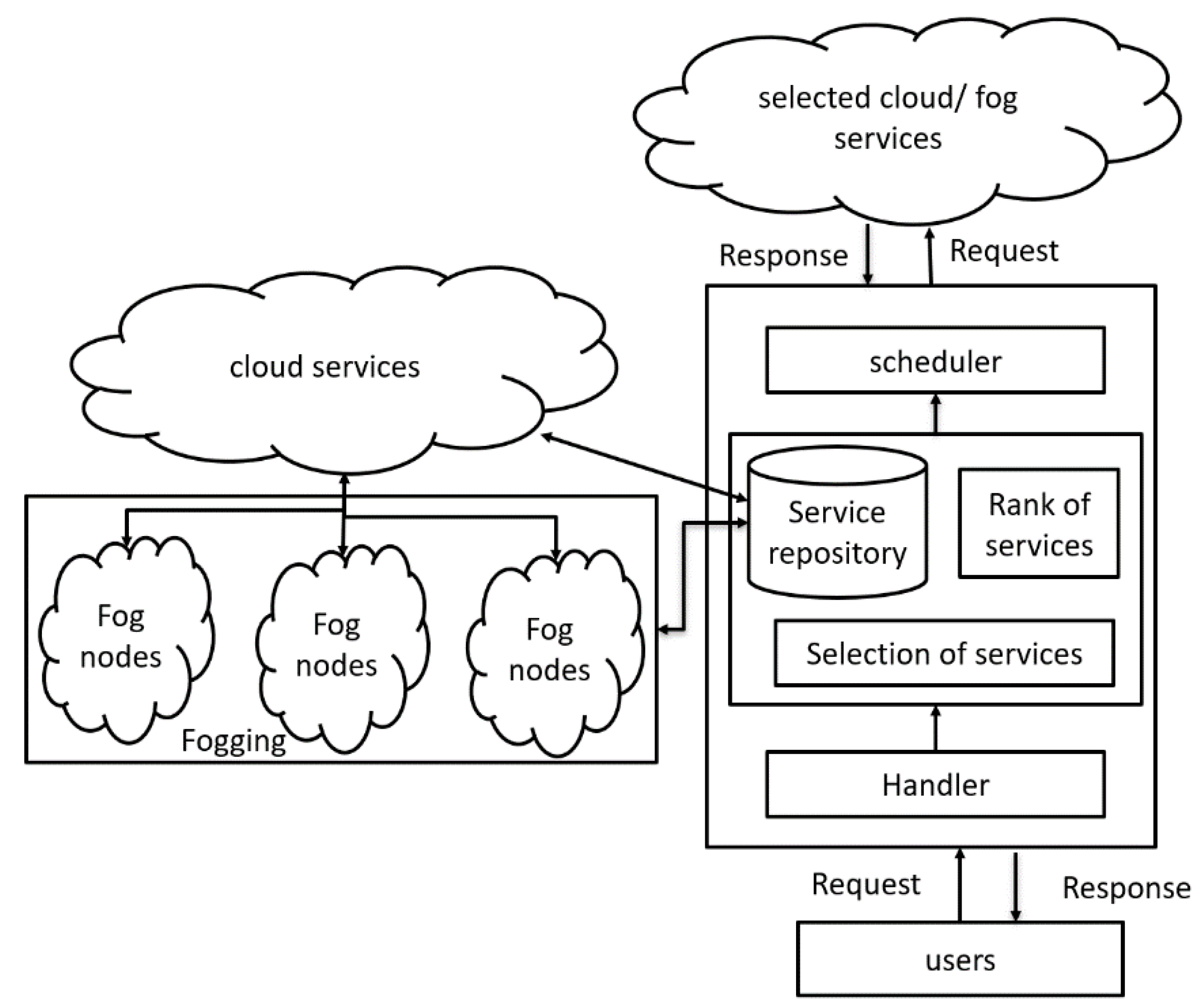
3.1. General Description of the Proposed Foglet
3.2. Selection of Criteria
3.3. Ranking Fog/Cloud Services
4. Ranking Procedure Applied
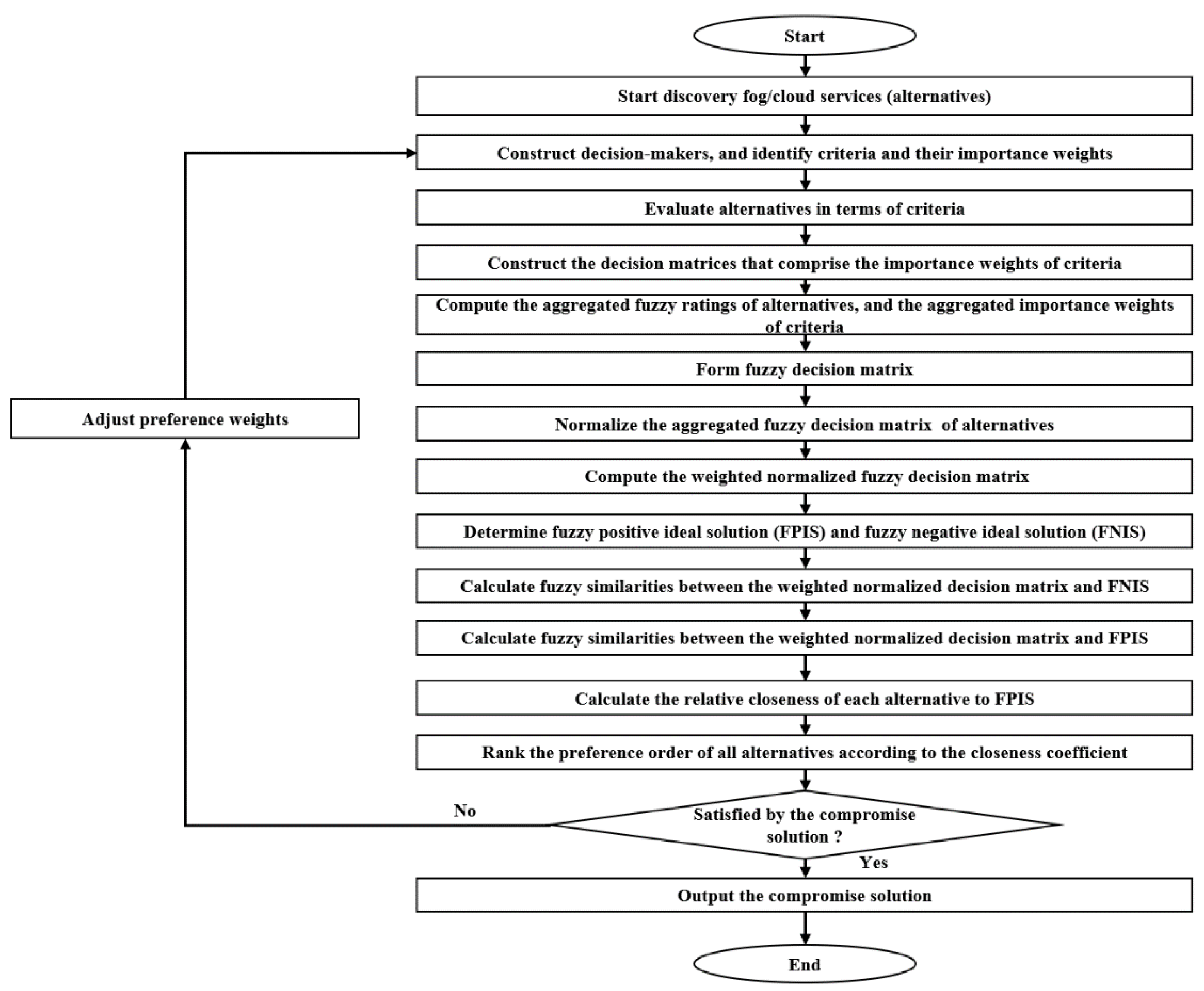
- Present the importance weights of the criteria determined by the formed decision-makers D1, D2, and D3 (Table 5).
- Rate the four alternatives by the formed decision-makers under the criteria (Table 6).
- Form the aggregated fuzzy decision matrix (Table 8).
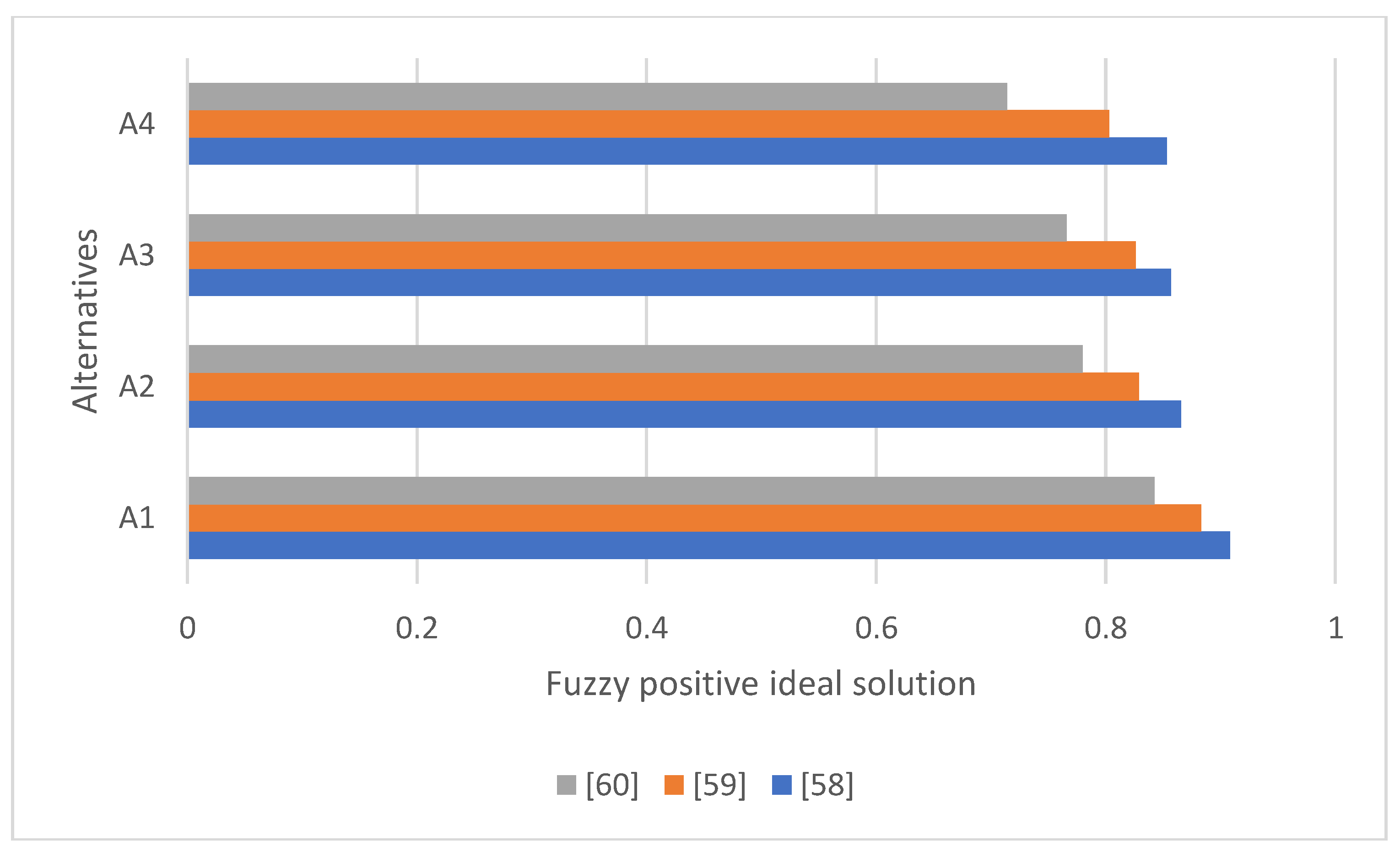
- Determine the fuzzy positive ideal solution (FPIS) and fuzzy negative ideal solution (FNIS) (Table 11).
- Calculate the similarity of each alternative from the fuzzy positive ideal solution (see Appendix A).
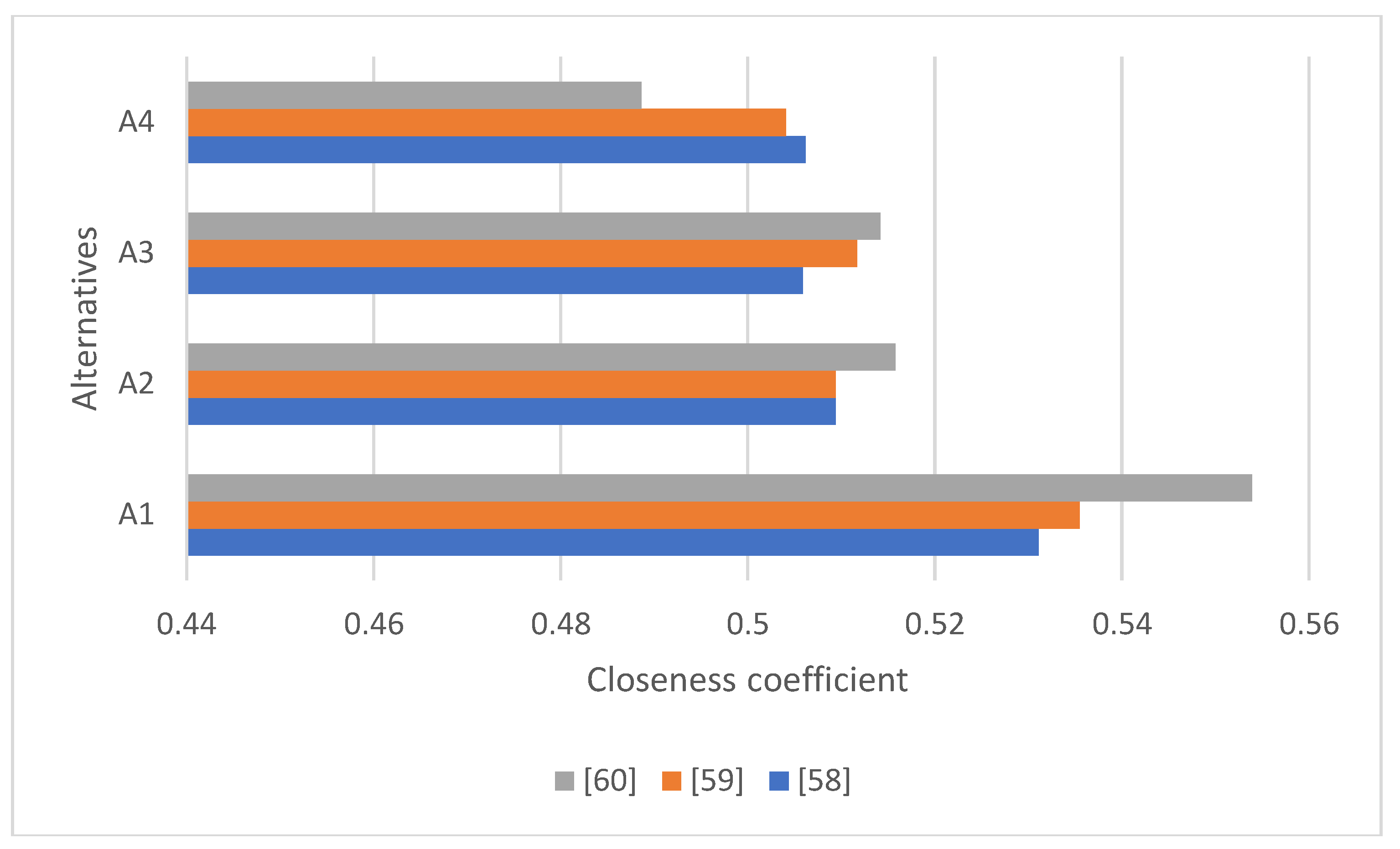
- Rank the alternatives according to the average similarity value (Table 12).
- In this numerical example, the ranking order to the four alternatives is A1 > A2 > A4 > A3. Therefore, the alternative A1 is the best service to process the user’s request.
5. Evaluation and Discussion
6. Conclusions
Funding
Conflicts of Interest
Appendix A. Similarity of Fuzzy Positive Ideal Solution Using MATLAB
| function Similarity =fuzzySimilarity (A,B,n) % n: number of criteria %A: Weighted normalized fuzzy decision matrix %B: fuzzy positive ideal solution for i=1:n P_A=sqrt((A(1)-A(2))^2+A(5)^2)+sqrt((A(3)-A(4))^2+A(5)^2)+(A(3)-A(2))+(A(4)-A(1)); P_B=sqrt((B(1)-B(2))^2+B(5)^2)+sqrt((B(3)-B(4))^2+B(5)^2)+(B(3)-B(2))+(B(4)-B(1)); minmax=(min(P_A,P_B)+min(A(5),B(5)))/(max(P_A,P_B)+max(A(5),B(5))); S1=1-sum(abs(A(1:4)-B(1:4)))/4; Similarity (i)=S1*minmax; End |
Appendix B. Similarity of Fuzzy Positive Ideal Solution Using MATLAB
| function Similarity =fuzzySimilarity (A,B,n) % n: number of criteria %A: Weighted normalized fuzzy decision matrix %B: fuzzy positive ideal solution for i=1:n PA=sqrt((A(1)-A(2))^2+A(5)^2)+sqrt((A(3)-A(4))^2+A(5)^2)+(A(3)-A(2))+(A(4)-A(1)); PB=sqrt((B(1)-B(2))^2+B(5)^2)+sqrt((B(3)-B(4))^2+B(5)^2)+(B(3)-B(2))+(B(4)-B(1)); aA=1/2*(A(5)*(A(3)-A(2)+A(4)-A(1))); aB=1/2*(B(5)*(B(3)-B(2)+B(4)-B(1))); temp=(min(PA,PB)/max(PA,PB))*(min(aA,aB) + min(A(5),B(5)))/(max(aA,aB) + max(A(5),B(5))); Similarity (i)=(1-(sum(abs(A(1:4)-B(1:4))))/4)*temp; end |
Appendix C. Similarity of Fuzzy Positive Ideal Solution Using MATLAB
| function Similarity =fuzzySimilarity (A,B,n) % n: number of criteria %A: Weighted normalized fuzzy decision matrix %B: fuzzy positive ideal solution for i=1:n if A(1)==A(4) Ya=A(5)/2; else Ya=A(5)*((A(3)-A(2))/(A(4)-A(1))+2); end if B(1)==B(4) Yb=B(5)/2; else Yb=B(5)*((B(3)-B(2))/(B(4)-B(1))+2); end Xa=(Ya*(A(3)+A(2))+(A(4)+A(1))*(A(5)-Ya))/2*A(5); Xb=(Yb*(B(3)+B(2))+(B(4)+B(1))*(B(5)-Yb))/2*B(5); Sa=A(4)-A(1); Sb=B(4)-B(1); if (Sa+Sb)/2==0 sasb=0; else sasb=1; end temp=(1-abs(Xa-Xb))^(sasb)*min(Ya,Yb)/max(Ya,Yb); S1=1-sum(abs(A(1:4)-B(1:4)))/4; Simil4=S1*temp; Similarity (i)=S1*temp; end |
References
- Talari, S.; Shafie-Khah, M.; Siano, P.; Loia, V.; Tommasetti, A.; Catalão, J. A review of smart cities based on the internet of things concept. Energies 2017, 10, 421. [Google Scholar] [CrossRef]
- Chaudhary, R.; Jindal, A.; Aujla, G.S.; Kumar, N.; Das, A.K.; Saxena, N. LSCSH: Lattice-Based Secure Cryptosystem for Smart Healthcare in Smart Cities Environment. IEEE Commun. Mag. 2018, 56, 24–32. [Google Scholar] [CrossRef]
- Tanwar, S.; Tyagi, S.; Kumar, S. The Role of Internet of Things and Smart Grid for the Development of a Smart City. In Intelligent Communication and Computational Technologies; Springer: Singapore, 2018; pp. 23–33. [Google Scholar]
- Menouar, H.; Guvenc, I.; Akkaya, K.; Uluagac, A.S.; Kadri, A.; Tuncer, A. UAV-enabled intelligent transportation systems for the smart city: Applications and challenges. IEEE Commun. Mag. 2017, 55, 22–28. [Google Scholar] [CrossRef]
- Tomasoni, M.; Capponi, A.; Fiandrino, C.; Kliazovich, D.; Granelli, F.; Bouvry, P. Profiling Energy Efficiency of Mobile Crowdsensing Data Collection Frameworks for Smart City Applications. In Proceedings of the 6th IEEE International Conference on Mobile Cloud Computing, Services, and Engineering (IEEE Mobile Cloud 2018), Bamberg, Germany, 26–29 March 2018. [Google Scholar]
- Hu, L.; Ni, Q. IoT-driven automated object detection algorithm for urban surveillance systems in Smart Cities. IEEE Internet Things J. 2018, 5, 747–754. [Google Scholar] [CrossRef]
- Prabhakaran, V.M.; Devatharini, P.; Dineshkumar, L.; Prasanth, K. Building a Big data provenance with its applications for Smart cities. Int. Res. J. Eng. Technol. 2018, 5, 451–457. [Google Scholar]
- Cai, H.; Xu, B.; Jiang, L.; Vasilakos, A.V. IoT-based big data storage systems in cloud computing: Perspectives and challenges. IEEE Internet Things J. 2017, 4, 75–87. [Google Scholar] [CrossRef]
- Jung, H.S.; Yoon, C.S.; Lee, Y.W.; Park, J.W.; Yun, C.H. Processing IoT Data with Cloud Computing for Smart Cities. Int. J. Web Appl. IJWA 2017, 9, 88–95. [Google Scholar]
- Cheng, B.; Solmaz, G.; Cirillo, F.; Kovacs, E.; Terasawa, K.; Kitazawa, A. FogFlow: Easy Programming of IoT Services Over Cloud and Edges for Smart Cities. IEEE Internet Things J. 2018, 5, 696–707. [Google Scholar] [CrossRef]
- Bangui, H.; Ge, M.; Buhnova, B.; Rakrak, S.; Raghay, S.; Pitner, T. Multi-Criteria Decision Analysis Methods in the Mobile Cloud Offloading Paradigm. J. Sens. Actuator Netw. 2017, 6, 25. [Google Scholar] [CrossRef]
- Whaiduzzaman, M.; Gani, A.; Anuar, N.B.; Shiraz, M.; Haque, M.N.; Haque, I.T. Cloud service selection using multicriteria decision analysis. Sci. World J. 2014, 2014, 459375. [Google Scholar] [CrossRef] [PubMed]
- Openfog. Available online: https://www.openfogconsortium.org/ (accessed on 13 May 2018).
- Butterfield, E.H. Fog Computing with Go: A Comparative Study. Bachelor’s Thesis, Claremont McKenna College, Claremont, CA, USA, 2016. [Google Scholar]
- Ha, K.; Chen, Z.; Hu, W.; Richter, W.; Pillai, P.; Satyanarayanan, M. Towards wearable cognitive assistance. In Proceedings of the 12th Annual International Conference on Mobile Systems, Applications, and Services, Bretton Woods, NH, USA, 16–19 June 2014; pp. 68–81. [Google Scholar]
- Accelerating Innovation and Collaboration for the Next Stage. Available online: http://www.ntt.co.jp/news2013/1311ehzt/pdf/xgxf131108d_all.pdf (accessed on 13 May 2018).
- Announcing the “Edge Computing” Concept and the “Edge Accelerated Web Platform” Prototype to Improve Response Time of Cloud Applications. Available online: http://www.ntt.co.jp/news2014/1401e/140123a.html (accessed on 13 May 2018).
- Truong, N.B.; Lee, G.M.; Ghamri-Doudane, Y. Software defined networking-based vehicular adhoc network with fog computing. In Proceedings of the 2015 IFIP/IEEE International Symposium on Integrated Network Management (IM), Ottawa, ON, Canada, 11–15 May 2015; pp. 1202–1207. [Google Scholar]
- Lin, C.C.; Chin, H.H.; Chen, W.B. Balancing latency and cost in software-defined vehicular networks using genetic algorithm. J. Netw. Comput. Appl. 2018, 116, 35–41. [Google Scholar] [CrossRef]
- Khan, A.A.; Abolhasan, M.; Ni, W. 5G next generation VANETs using SDN and fog computing framework. In Proceedings of the 2018 15th IEEE Annual Consumer Communications and Networking Conference (CCNC), Las Vegas, NV, USA, 12–15 January 2018; pp. 1–6. [Google Scholar]
- Xu, Y.; Mahendran, V.; Radhakrishnan, S. Towards SDN-based fog computing: MQTT broker virtualization for effective and reliable delivery. In Proceedings of the 2016 8th International Conference on Communication Systems and Networks (COMSNETS), Bangalore, India, 5–10 January 2016; pp. 1–6. [Google Scholar]
- Zhu, J.; Chan, D.S.; Prabhu, M.S.; Natarajan, P.; Hu, H.; Bonomi, F. Improving web sites performance using edge servers in fog computing architecture. In Proceedings of the 2013 IEEE 7th International Symposium on Service Oriented System Engineering (SOSE), Redwood City, CA, USA, 25–28 March 2013; pp. 320–323. [Google Scholar]
- Zeng, D.; Gu, L.; Guo, S.; Cheng, Z.; Yu, S. Joint optimization of task scheduling and image placement in fog computing supported software-defined embedded system. IEEE Trans. Comput. 2016, 65, 3702–3712. [Google Scholar] [CrossRef]
- Aazam, M.; St-Hilaire, M.; Lung, C.H.; Lambadaris, I. MeFoRE: QoE based resource estimation at Fog to enhance QoS in IoT. In Proceedings of the 2016 23rd International Conference on Telecommunications (ICT), Thessaloniki, Greece, 16–18 May 2016; pp. 1–5. [Google Scholar]
- Li, H.; Shou, G.; Hu, Y.; Guo, Z. Mobile edge computing: Progress and challenges. In Proceedings of the 2016 4th IEEE International Conference on Mobile Cloud Computing, Services, and Engineering (MobileCloud), Oxford, UK, 29 March–1 April 2016; pp. 83–84. [Google Scholar]
- Bartolí, A.; Hernández, F.; Val, L.; Gorchs, J.; Masip-Bruin, X.; Marín-Tordera, E.; Garcia, J.; Juan, A.; Jukan, A. Benefits of a Coordinated Fog-to-Cloud Resources Management Strategy on a Smart City Scenario. In Proceedings of the European Conference on Parallel Processing, Santiago de Compostela, Spain, 28 August–1 September 2017; Springer: Cham, Switzerland, 2017; pp. 283–291. [Google Scholar]
- Deng, R.; Lu, R.; Lai, C.; Luan, T.H. Towards power consumption-delay tradeoff by workload allocation in cloud-fog computing. In Proceedings of the 2015 IEEE International Conference on Communications (ICC), London, UK, 8–12 June 2015; pp. 3909–3914. [Google Scholar]
- Souza, V.B.; Ramírez, W.; Masip-Bruin, X.; Marín-Tordera, E.; Ren, G.; Tashakor, G. Handling service allocation in combined fog-cloud scenarios. In Proceedings of the 2016 IEEE International Conference on Communications (ICC), Kuala Lumpur, Malaysia, 22–27 May 2016; pp. 1–5. [Google Scholar]
- MF2C. Available online: http://www.mf2c-project.eu/ (accessed on 13 May 2018).
- Masri, W.; Al Ridhawi, I.; Mostafa, N.; Pourghomi, P. Minimizing delay in IoT systems through collaborative fog-to-fog (F2F) communication. In Proceedings of the 2017 Ninth International Conference on Ubiquitous and Future Networks (ICUFN), Milan, Italy, 4–7 July 2017; pp. 1005–1010. [Google Scholar]
- Zhao, Y.; Feng, X.; Chen, N.; Wang, Y.; Yu, Y.; Wang, H. A multi-dimensional hierarchical performance evaluation model for edge cloud platform. Procedia Comput. Sci. 2018, 129, 389–393. [Google Scholar] [CrossRef]
- Kimovski, D.; Ijaz, H.; Saurabh, N.; Prodan, R. An Adaptive Nature-inspired Fog Architecture. arXiv 2018, arXiv:1803.03444. [Google Scholar]
- Dhanya, N.M.; Kousalya, G.; Balarksihnan, P.; Raj, P. Fuzzy-Logic-Based Decision Engine for Offloading IoT Application Using Fog Computing. In Handbook of Research on Cloud and Fog Computing Infrastructures for Data Science; IGI Global: Hershey, PA, USA, 2018; pp. 175–194. [Google Scholar]
- Tang, Z.; Zhou, X.; Zhang, F.; Jia, W.; Zhao, W. Migration Modeling and Learning Algorithms for Containers in Fog Computing. IEEE Trans. Serv. Comput. 2018. [Google Scholar] [CrossRef]
- Wang, S.; Urgaonkar, R.; Zafer, M.; He, T.; Chan, K.; Leung, K.K. Dynamic service migration in mobile edge-clouds. In Proceedings of the IFIP Networking Conference (IFIP Networking), Toulouse, France, 20–22 May 2015; pp. 1–9. [Google Scholar]
- Tseng, F.H.; Tsai, M.S.; Tseng, C.W.; Yang, Y.T.; Liu, C.C.; Chou, L.D. A Lightweight Auto-Scaling Mechanism for Fog Computing in Industrial Applications. IEEE Trans. Ind. Inform. 2018, 14, 4529–4537. [Google Scholar] [CrossRef]
- Liu, X.; Deng, R.H.; Yang, Y.; Tran, H.N.; Zhong, S. Hybrid privacy-preserving clinical decision support system in fog–cloud computing. Future Gener. Comput. Syst. 2018, 78, 825–837. [Google Scholar] [CrossRef]
- Li, Q.; Zhao, L.; Gao, J.; Liang, H.; Zhao, L.; Tang, X. SMDP-based Coordinated Virtual Machine Allocations in Cloud-fog Computing Systems. IEEE Internet Things J. 2018, 5, 1977–1988. [Google Scholar] [CrossRef]
- Bitam, S.; Zeadally, S.; Mellouk, A. Fog computing job scheduling optimization based on bees swarm. Enterp. Inf. Syst. 2018, 12, 373–397. [Google Scholar] [CrossRef]
- Xu, J.; Liu, H.; Shao, W.; Deng, K. Quantitative 3-D shape features based tumor identification in the fog computing architecture. J. Ambient Intell. Humaniz. Comput. 2018. [Google Scholar] [CrossRef]
- Rahman, F.H.; Au, T.W.; Newaz, S.H.; Suhaili, W.S. Trustworthiness in Fog: A Fuzzy Approach. In Proceedings of the 2017 VI International Conference on Network, Communication and Computing, Kunming, China, 8–10 December 2017; pp. 207–211. [Google Scholar]
- Medina, J.; Espinilla, M.; Zafra, D.; Martínez, L.; Nugent, C. Fuzzy Fog Computing: A Linguistic Approach for Knowledge Inference in Wearable Devices. In Proceedings of the International Conference on Ubiquitous Computing and Ambient Intelligence, Philadelphia, PA, USA, 7–10 November 2017; Springer: Cham, Switzerland, 2017; pp. 473–485. [Google Scholar]
- Soleymani, S.A.; Abdullah, A.H.; Zareei, M.; Anisi, M.H.; Vargas-Rosales, C.; Khan, M.K.; Goudarzi, S. A Secure Trust Model Based on Fuzzy Logic in Vehicular Ad Hoc Networks with Fog Computing. IEEE Access 2017, 5, 15619–15629. [Google Scholar] [CrossRef]
- Ramalho, F.; Neto, A.; Santos, K.; Agoulmine, N. Enhancing ehealth smart applications: A fog-enabled approach. In Proceedings of the 2015 17th International Conference on E-health Networking, Application and Services (HealthCom), Boston, MA, USA, 14–17 October 2015; pp. 323–328. [Google Scholar]
- Chen, R.-Y. An intelligent value stream-based approach to collaboration of food traceability cyber physical system by fog computing. Food Control 2017, 71, 124–136. [Google Scholar] [CrossRef]
- Ningning, S.; Chao, G.; Xingshuo, A.; Qiang, Z. Fog computing dynamic load balancing mechanism based on graph repartitioning. China Commun. 2016, 13, 156–164. [Google Scholar] [CrossRef]
- Miao, Z.; Li, C.; Zhu, L.; Han, X.; Wang, M.; Cai, X.; Liu, Z.; Xiong, L. On resource management in vehicular ad hoc networks: A fuzzy optimization scheme. In Proceedings of the 2016 IEEE 83rd Vehicular Technology Conference (VTC Spring), Nanjing, China, 15–18 May 2016; pp. 1–5. [Google Scholar]
- Jutila, M. An adaptive edge router enabling internet of things. IEEE Internet Things J. 2016, 3, 1061–1069. [Google Scholar] [CrossRef]
- Zhou, B.; Dastjerdi, A.V.; Calheiros, R.N.; Srirama, S.N.; Buyya, R. A context sensitive offloading scheme for mobile cloud computing service. In Proceedings of the 2015 IEEE 8th International Conference on Cloud Computing (CLOUD), New York, NY, USA, 27 June–2 July 2015; pp. 869–876. [Google Scholar]
- Ravi, A.; Peddoju, S.K. Handoff strategy for improving energy efficiency and cloud service availability for mobile devices. Wirel. Pers. Commun. 2015, 81, 101–132. [Google Scholar] [CrossRef]
- Neto, J.L.; Yu, S.Y.; Macedo, D.F.; Nogueira, J.M.; Langar, R.; Secci, S. ULOOF: A User Level Online Offloading Framework for Mobile Edge Computing. IEEE Trans. Mob. Comput. 2018, 17, 2660–2674. [Google Scholar] [CrossRef]
- Ghasemi-Falavarjani, S.; Nematbakhsh, M.; Ghahfarokhi, B.S. Context-aware multi-objective resource allocation in mobile cloud. Comput. Electr. Eng. 2015, 44, 218–240. [Google Scholar] [CrossRef]
- Rashidi, S.; Sharifian, S. Cloudlet dynamic server selection policy for mobile task off-loading in mobile cloud computing using soft computing techniques. J. Supercomput. 2017, 73, 3796–3820. [Google Scholar] [CrossRef]
- Zannat, H.; Hossain, M.S. A hybrid framework using Markov decision process for mobile code offloading. In Proceedings of the 2016 19th International Conference on Computer and Information Technology (ICCIT), Dhaka, Bangladesh, 18–20 December 2016; pp. 31–35. [Google Scholar]
- Pattar, S.; Buyya, R.; Venugopal, K.R.; Iyengar, S.S.; Patnaik, L.M. Searching for the IoT Resources: Fundamentals, Requirements, Comprehensive Review and Future Directions. IEEE Commun. Surv. Tutor. 2018, 20, 2101–2132. [Google Scholar] [CrossRef]
- Behzadian, M.; Otaghsara, S.K.; Yazdani, M.; Ignatius, J. A state-of the-art survey of TOPSIS applications. Expert Syst. Appl. 2012, 39, 13051–13069. [Google Scholar] [CrossRef]
- Collan, M.; Luukka, P. Evaluating R and D projects as investments by using an overall ranking from four new fuzzy similarity measure-based TOPSIS variants. IEEE Trans. Fuzzy Syst. 2014, 22, 505–515. [Google Scholar] [CrossRef]
- Wei, S.H.; Chen, S.M. A new approach for fuzzy risk analysis based on similarity measures of generalized fuzzy numbers. Expert Syst. Appl. 2009, 36, 589–598. [Google Scholar] [CrossRef]
- Hejazi, S.R.; Doostparast, A.; Hosseini, S.M. An improved fuzzy risk analysis based on a new similarity measures of generalized fuzzy numbers. Expert Syst. Appl. 2011, 38, 9179–9185. [Google Scholar] [CrossRef]
- Chen, S.-J.; Chen, S.-M. A new method to measure the similarity between fuzzy numbers. In Proceedings of the 10th IEEE International Conference on Fuzzy Systems, Melbourne, Australia, 2–5 December 2001; pp. 1123–1126. [Google Scholar]
- Taylor, R.; Baron, D.; Schmidt, D. The world in 2025-predictions for the next ten years. In Proceedings of the 2015 10th International Microsystems, Packaging, Assembly and Circuits Technology Conference (IMPACT), Taipei, Taiwan, 21–23 October 2015; pp. 192–195. [Google Scholar]
- Marsh, K.D.; Sculpher, M.; Caro, J.J.; Tervonen, T. The use of MCDA in HTA: Great potential, but more effort needed. Value Health 2018, 21, 394–397. [Google Scholar] [CrossRef] [PubMed]



| Year | Paper | Main Contribution | MCDA Method Used |
|---|---|---|---|
| 2018 | [31] | Propose a new multi-dimensional hierarchical performance evaluation model for edge platforms. | AHP (Analytic Hierarchy Process) |
| 2018 | [32] | Propose an adaptive nature inspired smartFog. | NSGA-II multi-objective |
| 2018 | [33] | Make decision whether to execute tasks locally or offload them to fog servers. | Fuzzy-logic |
| 2018 | [34] | Propose container migration algorithms to support mobility tasks. | Markov Decision Process |
| 2015 | [35] | Propose a dynamic Service Migration in Mobile Edge-Clouds. | Markov Decision Process |
| 2018 | [36] | Propose a Lightweight Auto-Scaling Mechanism for Fog Computing by integrating hypervisor technique with container virtualization. | Fuzzy-logic |
| 2018 | [37] | Propose a hybrid model for clinical decision support system in fog–cloud computing. | Neural network |
| 2018 | [38] | Propose two semi-Markov decision process-based coordinated virtual machine allocation methods to balance the tradeoff in cloud-fog platforms. | Markov decision process |
| 2018 | [39] | Optimize the scheduling of Fog computing job based on bees swarm. | Fuzzy theory |
| 2018 | [40] | Propose a framework for data processing in fog computing. | fuzzy |
| 2017 | [41] | Evaluate the trustworthiness of the fog servers. | Fuzzy |
| 2017 | [42] | Propose a linguistic framework based on fogging for knowledge inference in wearable devices. | Fuzzy |
| 2017 | [43] | Propose a secure trust model based in vehicular ad hoc networks. | Fuzzy logic |
| 2015 | [44] | Deploy and evaluate an extended CAMA (Context-Aware Mobile Approach) hub-service in fogging. | Fuzzy logic and neural networks |
| 2017 | [45] | Describe a distributive and central traceable stream mechanism for traceability process in fogging. | Fuzzy |
| 2016 | [46] | Propose a dynamic load balancing mechanism in fog computing. | Graph repartitioning |
| 2016 | [47] | Propose a framework based on fogging for managing resources in Vehicular Ad Hoc. | Fuzzy logic |
| 2016 | [48] | Propose an adaptive edge router for monitoring and controlling the network quality-of-service changes within heterogeneous networks. | Fuzzy weighted queueing |
| 2015 | [49] | Propose a framework for selecting an adaptive mobile cloud service from clouds or cloudlets. | AHP and TOPSIS (Technique for Order of Preference by Similarity to Ideal Solution) |
| 2015 | [50] | Select a candidate among cloud, cloudlet or mobile devices to save energy consumption and increase the service availability for user (the distances of the fuzzy positive-ideal solution and fuzzy negative-ideal solution are used to rank the alternatives). | TOPSIS and Fuzzy |
| 2018 | [51] | Propose an online offloading framework for mobile edge computation offloading. | Binary decision |
| 2015 | [52] | Propose a middleware for resource allocation and offloading management of neighboring mobile devices. | TOPSIS |
| 2017 | [53] | Redirect users’ requests dynamically from host cloudlet to other cloudlets based on the latest network and server status. | Neuro-Fuzzy |
| 2016 | [54] | Propose a hybrid approach based on parameters of the mobile device and offloading servers for mobile code offloading. | Markov decision process |
| Criteria | Description |
|---|---|
| Availability | It refers to the guarantee of the level of availability in the edge/cloud services. |
| Usability | It describes the use of fog/cloud services to support users’ requirements. |
| Scalability | It is the capacity of fog/cloud services to fit a given problem and use resources effectively. |
| Adaptability | It is the ability of fog/cloud services to adjust according to users’ requests. |
| Performance | It defines the quality of service provided by the fog/cloud providers. |
| Proximity | It describes the closeness relationship between the users and fog/cloud services by using geographic information to satisfy different users’ demands at different locations. |
| Mobility | It is the ability to provide suitable fog/cloud services to support timely the high mobility of applications. |
| Cost | It represents the cost of fog/cloud resources. |
| Network | It refers to different network types that have a large impact on the communication between users and services. |
| Security | It is the ability of fog/cloud providers to keep the high confidence of privacy and data safety that could be attained by the fog/cloud services. |
| Linguistic Values | Fuzzy Ranges |
|---|---|
| Very low (VL) | [0 0 0.1 0.2 1] |
| Low (L) | [0.1 0.2 0.2 0.3 1] |
| Medium low (ML) | [0.2 0.3 0.4 0.5 1] |
| Medium (M) | [0.4 0.5 0.5 0.6 1] |
| Medium high (MH) | [0.5 0.6 0.7 0.8 1] |
| High (H) | [0.7 0.8 0.8 0.9 1] |
| Very high (VH) | [0.8 0.9 1.0 1.0 1] |
| Linguistic Values | Fuzzy Ranges |
|---|---|
| Very Poor (VP) | [0,0,1,2,1] |
| Poor (P) | [1,2,2,3,1] |
| Medium Poor (MP) | [2,3,4,5,1] |
| Fair(F) | [4,5,5,6,1] |
| Medium Good (MG) | [5,6,7,8,1] |
| Good (G) | [7,8,8,9,1] |
| Very Good (VG) | [8,9,10,10,1] |
| Criteria | Decision Makers Assessments | ||
|---|---|---|---|
| D1 | D2 | D3 | |
| C1 | VH | VH | VH |
| C2 | H | VH | VH |
| C3 | H | VH | VH |
| C4 | VH | H | VH |
| C5 | H | M | H |
| C6 | VH | VH | H |
| C7 | H | H | VH |
| C8 | H | H | VH |
| C9 | VH | H | VH |
| C10 | VH | VH | VH |
| Criteria | Alternatives | Decision Makers Assessments | ||
|---|---|---|---|---|
| D1 | D2 | D3 | ||
| C1 | A1 | G | MG | F |
| A2 | G | G | F | |
| A3 | G | MG | G | |
| A4 | F | P | VG | |
| C2 | A1 | F | MG | G |
| A2 | P | MP | MP | |
| A3 | G | MG | F | |
| A4 | G | MG | G | |
| C3 | A1 | MG | G | F |
| A2 | G | MG | F | |
| A3 | MP | G | G | |
| A4 | G | P | VG | |
| C4 | A1 | MG | F | MG |
| A2 | MP | MP | P | |
| A3 | MG | F | F | |
| A4 | MG | MG | VG | |
| C5 | A1 | G | F | MG |
| A2 | MG | MG | P | |
| A3 | MG | G | F | |
| A4 | G | F | G | |
| C6 | A1 | MG | F | MG |
| A2 | MP | MP | P | |
| A3 | MG | F | MG | |
| A4 | G | P | VG | |
| C7 | A1 | G | MG | G |
| A2 | MG | G | F | |
| A3 | G | G | MG | |
| A4 | G | MG | G | |
| C8 | A1 | F | MG | MG |
| A2 | P | MP | MP | |
| A3 | G | MP | F | |
| A4 | G | MG | G | |
| C9 | A1 | F | F | MG |
| A2 | MG | G | MG | |
| A3 | G | P | F | |
| A4 | F | MG | F | |
| C10 | A1 | F | G | G |
| A2 | MG | G | F | |
| A3 | MP | MP | G | |
| A4 | VP | MG | F | |
| Criteria | Alternatives | Decision Makers Assessments | ||
|---|---|---|---|---|
| D1 | D2 | D3 | ||
| C1 | A1 | [7,8,8,9,1] | [5,6,7,8,1] | [4,5,5,6,1] |
| A2 | [2,3,4,5,1] | [7,8,8,9,1] | [7,8,8,9,1] | |
| A3 | [5,6,7,8,1] | [4,5,5,6,1] | [5,6,7,8,1] | |
| A4 | [7,8,8,9,1] | [2,3,4,5,1] | [4,5,5,6,1] | |
| C2 | A1 | [7,8,8,9,1] | [7,8,8,9,1] | [4,5,5,6,1] |
| A2 | [7,8,8,9,1] | [1,2,2,3,1] | [8,9,10,10,1] | |
| A3 | [2,3,4,5,1] | [2,3,4,5,1] | [1,2,2,3,1] | |
| A4 | [7,8,8,9,1] | [5,6,7,8,1] | [7,8,8,9,1] | |
| C3 | A1 | [7,8,8,9,1] | [5,6,7,8,1] | [7,8,8,9,1] |
| A2 | [5,6,7,8,1] | [4,5,5,6,1] | [5,6,7,8,1] | |
| A3 | [5,6,7,8,1] | [4,5,5,6,1] | [5,6,7,8,1] | |
| A4 | [4,5,5,6,1] | [4,5,5,6,1] | [5,6,7,8,1] | |
| C4 | A1 | [4,5,5,6,1] | [1,2,2,3,1] | [8,9,10,10,1] |
| A2 | [2,3,4,5,1] | [2,3,4,5,1] | [1,2,2,3,1] | |
| A3 | [7,8,8,9,1] | [1,2,2,3,1] | [8,9,10,10,1] | |
| A4 | [5, 6, 7, 8, 1] | [7, 8, 8, 9, 1] | [5, 6, 7, 8, 1] | |
| C5 | A1 | [4, 5, 5, 6, 1] | [5, 6, 7, 8, 1] | [7, 8, 8, 9, 1] |
| A2 | [5, 6, 7, 8, 1] | [4, 5, 5, 6, 1] | [4, 5, 5, 6, 1] | |
| A3 | [7, 8, 8, 9, 1] | [5, 6, 7, 8, 1] | [7, 8, 8, 9, 1] | |
| A4 | [7, 8, 8, 9, 1] | [1, 2, 2, 3, 1] | [4, 5, 5, 6, 1] | |
| C6 | A1 | [1, 2, 2, 3, 1] | [2, 3, 4, 5, 1] | [2, 3, 4, 5, 1] |
| A2 | [5, 6, 7, 8, 1] | [5, 6, 7, 8, 1] | [8, 9, 10, 10, 1] | |
| A3 | [5, 6, 7, 8, 1] | [7, 8, 8, 9, 1] | [4, 5, 5, 6, 1] | |
| A4 | [4, 5, 5, 6, 1] | [5, 6, 7, 8, 1] | [4, 5, 5, 6, 1] | |
| C7 | A1 | [7, 8, 8, 9, 1] | [5, 6, 7, 8, 1] | [4, 5, 5, 6, 1] |
| A2 | [7, 8, 8, 9, 1] | [4, 5, 5, 6, 1] | [5, 6, 7, 8, 1] | |
| A3 | [7, 8, 8, 9, 1] | [7, 8, 8, 9, 1] | [5, 6, 7, 8, 1] | |
| A4 | [4, 5, 5, 6, 1] | [7, 8, 8, 9, 1] | [7, 8, 8, 9, 1] | |
| C8 | A1 | [7, 8, 8, 9, 1] | [5, 6, 7, 8, 1] | [7, 8, 8, 9, 1] |
| A2 | [5, 6, 7, 8, 1] | [5, 6, 7, 8, 1] | [1, 2, 2, 3, 1] | |
| A3 | [7, 8, 8, 9, 1] | [5, 6, 7, 8, 1] | [7, 8, 8, 9, 1] | |
| A4 | [5, 6, 7, 8, 1] | [7, 8, 8, 9, 1] | [4, 5, 5, 6, 1] | |
| C9 | A1 | [5, 6, 7, 8, 1] | [7, 8, 8, 9, 1] | [4, 5, 5, 6, 1] |
| A2 | [5, 6, 7, 8, 1] | [7, 8, 8, 9, 1] | [4, 5, 5, 6, 1] | |
| A3 | [4, 5, 5, 6, 1] | [5, 6, 7, 8, 1] | [5, 6, 7, 8, 1] | |
| A4 | [2, 3, 4, 5, 1] | [2, 3, 4, 5, 1] | [7, 8, 8, 9, 1] | |
| C10 | A1 | [7, 8, 8, 9, 1] | [5, 6, 7, 8, 1] | [4, 5, 5, 6, 1] |
| A2 | [7, 8, 8, 9, 1] | [4, 5, 5, 6, 1] | [7, 8, 8, 9, 1] | |
| A3 | [1, 2, 2, 3, 1] | [2, 3, 4, 5, 1] | [2, 3, 4, 5, 1] | |
| A4 | [0, 0, 1, 2, 1] | [5, 6, 7, 8, 1] | [4, 5, 5, 6, 1] | |
| C1 | C2 | C3 | C4 | C5 | C6 | C7 | C8 | C9 | C10 | |
|---|---|---|---|---|---|---|---|---|---|---|
| A1 | [4,6.333,6.666,9] | [4, 7, 7, 9] | [5,7.3333,7.6666,9] | [1,5.3333,5.6666,10] | [4,6.3333,6.6666,9] | [1,2.666,3.3333,5] | [4,6.3333,6.6666,9] | [5,7.3333,7.6666,9] | [4,6.3333,6.6666,9] | [4,6.3333,6.6666,9] |
| A2 | [2,6.333,6.666,9] | [1,6.3333,6.6666,10] | [4,5.6666,6.3333,8] | [1,2.6666,3.3333,5] | [4,5.3333,5.6666,8] | [5,7,8,10] | [4,6.3333,6.6666,9] | [1,4.6666,5.3333,8] | [4,6.3333,6.6666,9] | [4,7,7,9] |
| A3 | [4,5.6666,6.3333,8] | [1,2.6666,3.3333,5] | [4,5.6666,6.3333,8] | [1,6.3333,6.6666,10] | [5,7.3333,7.6666,9] | [4,6.3333,6.6666,9] | [5,7.3333,7.6666,9] | [5,7.3333,7.6666,9] | [4,5.6666,6.3333,8] | [1,2.6666,3.3333,5] |
| A4 | [2,5.3333,5.6666,9] | [5,7.3333,7.6666,9] | [4,5.3333,5.6666,8] | [5,6.6666,7.3333,9] | [1,5,5,9] | [4,5.3333,5.6666,8] | [4,7,7,9] | [4,6.3333,6.6666,9] | [2,4.6666,5.3333,9] | [0,3.6666,4.3333,8] |
| C1 | C2 | C3 | C4 | C5 | C6 | C7 | C8 | C9 | C10 | |
|---|---|---|---|---|---|---|---|---|---|---|
| A1 | [0.4444,0.7037,0.7407,1] | [0.4,0.7,0.7,0.9] | [0.5555,0.8148,0.8518,1] | [0.1,0.5333,0.5666,1] | [0.4444,0.7037,0.7407,1] | [0.1,0.2666,0.3333,0.5] | [0.4444,0.7037,0.7407,1] | [0.5555,0.8148,0.8518,1] | [0.4444,0.7037,0.7407,1] | [0.4444,0.7037,0.7407,1] |
| A2 | [0.2222,0.7037,0.7407,1] | [0.1,0.6333,0.6666,1] | [0.4444,0.6296,0.7037,0.8888] | [0.1,0.2666,0.33333,0.5] | [0.4444,0.59253,0.6296,0.8888] | [0.50,0.7,0.8,1] | [0.4444,0.70374,0.7407,1] | [0.1111,0.5185,0.5925,0.8888] | [0.4444,0.7037,0.7407,1] | [0.4444,0.777,0.777,1] |
| A3 | [0.4444,0.6296,0.7037,0.8888] | [0.1,0.2666,0.3333,0.5] | [0.4444,0.6296,0.7037,0.8888] | [0.1,0.6333,0.6666,1] | [0.5555,0.8148,0.8518,1] | [0.4,0.6333,0.6666,0.9] | [0.5555,0.8148,0.8518,1] | [0.5555,0.8148,0.8518,1] | [0.4444,0.62962,0.7037,0.8888] | [0.1111,0.2962,0.3703,0.5555] |
| A4 | [0.2222,0.5925,0.6296,1] | [0.5,0.7333,0.7666,0.9] | [0.4444,0.5925,0.6296,0.8888] | [0.5,0.6666,0.7333,0.9] | [0.1111,0.5555,0.5555,1] | [0.4,0.5333,0.5666,0.8] | [0.4444,0.7777,0.7777,1] | [0.4444,0.7037,0.7407,1] | [0.2222,0.5185,0.5925,1] | [0,0.4074,0.4814,0.8888] |
| C1 | C2 | C3 | C4 | C5 | C6 | C7 | C8 | C9 | C10 | |
|---|---|---|---|---|---|---|---|---|---|---|
| A1 | [0.3555,0.6333,0.7407,1] | [0.28,0.6066,0.6533,0.9] | [0.3888,0.7061,0.795,1] | [0.07,0.4622,0.5288,1] | [0.1777,0.4925,0.51859,0.9] | [0.07,0.2311,0.3111,0.5] | [0.3111,0.5864,0.6419,1] | [0.3888,0.679,0.7382,1] | [0.3111,0.6098,0.6913,1] | [0.3555,0.6333,0.7407,1] |
| A2 | [0.1777,0.6333,0.74074,1] | [0.07,0.5488,0.6222,1] | [0.3111,0.5456,0.6567,0.8888] | [0.07,0.2311,0.3111,0.5] | [0.1777,0.4148,0.4407,0.8] | [0.35,0.6066,0.7466,1] | [0.3111,0.5864,0.6419,1] | [0.0777,0.4320,0.5135,0.8888] | [0.3111,0.6098,0.6913,1] | [0.3555,0.7,0.7777,1] |
| A3 | [0.3555,0.5666,0.7037,0.8] | [0.07,0.2311,0.3111,0.5] | [0.3111,0.5456,0.6567,0.8] | [0.07,0.5488,0.6222,1] | [0.2222,0.5703,0.5962,0.9] | [0.28,0.5488,0.6222,0.9] | [0.3888,0.67901,0.7382,1] | [0.3888,0.679,0.7382,1] | [0.3111,0.5456,0.6567,0.8888] | [0.0888,0.2666,0.3703,0.5555] |
| A4 | [0.1777,0.5333,0.6296,1] | [0.35,0.63555,0.7155,0.9] | [0.3111,0.5135,0.5876,0.8888] | [0.35,0.5777,0.6844,0.9] | [0.0444,0.3888,0.3888,0.9] | [0.28,0.4622,0.5288,0.8] | [0.3111,0.6481,0.6740,1] | [0.3111,0.5864,0.6419,1] | [0.1555,0.4493,0.5530,1] | [0,0.3666,0.4814,0.8] |
| C1 | C2 | C3 | C4 | C5 | C6 | C7 | C8 | C9 | C10 | |
|---|---|---|---|---|---|---|---|---|---|---|
| FPIS | [0.3555,0.6333,0.7407,1] | [0.35,0.6355,0.7155,1] | [0.3888,0.7061,0.795,1] | [0.35,0.5777,0.6844,1] | [0.2222,0.5703,0.5962,0.9] | [0.35,0.6066,0.7466,1] | [0.3888,0.679,0.7382,1] | [0.3888,0.679,0.7382,1] | [0.3111,0.6098,0.6913,1] | [0.3555,0.7,0.7777,1] |
| FNIS | [0.1777,0.5333,0.6296,0.8888] | [0.07,0.2311,0.3111,0.5] | [0.3111,0.5135,0.5876,0.8888] | [0.07,0.2311,0.3111,0.5] | [0.04444,0.3888,0.3888,0.8] | [0.07,0.2311,0.3111,0.5] | [0.3111,0.5864,0.6419,1] | [0.0777,0.432,0.5135,0.8888] | [0.1555,0.4493,0.5530,0.8888] | [0,0.2666,0.3703,0.5555] |
| A1 | A2 | A3 | A4 | |
|---|---|---|---|---|
| Similarity of each alternative from FPIS: | 0.9078 | 0.8658 | 0.8571 | 0.8535 |
| Similarity of each alternative from FNIS: | 0.8016 | 0.8339 | 0.8371 | 0.8328 |
| Calculation of closeness coefficient for the alternatives: | 0.5311 | 0.5094 | 0.5059 | 0.5062 |
| Order of the alternatives: | A1 > A2 > A4 > A3 | |||
© 2018 by the authors. Licensee MDPI, Basel, Switzerland. This article is an open access article distributed under the terms and conditions of the Creative Commons Attribution (CC BY) license (http://creativecommons.org/licenses/by/4.0/).
Share and Cite
Bangui, H.; Rakrak, S.; Raghay, S.; Buhnova, B. Moving towards Smart Cities: A Selection of Middleware for Fog-to-Cloud Services. Appl. Sci. 2018, 8, 2220. https://doi.org/10.3390/app8112220
Bangui H, Rakrak S, Raghay S, Buhnova B. Moving towards Smart Cities: A Selection of Middleware for Fog-to-Cloud Services. Applied Sciences. 2018; 8(11):2220. https://doi.org/10.3390/app8112220
Chicago/Turabian StyleBangui, Hind, Said Rakrak, Said Raghay, and Barbora Buhnova. 2018. "Moving towards Smart Cities: A Selection of Middleware for Fog-to-Cloud Services" Applied Sciences 8, no. 11: 2220. https://doi.org/10.3390/app8112220
APA StyleBangui, H., Rakrak, S., Raghay, S., & Buhnova, B. (2018). Moving towards Smart Cities: A Selection of Middleware for Fog-to-Cloud Services. Applied Sciences, 8(11), 2220. https://doi.org/10.3390/app8112220