

Habitat Potential Mapping of Marten (Martes flavigula) and Leopard Cat (Prionailurus bengalensis) in South Korea Using Artificial Neural Network Machine Learning




Abstract
1. Introduction
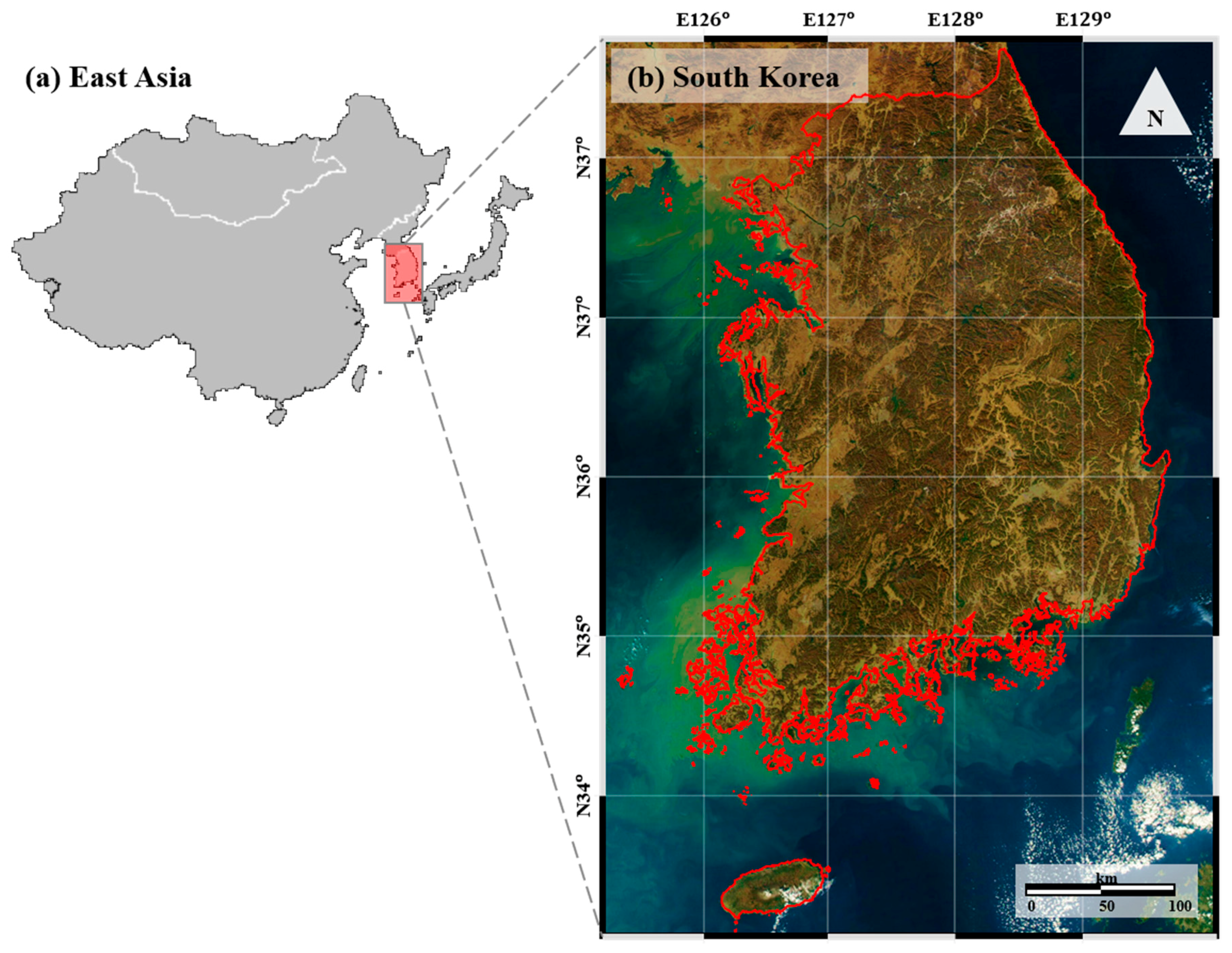
2. Data
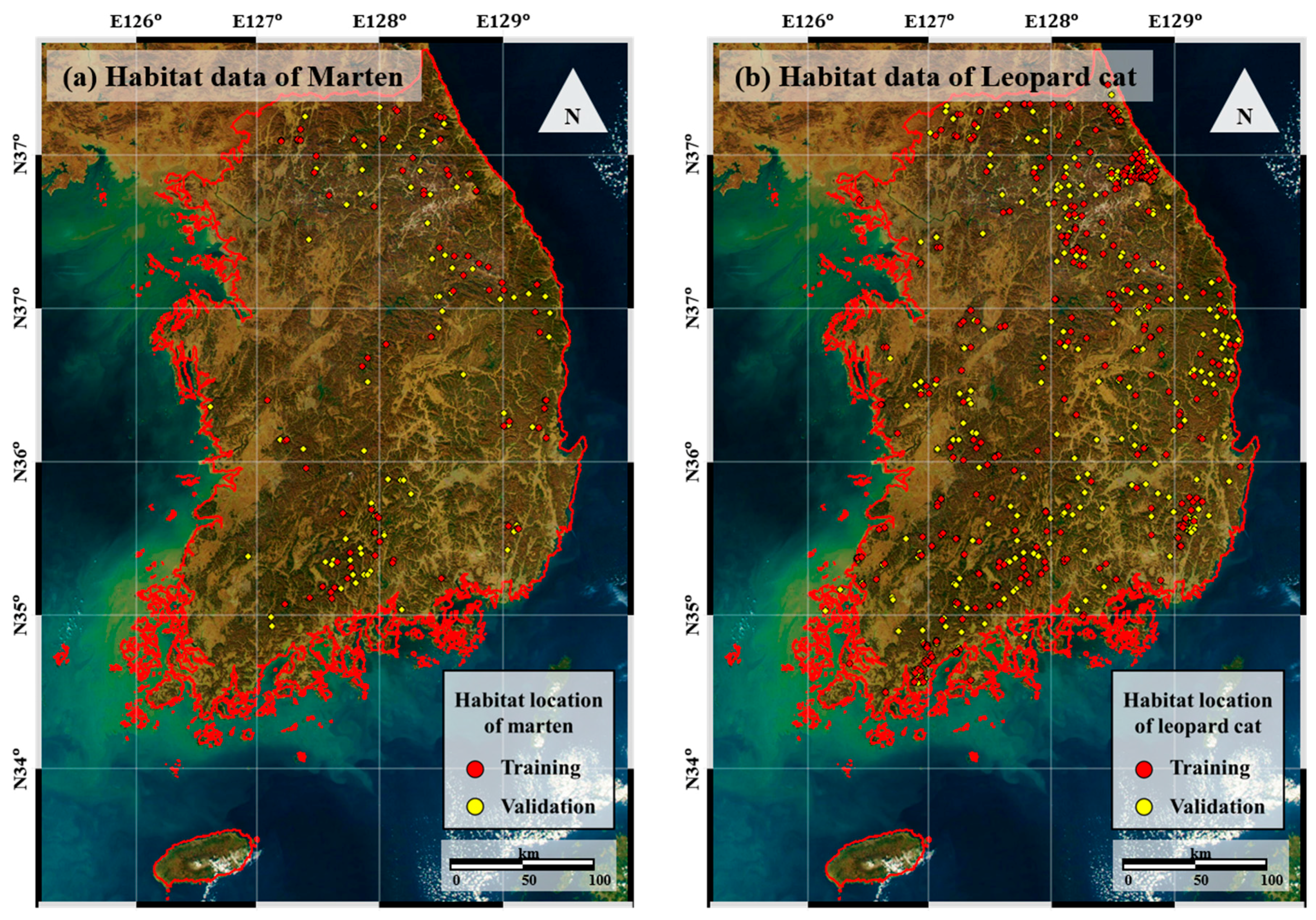
2.1. Habitat Survey
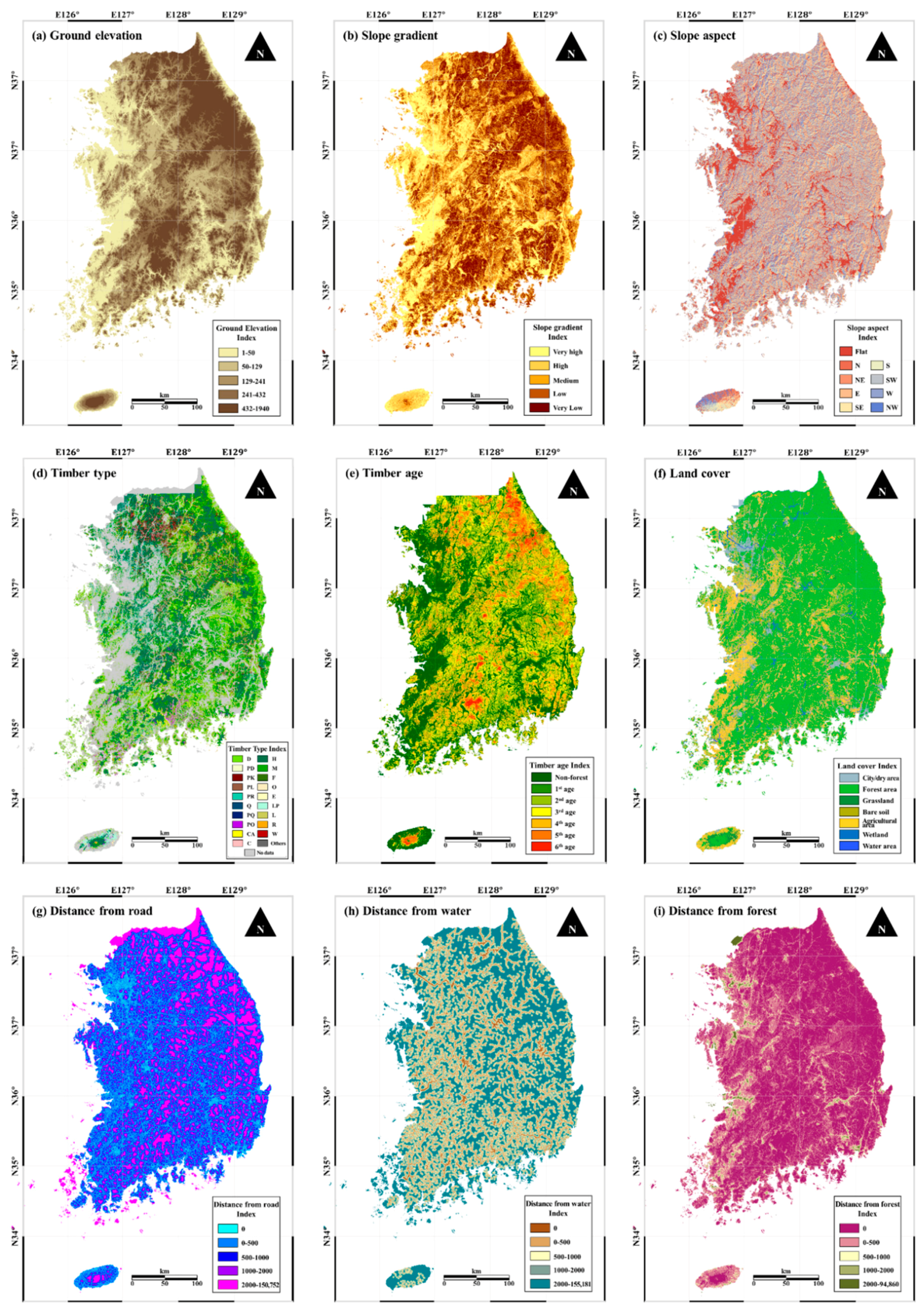
2.2. Habitat-Related Factors
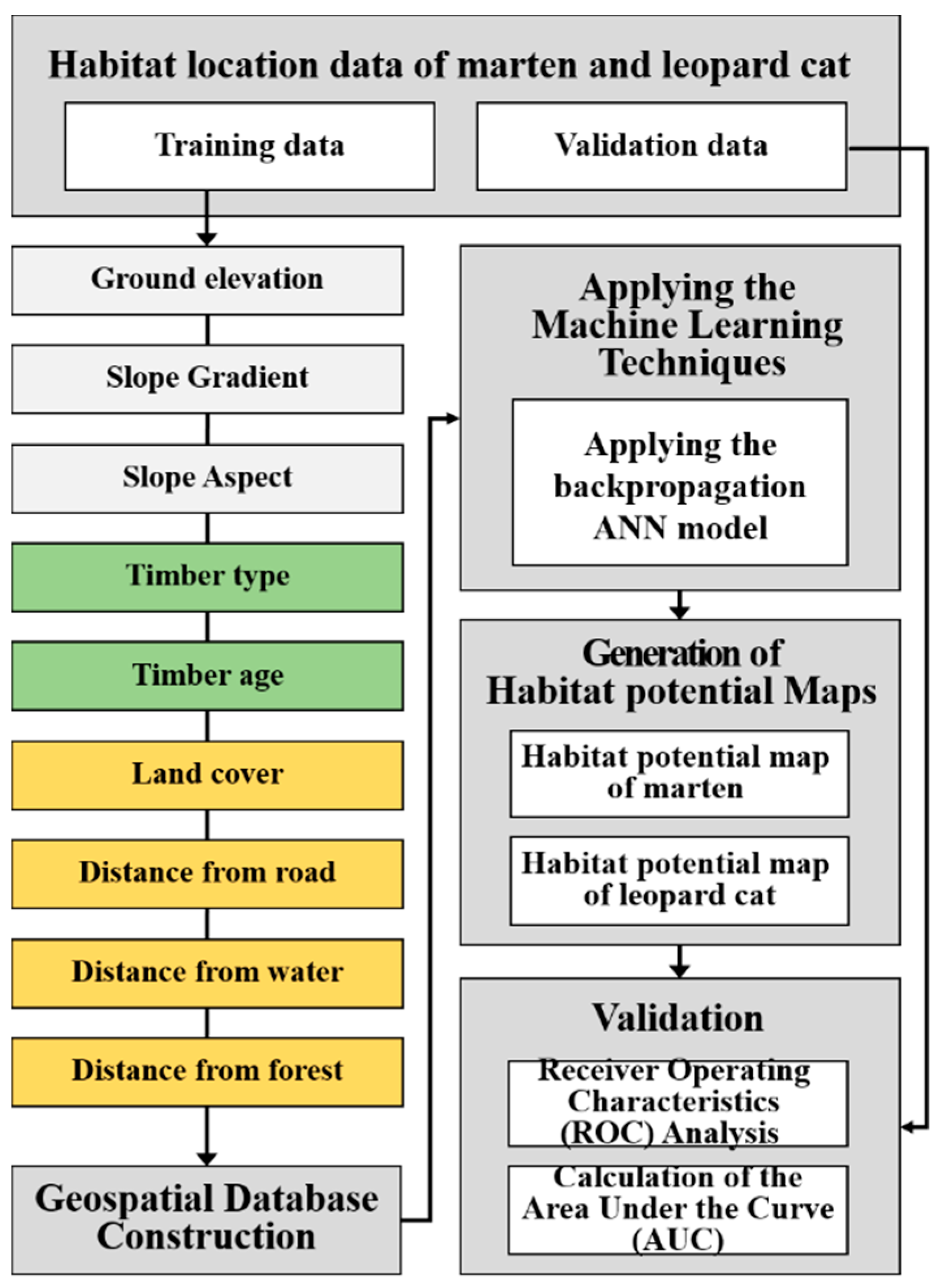
3. Methods
4. Results
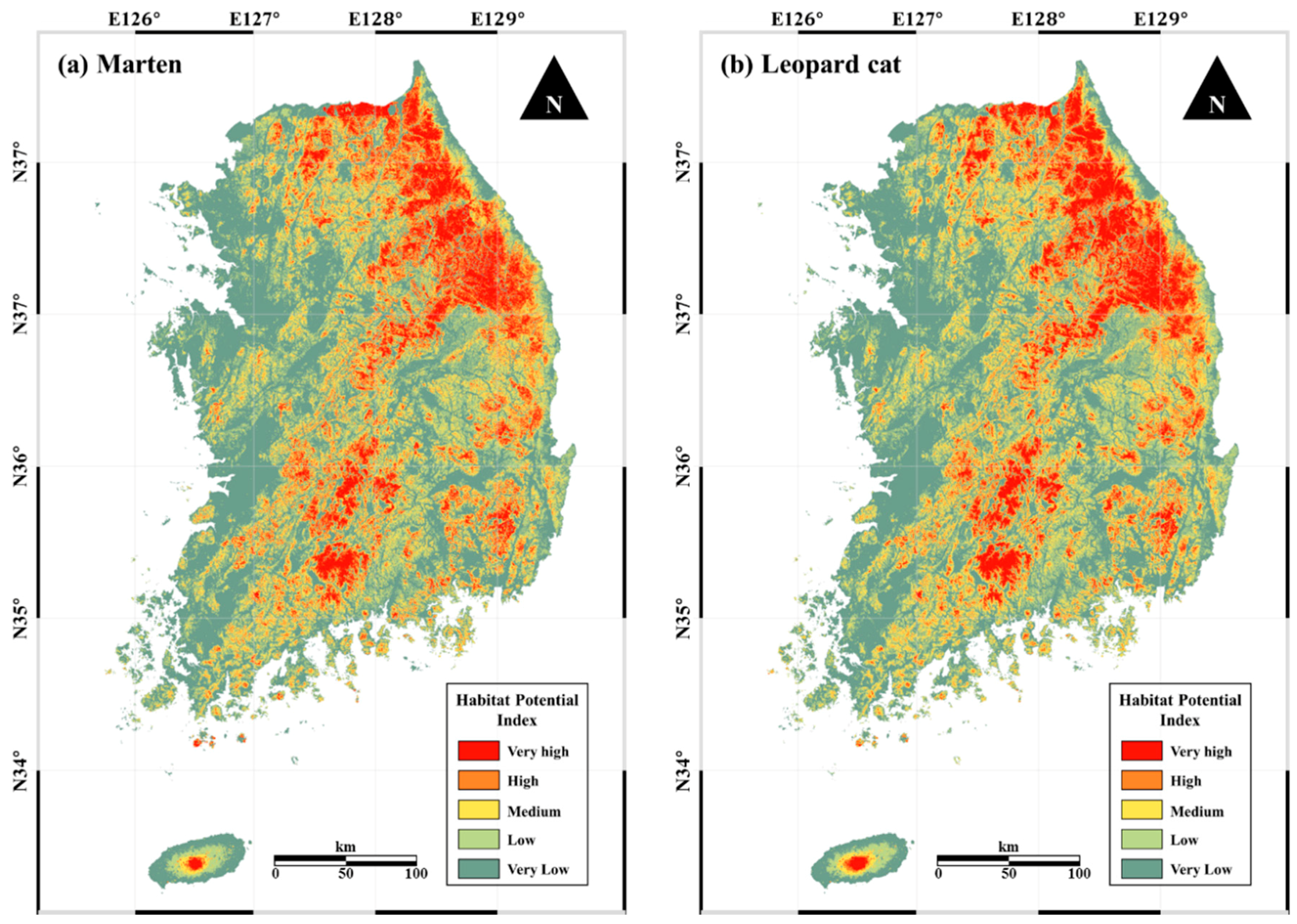
4.1. Weight of Related Factors and Habitat Potential Mapping
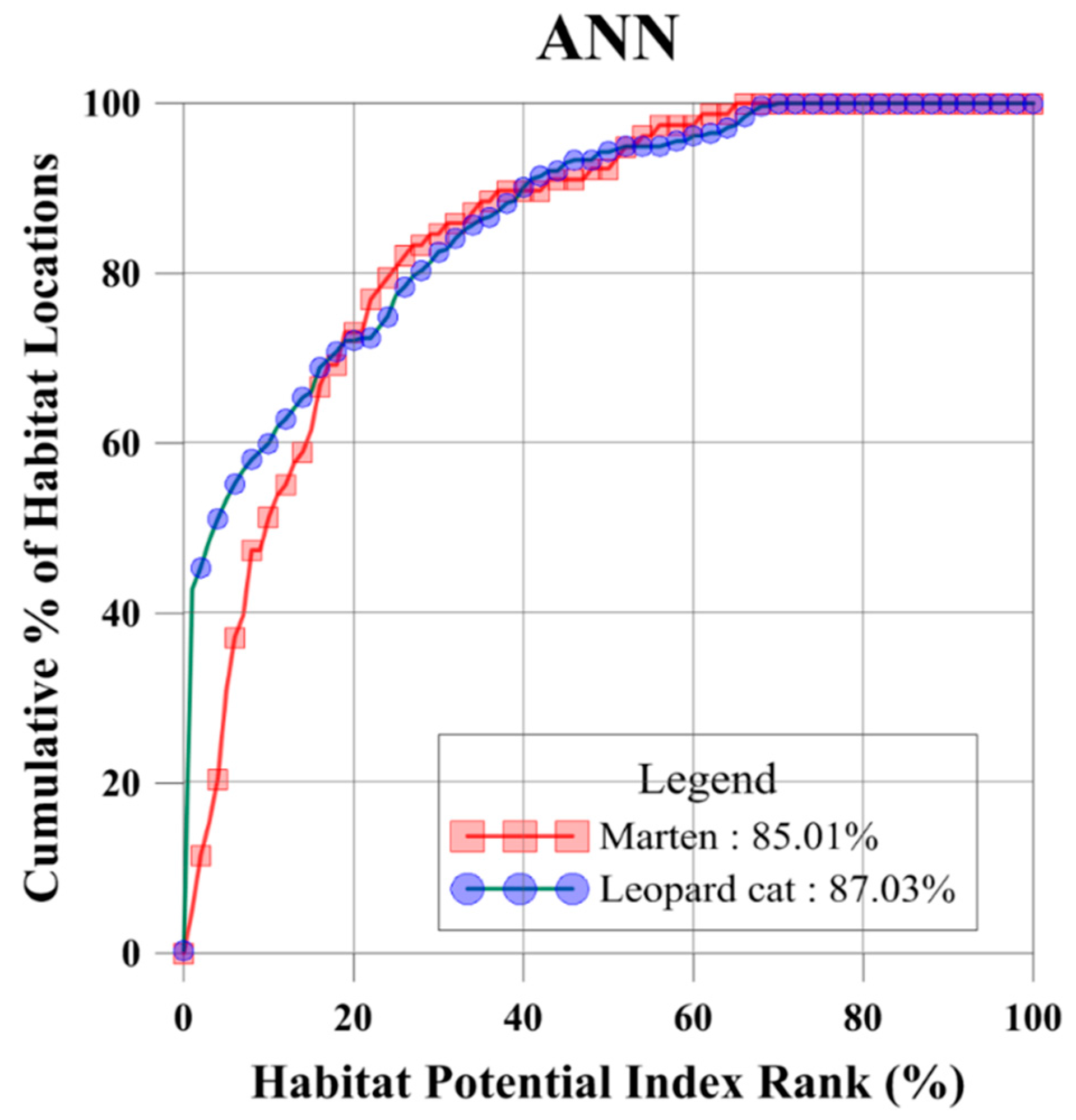
4.2. Validation
5. Discussion
6. Conclusions
Acknowledgments
Author Contributions
Conflicts of Interest
References
- Ripple, W.J.; Estes, J.A.; Beschta, R.L.; Wilmers, C.C.; Ritchie, E.G.; Hebblewhite, M.; Berger, J.; Elmhagen, B.; Letnic, M.; Nelson, M.P. Status and ecological effects of the world’s largest carnivores. Science 2014, 343, 1241484. [Google Scholar] [CrossRef] [Scilit] [PubMed]
- Taylor, S.L.; Buskirk, S.W. Forest microenvironments and resting energetics of the American marten Martes americana. Ecography 1994, 17, 249–256. [Google Scholar] [CrossRef] [Scilit]
- Harrison, D.J.; Fuller, A.K.; Proulx, G. Martens and Fishers (Martes) in Human-Altered Environments: An International Perspective; Springer Science & Business Media: Berlin, Germany, 2004. [Google Scholar]
- Grassman, L.I., Jr.; Tewes, M.E.; Silvy, N.J. Ranging, habitat use and activity patterns of binturong arctictis binturong and yellow-throated marten Martes flavigula in north-central Thailand. Wildl. Biol. 2005, 11, 49–57. [Google Scholar] [CrossRef] [Scilit]
- Park, C.-H.; Choi, T.-Y.; Kwon, H.-S.; Woo, D.-G. Habitat selection and management of the leopard cat (Prionailurus bengalensis) in a rural area of Korea. Korean J. Environ. Ecol. 2012, 26, 322–332. [Google Scholar]
- Ramcharan, A.; Hengl, T.; Nauman, T.; Brungard, C.; Waltman, S.; Wills, S.; Thompson, J. Soil property and class maps of the conterminous us at 100 meter spatial resolution based on a compilation of national soil point observations and machine learning. arXiv, 2017; arXiv:1705.08323.
- Veronesi, F.; Korfiati, A.; Buffat, R.; Raubal, M. Assessing accuracy and geographical transferability of machine learning algorithms for wind speed modelling. In Proceedings of the International Conference on Geographic Information Science, Wageningen, The Netherlands, 9–12 May 2017; Springer: Berlin, Germany, 2017; pp. 297–310. [Google Scholar]
- Folmer, E.O.; van Beusekom, J.E.; Dolch, T.; Gräwe, U.; Katwijk, M.M.; Kolbe, K.; Philippart, C.J. Consensus forecasting of intertidal seagrass habitat in the wadden sea. J. Appl. Ecol. 2016, 53, 1800–1813. [Google Scholar] [CrossRef] [Scilit]
- Sahragard, H.P.; Chahouki, M.A.Z. Comparison of logistic regression and machine learning techniques in prediction of habitat distribution of plant species. Range Manag. Agrofor. 2016, 37, 21–26. [Google Scholar]
- Fox, C.; Huettmann, F.; Harvey, G.; Morgan, K.; Robinson, J.; Williams, R.; Paquet, P. Predictions from machine learning ensembles: Marine bird distribution and density on Canada’s pacific coast. Mar. Ecol. Prog. Ser. 2017, 566, 199–216. [Google Scholar] [CrossRef] [Scilit]
- Wieland, R.; Kerkow, A.; Früh, L.; Kampen, H.; Walther, D. Automated feature selection for a machine learning approach toward modeling a mosquito distribution. Ecol. Model. 2017, 352, 108–112. [Google Scholar] [CrossRef] [Scilit]
- Anderson, D.J.; Rojas, L.F.; Watson, S.; Knelson, L.P.; Pruitt, S.; Lewis, S.S.; Moehring, R.W.; Bennett, E.E.S.; Weber, D.J.; Chen, L.F. Identification of novel risk factors for community-acquired clostridium difficile infection using spatial statistics and geographic information system analyses. PLoS ONE 2017, 12, e0176285. [Google Scholar] [CrossRef] [Scilit] [PubMed]
- Bui, D.T.; Bui, Q.-T.; Nguyen, Q.-P.; Pradhan, B.; Nampak, H.; Trinh, P.T. A hybrid artificial intelligence approach using gis-based neural-fuzzy inference system and particle swarm optimization for forest fire susceptibility modeling at a tropical area. Agric. For. Meteorol. 2017, 233, 32–44. [Google Scholar]
- Rahimi, S.; Martin, M.J.; Obeysekere, E.; Hellmann, D.; Liu, X.; Andris, C. A geographic information system (gis)-based analysis of social capital data: Landscape factors that correlate with trust. Sustainability 2017, 9, 365. [Google Scholar] [CrossRef] [Scilit]
- Ottaviani, D.; Panzacchi, M.; Lasinio, G.J.; Genovesi, P.; Boitani, L. Modelling semi-aquatic vertebrates’ distribution at the drainage basin scale: The case of the otter lutra lutra in Italy. Ecol. Model. 2009, 220, 111–121. [Google Scholar] [CrossRef] [Scilit]
- Poplar-Jeffers, I.O.; Petty, J.T.; Anderson, J.T.; Kite, S.J.; Strager, M.P.; Fortney, R.H. Culvert replacement and stream habitat restoration: Implications from brook trout management in an appalachian watershed, USA. Restor. Ecol. 2009, 17, 404–413. [Google Scholar] [CrossRef] [Scilit]
- Patel, R.P.; Wutke, S.; Lenz, D.; Mukherjee, S.; Ramakrishnan, U.; Veron, G.; Fickel, J.; Wilting, A.; Förster, D.W. Genetic structure and phylogeography of the leopard cat (Prionailurus bengalensis) inferred from mitochondrial genomes. J. Hered. 2017, 108, 349–360. [Google Scholar] [CrossRef] [Scilit] [PubMed]
- Tan, S.; Xu, J.-T.; Zou, F.-D.; Peng, Q.-K.; Peng, R. The complete mitochondrial genome of leopard cat, Prionailurus bengalensis chinensis (carnivora: Felidae). Mitochondrial DNA A 2016, 27, 3073–3074. [Google Scholar]
- Jang, K.H.; Hwang, U.W. Complete mitochondrial genome of korean yellow-throated marten, Martes flavigula (carnivora, mustelidae). Mitochondrial DNA A 2016, 27, 1785–1786. [Google Scholar] [CrossRef] [Scilit] [PubMed]
- Chen, M.-T.; Liang, Y.-J.; Kuo, C.-C.; Pei, K.J.-C. Home ranges, movements and activity patterns of leopard cats (Prionailurus bengalensis) and threats to them in Taiwan. Mamm. Study 2016, 41, 77–86. [Google Scholar] [CrossRef] [Scilit]
- Vigne, J.-D.; Evin, A.; Cucchi, T.; Dai, L.; Yu, C.; Hu, S.; Soulages, N.; Wang, W.; Sun, Z.; Gao, J. Earliest “domestic” cats in China identified as leopard cat (Prionailurus bengalensis). PLoS ONE 2016, 11, e0147295. [Google Scholar] [CrossRef] [Scilit] [PubMed]
- Mohamed, A.; Ross, J.; Hearn, A.J.; Cheyne, S.M.; Alfred, R.; Bernard, H.; Boonratana, R.; Samejima, H.; Heydon, M.; Augeri, D.M.; et al. Predicted distribution of the leopard cat Prionailurus bengalensis (mammalia: Carnivora: Felidae) on borneo. Raffles Bull. Zool. 2016, 33, 180–185. [Google Scholar]
- Lee, M.-J.; Song, W.; Lee, S. Habitat mapping of the leopard cat (Prionailurus bengalensis) in South Korea using gis. Sustainability 2015, 7, 4668–4688. [Google Scholar] [CrossRef] [Scilit]
- Bui, D.T.; Lofman, O.; Revhaug, I.; Dick, O. Landslide susceptibility analysis in the hoa binh province of vietnam using statistical index and logistic regression. Nat. Hazards 2011, 59, 1413. [Google Scholar] [CrossRef] [Scilit]
- Huck, M.; Davison, J.; Roper, T.J. Predicting European badger meles meles sett distribution in urban environments. Wildl. Biol. 2008, 14, 188–198. [Google Scholar] [CrossRef] [Scilit]
- Gavashelishvili, A.; Lukarevskiy, V. Modelling the habitat requirements of leopard panthera pardus in west and Central Asia. J. Appl. Ecol. 2008, 45, 579–588. [Google Scholar] [CrossRef] [Scilit]
- Northrup, J.; Stenhouse, G.; Boyce, M. Agricultural lands as ecological traps for grizzly bears. Anim. Conserv. 2012, 15, 369–377. [Google Scholar] [CrossRef] [Scilit]
- Kuemmerle, T.; Perzanowski, K.; Chaskovskyy, O.; Ostapowicz, K.; Halada, L.; Bashta, A.-T.; Kruhlov, I.; Hostert, P.; Waller, D.M.; Radeloff, V.C. European bison habitat in the Carpathian mountains. Biol. Conserv. 2010, 143, 908–916. [Google Scholar] [CrossRef] [Scilit]
- Clement, M.J.; Castleberry, S.B. Estimating density of a forest-dwelling bat: A predictive model for rafinesque’s big-eared bat. Popul. Ecol. 2013, 55, 205–215. [Google Scholar] [CrossRef] [Scilit]
- Greaves, G.J.; Mathieu, R.; Seddon, P.J. Predictive modelling and ground validation of the spatial distribution of the New Zealand long-tailed bat (Chalinolobus tuberculatus). Biol. Conserv. 2006, 132, 211–221. [Google Scholar] [CrossRef] [Scilit]
- Maleki, S.; Soffianian, A.R.; Koupaei, S.S.; Saatchi, S.; Pourmanafi, S.; Sheikholeslam, F. Habitat mapping as a tool for water birds conservation planning in an arid zone wetland: The case study hamun wetland. Ecol. Eng. 2016, 95, 594–603. [Google Scholar] [CrossRef] [Scilit]
- Novaczek, E.; Devillers, R.; Edinger, E.; Mello, L. High resolution habitat mapping to describe coastal denning habitat of a Canadian species at risk, atlantic wolffish (Anarhichas lupus). Can. J. Fish. Aquat. Sci. 2017. [Google Scholar] [CrossRef] [Scilit]
- Park, J.-K.; Das, A.; Park, J.-H. A new approach to estimate the spatial distribution of solar radiation using topographic factor and sunshine duration in South Korea. Energy Convers. Manag. 2015, 101, 30–39. [Google Scholar] [CrossRef] [Scilit]
- Woo, D.G. A Study on Ecological Characteristics and Conservation of Yellow-Throated Marten (Martes flavigula) in Temperate Forests of Korea. Ph.D. Thesis, Seoul National University, Seoul, Korea, 2014. [Google Scholar]
- Rumelhart, D.E.; McClelland, J.L.; Group, P.R. Parallel Distributed Processing; MIT Press: Cambridge, MA, USA, 1987; Volume 1. [Google Scholar]
- Hines, J.; Tsoukalas, L.H.; Uhrig, R.E. Matlab Supplement to Fuzzy and Neural Approaches in Engineering; John Wiley & Sons, Inc.: Hoboken, NJ, USA, 1997. [Google Scholar]
- Althuwaynee, O.F.; Pradhan, B.; Lee, S. A novel integrated model for assessing landslide susceptibility mapping using chaid and ahp pair-wise comparison. Int. J. Remote Sens. 2016, 37, 1190–1209. [Google Scholar] [CrossRef] [Scilit]
- Kim, J.-C.; Lee, S.; Jung, H.-S.; Lee, S. Landslide susceptibility mapping using random forest and boosted tree models in Pyeong-chang, Korea. Geocarto Int. 2017, 1–16. [Google Scholar] [CrossRef] [Scilit]
- Lee, S.; Kim, J.-C.; Jung, H.-S.; Lee, M.J.; Lee, S. Spatial prediction of flood susceptibility using random-forest and boosted-tree models in Seoul metropolitan city, Korea. Geomat. Nat. Hazards Risk 2017, 1–19. [Google Scholar] [CrossRef] [Scilit]
- Tahmassebipoor, N.; Rahmati, O.; Noormohamadi, F.; Lee, S. Spatial analysis of groundwater potential using weights-of-evidence and evidential belief function models and remote sensing. Arab. J. Geosci. 2016, 9, 79. [Google Scholar] [CrossRef] [Scilit]

| Original Data | Factors | Data Type | Scale |
|---|---|---|---|
| Habitat | Marten Leopard cat | Point | - |
| Topographical map a | Ground elevation (m) Slope gradient (°) Slope aspect | GRID | 1:5000 |
| Forest map b | Timber type Timber age | Polygon | 1:25,000 |
| Land cover map c | Land cover Distance from road (m) Distance from water (m) Distance from forest (m) | Polygon | 1:25,000 |
| Code | Forest Type | Code | Forest Type | ||
|---|---|---|---|---|---|
| Forest species | D PD PK PL PR Q PQ PO CA | Pinus densiflora Forests Pinus densiflora artificial forest Pinus koraiensis forest Larch Pinus rigida forest Oak forest Oak artificial forest Poplar forest Chestnut artificial forest | Forest physiognomy | C | Conifer mixed forest |
| H | Broadleaved forest | ||||
| M | Mixed forest of soft and hardwood | ||||
| Dentuded area | F | Cut-over area | |||
| O | Non-stocked forest land | ||||
| E | Dentuded land | ||||
| LP | Grassland | ||||
| L | Farmland | ||||
| Left-over area | R | Left-over area | |||
| W | Water |
| Marten | Leopard Cat | |||||
|---|---|---|---|---|---|---|
| Average | Standard Deviation | Normalized Weight with Respect to Land Cover | Average | Standard Deviation | Normalized Weight with Respect to Land Cover | |
| DEM | 0.1657 | 0.0175 | 2.3877 | 0.1728 | 0.0208 | 2.3883 |
| Slope gradient | 0.1335 | 0.0102 | 1.9242 | 0.1939 | 0.0103 | 2.6790 |
| Slope aspect | 0.0901 | 0.0019 | 1.2986 | 0.0768 | 0.0019 | 1.0619 |
| Timber type | 0.1453 | 0.0107 | 2.0945 | 0.1159 | 0.0185 | 1.6014 |
| Timber age | 0.0704 | 0.0104 | 1.0146 | 0.1053 | 0.0059 | 1.4545 |
| Land cover | 0.0694 | 0.0015 | 1.0000 | 0.0724 | 0.0030 | 1.0000 |
| Distance from road | 0.1092 | 0.0023 | 1.5741 | 0.0817 | 0.0054 | 1.1285 |
| Distance from water | 0.1210 | 0.0032 | 1.7439 | 0.0854 | 0.0037 | 1.1803 |
| Distance from forest | 0.0953 | 0.0008 | 1.3735 | 0.0959 | 0.0044 | 1.3259 |
© 2017 by the authors. Licensee MDPI, Basel, Switzerland. This article is an open access article distributed under the terms and conditions of the Creative Commons Attribution (CC BY) license (http://creativecommons.org/licenses/by/4.0/).
Share and Cite
Lee, S.; Lee, S.; Song, W.; Lee, M.-J. Habitat Potential Mapping of Marten (Martes flavigula) and Leopard Cat (Prionailurus bengalensis) in South Korea Using Artificial Neural Network Machine Learning. Appl. Sci. 2017, 7, 912. https://doi.org/10.3390/app7090912
Lee S, Lee S, Song W, Lee M-J. Habitat Potential Mapping of Marten (Martes flavigula) and Leopard Cat (Prionailurus bengalensis) in South Korea Using Artificial Neural Network Machine Learning. Applied Sciences. 2017; 7(9):912. https://doi.org/10.3390/app7090912
Chicago/Turabian StyleLee, Saro, Sunmin Lee, Wonkyong Song, and Moung-Jin Lee. 2017. "Habitat Potential Mapping of Marten (Martes flavigula) and Leopard Cat (Prionailurus bengalensis) in South Korea Using Artificial Neural Network Machine Learning" Applied Sciences 7, no. 9: 912. https://doi.org/10.3390/app7090912
APA StyleLee, S., Lee, S., Song, W., & Lee, M.-J. (2017). Habitat Potential Mapping of Marten (Martes flavigula) and Leopard Cat (Prionailurus bengalensis) in South Korea Using Artificial Neural Network Machine Learning. Applied Sciences, 7(9), 912. https://doi.org/10.3390/app7090912

