Fabrication and Characterizations of Hot-Melt Extruded Nanocomposites Based on Zinc Sulfate Monohydrate and Soluplus


Abstract
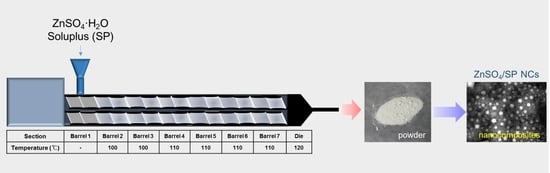
Share and Cite
Lee, S.Y.; Nam, S.; Choi, Y.; Kim, M.; Koo, J.S.; Chae, B.-J.; Kang, W.-S.; Cho, H.-J. Fabrication and Characterizations of Hot-Melt Extruded Nanocomposites Based on Zinc Sulfate Monohydrate and Soluplus. Appl. Sci. 2017, 7, 902. https://doi.org/10.3390/app7090902
Lee SY, Nam S, Choi Y, Kim M, Koo JS, Chae B-J, Kang W-S, Cho H-J. Fabrication and Characterizations of Hot-Melt Extruded Nanocomposites Based on Zinc Sulfate Monohydrate and Soluplus. Applied Sciences. 2017; 7(9):902. https://doi.org/10.3390/app7090902
Chicago/Turabian StyleLee, Song Yi, Suyeong Nam, Yohan Choi, Minju Kim, Ja Seong Koo, Byung-Jo Chae, Wie-Soo Kang, and Hyun-Jong Cho. 2017. "Fabrication and Characterizations of Hot-Melt Extruded Nanocomposites Based on Zinc Sulfate Monohydrate and Soluplus" Applied Sciences 7, no. 9: 902. https://doi.org/10.3390/app7090902
APA StyleLee, S. Y., Nam, S., Choi, Y., Kim, M., Koo, J. S., Chae, B.-J., Kang, W.-S., & Cho, H.-J. (2017). Fabrication and Characterizations of Hot-Melt Extruded Nanocomposites Based on Zinc Sulfate Monohydrate and Soluplus. Applied Sciences, 7(9), 902. https://doi.org/10.3390/app7090902