

Optimization of a Culture Medium Using the Taguchi Approach for the Production of Microorganisms Active in Odorous Compound Removal



Abstract
1. Introduction
2. Materials and Methods
2.1. Microorganisms
2.2. Media Components
2.3. Microbial Cultures in a BioLector Microbiooreactor System
2.4. Taguchi Array Design
2.5. Biomass Production
2.6. Statistical Methods
3. Results and Discussion
Acknowledgments
Author Contributions
Conflicts of Interest
References
- Gutarowska, B.; Borowski, S.; Durka, K.; Korczyński, M.; Kołacz, R. Screening of microorganisms capable to remove odorous compounds from poultry manure. Przem. Chem. 2009, 5, 2–7. (In Polish) [Google Scholar]
- Matusiak, K.; Oleksy, M.; Borowski, S.; Nowak, A.; Korczyński, M.; Dobrzański, Z.; Gutarowska, B. The use of Yucca schidigera and microbial preparation for poultry manure deodorization and hygienization. J. Environ. Manag. 2016, 170, 50–59. [Google Scholar] [CrossRef] [Scilit] [PubMed]
- Borowski, S.; Matusiak, K.; Powałowski, S.; Pielech-Przybylska, K.; Makowski, K.; Nowak, A.; Rosowski, M.; Komorowski, P.; Gutarowska, B. A novel microbial-mineral preparation for the removal of offensive odors from poultry manure. Int. Biodeter. Biodegr. 2017, 119, 299–308. [Google Scholar] [CrossRef] [Scilit]
- Czitrom, V. One factor at a time versus designed experiments. Am. Stat. Assoc. 1999, 53, 126–131. [Google Scholar] [CrossRef] [Scilit]
- Wahid, Z.; Nadir, N. Improvement of one factor at a time through design of experiments. World Appl. Sci. J. 2013, 21, 56–61. [Google Scholar]
- Connors, N.C. Culture medium optimization and scale-up for microbial fermentations. In Handbook of Industrial Cell Culture, 1st ed.; Vinci, V.A., Parekh, S.R., Eds.; Humana Press: New Delhi, India, 2003; pp. 171–193. ISBN 978-1-59259-346-0. [Google Scholar]
- Panda, B.P.; Ali, M.; Javed, S. Fermentation process optimization. Res. J. Microbiol. 2007, 2, 201–208. [Google Scholar]
- Jian, Z.; Nian-fa, G. Application of response surface methodology in medium optimization for pyruvic acid production of Torulopsis glabrata TP19 in batch fermentation. J. Zhejiang. Univ. Sci. B 2007, 8, 98–104. [Google Scholar]
- Kaur, B.; Kaur, R. Application of response surface methodology for optimizing arginine deiminase production medium for Enterococcus faecium sp. GR7. Sci. World J. 2013, 2013, 892587. [Google Scholar] [CrossRef] [Scilit] [PubMed]
- Vijayaraghavan, P.; Arun, A.; Al-Dhabi, N.A.; Gnana, S.; Vincent, P.; Arasu, M.V.; Choi, K.C. Novel Bacillus subtilis IND19 cell factory for the simultaneous production of carboxy methyl cellulase and protease using cow dung substrate in solid-substrate fermentation. Biotechnol. Biofuels 2016, 9, 1–13. [Google Scholar] [CrossRef] [Scilit] [PubMed]
- Polak-Berecka, M.; Waśko, A.; Kordowska-Wiater, M.; Podleśny, M.; Targoński, Z.; Kubik-Komar, A. Optimization of medium composition for enhancing growth of Lactobacillus rhamnosus PEN using response surface methodology. Polish J. Microbiol. 2010, 59, 113–118. [Google Scholar]
- Sen, R.; Babu, K.S. Modeling and optimization of the process conditions for biomass production and sporulation of a probiotic culture. Process Biochem. 2005, 40, 2531–2538. [Google Scholar] [CrossRef] [Scilit]
- Kiviharju, K.; Leisola, M.; Eerikäinen, T. Optimization of a Bifidobacterium longum production process. J. Biotechnol. 2005, 117, 299–308. [Google Scholar] [CrossRef] [Scilit] [PubMed]
- Jong-Min, J.; Thangamani, R.; Song, E.; Lee, H.; Lee, H.; Yang, Y. Media optimization of Corynebacterium glutamicum for succinate production under oxygen-deprived condition. J. Microbiol. Biotechnol. 2013, 23, 211–217. [Google Scholar]
- Sarria-Alfonso, V.; Sánchez-Sierra, J.; Aguirre-Morales, M.; Gutiérrez-Rojas, I.; Moreno-Sarmiento, N.; Poutou-Piñales, R.A. Culture media statistical optimization for biomass production of a ligninolytic fungus for future rice straw degradation. Indian J. Microbiol. 2013, 53, 199–207. [Google Scholar] [CrossRef] [Scilit] [PubMed]
- Peng, W.; Zhong, J.; Yang, J.; Ren, Y.; Xu, T.; Xiao, S.; Zhou, J.; Tan, H. The artificial neural network approach based on uniform design to optimize the fed-batch fermentation condition: Application to the production of iturin A. Microb. Cell Fact. 2014, 13, 54. [Google Scholar] [CrossRef] [Scilit] [PubMed]
- Yang, Y.; Gao, M.; Yu, X.; Zhang, Y.; Lyu, S. Optimization of medium composition for two-step fermentation of vitamin C based on artificial neural network–genetic algorithm techniques. Biotechnol. Biotechnol. Equip. 2015, 29, 1128–1134. [Google Scholar] [CrossRef] [Scilit]
- Velazco, E.E.; Bendell, A.; Disney, J.; Pridmore, W.A. Taguchi methods: Applications in world industry. Interfaces (Providence) 1991, 21, 99–101. [Google Scholar]
- Venil, C.K.; Lakshmanaperumalsamy, P. Taguchi experimental design for medium optimization for enhanced protease production by Bacillus subtilis HB04. E-J. Sci. Technol. 2001, 4, 1–10. [Google Scholar]
- Prasad, K.K.; Mohan, S.V.; Rao, R.S.; Pati, B.R.; Sarma, P.N. Laccase production by Pleurotus ostreatus 1804: Optimization of submerged culture conditions by Taguchi DOE methodology. Biochem. Eng. J. 2005, 24, 17–26. [Google Scholar] [CrossRef] [Scilit]
- Gutarowska, B.; Matusiak, K.; Borowski, S.; Rajkowska, A.; Brycki, B. Removal of odorous compounds from poultry manure by microorganisms on perlite—Bentonite carrier. J. Environ. Manag. 2014, 141, 70–76. [Google Scholar] [CrossRef] [Scilit] [PubMed]
- Hwang, C.F.; Chang, J.H.; Houng, J.Y.; Tsai, C.C.; Lin, C.K.; Tsen, H.Y. Optimization of medium composition for improving biomass production of Lactobacillus plantarum Pi06 using the Taguchi array design and the Box-Behnken method. Biotechnol. Bioprocess Eng. 2012, 17, 827–834. [Google Scholar] [CrossRef] [Scilit]
- Gu, W.; Chen, S.W.; Chen, G.P.; Ji, Z.X. Enhacement of Haemophilus parasuis serovar 5 yields by medium optimization. Lett. Appl. Microbiol. 2015, 61, 44–49. [Google Scholar] [CrossRef] [Scilit] [PubMed]
- Szymanowska-Powałowska, D.; Białas, W. Scale-up of anaerobic 1,3-propanediol production by Clostridium butyricum DSP1 from crude glycerol. BMC Microbiol. 2014. [Google Scholar] [CrossRef] [Scilit] [PubMed]
- He, J.; Zhen, Q.; Qiu, N.; Liu, Z.; Wang, B.; Shao, Z.; Yu, Z. Medium optimization for the production of a novel bioflocculant from Halomonas sp. V3a’ using response surface methodology. Bioresour. Technol. 2009, 100, 5922–5927. [Google Scholar] [CrossRef] [Scilit] [PubMed]

| #Exp | Levels (Percent Concentration) | ||
|---|---|---|---|
| Sucrose/Glucose (X1) | SPC (X2) | KH2PO4 (X3) | |
| (1) | 2% | 2% | 0.2% |
| (2) | 2% | 4% | 0.4% |
| (3) | 2% | 6% | 0.8% |
| (4) | 5% | 2% | 0.4% |
| (5) | 5% | 4% | 0.8% |
| (6) | 5% | 6% | 0.2% |
| (7) | 8% | 2% | 0.8% |
| (8) | 8% | 4% | 0.2% |
| (9) | 8% | 6% | 0.4% |
| Run | Strains | ||||||
|---|---|---|---|---|---|---|---|
| Bacillus megaterium | Bacillus subtilis | Pseudomonas fluorescens | Enterococcus faecium | Lactobacillus plantarum | Leuconostoc mesenteroides | ||
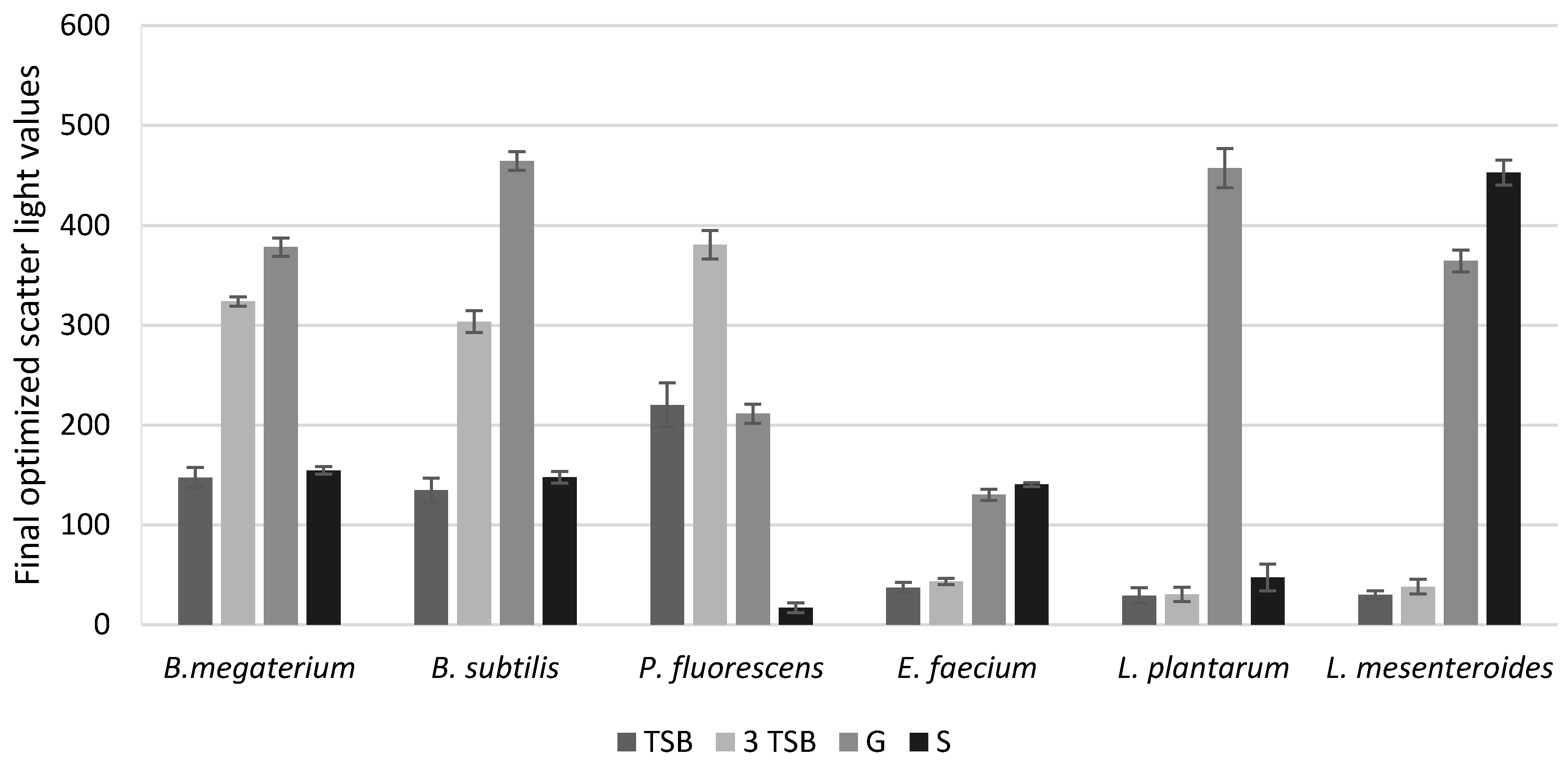
| TSB | 147.4 ± 10.0e | 134.7 ± 12.2cd | 220.1 ± 22.1g | 37.2 ± 5.1a | 29.2 ± 7.8a | 30.0 ± 4.0a | |
| 3TSB | 323.8 ± 4.6k | 303.6 ± 10.8hi | 380.6 ± 14.4j | 43.2 ± 3.0a | 30.6 ± 7.1a | 38.1 ± 7.4a | |
| G | (1) | 151.4 ± 18.2e | 258.6 ± 17.9g | 141.2 ± 10.5e | 148.7 ± 3.9f | 130.0 ± 6.4f | 168.1 ± 3.1fg |
| (2) | 176.0 ± 23.9f | 171.2 ± 16.8e | 267.1 ± 6.2h | 187.1 ± 1.7h | 152.5 ± 3.6g | 209.3 ± 2.4i | |
| (3) | 61.8 ± 12.0b | 294.8 ± 7.3h | 329.8 ± 1.2i | 267.5 ± 3.3j | 244.4 ± 10.8j | 256.1 ± 2.5j | |
| (4) | 100.7 ± 7.7c | 116.3 ± 6.6bc | 111.8 ± 11.0d | 94.4 ± 5.2de | 96.6 ± 5.1de | 107.4 ± 2.0d | |
| (5) | 13.8 ± 5.6a | 46.5 ± 26.7a | 139.3 ± 3.4e | 166.8 ± 8.8g | 64.2 ± 9.8b | 190.8 ± 6.6h | |
| (6) | 262.0 ± 22.0i | 365.6 ± 22.1j | 400.0 ± 4.2fj | 371.2 ± 7.3k | 289.4 ± 7.1k | 310.8 ± 5.8m | |
| (7) | 106.4 ± 20.5d | 132.3 ± 10.3cd | 75.1 ± 10.8bf | 68.0 ± 3.3c | 33.8 ± 3.1a | 66.7 ± 6.7b | |
| (8) | 125.4 ± 15.9d | 315.9 ± 11.3hi | 196.1 ± 12.9k | 203.2 ± 3.0i | 179.2 ± 8.8h | 331.2 ± 2.1n | |
| (9) | 84.0 ± 10.6cd | 322.9 ± 18.1i | 187.2 ± 9.1f | 272.4 ± 16.4j | 186.1 ± 4.9h | 330.7 ± 6.7n | |
| S | (1) | 108.1 ± 4.3d | 115.4 ± 12.1bc | 80.4 ± 17.5bc | 89.0 ± 4.8d | 88.4 ± 2.5cd | 175.8 ± 6.0g |
| (2) | 199.9 ± 2.7g | 154.5 ± 7.5de | 143.5 ± 21.6e | 64.2 ± 8.0c | 150.9 ± 4.0g | 275.7 ± 9.4k | |
| (3) | 238.2 ± 24.8h | 107.8 ± 17.9b | 103.0 ± 3.1d | 44.1 ± 4.0a | 109.0 ± 8.7e | 157.3 ± 2.4e | |
| (4) | 252.3 ± 7.5hi | 295.0 ± 18.6h | 72.4 ± 12.6ab | 104.1 ± 1.9e | 74.9 ± 4.4bc | 164.7 ± 2.8ef | |
| (5) | 299.2 ± 0.9j | 205.1 ± 8.5f | 53.6 ± 18.9a | 93.1 ± 5.7d | 69.4 ± 3.4b | 276.0 ± 7.6k | |
| (6) | 260.1 ± 6.6i | 317.1 ± 11.1hi | 193.1 ± 10.4k | 143.6 ± 4.2f | 202.6 ± 21.1i | 96.9 ± 2.8c | |
| (7) | 293.6 ± 7.8j | 208.9 ± 7.5f | 64.8 ± 18.0ab | 54.5 ± 2.1b | 35.4 ± 2.5a | 199.7 ± 2.4hi | |
| (8) | 314.6 ± 5.5jk | 256.7 ± 11.5g | 145.6 ± 2.1e | 172.0 ± 6.7g | 126.2 ± 10.9f | 297.1 ± 4.4l | |
| (9) | 305.6 ± 14.2jk | 261.6 ± 14.1g | 100.1 ± 10.0cd | 194.0 ± 3.0hi | 174.9 ± 7.3h | 330.7 ± 6.7n | |
| Microbial Strain | Concentration of Media Components (%) | ||
|---|---|---|---|
| Glucose (X1) | SPC (X2) | KH2PO4 (X3) | |
| B. megaterium | 5 | 4 | 0.4 |
| B. subtilis | 5 | 6 | 0.2 |
| P. fluorescens | 2 | 6 | 0.8 |
| E. faecium | 5 | 2 | 0.4 |
| L. plantarum | 2 | 6 | 0.2 |
| L. mesenteroides | 2 | 6 | 0.2 |
| Sucrose (X1) | SPC (X2) | KH2PO4 (X3) | |
| B. megaterium | 5 | 4 | 0.2 |
| B. subtilis | 8 | 2 | 0.4 |
| P. fluorescens | 5 | 6 | 0.2 |
| E. faecium | 8 | 4 | 0.4 |
| L. plantarum | 2 | 6 | 0.8 |
| L. mesenteroides | 8 | 2 | 0.2 |
| Strain | 0.5 L | 7 L | 42 L * | 300 L ** |
|---|---|---|---|---|
| B. megaterium | 2.6 × 10⁹ ± 2.0 × 10⁹ a | 1.8 × 10⁹ ± 2.2 × 10⁹ a | 6.1 × 10⁸ ± 5.5 × 10⁸ a | 1.1 × 10⁹ ± 7.9 × 10⁷ a |
| B. subtilis | 7.7 × 10⁹ ± 6.1 × 10⁹ a | 1.8 × 10⁹ ± 9.0 × 10⁸ ab | 1.7 × 10⁹ ± 7.7 × 10⁸ ab | 1.5 × 10⁹ ± 3.0 × 10⁸ b |
| P. fluorescens | 1.8 × 10¹⁰ ± 1.6 × 10¹⁰ a | 2.1 × 10⁹ ± 5.0 × 10⁸ ab | 2.2 × 10⁹ ± 1.3 × 10⁸ ab | 2.1 × 10⁹ ± 9.5 × 10⁷ b |
| E. faecium | 2.2 × 10⁹ ± 1.1 × 10⁹ a | 2.0 × 10⁹ ± 1.7 × 10⁸ a | 2.5 × 10⁹ ± 8.0 × 10⁸ a | 2.7 × 10⁹ ± 2.8 × 10⁸ a |
| L. plantarum | 4.4 × 10⁹ ± 3.2 × 10⁹ a | 1.0 × 10⁹ ± 1.7 × 10⁸ b | 1.1 × 10⁹ ± 6.6 × 10⁸ ab | 9.1 × 10⁸ ± 4.0 × 10⁸ b |
| L. mesenteroides | 2.6 × 10⁹ ± 2.5 × 10⁹ a | 1.9 × 10⁹ ± 3.2 × 10⁸ a | 2.4 × 10⁹ ± 1.7 × 10⁹ a | 1.47 × 10⁹ ± 1.06 × 10⁸ a |
© 2017 by the authors. Licensee MDPI, Basel, Switzerland. This article is an open access article distributed under the terms and conditions of the Creative Commons Attribution (CC BY) license (http://creativecommons.org/licenses/by/4.0/).
Share and Cite
Makowski, K.; Matusiak, K.; Borowski, S.; Bielnicki, J.; Tarazewicz, A.; Maroszyńska, M.; Leszczewicz, M.; Powałowski, S.; Gutarowska, B. Optimization of a Culture Medium Using the Taguchi Approach for the Production of Microorganisms Active in Odorous Compound Removal. Appl. Sci. 2017, 7, 756. https://doi.org/10.3390/app7080756
Makowski K, Matusiak K, Borowski S, Bielnicki J, Tarazewicz A, Maroszyńska M, Leszczewicz M, Powałowski S, Gutarowska B. Optimization of a Culture Medium Using the Taguchi Approach for the Production of Microorganisms Active in Odorous Compound Removal. Applied Sciences. 2017; 7(8):756. https://doi.org/10.3390/app7080756
Chicago/Turabian StyleMakowski, Krzysztof, Katarzyna Matusiak, Sebastian Borowski, Jakub Bielnicki, Alicja Tarazewicz, Marta Maroszyńska, Martyna Leszczewicz, Szymon Powałowski, and Beata Gutarowska. 2017. "Optimization of a Culture Medium Using the Taguchi Approach for the Production of Microorganisms Active in Odorous Compound Removal" Applied Sciences 7, no. 8: 756. https://doi.org/10.3390/app7080756
APA StyleMakowski, K., Matusiak, K., Borowski, S., Bielnicki, J., Tarazewicz, A., Maroszyńska, M., Leszczewicz, M., Powałowski, S., & Gutarowska, B. (2017). Optimization of a Culture Medium Using the Taguchi Approach for the Production of Microorganisms Active in Odorous Compound Removal. Applied Sciences, 7(8), 756. https://doi.org/10.3390/app7080756

