Automated Detection of Deceptive Design Patterns on University Websites: A Comparative Analysis of Browser-Based Tools and LLM-Based Approaches


Featured Application
Abstract
1. Introduction
2. Conceptual Framework and Research Questions
2.1. Automated Detection of Deceptive Design Patterns as a Methodological Problem
- RQ1: What are the characteristics and scope of limitations of automated detection of deceptive design patterns using tools for automated website analysis?
2.2. Reliability and Discriminatory Power of Automated Audit Procedures
- RQ2: To what degree are results generated by LLM-based automated auditing procedures a reliable and accurate basis for comparative analysis of websites?
2.3. Deceptive Design Patterns on University Websites
- RQ3: What is the extent of deceptive design pattern incidence on Polish universities’ websites?
3. Materials and Methods
3.1. Measurement Tools
3.1.1. Profiles of the GPT Models Used in the Study
3.1.2. Operational Principles of the RTDPA Procedure
3.1.3. Operational Principles of the SIRS Procedure
3.2. Research Pipeline
4. Results
4.1. Results from Browser Extensions
4.2. Results from the GPT Models
5. Discussion
5.1. Observations
5.2. Answers to Research Questions
5.3. Three-Tier Deceptive Design Pattern Detection Model
- Tier 1: mechanical (algorithmic, deterministic, structure-based). It concerns the detection of clearly definable interface artefacts such as pre-checked checkboxes, choice-option asymmetry, specific form attributes, recurring wording, or specific DOM configurations. In this case, deterministic rules and universal analytical procedures can be employed. This tier is highly controllable and repeatable, but covers only clearly identifiable structural elements.
- Tier 2: heuristic (a GPT model as an analytical assistant supporting heuristic interface analysis). At this level, LLM-based classification takes place. The tools suggest potential risk areas and interpret the patterns in the linguistic and functional contexts. The detection is probabilistic and must be validated by an expert, making it an automated, indicative prescreening. The tool is an analytical support rather than an autonomous measurement instrument.
- Tier 3: interpretative (qualification of the manipulativeness of design). The highest level involves assessment of whether a specific interface configuration can be considered manipulative in design and regulatory contexts. It requires an analysis of the context of use, cognitive asymmetry, user choice architecture, and potential design intent. It cannot be fully automated as of today, and remains a domain of expert audit. This three-pronged scheme facilitates distinguishing between the detection of structural attributes and normative qualification. It also reduces the risk of equating algorithmic signalling with a fully fledged audit.
6. Conclusions
6.1. Practical Implications
6.2. Limitations and Future Research
Funding
Institutional Review Board Statement
Informed Consent Statement
Data Availability Statement
Conflicts of Interest
Abbreviations
| AI | Artificial Intelligence |
| DDP | Deceptive Design Patterns |
| DOM | Document Object Model |
| DSA | Digital Services Act |
| GDPR | General Data Protection Regulation |
| GPT | Generative Pre-trained Transformer |
| HTML | HyperText Markup Language |
| IQR | Interquartile Range |
| LLM | Large Language Model |
| RTDPA | Real-Time Deceptive Pattern Auditor |
| SIRS | Structural Interface Risk Screening |
| SRI | Structural Risk Index |
| URL | Uniform Resource Locator |
| UX | User Experience |
Appendix A
Appendix A.1
Appendix A.2
Appendix A.3
References
- Morales-Vargas, A.; Pedraza-Jimenez, R.; Codina, L. Website Quality Evaluation: A Model for Developing Comprehensive Assessment Instruments Based on Key Quality Factors. J. Doc. 2023, 79, 95–114. [Google Scholar] [CrossRef]
- Muhammad, A.; Siddique, A.; Naveed, Q.N.; Khaliq, U.; Aseere, A.M.; Hasan, M.A.; Qureshi, M.R.N.; Shahzad, B. Evaluating Usability of Academic Websites through a Fuzzy Analytical Hierarchical Process. Sustainability 2021, 13, 2040. [Google Scholar] [CrossRef]
- Luguri, J.; Strahilevitz, L.J. Shining a Light on Dark Patterns. J. Leg. Anal. 2021, 13, 43–109. [Google Scholar] [CrossRef]
- Mathur, A.; Acar, G.; Friedman, M.J.; Lucherini, E.; Mayer, J.; Chetty, M.; Narayanan, A. Dark Patterns at Scale: Findings from a Crawl of 11K Shopping Websites. Proc. ACM Hum.-Comput. Interact. 2019, 3, 1–32. [Google Scholar] [CrossRef]
- Ji, Z.; Lee, N.; Frieske, R.; Yu, T.; Su, D.; Xu, Y.; Ishii, E.; Bang, Y.J.; Madotto, A.; Fung, P. Survey of Hallucination in Natural Language Generation. ACM Comput. Surv. 2023, 55, 1–38. [Google Scholar] [CrossRef]
- Zając, P.; Królak, A. Analysis of the Digital Accessibility of Selected Polish Government Portals for Persons with Disabilities. Univers. Access Inf. Soc. 2025, 24, 2705–2720. [Google Scholar] [CrossRef]
- Fakrudeen, M. Evaluation of the Accessibility and Usability of University Websites: A Comparative Study of the Gulf Region. Univers. Access Inf. Soc. 2025, 24, 1883–1898. [Google Scholar] [CrossRef]
- Ara, J.; Sik-Lanyi, C.; Kelemen, A.; Guzsvinecz, T. An Inclusive Framework for Automated Web Content Accessibility Evaluation. Univers. Access Inf. Soc. 2025, 24, 1581–1607. [Google Scholar] [CrossRef]
- Lannelongue, L.; Grealey, J.; Inouye, M. Green Algorithms: Quantifying the Carbon Footprint of Computation. Adv. Sci. 2021, 8, 2100707. [Google Scholar] [CrossRef] [PubMed]
- Persson, H.; Åhman, H.; Yngling, A.A.; Gulliksen, J. Universal Design, Inclusive Design, Accessible Design, Design for All: Different Concepts—One Goal? On the Concept of Accessibility—Historical, Methodological and Philosophical Aspects. Univers. Access Inf. Soc. 2015, 14, 505–526. [Google Scholar] [CrossRef]
- Nouwens, M.; Liccardi, I.; Veale, M.; Karger, D.; Kagal, L. Dark Patterns after the GDPR: Scraping Consent Pop-Ups and Demonstrating Their Influence. In Proceedings of the 2020 CHI Conference on Human Factors in Computing Systems, Honolulu, HI, USA, 21 April 2020; ACM: New York, NY, USA, 2020; pp. 1–13. [Google Scholar] [CrossRef]
- Gray, C.M.; Santos, C.T.; Bielova, N.; Mildner, T. An Ontology of Dark Patterns Knowledge: Foundations, Definitions, and a Pathway for Shared Knowledge-Building. In Proceedings of the CHI Conference on Human Factors in Computing Systems, Honolulu, HI, USA, 11 May 2024; ACM: New York, NY, USA, 2024; pp. 1–22. [Google Scholar] [CrossRef]
- Münscher, R.; Vetter, M.; Scheuerle, T. A Review and Taxonomy of Choice Architecture Techniques. Behav. Decis. Mak. 2016, 29, 511–524. [Google Scholar] [CrossRef]
- Szaszi, B.; Palinkas, A.; Palfi, B.; Szollosi, A.; Aczel, B. A Systematic Scoping Review of the Choice Architecture Movement: Toward Understanding When and Why Nudges Work. Behav. Decis. Mak. 2018, 31, 355–366. [Google Scholar] [CrossRef]
- Escobar, G.G.; Mitchell, S.H. A Systematic Review of Effort Discounting Research in Humans: Current Knowledge, Recommendations, and Future Directions. Judgm. Decis. Mak. 2025, 20, e33. [Google Scholar] [CrossRef]
- Gray, C.M.; Sanchez Chamorro, L.; Obi, I.; Duane, J.-N. Mapping the Landscape of Dark Patterns Scholarship: A Systematic Literature Review. In Proceedings of the Designing Interactive Systems Conference, Pittsburgh, PA, USA, 10 July 2023; ACM: New York, NY, USA, 2023; pp. 188–193. [Google Scholar] [CrossRef]
- Mathur, A.; Kshirsagar, M.; Mayer, J. What Makes a Dark Pattern... Dark? Design Attributes, Normative Considerations, and Measurement Methods. In Proceedings of the 2021 CHI Conference on Human Factors in Computing Systems, Yokohama, Japan, 6 May 2021; ACM: New York, NY, USA, 2021; pp. 1–18. [Google Scholar] [CrossRef]
- Gray, C.M.; Kou, Y.; Battles, B.; Hoggatt, J.; Toombs, A.L. The Dark (Patterns) Side of UX Design. In Proceedings of the 2018 CHI Conference on Human Factors in Computing Systems, Montreal, QC, Canada, 21 April 2018; ACM: New York, NY, USA, 2018; pp. 1–14. [Google Scholar] [CrossRef]
- Owens, K.; Gunawan, J.; Choffnes, D.; Emami-Naeini, P.; Kohno, T.; Roesner, F. Exploring Deceptive Design Patterns in Voice Interfaces. In Proceedings of the 2022 European Symposium on Usable Security, Karlsruhe, Germany, 29 September 2022; ACM: New York, NY, USA, 2022; pp. 64–78. [Google Scholar] [CrossRef]
- Chordia, I.; Tran, L.-P.; Tayebi, T.J.; Parrish, E.; Erete, S.; Yip, J.; Hiniker, A. Deceptive Design Patterns in Safety Technologies: A Case Study of the Citizen App. In Proceedings of the 2023 CHI Conference on Human Factors in Computing Systems, Hamburg, Germany, 19 April 2023; ACM: New York, NY, USA, 2023; pp. 1–18. [Google Scholar] [CrossRef]
- Król, K. Between Truth and Hallucinations: Evaluation of the Performance of Large Language Model-Based AI Plugins in Website Quality Analysis. Appl. Sci. 2025, 15, 2292. [Google Scholar] [CrossRef]
- Ofori-Boateng, R.; Aceves-Martins, M.; Wiratunga, N.; Moreno-Garcia, C.F. Towards the Automation of Systematic Reviews Using Natural Language Processing, Machine Learning, and Deep Learning: A Comprehensive Review. Artif. Intell. Rev. 2024, 57, 200. [Google Scholar] [CrossRef]
- Langford, A.; Lin, S.; Rakower, R.; Tao, T. Dark Pattern Detector. Available online: https://dark-pattern-detector.xyz/about/ (accessed on 12 February 2026).
- Zhao, H.; Chen, H.; Yang, F.; Liu, N.; Deng, H.; Cai, H.; Wang, S.; Yin, D.; Du, M. Explainability for Large Language Models: A Survey. ACM Trans. Intell. Syst. Technol. 2024, 15, 1–38. [Google Scholar] [CrossRef]
- Król, K. From Local Interfaces to Global Challenges: Auditing Digital Noise on University Websites in Poland. Information 2025, 16, 1047. [Google Scholar] [CrossRef]
- List of Public Higher Education Institutions Supervised by the Minister for Higher Education and Science—Public Universities. Available online: https://www.gov.pl/web/nauka/wykaz-uczelni-publicznych-nadzorowanych-przez-ministra-wlasciwego-ds-szkolnictwa-wyzszego-i-nauki-publiczne-uczelnie-akademickie (accessed on 28 March 2026).
- Pattern Shield: Real-Time Deceptive Pattern Detector. Available online: https://www.patternshield.com/ (accessed on 28 March 2026).
- dela Cruz, F.M. Dark Pattern Detector. Available online: https://www.floramaydc.com/ (accessed on 28 March 2026).


| Criterion | Dark Patterns | Deceptive Design Patterns |
|---|---|---|
| Origin of the term | A popular science term introduced by the UX community | A normative and regulatory term used in research, compliance, and ethics |
| Literature references | [4,12,17] | [12,19,20] |
| Paradigm | A normative and evaluative concept emphasising ethically unacceptable or intentionally manipulative design practices | An analytical and operational concept aimed at describing observable interface configurations and their impact on the decision-making process, regardless of the designer’s intent |
| Semantic focus | Moral evaluation and presumed intentionality of manipulation | Operational principles and decision impact regardless of the designer’s intent |
| Designer’s intent | Often implied (manipulation); assumes intentional manipulative effort on the part of the designer | No need to determine the designer’s intent based on an analysis of observable interface attributes and their effects |
| Phenomenological scope | A finite set of typical, clearly manipulative design patterns | A broad framework of diverse interface configurations that affect choice architecture |
| Legal and regulatory aspects | Weak/indirect. The notion is found in regulatory discourse mostly in descriptions and critical contexts | Strong (GDPR, DSA, and customer protection); the notion is consistent with regulatory discourse and aimed at design effects and the quality of users’ decisions |
| Detection automation | Limited; domination of expert judgement and context-based interpretation | Unambiguous description using structural rules, potential for formalisation of rules and structural detection at scale |
| Typical examples | Confirmshaming, fake scarcity, and trick questions | Opt-in/opt-out asymmetry, covert costs, and problematic unsubscribing |
| ID | Tool | Type of Tool/Developer |
|---|---|---|
| 1 | Langford Dark Pattern Detector | Chrome * browser extension (v0.1.2) [23] |
| 2 | Pattern Shield: Real-Time Deceptive Pattern Detector ^ | Chrome * browser extension (v1.0.0) [27] |
| 3 | Dark Pattern Detector | Chrome * browser extension (v0.2) [28] |
| 4 | Real-Time Deceptive Pattern Auditor (RTDPA) | RTDPA (v1.0, implemented in ChatGPT v5.2, OpenAI, San Francisco, CA, USA) (Appendix A.2) |
| 5 | Structural Interface Risk Screening (SIRS) | SIRS (v1.0, implemented in ChatGPT v5.2, OpenAI, San Francisco, CA, USA) (Appendix A.3) |
| Dimension | SIRS | RTDPA |
|---|---|---|
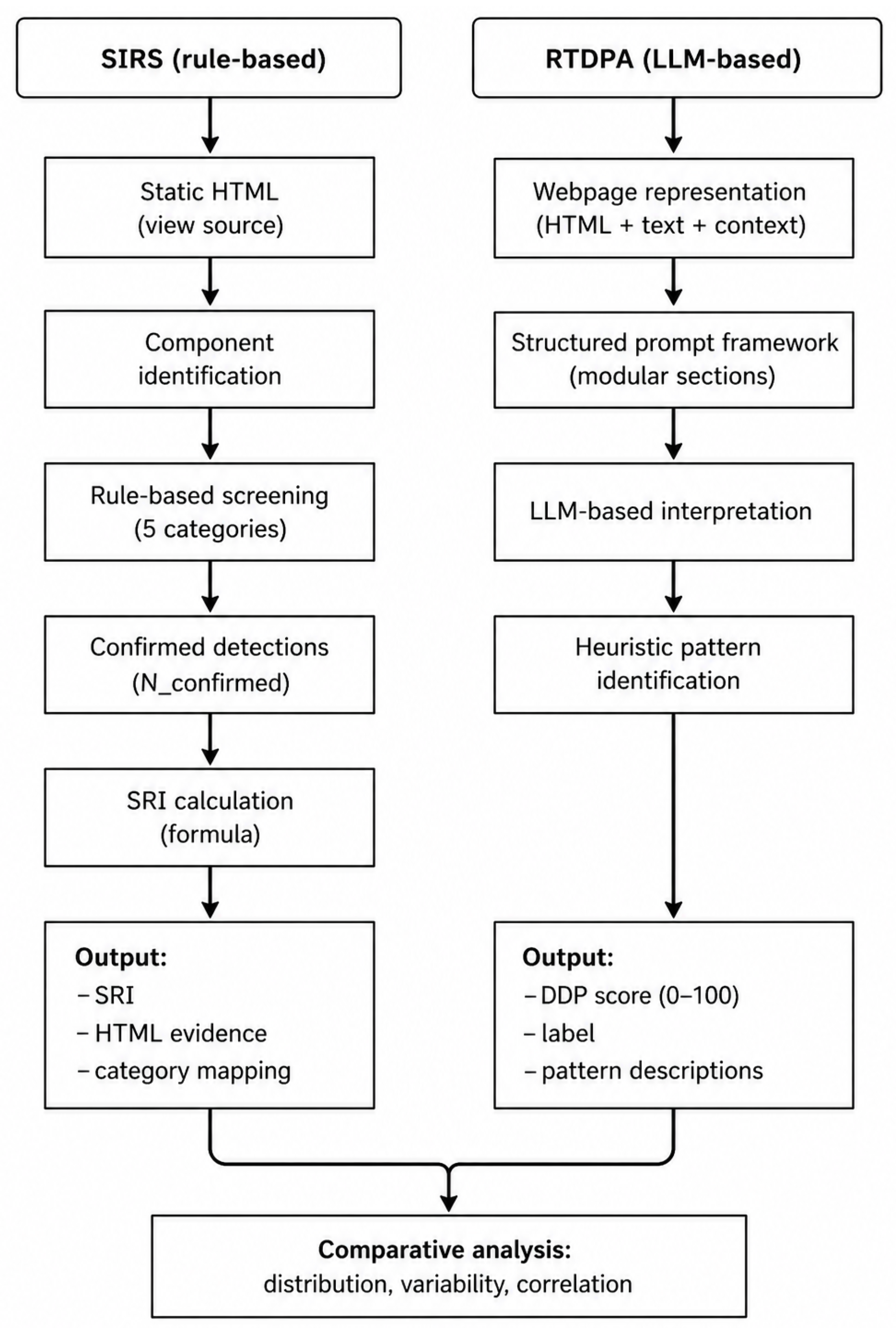
| Analytical approach and system characteristics | Deterministic, rule-based, transparent structural system | Generative, heuristic, black-box system |
| Scope of input | Static, server-delivered HTML (View source) | HTML + contextualised interpretation (often heuristic) |
| Detection type | Structural attributes of the interface | Potential manipulative patterns |
| Perceived designer’s intent | None; not considered | Often implied |
| Proof required (HTML code) | Obligatory | Optional |
| Heuristic layer | Separate, non-scored | Integrated with score |
| Score/indicator | Overt formula, Structural Risk Index (SRI), range: 0–100 plus DP Mapping—Dark Pattern Mapping | Typically narrative/model-based, Deceptive Design Patterns (DDPs), range: 0–100 with a label |
| Determinism | High (fixed rules) | Variable (probabilistic) |
| Replicability | High | Medium/low |
| Sensitivity | Low–moderate | High |
| Risk of over-detection | Low | High |
| Scope of UX interpretation | Structure only | Broad (language, context, presumptions) |
| Visual layer evaluation | None | Heuristic |
| Analysis of dynamic behaviour | None | Heuristic |
| Analytical perspective | Measurement tool | Exploratory tool |
| Tool | Result Type | Minimum Value | Maximum Value | Missing Data Count |
|---|---|---|---|---|
| Langford Dark Pattern Detector | Detected signs count (numerical value) | 0 | 10 | 0 |
| Pattern Shield | Pattern count/‘Error’ message | 1 | 2 | 45 |
| Dark Pattern Detector | Number of issues (numerical value) | 0 | 104 | 0 |
| Statistic | RTDPA (DDP) | SIRS (SRI) |
|---|---|---|
| Observation count (N) | 65 | 65 |
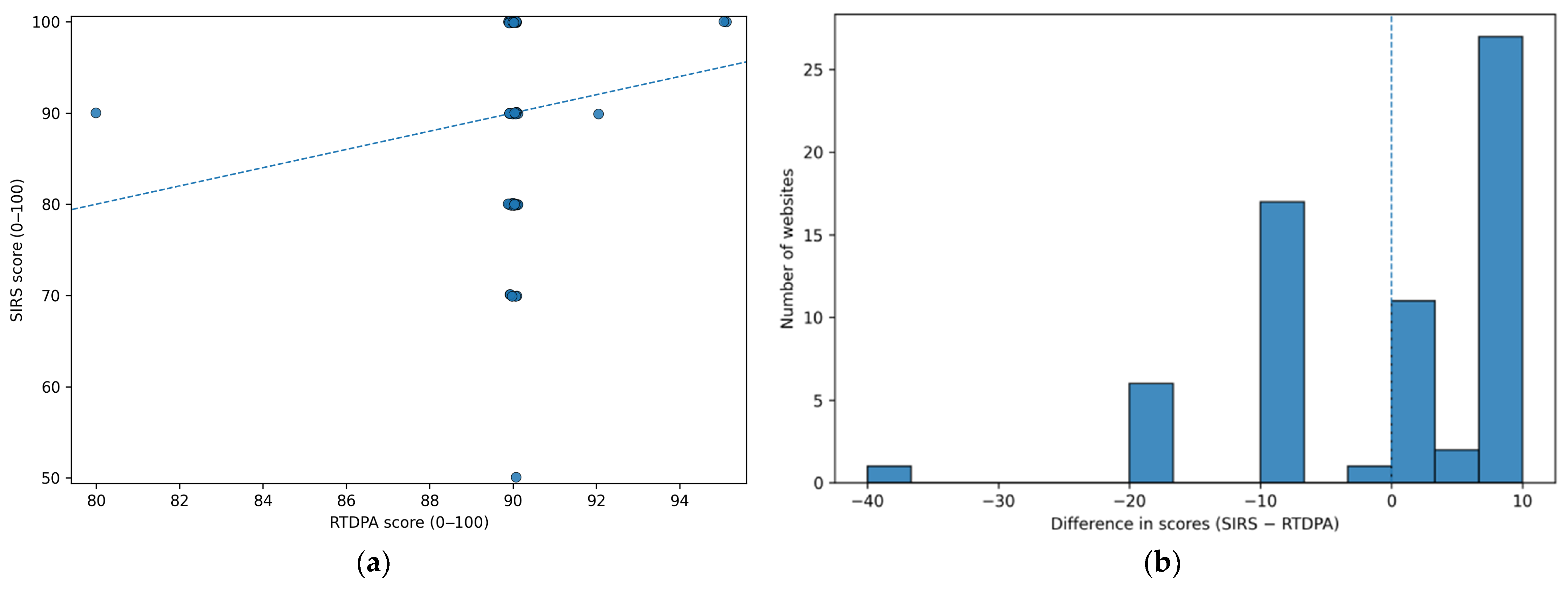
| Mean | 90.03 | 89.23 |
| Median | 90 | 90 |
| Standard deviation | 1.55 | 11.5 |
| Minimum value | 80 | 50 |
| Maximum value | 95 | 100 |
| Score range | 80–95 | 50–100 |
Disclaimer/Publisher’s Note: The statements, opinions and data contained in all publications are solely those of the individual author(s) and contributor(s) and not of MDPI and/or the editor(s). MDPI and/or the editor(s) disclaim responsibility for any injury to people or property resulting from any ideas, methods, instructions or products referred to in the content. |
© 2026 by the author. Licensee MDPI, Basel, Switzerland. This article is an open access article distributed under the terms and conditions of the Creative Commons Attribution (CC BY) license.
Share and Cite
Król, K. Automated Detection of Deceptive Design Patterns on University Websites: A Comparative Analysis of Browser-Based Tools and LLM-Based Approaches. Appl. Sci. 2026, 16, 4543. https://doi.org/10.3390/app16094543
Król K. Automated Detection of Deceptive Design Patterns on University Websites: A Comparative Analysis of Browser-Based Tools and LLM-Based Approaches. Applied Sciences. 2026; 16(9):4543. https://doi.org/10.3390/app16094543
Chicago/Turabian StyleKról, Karol. 2026. "Automated Detection of Deceptive Design Patterns on University Websites: A Comparative Analysis of Browser-Based Tools and LLM-Based Approaches" Applied Sciences 16, no. 9: 4543. https://doi.org/10.3390/app16094543
APA StyleKról, K. (2026). Automated Detection of Deceptive Design Patterns on University Websites: A Comparative Analysis of Browser-Based Tools and LLM-Based Approaches. Applied Sciences, 16(9), 4543. https://doi.org/10.3390/app16094543