1. Introduction
Artificial Intelligence (AI) and the Internet of Things (IoT) are increasingly converging into a paradigm for personalized health management in sport and human performance. This convergence, termed Artificial Intelligence of Things (AIoT), enables pervasive sensing, real-time analytics, and adaptive decision-making. In sports, athletes continuously generate high-frequency physiological, biomechanical, and environmental signals; yet training and recovery decisions remain largely device-agnostic and reactive. An AIoT-based approach can facilitate continuous monitoring, enabling early detection of adverse events, anomaly recognition, and data-informed optimization of performance and well-being throughout the athlete’s life course [
1,
2,
3].
However, realizing this promise demands far more than technology integration. It requires an interdisciplinary framework spanning sensor engineering, signal processing, machine learning, clinical medicine, exercise physiology, data governance, and ethical reasoning [
4,
5,
6]. Fragmented solutions—those that focus solely on wearable hardware, isolated algorithms, or single-domain analytics—systematically overlook the complex, nonlinear interactions among physiology, training load, recovery, psychology, and context [
6,
7]. Moreover, athlete-centered systems must address five critical dimensions simultaneously: (1) technical capability, achieving real-time sensitivity and specificity; (2) privacy and security—ensuring sensitive health data remains under athlete control; (3) explainability—enabling clinicians and athletes to understand AI-generated insights; (4) equity—ensuring access across diverse athlete populations and socioeconomic backgrounds; and (5) human-centered design—maintaining athlete autonomy and trust [
5,
7,
8,
9].
These considerations motivate the establishment of dedicated research centers capable of coordinating expertise across disciplines while maintaining a coherent scientific and ethical vision. This article presents the Interdisciplinary AI Center for Longevity and Health, conceived as an institutional hub integrating computer science, biomedical engineering, medicine, and sport science to design, evaluate, and iteratively refine AIoT solutions for athlete health. The Center’s dual mission is to: (1) propose and systematically evaluate AIoT system architectures supporting real-time monitoring, injury prediction, and individualized training response optimization and (2) explore the translation of emerging technologies into practical, ethically-grounded, and scalable services accessible to athletes, coaches, medical staff, and research communities.
In support of this mission, the paper discusses relevant literature across six complementary technical domains: (1) wearable sensor technologies and biomarker analysis for comprehensive physiological assessment; (2) distributed computing paradigms (edge-fog-cloud) enabling real-time processing with low latency and privacy guarantees; (3) deep learning and neural architectures for temporal and multimodal data fusion; (4) machine learning methods for clinical injury risk prediction and prevention; (5) privacy-preserving mechanisms including federated learning and differential privacy; and (6) digital twin technologies for longitudinal health trajectory modeling. We use this literature to frame system-level requirements and interdisciplinary constraints, identifying current capabilities, persistent open challenges, and research gaps that the proposed Center aims to address.
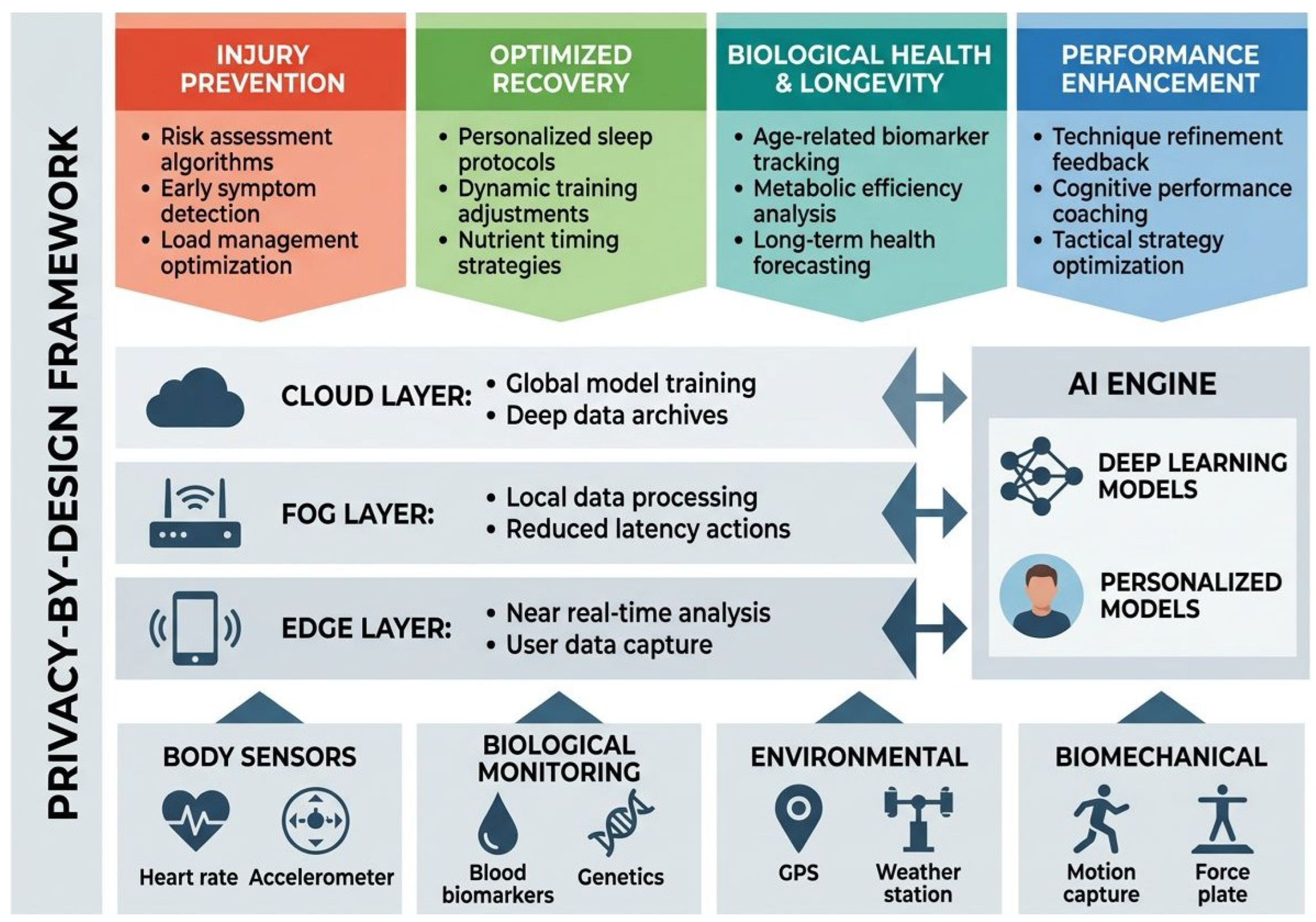
The architectural approach presented in
Figure 1 integrates three
design principles: (1) multimodal sensing—combining wearables, biomechanical instrumentation, biomarker monitoring, and environmental sensors into a coherent data acquisition strategy; (2) distributed intelligence—deploying edge nodes for real-time anomaly detection and immediate feedback, fog nodes for intermediate analytics and pattern recognition, and a cloud infrastructure for longitudinal tracking and predictive prevention; and (3) privacy by design—employing federated learning, differential privacy, and secure multiparty computation to ensure data protection at every layer. This architecture enables five primary applications: continuous health status monitoring with adaptive coaching feedback; injury risk prediction and biomechanical prevention; personalized performance optimization through training response characterization; comprehensive well-being assessment integrating physiological, psychological, and social dimensions; and longevity-oriented prevention through early biomarker detection and biological aging assessment.
1.1. Original Contributions of This Work
The original contributions of this paper are as follows:
- 1.
Conceptual framework: We propose an interdisciplinary conceptual framework that integrates AIoT, wearable sensing, distributed computing, and privacy-preserving AI within a unified athlete health ecosystem, bridging computer science, biomedical engineering, and sports science.
- 2.
Reference architecture: We outline a reference edge–fog–cloud architecture with explicit layer responsibilities (real-time preprocessing at the edge, intermediate aggregation at the fog, and deep analytics in the cloud), showing how each tier contributes to latency reduction, privacy enforcement, and scalable analytics.
- 3.
Prototype feasibility: We present a proof-of-concept implementation of a real-time health monitoring dashboard using an InfluxDB–Grafana pipeline validated with synthetic data, demonstrating end-to-end pipeline feasibility before physical device deployment.
- 4.
Integration of AI, privacy, and explainability: We combine federated learning, differential privacy, and formal verification (via Linear Temporal Logic) within the same architectural blueprint, presenting their interplay as design-level priorities rather than isolated techniques.
- 5.
Interdisciplinary research agenda: We define a structured research agenda spanning pilot experimentation, instrumentation roadmaps, and validation protocols, identifying concrete future research directions at the intersection of the contributing disciplines.
1.2. Objectives and Research Questions
To guide the design and evaluation of the proposed framework, this work addresses the following research and design questions:
- RQ1:
How can an integrated edge–fog–cloud architecture be structured to support real-time, multimodal athlete health monitoring while preserving data privacy and enabling explainable AI-driven decision support?
- RQ2:
What are the key technical requirements and design trade-offs for integrating heterogeneous wearable sensor data (physiological, biomechanical, biochemical, and environmental) into a coherent analytical pipeline?
- RQ3:
To what extent can a proof-of-concept dashboard pipeline, validated with synthetic data, demonstrate the feasibility of the proposed architecture for real-time health status visualization and downstream analytics?
- RQ4:
What open challenges and research gaps must be addressed to translate the proposed conceptual framework into a fully validated, deployable system for diverse athlete populations?
The remainder of this paper is structured as follows.
Section 2 presents the Center’s operational objectives, research agenda, the Integrated Well-Being Index (IW-BI) model, and the three interconnected physical environments that support interdisciplinary investigation.
Section 3 describes the proposed system architecture for continuous athlete monitoring, including the multi-layer AI framework, the multimodal data fusion strategy, the communication infrastructure, and the proof-of-concept implementation with its limitations.
Section 4 clarifies the scope of the literature discussed in the manuscript and examines recent advances in wearable sensor technologies and multimodal biomarker analysis.
Section 5 examines distributed edge–fog–cloud computing paradigms and AI architectures for real-time processing, including deep learning paradigms for time-series health data.
Section 6 presents AI-driven applications spanning real-time health monitoring, personalized performance optimization, holistic well-being assessment, and longevity management.
Section 7 addresses privacy-preserving mechanisms, model interpretability, and formal verification, with explicit status labels distinguishing implemented components from design intentions and future work.
Section 8 explores emerging technologies, including digital twins, multi-domain omics integration, and continual learning systems.
Section 9 discusses the overall contributions, limitations, and practical deployment challenges. Finally,
Section 10 summarizes the key findings and outlines critical future research directions.
2. Interdisciplinary AI Center Objectives and Research Agenda
The Interdisciplinary AI Center is conceived as a technological and scientific hub for education and well-being. Its core objective is to develop an integrated system for assessing and characterizing individual well-being by acquiring, analyzing, and personalizing biometric, psychological, and contextual data. The user profiling model integrates well-being dimensions (physical, emotional, mental, spiritual) into an Integrated Well-Being Index (IW-BI) and feeds a Long Life Trainer and a context-aware recommendation engine to deliver adaptive guidance over time. Within this framework, athletic performance, cognitive development, and everyday quality of life are treated as interdependent dimensions of a single health ecosystem.
Integrated Well-Being Index (IW-BI): Conceptual Model
The Integrated Well-Being Index (IW-BI) is proposed as a composite indicator that aggregates multiple dimensions of individual well-being into a single, interpretable score. The model currently distinguishes four primary dimensions:
Physical well-being: Indicators include resting heart rate, heart rate variability (HRV), sleep quality and duration, daily step count, active minutes, and body composition metrics.
Emotional well-being: Indicators include perceived stress level (e.g., via validated questionnaires such as PSS-10), mood self-reports, and physiological stress proxies (e.g., Garmin stress index derived from HRV).
Mental well-being: Indicators include cognitive load measures (via BCI or eye-tracking in laboratory settings), self-reported concentration and motivation levels, and attention metrics during performance tasks.
Spiritual/social well-being: Indicators include social connectedness self-reports, sense of purpose questionnaires, and qualitative assessments of life satisfaction.
For each dimension
, raw indicator values are normalized to a common
scale using min-max normalization relative to population-level or individual baseline ranges. The composite IW-BI score is then computed as a weighted aggregation:
where
is the normalized mean score for dimension
d and
is the corresponding weight satisfying
. In the current conceptual formulation, equal weights (
) are adopted as a baseline; alternative weighting schemes (e.g., based on expert elicitation or data-driven importance ranking) are identified as a future research direction.
The IW-BI model is currently conceptual and has not yet been validated with real-world data. Empirical validation—including sensitivity analysis of the weighting scheme, test–retest reliability, and concurrent validity against established well-being instruments—is required before the index can be considered suitable for clinical or applied use.
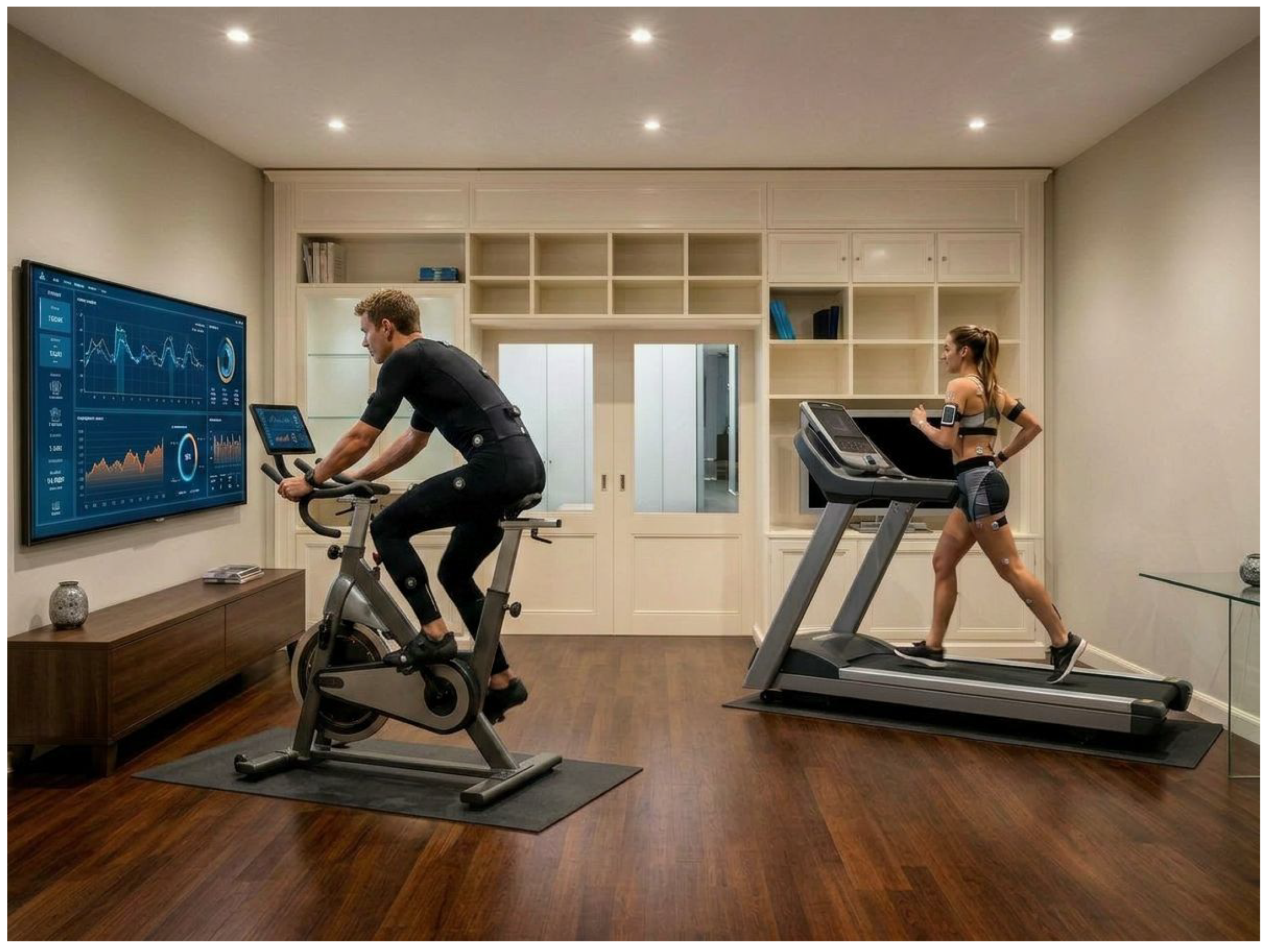
This operational vision is implemented across three interconnected physical environments, supported by a shared high-performance computing backbone (a proof of concept of the athlete’s monitoring room is shown in
Figure 2). The “Athlete Well-Being” room focuses on advanced biometric monitoring and performance evaluation under immersive conditions; the “Student Well-Being” room is a neuroscience laboratory with instruments for brain-computer interface (BCI) and eye-tracking analysis; and the “Personal Well-Being” room is a Living Lab equipped with environmental IoT sensing and mobile devices for studying general health and human-environment interactions. A distributed infrastructure (server with GPU/FPGA resources [
10] and a dedicated AI module) enables integrated data processing and real-time model training, supporting cross-domain analyses in sport, neuroscience and well-being.
The Center’s research agenda integrates technology development, experimentation, and validation:
AIoT and data integration. Aggregation of wearable and environmental sensor data, using ecosystem bridges (e.g., Garmin) for biometric and activity extraction, and validation of composite well-being metrics.
Virtual Coach and Digital Twin. Design of a Virtual Coach AI for training program management and a progressive Digital Twin to support human coaches by interpreting complex data and translating it into actionable guidance.
Performance and learning. Studies of physiological response to effort in immersive scenarios and analysis of attention/cognitive load via BCI, eye tracking, and extended reality.
Living Lab and everyday health. Continuous monitoring of stress, sleep, and HRV, assessment of environmental impacts on psychophysical health, and testing of telemedicine services and mobile health applications.
Pilot experimentation. A study with Sport Sciences students to compare human-designed vs. AI-generated training programs, integrating quantitative measures with qualitative questionnaires; definition of observation duration, sampling, and data governance.
Instrumentation roadmap. Evaluation of emerging technologies for movement analysis (computer vision) and body morphology assessment (3D scanning), aligned with the Center’s growth.
3. System Architecture for Athlete Monitoring
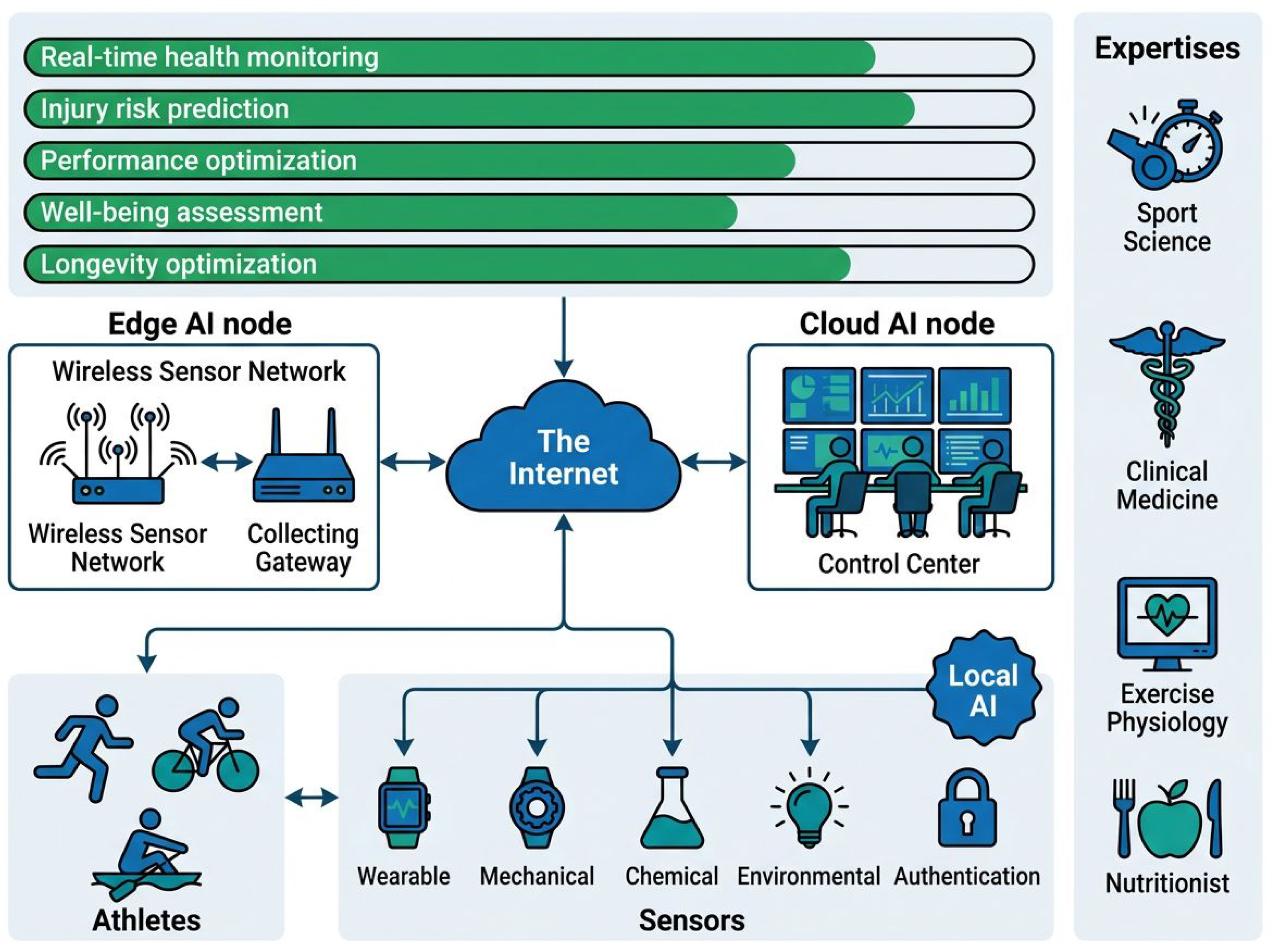
The principal scheme of the system architecture developed within the interdisciplinary center is illustrated in
Figure 3. The proposed platform is designed to support continuous monitoring of athletes during training sessions, both in controlled indoor environments and in outdoor scenarios, enabling real-time data acquisition, analysis, and feedback.
Athletes can perform their training activities either on-site, using sport-specific equipment (e.g., treadmills, stationary bicycles, or rowing machines), or in outdoor environments such as parks, roads, or swimming facilities. During these activities, athletes are equipped with a heterogeneous set of wearable and sensing devices, including smartwatches, fitness bands, and biochemical sensors. These devices enable the measurement of a wide range of physiological and performance-related parameters, such as heart rate, body temperature, and biochemical markers derived from sweat analysis. In addition, environmental sensors may be deployed to capture contextual data, including ambient temperature and humidity, which can significantly influence athletic performance and physiological responses.
To support data acquisition, a Wireless Sensor Network (WSN) is proposed to collect information from distributed sensing units associated with each athlete. The WSN is dimensioned based on several factors, including the expected number of athletes, the number and types of sports equipment, and the typical data rates required by monitoring applications. The network primarily relies on Bluetooth, commonly used by wearable devices, and Wi-Fi for higher data throughput. However, alternative communication technologies are also considered to ensure flexibility and scalability. These include ZigBee [
11] and LoRa [
12] for low-data-rate, energy-efficient transmissions, as well as 5G RedCap [
13] for direct communication among athlete devices in outdoor scenarios.
For indoor environments, the WSN provides seamless connectivity to local infrastructure, while for outdoor use cases, long-range and cellular communication technologies enable real-time data transmission to cloud-based services. This hybrid communication approach is designed to support continuous data collection regardless of the training context.
Collected data are transmitted in real time to a centralized cloud platform, where they can be visualized and monitored within a dedicated control room available at the interdisciplinary center. In addition to cloud storage, the system integrates a local server that supports both data persistence and AI model execution, enabling a hybrid cloud-edge computing paradigm.
To enhance the overall monitoring capabilities, we propose a multi-layer AI framework operating across three hierarchical levels:
Edge AI (real-time): The first level is located closest to the athlete and runs directly on wearable devices or small clusters of sensors. Although computational resources and available data are limited at this level, local AI enables immediate feedback, supporting both medical monitoring (e.g., anomaly detection in physiological signals) and performance-related insights. Typical tasks: raw signal filtering, threshold-based alerts, heartbeat irregularity detection. Latency target: <50 ms.
Fog AI (aggregation and pattern recognition): The second level is deployed at the network edge (e.g., on a local gateway or smartphone). Compared to on-device AI, this layer has access to a larger set of aggregated data from multiple devices and athletes. It performs intermediate analytics with moderate computational resources, providing a balance between responsiveness and analytical depth. Typical tasks: multi-sensor data fusion, session-level trend detection, cross-device correlation, short-term fatigue modeling. Latency target: <1 s.
Cloud AI (deep analytics): The third level operates in the cloud, leveraging large-scale computational resources and datasets. This layer is responsible for advanced analytics, long-term performance modeling, training optimization, and predictive analysis to support the athlete’s well-being and longevity. The cloud AI refines models using historical data stored in the central database, enabling personalized and adaptive training recommendations. Typical tasks: longitudinal trajectory modeling, population-level benchmarking, Digital Twin updates, LSTM-based fatigue prediction. Latency tolerance: minutes to hours.
The data flow across these layers follows a hierarchical filtering and abstraction principle: raw sensor streams are preprocessed and filtered at the edge, reducing bandwidth and removing noise; the fog layer aggregates filtered signals from multiple sources, applies intermediate fusion and pattern recognition, and forwards only relevant abstractions (e.g., session summaries, anomaly flags) to the cloud; the cloud layer integrates longitudinal data, runs computationally intensive models, and pushes updated model parameters or personalized recommendations back to the fog and edge layers. This bidirectional flow is designed to balance responsiveness, bandwidth efficiency, and analytical depth.
Preliminary latency observations: Internal benchmarks on the prototype pipeline (
Section 3.2.1) indicate that the InfluxDB ingestion-to-Grafana visualization cycle operates within seconds for synthetic data streams at typical wearable sampling rates (∼1 Hz). These observations are preliminary and were obtained under controlled, single-user conditions with synthetic data; systematic latency characterization under realistic multi-user, multi-device scenarios remains a key objective for future evaluation.
3.1. Multimodal Data Fusion Strategy
A distinguishing aspect of the proposed architecture is its support for multimodal data fusion—the integration of heterogeneous sensor streams into a unified analytical representation. In the context of athlete health monitoring, relevant data modalities include:
Physiological signals: heart rate, HRV, SpO2, body temperature (from wearables);
Biomechanical data: acceleration, angular velocity, gait parameters (from IMUs);
Biochemical markers: sweat lactate, glucose, cortisol, electrolytes (from epidermal sensors);
Environmental context: ambient temperature, humidity, altitude (from environmental IoT sensors).
The proposed fusion strategy operates at two levels within the architecture:
- 1.
Feature-level fusion (fog layer): Signals from co-located sensors are temporally aligned, normalized, and concatenated into a unified feature vector at the fog node. For each time window
t, the fused representation is:
where each sub-vector is independently normalized (z-score or min-max) to a common scale.
- 2.
Decision-level fusion (cloud layer): Domain-specific models (e.g., an LSTM for physiological trends, a random forest for injury risk) produce independent predictions, which are combined via a weighted voting or stacking ensemble:
where
is the prediction of model
m and
is its assigned weight.
Weighting strategy: In the current conceptual design, equal weights are adopted as a baseline. Data-driven weight optimization (e.g., via cross-validation on labeled pilot data or attention-based learned weights) is planned as a future research direction once sufficient real-world data are available.
Status clarification: The multimodal fusion pipeline described above is currently a design-level specification; the feature-level concatenation is supported by the prototype’s data ingestion pipeline, but the decision-level ensemble and weight optimization have not yet been implemented or validated. Their realization depends on the availability of labeled, multi-sensor training data from the planned pilot studies.
The integration of multi-modal sensing, heterogeneous communication technologies, and hierarchical AI processing is intended to support the realization of a comprehensive monitoring ecosystem. The proposed system is designed to facilitate real-time decision-making, long-term performance optimization, and proactive well-being management, with the goal of improving athletic performance and supporting longevity.
A key distinguishing feature of the proposed framework is the multidisciplinary nature of the AI models. Specifically, the AI components are designed to integrate and continuously draw on domain-specific expertise, including sports science, medical knowledge, exercise physiology, and nutrition science. This interdisciplinary approach allows the system to move beyond purely data-driven analytics, incorporating validated domain knowledge into the modeling and decision-making processes. By combining heterogeneous data sources with expert-informed AI models, the system is designed to provide a holistic, coherent assessment of the athlete’s condition. This includes not only performance optimization in terms of training efficiency and output, but also short-term well-being indicators, such as fatigue, recovery status, and physiological stress, as well as long-term factors related to health preservation and longevity.
Such an integrated perspective is intended to enable the delivery of personalized recommendations that adapt dynamically to the athlete’s evolving condition, training context, and environmental factors. As a result, the proposed architecture outlines a pathway from reactive monitoring toward proactive and predictive athlete management, where performance enhancement is coupled with health preservation and long-term sustainability.
3.2. Real-Time Monitoring and Visualization of Health Data from Wearable Devices
This section describes a fundamental building block of the Interdisciplinary AI Center focused on everyday health: the design and validation of a dashboard for real-time health status monitoring based on data from wearable devices, with particular reference to the Garmin ecosystem. Within the architecture of the Interdisciplinary AI Center, the proposed dashboard serves as the observation and control layer for real-time physiological data flows. It provides a continuous representation of key parameters required to estimate current health status, support the computation of composite indicators, and feed downstream components, such as the Virtual Coach, the Digital Twin, and personalized recommendation systems.
The addressed problem consists of designing and implementing an end-to-end pipeline capable of acquiring physiological data from Garmin devices, storing them in a time-series database, and making them available in real time on the wearable and asynchronous updates through an interactive dashboard intended for Living Lab scenarios and, in the long term, experimental clinical contexts. The pipeline must simultaneously satisfy the following requirements:
Continuous and reliable ingestion of data streams originating from heterogeneous wearable devices;
Interactive visualization of multiparametric time series (heart rate, steps, sleep, stress, etc.);
Extensibility toward advanced analytics, such as AI-based risk prediction and anomaly detection models.
Similar architectures are widely discussed in the literature on telemonitoring systems integrating smartwatches, environmental sensors, and cloud platforms to provide a unified view of patient health status, confirming the relevance of this problem in the digital health domain [
14,
15]. Several studies have highlighted the effectiveness of time-series dashboards for representing and analyzing physiological and environmental signals. In this context, Grafana has emerged as a versatile visualization tool due to its capability to manage real-time data streams, support multiple data sources, and provide a wide range of configurable graphical panels. For instance, it has been employed for meteorological data visualization and real-time slow control systems through interactive dashboards enabling dynamic time-window manipulation and multi-variable comparison within a single view, improving exploratory analysis compared to static tools [
16,
17,
18]. In the mHealth domain, Grafana has also been used for real-time monitoring of smartphone sensor data collection infrastructures, integrating heterogeneous data streams and enabling timely detection of acquisition anomalies, a crucial requirement in longitudinal studies involving large participant cohorts [
19]. Similarly, data fabric architectures for remote health monitoring integrate data from smartphones, wearables, and environmental sensors, exposing them through near-real-time dashboards for health assessment [
14]. Regarding the storage layer, the literature identifies InfluxDB as a mature solution for managing large volumes of time-series data. Comparative studies show that, compared with Prometheus, InfluxDB offers advantages in digital twin and Industrial IoT applications where long-term persistence and historical analysis are essential, while maintaining high ingestion performance and direct integration with Grafana [
20]. Power IoT implementations further demonstrate InfluxDB’s effectiveness in handling continuous data streams from distributed devices, thanks to its native time-series data model and temporal aggregation functions [
21]. Additional research proposes engine optimizations to improve scalability and performance under intensive write workloads [
22], while recent architectures integrate InfluxDB with LLM-based natural-language query interfaces, highlighting its extensibility for advanced analytics [
23].
The combined use of InfluxDB and Grafana is well established across multiple application domains characterized by continuous data streams. In IoT scenarios, MQTT → InfluxDB → Grafana pipelines enable efficient data collection and historical storage from distributed sensors while providing real-time operational dashboards [
24]. Similarly, the monitoring infrastructure of the ATLAS distributed computing system at CERN was migrated to a standardized stack based on InfluxDB and Grafana, achieving scalable monitoring and accounting dashboards for large-scale metrics [
25]. In smart healthcare contexts, this combination has also been applied to interactive ECG signal visualization, demonstrating its suitability for near-real-time biomedical data analysis [
26]. Overall, these findings indicate that the InfluxDB–Grafana pair constitutes a mature, validated technology stack suitable for both IoT and smart healthcare applications. In order to conduct a preliminary study and to validate the InfluxDB–Grafana pipeline, a simulation layer has been introduced that generates synthetic data compatible with the Garmin Connect ecosystem [
27,
28]. This layer continuously produces synthetic time-series data ingested by InfluxDB, emulating the behaviour of a real wearable device for metrics such as heart rate, step count, calories, distance, and stress index. The use of synthetic data in this context is motivated by both practical and ethical considerations: it mitigates limitations in data collection costs, labelling complexity, and privacy constraints while preserving the statistical properties and temporal structure of real physiological signals [
28].
Since the Garmin Connect API is subject to rate limits that prevent real-time data access during training sessions—data being made available only after the activity has concluded and the device has synchronised with the cloud [
29]—the simulation layer additionally allows testing of the Bluetooth communication load between the Garmin device, on which a data-harvesting application will be deployed, and the athlete’s smartphone, which acts as an edge node in the proposed architecture [
30,
31]. The data acquisition service is intentionally decoupled from both the storage and visualisation components, following a microservice-based IoT architecture principle that ensures scalability and interoperability: the ingestion component—whether real or simulated—can therefore be replaced by a live Garmin connector without structural modifications to the pipeline.
To address this communication constraint between the Garmin device and the smartphone, a dedicated on-device application must be developed using the Garmin Connect IQ SDK [
32], which provides the necessary APIs to stream real-time physiological data over Bluetooth to a companion application running on the smartphone edge node.
From a methodological perspective, the introduced simulation layer allows:
Exercising the ingestion pipeline at frequencies comparable to real wearable devices;
Validating temporal queries and Grafana panels using dynamically realistic data;
Evaluating dashboard behavior under continuous updates and assessing interface responsiveness.
3.2.1. Proof-of-Concept Implementation
We adapted a prototype based on the open-source project “garmin-grafana” [
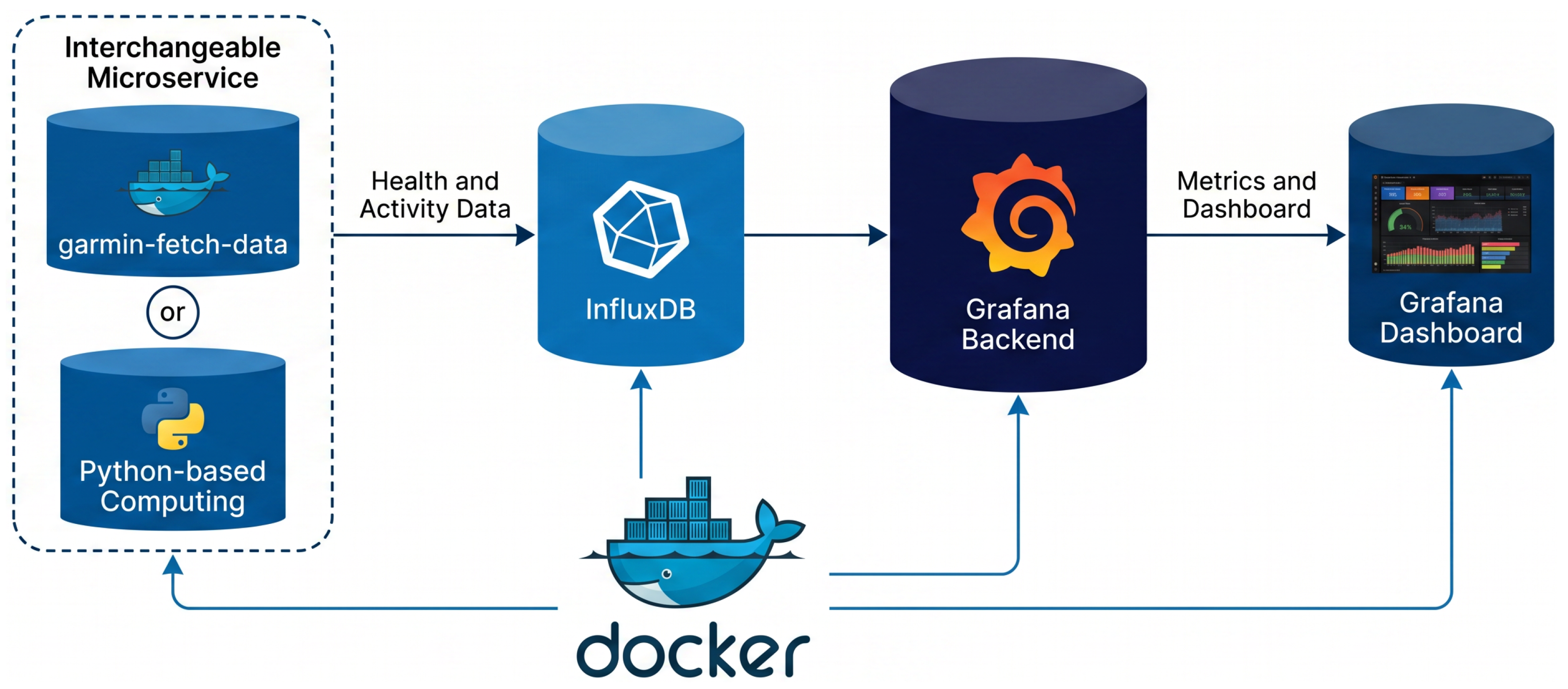
33], which provides a containerized architecture integrating Garmin Connect, InfluxDB, and Grafana. The project includes Docker containers dedicated to:
Periodic acquisition of data from Garmin Connect;
Ingestion into the InfluxDB database;
Visualization through preconfigured Grafana dashboards.
The solution supports numerous physiological and behavioral metrics, including heart rate, step counts, sleep parameters, stress levels, body battery indicators, and advanced training data, consistent with wearable-based health monitoring systems described in the literature. In the absence of physical devices during the initial phase, the simulation layer replaces the Garmin data flow by generating synthetic time series and writing them into the same InfluxDB instance without requiring structural modifications to the pipeline. The resulting Docker-based architecture is illustrated in
Figure 4.
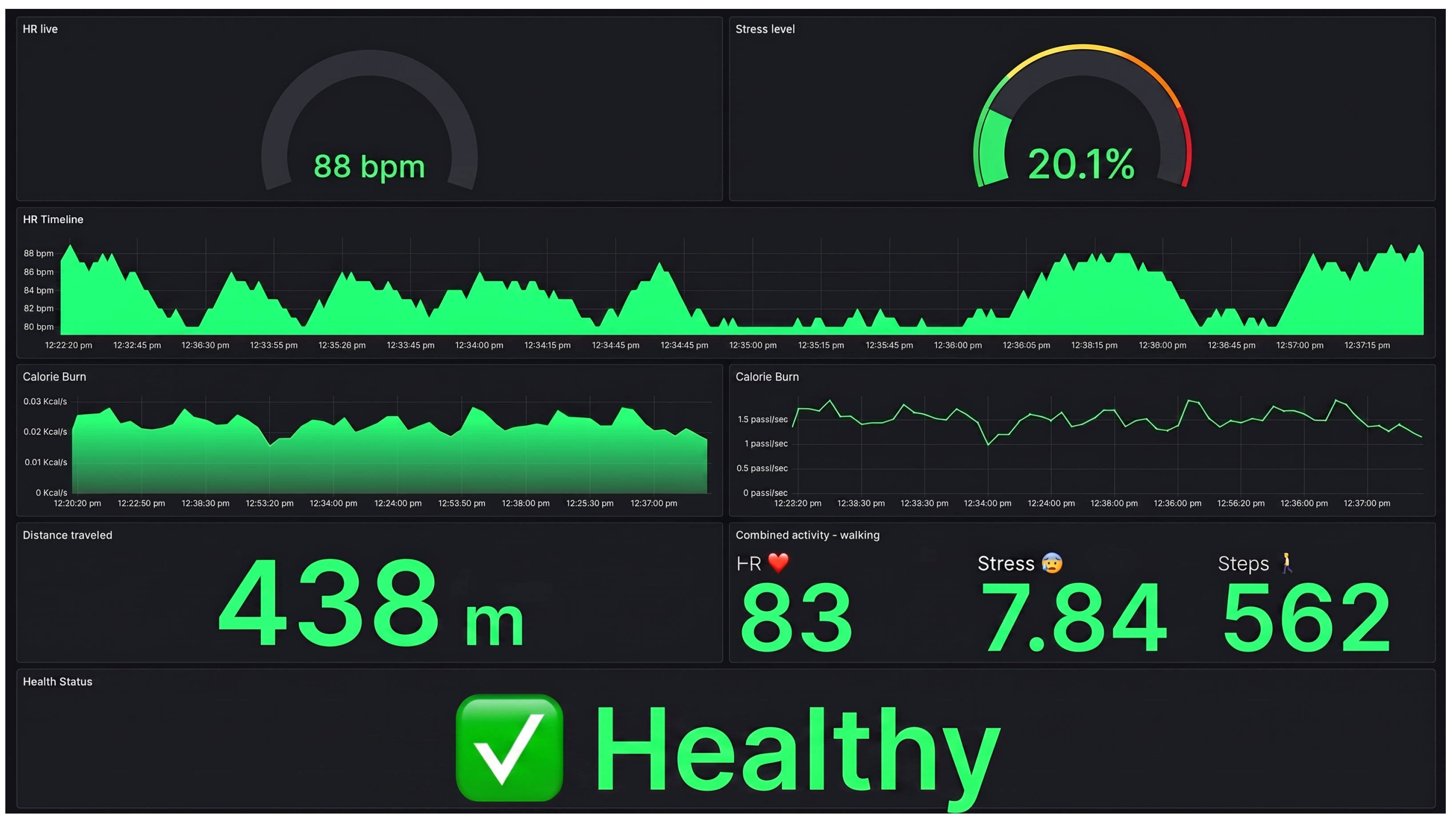
The resulting dashboard, shown in
Figure 5, illustrates that, even with simulated data, coherent and informative visualizations of physiological parameters can be produced, providing preliminary evidence of the approach’s feasibility for real-time health monitoring scenarios.
Building on the described architecture, a subsequent experimental research direction has been initiated to explore the use of generative interfaces such as C1 by Thesys (Thesys: The Generative UI Company (
https://github.com/thesysdev (accessed on 26 April 2026)), a Generative UI API for native AI applications. In this perspective, the dashboard evolves from a static set of predefined panels into a dynamically generated interface driven by user requests and analytical context. The architecture involves a locally executed language model (e.g., via Ollama) that queries InfluxDB based on user prompts and produces a structured description of the desired interface, which is subsequently translated into UI components by Thesys using C1.
Natural language requests can therefore be automatically transformed into layouts and visualizations, eliminating the need for manual dashboard design. This direction aligns with the broader evolution of digital health platforms, where wearable data exploration is increasingly orchestrated by AI components while maintaining transparency, auditability, and control requirements essential in clinical environments [
14].
In future developments, the Grafana–InfluxDB pipeline presented in this study serves as the foundational data infrastructure, while generative tools and local LLMs represent a step toward Generative UI systems that dynamically personalize data visualization based on user profiles and research questions.
3.2.2. Open-Source Components and Original Contributions
To ensure transparency regarding the distinction between reused and original elements, we clarify the following.
Reused components: The proof-of-concept pipeline builds on established open-source tools, including InfluxDB (time-series storage), Grafana (dashboard visualization), Docker (containerization), and the “garmin-grafana” project [
33] for initial Garmin data integration scaffolding. These tools provide mature, community-validated building blocks for IoT data pipelines.
Original contributions: The original contributions of this work lie not in the individual tools but in (1) the integration architecture that combines these tools into a coherent, modular health-monitoring pipeline aligned with the edge–fog–cloud paradigm; (2) the synthetic data simulation layer designed to emulate Garmin wearable output for pipeline validation; (3) the interdisciplinary design model that connects the technical pipeline to sports science, medicine, and well-being assessment through the IW-BI framework; and (4) the conceptual blueprint for extending the pipeline with privacy-preserving AI, explainable formal verification, and Generative UI—directions that distinguish this work from generic IoT dashboard implementations.
3.2.3. Proof-of-Concept Limitations
Several important limitations of the current proof-of-concept must be acknowledged:
Synthetic data only: All pipeline validation has been conducted using synthetically generated data. While the synthetic data layer preserves the temporal structure and statistical properties of typical wearable output, it cannot capture the full variability, noise characteristics, and edge cases present in real physiological signals.
No real-world validation: The prototype has not been tested with real athletes or real wearable devices in field conditions. End-to-end performance, reliability, and usability under realistic operational loads remain unverified.
No clinical validation: The dashboard and pipeline have not been evaluated against clinical endpoints or validated health instruments. No claims are made regarding diagnostic accuracy, clinical utility, or regulatory compliance.
Single-user scope: The current prototype has been exercised in a single-user configuration. Scalability to concurrent multi-athlete monitoring has not been tested.
AI components not yet integrated: The downstream AI components described in the architecture (e.g., anomaly detection, injury risk prediction, LSTM-based performance modeling) are design-level specifications and have not been implemented within the current prototype.
3.2.4. Future Work for Dashboard and Pipeline
The following steps are planned to advance the proof-of-concept toward a validated system:
Real data integration: Replacing the synthetic data layer with live Garmin Connect IQ data streams via a dedicated on-device application, enabling validation with real physiological signals.
Longitudinal pilot studies: Conducting controlled studies with Sport Sciences students (as outlined in the Center’s research agenda) to collect multi-week wearable datasets and evaluate pipeline robustness, data quality, and user acceptance.
Multi-user scalability testing: Evaluating system performance under concurrent data ingestion from multiple athletes with heterogeneous device configurations.
AI model integration: Implementing and evaluating real-time anomaly detection at the edge layer and LSTM-based performance models at the cloud layer, using pilot study data.
Clinical benchmarking: Comparing dashboard-derived health indicators against validated clinical instruments to assess concurrent validity.
Deployment roadmap: Defining infrastructure, governance, and ethical review requirements for transitioning from laboratory prototype to field deployment.
4. Wearable Sensing and Biomarker Technologies
Scope of the Literature Discussion
The discussion of prior work presented in
Section 4,
Section 5,
Section 6,
Section 7 and
Section 8 is intended to frame the proposed conceptual architecture and to situate it within the main technical domains relevant to athlete health and well-being.
Rather than presenting a formal literature review with a predefined review protocol, these sections draw on representative and recent contributions across the six domains identified in the Introduction to highlight enabling technologies, recurring challenges, and open research directions that motivate the proposed framework.
Accordingly, the cited literature should be read as contextual support for the conceptual and architectural argument developed in this paper, not as a systematic or reproducible review of the field.
Wearable sensor technologies have advanced dramatically, evolving from single-parameter devices into multimodal platforms that integrate chemical, physical, and thermal sensing within soft, skin-conformal formats. By leveraging advanced functional materials such as hydrogels, MXenes, graphene, and related composites, these systems improve conductivity, stretchability, analyte transport, and signal stability, thereby enabling the simultaneous detection of key biomarkers including glucose, sodium, and cortisol together with contextual physiological information such as movement and temperature, with clear implications for hydration monitoring, metabolic assessment, and stress evaluation [
34]. Among the various biofluids explored for non-invasive monitoring, sweat has emerged as a particularly advantageous medium due to its continuous availability during exercise and its rich biochemical composition, including metabolites, electrolytes, and hormones that reflect systemic physiological processes. This enables real-time, molecular-level assessment of the athlete’s internal state without the need for invasive sampling [
35].
Innovations also include a broad diversification of wearable form factors, notably epidermal patches, temporary transfer tattoos, and fabric-based sensors, all designed to maximize flexibility, comfort, and unobtrusiveness during physical activity. In the sports-monitoring literature, these platforms are repeatedly highlighted as preferable to rigid conventional devices because they can conform more effectively to the skin or garment surface, support continuous real-time sweat analysis, and transmit data to external interfaces while remaining suitable for field-based monitoring during exercise [
35]. These systems enable the monitoring of a spectrum of biochemical markers (such as glucose, lactate, electrolytes, pH, and cortisol) that provide complementary insights into energy metabolism, hydration balance, muscle fatigue, and psychophysiological stress, thereby supporting a more comprehensive understanding of training load and recovery dynamics.
Fully printed microfluidic devices further extend these capabilities by enabling rapid, multiplexed sweat analysis through inexpensive, scalable fabrication methods. Beyond single-analyte detection, recent advances in wearable biosensing are increasingly focused on multimodal and multiplexed platforms that simultaneously monitor multiple biochemical markers within a single device. This transition is critical, as isolated biomarkers often provide limited interpretability, whereas the combined analysis of metabolites (e.g., glucose, lactate), electrolytes (e.g.,
,
), and hormonal indicators (e.g., cortisol) enables a more comprehensive characterization of the athlete’s physiological state and adaptive response to training [
35].
In particular, integrating microfluidic architectures with electrochemical and colorimetric sensing modalities has enabled controlled sweat collection, improved analyte transport, and reduced contamination, thereby enhancing measurement reliability under dynamic exercise conditions. These systems can route sweat through microchannels to sensing regions, enabling time-resolved, location-specific analysis of biomarkers, which is essential for understanding transient physiological changes during effort.
Another emerging direction is the development of fully integrated, wireless, and self-powered sensing platforms that combine flexible electronics, signal-processing units, and real-time data transmission capabilities. Such systems facilitate continuous monitoring without disrupting athletic performance and support seamless integration with mobile health ecosystems and AI-driven analytics pipelines [
34,
35]. However, translating these technologies into real-world sports applications requires addressing several critical challenges, including variability in sweat rate, environmental influences (e.g., temperature and humidity), potential contamination at the skin interface, and signal instability over time.
Despite these advances, interpreting sweat biomarkers remains a complex challenge. Variability in sweat composition across individuals, differences in sweating rates, and time delays between blood and sweat analyte concentrations can affect the direct physiological interpretation of measurements. Consequently, robust calibration strategies and AI-based data fusion approaches are increasingly required to translate raw biosensor signals into actionable insights for performance optimization and health monitoring [
35,
36].
The increasing number of sensors, and consequently the associated demand for data to process in real-time with low latency have fundamentally challenged the scalability and responsiveness of traditional Cloud computing infrastructures. Cloud-centric architectures, while offering virtually unlimited storage and computational capacity, are inherently constrained by non-trivial network latencies introduced by the physical and logical distance between data sources and remote data centers [
37]. These limitations render Cloud computing inadequate for latency-sensitive and data-intensive applications, such as real-time health monitoring, where data must be processed within strict timing deadlines [
38].
5. Distributed Intelligence: Edge–Fog–Cloud Computing and AI Architectures
The computing continuum has evolved beyond the Cloud-only paradigm, giving rise to Edge and Fog computing as complementary and hierarchically organized processing layers [
39]. Edge computing relocates computation directly to the periphery of the network, in close proximity to the data sources, enabling low-latency pre-processing and filtering of raw sensor streams before transmission [
37]. Fog computing, positioned as an intermediate layer between the Edge and the Cloud, extends this paradigm by providing more substantial computational resources capable of aggregating, fusing, and analyzing data from multiple Edge nodes according to application-defined policies [
40]. Together, these layers form a distributed and heterogeneous continuum that offloads processing from the Cloud, reducing end-to-end latency and network bandwidth consumption, while also improving energy efficiency across the system [
41].
Table 1 summarizes the task allocation and design rationale across the three tiers.
Beyond performance considerations, this hierarchical architecture has been selected as solution because it offers compelling advantages with respect to data privacy and security, which are essential for the user data sovereignty. By pre-processing and anonymizing data at the Edge, sensitive information are anonymized before traversing the network, thereby limiting exposure to potential interception or unauthorized access [
42]. Fog nodes further enforce privacy-preserving policies through selective aggregation and data fusion, ensuring that only abstracted, anonymized, or aggregated representations are ultimately forwarded to the Cloud [
43]. This layered approach to data governance not only aligns with emerging regulatory frameworks such as the General Data Protection Regulation (GDPR), but also enables a principled separation between raw operational data and the higher-level services that consume it in the Cloud.
Empirical evaluations of hybrid fog-edge architectures confirm that distributing intelligence across these tiers yields measurable gains over cloud-only deployments. In particular, architectures in which edge nodes handle local preprocessing and selectively transmit only anomalous or high-risk signals to the cloud have been shown to achieve up to 70% reduction in end-to-end latency, 30% improvement in energy efficiency, and 60% savings in network bandwidth consumption [
44]. These results underscore the practical value of hierarchical offloading strategies in contexts where both responsiveness and resource constraints are critical design parameters.
The applicability of this paradigm extends naturally to the Internet of Health Things (IoHT), where the heterogeneity of connected medical devices and the stringent requirements of clinical-grade data pipelines demand tightly coordinated edge-fog environments. Integrating AI-augmented fog processing with complementary technologies such as Narrowband IoT (NB-IoT), blockchain-based data provenance, and 5 G communication networks has been proposed as a viable approach for resource-efficient, secure health data management at scale [
45]. In telemedicine applications specifically, edge-fog architectures have demonstrated the ability to sustain real-time health monitoring while satisfying low-latency service guarantees that are infeasible in purely centralized deployments [
46].
Further advances in AI-driven resource allocation have introduced dynamic orchestration frameworks that tightly couple digital twin representations with deep learning models. Notably, CNN-BiLSTM architectures integrated within digital twin pipelines have achieved 98% accuracy in cardiovascular risk prediction, while Deep Q-Network-based schedulers enable adaptive task offloading in response to fluctuating computational loads [
47]. At the edge layer, anomaly detection systems combining unsupervised clustering with Attribute-Based Encryption (ABE) have maintained 98.5% detection accuracy while simultaneously enforcing fine-grained data confidentiality policies [
48]. Complementing these approaches, fog-deployed ensemble methods based on random forests, augmented with domain generalization techniques, have reduced computational complexity by more than 2.5× compared to cloud-based equivalents, while improving F1 scores by over 20% on heterogeneous target domains [
49,
50]. Collectively, these results position the edge–fog–cloud continuum as the enabling infrastructure for the real-time, privacy-aware, and resource-efficient health analytics required by the proposed Center’s architecture.
5.1. Hardware Platforms for Edge Intelligence: FPGAs, MPSoC, Adaptive SoC, and RISC-V
Realizing the edge tier of the proposed architecture requires hardware platforms that simultaneously satisfy real-time processing, low power consumption, hardware isolation, and adaptability to evolving AI workloads. This spectrum is addressed today by a hierarchy of complementary technologies: MPSoC-FPGAs, dedicated adaptive SoC platforms, production-ready System-on-Module (SoM) solutions, and open-standard RISC-V processors—each targeting a distinct point in the performance–power–flexibility trade-off space [
51,
52,
53,
54,
55].
MPSoC-FPGAs combine hard multi-core ARM processors with reconfigurable logic on a single chip, enabling concurrent execution of hardware-accelerated signal preprocessing alongside AI inference and communication tasks through hardware/software co-design solutions [
56]. In the proposed Center’s architecture, this translates to edge nodes performing on-the-fly filtering and anomaly detection on raw physiological streams—ECG, PPG, IMU, and biochemical signals—before forwarding abstracted data upstream. The hardware-software co-design approach for Cyber-Physical Systems on MPSoC-FPGAs has demonstrated plug-and-play support for heterogeneous sensor components under mixed real-time and non-real-time protocols [
57], and configurable dataflow architectures for real-time data acquisition with mixed-precision processing in interventional medical scenarios [
58,
59,
60]. For biosignal workloads specifically, SoC-FPGA platforms have realized energy-efficient simultaneous PPG-based heart rate and EEG-based emotion classification entirely at the node [
61], while FPGA-based AI accelerators have achieved deterministic-latency dual-function ECG anomaly detection and arrhythmia classification [
62].
Adaptive SoC and dedicated AI SoM platforms extend this paradigm toward higher AI throughput. The AMD Versal ACAP integrates scalar ARM engines, reconfigurable logic, and dedicated AI Engines connected through a hardened Network-on-Chip, enabling preprocessing, inference, and postprocessing in a single device at superior performance-per-watt over conventional MPSoC-FPGAs [
53,
63,
64]. For deployment scenarios prioritising fast time-to-market and reduced hardware expertise, the AMD Kria K26 SoM builds on the same Zynq UltraScale+ MPSoC fabric and delivers a production-ready, Ubuntu-supported platform with native integration of the Vitis AI inference framework, enabling accelerated vision and multi-modal AI applications at the edge without requiring custom FPGA design [
53]. Together, Versal and Kria define complementary deployment paths within the Center: Versal for custom, high-throughput edge compute nodes, and Kria SoMs for rapid prototyping and scalable field deployment of AI inference applications. A critical requirement across all these platforms is hardware isolation between safety-critical and lower-priority domains sharing the same device. Lightweight Protection Units on the AXI interconnect of low-cost SoC-FPGAs have demonstrated zero-latency spatial isolation consuming less than 0.5% of device lookup tables [
65], ensuring that safety-critical health alerts execute within strict timing bounds independently of concurrent analytics tasks.
RISC-V-based solutions complement the FPGA/SoC tier for the wearable and sensor-proximate portion of the Local AI layer. The open, royalty-free RISC-V instruction set architecture has matured into a practical platform for edge deep learning, with commercial SoCs such as the GreenWaves GAP9—featuring a nine-core RISC-V parallel cluster with a hardware neural engine (NE16), operating at as low as 45 μW in sleep mode—enabling real-time TinyML inference directly on wearable devices at energy levels infeasible for ARM microcontrollers [
55]. The BioGAP platform, built around GAP9, has demonstrated simultaneous EEG, PPG, and EMG acquisition and on-device FFT and ML inference within 18.2 mW, sustaining 15 h continuous operation on a 75 mAh battery—reducing wireless data transmission by 97% through local feature extraction [
66]. RISC-V’s openness further enables custom ISA extensions for domain-specific acceleration, from vector operations supporting CNN inference to security extensions enforcing data integrity at the sensor node, making it a strategic complement to the proprietary MPSoC and Versal tiers for long-term, vendor-independent platform evolution [
54,
55].
5.2. AI Architectures and Learning Paradigms
Realizing comprehensive athlete health monitoring requires sophisticated machine learning architectures capable of handling complex multimodal time-series physiological data. This section examines the deep learning models, federated learning frameworks, and transfer learning approaches that enable real-time, privacy-preserving health analytics. We synthesize evidence on hybrid architectures combining convolutional and recurrent networks with attention mechanisms, as well as cutting-edge federated and continual learning paradigms that support personalized model adaptation across diverse athlete populations.
Deep Learning for Time-Series Data: Parallel LSTM-CNN architectures effectively address time-series classification, combining LSTM temporal dependencies with CNN spatial pattern recognition [
67]. Integrated CNN-LSTM models achieve >96% accuracy in damage detection with robustness in noisy environments [
68]. Attention mechanism-enhanced CNN-LSTM models improve prediction accuracy for multivariate time-series (
) [
69]. 3D CNNs and Vision Transformers demonstrate superior spatio-temporal performance over 2D CNNs for satellite imagery analysis [
70].
Federated Learning and Privacy: Federated Learning enables collaborative training across devices with decentralized architectures, achieving 96.1% accuracy with differential privacy (
) for healthcare applications [
71,
72]. Transfer learning and source-free domain adaptation enable model deployment across heterogeneous monitoring systems without source data [
73].
6. Applications for Athlete Health and Performance
After the discussion on distributed intelligence, we now focus on artificial intelligence which has emerged as a transformative technology for predicting and preventing sports injuries across disciplines. Machine learning techniques, including random forests, CNNs, and ANNs, analyze complex datasets to detect injury risk patterns, with effectiveness varying by sport-specific requirements [
74]. The integration of wearable-derived biochemical data further enhances these predictive frameworks, as continuous monitoring of metabolites and electrolytes provides direct insight into the athlete’s internal physiological load, complementing traditional biomechanical and performance metrics [
75,
76]. ML models such as CatBoost and SVM achieve high accuracy (0.9138, AUC 0.9725) for reinjury risk assessment using Cardiopulmonary Exercise Testing data, with concussion history significantly associated with reinjury risk [
77]. In particular, biomarkers such as lactate play a central role in characterizing exercise intensity and metabolic transitions, enabling the identification of anaerobic thresholds and fatigue accumulation, which are critical for optimizing training prescription and reducing injury risk [
78,
79].
Systematic reviews identify tree-based ensemble methods (n = 9) as predominant, with predictive performance ranging from poor (AUC = 0.52) to strong (AUC = 0.87, F1 = 0.85) [
80]. Biomechanical analysis reveals that the coefficient of variation in countermovement jump asymmetry (not mean asymmetry) correlates with injury risk (r = 0.447, OR = 2.4) [
81]. Synthetic data generation via Tabular Variational Autoencoders addresses data scarcity, with synthetic-trained models outperforming real-data baselines [
82]. Continuous wearable biosensing also helps overcome data scarcity by generating high-frequency, longitudinal datasets collected in ecologically valid training conditions, thereby improving the robustness and generalizability of AI models [
76].
Multimodal approaches that merge physiological, psychological, and contextual data achieve 90% accuracy in performance prediction (
), with functional movement screening (13.7%), athlete dedication (11.5%), and acceleration capability (10.2%) as the top predictors [
83]. Within this paradigm, integrating biochemical markers with physiological and contextual data enables more accurate estimation of the athlete’s internal load and recovery status, supporting individualized load-recovery management strategies and reducing the risk of non-functional overreaching [
75,
76]. Intelligent training robots using hidden Markov models achieve 96% movement recognition accuracy [
84].
6.1. Real-Time Health Status Monitoring
The advancement of wearable technology has evolved from simple activity tracking to sophisticated multimodal physiological assessment. Current evidence indicates that integrating non-invasive sweat analysis with traditional hemodynamic metrics allows for a comprehensive evaluation of the athlete’s internal load [
35]. Specifically, the real-time monitoring of sweat lactate levels has been validated as a critical marker for identifying anaerobic threshold transitions and metabolic efficiency during endurance performance, offering a direct alternative to invasive blood sampling [
78,
85]. However, continuous microfluidic sensing on the skin is highly susceptible to sensor drift, motion artifacts, and sweat rate dependency [
36,
86]. To address this within the proposed architecture, Edge AI deployed directly on the wearable network would filter this local noise, bypassing cloud latency [
76]. Concurrently, cortisol detection in sweat provides a window into the athlete’s psychophysiological stress response. Furthermore, the value of these biochemical data streams is enhanced when integrated with continuous heart rate and electrolyte monitoring, allowing adaptive feedback systems to detect alerts for dehydration or electrolyte imbalance before performance decline [
87]. Evidence indicates that variations in sweat cortisol reflect systemic stress responses to training intensity, supporting the early identification of non-functional overreaching [
88,
89].
6.2. Personalized Performance Optimization
Athletic performance optimization relies on high-definition characterization of training responses, now achievable through the real-time quantification of metabolic biomarkers which offer superior resolution compared to traditional external load metrics alone [
75]. Specifically, the continuous monitoring of sweat lactate dynamics allows for the non-invasive detection of the anaerobic threshold and maximal lactate steady state (MLSS), enabling the precise differentiation between productive physiological stress and non-functional overreaching [
78]. However, translating these acute, high-frequency physiological signals into predictive training adaptations requires advanced temporal modeling. This granular metabolic data, when integrated with glucose monitoring to assess glycogen depletion, facilitates individualized load management strategies [
35]. Within the proposed architecture, this integration is envisioned to be executed by Cloud-based Long Short-Term Memory (LSTM) networks. By analyzing historical and real-time multivariate time-series data—specifically mapping mechanical output against metabolic cost—the LSTM architectures learn the athlete’s unique fatigue trajectories and recovery kinetics [
90]. Consequently, training intensity can be dynamically modulated based on the athlete’s acute homeostatic status, such as real-time electrolyte balance and lactate clearance rates, rather than static periodization models, optimizing the stimulus-adaptation cycle to maximize functional gains [
79]. This AI-driven approach is envisioned to enable the system’s Virtual Coach to recalibrate both the immediate training target (e.g., adjusting power output thresholds) and the broader microcycle, aiming for an optimal allostatic load while mitigating overtraining risks [
91].
6.3. Holistic Well-Being Assessment
A comprehensive evaluation of athlete health requires integrating physiological, psychological, and social indicators, shifting from isolated metrics to a systemic “Health Intelligence” approach. While biochemical monitoring offers insight into metabolic stress, recent high-impact research identifies sleep management as a critical, modifiable determinant of performance recovery. Specifically, studies on continuous high-intensity operations demonstrate that rigid sleep protocols are ineffective; instead, adopting flexible strategies, such as “banking sleep” prior to competitive blocks or fractional sleep episodes, is essential to preserve cognitive function and reaction times under fatigue [
92]. Ceccanti et al.’s systematic review further established that no universal sleep strategy exists; rather, protocols must be tailored to the specific constraints of the event and the individual’s chronotype to effectively mitigate technical errors and injury risks [
93]. Consequently, aggregating these sleep metrics with continuous physiological data creates a robust stress, sleep, and recovery modeling system capable of predicting “readiness to train” with significantly higher accuracy than physical load tracking alone [
35].
6.4. Longevity and Healthspan Optimization
Beyond immediate performance, the longitudinal aggregation of wearable data enables the assessment of biological aging and the monitoring of long-term health trajectories. By establishing a “Digital Twin” of the athlete’s physiological profile, it is possible to implement career-spanning athlete health models that track deviations in cardiovascular health and metabolic flexibility over years [
94,
95]. This long-term data continuity empowers predictive prevention strategies, allowing medical staff to identify early biomarkers of chronic degeneration (e.g., atrial fibrillation risk or joint degradation), thereby extending the athlete’s healthspan and ensuring a higher quality of life post-retirement [
96].
7. Explainability, Privacy, and Ethical Governance
The deployment of AIoT ecosystems for athlete health monitoring requires a robust governance framework that goes beyond mere regulatory compliance with GDPR or HIPAA. By adopting a Value-Sensitive Design (VSD) approach, security and ethical imperatives are integrated as primary functional requirements, supporting a human-centered AI architecture.
Implementation status summary: To maintain transparency throughout this section, each component is labeled with its current development status: design principle (architectural decision guiding the framework), design intention (planned for implementation but not yet realized), or future work (identified as a research direction requiring further investigation). No component described in this section has been fully implemented and validated in a deployed system at the time of writing.
7.1. Systemic Risk Mitigation: Axiomatic Design and Evolved FMEA
The architecture of the proposed Decision Support System (DSS) leverages Axiomatic Design (AD) principles to map high-level confidentiality requirements directly into physical design parameters, promoting “digitally sustainable” information systems [
97].
Vulnerability Mapping: Systematic identification of failure modes in data transmission is conducted through evolved Failure Mode and Effects Analysis (FMEA), specifically validated for telemonitoring and complex health environments [
98].
Algorithmic Risk Assessment: We evaluate the impact of deep learning misclassifications on athlete health. While traditional non-FL models achieve high accuracy, they require centralized data storage, posing significant privacy risks compared to decentralized approaches [
99].
Proactive Mitigation: The framework prioritizes countermeasures based on the criticality of physiological data, using a combined AD-MCDA method to maintain integrity in medical systems [
100].
7.2. Privacy-Preserving Architectures and Transnational Interoperability
Given the transnational nature of elite sports, the system is designed to operate across heterogeneous legal landscapes through a Privacy-Enhancing Technology stack. The components below represent design intentions informed by the referenced literature; their integration into the Center’s infrastructure is planned for future development phases.
Federated Learning (FL) and Differential Privacy (DP) [design intention]: To support data sovereignty, the architecture incorporates FL, allowing models to be trained locally on the athlete’s device. Prior work has demonstrated that integrating DP with a privacy budget
can achieve 96.1% accuracy while providing strong privacy preservation with minimal performance trade-offs [
99]. Within the Center’s architecture, FL is envisioned to operate at the fog and cloud layers: each athlete’s edge/fog node trains a local model on personal data, and only model updates (not raw data) are transmitted to the cloud for aggregation. This design aligns with GDPR requirements by ensuring that raw physiological data never leave the athlete’s device [
97].
Edge-Centric Security and TinyML [design intention]: Enhanced protection is targeted by integrating TinyML with FL and DP on resource-constrained edge devices. Literature results report up to 99% accuracy on constrained devices [
98], suggesting the feasibility of this approach for real-time, privacy-preserving inference at the wearable layer.
Graph-Structured Data Protection [future work]: To manage complex biological interactions in future system versions, the architecture envisions EdgeSecureDP with Graphvariate Skellam [
101]. This approach exploits structural information in graph edges, maintaining privacy (
) and 78% accuracy in IoHT environments where standard Gaussian mechanisms typically fail [
101,
102].
7.3. HCI-Driven Data Sovereignty and Explainability
In alignment with Human-Computer Interaction (HCI) principles, the DSS architecture prioritizes reducing cognitive load while maintaining data control. The following elements represent design principles and intentions for the system’s user-facing layer.
Dynamic Informed Consent [design intention]: The system is designed to implement an adaptive consent model derived from advanced televisit programs [
103], enabling athletes to dynamically modulate data access permissions in real time.
Benchmarking and Data Quality [design principle]: A rigorous benchmarking framework is planned for wearable hardware to ensure transparency and support decision-making quality derived from sensor inputs [
101].
Explainable AI (XAI) [design intention]: To bridge the gap between “black-box” models and clinical actionability, the system is designed to provide interpretable feedback. In practice, XAI is envisioned to operate at two levels within the architecture: (1) post hoc attribution methods (e.g., SHAP, LIME) applied to cloud-layer predictive models to highlight which physiological features drive a given recommendation and (2) the formal verification framework (
Section 7.5), which provides deterministic, rule-based explainability at the edge layer through LTL-based assertions. The integration and evaluation of these XAI mechanisms with real clinical workflows remains a future research objective.
7.4. Axiomatic Design as a Framework for Cognitive Load Reduction
The integration of AD within the HCI layer is fundamental for managing information density in high-performance environments.
Functional Decoupling (Independence Axiom): According to the First Axiom, the design maintains the independence of Functional Requirements, such as separating clinical safety alerts from performance feedback [
97,
100]. This decoupling ensures that critical health alerts are isolated, reducing reaction time.
Information Minimization (Information Axiom): The Second Axiom dictates minimizing information content to maximize intuitiveness. By internalizing complexity via RDF Knowledge Graphs designed using an axiomatic methodology [
104], the system outputs actionable signals while preserving the athlete’s cognitive resources.
7.5. Explainable AI and Formal Verification Framework
To bridge the gap between high-accuracy neural networks and clinical interpretability identified in the current literature, the Center’s AIoT architecture proposes the integration of Assertion-Based Verification (ABV) paradigms. Traditionally utilized to guarantee the runtime safety and correctness of complex cyber-physical systems, ABV offers a deterministic counterweight to the probabilistic machine learning models envisioned for the cloud and edge layers.
Implementation status: The formal verification framework described below represents a design intention grounded in the referenced prior work on specification mining and edge–cloud orchestration. The LTL formalization and the orchestration strategy have been conceptualized and are supported by prior validated results in adjacent domains [
105,
106,
107]; however, their deployment on the Center’s athlete-monitoring infrastructure and validation with real physiological data streams are identified as future work.
7.5.1. Translating Physiological Dynamics into Linear Temporal Logic
The core premise of the proposed approach lies in treating the human biological response as a highly complex, yet formally specifiable, dynamic system. Rather than relying solely on black-box anomaly scores, the framework proposes to leverage formal specification mining to extract human-readable rules from physiological data streams. By utilizing property mining techniques [
105], the system would process an athlete’s longitudinal baseline data to automatically generate Linear Temporal Logic (LTL) specifications.
These LTL formulas would serve as formally verifiable boundaries of an athlete’s homeostatic and metabolic state. For example, a mined property governing metabolic fatigue within the proposed system can be formally expressed as:
Equation (
4) specifies that globally (
), if the athlete’s heart rate (
) exceeds a critical threshold (
) while the rate of lactate clearance (
) falls below a functional minimum (
), the system should trigger a metabolic alert within a strict, predefined time window (
). When a real-time data stream violates this assertion, the system would output the exact physiological constraint that was breached, providing clinical explainability.
7.5.2. Edge–Cloud Orchestration of Monitors
Deploying continuous ABV evaluation directly on wearable edge devices introduces significant computational overhead. To mitigate this without sacrificing real-time sensitivity, the architecture incorporates an edge–cloud orchestration framework designed specifically for distributed temporal monitoring [
106].
This framework is designed to dynamically synthesize LTL assertions into lightweight hardware/software monitors and migrate them across the AIoT network layers. Critical, high-priority safety assertions—such as those monitoring immediate arrhythmia risks or sudden impact thresholds—would be compiled and executed directly at the Local AI (On-Device) or Edge AI layers to minimize latency.
Conversely, computationally intensive assertions evaluating long-term trends are offloaded to the Cloud AI layer. Furthermore, to address the computational demands of high-frequency biometric signals at the edge, the architecture adapts lightweight, variational-based autoregressive frameworks originally designed for industrial real-time anomaly detection [
107]. This adaptation enables continuous, low-power health monitoring directly on the athlete’s sensor nodes, aligning seamlessly with the Center’s multi-layer AI computing strategy.
8. Digital Twins and Future Frontiers
Emerging technologies, including digital twins and integrated omics analysis, represent the next frontier for athlete health optimization. This section examines virtual replicas of athletes that enable real-time predictive analysis, multi-domain biomarker integration spanning molecular to behavioral scales, and continual learning systems that adapt over athletic careers. We discuss the convergence of wearable sensing, AI-driven interpretation, and interpretable machine learning models that translate complex data into actionable coaching guidance. These approaches position the field toward longitudinal health trajectory management, enabling preventive intervention before adverse health events occur.
Digital Twin Technologies for Athlete Monitoring: Digital twins, virtual replicas of physical athletes, enable continuous monitoring and predictive analysis for personalized health optimization [
47]. These synchronized virtual representations of physical systems provide real-time supervision while integrating deep learning models (CNN-BiLSTM), achieving 98% accuracy in physiological risk prediction. Digital twins improve resource utilization, reduce processing delays, and enhance responsiveness to critical health conditions. The integration of digital twins with edge-fog computing architectures supports more accurate cardiac event prediction and timely intervention, particularly in resource-constrained environments. This technology enables a holistic health assessment that combines physiological, psychological, and social dimensions, essential for comprehensive athlete wellness monitoring.
Machine Learning Model Interpretability and Explainability: Advanced deep learning frameworks emphasize the need for model interpretability beyond predictive accuracy [
74]. Explainable AI approaches ensuring transparency in model decision-making are critical for clinical adoption and ethical AI deployment in sports health applications. Future research must focus on developing interpretable models that healthcare professionals can understand and trust for injury prevention and performance optimization decisions.
Multi-Domain Integration and Omics Analysis: Future directions include evolving from single-biomarker detection toward multi-channel, multimodal system-level architectures with omics-level analysis integrating multiple physiological information sources [
108]. This represents a transition from traditional performance metrics to comprehensive molecular-level biomarker analysis, enabling personalized health management addressing physiological, psychological, and social dimensions. Advanced microfluidic-based wearable electrochemical sensors pave the way for seamless operation in diverse real-world settings through AI-assisted data analysis [
109]. Hybrid material integration, self-powered systems, and AI-assisted analytics enable a new era of digital health transformation.
Continual Learning and Adaptive Systems: System architectures must enable continual learning approaches, allowing adaptive system improvement over time [
47]. Future AIoT systems will continuously refine models using new athlete data while maintaining privacy through federated learning. This adaptive capability is essential for personalized health optimization across diverse athlete populations with varying physiological characteristics and sports-specific demands.
9. Discussion
This section situates the proposed framework within the broader landscape of AIoT-based health monitoring, identifies its principal limitations, and outlines the practical constraints that must be addressed before deployment.
9.1. Summary of Contributions and Scope
The work presented in this paper contributes a conceptual framework, a reference architecture, and a proof-of-concept pipeline for interdisciplinary athlete health monitoring. It is important to emphasize that the current contribution is primarily architectural and design-oriented: the proof of concept demonstrates pipeline feasibility using synthetic data, but does not constitute a validated system. The AI models, privacy-preserving mechanisms, and formal verification components described in
Section 5,
Section 6 and
Section 7 represent design intentions grounded in referenced prior work, not operational deployments within the Center’s infrastructure.
9.2. Limitations
Several limitations constrain the current state of this work:
Absence of real-world data: All pipeline validation relies on synthetic data. While this approach is standard for early-stage feasibility assessment, it cannot capture the full complexity of real physiological signals, including inter-individual variability, motion artifacts, sensor drift, and environmental confounders.
No clinical or field validation: The framework has not been evaluated with real athletes in training or clinical settings. Performance metrics, usability, and safety under operational conditions remain unknown.
Conceptual AI and privacy components: The federated learning, differential privacy, formal verification, and Digital Twin elements are presented as design-level specifications supported by literature evidence, but have not been implemented or tested within the proposed architecture.
IW-BI model not validated: The Integrated Well-Being Index is a conceptual aggregation model. Its construct validity, sensitivity, and reliability have not been empirically assessed.
Single-prototype scope: The proof of concept covers only the data ingestion and visualization layer. Downstream components (anomaly detection, injury prediction, Virtual Coach) are not yet implemented.
Generalizability: The framework has been designed with a focus on the Garmin ecosystem and a specific set of wearable modalities. Generalization to other device ecosystems, sports disciplines, and athlete populations requires further investigation.
9.3. Practical Constraints and Deployment Challenges
Translating the proposed framework into a deployable system entails several practical challenges:
Data governance and ethics: Collecting longitudinal physiological data from athletes raises significant ethical and regulatory considerations, including informed consent, data ownership, right to erasure, and the potential for surveillance. Institutional ethics review and a robust data governance protocol are prerequisites for pilot deployment.
Interoperability: The current prototype is tightly coupled with the Garmin ecosystem. Supporting heterogeneous device ecosystems (e.g., Apple HealthKit, Polar, Whoop) will require standardized data models and flexible ingestion adapters.
Scalability: The single-user prototype does not address the concurrent multi-athlete, multi-device scenarios that would characterize real-world deployment. Network dimensioning, database throughput, and real-time processing under load remain open engineering problems.
Clinical integration: For the framework to inform medical decision-making, its outputs must be validated against clinical gold standards, integrated with electronic health records, and reviewed within established clinical workflows.
User acceptance: The success of continuous monitoring depends on athlete compliance and trust. Human-centered design studies are needed to evaluate wearability, cognitive load, and the perceived value of AI-generated feedback.
10. Conclusions
This paper presented the conceptual framework, reference architecture, and proof-of-concept foundations of the Interdisciplinary AI Center for Longevity and Health, an institutional initiative designed to advance athlete well-being through the integration of AIoT, wearable sensing, distributed intelligence, and privacy-preserving AI. Rather than summarizing individual technical domains, these conclusions identify the cross-cutting insights and contributions that emerge from their integration, while acknowledging the current limitations of the work.
The central argument of this work is that fragmented approaches—focusing on a single sensor modality, an isolated algorithm, or a standalone privacy mechanism—are insufficient for comprehensive athlete health management. The proposed architecture outlines how meaningful “Personalized Performance Intelligence” may arise from the coupling of three elements: multimodal continuous sensing (from sweat biomarkers and cardiorespiratory signals to environmental context), hierarchical distributed computation (from RISC-V and FPGA-based edge nodes through fog aggregation to cloud-scale longitudinal modeling), and privacy-by-design governance (federated learning, differential privacy, and formal verification as architectural priorities at every layer).
Three contributions of this paper merit particular emphasis. First, the proof-of-concept Garmin–InfluxDB–Grafana pipeline, exercised with synthetic data, illustrates the feasibility of deploying and testing a real-time health monitoring dashboard before physical devices are available, providing a foundation for future Generative UI interfaces driven by local LLMs. Second, the formal verification framework proposing the translation of physiological dynamics into Linear Temporal Logic specifications—with planned edge–cloud orchestrated deployment on FPGA and adaptive SoC platforms—outlines a pathway toward mathematically verifiable explainability that complements the probabilistic post hoc attributions (SHAP, LIME) currently dominant in the field. Third, the Integrated Well-Being Index (IW-BI), grounded in Axiomatic Design principles, proposes a structured methodology for aggregating multidimensional well-being data while managing cognitive load in high-stakes monitoring environments. Each of these contributions is currently at the conceptual or prototype stage and requires empirical validation in future work.
The Center’s future research agenda is defined by several critical challenges: (1) the deployment and validation of formal specification mining and runtime verification on resource-constrained edge hardware (RISC-V, Kria SoM), where the interplay between LTL monitor complexity and power budgets remains an open problem; (2) molecular-level biomarker integration combining omics data with real-time wearable sensor fusion; (3) the evolution from static dashboards to Generative UI systems that dynamically personalize visualization based on user profiles and clinical context; (4) standardized validation benchmarks across diverse athlete populations, sporting disciplines, and environmental conditions; and (5) ethical AI governance frameworks ensuring athlete autonomy, dynamic informed consent, and equitable access.
The interdisciplinary approach unifying computer science, biomedical engineering, medicine, exercise physiology, and sports science within a single institutional framework provides a foundation for the feedback loops—from sensor to algorithm to clinical decision and back—that are necessary for advancing athlete health management toward proactive, personalized care. Translating this framework into a fully validated, deployable system will require sustained collaboration among technologists, clinicians, coaches, and athletes, as well as rigorous empirical evaluation at every stage of development.
Author Contributions
Conceptualization, E.W.D.L. and G.A.; methodology, E.W.D.L., N.D., R.G., C.P. and G.A.; software, N.D., P.S., S.A. and A.L.; validation, R.G., A.F. and V.Z.; formal analysis, S.G., D.P., C.P. and N.D.; investigation, C.d.V., A.d.C., A.F. and A.L.; resources, E.W.D.L. and V.Z.; data curation, N.D., P.S. and S.A.; writing—original draft preparation, N.D., R.G., C.d.V., A.L., C.P., P.S., S.G., D.P. and S.A.; writing—review and editing, E.W.D.L., A.d.C., A.F., V.Z. and G.A.; visualization, N.D., P.S., S.A. and A.L.; supervision, E.W.D.L., V.Z. and G.A.; project administration, E.W.D.L. and G.A. All authors have read and agreed to the published version of the manuscript.
Funding
This research received no external funding.
Institutional Review Board Statement
Not applicable.
Informed Consent Statement
Not applicable.
Data Availability Statement
The original contributions presented in the study are included in the article, further inquiries can be directed to the corresponding author.
Acknowledgments
The authors declare that generative AI tools (specifically, large language models) were used during the preparation of this manuscript for language editing, paraphrasing, and stylistic refinement of the text. All AI-generated suggestions were critically reviewed, verified, and revised by the authors, who take full responsibility for the content, accuracy, and integrity of the final manuscript. The images were improved through the use of AI for a more scientific visualization. No AI tools were used for data generation, or the formulation of scientific conclusions.
Conflicts of Interest
The authors declare no conflicts of interest.
References
- Phanichsiti, S.; Piriyasurawong, P.; Nilsook, P. System Architecture Analysis: Artificial Intelligence of Things. In Proceedings of the 2023 Research, Invention, and Innovation Congress: Innovative Electricals and Electronics (RI2C), Bangkok, Thailand, 24–25 August 2023; pp. 72–76. [Google Scholar]
- Seshadri, D.R.; Li, R.T.; Voos, J.E.; Rowbottom, J.R.; Alfes, C.M.; Zorman, C.A.; Drummond, C.K. Wearable sensors for monitoring the internal and external workload of the athlete. npj Digit. Med. 2019, 2, 71. [Google Scholar] [CrossRef]
- Rahmani, A.M.; Szu-Han, W.; Yu-Hsuan, K.; Haghparast, M. The Internet of Things for Applications in Wearable Technology. IEEE Access 2022, 10, 123579–123594. [Google Scholar] [CrossRef]
- Naughton, M.; Salmon, P.M.; Compton, H.R.; McLean, S. Challenges and Opportunities of Artificial Intelligence Implementation Within Sports Science and Sports Medicine Teams. Front. Sports Act. Living 2024, 6, 1332427. [Google Scholar] [CrossRef]
- Chidambaram, S.; Maheswaran, Y.; Patel, K.; Sounderajah, V.; Hashimoto, D.A.; Seastedt, K.P.; McGregor, A.H.; Markar, S.R.; Darzi, A. Using Artificial Intelligence-Enhanced Sensing and Wearable Technology in Sports Medicine and Performance Optimisation. Sensors 2022, 22, 6920. [Google Scholar] [CrossRef]
- Mateus, N.; Abade, E.; Coutinho, D.; Gómez, M.Á.; Peñas, C.L.; Sampaio, J. Empowering the Sports Scientist with Artificial Intelligence in Training, Performance, and Health Management. Sensors 2025, 25, 139. [Google Scholar] [CrossRef]
- Reis, F.J.J.; Alaiti, R.K.; Vallio, C.S.; Hespanhol, L. Artificial Intelligence and Machine Learning Approaches in Sports: Concepts, Applications, Challenges, and Future Perspectives. Braz. J. Phys. Ther. 2024, 28, 101083. [Google Scholar] [CrossRef] [PubMed]
- Alzahrani, A.; Ullah, A. Advanced Biomechanical Analytics: Wearable Technologies for Precision Health Monitoring in Sports Performance. Digit. Health 2024, 10, 20552076241256745. [Google Scholar] [CrossRef]
- Kim, J.H.; Kim, J.; Kang, H.; Youn, B.Y. Ethical Implications of Artificial Intelligence in Sport: A Systematic Scoping Review. J. Sport Health Sci. 2025, 14, 101047. [Google Scholar] [CrossRef] [PubMed]
- Cardarilli, G.C.; Di Nunzio, L.; Fazzolari, R.; Giardino, D.; Matta, M.; Re, M.; Silvestri, F.; Spanò, S. Efficient Ensemble Machine Learning Implementation on FPGA Using Partial Reconfiguration. In Applications in Electronics Pervading Industry, Environment and Society; Springer International Publishing: Berlin/Heidelberg, Germany, 2019; pp. 253–259. [Google Scholar]
- ZigBee Alliance. ZigBee Specification; Technical Report Document 053474r21, Version 1.0; ZigBee Alliance: Davis, CA, USA, 2008. [Google Scholar]
- LoRa Alliance. Technical Specifications. Available online: https://lora-alliance.org/about-lorawan/ (accessed on 30 December 2025).
- Giuliano, R. From 5G-Advanced to 6G in 2030: New Services, 3GPP Advances, and Enabling Technologies. IEEE Access 2024, 12, 63238–63270. [Google Scholar] [CrossRef]
- Buleje, I.; Siu, V.S.; Hsieh, K.Y.; Hinds, N.; Dang, B.; Bilal, E.; Nguyen, T.; Lee, E.E.; Depp, C.A.; Rogers, J.L. A Versatile Data Fabric for Advanced IoT-Based Remote Health Monitoring. In Proceedings of the 2023 IEEE International Conference on Digital Health (ICDH), Chicago, IL, USA, 2–8 July 2023; IEEE: Piscataway, NJ, USA, 2023; pp. 88–90. [Google Scholar]
- Anglano, C.; Canonico, M.; Desimoni, F.; Guazzone, M.; Savarro, D. The HealthTracker System: App and Cloud-Based Wearable Multi-Sensor Device for Patients Health Tracking. Appl. Sci. 2024, 14, 887. [Google Scholar] [CrossRef]
- Kirešová, S.; Guzan, M.; Fecko, B.; Somka, O.; Rusyn, V.; Yatsiuk, R. Grafana as a Visualization Tool for Measurements. In Proceedings of the 2023 IEEE 5th International Conference on Modern Electrical and Energy System (MEES), Kremenchuk, Ukraine, 27–30 September 2023; IEEE: Piscataway, NJ, USA, 2023; pp. 1–5. [Google Scholar]
- Anders, D.; Burtsev, V.; Passaretti, D.; Pfannenmüller, C.; Lurz, F.; Pionteck, T. A Lightweight Slow Control Interlock System Targeting the European GateMate™ FPGA. In Proceedings of the 2026 IEEE International Parallel and Distributed Processing Symposium Workshops (IPDPSW), New Orleans, LA, USA, 25–29 May 2026. To appear in the Reconfigurable Architectures Workshop (RAW 2026). [Google Scholar]
- HTI-OVGU. FPGA-Centric Slow Control Interlock System (SCIS). 2026. Available online: https://github.com/HTI-OVGU/FPGA-centric-SCIS (accessed on 29 March 2026).
- Drake, J.; Schulz, K.; Bukowski, R.; Gaither, K. Collecting and analyzing smartphone sensor data for health. In Proceedings of the PEARC ’21: Practice and Experience in Advanced Research Computing, Boston, MA, USA, 18–22 July 2021; ACM: New York, NY, USA, 2021; pp. 1–4. [Google Scholar]
- Amirkhanov, B.; Ishmurzin, T.; Kunelbayev, M.; Amirkhanova, G.; Aidynuly, A.; Tyulepberdinova, G. Digital twins and IIoT: Comparison of Prometheus and InfluxDB. Bull. Electr. Eng. Inform. 2025, 14, 3935–3958. [Google Scholar] [CrossRef]
- Liu, Q.; Meng, J.; Yu, D.; Qiao, Z.; Hou, J.; Wu, Z. An Implementation of Power IoT Time Series Data Based on InfluxDB. In Proceedings of the 2023 International Conference on Advances in Electrical Engineering and Computer Applications (AEECA), Dalian, China, 18–19 August 2023; IEEE: Piscataway, NJ, USA, 2023; pp. 34–39. [Google Scholar]
- Zhu, X.; Nie, X.; Liu, J. Time Series Database Optimization Based on InfluxDB. In Proceedings of the 2023 International Conference on Power, Electrical Engineering, Electronics and Control (PEEEC), Athens, Greece, 25–27 September 2023; IEEE: Piscataway, NJ, USA, 2023; pp. 879–885. [Google Scholar]
- Kaya, F.; Kirci, P. NLP-Based Query Interface for InfluxDB: Designing a Hybrid Architecture with SpaCy and Large Language Model. In Proceedings of the 2nd International Conference on Advances in Electrical, Electronics, Energy, and Computer Sciences, Skopje, North Macedonia, 24–25 October 2025; SCITEPRESS—Science and Technology Publications: Setúbal, Portugal, 2025; pp. 271–277. [Google Scholar]
- Hindi, I.; Alyaman, M.; AboZenah, A.; Zaid, A.; Shrara, M. Smart Alarm IoT System: Monitoring Elevator Traffic and Meteorological Data on Job Sites Using MQTT and InfluxDB integrated with Grafana. In Proceedings of the 2024 15th International Conference on Information and Communication Systems (ICICS), Irbid, Jordan, 13–15 August 2024; IEEE: Piscataway, NJ, USA, 2024; pp. 1–6. [Google Scholar]
- Beermann, T.; Alekseev, A.; Baberis, D.; Crépé-Renaudin, S.; Elmsheuser, J.; Glushkov, I.; Svatos, M.; Vartapetian, A.; Vokac, P.; Wolters, H. Implementation of ATLAS Distributed Computing monitoring dashboards using InfluxDB and Grafana. EPJ Web Conf. 2020, 245, 03031. [Google Scholar] [CrossRef]
- Aggoune, A.; Benratem, Z. ECG Data Visualization: Combining the power of Grafana and InfluxDB. In Proceedings of the 2023 International Conference on Advances in Electronics, Control and Communication Systems (ICAECCS), Blida, Algeria, 6–7 March 2023; IEEE: Piscataway, NJ, USA, 2023. [Google Scholar]
- Norgaard, S.; Saeedi, R.; Sasani, K.; Gebremedhin, A.H. Synthetic Sensor Data Generation for Health Applications: A Supervised Deep Learning Approach. In Proceedings of the 2018 40th Annual International Conference of the IEEE Engineering in Medicine and Biology Society (EMBC), Honolulu, HI, USA, 18–21 July 2018; IEEE: Piscataway, NJ, USA, 2018. [Google Scholar]
- Lange, L.; Wenzlitschke, N.; Rahm, E. Generating Synthetic Health Sensor Data for Privacy-Preserving Wearable Stress Detection. Sensors 2024, 24, 3052. [Google Scholar] [CrossRef] [PubMed]
- Garmin International. Activity API—Garmin Connect Developer Program. 2024. Available online: https://developer.garmin.com/gc-developer-program/activity-api/ (accessed on 30 March 2026).
- Siddiqui, H.; Khendek, F.; Toeroe, M. Microservices-Based Architectures for IoT Systems: State-of-the-Art Review. Internet Things 2023, 23, 100854. [Google Scholar] [CrossRef]
- Ortiz, G.; Boubeta-Puig, J.; Criado, J.; Corral-Plaza, D.; Garcia-de-Prado, A.; Medina-Bulo, I.; Iribarne, L. A Microservice Architecture for Real-Time IoT Data Processing: A Reusable Web of Things Approach for Smart Ports. Comput. Stand. Interfaces 2022, 81, 103604. [Google Scholar] [CrossRef]
- Garmin International. Connect IQ SDK—Garmin Developers. 2024. Available online: https://developer.garmin.com/connect-iq/sdk/ (accessed on 30 March 2026).
- Ghosh, A. Grafana for Garmin Dashboard. Available online: https://github.com/arpanghosh8453/garmin-grafana (accessed on 26 March 2026).
- Ma, C.B.; Shang, X.; Sun, M.; Bo, X.; Bai, J.; Du, Y.; Zhou, M. Emerging multifunctional wearable sensors: Integrating multimodal sweat analysis and advanced material technologies for next-generation health monitoring. ACS Sens. 2025, 10, 2388–2408. [Google Scholar] [CrossRef]
- Assalve, G.; Lunetti, P.; Di Cagno, A.; De Luca, E.W.; Aldegheri, S.; Zara, V.; Ferramosca, A. Advanced Wearable Devices for Monitoring Sweat Biochemical Markers in Athletic Performance: A Comprehensive Review. Biosensors 2024, 14, 574. [Google Scholar] [CrossRef] [PubMed]
- Clark, K.M.; Ray, T.R. Recent Advances in Skin-Interfaced Wearable Sweat Sensors: Opportunities for Equitable Personalized Medicine and Global Health Diagnostics. ACS Sens. 2023, 8, 3606–3622. [Google Scholar] [CrossRef]
- Shi, W.; Cao, J.; Zhang, Q.; Li, Y.; Xu, L. Edge computing: Vision and challenges. IEEE Internet Things J. 2016, 3, 637–646. [Google Scholar] [CrossRef]
- Mach, P.; Becvar, Z. Mobile edge computing: A survey on architecture and computation offloading. IEEE Commun. Surv. Tutor. 2017, 19, 1628–1656. [Google Scholar] [CrossRef]
- Bonomi, F.; Milito, R.; Zhu, J.; Addepalli, S. Fog Computing and Its Role in the Internet of Things. In Proceedings of the 1st ACM MCC Workshop on Mobile Cloud Computing, Helsinki, Finland, 17 August 2012; ACM: New York, NY, USA, 2012; pp. 13–16. [Google Scholar]
- Chiang, M.; Zhang, T. Fog and IoT: An Overview of Research Opportunities. IEEE Internet Things J. 2016, 3, 854–864. [Google Scholar] [CrossRef]
- Mahmud, R.; Kotagiri, R.; Buyya, R. Fog Computing: A Taxonomy, Survey and Future Directions. In Internet of Everything; Di Martino, B., Li, K.C., Yang, L.T., Esposito, A., Eds.; Springer: Singapore, 2018; pp. 103–130. [Google Scholar]
- Roman, R.; Lopez, J.; Mambo, M. Mobile Edge Computing, Fog et al.: A Survey and Analysis of Security Threats and Challenges. Future Gener. Comput. Syst. 2018, 78, 680–698. [Google Scholar] [CrossRef]
- Yi, S.; Li, C.; Li, Q. A Survey of Fog Computing: Concepts, Applications and Issues. In Proceedings of the 2015 Workshop on Mobile Big Data, Hangzhou, China, 21 June 2015; ACM: New York, NY, USA, 2015; pp. 37–42. [Google Scholar]
- Islam, U.; Alatawi, M.; Alqazzaz, A.; Alamro, S.; Shah, B.; Moreira, F. A hybrid fog-edge computing architecture for real-time health monitoring in IoMT systems with optimized latency and threat resilience. Sci. Rep. 2025, 15, 25655. [Google Scholar] [CrossRef] [PubMed]
- Rajagopal, D.; Subramanian, P.K.T. AI augmented edge and fog computing for internet of health things (IoHT). PeerJ Comput. Sci. 2025, 11, e2431. [Google Scholar] [CrossRef] [PubMed]
- He, Q.; Xi, Z.; Feng, Z.; Teng, Y.; Ma, L.; Cai, Y.; Yu, K. Telemedicine monitoring system based on fog/edge computing: A survey. IEEE Trans. Serv. Comput. 2025, 18, 479–498. [Google Scholar] [CrossRef]
- Nouh, B.O.C.M.; Brahmi, R.; Cheikh, S.; Ejbali, R.; Nanne, M.F. AI-driven resource allocation in edge-fog computing: Leveraging digital twins for efficient healthcare systems. Int. J. Adv. Comput. Sci. Appl. 2025, 18, 1045–1054. [Google Scholar] [CrossRef]
- Singh, A.K.; Chatterjee, K. Edge computing based secure health monitoring framework for electronic healthcare system. Clust. Comput. 2022, 26, 1205–1220. [Google Scholar] [CrossRef]
- Kukkar, A.; Kumar, Y.; Sandhu, J.K.; Kaur, M.; Walia, T.S.; Amoon, M. DengueFog: A fog computing-enabled weighted random forest-based smart health monitoring system for automatic dengue prediction. Diagnostics 2024, 14, 624. [Google Scholar] [CrossRef]
- Loh, J.; Dudchenko, L.; Viga, J.; Gemmeke, T. Towards hardware supported domain generalization in DNN-based edge computing devices for health monitoring. IEEE Trans. Biomed. Circuits Syst. 2024, 19, 5–15. [Google Scholar] [CrossRef]
- Passaretti, D.; Joseph, J.M.; Pionteck, T. Survey on FPGAs in Medical Radiology Applications: Challenges, Architectures and Programming Models. In Proceedings of the 2019 International Conference on Field-Programmable Technology (ICFPT), Tianjin, China, 9–13 December 2019; pp. 279–282. [Google Scholar]
- Aridhi, E.; Laabidi, K.; Mami, A. FPGA Technology in Healthcare: A Comprehensive Review of Hardware and Software Solutions for Diagnostics, Imaging, and Patient Care. Array 2025, 28, 100622. [Google Scholar] [CrossRef]
- Gaide, B.; Gaitonde, D.; Ravishankar, C.; Bauer, T. Xilinx Adaptive Compute Acceleration Platform: Versal Architecture. In Proceedings of the FPGA ’19: 2019 ACM/SIGDA International Symposium on Field-Programmable Gate Arrays, Seaside, CA, USA, 24–26 February 2019; ACM: New York, NY, USA, 2019; pp. 84–93. [Google Scholar]
- Capogrosso, L.; Cunico, F.; Cheng, D.S.; Fummi, F.; Cristani, M. A Machine Learning-Oriented Survey on Tiny Machine Learning. IEEE Access 2024, 12, 23406–23426. [Google Scholar] [CrossRef]
- Agosta, G.; Galimberti, A.; Zoni, D. Deep Learning on RISC-V Platforms at the Edge: A Perspective on the Hardware and Software Support. ACM Comput. Surv. 2025, 58, 1–37. [Google Scholar] [CrossRef]
- Passaretti, D.; Pionteck, T. Hardware/Software Co-Design of a control and data acquisition system for Computed Tomography. In Proceedings of the 2020 9th International Conference on Modern Circuits and Systems Technologies (MOCAST), Bremen, Germany, 7–9 September 2020; pp. 1–4. [Google Scholar]
- Passaretti, D.; Steiger, M.; Pionteck, T. Enabling Plug-and-Play in Cyber-Physical Systems Using MPSoC-FPGAs. IEEE Access 2023, 11, 116219–116234. [Google Scholar] [CrossRef]
- Passaretti, D.; Pionteck, T. A Control Data Acquisition System Architecture for MPSoC-FPGAs in Computed Tomography. In Proceedings of the Applied Reconfigurable Computing. Architectures, Tools, and Applications (ARC 2023), Cottbus, Germany, 27–29 September 2023; Lecture Notes in Computer Science; Springer: Cham, Switzerland, 2023; Volume 14251, pp. 361–365. [Google Scholar]
- Passaretti, D.; Ghosh, M.; Abdurahman, S.; Egito, M.L.; Pionteck, T. Hardware Optimizations of the X-ray Pre-Processing for Interventional Computed Tomography Using the FPGA. Appl. Sci. 2022, 12, 5659. [Google Scholar] [CrossRef]
- Passaretti, D.; Pionteck, T. Configurable Pipelined Datapath for Data Acquisition in Interventional Computed Tomography. In Proceedings of the 2021 IEEE 29th Annual International Symposium on Field-Programmable Custom Computing Machines (FCCM), Orlando, FL, USA, 9–12 May 2021; p. 257. [Google Scholar]
- Frutuoso, M.I.; Neto, H.C.; Véstias, M.P.; Duarte, R.P. Energy-Efficient and Real-Time Wearable for Wellbeing-Monitoring IoT System Based on SoC-FPGA. Algorithms 2023, 16, 141. [Google Scholar] [CrossRef]
- Liu, W.; Guo, Q.; Chen, S.; Chang, S.; Wang, H.; He, J.; Huang, Q. A Fully-Mapped and Energy-Efficient FPGA Accelerator for Dual-Function AI-Based Analysis of ECG. Front. Physiol. 2023, 14, 1079503. [Google Scholar] [CrossRef] [PubMed]
- Van Wijhe, V.; Sprave, V.; Passaretti, D.; Alachiotis, N.; Grutzeck, G.; Pionteck, T.; Van der Vlugt, S. Exploring the Versal AI Engines for Signal Processing in Radio Astronomy. In Proceedings of the 2024 34th International Conference on Field-Programmable Logic and Applications (FPL), Torino, Italy, 2–6 September 2024; pp. 1–10. [Google Scholar]
- Leftheriotis, A.; Tzomaka, A.; Danopoulos, D.; Lentaris, G.; Theodoridis, G.; Soudris, D. Evaluating Versal ACAP and conventional FPGA platforms for AI inference. In Proceedings of the 2023 12th International Conference on Modern Circuits and Systems Technologies (MOCAST), Athens, Greece, 28–30 June 2023; pp. 1–6. [Google Scholar]
- Passaretti, D.; Boehm, F.; Wilhelm, M.; Pionteck, T. Hardware Isolation Support for Low-Cost SoC-FPGAs. In Proceedings of the Architecture of Computing Systems (ARCS 2022), Heilbronn, Germany, 13–15 September 2022; Lecture Notes in Computer Science; Springer: Cham, Switzerland, 2022; Volume 13642, pp. 148–163. [Google Scholar]
- Frey, S.; Guermandi, M.; Benatti, S.; Kartsch, V.; Cossettini, A.; Benini, L. BioGAP: A 10-Core FP-Capable Ultra-Low Power IoT Processor with Medical-Grade AFE and BLE Connectivity for Wearable Biosignal Processing. arXiv 2023, arXiv:2307.01619. [Google Scholar] [CrossRef]
- Chakraborty, A.K.; Miry, R.; Greiner, R.; Lewis, M.A.; Wang, H.; Guan, T.; Ramazi, P. Deep learning for disease outbreak prediction: A parallel LSTM-CNN model. J. R. Soc. Interface 2025, 22, 20250046. [Google Scholar] [CrossRef]
- Ahmadzadeh, M.; Zahrai, S.M.; Bitaraf, M. An integrated deep neural network model combining 1D CNN and LSTM for structural health monitoring utilizing multisensor time-series data. Struct. Health Monit. 2024, 24, 447–465. [Google Scholar] [CrossRef]
- Yuan, J.; Hua, D.; Wang, Y.; Yang, X.; Huige, D.; Qing, Y. Attention mechanism based CNN-LSTM hybrid deep learning model for atmospheric ozone concentration prediction. Sci. Rep. 2025, 15, 21260. [Google Scholar] [CrossRef]
- Zhao, L.; Ji, S. CNN, RNN, or ViT? An evaluation of different deep learning architectures for spatio-temporal representation of sentinel time series. IEEE J. Sel. Top. Appl. Earth Obs. Remote Sens. 2023, 16, 44–56. [Google Scholar] [CrossRef]
- Abbas, S.R.; Abbas, Z.; Zahir, A.; Lee, S. Federated learning in smart healthcare: A comprehensive review on privacy, security, and predictive analytics with IoT integration. Healthcare 2024, 12, 2587. [Google Scholar] [CrossRef]
- Shukla, S.; Rajkumar, S.; Sinha, A.; Esha, M.; Elango, K.; Sampath, V. Federated learning with differential privacy for breast cancer diagnosis enabling secure data sharing and model integrity. Sci. Rep. 2025, 15, 13061. [Google Scholar] [CrossRef]
- Wang, X.; Wu, W.; Du, Y.; Cao, J.; Chen, Q.; Xia, Y. Wireless IoT monitoring system in Hong Kong-Zhuhai-Macao bridge and edge computing for anomaly detection. IEEE Internet Things J. 2024, 11, 4763–4774. [Google Scholar] [CrossRef]
- Musat, C.L.; Mereuta, C.; Nechita, A.; Tutunaru, D.; Voipan, A.E.; Voipan, D.; Mereuta, E.; Gurau, T.V.; Gurău, G.; Nechita, L.C. Diagnostic applications of AI in sports: A comprehensive review of injury risk prediction methods. Diagnostics 2024, 14, 2516. [Google Scholar] [CrossRef]
- Sempionatto, J.R.; Lin, M.; Yin, L.; De la paz, E.; Pei, K.; Sonsa-Ard, T.; de Loyola Silva, A.N.; Khorshed, A.A.; Zhang, F.; Tostado, N.; et al. An epidermal patch for the simultaneous monitoring of haemodynamic and metabolic biomarkers. Nat. Biomed. Eng. 2021, 5, 737–748. [Google Scholar] [CrossRef]
- Madrigal-Cerezo, R.; Domínguez-Sanz, N.; Martín-Rodríguez, A. Wearable Biosensing and Machine Learning for Data-Driven Training and Coaching Support. Biosensors 2026, 16, 97. [Google Scholar] [CrossRef] [PubMed]
- Abasi, A.; Nazari, A.; Moezy, A.; Aghda, S.A.F. Machine learning models for reinjury risk prediction using cardiopulmonary exercise testing (CPET) data: Optimizing athlete recovery. BioData Min. 2025, 18, 16. [Google Scholar] [CrossRef]
- Seki, Y.; Nakashima, D.; Shiraishi, Y.; Ryuzaki, T.; Ikura, H.; Miura, K.; Suzuki, M.; Watanabe, T.; Nagura, T.; Matsumato, M.; et al. A novel device for detecting anaerobic threshold using sweat lactate during exercise. Sci. Rep. 2021, 11, 4929. [Google Scholar] [CrossRef] [PubMed]
- Yang, G.; Hong, J.; Park, S.B. Wearable device for continuous sweat lactate monitoring in sports: A narrative review. Front. Physiol. 2024, 15, 1376801. [Google Scholar] [CrossRef] [PubMed]
- Eetvelde, H.V.; Mendona, L.; Ley, C.; Seil, R.; Tischer, T. Machine learning methods in sport injury prediction and prevention: A systematic review. J. Exp. Orthop. 2021, 8, 27. [Google Scholar] [CrossRef]
- Rodríguez, Á.A.; Reyes, C.; Vita, A.; Quintana, R.; Golubev, D.; Agusti, D.; Abal, A.; Portaz, E. Prediction of injuries in elite soccer players with the analysis of asymmetries in the CMJ through the use of machine learning tools. Retos 2025, 71, 678–692. [Google Scholar] [CrossRef]
- Cordeiro, M.C.; Cathin, C.; Daly, L.S.; Kelly, D.T.; Rodrigues, T.B. A synthetic data-driven machine learning approach for athlete performance attenuation prediction. Front. Sports Act. Living 2025, 7, 1607600. [Google Scholar] [CrossRef] [PubMed]
- Qin, J.; Isleem, H.F.; Almoghayer, W.J.K.; Khishe, M. Predictive athlete performance modeling with machine learning and biometric data integration. Sci. Rep. 2025, 15, 16365. [Google Scholar] [CrossRef]
- Xie, J.; Chen, G.; Liu, S. Intelligent badminton training robot in athlete injury prevention under machine learning. Front. Neurorobot. 2021, 15, 621196. [Google Scholar] [CrossRef]
- Xuan, X.; Chen, C.; Molinero-Fernández, A.; Ekelund, E.; Cardinale, D.; Swarén, M.; Wedholm, L.; Cuartero, M.; Crespo, G.A. Fully integrated wearable device for continuous sweat lactate monitoring in sports. ACS Sens. 2023, 8, 2401–2409. [Google Scholar] [CrossRef]
- Jacob, J.; Niranjan, D.B.; Sharma, A.; Jayakrishnan, S.; Jose, R.C.; Medikonda, J.; Peter, M.; Namboothiri, P.K. Recent advances in wearable sensor technology for sweat analysis. Discov. Appl. Sci. 2026, 8, 413. [Google Scholar] [CrossRef]
- Borra, V.; De Brier, N.; Berry, D.C.; Zideman, D.; Singletary, E.; De Buck, E. Oral rehydration beverages for treating exercise-associated dehydration: A systematic review. Part I: Carbohydrate-electrolyte solutions. J. Athl. Train. 2023; advance online publication.
- Torrente-Rodríguez, R.M.; Tu, J.; Yang, Y.; Min, J.; Wang, M.; Song, Y.; Yu, Y.; Xu, C.; Ye, C.; IsHak, W.W.; et al. Investigation of cortisol dynamics in human sweat using a graphene-based wireless mHealth system. Matter 2020, 2, 921–937. [Google Scholar] [CrossRef] [PubMed]
- Kayacan, Y.; Makaracı, Y.; Ucar, C.; Amonette, W.E.; Yıldız, S. Heart rate variability and cortisol levels before and after a brief anaerobic exercise in handball players. J. Strength Cond. Res. 2023, 37, 1479–1485. [Google Scholar] [CrossRef]
- Wu, J. DDPG-LSTM Framework for Personalized Athlete Training Plan Optimization and Competition Strategy Generation. Informatica 2025, 49. [Google Scholar] [CrossRef]
- Raju, S.; Singamaneni, K.K.; Hooi, L.B.; Rani, K.U.; B, C. Machine learning framework for predicting athletic injuries and optimising performance. BMC Sports Sci. Med. Rehabil. 2026, 18, 107. [Google Scholar] [CrossRef]
- Bruno, S.; Ceccanti, S.; Bazzani, A.; Faraguna, U. Handling shifts during an overnight sailing regatta: Comparison between sleep management strategies. Scand. J. Med. Sci. Sports 2022, 32, 1770–1779. [Google Scholar] [CrossRef] [PubMed]
- Ceccanti, S.; Bruno, S.; Bazzani, A.; Bianchi, F.; Faraguna, U. Sleep Management and Performance in Offshore Sailing Regattas: A Systematic Review. Sports Med. 2026, 56, 677–690. [Google Scholar] [CrossRef]
- Khoshfekr Rudsari, H.; Tseng, B.; Zhu, H.; Song, L.; Gu, C.; Roy, A.; Irajizad, E.; Butner, J.; Long, J.; Do, K.A. Digital twins in healthcare: A comprehensive review and future directions. Front. Digit. Health 2025, 7, 1633539. [Google Scholar] [CrossRef]
- Kabir, M.R.; Shishir, F.S.; Shomaji, S.; Ray, S. Digital twins in healthcare IoT: A systematic review. High-Confid. Comput. 2025, 5, 100340. [Google Scholar] [CrossRef]
- Runacres, A.; Lambert, C.; Mann, R.H.; Thelwell, R.C. Global health status of former elite athletes: A systematic review and meta-analysis. Sports Med. 2021, 51, 543–558. [Google Scholar]
- Pecoraro, F.; Pourabbas, E.; Rolli, F.; Parretti, C. Digitally Sustainable Information Systems in Axiomatic Design. Sustainability 2022, 14, 2598. [Google Scholar] [CrossRef]
- Parretti, C.; Tartaglia, R.; La Regina, M.; Venneri, F.; Sbrana, G.; Mandò, M.; Barach, P. Improved FMEA Methods for Proactive Health Care Risk Assessment of the Effectiveness and Efficiency of COVID-19 Remote Patient Telemonitoring. Am. J. Med. Qual. 2022, 37, 535–544. [Google Scholar] [CrossRef]
- Wassan, S.; Liudajun; Ying, H.; Dongyan, H.; Fei, P. Federated learning and differential privacy: Machine learning and deep learning for biomedical image data classification. Digit. Health 2025, 11, 20552076251358531. [Google Scholar] [CrossRef]
- Parretti, C.; Rolli, F.; Barbieri, R.; Arcidiacono, G.; Citti, P. A Combined Axiomatic Design-MCDA Method for Selecting Medical Systems Operating on a Common Telemedicine Platform. In Proceedings of the 15th International Conference on Axiomatic Design 2023; Springer: Cham, Switzerland, 2023; pp. 223–233. [Google Scholar]
- Bindi, B.; Garofano, M.; Parretti, C.; Pascarelli, C.; Arcidiacono, G.; Bandinelli, R.; Corallo, A. A Benchmarking Framework for Cost-Effective Wearables in Oncology: Supporting Remote Monitoring and Scalable Digital Health Integration. Technologies 2026, 14, 24. [Google Scholar] [CrossRef]
- Parretti, C.; Pourabbas, E.; Rolli, F.; Pecoraro, F.; Citti, P. Robust Privacy Assessment in Transnational Healthcare Systems. IOP Conf. Ser. Mater. Sci. Eng. 2021, 1174, 012015. [Google Scholar] [CrossRef]
- Tartaglia, R.; Parretti, C.; Candido, G.; Regina, M.L.; Scaldaferri, F.; Rumi, G.; Napolitano, D.; Vetrugno, G.; Barach, P. Implementing a hospital at home televisitation program run by a tertiary university hospital: Applying failure modes and effect analysis (FMEA) for improving patient safety and sustainable care. Saf. Sci. 2026, 196, 107096. [Google Scholar] [CrossRef]
- Rolli, F.; Parretti, C.; Barbieri, R.; Polidoro, A.; Bindi, B. RDF Knowledge Graphs Designed with Axiomatic Methodology to Enhance Industry 4.0. Machines 2025, 13, 58. [Google Scholar] [CrossRef]
- Germiniani, S.; Pravadelli, G. HARM: A Hint-Based Assertion Miner. IEEE Trans. Comput.-Aided Des. Integr. Circuits Syst. 2022, 41, 4277–4288. [Google Scholar] [CrossRef]
- Bombieri, N.; Germiniani, S.; Lumpp, F.; Pravadelli, G. Edge-Cloud Orchestration of Assertion-Based Monitors for Robotic Applications. ACM Trans. Embed. Comput. Syst. 2025, 25, 1–22. [Google Scholar] [CrossRef]
- Mascolini, A.; Gaiardelli, S.; Ponzio, F.; Dall’Ora, N.; Macii, E.; Vinco, S.; Di Cataldo, S.; Fummi, F. VARADE: A Variational-based AutoRegressive model for Anomaly Detection on the Edge. In Proceedings of the DAC ’24: 61st ACM/IEEE Design Automation Conference, New York, NY, USA, 23–27 June 2024. [Google Scholar]
- Xing, Z.; Hui, J.; Lin, B.; Wu, Z.; Mao, H. Recent advances in wearable sensors for the monitoring of sweat: A comprehensive tendency summary. Chemosensors 2023, 11, 470. [Google Scholar] [CrossRef]
- Park, S.; Kim, S.; Lee, S.; Tsukruk, V.; Park, S.; Lim, H.R. Advanced microfluidic-based wearable electrochemical sensors for continuous biochemical monitoring. Adv. Electron. Mater. 2025, 11, 2500010. [Google Scholar] [CrossRef]
| Disclaimer/Publisher’s Note: The statements, opinions and data contained in all publications are solely those of the individual author(s) and contributor(s) and not of MDPI and/or the editor(s). MDPI and/or the editor(s) disclaim responsibility for any injury to people or property resulting from any ideas, methods, instructions or products referred to in the content. |




 ,
,