Article

Study on Cutting Mechanism of TBM Double Disc Cutters and Mineralogical Response in Deep Mine Hard Rock


1
China-Zambia Belt and Road Joint Laboratory for Green and Safe Development of Mineral Resources, University of Science and Technology Beijing, Beijing 100083, China
2
Shandong Gold Mining Co., Ltd., Jinan 261400, China
3
School of Future Cities, University of Science and Technology Beijing, Beijing 100083, China
4
School of Resources and Safety Engineering, University of Science and Technology Beijing, Beijing 100083, China
*
Authors to whom correspondence should be addressed.
Appl. Sci. 2026, 16(9), 4534; https://doi.org/10.3390/app16094534
Submission received: 6 April 2026 / Revised: 26 April 2026 / Accepted: 28 April 2026 / Published: 5 May 2026

Featured Application

This study provides guidance on optimizing TBM disc cutter spacing based on rock mineral composition in deep mining projects, enabling improved excavation efficiency and reduced energy consumption in heterogeneous granite formations.

Abstract

In mining TBM excavation, the mineralogical heterogeneity of rock significantly impacts tunneling efficiency and rock-breaking performance. The cutting process of tunnel boring machine (TBM) double-disc cutters is significantly influenced by the combined effects of mineral composition differences and cutter spacing parameters. In this study, a heterogeneous granite model was constructed using the finite–discrete element method (FDEM), with quartz content fixed at 30%. Different mineral compositions were generated by adjusting the proportions of feldspar and mica, and a double-disc cutter–rock contact model was employed with various cutter spacings to perform numerical cutting simulations. Cutter work was calculated by integrating the force–displacement curves, rock-breaking efficiency was evaluated by the specific energy (SE) defined as the energy consumed per unit rock chip area, and fracture types, as well as fragmentation volumes, were identified. The results show that the total input energy ranged from 2.2 to 3.4 mJ, reaching a peak at medium cutter spacings of 50–70 mm; as feldspar content increased, the overall energy level rose significantly. Rock-breaking efficiency was relatively high at medium cutter spacings, and the favorable spacing range shifted from approximately 50 mm to 60 mm when feldspar content increased from 40–50% to 60%. Excessively small spacing led to a higher proportion of crushing and repeated damage, while overly large spacing weakened crack interactions, both of which reduced efficiency. Overall, cutter spacing mainly controlled the crack interaction patterns, whereas the feldspar–mica ratio dominated energy utilization. These findings suggest that, in practical TBM excavation, cutter spacing should be reasonably optimized according to the mineral composition of the surrounding rock to avoid energy waste caused by extreme spacing and to achieve a balance between efficiency and energy consumption.

1. Introduction

The tunnel boring machine (TBM) is an important piece of equipment in modern tunnel construction, owing to its significant advantages in efficiency, safety, environmental friendliness, and superior tunneling quality. Particularly against the backdrop of global shallow resource depletion and continuously increasing mining depths, the TBM has emerged as a strategic asset for the efficient development of deep mineral resources. For instance, the Sanshandao Gold Mine in Shandong successfully employed a TBM to complete the excavation of a long-distance submarine decline. Similarly, in large-scale coal mining areas such as Shendong and Huainan, TBMs are widely utilized for the construction of long-distance inclined shafts and gas-drainage roadways [1,2,3,4].
TBMs achieve excavation primarily by crushing rock through the rotation of the cutterhead and the disc cutters mounted upon it. As the core consumables that directly contact the rock to perform cutting tasks, the working performance of disc cutters in complex geological environments—characterized by high in situ stress and hard rock strata in deep mines—directly determines the excavation efficiency and economic viability of TBM projects [5]. Therefore, investigating the rock-breaking mechanism and working characteristics of disc cutters under various ore-rock geological conditions is of great engineering significance for enhancing TBM adaptability in the mining sector and improving rock-breaking efficiency.
Rock is a typical heterogeneous and discontinuous material, and its microscopic structural differences often determine its macroscopic mechanical response. Studies have shown that grain-scale geometric heterogeneity and contact characteristics can lead to local stress concentrations, thereby controlling crack initiation and propagation, and significantly influencing compressive strength and failure modes [6,7]. In addition, pre-existing cracks have been demonstrated to reduce rock strength and alter stress–strain characteristics, making the macroscopic mechanical behavior closer to that of natural rock masses [8]. At the mineral scale, nanoindentation experiments have provided direct quantitative evidence for the mechanical property differences among mineral phases. Hu et al. [9] obtained the mechanical parameters of major minerals such as quartz, feldspar, and mica through nanoindentation combined with finite element inversion, establishing a quantitative link between mineral-level properties and overall performance. Lei et al. [10], through nanoindentation combined with XRD analysis, further confirmed the elastic modulus and hardness ranking of quartz > feldspar > mica in granite. Liu et al. [11], using nanoindentation coupled with micro-CT imaging, revealed that feldspar grain boundaries serve as preferential crack propagation paths and that transgranular brittle fracture commonly occurs within feldspar grains under compressive loading. Mica possesses perfect basal cleavage and pronounced structural anisotropy; the mismatch in elasticity and strength between mica and the stiffer minerals (quartz and feldspar) plays an important role in guiding and deflecting crack propagation paths [12]. Overall, microstructural heterogeneity, mineral composition, and crack characteristics collectively govern the mechanical properties and failure modes of rocks, providing an essential basis for further investigations into the rock-breaking mechanisms of TBM disc cutters under different geological conditions.
In recent years, the rapid development of numerical simulation techniques has provided important tools for revealing the influence of mineral composition on rock mechanical properties and the mechanisms of cutter–rock interaction. The bonded-particle model (Potyondy and Cundall, 2004) [13] was an early approach capable of naturally reproducing the brittle fracture behavior of rocks through the process of microcrack initiation. He (2024) [14] systematically reviewed the advantages and limitations of methods such as the finite element method (FEM), discrete element method (DEM), boundary element method (BEM), finite difference method (FDM), and cohesive zone model (CZM) in simulating crack propagation, freeze–thaw damage, and nonlinear responses. Kazi et al. (2024) [15] developed a 3D finite element model incorporating the Drucker–Prager yield criterion with a damage-based element erosion approach, and successfully simulated crack initiation, propagation, and chip formation during rock cutting, further demonstrating the significant influence of pre-existing cracks on cutting forces and fragmentation mechanisms. Menon et al. (2021) [16] developed a three-dimensional cohesive interface element approach incorporating nonlinear fracture mechanics and plasticity to simulate crack formation and propagation in quasi-brittle materials, demonstrating that zero-thickness cohesive elements with a Coulomb-based yield function can effectively capture mode I and mixed-mode fracture behavior without remeshing, with numerical results showing good agreement with experimental data. Jiang and Meng (2018) [17] developed the finite–cohesive element method (FCEM), which reproduced the crushed zone formation, crack propagation, and chip generation during conical pick cutting under three-dimensional conditions, and validated the consistency of simulated peak cutting forces and chip size distributions with experiments. The finite–discrete element method (FDEM), systematically proposed by Munjiza (2004) [18], demonstrated unique advantages in continuous–discontinuous transition and complex crack network modeling, laying a solid foundation for studying rock fracture mechanisms and engineering applications. With continuous improvements in modeling approaches, researchers have gradually incorporated mineral composition, geometric heterogeneity, and pre-existing fractures into numerical models, revealing the controlling role of microstructure in nonlinear mechanical behavior and the evolution of the fracture process zone (FPZ) [19,20]. Meanwhile, FDEM has been extensively applied to simulating the TBM disc cutter rock-breaking process, covering key issues such as water effects, confining stress conditions, cutter spacing optimization, and rock-breaking efficiency evaluation [21,22,23]. In addition, Lv et al. (2017) [24] highlighted the dominant role of tensile cracking in disc cutter rock fragmentation using DEM combined with Voronoi grain-based models, while studies on mesh sensitivity and loading parameters [25,26] have provided reliable guidance for engineering-scale simulations. In summary, existing research has clearly demonstrated the advantages of FDEM in rock fracture and cutter–rock interaction simulations; however, systematic studies on the coupled effects of mineral composition variation and cutter spacing parameters remain limited.
The mineral composition has a significant influence on the cutting process of TBM disc cutters. Numerous studies have demonstrated that rock abrasivity is closely related to mineralogical characteristics, among which quartz, due to its high hardness and brittleness, is widely recognized as the primary factor aggravating cutter wear. Lin et al. (2017) [27] reported that the combination of cutter ring hardness and toughness directly determines wear modes, with considerable variations in the optimal cutter ring parameters under different lithological conditions. Li et al. (2024) [28] conducted systematic Cerchar abrasivity tests on monomineralic rocks using an improved apparatus, comprehensively analyzing the relationships among stylus tip wear, rock material loss, scratching force, and mineral hardness, and demonstrated that quartz-bearing minerals exhibit the highest abrasivity, with the Cerchar parameters providing an effective approach for evaluating cutting efficiency. Ge et al. (2022) [29], based on field measurements from the Yellow River Diversion Project, further verified this relationship and pointed out that cutter wear rate increases linearly with quartz content and is prone to abnormal wear in fractured formations. Gao et al. (2024) [30] established a CAI database covering multiple rock types, quantitatively revealing the relationship between quartz content and rock abrasivity, thereby providing valuable data support for TBM cutter life prediction. Hu et al. (2023) [31], using the finite–discrete element method grain-based model (FDEM-GBM), further showed that differences in the mechanical properties of mineral constituents significantly affect the strength and crack propagation characteristics of granite. In particular, quartz, with higher stiffness and brittleness, increases cutter load and wear, whereas feldspar and mica, being relatively more ductile, can partially mitigate wear but may reduce overall strength. In summary, mineral composition and its micromechanical characteristics not only dominate the macroscopic failure modes of rocks but also directly affect the rock-breaking efficiency and service life of TBM cutters. Therefore, systematic investigations into the coupled effects of mineral composition and cutter spacing parameters are of both engineering and theoretical importance.
The coupled influence of mineral composition differences and cutter spacing parameters on the cutting process of TBM double-disc cutters is significant. In this study, a numerical modeling approach is adopted to systematically analyze the interaction mechanisms and mechanical responses of disc cutters under varying mineral compositions and cutter spacing conditions. Furthermore, cutter design and excavation parameter optimization strategies are explored.

2. Numerical Modeling Method

2.1. Fundamentals of FDEM

The finite–discrete element method (FDEM), systematically proposed by Munjiza, is based on discretizing an intact rock mass into triangular finite element meshes and embedding zero-thickness cohesive elements along the interfaces between adjacent elements, thereby enabling hard rock numerical modeling in Abaqus 2020 [32,33]. During loading, cohesive elements first undergo an elastic stage; once the peak traction strength is reached, they enter the damage evolution stage and eventually fail completely to form cracks. To avoid stress singularities at crack tips, FDEM introduces the concept of the fracture process zone (FPZ), which provides a rational representation of the nonlinear fracture mechanisms governing crack initiation and propagation.
The material parameters of cohesive elements play a decisive role in the macroscopic mechanical response and failure mode of the mesoscopic model. Crack propagation in FDEM typically involves three classical modes: Mode I, corresponding to crack opening; Mode II, representing sliding; and Mode III, representing tearing. In some studies, Modes II and III are collectively classified as Mode II and further subdivided into the first and second shear directions [34]. The cohesive elements adopt a traction–separation law to describe the normal response associated with Mode I and the tangential responses associated with Modes II and III, with damage evolution governed by the effective displacement δ and the damage variable D, which is defined as follows:
δ m = δ n 2 + δ s 2 + δ t 2
D = δ m f δ m max δ m o δ m max ( δ m f δ m o )
In the equation, δ n , δ s , and δ t denote the normal strain, shear strain, and tensile strain, respectively. δ m max is the maximum effective displacement of the solid element during loading, δ m o is the effective displacement at the onset of damage, and δ m f is the effective displacement at complete failure of the cohesive element. When D = 1, the element is considered to have completely failed; further details can be found in the relevant literature [35,36,37,38,39].
To unify the treatment of different fracture modes, the present study adopts the Benzeggagh–Kenane (B–K) mixed-mode fracture criterion [40], which decomposes the total fracture energy into Mode I and Mode II components. The energy relationship is expressed as Equation (3):
G c = G n c + G s c G n c G s G n + G s η
In this equation, G c denotes the mixed-mode critical fracture energy; G n c and G s c represent the critical fracture energies in pure Mode I and Mode II, respectively; G n and G s are the normal and shear components of the energy release rate; and η is the material parameter governing the contribution of Mode II fracture.
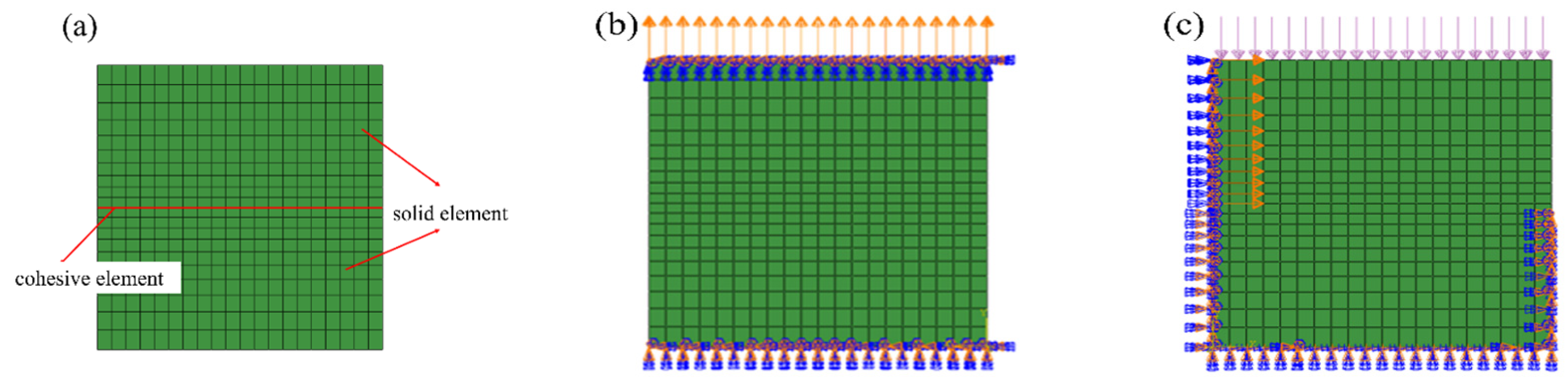
To validate the performance of the cohesive elements, a small-scale finite element model with dimensions of 1 mm × 1 mm was established in ABAQUS following previous studies [31]. The small-scale model was specifically chosen because it allows precise control over the number and arrangement of cohesive elements while maintaining computational efficiency, enabling the intrinsic mechanical response of individual cohesive elements to be clearly observed and compared against theoretical predictions without the complexity introduced by large-scale heterogeneous fracture networks. The mesh and boundary conditions are shown in Figure 1. Two types of boundary conditions were applied to isolate the fundamental fracture modes: (i) for the tensile test (Figure 1b), a uniform vertical displacement was applied to the top surface while the bottom surface was fully fixed, generating a pure Mode I opening condition; (ii) for the shear test (Figure 1c), a horizontal displacement was applied to the top surface with the bottom surface fixed, producing a pure Mode II sliding condition. These two loading configurations were designed to separately verify the cohesive element response under each basic fracture mode, thereby providing an unambiguous validation of the traction-separation constitutive law and the B-K mixed-mode fracture criterion.
The model consisted of 400 solid elements and 20 zero-thickness cohesive elements, which shared nodes with adjacent solids. The solid element parameters were assigned representative values for a generic isotropic elastic material, and the cohesive element parameters were calibrated following the methodology established by Hu et al. [31] and Camanho [34] to reproduce the expected Mode I and Mode II failure behaviors. All corresponding material parameters are listed in Table 1. The simulation results indicate that the failure mode of cohesive elements can be identified using the Mixed-Mode Damage Index (MMIXDMI): when MMIXDMI is less than 0.5, Mode I tensile failure is dominant, whereas values greater than 0.5 correspond primarily to Mode II shear failure. This result is consistent with previous research, confirming the reliability of the cohesive element parameters adopted in this study.
To describe the post-failure contact behavior after cohesive element removal, a general contact formulation with a penalty method was used under explicit integration, where the tangential behavior follows the Mohr–Coulomb friction law [20].
To describe the post-failure contact behavior between newly generated crack surfaces in the hard rock numerical model, a general contact model is adopted to characterize the contact state between solid element edges. When adjacent edges come into contact under local compressive stress, the penalty contact method in explicit analysis is employed to evaluate the contact behavior between neighboring edges after cohesive element damage and removal. The relationship between contact stress and relative displacement can be expressed as Equations (4)–(7):
p = 0 , δ 0 ( tensile ) p n δ n , δ n < 0 ( shear )
τ s = p s δ s
τ t = p t δ t
τ c r i t = μ p
where p, pn, and δn denote the normal contact stress, normal penalty stiffness, and normal relative displacement, respectively; τst), ps (pt), and δst) represent the tangential contact stress, tangential stiffness, and tangential relative displacement, respectively.
The tangential contact behavior is governed by the Mohr–Coulomb friction law. The critical shear stress τcrit is calculated according to the Mohr–Coulomb criterion, where μ is the defined contact surface friction coefficient.

2.2. Parameter Calibration and Model Construction

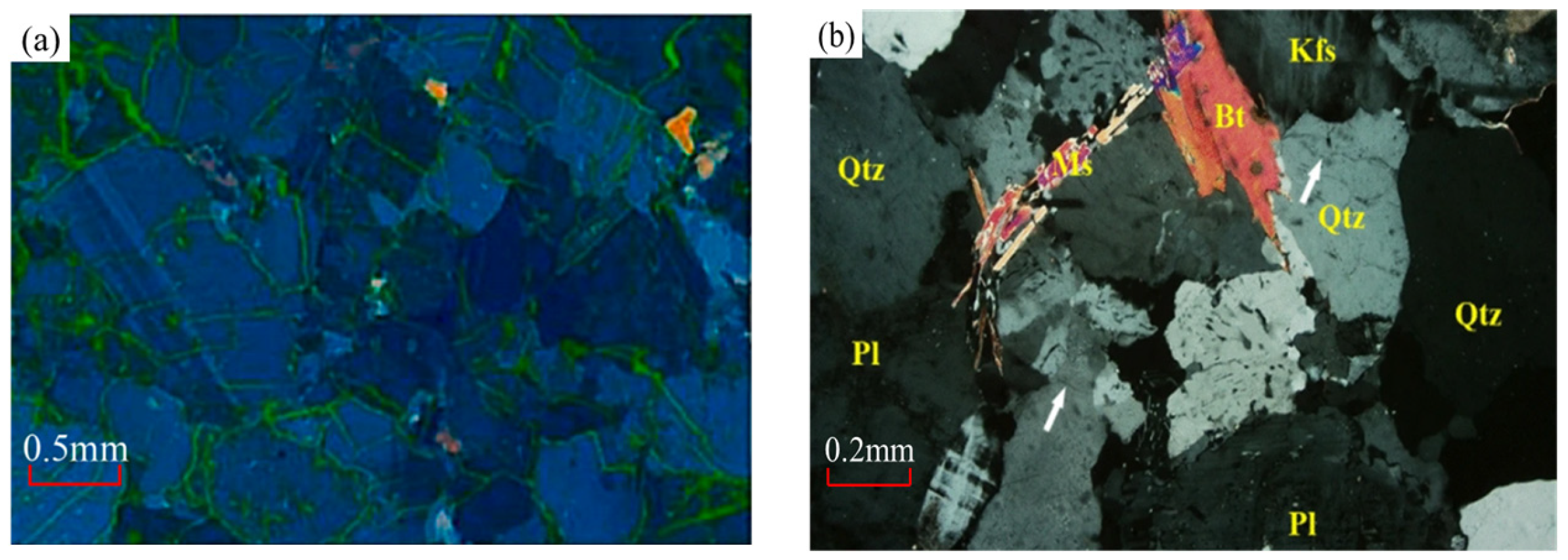
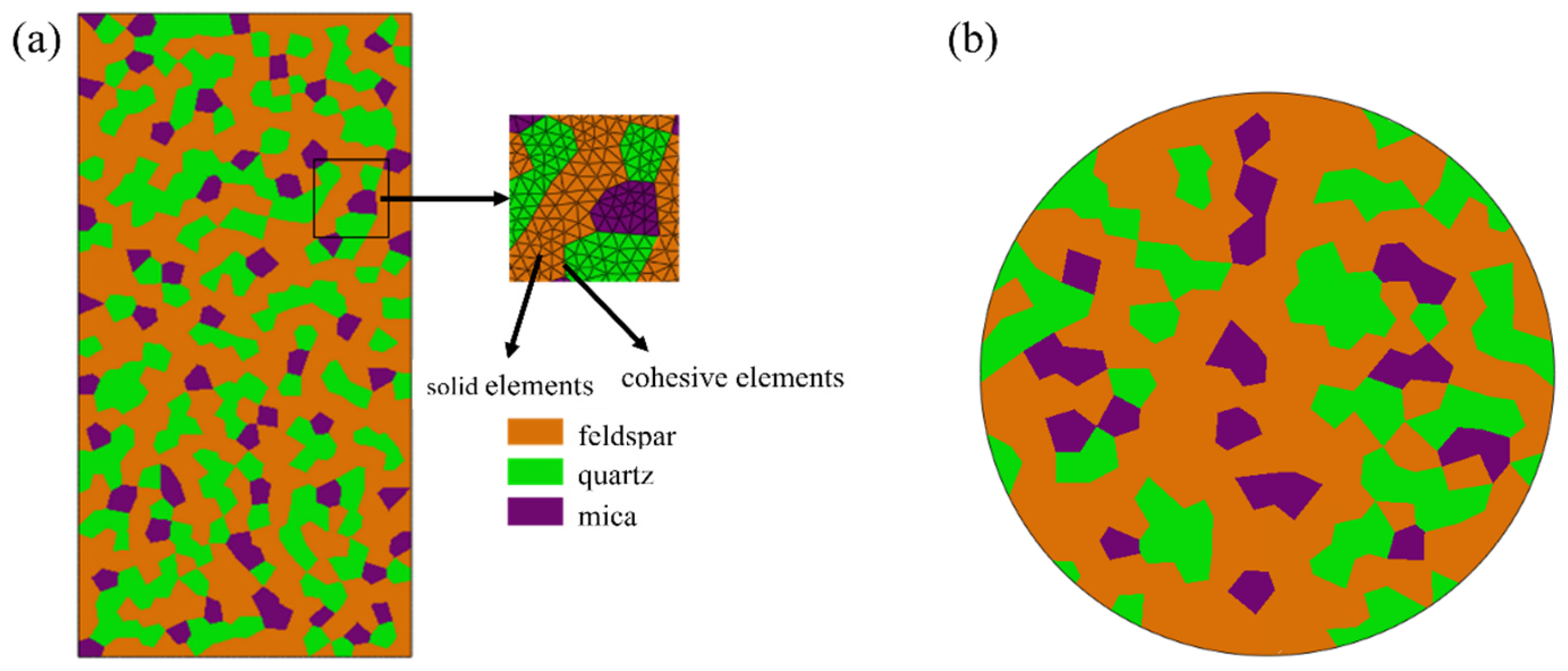
To investigate the influence of microstructure and mineral composition on the overall fracturing performance of granite, Lac du Bonnet (LdB) granite was selected as the research object. LdB granite is a typical brittle rock widely used as a benchmark material in rock mechanics research [41,42]. Its microstructure is shown in Figure 2. As illustrated in Figure 2a, LdB granite exhibits a polycrystalline aggregate structure composed of interlocking mineral grains. The mineral composition, shown in Figure 2b, consists of three principal phases: feldspar accounting for approximately 60%, quartz about 30%, and mica about 10%. The basic mechanical properties of LdB granite are summarized in Table 2.
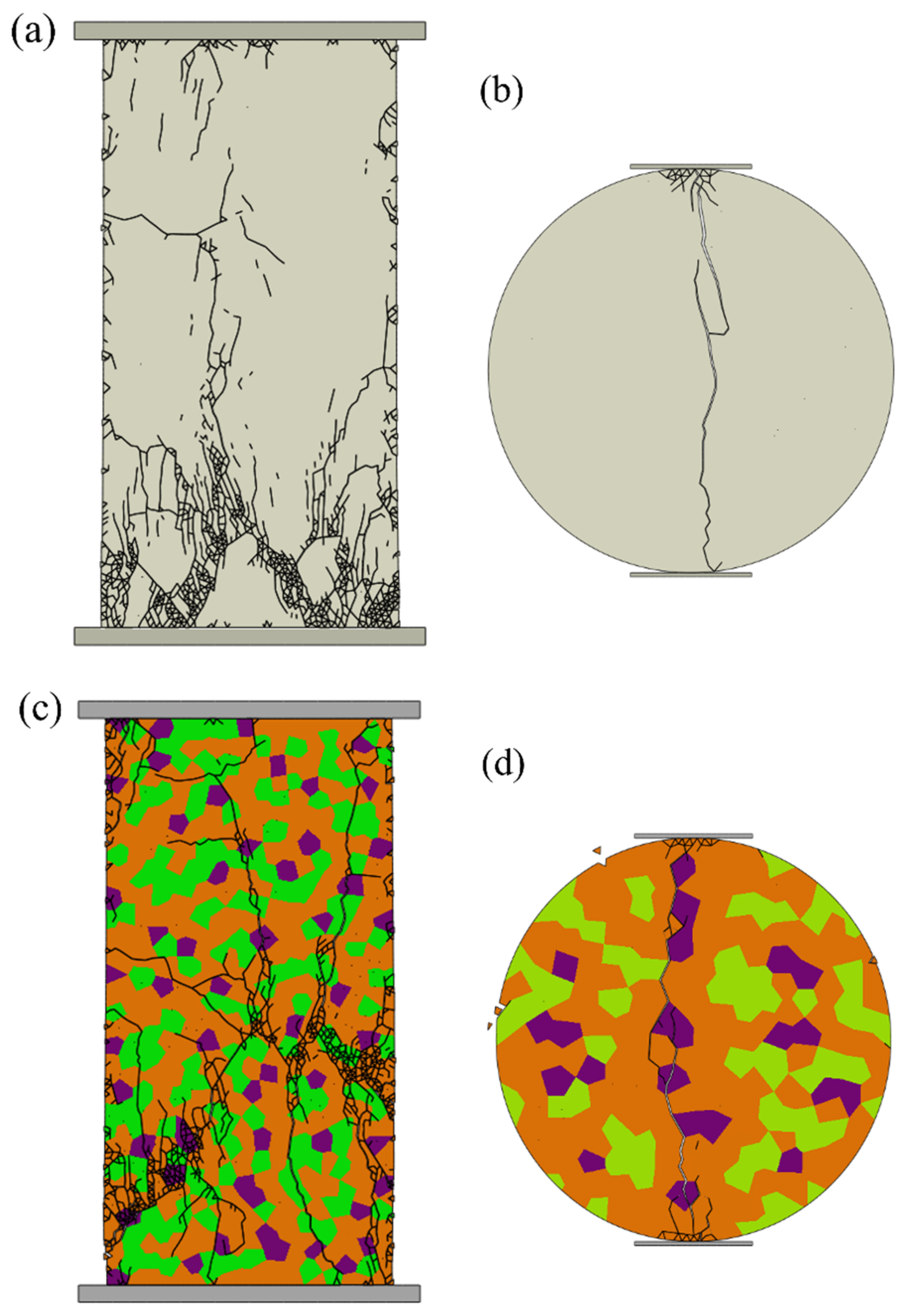
To capture the heterogeneity of granite, random Voronoi polygons were generated using Rhino 6.0 with the Grasshopper plugin and imported into Abaqus to construct a two-dimensional model. A Python 3.11 script was then applied to classify polygonal elements according to the mineral composition ratio and to distinguish boundaries between different minerals as well as within the same mineral, thereby producing a Voronoi-based model with heterogeneous characteristics (see Figure 3). To ensure model reliability, uniaxial compression tests (UCT) and Brazilian splitting tests (BST) were used for parameter calibration, yielding the compressive strength, Young’s modulus, and tensile strength, respectively. In the numerical models, the UCT specimen was a 50 mm × 100 mm rectangle, while the BST specimen was a disc with a radius of 25 mm. Loading was applied by rigid plates with a downward velocity of 1 mm/s, and fixed constraints were imposed at the bottom. All models were discretized with Voronoi meshes, with a uniform element size of 1 mm, and a general contact model with a friction coefficient of 0.2 was adopted. To improve calibration efficiency, a homogenized model was first constructed to determine the overall mechanical parameters, and then the heterogeneous model parameters were adjusted so that the numerical simulation curves matched the experimental results within a reasonable error range.
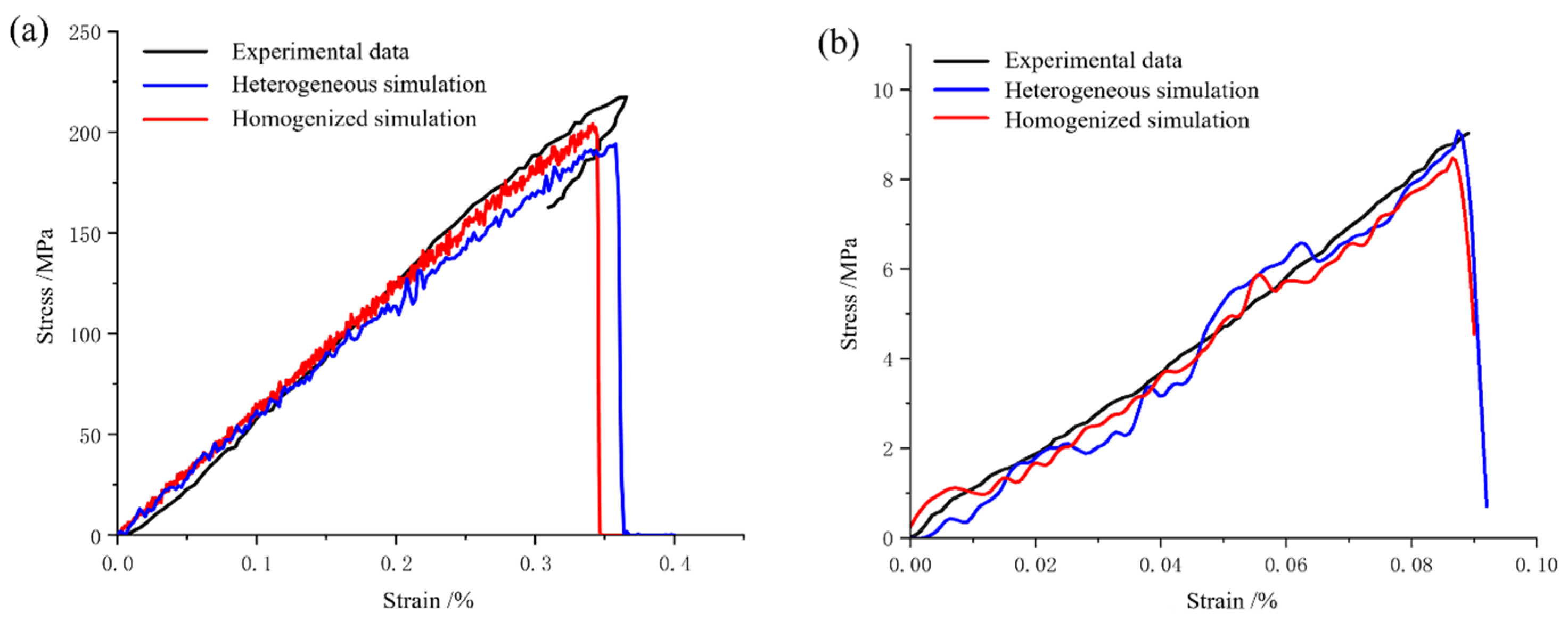
The comparison between the corrected numerical stress–strain curves of uniaxial compression and Brazilian splitting tests and the experimental stress–strain curves is shown in Figure 4. The validity of the simulation results is evaluated by calculating the relative error percentage between the numerical and experimental results, as expressed in Equation (8).
E = | N t N s | N t × 100 %
In the equation, E represents the relative error percentage, Nt is the experimental value, and Ns is the simulated value.
In the calibration of uniaxial compression and Brazilian splitting tests, the measured compressive strength of LdB granite was 210.43 MPa, and the tensile strength was 8.95 MPa. The relative errors between the simulation results of both the homogenized and heterogeneous models and the experimental values were within 7% (compressive strength errors of 3.7% and 6.7%, and tensile strength errors of 5.3% and 1.3%), indicating that the selected parameters can effectively reproduce the macroscopic mechanical properties of granite with high reliability. The corresponding simulation results are shown in Figure 5, and the calibration results are listed in Table 3 and Table 4.

2.3. TBM Double-Disc Cutter Model

The rock-breaking process of TBM cutters can be divided into two stages. In the first stage, the normal force applied to the cutter presses it into the rock, leading to chip spalling and the formation of internal cracks. In the second stage, cracks generated between adjacent cutters gradually propagate and coalesce, resulting in large-scale failure. Therefore, the rock-breaking process of TBM cutters can be regarded as a fracturing-like failure behavior. The present study mainly focuses on the effects of cutter spacing and mineral composition on the fracturing performance of TBM cutters.
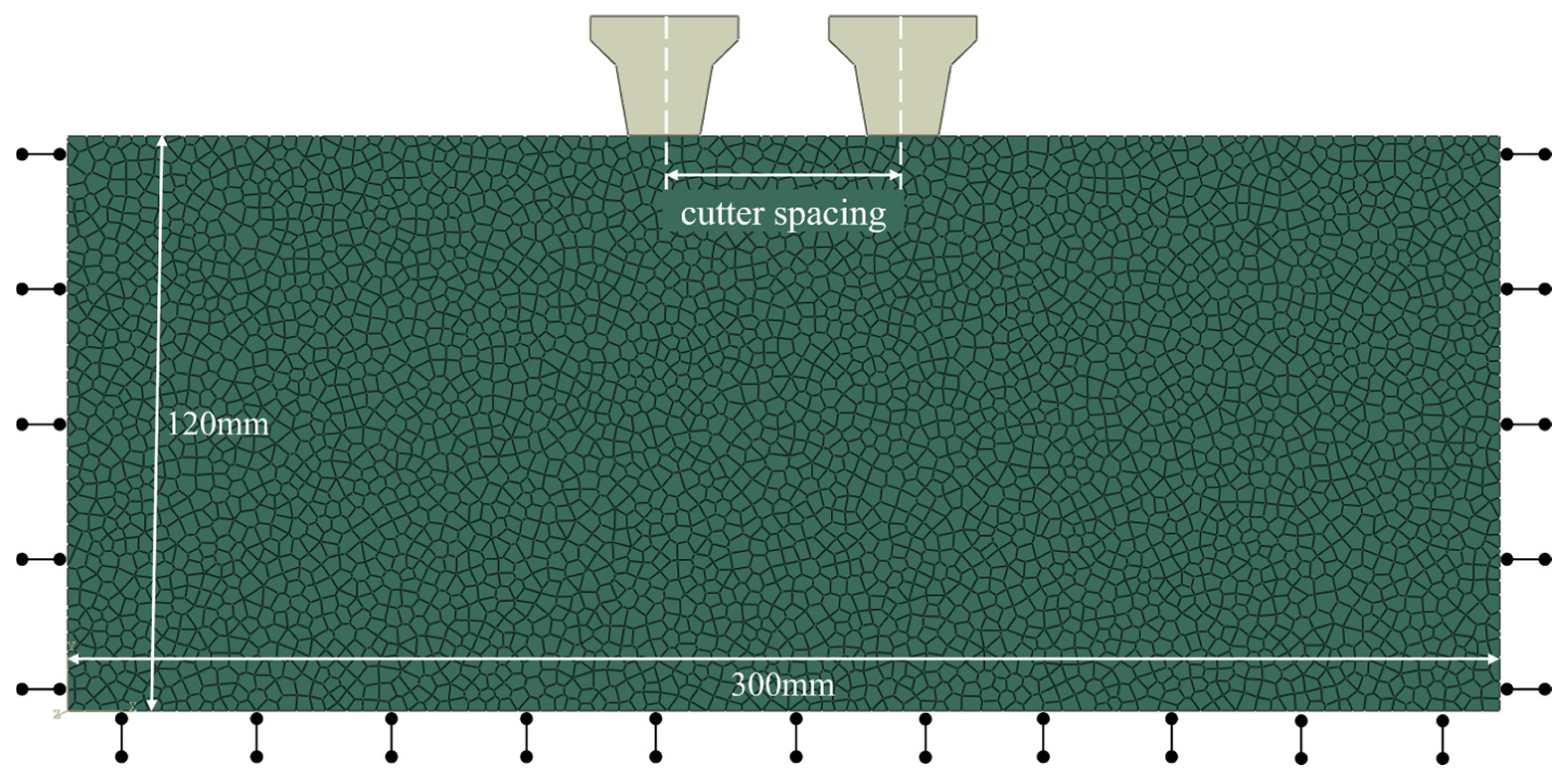
In the numerical modeling of double-disc cutter rock breaking, the rock model was set to 300 mm × 120 mm and discretized into polygonal meshes using the Voronoi method (see Figure 6). Fixed constraints were applied to all boundaries except the cutter–rock contact surfaces. Two disc cutters were positioned at the top of the model and loaded downward at a constant velocity of 0.25 m/s with a prescribed displacement of 0.8 mm. To avoid premature contact between the cutters and the rock at the start of loading, the initial gap was set to 0.1 mm, resulting in an actual indentation displacement of 0.7 mm. Cutter spacing was varied from 40 to 100 mm to perform comparative analyses of rock fragmentation.
The main aspects analyzed include crack evolution, cutter mechanical responses, rock fragment volume, and specific energy. To further investigate the influence of different mineral compositions on the rock-breaking mechanism and cutter spacing optimization, four mineral composition schemes were designed, as listed in the following Table 5.

3. Fracture Characteristics

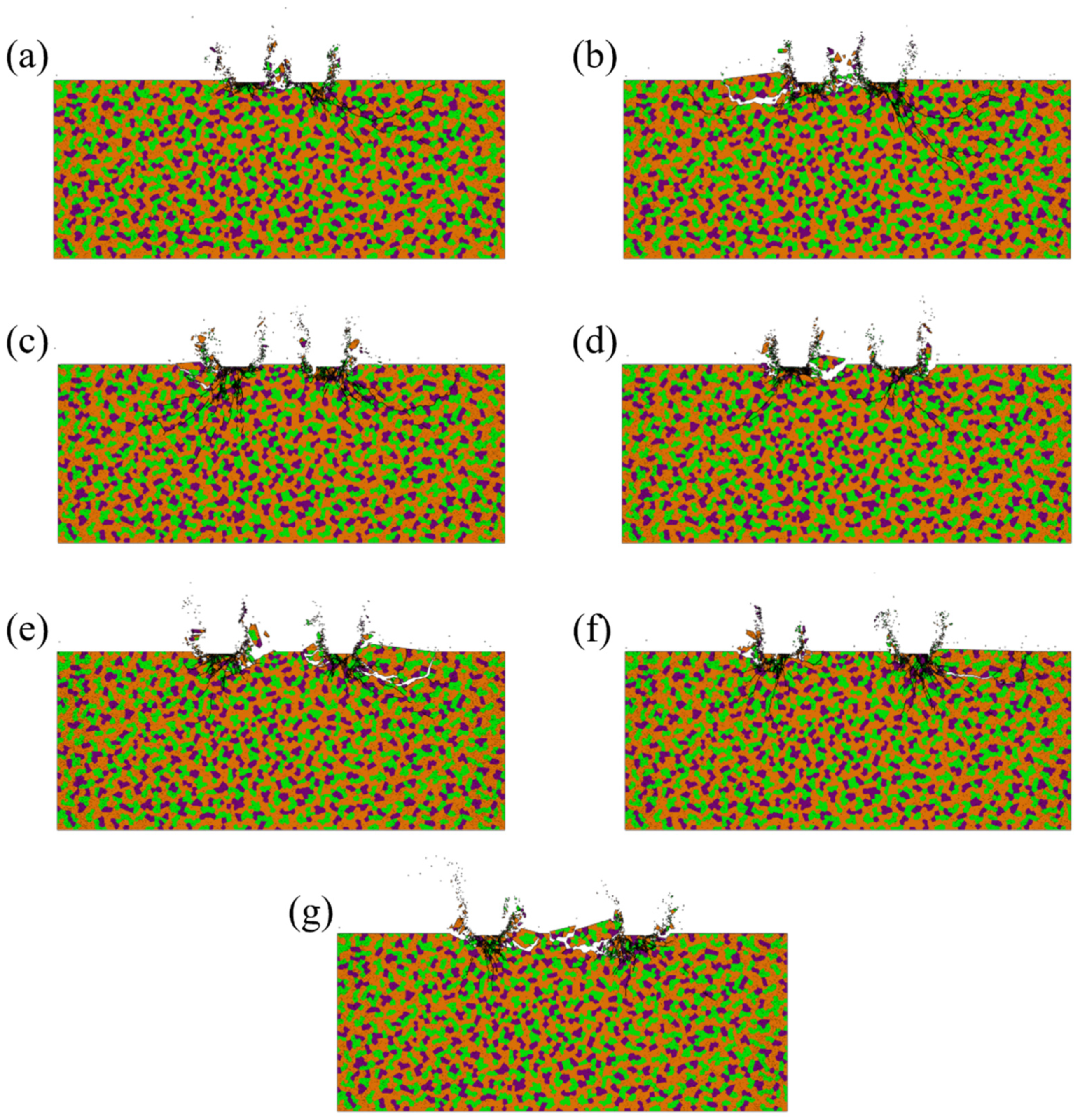
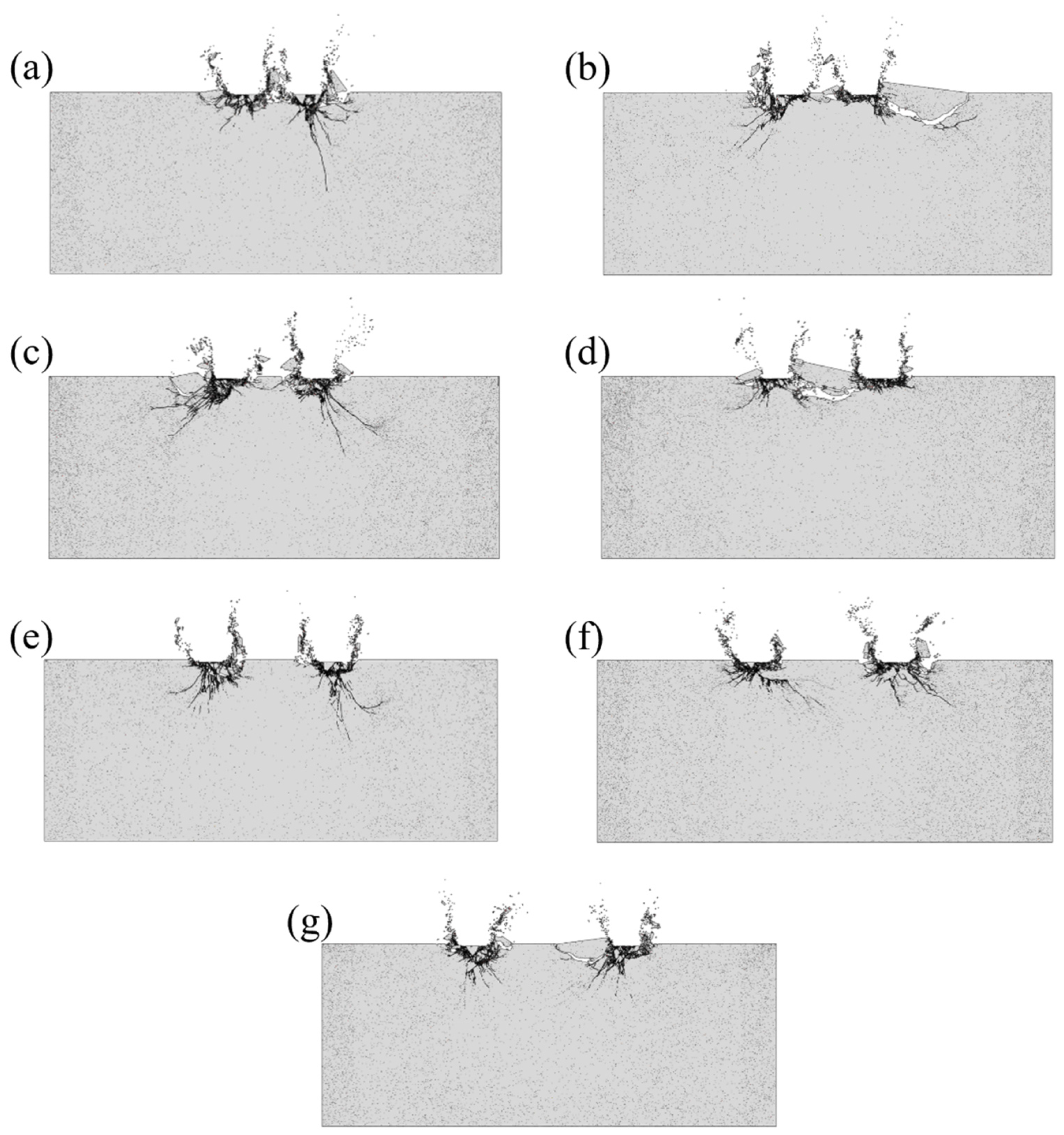
The fracture characteristics of homogeneous granite at a penetration displacement of 0.8 mm under different cutter spacing (s) conditions are illustrated in Figure 7. Within the range of s = 40–100 mm, a pronounced crushed zone is formed directly beneath the cutters, accompanied by numerous primary fractures and fine shear cracks. Outside the crushed zone, dispersed indirect tensile cracks appear, which can be categorized into downward and lateral cracks. When s = 40–70 mm, the lateral cracks intersect and eventually coalesce, leading to significant through-crack fragmentation of the rock mass between the cutters (Figure 7a–d). In contrast, at s = 80–100 mm, the lateral cracks fail to fully extend and do not completely coalesce, resulting in failure being mainly confined beneath each cutter. Notably, at s = 70 mm, the lateral cracks intersect precisely at the midpoint, completely segmenting the rock mass between the two cutters into blocks, which can be regarded as a favorable cutter spacing condition.
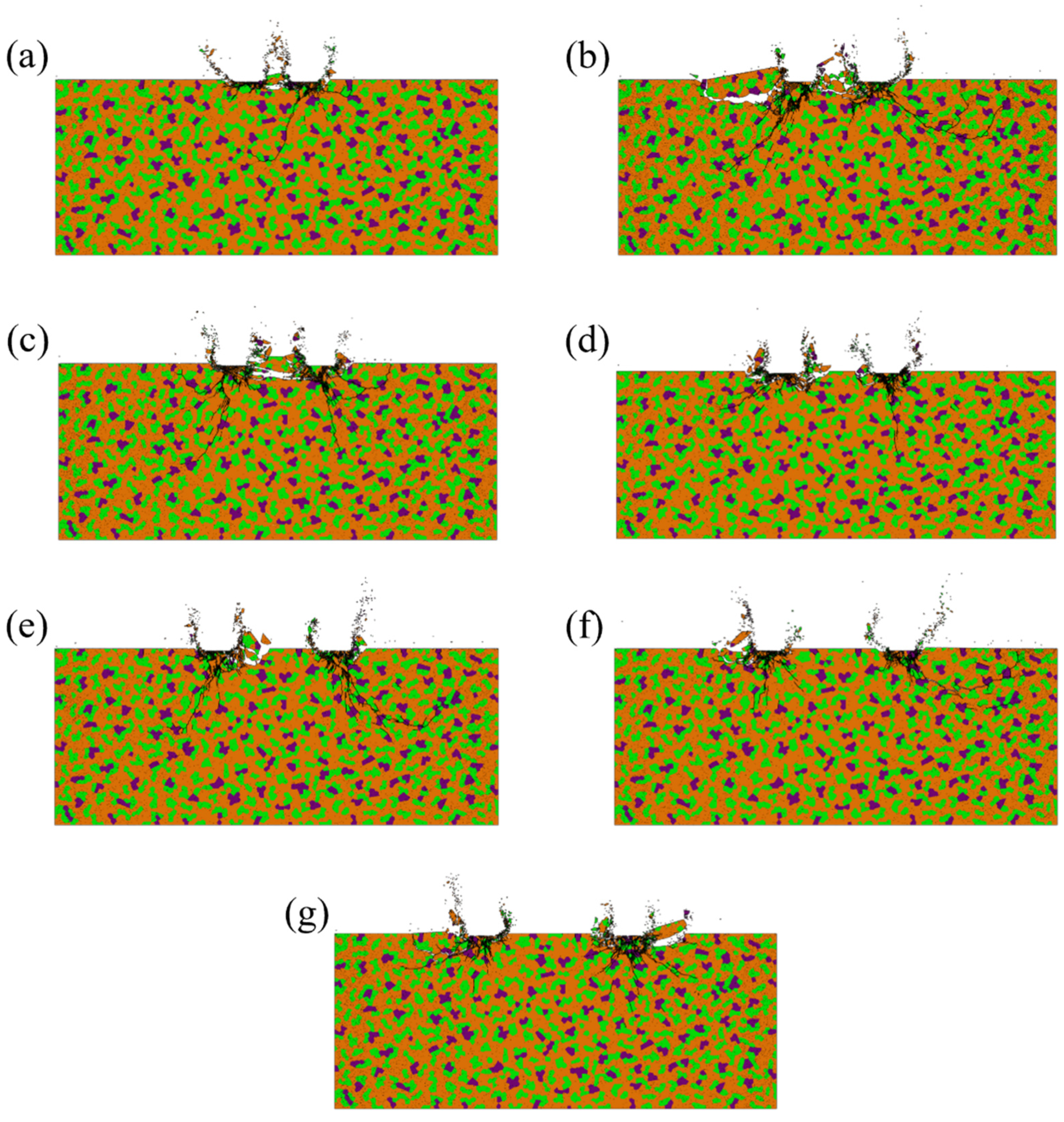
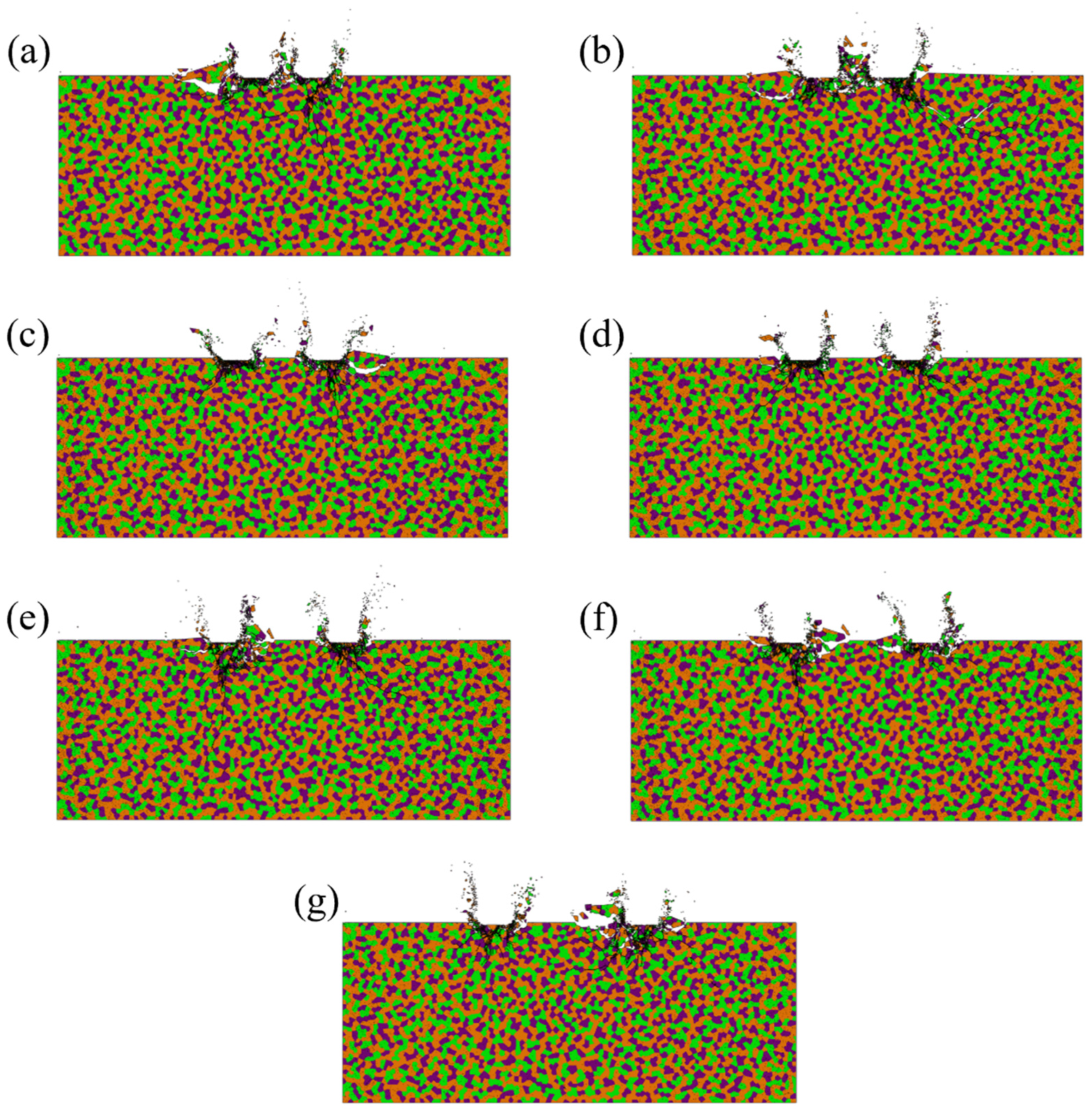
Figure 8, Figure 9 and Figure 10 present the fracture characteristics of heterogeneous granite with different mineral compositions under varying cutter spacings. The overall failure patterns are generally consistent with those of homogeneous granite: a crushed zone accompanied by numerous cracks forms beneath the cutters, while indirect cracks extend downward or laterally outside the crushed zone. However, compared with homogeneous granite, the lateral crack propagation in heterogeneous granite is significantly reduced. This phenomenon is primarily attributed to mica requiring greater displacement for failure compared with quartz and feldspar, whereas the cohesive element parameters of homogeneous granite lie between those of the three minerals, thereby exhibiting stronger crack propagation capability. This trend becomes more pronounced with changes in mineral composition: as feldspar content decreases and mica content increases, the maximum effective cutter spacing required to completely sever the rock mass between the two cutters gradually decreases. Specifically, the maximum effective cutter spacings for homogeneous granite and heterogeneous granite with feldspar contents of 60%, 50%, and 40% are approximately 70 mm, 60 mm, 50 mm, and 50 mm, respectively.

4. Crack Evolution and Fragmentation Volume

Crack information and fragmentation volume are important parameters for investigating the rock-breaking mechanism of TBMs. Based on the ABAQUS output database (ODB) file, this study proposes an identification algorithm to quantitatively obtain crack characteristics such as number, length, area, and location. The basic procedure is as follows: first, nodes, boundaries, and the damage variable (SDEG) of cohesive elements are extracted from the ODB file, and the geometric attributes and maximum damage values of the elements are calculated. Subsequently, a mapping relationship between the mesh and cohesive elements is established within the model domain. The connectivity of adjacent elements is then determined using partially failed nodes, and a union-find algorithm is applied to aggregate connected elements into independent crack segments. Finally, the geometric parameters of each crack segment are calculated, and the results are output. This algorithm enables efficient identification of crack networks and quantitative evaluation of fragmentation volume, thereby providing reliable data support for analyzing the damage evolution of granite under TBM loading. Specifically, cohesive elements with a damage variable SDEG ≥ 0.99 were identified as fully cracked. A connected component analysis was then applied to the remaining intact element clusters to identify individual fragments. Only fragments fully detached from the rock body and located above the free surface were counted as effective chips for the SE calculation.
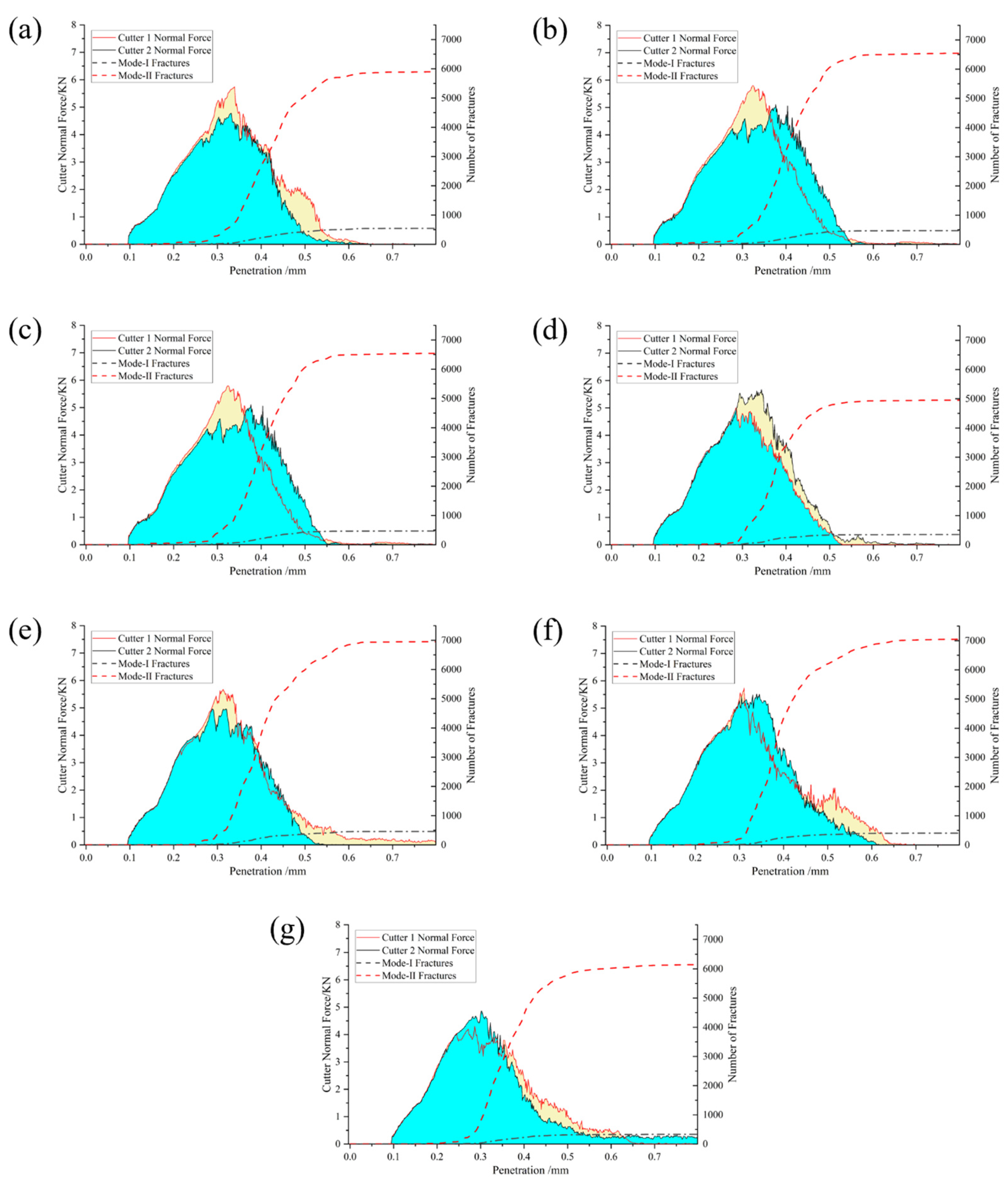
Figure 11 shows the evolution of normal cutter force and crack number with penetration displacement for homogeneous LdB granite under different cutter spacing conditions. Due to space limitations, only the cutting force–displacement curves and the crack number of homogeneous LdB granite are presented in this paper. The crack numbers and proportions of different crack types under each condition are summarized in Table 6.
From the evolution of normal force and crack number with penetration displacement, it can be observed that at the initial stage of cutter penetration, the disc cutter indents into the rock and forms a crushed zone beneath it, where Mode II cracks appear first. As the penetration depth increases, the contact area between the cutter and the rock gradually expands. When the normal force reaches its peak, the number of Mode II cracks increases significantly, accompanied by the initiation and propagation of Mode I tensile cracks. When cutter spacing is appropriately set, these tensile cracks can coalesce between the two cutters during propagation, forming a laterally connected fracture network, which effectively enlarges the cutting area and enhances rock-breaking efficiency.
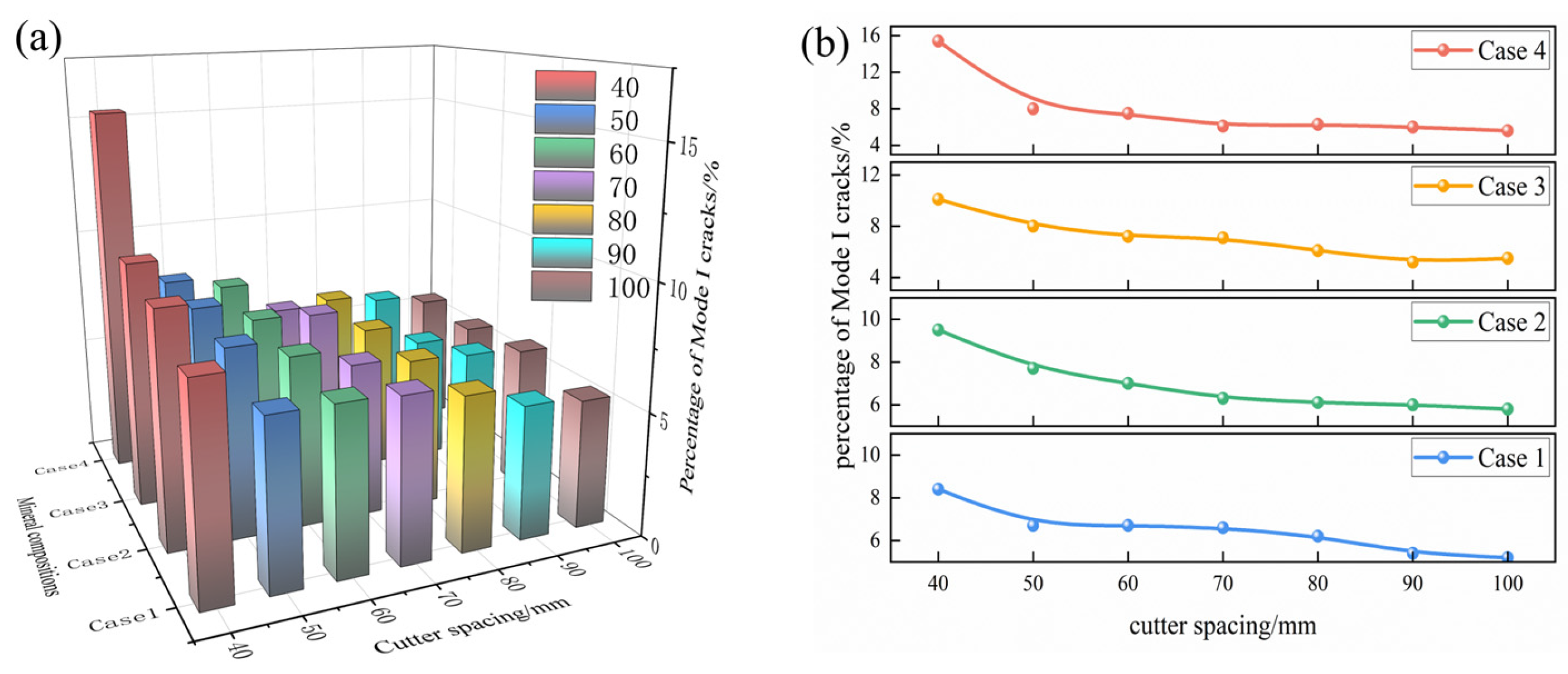
Figure 12 shows the proportion of Mode I cracks under different cutter spacings and mineral compositions. As illustrated in Figure 12a, the 3D bar chart provides an overall comparison of Mode I crack proportions under various conditions, while Figure 12b presents the variation in Mode I crack proportion with cutter spacing. After cutter penetration, the number and proportion of different crack types within the rock vary significantly with cutter spacing. When the spacing is either too small or too large, crack development is unfavorable, whereas at moderate spacing, crack initiation, propagation, and coalescence are most sufficient, thereby enhancing rock-breaking efficiency. Specifically, when the spacing is relatively small, the stress influence zones of the two cutters partially overlap, and the rock beneath the cutters is highly compressed, generating numerous fine cracks caused by local fragmentation. However, these cracks are mainly confined near the cutter grooves and cannot effectively coalesce across the rock bridge between adjacent grooves. As the spacing increases, the extent of crack propagation gradually enlarges. Particularly at moderate spacing, lateral cracks generated beneath adjacent cutters intersect and coalesce at the midpoint, forming a large number of transverse cracks. This process leads to the spalling of strip- or block-shaped rock fragments between the cutters, where cracks fully propagate and coalesce, the rock is efficiently segmented, and rock-breaking efficiency reaches its maximum. When the spacing further exceeds the optimum, the distance between adjacent cutters becomes too large, and their interaction weakens considerably. In this case, radial Mode II cracks generated beneath each cutter dominate, while the proportion of Mode I cracks decreases significantly, preventing cracks from bridging the wide intact rock bridge and making it difficult to produce large rock fragments.
Mineral composition also has a significant influence on the evolution of crack number and type during the rock-breaking process. With quartz content kept constant at approximately 30%, variations in the feldspar-to-mica ratio markedly alter the cracking pattern. Higher feldspar content enhances the overall brittleness of the rock, as feldspar grains tend to undergo transgranular fracture under loading, thereby promoting the initiation and coalescence of Mode I cracks, particularly in the tensile zone between double cutters, which facilitates the formation of dominant Mode I crack networks and the generation of large rock fragments. In contrast, mica, as a weak platy mineral with perfect cleavage, modifies the local stress field and disturbs crack paths. Its presence induces numerous Mode II shear cracks and causes frequent deflection or termination of major cracks during propagation. As a result, although the total crack number may increase, they are predominantly secondary Mode II cracks, which hinder the development of efficient Mode I crack networks. Consequently, the rock appears highly fragmented, but energy utilization efficiency is reduced. In summary, mineral composition governs the rock-breaking mode and efficiency by controlling the initiation type, propagation path, and coalescence efficiency of cracks.
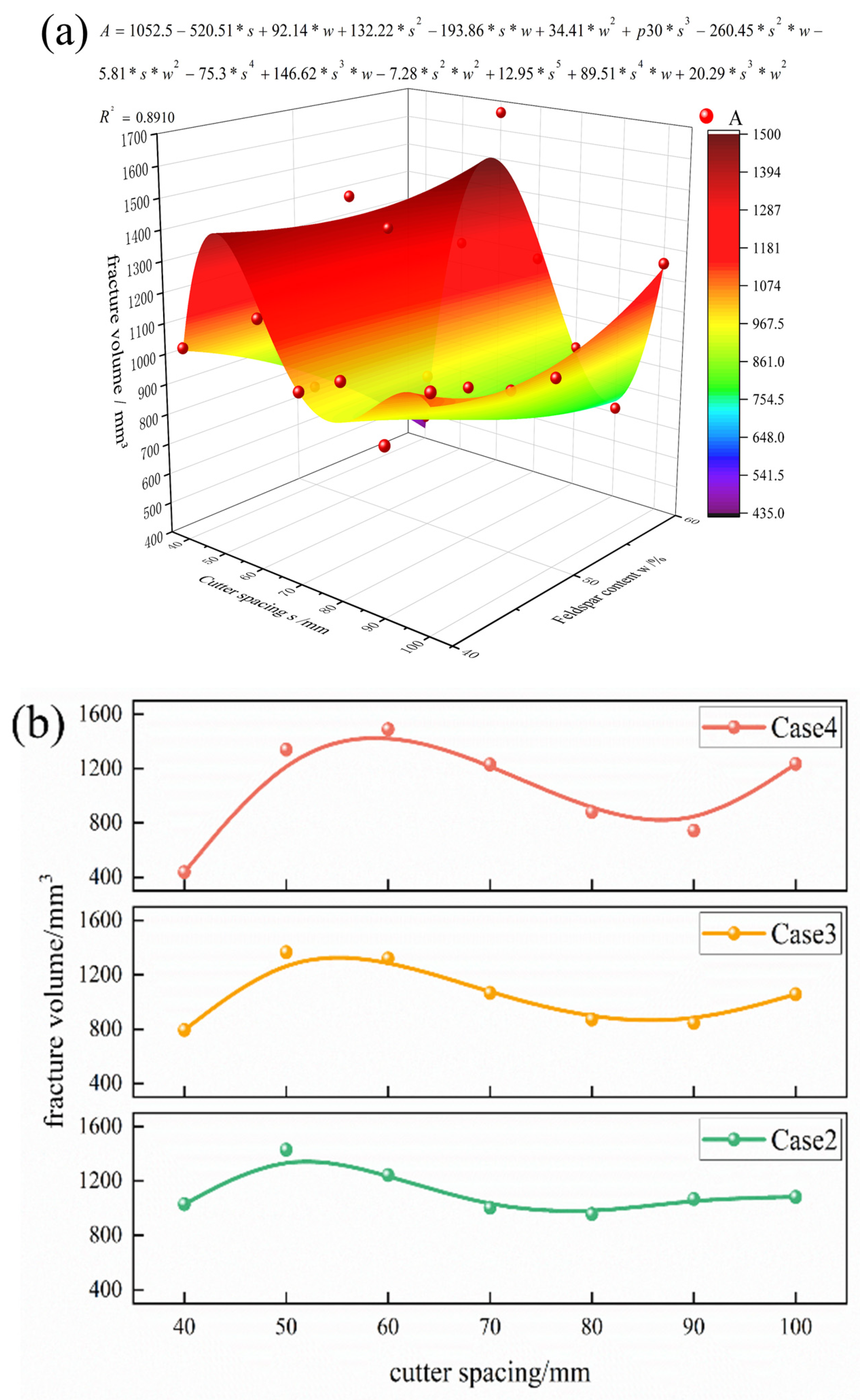
To systematically reveal the influence of cutter spacing and mineral composition on fragmentation volume, both quantitative and qualitative analyses were conducted based on numerical simulation results. Table 7 summarizes the fragmentation volumes obtained under different cutter spacing and mineral composition conditions, while Figure 13 illustrates the overall trends of fragmentation volume with respect to cutter spacing and mineral content. The results of fragmentation volume reveal significant differences among rocks with varying feldspar contents under double-cutter action. Overall, the fragmentation volume exhibits a trend of “increase–decrease–slight recovery” with increasing cutter spacing, reaching a relatively high level within the favorable spacing range (approximately 50–70 mm). This trend is consistent with the previous analysis based on crack proportions: when the spacing is relatively small, the influence zones of the two cutters partially overlap, and the rock beneath the cutters is subjected to intense compression, producing numerous fine cracks that remain confined near the cutter grooves and fail to effectively coalesce across the rock bridge. As the spacing increases, lateral cracks generated beneath adjacent cutters can intersect and coalesce at appropriate spacing, segmenting the rock mass between the two cutters into strip- or block-shaped fragments, thereby markedly increasing the fragmentation volume. However, when the spacing becomes excessively large, the cutters are too far apart, and their interaction is substantially weakened. In this case, cracks are mainly concentrated as radial Mode II cracks beneath each cutter, while the proportion of Mode I cracks decreases significantly, preventing cracks from bridging the intact rock ligament and resulting in a reduction in fragmentation volume.
In addition, clear differences in fragmentation volume are observed with varying feldspar contents. At the same cutter spacing, rocks with higher feldspar content tend to exhibit larger fragmentation volumes. This suggests that increased feldspar content enhances the overall brittleness of the rock, facilitates crack propagation, and promotes the initiation and lateral coalescence of Mode I cracks. In contrast, when feldspar content is lower and mica content is higher, the proportion of Mode II cracks increases, and crack paths become more disturbed, thereby hindering the effective coalescence of Mode I cracks required for efficient cutting and ultimately reducing the growth of fragmentation volume.

5. Energy Effects and Efficiency of Rock Breaking

The work of the cutter (W) is defined as the energy input into the rock during the entire penetration process, which is equal to the integral area under the cutter force–displacement curve [22]. Its specific form can be expressed as follows:
W = 0 δ m a x F ( δ ) d δ
where δ denotes the cutter penetration displacement; δmax is the maximum penetration displacement; and F(δ) represents the variation in normal cutter force with displacement.
In rock fragmentation tests and numerical simulations, the specific energy (SE) is commonly used to characterize the efficiency of TBM cutters in breaking rock [4,20]. For two-dimensional numerical models, SE is defined as the ratio of the work done by the cutter to the area of the generated rock chips. A smaller SE indicates higher rock-breaking efficiency, meaning that more rock is fragmented with less input work. Conversely, a larger SE corresponds to lower rock-breaking efficiency. The calculation of SE is expressed as follows:
S E = W 1 + W 2 A R = 0 p 1 max F 1 ( p 1 ) d p 1 + 0 p 2 max F 2 ( p 2 ) d p 2 A R × d
where SE denotes the rock-breaking efficiency; W1 and W2 represent the work done by cutter 1 and cutter 2, respectively; p1 and p2 are the penetration displacements of cutter 1 and cutter 2; p1max and p2max are the maximum penetration displacements of cutter 1 and cutter 2; F1(p1) and F2(p2) denote the force–penetration relationships of cutter 1 and cutter 2, respectively; AR is the area of the generated rock chips; and d is the model thickness, which is assumed to be 1 mm.
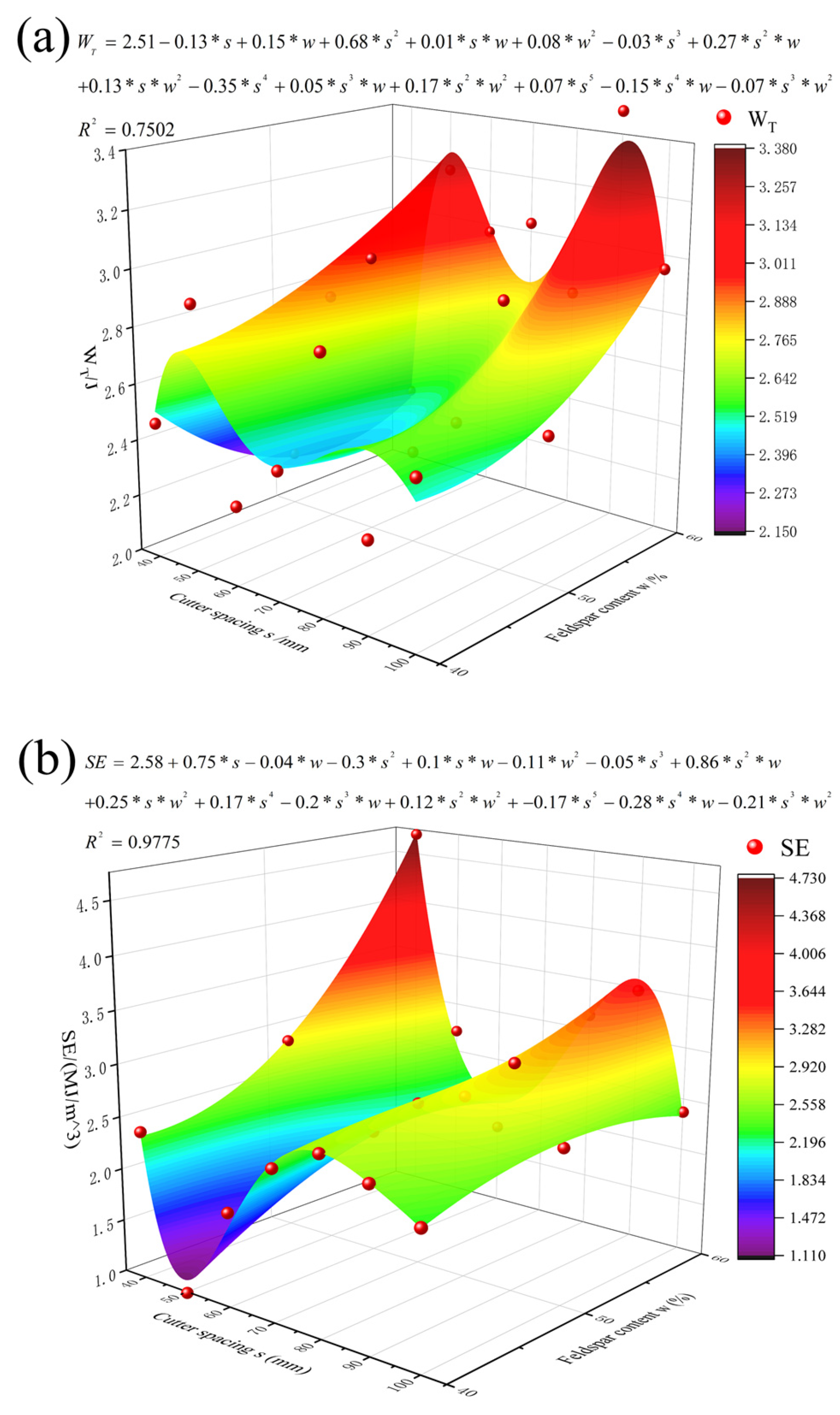
From the perspective of total energy as shown in Figure 14, rocks with different feldspar contents exhibit similar patterns under double-cutter action. The total energy generally remains within the range of 2.2–3.4 J, showing relatively stable fluctuations, with local peaks observed at medium cutter spacings (approximately 50–70 mm). With increasing feldspar content, the total energy increases overall, with 60% feldspar rock requiring the highest energy input, indicating greater demand during crack propagation and coalescence; in contrast, 40% feldspar rock shows the lowest energy, reflecting weaker energy requirements. Overall, cutter spacing determines whether cracks can fully propagate, while mineral composition influences the level of energy consumption, and the two jointly govern the energy characteristics of the fracturing process.
In terms of rock-breaking efficiency, both cutter spacing and mineral composition have significant effects on the variation in SE. The general trend is that SE reaches its minimum at medium cutter spacing, corresponding to relatively high efficiency, while SE increases under excessively small or large cutter spacings. Specifically, for rocks with 40% and 50% feldspar, SE is minimized at 50 mm, indicating effective crack coalescence and reasonable energy distribution within this range. When the spacing increases beyond 70 mm, crack interactions weaken, lateral cracks fail to coalesce across the spacing, and SE rises. For 60% feldspar rock, the favorable spacing appears at approximately 60 mm, and SE remains relatively low even at 100 mm. However, at 40 mm, SE increases significantly, suggesting that excessively small spacing leads to strong overlap of cutter influence zones, where energy is primarily consumed in crushing and repeated breakage. Although numerous fine chips are produced, their contribution to effective fragment area is limited, resulting in reduced overall efficiency.
Regarding mineral composition, higher feldspar content enhances rock brittleness and facilitates crack coalescence, but excessively small spacing is more prone to causing ineffective breakage. In contrast, higher mica content strengthens weak-plane guidance, increases the proportion of Mode II fractures, and reduces the propagation capacity of Mode I cracks, thereby further lowering energy utilization efficiency.
Overall, this study demonstrates that cutter spacing primarily determines the interaction patterns of cracks, while mineral composition regulates energy utilization efficiency. Under the condition of approximately 30% quartz, rocks with lower feldspar content require cutter spacing to be controlled within 50–60 mm to ensure crack coalescence and reduce energy consumption. For rocks with higher feldspar content, the suitable spacing range can be extended to 60–100 mm, although excessively small spacing should be avoided to prevent crushing damage. These findings suggest that, in practical TBM excavation, excavation parameters should be dynamically optimized according to the mineral composition of the surrounding rock: in brittle rock masses, equipment must have sufficient energy-bearing capacity to ensure stable rock breakage, whereas in mica-rich rocks with well-developed weak planes, cutter spacing should be more precisely controlled to enhance crack propagation capacity and minimize energy waste, thereby achieving a balance between energy consumption and rock-breaking efficiency.

6. Discussion

To further contextualize the findings of this study, it is instructive to compare the proposed FDEM-based heterogeneous modeling approach with classical numerical methods commonly employed in TBM cutter–rock interaction research. Conventional continuum-based finite element models using homogenized constitutive laws (e.g., Drucker–Prager or Mohr–Coulomb criteria) treat rock as a homogeneous material and cannot capture the mineral-scale heterogeneity that governs crack initiation sites, propagation paths, and coalescence patterns. In contrast, the present FDEM model explicitly represents the spatial distribution of quartz, feldspar, and mica through Voronoi-based grain structures, enabling the simulation of both intergranular and transgranular fracture mechanisms. Compared with discrete element methods such as the bonded-particle model (BPM) in PFC [13], the FDEM approach provides a more rigorous treatment of the continuous stress–strain field within intact mineral grains through finite element formulations, while the zero-thickness cohesive elements offer a physically based fracture criterion governed by the traction–separation law and the B–K mixed-mode energy criterion. This combination allows the model to naturally reproduce the transition from continuous deformation to discrete fracturing without predefined crack paths.
The robustness of the proposed approach is demonstrated through multiple levels of validation. At the material scale, both homogeneous and heterogeneous models were calibrated against experimental uniaxial compression and Brazilian splitting tests of LdB granite, with relative errors within 7%. At the cutting scale, the systematic parametric study covering four mineral compositions and seven cutter spacings (28 simulation cases in total) provides a comprehensive dataset that reveals consistent and physically interpretable trends in crack evolution, fragmentation volume, and specific energy. The observed patterns—including the dominance of Mode II cracks beneath the cutters, the coalescence of Mode I cracks at favorable spacing, and the increase in total energy with feldspar content—are all consistent with the fundamental mechanics of brittle rock fracture and with findings reported in previous studies [21,22,27]. These results are also supported by nanoindentation evidence showing that feldspar, with a higher elastic modulus and hardness than mica [9,10], tends to undergo transgranular brittle fracture [11], while the mismatch in elasticity and strength between mica and the stiffer minerals (quartz and feldspar) plays an important role in guiding and deflecting crack propagation paths [12].
It should be noted that the current study adopts a two-dimensional plane-strain model, which cannot capture three-dimensional chip geometry, lateral stress redistribution, and out-of-plane crack propagation. The absolute values of fragmentation volume and energy should therefore be interpreted as comparative indicators rather than direct engineering quantities. In addition, in situ stress and macroscopic discontinuities are not considered. Furthermore, the present FDEM model has been calibrated and validated at the material level (UCS and BTS), but independent validation against experimentally measured cutter forces or specific energy values from linear cutting tests has not been performed. The reported results are based on a single representative Voronoi realization for each mineral composition case; multiple random realizations with error bars would strengthen the statistical robustness of the findings. Future work will extend the model to three dimensions, incorporate in situ stress and macroscopic discontinuities, perform multiple random realizations to quantify stochastic variability, and validate the results through laboratory-scale linear cutting experiments.

7. Conclusions

In this study, a numerical model of double-disc cutter rock breaking considering mineralogical differences was established to analyze the effects of cutter spacing and mineral composition on energy consumption and rock-breaking efficiency, thereby revealing the role of mineralogical characteristics in the TBM rock-breaking process and the controlling mechanisms of TBM rock-breaking efficiency under the investigated mineralogical conditions. It should be noted that the present conclusions are derived under a fixed quartz content of 30% and a limited range of feldspar–mica ratios, and their extension to other granite types requires further parametric investigation:
  • During the TBM double-disc cutter rock-breaking process, cutter spacing and mineral composition are the key factors determining crack evolution patterns and fragmentation performance. Within a favorable spacing range (approximately 50–70 mm), lateral cracks induced by adjacent cutters can fully coalesce, leading to relatively high fragmentation volume and rock-breaking efficiency.
  • Mineral composition exerts a significant regulatory effect on crack types and energy consumption. With increasing feldspar content, the proportion of Mode I cracks rises, crack coalescence becomes easier, and both total energy and fragmentation volume increase significantly; in contrast, higher mica content elevates the proportion of Mode II cracks and reduces crack propagation capacity, thereby decreasing energy utilization efficiency.
  • In terms of total energy, rocks with different feldspar contents exhibit similar trends under double-cutter action, with total energy generally ranging between 2.2 and 3.4 mJ and reaching a peak at medium cutter spacing (approximately 50–70 mm). As feldspar content increases, the overall energy level rises, with rocks containing 60% feldspar showing the highest energy demand and those with 40% feldspar the lowest. This indicates that cutter spacing primarily controls whether cracks can fully propagate, whereas mineral composition governs the magnitude of energy consumption during crack extension.
  • In terms of rock-breaking efficiency, the SE usually reaches its minimum at medium cutter spacing, corresponding to relatively high efficiency, while excessively small or large spacing increases energy consumption. Higher feldspar content enhances rock brittleness and facilitates crack coalescence, but overly small spacing tends to cause crushing and ineffective breakage. Higher mica content strengthens weak-plane guidance, increases crack deflection and the proportion of Mode II fractures, and reduces overall efficiency. From an engineering perspective, cutter spacing should be reasonably controlled according to the mineral composition and structural characteristics of the surrounding rock: in brittle rock masses, excessively small spacing should be avoided to reduce crushing energy consumption while ensuring crack coalescence; in rock masses with well-developed weak planes, both energy consumption and crack propagation capacity should be considered to select an appropriate spacing, thereby achieving a balance between rock-breaking efficiency and construction stability.

Author Contributions

Conceptualization, Q.G. and W.T.; methodology, X.M. and Q.G.; software, X.M.; validation, Y.G. and L.L.; formal analysis, X.M.; investigation, S.W.; resources, Q.G. and W.T.; data curation, X.M. and H.J.; writing—original draft preparation, X.M.; writing—review and editing, Q.G. and W.T.; visualization, X.M.; supervision, Q.G. and W.T.; project administration, Q.G.; funding acquisition, Q.G. All authors have read and agreed to the published version of the manuscript.

Funding

This research was funded by the National Natural Science Foundation of China, grant number 52274072.

Institutional Review Board Statement

Not applicable.

Informed Consent Statement

Not applicable.

Data Availability Statement

The data presented in this study are available on request from the corresponding author.

Acknowledgments

The authors would like to thank the National Natural Science Foundation of China (Grant No. 52274072) for the financial support of this research.

Conflicts of Interest

Authors Hanwen Jia and Xiangkai Meng are employed by Shandong Gold Mining Co., Ltd. All authors declare that the research was conducted in the absence of any commercial or financial relationships that could be construed as a potential conflict of interest.

References

  1. Hu, G.; Zhao, H.; Fu, J.; Xue, J.; Xia, Y. Impact fracture failure analysis and mechanism study of a TBM disc cutter ring. Eng. Fail. Anal. 2024, 163, 108508. [Google Scholar] [CrossRef]
  2. Fu, J.; Xia, Y.; Zhang, L.; Lin, L.; Zhang, X.; Zhao, S. Failure analysis on the fracture of disc cutter in EPB shield machine. Eng. Fail. Anal. 2020, 108, 104341. [Google Scholar] [CrossRef]
  3. Jin, D.; Yuan, D.; Li, X.; Su, W. Probabilistic analysis of the disc cutter failure during TBM tunneling in hard rock. Tunn. Undergr. Space Technol. 2021, 109, 103744. [Google Scholar] [CrossRef]
  4. Zhou, G.; Wang, X.; Wang, D.; Luo, M.; Hao, Z.; Wu, W. Study on rock-breaking efficiency evaluation of TBM disc cutters based on rostami prediction equations. Front. Earth Sci. 2023, 11, 1178127. [Google Scholar] [CrossRef]
  5. Liu, B.; Yang, H.; Karekal, S. Reliability analysis of TBM disc cutters under different conditions. Undergr. Space 2021, 6, 142–152. [Google Scholar] [CrossRef]
  6. Lan, H.; Martin, C.D.; Hu, B. Effect of heterogeneity of brittle rock on micromechanical extensile behavior during compression loading. J. Geophys. Res. 2010, 115, 2009JB006496. [Google Scholar] [CrossRef]
  7. Pan, J.; Ma, Y.; Zhang, L.; Feng, X.; Ren, F.; Cai, M.; Xi, X. Effects of temperature on pure mode-I and mode-II fracture behaviors and acoustic emission characteristics of granite using a grain-based model. Theor. Appl. Fract. Mech. 2024, 133, 104637. [Google Scholar] [CrossRef]
  8. Zhang, X.-P.; Ji, P.-Q.; Peng, J.; Wu, S.-C.; Zhang, Q. A grain-based model considering pre-existing cracks for modelling mechanical properties of crystalline rock. Comput. Geotech. 2020, 127, 103776. [Google Scholar] [CrossRef]
  9. Hu, L.; Wang, F.; Meng, Y.; Jiang, F. Inverse analysis of micro-mechanical parameters of rock-forming minerals based on nano-indentation technology. Phys. Scr. 2023, 98, 055003. [Google Scholar] [CrossRef]
  10. Lei, M.; Dang, F.-N.; Xue, H.; He, M. Evaluation Method of Granite Multiscale Mechanical Properties Based on Nanoindentation Technology. Geofluids 2021, 2021, 6745900. [Google Scholar] [CrossRef]
  11. Liu, X.-Y.; Xu, D.-P.; Li, S.-J.; Qiu, S.-L.; Jiang, Q. An Insight into the Mechanical and Fracture Characterization of Minerals and Mineral Interfaces in Granite Using Nanoindentation and Micro X-Ray Computed Tomography. Rock Mech. Rock Eng. 2023, 56, 3359–3375. [Google Scholar] [CrossRef]
  12. Zhou, Y.; Lv, W.; Li, B.; Liang, Q.; Wang, S. A realistic 3D grain-based modeling approach for reproducing the mechanical and failure behavior of brittle granites. Int. J. Rock Mech. Min. Sci. 2025, 185, 105981. [Google Scholar] [CrossRef]
  13. Potyondy, D.O.; Cundall, P.A. A bonded-particle model for rock. Int. J. Rock Mech. Min. Sci. 2004, 41, 1329–1364. [Google Scholar] [CrossRef]
  14. He, J. Review of advances in numerical simulation of concrete under low-temperature conditions. Acad. J. Sci. Technol. 2024, 13, 118–122. [Google Scholar] [CrossRef]
  15. Kazi, A.A.; Antao, D.; Staack, D.; Tai, B.L. Numerical investigation of the effect of pre-induced cracks on hard rock cutting using finite element analysis. Rock Mech. Rock Eng. 2024, 57, 7997–8011. [Google Scholar] [CrossRef]
  16. Menon, S.; Song, X.; Bhowmick, S. Three-dimensional modeling of fracture in quasi-brittle materials using plasticity and cohesive finite elements. Int. J. Fract. 2021, 228, 45–63. [Google Scholar] [CrossRef]
  17. Jiang, H.; Meng, D. 3D numerical modelling of rock fracture with a hybrid finite and cohesive element method. Eng. Fract. Mech. 2018, 199, 280–293. [Google Scholar] [CrossRef]
  18. Munjiza, A. The Combined Finite-Discrete Element Method, 1st ed.; Wiley: Hoboken, NJ, USA, 2004. [Google Scholar] [CrossRef]
  19. Wu, Z.; Ma, L.; Fan, L. Investigation of the characteristics of rock fracture process zone using coupled FEM/DEM method. Eng. Fract. Mech. 2018, 200, 355–374. [Google Scholar] [CrossRef]
  20. Wu, Z.; Ji, X.; Liu, Q.; Fan, L. Study of microstructure effect on the nonlinear mechanical behavior and failure process of rock using an image-based-FDEM model. Comput. Geotech. 2020, 121, 103480. [Google Scholar] [CrossRef]
  21. Wang, T.; Yan, C.; Zheng, H. Investigation on rock breaking and optimum spacing of TBM cutters under confining stress using a continuum-discontinuum method. Eng. Anal. Bound. Elem. 2024, 165, 105775. [Google Scholar] [CrossRef]
  22. Wang, T.; Yan, C.; Zheng, H.; Ke, W.; Ali, S. Optimum spacing and rock breaking efficiency of TBM double disc cutters penetrating in water-soaked mudstone with FDEM. Tunn. Undergr. Space Technol. 2023, 138, 105174. [Google Scholar] [CrossRef]
  23. Lisjak, A.; Liu, Q.; Zhao, Q.; Mahabadi, O.K.; Grasselli, G. Numerical simulation of acoustic emission in brittle rocks by two-dimensional finite-discrete element analysis. Geophys. J. Int. 2013, 195, 423–443. [Google Scholar] [CrossRef]
  24. Lv, Y.; Li, H.; Zhu, X.; Liu, W. Discrete element method simulation of random voronoi grain-based models. Clust. Comput. 2017, 20, 335–345. [Google Scholar] [CrossRef]
  25. Liu, Q.; Deng, P. A numerical investigation of element size and loading/unloading rate for intact rock in laboratory-scale and field-scale based on the combined finite-discrete element method. Eng. Fract. Mech. 2019, 211, 442–462. [Google Scholar] [CrossRef]
  26. Guo, L.; Xiang, J.; Latham, J.-P.; Izzuddin, B. A numerical investigation of mesh sensitivity for a new three-dimensional fracture model within the combined finite-discrete element method. Eng. Fract. Mech. 2016, 151, 70–91. [Google Scholar] [CrossRef]
  27. Lin, L.; Mao, Q.; Xia, Y.; Zhu, Z.; Yang, D.; Guo, B.; Lan, H. Experimental study of specific matching characteristics of tunnel boring machine cutter ring properties and rock. Wear 2017, 378–379, 1–10. [Google Scholar] [CrossRef]
  28. Li, X.-F.; Zhang, X.-P.; Tang, S.-H.; Xie, W.-Q.; Yang, X.-M.; Liu, Q.-S. Study of Cerchar abrasive parameters of monomineralic rocks and its application for evaluating cutting efficiency. Int. J. Rock Mech. Min. Sci. 2024, 183, 105895. [Google Scholar] [CrossRef]
  29. Ge, Y.; Liu, Y.; Lin, P.; Xu, Z. Effects of rock properties on the wear of TBM disc cutter: A case study of the yellow river diversion project, China. Int. J. Geomech. 2022, 22, 04022011. [Google Scholar] [CrossRef]
  30. Gao, K.; Wang, X.; Wei, H.; Wang, S.; Xu, W.; Li, X.; Sun, L.; Jiang, H. Abrasivity database of different genetic rocks based on CERCHAR abrasivity test. Sci. Data 2024, 11, 630. [Google Scholar] [CrossRef]
  31. Hu, L.; Wang, F.; Jiang, F.; Huang, G. Study on the influence of mineral composition on the mechanical properties of granite based on FDEM-GBM method. Simul. Model. Pract. Theory 2023, 129, 102834. [Google Scholar] [CrossRef]
  32. Munjiza, A.A.; Knight, E.E.; Rougier, E. Large Strain Finite Element Method: A Practical Course; John Wiley & Sons: Hoboken, NJ, USA, 2015; ISBN 978-1-118-40532-4. [Google Scholar]
  33. Yan, C.; Zheng, H. A two-dimensional coupled hydro-mechanical finite-discrete model considering porous media flow for simulating hydraulic fracturing. Int. J. Rock Mech. Min. Sci. 2016, 88, 115–128. [Google Scholar] [CrossRef]
  34. Camanho, P.P.; Dávila, C.G. NASA/TM-2002-211737; Mixed-Mode Decohesion Finite Elements for the Simulation of Delamination in Composite Materials. Langley Research Center: Hampton, VA, USA, 2002.
  35. Munjiza, A.; Owen, D.R.J.; Bicanic, N. A combined finite-discrete element method in transient dynamics of fracturing solids. Eng. Comput. 1995, 12, 145–174. [Google Scholar] [CrossRef]
  36. Farahmand, K.; Diederichs, M.S. Implementation of a cohesive crack model in grain-based DEM technique for simulating fracture in quasi-brittle geomaterial. In Proceedings of the 68th Canadian Geotechnical Conference and the 7th Canadian Permafrost Conference, Quebec City, QC, Canada, 20–23 September 2015. [Google Scholar] [CrossRef]
  37. Sarhosis, V.; Bagi, K.; Lemos, J.V.; Milani, G. (Eds.) Computational Modeling of Masonry Structures Using the Discrete Element Method; IGI Global: Hershey, PA, USA, 2016. [Google Scholar] [CrossRef]
  38. Turon, A.; Camanho, P.P.; Costa, J.; Renart, J. Accurate simulation of delamination growth under mixed-mode loading using cohesive elements: Definition of interlaminar strengths and elastic stiffness. Compos. Struct. 2010, 92, 1857–1864. [Google Scholar] [CrossRef]
  39. Pan, C.; Li, X.; He, L.; Li, J. Study on the effect of micro-geometric heterogeneity on mechanical properties of brittle rock using a grain-based discrete element method coupling with the cohesive zone model. Int. J. Rock Mech. Min. Sci. 2021, 140, 104680. [Google Scholar] [CrossRef]
  40. Qi, S.; Lan, H.; Martin, D.; Huang, X. Factors controlling the difference in brazilian and direct tensile strengths of the lac du bonnet granite. Rock Mech. Rock Eng. 2020, 53, 1005–1019. [Google Scholar] [CrossRef]
  41. Liu, G.; Cai, M.; Huang, M. Mechanical properties of brittle rock governed by micro-geometric heterogeneity. Comput. Geotech. 2018, 104, 358–372. [Google Scholar] [CrossRef]
  42. Martin, C.D.; Chandler, N.A. The progressive fracture of lac du bonnet granite. Int. J. Rock Mech. Min. Sci. Geomech. Abstr. 1994, 31, 643–659. [Google Scholar] [CrossRef]
  43. Åkesson, U. Characterisation of Micro Cracks Caused by Core-Disking; SKB Rapport P-08-103; Swedish Nuclear Fuel and Waste Management Co.: Stockholm, Sweden, 2008; Available online: https://skb.se/publikation/1931358 (accessed on 2 March 2026).
  44. Miao, S.; Pan, P.-Z.; Zhao, X.; Shao, C.; Yu, P. Experimental study on damage and fracture characteristics of beishan granite subjected to high-temperature treatment with DIC and AE techniques. Rock Mech. Rock Eng. 2021, 54, 721–743. [Google Scholar] [CrossRef]
Figure 1. Model mesh and boundary conditions: (a) mesh model; (b) tensile boundary condition; (c) shear boundary condition.
Applsci 16 04534 g001
Figure 2. Microstructure of granite: (a) microstructure of LdB granite [43]; (b) mineral composition of LdB granite [44].
Applsci 16 04534 g002
Figure 3. Calibration specimen models: (a) uniaxial compression model; (b) Brazilian splitting model.
Applsci 16 04534 g003
Figure 4. Parameter calibration results of LdB granite: (a) uniaxial compression test; (b) Brazilian splitting test.
Applsci 16 04534 g004
Figure 5. Calibration results of specimen models: (a) homogeneous uniaxial compression; (b) homogeneous Brazilian splitting; (c) heterogeneous uniaxial compression; (d) heterogeneous Brazilian splitting.
Applsci 16 04534 g005
Figure 6. Double-disc cutter rock-breaking model.
Applsci 16 04534 g006
Figure 7. Failure characteristics of homogeneous LdB granite with different TBM double-disc cutter spacings: (a) 40 mm, (b) 50 mm, (c) 60 mm, (d) 70 mm, (e) 80 mm, (f) 90 mm, and (g) 100 mm.
Applsci 16 04534 g007
Figure 8. Failure characteristics of LdB granite containing 10% mica with different TBM double-disc cutter spacings: (a) 40 mm, (b) 50 mm, (c) 60 mm, (d) 70 mm, (e) 80 mm, (f) 90 mm, and (g) 100 mm.
Applsci 16 04534 g008
Figure 9. Failure characteristics of LdB granite containing 20% mica with different TBM double-disc cutter spacings: (a) 40 mm, (b) 50 mm, (c) 60 mm, (d) 70 mm, (e) 80 mm, (f) 90 mm, and (g) 100 mm.
Applsci 16 04534 g009
Figure 10. Failure characteristics of LdB granite containing 30% mica with different TBM double-disc cutter spacings: (a) 40 mm, (b) 50 mm, (c) 60 mm, (d) 70 mm, (e) 80 mm, (f) 90 mm, and (g) 100 mm.
Applsci 16 04534 g010
Figure 11. Cutting force–displacement curves and crack number of homogeneous LdB granite under different TBM double-disc cutter spacings: (a) 40 mm, (b) 50 mm, (c) 60 mm, (d) 70 mm, (e) 80 mm, (f) 90 mm, and (g) 100 mm.
Applsci 16 04534 g011
Figure 12. Percentage of Mode I cracks under different cutter spacings and mineral compositions: (a) 3D bar chart; (b) variation in crack proportion with cutter spacing.
Applsci 16 04534 g012
Figure 13. Effects of cutter spacing and mineral composition on fracture volume: (a) response surface; (b) variation in fracture volume with cutter spacing.
Applsci 16 04534 g013
Figure 14. Response surfaces showing the effects of cutter spacing and mineral composition: (a) total energy; (b) specific energy (SE).
Applsci 16 04534 g014
Table 1. Material parameters of solid and cohesive elements.
Element TypePropertiesValue
Solid elementsDensity ρ/(kg⋅m−3)2700
Young’s modulus E/GPa70
Poisson’s ratio ν0.25
Cohesive elementsNormal and tangential penalty stiffness kn(ks)/(MPa⋅mm−1)2500
The maximum normal and tangential traction force tn0(ts0tt0)/MPa25
Mode-I and Mode-II fracture energy Gnc(Gsc)/(J⋅m−2)500
Table 2. The properties of LdB granite [6,31,40,42].
PropertyValue
Density ρ /(kg⋅m−3)2630
Young’s modulus E/GPa69 ± 5.8
Poisson’s ratio ν0.25
Uniaxial compressive strength σc/Mpa200 ± 22
Tensile strength σt/Mpa8.8 ± 0.7
Grain size/mm−13
Table 3. Solid element parameters of the LdB granite model.
Material ModelMineral Density   ρ /(kg⋅m−3)Young’s Modulus E/GPaPoisson’s Ratio νInternal Friction Angle β/°Dilation Angle ψ/°Cohesion d/MPa
Homogenized 2.63700.22673443
HeterogeneousQuartz2.651000.07711848
Feldspar2.6600.18702145
Mica3.05300.3672015
Table 4. Cohesive element parameters of the LdB granite model.
Material ModelMineralNormal Penalty Stiffness kn
/(MPa⋅mm−1)
Stiffness Ratio kThe Maximum Normal Traction Force tn0/MPaTangential Traction Force ts0tt0/MPaMode-I Fracture Energy Gnc
/(J⋅m−2)
Mode-II Fracture Energy Gsc
/(J⋅m−2)
Homogenized 1 × 10619.5295150450
HeterogeneousQuartz1.64 × 106117.68315140280
Feldspar1.3 × 106116.58319.6200400
Mica8.1 × 10519.2260.6240480
Qz-qz8.2 × 105115.9295105210
Fsp-fsp7.5 × 10519.2250.64150300
Mica-mica4.5 × 10516.5212.04180360
Qz-fsp1.3 × 106115.85298100200
Qz-mica8.1 × 105110.9283.6110240
Fsp–mica7 × 10517.9240.440288
Table 5. Mineral composition schemes for different cases.
CaseMineral Composition
Case 1Homogeneous
Case 2Feldspar 40%–Mica 30%–Quartz 30%
Case 3Feldspar 50%–Mica 20%–Quartz 30%
Case 4Feldspar 60%–Mica 10%–Quartz 30%
Table 6. Statistics of crack number and type proportions during simulated cutting under different conditions.
Material ModelCutter Spacing/mmMode I CracksMode II CracksTotal CracksMode I Proportion/%Mode II Proportion/%
Case 140544589864428.491.6
50469654371026.793.3
60531742979606.793.3
70351495253036.693.4
80458695174096.293.8
90405704874535.494.6
100334614564795.294.8
Case 240565535459199.590.5
50603725278557.792.3
6052469767500793
70339504553846.393.7
80412635067626.193.9
9035855885946694
100375613465095.894.2
Case 3404544041449510.189.9
5057966937272892
60388500953977.292.8
70391514755387.192.9
80375582161966.193.9
90353641867715.294.8
100340579861385.594.5
Case 4405783176375415.484.6
5057566227197892
60473587463477.592.5
70324497252966.193.9
80406606864746.393.7
9035055305880694
100369618865575.694.4
Table 7. Statistics of fragmentation volume under different cutter spacing and mineral composition conditions.
Material ModelCutter Spacing/mmVolume of Rock Fragments/mm3
Case 2401028.9
501429.5
601243
701002.1
80955.94
901066.8
1001082.7
Case 340794.33
501366.6
601320.5
701066.6
80870.36
90845.81
1001057.5
Case 440437.57
501339.7
601490.2
701230.4
80879.94
90743.8
1001233.6
Disclaimer/Publisher’s Note: The statements, opinions and data contained in all publications are solely those of the individual author(s) and contributor(s) and not of MDPI and/or the editor(s). MDPI and/or the editor(s) disclaim responsibility for any injury to people or property resulting from any ideas, methods, instructions or products referred to in the content.