Article

Multi-Physic Coupling Analysis and Structure Optimization of Vehicle Thermoelectric Refrigerators


1
State Key Laboratory of Advanced Technology for Materials Synthesis and Processing, Wuhan University of Technology, Wuhan 430070, China
2
Dongfeng Motor Group Company Limited Research&Development Institute, Wuhan 430058, China
*
Authors to whom correspondence should be addressed.
Appl. Sci. 2026, 16(9), 4435; https://doi.org/10.3390/app16094435
Submission received: 15 March 2026 / Revised: 14 April 2026 / Accepted: 26 April 2026 / Published: 1 May 2026

Abstract

In vehicle-mounted thermoelectric refrigerators, limited installation space and fluctuating ambient conditions make it difficult to achieve both sufficient cooling capacity and low power consumption. However, most previous studies have focused on thermoelectric materials or standalone devices rather than system-level optimization under realistic vehicle constraints. To address this issue, a three-dimensional multiphysics-coupled finite element model combined with a parametric optimization approach was developed for a vehicle-mounted thermoelectric refrigerator used in one of Dongfeng Motor’s new energy vehicle models. Based on this model, the effects of key geometric parameters, including thermoelectric leg height (l), leg width (w), and leg number (pd), as well as operating conditions, namely input voltage (U) and ambient temperature (Ta), on the overall performance of the refrigerator, including cooling capacity (Qc), coefficient of performance (COP), and interior center temperature (T), were systematically investigated. The results show that under nominal operating conditions (U = 13.5 V, Ta = 25 °C), increasing pd from low to moderate values significantly improves cooling capacity, reduces the interior temperature, and decreases power consumption. However, further increases in pd lead to diminishing improvements in cooling performance because of the heat dissipation limitation on the hot side. By comprehensively evaluating cooling performance and energy consumption, the optimal design was determined to have 322 legs, a leg width of 1.4 mm, and a leg height of 1.8 mm. Under these conditions, the refrigerator achieved a cooling capacity of 13.95 W, a power consumption of 38.4 W, a COP of 0.36, and a compartment center temperature of 10.71 °C. Compared with the conventional 254-leg module (w = 1.4 mm, l = 1.6 mm), the optimized design improved the COP by more than 45.1% and reduced power consumption by 28.8%. In addition, the results indicate that under high ambient temperature conditions, the overall system performance is mainly limited by the hot-side heat rejection capacity. Overall, this study provides an effective structural optimization approach for improving the energy efficiency of compact thermoelectric refrigerators in confined spaces and offers a useful reference for the low-power design of vehicle-mounted cooling devices.

1. Introduction

With the rapid growth in new energy vehicles (NEVs), automobiles have evolved from mere transport devices into “mobile living spaces”. Consumers’ increasing demands for in-car comfort, convenience, and feature integration have driven the adoption of domestic-style amenities such as onboard refrigerators in modern electric vehicles. Particularly in scenarios like long-distance travel, camping, or family outings, in-car refrigerators offer significant advantages for food and beverage storage, and are gradually becoming an essential feature in mid- to high-end NEVs [1].
Currently, car refrigerators primarily adopt two technical approaches: compressor refrigeration and thermoelectric refrigeration. For vehicular application scenarios, existing research has conducted comparative analyses between compressor-based and thermoelectric-based car refrigerators in terms of cooling performance, energy efficiency, and reliability. Relevant studies indicate that while compressor refrigerators hold certain advantages in steady-state cooling efficiency, their complex structure, large size, sensitivity to installation orientation, along with issues such as vibration, noise, and refrigerant leakage, limit their application in the confined spaces and complex operating conditions of vehicles. In contrast, thermoelectric car refrigerators, which operate based on the Peltier effect, feature a compact structure, no moving mechanical parts, stable operation, and absence of refrigerant risks, making them more suitable for integration in new energy vehicles where space is limited and operating conditions vary. Consequently, the adoption rate of thermoelectric refrigerators in current new energy vehicles is increasing year by year, demonstrating strong engineering compatibility and promising application prospects [2,3].
Extensive research has been conducted globally on thermoelectric cooling technology. At the material level, for instance, efforts to enhance the thermoelectric performance of Bi2Te3-based materials through composition optimization, doping modulation, and microstructure design aim to improve the intrinsic cooling capability of the devices [4]. On the other hand, from a system perspective, optimizations targeting the heat dissipation structure, air-cooling conditions, and control strategies of thermoelectric modules have been pursued to enhance hot-side heat exchange and overall system performance [5]. However, much of this research focuses on individual thermoelectric modules or idealized heat dissipation conditions, often overlooking practical engineering challenges in automotive applications, such as severely constrained space, limited heat dissipation capacity, and the strong coupling between the device and the refrigerator’s structural components [6,7,8,9,10,11,12].
In practical automotive applications, thermoelectric refrigerators are typically installed in confined spaces such as the trunk or center console, where their hot-side heat dissipation capacity, module dimensions, and layout are strictly constrained [13]. Under these conditions, the thermoelectric cooling device is not merely an independent functional unit but also a core component of the vehicle’s overall thermal management system. Its geometric structural parameters (e.g., thermoelectric leg width, height, and number) directly influence the device’s equivalent resistance, Joule heating generation, temperature difference between the hot and cold sides, and its compatibility with the system’s heat dissipation capacity. Optimization based solely on material performance or empirical system design often fails to achieve sufficient cooling capacity under constraints of limited space and low power consumption [14,15,16].
Furthermore, existing studies on the geometric design of thermoelectric devices have mainly been conducted under idealized conditions, such as constant temperature difference or constant heat flux, and have paid limited attention to the constant-voltage power supply, restricted installation space, and limited hot-side heat dissipation encountered in practical vehicle-mounted refrigerators [17]. As a result, the relationship between thermoelectric leg geometry, electrical operating conditions, and cabinet-level cooling performance remains insufficiently understood in real automotive applications. In particular, under high ambient temperature conditions, insufficient heat rejection at the hot side may offset the benefit of increasing the driving voltage or enlarging the device size, thereby causing rapid deterioration in cooling efficiency and cabinet temperature control. Therefore, the research problem addressed in this work is how to optimize the geometric configuration and operating conditions of a thermoelectric module for a compact vehicle-mounted refrigerator under realistic space and heat dissipation constraints, so as to improve cooling performance while reducing power consumption [18,19,20].
In this study, the thermoelectric refrigerator installed in a representative Dongfeng new energy vehicle was selected as the research object because it reflects a typical engineering configuration of a compact in-vehicle refrigerator with realistic structural constraints, power-supply characteristics, and heat dissipation conditions. In addition, detailed structural and operating information for this refrigerator was available, which made it possible to establish a system-level model based on an actual product rather than an idealized configuration. Accordingly, the objective of this work is to develop a three-dimensional thermal–electrical multiphysics finite element model of the refrigerator and to use it to systematically investigate the effects of thermoelectric leg width, leg height, leg number, input voltage, and ambient temperature on cooling capacity, power consumption, coefficient of performance, and cabinet center temperature. Based on these results, an optimized thermoelectric module design with improved energy efficiency and low power consumption is proposed, providing design guidance for compact vehicle-mounted thermoelectric refrigerators operating in confined spaces. Compared with previous studies mainly focusing on thermoelectric materials, isolated modules, or idealized operating conditions, the present work provides a system-level structural optimization of an actual vehicle-mounted thermoelectric refrigerator under fixed module dimensions and realistic automotive thermal and electrical constraints, offering practical design guidance for low-power refrigeration applications.

2. Numerical Model and Simulation Method

2.1. Geometry and Construction of the 3D Finite Element Model

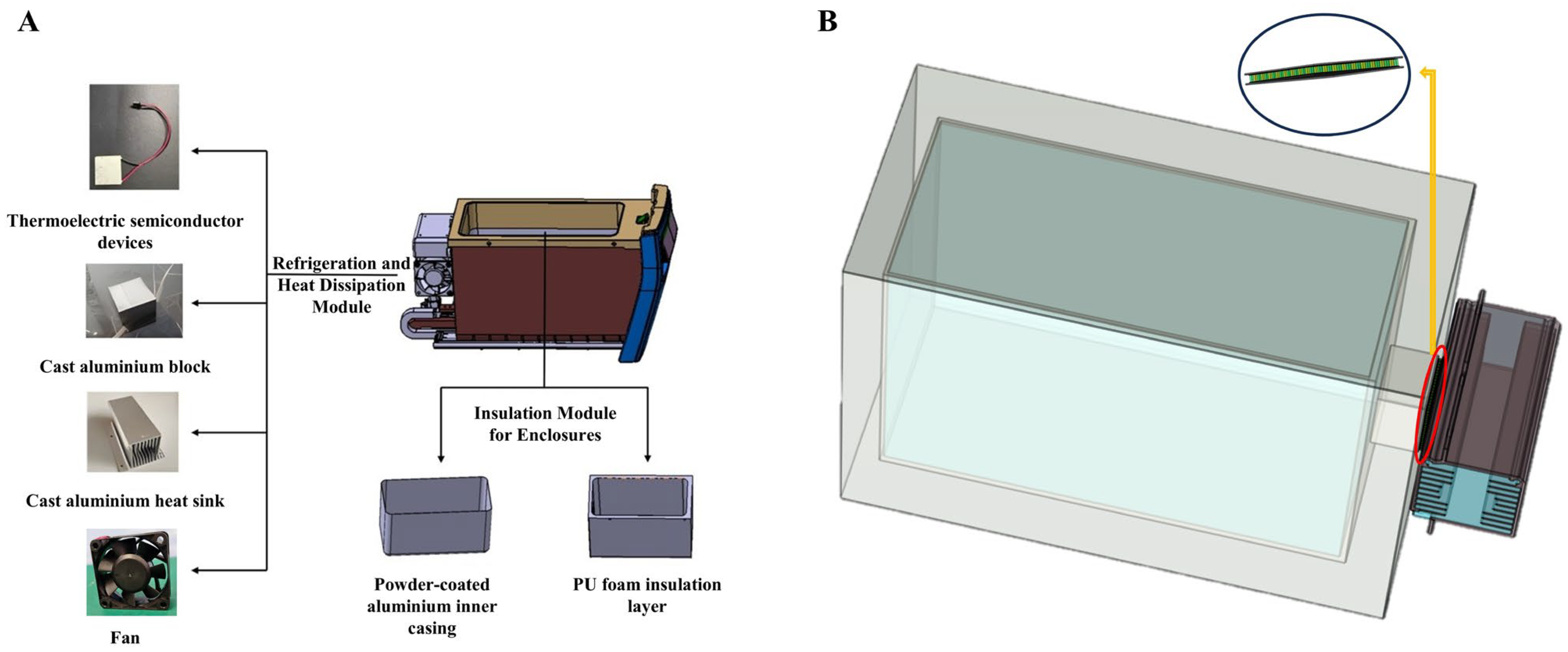
The subject of this study is an in-vehicle thermoelectric refrigerator installed in a new energy vehicle model manufactured by Dongfeng Motor Corporation. The structural configuration of the refrigerator is shown in Figure 1A. The cooling and insulation assembly mainly consists of a conventional π-type vertical thermoelectric cooling (TEC) module, a cold-side cast aluminium heat transfer block, a hot-side finned heat sink with an axial fan, polyurethane (PU) foam insulation, and an aluminium inner liner. This configuration represents a typical engineering design for semiconductor (Peltier) vehicle refrigerators in modern NEVs.
To reflect the coupled interactions between the thermoelectric cooling components and the overall refrigerator structure under practical vehicle operating conditions, a complete three-dimensional finite element model was established in COMSOL Multiphysics based on the actual assembly configuration, as shown in Figure 1B. The model includes the TEC module, the cold-side heat transfer components, the hot-side heat dissipation system consisting of the heat sink and fan, and the surrounding insulated enclosure. The detailed CAD geometry of the heat sink assembly adopted in the numerical model is provided in the Supplementary Material (Figure S5). This integrated model captures coupled thermal–electrical interactions within the refrigerator system and enables a system-level evaluation of how device geometry affects steady-state cooling performance [21,22,23,24,25].
The effective interior volume of the automotive thermoelectric refrigerator is 5.1 L. The enclosure is externally wrapped with PU foam insulation to reduce heat ingress from the environment. The nominal dimensions of the TEC module are 40 mm × 40 mm × 4 mm, and the module is mounted between the cold-side cast aluminium block and the hot-side finned heat sink. In the model, the substrate material is Al2O3 ceramic, the electrode material is Cu, the thermoelectric leg material is a Bi2Te3-based alloy, and the solder is a Sn–Sb alloy. All thermoelectric leg pairs are modelled as uniform rectangular prisms. For structural optimization, the thermoelectric leg width w, leg height l, and number of thermoelectric leg pairs pd are defined as parametric geometric variables.

2.2. Governing Equations

Within the three-dimensional model of the refrigerator, the operation of the thermoelectric cooling device involves heat conduction, electric current transport, and thermoelectric coupling effects. To characterise the spatial distributions of temperature and electric field under steady-state conditions, a set of coupled governing equations, including the energy conservation equation and the electric potential equation, is employed.
The heat flow control equation in the three-dimensional model of thermoelectric devices can be expressed as follows [26,27,28,29]:
ρ C T t + q = q ˙
In the equation, q ˙ represents the heat generation rate per unit volume, q is the vector of heat flux, ρ is the density of the material, T is the absolute temperature of the material, c represents the specific heat capacity of the material, and t represents time.
In the model, the charge continuity equation is
J + D t = 0
which J represents the vector of current density and D represents the vector of electric flux density.
Equations (1) and (2) are coupled to each other through the thermoelectric constitutive equations:
q = T [ α ] J [ κ ] T
J = [ σ ] ( E [ α ] T )
where [α] is the matrix of the material’s Seebeck coefficients, [κ] is the matrix of the material’s thermal conductivity, and [σ] is the matrix of the material’s electrical conductivity. The vector of the electric field intensity Ε can be derived from the scalar of electric potential φ:
E = φ
Furthermore, the vector of electric flux density D can be obtained from the medium’s polarization equation:
D = [ ε ] E
where [ε] is the matrix of dielectric constant.
By substituting Equations (3) and (4) into Equations (1) and (2), we can obtain the set of thermoelectric coupling equations:
ρ C T t + ( T [ α ] J ) ( [ κ ] T ) = q ˙
[ ε ] φ t + ( [ σ ] [ α ] T ) + ( [ σ ] φ ) = 0
where q ˙ includes the total electric work done by the Joule heating generated by the circuit and overcoming the Seebeck electric field [α]·∇T, donated as J·Ε.
The present calculation does not involve transient states and only considers steady-state operating conditions. Therefore, the model is intended to evaluate the quasi-steady thermal–electrical performance of the refrigerator under representative operating points, rather than to reproduce time-dependent vehicle operating events such as door opening/closing, rapid ambient-temperature changes, or transient voltage histories. If the properties of each material are isotropic, the above set of equations can be simplified to:
( T α J ) ( κ T ) = q ˙
( σ α T ) + ( σ φ ) = 0
These governing equations constitute the theoretical basis of the coupled thermal–electrical finite element model used in this study. Based on these equations, the three-dimensional refrigerator model was implemented in COMSOL Multiphysics, followed by material-property assignment, boundary-condition definition, mesh generation, and steady-state numerical solution. It should be noted that Equations (1)–(10) are the governing equations of the coupled thermal–electrical finite element model. Therefore, not all quantities appearing in these equations are prescribed as fixed numerical constants. Variables such as temperature T, heat flux q, electric potential φ, electric field intensity Ε, current density J, and electric flux density D are field variables obtained from the numerical solution and vary with spatial position and boundary conditions. By contrast, the material-related coefficients, including the Seebeck coefficient S, electrical conductivity σ, thermal conductivity κ, density ρ, and specific heat capacity C, were assigned according to the corresponding material properties in the model. In particular, S, σ, and κ for the p-type and n-type Bi2Te3-based thermoelectric materials were introduced as temperature-dependent functions, while the corresponding properties of the other structural materials were assigned according to standard material data and COMSOL material-property settings.

2.3. Material Properties, Boundary Conditions, and Modelling Assumptions

For the simulations, commercially available Bi2Te3-based thermoelectric materials (n-type and p-type) were used, with a peak dimensionless of merit ZT ≈ 1.0 at room temperature. The temperature-dependent Seebeck coefficient, electrical conductivity, and thermal conductivity of the thermoelectric materials were incorporated into the model to improve the accuracy of the results [30,31,32,33].
To further improve the fidelity of the simulation, both electrical contact resistance and thermal contact resistance were included in the model. According to CSPM characterization, the interfacial electrical contact resistances for the p-type and n-type thermoelectric elements were 3.6 μΩ cm2 and 5.3 μΩ cm2, respectively. These values were introduced into the finite element model through the corresponding electrical interface settings. In addition, the thermal contact resistance at the solid–solid interfaces was set to 1 × 10⁻⁵ m2·K·W−1.
The thermal boundary conditions were defined according to the actual operating environment of the vehicle-mounted refrigerator. For the normal operating condition, the ambient temperature was set to Ta = 25 °C. In addition, elevated ambient temperature conditions can be considered to evaluate the thermal performance degradation of the refrigerator in severe environments. The hot side of the TEC module is connected to an aluminium finned heat sink with fan-assisted cooling. Heat dissipation at the hot side includes both natural convection and forced convection generated by the axial fan, with an inlet air velocity of approximately 3 m/s across the heat sink fins. This treatment was used to represent the actual heat dissipation capability of the hot-side heat sink assembly under practical operating conditions. The cold side of the TEC module is thermally coupled to the refrigerator interior through the cast aluminium heat transfer block. Because the refrigerator compartment is compact and the internal air circulation is weak, an equivalent convective heat transfer coefficient of 5 W·m−2·K−1 was adopted for the cold-side thermal exchange boundary to approximate the limited heat transfer condition inside the enclosure. The air inside the refrigerator was not explicitly solved as a fluid flow field. Instead, its thermal effect was represented by the equivalent convective boundary condition at the cold side, and the cabinet-center temperature was used as a representative system-level thermal indicator. This treatment neglects possible natural-convection-induced temperature stratification inside the compartment but allows a comparative evaluation of the influence of structural parameters on the overall refrigerator performance under the same modelling assumptions. The cabinet temperature was therefore determined by the steady-state thermal balance of the system rather than prescribed in advance. For reproducibility, it should be noted that the thermal properties of the insulation and other non-thermoelectric structural components adopted in the present model were assigned according to standard material-property data. The electrical and thermal contact resistance values used in the simulations are explicitly given in Section 2.3. In addition, the hot-side fan condition was simplified as a constant inlet air velocity of 3 m/s in the present model. A detailed fan performance curve was not introduced; therefore, the hot-side cooling condition should be understood as a representative forced-convection boundary rather than a fan-specific characteristic curve [34].
The electrical boundary conditions were defined using a constant-voltage drive. One electrode of the TEC module was set as the zero-potential reference (ground), while the opposite electrode was assigned the driving voltage U. Under this constant-voltage condition, the operating current of the module was not prescribed in advance but was determined automatically by the internal electrical resistance of the module and the resulting coupled thermal–electrical field distribution. This constant-voltage condition represents the nominal operating voltage level of the vehicle electrical system and provides an approximation of the average steady-state performance of the device under actual automotive operating conditions.
To simplify calculations and enhance model feasibility, the following reasonable assumptions were adopted:
(1)
Radiative heat transfer is neglected, and only conductive and convective heat transfer modes are considered (for both ambient and elevated temperature conditions).
(2)
Additional heat losses from the TEC module due to natural or forced convection (e.g., from module surfaces) are ignored, assuming solid conduction dominates within the module.
(3)
The air inside the refrigerator is not explicitly modeled with fluid dynamics. Instead, its effect is captured via the convective boundary condition at the cold end, as described above (well-mixed, uniform interior air).
(4)
The p-type and n-type thermoelectric legs are assumed to have identical geometry and cross-sectional area. Each leg maintains a constant cross-section along its length.
(5)
The strong temperature dependence of the thermoelectric properties (Seebeck coefficient, electrical conductivity, and thermal conductivity) of the p-type and n-type legs is taken into account, whereas the thermal properties of the other structural components (ceramic substrates, copper electrodes, aluminium block, and heat sink) are treated as temperature-independent constants. In addition, possible variations in electrical and thermal contact resistances arising from assembly tolerances are not explicitly considered; instead, representative contact resistance values are adopted in the present simulations. These simplifications may introduce additional uncertainty under high-load or high-temperature conditions, but they do not affect the comparative evaluation of different structural configurations under the same modelling framework.

2.4. Calculation Procedure and Parametric Settings

The finite element calculation procedure consisted of four main steps. First, the three-dimensional geometry of the refrigerator was reconstructed in COMSOL Multiphysics according to the actual structural configuration and dimensions of the Dongfeng vehicle-mounted thermoelectric refrigerator. Second, the material properties of each component were assigned, including the temperature-dependent thermoelectric properties of the p-type and n-type Bi2Te3-based materials, and the coupled thermal–electrical physics interfaces were defined on the basis of the governing equations described above. Third, the thermal and electrical boundary conditions, together with the electrical and thermal contact resistances, were imposed on the model to represent the practical operating environment of the refrigerator. Fourth, the finite element mesh was generated and the steady-state coupled equations were solved for different combinations of geometric and operating parameters, after which the relevant performance indicators were extracted from the converged solutions.
To systematically investigate the system performance, a parametric study was carried out by varying the thermoelectric leg height l, leg width w, number of thermoelectric leg pairs pd, and input voltage U. In particular, U was varied over the range of 9–16.5 V to simulate the influence of vehicle power supply fluctuations on the cooling capacity, input power, and interior temperature of the thermoelectric refrigeration system. This treatment represents a steady-state parametric evaluation of possible vehicle power-supply levels, rather than a transient simulation of time-dependent voltage fluctuations during actual driving operation. These variables were implemented in COMSOL as parametric inputs. Specifically, w, l, and pd were introduced as geometric parameters, while the driving voltage U and ambient temperature Ta were assigned through the corresponding global parameter and boundary-condition settings. The temperature-dependent thermoelectric material properties were entered as material property functions, and the electrical/thermal contact resistances were imposed through the corresponding interface settings. In this way, both geometric variables and operating conditions could be updated automatically during the parametric sweep calculations. For the structural optimization, the thermoelectric leg width w, leg height l, and leg pair number pd were treated as the key design variables of the device, whereas the input voltage U was treated as an operating condition rather than a structural optimization variable. The optimization objective was to reduce the input power consumption of the thermoelectric refrigerator while maintaining sufficient cooling performance. Therefore, the optimal structural configuration was determined by comprehensively evaluating the cooling capacity Qc, coefficient of performance COP, input power P, and cabinet center temperature T under the same operating conditions. It should be noted that the present optimization was carried out within the fixed external dimensions of the TEC module and the realistic packaging constraints of the vehicle-mounted refrigerator. Therefore, increasing the leg number pd in this study does not represent unrestricted parallel area expansion; rather, it changes the internal geometric distribution, current density, electrical resistance, thermal resistance, Joule heating, and hot-side heat flux simultaneously within the same module envelope.
The performance metrics extracted from the converged solutions include the cooling capacity Qc, the temperature difference ΔT between the hot and cold sides of the TEC module, the input power P, the coefficient of performance (COP), and the central temperature T inside the refrigerator compartment. It should be noted that the interior temperature T was not prescribed in advance; rather, for each simulation case it was determined by the steady-state thermal balance of the system, including the heat removed by the TEC module and the heat entering through the insulated enclosure.
All simulations were carried out to steady-state convergence in COMSOL Multiphysics. Multiple iterations were performed for each case to ensure numerical stability and solution convergence. In addition, mesh independence was verified by confirming that further mesh refinement produced negligible changes in the key output variables. Appropriate mesh densities were therefore selected to balance computational accuracy and efficiency. To further support the reliability of the numerical framework, the simulated performance of a conventional thermoelectric cooler (TEC) module was compared with experimental measurements under controlled boundary conditions, and the detailed experimental measurement results and simulation–experiment comparison are provided in the Supplementary Material (Figure S4). The simulated trends of input power, cooling capacity, and coefficient of performance (COP) were consistent with the experimental data, and the deviations remained within 9% under small-to-moderate temperature differences. Although this validation was performed on a conventional TEC unit rather than the full refrigerator system, it supports the reliability of the core thermal–electrical modelling framework and parameter settings adopted in the present study. Based on this procedure, a fully parametric analysis was performed to evaluate how the leg height l, leg width w, leg pair number pd, and operating voltage U affect the steady-state cooling performance and power consumption of the thermoelectric refrigerator under realistic integrated conditions.

3. Results and Discussion

Based on the vehicle’s low-voltage power supply characteristics and the geometric constraints of the device, we conducted scenario-based analyses of the steady-state performance of both the thermoelectric cooling module and the entire refrigerator. This allowed us to elucidate the coupling relationships between the module’s geometric parameters and its electrical operating conditions. In the first scenario, under a constant voltage supply, we examine the effects of thermoelectric leg height l, leg width w, and number of legs pd on performance metrics such as cooling capacity Qc, input power P, and the cabinet’s centre temperature T. In this constant-U scenario, the device’s input current is determined adaptively by its equivalent resistance and the temperature distribution, closely approximating actual operating conditions under full vehicle integration. By comparing different combinations of l, w, and pd, we reveal how geometric dimensions and leg count influence metrics like Qc, and P, and we evaluate the overall impact of the device’s structural design on the refrigerator’s performance. In the second scenario, we fix the leg count at an optimised value and analyse the coupled effect of drive voltage U with the leg geometry (l, w). By varying U and the geometric parameters, we clarify how different electrical drive levels and structural refinements affect cooling performance and power consumption, providing a basis for matching the device parameters with an appropriate operating point. Results from both scenarios demonstrate that the TEC module’s geometric parameters are strongly coupled with the electrical drive conditions and significantly influence the overall cooling performance. In our analysis we focus on cooling capacity Qc, cooling efficiency (COP), input power P, and the no-load interior air temperature T to comprehensively evaluate different design schemes under the vehicle’s space-constrained conditions. Compared with previous studies that mainly reported the performance trends of isolated thermoelectric modules under simplified boundary conditions, the present section emphasizes the engineering implications of the results obtained from a system-level refrigerator model. Specifically, the discussion focuses on three aspects:
(1)
The existence of an optimal intermediate leg-count range under fixed module dimensions and constrained heat dissipation conditions.
(2)
The matching relationship between structural parameters and representative vehicle voltage levels.
(3)
The system-level thermal bottleneck that limits refrigerator performance under high ambient temperature. These results provide application-oriented design guidance for compact vehicle-mounted thermoelectric refrigerators rather than only reporting general thermoelectric performance trends.

3.1. Performance Variation of TEC Under Constant Voltage Conditions with Respect to Geometric Parameters

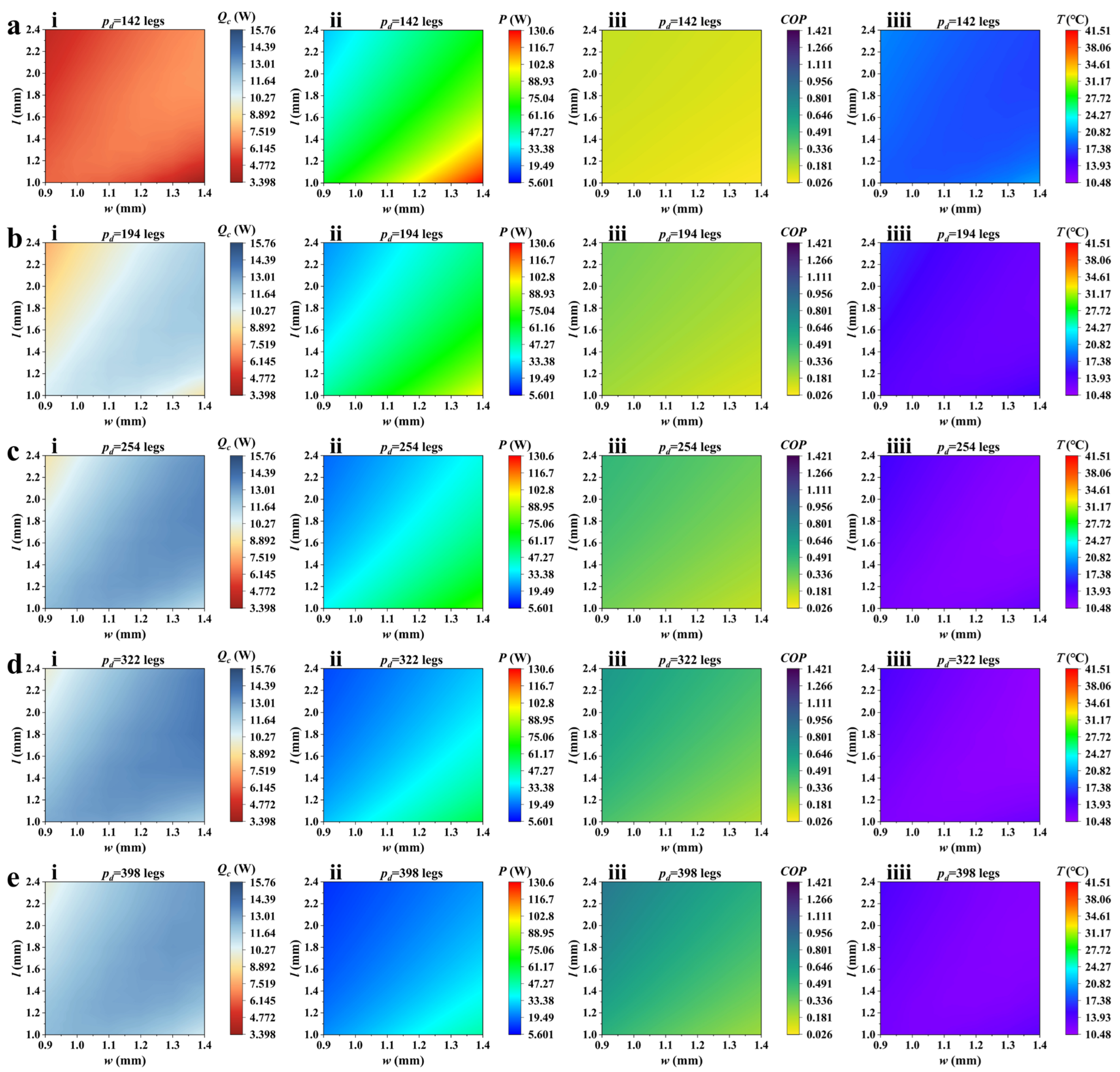
Under constant voltage conditions of 13.5 V and ambient temperature of 25 °C, a parametric simulation methodology was employed to systematically investigate the influence of thermoelectric leg height (l), width (w), and number of legs (pd) on the cooling capacity (Qc), input power (P), and central internal box temperature (T) of thermoelectric cooling devices. Five representative leg configurations were selected: pd = 142 legs, 194 legs, 254 legs, 322 legs, and 398 legs. For each configuration, different combinations of width (w) and height (l) were scanned (corresponding to Figure 2a–e), enabling a comprehensive assessment of how geometric parameter variations influence the steady-state cooling performance of the entire device. For each leg-count configuration, the values of Qc, P, COP, and T discussed below were extracted from the converged solution corresponding to the w-l combination that yielded the lowest cabinet-center temperature under the same operating condition (U = 13.5 V, Ta = 25 °C) in the parameter maps shown in Figure 2. Here, the coefficient of performance was calculated as COP = Qc/P.
Results indicate that under constant-voltage vehicle operation, increasing pd from low to medium ranges significantly enhances cooling capacity, substantially lowers compartment temperature, and markedly reduces input power. As pd further increases, cooling gains approach saturation due to heat dissipation limitations at the hot end, exhibiting diminishing marginal returns. As pd increased from 142 legs to 322 legs, the optimized geometry gradually shifted toward relatively taller and slimmer thermoelectric legs, which improved the thermal–electrical matching of the device. Under the fixed-voltage condition, this change reduced the operating current/current density and suppressed Joule heating, while the increased leg number enhanced the overall heat-pumping capability of the module. Meanwhile, the increase in leg height also raised the thermal resistance and reduced heat backflow from the hot side to the cold side. As a result, the net cooling capacity Qc increased from 7.16 W to 13.95 W, the cabinet-center temperature decreased from 17.19 °C to 10.71 °C, and the input power P decreased from 77.21 W to 38.40 W. Accordingly, the COP increased from 0.093 to 0.363. However, when pd was further increased to 398 legs, the hot-side heat dissipation bottleneck became dominant, so that the cooling benefit approached saturation and the cabinet-center temperature no longer decreased further despite the continued reduction in input power. Therefore, the effect of increasing pd in the present study should not be interpreted as a simple free scaling of cooling area. Because the external module size was fixed, increasing pd simultaneously changed the internal geometric distribution, current density, Joule heating, thermal resistance, and hot-side heat rejection load, which is why an intermediate leg-count range rather than the maximum pd provided the best overall performance [35,36,37,38,39].
For lower leg configurations such as pd = 142 legs and 194 legs, the device’s steady-state cooling performance exhibits extreme sensitivity to the geometric dimensions (w, l) of the thermoelectric legs. With fewer legs, each thermoelectric leg carries a larger current and a higher proportion of Joule heating. Consequently, the judicious selection of geometric parameters is crucial for balancing resistive losses and thermal conduction losses. Simulation results indicate that selecting w = 1.4 mm and l = 2.0 mm for pd = 142 legs, and w = 1.4 mm and l = 1.9 mm for pd = 194 legs, reduces the steady-state temperature at the enclosure centre to 17.2 °C and 12.6 °C, respectively, achieving optimal cooling performance for each leg count. This indicates that in low-leg-count configurations, optimising leg width and height can partially compensate for performance disadvantages arising from insufficient leg count. However, due to excessive current per thermoelectric leg and the difficulty in further reducing Joule heating losses, overall cooling capacity remains constrained [40,41,42,43,44].
As pd increases to moderately high levels (254 legs and 322 legs), the optimal thermoelectric leg height significantly increases, revealing a trend towards adopting slimmer thermoelectric legs. This occurs because the substantial reduction in current density per leg due to increased parallel thermoelectric channels diminishes the impact of Joule heating, while axial heat conduction progressively becomes the dominant limiting factor for performance. Consequently, appropriately increasing leg length effectively enhances thermal resistance, suppressing heat backflow from the hot end to the cold end. This increases the cold-end temperature difference and boosts cooling capacity. Under conditions of pd = 254 legs and 322 legs, the system remains within the ‘cooling enhancement-dominant’ operating range, where the Qc improvement gained from increasing leg count directly translates to lower internal compartment temperatures. For instance, the central compartment temperature drops to 11.1 °C at pd = 254 legs and further to 10.7 °C at pd = 322 legs; corresponding cooling capacities are approximately 13.6 W and 13.95 W, respectively. This demonstrates that within this leg count range, increasing legs while optimising geometry simultaneously enhances Qc and reduces compartment temperature, with overall cooling performance significantly improving with leg count [14].
However, when the pd increased to 398 legs, a distinct decoupling phenomenon emerged between cooling capacity and cabinet temperature: the geometric parameter combination achieving maximum Qc no longer corresponded to the lowest cabinet temperature. Simulation results indicate that even by increasing the thermoelectric leg height to 2.4 mm (w = 1.4 mm) to elevate the Qc of the pd = 398-leg module to 13.1 W—equivalent to that of pd = 322-leg modules—the central box temperature could only be reduced to approximately 11.5 °C. This temperature is paradoxically higher than the minimum temperatures achieved with pd= 254-leg and 322-leg configurations. This occurs because, while theoretically increasing the number of thermoelectric legs in parallel can enhance cold-end cooling capacity, the accompanying additional Joule heating and higher hot-end heat flux density elevate the hot-end temperature [45]. This effect offsets the contribution of increased cooling power towards reducing case temperature. Consequently, under constrained heat dissipation conditions, further increasing the number of legs exhibits pronounced diminishing marginal returns: excessively high leg counts not only fail to lower the box temperature further but also limit performance gains due to thermal accumulation. This demonstrates that ‘maximum cooling capacity’ does not equate to ‘minimum box temperature’; blindly increasing leg counts or driving voltage without addressing hot-end dissipation bottlenecks may prove counterproductive [46].
In summary, within thermally constrained automotive environments, optimal overall performance is achieved when the thermoelectric leg count falls between 254 legs and 322 legs. Designs within this range can meet cooling requirements while controlling excess joule heating and thermal backflow effects within reasonable limits. This effectively lowers the compartment’s steady-state temperature while enhancing cooling capacity. Conversely, excessively low leg counts result in inefficient operation due to excessive current per leg, while excessively high leg counts face thermal dissipation limitations, hindering further improvements in compartment temperature and energy efficiency. The optimal solution, derived under U = 13.5 V and Ta = 25 °C conditions, is pd = 322 legs (w = 1.4 mm, l = 1.8 mm), yielding Qc = 13.95 W, P = 38.40 W, COP = 0.36, and a cabinet centre temperature T = 10.71 °C. To quantitatively evaluate the advantage of the optimized design, this configuration was compared with the reference 254-leg configuration under the same operating condition. Compared with the reference 254-leg module (w = 1.4 mm, l = 1.6 mm, P = 53.97 W, COP = 0.248, T = 11.22 °C), the optimized 322-leg design reduces the input power by 28.8%, and increases the COP by 45.1%, while also reducing the cabinet-center temperature from 11.22 °C to 10.71 °C. This improvement is mainly attributed to the better thermal–electrical matching of the optimized geometry, which reduces current density and Joule heating, suppresses heat backflow from the hot side to the cold side, and thereby improves the ratio of cooling output to electrical input. Compared with many previous studies that mainly focused on isolated TEC modules or idealized boundary conditions, the present result shows that, within a fixed refrigerator module envelope and realistic vehicle heat dissipation constraints, the optimal leg number is not the maximum one, but an intermediate range in which thermal–electrical matching and system-level heat rejection are better balanced [47,48,49,50,51].

3.2. Performance Variation of TEC Under Constant Thermocouple Leg Count with Respect to Geometric Parameters

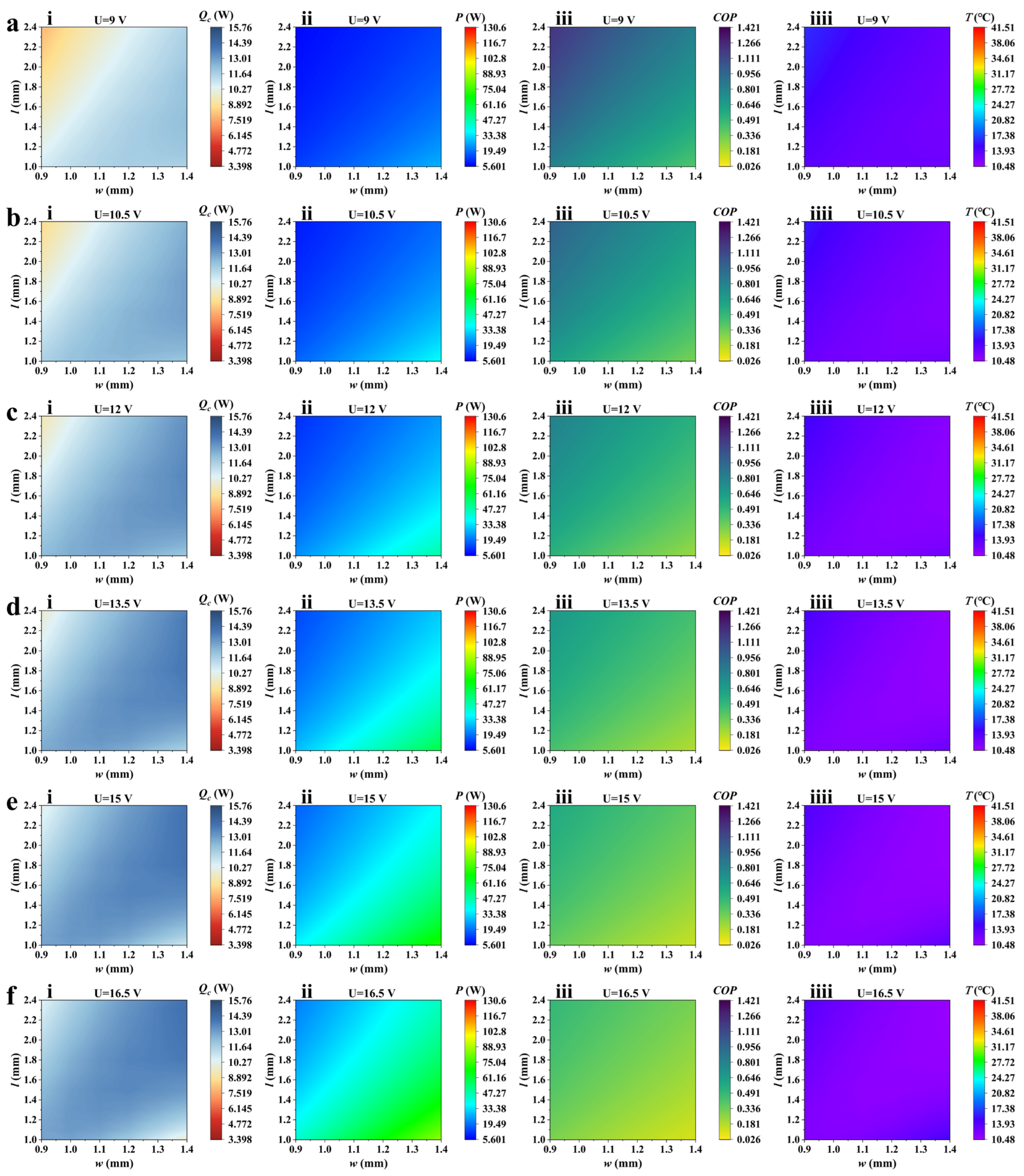
Under constant thermoelectric leg count pd = 322 legs and ambient temperature Ta = 25 °C, Figure 3a–f demonstrate the steady-state performance of the thermoelectric module and the complete refrigerator unit exhibiting typical and engineering-relevant variation patterns when the input voltage is increased from 9 V to 16.5 V. The combined simulation results indicate that as the drive voltage increases, the overall cooling capacity Qc rises while the coefficient of performance (COP) decreases markedly. The internal compartment centre temperature also gradually decreases but approaches saturation [52,53,54,55,56,57].
It is noteworthy that approximately U = 13.5 V emerges as the optimal operating point for this system, with its corresponding geometric parameters and performance exhibiting significant engineering advantages. At this voltage, selecting pd = 322 legs, w = 1.4 mm, and l = 1.8 mm enables the thermoelectric module to achieve its best overall performance: cooling capacity Qc = 13.95 W, with a centre temperature within the box of approximately 10.7 °C. This is remarkably close to the minimum temperature and cooling capacity achievable at higher voltages. Concurrently, the input power is approximately 38.4 W, significantly lower than the 46 W level observed at 16.5 V, while the COP remains above 0.35. In other words, at 13.5 V, approximately 98% of maximum cooling capacity is achieved with only about 83% of the power consumption. The marginal cooling gain from further voltage increases is negligible, yet comes at a significant energy cost. This operating point offers multiple engineering advantages: higher energy efficiency translates to lower power consumption per unit of cooling capacity, reducing strain on vehicle power supplies and thermal management systems; moderate power consumption minimises heat dissipation requirements at the hot end, maintaining temperatures below 55 °C for enhanced long-term reliability. The thermoelectric leg dimensions are optimally balanced (a length of 1.8 mm versus 2.3 mm minimises thermal impedance mismatch risks and mechanical stress), resulting in a more stable and robust module structure. In contrast, indiscriminately pushing conventional thermoelectric modules to higher voltages often proves counterproductive: cooling capacity not only saturates or stagnates, but excessively high currents also cause power consumption and waste heat to surge dramatically. For instance, on unoptimised conventional modules (such as standard pd = 254 legs-configurations), cooling capacity barely increases when voltage rises to 15 V–16 V, while input power surges beyond 60 W. This not only causes a steep decline in COP but may also trigger reliability issues due to hot-end overheating. Consequently, this study avoids the ‘high power consumption, low gain’ trap at elevated voltages by adjusting thermoelectric geometric parameters to match suitable operating voltages. This approach substantially enhances energy efficiency and stability while maintaining cooling capacity. This optimisation approach holds significant engineering implications for compact thermoelectric cooling devices in confined spaces, such as automotive semiconductor refrigerators: under constrained heat dissipation conditions, selecting appropriately matched module dimensions and power supply solutions enables operation near the optimum operating point, thereby achieving maximum cooling performance with minimal energy consumption [58].

3.3. Analysis of Refrigerator Cooling Failure During Operation at Extremely High Ambient Temperatures

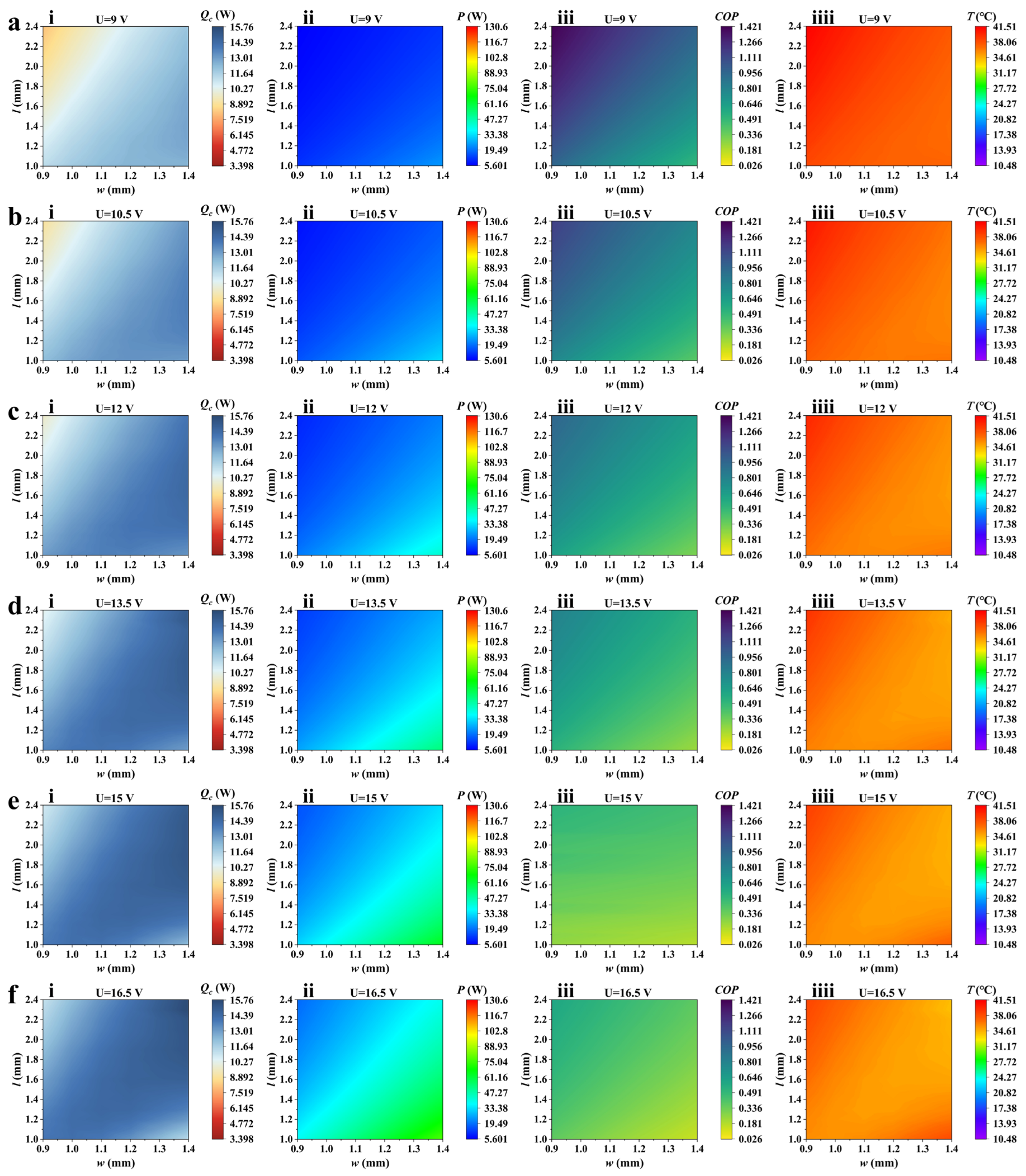
Under ambient temperature conditions of Ta = 50 °C and thermoelectric pin count pd = 322 legs, Figure 4a–f demonstrate significant performance variations in the thermoelectric cooling module as the drive voltage increases from 9 V to 16.5 V: The cooling capacity Qc increases monotonically with voltage, rising from approximately 12 W at 9 V to nearly 16 W at 16.5 V. However, the corresponding decrease in the centre temperature T of the enclosure is extremely limited, with the minimum temperature dropping only from approximately 37–38 °C to 34.13 °C, and then approaching saturation after U > 15 V. This indicates a pronounced ‘high power consumption, low gain’ phenomenon within the system: whilst higher voltages drive greater current, enhancing the Peltier cooling effect (Qc increases), the additional cooling capacity acquired does not translate into a proportionally greater temperature reduction. Conversely, the input power P increases substantially with voltage (from approximately 40 W to 46 W), yet the cooling efficiency diminishes, leading to a decline in the Coefficient of Performance (COP). This signifies a significant increase in the electrical power required per unit of cooling capacity. Consequently, although raising the voltage still slightly enhances Qc, the enclosure temperature scarcely decreases further, indicating the system is progressively entering a saturated cooling performance zone [59,60,61,62,63].
The mechanism behind this performance degradation lies in the cumulative effect of multiple adverse factors within the high-temperature environment. Firstly, at Ta = 50 °C, the temperature differential between the hot side and the environment is small, significantly reducing the heat dissipation driving force. Waste heat generated at the hot side struggles to be promptly transferred to the environment, causing the hot side temperature to rise continuously. This increase in hot side temperature directly weakens the effective Seebeck voltage corresponding to the Seebeck coefficient of the thermoelectric material, reducing the Peltier cooling capacity and diminishing the net cooling power achievable per unit current. Secondly, the voltage increase is accompanied by a rise in current, causing the generated Joule heating (I2R losses) to amplify dramatically. At elevated temperatures, this becomes the dominant heat source. Excessive Joule heating accumulates at the hot end without timely dissipation, with a portion ‘reflowing’ to the cold end via thermal conduction and convection, thereby offsetting the newly generated cooling capacity. Consequently, the cold-end temperature struggles to decrease further. Even as Qc continues to increase, the cold end approaches steady-state equilibrium temperature, signalling impending cooling failure. In other words, at extreme temperatures, the system is constrained by thermal dissipation limitations. Further increasing electrical drive power will substantially raise power consumption without yielding significant cooling benefits.
To address the aforementioned performance degradation at elevated temperatures, optimising thermocouple geometric parameters can mitigate the deterioration trend to some extent. As the drive current increases, the optimal height l of the thermoelectric leg shifts towards larger values: transitioning gradually from approximately l = 1.4–1.8 mm at low voltages to approximately l = 2.3 mm at high voltages. Increasing thermoelectric leg height enhances thermal resistance between hot and cold junctions, reducing solid thermal conduction and thermal backflow. This suppresses temperature difference losses caused by Joule heating during high-current operation, thereby maintaining an effective temperature differential. However, geometric scaling has limitations: excessively long thermoelectric legs significantly increase internal resistance, leading to reduced current and Qc values, necessitating an optimal range. Even when l was increased to 2.3 mm (w = 1.4 mm, pd = 322 legs) and operated at the maximum voltage U = 16.5 V, the minimum temperature at the enclosure centre remained only 34.13 °C. This indicates that relying solely on geometric scaling cannot fundamentally overcome performance bottlenecks at elevated temperatures; the limiting factor for cooling efficiency at this stage stems from system-level thermal dissipation capacity rather than inherent structural parameters of the device itself. Indeed, at Ta = 50 °C and high current density, the total joule heat generated by 322 thermoelectric arms increases significantly. Insufficient external heat dissipation prevents its reduction, causing the hot-end temperature to become “locked” at elevated levels. Consequently, the effective operating range of the TEC as a heat pump is substantially restricted.
Compared to ambient conditions, the degradation extent and dominant mechanisms of thermoelectric cooling performance under high ambient temperatures exhibit distinct differences. At Ta = 25 °C, the optimised pd = 322-leg thermoelectric module reduces the cabinet centre temperature to approximately 10.71 °C at U = 13.5 V, achieving a substantial cooling margin (ΔT ≈ 14 °C). At this point, system power consumption is approximately 38.4 W, COP = 0.36, with relatively adequate hot-end dissipation. The cooling effect was primarily constrained by the internal characteristics of the thermoelectric elements. In contrast, at Ta = 50 °C, even with a higher applied voltage of U = 16.5 V, the minimum temperature reached only 34.13 °C (ΔT ≈ 16 °C), significantly exceeding the internal temperature level under ambient conditions. This indicates a substantial reduction in cooling capacity under high-temperature environments. Furthermore, at 25 °C, increasing the voltage from 13.5 V to 16.5 V only marginally raised Qc from 13.95 W to 14.20 W, whilst power consumption P rose markedly from 38.40 W to 46.19 W, indicating diminishing marginal returns. However, at Ta = 50 °C, the same voltage increase scarcely lowered the cabinet temperature further, demonstrating that system performance is entirely constrained by thermal dissipation limitations rather than the thermoelectric stack’s inherent potential. In summary, under high-temperature conditions, the cooling capacity and COP of the thermoelectric cooler are markedly inferior to those at ambient temperatures. The final internal temperature rises substantially, with the failure mechanism primarily attributed to the difficulty in maintaining the temperature difference due to restricted heat dissipation at the hot end, coupled with the severe degradation of cooling efficiency caused by Joule heating and thermal backflow under high-temperature and high-current conditions. Therefore, the contribution of this section is not merely to show performance degradation at elevated ambient temperature, but to identify that the refrigerator failure mechanism under such conditions is dominated by system-level heat dissipation limitations rather than by a simple lack of intrinsic thermoelectric cooling capacity.

4. Conclusions

In this study, we established a three-dimensional finite element model with coupled multi-physics to study an in-vehicle thermoelectric refrigerator (Peltier cooling unit) in a Dongfeng Motor new-energy vehicle. Under two typical scenarios—a constant-voltage drive and a fixed thermoelectric leg-count—we systematically revealed the combined influence of various device geometric parameters (leg height l, leg width w, and leg count pd) and operating conditions (input voltage U, ambient temperature Ta) on key performance metrics of the refrigerator, namely the cooling capacity Qc, coefficient of performance COP, and interior center temperature T. Among these factors, the number of thermoelectric legs (pd) emerged as a fundamental parameter governing cooling performance. Increasing pd from a low value into a moderate range significantly improved the module’s cooling capacity and achieved a much greater temperature reduction inside the cabinet. However, as pd was increased further, the improvement became constrained by the heat dissipation capacity at the hot side; the cooling gains tended toward saturation, exhibiting diminishing marginal returns.
Under constant voltage conditions (ambient temperature Ta = 25 °C, drive voltage U = 13.5 V), parameter scanning optimisation yielded the optimal configuration: pd = 322 legs, w = 1.4 mm, and l = 1.8 mm. This achieves Qc = 13.95 W, P = 38.4 W, COP = 0.36, with an internal centre temperature T = 10.71 °C. Compared to the conventional reference structure (pd = 254 legs), this design reduces power consumption by approximately 28.8% and increases COP by about 45.1% under comparable cooling capacity conditions. The optimized configuration reported in this work should therefore be understood as a system-level nominal design target under fixed module dimensions and the modeled thermal boundary conditions, rather than a full product-level optimum including manufacturing tolerance, assembly feasibility, weight, and cost constraints. When pd = 322 legs remains constant, increasing the drive voltage can further enhance the cooling capacity, but the marginal benefit diminishes markedly: When U increases from 13.5 V to 16.5 V, Qc rises only from 13.95 W to 14.20 W, while P significantly increases from 38.40 W to 46.19 W. At U = 15 V, with w = 1.4 mm and l = 2.3 mm, Qc = 14.16 W and P = 38.67 W are maintained. In contrast, conventional modules exhibit saturated cooling capacity and power consumption exceeding 60 W under identical voltage conditions. Under high ambient temperature conditions (Ta = 50 °C), cooling performance deteriorates markedly, with the refrigerator’s core minimum temperature reaching only approximately 34.13 °C. This indicates that the system’s cooling capability is fundamentally constrained by system-level thermal bottlenecks.

Supplementary Materials

The following supporting information can be downloaded at: https://www.mdpi.com/article/10.3390/app16094435/s1, Figure S1: Temperature-dependent thermoelectric properties of commercial n-type and p-type Bi2Te3-based materials (i) Seebeck coefficient; (ii) electrical conductivity; (iii) thermal conductivity; (iiii) ZT; Figure S2: Finite element mesh for conventional TEC; Figure S3: Variations in simulated current, cooling capacity, and coefficient of performance (COP) for devices fabricated with different thermoelectric leg dimensions in conventional TEC technology; Figure S4: Comparison of simulated versus measured variations in power consumption, cooling capacity, and coefficient of performance (COP) for devices fabricated with different thermoelectric leg dimensions using conventional TEC technology; Figure S5: CAD diagram of the aluminium heat sink for the simulated physical model.

Author Contributions

D.L. and X.S. conceived the project; X.C. prepared the materials and tested their performance; X.C. carried out the finite element simulation; X.C., Y.L., D.L., X.S. and X.T. conceived the plan; X.C., Y.L., D.L., X.S. and X.T. analyzed the experimental data; X.C. wrote the manuscript. All authors have read and agreed to the published version of the manuscript.

Funding

This work was financially supported by the Natural Science Foundation of Hubei Province (Grant No. 2025CSA004) and the Dongfeng Motor Group Company Limited Research&Development Institute of China.

Institutional Review Board Statement

Not applicable.

Informed Consent Statement

Not applicable.

Data Availability Statement

The data presented in this study are available from the corresponding author upon request. The data are not publicly available due to privacy.

Conflicts of Interest

Author Dandan Liu was employed by the company Dongfeng Motor Group Company Limited Research&Development Institute. The remaining authors declare that the research was conducted in the absence of any commercial or financial relationships that could be construed as a potential conflict of interest.

References

  1. Liu, J.; Wu, C.; Le Vine, S.; Jian, S. Panel data analysis of Chinese households’ car ownership and expenditure patterns. Transp. Res. Part D Transp. Environ. 2023, 123, 103915. [Google Scholar] [CrossRef]
  2. Ballard, J.; Hubbard, M.; Jung, S.-J.; Rojas, V.; Ung, R.; Suh, J.; Kim, M.; Lee, J.; Pierce, J.M.; Venkatasubramanian, R. Nano-engineered thin-film thermoelectric materials enable practical solid-state refrigeration. Nat. Commun. 2025, 16, 4421. [Google Scholar] [CrossRef]
  3. Guclu, T.; Cuce, P.M.; Cuce, E.; Alvur, E.; Sen, H. TEC-Driven Mini Refrigerators: Recent Applications With Performance Characteristics. Energy Res. J. 2025, 14, 12–25. [Google Scholar] [CrossRef]
  4. Wang, Y.-W.; Wang, Y.; Liang, H.; Zhang, Y.-X.; Feng, J.; Ge, Z.-H. Enhanced thermoelectric performance in p-type (Bi, Sb)2Te3 materials via anomalous PbBr2 doping. J. Alloys Compd. 2025, 1010, 178050. [Google Scholar] [CrossRef]
  5. Du, J.; Sun, Y.; Guo, F.; Tong, H.; Yu, Z.; Liu, Z.; Zhu, J.; Sui, J. Enhanced thermoelectric cooling performance of (Bi, Sb)2Te3 through platinum doping. Mater. Today Phys. 2025, 53, 101705. [Google Scholar] [CrossRef]
  6. Xia, G.; Zhao, H.; Zhang, J.; Yang, H.; Feng, B.; Zhang, Q.; Song, X. Study on Performance of the Thermoelectric Cooling Device with Novel Subchannel Finned Heat Sink. Energies 2021, 15, 145. [Google Scholar] [CrossRef]
  7. Kim, D.-h.; Seo, S.; Kim, S.; Shin, S.; Son, K.; Jeon, S.-j.; Han, S. Design and performance analyses of thermoelectric coolers and power generators for automobiles. Sustain. Energy Technol. Assess. 2022, 51, 101955. [Google Scholar] [CrossRef]
  8. Zhang, J.; Song, X.; Lei, J.; Li, C.; Zhang, Y.; Sun, L.; Zhao, H. Performance and regression analysis of air-cooled thermoelectric cooling system using response surface methodology and numerical simulation. Int. J. Heat Mass Transf. 2024, 228, 125617. [Google Scholar] [CrossRef]
  9. Khalaf-Allah, R.A.; Eid, E.I.; Ellithy, A.-E.H.A.; Easa, A.S. Experimental Investigation of The Influence of Modifying the Inner Tube Outer Surface on Free Convection in A Concentrated Double Pipe. Exp. Heat Transf. 2022, 37, 335–355. [Google Scholar] [CrossRef]
  10. Yang, W.; Zhu, W.; Li, Y.; Xie, C.; Xiong, B.; Shi, Y.; Lin, W. Global structural optimization of annular thermoelectric generators based on a dual-finite-element multiphysical model. Appl. Therm. Eng. 2023, 220, 119797. [Google Scholar] [CrossRef]
  11. Luo, D.; Liu, Z.; Yan, Y.; Li, Y.; Wang, R.; Zhang, L.; Yang, X. Recent advances in modeling and simulation of thermoelectric power generation. Energy Convers. Manag. 2022, 273, 116389. [Google Scholar] [CrossRef]
  12. Luo, D.; Wang, R.; Yan, Y.; Yu, W.; Zhou, W. Transient numerical modelling of a thermoelectric generator system used for automotive exhaust waste heat recovery. Appl. Energy 2021, 297, 117151. [Google Scholar] [CrossRef]
  13. Zhang, W.; Dong, C.; Mao, Y.; Zhong, Y.; Ye, Y.; Gu, H.; Bu, Z.; Ye, C.; Zhu, C. Performance analysis of a thermoelectric cooler based on thermal management. Appl. Therm. Eng. 2025, 265, 125655. [Google Scholar] [CrossRef]
  14. Bhattacharyya, S.; Dinh, Q.T.; McGordon, A. Optimising thermoelectric coolers for battery thermal management in light electric vehicles. Appl. Energy 2025, 386, 125516. [Google Scholar] [CrossRef]
  15. Yang, Z.; Shen, X.; Chen, J.; Lu, L.; Liang, J.; Zhang, J. A coupled confined space heat transfer model for thermoelectric cooler considering spreading thermal resistance. Appl. Therm. Eng. 2025, 262, 125208. [Google Scholar] [CrossRef]
  16. Zhang, A.; Pang, D.; Wang, B.; Li, G.; Lou, J. Theoretical model for micro-thermoelectric coolers: Influence of coupled interfacial and Thomson effects on cooling performance. Appl. Therm. Eng. 2025, 258, 124750. [Google Scholar] [CrossRef]
  17. Park, J.; Park, S.J.; Bang, K.M.; Jin, H. Influence of external thermal resistance on thermoelectric cooling in thermal management systems: Operating modes and material selection. Energy Convers. Manag. 2025, 333, 119806. [Google Scholar] [CrossRef]
  18. Lv, X.; Fu, Y.; Mao, Y.; Gu, H.; Wang, L.; Dong, C.; Shen, J. Research on multi-space portable box based on thermoelectric refrigeration technology. Appl. Therm. Eng. 2025, 263, 125368. [Google Scholar] [CrossRef]
  19. Wang, Q.; Wang, W.; Sun, L.; Jiang, P. Multi-parameter optimization of the thermoelectric module under the constant heat flux condition. Mater. Today Energy 2023, 34, 101282. [Google Scholar] [CrossRef]
  20. Yang, H.; Zhu, Y.; Chong, H.M.H.; Huang, R. Accurate and efficient design and optimization of thermoelectric cooler via machine learning technologies. Appl. Therm. Eng. 2026, 285, 129224. [Google Scholar] [CrossRef]
  21. Rached, R.M.; AlBahrani, H.; Moellendick, T.E.; Carlos Santamarina, J.; Finkbeiner, T. Borehole integrity evaluation utilizing coupled hydraulic thermal and mechanical analyses in robust and pre-optimized finite element simulator. Appl. Comput. Geosci. 2025, 27, 100282. [Google Scholar] [CrossRef]
  22. Li, L.; He, S.; Xiao, F.; Zeng, Y.; Liu, Y.; Zhou, Y.; Cai, X.; Jin, X. Cooling innovations: Elastocaloric shape memory alloys, manufacturing, simulation, and refrigerator. Prog. Mater. Sci. 2025, 153, 101477. [Google Scholar] [CrossRef]
  23. Sadighi Dizaji, H.; Pourhedayat, S.; Anqi, A.E.; Aldawi, F.; Alsenani, T.R.; Moria, H. Enhanced Peltier refrigerator using an innovative hot-side heat-rejection mechanism; Experimental study under both transient and steady-state conditions. Energy 2024, 309, 133132. [Google Scholar] [CrossRef]
  24. Archana, S.; Guruviah, V. Finite element simulation of biomass-derived carbon electrodes for hybrid supercapacitors using COMSOL multiphysics. Energy Rep. 2025, 14, 4912–4920. [Google Scholar] [CrossRef]
  25. Ge, Z.; He, Y. A new multiphysics finite element method for a quasi-static poroelasticity model. Appl. Numer. Math. 2025, 209, 1–19. [Google Scholar] [CrossRef]
  26. Gong, T.; Gao, L.; Wu, Y.; Zhang, L.; Yin, S.; Li, J.; Ming, T. Numerical simulation on a compact thermoelectric cooler for the optimized design. Appl. Therm. Eng. 2019, 146, 815–825. [Google Scholar] [CrossRef]
  27. Yang, W.; Jin, C.; Zhu, W.; Li, Y.; Zhang, R.; Huang, L.; Xie, C.; Shi, Y. Taguchi optimization and thermoelectrical analysis of a pin fin annular thermoelectric generator for automotive waste heat recovery. Renew. Energy 2024, 220, 119628. [Google Scholar] [CrossRef]
  28. Rowe, D.M. CRC Handbook of Thermoelectrics; CRC Press: Boca Raton, FL, USA, 1995. [Google Scholar]
  29. Qian, B.; Ren, F. Cooling performance of transverse thermoelectric devices. Int. J. Heat Mass Transf. 2016, 95, 787–794. [Google Scholar] [CrossRef]
  30. Zhu, B.; Liu, X.; Wang, Q.; Qiu, Y.; Shu, Z.; Guo, Z.; Tong, Y.; Cui, J.; Gu, M.; He, J. Realizing record high performance in n-type Bi2Te3-based thermoelectric materials. Energy Environ. Sci. 2020, 13, 2106–2114. [Google Scholar] [CrossRef]
  31. Gayner, C.; Kar, K.K. Recent advances in thermoelectric materials. Prog. Mater. Sci. 2016, 83, 330–382. [Google Scholar] [CrossRef]
  32. Erturun, U.; Erermis, K.; Mossi, K. Influence of leg sizing and spacing on power generation and thermal stresses of thermoelectric devices. Appl. Energy 2015, 159, 19–27. [Google Scholar] [CrossRef]
  33. Pourkiaei, S.M.; Ahmadi, M.H.; Sadeghzadeh, M.; Moosavi, S.; Pourfayaz, F.; Chen, L.; Pour Yazdi, M.A.; Kumar, R. Thermoelectric cooler and thermoelectric generator devices: A review of present and potential applications, modeling and materials. Energy 2019, 186, 115849. [Google Scholar] [CrossRef]
  34. Yan, Y.; Song, L.; Yao, Y.; Tao, Z.; Li, J. Experimental study on endwall film cooling performance of an adjustable guide vane. Int. J. Therm. Sci. 2025, 208, 109440. [Google Scholar] [CrossRef]
  35. Chen, Z.; Liao, M.; Hu, X.; Ma, Y.; Jiang, S.; Chen, X.; Zou, F.; Fan, X.a.; He, Z. Study on the performance of thermoelectric refrigerator under natural convection heat transfer condition. Appl. Therm. Eng. 2023, 230, 120822. [Google Scholar] [CrossRef]
  36. Zhu, J.; Li, R.; Tan, X.; Feng, F.; Sun, Q.; Song, P.; Hong, M.; Ang, R. Valence Band Modification and Enhanced Phonon-Phonon Interactions for High Thermoelectric Performance in GeTe. Adv. Funct. Mater. 2024, 35, 2417260. [Google Scholar] [CrossRef]
  37. Fan, W.; Wu, Z.; Hong, S.; Sheng, K. High-performance integrated thermoelectric coolers for electronics cooling. Commun. Mater. 2025, 6, 114. [Google Scholar] [CrossRef]
  38. Jiang, Y.; Dong, J.; Zhuang, H.-L.; Yu, J.; Su, B.; Li, H.; Pei, J.; Sun, F.-H.; Zhou, M.; Hu, H.; et al. Evolution of defect structures leading to high ZT in GeTe-based thermoelectric materials. Nat. Commun. 2022, 13, 6087. [Google Scholar] [CrossRef]
  39. Sun, W.; Liu, W.-D.; Liu, Q.; Chen, Z.-G. Advances in thermoelectric devices for localized cooling. Chem. Eng. J. 2022, 450, 138389. [Google Scholar] [CrossRef]
  40. Lin, L.; Zhang, Y.-F.; Liu, H.-B.; Meng, J.-H.; Chen, W.-H.; Wang, X.-D. A new configuration design of thermoelectric cooler driven by thermoelectric generator. Appl. Therm. Eng. 2019, 160, 114087. [Google Scholar] [CrossRef]
  41. Yin, T.; He, Z.-Z. Analytical model-based optimization of the thermoelectric cooler with temperature-dependent materials under different operating conditions. Appl. Energy 2021, 299, 117340. [Google Scholar] [CrossRef]
  42. Orr, B.; Akbarzadeh, A.; Mochizuki, M.; Singh, R. A review of car waste heat recovery systems utilising thermoelectric generators and heat pipes. Appl. Therm. Eng. 2016, 101, 490–495. [Google Scholar] [CrossRef]
  43. Dongxu, J.; Zhongbao, W.; Pou, J.; Mazzoni, S.; Rajoo, S.; Romagnoli, A. Geometry optimization of thermoelectric modules: Simulation and experimental study. Energy Convers. Manag. 2019, 195, 236–243. [Google Scholar] [CrossRef]
  44. Rahman, S.M.A.; Hachicha, A.A.; Ghenai, C.; Saidur, R.; Said, Z. Performance and life cycle analysis of a novel portable solar thermoelectric refrigerator. Case Stud. Therm. Eng. 2020, 19, 100599. [Google Scholar] [CrossRef]
  45. Liu, Z.; Huang, R.; Shen, L.; Li, G.; Li, M.; Xie, J. A novel strategy for designing and selecting thermoelectric cooler based on bridge parameters and surrogate model. Appl. Therm. Eng. 2025, 258, 124591. [Google Scholar] [CrossRef]
  46. Hu, Y.; Shen, B. Experimental insights into thermoelectric freezer systems: Feasibility and efficiency. Energy Convers. Manag. X 2024, 23, 100676. [Google Scholar] [CrossRef]
  47. Motakabber, S.M.A.; Abdullah, K.; Islam, G.Z.; Bin Izuddin, Z. Design and Development of Smart Thermoelectric System for Small-Scale Cooling Applications. In Proceedings of the 2024 9th International Conference on Mechatronics Engineering (ICOM), Kuala Lumpur, Malaysia, 13–14 August 2024; pp. 438–441. [Google Scholar]
  48. Pai, A.; Kumar, B. Experimental investigation of TABS and all air system in tropical savanna climate: A thermal comfort and energy performance study. Energy Build. 2023, 299, 113593. [Google Scholar] [CrossRef]
  49. Wang, L.; Chu, T.; Yuan, S.; Zou, P.; Zhai, W.; Zheng, X.; Xia, M. Advances and future perspectives in thermoelectric cooling technology. Energy Convers. Manag. 2025, 332, 119621. [Google Scholar] [CrossRef]
  50. Qiao, J.; Chai, N.; Feng, Y.; Li, J.; Chen, X.; Yue, Y.; Li, S.; Zeng, Z.; Zhou, J.; Wang, H.; et al. Two-step surface treatment of femtosecond laser irradiation and ionic liquid to enhance thermoelectric properties of PEDOT:PSS films. Appl. Surf. Sci. 2024, 642, 158569. [Google Scholar] [CrossRef]
  51. Mani, A.; Sarkar, J. 3D simulation-based multi-objective optimization of segmented thermoelectric coolers using response surface methodology. Appl. Therm. Eng. 2026, 287, 129447. [Google Scholar] [CrossRef]
  52. Chen, W.Y.; Shi, X.L.; Zou, J.; Chen, Z.G. Thermoelectric Coolers: Progress, Challenges, and Opportunities. Small Methods 2022, 6, e2101235. [Google Scholar] [CrossRef]
  53. Fenton, E.; Bozorgi, M.; Tasnim, S.; Mahmud, S. Solar-powered thermoelectric refrigeration with integrated phase change material: An experimental approach to food storage. J. Energy Storage 2024, 79, 110247. [Google Scholar] [CrossRef]
  54. Zhuang, H.-L.; Cai, B.; Pan, Y.; Su, B.; Jiang, Y.; Pei, J.; Liu, F.; Hu, H.; Yu, J.; Li, J.-W.; et al. Strong and efficient bismuth telluride-based thermoelectrics for Peltier microcoolers. Natl. Sci. Rev. 2024, 11, nwae329. [Google Scholar] [CrossRef] [PubMed]
  55. Luo, D.; Wang, R.; Yu, W.; Zhou, W. Parametric study of a thermoelectric module used for both power generation and cooling. Renew. Energy 2020, 154, 542–552. [Google Scholar] [CrossRef]
  56. Pan, Y.; Yao, M.; Hong, X.; Zhu, Y.; Fan, F.; Imasato, K.; He, Y.; Hess, C.; Fink, J.; Yang, J.; et al. Mg3(Bi,Sb)2 single crystals towards high thermoelectric performance. Energy Environ. Sci. 2020, 13, 1717–1724. [Google Scholar] [CrossRef]
  57. Zuazua-Ros, A.; Martín-Gómez, C.; Ibáñez-Puy, E.; Vidaurre-Arbizu, M.; Ibáñez-Puy, M. Design, assembly and energy performance of a ventilated active thermoelectric envelope module for heating. Energy Build. 2018, 176, 371–379. [Google Scholar] [CrossRef]
  58. Zhou, L.; Meng, F.; Cao, J.; Sun, Y. Multi-Stage Thermoelectric Coolers Current Optimization for Infrared Detectors Based on the SNOPT-Finite Element Method. Appl. Therm. Eng. 2024, 252, 123498. [Google Scholar] [CrossRef]
  59. Yu, J.; Zhu, Q.; Kong, L.; Wang, H.; Zhu, H. Modeling of an Integrated Thermoelectric Generation–Cooling System for Thermoelectric Cooler Waste Heat Recovery. Energies 2020, 13, 4691. [Google Scholar] [CrossRef]
  60. Ahmed, H.A.; Megahed, T.F.; Mori, S.; Nada, S.; Hassan, H. Performance investigation of new design thermoelectric air conditioning system for electric vehicles. Int. J. Therm. Sci. 2023, 191, 108356. [Google Scholar] [CrossRef]
  61. Sun, Y.; Qian, K.; Yue, J.; Zhang, X.; Li, X.; Sun, S.; Dong, Y.; Huang, L. High-response In2O3/SnO2 heterojunction sensor for detection of food spoilage gas H2S in refrigerators. Sens. Actuators B Chem. 2026, 451, 139341. [Google Scholar] [CrossRef]
  62. Liu, H.; Li, G.; Zhao, X.; Ma, X.; Shen, C. Investigation of the impact of the thermoelectric geometry on the cooling performance and thermal—Mechanic characteristics in a thermoelectric cooler. Energy 2023, 267, 126471. [Google Scholar] [CrossRef]
  63. Xu, Y.; Chen, F.; Wang, Q.; Han, X.; Li, D.; Chen, G. A novel low-temperature absorption–compression cascade refrigeration system. Appl. Therm. Eng. 2015, 75, 504–512. [Google Scholar] [CrossRef]
Figure 1. (A) Structural configuration of the vehicle-mounted thermoelectric refrigerator; (B) Three-dimensional finite element model of the refrigerator established in COMSOL Multiphysics 6.2.
Applsci 16 04435 g001
Figure 2. Steady-state performance maps of the vehicle-mounted thermoelectric refrigerator at an ambient temperature of 25 °C for different thermoelectric leg numbers: (a) pd = 142 legs; (b) pd = 194 legs; (c) pd = 254 legs; (d) pd = 322 legs; (e) pd = 398 legs. For each leg-number configuration, the effects of leg width w and leg height l on (i) cooling capacity Qc, (ii) input power P, (iii) coefficient of performance COP, and (iiii) cabinet-center temperature T under no-load conditions are shown.
Applsci 16 04435 g002
Figure 3. Steady-state performance maps of the 322-leg thermoelectric refrigerator at an ambient temperature of 25 °C under different input voltages: (a) U = 9 V; (b) U = 10.5 V; (c) U = 12 V; (d) U = 13.5 V; (e) U = 15 V; (f) U = 16.5 V. The effects of leg width w and leg height l on (i) cooling capacity Qc, (ii) input power P, (iii) coefficient of performance COP, and (iiii) cabinet-center temperature T under no-load conditions are shown.
Applsci 16 04435 g003
Figure 4. Steady-state performance maps of the 322-leg thermoelectric refrigerator at an ambient temperature of 50 °C under different input voltages: (a) U = 9 V; (b) U = 10.5 V; (c) U = 12 V; (d) U = 13.5 V; (e) U = 15 V; (f) U = 16.5 V. The effects of leg width w and leg height l on (i) cooling capacity Qc, (ii) input power P, (iii) coefficient of performance COP, and (iiii) cabinet-center temperature T under no-load conditions are shown.
Applsci 16 04435 g004
Disclaimer/Publisher’s Note: The statements, opinions and data contained in all publications are solely those of the individual author(s) and contributor(s) and not of MDPI and/or the editor(s). MDPI and/or the editor(s) disclaim responsibility for any injury to people or property resulting from any ideas, methods, instructions or products referred to in the content.