Distributed Task Allocation and Path Planning Strategies for Cooperative UAV Swarms


Abstract
1. Introduction
- 1.
- A comprehensive system model is developed that jointly considers energy consumption, inspection data utility, and geographical fairness, enabling balanced task allocation and path planning in large-scale UAV swarm inspection scenarios;
- 2.
- GA is employed to optimize UAV flight paths within subregions, maximizing a weighted objective of data collection efficiency and geographic coverage, with dynamic programming introduced for computationally efficient optimization in small-scale cases;
- 3.
- The Gale–Shapley (GS) stable matching algorithm is integrated to achieve stable and balanced task allocation between UAVs and subregions based on mutual utility preferences, improving load balancing and allocation robustness;
- 4.
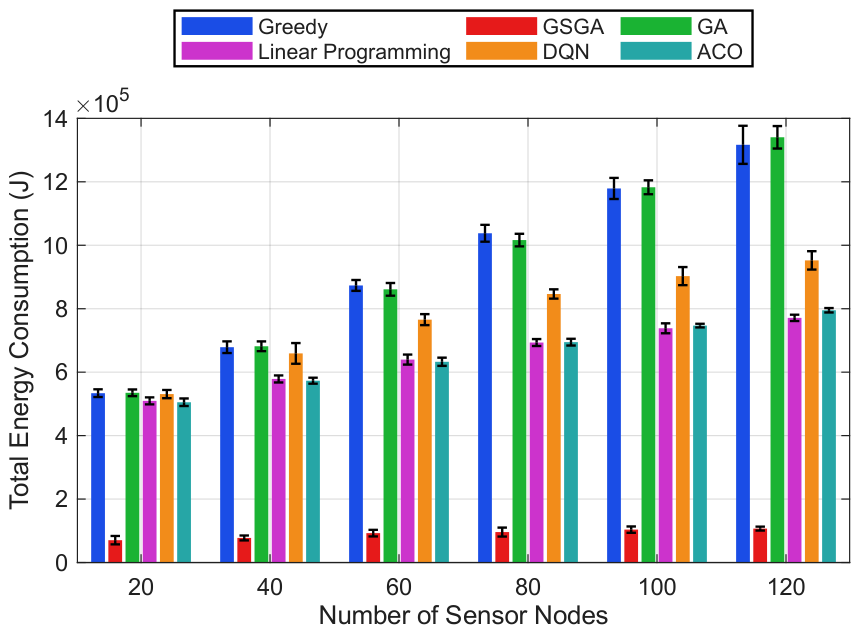
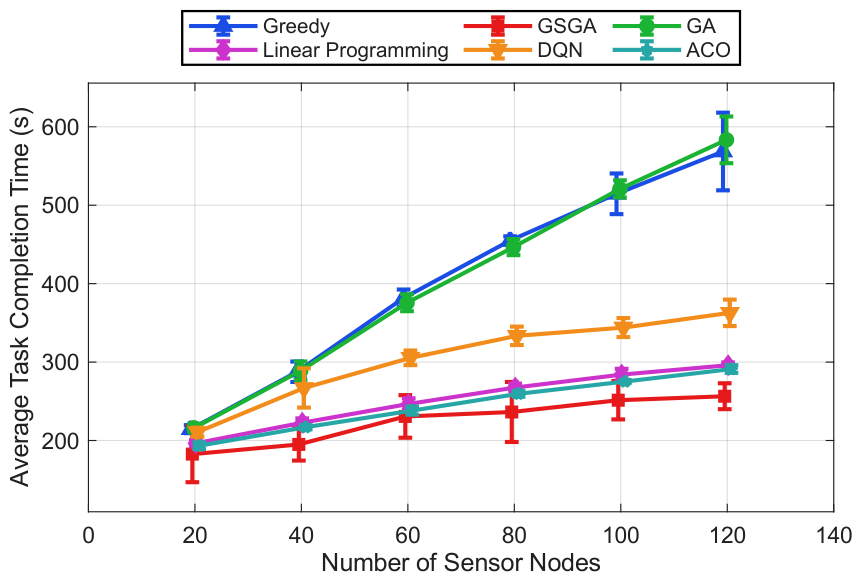
- A unified two-stage Gale-Shapley-based Genetic Algorithm (GSGA) framework is proposed, which decouples path planning and task allocation while maintaining coordination. Extensive simulations demonstrate its superior performance in energy efficiency, task completion time, and scalability compared with existing methods [3].
2. Related Work
2.1. UAV Swarm Task Allocation
2.2. UAV Swarm Path Planning
2.3. Hybrid Methods for UAV Task Allocation and Path Planning
3. Problem Formulation
3.1. System Model
3.2. UAV Energy Consumption Mode
3.3. Region Utility and UAV Preference
4. Proposed Methodology
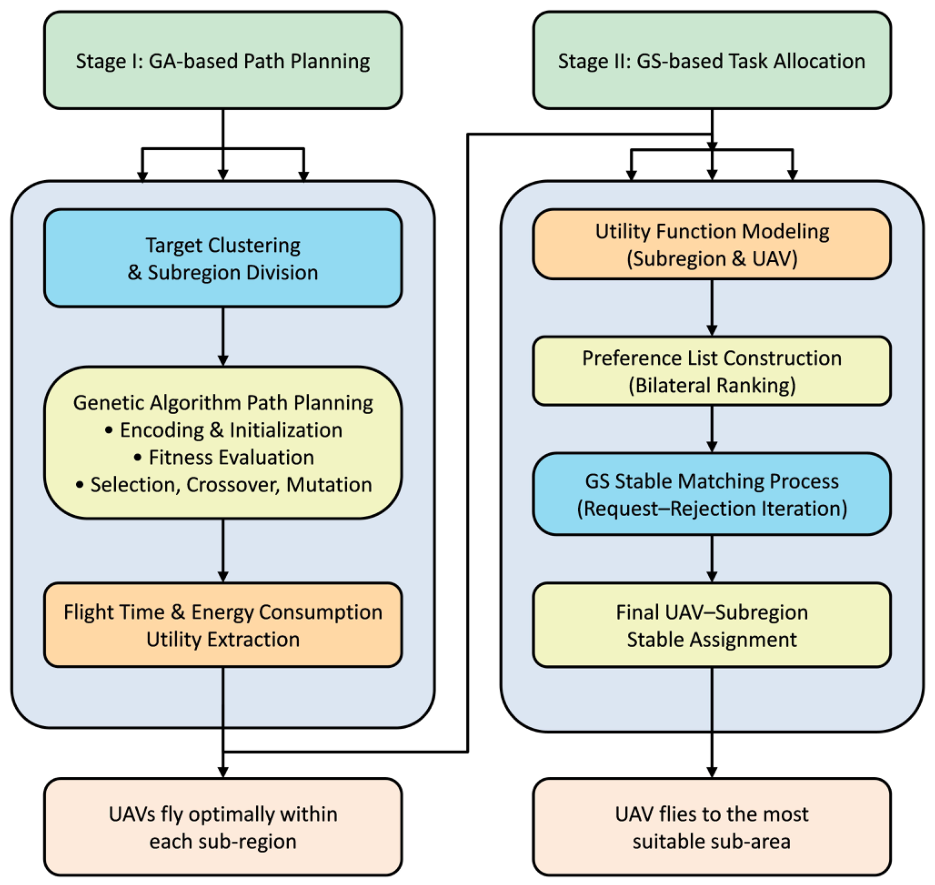
4.1. Framework Overview
4.2. Genetic Algorithm for Path Planning
4.3. Gale–Shapley Stable Matching for Task Assignment
- Each node in set X initiates matching requests to corresponding nodes in set Y based on its preference list;
- Upon receiving a matching request from set X, a node in set Y selects the node with the highest preference priority among all current requests for matching;
- If a matching request from a node in set X is rejected, that node proceeds to the next node in its preference list and initiates another matching request;
- The matching algorithm terminates only when all nodes in set X cease to initiate new matching requests.
- Request Rule: Any subregion selects the UAV with the highest preference level (maximum utility function) based on its preference list and initiates a matching request. The detailed procedure of the request rule is shown in Algorithm 1.
Algorithm 1 Request Rule Flow Input: Set of requesters S, preference list for each Output: Request sending results for each - 1:
- while S is not empty do
- 2:
- for each do
- 3:
- Select the highest-ranked UAV m from (preference list of ) that has not rejected
- 4:
- if m is unmatched and m has not received requests from other subregions then
- 5:
- sends a request to m
- 6:
- else if m is already matched or m has received other requests then
- 7:
- Remove m from
- 8:
- Continue attempting with the next UAV in
- 9:
- end if
- 10:
- end for
- 11:
- end while
- Rejection Rule: Any UAV, upon receiving a subregion matching request, may reject the current request if a more efficient subregion match already exists. The procedure of the rejection rule is presented in Algorithm 2.The specific matching process between UAVs and subregions is as follows:
- –
- Matching Preference Initialization Phase: Comprehensively consider the UAV’s data quality, inspection efficiency, and the sub-region’s own data volume and geographic fairness, while integrating the sub-region’s data volume, geographic distribution and its own energy consumption costs [34]. For each subregion and UAV , calculate utility values based on multi-dimensional metrics to generate corresponding preference lists (subregion preference ranking for UAVs) and (UAV preference ranking for subregions) [38]. Define set to store unmatched subregions, where initially (all subregions remain unmatched).
- –
- Subregion Request Rule Initiation Phase Objective: Unmatched subregions submit matching requests to UAVs in order of preference. Each subregion sends matching requests to the highest-ranked UAV that has not previously rejected it, following the priority order of its preference list [38]. If target UAV m has not yet matched with any subregion, the request of enters a pending state. If m has rejected its request, skip m and attempt the next UAV. For all subregions, requests are submitted individually according to the request rules.
- –
- UAV Rejection Rule Execution Phase Objective: UAVs respond to requests based on their preferences, forming or adjusting matching relationships [38]. If UAV m has not yet matched any subregion: directly accept the request, establish a temporary matching relationship with the requesting subregion , and remove it from the set . If UAV m is already matched with subregion : m compares the priority of the currently matched against the priority of the new request using its preference list . If has a higher priority: m rejects , establishes a matching relationship with , and re-adds to set ; If has a higher priority: m rejects , and proceeds to attempt the next UAV in its preference list.
| Algorithm 2 Rejection Rule Flow |
| Input: UAV m, request from requester , set of requesters , preference list of UAV m Output: Updated matching relationship of UAV m, updated set |
|
5. Simulation and Results
5.1. Experimental Setup
5.2. Impact of the Number of Sensor Nodes
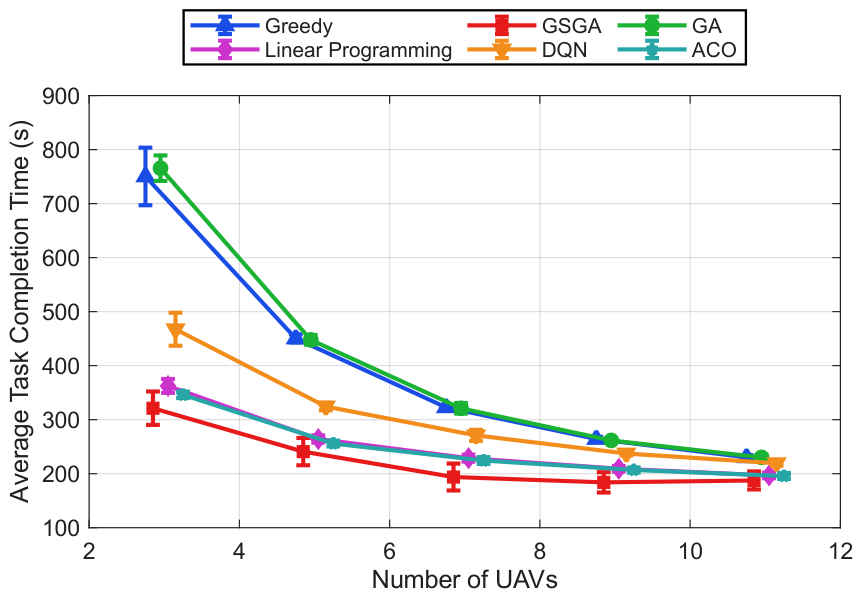
5.3. Impact of the Number of UAVs
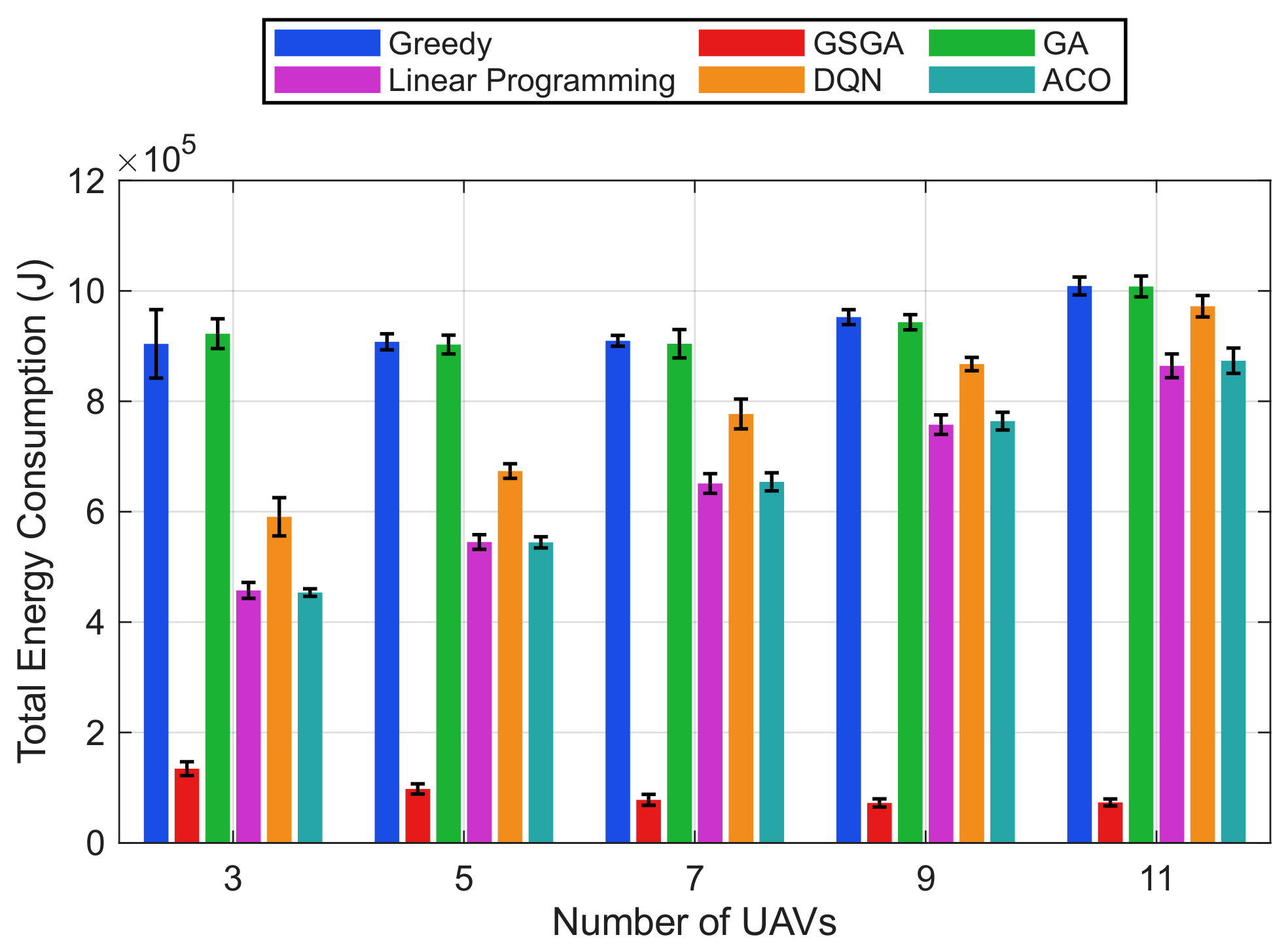
5.4. Energy Efficiency Comparison Across System Scales
5.5. Computational Complexity Analysis
- Greedy [53] selects the nearest or most beneficial target at each step, resulting in a time complexity of ;
- Standard joint GA simultaneously optimizes task allocation and path planning across all N targets, requiring operations;
- DQN (inference) [14] has a constant time complexity after training, though its training process is environment-specific and computationally expensive;
- ACO [30] iteratively updates pheromones over all nodes, leading to a complexity of .
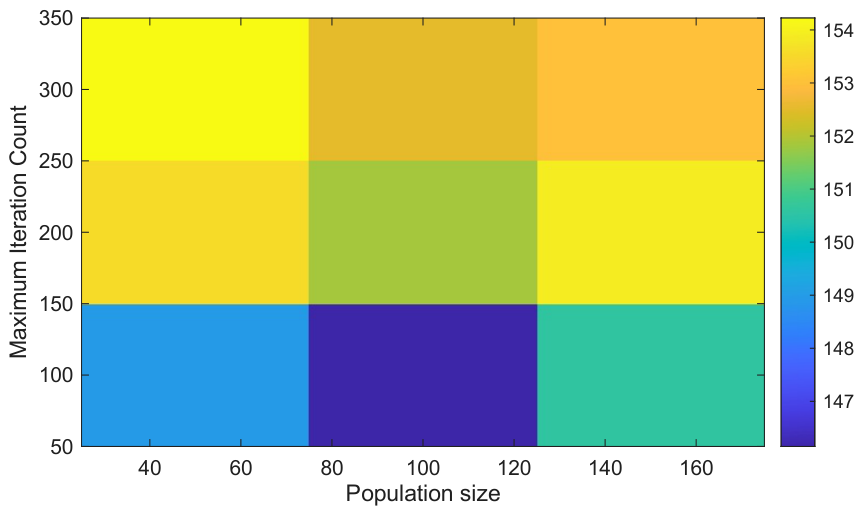
5.6. Parameter Sensitivity in Fitness Convergence
6. Discussion and Conclusions
Author Contributions
Funding
Data Availability Statement
Conflicts of Interest
Abbreviations
| F | Sum of UAV weight and drag force |
| G | Gene encoding matrix |
| GA | Genetic Algorithm |
| GS | Gale–Shapley |
| GSGA | Gale-Shapley-based Genetic Algorithm |
| MPC | Model Predictive Control |
| Minimum hovering power | |
| Minimum propulsion power | |
| Set of monitoring points | |
| RBF | Radial Basis Function |
| RL | Reinforcement Learning |
| S | Set of subregions |
| U | Set of UAV formations |
| UAV | Unmanned Aerial Vehicle |
References
- Motlagh, N.H.; Taleb, T.; Arouk, O. Low-altitude unmanned aerial vehicles-based Internet of Things services: Comprehensive survey and future perspectives. IEEE Internet Things J. 2016, 3, 899–922. [Google Scholar] [CrossRef] [Scilit]
- Erdelj, M.; Natalizio, E. UAV-Assisted Disaster Management: Applications and Open Issues. In Proceedings of the 2016 International Conference on Computing, Networking and Communications (ICNC), Kauai, HI, USA, 15–18 February 2016; pp. 1–5. [Google Scholar]
- Zhang, C.; Kovacs, J. The application of small UAVs for precision agriculture: A review. Precis. Agric. 2012, 13, 693–712. [Google Scholar] [CrossRef] [Scilit]
- Floreano, D.; Wood, R.J. Science, technology and the future of small autonomous drones. Nature 2015, 521, 460–466. [Google Scholar] [CrossRef] [Scilit]
- Campion, M.; Ranganathan, P.; Faruque, S. UAV Swarm Communication and Control Architectures: A Review. J. Unmanned Veh. Syst. 2019, 7, 93–106. [Google Scholar] [CrossRef] [Scilit]
- Zhang, L.; Zhu, Y.; Shi, X. A Hierarchical Decision-Making Method with a Fuzzy Ant Colony Algorithm for Mission Planning of Multiple UAVs. Information 2020, 11, 226. [Google Scholar] [CrossRef] [Scilit]
- Ning, Q.; Tao, G.; Chen, B.; Lei, Y.; Yan, H.; Zhao, C. Multi-UAVs Trajectory and Mission Cooperative Planning Based on the Markov Model. Phys. Commun. 2019, 35, 100717. [Google Scholar] [CrossRef] [Scilit]
- Kim, Y.; Gu, D.-W.; Postlethwaite, I. Real-Time Optimal Time-Critical Target Assignment for UAVs. In Advances in Cooperative Control and Optimization; Springer: Berlin/Heidelberg, Germany, 2007; pp. 265–280. [Google Scholar]
- Gao, Z.; Zheng, M.; Mei, Y.; Zheng, A.; Zhong, H. Distributionally Robust Chance-Constrained Task Assignment for Heterogeneous UAVs with Time Windows Under Uncertain Fuel Consumption. Drones 2025, 9, 633. [Google Scholar] [CrossRef] [Scilit]
- Güngör, G.; Yıldırım, G.; İşleyen, S. Multi Task Assignment and Path Planning for Heterogenous UAVs with Flight Dynamics. Afyon Kocatepe Univ. J. Sci. Eng. 2025, 25, 1359–1371. [Google Scholar] [CrossRef] [Scilit]
- Liu, Y.; Qi, N.; Yao, W.; Zhao, J.; Xu, S. Cooperative Path Planning for Aerial Recovery of a UAV Swarm Using Genetic Algorithm and Homotopic Approach. Appl. Sci. 2020, 10, 4154. [Google Scholar] [CrossRef] [Scilit]
- Wang, Q.; Han, X.; He, W.; Cheng, Y. Research on multi-UAV hierarchical task allocation in large-scale scenarios. J. Phys. Conf. Ser. 2023, 2478, 102023. [Google Scholar] [CrossRef] [Scilit]
- Zhou, L.; Xu, X.; Tang, C. A Novel Alternating Hierarchical Genetic Algorithm for UAV Coverage Path Planning. In 2025 44th Chinese Control Conference (CCC); IEEE: Piscataway, NJ, USA, 2025; pp. 1977–1982. [Google Scholar]
- Westheider, J.; Rückin, J.; Popović, M. Multi-UAV Adaptive Path Planning Using Deep Reinforcement Learning. In Proceedings of the 2023 IEEE/RSJ International Conference on Intelligent Robots and Systems (IROS), Detroit, MI, USA, 1–5 October 2023; pp. 649–656. [Google Scholar]
- Hu, Y.; Hu, J.; Yang, Y.; Hu, M.; Peng, K.; Zheng, T.; Cai, C.; Xiong, Z. Energy-aware Service Mesh Deployment and Online Request Routing in Edge: A Hierarchical Deep Reinforcement Learning Approach. IEEE Trans. Mob. Comput. 2026, 1–18. [Google Scholar] [CrossRef] [Scilit]
- Chen, W.; Liu, J.; Guo, H. Achieving Robust and Efficient Consensus for Large-Scale Drone Swarm. IEEE Trans. Veh. Technol. 2020, 69, 15867–15879. [Google Scholar] [CrossRef] [Scilit]
- Peng, K.; Liu, X.; Han, D.; Hu, Y.; Hu, M.; Cai, C.; Xiong, Z. Hybrid Orchestration of AI Services and Microservices in Cloud-Edge Collaboration. IEEE Trans. Mob. Comput. 2026, 1–17. [Google Scholar] [CrossRef] [Scilit]
- Qiu, Y.; Jiang, H.; Li, Q.; Dong, X.; Ren, Z. Application of an Adapted Genetic Algorithm on Task Allocation Problem of Multiple UAVs. In Proceedings of the 2018 IEEE CSAA Guidance, Navigation and Control Conference (CGNCC), Xiamen, China, 10–12 August 2018; pp. 1–6. [Google Scholar]
- Li, J.; Yang, X.; Yang, Y.; Liu, X. Cooperative mapping task assignment of heterogeneous multi-UAV using an improved genetic algorithm. Knowl.-Based Syst. 2024, 296, 111830. [Google Scholar] [CrossRef] [Scilit]
- Yan, F.; Chu, J.; Hu, J.; Zhu, X. Cooperative task allocation with simultaneous arrival and resource constraint for multi-UAV using a genetic algorithm. Expert Syst. Appl. 2024, 245, 123023. [Google Scholar] [CrossRef] [Scilit]
- Tang, J.; Liu, D.; Wang, Q.; Li, J.; Sun, J. Probabilistic Chain-Enhanced Parallel Genetic Algorithm for UAV Reconnaissance Task Assignment. Drones 2024, 8, 213. [Google Scholar] [CrossRef] [Scilit]
- Tang, J.; Chen, X.; Zhu, X.; Zhu, F. Dynamic Reallocation Model of Multiple Unmanned Aerial Vehicle Tasks in Emergent Adjustment Scenarios. IEEE Trans. Aerosp. Electron. Syst. 2023, 59, 1139–1155. [Google Scholar] [CrossRef] [Scilit]
- Sun, W.; Hao, M. A Survey of Cooperative Path Planning for Multiple UAVs. In Proceedings of the 2021 International Conference on Autonomous Unmanned Systems (ICAUS 2021); Springer: Singapore, 2022; pp. 189–196. [Google Scholar]
- Rahman, M.; Sarkar, N.I.; Lutui, R. A Survey on Multi-UAV Path Planning: Classification, Algorithms, Open Research Problems, and Future Directions. Drones 2025, 9, 263. [Google Scholar] [CrossRef] [Scilit]
- Jiang, Y.; Xu, X.-X.; Zheng, M.-Y.; Zhan, Z.-H. Evolutionary computation for unmanned aerial vehicle path planning: A survey. Artif. Intell. Rev. 2024, 57, 267. [Google Scholar] [CrossRef] [Scilit]
- Theile, M.; Bayerlein, H.; Nai, R.; Gesbert, D.; Caccamo, M. UAV Path Planning using Global and Local Map Information with Deep Reinforcement Learning. In Proceedings of the 2021 20th International Conference on Advanced Robotics (ICAR), Ljubljana, Slovenia, 6–10 December 2021; pp. 539–546. [Google Scholar]
- Song, J.; Zhao, K.; Liu, Y. Survey on Mission Planning of Multiple Unmanned Aerial Vehicles. Aerospace 2023, 10, 208. [Google Scholar] [CrossRef] [Scilit]
- Hustiu, S.; Kloetzer, M.; Mahulea, C. Mission assignment and 3D path planning for a team of UAVs. In Proceedings of the 2021 25th International Conference on System Theory, Control and Computing (ICSTCC), Iasi, Romania, 20–23 October 2021; pp. 401–406. [Google Scholar]
- Ma, Y.; Zhang, H.; Zhang, Y.; Gao, R.; Xu, Z.; Yang, J. Coordinated Optimization Algorithm Combining GA with Cluster for Multi-UAVs to Multi-tasks Task Assignment and Path Planning. In Proceedings of the 2019 IEEE 15th International Conference on Control and Automation (ICCA), Edinburgh, UK, 16–19 July 2019; pp. 1026–1031. [Google Scholar]
- Jia, Y.; Zhou, S.; Zeng, Q.; Li, C.; Chen, D.; Zhang, K.; Liu, L.; Chen, Z. The UAV Path Coverage Algorithm Based on the Greedy Strategy and Ant Colony Optimization. Electronics 2022, 11, 2667. [Google Scholar] [CrossRef] [Scilit]
- Chung, S.J.; Paranjape, A.A.; Dames, P.; Shen, S.; Kumar, V. A Survey on Aerial Swarm Robotics. IEEE Trans. Robot. 2018, 34, 837–855. [Google Scholar] [CrossRef] [Scilit]
- Colomina, I.; Molina, P. Unmanned aerial systems for photogrammetry and remote sensing: A review. ISPRS J. Photogramm. Remote Sens. 2014, 92, 79–97. [Google Scholar] [CrossRef] [Scilit]
- Zivuku, P.; Kisseleff, S.; Ntontin, K.; Papazafeiropoulos, A.K.; Adam, A.B.M.; Chatzinotas, S.; Ottersten, B. Resource Allocation for Geographical Fairness in Multi-RIS-Aided Outdoor-to-Indoor Communications. In Proceedings of the 2024 IEEE International Conference on Communications (ICC), Denver, CO, USA, 9–13 June 2024; pp. 3420–3426. [Google Scholar]
- Zivuku, P.; Adam, A.B.M.; Ntontin, K.; Kisseleff, S.; Ha, V.N.; Chatzinotas, S.; Ottersten, B. Geographical Fairness in Multi-RIS-Assisted Networks in Smart Cities: A Robust Design. IEEE Trans. Commun. 2025, 73, 6622–6638. [Google Scholar] [CrossRef] [Scilit]
- Brambilla, M.; Ferrante, E.; Birattari, M.; Dorigo, M. Swarm robotics: A review from the swarm engineering perspective. Swarm Intell. 2013, 7, 1–41. [Google Scholar] [CrossRef] [Scilit]
- Hu, W.; Yu, Y.; Liu, S.; She, C.; Guo, L.; Vucetic, B.; Li, Y. Multi-UAV Coverage Path Planning: A Distributed Online Cooperation Method. IEEE Trans. Veh. Technol. 2023, 72, 11727–11740. [Google Scholar] [CrossRef] [Scilit]
- Wu, Q.; Zeng, Y.; Zhang, R. Joint Trajectory and Communication Design for Multi-UAV Enabled Wireless Networks. IEEE Trans. Wirel. Commun. 2018, 17, 2109–2121. [Google Scholar] [CrossRef] [Scilit]
- Yan, Z.; Wu, Q.; Zhang, Q.; Wang, W.; Wang, J. A novel unmanned aerial vehicles task allocation approach based on the intuitionistic fuzzy multi-criteria bilateral matching-based decision-making method. Eng. Appl. Artif. Intell. 2025, 162, 112669. [Google Scholar]
- Zeng, Y.; Zhang, R.; Lim, T.J. Wireless communications with unmanned aerial vehicles: Opportunities and challenges. IEEE Commun. Mag. 2016, 54, 36–42. [Google Scholar] [CrossRef] [Scilit]
- Zhang, J.; Campbell, J.F.; Sweeney, D.C., II; Hupman, A.C. Energy consumption models for delivery drones: A comparison and assessment. Transp. Res. Part D Transp. Environ. 2021, 90, 102668. [Google Scholar] [CrossRef] [Scilit]
- Thu, A.; Lupin, S.; Oo, T.M.; Khaing, M.T. Comparing a Quadrotor Energy Consumption for Different Flight Trajectories in Windy Conditions. In Proceedings of the 2021 IEEE Conference of Russian Young Researchers in Electrical and Electronic Engineering (ElConRus), St. Petersburg/Moscow, Russia, 26–29 January 2021; pp. 2064–2066. [Google Scholar]
- Gao, N.; Zeng, Y.; Wang, J.; Wu, D.; Zhang, C.; Song, Q.; Qian, J.; Jin, S. Energy Model for UAV Communications: Experimental Validation and Model Generalization. China Commun. 2021, 18, 253–264. [Google Scholar] [CrossRef] [Scilit]
- Huroon, A.M.; Huang, Y.-C.; Wang, L.-C. Energy-Efficient Transmission Strategy for UAV-RIS 2.0 Assisted Communications Using Rate Splitting Multiple Access. IEEE Trans. Wirel. Commun. 2025, 25, 5246–5261. [Google Scholar] [CrossRef] [Scilit]
- Maijama’a, L.; Jiya, J.D.; Anene, E.C.; Miya, H.S. Controller Design and Modelling of UAV Quadcopter. In Proceedings of the 2024 4th International Multidisciplinary Information Technology and Engineering Conference (IMITEC), Vanderbijlpark, South Africa, 27–29 November 2024; pp. 6–13. [Google Scholar]
- Zhang, L.; Yang, F.-T.; Zhou, W.-Y.; Huang, J.; Su, X.-J. Pitch Angle Control of UAV Based on L1 Adaptive Control Law. In Proceedings of the 2020 35th Youth Academic Annual Conference of Chinese Association of Automation (YAC), Zhanjiang, China, 16–18 October 2020; pp. 68–72. [Google Scholar]
- Asghari, O.; Ivaki, N.; Madeira, H. UAV Operations Safety Assessment: A Systematic Literature Review. ACM Comput. Surv. 2025, 57, 266. [Google Scholar] [CrossRef] [Scilit]
- Alagurajan, V.; Rajagopal, S.; Kulkarni, V.N. Performance Metrics of Unmanned Aerial Vehicles from the Perspective of ISR Applications. Trans. Indian Natl. Acad. Eng. 2025, 10, 243–255. [Google Scholar] [CrossRef] [Scilit]
- Wang, X.; Duan, L. Economic Analysis of Unmanned Aerial Vehicle (UAV) Provided Mobile Services. IEEE Trans. Mob. Comput. 2021, 20, 1804–1816. [Google Scholar] [CrossRef] [Scilit]
- Huang, I.; Li, B. A Genetic Algorithm Using Priority-Based Encoding for Routing and Spectrum Assignment in Elastic Optical Network. In Proceedings of the 2014 7th International Conference on Intelligent Computation Technology and Automation, Changsha, China, 25–26 October 2014; pp. 5–11. [Google Scholar]
- Madhumathi, R.; Radhakrishnan, R. A Resource Allocation Strategy in Cloud Using Roulette Wheel Selection Method. In Proceedings of the 2015 International Conference on Green Computing and Internet of Things (ICGCIoT), Greater Noida, India, 8–10 October 2015; pp. 341–345. [Google Scholar]
- Akter, S.; Nahar, N.; ShahadatHossain, M.; Andersson, K. A New Crossover Technique to Improve Genetic Algorithm and Its Application to TSP. In Proceedings of the 2019 International Conference on Electrical, Computer and Communication Engineering (ECCE), Cox’sBazar, Bangladesh, 7–9 February 2019; pp. 1–6. [Google Scholar]
- Wang, X.; Meng, X. UAV Online Path Planning Based on Improved Genetic Algorithm. In Proceedings of the 2019 Chinese Control Conference (CCC), Guangzhou, China, 27–30 July 2019; pp. 4101–4106. [Google Scholar]
- García, A. Greedy algorithms: A review and open problems. J. Inequal. Appl. 2025, 2025, 11. [Google Scholar] [CrossRef] [Scilit]





| Parameters | Symbol | Value |
|---|---|---|
| Number of UAVs | M | 5 |
| Total Inspection Targets | N | 50 |
| Number of Subregions | R | 5 |
| Region Size | area_size | |
| Fixed Flight Altitude | h | |
| Flight Speed | v | |
| Initial Energy | ||
| Mass | ||
| Number of Rotors | w | 4 |
| Rotor Radius | ||
| Gravitational Acceleration | g | |
| Air Density | ||
| Drag Coefficient | ||
| Efficiency Coefficient | 0.8 |
| Parameters | Symbol | Value |
|---|---|---|
| Population Size | pop_size | 50 |
| Maximum Iterations | max_gen | 100 |
| Crossover Probability | cross_rate | 0.8 |
| Mutation Probability | mutate_rate | 0.1 |
| Data Volume Weight | 0.7 | |
| Geographical Fairness Weight | 0.3 |
Disclaimer/Publisher’s Note: The statements, opinions and data contained in all publications are solely those of the individual author(s) and contributor(s) and not of MDPI and/or the editor(s). MDPI and/or the editor(s) disclaim responsibility for any injury to people or property resulting from any ideas, methods, instructions or products referred to in the content. |
© 2026 by the authors. Licensee MDPI, Basel, Switzerland. This article is an open access article distributed under the terms and conditions of the Creative Commons Attribution (CC BY) license.
Share and Cite
Xu, J.; Li, X.; Xu, Y.; Zhou, F.; Xiang, X.; Li, C.; Deng, T. Distributed Task Allocation and Path Planning Strategies for Cooperative UAV Swarms. Appl. Sci. 2026, 16, 4428. https://doi.org/10.3390/app16094428
Xu J, Li X, Xu Y, Zhou F, Xiang X, Li C, Deng T. Distributed Task Allocation and Path Planning Strategies for Cooperative UAV Swarms. Applied Sciences. 2026; 16(9):4428. https://doi.org/10.3390/app16094428
Chicago/Turabian StyleXu, Jiaxiang, Xinru Li, Yunsheng Xu, Feng Zhou, Xingchen Xiang, Chen Li, and Tianping Deng. 2026. "Distributed Task Allocation and Path Planning Strategies for Cooperative UAV Swarms" Applied Sciences 16, no. 9: 4428. https://doi.org/10.3390/app16094428
APA StyleXu, J., Li, X., Xu, Y., Zhou, F., Xiang, X., Li, C., & Deng, T. (2026). Distributed Task Allocation and Path Planning Strategies for Cooperative UAV Swarms. Applied Sciences, 16(9), 4428. https://doi.org/10.3390/app16094428