1. Introduction
During the extraction of a longwall panel, a former conveyor roadway of a previously mined adjacent panel may be reused as a ventilation roadway. The reuse of development workings allows a reduction in the volume of newly driven entries, decreases the costs associated with panel preparation, and improves the efficiency of coal resource recovery [
1,
2]. Under modern mining conditions, this technological approach is considered one of the most economically justified directions in underground coal mining, as it contributes to reducing the overall costs of both development and longwall operations [
3,
4,
5]. The relevance of maintaining gate roadways behind the longwall face is also determined by the need to ensure stable ventilation of highly loaded longwall panels and to maintain the functionality of degasification systems within the zones influenced by longwall mining operations [
6,
7,
8,
9,
10].
Industrial practice demonstrates that the technology of maintaining roadways along the boundary with the goaf has been widely developed in countries with intensive longwall mining. The most significant experience has been accumulated in China, where various schemes of non-pillar mining, roadway retention along the goaf side, construction of protective structures, and controlled roof caving have been successfully implemented [
7,
8,
9,
10,
11]. At the same time, studies conducted under the mining conditions of Ukraine and Kazakhstan confirm the feasibility of reusing gate roadways provided that the parameters of support systems and protective structures are properly justified [
12,
13].
However, ensuring the stability of a gate roadway after the passage of the longwall face remains one of the most complex geomechanical problems. Within the zone influenced by longwall extraction, significant stress redistribution occurs, accompanied by the development of plastic deformation, intensive roof and rib displacements, which considerably complicates the preservation of the roadway in an operational state [
14,
15,
16]. This problem becomes particularly critical with increasing mining depth, deterioration of geological conditions, and the growth of dynamic impacts acting on the rock mass [
17,
18].
To support roadways intended for reuse, steel-polymer rock bolts, cable bolts, combined support systems, and various protective constructions erected on the goaf side are widely applied [
19,
20,
21,
22,
23]. The effectiveness of such solutions is determined not only by the load-bearing capacity of individual support elements but also by their influence on the formation of a reinforced rock mass capable of bearing additional loads and limiting the development of deformation processes [
19,
20,
21,
22,
23].
The selection of a protective structure plays a crucial role in maintaining roadways behind the longwall face, since the maximum abutment pressure is typically concentrated in this zone. Depending on the geological and mining conditions, various reinforcement approaches are applied, including bolting systems, combined support systems, backfilling and retaining structures, and—under conditions of difficult-to-cave roofs—technologies of preliminary weakening and directed destruction of hanging roof blocks [
24,
25,
26,
27,
28]. In such cases, roadway stability is determined by the coordinated interaction between the support system and the surrounding rock mass, as well as by the ability to control the stress–strain state of the rocks within the zone affected by longwall mining operations [
29,
30,
31,
32,
33].
Recent studies have further expanded the understanding of gob-side and gate roadway stability under complex mining conditions, including the performance of combined support systems, roof control mechanisms, and stability control in deep and high-stress environments. In particular, recent contributions have addressed the engineering application status of gob-side entry retaining technologies, the behavior of steel arch and rock–bolt support behind the longwall face, the failure mechanism of gob-side entries under hard roof conditions, and novel control approaches for high-stress retained roadways [
34,
35,
36,
37,
38].
To effectively address the problem of maintaining the stability of reused roadways, more comprehensive information is required regarding the mechanisms of deformation and failure of surrounding rocks. In this context, the main research tools include numerical modeling, underground observations, and in situ testing, which make it possible to assess the influence of individual support elements on the stress state of the rock mass and to determine rational schemes for maintaining gate roadways [
6,
8,
13,
16,
20,
22,
29,
30,
31].
Thus, the reuse of gate roadways represents an effective and promising direction for improving underground coal mining technologies. However, its reliable implementation requires detailed consideration of geological conditions, the patterns of stress redistribution, and the interaction mechanisms between various support elements and the surrounding rock mass [
3,
5,
13,
16,
20].
In this regard, the objective of the present study is to investigate the influence of support elements on the stress state of surrounding rocks and the stability of gate roadways after the passage of the longwall face under mining conditions typical of coal mines in Ukraine and Kazakhstan.
To achieve this objective, the following tasks were addressed:
Analysis of the geological and mining conditions of coal seam occurrence in the Western Donbas, Pokrovsk district, and the Karaganda Coal Basin.
Numerical modeling of the stress state of surrounding rocks around a gate roadway located at the boundary with the goaf under the conditions of PJSC “Mine Administration Pokrovske”, Dniprovska Mine of PJSC “DTEK Pavlogradugol”, and Kostenco Mine.
Investigation of the influence of individual support elements on the stress field and roadway stability under different geological and mining conditions.
2. Geological and Mining Conditions of Coal Seam Occurrence
In the Western Donbas, the mines of the Pokrovsk district are located within the Pavlohrad–Petropavlivka geological and industrial region. Coal extraction is carried out at ten mines operated by the company DTEK Pavlogradugol. Lithologically, the Carboniferous deposits are represented by alternating layers of sandstones, siltstones, and mudstones containing thin coal seams and limestone interbeds. The coal-bearing capacity of the region is associated with a terrigenous sedimentary sequence of Carboniferous age, within which 152 coal seams and interlayers have been identified. According to coal rank classification, the coals belong mainly to long-flame and gas ranks, with the degree of metamorphism increasing toward the southeastern direction. The average thickness of coal seams ranges from 0.5 to 1.2 m, rarely reaching 1.5 m, while mining operations are conducted at depths from 140 to 585 m.
The Pokrovske Mine Administration is located east of the Pavlohrad–Petropavlivka region within the Pokrovsk mining district. Carboniferous deposits in this area are predominantly composed of mudstones and siltstones, with sandstones occurring to a lesser extent, along with subordinate layers and interbeds of limestone and coal. Industrial coal-bearing capacity is associated with formations of all three subdivisions of the Carboniferous system. The total number of coal seams and interbeds within the Carboniferous formations reaches 221, of which 53 have workable thickness. The structure of coal seams is predominantly simple, although in some cases two-bench seams occur. Within the district, coals of various ranks are present, ranging from long-flame (D) to lean (OS) types. The average seam thickness varies from 0.5 to 2.0 m, occasionally reaching 2.4 m or more. Mining operations are conducted at depths of up to 1000 m.
The Karaganda Coal Basin, where the Kostenco Mine is located, lies in the central part of Kazakhstan and represents one of the largest coal-producing regions of the country. The lithological composition of the coal-bearing strata is characterized by alternating sandstones, siltstones, mudstones, marls, and conglomerates. Carboniferous deposits contain up to 80 coal seams with a total thickness of approximately 110 m, including about 30 workable seams with thicknesses ranging from 0.6 to 8.0 m. The highest coal saturation is characteristic of the middle part of the Karaganda and Dolinsk formations. Coals of the GZh, Zh, and KZh ranks are mainly mined at depths of 400–600 m.
On a regional scale, the principal factor determining the properties of coal-bearing rocks is the degree of metamorphism. In general, an increase in the degree of metamorphism leads to a decrease in porosity, an increase in density, a reduction in moisture content, an increase in gas saturation, and higher rock strength. For the mines of the Western Donbas (zones dominated by coals of grades D and G), the uniaxial compressive strength of surrounding rocks typically ranges from 10–30 MPa for mudstones, 14–35 MPa for siltstones, and 20–40 MPa for sandstones. The more highly metamorphosed rocks of the Pokrovsk district are generally stronger; the compressive strength of mudstones, siltstones, and sandstones may reach approximately 35 MPa, 45 MPa, and 65 MPa, respectively.
In terms of petrographic and lithological composition, the coal-bearing rocks of the Western Donbas and the Karaganda Coal Basin are highly similar. This similarity is related to their comparable tectono-sedimentary environments during the Carboniferous period and to a broadly similar geodynamic history of platform-type development. Both basins are of Carboniferous age, and sedimentation occurred under comparable geological conditions. In the Western Donbas, sedimentation was mainly associated with continental and coastal-marine facies, whereas in the Karaganda Basin it was dominated by continental, swamp, limnic, and coastal-marine environments. Sandstones in the Western Donbas are predominantly quartz–feldspar in composition and fine- to medium-grained, while in the Karaganda Basin they are also quartz–feldspar in composition and may locally contain volcanic clasts. Siltstones in both basins are compositionally similar: clay–silt varieties with chlorite and kaolinite in the Western Donbas, and chlorite–kaolinite siltstones with significant pelitic content in the Karaganda Basin. Mudstones also exhibit considerable similarity, being dark gray, compacted, and laminated in the Western Donbas, while in the Karaganda Basin they are likewise laminated and plastic, with a high content of illite and kaolinite. Coal types in both basins are petrographically and technologically comparable, consisting mainly of hard coals with a predominance of vitrinite.
At the same time, local geological factors such as tectonic structure, hydrogeological conditions, and fluid composition may significantly differentiate these basins when performing engineering-geological and mining analyses at specific sites. In particular, the Western Donbas is characterized by more intense folding and faulting, and the degree of coal metamorphism is generally higher. In contrast, the Karaganda Basin is characterized by relatively less pronounced tectonic deformation overall, although several active structural zones are present, and the coals are predominantly fat and gas ranks.
The strength properties of coal-bearing rocks in the Karaganda Coal Basin, similar to those in the Donbas, vary depending on the degree of metamorphism, lithological composition, fracture intensity, depth of occurrence, moisture content, and other geological and geomechanical factors.
3. Methods and Problem Formulation
To address the research objectives, numerical modeling of the elastoplastic deformation of the rock mass surrounding a gate roadway supported by different types of support systems at the boundary with the goaf was performed. A stationary formulation of the problem was adopted, describing the stabilized stress–strain state after the completion of the active phase of stress redistribution. The calculation cross-section was selected at a distance behind the longwall face within the displacement stabilization zone, where rock displacements reach stable values and further temporal changes in the stress state become negligible. The adopted numerical model is intended to assess the residual geomechanical condition of the roadway and the effectiveness of support elements at the stage of roadway maintenance.
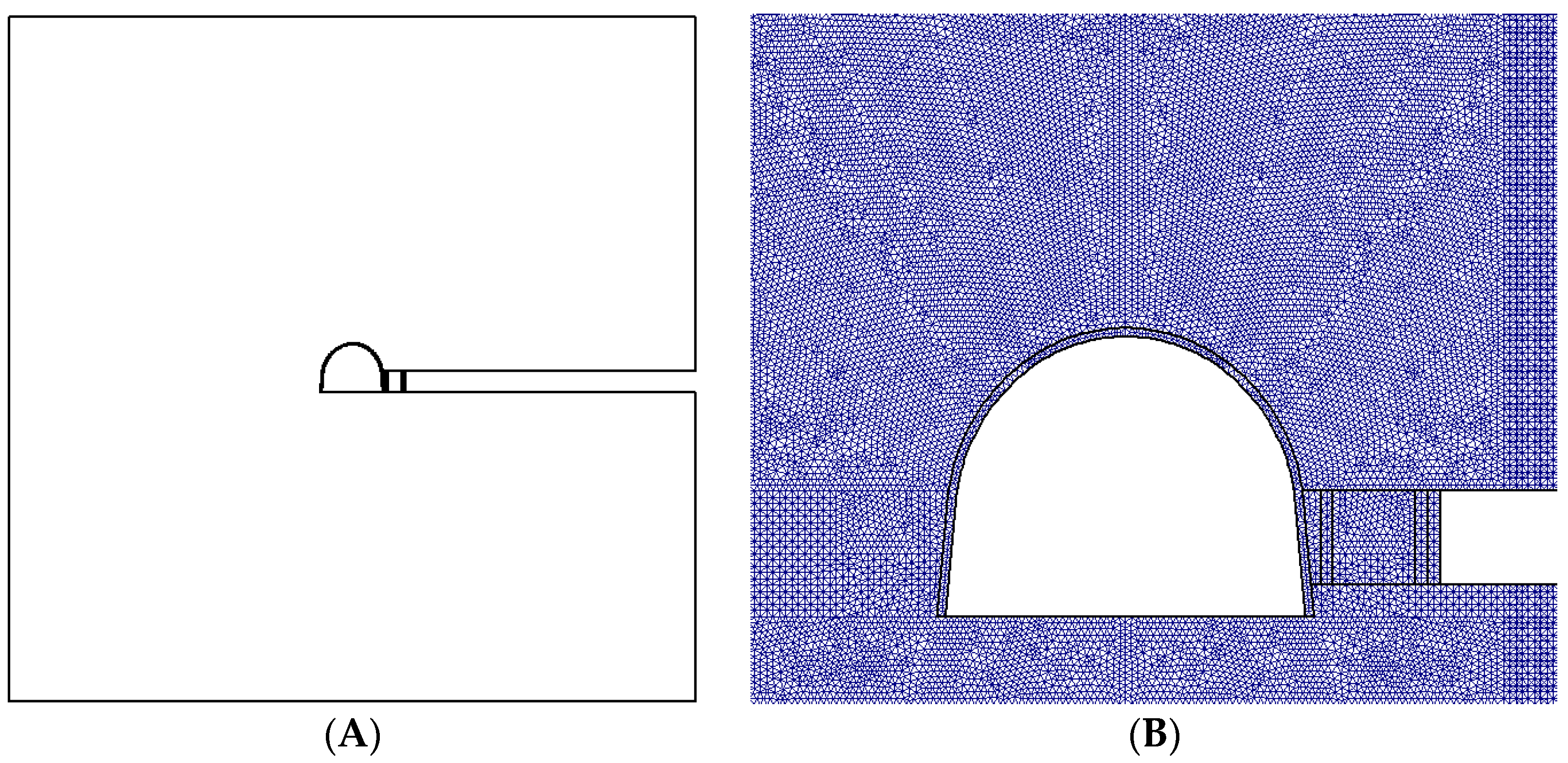
To perform a comparative evaluation of various support systems, a finite element model with dimensions of 64 × 64 m was developed with 74,088 triangular elements, with a minimum element size of about 0.05–0.1 m (
Figure 1A). This domain size ensures that the boundaries are located at a distance of 6–8 times the excavation diameter, effectively neutralizing boundary effects. The model geometry includes the goaf zone adjacent to the retained roadway, where the loss of lateral confinement and the high stress anisotropy create the most unfavorable conditions for evaluating the load-bearing capacity of the support systems. The representativeness of the comparative analysis is ensured by the use of a unified modeling framework with the same domain dimensions and a consistent discretization approach for all cases, while the mechanical properties of the stratified rock mass were assigned according to the specific mining conditions of each scenario.
Figure 1B shows the central part of the finite-element mesh.
Rock bolts and cable bolts were modeled as elastoplastic bar finite elements interacting with the surrounding rock mass within a compatible-deformation formulation. In this approach, the “support-rock mass” system operates under mutually interacting deformations and is treated as a single mechanically coupled system. The load acting on a bolt is governed by its interaction with the deforming rock mass, while the displacement of the surrounding rock mass is, in turn, influenced by the response of the support elements. Accordingly, the analysis was focused on axial load transfer in the bolts and cable bolts and on their contribution to stress redistribution in the surrounding rock mass. This representation provides an engineering approximation suitable for the comparative analysis of the support schemes considered in the present study.
Frame supports, wooden props, timber cribs, and cast strips were simulated by assigning the corresponding mechanical properties to specific finite elements. Their interaction with the surrounding rock mass was considered in terms of compatible deformations of the discretized medium, without using special contact elements.
The problem was solved using the finite element method (FEM) implemented in specialized software developed at the Institute of Geotechnical Mechanics of the National Academy of Sciences of Ukraine (IGTM NASU). This numerical implementation has been verified against analytical solutions and validated using laboratory and field data.
The present numerical model is based on a continuum representation of the rock mass. Within this approach, the surrounding rocks are treated as a continuous layered medium with assigned mechanical properties, which makes it possible to assess the general patterns of stress redistribution and the influence of support elements on roadway stability. Rock failure was described using the Mohr–Coulomb failure criterion. This criterion is widely applied in geomechanical modelling because of its simplicity and the clear physical interpretation of its strength parameters. At the same time, its limitations should be recognized. In the present study, the continuum representation and the Mohr–Coulomb criterion were used as an engineering approximation for the comparative numerical analysis of different roadway support schemes. Therefore, the obtained results should be interpreted primarily in terms of comparative stress redistribution, the development of inelastic deformation zones, and the relative efficiency of the considered support systems.
Boundary conditions were defined as follows: horizontal displacements of the rock mass were restricted along the vertical boundaries of the computational domain, while vertical displacements were restricted along the horizontal boundaries. Initial stresses corresponded to geostatic conditions, assuming a lateral earth pressure coefficient λ = 1.
The stability of gate roadways with an arched cross-section and an area of 20 m2, supported by different types of support systems, was investigated at the following mining depths:
400 m, corresponding to the mining depth at the Dniprovska Mine of PJSC “DTEK Pavlogradugol”, Ukraine;
600 m, corresponding to the mining depth of seam k2 at the Kostenco Mine, Kazakhstan;
1000 m, corresponding to the mining depth at PJSC “Mine Administration Pokrovske”, Ukraine.
The host rock within the computational domain was assumed to be siltstone. In the roof of the seam, at a distance of 6 m, a 12 m thick sandstone layer was present in all three cases, which corresponds to the typical lithological structure of the coal-bearing strata in the studied coal basins. The thickness of the coal seam was assumed to be 1.5 m for the first case, 3.0 m for the second case, and 2.0 m for the third case.
The mechanical properties of the rocks used in the numerical calculations are presented in
Table 1.
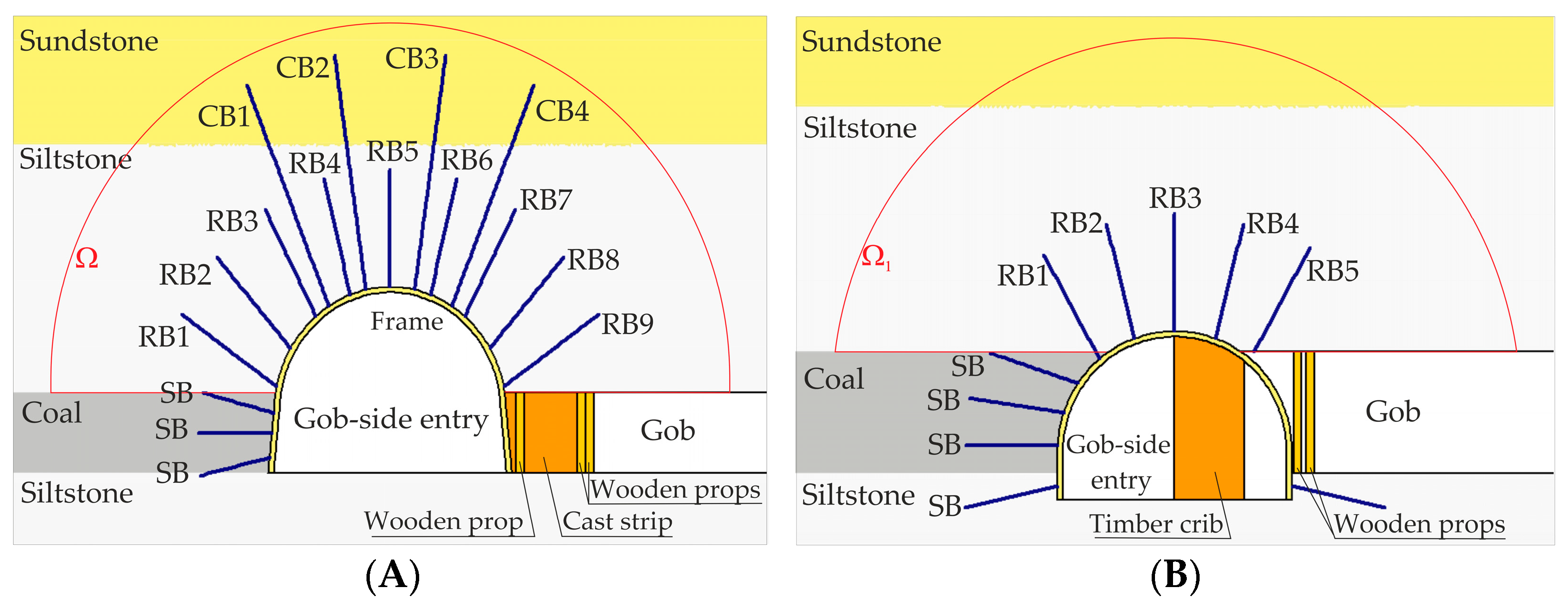
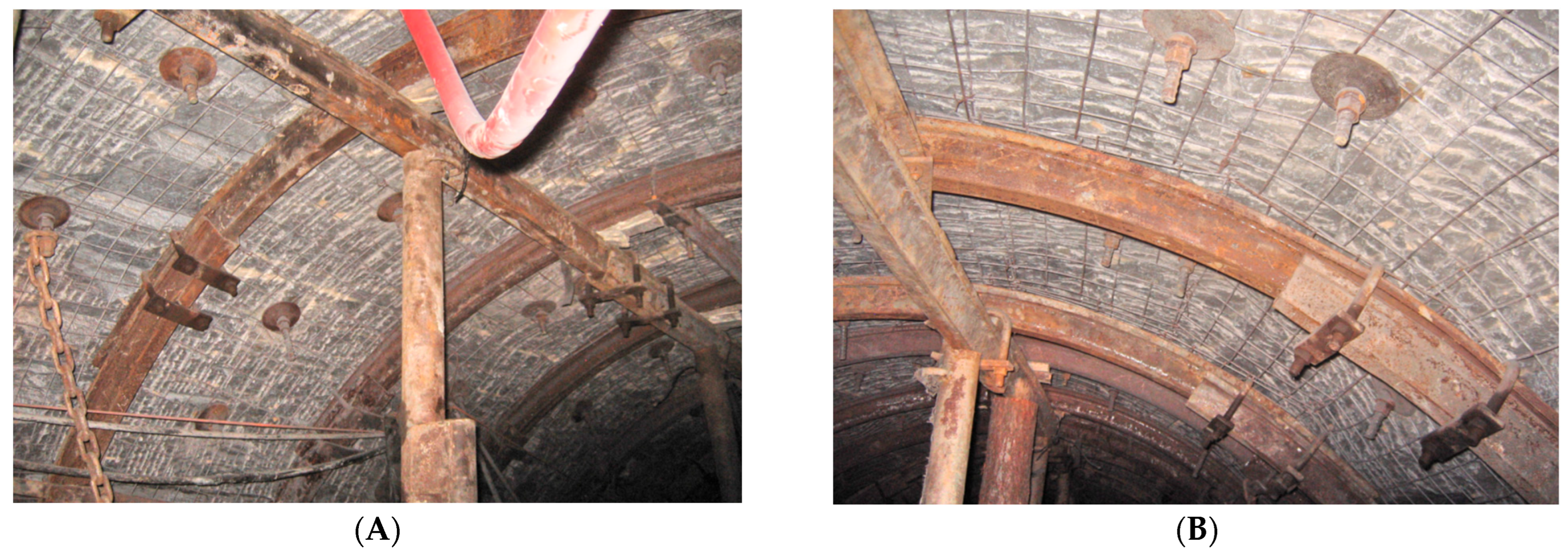
In the present study, the support schemes include the following elements: steel arch frames made of SVP profiles; protective structures (wooden props with a diameter of 0.18 m; cast strips,
Figure 2A; timber cribs,
Figure 2B); RB fully grouted steel roof bolts with lengths of 2.4 m or 3.0 m; SB plastic side bolts with a length of 1.5 m; and CB fully grouted cable bolts with a length of 6 m (
Figure 2).
The protective structure shown in
Figure 2A consists of three rows of wooden props and a cast strip with a width of 1.2 m and a height equal to the seam thickness. The cast strip is constructed by placing empty packages between the rows of wooden props followed by filling them with a rapidly hardening water–mineral mixture, the compressive strength of which, depending on the type of mixture, can reach 30–40 MPa [
31]. The width of the cast strip was selected according to the recommendations in [
31], depending on the stability category of the main roof and the thickness of the coal seam.
The protective structure shown in
Figure 2B consists of two rows of wooden props and a timber crib. The diameter of the bolts is 0.022 m, and their tensile strength is 650 MPa. In total, 17 support schemes were considered in this study (
Table 2).
The mechanical properties of the support elements are presented in
Table 3.
For the analysis of the stress state of the surrounding rocks, the parameters
Q* and
P* were used:
where
—maximum and minimum components of the principal stress tensor, Pa;
γ—average unit weight of the overlying rock mass, N/m3;
H—mining depth, m.
The parameters
Q* and
P* were used as dimensionless indicators for interpreting the stress state of the surrounding rock mass. Parameter
Q* characterizes the heterogeneity of the stress field through the contrast between the principal stress components. Higher
Q* values correspond to a more non-uniform stress state, which is associated with a higher probability of crack initiation, fracture development, and transition of the surrounding rock into an unstable condition. Parameter
P* characterizes the degree of stress relief of the rock mass relative to the geostatic stress level. Low
P* values indicate a strongly unloaded state with reduced confinement, which facilitates the separation of the rock mass into weakly interacting blocks, whereas higher
P* values indicate a stress state closer to uniform compression and, consequently, greater rock mass stability. Thus, the combined analysis of
Q*,
P*, and the zones of inelastic deformation makes it possible to assess both the non-uniformity of the stress field and the conditions promoting rock mass failure [
13,
39].
The variation in these parameters was analyzed within the zone of roadway influence, Ω or Ω
1, located in the roof of the coal seam (
Figure 2).
4. Numerical Study of the Influence of Support Elements on the Stress Field and Stability of the Gate Roadway After Longwall Passage Under Different Geological and Mining Conditions
4.1. Dniprovska Mine of PJSC “DTEK Pavlogradugol”
To demonstrate the influence of individual support elements, the stress state of an unsupported gate roadway was first considered. Subsequently, protective structures and rock bolts were gradually introduced into the support scheme.
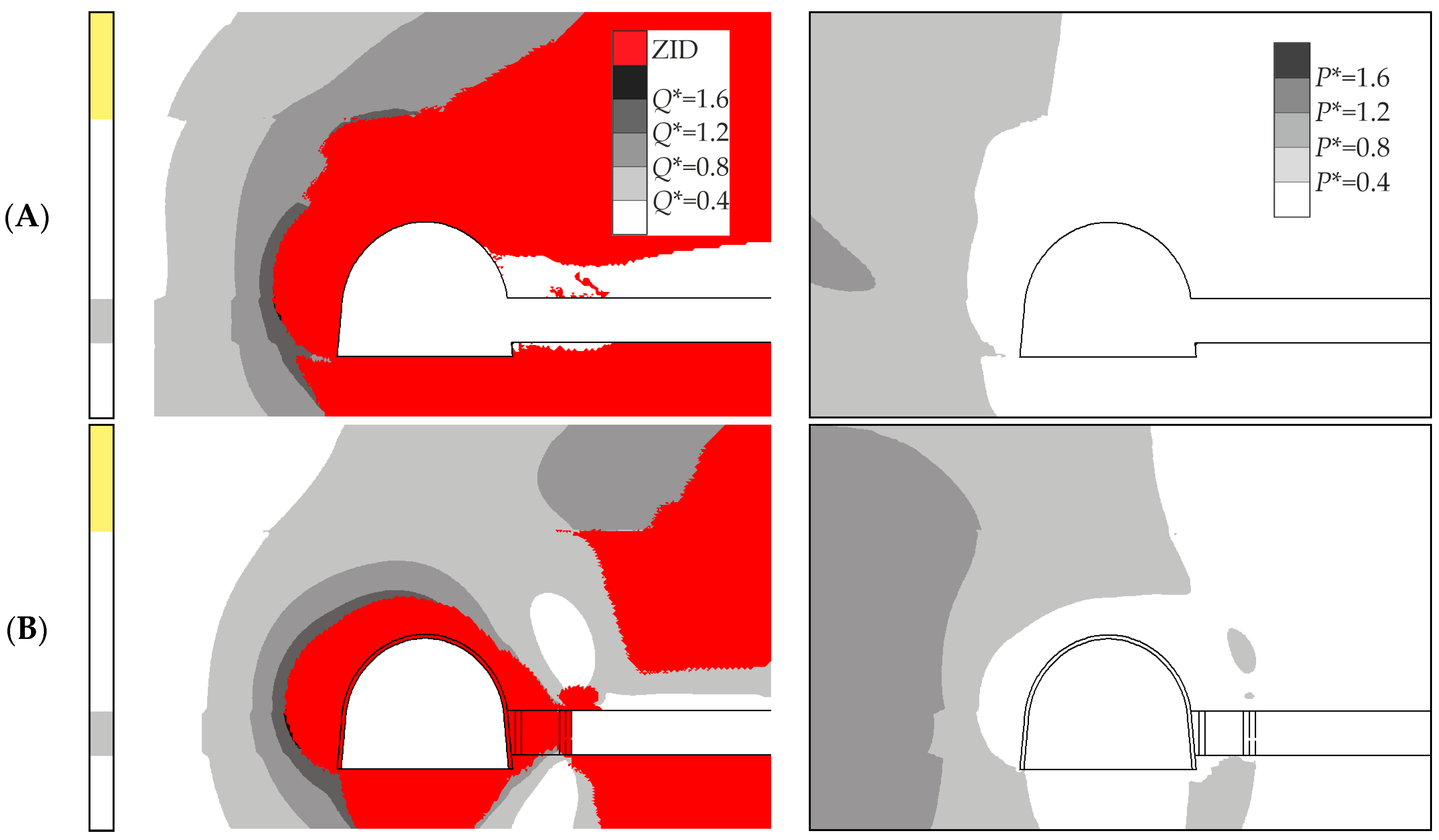
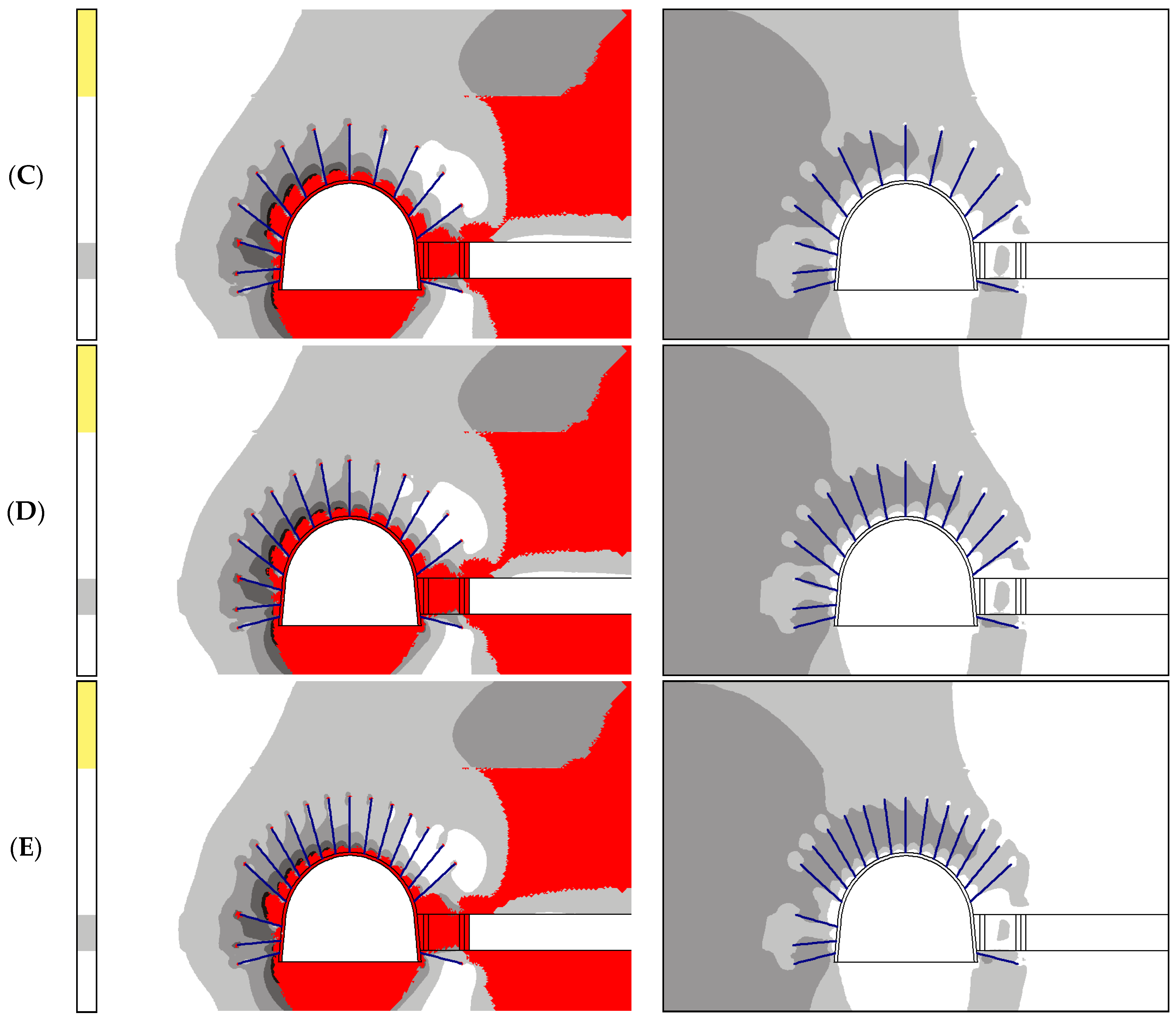
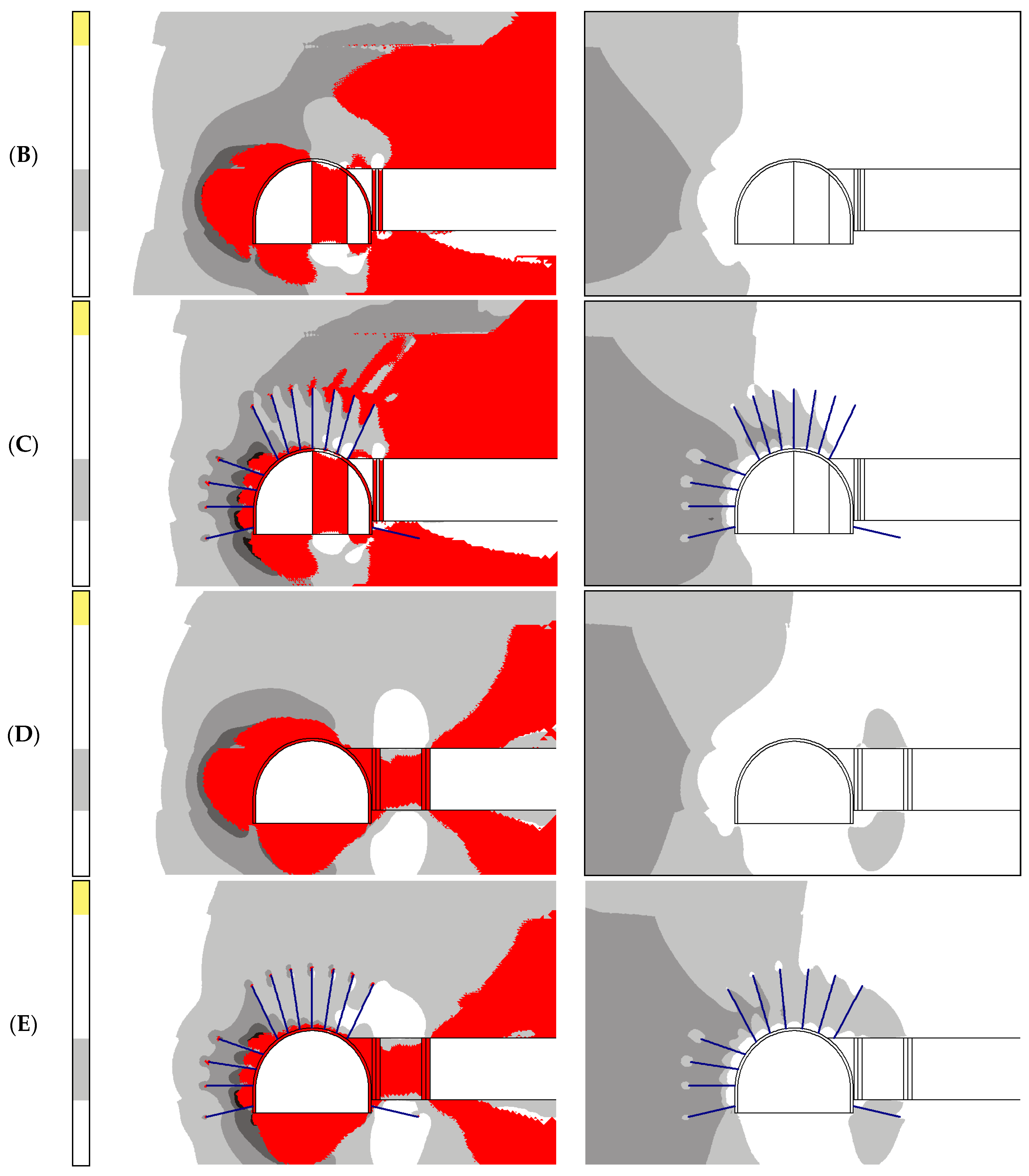
Figure 3 presents the calculated distributions of the parameters
Q* and
P*, as well as the zones of inelastic deformation. In this and all following figures, the lithological column is presented with the following color conventions: grey for coal, white for siltstone, and yellow for sandstone.
Despite the relatively shallow mining depth under the conditions of the Western Donbas, the unsupported gate roadway after the passage of the longwall face is surrounded by a large zone of increased heterogeneity of the stress field, where
Q* > 0.4 (
Figure 3A, left). The minimum depth of this zone on the coal side of the roadway is approximately equal to the width of the roadway itself. The values of the parameter
Q*, which are close to zero at a considerable distance from the excavation in the undisturbed rock mass, increase as the excavation contour is approached. As the heterogeneity of the stress field increases, the intensity of crack formation also rises. When
Q* > 0.8, uncontrolled crack propagation occurs; at this stage, deformations increase rapidly due to crack growth and rock loosening.
The zone of inelastic deformation (ZID), where the strength of the surrounding rocks is exceeded (
Figure 3A, left), surrounds the gate roadway. Because the surrounding rocks have relatively low strength, the area of the ZID is quite large. Its upper boundary above the roadway coincides with the contact between the siltstone and sandstone layers. Above the goaf, failure also affects the stronger sandstone layer. As shown in
Figure 3A (right), both the gate roadway and the goaf are surrounded by rocks that are almost completely unloaded from mining-induced stresses, where
P* < 0.4. In the immediate vicinity of the roadway contour, the minimum component of the stress tensor approaches zero. Under such conditions, failure of the surrounding rock mass occurs through its separation into individual weakly interacting blocks, and the development of this process requires minimal energy expenditure [
40].
The installation of steel frames and the construction of protective structures significantly improve the condition of the surrounding rocks (
Figure 3B). In this case, the area of the gray zone characterized by increased heterogeneity of the stress field (
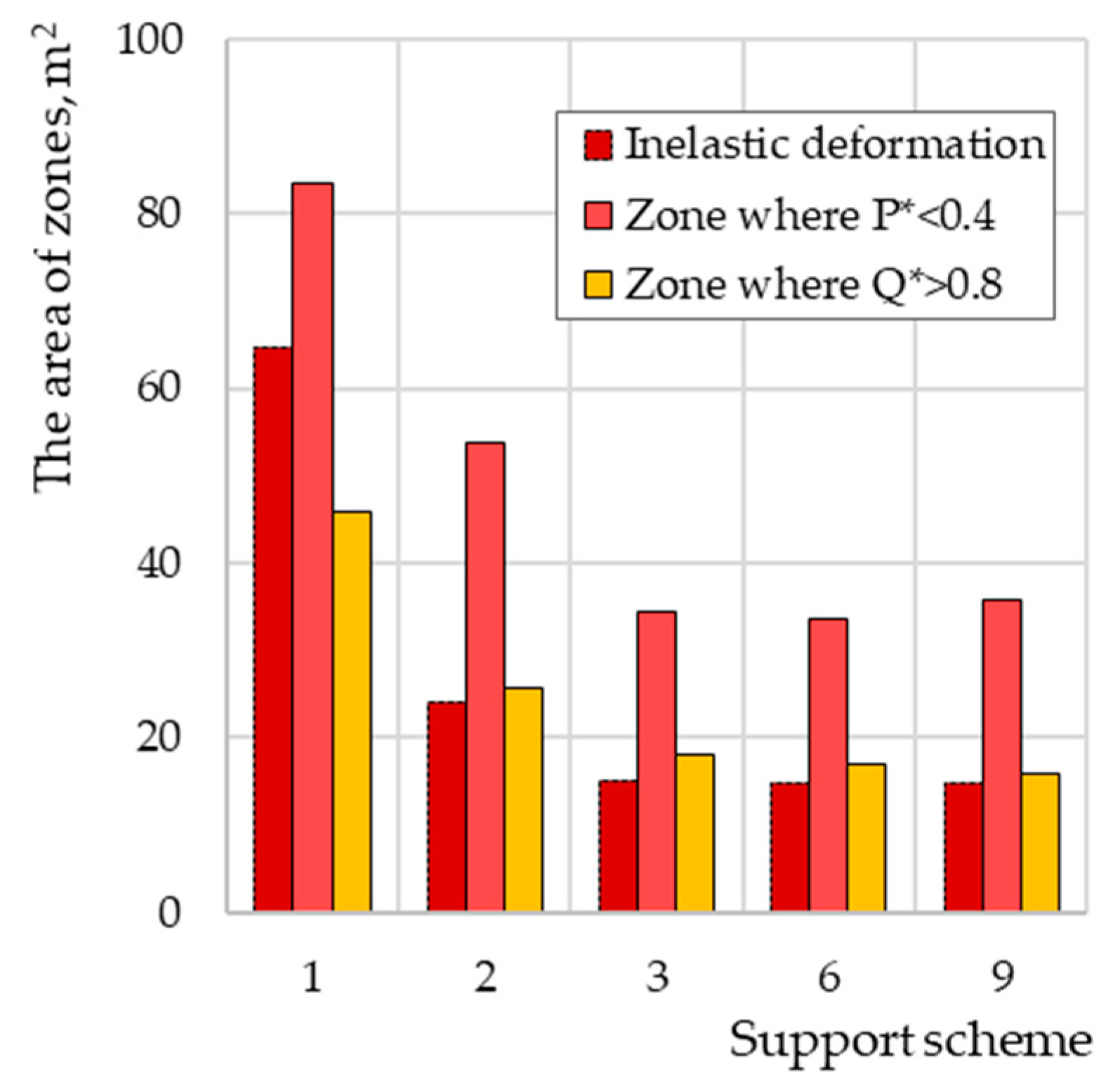
Q* > 0.4) surrounding the gate roadway on the left side becomes noticeably smaller. The area of the zone of inelastic deformation in the roof of the gate roadway also decreases by almost three times (
Figure 4).
The zone of inelastic deformation above the roadway and the goaf becomes divided into two separate parts that are no longer connected (
Figure 3B, left). This occurs because the strong cast strip takes on the load of the overlying rocks, resulting in an increase in the value of the parameter
P* both above and below the protective structures (
Figure 3B, right). The increase in
P* values in this region brings the stress state of the rocks closer to a condition of uniform compression, thereby reducing the probability of rock failure. However, in the roof of the gate roadway the
P* values remain very low, and the zone of inelastic deformation is still too large to consider the roadway stable after the passage of the longwall face.
With the installation of protective structures on the goaf side, a support for the stronger main roof is formed from the immediate roof rocks of the seam. Under these conditions, the length of the sandstone cantilever overhanging the goaf is 4 m, measured from the right rib (gob side) of the roadway (
Figure 3B, right).
With the installation of rock bolts, the values of all geomechanical parameters indicating the risk of rock failure in the roof of the roadway decrease (
Figure 4), while the zone of inelastic deformation in the surrounding rocks is significantly reduced (
Figure 3C, left). At the same time, the values of the parameter
P* within the bolted region increase considerably (
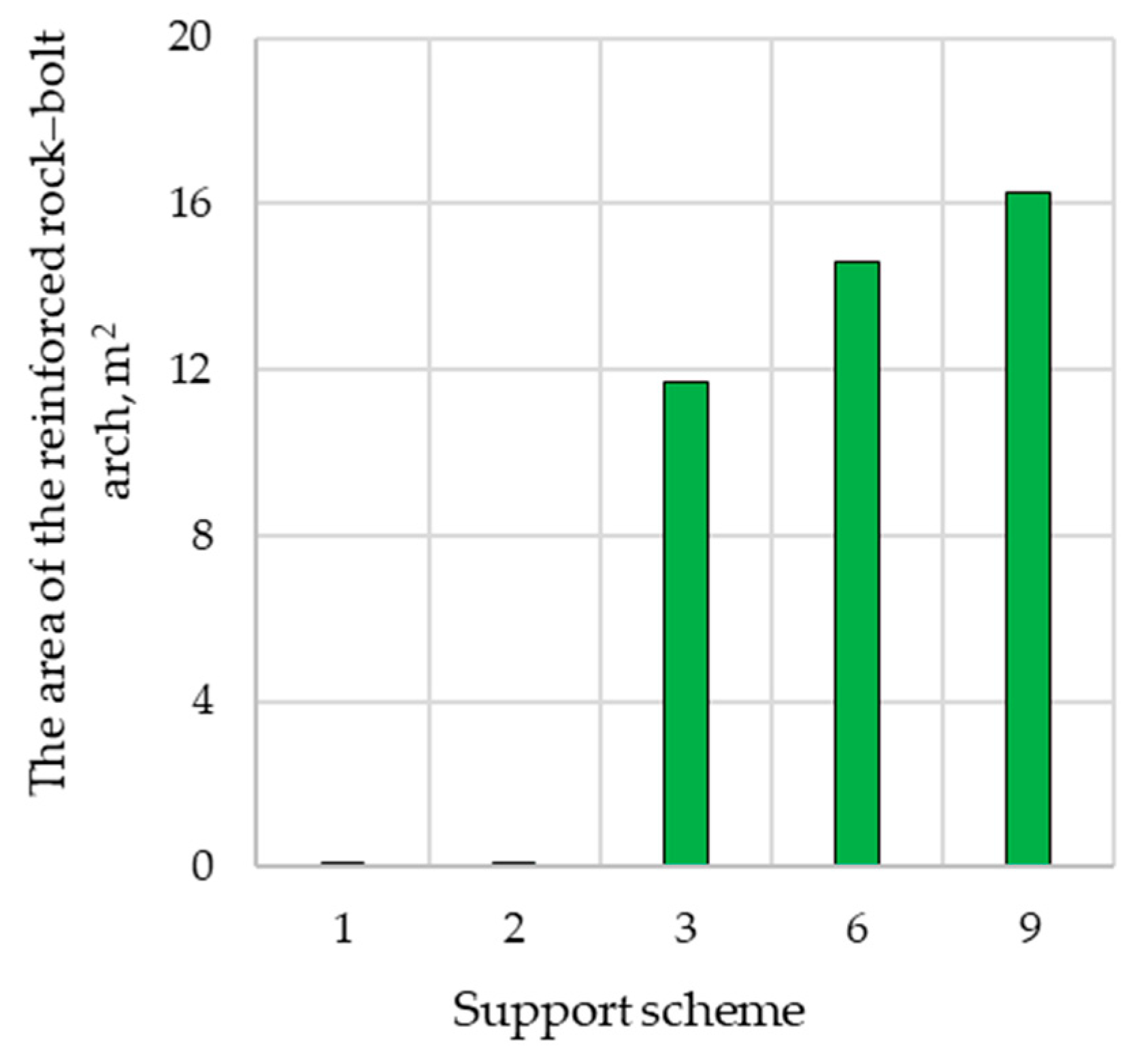
Figure 3C, right). Between bolts RB1 and RB5, a zone appears in which
P* > 0.8, with an area of nearly 12 m
2 (
Figure 5). The higher the values of the parameter
P*, the closer the stress state approaches that of an undisturbed rock mass under uniform compression, and consequently the more stable the surrounding rocks become. Therefore, the distribution of
P* values (
Figure 3C, right) clearly illustrates the formation of a reinforced rock–bolt arch in the roof of the gate roadway, which ensures its stability even after the passage of the longwall face.
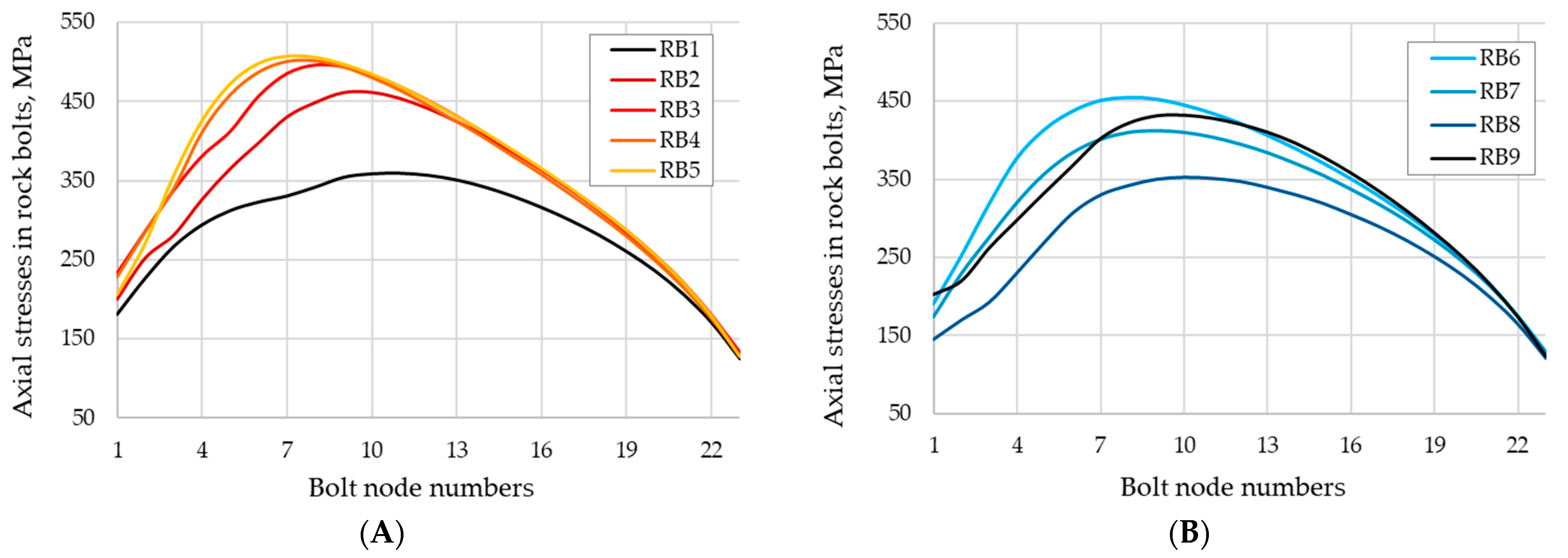
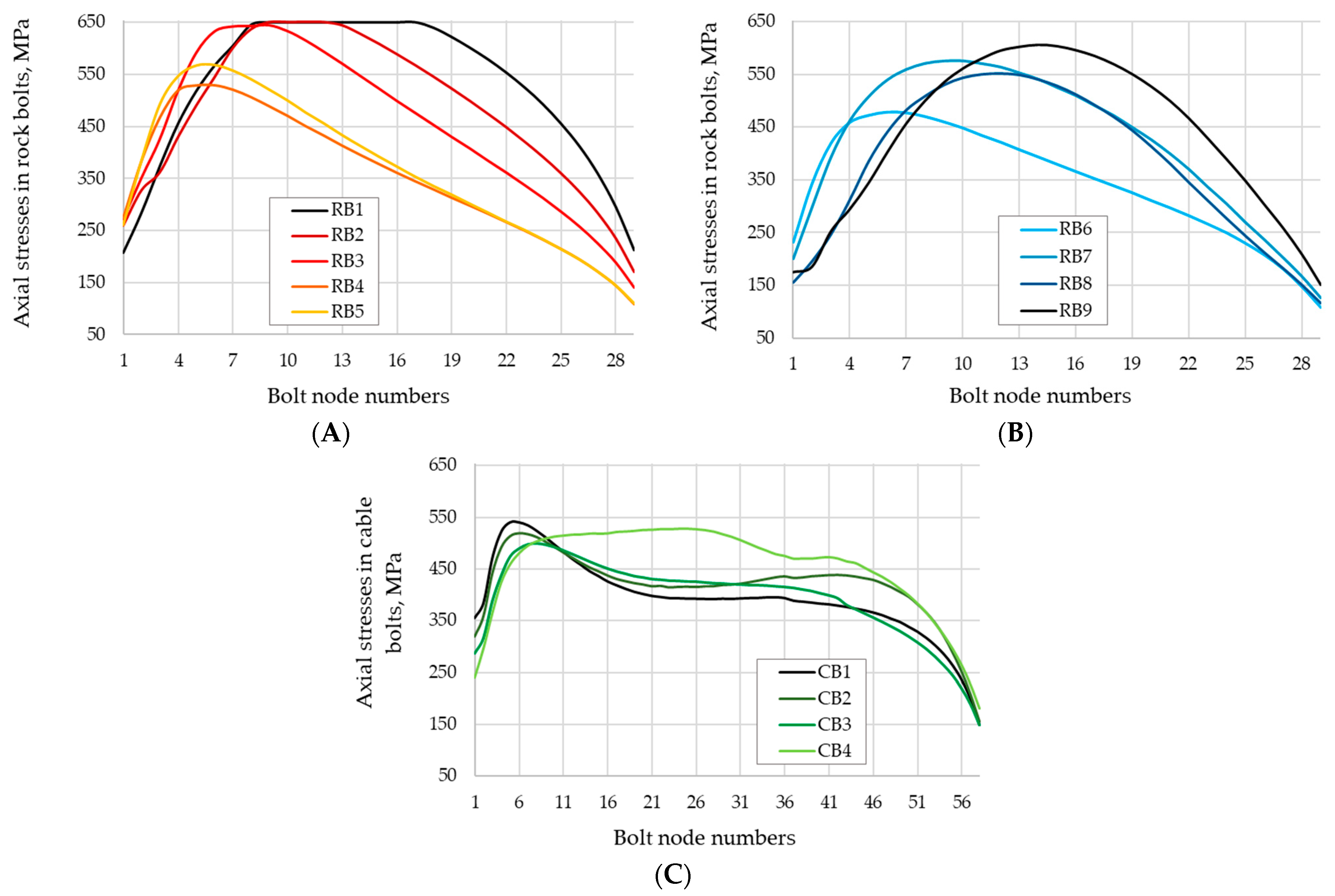
Figure 6 shows the distribution of axial stresses along bolts RB1–RB9 in the roof of the seam. The results indicate that all nine bolts operate within the elastic regime and do not reach their ultimate strength. The elastic working regime of the bolts, together with the clear evidence of the stability of the rock–bolt arch described above, indicates that there is no urgent need to strengthen the bolting system or to install cable bolts.
However, it is important to examine what occurs when the bolting density increases (
Figure 3D,E). No significant changes in the distribution of the parameter
Q* or in the boundaries of the zone of inelastic deformation were observed when applying support schemes 6 and 9, which is confirmed by the data presented in
Figure 4.
The only notable change is the increase in the area of the rock–bolt reinforced zone in the roof of the gate roadway (
Figure 3D, right;
Figure 3E, right;
Figure 5), which enhances the stability of the roadway and extends its service life.
Therefore, the decision to apply these support schemes should be made based on technological and economic considerations.
4.2. Kostenco Mine, Kazakhstan
To investigate the influence of a protective structure constructed within the cross-section of the gate roadway on its stability after the passage of the longwall face, the conditions of driving a ventilation inclined roadway (bremberg) along seam K2 at the Kostenco Mine were analyzed.
Figure 7 presents the calculated distributions of the stress field and the zones of inelastic deformation when different support systems are applied.
It can be observed that timber cribs installed within the roadway cross-section, as well as wooden props located at the boundary between the goaf and the roadway (
Figure 7B), also influence the distribution of the parameters
Q* and
P* when compared with the case shown in
Figure 7A.
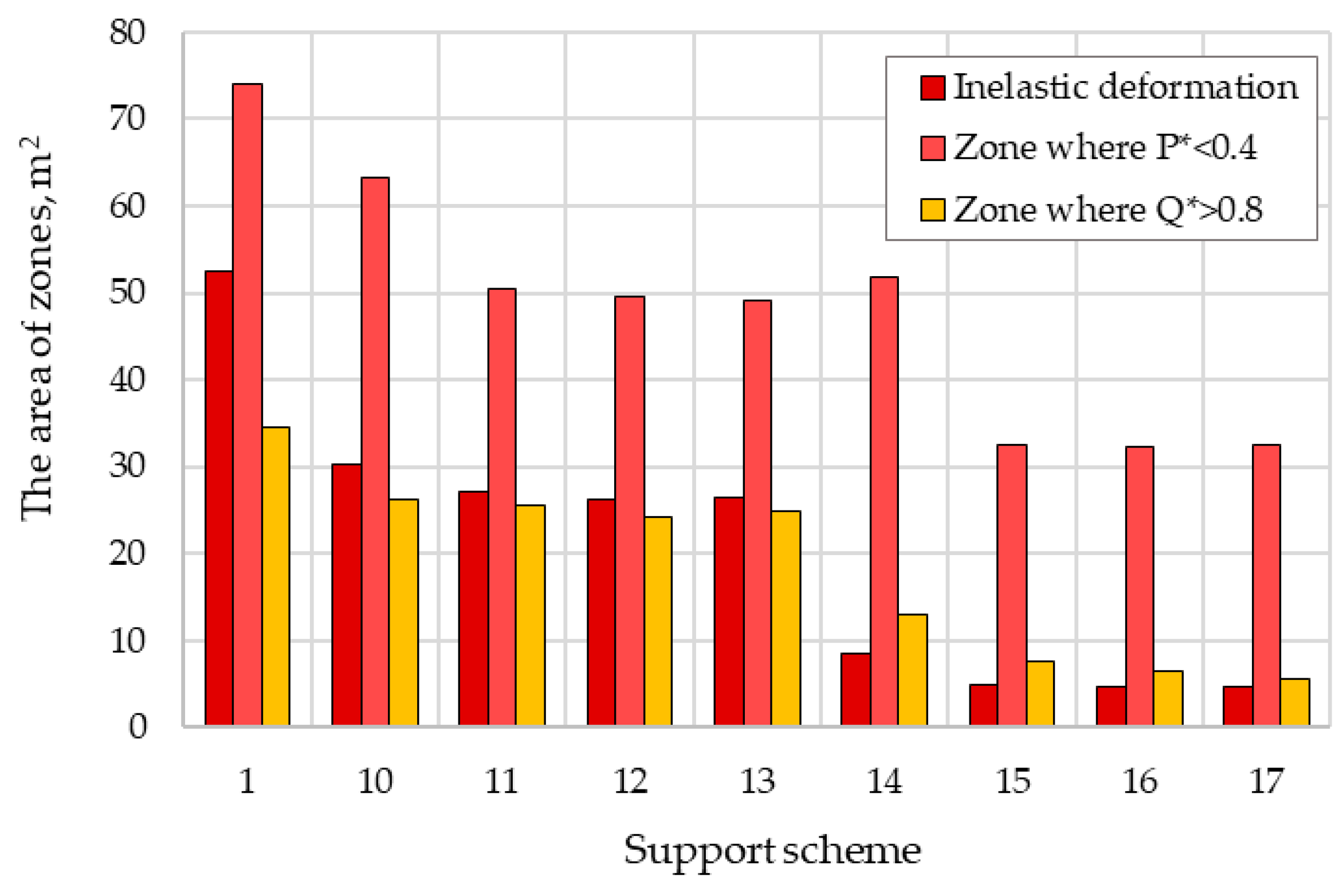
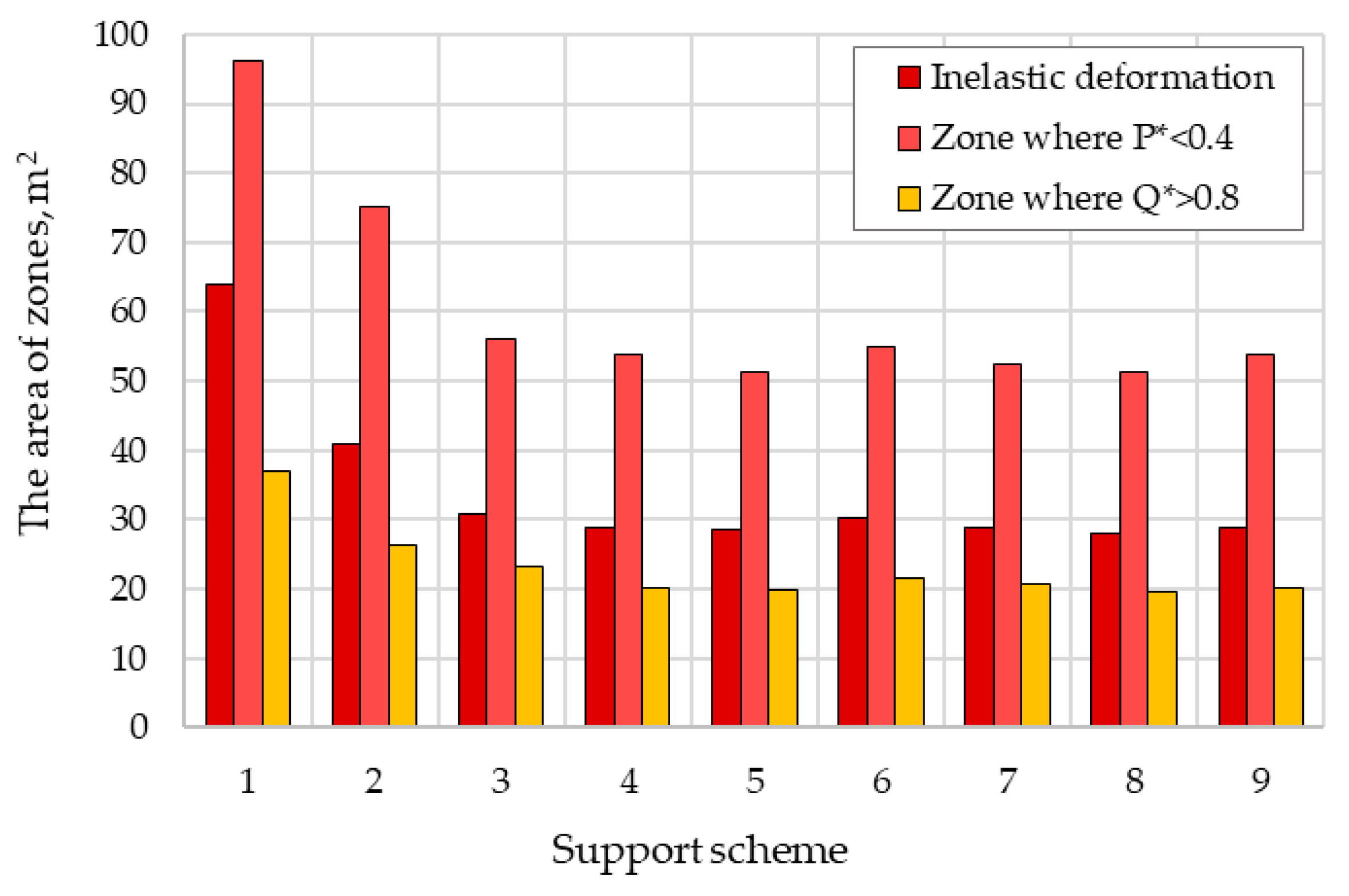
When these protective structures are applied, the area of the zone of inelastic deformation within the analyzed region Ω
1 decreases by 42%. The areas of zones characterized by high stress field heterogeneity (
Q* > 0.8) and rocks unloaded from mining pressure (
P* < 0.4) are also reduced by 15% and 24%, respectively (
Figure 8).
In the roof of the roadway, above the props and the timber crib, areas of undisturbed rock with relatively low stress heterogeneity remain preserved; these areas are not covered by the red zone where the rock strength is exceeded (
Figure 7B, left). However, the zone of inelastic deformation above the right rib of the roadway remains too close to the excavation contour.
The protective structure constructed within the cross-section of the gate roadway is located very close to the left rib of the roadway and therefore provides insufficient support for the overhanging rock arch.
A rock–bolt reinforced zone is formed in the roof of the gate roadway using rock bolts, where
Q* < 0.8 and
P* > 0.4. Between bolts RB1 and RB3, there is even a region whose stress state approaches triaxial compression, where
P* > 0.8 (
Figure 7C, right). On the coal side, this reinforced zone rests on the bolted rib of the roadway (
Figure 7C), where the zone of inelastic deformation is relatively small and the values of
P* exceed 0.8, making it a reliable support. On the opposite side, the rock–bolt arch rests on the timber crib, which is unable to prevent partial failure of the siltstone above the reinforced arch on the goaf side.
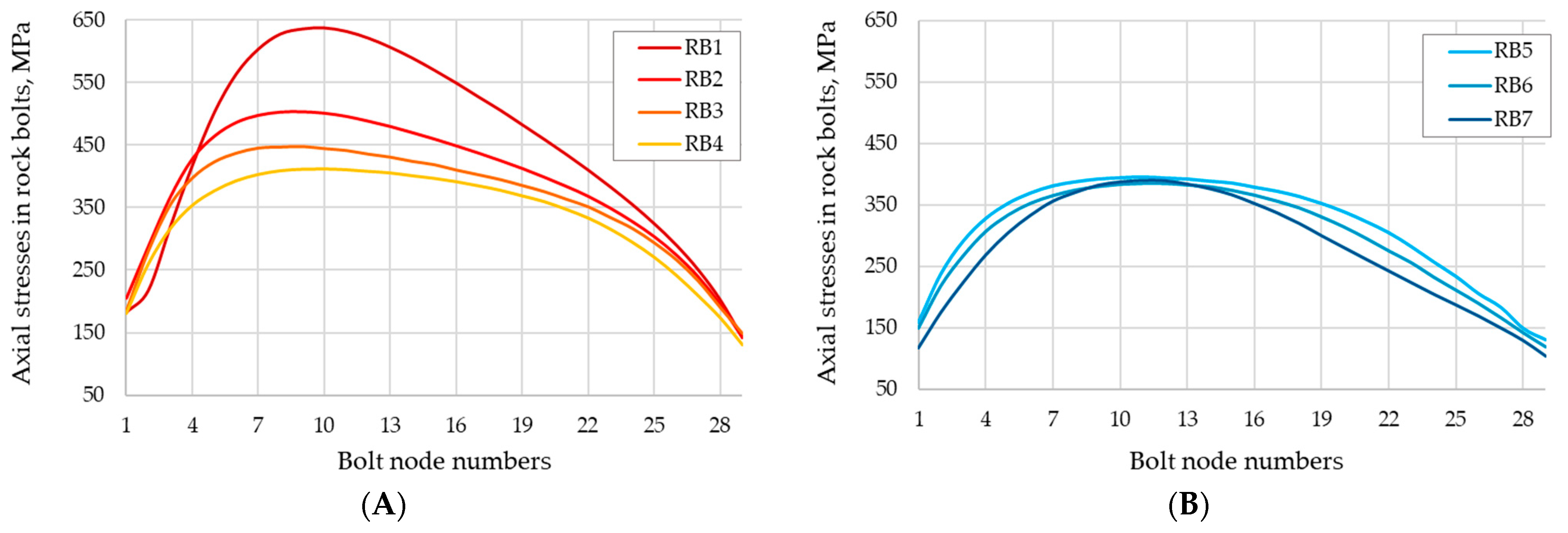
The distribution of axial stresses in bolts RB1–RB7 in the seam roof (
Figure 9) shows that all seven bolts operate within the elastic regime and do not reach their ultimate strength, similar to the conditions observed in the relatively less severe mining environments of the Western Donbas mines. However, bolts RB1–RB3, located on the right side toward the coal seam, experience higher loads (
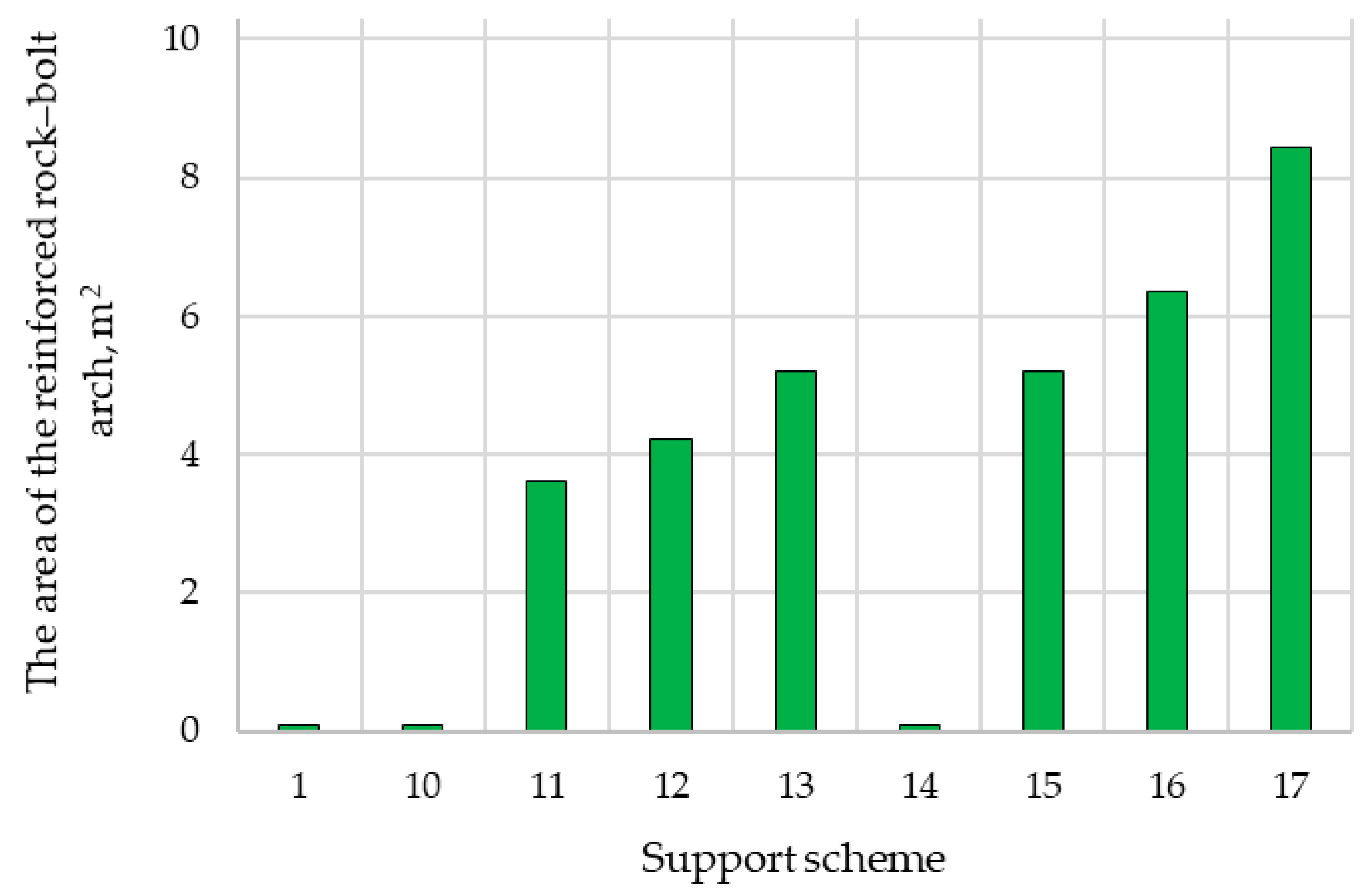
Figure 8). In particular, bolt RB1 carries the greatest load, as it is installed at the boundary with a relatively large unsupported section between it and the upper side bolt. This gap in the bolting pattern is intentionally created to avoid installing a steel bolt within the coal seam, which will subsequently be mined. Bolts located in the right part of the rock–bolt reinforced zone are subjected to lower loads because this portion of the reinforced arch is separated from the undisturbed roof rocks by a zone of inelastic deformation.
If, under the considered conditions, stronger protective structures positioned within the goaf are used, for example a cast strip, the long-term stability of the gate roadway can be improved. As shown in
Figure 7D, the siltstone above and below the cast strip is preserved in a triaxially compressed, undisturbed, and intact state: the heterogeneity of the stress field is minimal in this zone (
Q* < 0.4), the values of the parameter
P* exceed 0.4, and rock deformation occurs within the elastic regime.
If a reinforced rock–bolt arch is additionally created in the roof by means of rock bolts, it will rest on two strong supports—the left rib of the roadway and the cast strip (
Figure 7E, right). In this case, the area of the rock–bolt reinforced zone where
P* > 0.8 increases (
Figure 10).
4.3. PJSC “Mine Administration Pokrovske”, Ukraine
The stress state of the surrounding rocks within the zone influenced by the gate roadway was further analyzed for the more challenging mining conditions of PJSC “Mine Administration Pokrovske” using different support schemes (
Figure 11).
At the mining depth of seam d
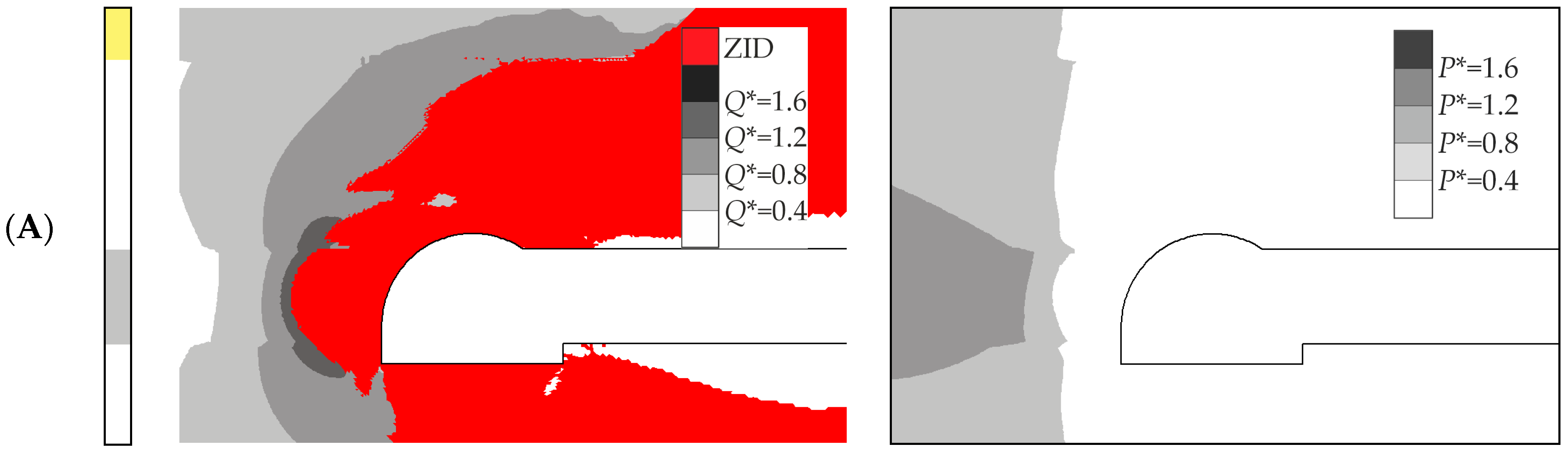
4, equal to 1000 m, the unsupported gate roadway after the passage of the longwall face is also in an extremely unstable condition. It is surrounded by extensive zones of inelastic deformation and increased stress field heterogeneity, while the rocks enclosing both the roadway and the goaf are unloaded from mining-induced stresses (
Figure 11A and
Figure 12). A different relationship between the strength properties of coal and surrounding rocks explains the differences in the contours of these zones in the left rib of the roadway under the conditions of Mine Administration Pokrovske compared with the mines of the Western Donbas. Since the siltstone of the immediate roof has lower strength than the overlying sandstone, the upper boundary of the zone of inelastic deformation above the roadway, as in the previous cases, follows the siltstone–sandstone contact (
Figure 11A, left).
Although the stress field and the zones of inelastic deformation around the unsupported gate roadway are approximately similar for the conditions of “shallow depth + weak rocks” and “great depth + strong rocks” when comparing
Figure 3A and
Figure 11A, as well as
Figure 4 and
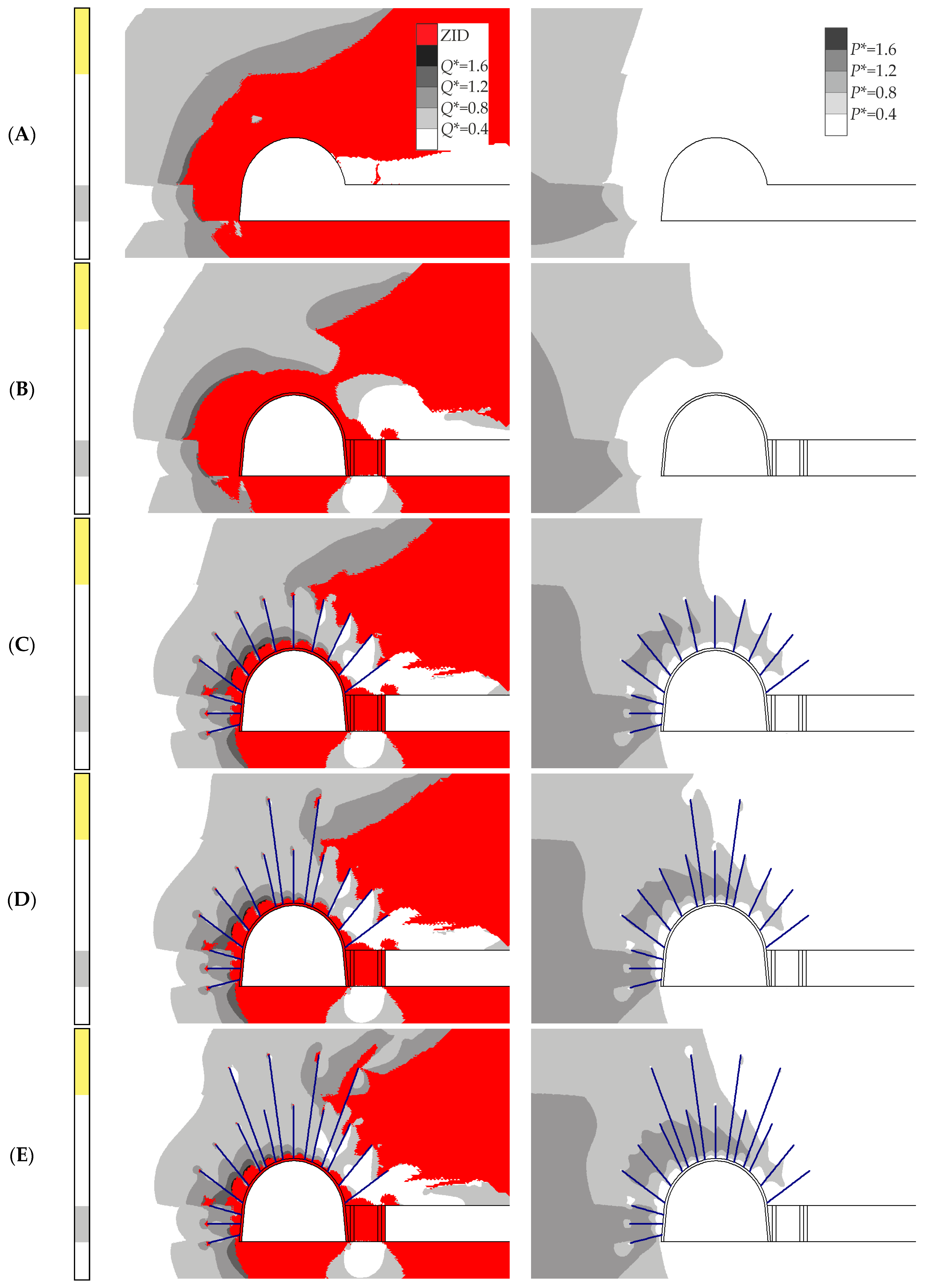
Figure 12, the installation of frames and the construction of protective structures in the latter case do not improve the stability of the surrounding rocks nearly as effectively (
Figure 11B). The strong cast strip is unable to withstand the weight of the overlying strata: the extensive zones of inelastic deformation above the roadway and the goaf remain connected into a single continuous region, indicating the inevitable collapse of the roof rocks (
Figure 11B, left). The value of the parameter
P* above and below the protective structures increases only slightly and remains within the range
P* < 0.4. Compared with the unsupported roadway, the values of the minimum principal stress component in the roof of the gate roadway with the cast strip have increased noticeably (
Figure 11B, right), but this increase is insufficient to form a stable rock arch.
Figure 12 shows that all parameters indicating the risk of rock failure within the roadway influence zone decreased by 22–36% compared with the previous case. Therefore, protective structures undoubtedly have a positive effect on the stress field even under difficult deep-mining conditions; however, in the present case, the application of high-capacity rock bolting systems is also required.
According to the regulation in force in Ukraine, “the length of rock bolts should be approximately one-half, but not less than 40% of the width of the designed roadway cross-section” [
41]. In the present case, the roadway width is 5.7 m, which allows the use of rock bolts with lengths of either 2.4 m or 3.0 m. Taking into account the mining depth and the long service life expected for repeated roadway use, 3.0 m long bolts were adopted.
As in the conditions of the Kostenco and Dniprovska mines, the installation of rock bolts further reduces the areas of inelastic deformation and the zones with critical values of the parameters
Q* and
P* in the roof of the roadway (
Figure 12). The values of the parameter
P* within the region Ω (
Figure 11C, right) increase compared with the case without rock bolting (
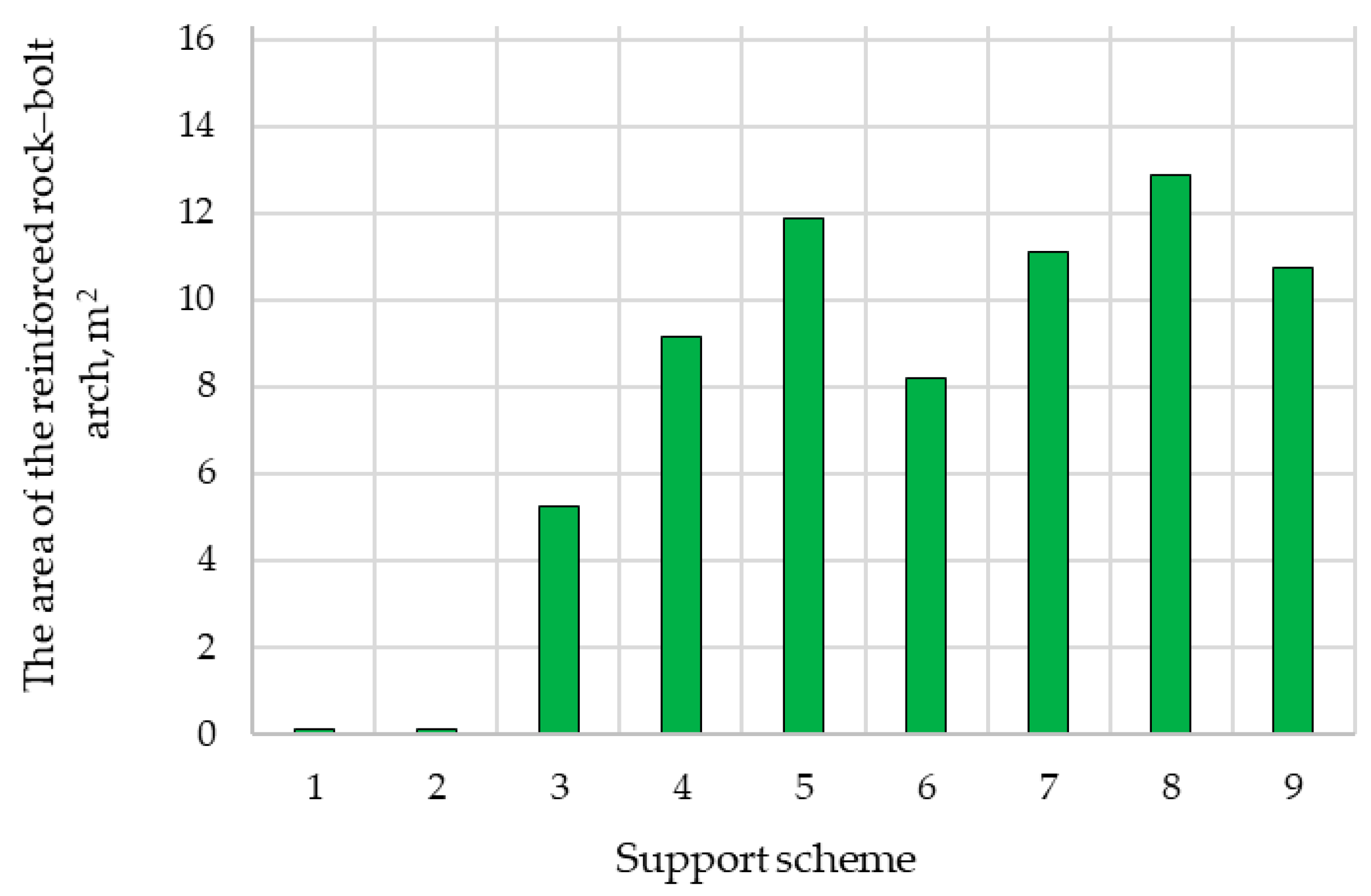
Figure 11B, right). Between bolts RB1 and RB3, a zone of rocks that remains not unloaded from mining-induced stresses is preserved, where
P* > 0.8 (
Figure 11C, right), with an area of 5.2 m
2 (
Figure 13, support scheme 3). On the coal side of the gate roadway, a reinforced sector of the rock–bolt arch is formed.
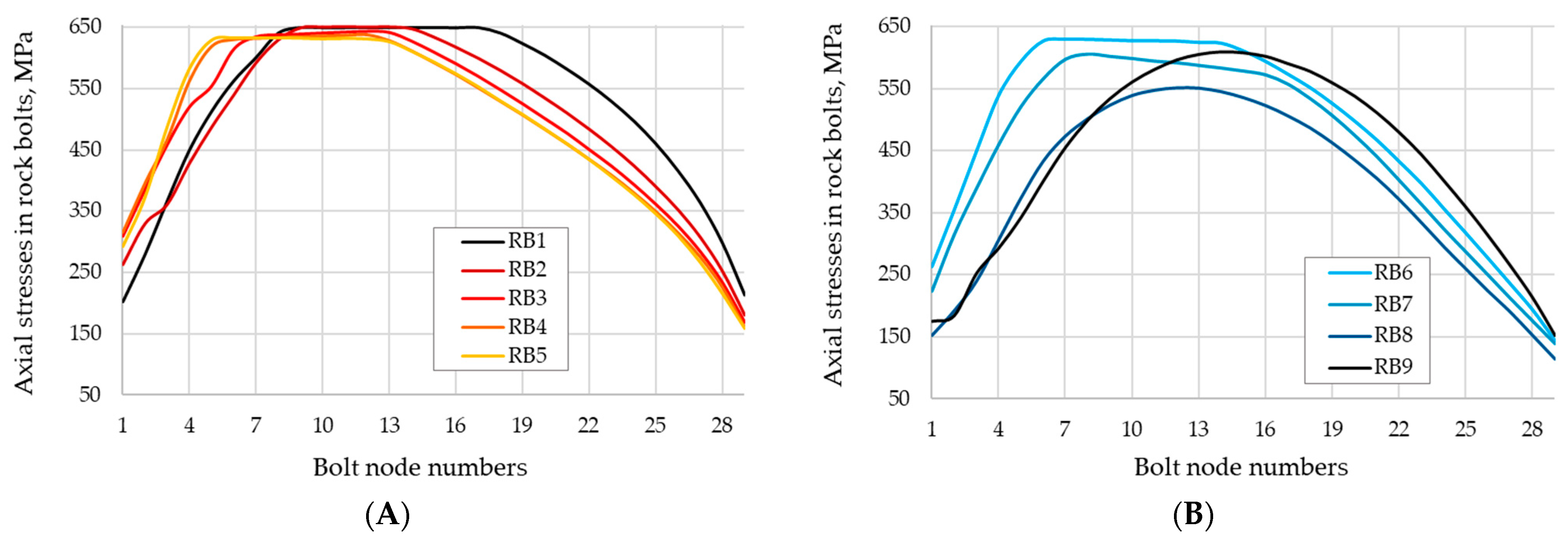
The axial stresses in the bolts shown in
Figure 14 indicate that almost all bolts installed in the roof of the gate roadway, except for RB7–RB9, have reached their ultimate strength, which suggests the possibility of bolt failure and confirms the need to reinforce the support system.
The use of a larger number of bolts in the roadway roof is primarily a matter of technological and economic feasibility, since the area of zones with critical values of the geomechanical parameters in the roof changes only slightly when the roof bolting density is increased from 1.0 bolt/m in support scheme No. 3 to 1.44 bolts/m in support scheme No. 9 (
Figure 12), whereas the area of the reinforced rock–bolt roof zone increases by more than two times (
Figure 13). Nevertheless, the zone of inelastic deformation on the goaf side overhangs the formed reinforced zone in the area of bolts RB6–RB9, separating it from the undisturbed rock mass. For this reason, as well as because most of the roof bolts are deformed to their limit state, the support scheme must be strengthened with cable bolts.
The left parts of
Figure 11D,E show that even with the use of cable bolts it is not possible to shift the zone of inelastic deformation away from the right edge of the reinforced rock–bolt roof zone in the gate roadway roof. However, the area of rock preserved in an undisturbed, intact state within the bolted roof zone increases significantly, reaching 12 m
2 (
Figure 13). In addition, the load acting on the bolts decreases substantially in this case (
Figure 15A,B), because the cable bolts take over part of the load and connect the reinforced roof zone to the undisturbed rock mass. Only bolts RB1, RB2, and RB3 undergo plastic deformation over a very short section, whereas all the remaining bolts, including the cable bolts (
Figure 15C), operate within the elastic regime.
5. Discussion of Numerical Results in the Context of Field Experience
The field data were considered as an additional basis for validating the numerical results obtained for representative mining conditions in Ukraine and Kazakhstan. The calculations show that the stability of gate roadways after longwall retreat is controlled by the combined action of protective structures and anchorage systems, whereas the required degree of reinforcement depends on mining depth, rock strength, and the position of the inelastic deformation zone relative to the reinforced roof zone. In this sense, the field experience reported below serves to verify whether the support mechanisms identified numerically are consistent with the actual behavior of reused roadways under operating conditions.
For the relatively shallow conditions typical of the Western Donbas, the numerical modeling demonstrated that protective structures significantly improve the condition of the surrounding rocks by decreasing the heterogeneity of the stress field and reducing the extent of the inelastic deformation zone. The subsequent installation of rock bolts leads to the formation of a reinforced rock–bolt arch in the roof, while the axial stresses in the bolts remain within the elastic range. This result indicates that, under such conditions, combined frame–rock–bolt support supplemented by protective structures can be sufficient to maintain roadway stability after longwall passage, whereas the installation of cable bolts is not critical in the absence of additional destabilizing factors.
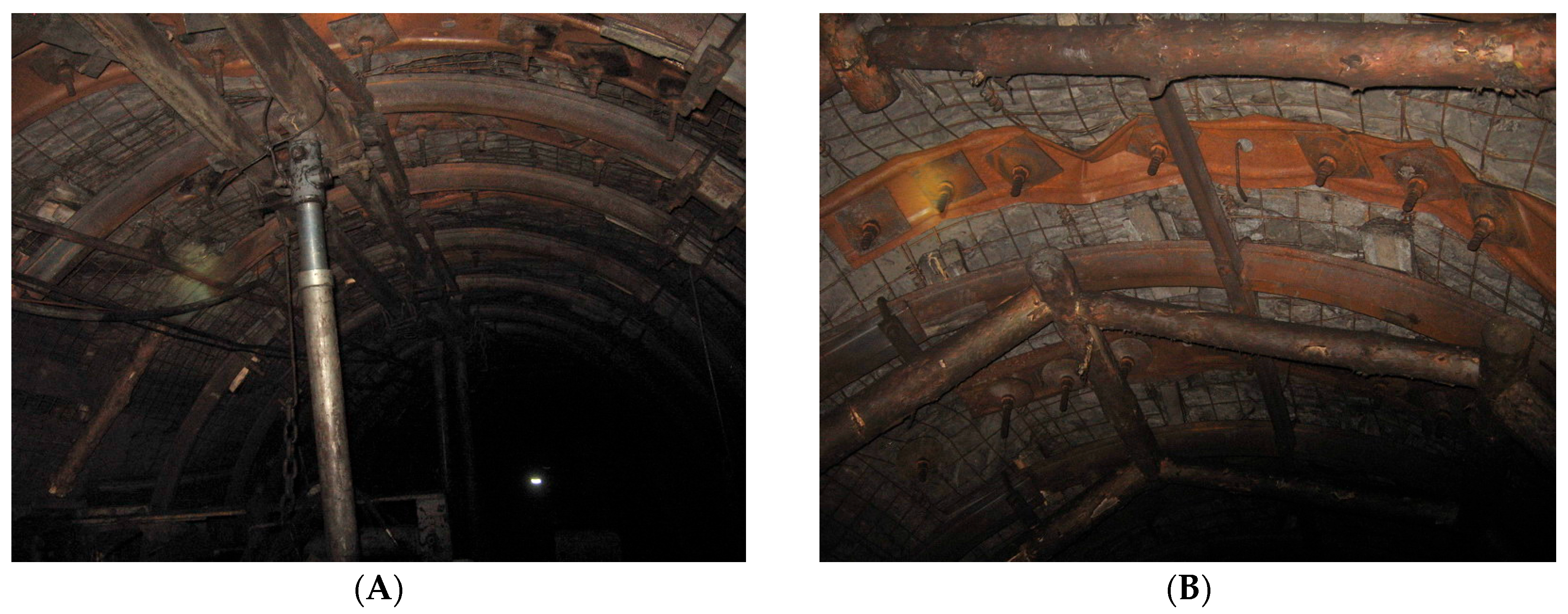
This numerical conclusion is consistent with field observations from the mines of PJSC “DTEK Pavlogradugol”. At Pavlohradska Mine, the retained 413 panel entry supported by a combined rock bolt–frame system with timber cribs preserved the integrity of the surrounding rocks both at the moment of longwall face opening and during subsequent service, with no visible cracks, spalls, or delamination (
Figure 16). A similar overall satisfactory behavior was observed at Yuvileina Mine, where the 585 collecting roadway remained stable during drivage, extraction of the first and second longwall panels, and repeated maintenance (
Figure 17). At the same time, the observations at Yuvileina Mine also revealed substantial floor heave during repeated reuse. This detail is important because it shows that the favorable agreement between the numerical and field results primarily concerns the stability of the roof and side contours, whereas long-term serviceability may additionally require measures aimed at controlling floor deformation and improving rib confinement.
A different pattern was obtained for the deep mining conditions of PJSC “Mine Administration Pokrovske”. In this case, the calculations showed that protective structures alone, although beneficial, do not provide sufficient stabilization of the surrounding rocks. The zones of inelastic deformation above the roadway and the goaf remain connected, which indicates the persistence of an unstable roof state. The introduction of roof bolts improves the stress state and forms only a partial reinforced arch, but most bolts reach their ultimate strength, which points to the risk of bolt failure. Only after the inclusion of cable bolts does the reinforced roof zone become more effectively connected with the undisturbed rock mass, while the load acting on the roof bolts decreases substantially. Thus, for deep conditions, the numerical model clearly indicates that the stability of a reused roadway requires not only protective structures and conventional rock bolts, but also additional reinforcement by cable bolts.
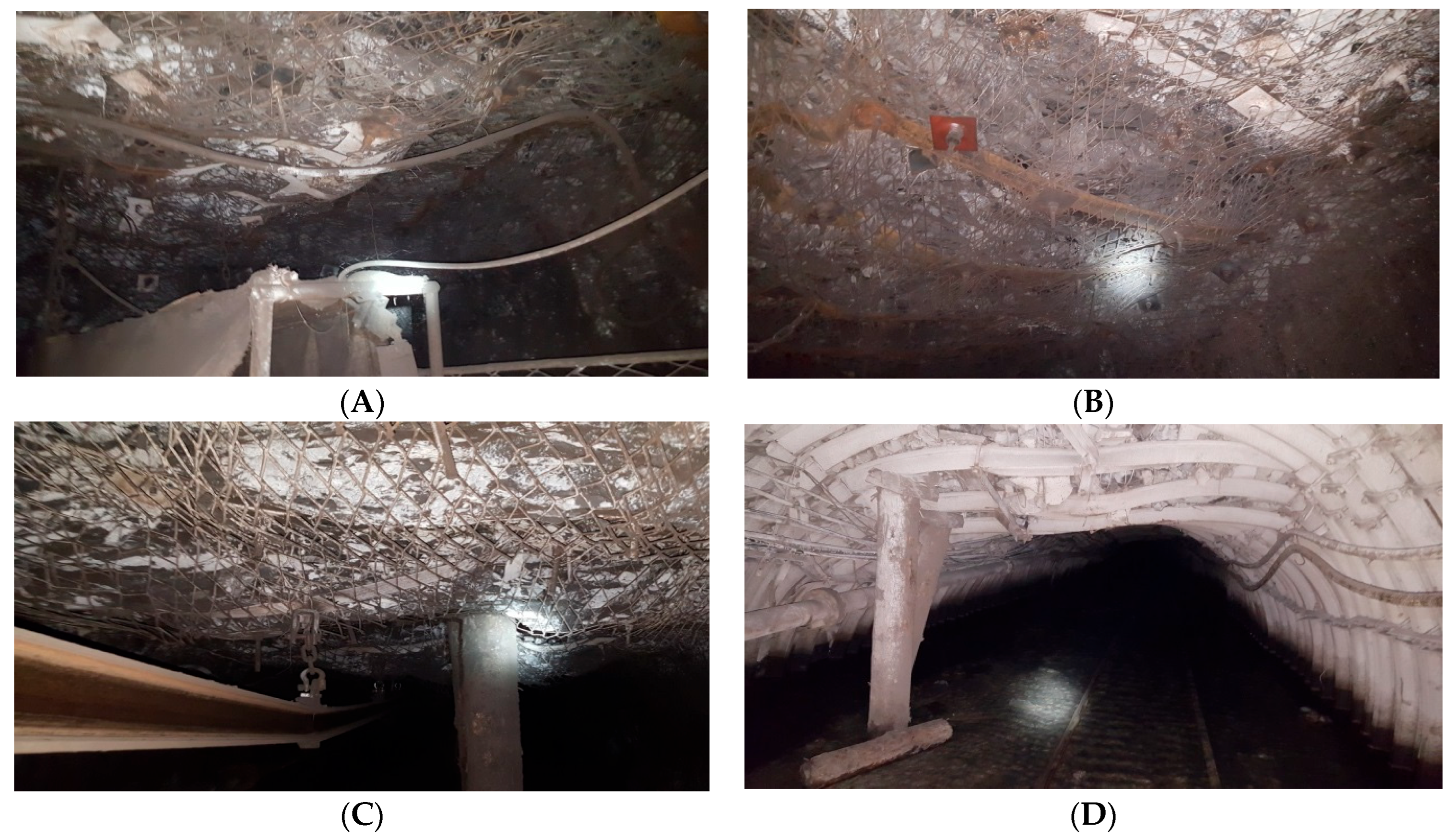
This interpretation agrees well with the field experience reported for the Karaganda coal mines, where conditions are among the most challenging for roadway maintenance behind the longwall face. These conditions are characterized by high mining pressure, weak floor rocks prone to heave, and roof strata requiring rigid support or additional technological measures. When the characteristics of the support system do not correspond to the load–deformation properties of the surrounding rocks, total roof displacements may reach 600 to 1700 mm, and roadway cross-sections may be reduced by 30 to 70% (
Figure 18). In response to these difficulties, technical recommendations were developed to increase the filling ratio of boreholes in reinforced zones from 40% to 100% and to apply cluster or two-level rock bolting systems. These field recommendations are consistent with the numerical conclusion that stronger reinforcement and more effective interaction between support elements and the rock mass are required in the Karaganda setting.
Protective structures reduce stress heterogeneity and can create favorable conditions for roadway preservation at relatively shallow depths, but their effectiveness decreases as mining depth and geomechanical complexity increase. Rock bolts form the reinforced roof zone that is critical for maintaining roadway stability; however, this zone remains effective only when it is properly supported and connected to sufficiently stable rock on both sides of the roadway. Cable bolts become necessary when the inelastic deformation zone overhangs the formed reinforced roof zone and when conventional rock bolts approach their strength limit. Consequently, the field evidence supports the main numerical conclusion of the present study: rational support design for gate roadways after longwall retreat must be differentiated according to mining depth and geological conditions and should be based on the combined action of protective structures, rock bolts, and, where necessary, cable bolts.
6. Conclusions
Maintaining gate roadways behind the advancing longwall face remains relevant both for their repeated use and for certain ventilation and degasification schemes in longwall mining. Experience has shown that ensuring the stability of gate roadways after longwall passage is a major challenge, since this stage is commonly accompanied by significant stress redistribution and substantial roof displacements. This problem becomes more acute with increasing mining depth and deterioration of geological and mining conditions. Therefore, for selecting an appropriate support system, it is important not only to predict mining-induced stresses but also to understand how each support element influences the redistribution of the stress field. In this study, the influence of support elements on the stress state of the surrounding rocks and on the stability of gate roadways after longwall passage was investigated under conditions typical of coal mines in Ukraine and Kazakhstan.
Numerical modeling was performed to analyze changes in the stress field within the surrounding rocks and support elements under different support schemes and geological conditions. To evaluate the contribution of each support component, namely protective structures, steel rock bolts, and cable bolts, a series of calculations was carried out with sequential reinforcement of the support system, and the axial stresses in the rock bolts were analyzed. Based on the obtained results, the following conclusions can be drawn.
At relatively shallow mining depths, the construction of protective structures significantly improves the condition of the surrounding rocks. In the vicinity of these structures, the heterogeneity of the stress field decreases and the zone of inelastic deformation becomes smaller. When high-strength materials are used, protective structures are capable of carrying the load of the overlying rocks, owing to which the stress state of the surrounding rocks approaches a condition of more uniform compression and the probability of failure decreases. Protective structures erected on the goaf side form a support for the stronger main roof from the immediate roof rocks of the seam. However, with increasing depth, as well as with decreasing structural strength, the positive effect of protective structures on the stability of the surrounding rocks becomes less pronounced. In such cases, extensive zones of inelastic deformation above the roadway and the goaf merge into a single continuous region, indicating the inevitable collapse of the roadway roof.
With the installation of rock bolting, the values of all geomechanical parameters indicating the risk of roof failure decrease, while the zone of inelastic deformation in the surrounding rocks is significantly reduced in all considered cases. Between the bolts, an area of undisturbed rock is preserved in a stress state close to triaxial compression, similar to that in the intact rock mass; as a result, a reinforced rock–bolt arch is formed in the roof of the gate roadway. If this arch is supported on one side by the bolt-reinforced coal side of the roadway and on the other side by protective structures appropriate to the given conditions, the stability of the gate roadway can be ensured even after the passage of the longwall face. Increasing the roof bolting density enlarges the area of the reinforced rock–bolt zone, thereby improving its stability and extending the service life of the roadway. Therefore, the use of a greater number of roof bolts should be determined on the basis of technological and economic feasibility.
If the zone of inelastic deformation on the goaf side overhangs the formed rock–bolt reinforced zone, separating it from the undisturbed rock mass, and if the stresses in the bolts reach their strength limit, the support scheme must be reinforced with cable bolts. The use of cable bolts significantly increases the area of the reinforced arch, while the load acting on the rock bolts decreases because part of this load is transferred to the cable bolts, and the reinforced zone becomes connected to the undisturbed rock mass.
The novelty of this study lies in a comparative assessment of the role of individual support elements in maintaining gate roadways after longwall retreat under different geological and mining conditions typical of coal mines in Ukraine and Kazakhstan. Unlike studies focused on a single support type or a single mining setting, the present work analyzes the sequential contribution of protective structures, rock bolts, and cable bolts within a unified elastoplastic FEM framework. An additional contribution of the study is the integrated use of the parameters Q* and P*, the extent of inelastic deformation zones, and axial stresses in the anchors to interpret the mechanisms by which support systems form a reinforced structural zone around the roadway. The numerical results are further linked with field observations from operating mines, which makes it possible to formulate practically oriented principles for selecting rational support systems for gate roadways intended for ventilation or repeated use.
Thus, the study demonstrates the role of each support element in the formation of a reinforced structural system around the gate roadway, which ensures its stability after longwall passage under conditions typical of coal mines in Ukraine and Kazakhstan. The visual representation of stress field redistribution under different support types provides a clearer understanding of the mechanism of their interaction with the rock mass. The results of this study may assist in the selection of appropriate support systems for gate roadways retained either for ventilation purposes or for repeated use.
The results obtained in this study should be interpreted within the limits of the adopted numerical formulation and the representative geological conditions considered. Therefore, the presented conclusions should be regarded as applicable primarily to conditions similar to those analyzed in the study.
Possible directions for further research include application of more advanced nonlinear failure criteria, a more detailed investigation of three-dimensional and time-dependent mining effects, the influence of geological heterogeneity, and a broader parametric optimization of support configurations.
Author Contributions
Conceptualization, O.K., V.K., K.B., V.D., D.A. and K.S.; methodology, O.K., V.K., K.B., V.D., D.A., K.S., K.Z. and R.A.; software, O.K., V.K. and K.B.; validation, V.D., D.A., R.M., N.Z., K.S., K.Z. and R.A.; formal analysis, O.K., V.K., K.B., D.A., K.S., K.Z. and R.A.; investigation, O.K., V.K., K.B., V.D., D.A., R.M., N.Z., N.G., K.S., K.Z. and R.A.; resources, V.D., D.A., R.M., N.Z., K.S., K.Z. and R.A.; data curation, O.K., V.K., K.B., N.G. and R.A.; writing—original draft preparation, O.K., V.K., K.B., D.A. and R.A.; writing—review and editing, V.D., D.A., R.M., N.Z., N.G., K.S., K.Z. and R.A.; visualization, O.K., V.K., K.B., N.G. and R.A.; supervision, D.A., K.S. and K.Z.; project administration, D.A. and K.S.; funding acquisition, K.S. and K.Z. All authors have read and agreed to the published version of the manuscript.
Funding
This research was carried out with the support of the Science Committee of the Ministry of Science and Higher Education of the Republic of Kazakhstan within the framework of program-targeted financing for the implementation of the scientific and scientific-technical program of the IRN BR28712407.
Institutional Review Board Statement
Not applicable.
Informed Consent Statement
Not applicable.
Data Availability Statement
The original contributions presented in this study are included in the article. Further inquiries can be directed to the corresponding authors.
Conflicts of Interest
The authors declare no conflicts of interest.
References
- Liu, W.; Guo, Z.; Hou, J.; Chen, D. Research and application of support technology for re-mining roadway in goaf under regenerated roof in thick coal seam. Geotech. Geol. Eng. 2019, 37, 4327–4335. [Google Scholar] [CrossRef]
- Shashenko, O.M.; Dubovyk, O.I. Assessment of the economic feasibility of reusing development roadways at the Krasnolymanska mine. Bull. Kryvyi Rih Natl. Univ. 2018, 47, 165–169. [Google Scholar] [CrossRef]
- Wu, H.; Li, Q.; Zhu, C.; He, L. Study on the failure law of surrounding rock in inclined coal seam with gob side entry. Sci. Rep. 2023, 13, 973. [Google Scholar] [CrossRef] [PubMed]
- Zhang, Z.; Wang, W.; Li, S.; Yu, X. Analysis on rockbolt support interaction with roof dilatancy above roadside backfill area in gob-side entry retaining. Geotech. Geol. Eng. 2018, 36, 2577–2591. [Google Scholar] [CrossRef]
- Akhmatnurov, D.; Zamaliyev, N.; Mussin, R.; Demin, V.; Ganyukov, N.; Zagórski, K.; Skrzypkowski, K.; Korzeniowski, W.; Stasica, J. Optimization of Reinforcement Schemes for Stabilizing the Working Floor in Coal Mines Based on an Assessment of Its Deformation State. Materials 2025, 18, 3094. [Google Scholar] [CrossRef]
- Zhang, P.; Esterhuizen, G.; Sears, M.; Trackemas, J.; Minoski, T.; Tulu, B. Roof stability and support strategies associated with longwall-induced horizontal stress changes in belt entries. Min. Metall. Explor. 2022, 39, 1873–1885. [Google Scholar] [CrossRef]
- Su, H.; Bai, J.; Yan, S.; Chen, Y.; Zhang, Z. Study on gob-side entry retaining in fully-mechanized longwall with top-coal caving and its application. Int. J. Min. Sci. Technol. 2015, 25, 503–510. [Google Scholar] [CrossRef]
- Li, X.; Ju, M.; Yao, Q.; Zhou, J.; Chong, Z. Numerical investigation of the effect of the location of critical rock block fracture on crack evolution in a gob-side filling wall. Rock Mech. Rock Eng. 2016, 49, 1041–1058. [Google Scholar] [CrossRef]
- Zhang, N.; Yuan, L.; Han, C.; Xue, J.; Kan, J. Stability and deformation of surrounding rock in pillarless gob-side entry retaining. Saf. Sci. 2012, 50, 593–599. [Google Scholar] [CrossRef]
- Ning, J.; Wang, J.; Liu, X.; Qian, K.; Sun, B. Soft–strong supporting mechanism of gob-side entry retaining in deep coal seams threatened by rock burst. Int. J. Min. Sci. Tech. 2014, 24, 805–810. [Google Scholar] [CrossRef]
- Wang, Q.; Wei, H.; Jiang, B.; Wang, X.; Sun, L.; He, M. High pre-tension reinforcing technology and design for ultra-shallow buried large-span urban tunnels. Int. J. Rock Mech. Min. Sci. 2024, 182, 105891. [Google Scholar] [CrossRef]
- Kainazarova, A.S.; Demin, V.F.; Kainazarov, A.S.; Akhmatnurov, D.R. Investigation of geomechanical process patterns during roadway maintenance at the boundary with the goaf behind the longwall face. Sustain. Dev. Mt. Territ. 2025, 17, 1606–1613. [Google Scholar] [CrossRef]
- Krukovskyi, O.; Krukovska, V. Supporting a mine working with a shelter in various mining and geological conditions. Inz. Miner. 2023, 1, 45–52. [Google Scholar] [CrossRef]
- Deng, L.; Lv, J.; Chen, Y. Supporting a Retained Gob-Side Entry Under Soft and Fractured Rock: Computer Simulations and a Practical Example. Geotech. Geol. Eng. 2019, 37, 2283–2292. [Google Scholar] [CrossRef]
- Fu, W. Study on surrounding rock control of gob-side entry retaining in inclined and thick longwall face. Geotech. Geol. Eng. 2022, 40, 3477–3491. [Google Scholar] [CrossRef]
- Qin, T.; Ren, K.; Jiang, C.; Duan, Y.; Liu, Z.; Wang, L. Distribution Law of Mining Stress of the Gob-Side Entry Retaining in Deep Mining Thin Coal Seam. Adv. Civ. Eng. 2021, 2021, 5589948. [Google Scholar] [CrossRef]
- Nehrii, S. Determination of roof displacement in mine workings within the zone of longwall face influence. News Donetsk Natl. Tech. Univ. 2019, 1, 41–52. [Google Scholar] [CrossRef]
- Wang, E.; Xie, S. Determination of coal pillar width for gob-side entry driving in isolated coal face and its control in deep soft-broken coal seam: A case study. Energy Sci. Eng. 2022, 10, 2305–2316. [Google Scholar] [CrossRef]
- Zamaliyev, N.; Akhmatnurov, D.; Małkowski, P.; Demin, V.; Ainash, K.; Mussin, R.; Ganyukov, N.; Andrey, S. Rock Mass Bolting in Coal Mine Workings for Floor Heave Control. Appl. Sci. 2026, 16, 2304. [Google Scholar] [CrossRef]
- Tao, Z.; Song, Z.; He, M.; Meng, Z.; Pang, S. Principles of the roof cut short-arm beam mining method (110 method) and its mining-induced stress distribution. Int. J. Min. Sci. Technol. 2018, 28, 391–396. [Google Scholar] [CrossRef]
- Yang, J.; He, M.; Cao, C. Design principles and key technologies of gob side entry retaining by roof pre-fracturing. Tunn. Undergr. Space Technol. 2019, 90, 309–318. [Google Scholar] [CrossRef]
- Sun, X.-M.; Li, G.; Song, P.; Miao, C.; Zhao, C.; Li, Q.; Xia, X. Application research on gob-side entry retaining methods in No. 1200 working face in Zhongxing Mine. Geotech. Geol. Eng. 2019, 37, 185–200. [Google Scholar] [CrossRef]
- Xu, F.; Li, S.-C.; Zhang, Q.-Q.; Li, L.-P.; Shi, S.-S.; Zhang, Q. A new type support structure introduction and its contrast study with traditional support structure used in tunnel construction. Tunn. Undergr. Space Technol. 2017, 63, 171–182. [Google Scholar] [CrossRef]
- Hu, Y.; Liu, Y.; Shi, L. Research on supporting technology for surrounding rock of inclined large-span open-off cut roadway. Geotech. Geol. Eng. 2020, 38, 1873–1884. [Google Scholar] [CrossRef]
- Tao, Z.; Cao, J.; Yang, L.; Guo, A.; Huang, R.; Yang, X.; Yuan, D.; Hou, L. Study on deformation mechanism and support measures of soft surrounding rock in muzhailing deep tunnel. Adv. Civ. Eng. 2020, 2020, 9367916. [Google Scholar] [CrossRef]
- Qiang, X.; Li, J.; Chen, C.; Dong, J.; Zheng, Y.; Chen, Z. Nonuniform Deformation Instability Mechanism of Gob-Side Entry Retained in Inclined Coal Seam and Stability Control. Appl. Sci. 2023, 13, 8727. [Google Scholar] [CrossRef]
- Kovalevska, I.; Barabash, M.; Gusiev, O. Research into stress-strain state of reinforced marginal massif of extraction mine working by combined anchoring system. Min. Miner. Depos. 2016, 10, 31–36. [Google Scholar] [CrossRef][Green Version]
- Hou, S.; Yang, J.; Wang, Y.; Chen, K.; Zhang, J.; He, M.; Yang, G.; Chen, G. Failure mechanism of directional roof cutting and design method optimization. J. Mt. Sci. 2024, 21, 3898–3912. [Google Scholar] [CrossRef]
- Gu, Q.; Ru, W.; Tan, Y.; Ning, J.; Xu, Q. Mechanical analysis of weakly cemented roof of gob-side entry retaining in fully-mechanized top coal caving mining. Geotech. Geol. Eng. 2019, 37, 2977–2984. [Google Scholar] [CrossRef]
- Zhabko, A.V. Strength Criterion for Blocky Media and Inverse Geomechanical Calculations. News of Higher Educa-tional Institutions. Min. J. 2020, 6, 37–47. [Google Scholar] [CrossRef]
- Ministry of Energy of Ukraine. On Approval of the Instruction for Ensuring the Stability of District Roadways Intended for Reuse in Coal Mines: Order No. 378 dated 10 November 2022, registered with the Ministry of Justice of Ukraine on 23 December 2022 under No. 1665/39001. In Legislation of Ukraine; Ministry of Energy of Ukraine: Kyiv, Ukraine, 2022. [Google Scholar]
- Zhang, H.; Wen, Y.; Wu, W.; Wen, H.; Hu, Y.; Wang, B.; Shao, J.; Li, Z.; Niu, J. Study on the Width of a Narrow Coal Pillar for Gob-Side Entry Driving near an Advancing Working Face in a Shallow Coal Seam. Energies 2025, 18, 4303. [Google Scholar] [CrossRef]
- Xia, Z.; Yao, Q.L.; Meng, G.S.; Xu, Q.; Tang, C.J.; Zhu, L.; Shen, Q. Numerical study of stability of mining roadways with 6.0-m section coal pillars under influence of repeated mining. Int. J. Rock Mech. Min. Sci. 2021, 138, 104641. [Google Scholar] [CrossRef]
- Zhao, Y.; Dai, J.; Chang, Q. Review on Engineering Application Status of Gob-Side Entry Retaining Technology in China. Appl. Sci. 2024, 14, 8888. [Google Scholar] [CrossRef]
- Bednarek, Ł.; Małkowski, P.; Niedbalski, Z.; Mucha, K. Steel Arch and Rock Bolt Support in Terms of the Gateroad Stability Maintaining behind the Longwall Face. Appl. Sci. 2024, 14, 3594. [Google Scholar] [CrossRef]
- Zhu, H.Z.; Xu, L.; Wen, Z.J. Ground response and failure mechanism of gob-side entry by roof cutting with hard main roof. J. Cent. South Univ. 2024, 31, 2488–2512. [Google Scholar] [CrossRef]
- Gao, H.; Zhao, S.; Shi, Y.; Li, Y.; Lv, K.; Fu, Q.; Ren, W.; Zhou, Z. Study on Surrounding Rock Failure Analysis and Novel Stability Control Approach for High-Stress Gob-Side Roadway Retaining. Appl. Sci. 2025, 15, 10119. [Google Scholar] [CrossRef]
- Li, S.; Wang, Z. Research on surrounding rock control technology for gob-side entry in close-distance lower coal seam. Sci. Rep. 2025, 15, 38382. [Google Scholar] [CrossRef]
- Krukovskyi, O.; Krukovska, V.; Bulich, Y.; Demchenko, S.; Konstantynova, I. Rock bolt and frame support of mine workings with a compound cross-section: Collective refuge chambers for mine workers. Min. Miner. Depos. 2024, 18, 28–37. [Google Scholar] [CrossRef]
- Shang, D.; Wang, M.; Li, D.; Yu, C.; Huang, S.; Li, J.; Wei, S.; Zhao, L. Stress-Relief–Anchor-Grouting, a Collaborative Control Technology for Severe Extrusion Floor Heave in a Deep Roadway: A Case Study. Sustainability 2023, 15, 13053. [Google Scholar] [CrossRef]
- SOU 10.1.05411357.012:2014; Instruction for the Design of Combined Frame-and-Bolt Support for Mine Workings. Standard of the Ministry of Energy and Coal Industry of Ukraine. Ministry of Energy and Coal Industry of Ukraine: Kyiv, Ukraine, 2014; 42p.
Figure 1.
Computational model: (A) geometry of the problem; (B) central part of the finite-element mesh.
Figure 1.
Computational model: (A) geometry of the problem; (B) central part of the finite-element mesh.
Figure 2.
Support elements used for maintaining gate roadways in mines: (A) Ukraine; (B) Kazakhstan.
Figure 2.
Support elements used for maintaining gate roadways in mines: (A) Ukraine; (B) Kazakhstan.
Figure 3.
Distribution of the parameter Q* with zones of inelastic deformation (left) and the parameter P* (right) for different support schemes: (A) scheme 1; (B) scheme 2; (C) scheme 3; (D) scheme 6; (E) scheme 9.
Figure 3.
Distribution of the parameter Q* with zones of inelastic deformation (left) and the parameter P* (right) for different support schemes: (A) scheme 1; (B) scheme 2; (C) scheme 3; (D) scheme 6; (E) scheme 9.
Figure 4.
Area of zones with critical geomechanical parameter values within the region Ω under different support schemes.
Figure 4.
Area of zones with critical geomechanical parameter values within the region Ω under different support schemes.
Figure 5.
Area of the rock–bolt reinforced zone in the roof of the gate roadway under different support schemes.
Figure 5.
Area of the rock–bolt reinforced zone in the roof of the gate roadway under different support schemes.
Figure 6.
Axial stresses in the rock bolts when using nine roof bolts, support scheme 3: (A) left side of the roof; (B) right side of the roof.
Figure 6.
Axial stresses in the rock bolts when using nine roof bolts, support scheme 3: (A) left side of the roof; (B) right side of the roof.
Figure 7.
Distribution of the parameter Q* with zones of inelastic deformation (left) and the parameter P* (right) for different support schemes: (A) scheme 1; (B) scheme 10; (C) scheme 13; (D) scheme 14; (E) scheme 17.
Figure 7.
Distribution of the parameter Q* with zones of inelastic deformation (left) and the parameter P* (right) for different support schemes: (A) scheme 1; (B) scheme 10; (C) scheme 13; (D) scheme 14; (E) scheme 17.
Figure 8.
Area of zones with critical geomechanical parameter values within the region Ω1 under different support schemes, Kostenco Mine.
Figure 8.
Area of zones with critical geomechanical parameter values within the region Ω1 under different support schemes, Kostenco Mine.
Figure 9.
Axial stresses in the bolts for the support scheme with seven roof bolts (support scheme 13): (A) left side of the roof; (B) right side of the roof.
Figure 9.
Axial stresses in the bolts for the support scheme with seven roof bolts (support scheme 13): (A) left side of the roof; (B) right side of the roof.
Figure 10.
Area of the rock–bolt reinforced zone in the roof of the gate roadway under different support schemes, Kostenco Mine.
Figure 10.
Area of the rock–bolt reinforced zone in the roof of the gate roadway under different support schemes, Kostenco Mine.
Figure 11.
Distribution of the parameter Q* with zones of inelastic deformation (left) and the parameter P* (right) for PJSC “Mine Administration Pokrovske” under the following support schemes: (A) scheme 1; (B) scheme 2; (C) scheme 3; (D) scheme 4; (E) scheme 5.
Figure 11.
Distribution of the parameter Q* with zones of inelastic deformation (left) and the parameter P* (right) for PJSC “Mine Administration Pokrovske” under the following support schemes: (A) scheme 1; (B) scheme 2; (C) scheme 3; (D) scheme 4; (E) scheme 5.
Figure 12.
Area of zones with critical geomechanical parameter values within the region Ω1 under different support schemes, PJSC “Mine Administration Pokrovske”.
Figure 12.
Area of zones with critical geomechanical parameter values within the region Ω1 under different support schemes, PJSC “Mine Administration Pokrovske”.
Figure 13.
Area of the rock–bolt reinforced zone in the roof of the gate roadway under different support schemes, PJSC “Mine Administration Pokrovske”.
Figure 13.
Area of the rock–bolt reinforced zone in the roof of the gate roadway under different support schemes, PJSC “Mine Administration Pokrovske”.
Figure 14.
Axial stresses in the bolts for the support scheme with nine roof bolts, PJSC “Mine Administration Pokrovske”: (A) left side of the roof; (B) right side of the roof.
Figure 14.
Axial stresses in the bolts for the support scheme with nine roof bolts, PJSC “Mine Administration Pokrovske”: (A) left side of the roof; (B) right side of the roof.
Figure 15.
Axial stresses in the bolts for the support scheme with nine rock bolts and four cable bolts, PJSC “Mine Administration Pokrovske”: (A) left side of the roof; (B) right side of the roof; (C) cable bolts.
Figure 15.
Axial stresses in the bolts for the support scheme with nine rock bolts and four cable bolts, PJSC “Mine Administration Pokrovske”: (A) left side of the roof; (B) right side of the roof; (C) cable bolts.
Figure 16.
413 panel entry: (A) at the longwall face opening; (B) 30 m behind the longwall face.
Figure 16.
413 panel entry: (A) at the longwall face opening; (B) 30 m behind the longwall face.
Figure 17.
585 collecting roadway: (A) 10 m ahead of the longwall face; (B) 60 m behind the longwall face.
Figure 17.
585 collecting roadway: (A) 10 m ahead of the longwall face; (B) 60 m behind the longwall face.
Figure 18.
Manifestations of roadway contour deformation during roadway maintenance behind the longwall face: (A) roof sagging; (B) uneven loading; (C) increased roof displacements; (D) deformation of the frame support.
Figure 18.
Manifestations of roadway contour deformation during roadway maintenance behind the longwall face: (A) roof sagging; (B) uneven loading; (C) increased roof displacements; (D) deformation of the frame support.
Table 1.
Mechanical properties of rocks.
Table 1.
Mechanical properties of rocks.
| Rock Type | Compressive Strength, σc (MPa) | Young’s Modulus, E (GPa) | Poisson’s Ratio, ν | Cohesion, c (MPa) | Internal Friction Angle, φ (°) |
|---|
| Sandstone | | | | | |
| – DTEK Pavlogradugol | 40 | 11 | 0.36 | 11.1 | 32.0 |
| – Kostenco Mine | 60 | 12 | 0.36 | 16.3 | 33.0 |
| – Pokrovske Mine Administration | 90 | 13 | 0.36 | 23.4 | 35.0 |
| Siltstone | | | | | |
| – DTEK Pavlogradugol | 25 | 9 | 0.32 | 7.8 | 26.0 |
| – Kostenco Mine | 40 | 11 | 0.32 | 11.8 | 29.0 |
| – Pokrovske Mine Administration | 35 | 11 | 0.32 | 10.4 | 28.5 |
| Coal | | | | | |
| – DTEK Pavlogradugol | 33 | 10 | 0.25 | 10.0 | 27.5 |
| – Kostenco Mine | 16 | 7 | 0.25 | 4.8 | 28.0 |
| – Pokrovske Mine Administration | 12 | 6 | 0.25 | 3.6 | 28.4 |
Table 2.
Composition of the analyzed support schemes.
Table 2.
Composition of the analyzed support schemes.
| Support Scheme No. | Protective Structures | Frame Support | Side Bolts | Number of Roof Bolts | Number of Cable Bolts |
|---|
| 1 | No | No | No | 0 | 0 |
| 2 | Cast strip + 3 wooden posts | Yes | No | 0 | 0 |
| 3 | Cast strip + 3 wooden posts | Yes | Yes | 9 | 0 |
| 4 | Cast strip + 3 wooden posts | Yes | Yes | 9 | 2 |
| 5 | Cast strip + 3 wooden posts | Yes | Yes | 9 | 4 |
| 6 | Cast strip + 3 wooden posts | Yes | Yes | 11 | 0 |
| 7 | Cast strip + 3 wooden posts | Yes | Yes | 11 | 2 |
| 8 | Cast strip + 3 wooden posts | Yes | Yes | 11 | 4 |
| 9 | Cast strip + 3 wooden posts | Yes | Yes | 13 | 0 |
| 10 | Timber crib + 2 wooden posts | Yes | No | 0 | 0 |
| 11 | Timber crib + 2 wooden posts | Yes | Yes | 5 | 0 |
| 12 | Timber crib + 2 wooden posts | Yes | Yes | 6 | 0 |
| 13 | Timber crib + 2 wooden posts | Yes | Yes | 7 | 0 |
| 14 | Cast strip + 3 wooden posts | Yes | No | 0 | 0 |
| 15 | Cast strip + 3 wooden posts | Yes | Yes | 5 | 0 |
| 16 | Cast strip + 3 wooden posts | Yes | Yes | 6 | 0 |
| 17 | Cast strip + 3 wooden posts | Yes | Yes | 7 | 0 |
Table 3.
Mechanical properties of support elements.
Table 3.
Mechanical properties of support elements.
| Support Element | Compressive Strength, σc (MPa) | Young’s Modulus, E (GPa) | Poisson’s Ratio, ν | Cohesion, c (MPa) | Internal Friction Angle, φ (°) |
|---|
| Frame support | 580 | 200 | 0.30 | – | – |
| Rock bolt | 650 | 210 | 0.30 | – | – |
| Cable bolt | 650 | 180 | 0.30 | – | – |
| Wooden props | 20 | 10 | 0.35 | – | – |
| Cast strip | 30 | 25 | 0.20 | 11.5 | 30 |
| Timber crib | 2 | 10 | 0.25 | – | – |
| Disclaimer/Publisher’s Note: The statements, opinions and data contained in all publications are solely those of the individual author(s) and contributor(s) and not of MDPI and/or the editor(s). MDPI and/or the editor(s) disclaim responsibility for any injury to people or property resulting from any ideas, methods, instructions or products referred to in the content. |




 ,
,