Review

A Circular Plastics Concept That Applies Underutilized Biomass and Cell-Plastics Technology in Japanese Industries and Regions


1
Graduate School of Science, Technology and Innovation, Kobe University, Kobe 657-8501, Japan
2
Daidokasei Co., Ltd., Yachimata 289-1103, Japan
3
Mitsui DM Sugar Co., Ltd., Minato-ku 108-0014, Japan
*
Author to whom correspondence should be addressed.
Appl. Sci. 2026, 16(9), 4401; https://doi.org/10.3390/app16094401
Submission received: 18 February 2026 / Revised: 9 April 2026 / Accepted: 27 April 2026 / Published: 30 April 2026

Abstract

Bioplastics are increasingly expected to function not only as alternatives to fossil-derived plastics but also as components of circular plastic systems. However, currently bioplastics remain limited by cost, feedstock availability, achievable biomass content, and end-of-life compatibility. This review examines these limitations by organizing recent technological and policy trends in bioplastics, with particular attention to Japan’s social and industrial infrastructure. On this basis, we discuss a systems-level framework for circular plastics that integrates regionally underutilized non-edible biomass, decentralized production concepts, and the emerging possibility of cell-plastics based on unicellular green algae. We argue that the practical dissemination of biomass plastics requires not only material development but also compatibility with molding processes, recycling and biodegradation pathways, and regional collection and treatment systems. In this context, cell-plastics derived from Chlamydomonas reinhardtii are positioned as an emerging technological platform for direct biomass utilization and interfacial material design, although their large-scale implementation remains limited by current cultivation and manufacturing constraints. We propose that circular biomass-plastics systems in Japan should be developed as regionally adapted production frameworks with clearly defined end-of-life pathways, rather than as simple substitutes for petroleum-derived plastics.

1. Current Status of Plastic Resource Supply Based on the Use of Fossil Resources

Climate change and continued dependence on non-circular fossil resources have intensified the need for alternative material systems with lower environmental burdens. Atmospheric carbon dioxide concentrations have risen markedly since the pre-industrial era, and recent assessments have emphasized the rapidly narrowing window for securing a sustainable future [1,2,3,4,5,6]. At the same time, plastics remain indispensable because of their versatility and broad range of applications. However, most plastics are still derived from petroleum feedstocks, linking their production to finite fossil resources and carbon-intensive industrial systems. Reducing dependence on this dependence and shifting toward circular alternatives is therefore an important societal challenge.
Among the candidate alternatives, biomass is particularly attractive because it is derived from atmospheric carbon and has long been studied as a renewable feedstock for materials and chemicals. In the petrochemical industry, naphtha has traditionally served as a major feedstock for plastics and related products, underscoring the central role of carbon feedstocks in modern materials production [7,8,9,10,11]. Accordingly, replacing petroleum-based feedstocks with circular biomass-derived resources is of clear significance. Bioplastics should no longer be viewed simply as substitutes for fossil-derived plastics, but also as components of broader circular resource systems that must be evaluated in terms of feedstock availability, processing feasibility, and end-of-life compatibility.
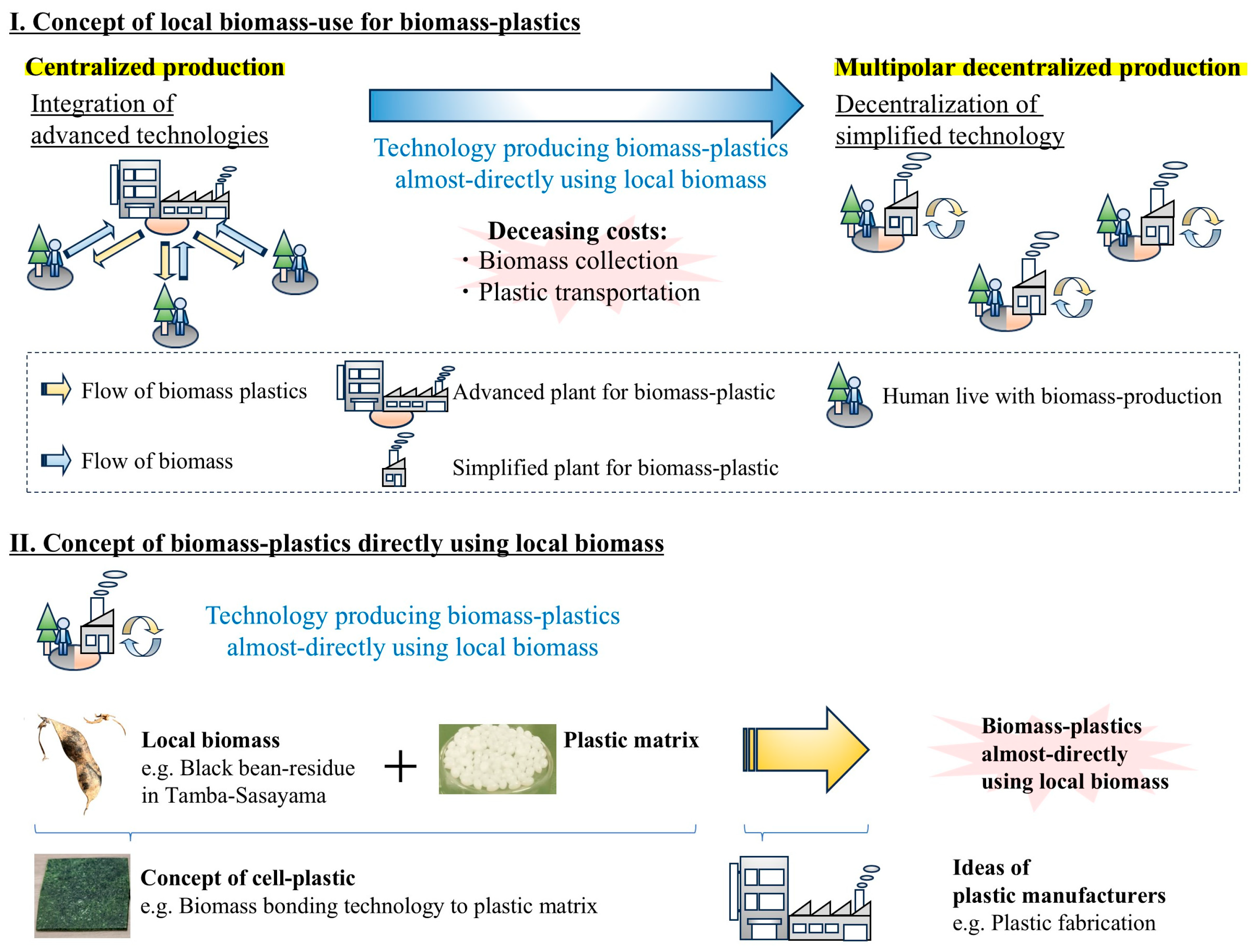
This review examine the practical implementation of bioplastics by summarizing technological and policy trends in existing biobased plastics, evaluating decentralized production models suited to Japan’s social infrastructure, and exploring potential of unicellular green algae in cell-plastics and their integration with regional biomass resources. It also discusses challenges related to molding processes, biodegradability evaluation, and life cycle assessment (LCA). Using cell-plastics derived from unicellular green algae as an illustrative example, we discuss a direct biomass utilization approach for plastics and extend this concept to consider the strategic use of underutilized regional and industrial biomass resources (Figure 1).
Historically, bioplastics were developed primarily as renewable alternatives to petroleum-derived feedstocks [12]. More recently, however, the focus has expanded beyond simple substitution to include biodegradability, carbon cycling, and the broader circularity of plastic-resource systems. Existing reviews have largely organized bioplastics in terms of material classes, biodegradation behavior, or life cycle assessment [13]. In contrast, this review examines how these technological trends can be interpreted and applied within Japan’s specific social and industrial infrastructure, with particular emphasis on the combined use of regionally underutilized biomass resources, decentralized production concepts, and the emerging potential of cell-plastics based on unicellular green algae. Thus, rather than merely summarizing existing bioplastics, this review discusses a systems-level direction for constructing a circular plastics framework adapted to Japanese industries and regions.

2. Biobased Plastics as a Sustainable Resource Supply for Plastic Production (With Biomass Naphtha as an Intermediary)

Plastics are synthetic polymeric materials primarily derived from petrochemical feedstocks and are commonly referred to as synthetic resins [14]. Their industrial development began with semi-synthetic materials such as celluloid in the nineteenth century and expanded with the advent of fully synthetic plastics such as Bakelite in the early twentieth century [15,16,17]. Subsequent advances in polyolefin polymerization, including the development of Ziegler–Natta catalysts, enabled large-scale plastic production and accelerated the widespread adoption of plastics in modern society [18,19,20]. As a result of these technological innovations, plastics became easier to process and more affordable, and they have now become indispensable materials in modern society.
Plastics are highly versatile materials, but many plastic products are used in largely disposable ways. Even durable engineering plastics eventually degrade through wear and oxidation, are replaced, and are ultimately discarded. At present, more than 99% of plastics are produced from fossil resources, primarily petroleum [21]. Most are manufactured from naphtha and are rarely recycled [22], but are instead predominantly incinerated, releasing carbon dioxide into the atmosphere. Current plastic production is therefore fundamentally non-circular and continues to drive both greenhouse gas emissions and resource depletion. A fundamental transformation of the existing system is urgently required.
To establish a circular and sustainable plastic production system, attention has increasingly turned to biobased plastics derived from renewable biomass resources [23]. Biomass is a renewable carbon resource, and the biomass industry has been suggested to contribute to climate change mitigation [24]. The term “biomass” is used in multiple contexts: in ecology, it refers to living organisms themselves, whereas in the context of biomass utilization, it refers to materials produced by biological activity [23]. Furthermore, depending on the context, biomass produced by organisms can refer to plant-derived materials [25], plant and algal materials [26], or materials produced by plants and animals [27].
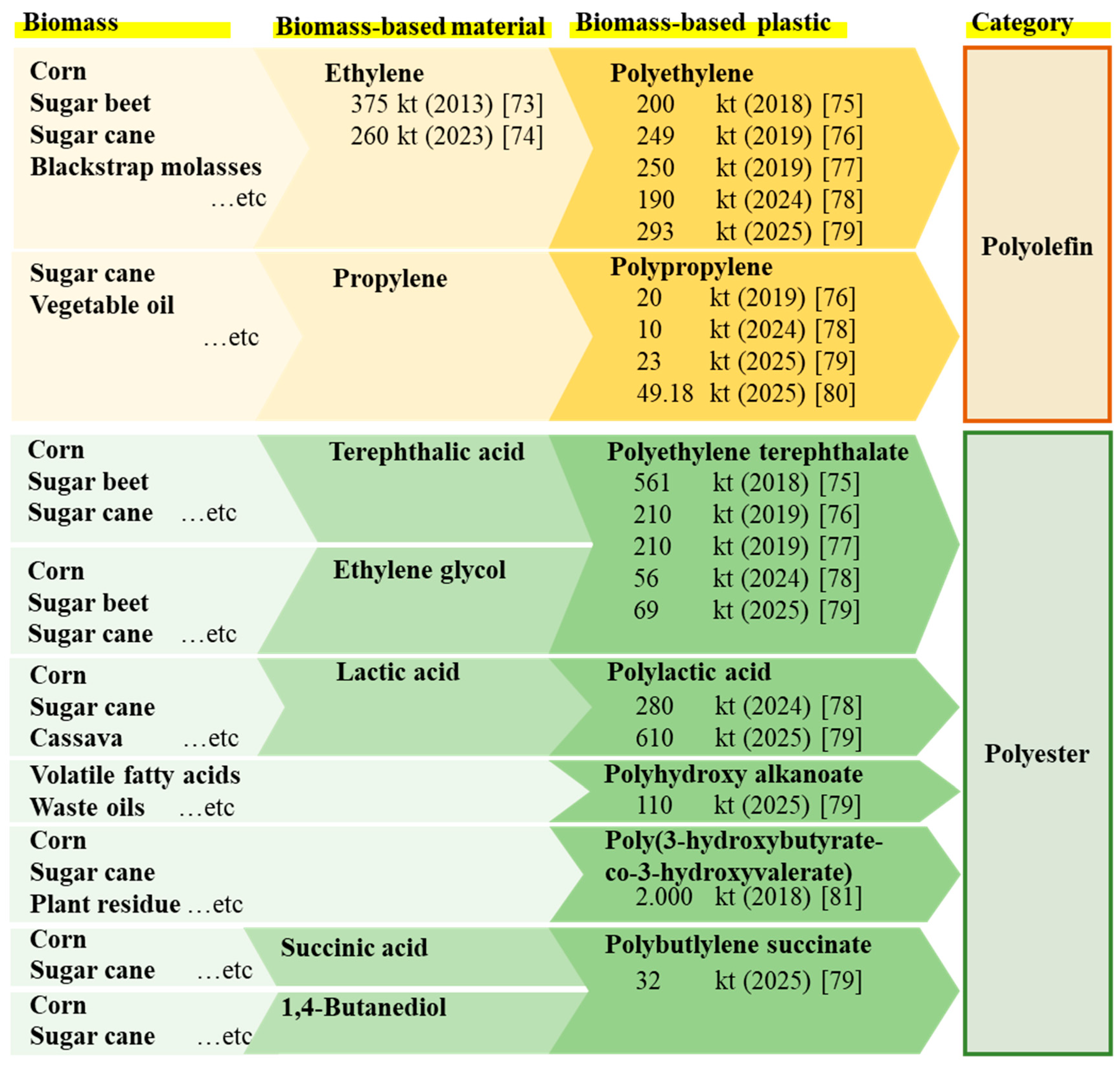
In recent years, industrial bioplastic production has largely relied on converting biomass into biomass naphtha, which is then used as a feedstock for plastic monomer production. Biomass naphtha serves as a renewable alternative to fossil naphtha for the production of polyolefins (PE/PP). Pilot-scale production began in late 2010s, and commercial-scale production of polypropylene and polyethylene derived from biomass-based feedstocks commenced in Germany in 2019 [28]. Biomass naphtha currently produced mainly by thermochemical conversion of biomass—such as corn, sugarcane, wood chips, and vegetable oils—followed by separation and purification.
A major advantage of biomass naphtha is its compatibility with existing petrochemical infrastructure. It can be processed in conventional naphtha crackers without major modification, and the resulting monomers are chemically indistinguishable from those derived from petroleum. This compatibility has enabled the widespread use of the mass balance approach in bioplastic manufacturing, in which the proportion of biomass-derived feedstock introduced into a system is allocated to end products through certified accounting schemes [29]. This approach has played a significant role in accelerating the adoption of biobased plastics.
However, biomass naphtha remains constrained by limited physical supply [30]. In addition, indicative offer prices in 2022 were approximately USD 2700–3200 per ton, corresponding to four to five times the price of fossil naphtha. Given these limitations, producers often prefer to market bioplastics with relatively high, but not necessarily 100%, biomass content through mass balance allocation rather than supply fully biobased plastics in small volumes.
Nevertheless, if bioplastics are to contribute meaningfully to long-term sustainability goals rather than merely commercial branding, plastics with high biomass must be produced. The limited supply of biomass-derived feedstock therefore creates a strong need for stable and scalable routes to bioplastic raw materials. As a result, increasing attention has been directed toward production pathways that do not rely on biomass naphtha.

3. Biodegradable Biobased Plastics for Sustainable Plastic Resources

When assessing the sustainability of plastics, it is essential to account not only for production but also environmental fate after use, including biodegradability in the environment. With increasing concern over plastic leakage into natural ecosystems, microplastics smaller than 5 mm have attracted global attention because of their adverse effects on ingestion, tissue accumulation, oxidative stress, and organismal growth and reproduction [31,32]. Therefore, environmental biodegradability is a critical consideration in sustainable plastic use. Modern biobased plastics are expected not only to reduce dependence on fossil resources but also to decrease the fraction of persistent plastic waste in the environment [33].
Early biobased plastics—including historically important PHB—were developed primarily as alternatives to petroleum-derived plastics, with less focus on biodegradability or carbon cycling. However, widely used commodity plastics such as polyethylene (PE), polypropylene (PP), polyvinyl chloride (PVC), and polystyrene (PS) are highly recalcitrant and persist in the environment in large quantities [34], posing significant ecological risks [35,36]. In particular, non-biodegradable plastics like PE remain in marine ecosystems for long periods, where they enter food webs and act as physical and chemical stressors [37].
Biodegradable plastics are generally defined as plastics that can be degraded by microorganisms in the environment, regardless of whether their feedstocks are petroleum-based or biomass-derived [38,39]. Representative examples include polyhydroxyalkanoates (PHAs), polylactic acid (PLA), and polycaprolactone (PCL). However, biodegradability depends strongly on polymer structure, microbial and enzymatic activity, and the disposal environment [12]. Some materials are primarily assessed under controlled composting conditions, whereas the same materials may degrade much more slowly or incompletely in home-composting, soil, freshwater, or marine environments. Accordingly, biodegradation time cannot be generalized across all biodegradable plastics, because both the rate and extent of degradation vary substantially depending on the polymer type and the disposal environment. Moreover, the degradation products discussed in the literature are not always equivalent, and complete mineralization to carbon dioxide, water, and biomass should be clearly distinguished from partial deterioration, fragmentation, or surface erosion. These limitations also help explain why biodegradable biobased plastics have not been implemented uniformly worldwide: their effective use often depends on the availability of appropriate collection and industrial composting infrastructure, clear waste sorting, and application-specific end-of-life management [40,41,42]. Therefore, discussions of biodegradable biomass plastics should address not only whether a material is biodegradable, but also under what conditions, by which degradation pathway, and to what endpoint that biodegradability is demonstrated [43]. Representative biodegradable biobased plastics are summarized in the following subsections.
Among representative biodegradable biobased plastics, biodegradation behavior, likely degradation routes, and practical end-of-life constraints differ substantially [12,42,43]. PHAs are generally regarded as the most broadly biodegradable major bioplastics, because many bacteria and fungi can depolymerize and mineralize them under soil, freshwater, marine, sludge, and compost-related conditions, although the degradation rate still varies with polymer composition, crystallinity, specimen thickness, and local microbial communities [12,43]. By contrast, PLA is often discussed as a biodegradable plastic, but its efficient biodegradation is usually associated with thermophilic industrial-composting conditions; under ambient soil, freshwater, or marine environments, degradation is often much slower, and hydrolysis, oligomer formation, and subsequent microbial assimilation should not be conflated with rapid complete mineralization [12,42]. PCL is also susceptible to microbial and enzymatic degradation, but its degradation behavior likewise depends strongly on molecular weight, crystallinity, blend composition, and environmental exposure conditions [42,43]. Therefore, even among representative biodegradable plastics, neither degradation rate nor degradation endpoint can be generalized, and the reported outcomes may range from molecular-weight reduction and surface erosion to oligomer/monomer formation and complete mineralization to carbon dioxide, water, and biomass [12,42]. These differences also mean that application design and end-of-life management cannot be uniform across materials, because the suitability of industrial composting, organic recycling, or integration with existing waste-treatment systems depends on the specific polymer and disposal environment [42].

3.1. Polyhydroxyalkanoates (PHAs)

Polyhydroxyalkanoates (PHAs) are among the best-known biodegradable bioplastics. Their major representative, polyhydroxybutyrate (PHB), is an aliphatic polyester that can be mineralized by many environmental microorganisms to carbon dioxide, water, and biomass [44,45,46]. PHB was identified in the early twentieth century and later recognized as an intracellular storage compound in microorganisms, which stimulated the development of microbial fermentation processes for PHA production [44,47].
Industrial interest in PHAs expanded from the 1980s onward. A notable milestone was the scale-up of P(3HB/3HV), a copolymer of PHB and 3-hydroxyvalerate with improved toughness [48]. PHAs attracted attention because they combine biodegradability with material properties partly comparable to those of conventional plastics such as polypropylene [46,49]. Later developments included commercial product applications and growing interest in biomedical uses. By 2020, more than 150 types of PHAs had been identified [50], and advances in non-sterile cultivation, mixed microbial cultures, and the use of waste streams as feedstocks [51]. Research in the 2010s further expanded toward new producer strains, engineered microorganisms with improved yields or tailored polymer compositions, pilot-scale production from waste feedstocks, and new application fields [52].

3.2. Polylactic Acid (PLA)

Polylactic acid (PLA), synthesized in 1932 by W.H. Carothers of DuPont, has gained attention as a biodegradable resin derived from renewable resources. PLA has a low glass transition temperature (~60 °C) and faces challenges in heat resistance and impact strength [53]. As a result, numerous material modification strategies have been explored. Annealing can increase crystallinity and improve heat resistance [53]. Inorganic fillers such as talc [54], calcium carbonate [55], nanoclay [56], and fibrous cellulose [57] have been used for mechanical reinforcement and to improve toughness. Nanofillers also enhance fracture resistance in inherently brittle PLA.
Owing to continued material and process development, PLA has become one of the most widely supplied chemically synthesized biodegradable plastics [58]. Continued technological development has positioned PLA as one of the most widely supplied chemically synthesized biodegradable plastics today. However, from an end-of-life perspective, efficient biodegradation of PLA is generally associated with thermophilic industrial-composting systems, whereas substantially slower degradation is often reported under unmanaged or ambient environmental conditions; this dependence on appropriate collection, sorting, and composting infrastructure is one reason why its global implementation remains uneven.

3.3. Polycaprolactone (PCL)

Polycaprolactone (PCL) is a biodegradable aliphatic polyester with a low melting point (~60 °C), high ductility, and excellent processability [59]. PCL is compatible with conventional molding processes such as injection molding, extrusion, melt spinning, and FDM-type 3D printing [60]. Due to its flexibility and impact resistance, it is widely used both as a standalone material and as an impact modifier or plasticizer for other biodegradable polymers such as PLA and PBS [59].
In biomedical applications, PCL’s high biocompatibility and slowly progressing enzymatic/microbial degradability have enabled its application in drug delivery systems, tissue engineering scaffolds, bone fixation materials, and sutures [61,62]. Although its low heat resistance and moderate mechanical strength limit certain uses, reinforcement through fiber composites, copolymerization, and nucleating agents is actively being investigated [63]. PCL continues to expand its presence across industrial, medical, and educational domains. Since the discovery of Aureobasidium pullulans as a PCL-degrading bacterium in 1974 [64], multiple PCL-degrading strains have been reported, and a range of studies has examined the effects of molecular weight, crystallinity, film thickness, and environmental microbial communities on degradation behavior [33,65,66,67,68]. PCL has also been industrially produced as blends with starch [69].
More broadly, the case of PCL highlights a recurring limitation of current biodegradable bioplastics: many still depend on centralized industrial production and agricultural feedstocks that may compete with food resource. Future development will therefore need to accommodate variability in waste biomass feedstocks and the flexible processing conditions required in regional and small-scale manufacturing settings.

4. Global Trends in Biobased Plastics and Japan’s Strategic Response

Globally, biobased plastics still account for only a small fraction of total plastic production (Figure 2); however, both production capacity and market size are growing steadily. According to 2024 data from European Bioplastics, global bioplastic production capacity is projected to expand from approximately 2.47 million tons in 2024 to about 5.73 million tons by 2029—more than doubling within five years—with 45% of applications concentrated in food packaging and related packaging sectors [70]. In recent years, both bio-based drop-in plastics such as bio-PE and bio-PET, and biodegradable plastics such as PHA, PLA, and PBS have grown significantly. Notably, some reports indicate that biodegradable bioplastics comprise more than half of global bioplastic production as of 2024 [71]. Driven by stricter environmental regulations and corporate carbon-neutrality commitments worldwide, annual growth rates of 10–20% are anticipated through around 2030 [72].
In response to these global trends, Japan has accelerated efforts on both the policy and industrial fronts. The Ministry of the Environment’s Plastic Resource Circulation Strategy adopts “3R + Renewable” as a core principle and sets a national target to introduce approximately 2 million tons of biobased plastics annually by 2030. As part of this initiative, Japan formulated the Bioplastic Introduction Roadmap in 2021. The roadmap highlights that domestic use of bioplastics was only 40,000–50,000 tons per year in the mid-2010s, indicating the scale of expansion needed to reach the 2030 target. In practice, of the roughly 10 million tons of plastics used annually in Japan, biobased and biodegradable plastics amount to only around 80,000 tons—revealing major challenges in supply volume, cost competitiveness, and application development.
On the industrial side, major Japanese chemical manufacturers are expanding development and investment aimed at both domestic international markets. For example, Kaneka Corp. has announced a target of more than 50,000 tons per year of PHB production [82], while Kobe Fine Chemical Co., Ltd., aims to supply approximately 10,000 metric tons of PLA annually in the Japanese market by 2030 [83]. As a result, bioplastic materials developed in Japan are gaining practical applications in food packaging, textiles, automotive components, and other sectors. At the same time, even biobased materials must ensure environmental performance over the entire life cycle, including compatibility with recycling systems.
At the same time, the expansion of biobased plastics requires environmental performance across the full life cycle, including compatibility with recycling systems. “Bio-based” and “biodegradable” are distinct concepts and should not be conflated in discussions of circularity [12,84]. Drop-in bioplastics such as bio-PE and bio-PET are chemically identical to their fossil-derived counterparts and can therefore, in principle, be integrated more readily into existing recycling streams. By contrast, biodegradable plastics such as PHA, PLA, PBS, and PCL must be matched carefully to the application, collection and sorting systems, and existing recycling infrastructure [85]. Compostability does not imply recyclability, and one suitable end-of-life route does not guarantee another. For this reason, intended end-of-life pathways should be defined at the design stage.
Japanese policy documents explicitly identify key issues such as the use of mass balance approaches, prioritization of applications by societal impact, and the mobilization of regional biomass resources [86]. This distinction is particularly important in Japan, where end-of-life management must be aligned not only with material properties but also with the practical constraints of regional collection, sorting, and processing systems [42].
Overall, biobased plastics are shifting globally from a niche category to a growing industrial segment. While pursuing the ambitious 2-million-ton target for 2030, ref. [87] is seeking to respond to this trend through coordinated advances in policy, technology, and supply-chain development. Importantly, given Japan’s resource constraints—limited petroleum reserves, restricted agricultural land, and a geographically dispersed population and industry structure—Japan also provides a relevant context in which to examine for a “residue-based, decentralized bioplastic production model” that leverages unused biomass and regional production networks. Thus, examining bioplastic strategies aligned with Japan’s social and industrial infrastructure is of critical importance.

5. Concept of Biobased Plastics Adapted to Japan’s Social Infrastructure

Although biomass is abundant in Japan, the wider adoption of biobased plastics has been hindered by several structural factors. These include the spatial mismatch between biomass supply sites and bioplastic feedstock production facilities, as well as the need to apply chemical conversion processes essentially equivalent to those used for conventional plastic feedstocks. For this reason, Japan may be better served by appropriately scaled, regionally distributed production systems than by large-scale centralized production. Greater production volume does not necessarily translate into higher overall efficiency, because long-distance transport from production sites to dispersed consumption sites can impose substantial energy, labor, and time costs. Accordingly, effective systems must match regional plastic demand with locally available biomass resources.
Wider deployment may also require reconsidering the performance expectations imposed on some plastic products. In selected applications, strict purity specifications may not always be necessary, provided that the required material performance is maintained. As long as the material satisfies the required material performance, a certain degree of variability in purity and the resulting material properties should be acceptable. If such variability can be tolerated, production processes for biobased plastics can be simplified, and production processes may be simplified and local implementation made more feasible—thereby enabling broader deployment. Based on criteria such as non-edibility, supply stability, compatibility with regional brands and local economies, and compositional suitability of biomass residues as plastic materials, the following section discusses potential biomass supply and utilization schemes within Japanese regional communities.
According to an October 2024 report by the Statistics Bureau of Japan [88], 35.8% of the national population resides in the Tokyo metropolitan area (one metropolis and seven prefectures), and 16.3% in the Kinki region (two prefectures and four prefectures), indicating a strong concentration of population in major urban centers. Nevertheless, populations in other regions, although smaller in scale, are certainly present and cannot be disregarded. Assuming that plastic demand is roughly proportional to population, the demand for plastics in rural areas is likewise non-negligible and requires an appropriate supply system.
However, plastic feedstocks are often produced through microbial fermentation using genetically modified organisms (GMOs), requiring substantial capital investment and advanced containment systems to prevent GMO leakage. These constraints naturally favor centralized production in areas where skilled personnel and continuous infrastructure investment are more readily available. Under such a supply structure, serving dispersed rural demand can impose high transport costs and make it difficult to respond flexibly to local demand.
For this reason, transitioning away from a highly centralized structure toward a multi-nodal, regionally distributed system may offer a useful conceptual direction for Japan’s biomass-plastics strategy. In this review, this proposition is presented as a systems-level perspective based on supply–demand distribution, transportation burden, and regional resource availability, rather than as a quantitatively verified techno-economic conclusion. To enable such distributed production, two conditions are essential: (1) the availability of biomass resources at the local level, and (2) the establishment of simple, locally implementable production methods.
In recent years, various regions in Japan have begun to identify characteristic underutilized biomass resources that have potential carbon sources for bioplastic production (Table 1). These resources differ markedly by region, reflecting local agricultural production systems and industrial activities. For example, in the Tokachi region of Hokkaido, several hundred thousand tons of wheat and potato starch-processing residues, beet pulp, and lignocellulosic by-products are generated annually, providing a biomass stream in which food-related residues and cellulose-rich residues coexist [89]. In the Uonuma region of Niigata Prefecture, one of Japan’s largest rice-producing areas, substantial quantities of rice straw are generated, and although most of it is incorporated into soil or composted [90], the volume remains significant. In contrast, in the Higashi-Hiroshima region of Hiroshima Prefecture, large quantities of rice husks and rice straw are produced; however, their utilization efficiency remains low, and they cannot be considered fully exploited [91]. Additionally, Inatomi reported the quantities of these biomass resources and suggested their potential use as industrial feedstocks [92].
These regional characteristics suggest that such areas may serve not only as sources of industrial residues but also as local biomass production clusters that are closely coupled with regional ecosystems, agricultural practices, and industrial structures. This also indicate that biomass currently used mainly for composting or other low-value applications could be re-evaluated as a feedstock for higher-value material use.
Tamba-Sasayama City in Hyogo Prefecture provides an illustrative case. The region possesses a production structure in which rice farming, black soybean cultivation, livestock production, and forestry co-exist, resulting in stable year-round supplies of multiple biomass categories—such as rice straw, rice husks, black soybean pods, underutilized bamboo, and wood-processing by-products. Additionally, the city is a typical mid-sized regional city where production sites are concentrated yet also enjoy strong logistical access to major metropolitan centers such as Osaka and Kobe. For these reasons, Tamba-Sasayama exhibits characteristics highly suitable for testing a multi-nodal biomass circulation model. Accordingly, the authors have been conducting research to establish localized production and supply methods for biobased plastics, positioning Tamba-Sasayama as a “local production for local consumption” model case for bioplastics within the Kinki region.
Tamba-Sasayama City is an inland municipality in Hyogo Prefecture with a population of approximately 38,700 as of 2025 [97]. Owing to its location roughly midway between the Seto Inland Sea and the Sea of Japan, the city is classified as having an inland climate, with relatively low annual precipitation of around 1500 mm [97]. Geographically, the city lies within the Sasayama Basin, which covers an area of 377.6 km2; because the surrounding mountains forming the basin are uniformly low in elevation, the catchment area is small [97]. For these reasons, the region has historically faced difficulty securing agricultural water [98], and in the past, some paddy fields were abandoned from rice cultivation without irrigation—known locally as “gisei-den” (“sacrifice fields”). However, in more modern times, to make effective use of such land, these fields were converted into dry fields for cultivating crops other than rice, a practice known as “horisaku”, with black soybeans (Glycine max L. Merrill) being the primary crop [99]. As a result, the cultivation of black soybeans has become one of the region’s major agricultural industries [98]. “Tamba-guro” refers collectively to a group of local landraces [98]; today, the Hyogo Prefecture Tamba Black Soybean Promotion Council manages elite lines—“Kawakita”, “Habe-guro”, “Hyo-kei-kuro No. 3”, and “Hyo-kei-kuro No. 6” [100]. In 2019, a total of 144.8 kg of seed was produced, and 7.0 tons of seed were collected from 27 seed-producing fields within the city [101]. Normally, only the seeds are used for food, and large quantities of branches and leaves remain as agricultural residues, so that effective utilization of this biomass has long been sought. Historically, a portion of these residues was burned in “hanya” (ash huts) to produce ash fertilizer for maintaining soil fertility [101]. However, the majority of the residues are difficult to process and are simply incinerated, making it hard to regard them as being effectively utilized. In particular, the burning of black soybean residues produces large volumes of smoke, creating recurring issues related to smoke pollution, thus highlighting the strong need for alternative uses of this biomass. These conditions make black soybean residues a relevant example of underutilized regional biomass for potential bioplastic applications.
The straw of G. max typically contains about 39.8 ± 0.6% cellulose, 22.6 ± 1.0% hemicellulose, 10.5 ± 0.7% insoluble lignin, and 2.31 ± 0.18% soluble lignin, and they are generally classified as lignocellulosic biomass [102]. While lignocellulosic biomass is often cited as an inexpensive and abundant biomass resource, lignin is biologically recalcitrant, and its resistance to degradation results in high conversion costs for biomass-derived products: consequently, its utilization is often considered limited [103]. Nonetheless, G. max represents an herbaceous biomass, which is substantially easier to process and utilize than woody biomass, offering greater practicality for bioplastic applications.
Furthermore, the food industry operates at extremely large material throughputs in modern society, and when considering biomass availability, the utilization of food-processing residues generated by private companies holds substantial significance. Among many agricultural raw materials, sugar is one of the most important processed commodities worldwide. According to the USDA Foreign Agricultural Service, global sugar production is approximately 177 million tons annually as a 10-year average [104]. Sugar beet (Beta vulgaris ssp. vulgaris) is a major industrial crop accounting for roughly 35% of global sugar production [105], with its enlarged roots (600–1200 g) as a harvested beet containing approximately 20% sucrose, 75% water, and 5% pulp [106]. Although sugar beet originated in Mediterranean climates characterized by hot, dry summers and relatively wet winters, it is now cultivated predominantly in temperate to subarctic regions as a cool-season crop and can also be grown in steppe or desert climates under irrigation. In Japan as well, sugar beet constitutes an important feedstock for sugar production and is widely cultivated, particularly in Hokkaido. According to the 2023 report “Production Results of 2023 Beet Sugar” issued by the Hokkaido Department of Agriculture, three major sugar producers in Hokkaido collectively processed 3,402,658.87 tons of beet (100%), yielding 447,536.71 tons of sugar (13%) and 133,790.50 tons of beet pulp (3%), the fibrous residue remaining after sucrose extraction [107]. These data indicate that although beet pulp represents only a few percent of the processed beet mass, the overall production volume remains large because beet production itself is substantial. Beet pulp is currently supplied primarily as dried flakes or compressed pellets and used mainly as feed for horses and other livestock. If higher-value applications for beet pulp can be developed, they may create economic value through the more effective utilization of an existing by-product, diversification of local biomass use, and the expansion of non-feed applications. Despite being a by-product of beet sugar processing, beet pulp contains relatively little sugar or other non-structural carbohydrates but is instead rich in dietary fiber, with approximately 10–12% protein and 0.7% calcium [108]. This composition suggests that beet pulp could serve as a promising biomass feedstock for bioplastic materials that leverage the principles and technologies of cell-based plastics discussed later in this review, while still providing desirable mechanical properties. In addition, herbaceous biomass like grassland biomass in general is known to store more CO2-derived carbon below ground compared with woody biomass [109], further increasing its potential as a carbon-cycle resource. Thus, residues from black soybean “Tamba-guro” represent an exemplary case of a non-edible, regionally branded herbaceous biomass that can be locally supplied, whereas beet pulp represents an exemplary case of a fiber-rich, molding-compatible by-product that can be supplied stably and in large quantities. Although these remain prototype examples, they are of conceptual value because they demonstrate a framework potentially applicable to other regions under similar conditions.
Although this discussion has focused on “Tamba-guro” as an example of underutilized regional biomass residues in Japan, increasing attention has also been directed toward rice straw and rice husks as alternative biomass resources [92]. These residues are major agricultural by-products in Southeast Asian countries where rice is a staple food [110]. Thus, the framework discussed here is not limited to black soybean residues, but may also be applicable to other forms of underutilized regional biomass. In this sense, the approach may be relevant not only to Japan but also to biomass-based plastics strategies in other countries.

6. Concept of Directly Using Biomass as a Plastic Feedstock

To substantially increase the supply capacity of biobased plastics, direct use of biomass as a plastic feedstock is an important concept. This concept is not entirely new, and related materials—such as highly filled wood–plastic composites (WPCs) [111,112,113], rice straw powder/fiber-filled composites [114,115], and bamboo powder/flour composites [116,117,118]—have been previously reported. However, these earlier materials were primarily developed as structural composites and were not designed to exploit the intrinsic structural or interfacial functions of biological cells themselves, nor to serve as platforms for broader cell-based biomass-material design.
In recent years, the authors have proposed cell-plastics that utilize unicellular green algae such as Chlamydomonas reinhardtii and Chlorella spp.—organisms that grow autotrophically using CO2 as a carbon source—as direct biomass feedstocks [119,120,121,122,123,124,125] (Table 2). Many unicellular green algae, being aquatic biomass, are recognized as third-generation feedstocks that could not compete with arable land or potable water, and marine microalgae cultivated in seawater further reduce freshwater consumption [126]. Moreover, compared with terrestrial plants, microalgae exhibit CO2 fixation rates 10–50 times higher [127], and their carbohydrates generally contain low amounts of lignin (with a high proportion of fermentable sugars), making them significantly easier to saccharify and attractive as promising, sustainable biomass feedstocks for bioethanol production [128,129].
Among these species, the freshwater microalga C. reinhardtii stands out as one of the most extensively studied model organisms: by 2007, it had been shown to share 706 protein families with humans [132], and it is widely used in biochemical, physiological, and genetic research [133], one of the most extensively studied model microalgae. Additionally, C. reinhardtii produces a range of value-added molecules—including carbohydrates, proteins, lipids, short-chain oligosaccharides, antioxidants, and carotenoids [134,135,136,137,138]—and can efficiently generate precursors for biofuels, textile and paper fibers, pharmaceutical compounds, and dietary supplements [139,140,141]. It is also considered biosafe, with no reported toxicity [142]. These features make it a useful platform organism for cell-based material design, although further molecular understanding of its cell wall remains important [134,143,144,145,146,147,148,149,150,151,152,153].
Traditionally, extraction of intracellular components from C. reinhardtii requires intensive cell disruption using methods such as bead beating [154,155], highlighting the mechanical robustness of the cells—a feature often regarded as a bottleneck in microbial industrial production. However, such robustness becomes advantageous when C. reinhardtii is considered as a structural component of plastic materials. Furthermore, microalgae are eukaryotes with diverse post-translational modification capacities, which are advantageous for recombinant protein production and synthetic biology applications [156,157]: therefore, their potential as functional material platforms is considerable. Based on these considerations, the authors have pursued the development of cell-plastics primarily using C. reinhardtii as the raw material. When using these unicellular algae as a plastic feedstock, an adhesive filler is required to bind the cells together. To achieve this, the authors adhered C. reinhardtii cells using glycerol and bovine serum albumin (BSA) to create a cell sheet, which was then coated with a flexible organic thin film such as a two-dimensional polymer. These layers were subsequently laminated repeatedly, yielding a free-standing, multilayered structure—termed cell-plastic [124], as reported in [158,159,160]. In addition, mixed-type cell-plastics—where C. reinhardtii cells are directly blended into various polymer matrices—have also been developed, including polybutylene succinate (PBS) [119], starch [120], poly(vinyl alcohol) (PVA) [121], intracellular components [123,125], and epoxy or urethane resins [122], all of which form free-standing composite materials incorporating intact algal cells.

7. Further Advances in Cell Adhesion Strategies for Green Algal Cell-Plastics

In recent years, attempts have emerged to improve the adhesion efficiency of green algal cells either to each other or to polymer matrices by exploiting endogenous cell-adhesive factors. Two approaches have been reported: (i) using C. reinhardtii cell lysates to mediate cell–cell adhesion [125], and (ii) purifying proteins from the lysates to serve as adhesive components. These studies have suggested that the helical structures of collagen-like proteins may contribute substantially to adhesion [123]. This studies suggest that collagen-like proteins may play an important role in adhesion, raising the possibility of improving both cell–cell and cell–matrix interactions in cell-plastics.
Building on these insights, the authors have focused on modifying cellular components—carbohydrates such as cellulose, pectin (polygalacturonic acid), sulfated polysaccharides, and calcium carbonate [126], as well as cell wall-associated proteins [143,144,145,146,147,148,149,150,151,152,153]—to improve affinity toward plastic matrices. The cell wall of green algae can be broadly categorized into two layers: (i) the external cell wall and (ii) the internal cell wall. More specifically, the external layer comprises a polysaccharide matrix of pectin, agar, alginate, and algaenan polymers, whereas the internal layer consists of microfibrillar matrices containing fucose, xylose, rhamnose, arabinose, and galactose, together with pectins, fucans, hemicellulose, and glycoproteins [161]. These components, even in C. reinhardtii, represent promising targets for chemical modification.
Although the structure of the C. reinhardtii cell wall was extensively investigated from the 1970s through the late 2000s [162,163], current understanding still relies heavily on foundational studies by Imam and colleagues—who characterized the effects of the cell wall–lytic enzyme lysin on wall architecture and protein composition—and on the general consensus that the wall comprises a multilayered extracellular matrix formed from carbohydrates and approximately 20–25 polypeptides [143]. Importantly, unlike the cellulose-based walls typical of many microalgae, the C. reinhardtii cell wall is composed of layers rich in glycoproteins reminiscent of extensin-like structures in higher plants [164]. Electron microscopy reveals that the protective wall contains five dense layers [144] enriched in glycoproteins. Goodenough and colleagues described these layers—extending from the cytoplasmic side to the exterior—as five fractions: W1 (membrane-anchoring protein layer), W2 (dense layer with fibrous proteins), W4 (sodium perchlorate-soluble core), W6 (sodium perchlorate-soluble core), and W7 (outer fibrillar surface) [144,145,146]. Among these, W4 and W6 constitute cores comprising dense granules and fibrous structures that contain chaotrope-soluble glycoproteins [144,145]. These layers include numerous high-molecular-weight hydroxyproline-rich glycoproteins (HRGPs), which are essential structural elements of W2 and W6 [165,166]. Chromatography and mass spectrometry analyses have partially revealed their sequences and compositions, while electron microscopy has elucidated their lamellar architecture. The cell wall of C. reinhardtii is considered to contain multiple glycoprotein components relevant to the structural and interfacial behavior of cell-plastics. In particular, HRGPs and less wall-bound glycoproteins (LWGPs) are regarded as important wall-associated constituents. HRGPs are expected to be O-glycosylated with arabinose (Ara) and galactose (Gal) mainly on Hyp and Ser residues, and possibly Thr, whereas LWGPs may be N-glycosylated with mannose (Man) via Thr, Ser, and Asn residues [165], suggesting that these glycoproteins play distinct roles in the structural organization and interfacial characteristics of cell-plastics. Differences in glycosylation pattern and molecular organization may therefore affect cell–cell interactions, interfacial adhesion, and the resulting morphology of multilayered cell-plastic structures. Additionally, low-molecular-weight proteins (30–50 kDa) rich in serine and threonine—referred to as “14-3-3” proteins—have been identified [146,147,148]; these proteins are thought to participate in cell wall crosslinking and may represent promising targets for chemical modification frameworks.
In the internal wall layers (W1 and W2), insoluble glycoprotein scaffolds are prominent [143,144,145], whereas the outer layers contain chaotrope-soluble glycoproteins [145]. These structural characteristics further highlight the potential of using wall proteins as chemical modification targets to improve interactions with polymer matrices. Collectively, these findings indicate that the carbohydrates and proteins of the C. reinhardtii cell wall constitute modifiable targets that may play key roles in mediating adhesion to plastic matrices. At the same time, various strategies have been proposed to optimize the material properties of biodegradable plastics without compromising biodegradability—for example, by copolymerizing aromatic units such as terephthalic acid [167] or by constructing amide linkages via the amine groups of amino acids to generate polyester amides [168]. Given that algal cells themselves are biodegradable, the authors anticipate that these modifications, when combined with biodegradable polymer matrices, will allow cell-plastics to retain robust biodegradability.
However, if one seeks to exploit the above-mentioned features by using C. reinhardtii or other green algae in pure culture, supplying such biomass at bulk scale becomes highly challenging, because doing so would require specialized cultivation facilities equipped with advanced technologies for large-scale microbial production. Even if such factories were functioning sufficiently, it would be practically impossible to supply an amount that matches the production volume of plastics.
Therefore, it will become essential to differentiate how green algae are used, such as using green algae as a material for technological development to transfer the technology to other biomass such as underutilized regional biomass, using green algae together with other biomass such as underutilized regional biomass, or using green algae under conditions in which the cellular functions are highly utilized. In the field of cell-plastics technology and its associated requirements, the authors are pursuing not only approaches aimed at supplying bulk quantities of material but also technologies for fabricating cell-plastics through the direct utilization of cells. Cell-plastics containing viable cells, including genetically engineered cells, represent novel materials that impart cellular metabolic functions to plastics, and further advances in this research area are expected.
Nevertheless, the current status of cell-plastics should be interpreted with caution from the viewpoint of industrial feasibility. Although previous studies have demonstrated proof-of-concept fabrication, multilayer structuring, and measurable mechanical properties at laboratory scale, these findings do not yet establish practical readiness for large-scale implementation [120]. Important challenges remain regarding the stable and economical cultivation of algal biomass, compatibility with continuous manufacturing processes, scalability of multilayer fabrication, reproducibility of interfacial structures, and industrial throughput [169,170]. In addition, while mechanical performance has been reported under experimental conditions, its consistency, durability, and applicability to broader product requirements have not yet been sufficiently validated [171]. Therefore, at the present stage, cell-plastics should be regarded not as an already established industrial solution, but as an emerging materials concept and technological platform that requires further process development, performance evaluation, and demonstration-scale verification.

8. Prospects for the Future Social Dissemination of Biomass Plastics

The acceleration of global warming and the continued dependence on fossil resources are compelling a fundamental transformation of the non-circular system represented by petroleum-derived plastics. Although various bioplastics have been developed to date, they have not yet provided a fundamental solution in terms of cost, supply capacity, or biomass content. Thus, materials and production schemes that exhibit both high biomass content and genuine circularity are therefore still needed.
As outlined in this review, a decentralized production model aligned with Japan’s social infrastructure—leveraging non-edible and currently underutilized biomass such as Tamba black soybean residues and beet pulp, while integrating the concept of cell plastics that directly utilize unicellular green algae—may provide a conceptually promising framework for transitioning from centralized to multi-nodal distributed production. In particular, the high CO2 assimilation capability and unique cell wall structure of C. reinhardtii may support the development of functional biomass plastics through interfacial design with polymer matrices. However, given the constraints of large-scale algal cultivation, a more realistic pathway is to combine green algae with regional biomass or to position algae primarily as a technological platform rather than as a bulk feedstock.
Furthermore, the industrial dissemination of biomass plastics requires not only the development and evaluation of raw materials but also close collaboration with plastic molding factories that handle large-scale forming processes. Within existing molding operations such as injection molding, extrusion, and blow molding, it is necessary to evaluate under practical conditions how increases in biomass content or variability derived from fillers influence melt viscosity, cooling shrinkage, dimensional stability, mold fouling, and cycle time. Optimization of parameters that directly affect factory handling—such as pellet geometry, moisture content, and compounding conditions—is equally important. As requirements for mechanical properties, surface quality, and recycling compatibility differ substantially across applications, it will be essential to co-develop evaluation metrics and draft standards with molding companies and end-product manufacturers.
In this context, the appropriate end-of-life option should also be differentiated according to application category [85,172]. For short-lifetime applications such as certain packaging materials, compatibility with collection systems and either mechanical recycling or managed composting may be particularly important, whereas for durable applications, long-term material stability and integration into established recycling routes are more critical. In all cases, contamination risk must be carefully considered, because the unintended mixing of biomass plastics with existing collection, sorting, and recycling streams can reduce processing efficiency and material quality. Therefore, if a decentralized production model is to be implemented in practice, material design must be coordinated not only with molding processes but also with regional systems for collection, sorting, recycling, and, where relevant, biodegradation management [42]. In other words, the social implementation of biomass plastics depends not only on advances in material development but also on their consistency with end-of-life infrastructure and waste-management pathways [173].
Only when a biomass material developed at the laboratory scale can be processed “with high yield” and “without major modifications to existing production lines” will it be accepted by industry as a viable sustainable plastic. In this sense, establishing an iterative collaborative framework between materials development and manufacturing sites is key to the societal implementation of circular biomass plastics. The present review is intended to clarify the conceptual rationale and systems-level implications of decentralized biomass-plastics production in Japan, rather than to present a quantitatively verified techno-economic comparison with centralized production systems. Key variables that should be included in future techno-economic comparisons include biomass bulk density, preprocessing requirement, transport radius, storage stability, seasonal supply fluctuation, achievable compounding ratio, and compatibility with existing molding infrastructure. Quantitative assessment of economic feasibility, including transportation, preprocessing, facility scale, and regional logistics, will require future demonstration-scale studies.
In addition, for transitioning toward a circular society, systematic evaluation of biodegradability is indispensable when producing biomass plastics at an industrial scale. “Biobased” and “biodegradable” are conceptually distinct, and biodegradation depends on environmental conditions—including temperature, moisture, microbial communities, pH, and exposure format [174]—making it impossible to scientifically substantiate environmental benefits without standardized testing regimes. Beyond ISO- and ASTM-based compostability and marine environment assessments, evaluation frameworks tailored to regional climate, soil composition, and waste management infrastructure will be required. Because durability during use and biodegradability after disposal often conflict, application-specific “functional lifetime design”—materials that perform only for the necessary duration and subsequently degrade reliably—will become essential. For materials such as non-edible biomass composites and cell plastics, which inherently contain compositional and structural heterogeneity, understanding and standardizing biodegradation behavior represent critical steps toward public acceptance and large-scale deployment. Thus, biodegradation assessment is not an auxiliary verification step but a core component for ensuring circularity, and should be situated within an LCA framework that integrates material design, manufacturing, and end-of-life processes.
For example, Walker et al. reviewed 56 comparative LCA studies and reported that although many biomass plastics reduce climate-change impacts relative to fossil plastics, environmental burdens associated with land-use change and fertilizer/pesticide use remain non-negligible [175]. Bishop et al. highlighted the strong influence of methodological choices—such as functional units, system boundaries (especially treatment of biogenic carbon), and end-of-life scenarios—on LCA outcomes, arguing against simplistic conclusions favoring bioplastics [176]. Reviews by Ali and Tecorralco-Bobadilla similarly noted that although biomass use can reduce fossil resource dependence and GHG emissions during raw material stages, these advantages diminish when process energy is fossil-derived [177]. Atiwesh et al. summarized that while biomass plastics may reduce climate impacts, trade-offs such as agricultural land expansion, water consumption, and toxicity-related burdens may arise, cautioning against the facile assumption that “biomass = environmentally superior” [178].
Taken together, evaluating the circularity of biomass plastics requires an integrated LCA framework that considers (i) origin of raw materials (e.g., whether they rely on residues or byproducts that do not compete with food), (ii) decarbonization of manufacturing processes in the context of the national energy mix, and (iii) end-of-life design synchronized with regional collection, recycling, and biodegradation infrastructure. The cell plastics discussed in this review—derived from unicellular green algae and regional underutilized biomass such as black soybean residues and beet pulp—align with desirable directions indicated by prior LCAs in that they utilize non-food, residue-based resources. However, to scientifically validate their environmental advantages, future efforts must involve process design and data acquisition at demonstration scales, followed by LCA and material flow analyses tailored to Japan’s social infrastructure, enabling quantitative positioning of these materials within a circular biomass plastic system.
Going forward, it will be essential to advance interdisciplinary research that integrates materials science, microbial engineering, and regional resource management, in order to articulate concrete implementation strategies for a circular plastic society—one that encompasses but is not limited to cell plastics, and fully leverages diverse perspectives on biomass plastic utilization.

Author Contributions

A.N.: Conceptualization, Methodology, Validation, Investigation, Resources, Data curation, Writing—original draft, Writing—review and editing, Visualization, Supervision, Project administration, Funding acquisition. Z.M.: Conceptualization, Project administration, Funding acquisition. T.H.: Conceptualization, Methodology, Validation, Investigation, Resources, Data curation, Writing—original draft, Writing—review and editing, Visualization, Supervision, Project administration, Funding acquisition. All authors have read and agreed to the published version of the manuscript.

Funding

This work was supported by Tamba-Sasayama Community Development Program Leveraging Japan Agricultural Heritage (funding data: 30 June 2025).

Institutional Review Board Statement

Not applicable.

Informed Consent Statement

Not applicable.

Data Availability Statement

The original contributions presented in this study are included in the article. Further inquiries can be directed to the corresponding author.

Acknowledgments

The authors deeply appreciate Naoya Hori and his colleague in Tamba-Sasayama city hall for their kind help. The authors also thank Shintaro Nemoto of Kobe University for his thoughtful support and valuable discussions.

Conflicts of Interest

Author Zaiken Mito serves as President of Daidokasei Co., Ltd. Author Tomohito Horimoto was employed by the company Mitsui DM Sugar Co., Ltd. The remaining authors declare that the research was conducted in the absence of any commercial or financial rela-tionships that could be construed as a potential conflict of interest.

References

  1. The Copernicus Climate Change Service of the European Union. Surface Air Temperature for July 2025. Available online: https://climate.copernicus.eu/surface-air-temperature-july-2025 (accessed on 22 December 2025).
  2. Kyoto Protocol to the United Nations Framework Convention on Climate Change. 1998. Available online: https://unfccc.int/resource/docs/convkp/kpeng.pdf (accessed on 5 December 2025).
  3. Our World in Data. Annual Concentration of Atmospheric Carbon Dioxide. Carbon Dioxide Concentrations in the Atmosphere. Available online: https://ourworldindata.org/grapher/co2-long-term-concentration (accessed on 5 December 2025).
  4. Romanello, M.; Walawender, M.; Hsu, S.C.; Moskeland, A.; Palmeiro-Silva, Y.; Scamman, D.; Ali, Z.; Ameli, N.; Angelova, D.; Ayeb-Karlsson, S.; et al. The 2024 report of the Lancet Countdown on health and climate change: Facing record-breaking threats from delayed action. Lancet 2024, 404, 1847–1896. [Google Scholar] [CrossRef]
  5. IPCC. Summary for Policymakers. In Climate Change 2021: The Physical Science Basis; Masson-Delmotte, V., Zhai, P., Pirani, A., Connors, S.L., Péan, C., Berger, S., Caud, N., Chen, Y., Goldfarb, L., Gomis, M.I., et al., Eds.; Contribution of Working Group I to the Sixth Assessment Report of the Intergovernmental Panel on Climate Change; Cambridge University Press: Cambridge, UK; New York, NY, USA, 2021; pp. 3–32. [Google Scholar]
  6. IPCC. Assessment Report Sixth (AR6) Synthesis Report. Climate Change 2023. Synthesis Report. Summary for Policymakers. Responses in the Near Term. Urgency of Near-Term Integrated Climate Action. C1. Available online: https://www.ipcc.ch/report/ar6/syr/resources/spm-headline-statements/ (accessed on 19 December 2025).
  7. Carbo Europe. How Are Fossil Fuels Formed? The Science Behind Oil, Coal, and Natural Gas. Available online: https://www.carboeurope.org/how-are-fossil-fuels-formed-the-science-behind-oil-coal-and-natural-gas/?utm_source (accessed on 5 December 2025).
  8. OPEC. Milestone 60th Edition of OPEC’s Annual Statistical Bulletin (ASB-2025) Launched on 2 July 2025. Available online: https://www.opec.org/pr-detail/1484568-2-july-2025.html (accessed on 5 December 2025).
  9. Höök, M.; Davidsson, S.; Johansson, S.; Tang, X. Decline and depletion rates of oil production: A comprehensive investigation. Philos. Trans. R. Soc. A Math. Phys. Eng. Sci. 2014, 372, 20120448. [Google Scholar] [CrossRef]
  10. Renewable Energy Institute. Pathway to Decarbonization of Petrochemicals in Japan: Shifting from Mass Consumption, Creating Carbon Circulation and Enhancing Renewable Energy Deployment. Available online: https://www.renewable-ei.org/pdfdownload/activities/REI_petrochemical_EN.pdf (accessed on 5 December 2025).
  11. Plastics Europe. Plastics—The Fast Facts 2024. Available online: https://plasticseurope.org/knowledge-hub/plastics-the-fast-facts-2024/ (accessed on 5 December 2025).
  12. Nizamuddin, S.; Baloch, A.J.; Chen, C.; Arif, M.; Mubarak, N.M. Bio-based plastics, biodegradable plastics, and compostable plastics: Biodegradation mechanism, biodegradability standards and environmental stratagem. Int. Biodeter. Biodegr. 2024, 195, 105887. [Google Scholar] [CrossRef]
  13. Yadav, K.; Nikalje, G.C. Comprehensive analysis of bioplastics: Life cycle assessment, waste management, biodiversity impact, and sustainable mitigation strategies. PeerJ 2024, 12, e18013. [Google Scholar] [CrossRef]
  14. Gazal, A.; Gheewala, S. Plastics, microplastics and other polymer materials—A threat to the environment. J. Sustain. Energy Environ. 2020, 11, 113–122. [Google Scholar]
  15. Springate, M.E. Cellulose nitrate plastic (celluloid) in archaeological assemblages: Identification and care. Northeast Hist. Archaeol. 1997, 26, 63–72. [Google Scholar] [CrossRef]
  16. Neves, A.L.M. Cellulose Nitrate Objects in Collections: History of Science and Technology Hand in Hand with Conservation of Cultural Heritage. Ph.D. Thesis, NOVA University Lisbon, Lisbon, Portugal, 2023. [Google Scholar]
  17. Klun, B.; Rozman, U.; Ogrizek, M.; Kalčíková, G. The first plastic produced but the latest studied in microplastics research: The assessment of leaching, ecotoxicity and bioadhesion of bakelite microplastics. Environ. Pollut. 2022, 307, 119454. [Google Scholar] [CrossRef] [PubMed]
  18. Sivaram, S. The Ziegler catalysts. Resonance 2017, 22, 985–1006. [Google Scholar] [CrossRef]
  19. Sivaram, S. Giulio Natta and the origins of stereoregular polymers. Resonance 2017, 22, 1007–1023. [Google Scholar] [CrossRef]
  20. Sauter, D.W.; Taoufik, M.T.; Boisson, C. Polyolefins: A success story. Polymers 2017, 9, 185. [Google Scholar] [CrossRef]
  21. Ciel. The Production of Plastic and Petrochemical Feedstocks. Fueling Plastics. Fossils, Plastics, & Petrochemical Feedbacks. Available online: https://www.ciel.org/wp-content/uploads/2017/09/Fueling-Plastics-Fossils-Plastics-Petrochemical-Feedstocks.pdf (accessed on 5 December 2025).
  22. Karali, N.; Khanna, N.; Shah, N. Climate Impact of Primary Plastic Production. Sustainable Energy and Environmental Systems, Energy Analysis and Environment Impacts Division, Lawrence Berkeley National Laboratory: Berkeley, CA, USA, 2024. Available online: https://eta-publications.lbl.gov/sites/default/files/2024-09/climate_and_plastic_report_lbnl-2001585.pdf (accessed on 5 December 2025).
  23. Rosenboom, J.G.; Langer, R.; Traverso, G. Bioplastics for a circular economy. Nat. Rev. Mater. 2022, 7, 117–137. [Google Scholar] [CrossRef]
  24. IPCC. Renewable Energy Sources and Climate Change Mitigation: Special Report of the Intergovernmental Panel on Climate Change. Available online: https://www.ipcc.ch/site/assets/uploads/2018/03/SRREN_Full_Report-1.pdf (accessed on 11 December 2025).
  25. IEA. Tracking Bioenergy. Available online: https://www.iea.org/reports/bioenergy (accessed on 13 January 2023).
  26. U.S. Department of Energy. Bioenergy Basics. BIOMASS: A Renewable Energy Resource. Available online: https://www.energy.gov/eere/bioenergy/bioenergy-basics (accessed on 11 December 2025).
  27. U.S. Energy Information Administration. Biomass Explained. Biomass—Renewable Energy from Plants and Animals. Available online: https://www.eia.gov/energyexplained/biomass/ (accessed on 11 January 2025).
  28. Federal Ministry of Food and Agriculture. Fachagentur Nachwachsende Rohstoffe. Bioplastics. Plants Raw Materials Products. Available online: https://www.fnr.de/fileadmin/Projekte/2020/Mediathek/Brosch_Bioplastics_2020_web.pdf (accessed on 1 December 2025).
  29. Jeswani, H.K.; Krüger, C.; Kicherer, A.; Antony, F.; Azapagic, A. A methodology for integrating the biomass balance approach into life cycle assessment with an application in the chemicals sector. Sci. Total Environ. 2019, 687, 380–391. [Google Scholar] [CrossRef]
  30. Bos, P.; Ritzen, L.; van Dam, S.; Balkenende, R.; Bakker, C. Bio-based plastics in product design: The state of the art and challenges to overcome. Sustainability 2024, 16, 3295. [Google Scholar] [CrossRef]
  31. Marcharla, E.; Vinayagam, S.; Gnanasekaran, L.; Soto-Moscoso, M.; Chen, W.H.; Thanigaivel, S.; Ganesan, S. Microplastics in marine ecosystems: A comprehensive review of biological and ecological implications and its mitigation approach using nanotechnology for the sustainable environment. Environ. Res. 2024, 256, 119181. [Google Scholar] [CrossRef]
  32. Grattagliano, A.; Grattagliano, Z.; Manfra, L.; Libralato, G.; Biandolino, F.; Prato, E. An overview on microplastics hazards to the marine ecosystem and humans’ health. Water 2025, 17, 916. [Google Scholar] [CrossRef]
  33. Lefèvre, C.; Tidjani, A.; Vander Wauven, C.; David, C. The interaction mechanism between microorganisms and substrate in the biodegradation of polycaprolactone. J. Appl. Polym. Sci. 2002, 83, 1334–1340. [Google Scholar] [CrossRef]
  34. Haq, F.; Kiran, M.; Khan, I.A.; Mehmood, S.; Aziz, T.; Haroon, M. Exploring the pathways to sustainability: A comprehensive review of biodegradable plastics in the circular economy. Mater. Today Sustain. 2025, 29, 101067. [Google Scholar] [CrossRef]
  35. Pilapitiya, P.G.C.N.T.; Ratnayake, A.S. The world of plastic waste: A review. Clean. Mater. 2024, 11, 100220. [Google Scholar] [CrossRef]
  36. Nakanishi, A.; Iritani, K.; Sakihama, Y. Developing neo-bioplastics for the realization of carbon sustainable society. J. Nanotechnol. Nanomater. 2020, 1, 72–85. [Google Scholar]
  37. Wayman, C.; Niemann, H. The fate of plastic in the ocean environment—A minireview. Environ. Sci. Process Impacts 2021, 23, 198–212. [Google Scholar] [CrossRef]
  38. Wackett, L.P. Bio-based and biodegradable plastics: An annotated selection of World Wide Web sites relevant to the topics in microbial biotechnology. Microb. Biotechnol. 2019, 12, 1492–1493. [Google Scholar] [CrossRef]
  39. Japan Bioplastics Association (JBPA). What’s Biodegradable Pla. History and Background of Biodegradable Pla. Available online: https://www.jbpaweb.net/english/e-gp/ (accessed on 5 December 2025).
  40. Paul-Pont, I.; Ghiglione, J.F.; Gastaldi, E.; Ter Halle, A.; Huvet, A.; Bruzaud, S.; Lagarde, F.; Galgani, F.; Duflos, G.; George, M.; et al. Discussion about suitable applications for biodegradable plastics regarding their sources, uses and end of life. Waste Manag. 2023, 157, 242–248. [Google Scholar] [CrossRef]
  41. Communication from the Commission to the European Parliament, the Council, the European Economic and Social Committee and the Committee of the Regions. EU Policy Framework on Biobased, Biodegradable and Compostable Plastics. Available online: https://eur-lex.europa.eu/legal-content/EN/TXT/?uri=celex:52022DC0682 (accessed on 1 April 2026).
  42. Sultan, M.; Ali, N.; Naseem, M.; Islam, M.; Kareem, A.; Yang, Y.; Khan, F.; Gul, S.; Khan, A.; Ali, F.; et al. Management of bioplastic waste: A critical analysis of biodegradation and recycling approaches. J. Polym. Res. 2025, 32, 362. [Google Scholar] [CrossRef]
  43. Folino, A.; Pangallo, D.; Calabrò, P.S. Assessing bioplastics biodegradability by standard and research methods: Current trends and open issues. J. Environ. Chem. Eng. 2023, 11, 109424. [Google Scholar] [CrossRef]
  44. Palmeiro-Sánchez, T.; O’Flaherty, V.; Lens, P.N.L. Polyhydroxyalkanoate bio-production and its rise as biomaterial of the future. J. Biotechnol. 2022, 348, 10–25. [Google Scholar] [CrossRef]
  45. Mai, J.; Kockler, K.; Parisi, E.; Chan, C.M.; Pratt, S.; Laycock, B. Synthesis and physical properties of polyhydroxyalkanoate (PHA)-based block copolymers: A review. Int. J. Biol. Macromol. 2024, 263, 130204. [Google Scholar] [CrossRef] [PubMed]
  46. Madison, L.L.; Huisman, G.W. Metabolic engineering of poly(3-hydroxyalkanoates): From DNA to plastic. Microbiol. Mol. Biol. Rev. 1999, 63, 21–53. [Google Scholar] [CrossRef]
  47. Macrae, R.M.; Wilkinson, J.F. Poly-β-hydroxybutyrate metabolism in washed suspensions of Bacillus cereus and Bacillus megaterium. J. Gen. Microbiol. 1958, 19, 210–222. [Google Scholar] [CrossRef] [PubMed]
  48. Jo, S.Y.; Lim, S.H.; Lee, J.Y.; Son, J.; Choi, J.I.; Park, S.J. Microbial production of poly(3-hydroxybutyrate-co-3-hydroxyvalerate), from lab to the shelf: A review. Int. J. Biol. Macromol. 2024, 274, 133157. [Google Scholar] [CrossRef]
  49. King, P.P. Biotechnology. An industrial view. J. Chem. Technol. Biotechnol. 1982, 32, 2–8. [Google Scholar] [CrossRef]
  50. Sathiyanarayanan, G.; Esteves, S. Autotrophic bacterial production of polyhydroxyalkanoates using carbon dioxide as a sustainable carbon source. Front. Bioeng. Biotechnol. 2025, 13, 1545438. [Google Scholar] [CrossRef]
  51. Koller, M.; Maršálek, L.; de Sousa Dias, M.M.; Braunegg, G. Producing microbial polyhydroxyalkanoate (PHA) biopolyesters in a sustainable manner. New Biotechnol. 2017, 37, 24–38. [Google Scholar] [CrossRef] [PubMed]
  52. Guzik, M.; Witko, T.; Steinbüchel, A.; Wojnarowska, M.; Sołtysik, M.; Wawak, S. What has been trending in the research of polyhydroxyalkanoates? A systematic review. Front. Bioeng. Biotechnol. 2020, 8, 959. [Google Scholar] [CrossRef]
  53. Ranakoti, L.; Gangil, B.; Mishra, S.K.; Singh, T.; Sharma, S.; Ilyas, R.A.; El-Khatib, S. Critical review on polylactic acid: Properties, structure, processing, biocomposites, and nanocomposites. Materials 2022, 15, 4312. [Google Scholar] [CrossRef]
  54. Battegazzore, D.; Bocchini, S.; Frache, A. Crystallization kinetics of poly(lactic acid)-talc composites. Expr. Polym. Lett. 2011, 5, 849–858. [Google Scholar] [CrossRef]
  55. Li, H.; Huneault, M.A. Effect of nucleation and plasticization on the crystallization of poly(lactic acid). Polymer 2007, 48, 6855–6866. [Google Scholar] [CrossRef]
  56. Robledo-Ortíz, J.R.; del Campo, A.S.M.; López-Naranjo, E.J.; Arellano, M.; Jasso-Gastinel, C.F.; González-Núñez, R.; Pérez-Fonseca, A.A. Effect of low nanoclay content on the physico-mechanical properties of poly(lactic acid) nanocomposites. Polym. Polym. Compos. 2019, 27, 43–54. [Google Scholar] [CrossRef]
  57. Ren, Q.; Wu, M.; Wang, L.; Zheng, W.; Hikima, Y.; Semba, T.; Ohshima, M. Cellulose nanofiber reinforced poly(lactic acid) with enhanced rheology, crystallization and foaming ability. Carbohydr. Polym. 2022, 286, 119320. [Google Scholar] [CrossRef] [PubMed]
  58. Pesaranhajiabbas, E.; Misra, M.; Mohanty, A.K. Recent progress on biodegradable polylactic acid based blends and their biocomposites: A comprehensive review. Int. J. Biol. Macromol. 2023, 253, 126231. [Google Scholar] [CrossRef]
  59. Woodruff, M.A.; Hutmacher, D.W. Polycaprolactone: How a Well-Known and Futuristic Polymer Has Become an Innovative Collagen-Stimulator in Esthetics. Clin. Cosmet. Investig. Dermatol. 2020, 13, 31–48. [Google Scholar]
  60. Formas, A.; Kurowska, A.; Janusz, J.; Szczygieł, P.; Rajzer, I. Injection molding process simulation of polycaprolactone sticks for further 3D printing of medical implants. Materials 2022, 15, 7295. [Google Scholar] [CrossRef]
  61. Dash, T.K.; Konkimalla, V.B. Poly-ε-caprolactone based formulations for drug delivery and tissue engineering: A review. J. Control. Release 2012, 158, 15–33. [Google Scholar] [CrossRef]
  62. Martinez, R.A.; Martinez, L.B.A.; Agnelli, J.A.M.; Elui, V.M.C. A standardized assessment of moldability parameters of thermoplastic materials used in orthotic manufacturing. PLoS ONE 2022, 17, e0267777. [Google Scholar]
  63. Kayan, G.Ö.; Kayan, A. Polycaprolactone Composites/Blends and Their Applications Especially in Water Treatment. ChemEngineering 2023, 7, 104. [Google Scholar] [CrossRef]
  64. Fields, R.D.; Rodriguez, F.; Finn, R. Microbial degradation of polyesters: Polycaprolactone degraded by P. pullulans. J. Appl. Polym. Sci. 1974, 18, 3571–3579. [Google Scholar] [CrossRef]
  65. Krumov, N.; Atanasova, N.; Boyadzhieva, I.; Petrov, K.; Petrova, P. Biodegradation of poly(ε-caprolactone): Microorganisms, enzymes, and mechanisms. Int. J. Mol. Sci. 2025, 26, 5826. [Google Scholar] [CrossRef] [PubMed]
  66. Benedict, C.V.; Cameron, J.A.; Huang, S.J. Polycaprolactone degradation by mixed and pure cultures of bacteria and a yeast. J. Appl. Polym. Sci. 1983, 28, 335–342. [Google Scholar] [CrossRef]
  67. Lefebvre, F.; Daro, A.; David, C. Biodegradation of polycaprolactone by microorganisms from an industrial compost of household refuse. Part II. J. Macromol. Sci. Part A 1995, 32, 867–873. [Google Scholar] [CrossRef]
  68. Lefebvre, F.; David, C.; Wauven, C.V. Biodegradation of polycaprolactone by micro-organisms from an industrial compost of household refuse. Polym. Degrad. Stab. 1994, 45, 347–353. [Google Scholar] [CrossRef]
  69. Averous, L.; Moro, L.; Dole, P.; Fringant, C. Properties of Thermoplastic Blends: Starch–Polycaprolactone. Polymer 2000, 41, 4157–4167. [Google Scholar] [CrossRef]
  70. European Bioplastics. EUBP Reveals the Results of the 2024 Market Data Report. Available online: https://www.european-bioplastics.org/eubp-reveals-the-results-of-the-2024-market-data-report/ (accessed on 5 December 2025).
  71. European Bioplastics. Bioplastics Market Development Update 2024. Available online: https://www.european-bioplastics.org/bioplastics-market-development-update-2024/?utm_source.com (accessed on 7 December 2025).
  72. BCC Research. Global Bioplastics Market Accelerates Toward 5,634.6 Kilotons by 2029. Available online: https://www.bccresearch.com/pressroom/pls/global-bioplastics-market-accelerates-toward-56346-kilotons#:~:text=Boston%3A%20According%20to%20the%20latest%20study%20from%20BCC,rate%20%28CAGR%29%20of%2018.3%25%20from%202024%20through%202029 (accessed on 10 December 2025).
  73. IEA-ETSAO; IRENA Technology. Production of Bio-Ethylene Technology Brief. Available online: https://www.irena.org/-/media/Files/IRENA/Agency/Publication/2013/IRENA-ETSAP-Tech-Brief-I13-Production_of_Bio-ethylene.pdf?utm_source=chatgpt.com (accessed on 7 December 2025).
  74. Braskem Expands Its Biopolymer Production by 30% Following an Investment of US $87 Million. The Brazilian Bio-Based Ethylene Facility Is Now Operating at a Capacity of 260 Thousand Tons per Year. Available online: https://www.braskem.com.br/europe/news-detail/braskem-expands-its-biopolymer-production-by-30-following-an-investment-of-us-87-million (accessed on 7 December 2025).
  75. European Bioplastics. Bioplastics Market Data 2018. Global Production Capacities of Bioplastics 2018–2023. Global Production Capacities of Bioplastics in 2018. Available online: https://www.european-bioplastics.org/wp-content/uploads/2016/02/Report_Bioplastics-Market-Data_2018.pdf (accessed on 7 December 2025).
  76. European Bioplastics Conference. Bioplastics Market Development Update 2019. Available online: https://www.european-bioplastics.org/wp-content/uploads/2019/11/Report_Bioplastics-Market-Data_2019_short_version.pdf (accessed on 7 December 2025).
  77. Jeremic, S.; Milovanovic, J.; Mojicevic, M.; Bogojevic, S.S.; Nikodinovic-Runic, J. Understanding bioplastic materials—Current state and trends. J. Serbian Chem. Soc. 2020, 85, 51. [Google Scholar] [CrossRef]
  78. Plastics Europe. Bio-Based and Biodegradable Plastics. Available online: https://plasticseurope.org/sustainability/climate/circular-feedstocks/bio-based-and-biodegradable-plastics/ (accessed on 7 December 2025).
  79. European Bioplastics. Global Production Capacities of Biobased Plastics 2025. Available online: https://www.european-bioplastics.org/market/# (accessed on 7 December 2025).
  80. Towards Chem&Materials. Bio-Based Polypropylene Market Size and Companies Revenue by 2025–2034. Available online: https://www.towardschemandmaterials.com/insights/bio-based-polypropylene-market?utm_source=chatgpt.com (accessed on 7 December 2025).
  81. Sun, L.; García, J.; Gonzalez-Flo, E. Potential sustained production of polyhydroxyalkanoate copolymers using cyanobacteria microbiomes. Sci. Rep. 2025, 15, 26358. [Google Scholar] [CrossRef]
  82. Ghasemlou, M.; Barrow, C.J.; Adhikari, B. The future of bioplastics in food packaging: An industrial perspective. Food Packag. Shelf Life 2024, 43, 101279. [Google Scholar] [CrossRef]
  83. Kobe Fine Chemical Co., Ltd. Corporate Philosophy & Our Activities. Available online: https://kobeseika.co.jp/en/corp_philosophy.html?utm_source.com (accessed on 22 December 2025).
  84. Lackner, M.; Mukherjee, A.; Koller, M. What are “bioplastics”? Defining renewability, biosynthesis, biodegradability, and biocompatibility. Polymers 2023, 15, 4695. [Google Scholar] [CrossRef]
  85. Gioia, C.; Giacobazzi, G.; Vannini, M.; Totaro, G.; Sisti, L.; Colonna, M.; Marchese, P.; Celli, A. End of life of biodegradable plastics: Composting versus re/upcycling. ChemSusChem 2021, 14, 4167–4175. [Google Scholar] [CrossRef] [PubMed]
  86. Ueda, H. Japan’s Policy for Bioplastics Towards 2030 and 2050 and Position on Mass Balance Approach. Mitsubishi UFJ Research & Consulting Co., Ltd. Available online: https://iscc-system.org/wp-content/uploads/_legacy/2023/11/2_Japans-Policy-for-Bioplastics-towards-2030-and-2050-and-Position-to-Mass-Balance-Approach-%E2%80%93-Hiroyuki-Ueda-Chief-Researcher-Mitsubishi-UFJ-Research-and-Consulting-Co.-Ltd-behalf-of-MOE.pdf (accessed on 21 December 2025).
  87. Ministry of the Environment, Government of Japan. Roadmap for Bioplastics Introduction. Available online: https://www.env.go.jp/recycle/roadmap_for_bioplastics_introduction.html (accessed on 1 December 2025).
  88. Statistics Bureau of Japan. Current Population Estimates as of October 1, 2024. Available online: https://www.stat.go.jp/english/data/jinsui/2024np/index.html (accessed on 5 December 2025).
  89. Interim Evaluation Report. Tokachi Biomass Industrial City Initiative. 2023. Available online: https://www.city.obihiro.hokkaido.jp/_res/projects/default_project/_page_/001/005/508/tokachi-biomass-kityuhyoka.pdf (accessed on 5 December 2025).
  90. Plan of Promotion for Biomass-Use in Uonuma-City. 2021. Available online: https://www.jora.jp/wp-content/uploads/2021/02/uonuma.niigata.pdf (accessed on 5 December 2025).
  91. Concept of Biomass-Industrial city in Higashi-Hiroshima City. 2021. Available online: https://www.jora.jp/wp-content/uploads/2021/02/higashihiroshima_kousou.pdf (accessed on 5 December 2025).
  92. Inatomi, M. Estimation of mass amounts of attainable”ed biomass for fabricating bio-ash in each prefecture in Japan. J. NARO Res. Dev. 2025, 21, 21–25. [Google Scholar]
  93. Tamba-Sasayama City Government. Available online: https://www.city.tambasasayama.lg.jp/index.html (accessed on 17 December 2025).
  94. Tamba-Sasayama City Government. Forest Biomass Utilization Promotion Plan of Sasayama City. Available online: https://www.maff.go.jp/j/shokusan/biomass/b_kihonho/local/pdf/sinoyama.pdf?utm_source.com (accessed on 12 December 2025).
  95. Mitoyo City Government. Biomass Utilization Promotion Plan of Mitoyo City. Available online: https://www.jora.jp/wp-content/uploads/2021/02/20110930kagawa_mitoyo.pdf?utm_source.com (accessed on 12 December 2025).
  96. Aso City Government. Aso City Biomass Town Concept. Available online: https://www.city.aso.kumamoto.jp/files/uploads/2014/05/biomass.pdf (accessed on 12 December 2025).
  97. Tamba-Sasayama City. Summary of Tamba-Sasayama. Available online: https://www.city.tambasasayama.lg.jp/soshikikarasagasu/somuka/gyoseijoho/6050.html (accessed on 5 December 2025).
  98. Cultivation of Black Soy Bean in Tamba-Sasayama. Excellent Seeds and Family Farming Supported by “Mura”. Available online: https://tambasasayama-kuromame.jp/wp-content/uploads/2023/06/%E6%8E%B2%E8%BC%89%E7%94%A8-09.pdf (accessed on 3 December 2025).
  99. National Agriculture and Food Research Organization. Soybean varieties (Glycine max (L.) Merr.). Available online: https://www.naro.go.jp/collab/breed/0100/0109/index.html (accessed on 19 December 2025).
  100. Hyogo Prefecture. “Tamba-Guro”. Available online: https://web.pref.hyogo.lg.jp/nk12/af11_000000115.html (accessed on 3 December 2025).
  101. Japanese Nationally Important Agricultural Heritage Systems. Culturing of Kuro-Daizu in Tamba-Sasayama. Available online: https://www.maff.go.jp/j/nousin/kantai/attach/pdf/giahs_3_sasayama-5.pdf?utm_source.com (accessed on 19 December 2025).
  102. Martelli-Tosi, M.; Assis, O.B.G.; Silva, N.C.; Esposto, B.S.; Martins, M.A.; Tapia-Blácido, D.R. Chemical treatment and characterization of soybean straw and soybean protein isolate/straw composite films. Carbohydr. Polym. 2017, 157, 512–520. [Google Scholar] [CrossRef] [PubMed]
  103. Fellows, C.M.; Brown, T.C.; Doherty, W.O.S. Lignocellulosics as a renewable feedstock for chemical industry: Chemicals from lignin. In Green Chemistry for Environmental Remediation; Sanghi, R., Singh, V., Eds.; Wiley: Hoboken, NJ, USA, 2011; pp. 561–610. [Google Scholar]
  104. USDA. Foreign Agricultural Service. Production—Sugar. Available online: https://www.fas.usda.gov/data/production/commodity/0612000 (accessed on 1 December 2025).
  105. Harveson, R.M.; Hanson, L.E.; Hein, G.L. Compendium of Beet Diseases and Pests, 2nd ed.; APS Press: St. Paul, MN, USA, 2009; pp. 1–140. [Google Scholar]
  106. Nap, J.P.; de Ruijter, F.J.; van Es, D.S.; van der Meer, I.M. The case of sugar beet in Europe: A review of the challenges for a traditional food crop on the verge of climate change and circular agriculture. J. Agric. Food Res. 2025, 24, 102343. [Google Scholar] [CrossRef]
  107. Regarding the Production Status of Sugar Beets Harvested in 2023. Agricultural Promotion Division, Agriculture Promotion Bureau, Agriculture Department, Hokkaido Prefectural Government. Available online: https://www.pref.hokkaido.lg.jp/fs/1/0/3/2/6/0/0/1/_/R5%E5%B9%B4%E7%94%A3%E3%81%A6%E3%82%93%E8%8F%9C%E7%B3%96%E7%94%9F%E7%94%A3%E5%AE%9F%E7%B8%BE.pdf (accessed on 1 December 2025).
  108. Warren, L.K. Horse Feeding Myths and Misconceptions. Available online: https://en.engormix.com/equines/horse-nutrition/horse-feeding-myths-misconceptions_a34311/ (accessed on 1 December 2025).
  109. Food and Agriculture Organization of the United Nation. Livestock Solutions for Climate Change. Available online: https://openknowledge.fao.org/server/api/core/bitstreams/0d178ab7-b755-4eb2-a6cd-05ba1db35819/content (accessed on 1 December 2025).
  110. International Renewable Energy Agency (IRENA). Agricultural Residue-Based Bioenergy: Regional Potential and Scale-Up Strategies; IRENA. Available online: https://www.irena.org/-/media/Files/IRENA/Agency/Publication/2023/Nov/IRENA_Agricultural_residue_bioenergy_2023.pdf (accessed on 26 December 2025).
  111. Rimdusit, S.; Smittakorn, W.; Jittarom, S.; Tiptipakorn, S. Highly filled polypropylene rubber wood flour composites. Eng. J. 2011, 15, 17–30. [Google Scholar] [CrossRef]
  112. Niu, Z.; Chen, Y.; Feng, J. Preparation, structure, and property of wood flour incorporated polypropylene composites prepared by a solid-state mechanochemical method. J. Appl. Polym. Sci. 2016, 133, 43108. [Google Scholar] [CrossRef]
  113. Ibach, R.E.; Clemons, C.M. Long Term Durability of Wood-Plastic Composites Made with Chemically Modified Wood. Available online: https://research.fs.usda.gov/treesearch/55003 (accessed on 5 December 2025).
  114. Yao, F.; Wu, Q.; Lei, Y.; Xu, Y. Rice straw fiber-reinforced high-density polyethylene composite: Effect of fiber type and loading. Ind. Crops Prod. 2008, 28, 63–72. [Google Scholar] [CrossRef]
  115. Singh, A.K.; Bedi, R.; Khajuria, A. A review of composite materials based on rice straw and future trends for sustainable composites. J. Clean. Prod. 2024, 457, 142417. [Google Scholar] [CrossRef]
  116. Isa, A.; Minamino, J.; Mizuno, H.; Suzuki, S.; Kojima, Y.; Ito, H.; Makise, R.; Okamoto, M.; Hasegawa, T. Increased water resistance of bamboo flour/polyethylene composites. J. Wood Chem. Technol. 2013, 33, 208–216. [Google Scholar] [CrossRef]
  117. Jiang, S.; Wei, Y.; Hu, Z.; Ge, S.; Yang, H.; Peng, W. Potential application of bamboo powder in PBS bamboo plastic composites. J. King Saud Univ. Sci. 2020, 32, 1130–1134. [Google Scholar] [CrossRef]
  118. Xu, D.; He, S.; Leng, W.; Chen, Y.; Wu, Z. Replacing plastic with bamboo: A review of the properties and green applications of bamboo-fiber-reinforced polymer composites. Polymers 2023, 15, 4276. [Google Scholar] [CrossRef]
  119. Nakanishi, A.; Iritani, K.; Sakihama, Y.; Watanabe, M. Investigation of the mechanical strength of cell-plastics fabricated using unicellular green algal cells and varying weight ratios of biodegradable polybutylene succinate. Int. J. Microbiol. Biotechnol. 2020, 5, 159–164. [Google Scholar] [CrossRef]
  120. Nakanishi, A.; Iritani, K.; Sakihama, Y.; Watanabe, M.; Mochiduki, A.; Tsuruta, A.; Sakamoto, S.; Ota, A. Fabrication and biodegradability of starch cell-plastics as recyclable resources. Appl. Sci. 2021, 11, 847. [Google Scholar] [CrossRef]
  121. Iritani, K.; Nakanishi, A.; Ota, A.; Yamashita, T. Fabrication of novel functional cell-plastic Using polyvinyl alcohol: Effects of cross-linking structure and mixing ratio of components on the mechanical and thermal properties. Glob. Chall. 2021, 5, 2100026. [Google Scholar] [CrossRef] [PubMed]
  122. Iritani, K.; Nakanishi, A.; Nihei, R.; Sugitani, S.; Yamashita, T. Development of epoxy and urethane thermosetting resin using Chlorella sp. as curing agent for materials with low environmental impact. Polymers 2023, 15, 2968. [Google Scholar] [CrossRef] [PubMed]
  123. Nakanishi, A.; Nemoto, S.; Yamamoto, N.; Iritani, K.; Watanabe, M. Identification of cell-attachment factors derived from green algal cells disrupted by sonication in fabrication of cell plastics. Bioengineering 2023, 10, 893. [Google Scholar] [CrossRef] [PubMed]
  124. Nakanishi, A.; Iritani, K.; Sakihama, Y.; Ozawa, N.; Mochizuki, A.; Watanabe, M. Construction of cell-plastics as neo-plastics consisted of cell-layer provided green alga Chlamydomonas reinhardtii covered by two-dimensional polymer. AMB Express 2020, 10, 112. [Google Scholar] [CrossRef]
  125. Nakanishi, A.; Iritani, K.; Tsuruta, A.; Yamamoto, N.; Watanabe, M.; Ozawa, N.; Watanabe, M.; Zhang, K.; Tokudome, A. Fabrication of cell-plastics composed only of unicellular green alga Chlamydomonas reinhardtii as a raw material. Appl. Microbiol. Biotechnol. 2022, 106, 4459–4468. [Google Scholar] [CrossRef] [PubMed]
  126. Chen, C.-Y.; Zhao, X.-Q.; Yen, H.-W.; Ho, S.-H.; Cheng, C.-L.; Lee, D.-J.; Bai, F.-W.; Chang, J.-S. Microalgae-based carbohydrates for biofuel production. Biochem. Eng. J. 2013, 78, 1–10. [Google Scholar] [CrossRef]
  127. Wang, B.; Li, Y.; Wu, N.; Lan, C.Q. CO2 bio-mitigation using microalgae. Appl. Microbiol. Biotechnol. 2008, 79, 707–718. [Google Scholar] [CrossRef] [PubMed]
  128. Harun, R.; Danquah, M.K.; Forde, G.M. Microalgal biomass as a fermentation feedstock for bioethanol production. J. Chem. Technol. Biotechnol. 2009, 85, 199–203. [Google Scholar] [CrossRef]
  129. Ho, S.-H.; Chen, C.-Y.; Chang, J.-S. Effect of light intensity and nitrogen starvation on CO2 fixation and lipid/carbohydrate production of an indigenous microalga Scenedesmus obliquus CNW-N. Bioresour. Technol. 2012, 113, 244–252. [Google Scholar] [CrossRef]
  130. Ramkumar, N.; Mazumdar, D.; Mishra, P.; Subudhi, S. Mixotrophic cultivation of Chlamydomonas for value added biomass production: Valorization of organic acid rich spent effluent. Curr. Res. Green Sustain. Chem. 2021, 4, 100126. [Google Scholar] [CrossRef]
  131. Nakanishi, A.; Sakihama, Y.; Ozawa, N. Improvement of growth of Chlamydomonas reinhardtii in CO2—Stepwisely aerating condition. J. Appl. Biotechnol. Rep. 2021, 8, 37–40. [Google Scholar]
  132. Merchant, S.S.; Prochnik, S.E.; Vallon, O.; Harris, E.H.; Karpowicz, S.J.; Witman, G.B.; Terry, A.; Salamov, A.; Fritz-Laylin, L.K.; Maréchal-Drouard, L.; et al. The Chlamydomonas genome reveals the evolution of key animal and plant functions. Science 2007, 318, 245–250. [Google Scholar] [CrossRef]
  133. Salomé, P.A.; Merchant, S.S. A series of fortunate events: Introducing Chlamydomonas as a reference organism. Plant Cell 2019, 31, 1682–1707. [Google Scholar] [CrossRef]
  134. Velazquez-Lucio, J.; Rodríguez-Jasso, R.M.; Colla, L.M.; Sáenz-Galindo, A.; Cervantes-Cisneros, D.E.; Aguilar, C.N.; Fernandes, B.D.; Ruiz, H.A. Microalgal biomass pretreatment for bioethanol production: A review. Biofuel Res. J. 2018, 5, 780–791. [Google Scholar] [CrossRef]
  135. Harun, R.; Yip, J.W.S.; Thiruvenkadam, S.; Ghani, W.A.W.A.K.; Cherrington, T.; Danquah, M.K. Algal biomass conversion to bioethanol: A step-by-step assessment. Biotechnol. J. 2014, 9, 73–86. [Google Scholar] [CrossRef]
  136. Demuez, M.; Mahdy, A.; Tomás-Pejó, E.; González-Fernández, C.; Ballesteros, M. Enzymatic cell disruption of microalgae biomass in biorefinery processes. Biotechnol. Bioeng. 2015, 112, 1955–1966. [Google Scholar] [CrossRef]
  137. Moon, M.; Kim, C.W.; Park, W.K.; Yoo, G.; Choi, Y.E.; Yang, J.W. Mixotrophic growth with acetate or volatile fatty acids maximizes growth and lipid production in Chlamydomonas reinhardtii. Algal Res. 2013, 2, 352–357. [Google Scholar] [CrossRef]
  138. Sun, H.; Mao, X.; Wu, T.; Ren, Y.; Chen, F.; Liu, B. Novel insight of carotenoid and lipid biosynthesis and their roles in storage carbon metabolism in Chlamydomonas reinhardtii. Bioresour. Technol. 2018, 263, 450–457. [Google Scholar] [CrossRef]
  139. Hwang, J.H.; Kim, H.C.; Choi, J.A.; Abou-Shanab, R.A.I.; Dempsey, B.A.; Regan, J.M.; Kim, J.R.; Song, H.; Nam, I.H.; Kim, S.N.; et al. Photoautotrophic hydrogen production by eukaryotic microalgae under aerobic conditions. Nat. Commun. 2014, 5, 3234. [Google Scholar] [CrossRef]
  140. Madadi, R.; Maljaee, H.; Serafim, L.S.; Ventura, S.P.M. Microalgae as contributors to produce biopolymers. Mar. Drugs 2021, 19, 466. [Google Scholar] [CrossRef]
  141. Rahman, A.; Agrawal, S.; Nawaz, T.; Pan, S.; Selvaratnam, T. A review of algae-based produced water treatment for biomass and biofuel production. Water 2020, 12, 2351. [Google Scholar] [CrossRef]
  142. Ochoa-Méndez, C.E.; Lara-Hernández, I.; González, L.M.; Aguirre-Bañuelos, P.; Ibarra-Barajas, M.; Castro-Moreno, P.; González-Ortega, O.; Soria-Guerra, R.E. Bioactivity of an antihypertensive peptide expressed in Chlamydomonas reinhardtii. J. Biotechnol. 2016, 240, 76–84. [Google Scholar] [CrossRef] [PubMed]
  143. Imam, S.H.; Buchanan, M.J.; Shin, H.C.; Snell, W.J. The Chlamydomonas cell wall: Characterization of the wall framework. J. Cell Biol. 1985, 101, 1599–1607. [Google Scholar] [CrossRef]
  144. Goodenough, U.W.; Heuser, J.E. The Chlamydomonas cell wall and its constituent glycoproteins analyzed by the quick-freeze, deep-etch technique. J. Cell Biol. 1985, 101, 1550–1568. [Google Scholar] [CrossRef]
  145. Goodenough, U.W.; Gebhart, B.; Mecham, R.P.; Heuser, J.E. Crystals of the Chlamydomonas reinhardtii cell wall: Polymerization, depolymerization, and purification of glycoprotein monomers. J. Cell Biol. 1986, 103, 405–417. [Google Scholar] [CrossRef] [PubMed]
  146. Voigt, J.; Frank, R. 14-3-3 proteins are constituents of the insoluble glycoprotein framework of the Chlamydomonas cell wall. Plant Cell 2003, 15, 1399–1413. [Google Scholar] [CrossRef] [PubMed]
  147. Voigt, J.; Liebich, I.; Kiess, M.; Frank, R. Subcellular distribution of 14-3-3 proteins in the unicellular green alga Chlamydomonas reinhardtii. Eur. J. Biochem. 2001, 268, 6449–6457. [Google Scholar] [CrossRef]
  148. Voigt, J.; Stevanovic, S.; Schirle, M.; Fausel, M.; Maier, J.; Adam, K.H.; Marquardt, O. A 14-3-3 protein of Chlamydomonas reinhardtii associated with the endoplasmic reticulum: Nucleotide sequence of the cDNA and gene, and derived amino acid sequence. Biochim. Biophys. Acta 2004, 1679, 180–194. [Google Scholar] [CrossRef]
  149. Roberts, K.; Gurney-Smith, M.; Hills, G.J. Structure, composition and morphogenesis of the cell wall of Chlamydomonas reinhardtii. I. Ultrastructure and preliminary chemical analysis. J. Ultrastruct. Res. 1972, 40, 599–613. [Google Scholar] [CrossRef]
  150. Roberts, K. Crystalline glycoprotein cell walls of algae: Their structure, composition and assembly. Philos. Trans. R. Soc. Lond. B Biol. Sci. 1974, 268, 129–146. [Google Scholar] [CrossRef] [PubMed]
  151. Goodenough, U.W.; Heuser, J.E. Molecular organization of cell-wall crystals from Chlamydomonas reinhardtii and Volvox carteri. J. Cell Sci. 1988, 90, 717–733. [Google Scholar] [CrossRef]
  152. Hills, G.J.; Philips, J.M.; Gay, M.R.; Roberts, K. Self-assembly of a plant cell wall in vitro. J. Mol. Biol. 1975, 96, 431–441. [Google Scholar] [CrossRef]
  153. Monk, B.C.; Adair, W.S.; Cohen, R.A.; Goodenough, U.W. Topography of Chlamydomonas: Fine structure and polypeptide components of the gametic flagellar membrane surface and the cell wall. Planta 1983, 158, 517–533. [Google Scholar] [CrossRef]
  154. Nakanishi, A.; Aikawa, S.; Ho, S.H.; Chen, C.Y.; Chang, J.S.; Hasunuma, T.; Kondo, A. Development of lipid productivities under different CO2 conditions of marine microalgae Chlamydomonas sp. JSC4. Bioresour. Technol. 2014, 152, 247–252. [Google Scholar] [CrossRef] [PubMed]
  155. Lee, H.; Bingham, S.E.; Webber, A.N. Function of 3′ noncoding sequences and stop codon usage in expression of the chloroplast psaB gene in Chlamydomonas reinhardtii. Plant Mol. Biol. 1996, 31, 337–354. [Google Scholar] [CrossRef]
  156. Crozet, P.; Navarro, F.J.; Willmund, F.; Mehrshahi, P.; Bakowski, K.; Lauersen, K.J.; Pérez-Pérez, M.E.; Auroy, P.; Rovira, A.G.; Sauret-Gueto, S.; et al. Birth of a photosynthetic chassis: A MoClo toolkit enabling synthetic biology in the microalga Chlamydomonas reinhardtii. ACS Synth. Biol. 2018, 7, 2074–2086. [Google Scholar] [CrossRef]
  157. Rasala, B.A.; Muto, M.; Lee, P.A.; Jager, M.; Cardoso, R.M.F.; Behnke, C.A.; Kirk, P.; Hokanson, C.A.; Crea, R.; Mayfield, S.P. Production of therapeutic proteins in algae: Analysis of expression of seven human proteins in the chloroplast of Chlamydomonas reinhardtii. Plant Biotechnol. J. 2010, 8, 719–733. [Google Scholar] [CrossRef]
  158. Clair, S.; de Oteyza, D.G. Controlling a chemical coupling reaction on a surface: Tools and strategies for on-surface synthesis. Chem. Rev. 2019, 119, 4717–4776. [Google Scholar] [CrossRef]
  159. Janica, I.; Patroniak, V.; Samorì, P.; Ciesielski, A. Imine-based architectures at surfaces and interfaces: From self-assembly to dynamic covalent chemistry in 2D. Chem. Asian J. 2018, 13, 465–481. [Google Scholar] [CrossRef] [PubMed]
  160. Sakamoto, J.; van Heijst, J.; Lukin, O.; Schlüter, A.D. Two-dimensional polymers: Just a dream of synthetic chemists? Angew. Chem. Int. Ed. 2009, 48, 1030–1069. [Google Scholar] [CrossRef] [PubMed]
  161. Scholz, M.J.; Weiss, T.L.; Jinkerson, R.E.; Jing, J.; Roth, R.; Goodenough, U.; Posewitz, M.C.; Gerken, H.G. Ultrastructure and composition of the Nannochloropsis gaditana cell wall. Eukaryot. Cell 2014, 13, 1450–1464. [Google Scholar] [CrossRef]
  162. Miller, D.H.; Lamport, D.T.; Miller, M. Hydroxyproline heterooligosaccharides in Chlamydomonas. Science 1972, 176, 918–920. [Google Scholar] [CrossRef]
  163. Voigt, J.; Frank, R.; Wöstemeyer, J. The chaotrope-soluble glycoprotein GP1 is a constituent of the insoluble glycoprotein framework of the Chlamydomonas cell wall. FEMS Microbiol. Lett. 2009, 291, 209–215. [Google Scholar] [CrossRef]
  164. Saito, F.; Suyama, A.; Oka, T.; Yoko-O, T.; Matsuoka, K.; Jigami, Y.; Shimma, Y.I. Identification of novel peptidyl serine α-galactosyltransferase gene family in plants. J. Biol. Chem. 2014, 289, 20405–20420. [Google Scholar] [CrossRef] [PubMed]
  165. Poulhazan, A.; Arnold, A.A.; Mentink-Vigier, F.; Muszyński, A.; Azadi, P.; Halim, A.; Vakhrushev, S.Y.; Joshi, H.J.; Wang, T.; Warschawski, D.E.; et al. Molecular-level architecture of Chlamydomonas reinhardtii’s glycoprotein-rich cell wall. Nat. Commun. 2024, 15, 986. [Google Scholar] [CrossRef] [PubMed]
  166. Mathieu-Rivet, E.; Mati-Baouche, N.; Walet-Balieu, M.L.; Lerouge, P.; Bardor, M. N- and O-glycosylation pathways in the microalgae polyphyletic group. Front. Plant Sci. 2020, 11, 609993. [Google Scholar] [CrossRef]
  167. Zhang, Q.; Song, M.; Xu, Y.; Wang, W.; Wang, Z. Bio-based polyesters: Recent progress and future prospects. Prog. Polym. Sci. 2021, 120, 101430. [Google Scholar] [CrossRef]
  168. Dupret, I.; David, C.; Daro, A. Biodegradation of polyester-amides using a pure strain of micro-organisms or papain I. Model compounds. Polym. Degrad. Stab. 2000, 67, 497–504. [Google Scholar] [CrossRef]
  169. Chaudry, S.; Hurtado-McCormick, V.; Cheng, K.Y.; Willis, A.; Speight, R.; Kaksonen, A.H. Microalgae to bioplastics–routes and challenges. Clean. Eng. Technol. 2025, 25, 100922. [Google Scholar] [CrossRef]
  170. Sarker, N.K.; Kaparaju, P. Advances in algae-based bioplastics: From strain engineering and fermentation to commercialization and sustainability. Fermentation 2025, 11, 574. [Google Scholar] [CrossRef]
  171. Sudhakar, M.P.; Maurya, R.; Mehariya, S.; Karthikeyan, O.P.; Dharani, G.; Arunkumar, K.; Pereda, S.V.; Hernández-González, M.C.; Buschmann, A.H.; Pugazhendhi, A. Feasibility of bioplastic production using micro-and macroalgae—A review. Environ. Res. 2024, 240, 117465. [Google Scholar] [CrossRef]
  172. Spierling, S.; Venkatachalam, V.; Mudersbach, M.; Becker, N.; Herrmann, C.; Endres, H.-J. End-of-life options for bio-based plastics in a circular economy—Status quo and potential from a life cycle assessment perspective. Resources 2020, 9, 90. [Google Scholar] [CrossRef]
  173. King, S.; Locock, K.E. A circular economy framework for plastics: A semi-systematic review. J. Clean. Prod. 2022, 364, 132503. [Google Scholar] [CrossRef]
  174. Folino, A.; Karageorgiou, A.; Calabrò, P.S.; Komilis, D. Biodegradation of wasted bioplastics in natural and industrial environments: A review. Sustainability 2020, 12, 6030. [Google Scholar] [CrossRef]
  175. Walker, S.; Rothman, R. Life cycle assessment of bio-based and fossil-based plastic: A review. J. Clean. Prod. 2020, 261, 121158. [Google Scholar] [CrossRef]
  176. Bishop, G.; Styles, D.; Lens, P.N.L. Environmental performance comparison of bioplastics and petrochemical plastics: A review of life cycle assessment (LCA) methodological decisions. Resour. Conserv. Recycl. 2021, 168, 105451. [Google Scholar] [CrossRef]
  177. Ali, S.S.; Abdelkarim, E.A.; Elsamahy, T.; Al-Tohamy, R.; Li, F.; Kornaros, M.; Zuorro, A.; Zhu, D.; Sun, J. Bioplastic production in terms of life cycle assessment: A state-of-the-art review. Environ. Sci. Ecotechnol. 2023, 15, 100254. [Google Scholar] [CrossRef]
  178. Atiwesh, G.; Mikhael, A.; Parrish, C.C.; Banoub, J.; Le, T.A.T. Environmental impact of bioplastic use: A review. Heliyon 2021, 7, e07918. [Google Scholar] [CrossRef]
Figure 1. A substantially possible concepts of biomass plastic. Schematic illustration of the transition from centralized production to multipolar decentralized production of biomass plastics, highlighting the concept of biomass plastics based on the utilization of locally available biomass (I. Concept of local biomass use for biomass plastics). Schematic illustration of biomass plastics produced directly from regional biomass resources using cell-plastics as a research platform (II. Concept of biomass plastics directly using local biomass).
Applsci 16 04401 g001
Figure 2. Annual producing capacities of materials and plastics deriving from biomass. Biomass plastics that have attracted increasing attention in recent years were broadly classified into polyolefin-based and polyester-based types. Based on this categorization, “biomass-based plastics” were further classified, and their constituent “biomass” and “biomass-based materials” were systematically described [73,74,75,76,77,78,79,80,81].
Applsci 16 04401 g002
Table 1. Biomass availability and utilization by region in Japan.
ZoneReference
Year
Biomass TypeAvailability (t/Year)Utilization (t/Year)Reference
PrefectureRegion
HyogoTamba-Sasayama2025Rice straw10,5088932[93]
Tamba-Sasayama2015Forest residues39591391[94]
HokkaidoTokachi2022Woody biomass225,339143,120[89]
Tokachi2022Agricultural residues566,201290,058
NiigataUonuma2011Rice straw16,77016,770[90]
Uonuma2011Rice husk/Buckwheat husk33673367
Uonuma2011Thinning residues/Forest residues3145684
HiroshimaHigashi-hiroshima2021Rice husk/Rice straw30,8693266[91]
Higashi-hiroshima2021Forest residues14160
KagawaMitoyo2011Rice straw12,19112,191[95]
Mitoyo2011Rice husk26362636
Mitoyo2011Forest residues7160
KumamotoAso2014Rice straw16,12715,304[96]
Aso2014Bamboo biomass15958
Table 2. Researches regarding cell-plastics.
Types of Fabrication
for Cell-Plastics
Used Green AlgaMatrix/AttachmentGreen Algal
Concentration (wt%)
Mechanical PropertiesYearReference
Young’s Modulus (MPa)Tensile Strength (MPa)Strain at Break (%)
LayeringC. reinhardtiiCinnamate derivative; bovine serum albumin, glycerolApproximate 75~84 *6.2~9.00.29~0.325~152020[121]
MixingC. reinhardtiiPolybutylene succinate50~916.3~2400.16~8.82~102020[116]
MixingC. reinhardtiiStarch, oxdized starch50, 90100~3501~71.0~2.52021[117]
MixingChlorella sp.Polyvinyl alcoholApproximate 45~620.57~1.223.7~150.7~2.02021[118]
MixingC. reinhardtiiDisrupted cell-contents6~2566~7642.9~8.60.8~4.02022[122]
MixingChlorella sp.Epoxy, urethane47~95390~8006.3~181.6~4.02023[119]
MixingC. reinhardtiiDisrupted cell-contents98.0~99.5227.3~564.43.5~7.70.4~1.62023[120]
*: Value calculated with 100 mg/1.0 × 109 cells as cell density [130,131].
Disclaimer/Publisher’s Note: The statements, opinions and data contained in all publications are solely those of the individual author(s) and contributor(s) and not of MDPI and/or the editor(s). MDPI and/or the editor(s) disclaim responsibility for any injury to people or property resulting from any ideas, methods, instructions or products referred to in the content.