Article

Geomechanical Modelling and Rock Fragmentation Prediction for Blasting Optimization at a Limestone Quarry

1
Faculty of Engineering in Earth Sciences (FICT), ESPOL Polytechnic University, Gustavo Galindo Campus, Guayaquil 090101, Ecuador
2
Department of Engineering and Fiel Morphology, Polytechnic University of Madrid, 28040 Madrid, Spain
*
Author to whom correspondence should be addressed.
Appl. Sci. 2026, 16(9), 4386; https://doi.org/10.3390/app16094386
Submission received: 22 September 2025 / Revised: 26 February 2026 / Accepted: 22 April 2026 / Published: 30 April 2026
(This article belongs to the Special Issue Advances and Technologies in Rock Mechanics and Rock Engineering)

Abstract

Limestone quarrying relies strongly on drilling and blasting, processes whose performance depends on both the geomechanical conditions of the rock mass and the resulting fragmentation. This study integrates rock mass characterization, blast analysis, and slope-stability assessment to optimize rock breakage and operational safety. Rock mass quality was evaluated using RMR, GSI, RQD, A-factor, and SMR, while slope stability was analyzed through the limit equilibrium method and kinematic analysis. Fragmentation was quantified using UAV-based photogrammetry combined with AI-driven particle-size detection, enabling the construction of granulometric curves. These data were incorporated into the Kuz–Ram model, applying the Ash method to determine optimal drilling patterns. Five distinct rock masses were identified, and wedge- and block-type instabilities were detected along the working face. Mitigation measures, including catch berms and drainage ditches, were proposed. Optimal burden values ranged from 2.59 to 3.35 m, yielding D80 values below 60 cm.

1. Introduction

The fragmentation of a rock mass by blasting constitutes the initial and one of the most influential stages in quarry operations, as it directly affects downstream activities such as loading, hauling, crushing, and milling [1,2,3,4,5]. Effective blasting requires achieving fragmentation targets—such as D80—that are consistent with the operational constraints of downstream equipment, including the feed-size limitations of primary crushers.
Blast performance, however, is not governed merely by controllable design parameters such as burden, spacing, charge distribution, and initiation sequence. It is strongly conditioned by the geomechanical characteristics of the rock mass—such as discontinuity orientation, spacing, persistence and intact-rock strength—which cannot be modified directly but can be characterized and partly mitigated through engineering measures. Therefore, to adapt blast designs to site-specific conditions it is important to conduct geomechanical assessments (e.g., discontinuity mapping and RQD/GSI evaluation) before the extraction together with in situ monitoring during extraction [6,7,8]. These geological features not only influence blast-induced fragmentation but also control the stability of the final quarry slopes after blasting. Consequently, blast design must reconcile two interrelated objectives: achieving the required fragmentation for efficient production while maintaining adequate slope stability to ensure operational safety and long-term quarry viability.
Previous studies have extensively addressed rock fragmentation prediction using empirical and semi-empirical models, among which the Kuz–Ram model [3] and its subsequent modifications remain the most widely applied tools in surface mining and quarrying. These models relate blast geometry, explosive properties, and rock mass characteristics to the expected particle size distribution [3,4]. Parallel to this, slope stability analysis in quarries has traditionally been conducted using kinematic and limit equilibrium approaches [9,10,11,12], focusing on the identification of potential planar, wedge, or toppling failures controlled by discontinuity sets. Although both research streams are well established, they are commonly treated as independent tasks: fragmentation models are calibrated to optimize production, while slope stability analyses are performed as post-design or post-blast safety assessments.
Recent advances in remote sensing and digital rock mass characterization, particularly through UAV-based photogrammetry and AI-assisted image analysis, have significantly improved the quality, objectivity, and spatial coverage of geomechanical data [3,13,14]. These technologies allow detailed mapping of discontinuity networks on steep or inaccessible quarry faces and enable high-resolution, repeatable measurements of blast-induced rock fragmentation using image-based techniques [2,15,16]. Despite these developments, most existing studies still address geomechanical characterization, fragmentation prediction, and slope stability analysis as largely independent tasks. Consequently, the potential of these technologies to support an integrated blast design framework that explicitly links rock mass structure, fragmentation performance, and slope stability constraints has not yet been fully exploited in quarry blasting practice [2,10].
In this context, the present study proposes an integrated workflow that combines geomechanical characterization, slope stability assessment, and fragmentation modeling to optimize blast design in a limestone quarry. Rock mass properties are characterized through field measurements and UAV-based photogrammetry, and discontinuity-controlled failure mechanisms are evaluated using kinematic and limit equilibrium analyses. These geomechanical parameters are then incorporated into blastability assessment and Kuz–Ram fragmentation modeling, which is calibrated using AI-driven photogrammetric fragmentation data. By explicitly linking slope stability constraints with fragmentation-based optimization of the drilling pattern, the study demonstrates how blast design parameters, particularly burden, can be adapted to site-specific geomechanical conditions.
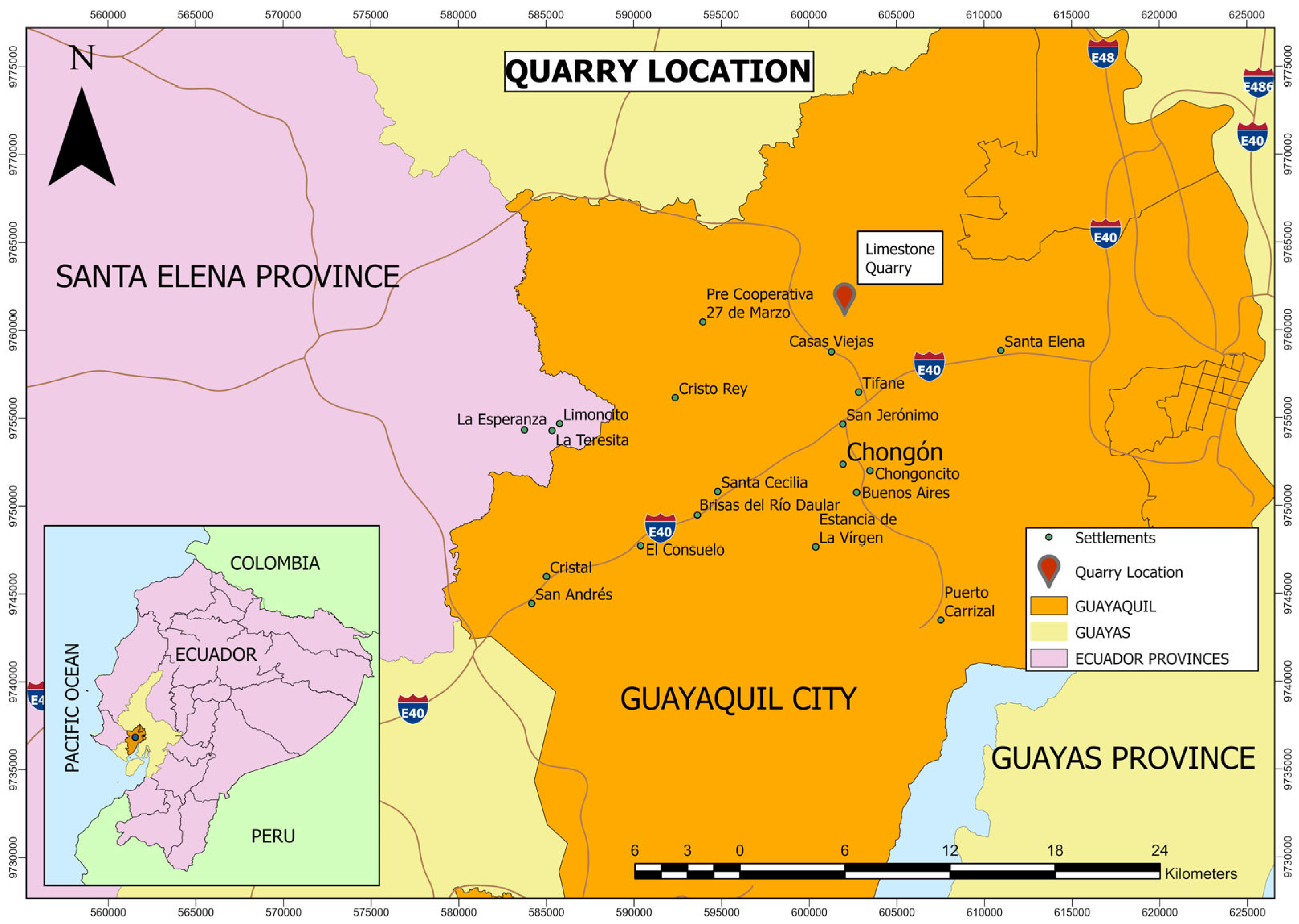
The quarry analyzed in this study is located in the Chongón Parish of Guayaquil, Ecuador, and supplies 100% of the limestone used in the process of clinker and cement fabrication. The location of the active mining front and the study area is shown in Figure 1.
As in many quarries within this region, the local geology is characterized by a sequence of sedimentary formations with varying lithologies and thicknesses. The northern sector of the quarry is underlain by the Guayaquil Formation (KTcg), which reaches thicknesses of up to 450 m and consists predominantly of silica-rich shales that dip toward the southwest. South of this unit lies the San Eduardo Formation (Ese), composed mainly of limestone beds with thicknesses ranging from 80 to 150 m along an approximate west–east orientation. Overlying the San Eduardo Formation is the Las Masas Formation (Elm), which comprises a succession of shale layers. The basal portion of the deposit corresponds to units of the Ancon Group, consisting of various clay-rich sediments.

2. Materials and Methods

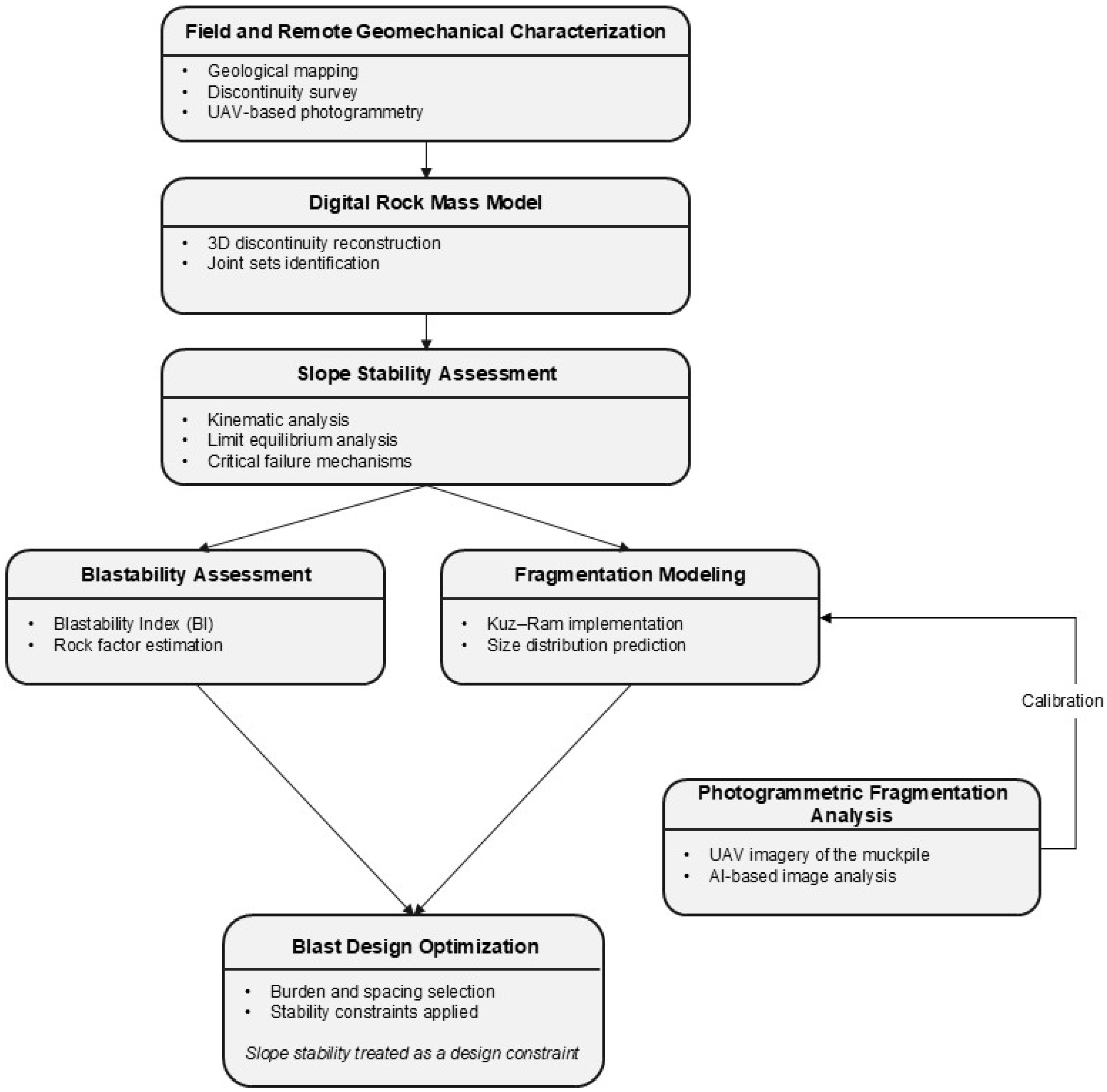
Figure 2 illustrates the proposed integrated workflow adopted in this study. Unlike conventional approaches where slope stability analysis and fragmentation prediction are conducted independently, slope stability is explicitly incorporated as a constraint in the blast design optimization stage. Discontinuity-controlled failure mechanisms identified through kinematic and limit equilibrium analyses directly condition acceptable blast geometry, particularly burden selection, while fragmentation performance is calibrated using UAV-based photogrammetric measurements.

2.1. Geomechanical Characterization

Five geotechnical stations were established along the slope face of the limestone quarry. At each station, discontinuity orientation was measured using a Brunton® Axis Compass, with a minimum of 20 measurements per station. Upper and inaccessible portions of the slope were characterized using UAV-based photogrammetry, and discontinuity orientations were extracted using the Rock Mass AI module of the Strayos v4.7 software (St. Louis, MO, USA). All discontinuity data were processed and statistically grouped into joint sets using Dips v9 software (Toronto, ON, Canada).
Uni-axial Compressive Strength (UCS) and Joint Compressive Strength were estimated at each station using a Schmidt hammer. Discontinuity roughness, spacing persistence, infilling and surface conditions were recorded in the field according to traditional geomechanical mapping [17,18]. Joint roughness and strength parameters were normalized to account for scale effects using established empirical relationships [19] (Equations (1)–(7)). Rock mass quality was classified using the RMR and SMR systems [20,21] based on field measurements and photogrammetric data.
The geomechanical parameters obtained in this stage were subsequently used as input data for slope stability assessment and blastability evaluation.
Refs. [5,18,20,21,22,23].

2.1.1. Geomechanical Parameters

  • Normalized Joint Roughness Coefficient (JRCn): JRC was estimated by generating roughness profiles of the discontinuities and JRCn was calculated using Equation (1) [19], where Ln denotes the persistence of the joint set analyzed and L0 refers to the actual length of the measured roughness profile.
J R C n = J R C 0 L n L 0 0.02 J R C 0
  • UCS and Joint Compression Strength (JCS): Ten rebound readings were collected on discontinuity surfaces, from which the five lowest were discarded to minimize the influence of locally weakened points; the remaining five readings were averaged and used to determine the UCS and JCS0 through the Barton-Bandis correlation chart. To account for the scale effect, the normalized JCSn was computed using Equation (2) [19].
J C S n = J C S 0 L n L 0 0.02 J R C 0
  • Internal friction angle (φ): First, the basic friction angle (φb) was obtained from intern reports, while the instantaneous friction angle (φi) was determined following Equations (3) and (4) [24], using a normal stress a σn calculated from Equation (5) [24] corresponding to a bench height (H) of 12 m. The instantaneous friction angle φi was used in the kinematic failure analysis, whereas the shear stress (τ) was computed using Equation (6) [24].
φ i = a r c t a n δ τ δ σ n
δ τ : shear strength differential increment
δ σ n : normal strength differential increment
δ τ δ σ n = t a n J R C   log J C S σ n + φ b J R C ln 10 tan 2 J R C log J C S σ n + φ b + 1
σ n = H γ r
τ = σ n t a n J R C   log J C S σ n + φ b
  • Cohesion (c): the rock mass cohesion was obtained from internal geotechnical reports, but instantaneous cohesion (ci) was computed following Equation (7) [24].
c i = τ σ n t a n φ i

2.1.2. Rock Mass Classification

The Rock Mass Rating (RMR) system developed by Bieniawski [25] was employed to classify the quality of the rock mass [26]. RMR parameters were determined in the field, while RQD was computed from the 3D model by drawing a measurement line and counting the number of discontinuities intersecting such line, following Equation (8) [26].
R Q D = 100 e 0.1   λ 0.1 λ + 1
where λ was obtained using Equation (9) [26].
λ = N l
Joint spacing was measured both in the field with a measuring tape and in the 3D model using its built-in measuring tool. Joint conditions were assessed in the field and classified according to Bieniawski guidelines [25]. Groundwater was considered based on a winter scenario, reflecting field observations that indicate the presence of water within the rock mass during this period. Finally, joint orientation was determined using the information obtained in the structural geology survey, integrating field measurements and photogrammetric analysis where applicable.

2.2. Slope Stability

2.2.1. Kinematic Analysis

Discontinuity orientations from all geotechnical stations were plotted on stereographic projections using Dips software. The potential for planar, wedge, and toppling failure modes was evaluated based on kinematic criteria, considering slope orientation and friction angle. This analysis allowed the identification of structurally controlled instability mechanisms along the quarry face. Rocplane v4, Swedge v7 and RocTopple v2 were used to assess the factors of safety both under static conditions and with seismic loading and software, respectively. Analysis was performed under both static conditions and considering seismic loading and groundwater effects. The calculated FS values were then compared with the NEC [27] requirements to evaluate the stability of the slopes.

2.2.2. Limit Equilibrium Analysis

Following the kinematic assessment, limit equilibrium analyses were conducted to evaluate the Factor of Safety (FS) for planar, wedge, and toppling failures using RocPlane, SWedge, and RocTopple software, respectively. Analyses were performed under static and pseudo-static conditions, including groundwater effects, and FS values were compared against the Ecuadorian Normative of Construction (NEC) requirements [27].
Global slope stability was evaluated using photogrammetry-derived geometry and analyzed in Slide2 v9 and Slide3 v3 software. The resulting stability conditions were later incorporated as constraints in the blast design optimization process.

2.3. Fragmentation Modeling and Blast Design

2.3.1. Explosives and Drilling and Blasting Geometry

The actual drilling pattern and blasting geometry were evaluated based on field observations and previous blasting reports. The type and properties of the explosives used were obtained from the supplier’s technical data sheets.

2.3.2. Kuz–Ram Model

It is an empirical predictive model for fragmentation (Equation (10) [28]) which incorporates both the Kuznetsov predictive model for the average size (Equation (10) [28]) and the Rossim Rammler equation for the grain size distribution (Equation (12) [28]) [16,28,29,30]. Through the Kuz–Ram model, it is possible to predict the mean size (X50) and the critical fragmentation size Xc of the blasting.
X 50 = A P F 0.8 Q e 1 / 6 115 S A N F O 19 / 30
with A being the rock constant, which can be obtained from the Lilly blastability index (BI) as shown in Equation (11) [16]. BI parameters including Rock Mass Description (RMD), Joint Factor (JF), Rock Density Influence (RDI) and Hardness Factor (HD) were evaluated in the field and classified according to Table 1 [3,16,28].
A = 0.12 × B I = 0.12 × 0.5 R M D + J F + R D I + H F = 0.06 × R M D + J F + R D I + H F
where BI is Lilly’s Blastability Index, computed as the weighted sum of RMD, JF, RDI and HF.
R = e X X c n
Equation (12) [23] can be rearranged, yielding a useful expression for assessing the grain size X corresponding to a retained percentage R as shown in Equation (13):
X = X c ln 1 R 1 / n
Xc is the characteristic size and can be found using Equation (14) [23]:
X c = X 50 ( ln 2 ) 1 n = A P F 0.8 Q e 1 / 6 115 S A N F O 19 / 30 ( ln 2 ) 1 n
With n being the uniformity index, obtained through Equation (15):
n = 2.2 14 B D 1 + S B 2 0.5 1 W B B C L C C L L + 0.1 0.1 L H P
where
Qe: explosive charge (kg);
SANFO: specific gravity of the explosive related to ANFO;
A: Rock factor;
BI: Lilly’s blastability index;
B: Burden (m);
S: Spacing (m);
W: Drilling deviation (m);
D: Drilling diameter (mm);
L: Explosive charge length (m);
BCL: Bottom charge length (m);
CCL: Column charge length (m);
n: uniformity index;
X50: average size (cm);
Xc: blasting critical size (cm);
H: bench height;
P: drilling pattern; 1.1 for staggered pattern, 1 for non-staggered pattern.

2.3.3. Fragmentation Model Adjustment

After developing the fragmentation predictive model, the associated granulometric curve was compared with that generated through image analysis of previous blasts at the quarry. Image acquisition was performed using a DJI® Mavic 3 Enterprise UAV (Shenzhen, Guangdong, China), which conducted an overhead flight with the camera set at a 45° inclination over the muckpile. The images were processed using the Fragmentation AI tool in the Strayos software to generate the corresponding particle size analysis.
The predicted and measured size distributions were compared by computing the squared difference between the predicted retained percentage (%Ra) and the real retained percentage (%Rr) for each sieve size. The overall error was then calculated using Equation (16) [16]. Using Excel Solver optimization tool, the model parameters Xc and n were adjusted by minimizing this error, with Equation (16) [16] being the objective and Xc′ and n′ the variables. Finally, the correction coefficients kc and kn were determined according to Equations (17) and (18), respectively, by comparing the initial parameter values (Xc and n) with their adjusted counterparts (Xc′ and n′).
E r r o r = % R r % R a 2
k c = X c X c
k n = n n
Then, the fragmentation model was improved by introducing Equations (17) and (18) into Equations (14) and (15). Thus, the final Kuz–Ram model was described by Equations (19) and (20).
X c = X c k c = X 50 ( ln 2 ) 1 n k c = A P F 0.8 Q e 1 / 6 115 S A N F O 19 / 30 ( ln 2 ) 1 n k c
n = n k n = 2.2 14 B D 1 + S B 2 0.5 1 W B B C L C C L L + 0.1 0.1 L H k n

2.3.4. Drilling Pattern and Explosive Charge Geometry

The blast geometry (pattern and explosive charge) was computed following Equations (21) to (26) [6] which correspond to the Ash drilling design method with the X80 required at the quarry’s crusher as the size goal.
Spacing   S = K S B
Burden   B = K B D
Subdrilling   J = K J B
Stemming   T = K T B
Bench   Height   H = K H B
Burden   Constant   k B = π 4 S G E S G R S A N F O P F A N F O K H + K J K T K H K S 1 / 2
Equation (27) shows the Powder Factor as a function of X and R while Equation (28) is in function of the initial Blasted Rock Volume (V0).
P F = A Q e 1 / 6 115 S A N F O 19 / 30 X ( ln 2 ) 1 n ln 1 R 1 / n 5 / 4
P F = Q e V 0 = Q e B S H = Q e K S B 2 H
By combining Equations (27) and (28) and rearranging for B, it was possible to find the optimal Burden as a function of the grain size and retained percentage desired (Equation (29)). Equation (20) was modified to Equation (30) including the B/S relationship constant (Equation (21)).
B = Q e K S H 1 / 2 A Q e 1 / 6 115 S A N F O 19 / 30 X ( ln 2 ) 1 n ln 1 R 1 / n k c 5 / 8
n = n k n = 2.2 14 B D 1 + K S 2 0.5 1 W B B C L C C L L + 0.1 0.1 L H k n
Thus, using Equations (29) and (30), the optimum Burden could be found iteratively.

3. Results

3.1. Rock Mass

3.1.1. Discontinuities

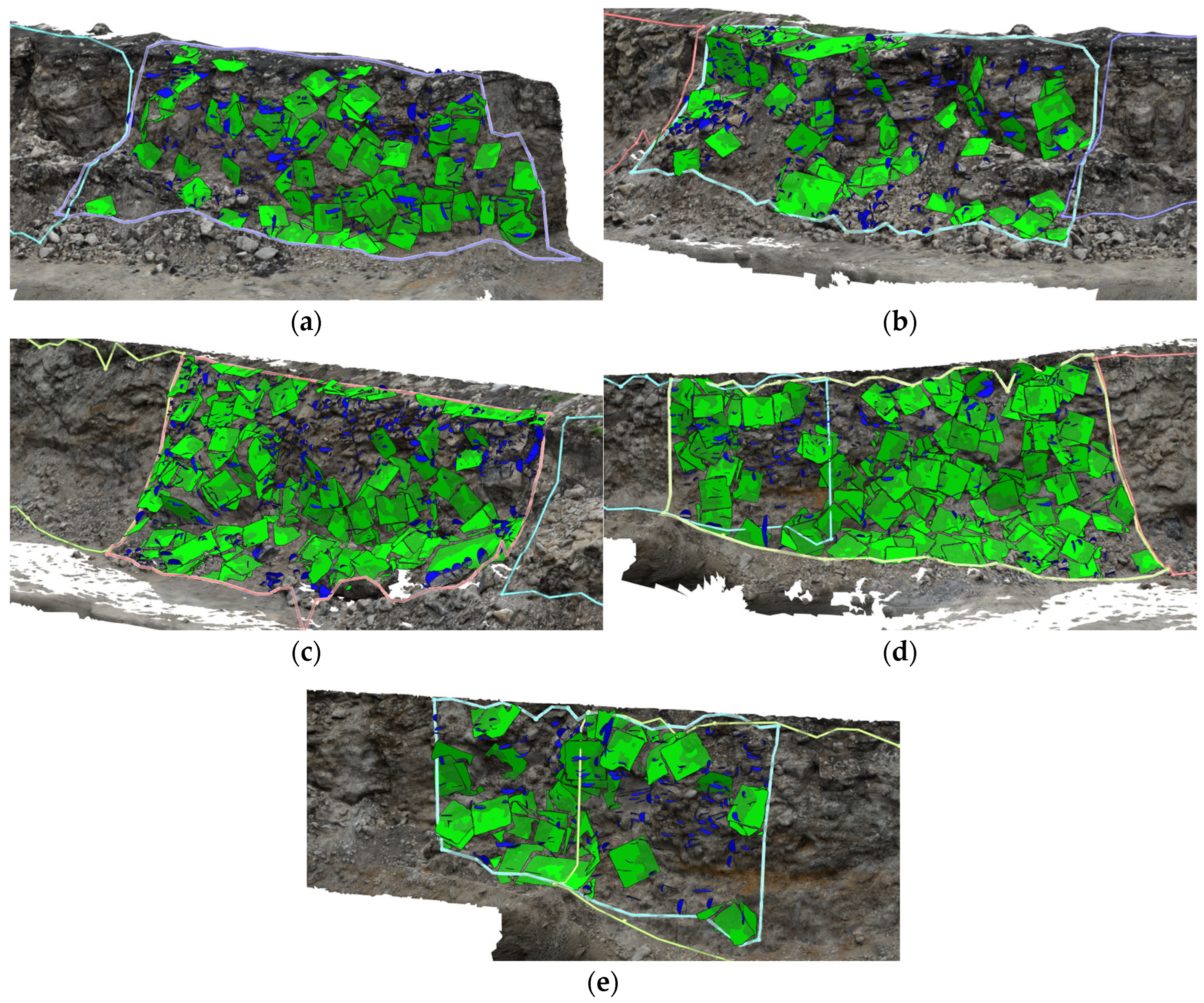
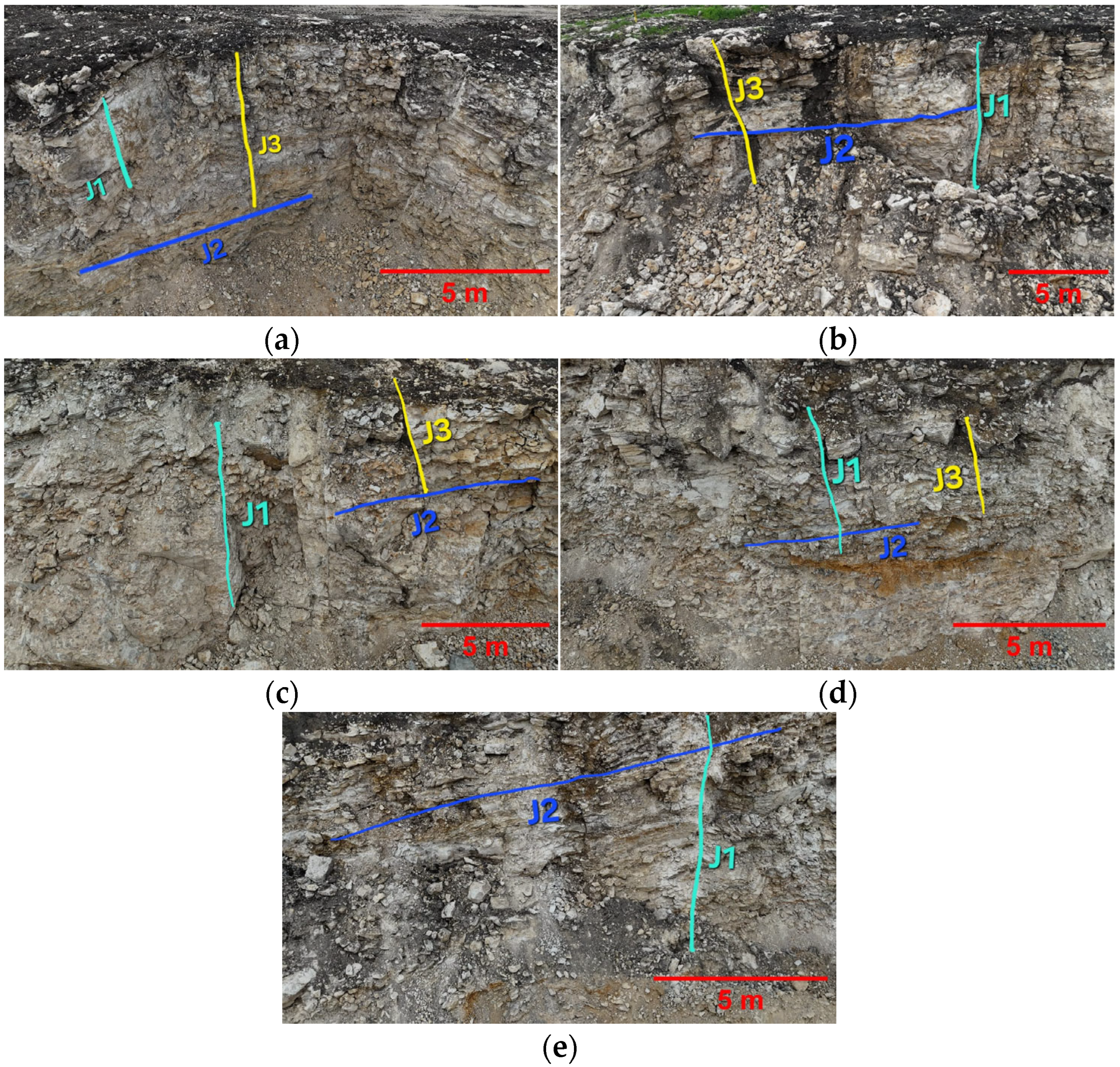
Figure 3 shows the different planes of discontinuities detected by AI with Rock Mass Module of Strayos at every geomechanical station and Figure 4 displays the five geomechanical stations and the three major planes identified (J1, J2, and J3).
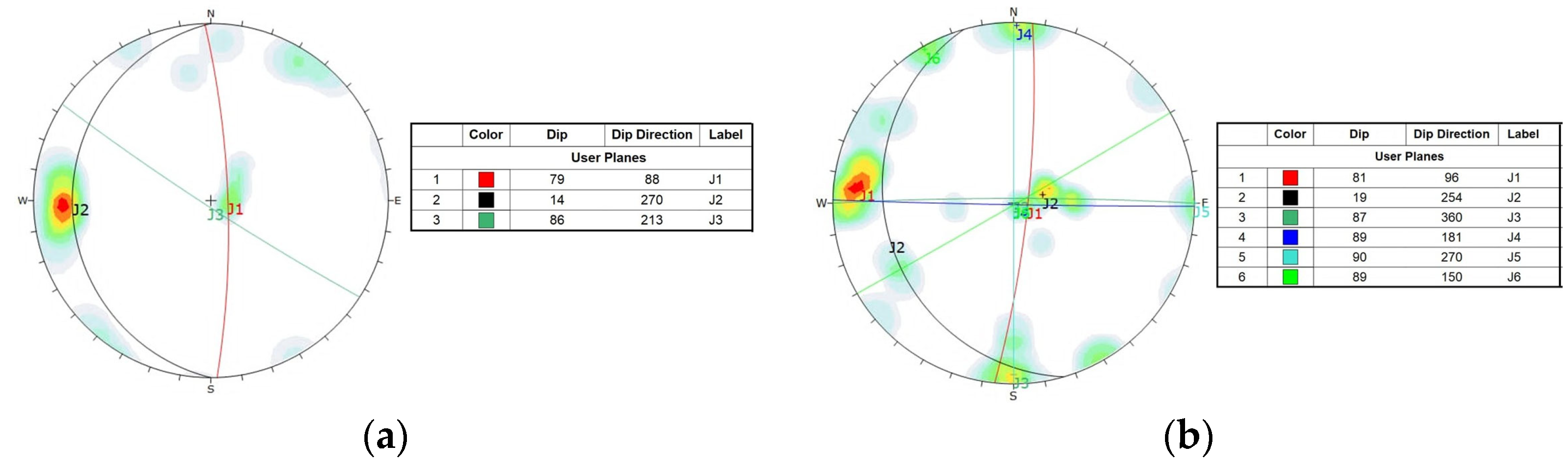
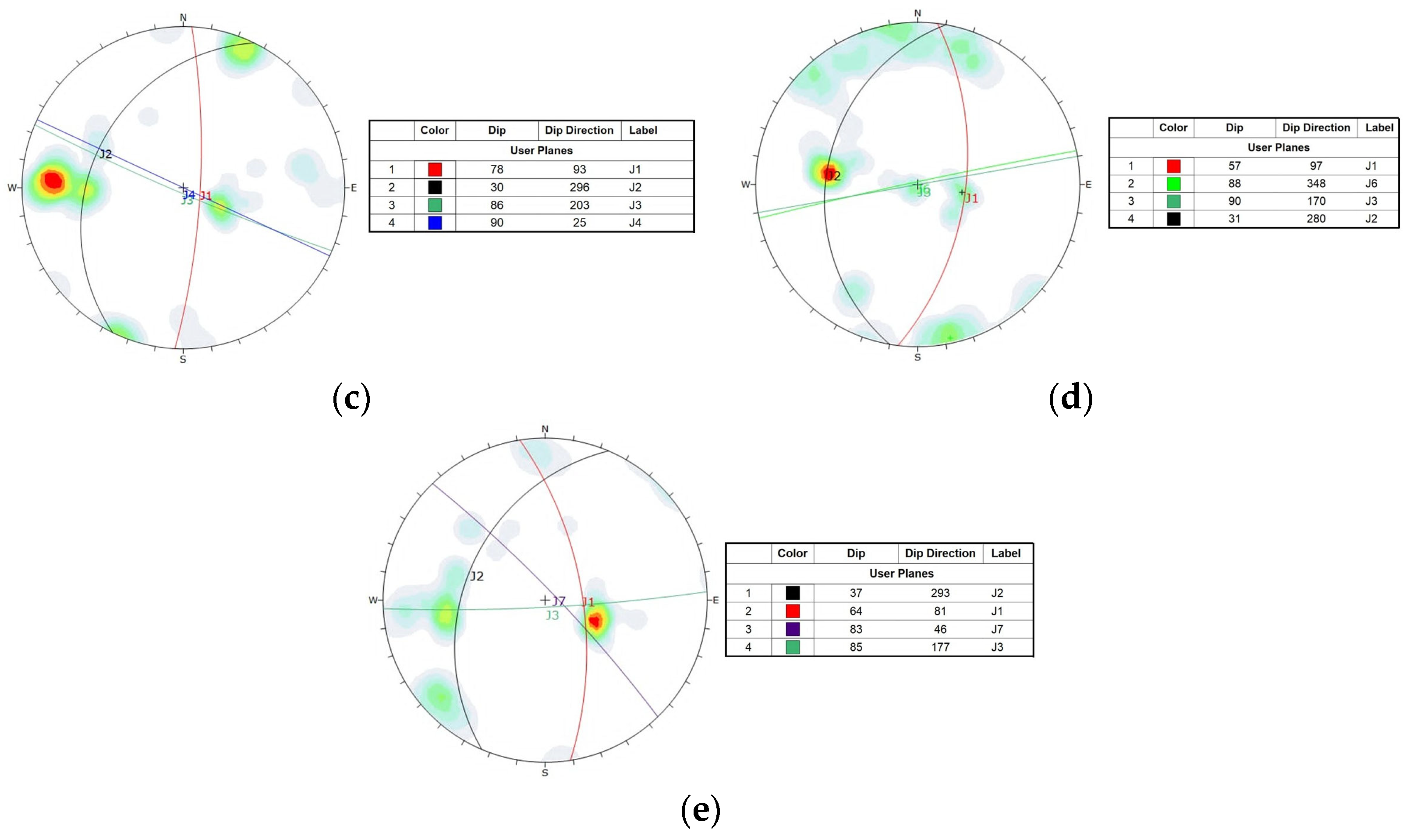
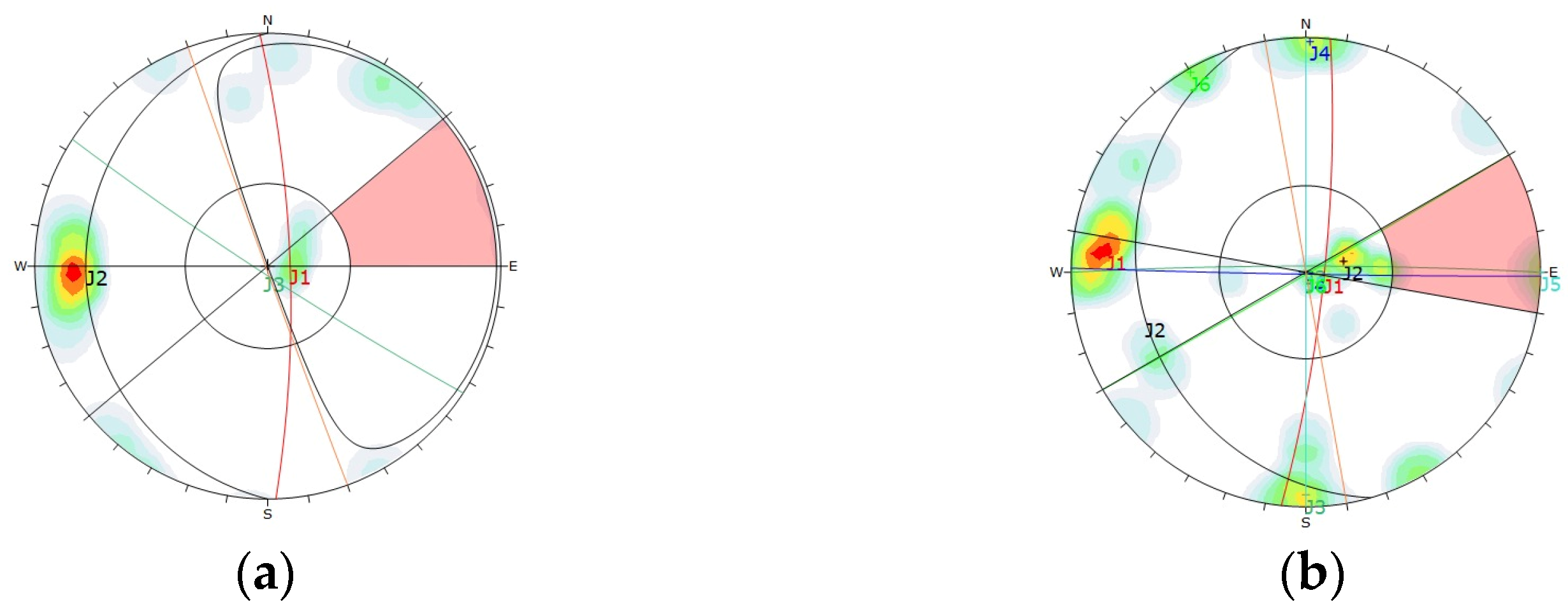
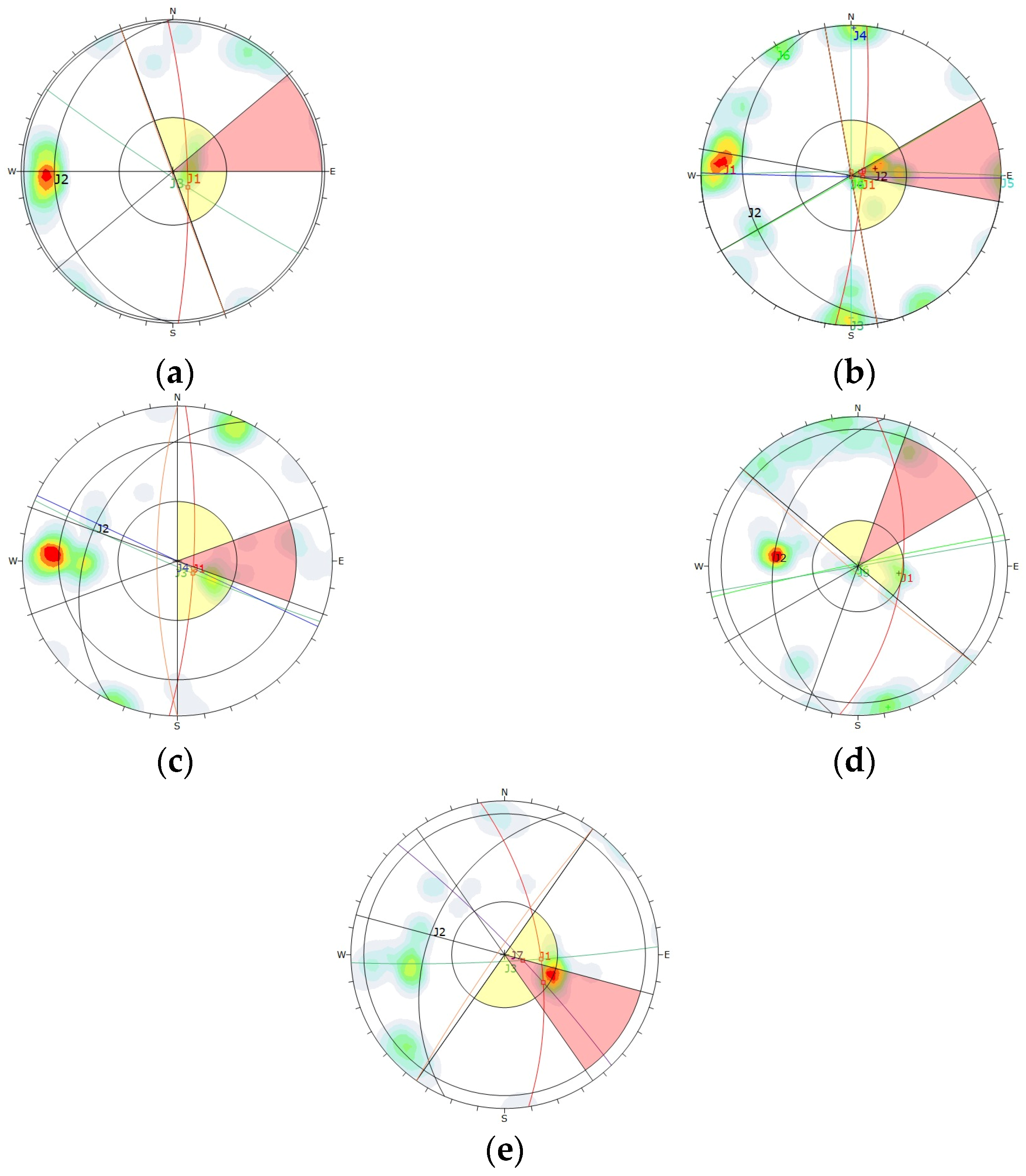
Figure 5 summarizes the discontinuities measured at each geomechanical station and their statistical grouping into joint sets using the Dips v9 software, while Table 2 presents the corresponding dip and dip direction for each joint family. Three predominant joint sets (J1, J2, and J3) were identified at four of the five stations (Figure 5a–d). J1 corresponds to a subvertical set with dips ranging from 57° to 81° and dip directions between 81° and 96°. J2 represents the main bedding plane, dipping between 14° and 37° with dip directions from 254° to 296°. J3 is another subvertical set, characterized by dips between 86° and 90° and dip directions ranging from 181° to 213°.
In contrast, EG180-02 (Figure 5e) exhibited three distinct subvertical joint sets (J4, J5, and J6) with dips between 87° and 90°, which were not observed at the other stations and appear to be locally confined.

3.1.2. Rock Mass Classification

Table 3 summarizes the RQD, RMR, GSI, BI and rock factor A obtained for the five geomechanical. RQDs values ranged from 86.7 to 92.93, indicating generally high rock quality. The RMR values varied between 51 and 71, corresponding to rock mass classifications from Fair to Good, with Stations 01, 02, and 05 exhibiting the lowest quality within the study area. This observation is consistent with the structural data, as EG180-02 contains several subvertical joint sets Table 2.
GSI values ranged from 36 to 60, with Stations 01 and 02 presenting the lowest rankings. On the other hand, all BI values were greater than 40, indicating that the rock mass was at all stations classified as “very easy” to blast according to the referenced scale [31]. The Rock Factor A ranges from 5.76 to 8.16, following the same structural pattern: lower A values (e.g., EG180-01) correspond to more fractured conditions, while higher A values (e.g., EG180-03) correspond to more competent and continuous rock masses. This trend is comparable to the behavior reported in other limestone quarries of the coastal Ecuadorian region and in similar Mesozoic–Cenozoic carbonate formations, where structural disturbances strongly influence blast performance [32,33].
Table 4 presents the SMR values calculated for the five stations considering the orientation and kinematic compatibility of the different identified joint set. When compared with the baseline RMR classifications reported in Table 3, the results demonstrate that the reduction in rock mass quality is not uniformly distributed, but structurally controlled.
Joint set J1 produces a significant decrease in the SMR of EG180-04, changing its classification from Good to Fair. This reduction indicates that the geometric relationship between J1 and the slope orientation generates partially unfavorable conditions, increasing the possibilities to structurally controlled failure despite adequate intrinsic rock mass quality.
Joint set J2 exerts the most significant influence, reducing the SMR of EG180-04 from Good to Fair and that of EG180-05 from Fair to Poor. The latter represents a critical downgrade, suggesting that J2 exhibits high kinematic compatibility with the slope face at EG180-05. This implies planar or wedge instability are more susceptible under adverse loading conditions.
Conversely, joint sets J3, J4, and J5 show negligible influence on the SMR classification at Stations 02 and 04. Although present within the rock mass, their orientation relative to the slope geometry does not promote kinematically admissible failure modes, indicating that their structural contribution to instability is limited.
Joint set J6 decreases the SMR classification of EG180-04 from Good to Fair, reinforcing the interpretation that this station presents structurally sensitive conditions due to the combined effect of multiple discontinuity sets. In contrast, J7 does not significantly modify the SMR at EG180-05, suggesting limited geometric compatibility with the slope orientation at that location.
Overall, the SMR analysis reveals that slope stability is predominantly controlled by a subset of structurally unfavorable joint sets rather than by global rock mass degradation. This distinction is critical, as it confirms that local instability potential arises from orientation-dependent structural interactions rather than from poor intrinsic rock mass quality. Consequently, stability mitigation and blast optimization strategies should prioritize structural domain control over generalized rock mass strengthening.

3.1.3. Joint Properties

Table 5 summarizes the mechanical properties computed for the two main joint families, J1 and J2, at the five geomechanical stations. The scale-corrected values for JRC and JCS the due to scale effect as shown, while the internal friction angle (φi), cohesion (c), shear stress (τ) and normal stress (σn) were obtained following a bench height of 12 m.
Thus, relatively high values of φi for both the subvertical joints (J1) and subhorizontal joints (J2) could be found. These values exceed the basic friction angle reported in the internal geotechnical documents, reflecting the influence of joint roughness and surface conditions on the shear strength parameters.

3.2. Kinematic Analysis

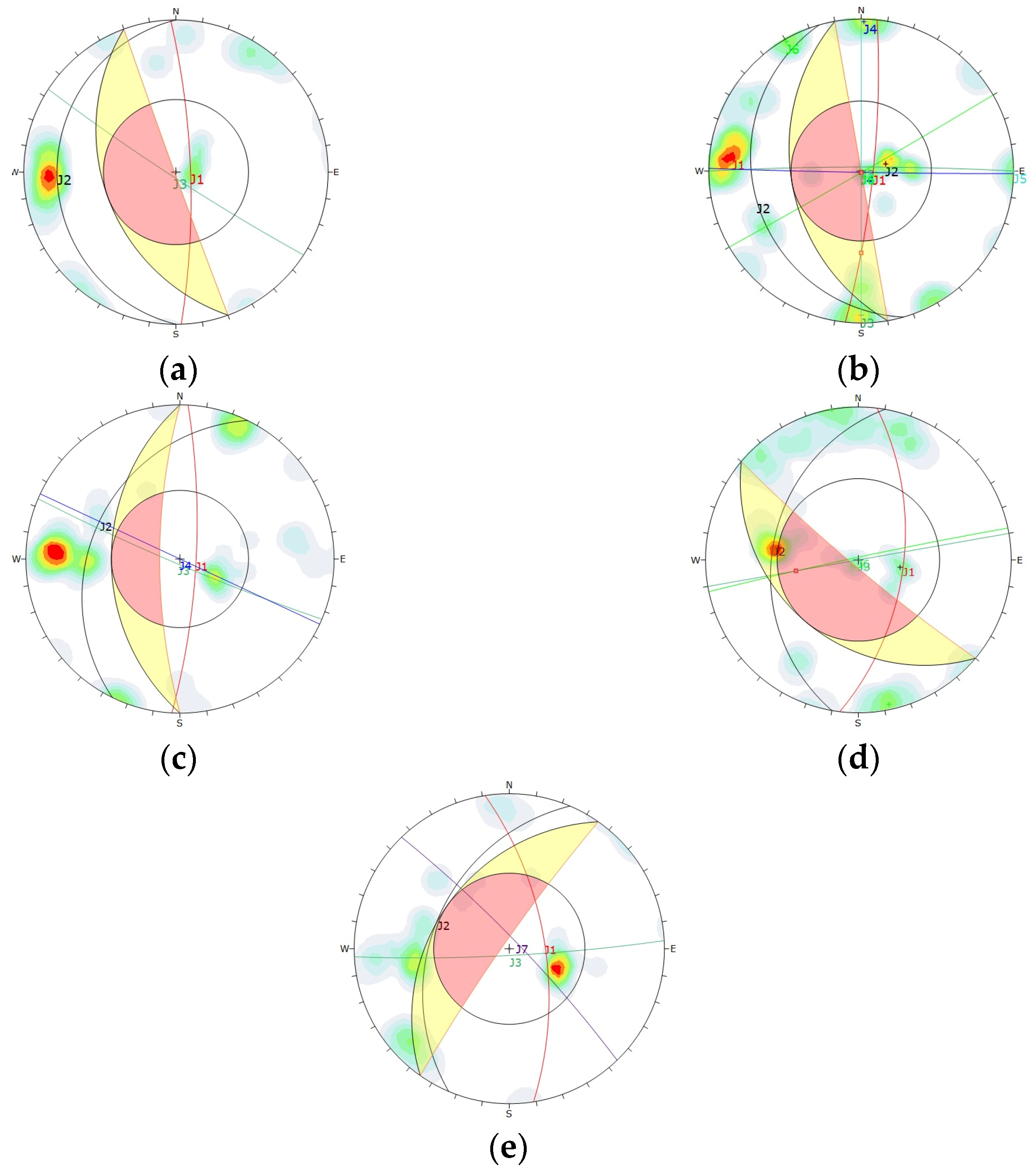
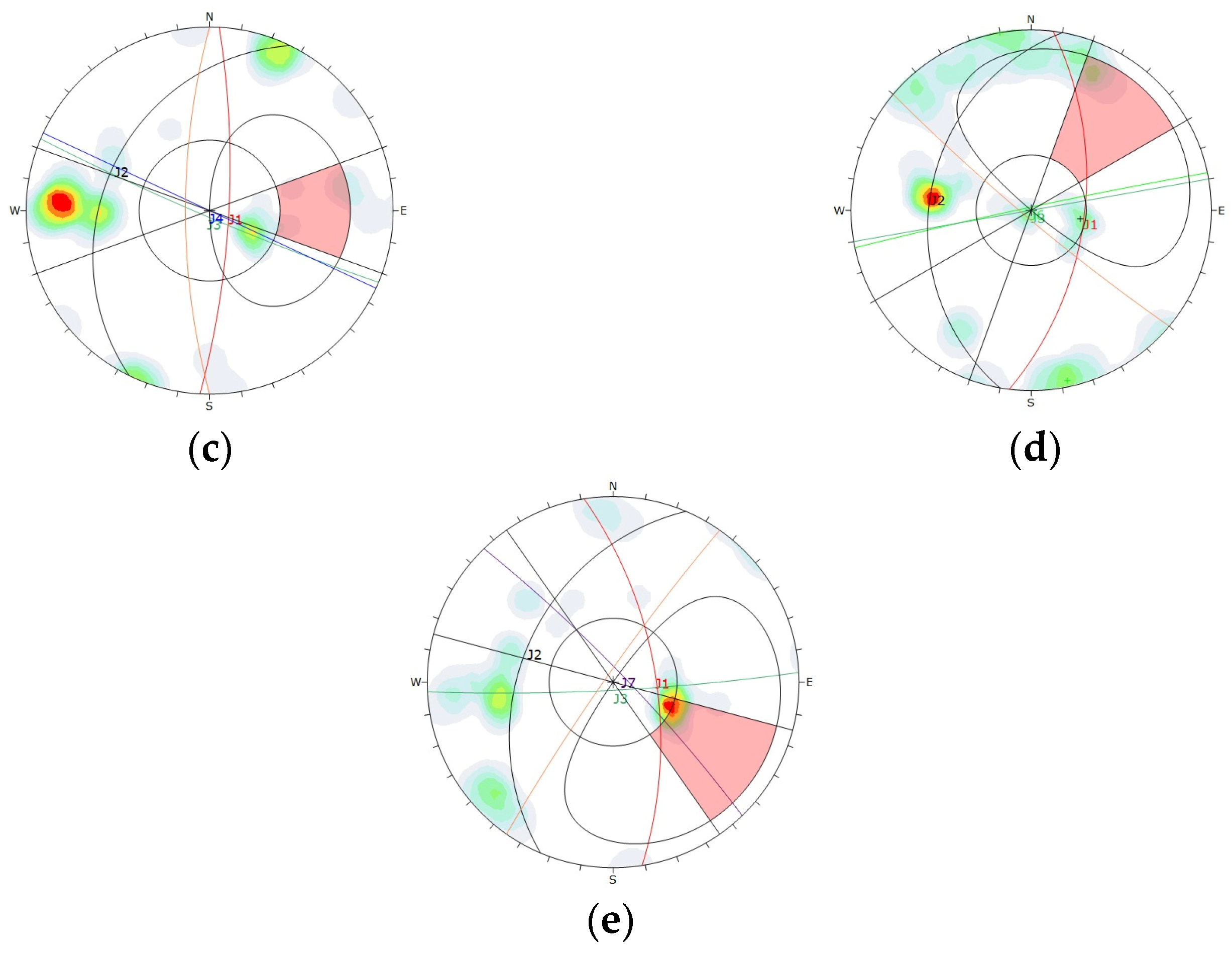
Figure 6 presents the kinematic analysis for planar failure at the five geomechanical stations. The results indicate that only the J2 joint set at EG180-05 satisfies the geometric conditions for planar sliding. No other station exhibits kinematic feasibility for this failure mode, as the orientation of the discontinuities does not permit the development of planar instability.
Figure 7 shows the kinematic analysis of wedge failure at the 5 stations; wedge failure can occur at EG180-02 with the intersection of joints J4 and J5 and can also occur at EG180-04 with the intersection of joints J3 and J6.
Figure 8 presents the kinematic analysis for direct toppling failure at the five geomechanical stations. The analysis indicates that direct toppling is kinematically feasible at EG180-02 due to the orientation of joint sets J1 and J3, and at EG180-05 where joint sets J2 and J7 meet the geometric conditions for this failure mechanism.

3.3. Limit Equilibrium Analysis

Table 6 summarizes the Factors of Safety (FS) obtained from the limit equilibrium analyses for planar, wedge, and direct toppling failure under both static and pseudostatic conditions. The pseudostatic analyses were performed using a horizontal seismic coefficient kh of 0.24, based on NEC calculations for Guayaquil, considering its location at a strong seismic zone and assuming 100% water fill along the discontinuities, following NEC requirements.
For the station EG180-05 For location EG180-05, the static FS was 1.091, below the minimum NEC threshold of 1.5. Under pseudostatic loading, the FS decreased to 0.37, also below the required value of 1.05. These results indicate that the slope is unstable under both conditions.
At station EG180-02, the wedge formed by joint sets J4 and J5 yielded a static FS of 0.154 and a pseudostatic FS of 0.00, both far below the NEC minimum values. However, the computed wedge has a very small block volume, and consequently its kinematic relevance and potential impact are limited. In contrast, for EG180-04, the static and pseudostatic FS values were 23.74 and 2.88, respectively, both exceeding the NEC thresholds of 1.5 and 1.05, indicating a stable condition for wedge failure mode.
At station EG180-02, the direct toppling analysis produced a static FS of 13.042 but a pseudostatic FS of 0.100, the latter falling significantly below the NEC minimum, implying potential instability under seismic conditions. Similarly, at EG180-04, FS values of 25.0 (static) and 0.769 (pseudostatic) were obtained, indicating stability under static loading but instability under pseudostatic conditions. Finally, at station EG180-05, the static FS was 6.75, whereas the pseudostatic FS was 0.475, the latter again below the NEC requirement, confirming unstable behavior under pseudostatic loading.
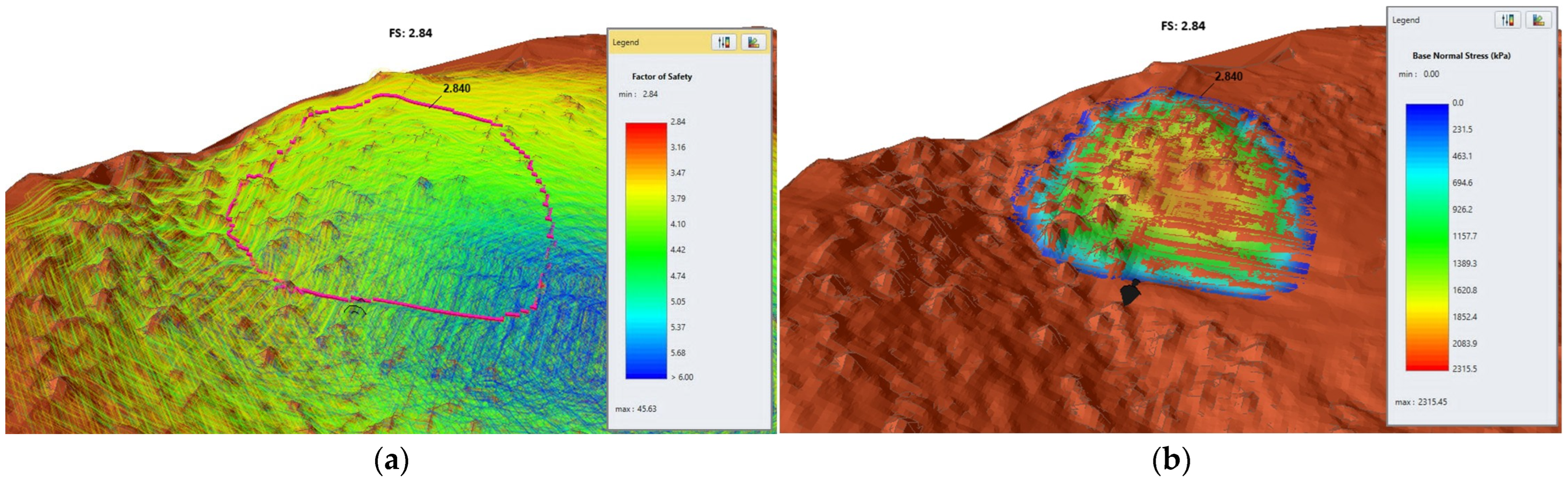
Figure 9 presents the result of the global limit equilibrium analysis for the open pit currently under operation. A FS of 2.84 was determined under pseudostatic conditions with a seismic horizontal coefficient kh of 0.24. This value of FS indicates that the pit remains stable even under powerful seismic activity.

3.4. Fragmentation Modelling

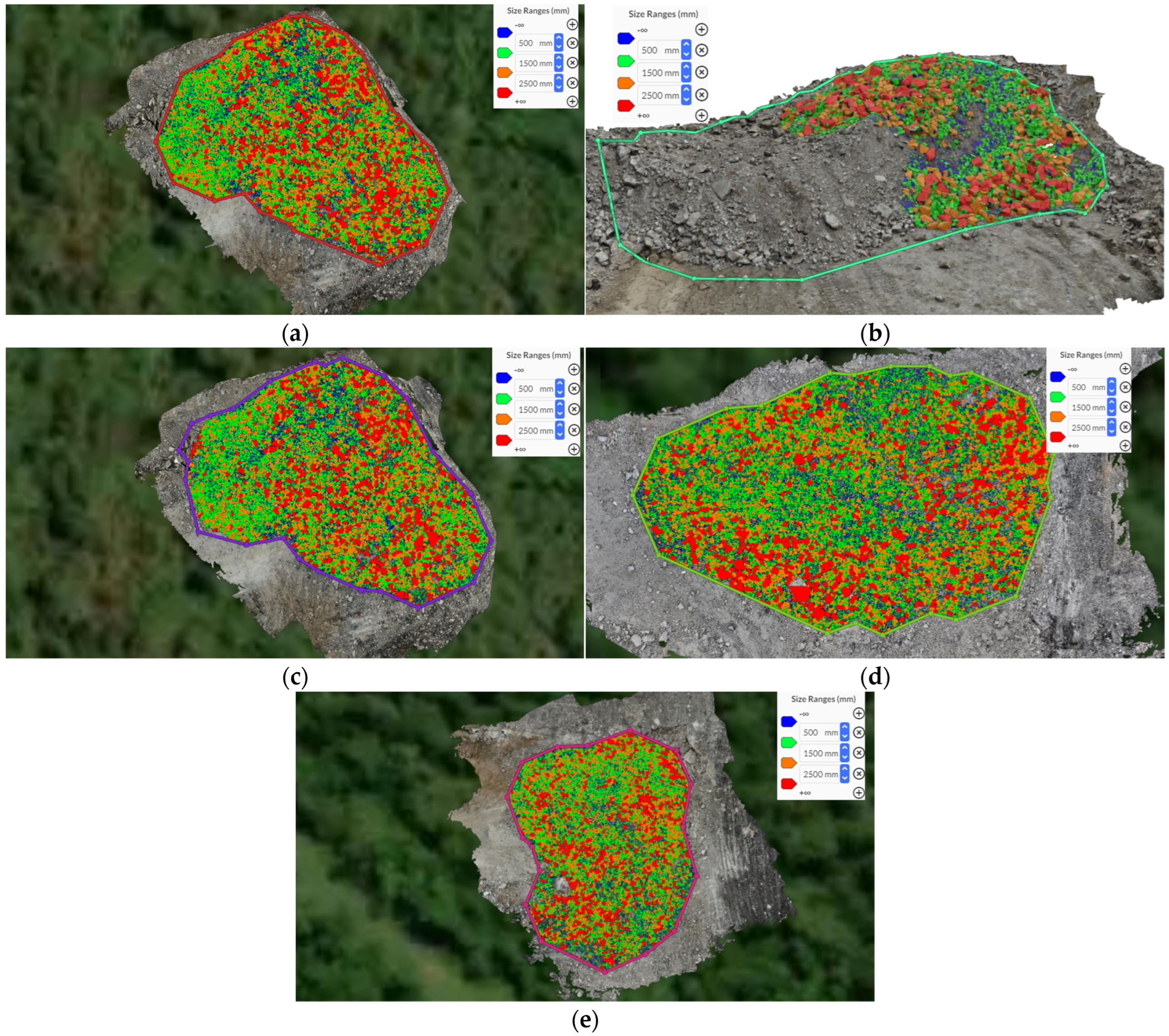
Figure 10 presents the results of particle-size detection for the five analyzed blasts, obtained using the Fragmentation AI module from Strayos. Particles are color-classified according to their size:
  • Blue for fragments smaller than 500 mm;
  • Green for fragments between 500 mm and 1500 mm;
  • Orange for fragments ranging from 1500 mm to 2500 mm;
  • Red for fragments larger than 2500 mm.
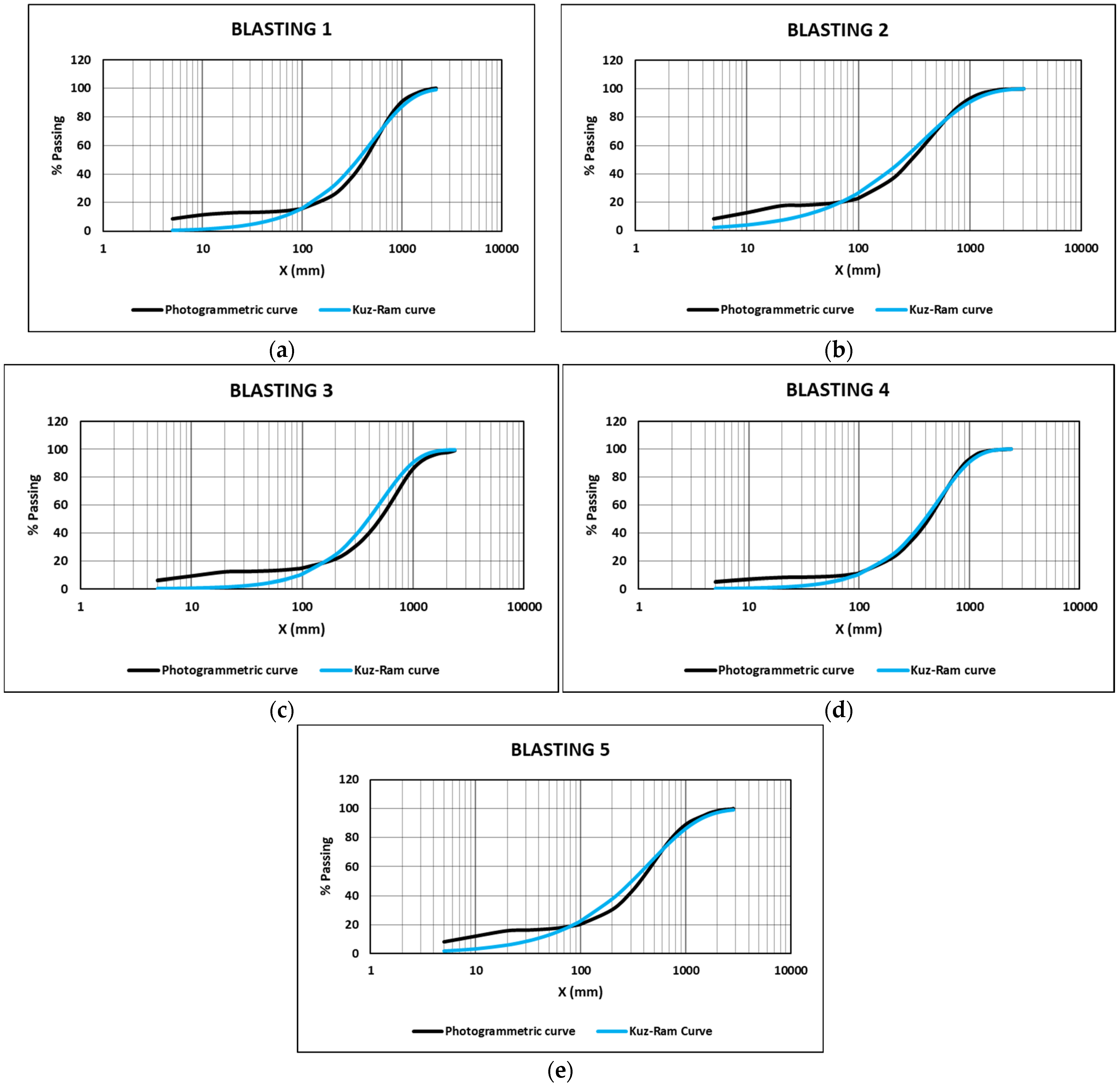
Additionally, the granulometric distribution derived from this AI-based technique is compared to the Kuz–Ram adjusted model, with the resulting granulometric curves shown in Figure 11. As seen in the figure, the model fits well with the coarse region (X > 100 mm), but the fine region (X < 100 mm) does not align as accurately with the photogrammetric data. This discrepancy suggests that the photogrammetric model may have limitations in accurately predicting finer particle sizes.
Table 7 summarizes the geometrical, explosive, and rock mass parameters evaluated for the five blasts carried out in the quarry, as well as the corresponding performance indicators—X50, Xc, and D80—calculated using the Kuz–Ram model. The table also includes the calibration factors obtained through least-squares comparison between the predicted granulometric curves and those derived from photogrammetric analysis.

3.5. Optimum Burden

Based on the adjusted Kuz–Ram coefficients and using Equation (29) the optimum burden was determined as a function of the rock mass characteristics, explosive properties, drilling parameters and the desired D80 size of 60 cm. Table 8 presents the iterative convergence process used to obtain the final burden value, showing the results after five successive iterations.
Table 9 summarizes the optimal drilling pattern and corresponding charging configuration for each of the different rock masses identified along the active working face, based on the optimal burden values derived in Table 8. As expected, an inverse relationship is observed between Rock Factor A and the optimal burden: higher A values—representing stronger or more competent rock masses—require lower burden values to achieve the desired fragmentation.

4. Discussion

In the active mining rock face, the combination of structural mapping and stereographic projection played a vital role in identifying the two major joint sets (J1 and J2) present at all five geomechanical stations. These joint sets, along with their corresponding high persistence values, indicate a dominant control of the structural features throughout the entire deposit. The persistence of these joints suggests that the rock mass may exhibit relatively uniform geological conditions across the quarry, which is essential for predicting rock behavior during excavation. J3, although present at four out of five stations, was found to be less influential but still likely plays a significant role in the geomechanical framework of the area. This joint set could be seen as an additional structural feature that influences the stability of the rock mass, but to a lesser degree than J1 and J2.
Conversely, EG180-02 exhibited the highest number of discontinuities, with a total of six joint sets. This makes EG180-02 notably more complex compared to the other stations, highlighting a more intricate structural configuration. The higher number of joint sets in this area indicates a region more susceptible to the formation of wedges and toppling failures. The presence of multiple intersecting joint sets increases the likelihood of rock blocks forming and destabilizing under certain conditions. These blocks can be prone to sliding or toppling, particularly under high seismic or water-induced loads. This complexity suggests that EG180-02 could be a critical zone to monitor.
Furthermore, UAVs proved to be a highly effective tool in complementing traditional manual measurements taken with a compass. UAVs enabled access to the highest portions of the slope that would otherwise have been difficult to reach. The integration of drone-based photogrammetry with conventional data collection methods significantly improved the precision and coverage of the structural mapping. The data from the UAVs showed a high level of consistency with manual measurements, with differences in orientation measurements of no more than 5°. This confirms the reliability of drone technology for geotechnical mapping, especially in steep or inaccessible areas, and underscores its importance for modern mining operations.
Based on the Rock Mass Rating (RMR), the overall quality of the rock mass in the study area was classified as ranging from fair to good. However, the GSI evaluation revealed that EG180-01 exhibits the poorest rock mass quality. This is primarily due to the folding and frequent intersection of joints J1, J2, and J3, which significantly compromise the stability of the rock mass at this location. In contrast, EG180-02 was found to have a blockier condition, as it is characterized by the presence of more than three joint sets, which leads to a more fractured and disjointed rock structure.
On the other hand, Stations 3, 4, and 5 were classified as having good quality blocky condition, indicating that they contain larger volumes of intact rock blocks. These stations are therefore considered more stable compared to EG180-01, which contains smaller and less cohesive rock blocks due to its higher degree of fracturing and joint intersection.
Additionally, EG180-01 exhibited the lowest Rock Factor A value of 5.76 among the five stations, which correlates with its relatively poor GSI, RQD, and RMR values. In contrast, EG180-03 demonstrated the highest Rock Factor A of 8.16, indicating that it has the highest quality rock mass in the active working area. This suggests that blasting at EG180-01 would likely require less energy and be easier to execute compared to the other stations. However, using the same drilling pattern from EG180-01 for blasting at EG180-03 could lead to over-fragmentation, producing undesirable boulders or larger fragments that may not be optimal for processing.
The updated SMR analysis confirms that slope stability across the five stations is predominantly controlled by joint orientation rather than intrinsic rock mass quality. While most sectors remain within fair to good stability classes, the reductions observed are structurally selective.
EG180-05 represents the most critical domain, where joint set J2 reduces the classification to Poor due to strong kinematic compatibility with the slope face, generating a clear planar sliding potential. In contrast, EG180-04 exhibits moderate structural sensitivity, with multiple joint sets (J1, J2, and J6) lowering its classification from Good to Fair, indicating transitional stability conditions.
The kinematic assessment corroborates these findings: planar failure is feasible only at EG180-05 (J2), wedge mechanisms may occur at Stations 02 and 04, and localized toppling is possible at Stations 02, 04, and 05. These mechanisms are structurally driven and spatially constrained rather than representative of generalized rock mass weakness.
From an operational perspective, these results imply that slope management and blast design should adopt a structurally differentiated approach. At EG180-05, burden and charge distribution must be carefully controlled to avoid excessive disturbance along J2-controlled planes, while monitoring of hydrogeological conditions becomes critical. EG180-04 requires attention to block formation potential, suggesting tighter geometric control and selective scaling. Conversely, stations with minimal SMR reduction may tolerate standard blasting configurations without compromising stability.
Overall, the integration of SMR and kinematic analyses supports a stability-informed blasting strategy, where structural domains dictate operational adjustments rather than uniform design parameters across the working face. Based on the Limit Equilibrium analysis, the FS was calculated to assess the likelihood of failure for the three failure modes previously discussed. The results show that Stations 1 and 3 present no risk of sliding for any of the failure modes. However, EG180-02 exhibited significant concerns, particularly with wedge sliding due to the unique intersection of joints J4 and J5. These sets create a more unstable condition, increasing the likelihood of failure in this area. Additionally, toppling failure at EG180-02 is possible under pseudostatic conditions and high-water content, which could further exacerbate instability in this section of the quarry. In contrast, EG180-04 showed no risk of wedge sliding, even under pseudostatic and high-water content conditions. However, toppling failure remained a concern under seismic loading and high-water content, which could lead to instability in this station under specific conditions. Finally, EG180-05 was identified as highly susceptible to both planar sliding and toppling failure, particularly under pseudostatic conditions with high-water content. The presence of joint J2 in this station was found to be the most hazardous, significantly contributing to the risk of both failure modes. Given these findings, it is crucial to monitor this area closely and consider mitigation strategies for potential sliding and toppling risks.
The overall stability of the quarry was found to be very favorable, even under pseudostatic conditions, with a FS of 2.84. This FS value indicates that the current quarry geometry—comprising slope height and berm width—is more than sufficient to ensure stability. The results suggest that the quarry is well-designed to withstand seismic and other dynamic loading conditions, with ample safety margins.
The Kuz–Ram model initially did not accurately fit the photogrammetric fragmentation curve. As a result, adjustments were made to the Kc and Kn values for Xc and n to achieve a better match with the granulometric curve. After performing the adjustments, the resulting granulometric curves demonstrated a much better fit, particularly in the coarse region (X > 100 mm), with the difference between predicted and observed values being less than 10%. The average values from the five blasts were calculated as Kc = 1.67 and Kn = 0.74, and these values were subsequently used to determine the optimal burden and drilling pattern.
The optimal drilling pattern for each rock type was established based on Rock Factor A and a desired D80 of 60 cm. The calculated D80 values ranged from 56.6 cm to 56.7 cm, showing minimal deviation from the target. The Burden and Spacing in the model were significantly different from the existing configuration in the quarry. It was found that rock masses with higher A values required more energy to break, which led to a reduction in the Burden. Consequently, EG180-01, with the lowest A value, required the longest Burden, while EG180-03, with the highest A value, had the shortest Burden, indicating a need for more intensive energy input for fragmentation.
The present work presents several limitations that should be acknowledged. The geomechanical characterization was conducted at only five stations within a single working face, which may restrict the spatial extrapolation of the results to the whole quarry. Although UAV photogrammetry proved highly valuable, its accuracy depends on image quality, lighting conditions, and point-cloud resolution, which may introduce uncertainties in the measurement of discontinuity orientation and spacing. The mechanical parameters used in the limit equilibrium analysis (cohesion, friction angle and unit weight) were values obtained from internal reports rather than results from laboratory testing and therefore may not fully represent the in situ mechanical response of the rock mass. Even though empirical adjustments of Kc and Kn were applied to the Kuz–Ram fragmentation model to obtain a reasonable fit for coarse fragmentation, the model still showed limited predictive capacity for particles finer than 100 mm. These factors collectively restrict the generalization of the blasting optimization results.
Despite these constraints, the findings of this research provide significant contributions to the geotechnical and operational management of limestone quarries. The integrated workflow combining UAV-based structural mapping, stereographic and kinematic assessment, limit equilibrium analysis, and fragmentation modeling represents an efficient digital approach for characterizing slope stability and designing blast patterns. The study confirms the dominant structural control exerted by persistent joint sets across the quarry face, demonstrates how rock mass quality directly influences blast performance, and quantifies the relationship between Rock Factor A and required energy for breakage. By calibrating the Kuz–Ram model using site-specific fragmentation data, the work offers a practical framework for improving drilling and blasting design. Additionally, the slope stability results, supported by a high global factor of safety, provide confidence for planning future bench development while maintaining safe operating conditions.
Future research should aim to expand the geomechanical survey to additional levels within the quarry to obtain a more complete representation of structural variability and define geomechanical domains. Laboratory testing of mechanical properties (UCS, Young’s modulus, cohesion, and friction angle) would help validate the parameters used in the stability analyses. The implementation of continuous monitoring techniques, such as LiDAR scanning, InSAR, or periodic UAV surveys, could improve the detection of progressive deformation or block instability. Advanced numerical modeling with Finite Element Method (FEM) or Discrete Element Method (DEM) may reveal deeper insights into the three-dimensional behavior of discontinuity networks and the interaction between blasting and slope stability. Regarding blasting performance, a larger dataset of fragmentation analyses should be used to refine the calibration of the Kuz–Ram model and potentially incorporate machine learning algorithms to improve predictive capability. Field trials comparing optimized drilling patterns against current configurations would allow quantification of operational, economic, and environmental benefits.

5. Conclusions

This study demonstrates that blast optimization in limestone quarries should not be addressed as an isolated fragmentation problem, but rather as a coupled geomechanical–stability–fragmentation system where slope stability acts as an active design constraint. By integrating detailed rock mass characterization, kinematic and limit equilibrium analyses, UAV-based structural mapping, and AI-assisted fragmentation monitoring, a concise workflow was developed and applied to the active working face of the quarry.
The structural analysis revealed that two persistent joint sets (J1 and J2) exert dominant control across the quarry face, while localized structural complexity at station EG-180-02 significantly increases susceptibility to wedge and toppling failures. Station EG-180-05 was identified as the most critical sector in terms of planar sliding potential, particularly under pseudostatic conditions and high groundwater presence. Despite these localized instabilities, the global slope analysis yielded a Factor of Safety of 2.84, demonstrating that the overall pit geometry remains stable within the requirements of the Ecuadorian Construction Code (NEC).
Rock mass quality ranged from fair to good according to RMR and GSI classifications, with Rock Factor A varying between 5.51 and 8.62. A clear inverse relationship was established between Rock Factor A and optimal burden, demonstrating that more competent rock masses require reduced burden values to achieve the same fragmentation target. This finding confirms that uniform drilling patterns are unsuitable in structurally heterogeneous carbonate formations and that blast geometry must be adjusted according to spatially distributed geomechanical domains.
The initial Kuz–Ram model did not adequately reproduce the measured granulometric curves, particularly in the fine fraction (<100 mm). Through calibration using UAV-based AI fragmentation analysis, correction coefficients were introduced for the characteristic size (Kc) and uniformity index (Kn), with average values of 1.67 and 0.74, respectively. After adjustment, the model achieved improved agreement with measured coarse fragmentation (X > 100 mm), enabling more reliable prediction of D80.
Using the calibrated fragmentation model and incorporating slope stability constraints, optimal burden values were determined iteratively for each geomechanical domain. The resulting D80 values ranged between 56.6 cm and 56.7 cm, closely matching the operational target of 60 cm required by the primary crusher. This demonstrates that integrating stability constraints into fragmentation modeling does not compromise production objectives but instead leads to a safer and more energy-consistent blast design.
The proposed workflow represents a transition from static empirical blasting design toward an adaptive, data-driven optimization strategy. By linking UAV-based structural mapping, AI-driven fragmentation monitoring, and calibrated predictive modeling, the study provides a practical framework for implementing dynamic burden zoning based on Rock Factor A. Such an approach reduces the risk of over-fragmentation in weaker domains and under-fragmentation in stronger domains, thereby improving operational efficiency and safety simultaneously.
Although the study was conducted at a single working face and is subject to uncertainties related to photogrammetric resolution and empirical parameter estimation, the methodological framework is transferable to other limestone quarries and surface mining operations characterized by structurally controlled rock masses.
Future developments should focus on expanding geomechanical domain mapping throughout the quarry, incorporating laboratory-derived mechanical parameters, performing sensitivity analyses of burden versus D80, and integrating real-time fragmentation monitoring into a continuous calibration loop. Advanced numerical modeling techniques, such as FEM or DEM simulations, may further clarify the three-dimensional interaction between blasting-induced damage and slope stability.
In conclusion, this research confirms that blast design optimization achieves its highest performance when fragmentation prediction, geomechanical characterization, and slope stability assessment are treated as an interconnected system rather than independent procedures. The integration of digital mapping technologies and model calibration techniques provides a robust foundation for safer, more efficient, and geomechanically consistent quarry operations.


Author Contributions

Conceptualization, K.P. and L.J.-B.; methodology, K.P.; software, K.P.; validation, L.J.-B. and W.V.; formal analysis, L.J.-B. and W.V.; investigation, K.P.; resources, K.P.; data curation, K.P.; writing—original draft preparation, K.P.; writing—review and editing, K.P., L.J.-B. and W.V.; visualization, K.P.; supervision, L.J.-B. and W.V.; project administration, K.P.; funding acquisition, K.P. All authors have read and agreed to the published version of the manuscript.

Funding

This research was funded by UPM Technical UNiversity of Madrid grant number RP2504350220 “Geotecnia sin fronteras—geotechnics without borders”.

Institutional Review Board Statement

Not applicable.

Informed Consent Statement

Not applicable.

Data Availability Statement

Data presented in this article is of strict property of the quarry.

Acknowledgments

This research could not have been completed without a scholarship granted to the author by the Faculty of Engineering in Earth Sciences (FICT, acronym in Spanish) from ESPOL. Also, particular gratitude is due to the CENACA quarry and its personnel who gave me all the facilities need to develop this study.

Conflicts of Interest

The authors declare no conflicts of interest.

References

  1. Li, E.; Yang, F.; Ren, M.; Zhang, X.; Zhou, J.; Khandelwal, M. Prediction of Blasting Mean Fragment Size Using Support Vector Regression Combined with Five Optimization Algorithms. J. Rock Mech. Geotech. Eng. 2021, 13, 1380–1397. [Google Scholar] [CrossRef]
  2. Mwango, V.B. Optimization Of Blasting Design Parameters On Open Pit Bench A Case Study Of Nchanga Open Pits. Int. J. Sci. Technol. Res. 2015, 4, 45–51. [Google Scholar]
  3. Salmi, E.F.; Sellers, E.J. A Review of the Methods to Incorporate the Geological and Geotechnical Characteristics of Rock Masses in Blastability Assessments for Selective Blast Design. Eng. Geol. 2021, 281, 105970. [Google Scholar] [CrossRef]
  4. Xie, C.; Nguyen, H.; Bui, X.N.; Choi, Y.; Zhou, J.; Nguyen-Trang, T. Predicting Rock Size Distribution in Mine Blasting Using Various Novel Soft Computing Models Based on Meta-Heuristics and Machine Learning Algorithms. Geosci. Front. 2021, 12, 105970. [Google Scholar] [CrossRef]
  5. Yussupov, K.; Myrzakhmetov, S.; Aben, K.; Nehrii, S.; Nehrii, T. Optimization of the Drilling-and-Blasting Process to Improve Fragmentation by Creating of a Preliminary Stress in a Block. In Proceedings of the E3S Web of Conferences; EDP Sciences: Les Ulis, France, 2021; Volume 280. [Google Scholar]
  6. Hustrulid, W. Blasting Principles for Open Pit Mining; Taylor & Francis: Abingdon, UK, 1999; Volume 2. [Google Scholar]
  7. Lusk, B.; Worsey, P. Explosives and Blasting. In SME Mining Engineering Handbook; Darling, P., Ed.; SME: Englewood, CO, USA, 2011; pp. 443–459. [Google Scholar]
  8. Persson, P.; Holmberg, R.; Lee, J. Rock Blasting and Explosives Engineering; CRC Press: New York, NY, USA, 1994. [Google Scholar]
  9. Kliche, C.A. Slope Stability. In SME Mining Engineering Handbook; Darling, P., Ed.; SME: Englewood, CO, USA, 2011; pp. 495–525. [Google Scholar]
  10. Wyllie, D.C.; Mah, C.W. Rock Slope Engineering: Civil and Mining, 4th ed.; Taylor & Francis: Abingdon, UK, 2017; pp. 1–432. [Google Scholar] [CrossRef]
  11. Qadri, J.; Alam, M.M.; Sadique, R. Comparison of Slope Mass Ratings Classiication Systems: A Review. Res. Sq. 2021. [Google Scholar] [CrossRef]
  12. Rawat, S.; Gupta, A.K. Analysis of a Nailed Soil Slope Using Limit Equilibrium and Finite Element Methods. Int. J. Geosynth. Ground Eng. 2016, 2, 34. [Google Scholar] [CrossRef]
  13. Sturzenegger, M.; Stead, D. Close-Range Terrestrial Digital Photogrammetry and Terrestrial Laser Scanning for Discontinuity Characterization on Rock Cuts. Eng. Geol. 2009, 106, 163–182. [Google Scholar] [CrossRef]
  14. Hao, J.; Zhang, X.; Wang, C.; Wang, H.; Wang, H. Application of UAV Digital Photogrammetry in Geological Investigation and Stability Evaluation of High-Steep Mine Rock Slope. Drones 2023, 7, 198. [Google Scholar] [CrossRef]
  15. Maerz, N.H.; Zhou, W. Optical Digital Fragmentation Measuring Systems-Inherent Sources of Error. Fragblast 1998, 2, 415–431. [Google Scholar] [CrossRef]
  16. Lawal, A.I. A New Modification to the Kuz-Ram Model Using the Fragment Size Predicted by Image Analysis. Int. J. Rock Mech. Min. Sci. 2021, 138, 104595. [Google Scholar] [CrossRef]
  17. Barnes, J.W.; Lisle, R.J. Basic Geological Mapping; Wiley: Hoboken, NJ, USA, 2004. [Google Scholar]
  18. Zhang, Z.-X. Rock Fracture and Blasting; Elsevier: Amsterdam, The Netherlands, 2016. [Google Scholar]
  19. Zhang, L. Rock Masses. In Engineering Properties of Rocks; Elsevier: Amsterdam, The Netherlands, 2017; pp. 137–171. [Google Scholar]
  20. Palmström, A.; Stille, H. Rock Engineering, 2nd ed.; ICE Publishing: London, UK, 2015. [Google Scholar]
  21. Bohloli, B. Effects of the Geological Parameters on Rock Blasting Using the Hopkinson Split Bar. J. Rock Mech. Min. Sci. 1997, 34, 32.e1–32.e9. [Google Scholar] [CrossRef]
  22. Abzalov, M. Mine Mapping. In Applied Mining Geology; Springer: Cham, Switzerland, 2016; pp. 19–37. [Google Scholar]
  23. Pollard, D.D.; Fletcher, R.C. Fundamentals of Structural Geology; Cambridge University Press: Cambridge, UK, 2005. [Google Scholar]
  24. Hoek, E.; Kaiser, P.K. Support of Underground Excavation in Hard Rock; CRC Press: Boca Raton, FL, USA, 1995. [Google Scholar]
  25. Bieniawski, Z.T. Engineering Rock Mass Classifications A Complete Manual for Engineers and Geologists in Mining, Civil, and Petroleum Engineering; Wiley: Hoboken, NJ, USA, 1989. [Google Scholar]
  26. Hudson, J.A.; Priest, S.D. Discontinuities and Rock Mass Geometry. Int. J. Rock Mech. Min. Sci. Géoméch. Abstr. 1979, 16, 339–362. [Google Scholar] [CrossRef]
  27. NEC. Geotécnia y Cimentaciones; Ministerio de Desarrollo Urbano y Vivienda: Quito, Ecuador, 2014. [Google Scholar]
  28. Gheibie, S.; Aghababaei, H.; Hoseinie, S.H.; Pourrahimian, Y. Modified Kuz-Ram Fragmentation Model and Its Use at the Sungun Copper Mine. Int. J. Rock Mech. Min. Sci. 2009, 46, 967–973. [Google Scholar] [CrossRef]
  29. Jethro, M.A.; Ajayi, O.D.; Elijah, O.P. Rock Fragmentation Prediction Using Kuz-Ram Model. J. Environ. Earth Sci. 2016, 6, 110–115. [Google Scholar]
  30. Rojas Linares, E.L. Un Nuevo Enfoque Predictivo de La Fragmentación En La Voladura de Rocas. Ind. Data 2018, 21, 17. [Google Scholar] [CrossRef]
  31. Chatziangelou, M.; Christaras, B. Blastability Index On Poor Quality Rock Mass. Int. J. Civ. Eng. 2013, 2, 9–16. [Google Scholar]
  32. Vallejo, C. Evolution of the Western Cordillera in the Andes of Ecuador (Late Cretaceous-Paleogene). Ph.D. Thesis, Swiss Federal Institute Of Technology Zürich, Quito, Ecuador, 2007. [Google Scholar]
  33. Sinchi, L. Caracterización Geológica y Geomecánica de los Afloramientos de la Cantera “La Condora”, Parroquia Chongón, Provincia Del Guayas. Bachelor’s Thesis, Universidad de Guayaquil, Guayaquil, Ecuador, 2020. [Google Scholar]
Figure 1. Location of the quarry and front of work studied in this present article.
Applsci 16 04386 g001
Figure 2. Integrated workflow for blast design optimization at the limestone quarry. The methodology combines geomechanical characterization, UAV-based rock mass mapping, slope stability assessment, blastability evaluation, and fragmentation modeling. Slope stability analysis is treated as an active constraint in blast design, while photogrammetric fragmentation measurements are used to calibrate and validate the fragmentation model prior to selecting the optimal blast geometry.
Applsci 16 04386 g002
Figure 3. Planes of discontinuities detected by Rock Mass AI module from Strayos, all the possible planes are shown. (a) Station EG180-01; (b) Station EG180-02; (c) Station EG180-03; (d) Station EG180-04; (e) Station EG180-05.
Applsci 16 04386 g003
Figure 4. The five geomechanical stations displaying the three major planes identified. (a) Station EG180-01; (b) Station EG180-02; (c) Station EG180-03; (d) Station EG180-04; (e) Station EG180-05.
Applsci 16 04386 g004
Figure 5. Discontinuities mapped processed with Dips. (a) Station EG180-01 showing discontinuities grouped in 3 sets of joints; (b) Station EG180-02 showing discontinuities grouped in 6 sets of joints; (c) Station EG180-03 showing discontinuities grouped in 4 sets of joints; (d) Station EG180-04 showing discontinuities grouped in 4 sets of joints; (e) Station EG180-05 showing discontinuities grouped in 4 sets of joints.
Applsci 16 04386 g005aApplsci 16 04386 g005b
Figure 6. Planar sliding analysis. (a) EG180-01: no risk of planar failure was identified, as none of the joint poles fall within the failure envelope. (b) EG180-02: Similar to EG180-01, no evidence of planar failure development was observed.(c) EG180-03: no potential for planar failure was detected, consistent with the results from Stations 1 and 2. (d) EG180-04: the analysis revealed no conditions indicative of planar failure. (e) EG180-05: potential for planar failure was identified, as joint set J2 intersects the failure envelope.
Applsci 16 04386 g006aApplsci 16 04386 g006b
Figure 7. Wedge sliding analysis. (a) EG180-01: no risk of wedge failure was identified, as none of the joint intersections fall within the failure envelope. (b) EG180-02: wedge failure is feasible, as the intersection of joint sets J4 and J5 falls inside the failure region. (c) no potential for wedge failure was detected, consistent with the results from EG180-01. (d) EG180-04: the intersection between joint sets J3 and J6 indicates a risk of wedge failure occurrence.(e) EG180-05: no risk of wedge failure was observed.
Applsci 16 04386 g007
Figure 8. Direct Toppling failure analysis. (a) EG180-01: no risk of direct toppling failure was identified, as none of the intersections fall within the failure zone. (b) EG180-02: direct toppling is feasible, as the intersection between joint sets J1 and J3 falls inside the failure region. (c) EG180-03: no potential for direct toppling failure was detected. (d) EG180-04: the analysis revealed no conditions indicative of direct toppling failure. (e) EG180-05: risk of direct toppling failure was observed, as intersections between joint sets J2 and J7, and between J1 and J7, fall within the failure zone.
Applsci 16 04386 g008
Figure 9. Global stability of the Slope. (a) FS of 2.84 was obtained under pseudostatic conditions, this value is greater than 1.05 demanded by NEC; (b) The base normal stress is shown, a maximum base normal stress of 2315.45 kPa is to be applied at the center of the slope which comprises the region with the highest stress applied. The circle zone means the possible region of failure with its corresponding FS.
Applsci 16 04386 g009
Figure 10. AI-based particle size detection for five representative blasts (from a to e). Fragments are automatically segmented and classified into four size ranges. The figure illustrates spatial variability in fragmentation distribution prior to model calibration.
Applsci 16 04386 g010
Figure 11. Comparison of photogrammetric curves and Kuz–Ram granulometric curves. After adjustment, it can be seen as a better fit in the coarse region (X > 100 mm), but for sizes under 100 mm, the Kuz–Ram model does not approach to the measured values using photogrammetry. (a) Comparison for Blasting 1, curves tend to concentrate mostly in the region of 300 mm to 1000 mm, with a very stepped curve slope; (b) Comparison for Blasting 2, curve slope is not as stepped as curve 1 and size ranges are more spread over the fine region; (c) Comparison for Blasting 3, presenting a performance similar to blast 1; (d) Comparison for Blasting 4, the best curve adjustment, with the curve slope higher value in the 200 mm–800 mm; (e) Comparison for Blasting 5, the curve slope lays more over the region 100 mm–800 mm.
Applsci 16 04386 g011
Table 1. Rock Factor A parameters.
ParameterClassificationScore
RMDSlightly consolidated10
Blocky (0.5 cm)20
Blocky (0.1 m)30
Blocky (>1 m)40
Massive50
JFJPSVery small (<0.1 m)10
Small (0.1–0.3 m)20
Medium (0.3–0.6 m)30
Large (0.6–1.0 m)40
Very large (>1 m)50
JPOHorizontal10
Dip out of face20
Strike perpendicular to face30
Dip into face40
RDIRDI = 25 × Density – 50-
HFHF = 0.05 * JCS-
Table 2. Joint orientations.
EG180-01EG180-02EG180-03EG180-04EG180-05
Dip (°)Dip Dir. (°)Dip (°)Dip Dir. (°)Dip (°)Dip Dir. (°)Dip (°)Dip Dir. (°)Dip (°)Dip Dir. (°)
Slope8925090260752708527585305
J17908881096780935709764081
J21427019254302963128037293
J386213891818620390170--
J4--90270------
J5--89150------
J6--873609002588348--
J7--------83046
Table 3. RQD, RMR, BI, and A Classification.
EG180-01EG180-02EG180-03EG180-04EG180-05
N19962213
L (m)35883
λ6.331.800.752.754.33
RQD86.7098.5699.7396.8592.93
RMR177777
RMR21717202020
RMR31010151510
RMR41210191214
RMR5771077
RMRb5351716158
ClassIIIIIIIIIIIII
QualityFairFairGoodGoodFair
GSI3645555060
BI48.0051.5068.0059.0062.50
A5.766.88.167.087.50
Table 4. SMR for the five stations.
EG-180-01EG-180-02EG-180-03EG-180-04EG-180-05
J1F10.150.150.150.150.15
F21.001.001.001.001.00
F3−50−500−60−60
F400000
SRM45.5043.5071.0052.0049.00
ClassFairFairGoodFairFair
StabilityPartially StablePartially StableStablePartially StablePartially Stable
FeaturesSome joints or many wedgesSome joints or many wedgesSome blocksSome joints or many wedgesSome joints or many wedges
J2F10.430.800.320.830.63
F20.150.150.330.360.57
F3−60−60−60−60−60
F400000
SRM49.143.864.742.936.6
ClassFairFairGoodFairBad
StabilityPartially StablePartially StableStablePartially StableUnstable
FeaturesSome joints or many wedgesSome joints or many wedgesSome blocksSome joints or many wedgesPlanar or big wedges
J3F10.150.150.150.15-
F21.001.001.001.00-
F3−25−2500-
F40000-
SRM49.25477161-
ClassFairFairGoodGood-
StabilityPartially StablePartially StableStableStable-
FeaturesSome joints or many wedgesSome joints or many wedgesSome blocksSome blocks-
J4F1-0.68---
F2-0.15---
F3-−25---
F4-0---
SRM-48---
Class-Fair---
Stability-Partially Stable---
Features-Some joints or many wedges---
J5F1-0.15---
F2-1.00---
F3-−25---
F4-0---
SRM-47---
Class-Fair---
Stability-Partially Stable---
Features-Some joints or many wedges---
J6F1-0.150.150.15-
F2-1.001.001.00-
F3-−500−60-
F4-000-
SRM-43.571.052.0-
Class-FairGoodFair-
Stability-Partially StableStablePartially Stable-
Features-Some joints or many wedgesSome blocksSome joints or many wedges-
J7F1----0.15
F2----1.00
F3----−50.00
F4----0.00
SRM----50.5
Class----Fair
Stability----Partially Stable
Features----Some joints or many wedges
Table 5. Joint properties of the 5 stations.
EG-180-01EG-180-02EG-180-03EG-180-04EG-180-05
J2J1J2J1J2J1J2J1J2J1
Basic friction angle (°)34343434343434343434
JRC3.474.783.833.974.954.693.803.362.834.45
JCS (MPa)38.1252.6071.7974.4033.0131.2939.6235.0522.2734.96
H (m)12121212121212121212
φi (°)39.842.741.541.542.042.0140.539.638.241.3
c (MPa)0.010.020.250.000.020.020.020.0130.010.02
σn (MPa)0.280.280.280.280.280.280.280.280.260.28
τ (MPa)0.250.280.250.250.280.280.260.250.210.27
Table 6. Factors of safety corresponding to the limit equilibrium analysis of planar, wedge and toppling failure with the different stations.
StationJointPlanarFSJointWedgeFSJointTopplingFS
EG180-01-NANA-NANA-NA-NA
EG180-02 NANAJ489/189S0.0154J181/96S13.042
-J590/270P0J387/360P0.100
EG180-03-NANA--NANA-NANA-
EG180-04-NANAJ388/348S23.74J157/97S25
-NANAJ490/170P2.88J490/170P0.769
EG180-05J237/293S1.091--NAJ264/81S6.753
P0.37--J783/46P0.475
Table 7. Blasting modelling and adjustment for 5 different blasts. Geometrical, explosive and rock mass characteristics can be found in.
Blasting 1Blasting 2Blasting 3Blasting 4Blasting 5
H (m)1277126
S (m)43.5444
B (m)43.5444
T (m)22221.5
J (m)21121
D (mm)127127127127127
W (m)0.50.50.50.50.5
SGE0.80.80.80.80.8
SGR2.42.42.42.42.4
BCL (m)0.410.410.410.410.41
CCL (m)11.595.595.5911.595.09
L (m)1266125.5
n1.541.331.311.541.40
X50 (cm)19.3220.7125.6525.4523.96
XC (cm)24.5027.3033.8932.2631.10
R00.50.50.50.50.5
V0 (m3)19285.7511219296
QE (kg)121.6160.8060.80121.6155.74
A5.518.627.896.127.27
SANFO100100100100100
D50 (cm)19.3220.7125.6525.4523.96
D80 (cm)33.3539.0648.6833.3543.65
Adjustment
Xc′ (cm)50.4037.9260.8552.1845.96
n′1.070.881.121.330.89
Kc2.061.391.801.621.48
Kn0.690.660.850.860.64
D50′ (cm)35.7725.0243.8239.6330.47
D80′ (cm)78.6765.0693.2074.5878.35
Table 8. Optimal Burden iterative results.
Rock Factor A
5.518.627.896.127.27
n′B (m)n′B (m)n′B (m)n′B (m)n′B (m)
1.129283413.261340661.129283412.467654851.129283412.606305541.129283413.056061391.129283412.7446737
1.176058223.359425861.194911382.589699831.194153842.724091761.195369492.730208241.192.86786587
1.17098663.348044511.19542172.585636031.194246232.724426541.180444483.157549451.191287312.8599619
1.171597073.349395221.195430252.585795921.194241262.72440831.180878223.158520191.191476342.86046684
1.171524913.349235321.195429952.585789661.194241532.724409291.180882973.158530841.191463382.86043202
1.171533463.349254261.195429962.58578991.194241522.724409241.18088253.158529781.191464282.86043442
Table 9. Optimal Drilling Pattern and Column Charge configuration.
Drilling Pattern Parameters
H (m)12.0012.0012.0012.0012.00
S (m)3.852.973.133.633.29
B (m)3.352.592.723.162.86
T (m)2.341.811.912.212.00
J (m)1.000.780.820.950.86
D (mm)127.00127.00127.00127.00127.00
W (m)0.500.500.500.500.50
SGE0.800.800.800.800.80
SGR2.402.402.402.402.40
BCL (m)0.410.410.410.410.41
CCL (m)10.2510.5610.5010.3310.45
L (m)10.6610.9710.9110.7410.86
n1.441.471.471.451.46
X50 (cm)17.5317.7917.7717.6317.74
XC (cm)22.6222.8322.8222.7122.80
R0.500.500.500.500.50
V0 (m3)154.8092.27102.43137.67112.91
Qe (kg)108.03111.13110.57108.81110.01
A5.518.627.896.127.27
SANFO100.00100.00100.00100.00100.00
Adjustment
Xc′ (cm)37.7238.0738.0537.8638.01
n′1.171.201.191.181.19
Kc1.671.671.671.671.67
Kn0.740.740.740.740.74
D50′ (cm)27.5928.0228.0027.7627.95
D80′ (cm)56.6256.6956.6856.6556.68
Disclaimer/Publisher’s Note: The statements, opinions and data contained in all publications are solely those of the individual author(s) and contributor(s) and not of MDPI and/or the editor(s). MDPI and/or the editor(s) disclaim responsibility for any injury to people or property resulting from any ideas, methods, instructions or products referred to in the content.