Article

Employing an Artificial Neural Network Model to Predict Thermal Properties of a Drink Made from Buttermilk Sweetened with Date Syrup

by
Saleh Al-Ghamdi
*,
Bandar Alfaifi
and
Abdulwahed M. Aboukarima
*
Department of Agricultural Engineering, College of Food and Agriculture Sciences, King Saud University, P.O. Box 2460, Riyadh 11451, Saudi Arabia
*
Authors to whom correspondence should be addressed.
Appl. Sci. 2026, 16(9), 4362; https://doi.org/10.3390/app16094362
Submission received: 5 April 2026 / Revised: 21 April 2026 / Accepted: 27 April 2026 / Published: 29 April 2026
(This article belongs to the Special Issue Advanced Food Processing Technologies and Food Quality: 2nd Edition)

Abstract

Predictive modeling using artificial neural networks (ANN) has drawn a lot of interest as a quick, dependable, and non-destructive method for assessing food qualities. In order to forecast the thermal conductivity and thermal diffusivity of a beverage made from buttermilk sweetened with date syrup from the Khlass type, this study developed an ANN model. We looked into the effects of date syrup concentration (5, 10, and 15%), storage cooling temperature (0, 5, 10, 15 °C), and storage duration (0, 3, 6, 9, 12, and 15 days). The findings of the experiment showed that while higher date syrup concentrations and storage temperatures led to higher values of these attributes, longer storage times decreased both thermal conductivity and thermal diffusivity. Thermal diffusivity was between 1.317 × 10⁻⁷ and 2.247 × 10⁻⁷ m2/s, while thermal conductivity was between 0.533 and 0.632 W/m K. Using a trial-and-error method, the best ANN architecture was found to include three input neurons, one hidden layer with twenty neurons, and two output neurons. With mean absolute errors of 1.80 × 10⁻³ W/m K and 1.7 × 10⁻⁹ m2/s for thermal conductivity and thermal diffusivity, respectively, using the testing points, the model shows excellent forecast accuracy. According to sensitivity analysis, the most significant factor influencing both thermal properties was storage duration.

1. Introduction

Dates are fruits of the date palm, which belongs to the Arecaceae family. With over 2500 species and 200 genera, dates are an important component of everyday diets all over the world and have positive nutritional, health, and economic benefits. The date palm (Phoenix dactylifera) is particularly prominent in hot and arid regions [1]. About 10% of Saudi Arabia’s total agricultural income comes from date cultivation. Approximately 31 million palm trees are used to produce more than 1.5 million tons of dates annually [2].
High-quality dates are currently used in a number of items, including drinks, baked goods, jam, and confections [3]. Over 10%, the production is discarded as waste or by-products, creating a serious sustainability challenge [4]. Low-quality date fruits are usually processed into date syrup and paste; both are widely used in the food industry [5,6]. Date syrup (dibs) is the most common date product [7]. It is an excellent natural sweetener concentrate and nutritional enhancer for food products, including dairy products [8].
Milk is an important dairy product with an extended history of production and consumption in Saudi Arabia [9]. Buttermilk is a liquid by-product obtained when cream is churned to make butter; its nutritional composition includes 3.6–6.7% lactose, 2.4–3.5% proteins, 0.5–1.5% lipids, 0.6–0.8% ash, and 0.1–0.2% polar lipids, making it a nutrient-dense dairy product [10,11,12].
Flavored milk drinks present in Saudi supermarkets are classically made from milk with artificial or natural fruit flavors that contain added refined sugars [9]. The availability of date syrups and buttermilk in Saudi Arabia suggests the possibility of producing a distinctive beverage that is naturally sweetened, nutrient-dense, and healthy. This would provide customers with a unique nutritious and healthy beverage and create new marketing opportunities for dates and dairy products together [13].
A wide range of products can be made from fresh milk involving several manufacturing steps, including thermal treatment, pumping, cooling, and concentration. In these processes, temperature and composition undergo significant changes, altering the physical characteristics of milk [14]. The addition of date syrup to dairy products further modifies their physical and chemical properties [15]. Accurate data on properties like thermal diffusivity and specific heat, as well as an understanding of their variation during particular processes, such as temperature and food composition, are vital for designing cost-effective and efficient equipment for food processing operations involving heat transfer [16]. Additionally, thermal properties have an impact on processing requirements [9].
Food processing, packaging, storage, and shelf life are commonly employed in thermal processes like pasteurization, concentration, drying, chilling, and mixing. Understanding the thermophysical characteristics of food—including thermal conductivity, diffusivity, and specific heat—is important for process design and predicting and managing changes in food processing [17]. Thermal conductivity, as defined by Fourier’s law, is the capacity to transport heat through conductivity, while thermal diffusivity indicates the rate of change in substance temperature during heating or cooling. It is defined as thermal conductivity divided by specific heat and multiplied by the product’s density [18,19]. Accurate determination of these properties is critical for process control; however, experimental measurements can be time-consuming and costly, motivating the development of predictive models and reliance on cutting-edge scientific and technological tools. However, dairy-based beverages and date-enriched drinks represent complex multiphase systems, making their thermophysical characterization particularly challenging. MacCarthy [20] used a guarded hot plate method to determine the effective heat conductivity of skim milk. For bulk densities between 292 and 724 kg/m3, values varied from 0.036 to 0.0109 W/m K in the temperature range of 11.8 ± 49.7 °C. Both bulk density and temperature enhanced effective thermal conductivity. Additionally, Alhamdan [21] investigated the thermal behavior of a milk beverage flavored with date syrup using artificial neural network and a modified differential scanning calorimeter. As the concentration of milk–date drink increased in both liquid and solid phases, the apparent specific heat values fell.
Artificial intelligence (AI), with machine learning as a core branch, has created new prospects for prediction and regulation in the food business [22]. Among AI methods, artificial neural networks (ANNs) have been widely applied in almost every field in technology and engineering due to their ability to obtain the desired output, including analyses of shelf life prediction in food products [23].
ANNs are machine learning technologies that consist of computer programs that can learn through iteration without requiring prior knowledge of the correlations between process parameters. Excellent handling of uncertainties, noisy data, and non-linear interactions are the main advantages of employing ANNs [24].
Previous studies have demonstrated the effectiveness of ANNs in predicting thermophysical and quality-related properties of food systems. Sablani and Rahman [25] developed an ANN model to predict food thermal conductivity as a function of temperature, moisture content, and apparent porosity, achieving acceptable prediction accuracy across a wide range of food materials. Apple, pear, cornstarch, raisin, potato, ovalbumin, sucrose, starch, carrot, and rice were all used in their study. Food products’ thermal conductivity values (0.012–2.350 W/m K) were collected from the literature for a broad range of temperature (−42–130 °C), apparent porosity (0.0–0.70), and moisture content (0.04–0.98 on wet basis, fraction). Several ANN configurations were evaluated. Two hidden layers, each with four neurons, made up the ideal ANN model. Thermal conductivity was predicted by this model with a mean absolute error of 0.081 W/m K and a mean relative error of 12.6%.
Similarly, Sofu and Ekinci [26] developed an ANN model to estimate yogurt storage periods using back-propagation networks with a single hidden layer and sigmoid activation functions. pH, total aerobic, yeast, mold, and coliform counts, as well as color analysis results, were the input variables, while yogurt’s storage duration was the output variable. With a high determination coefficient (R2 = 0.9996), the modeling results demonstrated excellent agreement between the experimental data and predicted values. Recently, Elamshity and Alhamdan [9] achieved high-precision flavor prediction in dairy products by utilizing an ANN model in conjunction with near-infrared spectroscopy and pH data.
ANN modeling in food processing not only improves prediction accuracy but also offers new strategies for examining and optimizing variable levels during date syrup–milk beverage development. However, traditional measurement methods for thermal properties of foods are often limited by available devices and cost. With the rise of high-throughput technologies, ANN has emerged as a promising tool for modeling and regulating complex systems in the field of food and beverage industrial systems. Therefore, the present study was designed with two objectives. First was investigating the factors influencing the thermal conductivity and thermal diffusivity of a drink produced from date syrup–sweetened buttermilk. Second, the selected variables were ranked according to their importance in determining the thermal conductivity and thermal diffusivity of such a drink based on ANN model analysis. To the best of our knowledge, this study is the first to quantify and rank the contribution percentage of factors that impact thermal conductivity and thermal diffusivity of a drink produced from date syrup–sweetened buttermilk. Previous studies have primarily focused on identifying positive or negative effects of individual factors on beverage quality. In contrast, the present work provides novel insights by systematically ranking the key variables influencing these thermophysical properties for the first time.

2. Materials and Methods

2.1. Creating the Date Syrup–Sweetened Buttermilk Drink

The goal of this study was to create a new functional drink based on date syrup and sweetened buttermilk. Samples of sweetened buttermilk and date syrup with new manufacturing dates were purchased from a local market in the Riyadh region of Saudi Arabia. The date syrup was produced from Khlass dates by a local company. Phoenix dactylifera, a popular and highly valued date variety in Saudi Arabia, refers to the well-known term “Khlass” (or “Khalas”) and is considered one of the most important and costly date varieties in Saudi Arabia [27]. Date syrup is widely used as a healthy natural sweetener for flavored milk drinks [28]. Cow’s milk was used to make the sweetened buttermilk. Khlass date syrup was used at three different concentrations: 5%, 10%, and 15% (date syrup weight/total weight of sweetened buttermilk). A commercial electric drink mixer (type: T2, MACAP, Maerne, Italy) with a speed of 15.000 rpm was used to mix the date syrup into the sweetened buttermilk for two minutes, and the mixing process was achieved at room temperature through cold mixing. Samples were kept in an adjustable refrigerator for 0, 3, 6, 9, 12, and 15 days at four storage cooling temperature settings (0 °C, 5 °C, 10 °C, and 15 °C).
A full factorial design was employed with three factors. Every potential combination of factors was tested in this design. The first factor was date syrup concentration (DC), with three levels (5%, 10%, and 15%); the second factor was storage period (SP), with six levels (0, 3, 6, 9, 12, and 15 days); and the third factor was storage cooling temperature (SCT), with four levels (0 °C, 5 °C, 10 °C, and 15 °C). This design provided 72 treatments (3 × 6 × 4), each conducted in triplicate. Thermal conductivity and thermal diffusivity were measured at the end of each experiment.
In March 2024, all measurements were carried out at the Food Engineering laboratory at the Department of Agricultural Engineering, College of Food and Agriculture Sciences, King Saud University, Saudi Arabia, Riyadh. The selected levels were based on the study conducted by Alhamdan et al. [29].

2.2. Determination of the Properties of the Samples

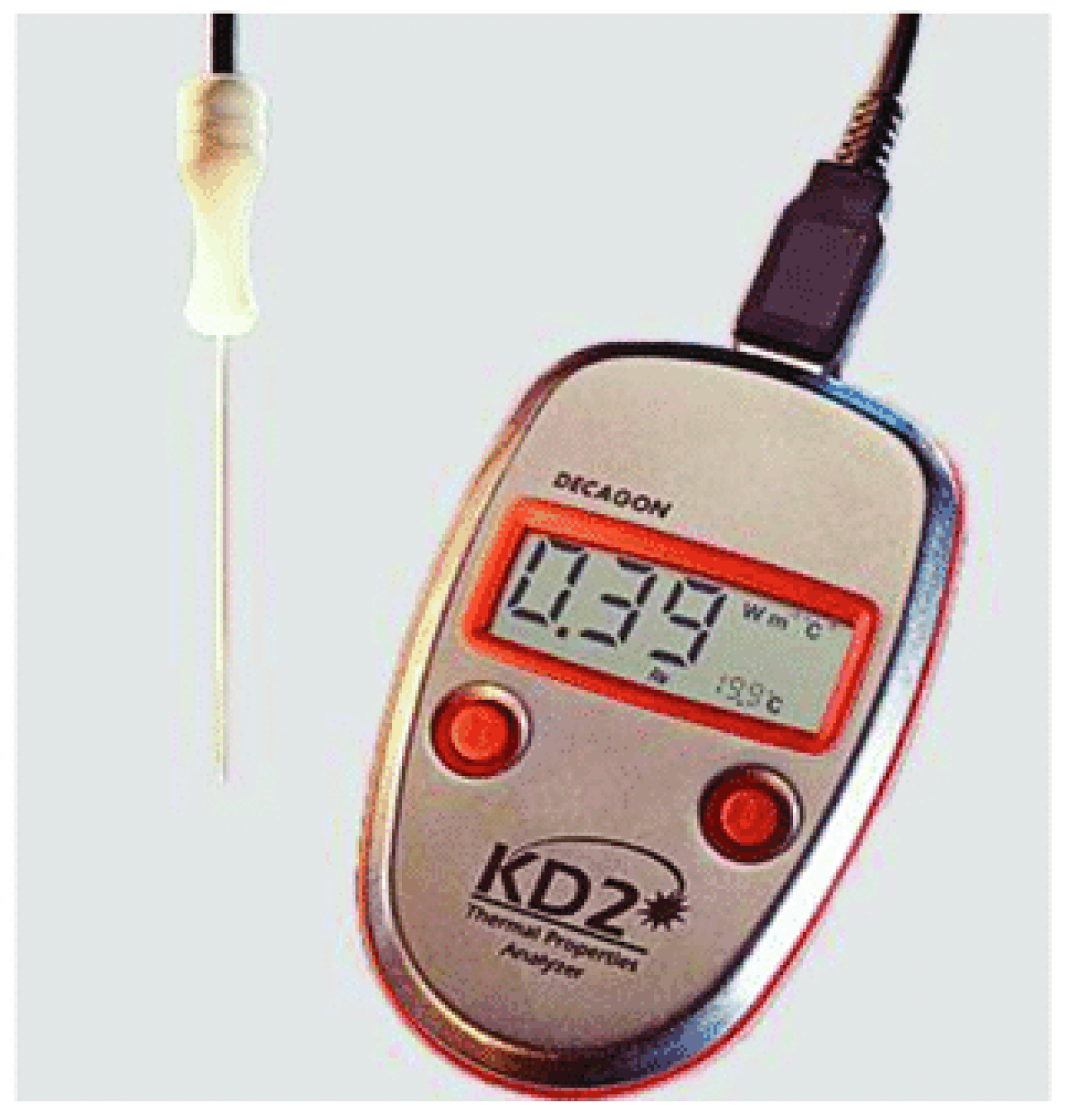
The produced drink samples were studied for the investigated factors, so 72 treatments were tested to measure their density, water activity, total soluble solids (TSS), and pH at room temperature (24 ± 2 °C). Water activity was measured using an Aqualab model series water activity analyzer (Decagon Devices, Inc., Pullman, WA, USA). A pH meter (Jenway, Model 3510, Cambridge, UK) with an accuracy of ±0.01 was used to test pH, and a pH 7.0 buffer was used to standardize the results. A refractometer (ATAGO-28E, Tokyo, Japan) was used to measure the concentration of TSS in the sample. A DMA4100M density meter (Anton Paar GmbH, Graz, Austria) calibrated with distilled water at 24 ± 2 °C was used to measure density. Every characteristic was measured three times. Additionally, both the thermal conductivity and thermal diffusivity of the fresh date syrup and sweetened buttermilk were measured. Measurements of thermal conductivity and thermal diffusivity were conducted using the Decagon KD2 Pro (Decagon Devices Incorporation, Pullman, WA, USA) (Figure 1). The length and diameter of the device prob were 60 mm and 28 mm, respectively. Each sample required 120 s to acquire a reading; three readings were recorded for each sample. The device was calibrated using a calibration solution of glycerin with thermal conductivity of 0.285 W/m K.
The heat flux, Q (W/m2), that flows through a material in the presence of a particular temperature gradient, ∆T (K/m), is described by thermal conductivity. In other words, it is the heat flow per unit area per unit of time when the temperature lowers by one degree in a unit of distance. Thus, the following formula (Equation (1)) was used to compute the heat flux, Q [30]:
Q = k × A × ( T H T L L )
where A stands for cross-sectional area, Q stands for heat flux, k stands for thermal conductivity, TL stands for cold end temperature, TH stands for hot end temperature, and L stands for material thickness. The negative sign denotes a positive heat flow in the direction of temperature decline.
Thermal diffusivity (α, m2/s) is the ability of a material to conduct heat and the ability to store it; Betta et al. [31] presented Equation (2) to determine it.
α = k ρ × c p
where ρ stands for density (kg/m3), k stands for thermal conductivity (W/m K), and cp stands for specific heat capacity (J/kg K).

2.3. Building the Artificial Neural Network (ANN) Model

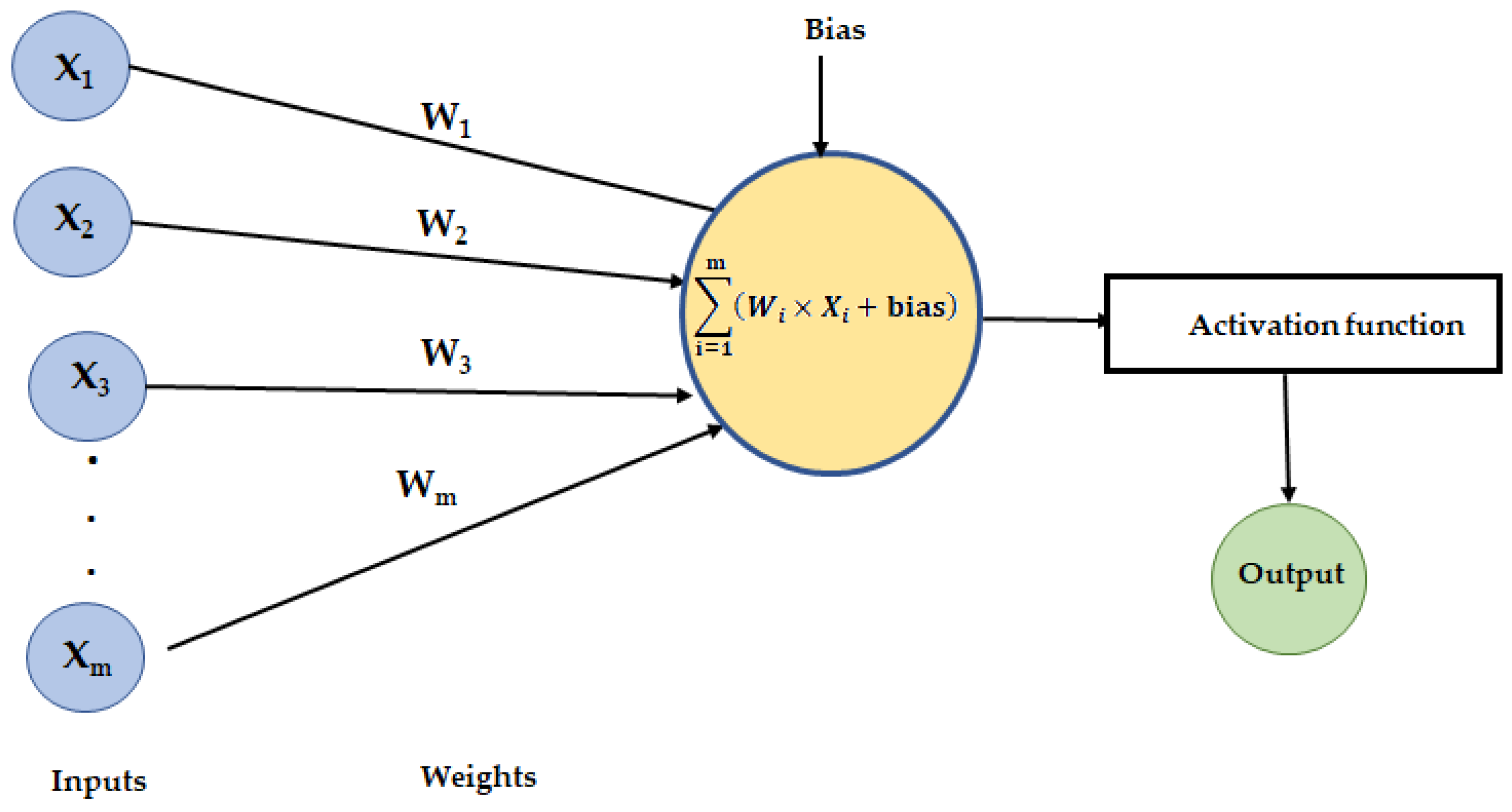
ANNs are a popular soft computing technique for modeling intricate, multifaceted, and highly non-linear relationships. ANNs are made up of many layers of artificial neurons, which are basic processing components. Figure 2 shows such processing elements. The theory of ANNs has been described in several papers [32].
The multilayer perceptron (MLP) was utilized in this study’s ANN modeling utilizing Qnet V.2000 software [33]. MLP is a feed forward network that generates a prediction model for one or more dependent variables. An input layer and an output layer are the two primary layers that make up MLP. The input and output levels are frequently separated by one or two extra layers known as hidden layers. Model performance is strongly influenced by the number of neurons in the hidden layer; therefore, optimal ANN structures were determined using a trial-and-error approach, as no fixed guideline exists. The learning process involves adjusting weights to minimize prediction error across the training dataset [34,35].
Al-Sager et al. [36] described how to develop and assess a neural network model using Qnet V.2000 software in order to determine the optimal architecture. Finding the weights that produce the best match for the expected outputs across the entire training dataset is part of the learning process [33].
A total of 216 data points were randomly divided into training and test sets in an 80:20 ratio. As a result, 172 and 44 data points were used for training and testing, respectively. Table 1 displays the statistical description of the entire set of data, including the values of the input and output parameters.
The experimental data used in the modeling process using the ANN method, were normalized automatically by the software (Qnet V.2000) to fall within a specific range using Equation (3). The range was between 0.15 and 0.85. The Qnet V.2000 software also reverse-scaled the data after predictions to present the results in their original units.
N o r m a l i z e d   V a l u e = ( O r i g i n a l   V a l u e M i n i m u m   V a l u e M a x i m u m   V a l u e M i n i m u m   V a l u e ) × ( 0.85 0.15 ) + 0.15
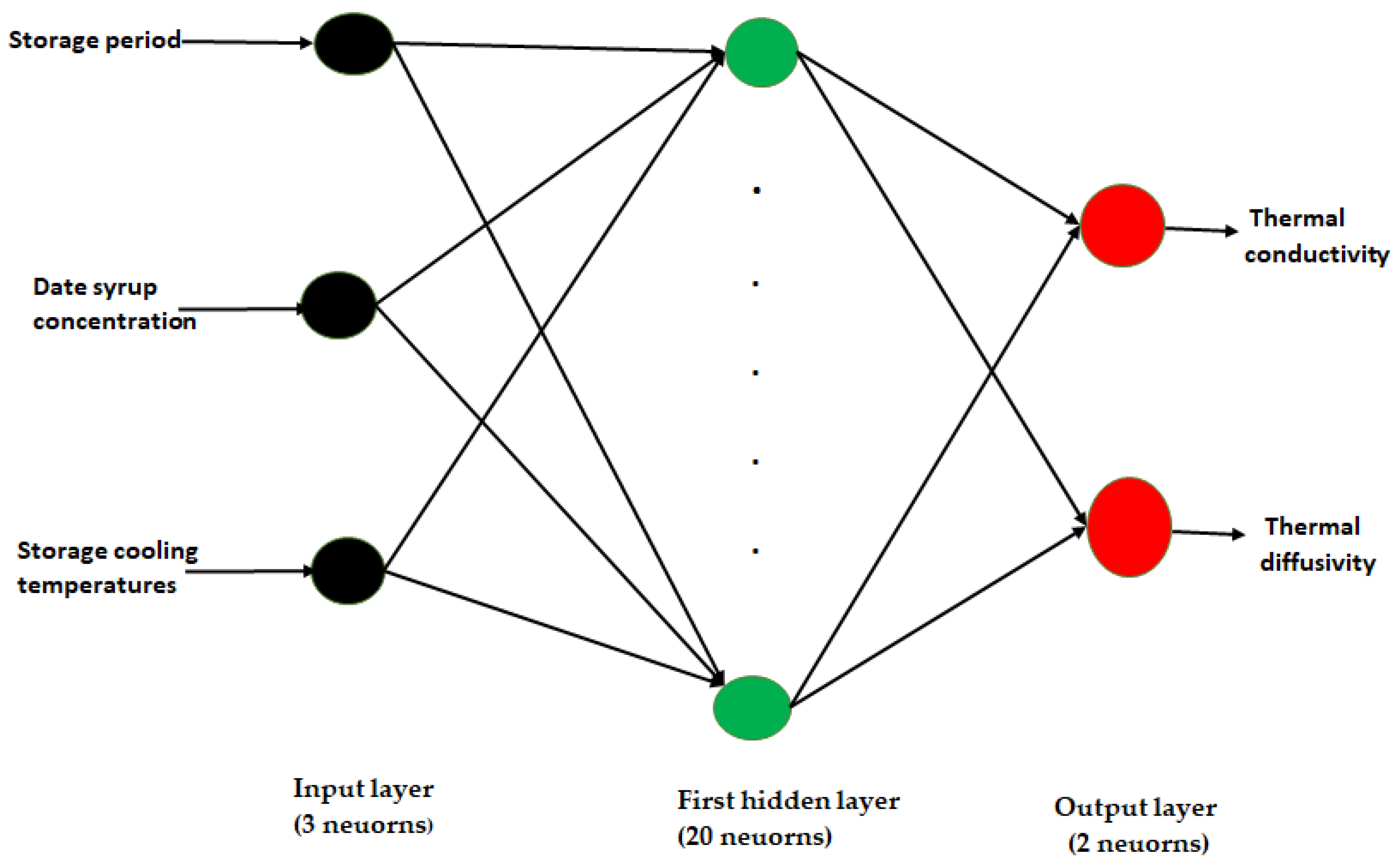
The input layer was composed of three nodes (storage cooling temperature, date syrup concentration, and storage period), while the output layer had two nodes (thermal conductivity and thermal diffusivity). The ANN model was trained using the standard back-propagation approach, which iteratively adjusts weights and biases to minimize prediction error.
When faced with unknown inputs that have never been seen before, well-trained back-propagation networks typically provide reasonable responses. Well-trained back-propagation networks exhibit good generalization, enabling accurate predictions for previously unseen inputs.
Each neuron’s response in the output layer is computed and compared to the intended output response for a specific set of inputs to the network. Every neuron from the output to the input layer is tweaked to minimize mistakes related to the intended output response.
In this study, the number of neurons in the hidden layer ranged from three to fifty. The sigmoid and hyperbolic tangent were used to test the neurons’ transfer functions. The software adjusted the learning rate while maintaining a fixed momentum rate of 0.8. The optimal ANN architecture, as depicted in Figure 3, was made up of 3–20–2 using a sigmoid function after 100,000 iterations, which showed better performance because of its effectiveness for non-linear relationships [37].

2.4. Contribution Analysis for Quantifying Input Variables’ Importance

Although ANNs have been widely applied across various fields for regression and prediction tasks, they are sometimes perceived as a “black box.” To ascertain the impact of each independent input variable on the results of an ANN model, a number of techniques were applied. One of them is offered by the Qnet V.2000 environment, which is called the contribution percentage; it provides information about the importance of the input variables. It is frequently helpful to identify inputs that are crucial to an ANN’s output response once it is close to its completely trained state. A contribution percentage or relative impact was generated for each output node, indicating the relative significance of each input on that specific output. By cycling each input for every training pattern and calculating the impact on the ANN’s output response, sensitivities are found. Each input value is assumed to be independent of every other input in this approach to calculating sensitivity. The three values used in the cycling process are the input node’s minimum, average, and maximum values as established by the training data. For every input node, the output change for the (minimum-average) and (maximum-average) are then computed and added up in a root sum square computation. It is therefore possible to compare the relative impact that each node has on the output response after doing this for each input node and case. According to the Qnet V.2000 environment, each input node’s simple percent effect is then calculated using the output node modifications as follows [38]:
R E = R M S E C R M S E T × 100
where RE stands for the relative impact or contribution percentage of each node’s inputs on the output response (%). RMSE-T is the root mean square error of output changes for all input nodes (inputs), whereas RMSE-C is the root mean square error of output changes when node 1, for instance, is varied (meaning first input). The analysis of the contribution percentage of input variables was based on ANN architecture consisting of 3–20–2.

2.5. Creating a Validation Dataset

Creating a validation dataset is a crucial step in ANN applications to ensure that a model generalizes well to unseen data. In this study, a validation dataset was generated by insulating inputs using only the investigated levels. About 72 data points were created, which were fed to the Qnet V.2000 software using Recall Mode. The predicted outputs were then compared with the experimentally observed values of thermal conductivity and thermal diffusivity for date syrup–sweetened buttermilk drinks.

2.6. Statistical Analysis

The results of this study were analyzed using IBM SPSS Statistics version 29 [39]. The significance level was tested through three-way analysis of variance (ANOVA) at the level of (p ≤ 0.05).

2.7. Statistical Measures for Performance Assessment of the Established ANN Model

The ANN model was appraised using the coefficient of determination (R2), mean absolute percentage error (MAPE), mean absolute error (MAE), and root mean square error (RMSE). The examined statistical criteria are commonly used [40,41] and defined as follows:
M A P E = 100 × 1 N   × q = 1 N t   | P q P ^ q P q |
M A E = q = 1 N   | P q P ^ q | N  
R M S E = q = 1 N   ( P q P ^ q ) 2 N  
where P ^ q represents the prediction value, Pq signifies the experimental value, and N is the total number of data points in the training and testing datasets.

3. Results and Discussion

3.1. Experimental Data Analysis

Fresh sweetened buttermilk was characterized by water activity of 0.992 ± 0.08, pH of 6.17 ± 0.03, density of 1.02 ± 0.07 g/cm3, TSS of 14.1 ± 0.001%, thermal conductivity of 0.433 ± 0.021 W/m K, and thermal diffusivity of 1.513 × 10⁻⁷ ± 2.80201 × 10⁻⁸ m2/s. The fresh Khlass date syrup utilized in this study was characterized by a water activity value of 0.653 ± 0.04, pH of 5.10 ± 0.05, TSS of 54.1 ± 1.10%, density of 1.22 ± 0.09 g/cm3, thermal conductivity of 0.455 ± 0.052 W/m K, and thermal diffusivity of 1.64 × 10⁻⁷ m2/s ± 2.12 × 10⁻⁹ m2/s. The obtained values were consistent with those reported in previous studies; however, differences may be attributed to the type of date syrup and extraction and evaporation methods [7,42,43,44].
As shown in Table 1, thermal conductivity data of the developed drink combinations ranged from 0.533 to 0.633 W/m K, while thermal diffusivity ranged from 1.317 × 10⁻⁷ to 2.247 × 10⁻⁷ m2/s. However, Souza Jr. et al. [19] reported that thermal diffusivity was 1.00 to 9.03 × 10⁻⁷ m2/s in bovine milk, affected by temperature and composition. Furthermore, the values of thermal diffusivity in whole milk, skim milk, and whey were reported by [17] to be in the range of 1.1–1.6 × 10⁻⁷ m2/s. The discrepancy between the present study and those by Souza Jr. et al. [19] and Muramatsu et al. [17] may arise from differences in composition and temperature [17,19]. Furthermore, factors such as instrument calibration, probe sensitivity, sample heterogeneity, and experimental conditions (e.g., temperature control and measurement procedures) may contribute to variations in reported values. Moreover, over a temperature range of 0 to 100 °C, the range of the thermal conductivity of whole and skim milk was 0.530 to 0.613 W/m K and 0.527 to 0.622 W/m K, respectively. Furthermore, the thermal conductivity of whole milk, skimmed milk, and partially skimmed milk was in the range of 0.5 to 0.6 W/m K at concentrations ranging from (72.0 to 92.0) mass% water content and from (0.1 to 7.8) mass% fat content and at temperatures ranging from (275.15 K to 344.15 K) [45]. Additionally, Gonçalves et al. [46] reported values of thermal conductivity of 0.453, 0.520, and 0.515 W/m K for yogurts, fermented dairy beverages, and fermented milks, respectively; however, the temperature was set to 15 °C and the composition of the products was in the range of 2.00 to 3.11% protein, 0 to 2.94% fat, 11.11 to 15.90% carbohydrates, 0% fiber, 0.10 to 0.13% ash, and 77.92 to 85.29% water. The food ingredient that increases conductivity the greatest is water [46]. Additionally, Keppeler and Boose [47] reported a range for thermal conductivity of sucrose of 0.370–2.204 W/m K at different temperatures and water contents.
When modeling data statistically, it is crucial to comprehend the probability distributions. Specifically, distributional asymmetry and tail heaviness are commonly captured by skewness and kurtosis [48]. Both thermal conductivity and thermal diffusivity data from the experimental work in the current study had kurtosis values of −0.446 and −0.379 and skewness values of 0.182 and −0.382, respectively (Table 1). Because both skewness and kurtosis lie between +1 and −1, the data were considered approximately normally distributed, supporting the use of parametric statistical analysis.
A three-way ANOVA was performed to evaluate the effects of storage period, date syrup concentration, and storage cooling temperature on the thermal conductivity and thermal diffusivity of the developed drink. As summarized in Table 2, all main effects and their interactions were statistically significant (p < 0.001). These findings indicate that the thermal properties of the developed drink are strongly influenced by both formulation and storage conditions, likely reflecting the inherent thermal properties of the original sweetened buttermilk and date syrup [9].
Table 3 shows the effect of the investigated factors on the mean thermal conductivity and thermal diffusivity of the created drink. Multiple comparison analysis revealed that the mean value of the thermal conductivity and thermal diffusivity was significantly different across storage periods, date syrup concentrations, and storage cooling temperatures. As shown in Table 3, increasing the storage period level from 0 to 15 days led to decreases in both thermal conductivity and thermal diffusivity. Increasing the date syrup concentration level from 5% to 15% led to an increase in both thermal conductivity and thermal diffusivity. Increasing the storage cooling temperature level from 0 °C to 15 °C led to an increase in both thermal conductivity and thermal diffusivity. However, the thermal conductivity of milk shows a linear increase as temperature rises [49]. This trend is related to viscosity, as the viscosity of most liquids decreases with increasing temperature. The buttermilk–date syrup system becomes less viscous at higher storage temperatures. Thermal conductivity is further improved by lower viscosity, which facilitates chemical rearrangement and lowers resistance to heat transfer. According to Fox and McSweeney [50], milk’s thermal conductivity rises linearly with temperature and falls with TSS [44]. Within the tested range, the thermal conductivity was more affected by the water content and less by the fat content [45]. More and Prasad [50] stated that the thermal conductivity of whole milk increased with temperature and decreased with total solids content when evaluated over temperatures of 40–90 °C and total solids ranging from 37 to 72.4%.

3.2. Performance Analysis of the Developed ANN Model to Predict the Thermal Conductivity and Thermal Diffusivity of the Created Drink

Understanding the thermal conductivity of milk is necessary for the design of heat exchanger equipment in the dairy processing sector [51]. Gavrilă et al. [52] found a way to model the thermal conductivity of different products used in dairy technology, highlighting its importance in the design, simulation, optimization, and management of processes such as evaporation, heat exchange, and spray drying. These characteristics are typically predicted using polynomial techniques based on empirical correlation to experimental data. Large-scale, noisy knowledge indexing is better handled by ANNs [37]. ANNs showed better specific heat, thermal conductivity, and milk density prediction capabilities than polynomial models, making them a reliable alternative for modeling food thermophysical properties [37].
The best ANN model structure for forecasting the thermal conductivity and thermal diffusivity of the produced drink was determined in this study using the ANN technique using Qnet V.2000 software. The input layer of the ANN consisted of three independent variables. The best network was discovered after 100,000 epochs, with a momentum factor of 0.8 and a learning rate of 0.041057. ANN restructuring was 3–20–2, with a testing error of 0.012147, a training error of 0.011038, and a sigmoid transfer function.
The model’s predictive performance was evaluated using R2, MAE, RMSE, and MAPE (Table 4). The smallest magnitude of these criteria indicates a reasonable degree of error. This demonstrates that the established ANN model can accurately forecast unknown data. Nonetheless, the ANN model showed excellent predictive accuracy in the experimental work; however, additional validation using independent datasets is necessary to determine its generalization capacity outside of the investigated range.
According to the literature, a prediction based on MAPE has an acceptance level of 10% [53,54]. The present study obtained MAPE values for the training and testing datasets of 0.256% and 0.313%, respectively, for thermal conductivity; for the thermal diffusivity of the created drink, the MAPE values were 0.837% and 0.969%, respectively, for the training and testing datasets (Table 4).
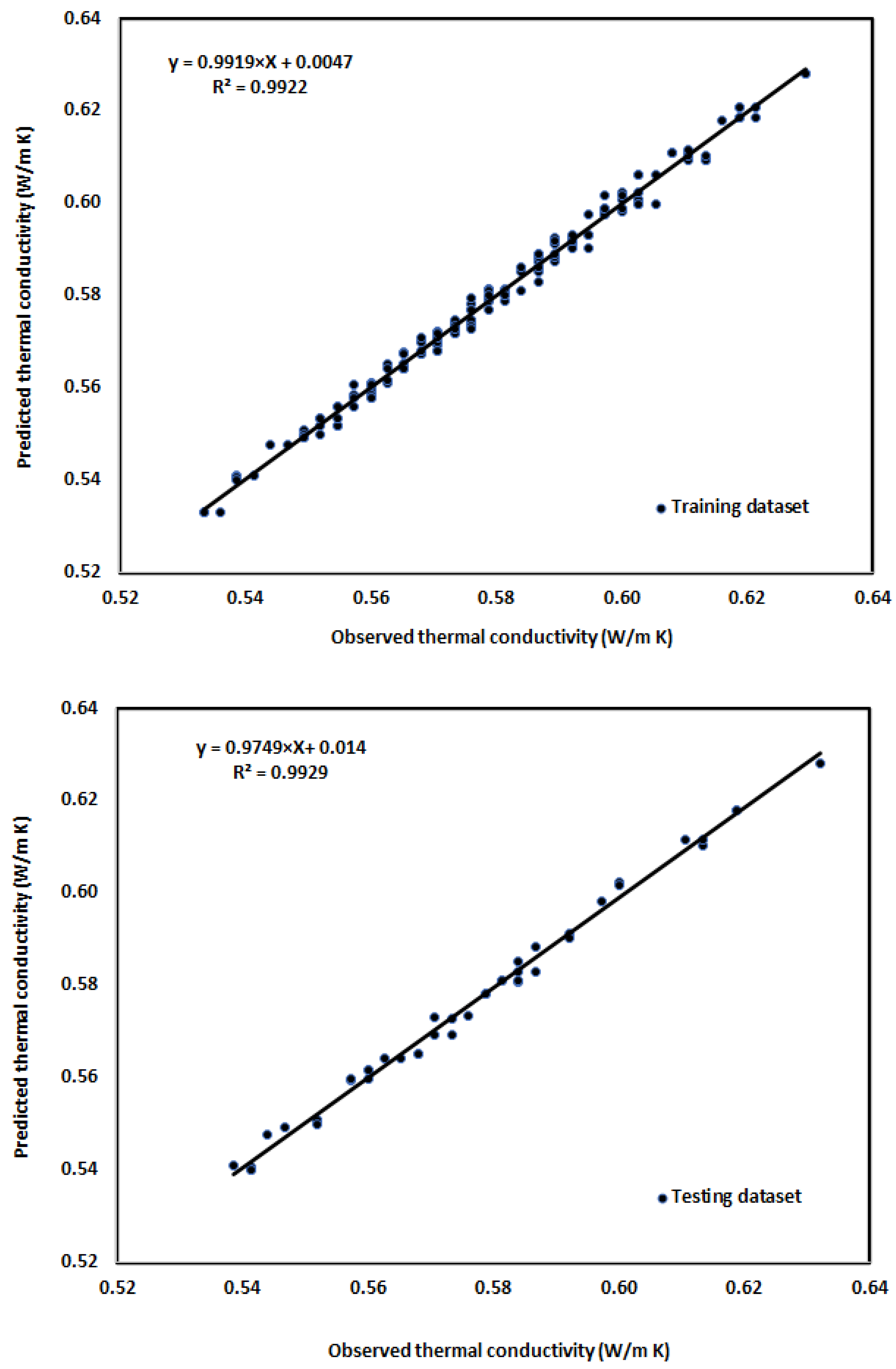
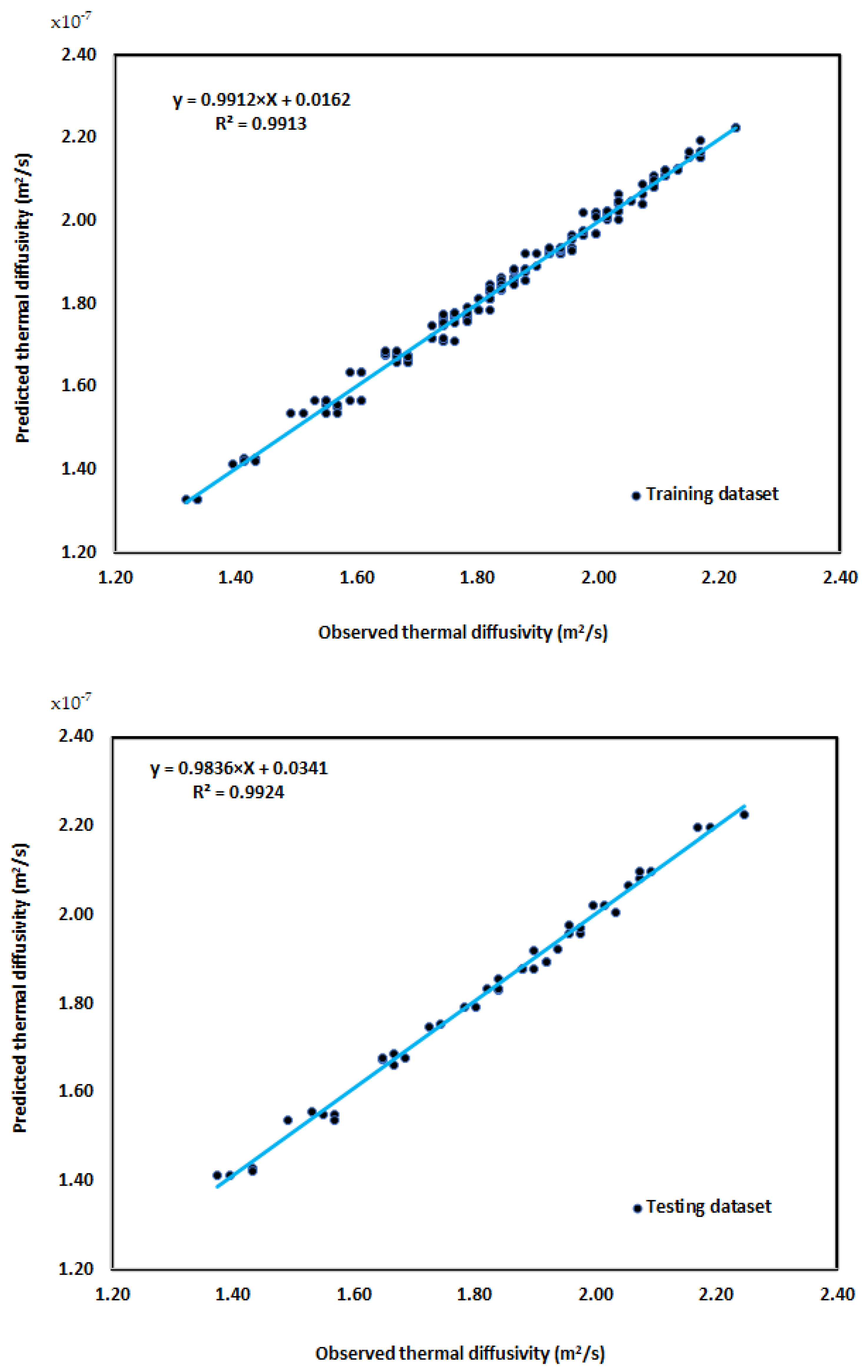
During the training and testing phases, MAE varied across the two outputs (Table 4). However, Figure 4 shows the regression of the best ANN model for thermal conductivity when using training and testing datasets for the observed values against the ANN’s output values, demonstrating the network’s ability to learn the training dataset accurately. R2 for the data was determined to be 0.9922 for the training dataset and 0.9929 for the testing dataset (Table 4 and Figure 4), indicating strong agreement between observed and predicted thermal conductivity values. Figure 5 indicates the regression of the optimal ANN model for thermal diffusivity, comparing observed values with predicted outputs for both the training and testing datasets, demonstrating the network’s ability to learn accurately. R2 for the data was determined to be 0.9913 for the training dataset and 0.9924 for the testing data (Table 4 and Figure 5); this result shows that the observed and predicted thermal diffusivity are appropriately related.
Neural-network-based models have been shown to be the most effective modeling approach for predicting the thermal conductivity of a range of foods [55]. Among the key benefits of using ANN are its excellent handling of uncertainties, noisy data, and non-linear interactions. Neural network modeling has become popular and is an interesting method for estimating, predicting, and controlling bioprocesses [56]. The behavior of the ANN model developed in this study was nearly identical to that of ANN models used in previous research for prediction in the food industry [31].
When utilizing an ANN model in various applications, prediction accuracy may be impacted by explanatory characteristics, data quantity, the ANN training algorithm, etc. For instance, Ajasa et al. [30] demonstrated the use of an ANN model to estimate the thermal conductivity of food (bakery) items as a function of temperature, apparent density, and moisture content. The simplest ANN model was a network with one hidden layer and ten neurons. It predicted thermal conductivity values with a mean relative error of 3.388 × 10⁻²% and a mean absolute error of 0.0034 W/m K.
In the current study, ANN predictions were compared with experimental data to validate the ANN model. Table 5 displays a statistical description of the validation dataset. The trend of the observed and predicted data was evidently the same, suggesting strong agreement.

3.3. Results of Determining the Contribution Percentages of Each Input on Outputs

The established ANN model can detect the contribution percentages of each input on outputs, which is useful given the complex and non-linear relationship between the parameters, such as storage cooling temperature, date syrup concentration, and storage period, and the thermal conductivity and thermal diffusivity of a drink produced from date syrup–sweetened buttermilk. Sensitivity analysis is a common method for evaluating how each factor affects the overall process [57].
Numerous scientific domains employ techniques for measuring the significance of variables in neural-network-based models. These techniques reveal the relative significance of explanatory factors by opening up the “black box” model [58]. Several techniques, such as the Garson algorithm, have been used to determine the relative importance of each independent variable in the ANN model developed [59]. Previous studies show that the strategy employed can affect how a variable is ranked [60].
In this study, the input node interrogator for contribution percentages calculation in Qnet V.2000 software as described in Section 2.4 was used to identify the contribution percentages, which indicate the influence of each input on the outputs but not the direction of the relationship.
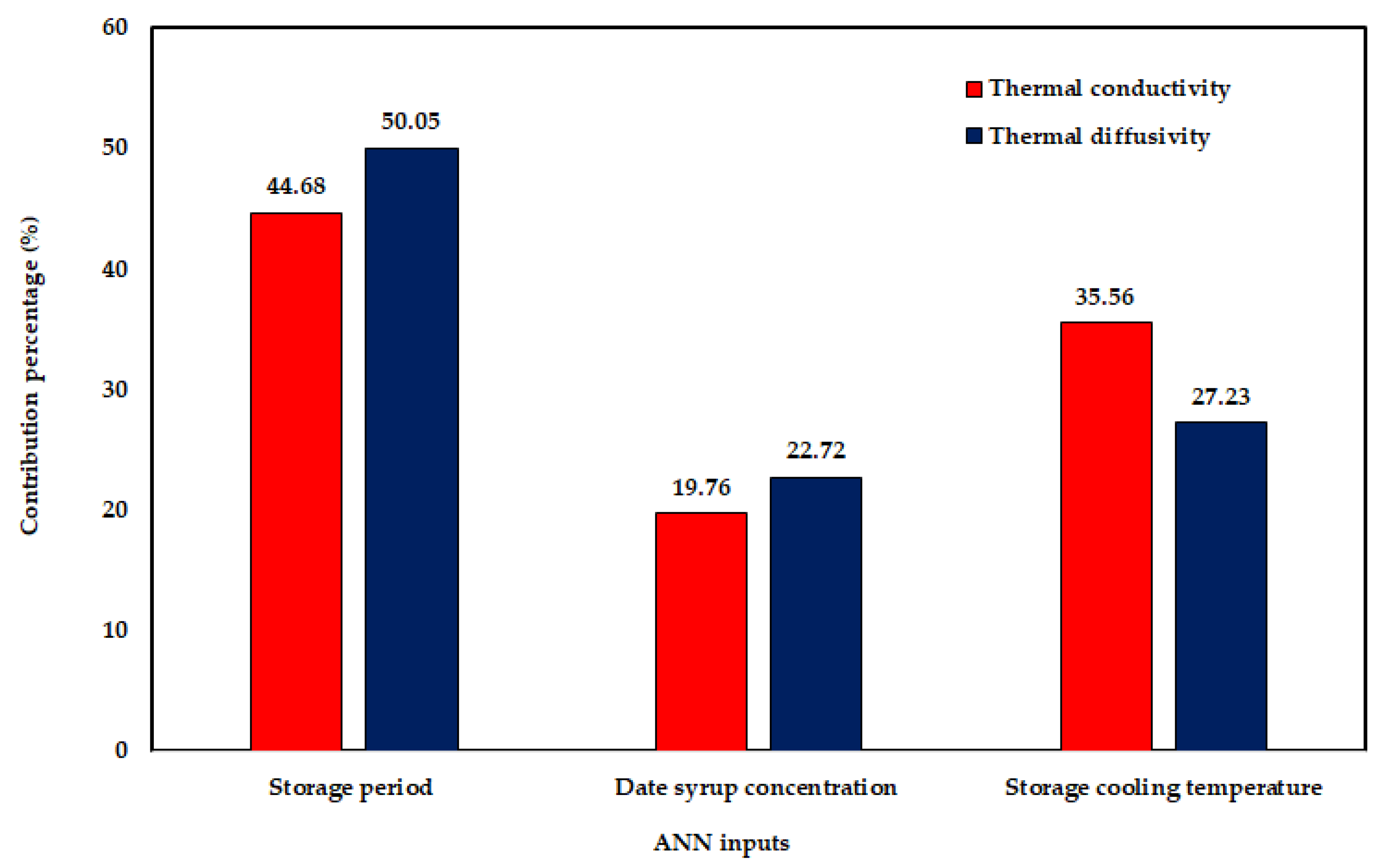
Utilizing the created ANN model for prediction utilizing data from the experimental work, Figure 6 shows the contribution percentages of the input to output relationship. The findings indicate that the main factor influencing thermal conductivity is storage duration (44.68% of contribution percentage), followed by storage cooling temperature (35.53%) and date syrup concentration (19.76%). The storage period (50.05% of the contribution percentage) is the principal factor influencing thermal diffusivity, followed by storage cooling temperature (27.23%), and date syrup concentration (22.72%). Note that a high contribution percentage to a parameter indicates that a slight change in the parameter might have a significant impact on the system’s performance and vice versa [61].
According to AL-Jadede et al. [62], storage period affected some of the physicochemical characteristics of homemade date syrup. The results of the present study show the ability of ANN-based method to assess the percentage contribution of process factors while creating a beverage from buttermilk and date syrup, and it has the potential to significantly transform the optimization process in process design. This approach also holds promise for evaluating the significance of other dairy products and date syrup properties beyond those considered in this study.
The results of this study demonstrate the great potential of the developed ANN model as trustworthy instrument for forecasting the thermophysical characteristics of intricate dairy-based drinks. From an industrial standpoint, real-time decision-making during processes like pasteurization, chilling, and storage can be supported by integrating the generated model into process design and control systems. The model may lessen the need for lengthy experimental tests by permitting quick predictions of thermal conductivity and diffusivity based on formulation and storage conditions. This would cut operating costs and increase process efficiency. In real-world applications, these prediction technologies might be integrated into smart manufacturing platforms in the dairy and beverage sectors. This would enable processors to dynamically modify operational parameters (such as residence time, temperature profiles, and heat exchanger settings) in response to changes in product composition, especially when employing natural sweeteners like date syrup.
Future studies should concentrate on expanding the present modeling framework to incorporate other quality factors, such as density, viscosity, specific heat capacity, and sensory-related parameters. Adding physicochemical characteristics as input variables, such as pH, total soluble solids (TSS), and water activity, may improve the model’s predictive power and resilience. Additionally, future research should use larger and more varied datasets covering wider ranges of processing conditions and product compositions in order to increase model generalization and industry relevance. Lastly, the suggested modeling method can be used for various functional drinks and dairy substitutes, such as plant-based beverages and fortified dairy products, in addition to buttermilk–date syrup systems. These developments would help innovation and sustainability in the food business by advancing the creation of universal predictive frameworks for food process engineering.

4. Conclusions

The thermal conductivity and thermal diffusivity of a drink made from buttermilk sweetened with date syrup were evaluated and modeled in this work as a function of storage cooling temperatures, date syrup concentration, and storage duration using an ANN model. Increasing the storage period from 0 to 15 days led to decreases in both thermal conductivity and thermal diffusivity. Increasing date syrup concentration from 5% to 15% led to an increase in both thermal conductivity and thermal diffusivity. Increasing storage cooling temperature from 0 °C to 15 °C led to an increase in both thermal conductivity and thermal diffusivity. The findings indicate that the key factor influencing thermal conductivity is storage duration (44.68% of contribution percentage), followed by storage cooling temperature (35.53%), and date syrup concentration (19.76%). The storage period (50.05% of the contribution percentage) is the main factor influencing thermal diffusivity, with storage cooling temperature (27.23%) and date syrup concentration (22.72%) ranked second and third, respectively.
The ANN predictions closely matched the experimental data, with R2 values of 0.9929 and 0.9924 for thermal conductivity and thermal diffusivity in the testing phase, respectively, confirming that the ANN model is highly effective for interpolation within the defined experimental domain.
These findings have significant practical implications for the design of beverage processing and storage systems. Accurate prediction models, like ANNs, can greatly enhance the design of thermal processes, such as pasteurization, cooling, and storage, according to the observed impact of thermal properties on temperature and composition. In particular, because of their reduced specific heat and changed heat transfer characteristics, beverages with a higher date syrup content may need different heating and cooling schedules.
Despite these contributions, several limitations should be acknowledged. The study was conducted over a range of storage cooling temperatures and storage durations, which may limit the generalizability of the results. Furthermore, experimental conditions were restricted to a relatively narrow range of storage cooling temperatures, syrup concentrations, and storage durations, which may limit the generalizability of the findings to other dairy systems or industrial conditions. In addition, the determination of thermal properties using a single measurement technique may introduce uncertainties related to sample heterogeneity and instrument sensitivity, particularly in complex food matrices. From a modeling perspective, the ANN was developed using a relatively limited dataset, which may increase the risk of overfitting and reduce the robustness of the model when applied to external datasets. Furthermore, the model architecture was selected using a trial-and-error approach without systematic optimization or cross-validation, which may affect reproducibility. Finally, the validation procedure was based on data generated within the same experimental domain and therefore does not fully demonstrate the predictive capability of the model under independent or real-world conditions.
In conclusion, ANN demonstrated a greater capacity to handle noisy data and a lot of information, making it a reliable alternative to linear or polynomial regression for predicting thermophysical properties of date syrup–sweetened buttermilk.

Author Contributions

A.M.A. and S.A.-G. conceptualized and prepared the manuscript; A.M.A., B.A. and S.A.-G. developed the methodology, analyzed the data, acquired funding, authored and reviewed drafts of the paper, and approved the final draft. All authors have read and agreed to the published version of the manuscript.

Funding

This research was funded by the Ongoing Research Funding Program (ORF-2026-1891), King Saud University, Riyadh, Saudi Arabia.

Institutional Review Board Statement

Not applicable.

Informed Consent Statement

Not applicable.

Data Availability Statement

Data are contained within the article.

Acknowledgments

The authors would like to extend their sincere appreciation to the Ongoing Research Funding Program (ORF-2026-1891), King Saud University, Riyadh, Saudi Arabia.

Conflicts of Interest

The authors declare no conflict of interest.

References

  1. Al-Karmadi, A.; Okoh, A.I. An Overview of Date (Phoenix dactylifera) Fruits as an Important Global Food Resource. Foods 2024, 13, 1024. [Google Scholar] [CrossRef]
  2. Alamri, Y.A.; Alnafissa, M.A.; Kotb, A.; Alagsam, F.; Aldakhil, A.I.; Alfadil, I.E.; Al-Qunaibet, M.H.; Alaagib, S. Estimating the Expected Commercial Potential of Saudi Date Exports to Middle Eastern Countries Using the Gravity Model. Sustainability 2024, 16, 2552. [Google Scholar] [CrossRef]
  3. Iliyasu, R.; Muhammad, A.S.; Dandago, M.A.; Jibril, H. Date Fruit Processing and Composition. Ann. Food Sci. Technol. 2021, 22, 274. [Google Scholar]
  4. Ranasinghe, M.; Manikas, I.; Maqsood, S.; Stathopoulos, C. Date Components as Promising Plant-Based Materials to Be Incorporated into Baked Goods—A Review. Sustainability 2022, 14, 605. [Google Scholar] [CrossRef]
  5. Najjar, Z.; Stathopoulos, C.; Chockchaisawasdee, S. Utilization of Date By-Products in the Food Industry. Emir. J. Food Agric. 2020, 32, 808–815. [Google Scholar] [CrossRef]
  6. Besbes, S.; Drira, L.; Blecker, C.; Deroanne, C.; Attia, H. Adding Value to Hard Date (Phoenix dactylifera L.): Compositional, Functional and Sensory Characteristics of Date Jam. Food Chem. 2009, 112, 406–411. [Google Scholar] [CrossRef]
  7. El-Nagga, E.A.; Abd ElTawab, Y.A. Compositional Characteristics of Date Syrup Extracted by Different Methods in Some Fermented Dairy Products. Ann. Agric. Sci. 2012, 57, 29–36. [Google Scholar] [CrossRef]
  8. Almuzaini, H.A.; Faqih, E.H.; Alhumaid, N.A.; Shabib, Z.A.; Abd El-Hady, E.-S.A.; Gadallah, M.G.E. Advantages of Khalas Date Products (Phoenix dactylifera L.) as a Natural Substitute for Sugar and Sweeteners in Food Processing. Alex. Sci. Exch. J. 2024, 45, 661–674. [Google Scholar] [CrossRef]
  9. Elamshity, M.G.; Alhamdan, A.M. Non-Destructive Evaluation of the Physiochemical Properties of Milk Drink Flavored with Date Syrup Utilizing VIS-NIR Spectroscopy and ANN Analysis. Foods 2024, 13, 524. [Google Scholar] [CrossRef]
  10. Vanderghem, C.; Bodson, P.; Danthine, S.; Paquot, M.; Deroanne, C.; Blecker, C. Milk Fat Globule Membrane and Buttermilks: From Composition to Valorization. Biotechnol. Agron. Soc. Environ. 2010, 14, 485–500. [Google Scholar]
  11. Ali, A.H. Current Knowledge of Buttermilk: Composition, Applications in the Food Industry, Nutritional and Beneficial Health Characteristics. Int. J. Dairy Technol. 2019, 72, 169–182. [Google Scholar] [CrossRef]
  12. Calvo, M.V.; Martín-Hernández, M.C.; García-Serrano, A.; Castro-Gómez, M.P.; Alonso-Miravalles, L.; García-Martín, R.; Megino-Tello, J.; Alonso, L.; Fontecha, J. Comprehensive Characterization of Neutral and Polar Lipids of Buttermilk from Different Sources and Its Milk Fat Globule Membrane Isolates. J. Food Compos. Anal. 2020, 86, 103386. [Google Scholar] [CrossRef]
  13. Hassan, B.H. Production of Dibbs and High Fructose Sugar of Dates on an Industrial Scale. In Engineering Applications in the Manufacturing Dates, 2nd ed.; Hubani, A.I., Aljanobi, A.A., Eds.; King Saud University: Riyadh, Saudi Arabia, 2008; pp. 109–131. [Google Scholar]
  14. Alcântara, L.A.P.; Fontan, R.D.C.I.; Bonomo, R.C.F.; Souza, E.C.D., Jr.; Sampaio, V.S.; Pereira, R.G. Density and Dynamic Viscosity of Bovine Milk Affect by Temperature and Composition. Int. J. Food Eng. 2012, 8, 11. [Google Scholar] [CrossRef]
  15. Ardali, F.R.; Rahimi, E.; Tahery, S.; Shariati, M.A. Production of a New Drink by Using Date Syrup and Milk. J. Food Biosci. Technol. 2014, 4, 67–72. [Google Scholar]
  16. Guimarães, G.C.; Coelho Júnior, M.C.; Garcia Rojas, E.E. Density and Kinematic Viscosity of Pectin Aqueous Solution. J. Chem. Eng. Data 2009, 54, 662–667. [Google Scholar] [CrossRef]
  17. Muramatsu, Y.; Sakaguchi, E.; Orikasa, T.; Tagawa, A. Simultaneous Estimation of the Thermophysical Properties of Selected Liquid Dairy Products by a Transient Heat Flow Probe Method. Int. J. Food Prop. 2011, 14, 557–569. [Google Scholar] [CrossRef]
  18. Poling, B.E.; Prausnitz, J.M.; O’Connell, J.P. Properties of Gases and Liquids, 5th ed.; McGraw-Hill’s AccessEngineering; McGraw-Hill Education: New York, NY, USA, 2020. [Google Scholar]
  19. Souza, E.C.; Fontan, R.C.I.; Veríssimo, L.A.A.; Sampaio, V.S.; Silva, W.S.; Bonomo, R.C.F.; Veloso, C.M. Thermal Diffusivity and Specific Heat of Bovine Milk Affected by Temperature and Composition. Int. J. Food Eng. 2012, 8, 8. [Google Scholar] [CrossRef]
  20. MacCarthy, D. Engineering and Food; Applied Science Publishers: London, UK, 1984; Volume 1. [Google Scholar]
  21. Alhamdan, A.M. Thermal behavior of milk drink flavored with date syrup measured by MDSC and predicted by artificial neural networks (ANNs). In ISHS Acta Horticulturae 882: IV International Date Palm Conference; International Society for Horticultural Science (ISHS): Leuven, Belgium, 2010; pp. 1181–1193. [Google Scholar] [CrossRef]
  22. Luo, H.; Akkermans, S.; Van Impe, J.F.M. Demystifying Food Flavor: Flavor Data Interpretation through Machine Learning. Food Chem. 2025, 483, 144000. [Google Scholar] [CrossRef]
  23. Goyal, S. Predicting Shelf Life of Dairy Product by Using Artificial Neural Networks (ANN) and Statistical Computerized Methods. Int. J. Comput. Eng. Res. 2012, 3, 20–24. [Google Scholar] [CrossRef]
  24. Montesinos López, O.A.; Montesinos López, A.; Crossa, J. Fundamentals of Artificial Neural Networks and Deep Learning. In Multivariate Statistical Machine Learning Methods for Genomic Prediction; Montesinos López, O.A., Montesinos López, A., Crossa, J., Eds.; Springer International Publishing: Cham, Switzerland, 2022; pp. 379–425. [Google Scholar]
  25. Sablani, S.S.; Rahman, M.S. Using Neural Networks to Predict Thermal Conductivity of Food as a Function of Moisture Content, Temperature and Apparent Porosity. Food Res. Int. 2003, 36, 617–623. [Google Scholar] [CrossRef]
  26. Sofu, A.; Ekinci, F.Y. Estimation of Storage Time of Yogurt with Artificial Neural Network Modeling. J. Dairy Sci. 2007, 90, 3118–3125. [Google Scholar] [CrossRef]
  27. Al-Mahish, M.; Almulhim, T.; Alali, M. Purchasing Decisions on Date Palm Fruits: A Quantitative Analysis of the Khalas Cultivar. PLoS ONE 2023, 18, e0289512. [Google Scholar] [CrossRef] [PubMed]
  28. Alshamlan, N.S. Effect of Plant Sweeteners with Date Syrup on Physicochemical and Sensory Quality Properties of Cow’s Milk. J. Food Dairy Sci. 2022, 13, 175–179. [Google Scholar] [CrossRef]
  29. Alhamdan, A.M.; Juhaimi, F.Y.A.; Hassan, B.H.; Ehmed, K.A.; Ahmed, I.A.M. Physicochemical, Microbiological, and Sensorial Quality Attributes of a Fermented Milk Drink (Laban) Fortified with Date Syrup (Dibs) during Cold Storage. Foods 2021, 10, 3157. [Google Scholar] [CrossRef]
  30. Ajasa, A.A.; Akinyemi, L.A.; Shoewu, O.O.; Adenowo, A.A. Exploitation of Artificial Neural Networks Approach to Predict the Thermal Conductivity of Food Products in Nigeria. Am. J. Eng. Res. (AJER) 2014, 3, 22–29. [Google Scholar]
  31. Betta, G.; Rinaldi, M.; Barbanti, D.; Massini, R. A Quick Method for Thermal Diffusivity Estimation: Application to Several Foods. J. Food Eng. 2009, 91, 34–41. [Google Scholar] [CrossRef]
  32. Basheer, I.A.; Hajmeer, M. Artificial Neural Networks: Fundamentals, Computing, Design, and Application. J. Microbiol. Methods 2000, 43, 3–31. [Google Scholar] [CrossRef] [PubMed]
  33. Vesta Services, Inc. Qnet V 2000 Shareware; Vesta Services, Inc.: Winnetka, IL, USA, 2000. [Google Scholar]
  34. Shafi, I.; Ahmad, J.; Shah, S.I.; Kashif, F.M. Impact of Varying Neurons and Hidden Layers in Neural Network Architecture for a Time Frequency Application. In 2006 IEEE International Multitopic Conference; IEEE: Piscataway, NJ, USA, 2006; pp. 188–193. [Google Scholar]
  35. Deng, T. Effect of the Number of Hidden Layer Neurons on the Accuracy of the Back Propagation Neural Network. Highlights Sci. Eng. Technol. 2023, 74, 462–468. [Google Scholar] [CrossRef]
  36. Al-Sager, S.M.; Almady, S.S.; Marey, S.A.; Al-Hamed, S.A.; Aboukarima, A.M. Prediction of Specific Fuel Consumption of a Tractor during the Tillage Process Using an Artificial Neural Network Method. Agronomy 2024, 14, 492. [Google Scholar] [CrossRef]
  37. Mattar, H.L.; Minim, L.A.; Coimbra, J.S.R.; Minim, V.P.R.; Saraiva, S.H.; Telis-Romero, J. Modeling Thermal Conductivity, Specific Heat, and Density of Milk: A Neural Network Approach. Int. J. Food Prop. 2004, 7, 531–539. [Google Scholar] [CrossRef]
  38. Al-Dosary, N.M.N.; Alnajjar, F.M.; Aboukarima, A.E.W.M. Estimation of Wheel Slip in 2WD Mode for an Agricultural Tractor during Plowing Operation Using an Artificial Neural Network. Sci. Rep. 2023, 13, 5975. [Google Scholar] [CrossRef] [PubMed]
  39. IBM Corp. IBM SPSS Statistics for Windows, version 29.0; IBM Corp.: Armonk, NY, USA, 2022.
  40. Sammen, S.S.; Kisi, O.; Ehteram, M.; El-Shafie, A.; Al-Ansari, N.; Ghorbani, M.A.; Bhat, S.A.; Ahmed, A.N.; Shahid, S. Rainfall Modeling Using Two Different Neural Networks Improved by Metaheuristic Algorithms. Environ. Sci. Eur. 2023, 35, 112. [Google Scholar] [CrossRef]
  41. Tsae, N.B.; Adachi, T.; Kawamura, Y. Application of Artificial Neural Network for the Prediction of Copper Ore Grade. Minerals 2023, 13, 658. [Google Scholar] [CrossRef]
  42. Entezari, M.H.; Nazary, S.H.; Khodaparast, M.H. The Direct Effect of Ultrasound on the Extraction of Date Syrup and Its Micro-Organisms. Ultrason. Sonochem. 2004, 11, 379–384. [Google Scholar] [CrossRef]
  43. Elmejhed, B.; Derraji, H.; Terouzi, W.; Kzaiber, F. Assessment of the Physico-Chemical and Sensory Qualities of Moroccan Date Syrup: Optimization of Extraction and Conservation. J. Biotechnol. Biochem. 2021, 7, 35–45. [Google Scholar]
  44. Al-Mutairi, S.K.; Al-Jasser, M.S. Effect of Using Rotary Evaporator on Date Dibs Quality. J. Am. Sci. 2012, 8, 587–594. [Google Scholar]
  45. Minim, L.A.; Coimbra, J.S.R.; Minim, V.P.R.; Telis-Romero, J. Influence of Temperature and Water and Fat Contents on the Thermophysical Properties of Milk. J. Chem. Eng. Data 2002, 47, 1488–1491. [Google Scholar] [CrossRef]
  46. Gonçalves, B.J.; Pereira, C.G.; Lago, A.M.T.; Gonçalves, C.S.; Giarola, T.M.O.; Abreu, L.R.; Resende, J.V. Thermal conductivity as influenced by the temperature and apparent viscosity of dairy products. J. Dairy Sci. 2017, 100, 3513–3525. [Google Scholar] [CrossRef]
  47. Keppeler, R.A.; Boose, J.R. Thermal properties of frozen sucrose solutions. Trans. ASAE 1970, 13, 0335–0339. [Google Scholar] [CrossRef]
  48. Kim, J.H.; Kim, H. Estimating Skewness and Kurtosis for Asymmetric Heavy-Tailed Data: A Regression Approach. Mathematics 2025, 13, 2694. [Google Scholar] [CrossRef]
  49. Hlaváč, P.; Božiková, M. Effect of Temperature on Milk Rheologic and Thermophysical Properties. J. Process. Energy Agric. 2011, 15, 17–22. [Google Scholar]
  50. Fox, P.F.; Mcsweeney, P.L.H. Advanced Dairy Chemistry, Volume 2: Lipids; Springer International Publishing: Cham, Switzerland, 2020. [Google Scholar]
  51. More, G.R.; Prasad, S. Thermal Conductivity of Concentrated Whole Milk. J. Food Process Eng. 1988, 10, 105–112. [Google Scholar] [CrossRef]
  52. Gavrila, L.; Fînaru, A.; Istrati, L.; Simion, A.I.; Ciocan, M. Influence of Temperature, Fat and Water Content on the Thermal Conductivity of Some Dairy Products. Agroaliment. Process. Technol. 2005, 11, 205–210. [Google Scholar]
  53. Siami-Irdemoosa, E.; Dindarloo, S.R. Prediction of Fuel Consumption of Mining Dump Trucks: A Neural Networks Approach. Appl. Energy 2015, 151, 77–84. [Google Scholar] [CrossRef]
  54. Qazi, A.; Fayaz, H.; Wadi, A.; Raj, R.G.; Rahim, N.A.; Khan, W.A. The Artificial Neural Network for Solar Radiation Prediction and Designing Solar Systems: A Systematic Literature Review. J. Clean. Prod. 2015, 104, 1–12. [Google Scholar] [CrossRef]
  55. Linko, P.; Zhu, Y. Neural Network Programming in Bioprocess Variable Estimation and State Prediction. J. Biotechnol. 1991, 21, 253–269. [Google Scholar] [CrossRef]
  56. Ruan, R.; Almaer, S.; Zhang, J. Prediction of Dough Rheological Properties Using Neural Networks. Cereal Chem. 1995, 72, 308–311. [Google Scholar]
  57. Munir, M.T.; Zhang, Y.; Yu, W.; Wilson, D.I.; Young, B.R. Virtual Milk for Modelling and Simulation of Dairy Processes. J. Dairy Sci. 2016, 99, 3380–3395. [Google Scholar] [CrossRef] [PubMed]
  58. Pentoś, K. The Methods of Extracting the Contribution of Variables in Artificial Neural Network Models–Comparison of Inherent Instability. Comput. Electron. Agric. 2016, 127, 141–146. [Google Scholar] [CrossRef]
  59. Ibrahim, O.M. A Comparison of Methods for Assessing the Relative Importance of Input Variables in Artificial Neural Networks. J. Appl. Sci. Res. 2013, 9, 5692–5700. [Google Scholar]
  60. De Oña, J.; Garrido, C. Extracting the Contribution of Independent Variables in Neural Network Models: A New Approach to Handle Instability. Neural Comput. Appl. 2014, 25, 859–869. [Google Scholar] [CrossRef]
  61. Agwu, O.E.; Akpabio, J.U.; Dosunmu, A. Artificial Neural Network Model for Predicting the Density of Oil-Based Muds in High-Temperature, High-Pressure Wells. J. Pet. Explor. Prod. Technol. 2020, 10, 1081–1095. [Google Scholar] [CrossRef]
  62. AL-Jadede, D.A.; Al-khojah, H.M.; Sadek, O.H.; Al-Shitwi, N.; Elhefian, E.A. Impact of Storage Period on Some Physicochemical Properties of Home-Made Date Syrup (Rub-Altamr). Int. J. Acad. Multidiscip. Res. (IJAMR) 2024, 8, 184–187. [Google Scholar]
Figure 1. Decagon KD2 Pro device.
Applsci 16 04362 g001
Figure 2. The processing element.
Applsci 16 04362 g002
Figure 3. The optimal ANN prediction model architecture (3–20–2) for the thermal diffusivity and thermal conductivity of a drink made with buttermilk sweetened with date syrup.
Applsci 16 04362 g003
Figure 4. Predicted thermal conductivity values of the created drink with the proposed ANN model versus the target values in the training and testing stages. The perfect fit is indicated by the solid black line.
Applsci 16 04362 g004
Figure 5. Predicted thermal diffusivity values of the created drink with the proposed ANN model versus the target values in the training and testing stages. The perfect fit is indicated by the solid blue line.
Applsci 16 04362 g005
Figure 6. Contribution percentages of input to output relationship using the developed ANN model for prediction of thermal conductivity and thermal diffusivity of a drink produced from date syrup–sweetened buttermilk from experimental data.
Applsci 16 04362 g006
Table 1. Statistical description of the whole dataset, including input and output parameter values.
Statistical Criteria Thermal Conductivity (W/m K)Thermal Diffusivity (m2/s)
Mean0.5781.841 × 10−7
Minimum0.5331.317 × 10−7
Maximum0.6322.247 × 10−7
Standard deviation0.0210.205 × 10−7
Kurtosis−0.446−0.379
Skewness0.182−0.382
Table 2. Source of variation, degree freedom (Df), and significance level of factors affecting the thermal conductivity and thermal diffusivity of the created drink.
Source of VariationDfSignificance Level
Thermal
Conductivity
Thermal
Diffusivity
Corrected model71<0.001<0.001
Intercept1<0.001<0.001
Storage period (SP)5<0.001<0.001
Date syrup concentration (DC)2<0.001<0.001
Storage cooling temperature (SCT)3<0.001<0.001
SP × DC100.014<0.001
SP × SCT15<0.001<0.001
DC ×SCT6<0.001<0.001
SP × DC × SCT300.002<0.001
Error144
Total216
Corrected total215
R2 = 0.997
Adjusted R2 = 0.995
R2 = 0.998
Adjusted R2 = 0.997
Table 3. Effect of storage period, date syrup concentration, and storage cooling temperature on the mean * of thermal conductivity and thermal diffusivity of the developed drink.
Storage Period Level (Day)k
(W/m K)
α
(m2/s)
Date Syrup Concentration Level (% w/w)k
(W/m K)
α
(m2/s)
Storage Cooling Temperature Level (°C)k
(W/m K)
α
(m2/s)
150.557 f1.60384 × 10−7 f50.570 c1.7374 × 10−7 c00.563 d1.71618 × 10−7 d
120.565 e1.7103 × 10−7 e100.577 b1.83821 × 10−7 b50.570 c1.78785 × 10−7 c
90.573 d1.80335 × 10−7 d150.588 a1.94862 × 10−7 a100.584 b1.89632 × 10−7 b
60.584 c1.89439 × 10−7 c 150.596 a1.96606 × 10−7 a
30.592 b1.9738 × 10−7 b
00.599 a2.06291 × 10−7 a
* Similar letters in each column indicate that the mean values are not significantly different at p ≤ 0.05.
Table 4. MAPE, R2, RMSE, and MAE between the observed and predicted values of thermal conductivity and thermal diffusivity of the created drink using an ANN model structure (3–20–2).
Output Statistical
Criteria
Training DatasetTesting Dataset
Thermal
conductivity
RMSE (W/m K)1.84 × 10−32.07 × 10−3
MAE (W/m K)1.49 × 10−31.80 × 10−3
MAPE (%)0.2560.313
R20.99220.9929
Thermal
diffusivity
RMSE (m2/s)1.85641 × 10−92.00 × 10−9
MAE (m2/s)1.49556 × 10−91.70 × 10−9
MAPE (%)0.8370.969
R20.99130.9924
Table 5. Statistical description of the observed and predicted values of thermal conductivity and thermal diffusivity of the created drink using the ANN model structure (3–20–2) for the validation group data.
Statistical
Description
Thermal Conductivity
(W/m K)
Thermal Diffusivity (m2/s)
ObservedPredictedObservedPredicted
Average0.5780.5781.843 × 10−71.842 × 10⁻⁷
Standard deviation0.021420.021390.205 × 10−70.204 × 10⁻⁷
Minimum0.5330.5331.337 × 10−71.327 × 10⁻⁷
Maximum0.62930.62792.228 × 10−72.224 × 10⁻⁷
Kurtosis−0.385−0.465−0.397−0.335
No. of points72727272
Disclaimer/Publisher’s Note: The statements, opinions and data contained in all publications are solely those of the individual author(s) and contributor(s) and not of MDPI and/or the editor(s). MDPI and/or the editor(s) disclaim responsibility for any injury to people or property resulting from any ideas, methods, instructions or products referred to in the content.