Low-Power Magnetoplasmadynamic Thruster Numerical Performance Model





Abstract
1. Introduction
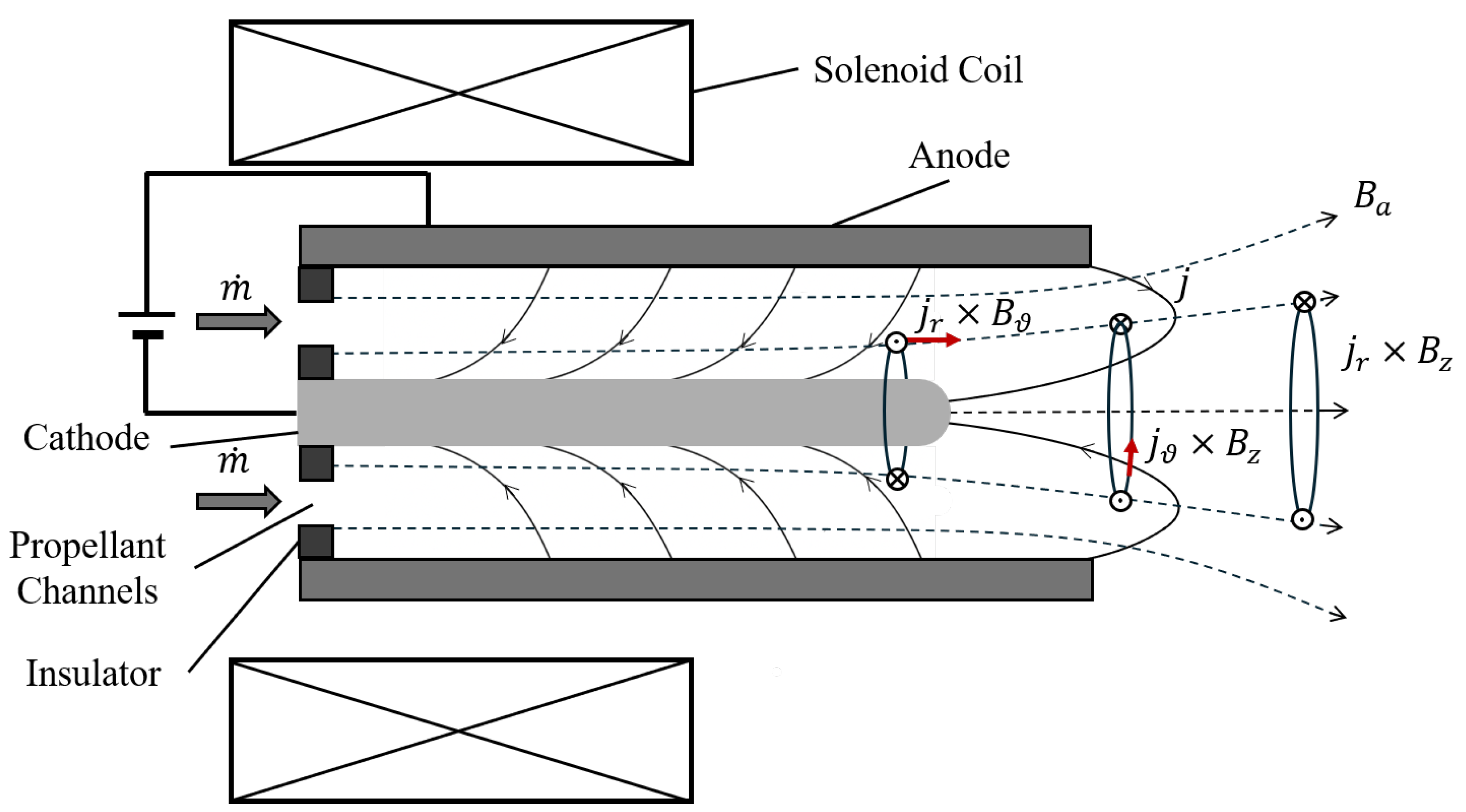
- Self-Field MPDTs (SF-MPDTs). In this configuration, thrust is generated by the interaction between the discharge current and the self-induced magnetic field. Specifically, the current induces an azimuthal magnetic field , and its interaction with the radial current density component () produces a Lorentz force. The axial component of this interaction (), called the “blowing force“, is responsible for the acceleration. Although Figure 1 depicts an applied-field thruster, this self-field component is present and indicated by the vector .
- Applied-Field MPDTs (AF-MPDTs). In this configuration, shown in Figure 1, the addition of an external solenoid generates a strong applied magnetic field () directed along the thruster axis. The radial component of the discharge current density () interacts with the axial magnetic field (), creating an azimuthal Lorentz force () that induces a swirling motion of the plasma. This mechanism is known as “swirl acceleration“, where the swirling plasma expands within the “magnetic nozzle” formed by the applied field to generate axial thrust. Furthermore, the swirling motion induces an azimuthal Hall current, whose interaction with the applied field generates another significant thrust component (), called “Hall acceleration”.
2. Performance Model Development Methodology
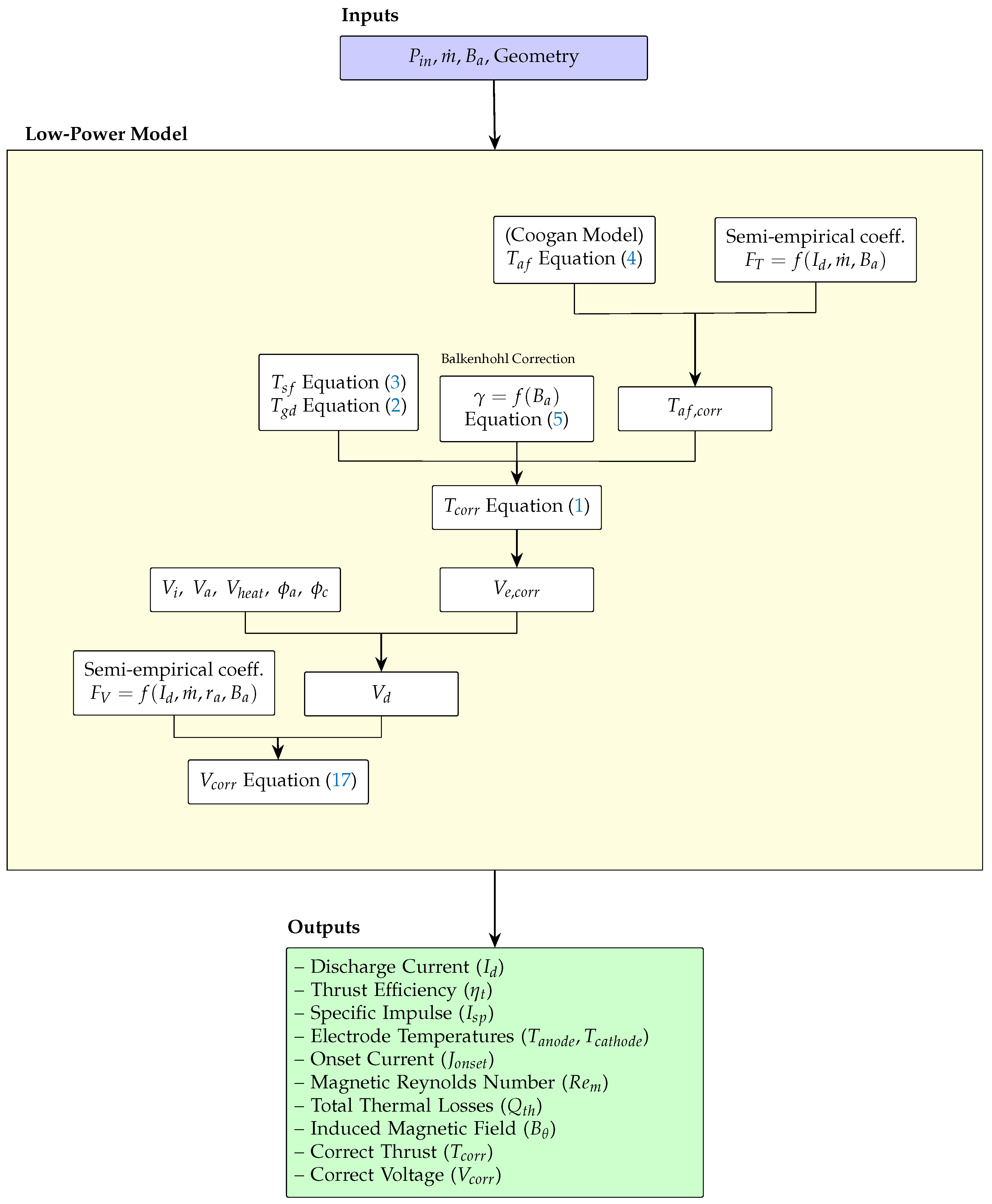
Flowchart of the Model
- For the thrust model, the correction was applied to the applied-field electromagnetic thrust component () yielding to the corrected variable (). This component was selected because it proved to be the most sensitive to changes in the operating parameters.
- For the voltage model, an analogous approach was taken. Starting from the corrected thrust , the estimation of the back-electromotive force was further refined to obtain () by introducing a non-linear correction factor that accounts for the interactions between current , mass flow rate , and magnetic field .
3. Data Collection
4. Development of the Improved Thrust Model
5. Development of the Improved Voltage Model
- (Back-Electromotive Voltage) is the “useful” component of voltage, directly associated with the kinetic power imparted to the plasma jet and hence with thrust production. Often referred to as the back electromotive voltage, it is expressed as:
- (Ionization Voltage) represents the potential drop corresponding to the energetic cost of ionizing the neutral propellant. It depends on the first ionization energy of the gas () and the mass flow rate:
- (Plasma Heating Voltage) quantifies the power dissipated in raising the temperature of the ions () and electrons (), which does not directly contribute to thrust. It is calculated as:where is the Boltzmann constant.
- (Anode Sheath Voltage) models the potential drop across the anode sheath. In this work, the sheath voltage drop is specified solely for the anode and involves a semi-empirical formulation based on the balance between random electron flux and thermionic emission from the anode surface:where e is the elementary charge, the anode surface area, the Richardson constant, the electron density, the electron mass, and the anode work function. The definitions and auxiliary relations used to evaluate these variables are adopted from the work of Coogan et al. [4].
- and (Work Functions) represent the minimum energy required to extract electrons from the anode and cathode surfaces, respectively.
- An indicator variable, , defined as:
- A safe logarithmic variable, , which contains only if , and is 0 otherwise, ensuring numerical stability.
- In the Self-Field regime (): and , thus removing the corresponding terms and simplifying the equation to a reduced form.
- In the Applied-Field regime (): , activating the term, which accounts for the transition effect, while models the dependence on the magnitude of the applied field.
6. Results
Validation and Comparison with Experimental Data and Reference Model
- Balkenhohl Thrust Model (): The thrust predicted by the original reference model.
- Improved Thrust Model (): The thrust predicted by the improved model, incorporating the multi-variable correction factor .
- In the self-field regime (), where the component is null, the factor is irrelevant. As expected, the improved model’s predictions are identical to those of the Balkenhohl model. Both models show very good agreement with the experimental data for the SF-configuration of Beihang Univ. [17], with a maximum error of only 4.3%, confirming the validity of the underlying and formulations.
- In the applied-field regime (), the advantages of the multi-variable correction become evident. The most critical case is that of the configuration of Waseda Univ. [15] (low mass flow rate, high magnetic field), where the Balkenhohl model [6] showed its greatest limitation, with errors exceeding 267%. The improved model, , drastically reduces this discrepancy, lowering the maximum error to about 154%.
- For more standard operating configurations, such as the AF configuration of Beihang Univ. (2019) [17] and the configuration of Beihang Univ. (2018) [16], a consistent improvement is observed across the entire current range. The Balkenhohl model exhibited errors between 15% and 29%, whereas the new model consistently keeps the error below 9%, often falling below 5%, with a maximum of 6.3% in the configuration of Beihang Univ. (2018) [16].
- In the Self-Field Regime (): This regime exposes the most significant weakness of the Balkenhohl model [6], which produces errors exceeding 70%. This is because its correction factor is not designed for zero-field operation. In stark contrast, the improved model demonstrates exceptional accuracy, with prediction errors consistently around 1% or less. This confirms the success of the regime-dependent, piecewise structure of the new correction factor .
- In the Applied-Field Regime (): The improved model consistently outperforms the reference model. For the configuration of the Waseda Univ. [15], the error is reduced from a range of 42–43% down to approximately 2%. A similar trend is observed for the AF configuration of Beihang Univ. (2019) [17], where errors are reduced from an 8–26% range to below 6.6% in most cases.
- Robustness in Critical Operating Regimes: The model’s robustness is particularly evident in two specific cases. For the configuration of DFVLR (1975) [14], operating at a very high magnetic field, the new model achieves a near-perfect prediction with 0% error, a significant improvement over the 54% error of the baseline model. Furthermore, for the configuration of Beihang Univ. (2018) [16] at 180 A, where the Balkenhohl model [6] shows a 12.3% error, the new model remains exceptionally accurate, with an error of just 1.3%. It is worth noting that only in one operating point (Beihang 2018, A), the corrected model performs slightly worse (4.8% vs. 4.1%), but the discrepancy is marginal and does not affect the overall improvement trend.
7. Discussion
8. Conclusions
Author Contributions
Funding
Institutional Review Board Statement
Informed Consent Statement
Data Availability Statement
Acknowledgments
Conflicts of Interest
Abbreviations
| AF-MPDT | Applied-Field Magnetoplasmadynamic Thruster |
| EP | Electric Propulsion |
| HET | Hall Effect Thruster |
| HTS | High-Temperature Superconductor |
| MPD | Magnetoplasmadynamic |
| SF-MPDT | Self-Field Magnetoplasmadynamic Thruster |
| Symbols | |
| Auxiliary variable | |
| Ion sound velocity | |
| Anode surface area | |
| Richardson constant | |
| Auto-inducted magnetic field | |
| Applied magnetic field | |
| Axial magnetic field | |
| Balkenhohl magnetic correction factor | |
| Electron specific heat ratio | |
| First ionization energy | |
| e | Elementary charge |
| Thrust correction factor | |
| Voltage correction factor | |
| Discharge current | |
| Specific Impulse | |
| Onset current | |
| Boltzmann constant | |
| Gasdynamic thrust dimensionless coefficient | |
| Anode axial length | |
| Cathode axial length | |
| Propellant mass flow rate | |
| Electron mass | |
| Ion mass | |
| Vacuum Permeability constant | |
| Electron density | |
| Thrust model coefficients | |
| Voltage model coefficients | |
| Total efficiency | |
| Input power | |
| Thermal losses | |
| Anode internal radius | |
| Cathode radius | |
| Magnetic Reynolds number | |
| T | Total thrust |
| Gasdynamic thrust component | |
| Self-Field thrust component | |
| Applied-Field thrust component | |
| Balkenhohl thrust model | |
| Corrected total thrust | |
| Electron temperature | |
| Ion temperature | |
| Experimental thrust | |
| Anode temperature | |
| Cathode temperature | |
| Discharge voltage | |
| Corrected electromotive voltage | |
| Corrected discharge voltage | |
| Back-electromotive force | |
| Ionization voltage | |
| Anode sheath voltage | |
| Plasma heating voltage | |
| Experimental voltage | |
| Balkenhohl model voltage | |
| Anode working function | |
| Cathode working function | |
| Coogan model geometric parameter |
References
- LaPointe, M.; Strzempkowski, E.; Pencil, E. High Power MPD Thruster Performance Measurements. In Proceedings of the 40th AIAA/ASME/SAE/ASEE Joint Propulsion Conference and Exhibit, Fort Lauderdale, FL, USA, 11–14 July 2004. [Google Scholar] [CrossRef][Green Version]
- Gilland, J.; Johnston, G. MPD Thruster Performance Analytic Models. AIP Conf. Proc. 2003, 654, 516–524. [Google Scholar] [CrossRef]
- Andrenucci, M. Magnetoplasmadynamic Thrusters; John Wiley & Sons, Ltd.: Pisa, Italy, 2010; pp. 1–20. [Google Scholar]
- Coogan, W.; Choueiri, E. A Critical Review of Thrust Models for Applied-Field Magnetoplasmadynamic Thrusters. In Proceedings of the 53rd AIAA/SAE/ASEE Joint Propulsion Conference, Atlanta, GA, USA, 10–12 July 2017. [Google Scholar] [CrossRef]
- Lev, D.; Choueiri, E. Scaling of Efficiency with Applied Magnetic Field in Magnetoplasmadynamic Thrusters. J. Propuls. Power 2012, 28, 609–616. [Google Scholar] [CrossRef]
- Balkenhohl, J.; Glowacki, J.; Rattenbury, N.; Cater, J. A review of low-power applied-field magnetoplasmadynamic thruster research and the development of an improved performance model. J. Electr. Propuls. 2023, 2, 1. [Google Scholar] [CrossRef]
- Bögel, E.; Collier-Wright, M.; Aggarwal, K.; La Rosa Betancourt, M. State of the Art Review in Superconductor-based Applied-Field Magnetoplasmadynamic thruster technology. In 37th International Electric Propulsion Conference; Massachusetts Institute of Technology Cambridge: Cambridge, MA, USA, 2022. [Google Scholar]
- Mayer, T.; Gabrielli, R.; Boxberger, A.; Prof, A.; Herdrich, G.; Petkow, D. Development of Analytical Scaling Models for Applied Field. In Proceedings of the 64th International Astronautical Congress, International Astronautical Federation, Beijing, China, 23–27 September 2013. [Google Scholar]
- Herdrich, G.; Boxberger, A.; Petkow, D.; Gabrielli, R.; Andrenucci, M.; Albertoni, R.; Paganucci, F.; Rossetti, P.; Fasoulas, S. Advanced scaling model for simplified thrust and power scaling of an applied-field magnetoplasmadynamic thruster. In 46th AIAA/ASME/SAE/ASEE Joint Propulsion Conference & Exhibit; American Institute of Aeronautics and Astronautics: Reston, VA, USA, 2010. [Google Scholar] [CrossRef]
- Fradkin, D.B.; Blackstock, A.W.; Roehling, D.J.; Stratton, T.F.; Williams, M.; Liewer, K.W. Experiments using a 25-kw hollow cathode lithium vapor MPD arcjet. AIAA J. 1970, 8, 886–894. [Google Scholar] [CrossRef] [PubMed]
- Albertoni, R.; Paganucci, F.; Andrenucci, M. A phenomenological performance model for applied-field MPD thrusters. Acta Astronaut. 2015, 107, 177–186. [Google Scholar] [CrossRef]
- Lev, D. Investigation of Efficiency in Applied Field Magnetoplasmadynamic Thrusters. Ph.D. Dissertation, Princeton University, Princeton, NJ, USA, 2012. [Google Scholar]
- Maecker, H. Plasmaströmungen in Lichtbögen infolge eigenmagnetischer Kompression. Z. Phys. 1955, 141, 198–216. [Google Scholar] [CrossRef]
- Krülle, G.; Zeyfang, E. Preliminary Conclusions of Continuous Applied-Field Electromagnetic Thruster Research at DFVLR. In AIAA Paper 75-417; American Institute of Aeronautics and Astronautics: New Orleans, LA, USA, 1975. [Google Scholar]
- Nakano, T.; Ishiyama, A.; Shimizu, Y.; Toki, K. Feasibility Study of a Low-power Applied-field MPD Arcjet. In Proceedings of the 28th International Electric Propulsion Conference (IEPC-2003), IEPC-03-92, Toulouse, France, 17–21 March 2003. [Google Scholar]
- Li, Z.; Tang, H.; Wang, Y.; Wang, B.; Lu, X.; Zhang, Z. Increasing the effective voltage in applied-field MPD thrusters. J. Phys. D Appl. Phys. 2018, 51, 085201. [Google Scholar] [CrossRef]
- Kitaeva, A.; Tang, H.; Wang, B.; Andreussi, T. Theoretical and experimental investigation of low-power AF-MPDT performance in the high mass flow rate low discharge current regime. Vacuum 2019, 159, 324–334. [Google Scholar] [CrossRef]
- Tikhonov, V.B.; Semenikhin, S.A.; Brophy, J.R.; Polk, J.E. Performance of 130 kW MPD Thruster With an External Magnetic Field and Li as a Propellant. In Proceedings of the 25th International Electric Propulsion Conference, Cleveland, OH, USA, 24–28 August 1997. [Google Scholar]
- MathWorks. MATLAB Online. Available online: https://it.mathworks.com/products/matlab-online.html (accessed on 28 August 2025).


| Thruster | Power [kW] | [A] | [mT] | Cathode Type | Propellant | Ref. |
|---|---|---|---|---|---|---|
| DFVLR (1975) | 7.0–11.6 | 80 | ∼600 | rod | Ar, Kr, Xe | [14] |
| Waseda Univ. (2003) | ∼0.5–1.1 | 8–36 | 100–200 | rod | Ar, Ne, He | [15] |
| Beihang Univ. (2018) | ∼10 | 90–180 | 50–170 | n.a. | Ar | [16] |
| Beihang Univ. (2019) | 5–10 | 100–180 | 0–133 | hollow | Ar | [17] |
| Coefficient | 0.51 | 0.77 | 1.00 | 1.10 |
| Valid. Coeff. | 0.51 | 0.77 | 1.00 | 1.10 |
| Coefficient | 0.77 | 0.75 | 0.13 | 0.02 | 0.07 | 0.50 |
| Valid. Coeff. | 0.71 | 0.80 | 0.12 | 0.06 | 0.10 | 0.53 |
| Thrust Configuration | [T] | [A] | [mN] | [mN] | [mN] | Error % | Error % |
|---|---|---|---|---|---|---|---|
| Beihang Univ. [17] | 0 | 100 | 139 | 144.98 | 144.98 | 4.30 | 4.30 |
| SF-Configuration (21 mg/s) | 0 | 120 | 143 | 146.74 | 146.74 | 2.62 | 2.62 |
| 0 | 150 | 149 | 149.98 | 149.98 | 0.66 | 0.66 | |
| 0 | 180 | 154 | 153.95 | 153.95 | 0.03 | 0.03 | |
| Waseda Univ. (4) [15] (3 mg/s) | 0.15 | 15 | 6.5 | 23.91 | 16.48 | 267.81 | 153.58 |
| 0.15 | 25 | 12.5 | 29.28 | 17.25 | 134.20 | 38.00 | |
| 0.15 | 35 | 14.0 | 34.71 | 18.32 | 147.90 | 30.84 | |
| DFVLR [14] (7 mg/s) | 0.6 | 80 | 251 | 127.76 | 247.59 | 49.10 | 1.36 |
| Beihang Univ. [17] | 0.133 | 100 | 196 | 165.34 | 187.50 | 15.64 | 4.34 |
| AF-Configuration (21 mg/s) | 0.133 | 120 | 224 | 176.29 | 215.49 | 21.30 | 3.80 |
| 0.133 | 150 | 259 | 193.20 | 264.76 | 25.41 | 2.23 | |
| 0.133 | 180 | 296 | 210.69 | 322.42 | 28.82 | 8.93 | |
| Beihang Univ. [16] | 0.09 | 88 | 150 | 161.81 | 156.81 | 7.87 | 4.54 |
| (21 mg/s) | 0.09 | 120 | 195 | 177.81 | 182.72 | 8.81 | 6.30 |
| 0.09 | 150 | 215 | 193.54 | 212.61 | 9.98 | 1.11 | |
| 0.09 | 180 | 250 | 209.96 | 247.67 | 16.02 | 0.93 | |
| Waseda Univ. (6) [15] | 0.15 | 25 | 10.9 | 28.71 | 17.20 | 163.44 | 57.79 |
| (3.0 mg/s) (Validation) | 0.15 | 36.5 | 14.0 | 34.70 | 18.40 | 147.89 | 31.44 |
| Thrust Configuration | [T] | [A] | [V] | [V] | [V] | Error % | Error % |
|---|---|---|---|---|---|---|---|
| Beihang Univ. [17] | 0 | 100 | 24.3 | 42.84 | 24.06 | 76.28 | 1.01 |
| SF-Configuration (21 mg/s) | 0 | 120 | 22.8 | 39.48 | 22.72 | 73.16 | 0.36 |
| 0 | 150 | 21.3 | 36.25 | 21.50 | 70.20 | 0.92 | |
| 0 | 180 | 20.7 | 34.22 | 20.79 | 65.33 | 0.46 | |
| Waseda Univ. (4) [15] (3 mg/s) | 0.15 | 15 | 31.5 | 45.09 | 30.86 | 43.16 | 2.03 |
| 0.15 | 25 | 28.0 | 39.72 | 28.02 | 41.85 | 0.06 | |
| 0.15 | 35 | 27.0 | 38.36 | 27.54 | 42.08 | 2.00 | |
| DFVLR [14] (7 mg/s) | 0.6 | 80 | 145.0 | 66.51 | 145.0 | 54.13 | 0.00 |
| Beihang Univ. [17] | 0.133 | 100 | 54.0 | 49.46 | 54.09 | 8.40 | 0.17 |
| AF-Configuration (21 mg/s) | 0.133 | 120 | 59.4 | 47.58 | 55.50 | 19.91 | 6.57 |
| 0.133 | 150 | 59.2 | 46.35 | 59.70 | 21.70 | 0.84 | |
| 0.133 | 180 | 62.2 | 46.20 | 65.91 | 25.73 | 5.96 | |
| Beihang Univ. [16] | 0.09 | 88 | 50.0 | 59.98 | 55.59 | 19.96 | 11.17 |
| (21 mg/s) | 0.09 | 120 | 57.0 | 54.67 | 54.27 | 4.08 | 4.79 |
| 0.09 | 150 | 58.0 | 52.53 | 55.52 | 9.42 | 4.28 | |
| 0.09 | 180 | 59.0 | 51.74 | 58.24 | 12.31 | 1.30 | |
| Waseda Univ. (6) [15] | 0.15 | 25 | 27.10 | 38.36 | 27.24 | 41.57 | 0.51 |
| (3.0 mg/s) (Validation) | 0.15 | 36.5 | 29.60 | 36.91 | 26.75 | 24.71 | 9.64 |
Disclaimer/Publisher’s Note: The statements, opinions and data contained in all publications are solely those of the individual author(s) and contributor(s) and not of MDPI and/or the editor(s). MDPI and/or the editor(s) disclaim responsibility for any injury to people or property resulting from any ideas, methods, instructions or products referred to in the content. |
© 2026 by the authors. Licensee MDPI, Basel, Switzerland. This article is an open access article distributed under the terms and conditions of the Creative Commons Attribution (CC BY) license.
Share and Cite
Coppola, G.; Caruso, T.; Panelli, M.; Battista, F. Low-Power Magnetoplasmadynamic Thruster Numerical Performance Model. Appl. Sci. 2026, 16, 4308. https://doi.org/10.3390/app16094308
Coppola G, Caruso T, Panelli M, Battista F. Low-Power Magnetoplasmadynamic Thruster Numerical Performance Model. Applied Sciences. 2026; 16(9):4308. https://doi.org/10.3390/app16094308
Chicago/Turabian StyleCoppola, Giovanni, Tina Caruso, Mario Panelli, and Francesco Battista. 2026. "Low-Power Magnetoplasmadynamic Thruster Numerical Performance Model" Applied Sciences 16, no. 9: 4308. https://doi.org/10.3390/app16094308
APA StyleCoppola, G., Caruso, T., Panelli, M., & Battista, F. (2026). Low-Power Magnetoplasmadynamic Thruster Numerical Performance Model. Applied Sciences, 16(9), 4308. https://doi.org/10.3390/app16094308