1. Introduction
Volleyball is a high-intensity, intermittent team sport characterized by repeated explosive overhead actions performed under variable and often asymmetrical loading conditions, including spiking, serving, and blocking [
1]. Performance in volleyball is inherently multifactorial and is influenced by technical, tactical, physical, and perceptual-cognitive factors. Within this complex performance model, the ability of the upper limb, particularly the shoulder complex, to generate force and maintain neuromuscular control during repetitive overhead actions may represent an important component of sport-specific function [
2]. However, the contribution of shoulder function should be interpreted within the broader context of whole-body performance rather than as a singular determinant of match success.
Due to the repetitive and high-load nature of overhead movements, the shoulder joint is exposed to substantial mechanical stress during volleyball participation. Consequently, shoulder function has been widely investigated in relation to both performance and injury-related outcomes in overhead athletes [
3,
4]. Shoulder injuries are particularly prevalent in volleyball and may negatively affect training continuity and competitive performance [
4]. Surveillance data indicate that shoulder-related complaints may represent a considerable proportion of reported injuries, particularly among female volleyball players [
3,
5].
However, the relationship between upper-limb function, performance, and injury risk remains complex and should not be interpreted in isolation. Accordingly, the assessment of shoulder strength and neuromuscular function has been increasingly explored in applied settings as a tool for athlete profiling and longitudinal monitoring. Nevertheless, its role in screening, return-to-play decision-making, and injury prevention requires further empirical support.
Previous research has consistently demonstrated sex-related differences in neuromuscular performance across various sports disciplines, particularly with respect to maximal strength, power output, and force–time characteristics [
6]. In volleyball and other overhead sports, male athletes typically exhibit greater absolute strength, whereas female players may demonstrate different neuromuscular strategies related to force magnitude and muscle activation patterns [
7]. These differences are often associated with sex-specific morphological and neuromuscular characteristics, including variations in muscle cross-sectional area, tendon properties, and neural activation patterns [
8]. In addition, sex-related differences in scapular kinematics and muscle activation have been reported [
9,
10,
11]. For example, Lang et al. [
11] demonstrated that males exhibited altered scapular muscle activation ratios and reduced internal rotation during functional tasks compared with females, whereas other tasks revealed differences in scapular motion without consistent changes in activation patterns. Collectively, these findings suggest that males and females may adopt distinct neuromuscular strategies to achieve task-specific shoulder force production.
Beyond general differences in strength and power, sex-related distinctions in volleyball performance have also been observed at technical and biomechanical levels. Male players typically demonstrate greater jump height and differences in spike mechanics, including approach speed, step characteristics, and upper-body coordination patterns, which are not explained solely by strength but also by technical and neuromuscular factors [
12]. Similarly, males tend to achieve higher serve velocities, whereas serve accuracy appears comparable between sexes, with performance influenced by different anthropometric and physical determinants [
13]. At the match level, male volleyball is generally characterized by a greater emphasis on high-intensity terminal actions, whereas female volleyball involves longer rallies and greater reliance on technical and tactical organization [
14]. Additionally, sex-related differences in movement demands and load characteristics have been reported, with female athletes demonstrating a higher incidence of injuries despite lower external loads in some contexts [
15].
Despite the growing body of evidence on sex-related neuromuscular differences, there is still limited understanding of how these differences manifest in upper-limb force production across task-specific positions relevant to volleyball performance. In particular, it remains unclear whether sex-related differences are consistent across different shoulder orientations that impose distinct mechanical demands. Addressing this gap may improve the interpretation of upper-limb performance assessments in volleyball players.
The Athletic Shoulder (ASH) test has been used as a standardized method for assessing isometric force characteristics across different shoulder positions [
16,
17,
18]. In the context of the present study, it is considered primarily as a methodological tool for evaluating neuromuscular performance under controlled conditions, rather than as the central focus of investigation. However, evidence regarding sex-related differences in ASH-derived outcomes across task-specific positions in volleyball players remains limited.
Therefore, the aim of this study was to examine sex differences in upper-limb neuromuscular performance in volleyball players using the ASH Test performed in the I, Y, and T positions. Specifically, the study compared peak force, rate of force development, and time to peak force between male and female players across test positions and limb sides. It was hypothesized that male players would demonstrate higher absolute force values than female players and that the magnitude of these differences would vary depending on test position.
2. Materials and Methods
2.1. Subjects
A total of 24 competitive volleyball players participated in the study, including 12 male and 12 female athletes competing at a comparable performance level. All participants were active players in the first national league (top-tier domestic competition) at the time of testing. Participants’ anthropometric characteristics are presented in
Table 1. All participants had at least 10 years of systematic volleyball training experience and a minimum of 5 years of competition at the national league level. In addition, participants trained regularly (4–6 sessions per week). All players reported a dominant right upper limb, defined as the arm preferentially used for performing the volleyball serve.
The main inclusion criterion was the absence of any upper-limb injury or musculoskeletal disorder within the previous two years that could affect performance. Participants were excluded if they reported current pain or any condition limiting maximal effort during testing.
The study protocol was approved by the Research Ethics Committee for Scientific Research at the Academy of Physical Education in Katowice, Poland (approval number: 2-X/2025), and conducted in accordance with the Declaration of Helsinki (2013). All participants were informed about the purpose, procedures, and potential risks of the study prior to participation, and written informed consent was obtained from all participants.
All collected data were treated as confidential and anonymized prior to analysis.
2.2. Athletic Shoulder Test Procedure
Before formal testing, all participants completed a standardized warm-up consisting of 5 min of general upper-body mobility and activation exercises, followed by submaximal practice contractions in each ASH position. Participants were familiarized with the test procedure prior to data collection. All athletes had prior experience with resistance training and upper-body strength assessment; however, none had undergone a formal ASH-based evaluation.
Upper-limb neuromuscular performance was assessed using the Athletic Shoulder (ASH) Test, a standardized isometric testing protocol performed in three distinct arm positions (I, Y, and T), each representing a different shoulder orientation.
All measurements were conducted using a force plate (ForceDecks, VALD Performance, Brisbane, Australia) with a sampling frequency of 1000 Hz [
19]. Force signals were recorded using the manufacturer’s default acquisition settings. The system applies internal signal processing; however, specific details regarding any filtering procedures (e.g., filter type, cutoff frequency, or order) are not disclosed by the manufacturer. No additional user-defined filtering or smoothing procedures were applied. Therefore, the exported force–time data were used directly for all subsequent analyses. The system has been validated against laboratory-grade force platforms, demonstrating near-perfect concurrent validity (r > 0.99) for force measurements [
19]. Previous studies have reported excellent test–retest reliability of the ASH test for peak force (ICC = 0.94–0.98; CV < 10%) [
15], while reliability for rate of force development (RFD) is considered moderate to good (ICC = 0.75–0.85), reflecting the inherent variability of explosive force characteristics [
20].
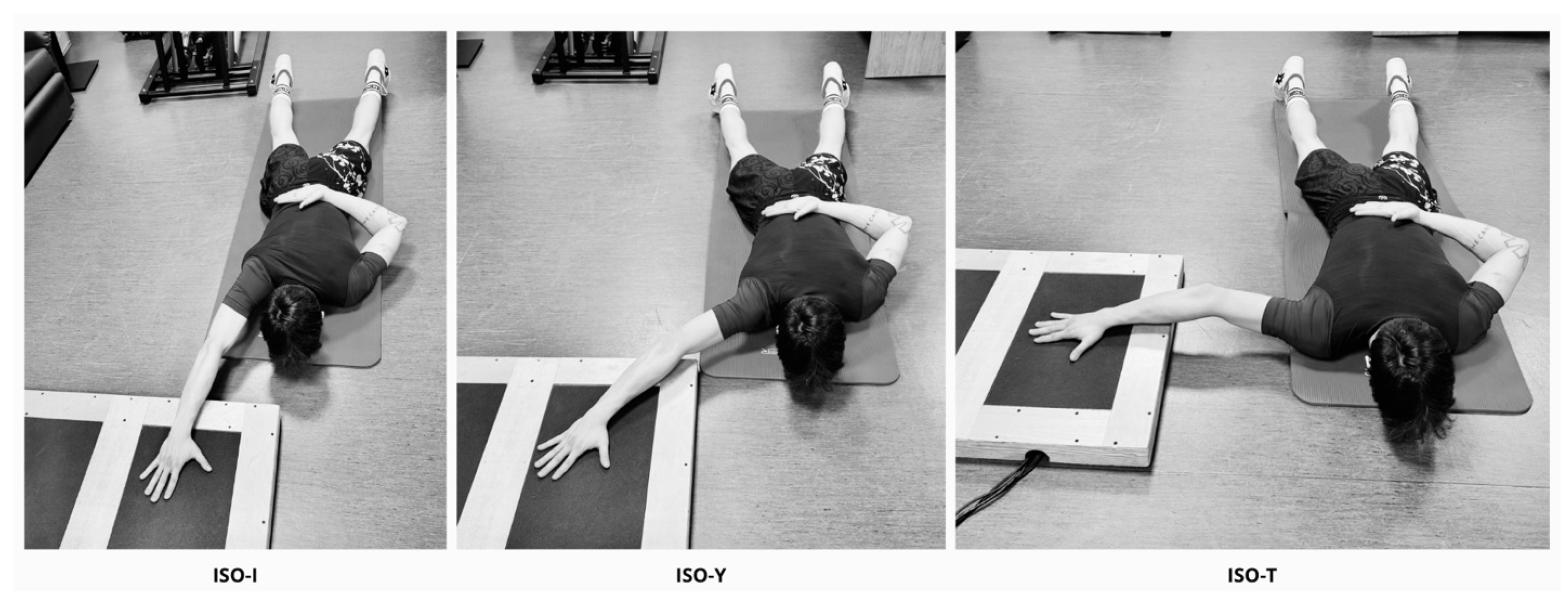
Participants were positioned in a prone position, with the forehead supported on a 4 cm foam block to maintain a neutral head position and minimize compensatory movements. The tested arm was fully extended, with the elbow kept as straight as possible, and the hand was placed centrally on the force plate. The non-tested arm was positioned alongside the body during the I position and placed behind the back during the Y and T positions. Participants maintained a stable stance with feet approximately hip-width apart throughout testing.
The arm positions were defined as follows:
I position: arm extended overhead in line with the trunk
Y position: arm extended diagonally at approximately 45° relative to the body axis
T position: arm extended laterally, perpendicular to the trunk
Prior to each trial, the force plate was zeroed to ensure accurate signal acquisition. Participants were instructed to remain motionless for 2–3 s before each contraction to stabilize the baseline force signal (
Figure 1).
Each participant performed three maximal isometric trials for each limb and each test position. A rest interval of approximately 20 s was provided between trials and 2 min between test positions to minimize fatigue.
During each trial, participants were instructed to produce force as rapidly and forcefully as possible by pushing vertically into the force plate while maintaining a stable body position, level pelvis, and extended elbow. Each contraction was sustained for a minimum of 2 s before relaxation.
For data analysis, the highest value obtained from the three trials (i.e., the best repetition) was retained for each variable, limb, and test position, rather than an average of trials. This approach was applied consistently across all outcome measures to reflect maximal neuromuscular capacity.
All force–time data were exported from the force platform software and visually inspected offline by the primary investigator to verify signal quality and correct identification of the contraction phase. The assessor was not blinded to sex or test condition. Trials were considered acceptable when they showed a stable baseline before contraction, no obvious movement artifact, and correct execution of the required arm position. Trials were excluded and repeated if a clear loss of position, unstable baseline, or technical artifact was observed.
The following upper-limb neuromuscular variables were extracted for each limb and test position:
Peak Force [N]: the maximum vertical force recorded during the contraction.
Peak Force relative to body mass [N·kg−1]: peak force values normalized to participants’ body mass, providing a size-independent measure of force-generating capacity.
Rate of Force Development (RFD) [N/s]: calculated as the slope of the force–time curve over the initial 200 ms following force onset.
Time to Peak Force [s]: defined as the time interval between force onset and the attainment of peak force.
Force onset was defined as the point at which the force signal exceeded baseline by 5 N. This criterion was applied consistently across all trials and participants.
The independent variables were sex (male, female), limb side (right, left), and test position (I, Y, T). The dependent variables included peak force, rate of force development and time to peak force.
2.3. Statistical Analyses
A priori power analysis was conducted in G*Power (version 3.1) [
21] for a mixed-design repeated-measures ANOVA. The following parameters were applied: effect size f = 0.25 (medium effect), alpha level α = 0.05, and desired statistical power (1 − β) = 0.80. The analysis assumed two groups (male and female) and three repeated measurements (test positions: I, Y, T).
The correlation among repeated measures was estimated at r = 0.77 based on an internal pilot dataset (the lowest correlation between test positions). Sphericity was assumed for the purpose of the a priori estimation (ε = 1.0). Based on these parameters, the required total sample size was estimated at n = 24, and recruitment continued until this sample size was achieved.
It should be noted that the a priori power analysis was based on the primary within-subject factor (Test) and the between-subject factor (Sex). The additional within-subject factor (Side), included in the final analytical model (3 × 2 × 2), was not incorporated into the initial estimation. Therefore, the power analysis reflects the main structure of the design but does not fully account for the complete model, particularly with respect to higher-order interaction effects. This should be considered when interpreting the results.
Descriptive statistics are presented as mean ± SD, together with 95% confidence intervals (95% CI). Normality of distribution was assessed separately for each dependent variable using the Shapiro–Wilk test. Homogeneity of variance was examined using Levene’s test. For within-subject factors with three levels, sphericity was assessed using Mauchly’s test; when the assumption of sphericity was violated, Greenhouse–Geisser correction was applied.
For each dependent variable, outcomes were analyzed using a mixed-design repeated-measures ANOVA (3 × 2 × 2), with Test (I, Y, T) and Side (right, left) as within-subject factors and Sex (male, female) as the between-subject factor. Where significant main effects or interactions were observed, Tukey-adjusted pairwise comparisons were performed.
Effect sizes for ANOVA effects are reported as partial eta squared (ηp
2), and Cohen’s d was calculated for pairwise comparisons (0.2 = small, 0.5 = medium, 0.8 = large) [
22]. Statistical significance was set at α = 0.05. In addition to
p-values, 95% confidence intervals were considered to aid interpretation of the results.
3. Results
3.1. Peak Vertical Force
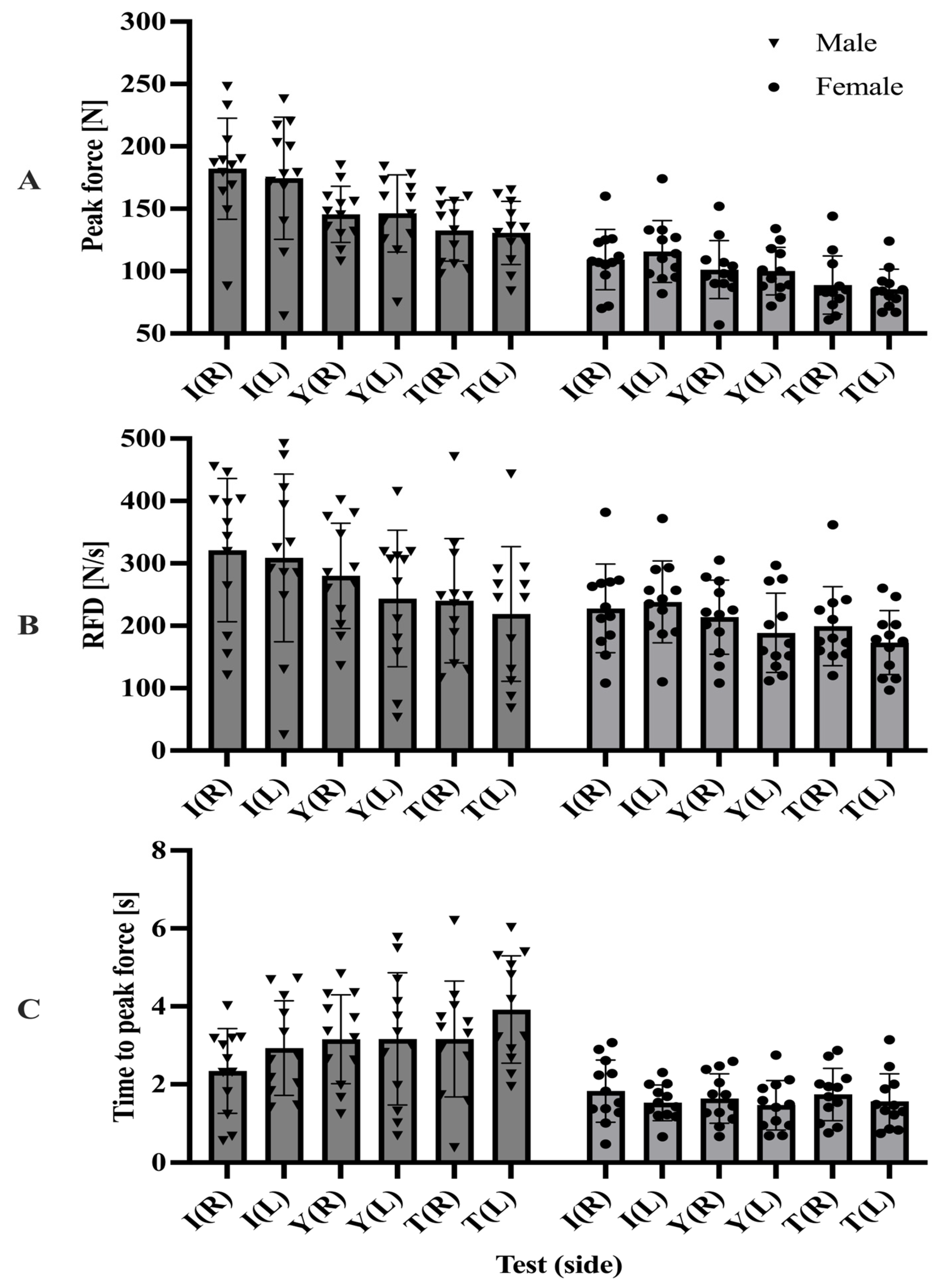
The analysis revealed a significant main effect of Test (F(1.45, 31.99) = 44.39, p < 0.001, ηp2 = 0.669) and a significant Test × Sex interaction (F(1.45, 31.99) = 4.94, p = 0.022, ηp2 = 0.183).
Across conditions, males demonstrated higher peak force values than females, indicating a consistent effect of sex on maximal force production. There was no significant main effect of Side (F(1, 22) = 0.18, p = 0.678), and no significant interactions involving Side (all p ≥ 0.518). The three-way interaction (Test × Side × Sex) was not statistically significant (p = 0.095).
Post hoc analyses indicated that males demonstrated higher peak force values than females across all test positions (I: p = 0.002, d = 1.89; Y: p < 0.001, d = 2.05; T: p < 0.001, d = 2.03). Within the males, peak force differed significantly across all test positions (I > Y > T; all p ≤ 0.008, d = 1.00–1.54). Within the females, no significant difference was observed between the I and Y positions (p = 0.319), whereas both positions showed higher values compared with the T position (I vs. T: p = 0.011, d = 2.10; Y vs. T: p = 0.013, d = 1.29).
Descriptive statistics for peak force across test positions and limb sides are presented in
Table 2. The results are illustrated in
Figure 2A.
3.2. Relative Peak Force
Peak force values were normalized to body mass and re-analyzed. The analysis revealed a significant main effect of Test (F(1.51, 33.23) = 47.85, p < 0.001, ηp2 = 0.685) and a significant main effect of Sex (F(1, 22) = 6.79, p = 0.016, ηp2 = 0.236). The Test × Sex interaction did not reach significance (F(2, 44) = 2.26, p = 0.117, ηp2 = 0.093). There was no main effect of Side (F(1, 22) = 0.09, p = 0.771), and no interactions involving Side (all p ≥ 0.466). Post hoc tests indicated higher relative values in males than females at the I (p = 0.023, d = 1.02) and T positions (p = 0.017, d = 1.05), while the difference at Y did not reach significance (p = 0.072, d = 0.77). Within males, values followed an I > Y > T pattern across all tests (I vs. Y: p = 0.003, d = 1.01; I vs. T: p = 0.001, d = 1.53; Y vs. T: p = 0.016, d = 0.74). Within females, the same hierarchical pattern was observed, with all comparisons reaching significance (I vs. Y: p = 0.007, d = 0.72; I vs. T: p < 0.001, d = 1.60; Y vs. T: p = 0.004, d = 0.97).
3.3. Rate of Force Development
The analysis revealed a significant main effect of Test (F(1.91, 42.06) = 12.40, p < 0.001, ηp2 = 0.360). No consistent differences between sexes were observed across conditions, and the Test × Sex interaction was not significant (F(1.91, 42.06) = 1.03, p = 0.364).
There was no significant main effect of Side (F(1, 22) = 3.42, p = 0.078), and no significant interactions involving Side (all p > 0.230).
No significant sex differences were observed within individual test positions (I: p = 0.278; Y: p = 0.386; T: p = 0.754). Within the males, RFD was significantly higher in the I position compared with the T position (p = 0.006, d = 1.06) and tended to be higher in I compared with Y (p = 0.084), while no difference was observed between Y and T (p = 0.459). Within the females, no significant differences between test positions were identified (all p ≥ 0.259).
Descriptive statistics for RFD are presented in
Table 2. The results are illustrated in
Figure 2B. No statistically significant differences in RFD were detected between sexes.
3.4. Time to Peak Force
The analysis revealed no significant main effect of Test (F(1.87, 41.20) = 2.19, p = 0.128) and no significant Test × Sex interaction (F(1.87, 41.20) = 2.61, p = 0.089).
Across conditions, males demonstrated higher time to peak force values than females, indicating a general tendency toward longer force development duration. There was no significant main effect of Side (F(1, 22) = 0.46, p = 0.503), and no significant interactions involving Side (Test × Side: p = 0.665; Test × Side × Sex: p = 0.593). The Side × Sex interaction did not reach statistical significance (F(1, 22) = 3.81, p = 0.064, ηp2 = 0.148).
Although no significant Test × Sex interaction was observed, exploratory pairwise comparisons indicated that males demonstrated higher time to peak force values than females across individual test positions (I: p = 0.016, d = 1.49; Y: p = 0.005, d = 1.70; T: p < 0.001, d = 2.65).
Within the male group, significant differences were observed between the I and Y positions (p = 0.035, d = 0.44) and between the I and T positions (p = 0.019, d = 0.73), whereas no difference was found between the Y and T positions (p = 0.857). Within the female group, no significant differences between test positions were identified (all p = 1.000).
These comparisons are presented for descriptive purposes and should be interpreted with caution.
Descriptive statistics for time to peak force are presented in
Table 2. The results are illustrated in
Figure 2C.
4. Discussion
The primary aim of this study was to examine sex differences in upper-limb neuromuscular performance in volleyball players and to assess inter-limb differences across selected force, explosive, and temporal variables. The main findings indicate the presence of sex-related differences in maximal force production and temporal characteristics of force generation. In contrast, no statistically significant differences were detected in the rate of force development (RFD). These results provide preliminary evidence of sex-related distinctions within this specific cohort and may contribute to a more comprehensive understanding of upper-limb neuromuscular performance in volleyball players, particularly in relation to task-specific shoulder positioning.
A substantial difference in peak force values was observed between male and female volleyball players across all ASH test positions (I, Y, and T), with large effect sizes. These findings are consistent with the existing literature reporting pronounced sex differences in shoulder strength, largely attributable to differences in muscle mass, cross-sectional area, and neuromuscular activation capacity [
23], which supports the present observations. A recent systematic review further confirmed that males typically demonstrate greater shoulder strength across a variety of testing modalities [
23], reinforcing the interpretation of the present findings. However, given the limited sample size and the specificity of the study population, these findings should be interpreted as sample-specific and not generalizable to broader athletic populations. Importantly, the use of the best trial for analysis reflects maximal neuromuscular capacity rather than typical performance and should be considered when comparing the present findings with studies using averaged values. The inclusion of body mass–normalized peak force provides additional insight into relative force-generating capacity, partially reducing the influence of body size differences between sexes. However, differences remained evident, suggesting that factors beyond body size may contribute to the observed results.
An important finding of this study is the presence of a significant Test × Sex interaction, indicating that sex-related differences were not uniform across shoulder positions. Male players exhibited a clear hierarchical force pattern (I > Y > T), whereas female players demonstrated comparable force outputs in the I and Y positions, with lower values observed only in the T position. This may indicate that sex-related differences in force production could be influenced by task-specific mechanical demands and shoulder positioning. Positions such as Y and T may represent different mechanical configurations of the shoulder joint [
24,
25,
26]; however, specific stabilization demands and rotator cuff function were not directly assessed in the present study.
These sex-related differences in force production may be partially explained by well-established physiological and morphological distinctions between males and females. Males typically exhibit greater muscle cross-sectional area and higher absolute force-generating capacity, which are strongly associated with differences in muscle mass and hormonal profile, particularly testosterone levels [
27,
28]. In contrast, females have been reported to demonstrate relatively greater fatigue resistance and, in some contexts, different neuromuscular activation strategies during submaximal and stabilization tasks [
29,
30]. However, it should be emphasized that such factors were not directly assessed in the present study, and therefore their contribution to the observed differences remains speculative. Moreover, the extent to which these general physiological characteristics translate to sport-specific, position-dependent force production in volleyball players requires further investigation.
Previous studies have reported sex-related differences in scapular kinematics and muscle activation patterns [
11,
12,
13]. For example, Lang et al. [
14] observed differences in scapular muscle activation ratios and movement strategies between males and females during functional upper-limb tasks. Similarly, Motobar and Nimbarte [
25] reported that female participants demonstrated lower strength and endurance but higher muscle activation and perceived exertion during rotator cuff tasks. While these findings may provide a potential context for interpreting the present results, it should be emphasized that neuromuscular variables such as muscle activation, neural drive, and scapular mechanics were not directly measured in this study. Therefore, any mechanistic explanation should be considered tentative and hypothesis-generating rather than confirmatory.
No statistically significant differences in RFD were detected between sexes across any ASH test position. This finding may suggest that differences in maximal strength may be more pronounced than differences in early-phase force production. However, this should not be interpreted as evidence of equivalence between groups. RFD is characterized by relatively high variability and is sensitive to methodological factors such as force onset detection and signal processing. Its interpretation may also be influenced by maximal strength levels and sample size, particularly in relatively small samples such as the present study, and therefore requires cautious interpretation.
Temporal characteristics of force production also differed between male and female players. Male athletes demonstrated longer time to peak force across all positions, whereas female players reached peak force more rapidly despite lower maximal values [
31]. These differences may reflect variations in force production strategies. However, they may also be influenced by differences in absolute force levels. Therefore, shorter time to peak force in female players should not be directly interpreted as evidence of distinct neuromuscular strategies. As variables such as motor unit recruitment, muscle–tendon stiffness, and neuromuscular coordination were not directly measured, these interpretations remain speculative and should be considered with caution [
32,
33].
Substantial differences in peak force and RFD across ASH test positions were observed irrespective of sex, confirming the position-specific nature of shoulder neuromuscular performance. Higher force outputs in the I position may be related to more favorable joint alignment and greater contribution of larger muscle groups, whereas the Y and T positions represent different mechanical configurations of the shoulder joint [
17,
19,
34].
These findings may also be interpreted within the broader context of sex-related differences in volleyball performance. Previous studies have shown that male players tend to rely more on high-intensity, terminal actions such as powerful serves and spikes, whereas female volleyball is characterized by longer rallies and greater emphasis on technical and tactical organization [
12,
13,
14]. In addition, sex-related differences in jump mechanics, approach strategies, and upper-body coordination have been reported, suggesting that performance outcomes are influenced not only by force magnitude but also by movement patterns and task-specific execution [
13,
14,
15]. Within this context, the present results may reflect not only differences in maximal force capacity but also the potential role of sex-specific movement strategies in how force is generated and expressed across different shoulder positions. However, as movement kinematics and coordination were not directly assessed in this study, these interpretations should be considered as contextual and hypothesis-generating rather than explanatory. Peak force was analyzed in both absolute and relative (body mass–normalized) terms, whereas RFD was expressed only in absolute values.
From a functional perspective, the ASH test positions may be cautiously related to general movement patterns observed in volleyball [
35]. The I position, characterized by arm elevation in line with the trunk, may correspond to overhead arm positioning typically observed during actions such as spiking and serving. The Y position may reflect intermediate arm orientations requiring coordinated force transfer, whereas the T position represents a lateral arm configuration that differs in joint alignment and movement context [
16,
36,
37]. However, although the ASH test positions resemble functional arm orientations, they do not replicate the dynamic and ballistic nature of volleyball-specific movements. Therefore, these interpretations should be considered descriptive only, and the direct transfer of ASH-derived outcomes to sport-specific performance remains unclear.
The findings of this study also suggest that the ASH test may provide a standardized method for assessing upper-limb force characteristics [
15,
34].
Given its previously reported reliability and practical applicability, the ASH test may offer a feasible approach for assessing upper-limb force characteristics in applied settings. However, due to the cross-sectional design and limited sample size, the present findings should be interpreted as exploratory and specific to the studied sample. Accordingly, the observed sex-related differences should not be considered as a basis for establishing normative or sex-specific reference values.
Furthermore, the present results should not be interpreted as direct evidence for its use in injury prevention, return-to-play decision-making, or comprehensive performance monitoring, as the study was cross-sectional and limited to isometric force assessment.
Contrary to some findings reported in overhead athletes, no significant inter-limb differences were observed in the present study. This may be related to the specific movement demands of volleyball, which involve both unilateral and bilateral upper-limb actions, such as serving, spiking, and blocking [
38,
39,
40]. However, evidence regarding the development of symmetrical loading patterns in volleyball remains limited and context-dependent [
41].
Overall, the present findings indicate that, within this sample of well-trained, right-hand dominant volleyball players, no statistically significant side-related differences in isometric shoulder performance were observed. These findings highlight the importance of considering methodological context when interpreting neuromuscular performance outcomes. Importantly, the results should be regarded as specific to this cohort and not generalized beyond comparable populations. Given the cross-sectional design and the use of isometric assessments, no causal inferences can be drawn regarding underlying neuromuscular mechanisms or sport-specific performance.
5. Conclusions
The present study examined sex differences in upper-limb neuromuscular performance in volleyball players using the Athletic Shoulder (ASH) Test across three functionally relevant shoulder positions. The findings indicate that sex-related differences are present in maximal force production and temporal characteristics of force generation, whereas no statistically significant differences were detected in the rate of force development.
Male volleyball players demonstrated higher peak force values across all ASH test positions, and the magnitude of these differences varied depending on shoulder position. Specifically, males exhibited a hierarchical force pattern (I > Y > T), whereas females showed comparable force outputs in the I and Y positions, with lower values observed in the T position.
The absence of significant differences in RFD should not be interpreted as evidence of equivalence between sexes. Similarly, the lack of inter-limb differences observed in this study applies specifically to this sample of right-hand dominant volleyball players and should not be generalized beyond this context.
Overall, these findings contribute to the understanding of upper-limb neuromuscular characteristics in volleyball players and highlight the importance of considering both sex and test position when interpreting ASH test outcomes. However, the results should be regarded as specific to this sample and should not be generalized to broader populations. While the ASH test may provide useful information for upper-limb performance profiling, its broader application in performance monitoring and injury-related contexts requires further investigation. These findings should be interpreted within the context of the study design and do not establish causal relationships.
5.1. Practical Implications
From an applied perspective, the present findings may offer several considerations for strength and conditioning coaches, sports scientists, and practitioners working with volleyball players. However, these implications should be interpreted with caution, as the study was cross-sectional and limited to isometric force assessment.
First, the observed sex-related differences in maximal force production indicate that sex should be considered when interpreting ASH test outcomes. However, the present data do not provide a sufficient basis for establishing sex-specific reference or normative values, and such interpretations should be restricted to the studied sample.
Second, female volleyball players demonstrated lower maximal force values across all test positions. These findings may indicate potential differences in force production capacity within this sample; however, their direct implications for training should be interpreted with caution. Although resistance-based approaches targeting shoulder musculature may be considered, the effectiveness of such interventions was not evaluated in the present study.
Third, no statistically significant sex differences were detected in the rate of force development. This suggests that maximal force capacity and explosive force characteristics may represent distinct components of neuromuscular performance, which should be considered separately when profiling athletes. However, this finding should not be interpreted as evidence of equivalence between sexes.
Fourth, the position-specific differences observed in the ASH test indicate variability in neuromuscular performance across measurement conditions. However, the applied relevance of assessing multiple positions was not directly evaluated and should therefore be interpreted with caution.
Each test position reflects different task-specific measurement conditions; however, the direct transfer of these positions to specific volleyball actions was not examined in the present study and should also be interpreted cautiously.
Finally, no significant inter-limb differences were observed in this sample. Therefore, side-related findings should be interpreted within the specific context of the sport, task, and assessment method.
Overall, while the ASH test may provide useful information regarding upper-limb neuromuscular characteristics, its application for benchmarking or the establishment of reference standards requires further investigation in larger and more diverse populations. Moreover, its use in contexts such as injury prevention, return-to-play decision-making, or comprehensive performance monitoring requires further investigation.
5.2. Limitations
Several limitations of the present study should be acknowledged when interpreting the findings.
First, the relatively small sample size, although determined through a priori power analysis, may limit the generalizability of the results and the ability to detect higher-order interaction effects. Larger cohort studies would provide greater statistical power and allow for more detailed subgroup analyses.
Second, the study included athletes competing at a similar performance level; therefore, the findings may not be directly applicable to youth, amateur, or elite international volleyball populations. Differences in training history, competitive level, and physical development may influence shoulder neuromuscular characteristics. Additionally, the 20 s rest interval between trials may have been insufficient for full recovery during maximal isometric efforts, which should be considered when interpreting the results.
Third, peak force was analyzed in both absolute and relative (body mass–normalized) terms, whereas rate of force development (RFD) was expressed only in absolute values. Although normalization partially reduces the influence of body size, the observed differences between sexes may still be affected by differences in body composition and other physiological factors, and therefore may not reflect purely neuromuscular characteristics. From a functional perspective, the use of absolute values reflects the mechanical demands of volleyball-specific actions, where the ability to generate high levels of force is relevant. However, the inclusion of additional normalized metrics (e.g., relative to lean mass) may provide further insight into relative force production capacity and should be considered in future research.
Fourth, only isometric force characteristics were evaluated in the present study. Although the ASH test provides valuable insight into shoulder neuromuscular capacity, volleyball performance involves highly dynamic and ballistic actions. Consequently, the relationship between ASH-derived metrics and sport-specific performance outcomes warrants further investigation.
Fifth, the cross-sectional nature of the study prevents the determination of causal relationships between neuromuscular characteristics and injury risk or performance. Longitudinal research designs would provide greater insight into how ASH variables evolve across training cycles and competitive seasons.
Finally, although the ASH test positions replicate functional shoulder orientations, they cannot fully reproduce the complex biomechanical demands of volleyball-specific movements such as spiking or serving.
5.3. Future Research Directions
Future studies should aim to expand the current findings by addressing several important research questions.
First, longitudinal investigations are required to determine how ASH-derived neuromuscular variables respond to different strength and conditioning interventions, particularly those targeting shoulder stability and overhead force production.
Second, future research should explore the relationship between ASH test outcomes and volleyball-specific performance metrics, such as spike velocity, serve speed, and attack efficiency. Understanding these relationships could enhance the practical relevance of ASH testing within performance monitoring systems.
Third, additional studies should examine the relationship between ASH-derived variables and shoulder injury risk in volleyball players. Identifying neuromuscular markers associated with injury susceptibility may contribute to the development of more effective screening protocols.
Fourth, future research should investigate age- and development-related differences in ASH performance across youth, junior, and elite volleyball populations. Such data would enable the creation of sport-specific normative databases.
Finally, integrating ASH testing with other neuromuscular and biomechanical assessments (e.g., electromyography, motion analysis, or dynamic shoulder strength testing) may provide a more comprehensive understanding of shoulder function in overhead athletes.




 ,
,