1. Introduction
In the context of current industrial competitiveness, productivity growth no longer depends exclusively on increasing the workload, but on the company’s ability to design and control processes through mathematical models, optimization methods, and analytical tools that reduce variability, unnecessary resource consumption, and non-productive time. For a performance-oriented enterprise, the use of these approaches enables decisions to be based on objective data, which leads to more stable processes, better controlled costs, and superior use of production capacity [
1,
2,
3,
4].
From this perspective, the topic of the present paper is relevant because a data-centered architecture for intelligent wire harness assembly is not merely a technical verification solution, but also a managerial mechanism through which the company can increase system productivity. When processes are supported by dedicated devices, control logic, and modern production improvement tools, the organization succeeds in reducing errors, shortening execution cycles, and increasing the repeatability of results, all of which are essential for operational efficiency and consistent quality [
4,
5,
6].
The literature highlights that the application of linear programming, optimal control, and other mathematical methods in production planning and launch directly contributes to the selection of advantageous decision alternatives, the balancing of resource loading, and the reduction in losses generated by the inadequate organization of the technological flow. At the same time, the use of DFM principles and modern process optimization tools makes it possible to reduce manufacturing times and adapt the company more rapidly to market requirements, thereby supporting long term competitiveness [
2,
3,
5,
6].
Therefore, for a company seeking to become as efficient as possible, the integration of mathematical models, control devices, and modern analytical tools should be regarded as a strategic investment in productivity. In line with the title of the paper, the proposed data-centered architecture can be understood as part of a broader direction of transforming manufacturing systems into intelligent structures capable of preventing nonconformities, supporting operational decisions, and creating the conditions for sustainable industrial performance [
1,
2,
3,
4,
5,
6].
In the literature, multi-pin wiring harness verification is typically addressed through end-of-line (EOL) testing based on continuity, insulation/resistance tests, and approaches focused on traceability and integration into digital production flows. However, many existing solutions treat separately (i) the electrical conformance verdict, (ii) precise pin-to-pin miswiring diagnosis, and (iii) data capture for traceability and organizational learning. In practice, this separation leads to situations where a defect is detected, but the root cause is not operationally guided to the operator, and test data are not sufficiently structured for longitudinal analysis and continuous improvement.
Therefore, there is a gap between test systems that can only deliver a PASS/FAIL verdict and the industrial need to simultaneously provide a deterministic quality gate, actionable pin-to-pin diagnosis, and full unit-level traceability integrated within a data-centric architecture.
The contributions of this study are (1) a deterministic verification and pin-to-pin miswiring diagnosis logic that enables guided correction and fast retesting; (2) a minimal yet sufficient data model for unit-level traceability and trend analysis (digital thread); and (3) an operational evaluation framework that quantifies the impact on inspection time, rework, and overall productivity in a real industrial case.
In this paper, the term “zero defects” is used strictly in the sense of zero customer escapes (zero shipped defects), i.e., operating as a quality gate that prevents shipment of nonconforming units, without implying complete elimination of defect occurrence at the source.
Smart manufacturing aims to improve operational performance by reducing process variability through standardization, connectivity, and data-driven control. In this context, the concept of digital threading continuity and integration of product and process information across lifecycle stages has gained significant attention as a foundation for traceability, systematic quality improvement, and closed-loop decision-making. Recent studies emphasize both the definitional consolidation of digital-thread concepts and the practical challenges of implementation, such as data integration across heterogeneous systems and ensuring actionable continuity of information from design to manufacturing and operations [
7,
8].
Despite ongoing advances in automation, many industrial assembly environments remain strongly dependent on manual work. As a result, human error continues to be a key contributor to quality losses, especially in repetitive or cognitively demanding assembly tasks. Empirical research in complex manual assembly has shown that manufacturing systems are sensitive to human reliability factors, and that error mitigation often requires structured interventions: improved work instructions, systematic feedback, and objective verification at critical steps [
9]. These findings reinforce the need to strengthen quality assurance in manual or semi-manual operations by reducing reliance on subjective judgment and increasing the repeatability of inspection and control.
A widely adopted principle for robust production systems is mistake-proofing (poka-yoke), which focuses on preventing errors or making them immediately detectable at the point of occurrence. In smart production settings, poka-yoke has been combined with operator guidance systems (e.g., pick-to-light) to reduce picking/assembly errors while improving operational efficiency and accuracy [
10]. In addition, poka-yoke can be implemented not only at the workstation level but also as a process gate (shipment gating), where defective products are systematically blocked from moving downstream until corrected and re-verified.
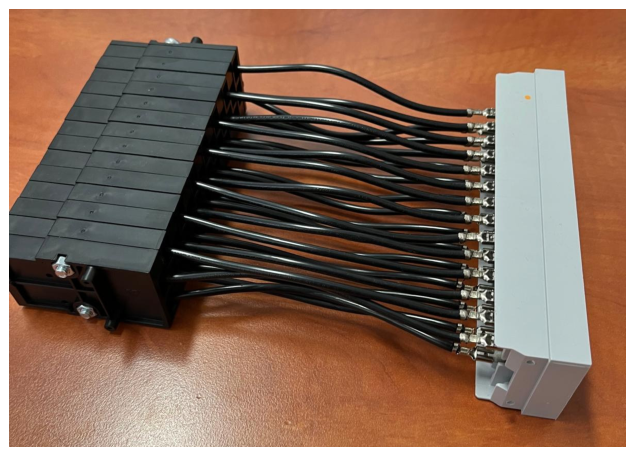
This paper addresses an industrial case involving a quick-connect electrical harness consisting of two main connectors (a receptacle-type connector and a pin-type connector) linked by 16 conductors, each with 2.5 mm2 cross-section and 200 mm length, with crimped terminals at both ends. The manufacturing route includes procurement and incoming inspection, cable cutting to length, crimping, intermediate checks, connector assembly, and final inspection prior to packing and shipment. A critical product characteristic is that all conductors are black, which makes visual confirmation of the correct pin-to-pin wiring map unreliable without auxiliary marking or measurement. Under these constraints, visual inspection may confirm gross completeness but cannot robustly validate correct circuit mapping.
The dominant nonconformity observed in production is a miswire (swap) of two conductors among the 16 circuits, leading to an incorrect connector-to-connector mapping. In the baseline condition, quality control relied on visual inspection only (mean inspection time 1 min/unit) and the internal nonconformity occurrence rate was 4%.
In the context of ISO 9001-based quality management, organizations are required to monitor, measure, analyze, and evaluate relevant quality-management performance indicators and to control nonconforming outputs and nonconformities through corrective-action processes [
11,
12]. Accordingly, in this study, the internal nonconformity occurrence rate is operationalized as the percentage of internally detected nonconformities relative to the relevant total volume checked or produced within the same period.
General formula (percentage):
where:
is the number of nonconformities detected internally (in production, quality control, internal audit, etc.)
is the total number of units/lots/operations/records inspected, or deliverables produced (the reporting base must be clearly defined)
If the rate was 4%, the equivalent relationship is:
For such wiring-map defects, automated verification is often preferred because it directly tests the electrical topology rather than inferring correctness from visual cues. Research on the automation of electrical cable harness testing discusses the feasibility of automated harness testing and highlights strategies to improve adaptability and scalability, including modular hardware/software concepts suitable for broad product ranges [
13]. Complementarily, data-driven approaches have also been explored, including AI-based fault detection methods intended to improve quality-control effectiveness in wiring harness manufacturing contexts [
14].
Motivated by these approaches, this paper proposes a data-centric architecture that integrates an electronic test fixture into the production flow as a mandatory gate prior to packing. The fixture performs 100% continuity testing and reconstructs the complete pin-to-pin connectivity map, enabling deterministic classification of actionable fault categories: open circuits, short/bridging faults, and miswires (swaps). The system outputs standardized diagnostics to guide rework and retest, and logs test outcomes (unit/lot ID, timestamp, PASS/FAIL, defect type, and affected positions) to support traceability and continuous improvement in line with digital-thread principles [
7,
8].
A core operational objective of the proposed architecture is zero customer defects, achieved not by assuming error elimination at the source, but by enforcing a poka-yoke shipment rule: no unit may proceed to packing without a PASS result. Units that fail are routed to rework and must be retested until they pass. This form of error-proofing is consistent with broader industrial implementations of sequencing and verification systems that strengthen real-time traceability and prevent process deviations from propagating downstream; for instance, RFID-based sequencing-error-proofing solutions have been reported to improve visibility and control in manufacturing logistics [
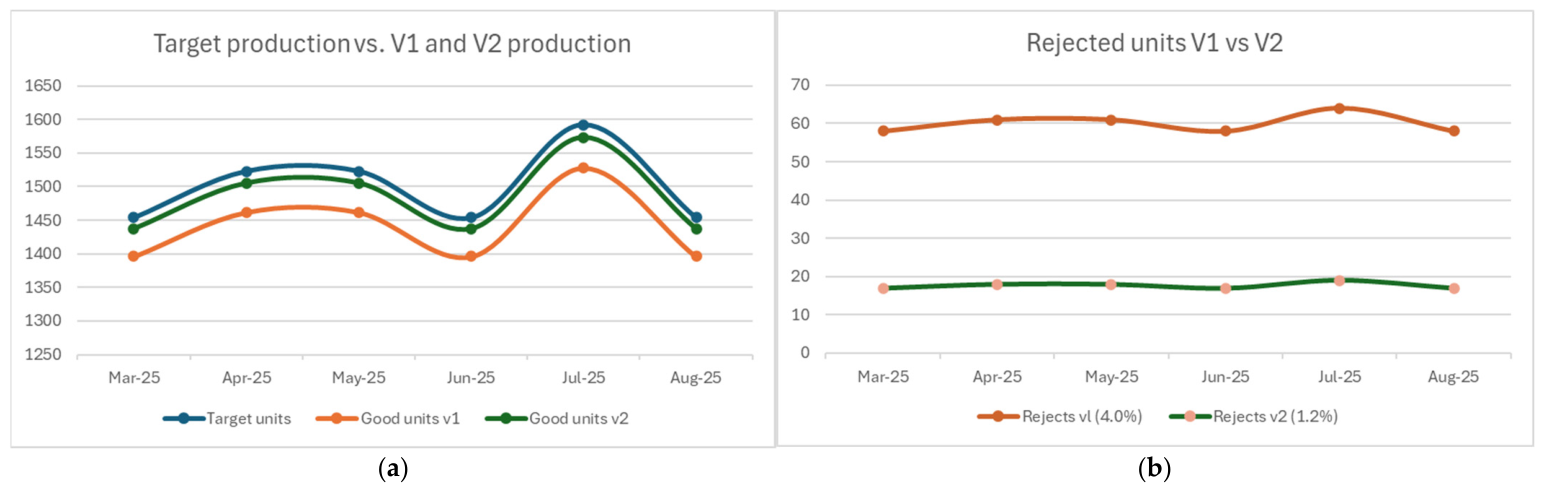
15]. Beyond quality protection, the proposed fixture reduces test time to 0.33 min/unit, increasing inspection throughput and reducing total QC-plus-rework time at a monthly volume of 1500 units.
The contributions of this work are fourfold (i) an industrially deployable fixture-based method for automated pin-to-pin verification of multi-circuit harnesses with visually indistinguishable conductors; (ii) a deterministic diagnosis workflow for miswiring detection supporting rapid, standardized rework; (iii) a traceability-oriented data model aligned with digital-thread concepts; and (iv) an operational analysis demonstrating productivity gains while supporting the goal of zero customer defects through a poka-yoke shipment gate.
The remainder of this paper is organized as follows.
Section 2 details the manufacturing context, the fixture architecture, and the pin-to-pin mapping method.
Section 3 highlights the methodology and test logic.
Section 4 presents the operational calculations and productivity analysis.
Section 5 discusses implementation considerations and limitations.
Section 6 concludes the paper and outlines future enhancements.
2. Materials and Methods
2.1. Industrial Context and Product Description
This research is grounded in an industrial production setting manufacturing a quick-connect cable harness intended for industrial equipment (
Figure 1). The product consists of two main connectors—a receptacle-type connector (“female”) and a pin-type connector (“male”)—interconnected by 16 individual conductors assembled into a compact harness. Each conductor has a 2.5 mm
2 cross-section and a nominal length of 200 mm. All conductors are black, eliminating color-based discrimination and increasing the risk of wiring swaps during assembly.
Each conductor is terminated at both ends by a crimped contact that is inserted into the connector cavities according to a specified pin-to-pin mapping. The critical-to-quality (CTQ) characteristic is the mapping correctness (topology) rather than the mechanical presence of terminals alone. A two-wire swap among the 16 circuits constitutes the dominant defect mechanism and can lead to functional nonconformity, equipment malfunction, or potential damage, depending on the downstream application. The product configuration and its susceptibility to human error are consistent with findings in complex manual assembly, where similarity and repetition increase the likelihood of selection/insertion errors [
9].
In terms of manufacturing inputs, the typical bill of materials includes (i) two connector housings (female and male); (ii) 32 terminals/contacts (two per conductor); (iii) 16 cable segments; and (iv) auxiliary items for packing and labeling. Manufacturing resources include cutting equipment, crimping tools (manual or semi-automatic), insertion tools (if applicable), and work instructions defining the nominal pin map and assembly sequence.
2.2. Process Route and Baseline Inspection
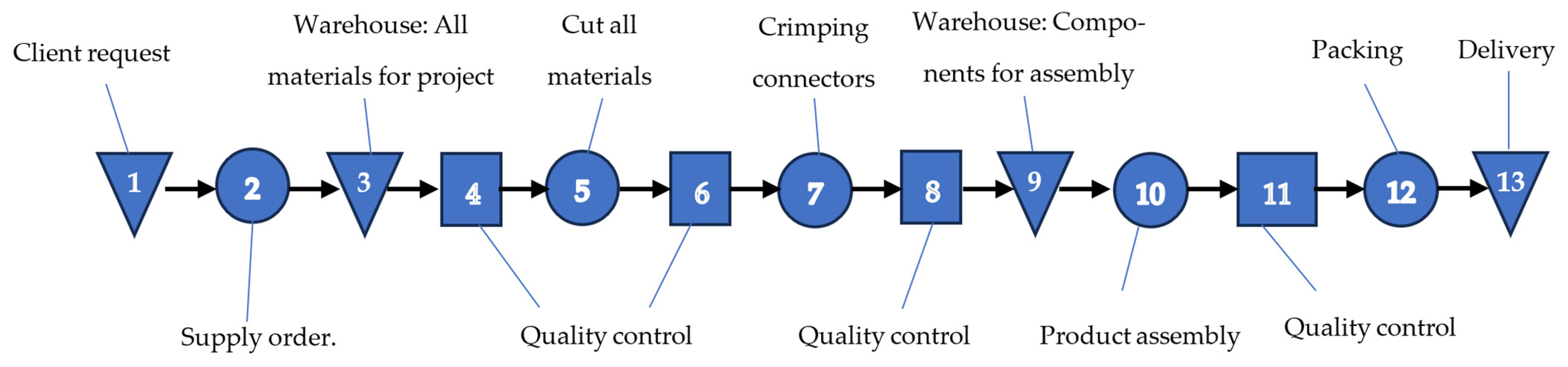
The end-to-end process route follows a conventional multi-stage manufacturing flow: customer request/quantity definition; quotation; procurement from suppliers; raw material storage; incoming inspection; cable cutting to 200 mm; length verification; crimping; crimp inspection; component staging; harness assembly; end-of-line verification; packing; and shipment (
Figure 2). The route includes at least three quality-relevant control points: incoming inspection, in-process checks (length and crimp), and final verification.
The final verification stage is critical because upstream inspections do not guarantee pin-to-pin mapping correctness. For example, correct cable length and acceptable crimp geometry do not prevent a conductor from being inserted into the wrong cavity. In multi-stage manufacturing systems, such hidden defects can propagate unless explicitly captured at a properly designed quality gate [
16].
Baseline EOL inspection was visual-only (no multimeter), with mean test time of 1 min/unit. The internal nonconformity rate was 4%, and defects were repairable. Because the dominant defect is miswiring (two-wire swap) in visually identical conductors, visual inspection provides limited detection capability; strengthening the EOL gate is consistent with the multi-stage quality-control literature [
16,
17].
2.3. Proposed Solution: 100% Electronic Continuity and Mapping Test Fixture (EOL Poka-Yoke)
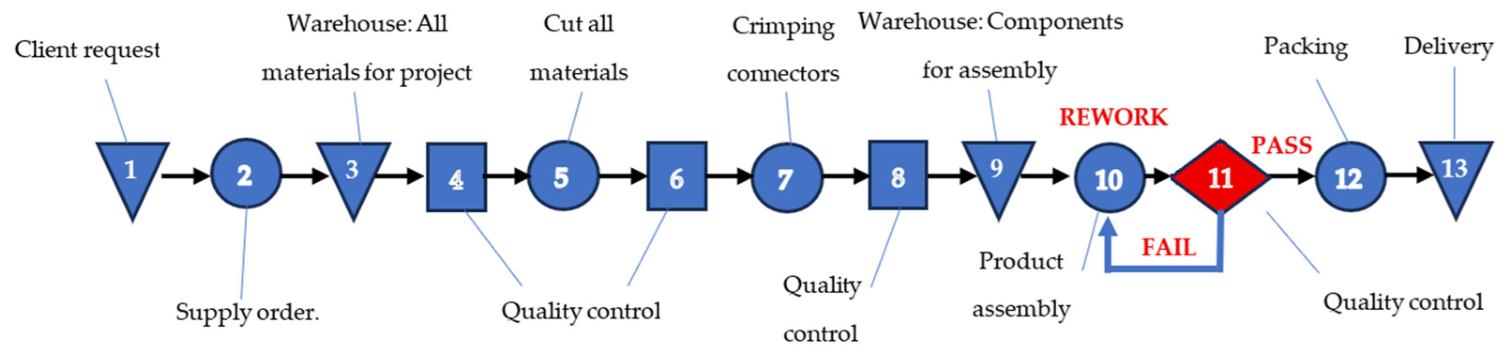
To achieve the operational goal of zero customer escapes, the proposed intervention is an electronic EOL test fixture performing 100% continuity testing and pin-to-pin mapping verification for all 16 circuits. The fixture is positioned immediately after assembly and before packing, establishing a deterministic EOL quality gate (
Figure 3).
The gate is implemented via a poka-yoke rule: “no PASS—no shipment.” Under this rule, any unit failing the mapping test is blocked from packing/shipment and routed to rework, followed by mandatory retest until PASS. Such mistake-proofing logic is consistent with poka-yoke principles emphasizing immediate detection and prevention of defect flow to the customer [
18,
19]. In addition, formalization of EOL decision-making is aligned with quality-gate and virtual-quality-gate approaches used to prevent defect propagation in multi-stage systems [
16,
17].
In this work, the acceptance decision is topology-based: the fixture validates that every pin on connector A maps to the correct pin on connector B, and that no opens/shorts are present. Resistance thresholds are not used as acceptance criteria in this version, because the dominant defect risk is miswire topology rather than contact degradation.
2.4. Data-Centric Architecture and Process Integration
The data-centric architecture is operationalized through a minimal set of entities and fields: unit identifier (UID), test timestamp, product/variant configuration, PASS/FAIL result, defect type (taxonomy), involved pin pairs, station/operator, number of retests, and durations. This structuring enables both traceability of a single event (when, where, who, and what defect) and aggregation across batches, shifts, or time windows (e.g., the frequency of swaps on specific pins).
In a minimal scenario, data are exported periodically for reporting and analysis; in a full scenario, the test outcome controls unit release into the flow (digital quality gate) and can be integrated with MES/ERP via API services or standard data-exchange mechanisms.
A key design aspect is that the fixture is not only a test device but also a data source for quality management. Each unit tested generates a structured record containing, at minimum (i) unit or lot identifier; (ii) timestamp; (iii) PASS/FAIL verdict; (iv) defect class (open/short/miswire); (v) pin-level diagnosis (e.g., swapped cavities/pins); and (vi) rework/retest cycle count. This data model supports traceability and continuous improvement.
The approach is consistent with digital-thread concepts, where product and process data are linked across lifecycle stages to enhance decision-making and root-cause analysis [
7,
20]. It also aligns with data-driven quality-management approaches in multi-stage manufacturing, where structured inspection data enable actionable analytics and prioritization [
21]. In industrial deployment, these data can be exported to a local database, a manufacturing execution system (MES), or enterprise resource planning (ERP) systems to enable lot-level reporting and auditability.
2.5. Evaluation Design, Metrics, and Assumptions
To quantify the impact on internal quality and rework volume, we define below the internal nonconformance rate on a consistent basis: the number of nonconforming units identified in internal control relative to the total number of units produced in the analyzed period.
In the baseline model, the internal rate p0 is kept constant to isolate the effect of the quality gate on rework volume and inspection time. This assumption does not claim that defect generation at the source remains unchanged; rather, it provides a conservative comparison framework: even without upstream improvements, the system can prevent shipment and reduce total effort through rapid diagnosis and retesting.
In practice, p can become a time-dependent function p(t), because diagnostic data can feed process improvement (training, ergonomics, and standard work). A realistic scenario is a gradual decrease in p as recurring causes are eliminated, which amplifies the model benefits: rework decreases and throughput becomes more stable.
A before–after evaluation was conducted using a monthly workload model based on: N = 1500 units/month, baseline internal nonconformity rate p0 = 4%, baseline test time ttest,0 = 1 min/unit, rework time trw = 5 min/defective unit, and post-implementation test time ttest,1 = 0.33 min/unit. Retest after rework is mandatory in both scenarios to ensure shipment of conforming products.
The model focuses on operationally relevant indicators (i) total monthly QC workload (test + rework + retest time); (ii) global QC productivity computed over total QC workload; (iii) released time/capacity; and (iv) customer escapes targeted to zero via enforced EOL gate logic.
The internal nonconformity rate
p0 is treated as an occurrence rate that may not immediately change due to the gate itself; however, the gate prevents shipment of nonconforming units. This interpretation is consistent with the quality-gate literature, which differentiates internal defect occurrence from outgoing quality (escape rate) [
16,
17]. In subsequent continuous improvement cycles, the logged data are expected to support upstream preventive actions that reduce the internal occurrence rate over time [
21].
3. Methodology and Test Logic
3.1. System Overview
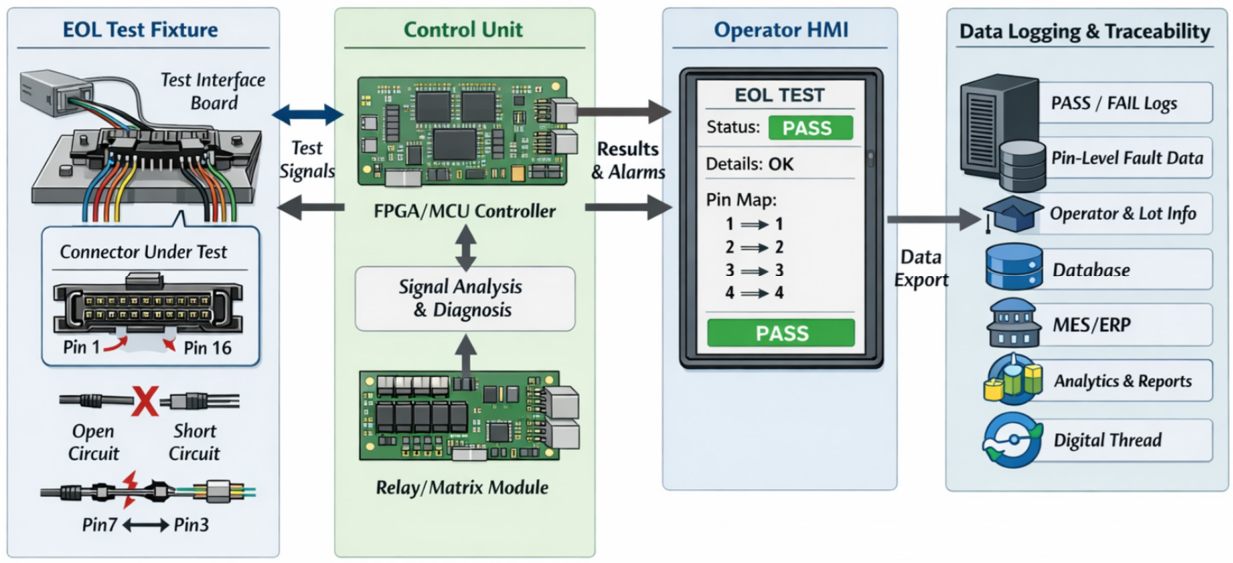
To ensure repeatable end-of-line (EOL) verification and actionable fault localization in cable harness assembly, the proposed solution is implemented as an integrated verification system that combines a dedicated mechanical interface with an electronic addressing layer, deterministic continuity/mapping evaluation, and operator-oriented guidance. This system-level integration follows the general direction reported in the harness testing automation literature, where adaptable architectures and short cycle times are emphasized, and industrial solutions are shown to detect incorrect pinning efficiently.
The main building blocks of the verification system are summarized below:
a mechanical fixture enabling repeatable mating to both connectors;
an electronic addressing layer (e.g., switching/multiplexing);
a continuity and mapping evaluation module;
HMI feedback (PASS/FAIL + fault guidance);
data logging for traceability and improvement.
The automation literature on harness testing emphasizes adaptable architecture, and reported industrial systems can detect incorrect pinning with short test times [
13,
22].
3.2. Acceptance Criterion (No Resistance Thresholds in the PASS/FAIL Verdict)
Given that the dominant risk is a topological error (miswire/swap), the PASS/FAIL verdict is based strictly on:
continuity for all circuits;
absence of short/bridging faults;
conformance of measured mapping to the nominal mapping.
Resistance can be captured as optional diagnostic metadata, but it is not required for the acceptance decision in this study. Where needed, standardized contact resistance test methods are available (e.g., IEC 60512-2-1 and MIL-STD-202 Method 307) [
23,
24].
3.3. Pin-to-Pin Mapping Model and Fault Taxonomy
Let connector A pins be
and connector B pins be
. The fixture constructs a connectivity matrix
:
Conformance is achieved when each row and column contains exactly one “1” and the mapping equals the nominal mapping
. Fault classes:
This fault taxonomy is aligned with the harness test automation literature and reported industrial systems [
13,
22].
3.4. Scan and Decision Procedure (Deterministic Miswiring Diagnosis)
The diagnostic procedure starts with the expected mapping (a list of pin-to-pin pairs) and constructs the observed mapping by scanning the fixture. It then compares the two representations and determines the defect type.
The steps are (1) initialization and product/variant identification; (2) sequential continuity scan to construct the connectivity matrix C; (3) derivation of the observed mapping from C; (4) comparison with the nominal mapping and classification into PASS, two-wire swap, open, short, or ambiguous case; (5) display of corrective instructions to the operator; and (6) retest and logging of the final result. Ambiguous cases are those where multiple configurations can explain the same matrix (e.g., multiple defects or unstable contacts); these are handled via re-scan and/or escalation to re-inspection.
Scan: address each on connector A and test continuity against each on connector B to populate C.
open detected → FAIL;
short/bridging detected → FAIL;
else mapping equals nominal → PASS; otherwise → FAIL with explicit swap diagnosis;
FAIL → rework + mandatory retest until PASS.
3.5. Traceability Record Structure (Data-Centric Element)
Data are stored in a database (relational or time-series, depending on factory infrastructure), and each record is associated with the unit UID. Event sampling is per test (start/stop, verdict, and diagnosis), and data retention is defined by internal policies (e.g., keeping records for the product warranty period and compliance obligations).
For each tested unit, the system stores:
unit ID/lot ID, timestamp;
PASS/FAIL;
defect class (open/short/miswire);
affected pins (e.g., swapped indices);
number of rework/retest cycles;
optional station/operator identifier.
This minimal dataset supports Pareto analyses, targeted training, and continuous improvement consistent with digital-thread and data-driven quality-management approaches [
7,
20,
21].
3.6. Practical Considerations
In industrial operation, beyond the test logic itself, system performance and repeatability depend on practical factors such as contact stability in the fixture, switching times of the matrix, and how the operator receives diagnostic feedback. The following considerations summarize key implementation aspects that ensure reproducibility and robustness in production.
To reduce the influence of unstable contacts (contact bounce), the connectivity verdict can be validated by repeating the measurement/scan on the same pin selection and by applying a consistency rule (e.g., accepting only if the same result repeats). If results are inconsistent, the system flags the case as unstable and requests refixation of the harness, preventing erroneous diagnoses.
The HMI interface transforms the diagnostic result into an actionable instruction (
Figure 4). After scanning, the operator receives the verdict (PASS/FAIL), defect type (e.g., swap), the involved pin pairs, and a recommended action (e.g., “swap wires between pin X and pin Y”). To minimize interpretation time, the display is standardized (defect codes and visual highlight of pins), and retest history for the same unit is retained.
Fixture wear and mating stability: periodic inspection and replacement are required to prevent intermittent contact effects. Standards and methods exist to support contact resistance characterization if introduced [
23,
25];
Upstream workmanship criteria: the EOL gate complements—rather than replaces—workmanship/acceptance practices for harness assemblies (e.g., IPC/WHMA-A-620) [
24];
Scalability: higher pin counts increase scan complexity; modular architectures support adaptation, as recommended in harness testing automation research [
13].
5. Discussion: Human Factors and Data Value
A key limitation is scalability: as the number of pins increases, scan complexity and the number of potential ambiguous cases also increase, especially in the presence of multiple defects. For high-pin-count harnesses, optimizing scan order and constraining the assumed defect set become essential.
The economic benefit comes from reducing inspection time and rework time and from preventing the costs associated with shipped defects (complaints, returns, and line stops). Costs include fixture design and manufacturing, electronic integration, and maintenance (e.g., contact replacement and calibration). In production, payback is driven primarily by volume and time saved per unit; the higher the baseline visual inspection time and the higher p0, the faster the investment is recovered.
An alternative approach is to prevent miswiring through design (mechanical keying, differentiated connectors, and coding). In practice, this may be constrained by cost, existing standards, compatibility with installed equipment, and retrofit needs. Therefore, the proposed quality gate is complementary: it reduces operational risk when product design cannot be changed rapidly.
The results can be complemented with a sensitivity analysis on key parameters (p0, test time, rework time, and retest rate) to show the range of productivity gains. This analysis highlights which parameters dominate the outcome and under what conditions the solution remains advantageous.
The proposed EOL fixture substantially reduces reliance on perceptual discrimination in a high-similarity assembly context (all black conductors). In the baseline workflow, the operator’s final judgment depended on visual checking and cognitive verification of a wiring order that is not directly observable once conductors are routed and inserted. Such tasks are known to be susceptible to attention lapses, working memory overload, and confirmation bias, particularly under repetitive work, time pressure, or frequent changeovers. By converting the verification step from a subjective visual assessment into a deterministic functional check, the fixture decreases the probability that a miswire will remain undetected and reduces inter-operator variability. This is consistent with human reliability findings in complex manual assembly, where standardization and objective feedback mechanisms reduce error occurrence and improve inspection consistency [
9].
From a human factors’ standpoint, the fixture also enables immediate, actionable feedback. Instead of a generic “fail” condition, the system can indicate the fault class (open/short/miswire) and, for miswiring, provide pin-level localization. This changes the operator’s task from searching for an error in an ambiguous condition to performing a guided correction with lower cognitive burden. Over time, this can support learning effects and more stable performance across shifts because the operator receives consistent feedback and the process becomes less dependent on tacit experience. In practice, such feedback loops are a key mechanism for reducing the probability of repeated errors in manual assembly settings [
9].
From a data perspective, architecture’s value is not limited to gatekeeping. The structured logging of PASS/FAIL outcomes together with fault classes, affected pin indices, timestamps, and rework cycles creates a minimal but high leverage dataset for continuous improvement. In a digital-thread-oriented perspective, these records can be linked to batch/lot information, work orders, material traceability (connectors and terminals), and station/operator identifiers, thereby creating an auditable chain of evidence for each shipped unit and supporting root-cause analysis when anomalies arise. Such linkage is aligned with digital-thread concepts emphasizing lifecycle continuity of product and process information [
7,
20]. Furthermore, the systematic collection of inspection and rework data enables a data-driven quality-management approach by supporting KPI tracking (e.g., first-pass yield, rework rate, and retest cycles), defect Pareto analyses (e.g., recurring swapped pin pairs), and targeted interventions (training, work-instruction changes, and fixture maintenance strategies). These practices are consistent with data-centric quality-management approaches in multi-stage manufacturing [
21].
In addition, the logged dataset provides a practical foundation for more advanced analytics if pursued in future work. For example, time-series monitoring can identify drift in failure patterns (e.g., increasing open-circuit occurrences linked to tooling wear in crimping). More sophisticated approaches could combine EOL test results with upstream process signals (crimp parameters, operator sequence, or changeover events) to predict risk and recommend preventive actions. Recent research on AI-assisted fault detection in wiring harness manufacturing suggests that machine learning can be used to improve fault identification and decision support, provided that sufficiently structured data are available. In this context, the proposed logging strategy becomes a prerequisite for scaling toward AI-supported quality control, while maintaining deterministic EOL acceptance criteria for shipment decisions [
14].




 ,
,