1. Introduction
Decision-making on the implementation of transport projects, particularly in the field of railway infrastructure, is closely linked to the need for efficient allocation of public resources [
1]. Under conditions of limited financial capacity and increasing investment costs [
2], it is essential to evaluate projects not only from a technical perspective, but also from economic and societal viewpoints [
3]. One of the most used tools for this purpose is cost–benefit analysis (CBA), which enables the quantification and comparison of all relevant costs and benefits of a project over its lifecycle [
4,
5,
6].
In the railway sector, CBA plays a crucial role, especially in track modernization projects, which require substantial capital expenditures while their benefits materialize over a long-term horizon [
7,
8]. In addition to financial flows, the evaluation also incorporates broader socio-economic effects, such as travel time savings [
9], reductions in vehicle operating costs [
10], improvements in safety, and the mitigation of negative environmental impacts [
11].
This paper focuses on the assessment of the efficiency of the modernization of the regional railway line Prievidza–Jelšovce, which represents an important transport corridor in the Upper and Central Nitra regions [
12]. Despite its significance, the line has long been affected by technical deficiencies and a low level of modernization, reflected mainly in speed limitations, outdated signalling systems, and a lower quality of service provision.
The novelty of this paper lies primarily in updating the project evaluation based on the most recent input data, reflecting a significant increase in investment costs and an expansion of the project scope compared to previous assessments. Unlike existing studies based on the original feasibility study, this contribution integrates the results of the EIA process and applies the latest CBA methodology. The added value of the paper also consists in a comprehensive comparison of multiple project variants, including an alternative proposal, which allows for the identification of the impact of modernization scope on economic efficiency. Furthermore, the paper provides a detailed quantification of socio-economic and environmental effects in the context of regional railway transport, which is less frequently addressed in the literature compared to major corridor projects. The study thus contributes to extending knowledge on the application of CBA in regional transport projects and highlights the importance of updating input parameters in public investment decision-making.
From a broader perspective, the modernization of railway infrastructure can also be interpreted as a strategic response to increasing competitive pressures from alternative transport modes, particularly individual car transport. In corridors where private car usage dominates, infrastructure upgrades are not only a matter of technical improvement but also a necessary condition for maintaining the competitiveness of rail transport.
In this context, modernization can be linked to the concept of digital commitment and digital innovation, as discussed in the recent literature on the role of competition policy in driving technological transformation [
13]. The implementation of advanced signalling and control systems represents a form of digital upgrading, enabling higher operational efficiency, improved service quality, and greater system reliability. Even when certain technologies (such as ETCS) are partially limited due to cost considerations, the overall modernization process contributes to strengthening the competitive position of railway transport within the transport market.
The aim of the paper is to assess the economic efficiency of the proposed modernization variants of this railway line using cost–benefit analysis, considering the recent increase in investment costs and the expansion of the project scope to include potential technical measures, such as electrification. The analysis is based on a comparison of two project variants evaluated through financial and economic indicators. The paper also emphasizes the importance of updating CBA input parameters, as changes in investment costs, transport demand, or technical design can significantly affect the overall project appraisal and, consequently, decision-making regarding its implementation.
This study shows that cost optimization combined with electrification can significantly improve the economic performance of regional rail projects, even under constrained demand conditions. The study does not aim to introduce a new methodological framework for cost–benefit analysis; rather, it applies established CBA principles to a specific regional railway project using updated input data and revised assumptions. The contribution of the paper lies primarily in its contextual and empirical perspective.
Specifically, the study provides an updated economic evaluation of a real infrastructure project, incorporating revised investment costs, environmental parameters, and transport demand assumptions. It also offers a comparative assessment between a capital-intensive modernization concept and a cost-optimized alternative design, highlighting the impact of investment structure on overall economic efficiency.
In this way, the paper contributes to the literature by providing practical insights into the economic performance of regional railway modernization projects under current methodological and policy conditions, with a particular focus on cost-efficiency and environmental performance trade-offs.
2. Literature Review
The literature review provides the theoretical and methodological background for the issue of transport project appraisal, with a focus on railway infrastructure and the application of CBA. Attention is paid to approaches to the economic evaluation of projects and the specific features of their application in rail transport, as well as environmental and technological aspects that significantly influence the final assessment.
At the same time, the main approaches, benefits, and limitations of using CBA in transport planning are identified, along with the key factors affecting the economic efficiency of projects. The literature review thus establishes a foundation for interpreting the results of the conducted analysis and enables the project to be positioned within a broader scientific and practical context.
2.1. Methodological Approaches to Cost–Benefit Analysis in Transport
The evaluation of transport infrastructure investments is currently standardly conducted using CBA, which enables a comprehensive assessment of project economic efficiency from a societal perspective. The national methodological framework for the application of CBA in the transport sector in Slovakia is defined by the methodological guidelines issued by the Ministry of Transport [
14,
15], which systematically regulate the procedures for calculating financial and economic indicators, the valuation of externalities, and the application of shadow pricing. The importance of CBA as a tool for evaluating public investments is also emphasized by [
16], who highlights its role in assessing value for money and rationalizing public expenditures.
At the European level, the key methodological framework is provided by the European Commission [
17], which defines in detail the principles of economic appraisal within the cohesion policy and offers a standardized approach to the monetization of costs and benefits. The document also emphasizes the need for consistency in discounting, risk assessment, and sensitivity analysis.
Authors of the study [
18] extend the traditional CBA framework by emphasizing the comprehensive capture of transport project benefits, particularly travel time savings and their distributional effects. The study [
19], based on the Dutch experience, highlights the importance of standardized methodological approaches, which enhance transparency and comparability in project evaluation. The authors of the study [
20] address the issue of the social discount rate and its impact on CBA results, underlining the importance of its appropriate specification in public investment appraisal.
The OECD [
21] identifies the need for further development of CBA methodology, particularly in the areas of uncertainty, externalities, and broader socio-economic effects. Similarly, the authors of the study [
22], based on empirical analysis, show that, although CBA represents an important decision-making tool, its results are often complemented by qualitative considerations.
Alternative approaches to the evaluation of transport projects include multi-criteria methods. The study [
23] compares CBA with Multi-Attribute Tradespace Exploration (MATE) and demonstrate that combining these approaches can lead to more robust decision-making processes. The author of the study [
24] further highlights the broader economic impacts of infrastructure investments, such as the stimulation of entrepreneurship and regional development, which are not always fully captured by traditional CBA.
2.2. Application of CBA in Railway Projects
In the field of railway transport, the literature primarily focuses on assessing the economic efficiency of different types of projects. The authors in the study [
25] analyze a high-speed rail project in Spain and identify travel time savings as the dominant source of economic benefits. This conclusion has been confirmed by subsequent studies.
The study [
26] extends the analysis to various types of railway projects (high-speed rail versus suburban services) and highlight differences in the structure of costs and benefits. The authors of the study [
27] emphasize the importance of ex post evaluation, which allows for a comparison between projected and actual outcomes and helps identify deviations in demand and benefit forecasts.
The study [
28] focusses on passenger transport planning and underlines the critical role of accurate demand estimation in project evaluation. This aspect is further developed by the author of the study [
29], who analyses transport demand elasticities and the factors influencing modal choice.
In the Slovak context, important insights are provided by evaluations conducted by the Ministry of Finance of the Slovak Republic [
30] and feasibility studies prepared by Slovak Railways [
31]. These studies highlight a frequent issue of high capital intensity in railway projects and its negative impact on overall economic efficiency.
2.3. Environmental and Technological Aspects of Transport Projects
Environmental aspects represent a significant component of transport project evaluation, particularly in the context of sustainable development. The authors of the study [
32] emphasize the importance of the indirect benefits of railway investments, such as reductions in congestion and emissions, and improvements in quality of life. The study [
33] compares road and rail transport from the perspective of externalities and highlights the substantially lower environmental impacts associated with railway transport.
The authors of the study [
34] propose an adapted CBA methodology for innovative railway services, incorporating new categories of costs and benefits. The author of the study [
35] further extends the evaluation framework by integrating a social dimension, including considerations of equity and the distribution of benefits.
Methods for the valuation of externalities, including contingent valuation [
36], enable the monetization of environmental impacts of transport, such as emissions, noise, and safety.
With ongoing technological advancements, the evaluation of alternative traction systems has gained increasing importance. The study [
37] analyses the economic efficiency of battery-electric trains and the integration of renewable energy sources. The authors of the study [
38] propose a methodology for assessing new propulsion systems that incorporate technological innovations and their economic implications.
2.4. Limitations of CBA and Challenges in Transport Project Evaluation
Despite its widespread use, several authors highlight the limitations of cost–benefit analysis. The study [
39] points to the problematic perception of CBA within the planning process, particularly due to the simplification of complex decision-making situations. The authors in the papers [
40,
41] discuss both the methodological and ethical limitations of CBA, including issues related to the distribution of benefits and social equity.
The study [
42] emphasizes the challenges associated with evaluating large-scale infrastructure projects, where results are heavily influenced by uncertainty and long-term forecasts. A significant issue is also the accuracy of investment cost estimates. The authors of the study [
43] identify systematic cost overruns in transport infrastructure projects, which can substantially distort CBA outcomes.
These findings suggest that, despite the well-developed methodological framework, key challenges remain, particularly in accurate demand modelling, proper valuation of externalities, and effective control of investment costs.
2.5. Research Gap
Despite the extensive body of literature on the evaluation of transport infrastructure projects, several important research gaps can be identified. Most studies focus on large-scale infrastructure projects, particularly high-speed rail, while significantly less attention is paid to regional railway lines, which exhibit different demand structures and benefit profiles. Although existing research highlights the importance of environmental benefits, the detailed quantification of electrification effects in the context of regional railways remains insufficiently explored.
The literature also emphasizes the role of capital investment costs as a key determinant of economic efficiency; however, there is a lack of detailed analyses focusing on the optimization of technical design and its impact on CBA results. Furthermore, several studies identify the limitations of CBA in transport demand modelling, particularly in capturing behavioural changes resulting from improvements in railway service quality.
This paper addresses these gaps by analyzing the economic efficiency of a regional railway optimization project, with a particular focus on the combined effects of capital cost rationalization and the environmental benefits of electrification. In doing so, it contributes to extending the existing knowledge on the evaluation of transport infrastructure projects, particularly in the underexplored context of regional rail systems.
Although the existing literature provides a solid foundation for the application of cost–benefit analysis in transport infrastructure projects, several gaps remain in the context of regional railway modernization. Previous studies have primarily focused on the evaluation of individual investment projects, often emphasizing demand forecasting, environmental benefits, or overall project feasibility. However, less attention has been paid to the comparison between capital-intensive modernization concepts and cost-optimized alternatives, particularly in cases where infrastructure design may be over-dimensioned relative to actual transport demand. Furthermore, while many studies confirm the importance of environmental benefits—especially in the context of electrification—the role of capital expenditure as the dominant factor influencing economic efficiency is often less explicitly addressed. In regional railway projects with lower traffic volumes, high capital intensity frequently becomes the key limiting factor for achieving positive ENPV.
In this context, the present study contributes by providing a comparative assessment of alternative project designs and by highlighting the critical role of investment structure in determining economic performance. Although the analysis is based on a specific case study in Slovakia, the findings offer transferable insights for similar regional railway projects, where balancing infrastructure scope, cost-efficiency, and environmental performance represents a central challenge.
3. Methodology
The evaluation of the efficiency of the modernization of the Prievidza–Jelšovce railway line was carried out using CBA, which represents a standard tool for the economic appraisal of transport projects. The methodology is based on the comparison of the “without project” and “with project” scenarios, in which all relevant costs and benefits are identified, quantified, and monetized over the evaluation period.
CBA enables the assessment of the project from a societal perspective by transforming financial flows into economic values and incorporating non-market effects, such as travel time savings, reductions in vehicle operating costs, improvements in safety, and the mitigation of negative environmental impacts. The evaluation was conducted for two project variants—the variant based on the EIA documentation and the proposed optimization solution.
3.1. Economic Flows of the Project
The basis of the evaluation is the calculation of net economic flows, which are determined using Equation (1). This relationship reflects the basic principle of cost–benefit analysis, where economic efficiency is assessed as the difference between total benefits and total costs over the evaluation period.
where
The net economic flow relationship in Equation (2) further decomposes total economic flows into individual categories of benefits and costs that are explicitly quantified within the project evaluation.
where
—travel time savings [€],
—vehicle operating cost savings [€],
—safety benefits [€],
—environmental benefits [€],
—residual value [€],
—investment costs [€],
—infrastructure operation and maintenance costs [€].
3.2. Discounting and Evaluation Indicators
The net present value is calculated using Equation (3), which expresses the conversion of future cash flows into their present value, thereby accounting for the time value of money:
where
The economic net present value (ENPV) represents the key decision-making indicator, determining whether the total benefits of a project exceed its total costs. It is calculated using Equation (4).
The benefit–cost ratio is calculated using Equation (5) and allows for a relative comparison of project efficiency, expressing how many units of benefits correspond to one unit of costs.
The economic rate of return represents the discount rate at which the economic net present value of the project equals zero. It is calculated using Equation (6):
3.3. Project Costs
The residual value of the investment is calculated using Equation (7), which expresses the remaining value of the investment at the end of the evaluation period, considering the unutilized lifetime of infrastructure components:
where
—investment costs [€],
—remaining lifetime [years],
—total lifetime [years].
3.4. Project Benefits
Within the project evaluation, individual effects are classified into several categories, with travel time savings representing the key benefit.
3.4.1. Travel Time Savings
Monetized travel time savings represent the valuation of time savings for passengers, calculated as the product of the difference in travel time, the number of passengers, and the value of time. It is calculated using Equation (8):
where
—travel time before and after the project [h],
—number of passengers [persons],
—value of time [€/h].
The number of diverted passengers is calculated using Equation (9). This relationship determines the number of passengers who shifted from other modes of transport to railway transport because of the project implementation.
where
Equation (10) quantifies the travel time savings for diverted passengers.
where
3.4.2. Operating Cost Savings
Operating cost savings represent the difference in unit costs before and after the project, multiplied by transport performance. It is calculated using Equation (11):
where
—unit costs [€/unit of performance],
—transport performance.
Vehicle operating costs represent the calculation of operating costs based on traffic intensity, travelled distance, and unit costs. They are calculated using Equation (12):
where
Equation (13) decomposes operating costs into individual components, allowing for a more detailed assessment of their changes.
where
—fuel costs [€],
—maintenance costs [€],
—other costs [€].
Equation (14) summarizes total operating cost savings as the sum of savings across individual cost components.
where
3.4.3. Transport Safety
Accident costs are calculated using Equation (15) and represent the total societal costs of transport accidents as the sum of costs across individual accident types:
where
Equation (16) expresses the project benefit in terms of reduced accident costs resulting from improved safety.
where
—number of accidents,
—average cost per accident [€].
3.4.4. Environmental Benefits
Total environmental benefits are expressed as the sum of benefits from reductions in air pollution, greenhouse gas emissions, and noise, and are calculated using Equation (17):
where
—benefits from reduced air pollution [€],
—benefits from reduced greenhouse gas emissions [€],
—benefits from noise reduction [€].
The benefits from reduced air pollution are calculated using Equation (18):
where
The benefits from reduced greenhouse gas emissions are calculated using Equation (19):
where
The benefits from noise reduction are calculated using Equation (20):
where
In the case of rail transport, the calculation of environmental impacts differs between diesel and electric traction. For diesel traction, emissions were calculated based on fuel consumption and standard emission factors per litre of diesel. For electric traction, indirect emissions were calculated using emission factors per kWh of electricity, reflecting the national electricity generation mix.
The electricity emission factor was based on average values corresponding to the Slovak energy mix, considering the share of low-emission sources such as nuclear and renewable energy. As a result, electric traction is associated with significantly lower emissions compared to diesel traction. The resulting emission quantities were monetized using unit costs for individual pollutants and CO2 and subsequently aggregated into total environmental benefits within the economic analysis.
3.5. Sensitivity Analysis
The change in economic efficiency is calculated using Equation (21), which expresses the dependence of the resulting economic performance on changes in key input parameters:
where
3.6. Key Assumptions and Input Parameters
To ensure the transparency and reproducibility of the analysis, the main input assumptions used in the cost–benefit analysis are explicitly defined in this section. The input data used in the analysis were derived from project documentation and internal materials of Slovak Railways (ŽSR), including cost estimates and transport model outputs. The economic evaluation was carried out using a social discount rate of 5%, in accordance with the current methodological guidelines for transport projects in Slovakia [
15]. The reference period was set to 40 years, reflecting the standard lifetime of railway infrastructure projects.
The conversion from financial to economic analysis was performed using standard conversion factors defined in the national CBA methodology. Investment costs were adjusted by applying a shadow price coefficient of 0.9 to exclude indirect taxes and market distortions. Labour costs were converted using a shadow wage factor of 0.85, reflecting regional labour market conditions. The valuation of travel time savings was based on unit values specified in the national CBA guidelines [
15]. For passenger rail transport, the value of time was set at 7.0 €/h for existing passengers and 6.5 €/h for diverted passengers, reflecting differences in transport mode and user characteristics. Environmental externalities were monetized using unit values based on the updated methodology [
15]. The cost of CO
2 emissions was set at 100 €/t, while the valuation of air pollutants (NOx, PM, etc.) was based on standard emission factors differentiated by vehicle type and fuel. Noise costs were calculated using average unit values per vehicle-kilometre.
The transport model inputs were based on demand forecasts developed within the project documentation [
44]. The model assumes an annual increase in rail passenger demand of approximately 81,000 to 89,000 passengers. The modal split of diverted passengers (90% private car, 10% bus) is based on the observed structure of transport demand in the corridor, where individual car transport represents the dominant mode. This assumption reflects current traffic patterns and is consistent with the expectation that most newly attracted rail passengers would shift from private car transport rather than from bus services. However, this assumption introduces a degree of uncertainty, as the exact behavioural response of passengers cannot be determined with full precision. Freight transport projections reflect a decline in coal transport after 2028 and moderate growth in other freight segments. All monetary values are expressed in constant prices at the 2025 price level.
Induced demand effects are not explicitly modelled; instead, demand changes are based on transport model forecasts that incorporate expected modal shifts and overall demand development.
A distinction is made between financial and economic costs. Financial costs represent actual investment expenditures including taxes and market prices, while economic costs reflect the real resource consumption from a societal perspective. Therefore, financial investment costs were adjusted by excluding VAT and applying conversion factors (shadow pricing) to eliminate market distortions. As a result, economic investment costs are lower than financial capital expenditures. For transparency and reproducibility, the key input parameters used in the economic appraisal are summarized in a single overview table (
Table 1).
4. Study Area and Project Background
A fundamental component of transport projects is the description of existing infrastructure and transport relations within the affected area, as project-induced changes are reflected not only in the modernized infrastructure itself but also across the broader transport system. In the case of the Prievidza–Jelšovce railway optimization project, the evaluation therefore considers not only the railway line but also parallel and alternative road connections, where changes in traffic volume, direction, and structure of transport flows can be expected.
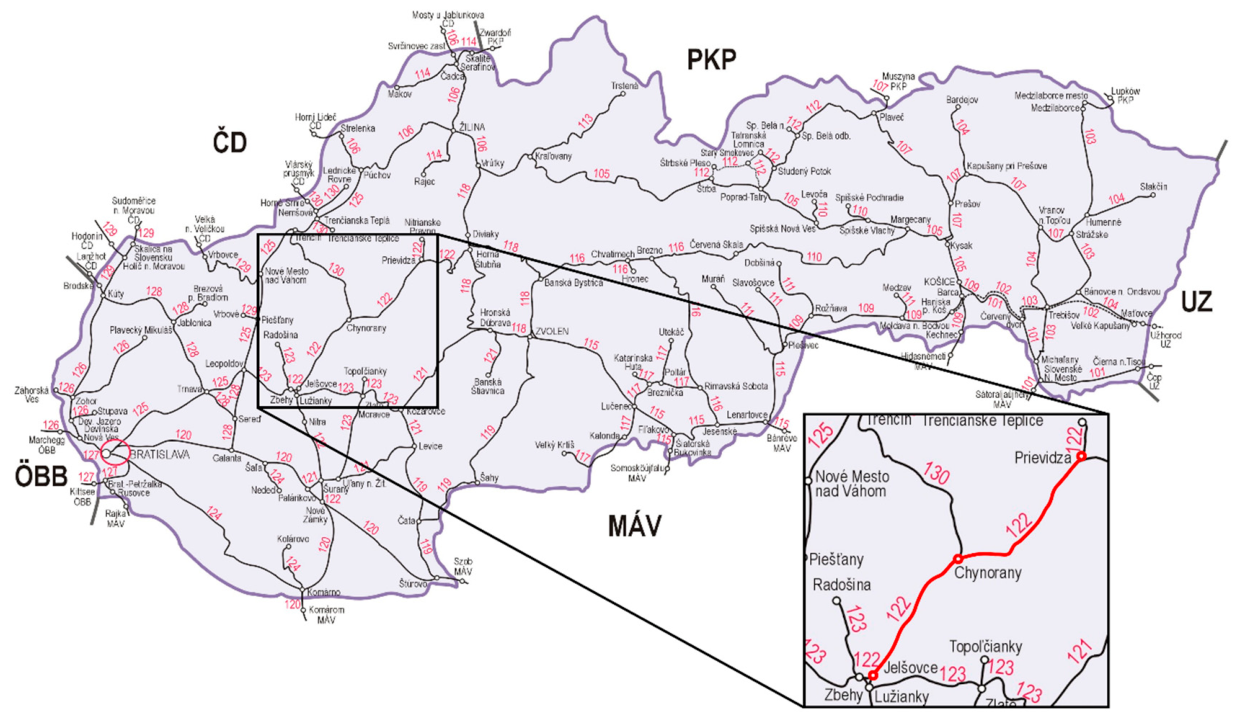
The railway section Prievidza–Jelšovce is part of the ŽSR line No. 122 C Nitrianske Pravno–Nové Zámky. It is a single-track, non-electrified railway line with a line speed of 80 km/h in the Prievidza–Topoľčany section and 100 km/h in the Topoľčany–Jelšovce section. The total length of the evaluated section is 66.606 km, while the length between the entry signals of the terminal stations is 68.082 km [
12]. The main technical parameters of the section are summarized in
Table 2.
One of the main operational issues of the railway line is the obsolescence of signalling systems. In most railway stations within the evaluated section, station signalling systems of Category 1 are used, i.e., mechanical systems without interlocking between signals and switch positions. This type of system reduces traffic fluidity, prolongs route setting, and causes significant speed reductions at station throats. As a result, trains must reduce their speed to approximately 40 km/h when entering and leaving stations, which negatively affects travel times and operational reliability. An overview of the main infrastructure deficiencies is presented in
Table 3.
A similarly inadequate condition is identified in the case of line signalling systems. Along the entire evaluated section, as well as in adjacent interstation sections, train operations are controlled by telephone communication, representing a Category 1 line signalling system. As a result, operations are highly dependent on the human factor, which limits operational flexibility and reduces the safety level of the line. An important part of the assessment is also the condition of level crossing protection systems. The line includes a total of 48 level crossings, of which 24 are equipped with light signalling and 14 are mechanically operated, while some crossings remain unprotected. This situation creates an increased safety risk, particularly at crossings located on heavily trafficked roads.
The railway line is complemented by a significant road infrastructure in the affected area, which represents its main competitor. The key road is the I/64, which runs parallel to the railway line along the entire evaluated section. It constitutes the main transport corridor of the region and is, in some sections, designed as a four-lane road. The spatial relationships between the railway and road infrastructure are illustrated in
Figure 1.
4.1. Transport Relations and Travel Demand
The evaluation of the efficiency of the railway modernization project also requires an analysis of transport relations within the area, as transport demand forms the basis for identifying the project’s socio-economic benefits. Several important settlement centres are located along the railway line, particularly Prievidza, Nováky, Partizánske, and Topoľčany.
From the perspective of passenger transport, daily passenger volumes on the railway line range approximately between 2300 and 3700 passengers. On the parallel road infrastructure, individual car transport dominates, exceeding 10,000 passengers per day in most sections. The basic quantitative characteristics of transport demand are summarized in
Table 4.
The findings indicate a strong dominance of road transport, which also suggests a significant potential for modal shift toward rail transport if its parameters are improved.
4.2. Existing Project Assessments and Development of Technical Solutions
The Prievidza–Jelšovce railway optimization project has been developed in previous stages through the feasibility study from 2020 and the EIA documentation from 2023. The key differences between these documents are summarized in
Table 5.
The key differences between the two documents are primarily reflected in the scope of reconstruction, the technical solutions of signalling systems, and the extent of construction works. The EIA proposal considers a comprehensive reconstruction of the entire line, including the modernization of the track substructure and superstructure, the construction of new infrastructure elements, and the implementation of advanced traffic management technologies.
These differences are also clearly reflected in the investment costs. A detailed comparison of investment costs is presented in
Table 6. All financial and economic indicators are expressed in 2025 price levels (PL, 2025).
The comparison of existing assessments for the Prievidza–Jelšovce railway line indicates that the originally proposed technical solution presented in the feasibility study was significantly underestimated. The largest discrepancies in the scope of construction works required to ensure safe railway operation were identified in the areas of track substructure, track superstructure, bridges, and signalling systems, resulting in a substantial increase in investment costs. For these reasons, a re-evaluation of the cost–benefit analysis for the Prievidza–Jelšovce optimization project is necessary.
In addition to changes in the technical design, which were primarily reflected in the scale of investment costs, the methodology of cost–benefit analysis has also been updated in the meantime. This factor also significantly influences the evaluation results.
4.3. Changes in CBA Methodology as a Factor Influencing Project Evaluation Results
In addition to changes in the technical design of the project, a significant update of the CBA methodology has also occurred in the interim period. The updated methodology introduces more precise procedures for quantifying costs and benefits, which directly affects the results of economic evaluations of transport infrastructure projects. The main differences between the original and updated CBA methodologies are summarized in
Table 7.
One of the most significant changes concerns the calculation of travel time savings, which has been extended to include waiting time, transfers, and walking time. This adjustment leads to a more accurate representation of benefits for transport users and, in the case of projects aimed at improving the quality of railway transport, may result in a substantial increase in estimated benefits. Changes have also been introduced in the calculation of operating costs, which are defined in the new methodology based on a detailed breakdown of individual infrastructure elements. In contrast to the previous approach based on average values per kilometre of track, the updated methodology considers factors such as the number of switches, track length, bridge structures, and types of signalling systems, resulting in a more precise cost estimation.
A significant modification has also been made in the evaluation of environmental impacts, where aggregated unit values have been replaced by emission factors derived from fuel consumption. This change allows for a more accurate assessment of the project’s environmental effects. Another important adjustment concerns the lifetime of individual infrastructure components, which directly affects the calculation of the residual value of the investment. The reduction in the lifetime of certain technological systems, particularly signalling and communication equipment, leads to different outcomes in the economic evaluation. Based on the above, it can be concluded that changes in the CBA methodology have a substantial impact on the resulting efficiency indicators of the project. Therefore, the original analysis prepared under the previous methodology no longer reflects current conditions, making its update essential.
5. Results
For the purposes of the updated cost–benefit analysis, two variants of the Prievidza–Jelšovce railway modernization were evaluated. The first variant represents the technical solution based on the proposal developed within the EIA process. The second variant represents an alternative design (author-proposed variant) aimed at reducing investment-intensive construction and technological elements while maintaining the core functional objectives of the project. The results presented in this section are based on the key input assumptions defined in
Section 3.6, including a social discount rate of 5%, standardized values of travel time, and unit costs for environmental externalities. This ensures consistency between the methodological framework and the empirical results. The economic results presented in this section are based on the input parameters summarized in
Table 1.
Compared to the EIA variant, the alternative design primarily reduces the number of underpasses, the extent of platform construction, selected road infrastructure elements, noise barriers, ETCS implementation, elevators, and part of the communication systems. On the other hand, it includes the electrification of the railway line, which increases investment costs but significantly improves the environmental performance of the project. The key differences between the two variants are presented in
Table 8.
The comparison highlights two fundamentally different approaches to project design. While the EIA variant emphasizes a comprehensive modernization with a high level of infrastructure and technological equipment, the alternative design focuses on cost optimization by reducing non-essential investment components.
At the same time, the inclusion of electrification in the alternative variant represents a strategic trade-off, where higher initial investment is compensated by significantly improved environmental performance. This contrast allows for a clearer assessment of the relationship between capital intensity and economic efficiency.
5.1. Operational and Technical Solution of the Alternative Design
One of the most significant differences between the alternative design and the EIA variant lies in the solution for passenger access to platforms. While the EIA variant is based on the extensive construction of grade-separated access (underpasses and overpasses), the alternative design considers level access via a central pedestrian crossing in several stations. This approach reflects the fact that the line is a single-track regional railway, where full platform segregation does not provide the same operational benefits as on double-track corridor lines.
Figure 2 illustrates the concept of two side platforms, with access to the opposite platform provided via a central level crossing. The proposed solution allows for a reduction in investment costs related to underpasses and elevators while maintaining operational functionality and an adequate level of safety on a regional single-track line.
A specific case is represented by the Chynorany station, where a combination of an island platform and a side platform is proposed.
Figure 3 illustrates the layout of Chynorany station, where the island platform enables the crossing of higher-category trains, while the side platform is intended for regional services. This design combines operational efficiency with lower investment requirements.
The overall effect of the optimization measures included in the alternative design represents a reduction in investment costs of approximately €34.2 million, despite a significant cost increase caused by the electrification of the line. The largest savings were achieved through the reduction in underpasses and the elimination of noise barriers.
Table 9 illustrates the impact of selected measures on the total investment costs of the project.
The results clearly indicate that the greatest potential for cost reduction lies in limiting investment-intensive infrastructure elements that do not provide proportional operational benefits in the context of a regional single-track line. In particular, the extensive implementation of grade-separated crossings and noise barriers appears to represent a form of overdesign. At the same time, the inclusion of electrification demonstrates that it is possible to achieve substantial environmental benefits while maintaining an overall reduction in capital expenditure, highlighting the importance of balanced project optimization.
5.2. Input Parameters and Transport Model
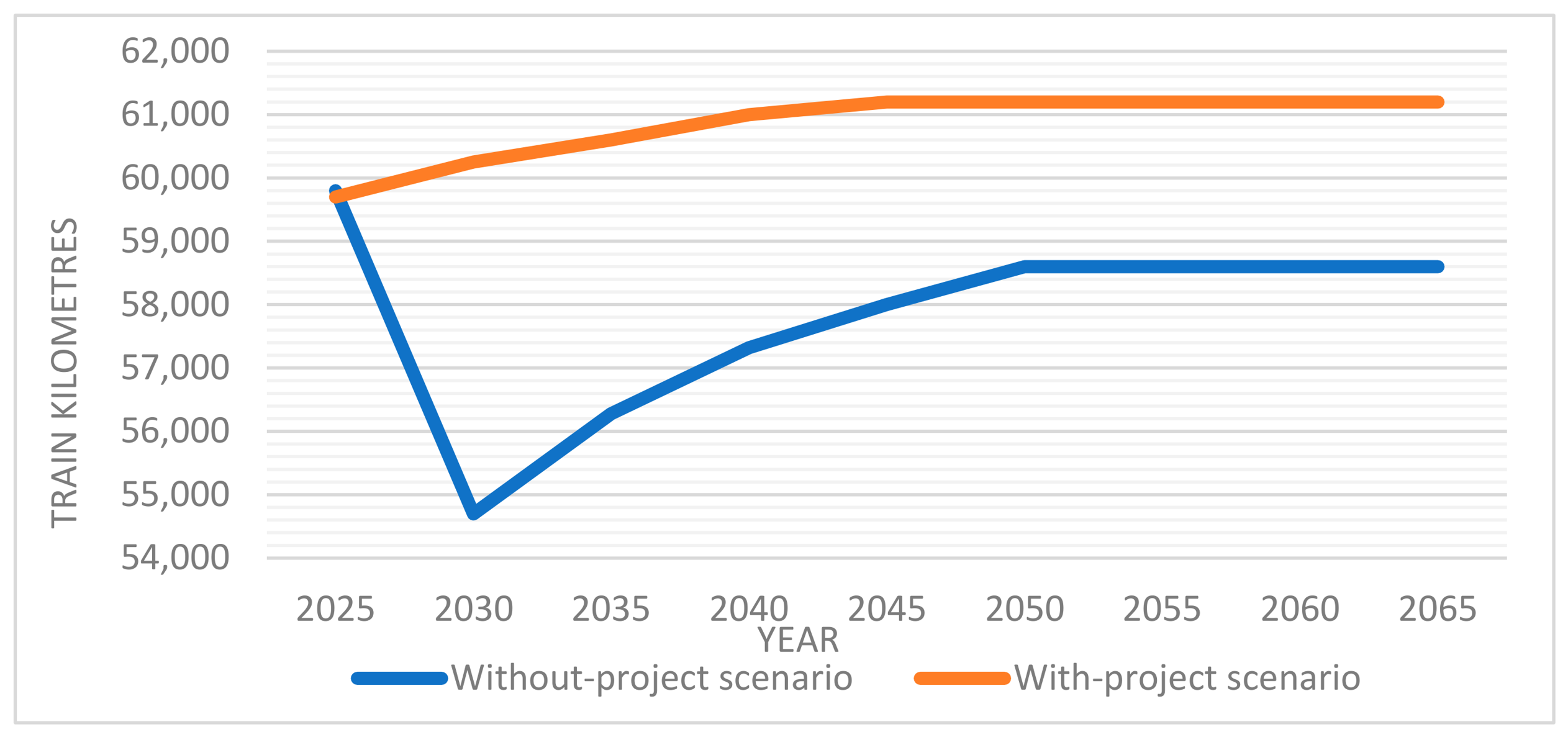
Both variants are based on the same transport model and share identical input parameters; therefore, differences in the results are primarily driven by the technical scope of the project. In passenger transport, the model assumes an increase in demand only in regional rail services. This increase ranges from approximately 81,000 to 89,000 passengers per year over the reference period, showing a slightly decreasing trend. The diverted passengers are assumed to originate from bus and individual car transport in a ratio of 10:90.
This assumption is based on the current modal split in the corridor, where individual car transport represents the dominant mode, significantly exceeding both bus and rail transport volumes. Given the strong dominance of private car usage in the corridor, it is assumed that most newly attracted rail passengers would shift from individual car transport rather than from bus services. This assumption is consistent with the observed structure of transport demand and with typical modal shift patterns in regional corridors with high car dependency. At the same time, it should be noted that this assumption introduces a degree of uncertainty into the analysis, as the exact structure of diverted traffic cannot be determined with full precision. The development of passenger numbers in the “without project” and “with project” scenarios is illustrated in
Figure 4.
Figure 4 illustrates the development of passenger numbers in rail transport over the reference period. The model assumes an incremental increase in regional rail passengers under the “with project” scenario, with this increase remaining relatively stable over time.
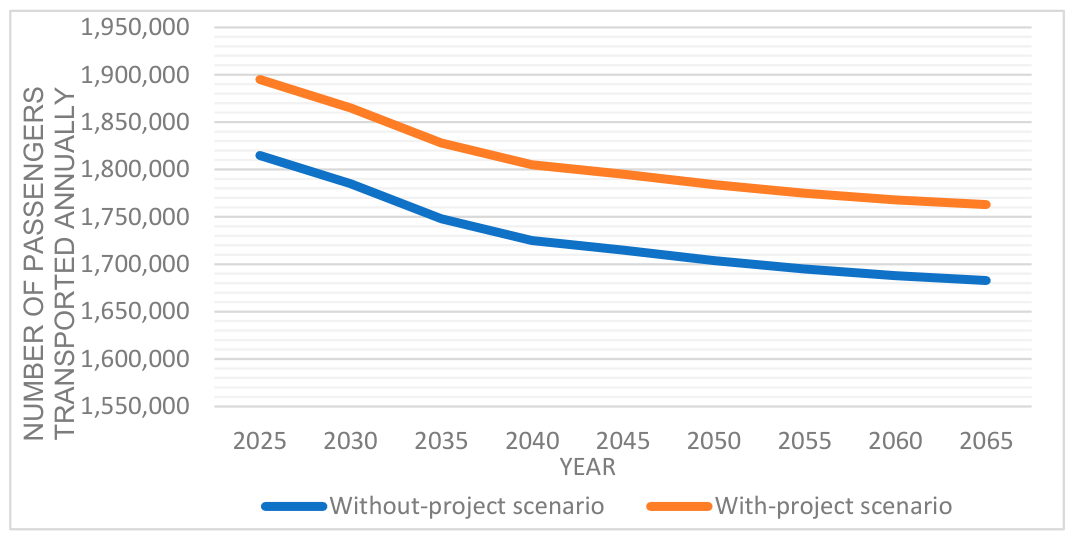
In freight transport, the model reflects the decline of coal mining in the region, which leads to a sharp decrease in transport performance after 2028 in the “without project” scenario. In contrast, the “with project” scenario assumes a moderate growth in rail freight transport.
Figure 5 illustrates the transport model for freight transport in gross tonne-kilometres.
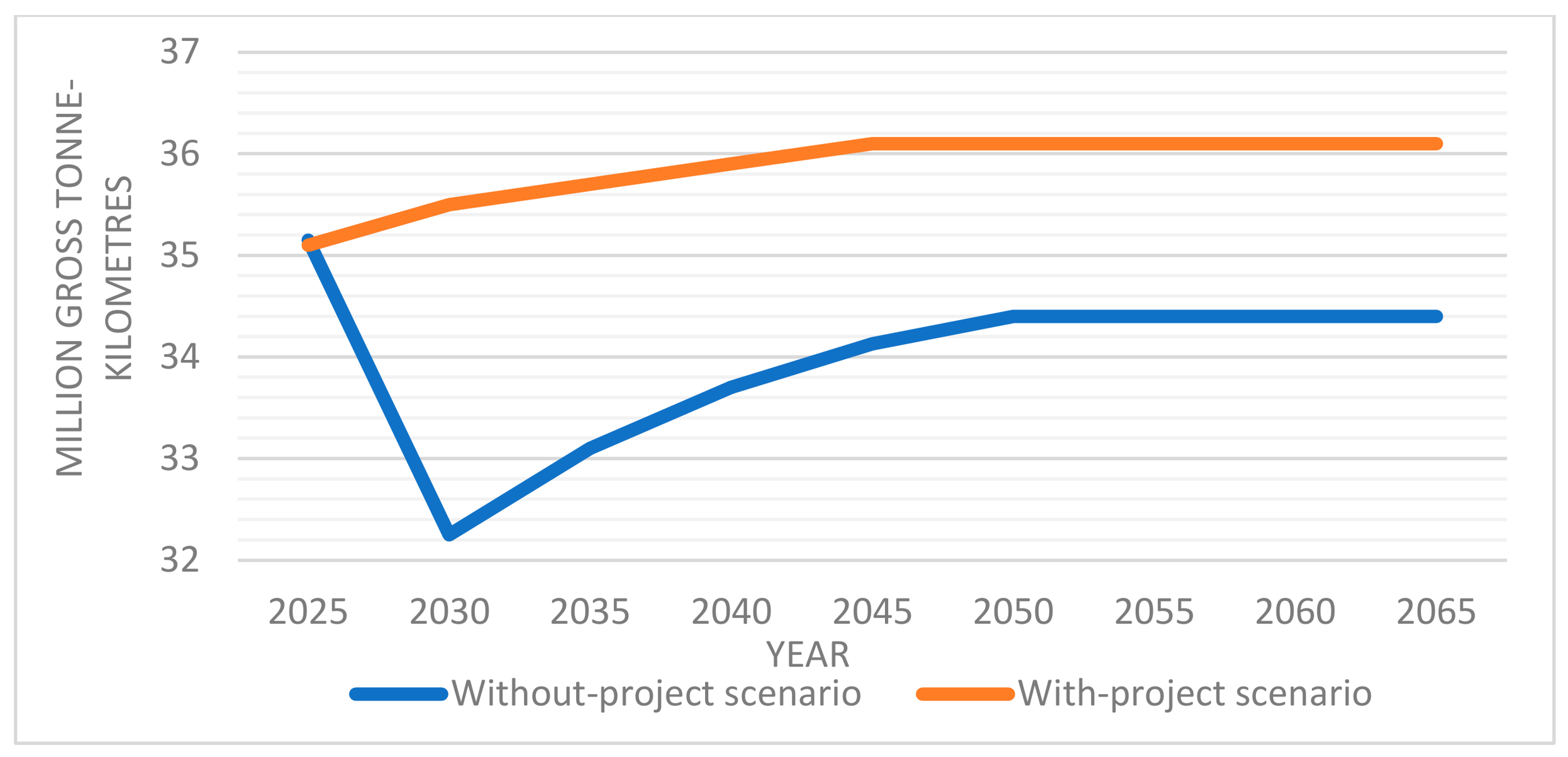
Figure 5 shows the incremental gross tonne-kilometres of freight transport, which range between approximately 1.6 and 3.2 million gross tonne-kilometres per year over the reference period. A similar trend is observed for freight train-kilometres, as illustrated in
Figure 6.
Figure 6 shows the development of incremental freight train-kilometres, which reach approximately 2700 to 5300 train-km per year. This indicator is primarily used in the calculation of operating costs and externalities associated with freight transport.
For the economic analysis, additional inputs are also important, particularly the technical parameters of the infrastructure. With the project scenario, these parameters change mainly due to variations in the length of mainline and station tracks, the number of electronically operated switches, the number of level crossings, and areas designated for passengers. An overview of these inputs is provided in
Table 10.
5.3. Financial Analysis
The financial analysis represents a fundamental step in project appraisal from the investor’s perspective and focuses on identifying and quantifying all financial flows associated with the implementation and operation of the project. Within this analysis, particular attention is paid to capital expenditures, operating costs, and potential financial benefits, with emphasis on their distribution over the entire evaluation period.
A key input to the financial analysis is capital expenditure, which constitutes the most significant cost component of the project and has a decisive impact on its overall economic efficiency.
5.3.1. Capital Expenditure
The level of capital expenditure was determined based on internal materials of ŽSR and recalculated to the 2025 price level. A detailed breakdown of capital expenditure for both variants is presented in
Table 11.
Total capital expenditure excluding VAT and including contingency thus amounts to €686.9 million for the EIA variant and €648.8 million for the alternative design. These values represent financial costs and therefore differ from the economic investment costs used in the subsequent economic analysis, which are adjusted for VAT and conversion factors. From an investment perspective, both variants represent highly capital-intensive infrastructure projects, with construction works forming the dominant share of total costs. The largest cost items include the railway substructure and superstructure, signalling systems, and—in the case of the EIA variant—also noise barriers.
5.3.2. Residual Value
The residual value of the project is influenced by the service life of individual infrastructure components and the length of the reference period. The results are presented in
Table 12.
Both variants apply the maximum reference period of 40 years. During this period, expenditure on the renewal of infrastructure components reaches approximately €262 million for the EIA variant and €248 million for the alternative design.
5.3.3. Operating Expenditure
Operating expenditure was calculated on an incremental basis, as the difference between the “without project” and “with project” scenarios. The results indicate that both variants lead to significant savings in operating costs compared to the “without project” scenario implementation. A summary of the results is provided in
Table 13.
Negative values indicate savings compared to the “without project” scenario. The total savings in operating expenditure therefore exceed €320 million in both cases.
5.3.4. Operating Revenues
Operating revenues are mainly generated from charges for the use of railway infrastructure. Their level is relatively low in both variants, with the higher value in the alternative design related to the use of heavier electric traction vehicles. The results are presented in
Table 14.
5.3.5. Summary Results of the Financial Analysis
The financial results of the project are summarized in
Table 15.
The financial analysis thus confirms that neither variant is financially viable without external support; however, both variants meet the conditions for financing from EU funds.
5.4. Economic Analysis and Structure of Benefits
5.4.1. Passenger Time Savings
The most significant socio-economic benefit of both variants is passenger time savings. Its total value amounts to €42.27 million, with the largest share attributable to existing rail passengers.
More detailed results show that time savings for existing passengers on regional trains (Os) reach approximately €63.84 million, for existing passengers on fast trains (R) approximately €42.63 million, and for diverted passengers approximately €1.77 million. These values confirm that the dominant benefit of the project lies in faster travel for existing rail users rather than in a substantial modal shift from road transport.
5.4.2. Savings in Train Operating Costs
Savings in train operating costs are presented in
Table 16.
The EIA variant achieves higher savings in railway vehicle operating costs than the alternative design, which is related to differences in the cost structure of diesel and electric traction and to different train compositions.
5.4.3. Savings in Road Vehicle Fuel/Energy Consumption
Fuel and energy savings were evaluated in two components: base consumption and additional consumption at acceleration, intersections, and roundabouts. The base component is summarized in
Table 17.
The additional consumption component is summarized in
Table 18.
The total savings in road vehicle fuel and energy consumption thus amount to approximately €3.46 million.
5.4.4. Savings in Other Road Vehicle Operating Costs
Other operating costs were calculated separately for time-based and distance-based components. The results are presented in
Table 19.
Total savings in other operating costs of road vehicles amount to approximately €8.8 million, with the time component representing the dominant share. The highest savings are observed for electric passenger cars and heavy goods vehicles.
5.4.5. Safety
Savings in accident costs are presented in
Table 20.
The results confirm the safety benefits resulting from the shift in part of transport from road to rail.
5.4.6. Environmental Benefits
A summary of the environmental benefits of the project for each variant, including detailed calculations and their aggregation within the economic analysis, is presented in
Table 21.
Table 21 shows that the key difference between the evaluated variants lies primarily in rail-related externalities. This difference is primarily driven by the replacement of diesel traction with electric traction, which significantly reduces direct emissions of air pollutants and greenhouse gases. While diesel trains produce emissions directly at the point of operation, electric traction shifts emissions to the electricity generation sector, where lower emission factors apply due to the structure of the national energy mix. As a result, the electrified variant achieves substantially lower emission levels, which translates into significantly higher monetized environmental benefits within the economic analysis.
Table 22 provides a comprehensive overview of the main economic benefits by category, allowing direct comparison between the EIA-based variant and the proposed solution.
Time savings represent the dominant benefit in both variants, reaching approximately €42 million. Environmental benefits differ significantly, with the proposed solution achieving approximately +€56 million in pollution reduction benefits. Economic efficiency remains negative in both cases, with ENPVs of approximately −€186 million (EIA variant) and −€71 million (proposed variant). The results clearly indicate that the key limiting factor is the level of investment costs (CAPEX).
6. Discussion
The economic analysis shows that both assessed variants generate relevant socio-economic benefits; however, their magnitude is insufficient to achieve overall economic efficiency under the current level of investment costs. The decisive factor is the imbalance between high capital expenditures and the level of monetized benefits, which is reflected in negative values of the economic net present value (ENPV), specifically −€186 million for the EIA variant and −€71 million for the alternative design.
The most significant common benefit of both variants is passenger time savings, amounting to approximately €42.27 million. This component represents the dominant share of the project’s economic benefits and confirms that the modernization of the line would have a substantial positive impact on the quality of transport services in the region. At the same time, the importance of time savings highlights existing infrastructure deficiencies, particularly low line speeds and operational constraints at stations. However, this benefit is not sufficient to offset the project’s investment cost, which reach €543 million for the EIA variant and €512 million for the alternative design (in economic terms).
The main differences between the variants are observed in environmental benefits. The alternative design achieves substantially higher savings in terms of air pollution and greenhouse gas emissions, specifically €56.29 million compared to €1.20 million for air pollutants, and €42.16 million compared to €2.97 million for greenhouse gases. This difference is primarily driven by the electrification of the line, which eliminates a significant share of emissions from diesel traction. Electrification thus emerges as a key factor in the environmental performance of the project and the main reason for the better results of the alternative design.
The accuracy of the estimated environmental benefits is closely linked to the availability and quality of input data, particularly emission factors and traffic-related parameters. In this context, recent research highlights the role of open government data in improving the monitoring and evaluation of environmental impacts, enabling more precise estimation of pollutant and greenhouse gas reductions. Greater accessibility of public data can support more detailed and dynamic modelling of environmental externalities, reducing reliance on aggregated unit values typically used in standard CBA methodologies. This suggests that the effectiveness and credibility of “green” railway projects can be further enhanced when supported by transparent and accessible data frameworks, allowing for more accurate tracking of long-term environmental outcomes [
47].
Beyond the technical and economic evaluation, the results can also be interpreted in a broader strategic context. The modernization of railway infrastructure represents not only a response to technical deficiencies but also a reaction to strong competitive pressure from individual car transport, which currently dominates the corridor. From this perspective, infrastructure modernization can be understood as a form of digital and technological upgrading that supports the long-term competitiveness of rail transport [
13]. The implementation of modern signalling and control systems contributes to higher operational efficiency, improved reliability, and enhanced service quality, which are key factors in attracting passengers from competing transport modes. Therefore, even investment-intensive technological elements should not be viewed solely as costs, but also as strategic enablers of competitiveness and sustainability in regional rail transport systems.
From a broader perspective, the choice between diesel and electric traction can also be interpreted in the context of the ongoing transition towards more sustainable and low-carbon transport systems. While electrification involves higher initial investment costs, it significantly reduces environmental externalities and aligns with long-term decarbonization objectives. In this sense, the evaluated trade-off reflects not only an economic decision but also a strategic response to increasing regulatory and societal pressure for sustainable transport solutions. Recent research highlights that sustainability-oriented decisions in infrastructure and technology adoption are increasingly influenced by broader considerations related to environmental responsibility and long-term system performance.
Therefore, the environmental benefits associated with electrification should not be viewed solely as monetized effects within the CBA framework, but also as part of a wider transition towards more sustainable and resilient transport systems [
48].
In contrast, benefits related to noise and safety are less significant compared to other components. Savings in accident costs amount to approximately €2.92 million, while noise-related savings reach only about €50 thousand. Although these benefits confirm the positive impact of the project on safety and environmental quality, they play a complementary role in the overall economic assessment.
Similarly, savings in operating costs represent a relevant but not dominant benefit. Total savings in vehicle operating costs amount to approximately €11.88 million for the EIA variant and €10.28 million for the alternative design, including savings for both rail and road vehicles as well as fuel and energy consumption. These benefits result from reduced travel times, shorter travel distances, and the modal shift in part of transport from road to rail infrastructure. A comprehensive comparison of the economic flows of both variants is presented in
Table 23.
The achieved values of the economic efficiency indicators are also consistent with the results of similar projects involving the modernization of regional railway lines, where low economic returns are often observed alongside high capital intensity. This phenomenon is particularly typical for lines with predominantly regional importance and lower traffic volumes.
The comparison of variants further shows that the EIA-based solution can be considered over-dimensioned in terms of investment. Despite including comprehensive infrastructure modernization, its economic efficiency is significantly lower. In contrast, the alternative design demonstrates that reducing certain construction elements and technological components can lead to a substantial improvement in results without significantly weakening the functional benefits of the project. This variant achieves more favourable values across all key indicators, specifically an ERR of 3.55% compared to 1.23% and a B/C ratio of 0.73 compared to 0.35, indicating a higher potential for further optimization. Important insights are also provided by the sensitivity analysis, the results of which are presented in
Table 24.
The sensitivity analysis confirms that capital expenditure is the key factor influencing the results of the economic analysis. A 1% change in investment costs leads to a change in ENPV of up to 7.45% in the case of the alternative design, indicating a high sensitivity of the project to the cost side. In contrast, changes in diverted traffic have only a minimal impact, suggesting that transport demand is not the limiting factor of the project. While the sensitivity analysis is based on marginal changes in selected variables, the results consistently indicate that the overall economic performance of the project is structurally driven by capital intensity. Even under broader variations in key parameters—such as demand development, operating costs, or environmental valuation factors—the relative importance of investment costs would remain dominant due to their substantial share in total project costs.
This implies that the main conclusion of the analysis is robust: the economic viability of the project is primarily constrained by high investment costs rather than uncertainty in demand or external parameters. Therefore, achieving economic efficiency would require substantial cost optimization rather than marginal improvements in other variables. Although the sensitivity analysis focuses primarily on investment costs and traffic volumes, it can be reasonably expected that variations in other input parameters—such as operating costs or environmental valuation factors—would have a comparatively lower impact on the overall results. This is due to the dominant share of capital expenditure in the total cost structure of the project. Therefore, even under alternative assumptions regarding demand development, operating costs, or environmental parameters, the overall conclusion regarding the limited economic efficiency of the project would remain unchanged unless there is a substantial reduction in investment costs.
Achieving economic efficiency would therefore require a substantial reduction in investment costs. For the EIA variant, this would mean a reduction of approximately 33.41%, while for the alternative design, a reduction of 13.42% would be sufficient. This difference confirms that the alternative design is significantly closer to the threshold of economic viability.
The results of the analysis are to some extent influenced by the input assumptions used in the transport model, particularly the structure of diverted traffic and estimates of future demand development. A key source of uncertainty in the analysis is the assumed structure of diverted traffic, particularly the 10:90 split between bus and individual car transport. While this assumption is based on the observed dominance of private car transport in the corridor, the exact behavioural response of users to improved rail services cannot be determined with certainty. The results of the analysis are to some extent influenced by the input assumptions used in the transport model, particularly the structure of diverted traffic and estimates of future demand development. A key source of uncertainty in the analysis is the assumed structure of diverted traffic, particularly the 10:90 split between bus and individual car transport. While this assumption is based on the observed dominance of private car transport in the corridor, the exact behavioural response of users to improved rail services cannot be determined with certainty. Passenger demand growth is assumed to occur primarily within regional rail services, reflecting the scope of the project and the structure of the transport model. Long-distance demand effects are not explicitly considered, as the analyzed corridor serves predominantly regional transport functions.
Future research should therefore consider scenario-based analysis with alternative modal split assumptions to better capture this uncertainty. Similarly, broader socio-economic effects—such as the impact of the project on regional development or changes in spatial mobility patterns—are not fully captured in the analysis. The results clearly indicate that the limiting factor is not transport demand but excessive capital intensity of the project design. In this context, it is important to consider that transport infrastructure projects may generate broader economic impacts that are not fully captured by standard CBA indicators such as ENPV. Improved connectivity can facilitate the movement of labour, goods, and information, thereby influencing the dynamics of regional economic activity.
Recent research suggests that increased accessibility to infrastructure and data can affect firm dynamics by supporting entrepreneurship, innovation, and business development, particularly in regional centres. In the case of the Prievidza–Jelšovce corridor, improved transport conditions may enhance the attractiveness of key settlements such as Prievidza and Topoľčany, potentially stimulating local economic activity and supporting the development of new business opportunities. These wider effects are not explicitly quantified in the present analysis but represent an important dimension of the project’s overall socio-economic impact, particularly in the context of regional development and long-term economic sustainability [
49].
Despite not achieving economic efficiency, the project should also be assessed from the perspective of its broader strategic benefits. The modernization of the line contributes to improving the quality of transport services, supporting sustainable mobility, and reducing dependence on individual car transport. In the long term, the project may have a significant impact on regional development and on strengthening the role of rail transport within a multimodal transport system.
Based on the above results, it can be concluded that the Prievidza–Jelšovce line optimization project delivers substantial transport, safety, and environmental benefits; however, its implementation is constrained by high capital intensity. The alternative design represents a more suitable basis for further project preparation, as it combines lower investment costs with higher environmental benefits. For these reasons, it appears justified to continue project preparation, with further optimization of investment costs as a key condition for its implementation.
The results indicate that the limiting factor of the project is not insufficient transport demand, but rather excessive capital intensity caused by an over-dimensioned technical design of the infrastructure. From a practical perspective, addressing the issue of high capital intensity requires not only technical optimization but also improvements in project governance and cost control mechanisms. Recent research emphasizes the role of digitalization and data-driven decision-making in enhancing the efficiency of large infrastructure projects. The application of digital governance tools—such as advanced project monitoring systems, data integration platforms, and real-time cost tracking—can contribute to better control of investment expenditures, particularly in cost-intensive components such as substructure and superstructure works. In this context, stronger digital commitment and the use of transparent data frameworks may support more efficient planning, procurement, and implementation processes.
These approaches can help mitigate the risks associated with cost overruns and contribute to achieving the level of investment reduction required for improving the economic viability of the project.
7. Conclusions
The cost–benefit analysis confirms that the modernization of the railway line generates significant socio-economic benefits, particularly in terms of passenger time savings, reduced transport operating costs, and the mitigation of negative externalities. The main benefit of both variants is passenger time savings, amounting to approximately €42 million, which represents the dominant component of the project’s total socio-economic benefits.
The comparison of variants shows that the alternative design achieves substantially more favourable results than the variant based on the EIA process. This difference is driven by a combination of lower capital intensity and significantly higher environmental benefits. The electrification of the line has proven to be a key factor, as it generates savings in environmental pollution costs of approximately €56 million and reductions in greenhouse gas emissions of approximately €42 million, representing a substantial improvement compared to the EIA variant.
Despite these positive effects, neither variant achieves economic efficiency. The economic net present value remains negative (−€186 million for the EIA variant and −€71 million for the alternative design), while the economic rate of return (1.23% and 3.55%) and the benefit–cost ratio (0.35 and 0.73) also fail to reach the required threshold values. The results clearly indicate that the main limiting factor of the project is not insufficient demand, but rather its high capital intensity.
This conclusion is further confirmed by the sensitivity analysis, which identified capital expenditure as the key (critical) variable. A 1% change in investment costs leads to a change in ENPV of up to ±2.99% for the EIA variant and ±7.45% for the alternative design, whereas a change in diverted traffic has only a negligible impact (up to ±0.06%). This implies that the potential for improving the project’s economic efficiency lies primarily in further optimization of investment costs. To achieve a zero ENPV, investment costs would need to be reduced by approximately 33.41% for the EIA variant and 13.42% for the alternative design.
The interpretation of the results is subject to several limitations. A significant constraint is the use of a transport model that assumes relatively low demand growth and does not specify the exact sources of diverted traffic, which may lead to an underestimation of benefits. Another limitation is the use of aggregated input data and unit values based on CBA methodology, which may not fully reflect local specificities. Environmental benefits are based on average emission factors and assumptions about the energy mix, which may affect their future accuracy. The analysis also does not capture broader systemic effects, such as impacts on regional development, labour mobility, or network synergies, and does not include a detailed optimization of the technical solution at the level of individual stations.
In particular, the environmental performance of electric traction depends on the carbon intensity of electricity production, which may change over time. A cleaner energy mix, with a higher share of low-emission sources such as nuclear and renewable energy, would increase the environmental benefits of electrification, while a higher share of fossil-based electricity generation would reduce them. Therefore, the reported environmental effects should be interpreted as indicative values reflecting current average conditions rather than fixed outcomes.
Based on these findings, the main direction for further research can be identified as the need for deeper optimization of the investment solution, particularly regarding the scope of infrastructure elements and technological systems. It is also important to refine the transport model, including a more detailed identification of the sources of diverted traffic and potential demand growth. Future work should also incorporate broader socio-economic effects and extend the environmental analysis to include scenarios of energy mix development and transport decarbonization. Overall, the results suggest that a combination of rationalized investment costs and the preservation of environmental benefits—particularly through electrification—can improve the economic performance of regional rail projects. However, this conclusion is based on a single case study and a specific set of assumptions and should therefore be interpreted with caution when applied to other corridors with different demand levels, cost structures, or energy conditions. Future research could extend the sensitivity analysis by incorporating scenario-based variations in key parameters, including demand development, operating costs, and environmental valuation factors, to further assess the robustness of the results.
The findings highlight the need for cost-optimized modernization strategies in regional rail projects, where the balance between investment costs and environmental benefits plays a crucial role in achieving economic efficiency and supporting sustainable transport development.