Article

Evaluating Radon Adsorption Characteristics of Adsorbents by Parallel Exposures at Different Temperatures


by
Dobromir Pressyanov
*,
Momchil Momchilov
and
Peter A. Georgiev
Faculty of Physics, Sofia University “St. Kliment Ohridski”, 5 James Bourchier Blvd., 1164 Sofia, Bulgaria
*
Author to whom correspondence should be addressed.
Appl. Sci. 2026, 16(9), 4183; https://doi.org/10.3390/app16094183
Submission received: 2 April 2026 / Revised: 16 April 2026 / Accepted: 23 April 2026 / Published: 24 April 2026
(This article belongs to the Section Energy Science and Technology)

Featured Application

This work has broad prospects for applications in the use of adsorbents for radioactive noble gases in environmental and nuclear science.

Abstract

Reliable determination of radon adsorption properties in candidate adsorbents is essential for developing highly sensitive methods capable of measuring low 222Rn activity concentrations in air. Such measurements are increasingly important in environmental monitoring, climate research, and low-background experiments. Conventional approaches for determining the adsorption coefficient and heat of adsorption are labor- and time-intensive, limiting their suitability for comparative studies under identical conditions. Here, a recently proposed method is applied for the first time in a systematic comparative study. The approach couples solid-state nuclear track detectors (SSNTDs) with adsorbents that simultaneously act as radon collectors and alpha emitters, enabling fully parallel exposure and signal acquisition across multiple samples. Eight adsorbents—three activated carbon fabrics, two bulk activated carbons, and three synthetic zeolites—were evaluated simultaneously over a temperature range of 0–46.5 °C. Activated carbon fabrics exhibited the highest adsorption coefficients, with ACC-5092-10 reaching 11.8 ± 1.3 m3/kg at 20 °C. The heats of adsorption ranged from 24.8 ± 3.9 to 33.3 ± 5.0 kJ/mol, consistent with the literature values. For synthetic zeolites, the adsorption coefficient increased linearly with the Si:Al ratio. The influence of water content was further investigated for the five best-performing materials. The most hydrophobic material, zeolite SA-25 (Si:Al = 25), showed only a 25% reduction in adsorption coefficient under saturated humidity, whereas activated carbons exhibited strong suppression. These results demonstrate the practicality, sensitivity, and efficiency of the SSNTD–adsorbent method for comparative radon adsorption studies.

1. Introduction

Radon-222, a radioactive isotope of the noble gas radon, is produced by the decay of 226Ra which naturally occurs in soil, rocks, and minerals. It readily migrates through pores and fractures, or dissolves in water, and subsequently emanates into the air. Radon-222 decays into a series of short-lived progeny—218Po, 214Pb, 214Bi and 214Po (the latter always being in equilibrium with its parent 214Bi). When inhaled, radon-222 and its progeny are carcinogenic, with the dose to the lungs arising almost entirely from the progeny [1].
Indoor radon exposure has received considerable public attention over recent decades [2] and has been classified by the World Health Organization as the second leading cause of lung cancer after smoking [3]. In response, the European Union has established a reference level for the annual average activity concentration of 222Rn in dwellings and workplaces, that should not exceed 300 Bq/m3 [4]. Because the spatial distribution of radon in the environment is highly heterogeneous [5], the corresponding European directive [4] requires the identification of “radon priority areas” (RPAs), where indoor radon concentrations exceed the reference level in a significant proportion of buildings.
New priorities have recently emerged in radon research. Measurements of 222Rn in outdoor air, where activity concentrations are typically much lower than indoors, can support the delineation of RPAs [6], enable monitoring of atmospheric transport processes [7,8], and reveal variations in atmospheric radon associated with human activity or geological and seismic phenomena [9]. In fundamental nuclear research, it is also essential to measure and control very low, or even ultra-low, 222Rn levels in deep underground low-background laboratories [10,11]. Interest in detecting very low radon concentrations (1–10 Bq/m3 or even below 1 Bq/m3, if possible), as well as in the development and metrology of suitable methods and instrumentation, has further increased following studies linking atmospheric radon to greenhouse gas concentrations [12,13,14,15,16]. These findings highlight the importance of highly sensitive radon measurements for understanding global climate change and developing effective mitigation strategies. Achieving such sensitivity, however, remains a considerable technical challenge.
One approach to addressing this challenge is the use of highly efficient radon adsorbents configured to serve as radiators for radiation detectors [17,18,19]. The use of activated charcoal for radon sampling and detection dates back more than a century, beginning with the pioneering work of Sir Ernest Rutherford [20]. However, its practical application has long been limited by the degradation of adsorption performance due to atmospheric moisture [21] and by the strong temperature dependence of the adsorption coefficient [22,23,24]. Consequently, activated carbon materials have typically been restricted to short-term sampling (2–7 days) [25], often requiring temperature corrections [22].
In recent years, interest in discovering or synthesizing new highly efficient radon adsorbents has increased dramatically [26,27,28]. Materials capable of maintaining high radon adsorption capacity even when saturated with water have been identified [29]. In addition, a method for compensating the temperature dependence of adsorbents has been patented [30] and subsequently investigated [31]. These developments have enabled detection sensitivities—achieved by coupling such adsorbents with radiation detectors—that exceed those of conventional radon detectors and monitors by one to two orders of magnitude [32,33]. Another application of adsorbents is radon removal and mitigation [26]. For such uses, efficient and cost-effective radon adsorbents may be required in large quantities. In the coming years, extensive studies comparing the adsorption characteristics of many promising adsorbents can be anticipated.
The key characteristics of radon adsorbents intended for practical applications include the adsorption coefficient, the heat of adsorption, and the reduction in adsorption capacity caused by water retained in the material. The adsorption coefficient K is defined as the ratio of the radon-specific activity in the adsorbent to the radon activity concentration (i.e., radon activity per unit volume) in air, and is expressed as [22,24]:
K T = κ × e x p Q R T ,
where T is the absolute temperature, R = 8.314 J/(mol.K) is the universal gas constant, and κ is a constant. The heat of adsorption Q determines the temperature dependence of the adsorption coefficient. The heat of adsorption is essential both for applying temperature corrections to radon measurements performed with adsorbents [22] and for designing systems that compensate for this temperature dependence [30,31,34].
Given the current need to identify radon adsorption materials that are most efficient for use, it is highly relevant to compare their adsorption properties under identical exposure conditions, preferably using a single measurement method. However, existing methods for determining adsorption coefficients are complex and both labor- and time-intensive [24,27,28]. These methods usually employ complex, specially constructed flow-through systems [24,27]. Within a single exposure, only one adsorbent can be loaded [24,27,28]. This is a major drawback when different adsorbents must be studied and ranked. For this purpose, multiple exposures are required, making the reproducibility of exposure conditions and sampling a particular concern.
In recent years, potential progress has emerged. Its central concept is to couple solid-state nuclear track detectors (SSNTDs) with an adsorbent that simultaneously acts as an adsorber and a radiator [33]. The SSNTD can detect alpha particles emitted from the adsorbent. This configuration allows for the simultaneous exposure of many adsorbents, obviously under identical environmental conditions, enabling the determination of their adsorption coefficients and adsorption heat in parallel.
In the present work, this method was applied for the first time to simultaneously determine the adsorption properties of eight adsorbents, over a temperature range of 0–46.5 °C. Additionally, the reduction in adsorption coefficient due to humidity was examined for five adsorbents that exhibited the highest adsorption coefficients. The materials studied included three activated carbon fabrics, two bulk activated carbons, and three ZSM-5 zeolites with different Si:Al ratios. The activated carbon fabrics were selected for their promising adsorption properties, which for some of them are retained even when saturated with water [29,32], as well as for their ease of integration with various detectors [32,33]. The bulk activated carbons used were chosen for their availability and low cost, making them suitable for radon/thoron removal and mitigation applications where large quantities of material may be required. The novel zeolites are worth studying [27].
The aims of this study are twofold: (1) to evaluate the method based on adsorbents coupled with SSNTD under practical conditions, and (2) to investigate the radon adsorption properties of adsorbents differing in type and origin using a single, unified approach with fully parallel exposure and signal acquisition during exposure. This opens the door to many potential applications, ranging from the selection of suitable adsorbents for next-generation radon detectors operable under a wide range of environmental conditions to the identification of cost-effective materials for radon/thoron removal and mitigation.

2. Materials and Methods

The method combines adsorbents with SSNTDs, which are sensitive to alpha radiation. As an inert gas, radon diffuses into the porous matrix of the adsorbent and may become trapped in nanometer-scale micropores. Radon-222 decays by emitting an alpha particle with an energy of 5.5 MeV. After radioactive decay, it produces short-lived progeny atoms that remain immobilized at the site of origin. Two of these progeny isotopes are also alpha emitters: 218Po, which emits alpha particles with an energy of 6.0 MeV, and 214Po, which emits alpha particles with an energy of 7.69 MeV. Alpha particles emitted from depths below the adsorbent surface that are less than their range in the material may escape and reach the detector. In this way, the adsorbent acts both as a radon collector and radiator of alpha particles.
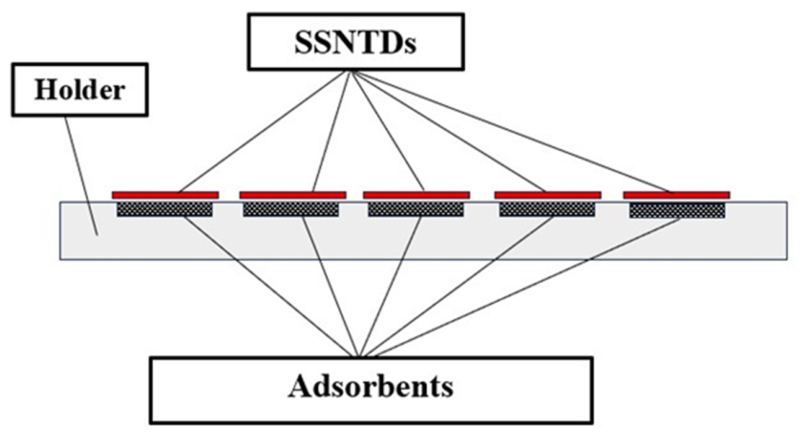
Alpha particles that strike the detector’s surface within the specific energy and angular window of a given SSNTD type produce latent tracks that can later be etched and easily counted [33]. During exposure, the sensitive surface of the SSNTD is positioned close to the adsorbent (<1 mm; Figure 1), allowing emitted alpha particles to be subsequently detected. The methodology is described in detail elsewhere [33].
After etching, the tracks are counted and the net track density (number of tracks per unit area, after the background is subtracted) is determined. Throughout the exposure, the 222Rn activity concentration in air is monitored using a reference radon monitor, allowing for the determination of the reference radon exposure (activity concentration integrated over the exposure time). The calibration factor is then calculated as
CF = net   track   density reference   Rn 222   exposure .
As shown previously [33], the adsorption coefficient is directly proportional to CF:
K = η . C F
The coefficient η depends on the energy–angular window of the SSNTDs and the chemical composition of the adsorbent, and it can be determined as described in [33].
The adsorption coefficients of the various adsorbents were experimentally measured by coupling the adsorbents with SSNTDs (Kodak Pathé LR-115, type II (Dosirad, Gif-sur-Yvette, France)), as illustrated in Figure 1.
Experiments were conducted with eight different adsorbents; however, the current setup allows many more materials to be tested in parallel. The adsorbents used in this study include:
Activated carbon fabrics (produced by Kynol Europe GmbH, Hamburg, Germany):
  • ACC-5092-10;
  • ACC-5092-20;
  • Kynol-507-10.
Synthetic zeolites (SA-x, where the number indicates the Si:Al atomic concentration ratio):
  • SA-12;
  • SA-15;
  • SA-25.
Bulk activated carbons:
  • AC-P (pharmaceutical grade);
  • AC-T (technical grade).
Thus, the set consisted of three activated carbon fabrics, two bulk activated carbons of low price and different origin, and three protonated forms of synthetic zeolite ZMS-5 with different Si-to-Al ratio, approximately 25, 15 and 12, and with typical Brunauer–Emmett–Teller (BET) surface areas around 400 m2/g, and micropore sizes of 5.3 and 5.6 Å. These were earlier obtained by heat treatment of the corresponding ammonia forms at 550 °C, as described in [35]. The chemical composition of the activated carbon fabrics and synthetic zeolites is summarized in Table 1. For the bulk activated carbon, 100% carbon content was assumed. Regarding the Kynol-507-10 material, the manufacturer informed us that it is no longer in production; however, its composition is comparable to that of ACC-5092-10.
All exposure procedures were performed in a 50 L exposure chamber using the experimental facility described elsewhere [37]. During irradiation, the 222Rn activity concentration (maintained at approximately 300 kBq/m3 in all exposures) was monitored using a reference Alpha Guard PQ 2000 Pro Rn Tn monitor (Bertin GmbH, Frankfurt am Main, Germany). The temperature inside the exposure chamber was maintained within ±0.5 °C throughout the exposure. Relatively short exposure times (~1 h) were used to avoid significant changes in the adsorbent’s moisture content, which was monitored using a gravimetric method. In all experiments, except those involving water-saturated adsorbents, the specimens were fully dehydrated.
Prior to the radon gas dosing all sample materials were evacuated in a vacuum oven at 120 °C, for 2 h, under dynamic vacuum at about 10−2 mbar. The dehydrated samples were quickly transferred into a desiccator filled with a fresh molecular sieve and consequently from the desiccator into the radon exposure chamber, capped with the SSNTD film(s). A fresh molecular sieve was also placed in the exposure chamber.
After exposure, the coupled adsorbents/SSNTDs were left for 24 h in an environment with low radon levels (~20 Bq/m3) to allow adsorbed radon to degas and radon progeny to decay. The SSNTDs were then etched in 10% NaOH at 60 °C for 100 min, followed by rinsing for 30 min in running water and 2 min in a 50% ethanol solution. After drying, the alpha particle tracks were counted by a careful visual inspection, under optical microscope, and the net track density was determined to calculate CF. The experimentally determined CFs were subsequently used to calculate the adsorption coefficient K according to Equation (3). The numerical values of η, obtained following the method described by [33], are as follows:
  • Activated carbon fabrics: η = 0.379 ± 0.029;
  • Bulk activated carbons: η = 0.381 ± 0.029;
  • Synthetic zeolites: η = 0.314 ± 0.024.
These values apply when K and CF are expressed in the commonly used units m3/kg and cm−2/(kBq·h·m−3), respectively.
For the humidity experiments, the adsorbents were saturated with water by exposing them in a laboratory chamber at 100% relative humidity. Their weight was periodically monitored, and the adsorbents were considered saturated once their weight stabilized and remained unchanged for more than 24 h. During radon exposure of the saturated adsorbents, the relative humidity in the exposure chamber was also maintained at 100%.

3. Results

3.1. Temperature Experiments

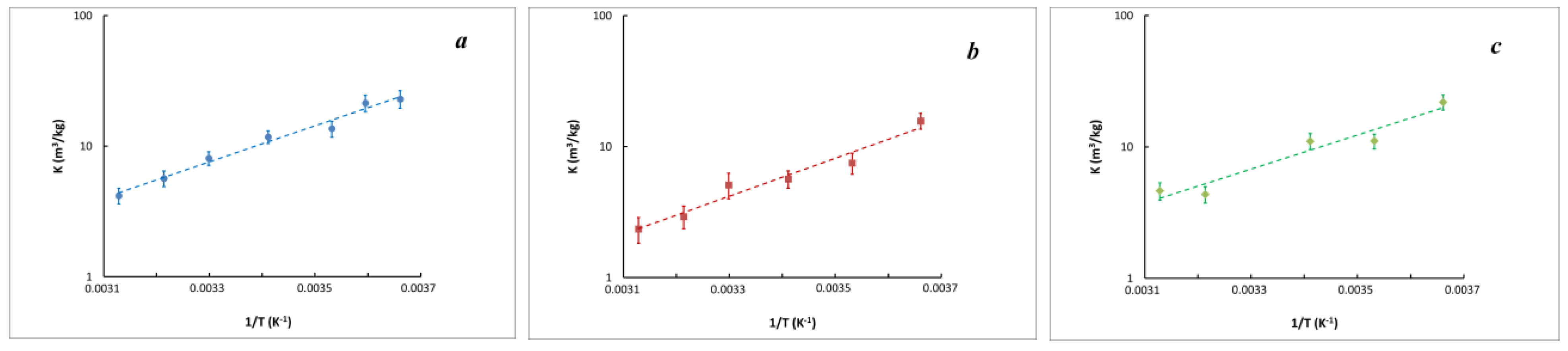
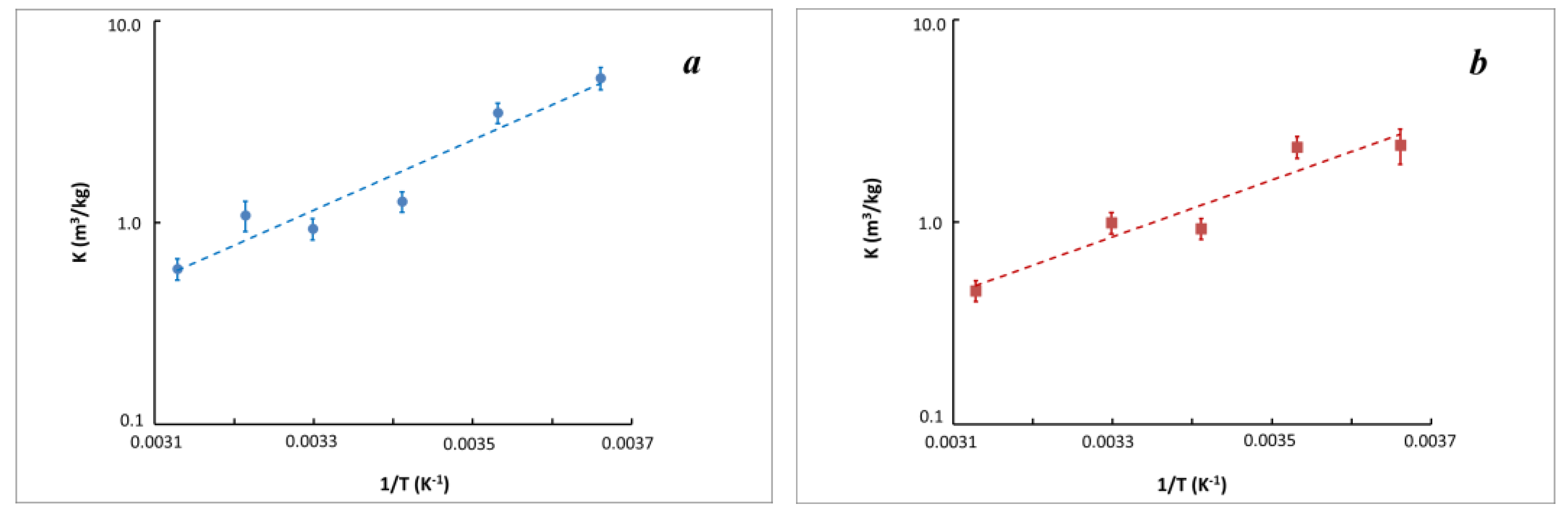
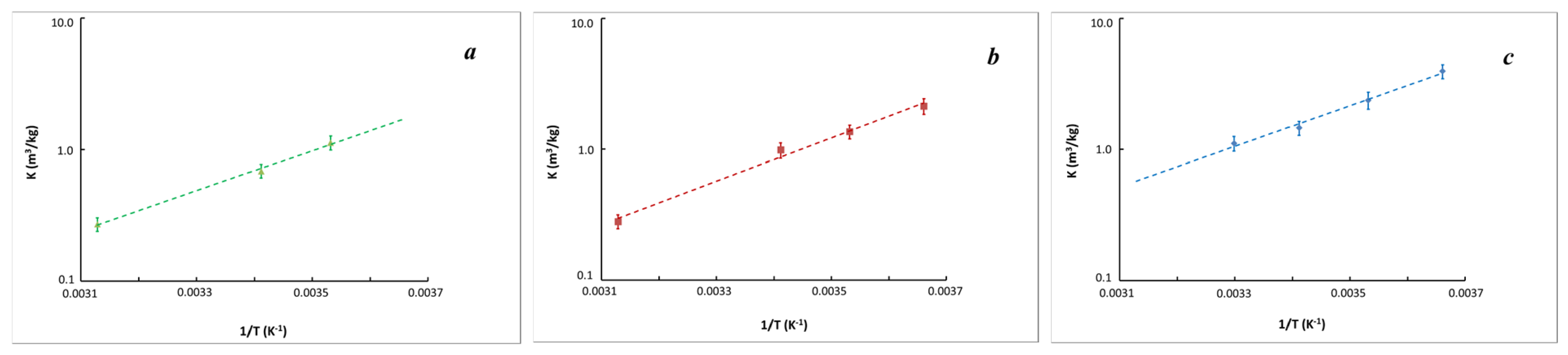
The adsorption coefficients of the studied adsorbents were investigated over a temperature range of 0–46.5 °C. Experiments were conducted at seven different temperature points within this interval; however, due to technical limitations, some adsorbents were tested at fewer points. The results are presented in Figure 2, Figure 3 and Figure 4.
On the semi-logarithmic scale used in Figure 2, Figure 3 and Figure 4, the exponential dependence in Equation (1) appears as a straight line and as seen, the experimental points fit well this model. The experimentally determined adsorption coefficients at 20 °C are listed in Table 2. As shown, the adsorption coefficients of the activated carbon fabrics are significantly higher than those of the other adsorbents studied.
It is interesting to compare the fabrics ACC-5092-10 and ACC-5092-20, whose adsorption coefficients differ by a factor of two. Radon adsorption is primarily governed by Van der Waals forces [38], and the match between the Van der Waals diameter of radon atoms (0.417 nm) and the pore size of the adsorbent plays a key role. Micropores in the range of 0.5–0.8 nm are particularly important for radon adsorption [39]. The average pore size of ACC-5092-10 is 0.67 nm, whereas that of ACC-5092-20 is 0.86 nm [36]. Thus, the pore size of ACC-5092-10 is better suited to this optimal range, which likely explains its higher adsorption coefficient.
In the literature, the adsorption coefficients of various activated carbons at room temperature are reported to range from 1 to 7 m3/kg [26,40]. In this context, the bulk activated carbons studied here fall near the lower end of this range, whereas two of the activated carbon fabrics (ACC-5092-10 and Kynol-507-10) exceed the upper end. Recently studied metal-loaded bamboo activated carbons exhibited K-values up to approximately 11 m3/kg [28], comparable to the performance of the ACC-5092-10 fabric.
Statistical data analysis of the dependences illustrated in Figure 2, Figure 3 and Figure 4 was performed using TableCurve 2D, version 5.0. The experimental data were fitted to Equation (1), and the heat of adsorption Q along with its uncertainty was determined. The results are presented in Table 3.
Within the experimental uncertainties, no statistically significant differences (at 95% confidence) were observed in the heat of adsorption for the materials studied. All values cluster within ±16% of the average value of 28.7 kJ/mol.
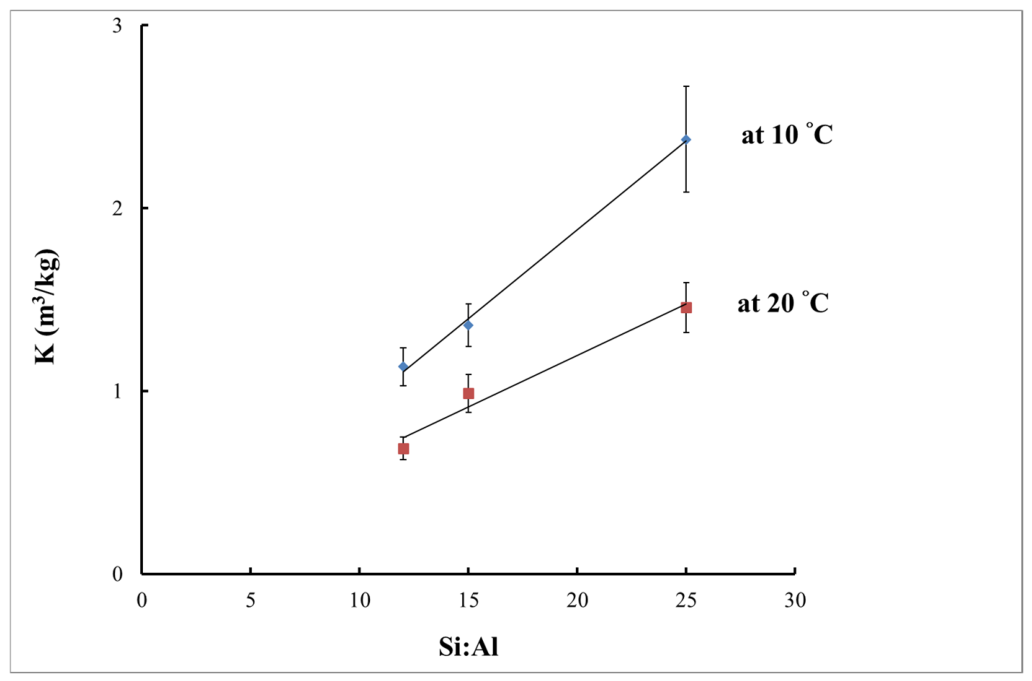
In synthetic zeolites, an interesting correlation was observed between the adsorption coefficient and the Si:Al ratio in their composition (Figure 5). A clear linear relationship between the adsorption coefficient and the Si:Al ratio is evident in Figure 5.

3.2. Humidity Experiments

The results of the humidity experiments are summarized in Table 4.
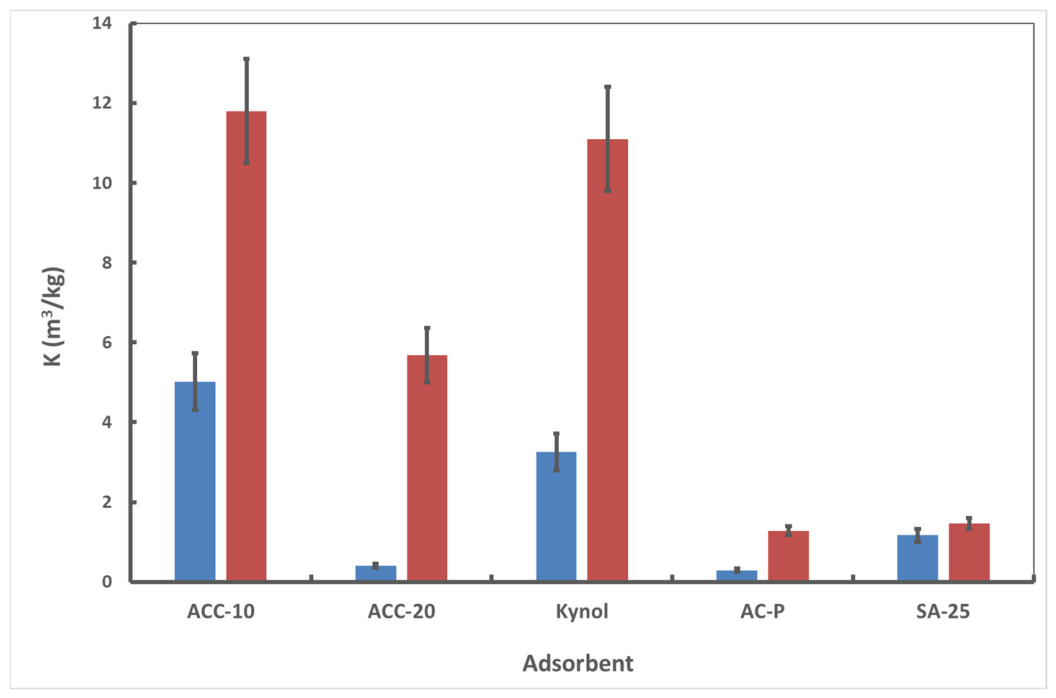
The synthetic zeolite SA-25 exhibits a much lower water uptake at saturation and its adsorption coefficient is less affected by humidity compared with the activated carbon materials studied (Figure 6). In the dehydrated state, it ranks fourth out of five materials, with an adsorption coefficient 8.1 times lower than that of ACC-5092-10. When saturated with water, it ranks third out of five (or second out of four, if Kynol is excluded due to discontinuation). Under these conditions, its adsorption coefficient is 4.3 times lower than that of water-saturated ACC-5092-10 and, more importantly, only 25% lower than that of dehydrated SA-25 (see Table 4).
The saturated water content of ACC-5092-10 and ACC-5092-20 is consistent with values reported in the literature [36]. Among the materials studied, the most hydrophobic was the synthetic zeolite SA-25, which belongs to a class of materials known for their hydrophobicity. When saturated, its water content is only 6.3%. The effect of moisture was further examined for the five most relevant adsorbents by comparing the adsorption coefficients of dehydrated and moisture-saturated samples. The most notable case is SA-25, where K decreases only by approximately 25% upon saturation. Among the other materials, ACC-5092-10 also shows potential for use under high-humidity conditions, maintaining a sufficiently high radon adsorption coefficient of 5.02 ± 0.48 m3/kg even when saturated with water.

4. Discussion and Conclusions

The method demonstrated in the present work allows the adsorption characteristics of multiple adsorbents to be studied in parallel under fully identical exposure conditions. In this way, any differences observed between materials can be attributed solely to their adsorption properties, without bias arising from variability in exposure conditions.
The radon adsorption coefficients of eight different adsorbents were investigated in parallel in this study. Measurements were performed over a temperature range of 0–46.5 °C, and the heat of adsorption was determined for each material.
Among the adsorbents studied, the highest adsorption coefficient was exhibited by the activated carbon fabric ACC-5092-10, with a value of 11.8 ± 1.3 m3/kg at 20 °C. With this adsorption coefficient, this material ranks among the best-performing activated carbon-based adsorbents [28]. Even when saturated with water, its adsorption coefficient of 5.02 ± 0.48 m3/kg remains sufficiently high.
All values of adsorption heat cluster within ±16% of the average value of 28.7 kJ/mol. Literature values for the heat of adsorption of activated carbons vary widely, ranging from 18.8 kJ/mol [23], 20.5 kJ/mol [24], and 25 kJ/mol [22] to approximately 30 kJ/mol [41]. The adsorption heats obtained in this work generally fall within this range.
A natural question is whether Equation (1) remains valid outside the temperature range examined in this study. Previous research [24] has shown that it remains applicable at least down to –48 °C. It therefore appears that temperature correction or compensation based on the experimentally determined Q-values and Equation (1) can be applied over the full range of temperatures encountered in typical human environments.
A clear linear increase in the adsorption coefficient of the synthetic zeolites with the Si:Al ratio in their composition was observed, and this increase was temperature-dependent. This relationship provides a clear direction for the future development of synthetic adsorbents with adsorption coefficients exceeding that of SA-25. Further research is planned to investigate whether this trend persists outside the range of Si:Al ratios studied here, with the aim of significantly enhancing the adsorption coefficient of these zeolites at ambient conditions.
The effect of humidity was examined for the five adsorbents that exhibited the highest adsorption coefficients. The adsorption coefficients of the bulk activated carbon materials and the fabric ACC-5092-20 decreased dramatically under saturated conditions. In contrast, fabrics ACC-5092-10 and Kynol-507-10, as well as the zeolite SA-25, maintained relatively high radon adsorption even when fully saturated with water. Of note is SA-25, whose adsorption coefficient decreases by only 25% upon water saturation. Future studies with zeolites of higher Si:Al ratios will assess whether this promising property is retained.
The availability of synthetic zeolites whose adsorption properties vary only weakly across the range of environmental humidity levels makes them particularly suitable for sensitive measurements under changing humidity conditions. For example, the adsorbent SA-25 can be applied as a thin film on the sensitive surface of a large-area alpha detector. When relative humidity varies over the 0–100% range, the resulting variation in the detector signal is limited to approximately 25%. As shown in [32], the minimum detectable activity concentration (MDAC) is inversely proportional to the adsorption coefficient. When, e.g., ACC-5092-10 is coupled with DVD, used as a large-area SSNTD with a 100 cm2 sensitive area, the MDAC becomes two orders of magnitude lower than that of currently used passive radon detectors based on SSNTDs. Since the adsorption coefficient of SA-25 is 8.1 times lower than that of ACC-5092-10, the MDAC of the DVD + SA-25 configuration remains roughly an order of magnitude better than that of current state-of-the-art passive detectors. When saturated with water, the sensitivity of ACC-5092-10 deteriorates by a factor of 2.35 (see Table 4), whereas that of SA-25 decreases by only 25%.
Our findings demonstrate significant and promising potential for applications aligned with current priorities in applied science, particularly in the development, optimization, and targeted engineering of advanced adsorbent materials through controlled modifications of their pore structures. Such modifications are essential for enhancing noble gas adsorption performance, especially in applications where high selectivity, large adsorption capacity, and long-term stability under realistic operational conditions are of critical importance. The ability to precisely fine-tune pore size distribution, tailor surface chemistry, and control structural heterogeneity provides valuable opportunities for improving adsorption efficiency, optimizing adsorption kinetics, and broadening the practical applicability of these materials across a range of scientific and industrial domains.
Substantial and ongoing research efforts have been devoted to experimental investigations of a diverse range of advanced adsorbent materials [27,42,43,44,45,46]. These include metal–organic framework (MOF)-derived metallic carbons [42], which combine exceptionally high surface areas with highly tunable and hierarchical porosity; various chemically and physically modified activated carbons [27,46], widely recognized for their versatility, scalability, and cost-effectiveness; and silver-exchanged zeolites [27], which exhibit strong and selective interactions with certain noble gases due to the presence of active metal sites and favorable electronic properties. In addition, a variety of other modifying agents, dopants, and composite materials [43,44,45] have been systematically explored with the aim of further enhancing adsorption characteristics, including improvements in selectivity, adsorption kinetics, thermal and chemical stability, and regeneration potential under repeated use conditions.
To enable a systematic, reliable, and scientifically meaningful evaluation of how different modifications influence adsorption coefficients, it is essential that all studied adsorbents be tested under strictly equivalent, well-defined, and carefully controlled exposure conditions. Only by ensuring such a high degree of experimental uniformity can robust and reproducible comparisons be made across different materials, synthesis routes, and modification strategies. Establishing standardized testing protocols is particularly important for identifying statistically significant differences in adsorption performance and for accurately correlating these differences with specific structural, morphological, or chemical modifications introduced in the adsorbents. Without such rigorous control, observed variations in experimental results may be confounded by inconsistencies in exposure conditions rather than reflecting true and intrinsic differences in material properties. In this respect, the method employed in the present work represents a clear advancement, as it enables multiple adsorbents of interest to be studied within a single exposure, thereby ensuring practically identical conditions and significantly reducing experimental uncertainty while improving data comparability.
In summary, the newly developed method for determining radon adsorption coefficients of multiple adsorbents in parallel has proven to be both effective and cost-efficient, while also offering improved reproducibility and throughput compared to conventional approaches. This methodology is expected to be highly valuable for future systematic studies of novel radon adsorbents, supporting not only the development of highly sensitive radon measurement techniques and their metrological validation, but also the identification, optimization, and practical implementation of cost-effective adsorbent materials for radon removal, mitigation, and environmental monitoring applications.

Author Contributions

Conceptualization, D.P.; methodology, D.P. and P.A.G.; software, D.P.; validation, D.P. and P.A.G.; formal analysis, D.P. and M.M.; investigation, M.M.; resources, D.P. and P.A.G.; data curation, D.P. and M.M.; writing—original draft preparation, D.P.; writing—review and editing, D.P. and P.A.G.; visualization, D.P. and M.M.; supervision, D.P.; project administration, D.P.; funding acquisition, D.P. All authors have read and agreed to the published version of the manuscript.

Funding

This work was supported by the Bulgarian National Science Fund under contract KP-06-N58/9 (22.11.2021).

Institutional Review Board Statement

Not applicable.

Informed Consent Statement

Not applicable.

Data Availability Statement

The data presented in this study are available on request from the corresponding author due to privacy.

Conflicts of Interest

The authors declare no conflicts of interest.

References

  1. International Agency for Research on Cancer (IARC). IARC Monographs on the Evaluation of Carcinogen Risks to Humans; International Agency for Research on Cancer (IARC): Lyon, France, 1988; Volume 43. [Google Scholar]
  2. Harley, N.H.; Harley, J.H. Potential lung cancer from indoor radon exposure. CA Cancer J. Clin. 1990, 40, 265–275. [Google Scholar] [CrossRef]
  3. WHO—World Health Organization. WHO Handbook on Indoor Radon: A Public Health Perspective; Zeeb, H., Shannoun, F., Eds.; WHO Publications: Geneva, Switzerland, 2009. [Google Scholar]
  4. Council of the European Union. Council Directive 2013/59/EURATOM of 5 December 2013. Official Journal of the European Union, 17 January 2014.
  5. Cinelli, G.; De Cort, M.; Tollefsen, T. (Eds.) European Atlas of Natural Radiation; European Commission, Publication Office of the European Union: Luxembourg, 2019. [Google Scholar]
  6. Celikovic, I.; Pantelic, G.; Vukanac, I.; Nikolic, J.K.; Živanovic, M.; Cinelli, G.; Gruber, V.; Baumann, S.; Poncela, L.S.Q.; Rabago, D. Outdoor Radon as a Tool to Estimate Radon Priority Areas—A Literature Overview. Int. J. Environ. Res. Public Health 2022, 19, 662. [Google Scholar] [CrossRef] [PubMed]
  7. Tait, D.R.; Santos, I.R.; Maher, D.T.; Cyronak, T.J.; Davis, R.J. Enrichment of radon and carbon dioxide in the open atmosphere of an Australian coal seam gas field. Environ. Sci. Technol. 2013, 47, 3099–3104. [Google Scholar] [CrossRef] [PubMed]
  8. Chambers, S.D.; Hong, S.-B.; Williams, A.G.; Crawford, J.; Griffiths, A.D.; Park, S.-J. Characterising terrestrial influences on Antarctic air masses using Radon-222 measurements at King George Island. Atmos. Chem. Phys. 2014, 14, 9903–9916. [Google Scholar] [CrossRef]
  9. Baskaran, M. Radon: A Tracer for Geological, Geophysical and Geochemical Studies; Springer Geochemistry; Springer: Cham, Switzerland, 2016. [Google Scholar] [CrossRef]
  10. Clemenza, M.; Maiano, C.; Pattavina, L.; Previtali, E. Radon-induced surface contaminations in low background experiments. Eur. Phys. J. C 2011, 71, 1805. [Google Scholar] [CrossRef]
  11. Fukuda, S.; Fukuda, Y.; Hayakawa, T.; Ichihara, E.; Ishitsuka, M.; Itow, Y.; Kajita, T.; Kameda, J.; Kaneyuki, K.; Kasuga, S.; et al. The Super-Kamiokande detector. Nucl. Instrum. Methods Phys. Res. Sect. A 2003, 501, 418–462. [Google Scholar] [CrossRef]
  12. TraceRADON. Available online: http://traceradon-empir.eu (accessed on 18 March 2026).
  13. Grossi, C.; Arnold, D.; Adame, J.A.; López-Coto, I.; Bolívar, J.P.; de la Morena, B.A.; Vargas, A. Atmospheric 222Rn concentration and source term at El Arenosillo 100 m meteorological tower in southwest Spain. Radiat. Meas. 2012, 47, 149–162. [Google Scholar] [CrossRef]
  14. Grossi, C.; Vogel, F.R.; Curcoll, R.; Àgueda, A.; Vargas, A.; Rodó, X.; Morguí, J.-A. Study of the daily and seasonal atmospheric CH4 mixing ratio variability in a rural Spanish region using 222Rn tracer. Atmos. Chem. Phys. 2018, 18, 5847–5860. [Google Scholar] [CrossRef]
  15. Fialova, E.; Otahal, P.P.S.; Vosahlik, J.; Mazanova, M. Equipment for testing measuring devices at a low-level radon activity concentration. Int. J. Environ. Res. Public Health 2020, 17, 1904. [Google Scholar] [CrossRef]
  16. Röttger, S.; Röttger, A.; Grossi, C.; Vargas, A.; Karstens, U.; Cinelli, G.; Chung, E.; Kikaj, D.; Rennick, C.; Mertes, F.; et al. Radon metrology for use in climate change observation and radiation protection at the environmental level. Adv. Geosci. 2022, 57, 37–47. [Google Scholar] [CrossRef]
  17. Tommasino, L.; Tommasino, M.C.; Viola, P. Radon-film-badges by solid radiators to complement track detector-based radon monitors. Radiat. Meas. 2009, 44, 719–723. [Google Scholar] [CrossRef]
  18. Sohrabi, M.; Ghahremani, M. Novel panorama megasize environmental radon monitor. Radiat. Phys. Chem. 2021, 181, 109325. [Google Scholar] [CrossRef]
  19. Sohrabi, M. Concentration and duration dependence of a new prototype polycarbonate/activated-carbon fabric individual and environmental radon monitor. J. Instrum. 2018, 13, P11012. [Google Scholar] [CrossRef]
  20. Rutherford, E. Adsorption of radioactive emanations by charcoal. Nature 1906, 76, 634. [Google Scholar]
  21. Scarpita, S.C. Factors Affecting the Estimation of Indoor Radon Using Passive Activated Charcoal Canisters. Ph.D. Dissertation, New York University, New York, NY, USA, 1990. [Google Scholar]
  22. Cooper, A.; Le, T.N.; Iimoto, T.; Kosako, T. Temperature calibration formula for activated charcoal radon collectors. J. Environ. Radioact. 2011, 102, 60–63. [Google Scholar] [CrossRef]
  23. Zikovsky, L. Temperature dependence of adsorption coefficients of 222Rn on activated charcoal determined by adsorption-desorption method. Health Phys. 2001, 80, 175–176. [Google Scholar] [CrossRef]
  24. Guo, L.; Wang, Y.; Zhang, L.; Zeng, Z.; Dong, W.; Guo, Q. The temperature dependence of adsorption coefficients of 222Rn on activated charcoal: An experimental study. Appl. Radiat. Isot. 2017, 125, 185–187. [Google Scholar] [CrossRef]
  25. George, A. State-of-the-art instruments for measuring radon/thoron and their progeny in dwellings-a review. Health Phys. 1996, 70, 451–463. [Google Scholar]
  26. Karunakara, N.; Kumara, K.; Yashodhara, I.; Sahoo, B.; Gaware, J.; Sapra, B.; Mayya, Y. Evauation of radon adsorption characteristics of a coconut shell-based activated charcoal system for radon and thoron removal applications. J. Environ. Radioact. 2015, 142, 87–95. [Google Scholar]
  27. Heinitz, S.; Mermans, J.; Maertens, D.; Skliarova, H.; Aerts, A.; Cardinaels, T.; Gueibe, C.; Rutten, J.; Ireland, N.; Kuznicki, D.; et al. Adsorption of radon on silver exchanged zeolites at ambient temperatures. Sci. Rep. 2023, 13, 6811. [Google Scholar] [CrossRef]
  28. Zuo, H.; Ye, Y.; Mou, S.; Yao, X. Radon adsorption performance of metal-loaded bamboo activated carbons with different pore structures. Langmuir 2025, 41, 17644–17653. [Google Scholar] [CrossRef]
  29. Pressyanov, D.; Momchilov, M.; Georgiev, P. Influence of humidity on activated carbon fabrics scheduled for use in high sensitivity radon detectors. Appl. Radiat. Isot. 2023, 200, 110941. [Google Scholar] [CrossRef] [PubMed]
  30. Pressyanov, D. Compensation Module for Sensors for Measurement of Radioactive Noble Gases. Bulgarian Patent BG67405, 19 March 2019. [Google Scholar]
  31. Pressyanov, D. New generation of highly sensitive radon detectors based on activated carbon with compensated temperature dependence. Sci. Rep. 2022, 12, 8479. [Google Scholar] [CrossRef] [PubMed]
  32. Pressyanov, D.; Dimitrov, D. The sensitivity of Innovative techniques for measuring low levels of radon in the environment using passive detectors. J. Environ. Radioact. 2024, 277, 107461. [Google Scholar] [CrossRef] [PubMed]
  33. Pressyanov, D. Assessing radon adsorption capacity in adsorbents using solid state nuclear track detectors (SSNTDs). Radiat. Meas. 2024, 176, 107199. [Google Scholar] [CrossRef]
  34. Pressyanov, D. Efficient Temperature- and Moisture-Compensated Design for Next-Generation Adsorbent-Based Radon Detectors. Atmosphere 2026, 17, 346. [Google Scholar] [CrossRef]
  35. Georgiev, P.A.; Drenchev, N.; Hadjiivanov, K.I.; Ollivier, J.; Unruh, T.; Albinati, A. Dynamics of bound states of dihydrogen at Cu(I) and Cu(II) species coordinated near one and two zeolite framework aluminium atoms: A combined sorption, INS, IR and DFT study. Int. J. Hydrogen Energy 2021, 46, 26897–26914. [Google Scholar] [CrossRef]
  36. Sullivan, P.; Stone, B.; Hashisho, Z.; Rood, M. Water adsorption with hysteresis effect onto microporous activated carbon fabrics. Adsorption 2007, 13, 173–189. [Google Scholar] [CrossRef]
  37. Pressyanov, D.; Mitev, K.; Georgiev, S.; Dimitrova, I.; Kolev, J. Laboratory facility to create reference radon+thoron atmosphere under dynamic exposure conditions. J. Environ. Radioact. 2017, 166, 181–187. [Google Scholar] [CrossRef]
  38. Wang, X.; Mo, F.; Liu, S.; Chen, L.; Xiong, S.; Dai, X.; Tai, B.; He, L.; Yuan, M.; Mi, P.; et al. Thermodynamics-kinetics-balanced metal-organic framework for in-depth Rn removal under ambient conditions. J. Am. Chem. Soc. 2022, 144, 13634–13642. [Google Scholar] [CrossRef]
  39. Wang, Q.; Qu, J.; Zhu, W.; Zhou, B.; Cheng, J. An experimental study on Rn adsorption ability and microstructure of activated carbon. Nucl. Sci. Eng. 2011, 168, 287–292. [Google Scholar] [CrossRef]
  40. Cosma, C.; Van Deynse, A.; Poffijn, A. Studies on radon adsorption characteristics of different charcoals used as amplifiers for the track detectors. Radiat. Meas. 1999, 31, 351–354. [Google Scholar] [CrossRef]
  41. Golightly, J. Characterization of a Carbon Radon Filter, and Radon Detection. Master’s Thesis, Queen’s University, Kingston, ON, Canada, 2008. [Google Scholar]
  42. Gong, S.; Tao, Y.; Chen, L.; Xu, Q.; Lu, J.; Ma, F.; Wang, X.; Li, G.; Wan, J.; Ji, G.; et al. Metal−Organic Framework-Derived Metallic Carbon with 362 Record High Rn Gas Capture Performance. CCS Chem. 2023, 6, 1789–1797. [Google Scholar] [CrossRef]
  43. Guan, T.; Zhao, J.; Zhang, G.; Zhang, D.; Han, B.; Tang, N.; Wang, J.; Li, K. Insight into controllability and predictability of pore structures in pitch-based activated carbons. Microporous Mesoporous Mater. 2018, 271, 118–127. [Google Scholar] [CrossRef]
  44. Deng, X.; Liao, Y.; Wang, M.; Xiao, D. Investigation of the effect of the key pore size on the Rn adsorption performance by combining grand canonical Monte Carlo and activated carbon modification experiments. Appl. Surf. Sci. 2024, 643, 158730. [Google Scholar] [CrossRef]
  45. Xu, Q.; Lei, J.; Chen, L.; Xu, J.; Li, G.; Wan, J.; He, L.; Shen, Y.; Wei, G.; Ji, G.; et al. Biomass-derived ultramicroporous carbon with narrow pore size distribution for recordhigh Rn adsorption. Sep. Purif. Technol. 2024, 339, 126582. [Google Scholar] [CrossRef]
  46. Liu, J.; Strachan, D.M.; Thallapally, P.K. Enhanced Noble Gas Adsorption in Ag@MOF-74Ni. Chem. Commun. 2014, 50, 466–468. [Google Scholar] [CrossRef] [PubMed]
Figure 1. An aluminum holder containing adsorbents coupled with SSNTDs used in radon exposure experiments.
Applsci 16 04183 g001
Figure 2. Adsorption coefficients of activated carbon fabrics: (a) ACC-5092-10, (b) ACC-5092-20, and (c) Kynol-507-10. Values are shown for temperatures from 0 °C (1/T = 0.00366 K−1) to 46.5 °C (1/T = 0.00313 K−1). Additional temperature points are 5 °C (0.00360 K−1), 10 °C (0.00353 K−1), 20 °C (0.00341 K−1), 30 °C (0.00330 K−1), and 38 °C (0.00321 K−1).
Applsci 16 04183 g002
Figure 3. Adsorption coefficients of bulk activated carbons: (a) AC-P and (b) AC-T.
Applsci 16 04183 g003
Figure 4. Adsorption coefficients of synthetic zeolites: (a) SA-12, (b) SA-15, and (c) SA-25.
Applsci 16 04183 g004
Figure 5. Dependence of the adsorption coefficient of synthetic zeolites on the Si:Al ratio.
Applsci 16 04183 g005
Figure 6. Adsorption coefficients of dehydrated (red) and water-saturated (blue) adsorbents listed in Table 4.
Applsci 16 04183 g006
Table 1. Chemical composition of the activated carbon fabrics and synthetic zeolites used in this study.
MaterialC, % wtO, % wtN, % wtS, % wtReference
ACC-5092-10 94.15.40.30.3[36]
ACC-5092-20 94.24.80.60.3[36]
Zeolite materialNa (H), % wtAl, % wtSi, % wtO, % wt
SA-12 0.1353.6043.0053.25
SA-15 0.112.8143.8353.25
SA-25 0.071.7344.9553.25
Table 2. Experimental values of the adsorption coefficients of the adsorbents used in this study at 20 °C.
Adsorption Coefficient (m3/kg)
ACC-5092-10ACC-5092-20Kynol 507-10AC-PAC-TSA-25SA-15SA-12
11.8 ± 1.35.68 ± 0.6911.1 ± 1.31.28 ± 0.110.933 ± 0.0831.46 ± 0.140.99 ± 0.100.687 ± 0.062
Table 3. Heat of adsorption of the examined adsorbents.
MaterialQ [kJ/mol]
ACC-5092-1026.5 ± 1.7
ACC-5092-2027.7 ± 2.9
Kynol-507-1024.8 ± 3.9
AC-T33.3 ± 5.0
AC-P26.9 ± 5.1
SA-2529.6 ± 2.2
SA-1531.7 ± 2.2
SA-1229.1 ± 1.6
Table 4. Water content at saturation and corresponding reduction in the adsorption coefficient of the studied adsorbents.
AdsorbentSaturated Water Content (g/g)Reduction Factor of the Adsorption Coefficient (Dehydrated/Saturated)
ACC-5092-100.25 ± 0.012.35 ± 0.44
ACC-5092-200.56 ± 0.0114.0 ± 2.5
Kynol-507-100.26 ± 0.013.41 ± 0.60
AC-P0.34 ± 0.014.44 ± 0.64
SA-250.063 ± 0.0031.25 ± 0.14
Disclaimer/Publisher’s Note: The statements, opinions and data contained in all publications are solely those of the individual author(s) and contributor(s) and not of MDPI and/or the editor(s). MDPI and/or the editor(s) disclaim responsibility for any injury to people or property resulting from any ideas, methods, instructions or products referred to in the content.