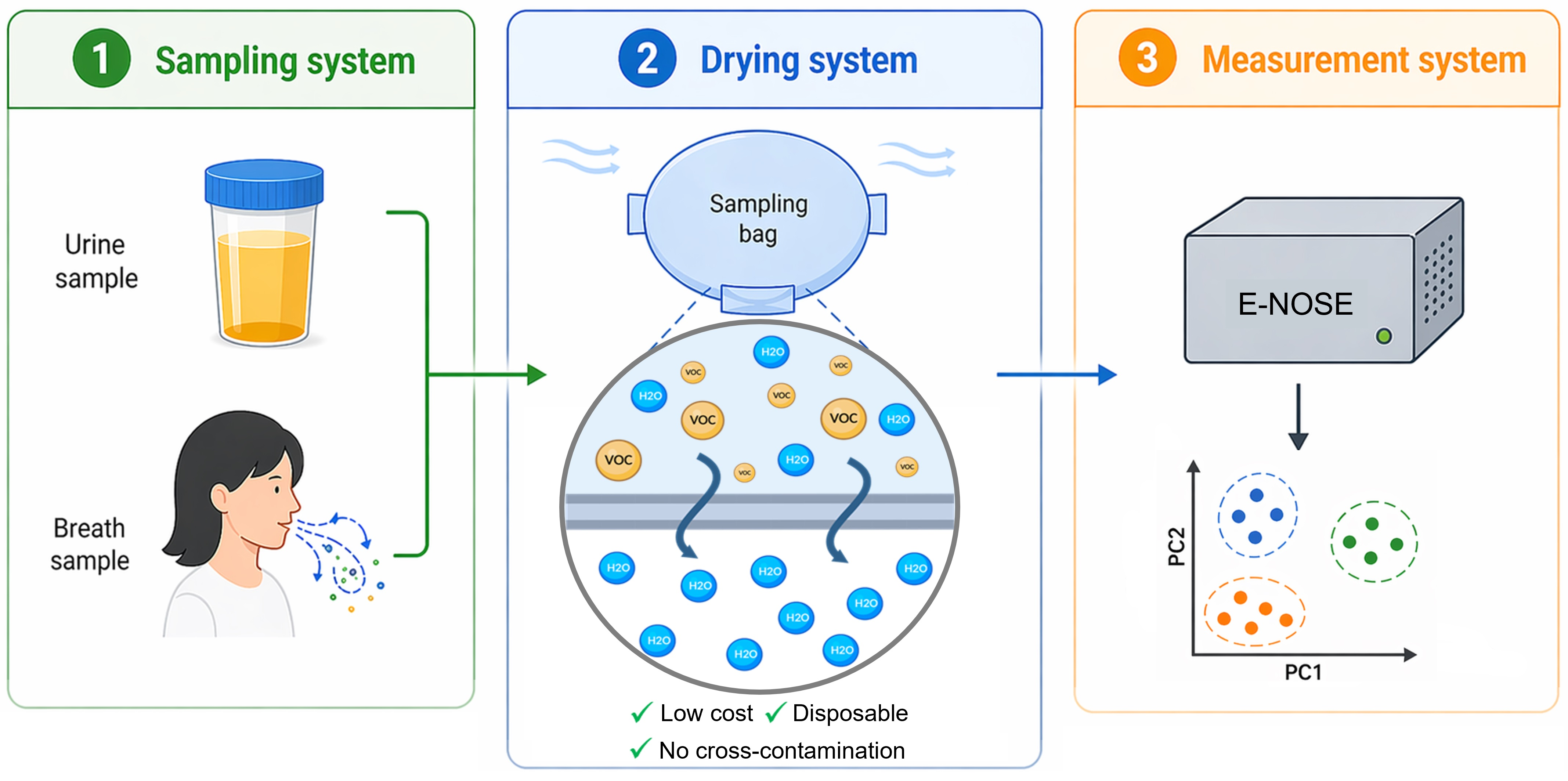
Comparison of Sampling Systems for Biological Sample Dehumidification Prior to Electronic Nose Analysis

 , , , ,
  ,
,  ,
, 
 and
and 
Abstract
1. Introduction
2. Design of the Experiment
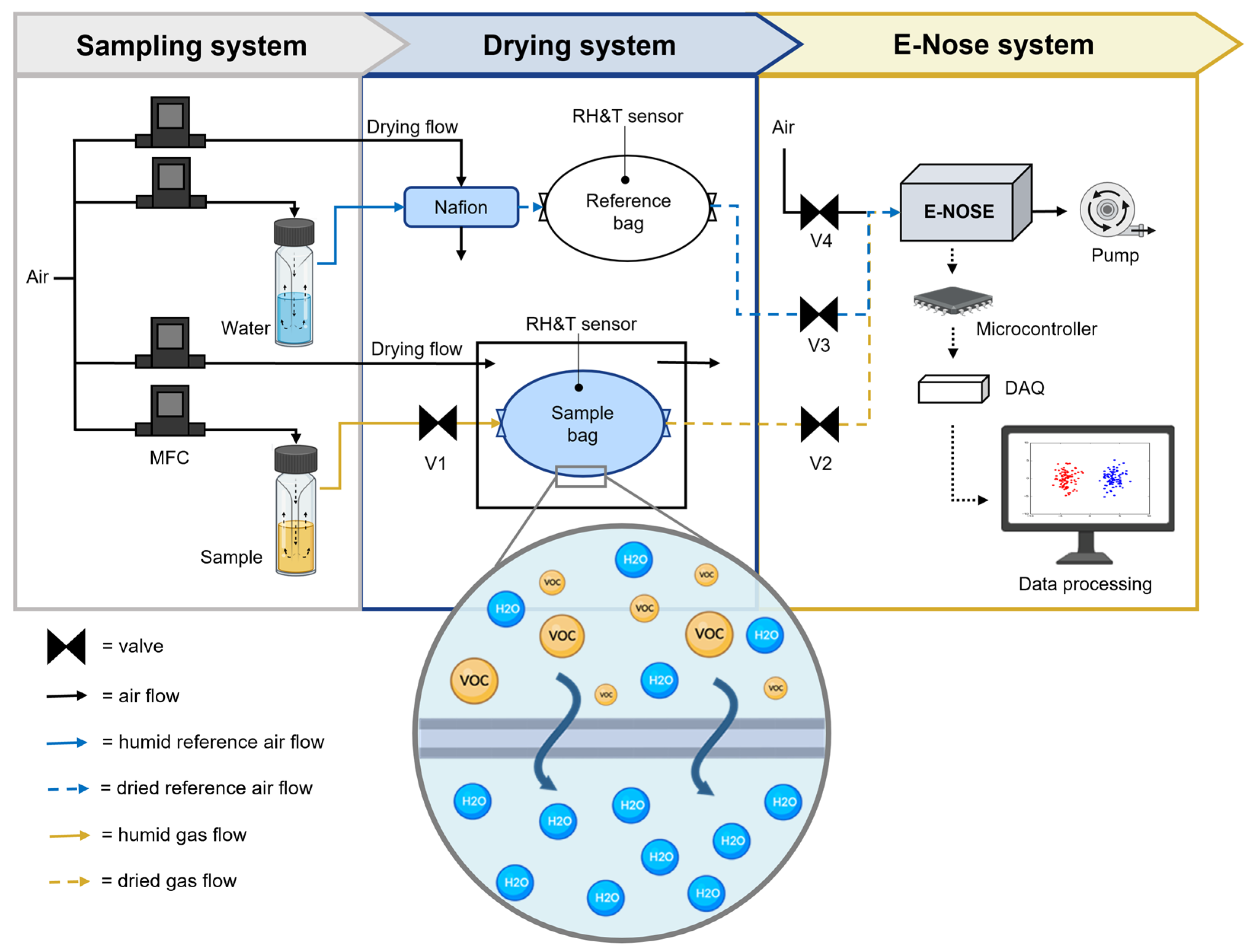
2.1. Experimental Setup
2.2. Sampling Bags
2.3. Biological Samples Involved for Testing
2.3.1. Urine Collection from Volunteers
2.3.2. Pooled and Spiked Urine Sample Preparation
- The first portion, labeled Class P, consisted of unmodified pooled urine samples.
- The second portion, labeled Class A, consisted of pooled samples spiked with 0.156 µL/L of 4-heptanone and 3.22 µL/L of acetone as specific chemical markers. Acetone and 4-heptanone were chosen based on a previous study suggesting their association with prostate cancer-related metabolic pathways [28,45]. The added concentration falls within the range of concentrations naturally found in human urine, as previously described [46].
2.4. Experimental Protocol
2.4.1. Phase 1: Dehumidification Performance of Sampling Bags
Dry Air Flow Rate Optimization
Dehumidification Time Characterization of Sampling Bags
2.4.2. Phase 2: Investigation of Adsorption and Diffusion Losses
Experimental Protocol
Calculation of Water Mass Loss
2.4.3. Phase 3: Effect of Dehumidification on VOCs
Urine Headspace Analysis
Data Processing and Statistical Analysis
3. Results
3.1. Phase 1: Dehumidification Performance
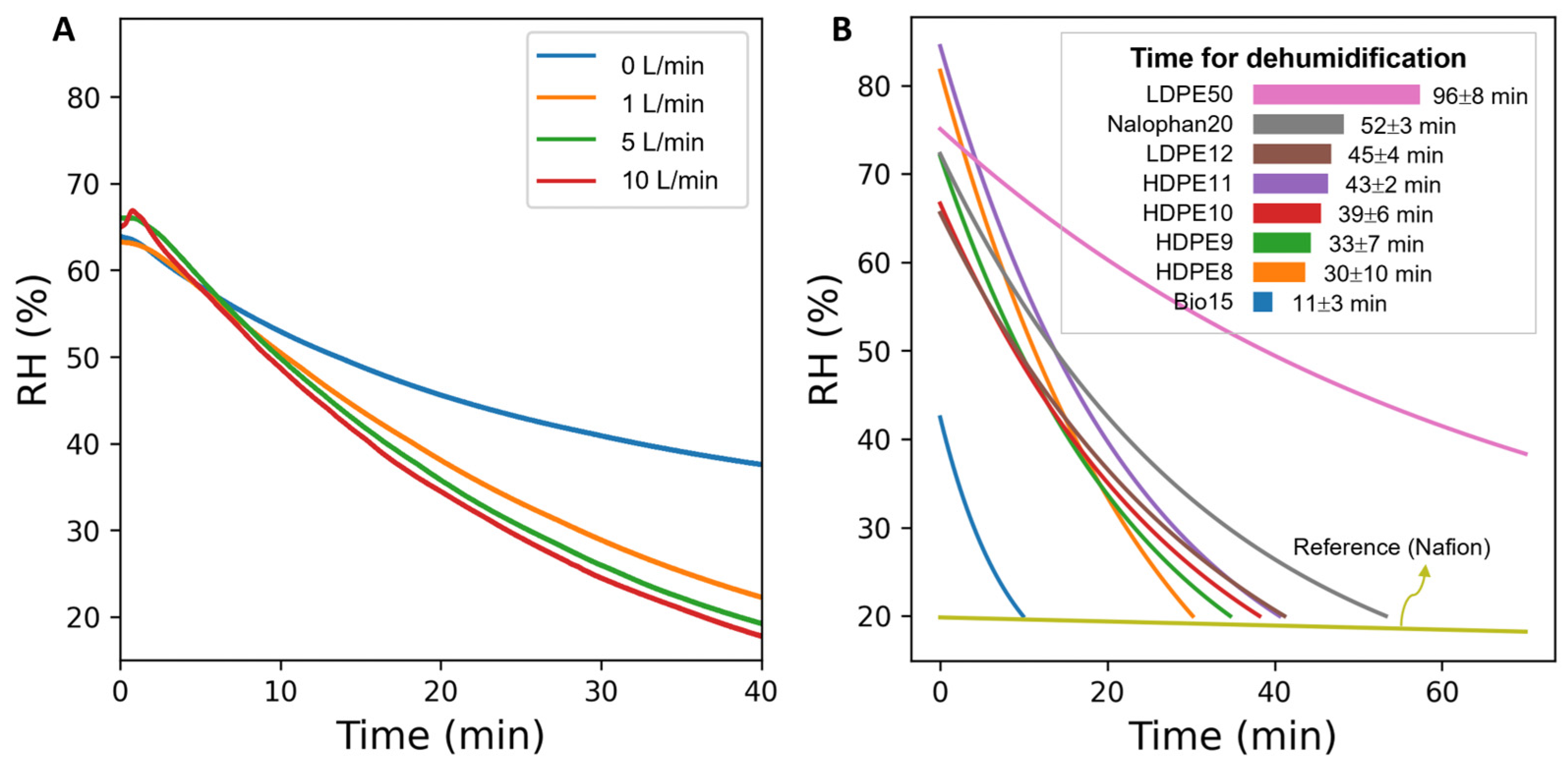
3.1.1. Effect of Dry Air Flow Rate on the Dehumidification Rate of Sampling Bags
3.1.2. Dehumidification Rate of Sampling Bags Exposed to 1 L/min of Dry Air
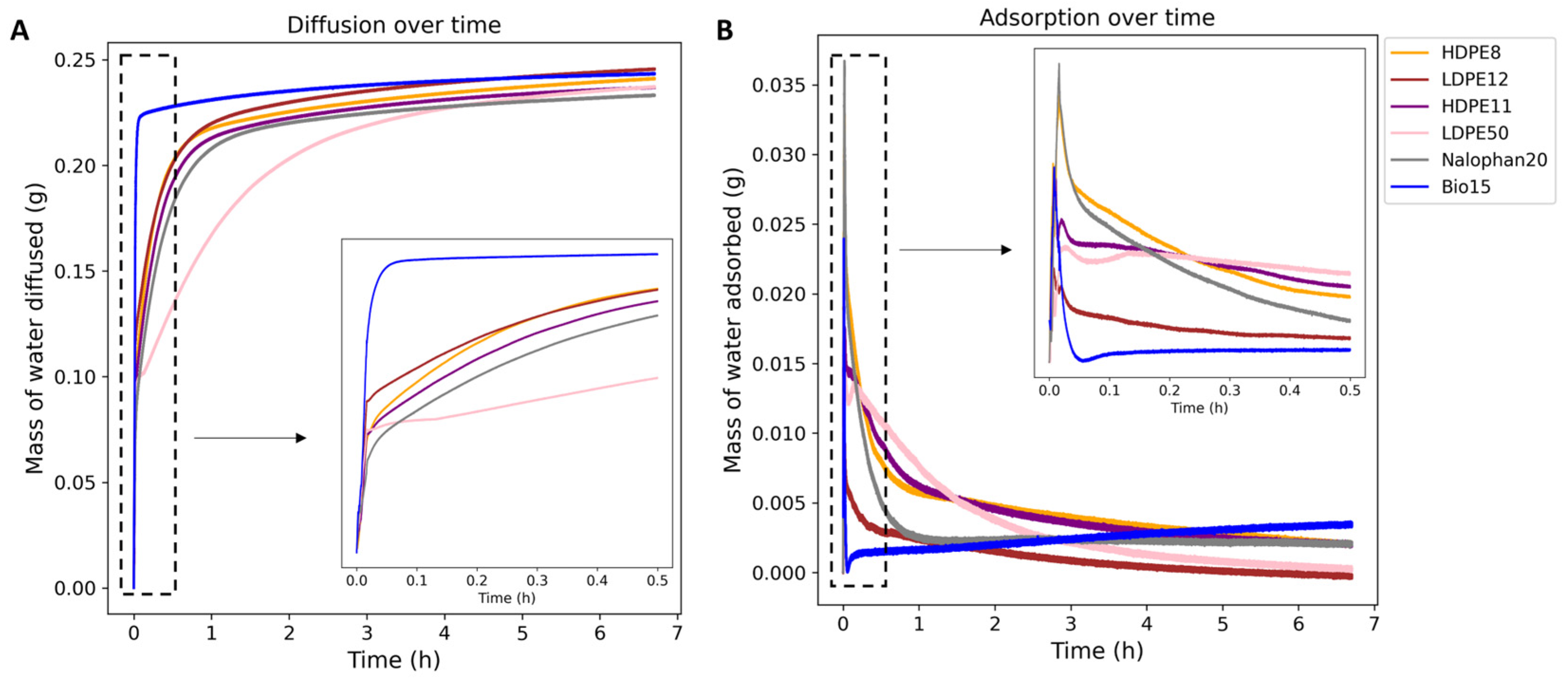
3.2. Phase 2: Investigation of Water Diffusion and Adsorption in Sampling Bags
3.3. Phase 3: Impact of Dehumidification on VOC Detection by e-Nose
3.3.1. Exploratory Analysis of Sensor Response
3.3.2. Gas Clustering and Classification
4. Discussion
5. Conclusions
Supplementary Materials
Author Contributions
Funding
Institutional Review Board Statement
Informed Consent Statement
Data Availability Statement
Conflicts of Interest
Abbreviations
| Bio-PS | Biodegradable Polyester |
| DBI | Davies–Bouldin Index |
| e-Nose | Electronic Nose |
| HDPE | High-Density Polyethylene |
| LDPE | Low-Density Polyethylene |
| OSC | Orthogonal Signal Correction |
| PCs | Principal Components |
| PCA | Principal Component Analysis |
| PID | Photoionization Detector |
| SVM | Support Vector Machine |
| VOC | Volatile Organic Compound |
References
- Covington, J.A.; Marco, S.; Persaud, K.C.; Schiffman, S.S.; Nagle, H.T. Artificial Olfaction in the 21st Century. IEEE Sens. J. 2021, 21, 12969–12990. [Google Scholar] [CrossRef]
- Capelli, L.; Sironi, S.; Del Rosso, R. Electronic Noses for Environmental Monitoring Applications. Sensors 2014, 14, 19979–20007. [Google Scholar] [CrossRef]
- Lim, Y.M.; Swamy, V.; Ramakrishnan, N.; Chan, E.S.; Kesuma, H.P. Volatile Organic Compounds (VOCs) in Wastewater: Recent Advances in Detection and Quantification. Microchem. J. 2023, 195, 109537. [Google Scholar] [CrossRef]
- Theodoro, R.S.; Santos, G.S.M.; D’Andria, M.; Gropelo, H.S.; Kravecz, S.; Güntner, A.T.; Volanti, D.P. Air Pollution Monitoring with Nanoscaled Materials in Chemoresistive Gas Sensors. ACS Appl. Mater. Interfaces 2026, 18, 14473–14520. [Google Scholar] [CrossRef]
- Mohd Ali, M.; Hashim, N.; Abd Aziz, S.; Lasekan, O. Principles and Recent Advances in Electronic Nose for Quality Inspection of Agricultural and Food Products. Trends Food Sci. Technol. 2020, 99, 1–10. [Google Scholar] [CrossRef]
- Kiani, S.; Minaei, S.; Ghasemi-Varnamkhasti, M. Application of Electronic Nose Systems for Assessing Quality of Medicinal and Aromatic Plant Products: A Review. J. Appl. Res. Med. Aromat. Plants 2016, 3, 1–9. [Google Scholar] [CrossRef]
- Ramadan, K.M.A.; Bendary, E.S.A.; Khalil, H.B.; Ali, S.A.; Ahmed, A.R.; Mahmoud, M.A.A. Smart Detection of Food Spoilage Using Microbial Volatile Compounds: Technologies, Challenges, and Future Outlook. J. Agric. Food Chem. 2025, 73, 19222–19243. [Google Scholar] [CrossRef]
- Wilson, A.D.; Baietto, M. Advances in Electronic-Nose Technologies Developed for Biomedical Applications. Sensors 2011, 11, 1105–1176. [Google Scholar] [CrossRef]
- Checker, S.; Yadav, A.B.; Sivnath Reddy, G.V.; Checker, R. Advances in Volatile Organic Compounds-Based Biomarker Detection Using Nanomaterial-Integrated Sensor Platforms for Cancer Diagnosis. ACS Appl. Electron. Mater. 2026, 8, 2198–2224. [Google Scholar] [CrossRef]
- Robbiani, S.; Lotesoriere, B.J.; Dellacà, R.L.; Capelli, L. Physical Confounding Factors Affecting Gas Sensors Response: A Review on Effects and Compensation Strategies for Electronic Nose Applications. Chemosensors 2023, 11, 514. [Google Scholar] [CrossRef]
- Wang, C.; Yin, L.; Zhang, L.; Xiang, D.; Gao, R. Metal Oxide Gas Sensors: Sensitivity and Influencing Factors. Sensors 2010, 10, 2088–2106. [Google Scholar] [CrossRef] [PubMed]
- Wang, Y.; Zhou, Y. Recent Progress on Anti-Humidity Strategies of Chemiresistive Gas Sensors. Materials 2022, 15, 8728. [Google Scholar] [CrossRef]
- Yan, M.; Wu, Y.; Hua, Z.; Lu, N.; Sun, W.; Zhang, J.; Fan, S. Humidity Compensation Based on Power-Law Response for MOS Sensors to VOCs. Sens. Actuators B Chem. 2021, 334, 129601. [Google Scholar] [CrossRef]
- Pan, Y.; Zhang, L.; Cao, B.; Xue, X.; Liu, W.; Zhang, C.; Wang, W. Effects of Temperature and Humidity on the Performance of a PECH Polymer Coated SAW Sensor. RSC Adv. 2020, 10, 18099–18106. [Google Scholar] [CrossRef]
- Tischer, A.M.; Lotesoriere, B.J.; Capelli, L. How to Manage the Humidity of Biological Samples to Reduce Interference on Chemical Sensors. Crit. Rev. Anal. Chem. 2026, 1–26. [Google Scholar] [CrossRef] [PubMed]
- Güntner, A.T.; Abegg, S.; Königstein, K.; Gerber, P.A.; Schmidt-Trucksäss, A.; Pratsinis, S.E. Breath Sensors for Health Monitoring. ACS Sens. 2019, 4, 268–280. [Google Scholar] [CrossRef]
- Ratti, C.; Bax, C.; Lotesoriere, B.J.; Capelli, L. Real-Time Monitoring of Odour Emissions at the Fenceline of a Waste Treatment Plant by Instrumental Odour Monitoring Systems: Focus on Training Methods. Sensors 2024, 24, 3506. [Google Scholar] [CrossRef]
- Zhang, J.; Xue, Y.; Sun, Q.; Zhang, T.; Chen, Y.; Yu, W.; Xiong, Y.; Wei, X.; Yu, G.; Wan, H.; et al. A Miniaturized Electronic Nose with Artificial Neural Network for Anti-Interference Detection of Mixed Indoor Hazardous Gases. Sens. Actuators B Chem. 2021, 326, 128822. [Google Scholar] [CrossRef]
- Sohn, J.H.; Atzeni, M.; Zeller, L.; Pioggia, G. Characterisation of Humidity Dependence of a Metal Oxide Semiconductor Sensor Array Using Partial Least Squares. Sens. Actuators B Chem. 2008, 131, 230–235. [Google Scholar] [CrossRef]
- Shooshtari, M.; Salehi, A. An Electronic Nose Based on Carbon Nanotube -Titanium Dioxide Hybrid Nanostructures for Detection and Discrimination of Volatile Organic Compounds. Sens. Actuators B Chem. 2022, 357, 131418. [Google Scholar] [CrossRef]
- Dai, X.; Zhu, Y.; Zhang, S.; Sun, P.; Dong, X.; Dong, F.; Chen, S. Performance Optimization of Semiconductor Gas Sensors Based on Interfacial Reaction Regulation: Status and Challenges. ACS Sens. 2026, 11, 792–810. [Google Scholar] [CrossRef]
- Baltussen, E.; Cramers, C.; Sandra, P. Sorptive Sample Preparation—A Review. Anal. Bioanal. Chem. 2002, 373, 3–22. [Google Scholar] [CrossRef] [PubMed]
- Demeestere, K.; Dewulf, J.; De Witte, B.; Van Langenhove, H. Sample Preparation for the Analysis of Volatile Organic Compounds in Air and Water Matrices. J. Chromatogr. A 2007, 1153, 130–144. [Google Scholar] [CrossRef]
- Harper, M. Sorbent Trapping of Volatile Organic Compounds from Air. J. Chromatogr. A 2000, 885, 129–151. [Google Scholar] [CrossRef] [PubMed]
- Woolfenden, E. Sorbent-Based Sampling Methods for Volatile and Semi-Volatile Organic Compounds in Air. J. Chromatogr. A 2010, 1217, 2674–2684. [Google Scholar] [CrossRef]
- Dinh, T.V.; Kim, J.C. Moisture Removal Techniques for a Continuous Emission Monitoring System: A Review. Atmosphere 2021, 12, 61. [Google Scholar] [CrossRef]
- Bax, C.; Robbiani, S.; Zannin, E.; Capelli, L.; Ratti, C.; Bonetti, S.; Novelli, L.; Raimondi, F.; Di Marco, F.; Dellacà, R.L. An Experimental Apparatus for E-Nose Breath Analysis in Respiratory Failure Patients. Diagnostics 2022, 12, 776. [Google Scholar] [CrossRef]
- Bax, C.; Lotesoriere, B.J.; Sironi, S.; Capelli, L. Review and Comparison of Cancer Biomarker Trends in Urine as a Basis for New Diagnostic Pathways. Cancers 2019, 11, 1244. [Google Scholar] [CrossRef] [PubMed]
- Monotube Dryer (MD) Series Gas Dryer. Available online: https://salaera.com/products/monotube-dryer-md-series-gas-dryer (accessed on 10 March 2026).
- Xiang, C.; Wang, W.; Zhao, X.; Yang, N.; Tu, C. Dehumidification Performance of the Nafion Tube for SO2 at Low Concentration. In IOP Conference Series: Materials Science and Engineering; Institute of Physics Publishing: Bristol, UK, 2019; Volume 490. [Google Scholar]
- Burns, W.F.; Tingey, D.T.; Evans, R.C.; Bates, E.H. Problems with a Nafion® Membrane Dryer for Drying Chromatographic Samples. J. Chromatogr. A 1983, 269, 1–9. [Google Scholar] [CrossRef]
- Yee, R.S.L.; Rozendal, R.A.; Zhang, K.; Ladewig, B.P. Cost Effective Cation Exchange Membranes: A Review. Chem. Eng. Res. Des. 2012, 90, 950–959. [Google Scholar] [CrossRef]
- EN 13725:2022; Stationary Source Emissions—Determination of Odour Concentration by Dynamic Olfactometry and Odour Emission Rate. European Committee for Standardization (CEN): Brussels, Belgium, 2022.
- Sironi, S.; Eusebio, L.; Capelli, L.; Boiardi, E.; Rosso, R.D.; Guillot, J.-M. Ammonia Diffusion Phenomena through NalophanTM Bags Used for Olfactometric Analyses. J. Environ. Prot. 2014, 5, 949–961. [Google Scholar] [CrossRef]
- Capelli, L.; Bax, C.; Grizzi, F.; Taverna, G. Optimization of Training and Measurement Protocol for eNose Analysis of Urine Headspace Aimed at Prostate Cancer Diagnosis. Sci. Rep. 2021, 11, 20898. [Google Scholar] [CrossRef] [PubMed]
- Beauchamp, J.; Herbig, J.; Gutmann, R.; Hansel, A. On the Use of Tedlar® Bags for Breath-Gas Sampling and Analysis. J. Breath Res. 2008, 2, 046001. [Google Scholar] [CrossRef] [PubMed]
- Fido, M.; Hersberger, S.; Güntner, A.T.; Zenobi, R.; Giannoukos, S. Systematic Study of Polymer Gas Sampling Bags for Offline Analysis of Exhaled Breath. J. Breath Res. 2024, 18, 046009. [Google Scholar] [CrossRef]
- Eusebio, L.; Capelli, L.; Sironi, S. H2S Loss through NalophanTM Bags: Contributions of Adsorption and Diffusion. Sci. World J. 2017, 2017, 9690704. [Google Scholar] [CrossRef]
- Kasper, P.L.; Oxbøl, A.; Hansen, M.J.; Feilberg, A. Mechanisms of Loss of Agricultural Odorous Compounds in Sample Bags of Nalophan, Tedlar, and PTFE. J. Environ. Qual. 2018, 47, 246–253. [Google Scholar] [CrossRef] [PubMed]
- Taverna, G.; Grizzi, F.; Tidu, L.; Bax, C.; Zanoni, M.; Vota, P.; Lotesoriere, B.J.; Prudenza, S.; Magagnin, L.; Langfelder, G.; et al. Accuracy of a New Electronic Nose for Prostate Cancer Diagnosis in Urine Samples. Int. J. Urol. 2022, 29, 890–896. [Google Scholar] [CrossRef]
- Cassinerio, M.; Lotesoriere, B.J.; Robbiani, S.; Zanni, E.; Grizzi, F.; Taverna, G.; Dellacà, R.; Capelli, L.M.T. Development of a Calibration Transfer Methodology and Experimental Setup for Urine Headspace Analysis. Chemosensors 2025, 13, 395. [Google Scholar] [CrossRef]
- Leckrone, K.J.; Hayes, J.M. Efficiency and Temperature Dependence of Water Removal by Membrane Dryers. Anal. Chem. 1997, 69, 911–918. [Google Scholar] [CrossRef]
- Weiss, F.; Chawaguta, A.; Tolpeit, M.; Volk, V.; Schiller, A.; Ruzsanyi, V.; Hillinger, P.; Lederer, W.; Märk, T.D.; Mayhew, C.A. Detecting Hexafluoroisopropanol Using Soft Chemical Ionization Mass Spectrometry and Analytical Applications to Exhaled Breath. J. Am. Soc. Mass Spectrom. 2023, 34, 958–968. [Google Scholar] [CrossRef]
- Yue, S.; Zhang, T.; Wang, S.; Han, D.; Huang, S.; Xiao, M.; Meng, Y. Recent Progress of Biodegradable Polymer Package Materials: Nanotechnology Improving Both Oxygen and Water Vapor Barrier Performance. Nanomaterials 2024, 14, 338. [Google Scholar] [CrossRef]
- Amann, A.; Costello, B.d.L.; Miekisch, W.; Schubert, J.; Buszewski, B.; Pleil, J.; Ratcliffe, N.; Risby, T. The Human Volatilome: Volatile Organic Compounds (VOCs) in Exhaled Breath, Skin Emanations, Urine, Feces and Saliva. J. Breath Res. 2014, 8, 034001. [Google Scholar] [CrossRef]
- Cassinerio, M. Beatrice Julia Lotesoriere Addressing the Issue of Gas Sensor Reproducibility: Development of a Calibration Transfer Methodology for Urine Headspace Analysis; Politecnico di Milano: Milan, Italy, 2025. [Google Scholar]
- Marco, S.; Gutiérrez-Gálvez, A. Signal and Data Processing for Machine Olfaction and Chemical Sensing: A Review. IEEE Sens. J. 2011, 12, 3189–3214. [Google Scholar] [CrossRef]
- Bax, C.; Prudenza, S.; Gaspari, G.; Capelli, L.; Grizzi, F.; Taverna, G. Drift Compensation on Electronic Nose Data for Non-Invasive Diagnosis of Prostate Cancer by Urine Analysis. iScience 2022, 25, 103622. [Google Scholar] [CrossRef] [PubMed]
- Fearn, T. On Orthogonal Signal Correction. Chemom. Intell. Lab. Syst. 2000, 50, 47–52. [Google Scholar] [CrossRef]
- Wu, K.P.; Wang, S. De Choosing the Kernel Parameters for Support Vector Machines by the Inter-Cluster Distance in the Feature Space. Pattern Recognit. 2009, 42, 710–717. [Google Scholar] [CrossRef]
- Ikotun, A.M.; Habyarimana, F.; Ezugwu, A.E. Benchmarking Validity Indices for Evolutionary K-Means Clustering Performance. Sci. Rep. 2025, 15, 21842. [Google Scholar] [CrossRef]
- Fernandez, L.; Oller-Moreno, S.; Fonollosa, J.; Garrido-Delgado, R.; Arce, L.; Martín-Gómez, A.; Marco, S.; Pardo, A. Signal Preprocessing in Instrument-Based Electronic Noses Leads to Parsimonious Predictive Models: Application to Olive Oil Quality Control. Sensors 2025, 25, 737. [Google Scholar] [CrossRef]
- Metz, S.J. Water Vapor and Gas Transport Through Polymeric Membranes. Ph.D. Thesis, University of Twente, Enschede, The Netherlands, 2003. [Google Scholar]
- Qin, P.; Wu, L.; Li, B.; Li, N.; Pan, X.; Dai, J. Superior Gas Barrier Properties of Biodegradable PBST vs. PBAT Copolyesters: A Comparative Study. Polymers 2021, 13, 3449. [Google Scholar] [CrossRef]
- Keller, P.E.; Kouzes, R. Water Vapor Permeation in Plastics; Pacific Northwest National Laboratory: Richland, WA, USA, 2017. [Google Scholar]
- Toledo, M.; Guillot, J.M.; Siles, J.A.; Martína, M.A. Permeability and Adsorption Effects for Volatile Sulphur Compounds in Nalophan Sampling Bags: Stability Influenced by Storage Time. Biosyst. Eng. 2019, 188, 217–228. [Google Scholar] [CrossRef]
- Rogers, C.E.; Stannett, V.; Szwarc, M. The Sorption, Diffusion, and Permeation of Organic Vapors in Polyethylene. J. Polym. Sci. 1960, 45, 61–82. [Google Scholar] [CrossRef]
- Prasad, T.; Brown, K.; Thomas, J. Diffusion Coefficients of Organics in High Density Polyethylene (HDPE). Waste Manag. Res. 1994, 12, 61–71. [Google Scholar] [CrossRef]
- Hodgson, S.C.; Casey, R.J.; Bigger, S.W.; Scheirs, J. Review of Volatile Organic Compounds Derived from Polyethylene. Polym. Plast. Technol. Eng. 2000, 39, 845–874. [Google Scholar] [CrossRef]
- Mahdavi, H.; Rahbarpour, S.; Hosseini-Golgoo, S.M.; Jamaati, H. Reducing the Destructive Effect of Ambient Humidity Variations on Gas Detection Capability of a Temperature Modulated Gas Sensor by Calcium Chloride. Sens. Actuators B Chem. 2021, 331, 129091. [Google Scholar] [CrossRef]
- Charlon, S.; Follain, N.; Soulestin, J.; Sclavons, M.; Marais, S. Water Transport Properties of Poly(Butylene Succinate) and Poly[(Butylene Succinate)-Co-(Butylene Adipate)] Nanocomposite Films: Influence of the Water-Assisted Extrusion Process. J. Phys. Chem. C 2017, 121, 918–930. [Google Scholar] [CrossRef]
- Pannico, M.; La Manna, P. Sorption of Water Vapor in Poly(L-Lactic Acid): A Time-Resolved FTIR Spectroscopy Investigation. Front. Chem. 2019, 7, 275. [Google Scholar] [CrossRef]
- Polvara, E.; Gariboldi, A.; Proserpio, B.; Invernizzi, M.; Sironi, S. Storage Stability of Odorants in NalophanTM Bags: Effect of Storage Condition on Recovery. Appl. Sci. 2025, 15, 9258. [Google Scholar] [CrossRef]
- Hongsirikarn, K.; Goodwin, J.G.; Greenway, S.; Creager, S. Influence of Ammonia on the Conductivity of Nafion Membranes. J. Power Sources 2010, 195, 30–38. [Google Scholar] [CrossRef]
- Sachse, D.; Glüsen, A.; Wippermann, K.; Müller, M.; Rau, U.; Peters, R. The Ammonia Adsorption and Desorption Behavior of Nafion. Membranes 2025, 15, 149. [Google Scholar] [CrossRef]
- Guo, J.; Lee, J.-G.; Tan, T.; Yeo, J.; Wong, P.W.; Ghaffour, N.; An, A.K. Enhanced Ammonia Recovery from Wastewater by Nafion Membrane with Highly Porous Honeycomb Nanostructure and Its Mechanism in Membrane Distillation. J. Memb. Sci. 2019, 590, 117265. [Google Scholar] [CrossRef]




| HDPE 8 μm | HDPE 11 μm | LDPE 12 μm | LDPE 50 μm | NalophanTM 20 μm | Bio-PS 15 μm | |
|---|---|---|---|---|---|---|
| mass adsorbed (g) | 0.0020 ± 0.0002 | 0.0020 ± 0.002 | 0.0003 ± 0.001 | 0.0002 ± 0.001 | 0.0020 ± 0.001 | 0.0016 ± 0.001 |
| mass diffused (g) | 0.2410 ± 0.0150 | 0.2369 ± 0.0144 | 0.2454 ± 0.010 | 0.2371 ± 0.009 | 0.2332 ± 0.011 | 0.2417 ± 0.009 |
| mass lost (g) | 0.2430 ± 0.0160 | 0.2389 ± 0.0139 | 0.2457 ± 0.010 | 0.2374 ± 0.009 | 0.2352 ± 0.011 | 0.2422 ± 0.012 |
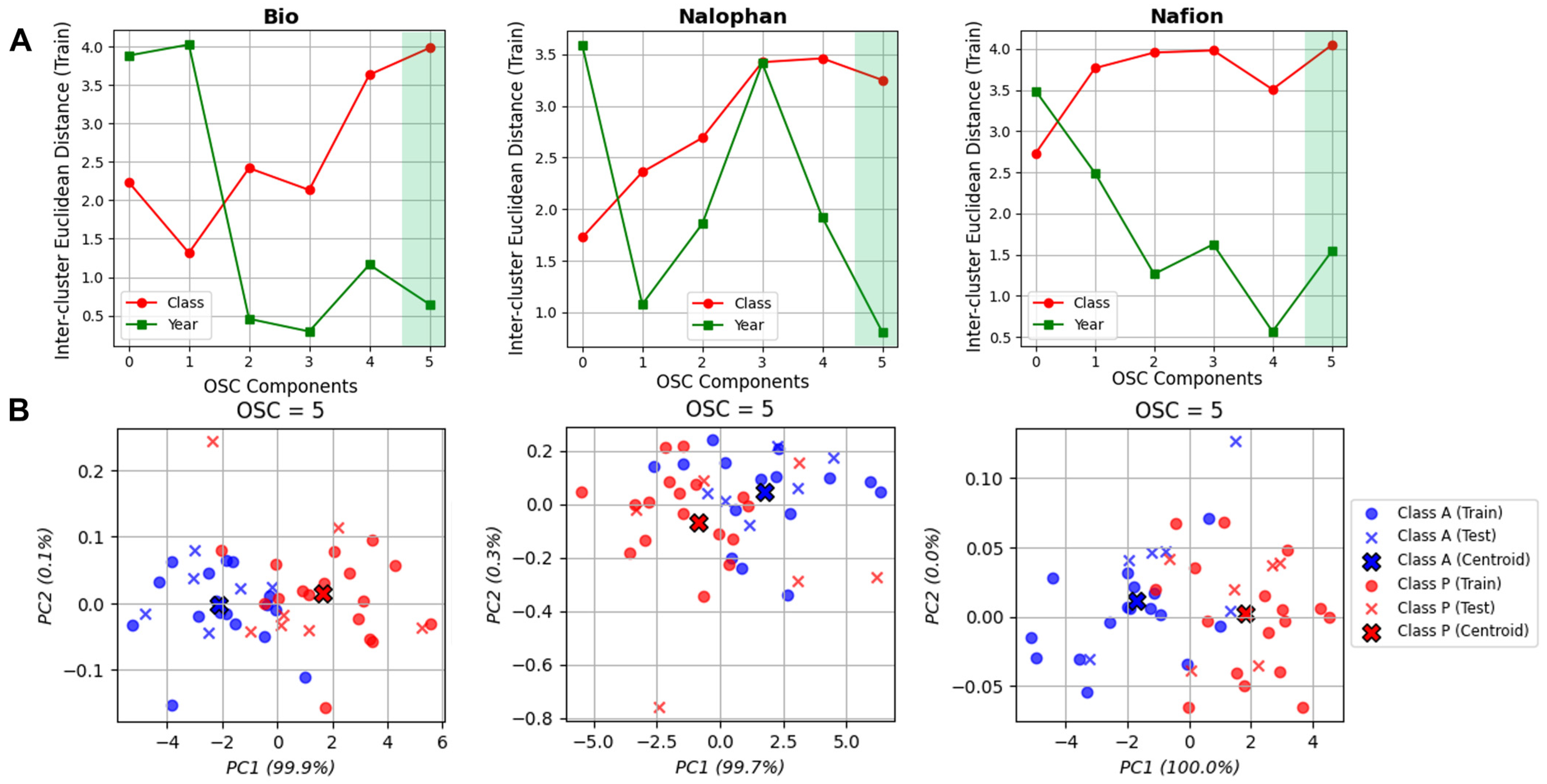
| Sample Preparation Method | Number of OSC Components | Euclidean Distance Class | Davies–Bouldin Index | Accuracy Training CV (CI95%) | Accuracy Test (CI95%) |
|---|---|---|---|---|---|
| Bio-PS | 0 | 2.235 | 1.918 | 0.743 (0.567, 0.875) | 0.692 (0.385, 0.909) |
| 5 | 3.981 | 0.705 | 0.857 (0.699, 0.950) | 0.769 (0.472, 0.936) | |
| NalophanTM | 0 | 1.726 | 2.403 | 0.739 (0.556, 0.876) | 0.777 (0.460, 0.953) |
| 5 | 3.250 | 1.036 | 0.875 (0.719, 0.950) | 0.833 (0.552, 0.953) | |
| NafionTM | 0 | 2.734 | 1.410 | 0.788 (0.691, 0.933) | 0.833 (0.552, 0.953) |
| 5 | 4.046 | 0.702 | 0.808 (0.635, 0.923) | 0.861 (0.559, 0.975) |
Disclaimer/Publisher’s Note: The statements, opinions and data contained in all publications are solely those of the individual author(s) and contributor(s) and not of MDPI and/or the editor(s). MDPI and/or the editor(s) disclaim responsibility for any injury to people or property resulting from any ideas, methods, instructions or products referred to in the content. |
© 2026 by the authors. Licensee MDPI, Basel, Switzerland. This article is an open access article distributed under the terms and conditions of the Creative Commons Attribution (CC BY) license.
Share and Cite
Tischer, A.M.; Lotesoriere, B.J.; Robbiani, S.; Navid, H.; Zanni, E.; Bax, C.; Grizzi, F.; Taverna, G.; Dellacà, R.; Capelli, L. Comparison of Sampling Systems for Biological Sample Dehumidification Prior to Electronic Nose Analysis. Appl. Sci. 2026, 16, 4174. https://doi.org/10.3390/app16094174
Tischer AM, Lotesoriere BJ, Robbiani S, Navid H, Zanni E, Bax C, Grizzi F, Taverna G, Dellacà R, Capelli L. Comparison of Sampling Systems for Biological Sample Dehumidification Prior to Electronic Nose Analysis. Applied Sciences. 2026; 16(9):4174. https://doi.org/10.3390/app16094174
Chicago/Turabian StyleTischer, Ana Maria, Beatrice Julia Lotesoriere, Stefano Robbiani, Hamid Navid, Emanuele Zanni, Carmen Bax, Fabio Grizzi, Gianluigi Taverna, Raffaele Dellacà, and Laura Capelli. 2026. "Comparison of Sampling Systems for Biological Sample Dehumidification Prior to Electronic Nose Analysis" Applied Sciences 16, no. 9: 4174. https://doi.org/10.3390/app16094174
APA StyleTischer, A. M., Lotesoriere, B. J., Robbiani, S., Navid, H., Zanni, E., Bax, C., Grizzi, F., Taverna, G., Dellacà, R., & Capelli, L. (2026). Comparison of Sampling Systems for Biological Sample Dehumidification Prior to Electronic Nose Analysis. Applied Sciences, 16(9), 4174. https://doi.org/10.3390/app16094174