Advanced Waste-to-Energy Technologies: Evidence, Scalability, and Implications for a Net-Zero Transition


Abstract
1. Introduction
1.1. Waste-to-Energy in the Context of Climate Change and Resource Constraints
1.2. Motivation, Scope, and Contribution of This Review
2. Overview of Waste-to-Energy Pathways
2.1. Classification of Waste Streams and Conversion Routes
2.2. Thermochemical, Biochemical, and Hybrid Technologies
2.3. Technology Readiness and Current Deployment Status
3. Evidence Base for Performance Claims
3.1. Energy Efficiency and Conversion Yields
3.2. Environmental Performance and Emissions Profiles
3.3. Contradictions and Uncertainties in the Literature
4. Scalability and System Integration Challenges
4.1. From Laboratory and Pilot Scale to Commercial Deployment
4.2. Feedstock Variability and Process Stability
4.3. Heat Integration, Process Control, and Infrastructure Requirements
5. Waste-to-Energy Within Circular Economy Frameworks
5.1. Resource Recovery Versus Energy Recovery
5.2. Trade-Offs Between Material Recycling and Energy Conversion
5.3. Boundary Conditions for Circularity Assessment
6. Implications for Net-Zero Transitions
6.1. Carbon Accounting and System Boundaries
6.2. Role of Waste-to-Energy in Integrated Energy Systems
6.3. Alignment with Net-Zero Pathways and Policy Targets
7. Emerging Directions and Research Gaps
7.1. Advanced Reactors and Process Intensification
7.2. Data Gaps, Methodological Limitations, and Overstated Claims
7.3. Priorities for Future Research and Development
8. Conclusions
Funding
Institutional Review Board Statement
Informed Consent Statement
Data Availability Statement
Conflicts of Interest
Abbreviations
References
- Farooq, A.; Haputta, P.; Silalertruksa, T.; Gheewala, S. A Framework for the Selection of Suitable Waste to Energy Technologies for a Sustainable Municipal Solid Waste Management System. Front. Sustain. 2021, 2, 681690. [Google Scholar] [CrossRef]
- Amin, S.; Khandaker, M.; Jannat, J.; Khan, F.; Rahman, S. Cooperative environmental governance in urban South Asia: Implications for municipal waste management and waste-to-energy. Environ. Sci. Pollut. Res. 2023, 30, 69550–69563. [Google Scholar] [CrossRef] [PubMed]
- Roy, H.; Alam, S.; Bin-Masud, R.; Prantika, T.; Pervez, M.; Islam, M.; Naddeo, V. A Review on Characteristics, Techniques, and Waste-to-Energy Aspects of Municipal Solid Waste Management: Bangladesh Perspective. Sustainability 2022, 14, 10265. [Google Scholar] [CrossRef]
- Soni, A.; Gupta, S.; Rajamohan, N.; Yusuf, M. Waste-to-energy technologies: A sustainable pathway for resource recovery and materials management. Mater. Adv. 2025, 6, 4598–4622. [Google Scholar] [CrossRef]
- Tahiru, A.; Cobbina, S.; Asare, W.; Takal, S. Unlocking Energy from Waste: A Comprehensive Analysis of Municipal Solid Waste Recovery Potential in Ghana. World 2024, 5, 192–218. [Google Scholar] [CrossRef]
- Zueva, S.; Ferella, F.; Corradini, V.; Vegliò, F. Review of Organic Waste-to-Energy (OWtE) Technologies as a Part of a Sustainable Circular Economy. Energies 2024, 17, 3797. [Google Scholar] [CrossRef]
- Bosmans, A.; Vanderreydt, I.; Geysen, D.; Helsen, L. The crucial role of Waste-to-Energy technologies in enhanced landfill mining: A technology review. J. Clean. Prod. 2013, 55, 10–23. [Google Scholar] [CrossRef]
- Castaldi, M.; Deventer, J.; Lavoie, J.; Legrand, J.; Nzihou, A.; Pontikes, Y.; Verstraete, W. Progress and Prospects in the Field of Biomass and Waste to Energy and Added-Value Materials. Waste Biomass Valorization 2017, 8, 1875–1884. [Google Scholar] [CrossRef]
- Porshnov, D. Evolution of pyrolysis and gasification as waste to energy tools for low carbon economy. Wiley Interdiscip. Rev. Energy Environ. 2021, 11, e421. [Google Scholar] [CrossRef]
- Begum, Y.; Kumari, S.; Jain, S.; Garg, M. A review on waste biomass-to-energy: Integrated thermochemical and biochemical conversion for resource recovery. Environ. Sci. Adv. 2024, 3, 1197–1216. [Google Scholar] [CrossRef]
- Segneri, V.; Ferrasse, J.; Trinca, A.; Vilardi, G. An Overview of Waste Gasification and Syngas Upgrading Processes. Energies 2022, 15, 6391. [Google Scholar] [CrossRef]
- Yap, H.; Nixon, J. A multi-criteria analysis of options for energy recovery from municipal solid waste in India and the UK. Waste Manag. 2015, 46, 265–277. [Google Scholar] [CrossRef]
- Davis, J.; Gelman, R.; Tomberlin, G.; Bain, R. Waste-to-Energy: Hawaii and Guam Energy Improvement Technology Demonstration Project; National Renewable Energy Laboratory: Golden, CO, USA, 2014. [CrossRef]
- Abdeljaber, A.; Zannerni, R.; Masoud, W.; Abdallah, M.; Rocha-Meneses, L. Eco-Efficiency Analysis of Integrated Waste Management Strategies Based on Gasification and Mechanical Biological Treatment. Sustainability 2022, 14, 3899. [Google Scholar] [CrossRef]
- Nubi, O.; Murphy, R.; Morse, S. Life Cycle Sustainability Assessment of Waste to Energy Systems in the Developing World: A Review. Environments 2024, 11, 123. [Google Scholar] [CrossRef]
- Pozzo, A.; Lucquiaud, M.; Greef, J. Research and Innovation Needs for the Waste-To-Energy Sector towards a Net-Zero Circular Economy. Energies 2023, 16, 1909. [Google Scholar] [CrossRef]
- Kassim, F.; Thomas, C.; Afolabi, O. Integrated conversion technologies for sustainable agri-food waste valorisation: A critical review. Biomass Bioenergy 2022, 156, 106314. [Google Scholar] [CrossRef]
- Yao, Y.; Ramu, C.; Procher, A.; Littlejohns, J.; Hill, J.; Butler, J. Potential for Thermo-Chemical Conversion of Solid Waste in Canada to Fuel, Heat, and Electricity. Waste 2023, 1, 689–710. [Google Scholar] [CrossRef]
- Eke, J.; Onwudili, J.; Bridgwater, A. Influence of Moisture Contents on the Fast Pyrolysis of Trommel Fines in a Bubbling Fluidized Bed Reactor. Waste Biomass Valorization 2019, 11, 3711–3722. [Google Scholar] [CrossRef]
- Satchwell, A.; Scown, C.; Smith, S.; Amirebrahimi, J.; Jin, L.; Kirchstetter, T.; Preble, C. Accelerating the Deployment of Anaerobic Digestion to Meet Zero Waste Goals. Environ. Sci. Technol. 2018, 52, 13663–13669. [Google Scholar] [CrossRef]
- Wellinger, M.; Wochele, J.; Biollaz, S.; Ludwig, C. Online elemental analysis of process gases with ICP-OES: A case study on waste wood combustion. Waste Manag. 2012, 32, 1843–1852. [Google Scholar] [CrossRef]
- Nguyen, Q.; Smith, W.; Wahlen, B.; Wendt, L. Total and Sustainable Utilisation of Biomass Resources: A Perspective. Front. Bioeng. Biotechnol. 2020, 8, 546. [Google Scholar] [CrossRef] [PubMed]
- Razzak, S. Municipal Solid and Plastic Waste Co-pyrolysis Towards Sustainable Renewable Fuel and Carbon Materials: A Comprehensive Review. Chem.–Asian J. 2024, 19, e202400307. [Google Scholar] [CrossRef] [PubMed]
- Lee, S.; Sankaran, R.; Chew, K.; Tan, C.; Rambabu, K.; Chu, D.; Show, P. Waste to bioenergy: A review on the recent conversion technologies. BMC Energy 2019, 1, 4. [Google Scholar] [CrossRef]
- Ochieng, R.; Gebremedhin, A.; Sarker, S. Integration of Waste to Bioenergy Conversion Systems: A Critical Review. Energies 2022, 15, 2697. [Google Scholar] [CrossRef]
- Bora, R.; Richardson, R.; You, F. Resource recovery and waste-to-energy from wastewater sludge via thermochemical conversion technologies in support of circular economy: A comprehensive review. BMC Chem. Eng. 2020, 2, 8. [Google Scholar] [CrossRef]
- Sena, S.; Pereira, C. From Biomass to Bio-oil: Processes and Treatments to Convert Raw Material into Energy. Int. J. Chem. Eng. Res. 2018, 5, 1–10. [Google Scholar] [CrossRef]
- Kowalski, Z.; Makara, A.; Kulczycka, J.; Generowicz, A.; Kwaśnicki, P.; Ciuła, J.; Gronba-Chyła, A. Conversion of Sewage Sludge into Biofuels via Different Pathways and Their Use in Agriculture: A Comprehensive Review. Energies 2024, 17, 1383. [Google Scholar] [CrossRef]
- Constantinou, A.; Hafeez, S.; Harkou, E.; Adamou, P.; Pallari, E.; Manos, G.; Al-Salem, S. Fuel Quality from Thermochemical Conversion and Biological Treatment of Biomass. Ind. Eng. Chem. Res. 2024, 63, 18699–18723. [Google Scholar] [CrossRef]
- Okolie, J.A.; Jimoh, T.; Akande, O.; Okoye, P.U.; Ogbaga, C.C.; Adeleke, A.A.; Ikubanni, P.P.; Güleç, F.; Amenaghawon, A.N. Pathways for the valorization of animal and human waste to biofuels, sustainable materials, and value-added chemicals. Environments 2023, 10, 46. [Google Scholar] [CrossRef]
- Zein, S.H.; Agyemang, Y.K.; Ahmed, U.; Al Saadi, A.; Putranto, A.; Jalil, A.A. Hydrogen from Waste Plastics: Integrated Pyrolysis–Reforming Simulation and Techno-Economic Insights for a Circular Economy. Hydrogen 2026, 7, 30. [Google Scholar] [CrossRef]
- Okoye, I.J.; Zein, S.H.; Oko, E.; Jalil, A.A. Sustainable syngas production: Economic and circular economy benefits of PET waste gasification. Prog. Rubber Plast. Recycl. Technol. 2025, 41, 235–250. [Google Scholar] [CrossRef]
- Mathanker, A.; Das, S.; Pudasainee, D.; Khan, M.; Kumar, A.; Gupta, R. A Review of Hydrothermal Liquefaction of Biomass for Biofuels Production with a Special Focus on the Effect of Process Parameters, Co-Solvents, and Extraction Solvents. Energies 2021, 14, 4916. [Google Scholar] [CrossRef]
- Ghavami, N.; Özdenkçi, K.; Salierno, G.; Björklund-Sänkiaho, M.; Blasio, C.D. Analysis of operational issues in hydrothermal liquefaction and supercritical water gasification processes: A review. Biomass Convers. Biorefinery 2023, 13, 12367–12394. [Google Scholar] [CrossRef]
- Zhang, L.; Xu, C.; Champagne, P.; Mabee, W. Overview of current biological and thermo-chemical treatment technologies for sustainable sludge management. Waste Manag. Res. 2014, 32, 586–600. [Google Scholar] [CrossRef]
- Stafford, W.; Lotter, A.; Brent, A.; Maltitz, G. Biofuels Technology: A Look Forward; UNU-WIDER: Helsinki, Finland, 2017. [Google Scholar] [CrossRef]
- Santos, S.; Nobre, C.; Brito, P.; Gonçalves, M. Brief Overview of Refuse-Derived Fuel Production and Energetic Valorization: Applied Technology and Main Challenges. Sustainability 2023, 15, 10342. [Google Scholar] [CrossRef]
- Qui, R.; Lee, J.; Ingabire, L. Resource and Water Recovery Solutions for Singapore’s Water, Waste, Energy, and Food Nexus. Part I, Resource Recovery from Wastewater and Sludge; Wageningen Food & Biobased Research: Wageningen, The Netherlands, 2021. [Google Scholar] [CrossRef]
- Materazzi, M.; Chari, S.; Bajwa, S.; Sebastiani, A. Waste-to-Hydrogen: Challenges and Opportunities in the UK Scenario. Detritus 2023, 23, 65–75. [Google Scholar] [CrossRef]
- Gao, N.; Kamran, K.; Quan, C.; Williams, P. Thermochemical conversion of sewage sludge: A critical review. Prog. Energy Combust. Sci. 2020, 79, 100843. [Google Scholar] [CrossRef]
- Rauch, R.; Kiros, Y.; Engvall, K.; Kantarelis, E.; Brito, P.; Nobre, C.; Graefe, P. Hydrogen from Waste Gasification. Hydrogen 2024, 5, 70–101. [Google Scholar] [CrossRef]
- Yansaneh, O.Y.; Zein, S.H. Recent advances on waste plastic thermal pyrolysis: A critical overview. Processes 2022, 10, 332. [Google Scholar] [CrossRef]
- Zein, S.H.; Grogan, C.T.; Yansaneh, O.Y.; Putranto, A. Pyrolysis of high-density polyethylene waste plastic to liquid fuels—Modelling and economic analysis. Processes 2022, 10, 1503. [Google Scholar] [CrossRef]
- Kumar, M.; Kumar, S.; Singh, S. Plasma Technology as Waste to Energy: A Review. Int. J. Adv. Res. 2020, 8, 464–473. [Google Scholar] [CrossRef]
- Gruttola, F.; Borello, D. Analysis of the EU Secondary Biomass Availability and Conversion Processes to Produce Advanced Biofuels. Sustainability 2021, 13, 7882. [Google Scholar] [CrossRef]
- Afrane, S.; Ampah, J.D.; Agyekum, E.B.; Amoh, P.O.; Yusuf, A.A.; Fattah, I.M.R.; Agbozo, E.; Elgamli, E.; Shouran, M.; Mao, G.; et al. Integrated AHP-TOPSIS under a Fuzzy Environment for the Selection of Waste-to-Energy Technologies in Ghana: A Performance Analysis and Socio-Enviro-Economic Feasibility Study. Int. J. Environ. Res. Public Health 2022, 19, 8428. [Google Scholar] [CrossRef]
- Liu, J.; Chen, H.; Zhao, X.; An, J.; Xu, G.; Dong, Y.; Zhao, Q. Thermo-Economic Analysis of a Plasma-Gasification-Based Waste-to-Energy System Integrated with a Supercritical CO2 Cycle and a Combined Heat and Power Plant. Energy Technol. 2022, 10, 2200101. [Google Scholar] [CrossRef]
- Perera, S.; Wickramasinghe, C.; Samarasiri, B.; Narayana, M. Modeling of thermochemical conversion of waste biomass—A comprehensive review. Biofuel Res. J. 2021, 8, 1481–1528. [Google Scholar] [CrossRef]
- Bianco, I.; Panepinto, D.; Zanetti, M. Environmental Impacts of Electricity from Incineration and Gasification: How the LCA Approach Can Affect the Results. Sustainability 2021, 14, 92. [Google Scholar] [CrossRef]
- Sarker, T.; Khatun, M.; Ethen, D.; Ali, M.; Islam, M.; Chowdhury, S.; Akm, R. Recent evolution in thermochemical transformation of municipal solid wastes to alternate fuels. Heliyon 2024, 10, e37105. [Google Scholar] [CrossRef]
- Yansaneh, O.Y.; Zein, S.H. Latest advances in waste plastic pyrolytic catalysis. Processes 2022, 10, 683. [Google Scholar] [CrossRef]
- Lahafdoozian, M.; Khoshkroudmansouri, H.; Zein, S.H.; Jalil, A.A. Hydrogen production from plastic waste: A comprehensive simulation and machine learning study. Int. J. Hydrogen Energy 2024, 59, 465–479. [Google Scholar] [CrossRef]
- Güleç, F.; Anburajan, P.; Umenweke, G.; Musa, U.; Williams, O.; Mortezaei, Y.; Okolie, J. Progress in lignocellulosic biomass valorization for biofuels and value-added chemical production in the EU. Biofuels Bioprod. Biorefining 2023, 18, 755–781. [Google Scholar] [CrossRef]
- Kisiga, W.; Chetty, M.; Rathilal, S. Environmental impact assessment of alternative technologies for production of biofuels from spent coffee grounds. Energy Sci. Eng. 2024, 12, 4823–4842. [Google Scholar] [CrossRef]
- Rijo, B.; Nobre, C.; Brito, P.; Ferreira, P. An Overview of the Thermochemical Valorization of Sewage Sludge: Principles and Current Challenges. Energies 2024, 17, 2417. [Google Scholar] [CrossRef]
- Zein, S.H. Evaluation of Waste-to-Hydrogen Infrastructure in Oman: A Mixed-Integer Programming Approach for Circular Economy Integration. Modelling 2026, 7, 62. [Google Scholar] [CrossRef]
- Al-Qadri, A.A.; Ahmed, U.; Jameel, A.G.A.; Zahid, U.; Ali, I.; Hussain, M.; Zein, S.H. Sustainable ammonia production from plastic waste gasification integrated with partial oxidation: Technoeconomic assessment. Int. J. Hydrogen Energy 2025, 109, 762–773. [Google Scholar] [CrossRef]
- Feng, B.; Dam, K.; Guo, M.; Shah, N.; Passmore, S.; Wang, X. Planning of Food-Energy-Water-Waste (FEW2) nexus for sustainable development. BMC Chem. Eng. 2020, 2, 4. [Google Scholar] [CrossRef]
- Catedral, A.; Aviso, K.; Juan, J.; Show, P.; Concepcion, R.; Tabanag, I.; Mayol, A. Comparative life cycle assessment of bio-based sustainable aviation fuel pathways. IOP Conf. Ser. Earth Environ. Sci. 2025, 1500, 012021. [Google Scholar] [CrossRef]
- Dyk, S.; Su, J.; Ebadian, M.; O’Connor, D.; Lakeman, M.; Saddler, J. Potential yields and emission reductions of biojet fuels produced via hydrotreatment of biocrudes produced through direct thermochemical liquefaction. Biotechnol. Biofuels 2019, 12, 281. [Google Scholar] [CrossRef]
- Cunha, L.; Medeiros, D.; Moreira, Í. Carbon Footprint of Hydrothermal Liquefaction of Microalgae Biomass Cultivated in Availability and Limitation of Nutrients. J. Bioeng. Technol. Health 2023, 5, 232–236. [Google Scholar] [CrossRef]
- Al-Qadri, A.A.; Ahmed, U.; Razzak, S.A.; Shahbaz, M.; Hussain, M.; Zein, S.H. Technical and economic assessment of hydrogen production from heavy fuel oil via thermochemical conversion routes. Fuel 2025, 385, 134054. [Google Scholar] [CrossRef]
- Khandelwal, N.; Kumari, S.; Poduval, S.; Behera, S.K.; Kumar, A.; Gedam, V.V. Life-cycle assessment of three biorefinery pathways across different generations. Sci. Rep. 2025, 15, 13135. [Google Scholar] [CrossRef]
- Garcia, R.; Freire, F. Carbon footprint of particleboard: A comparison between ISO/TS 14067, GHG Protocol, PAS 2050 and Climate Declaration. J. Clean. Prod. 2014, 66, 199–209. [Google Scholar] [CrossRef]
- Garcia, R.; Alvarenga, R.; Huysveld, S.; Dewulf, J.; Allacker, K. Accounting for biogenic carbon and end-of-life allocation in life cycle assessment of multi-output wood cascade systems. J. Clean. Prod. 2020, 275, 122795. [Google Scholar] [CrossRef]
- Ahlgren, S.; Björklund, A.; Ekman, A.; Karlsson, H.; Berlin, J.; Börjesson, P.; Strid, I. Review of methodological choices in LCA of biorefinery systems—Key issues and recommendations. Biofuels Bioprod. Biorefining 2015, 9, 606–619. [Google Scholar] [CrossRef]
- Moretti, L.; Arpino, F.; Cortellessa, G.; Di Fraia, S.; Di Palma, M.; Vanoli, L. Reliability of Equilibrium Gasification Models for Selected Biomass Types and Compositions: An Overview. Energies 2022, 15, 61. [Google Scholar] [CrossRef]
- Safarian, S.; Unnþórsson, R.; Richter, C. A review of biomass gasification modelling. Renew. Sustain. Energy Rev. 2019, 110, 378–391. [Google Scholar] [CrossRef]
- Verma, M.; Godbout, S.; Brar, S.; Solomatnikova, O.; Lemay, S.; Larouche, J. Biofuels Production from Biomass by Thermochemical Conversion Technologies. Int. J. Chem. Eng. 2012, 2012, 542426. [Google Scholar] [CrossRef]
- Yang, R.; Jan, K.; Chen, C.; Chen, W.; Wu, K. Thermochemical Conversion of Plastic Waste into Fuels, Chemicals, and Value-Added Materials: A Critical Review and Outlooks. ChemSusChem 2022, 15, e202200171. [Google Scholar] [CrossRef]
- Radosits, F.; Ajanović, A.; Harasek, M. The relevance of biomass-based gases as energy carriers: A review. Wiley Interdiscip. Rev. Energy Environ. 2024, 13, e527. [Google Scholar] [CrossRef]
- Chen, P.; Xie, Q.; Addy, M.; Zhou, W.; Liu, Y.; Wang, Y.; Ruan, R. Utilization of municipal solid and liquid wastes for bioenergy and bioproducts production. Bioresour. Technol. 2016, 215, 163–172. [Google Scholar] [CrossRef]
- Santos, S.; Gonçalves, M.; Brito, P.; Nobre, C. Waste-Derived Chars: A Comprehensive Review. Waste 2024, 2, 218–239. [Google Scholar] [CrossRef]
- Jamil, F.; Inayat, A.; Hussain, M.; Akhter, P.; Abideen, Z.; Ghenaï, C.; Abdellatief, T. Valorization of Waste Biomass to Biofuels for Power Production and Transportation in Optimized Way: A Comprehensive Review. Adv. Energy Sustain. Res. 2024, 5, 2400104. [Google Scholar] [CrossRef]
- Obileke, K.; Makaka, G.; Nwokolo, N. Recent Advancements in Anaerobic Digestion and Gasification Technology. Appl. Sci. 2023, 13, 5597. [Google Scholar] [CrossRef]
- Mendecka, B.; Lombardi, L.; Gładysz, P. Waste to energy efficiency improvements: Integration with solar thermal energy. Waste Manag. Res. 2019, 37, 419–434. [Google Scholar] [CrossRef] [PubMed]
- Hachem-Vermette, C.; Singh, K. Analysis of Urban Energy Resources to Achieve Net-Zero Energy Neighbourhoods. Front. Sustain. Cities 2021, 3, 663256. [Google Scholar] [CrossRef]
- Zein, S.H. Thermodynamic Analysis of Plastic Waste Conversion to Hydrogen: Heat Integration and System Performance—A Review. Thermo 2026, 6, 14. [Google Scholar] [CrossRef]
- Goh, H.; Suo, W.; Liang, X.; Zhang, D.; Dai, W.; Kurniawan, T.; Goh, K. An adaptive energy management strategy for airports to achieve carbon neutrality by 2050 via waste, wind, and solar power. Front. Energy Res. 2024, 12, 1365650. [Google Scholar] [CrossRef]
- Armoo, E.; Narra, S.; Mohammed, M.; Boahemaa, B.; Beguedou, E.; Kemausuor, F.; Agyenim, F. Hybrid Waste-to-Energy Solutions within a Circular Economy Framework Directed towards Sustainable Urban Waste Management in Ghana. Sustainability 2024, 16, 4976. [Google Scholar] [CrossRef]
- Nuvvula, R.; Elangovan, D.; Kishore, T. A hybrid multiobjective optimisation technique for optimal sizing of BESS-WtE supported multi-MW HRES to overcome ramp rate limitations on thermal stations. Int. Trans. Electr. Energy Syst. 2021, 31, e13241. [Google Scholar] [CrossRef]
- Kļaviņš, M.; Bisters, V.; Burlakovs, J. Small Scale Gasification Application and Perspectives in Circular Economy. Environ. Clim. Technol. 2018, 22, 42–54. [Google Scholar] [CrossRef]
- Bertone, M.; Stabile, L.; Buonanno, G. An Overview of Waste-to-Energy Incineration Integrated with Carbon Capture Utilisation or Storage Retrofit Application. Sustainability 2024, 16, 4117. [Google Scholar] [CrossRef]
- Schnyder, M.; Huo, J.; Hellweg, S. Assessing decarbonization strategies and industrial symbiosis in the chemical and waste-to-energy sector. J. Ind. Ecol. 2025, 29, 486–502. [Google Scholar] [CrossRef]
- Caneghem, J.; Acker, K.; Greef, J.; Wauters, G.; Vandecasteele, C. Waste-to-energy is compatible and complementary with recycling in the circular economy. Clean Technol. Environ. Policy 2019, 21, 925–939. [Google Scholar] [CrossRef]
- Lange, J. Managing Plastic Waste—Sorting, Recycling, Disposal, and Product Redesign. ACS Sustain. Chem. Eng. 2021, 9, 15722–15738. [Google Scholar] [CrossRef]
- Clark, R.; Shaver, M. Depolymerization within a Circular Plastics System. Chem. Rev. 2024, 124, 2617–2650. [Google Scholar] [CrossRef] [PubMed]
- Lombardi, L.; Castaldi, M. Energy Recovery from Residual Municipal Solid Waste: State of the Art and Perspectives within the Challenge to Climate Change. Energies 2024, 17, 395. [Google Scholar] [CrossRef]
- Brunner, P.; Morf, L. Waste to energy, indispensable cornerstone for circular economy: A mini-review. Waste Manag. Res. 2024, 43, 26–38. [Google Scholar] [CrossRef]
- Schirmeister, C.; Mülhaupt, R. Closing the Carbon Loop in the Circular Plastics Economy. Macromol. Rapid Commun. 2022, 43, e2200247. [Google Scholar] [CrossRef]
- Tomić, T.; Slatina, I.; Schneider, D. Thermochemical recovery from the sustainable economy development point of view—LCA-based reasoning for EU legislation changes. Clean Technol. Environ. Policy 2022, 24, 3093–3144. [Google Scholar] [CrossRef]
- Petrík, J.; Genuino, H.; Kramer, G.; Shen, L. Pyrolysis of Dutch mixed plastic waste: Lifecycle GHG emissions and carbon recovery efficiency assessment. Waste Manag. Res. 2024, 43, 1219–1233. [Google Scholar] [CrossRef]
- Salahuddin, E.; Sun, J.; Zhu, C.; Wu, M.; Zhao, B.; Gao, P. Plastic Recycling: A Review on Life Cycle, Methods, Misconceptions, and Techno-Economic Analysis. Adv. Sustain. Syst. 2023, 7, 2200471. [Google Scholar] [CrossRef]
- Bachmann, M.; Zibunas, C.; Hartmann, J.; Tulus, V.; Suh, S.; Guillén-Gosálbez, G.; Bardow, A. Towards circular plastics within planetary boundaries. Nat. Sustain. 2023, 6, 599–610. [Google Scholar] [CrossRef]
- Stathatou, P.; Anglou, E.; Chang, Y.; Sweet, J.; Ganesan, A.; Yutthasaksunthorn, N.; Sievers, C. Enabling Informed Decisions on Pyrolysis: A Key to Turn the Tide on Plastics Recycling. ACS Sustain. Chem. Eng. 2025, 13, 8496–8507. [Google Scholar] [CrossRef]
- Zhou, Z.; Tang, Y.; Chi, Y.; Ni, M.; Buekens, A. Waste-to-energy: A review of life cycle assessment and its extension methods. Waste Manag. Res. 2017, 36, 3–16. [Google Scholar] [CrossRef]
- Khatiwada, D.; Golzar, F.; Mainali, B.; Devendran, A. Circularity in the Management of Municipal Solid Waste—A Systematic Review. Environ. Clim. Technol. 2021, 25, 491–507. [Google Scholar] [CrossRef]
- Pluskal, J.; Šomplák, R.; Hrabec, D.; Nevrlý, V.; Hvattum, L. Optimal location and operation of waste-to-energy plants when future waste composition is uncertain. Oper. Res. 2022, 22, 5765–5790. [Google Scholar] [CrossRef]
- Firdaus, R.; Harun, S.; Hanafiah, M.; Deli, M.; Adhikary, S. Life cycle assessment of rice straw for energy valorization: A comprehensive review of methodological trends and future outlooks. Wiley Interdiscip. Rev. Energy Environ. 2024, 13, e520. [Google Scholar] [CrossRef]
- Zeng, J.; Mustafa, A.; Liu, M.; Huang, G.; Shang, N.; Liu, X.; Dong, H. Environmental, Energy, and Techno-Economic Assessment of Waste-to-Energy Incineration. Sustainability 2024, 16, 4140. [Google Scholar] [CrossRef]
- Pavlas, M.; Dvořáček, J.; Pitschke, T.; Peche, R. Biowaste Treatment and Waste-to-Energy—Environmental Benefits. Energies 2020, 13, 1994. [Google Scholar] [CrossRef]
- Farjana, S.; Tokede, O.; Ashraf, M. Environmental Impact Assessment of Waste Wood-to-Energy Recovery in Australia. Energies 2023, 16, 4182. [Google Scholar] [CrossRef]
- Boakes, E.; Voogd, J.; Wauters, G.; Caneghem, J. The influence of energy output and substitution on the environmental impact of waste-to-energy operation: Quantification by means of a case study. Clean Technol. Environ. Policy 2022, 25, 253–267. [Google Scholar] [CrossRef]
- Becattini, V.; Gabrielli, P.; Mazzotti, M. Role of Carbon Capture, Storage, and Utilization to Enable a Net-Zero-CO2-Emissions Aviation Sector. Ind. Eng. Chem. Res. 2021, 60, 6848–6862. [Google Scholar] [CrossRef]
- Charis, G.; Danha, G.; Muzenda, E. A review of the application of GIS in biomass and solid waste supply chain optimisation: Gaps and opportunities for developing nations. Detritus 2019, 6, 96–106. [Google Scholar] [CrossRef]
- Stegmann, P.; Daioglou, V.; Londo, M.; Vuuren, D.; Junginger, M. Plastic futures and their CO2 emissions. Nature 2022, 612, 272–276. [Google Scholar] [CrossRef] [PubMed]
- Lausselet, C.; Cherubini, F.; Oreggioni, G.; Serrano, G.; Becidan, M.; Hu, X.; Strømman, A. Norwegian Waste-to-Energy: Climate change, circular economy and carbon capture and storage. Resour. Conserv. Recycl. 2017, 126, 50–61. [Google Scholar] [CrossRef]
- Landim, K.; Ceglia, D.; Júnior, E.; Lima, S. A Systematic Review of Urban Solid Waste Management to Mitigate Greenhouse Gas Emissions: A Quantitative and Qualitative Approach. Sustain. Dev. 2025, 33, 7474–7512. [Google Scholar] [CrossRef]
- Vergara, S.; Damgaard, A.; Horvath, A. Boundaries matter: Greenhouse gas emission reductions from alternative waste treatment strategies for California’s municipal solid waste. Resour. Conserv. Recycl. 2011, 57, 87–97. [Google Scholar] [CrossRef][Green Version]
- Haaf, M.; Anantharaman, R.; Roussanaly, S.; Ströhle, J.; Epple, B. CO2 capture from waste-to-energy plants: Techno-economic assessment of novel integration concepts of calcium looping technology. Resour. Conserv. Recycl. 2020, 162, 104973. [Google Scholar] [CrossRef]
- Psomopoulos, C.; Kiskira, K.; Kalkanis, K.; Leligou, H.; Themelis, N. The role of energy recovery from wastes in the decarbonization efforts of the EU power sector. IET Renew. Power Gener. 2021, 16, 48–64. [Google Scholar] [CrossRef]
- Balaban, D.; Stošić, J.; Bera, O.; Kojić, P. Performance analysis of refuse-derived fuel gasification plant with carbon capture and storage for power, heating, and hydrogen production. Environ. Prog. Sustain. Energy 2024, 43, e14472. [Google Scholar] [CrossRef]
- Dong, J.; Tang, Y.; Nzihou, A.; Chi, Y.; Weiss-Hortala, E.; Ni, M.; Zhou, Z. Comparison of waste-to-energy technologies of gasification and incineration using life cycle assessment: Case studies in Finland, France and China. J. Clean. Prod. 2018, 203, 287–300. [Google Scholar] [CrossRef]
- Weber, K.; Quicker, P.; Hanewinkel, J.; Flamme, S. Status of waste-to-energy in Germany, Part I—Waste treatment facilities. Waste Manag. Res. 2020, 38, 23–44. [Google Scholar] [CrossRef] [PubMed]
- Putna, O.; Kůdela, J.; Krňávek, M.; Pavlas, M.; Ondra, K. Modelling of Change in Fuel Mix within a District Heating Network. Energies 2022, 15, 2879. [Google Scholar] [CrossRef]
- Andrade, C.; Selosse, S. Circular Economy for the Energy System as a Leverage for Low-Carbon Transition: Long-Term Analysis of the Case of the South-East Region of France. Energies 2024, 17, 1407. [Google Scholar] [CrossRef]
- Torvanger, A. Business Models for Negative Emissions from Waste-to-Energy Plants. Front. Clim. 2021, 3, 709891. [Google Scholar] [CrossRef]
- Maalouf, A.; El-Fadel, M. Life cycle assessment for solid waste management in Lebanon: Economic implications of carbon credit. Waste Manag. Res. 2019, 37, 14–26. [Google Scholar] [CrossRef]
- Yliheljo, E.; Paloniitty, T. Cant see the carbon for the CO2? Regulating CCU value chains under and beyond climate law. Rev. Eur. Comp. Int. Environ. Law 2024, 33, 424–437. [Google Scholar] [CrossRef]
- Banaś, M.; Pająk, T.; Bator, J.; Wróbel, W.; Ciuła, J. Energy Efficiency Analysis of Waste-to-Energy Plants in Poland. Energies 2024, 17, 2390. [Google Scholar] [CrossRef]
- Akbar, F.; Hafiy, M.; Ibrahim, F.; Yudhistira, A. Effectiveness of Integrated Carbon Capture Technology in Waste to Energy Plants and Implementation Prospects. Sociae Polites 2021, 22, 30–47. [Google Scholar] [CrossRef]
- Sharma, S.S.; Batra, V.S. Production of hydrogen and carbon nanotubes via catalytic thermo-chemical conversion of plastic waste: A review. J. Chem. Technol. Biotechnol. 2020, 95, 11–19. [Google Scholar] [CrossRef]
- Elbaba, I.; Williams, P. Deactivation of Nickel Catalysts by Sulfur and Carbon for the Pyrolysis-Catalytic Gasification/Reforming of Waste Tires for Hydrogen Production. Energy Fuels 2014, 28, 2104–2113. [Google Scholar] [CrossRef]
- Sedej, O.; Mbonimpa, E. CFD Modeling of a Lab-Scale Microwave Plasma Reactor for Waste-to-Energy Applications: A Review. Gases 2021, 1, 133–147. [Google Scholar] [CrossRef]
- Greef, J.; Villani, K.; Goethals, J.; Belle, H.; Caneghem, J.; Vandecasteele, C. Optimising energy recovery and use of chemicals, resources and materials in modern waste-to-energy plants. Waste Manag. 2013, 33, 2416–2424. [Google Scholar] [CrossRef] [PubMed]
- Esmaeilion, F.; Ahmadi, A.; Dashti, R. Exergy-Economic-Environment Optimisation of the Waste-to-Energy Power Plant Using Multi-Objective Particle-Swarm Optimisation (MOPSO). Sci. Iran. 2021, 28, 2733–2750. [Google Scholar] [CrossRef]
- Williams, P. Hydrogen and Carbon Nanotubes from Pyrolysis-Catalysis of Waste Plastics: A Review. Waste Biomass Valorization 2020, 12, 1–28. [Google Scholar] [CrossRef]
- Wu, C.; Williams, P. Effects of Gasification Temperature and Catalyst Ratio on Hydrogen Production from Catalytic Steam Pyrolysis-Gasification of Polypropylene. Energy Fuels 2008, 22, 4125–4132. [Google Scholar] [CrossRef]
- Niu, F.; Wu, Z.; Chen, D.; Huang, Y.; Ordomsky, V.V.; Khodakov, A.Y.; Van Geem, K.M. State-of-the-art and perspectives of hydrogen generation from waste plastics. Chem. Soc. Rev. 2025, 54, 4948–4972. [Google Scholar] [CrossRef]
- Bashir, M.; Ji, T.; Weidman, J.; Soong, Y.; Gray, M.; Shi, F.; Wang, P. Plastic waste gasification for low-carbon hydrogen production: A comprehensive review. Energy Adv. 2025, 4, 330–363. [Google Scholar] [CrossRef]
- Das, A.; Peu, S. A Comprehensive Review on Recent Advancements in Thermochemical Processes for Clean Hydrogen Production to Decarbonize the Energy Sector. Sustainability 2022, 14, 11206. [Google Scholar] [CrossRef]
- Holliday, M.C.; Parsons, D.R.; Zein, S.H. Microwave-assisted hydrothermal carbonisation of waste biomass: The effect of process conditions on hydrochar properties. Processes 2022, 10, 1756. [Google Scholar] [CrossRef]
- Zein, S.H.; Antony, A. Techno-economic analysis and feasibility of industrial-scale activated carbon production from agricultural pea waste using microwave-assisted pyrolysis: A circular economy approach. Processes 2022, 10, 1702. [Google Scholar] [CrossRef]
- Pawelczyk, E.; Wysocka, I.; Gębicki, J. Pyrolysis Combined with the Dry Reforming of Waste Plastics as a Potential Method for Resource Recovery—A Review of Process Parameters and Catalysts. Catalysts 2022, 12, 362. [Google Scholar] [CrossRef]
- Elbaba, I.; Wu, C.; Williams, P. Catalytic Pyrolysis-Gasification of Waste Tire and Tire Elastomers for Hydrogen Production. Energy Fuels 2010, 24, 3928–3935. [Google Scholar] [CrossRef]
- Adu, T.; Mensah, L.; Rockson, M.; Kemausuor, F. Decision support systems for waste-to-energy technologies: A systematic literature review of methods and future directions for sustainable implementation in Ghana. Heliyon 2025, 11, e42353. [Google Scholar] [CrossRef] [PubMed]
- Hwangbo, S.; Sin, G.; Rhee, G.; Yoo, C. Development of an integrated network for waste-to-energy and central utility systems considering air pollutant emissions pinch analysis. J. Clean. Prod. 2020, 252, 119746. [Google Scholar] [CrossRef]
- Marcantonio, V.; Paola, L.; Falco, M.; Capocelli, M. Modeling of Biomass Gasification: From Thermodynamics to Process Simulations. Energies 2023, 16, 7042. [Google Scholar] [CrossRef]
- Talero, G.; Kansha, Y. Simulation of the Steam Gasification of Japanese Waste Wood in an Indirectly Heated Downdraft Reactor Using PRO/II™: Numerical Comparison of Stoichiometric and Kinetic Models. Energies 2022, 15, 4181. [Google Scholar] [CrossRef]
- Alejandro, D.; Nam, H.; Maglinao, A.; Capareda, S.; Aguilera-Alvarado, A. Development of a modified equilibrium model for biomass pilot-scale fluidized bed gasifier performance predictions. Energy 2016, 115, 1092–1108. [Google Scholar] [CrossRef]
- Mutlu, ÖÇ; Zeng, T. Challenges and opportunities of modeling biomass gasification in Aspen Plus: A review. Chem. Eng. Technol. 2020, 43, 1674–1689. [Google Scholar] [CrossRef]



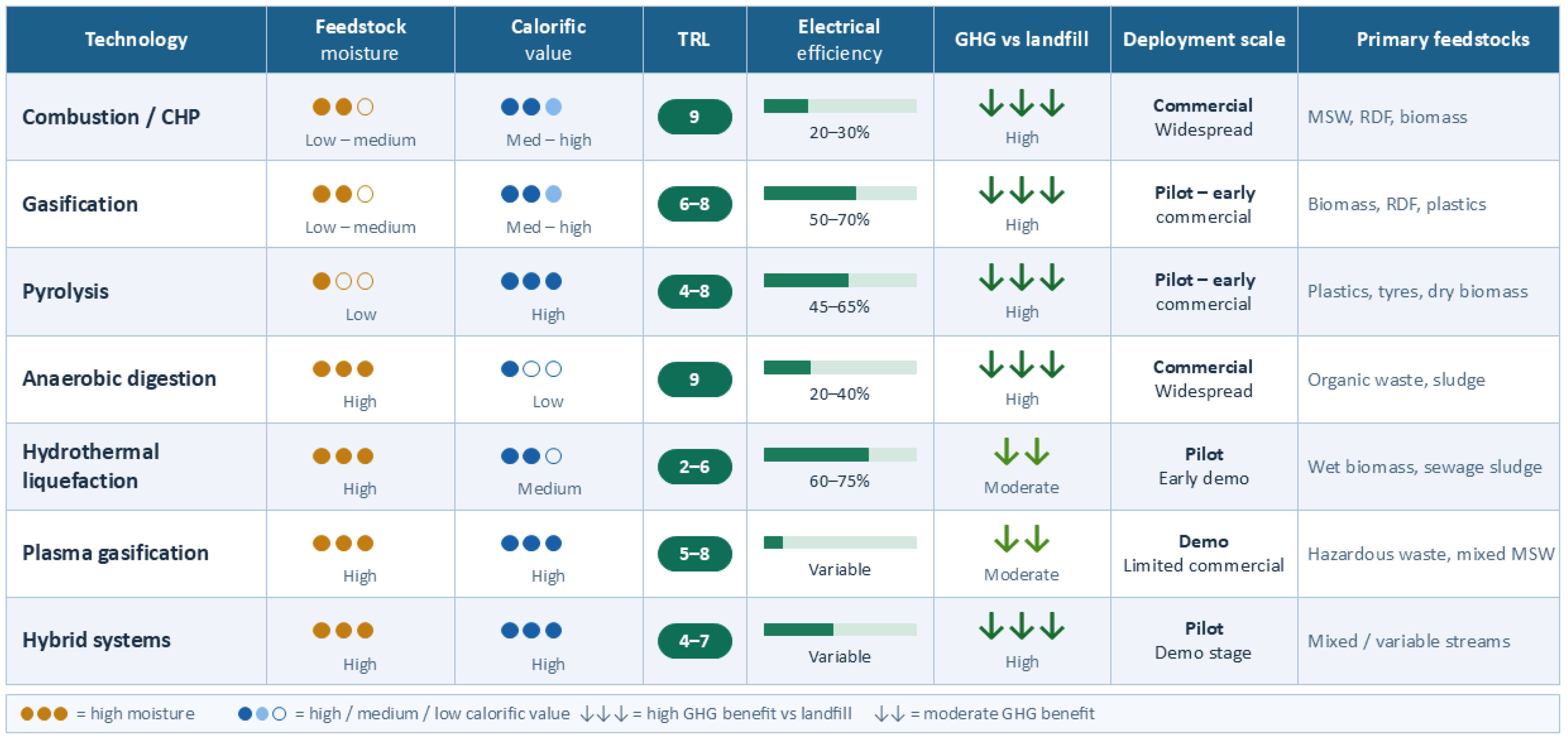
| Technology | Typical Feedstock | Main Conversion Principle | Typical Products | TRL/Deployment Status | Key Operational Advantages | Main Challenges/Limitations |
|---|---|---|---|---|---|---|
| Combustion/CHP | MSW, RDF, biomass residues | Complete oxidation at high temperature | Heat, electricity, bottom ash | TRL 9; commercially mature, widely deployed | High throughput; handles heterogeneous waste; established infrastructure | Emissions control; ash handling; limited product flexibility |
| Gasification | Biomass, RDF, plastic-rich waste, industrial residues | Partial oxidation or steam conversion | Syngas (CO, H2), char, tar | TRL 6–8; pilot to early commercial | Flexible product use; potential for fuels and chemicals; higher-value energy products than direct combustion | Tar formation; feedstock variability; gas cleaning requirements; process stability |
| Pyrolysis | Waste plastics, biomass, tyres, mixed carbonaceous waste | Thermal decomposition in absence of oxygen | Pyrolysis oil, gas, char | TRL 4–8; pilot to early commercial | Suitable for plastic-rich feedstocks; multiple product streams; chemical recovery potential | Product variability; feedstock contamination; upgrading requirements; scale-up uncertainty |
| Anaerobic digestion | Food waste, sewage sludge, agricultural residues, organic MSW | Microbial degradation under anaerobic conditions | Biogas (CH4, CO2), digestate | TRL 9; commercially mature | Effective for wet biodegradable waste; low operating temperature; established in wastewater treatment | Limited to biodegradable fractions; process sensitivity; digestate management |
| Hydrothermal liquefaction (HTL) | Wet biomass, sewage sludge, algae, high-moisture organic waste | Conversion in hot compressed water under subcritical or supercritical conditions | Bio-crude, aqueous phase products, gas, solid residue | TRL 2–6; early-stage to pilot/demonstration | Suitable for wet feedstocks; avoids energy-intensive drying; potential for liquid fuel production | High-pressure operation; corrosion; upgrading needs; limited large-scale deployment |
| Plasma gasification | Mixed hazardous waste, MSW, industrial residues | Extremely high-temperature plasma-assisted conversion | Syngas, vitrified slag | TRL 5–8; demonstration to limited commercial use | High conversion intensity; can treat difficult wastes; slag vitrification | Very high energy demand; high capital cost; operational complexity |
| Hybrid WtE systems | Mixed waste streams with separable organic and carbon-rich fractions | Integration of biochemical and thermochemical stages | Biogas, syngas, heat, electricity, fuels, residues | TRL 4–7; mostly pilot/demonstration | Improved resource recovery; better handling of complex waste streams; system-level optimisation | Integration complexity; control requirements; higher capital and operational costs |
| Feedstock Type | Operating Conditions | Energy Efficiency (%) | Main Products | Notes | |
|---|---|---|---|---|---|
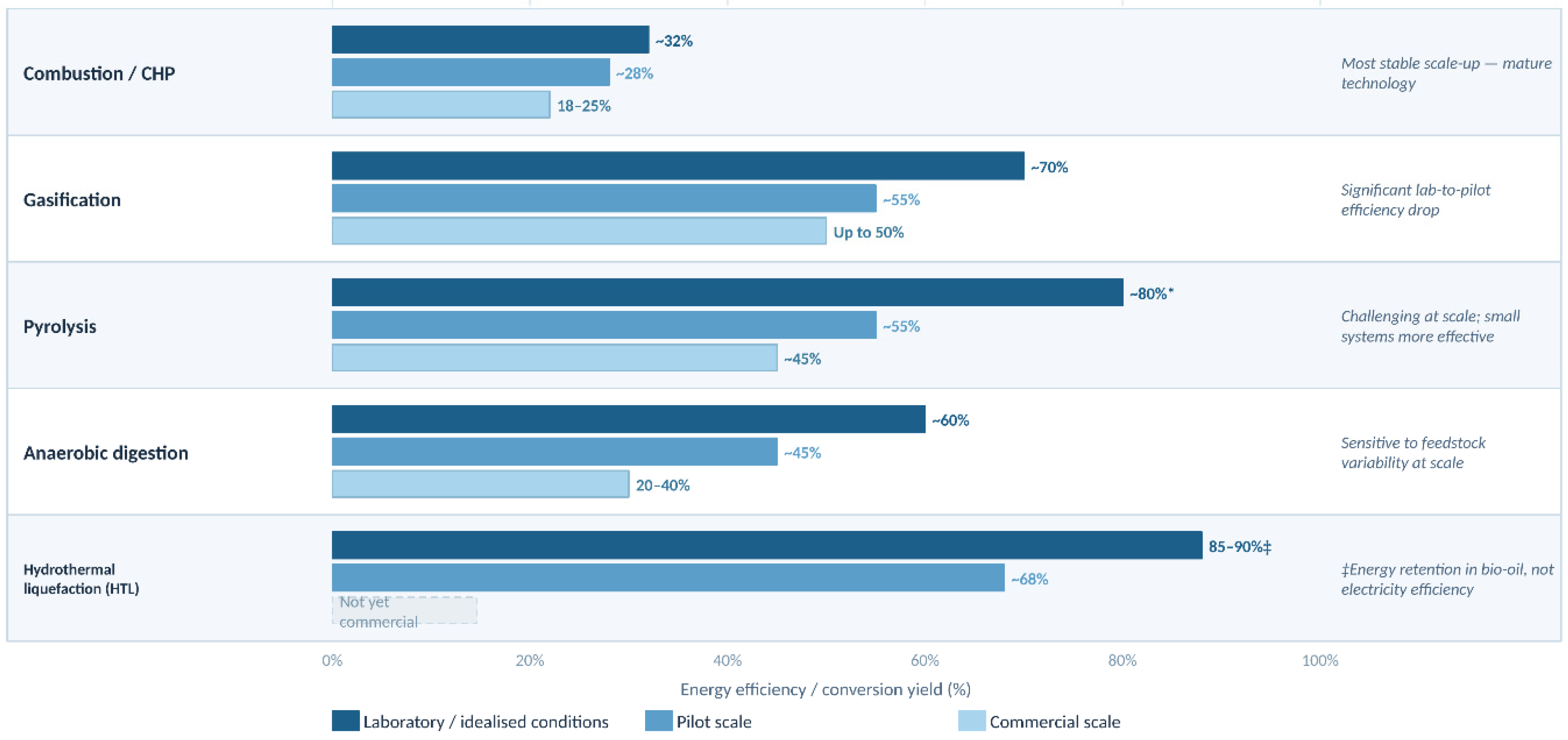
| Combustion (CHP) | MSW | Commercial scale | 20–30 (electric); 60–80 (CHP) | Heat, electricity | Mature, stable; CHP efficiency increases significantly with district heating integration |
| Gasification | Biomass/RDF | 700–1000 °C | 50–70 | Syngas (H2, CO) | Tar formation is a key operational challenge affecting downstream efficiency |
| Pyrolysis | Plastics/biomass | 400–800 °C | 45–65 * | Oil, gas, char | Product distribution highly dependent on temperature, heating rate, and feedstock composition |
| Anaerobic digestion | Organic waste | Mesophilic/thermophilic | 20–40 (methane yield basis) | Biogas (CH4, CO2) | Sensitive to feedstock variability and process stability; values based on methane yield |
| Hydrothermal liquefaction | Wet biomass/sludge | 250–374 °C | 60–75 ‡ | Bio-crude | Early-stage technology; efficiency metric reflects energy retained in bio-oil, not electricity generation efficiency |
| Plasma gasification | Mixed waste | >2000 °C | Variable | Syngas, slag | High energy input limits net efficiency; high conversion intensity but energy demand constrains commercial viability |
| Technology | Main Emissions | Environmental Concerns | Mitigation Measures | Key LCA Consideration |
|---|---|---|---|---|
| Combustion/CHP | CO2, NOx, SOx, PM, dioxins, furans | Air pollution; bottom ash and fly ash disposal; residual trace pollutants | Flue gas cleaning; electrostatic precipitators; selective catalytic reduction; activated carbon injection | Biogenic vs fossil carbon fraction strongly influences net GHG outcome; system boundary selection determines overall assessment |
| Gasification | CO2, CO, tar, particulates, H2S | Tar handling; gas cleaning requirements; syngas impurities affecting downstream use | Syngas cleaning systems; tar cracking catalysts; cyclones and filters | System boundary selection significantly affects net emissions; tar removal efficiency critical |
| Pyrolysis | VOCs, CO2 (during product use phase) | Product upgrading impacts; potential VOC release during processing and end use | Condensation and upgrading control; emissions monitoring at point of use | Full lifecycle must account for emissions from end-use combustion of pyrolysis oil products |
| Anaerobic digestion | CH4 leakage, CO2 | Methane slip; digestate management; odour generation | Gas capture systems; sealed infrastructure; continuous real-time monitoring | Methane is approximately 86 times more potent than CO2 over a 20-year horizon; small leaks can offset climate benefits |
| Hydrothermal liquefaction | CO2, aqueous waste streams | Wastewater treatment requirements; energy-intensive processing at pressure | Process water recycling; heat integration to reduce energy penalty | High moisture content of feedstock reduces net energy benefit; early-stage LCA data limited |
| Plasma gasification | CO2, syngas impurities | Very high energy consumption; operational emissions from electricity use | Energy optimisation; integration with renewable electricity sources to reduce carbon intensity | Net GHG benefit highly sensitive to the carbon intensity of electricity source used to power plasma system |
| Aspect | Material Recycling | Energy Recovery (WtE) |
|---|---|---|
| Material value | Preserved; embedded value retained in product cycle | Lost after thermal or biochemical conversion |
| Energy recovery | Indirect energy savings from avoided primary production | Direct generation of heat, electricity, or fuels |
| Greenhouse gas impact | Generally lower for clean, well-sorted single-polymer streams | Depends strongly on system boundaries, carbon accounting method, and displaced energy source |
| Feedstock requirements | Requires clean, well-sorted, homogeneous streams | Can handle mixed, contaminated, and heterogeneous residual waste |
| Infrastructure needs | Sorting, collection, reprocessing, and end-market facilities | Thermochemical or biochemical conversion plants with emissions control |
| Flexibility | Limited by material type and market conditions | Higher for residual and non-recyclable fractions |
| GHG benefit order | Highest: mechanical recycling > chemical recycling by pyrolysis > chemical recycling by gasification > incineration | Lowest among recovery options; above landfill only |
| Role in waste hierarchy | Higher priority; preferred over energy recovery in EU waste hierarchy | Lower priority; appropriate only for residual fractions that cannot be recycled |
| Policy alignment | Required by EU waste hierarchy and circular economy targets | Permitted for non-recyclable fractions; subject to EU ETS inclusion from 2028 |
| Policy Driver | Influence on WtE Deployment | Key Implication for Net-Zero |
|---|---|---|
| Landfill taxes and bans | Encourages waste diversion from landfill toward WtE or recycling; strengthens economic case for WtE facilities | Reduces uncontrolled methane emissions from landfill; supports more controlled waste management; increases WtE project viability |
| Renewable energy incentives | Supports classification of WtE as renewable or low-carbon energy where biogenic fraction is significant; improves project economics | Eligibility depends on feedstock composition thresholds and national definitions of renewable; creates variability across jurisdictions |
| Carbon pricing (EU ETS, 2028 mandate) | Penalises fossil-derived CO2 emissions from WtE incineration; creates financial incentive for efficiency improvements | Incentivises CCS integration to offset fossil emissions; rewards high biogenic content feedstocks; increases operational costs for fossil-heavy waste streams |
| Recycling and circular economy targets | Limits available WtE feedstock by diverting recyclable fractions to material recovery; promotes waste segregation at source | Positions WtE as a residual waste solution only; requires robust pre-treatment and sorting infrastructure upstream of WtE facilities |
| Circular economy legislation | Requires material recovery to be prioritised before energy recovery under EU waste hierarchy; restricts WtE to non-recyclable fractions | Increases pre-treatment requirements; supports complementary role of WtE within circular systems rather than as primary waste management strategy |
| Infrastructure development policies | Enables system integration with district heating networks, hydrogen infrastructure, and CCS facilities | Supports CHP configurations and unlocks negative emission potential through biogenic CCS; requires long-term coordinated investment planning |
| Carbon accounting frameworks | Determines whether biogenic CO2 emissions are counted as carbon neutral or as net sources; methodology choice strongly influences LCA outcomes | Harmonised and transparent methodology required for consistent policy evaluation; results vary significantly across current national frameworks |
Disclaimer/Publisher’s Note: The statements, opinions and data contained in all publications are solely those of the individual author(s) and contributor(s) and not of MDPI and/or the editor(s). MDPI and/or the editor(s) disclaim responsibility for any injury to people or property resulting from any ideas, methods, instructions or products referred to in the content. |
© 2026 by the author. Licensee MDPI, Basel, Switzerland. This article is an open access article distributed under the terms and conditions of the Creative Commons Attribution (CC BY) license.
Share and Cite
Zein, S.H. Advanced Waste-to-Energy Technologies: Evidence, Scalability, and Implications for a Net-Zero Transition. Appl. Sci. 2026, 16, 4169. https://doi.org/10.3390/app16094169
Zein SH. Advanced Waste-to-Energy Technologies: Evidence, Scalability, and Implications for a Net-Zero Transition. Applied Sciences. 2026; 16(9):4169. https://doi.org/10.3390/app16094169
Chicago/Turabian StyleZein, Sharif H. 2026. "Advanced Waste-to-Energy Technologies: Evidence, Scalability, and Implications for a Net-Zero Transition" Applied Sciences 16, no. 9: 4169. https://doi.org/10.3390/app16094169
APA StyleZein, S. H. (2026). Advanced Waste-to-Energy Technologies: Evidence, Scalability, and Implications for a Net-Zero Transition. Applied Sciences, 16(9), 4169. https://doi.org/10.3390/app16094169