Article

Physics–Data-Driven Crashworthiness Design of Slotted Circular Tubes for Airdrop Cushioning Energy Absorption in Transport Vehicles

1
Key Laboratory of Traffic Safety on Track School of Traffic & Transportation Engineering, Central South University, Ministry of Education, Changsha 410075, China
2
Joint International Research Laboratory of Key Technology for Rail Traffic Safety, Changsha 410075, China
3
National & Local Joint Engineering Research Center of Safety Technology for Rail Vehicle, Changsha 410075, China
*
Author to whom correspondence should be addressed.
Appl. Sci. 2026, 16(8), 4005; https://doi.org/10.3390/app16084005
Submission received: 27 February 2026 / Revised: 9 April 2026 / Accepted: 15 April 2026 / Published: 20 April 2026
(This article belongs to the Section Applied Industrial Technologies)

Abstract

When ground transportation is disrupted by natural disasters, airdropped rescue vehicles require energy-absorbing cushioning devices to prevent landing impact damage. Thin-walled circular tubes are preferred for their high energy absorption capacity and structural efficiency. However, to reduce platform force fluctuations and decrease residual stroke after compression, thereby avoiding unbalanced loading and ensuring post-landing mobility, slots are introduced into the tube wall, which renders the mean crushing force (MCF) difficult to predict accurately using conventional methods. To address this issue, this paper proposes a physics–data-driven method for predicting the energy absorption characteristics of slotted thin-walled circular tubes. The engineering scenario is introduced, followed by comparative validation via drop weight tests and impact simulations to obtain a sample set via design of experiments (DOE). A multi-layer perceptron (MLP) neural network then augments the samples to generate a dataset. Dimensional analysis yields candidate MCF prediction equations, whose forms and coefficients are determined via a physics–data-driven approach. Weighted graph encoding transforms the equation-solving problem into a graph optimization problem to reduce the computational complexity, and an improved differential evolution (DE) algorithm with a dual-adaptive mutation operator (DSADE) adjusts the parameters and accelerates convergence. The resulting MCF prediction formula, combined with drop test requirements as the optimization objective, achieves a simulation relative error below 5%. These parameters also satisfy engineering requirements in actual airdrop tests, confirming the method’s effectiveness in predicting the energy absorption characteristics of slotted thin-walled tubes.

1. Introduction

In recent years, with the increase in extreme weather events and frequent natural disasters, airdrop rescue vehicles have effectively overcome the limitations of ground-based rescue when disasters disrupt ground transportation, providing critical support for emergency rescue efforts in disaster-stricken areas. To prevent damage to internal equipment caused by the sudden impact and overload during direct landing, airdrop landing cushioning and energy absorption devices are required.
Common airborne absorbing landing cushioning devices include retro-rockets [1,2], inflatable airbags [3,4,5,6], and thin-walled structural cushioning devices [7,8,9,10]. To meet the application requirements in terms of stable energy absorption and ease of assembly/disassembly, thin-walled metal structures emerge as an excellent choice. Among these, thin-walled circular tubes are widely adopted as energy-absorbing buffers in rail vehicles, automobiles, and aerospace applications due to their simplicity, high strength, high stiffness, light weight, low cost, ease of fabrication, and stable, reliable energy absorption characteristics. This study employs such a thin-walled tube as the energy-absorbing device.
To control the axial crushing of thin-walled circular tubes, researchers have introduced initial defects including corrugations [11,12,13,14], grooves [15,16], stiffeners [17], and guide holes [18,19]. Daneshi et al. found that slotting reduces the buckling force non-uniformity and improves deformation control [20,21,22]. Natarajan et al. [23] studied groove depth effects on impact resistance. Wang et al. [24] proposed an enhanced machine learning method for geometric analysis. Montazeri et al. [25] simulated slotted tubes and validated them experimentally. Feli et al. [26] showed that increasing the notch width reduces the peak force and specific energy absorption. Overall, existing studies have systematically investigated the energy absorption characteristics of slotted circular tubes from multiple perspectives, including structural design, numerical simulation, and optimization methods, providing important guidance for optimizing the notch shape and parameters of thin-walled circular tubes in this study.
Based on the above research, researchers have further conducted systematic investigations into theoretical formulations. Alexander et al. [27] established an energy absorption theory for circular tubes, derived an MCF expression, and proposed the static plastic hinge concept, laying the theoretical foundation for thin-walled tube crashworthiness. Abramowicz and Wierzbicki [28,29,30] proposed the “superfolded element” theory for square tubes under axial loading. Xie et al. used multivariate nonlinear regression and backpropagation neural networks to predict energy absorption patterns. Giannopoulos et al. [31] considered alternative energy absorption schemes inspired by microstructural design, which offer new insights into energy absorption mechanisms. Yao et al. [32] employed dimensional analysis to relate the deformation displacement, energy absorption, and MCF to the impact mass and velocity. Duan et al. [33] developed a theoretical model for curved collapse, derived a bending deformation and energy absorption formula, and validated it experimentally. Xiang et al. [34] proposed a variable-thickness cylindrical tube, derived an MCF formula via analytical modeling, and validated it experimentally. Zhang et al. derived a crushing load prediction formula based on simplified folded-plate theory and validated it numerically. Overall, the existing studies have established various theoretical prediction formulas based on the MCF, which have been validated through experimental and numerical methods. However, these studies are primarily focused on plain circular tubes, and their applicability to slotted thin-walled tubes still requires further investigation.
In recent years, dimensional analysis or machine learning methods have offered new approaches to predicting the energy absorption characteristics of slotted tubes. Dimensional analysis can transform multivariate problems into relationships involving a few dimensionless numbers via the Buckingham π theorem, exponentially reducing the number of experimental runs and computational complexity [35,36,37], and it is widely applied in engineering [38,39,40,41]. However, dimensional analysis has limitations, such as ambiguous functional forms, empirical variable selection, and difficulties in modeling nonlinear systems, requiring parameter calibration. Data-driven approaches overcome these limitations by learning complex mappings, identifying key variables, and addressing high-dimensional coupling effects. Wu et al. [42] developed an LSTM-based model for mean crushing force prediction with errors below 5%. Kuleyin et al. [43] employed data-driven models to predict the mechanical behavior of thin-walled tubes under impact loading, and Wu et al. [44] applied machine learning to predict deformation modes during quasi-static compression. Together, these studies show that data-driven methods can effectively complement traditional analytical and numerical approaches. They can also incorporate dimensional constraints to ensure physical plausibility, offering advantages in resolving calibration challenges [45].
Therefore, this paper proposes a physics–data-driven approach to predicting the energy absorption characteristics of slotted circular tubes, validated in airdrop scenarios. Compared with conventional methods that rely on extensive numerical simulations, the proposed approach expands the dataset through data-driven techniques, significantly reducing the computational cost. Meanwhile, a predictive formula for the MCF is derived based on dimensional analysis, enabling a transition from simulation to equation design, thereby substantially improving optimization and design efficiency.
The subsequent sections of this paper are structured into stages: Section 2 first outlines the engineering application background of this study; Section 3 uses experimental design methods to construct a sample set and obtains the dataset of this paper through MLP neural network enhancement. Section 4 screens candidate equations through dimensional analysis and then uses weighted graphs to transform the problem into a graph optimization task. An adaptive differential algorithm is introduced to derive the average extrusion force formula for slotted thin-walled circular tubes, which is then optimized using a genetic algorithm. Section 5 uses a single-objective optimization method to obtain the optimal solution that meets the engineering requirements. The solution is verified through simulations and actual rescue vehicle airdrop tests, fully verifying the effectiveness of the proposed method in predicting the energy absorption characteristics of slotted thin-walled circular tubes. Finally, Section 6 summarizes the research results.

2. Problem Description

2.1. Engineering Background

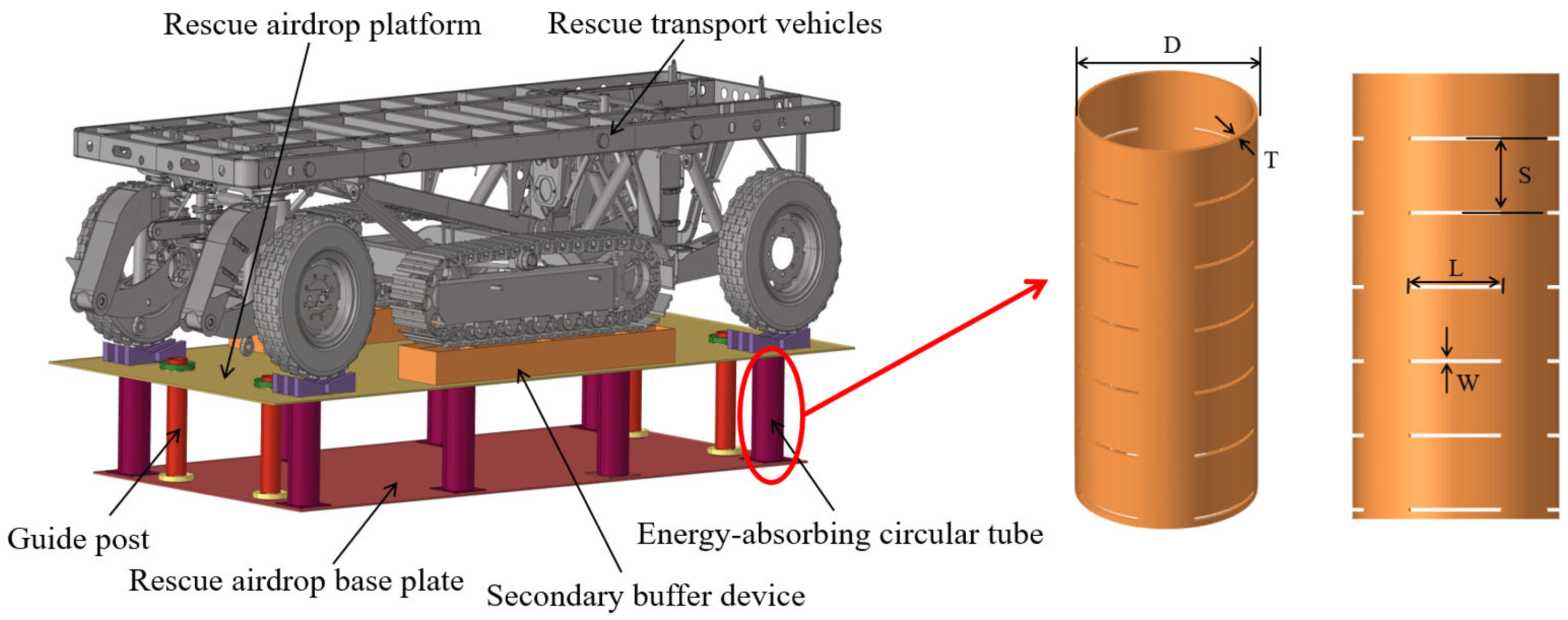
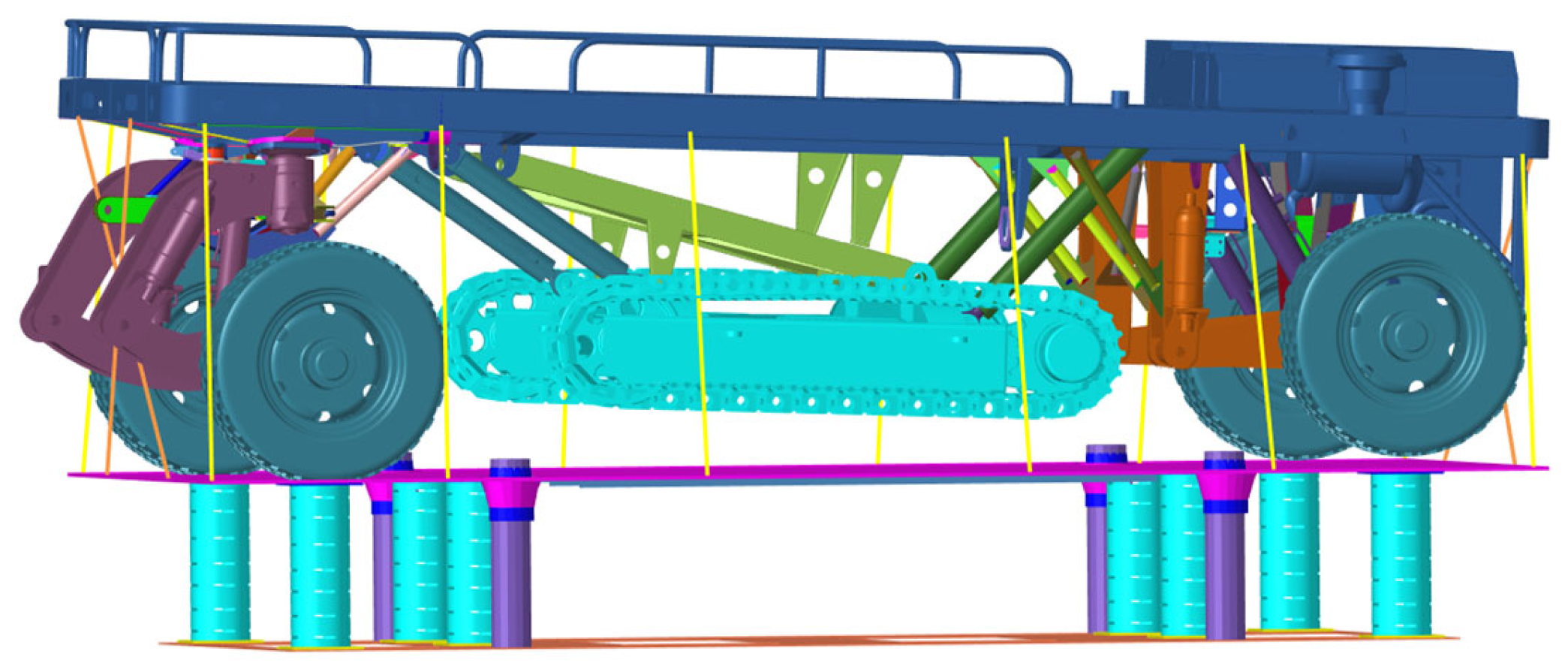
The energy-absorbing buffer device for rescue transport vehicles is a sandwich structure. The rescue vehicle is placed on the upper layer, with the wheels and tracks as the main load-bearing positions, each equipped with paper honeycomb secondary buffers. Energy-absorbing circular tubes are arranged between the sandwich layers under the wheels and tracks to absorb the landing impact energy. Guiding mechanisms are installed through the vertical gaps of the vehicle to ensure stable tube crushing. The overall design is shown in Figure 1.
As shown in Figure 1, the buffer device consists of eight thin-walled circular tubes. For ordinary tubes under axial impact, elastic deformation may cause uneven force distribution, preventing synchronous crushing, reducing energy absorption, and potentially damaging onboard equipment. Introducing slots can reduce force unevenness and improve synchronized operation. The key parameters of the slotted tubes are D, T, L, S, and W, representing the diameter, thickness, slot length, slot width, and slot spacing, respectively.

2.2. Crashworthiness Requirements and Fundamental Parameters

According to relevant industry standards, the airdrop rescue vehicle must satisfy the following requirements:
(1)
The initial vertical landing velocity must be ≥8 m/s, and it is reduced to ≤3 m/s after cushioning.
(2)
The landing deceleration must be ≥30 g for more than 25 ms, while the deceleration transmitted to the vehicle body after buffering must be ≤10 g.
(3)
After landing, the vehicle must be able to drive away after the simple disassembly of the buffer device.
The mechanical properties of the energy-absorbing buffer device are ultimately determined by calculating the magnitude of the impact acceleration transmitted to the transport vehicle after the device has actuated. The variable conditions that must be satisfied are the platform force F and the energy-absorbing travel S. After calculation and verification, the initial range of design variable values can be determined. Under ideal conditions, the relationship between the platform force and energy-absorbing travel is as shown in Equation (1):
F S = 1 2 m v 2 F = m a
In Equation (1), F is the platform force, S is the energy-absorbing stroke, m is the vehicle mass, v is the landing impact velocity, and a is the transmitted impact acceleration. Since m and v are known, the buffer dynamics can be derived from energy conservation and momentum. During landing, the initial kinetic energy is assumed to be fully converted into the deformation energy of the buffer device, so F × S follows a constant energy relationship, which further links a to S during buffering.
With constant impact energy, the transmitted deceleration mainly depends on the mean crushing load of the thin-walled circular tube. An excessively high mean load may limit buffering effectiveness, while an overly low mean load requires a longer stroke and tube length, increasing the risk of crushing instability, reduced energy absorption, or exceeded height constraints.
The test aims to ensure stable landing and normal operation. Therefore, the key indicator is the vertical impact acceleration transmitted to the vehicle. Computational analysis shows that an optimal platform force of about 640 kN (≈80 kN per tube) yields the most favorable transmitted acceleration and meets the standard requirements.

2.3. Methodology

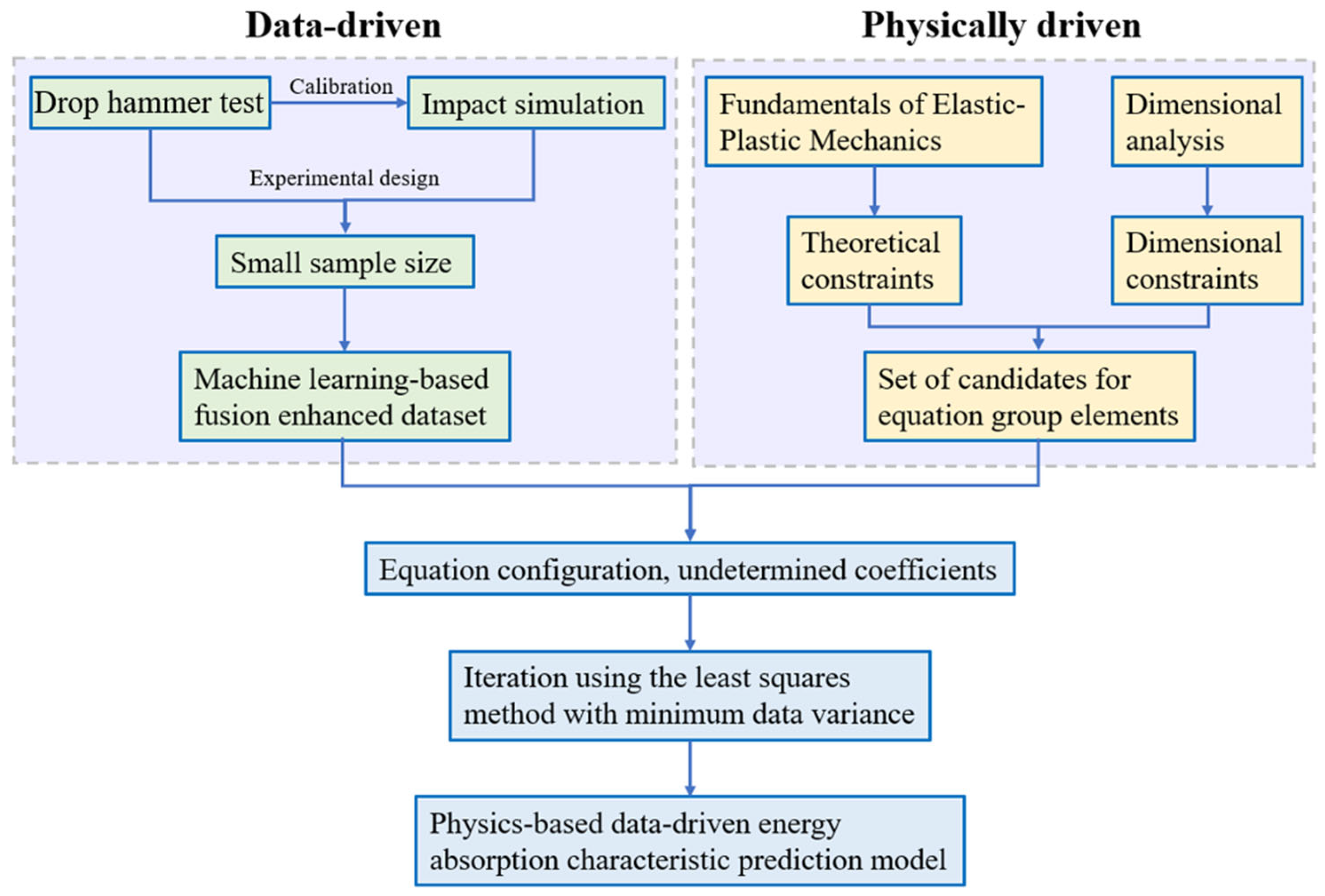
Based on the previous dynamic analysis, the buckling platform force of a single slotted thin-walled circular tube is about 80 kN. To efficiently determine tube parameters that meet the requirements, this study proposes a physics–data-driven model for predicting energy absorption characteristics. As shown in Figure 2, the model integrates physics-driven and data-driven approaches. The data-driven part calibrates impact simulations using drop hammer tests and then applies DOE to generate a small sample set, which is expanded through machine learning to form an enhanced dataset. The physics-driven part derives theoretical and dimensional constraints from elastic–plastic mechanics and dimensional analysis to construct candidate equation components. By combining both approaches, the equation structure and coefficients are identified, and the final prediction model is obtained via differential evolution with data variance minimization.

3. Dataset Generation

3.1. Establishment of Finite Element Models and Experimental Verification

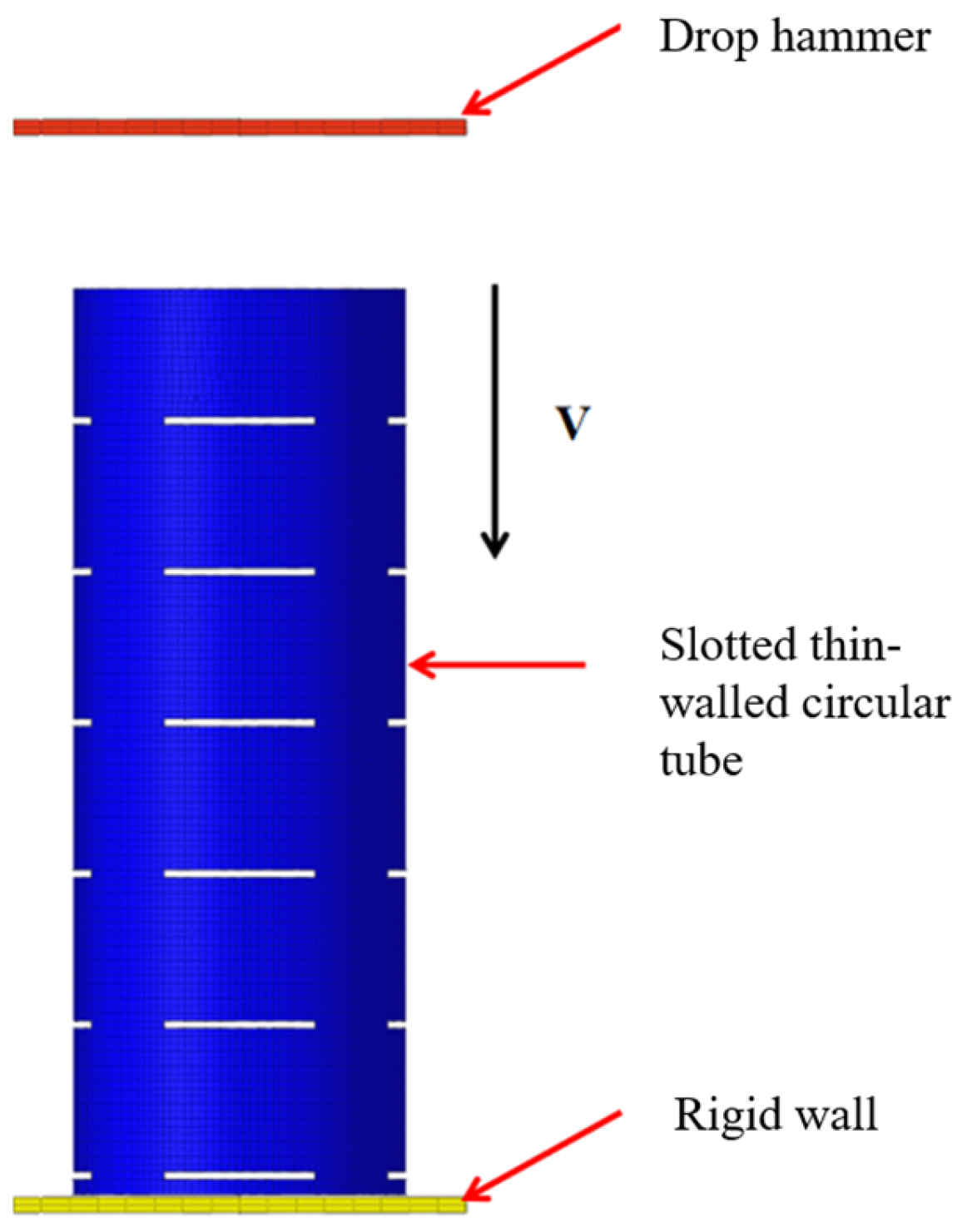
Numerical simulation was performed using the nonlinear finite element software LS-DYNA 2022, as shown in Figure 3. The finite element model consists of the following components: a drop hammer, a thin-walled circular tube, and a rigid wall. The energy-absorbing circular tube of the energy-absorbing structure is composed of a series 6 aluminum alloy, simulated in LS-DYNA using material number 24 *MAT_PIECEWISE_LINEAR_PLASTICITY, without considering the effect of the strain rate. The steel plate and rigid wall are treated as rigid bodies and simulated using material type 20 (*MAT_RIGID), with specific material parameters as shown in Table 1. Both the steel plate and rigid wall are treated as rigid bodies, and the thin-walled circular tube and rigid wall are connected using a rigid-body-to-elastic-body connection (*Constrained_Extra_Node_set contact). The circular tube uses the “AUTOMATIC_SINGLE_SURFACE” contact algorithm for self-contact, while the circular tube and rigid wall use the “AUTOMATIC_SURFACE_TO_SURFACE” contact algorithm for contact with the rigid wall and falling hammer. The static friction coefficient is defined as 0.3, and the dynamic friction coefficient is defined as 0.2 [46]. The thin-walled circular tube was modeled using four-node quadrilateral shell elements, with the Belytschko–Tsay element formula (element type 2 in LS-DYNA) selected. This formula employs a conjugate rotating coordinate system and a full integration method. Five integration points were set along the thickness direction to accurately capture the elastoplastic bending behavior during the folding process. To ensure the accuracy of the numerical simulation, thin-walled circular tubes with shell element meshes of four different sizes were selected for a mesh convergence analysis. Table 2 compares the convergence results for different mesh sizes. The results indicate that a mesh size of 0.5 mm × 0.5 mm accurately captures the deformation behavior while keeping the computation time within an acceptable range.
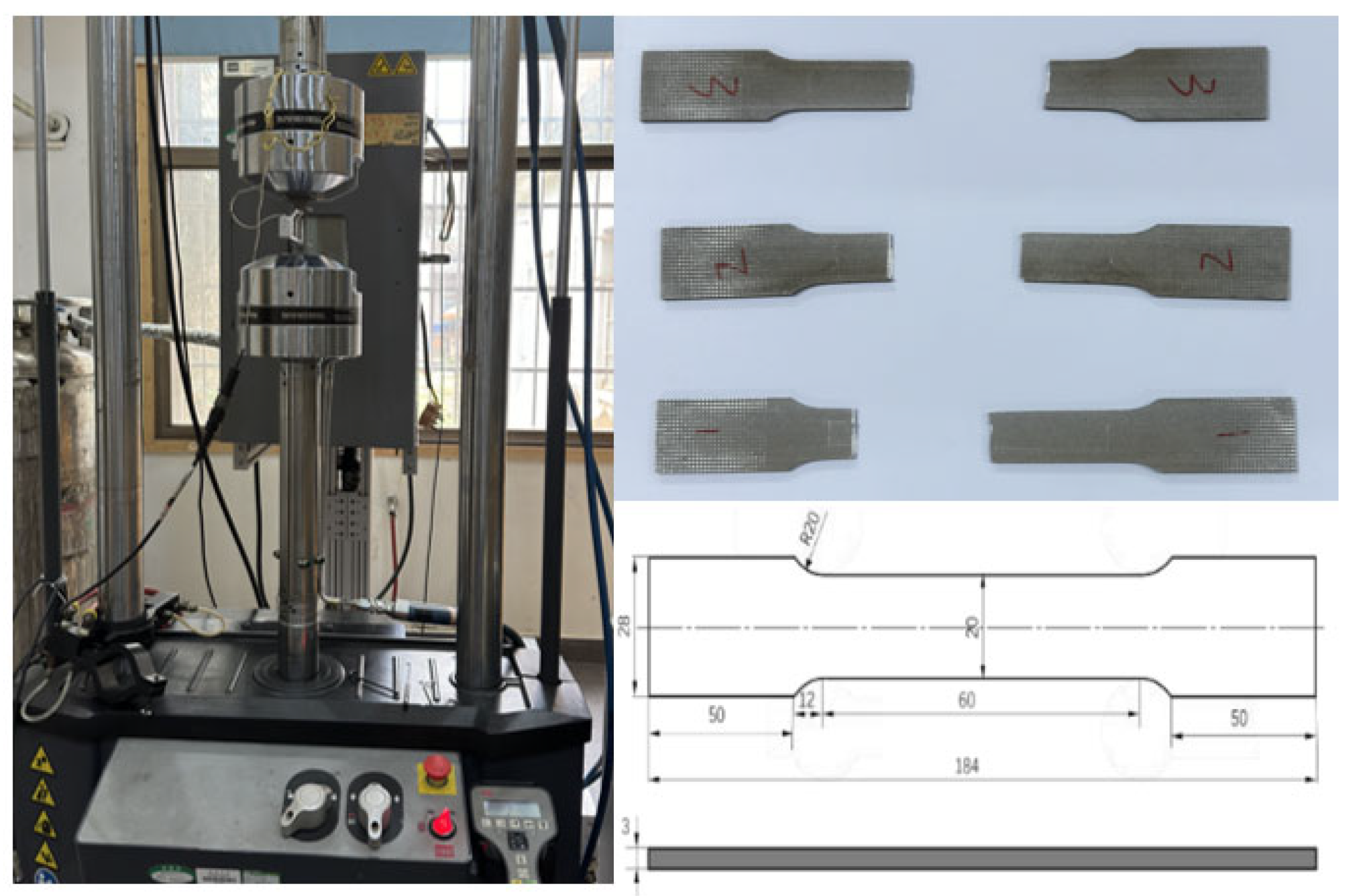
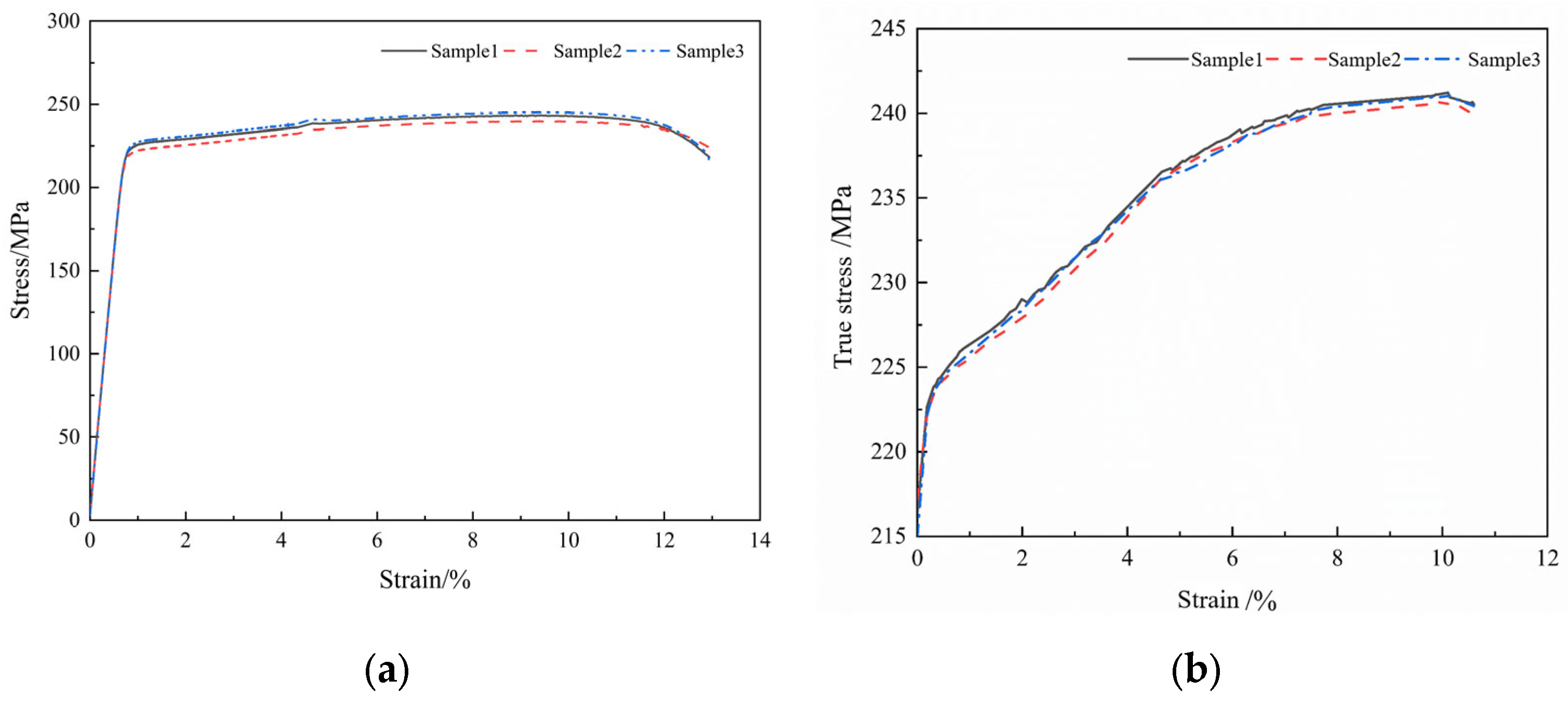
To obtain the mechanical properties of the material and apply them to the finite element simulation, tensile tests were conducted on the 6000-series aluminum alloy. Five quasi-static tensile tests were performed using an MTS 647 tensile testing machine, as shown in Figure 4. The stress–strain curve obtained from the average of the five tensile tests is shown in Figure 5a. The material type selected from the LS-DYNA library is “MAT_024 (Piecewise Linear Plasticity)”, which allows the true stress–strain curve to be defined as an offset table, with the true stress–strain relationship divided into two parts. The logarithmic true stress and strain at maximum load define the process before necking, while the power-law relationship defines the process after necking [47]. The obtained true stress–strain curve is shown in Figure 5b, and the material curves for the six-series aluminum alloy are shown in Figure 5 and Table 3.
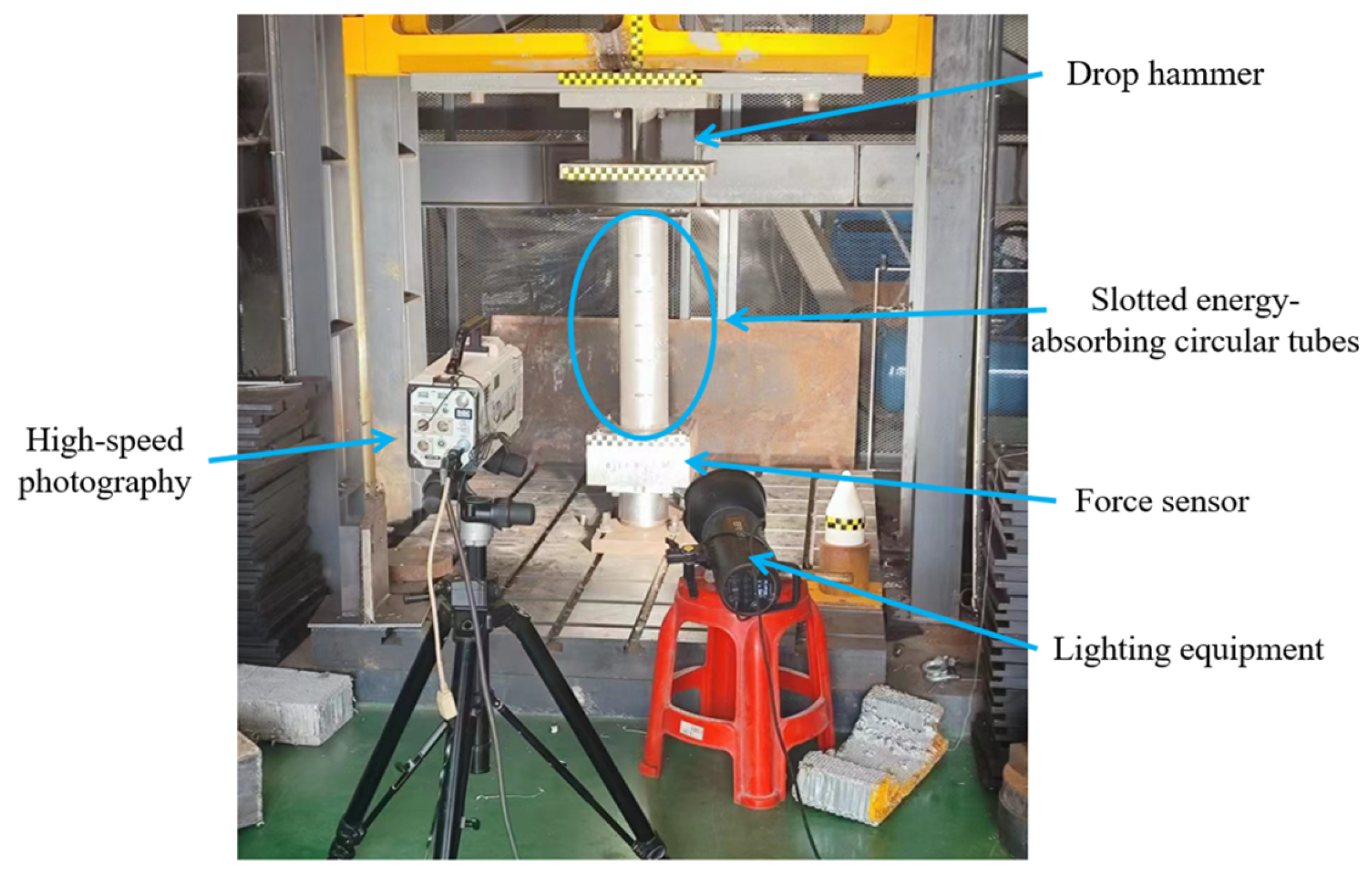
To ensure the accuracy of the finite element model, a drop hammer test was conducted on a circular tube in the Collision Laboratory of the Ministry of Education Key Laboratory for Railway Transportation Safety at Central South University. In the drop hammer tests, the thin-walled circular tube was placed on a rigid base plate with fixed support at the bottom. The top of the tube remained free to receive the impact from the drop hammer. No lateral constraints were applied to the tube, allowing free radial expansion during the crushing process. The slotted energy-absorbing circular tube was welded onto an aluminum plate and securely fastened to the load cell base using four M10 bolts. A drop hammer with a mass of 1000 kg was released from a height of 3.85 m to apply the impact load, providing theoretical impact kinetic energy of 37.73 kJ. No cushioning or guiding device was placed between the drop hammer and the top of the tube to ensure instantaneous load transfer. A load cell was installed beneath the base plate at the bottom of the tube to record the force–time history during impact. The experimental setup is shown in Figure 6.
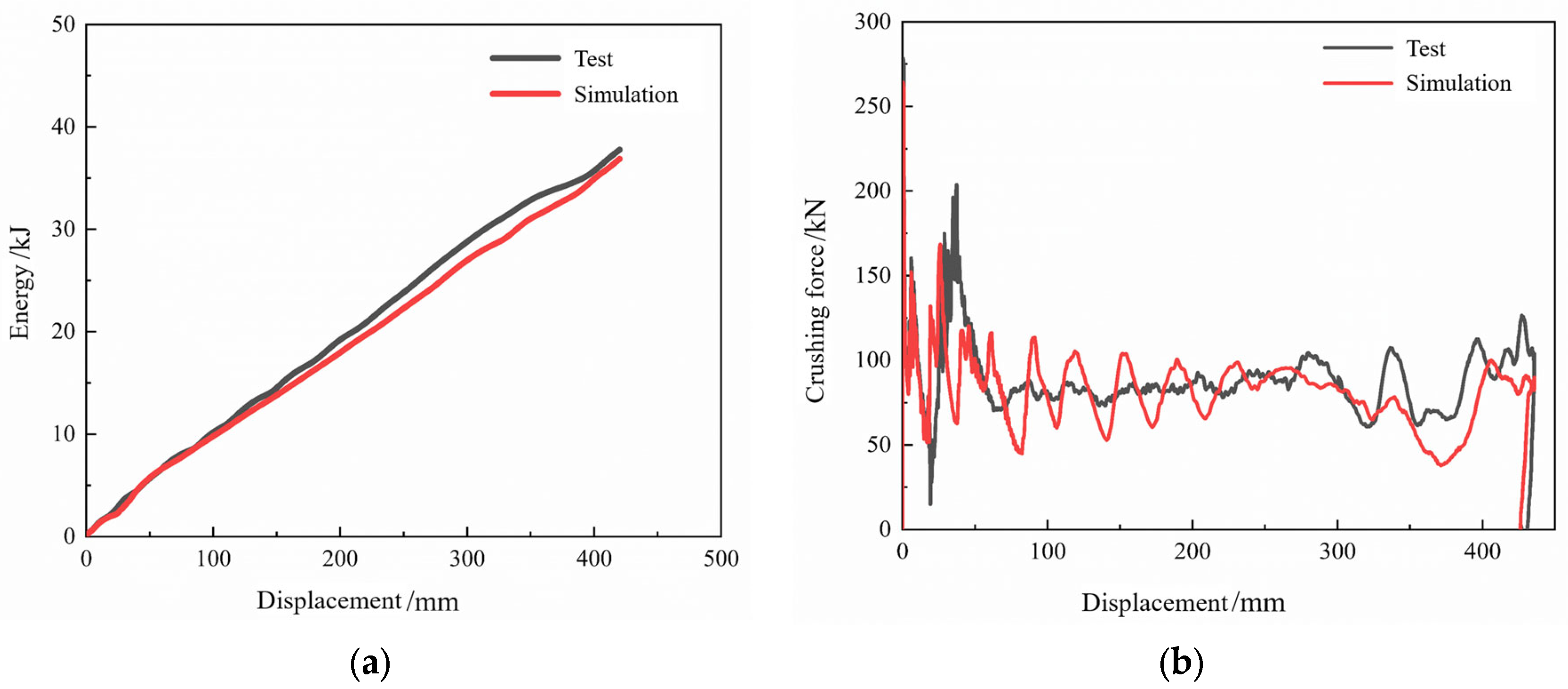
To validate the accuracy of the finite element model, the finite element simulation results were compared with the experimental results. A high-speed camera was used to record the entire collision process. The data collected by the high-speed camera were post-processed to obtain the displacement–time curve of the circular tube. The force–time curve of the circular tube during the entire collision process was obtained using a force sensor, from which the force–displacement curve was derived. The force–displacement curve was integrated to obtain the energy absorption curve. The MCF was calculated by dividing the energy absorption by the effective compression stroke. The comparison between the finite element simulation results and the experimental results is shown in Figure 7.
The simulation results show that the motion of the circular tube is consistent with the experimental results, and the force–displacement curve also matches the experimental data. This study focuses on the deformation displacement, energy absorption, and platform force. The comparison of the parameters between the experiment and simulation is shown in Table 5; the relative error between the simulation and experiment is less than 5%, indicating that this finite element model is suitable for further research.
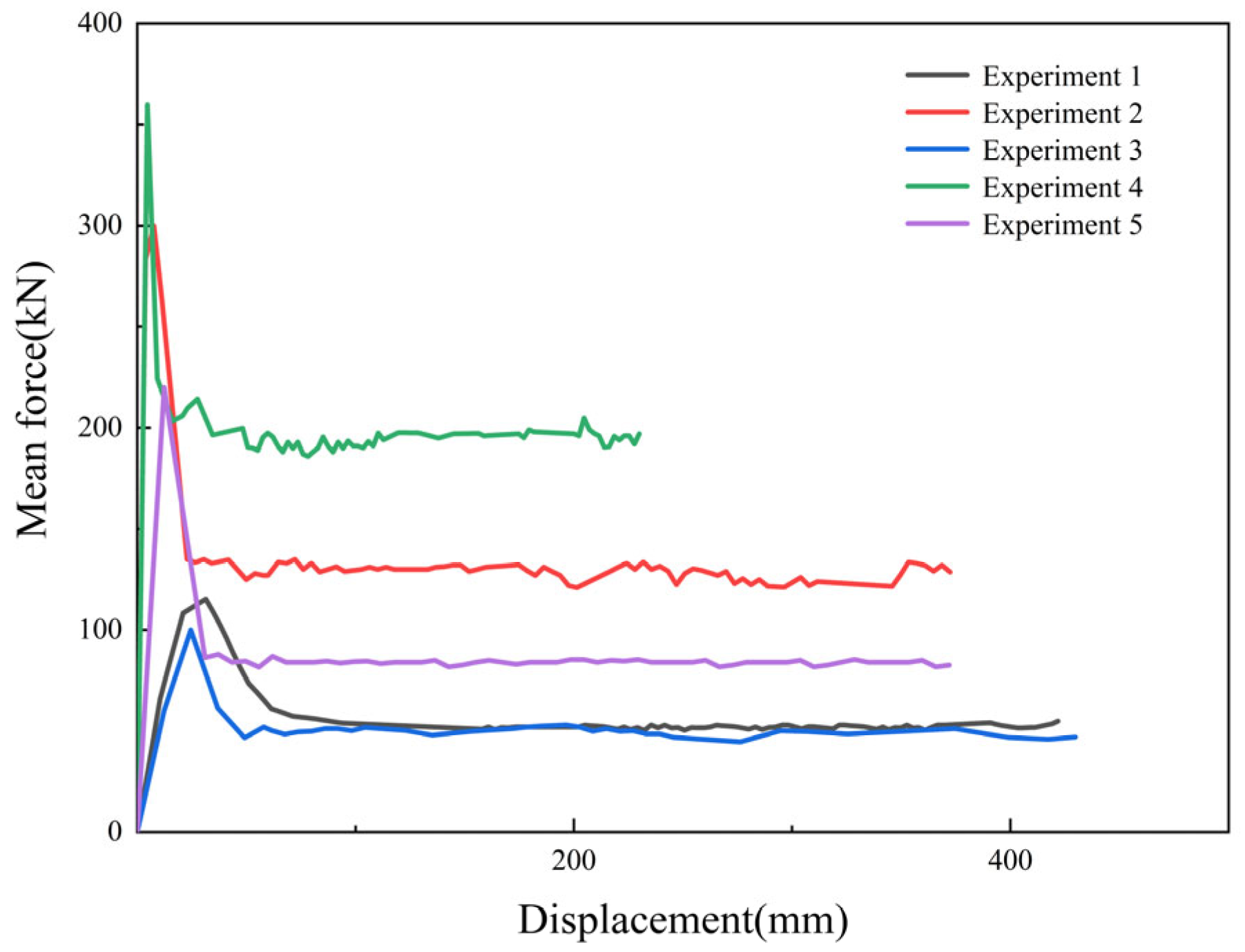
To validate the predicted results, a circular tube drop hammer test was conducted. The data collected by the high-speed camera were processed to obtain the displacement–time curve. The force–displacement curve was obtained from the data collected by the force sensor, and the energy absorption curve was derived by integrating the force–displacement curve. The MCF was calculated by dividing the energy absorption by the displacement. The drop hammer test curves for the circular tubes are shown in Figure 8, and the detailed parameters of the test tubes are listed in Table 4. The test results are compared with the predicted values in Table 5. As shown in Table 6, the relative errors between the predicted and test values for all groups are within 5%, verifying the reliability of the prediction model for further research.

3.2. Sample Based on Design of Experiments (DOE)

The accuracy in predicting the MCF for thin-walled circular tubes after slotting depends on whether the selected design variables adequately represent the performance of the thin-walled circular tubes. Randomly selected design variables may lead to inaccurate prediction results. DOE is widely used in optimization design. DOE can be defined as a test or series of tests in which the input variables of a process or system are purposefully altered to identify and observe the causes of changes in the output response. The objectives of DOE research are (1) to determine which factors have the greatest impact on the response; (2) to determine the optimal settings for input control variables to minimize variability in the output response while bringing it closer to the desired nominal value; and (3) to construct an approximate model that can serve as an alternative to computationally intensive real models.
During the DOE process, commonly used experimental design methods include fractional factorial design, central composite design, full factorial design, Hammersley’s method, and Latin hypercube sampling, among others. Among these, the Hammersley method is distinguished for its ability to generate points within a unit hypercube, exhibiting low discrepancy properties [48]. These sequences are meticulously designed to provide a more uniform distribution of points in multidimensional spaces compared to purely random sampling. This feature is advantageous for numerous computational tasks, including integration, optimization, and the simulation of stochastic phenomena. Consequently, a DOE approach based on the Hammersley method was employed to develop the dataset. Based on previous simulations and experiments, the parameter ranges for the circular tube diameter D, thickness T, slot length L, slot width W, and slot spacing S were determined, as shown in Table 7. A total of 500 samples were simulated by varying the input structural variables. The HyperMesh 2022 software provides robust capabilities for secondary development through the utilization of the Tcl/Tpl language as a development tool, thereby significantly enhancing work efficiency. Altair Compose and HyperView are specialized software tools designed for engineers and product developers, facilitating the effective analysis and visualization of diverse simulation results. These tools also offer an interactive programming environment that supports the reading of various computer-aided engineering result files. In this study, a parametric model is conducted by compiling TCL scripts, which are integrated with the Hammersley method to generate the sample space, and the LS-DYNA software is employed for solving. Following batch computation, Compose is utilized to compile the batch processing code for the calculation results to derive crashworthiness indicators and force–displacement curves. Concurrently, TCL scripts are recompiled using HyperView to batch-process and obtain deformation images. This methodology effectively enhances the data processing efficiency while ensuring the consistency of the structural response data results. To enhance the robustness of the model and prevent overfitting, the entire dataset was divided into training and test sets at a ratio of 8:2. The data distribution within each subset is also presented separately. The process of dataset partitioning entails the random shuffling of the 500 sets of results before their division.

3.3. Neural Network Dataset Augmentation

In the dataset augmentation stage, a multi-layer perceptron (MLP) is used to learn the mappings between the structural parameters and MCF. An MLP is a feedforward neural network composed of an input layer, one or more hidden layers, and an output layer, where nonlinear feature transformation is achieved through fully connected neurons and activation functions.
The network is trained using backpropagation with gradient-based optimization to update weights and biases by minimizing the loss between predictions and true values. In this study, the root mean squared error (RMSE) is adopted as the loss function (Equation (2)) to measure the deviation between the predicted and actual MCF. By minimizing the RMSE, the MLP improves the prediction accuracy and generalization ability.
L o s s R M S E = 1 n i = 1 n ( ( y i y ^ i ) 2
where y i denotes the true value of the i-th sample, y ^ i represents the model’s predicted value, and n denotes the total number of samples.
To determine the optimal network configuration, this study systematically examined the impacts of the hidden layer depth and neuron count on the predictive performance. During training, the iteration count was set to 1000, the batch size to 32, and the initial learning rate to 1 × 10⁻⁴. The training results are presented in Table 8. It can be observed that, while all network architectures achieved R2 values exceeding 90% on the test set, indicating overall strong performance, certain performance differences still exist between different structures. Notably, when the network architecture was configured with two hidden layers, each containing 32 neurons, the model achieved the best prediction performance on the test set, with a coefficient of determination (R2) as high as 98.4%, the text is displayed in bold in the table. Furthermore, metrics such as the MAE and RMSE for this architecture were also at relatively low levels, further indicating that this network configuration possesses good generalization capabilities while ensuring high-precision predictions.
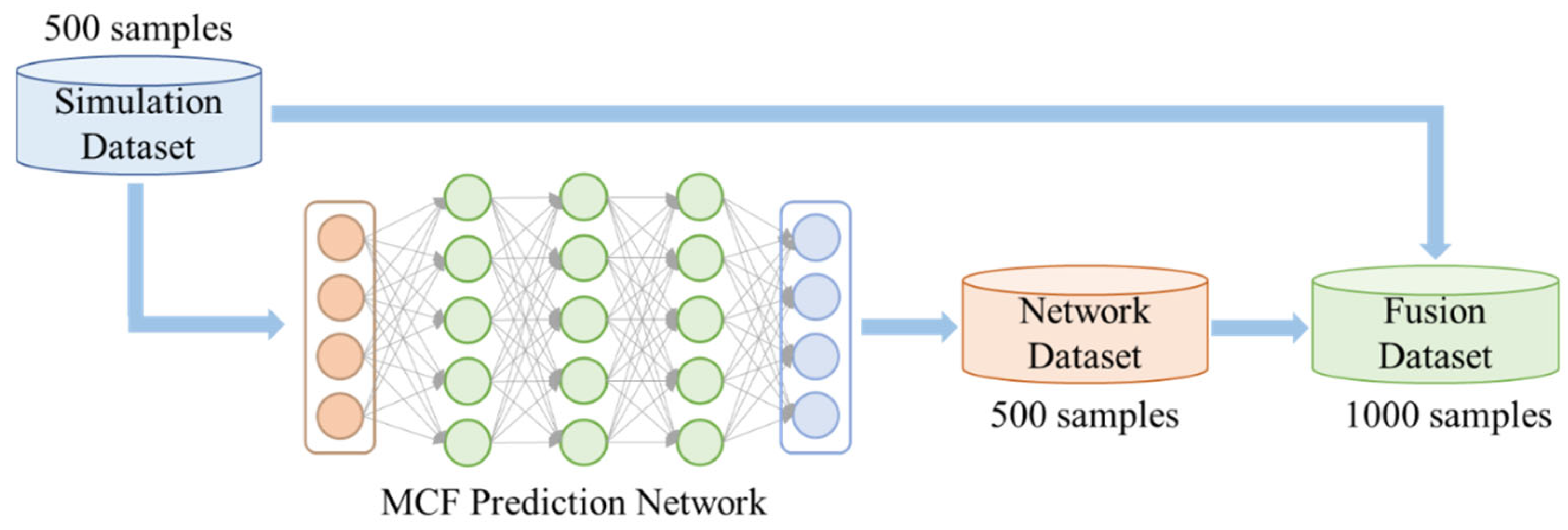
Building upon this foundation, this paper employs the constructed optimal MLP network to perform dataset augmentation, generating an additional 500 sets of high-quality samples. This expands the dataset scale and enhances the robustness of subsequent analyses. These augmented samples not only compensate for the original data’s limitations in quantity and distribution while improving the sample diversity but also mitigate the risk of model overfitting to a certain extent. This provides more robust data support for subsequent formula derivation and structural optimization, as shown in Figure 9.

4. Physics–Data-Driven Prediction of Energy Absorption Characteristics of Slotted Thin-Walled Circular Tubes

4.1. Determination of Candidate Sets for Prediction Equation Based on Dimensional Analysis

Dimensionless analysis is commonly used to test models when the equations related to process parameters are unknown. This paper employs this method to establish predictive formulas between the dimensionless MCF and material properties and geometric parameters. To obtain an approximate relationship between the MCF, material properties, and geometric parameters, since the elastic modulus has a minimal influence during plastic deformation, the yield stress is selected as the material parameter. The geometric parameters considered are the circular tube diameter (D), circular tube thickness (T), slot length (L), slot width (W), and slot spacing (S).
The Buckingham π theory serves as the foundation for most dimensionless analyses. According to this theory, any complete physical relationship can be expressed as a set of independent dimensionless products [44]:
f ( q 1 , q 2 , , q n ) = 0
Assume that   q n , q n 1 , , q n s + 1 is an independent fundamental physical quantity in group s. Then, there will be a set of real numbers a n , a n 1 , , a n s + , i , and the formula can be expressed as
q i = π i q n a n , i q n 1 a n 1 , i q n s + 1 a n s + 1 , i , i = 1 , 2 , , n s
Equation (5) can also be converted to
π i = q i q n a n , i q n 1 a n 1 , i q n k + 1 a n k + 1 , i
We select the MCF, yield stress, circular tube diameter D, thickness T, slot length L, slot width W, and slot spacing S, which can represent the collision results for parameter analysis. Assuming that the MCF is a function of the above physical variables, which describe the geometric shape and material properties of the structure, the following equation can be written:
f ( M C F , σ 0 , μ , D , T , L , S , W ) = 0
According to the requirement of dimensionality, it can be seen that the equation can be expressed in dimensionless form. In order to select a suitable dimension group (DG, collectively referred to as the π group), each physical variable is multiplied by its power to obtain a special dimensionless group:
D G = M C F a σ 0 b μ c D c T d L e S f W g
Since DG must be dimensionless, the values of the exponential parameters a, b, c, d, e, f, and g can be expressed using two basic dimensions for each physical quantity (the two basic dimensions used here are force F and length L). Substituting the results into Equation (8) yields
D G = ( F ) a ( F L 2 ) b ( μ ) c ( L ) c ( L ) d ( L ) e ( L ) f ( L ) g
According to the Buckingham π theory, when the number of physical variables is 7 and the fundamental dimension is 2, Equation (9) can be expressed using 5 dimensionless groups. Since DG is dimensionless, we can obtain
a + b = 0 c + d + e + f + g 2 b = 0
Let a = 1, b = −1, c = −1, and d = −1; then, we can obtain e = f = g = 0. Therefore, the first dimensionless group can be expressed as
π 1 = M C F σ 0 D T
Similarly, if we set a = 0, b = 0, c = 1, and d = −1, we can obtain e = f = g = 0. Therefore, the second dimensionless group can be expressed as
π 2 = D T
Similarly, other dimensionless groups can be obtained, as shown in Equation (12):
π 3 = L D , π 4 = W L , π 5 = S D ,
Since any two geometric parameters can be constructed into a dimensionless array, the set of equation system candidates can be generated from all possible dimensionless arrays. Here, we simplify the problem appropriately. Considering that the theoretical prediction model for thin-walled circular tubes indicates that the average load is primarily associated with material stress, the wall thickness, and the diameter, the most significant dimensionless array is π 1 = M C F σ 0 D T . Therefore, this dimensionless array is used as a fixed equation system element. The remaining dimensionless arrays can be constructed through arbitrary combinations of geometric parameters and serve as variable candidate equation system elements. In this paper, all possible dimensionless combinations of the geometric parameters D, T, L, W, and S were systematically considered, resulting in a total of C 5 2 = 10 possible parameter combinations. Thus, these 10 dimensionless arrays constitute the candidate set for equation system elements. Based on the aforementioned dimensional analysis process, the equation structure can be represented as follows:
M C F σ 0 D T = k U i a U j b U m c U n d               i , j , m , n U     i j m n
In the equation, k, a, b, c, and d are all undetermined parameters.

4.2. Configuration Coding Based on Weighted Graph

After determining the basic form of the equation configuration described above, the first task is to address the encoding representation of the equation variables to facilitate computer processing. In the aforementioned equations, the equation system elements are symbolic variables, while the undetermined coefficients are numerical variables. Therefore, an encoding method capable of simultaneously representing variables of two different dimensions is required.
In our previous research, weighted graphs were used to construct a unified representation of structural topological/shape/size variables, and this approach has proven to be an effective method. Therefore, this paper adopts the concept of weighted graphs to encode the variables of the equation configuration.
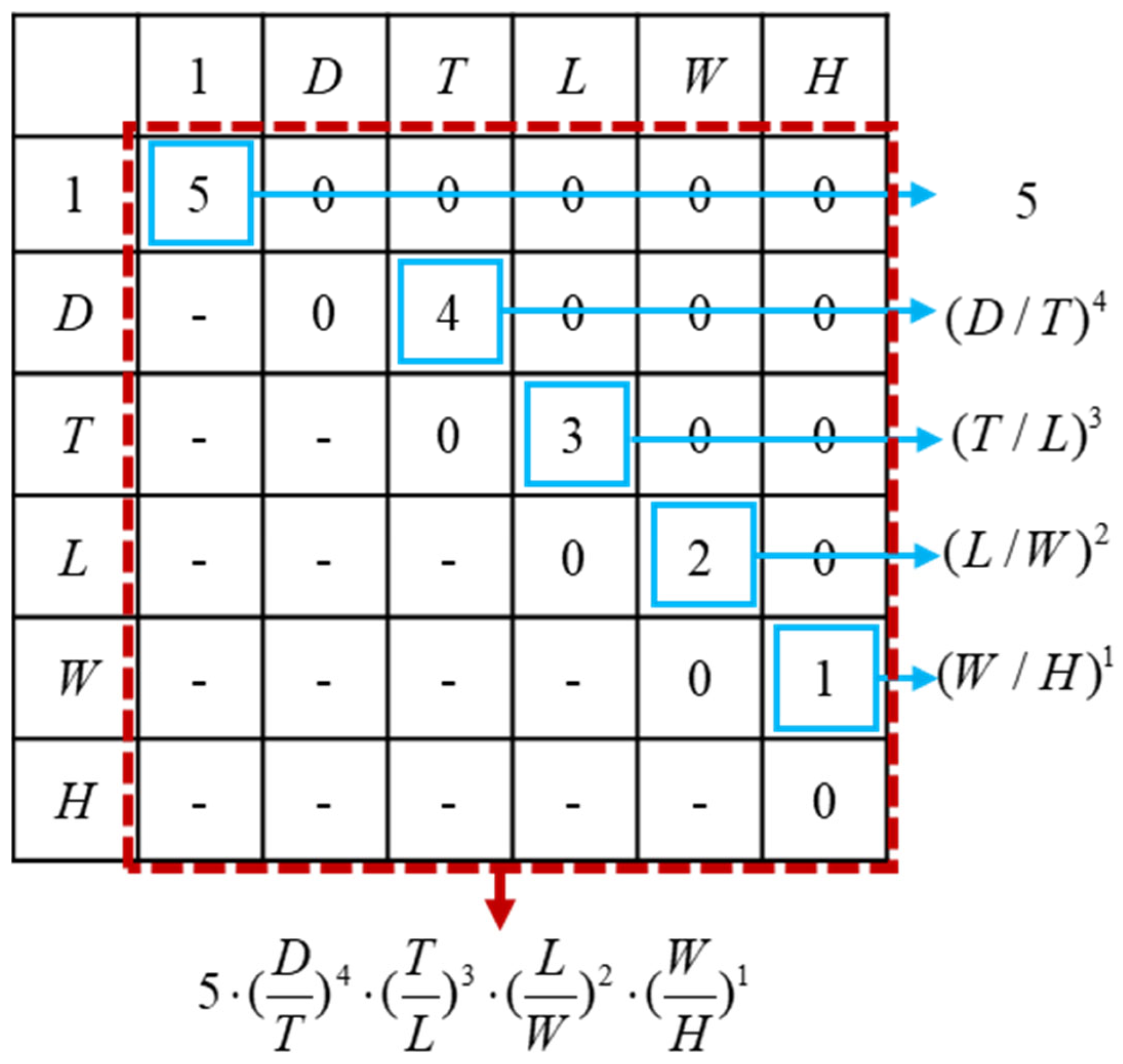
A graph G = ( V ( G ) , E ( G ) , D ( G ) ) with a number on its edge is called a weighted graph. The weight can be understood as a mathematical abstraction that represents an attribute belonging to an edge in the weighted graph. In this problem, the variable symbols {1, D, T, L, W, H} are chosen as the vertex matrix V ( G ) = { v 1 , v 2 , , v n } , and the equation elements can be treated as the adjacent combination of two arbitrary vertices, which is defined as the edge of the graph E(G). The matrix D = (dij) with size n × n is called a weighted adjacency matrix, where
d i j = k i j       v i   is   adjacent   to   v j 0           v i   is   not   adjacent   to   v j
Obviously, the element k i j can be treated as the power exponent belonging to the equation element formed by a particular combination of variables i and j.
An example explanation is displayed in detail in Figure 10. As mentioned in the previous section, the right side of the prediction equation includes a total of five unknown terms, which means that there should be five nonzero elements in the weighted adjacency matrix. For each nonzero element, the row and column in which it is located determine the variable combination that constitutes the term of the equation, and its value represents the corresponding power exponent. Therefore, according to the location and value information indicated in the above weighted adjacency matrix, the term combinations of the prediction equation are well represented and organized by the weighted graph model.

4.3. Determination of Coefficients Based on Dual Self-Adaptive Differential Evolution

4.3.1. Algorithm Description

Based on the weighted graph obtained from weighted graph encoding using the preceding equation, the optimization problem of the platform force prediction formula can be regarded as a graph optimization iterative solution problem. This paper adopts a novel genetic algorithm (GA) with dual-adaptive mutation operators, named DSADE, and applies it to the graph optimization problem [49].
The differential evolution (DE) algorithm was first proposed by Storn and Price (Storn 1996) and has been widely studied and extended due to its simple structure and strong global search capabilities [50]. To achieve rapid convergence in the DSADE algorithm adopted in this paper, the “DE/target-to-best” strategy is introduced in the mutation phase, and a dual-adaptive mechanism is employed to dynamically adjust the parameters, thereby enhancing the algorithm’s search efficiency and robustness [51,52,53]. Additionally, an elite retention strategy is introduced in the selection phase to accelerate the convergence speed. Previous studies have also shown that this method has good application effects in complex optimization problems [54,55,56,57]. However, the DSADE algorithm has certain limitations. Like most evolutionary algorithms, it does not guarantee convergence to the global optimum for nonconvex or highly nonlinear objective functions and is sensitive to the initial population size and adaptive parameter bounds.
Overall, the graph optimization process of DSADE includes five steps: initialization, mutation, crossover, selection, and convergence determination. In practical applications, the core parameters must first be set, including the population size (NP), scaling factor (F), and crossover probability (CR). In this study, the population size was set to 27, the maximum number of generations was set to 1000, the mutation strategy was set to 3, and the crossover fraction was set to 0.8.

4.3.2. Basic Iteration

Considering the randomness of the optimization results, the process is performed 10 times to obtain the optimal value. The results are shown in Table 9. It can be seen that the RMSEs of the optimization results are basically the same, but the expressions have different configurations and coefficients.
To visually demonstrate the optimization results, we combine like terms in the expression, as shown in Equation (15). The optimized expressions are basically consistent.
1000 M C F 0.12 σ 0 D T = 10.0433 × D 0.2075 × T 0.4068 × L 0.6544 × S 0.1100 × W 0.0699 1000 M C F 0.12 σ 0 D T = 10.0742 × D 0.2076 × T 0.4079 × L 0.6565 × S 0.1112 × W 0.0703 1000 M C F 0.12 σ 0 D T = 10.0254 × D 0.2078 × T 0.4066 × L 0.6550 × S 0.1108 × W 0.0703 1000 M C F 0.12 σ 0 D T = 10.0490 × D 0.2073 × T 0.4074 × L 0.6545 × S 0.1103 × W 0.0705 1000 M C F 0.12 σ 0 D T = 10.0501 × D 0.2068 × T 0.4074 × L 0.6550 × S 0.1114 × W 0.0705 1000 M C F 0.12 σ 0 D T = 10.0301 × D 0.2077 × T 0.4068 × L 0.6550 × S 0.1108 × W 0.0703 1000 M C F 0.12 σ 0 D T = 10.0377 × D 0.2079 × T 0.4069 × L 0.6556 × S 0.1109 × W 0.0702 1000 M C F 0.12 σ 0 D T = 10.0531 × D 0.2071 × T 0.4073 × L 0.6562 × S 0.1121 × W 0.0703 1000 M C F 0.12 σ 0 D T = 6.6946 × D 0.4485 × T 0.3435 × L 0.3822 × S 0.3435 × W 0.0663 1000 M C F 0.12 σ 0 D T = 10.0567 × D 0.2069 × T 0.4074 × L 0.6557 × S 0.1117 × W 0.0704
In order to analyze the influence of the DSADE parameters on the optimization results, different variation strategies and crossover probabilities were selected for parameter analysis.

4.3.3. Parameter Analysis

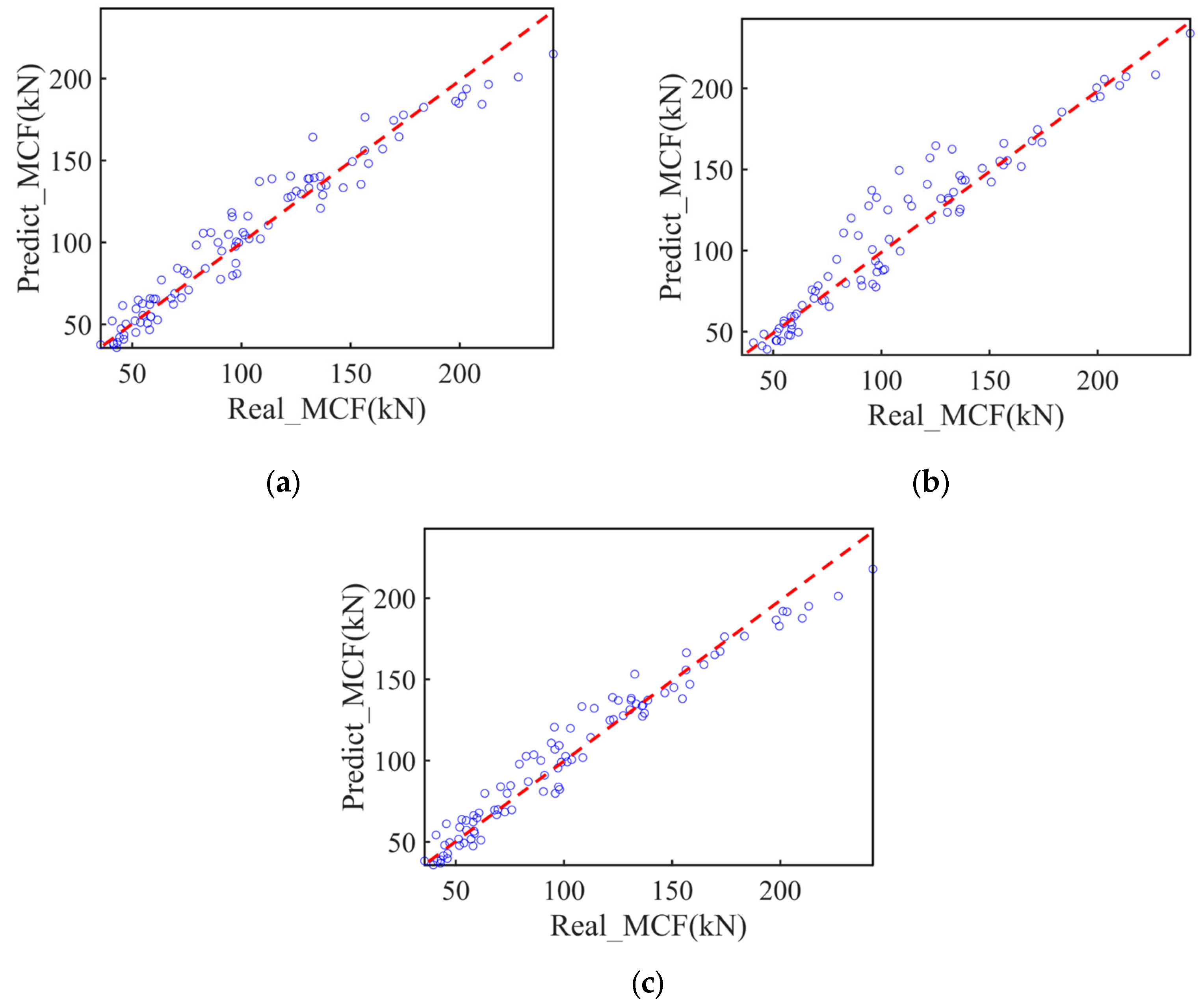
Iterative optimization is performed using three different mutation strategies under the condition that other parameters remain unchanged. Each variation strategy is optimized 10 times to obtain the optimal solution, as shown in Table 10. The expression is shown in Equations (16)–(18), respectively.
1000 M C F 0.12 σ 0 D T = 9.1743 × D 0.3287 × T 0.4109 × L 0.5195 × S 0.1494 × W 0.0707
1000 M C F 0.12 σ 0 D T = 39.4439 × D 0.1529 × T 0.7134 × L 0.7744 × S 0.2630 × W 0.0491
1000 M C F 0.12 σ 0 D T = 10.0531 × D 0.2078 × T 0.4074 × L 0.6554 × S 0.1105 × W 0.0703
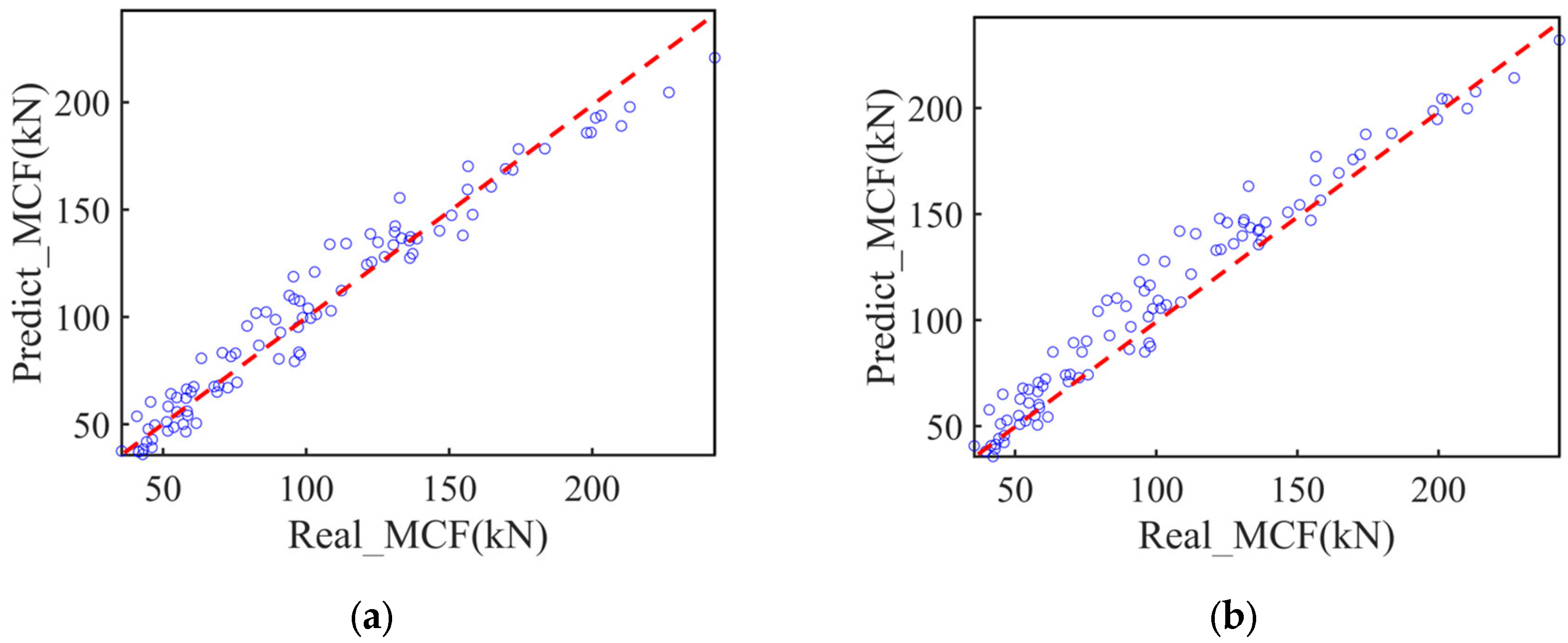
As shown in the results in Figure 11 and Table 11, the best results from the iterative optimization were obtained when using mutation strategy 3. Each crossover is optimized 10 times to obtain the optimal solution, as shown in Table 12. The expression is shown in Equations (19)–(23), respectively.
1000 M C F 0.12 σ 0 D T = 10.0503 × D 0.2891 × T 0.4210 × L 0.6942 × S 0.0485 × W 0.0644
1000 M C F 0.12 σ 0 D T = 10.7680 × D 0.2069 × T 0.4078 × L 0.6565 × S 0.1112 × W 0.0702
1000 M C F 0.12 σ 0 D T = 10.0530 × D 0.2083 × T 0.4073 × L 0.6574 × S 0.1118 × W 0.0700
1000 M C F 0.12 σ 0 D T = 10.0747 × D 0.2065 × T 0.4077 × L 0.6555 × S 0.1115 × W 0.0702
1000 M C F 0.12 σ 0 D T = 10.0451 × D 0.2080 × T 0.4072 × L 0.6542 × S 0.1093 × W 0.0703
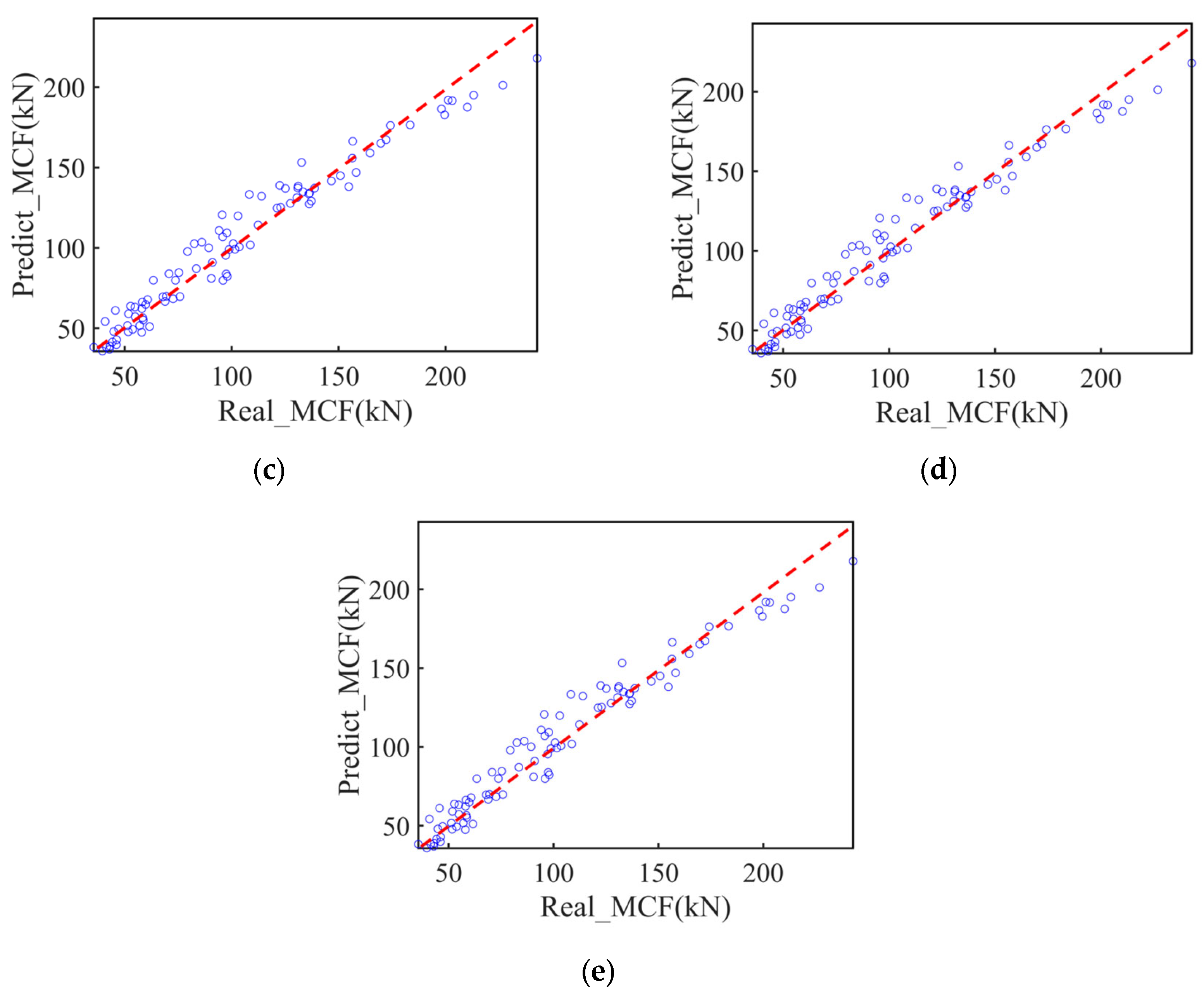
As shown in the results in Figure 12 and Table 13, it can be determined that the prediction formula for the circular tube platform force exhibits the smallest prediction error when the mutation strategy is set to 3 and the crossover probability is 0.9. Therefore, the final prediction formula for the circular tube MCF is as follows:
M C F = 0.01 × D 1.2080 × T 1.4072 × L 0.6542 × S 0.1093 × W 0.0703 × σ 0 * 0.12
To verify the validity of Equation (24), a dimensional analysis was first conducted. The results indicate that the dimensional terms are expressed in mm2 and the stress in MPa, satisfying the requirement of dimensional consistency. Subsequently, the experimental parameters listed in Table 4 were substituted into the equation for calculation, and the results were compared with the experimental data, as shown in Table 14. The comparison demonstrates that the calculated MCF agrees well with the experimental results, confirming the accuracy and reliability of the proposed equation.

5. Parameter Optimization

5.1. Algorithm Definition and Results

In the optimization design of slotted energy-absorbing thin-walled circular tube structures, a single-objective optimization method was employed to conduct systematic analysis and design, aiming to achieve optimal structural parameter configurations. Further optimization focused on the steady-state compression phase of the slotted thin-walled tube, targeting plateau force compliance with design requirements while maintaining fluctuations within reasonable limits. Specifically, the design objectives stipulate that the plateau force of the slotted thin-walled circular tube during steady-state compression must reach 80 kN, while its fluctuation amplitude must be strictly controlled within ±12% (as determined by simulation and experimental results). Based on these objectives, this paper adopts the minimization of the plateau force fluctuation amplitude M C F 80 as the optimization target.
The parameters D, T, L, S, W, and scorp (indicating the magnitude of fluctuation) were considered as design variables. The mathematical expression is shown in Equation (25).
min       M C F 80 s . t         200 mm D 240 mm 1.5 mm T 3 mm 80 mm L 120 mm 3 mm W 7 mm 90 mm S 110 mm 0 < s c o r p 12 %
The genetic algorithm is adopted because it is gradient-free, possesses strong global search capabilities due to its population-based mechanism, and can naturally handle discrete variables and complex constraints without requiring problem-specific reformulation. For these reasons, it is employed to optimize the parameters of the slotted circular tube. However, it also has certain limitations. Specifically, the genetic algorithm tends to yield local optima rather than the global optimum. The population size was set to 100, the maximum number of generations was set to 80, and the crossover fraction was set to 0.8.
The optimized results are shown in Table 15.

5.2. Simulation and Experimental Verification

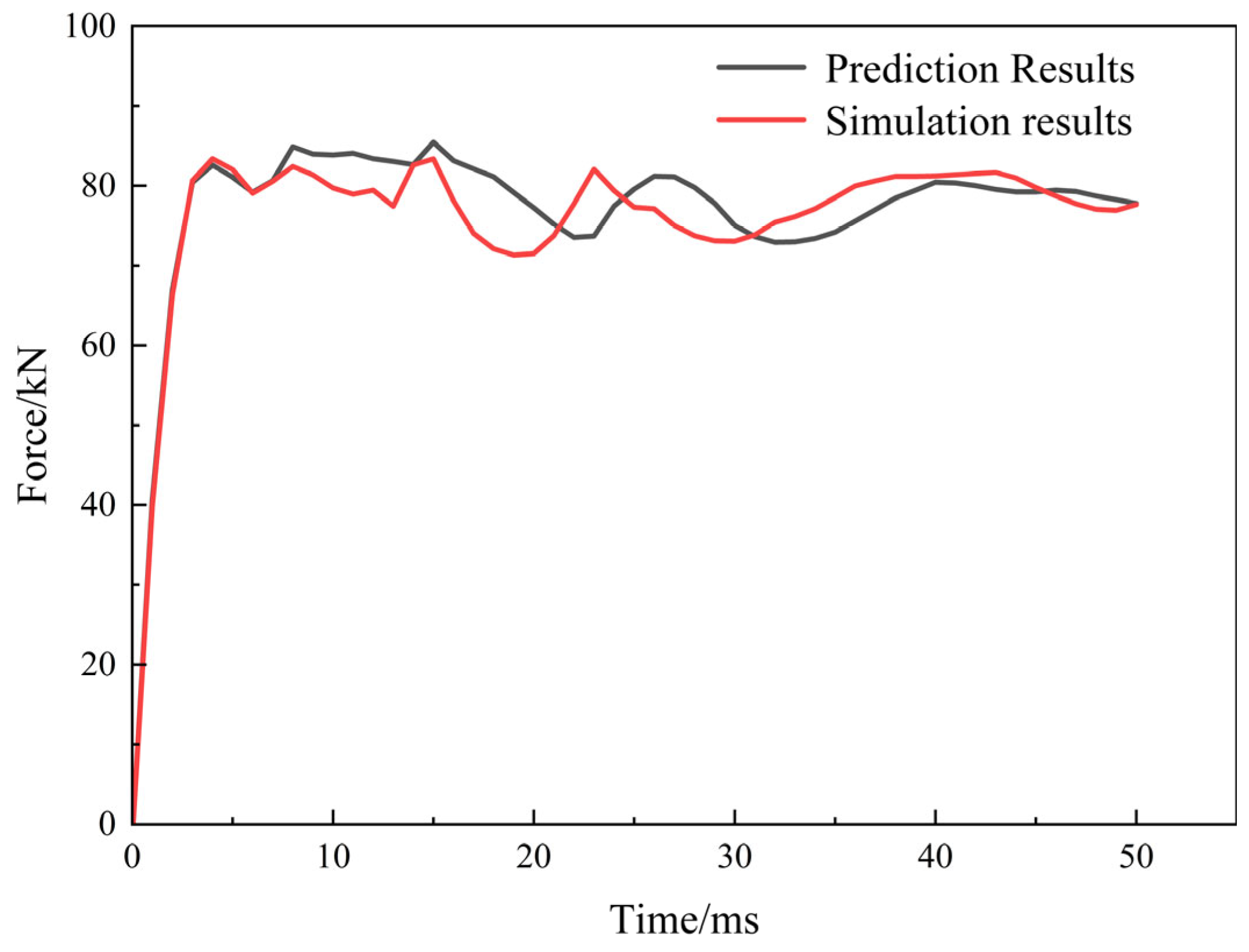
To further validate the results, finite element simulation was performed based on the optimized structural parameters. The comparison between the predicted results and the simulation results is shown in Figure 13.
Table 16 shows a comparison of the predicted results and simulation results under the same boundary constraints. The platform forces for the predicted results and simulation results are 81.5 kN and 78.8 kN, respectively, with a relative error of 3.4%. The ranges of the force fluctuations for the predicted results and simulation results are 7.71% and 7.92%, respectively, with a relative error of 2.6%. The results indicate that the relative error between the predicted and simulated results is within the engineering tolerance range, indicating that the results predicted using the method adopted in this section can be used for subsequent research.
To ensure the safety of the final simulated airdrop test, it is necessary to comprehensively assess the impacts of potential risk factors and conduct dynamic simulation analyses under airdrop test conditions prior to the formal test. Based on the simulation results, an evaluation of the safety of the final test should be performed, the simulation model is shown in Figure 14.
To this end, based on the formula for the average crushing force of a circular tube derived from the predictions in Section 4, we designed appropriate tube dimensions and a slotting method to meet the requirement of an average crushing force of 80 kN and incorporated them into a simulation model vehicle to verify their effectiveness.
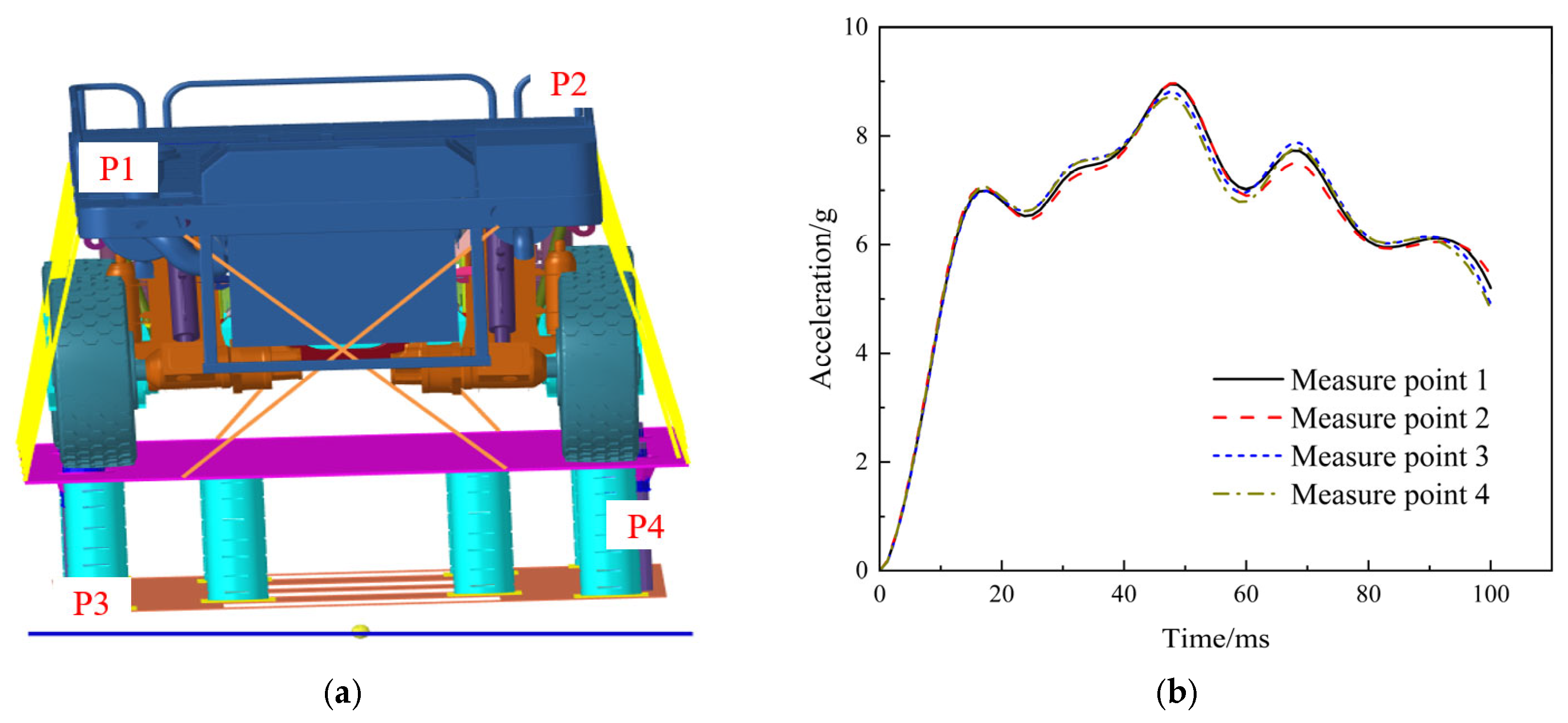
To evaluate the accuracy of the prediction results, a simulation was conducted using the operating conditions with the largest initial yaw angle of the vehicle body. Four acceleration measurement points were set up in the simulation, as shown in Figure 15a. As indicated by the acceleration results from these four points in Figure 15b, after adopting the predicted slotted thin-walled circular tube, the maximum acceleration transmitted to each measurement point on the airdropped rescue vehicle during impact was less than 10 g. This validates the effectiveness of the proposed prediction method from a simulation perspective.
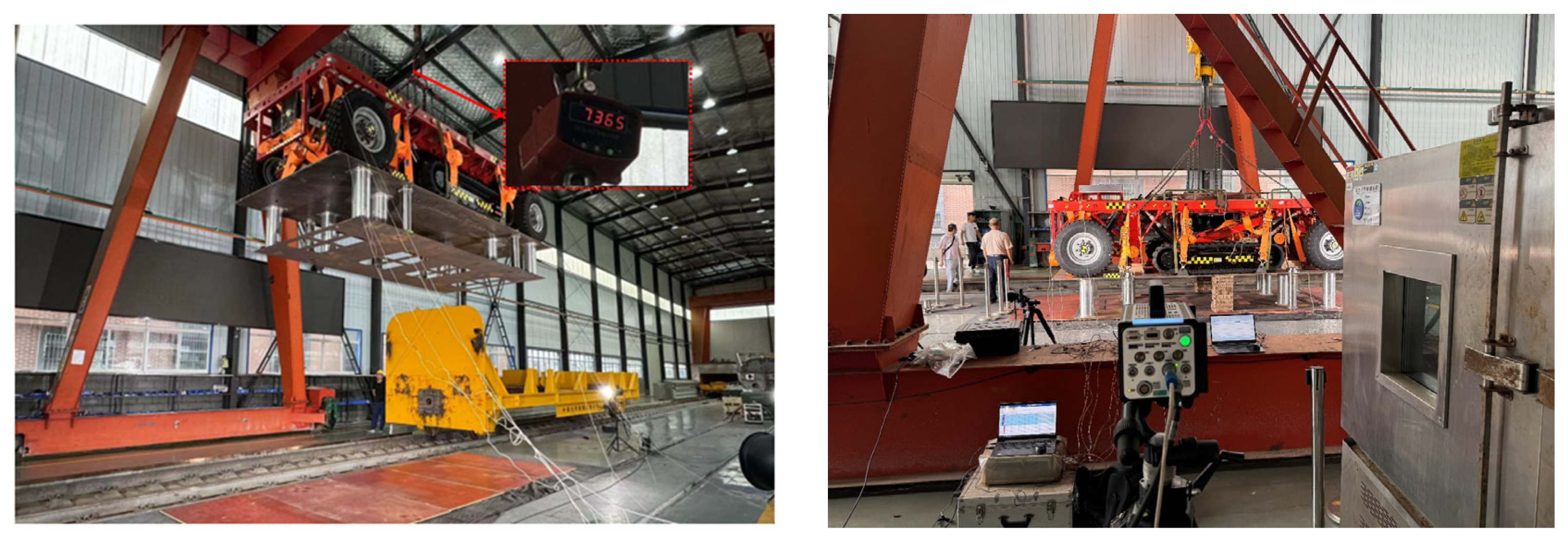
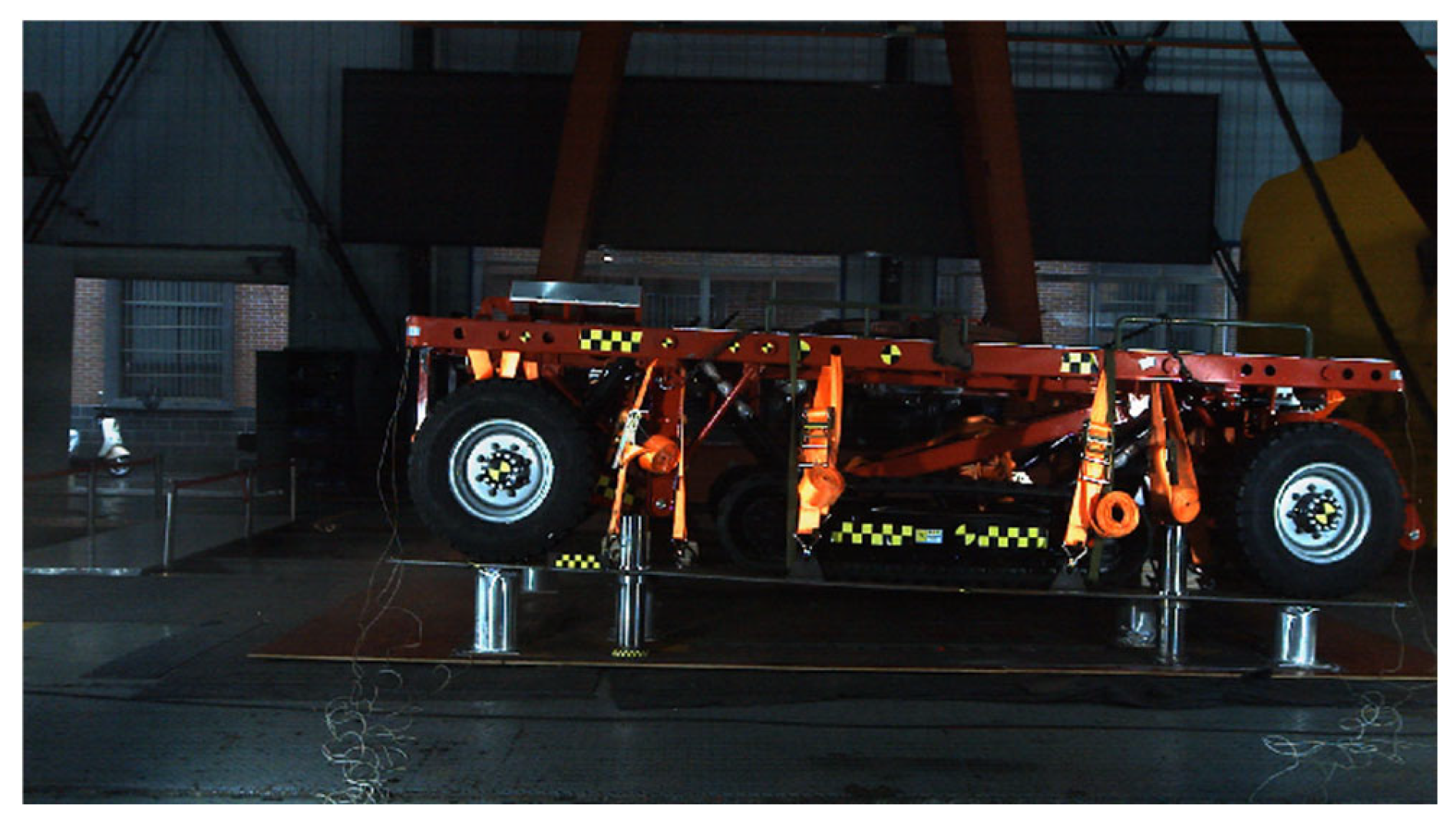
To lend greater credibility to the findings, this study also conducted drop tests on actual vehicles. The simulated airdrop test process is shown in Figure 16. The model vehicle is secured to the airdrop platform; then, a crane lifts it to a certain height, and the release mechanism is activated, causing the rescue vehicle’s airdrop platform, carrying the model vehicle, to accelerate downward in freefall.
The requirements for the landing simulation are that the landing speed of the cargo platform upon impact must match the actual landing speed during an airdrop, with a descent speed of 8 m/s and a drop height H of 3.2 m.
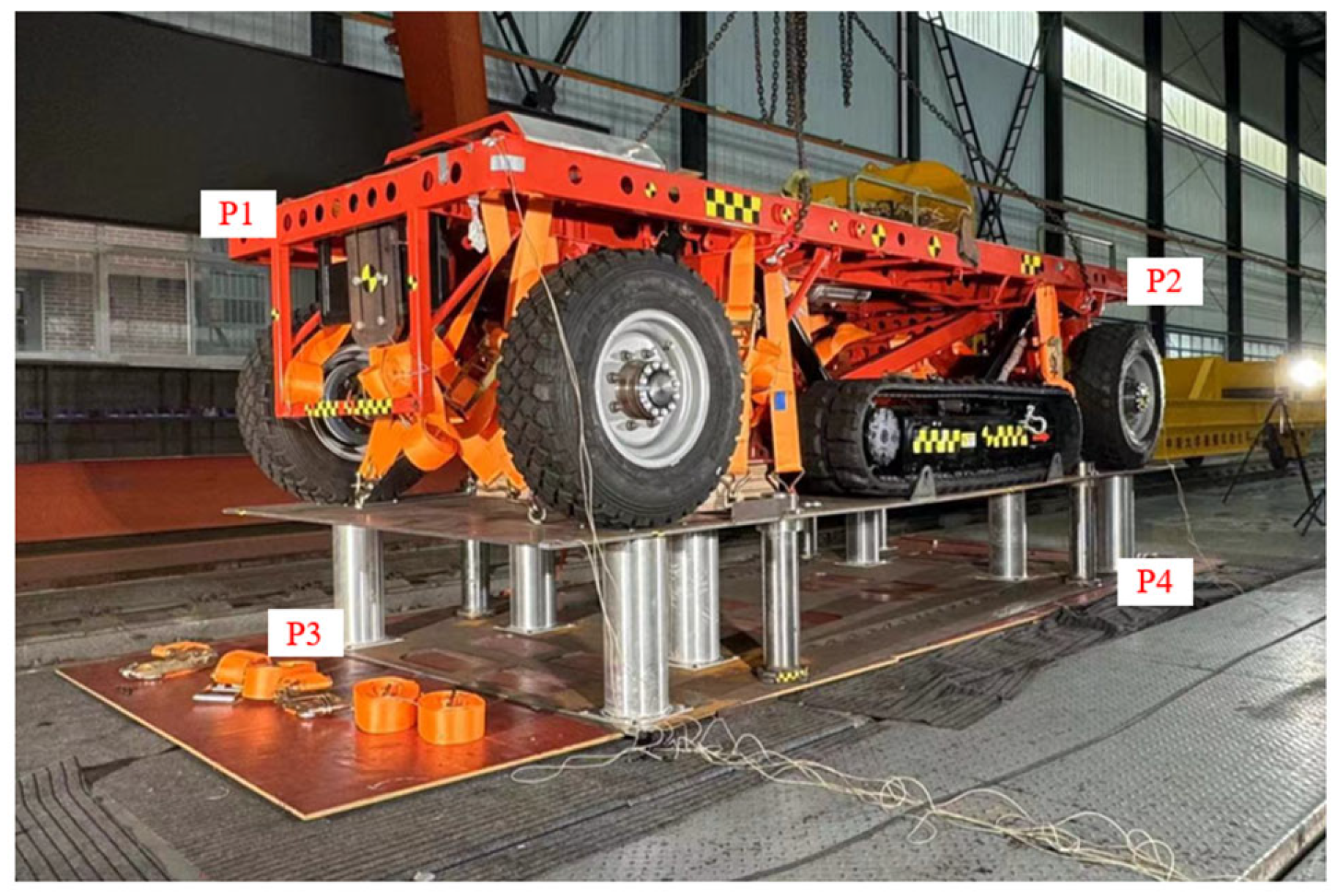
To measure the magnitude of impact overload acceleration experienced by some critical components of the rescue vehicle during the simulated airdrop experiment, and to verify the cushioning effect of the thin-walled circular tubes, acceleration sensors were placed around the rescue vehicle, the rescue airdrop platform, and the rescue airdrop base plate. These sensors recorded changes in impact acceleration at various detection points throughout the airdrop process. The acceleration measurement points are shown in Figure 17.
The post-experiment scene is shown in Figure 18. As can be seen from the figure, the impact kinetic energy generated by the freefall of the system is absorbed through the compression deformation of the thin-walled circular tube, and the rescue vehicle did not overturn during the entire fall process. Therefore, it is proven that the buffer energy-absorbing device in the system functions stably.
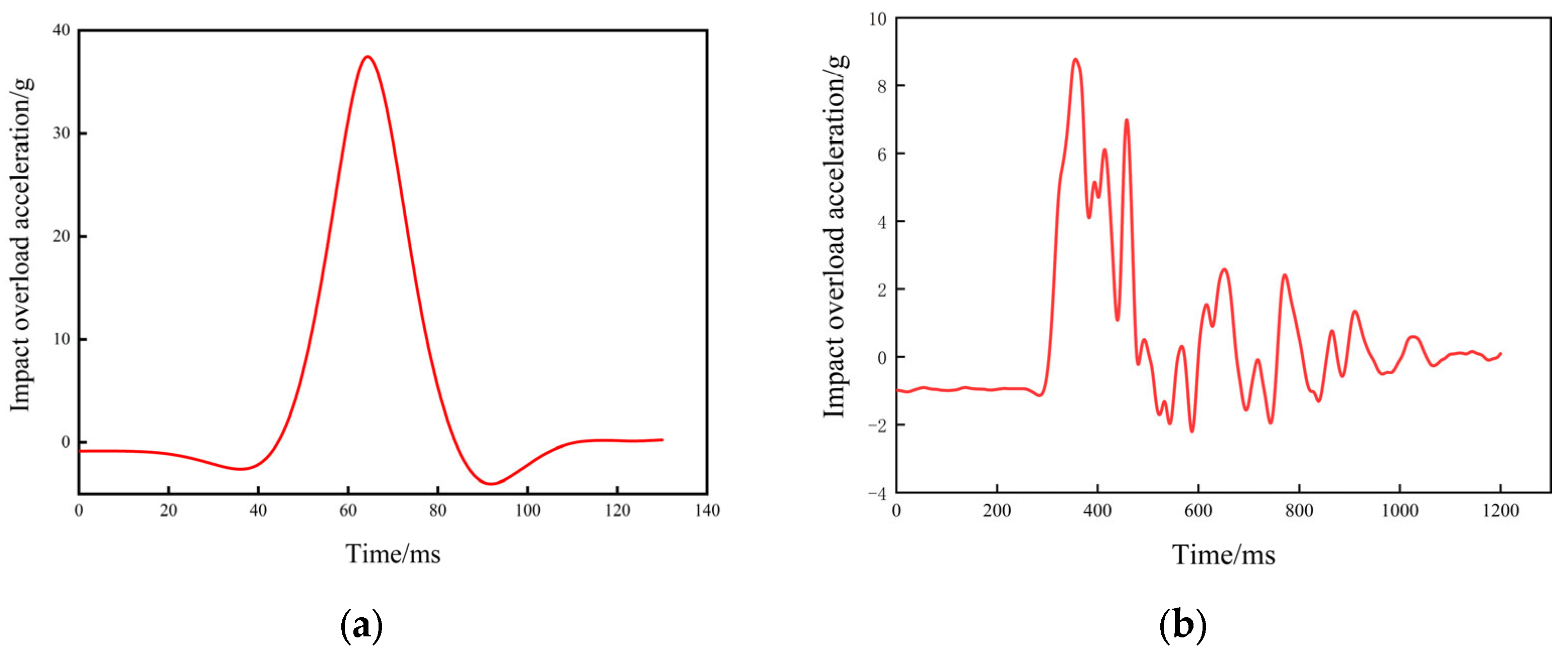
By collecting data from high-speed cameras and acceleration sensors, the average acceleration time curves for each position of the rescue vehicle system were obtained, as shown in Figure 19.
As shown in the figure, the impact overload acceleration measured at the rescue vehicle drop platform measurement point, drop platform measurement point, and model vehicle measurement point decreased gradually, consistent with our expectations, ultimately ensuring that the impact overload acceleration transmitted to the rescue vehicle met the requirement of ≤10 g. This further validates the accuracy of the MCF formula and optimization results for slotted thin-walled circular tubes.

6. Conclusions

This study employed experimental and numerical simulation methods to predict the average buckling force of slotted thin-walled circular tubes using formulae. Based on a validated finite element model, a parameter study and design guidelines for slotted thin-walled circular tubes as energy-absorbing structures was established, yielding the following conclusions:
(1)
The physics–data-driven method proposed in this paper constructs a dataset through numerical simulation, DOE, and neural network enhancement and effectively reduces the complexity of multi-parameter optimization by combining dimensional analysis and weighted graph coding. Finally, an adaptive differential algorithm is used to establish a prediction formula for the MCF in slotted thin-walled circular tubes, verifying the efficiency and feasibility of this method in predicting energy absorption characteristics.
(2)
The derived MCF formula for slotted thin-walled circular tubes underwent genetic algorithm optimization and refinement, yielding a highly accurate formula applicable to slotted circular tubes. Predictions from this formula exhibited relative errors below 5% compared to experimental and simulation results, demonstrating the proposed theoretical model’s ability to accurately predict the axial crushing behavior of slotted circular tubes.
(3)
Based on the predicted MCF formula, single-objective optimization was applied to design corresponding geometric parameters and slotting patterns for the circular tube, addressing the engineering challenge of rescue vehicle airdrops. The designed tube underwent validation through simulated vehicle airdrop tests. By integrating airdrop requirements with data collected via high-speed cameras and accelerometers, the reliability of the prediction formula and optimization results was further confirmed, demonstrating significant implications for the design of airdrop energy-absorbing cushioning devices.
Although the proposed physics–data-driven method demonstrates good accuracy and efficiency in predicting the energy absorption characteristics of slotted thin-walled circular tubes, certain limitations remain. First, the parameter ranges considered in this study covered common engineering applications, and the dataset was constructed using DOE and data augmentation. However, when the structural parameters significantly exceed the training range, the prediction accuracy may be affected, and the applicability of the model requires further validation. Second, a systematic sensitivity analysis of the input parameters has not been conducted, making it difficult to fully reveal the physical contributions and underlying mechanisms of each dimensionless term regarding the model output.
Future work will focus on the following aspects. First, the dataset will be further expanded by incorporating test data with a wider range of geometric dimensions and loading conditions in order to improve the robustness and generalization capabilities of the model. Second, global sensitivity analysis methods will be introduced to quantitatively evaluate the effects of the input parameters and their interactions on the energy absorption characteristics, thereby revealing the underlying mechanisms.


Author Contributions

G.H.: methodology, software, investigation, writing—original draft. B.W.: visualization, writing—review and editing. J.X.: investigation, writing—review and editing. P.X.: validation, resources, funding acquisition. S.Y.: validation, funding acquisition. X.G.: data curation, supervision. A.S.: data curation, supervision. All authors have read and agreed to the published version of the manuscript.

Funding

This work was supported by the National Key Research and Development Program of China (No. 2024YFB4303001) and the National Natural Science Foundation of China (No. U24B20121), and the financial support is gratefully acknowledged.

Institutional Review Board Statement

Not applicable.

Informed Consent Statement

Not applicable.

Data Availability Statement

The original contributions presented in this study are included in the article. Further inquiries can be directed to the corresponding author.

Conflicts of Interest

The authors declare no conflicts of interest.

References

  1. McKinney, J.; Taylor, T. Use of LS-DYNA to Simulate the Airbag Landing Impact Attenuation of the Kistler Kl Reusable Launch Vehicle. In Proceedings of the 5th International LS-DYNA User’s Conference, Southfield, MI, USA, 21-23 September 1998; LSTC: Livermore, CA, USA, 1998; pp. 21–30. [Google Scholar]
  2. Smith, T.R.; Sandy, C.R.; Ware, J.S.; Welch, J.; Willey, C.E.; Wilson, D. Orion CEV earth landing impact attenuating airbags-design challenges and application. In Proceedings of the 2007 IEEE Aerospace Conference, Big Sky, MT, USA, 3–10 March 2007; IEEE: Piscataway, NJ, USA, 2007; pp. 1–12. [Google Scholar]
  3. Cao, P.; Hou, X.; Wang, Y.; Li, M.; Rao, X.; Shi, Y. Flexible airbag cushioning for Martian landing based on discrete element method. Adv. Space Res. 2019, 63, 2566–2583. [Google Scholar] [CrossRef]
  4. Zhou, X.; Zhou, S.; Li, D.; Zhou, A. Direct folding method of cylindrical airbag and its application in landing buffer. J. Aerosp. Eng. 2022, 35, 04022083. [Google Scholar] [CrossRef]
  5. He, C.; He, H.; Wang, T. Similarity Design Method of the Inflatable Buffer Landing System. Int. J. Aerosp. Eng. 2019, 2019, 5326979. [Google Scholar] [CrossRef]
  6. Li, M.; Liu, S.; Wei, G.; Guo, Y. Response Characteristics of a Sealing Airbag under Different Impact Types and Impact Pressures. ACS Omega 2022, 7, 38589–38599. [Google Scholar] [CrossRef]
  7. Liu, Q.; Wang, W.; Zhang, W. Study on buffering performance of thin-walled metal tube with different angles. Def. Technol. 2018, 14, 702–708. [Google Scholar] [CrossRef]
  8. Luo, H.; Li, Y.; Liu, G.; Yu, C.; Chen, S. Buffering Performance of High-Speed Impact Space Penetrator with Foam-Filled Thin-Walled Structure. Shock Vib. 2019, 2019, 7981837. [Google Scholar] [CrossRef]
  9. Hao, X.; Yu, J.; He, W.; Jiang, Y. Factors Affecting the Compression and Energy Absorption Properties of Small-Sized Thin-Walled Metal Tubes. Int. J. Aerosp. Eng. 2020, 2020, 6135925. [Google Scholar] [CrossRef]
  10. Li, X.; Yin, Y.; Zhu, X.; Wang, R.; Li, T.; Zhang, Q.; Li, W. Performance of hollow and aluminum foam-filled multi-cell thin-walled aluminum alloy tubes (6063-T5) under axial impact. Structures 2023, 47, 1803–1821. [Google Scholar] [CrossRef]
  11. Mahbod, M.; Asgari, M. Energy absorption analysis of a novel foam-filled corrugated composite tube under axial and oblique loadings. Thin-Walled Struct. 2018, 129, 58–73. [Google Scholar] [CrossRef]
  12. Hao, W.; Xie, J.; Wang, F. Theoretical prediction of the progressive buckling and energy absorption of the sinusoidal corrugated tube subjected to axial crushing. Comput. Struct. 2017, 191, 12–21. [Google Scholar] [CrossRef]
  13. Xinping, O.; Huihui, H. Simulation study on optimal structure of circular corrugated finned tube. Int. J. Therm. Sci. 2022, 179, 107622. [Google Scholar] [CrossRef]
  14. Mohammad, S.; Javad, M. CFRP cylindrical tubes equipped with thin-walled semi-circular lateral corrugated inner stiffeners subjected to quasi-static latitudinal impact. Proc. Inst. Mech. Eng. Part C J. Mech. Eng. Sci. 2023, 237, 5094–5111. [Google Scholar]
  15. Hosseinipour, S.; Daneshi, G. Energy absorbtion and mean crushing load of thin-walled grooved tubes under axial compression. Thin-Walled Struct. 2003, 41, 31–46. [Google Scholar] [CrossRef]
  16. Yao, R.; Yin, G.; Hao, W.; Zhao, Z.-Y.; Li, X.; Qin, X.-L. Axial buckling modes and crashworthiness of circular tube with external linear gradient grooves. Thin-Walled Struct. 2019, 134, 395–406. [Google Scholar] [CrossRef]
  17. Adachi, T.; Tomiyama, A.; Araki, W.; Yamaji, A. Energy absorption of a thin-walled cylinder with ribs subjected to axial impact. Int. J. Impact Eng. 2006, 35, 65–79. [Google Scholar] [CrossRef]
  18. Han, H.; Cheng, J.; Taheri, F.; Pegg, N. Numerical and experimental investigations of the response of aluminum cylinders with a cutout subject to axial compression. Thin-Walled Struct. 2005, 44, 254–270. [Google Scholar] [CrossRef]
  19. El-baky, M.A.A.; Allah, M.M.A.; Kamel, M.; Abd-Elaziem, W. Energy absorption characteristics of E-glass/epoxy over-wrapped aluminum pipes with induced holes: An experimental research. Sci. Rep. 2022, 12, 21097. [Google Scholar] [CrossRef]
  20. Daneshi, G.H.; Hosseinipour, S.J. Grooves effect on crashworthiness characteristics of thin-walled tubes under axial compression. Mater. Des. 2002, 23, 611–617. [Google Scholar] [CrossRef]
  21. Daneshi, G.H.; Hosseinipour, S.J. Elastic–plastic theory for initial buckling load of thin-walled grooved tubes under axial compression. J. Mater. Process. Technol. 2002, 125, 826–832. [Google Scholar] [CrossRef]
  22. Hosseinipour, S.J. Mathematical model for thin-walled grooved tubes under axial compression. Mater. Des. 2003, 24, 463–469. [Google Scholar] [CrossRef]
  23. Natarajan, B.; Subramaniam, S.; NavaneethaKrishnan, P.; Karupannasamy, D.; Chinnasamy, S.; Rajagopal, S. Augmentation of crashworthiness design of circular tubular structures by engraving grooves of varying depths. Mech. Adv. Mater. Struct. 2023, 30, 3097–3110. [Google Scholar] [CrossRef]
  24. Wang, W.; He, Y.; Zhang, T.; Zhang, W.; Ju, F.; Xu, X.; Ahmed, H.W. Crashworthiness analysis and optimization of thin-walled structures based on the TSSA-LSSVM surrogate model. Int. J. Struct. Stab. Dyn. 2024, 25, 2550003. [Google Scholar] [CrossRef]
  25. Montazeri, S.; Elyasi, M.; Moradpour, A. Investigating the energy absorption, SEA and crushing performance of holed and grooved thin-walled tubes under axial loading with different materials. Thin-Walled Struct. 2018, 131, 646–653. [Google Scholar] [CrossRef]
  26. Feli, S.; Makhsousse, E.; Jafari, S.S. Dynamic progressive buckling of thin-wall grooved conical tubes under impact loading. Int. J. Crashworthiness 2019, 25, 220–229. [Google Scholar] [CrossRef]
  27. Alexander, J.M. An approximate analysis of the collapse of thin cylindrical shells under axial loading. Q. J. Mech. Appl. Math. 1960, 13, 10–15. [Google Scholar] [CrossRef]
  28. Wierzbicki, T.; Abramowicz, W. On the crushing mechanics of thin-walled structures. J. Appl. Mech. 1983, 50, 727–734. [Google Scholar] [CrossRef]
  29. Hayduk, R.J.; Wierzbicki, T. Extensional collapse modes of structural members. Comput. Struct. 1984, 18, 447–458. [Google Scholar] [CrossRef]
  30. Abramowicz, W.; Wierzbicki, T. Axial crushing of multicorner sheet metal columns. J. Appl. Mech. 1989, 56, 113–120. [Google Scholar] [CrossRef]
  31. Giannopoulos, G.I.; Georgantzinos, S.K. A tunable metamaterial joint for mechanical shock applications inspired by carbon nanotubes. Appl. Sci. 2021, 11, 11139. [Google Scholar] [CrossRef]
  32. Yao, S.; Yan, K.; Lu, S.; Xu, P. Prediction and application of energy absorption characteristics of thin-walled circular tubes based on dimensional analysis. Thin-Walled Struct. 2018, 130, 505–519. [Google Scholar] [CrossRef]
  33. Duan, L.; Du, Z.; Jiang, H.; Xu, W.; Li, Z. Theoretical prediction and crashworthiness optimization of top-hat thin-walled structures under transverse loading. Thin-Walled Struct. 2019, 144, 106261. [Google Scholar] [CrossRef]
  34. Xiang, X.F.; Qiang, N.X.; Ru, S.T. Numerical Analysis and Theoretical Prediction of Axial Crushing Characteristics of Mixed Thin-walled Tubes with Dual-variable Attribute. Int. J. Automot. Technol. 2022, 23, 1555–1568. [Google Scholar] [CrossRef]
  35. Bridgman, P.W. Dimensional Analysis; Yale University Press: London, UK, 1922. [Google Scholar]
  36. Conejo, A.N. Fundamentals of Dimensional Analysis; Springer: Singapore, 2021. [Google Scholar]
  37. Lin, C.C.; Segel, L.A. Mathematics Applied to Deterministic Problems in the Natural Sciences; Society for Industrial and Applied Mathematics: Philadelphia, PA, USA, 1988. [Google Scholar]
  38. Johnson, W.; Sengupta, A.K.; Ghosh, S.K.; Reid, S. Mechanics of high speed impact at normal incidence between plasticine long rods and plates. J. Mech. Phys. Solids 1981, 29, 413–445. [Google Scholar] [CrossRef]
  39. Li, Q.M.; Jones, N. On dimensionless numbers for dynamic plastic response of structural members. Arch. Appl. Mech. 2000, 70, 245–254. [Google Scholar] [CrossRef]
  40. Zhao, Y.P. Suggestion of a new dimensionless number for dynamic plastic response of beams and plates. Arch. Appl. Mech. 1998, 68, 524–538. [Google Scholar] [CrossRef]
  41. Nurick, G.N.; Martin, J.B. Deformation of thin plates subjected to impulsive loading—A review: Part i: Theoretical considerations. Int. J. Impact Eng. 1989, 8, 159–170. [Google Scholar] [CrossRef]
  42. Wu, F.; Chen, Y.; Zhao, S.; Hong, Y.; Zhang, Z.; Zheng, S. Mechanical properties and energy absorption of composite bio-inspired multi-cell tubes. Thin-Walled Struct. 2023, 184, 110451. [Google Scholar] [CrossRef]
  43. Kuleyi̇n, H.; Karabacak, Y.E.; Gümrük, R. Predicting mechanical behavior of different thin-walled tubes using data-driven models. Mater. Today Commun. 2024, 40, 109998. [Google Scholar] [CrossRef]
  44. Wu, X.; Hu, T.; Khodadadi, N.; Nanni, A. Prediction on quasi-static compression deformation modes of circular tubes based on machine learning. Int. J. Mech. Sci. 2025, 287, 109993. [Google Scholar] [CrossRef]
  45. Sakaridis, E.; Karathanasopoulos, N.; Mohr, D. Machine-learning based prediction of crash response of tubular structures. Int. J. Impact Eng. 2022, 166, 104240. [Google Scholar] [CrossRef]
  46. Yao, S.; Li, Z.; Yan, J.; Xu, P.; Peng, Y. Analysis and parameters optimization of an expanding energy-absorbing structure for a rail vehicle coupler. Thin-Walled Struct. 2018, 125, 129–139. [Google Scholar] [CrossRef]
  47. Xiang, Y.; Wang, M.; Yu, T.; Yang, L. Key Performance Indicators of Tubes and Foam-Filled Tubes Used as Energy Absorbers. Int. J. Appl. Mech. 2015, 7, 1550060. [Google Scholar] [CrossRef]
  48. Lee, G.; Mou, J.; Shen, Y. Sampling strategy design for dimensional measurement of geometric features using coordinate measuring machine. Int. J. Mach. Tools Manuf. 1997, 37, 917–934. [Google Scholar] [CrossRef]
  49. Jie, X.; Ping, X.; Shuguang, Y.; Hui, Z.; Ziliang, Z.; Zhangjun, W. A novel weighted graph representation-based method for structural topology optimization. Adv. Eng. Softw. 2021, 153, 102977. [Google Scholar] [CrossRef]
  50. Storn, R. On the usage of differential evolution for function optimization. In Proceedings of the North American Fuzzy Information Processing, Berkeley, CA, USA, 19–22 June 1996; IEEE: Piscataway, NJ, USA, 1996; pp. 519–523. [Google Scholar]
  51. Ho-Huu, V.; Do-Thi, T.D.; Dang-Trung, H.; Vo-Duy, T.; Nguyen-Thoi, T. Optimization of laminated composite plates for maximizing buckling load using improved differential evolution and smoothed finite element method. Compos. Struct. 2016, 146, 132–147. [Google Scholar] [CrossRef]
  52. Ho-Huu, V.; Nguyen-Thoi, T.; Vo-Duy, T.; Nguyen-Trang, T. An adaptive elitist differential evolution for optimization of truss structures with discrete design variables. Comput. Struct. 2016, 165, 59–75. [Google Scholar] [CrossRef]
  53. Ho-Huu, V.; Vo-Duy, T.; Luu-Van, T.; Le-Anh, L.; Nguyen-Thoi, T. Optimal design of truss structures with frequency constraints using improved differential evolution algorithm based on an adaptive mutation scheme. Autom. Constr. 2016, 68, 81–94. [Google Scholar] [CrossRef]
  54. Zhang, J.; Sanderson, A.C. JADE: Adaptive differential evolution with optional external archive. IEEE Trans. Evol. Comput. 2009, 13, 945–958. [Google Scholar] [CrossRef]
  55. Islam, S.M.; Das, S.; Ghosh, S.; Roy, S.; Suganthan, P.N. An adaptive differential evolution algorithm with novel mutation and crossover strategies for global numerical optimization. IEEE Trans. Syst. Man Cybern. Part B (Cybern.) 2011, 42, 482–500. [Google Scholar]
  56. Yu, X.; Cai, M.; Cao, J. A novel mutation differential evolution for global optimization. J. Intell. Fuzzy Syst. 2015, 28, 1047–1060. [Google Scholar] [CrossRef]
  57. Cui, L.; Li, G.; Lin, Q.; Chen, J.; Lu, N. Adaptive differential evolution algorithm with novel mutation strategies in multiple sub-populations. Comput. Oper. Res. 2016, 67, 155–173. [Google Scholar] [CrossRef]
Figure 1. Schematic diagram of airdrop plan.
Applsci 16 04005 g001
Figure 2. Framework of research methodology.
Applsci 16 04005 g002
Figure 3. Finite element model.
Applsci 16 04005 g003
Figure 4. Dimensions of material test specimens and clamping diagram.
Applsci 16 04005 g004
Figure 5. Material stress–strain curves: (a) engineering curve; (b) true curve.
Applsci 16 04005 g005
Figure 6. Test scene diagram.
Applsci 16 04005 g006
Figure 7. Comparison of simulation and experimental results: (a) energy–displacement curve; (b) force–displacement curve.
Applsci 16 04005 g007
Figure 8. MCF–displacement curve of drop hammer test.
Applsci 16 04005 g008
Figure 9. MLP neural network enhancement.
Applsci 16 04005 g009
Figure 10. An example explanation for the weighted graph representation of the equation combination.
Applsci 16 04005 g010
Figure 11. Comparison of the predicted and real values under different mutation strategies: (a) strategy 1; (b) strategy 2; (c) strategy 3.
Applsci 16 04005 g011
Figure 12. Comparison of the predicted and real values under different crossover fractions: (a) 0.5; (b) 0.6; (c) 0.7; (d) 0.8; (e) 0.9.
Applsci 16 04005 g012aApplsci 16 04005 g012b
Figure 13. Comparison of MCF predicted and simulated results.
Applsci 16 04005 g013
Figure 14. Finite element model diagram corresponding to simulated airdrop test conditions.
Applsci 16 04005 g014
Figure 15. Acceleration sensor placement and measurement results: (a) acceleration sensor placement on the vehicle body; (b) acceleration measurement results from the four sensors.
Applsci 16 04005 g015
Figure 16. Simulated airdrop experiment scenario diagram.
Applsci 16 04005 g016
Figure 17. Accelerometer placement diagram.
Applsci 16 04005 g017
Figure 18. Post-test scene diagram.
Applsci 16 04005 g018
Figure 19. Acceleration–time curves for each measurement point: (a) rescue airdrop base plate; (b) rescue airdrop vehicle.
Applsci 16 04005 g019
Table 1. Material parameters for finite element models.
Modulus of Elasticity/MPaDensity/(kg/m3)Poisson Ratio
Energy-absorbing circular tube1.45 × 10527000.3
Drop hammer and rigid wall2.1 × 10578000.3
Table 2. Analysis of mesh convergence and divergence.
Mesh Size (mm)SEA (kJ/kg)Relative Error (%)Calculation Duration (min)
1 × 115.770.5215
0.75 × 0.7515.810.2518
0.5 × 0.515.830.0421
0.25 × 0.2515.85−0.0930
Table 3. Material properties of six-series aluminum alloy.
UnitNumerical Value
Densitykg/m32690
Young’s modulusMPa73,000
Yield strengthMPa235
Tangent modulusMPa299
Ultimate tensile strengthMPa338
Fracture stressMPa307
Table 4. Detailed parameters of each test tube.
Experiment12345
Diameter D (mm)250195193.5103172
Thickness T (mm)23.82.233.9
Slot length L (mm)11785107105.7115
Slot width W (mm)3.43915
Slot spacing S (mm)10386.898.68083.4
Experiment12345
Table 5. Comparison of experimental and simulation parameters.
Deformation Displacement (mm)Energy Absorption (kJ)MCF (kN)
Experiment426.337.7888.6
Simulation425.136.8886.8
Table 6. Comparison of test results and predicted results.
Experiment12345
MCF (kN)53.2132.448.7200.485.4
Predicted MCF (kN)53.3127.547.4192.386.6
Relative error0.2%3.7%2.6%4%1.4%
Table 7. Ranges of each parameter for slotted thin-walled circular tubes.
ParameterDiameter D/mmThickness T/mmSlot Length L/mmSlot Width W/mmSlot Spacing S/mm
Range200~2401.5~380~1203~790~110
Table 8. Prediction accuracy across different MLP network architectures.
Network ArchitectureR2MAERMSE
Training SetTest
Set
Training SetTest
Set
Training SetTest
Set
1
Layer
40.92820.909210.44513.53813.04318.345
80.93320.904810.18713.71112.57118.779
160.94350.92439.577912.67111.57016.751
320.97730.96055.69049.27727.338812.098
2
Layers
40.94950.94068.929611.88710.93714.843
80.95020.94338.552811.02410.85614.495
160.96910.95526.938110.3208.558012.879
320.98410.98514.93935.07036.13717.4291
3
Layers
40.95630.91128.307513.71510.17118.134
80.96540.96237.21818.75129.043111.821
160.97000.94716.548911.2018.425313.995
320.98090.97045.25948.5156.723410.476
Table 9. Optimized results of the expression.
No.RMSE kabcd
10.3898198510.04330.2075−0.11010.07000.6143
20.3898835410.0742−0.24860.31880.4080−0.1112
30.38989521010.0254−0.04060.40660.2079−0.0703
40.3898592610.04900.3369−0.11030.20730.0705
50.3898798310.05010.4074−0.5188−0.13630.2068
60.38985381010.03010.40680.2078−0.2483−0.1109
70.3898659410.03770.07020.3367−0.31890.2079
80.3898872110.05310.0703−0.11210.7265−0.5194
90.448328736.6946−1.3230−1.70520.34351.7715
100.3898269510.05670.20690.0704−0.11170.3370
Table 10. Optimized results for different mutation strategies.
StrategyRMSE kabcd
10.407227869.17430.32870.1494−0.19070.2615
20.5430698439.4430.7134−0.1101−0.6643−0.1530
30.3898467910.0530.20790.07030.3371−0.6554
Table 11. Error margins under different optimization strategies.
StrategyR2MAEMBERMSE
10.9488.970.5911.55
20.91910.222.1814.36
30.9518.614.0811.25
Table 12. Optimized results for different crossover fractions.
CrossoverRMSE kabcd
0.50.39321097210.0503−0.0644−0.40510.42100.2891
0.60.3898624310.07680.40780.6565−0.1120−0.3376
0.70.3898451610.0530−0.11180.65740.32010.0701
0.80.3898913810.0747−0.1115−0.40770.6142−0.5440
0.90.3898253410.04510.24700.40720.0703−0.1093
Table 13. Errors in results under different cross-probabilities.
CrossoverR2MAEMBERMSE
0.50.9508.794.1511.28
0.60.9459.466.5012.38
0.70.9518.614.0811.25
0.80.9508.674.3111.33
0.90.9518.583.9911.22
Table 14. Comparison of test results and calculated results.
Experiment12345
MCF (kN)53.2132.448.7200.485.4
Calculated MCF (kN)57.3124.545.9187.690.6
Relative error7.7%5.9%5.7%6.4%6.1%
Table 15. Optimized results for the circular tube.
ParameterD (mm)T (mm)L (mm)W (mm)S (mm)scorp/%
Value2302.81163.498.87.71
Table 16. Comparison of predicted and simulated results.
Prediction ResultSimulation ResultRelative Error
MCF81.5 kN78.8 kN3.4%
scorp7.71%7.92%2.6%
Disclaimer/Publisher’s Note: The statements, opinions and data contained in all publications are solely those of the individual author(s) and contributor(s) and not of MDPI and/or the editor(s). MDPI and/or the editor(s) disclaim responsibility for any injury to people or property resulting from any ideas, methods, instructions or products referred to in the content.