Flocking Dynamics of Multi-Agent Systems Based on an Extended Cucker–Smale Model with Nonlinear Coupling and Binding Forces


Abstract
1. Introduction
- Nonlinear Cucker–Smale Extensions: While prior work [25] introduced nonlinear velocity coupling, it did not incorporate binding forces for formation control. Our model unifies nonlinear coupling with state-aware binding mechanisms, enabling simultaneous velocity alignment and geometric structure regulation.
- Collision Avoidance Strategies: Methods such as artificial potential fields [19] provide empirical collision avoidance but frequently lack rigorous stability proofs. Our binding force formulation, particularly the term, delivers provable collision avoidance (Theorem 2) while preserving formation cohesion.
- Energy-Aware Coordination: Most flocking models focus solely on convergence metrics, neglecting control effort. We introduce an energy-efficiency metric and conduct comprehensive parameter optimization to identify Pareto-optimal trade-offs between synchronization accuracy and energy consumption—an aspect largely unexplored in prior work.
- Theoretical Analysis: In contrast to simulation-based studies, we furnish rigorous Lyapunov-based proofs for both velocity consensus and collision avoidance within a unified nonlinear framework. Our analysis explicitly relates the control parameters to convergence rates and safety guarantees.
- Parameter Sensitivity: Although parameter studies exist, they typically examine isolated effects. Our work provides a systematic multi-metric analysis (encompassing velocity error, spatial dispersion, collision rate, and heading stability) that reveals intricate parameter interactions and their practical implications for controller design.
1.1. Positioning Relative to Existing Literature
1.2. Experimental Validation Strategy
1.3. Research Objective
2. Preliminaries
2.1. Nonlinear Velocity Coupling Function Properties
- 1.
- Oddness and Semi-Positive Definiteness: For all ,
- 2.
- Growth Condition: There exist constants and such that for all ,
Physical Interpretation and Examples
- Saturating nonlinearity: with , which models actuator saturation.
- Power-law nonlinearity: with , representing generalized damping.
2.2. Asymptotic Flocking Properties
- 1.
- Velocity alignment:
- 2.
- Group formation:
2.3. Barbalat’s Lemma
- 1.
- is lower bounded,
- 2.
- is uniformly continuous,
- 3.
- exists (i.e., the integral converges),
3. Model Construction and Theoretical Analysis
3.1. Construction of Extended Model
Physical Interpretation and Derivation of the Force Terms
- 1.
- The Term: Viscous Damping Force
- Physical Role: This term acts as a viscous damper within the system. Its magnitude is proportional to the projection of the relative velocity onto the inter-agent axis, , with serving as the damping coefficient. When agents approach each other (), the force is repulsive, decelerating the approach. When they separate (), it becomes attractive, inhibiting excessive swarm dispersion. Thus, primarily functions to dissipate internal kinetic energy, suppress oscillations, and expedite convergence to a stable relative configuration.
- Physical Derivation: The term originates from Rayleigh’s dissipation function , representing the power dissipated due to relative motion along the inter-agent direction. The corresponding dissipative force, , yields precisely the term in Equation (5). This derivation confirms as a genuine physical damping coefficient, not merely an empirical parameter.
- 2.
- The Term: Conservative Binding/Spring Force
- Physical Role: This term behaves as an ideal spring that regulates the inter-agent distance towards a predefined safety distance . Here, is the spring constant (stiffness). For , the force is attractive, maintaining formation cohesion. For , it becomes strongly repulsive, forming the core collision avoidance mechanism. Consequently, dictates the “hardness” of the safety distance enforcement. A higher increases sensitivity to spacing deviations, enhancing collision prevention at the potential cost of induced oscillations due to stronger forces.
- Physical Derivation: The term is derived from the conservative potential , which models a harmonic spring with equilibrium length . The resulting force, , matches the term in Equation (5), establishing as a physical spring constant.
- Dynamic Role of : From the energy derivative in Theorem 1, the term contributes , explicitly demonstrating its dissipative nature. Thus, controls the rate of kinetic energy dissipation and, consequently, the convergence speed.
- Static Role of : The term appears in the potential energy , which dictates the equilibrium configuration. Theorem 2 provides the group formation bound , showing that fundamentally limits the maximum inter-agent distance.
- Coupled Dynamics: The interplay between the dissipative () and conservative () forces creates a second-order dynamic system for each agent pair. The effective damping ratio is proportional to , theoretically explaining the observed performance trade-off: high accelerates convergence but may induce overshoot; high enforces strict spacing at the potential cost of slower convergence. This is a direct consequence of the coupled dissipative-conservative dynamics, not merely an empirical observation.
- UAV Swarms: represents the gains for aerodynamic damping and velocity tracking, while models the controllers for collision avoidance and formation-keeping.
- Robotic Teams: corresponds to the damping inherent in actuators, and to the impedance control parameters that ensure safe physical interaction.
- Autonomous Vehicles: governs the damping in braking/acceleration response, whereas implements the spacing control logic in adaptive cruise control systems.
3.2. Energy Function Definition and System Properties
3.2.1. Total Energy Definition
- The communication weight is bounded since is continuous and :
- The nonlinear coupling term satisfies, by Assumption 1 and the continuity of ,
- The and terms are bounded because:
3.2.2. Energy Dissipation Theorem
- The first term is non-positive because , , and .
- The second term is non-positive as a sum of squares.
3.3. Collision Avoidance Analysis
3.4. Asymptotic Clustering Verification
- 1.
- Velocity alignment: The relative velocities converge to zero asymptotically:
- 2.
- Group formation: The inter-agent distances remain uniformly bounded:
- is non-increasing for all ,
- is bounded below by 0,
- Therefore, exists and is finite.
- and their derivatives (accelerations)
- and
- Terms with denominators
- is bounded below (by 0)
- is uniformly continuous (established above)
- converges (established in Step 1.2)
4. Numerical Simulation and Parametric Analysis
- Scope of Numerical Validation
4.1. Simulation Settings
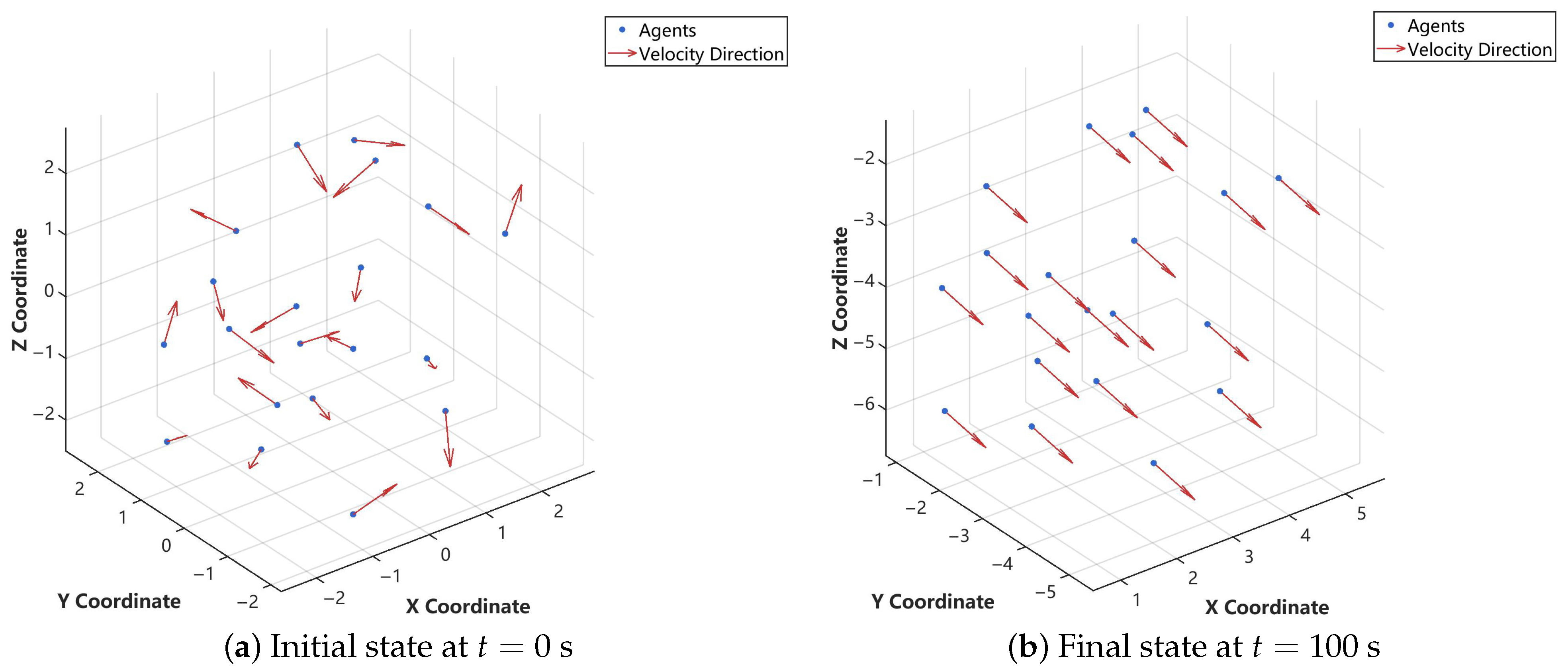
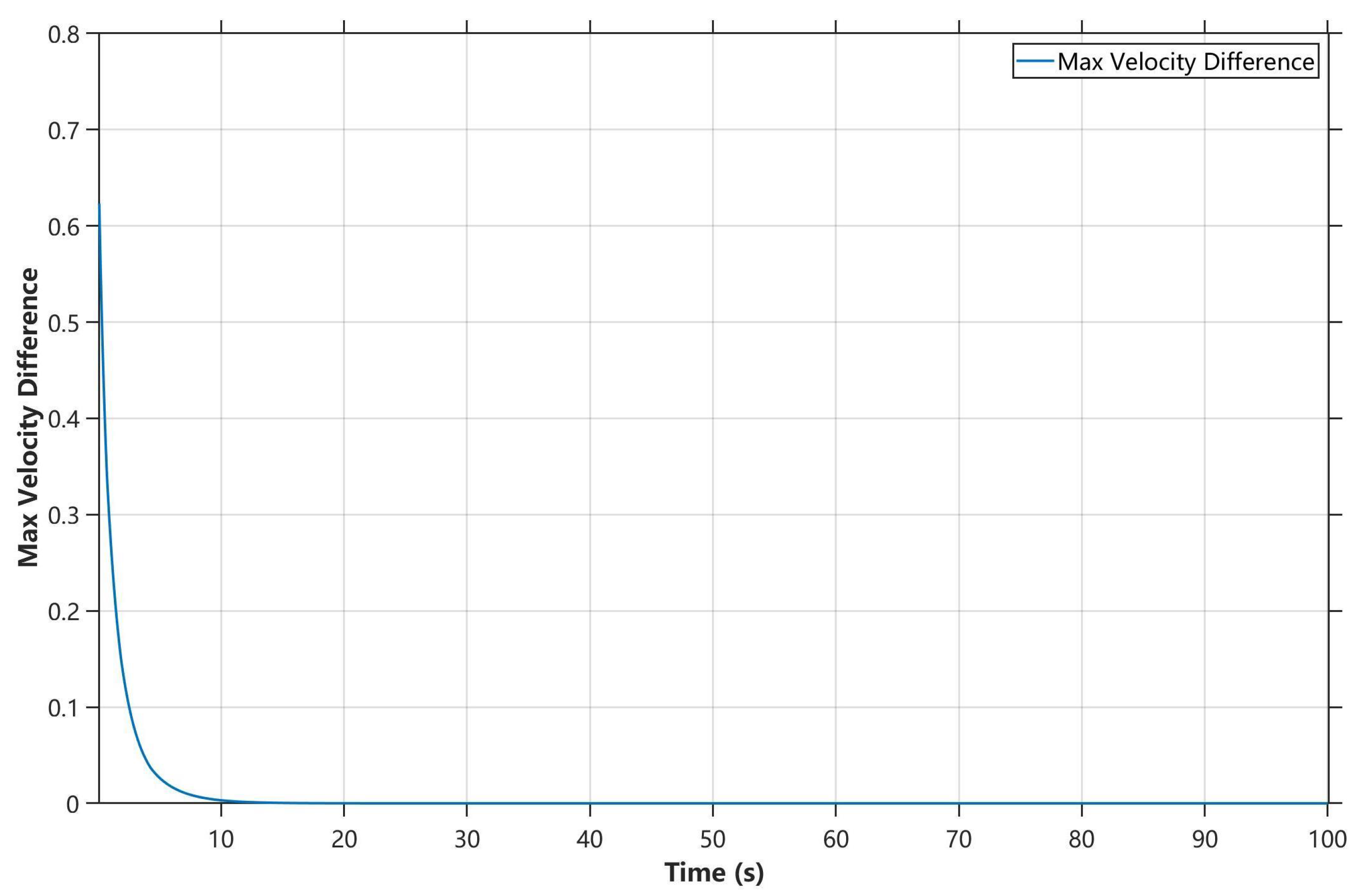
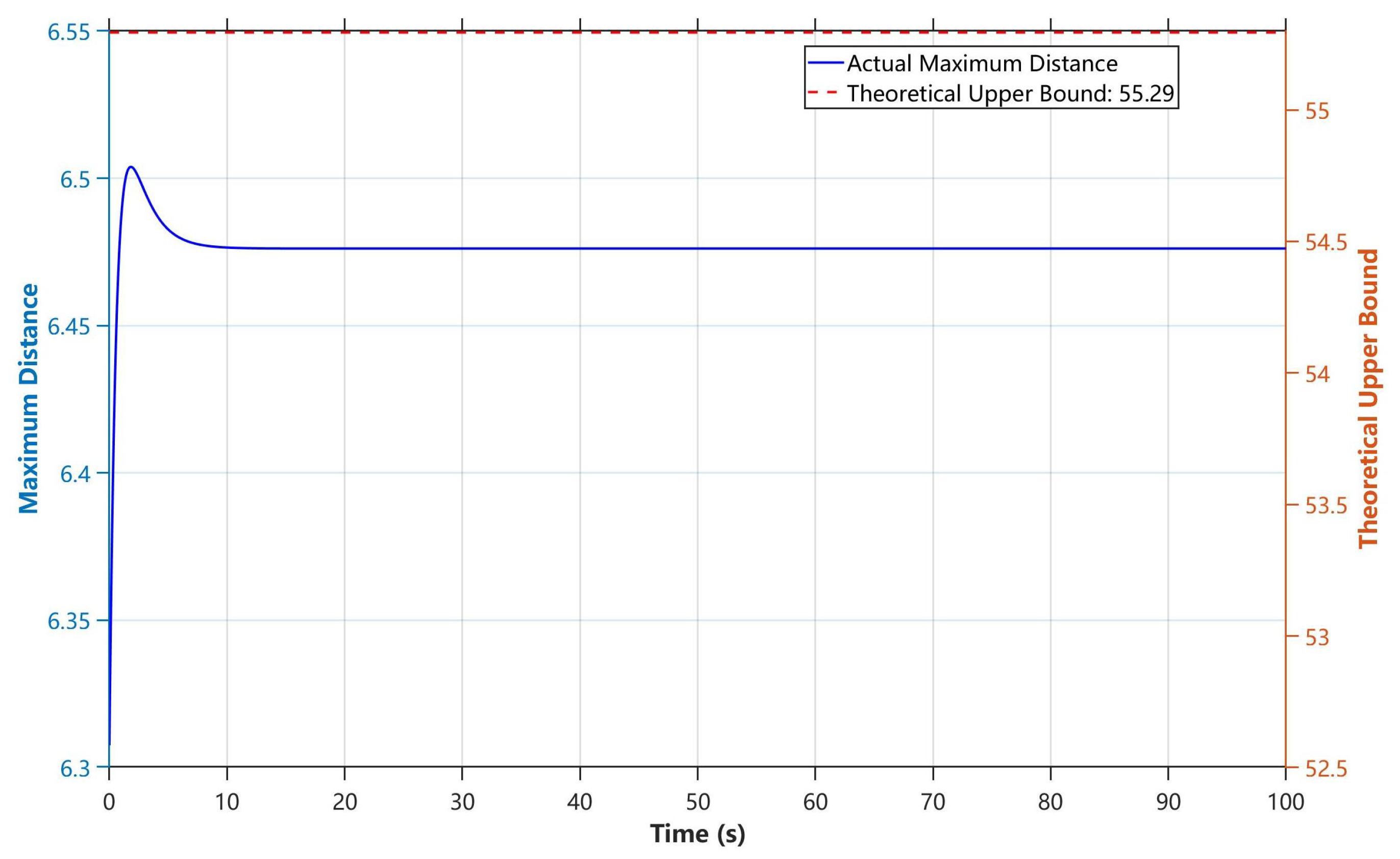
4.2. Analysis of Swarm Behaviour Evolution
- Energy Partition: The initial energy is partitioned between kinetic and potential energy, with only a fraction contributing directly to inter-agent distances.
- Continuous Dissipation: The damping term continuously dissipates kinetic energy, preventing the system from ever reaching the worst-case potential energy configuration.
- Parameter Effects: With and , the system operates in a regime where damping is dominant, naturally promoting compact swarm formations.
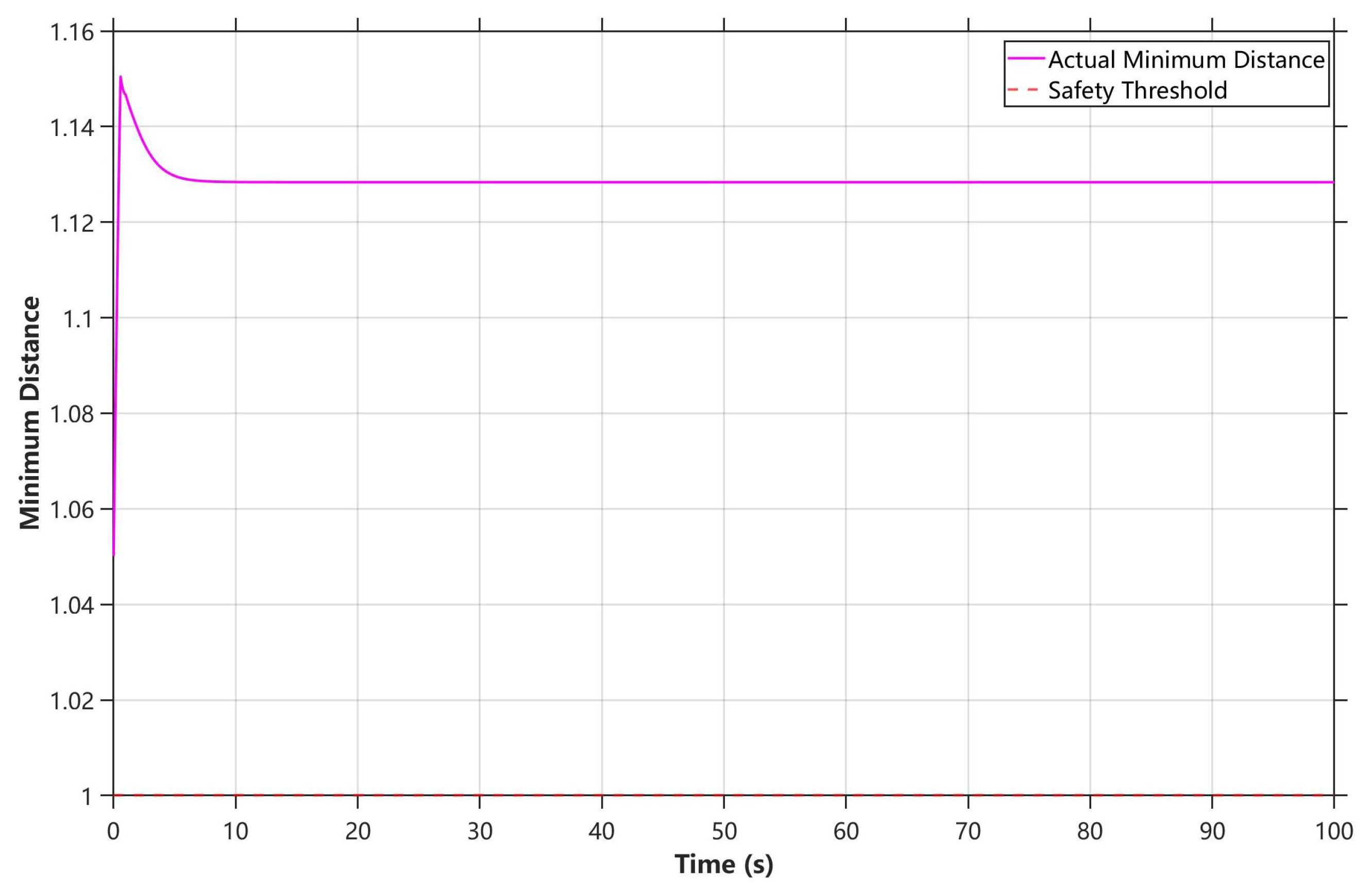
4.3. Collision Avoidance Verification
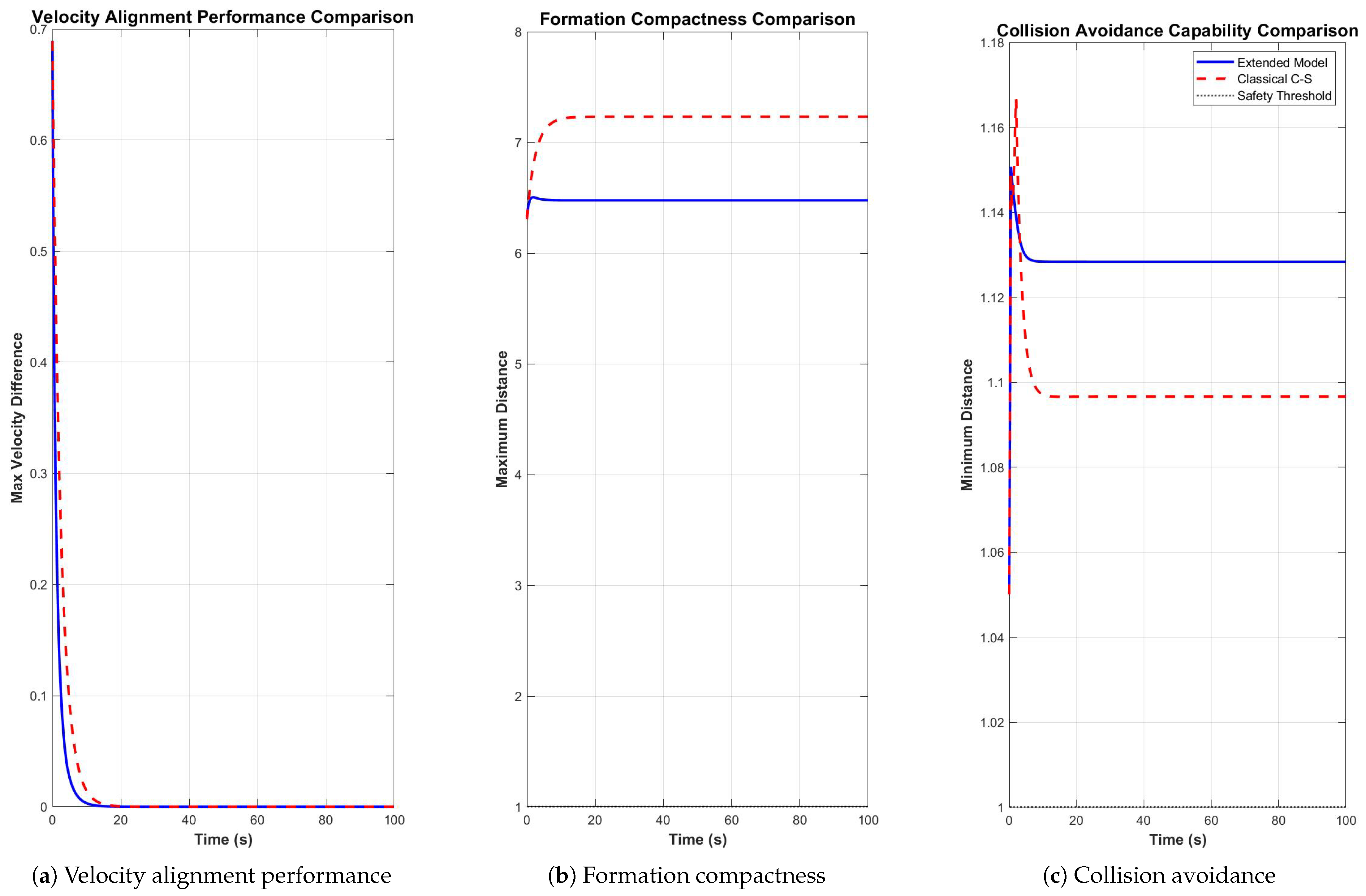
4.4. Comparative Analysis with Classical Cucker–Smale Model
- Velocity alignment performance: Both models achieve excellent velocity alignment, with final synchronization errors at the level of machine precision (< m/s). This confirms that the core consensus mechanism remains effective under the extended nonlinear coupling, without degradation in alignment capability.
- Formation compactness: The extended model reduces the maximum inter-agent distance to 6.48 m, compared to 7.23 m for the classical model—a 10.5% reduction in spatial dispersion. This improvement demonstrates that the binding forces provide enhanced regulation of the formation geometry while preserving swarm coherence.
- Collision avoidance: In the tested scenario, both models successfully avoid collisions, with minimum distances of 1.050 m (extended) and 1.097 m (classical), both safely exceeding the m threshold. A critical distinction is that while collision avoidance in the classical model is observed empirically in this specific trial, the extended model provides provable collision avoidance guarantees under condition (11), as established in Theorem 2.
4.5. Parameter Sensitivity Analysis
- Metric Interpretation:
- Velocity synchronization error (): Quantifies alignment quality, with indicating perfect synchronization.
- Group dispersion (): Measures spatial compactness, where lower values correspond to tighter formations.
- Collision count (): Tallies the number of agent pairs violating the safety distance (), averaged over all trials.
- Heading offset angle (): Measures directional deviation from the target orientation , with indicating perfect alignment.
- Experimental Protocol: The sensitivity analysis follows a systematic Monte Carlo approach with the following configuration:
- Parameter ranges: (increments of 0.05) and (increments of 0.20).
- Simulation settings: 2D planar region, duration, time step (fourth-order Runge–Kutta integration).
- Initial conditions: Positions uniformly distributed, velocities in the range 10–20 m/s, initial headings .
- Statistical basis: 50 independent trials per parameter configuration.
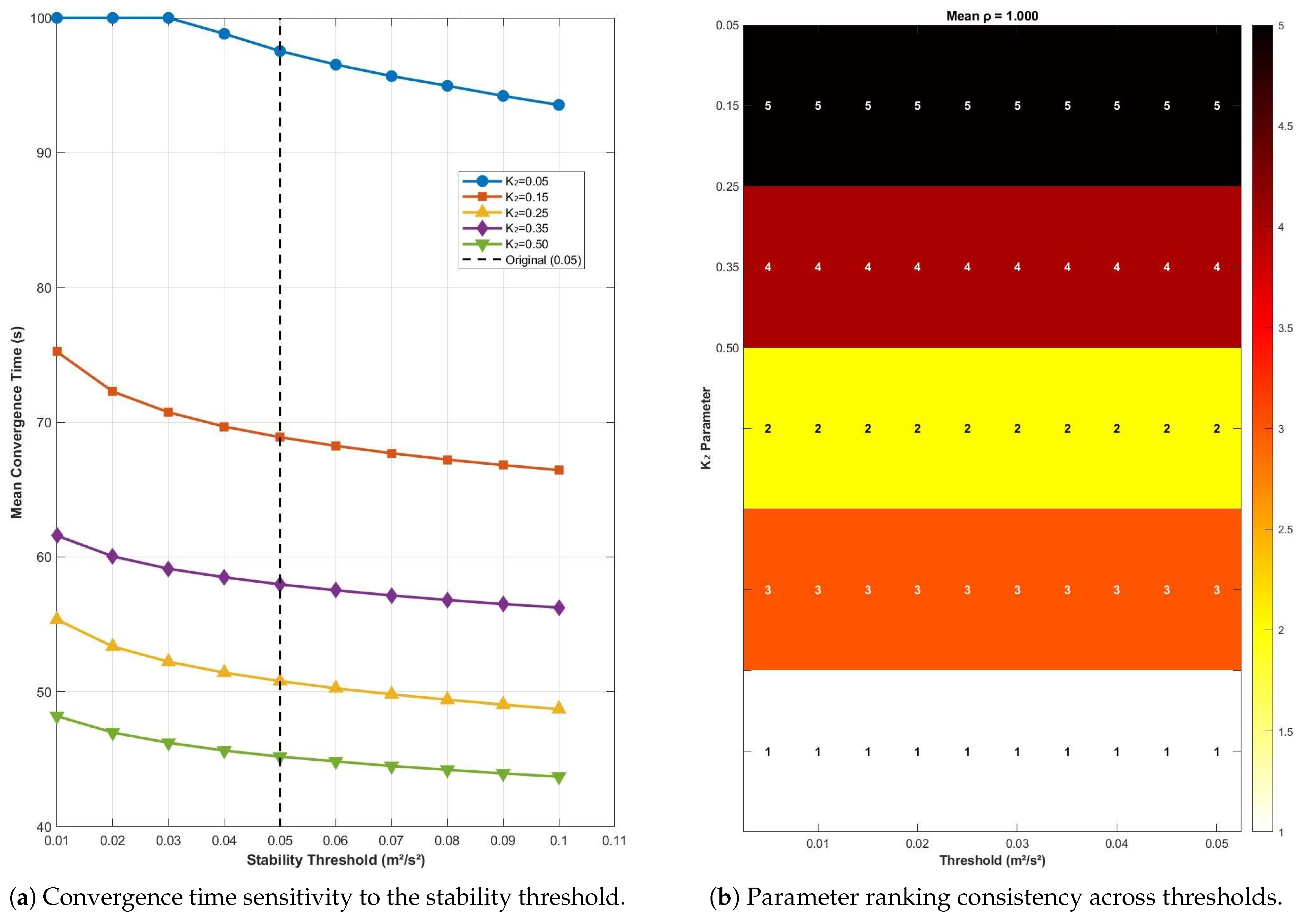
- Stability criterion: The system is considered stable when the mean velocity variance remains below for 10 consecutive time steps. A detailed sensitivity analysis of this threshold is provided below.
4.5.1. Sensitivity Analysis of the Stability Criterion
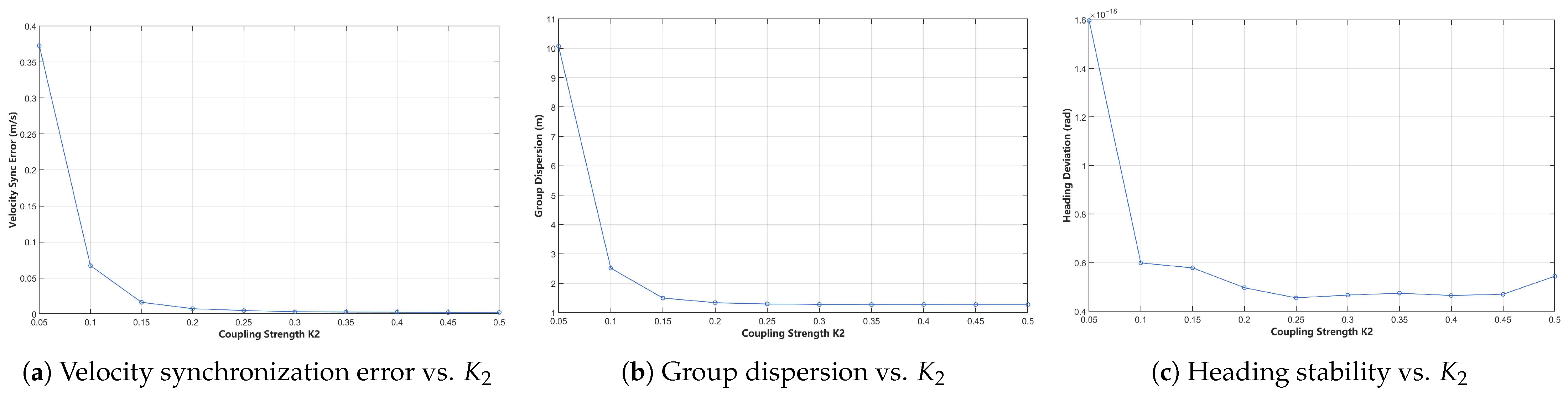
4.5.2. Repulsion Gain () Sensitivity
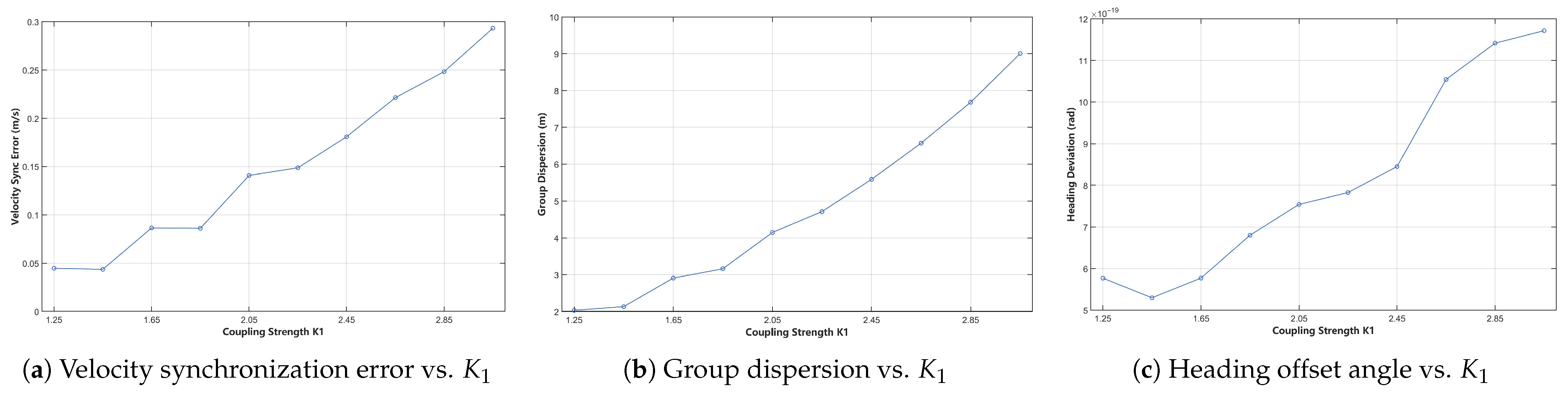
4.5.3. Dissipation Gain () Sensitivity
- Velocity synchronization error increases by 85% from to 3.05;
- Group dispersion expands by 32%, indicating looser formations;
- Heading accuracy deteriorates, suggesting reduced directional coordination.
4.5.4. Interpretation and Implications
- Robustness of the stability threshold: The parameter ranking remains perfectly consistent (Spearman ) across thresholds from 0.01 to 0.10 , validating the selection of .
- Optimal range: provides the best trade-off between performance enhancement and collision safety. Beyond this range, diminishing returns are observed.
- Performance trade-off with : Higher values degrade flocking metrics, suggesting that excessive damping disrupts the balance between velocity alignment and formation maintenance.
- Independent collision safety: The mechanism ensures collision avoidance independent of variations, thereby providing robust safety guarantees.
- Practical design guidelines: For implementation, designers should prioritize within the optimal range (0.15–0.30) and employ moderate values (1.5–2.0) to balance convergence speed with formation quality.
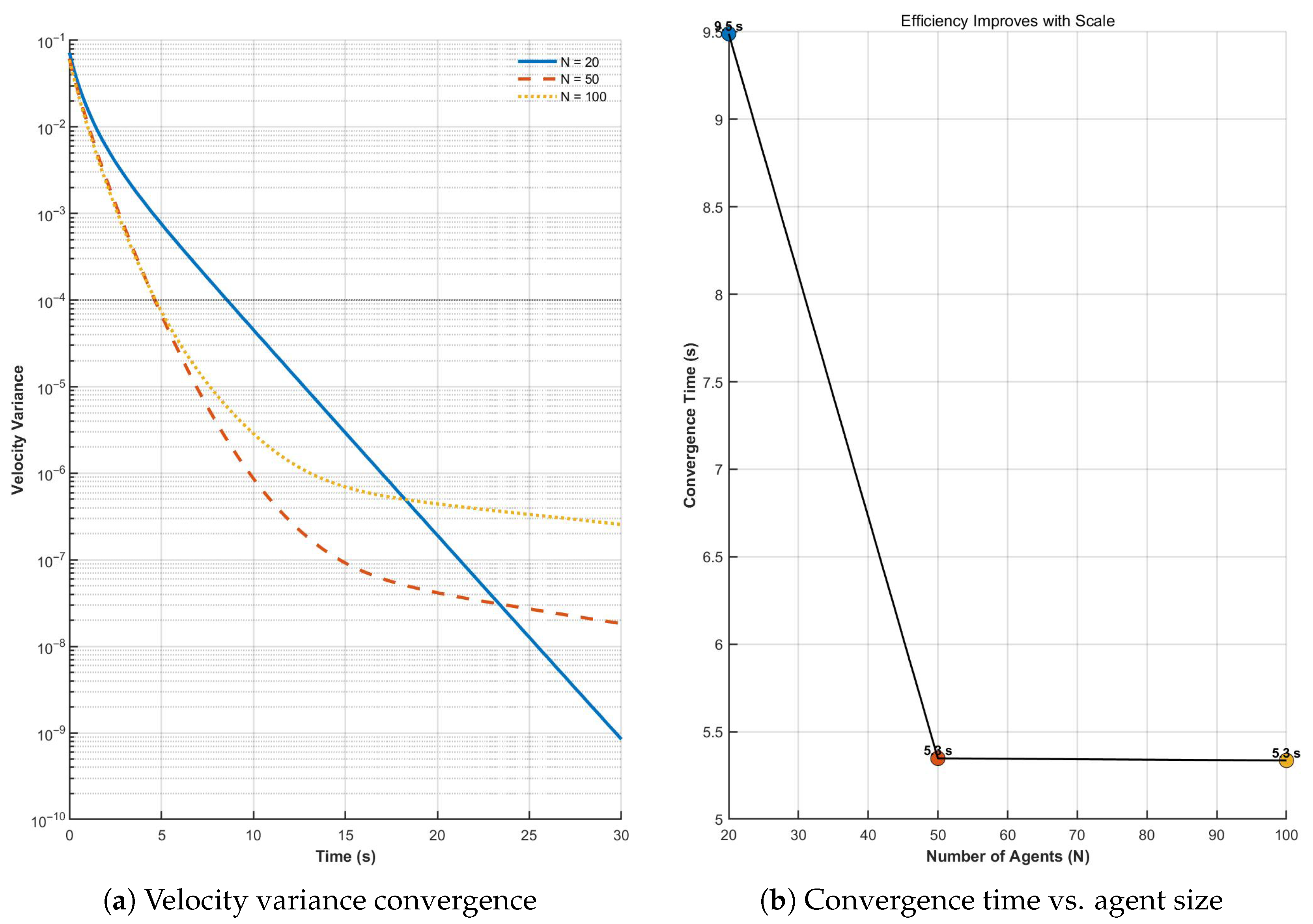
4.6. Scalability Analysis
4.7. Parameter Optimization
5. Conclusions and Prospects
- The repulsion gain governs spatial cohesion. An optimal range substantially improves velocity synchronization and reduces dispersion, with diminishing returns beyond .
- High dissipative gain can destabilize flocking through overcorrection, degrading velocity coherence, spatial cohesion, and heading stability.
- A Pareto-optimal parameter window (, ) is identified, effectively balancing alignment accuracy, collision avoidance, and energy efficiency.
- Robustness to Communication Constraints: The current model assumes perfect, instantaneous information exchange. A critical theoretical extension is to analyze the system’s stability and performance under communication delays and intermittent packet loss. This would involve reformulating the model using delayed differential equations or event-triggered control frameworks to derive new convergence conditions.
- Sensitivity to Measurement Noise: The analysis assumes accurate state measurements. Investigating the model’s behaviour with sensor noise (e.g., Gaussian noise in position/velocity estimates) is essential. This would require a stochastic stability analysis to determine how noise statistics propagate through the nonlinear coupling and binding forces, potentially informing the design of robust observers.
- Extension to Heterogeneous Dynamics: The framework currently considers homogeneous agents. Extending it to systems with heterogeneous agent dynamics (e.g., varying masses, actuator limits, or sensor capabilities) presents a significant theoretical challenge. This would involve developing heterogeneous Lyapunov functions or adaptive control schemes to ensure cohesive flocking despite individual differences.
- Limitations and Scope: The numerical validation presented in this work focuses on verifying the theoretical predictions of the proposed model under idealized conditions. This approach allows for clear interpretation of results without confounding factors. While the scalability analysis (Section 4.4) demonstrates the model’s effectiveness with up to 100 agents, validation under more realistic conditions—including communication delays, measurement noise, and heterogeneous agent dynamics—represents important directions for future research as outlined in Section 5. The current study establishes the theoretical foundation and demonstrates fundamental capabilities; subsequent work will build upon this foundation to address implementation challenges in specific application domains.
- Experimental Validation: Ultimately, implementing and testing the proposed algorithm on physical multi-robot platforms is necessary to validate its practical efficacy and identify unforeseen real-world constraints.
Author Contributions
Funding
Institutional Review Board Statement
Informed Consent Statement
Data Availability Statement
Acknowledgments
Conflicts of Interest
Abbreviations
| MAS | Multi-Agent Systems |
| UAV | Unmanned Aerial Vehicle |
| C-S | Cucker–Smale |
| ECR | Energy Consumption Ratio |
References
- Berthold, P.; Helbig, A.J.; Mohr, G.; Querner, U. Rapid microevolution of migratory behaviour in a wild bird species. Nature 1992, 360, 668–670. [Google Scholar] [CrossRef]
- Partridge, B.L. The structure and function of fish schools. Sci. Am. 1982, 246, 114–123. [Google Scholar] [CrossRef] [PubMed]
- Dong, X.; Yu, B.; Shi, Z.; Zhong, Y. Time-varying formation control for unmanned aerial vehicles: Theories and applications. IEEE Trans. Control Syst. Technol. 2014, 23, 340–348. [Google Scholar] [CrossRef]
- Jadbabaie, A.; Lin, J.; Morse, A.S. Coordination of groups of mobile autonomous agents using nearest neighbor rules. IEEE Trans. Autom. Control 2003, 48, 988–1001. [Google Scholar] [CrossRef]
- Abegaz, M.S.; Abishu, H.N.; Yacob, Y.H.; Ayall, T.A.; Erbad, A.; Guizani, M. Blockchain-based resource trading in multi-UAV-assisted industrial IoT networks: A multi-agent DRL approach. IEEE Trans. Netw. Serv. Manag. 2022, 20, 166–181. [Google Scholar] [CrossRef]
- Li, L.; Hu, J.; Tang, X.; Dong, Y. UAV Trajectory Planning and Resource Optimization for NOMA-VLC Systems via MAS-MARL. In Proceedings of the 2024 Asia Communications and Photonics Conference (ACP) and International Conference on Information Photonics and Optical Communications (IPOC); IEEE: Piscataway, NJ, USA, 2024; pp. 1–4. [Google Scholar]
- Lin, N.; Wang, Z.; Zhao, L. MAS-DDPG: Multi-Sensor Self-Adaptive Scheduling for UAV Path Planning in Network-Unavailable Environments. In Proceedings of the 2023 IEEE Intl Conf on Parallel & Distributed Processing with Applications, Big Data & Cloud Computing, Sustainable Computing & Communications, Social Computing & Networking (ISPA/BDCloud/SocialCom/SustainCom); IEEE: Piscataway, NJ, USA, 2023; pp. 1034–1041. [Google Scholar]
- Kada, B.; Khalid, M.; Shaikh, M.S. Distributed cooperative control of autonomous multi-agent UAV systems using smooth control. J. Syst. Eng. Electron. 2020, 31, 1297–1307. [Google Scholar] [CrossRef]
- Maldonado, D.; Cruz, E.; Torres, J.A.; Cruz, P.J.; Gamboa, S. Multi-agent Systems: A survey about its components, framework and workflow. IEEE Access 2024, 12, 80950–80975. [Google Scholar] [CrossRef]
- Jiang, H.; Cui, Z. Research on the Method and Its Improvement of MAS for Tourism E-commerce System. In Proceedings of the 2009 First International Workshop on Education Technology and Computer Science; IEEE: Piscataway, NJ, USA, 2009; Volume 1, pp. 59–61. [Google Scholar]
- Wang, C.; Zhang, Y.; Zhao, R.; Li, B.; Chen, J.; Xu, C. Application of WebGIS in distribution network dispatching management. In Proceedings of the 2021 6th International Conference on Smart Grid and Electrical Automation (ICSGEA); IEEE: Piscataway, NJ, USA, 2021; pp. 352–355. [Google Scholar]
- Esmaeili, A.; Ghorrati, Z.; Matson, E. Multi-agent cooperation using snow-drift evolutionary game model: Case study in foraging task. In Proceedings of the 2018 Second IEEE International Conference on Robotic Computing (IRC); IEEE: Piscataway, NJ, USA, 2018; pp. 308–312. [Google Scholar]
- Scheikl, P.M.; Gyenes, B.; Davitashvili, T.; Younis, R.; Schulze, A.; Müller-Stich, B.P.; Neumann, G.; Wagner, M.; Mathis-Ullrich, F. Cooperative assistance in robotic surgery through multi-agent reinforcement learning. In Proceedings of the 2021 IEEE/RSJ International Conference on Intelligent Robots and Systems (IROS); IEEE: Piscataway, NJ, USA, 2021; pp. 1859–1864. [Google Scholar]
- Acha, S.; Yi, S. Cooperative Intelligent Control of Multi-Agent Systems (MAS) Through Communication, Trust, and Reliability. Control Syst. Optim. Lett. 2025, 3, 53–67. [Google Scholar] [CrossRef]
- Lee, R.K.; Kitts, C.A.; Neumann, M.A.; Mcdonald, R.T. Multiple UAV adaptive navigation for three-dimensional scalar fields. IEEE Access 2021, 9, 122626–122654. [Google Scholar] [CrossRef]
- Cucker, F.; Smale, S. Emergent behavior in flocks. IEEE Trans. Autom. Control 2007, 52, 852–862. [Google Scholar] [CrossRef]
- Shen, J. Cucker–Smale flocking under hierarchical leadership. SIAM J. Appl. Math. 2008, 68, 694–719. [Google Scholar] [CrossRef]
- Cucker, F.; Huepe, C. Flocking with informed agents. Math. Action 2008, 1, 1–25. [Google Scholar] [CrossRef]
- Park, J.; Kim, H.J.; Ha, S.-Y. Cucker-Smale flocking with inter-particle bonding forces. IEEE Trans. Autom. Control 2010, 55, 2617–2623. [Google Scholar] [CrossRef]
- Li, Z.; Xue, X. Cucker–Smale flocking under rooted leadership with fixed and switching topologies. SIAM J. Appl. Math. 2010, 70, 3156–3174. [Google Scholar] [CrossRef]
- Ahn, S.M.; Choi, H.; Ha, S.Y.; Lee, H. On collision-avoiding initial configurations to Cucker-Smale type flocking models. Commun. Math. Sci. 2012, 10, 625–643. [Google Scholar] [CrossRef]
- Yin, X.; Yue, D.; Chen, Z. Asymptotic behavior and collision avoidance in the Cucker–Smale model. IEEE Trans. Autom. Control 2019, 65, 3112–3119. [Google Scholar] [CrossRef]
- Kim, J.-H.; Park, J.-H. Complete characterization of flocking versus nonflocking of Cucker–Smale model with nonlinear velocity couplings. Chaos Solitons Fractals 2020, 134, 109714. [Google Scholar] [CrossRef]
- Zhao, R.; Liu, Q.; Zhang, H. Flocking and collision avoidance problem of a singular Cucker–Smale model with external perturbations. Phys. A Stat. Mech. Appl. 2022, 590, 126718. [Google Scholar] [CrossRef]
- Yin, X.; Yue, D.; Han, Q.-L. The Cucker–Smale Model With Nonlinear Velocity Couplings and Power-Law Attractive Potentials. IEEE Trans. Autom. Control 2022, 68, 5752–5758. [Google Scholar] [CrossRef]
- Shi, L.; Ma, Z.; Yan, S.; Zhou, Y. Cucker–Smale flocking behavior for multiagent networks with coopetition interactions and communication delays. IEEE Trans. Syst. Man Cybern. Syst. 2024, 24, 5824–5833. [Google Scholar] [CrossRef]
- Zhang, Z.; Yin, X.; Gao, Z. Non-flocking and flocking for the Cucker-Smale model with distributed time delays. J. Frankl. Inst. 2023, 360, 8788–8805. [Google Scholar] [CrossRef]
- Wu, C.; Dong, J.-G. Effects of Time Delay on Cucker–Smale Flocking Under Hierarchical Leadership. IEEE Trans. Autom. Control 2023, 69, 1812–1817. [Google Scholar] [CrossRef]
- Wang, X.; Xue, X. Flocking behavior of the Cucker–Smale model on infinite graphs with a central vertex group. J. Stat. Phys. 2024, 191, 47. [Google Scholar] [CrossRef]
- Sun, F.; Wang, R.; Zhu, W.; Li, Y. Flocking in nonlinear multi-agent systems with time-varying delay via event-triggered control. Appl. Math. Comput. 2019, 350, 66–77. [Google Scholar] [CrossRef]



| Parameter | Value |
|---|---|
| Velocity coupling strength () | 1.2 |
| Binding force strength () | 2.5 |
| Dissipative force gain () | 1.5 |
| Repulsive force gain () | 0.8 |
| Expected spacing (R) | 0.5 |
| Metric | Extended Model | Classical C-S | Improvement |
|---|---|---|---|
| Final velocity error (m/s) | < | < | Comparable |
| Maximum dispersion (m) | 6.48 | 7.23 | 10.5% reduction |
| Minimum distance (m) | 1.050 | 1.097 | Both m |
| Theoretical safety guarantee | Yes (Theorem 2) | No | – |
| Energy dissipation guarantee | Yes (Theorem 1) | No | – |
| 0.01 | 0.02 | 0.03 | 0.04 | 0.05 | 0.06 | 0.07 | 0.08 | 0.09 | 0.10 | |
|---|---|---|---|---|---|---|---|---|---|---|
| 0.05 | 100.0 | 100.0 | 100.0 | 98.8 | 97.5 | 96.5 | 95.7 | 95.0 | 94.2 | 93.5 |
| 0.15 | 75.2 | 72.3 | 70.7 | 69.7 | 68.9 | 68.2 | 67.7 | 67.2 | 66.8 | 66.4 |
| 0.25 | 55.4 | 53.4 | 52.2 | 51.4 | 50.8 | 50.3 | 49.8 | 49.4 | 49.1 | 48.7 |
| 0.35 | 61.6 | 60.0 | 59.1 | 58.5 | 58.0 | 57.5 | 57.1 | 56.8 | 56.5 | 56.2 |
| 0.50 | 48.2 | 47.0 | 46.2 | 45.6 | 45.2 | 44.9 | 44.5 | 44.2 | 44.0 | 43.7 |
| 0.05 | 0.10 | 0.15 | 0.20 | 0.25 | 0.30 | 0.35 | 0.40 | 0.45 | 0.50 | |
|---|---|---|---|---|---|---|---|---|---|---|
| Collisions | 0 | 0 | 0 | 0 | 0 | 0 | 0 | 0 | 0 | 0.1 |
| Stability Time (s) | 57.0 | 51.1 | 50.7 | 53.9 | 51.3 | 53.2 | 58.7 | 53.9 | 52.5 | 54.2 |
| 1.25 | 1.45 | 1.65 | 1.85 | 2.05 | 2.25 | 2.45 | 2.65 | 2.85 | 3.05 | |
|---|---|---|---|---|---|---|---|---|---|---|
| Collisions | 0 | 0 | 0 | 0 | 0 | 0 | 0 | 0 | 0 | 0 |
| Stability Time (s) | 50.4 | 51.0 | 55.4 | 51.9 | 52.1 | 51.8 | 58.5 | 50.8 | 54.1 | 56.4 |
| 0.05 | 0.10 | 0.15 | 0.20 | 0.25 | 0.30 | 0.35 | 0.40 | 0.45 | 0.50 | |
|---|---|---|---|---|---|---|---|---|---|---|
| Velocity Error | 0.35 | 0.07 | 0.02 | 0.006 | 0.003 | 0.003 | 0.003 | 0.002 | 0.002 | 0.002 |
| ECR (%) | 1.5 | 4.6 | 9.5 | 17.8 | 25.4 | 34.9 | 48.6 | 67.2 | 82.0 | 103.6 |
| 1.25 | 1.45 | 1.65 | 1.85 | 2.05 | 2.25 | 2.45 | 2.65 | 2.85 | 3.05 | |
|---|---|---|---|---|---|---|---|---|---|---|
| Velocity Error | 0.05 | 0.06 | 0.07 | 0.08 | 0.15 | 0.16 | 0.21 | 0.25 | 0.34 | 0.34 |
| ECR (%) | 105.7 | 88.3 | 82.8 | 67.1 | 67.3 | 58.5 | 51.1 | 54.5 | 50.9 | 47.0 |
Disclaimer/Publisher’s Note: The statements, opinions and data contained in all publications are solely those of the individual author(s) and contributor(s) and not of MDPI and/or the editor(s). MDPI and/or the editor(s) disclaim responsibility for any injury to people or property resulting from any ideas, methods, instructions or products referred to in the content. |
© 2026 by the authors. Licensee MDPI, Basel, Switzerland. This article is an open access article distributed under the terms and conditions of the Creative Commons Attribution (CC BY) license.
Share and Cite
Li, Y.; Jin, Y.; Fan, W. Flocking Dynamics of Multi-Agent Systems Based on an Extended Cucker–Smale Model with Nonlinear Coupling and Binding Forces. Appl. Sci. 2026, 16, 3933. https://doi.org/10.3390/app16083933
Li Y, Jin Y, Fan W. Flocking Dynamics of Multi-Agent Systems Based on an Extended Cucker–Smale Model with Nonlinear Coupling and Binding Forces. Applied Sciences. 2026; 16(8):3933. https://doi.org/10.3390/app16083933
Chicago/Turabian StyleLi, Yimeng, Yinghua Jin, and Wenping Fan. 2026. "Flocking Dynamics of Multi-Agent Systems Based on an Extended Cucker–Smale Model with Nonlinear Coupling and Binding Forces" Applied Sciences 16, no. 8: 3933. https://doi.org/10.3390/app16083933
APA StyleLi, Y., Jin, Y., & Fan, W. (2026). Flocking Dynamics of Multi-Agent Systems Based on an Extended Cucker–Smale Model with Nonlinear Coupling and Binding Forces. Applied Sciences, 16(8), 3933. https://doi.org/10.3390/app16083933