Article

Design of Dry Stacking of Filtered Tailings in Extreme Seismic and Mountain Conditions

by
Carlos Cacciuttolo
1,*,
Edison Atencio
2,
Seyedmilad Komarizadehasl
3 and
Jose Antonio Lozano-Galant
1,*
1
Department of Civil Engineering, Universidad de Castilla-La Mancha, Av. Camilo Jose Cela s/n, 13071 Ciudad Real, Spain
2
School of Civil Engineering, Pontificia Universidad Católica de Valparaíso, Av. Brasil 2147, Valparaíso 2340000, Chile
3
Department of Civil and Environment Engineering, Universitat Politècnica de Catalunya, BarcelonaTech, C/Jordi Girona 1-3, 08034 Barcelona, Spain
*
Authors to whom correspondence should be addressed.
Appl. Sci. 2026, 16(8), 3911; https://doi.org/10.3390/app16083911
Submission received: 7 March 2026 / Revised: 13 April 2026 / Accepted: 14 April 2026 / Published: 17 April 2026
(This article belongs to the Special Issue Surface and Underground Mining Technology and Sustainability)

Abstract

Tailings management presents a critical challenge for the mining industry, particularly in mountainous regions with high seismicity and steep slopes. This article presents the development and design criteria for dry stacking of filtered tailings as a sustainable and safe alternative to conventional slurry tailings storage facilities (TSFs). The study focuses on the extreme conditions of a mountainous location characterized by complex topography with 10% slopes, space constraints, and significant seismic activity defined by a peak ground acceleration (PGA) of 0.3 g. The design methodology, which incorporates layered compaction of the filtered tailings to achieve a geotechnically stable structure, is detailed for a filtered TSF consisting of 7 terraces, each 10 m high, reaching a total height of 70 m. This approach minimizes the risk of liquefaction and prepares the filtered tailings surface for progressive closure, with unit operating costs (OPEX) of 2.5 USD/t. The results of the physical stability analysis confirm the viability of this solution: pseudo-static stability analysis yielded a safety factor of 1.22, demonstrating a significant reduction in water consumption and potential environmental impact. It is concluded that the dry disposal of filtered tailings is a technically robust option for tailings management in extreme mountainous environments, offering greater long-term safety guarantees and facilitating landscape integration, thus setting a precedent for mining projects in similar geographies.

1. Introduction

Sustainable mining integrates the reprocessing of copper slag as a key pillar of the circular economy [1,2,3]. Using advanced technologies such as leaching and flotation, valuable residual metals (copper, iron, zinc) that were previously discarded are extracted [4,5]. This transforms a historical environmental liability into a new resource, radically reducing the need to extract virgin ore and decreasing the volume of waste deposited in tailings storage facilities (TSFs) [6]. This process closes the material cycle, as the resulting inert byproducts are used in road construction or as filling material [7]. Thus, the value of the original resource is maximized, the environmental impact is minimized, and a more efficient and regenerative economic model is generated, where waste ceases to be a problem and becomes a new source of value [8]. The mining companies’ objectives are (i) to treat intermediate slags with approximately 8% copper grade, (ii) to obtain a copper concentrate (the recovery of this metal from the slag), and (iii) to minimize copper losses in the tailings [9,10].
The management of tailings has become one of the most critical and urgent challenges facing the global mining industry in the 21st century [11]. These wastes, generated in enormous volumes during mineral extraction and concentration, pose a significant environmental liability and a latent risk to surrounding communities and ecosystems [12]. The pressing need to extract metals and minerals essential for the energy transition and technological development contrasts sharply with the responsibility to ensure safe and sustainable operations, placing tailings management at the heart of the debate on the future of mining.
Historically, the storage of tailings in the form of slurries, or slurries using containment dams, has been the predominant method [13]. However, this practice carries significant geotechnical and operational risks, as these enormous structures must perpetually contain large volumes of water and solids [14]. The stability of these dams is subject to complex variables such as water regimes, seismic activity, and proper operation throughout their life cycle [15]. Unfortunately, recent history has shown us the devastating consequences of failures in these facilities, with catastrophic events resulting in tragic loss of life, enormous environmental damage, and the loss of the social license to operate [16].
In this context, reducing the probability of tailings storage facility failures has become a strategic priority and an unavoidable ethical imperative for the industry [17]. The adoption of international regulatory frameworks, such as the Global Industry Standard on Tailings Management (GISTM) [18], is driving companies to move beyond conventional practices, demanding a “zero-risk” approach and robust corporate governance that ensures the safety of these deposits during and after mining operations [19]. This implies not only rigorous management of existing dams, with real-time monitoring and constant risk assessment, but also the search for technological alternatives that eliminate or drastically reduce the hazards inherent in conventional tailings facilities [20].
This is where filtered tailings technology and dry stacking emerge as one of the most promising and transformative solutions [21]. This process involves mechanically dewatering the tailings using filters, reducing their moisture content until a solid material, or “cake,” is obtained, with a consistency similar to that of moist soil. By removing excess water, the nature of the waste is transformed, going from an unstable mixture to a geotechnically competent material that can be transported, placed, and compacted into piles, without the need to construct dams to contain water [22].
The advantages of this technology in terms of safety are profound. Dry stacking eliminates the risk of catastrophic failure associated with liquefaction or dam overtopping, since a significant volume of water is not stored in the TSF [23]. This greater stability, even under extreme weather conditions or seismic events, drastically reduces the potential consequences of any incident [24]. Furthermore, this technique offers significant environmental and operational benefits, such as a smaller surface footprint, efficient recovery and recirculation of process water (an increasingly valuable resource), and facilitation of the gradual closure and revegetation of impacted areas [25].
Given the legacy of risks associated with conventional tailings dams and the need for more responsible mining, the transition to filtered tailings and dry stacking technologies is emerging as a necessary path, increasingly adopted by the forward-thinking industry [26]. Reducing reliance on water reservoirs and opting for solid storage systems not only mitigates the risk of catastrophic failures, thus protecting communities and the environment, but also strengthens the long-term viability of mining operations [27]. This paradigm shift, driven by technological innovation and social pressure, is paving the way for mining development that is compatible with safety, sustainability, and social acceptance [28].

2. Methodology

The following paragraphs present the description of the methodology used in this research:

2.1. Technological Approach

The filtered tailings technology approach represents a paradigm shift from conventional slurry-based tailings management. In this approach, tailings, typically mineral processing waste, are subjected to mechanical dewatering using pressure filters, vacuum filters, or centrifuges to remove a significant portion of the process water. The result is a filtered material with a moisture content typically ranging between 12% and 20%, depending on the material characteristics and the filtration equipment employed. This reduced moisture content allows the tailings to be transported via conveyor belts, trucks, or stackers and placed in a controlled manner as an unsaturated, compacted deposit, fundamentally altering the physical behavior and risks associated with conventional tailings storage facilities [29].
The construction methodology for filtered tailings deposits follows a dry stack approach, where the material is placed in thin layers, commonly 20 to 50 cm in thickness, and compacted using earthmoving equipment to achieve specified density targets, such as 95% of Standard Proctor density. This layering and compaction process creates a mechanically stable mass that can be configured with engineered slopes, terraces, and berms. The TSF is typically constructed in an upstream direction, allowing for progressive build-up while maintaining structural integrity. Because the material is placed at or near its optimum moisture content, it exhibits shear strength characteristics comparable to conventional soil fills, enabling the construction of stable slopes without the need for extensive water management infrastructure such as decant towers or large-scale pond containment [30].
From an environmental perspective, the filtered tailings technology approach substantially reduces or eliminates the primary risks associated with conventional tailings management. By removing the majority of the process water prior to deposition, the technology minimizes the potential for seepage into underlying soils and groundwater, effectively eliminating the need for large water retention ponds that characterize conventional slurry facilities [31]. Additionally, the absence of a free water surface eliminates the risk of catastrophic dam failure due to overtopping or piping, representing a fundamental reduction in consequence potential [32]. However, the approach introduces other considerations, particularly the management of dust generation from exposed surfaces during dry periods, which is typically addressed through progressive cover placement, the use of chemical stabilizers, or the incorporation of moisture-retention strategies during operations [33].
A defining feature of the filtered tailings technology approach is its integration of closure considerations into the operational phase. Because the TSF is constructed as a compacted, unsaturated mass, it can be progressively closed as terraces and slopes reach their final configuration. This progressive closure typically involves the placement of cover systems, such as granular soil layers, geosynthetic materials, or topsoil, to support vegetation establishment, control erosion, and manage infiltration. Quality assurance controls are central to the approach, requiring rigorous monitoring of deposition geometry, compaction characteristics, moisture content, and layer thickness to ensure compliance with design specifications. When implemented with appropriate engineering controls, operator training, and adherence to standards such as the Global Industry Standard on Tailings Management (GISTM) [18], the filtered tailings technology approach offers a robust alternative for tailings management that prioritizes long-term stability, environmental protection, and risk reduction [34,35].

2.2. Project Overview

The project is located in a smelter industrial complex, which lies in the Atacama Desert (province of Chañaral, III Region, Chile), a zone that is characterized by the mountainous Domeyko Highland area at some 3000 m a.s.l.
The construction of a flotation plant will take out of operation three slag cleaning furnaces, which allows for decreasing CO2 and SO2 emissions, resulting in a process that is friendlier to the environment. The current design of the new slag flotation treatment plant has a nominal tailings production of 1350 mtpd for a primary operational horizon of 25 years, during which the treatment of slags by flotation will generate a significant amount of tailings, equivalent to 10 Mt of filtered tailings. Given the particular topography constraints of the area, these tailings will be stored in three independent TSFs.
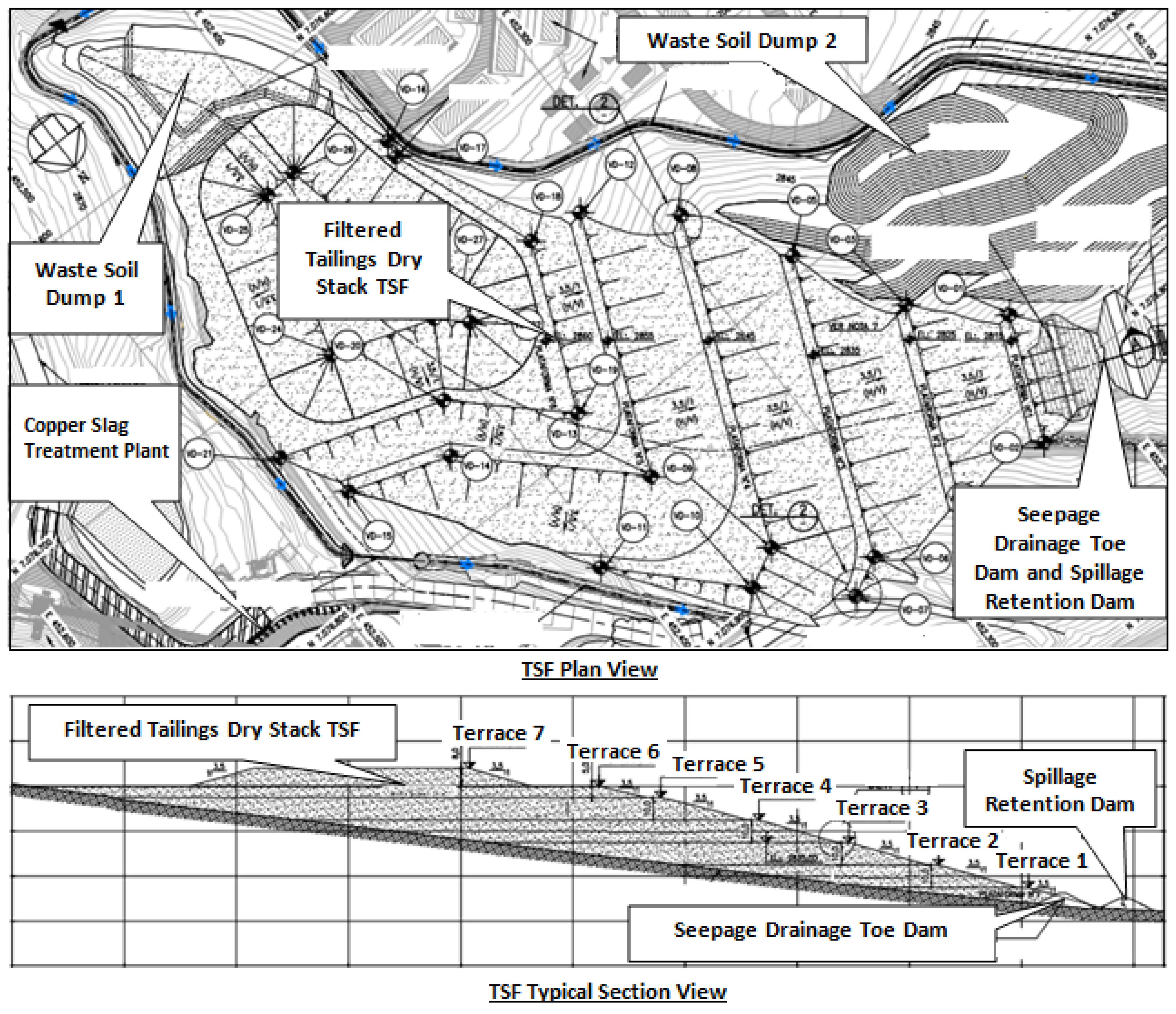
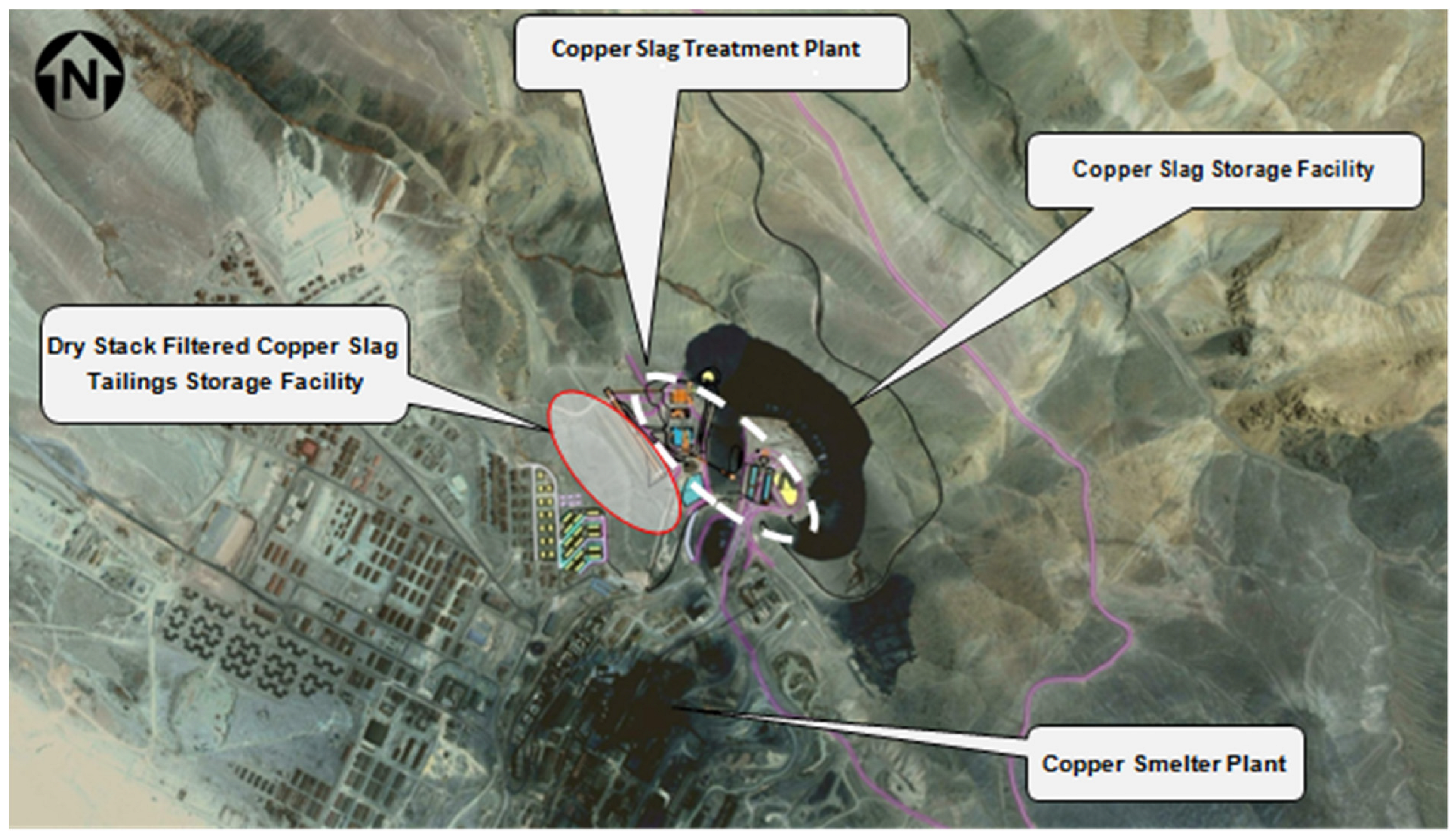
The area where the slag treatment plant is located is close to the current large slag dump, at the side of the Afluente Creek. The following Figure 1 presents the main facilities for the project:
The main decision-making objectives for applying the filtered tailings technology to this project are (i) to recover the greatest amount of water for its reuse in the process (reduced availability of fresh water), (ii) to optimize the maximum volumetric storage capacity for tailings and the useful life of the TSF (with scarcity of adequate sites with valley-type topography for a conventional tailings dam), and (iii) to implement a progressive closure, reducing TSF footprint and impact areas [36].
Aiming to maximize water recovery, the tailings undergo thickening and filtration, resulting in a final tailings product with low moisture content. This waste material is managed and deposited on a surface using mechanical equipment, increasing the storage capacity of the TSF by means of a greater dry density [37].
This article presents the design of the first TSF to be implemented, located in the Afluente Creek area, adjacent to the new copper slag treatment plant.
The following table presents the design parameters that define the capacity and useful life of the filtered TSF, located in the Afluente Creek area:
Table 1 presents the capacity and service life design parameters for a dry-stack TSF for copper slag. It specifies that the nominal copper slag production is 1350 tons per day (mtpd) or 750 cubic meters per day (m3pd). The total volume to be stored in the TSF is 610,000 m3, equivalent to 1,220,000 tons. Based on these values, the estimated service life of the facility is 3.0 years.

2.3. Geological and Topographical Conditions

The project is located in the Domeyko Mountain Range on a terrace of alluvial material that covers pleated volcano-sedimentary rocks. The area is bounded to the west by Agua Dulce Creek, to the north by Jardin Creek, and to the east by Mina de Cal Creek. The eastern border is a mountainous range in the north–south direction, whose main peaks are Cortadera Hill to the north with 3210 m a.s.l. and Miraflores Hill to the south with 3667 m a.s.l.
The Quaternary alluvial horizons cover the bottoms of creeks and have thicknesses of less than 5 m, being composed of gravel, sand, and silt, originating from scarce torrential rains that drag sediments, accumulating them at the bottom of creeks, produced by the weathering of rocks and old sediments. The intrusive rocks in the area correspond to rhyolitic porphyry, which is found in the southeast part of the smelter area.
In Andean landscapes like this case study, the topographic features are dominated by rugged terrain with steep slopes, especially in ravines and narrow valleys. In these areas, slope gradients often exceed 10%, frequently reaching between 30% and over 70%, reflecting high relief energy and marked morphodynamic instability. These steep slopes influence land use, limiting intensive agriculture and favoring the formation of terraces or torrential drainage systems, and they demonstrate the relatively young tectonics of the Andean landscape. The study focuses on the extreme conditions of a mountainous location characterized by complex topography with 10% slopes.

2.4. Climate Conditions

The area where the project is located is characterized by a mountain- and desert-type climate, with constant wind predominantly in the northeastern direction. The following table presents the climate design parameters considered.
According to Table 2, this climate is typical of a high-arid or semi-arid mountain region. Temperatures vary considerably between day and night (high daily temperature range). Evaporation far exceeds precipitation, resulting in a permanent water deficit. Low humidity and high altitude generate strong solar radiation and a dry environment. Snow is possible but not persistent.

2.5. Seismic Conditions

The project is located in a highly seismic area that lies in a subduction area where the Nazca and South American Plates interact, with earthquakes of magnitude Mw 8.5 occurring every 100 years. The following table shows the seismic parameters adopted for the design:
Table 3 presents two seismic design scenarios for critical infrastructure: the Operational case and the Closure case. Both cases are in Seismic Zone 4 of the UBC (Uniform Building Code), which corresponds to the highest seismic hazard. For the Operational case, a return period of 100 years, a horizontal seismic coefficient of 0.15, and a peak ground acceleration (PGA) of 0.3 g are defined. For the Closure case, the return period is 500 years, the horizontal seismic coefficient is 0.50, and the acceleration level is defined as the MCE (Maximum Credible Earthquake), that is, the maximum credible earthquake for the site.
These two cases reflect a design strategy based on seismic performance levels. The Operational case (100 years, 0.15 g) aims to ensure that the structure can withstand frequent or moderate earthquakes without losing its functionality, allowing for continuous operation or rapid resumption after an event. In contrast, the Closure case (500 years, MCE) represents an extreme and very rare earthquake. For this level, the structure is not required to operate normally, but rather to avoid collapse or release of hazardous materials, thus ensuring the safety of people and the environment during the controlled closure or abandonment of the TSF.

2.6. Design Criteria

Considering the objectives defined above for the management and impoundment of tailings, the design criteria for the project are presented in the sections that follow.

2.6.1. Thickening and Filtering Processes

The tailings thickening and filtering areas of the new copper slag treatment plant include the following main equipment:
  • Tailings thickener (high-density type): The high-density tailings thickener is characterized by producing a slurry discharge with a consistency intermediate between that of a conventional thickener and a paste thickener, typically achieving solids concentrations between 60% and 65% by weight. Its design includes a more robust, higher-torque rake mechanism, along with a central feed that incorporates a dilution system and a deep feed well to optimize flocculation and sedimentation. Furthermore, it operates with a steeper sludge slope and requires continuous monitoring of the sludge–clear water interface height, resulting in an overflow with a low solids load and a thick but still pumpable discharge.
  • Tailings filters (ceramic disc vacuum filters): Ceramic disc vacuum filters are characterized using porous filter plates made of ceramic material (generally aluminum oxide or silicon carbide), which replace traditional filter cloths, achieving highly efficient solid–liquid separation through the combined action of vacuum and capillary action. Their design consists of a set of rotating ceramic discs partially submerged in a tank containing the pulp. Each disc is divided into segments connected to a vacuum system and a countercurrent washing circuit with hot water and nitric acid to clean the pores and maintain permeability. Key advantages include low energy consumption (up to 90% less than cloth filters), reduced final moisture content in the solid cake (typically between 10% and 12%), very clear filtered water that can be reused in the process, and the absence of significant wear due to the hardness of the ceramic material.
Final tailings are received from flotation with a Cw (solids content by weight) around 27%, and are thickened to a Cw of approximately 60% before being fed to the ceramic disc vacuum filters. These units provide a cake-type product with a Cw between 88 and 90%, a cake thickness in the order of 10–12 mm, and a moisture content (wet basis) of approximately 10–12%. The following Table 4 presents a summary of the process design parameters considered for the project.
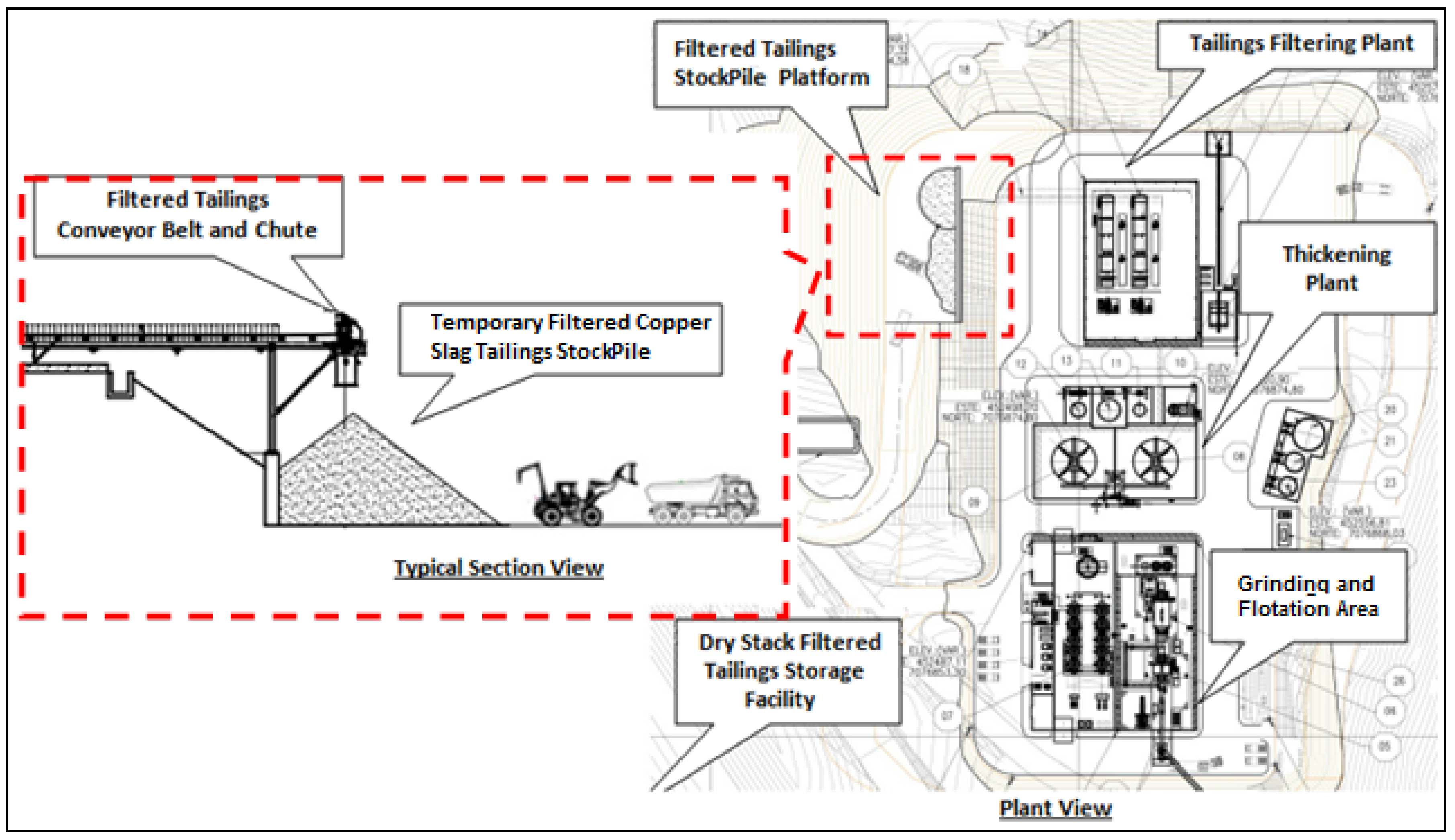
The following figure shows the plant view and a typical section view of the copper slag treatment plant and the filtered copper slag tailings transfer stockpile:
Figure 2 presents a technical diagram divided into two main sections: a “Typical Section View” and a “Plant View.” The cross-section shows a filtered tailings storage platform upon which a temporary stockpile of filtered tailings is located. The plan view sequentially identifies the grinding and flotation area, the thickening plant, and the tailings filtration plant, which ultimately feed the filtered tailings platform.
Figure 2 represents a dry tailings disposal system widely used in modern mining to reduce environmental and operational risks. The process begins with the concentration of ore in the grinding and flotation area. The tailings are then thickened to recover water, subsequently filtered until they reach a moist but manageable consistency and finally stacked on a platform designed for geotechnical stability. The inclusion of a temporary stockpile for filtered copper slag suggests the use of a front-end loader and dump truck for transporting the filtered tailings. This scheme avoids conventional tailings dams, minimizing water consumption and the risk of catastrophic failures, making it ideal for arid areas or areas with high environmental regulation.

2.6.2. Filtered Tailings Transfer, Storage and Transport

Considering (i) the short life of the TSF, (ii) the closeness of this TSF to the copper slag treatment plant (distance of 1 km), and (iii) the need to save energy, the transport of filtered tailings is done by haul trucks, and their dispersal at the TSF uses bulldozers and smooth drum vibrating rollers [38]. The components of the filtered tailings stockpile and transport system, once the filtered cake is obtained, are:
  • Conveyor belt and chute for filtered tailings, which dump onto the transfer stockpile.
  • Temporary storage in a temporary stockpile and loading by a front-end loader onto haul trucks of filtered tailings.
  • Haul operation road for the transit of 25 t capacity haul trucks to the TSF.

2.6.3. Filtered Copper Slag TSF Civil Works

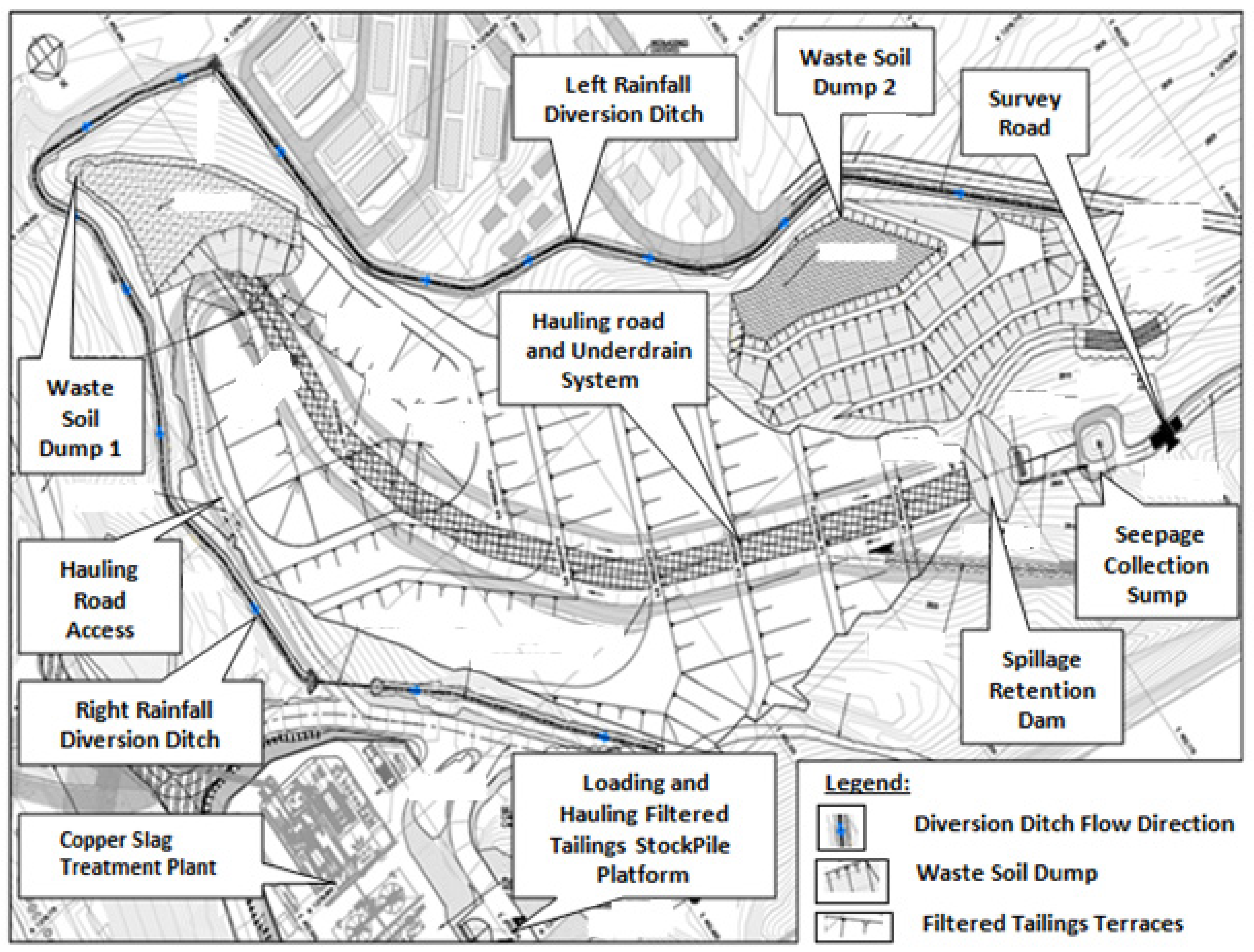
The TSF is composed of the following civil works [39], which are shown in the following Figure 3:
  • Haul roads and emergency brake track.
  • Spillage retention dam.
  • Underdrain system.
  • Seepage collection sump.
  • Rainfall diversion ditches.
  • Waste soil dumps.
The following paragraphs present a brief description of the civil works of the TSF considering Figure 3.
  • Haul operation roads and emergency brake track
The project considers the transport of filtered tailings using 25 t capacity haul trucks, which allows the transport of 750 m3/day of generated tailings. For the adequate circulation of haul trucks, the project considers the construction of an access road to the site of the TSF, in order to facilitate dry-stack construction and quick transit. Considering the topographical characteristics of the TSF, the road entrance is at the rear of the watershed, with a double track (two separate tracks), one uphill and one downhill. Considering the slope of both tracks (watershed with an average slope of 12%) and the descent of haul trucks with filtered tailings, the project includes an emergency brake track as a contingency measure [40].
  • Spillage retention dam
This civil structure is a 5 m-high dam situated downstream of the TSF and is designed to contain any potential spills of filtered tailings caused by rainfall events [41].
  • Drainage system
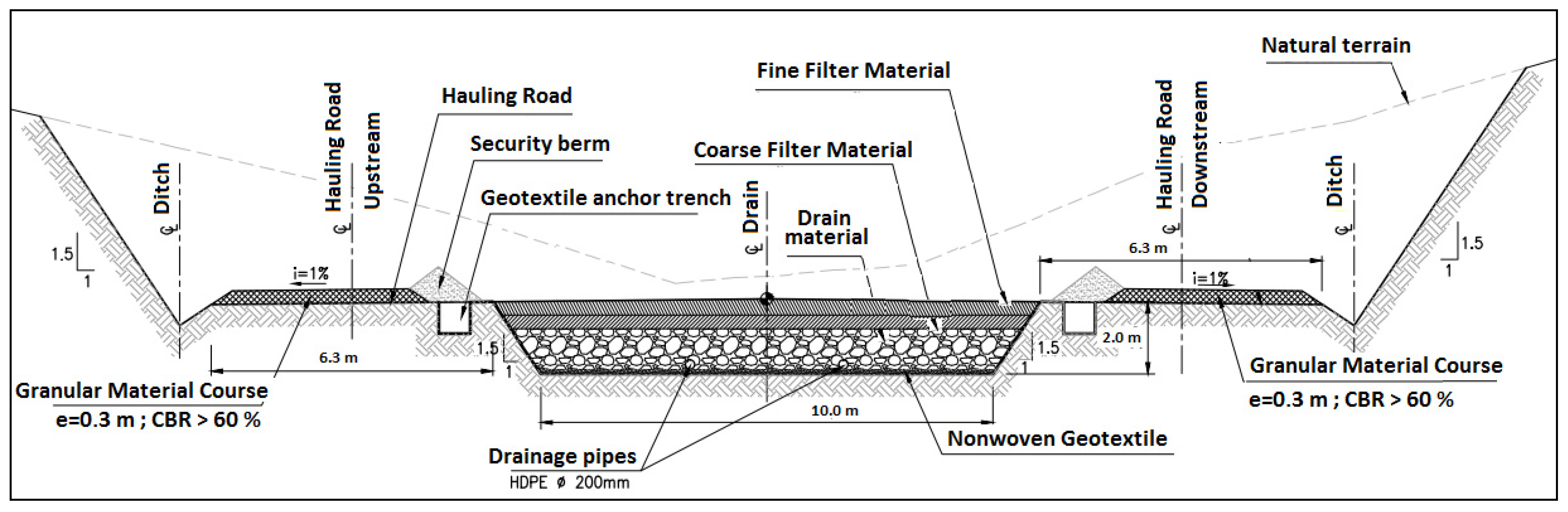
This is the primary drainage system, consisting of an excavated trench lined with non-woven geotextile and filled with gravel and filter materials. It is positioned at the downstream end of Afluente Creek to capture any potential seepage from the filtered tailings [42].
  • Drainage sump
The drainage sump is situated roughly 5 m downstream of the spillage retention dam and is designed to collect any potential seepage from the filtered tailings. The sump is fully lined with a geotextile and a geomembrane. To remove the water that accumulates in the sump, one option is to install a submersible pump and transfer the water to a tank truck for disposal. Should excessive water accumulate due to extreme rainfall, the sump is equipped with a safety spillway to discharge the excess [41].
  • Rainfall diversion channels
The project involves the construction of two perimeter channels—one on the right bank (southeast) and one on the left bank (west) of Afluente Creek. These channels consist of trapezoidal cross-sections lined with a concrete cloth ditch liner, featuring average slopes of 12%, and incorporate corrugated steel pipes in sections where slopes exceed 22%. Both channels collect surface water runoff from rainfall, preventing it from entering the filtered TSF, and convey these flows to discharge points downstream of the facility [39].
  • Waste soil dumps
All excess materials from the excavations of civil works associated with the TSF, as mentioned above, will be transported and kept in two dumps, with one dump located at the back of the deposit (16,000 m3), and the other dump located on the left side of Afluente Creek, adjacent to the closure dam (52,000 m3). These materials are relevant since they will be used later to build the cover of the filtered TSF, which will be done in a progressive manner, aiming to control dust entrainment given the constant wind present in the area [43].
Finally, the methodology of this article considers field testing (geotechnical tests, such as field tests for compaction of filtered tailings, considering vibrating drum rollers, among others), experimentation (geotechnical lab tests such as particle size distribution and CIU triaxial tests, among others), and numerical modeling (hydrological, hydraulic, and geotechnical modeling).

3. Results

3.1. Filtered Tailings Dry Stack TSF Geometry and Disposal Scheme

The filtered tailings are placed in 30 cm thick layers, where they are left to achieve their optimal moisture content of 12% and are subsequently compacted to 95% of the Standard Proctor density (ASTM D698) [44]. The filtered tailings dry stack storage facility consists of a mass comprising seven terraces and berms. The dry stack facility is constructed in the upstream direction of Afluente Creek. The main geometric features of the facility are presented in the following table.
Table 5 presents the main geometric characteristics of a dry stack filtered tailings (TSF) storage facility. The values indicate a design with seven stepped terraces, each with a maximum height of 10 m and a minimum berm width between terraces of 5 m. The local slope of each terrace is 3.5 horizontal to 1 vertical (3.5 H:1 V), while the overall slope considering all seven terraces is slightly gentler (4.0 H:1 V), reaching a maximum total height of 70 m.
The design corresponds to a medium-to-large filtered tailings facility, typical of modern mining operations seeking to minimize hydrological and geotechnical risks. The combination of 5 m berms and gentle slopes ensures static and seismic stability, allows access for machinery used in layer construction, and facilitates surface drainage. The overall slope, which is gentler than the local slope, reflects the stabilizing effect of the horizontal berms. Taken together, these specifications meet international safety standards for dry-filtered tailings storage facilities, significantly reducing the risk of catastrophic failures compared to conventional tailings dams.
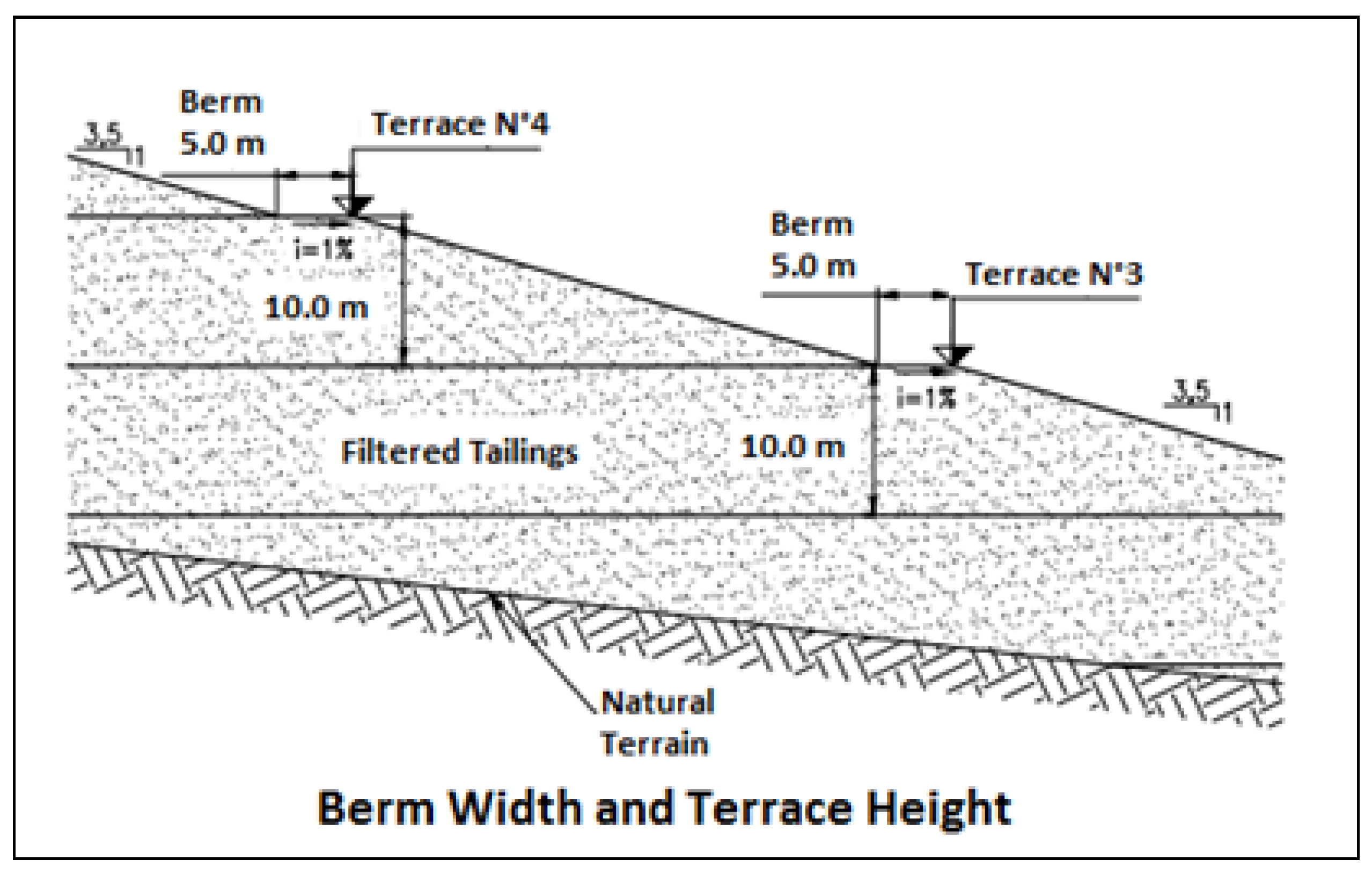
The following figures (Figure 4 and Figure 5) show the main geometric design characteristics of the filtered TSF (i) in plant view, a typical longitudinal section, and (ii) berm details.
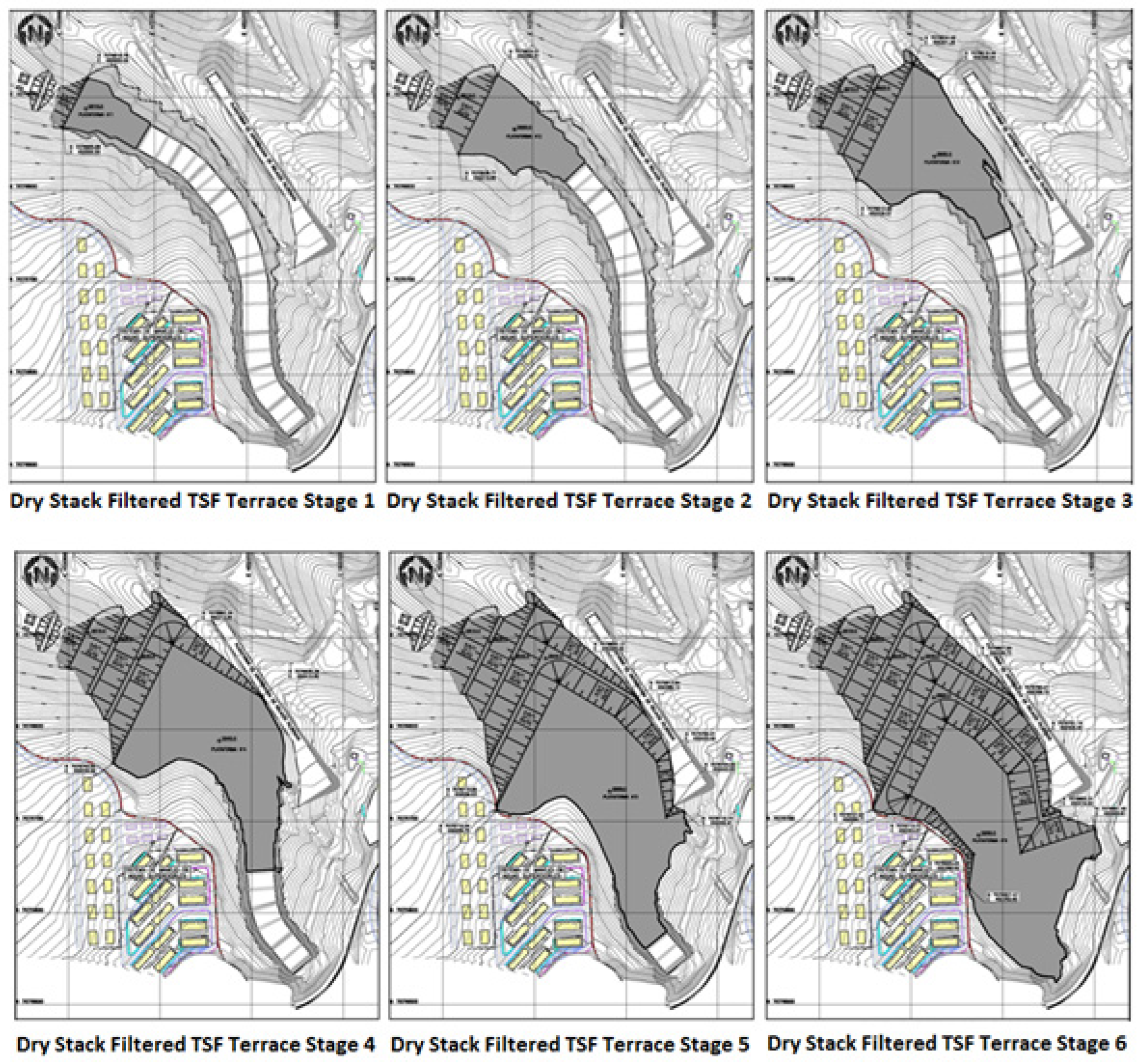
The construction of the TSF terraces proceeds from the lower sector to the higher sector of Afluente Creek, according to the geometric characteristics described above and indicated in the previous table, in order to facilitate adequate construction with haul trucks, bulldozers, and smooth drum vibrating rollers, ensuring TSF physical stability [45]. The following figure presents the arrangement and growth scheme of the filtered TSF:
Figure 6 shows a six-stage evolutionary sequence (Stage 1 to Stage 6) in the construction of a dry-filtered tailings storage facility using terraces. In the initial stages (Stage 1 and Stage 2), the lower terraces are formed, where the filtered tailings are placed and compacted in ascending layers, starting from a level base. As the sequence progresses (Stage 3 to Stage 6), the terraces are progressively raised in both height and lateral extent. Each new terrace rests on the berm or platform of the terrace below, maintaining the local and overall slopes specified in the designs.
Interpreting the figure, the filtered tailings are stacked in successive terraces from the bottom up, allowing for continuous operation while the lower terraces drain, consolidate, and gain stability. This phased approach offers key advantages: it facilitates stability control during construction, allows for the early rehabilitation of completed slopes, reduces surface erosion, and minimizes the risk of liquefaction or overall failure. Overall, the figure illustrates a modern mining engineering practice that prioritizes safety and sustainability over conventional TSFs.

3.2. Geotechnical Properties of Filtered Tailings

A characterization of the physical, strength, compaction, and permeability properties of the copper slag filtered tailings has been carried out. The filtered tailings are a non-plastic clayey silt soil of high permeability due to the shape of the particles of this material, which has a crystalline and angular structure. The following table presents the physical and compaction properties of the filtered tailings.
Table 6 presents the physical and compaction properties of a material called filtered tailings. This is a predominantly fine material, with a P80 size of 44 microns and a P50 size of 30 microns. Its relative density of solids ranges from 3.7 to 4.0, indicating a high specific gravity, typical of materials containing metal oxides. According to the USCS system, it is classified as ML (low plasticity silt), and its Atterberg limits show that it is non-plastic (NP). This combination suggests mechanical behavior similar to that of silty sands or non-plastic silts.
Regarding compaction, the minimum dry density ranges from 1.3 to 1.5 t/m3, while the maximum reaches 2.2 to 2.4 t/m3, reflecting a wide densification range. For 95% of the maximum density of the standard Proctor test (ASTM D698) [44], a dry density of 2.0 to 2.2 t/m3 is obtained, with an optimum moisture content between 10 and 12%. The absence of plasticity and the high maximum possible density suggest that this material can achieve good mechanical strength with proper compaction.
To ensure the safe placement of filtered dry tailings under the high seismic condition characteristic of the area, specific measures were developed. According to this case study, the filtered tailings were placed with a bulldozer in loose layers of 30 cm thickness. Each layer was then compacted using a 10-tonne vibratory roller compactor. The number of passes of this vibratory roller was carefully determined to achieve a maximum compacted dry density equal to 95% of the Standard Proctor test value. This target density is critical for providing the necessary shear strength and resistance to liquefaction or settlement during a high-impact seismic event.
The article thus confirms that the combination of a 30 cm layer thickness, a 10-tonne vibratory roller, and a compaction effort calibrated to reach 95% of Standard Proctor maximum dry density constituted the core technical strategy for seismic-safe tailings placement. By controlling these parameters, the operation aimed to ensure that each layer achieved uniform, high-density packing, minimizing void space and enhancing the material’s stability under dynamic loading. These measures, as presented in this article, directly address the seismic risks of the zone by producing a compacted filtered tailings deposit capable of withstanding strong ground motions without significant deformation or failure.
The filtered tailings compacted to 95% of the Proctor Standard (ASTM D698) [44] reach a maximum dry density in the order of 2.0 t/m3, at a corresponding moisture content of 12%, which is adequate and achievable in the TSF, considering the process and climate conditions of the project.
The following table indicates the strength and permeability properties of the filtered tailings based on CIU triaxial tests.
Table 7 presents the geotechnical properties of filtered tailings for a dry density range of 2.0 to 2.2 t/m3. It includes shear resistance parameters: cohesion equal to 0 t/m2, internal friction angle between 32° and 38°, a dimensionless parameter (Ratio of ultimate strength versus effective vertical stress) of 0.27, and permeability ranging from 10−4 to 10−5 cm/s.
These values indicate that the material behaves as a granular soil with no effective cohesion, typical of clean sands or gravels, where shear strength depends solely on internal friction. The friction angle of 32° to 38° is moderately high, suggesting good bearing capacity. The low permeability (on the order of 10−4 to 10−5 cm/s) is characteristic of fine-grained materials or those with some silt content, implying slow drainage. This is relevant for evaluating consolidation, slope stability, and behavior under dynamic loads in TSFs.
Finally, since the filtered TSF was originally part of an engineering project and has not yet been constructed, it was not possible to obtain undisturbed samples from the site. Therefore, CIU triaxial tests were performed on tailings samples prepared in the laboratory from material obtained during metallurgical comminution and flotation tests.
The samples were reconstituted in the laboratory, simulating the compaction conditions expected to be applied in the future filtered TSF. For this purpose, dry tailings from the metallurgical tests were used, which were homogenized and characterized in terms of particle size distribution, specific gravity, and fines content. The specimens were prepared by static compaction in five layers within a cylindrical mold, achieving a target dry density of 2.00 g/cm3 and a moisture content of approximately 12% (like the optimum compaction obtained in Standard Proctor tests). No additives or cementitious materials were used in the reconstitution process.

3.3. Water Management

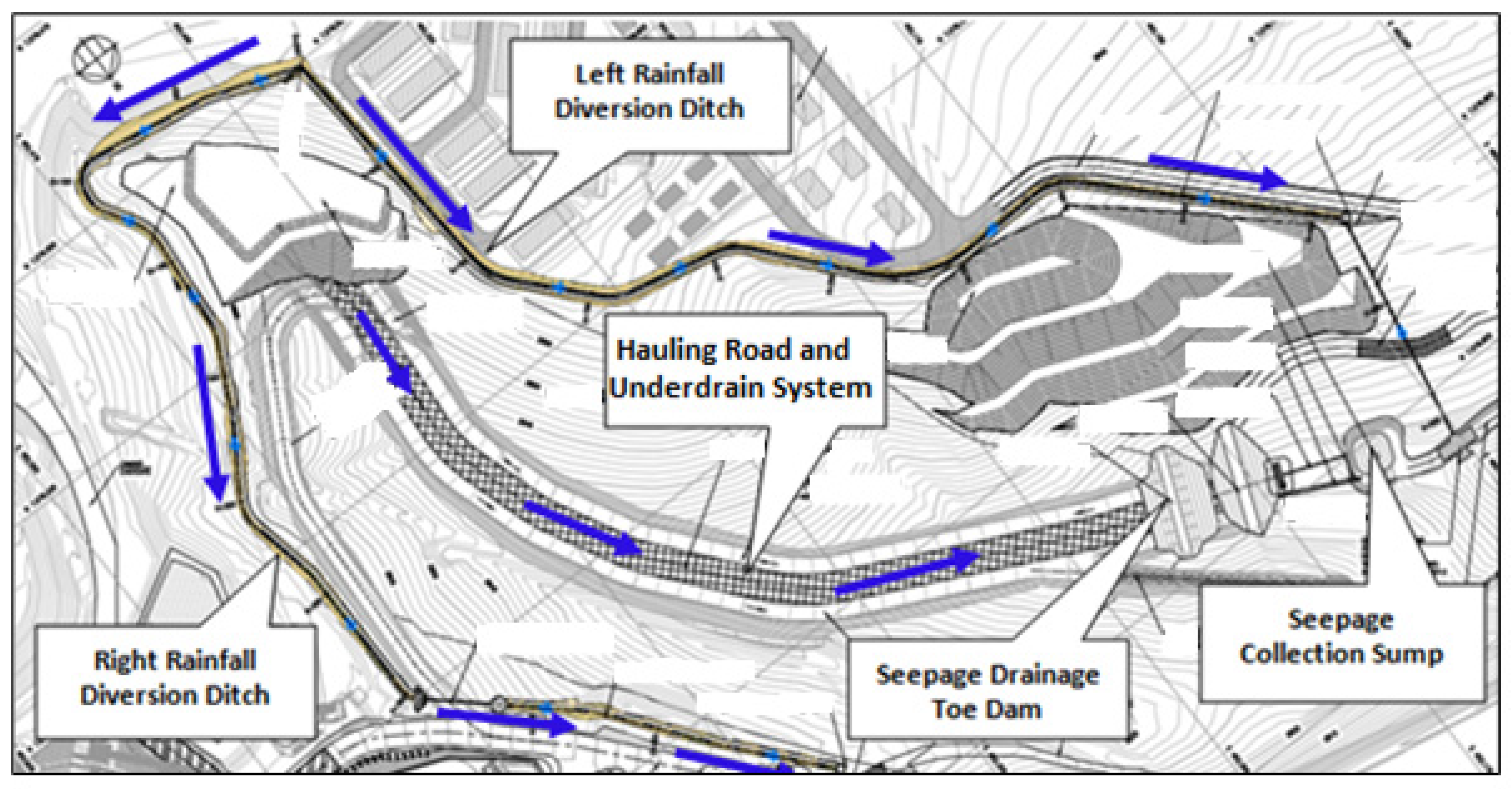
Considering the use of filtered tailings technology, the physical and hydrological stability of the TSF has to be assured, which implies designing civil works where the surface and groundwater flows are managed adequately [46]. It is important to maintain these tailings with low moisture levels, close to an optimum moisture content, avoiding saturation, to be able to achieve high dry densities and, therefore, adequate shear resistances, assuring the stability of dry stacking. The following figure presents projected civil works and direction of flows regarding water management in the filtered TSF.
The following paragraphs describe the content of Figure 7.

3.3.1. Rainfall Diversion Channels

The perimeter channels are meant to capture surface water runoff generated by rainfall flowing towards the TSF. These are designed for a return period of 100 years and divert their courses downstream of Afluente Creek.
The project includes the construction of two perimeter channels, one at each margin of Afluente Creek. Both are considered initial capital works, which will operate from the beginning of operations of the filtered TSF project.
The design of TSF includes perimeter channels designed for extreme rainfall events with a 100-year return period, and the flow capacity has been verified for 200-year return period according to local regulations in Chile. The designed channels consist of excavated ditches with a base width of 1.0 m and a height of 0.6 m, lateral slopes of H:V = 1.0:2.0, and sections lined with concrete [6].

3.3.2. Drainage and Seepage Collection System

The drainage system of the filtered TSF consists of an excavated trench located in the lower course of the watershed called Afluente Creek. The basin has an average longitudinal slope following the course of the watershed of 12%, with average slopes at the margins of 20%, and some of the topographical features of the basin are underneath the filtered TSF. This means that seepage will flow by gravity and will finally be captured by the drainage system. The designed drainage system takes into consideration [39]:
  • Filtered tailings moisture: Considering the dry, desert climate (high evaporation rates and scarce precipitation) and the disposal of final tailings with filter technology (Cw = 88%), during regular operations, no seepage is expected downstream of the filtered TSF. However, the designers conservatively assumed an eventual operation of the tailings filters with a performance different from the expected design (cake with a higher moisture content of 18%).
  • Potential snowmelt: The drains are designed to evacuate the water from precipitation that falls directly on the filtered tailings dry stack deposit and from the potential melting of accumulated layers of snow of an estimated depth of 0.8 m.
The drainage system includes the following elements:
  • Base drain: The drain is formed by a nonwoven geotextile that functions as a filter located at the bottom of the drain, with clean gravel drain material and layers of filter materials to protect the base drain in its upper part from clogging with fines at its contact with the filtered tailings.
  • Toe drain: This works by lowering and capturing an eventual phreatic level in the TSF and transporting it to the base drain for quick evacuation, avoiding in this manner the accumulation of water in the upstream part of the spillage retention dam.
  • Drainage sump: Seepage is controlled and stored in the drainage sump to be eventually removed by a submersible pump and tank truck for use in other mining operations.
The following Figure 8 presents a typical drain section and configuration of the toe drain.
According to Figure 8, the implementation of this drainage system with a uniform 1% slope effectively controls pore pressures in the TSF, reducing the risk of static liquefaction and fines flow by maintaining a low hydraulic gradient that promotes laminar and stable flow. Furthermore, the repetitive geometry of the drainage system and its low slope ensure gradual water evacuation without internal erosion or particle transport, contributing to the long-term stability of the TSF. However, this requires precise construction and constant maintenance to prevent blockages in a material with high specific density and low plasticity.

3.4. Environmental and Progressive Mine Closure Considerations

Filtered tailings are an environmentally friendly technology, as they generate minimal to no seepage. However, an important aspect to address is the prevention of dust or fine particle entrainment by local winds throughout the operational life of the TSF [47,48].
To mitigate this, a cover composed of granular materials, geosynthetics, or topsoil is planned for the terraces of the filtered tailings. This cover is applied during normal facility construction activities, serving as a progressive closure measure. The project includes the placement of a 0.5 m layer of granular soil cover on the slopes, berms, and terraces of the filtered tailings storage facility. These materials are sourced from excess soil stockpiles generated by excavation works for the facility’s civil structures [49,50].
The covering of the filtered TSF is a key tool for the progressive closure of mining operations, as it allows for the early recovery of areas and reduction of environmental liabilities without waiting for the end of the deposit’s useful life. By applying layers of soil, gravel, geosynthetics, or vegetation over the tailings, landscape integration is facilitated, water infiltration is controlled, and erosion is minimized, which accelerates the achievement of stabilized land that can be monitored and eventually left under controlled abandonment. This reduces long-term costs and risks, while also complying with regulatory requirements that promote phased closure and safe post-closure [51].
Regarding the control of particulate matter emissions, the covers act as a physical barrier that prevents wind from carrying fine particles from the surface of the dry tailings. Without such protection, the winds typical of arid or semi-arid regions where these deposits are often located can generate dust containing metals or other potentially toxic elements, affecting the health of nearby communities and air quality. A well-designed cover, whether with thick layers of stony material or permanent vegetation, drastically reduces wind erosion, ensuring compliance with emission standards and avoiding costly subsequent corrective measures, thereby reinforcing the mine’s operational sustainability and social responsibility [52].

3.5. Geotechnical Stability Considerations

The TSF design is based on the construction of a tailings dry stack deposit, which entails that it is a mechanically stable system when the filtered tailings deposited have low moisture content and that they may be managed as a cake to be transported by haul trucks, to be technically placed by means of bulldozers and compacted by a smooth drum vibrating rollers, to reach their maximum dry density [8,45]. A stability analysis of the TSF slopes under static, pseudo-static, drained, and undrained conditions, both at the local level of terraces as well as at a global level of the filtered tailings dry stack, was performed.

3.5.1. Geotechnical Properties of Materials

The geotechnical characterization of the foundation soil and the materials that make up the TSF is based on geotechnical investigations supported by boreholes, geophysical exploration, test pits, and laboratory tests (CIU Triaxial Tests). Based on these results, the geotechnical parameters indicated in the following Table 8 are adopted for the stability analyses:
Table 8 compares the geotechnical properties of two materials under drained and undrained conditions. For the natural terrain (foundation), a density of 2.1 t/m3, cohesion of 1.0 t/m2, and a friction angle of 38° are reported under drained conditions; no information is provided for undrained conditions. For the filtered tailings (compacted to 95% of the Standard Proctor test), the density is also 2.1 t/m3, with zero cohesion (0.0 t/m2) and a friction angle of 32° under drained conditions; under undrained conditions, the undrained strength ratio of 0.27 (dimensionless) is given.
The natural terrain exhibits both cohesion and friction, indicating a mixed (cohesive–frictional) soil behavior with good shear strength. In contrast, the filtered tailings behave as a purely granular material (c = 0) under drained conditions, with a moderate friction angle of 32°, which is slightly lower than that of the natural terrain (38°). Under undrained conditions, the ratio = 0.27 suggests a moderately low undrained strength, typical of fine-grained or silty granular materials, implying a risk under rapid loading or seismic events if drainage is insufficient. Compaction to 95% of the Standard Proctor ensures controlled density, which is relevant for the mechanical behavior of the TSF.

3.5.2. Seismic Parameters Considered

To evaluate the stability of tailings storage facilities during a seismic event, pseudo-static analysis is used. This analysis involves imposing horizontal and vertical forces on the potential slip volume, representing inertial seismic forces. These forces, which are proportional to the mass of the potential slip volume, are defined by seismic coefficients.
In standard slope stability analysis practice in Chile, a horizontal seismic coefficient, Kh, is adopted, ranging from one third to one half of the PGA, where PGA is the estimated maximum free-field acceleration in the foundation zone of the TSF being analyzed.
Based on experience with similar TSFs located in extreme seismic zones in Chile, a horizontal seismic coefficient of kh = 0.15 is adopted for the operation of this case study.
For the pseudo-static analysis, a zero vertical seismic coefficient, Kv, is considered. This is a common practice in Chile, given that this parameter has little influence on the safety factors finally calculated.

3.5.3. Slope Stability Methodology

Slope stability analyses of the TSF are performed using limit equilibrium methods. These methods allow a safety factor to be associated with a potential slip surface with a defined geometry. The safety factor depends on the geometry of the potential slip surface, the shear strength properties of the materials involved, and the specific conditions of the analyzed situation (pore pressures, surcharges, seismic forces).
The calculations are performed using the SLOPE/W program, version 2007, which allows the determination of safety factors associated with many potential slip surfaces. This program offers, among others, the following capabilities:
  • It allows the evaluation of geometries with various soil types and different geotechnical properties.
  • It allows the adoption of different soil shear strength models.
  • It allows the analysis of different types of potential slip surfaces (planar, circular, and user-defined).
  • It allows the analysis of seismic cases through a pseudo-static analysis.
  • It allows verification of results using different limit equilibrium methods.
The safety factors reported in this article are calculated using the Morgenstern–Price method, which is based on an analysis that considers the equilibrium of forces and moments.

3.5.4. Analysis Considerations and Assumptions

The following calculation considerations were adopted to analyze the stability of the filtered tailings storage facility:
  • The 30 cm thick filtered tailings layers exhibit homogeneous and isotropic behavior; therefore the strength parameters remain constant with depth.
  • Conservatively, a water table level of 3 m was considered at the foundation of the filtered tailings storage facility, assuming a possible accumulation of water drained by the tailings. However, this situation is unlikely, since the filtered tailings have a low moisture content and the TSF has a large drainage system. This condition was evaluated considering both drained and undrained behavior of the lower layer.
  • For modeling purposes, the foundation soil is considered a higher-strength stratum, and it is unlikely to be affected by potential failure surfaces.
  • For the pseudo-static stability assessment, a horizontal seismic coefficient (Kh) of 0.15 and a zero vertical seismic coefficient (Kv) are considered.
  • The preferential slip surfaces would exhibit a semicircular morphology, according to the Mohr–Coulomb criterion. According to geotechnical analyses, results of CIU triaxial tests, and the characteristics of the filtered tailings, this material under seismic (pseudo-static) conditions will not present an undrained behavior as a consequence of its low moisture content and quick removal of pore water through a base drainage system [53,54].

3.5.5. Acceptability Criteria Considering Safety Factors

The acceptability criteria are established as minimum safety factors, corresponding to those typically applied in the design of this type of facility and focused on compliance with Chilean regulations. The following Table 9 shows the acceptability criteria for the TSF.

3.5.6. Slope Stability Analysis Results

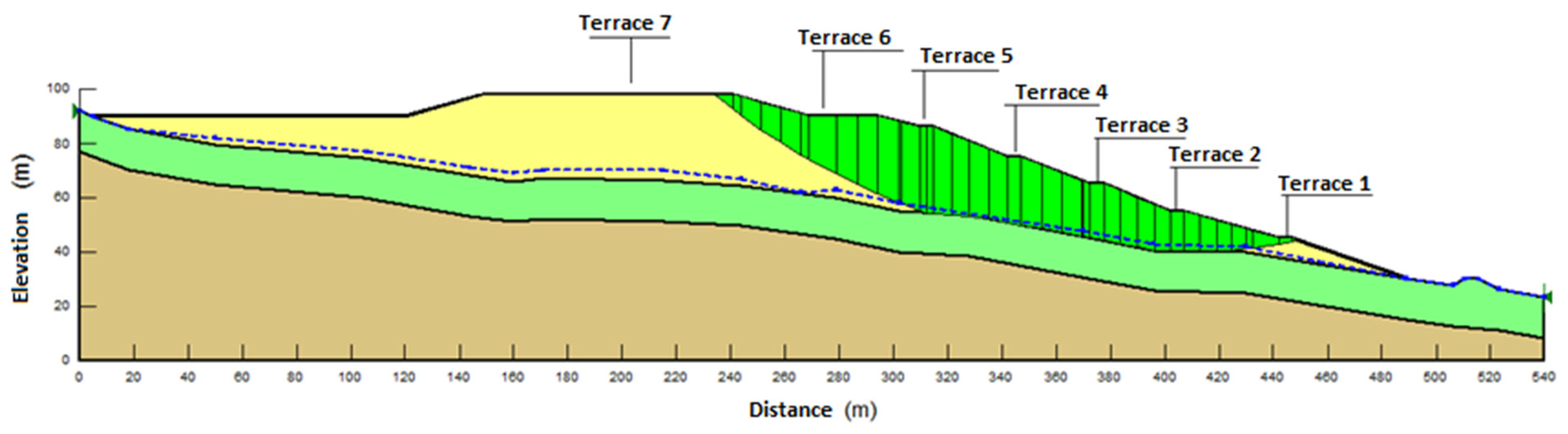
The following Table 10 and Figure 9 present stability cases analyzed and pertinent results, showing a minimum safety factor of 1.22.
The stability features of this type of facility considerably decrease instability or failure risks, based on: (i) an adequate geometry of the dry stack TSF, (ii) placement of filtered tailings with an optimum moisture content, and (iii) adequate compaction by smooth drum vibratory rollers [55].
The design includes installation of geotechnical instrumentation, implementing open pipe piezometers (also termed Casagrande units) in the crest of the spillage retention dam, as well as on berms of the filtered tailings dry stack deposit [56], to measure the water table level within the base drain and to analyze its behavior during the life of the TSF, thereby monitoring the TSF drained performance [54].
It is recommended to periodically monitor the piezometric level within the filtered tailings storage facility to detect any variations over time. To maintain the stability of the facility, care must be taken to keep this level low to avoid excessive pore pressures in the tailings that could weaken its stability. If the piezometric level rises to levels approaching those defined as critical, the necessary corrective measures must be taken to lower it immediately.
The results obtained are valid only for the projected geometric configurations, the specified geotechnical properties of the materials, and the adopted calculation considerations and assumptions.

3.6. Operational and Constructability Considerations

To build a stable filtered tailings dry stack deposit, it is necessary to implement quality assurance controls over construction procedures and the materials used. Operators must monitor and track the geometric, geotechnical, and compaction characteristics of the deposited filtered tailings to ensure strict adherence to the design specifications throughout the project’s operation [38,39].
The following Table 11 shows controls that must be compiled within a QA/QC plan:

3.7. Economic Analysis of Applying Filtered Tailings

The following paragraphs present an economic analysis of the application of filtered tailings:

3.7.1. Capital Expenditure (CAPEX)

The implementation of a dry stacking system requires significantly higher capital investment compared to conventional tailings disposal methods. The highest CAPEX component corresponds to the acquisition of large-scale filter banks, high-specification technical equipment designed for continuous operation with high processing rates. This equipment typically demands not only a high initial investment but also associated infrastructure, including pulp feed systems, high-pressure pumps, large-capacity compressors, pneumatic transport systems, and receiving bins for the dry material. The selection of filtration technology (plate-and-frame press filters, disc vacuum filters, or belt filters) defines a large part of the CAPEX, conditioning the economic viability of the project from its feasibility stage.
Beyond the filters themselves, CAPEX is significantly increased by the civil works and complementary infrastructure necessary to operate a filtered TSF. Unlike a conventional TSF, where the deposit is a large containment structure, dry stacking requires the construction of support platforms with drainage systems and perimeter channels for rainwater. Contact water collection systems represent a significant CAPEX item and must be designed with high-durability materials (HDPE, geotextiles) to ensure the long-term physical and chemical stability of the deposit.
A critical implication of the high CAPEX associated with this technology is the project’s exposure to global supply chain volatilities and long lead times. For example, large-tonnage filter presses and their critical components (filter cloths, membrane pumps, hydraulic accumulators) have manufacturing times that can exceed 12 to 18 months and often require customized detailed engineering based on the mineralogy and particle size distribution of the tailings. This concentration of CAPEX in internationally manufactured equipment means that any delay in manufacturing, transportation, or customs clearance directly impacts project commissioning, generating cost overruns due to interest during construction, which can significantly affect the mining project’s profitability.
A distinctive characteristic of CAPEX in dry stacking is the need to invest in a high-performance mobile fleet for the transport, spreading, and compaction of the filtered material. Unlike a conventional TSF, where the pulp flows by gravity, filtered tailings must be moved from the filtration plant to the disposal area using articulated trucks, motor scrapers, or conveyor belt systems. This technological decision defines a substantial part of the CAPEX: opting for conveyors implies a high initial investment in fixed infrastructure and automation, while opting for a truck fleet implies a significant investment in high-tonnage equipment, along with respective maintenance workshops and fuel management systems.
CAPEX management in dry stacking presents a strong duality with operational costs (OPEX). There is an inverse relationship where a higher initial CAPEX in more efficient filtration equipment (with greater unit capacity and lower energy consumption) and in automated stacking systems (such as radial stackers) can drastically reduce future OPEX in terms of electricity consumption, filter cloth replacement, fleet fuel consumption, and operational labor. However, from a financial engineering perspective, the high CAPEX requires that the project meet certain materiality criteria; that is, it is only viable for large-scale operations or for greenfield projects with high head grades that can absorb the high initial outlay without compromising the internal rate of return (IRR).
Finally, CAPEX in this technology has strategic implications for risk management and closure costs. While the initial outlay is higher, the investment in robust equipment significantly reduces the risks of catastrophic failure, liquefaction, and long-term environmental liabilities. This translates into a reduction in CAPEX allocated to financial guarantees and closure plans, as filtered tailings technology allows for early water recovery and a final deposit configuration that does not require complex permanent containment infrastructure. Consequently, although the operational CAPEX for equipment and materials is high, it is offset by a lower capital provision for mine closure, generating a more sustainable investment profile aligned with modern environmental standards, such as the Global Industry Standard on Tailings Management (GISTM) [18].

3.7.2. Operating Expenses (OPEX)

The most distinctive component of operational costs in dry stacking is the high energy demand associated with the filtration process. Unlike conventional TSFs, where the main energy consumption is limited to hydraulic pulp pumping, filtration technology requires large banks of filter presses or vacuum filters to operate continuously to reduce tailings moisture from values close to 60–70% down to levels between 12% and 20%. This stage entails significantly higher electricity consumption per ton treated than traditional methods. The implication of this characteristic is that the economic viability of this technology critically depends on the availability of reliable electrical energy and competitive rates; in regions with high or unstable energy costs, OPEX can erode operating margins, whereas in contexts with access to low-cost renewable energy, this higher consumption can be perfectly manageable and offset by advantages in other operational areas.
Alongside electrical energy, the filtration process generates recurring operational costs associated with consumables that complement the system’s energy intensity. Filter cloths, screens, plates, valves, and hydraulic systems in filter presses have limited useful lives and require periodic replacements, constituting a significant and predictable OPEX item. Additionally, to achieve the required solid–liquid separation efficiency, flocculants and chemical reagents are continuously consumed. The implication of this cost structure is that operating a filtered tailings plant demands rigorous logistics and inventory management, as well as highly disciplined maintenance planning. Any unplanned interruption in the filtration line not only generates repair costs but can compromise the entire concentrator’s operational continuity, increasing OPEX through production losses and highly complex corrective maintenance.
A fundamental shift in the OPEX structure compared to conventional TSFs is the transition from hydraulic transport via pipelines to mechanized transport using high-tonnage trucks or conveyor belts. When the tailings storage facility is located at moderate or long distances from the filtration plant, diesel fuel consumption becomes one of the main components of operational cost. Fleets of articulated trucks operate continuously, carrying out cycles of loading, transport, dumping, and return, with fuel consumption highly sensitive to oil price fluctuations and operator efficiency. The implication of this aspect is that the profitability of dry stacking is directly linked to transport distance; as this distance increases, operational costs per ton grow linearly, making this technology financially more competitive for medium-scale operations or for those where the storage facility is located close to the plant, while in large-tonnage projects with long distances, fuel OPEX can become prohibitive compared to hydraulic pumping.
A relevant counterpoint in the fuel consumption analysis is that dry stacking technology virtually eliminates the operational costs associated with earthmoving for dam construction and maintenance, which are characteristic of conventional TSFs. In a traditional TSF, continuous fuel consumption is required for earthmoving equipment (bulldozers, excavators, rollers) to operate in dam raises, berm construction, perimeter channel maintenance, and tailings beach management. With no containment structures requiring periodic raising, fuel OPEX is concentrated exclusively on the transport and stacking of the filtered tailings material. The implication of this shift is greater predictability in operational costs, as fuel consumption in dry stacking is directly linked to mineral production and not to geotechnical or climatic variables that, in conventional TSFs, can generate unforeseen earthmoving needs and additional fuel consumption.
In terms of labor, dry stacking technology substantially modifies both the composition and the unit cost of operational personnel. Conventional TSFs require a large number of earthmoving equipment operators, geotechnical monitoring staff, dyke maintenance crews, and water management technicians, with a cost structure based on headcount. In contrast, dry stacking demands a smaller workforce in number, but with a profile of higher technical specialization: filtration plant operators, instrument technicians, industrial mechanics specialized in high-pressure equipment, automation and process control technicians, and maintenance personnel for conveyor belts or truck fleets. The strategic implication is that, although the cost per worker may be higher due to the required qualifications, operational efficiency improves and exposure to occupational risks associated with earthmoving activities under variable stability conditions is reduced. Additionally, the smaller workforce implies a reduction in indirect costs associated with camps, personnel transport, and welfare services, which in large-scale projects represent a significant part of total OPEX.
The combination of high electrical intensity, fuel consumption for transport, and specialized labor generates profound strategic implications for operational cost management. Firstly, this OPEX structure shifts operational efficiency from managing geotechnical and water-related risks to excellence in industrial and logistics operations; system profitability critically depends on the mechanical availability of the filters and the optimization of transport routes. Secondly, the energy profile of dry stacking requires mining companies to develop long-term energy supply strategies, evaluating electricity supply contracts with renewable sources to mitigate cost volatility and meet carbon footprint reduction targets. Lastly, the significant reduction in operational costs associated with mine closure, given that the dry deposit can be revegetated and closed in a short timeframe without perpetual monitoring, partially compensates for the higher energy and labor costs during the operational phase. This compensation, together with the elimination of the risk of catastrophic failure and its associated costs, positions dry stacking as an operationally more predictable and financially sustainable alternative in contexts where energy costs can be adequately managed.
For this case study, the operating expenses (OPEX) are equivalent to 2.50 USD/t, based on the following considerations:
  • The operating cost estimate is based on 3 years.
  • The filtration plant operates 24 h a day, 340 days a year, producing filtered tailings.
  • Tailings transport and deposition operations are carried out 340 days a year, in a 9 h workday.
  • The cost of machinery maintenance and spare parts has been determined to be 10% of the total cost of supplying main equipment.
  • A net fuel cost of 1.15 USD/L is considered.
  • The internal rate of return (IRR) used is 10%.
  • Fuel supply costs are adjusted for inflation using a rate of 15% per year.
  • The associated unit operations are: (i) Loading of filtered tailings at the filter plant, (ii) Transport of filtered tailings to the TSF; (iii) Unloading of filtered tailings at the TSF; (iv) Spreading and layering of filtered tailings; (v) Compaction of filtered tailings at the TSF; (vi) Loading of granular material at the waste dump for TSF cover; and (vii) Transport and unloading of granular material at the TSF.
  • The maximum distance traveled by dump trucks between the filter plant and the mine TSF is 1 km.

4. Discussion

4.1. Application of Dry Stacking of Filtered Tailings Technology

Dry stacking of filtered tailings has emerged as one of the most promising alternatives for managing mining waste, especially after the Brumadinho and Samarco disasters in Brazil [12,23,57]. This method involves mechanical dewatering of tailings to a moisture content of between 15% and 20%, then transporting and compacting them into piles, eliminating the need for large containment dams [58]. While this technology represents a significant advance in safety, its implementation entails a complex balance between operational benefits and economic challenges that must be rigorously evaluated for each mining operation [59].
Among the most notable advantages of dry stacking is the drastic reduction in the risk of catastrophic failures. By removing most of the water, the deposited material is in an unsaturated state, eliminating the potential for static and seismic liquefaction, which is the primary failure mechanism in conventional tailings dams [60]. This condition allows the tailings to behave like compacted soil with high seismic resistance, providing superior geotechnical stability that facilitates obtaining permits and gaining acceptance from nearby communities. Furthermore, by not requiring large water reservoirs, the risk of long-distance tailings flows in the event of a structural collapse is minimized [61].
From an environmental and operational perspective, tailings filtration offers substantial benefits. Maximum process water recovery is crucial in arid regions, as it allows a valuable resource to be returned to the production cycle and reduces the mine’s water footprint. Likewise, the physical footprint of the TSF is optimized, since the higher density of the material allows it to be stacked with steeper slopes, reducing the area occupied and facilitating progressive rehabilitation throughout the mine’s lifespan, which in turn lowers long-term closure costs. This characteristic also makes mining viable in mountainous terrain or areas with space limitations [52].
However, the economic and technical disadvantages are equally significant. The main barrier remains the high capital expenditure (CAPEX) and operating expenditure (OPEX), stemming from the need to install and maintain a filtration plant with multiple energy-intensive pieces of equipment. Although the technology has advanced, it remains a challenge for very high-tonnage operations (over 50,000 tons per day), where the number of filters required can make the process logistically complex and financially prohibitive compared to conventional methods [55]. Additionally, the presence of clay in the ore can clog the filter media and drastically reduce efficiency, preventing the achievement of the target moisture content.
Operating a dry stockpile introduces specific geotechnical and climatic challenges that require rigorous management. Quality control during compaction is critical, as variability in the moisture content of the filter cake can create layers of lower strength within the stockpile. In arid climates, dust generation is a constant environmental and occupational health problem that requires mitigation measures. Conversely, in regions with high rainfall, runoff management becomes critical; infiltration can partially saturate the base of the reservoir, or uncontrolled water accumulation can erode the slopes, compromising their stability and the accessibility of machinery.
Regarding the prevention of catastrophic failures, dry stacking represents a paradigm shift by eliminating stored water, which is the primary destructive agent in dam failures. However, it is a mistake to assume they are inherently “fail-safe”; their safety depends on careful hydrogeological design that prevents the formation of internal water tables and rigorous operational control. Technical literature warns that a poorly operated TSF, with inadequate compaction or insufficient rainwater drainage capacity, can develop its own instability mechanisms.
In summary, filtered tailings storage with dry stacking is a technically superior solution for mitigating disaster risk in mining, provided it is applied in the appropriate context and with the necessary operational discipline. Its advantages in safety, water recovery, and rehabilitation are undeniable, but they are inherently linked to high costs and operational challenges that depend on mineralogy and climate. The decision to implement it should not be based on a simplistic “maximum safety” narrative, but rather on a multidimensional analysis that considers the site’s specific risk profile, the project’s financial viability, and the operation’s capacity to maintain the stringent quality controls that this technology demands.

4.2. Case Study Findings

The design experience in this case study confirms that the application of filtered tailings with dry stacking in mountainous and seismically active zones requires careful adaptation of classical criteria from the literature. Although the general principles of stability and infiltration control are consistent with those reported in the literature [39], the presence of steep natural slopes, the high geotechnical variability of the foundation, and the local seismic demands led to prioritizing geometric configurations and construction sequences that are more conservative than those proposed in reference studies for contexts of lower seismicity or relatively flat topography. In this regard, the project confirms that it is not sufficient to directly transfer the design criteria from stacks in relatively flat areas: the actual response of the TSF depends critically on the interaction between the filtered tailings, the foundation, and the design earthquake.
A central aspect of this case was the control of the moisture content of the filtered tailings. While the literature [40,50] often recommends moisture ranges close to the optimum compaction limit, site operations showed that daily variations in production and climatic conditions (especially high-intensity rainfall cycles and prolonged dry periods) make it difficult to consistently maintain the theoretical range. Consequently, it was necessary to define wider acceptable moisture bands and design staged compaction procedures, with differentiated requirements for critical zones (slopes and berms) and the interior zones of the TSF. This strategy differs from cases reported in more uniform climates, where stricter control over water content is assumed, and highlights the importance of explicitly incorporating operational variability into short- and long-term stability analyses.
Another key technical challenge was the performance of the TSF’s internal and surface drainage systems. The literature [39] emphasizes the importance of effective drainage to maintain low pore pressures but often assumes a relatively permeable or uniformly stratified foundation. In this case, the presence of low-permeability horizons and local geological faults necessitated the design of a denser drainage network, with stepped underdrains and intermediate drainage layers. Construction experience revealed practical limitations, such as the difficulty of maintaining drain continuity over irregular topography and the risk of clogging in sectors with higher fines content. These observations indicate that the groundwater flow models used in the design stage tend to oversimplify geological heterogeneity and that a periodic verification program of flow rates and pore pressures is required to adapt the design to actual conditions.
Likewise, construction experience on steep slopes showed significant discrepancies from the stacking sequences commonly recommended in the literature [36]. Modular terrace advance allowed for better control of local stability but generated internal interfaces with variations in density and degree of saturation that are difficult to reproduce in numerical models. These interfaces can constitute potential localized deformation planes during seismic events. Although the stability analyses performed suggest acceptable permanent displacements, information on long-term field-measured deformations to fully validate these predictions is not yet available. This gap between modeled and actual behavior constitutes a significant technical limitation, especially for extrapolating results to future, higher-elevation phases of the TSF.
When comparing the stability and hydraulic performance results of this case with reports from similar projects, it is observed that the obtained static and seismic safety factors fall within the upper range, partly due to conservative design criteria and the use of wider berms. However, this additional safety margin has been achieved at the cost of a somewhat larger physical footprint and stricter compaction requirements, which implies higher construction and operating costs. Experience indicates that the design can be optimized as monitoring data become available to confirm (or challenge) the initial hypotheses regarding stiffness, drainage, and deformability. This feedback between monitoring, model re-calibration, and geometry adjustment still seems understudied in the literature and represents a relevant line of improvement.
Among the main technical limitations of the case are: (i) the dependence of the overall TSF performance on the efficiency of the filtration system, which conditions both the initial moisture and the uniformity of the tailings; (ii) the scarcity of laboratory and field data on the cyclic behavior of compacted filtered tailings under similar confinement and seismic conditions; and (iii) the difficulties in representing in numerical models the internal discontinuities generated by construction phases, operational variations, and intense rainfall events. These limitations require interpreting the analysis results with caution and incorporating additional safety margins, especially during the initial operating stages.
Looking towards future improvements, several lines of work are identified. First, the implementation of a comprehensive instrumentation program (piezometers, inclinometers, surface extensometers, GNSS stations, InSAR, and seismic records) would allow for validating numerical models and reducing the uncertainty associated with design parameters. Second, the development of specific cyclic triaxial tests on representative samples of filtered and compacted tailings under field conditions would help refine seismic criteria. Third, the integration of coupled hydro-geomechanical models that explicitly consider infiltration during extreme rainfall events could improve the evaluation of critical transient scenarios that the literature tends to treat in a simplified manner. Finally, systematic comparison between this and other case studies in mountainous and seismically active environments would allow progress towards more specific design guidelines for this type of condition, moving beyond the still generic approach typically applied to dry stacking of tailings.

5. Conclusions

The development of dry stacking of filtered tailings proved to be a technically and environmentally viable solution for the disposal of mining waste in extreme mountainous conditions, such as those with slopes of 10%. The layered compaction methodology allowed for the construction of a 70 m high structure (seven terraces of 10 m each) with suitable geotechnical properties. Under a peak ground acceleration (PGA) of 0.3 g, pseudo-static stability analyses yielded a factor of safety of 1.22, guaranteeing physical stability even on steep slopes and in areas of high seismicity. This approach overcomes space limitations inherent in mountainous terrain and effectively eliminates the risk of liquefaction, the main point of failure for conventional TSFs, thus representing a significant advance in mine safety.
From a sustainability perspective, this tailings management model promotes more responsible mining. The implemented filtration technology enables recirculation of most processed water, drastically reducing consumption and minimizing acid rock drainage (ARD). Furthermore, the formation of a solid and stable surface facilitates gradual closure and landscape integration, transforming the environmental liability into a geotechnically sound structure with revegetation potential, thereby reducing long-term visual and ecological impact. Notably, the operational costs (OPEX) of 2.5 USD/t make this approach economically competitive while enhancing environmental performance.
The implementation of filtered tailings technology leads to great advantages under special conditions, such as: (i) dry climates, (ii) areas with high seismic risk (e.g., PGA of 0.3 g), (iii) complex topographies with slopes of 10% and low impoundment/dam ratio, (iv) requirement for optimum water use, (v) considerable decreases in seepage, and (vi) implementation of progressive closure plans at low costs that are environmentally friendly.
The 70 m high terraced structure (seven lifts of 10 m each) achieved a factor of safety of 1.22 under seismic loading, confirming that filtered tailings can be safely deposited on steep slopes. This performance, combined with unit OPEX of 2.5 USD/t, demonstrates that the technology is most appropriate when the objective is sustainable development of water and tailings management, with decreased water makeup and reduced negative environmental impacts.
The greater presence and competitiveness of this technology in mining projects will depend on advances and developments in: (i) reliability of filter units, (ii) decreases in investment and operational costs of filters, and (iii) decreases in investment and operational costs of filtered tailings transportation.

Author Contributions

Conceptualization, C.C., E.A. and J.A.L.-G.; formal analysis, C.C., E.A. and J.A.L.-G.; investigation, C.C.; resources, C.C. and E.A.; writing—original draft preparation, C.C.; writing—review and editing, C.C., E.A., S.K. and J.A.L.-G.; visualization, C.C.; supervision, E.A., S.K. and J.A.L.-G. All authors have read and agreed to the published version of the manuscript.

Funding

This research received no external funding.

Institutional Review Board Statement

Not applicable.

Informed Consent Statement

Not applicable.

Data Availability Statement

The original contributions presented in the study are included in the article, further inquiries can be directed to the corresponding authors.

Conflicts of Interest

The authors declare no conflicts of interest.

Abbreviations

The following abbreviations are used in this manuscript:
TSFTailings storage facility
mtpdMetric tons per day
tTons
m a.s.l.Meters above sea level
MCEMaximum credible earthquake
UBCUniform building code
PGAPeak ground acceleration
KhHorizontal seismic coefficient
KvVertical seismic coefficient
FoSFactor of safety
GISTMGlobal industry standard on tailings management
IRRInternal rate of return
CAPEXCapital expenditure
OPEXOperating expenses
GNSSGlobal navigation satellite system
InSARInterferometric synthetic aperture radar
CIUConsolidated isotropically undrained
QA/QCQuality assurance and quality control
USDUnited States dollar
ARDAcid rock drainage

References

  1. Zetola, V.; Keith, B.F.; Lam, E.J.; Montofré, Í.L.; Rojas, R.J.; Marín, J.; Becerra, M. From Mine Waste to Construction Materials: A Bibliometric Analysis of Mining Waste Recovery and Tailing Utilization in Construction. Sustainability 2024, 16, 10314. [Google Scholar] [CrossRef] [Scilit]
  2. Hamraoui, L.; Bergani, A.; Ettoumi, M.; Aboulaich, A.; Taha, Y.; Khalil, A.; Neculita, C.M.; Benzaazoua, M. Towards a Circular Economy in the Mining Industry: Possible Solutions for Water Recovery through Advanced Mineral Tailings Dewatering. Minerals 2024, 14, 319. [Google Scholar] [CrossRef] [Scilit]
  3. Araujo, F.S.M.; Taborda-Llano, I.; Nunes, E.B.; Santos, R.M. Recycling and Reuse of Mine Tailings: A Review of Advancements and Their Implications. Geosciences 2022, 12, 319. [Google Scholar] [CrossRef] [Scilit]
  4. Araya, N.; Mamani Quiñonez, O.; Cisternas, L.A.; Kraslawski, A. Sustainable Development Goals in Mine Tailings Management: Targets and Indicators. Mater. Proc. 2021, 5, 82. [Google Scholar]
  5. Adiansyah, J.S.; Rosano, M.; Vink, S.; Keir, G. A framework for a sustainable approach to mine tailings management: Disposal strategies. J. Clean. Prod. 2015, 108, 1050–1062. [Google Scholar] [CrossRef] [Scilit]
  6. Edraki, M.; Baumgartl, T.; Manlapig, E.; Bradshaw, D.; Franks, D.M.; Moran, C.J. Designing mine tailings for better environmental, social and economic outcomes: A review of alternative approaches. J. Clean. Prod. 2014, 84, 411–420. [Google Scholar] [CrossRef] [Scilit]
  7. Kinnunen, P.; Karhu, M.; Yli-Rantala, E.; Kivikytö-Reponen, P.; Mäkinen, J. A review of circular economy strategies for mine tailings. Clean. Eng. Technol. 2022, 8, 100499. [Google Scholar] [CrossRef] [Scilit]
  8. Innis, S.; Kunz, N.C. The role of institutional mining investors in driving responsible tailings management. Extr. Ind. Soc. 2020, 7, 1377–1384. [Google Scholar] [CrossRef] [Scilit]
  9. Lim, B.; Alorro, R.D. Technospheric Mining of Mine Wastes: A Review of Applications and Challenges. Sustain. Chem. 2021, 2, 686–706. [Google Scholar] [CrossRef] [Scilit]
  10. Ojeda-Pereira, I.; Campos-Medina, F. International trends in mining tailings publications: A descriptive bibliometric study. Resour. Policy 2021, 74, 102272. [Google Scholar] [CrossRef] [Scilit]
  11. Kemp, D.; Owen, J.R.; Lèbre, É. Tailings facility failures in the global mining industry: Will a ‘transparency turn’ drive change? Bus. Strategy Environ. 2021, 30, 122–134. [Google Scholar] [CrossRef] [Scilit]
  12. Mura, J.C.; Gama, F.F.; Paradella, W.R.; Negrão, P.; Carneiro, S.; de Oliveira, C.G.; Brandão, W.S. Monitoring the vulnerability of the dam and dikes in Germano iron mining area after the collapse of the tailings dam of fundão (Mariana-MG, Brazil) using DInSAR techniques with terraSAR-X data. Remote Sens. 2018, 10, 1507. [Google Scholar] [CrossRef] [Scilit]
  13. Piciullo, L.; Storrøsten, E.B.; Liu, Z.; Nadim, F.; Lacasse, S. A new look at the statistics of tailings dam failures. Eng. Geol. 2022, 303, 106657. [Google Scholar] [CrossRef] [Scilit]
  14. Rana, N.M.; Ghahramani, N.; Evans, S.G.; Small, A.; Skermer, N.; McDougall, S.; Take, W.A. Global magnitude-frequency statistics of the failures and impacts of large water-retention dams and mine tailings impoundments. Earth-Sci. Rev. 2022, 232, 104144. [Google Scholar] [CrossRef] [Scilit]
  15. Li, Q.; Chen, Z.; Zhang, B.; Li, B.; Lu, K.; Lu, L.; Guo, H. Detection of tailings dams using high-resolution satellite imagery and a single shot multibox detector in the Jing-Jin-Ji Region, China. Remote Sens. 2020, 12, 2626. [Google Scholar] [CrossRef] [Scilit]
  16. dos Santos Vergilio, C.; Lacerda, D.; da Silva Souza, T.; de Oliveira, B.C.V.; Fioresi, V.S.; de Souza, V.V.; da Rocha Rodrigues, C.; de Araujo Moreira Barbosa, M.K.; Sartori, E.; Rangel, T.P.; et al. Immediate and long-term impacts of one of the worst mining tailing dam failure worldwide (Bento Rodrigues, Minas Gerais, Brazil). Sci. Total Environ. 2021, 756, 143697. [Google Scholar] [CrossRef] [Scilit]
  17. Islam, K.; Murakami, S. Global-scale impact analysis of mine tailings dam failures: 1915–2020. Glob. Environ. Change 2021, 70, 102361. [Google Scholar] [CrossRef] [Scilit]
  18. Global Tailings Review. Global Industry Standard on Tailings Management, International Council on Mining and Metals (ICMM), United Nations Environment Programme (UNEP), Principles for Responsible Investment (PRI). 2020. Available online: https://globaltailingsreview.org/global-industry-standard (accessed on 1 March 2026).
  19. Soares Fortes, B.C.; Villefort Teixeira, M.C.; Pereira da Costa, S.; Wagner, M.H.; Scotti, M.R. Post-disaster recovery plan for a rural settler’s community affected by the Fundão dam tailings in Brazil. J. Rural. Stud. 2022, 93, 55–66. [Google Scholar] [CrossRef] [Scilit]
  20. Schoenberger, E. Environmentally sustainable mining: The case of tailings storage facilities. Resour. Policy 2016, 49, 119–128. [Google Scholar] [CrossRef] [Scilit]
  21. Lumbroso, D.; McElroy, C.; Goff, C.; Collell, M.R.; Petkovsek, G.; Wetton, M. The potential to reduce the risks posed by tailings dams using satellite-based information. Int. J. Disaster Risk Reduct. 2019, 38, 101209. [Google Scholar] [CrossRef] [Scilit]
  22. Dong, L.; Deng, S.; Wang, F. Some developments and new insights for environmental sustainability and disaster control of tailings dam. J. Clean. Prod. 2020, 269, 122270. [Google Scholar] [CrossRef] [Scilit]
  23. Cheng, D.; Cui, Y.; Li, Z.; Iqbal, J. Watch out for the tailings pond, a sharp edge hanging over our heads: Lessons learned and perceptions from the brumadinho tailings dam failure disaster. Remote Sens. 2021, 13, 1775. [Google Scholar] [CrossRef] [Scilit]
  24. Hatje, V.; Pedreira, R.M.A.; De Rezende, C.E.; Schettini, C.A.F.; De Souza, G.C.; Marin, D.C.; Hackspacher, P.C. The environmental impacts of one of the largest tailing dam failures worldwide. Sci. Rep. 2017, 7, 10706. [Google Scholar] [CrossRef] [Scilit]
  25. Dold, B. Sustainability in metal mining: From exploration, over processing to mine waste management. Rev. Environ. Sci. Biotechnol. 2008, 7, 275–285. [Google Scholar] [CrossRef] [Scilit]
  26. Armstrong, M.; Petter, R.; Petter, C. Why have so many tailings dams failed in recent years? Resour. Policy 2019, 63, 101412. [Google Scholar]
  27. Owen, J.R.; Kemp, D.; Lèbre Svobodova, K.; Pérez Murillo, G. Catastrophic tailings dam failures and disaster risk disclosure. Int. J. Disaster Risk Reduct. 2020, 42, 101361. [Google Scholar] [CrossRef] [Scilit]
  28. Lamghari, K.; Taha, Y.; Elghali, A.; Ait-Khouia, Y.; Hakkou, R.; Benzaazoua, M. Sustainable mining re-examined: Challenges, approaches, and the MASTER roadmap to cleaner processes. Miner. Eng. 2026, 243, 110234. [Google Scholar] [CrossRef] [Scilit]
  29. East, D.; Fernandez, R. Managing Water to Minimize Risk in Tailings Storage Facility Design, Construction, and Operation. Mine Water Environ. 2021, 40, 36–41. [Google Scholar] [CrossRef] [Scilit]
  30. Cacciuttolo, C.; Pastor, A.; Valderrama, P.; Atencio, E. Process Water Management and Seepage Control in Tailings Storage Facilities: Engineered Environmental Solutions Applied in Chile and Peru. Water 2023, 15, 196. [Google Scholar] [CrossRef] [Scilit]
  31. Williams, D.J. Lessons from tailings dam failures—Where to go from here? Minerals 2021, 11, 853. [Google Scholar] [CrossRef] [Scilit]
  32. Hu, S.; Xiong, X.; Li, X.; Chang, J.; Wang, M.; Xu, D.; Pan, A.; Zhou, W. Spatial distribution characteristics, risk assessment and management strategies of tailings ponds in China. Sci. Total Environ. 2024, 912, 169069. [Google Scholar] [CrossRef] [Scilit]
  33. Cacciuttolo, C.; Cano, D.; Custodio, M. Socio-Environmental Risks Linked with Mine Tailings Chemical Composition: Promoting Responsible and Safe Mine Tailings Management Considering Copper and Gold Mining Experiences from Chile and Peru. Toxics 2023, 11, 462. [Google Scholar] [CrossRef] [Scilit]
  34. Massignan, R.S.; Sánchez, L.E. Public databases of tailings storage facilities fall short of full risk disclosure. Extr. Ind. Soc. 2024, 17, 101420. [Google Scholar] [CrossRef] [Scilit]
  35. Vinet, L.; Valdés-González, H.; Calderón, M. Risk Management Model for Tailings Storage Facilities in Chile: An Approach from Geological and Mining Engineering and the Regulatory Framework. Mining 2025, 5, 80. [Google Scholar] [CrossRef] [Scilit]
  36. Dimitriadis, D.; Zachareas, E.; Gazea, V. Upgrading of a Tailings Management Facility for the Disposal of Dry Stack Tailings. Mater. Proc. 2022, 5, 132. [Google Scholar]
  37. Fränkle, B.; Morsch, P.; Sok, T.; Gleiß, M.; Nirschl, H. Tailings Filtration Using Recessed Plate Filter Presses: Improving Filter Media Selection by Replicating the Abrasive Wear of Filter Media Caused by Falling Filter Cake after Cake Detachment. Mining 2022, 2, 425–437. [Google Scholar] [CrossRef] [Scilit]
  38. Fränkle, B.; Morsch, P.; Kessler, C.; Sok, T.; Gleiß, M.; Nirschl, H. Iron Ore Tailings Dewatering: Measurement of Adhesion and Cohesion for Filter Press Operation. Sustainability 2022, 14, 3424. [Google Scholar] [CrossRef] [Scilit]
  39. Cacciuttolo Vargas, C.; Pérez Campomanes, G. Practical Experience of Filtered Tailings Technology in Chile and Peru: An Environmentally Friendly Solution. Minerals 2022, 12, 889. [Google Scholar] [CrossRef] [Scilit]
  40. Li, S.; Chen, Q.; Wang, X. Superiority of filtered tailings storage facility to conventional tailings impoundment in southern rainy Regions of China. Sustainability 2016, 8, 1130. [Google Scholar] [CrossRef] [Scilit]
  41. Cacciuttolo, C.; Atencio, E. Dry Stacking of Filtered Tailings for Large-Scale Production Rates over 100,000 Metric Tons per Day: Envisioning the Sustainable Future of Mine Tailings Storage Facilities. Minerals 2023, 13, 1445. [Google Scholar] [CrossRef] [Scilit]
  42. Li, Q.; Wu, B.Z.; Li, X.; Jia, S.; Zhen, F.H.; Gao, S. The Relatively Stable Seepage Field: A New Concept to Determine Seepage Field in the Design of a Dry-Stack Tailings Pond. Appl. Sci. 2022, 12, 12123. [Google Scholar] [CrossRef] [Scilit]
  43. Wang, K.; Zhang, Z.; Zhu, L.; Yang, X.; Chen, M.; Yang, C. Comparative Life Cycle Assessment of Conventional and Dry Stack Tailings Disposal Schemes: A Case Study in Northern China. Minerals 2022, 12, 1603. [Google Scholar] [CrossRef] [Scilit]
  44. ASTM D698; Standard Methods for Laboratory Compaction Characteristics of Soil Using Standard Effort; (12,400 ft-lbf/ft3 (600 kN-m/m3). ASTM International: West Conshohocken, PA, USA, 2021.
  45. Furnell, E.; Bilaniuk, K.; Goldbaum, M.; Shoaib, M.; Wani, O.; Tian, X.; Chen, Z.; Boucher, D.; Bobicki, E.R. Dewatered and Stacked Mine Tailings: A Review. ACS ES T Eng. 2022, 2, 728–745. [Google Scholar] [CrossRef] [Scilit]
  46. Tuomela, A.; Ronkanen, A.K.; Rossi, P.M.; Rauhala, A.; Haapasalo, H.; Kujala, K. Using geomembrane liners to reduce seepage through the base of tailings ponds—A review and a framework for design guidelines. Geosciences 2021, 11, 93. [Google Scholar] [CrossRef] [Scilit]
  47. Burden, R.; Wilson, G.W. Commingling of Waste Rock and Tailings to Improve “Dry Stack” Performance: Design and Evaluation of Mixtures. Minerals 2023, 13, 295. [Google Scholar] [CrossRef] [Scilit]
  48. Cacciuttolo, C.; Atencio, E. An Alternative Technology to Obtain Dewatered Mine Tailings: Safe and Control Environmental Management of Filtered and Thickened Copper Mine Tailings in Chile. Minerals 2022, 12, 1334. [Google Scholar] [CrossRef] [Scilit]
  49. Consoli, N.C.; Vogt, J.C.; Silva, J.P.S.; Chaves, H.M.; Filho, H.C.S.; Moreira, E.B.; Lotero, A. Behaviour of Compacted Filtered Iron Ore Tailings–Portland Cement Blends: New Brazilian Trend for Tailings Disposal by Stacking. Appl. Sci. 2022, 12, 836. [Google Scholar] [CrossRef] [Scilit]
  50. Sepúlveda, R.G.; Robert, E.S.; Camacho-Tauta, J. Assessment of the Self-Compaction Effect in Filtered Tailings Disposal under Unsaturated Condition. Minerals 2022, 12, 422. [Google Scholar] [CrossRef] [Scilit]
  51. Petrean, I.A.; Micle, V.; Sur, I.M.; Șenilă, M. Characterization of Sterile Mining Dumps by the ICP-OES Analytical Method: A Case Study from Baia Mare Mining Area (Maramures, Romania). Sustainability 2023, 15, 1158. [Google Scholar] [CrossRef] [Scilit]
  52. Sako, C.H.; Pabst, T. Comparative geochemical evaluation of codisposal approaches for reactive filtered tailings deposition. Clean. Waste Syst. 2023, 5, 100094. [Google Scholar] [CrossRef] [Scilit]
  53. Liang, Y.; Beier, N.; Bieber, J.; Owusu, P. Measuring the In Situ Density and Moisture Content of Filtered Tailings Using an Electrical Density Gauge. Minerals 2024, 14, 231. [Google Scholar] [CrossRef] [Scilit]
  54. Cacciuttolo, C.; Guzmán, V.; Catriñir, P.; Atencio, E. Sensor Technologies for Safety Monitoring in Mine Tailings Storage Facilities: Solutions in the Industry 4.0 Era. Minerals 2024, 14, 446. [Google Scholar] [CrossRef] [Scilit]
  55. Servi, S.; Lotero, A.; Silva, J.P.S.; Bastos, C.; Consoli, N.C. Mechanical response of filtered and compacted iron ore tailings with different cementing agents: Focus on tailings-binder mixtures disposal by stacking. Constr. Build. Mater. 2022, 349, 128770. [Google Scholar] [CrossRef] [Scilit]
  56. Toderaș, M.; Florea, V.A.; Itu, R.B. Stability Analysis of the Tailings Dam for the Purpose of Closing, Greening, and Ensuring Its Safety—Study Case. Sustainability 2023, 15, 7606. [Google Scholar] [CrossRef] [Scilit]
  57. Silva Rotta, L.H.; Alcântara, E.; Park, E.; Negri, R.G.; Lin, Y.N.; Bernardo, N.; Gonçalves Mendes, T.S.; Souza Filho, C.R. The 2019 Brumadinho tailings dam collapse: Possible cause and impacts of the worst human and environmental disaster in Brazil. Int. J. Appl. Earth Obs. Geoinf. 2020, 90, 102119. [Google Scholar] [CrossRef] [Scilit]
  58. Ledesma, O.; Sfriso, A.; Manzanal, D. Procedure for assessing the liquefaction vulnerability of tailings dams. Comput. Geotech. 2022, 144, 104632. [Google Scholar] [CrossRef] [Scilit]
  59. Franks, D.M.; Boger, D.V.; Côte, C.M.; Mulligan, D.R. Sustainable development principles for the disposal of mining and mineral processing wastes. Resour. Policy 2011, 36, 114–122. [Google Scholar] [CrossRef] [Scilit]
  60. Hancock, G.R. A method for assessing the long-term integrity of tailings dams. Sci. Total Environ. 2021, 779, 146083. [Google Scholar] [CrossRef] [Scilit]
  61. Morrison, K.F. Tailings Management Handbook: A Lifecycle Approach; Society for Mining, Metallurgy, and Exploration, Inc.: Englewood, CO, USA, 2022; pp. 1–1026. [Google Scholar]
Figure 1. Main facilities of the new copper slag treatment plant project—plant view.
Applsci 16 03911 g001
Figure 2. Copper slag treatment plant and filtered tailings stockpile (transfer).
Applsci 16 03911 g002
Figure 3. Filtered copper slag TSF civil works—plan view.
Applsci 16 03911 g003
Figure 4. Dry stack TSF geometrical configuration—plan and typical longitudinal view.
Applsci 16 03911 g004
Figure 5. Platforms and berm—typical section.
Applsci 16 03911 g005
Figure 6. Dry stack TSF disposal scheme and placement—plan view.
Applsci 16 03911 g006
Figure 7. TSF water management system and associated civil works—plan view.
Applsci 16 03911 g007
Figure 8. TSF seepage underdrain—typical cross-section.
Applsci 16 03911 g008
Figure 9. TSF typical section stability analysis.
Applsci 16 03911 g009
Table 1. TSF capacity and lifetime design parameters.
ParameterValueUnit
Copper slag tailings nominal production1350(mtpd)
Copper slag tailings nominal production750(m3pd)
Copper slag tailings volume to be storage at TSF610,000(m3)
Copper slag tailings tonnage to be storage at TSF1,220,000(t)
Dry stack filtered copper slag TSF Lifetime3.0(years)
Table 2. Climate design parameters.
ParametersValueUnit
Elevation3000m a.s.l.
Minimum/Mean/Maximum temperature−7/15/30(°C)
Minimum/Maximum humidity8/70(%)
Annual mean rainfall55(mm)
Annual mean evaporation1500(mm)
Maximum snow thickness per year0.8 (very occasional)(m)
Dry seasonNovember–April-
Wet seasonMay–October-
Table 3. Seismic design parameters.
Design CaseProject Seismic ZoneReturn PeriodHorizontal Seismic Coefficient KhPGA
Operational(UBC Zone 4)100 years0.150.3 g
Closure(UBC Zone 4)500 years0.50MCE
Table 4. Copper slag tailings process design parameters.
ParameterValueUnit
Operation availability per year340(days)
Copper slag treatment plant nominal production1700(mtpd)
Copper concentrate nominal production350(mtpd)
Copper slag Tailings nominal Production1350(mtpd)
Solid content of copper slag tailings at thickener feed27(%)
Solid content of copper slag tailings at thickener underflow60–65(%)
Solid content of filtered copper slag tailings in the filter product88–90(%)
Filtered copper slag tailings product moisture content (wet basis)10–12(%)
Copper slag filtered tailings cake thickness10–12(mm)
Table 5. Filtered tailings dry stack TSF main geometrical characteristics [39].
CharacteristicsValueUnit
Number of terraces7-
Maximum terrace height10.0(m)
Minimum berm width between terraces5.0(m)
TSF terrace local slope3.5 H:1.0 V-
TSF global slope (7 terraces)4.0 H:1.0 V-
TSF maximum height (7 terraces)70(m)
Table 6. Geotechnical filtered tailings physical and compaction properties.
Geotechnical CharacteristicsAverage ValuesUnit
Grain size distribution:
P8044(microns)
P5030(microns)
Fine fraction97–98(%)
Solid specific gravity3.7–4.0dimensionless
USCS classificationML-
Atterberg limits:
Liquid limit-(%)
Plasticity (Plastic Index IP)NP-
Minimum dry density1.3–1.5(t/m3)
Maximum dry density2.2–2.4(t/m3)
95% Standard Proctor maximum dry density γd (ASTM D698) [44]2.0–2.2(t/m3)
Standard Proctor optimum moisture content (by dry basis)10–12(%)
Note: ML: Silt with Low Plasticity, NP: Non-Plastic, and P80: 80% passing through sieve size (microns).
Table 7. Geotechnical filtered tailings strength and permeability properties.
Tailings Dry DensityShear Resistance ParametersPermeability Parameters
γdcθSuvK (*)
(t/m3)(T/m2)(°)dimensionless(cm/s)
2.0–2.2032–380.2710−4–10−5
Note: γd: Filtered tailings dry density, c: Cohesion in total stress, θ: frictional angle in total stress, Suv: Ratio of ultimate strength versus effective vertical stress, and K (*): Permeability (estimated). Some limitations related to geotechnical tests include the low number of investigations and the lack of cyclic tests for the determination of strength parameters.
Table 8. Geotechnical properties of materials.
MaterialDrained ConditionUndrained Condition
Density
γt (t/m3)
Cohesion
c (t/m2)
Friction Angle
(°)
Undrained Resistance Ratio
Suv
Natural Terrain
(Foundation)
2.11.038
Filtered Tailings (*)2.10.0320.27
Note: (*): Filtered tailings compacted to 95% of the Standard Proctor test.
Table 9. Acceptability criteria considering Chilean regulations.
AnalysisFactor of Safety (FoS)
StaticDrained condition≥1.5
Undrained condition≥1.0
Pseudo-staticDrained condition≥1.2
Table 10. TSF safety stability factor analysis and results.
ConditionAnalysisDry Stack LocationMinimum Stability Factor of Safety (FoS)
StaticPseudo–Static
DrainedGlobalAll terraces2.681.57
UndrainedGlobalAll terraces1.39-
DrainedLocalTerrace N° 11.801.22
DrainedLocalTerrace N° 2–Terrace N° 31.721.42
DrainedLocalTerrace N° 4–Terrace N° 51.941.43
DrainedLocalTerrace N° 6–Terrace N° 72.01.77
Table 11. TSF geometrical, compaction and geotechnical measurements and controls.
TSF Geometrical Measurements and Controls
Type of ControlValueUnitControl Frequency
Local slope between terraces3.5:1.0H:VMonthly
TSF Global slope 4.0:1.0H:VEvery 2 constructed terraces
Minimum berm width5mPer terrace
Maximum terrace height10mPer terrace
Tailings Compaction Measurements and Controls
Type of ControlValueUnitControl Frequency
Recommended tailings thickness lift30–35cmPer compacted tailings lift
Maximum dry compacted tailings density1.9–2.1t/m3Per 5.000 m3 of compacted tailings
Optimal tailings moisture content12%Per compacted tailings lift
Tailings Geotechnical Measurements and Controls
Type of ControlValueUnitControl Frequency
Grain size distributionML-CL-Monthly
Solids specific gravity3.65–3.75-Monthly
Number of Casagrande piezometers7-One per terrace in the berm
Casagrande piezometer lecture10–60mMonthly per terrace
Disclaimer/Publisher’s Note: The statements, opinions and data contained in all publications are solely those of the individual author(s) and contributor(s) and not of MDPI and/or the editor(s). MDPI and/or the editor(s) disclaim responsibility for any injury to people or property resulting from any ideas, methods, instructions or products referred to in the content.