Hybrid Simulation Modeling of Underground Mining Processes Under Multidimensional Constraints: A Case Study of the Sanshandao Gold Mine

Abstract
1. Introduction
2. A Hybrid Simulation Modeling Method for Underground Mining Processes Under Multidimensional Constraints
2.1. Overview of the Modeling Approach
2.2. Multi-Level Modeling of the Underground Mining Process
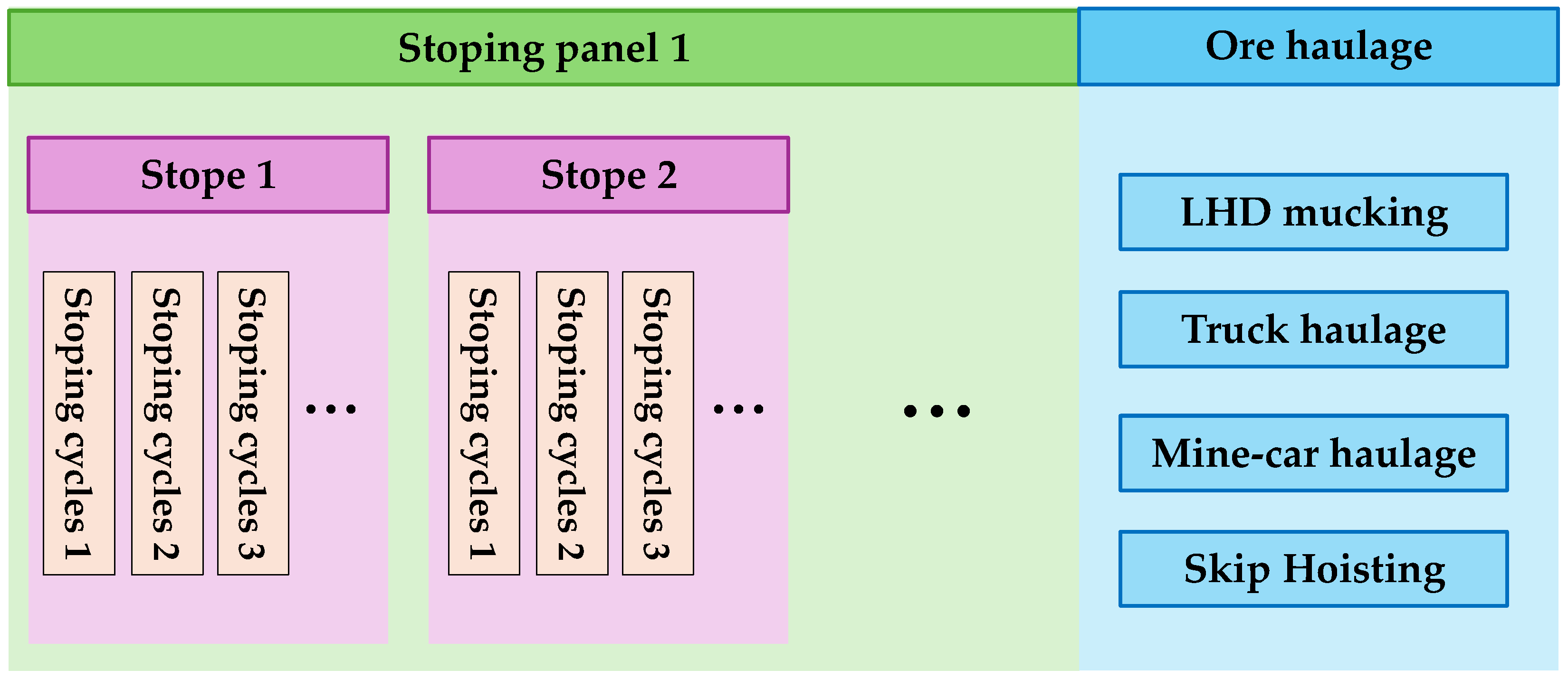
- Spatial modeling module. This module represents the spatial layout of panels and stopes. A three-dimensional grid is used to define panel boundaries and stope geometries, automatically generate a stope matrix and its spatial coordinates, and output basic data such as mineable range and service radius. These outputs provide positional and boundary conditions for subsequent process modeling and equipment dispatching. Calibration of the spatial matrix and related parameters is detailed in Section 2.3 on spatiotemporal constraints.
- Stoping and backfilling module. This module focuses on the stope extraction and backfilling processes, describing key parameters such as blasted ore tonnage, consumption of backfilling materials, and advance per cycle. The model updates stope states according to cycle advancement and outputs ore tonnage and backfill demand on a per-cycle basis, thereby supplying demand-side information to the haulage and material supply module.
- Cycle control module. This module contains an iterative control logic that advances the sequence of cyclic operations according to process flows and engineering constraints. By combining conditions such as completion of development, backfill strength and curing time, ventilation status, and safety boundaries, it controls the start–stop status and state transitions of different operational stages, thus realizing internal process control at the stope scale—i.e., determining whether a given block can be mined and which block is mined first.
- Haulage and dispatching module. This module takes haulage equipment and auxiliary units as basic entities. Tasks are assigned based on ore tonnage and operational demand, and operating information such as equipment location, loading status, and waiting time is updated in real time. By recording haulage efficiency, queuing time, and production completion, the module reflects the match between panel-level constraints and stope-level demand.
2.3. Engineering Constraint System for the Underground Mining Process
2.3.1. Spatiotemporal Constraints for Safe Underground Stoping
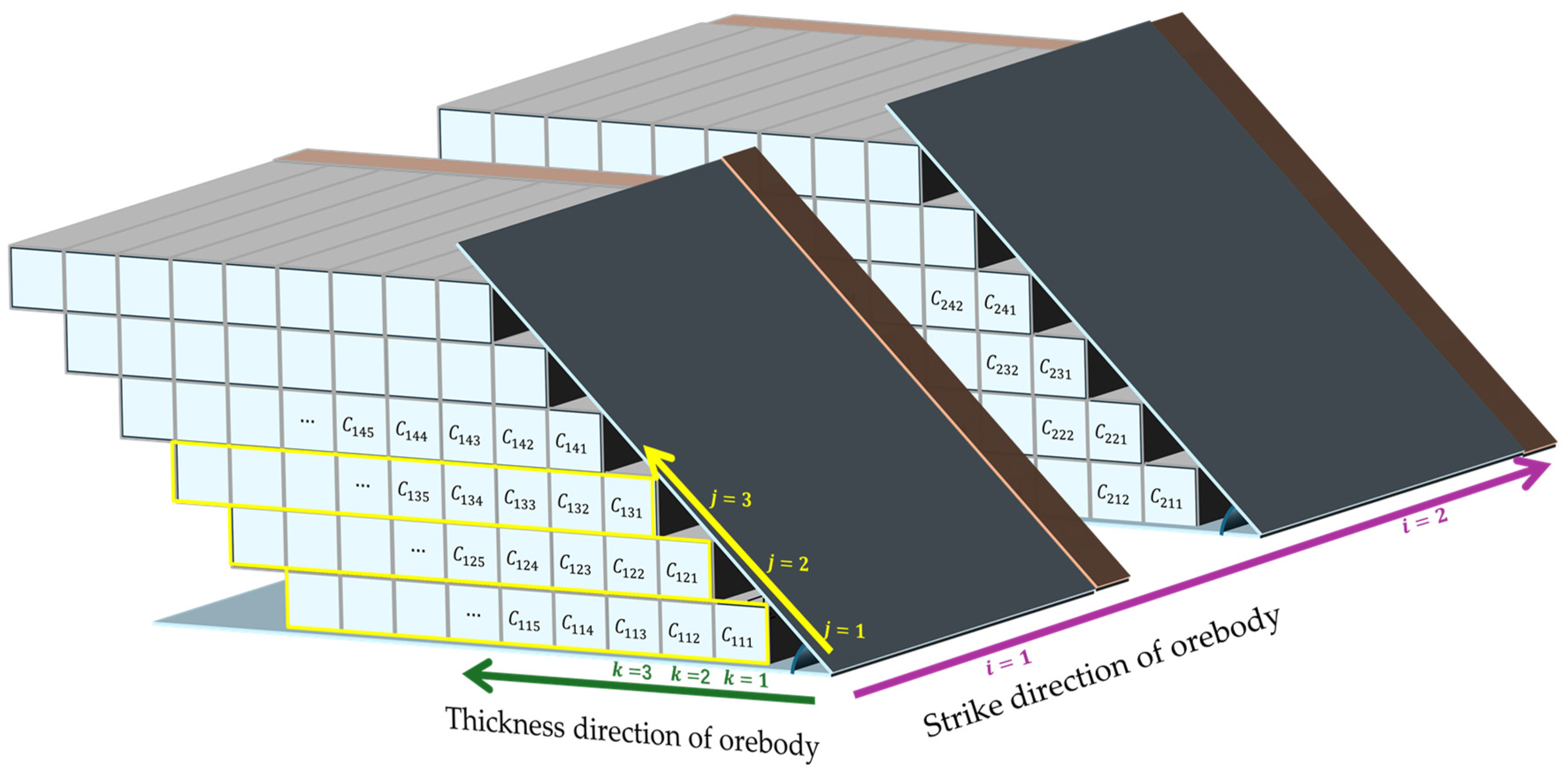
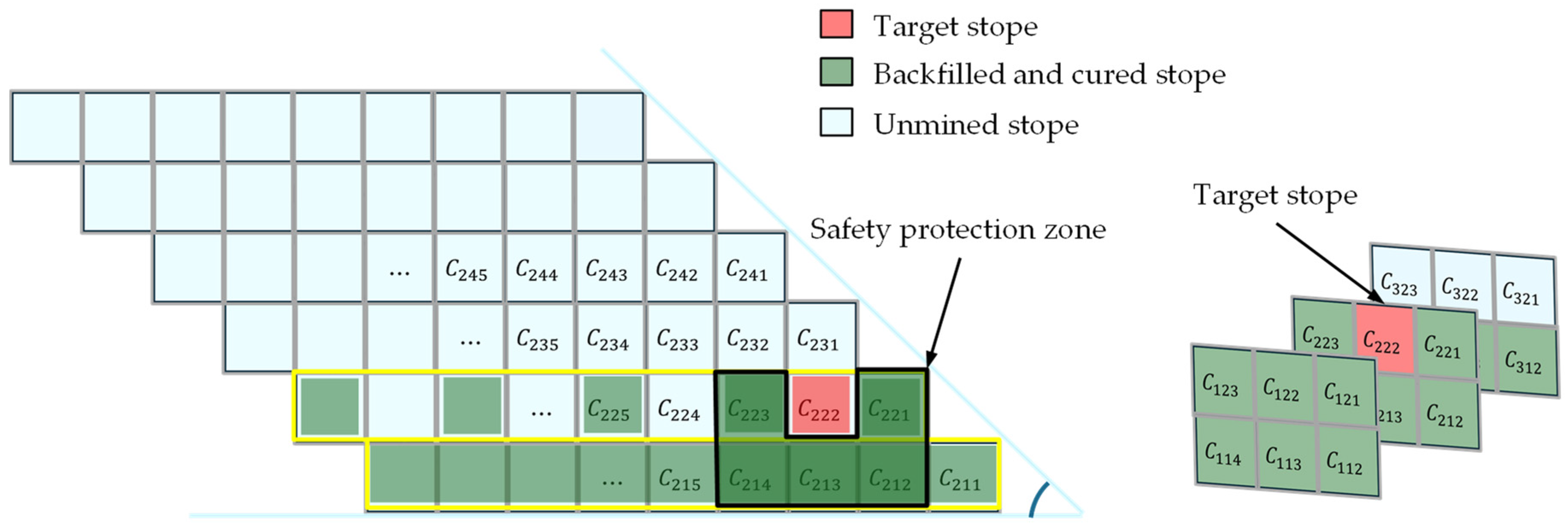
- Strike direction (): adjacent stopes must be in the “unmined” or “backfilled-and-cured” state to ensure roof integrity.
- Vertical direction (): the lower group of stopes must have been backfilled-and-cured to provide effective support and prevent damage induced by overlying stoping.
- Thickness direction (): neighboring stopes must provide sufficient pillar support to avoid lateral instability.
- Backfill curing: the required curing period for backfilling in underlying or adjacent stopes before the target stope can be mined.
- Blasting safety limits: the safety window during which operations in adjacent stopes are suspended and personnel and equipment are evacuated when blasting is conducted.
- Resource competition and waiting: when shared production resources can serve only one stope at a time, other stopes must wait in a queue.
2.3.2. Process Constraints in the Underground Mining Process
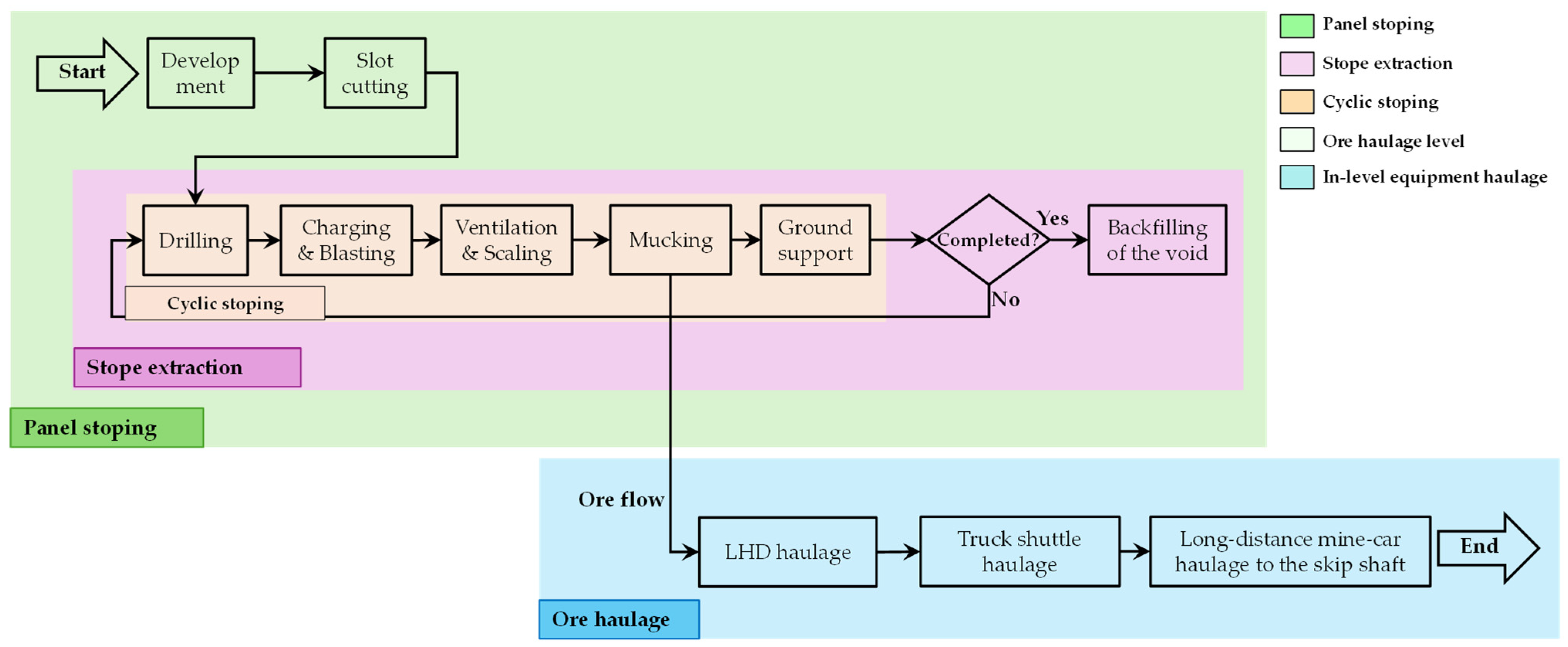
- Process sequence constraint: the sequence “development → slot cutting → stoping (drilling, charging, blasting, ventilation, mucking, ground support) → backfilling” must be strictly followed, and reverse or out-of-order execution of operations is prohibited.
- Blasting safety constraint: when multiple panels or stopes operate in parallel, blasting must be conducted within coordinated time windows; during blasting, adjacent operations must be suspended and personnel evacuated to ensure safety.
- Backfill curing constraint: when the target stope is being extracted, adjacent stopes on the same level must be in either the “unmined” or “backfilled-and-cured” state to ensure stope safety. Between sublevels, upper-level stoping is permitted only after the backfill in the lower level has fully cured; otherwise, stoping must be postponed until curing is complete.
2.3.3. Organizational Constraints on Personnel and Equipment
3. Constraint-Based Simulation Model of Underground Mining Operations
3.1. Model Overview
3.2. Implementation of Multi-Dimensional Constraints in the Simulation
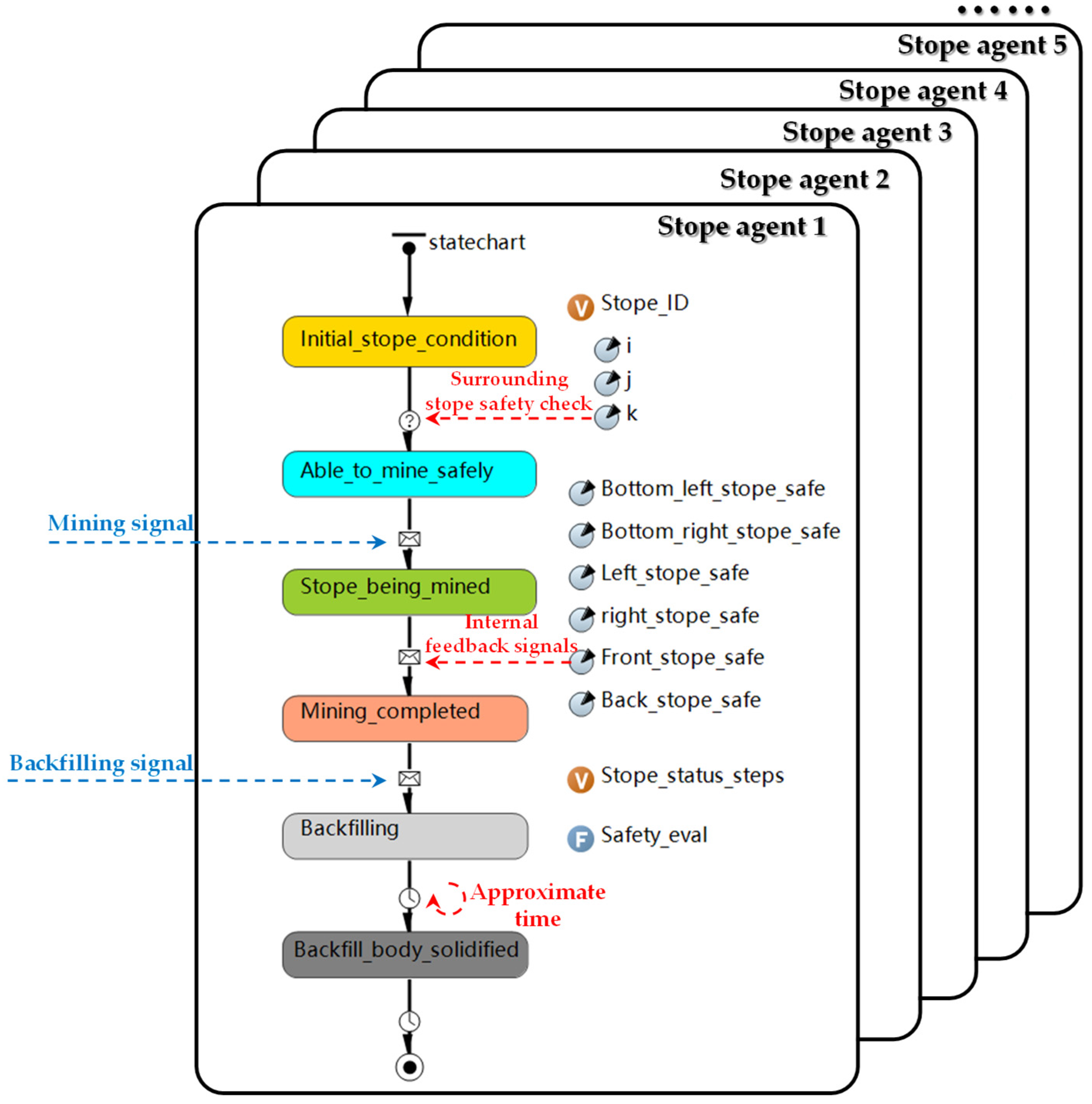
3.2.1. Spatiotemporal Constraint System for Multiple Stopes
- is taken as StopeID modulo , representing the position of the stope along the orebody thickness direction;
- is taken as the integer part of StopeID divided by , representing the row index in the vertical direction;
- is taken as the integer part of StopeID divided by , representing the layer index along the orebody strike direction.
- The corresponding mathematical expressions are given in the model equations, see Formula (1), where mod denotes the remainder (modulo) operator and denotes the floor (integer part) operator.
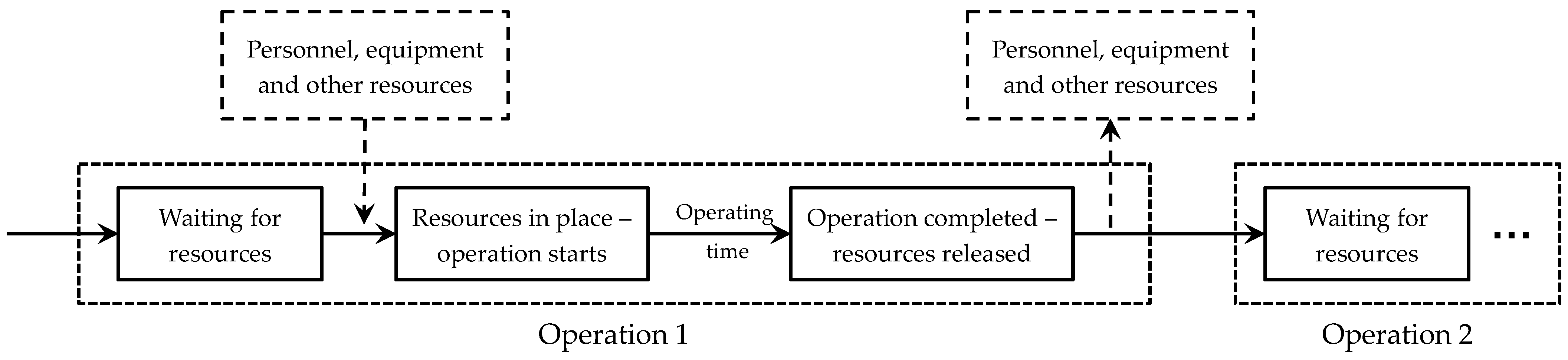
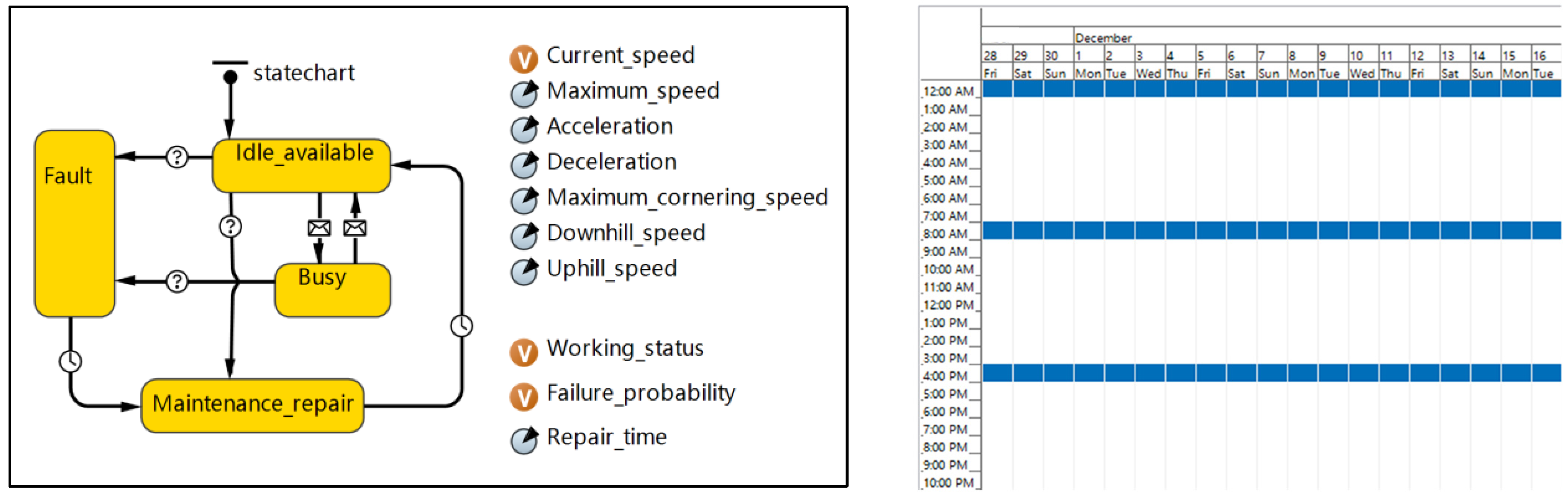
3.2.2. Organizational Constraint Modeling for Personnel and Equipment
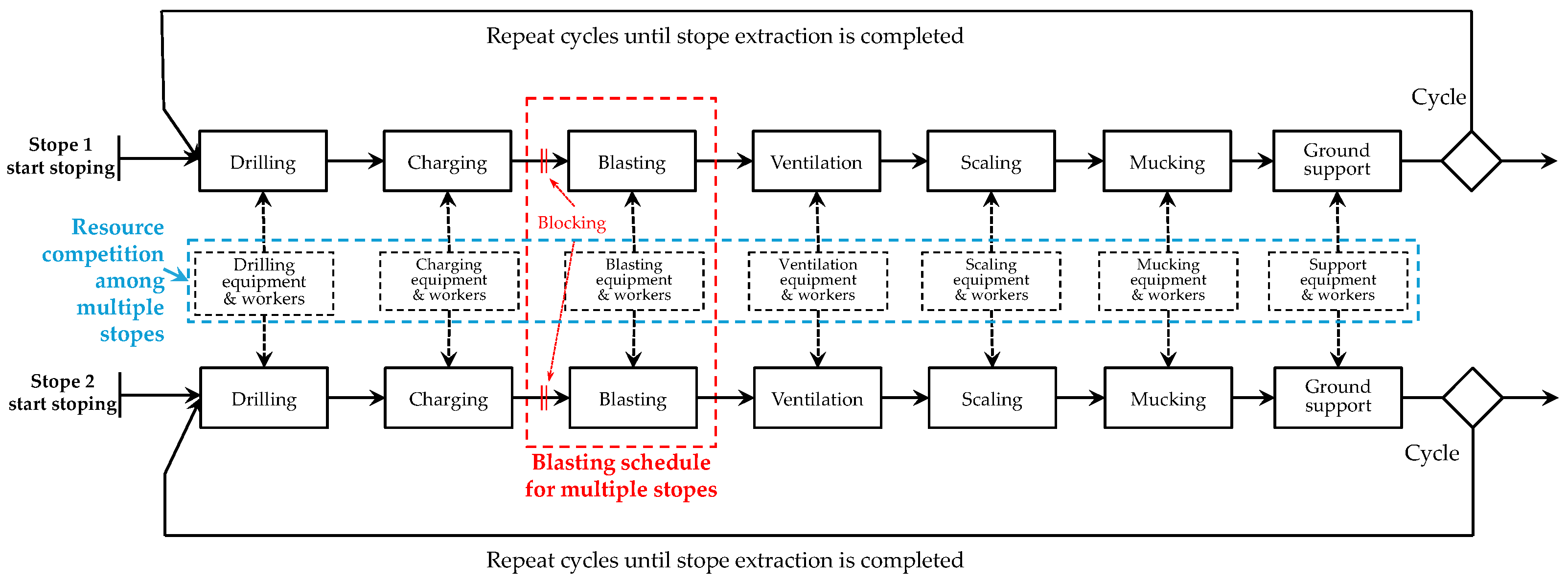
3.2.3. Resource Competition and Process-Flow Constraints Among Multiple Stopes
4. Constraint-Based Simulation Case Study of Underground Mining Operations
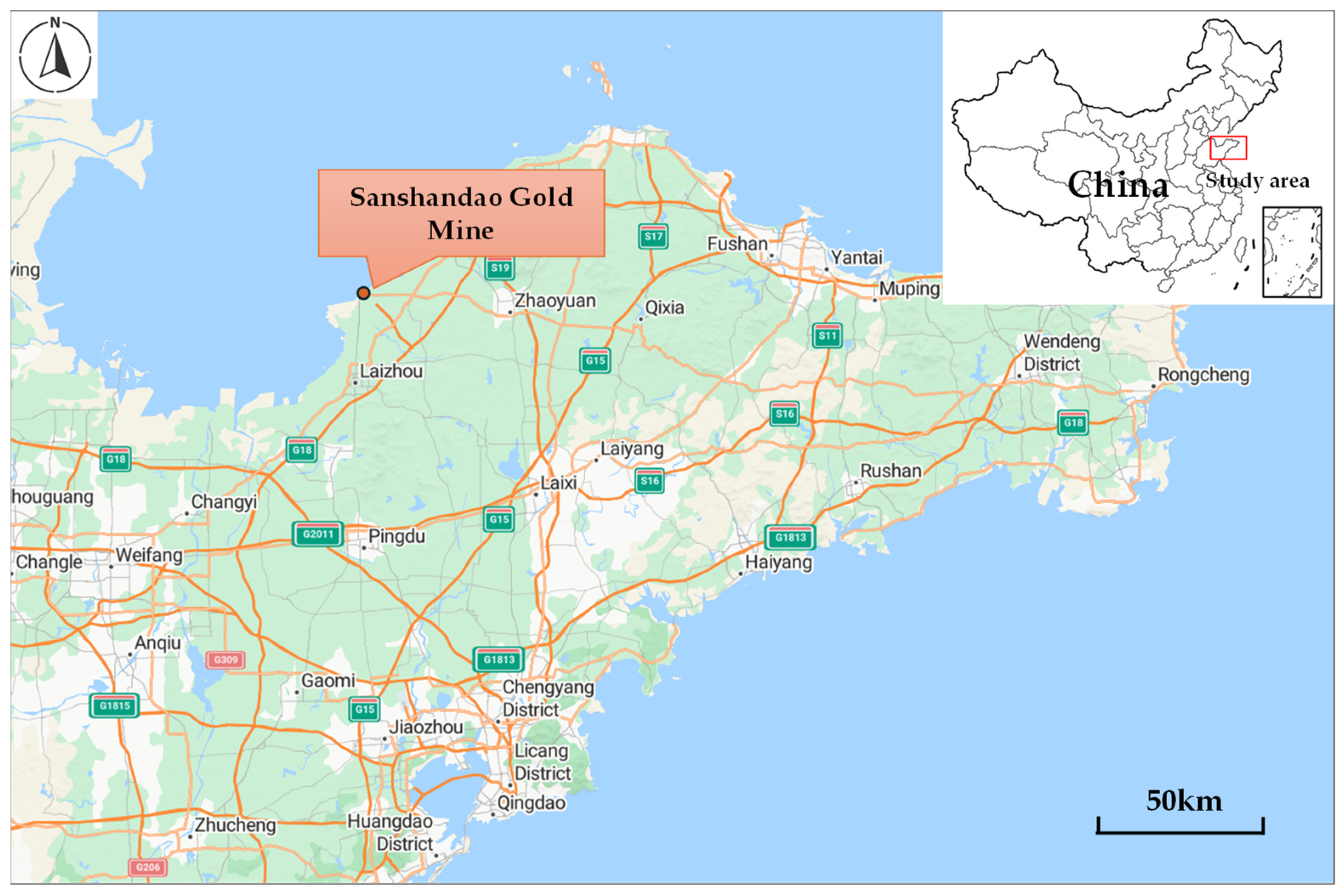
4.1. Simulation Model of Drift-Based Horizontal Cut-and-Fill Mining at the Sanshandao Gold Mine
4.1.1. Case Study Background
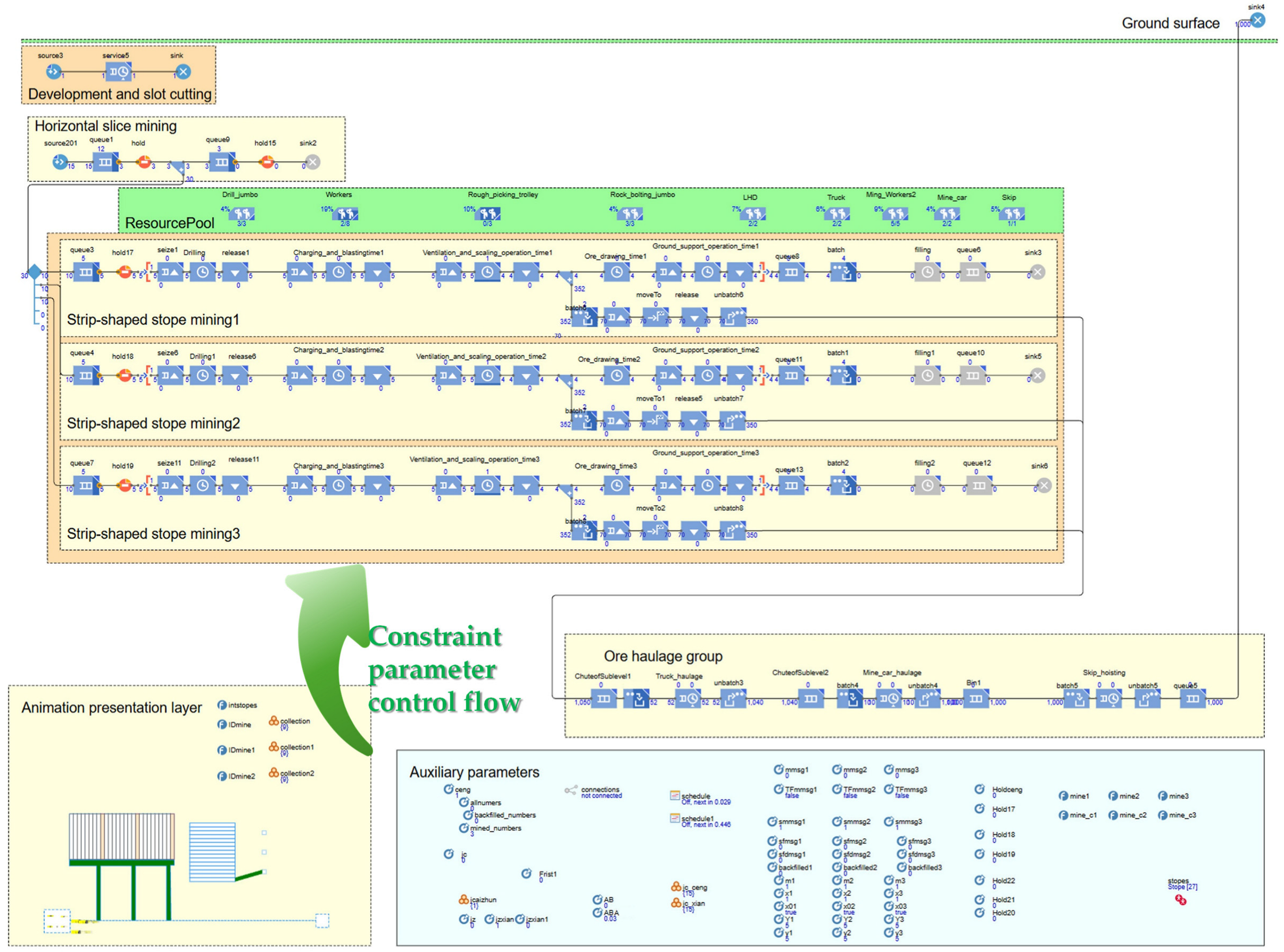
4.1.2. Model Construction
4.2. Reliability Testing of the Simulation Model
4.2.1. Initial Input Conditions
4.2.2. Simulation Environment
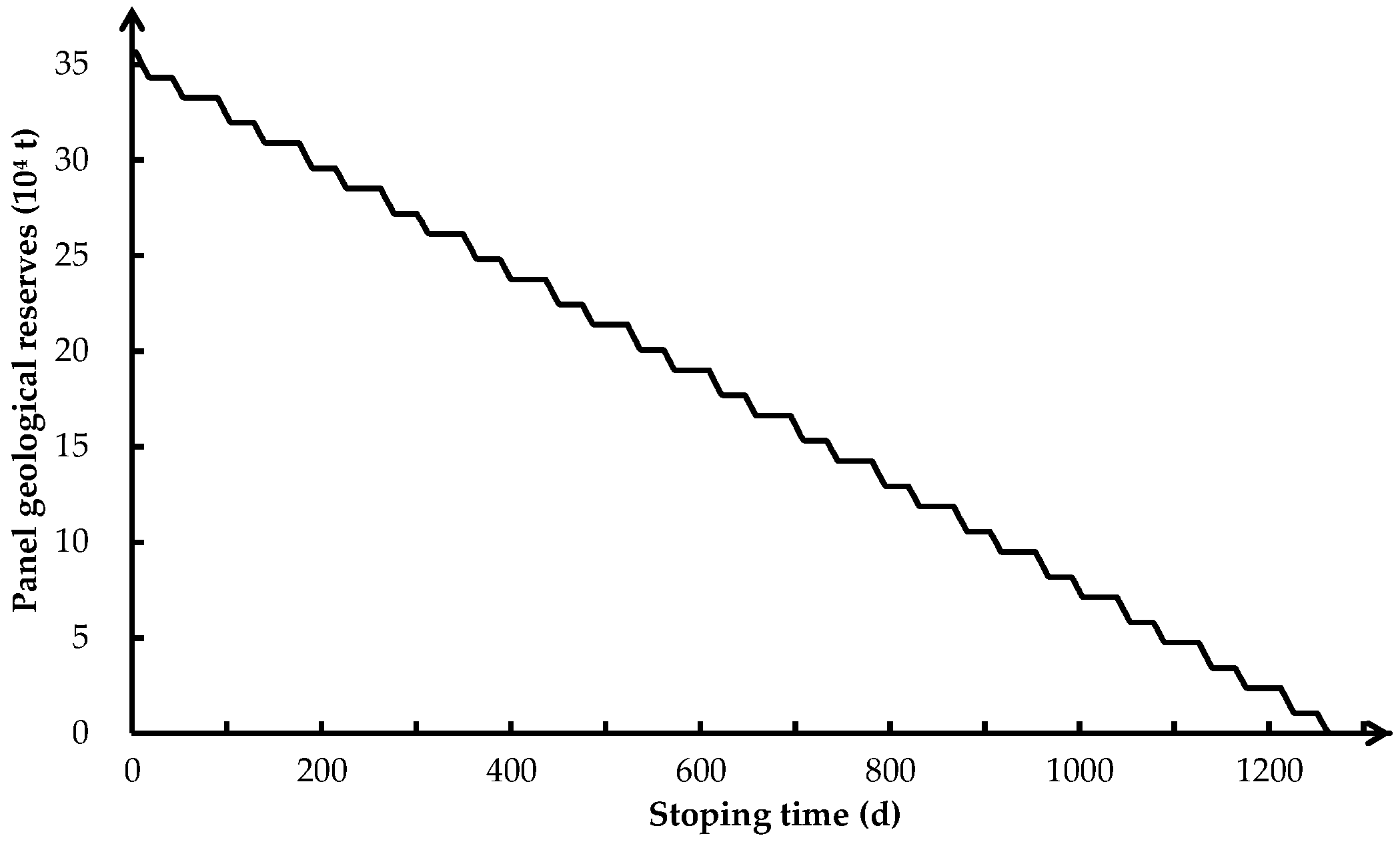
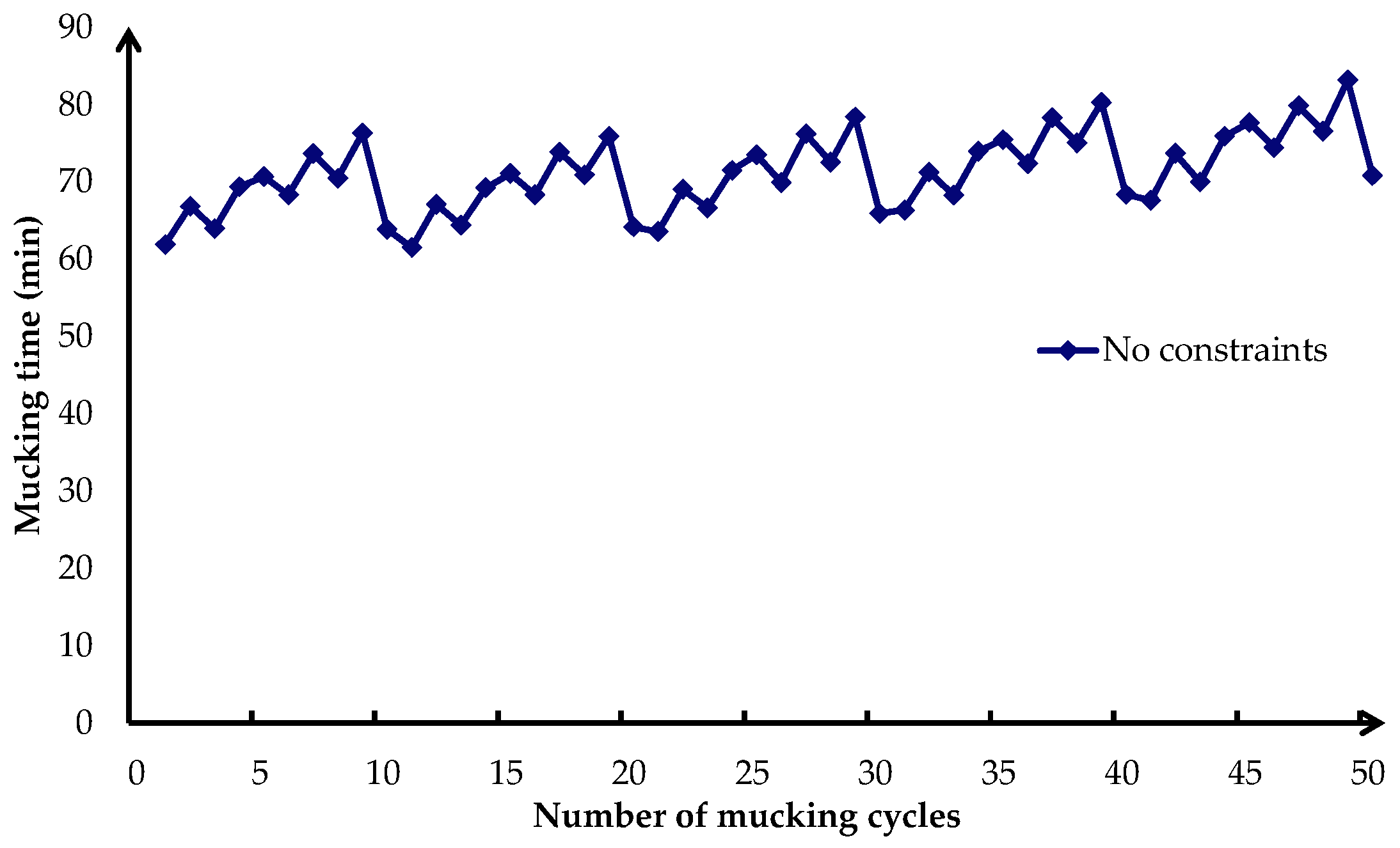
4.2.3. Simulation Results and Validation
4.3. System-Level Characteristics Revealed by the Simulation Model
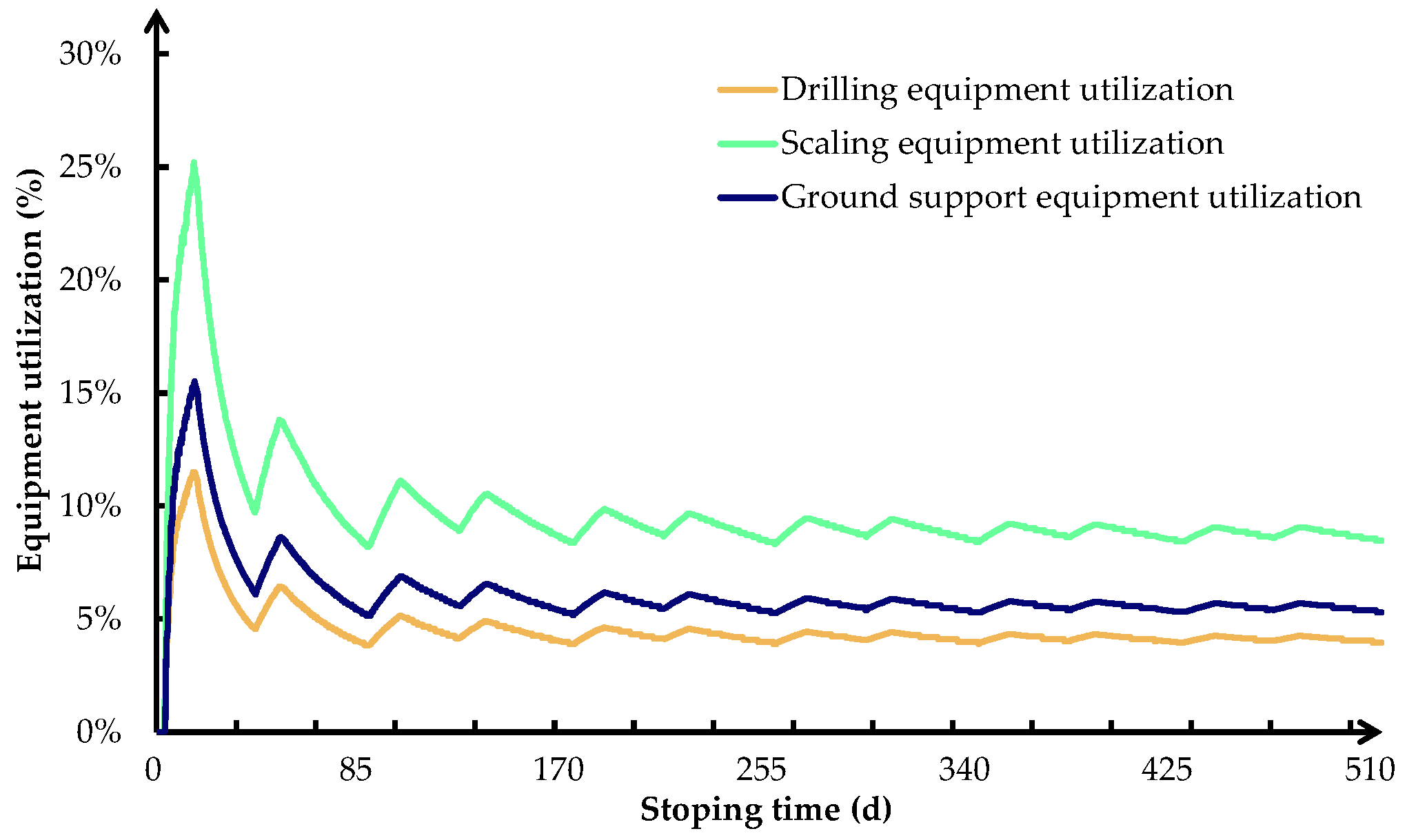
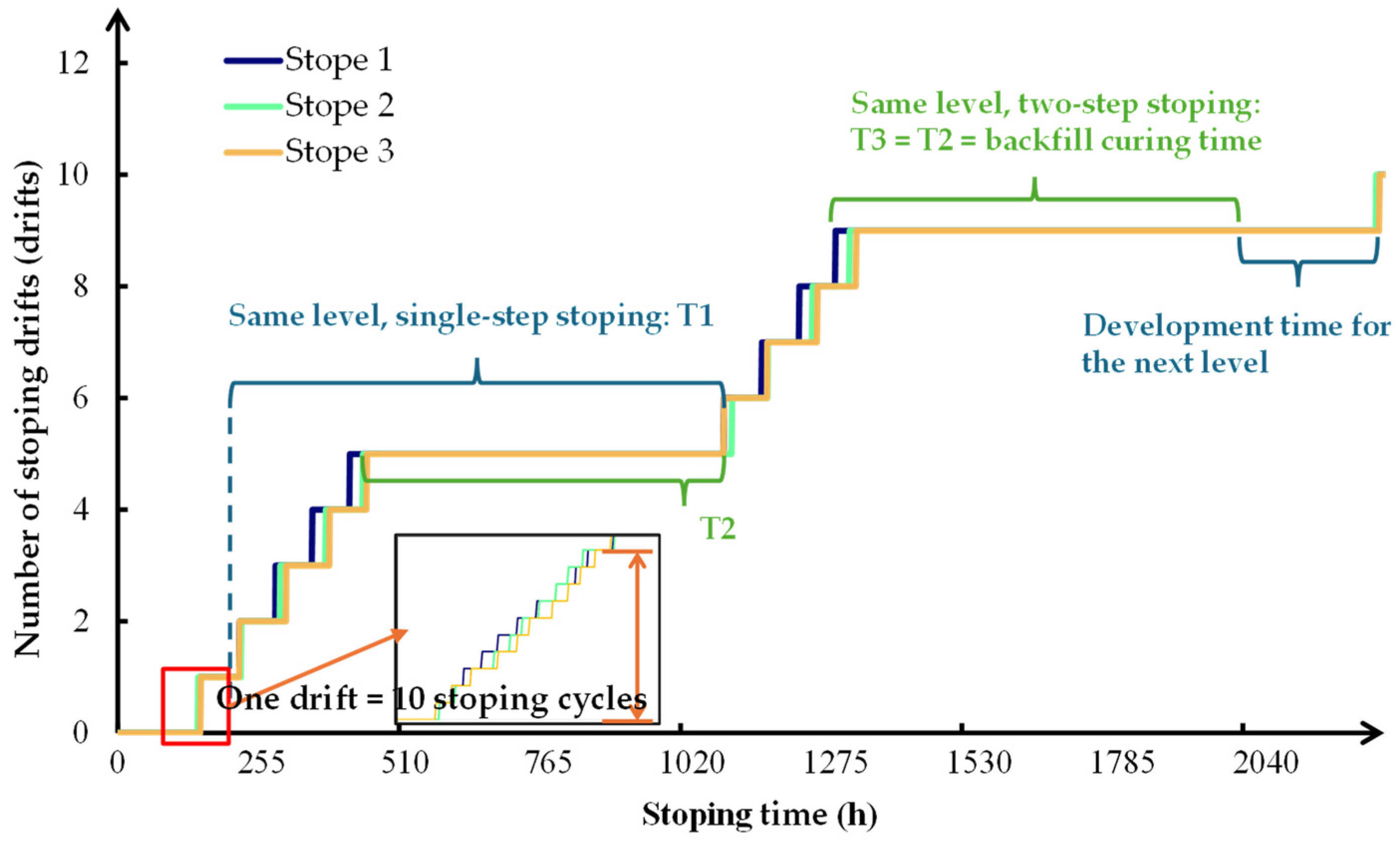
4.3.1. Production Rhythm and Structural Characteristics
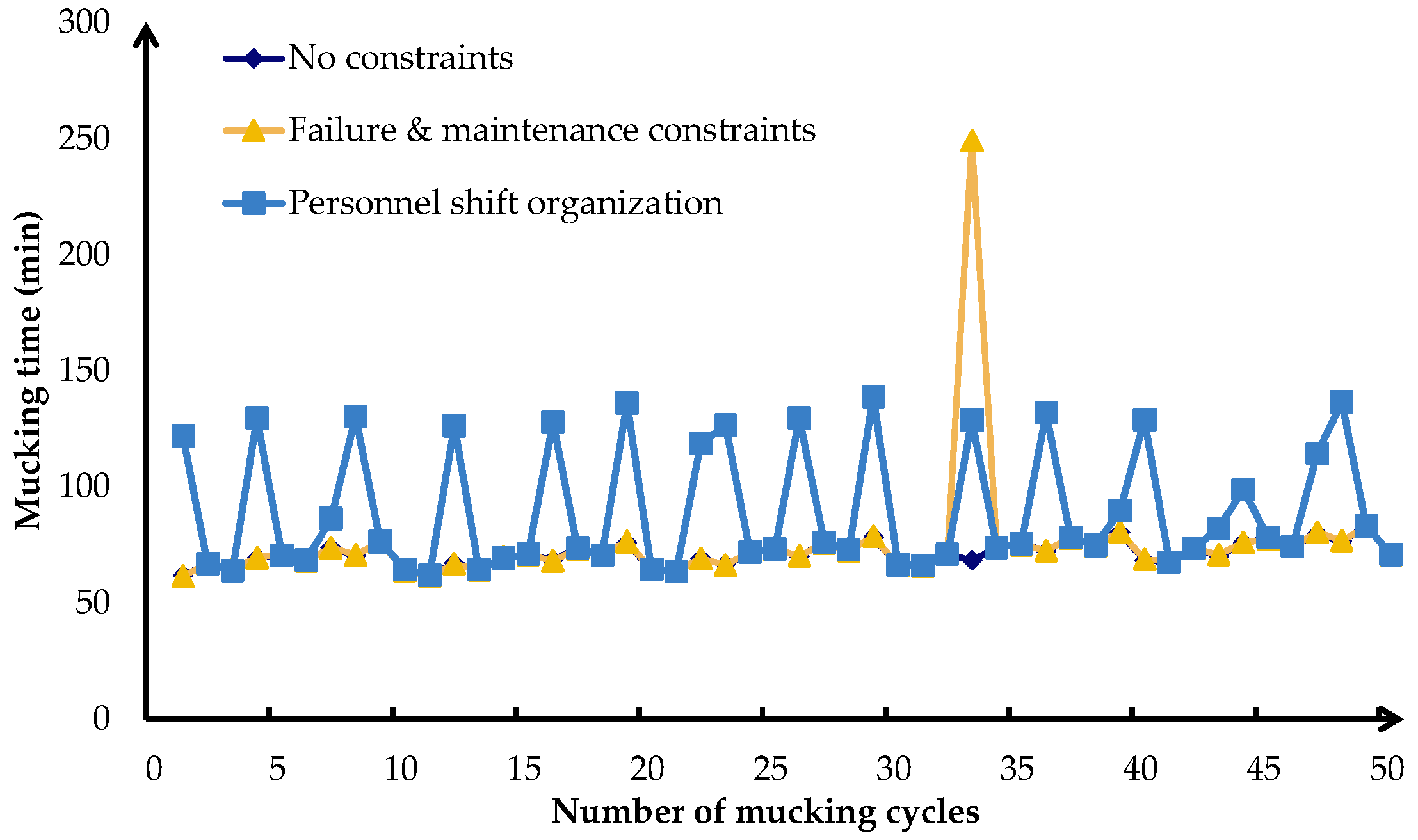
4.3.2. Model Results Under Different Engineering Constraint Scenarios
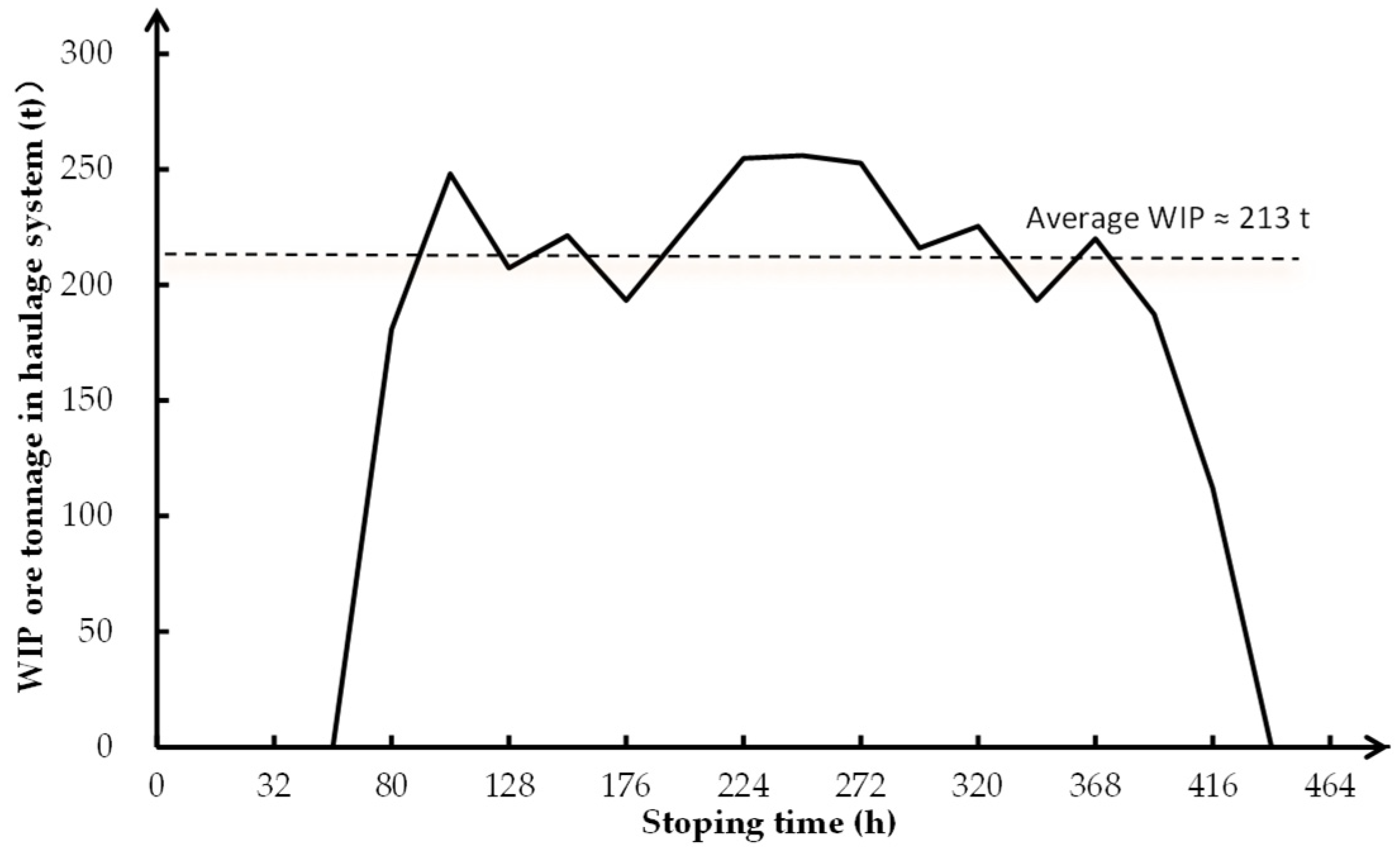
4.3.3. Dynamic Evolution of WIP and Ore Transfer Characteristics
5. Conclusions
Author Contributions
Funding
Institutional Review Board Statement
Informed Consent Statement
Data Availability Statement
Acknowledgments
Conflicts of Interest
References
- Song, Z.; Schunnesson, H.; Rinne, M.; Sturgul, J. An approach to realizing process control for underground mining operations of mobile machines. PLoS ONE 2015, 10, e0129572. [Google Scholar] [CrossRef] [Scilit]
- Tu, S.; Jia, M.; Wang, L.; Feng, S.; Huang, S. A Dynamic Scheduling Model for Underground Metal Mines under Equipment Failure Conditions. Sustainability 2023, 15, 7306. [Google Scholar] [CrossRef] [Scilit]
- Nesbitt, P.; Blake, L.R.; Lamas, P.; Goycoolea, M.; Pagnoncelli, B.K.; Newman, A.; Brickey, A. Underground Mine Scheduling under Uncertainty. Eur. J. Oper. Res. 2021, 294, 340–352. [Google Scholar] [CrossRef] [Scilit]
- Sofrankova, A.; Ondov, M.; Sofranko, M. Simulation-Driven Mining Logistics Towards Sustainable and Reliable Production. Appl. Sci. 2025, 15, 11722. [Google Scholar] [CrossRef] [Scilit]
- Mohana, V. Simprep: Underground operations preparation and production planning for short and long term. In MassMin 2024: Proceedings of the International Conference & Exhibition on Mass Mining, Kiruna, Sweden, 17–19 September 2024; Johansson, D., Schunnesson, H., Eds.; Luleå University of Technology: Luleå, Sweden, 2024; pp. 49–64. [Google Scholar] [CrossRef] [Scilit]
- Quan, K.; King, G.; Schrimpf, T. Discrete event simulation—A tool to support the design of complex production and logistic processes; its application in underground mine design. In Design Methods 2015: Proceedings of the International Seminar on Design Methods in Underground Mining, Perth, Australia, 17–19 November 2015; Potvin, Y., Ed.; Australian Centre for Geomechanics: Perth, Australia, 2015; pp. 443–462. [Google Scholar] [CrossRef] [Scilit]
- Paravarzar, S.; Pourrahimian, Y.; Askari-Nasab, H.; Emery, X. Short-Term Underground Mine Planning: A Review. Int. J. Min. Miner. Eng. 2021, 12, 1–33. [Google Scholar] [CrossRef] [Scilit]
- Li, N.; Feng, S.; Lei, T.; Ye, H.; Wang, Q.; Wang, L.; Jia, M. Rescheduling Plan Optimization of Underground Mine Haulage Equipment Based on Random Breakdown Simulation. Sustainability 2022, 14, 3448. [Google Scholar] [CrossRef] [Scilit]
- Aalian, Y.; Gamache, M.; Pesant, G. Short-Term Underground Mine Planning with Uncertain Activity Durations Using Constraint Programming. J. Sched. 2024, 27, 423–439. [Google Scholar] [CrossRef] [Scilit]
- Skawina, B.; Astrand, M.; Sundqvist, F.; Greberg, J.; Salama, A.; Ekbeck, P. Automatic closed-loop scheduling in underground mining using discrete event simulation. J. South. Afr. Inst. Min. Metall. 2021, 121, 277–282. [Google Scholar] [CrossRef] [Scilit]
- Baek, J.; Choi, Y. Simulation of Truck Haulage Operations in an Underground Mine Using Big Data from an ICT-Based Mine Safety Management System. Appl. Sci. 2019, 9, 2639. [Google Scholar] [CrossRef] [Scilit]
- Jung, D.; Baek, J.; Choi, Y. Stochastic Predictions of Ore Production in an Underground Limestone Mine Using Different Probability Density Functions: A Comparative Study Using Big Data from ICT System. Appl. Sci. 2021, 11, 4301. [Google Scholar] [CrossRef] [Scilit]
- Soto, I.; Anani, A.; Córdova, E. A Discrete Event Simulation Approach for Mine Development Planning at Codelco’s New Mine Level. J. South. Afr. Inst. Min. Metall. 2022, 122, 549–560. [Google Scholar] [CrossRef] [Scilit]
- Manríquez, F.; Pérez, J.; Morales, N. A Simulation–Optimization Framework for Short-Term Underground Mine Production Scheduling. Optim. Eng. 2020, 21, 939–971. [Google Scholar] [CrossRef] [Scilit]
- Hou, J.; Li, G.; Chen, L.; Wang, H.; Hu, N. Optimization of Truck–Loader Matching Based on a Simulation Method for Underground Mines. Sustainability 2023, 15, 216. [Google Scholar] [CrossRef] [Scilit]
- Augustine, P.C.; Moniri-Morad, A.; Shahsavar, M.; Sattarvand, J. Investigating the Effect of Human Factors on the Underground Mine Evacuation Process Using Agent-Based Simulation. Appl. Sci. 2024, 14, 11773. [Google Scholar] [CrossRef] [Scilit]
- Sun, Y.; Liu, X. Research and Application of a Multi-Agent-Based Intelligent Mine Gas State Decision-Making System. Appl. Sci. 2025, 15, 968. [Google Scholar] [CrossRef] [Scilit]
- Zhang, C.; Yang, X.; Zhou, R.; Guo, Z. A Path Planning Method Based on Improved A* and Fuzzy Control DWA of Underground Mine Vehicles. Appl. Sci. 2024, 14, 3103. [Google Scholar] [CrossRef] [Scilit]
- Witulska, J.; Stefaniak, P.; Jachnik, B.; Skoczylas, A.; Śliwiński, P.; Dudzik, M. Recognition of LHD Position and Maneuvers in Underground Mining Excavations—Identification and Parametrization of Turns. Appl. Sci. 2021, 11, 6075. [Google Scholar] [CrossRef] [Scilit]
- Herzog, O.; Icarte-Ahumada, G.; Arratia, D.; Lucero, C. Reinforcement Learning-Driven Negotiation in a Multi-Agent System for Truck Dispatching in Open-Pit Mining. Appl. Sci. 2026, 16, 2343. [Google Scholar] [CrossRef] [Scilit]
- Weiss-Cohen, M.; Coelho, V.N. Open-Pit Mining Operational Planning using Multi Agent Systems. Procedia Comput. Sci. 2021, 192, 1677–1686. [Google Scholar] [CrossRef] [Scilit]
- Ozdemir, B.; Kumral, M. Appraising Production Targets through Agent-Based Petri Net Simulation of Material Handling Systems in Open Pit Mines. Simul. Modell. Pract. Theory 2018, 87, 138–154. [Google Scholar] [CrossRef] [Scilit]
- Basilico, G. Agent-Based Systems and Dynamic Multi-Agent Scheduling for Fleet Management in Underground Mines: Towards Mining 4.0. Master’s Thesis, Polytechnique Montréal, Montréal, QC, Canada, 2020. Available online: https://publications.polymtl.ca/9153/ (accessed on 3 March 2026).
- Velasquez, N.; Anani, A.; Munoz-Gama, J.; Pascual, R. Towards the Application of Process Mining in the Mining Industry—An LHD Maintenance Process Optimization Case Study. Sustainability 2023, 15, 7974. [Google Scholar] [CrossRef] [Scilit]
- País Cerna, G.; Cornejo González, J.; Troncoso-Palacio, A.; Coronado Hernandez, J. Using Discrete Event Simulation to Muck Development Planning in Underground Mining. Procedia Comput. Sci. 2023, 220, 916–921. [Google Scholar] [CrossRef] [Scilit]
- Park, S.; Choi, Y. Analysis and Diagnosis of Truck Transport Routes in Underground Mines Using Transport Time Data Collected through Bluetooth Beacons and Tablet Computers. Appl. Sci. 2021, 11, 4525. [Google Scholar] [CrossRef] [Scilit]
- Miao, W.; Zhao, X. Traffic Congestion Scheduling for Underground Mine Ramps Based on an Improved Genetic Scheduling Algorithm. Appl. Sci. 2024, 14, 9862. [Google Scholar] [CrossRef] [Scilit]





| Stage | Operation | Value |
|---|---|---|
| Panel development | Development and slot preparation | 3 d |
| Stope extraction | Drilling | 2.5 ± 0.5 h |
| Charging & blasting | 1.5 ± 0.5 h | |
| Ventilation & scaling | 1 ± 0.2 h | |
| Mucking | 4 min/cycle; 5 t/cycle | |
| Ground support | 0.5 ± 0.1 h | |
| Backfilling of the void | 30 ± 5 d | |
| Ore haulage | Truck shuttle haulage | 16 min/cycle 20 t/cycle |
| Mine cars to shaft | 61 min/cycle 100 t/cycle | |
| Shaft hoisting | 14 min/cycle 50 t/cycle |
| Transport Mode | Truck Haulage | Mine-Car Haulage | Skip Hoisting |
|---|---|---|---|
| Haul distance | 1000 m | 3000 m | 1000 m |
| Capacity | 20 t | 6 m3 per car; 8 cars, 72 t/cycle | 45 t/cycle |
| Average speed | Acceleration 0.3 m/s2; Constant 20 km/h | 10 km/h | Constant 10 m/s; acceleration 0.5 m/s2 |
| Loading/unloading time | 10 min total | Vibratory feeder; 3 min/car; 24 min total | 5 min per 2 cars; 10 min total |
| Single-cycle haulage time | Round trip 6 min; 16 min per cycle | Round trip 37 min; 61 min per cycle | Round trip 4 min; 14 min per cycle |
| Job Type | Position | Number of Workers | Equipment | Quantity |
|---|---|---|---|---|
| Drilling | Drilling workers | 2 | Drill jumbo | 1 |
| Charging & blasting | Charging and blasting workers | 3 | Charging unit | 1 |
| Ventilation | Ventilation workers | 2 | Ventilation equipment (fixed) | 1 |
| Loading | LHD operator and assistant | 2 | LHD | 1 |
| Truck haulage | Haulage truck driver | 1 | Underground haulage truck | 1 |
| Mine-car haulage | Mine-car driver | 1 | Underground mine-car train | 1 |
| Ground support | Support worker | 1 | Rock-bolting rig | 1 |
| Maintenance | Maintenance worker | 1 | — | — |
| Mining Unit | Time Required (h) | Time Converted (d) | Ore Tonnage (t) | Equivalent Stope-Level Mining Efficiency (t/d) | Field Statistical Value (t/d) | Relative Error |
|---|---|---|---|---|---|---|
| Single production cycle | 7.1 | 0.3 | 88.0 | 297.5 | 285.2 | 4.31% |
| Single stope | 71.9 | 3.0 | 880.0 | 293.7 | 280.4 | 4.74% |
| Single level | 2028.7 | 84.5 | 23,760.0 | 281.1 | 266.8 | 5.36% |
| Complete ore block | 31,511.1 | 1313.0 | 356,400.0 | 271.4 | 254.2 | 6.77% |
Disclaimer/Publisher’s Note: The statements, opinions and data contained in all publications are solely those of the individual author(s) and contributor(s) and not of MDPI and/or the editor(s). MDPI and/or the editor(s) disclaim responsibility for any injury to people or property resulting from any ideas, methods, instructions or products referred to in the content. |
© 2026 by the authors. Licensee MDPI, Basel, Switzerland. This article is an open access article distributed under the terms and conditions of the Creative Commons Attribution (CC BY) license.
Share and Cite
Zou, Q.; Li, Y.; Wang, Y.; Xiao, G.; Liu, Y.; An, Y. Hybrid Simulation Modeling of Underground Mining Processes Under Multidimensional Constraints: A Case Study of the Sanshandao Gold Mine. Appl. Sci. 2026, 16, 4646. https://doi.org/10.3390/app16104646
Zou Q, Li Y, Wang Y, Xiao G, Liu Y, An Y. Hybrid Simulation Modeling of Underground Mining Processes Under Multidimensional Constraints: A Case Study of the Sanshandao Gold Mine. Applied Sciences. 2026; 16(10):4646. https://doi.org/10.3390/app16104646
Chicago/Turabian StyleZou, Qingbao, Yuanhui Li, Yunsen Wang, Guixuan Xiao, Yong Liu, and Yijun An. 2026. "Hybrid Simulation Modeling of Underground Mining Processes Under Multidimensional Constraints: A Case Study of the Sanshandao Gold Mine" Applied Sciences 16, no. 10: 4646. https://doi.org/10.3390/app16104646
APA StyleZou, Q., Li, Y., Wang, Y., Xiao, G., Liu, Y., & An, Y. (2026). Hybrid Simulation Modeling of Underground Mining Processes Under Multidimensional Constraints: A Case Study of the Sanshandao Gold Mine. Applied Sciences, 16(10), 4646. https://doi.org/10.3390/app16104646