Design and Structural Validation of a Device for Assisted Vehicle Boarding



Abstract
1. Introduction
2. Materials and Methods
- Lifter should support legs during the whole time necessary to move legs into the car.
- Lifter should be able to stop at any time during lifting.
- Lifter should be able to move down any time after stopping lifting.
- Movement up and down must be controlled by the person whose legs are lifted.
- Lifter should be lightweight and easily removable.
- Lifter should be possible to use with nearly any passenger car.
- Lifter should be powered by energy standardly accessible in the passenger car (most common is electric power with voltage 12 V).
- Lifter size should be such that it will be possible to transport it in the passenger car.
- Distance measurement to determine maximum height of lifting.
- Calculation of maximum loads to determine maximum load.
- CAD modeling to create 3D model of leg lifter.
- Matrix calculations.
- FEM analysis to determine stress and displacement in leg lifter construction.
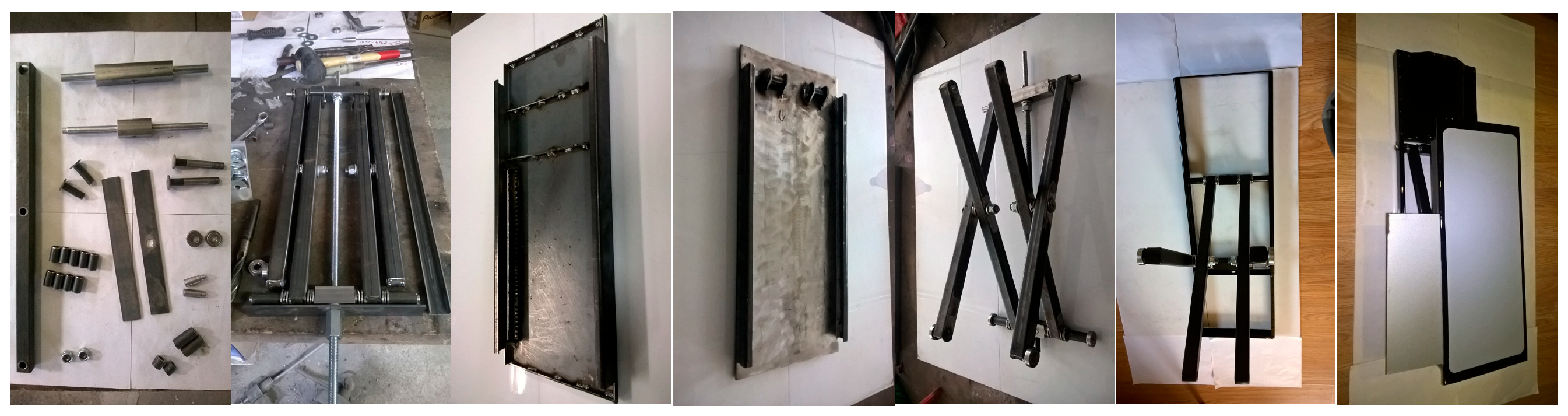
- Prototype production and testing to evaluate results of calculations.
2.1. Maximum Height of Lifting
2.2. Maximum Load Capacity
- mi—weight of the i-th segment (kg);
- B0, B1, B2—coefficients;
- x1—total body weight of the person (kg);
- x2—total body height of the person (cm).
2.3. Leg Lifter Mechanism Choice
- Hydraulic—powerful with a relatively small size, but in case of failure, it goes down without the possibility to stop it. It can injure the person whose legs are placed on the lifter. To avoid this, it is necessary to use a mechanical security system (ratchet mechanism), which makes construction more complicated and heavier.
- Pneumatic—pneumatic drive offers fast lifting in comparison with hydraulic, but it is noisy and needs a source of compressed air. Another possibility is using pneumatic balloons, like those in pneumatic balloons jacks. This is a simple solution, and with a safety valve, it is safe for use, but usually not very precise.
- Mechanics—there can be many different solutions, e.g.,
- a.
- Linear drive unit—safety, precise but expensive solution.
- b.
- Lever mechanism—in this case, not very suitable, because of the small space and relatively high distance of lifting.
- c.
- Pulley mechanism—simple, reliable, and precise but more suitable to lift in one point. To lift a surface on a horizontal plane, it will require more pulleys or an equal distribution of force to at least three points. It can require a more complex mechanism to facilitate equal lifting at all points of anchorage. Moreover, there can be problems with ropes, which can tangle.
- d.
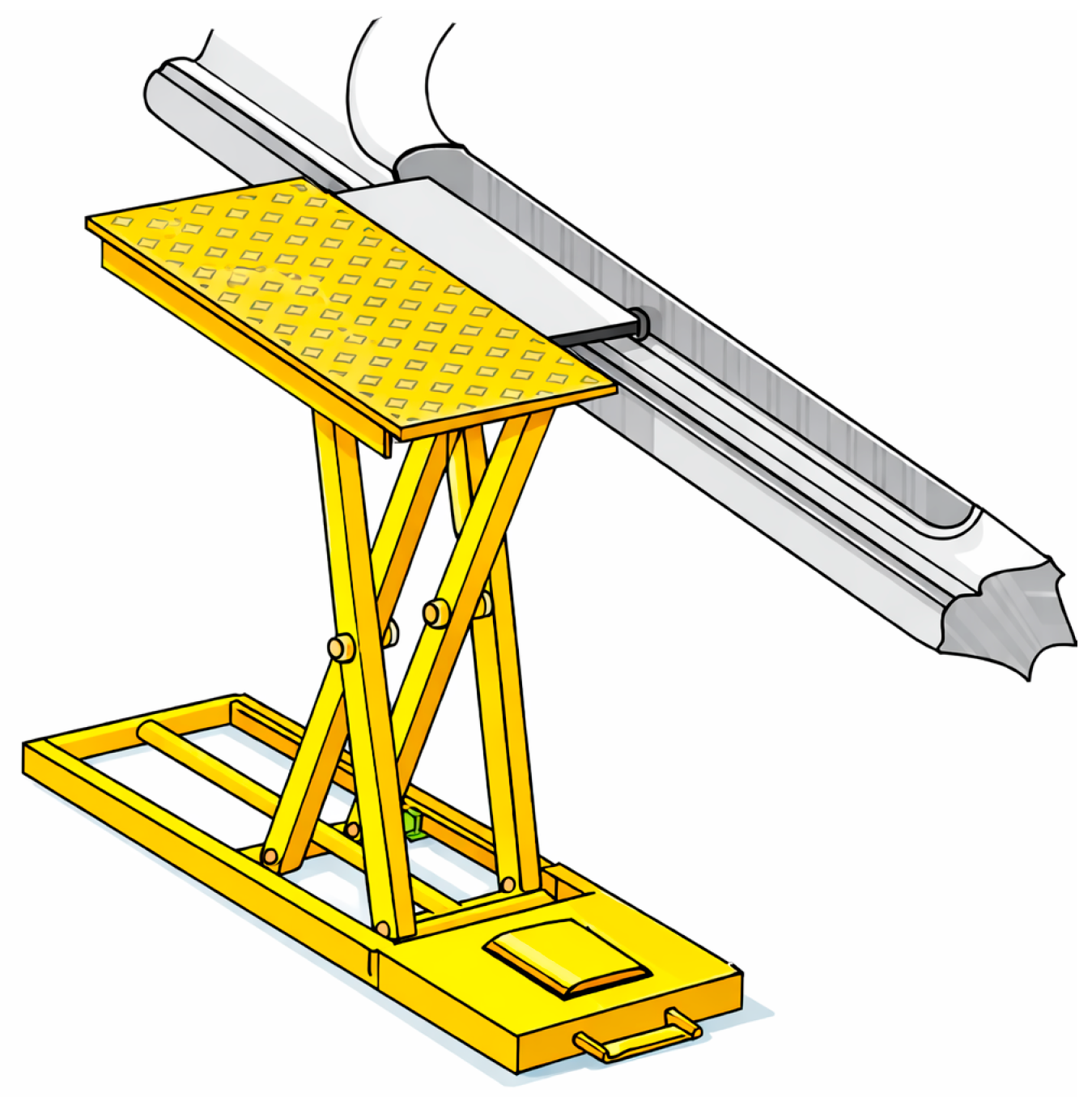
- Screw mechanism—e.g., scissor lift. Robust, inexpensive, precise and simple.
3. Results
3.1. Main Components of the Power Screw
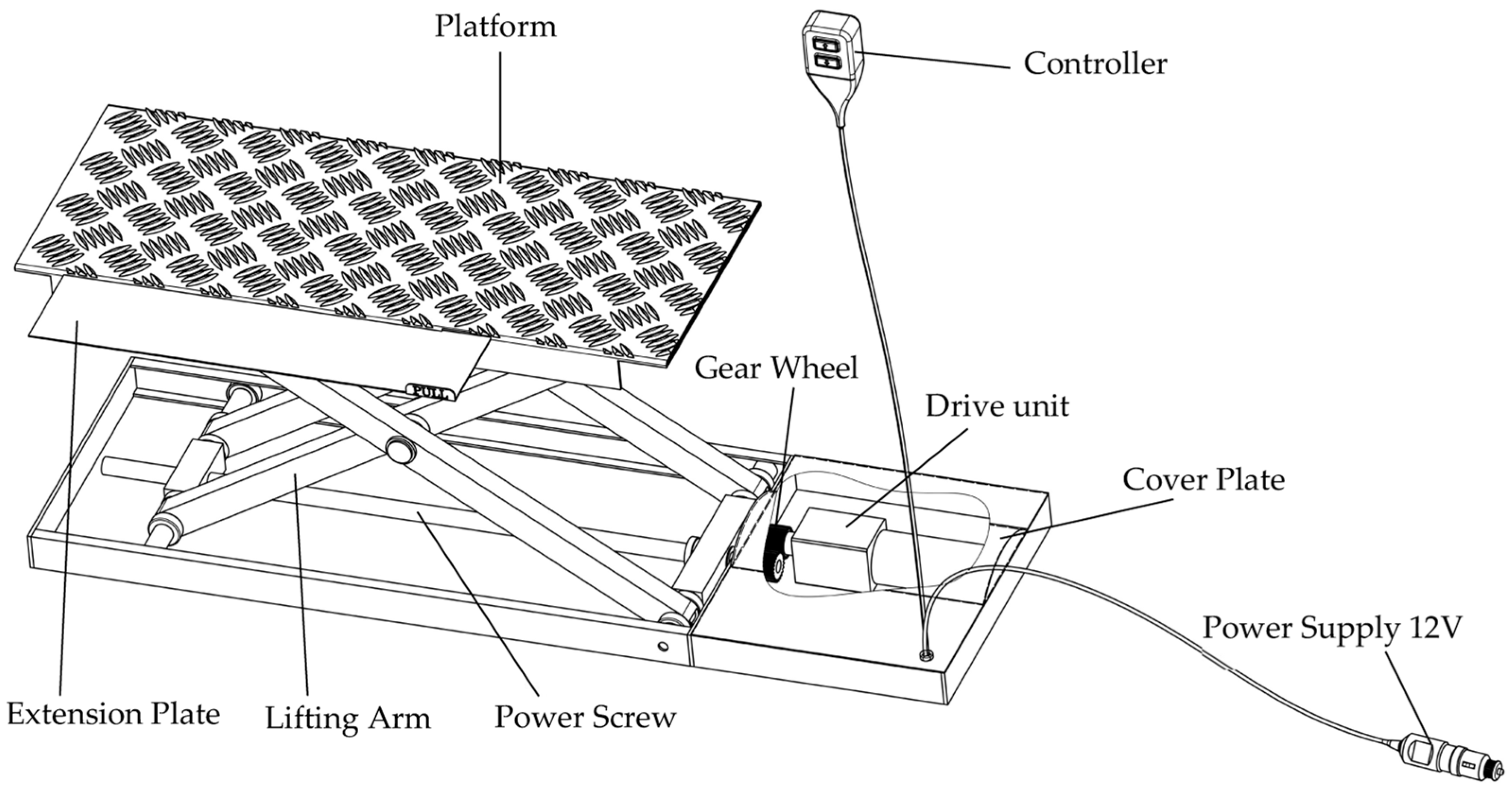
- Power screw with a specific thread type;
- Nut;
- Source of rotational motion.
Evaluation of the Proposed Design
- Simple, stable construction composed of standardized components;
- Straightforward and cost-effective drive mechanism;
- Low weight;
- Design independent of the vehicle;
- High universality.
- Requirement for a compact, high-performance motor, a drawback that can be mitigated by employing linear actuators;
- Reduced stability on uneven terrain.
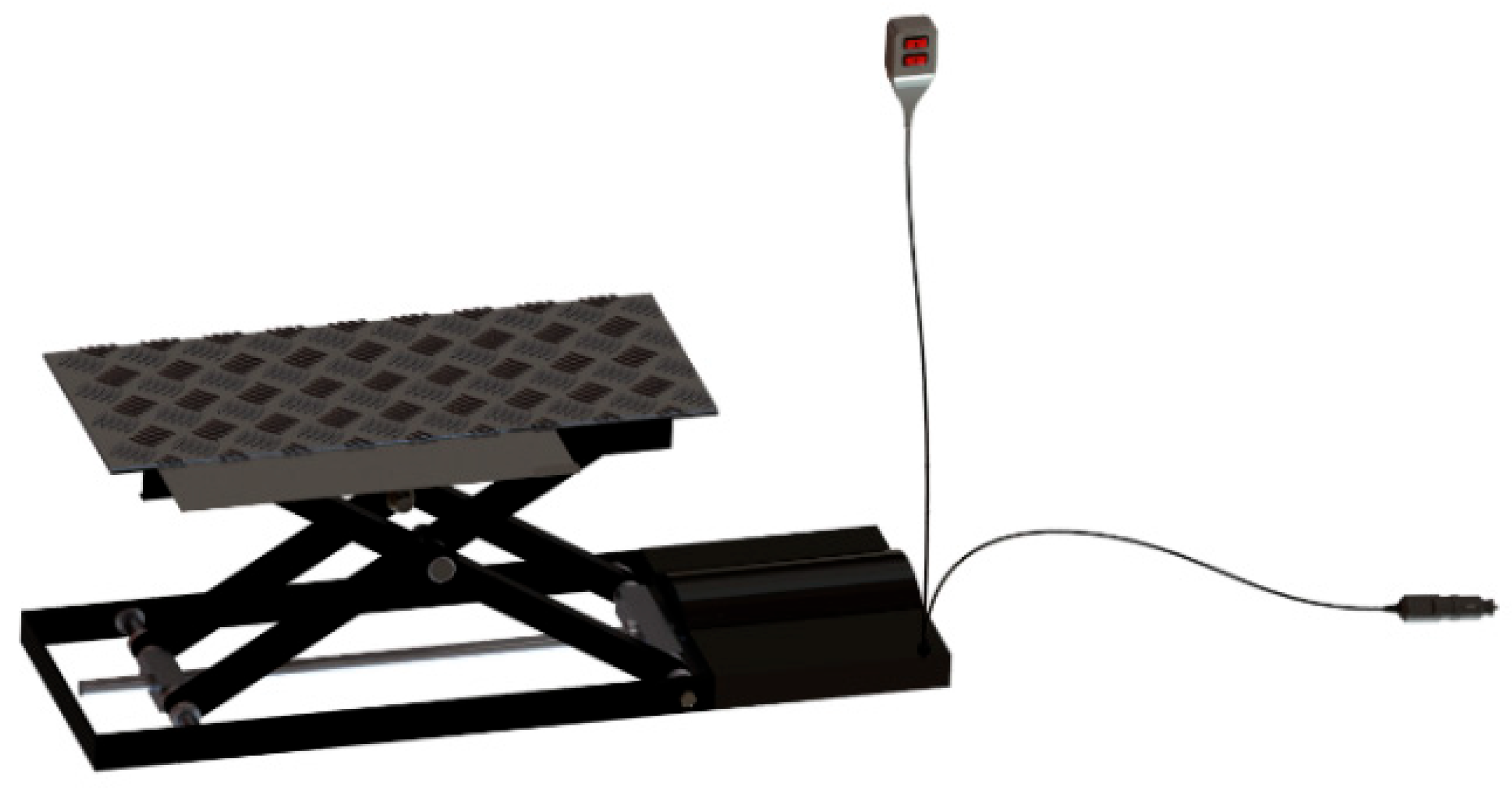
3.2. Model Creation
3.3. Calculations
3.3.1. Calculation of the Power Screw
Axial Force
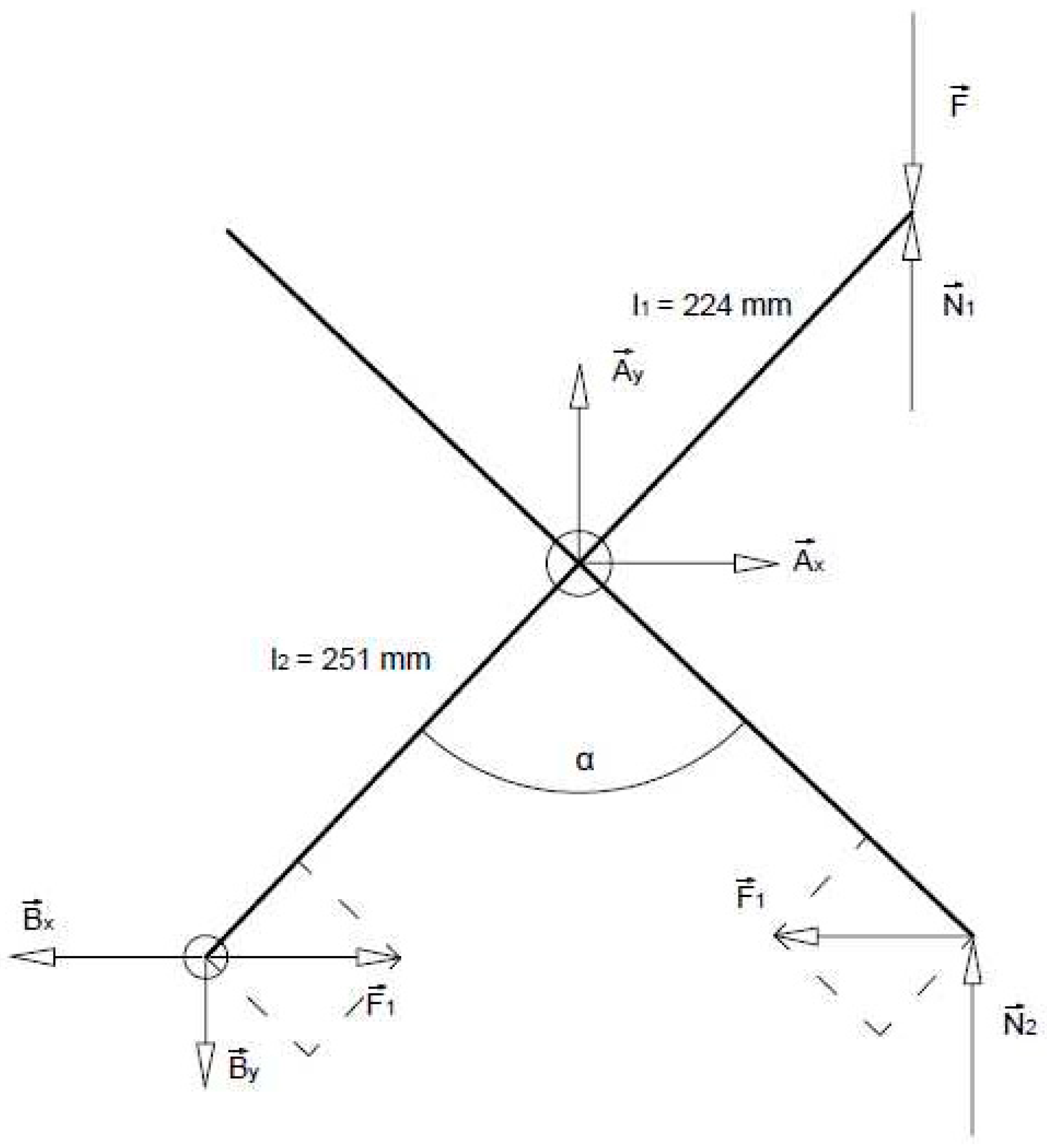
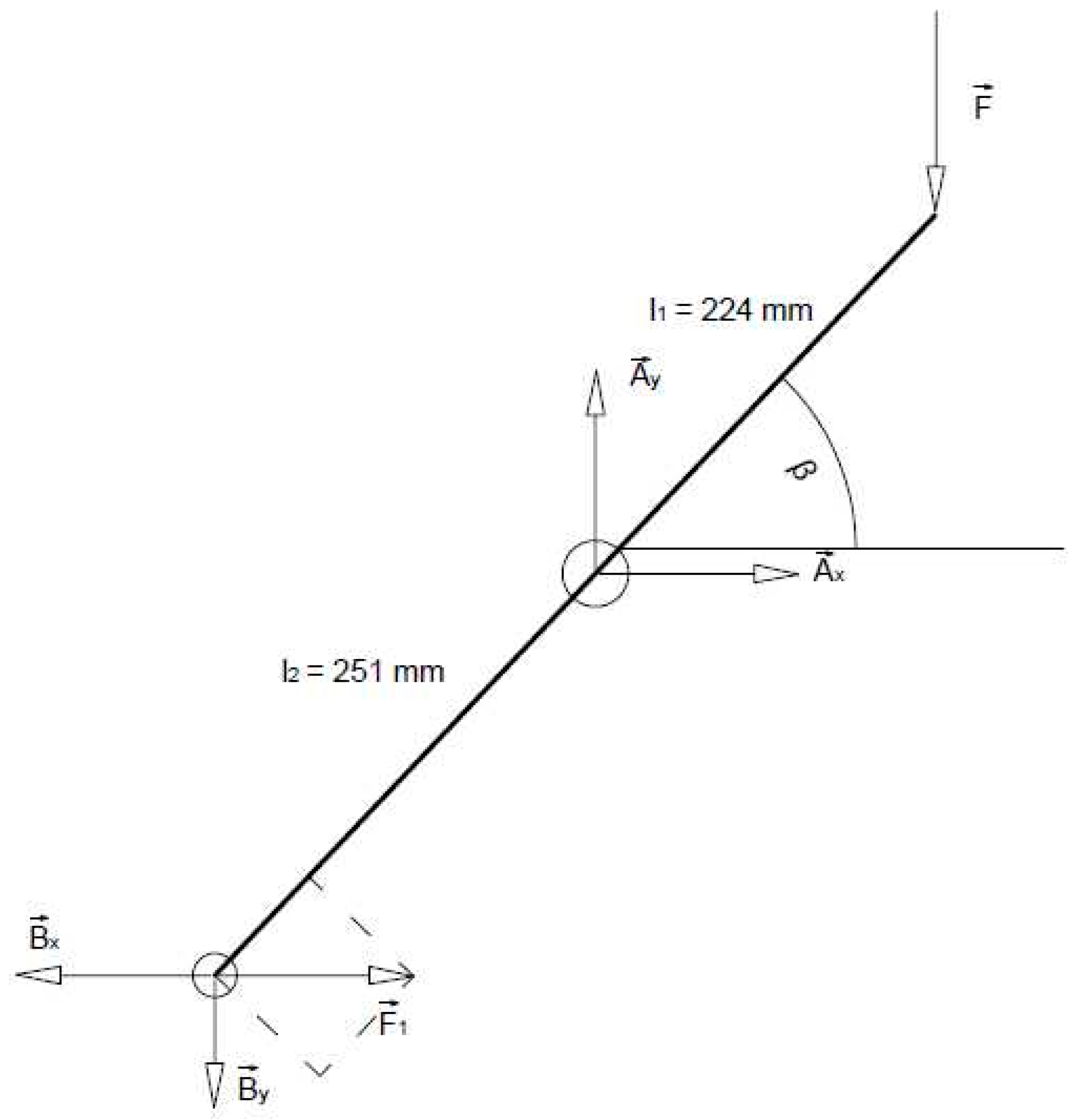
- Transformation of the Assembly into a Planar System of Bodies
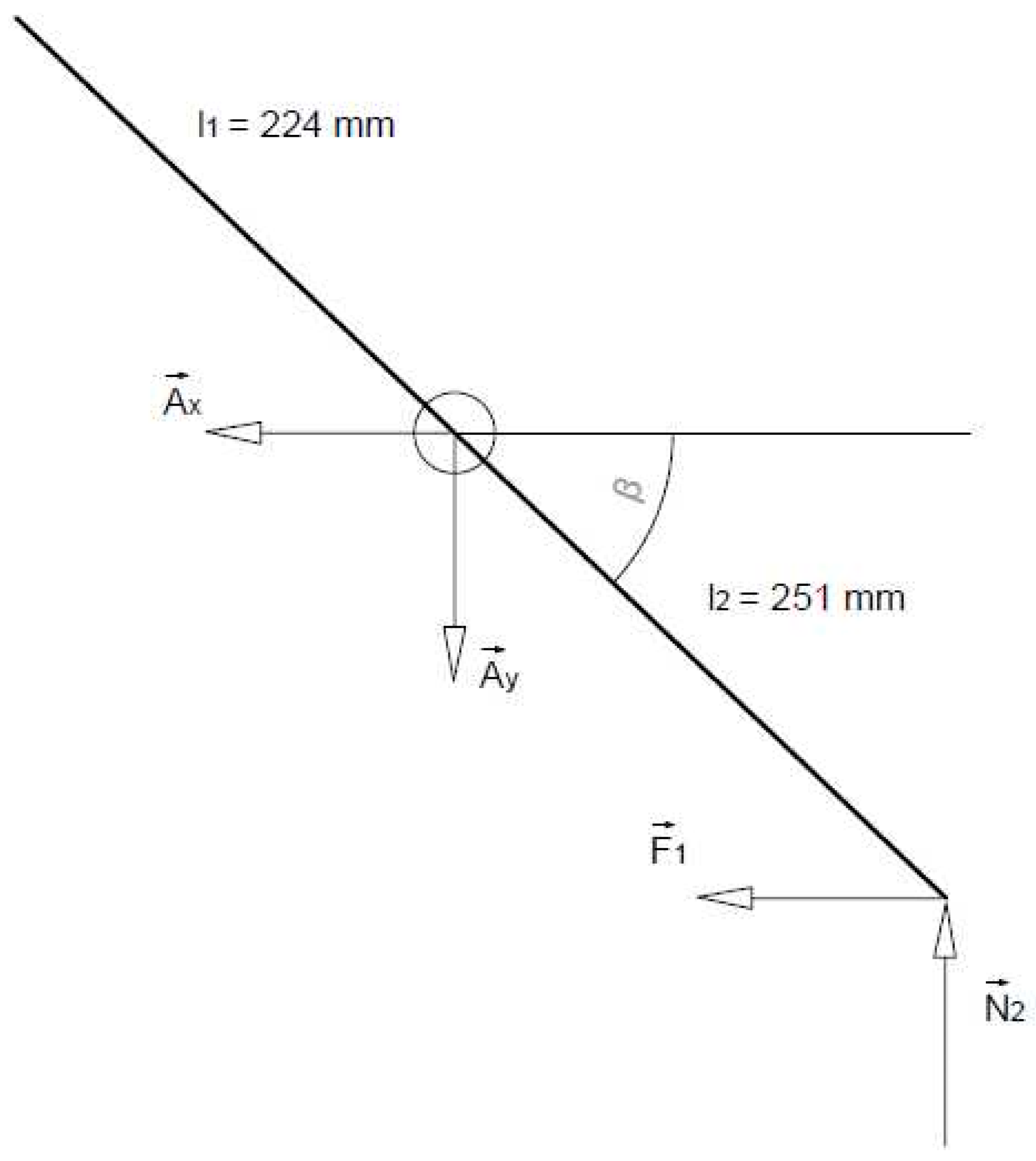
- Release of system members
- Second Body in the Plane
- System of Equations
- −F1 − Ax = 0 => F1 = 3295.98 N
- × Ax + × N2 = 0 => Ax = −3295.98 N
- −Ay + N2 = 0 => Ay = 3295.98 N
- −Bx = 0 => Bx = 0
- −By + N2 = 589 => By = 2706.98 N
- × N2 = 144.232 => N2 = 3295.98 N
Strength Verification of the Power Screw
- Tensile/Compressive Stress in the Core of the Screw (σ):
- FQ—Axial Force in the Screw;
- d3—Minor Diameter of the External Thread at the Crest of the Thread Root Radius.
- Shear Stress in Torsion (τk):
- Mtz—Frictional Torque in the Thread of the Screw and Nut;
- Wk—Torsional Section Modulus.
- d2—Pitch Diameter.
- γ—Lead Angle of Thread (M12×1.75).
- φ—Friction Angle for Friction Coefficient μ = 0.12.
- Reduced Stress:
- k—Safety Factor (1 ÷ 5);
- Ϭkt—Yield Strength (steel grade E295–265 MPa).
- βpr—determined by estimation ≈ 1.2.
- Minimum Minor Diameter of the External Thread d3:
- d3 ≥ 8.72 mm.
- Verification of the Accuracy of the Estimated Coefficient β:
- d—Major Diameter.
- Verification of the Specific Pressure in the Threads p:
- p = ≤ pdov = = 6.3 MPa
- p = 6.3 MPa ≤ pdov.
- vz—Thread Engagement Depth;
- z—Number of Threads in the Nut;
- pdov—Permissible Specific Pressure (15 ÷ 20 MPa).
3.3.2. Calculation of Drive System
- To lift the platform to a height of 383.5 mm, the nut must travel 159 mm.
- The pitch of the screw is 1.75 mm.
- The lead screw must complete 91 revolutions to achieve a lifting height of 383.5 mm.
- The time required for the lift was empirically determined to be 30 s.
- The calculation shows that, for the average lifting height, a rotational speed of 182 rpm is required to raise the platform within the specified time of 30 s.
- To lift the platform to a height of 475 mm, the nut must travel 308 mm.
- The pitch of the screw is 1.75 mm.
- The lead screw must complete 176 revolutions to achieve a lifting height of 475 mm.
- The time required for the lift was empirically determined to be 30 s.
- The calculation shows that, for the maximum lifting height, a rotational speed of 352 rpm is required to raise the platform within the specified time of 30 s.
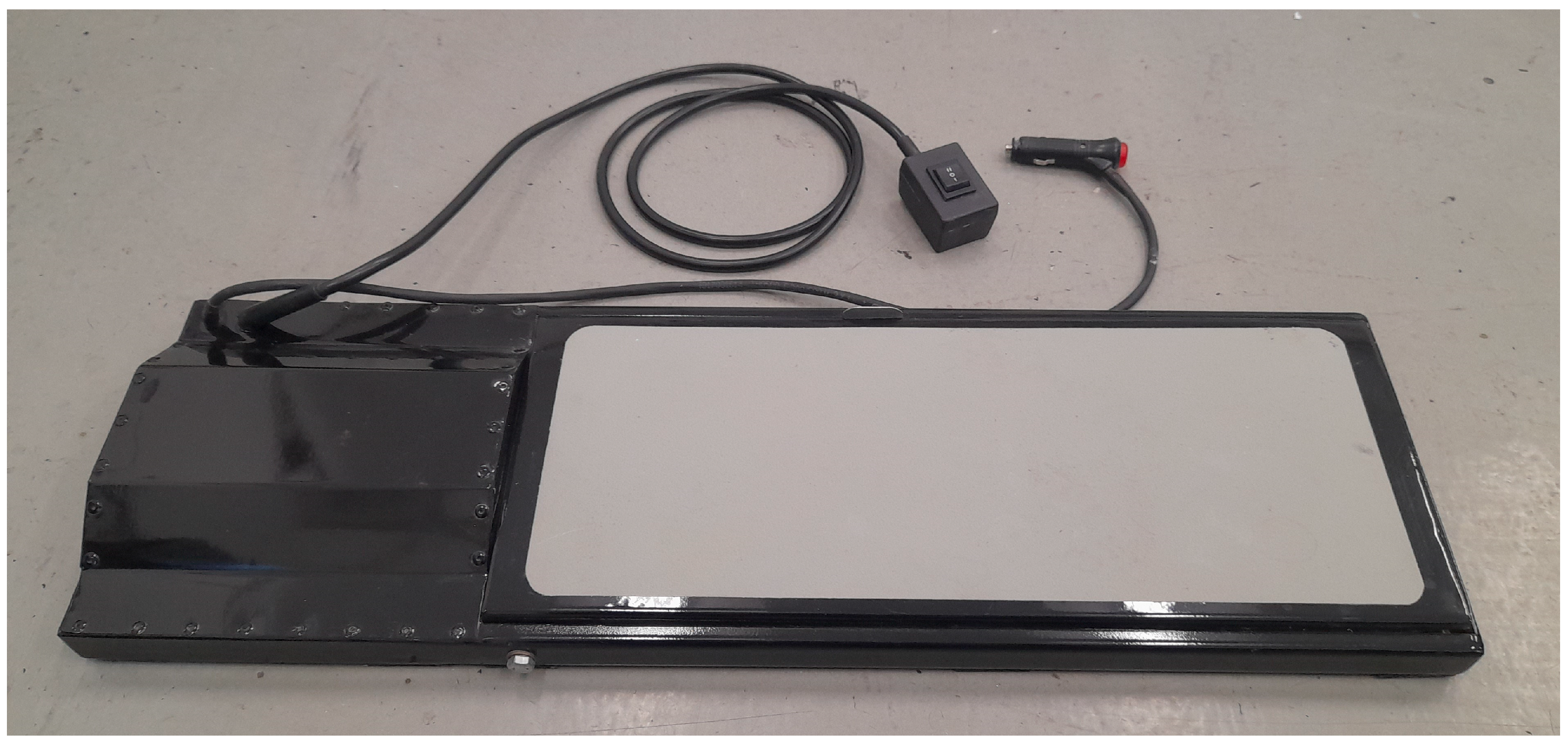
- Electric motor
- Control and Power Supply
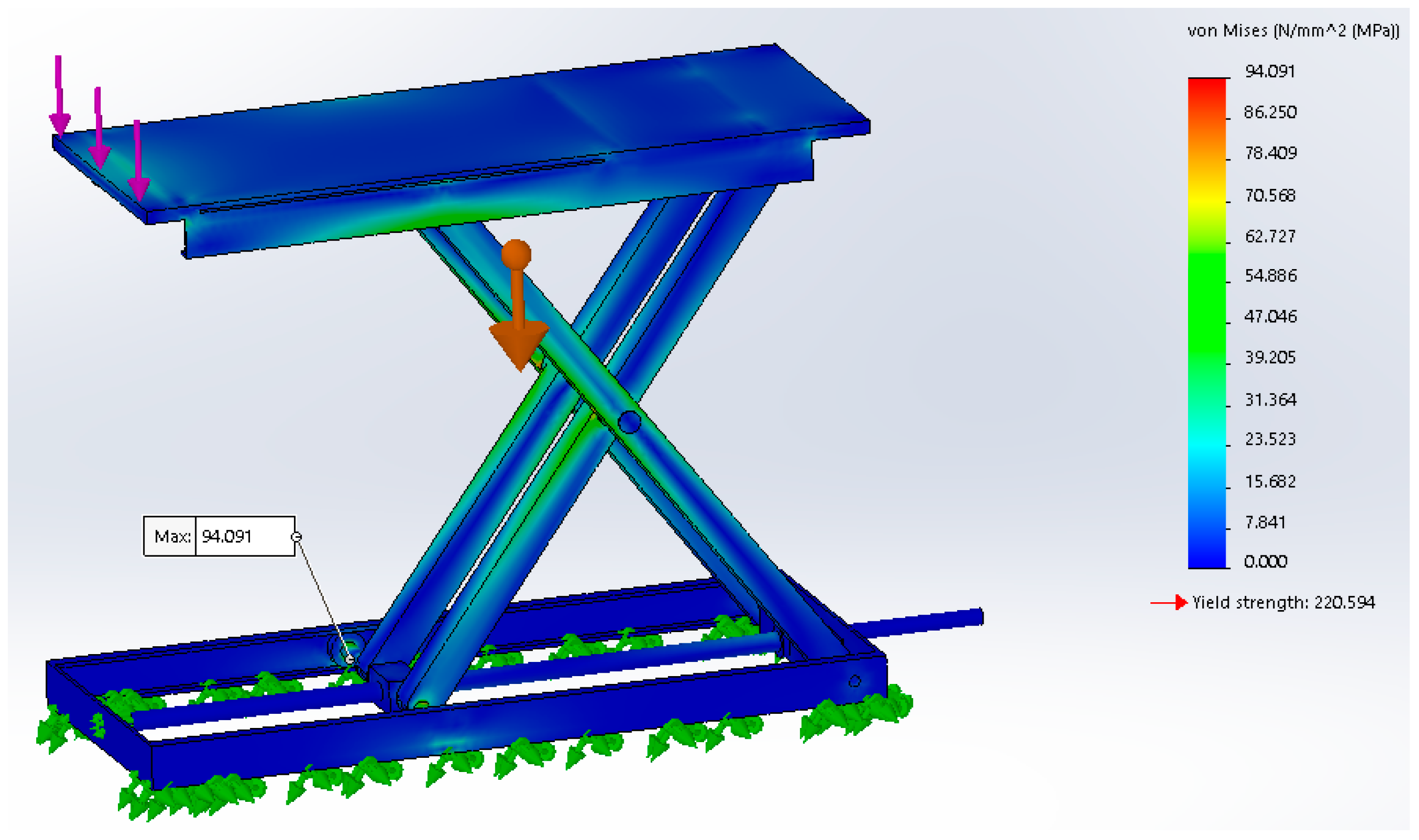
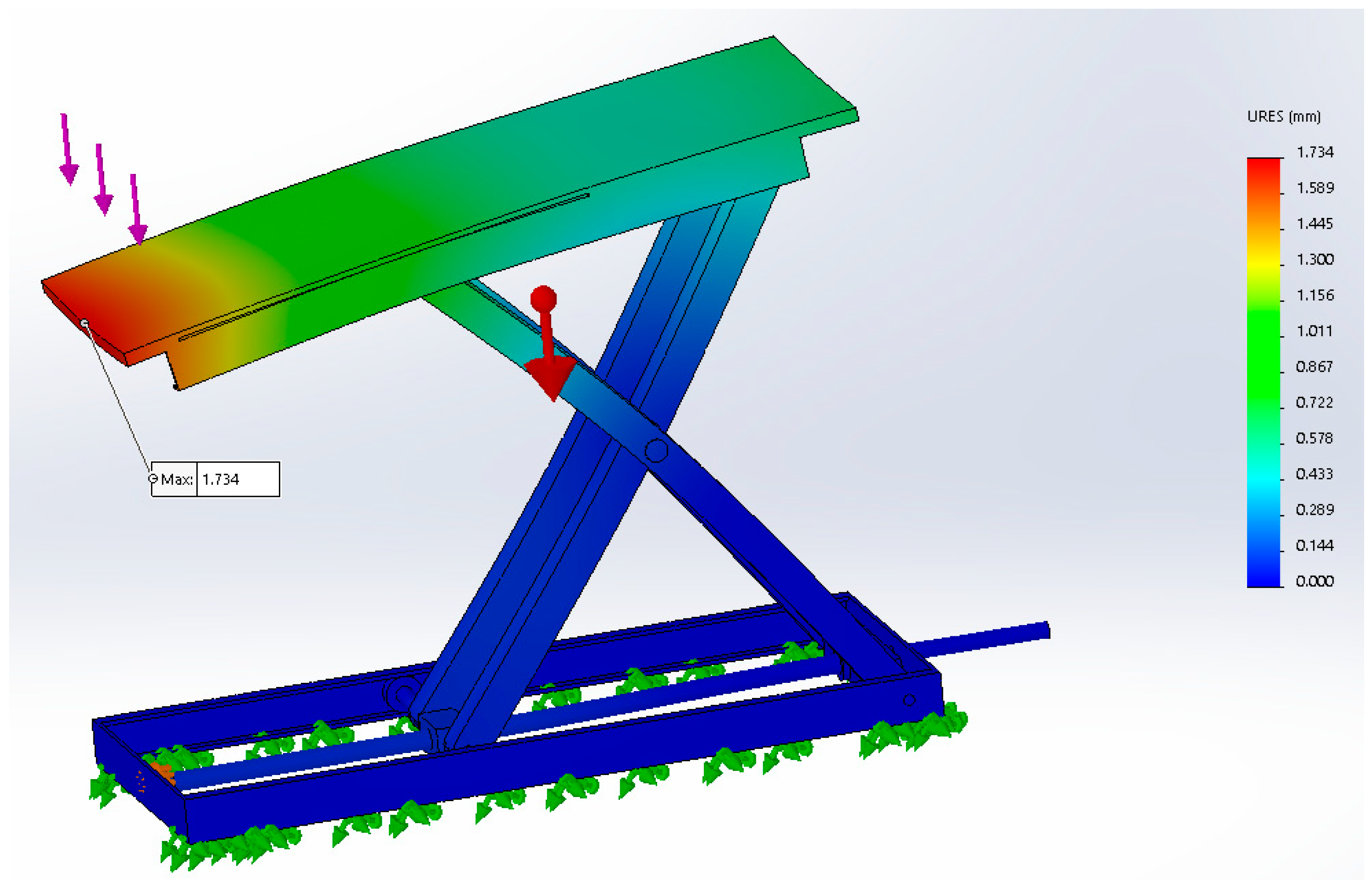
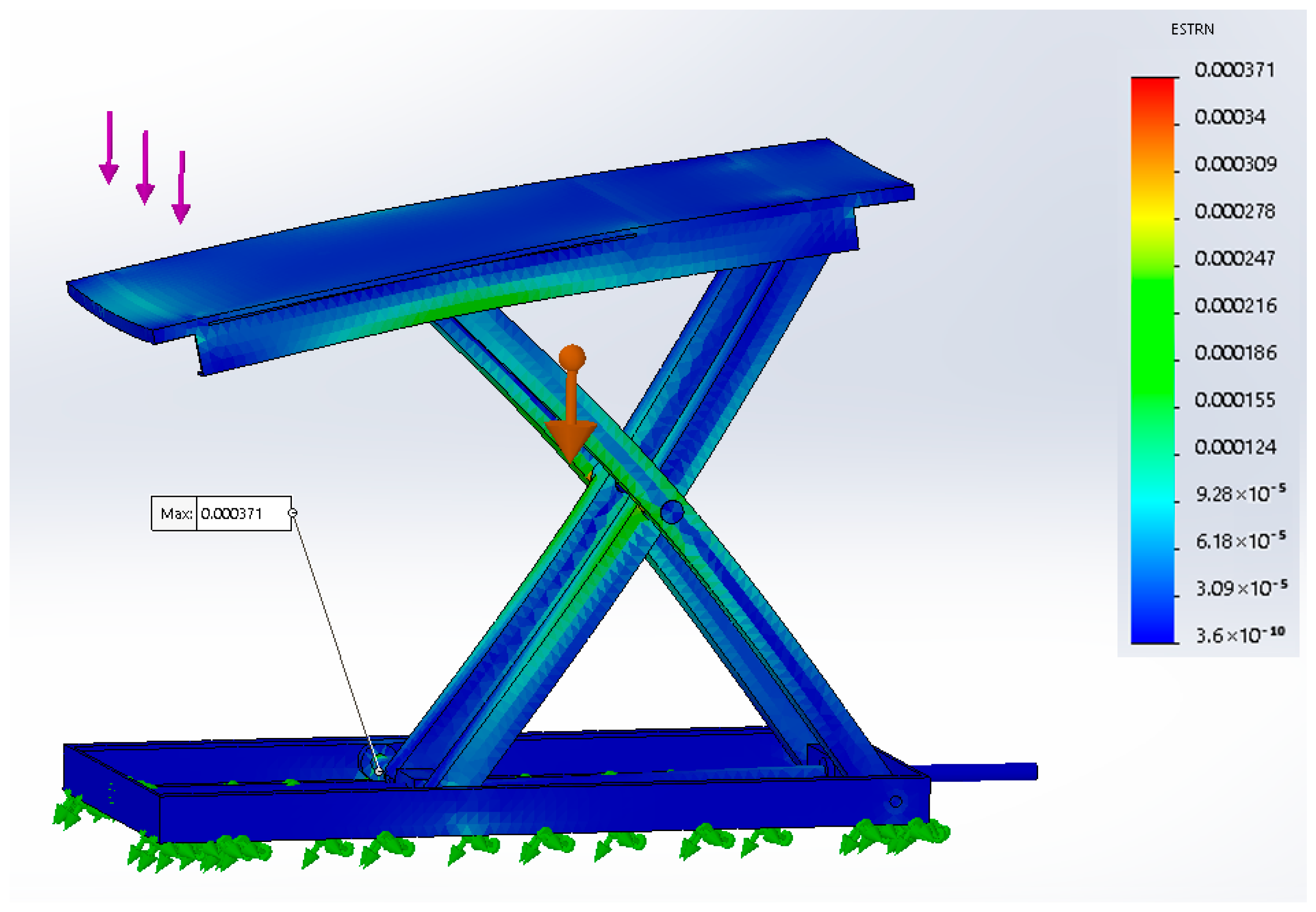
3.3.3. Static Analysis
4. Discussion
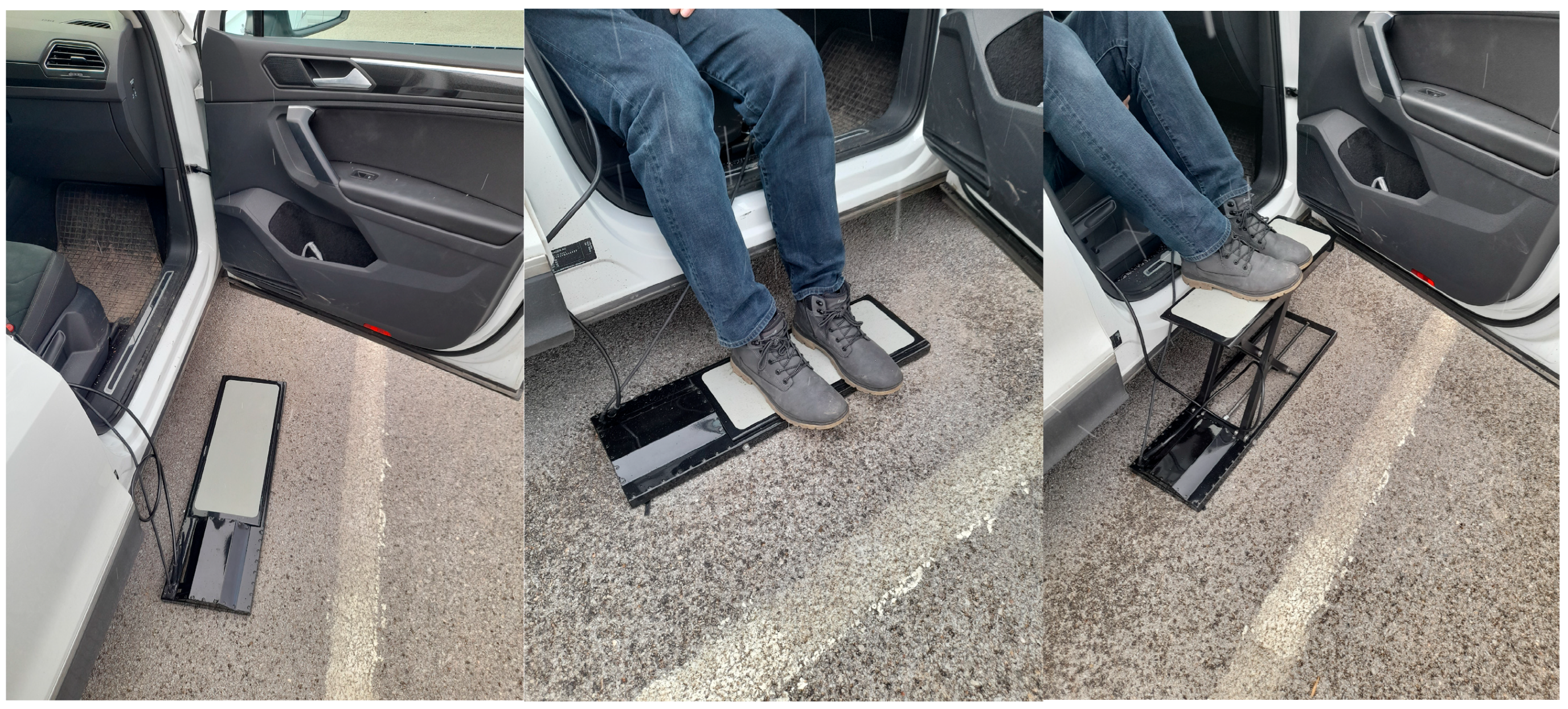
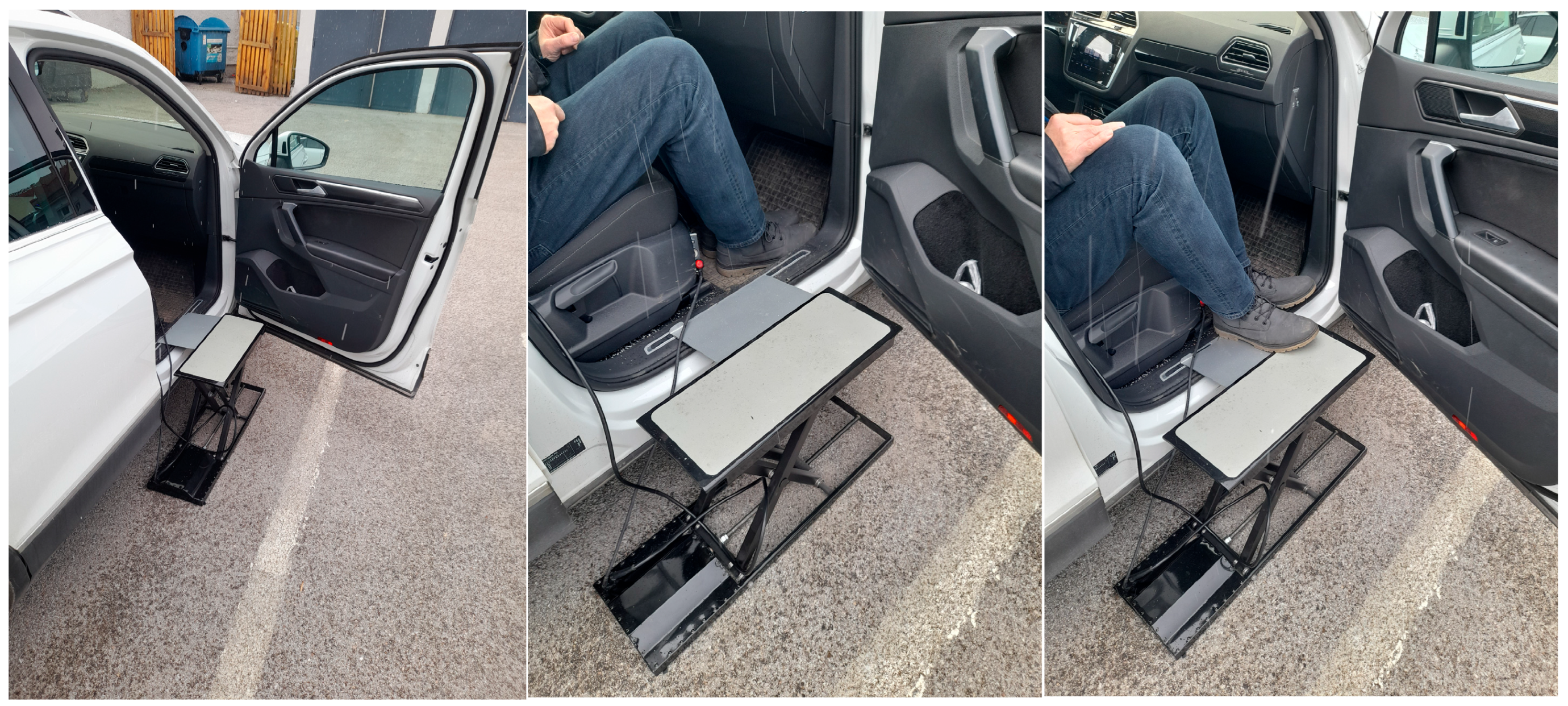
- Usage of device
- Open the vehicle door and place the device parallel to the wheel well of the vehicle.
- Stand on the device with your back to the vehicle and then sit down on the seat. It is advisable to use a swivel seat cushion placed on the seat.
- Lift the legs of the person with partial mobility impairment to the required height.
- Transfer the legs into the vehicle using the sliding element.
- Fold and store the device.
5. Conclusions
Author Contributions
Funding
Institutional Review Board Statement
Informed Consent Statement
Data Availability Statement
Conflicts of Interest
References
- Eurostat. Population Structure and Ageing. Available online: https://ec.europa.eu/eurostat/statistics-explained/index.php?title=Population_structure_and_ageing (accessed on 20 March 2026).
- Wang, P.; Wang, Y.; Su, P.; Wang, M.; Yang, Y.; Luo, M.; Cui, J.; He, J.; Han, L. Research and Design of Mobility Aids. J. Phys. Conf. Ser. 2021, 1748, 062054. [Google Scholar] [CrossRef]
- Divya, R.; Murali, K.T.M.; Manuj, R.; Nithya, R. Design and Development of Mobility Aid for Physically Challenged. Int. J. Appl. Eng. Res. 2018, 13, 12522–12526. [Google Scholar]
- Haugen, L.F. Designing for Mobility. Examining How Design Can Help Improve the Mobility and Quality of Life Among the Elderly. Available online: https://www.ntnu.edu/documents/139799/1270604448/TPD4505.Lisa.Frodadottir.Haugen.pdf (accessed on 23 July 2025).
- Zhang, B.; Wang, Z.; Li, Z. Mobility Aid Design for the Elderly (MADE): A design thinking approach using a smart walker as a case study. Humanit. Soc. Sci. Commun. 2024, 11, 1469. [Google Scholar] [CrossRef]
- Cao, J.; Jain, K.; Zhang, J.; Peng, Y.; Patel, S.; Mankoff, J. “A Tool for Freedom”: Co-Designing Mobility Aid Improvements Using Personal Fabrication and Physical Interface Modules with Primarily Young Adults. In Proceedings of the 2025 CHI Conference on Human Factors in Computing Systems (CHI ’25), Yokohama, Japan, 26 April–1 May 2025; pp. 1–16. [Google Scholar] [CrossRef]
- Scheffers, M.F.; Ona Ayala, K.E.; Ottesen, T.D.; Tuakli-Wosornu, Y.A. Design and development of mobility equipment for persons with disabilities in low-resource and tropical settings: Bamboo wheelchairs. Disabil. Rehabil. Assist. Technol. 2019, 16, 377–383. [Google Scholar] [CrossRef] [PubMed]
- Zhang, Y.; Tao, C.; Wang, H.; Fan, Y. Biomechanical effects of human-mobility aid interaction: A narrative review. Gait Posture 2025, 118, 1–12. [Google Scholar] [CrossRef] [PubMed]
- Dávila-Soberón, S.; Morales-Díaz, A.; Castelán, M. A novel image dataset for detecting and classifying mobility aid users. Expert Syst. Appl. 2025, 293, 128697. [Google Scholar] [CrossRef]
- Steyn, N.; Hamam, Y.; Monacelli, E.; Djouani, K. Modelling and design of an augmented reality differential drive mobility aid in an enabled environment. Simul. Model. Pract. Theory 2015, 51, 115–134. [Google Scholar] [CrossRef]
- Bhuiya, M.M.R.; Hasan, M.M.U.; Shao, W. Into the Nexus of disability, mobility aid and travel Behavior—A Tale from a South Asian City. Transp. Res. Interdiscip. Perspect. 2024, 28, 101274. [Google Scholar] [CrossRef]
- O’Brien, M.M.; Best, K.L.; Barnabe, C.; Routhier, F.; Miller, W.C.; Harpreet, R.; Manocha, K. Feasibility of an Interactive Video-Based Training Program for Learning and Reviewing Walking Aid Skills. Arch. Phys. Med. Rehabil. 2025, 106, 1703–1711. [Google Scholar] [CrossRef] [PubMed]
- Deb, A.; Wypych, Z.; Lonner, J.; Ashrafiuon, H. Design and Control of an Autonomous Robot for Mobility-Impaired Patients. J. Med. Robot. Res. 2021, 6, 2150007. [Google Scholar] [CrossRef]
- Zhou, Z.; Wang, L.; Dong, Y. Research on innovative design of community mutual aid elderly care service platform based on Kano model. Heliyon 2023, 9, e15546. [Google Scholar] [CrossRef] [PubMed]
- Paetzold, K.; Wartzack, S.; Krause, D. Platform of Design Method for Developing Mobility-preserving Products. Procedia CIRP 2014, 21, 409–414. [Google Scholar] [CrossRef][Green Version]
- Mishra, R.K.; Hamad, A.; Ibrahim, R.; Mathew, M.; Talal, T.; Al-Ali, F.; Park, C.; Davuluri, V.; Fernando, M.E.; Najafi, B. Objective assessment of mobility among adults with diabetes and end-stage renal disease using walking aid: A cross-sectional cohort study. Clin. Biomech. 2023, 107, 106014. [Google Scholar] [CrossRef] [PubMed]
- Athanasopoulou, L.; Papacharalampopoulos, A.; Stavropoulos, P.; Mourtzis, D. Design and manufacturing of a smart mobility platform’s context awareness and path planning module: A PSS approach. Procedia Manuf. 2020, 51, 61–66. [Google Scholar] [CrossRef]
- Purwar, A.; Bhargava, K.; Behan, E. A multi-functional mobility assist device for sit-to-stand motion. Int. J. Ind. Ergon. 2023, 93, 103396. [Google Scholar] [CrossRef]
- Research Institute for Disabled Consumers (RiDC). Accessories for Getting into and Out of a Car. Available online: https://www.ridc.org.uk/features-reviews/out-and-about/car-adaptations/getting-and-out-car/accessories-getting-and-out-car/ (accessed on 23 July 2025).
- Independent Living Centre. Independent Living Centre. Available online: https://www.independentlivingcentre.org.uk/equipment-advice/car-transfers-advice/ (accessed on 23 July 2025).
- BraunAbility Europe AB. Turny Evo. Available online: https://www.braunability.eu/en/products/getting-seated/turny-evo/ (accessed on 20 March 2026).
- Crowley, R.J.; Crowley, E.A. Leg lifter. U.S. Patent Application Publication. Available online: https://patentimages.storage.googleapis.com/d3/37/70/ce74916e36b30c/US20150351992A1.pdf (accessed on 20 March 2026).
- NED Ansa Leg Lifter. Available online: https://askned.com.au/lifting-and-transferring-people/leg-lifters/leg-lifter/ (accessed on 20 March 2026).
- Hospital Direct. Leg Lifter—Car. Available online: https://www.hospitaldirect.co.uk/product/car-leg-lifter-deluxe-wipeclean/# (accessed on 23 July 2025).
- Tutorial Example. Available online: http://biomech.ftvs.cuni.cz/pbpk/kompendium/biomechanika/geometrie_hmotnost.php (accessed on 23 February 2017).
- Janura, M. Biomechanics II (Biomechanika II); University of Ostrava: Ostrava, Czech Republic, 2011; ISBN 978-80-7464-044-5. [Google Scholar]
- Electromechanical Linear Actuators and Screw Supports. Available online: http://eir.lunarservers.com/~trade46/Promebat/Elektro-mechanische_vijzel_actuator.pdf (accessed on 21 February 2017).
- Raeymaekers, B. Design of Mechanical Elements—A Concise Introduction to Mechanical Design Considerations and Calculations—8.2.5 Collar Friction; John Wiley & Sons: Hoboken, NJ, USA, 2022; p. 136. Available online: https://app.knovel.com/hotlink/pdf/id:kt013EPLUV/design-mechanical-elements/collar-friction (accessed on 28 July 2025).
- Marrs, J. Machine Designers Reference—11.6.1 Screw Characteristics; Industrial Press: New York, NY, USA, 2012; p. 664. Available online: https://app.knovel.com/hotlink/pdf/id:kt0097WKX2/machine-designers-reference/screw-characteristics (accessed on 28 July 2025).
- Roton Products, Inc. Formula Calculators. Available online: https://www.roton.com/screw-university/formula-calculators/ (accessed on 28 July 2025).
- RoyMech. Available online: https://www.roymech.co.uk/Useful_Tables/Cams_Springs/Power_Screws_1.html (accessed on 28 July 2025).
- The Engineering ToolBox. Screw Jack—Effort Force vs. Load. Available online: https://www.engineeringtoolbox.com/screw-jack-d_1308.html (accessed on 28 July 2025).
- Baker, D.W.; Haynes, W. Engineering Statics Open and Interactive—9.4 Screw Threads. Available online: https://engineeringstatics.org/Chapter_09-screw-friction.html (accessed on 28 July 2025).
- WM Berg Inc. How to Calculate Lead Screw Maximum Load, Speed & More. Available online: https://www.wmberg.com/resources/tech-and-application-support/lead-screw-load (accessed on 28 July 2025).
- MITCalc. Power Screw. Available online: https://www.mitcalc.com/doc/powerscrew/help/en/PowerScrew.htm (accessed on 28 July 2025).





| Vehicle Brand | Distance to Lower Edge of Car Door Sill (cm) | Distance to Upper Plastic Edge of Car Door Sill (cm) |
|---|---|---|
| Fiat 500 | 30.5 | 36.5 |
| Fiat Panda | 31.5 | 37.5 |
| Fiat Tipo | 31 | 40.5 |
| Fiat Doblo | 31 | 40.5 |
| Fiat Fiorino | 32 | 37 |
| Fiat Linea | 28.5 | 35 |
| Fiat 500X | 30 | 46 |
| Fiat 500L | 31.5 | 38.5 |
| Alfa 159 | 28 | 34 |
| Honda Civic | 27 | 32.5 |
| Opel Corsa | 28.5 | 31.5 |
| Opel Zafira | 30 | 42 |
| Škoda Octavia II. | 32 | 40.5 |
| Škoda Fabia | 29.8 | 38 |
| Škoda Yeti | 29 | 38.5 |
| Kia Sportage | 37.5 | 47.5 |
| Peugeot 207 | 27.5 | 36 |
| Average | 30.31 | 38.35 |
| Minimum Distance | 27 | 31.5 |
| Maximum Distance | 37.5 | 47.5 |
| German Population | |||
|---|---|---|---|
| Percentile | 1.9 | 50 | 100 |
| Body Height (mm) | |||
| Male | 1612.9 | 1750 | 2014 |
| Female | 1508.4 | 1625 | 1849.8 |
| Leg Length (mm) | |||
| Male | 727.1 | 813.2 | 979.2 |
| Female | 698.4 | 766.2 | 896.8 |
| Body Weight (kg) | |||
| Male | 66.1 | 79 | 122.9 |
| Female | 53.6 | 66 | 95.4 |
| French Population | |||
|---|---|---|---|
| Percentile | 1.9 | 50 | 100 |
| Body Height (mm) | |||
| Male | 1612.2 | 1744.8 | 2000.4 |
| Female | 1493.9 | 1621.2 | 1866.4 |
| Leg Length (mm) | |||
| Male | 756.6 | 846.9 | 903.5 |
| Female | 687.5 | 769.4 | 819.9 |
| Body Weight (kg) | |||
| Male | 34.1 | 70.6 | 109.6 |
| Female | 28.6 | 58.4 | 77.7 |
| Average Height (mm) | Average Weight (kg) | Maximum Average Height (mm) | Maximum Average Weight (kg) | |
|---|---|---|---|---|
| Male | 1747.4 | 74.82 | 2007.2 | 116.25 |
| Female | 1623.1 | 62.2 | 1857.9 | 86.55 |
| Segment | % | B0 [kg] | B1 | B0 [kg/cm] | Zatsiorski Method |
|---|---|---|---|---|---|
| Head | 7.4% | 1.296 | 0.0171 | 0.0143 | 5.074204 |
| Thigh | 12.40% | −2.649 | 0.1463 | 0.0137 | 10.691104 |
| Knee | 4.60% | −1.592 | 0.03616 | 0.0121 | 3.2278452 |
| Foot | 1.6% | −0.829 | 0.0077 | 0.0073 | 1.022716 |
| Upper Arm | 2.90% | 0.25 | 0.03012 | −0.0027 | 2.0317804 |
| Forearm | 1.7% | 0.3185 | 0.01445 | −0.00114 | 1.2004454 |
| Hand | 0.70% | −0.1165 | 0.0036 | 0.00175 | 0.458647 |
| Torso | 44.80% | 32.6112964 | |||
| Upper Part of Torso | 8.2144 | 0.1862 | −0.0584 | 11.941068 | |
| Middle Part of Torso | 7.181 | 0.2234 | −0.0663 | 12.310526 | |
| Lower Part of Torso | −7.498 | 0.0976 | 0.04896 | 8.3597024 | |
| Upper Limb, Total | 3.6908728 | ||||
| Lower Limb, Total | 14.9416652 | ||||
| Total | 74.9505764 |
| Segment | % | B0 [kg] | B1 | B0 [kg/cm] | Zatsiorski Method |
|---|---|---|---|---|---|
| Head | 7.4% | 1.296 | 0.0171 | 0.0143 | 6.153885 |
| Thigh | 12.40% | −2.649 | 0.1463 | 0.0137 | 17.107965 |
| Knee | 4.60% | −1.592 | 0.03616 | 0.0121 | 5.04007 |
| Foot | 1.6% | −0.829 | 0.0077 | 0.0073 | 1.531235 |
| Upper Arm | 2.90% | 0.25 | 0.03012 | −0.0027 | 3.20956 |
| Forearm | 1.7% | 0.3185 | 0.01445 | −0.00114 | 1.7695145 |
| Hand | 0.70% | −0.1165 | 0.0036 | 0.00175 | 0.653225 |
| Torso | 44.80% | 51.658382 | |||
| Upper Part of Torso | 8.2144 | 0.1862 | −0.0584 | 18.13927 | |
| Middle Part of Torso | 7.181 | 0.2234 | −0.0663 | 19.84484 | |
| Lower Part of Torso | −7.498 | 0.0976 | 0.04896 | 13.674272 | |
| Upper Limb, Total | 5.632995 | ||||
| Lower Limb, Total | 23.67927 | ||||
| Total | 116.435406 |
| Weight (kg) | 1. Measurement (N) | 2. Measurement (N) | Average (N) | Torque (Nm) |
|---|---|---|---|---|
| 0 | 1.04 | 1.2 | 1.12 | 0.28 |
| 10 | 5.2 | 4.2 | 4.7 | 1.175 |
| 20 | 7.5 | 7.5 | 7.5 | 1.875 |
| 30 | 10 | 11.1 | 10.55 | 2.6375 |
| 40 | 13.5 | 11.44 | 12.47 | 3.1175 |
| 50 | 14.6 | 13.6 | 14.1 | 3.525 |
| 60 | 22.3 | 18 | 20.15 | 5.0375 |
| 70 | 22 | 20 | 21 | 5.25 |
| 80 | 22 | 23.7 | 22.85 | 5.7125 |
| CGI 017VPX (CN) | |||
|---|---|---|---|
| Ratio | Mnom (Nominal) (Nm) | Mstart (Starting) (Nm) | Mmax (Maximal) (Nm) |
| 4:1 | 12 | 16 | 25 |
| 5:1 | 12 | 15 | 24 |
| 7:1 | 10 | 13 | 21 |
| 10:1 | 9 | 12 | 17 |
| 15:1 | 12 | 16 | 25 |
| 20:1 | 14 | 17 | 28 |
| 25:1 | 13 | 16 | 26 |
| 28:1 | 14 | 17 | 28 |
| 40:1 | 14 | 18 | 29 |
| 50:1 | 13 | 17 | 27 |
| 70:1 | 11 | 14 | 23 |
| 100:1 | 9 | 12 | 17 |
| Gearbox Weight | Single-Stage 0.36 kg/Two-Stage 0.5 kg |
|---|---|
| Input Speed | Maximal 5000 rpm |
| Gearbox Backlash | 0.2° (Single-stage), 0.26° (Two-stage) |
| Degree of Protection—IP | IP54 |
| Service Life | >10,000 h |
| Efficiency | Single-stage > 90%/Two-stage > 85% |
| Operating Temperature | −40 °C to 120 °C |
| Model | 42ZYT04B (CN) | |
|---|---|---|
| Unit | Value | |
| Rated Voltage | V | 12 |
| Continuous Rated Speed | rpm | 4700 |
| Continuous Rated Torque | mN.m | 100 |
| Direct Current | A | 5.85 |
| Starting Torque | mN.m | 479 |
| Starting Current | A | 26.71 |
| No-load Speed | pm | 5900 |
| No-load Current | A | 0.4 |
| Demagnetization Current | A | 52 |
| Rotor Inertia | g/cm2 | 154 |
| Motor Weight | g | 550 |
| Motor Length | mm | 90 |
Disclaimer/Publisher’s Note: The statements, opinions and data contained in all publications are solely those of the individual author(s) and contributor(s) and not of MDPI and/or the editor(s). MDPI and/or the editor(s) disclaim responsibility for any injury to people or property resulting from any ideas, methods, instructions or products referred to in the content. |
© 2026 by the authors. Licensee MDPI, Basel, Switzerland. This article is an open access article distributed under the terms and conditions of the Creative Commons Attribution (CC BY) license.
Share and Cite
Mareš, A.; Malega, P.; Daneshjo, N.; Štofková, Z.; Mišenčík, T. Design and Structural Validation of a Device for Assisted Vehicle Boarding. Appl. Sci. 2026, 16, 3898. https://doi.org/10.3390/app16083898
Mareš A, Malega P, Daneshjo N, Štofková Z, Mišenčík T. Design and Structural Validation of a Device for Assisted Vehicle Boarding. Applied Sciences. 2026; 16(8):3898. https://doi.org/10.3390/app16083898
Chicago/Turabian StyleMareš, Albert, Peter Malega, Naqib Daneshjo, Zuzana Štofková, and Tomáš Mišenčík. 2026. "Design and Structural Validation of a Device for Assisted Vehicle Boarding" Applied Sciences 16, no. 8: 3898. https://doi.org/10.3390/app16083898
APA StyleMareš, A., Malega, P., Daneshjo, N., Štofková, Z., & Mišenčík, T. (2026). Design and Structural Validation of a Device for Assisted Vehicle Boarding. Applied Sciences, 16(8), 3898. https://doi.org/10.3390/app16083898