1. Introduction
Global agriculture must produce more food under increasingly challenging conditions such as crop diseases, pest outbreaks, and climate-induced stresses. Plant diseases alone can cause significant yield losses and pose a serious threat to global food security [
1]. For instance, fungal and bacterial pathogens contribute to major crop failures, undermining food safety and farm incomes [
1]. At the same time, abiotic stresses like drought and salinity intensified by climate change further reduce agricultural productivity [
2]. Conventional agricultural practices, especially the excessive use of chemical fertilizers and pesticides, have boosted yields in the past, but often at the cost of soil degradation, environmental pollution, and human health risks [
3,
4,
5,
6,
7]. There is an urgent need for innovative, sustainable technologies to enhance crop production while minimizing ecological harm [
3,
8].
Nanotechnology has emerged as a promising avenue to revolutionize agriculture by improving the efficiency of inputs and providing novel solutions to crop management [
3,
4,
9,
10]. By engineering materials at the nanoscale (1–100 nm), scientists can create nanoformulations of agrochemicals with greater efficacy and targeted delivery [
2]. In recent years, nano-enabled agrochemicals—including nanofertilizers and nanopesticides—have demonstrated potential to increase crop yields, protect plants from pests and diseases, and reduce the environmental footprint of agriculture [
3,
6]. Nanoparticles (NPs) offer a high surface area and unique physicochemical properties that can improve the bioavailability of nutrients and pesticides, enhancing their uptake and action in plants [
3,
11]. For example, nanoformulations of fertilizers can release nutrients more slowly and precisely, improving nutrient-use efficiency and crop yield while reducing nutrient losses and runoff [
4]. Similarly, nano-sized pesticide formulations can enable controlled release and targeted delivery of active ingredients, maintaining crop protection with lower doses and fewer spray applications [
6,
12].
The advantages of nanofertilizers and nanopesticides over their conventional counterparts are substantial. Conventional chemical fertilizers suffer from low nutrient-use efficiency—typically only 30–50% of applied nitrogen and less than 20% of phosphorus is absorbed by crops, with the remainder lost through leaching, volatilization, or runoff, contributing to eutrophication and greenhouse gas emissions [
3,
4]. Nanofertilizers address this by enabling controlled, slow release of nutrients directly at the root zone, improving uptake efficiency by up to 80–90% in some formulations and reducing the total amount of fertilizer required [
5,
13,
14]. Similarly, conventional pesticides are characterized by broad-spectrum toxicity, environmental persistence, and the progressive development of resistance in target organisms [
6,
7]. Nanopesticides, by contrast, can encapsulate or deliver active ingredients in a targeted manner, reducing off-target exposure, extending residual activity, and potentially circumventing resistance mechanisms through multi-site modes of action [
12]. Taken together, these properties position nano-enabled agrochemicals as a more precise and environmentally responsible alternative to bulk chemical inputs.
The efficiency gains associated with these nano-enabled inputs are directly linked to their nanoscale dimensions (1–100 nm). At this scale, materials exhibit a dramatically increased surface-area-to-volume ratio compared to their bulk counterparts, which enhances reactivity, solubility, and interaction with biological surfaces such as plant cell walls and membranes [
2,
11]. Nanoparticles can penetrate plant tissues through stomata, cuticle pores, and root cell junctions—pathways largely inaccessible to bulk-sized particles—enabling more direct delivery of active ingredients to target sites within the plant [
11]. Furthermore, the nanoscale confers unique optical, magnetic, and electronic properties that do not exist at larger scales, some of which underlie the antimicrobial and stress-alleviating mechanisms described in this review. It follows that if green-synthesized particles are not within the nanoscale range, they are unlikely to exhibit the same efficacy as fertilizers or pesticides, as the biological interactions that drive their agronomic benefits are fundamentally size-dependent [
2,
3].
Early work on nano-enabled agriculture established the field’s foundations by mapping how nanomaterials could enhance crop production and plant protection, while also highlighting key constraints for deployment at the farm scale, such as formulation stability, delivery routes, and environmental fate [
13]. These early contributions helped consolidate nano-agriculture as a distinct research domain and set the stage for subsequent specialization into nanofertilizers and nanopesticides, later consolidated by targeted nanofertilizer research [
13,
14]. In parallel, the emergence of plant-mediated “green” synthesis represented a pivotal shift toward safer and more sustainable production routes, by leveraging plant metabolites as both reducing and capping agents, enabling nanoparticle fabrication under mild conditions and without harsh reagents [
15]. Together, these foundational streams underpin current efforts to design nano-enabled inputs that improve nutrient-use efficiency and crop protection while reducing chemical loads and environmental impacts.
Among nanotechnology approaches, green nanotechnology has gained particular attention for sustainable agriculture [
4,
8]. By harnessing the reducing and stabilizing power of phytochemicals present in plant extracts, metallic ions can be converted into nanoparticles under mild, reagent-free conditions, an approach often termed “phytonanotechnology” or “green synthesis” [
16,
17]. The resulting green-synthesized nanoparticles can enhance crop growth as nanofertilizers, protect plants from pests and diseases as nanopesticides, and mitigate abiotic stresses, potentially replacing a portion of conventional agrochemicals [
3,
12,
18]. The mechanistic and methodological basis of this approach is discussed in detail in
Section 3 and
Section 4.
Recent studies indicate that applying green-synthesized nanoparticles in crop production can significantly improve outcomes. For example, nanofertilizers produced via green routes have achieved substantial yield improvements in staples like wheat and rice while reducing the requirement of bulk chemical fertilizers [
5]. One review reported that nanofertilizers increased wheat grain yields by up to 20–55% and rice yields by 13–40%, compared to traditional fertilization [
5,
19]. Likewise, green nanoformulations of pesticides have shown equal or greater efficacy against insects and pathogens at lower active ingredient doses, thereby lowering chemical residues in the environment [
12,
20]. These advances suggest that integrating green nanotechnology into agriculture could help achieve the dual goals of increasing crop productivity and sustainability. However, it is also critical to evaluate and address potential challenges and risks associated with nanotechnology on the farm. Issues such as the consistency of biological synthesis, nanoparticle behavior in soils, effects on non-target organisms, and regulatory approval need careful consideration [
6,
7].
In this review, we explore the current state of green nanotechnology in sustainable agriculture, with a focus on plant-based synthesis of metallic nanoparticles for crop protection and productivity. We first introduce the framework of green nanotechnology and its relevance to agriculture. Next, we discuss various biogenic sources (especially plants) used for nanoparticle synthesis and the mechanisms by which plant metabolites reduce and stabilize nanoparticles. We then overview the common characterization methods to confirm nanoparticle properties. The core of the review examines the agricultural applications of green-synthesized metallic nanoparticles: as nanofertilizers to enhance plant growth and yield, as nanopesticides to control diseases and pests, and in mitigating abiotic stresses to improve crop resilience. For each application, we highlight representative studies and the modes of action of the nanomaterials. Finally, we address the challenges and future perspectives of implementing green nanotechnology in agriculture, including production scalability, variation in efficacy, safety and regulatory hurdles, and research gaps. By compiling recent advances (primarily from 2020 to 2025) and expert insights, this review aims to provide a comprehensive understanding of how plant-based metallic nanoparticles can contribute to sustainable crop management and what steps are needed to fully realize their potential in global agriculture.
Several reviews have recently addressed aspects of green nanotechnology in agriculture, providing valuable context for the present work. Zeng et al. [
9] and Atanda et al. [
10] offer broad overviews of nanotechnology applications in agricultural sustainability but do not focus specifically on plant-mediated synthesis routes or the mechanistic role of phytochemicals in nanoparticle formation and stabilization. Shandila et al. [
21] address metal-based nanopesticides with particular emphasis on opportunities and challenges, yet their scope does not extend to nanofertilizers or abiotic stress mitigation. Ali et al. [
12] cover bacterial-based green synthesis for plant pathogen control, while Hano and Abbasi [
18] provide a synthesis-focused perspective on plant-based nanoparticle production without systematically examining agricultural outcomes across multiple application categories. The present review advances beyond these contributions in three specific respects: (i) it integrates, within a single framework, the synthesis mechanisms, characterization methods, and the full spectrum of agricultural applications—nanofertilizers, nanopesticides, and stress tolerance agents—for plant-derived metallic nanoparticles; (ii) it provides a structured critical analysis of each application domain, distinguishing laboratory and greenhouse evidence from field-validated data and identifying contradictory findings in the literature; and (iii) it incorporates an explicit safety and risk assessment section covering environmental, ecosystem, and human health dimensions—a dimension frequently absent or underdeveloped in existing reviews. By doing so, this review aims to serve both as a synthesis of current knowledge and as a critical guide to research priorities for the responsible deployment of green-synthesized metallic nanoparticles in sustainable crop management.
To enhance transparency regarding the scope and methodology of this review, the literature search was conducted primarily in Web of Science, Scopus, and PubMed, supplemented by manual screening of reference lists and recent publications. The main time window covered was 2020–2025, reflecting the rapid growth of the field in this period, with selective inclusion of earlier foundational and highly cited works (2010–2019) that established the conceptual, mechanistic, and methodological basis of green nanotechnology in agriculture. Search terms included combinations of “green synthesis”, “plant-mediated nanoparticles”, “biogenic nanoparticles”, “metallic nanoparticles agriculture”, “nanofertilizers”, “nanopesticides”, “nano-enabled agrochemicals”, “abiotic stress nanoparticles”, and “crop protection nanotechnology”. Inclusion criteria required that studies (i) focused on biologically mediated—particularly plant-extract-mediated—synthesis of metallic or metal oxide nanoparticles, and (ii) reported at least one agricultural outcome, such as crop growth, yield, disease suppression, pest control, or stress tolerance. Studies were excluded if they described exclusively chemical or physical synthesis routes without biological mediation, or if they reported no agronomic application or evaluation. This approach does not constitute a formal systematic review or meta-analysis; rather, it represents a narrative review with transparent and reproducible search criteria, designed to synthesize recent progress and identify key trends and knowledge gaps in the field. An initial database search retrieved approximately 1200 potentially relevant records. After removal of duplicates and screening of titles and abstracts against the inclusion and exclusion criteria described above, approximately 300 full-text articles were assessed for eligibility, of which around 180 met the criteria and formed the primary evidence base for this review, supplemented by foundational references and regulatory documents included for contextual framing.
2. Green Nanotechnology Framework
The concept of green nanotechnology emerged from early efforts to reconcile the rapid development of nanomaterials with the principles of green chemistry and environmental sustainability. Initial studies emphasized the use of biological systems, particularly plant extracts, as reducing and stabilizing agents to replace conventional chemical synthesis routes and minimize ecological and health risks [
15]. These foundational contributions established plant-mediated nanoparticle synthesis as a core pillar of green nanotechnology, laying the conceptual basis for its later adoption in agricultural and food-related applications [
15,
17,
18].
Green nanotechnology is defined by the use of environmentally benign methods and materials in the development of nanoproducts [
15,
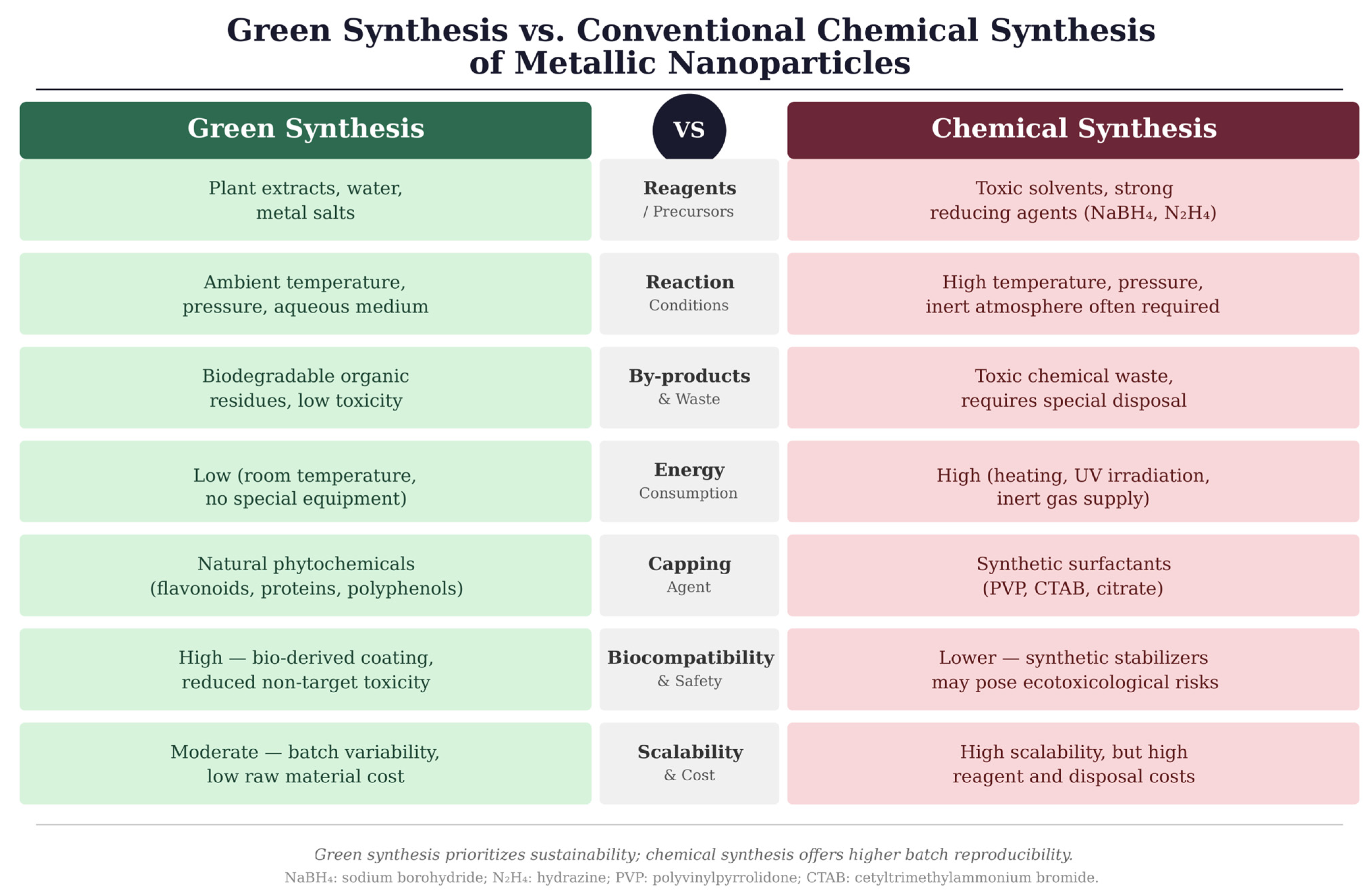
21]. In the context of agriculture, a green nanotechnology framework emphasizes biosynthesis of nanoparticles using natural sources, in contrast to conventional chemical synthesis that often requires toxic solvents or extreme manufacturing conditions [
16,
17]. The key idea is to leverage biological systems—such as plants, algae, bacteria, and fungi—to produce metallic nanoparticles in a sustainable way. These biological entities contain a variety of bioactive molecules (e.g., phenolics, flavonoids, terpenoids, proteins, enzymes) that can act as natural reducing and capping agents during nanoparticle formation [
16,
17]. By simply incubating a metal salt solution (such as silver nitrate or gold chloride) with a plant extract or microbial culture filtrate, one can trigger the reduction of metal ions to zero-valent metal nanoparticles, with simultaneous stabilization of those nanoparticles by the surrounding biomolecules [
17,
18]. This one-step green synthesis process occurs under mild conditions (ambient temperature and pressure, aqueous medium) and avoids the need for additional chemicals, making it an eco-friendly and cost-effective approach [
16,
18].
A typical green synthesis protocol for metal nanoparticles using plant extracts involves mixing an aqueous plant extract (derived from leaves, fruits, roots, etc.) with a metal salt solution. Phytochemicals in the extract—such as ascorbic acid, polyphenols, sugars, alkaloids, and proteins—play a dual role: they reduce metal ions to form nanoparticle nuclei and stabilize the growing nanoparticles by capping their surface [
16,
17]. This results in colloidal metallic nanoparticles wrapped with a coating of plant metabolites. The exact composition of the capping layer depends on the plant species and extract preparation, but commonly includes compounds like flavonoids, tannins, and other antioxidants that strongly bind to metal atoms [
17]. Because these biomolecules are non-toxic and often biodegradable, the resulting nanoparticles are considered biocompatible and may be less hazardous to the environment and non-target organisms [
18]. In essence, green-synthesized nanoparticles carry a “natural” surface corona that can improve their interfacing with biological systems [
18].
Green nanotechnology aligns with sustainable agriculture in several ways. First, it replaces hazardous chemical reagents with biological extracts, reducing the generation of toxic waste and by-products [
16,
17]. Second, it taps into renewable resources (plants can be grown and harvested) and often uses agricultural or food waste as starting materials (e.g., peels, leaves), contributing to a circular bioeconomy [
4,
22,
23]. Third, the mild synthesis conditions (often just stirring at room temperature) require low energy input, shrinking the carbon footprint of nanoparticle production [
18]. Lastly, the benign nature of the capping biomolecules can make the nanoparticles more acceptable for agricultural use, as they are derived from edible or medicinal plants rather than unknown synthetic chemicals [
6,
18]. For example, a green-synthesized silver nanoparticle capped with green tea polyphenols or neem leaf compounds may raise fewer safety concerns than a chemically synthesized nanoparticle stabilized by an artificial surfactant. This advantage is increasingly recognized by researchers and regulators aiming for safer nanotech applications in food and agriculture [
6].
The alignment of plant-mediated nanoparticle synthesis with the twelve principles of green chemistry, particularly atom economy, use of renewable feedstocks, reduced auxiliary substances, inherently safer chemistry, and real-time pollution prevention, has been explicitly articulated in several recent analyses [
16,
17,
18]. From a sustainability metrics perspective, comparative life cycle assessment (LCA) studies, though still limited in number, consistently indicate that green synthesis routes generate substantially lower environmental burdens than chemical counterparts across key impact categories. For instance, published LCA comparisons of AgNP synthesis routes report that plant-extract-mediated processes consume 40–60% less energy per gram of nanoparticle produced than chemical reduction methods using NaBH
4 or hydrazine and generate significantly lower quantities of hazardous solvent waste [
4,
16]. Carbon footprint estimates similarly favour green synthesis, with some analyses reporting greenhouse gas emissions 30–50% lower than equivalent chemical routes when agricultural or food-processing waste is used as the plant extract feedstock [
18]. It should be acknowledged, however, that LCA data for green-synthesized nanoparticles remain sparse and methodologically heterogeneous, studies differ in system boundaries, functional units, and assumptions about extract sourcing, making cross-study comparisons difficult. Furthermore, end-of-life environmental fate, which is a critical LCA phase for nanomaterials applied to agricultural soils, is rarely included in published assessments due to insufficient data on NP transformation and persistence under field conditions. A standardised LCA framework specifically adapted to agricultural nanomaterials would represent a significant contribution to the field and is identified here as a priority research need [
6,
7].
It should be noted that “green” does not automatically equate to “safe” in all cases; a nanoparticle’s environmental or health impact depends on its core composition, size, dose, and fate, regardless of synthesis method [
7]. Nonetheless, the green nanotechnology framework provides a guiding principle to design nanomaterials that are more sustainable throughout their life cycle. In agriculture, this means prioritizing nanoparticle formulations that reduce reliance on petrochemicals, are produced through low-impact processes, and ideally degrade or become inert after performing their function [
4,
7]. An example is the development of a green nanopesticide wherein the active ingredient is a metal nanoparticle synthesized by a plant extract, delivered in the field, and eventually transformed into non-toxic forms in soil [
4,
7]. Such a holistic approach can help ensure that nanotechnology contributes positively to sustainable crop production without introducing new ecological risks.
4. Mechanisms of Reduction and Stabilization
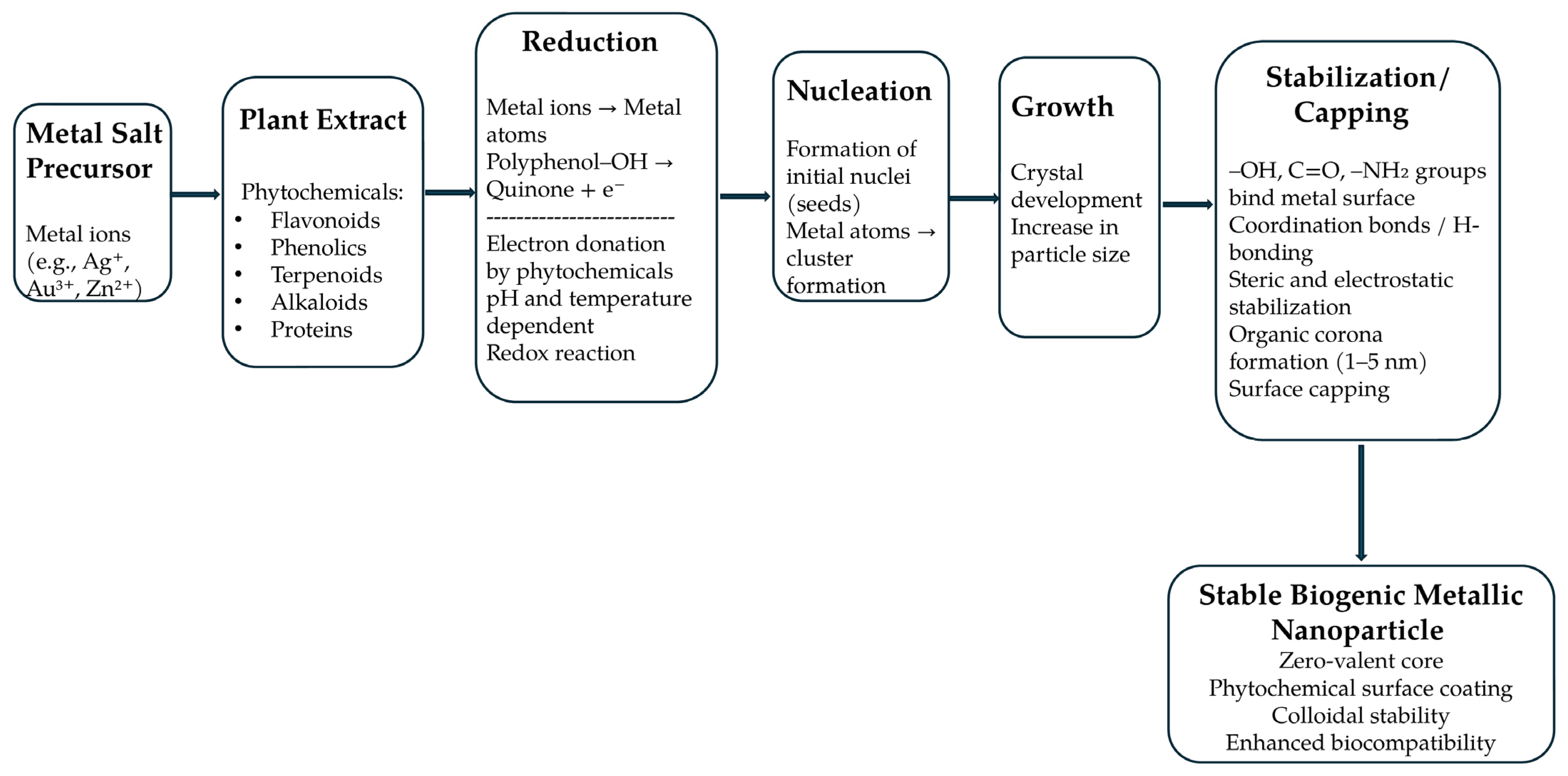
The green synthesis of metallic nanoparticles using plant extracts (or other biological mediums) involves complex chemical interactions, but it can be broadly understood as a two-step mechanism: (a) reduction of metal ions to form nanoparticle nuclei, and (b) stabilization (capping) of the nascent nanoparticles to prevent aggregation [
16,
17]. Plant extracts are rich in phytochemicals that serve both roles. Key players often include water-soluble compounds like phenolic acids (e.g., gallic acid, caffeic acid), flavonoids (e.g., quercetin, catechin), terpenoids, alkaloids, sugars, and proteins with functional groups (amines, carbonyls) [
17]. These molecules have redox potentials that enable them to donate electrons to metal ions, reducing the ions to neutral metal atoms. Simultaneously or immediately after reduction, the same molecules (or their oxidized products) bind to the surface of the newly formed metal nuclei, acting as capping agents.
The bioactive molecules involved in green synthesis can be systematically grouped into three main categories according to their chemical nature and functional role.
Plant proteins, including albumins, globulins, and enzyme fractions such as oxidoreductases, contribute to both reduction and capping. Their free amine (–NH
2), carboxylate (–COOH), and thiol (–SH) functional groups chelate metal ions and anchor onto nanoparticle surfaces, while their bulky tertiary structure provides steric stabilization that prevents particle aggregation [
16,
17]. Protein-capped nanoparticles tend to exhibit high colloidal stability and improved biocompatibility, properties that are advantageous for agricultural spraying applications.
Polysaccharides, such as starch, cellulose derivatives, and chitosan, present in plant cell walls and algal biomass, act primarily as capping and templating agents rather than reducing agents, physically constraining nanoparticle growth within their polymer matrix and yielding more uniform size distributions [
17,
18]. Their hydroxyl-rich surfaces also facilitate hydrogen bonding with metal surfaces, enhancing coating stability. Chitosan, in particular, carries a positive charge at physiological pH that can confer antimicrobial properties to the capped nanoparticle independently of the metal core. Low-molecular-weight bioactive molecules (encompassing flavonoids, phenolic acids, terpenoids, alkaloids, and reducing sugars) are the primary electron donors in most phytosynthesis reactions. Their hydroxyl groups undergo oxidation to carbonyl or quinone forms, releasing electrons that reduce metal cations to their zero-valent state [
16,
17]. Many of these compounds retain partial bioactivity after oxidation and remain associated with the nanoparticle surface, potentially contributing synergistic antimicrobial, antioxidant, or growth-promoting effects in agricultural applications [
18].
Reduction mechanism: When a metal salt (say, AgNO
3 for silver) is mixed with a plant extract, the metal cations (Ag
+) encounter phytochemicals that can be oxidized. For instance, polyphenols with adjacent hydroxyl groups can be oxidized to quinones, releasing electrons in the process [
17]. Those electrons are taken up by Ag
+, reducing it to Ag
0, which then nucleates into a cluster of silver atoms (an initial nanoparticle seed). Vitamin C (ascorbate) is another powerful reductant in many fruit extracts; it directly reduces metal ions while being oxidized to dehydroascorbic acid [
17]. Similarly, plant sugars can undergo oxidation to acids, contributing electrons for metal reduction. The rate of reduction and thus the rapidity of nanoparticle formation depends on factors like the concentration of these phytochemicals, solution pH, temperature, and metal salt concentration [
16]. Typically, higher temperature and higher pH accelerate the reduction (since many phenolics are more reactive in alkaline conditions), yielding faster nucleation of NPs [
16]. The color change observed (e.g., pale yellow to brown for silver) is due to the surface plasmon resonance of the formed nanoparticles, confirming metal ion reduction. In sum, plant extracts act as natural reducing agents, converting ionic metals to metallic nanoparticles through the oxidation of their own constituents [
16,
17]. The influence of synthesis parameters on nanoparticle size, yield, and polydispersity has been extensively documented across multiple plant–metal systems. Reaction temperature typically ranges from 25 to 90 °C, with higher temperatures (60–80 °C) generally accelerating nucleation and yielding smaller, more monodisperse particles; for example, AgNPs synthesized from Azadirachta indica extract decreased in average size from approximately 35 nm at 25 °C to 10 nm at 60 °C [
29,
30]. Solution pH is equally critical: alkaline conditions (pH 8–10) promote deprotonation of phenolic –OH groups, enhancing their reducing capacity and typically producing smaller particles with narrower size distributions, whereas acidic pH (below 5) often inhibits or slows reduction markedly [
30,
31]. Plant extract concentration follows a dose-dependent pattern: extract-to-metal-salt volume ratios typically range from 1:10 to 1:1, with higher extract concentrations providing more reducing equivalents and capping molecules, favouring rapid nucleation and smaller final particle sizes (5–30 nm), while lower concentrations tend to produce larger particles (50–100 nm) with broader distributions [
16,
30]. Reaction time to completion varies considerably by system, from as little as 15 min for highly reactive extracts (e.g., Camellia sinensis, rich in EGCG) to 24 h or more for extracts with lower polyphenol content [
17,
31]. Metal salt concentration (typically 0.5–5 mM) also modulates nucleation kinetics: higher salt concentrations favour the formation of more numerous but smaller nuclei when excess capping agent is present, but can lead to aggregation if capping capacity is insufficient [
16]. Taken together, these parameters interact in a multivariate manner, and systematic optimisation—ideally using response surface methodology—is necessary to achieve reproducible nanoparticle batches with defined physicochemical characteristics [
30].
Stabilization mechanism: Left unchecked, freshly reduced metal atoms would continue to coalesce into larger particles or even bulk precipitates. However, the presence of phytochemicals adsorbed on their surface impedes this uncontrolled growth. As soon as a metal nanoparticle nucleus forms, phytochemicals (or their oxidation products) coat its surface via interactions such as coordination bonds, electrostatic attraction, or hydrogen bonding [
17]. For example, a polyphenol may chelate a surface metal atom through its oxygen donor atoms, effectively “capping” that site and preventing other nanoparticles from attaching. In many green syntheses, proteins from the plant extract also bind to nanoparticles; the negatively charged functional groups of amino acids (carboxylate, thiol) can anchor onto positive metal surfaces, while the bulky protein structure provides a steric barrier to aggregation [
16]. The result is a colloid of nanoparticles, each surrounded by a shell of organic molecules (~1–5 nm thick), which repel each other either sterically or electrostatically, maintaining dispersion stability [
17]. This phenomenon is evident in zeta potential measurements: biogenic nanoparticles often exhibit moderate to high negative zeta potential due to deprotonated capping molecules, which helps in electrostatic stabilization of the colloid [
21]. For instance, silver nanoparticles synthesized using tea extract were reported to have a zeta potential around –25 mV, indicating a reasonably stable negatively charged surface from the capping tea compounds [
21].
The specific chemical identity of capping agents in plant-mediated synthesis is an active area of research. Techniques like Fourier-transform infrared spectroscopy (FTIR) and UV-Vis spectroscopy are used to identify functional groups involved in binding [
17]. Often a broad signature of O–H, C=O, and N–H groups are seen on capped NPs, confirming the presence of polyphenols and proteins on their surface [
17]. In some cases, distinct plant metabolites have been isolated from NP surfaces, linking certain molecules to the stabilization process. For example, flavonoids from
Azadirachta indica and terpenoids from
Eucalyptus have been implicated in capping AgNPs and ZnO-NPs respectively [
29,
32]. The capping not only stabilizes the NPs but can also influence their shape. There are reports where particular biomolecules preferentially adsorb on specific crystal facets of a growing nanoparticle, thereby directing shape evolution (e.g., triangular nanoprisms vs. spherical particles) [
2]. While shape control in green synthesis is less precise than in chemical methods, some level of shape selection (spheres, rods, plates) has been achieved by adjusting biological extract composition or reaction parameters [
16].
Mechanistic illustration: Taking a concrete example, the biosynthesis of gold nanoparticles using
Magnolia leaf extract can be described mechanistically. The extract contains magnolol and honokiol (polyphenolic compounds). Magnolol gets oxidized to a quinone form, reducing Au
3+ (from HAuCl
4) to Au
0 [
17]. Clusters of Au atoms form and are immediately capped by both magnolol quinones and residual magnolol via π-electron interactions and Au–O coordination. These capped clusters grow into gold nanoparticles (~20 nm) but do not aggregate further because the bulky phenolic rings of magnolol provide steric hindrance. In this way, stable AuNPs are produced in the colloid. Similar narratives apply to other systems: tea polyphenols (like EGCG) reducing and capping AgNPs, or fungal enzymes (nitrate reductase) reducing Ag
+ to Ag
0 while proteins cap the nanoparticles.
In summary, plant-based nanoparticle synthesis is essentially a green chemistry redox reaction: plant metabolites (acting as electron donors) reduce metal ions (electron acceptors) to metallic form and in the process transform into oxidation products that adhere to nanoparticle surfaces, thereby stabilizing them [
16,
17]. This dual functionality of phytochemicals is the cornerstone of green nanotechnology. By understanding which classes of compounds in a given extract are responsible (e.g., polyphenols for reduction, proteins for capping), researchers can sometimes tweak conditions to control nanoparticle attributes like size distribution. For instance, a higher concentration of capping agents relative to metal ions tends to yield smaller NPs because abundant capping quickly halts growth at a smaller size [
16]. Conversely, diluted extracts may produce larger particles due to insufficient capping density. Moreover, factors like pH influence both reduction potential and capping efficacy—alkaline pH often increases the deprotonation of capping molecules, enhancing their binding to nanoparticles but also possibly accelerating reduction too much, leading to rapid nucleation and smaller particles [
2]. Careful optimization of these conditions can improve the quality (monodispersity, stability) of green-synthesized nanoparticles. Representative benchmark synthesis conditions for the most studied NP types are summarised in
Table 2.
5. Characterization Methods
Characterization of green-synthesized nanoparticles is crucial to verify their formation, determine their physicochemical properties, and ensure consistency for applications. Nanoparticles produced via plant-based methods are typically characterized by a combination of spectroscopic, microscopic, and diffraction techniques, many of which overlap with standard nanoparticle characterization in nanoscience [
16,
18,
30]. However, certain techniques are particularly useful for green-synthesized NPs because of the organic capping layer and the need to confirm its presence.
The common characterization methods include the following:
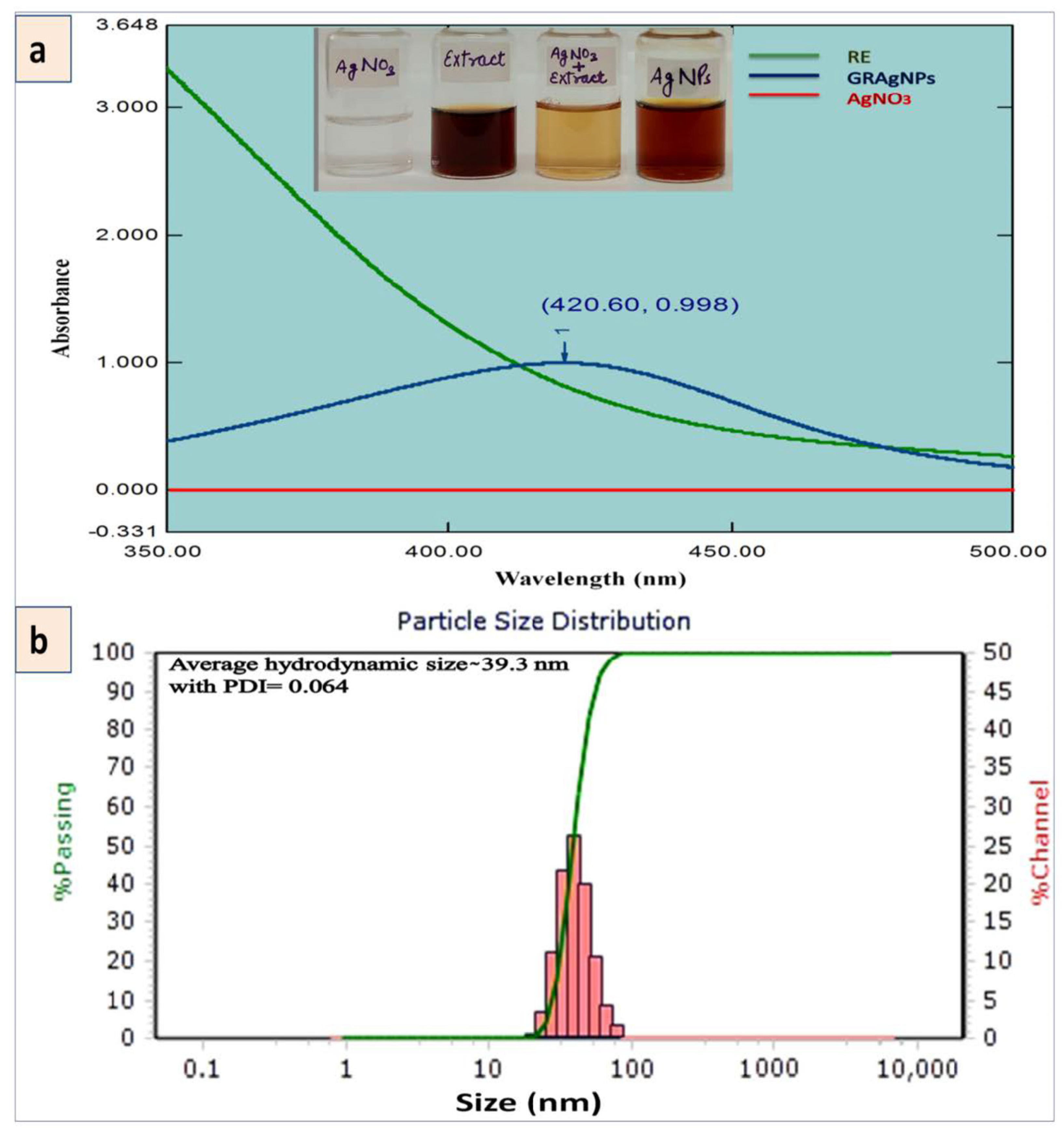
UV-Visible Spectroscopy (UV-Vis): This is often the first and simplest tool. Metallic nanoparticles exhibit surface plasmon resonance (SPR) absorption bands in the UV-Vis range, which confirm their formation and give insight into size and concentration. For example, silver nanoparticles typically show an SPR peak around 400–450 nm (brownish colloid), whereas gold nanoparticles show a peak around 520–550 nm (reddish colloid) [
16]. The position and width of the SPR band indicate particle size and dispersion—a red-shift or broadening might suggest larger or polydisperse particles, or aggregation. In green synthesis, UV-Vis can also be used kinetically to monitor the reaction progress by observing the growth of the nanoparticle SPR peak over time [
17].
Dynamic Light Scattering (DLS) and Zeta Potential: DLS provides the hydrodynamic diameter of nanoparticles in a colloid, which is useful for estimating the size distribution in solution (including the capping layer and any solvation shell). Zeta potential measurement reveals the surface charge, which is an indicator of colloidal stability. Green-synthesized NPs often carry a negative zeta potential due to deprotonated carboxylate or phenolic groups from capping biomolecules [
21]. A zeta potential magnitude above ±25 mV usually implies good electrostatic stability. These measurements help ensure that the biogenic NPs will remain well-dispersed when applied (e.g., in foliar sprays) [
21].
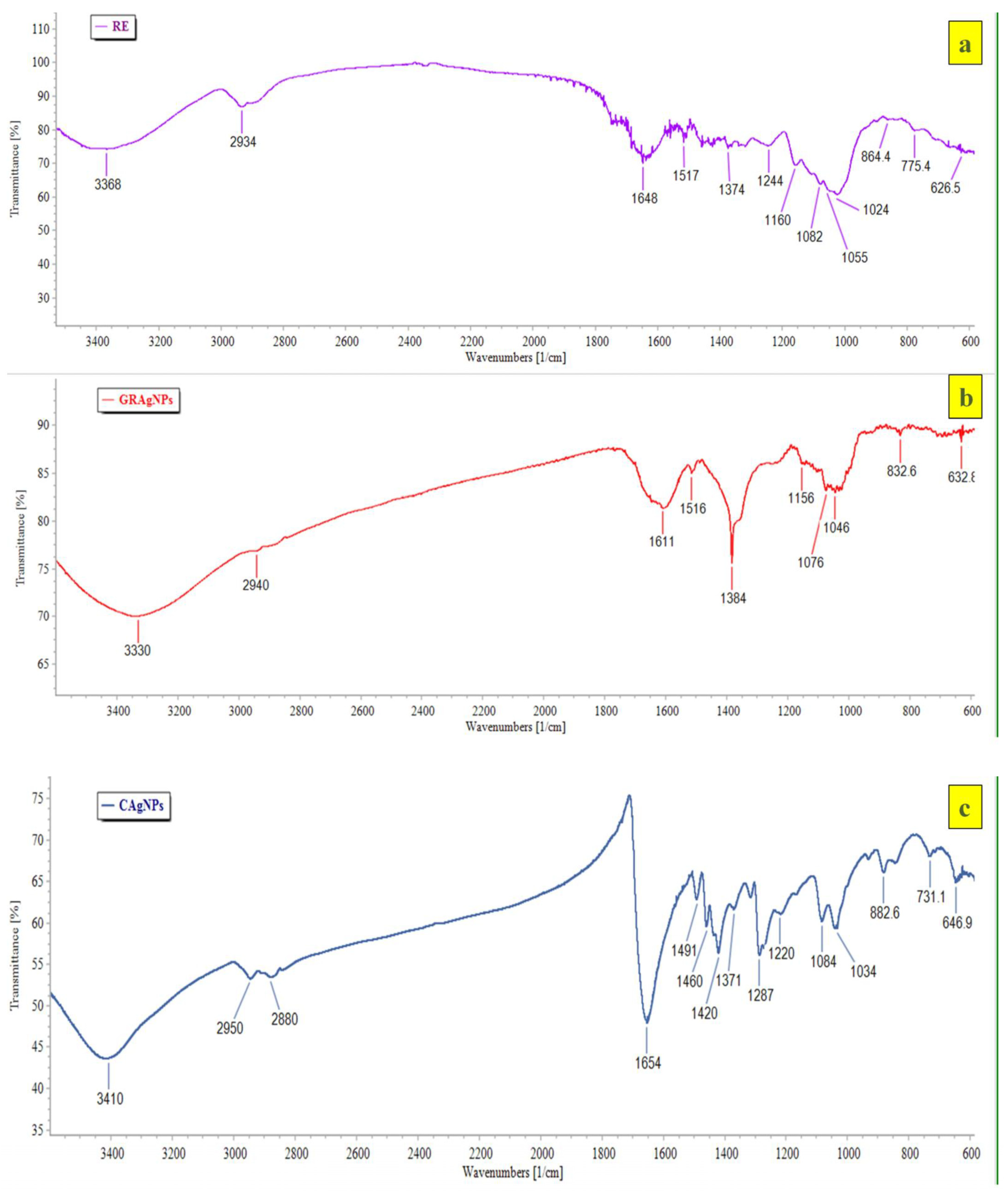
Fourier-Transform Infrared Spectroscopy (FTIR): FTIR is extensively used to identify the functional groups of phytochemicals attached to the nanoparticle surface [
17]. By comparing the FTIR spectrum of the pure plant extract with that of the dried nanoparticle powder, one can observe shifts or attenuations in certain peaks. For instance, a decrease in the O–H stretching intensity and appearance of C=O peaks on the nanoparticle sample might indicate that polyphenols have oxidized and bound to the NP surface as quinones or carboxylates [
17]. FTIR evidence of N–H or C–N vibrations on NPs would suggest proteins or amino acids capping the particles. Thus, FTIR confirms that the nanoparticles are indeed
bio-capped and provides clues about which biomolecules are involved (e.g., peaks around 1600 cm
−1 for aromatic C=C suggests polyphenols; amide I and II bands ~1650 and 1540 cm
−1 suggest proteins) [
17,
31].
X-Ray Diffraction (XRD): XRD is used to determine the crystal structure and phase of metallic nanoparticles [
5]. Green-synthesized metallic NPs (like Ag, Au, Cu) typically show distinct Bragg reflections corresponding to their face-centered cubic (fcc) lattices. For example, AgNPs will exhibit XRD peaks at 2θ ≈ 38°, 44°, 64°, 77° corresponding to the (111), (200), (220), (311) planes of fcc silver [
16]. The presence of these peaks confirms that the product is crystalline metal and not some unreduced compound. The average crystalline size can also be estimated from peak broadening using the Scherrer equation—often yielding size estimates in the 5–50 nm range consistent with microscopy. XRD patterns sometimes contain additional features due to the organic matrix (which generally appears as a broad amorphous background). But overall, XRD verifies that metallic nanoparticles with the expected crystal structure have been synthesized.
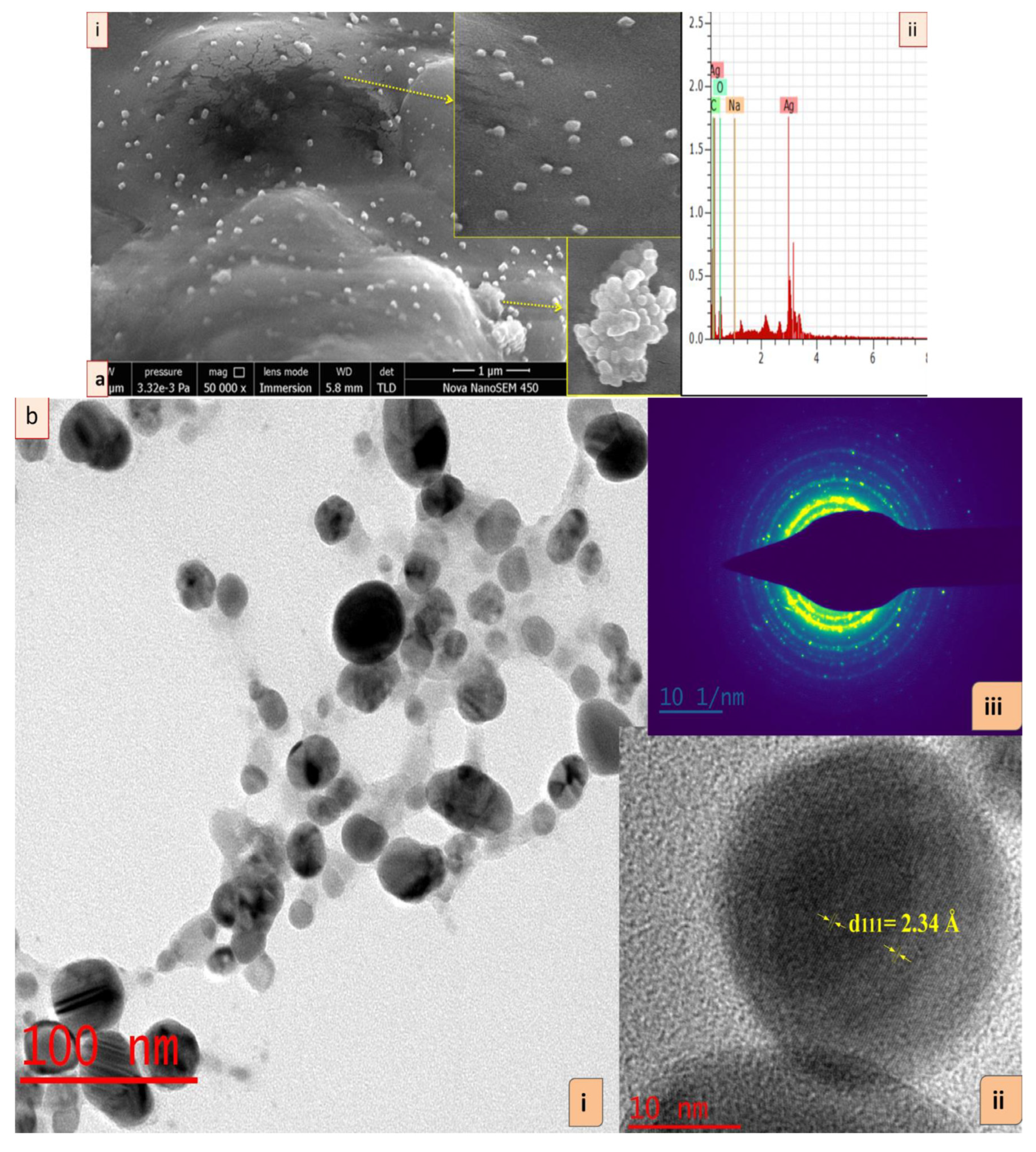
Electron Microscopy (TEM and SEM): Transmission electron microscopy (TEM) is the gold standard to directly visualize nanoparticles, measure their size and shape, and assess dispersion/agglomeration at the nanoscale. Green-synthesized nanoparticles are commonly imaged by means of TEM, which often reveals roughly spherical particles with size distributions that can be measured (TEM can pick up the inorganic core but not the organic shell unless staining is used). For example, a TEM image might show AgNPs of ~10 nm average diameter synthesized with curry leaf extract, along with a thin halo around each particle indicating the organic corona [
17]. High-resolution TEM (HRTEM) can resolve lattice fringes, confirming crystallinity and allowing identification of crystal facets. Selected area electron diffraction (SAED) patterns further corroborate the crystalline nature as rings matching the metal’s known d-spacings [
16]. Scanning electron microscopy (SEM) can also be used, especially for larger nanoparticles or to examine the surface morphology of nanoparticle-coated plant materials (e.g., a leaf after nano-treatment). However, SEM typically provides lower resolution for sub-20 nm particles compared to TEM. Energy-dispersive X-ray spectroscopy (EDS) attached to SEM/TEM can confirm the elemental composition (peaks for the metal and possibly signals for elements like O, N from the capping). For instance, EDS of biosynthesized AuNPs will show a strong Au peak and weaker signals for C and O from the capping layer [
16,
33].
Thermal and Surface Analysis: Techniques like thermogravimetric analysis (TGA) can quantify the amount of organic capping by showing weight loss at certain temperature ranges (e.g., a 10% weight loss at 200–500 °C might correspond to burning off plant organics on the NP) [
17]. Similarly, BET surface area analysis can be used if needed to understand the surface area of dried nanopowders, though this is less common for colloidal use. X-ray photoelectron spectroscopy (XPS) is another advanced tool to analyze the surface chemistry and oxidation states; for green NPs, XPS can confirm that the metal is in the 0-oxidation state and that surface elements like O, N from organics are present [
16].
Nuclear Magnetic Resonance (NMR) and Mass Spectrometry (MS): Although less routinely applied than spectroscopic or microscopic methods, NMR and MS provide valuable complementary information about the organic capping layer of green-synthesized nanoparticles. Solution-state
1H and
13C NMR can identify the specific phytochemicals retained on the nanoparticle surface by comparing spectra of the pure plant extract with those of the washed nanoparticle suspension; shifts in resonance frequencies indicate binding interactions between biomolecules and the metal surface, helping to elucidate which functional groups are directly coordinated to the metal core [
16,
17]. Solid-state NMR can additionally characterize the structural environment of surface-bound molecules on dried nanoparticle powders. Mass spectrometry, particularly electrospray ionisation MS (ESI-MS) and matrix-assisted laser desorption/ionisation MS (MALDI-MS), complements NMR by identifying the molecular weight and fragmentation pattern of capping molecules, enabling unambiguous identification of specific flavonoids, phenolic acids, or proteins associated with the nanoparticle surface [
17]. Together, NMR and MS provide the most direct molecular-level evidence of the capping layer composition, information that is increasingly required by reviewers and regulatory bodies seeking to understand the precise chemical identity of green-synthesized nanoparticle formulations.
Beyond their value for quality control during synthesis, the physicochemical parameters measured by these characterisation techniques have direct and underappreciated consequences for agronomic performance. Polydispersity index (PDI), which reflects the breadth of the nanoparticle size distribution, is particularly relevant: highly polydisperse preparations (PDI > 0.3) contain a mixture of particle sizes that dissolve, translocate, and interact with plant tissues at different rates, making dose-response relationships difficult to interpret and reducing batch-to-batch reproducibility in field applications [
31,
32]. Narrow size distributions (PDI < 0.2), by contrast, allow more predictable and consistent agronomic outcomes. Surface chemistry, as characterised by means of FTIR and zeta potential, determines not only colloidal stability but also the nature of NP interactions with plant cell walls, soil particles, and pathogen surfaces. Nanoparticles with strongly negative zeta potentials (below −30 mV) tend to remain dispersed in aqueous spray solutions and resist aggregation on leaf surfaces, improving foliar coverage and contact time with target pathogens [
11,
17]. The composition of the organic capping layer, readily identifiable by FTIR, further modulates these interactions: polyphenol-rich coatings confer additional antioxidant and antimicrobial activity to the NP surface, potentially synergising with the metal core in crop protection applications, while protein-dominated coatings enhance biocompatibility and slow ion release, which is advantageous when the goal is controlled nutrient delivery rather than acute pathogen inhibition [
16,
17]. Ion-release behaviour, which can be quantified through inductively coupled plasma spectrometry (ICP-MS) of NP suspensions over time, is perhaps the most directly agronomically relevant parameter: slow-release formulations sustain nutrient supply or antimicrobial activity over longer periods, reducing application frequency, while fast-releasing formulations may be more appropriate for acute disease management but carry greater phytotoxicity risk at sub-optimal doses [
31,
32]. Taken together, these physicochemical parameters should be routinely reported and interpreted in relation to agronomic outcomes, not merely as characterisation checkboxes, if the field is to move towards predictive, evidence-based design of green NP formulations for specific agricultural applications [
16,
17,
31].
By using a combination of these methods, researchers ensure that the green-synthesized nanoparticles are properly characterized: one confirms they are indeed nanoparticles (UV-Vis, TEM), another confirms they are metallic in nature (XRD, EDS), and others elucidate the organic coating (FTIR, zeta potential, XPS, NMR, MS). For example, a typical report might state: “UV-Vis showed an SPR peak at 425 nm for AgNPs. TEM images revealed roughly spherical AgNPs of 12 ± 3 nm diameter. XRD confirmed face-centered cubic silver. FTIR indicated capping by polyphenols (peaks at 3380 cm
−1 for O–H, 1640 cm
−1 for C=O). Zeta potential was –32 mV, suggesting stable colloidal dispersion due to negatively charged bio-molecules on the surface [
17,
21].” Such a comprehensive characterization is important not only scientifically but also to build trust that these green nanoproducts can be consistently produced and their behavior understood for agricultural use [
34].
6. Applications in Agriculture
Green-synthesized metallic nanoparticles have a broad spectrum of applications in sustainable agriculture. Owing to their small size and unique properties, these biogenic NPs can interact with plants and pests in ways that improve crop growth and protect against stresses. Here, we discuss several key application areas: nanofertilizers for enhanced nutrition and growth, nanopesticides for pest and disease management, and nanoparticles for stress tolerance. In each case, the plant-based origin and capping of the nanoparticles often confer additional benefits, such as biocompatibility and targeted action. We also include examples from recent studies (2020–2025) to illustrate these roles [
2,
3,
35].
It is important to note at the outset that the evidence base for these applications is heavily skewed towards laboratory and greenhouse studies. A systematic assessment of the literature reviewed here indicates that fewer than 20% of studies reporting agronomic benefits of green-synthesized NPs were conducted under open-field conditions, with the remainder relying on pot experiments, hydroponic systems, or in vitro bioassays. This distinction is critical: controlled-condition studies typically use optimized NP concentrations, uniform substrates, and eliminate confounding environmental variables such as soil microbiome complexity, rainfall variability, and competitive weed or pest pressure.
To facilitate a critical reading of the evidence presented in this section, we adopt an explicit hierarchy of evidentiary strength, consistent with that used in applied agricultural research. In vitro and laboratory studies (controlled conditions, single-organism or cell-based assays) represent the lowest level of field-translatable evidence and are treated here as hypothesis-generating. Greenhouse and pot experiments under controlled or semi-controlled conditions constitute an intermediate level, providing useful mechanistic and dose-response information but are limited in their ability to replicate field complexity (soil microbiome variability, weather, pest pressure, crop competition). Field trials, particularly multi-season, multi-location studies with agronomic benchmarking against conventional inputs, represent the highest level of evidence and are given the greatest weight in this review. Where only laboratory or greenhouse data are available, findings are described as preliminary or indicative rather than conclusive. This distinction is noted explicitly throughout
Section 6.1,
Section 6.2 and
Section 6.3.
Results obtained under such conditions cannot be directly extrapolated to field performance, and the gap between laboratory efficacy and real-world outcomes has been documented for other nano-enabled agrochemicals [
6,
7,
21,
36]. Each application subsection below therefore distinguishes, where possible, between laboratory-scale and field-validated evidence. A semi-quantitative synthesis of the studies reviewed here reveals a consistent pattern across application categories. In the nanofertiliser literature, the large majority of studies (estimated at over 70% of those reviewed) report statistically significant positive effects on at least one growth or yield parameter under controlled or greenhouse conditions. However, this proportion drops markedly when restricted to open-field studies, where outcomes are more variable and effect sizes smaller, with a non-trivial proportion of trials reporting neutral or inconsistent results depending on crop, soil type, and application method. In the nanopesticide literature, in vitro and greenhouse studies report pathogen inhibition rates exceeding 80% in most cases, yet the few available field trials show considerably more variable efficacy. For stress-tolerance applications, positive physiological responses are reported in the majority of greenhouse studies, but these rarely translate into robust, quantified yield gains at harvest. Across all three application categories, negative or phytotoxic outcomes are reported in a meaningful minority of studies, typically associated with doses above 100 mg/L or repeated applications, underscoring the dose-dependency of nanoparticle effects. Taken together, these patterns suggest that while the directional evidence broadly favours agronomic benefits of green-synthesized NPs under controlled conditions, the magnitude and reliability of those benefits under real-world conditions remain uncertain and likely lower than the published literature implies, partly due to the publication bias discussed above [
6,
7,
9,
33].
6.1. Nanofertilizers and Growth Enhancement
Nanofertilizers are nutrient-delivery systems at the nanoscale designed to release nutrients more efficiently to plants [
14]. By converting nutrients into nanoparticle form or loading them onto nanocarriers, one can increase the surface area for plant uptake and reduce losses of fertilizers to the environment [
3]. Green-synthesized nanoparticles of nutrient elements (or nutrient-coated NPs) offer an eco-friendly route to create such nanofertilizers. For example, nano forms of essential nutrients like iron, zinc, and silica can be synthesized via plant extracts and used to supplement crop nutrition [
2]. These nano-nutrients tend to have higher solubility and mobility in soils than bulk mineral supplements, making them more readily available to crop roots [
3]. A case in point is zinc oxide nanoparticles (ZnO-NPs) synthesized using plant extracts: several studies have shown that ZnO-NPs can alleviate zinc deficiency in crops more effectively than conventional ZnSO
4 fertilizer, leading to improved growth and yield under both normal and stress conditions [
28,
37].
Green nanofertilizers have demonstrated notable improvements in plant growth metrics. In wheat and maize trials, nano-formulations of NPK (nitrogen, phosphorus, and potassium) fertilizers prepared with biogenic methods achieved equivalent or higher yields with significantly reduced fertilizer amounts [
5]. One report indicated that a nano-urea fertilizer (where urea was encapsulated in a polymeric nano-carrier) improved wheat yield by ~10% while using half the nitrogen input, thanks to more efficient foliar uptake [
6]. Plant-based synthesis can also introduce beneficial compounds into the nanofertilizer; for instance, if a nanoparticle is capped with organic acids from a plant extract, these acids might chelate soil nutrients and further facilitate nutrient uptake by roots [
23]. Additionally, the organic coating on green NPs often contains micronutrients or growth stimulators (like amino acids or vitamins) that can have auxiliary positive effects on crop development [
18].
One concrete example is the use of silver and silica nanoparticles as seed priming agents. Silver nanoparticles (AgNPs) biosynthesized using plant extracts have been used to prime seeds before sowing. Such priming can enhance seed germination rates, seedling vigor, and root/shoot growth in early stages [
38]. The mechanism may involve AgNP-induced modulation of plant hormone levels or activation of antioxidant pathways that promote germination. For instance, green-synthesized AgNPs (using yeast extract) applied to rice seeds significantly improved germination percentage and early seedling growth compared to untreated seeds [
38]. Similarly, silicon nanoparticles (SiO
2-NPs) produced via green routes (like using rice husk ash) have been applied to crops as nano-silica fertilizers. Silicon is a beneficial element that can strengthen cell walls and improve tolerance to pests and abiotic stress. Nano-silica is more bioavailable than bulk silica; foliar sprays of biogenic SiO
2-NPs on cucumber and tomato led to increased plant height, leaf chlorophyll content, and yield under drought conditions by reducing water loss and oxidative damage.
Green nanofertilizers also show promise in remediating micronutrient deficiencies in an environmentally friendly way. Iron nanoparticles (zerovalent iron or iron oxide) synthesized with plant extracts have been tested to correct iron chlorosis in crops like peanut and soybean. These nano-iron formulations have high surface reactivity and gradually release Fe
2+/Fe
3+ that plants can assimilate [
3]. In pot studies, a one-time soil application of green-synthesized Fe
3O
4 nanoparticles (coated with tea polyphenols) provided season-long iron supply to soybeans, improving their chlorophyll levels and yield, whereas equivalent iron in bulk form had to be applied multiple times due to leaching [
3].
It is worth noting that while nanofertilizers can boost productivity, their dose and method of application must be carefully managed to avoid toxicity or accumulation issues. Studies generally find an optimal concentration range where growth is stimulated, beyond which excessive nanoparticles might cause nutrient imbalance or stress in the plant. Green-synthesized NPs, with their organic coats, often have a relatively wide safety margin; the organic layer can act as a slow-release matrix and may mitigate direct nanoparticle-plant contact stress [
18]. For example, green ZnO-NPs were observed to dissolve gradually in soil, providing sustained zinc to plants but not accumulating to toxic levels in soil biota [
39]. Nonetheless, precision in nanofertilizer delivery (e.g., via seed coating or targeted foliar spray) is advocated to maximize benefits and minimize waste.
Despite these encouraging results, a critical appraisal of the nanofertiliser literature reveals important limitations. The overwhelming majority of studies have been conducted under controlled laboratory or pot-experiment conditions, with very few replicated multi-season field trials. Effect sizes reported in pot studies, such as yield increases of 13–55%, may not be reproducible under open-field conditions, where soil heterogeneity, microbial communities, irrigation regimes, and ambient temperature fluctuations can substantially alter nanoparticle behaviour and plant response. Furthermore, many studies use small sample sizes (often
n < 5 per treatment) and do not report variance data or statistical power, making it difficult to assess the robustness of reported effects. Batch-to-batch variability in plant-extract-mediated synthesis is another recognised limitation: seasonal and geographical differences in phytochemical composition can yield NPs with different size distributions and surface chemistries, complicating dose-response comparisons across studies. Some reports also show contradictory outcomes, for example, nano-zinc applications that improved growth at 20 ppm caused chlorosis and reduced biomass at concentrations above 100–200 ppm, highlighting how narrow the optimal dose window can be and how easily sub-optimal conditions arise in the field. Long-term soil accumulation of NP-derived metals and their effects on soil microbial communities also remain poorly characterised beyond single-season experiments. These gaps collectively mean that while the mechanistic evidence is scientifically sound, the agronomic maturity of nanofertilisers remains low-to-moderate, and large-scale adoption requires further field-scale validation [
5,
7,
14]. In the evidence hierarchy adopted in this review, nanofertiliser research currently occupies an intermediate level: mechanistic evidence is ✓ established at laboratory and pot-experiment scale, but agronomic efficacy under open-field conditions remains △ emerging and insufficiently validated.
6.2. Nanopesticides and Disease Management
Another major application of green-synthesized nanoparticles in agriculture is as nanopesticides—nano-scale formulations intended to control or repel pests and pathogens [
21]. This includes nanomaterials used as insecticides, fungicides, bactericides, nematicides, or herbicides. Metallic nanoparticles like silver, copper, and zinc are well-known for their broad-spectrum antimicrobial properties, and when synthesized via green methods, they carry natural coatings that can enhance their biocidal effectiveness and target specificity [
12,
20]. Green nanopesticides offer the potential to reduce the reliance on conventional chemical pesticides, many of which have issues like environmental persistence and pest resistance. By using nano-sized agents, one can achieve potent pest control with smaller quantities of active ingredient, and the unique modes of action of nanoparticles can overcome some forms of resistance [
20,
40].
Antimicrobial Nanoparticles (Ag, Cu, Zn): Silver nanoparticles (AgNPs) are one of the most widely studied nano-antimicrobials. They can attach to microbial cell walls and release Ag
+ ions, disrupting membrane integrity and enzyme function in pathogens. Green-synthesized AgNPs have been tested against various plant pathogens with notable results [
41]. For instance, AgNPs produced using
Azadirachta indica (neem) extract showed strong inhibitory effects on fungal pathogens like
Rhizoctonia solani and
Sclerotinia sclerotiorum, which cause rot diseases, by penetrating fungal hyphae and causing structural collapse [
26,
42,
43]. The neem compounds capping the nanoparticles possibly also contributed an antifungal effect, making the nano-formulation more effective than either neem extract or AgNPs alone [
42]. Similarly, copper nanoparticles (CuNPs) synthesized with plant extracts have been applied as nano-fungicides and bactericides. Copper is an established crop protectant (e.g., copper oxychloride sprays), but nano-Cu can provide more targeted delivery and lower usage. Green CuNPs have successfully controlled fungal blights in tomato and bacterial spot in citrus, with studies indicating that CuNPs disrupt pathogen cells at lower copper concentrations than traditional salts [
20,
44]. The biologically capped CuNPs also tended to be less phytotoxic than some copper salts, likely due to slower release of Cu
2+ ions [
44]. Zinc oxide nanoparticles (ZnO-NPs), aside from nutrition, also have antimicrobial properties under UV light and have been used to suppress powdery mildew and other foliar diseases. ZnO-NPs generated with gum arabic and leaf extracts have reduced
Erysiphe (powdery mildew) infection on cucurbits by causing oxidative damage to fungal spores on leaf surfaces [
45].
Insect Pest Control: Metallic nanoparticles and nano-formulations can also target insect pests directly. One approach is using nano-sized silica or alumina which act as physical insecticides by abrading the insect cuticle. Another is exploiting the toxicity of metals like silver to insects. Green-synthesized AgNPs have been tested as nano-insecticides against sap-sucking pests and caterpillars. For example, AgNPs made with
Ocimum sanctum (holy basil) extract were sprayed on rice plants and found to significantly reduce populations of the brown planthopper, a major rice pest [
20]. The AgNPs likely exerted toxicity upon ingestion or contact, and the natural extract components possibly helped in either attracting the pests (to ensure contact) or synergizing the toxic effect. There are also reports of green AgNPs showing ovicidal (egg-killing) activity against mosquito eggs and larvicidal effects on mosquito larvae [
12]—indicating potential use in controlling insect vectors of plant (and human) diseases. Furthermore, biogenic gold nanoparticles (AuNPs), though less inherently toxic, have been explored as carriers for pheromones or repellents, creating smart nano-delivery systems to confuse or repel pests instead of killing them [
46].
Nematicidal Applications: Plant-parasitic nematodes in soil (e.g.,
Meloidogyne root-knot nematodes) cause significant crop losses. Green metallic nanoparticles have shown efficacy in managing nematode infestations. As covered earlier, silver, copper, and zinc nanoparticles produced using plant sources like
Acalypha and
Tridax have achieved high nematode mortality in lab and greenhouse trials [
27,
47]. These nanoparticles can be applied as soil drenches around the root zone. They penetrate the nematode cuticle or release toxic metal ions that incapacitate the nematodes. Notably, an advantage reported is that certain biogenic NPs (like those capped with medicinal plant compounds) are able to not only kill nematodes but also induce some resistance in the plant or stimulate root growth as a recovery mechanism [
48]. For example, green AgNPs from licorice root completely inhibited nematode egg hatching and also seemed to trigger greater antioxidant enzyme activity in the host plant roots, aiding in nematode stress tolerance [
26].
Mechanisms and Benefits: Nanopesticides often have multi-faceted mechanisms. Silver and copper NPs generate reactive oxygen species (ROS) at sufficient concentrations when in contact with microbial or insect cells, causing oxidative stress that is lethal to the pathogens [
20,
40,
49]. They can also release metal ions that bind to proteins and DNA of the pathogens, disrupting their normal function [
12]. Importantly, because nanoparticles operate through these physico-chemical interactions broadly, pests and pathogens may find it more difficult to develop resistance compared to single-target conventional pesticides [
20]. For instance, fungi that became resistant to a fungicide by mutating a single enzyme might still be susceptible to the broad membrane and ROS damage caused by AgNPs. Additionally, nanoparticles can adhere to plant surfaces and within tissues more effectively, potentially providing a longer protective effect (a kind of slow release or depot effect on leaves/roots) [
11]. Green-synthesized NPs, being capped with organic molecules, often have better dispersion in water and adhesion on plant tissue due to their surface chemistry, improving their field performance as sprays or drenches [
11,
17].
A critical mechanistic question that the literature has only recently begun to address systematically is whether the observed antimicrobial and growth-promoting effects arise from the nanoparticles as discrete physical entities or from the metal ions released upon their dissolution, a distinction with significant implications for both efficacy prediction and risk assessment. For AgNPs, experimental evidence suggests that both mechanisms operate simultaneously but with different kinetics and targets: ionic Ag
+, released continuously from the NP surface, is the primary driver of acute antimicrobial toxicity through thiol-group binding in pathogen enzymes and disruption of the proton motive force, while the nanoparticle itself contributes through direct membrane adhesion, generation of localised ROS at the particle–cell interface, and intracellular delivery of Ag
+ following endocytosis-like uptake [
20,
40]. The relative contribution of each mode depends critically on particle size, surface chemistry, and environmental conditions: smaller particles and those with higher polydispersity dissolve faster, releasing ions more rapidly, whereas particles stabilised by dense polyphenolic capping layers exhibit slower ion release and a proportionally greater particle-specific effect [
31,
32]. For ZnO-NPs, dissolution to Zn
2+ is even more prominent and is generally considered the dominant mechanism of both phytotoxicity and growth stimulation at low doses, since Zn
2+ at sub-toxic concentrations is an essential micronutrient that activates metalloenzymes involved in photosynthesis and nitrogen metabolism [
28,
37]. For CuNPs, ion release also plays a primary role in antifungal activity, though nanoparticle-specific effects on fungal membrane integrity have been documented at concentrations too low to account for ionic toxicity alone [
20]. Disentangling these contributions experimentally requires ion-chelation controls (e.g., using EDTA to sequester released ions) and size-fractionation studies, approaches that remain uncommon in the agricultural nanoscience literature. Until such mechanistic clarity is achieved, efficacy claims for green-synthesized NPs should be interpreted as reflecting a combined particle-plus-ion effect rather than a purely nanoparticle-specific one [
40,
49].
Studies have shown that using nanofungicides or nano-insecticides can allow for reduced application frequency and quantity. In a field trial, a nano-formulated botanical pesticide (neem oil encapsulated in a polymer NP) maintained pest control over a longer period than raw neem oil, due to the controlled-release nature of the nanoencapsulation [
12]. Similarly, copper nanoparticle treatments achieved disease control comparable to copper hydroxide sprays at a fraction of the copper dose, which is beneficial since copper accumulation in soil is a concern in long-term use [
44].
One must also consider the safety and environmental fate of these nanomaterials. Green-synthesized nanopesticides are generally regarded as more environmentally compatible than conventional ones: the plant-based coatings may make them more biodegradable or at least reduce the risk to non-target organisms like pollinators and soil microbes [
6,
7]. However, thorough assessments are needed. For example, while AgNPs are effective antimicrobials, their excessive use could harm beneficial soil microbes if not carefully managed [
7]. The hope is that due to higher efficacy, one can use much lower quantities of these nano-formulations than traditional chemicals, mitigating potential side effects [
20]. Preliminary studies indicate that in the presence of organic matter, green NPs tend to aggregate and eventually become part of soil mineral matter without causing long-term toxicity [
7], but research is ongoing.
Green nanotechnology provides a novel arsenal for crop protection, enabling the development of nanopesticides that are potent against a wide range of agricultural pests and pathogens. Biogenic metallic nanoparticles like Ag, Cu, and Zn (and their oxides) have shown successful application as fungicides, bactericides, nematicides, and insecticides in controlled experiments [
20,
47]. They work through multiple mechanisms and can overcome some limitations of conventional pesticides, potentially reducing overall pesticide load in agriculture. Going forward, integrating such nanopesticides in integrated pest management (IPM) programs could enhance sustainability—for instance, using a lower dose of nano-Cu alongside biological control agents to achieve crop disease suppression with minimal chemical input [
20].
A balanced assessment of nanopesticide research must acknowledge the significant gap between laboratory efficacy and field-validated performance. The majority of in vitro and greenhouse studies report impressive pathogen inhibition rates—often >80–90% against target fungi or bacteria—yet these conditions rarely capture the complexity of field environments, where UV degradation, rainfall washoff, temperature extremes, and competition from non-target microorganisms can substantially reduce efficacy. The few available field trials show more modest and variable results, underscoring the need for caution when extrapolating laboratory data. There are also notable inconsistencies in the literature: some studies report that biogenic AgNPs have negligible effects on beneficial soil bacteria at the tested concentrations, while others document significant disruption of microbial community structure at equivalent doses, reflecting differences in soil type, organic matter content, and NP surface chemistry. Non-target toxicity to pollinators and aquatic invertebrates has been flagged as a concern in several ecotoxicological studies, though direct comparisons with conventional pesticides are scarce. The risk of selecting for metal-tolerant pathogen strains through sub-lethal exposure is also underexplored. Importantly, almost all nematicidal and insecticidal studies reviewed here were conducted at laboratory or small greenhouse scale with no long-term or multi-season follow-up. These limitations do not invalidate the potential of green nanopesticides, but they highlight that efficacy claims should be interpreted cautiously and that robust integrated pest management (IPM) frameworks will be essential for responsible deployment [
7,
20,
21]. Within the evidence hierarchy of this review, the antimicrobial and nematicidal efficacy of green nanopesticides is ✓ established under controlled conditions, while field-scale performance, non-target safety, and resistance management remain △ emerging areas requiring systematic investigation.
6.3. Enhancing Stress Tolerance and Productivity
Beyond direct nutrition and pest control, green nanoparticles can also bolster plant performance under various abiotic stresses and generally stimulate better growth and productivity [
50]. Several studies have reported that metallic nanoparticles (at appropriate doses) act as nanobionutrients or nano-biostimulants, triggering physiological responses in plants that improve their tolerance to stress conditions such as drought, salinity, extreme temperatures, and heavy metal contamination [
2,
51]. Additionally, even under normal conditions, these nanoparticles can enhance metabolic activities (like photosynthesis or root development), leading to increased biomass and yield [
52,
53]. Green synthesis is especially relevant here because the capping biomolecules on the nanoparticles might interact beneficially with plant cells—for example, by acting as signaling molecules or antioxidants themselves. Representative examples of these applications across different crop systems are summarised in
Table 3.
Abiotic Stress Mitigation: One key area of research is using nanoparticles to mitigate salt stress (salinity) in crops, which is a major issue in irrigated farmlands. Zinc oxide nanoparticles (ZnO-NPs) and silicon nanoparticles (Si-NPs) synthesized via green methods have shown pronounced effects in improving salt tolerance. For instance, when pea plants facing salinity were treated with green ZnO-NPs, they exhibited higher chlorophyll content, better growth, and lower accumulation of sodium in their tissues compared to untreated salt-stressed plants. The ZnO-NPs (and possibly zinc ions released) likely enhanced antioxidant enzyme activities (e.g., superoxide dismutase, peroxidase) and stabilized membrane integrity under salt stress. Similarly, green Si-NPs, due to the known role of silicon in stress mitigation, have reduced the impacts of salinity by depositing in cell walls and equipping plants with more rigid structures to exclude sodium and maintain water balance. Studies on wheat and cotton have found that nano-silica treatments resulted in improved Na
+/K
+ ratios and enhanced proline accumulation (a stress osmoprotectant) under salt stress [
2]. In cotton, a recent work showed that biogenic ZnO-NPs not only improved growth under salinity but also modulated the expression of stress-responsive genes and maintained higher potassium levels in leaves, indicating a transcriptional level stress mitigation [
54].
Drought tolerance is another area where nanoparticles show promise. Nanoparticles can influence stomatal behavior and water-use efficiency. For example, TiO
2 and SiO
2 nanoparticles have been reported to form thin coatings on leaves that reduce transpiration without hampering CO
2 uptake significantly, thereby conserving water in drought conditions [
2]. Green-synthesized nanoparticles of silica have increased the activity of aquaporin proteins in roots, improving water uptake under limited moisture [
55]. Some metal NPs (like cerium oxide, though less frequently addressed in green syntheses) act as ROS scavengers—CeO
2-NPs can alternate between Ce
3+ and Ce
4+, mimicking antioxidant enzymes, thus protecting plants from oxidative stress due to drought or heat [
53].
Growth and Yield Stimulation: Even in the absence of abiotic stress, low-dose exposure to certain nanoparticles has been observed to stimulate plant growth. This phenomenon is sometimes attributed to nanoparticle-induced mild stress that triggers growth hormone production or improved nutrient acquisition. Iron oxide nanoparticles, for instance, can stimulate root elongation and branching, possibly by supplying iron in a highly accessible form and also by locally generating ROS that signal root developmental pathways [
3]. One experiment with green-synthesized Fe
3O
4-NPs found that treated soybeans developed a more extensive root system and higher nodule numbers (when inoculated with rhizobia) than controls, translating to increased nitrogen fixation and yield [
3]. Gold and silver nanoparticles at very low concentrations have been noted to enhance seedling vigor in crops like maize and capsicum—hypotheses include that they might stimulate nitrate reductase activity or other metabolic enzymes, or that they might help in better utilization of endogenous reserves during germination [
38,
56]. For example, one study reported that seeds primed with green-synthesized AgNPs germinated faster and had stronger amylase activity (breaking down starch to fuel growth) than non-primed seeds [
38].
Moreover, some nanoparticles can carry or induce the production of plant growth regulators. Green NPs might naturally come with plant hormones from the extracts (like auxins or cytokinins if the source plant contained them). While most of these would be in very low amounts, even trace hormone-like activity could influence plant development. There is evidence that chitosan NPs (from natural polymer chitosan) can elicit defense pathways and also growth responses such as increased leaf area and fruit set in tomatoes [
12].
Synergistic Effects: It is worth noting that green nanoparticles can provide a combination of benefits. For example, nano zinc can act both as a micronutrient (improving enzyme function and photosynthesis due to zinc’s role in enzymes) and as a protector against stress (through stabilizing membranes and antioxidant systems) [
54]. Nano silica can strengthen physical structures (making plants more robust against mechanical stress and herbivory) and simultaneously reduce biotic and abiotic stress impacts by inducing systemic resistance and improving water relations [
2]. So, a single application of a certain biogenic nanoparticle might enhance overall plant vigor, which in turn improves tolerance to both abiotic and biotic challenges.
Field trials have started to confirm some of these productivity enhancements. For example, in a semi-arid field, wheat treated with a combination of green nanofertilizers (nano-NPK) and nano-silica showed not only better growth under drought but also a measurable yield increase over standard fertilizer treatment [
5]. The nanotreated wheat had more grains per spike and higher grain weight, attributed to improved nutrient uptake and prolonged photosynthetic activity during dry spells [
5].
While these results are encouraging, it is important to emphasize proper dosing and timing. Excessively high nanoparticle concentrations can induce phytotoxicity (excess ROS or metal burden) and stunt growth—the dose makes the poison. Often there is a bell-shaped response curve where low to moderate NP doses stimulate growth, but high doses inhibit it [
54]. For instance, green ZnO-NPs might enhance plant dry weight at 20 ppm Zn but cause chlorosis at 200 ppm. Therefore, practical use will require calibration to find optimal, sub-toxic levels that maximize stress tolerance without negative side effects [
7].
In conclusion, metallic nanoparticles derived from green synthesis have multifaceted roles in enhancing crop productivity. They serve as stress alleviators (helping plants cope with drought, salinity, temperature extremes by modulating physiological pathways) and as growth promoters (boosting germination, root development, nutrient uptake, and photosynthesis) [
2,
53]. Through these effects, they can indirectly lead to higher yields and more stable production under adverse conditions. This aspect of nanotechnology in agriculture is particularly appealing as climate change increases the frequency of stress conditions—having nano-formulations that can be applied to fortify crops could become part of climate-smart agriculture strategies [
8,
39,
53]. Of course, more in-field research is needed to confirm these benefits on a broad scale and to ensure that such interventions are economically viable and safe for ecosystems.
The stress-tolerance literature for green-synthesized NPs is largely at an early experimental stage, and several limitations temper the interpretation of reported benefits. Most studies have been conducted in controlled greenhouse environments under single, artificially imposed stress conditions (e.g., uniform NaCl salinity or water withholding), which do not replicate the combined and fluctuating stresses typical of field crops. Reported improvements in physiological parameters such as chlorophyll content, Na
+/K
+ ratios, or proline accumulation are often measured at a single time point, providing limited insight into whether benefits persist throughout the crop cycle or translate into meaningful yield gains at harvest. There is also notable heterogeneity in findings: while some studies on ZnO-NPs under salinity show consistent growth promotion, others report negligible or even negative effects at similar doses, possibly due to differences in soil pH, clay content, or extract composition. The role of the phytochemical capping layer in mediating stress responses—frequently cited as a key advantage of green synthesis—remains largely hypothetical for most species, as direct mechanistic evidence linking specific phytochemicals to specific stress pathways is still scarce. Finally, the economic feasibility of applying biogenic NPs as stress-management agents at the farm scale has not been evaluated in most studies, and the environmental persistence of NP-derived metals under repeated stress-triggered applications is unknown. Addressing these gaps through multi-season, multi-site field trials that incorporate socio-economic analysis will be essential before stress-mitigation applications can be considered agronomically mature [
2,
50,
53]. In terms of evidentiary strength, the physiological mechanisms underlying NP-mediated stress tolerance are partially ✓ established at the cellular and pot-experiment level, but crop-level benefits under realistic field stress conditions remain largely △ indicative and hypothesis-generating at this stage.
Taken together, the figures presented in this review provide an integrated visual framework linking synthesis to application:
Figure 1 contrasts green and conventional synthesis routes;
Figure 2 illustrates the reduction and stabilization mechanisms;
Figure 3,
Figure 4 and
Figure 5 exemplify the characterisation workflow; and
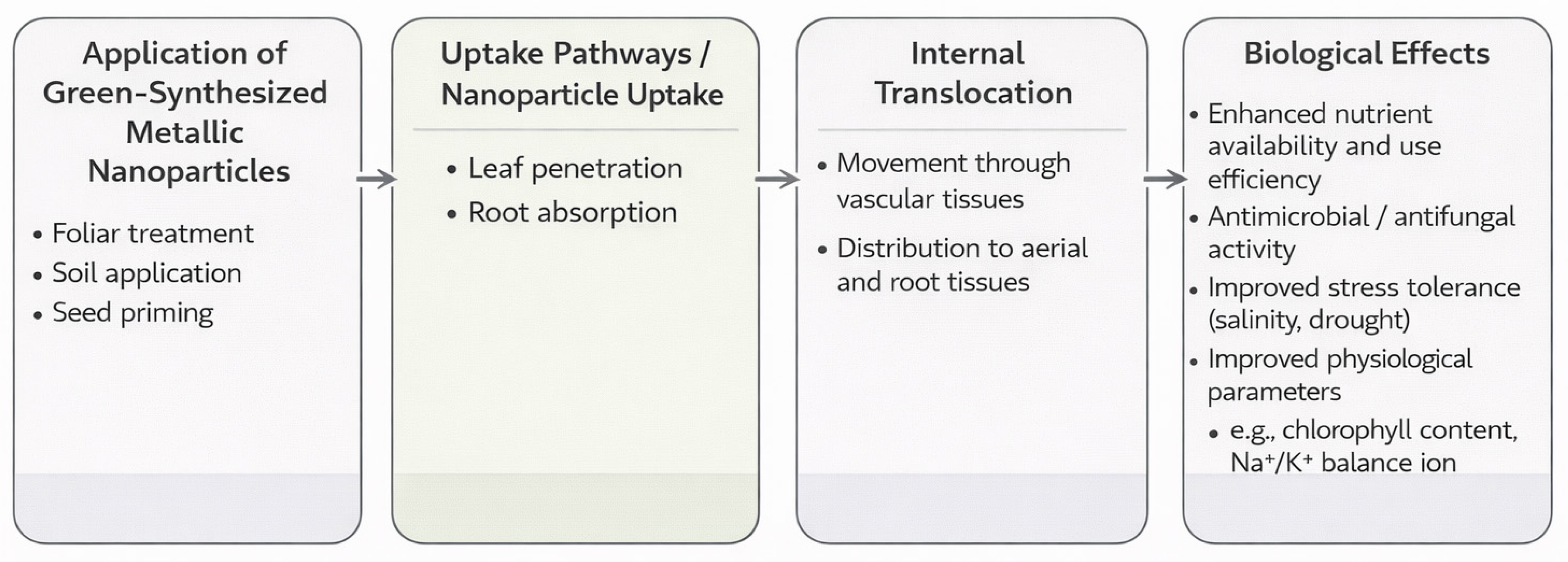
Figure 6 conceptually maps the uptake, translocation, and physiological modes of action of green-synthesized NPs in crop plants, connecting nanoparticle properties to plant responses across the key application categories discussed in
Section 6.1,
Section 6.2 and
Section 6.3.
Green-synthesized metallic nanoparticles may be applied through foliar treatment, soil application, or seed priming. After foliar or root uptake, nanoparticles may undergo internal translocation and exert multiple biological effects, including improved nutrient efficiency, antimicrobial activity, and enhanced stress tolerance, as discussed in this review.
In the context of foliar application, the predominant delivery route for nanopesticides and an increasingly common route for nanofertilisers, the physical interaction of nanoparticles with the leaf surface represents a critical and frequently overlooked determinant of efficacy. Before any biological effect can occur, applied NPs must first adhere to the leaf surface and, in many cases, penetrate the cuticle, a hydrophobic barrier composed primarily of cutin polymer and epicuticular waxes that serves as the plant’s first line of defence against both pathogens and agrochemicals [
11]. Nanoparticle adhesion to leaf surfaces is governed by a combination of electrostatic interactions, van der Waals forces, and hydrophobic compatibility between the NP capping layer and the waxy cuticle. Green-synthesized NPs, with their polyphenol- and protein-rich organic coatings, tend to be moderately hydrophilic, which can limit adhesion to strongly hydrophobic epicuticular wax layers, a factor that partly explains the variable field efficacy of foliar NP sprays compared to laboratory results obtained on excised leaves or in solution [
11,
17]. Cuticular penetration occurs primarily through two pathways: aqueous pores associated with polar solutes (effective for small, hydrophilic particles below ~5 nm) and transcuticular diffusion through the lipophilic wax domain (more accessible to hydrophobic or lipid-coated particles). Most green-synthesized metallic NPs (10–50 nm) are too large for direct pore penetration and must rely on stomatal entry or cuticular diffusion aided by humidity and temperature gradients [
11]. This size-dependent cuticular barrier effect means that smaller, more monodisperse NP preparations are likely to achieve superior foliar uptake, reinforcing the agronomic relevance of tight size control during synthesis. Interaction with epicuticular waxes can also chemically modify the NP surface after deposition: wax components may partially displace the original capping layer, altering ion-release kinetics and biological activity in ways that are rarely studied under realistic field conditions. Surfactants or humectants added to NP spray formulations, commonly used in conventional pesticide applications to improve wetting, can enhance cuticular penetration but may also destabilise the NP colloidal suspension or alter the capping layer integrity [
11,
17]. These foliar delivery considerations highlight an important gap in the current literature: the majority of agronomic studies apply NPs directly to plant roots or to detached organs in controlled media, bypassing the cuticular barrier entirely, and are therefore not representative of real foliar application scenarios.
7. Safety and Risk Assessment of Green-Synthesized Nanoparticles
Despite the eco-friendly nature of their production, green-synthesized metallic nanoparticles are not inherently safe, and their large-scale agricultural deployment raises legitimate concerns across three interconnected risk domains: environmental fate, ecosystem integrity, and human health [
7,
53].
Environmental risks. Once applied to crops, green-synthesized NPs enter the soil environment through leaching, runoff, or direct application, where they may persist, transform, or accumulate depending on soil pH, organic matter content, and ionic strength [
7]. Metal-based NPs such as AgNPs and CuNPs can release metal ions progressively in soil solution, reaching concentrations that inhibit nitrification and denitrification processes carried out by beneficial soil microorganisms, thereby disrupting nutrient cycling [
7,
53]. ZnO-NPs, while generally considered less persistent due to dissolution to Zn
2+, may still accumulate in soils under repeated application regimes, particularly in low-pH or clay-rich soils where dissolution is slower [
57]. Runoff into aquatic systems is an additional concern: AgNPs have been shown to be toxic to freshwater invertebrates and algae at concentrations as low as 1–10 µg/L, values that could plausibly be reached in drainage water from treated fields [
7,
53,
58], and their persistence in sediments is poorly characterized [
7]. The organic capping layer of biogenic NPs may partially mitigate these risks by slowing ion release and promoting aggregation, but systematic comparative data between green-synthesized and chemically synthesized NPs under realistic field conditions remain scarce.
Ecosystem risks. At the community and ecosystem level, the primary concern is the disruption of soil microbial communities that underpin fertility, decomposition, and plant-microbe symbioses. Several studies have documented significant shifts in microbial community structure following exposure to AgNPs and CuNPs at doses of 1–50 mg/kg soil, including reductions of up to 40% in mycorrhizal colonization rates and marked suppression of nitrogen-fixing bacterial populations [
7,
53]. Pollinators represent another vulnerable non-target group: sub-lethal exposure to metallic NPs through contaminated pollen or nectar has been reported to impair navigation and foraging behaviour in bees, though dose-response relationships under field conditions are not well established [
7]. Long-term effects on soil biodiversity and food web dynamics—including bioaccumulation through soil invertebrates such as earthworms into higher trophic levels—remain largely uncharacterized beyond single-species laboratory studies [
7,
23].
Human health risks. The pathway of greatest concern for human exposure is dietary uptake through crop consumption. Studies have confirmed that plants can absorb metallic NPs or their dissolved ions through roots and translocate them to aerial tissues, including edible parts, though the extent varies substantially with NP type, size, plant species, and soil conditions [
23,
53]. While many NPs are transformed within plant tissues into less bioavailable forms, translocation factors for AgNPs to edible tissues have been reported in the range of 0.01–0.15, depending on plant species and soil conditions, and the long-term health implications of chronic low-level dietary exposure, particularly to AgNPs and CuNPs, have not been adequately evaluated in human or animal models [
53]. Occupational exposure during NP synthesis, formulation, and field application represents a further risk pathway, particularly through inhalation of aerosolized nanoparticles, which can penetrate deep into lung tissue. Mitigation strategies include implementing maximum residue limits (MRLs) for nanoparticulate metals in food crops, developing occupational exposure guidelines for agricultural workers, establishing pre-market safety assessment requirements analogous to those applied to conventional pesticides, and promoting closed-system handling protocols during NP production and application [
59,
60,
61,
62].
8. Challenges and Future Perspectives
Many of the challenges currently associated with green nanotechnology in agriculture, such as scalability, reproducibility, environmental fate, and safety assessment, were already anticipated in early foundational studies of nano-enabled agricultural systems. Initial reviews highlighted the need for standardized synthesis protocols, comprehensive toxicological evaluations, and a deeper understanding of nanoparticle–plant–soil interactions before large-scale deployment [
14,
15].
Recent advances in analytical techniques, formulation strategies, and regulatory awareness have begun to address these concerns, enabling more informed and responsible development of green-synthesized nanoparticles for agricultural use [
3,
6,
8]. Before examining specific challenges, it is important to acknowledge several structural limitations in the current literature that affect the interpretation of findings presented in this and other reviews. First, there is strong evidence of publication bias: studies reporting positive or significant effects of green-synthesized NPs on crop performance are substantially overrepresented in the literature, while null results, negative outcomes, or failed scale-up attempts are rarely published. This skews the apparent efficacy of these materials and may lead to overly optimistic assessments of their agricultural potential. Second, the literature is dominated by short-term, single-season studies conducted under highly controlled conditions, which tend to amplify treatment effects and mask the variability inherent in agricultural systems. The chronic effects of repeated NP application, on soil health, microbial community structure, and food safety, remain largely uncharacterised. Third, there is a marked taxonomic and material bias: silver nanoparticles (AgNPs) account for a disproportionate share of published studies, with copper, zinc oxide, and iron oxide NPs receiving considerably less attention, and other potentially valuable metals (titanium, cerium, selenium) being only sporadically investigated in agricultural contexts. This concentration of effort limits the generalisability of conclusions across different crop–soil–climate systems. Fourth, most studies originate from a limited number of geographical regions, predominantly South and East Asia, which may not be representative of the diverse agroecological conditions under which these technologies would need to perform globally. These biases collectively mean that the evidence base, while growing rapidly, should be interpreted with appropriate caution [
6,
7,
9,
10].
While green nanotechnology offers exciting opportunities for sustainable agriculture, several challenges must be addressed before plant-based nanoparticles can be widely adopted in the field. One major challenge is the scalability and consistency of green synthesis. Biological sources, such as plant extracts, inherently have variability in their chemical composition depending on species, growth conditions, harvest time, etc. [
7]. This can lead to batch-to-batch variation in nanoparticle yield, size, and efficacy. For example, the concentration of a reducing polyphenol in a leaf extract might vary seasonally by 30–60%, directly affecting the rate of nanoparticle formation, the size distribution, and the final yield of the synthesis [
7]. Achieving standardized production will likely require more controlled extract preparation (perhaps using dried plant powders or purified fractions) and real-time monitoring of synthesis (using UV-Vis or other quick assays to ensure the nanoparticle characteristics are within the desired range). Researchers are exploring process optimization techniques and possibly even bioreactor approaches (using plant cell cultures or algae in bioreactors for continuous nanoparticle production) to scale up green synthesis in a reproducible manner [
16,
17].
Another challenge concerns the stability and shelf-life of green nanoparticles. The organic capping agents that confer advantages can also be sensitive to environmental factors. Green-synthesized nanoparticle formulations might have a shorter shelf-life than chemically synthesized ones—for instance, microbial growth could occur in a stored plant extract-based nano formulation if not properly preserved (the same nutrients that reduce the metals can also feed bacteria) [
7]. Additionally, some capping agents could degrade over time or desorb, potentially causing the nanoparticles to agglomerate and lose functionality. Developing stable formulations (perhaps by drying nanoparticles into a powder or encapsulating them in a matrix) will be important for practical use by farmers, who need products with reasonable storage stability.
Regulatory and safety concerns form another significant hurdle that warrants careful distinction between what is currently established and what remains speculative or aspirational. On the evidence side, it is well-documented that nano-forms of metals and metal oxides represent novel physicochemical entities that differ from their bulk counterparts in solubility, reactivity, and biological interaction, and that existing regulatory frameworks for conventional fertilisers and pesticides were not designed to capture these nanoscale properties [
59,
60]. It is also established that several jurisdictions—including the European Union (through REACH and the Plant Protection Products Regulation) and the United States (EPA/FIFRA)—currently lack nano-specific registration pathways for agricultural nanomaterials, meaning that most green-synthesized NP products occupy a regulatory grey area [
59,
60,
61]. Ecotoxicological studies have confirmed that AgNPs and CuNPs can harm beneficial soil microorganisms at concentrations that may be reached under repeated field applications, and that phytotoxicity is dose-dependent with narrow safety margins [
7]. These findings are supported by peer-reviewed data and should be treated as established concerns. By contrast, several widely cited expectations remain speculative and insufficiently supported by current evidence: the claim that plant-based capping agents will make biogenic NPs substantially more biodegradable than chemically synthesized equivalents has not been systematically validated across soil types or climates; the assumption that regulatory approval will follow straightforwardly once toxicological data are provided underestimates the structural complexity of nano-specific regulation; and projections about consumer acceptance of nano-enabled food crops are not grounded in robust social science data. Regulatory bodies will also require data on toxicity to non-target organisms (soil microbes, earthworms, pollinators, aquatic life if runoff occurs) and potential accumulation in soils or crops [
6,
7]. For example, silver nanoparticles in high doses could harm beneficial soil fungi or bacteria that are important for nutrient cycling [
7]. There is also the question of nanoparticle residues in edible parts of crops—would consuming produce grown with nanofertilizers introduce nanoparticles into the human diet, and if so, are there health implications? Preliminary studies suggest that plants do uptake some nanoparticles or their dissolved ions, but often in minor amounts and many get transformed (e.g., coated with biomolecules) within plant tissues [
7]. Nonetheless, comprehensive food safety evaluations are needed. On the positive side, green synthesis may produce particles that are more easily dissolvable or transformable in soil, potentially reducing long-term persistence. For instance, ZnO-NPs in soil will gradually dissolve to Zn
2+, which is a normal nutrient, whereas some engineered carbon nanomaterials might persist much longer. Regulators might treat nano-agrochemicals akin to pesticides or fertilizers depending on their use, so clear guidelines and testing protocols are needed that cover nanoscale phenomena.
The following summarises the main regulatory priorities for nano-enabled agrochemicals, distinguishing between issues grounded in current evidence or existing law (✓ Established) and those that are still emerging or aspirational (△ Emerging/Speculative) [
59,
60]:
✓ [Established need, partially addressed] Comprehensive toxicity assessment for non-target organisms (soil microbiota, pollinators, aquatic systems) is already required under EU Regulation 1107/2009 for plant protection products and under EPA/FIFRA in the US, but nano-specific testing protocols remain absent from most regulatory guidance documents.
✓ [Established need, largely unmet] Evaluation of nanoparticle persistence, transformation, and bioaccumulation in soil–plant systems is scientifically recognised as essential, and preliminary data exist for some NP types (e.g., ZnO-NPs dissolving to Zn2+ in soil), but multi-season, multi-crop field datasets are absent for the majority of green-synthesized formulations.
✓ [Established concern, evidence limited] Assessment of potential residues in edible plant tissues is required by food safety regulators (e.g., EFSA in Europe) [
59], but maximum residue limits (MRLs) for nanoparticulate metals in food crops have not yet been defined, and available uptake data are largely from short-term pot studies.
△ [Emerging, largely aspirational] Development of harmonised testing protocols adapted to nanoscale materials is actively discussed in international bodies (OECD, ISO), and some guidance documents exist for nanomaterial characterisation [
59], but consensus nano-specific ecotoxicity protocols for agricultural contexts are not yet in place.
△ [Emerging, unresolved] Clarification of regulatory classification frameworks (nanofertiliser vs. nanopesticide categories) is an acknowledged policy gap in both the EU and the US; whether nano-agrochemicals require entirely new regulatory categories or can be accommodated within existing ones remains an open question under active regulatory debate [
60,
61].
While short-term experimental evidence suggests substantial agronomic benefits under controlled conditions, large-scale field validation and long-term environmental monitoring remain essential before widespread commercial adoption [
5,
7].
A critical dimension that the literature frequently underestimates is the translational gap between laboratory proof-of-concept and farm-ready products. Most published studies on green-synthesized NPs in agriculture operate at Technology Readiness Levels (TRL) 2–4, that is, they confirm basic effects under controlled conditions but have not progressed to pilot-scale validation or pre-commercial testing [
6,
8]. Field trials in the strict sense (multi-season, multi-location, with agronomic and economic benchmarking against conventional inputs) remain scarce for virtually all green-synthesized formulations reviewed here. Among commercially available nano-agrochemical products, the majority are chemically synthesized; plant-mediated products have not yet reached the market at scale, partly due to the regulatory gaps described above and partly due to the batch-to-batch variability inherent in biological synthesis. Bridging this translational gap will require coordinated investment in pilot manufacturing, standardized efficacy testing protocols analogous to those used for conventional pesticide registration, and public-private partnerships capable of absorbing the cost and risk of field-scale validation [
6,
59,
60,
63].
Economic viability is a critical and underexamined barrier to the commercialisation of green-synthesized nanoparticles. Although plant-extract-mediated synthesis is inherently cheaper than approaches requiring purified chemical reagents or high-energy physical processes, a structured cost comparison with conventional agrochemicals is rarely presented in the literature. Available estimates suggest that laboratory-scale production of green AgNPs costs approximately USD 50–200 per gram depending on the plant source and metal salt used, whereas bulk silver-based fungicides cost a fraction of that per gram of active ingredient, a gap that narrows considerably when accounting for the much lower application rates required for NP formulations (typically in the mg/L rather than g/L range) [
6,
16]. For ZnO-NPs and Fe-based NPs, the cost differential is smaller given the lower price of zinc and iron precursors, making these candidates more economically competitive in the near term. Using agricultural or food processing waste as feedstock for plant extracts, a strategy already demonstrated with rice husk, onion peel, and citrus peel extracts, can reduce raw material costs substantially while adding value to waste streams [
17]. However, three structural cost drivers remain problematic at scale: (i) characterisation and quality control, since verifying that each batch meets defined physicochemical specifications (size, zeta potential, polydispersity index) requires analytical instrumentation not routinely available in agricultural settings; (ii) formulation and shelf-life engineering, as converting a freshly synthesised colloidal suspension into a stable, transportable, and registrable product (powder, granule, or emulsion) adds processing steps that increase cost; and (iii) regulatory compliance, since obtaining registration as a nanopesticide or nanofertiliser will require multi-year, multi-site toxicological and environmental fate studies analogous to conventional pesticide registration, representing a substantial financial burden that only larger companies or well-funded public-private consortia are likely to absorb. Currently, no plant-mediated NP product has achieved full regulatory registration as an agricultural input in the EU or US markets, and the commercialisation pathway remains undefined. Progress will likely require dedicated nano-agrochemical regulatory frameworks, investment in pilot-scale manufacturing infrastructure, and demonstration projects that provide the field-validated efficacy and safety data needed to justify registration costs [
6,
59,
60,
62].
From a research perspective, some knowledge gaps include understanding the precise mechanisms of how nanoparticles interact with plant physiological processes. We know they can enhance growth or stress tolerance, but deeper omics studies (transcriptomics, proteomics) can reveal which genes/pathways are being altered by nanoparticle exposure [
53]. Such information would guide the design of nanoparticles tailored to trigger specific beneficial responses (for example, a nanoparticle that strongly induces drought-responsive genes could be used as a prophylactic treatment before anticipated drought). Furthermore, questions remain about the long-term fate of nanoparticles in soil-plant systems—do they remain as particles at harvest time or mostly dissolve/transform? Do they accumulate in specific plant tissues or get excreted through root exudates? Long-term field experiments tracking nanoparticle fate over multiple seasons would be valuable to ensure there are no unexpected negative consequences like the build-up of metals in soil or selection for nanoparticle-resistant pest strains.
The future perspectives for green nanotechnology in agriculture are largely optimistic. Continued innovation is likely in creating hybrid nanomaterials—for instance, combining biogenic nanoparticles with biopolymers to make smart controlled-release fertilizers and pesticides [
12,
64]. Speculatively, one can envision a nano-formulation where a metallic nanoparticle is embedded in a biodegradable carrier that releases it in response to environmental triggers (moisture, pH, pest presence), though this concept has not yet been demonstrated at the field scale. Also, the integration of green nanotech with other sustainable practices like biofertilizers (microbial inoculants) could yield synergistic effects [
12]. For example, nano-hydroxyapatite (a source of phosphorus) delivered with phosphate-solubilizing bacteria might significantly improve P uptake efficiency while keeping application rates low. Digital farming and precision agriculture may also intersect with nanotech: speculatively, nanosensors based on metallic NPs or metal oxides could in the future be deployed in fields to monitor soil nutrient levels or plant health in real-time, guiding precision application of nanofertilizers or nanopesticides [
6]—though this remains at the research prototype stage. Some of these nanosensors (like those based on graphene or metal oxides) are being researched; if they can be made cheaply and safely (maybe even biodegradable sensors), they would greatly enhance resource use efficiency by ensuring inputs are applied only as needed.
Beyond addressing individual agronomic constraints, green nanotechnology has the potential to contribute to a broader rethinking of agricultural input management under climate change scenarios. Rather than functioning solely as efficiency-enhancing additives, green-synthesized nanoparticles may enable more adaptive and resilient fertilization and crop protection strategies by integrating controlled nutrient delivery, stress-responsive behavior, and reduced environmental persistence. In this sense, green nanotechnology could evolve from a supporting technology into a systems-level tool aligned with sustainable intensification goals, provided that scalability, safety, and regulatory integration are addressed in parallel [
8,
53].
In terms of adoption, small-scale trials and demos will be important to convince farmers of the benefits. Knowledge transfer will be needed, as “nano” might be an unfamiliar concept to many growers. Explaining that these are just very fine particles of elements they know (like zinc, iron, silica) but prepared in a way that plants can use more effectively could help acceptance. Over time, if green nano-products prove to reduce costs (say by decreasing fertilizer needed or preventing a devastating pest outbreak), farmers will be incentivized to use them. Public perception of nanotechnology in food and farming is another consideration, hence highlighting the “green” aspect (using natural materials and processes) and thoroughly addressing safety will be key for public acceptance [
6].