Article

Use of Texturised Pea Protein By-Product in High-Protein Bread

Food Technology Area, College of Agricultural Engineering, University of Valladolid, Av. Madrid, 34004 Palencia, Spain
*
Author to whom correspondence should be addressed.
Appl. Sci. 2026, 16(8), 3860; https://doi.org/10.3390/app16083860
Submission received: 11 March 2026 / Revised: 9 April 2026 / Accepted: 12 April 2026 / Published: 16 April 2026
(This article belongs to the Special Issue Emerging Trends in Food Safety and Quality Control)

Featured Application

The use of texturised pea proteins as functional ingredients in breadmaking enables the production of high-protein breads with improved technological and textural properties. This approach supports the valorisation of extrusion by-products and provides a technical valorisation strategy for developing nutritionally enhanced bakery products suitable for functional foods and plant-based diets.

Abstract

There is increasing interest in protein-enriched foods and in the valorisation of by-products from the agri-food sector. This study investigated the incorporation of by-products derived from texturised pea protein production into high-protein bread formulations. Wheat flour was partially replaced (10%) with different protein sources (gluten, pea protein isolate, pea protein concentrate, and two types of texturised by-products, T60 and T80). In a subsequent trial, blends of gluten with a by-product (T60) or with pea protein concentrate were evaluated at replacement levels of 10, 20 and 30%. Dough mixing properties and bread quality attributes (specific volume, texture and colour) were assessed. All protein sources increased water absorption. Gluten and the protein concentrate also increased kneading time. Gluten and the by-products increased the specific volume of the breads and reduced crumb firmness, whereas the isolate showed the opposite effect. The incorporation of gluten–T60 blends at 30% significantly increased dough water absorption, enhanced specific volume (by more than 80%), reduced crumb firmness, and improved elasticity and cohesiveness compared with the control, while doubling the protein content. However, achieving these improvements delays dough development. These results demonstrate the potential of texturised pea protein by-products as functional ingredients in breadmaking, enabling the development of nutritionally enriched products with favourable technological performance.

1. Introduction

Bread is a staple food for large segments of the global population. Although higher consumption of wholemeal bread would be desirable, most bread consumed worldwide is made from refined flours. Bread is not particularly rich in harmful components such as simple sugars or saturated fats; however, its protein content is low, and the quality of these proteins could be improved. In particular, cereal proteins are deficient in lysine, so enrichment of bread with legume proteins enhances the amino acid balance and overall protein quality [1].
Food waste accounts for up to one-third of global production, including losses generated by the agri-food industry [2]. The growing demand for vegan products has increased the production of texturised proteins, typically obtained from legume isolates or concentrates such as soy or pea [3]. Texturised proteins are produced by extrusion and are marketed in the form of large particles obtained by breaking the extrudate. During this process, smaller fractions are generated, which are usually directed to animal feed due to their high protein content. However, various international organisations, including the European Union, recommend that the optimal strategy for food by-products is their reintegration into the human food chain [4].
In recent years, interest in high-protein products has increased, particularly in those of plant origin [5]. In the case of bread, numerous studies have examined the substitution of wheat flour with alternative protein sources. The earliest works date back to the 1970s [6,7]. Legume-derived ingredients are among the most widely investigated for this purpose [8,9], although other alternatives such as insects [10], algae, and industrial by-products have also been studied [11,12]. However, incorporation of these protein sources often results in reduced loaf volume, firmer crumb texture, and darker colours. These effects are attributed, at least in part, to gluten dilution, the pigments naturally present in these ingredients, and the influence of proteins on Maillard reactions.
Besides legume flours, protein isolates and concentrates can also be used for bread enrichment, enabling higher protein fortification with lower inclusion rates. Among the commercially available options, soy and pea proteins are the most relevant, with pea protein having the advantage of low allergenicity [13]. Isolates are produced by wet milling, whereas concentrates are obtained by micronisation and cyclone separation [14]. The use of pea protein isolates to enrich bread has been investigated by Hoehnel et al. [15] and Malalgoda et al. [16], while modifications of these proteins by malting have also been explored [17]. Pea protein concentrate has likewise been studied [18].
Another interesting approach involves increasing the protein content of wheat itself [19]. Isolated gluten is commonly employed as an improver in certain types of bread, particularly those with reduced gluten levels or weakened gluten networks [20,21,22,23]. Combining gluten with other proteins can offset the dilution effect while improving the nutritional profile of the final product [24].
Despite the growing interest in protein-enriched breads, by-products generated during the extrusion of plant proteins have received little attention as breadmaking ingredients. Their inclusion could not only enhance the nutritional value of bread but also promote food chain sustainability through the valorisation of plant protein industry by-products. Our working hypothesis is that the treatments undergone by proteins and starches during texturisation affect the functionality of these components and, consequently, their influence on breadmaking processes, distinguishing them from untreated protein isolates and concentrates. Furthermore, we hypothesise that the inclusion of gluten in such formulations may counteract some of the negative effects associated with a high content of pea protein, such as reduced specific volume, altered texture, or the presence of off-flavours. This influence, not previously described to date, should be analysed to determine whether it is beneficial or detrimental to the quality of enriched breads. Should the effect prove positive, further studies exploring these phenomena in greater depth would be warranted. This study investigates the incorporation of two by-products from texturised pea protein production, differing in protein content. First, their inclusion at 10% was compared with other protein sources (gluten, pea protein isolate, and pea protein concentrate). In the second phase, the T60 protein-textured flour was prioritised due to its superior technical and functional performance; wheat flour was partially substituted with blends of the lower-protein by-product and gluten or with blends of pea protein concentrate and gluten, at inclusion levels of 10, 20 and 30%. In all cases, bread specific volume, baking loss, crumb texture at 24 h and 7 days, and crumb and crust colour were evaluated.

2. Materials and Methods

2.1. Materials

Breads were prepared with wheat flour (14.60 g/100 g moisture; 14.15 g/100 g protein; 0.26 g/100 g, ash; 1.72 g/g water-binding capacity (WBC); W 330) (Zapardiel, Fraga S.A., Medina del Campo, Spain), instant dry baker’s yeast (Saf-instant® The Original, Lesaffre, Valladolid, Spain), salt (Hacendado, Salinas de Odiel, Huelva, Spain), ascorbic acid (Sapore Puro, Torino, Italy), and tap water from the local supply.
The protein sources used were gluten (9.29 g/100 g moisture; 81.43 g/100 g protein; 0.58 g/100 g ash; 2.28 g/g WBC) (Eurogerm Iberia, Barcelona, Spain), pea protein isolate (8.24 g/100 g moisture; 78.84 g/100 g protein; 2.81 g/100 g ash; 6.44 g/g WBC) (Nutralys F85, Roquette, Lestrem, France), pea protein concentrate (8.73 g/100 g moisture; 51.71 g/100 g protein; 5.05 g/100 g ash; 2.13 g/g WBC) (AM Nutrition, Stavanger, Norway), texturised pea protein by-product T80 (9.29 g/100 g moisture; 78.66 g/100 g protein; 2.80 g/100 g ash; 5.75 g/g WBC) (Molendum Ingredients, Zamora, Spain), and texturised pea protein by-product T60 (9.69 g/100 g moisture; 66.10 g/100 g protein; 3.07 g/100 g ash; 5.19 g/g WBC) (Molendum Ingredients, Zamora, Spain). The T80 by-product originates from the texturisation of pea protein isolate, whereas T60 derives from the texturisation of a blend of isolate and pea flour, with a protein content slightly higher than that of the concentrate. In both cases, the commercial texturised proteins are marketed as large particles, while the by-products consist of the smaller fractions obtained during processing, which were subsequently milled into flours under controlled temperature and humidity.

2.2. Methods

2.2.1. Flour and Protein Characteristics

Ash and protein contents were determined according to the official methods of the Association of Official Agricultural Chemists [25], following AOAC Methods 935.42 and 945.18B, respectively. A nitrogen-to-protein conversion factor of 6.25 was applied. The results were expressed as grams per 100 g of sample on a dry weight basis. All analyses were performed in triplicate.
Water binding capacity (WBC), defined as the amount of water retained by the sample after centrifugation, was determined according to AACC method 56-20.01 [26], with modifications described by de Pablo et al. [27]. All WBC measurements were performed in triplicate.

2.2.2. Bread Preparation

The control bread, which was shared between the two phases, was prepared with the following formulation (Table 1): 100 parts wheat flour, 2 parts yeast, 2 parts salt, and 0.01 parts ascorbic acid. In the first stage, breads were produced by replacing 10 parts of wheat flour with 10 parts of the different protein sources (gluten, isolate, concentrate, by-product T60, and by-product T80). In the second stage, breads were prepared by replacing 10, 20, or 30 parts of wheat flour with equal blends of gluten/by-product T60 or gluten/concentrate. In all cases, the amount of water was adjusted according to farinograph analyses to reach 500 UB. Water temperature was calculated to achieve a final dough temperature of 24 °C. Kneading times were adjusted to allow full development of the gluten network. After kneading, the dough was divided into 150 g portions, hand-rounded, and placed into rectangular aluminium moulds (145 × 120 × 40 mm). Fermentation was carried out for 90 min at 30 °C and 80% relative humidity. After proofing, breads were baked at 220 °C for 30 min. Following baking, loaves were removed from the moulds, cooled at room temperature for 1 h, packed in polyethene bags with hermetic closure, and stored for 24 h (or 7 days) before analysis. All breadmaking trials were performed in duplicate.

2.2.3. Dough Rheology

The optimal water absorption of each formulation was determined with a farinograph (FarinoGraph, Brabender®, Anton Paar, Graz, Austria) according to AACC Method 54-21.01 [26]. Dough development time and stability under overmixing were also analysed. Each dough was analysed in duplicate.

2.2.4. Bread Characteristics

Bread properties were assessed 24 h after baking, except for weight loss (1 h after baking) and texture (after 24 h and 7 days).
Weight loss was determined in three loaves from each batch using Equation (1):
W e i g h t   l o s s = d o u g h   w e i g h t b r e a d   w e i g h t   a f t e r   b a k i n g d o u g h   w e i g h t × 100
Bread volume was measured in the same loaves using a Volscan Profiler volume analyser (Stable Microsystems, Surrey, UK). Specific volume was calculated as volume/weight and expressed as cm3/g.
Crumb texture was determined by Texture Profile Analysis (TPA) using a TA-XT2 texture analyser (Stable Microsystems, Surrey, UK) with a 75 mm diameter cylindrical aluminium probe. Experimental conditions were 50% compression depth, a trigger force of 5 g, a test speed of 2 mm/s, and a 30 s delay between compressions. Two central slices (25 mm thick), previously cut with a 25 mm diameter stainless steel cylinder, from two loaves of each batch were analysed. Hardness (N), springiness, resilience, and cohesiveness were calculated [28]. The hardness increase was determined using Equation (2):
H a r d n e s s   i n c r e a s e   ( % ) = h a r d n e s s   d a y   7 h a r d n e s s   d a y   1 h a r d n e s s   d a y   1 × 100
Slice images were acquired with an HP Scanjet G3110 scanner (HP, Palo Alto, CA, USA).
Crumb and crust colour were measured using a CR400 colorimeter (Konica Minolta, Tokyo, Japan) at a 45° viewing angle (d/45 illumination, D illuminant). Measurements were taken on two loaves from each batch, at three different points of the crust and in the middle of three slices (crumb) of each loaf, and expressed as L*, a*, and b* values.
The protein contents of the breads were determined according to the official methods of the Association of Official Agricultural Chemists [25], following AOAC Methods 945.18B.

2.2.5. Focus Group Evaluation

A focus group was conducted to assess bread flavour. Five experts aged 24–60 participated. The sessions were held in a dedicated room with adequate space, lighting, and drinking water available. Each expert received coded samples (four-digit numbers), which were presented in random order. Bread samples were standardised in size prior to evaluation. Breads were consumed plain or accompanied by savoury (cooked ham) or sweet (cocoa spread) products. Experts evaluated the samples individually, recording notes on separate sheets. Afterwards, results were discussed collectively, and final decisions were recorded.

2.2.6. Statistical Analysis

Data were analysed using one-way ANOVA with INFOSTAT software version 2014 (Faculty of Agricultural Sciences, UNC, Argentina). Mean differences were determined by Tukey’s test at a 95% confidence level (p ≤ 0.05).

3. Results and Discussion

3.1. Comparison at 10%

3.1.1. Water Absorption and Dough Mixing Behaviour

Regarding water absorption to reach 500 UB (Table 2), protein incorporation increased this value in all cases. This is expected since plant proteins generally exhibit a higher water absorption capacity than starch. Accordingly, inclusion of the products with the highest protein content (isolate and gluten) produced the greatest increase. Indeed, Bianchi and Simonato [29] reported higher water absorption capacity in pea isolates compared with concentrates. Previous studies also observed increased farinograph water absorption with the addition of gluten [20], pea protein concentrate [18] and pea protein isolate [30]. However, in the case of the isolate, the value was considerably higher than for T80, suggesting that this difference may be related to the industrial texturisation process, which may have altered the functional properties of the proteins, although compositional differences between samples also contribute. This decrease in absorption following extrusion has already been reported [31]. By contrast, comparing the concentrate with T60 revealed that the latter produced a greater increase in absorption, even higher than T80. This observation is consistent with starch gelatinisation during extrusion, as sufficient heat and water were available for this process. Gelatinised starch is known to have higher water absorption than native starch and proteins [32], thereby increasing dough water demand during mixing [33]. Consequently, the increased absorption caused by gelatinised starch compensates for the reduction due to protein denaturation.
This higher farinograph absorption aligned with the water-binding capacity (WBC) determined by centrifugation. However, gluten and concentrate showed much lower WBC values than other proteins with similar protein content and farinograph absorption. This discrepancy may be due to their slower water absorption during farinograph testing, while centrifugation is a rapid method. Thus, in these cases, WBC values are not reliable predictors of farinograph absorption.
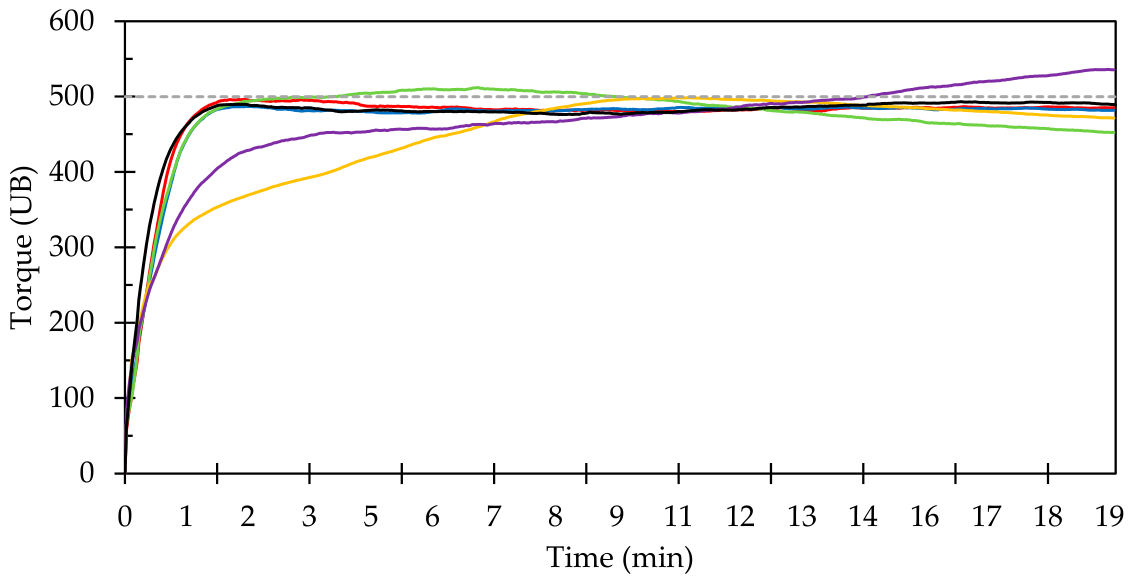
Farinograms of the doughs with 10% protein substitution are shown in Figure 1. Incorporation of most proteins did not markedly alter curve shape, mixing time, or dough stability. This contrasts with other studies reporting increased development time and stability with pea protein isolates [16,30]. However, the control flour in this study already had high protein content, alveograph strength, and good stability, reflecting its high quality. In contrast, previous studies employed weak or wholemeal flours with lower baseline stability and development times, leaving greater scope for improvement.
Significant differences were observed with gluten and pea protein concentrate. Gluten doughs displayed an initial peak that required more time to develop than the other blends, followed by a continuous increase in consistency throughout the test. This longer development time agrees with findings by Veraverbeke et al. [34]. Concentrate doughs also showed an initial peak, but with a shorter development time than other formulations, and then gradually increased in consistency until stabilising mid-test, consistent with Belc et al. [18]. Gluten, with its high protein concentration, requires mechanical work to develop the gluten network, hence the longer mixing time. In the case of the concentrate, gluten development occurred rapidly, but other components, its lower protein and higher ash contents, particularly fibres such as cellulose and hemicellulose, absorbed water more slowly [35]. Crystalline cellulose, for example, is known to absorb water gradually [36]. These doughs also differed texturally after mixing: gluten dough was more compact, elastic and less sticky, whereas concentrate doughs were highly sticky, appearing initially overhydrated (similar to ciabatta dough) but gaining consistency with extended mixing.

3.1.2. Bread Quality

Specific volume values are shown in Table 2. Incorporation of texturised proteins increased loaf volume by more than 25%, with gluten showing the highest effect (>80%). Conversely, isolate addition reduced bread volume by 35%, while concentrate produced no significant differences compared with the control. Thus, gluten clearly provided the best performance in terms of loaf volume, while textured pea proteins exhibited better breadmaking behaviour, which may be related to the heat treatment and denaturation of the pea proteins during the industrial texturisation process.
The positive effect of vital gluten on gas retention and bread volume is well documented [20]. Conversely, pea protein concentrates [18] and isolates [15] have been associated with reduced loaf volume due to gluten dilution and interactions with gluten components. However, these effects depend on both the amount of protein added and flour strength. In this study, with 10% substitution and a strong flour, concentrate did not significantly alter volume. Texturised proteins, by contrast, contain gelatinised starch, which increases the level of damaged starch hydrolysed by amylases to produce fermentable sugars [37]. Martínez et al. [33] also observed greater gas production and dough development when pre-gelatinised wheat flours were incorporated. In isolate-containing doughs, the limited starch content suggests that increased volume may instead result from protein modification during the texturisation process. Campbell et al. [38] did not observe this effect with cowpea proteins, but differences in flour type (unspecified in that study) or protein type may explain the discrepancy. Hoehnel et al. [15] also reported marked variation in bread volume depending on the legume protein used.
No significant differences were found in baking weight loss (Table 2). Formulations with higher water content showed similar weight loss compared to other formulations, indicating that the additional water may contribute to maintaining dough mass during baking. Consequently, these formulations exhibited a higher final bread weight per kilogram of flour, consistent with the increased initial water content.
Therefore, formulations with higher water absorption retained this moisture, improving baking yield and crumb moistness.
Crumb texture (Table 3) showed a direct relationship between specific volume and hardness: loaves with higher volume were softer. Accordingly, gluten breads were the softest, followed by texturised proteins, whereas isolate breads were the hardest. Concentrated breads were significantly harder than the control, despite showing no significant difference in specific volume. This relationship between hardness and volume has been widely confirmed [28]. During storage, hardness increased less in breads with a higher protein content, except for T60, which showed no significant differences from the control. Reduced hardening may be linked to the higher water retention capacity of proteins, limiting moisture migration from crumb to crust during storage, and to the lower starch content, as starch retrogradation is a key contributor to staling [39,40]. Interestingly, isolate breads showed smaller increases in hardness, although they were initially much firmer than other breads.
Elasticity was highest in gluten breads, almost 400% above the control. Among other breads, only T60 showed a modest improvement. Gluten also significantly increased cohesiveness compared with the control, unlike the other protein blends. Resilience was also highest in gluten breads though not significantly different from T60. Control, isolate, and concentrate breads showed the lowest resilience values. Gluten’s positive effects on elasticity, cohesiveness, and resilience are consistent with its known role, as the lack of these properties is a common problem in gluten-free breads [41], linked to protein denaturation and gelling ability [42]. Overall, higher resilience and cohesiveness, combined with lower hardness, are desirable. Thus, breads with gluten and T60 performed best in this regard.
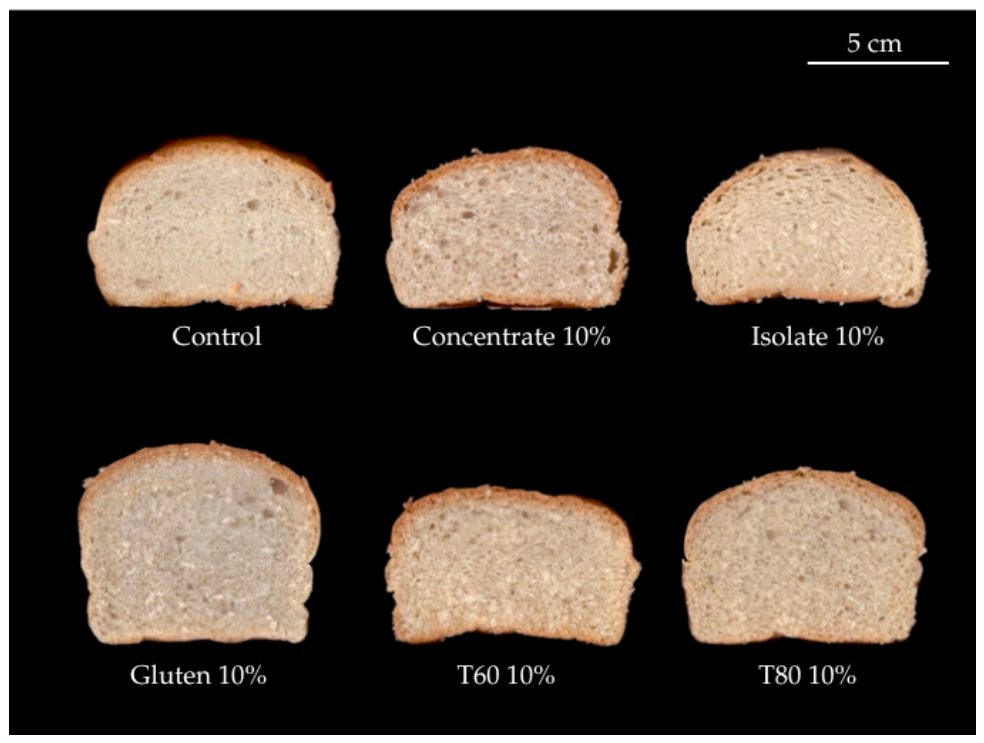
Bread colour is shown in Table 4, crumb lightness (L) did not differ significantly between formulations, but differences were observed in a* and b* values. Gluten slightly reduced a* and b* values compared with the control, while texturised proteins, particularly the isolate, increased them. Crumb colour is largely determined by ingredient colour, as interior bread temperatures remain below 100 °C, and caramelisation or Maillard reactions do not occur. However, as shown in Figure 2, these differences were minor and unlikely to negatively affect consumer perception.
For crust colour, increased lightness was observed only in breads with higher pea protein contents (isolate and T80), which also showed lower a* values. No differences were detected in b* values. Previous studies have reported contrasting results: Belc et al. [18] found decreased crust lightness with pea proteins, whereas Malalgoda et al. [16] reported the opposite. Such discrepancies may reflect bread type or baking conditions. In our study, differences likely arose from protein influence on Maillard reactions, which are critical in crust colour formation [43]. Not only protein quantity but also amino acid composition affects these reactions [44], as also highlighted by Hoehnel et al. [15].
The protein content of enriched breads increased by 24–45%, depending on the protein source, with higher values obtained from higher-protein ingredients.
In summary, gluten addition produced the greatest improvements in loaf volume, cohesiveness, resilience, and crumb softness, without negatively affecting colour, although it required longer mixing times. Texturised proteins also improved bread texture compared with untreated pea proteins, notably T60, which enhanced elasticity, cohesiveness, and resilience. However, focus group tasting revealed a slight legume flavour at 10% substitution, noticeable when breads were consumed alone but less perceptible when accompanied by sweet or savoury products. These findings provide preliminary observations on flavour perception, which may vary depending on consumption context.
Based on these findings, subsequent experiments focused on blends of gluten and T60. Among texturised proteins, T60 showed higher water absorption, with no major differences in other parameters compared with T80. Gluten proved the most effective protein in improving loaf volume and textural properties (hardness, cohesiveness, resilience) while also contributing to higher water absorption. Furthermore, gluten interacts differently with dough than pea proteins and may compensate for gluten dilution caused by partial replacement with pea proteins.
Therefore, breads were subsequently prepared with blends of gluten and T60 at 10, 20 and 30% substitution levels. Parallel tests were also carried out with gluten and concentrate blends, given the similar protein content of concentrate and T60. The use of gluten–protein blends has previously been proposed [24], although in those cases, gluten was added at higher levels as a bread improver rather than as a protein source.

3.2. Comparison of Gluten and Concentrate or T60 Blends

3.2.1. Water Absorption and Dough Mixing Behaviour

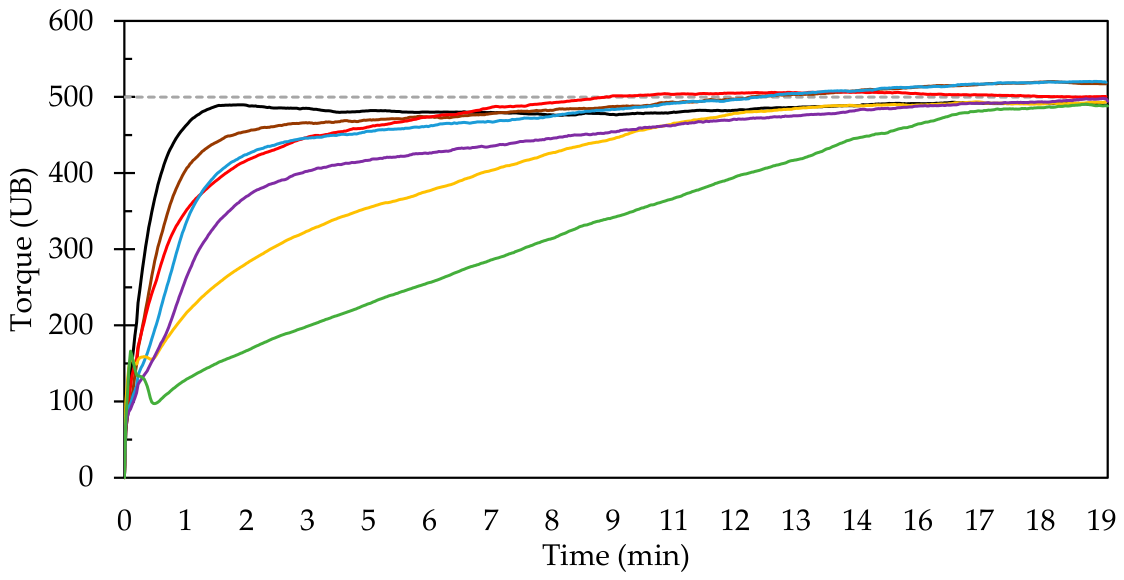
Farinograms of the blends are shown in Figure 3. Water absorption values (Table 5) increased progressively with higher protein substitution levels, with greater increases observed for gluten/T60 blends. This trend was consistent with that observed in the first experiment comparing individual protein sources. In breads with 30% gluten/T60, water absorption, and thus dough hydration, increased by 38% (26% at 20% substitution).
In all cases, inclusion of protein blends reduced and delayed the initial peak in the farinograms. Subsequently, consistency increased until reaching similar levels corresponding to the calculated absorption. This behaviour was consistent with the effect of gluten observed in the first part of the study, as gluten was present in all enriched doughs. The reduction and extended development time were more pronounced in blends with concentrate than in those with T60, as noted previously, and the effect intensified with higher protein levels. This suggests that the effect of protein substitution on dough properties was evident, particularly when concentrates were used. Concentrate blends often appeared excessively hydrated (soft and sticky) at the start of the mixing process, suggesting that the absorption of water may differ from expectations. However, the dough gradually became more consistent as the mixing process continued. These observations suggest that the type of protein and the industrial treatment can influence the hydration and handling characteristics of the blends.

3.2.2. Bread Quality

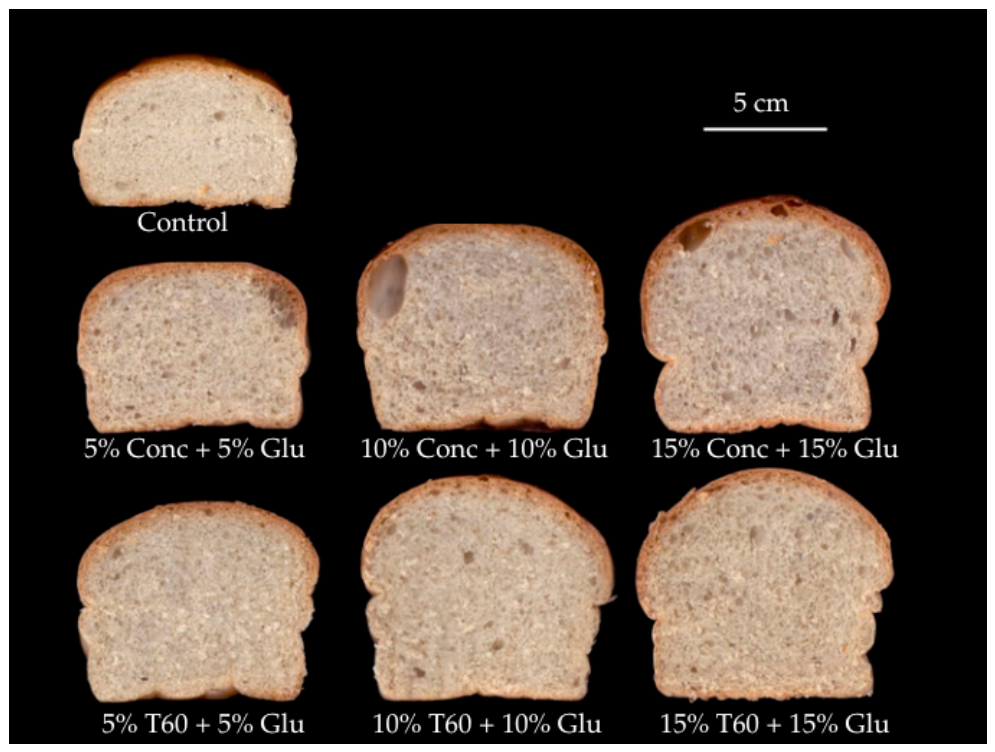
Specific volume values (Table 5) increased with protein blends, mainly due to gluten, as already demonstrated in earlier trials. The effect was greater at 20% and 30% substitution than at 10%. Interestingly, loaves with gluten/T60 at 10% showed a higher volume than those with concentrate, but this trend reversed at 30%, where gluten/concentrate loaves reached significantly higher volumes (Figure 4). These differences may be attributed to the presence of pre-gelatinised starch, as texturised products are subjected to heat during processing, which can contribute a little viscosity upon heating [45] and may slightly weaken the final bread structure. Nevertheless, gluten/T60 blends increased specific volume by up to 82% compared with the control.
No significant differences were found in baking weight loss, indicating that increased dough hydration enhanced moisture retention, thereby improving yield and crumb moistness.
Crumb texture (Table 6) again showed an inverse relationship between hardness and specific volume. Thus, protein blends substantially reduced hardness compared with the control, with reductions becoming greater at higher substitution levels. At lower substitution (10%), T60 blends were more effective, whereas at higher substitution (30%), concentrate blends yielded softer crumbs, consistent with specific volume results. Protein blends also enhanced elasticity, cohesiveness, and resilience, in line with results observed for gluten in the first trials. These improvements increased with protein level, except for resilience, which showed no clear differences between T60 and concentrate blends. Furthermore, incorporation of protein blends slowed crumb firming during storage, suggesting slower firming during storage.
As expected, protein content increased with greater wheat flour substitution. From 20% substitution onwards, breads with T60 contained significantly more protein than those with concentrate, reflecting the higher protein content of T60. In this way, the protein content of bread could be doubled while maintaining favourable technological properties such as specific volume and texture. Focus group evaluation indicated that a noticeable legume-like flavour emerged from 10% legume protein inclusion (20% blend substitution), particularly in concentrate breads. However, the experts did not detect these flavours when breads were consumed with other foods, either savoury or sweet, even at the highest substitution levels.

4. Conclusions

Incorporation of texturised pea proteins into breadmaking increased dough water absorption and loaf volume, while reducing crumb hardness and staling. Using blends with gluten enabled high levels of protein enrichment while improving the water absorption and exhibiting the same weight loss after baking as other formulations. It also improved specific volume, crumb cohesiveness, elasticity, and resilience, and simultaneously reduced hardness and staling. These findings highlight the potential for valorising extrusion by-products as functional ingredients, offering a nutritionally beneficial strategy for the production of high-protein breads.

Author Contributions

Conceptualisation, M.G.; methodology, P.F. and D.S.; software, P.F., D.S. and M.G.; validation, M.G.; formal analysis, P.F. and D.S.; investigation, M.G. and P.F.; resources, M.G.; data curation, P.F. and D.S.; writing—original draft preparation, M.G. and D.S.; writing—review and editing, P.F., D.S. and M.G.; visualisation, M.G.; supervision, M.G.; project administration, M.G.; funding acquisition, M.G. All authors have read and agreed to the published version of the manuscript.

Funding

This research was funded by FEDER Interreg VI A Spain–Portugal (POCTEP) 2021–2027 cooperation project TRANSCoLAB PLUS (0112_TRANSCOLAB_PLUS_2_P) and the Applied Research Project (VA157P24), cofunded by the Junta de Castilla y León and FEDER, EU.

Institutional Review Board Statement

Not applicable.

Informed Consent Statement

Not applicable.

Data Availability Statement

The data presented in this study are available on request from the corresponding author. The data are not publicly available due to privacy.

Acknowledgments

The author D.S. acknowledges the University of Valladolid and Santander Bank for the predoctoral fellowship. We acknowledge Molendum Ingredients and Anton Paar for providing the protein materials and FarinoGraph equipment respectively.

Conflicts of Interest

The authors declare no conflicts of interest.

References

  1. Dimina, L.; Rémond, D.; Huneau, J.-F.; Mariotti, F. Combining Plant Proteins to Achieve Amino Acid Profiles Adapted to Various Nutritional Objectives—An Exploratory Analysis Using Linear Programming. Front. Nutr. 2022, 8, 809685. [Google Scholar] [CrossRef] [PubMed]
  2. Magalhães, V.S.M.; Ferreira, L.M.D.F.; Silva, C. Causes and Mitigation Strategies of Food Loss and Waste: A Systematic Literature Review and Framework Development. Sustain. Prod. Consum. 2021, 28, 1580–1599. [Google Scholar] [CrossRef]
  3. Zhang, T.; Yu, S.; Pan, Y.; Li, H.; Liu, X.; Cao, J. Properties of Texturized Protein and Performance of Different Protein Sources in the Extrusion Process: A Review. Food Res. Int. 2023, 174, 113588. [Google Scholar] [CrossRef]
  4. European Union. Directive 2008/98/EC of the European Parliament and of the Council of 19 November 2008 on Waste and Repealing Certain Directives. Off. J. Eur. Union 2008, L 312, 3–30. Available online: http://data.europa.eu/eli/dir/2008/98/oj (accessed on 20 February 2026).
  5. Aschemann-Witzel, J.; Gantriis, R.F.; Fraga, P.; Perez-Cueto, F.J.A. Plant-Based Food and Protein Trend from a Business Perspective: Markets, Consumers, and the Challenges and Opportunities in the Future. Crit. Rev. Food Sci. Nutr. 2021, 61, 3119–3128. [Google Scholar] [CrossRef]
  6. Pomeranz, Y.; Shogren, M.D.; Finney, K.F. Flour from Germinated Soybeans in High-Protein Bread. J. Food Sci. 1977, 42, 824–827. [Google Scholar] [CrossRef]
  7. McConnell, L.M.; Simmonds, D.H.; Bushuk, W. High-Protein Bread from Wheat-Faba Bean Composite Flours. Cereal Sci. Today 1974, 19, 517–521. [Google Scholar]
  8. Boukid, F.; Zannini, E.; Carini, E.; Vittadini, E. Pulses for Bread Fortification: A Necessity or a Choice? Trends Food Sci. Technol. 2019, 88, 416–428. [Google Scholar] [CrossRef]
  9. Bresciani, A.; Marti, A. Using Pulses in Baked Products: Lights, Shadows, and Potential Solutions. Foods 2019, 8, 451. [Google Scholar] [CrossRef]
  10. Amoah, I.; Cobbinah, J.C.; Yeboah, J.A.; Essiam, F.A.; Lim, J.J.; Tandoh, M.A.; Rush, E. Edible Insect Powder for Enrichment of Bakery Products—A Review of Nutritional, Physical Characteristics and Acceptability of Bakery Products to Consumers. Future Foods 2023, 8, 100251. [Google Scholar] [CrossRef]
  11. Qazi, W.M.; Ballance, S.; Uhlen, A.K.; Kousoulaki, K.; Haugen, J.-E.; Rieder, A. Protein Enrichment of Wheat Bread with the Marine Green Microalgae Tetraselmis Chuii—Impact on Dough Rheology and Bread Quality. LWT 2021, 143, 111115. [Google Scholar] [CrossRef]
  12. Waters, D.M.; Jacob, F.; Titze, J.; Arendt, E.K.; Zannini, E. Fibre, Protein and Mineral Fortification of Wheat Bread through Milled and Fermented Brewer’s Spent Grain Enrichment. Eur. Food Res. Technol. 2012, 235, 767–778. [Google Scholar] [CrossRef]
  13. Zhu, X.; Li, X.; Liu, X.; Li, J.; Zeng, X.-A.; Li, Y.; Yuan, Y.; Teng, Y.-X. Pulse Protein Isolates as Competitive Food Ingredients: Origin, Composition, Functionalities, and the State-of-the-Art Manufacturing. Foods 2023, 13, 6. [Google Scholar] [CrossRef]
  14. Reichrt, R.D. Air Classification of Peas (Pisum sativum) Varying Widely in Protein Content. J. Food Sci. 1982, 47, 1263–1267. [Google Scholar] [CrossRef]
  15. Hoehnel, A.; Axel, C.; Bez, J.; Arendt, E.K.; Zannini, E. Comparative Analysis of Plant-Based High-Protein Ingredients and Their Impact on Quality of High-Protein Bread. J. Cereal Sci. 2019, 89, 102816. [Google Scholar] [CrossRef]
  16. Malalgoda, M.; Stefanson, R.; Senarathna, S.; Valsalan, A.; Swaminathan, I.; Laplaud, P.; Liu, M.; Carlin, J. Developing Protein-Enriched Wholegrain Bread with Different Plant Protein Isolates. J. Food Sci. 2025, 90, e70362. [Google Scholar] [CrossRef]
  17. Villeneuve, S.; Mondor, M. Processing and Bread-Making Potential of Proteins Isolated from Malted and Non-Malted Pea Seeds by Ultrafiltration/Diafiltration. Food Biosci. 2014, 8, 33–36. [Google Scholar] [CrossRef]
  18. Belc, N.; Duta, D.E.; Culetu, A.; Stamatie, G.D. Type and Amount of Legume Protein Concentrate Influencing the Technological, Nutritional, and Sensorial Properties of Wheat Bread. Appl. Sci. 2021, 11, 436. [Google Scholar] [CrossRef]
  19. Goel, S.; Singh, M.; Grewal, S.; Razzaq, A.; Wani, S.H. Wheat Proteins: A Valuable Resources to Improve Nutritional Value of Bread. Front. Sustain. Food Syst. 2021, 5, 769681. [Google Scholar] [CrossRef]
  20. Ortolan, F.; Steel, C.J. Protein Characteristics That Affect the Quality of Vital Wheat Gluten to Be Used in Baking: A Review. Compr. Rev. Food Sci. Food Saf. 2017, 16, 369–381. [Google Scholar] [CrossRef] [PubMed]
  21. Tagliasco, M.; Peressini, D.; Pellegrini, N. The Effects of Gluten Addition, Dough Moisture Content and Mixing Time on the Textural Properties and in Vitro Starch Digestibility of Durum Wheat Bread Made with Coarse Semolina. Appl. Food Res. 2025, 5, 101017. [Google Scholar] [CrossRef]
  22. Xiang, Y.; Dong, R.; Xu, S.; Ren, T.; Hu, X. Effect of Wheat Gluten Addition on the Quality of Thermal-vacuum Packaged Chinese Steamed Bread. Cereal Chem. 2022, 99, 530–541. [Google Scholar] [CrossRef]
  23. Zeng, F.; Weng, Y.; Yang, Y.; Liu, Q.; Yang, J.; Jiao, A.; Jin, Z. Effects of Wheat Gluten Addition on Dough Structure, Bread Quality and Starch Digestibility of Whole Wheat Bread. Int. J. Food Sci. Technol. 2023, 58, 3522–3537. [Google Scholar] [CrossRef]
  24. Hoehnel, A.; Bez, J.; Petersen, I.L.; Amarowicz, R.; Juśkiewicz, J.; Arendt, E.K.; Zannini, E. Enhancing the Nutritional Profile of Regular Wheat Bread While Maintaining Technological Quality and Adequate Sensory Attributes. Food Funct. 2020, 11, 4732–4751. [Google Scholar] [CrossRef]
  25. AOAC. Official Methods of Analysis of AOAC International, 16th ed.; AOAC (Association of Official Analytical Chemists) International: Rockville, MD, USA, 1999; Volume 2. [Google Scholar]
  26. American Association of Cereal Chemists. AACC Approved Methods of the American Association of Cereal Chemists International. Methods: 54.21.01 (Farinograph Method for Flour), 56-20.01 (WBC), 11th ed.; American Association of Cereal Chemists: St. Paul, MI, USA, 2012. [Google Scholar]
  27. de Pablo, S.; Salvati, D.; Gómez, M. Adjustment of Dough Hydration to Achieve Standardised Volume in Gluten-Free Breads. J. Cereal Sci. 2025, 126, 104322. [Google Scholar] [CrossRef]
  28. Gómez, M.; Ronda, F.; Caballero, P.A.; Blanco, C.A.; Rosell, C.M. Functionality of Different Hydrocolloids on the Quality and Shelf-Life of Yellow Layer Cakes. Food Hydrocoll. 2007, 21, 167–173. [Google Scholar] [CrossRef]
  29. Bianchi, F.; Simonato, B. Pulses Protein Concentrates and Isolates as Stand-Alone Plant-Based Egg Replacers: An Explorative Study of Their Functional Properties and Technological Effect in Pancakes. Food Bioproc. Tech. 2025, 18, 6160–6175. [Google Scholar] [CrossRef]
  30. Nogueira, A.d.C.; de Aquino, R.K.d.N.; Steel, C.J. Empirical Rheology of Wheat Flour Doughs with Pea, Soybean and Whey Protein Isolates. Food Sci. Technol. 2022, 42, e23921. [Google Scholar] [CrossRef]
  31. Webb, D.; Plattner, B.J.; Donald, E.; Funk, D.; Plattner, B.S.; Alavi, S. Role of Chickpea Flour in Texturization of Extruded Pea Protein. J. Food Sci. 2020, 85, 4180–4187. [Google Scholar] [CrossRef] [PubMed]
  32. Martínez, M.M.; Calviño, A.; Rosell, C.M.; Gómez, M. Effect of Different Extrusion Treatments and Particle Size Distribution on the Physicochemical Properties of Rice Flour. Food Bioproc. Tech. 2014, 7, 2657–2665. [Google Scholar] [CrossRef]
  33. Martínez, M.; Oliete, B.; Gómez, M. Effect of the Addition of Extruded Wheat Flours on Dough Rheology and Bread Quality. J. Cereal Sci. 2013, 57, 424–429. [Google Scholar] [CrossRef]
  34. Veraverbeke, W.S.; Roels, S.P.; Delcour, J.A. Heat-Induced Changes in Sodium Dodecyl Sulphate-Sedimentation Volume and Functionality of Vital Wheat Gluten. J. Cereal Sci. 1997, 26, 177–181. [Google Scholar] [CrossRef]
  35. Wu, C.; Gong, X.; Zhang, J.; Zhang, C.; Qian, J.-Y.; Zhu, W. Effect of Rice Protein on the Gelatinization and Retrogradation Properties of Rice Starch. Int. J. Biol. Macromol. 2023, 242, 125061. [Google Scholar] [CrossRef]
  36. Célino, A.; Fréour, S.; Jacquemin, F.; Casari, P. The Hygroscopic Behavior of Plant Fibers: A Review. Front. Chem. 2014, 1. [Google Scholar] [CrossRef]
  37. Potus, J.; Poiffait, A.; Drapon, R. Influence of Dough-Making Conditions on the Concentration of Individual Sugars and Their Utilization during Fermentation. Cereal Chem. 1994, 71, 505–508. [Google Scholar]
  38. Campbell, L.; Euston, S.R.; Ahmed, M.A. Effect of Addition of Thermally Modified Cowpea Protein on Sensory Acceptability and Textural Properties of Wheat Bread and Sponge Cake. Food Chem. 2016, 194, 1230–1237. [Google Scholar] [CrossRef]
  39. Choi, Y.-J.; Ahn, S.-C.; Choi, H.-S.; Hwang, D.-K.; Kim, B.-Y.; Baik, M.-Y. Role of Water in Bread Staling: A Review. Food Sci. Biotechnol. 2008, 17, 1139–1145. [Google Scholar]
  40. Fadda, C.; Sanguinetti, A.M.; Del Caro, A.; Collar, C.; Piga, A. Bread Staling: Updating the View. Compr. Rev. Food Sci. Food Saf. 2014, 13, 473–492. [Google Scholar] [CrossRef] [PubMed]
  41. Puerta, P.; Laguna, L.; Villegas, B.; Rizo, A.; Fiszman, S.; Tarrega, A. Oral Processing and Dynamics of Texture Perception in Commercial Gluten-Free Breads. Food Res. Int. 2020, 134, 109233. [Google Scholar] [CrossRef]
  42. Wang, K.-Q.; Luo, S.-Z.; Zhong, X.-Y.; Cai, J.; Jiang, S.-T.; Zheng, Z. Changes in Chemical Interactions and Protein Conformation during Heat-Induced Wheat Gluten Gel Formation. Food Chem. 2017, 214, 393–399. [Google Scholar] [CrossRef] [PubMed]
  43. Purlis, E.; Salvadori, V.O. Modelling the Browning of Bread during Baking. Food Res. Int. 2009, 42, 865–870. [Google Scholar] [CrossRef]
  44. Chen, X.-M.; Liang, N.; Kitts, D.D. Chemical Properties and Reactive Oxygen and Nitrogen Species Quenching Activities of Dry Sugar–Amino Acid Maillard Reaction Mixtures Exposed to Baking Temperatures. Food Res. Int. 2015, 76, 618–625. [Google Scholar] [CrossRef] [PubMed]
  45. Martínez, M.M.; Rosell, C.M.; Gómez, M. Modification of Wheat Flour Functionality and Digestibility through Different Extrusion Conditions. J. Food Eng. 2014, 143, 74–79. [Google Scholar] [CrossRef]
Figure 1. Farinograms of mixtures with 10% of different proteins. Grey: Target value of 500 UB; Black: control flour; purple: 10% gluten protein; yellow: 10% protein concentrate; green: 10% protein isolate; blue: 10% T60 (protein texturisation of a mixture of isolate and pea flour); red: 10% T80 (texturisation of pea protein isolate).
Applsci 16 03860 g001
Figure 2. Cross-section of breads made with 10% different protein mixtures. T60: protein texturisation of a mixture of isolate and pea flour; T80: texturisation of pea protein isolate.
Applsci 16 03860 g002
Figure 3. Farinograms of mixtures with 10, 20, and 30% of different proteins. Grey: Target value of 500 UB; Black: control flour; red: 5% concentrate + 5% gluten; brown: 5% T60 + 5% gluten; yellow: 10% concentrate + 10% gluten; blue: 10% T60 + 10% gluten; purple: 15% T60 + 15% gluten; green: 15% concentrate + 15% gluten.
Applsci 16 03860 g003
Figure 4. Cross-section of breads made with 10%, 20%, and 30% of different protein mixtures. Glu: gluten protein; Conc: protein concentrate; T60: protein texturisation of a mixture of isolate and pea flour.
Applsci 16 03860 g004
Table 1. Bread formulations with partial replacement of wheat flour by protein sources (g/100 g flour).
FormulationWheat Flour
(g/100 g)
Gluten
(g/100 g)
Isolate
(g/100 g)
Conc.
(g/100 g)
T60
(g/100 g)
T80
(g/100 g)
Yeast
(g/100 g)
Salt
(g/100 g)
Ascorbic Acid
(g/100 g)
Control10000000220.01
Glu 10%90100000220.01
Conc 10%90001000220.01
Aisl 10%90010000220.01
T60 10%90000100220.01
T80 10%90000010220.01
5% Conc + 5% Glu9050500220.01
5% T60 + 5% Glu9050050220.01
10% Conc + 10% Glu801001000220.01
10% T60 + 10% Glu801000100220.01
15% Conc + 15% Glu701501500220.01
15% T60 + 15% Glu701500150220.01
Glu: gluten protein; Conc: protein concentrate; Aisl: protein isolate; T60: protein texturisation of a mixture of isolate and pea flour; T80: texturisation of pea protein isolate.
Table 2. Dough development time (DTT), water absorption, specific volume, weight loss, and protein content of mixtures with 10% different proteins.
DTT
(Min)
Water Absorption
(g/100 g)
Specific Volume
(cm3/g)
Weight Loss
(%)
Protein Content
(g/100 g, wb)
Control2.61 ± 0.34 d55.2 ± 0.00 a3.12 ± 0.06 b15.01 ± 2.24 a15.93 ± 0.57 a
Glu 10%19.63 ± 0.38 a63.29 ± 0.13 e5.61 ± 0.33 d15.16 ± 2.11 a23.03 ± 0.19 d
Conc 10%10.87 ± 0.92 b59.68 ± 0.25 b3.19 ± 0.12 b13.42 ± 3.95 a19.82 ± 0.08 b
Aisl 10%6.70 ± 0.64 c65.70 ± 0.00 f2.01 ± 0.10 a13.25 ± 3.97 a22.56 ± 0.21 d
T60 10%6.39 ± 0.46 c61.40 ± 0.00 d4.03 ± 0.16 c15.92 ± 2.31 a21.56 ± 0.04 c
T80 10%2.61 ± 0.20 d60.65 ± 0.35 c3.95 ± 0.01 c16.88 ± 2.29 a23.15 ± 0.56 d
Results expressed by mean ± standard deviation. Values with the same letter do not show significant differences (p ≤ 0.05). DTT: dough development time; Glu: gluten protein; Conc: protein concentrate; Aisl: protein isolate; T60: protein texturisation of a mixture of isolate and pea flour; T80: texturisation of pea protein isolate; wb: wet weight basis.
Table 3. Texture profile of breads made with 10% mixtures of different proteins.
Hardness
(N)
SpringinessCohesivenessResilienceHardness Increase (%)
Control8.34 ± 0.07 c1.02 ± 0.05 a0.66 ± 0.02 ab0.26 ± 0.01 a278.21 ± 5.77 d
Glu 10%1.32 ± 0.06 a3.88 ± 0.07 c0.81 ± 0.01 c0.34 ± 0.01 d249.20 ± 5.69 c
Conc 10%10.12 ± 0.25 d0.98 ± 0.00 a0.64 ± 0.00 a0.27 ± 0.01 ab216.78 ± 3.43 b
Aisl 10%29.49 ± 1.00 e0.93 ± 0.00 a0.64 ± 0.01 a0.26 ± 0.00 ab135.66 ± 4.14 a
T60 10%3.38 ± 0.18 b1.31 ± 0.06 b0.69 ± 0.00 b0.31 ± 0.01 cd288.18 ± 9.09 d
T80 10%4.08 ± 0.08 b1.02 ± 0.02 a0.67 ± 0.00 ab0.29 ± 0.00 bc216.88 ± 1.24 b
Results expressed by mean ± standard deviation. Values with the same letter do not show significant differences (p ≤ 0.05). Glu: gluten protein; Conc: protein concentrate; Aisl: protein isolate; T60: protein texturisation of a mixture of isolate and pea flour; T80: texturisation of pea protein isolate.
Table 4. Colour parameters of breads made with mixtures containing 10% of different proteins.
CrumbCrust
La*b*La*b*
Control69.51 ± 0.56 a2.05 ± 0.16 b12.32 ± 0.14 b49.15 ± 1.06 a16.55 ± 1.19 bc28.36 ± 1.31 a
Glu 10%65.32 ± 0.22 a1.45 ± 0.02 a9.69 ± 0.12 a54.13 ± 5.26 ab16.11 ± 0.41 bc29.21 ± 2.36 a
Conc 10%67.56 ± 4.86 a3.13 ± 0.08 c13.97 ± 0.52 c47.64 ± 4.32 a17.67 ± 0.28 c27.38 ± 1.76 a
Aisl 10%71.76 ± 0.35 a3.87 ± 0.07 d17.09 ± 0.4 d68.51 ± 0.74 c11.03 ± 0.62 a25.57 ± 1.14 a
T60 10%67.33 ± 0.02 a3.35 ± 0.16 cd15.34 ± 0.34 c49.10 ± 1.80 a16.03 ± 0.30 bc26.25 ± 0.95 a
T80 10%67.34 ± 1.56 a3.09 ± 0.26 c14.98 ± 0.61 c63.55 ± 1.09 bc13.50 ± 1.33 ab27.03 ± 2.56 a
Results expressed by mean ± standard deviation. Values with the same letter do not show significant differences (p ≤ 0.05). Glu: gluten protein; Conc: protein concentrate; Aisl: protein isolate; T60: protein texturisation of a mixture of isolate and pea flour; T80: texturisation of pea protein isolate.
Table 5. Dough development time (DTT), water absorption, specific volume, weight loss, and protein content of mixtures with 10, 20, and 30% of different proteins.
DTT
(Min)
Water Absorption
(g/100 g)
Specific Volume
(cm3/g)
Weight Loss
(%)
Protein Content
(g/100 g, wb)
Control2.61 ± 0.34 c55.20 ± 0.00 a3.12 ± 0.06 a15.01 ± 2.24 a15.93 ± 0.57 a
5% Conc + 5% Glu12.22 ± 0.90 b61.25 ± 0.21 b4.58 ± 0.13 b11.23 ± 0.47 a21.86 ± 0.24 b
5% T60 + 5% Glu19.13 ± 0.32 a62.62 ± 0.37 c5.48 ± 0.20 c14.30 ± 1.18 a21.23 ± 0.33 b
10% Conc + 10% Glu18.61 ± 1.69 a67.35 ± 0.21 d6.08 ± 0.06 d11.94 ± 0.29 a26.33 ± 0.21 c
10% T60 + 10% Glu19.69 ± 0.15 a69.81 ± 0.01 e5.82 ± 0.00 cd13.87 ± 3.78 a28.50 ± 0.30 d
15% Conc + 15% Glu20.73 ± 0.40 a73.63 ± 0.18 f6.61 ± 0.03 e12.73 ± 0.37 a30.95 ± 0.22 f
15% T60 + 15% Glu20.94 ± 1.43 a76.10 ± 0.07 g5.69 ± 0.02 c14.36 ± 0.23 a33.62 ± 0.55 g
Results expressed by mean ± standard deviation. Values with the same letter do not show significant differences (p ≤ 0.05). DTT: dough development time; Glu: gluten protein; Conc: protein concentrate; T60: protein texturisation of a mixture of isolate and pea flour; wb: wet weight basis.
Table 6. Texture profile of breads made with mixtures containing 10, 20, and 30% of different proteins.
Hardness
(N)
SpringinessCohesivenessResilienceHardness Increase (%)
Control8.34 ± 0.07 f1.02 ± 0.05 a0.66 ± 0.02 a0.26 ± 0.01 a278.21 ± 5.77 d
5% Conc + 5% Glu2.91 ± 0.01 e2.01 ± 0.08 b0.74 ± 0.01 b0.31 ± 0.00 b246.77 ± 8.09 c
5% T60 + 5% Glu1.57 ± 0.02 d3.86 ± 0.03 c0.78 ± 0.01 bc0.33 ± 0.00 b168.75 ± 0.73 b
10% Conc + 10% Glu1.34 ± 0.01 b3.63 ± 0.02 c0.79 ± 0.01 c0.34 ± 0.01 b167.39 ± 3.89 b
10% T60 + 10% Glu1.48 ± 0.05 cd3.65 ± 0.10 c0.80 ± 0.01 cd0.34 ± 0.00 b180.56 ± 0.28 b
15% Conc + 15% Glu1.03 ± 0.02 a4.13 ± 0.08 d0.83 ± 0.01 d0.34 ± 0.02 b182.01 ± 0.18 b
15% T60 + 15% Glu1.43 ± 0.01 bc3.72 ± 0.04 c0.80 ± 0.00 cd0.32 ± 0.00 b137.11 ± 0.57 a
Results expressed by mean ± standard deviation. Values with the same letter do not show significant differences (p ≤ 0.05). Glu: gluten protein; Conc: protein concentrate; T60: protein texturisation of a mixture of isolate and pea flour.
Disclaimer/Publisher’s Note: The statements, opinions and data contained in all publications are solely those of the individual author(s) and contributor(s) and not of MDPI and/or the editor(s). MDPI and/or the editor(s) disclaim responsibility for any injury to people or property resulting from any ideas, methods, instructions or products referred to in the content.