Article

Research on Yarn Amount Control for PMSM in Yarn Feeder Based on Improved DSOGI and Kalman Filter

by
Fuhua Huang
1,
Wenqi Lu
1,*,
Yufan Ruan
2 and
Chaojun Han
3
1
School of Mechanical Engineering, Zhejiang Sci-Tech University, Hangzhou 310018, China
2
Hangzhou Cloud Shield Industrial Equipment Installation Co., Ltd., Hangzhou 310005, China
3
General Manager’s Office, Hangzhou Jiangnan Electric Motor Co., Ltd., Hangzhou 311209, China
*
Author to whom correspondence should be addressed.
Appl. Sci. 2026, 16(8), 3844; https://doi.org/10.3390/app16083844
Submission received: 3 March 2026 / Revised: 6 April 2026 / Accepted: 13 April 2026 / Published: 15 April 2026
(This article belongs to the Section Electrical, Electronics and Communications Engineering)

Abstract

To solve the problems of rotor position estimation error caused by the installation deviation of Hall sensors and the increase in yarn amount detection error in complex environments, resulting in speed fluctuations and unstable yarn feeding in the traditional permanent magnet synchronous motor (PMSM) drive system for yarn feeder, a control method for yarn amount in yarn feeder PMSMs based on an improved dual second-order generalized integrator (DSOGI) and Kalman filter is proposed. Firstly, in order to reduce the influence of installation deviation of Hall sensors, the three-phase Hall signals are converted into two-phase orthogonal Hall vector signals. An improved DSOGI is used to filter out high-order harmonic components and specific harmonic components in the Hall vector signals, and a cross-coupled structure is constructed to further enhance the fundamental component and suppress high-order harmonic components of negative coefficients. Then, accurate motor rotor position information is extracted by a quadrature phase-locked loop; secondly, in order to obtain accurate information on yarn amount, a system state model based on yarn amount and its rate of change is established, and Kalman filtering is used for optimal estimation of the yarn amount; finally, the above methods are integrated into the PMSM control system of the yarn feeder. Experimental results show that, compared with traditional methods, the PMSM control system of the yarn feeder using the method proposed in this paper has a shorter startup time and smaller steady-state error in motor speed and yarn amount when conveying yarn at a constant speed; when transporting yarn at variable speed, the motor speed and yarn amount settling time are shorter, and the peak deviation is smaller.

1. Introduction

The permanent magnet synchronous motor is increasingly widely used in the field of textile machinery drives due to its high-power density, compact size, and superior speed regulation performance [1,2,3]. With the increasing demand for production efficiency and fabric quality in textile equipment, yarn feeder is developing towards high speed, and PMSMs have become one of their mainstream driving solutions [4]. At present, field-oriented control (FOC) is a commonly used control algorithm for a PMSM, and its performance depends on accurate feedback of the motor rotor position and speed [5,6,7]. In addition, the control system of the yarn feeder incorporates a yarn amount control loop, whose effectiveness is determined by the precise estimation of yarn amount. Therefore, obtaining accurate rotor position information and yarn amount information is the key to improving system control performance.
At present, rotor position detection methods for PMSMs can be broadly categorized into sensorless and sensored schemes [8,9]. The sensorless methods estimate the position information of the motor rotor through algorithms such as back electromotive force [10,11]. Although such approaches can save space, their control algorithms are complex and difficult to meet the requirements for full-speed range control stability in a yarn feeder. In sensored schemes, while devices like photoelectric and magnetic encoders offer high-precision position feedback [12,13], their high cost and structural complexity limit their application in cost-sensitive contexts such as yarn feeder. In contrast, switching Hall sensors can balance cost and control performance [14,15], making them more suitable for position detection in the PMSM employed for the yarn feeder. However, switching Hall sensors can only output discrete position signals, which must be converted into continuous position signals. Traditional estimation methods, such as the average velocity method and the average acceleration method, have significant errors and lags [16,17]. To improve accuracy, a method to compensate for the Lagrange remainder of first-order Taylor series expansion is proposed in [18], which improves dynamic performance compared to traditional interpolation methods. Furthermore, a position control method for PMSMs based on low resolution binary Hall sensors is proposed in [19], which constructs a semi-closed-loop system through polynomial fitting and dual sampling rate observer techniques to improve position estimation accuracy. A vector tracking observer combining Hall signals and flux linkage information was proposed in [20], which calibrates the flux linkage using signals, overcoming issues such as hysteresis, initial deviation, and integral drift in traditional methods, thereby achieving fast and high-precision rotor position estimation. However, these methods cannot solve the estimation error caused by the installation deviation of PMSM Hall in the yarn feeder. Therefore, a position estimation strategy based on ZOT approximate velocity measurement and power-loop is proposed in [21], which can compensate for Hall sensor errors and achieve continuous and accurate estimation of rotor position. However, this method relies on a large number of experiments to determine motor parameters and only considers copper losses, resulting in poor robustness and practicality in real engineering applications. On the other hand, some studies convert three-phase Hall signals into two-phase orthogonal Hall signals and extract the fundamental component by filtering out high-order harmonics to obtain rotor position information. The core limitation of this approach, however, is its insufficient ability to suppress high-order harmonics in the Hall vector signals, leading to residual errors in the estimated rotor position. It is worth noting that, in the field of grid synchronization, the dual second-order generalized integrator-based phase-locked loop (DSOGI-PLL), technology has become a standard solution in this field due to its excellent performance in fundamental component extraction, orthogonal signal generation, and high-order harmonic suppression [22]. This provides a new idea for solving the aforementioned challenge of suppressing high-order harmonics in Hall vector signals. Despite this, the application of this technology to rotor position estimation in permanent magnet synchronous motors using switching Hall sensors is rarely mentioned, and related research remains scarce.
In terms of yarn amount information detection, there are two commonly used methods: the computer vision method and the photoelectric detection method [23,24]. Although the computer vision method can detect complex yarn information [25], it has a high cost and a complex algorithm. The photoelectric detection method, with its advantages of simple structure and low cost, is widely used in the detection of yarn amount information [26]. For example, in reference [27], the yarn amount is calculated by collecting the input and output pulse signals of the photoelectric sensor and counting them. This type of direct counting method has good accuracy in detecting the amount under stable operating conditions. However, when the yarn feeder works in complex environments, it is susceptible to interference from dust and stray light, resulting in missed detections and false detections. The error accumulates over time, affecting the long-term stability of the system control.
In summary, in the PMSM drive system of the yarn feeder, existing methods have difficulty in effectively overcoming the rotor position estimation error introduced by the installation deviation of Hall sensors, and the accuracy and anti-interference ability of yarn amount detection are insufficient in complex environments. Therefore, a control method for yarn amount in yarn feeder PMSMs based on improved DSOGI and Kalman filter is proposed in this paper, with the main contributions as follows:
(1)
To solve the problem of rotor position estimation error introduced by Hall sensor mounting deviations in yarn feeder PMSMs, a rotor position estimation method based on an improved DSOGI is proposed.
(2)
To obtain accurate information on yarn amount, a system state model based on yarn amount and its rate of change is established, and Kalman filtering is used for optimal estimation of the yarn amount.
(3)
To suppress fluctuations in yarn amount, a high-performance integrated control system for yarn feeder is constructed, which integrates improved position estimation with optimized yarn amount detection.

2. Traditional Control Method for Yarn Amount in Yarn Feeder PMSM Based on Average Acceleration

2.1. Working Principle of the Yarn Feeder

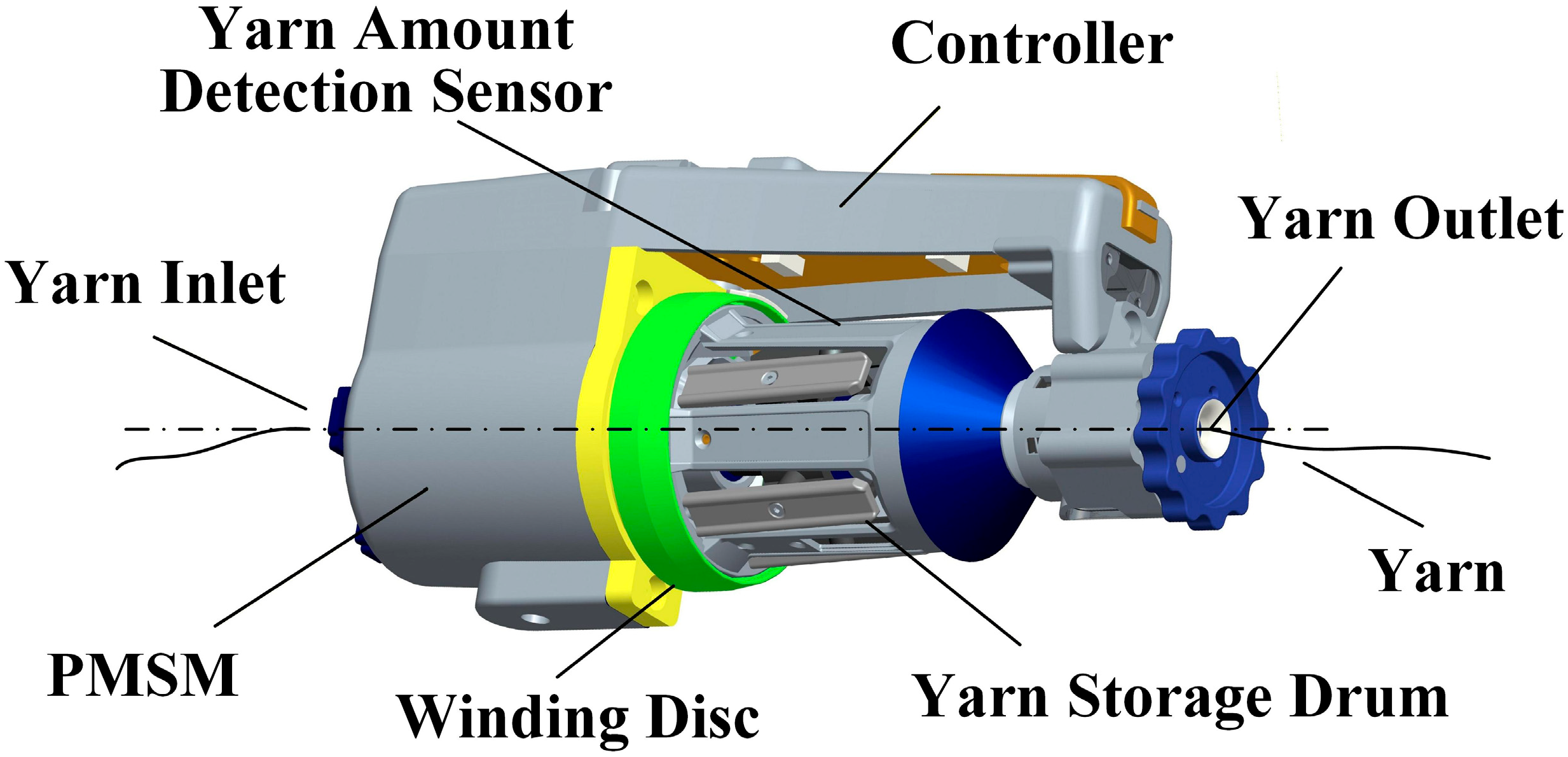
The structural diagram of the entire system of the yarn feeder is shown in Figure 1, which consists of a PMSM, a controller, a yarn amount detection sensor, a yarn inlet, a yarn outlet, a yarn storage drum, a winding disk, and other mechanisms. When the system is working, the weaving machine pulls the yarn out of the yarn outlet, and the controller detects the real-time yarn amount on the yarn storage drum through the yarn amount detection sensor. After calculation by the closed-loop control algorithm, it drives the PMSM to operate, driving the yarn to input from the yarn inlet, thus maintaining the dynamic balance between the input and output of the yarn.

2.2. Motor Rotor Position and Velocity Estimation Method Based on Average Acceleration

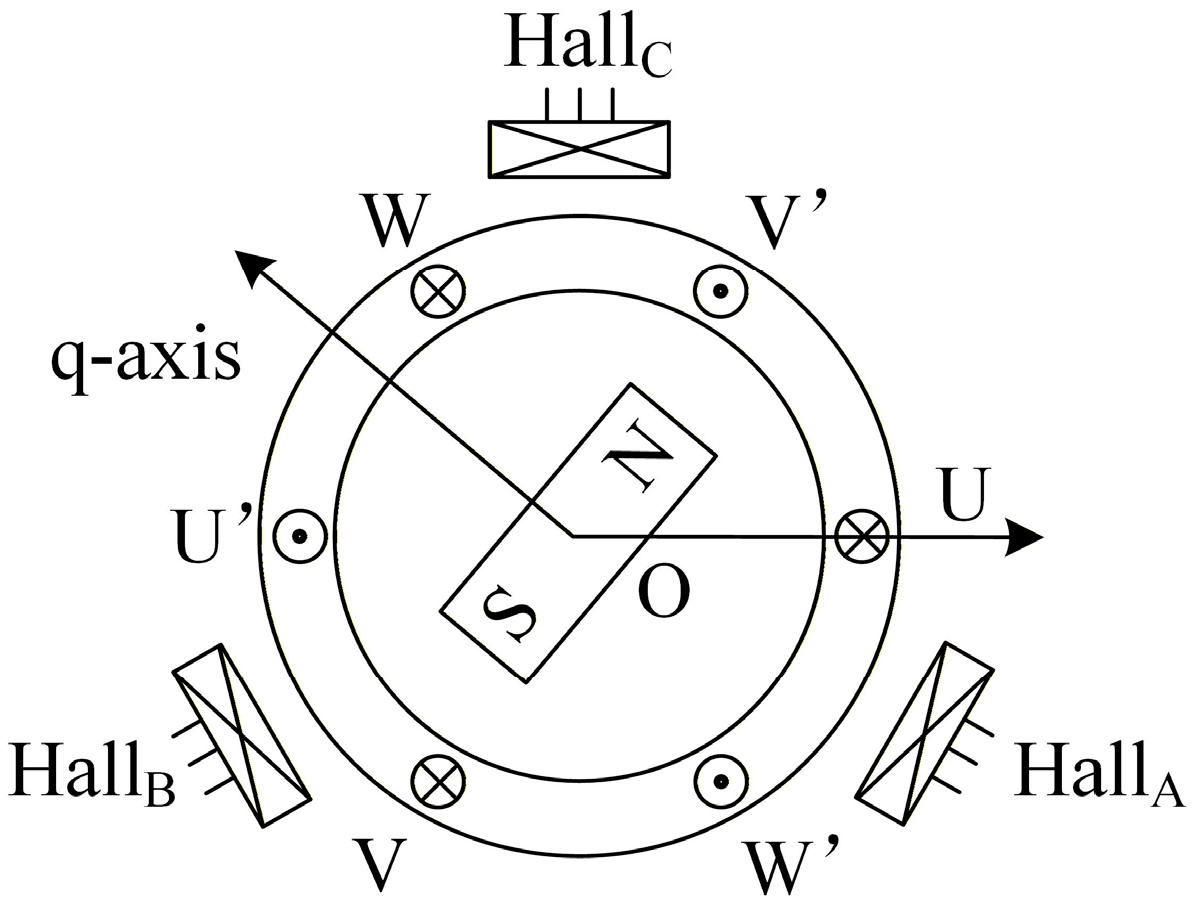
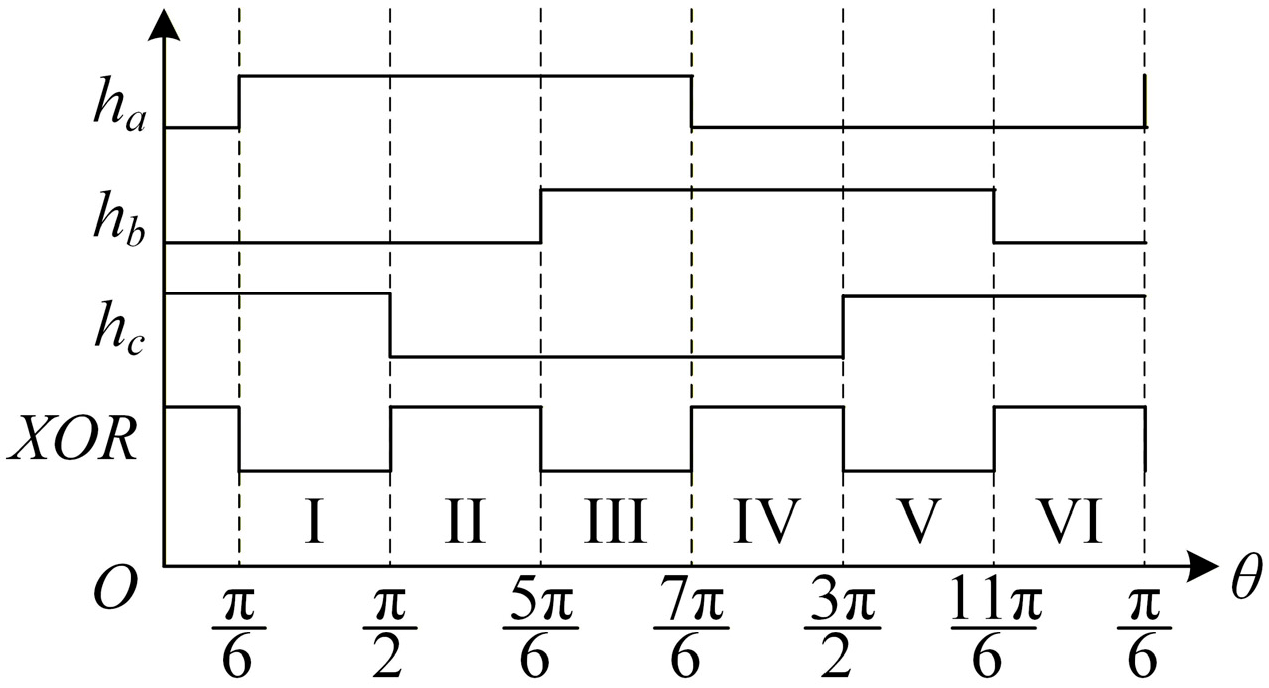
In a PMSM, three-phase switching Hall position sensors are usually symmetrically installed on the stator at 120 ° electrical angle intervals. The installation diagram of the sensors is shown in Figure 2. When the sensor identification surface changes from pointing towards the S pole of the permanent magnet to the N pole, its output signal jumps from logic 0 to logic 1. Set the OU axis as the reference zero position, clockwise as the positive rotation direction. When the motor rotates clockwise, the three-phase Hall output signals (ha, hb, hc) and their XOR signals are related to the rotor position θ, as shown in Figure 3.
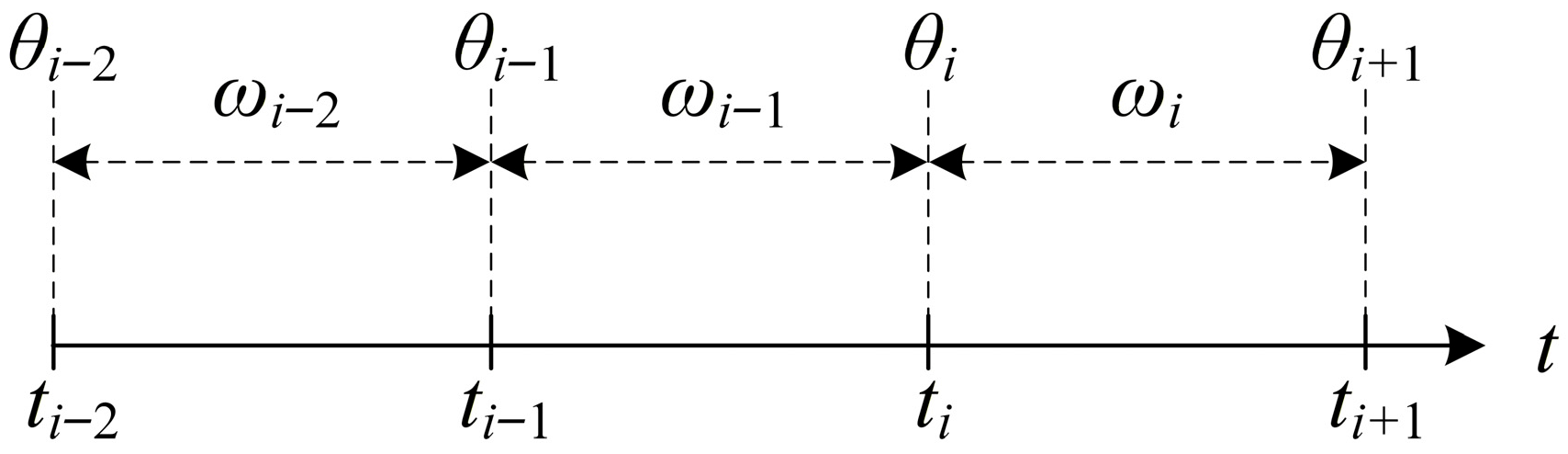
As shown in Figure 3, the switching Hall sensor can only detect information about the rotor at six specific discrete positions. The schematic diagram of position and velocity estimation using the traditional average acceleration method is shown in Figure 4.
The specific calculation equation for the traditional average acceleration method is as follows:
θ i p = θ i + ω i 1 T p + 1 2 a i 1 T p 2 ω i p = ω i + a i 1 T p a i 1 = 2 ( ω i 1 ω i 2 ) ( t i t i 1 ) + ( t i 1 t i 2 )
In the equation, Tp is the time elapsed by the rotor within the current sector; θip and ωip are the rotor position and speed at moment p within the i-th sector, respectively; θi is the initial rotor position in the i-th sector; ωi and ωi−1 are the average rotor speeds in the i-th and (i − 1)-th sectors, respectively; ai−1 is the average rotor acceleration in the (i−1)-th sector. Although the average acceleration method can obtain continuous rotor position information, its estimation results themselves have certain errors, and the installation deviation of switching Hall sensors will further amplify the estimation error, leading to a decrease in motor control performance.

3. Control Method for Yarn Amount in Yarn Feeder PMSM Based on Improved DSOGI and Kalman Filter

3.1. Hall Signal Vector Transformation

In order to reduce the detection error caused by Hall installation deviation, the Hall signal is subjected to coordinate transformation using the following equation:
h α h β = 3 2 0 3 2 1 2 1 1 2 h a h b h c
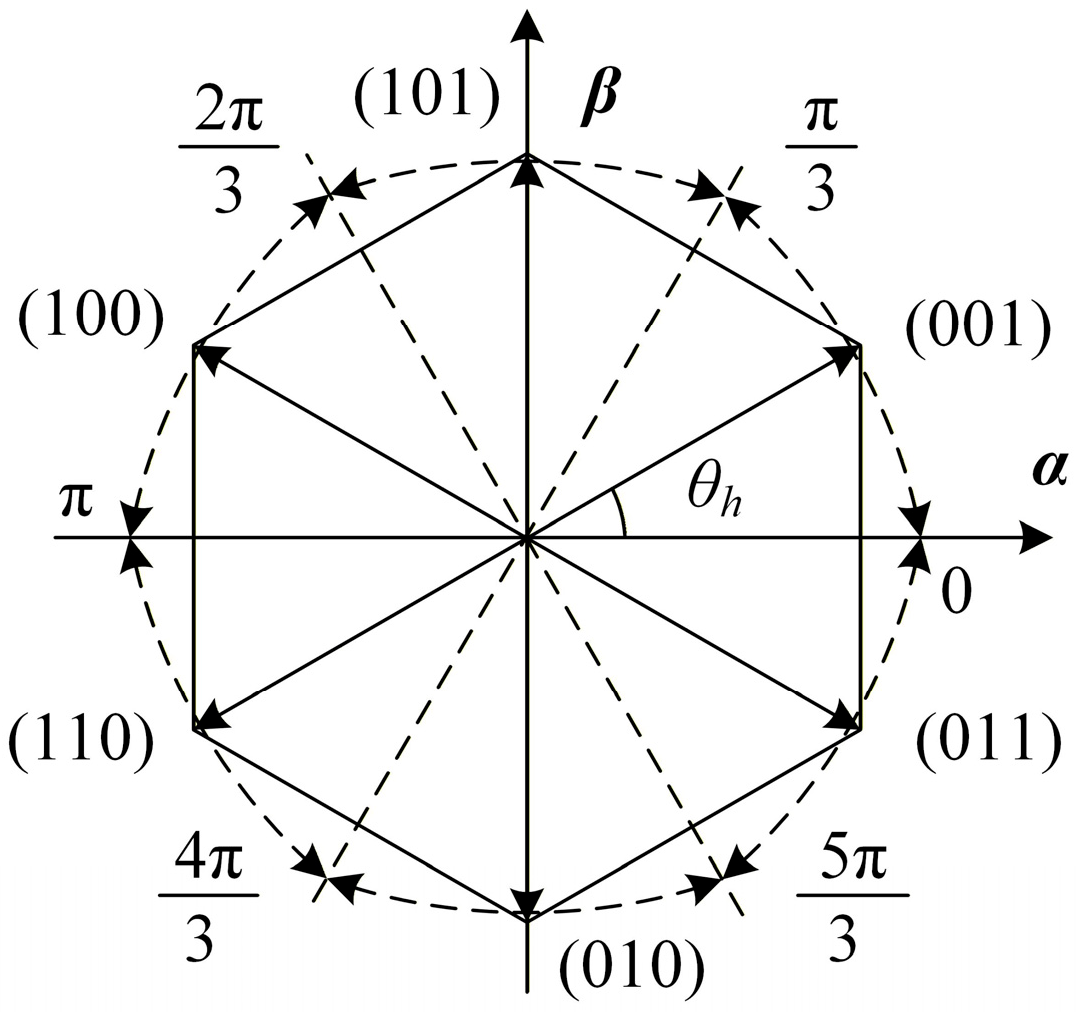
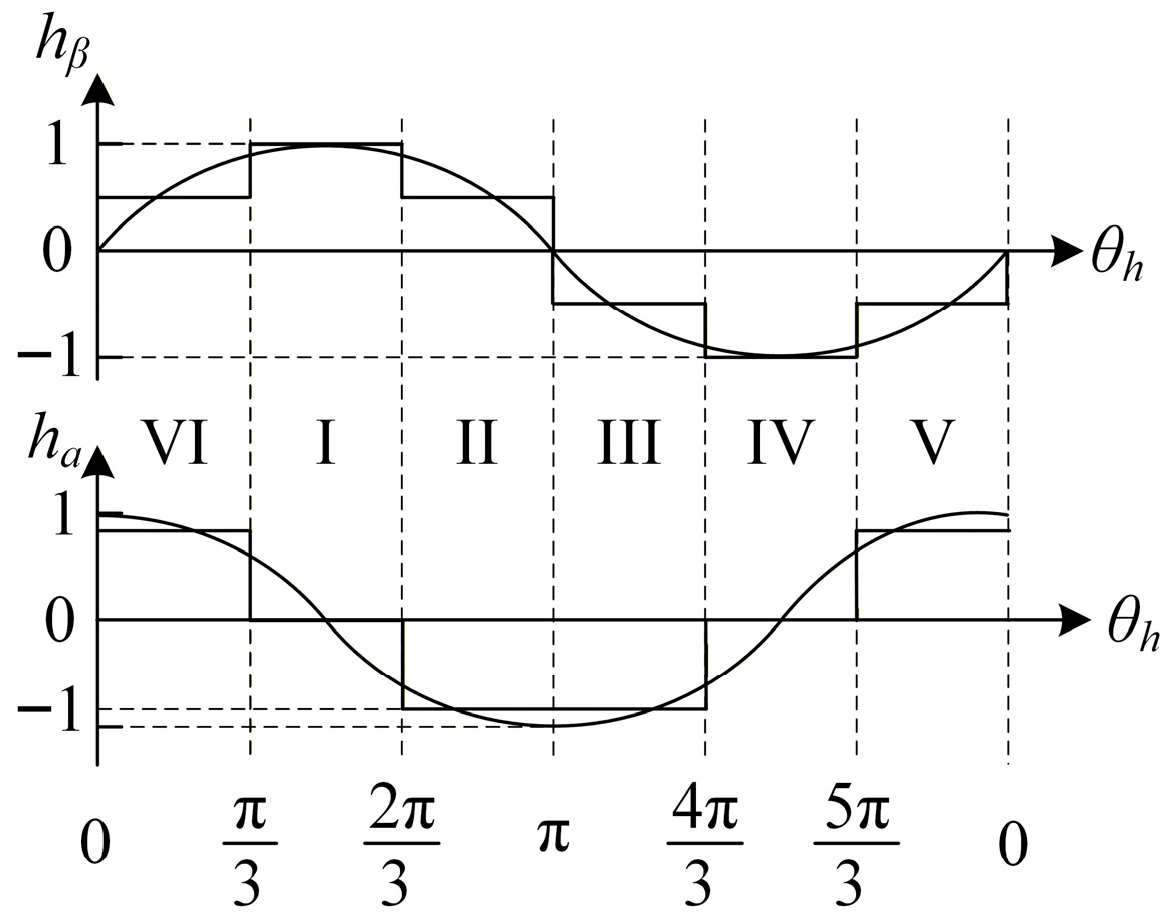
In the equation, hα and hβ are the two-phase orthogonal Hall signals after coordinate transformation. Define hα and hβ as the horizontal and vertical axes of the rotation vector Hαβ, respectively, and θh as the phase angle of the rotation vector. The transformation relationship between the rotation vector signal and the three-phase Hall signal is shown in Figure 5. Based on this definition, the relationship between the orthogonal Hall signals hα and hβ and the phase angle θh can be derived as shown in Figure 6.
Treating hα and hβ as the cosine and sine functions of θh, respectively, and performing a Fourier series expansion on them yields the following equation:
h α = n = 1 3 n π sin ( n π 3 ) + sin ( 2 n π 3 ) cos ( n ω c t ) h β = n = 1 1 n π 1 + cos ( n π 3 ) cos ( 2 n π 3 ) sin ( n ω c t )
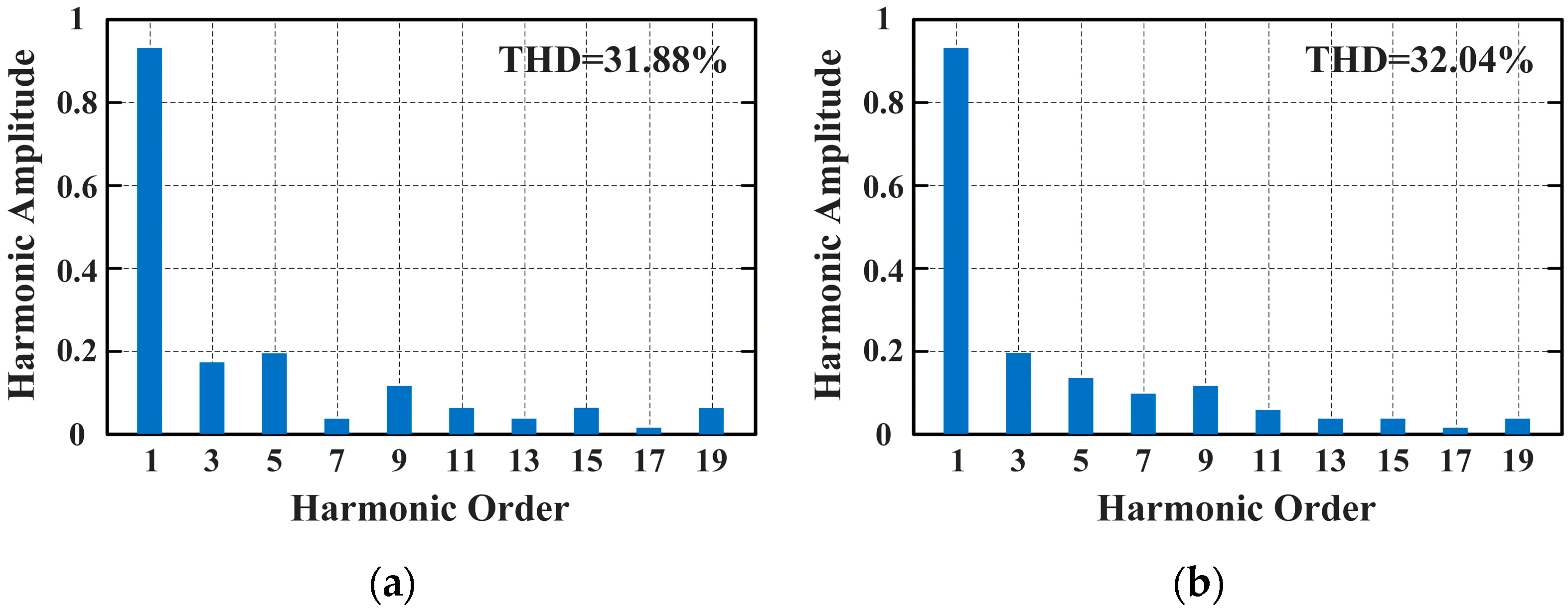
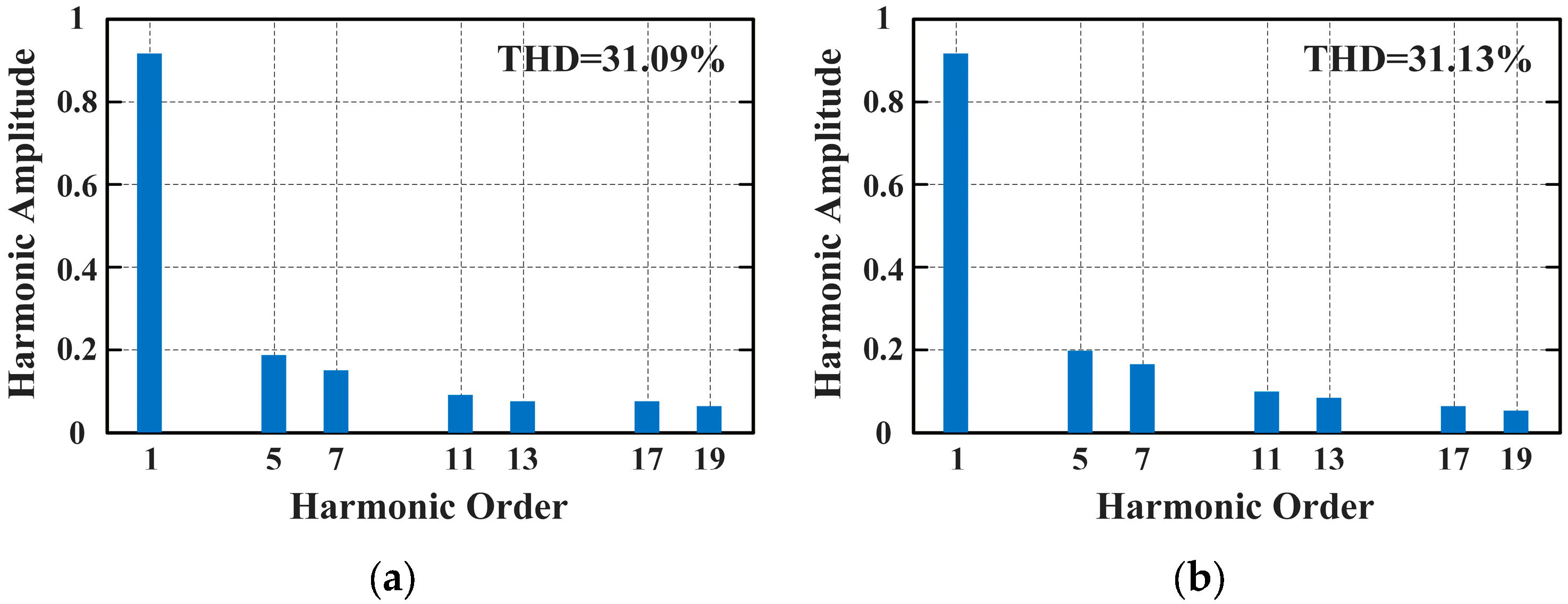
In the equation, ωc is the motor speed. Under ideal installation conditions, where the motor poles are symmetrical and the Hall sensors have no installation errors, the output Hall signals are ideal. In this case, the spectra of hα and hβ are shown in Figure 7. Spectral analysis reveals that hα and hβ contain only harmonic components of orders 6k ± 1 (k is a positive integer), with Total Harmonic Distortion (THD) values of 31.09% and 31.13%, respectively. In practical operating conditions, Hall sensor installation errors are unavoidable. Taking the example where sensors for phases A, B, and C have installation errors of 5°, 3°, and 4°, respectively, the phase differences in the three-phase Hall signals are no longer the standard 2π/3 electrical angle. Under these conditions, the corresponding spectra of hα and hβ are shown in Figure 8. Spectral analysis indicates that hα and hβ exhibit harmonics of orders 2k ± 1, with THD values of 31.88% and 32.04%, respectively.
Analysis shows that, when there are installation errors in the Hall sensor, the fundamental components that represent the true position and speed of the motor in the hα and hβ signals are almost unaffected, while the high-order harmonic components that act as interference signals change from the original 6k ± 1 harmonic to 2k ± 1 harmonic. Therefore, by designing filters to effectively filter out high-order harmonic interference and extract pure fundamental signals, the influence of Hall installation deviation can be suppressed, and accurate rotor position information can be obtained.

3.2. Motor Rotor Position and Velocity Estimation Method Based on Improved DSOGI with Cross-Coupled Filtering

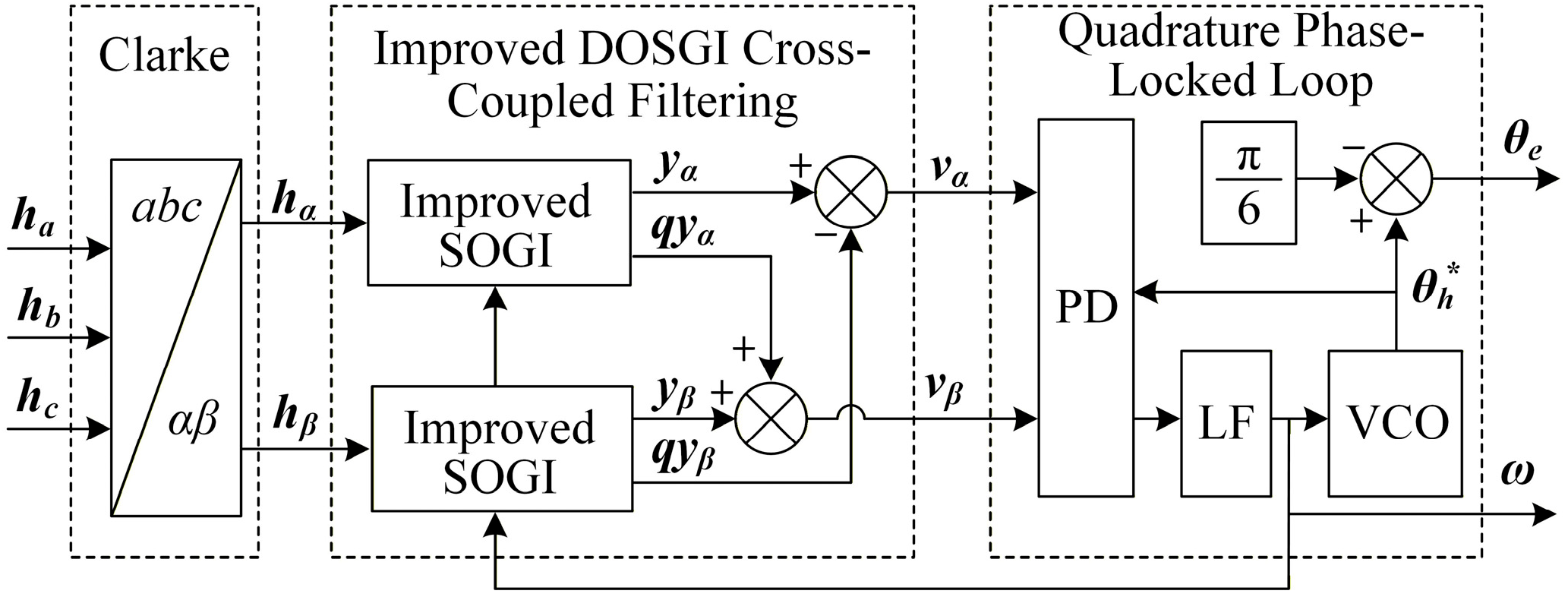
The high-order harmonic components of Hall vector signals can be filtered out using a second-order generalized integrator (SOGI), but the ability of SOGI to suppress high-order harmonic components is limited, and there are still some errors in rotor position and velocity estimation. To improve the filtering performance, a motor rotor position and velocity estimation method based on improved DSOGI with cross-coupled filtering is proposed, the schematic of which is shown in Figure 9. Firstly, the Hall signals ha, hb and hc are transformed into hα and hβ via coordinate transformation. Secondly, hα and hβ are fed into the improved SOGI, and the filtered two pairs of orthogonal signals yα, qyα, and yβ, qyβ are output. A cross-coupled structure is then employed to further enhance the filtering performance. Finally, the cosine function vα and sine function vβ are processed by a quadrature phase-locked loop to obtain the position and velocity information of the motor rotor.

3.2.1. Second-Order Generalized Integrator

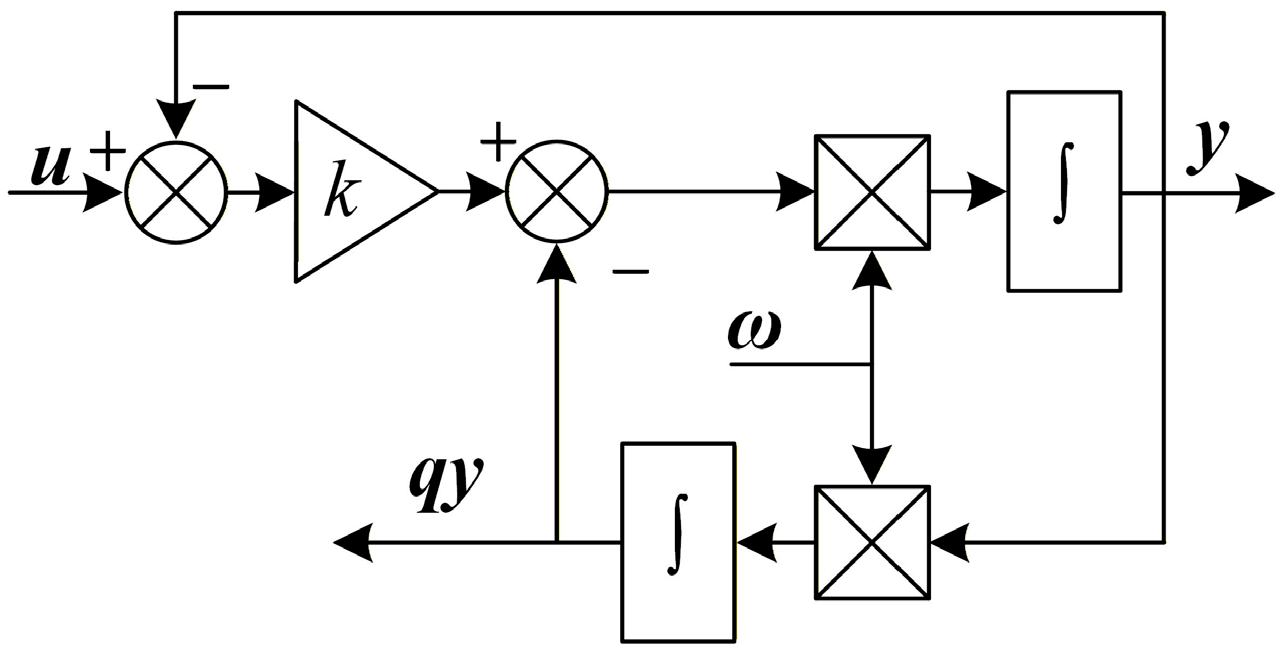
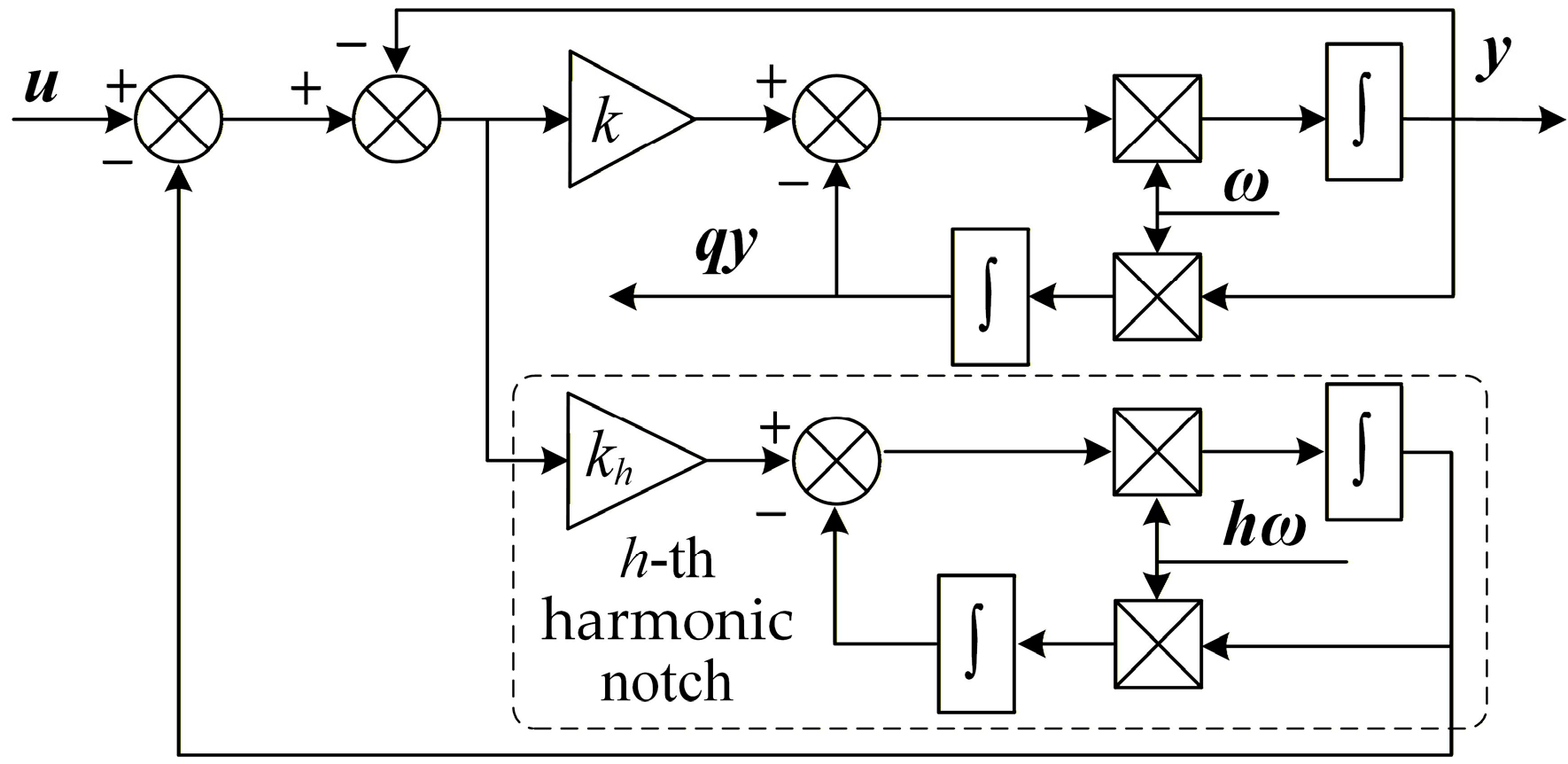
The structure diagram of the second-order generalized integrator is shown in Figure 10.
The system takes u(t) as input and outputs both in-phase component y(t) and quadrature component qy(t), corresponding to the transfer function as follows:
D 1 ( s ) = y ( s ) u ( s ) = k ω s s 2 + k ω s + ω 2 Q 1 ( s ) = q y ( s ) u ( s ) = k ω 2 s 2 + k ω s + ω 2
In the equation, k is the gain coefficient and ω is the resonant frequency. To analyze its harmonic suppression characteristics, calculate the amplitude and phase at the fundamental frequency ω and each harmonic frequency hω. The equation is as follows:
D 1 ( j ω ) = 1 0 D 1 ( j h ω ) = 1 ( 1 h 2 ) / k 2 h 2 + 1 [ tan 1 ( 1 h 2 k h ) ] Q 1 ( j ω ) = 1 ( π 2 ) Q 1 ( j h ω ) = k ( 1 h 2 ) + k 2 h 2 [ tan 1 ( k h 2 1 h 2 ) ]
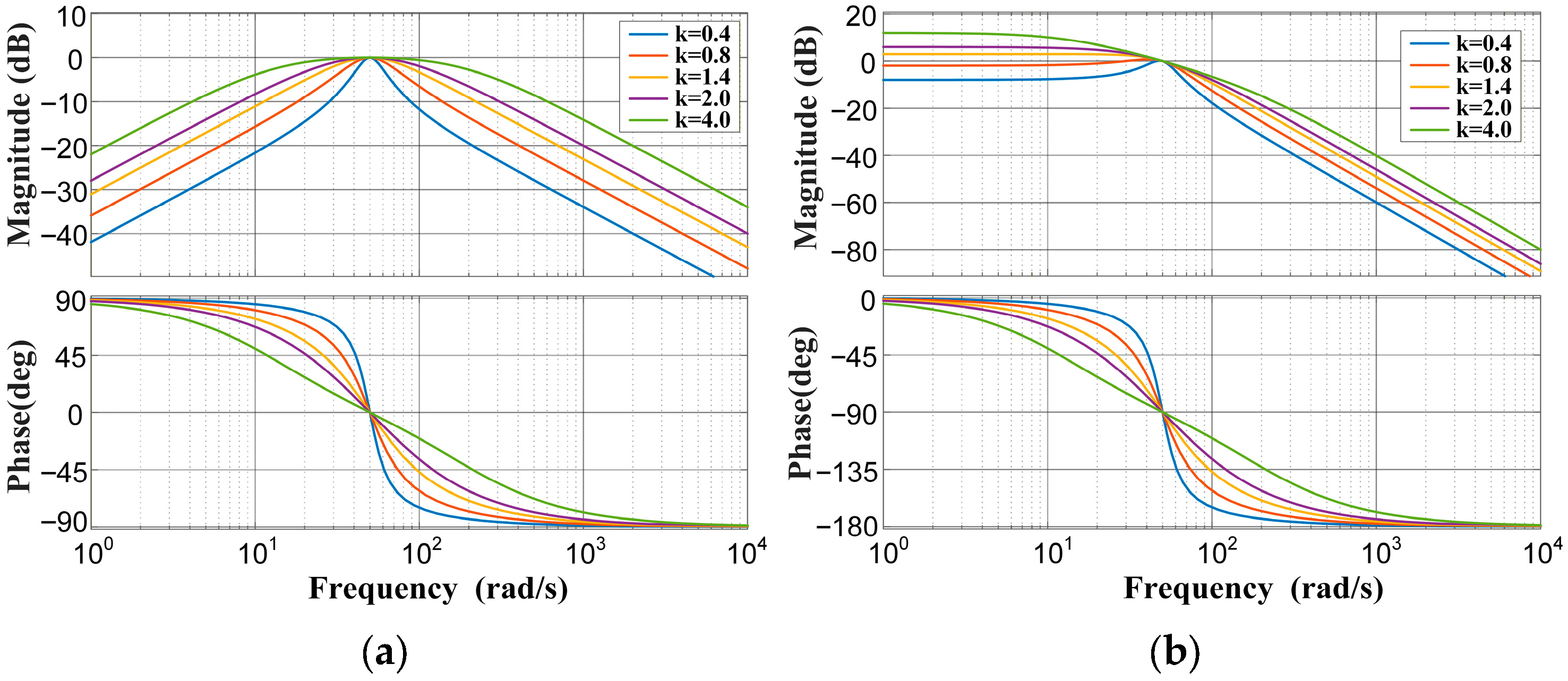
According to the equation, at the fundamental frequency ω, D1(s) has a gain of 1 and a phase of 0°, while Q1(s) has a gain of 1 and a phase lag of 90°. At higher-order harmonic frequencies, both gains decrease significantly, and Q1(s) lags behind D1(s) by 90° in phase. Therefore, second-order generalized integrators have the function of suppressing higher-order harmonic components. When the fundamental frequency ω is set to 50π rad/s, the Bode plots of the transfer functions D1(s) and Q1 (s) are shown in Figure 11. The analysis indicates that, as the gain coefficient k increases, the system cutoff frequency shifts toward higher frequencies, while the phase margin decreases accordingly. With a smaller value of k, the system exhibits higher stability, but the dynamic response speed is limited; with a larger value of k, the response speed improves, but the stability margin decreases significantly, making the system prone to oscillation. To maximize the dynamic response performance while ensuring system stability, a comprehensive trade-off was made, and the gain coefficient k = 1.4 was ultimately selected.

3.2.2. Improved Dual Second-Order Generalized Integrating Cross-Coupled Filter

Based on the spectrum analysis of the Hall signals, the third harmonic is identified as the high-order harmonic component closest to the fundamental wave. Due to the limited ability of the SOGI to suppress harmonics near the fundamental frequency, the third harmonic still has a certain impact on the accuracy of rotor position estimation. For higher-order harmonics such as the 5th and 7th, the original structure already provides effective suppression, making their impact is relatively small. Therefore, an h-th harmonic notch filter is introduced into the traditional SOGI structure, as shown in Figure 12. By setting h = 3, targeted suppression of the main interference components is achieved.
In the figure, the dashed box represents the h-th harmonic notch filter, kh is the notch filter gain coefficient, and hω is the notch frequency. The transfer function can be derived as follows:
D 2 ( s ) = y ( s ) u ( s ) = k s ( s 2 + k h s + h 2 ω 2 ) ( s 2 + k ω s + ω 2 ) ( s 2 + k h s + h 2 ω 2 ) + k k h ω s Q 2 ( s ) = q y ( s ) u ( s ) = k ω ( s 2 + k h s + h 2 ω 2 ) ( s 2 + k ω s + ω 2 ) ( s 2 + k h s + h 2 ω 2 ) + k k h ω s
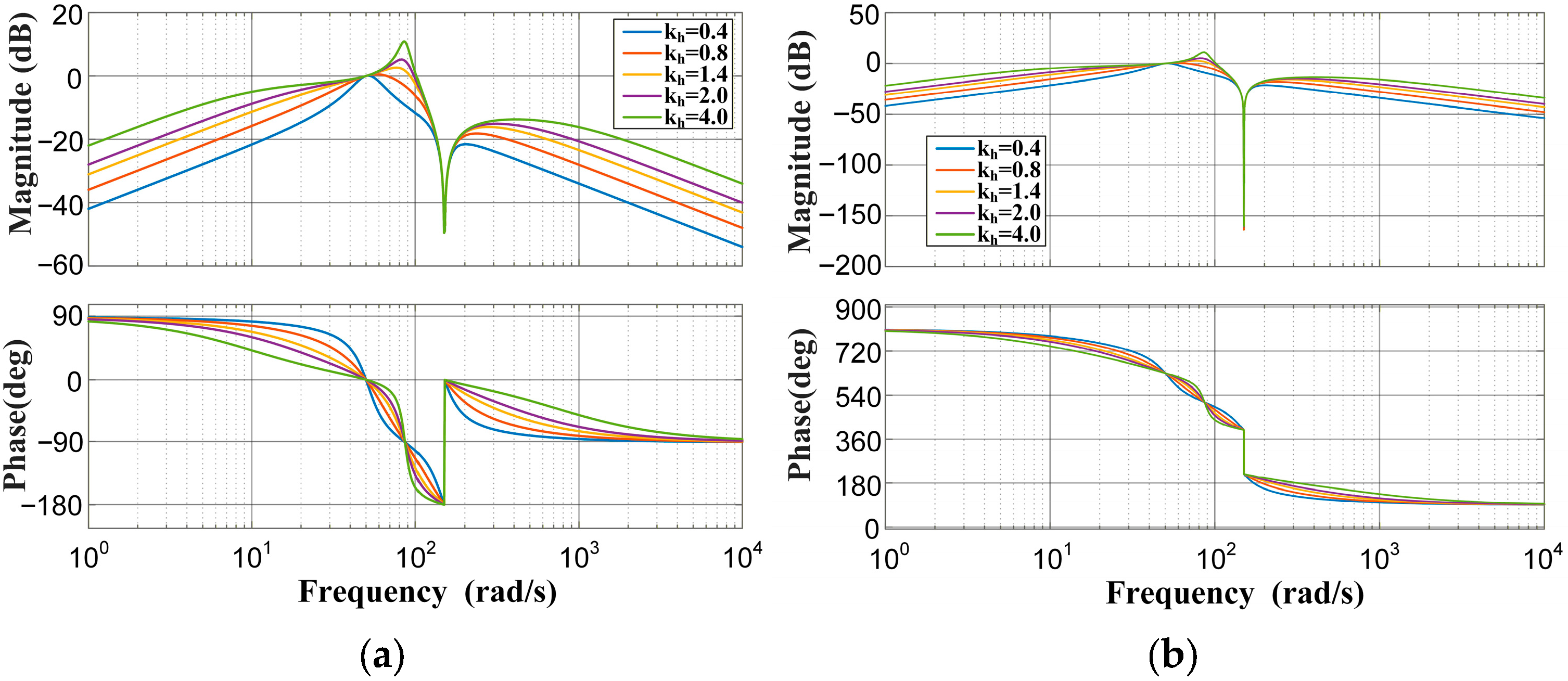
When the fundamental frequency ω is set to 50π rad/s and h is set to 3, the Bode plots of the transfer functions D2(s) and Q2(s) are shown in Figure 13. Analysis of the figure shows that the system phase margin decreases as kh increases. When kh = 1.4, the system phase margin meets the typical engineering stability requirements. Compared to kh = 0.8, its bandwidth is significantly wider, and the dynamic response is markedly faster. Compared to kh = 2.0, it provides a higher phase margin and better system stability. Therefore, selecting kh = 1.4 is the optimal choice for improving dynamic response while ensuring sufficient stability margin. It achieves a good comprehensive balance in key indicators such as phase margin, cutoff frequency, and step response time.
Following filtering by the improved SOGI, the third-order harmonic components in the Hall vector signals hα and hβ are effectively suppressed, resulting in two pairs of orthogonal signals: yα, qyα, and yβ, qyβ. Cross-coupled processing of these two signal pairs can enhance the fundamental component and suppress high-order harmonic components with negative coefficients. As shown in Figure 9, the two-phase orthogonal signals vα and vβ output after cross-coupling are expressed as follows:
v α = D 2 ( s ) h α Q 2 ( s ) h β v β = D 2 ( s ) h β + Q 2 ( s ) h α
According to Equation (3), the fundamental components hα,based and hβ,based of the Hall signal can be expressed as follows:
h α , b a s e d = 3 π cos ω c t h β , b a s e d = 3 π sin ω c t
Due to the 90° lag between the Q2(s) output signal and the D2(s) output signal, after substituting Equation (8) into Equation (7), the fundamental components of the orthogonal signals vα and vβ are obtained to be twice hα,based and hβ,based, respectively. Therefore, the fundamental components are superimposed and enhanced. The high-order harmonic components hα,neg with negative coefficients and their corresponding hβ,neg can be expressed as follows:
h α , n e g = n = 1 3 ( 6 n 1 ) π cos ( 6 n 1 ) ω c t h β , n e g = n = 1 3 ( 6 n 1 ) π sin ( 6 n 1 ) ω c t
Similarly, by substituting Equation (9) into Equation (7), the amplitude of the high-order harmonic components of the negative coefficients of the orthogonal signals vα and vβ is much smaller than that of hα,neg, and hβ,neg before cross coupling. Therefore, the negative coefficient harmonic components are further suppressed.
Finally, Equation (7) is expanded and simplified to obtain the transfer function Gα,β(s) of the improved DSOGI cross-coupled structure as follows:
G α , β ( s ) = v α , β ( s ) h α , β ( s ) = k ( s 2 + k h s + h 2 ω 2 ) ( s + j ω ) ( s 2 + k ω s + ω 2 ) ( s 2 + k h s + h 2 ω 2 ) + k k h ω s
Among them, the input of the transfer function is the two-phase orthogonal Hall signal hα,β(s), and the output is the filtered two-phase orthogonal signal vα,β(s).
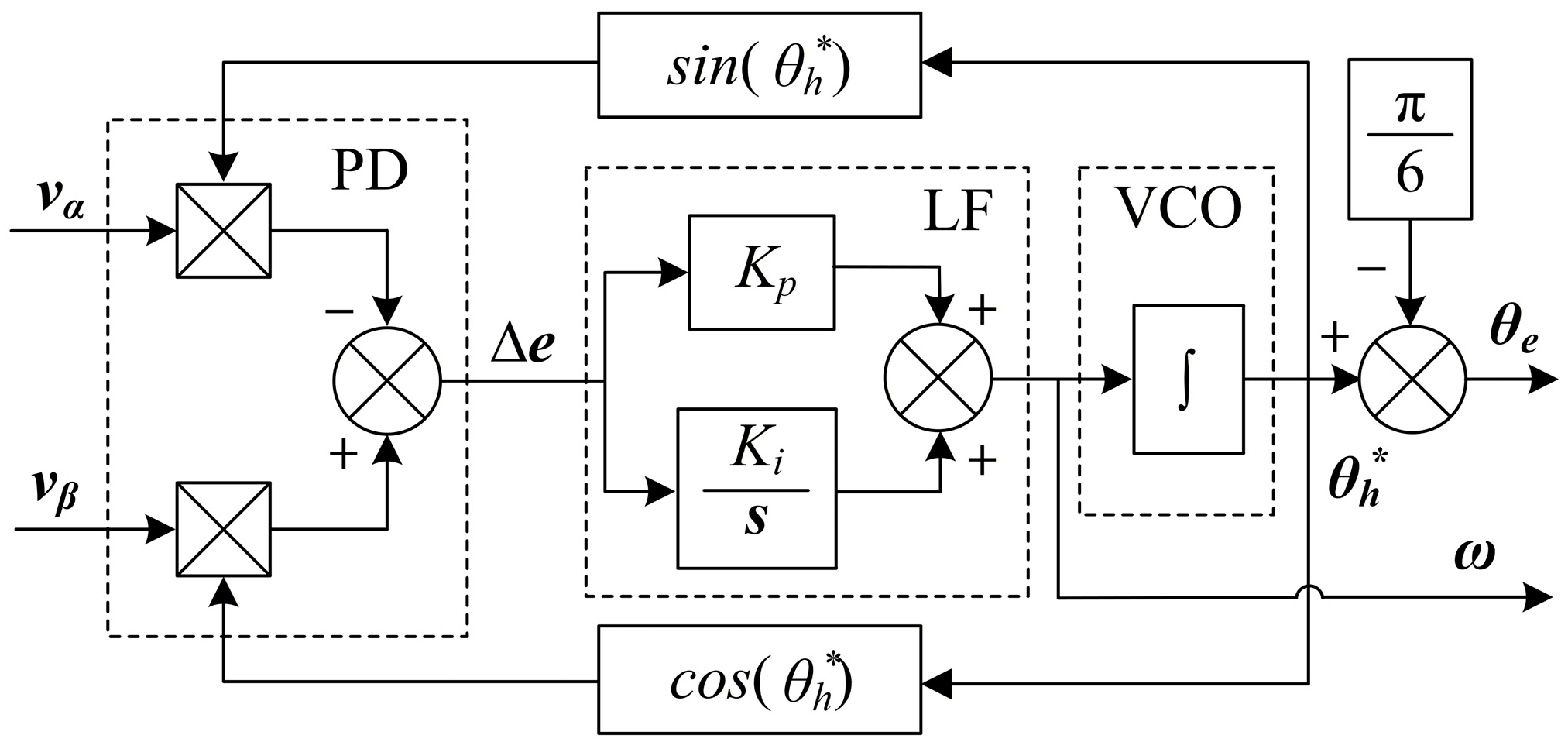
As mentioned earlier, vα and vβ are the cosine and sine functions of the filtered motor rotor position. The position and velocity information of the motor rotor can be extracted through a quadrature phase-locked loop. The structure diagram of the quadrature phase-locked loop is shown in Figure 14, consisting of a phase detector (PD), a loop filter LF, and a voltage-controlled oscillator (VCO).

3.3. Yarn Amount Detection Based on Kalman Filter

In order to provide accurate feedback signals to the closed-loop control of yarn amount and improve the stability of yarn amount control in the yarn feeder, the system uses a linear Hall yarn amount sensor as the detection unit and introduces the Kalman filtering algorithm to process the signal, filtering out measurement noise and interference.
Firstly, define the yarn amount Y and its rate of change V as the system states, with i as the sampling instant, and Ts as the sampling period. The system state equation is as follows:
x ( i + 1 ) = A x ( i ) + λ ( i )
In the equation, x(i) is the state vector, A is the state transition matrix, λ(i) is the process noise vector, and the values are x ( i ) = Y ( i ) V ( i ) , A = 1 T s 0 1 , λ ( i ) = λ 1 ( i ) λ 2 ( i ) . In this study, experimental tests were conducted on the yarn feeder under typical operating conditions. A continuous sequence of state observations during steady-state operation was collected and substituted into the state Equation (11) to derive the sequence of state prediction residuals. Subsequently, the variances of λ1(i) and λ2(i) were calculated, yielding σ λ 1 2 = 0.1 and σ λ 2 2 = 0.9 , respectively. The corresponding process noise covariance matrix Q is as follows:
Q = E λ ( i ) λ ( i ) T = σ λ 1 2 0 0 σ λ 2 2
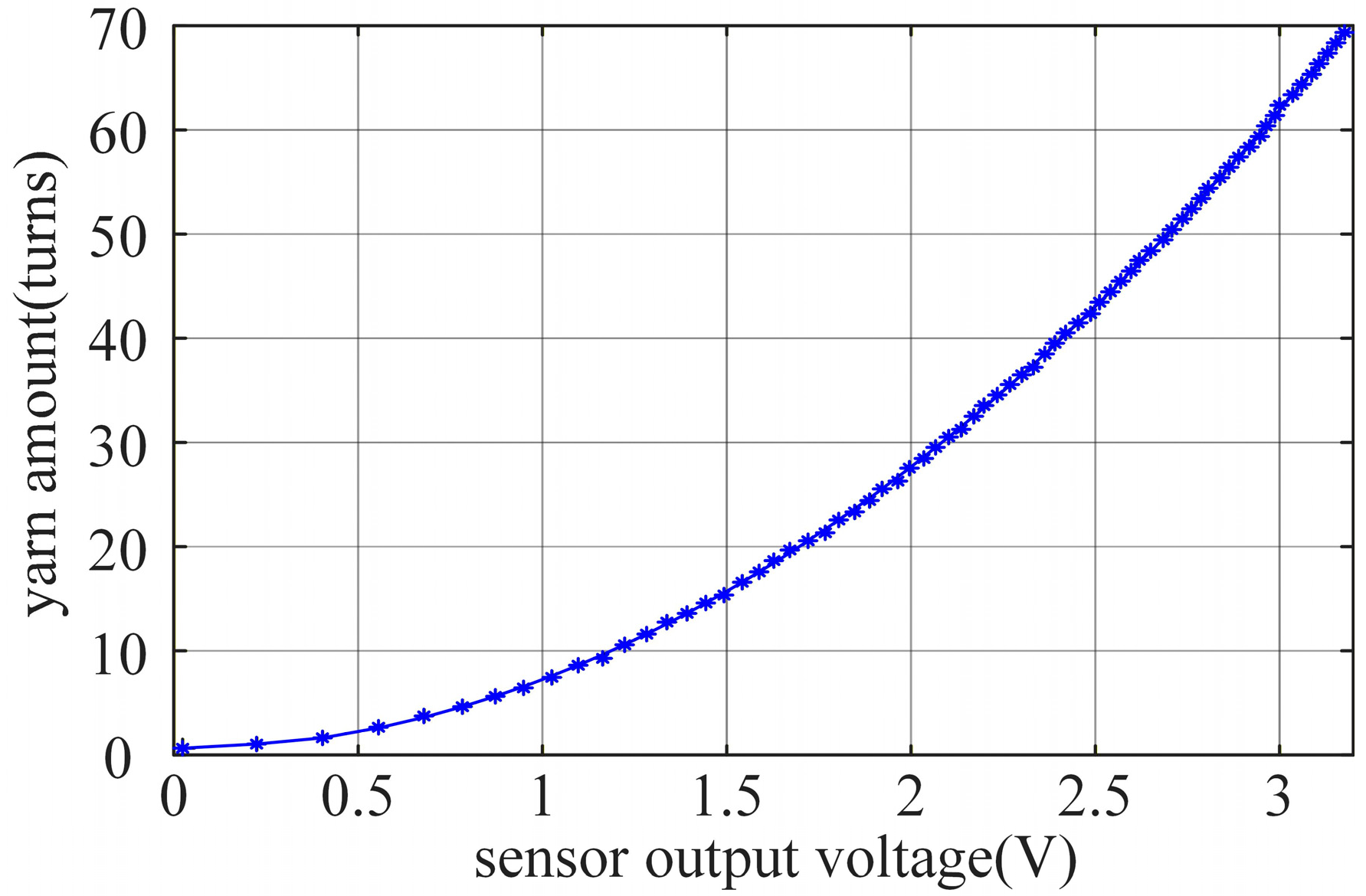
Secondly, the yarn amount analog value Z(i) is acquired via a linear Hall sensor and mapped through a calibration function g(∙) to obtain the observed yarn amount as follows:
Y h = g ( Z ( i ) )
where the calibration function g(∙) is obtained through offline calibration experiments, and its mapping relationship is illustrated in Figure 15.
Based on the obtained observation, the observation equation of the system is established:
y ( i ) = C x ( i ) + γ ( i )
In the equation, C is the measurement matrix, specifically C = 1 0 , and γ(i) represents the measurement noise. By continuously sampling the output signal of the linear Hall sensor over an extended period while the yarn is completely stationary, the variance of the measurement noise is calculated, and its estimated value is σ2 = 0.01. Its covariance matrix R is as follows:
R = E γ ( i ) γ ( i ) T = σ 2
Parameter sensitivity analysis of the process noise covariance Q and measurement noise covariance R was performed using measured data from the yarn feeder. The results indicate that, when both parameters vary within 0.5 to 2 times their nominal values, the change in state estimation error is small, demonstrating good robustness of the filter within this range.
Finally, the Kalman filter is employed to obtain the optimal state estimate. Its state prediction equations are as follows:
x ( i | i 1 ) = A x ( i 1 | i 1 ) P ( i | i 1 ) = A P ( i 1 | i 1 ) A T + Q
In the equation, x(i|i − 1) is the prior estimation state, and P(i|i − 1) is the covariance matrix of the prior estimation error. When a new sensor observation vector y(i) is obtained at time i, the update is performed with the following equations:
G ( i ) = P ( i | i 1 ) C T ( C P ( i | i 1 ) C T + R ) 1 e r r ( i ) = y ( i ) C x ( i | i 1 ) x ( i | i ) = x ( i | i 1 ) + G ( i ) e r r ( i ) P ( i | i ) = ( I G ( i ) C ) P ( i | i 1 )
In the equation, G is the Kalman gain, err is the observation residual, and I is the identity matrix. The term x(i|i) represents the optimal estimated yarn amount at time i after Kalman filtering.

3.4. Control Method for Yarn Amount in Yarn Feeder PMSM Based on Improved DSOGI and Kalman Filter

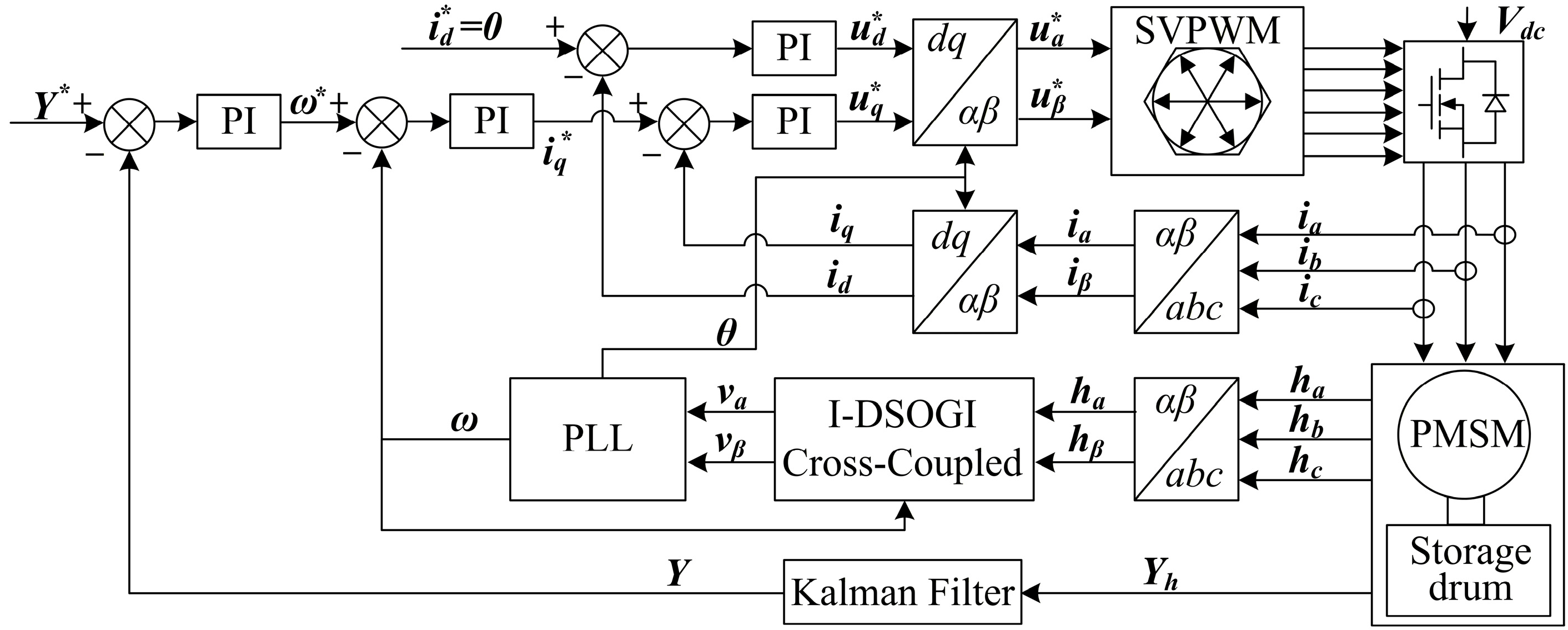
In summary, the improved DSOGI cross-coupled filtering algorithm and the Kalman filter algorithm are integrated to construct a complete yarn amount control system for the yarn feeder PMSM. The overall framework is shown in Figure 16. In this system, the Hall signals from the PMSM’s switching Hall sensors are processed by the improved DSOGI cross-coupled filter, and then the motor rotor position θ and speed ω are accurately estimated via a quadrature phase-locked loop (QPLL). The raw signal measured by the yarn amount sensor is processed by the Kalman filter to obtain accurate yarn amount information Y. The acquired rotor speed, position, and yarn amount information together provide precise feedback for the system’s current loop, speed loop, and yarn control loop, forming a closed-loop control that enables precise yarn amount control for the yarn feeder PMSM.

4. Experimental Testing and Analysis

4.1. Experimental Platform Construction

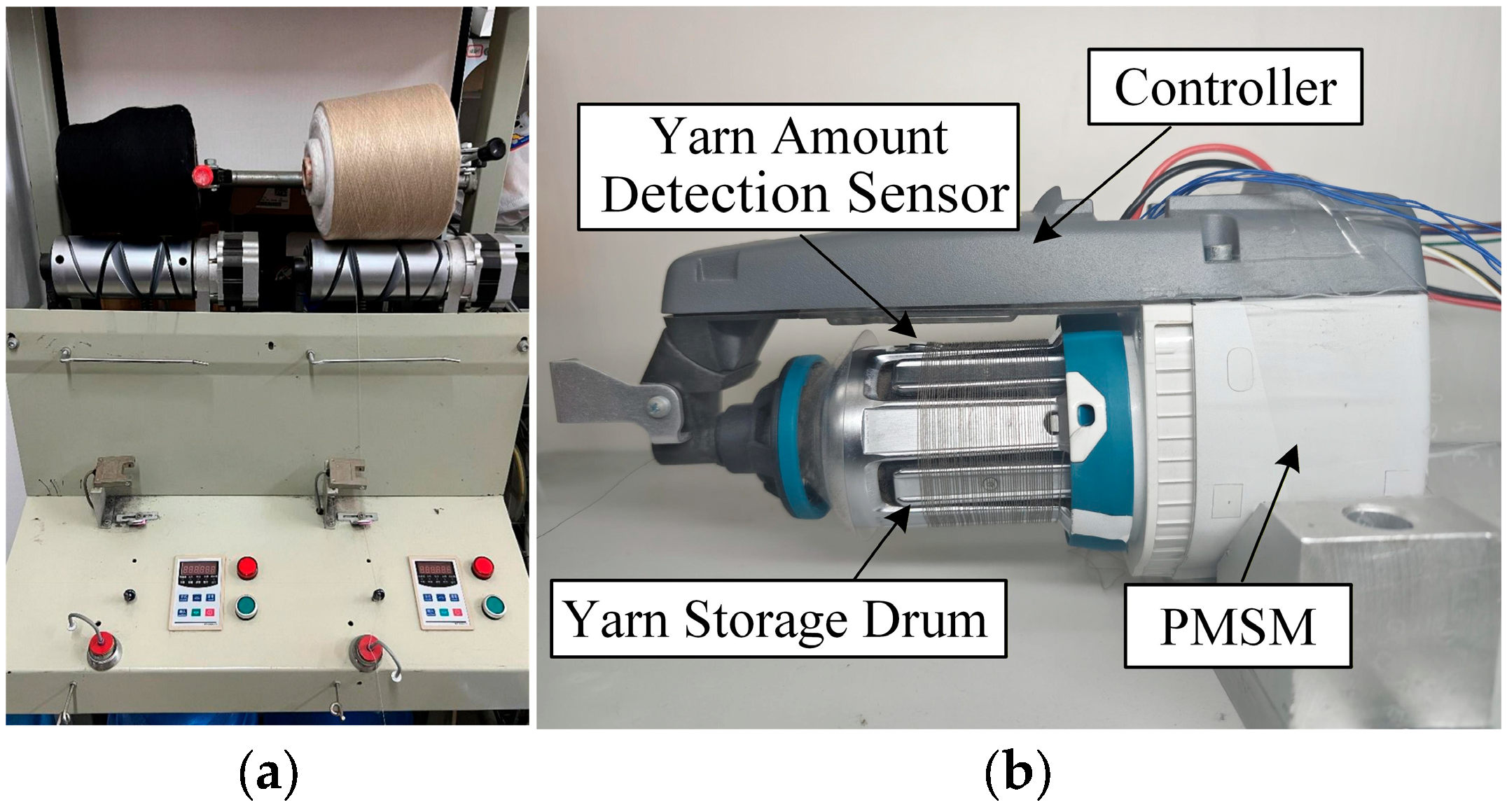
In order to verify the effectiveness of the proposed method, key components and the entire system of the yarn feeder were designed, and a complete experimental testing platform was built, as shown in Figure 17. The platform mainly consists of a yarn feeder and a yarn winding machine, among which the yarn feeder includes key components such as a PMSM, controller, a yarn amount detection sensor, and a yarn storage drum. The controller employs an STM32F405RGT6 microcontroller (STMicroelectronics, Geneva, Switzerland), with the system sampling and control cycle both set to 100 µs. Within this cycle, the single execution time of the improved DSOGI algorithm is far less than the control period, meeting real-time requirements, and its implementation complexity does not pose a bottleneck for engineering application. Yarn amount detection utilizes the HAL2420 linear Hall sensor (TDK-Micronas, Freiburg, Germany), whose measured output noise peak-to-peak value under static conditions is approximately 3.5 mV. The analog voltage signal output from the sensor is acquired via the controller’s ADC module, and the related algorithms are implemented in C within the Keil development environment. The specific parameters of the PMSM are shown in Table 1. Based on this platform, comparative tests were conducted between a PMSM yarn amount control method using a vector tracking observer (VTO) with yarn photoelectric detection (PD) and a PMSM yarn amount control method based on an improved dual second-order generalized integrator (DSOGI) and Kalman filter (KF). In the experiment, the initial value of the yarn amount was set to 60 turns. After the yarn winding machine was started, the yarn was pulled out and controlled by the motor to maintain a stable yarn amount of 50 turns.
To objectively and quantitatively evaluate the performance of the proposed method, the key performance indicators in this paper are defined as follows:
Steady-state error is measured using the normalized root mean square error. The speed steady-state error (ES) is defined as the normalized root mean square error of the measured motor speed ωmeans(k) relative to the target speed ωref during steady-state operation. The calculation formula is as follows:
E S = 1 N k = 1 N ω m e a n s ( k ) ω r e f ω r e f 2 × 100 %
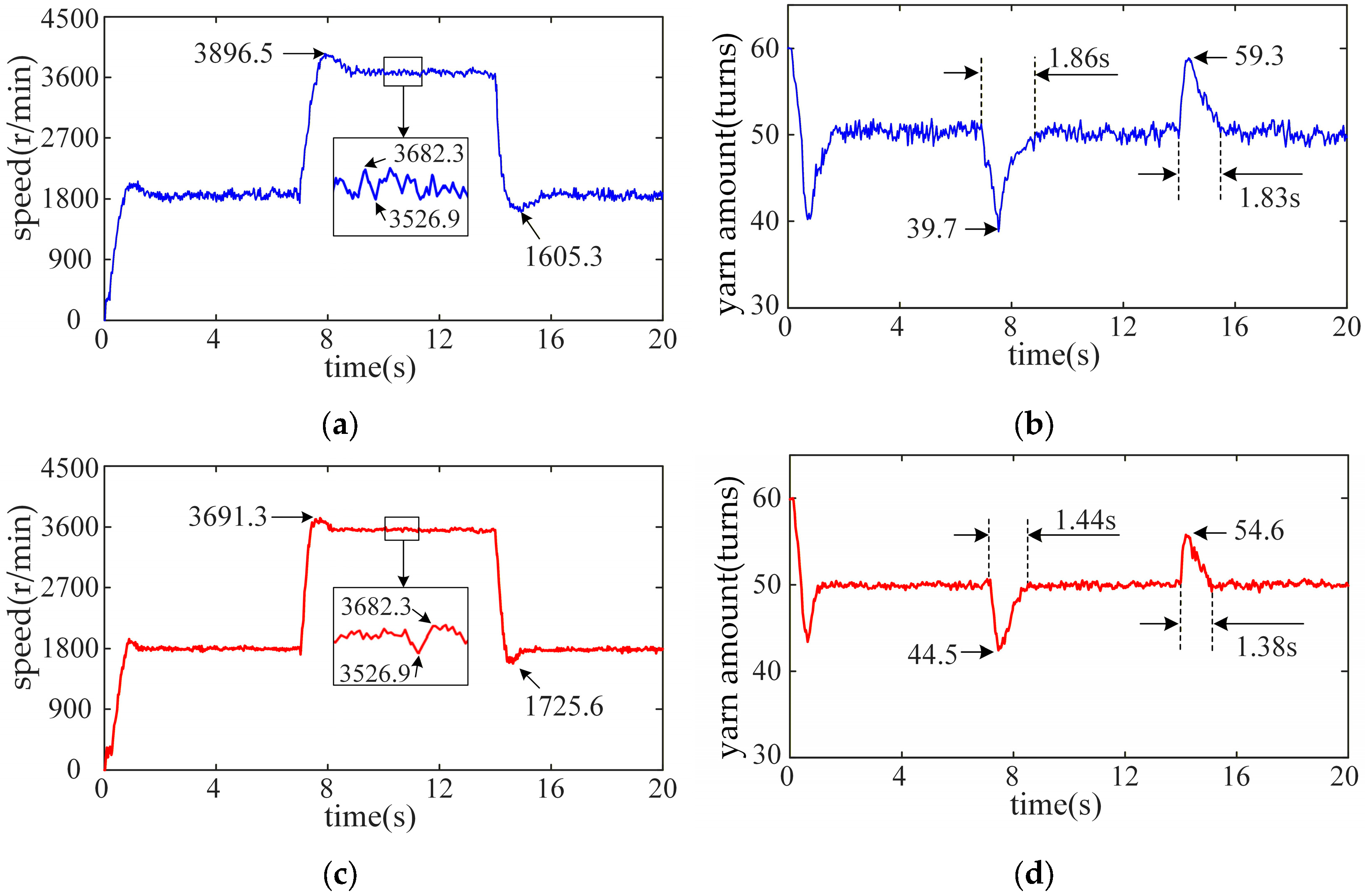
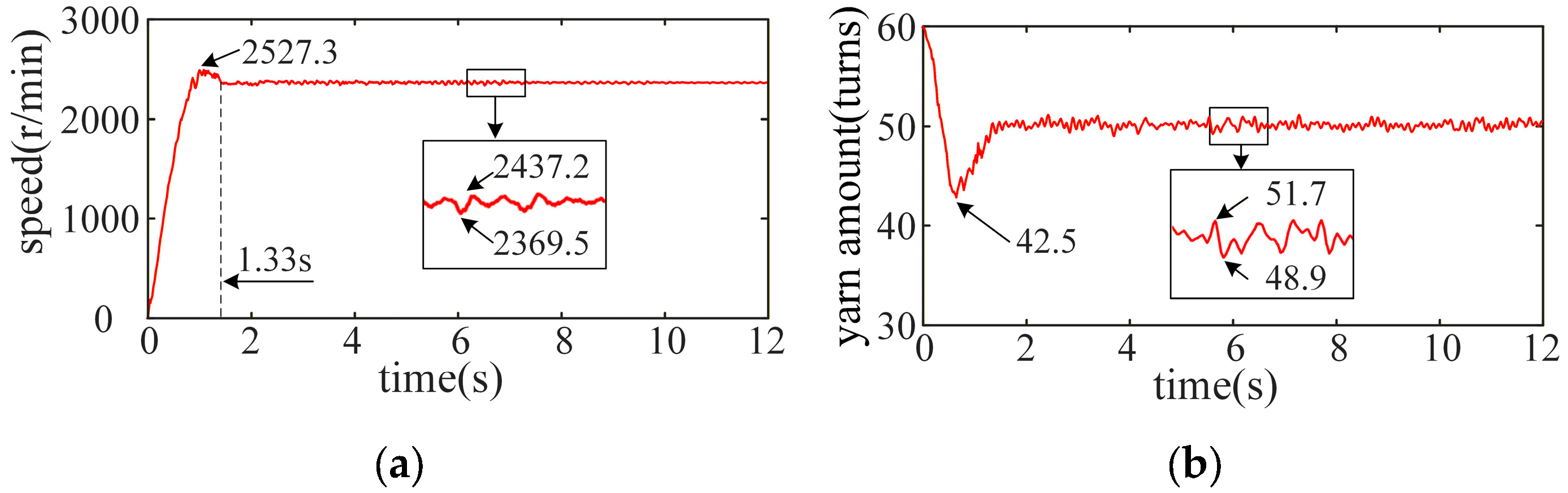
where N is the number of sampling points during the steady-state phase. The yarn amount steady-state error (EY) is defined similarly to the motor speed steady-state error. Fluctuation is defined as the difference between the maximum and minimum values of the controlled variable during the steady-state phase. Motor speed overshoot (ωpp) is defined as the difference between the peak value of the motor speed response and the target value. Maximum yarn deviation (Ypp) is defined as the absolute value of the difference between the target yarn amount and the peak value during the response process. Specifically, YppA denotes the maximum yarn deviation after sudden acceleration, and YppD denotes the maximum yarn deviation after sudden deceleration. Startup time (TST) is defined as the time when the winding machine starts pulling the yarn and the yarn feeder begins operation, until the system reaches a steady state. The settling time is defined as the time required for the yarn amount to return to a steady state after a rapid change in the winding machine’s pulling speed. Here, TAR is the settling time after sudden acceleration, and TDR is the settling time after sudden deceleration.

4.2. Yarn Feeding Performance Test Under Constant Motor Speed Operation Mode

To verify the yarn-delivery performance of the motor at different constant speeds, experimental comparative tests were conducted under the conditions of winding machine speeds of 100 m/min, 400 m/min, and 700 m/min. Using the vector tracking observer (VTO) for rotor position estimation and the photoelectric detection (PD) method for yarn amount estimation as the performance benchmark, the following methods were compared: the method using only the improved dual second-order generalized integrator (DSOGI), the method using only the Kalman filter (KF), and the method combining the improved DSOGI with the KF.
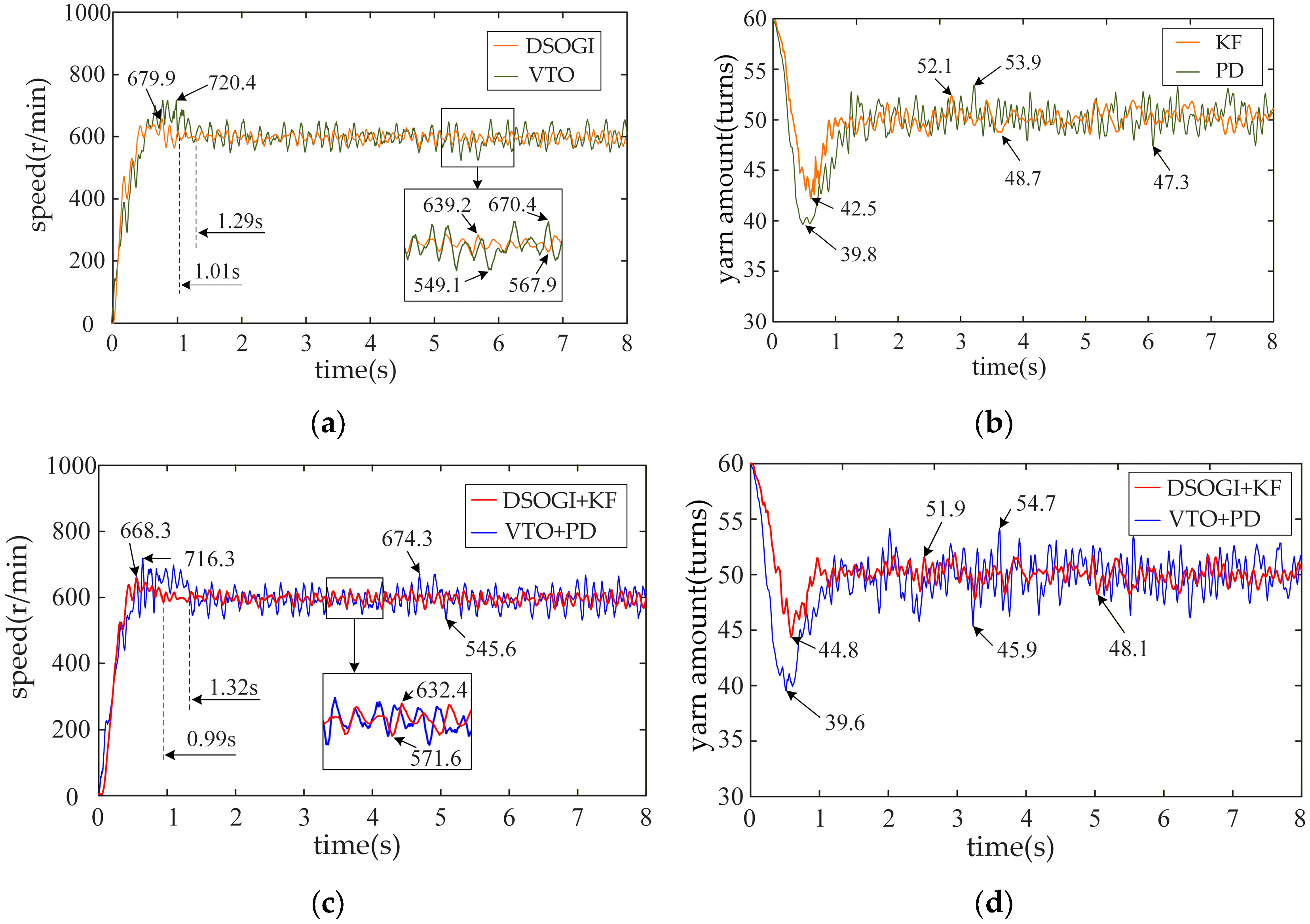
Firstly, experimental tests were conducted on the yarn winding machine at a wire speed of 100 m/min (corresponding to a PMSM speed of 600 r/min), and the obtained experimental waveforms are shown in Figure 18. Observing the waveform, it can be seen that, compared to the VTO method, the system using the improved DSOGI method reduces startup time by 0.28 s, speed overshoot by 40.5 r/min, and speed steady-state error by 4.62%. Compared to the PD method, the system using the KF method reduces the maximum yarn deviation by 2.7 turns and the yarn amount steady-state error by 3.33%. Compared to the VTO and PD methods, the system using the improved DSOGI and KF methods reduces startup time by 0.33 s, speed overshoot by 48.0 r/min, maximum yarn deviation by 5.2 turns, speed steady-state error by 6.19%, and yarn amount steady-state error by 4.5%.
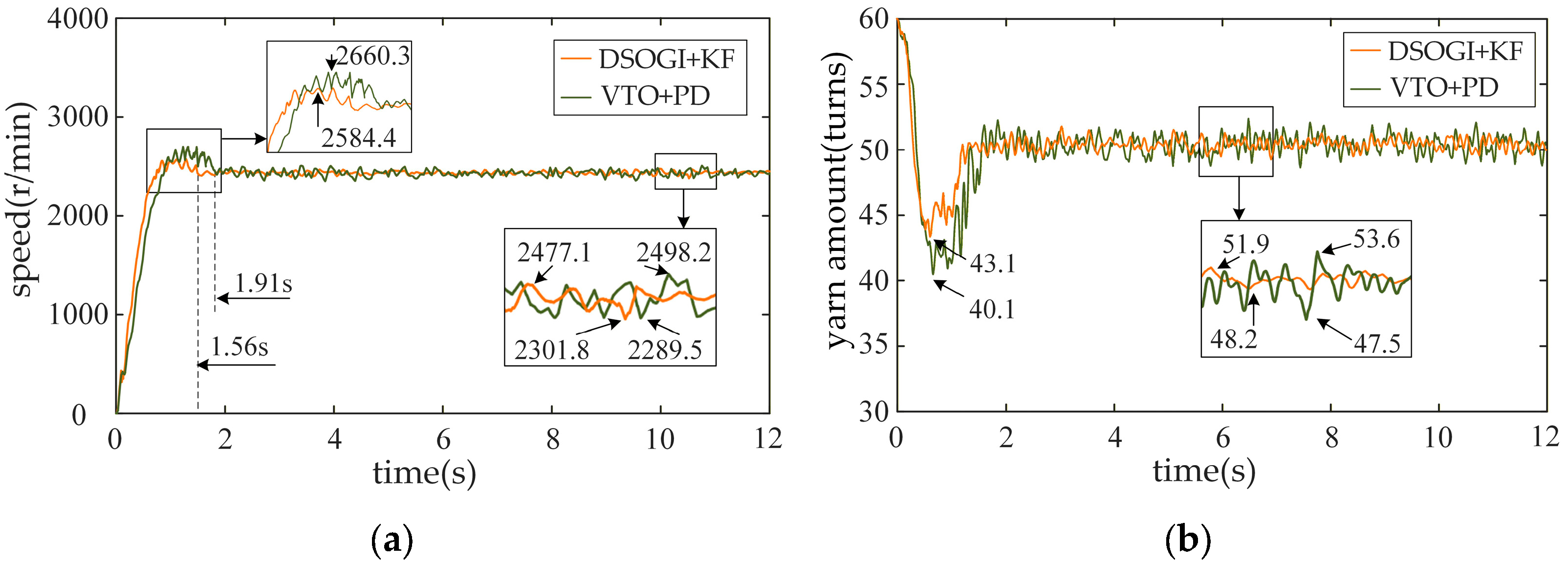
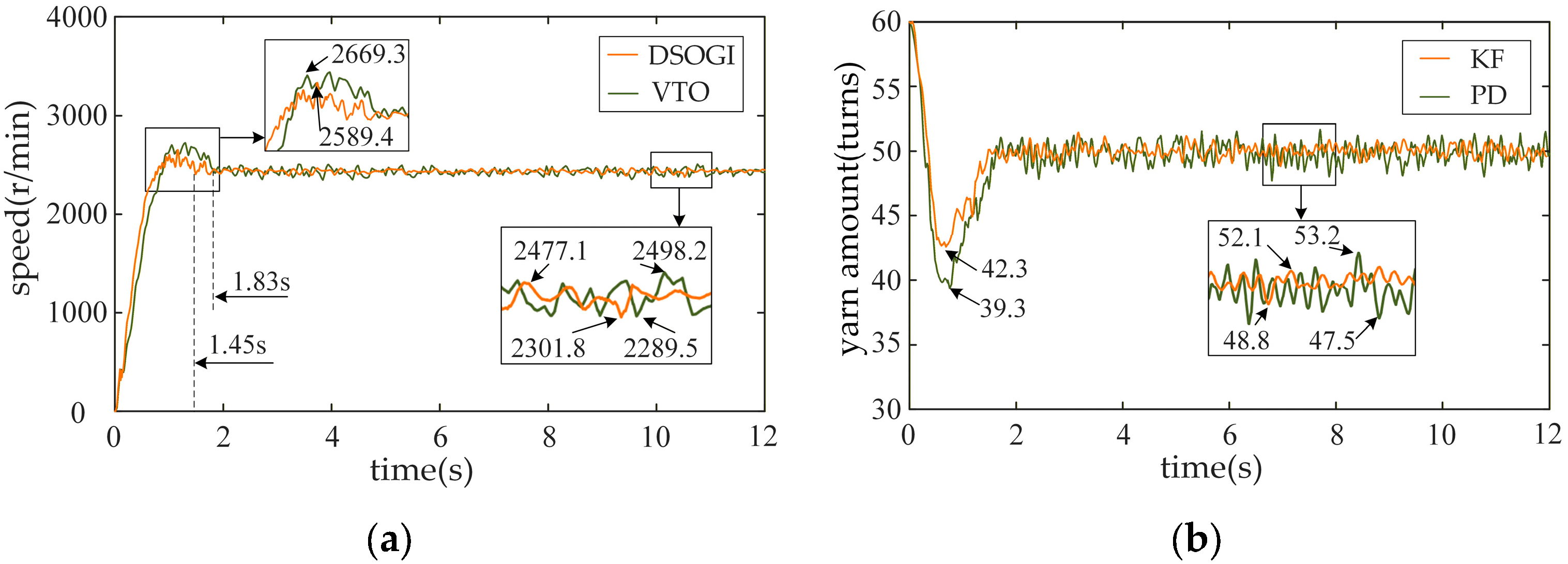
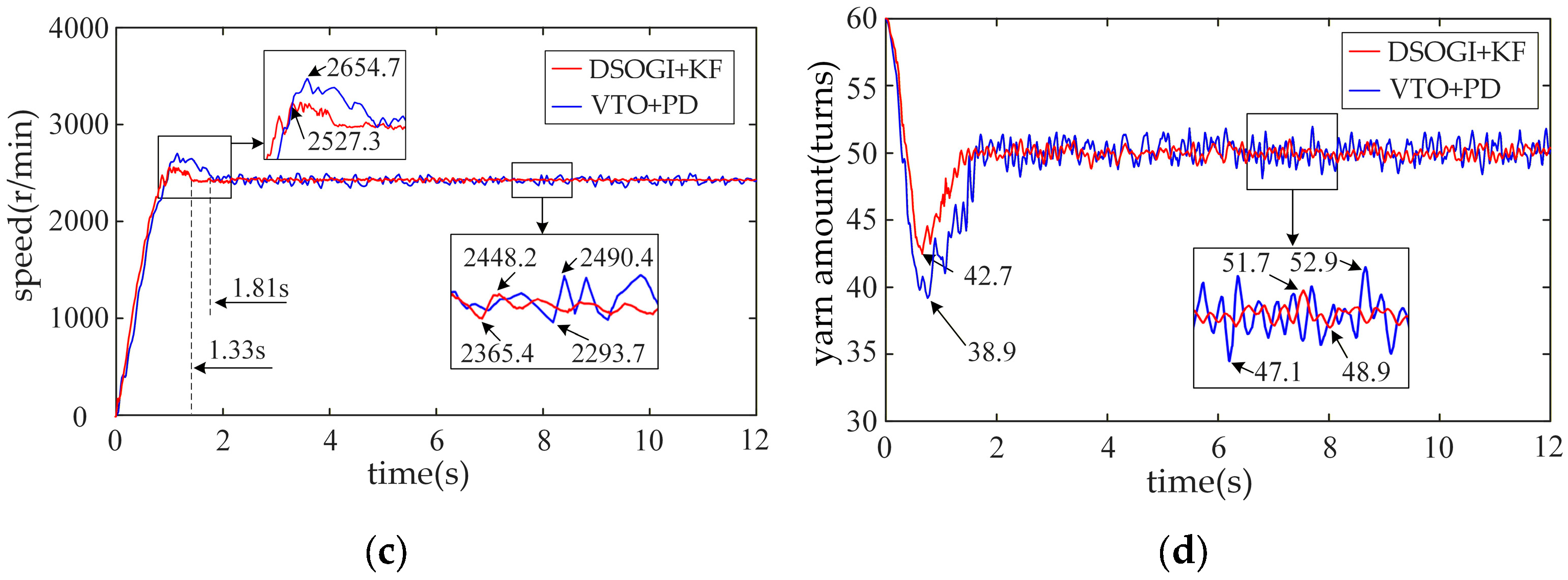
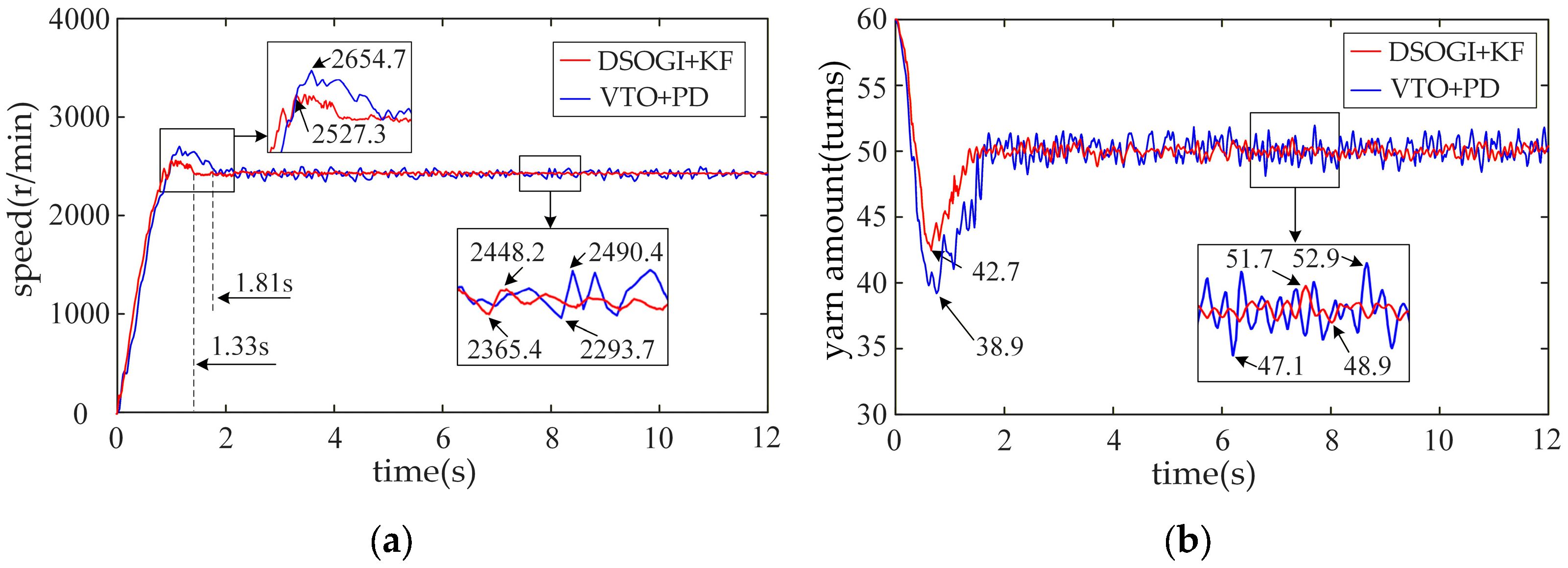
Secondly, experimental tests were conducted on the yarn winding machine at a wire speed of 400 m/min (corresponding to a PMSM speed of 2400 r/min), and the obtained experimental waveforms are shown in Figure 19. Observing the waveform, it can be seen that, compared to the VTO method, the system using the improved DSOGI method reduces startup time by 0.38 s, speed overshoot by 79.9 r/min, and speed steady-state error by 2.13%. Compared to the PD method, the system using the KF method reduces the maximum yarn deviation by 3.0 turns and the yarn amount steady-state error by 2.26%. Compared to the VTO and PD methods, the system using the improved DSOGI and KF methods reduces startup time by 0.48 s, speed overshoot by 127.4 r/min, maximum yarn deviation by 3.8 turns, speed steady-state error by 2.55%, and yarn amount steady-state error by 2.68%.
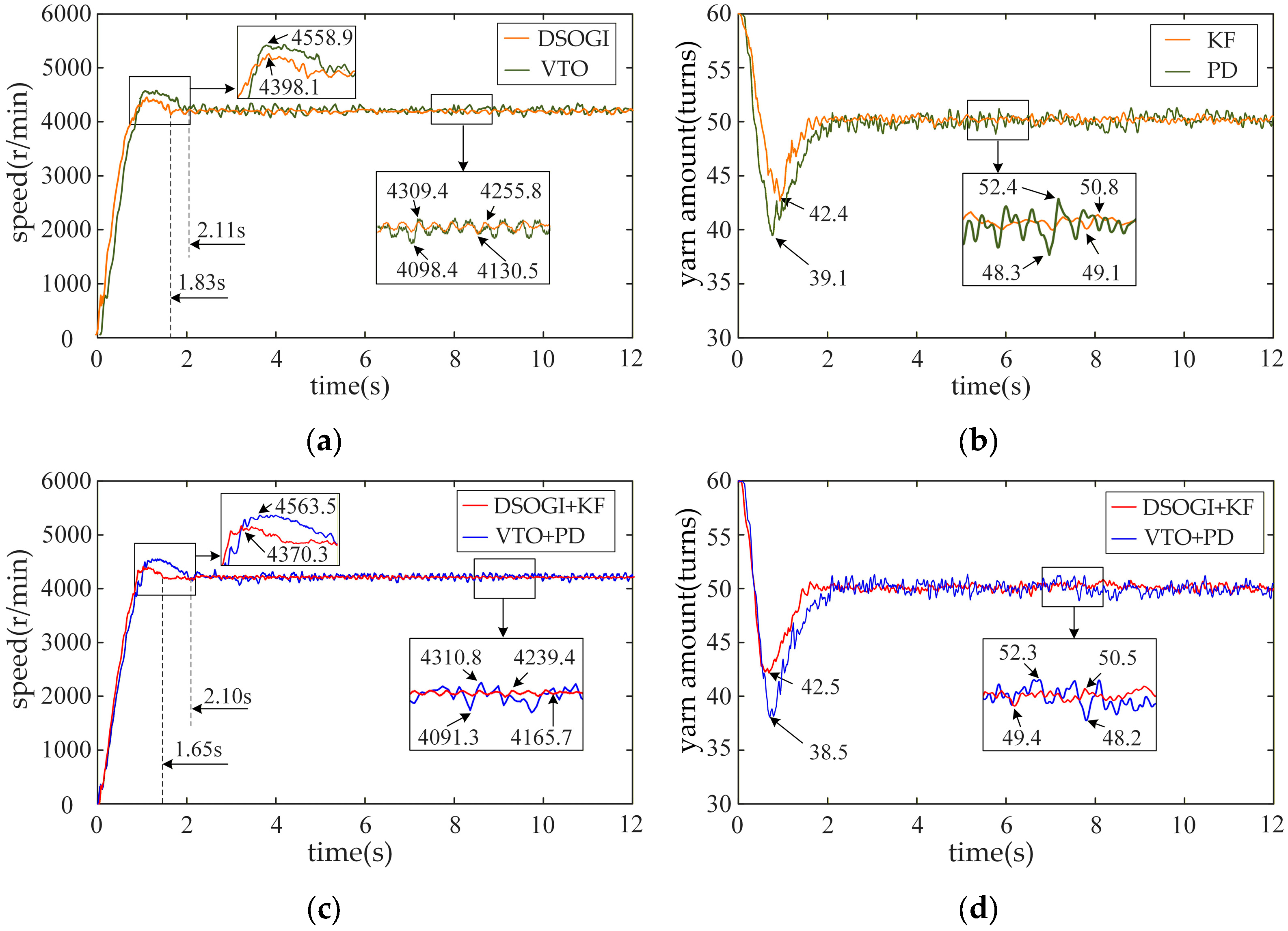
Finally, experimental tests were conducted on the yarn winding machine at a wire speed of 700 m/min (corresponding to a PMSM speed of 4200 r/min), and the obtained experimental waveforms are shown in Figure 20. Observing the waveform, it can be seen that, compared to the VTO method, the system using the improved DSOGI method reduces startup time by 0.28 s, speed overshoot by 160.8 r/min, and speed steady-state error by 1.53%. Compared to the PD method, the system using the KF method reduces the maximum yarn deviation by 3.3 turns and the yarn amount steady-state error by 1.95%. Compared to the VTO and PD methods, the system using the improved DSOGI and KF methods reduces startup time by 0.45 s, speed overshoot by 193.2 r/min, maximum yarn deviation by 4.0 turns, speed steady-state error by 1.78%, and yarn amount steady-state error by 2.16%.
Experimental results indicate that, at different constant yarn-delivery speeds, compared to the VTO and PD methods, the system performance is improved when using either the improved DSOGI method or the KF method alone. When both the improved DSOGI and KF methods are employed together, the effectiveness of both motor control and yarn amount control is further enhanced.
To enhance the reliability and stability of the experimental results, 10 independent repeated tests were conducted for both the VTO + PD method and the DSOGI + KF method under each operating condition. The key performance indicators are summarized in Table 2. As shown in the table, under different operating conditions, the yarn feeder system employing the improved DSOGI and KF method achieved reductions in startup time of 0.34 s, 0.49 s, and 0.44 s, respectively; reductions in speed steady-state error of 6.21%, 2.58%, and 1.77%, respectively; and reductions in yarn amount steady-state error of 4.60%, 2.66%, and 2.18%, respectively. The system exhibits shorter startup time, smaller steady-state errors, and better yarn-delivery performance, further demonstrating the superiority of the improved method.

4.3. Yarn Feeding Performance Test Under Variable Motor Speed Operation Mode

To verify the motor’s variable-speed performance under the condition of acceleration and deceleration of the winding machine, experimental tests were conducted on the VTO + PD method and the improved DSOGI + KF method, where the pulling speed of the yarn winding machine at 100 m/min corresponds to the motor speed of the yarn feeder at 600 r/min.
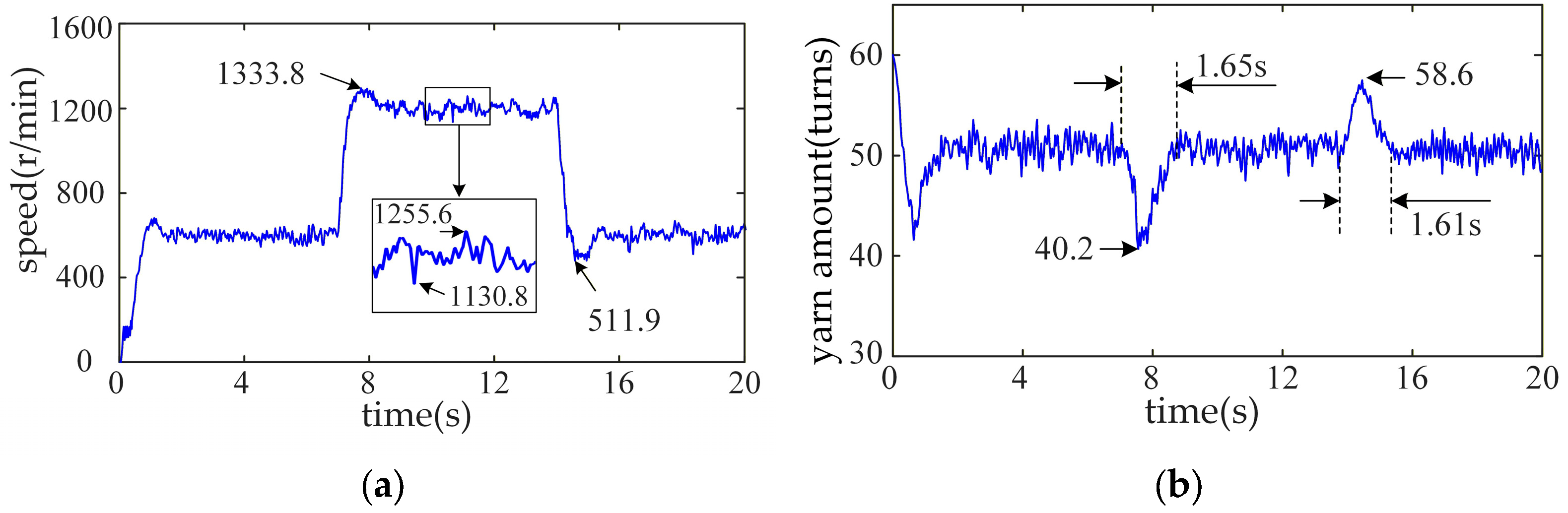
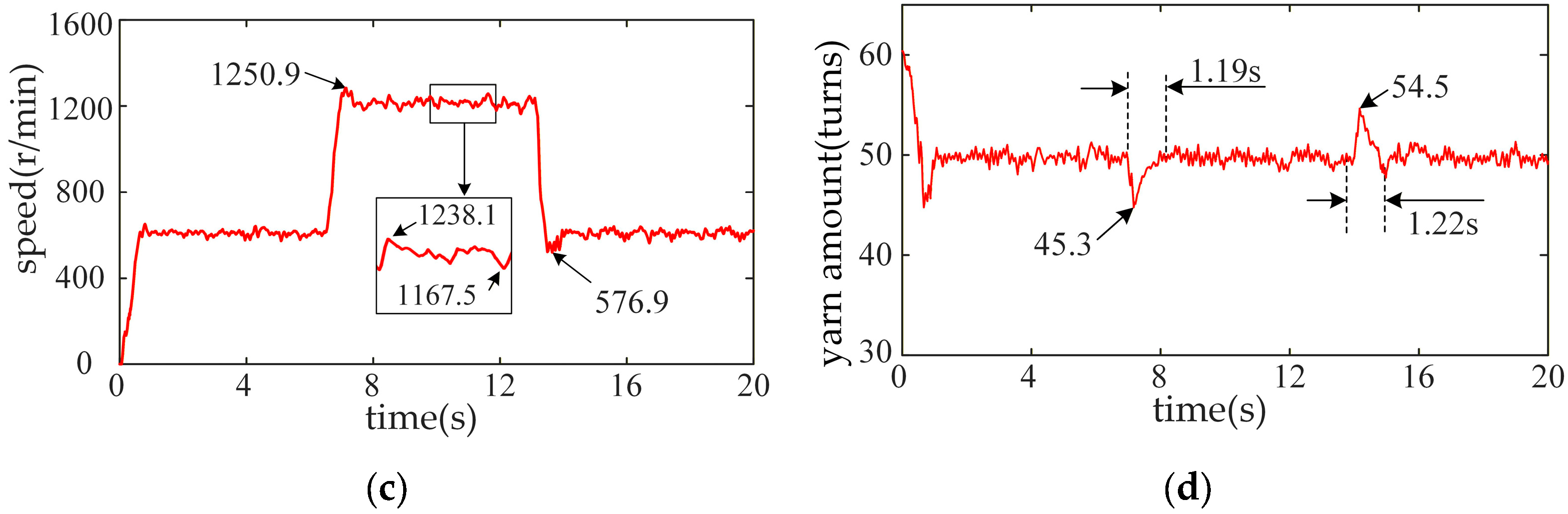
Firstly, under the condition of varying the wire speed of the yarn winding machine between 100 m/min and 200 m/min (rapid acceleration at 7 s and rapid deceleration at 14 s), both methods were tested, and the experimental waveforms are shown in Figure 21. The results indicate that, compared with the VTO + PD method, the system using the improved DSOGI + KF method reduced the maximum yarn deviation by 5.1 turns and the settling time by 0.46 s during acceleration, and reduced the maximum yarn deviation by 4.1 turns and the settling time by 0.39 s during deceleration. Therefore, under this operating condition, the improved DSOGI + KF method exhibits smaller yarn amount fluctuations and better yarn-delivery performance.
Secondly, under the condition of varying the wire speed of the yarn winding machine between 300 m/min and 600 m/min (rapid acceleration at 7 s and rapid deceleration at 14 s), both methods were tested, and the experimental waveforms are shown in Figure 22. The results indicate that, compared with the VTO + PD method, the system using the improved DSOGI + KF method reduced the maximum yarn deviation by 3.8 turns and the settling time by 0.42 s during acceleration, and reduced the maximum yarn deviation by 4.7 turns and the settling time by 0.45 s during deceleration. Therefore, under this operating condition, the improved DSOGI + KF method exhibits smaller yarn amount fluctuations and better yarn-delivery performance.
To enhance the reliability and stability of the experimental results, 10 independent repeated tests were conducted for both methods under two speed varying operating conditions: Condition 1 (winding speed changing from 100 m/min to 200 m/min) and Condition 2 (winding speed changing from 300 m/min to 600 m/min). The key performance indicators are shown in Table 3. The analysis shows that, under different operating conditions, the system using the improved DSOGI + KF method reduces the settling time by 0.48 s and 0.43 s, and the maximum yarn deviation by 5.7 turns and 3.8 turns during rapid acceleration, respectively. During rapid deceleration, its reduces the settling time by 0.41 s and 0.44 s, and the maximum yarn deviation by 4.1 turns and 4.2 turns, respectively. Therefore, the improved method of the yarn feeder system has shorter settling time, smaller maximum yarn deviation, and better yarn conveying performance when the speed fluctuates.

4.4. Robustness Analysis of Motor Parameter Mismatch

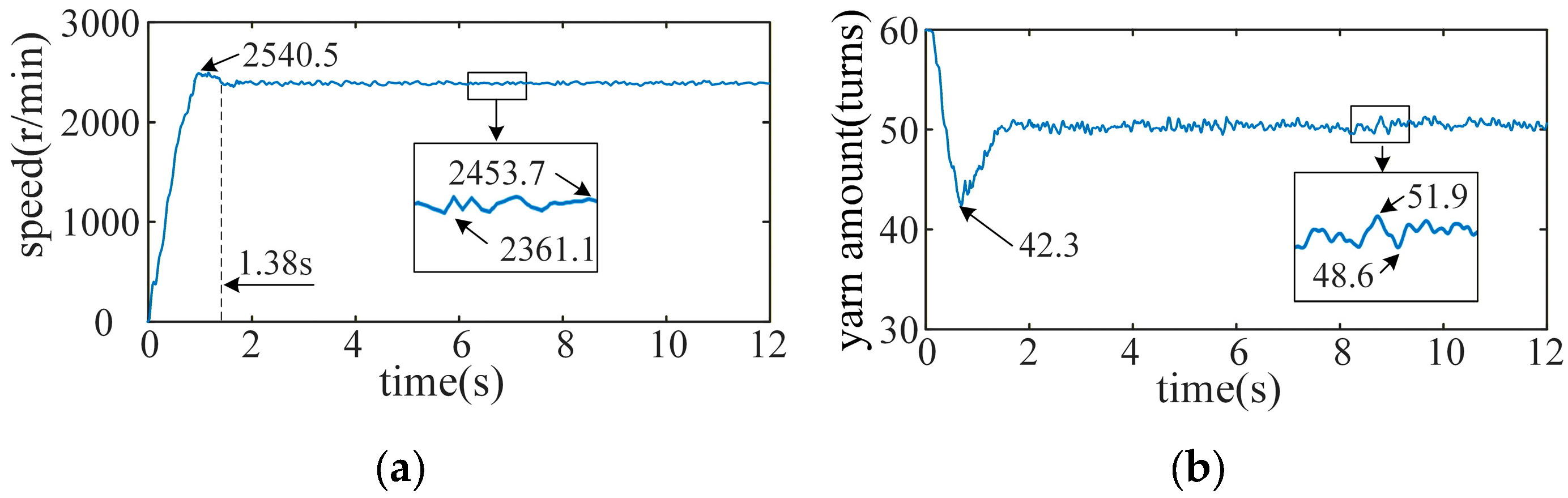
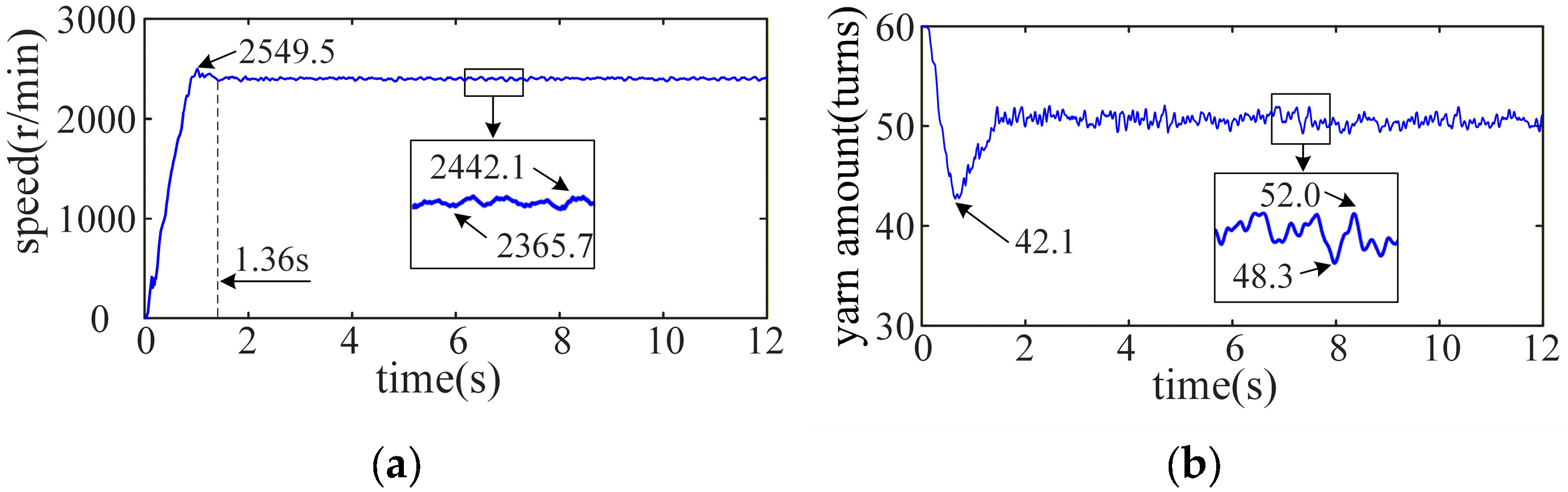
To evaluate the sensitivity of the proposed method to motor parameters, experimental tests were conducted under the condition of a winding machine pulling speed of 400 m/min with different motor parameter settings. Figure 23 shows the experimental waveform obtained with the rated resistance R and rated inductance L. Figure 24 shows the experimental waveform with a resistance of 1.5 R and an inductance of L, and Figure 25 shows the experimental waveform with a resistance of R and an inductance of 1.5 L. Waveform analysis indicates that, as the Hall signals are not affected by the motor parameters, even with variations in the motor parameters, neither the motor speed nor the yarn amount exhibits significant fluctuations. The speed steady-state error remains within 1.98%, the yarn amount steady-state error stays within 3.45%, and the maximum yarn deviation does not exceed 7.9 turns. The system maintains good yarn-delivery performance, demonstrating a certain degree of robustness.

4.5. Yarn Feeding Performance Test Under Different Loads

To better simulate actual textile operating conditions, the experiment employed the method of conveying yarns with different diameters to emulate varying load conditions. Under the condition of a winding machine pulling speed of 400 m/min, yarns with diameters of 0.25 mm and 0.16 mm were selected to conduct experimental tests on the VTO + PD method and the improved DSOGI + KF method. The experimental waveforms for yarn diameters of 0.25 mm and 0.16 mm are shown in Figure 26 and Figure 27, respectively. Analysis of the waveforms indicates that, compared to VTO and PD methods, the system using improved DSOGI and KF methods reduced startup time by 0.35 s and 0.48 s, speed overshoot by 75.9 r/min and 127.4 r/min, maximum yarn deviation by 3.0 and 3.4 turns, speed steady-state error by 2.34% and 2.57%, and yarn amount steady-state error by 2.55% and 2.67%, respectively. So the yarn conveying performance of the system is better.

5. Conclusions

To solve the problems of speed fluctuations and unstable yarn feeding in traditional yarn feeder PMSM drive systems, a control method for yarn amount in yarn feeder PMSM based on improved DSOGI and Kalman filter is proposed. This method comprises two key contributions: a motor rotor position and velocity estimation method based on improved DSOGI with cross-coupled filtering and a yarn amount detection method based on Kalman filter.
Experimental results show that, compared with the traditional method, the system employing the PMSM yarn amount control method based on the improved DSOGI and Kalman filter can reduce the estimation error caused by the installation deviation of Hall sensors and improve the accuracy of yarn amount detection. Under constant-speed, variable-speed, and different yarn-diameter delivery conditions, the startup time is significantly shortened, while the steady-state errors of motor speed and yarn amount, as well as overshoot, are markedly reduced. At the same time, it also has good robustness. Therefore, the yarn conveying performance of the system has been effectively improved.

Author Contributions

Conceptualization, F.H. and W.L.; methodology, F.H. and W.L.; software, F.H.; validation, Y.R. and C.H.; formal analysis, F.H.; investigation, F.H., Y.R. and C.H.; resources, Y.R. and C.H.; data curation, F.H.; writing—original draft preparation, F.H.; writing—review and editing, W.L.; supervision, W.L. All authors have read and agreed to the published version of the manuscript.

Funding

This work was supported in part by the National Natural Science Foundation of China under Grant 52277068, and in part by the Key Research and Development Program of Zhejiang Science and Technology Department under Grant 2024C01230, 2025C02006, 2025C01015, 2025C03011 and Grant 2025C03013.

Institutional Review Board Statement

Not applicable.

Informed Consent Statement

Not applicable.

Data Availability Statement

The data presented in this study are available in article.

Conflicts of Interest

Author Yufan Ruan was employed by Hangzhou Cloud Shield Industrial Equipment Installation Co., Ltd. Author Chaojun Han was employed by Hangzhou Jiangnan Electric Motor Co., Ltd. The remaining authors declare that the research was conducted in the absence of any commercial or financial relationships that could be construed as a potential conflict of interest.

References

  1. Liu, C.; Zou, J.; Xu, Y.; Yu, G. An Efficient Thermal Computation Model of PMSM Based on FEA Results and Interpolation. IEEE Trans. Appl. Supercond. 2021, 31, 5204904. [Google Scholar] [CrossRef]
  2. Cai, X.; Cheng, M.; Zhu, S.; Zhang, J. Thermal Modeling of Flux-Switching Permanent-Magnet Machines Considering Anisotropic Conductivity and Thermal Contact Resistance. IEEE Trans. Ind. Electron. 2016, 63, 3355–3365. [Google Scholar] [CrossRef]
  3. Zhang, H.; Xiao, D. Steady-State Efficiency Optimization Method for PMSM Considering Current Distribution and Iron Loss Resistance. IEEE Trans. Circuits Syst. II Express Briefs 2024, 71, 4924–4928. [Google Scholar] [CrossRef]
  4. Gao, M.; Zhong, K.; He, Z. Research and Application of High-Speed Electronic Weft Feeder Control System. In Proceedings of the 2016 Sixth International Conference on Instrumentation & Measurement, Computer, Communication and Control (IMCCC), Harbin, China, 21–23 July 2016; pp. 584–588. [Google Scholar]
  5. Xu, Y.; Jin, S.; Li, S.; Zhang, X.; Zou, J. A Novel Finite Position Set Phase-Locked Loop Strategy for PMSM Position Estimation with High-Precision and Low Computational Burden. IEEE Trans. Power Electron. 2025, 40, 1622–1635. [Google Scholar] [CrossRef]
  6. Liu, G.; Zhang, H.; Song, X. Position-Estimation Deviation-Suppression Technology of PMSM Combining Phase Self-Compensation SMO and Feed-Forward PLL. IEEE J. Emerg. Sel. Top. Power Electron. 2021, 9, 335–344. [Google Scholar] [CrossRef]
  7. Dang, C.; Dou, M.; Yan, S.; Dang, M.; Wang, Y.; Zhao, D. An Improved Adaptive Sliding Mode Speed Control of PMSM Drives with an Extended State Observer. IEEE Trans. Energy Convers. 2024, 39, 2349–2361. [Google Scholar] [CrossRef]
  8. Wei, Z.; Zhao, M.; Liu, X.; Lu, M. A Novel Variable-Proportion Desaturation PI Control for Speed Regulation in Sensorless PMSM Drive System. Appl. Sci. 2022, 12, 9234. [Google Scholar] [CrossRef]
  9. Ahn, H.-J.; Lee, D.-M. A New Bumpless Rotor-Flux Position Estimation Scheme for Vector-Controlled Washing Machine. IEEE Trans. Ind. Inf. 2016, 12, 466–473. [Google Scholar] [CrossRef]
  10. Zhao, Y.; Liu, X.; Zhang, Q. Predictive Speed-Control Algorithm Based on a Novel Extended-State Observer for PMSM Drives. Appl. Sci. 2019, 9, 2575. [Google Scholar] [CrossRef]
  11. Liu, Y.; Zhang, X.; Yang, B.; Gong, C.; Wang, J.; Ding, X. Novel Speed Observer-Based Sensorless Control Strategy Without Signal Injection for PMSMs Over Low-Speed Range. IEEE Trans. Ind. Electron. 2025, 72, 8683–8687. [Google Scholar] [CrossRef]
  12. Novak, Z. Confidence Weighted Learning Entropy for Fault-Tolerant Control of a PMSM With a High-Resolution Hall Encoder. IEEE Trans. Ind. Electron. 2024, 71, 5176–5186. [Google Scholar] [CrossRef]
  13. Zhang, C.; Wang, Y.; Wu, Z.; Hua, W.; Zhang, M. Implementation of Dual Three-Phase Linear Hall Sensor-Based Embedded Magnetic Encoder in Permanent Magnet Synchronous Motors. IEEE Trans. Power Electron. 2024, 39, 10688–10692. [Google Scholar] [CrossRef]
  14. Pimenta, F.C.; Fernandes, E.D.M.; Lima, R.C.; Silva, F.D.L. Vector Control of PMSM Based on Misaligned Hall-Effect Sensors. IEEE Access 2026, 14, 26189–26201. [Google Scholar] [CrossRef]
  15. Yang, A.; Lin, M.; Jia, L.; Lin, K. A Hall-Based Modified Finite Position Set-Phase Locked Loop for PMSM Control System in EVs. IEEE Trans. Appl. Supercond. 2024, 34, 5207505. [Google Scholar] [CrossRef]
  16. Miguel-Espinar, C.; Heredero-Peris, D.; Igor-Gross, G.; Llonch-Masachs, M.; Montesinos-Miracle, D. Accurate Angle Representation from Misplaced Hall-Effect Switch Sensors for Low-Cost Electric Vehicle Applications. IEEE Trans. Ind. Appl. 2022, 58, 5227–5237. [Google Scholar] [CrossRef]
  17. Giulii Capponi, F.; De Donato, G.; Del Ferraro, L.; Honorati, O.; Harke, M.C.; Lorenz, R.D. AC brushless drive with low-resolution Hall-effect sensors for surface-mounted PM Machines. IEEE Trans. Ind. Appl. 2006, 42, 526–535. [Google Scholar] [CrossRef]
  18. Zhang, W.; Hou, D.; Zhang, Y.; Wang, X.; Lin, W.; Xu, Y. An Improved Rotor Position Estimation Method in PMSM Drives with Low-Resolution Hall Sensors. In Proceedings of the 2024 IEEE 7th International Electrical and Energy Conference (CIEEC), Harbin, China, 10–12 May 2024; pp. 2831–2835. [Google Scholar]
  19. Ni, Q.; Yang, M.; Odhano, S.A.; Tang, M.; Zanchetta, P.; Liu, X. A new position and speed estimation scheme for position control of PMSM drives using low-resolution position sensors. IEEE Trans. Ind. Appl. 2019, 55, 3747–3758. [Google Scholar] [CrossRef]
  20. Qu, K.; Pang, P.; Hua, W. High-Precision Rotor Position Fitting Method of Permanent Magnet Synchronous Machine Based on Hall-Effect Sensors. Energies 2024, 17, 5625. [Google Scholar] [CrossRef]
  21. Yu, L.; Zhang, Y.; Huang, W. Accurate and Efficient Torque Control of an Interior Permanent Magnet Synchronous Motor in Electric Vehicles Based on Hall-Effect Sensors. Energies 2017, 10, 410. [Google Scholar] [CrossRef]
  22. Wang, T.; Yao, W.; Yang, H.; Li, W. Modeling and Stability Analysis of the Three-Phase Grid-Connected Inverter Under DSOGI-PLL Considering Frequency-Adaptive Feedback. IEEE J. Emerg. Sel. Top. Power Electron. 2024, 12, 4638–4651. [Google Scholar] [CrossRef]
  23. Li, Z.; Zhong, P.; Tang, X.; Chen, Y.; Su, S.; Zhai, T. A New Method to Evaluate Yarn Appearance Qualities Based on Machine Vision and Image Processing. IEEE Access 2020, 8, 30928–30937. [Google Scholar] [CrossRef]
  24. Yan, N.; Zhu, L.; Yang, H.; Li, N.; Zhang, X. Online Yarn Breakage Detection: A Reflection-Based Anomaly Detection Method. IEEE Trans. Instrum. Meas. 2021, 70, 5008813. [Google Scholar] [CrossRef]
  25. Idzik, M.; Rybicki, T. Real-Time Yarn Breakage Detection in the Warping Machine. IEEE Access 2023, 11, 47501–47509. [Google Scholar] [CrossRef]
  26. Carvalho, V.H.; Belsley, M.S.; Vasconcelos, R.M.; Soares, F.O. Automatic Yarn Characterization System: Design of a Prototype. IEEE Sens. J. 2009, 9, 987–993. [Google Scholar] [CrossRef][Green Version]
  27. Lu, W.; Zhao, Y.; Yan, B.; Lu, K.; Zhang, Y.; Guo, L. Self-Balancing Control of Yarn Number Based on a Novel Sensorless PMSM Speed Drive System. IEEE/ASME Trans. Mechatron. 2022, 27, 4293–4303. [Google Scholar] [CrossRef]
Figure 1. The structural diagram of the entire system of the yarn feeder.
Applsci 16 03844 g001
Figure 2. Installation diagram of switching Hall sensors.
Applsci 16 03844 g002
Figure 3. Relationship diagram between output signal of three-phase Hall sensor and rotor position.
Applsci 16 03844 g003
Figure 4. Schematic diagram of position and velocity estimation using the traditional average acceleration method.
Applsci 16 03844 g004
Figure 5. Relationship diagram between rotation vector signal Hαβ and three-phase Hall signals (ha, hb, hc).
Applsci 16 03844 g005
Figure 6. Relationship diagram between orthogonal Hall signals (hα, hβ) and phase angle θh.
Applsci 16 03844 g006
Figure 7. Spectrum of hα and hβ without Hall sensor installation errors. (a) Spectrum of hα; (b) spectrum of hβ.
Applsci 16 03844 g007
Figure 8. Spectrum of hα and hβ with Hall sensor installation errors. (a) Spectrum of hα; (b) spectrum of hβ.
Applsci 16 03844 g008
Figure 9. Principle diagram of the dual second-order generalized integrator (DSOGI) cross-coupled filter.
Applsci 16 03844 g009
Figure 10. Structural diagram of second-order generalized integrator.
Applsci 16 03844 g010
Figure 11. Bode diagram of transfer functions D1(s) and Q1(s). (a) Bode diagram of D1(s); (b) Bode diagram of Q1(s).
Applsci 16 03844 g011
Figure 12. Structural diagram of improved second-order generalized integrator.
Applsci 16 03844 g012
Figure 13. Bode diagram of transfer functions D2(s) and Q2(s). (a) Bode diagram of D2(s); (b) Bode diagram of Q2(s).
Applsci 16 03844 g013
Figure 14. Schematic diagram of the quadrature phase-locked loop.
Applsci 16 03844 g014
Figure 15. Calibration curve of the mapping function g(∙).
Applsci 16 03844 g015
Figure 16. Block diagram of the control method for yarn amount in yarn feeder PMSM based on improved DSOGI and Kalman filter.
Applsci 16 03844 g016
Figure 17. Yarn feeder and experimental testing platform. (a) Yarn winding machine; (b) yarn feeder.
Applsci 16 03844 g017
Figure 18. Experimental waveforms at a yarn speed of 100 m/min. (a) Rotation speed of improved DSOGI and VTO; (b) yarn amount of PD and KF; (c) rotation speed of VTO + PD and improved DSOGI + KF; (d) yarn amount of VTO + PD and improved DSOGI + KF.
Applsci 16 03844 g018
Figure 19. Experimental waveforms at a yarn speed of 400 m/min. (a) Rotation speed of improved DSOGI and VTO; (b) yarn amount of PD and KF; (c) rotation speed of VTO + PD and improved DSOGI + KF; (d) yarn amount of VTO + PD and improved DSOGI + KF.
Applsci 16 03844 g019aApplsci 16 03844 g019b
Figure 20. Experimental waveforms at a yarn speed of 700 m/min. (a) Rotation speed of improved DSOGI and VTO; (b) yarn amount of PD and KF; (c) rotation speed of VTO + PD and improved DSOGI + KF; (d) yarn amount of VTO + PD and improved DSOGI + KF.
Applsci 16 03844 g020
Figure 21. Experimental waveforms with yarn speed varying from 100 m/min to 200 m/min. (a) Rotation speed of VTO + PD; (b) yarn amount of VTO + PD; (c) rotation speed of improved DSOGI + KF; (d) yarn amount of the improved DSOGI + KF.
Applsci 16 03844 g021aApplsci 16 03844 g021b
Figure 22. Experimental waveforms with yarn speed varying from 300 m/min to 600 m/min. (a) Rotation speed of VTO + PD; (b) yarn amount of VTO + PD; (c) rotation speed of improved DSOGI + KF; (d) yarn amount of the improved DSOGI + KF.
Applsci 16 03844 g022
Figure 23. Waveform diagrams at resistance R and inductance L. (a) Rotation speed waveform; (b) yarn amount waveform.
Applsci 16 03844 g023
Figure 24. Waveform diagrams at resistance 1.5 R and inductance L. (a) Rotation speed waveform; (b) yarn amount waveform.
Applsci 16 03844 g024
Figure 25. Waveform diagrams at resistance 1 R and inductance 1.5 L. (a) Rotation speed waveform; (b) yarn amount waveform.
Applsci 16 03844 g025
Figure 26. Waveform diagrams for the 0.25 mm diameter yarn condition. (a) Rotation speed waveform; (b) yarn amount waveform.
Applsci 16 03844 g026
Figure 27. Waveform diagrams for the 0.16 mm diameter yarn condition. (a) Rotation speed waveform; (b) yarn amount waveform.
Applsci 16 03844 g027
Table 1. Parameters of permanent magnet synchronous motor.
Parameters of PMSMValue
Number of pole pairs2
Rated voltage/V48.00
Rated current/A0.55
Rated speed/(r/min)4200
Line inductance/mH5.04
Line resistance/Ω3.38
Flux linkage/Wb0.0247
Table 2. Comparison of yarn feeding performance between VTO + PD and DSOGI + KF methods at different constant speeds.
Operating ConditionMethodsTST (s)ES (%)EY (%)
100 m/minVTO + PD1.33 ± 0.0311.36 ± 0.679.32 ± 0.23
DSOGI + KF0.99 ± 0.045.15 ± 0.254.72 ± 0.13
400 m/minVTO + PD1.81 ± 0.054.55 ± 0.296.12 ± 0.18
DSOGI + KF1.32 ± 0.031.97 ± 0.183.46 ± 0.15
700 m/minVTO + PD2.06 ± 0.062.72 ± 0.193.50 ± 0.16
DSOGI + KF1.64 ± 0.040.95 ± 0.111.32 ± 0.13
Table 3. Statistical comparison of performance indicators between two methods when speed varies.
Operating ConditionMethodsTAR (s)YppA (Turns)TDR (s)YppD (Turns)
condition 1VTO + PD1.67 ± 0.069.7 ± 0.31.62 ± 0.058.6 ± 0.3
DSOGI + KF1.19 ± 0.044.0 ± 0.21.21 ± 0.044.5 ± 0.2
condition 2VTO + PD1.88 ± 0.069.9 ± 0.41.84 ± 0.069.1 ± 0.3
DSOGI + KF1.45 ± 0.046.1 ± 0.21.40 ± 0.044.9 ± 0.2
Disclaimer/Publisher’s Note: The statements, opinions and data contained in all publications are solely those of the individual author(s) and contributor(s) and not of MDPI and/or the editor(s). MDPI and/or the editor(s) disclaim responsibility for any injury to people or property resulting from any ideas, methods, instructions or products referred to in the content.