Article

Investigation of the Dynamic Behavior of Flexible Fiber Free Ends During Vortex Spinning Process Based on an Enhanced Bead–Rod Model


School of Mechanical Engineering, Zhejiang Sci-Tech University, Hangzhou 310018, China
*
Author to whom correspondence should be addressed.
Appl. Sci. 2026, 16(8), 3843; https://doi.org/10.3390/app16083843
Submission received: 9 February 2026 / Revised: 11 April 2026 / Accepted: 13 April 2026 / Published: 15 April 2026

Abstract

Fibers in vortex turbulence fields involve complex gas–solid coupling effects, significantly influencing the spinning process within vortex nozzles. This paper utilizes the Discrete Element Method (DEM) to refine the existing rigid bead–elastic rod model describing fiber constitutive behavior. This improved model is used to numerically simulate the dynamic behavior of a single flexible fiber within the vortex field of the nozzle. Based on elastic mechanics, this study establishes mapping functions converting relative displacement and angular displacement between beads into internal forces and torques within the beads. A contact model is also developed to handle fiber–wall interactions. The effects of different nozzle structures on fiber motion are investigated. The improved model successfully simulates the entire motion process of a single fiber during spinning. Its reliability is validated by comparing with experimentally collected fiber motion data. The study reveals that a twist chamber diameter of 6 mm, a conical cavity angle of 55 degrees, and a distance of 1.05 mm between the jet orifice and the hollow spindle yield optimal fiber twist count and wrapping density. This research provides effective insights for developing textile equipment that relies on airflow to drive fiber spinning and contributes to establishing a comprehensive twisting mechanism.

1. Introduction

Vortex spinning machines represent a novel spinning technology evolved from air-jet spinning, utilizing a high-velocity jet to drive fiber strand interactions and subsequently aggregate them into yarn [1]. When high-pressure air is injected into the vortex chamber through the jet orifice of the nozzle vortex tube, its unique internal structure generates a complex vortex turbulent flow field with an extremely high Reynolds number. Unlike traditional spinning technologies that rely on structural forces to wind fiber strands, vortex spinning controls a high-speed, high-pressure rotating airflow to induce a series of complex fiber motions—including suction, separation, flattening, twisting, and winding. This enables free fibers to interact with core fibers and twist into yarn. Vortex spinning technology exhibits outstanding characteristics such as high spinning efficiency, a short process flow, and the production of yarns that are uniformly soft and smooth throughout [2]. However, it also suffers from drawbacks including low strength, high fiber loss rates, and poor uniformity. Therefore, research on the nozzle flow field is crucial for the advancement of vortex spinning technology. Past research has primarily focused on turbulence models and experimental investigations of the flow field, aiming to determine flow characteristics and predict fiber motion patterns by analyzing pressure, velocity, and turbulent kinetic energy distributions and numerical values [3,4]. However, these studies lacked mathematical derivations for motion prediction models and notably ignored the coupling effects between fibers and the airflow field.
When the vortex spinning nozzle twists yarn, fiber strands enter the nozzle flow field, forming a two-phase coupled physical field within the nozzle comprising gas and solid phases. To explain the force–displacement exchange mechanism at the fluid–structure interaction (FSI) interface, corresponding coupling equations can be established based on the Arbitrary Lagrange–Euler (ALE) method within the mesh approach [5]. The gas–solid coupling process within the nozzle can be described as the airflow driving fiber motion and deformation, while fiber deformation alters the flow field. This interaction between gas and solid generates complex fiber motion patterns, significantly influencing the vortex spinning process [6]. Wang et al. [7] developed a bidirectional coupling model between fibers and gas flow based on ALE, dividing the fiber into countless continuous rectangular meshes. The study revealed that after entering the vortex cavity, uneven airflow distribution causes fibers to approach each other, resulting in a certain axial displacement difference. Han et al. [8] established a finite element model of fibers based on elastic slender rod elements, enabling the simulation of fiber motion trajectories and flexibility characteristics similar to those observed in actual spinning processes. However, this research indicates that a limited number of meshes struggle to accurately simulate the mechanical and dynamic properties of fibers. The aforementioned studies effectively simulate fiber motion only in two-dimensional fields. Computations in three-dimensional fields require substantial resources for remeshing, significantly reducing computational efficiency and stability [9,10]. This necessitates alternative computational methods to achieve numerical simulations of fiber-coupled dynamic models in three-dimensional space, yielding realistic motion trajectories to qualitatively characterize the yarn-forming process.
Among numerous algorithms addressing fluid–solid coupling solid deformation problems, the DEM method has garnered significant attention due to its outstanding performance in simulating rapid solid displacement and large deformations. The DEM method discretizes continuous solid matter into relatively independent particle units, thereby avoiding the need for fluid domain mesh repartitioning and remeshing during computation [11]. Considering that fibers typically operate at the order of magnitude of 10 μm, they can be discretized into microparticles. The interparticle forces are approximated as those provided by mechanical components such as rods, chains, and needles [12]. Based on particle dynamics, coupled dynamical equations for particles in the flow field are constructed to solve for their kinematic behavior. Jeffrey’s research [13] on rigid ellipsoidal particle motion in low-Reynolds-number shear flow provided a model basis and theoretical foundation for subsequent fiber motion studies. Yamamoto [14] simulated fiber shapes by bonding multiple spherical particles, analogizing inter-particle forces to elastic deformation forces in rods. He described fiber stretching, bending, and twisting motions using variables such as the bonding distance, bonding angle, and twist angle between adjacent spheres. Joung et al. [15] introduced lubrication forces between particles to prevent excessive fiber bending or overlapping during multi-fiber contact, ensuring the connectivity of the fiber model. These studies successfully captured the motion of nonwoven fibers and the impact of fiber deformation on suspension viscosity changes. Conversely, Dhas [16] and Dotto [17] investigated fiber suspensions in turbulent channel flows, examining the statistical properties of fiber velocity, orientation, deformation, and aggregation effects under varying aspect ratios and Stokes numbers. Dhas [16] modeled fibers as chains of rod-like segments, each represented by an equivalent ellipsoid. Each rod unit was constrained to be smaller than the Kolmogorov length scale of the flow to reasonably apply the Stokes flow framework for describing the drag and hydrodynamic torques acting on the rod. In high-concentration fiber suspensions, the two-way coupling between fibers and the fluid cannot be neglected, as fiber motion contributes to turbulent modulation. The back-reaction of the dispersed phase influences the macroscopic behavior of the carrier flow, significantly dissipating turbulent kinetic energy and reducing drag in channel flows [18]. Di Giusto & Marchioli [19] employed the exact regularized point-particle method to compute the two-way coupling forces between fibers and the fluid, incorporating them as source terms in the fluid governing equations. In test cases involving viscous shear flow, the rotation angles of rigid fibers were found to be consistent with Cox’s analytical solution. Textile fibers share similar geometric and mechanical characteristics with most material fibers, making DEM a promising method for investigating textile fiber motion and force response.
To investigate the entanglement motion of flexible fibers under water vortex action, Xiang [20] proposed a rod chain model, modeling the fiber as a structure composed of multiple rigid short rods connected together. The study revealed that the more rods the fiber is divided into, the more flexible it behaves. For the rod chain model under axial flow, the viscous fluid resistance on individual rod segments can be referenced from the studies by Païdoussis et al. [21,22]. Guo [23] employed the equivalent volume method to approximate the forces acting on rods as equivalent forces on spheres. Zeng [24] established a bead-chain model for the fiber, assuming it as a chain composed of n beads, and conducted numerical simulations in a simplified two-dimensional nozzle flow field. The study also proposed a method to determine actual fiber motion by analyzing lateral displacement at the fiber tail. Due to high-speed vortices within the nozzle, significant velocity gradients and centrifugal forces at the wall surface frequently cause fiber–wall contact. To investigate how motion changes after repeated fiber–wall contact, researchers have developed various contact models. For instance, Pei [25] established fiber–wall contact equations based on the principle of virtual work and stress tensor mapping, applicable to contact problems between moving, large-deformation elastic solids and stationary solid walls. Guo’s fiber–wall contact model referenced the spherical collision model, where the velocity recovery coefficient after fiber collision fully follows the velocity recovery coefficient equation for erosive particles in turbomachinery [26]. However, turbine working fluid domains involve external flow fields, and erosion particles are primarily alloy particles whose recovery coefficients are not applicable to fiber–wall models. Ali [27] addressed the multi-segment wall contact problem in ball–chain models by dividing it into two parts to examine contact force conditions separately, then determining whether fibers slide off the cylinder or remain stationary through simultaneous analysis. Bec [28] employed a soft-boundary method that allows for slight overlaps between entities to simulate the contact interaction between discrete particles and the wall. This approach successfully reproduces the pole-vaulting phenomenon observed when fibers come into contact with the wall. While these studies partially simulate fiber flexibility and large deformations, the constructed flow fields remain simplified approximations of actual conditions. They lack a comprehensive analysis of the entire twisting process—from free fiber entry into the nozzle vortex chamber to yarn formation—resulting in significant discrepancies between simulated and real fiber motion.
This paper enhances the rigid bead–elastic rod chain model originally proposed by Guo [23] for simulating single-fiber twisting dynamics within nozzle flow fields. The improvement incorporates two key mechanical refinements: explicit modeling of fiber axial tensile deformation, and revised formulations for bending and torsional displacements of fiber elements. These modifications significantly improve the fidelity of fiber mechanical response, yielding bead particle force and velocity couplings with the surrounding flow that align more closely with experimentally observed fiber behavior. Furthermore, a physically informed wall collision model is introduced, built upon a non-perfectly elastic impact framework and explicitly accounting for material properties. A comprehensive analysis of the coupling characteristics between fiber bead particles and the flow is conducted. Based on the analytical conclusions, only the unidirectional fluid–structure interaction is considered. Leveraging this insight, high-fidelity numerical simulations are performed to resolve fiber kinematics in the nozzle region, generating temporally resolved snapshots at critical motion nodes. Fiber twisting trajectories are reconstructed quantitatively from end-point displacement histories. To validate the model, an experimental platform for vortex spinning nozzles was developed. A quantitative comparison between the measured fiber trajectories and simulated results demonstrates strong agreement in both spatial configuration and temporal evolution. Using the validated model, parametric studies identify the optimal nozzle geometry. Thes simulation results revealed that the unique twisting mechanism of vortex spinning machines arises from the combined action of fiber inertial forces and rotating airflow. The study further discovered that counterflow at the hollow spindle inlet causes fiber ends to migrate above the spindle during the late twisting phase. Excessive axial velocity may subsequently lead to fiber detachment from the yarn body.

2. Methodology

2.1. Fiber Model

2.1.1. Internal Forces in Fiber Deformation Recovery

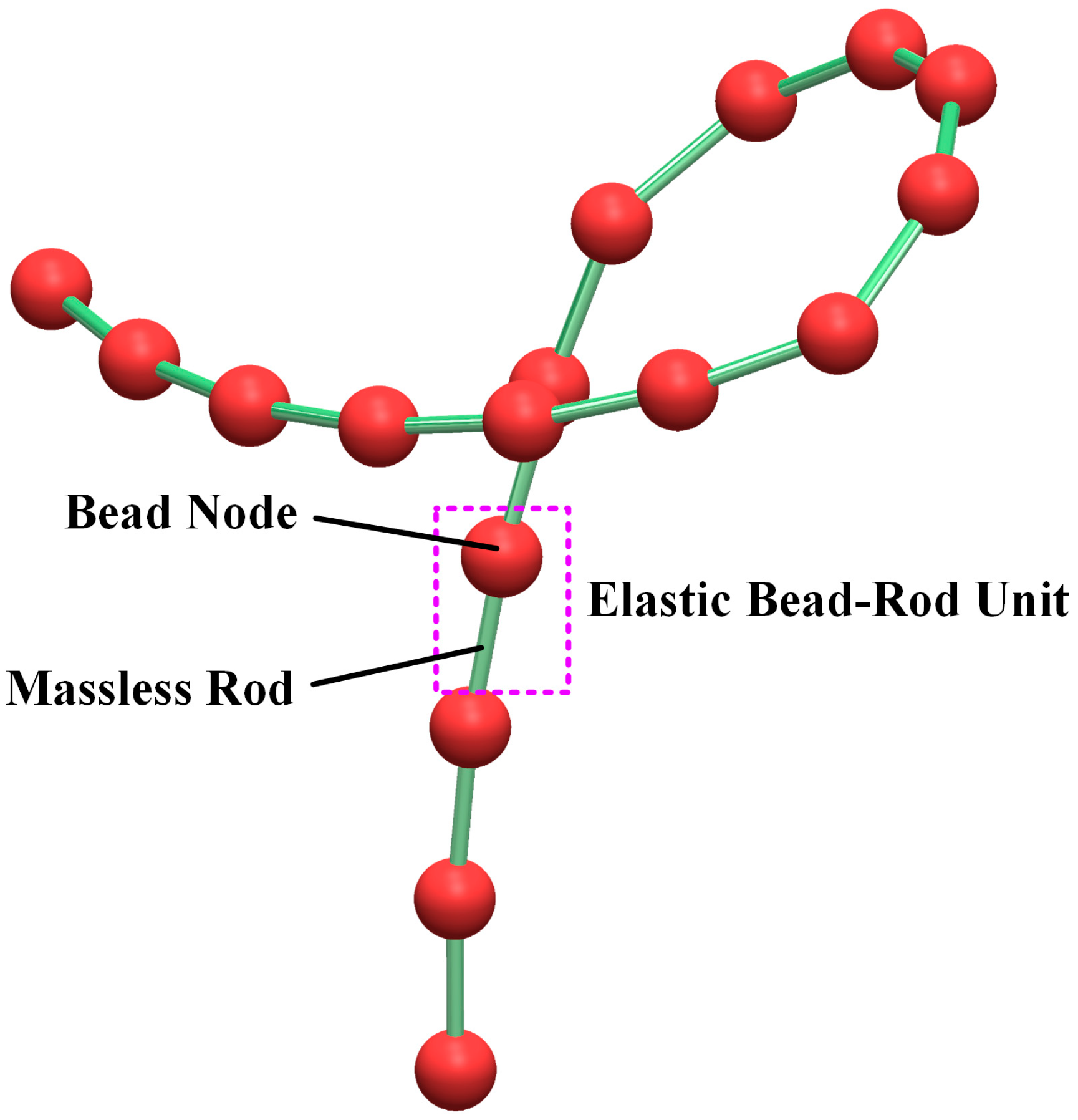
Textile fibers are flexible, unstable rod-like structures with extremely high aspect ratios. Their dynamic behavior in airflow fields is complex, involving both global motion and linear displacement and rotation of micro-segments. A reasonable improvement is made to the bead–rod chain model proposed by Guo [23] for approximating the constitutive properties of fibers, and the improved model is applied to simulate fiber motion in eddy currents. The construction idea of the particle-level fiber model is as follows: a fiber is segmented into multiple small segments, each of which is treated as an elastic rod. Adjacent rods are bonded by rigid beads, and no relative displacement or rotation occurs at the joints. The relative displacement, rotation, and deflection of the beads are transmitted to the elastic rods through the bonding surfaces (lines) and then to the next bead. Multiple bead–rod units are integrated to form a bead–rod chain that can characterize the material properties and mechanical behaviors of the fiber. In the bead–rod chain model, the elastic rods have no mass; their role is to transmit deformation and internal forces, and maintain the overall continuity of the chain. External forces, elastic restoring forces, and gravity are borne by the beads.
This paper introduces four key improvements to existing models: (1) incorporating axial tensile/compressive deformation by adding axial internal forces to the motion equations; (2) refining the bending recovery internal force equation for beads during fiber bending to account for the combined effect of adjacent elastic rods on both sides; (3) incorporating rotational motion of beads under combined external and internal forces; (4) proposing a new equation for the restoring internal force on beads during fiber torsional deformation, where the deformation magnitude is determined by the angular displacement between adjacent beads. The fiber model consists of N beads and N rods, as shown in Figure 1. The mass of a bead in the chain can be expressed as
m i = π 4 ρ f D f 2 l i ,   ( i = 1 , 2 , , N )
where ρ f is fiber density; D f denotes fiber diameter, which also corresponds to the bead diameter in the model; and l i indicates the length of the rod i. Depending on the initial fiber morphology, rod lengths may be slightly adjusted, and bead masses within the chain may not be entirely equal.
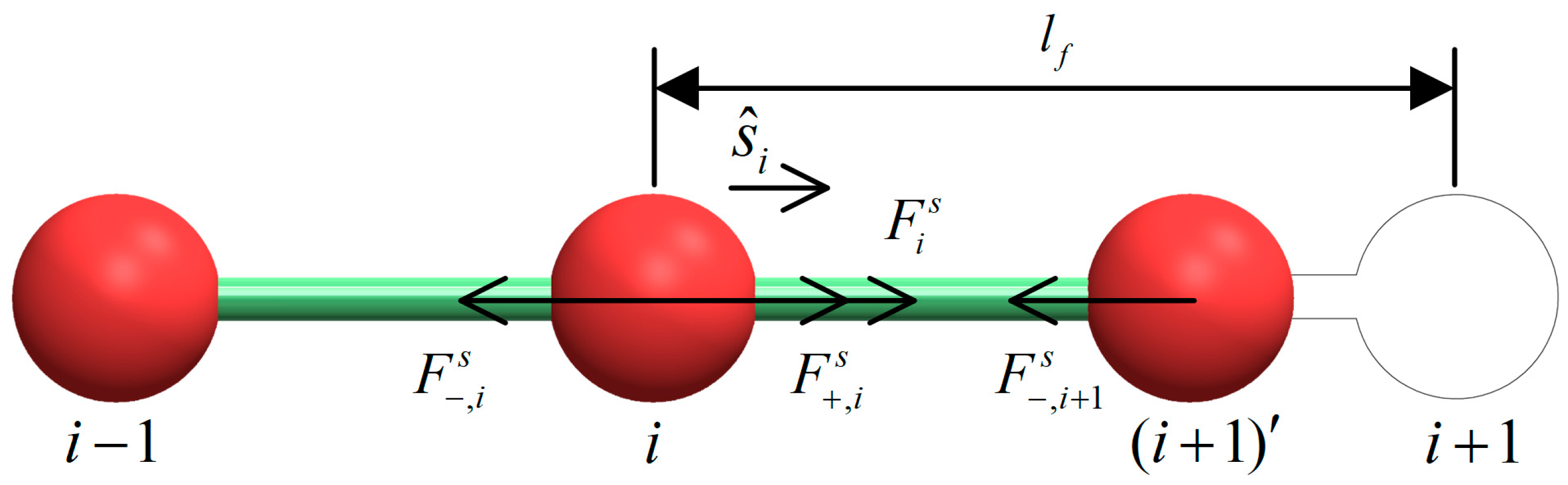
When subjected to axial tensile force, the fiber segment undergoes tensile–compressive deformation as shown in Figure 2. For a specified elastic unit under axial loading, the rod length changes while the diameter remains constant. Referencing the axial stress analysis of Pei’s fiber model [29], the axial tensile and compressive deformation of fiber micro-segment ( i , i + 1 ) is analyzed separately below. From the axial stress equilibrium of the elastic rod, we can obtain
F i s = F i + 1 s
Bead i is subjected to axial forces from both adjacent rods simultaneously:
F i s = F + , i s + F , i s
F + , i s = π D f 2 E f 4 r i + 1 r i l i 1 s ^ i
The position vector of bead i is denoted by r i , with the vector origin located at the specified origin of the flow field, where s ^ i is the unit direction vector of the elastic rod, s ^ i = r i + 1 r i r i + 1 r i , E f is the elasticity modulus. F + , i s and F , i s are the axial forces exerted by fiber segments ( i , i + 1 ) and ( i 1 , i ) on bead i, respectively. Based on the theory of action and reaction,
F , i s = F + , i 1 s ,   ( i = 2 , 3 , , N )
For the beads at both ends of the fiber model, the applied force is defined as F + , N s = 0 , F , 1 s = 0 .
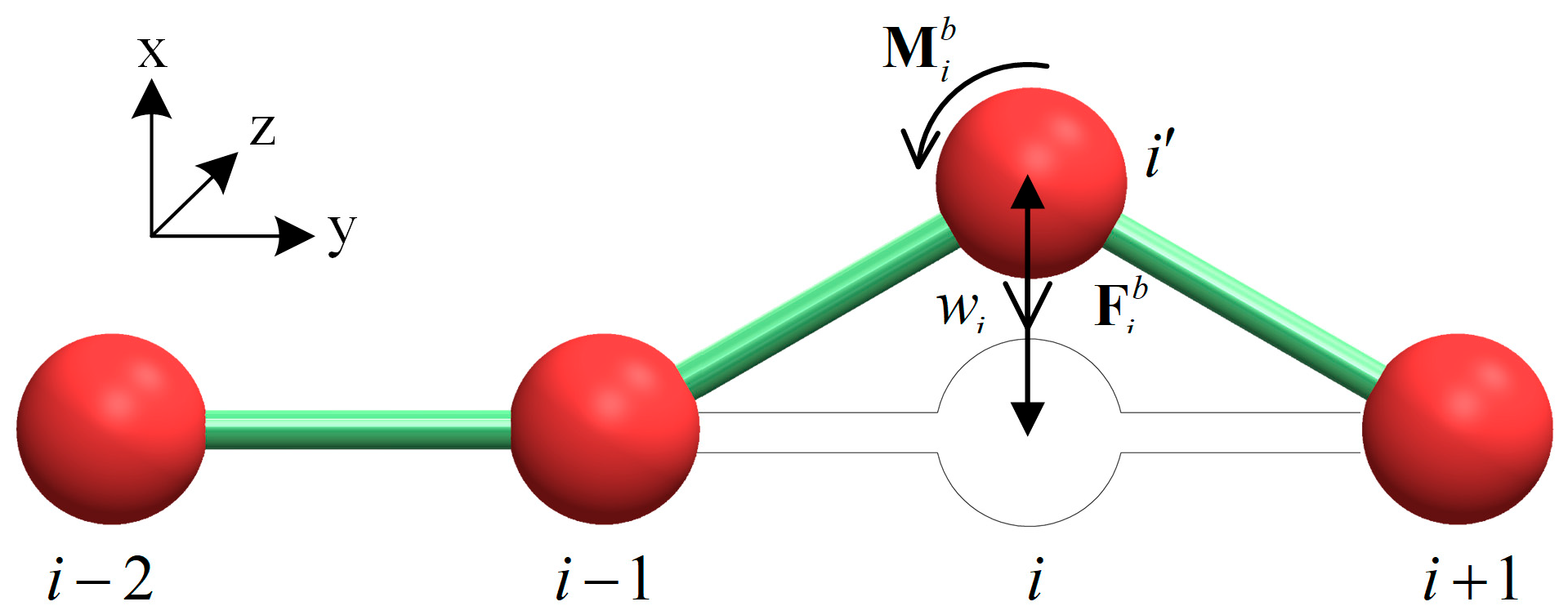
Figure 3 illustrates the bending of fiber elements caused by transverse forces. For rods with axial lengths far exceeding their cross-sectional dimensions, the influence of shear forces on bending deformation can be neglected. Therefore, rods subjected to lateral forces can be considered to undergo pure bending deformation. The bending deformation of the fiber is described by the relative displacement between beads. Beads i−1 and i+1 flanking the fixed bead i define the initial state of the fiber’s geometry at time 0. The magnitude and direction of the restoring internal forces enable the fiber to return to this initial state. The bending restoring force for bead i is expressed by the following equation:
F i b = 3 E I l i , m w i b ^ i
where l i , m represents the equivalent length derived from the length l i 1 of elastic rod i−1 and the length l i of rod i, as follows:
l i , m = l i 1 + l i l i 1 2 l i 2
The fiber is a cylindrical slender rod, with E I as the flexural rigidity and I ( I = π D f 4 / 64 ) as the section moment of inertia. After a time step, the position vector of bead i changes from r i to r i . Bending deformation occurs at bead i, resulting in a displacement of value w i between the two time points, w i = r i r i . The unit vector b ^ i represents the direction of the bending restoring force on bead i, which is defined by the position vectors of adjacent beads:
b i = r i 1 r i × z r i 1 r i + r i r i + 1 × z r i r i + 1
b ^ i = b i b i
where z represents one of the directions in the ground coordinate system, z = x × y . Within each time step, the displacement w i of bead i is very small, and the bending moment M i b at bead i is
M i b = l i 1 l i l i 1 + l i F i b z
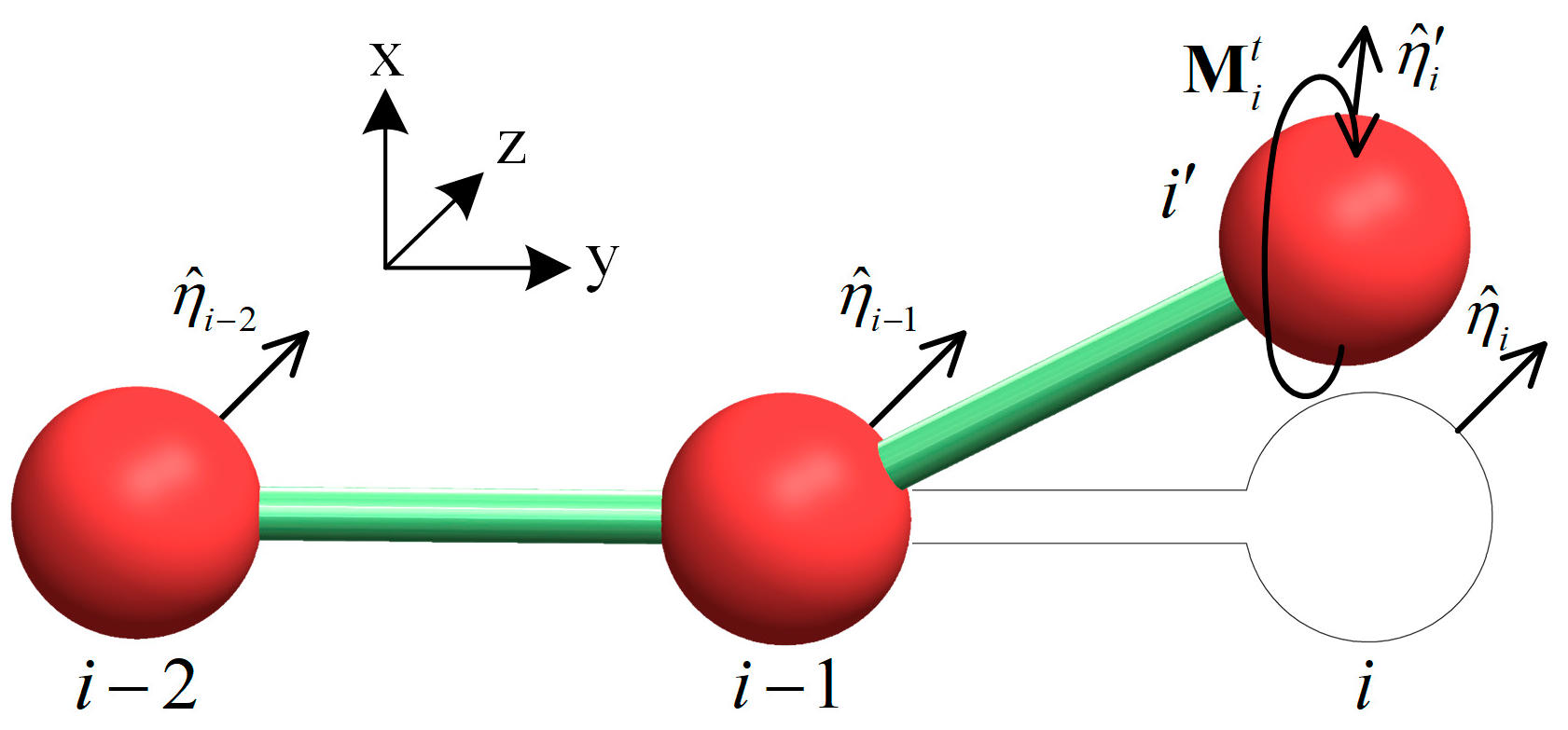
When a fiber unit experiences a torsional torque along its axis, it undergoes torsional deformation. If the torsional strain is small and linearly distributed along the rod axis, the torsional restoring torque M i t at bead i can be expressed as
M i t = G I p Δ ϕ i l i 1 r i r i 1 r i r i 1
where G I p is torsional stiffness of the fiber section. Δ ϕ i is the relative angular displacement between bead i and bead i−1. If a bead–rod unit at a given instant is subject to torsional deformation only, the torsional angle Δ ϕ i at bead i is as shown in Equation (12):
Δ ϕ i = cos 1 ( η ^ i 1 η ^ i )
The unit normal vector η ^ i is located at bead i and is normal to elastic rod ( i , i + 1 ) . After the elastic rod twists, η ^ i becomes η ^ i . Initially, η ^ i lies within the x-y plane of the nozzle model’s global coordinate system and points in the positive z-axis direction.
When both torsional and bending deformations occur simultaneously, one approach is to eliminate the bending by restoring adjacent rods to their pre-deformation positions, then calculating the torsional angle. The composite bending–torsional deformation of the fiber element is shown in Figure 4. To return the bead normal vector η ^ i to its original position after bending deformation, its rotation matrix is expressed using the Rodrigues formula:
R u i , θ i = cos θ i I + 1 cos θ i u i u i T + sin θ i u i ×
where θ i represents the angle between elastic rods i 1 , i and i 1 , i , and u i is the rotation axis. u i × is the cross-product matrix of vector u i , as shown in the following equation:
u i = ( r i r i 1 ) × ( r i r i 1 ) ( r i r i 1 ) × ( r i r i 1 )
u i × = 0 u i z u i y u i z 0 u i x u i y u i x 0
To calculate the torsional displacement of bead i after composite deformation, multiply the unit normal vector η ^ i by the left matrix R , as η ^ i = R η ^ . Subsequently, calculate the twist angle Δ ϕ i at bead i according to Equation (20), and the torque according to Equation (19).

2.1.2. Fluid Forces

When fibers are immersed in high-speed eddies, besides the primary effect of fluid drag F i d , they also experience shear-induced lift F i l due to surface pressure differences, along with added mass and centrifugal force. The fluid lift equation is only applicable to spherical particles with significant surface velocity gradients, which requires sufficiently fine meshes. Considering that the lift force can be neglected for high-density fibers and to reduce the resource consumption of the coupled calculation system caused by excessively high mesh resolution, this paper only accounts for the fluid drag acting on the fibers. To calculate the external fluid forces in Newtonian fluids, one must first determine the particle Reynolds number Re p for the bead in the fiber model within the flow field:
Re p = ρ D p U U p μ
where ρ and μ are the gas density and dynamic viscosity coefficient, respectively; D p represents the bead diameter, which equals the fiber diameter; U and U p represent the characteristic velocities of the airflow and the particles, respectively. The twisting motion of fibers mainly occurs in the vortex chamber near the inlet end face of the hollow spindle. The average velocity of the flow field within 1 mm from the inlet end face of the hollow spindle is taken as the characteristic velocity in the study of the entire flow field: U = 90   m / s . The average velocity of the fiber’s end during its helical motion is taken as the characteristic velocity of the fiber particle: U p = 75   m / s . It can be calculated that Re p = 20.4 . The flow resistance around particles no longer exhibits the Stokes resistance state; inertial forces become significant while viscous forces diminish. The expression for the Stokes number at high Reynolds numbers is as follows:
S t k = ρ p D p ρ C D Re p U L
where ρ p represents the particle density, which is equivalent to the fiber density; C D is the flow field resistance coefficient; and L is the flow field characteristic length. The value of the modified Stokes equation is calculated to be 9.5, which is greater than 1 (the critical value). This indicates that there exists a certain coupling effect between the particles and the fluid, causing the particle trajectories to deviate from the flow lines and not be completely consistent with them.
As a cylindrical rod structure with a large aspect ratio, fibers exhibit different drag forces on their surface under axial and transverse incoming flows. The axial and transverse fluid drag forces acting on bead i can be calculated using the following formulas [30]:
V r e l i = V i V p i
F i d , n = 1 2 ρ C D n D f l i V r e l i V r e l i n ^ i n ^ i
F i d , τ = 1 2 ρ C D τ D f l i V r e l i V r e l i s ^ i s ^ i
where V i and V p i represent the flow velocity at the position of the bead particle i and the velocity of bead particle i, respectively. The unit normal vector n ^ i is perpendicular to s ^ i , and the two vectors satisfy the following relationship: n ^ i + s ^ i = V ^ r e l i . The drag coefficient is related to the angle θ between the incoming flow and the fiber rod element:
C D n = 0.9 Re p 0.316 cos θ 1.355 + 0.078 sin ( 2 θ ) 1.12
C D τ = 0.811 sin θ 1.395 + 10.593 Re p 0.847 sin θ 0.895
Based on the fluid–structure interaction model established by Lukerchenk [31], the fluid-induced rotational resistance torque on the bead particles in the fiber model is
Μ i d = 1 64 ρ ζ M ( 1 + 0.0044 Re p 1 2 ) D p 5 ω i ω p i ( ω i ω p i )
where ω i and ω p i represent the angular velocity of the airflow at the position of bead particle i and the angular velocity of bead i, respectively. ζ M is the fluid resistance torque coefficient, which can be expressed as the particle rotational Reynolds number Re ω , ζ M = 16 π / Re ω .

2.1.3. Fiber Equation of Motion and End-Point Force Analysis

The motion and flexible deformation of the fiber are substituted by the movement of beads, along with the relative linear and angular displacements between adjacent beads. The corresponding structural motion state is described using Lagrangian variables. The dynamic behavior of a single fiber bead particle is obtained by solving its dynamic equations under applied hydrodynamic forces and torques, as well as the restoring internal forces of the bead–rod unit. To derive the fiber’s overall motion trajectory, the paper solves the coupled equations governing the motion of every particle. Based on Newton’s second law, the control equations for fiber motion can be derived from the restoring forces and fluid forces acting on bead node i within the fiber unit under various stress states, as obtained in the preceding subsection. The translational equation for bead node i is
m i d 2 r i d t 2 = F i s + F i b + F i d + F i l + G
The rotational equation for bead node i is given by Equation (32), and the bead’s moment of inertia is J = 1 10 m i D f 2 :
J d 2 α i d t 2 = M i b + M i t + M i d
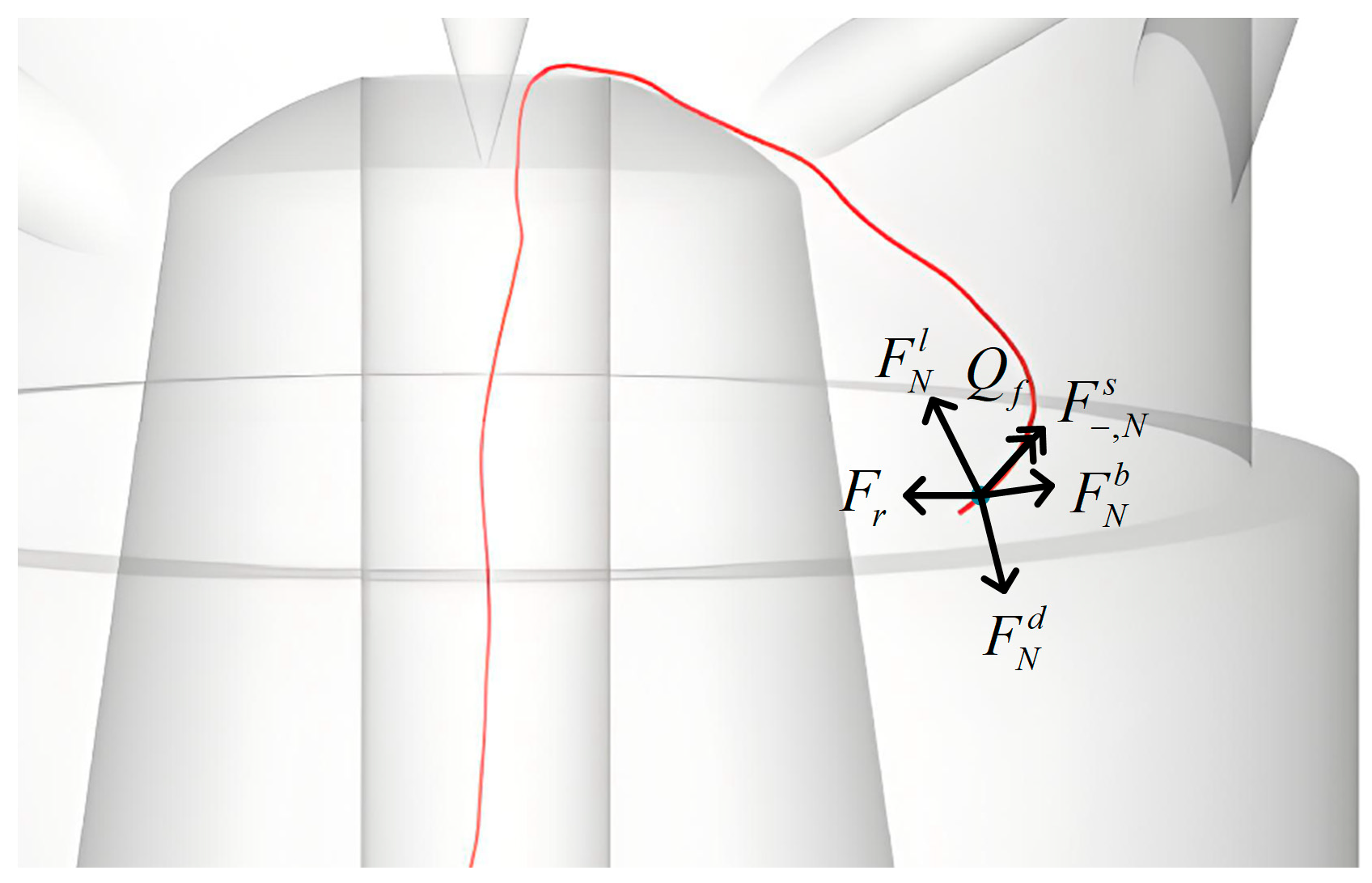
The radial and circumferential motion trajectories of the fiber tip are crucial for studying vortex yarn structure and enhancing its strength, as illustrated in Figure 5. The free fiber tip performs circular motion around the nozzle axis with angular velocity ω N f , while simultaneously undergoing axial traction motion at constant velocity v y . Since the circular motion duration is extremely brief, the angular velocity variation at the tip is negligible and assumed constant. Thus, its trajectory can be approximated as an Archimedean spiral. Neglecting minute oscillations of the tip particle, the magnitude of the resultant velocity v J is expressed as
v J = v y 2 + ( ω N f R N ) 2
where R N is the radial length of the terminal particle. When the fiber head is twisted into the preformed vortex yarn, it experiences lateral pressure from the surrounding core fiber strands and enveloping fibers. If this pressure is uniformly distributed across all fibers within the yarn cross-section, the resulting traction force Q f can be expressed by the following equation [32]:
Q f = 2 π σ b sin 2 α L c R y R c n y μ f
where σ b is the tensile yield strength of the fiber, α is the fiber wrapping angle, L c is the length of the fiber serving as the core fiber portion within the vortex yarn, and μ f is the static friction coefficient of the fiber surface. R y , R c , n y represent the yarn radius, the radius of the core fiber portion in the yarn cross-section, and the number of fibers in the yarn, respectively. The force conditions acting on the fiber end particles along the fiber axis are as follows:
F , N s + F N b + F N d + F N l + Q f = F r
where F r is the centripetal force acting on the particles at the fiber ends during Archimedes’ screw motion, F r = R N ( ω N f ) 2 m N .

2.2. Fiber–Wall Contact Model

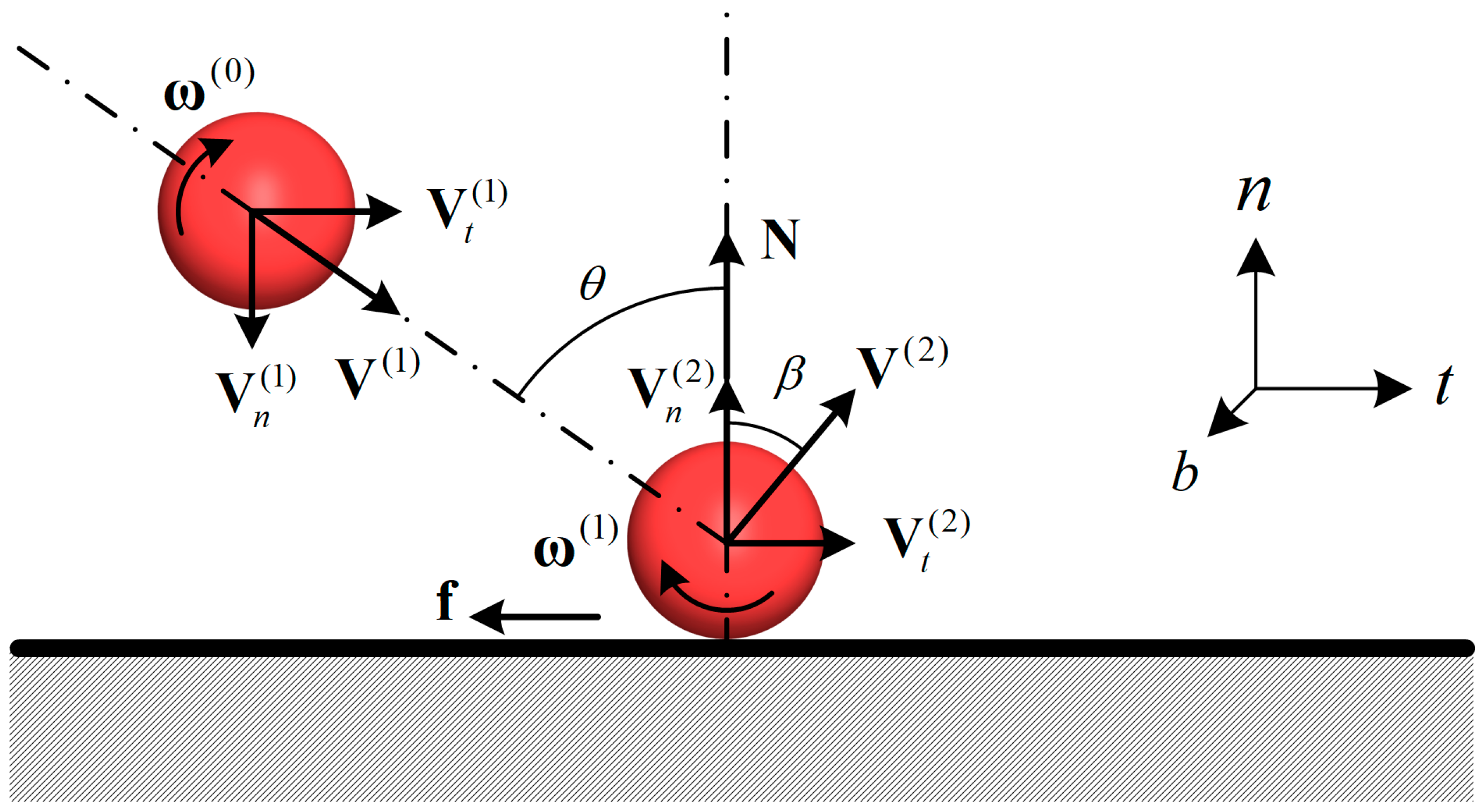
Fibers frequently come into contact with the conical surface of hollow spindles or the walls of vortex tubes. Therefore, a reasonable fiber–wall model is required to address the motion of fibers before and after contact. The radial dimensions of the fibers are significantly small, allowing the curvature of the hollow spindle wall to be neglected. In this case, it can be assumed that the fiber contacts a large flat plate, and only the bead particles come into contact with the plate. The normal direction n is perpendicular to the wall surface and points outward from the wall. The tangential direction t is perpendicular to the normal and aligns with the fluid flow direction. A third direction b is required to represent the rotational direction of the bead. From the model of an inelastic collision between small spheres, it is evident that when the collision angle is greater than or equal to the critical angle, friction persists at the moment the collision ends, causing the spherical particles to rotate around their center of mass. Schematic diagrams of the particles before and after impact are shown in Figure 6. The velocity can be determined as follows:
V n ( 2 ) = e n V n ( 1 )
V t ( 2 ) = V n ( 2 ) tan β
ω ( 2 ) = ω ( 1 ) R p I p f p m i V ( 1 ) cos θ ( e n + 1 ) b
where V and ω denote the particle’s linear velocity and angular velocity, respectively, with subscripts indicating direction and superscripts denoting pre- and post-contact states; e n is the normal recovery coefficient, whose value depends on the material properties of the particle and surface, the impact velocity and angle, the particle shape, surface roughness, and temperature [33]; θ is the angle of incidence; and β is the angle of refraction, θ , β π 2 . According to the law of momentum, it is possible to determine tan β ; m i , R p , I p , and f p represent the particle mass, radius, moment of inertia, and coefficient of sliding friction, respectively. This paper simplifies the relationship by establishing an equation for the normal recovery coefficient based on the material properties of the contact surface and the particle impact velocity:
e n = V n ( 2 ) V n ( 1 ) = σ y , p 2 ρ p E
E = 1 μ s 2 E s + 1 μ p 2 E p 1
tan β = tan θ f s ( e n + 1 ) e n
where σ y , p and ρ p are the particle yield strength and density, respectively; E is the equivalent modulus of elasticity; μ p , E p , μ s , and E s represent the material properties of the particle and wall surface, with specific values listed in Table 1. When the collision angle is less than the critical angle and the duration of friction is shorter than the collision duration [34], the velocity of the bead particle and the critical collision angle θ m are as shown in the following:
V t ( 2 ) = V ( 1 ) sin θ t I p V ( 1 ) sin θ R p ω ( 1 ) I p + m i R p 2 t
ω ( 2 ) = I p I p + m i R p 2 ω ( 1 ) m i R p V ( 1 ) sin θ I p + m i R p 2 b
tan θ m = 7 2 f p ( e n + 1 ) + R p ω ( 1 ) V ( 1 ) cos θ

2.3. Fiber Motion Implementation Program

Based on the derivation in Section 2.1.2, the inertial force of the beads in the fiber model is comparable to the viscous force of the fluid. Since the characteristic dimensions of a single fiber are relatively small compared to the flow field, changes in fiber position do not exert a significant influence on the fluid domain. This permits consideration of unidirectional fluid–structure interaction only. Therefore, this study’s numerical calculation of flexible fiber motion within a compressible vortex field in a nozzle considers only the unidirectional fluid–fiber coupling effect. Two independent grid and solver systems are employed to compute the physical states of the fluid domain and solid domain. The finite volume method is used to solve the turbulence model, with the flow state described in a fixed Eulerian coordinate system. Based on the DEM, the constructed model discretizes the fiber into discrete bead particles on a rod chain. The coupled motion of the fiber is then studied by solving the transport dynamics equations for each bead. Unidirectional data exchange between the flow field and the fiber is achieved through linear interpolation functions. An appropriate time step size is selected to ensure that the linear displacement and angular displacement of beads in the fiber chain at each step are sufficiently small to satisfy the assumptions of the fiber model’s constitutive equations [35]. The solution process for the one-way fluid–solid coupling algorithm for fibers is as follows:
  • Set the initial boundary conditions for the flow field to obtain a fully developed and stable turbulent flow field, thereby acquiring velocity field, density field, and vorticity field data.
  • Given the material, geometry, and position information of the fiber, set the number of fiber elements and the coordinates of the bead nodes; specify the constraints and velocities acting on the fiber under the initial state.
  • Calculate the fluid forces on each bead node, and compute the elastic restoring force and restoring torque for each bead node.
  • Solve the equations for fiber motion to obtain the displacement and velocity of the bead node; then, update the fiber position.
  • Monitor fiber contact, calculate the rebound velocity of the contact bead, and then update the fiber position.
  • Repeat steps 2 through 5 until the iteration ends.

2.4. Nozzle Model and Computational Setup

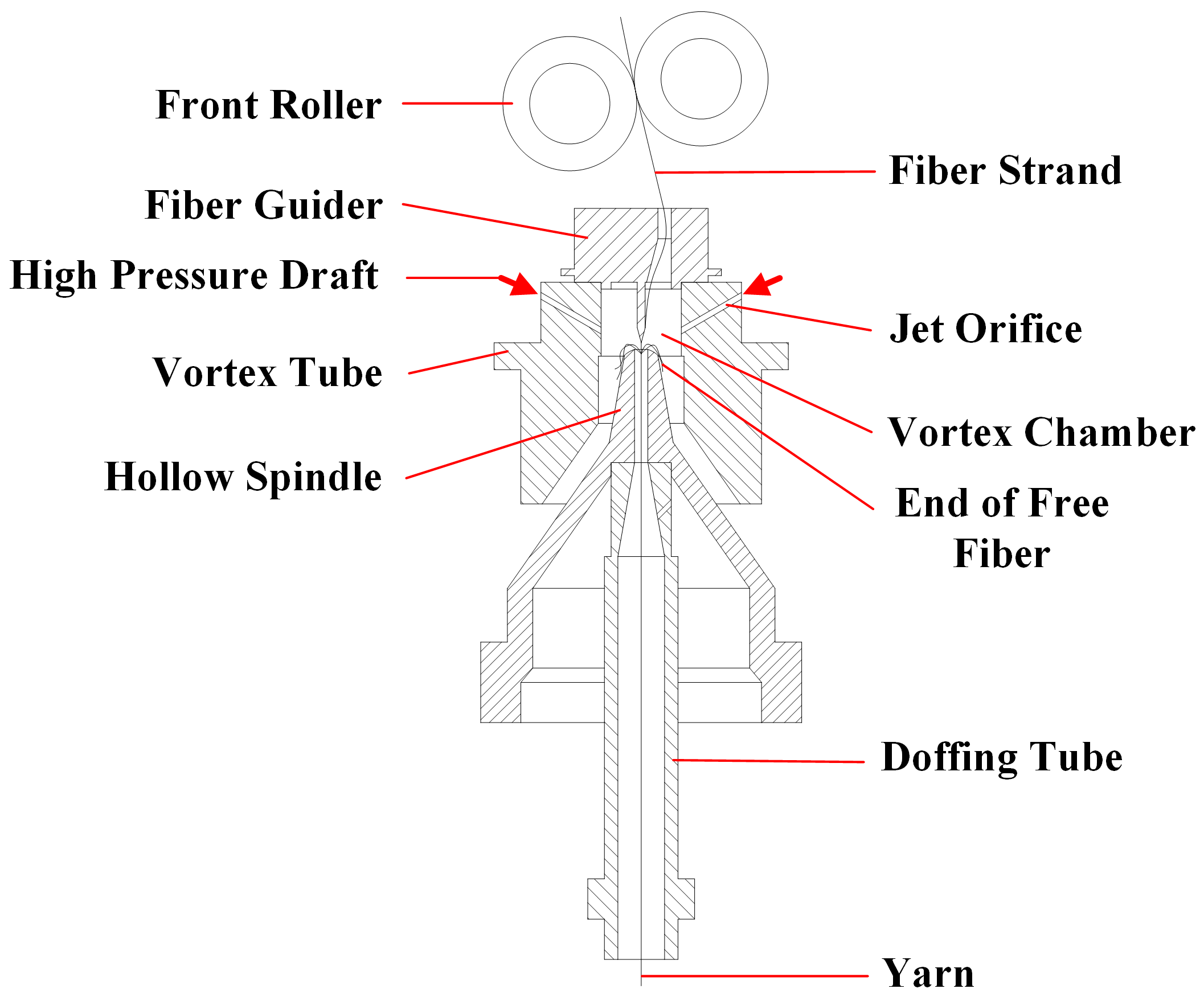
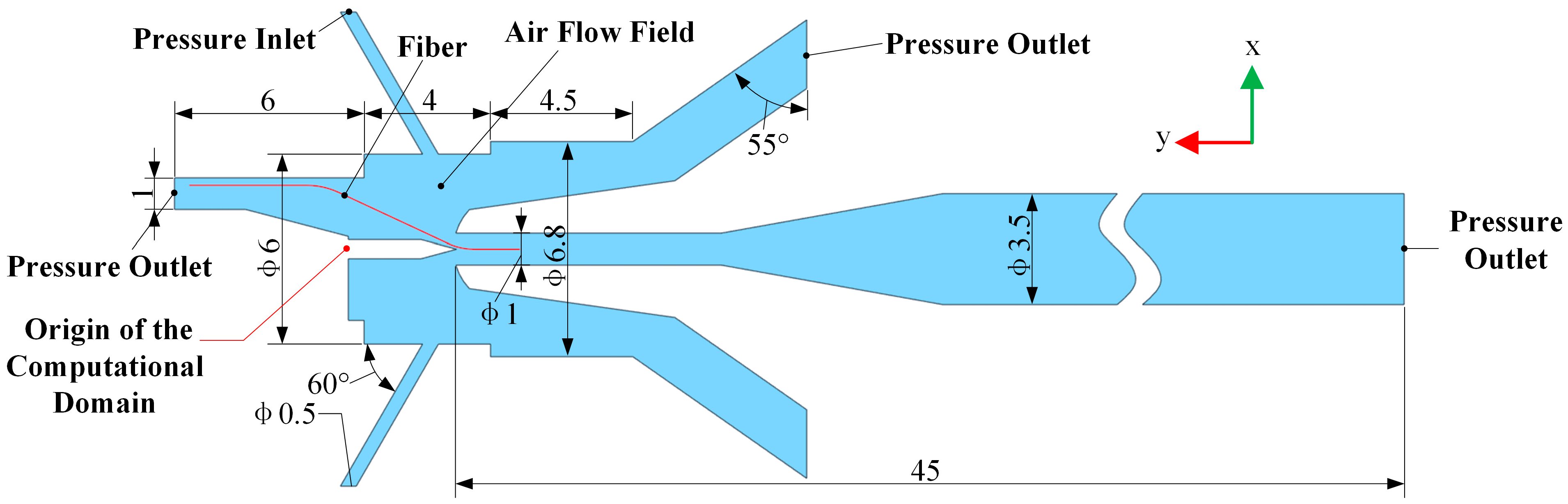
Figure 7 illustrates the two-dimensional schematic diagram of the vortex spinning nozzle. The numerical computational model and basic dimensions of the nozzle gas flow field are depicted in Figure 8. Cotton fiber is used as the study case, with a length of 10.5 mm and diameter of 20 μm. The aspect ratio λ of the fiber is 1050, and its total mass is 5.08 μg. At the initial moment, the fiber tail is located near the nozzle inlet, 0.5 mm away from the inlet; the fiber head is positioned inside the hollow spindle, 1.5 mm away from the spindle inlet end face. Referencing the spinning speed of the vortex spinning device, the fiber maintains a vertical downward velocity of 6.5 m/s. The working medium in the nozzle flow field is a viscous, compressible ideal gas, with thermal effects neglected. Since high-pressure gas flows into the nozzle through the orifice, the orifice opening is defined as a pressure inlet boundary with the total pressure of 0.5 MPa in the flow field simulation. The nozzle inlet, vortex tube outlet, and yarn guide tube outlet are set as pressure outlet boundaries, which are maintained at the local atmospheric pressure. The flow field walls are defined as no-slip boundaries. The flow patterns within the nozzle primarily consist of two forms: high-velocity jets and vortex-like flow within the duct. The Realizable k ε turbulence model demonstrates significantly superior simulation performance compared to standard turbulence models when handling complex conditions such as rotating jets, negative pressure gradients, and outlet recirculation [36]. We compared the simulation results of the Realizable k ε model with those of the standard k ε model, RNG k ε model, and standard k ω model. The results showed that the Realizable model provided a pressure field that was consistent with typical expectations for this flow configuration. In the absence of experimental ground truth, the Realizable k ε model was ultimately adopted for subsequent calculations in this study, given its extensive application in similar turbulence problems.
The numerical simulation of the flow field in this study was performed using the commercial finite element software ANSYS Fluent 2024R1, with the SIMPLEC algorithm employed for pressure–velocity coupling. The solid solver used was Rocky 2024, and the elastic bead–rod model of fibers was implemented based on the Pyrocky library. During the normal operation of vortex spinning, the incoming flow at the nozzle orifice inlet is a steady pressure flow, and the flow inside the nozzle can be regarded as fully developed turbulent flow in a pipe under constant pressure, thus treated as steady turbulence. A steady-state solver was used to simulate the flow field in this study. The flow field was solved in steady state, while the structural field was solved in transient state, with the two solved in an asynchronous manner. The time step for the structural field solution was set to 0.001 ms.

3. Results

3.1. Parameter Sensitivity Analysis

3.1.1. Mesh Sensitivity

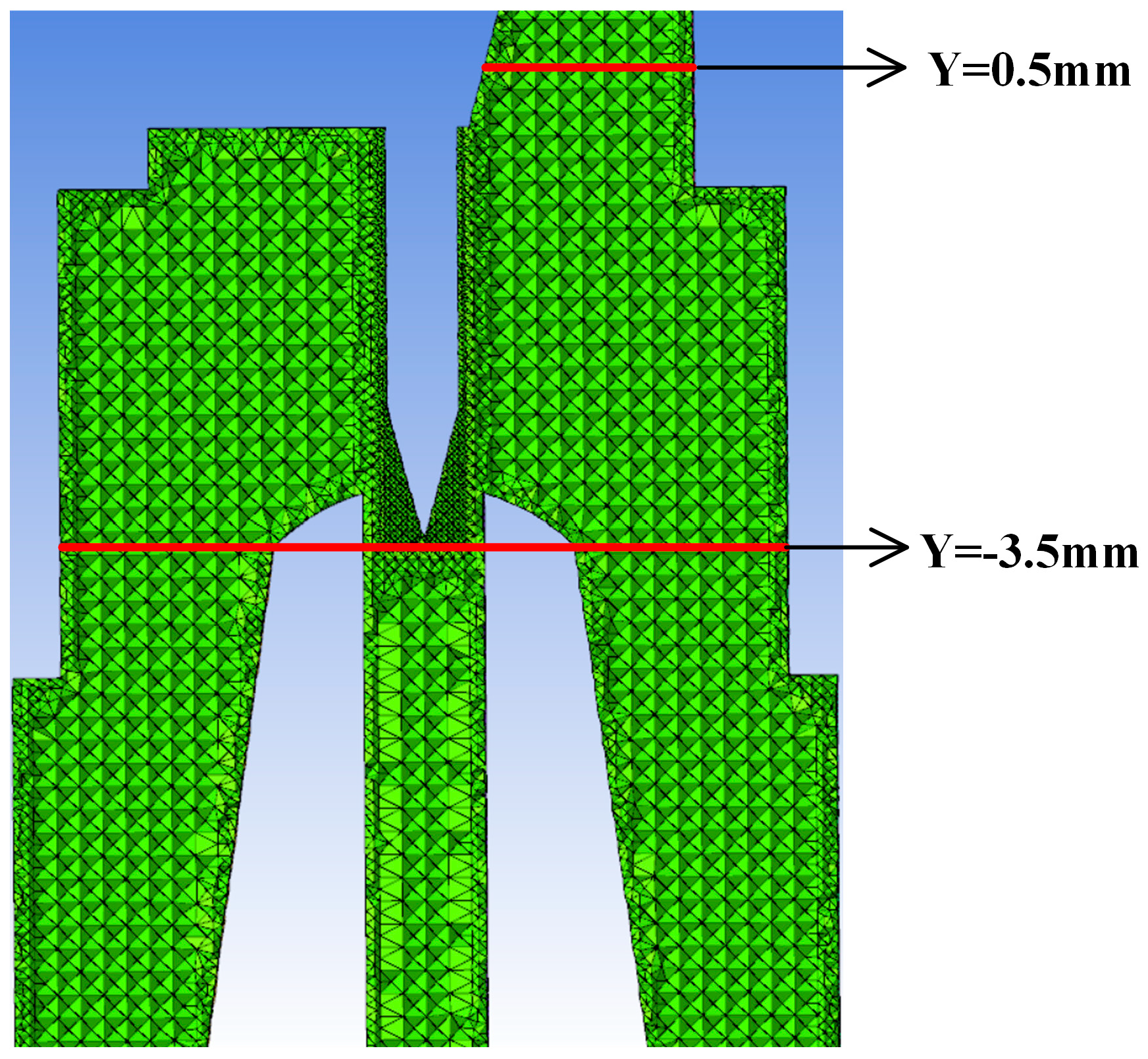
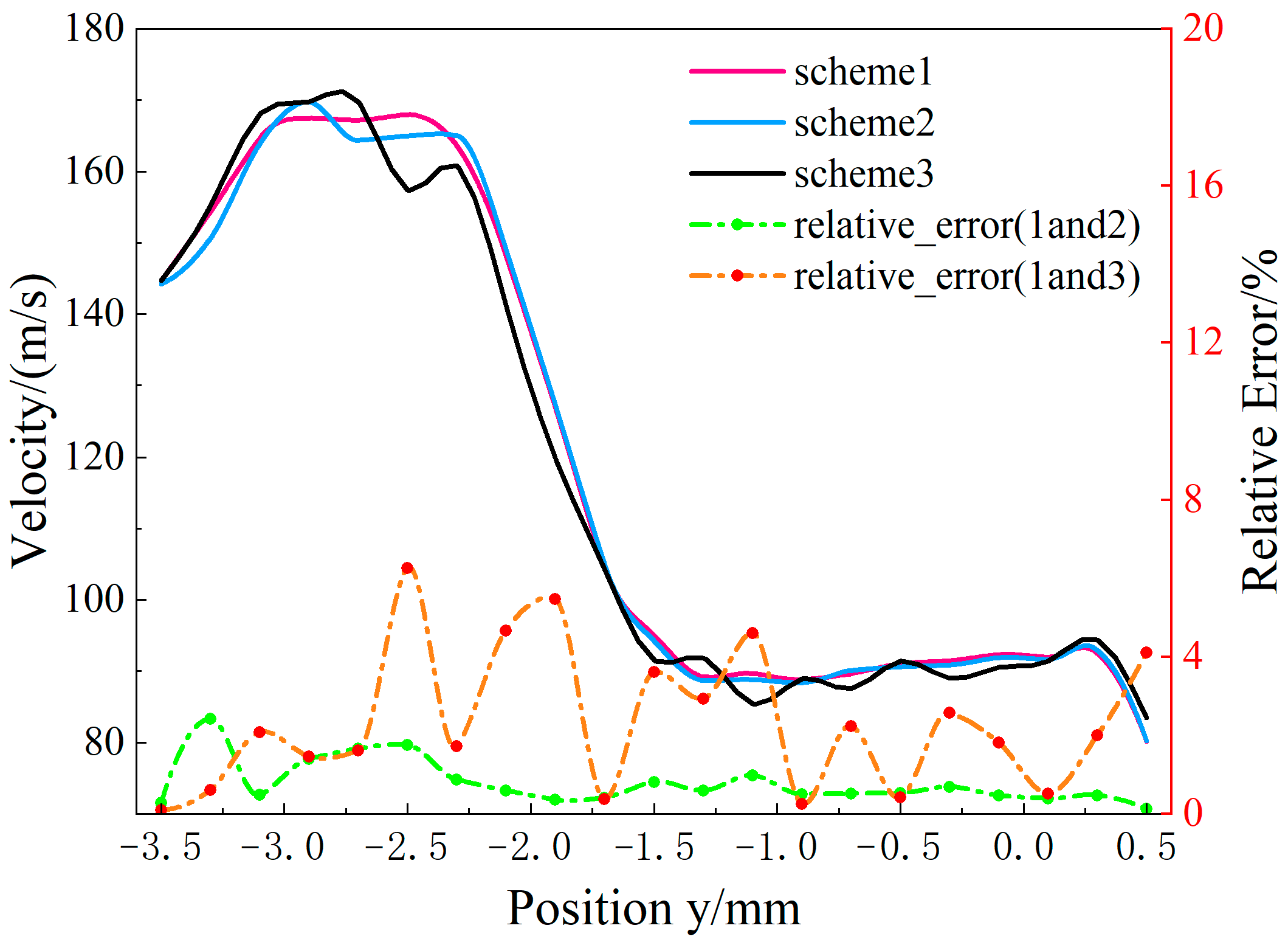
The nozzle flow field has a complex geometric structure. A single unstructured tetrahedral element was selected to mesh the entire flow field model, so as to reduce the complexity of grid calculation during the preprocessing period and obtain a high-quality grid model, as shown in Figure 9. To capture the high stress gradient characteristics of the flow field at certain locations and improve the simulation accuracy of regions of interest, grid refinement was performed at the guide pin, the jet orifice and its outlet, and the end face of the hollow spindle. Grid independence verification was carried out to reduce the sensitivity of simulation results to grid size and ensure high calculation accuracy. Three sets of grids (coarse, medium, and fine) were designed: scheme 1 (medium) with 2.63 million nodes, scheme 2 (fine) with 4.39 million nodes, and scheme 3 (coarse) with 1.16 million nodes. The area-weighted average velocities at different cross-sections within the Y-coordinate range of 0.5 mm to −3.5 mm were monitored, and the calculation results obtained from different mesh schemes were compared. The relevant results are presented in Figure 10. The difference between the calculation results of schemes 1 and 2 was less than 3%, while the overall error between schemes 1 and 3 was more than 3%, which proved that the accuracy of the medium grid was sufficient.

3.1.2. Rod Element Length Sensitivity

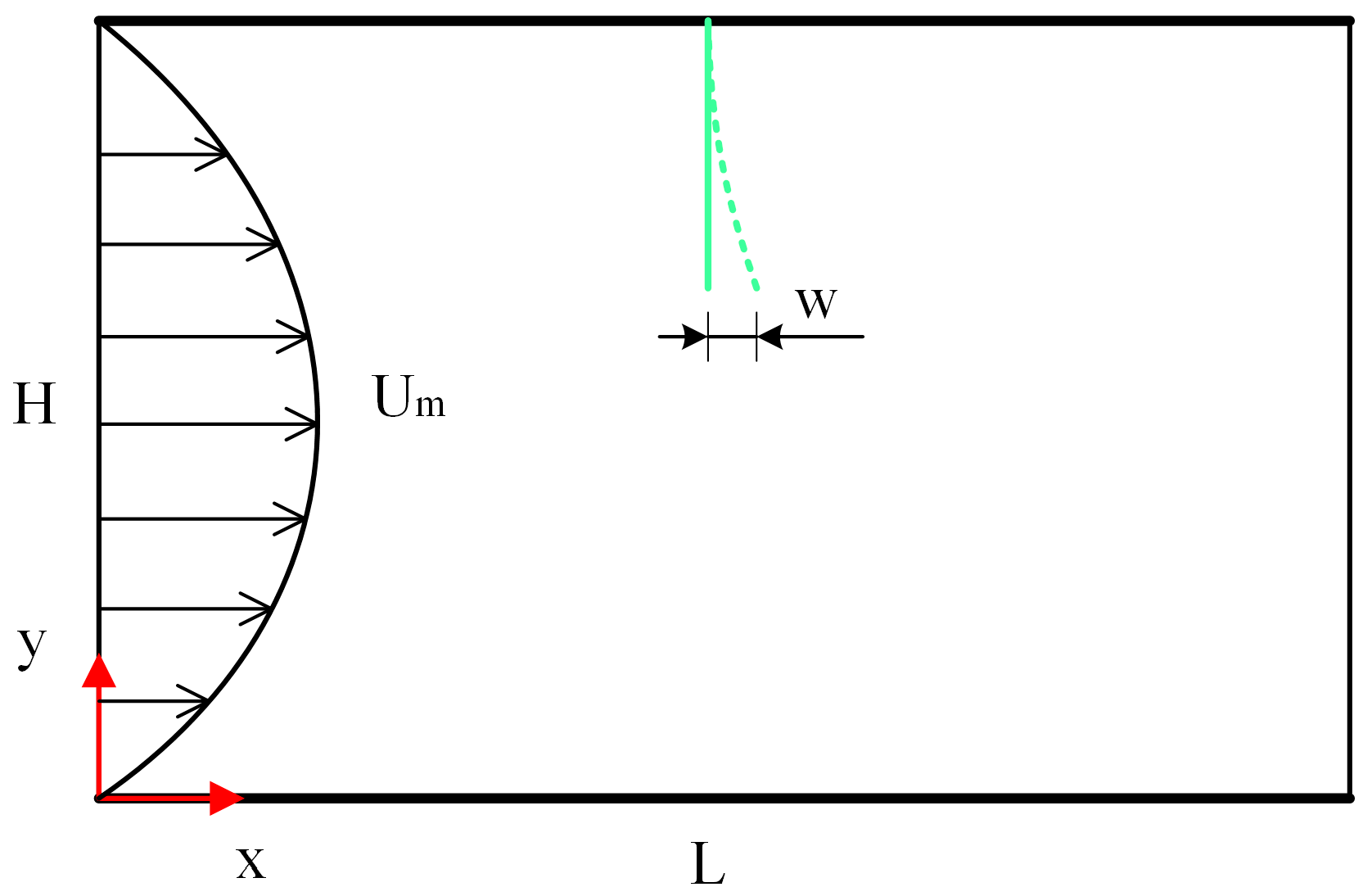
The deflection experiment of the free side of a cantilever beam in laminar flow can serve as a benchmark for testing fiber dynamic models in fluid flow. By comparing the simulated deflection of the free end of the fiber with the analytical solution of the equation established by Lawryshyn [37], the influence of rod length in the fiber model on fiber dynamics was investigated. The flow field setup is shown in Figure 11: the channel width is H = 15 mm and the length is L = 20 mm . One end of the fiber is fixed to the upper wall of the flow field, and the other end is in a naturally drooping initial state. When the fluid velocity in the channel follows a parabolic distribution, the formula for the deflection w of the free end of the cantilever fiber is as follows:
w = 2 π 45 μ U m L f 5 E I H 2 ln D f L f 33 H 26 L f
where U m is the maximum flow velocity in the channel, U m = 0.68   m / s . In this simulation, the total length of the fiber L f was set to 5 mm, and the fiber diameter D f was set to 20 μm. The value of Equation (37) is 24.8 μm. Table 2 indicates that as the number of rods increases, the simulated free-end deflection gradually approaches the analytical solution proposed by Lawryshyn. When the number of rods was 60, the error between the simulated deflection value and the equation solution was the smallest, at 1.2%. When the number of rods was 50 (i.e., the rod length is 0.1 mm), the fiber exhibited favorable dynamic characteristics without occupying excessive computational resources. Therefore, in subsequent experiments, 0.1 mm was used as the length of the fiber rod element, with an aspect ratio λ i of 10.

3.2. Fiber Motion Simulation

3.2.1. Motion Analysis

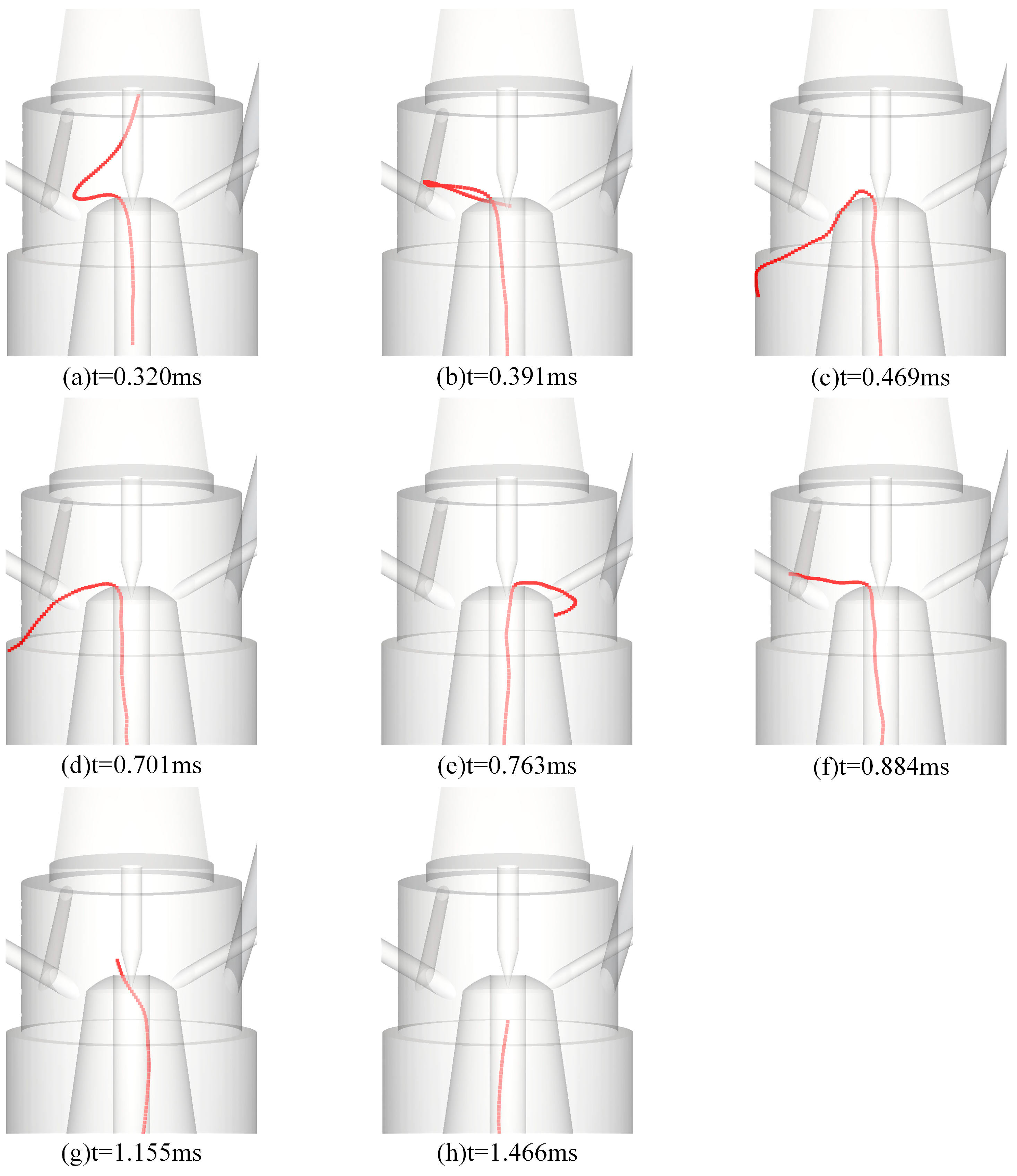
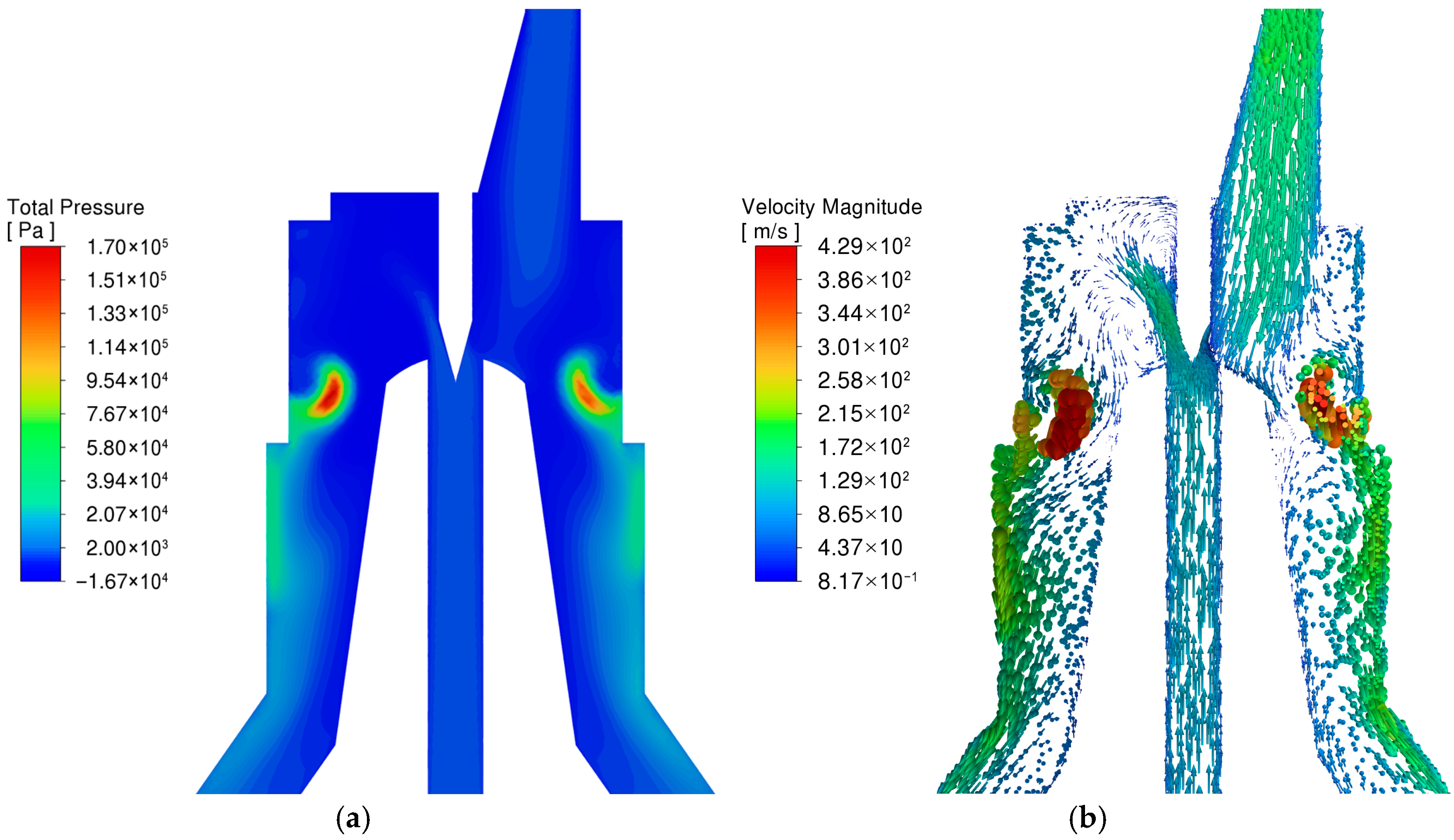
The entire process of the fiber tail entering through the nozzle inlet and exiting from the hollow spindle is shown in Figure 12. At the initial moment, the fiber head is located within the hollow spindle, while the tail resides in the guide body channel. Assuming the fiber head has already been twisted into the preliminary vortex yarn formed within the hollow spindle, it moves downward at a speed of 6.5 m/s (actual spinning speed) due to the frictional force exerted by surrounding fibers. The simulation results indicate that the fiber tail rapidly enters the vortex chamber and moves along the guide needle toward the top surface of the hollow spindle. This is mainly because there exists a strong negative pressure region in the nozzle vortex chamber, extending from the inner cavity of the guide body to the inlet end face of the hollow spindle, with a gradually increasing negative pressure gradient, which entrains the free fibers released from the front roller’s grip, as shown in Figure 13a. There is also a guiding airflow around the guide pin, driving the free fibers toward the hollow spindle, as shown in Figure 13b. This airflow is driven by the adverse pressure gradient and its velocity gradually increases. Due to the difference in aerodynamic forces acting on different segments of the fiber, the movement velocity of the middle segment of the fiber is significantly higher than that of the tail segment. The combined effect of aerodynamic forces and the fiber’s gravity causes the middle segment of the fiber to exhibit a phenomenon similar to natural drooping. The middle segment of the free fiber droops downward due to gravity and will contact the conical wall of the hollow spindle. The end segment, under the action of centrifugal force, accelerates toward the wall of the swirl chamber without contacting the conical wall. The tangential airflow in the vortex chamber is generated by the tangentially distributed jet orifices in the vortex tube, and moves mainly in a spiral manner along the wall of the vortex tube. Driven by the tangential airflow, the fiber rotates around the hollow spindle, maintaining a straight overall configuration. From 0.469 ms to 1.155 ms, the fiber undergoes accelerated rotational motion, with its tip height gradually increasing. By 0.884 ms, the tip height exceeds that of the hollow spindle’s inlet end. In actual spinning, entanglement with the input fiber strand may occur. Simulation results indicate that the unique twisting process of vortex spinning machines arises from the combined action of fiber inertial forces and the rotating airflow.
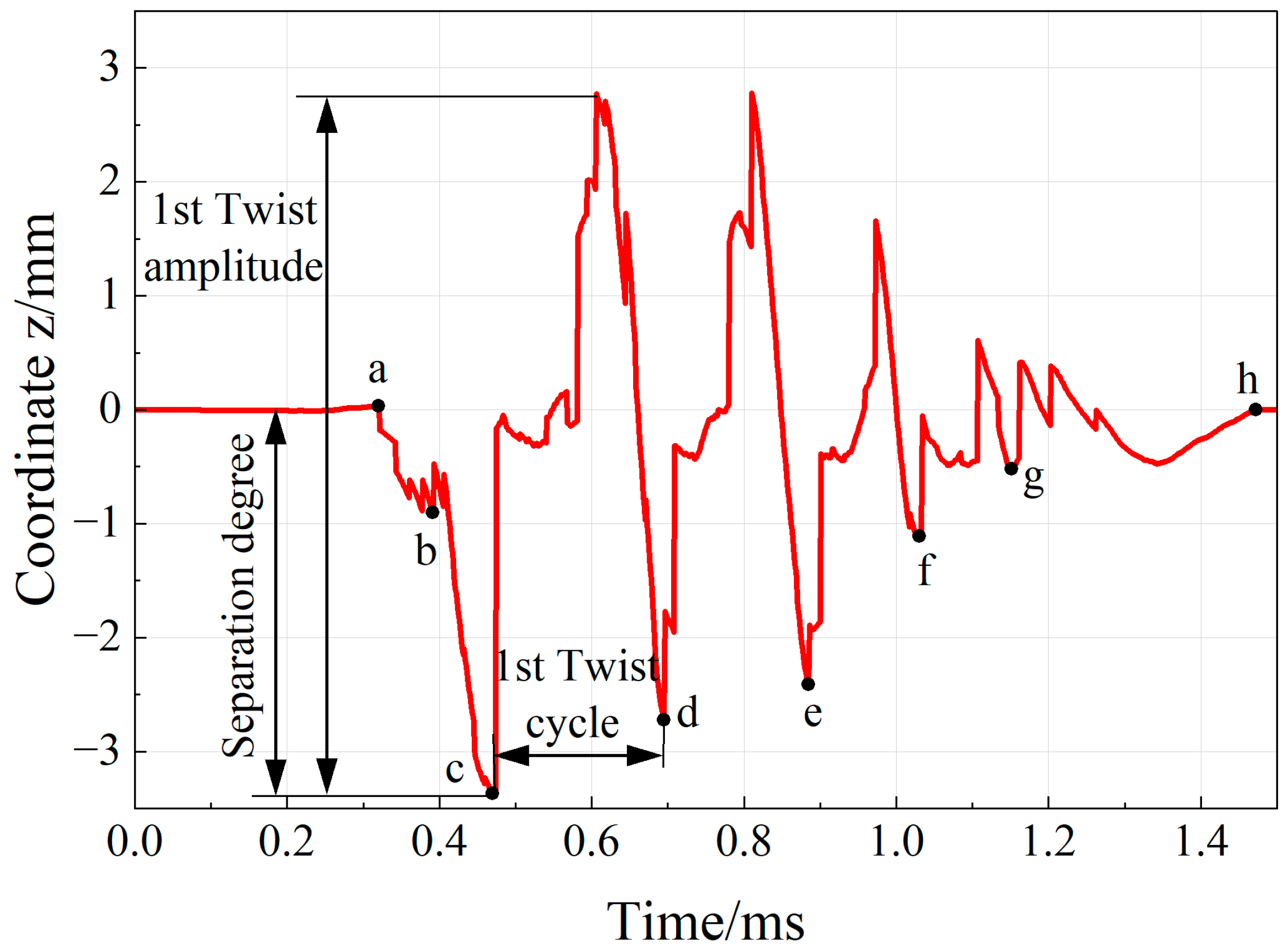
Figure 14 illustrates the z-axis displacement curve of the free fiber end. At time point a, the fiber enters the vortex chamber; at time point b, the fiber begins to flatten. At time point c, the greater the absolute value of the z-axis displacement at the tip, the higher the degree of separation between the fiber strands, making it easier to achieve regular wrapping motion. During the c–g time interval, the displacement curve exhibits periodic, decaying variations, indicating the rotational motion of the tip as the fiber gradually twists into the vortex yarn. The displacement value transitions from negative to positive and back to negative, representing one complete twist cycle. The amplitude of the first waveform reflects the tightness of fiber entanglement. The fiber tip completed four full twists. Generally, more twists result in larger motion amplitudes, tighter fiber wrapping, and higher vortex yarn strength. After time point g, the fiber tip entered the hollow spindle. At time point h, the fiber tip’s z-axis displacement value reached zero, concluding the twisting process.

3.2.2. Velocity Analysis

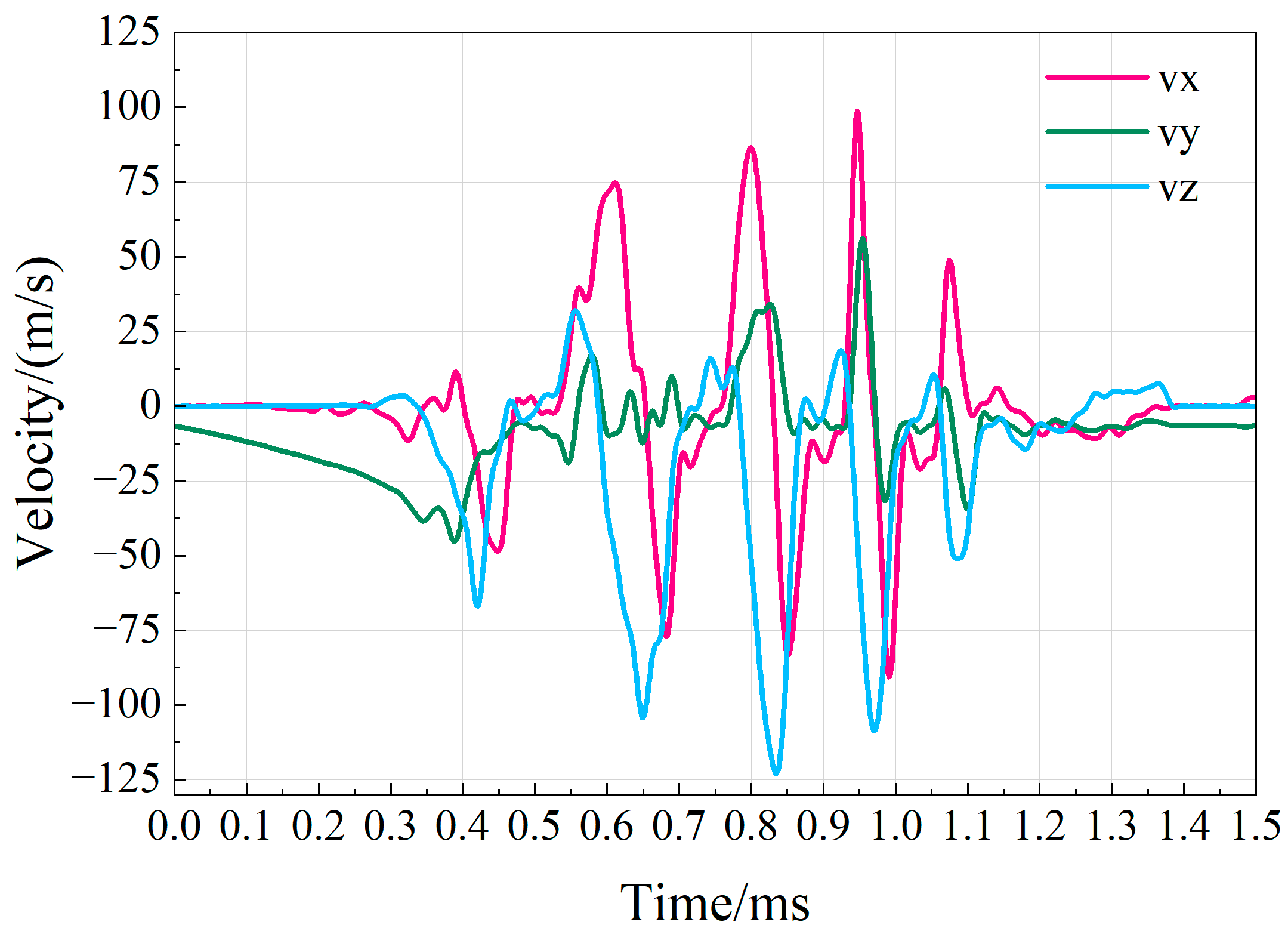
Due to the turbulent flow field formed by high-pressure gas within the vortex spinning nozzle, the highly irregular pulsation of air fluid micro-clusters causes unpredictable oscillations at the ends of small-mass fibers, resulting in velocity discontinuities. This paper employs the Fast Fourier Transform (FFT) method to smooth fiber motion data; see Figure 15. First, the y-direction velocity curve of the fiber end is analyzed. At time 0, the y-direction velocity is non-zero, moving downward at a speed of −6.5m/s under the traction of the fiber head. From 0 to 0.392 ms, the velocity slope continuously increases. This indicates that the guiding airflow within the nozzle guide body exhibits increasing velocity gradients and pressure gradients as it approaches the inlet end face of the hollow spindle. Subsequently, the velocity becomes positive and gradually oscillates upward. This phenomenon is not only related to fiber traction but also indicates the presence of a certain counterflow at the hollow spindle inlet.
According to the analysis of the x-direction velocity curve at the fiber tip, due to the tip’s rotation around the nozzle axis, the velocity exhibits periodic fluctuations. As the tip gradually approaches the hollow spindle inlet, the x-direction velocity increases, the period shortens, and the angular velocity rises, indicating that the flow field reaches its maximum velocity near the hollow spindle inlet. Closer to the flow field axis, the gas velocity decreases, causing the fiber velocity amplitude to first increase and then decrease. The z-direction velocity follows the same trend as the x-direction velocity, but their peaks do not occur simultaneously.

3.3. Simulation Result Verification

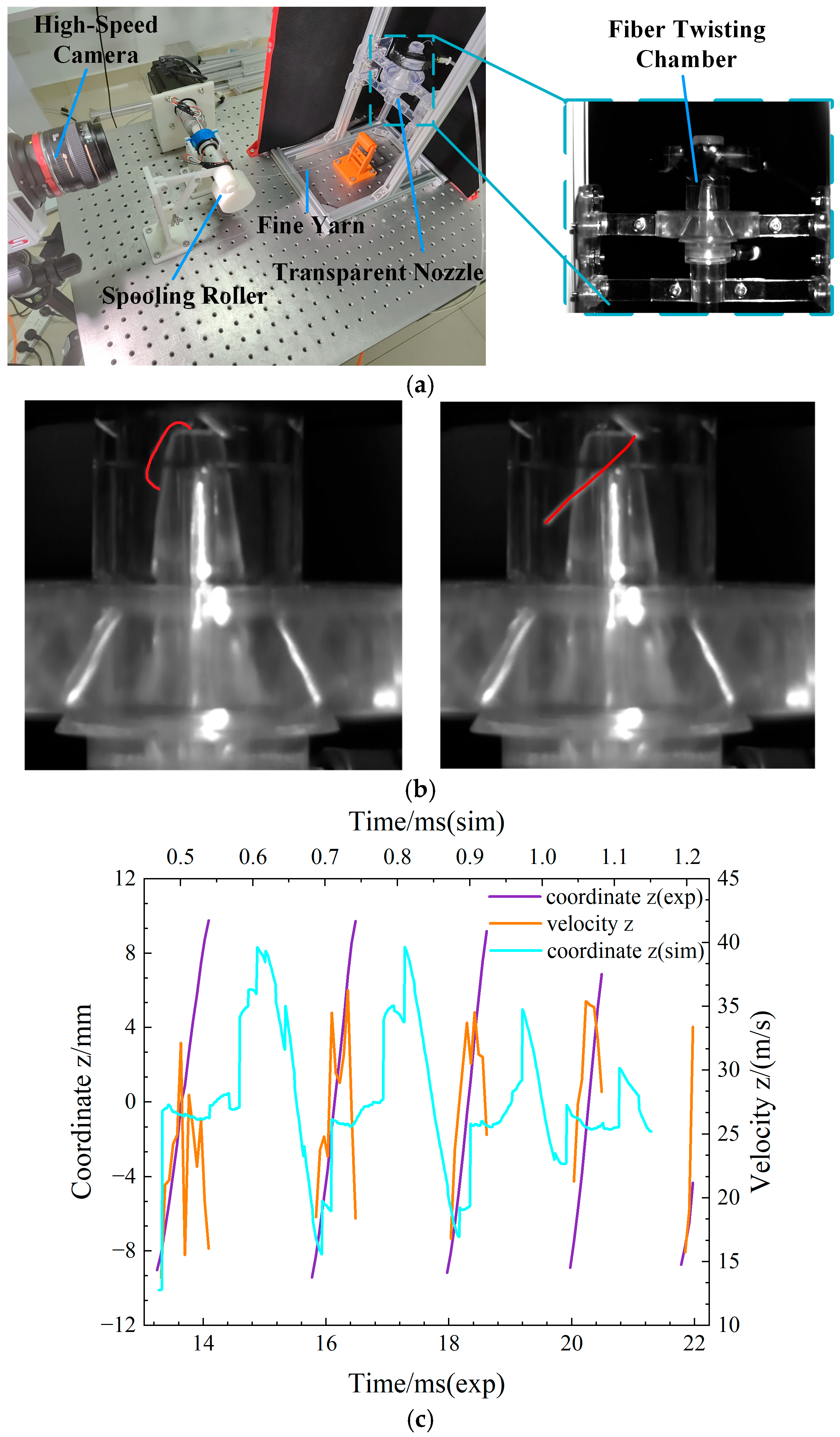
To validate the rationality of the enhanced rigid bead–elastic rod chain model and accuracy of the numerical simulation results, a fiber motion observation platform was constructed based on the yarn-forming device of a vortex spinning nozzle, and fiber twisting experiments were conducted. The yarn-forming process of free fibers within the nozzle vortex chamber typically completes within milliseconds in the confined space, making it impossible to clearly capture the motion characteristics of fiber endpoints under actual operating conditions. Constrained by experimental observation hardware limitations, this study tripled the nozzle dimensions. All nozzle components were fabricated from transparent resin material.
Since the flow inside the nozzle is high-speed compressible flow, the model and prototype should satisfy the Mach number similarity and Reynolds number similarity to ensure airflow similarity. However, when air is used as the medium for both similarity criteria, there is a contradiction in setting the model flow velocity, making it impossible to satisfy both simultaneously. Considering the working capacity of the air compressor and the experimental condition being viscous flow in the pipe, the Reynolds similarity criterion is adopted in the study to achieve dynamic similarity of the flow field. The Reynolds number similarity should satisfy
Re = ρ p U p L p μ p = ρ m U m L m μ m
where the subscripts p and m denote the physical quantities of the experimental model and simulation model, respectively. In both the experiment and simulation, air is used as the working medium. Thus, the characteristic velocity of the flow field in the experiment is one-third of that in the simulation model. For the convenience of measurement, the inlet velocity of the nozzle orifices is taken as the characteristic velocity. In the experiment, the inlet flow rate is mainly set to three times the simulation flow rate to ensure flow similarity.
Due to the limitations of the high-speed camera’s frame rate and resolution, an extremely fine pure cotton single yarn (with a diameter controlled at approximately 100 μ m ) was used instead of coarse fibers for subsequent experiments. Considering the extremely high movement speed of fibers during the stable spinning stage, the spinning speed was reduced to 2.5 m/s in this study. The high-speed camera employed was the Revealer S1315M/C (HF Agile Device Co., Ltd., Hefei, China), equipped with a 50 mm f/1.4 Canon (Tokyo, Japan) lens. Operating at a full-frame rate of 5200 fps, the frame rate could be increased to 15,000 fps through image cropping. The planar coordinates are determined by observing the convex hull of the object [18]. The experimental setup simulating the vortex spinning process and the observational results are shown in Figure 16.
The entire experimental platform concludes three components: nozzle, winding roller, and high-speed camera (see Figure 16a). The experimental procedure involves introducing high-pressure gas from a high-pressure gas source, manually releasing the yarn tail end, and simultaneously activating the winding roller. The winding roller then pulls the yarn head end outward, while the high-speed camera records the internal view of the nozzle twisting chamber during the experiment. In Figure 16b, the left image shows the free yarn being drawn into the vortex chamber by the negative pressure airflow in the chamber. The closer it gets to the hollow spindle, the higher the axial airflow velocity, resulting in the phenomenon that the middle segment of the yarn begins to droop first. This is consistent with Figure 12a. The right image in Figure 16b displays the wrapping motion of the yarn. The angular kinetic energy of the gas inside the nozzle decays axially, causing the angular velocity of the fiber end to be smaller than that of the middle position, and the end lags behind the middle position relative to it. This is consistent with Figure 12e.
Due to insufficient transparency of components, obstruction by the hollow spindle, and interference from the nozzle bracket, the traceable yarn trajectory is severely limited. Only five half-cycles of the yarn end’s twist-back motion curve could be obtained, as shown in Figure 16c. As the number of twists increases, the twist-back speed gradually increases. Within the same twist cycle, the z-axis velocity of the yarn end first increases and then decreases. Across different twist cycles, the maximum velocity changes from increasing to decreasing. The simulation curve in Figure 16c has its amplitude amplified by three times and the time axis shifted to match the displacement of the fiber during different twisting cycles. Although the fiber bundle as the research object failed to strictly meet the dynamic similarity conditions due to limited experimental conditions, the motion law of the yarn end obtained from the experiment is highly similar to the numerical simulation results of free fiber motion, indicating that the research method for the fiber coupling motion in the nozzle flow field of the vortex spinning machine in this study is feasible.

4. Influence of Nozzle Geometric Parameters on Fiber Motion

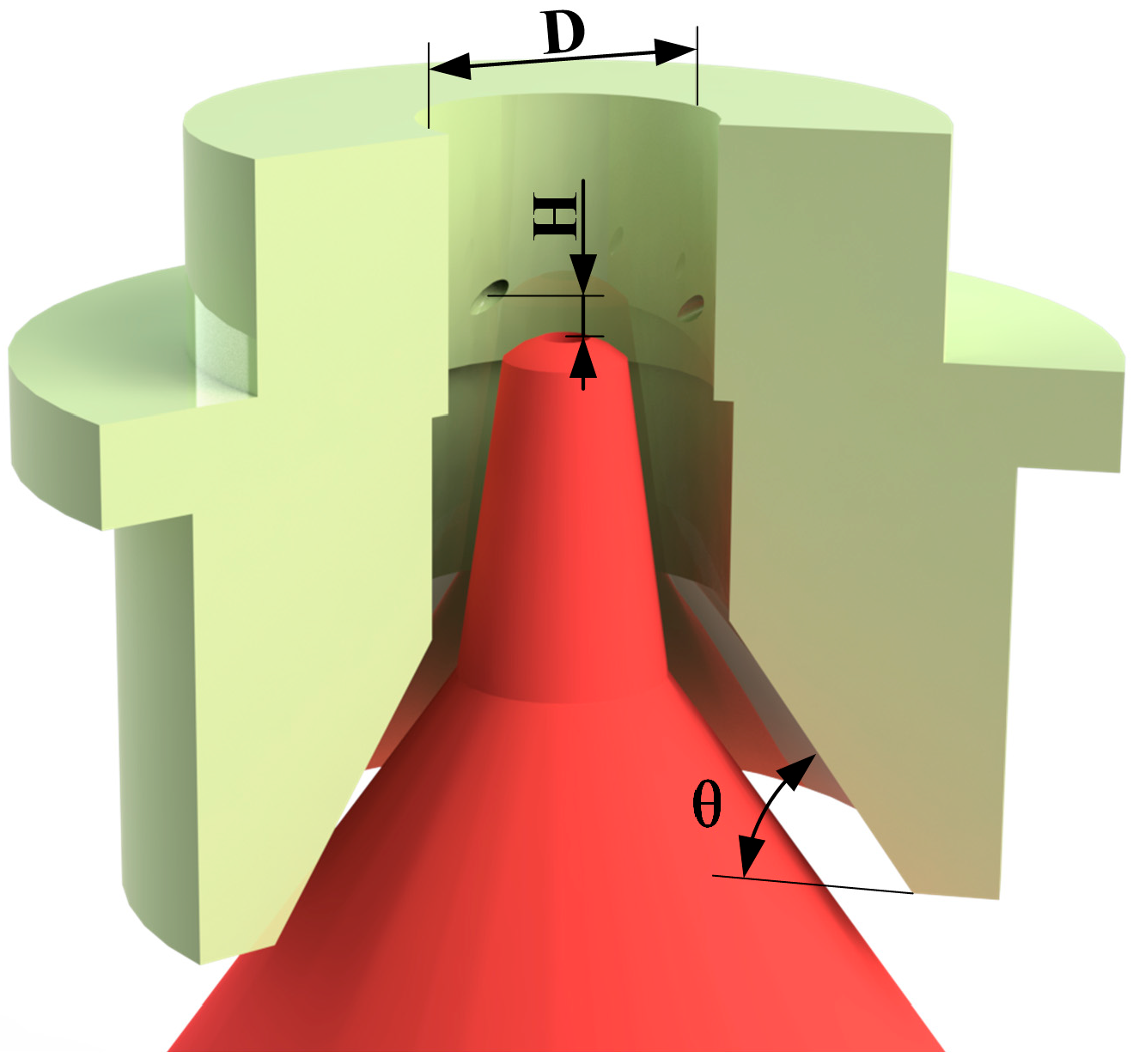
Numerous studies have optimized typical geometric parameters of nozzles. However, certain parameters warrant further refinement, such as the distance H between the vortex tube jet orifice outlet and the hollow spindle, the diameter D of the nozzle twisting chamber, and the taper angle θ of the vortex tube’s conical cavity. These geometric parameters influence the distribution of physical properties within the airflow field, thereby significantly impacting the fiber bundle twisting process, which relies entirely on airflow-driven mechanisms. This study investigates the effects of these parameters on fiber motion and further analyzes their impact on yarn microstructure and mechanical properties. A schematic diagram of the geometric parameters is shown in Figure 17. Single-factor experiments were conducted for each parameter, designing seven operating conditions with three experimental sets per parameter, as detailed in Table 3. The influence of different parameters on the motion trajectory of fiber tails was analyzed.

4.1. Effect of Distance Between Nozzle Outlet and Hollow Spindle

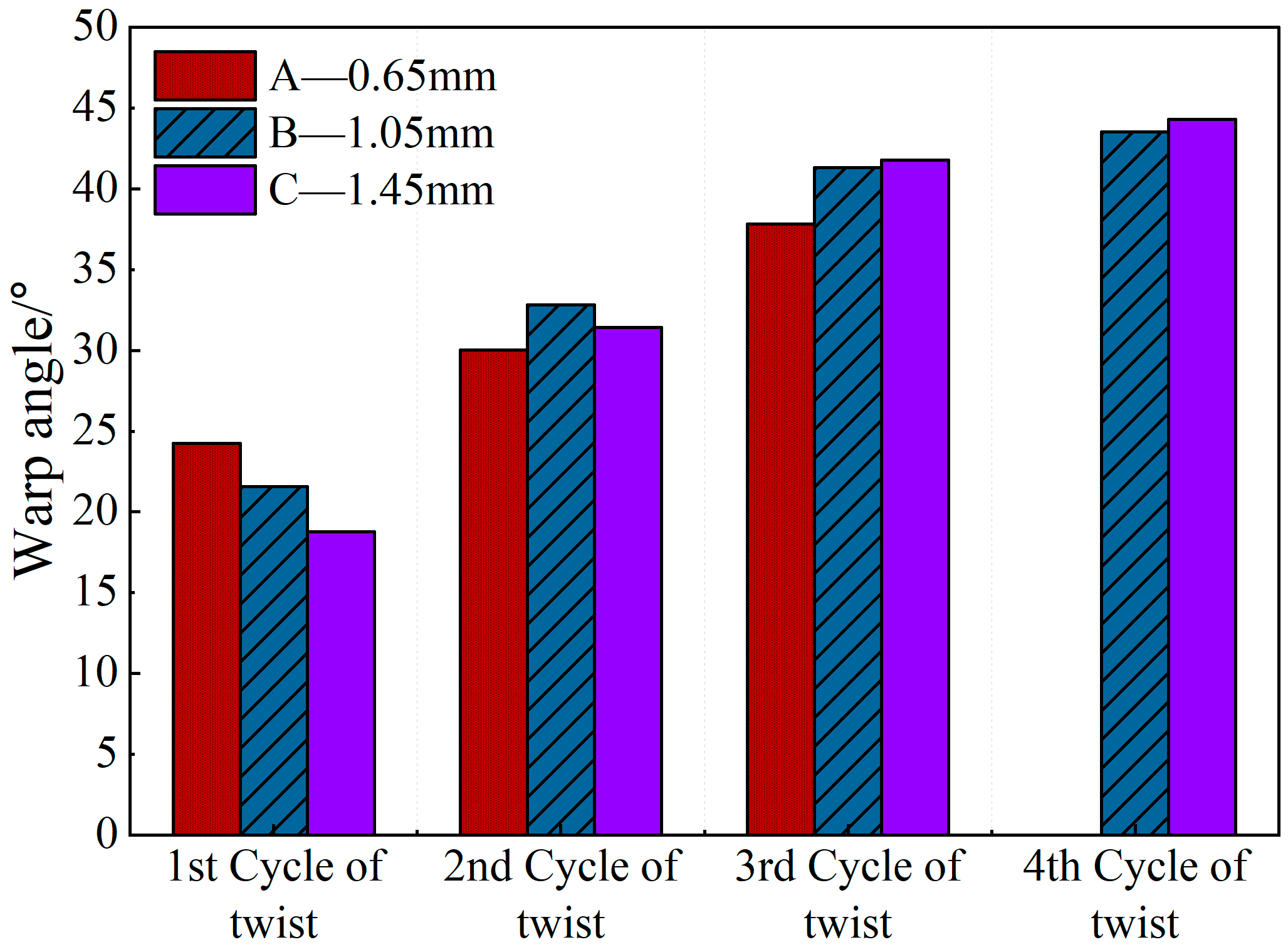
Analysis of the z-displacement curve at the fiber end and the value of the wrap angle at different twist cycles is shown in Figure 18 and Figure 19. This study observed the rotational cycle and amplitude of the free fiber end to derive its motion pattern, concluding that the movement characteristics of the fiber end during the twisting process play a crucial role in the construction and mechanical properties of vortex yarn. A complete oscillation cycle in the displacement curve corresponds to one twist movement, equivalent to adding one twist to the yarn. The degree of fiber separation, the number of spiral motion cycles, and the amplitude significantly influence the strength and abrasion resistance of vortex yarn.
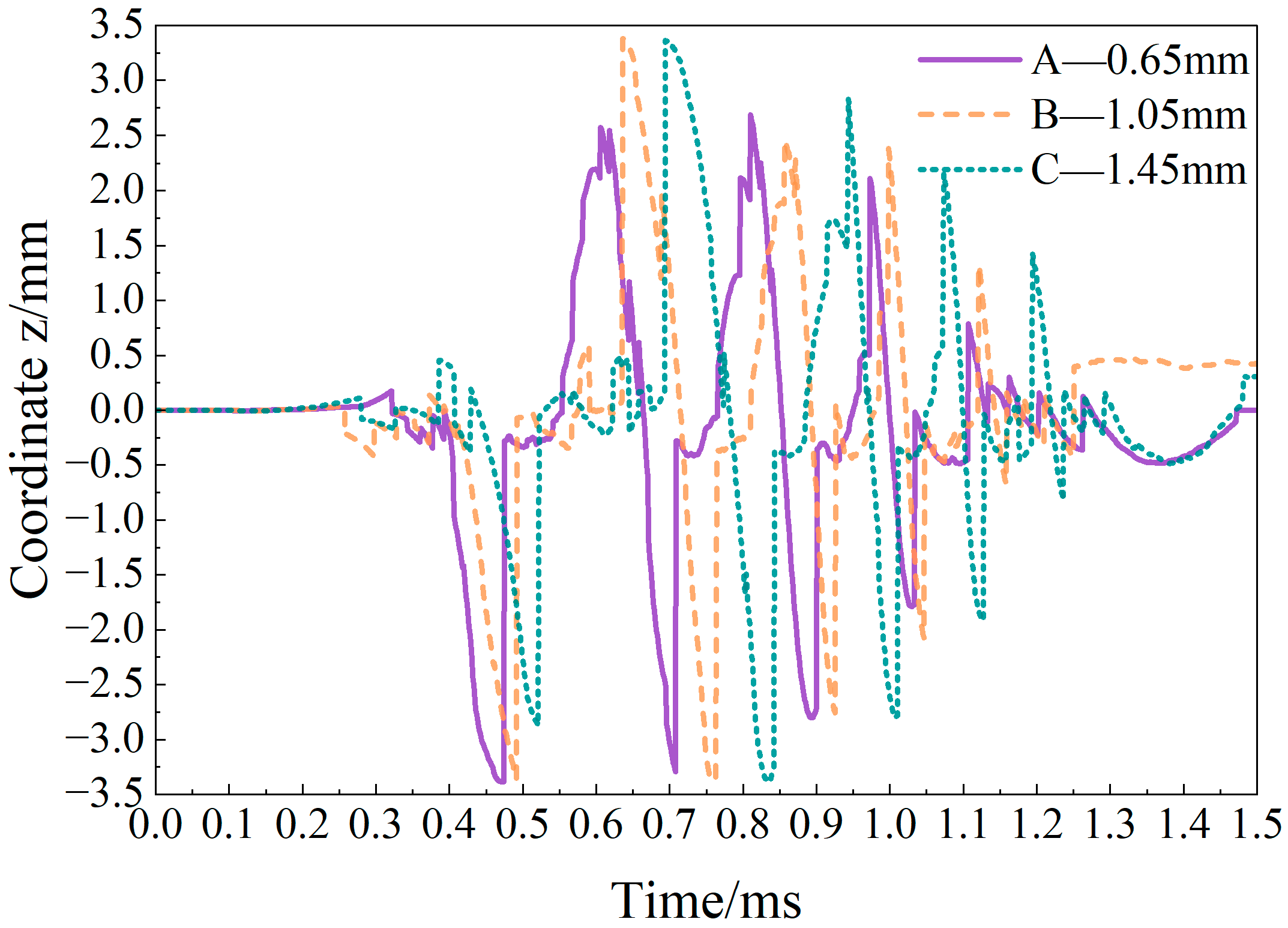
Figure 18 shows the displacement variation curves of the fiber end points in the z-direction under operating conditions A, B, and C. The displacement values represent the amplitude and range of movement at the fiber end during twisting motion. Conditions B and C completed four twists, and the waveforms gradually shifted toward the positive time axis as distance increased, indicating a delayed flattening timing. A larger rotational amplitude indicates higher fiber wrap density. Condition B exhibited the greatest rotational amplitude, followed by Condition C; additionally, Condition B had the highest average rotational amplitude. The first trough value in the fiber motion curves for Conditions A and B is the smallest, indicating the highest fiber separation degree and the greatest number of separated wrapped fibers. Referring to Figure 19, the average warp angle in condition B is greater than that in condition C, with a value of 34.80 ° . It follows that condition B yields the highest number of separated fibers, the tightest fiber warp level, the greatest yarn strength, and the best quality. Furthermore, in subsequent structural optimization experiments, the distance between the vortex tube jet orifice and the hollow spindle in condition B was used as a quantitative parameter. By fixing the different optimal values obtained later, the optimal parameter values were ultimately determined.

4.2. Effect of Nozzle Twisting Chamber Diameter

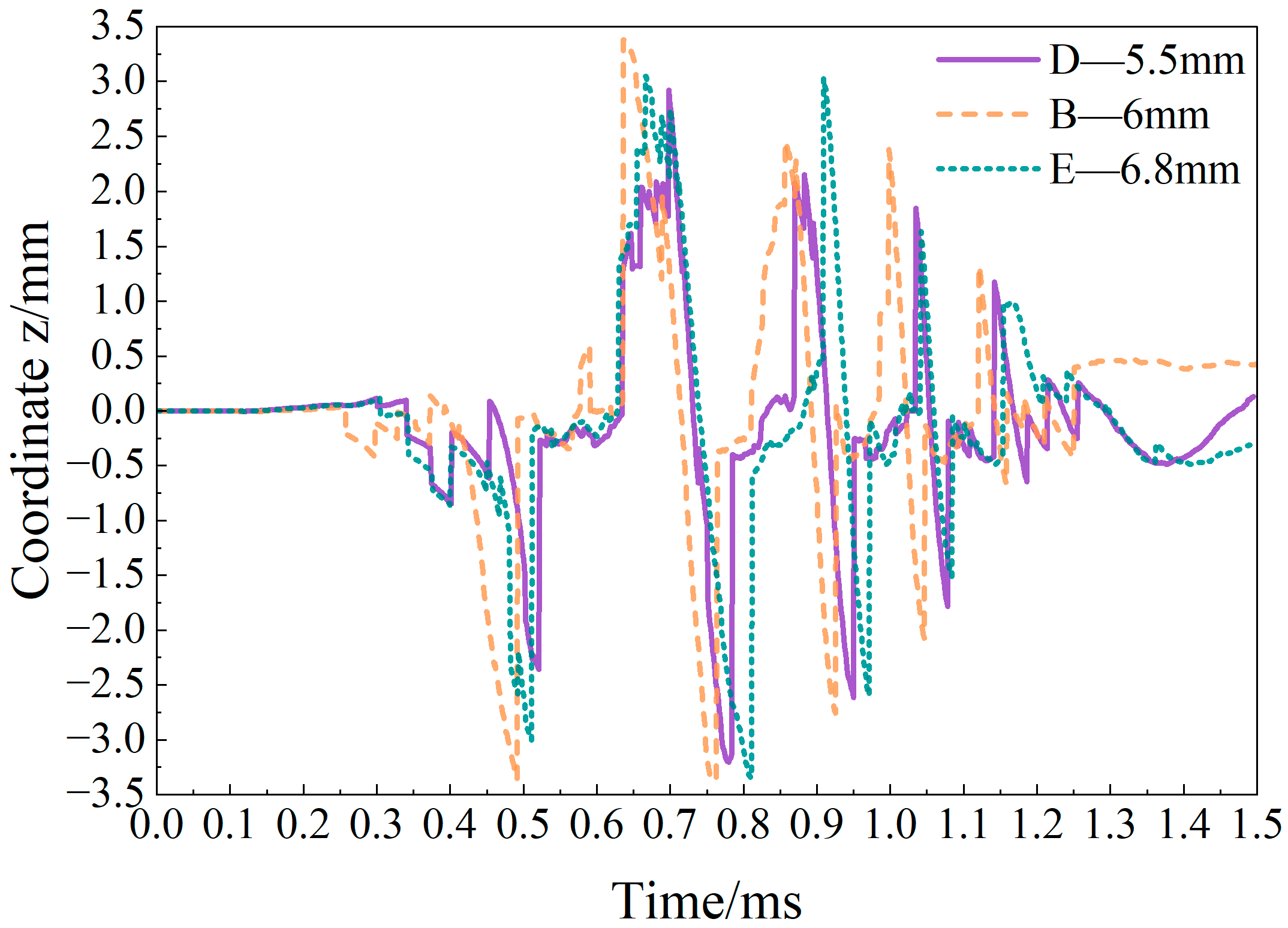
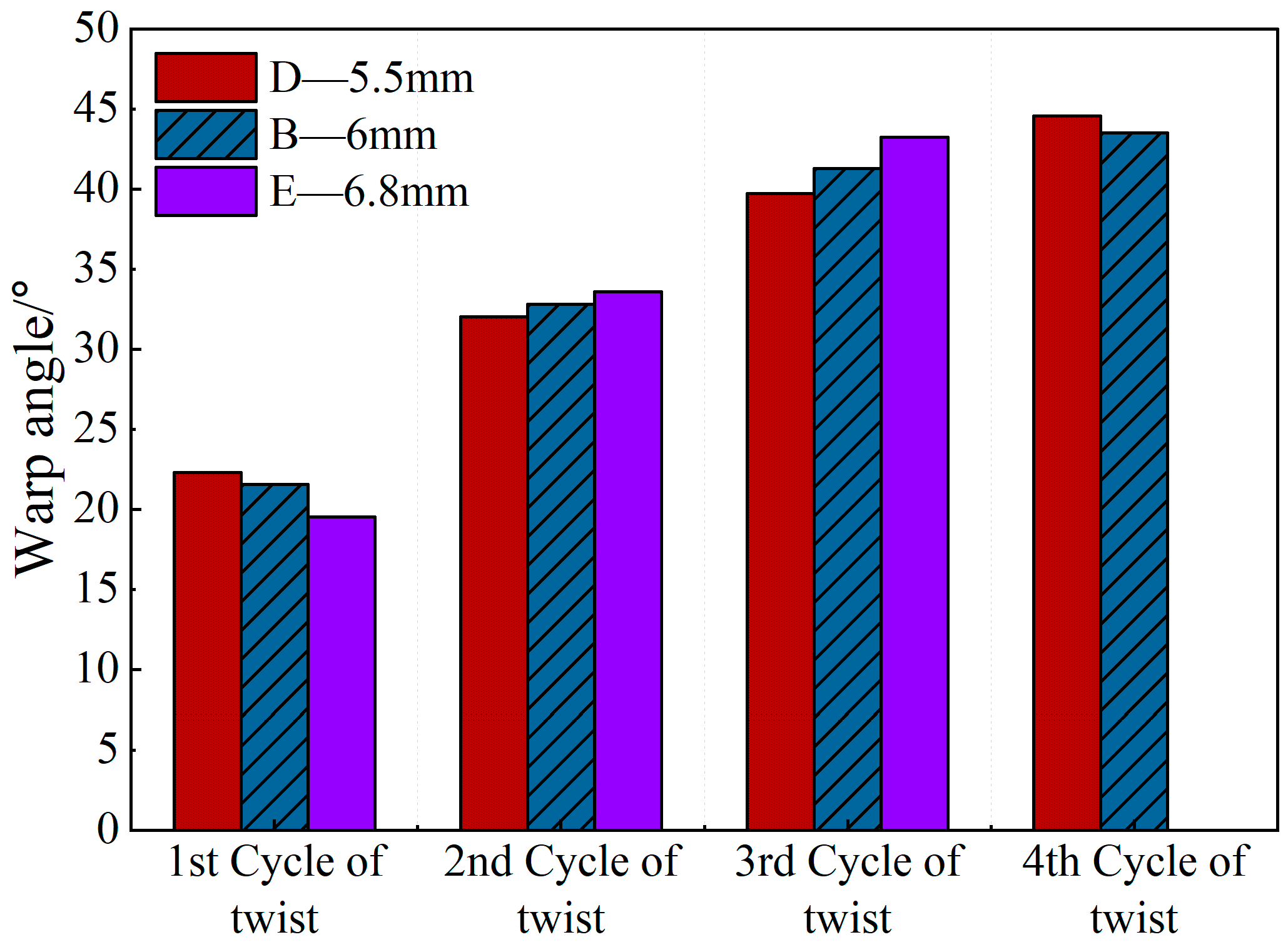
The diameter of the nozzle twisting chamber primarily affects the nozzle’s ability to capture free fibers. A vortex tube with a smaller inner diameter increases the mass flow rate of air within the vortex chamber, enhancing its airflow entrainment capability [38]. However, an excessively small vortex tube inner diameter hinders the full development of the turbulent flow field. Figure 20 displays the z-axis displacement values of fiber endpoints under operating conditions B, D, and E. Comparing the number of twists achieved under the three operating conditions, condition E completed the fewest twists, at only three. Since higher twist counts result in greater vortex yarn strength, comparing conditions B and D yielded the optimal nozzle twisting chamber diameter. The first trough value of the fiber motion curve in condition B was greater than that in condition D, indicating that a twisting chamber diameter of approximately 6 mm can achieve superior fiber bundle separation results. Condition B had the largest amplitude and the highest average amplitude, and thus performed the best among the three. Figure 21 showed that the wrapping angles during the second and third twist cycles in condition B were slightly larger than those in condition D, but the wrapping angle during the first and fourth twist cycle in condition B were smaller. Calculations reveal that the average wrapping angle in condition B is greater than that in condition D. Based on the above analysis, the fiber motion process in condition B is more stable, resulting in superior yarn output. Therefore, the optimal diameter for the nozzle twist chamber should be 6 mm.

4.3. Effect of the Taper Angle of the Vortex Tube’s Conical Cavity

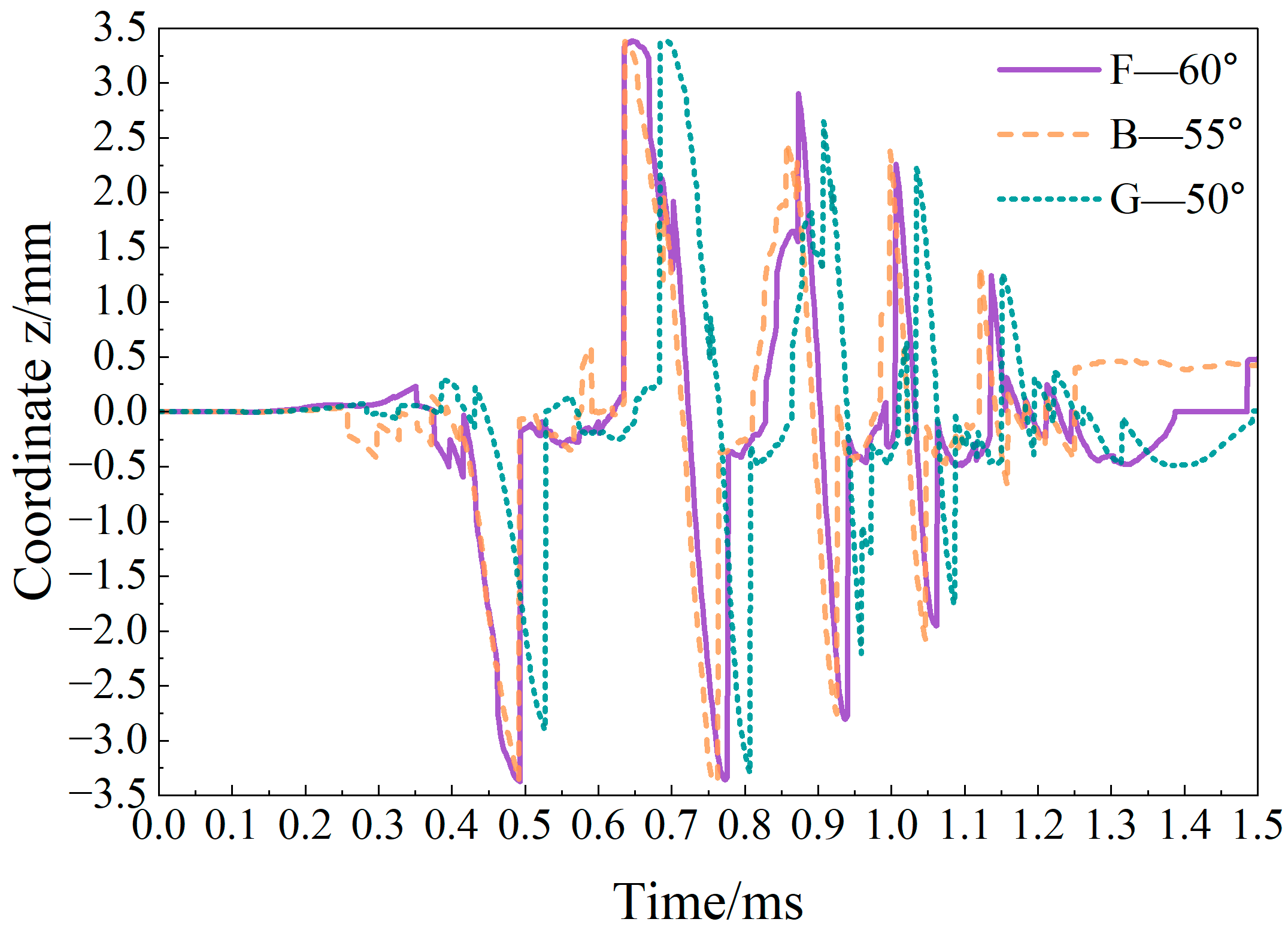
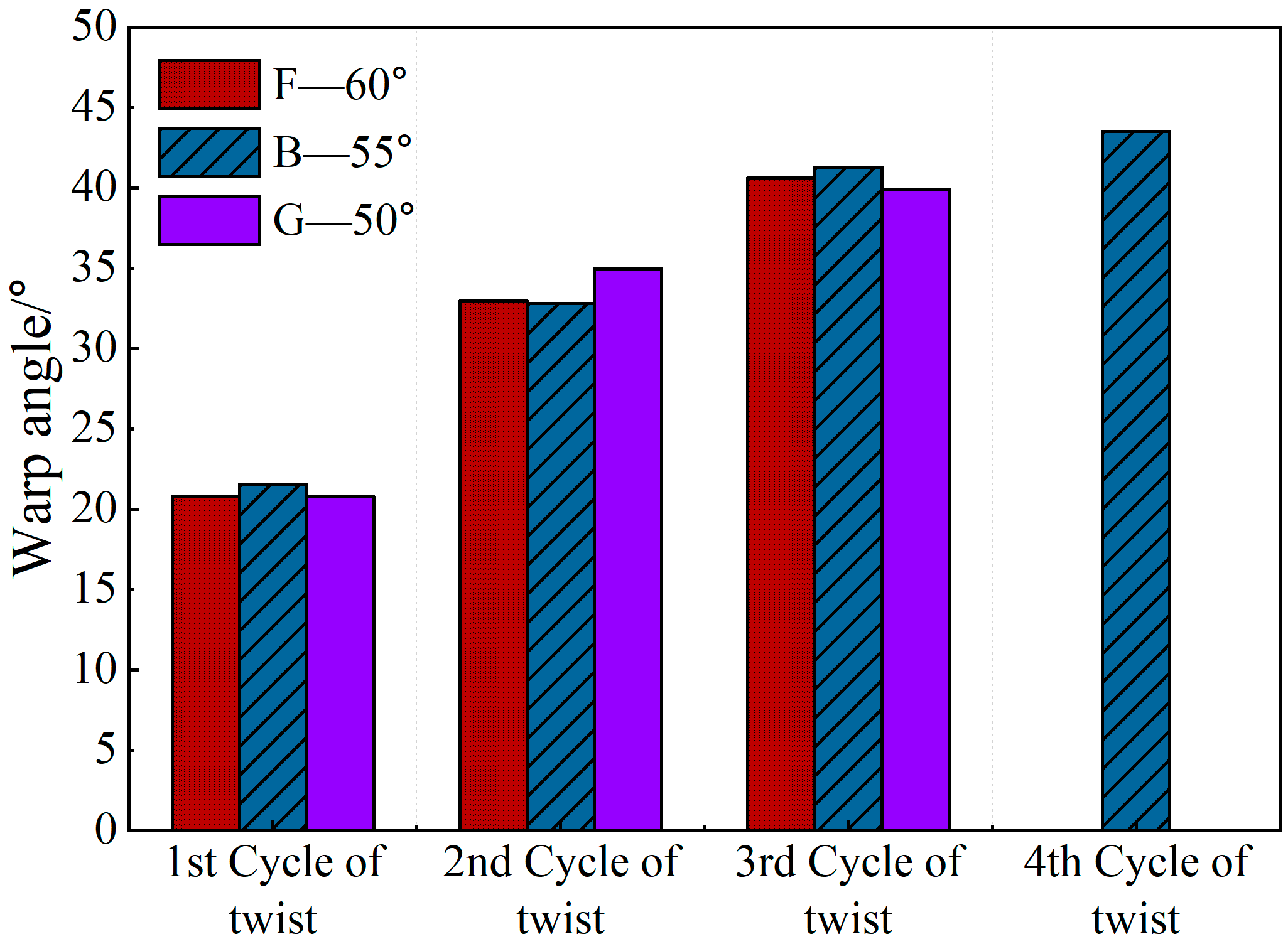
Figure 22 shows the temporal variation in the z-axis displacement values for the fiber end-point nozzle under operating conditions B, F, and G. The analysis of Figure 22 reveals that only the fiber in condition B completed four cycles of rotation during the twisting process. The strength of vortex yarn is largely determined by the twist count of externally wrapped fibers. The taper angles of vortex tubes represented by operating condition B result in higher yarn strength values at the nozzle outlet. The first trough value of the fiber motion curve in condition F is similar to that in condition B, indicating comparable fiber separation. Although condition F exhibited a greater average rotational amplitude, it only completed three twists, which fails to meet the strength requirements for high-quality yarn. Figure 23 shows that condition B had larger wrapping angles in all regions except for the second twist cycle. Based on the combined analysis of the free fiber movement curve and the wrapping angles across different twist cycles, the output yarn quality is superior under operating condition B. Therefore, the optimal angle for the vortex tube’s conical cavity should be 55 ° .

5. Conclusions and Prospects

This paper employs the Discrete Element Method to discretize flexible fibers into multiple rigid beads and massless elastic rods bonded together, forming fiber units. An improved rigid bead–elastic rod model capable of describing the mechanical and kinematic behavior of flexible fibers is constructed. This fiber model can simulate the mechanical characteristics of fibers undergoing tensile, bending, and torsional deformations in three-dimensional space. A fiber–particle–wall contact model based on non-perfectly elastic collisions is proposed. The Stokes number for fiber particles in high-speed vortices is discussed, and the hydrodynamic equations for fiber beads are established. Assuming unidirectional fluid–fiber coupling, coupled dynamic equations for fibers are formulated, and the forces acting on free fiber ends are analyzed. We carry out numerical sensitivity analysis to determine the appropriate mesh density and initial length of the rod element. Using this model, the entire twisting motion of flexible fibers in the nozzle is simulated. The analysis of the fiber end-point trajectory and velocity reveals the vortex twisting mechanism. An experimental platform for observing vortex spinning twisting motion is established. After verifying that the simulation results align with actual fiber motion, the influence of several key nozzle geometric parameters on fiber motion patterns and yarn performance is investigated. This study leads to the following conclusions:
  • Based on the modified Stokes equation, a certain coupling effect exists between particles and the fluid, with inertial forces non-negligible and the influence of viscous forces diminished. Given that the characteristic dimensions of fibers are relatively small compared to the flow field, when studying single-fiber motion, it can be assumed that only unidirectional coupling exists between the fiber and airflow, and the deformation of the fiber does not affect the flow field configuration.
  • Numerical simulation results indicate that during the spinning process, the separation, flattening, and twisting motions of free fibers after being drawn into the nozzle by negative pressure are the combined result of fiber inertial forces and rotating airflow. A countercurrent airflow exists at the hollow spindle inlet, causing fiber ends to migrate toward the spindle top later in the process and develop significant axial velocity. Excessive axial velocity is the primary cause of high fiber drop rates in vortex spinning machines.
  • The fiber end velocity exhibits periodic fluctuations. As the fiber end approaches the hollow spindle inlet, the amplitude of both x- and z-directional velocities increases, the period shortens, and the angular velocity rises, indicating that the flow field reaches its maximum velocity near the hollow spindle inlet. Closer to the flow field axis, the gas velocity decreases, causing the fiber velocity amplitude to first increase and then decrease.
  • Analysis of the fiber z-direction displacement curves under various operating conditions and the wrap angle formed during twisting reveals the optimal nozzle geometric parameters for achieving maximum strength in pure cotton vortex yarn: the distance between the jet orifice and hollow spindle is 1.05 mm, the nozzle twisting chamber diameter is 6 mm, and the taper angle of the vortex tube’s conical cavity is 35 degrees.
This paper adopts a discrete bead–rod chain model to study the overall dynamic response and deformation of flexible fibers under low-frequency systems. Introducing lumped mass and inertia into the model leads to an inherent deviation from the continuous medium model when describing high-frequency wave propagation, causing changes in the system’s high-frequency response, emergence of new local modes, and occurrence of high-frequency local vibrations. Future research will focus on improving the physical realism and prediction accuracy of the fluid–structure interaction model for fibers in the nozzle swirl field: the stiffness change caused by twisting should be considered, as well as the number and initial length of the model’s rod elements, to comprehensively analyze the full-frequency dynamic characteristics and wave propagation behavior of the discrete model. In addition, we found that local shock waves exist near the nozzle orifice, which may induce uncontrollable flutter of fibers [39]. To obtain a low-dissipation and high-fidelity vortex turbulent field and ensure the real evolution of large-scale vortices, high-precision schemes such as ROUND schemes [40] will be explored to resolve broadband turbulence, and the coupling mechanism between shock waves and fibers in the nozzle will be studied in depth. For experimental verification, hardware facilities will be optimized, experiments strictly meeting similarity conditions will be carried out, and cross-validation will be performed with tools such as LS-DYNA.

Author Contributions

Conceptualization, L.P. and X.C.; methodology, X.C. and Y.Q.; software, X.C.; validation, X.C.; formal analysis, L.P.; investigation, Y.Q. and L.P.; resources, L.P.; data curation, X.C.; writing—original draft preparation, X.C.; writing—review and editing, L.P. and Y.Q.; supervision, Y.Q.; funding acquisition, L.P. All authors have read and agreed to the published version of the manuscript.

Funding

This research was funded by Zhejiang Science and Technology Program, grant number 2024SJCZX0027; Zhejiang Science and Technology Program, grant number 2024C01133; National Key Research and Development Program (of China), grant number SQ2023YFB3200093.

Institutional Review Board Statement

Not applicable.

Informed Consent Statement

Not applicable.

Data Availability Statement

The original contributions of the study are included in the article, and further inquiries can be directed to the corresponding author.

Acknowledgments

The authors would like to thank Jianqiang Li for their valuable guidance and significant contributions throughout this research. Jianqiang Li conducted the preliminary numerical simulation of the flow field, including the analysis of the airflow field characteristics of the nozzle and the operation of simulation software. Special thanks go to Zhejiang Rifa Textile Machinery CO., LTD. and Kaiyuan Shao for providing the necessary facilities and technical support.

Conflicts of Interest

The authors declare no conflicts of interest.

References

  1. Ahmed, H.A.; Afify, R.S.; Hassanin, A.H.; El-Hawary, I.A.; Mashaly, R.I. Numerical and experimental study of the influence of nozzle flow parameters on yarn production by jet-ring spinning. Alex. Eng. J. 2018, 57, 2975–2989. [Google Scholar] [CrossRef]
  2. Han, C.; Gao, W.; Chen, L. Study on the Trajectory of Free-End Fiber in Jet Vortex Spinning Based on the Elastic Thin-Rod Finite Element Model of Flexible Fiber. Autex Res. J. 2020, 20, 43–48. [Google Scholar] [CrossRef]
  3. Li, M.; Yu, C.; Shang, S. A numerical and experimental study on the effect of the orifice angle of vortex tube in vortex spinning machine. J. Text. Inst. 2013, 104, 1303–1311. [Google Scholar] [CrossRef]
  4. Xi, C.; Wang, J.; Wang, Y.; Chen, G.; Pei, Z. Numerical investigation on the dependence of air consumption on injector parameters of the vortex spinning system for producing viscose yarns. J. Text. Inst. 2025, 116, 921–935. [Google Scholar] [CrossRef]
  5. Peng, H.; Guo, J.; Ping, H.; Sun, Y.; Liu, G.; Liu, G. Numerical analysis of the fluid–structure interaction characteristics of a pontoon submerged floating tunnel. Ocean Eng. 2024, 301, 117660. [Google Scholar] [CrossRef]
  6. Pei, Z.; Yu, C. Numerical simulation of fiber motion in the nozzle of Murata vortex spinning machine. J. Text. Inst. 2011, 102, 281–292. [Google Scholar] [CrossRef]
  7. Wang, Q.; Lv, X.; Dang, S.; Liang, G.; Jiang, Y.; Zhao, T. Fiber movement during twisting in air vortex spinning. Text. Res. J. 2024, 94, 484–493. [Google Scholar] [CrossRef]
  8. Han, C.; Gao, W. Research on the motion law of fiber in the vortex field inside the nozzle based on ADINA fluid–structure coupling model. Int. J. Cloth. Sci. Technol. 2022, 34, 218–227. [Google Scholar] [CrossRef]
  9. Xue, B.; Wang, S.-P.; Peng, Y.-X.; Zhang, A.-M. A novel coupled Riemann SPH–RKPM model for the simulation of weakly compressible fluid–structure interaction problems. Ocean Eng. 2022, 266, 112447. [Google Scholar] [CrossRef]
  10. Wiegard, B.; König, M.; Lund, J.; Radtke, L.; Netzband, S.; Abdel-Maksoud, M.; Düster, A. Fluid-structure interaction and stress analysis of a floating wind turbine. Mar. Struct. 2021, 78, 102970. [Google Scholar] [CrossRef]
  11. Yu, C.; Lin, D.; Xu, N.; Wang, X.; Pu, K.; Wang, Z.; Zhao, G.; Geng, R.; Gong, S. DEM simulation of particle flow and separation in a vibrating flip-flow screen. Particuology 2023, 73, 113–127. [Google Scholar] [CrossRef]
  12. Zeng, Y.-C.; Yu, C.-W. A flexible fiber model for dynamic simulation of fibers in high speed air flows. Int. J. Nonlinear Sci. Numer. Simul. 2006, 7, 427–430. [Google Scholar] [CrossRef]
  13. Jeffery, G.B. The motion of ellipsoidal particles immersed in a viscous fluid. In Proceedings of the Royal Society of London. Series A, Containing Papers of a Mathematical and Physical Character; The Royal Society: London, UK, 1922; Volume 102, pp. 161–179. [Google Scholar] [CrossRef]
  14. Yamamoto, S.; Matsuoka, T. A method for dynamic simulation of rigid and flexible fibers in a flow field. J. Chem. Phys. 1993, 98, 644–650. [Google Scholar] [CrossRef]
  15. Joung, C.G.; Phan-Thien, N.; Fan, X.J. Direct simulation of flexible fibers. J. Non-Newton. Fluid Mech. 2001, 99, 1–36. [Google Scholar] [CrossRef]
  16. Dhas, D.J.; Marchioli, C. Orientational dynamics of long flexible fibers in wall-bounded turbulence. J. Fluids Eng. 2025, 147, 071102. [Google Scholar] [CrossRef]
  17. Dotto, D.; Marchioli, C. Orientation, distribution, and deformation of inertial flexible fibers in turbulent channel flow. Acta Mech. 2019, 230, 597–621. [Google Scholar] [CrossRef]
  18. Marchioli, C.; Rosti, M.E.; Verhille, G. Flexible fibers in turbulence. Annu. Rev. Fluid Mech. 2025, 58, 167–192. [Google Scholar] [CrossRef]
  19. Di Giusto, D.; Marchioli, C. Turbulence modulation by slender fibers. Fluids 2022, 7, 255. [Google Scholar] [CrossRef]
  20. Xiang, P.; Kuznetsov, A.V. Simulation of shape dynamics of a long flexible fiber in a turbulent flow in the hydroentanglement process. Int. Commun. Heat Mass Transf. 2008, 35, 529–534. [Google Scholar] [CrossRef]
  21. Païdoussis, M.P. Fluid-Structure Interactions Volume 2: Slender Structures and Axial Flow, 2nd ed.; Academic Press: London, UK, 2016; pp. 144–201. [Google Scholar]
  22. Païdoussis, M.P. The dynamics of cantilevered structures subject to axial flow. J. Fluids Struct. 2024, 125, 104075. [Google Scholar] [CrossRef]
  23. Guo, H.; Xua, B. A novel method for dynamic simulation of flexible fibers in a 3D swirling flow. Int. J. Nonlinear Sci. Numer. Simul. 2009, 10, 1473–1480. [Google Scholar] [CrossRef]
  24. Zeng, Y.C.; Yang, J.P.; Yu, C.W. Mixed Euler–Lagrange approach to modeling fiber motion in high speed air flow. Appl. Math. Model. 2005, 29, 253–261. [Google Scholar] [CrossRef]
  25. Pei, Z.; Yu, C. Numerical study on the effect of nozzle pressure and yarn delivery speed on the fiber motion in the nozzle of Murata vortex spinning. J. Fluids Struct. 2011, 27, 121–133. [Google Scholar] [CrossRef]
  26. Guo, H.F.; Bin-Gang, X. A 3D numerical model for a flexible fiber motion in compressible swirling airflow. Comput. Model. Eng. Sci. 2010, 61, 201. [Google Scholar]
  27. Vakil, A.; Green, S.I. Flexible fiber motion in the flow field of a cylinder. Int. J. Multiph. Flow 2011, 37, 173–186. [Google Scholar] [CrossRef]
  28. Bec, J.; Brouzet, C.; Henry, C. Enhanced transport of flexible fibers by pole vaulting in turbulent wall-bounded flow. Phys. Rev. Fluids 2024, 9, L062501. [Google Scholar] [CrossRef]
  29. Pei, Z.; Zhang, Y.; Zhou, J. A model for the particle-level simulation of multiple flexible fibers moving in a wall-bounded fluid flow. J. Fluids Struct. 2018, 80, 37–58. [Google Scholar] [CrossRef]
  30. Bral, A.; Peeters, J.; Daelemans, L.; Degroote, J. Development and validation of an actuator line method for fuzzy yarns in high-speed air flow. Int. J. Numer. Methods Eng. 2025, 126, e70108. [Google Scholar] [CrossRef]
  31. Lukerchenko, N.; Kvurt, Y.; Keita, I.; Chara, Z.; Vlasak, P. Drag force, drag torque, and Magnus force coefficients of rotating spherical particle moving in fluid. Part. Sci. Technol. 2012, 30, 55–67. [Google Scholar] [CrossRef]
  32. Yao, J.W.; Zhou, Z.Y.; Yan, L.L.; Wei, G.; Tang, P.J. Prediction model on tensile strength of air jet vortex spinning yarn and its verification. J. Text. Res. 2018, 39, 32–37. (In Chinese) [Google Scholar]
  33. Hartmann, J.; Koch, C.; Staudacher, S. Modeling Stochastical Particle Rebound Based on High-Velocity Experiments. J. Turbomach. 2025, 147, 041006. [Google Scholar] [CrossRef]
  34. Ren, C.G.; Chen, Z.S. Non central collision and rotation. Coll. Phys. 2004, 23, 34–36. (In Chinese) [Google Scholar]
  35. Guo, H.F.; Yu, C.W.; Xu, B.G.; Li, S.Y. Effect of the geometric parameters on a flexible fiber motion in a tangentially injected divergent swirling tube flow. Int. J. Eng. Sci. 2011, 49, 1033–1046. [Google Scholar] [CrossRef]
  36. Yu, Y.; Fang, L.; Zhou, B.; Cui, W.; Yin, S.; Song, K. Ventilation parameters’ impact on artificial tornado-based cylindrical vortex dust removal system performance. Adv. Powder Technol. 2025, 36, 104852. [Google Scholar] [CrossRef]
  37. Lawryshyn, Y.A. Statics and Dynamics of Pulp Fibres. Ph.D. Dissertation, University of Toronto, Toronto, ON, Canada, 1997. [Google Scholar]
  38. Li, M.L. Effects of Airflow and Fiber Motion on the Yarn Tenacity in Air-Jet Vortex Spinning. Ph.D. Dissertation, Donghua University, Shanghai, China, 2017. (In Chinese) [Google Scholar]
  39. Badhurshah, R.; Srinil, N. Vortex-Induced Vibrations of Lazy-Wave Cables by Using Multiple Wake Oscillators. In Proceedings of the International Conference on Offshore Mechanics and Arctic Engineering, Vancouver, BC, Canada, 22–27 June 2025. [Google Scholar]
  40. Deng, X.; Jiang, Z.-H.; Yan, C. Efficient ROUND schemes on non-uniform grids applied to discontinuous Galerkin schemes with Godunov-type finite volume sub-cell limiting. J. Comput. Phys. 2025, 522, 113575. [Google Scholar] [CrossRef]
Figure 1. Fiber model schematic diagram.
Applsci 16 03843 g001
Figure 2. Bead–rod unit tensile deformation.
Applsci 16 03843 g002
Figure 3. Bead–rod unit bending deformation.
Applsci 16 03843 g003
Figure 4. Bead–rod unit composite bending–torsional deformation.
Applsci 16 03843 g004
Figure 5. Force conditions at the free fiber end.
Applsci 16 03843 g005
Figure 6. Fiber bead particles collide with the wall surface.
Applsci 16 03843 g006
Figure 7. Schematic diagram of vortex spinning nozzle structure.
Applsci 16 03843 g007
Figure 8. Nozzle flow field computational domain.
Applsci 16 03843 g008
Figure 9. Flow field mesh topology and cross-section positions (red line).
Applsci 16 03843 g009
Figure 10. Comparison of velocity and error in the yarn twisting zone under different mesh division schemes.
Applsci 16 03843 g010
Figure 11. Schematic of cantilever fiber deformation in laminar channel flow.
Applsci 16 03843 g011
Figure 12. Fiber motion diagram in the nozzle airflow field.
Applsci 16 03843 g012
Figure 13. Visualization of flow field simulation results: (a) total pressure contour of nozzle flow field (x-y cross-section); (b) velocity vector diagram of nozzle flow field (x-y cross-section).
Applsci 16 03843 g013
Figure 14. The displacement of the fiber end along the z-axis. The lowercase letters a–h represent the key time points of the motion.
Applsci 16 03843 g014
Figure 15. Variation curves of velocity components at fiber end.
Applsci 16 03843 g015
Figure 16. Experimental validation of fiber motion numerical simulation results: (a) vortex spinning nozzle yarn-twisting motion observation platform; (b) fiber motion images captured at different time points; (c) curves of z-direction displacement and velocity of the fiber end obtained from simulation and experiment.
Applsci 16 03843 g016
Figure 17. Schematic diagram of nozzle structure optimization.
Applsci 16 03843 g017
Figure 18. Fiber end displacement under operating conditions A, B, and C.
Applsci 16 03843 g018
Figure 19. Fiber wrap angle under operating conditions A, B, and C.
Applsci 16 03843 g019
Figure 20. Fiber end displacement under operating conditions B, D and E.
Applsci 16 03843 g020
Figure 21. Fiber wrap angle under operating conditions B, D and E.
Applsci 16 03843 g021
Figure 22. Fiber end displacement under operating conditions B, F and G.
Applsci 16 03843 g022
Figure 23. Fiber wrap angle under operating conditions B, F and G.
Applsci 16 03843 g023
Table 1. Fiber particle and nozzle material properties.
Fiber ParticleNozzle
Yield Strength σ y , p (GPa)0.39–0.62-
Density ρ p (Kg/m3)1540-
Diameter (µm)20-
Young’s Modulus E (GPa)8320
Poisson’s Ratio μ 00.22
Table 2. Number of cantilever fiber rod elements and corresponding deflection in laminar channel.
Number of Rod Elements2030405060Analytical Solution
Deflection μ m 29.425.825.624.425.124.8
Error18.54.0%3.2%1.6%1.2%-
Table 3. Setting of nozzle geometric parameters under different operating conditions.
Operating Conditions H /mm D /mm θ /degree
A0.656.0055
B1.056.0055
C1.456.0055
D1.055.5055
E1.056.8055
F1.056.0060
G1.056.0050
Disclaimer/Publisher’s Note: The statements, opinions and data contained in all publications are solely those of the individual author(s) and contributor(s) and not of MDPI and/or the editor(s). MDPI and/or the editor(s) disclaim responsibility for any injury to people or property resulting from any ideas, methods, instructions or products referred to in the content.