1. Introduction
Wave energy is a promising resource for future power production, as it can provide a consistent, reliable supply of renewable energy that is concentrated near the water’s surface [
1]. The estimated 90% production time of wave energy is of particular interest, since wind and solar energy can experience significantly greater periods of inactivity depending on the weather. Current wave energy converter (WEC) technology is hampered by both the high financial cost of developing and deploying maritime systems capable of withstanding harsh ocean conditions and the poor efficiency of existing systems [
1]. Research into WECs seeks to mitigate these issues and provide a reliable green energy source that can meet society’s need for a consistent energy supply without the negative climate impacts and geopolitical volatility associated with carbon fuels [
1]. There are many types of WECs that generate energy from ocean wave motion. The point absorber WEC is one such device, which consists of a buoy attached to a power takeoff (PTO) system that produces energy from the relative motion between the buoy and a stationary object [
2]. An example of this device is shown in
Figure 1. This device may oscillate in one degree of freedom (1-DOF) or in multiple degrees. Three-degree-of-freedom (3-DOF) WECs can produce significantly more power than 1-DOF systems, though this requires more complex systems to harvest energy effectively [
3]. Further research showed that six-degree-of-freedom devices could not produce substantially more energy than 3-DOF devices, so such systems are not as widely pursued for future development [
4].
Recent studies have explored various control strategies to improve WEC performance. Veurink et al. [
5] investigated the integration of WEC arrays with power grids, while Cai et al. [
6] provided numerical and experimental research on resonance-based converters. Additionally, theoretical investigations on multi-DOF WECs in front of seawalls have been conducted [
7]. However, many existing models rely on active control forces that require significant local energy storage. This manuscript addresses this gap by proposing a design that achieves natural resonance through geometric optimization, thereby minimizing the reliance on external control forces. The highlights of this research include the analytical development of a 3-DOF resonant model and its validation against varying sea states.
As a point absorber, the WEC buoy’s motions in multiple degrees of freedom (DOF) are inherently coupled. Under certain conditions, the fluid-structure interaction leads to parametric excitation [
8], where periodic variations in the system’s parameters—such as the waterplane area or metacentric height—transfer energy between motion modes. This can trigger instabilities and disproportionately large oscillations, even in modes not directly excited by primary wave forces. In a 1-DOF system, this parametric excitation results in reduced energy production, while a 3-DOF system that accounts for this effect sees improved energy production [
9]. Due to the potency of this type of excitation, systems that are affected by it can experience great instability if certain resonance points are reached [
10]. The location of linear resonance, where all 3-DOF naturally resonate at the same frequency as the wave excitation force, is already known to produce greater amounts of energy than other investigated locations [
11]. This suggests that other resonance locations may yield similarly improved energy output.
To get a buoy to naturally resonate at these resonance locations, a control force may be applied to the system. A commonly studied method for controlling the buoy is the proportional-derivative complex conjugate control (PDC3) scheme [
11]. In this scheme, the proportional control makes the buoy resonate at the same frequency as incoming waves while the derivative control maximizes the average energy output from the system by matching the buoy damping [
11].
2. Modeling
As put forth by [
3], a cylindrical WEC buoy moving in surge, heave, and pitch modes under linear conditions in waves of known frequency may be modeled using
where the symbols are outlined
Table 1. In these equations, the values
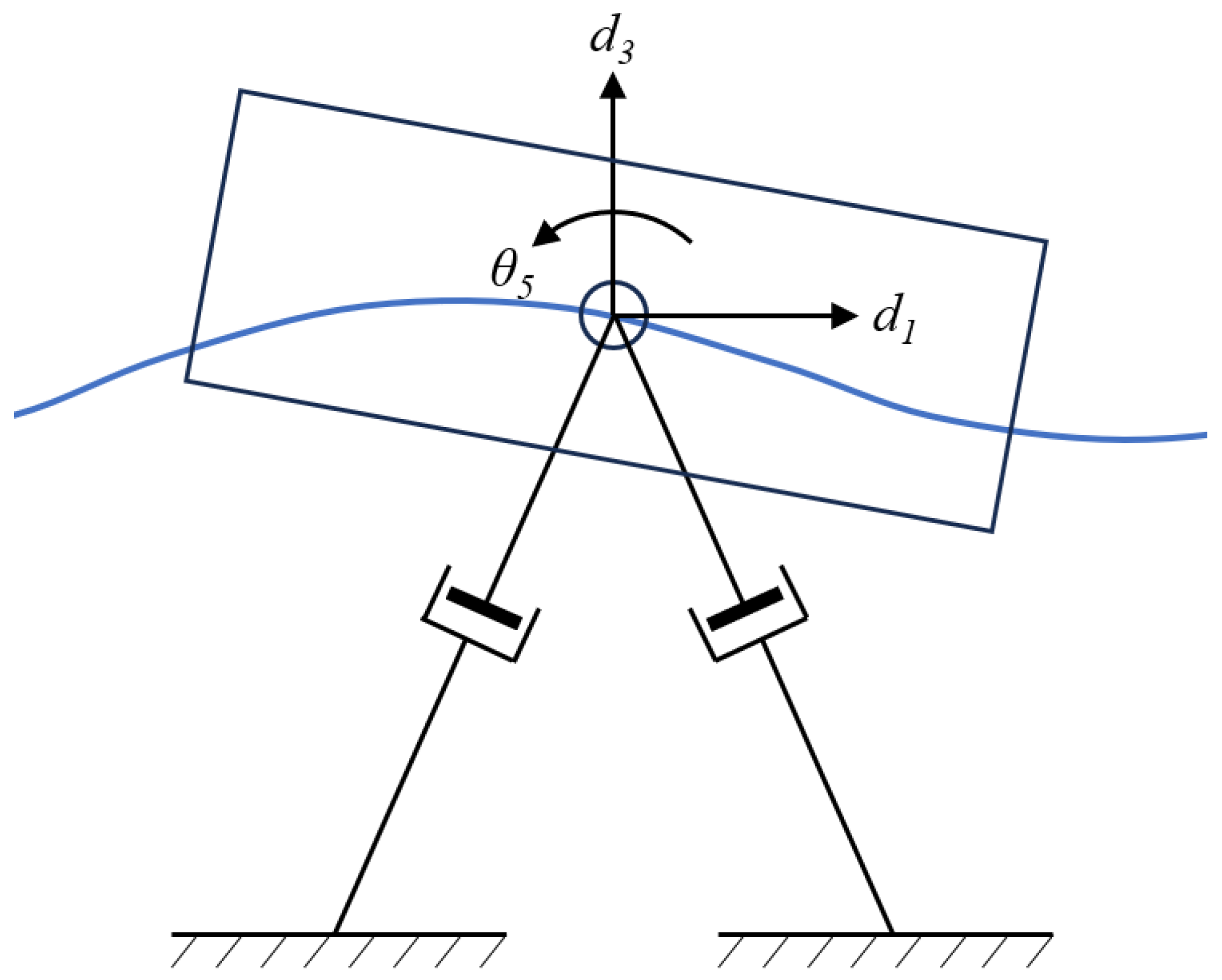
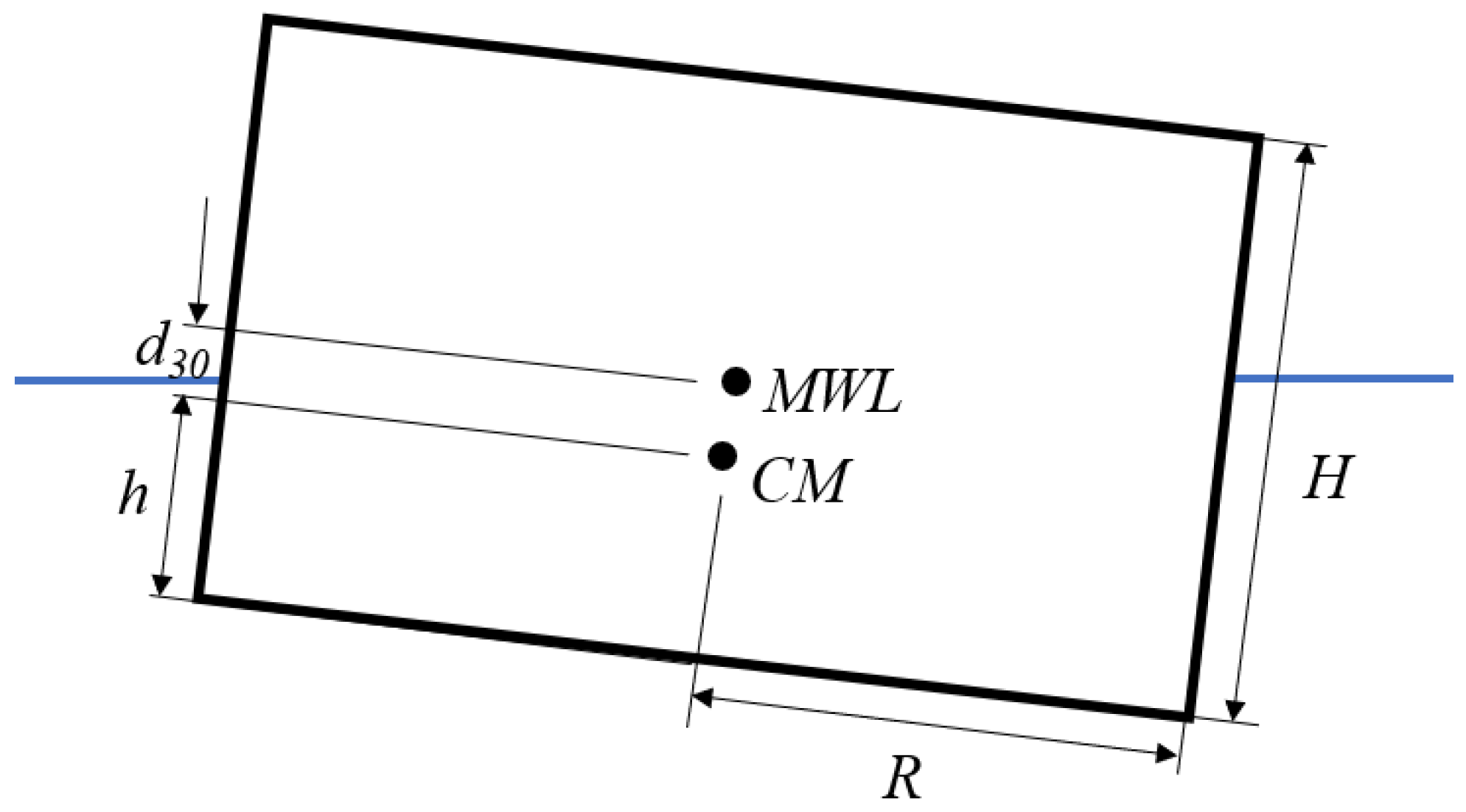
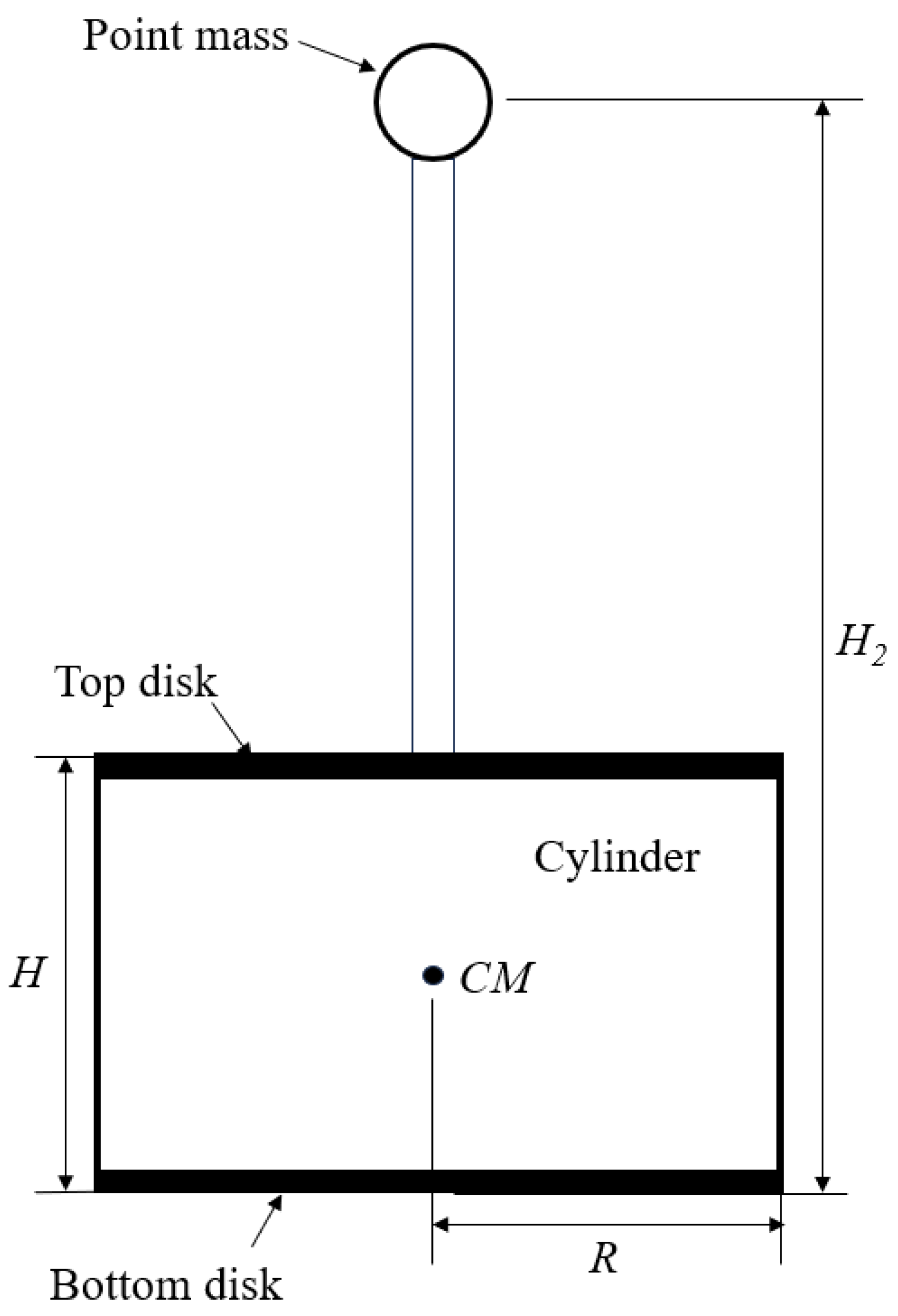
R and
h refer to the cylindrical buoy radius and height of the center of mass of the buoy, as shown in
Figure 2.
is the wave excitation force in direction
j, outlined through
in surge [
12], where
and
are the Bessel function and the derivative, respectively. In heave and pitch, these excitation forces are
where
is the wave number,
is the wave length,
is the wave frequency, and
is the wave height [
13].
The control forces
,
, and
in (
4)–(
6) are the PDC3 values calculated using
where
This makes the buoy naturally resonate in heave at the driving wave frequency
, and at the desired frequency
for the coupled surge and pitch directions for a regular wave. In the case of an irregular wave, the total proportional control coefficients
,
,
,
, and
may be calculated by performing the calculations in (
10) and (
11) and applying these values individually to (
7)–(
9) for the system displacements associated with each frequency in the wave state. The total control force in each direction is then determined by summing the results across all present frequencies.
To get the WEC displacements associated with each individual frequency, a Fourier series is used to break the total system motion into individual frequencies using
where the displacement
is the total approximate motion in a given mode
j. Once the magnitude values
and
are determined, frequency-specific motion may be calculated to apply the control force for an irregular wave state. Because this method requires an established input signal to be applied to a transient feedback system, it requires a buffer period before it can activate and provide an appropriate control force.
The radiation damping forces
,
, and
in (
4)–(
6) are expressed as
where the radiation damping values
are determined by a boundary element software package such as WAMIT. The ∗ indicates the convolution integral [
3].
The buoy mass
m may be related to the external buoy dimensions
R and
H, along with the water density
using
where
C is the ratio between the average buoy density and the density of the surrounding water, and
is the total volume of the cylindrical buoy.
The added masses from (
1)–(
3) must be approximated for the submerged geometry of the cylindrical buoy. The non-coupled added mass terms are calculated using the equations
from [
13] for a submerged cylindrical body. (
21) assumes a slender cylinder, and may be inaccurate for non-slender cylinders.
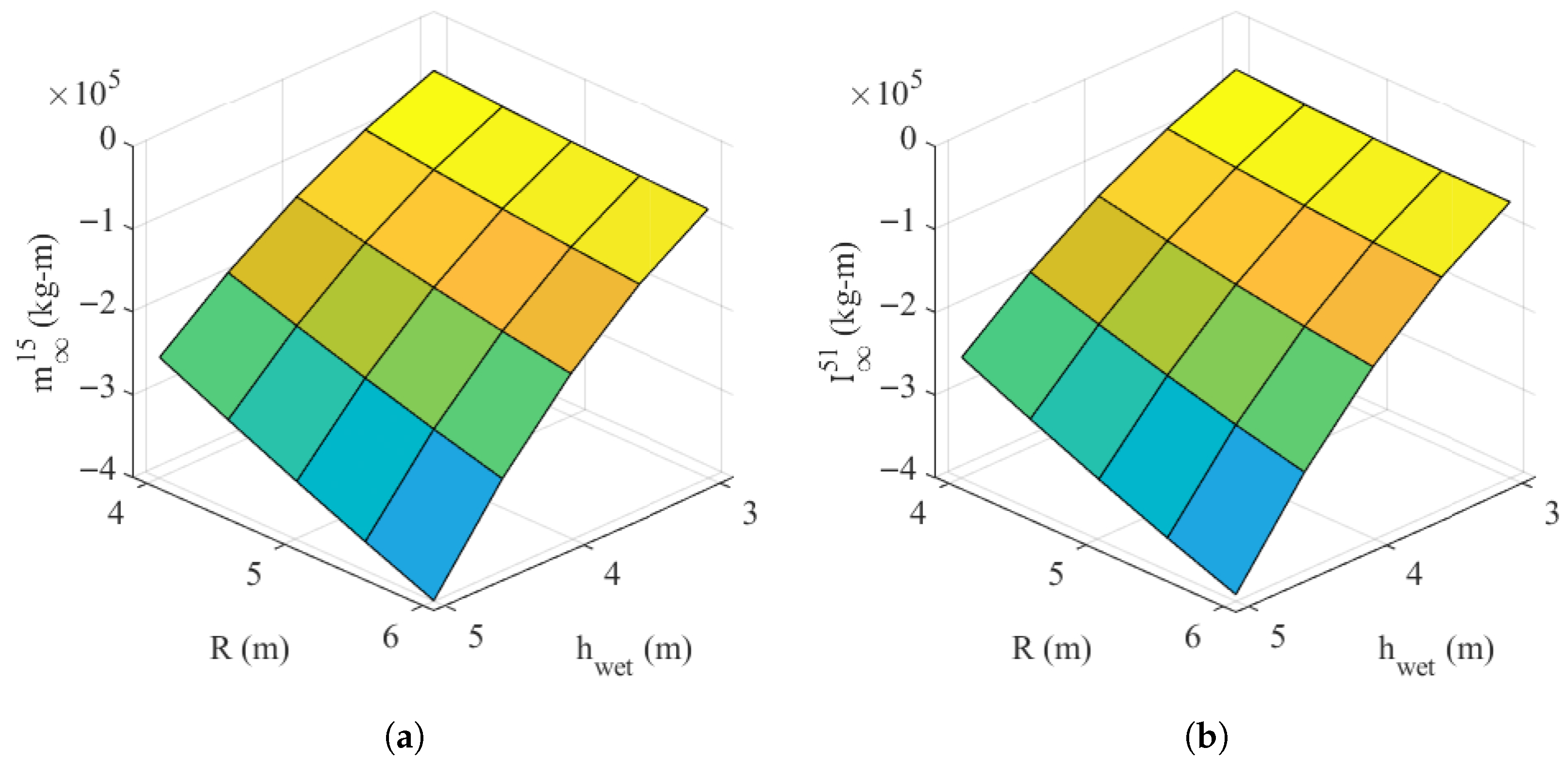
The coupled added-mass terms do not have simple analytical expressions and must be approximated numerically. Using a series of WAMIT simulations for vertical cylindrical buoys of a variety of radii and submerged heights,
Figure 3a,b are generated. As long as the designed buoy radius and submerged height remain within the bounds of these numerically determined values, the coupled added mass terms for that buoy may be interpolated from the results shown to obtain approximate values for
and
for that buoy geometry.
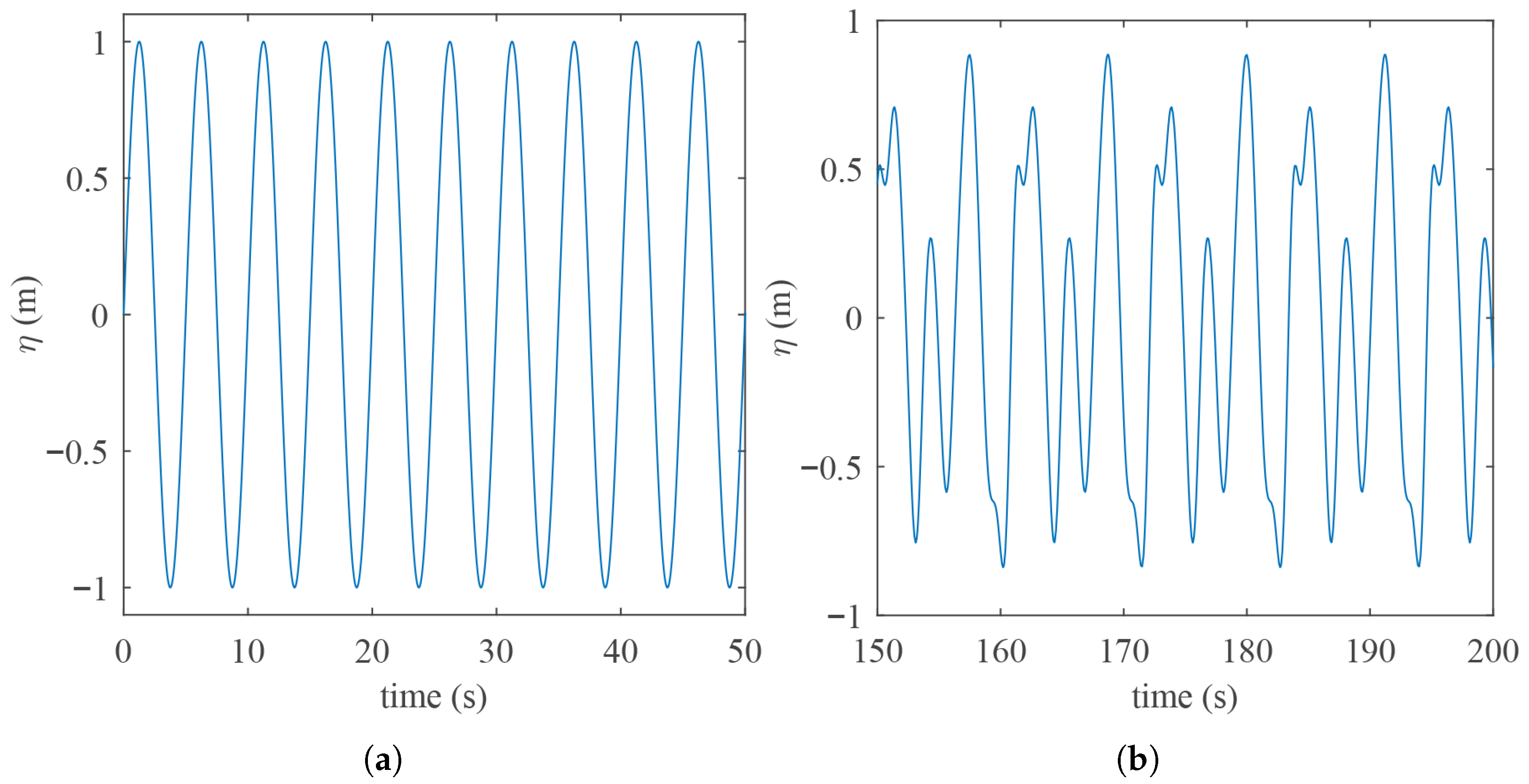
WEC buoy simulations may be subjected to regular or irregular waves. Regular waves are simple sinusoids that apply the associated wave forces with constant frequency and consistent magnitude, as seen in
Figure 4a [
13]. Irregular waves are more representative of actual ocean conditions as they account for the stochastic nature of the sea surface [
13]. According to random wave theory [
14], the significant wave height
represents the average of the highest third of waves; thus, individual component sinusoids in the Bretschneider spectrum may have heights significantly lower than
, yet their summation results in a realistic sea state where peaks can exceed the significant height. The wave height for each frequency can be determined using
where
is the modal (or dominant) frequency and
is the significant wave height [
15]. An example Bretschneider wave is depicted in
Figure 4b.
3. Natural Resonance
The natural resonance equation,
relates the natural frequency
of the system to the restoring coefficient
k and inertia
m. From (
2), the
k and
m terms can be identified as the coefficients associated with
and
, respectively. (
25) can therefore be arranged as
in heave, where
is given by the expression in (
22). When values for
R and
m are selected to result in a low
value typical of ocean waves, the buoy must have a small radius and large mass, which makes buoyancy difficult. The average buoy density
must be below that of water to maintain buoyancy, and this buoyancy is related to total system mass using (
19) and (
20). The necessary buoy height to maintain buoyancy can then be calculated from (
22), (
19), (
20), and (
26) as
where
C is the ratio of the buoy and water densities
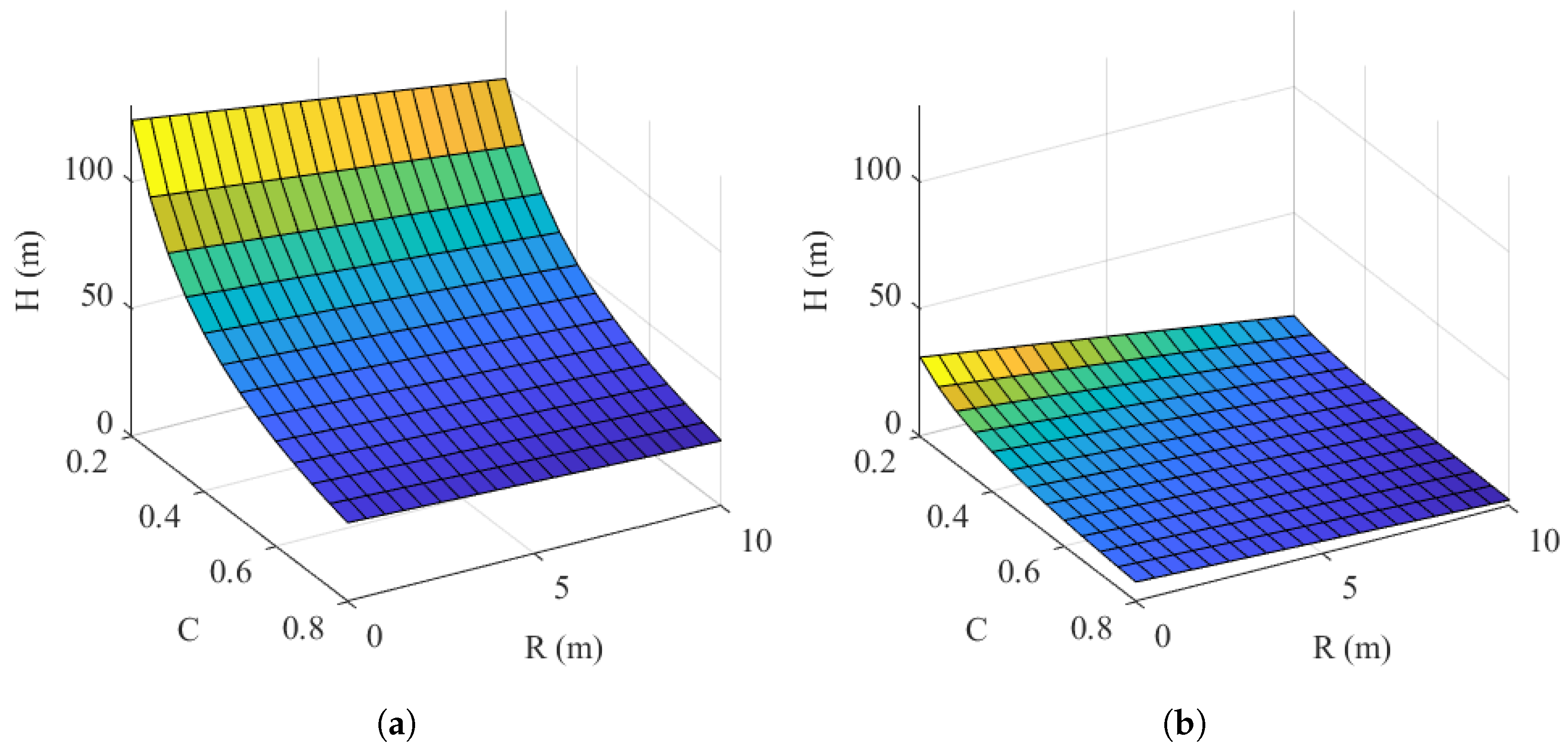
The results of (
27) are plotted for 0.1 Hz waves in
Figure 5a, which shows that for most buoyant designs, the cylindrical WEC buoy must be very tall and narrow to naturally resonate. The heights for 0.2 Hz waves in
Figure 5b show that buoys do not need to be as tall for this higher-frequency wave state.
Because of the requirements of the natural frequency expression (
26) and the limitations of buoy density on buoyancy, a buoy design that naturally resonates within a certain wave state may not be feasible. In this situation, an optimization expression can balance the needs for buoyancy with a buoy that approaches
. In
works as a penalty term to keep the buoy density ratio
C below
and maintain buoyancy. The
term is calculated using (
26) so that (
29) can create a buoy with the optimal
R,
H, and
m parameters to approach natural resonance while not sinking.
In the surge and pitch directions described by (
1) and (
3), the coupled motion requires a matrix form natural frequency calculation given by
where the proportional control coefficients
and
are necessary to account for the coupled motion between these modes. The pitch restoring coefficient
is taken from (
3) and linearized about
using
Taking the non-coupled surge portion of (
30), the natural frequency calculation of
is obtained. This can be rearranged along with substitutions from (
19), (
20), and (
21) to solve for the necessary mooring coefficient using
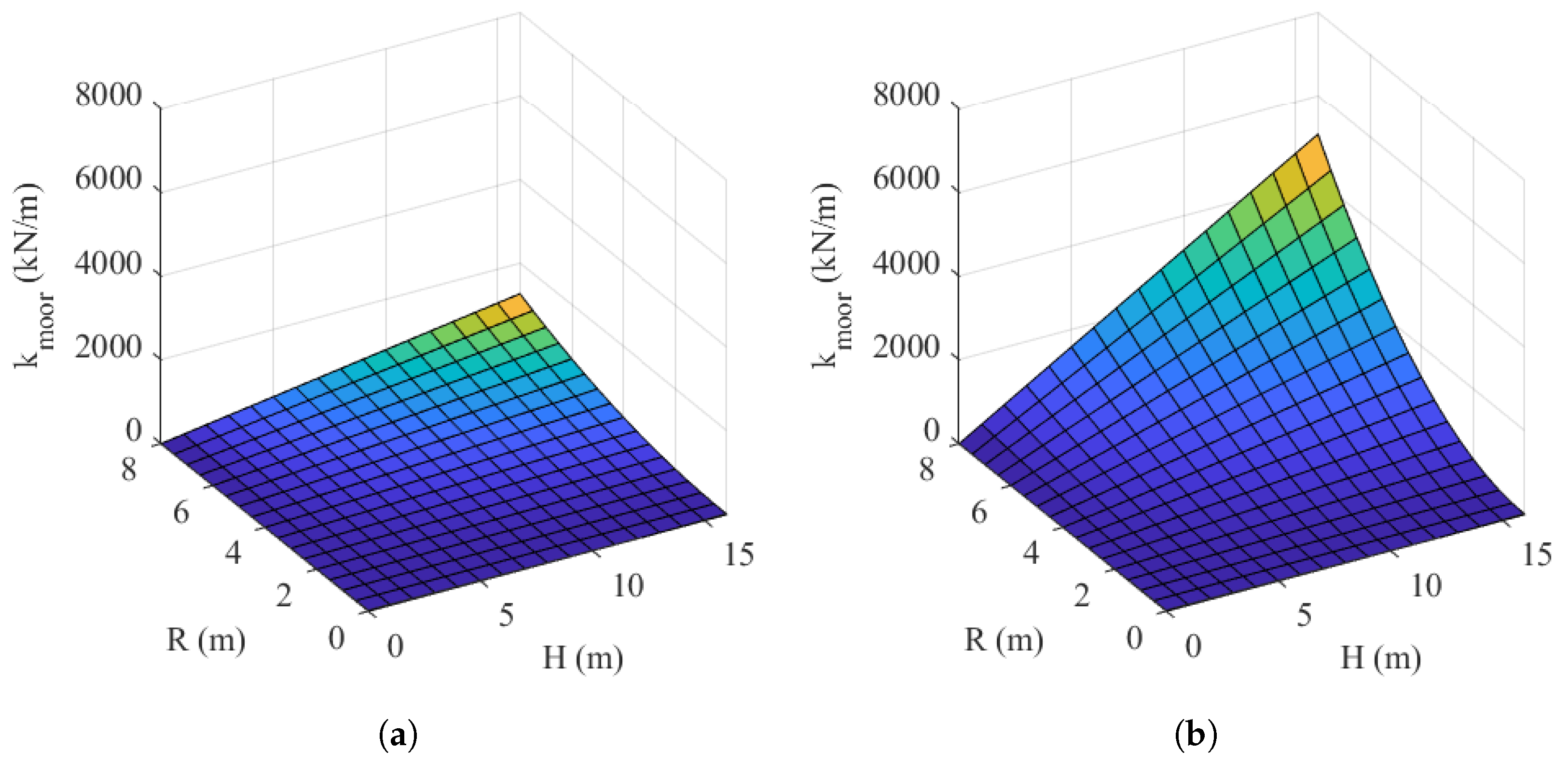
This equation is plotted for a 0.1 Hz wave condition over a range of buoy heights and radii in
Figure 6a. The same graph is plotted again for a 0.2 Hz wave state in
Figure 6b, showing that higher-frequency wave states require greater mooring coefficients for resonance. Additionally, larger buoys will require stronger moorings than smaller ones.
In the uncoupled pitch portion of (
30), the natural frequency is found to be
which may be rearranged to solve for the necessary moment of inertia
. Substitutions from (
19), (
20), and (
23) are used to obtain
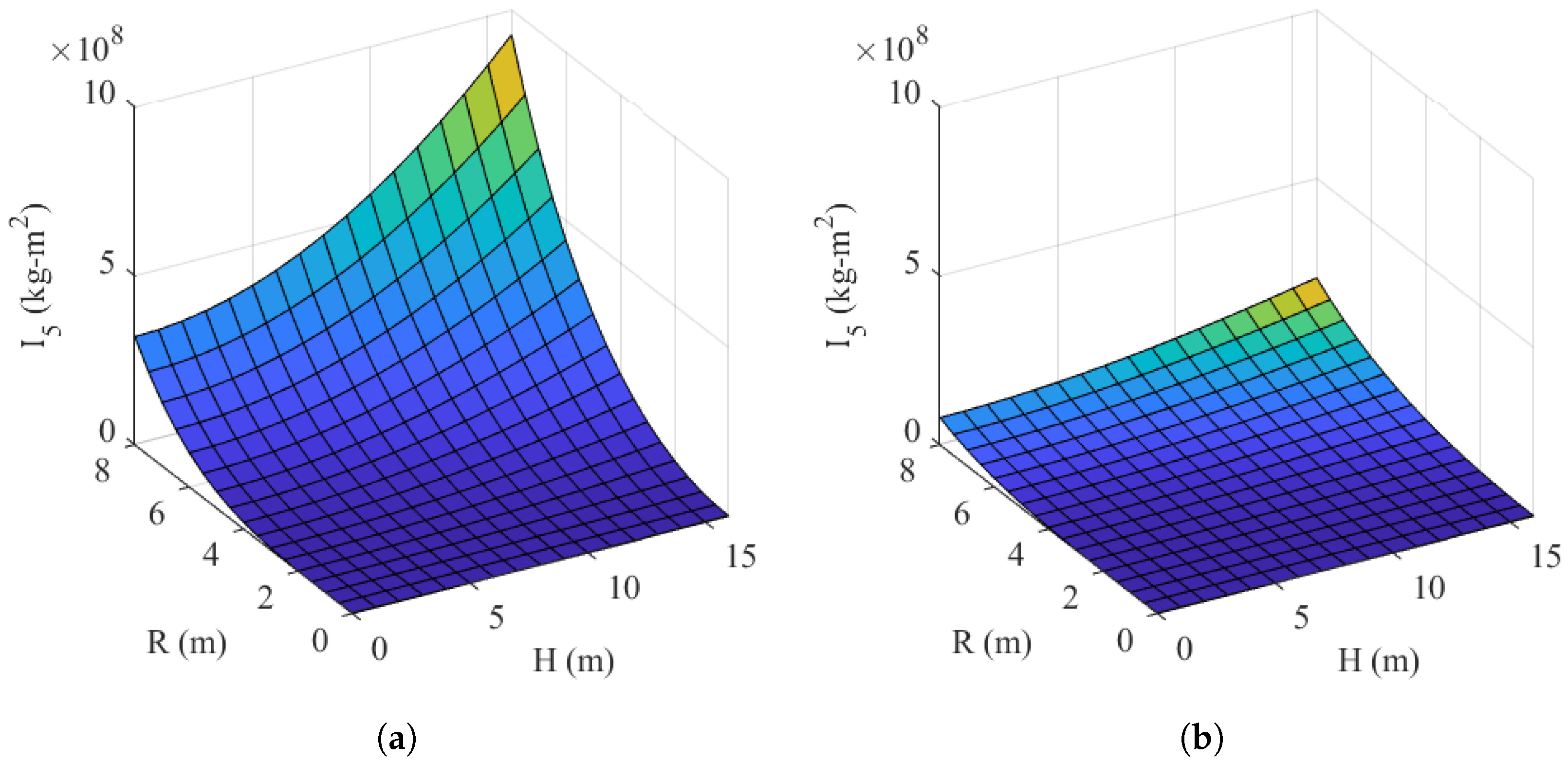
This equation is plotted in
Figure 7a for the 0.1 Hz wave condition. This shows that larger cylindrical buoys require higher moments of inertia than smaller ones. In
Figure 7b, the required moment of inertia is plotted for a 0.2 Hz wave state. Here, it is observed that buoys require lower moments of inertia for higher frequency wave states. Both
Figure 7a,b show that the necessary WEC has a higher moment of inertia than a hollow cylinder of the necessary
R and
H can achieve for an average density for
, while staying within the confines of the cylindrical buoy structure. Therefore, the buoy must be designed to move some of the mass outside of the cylindrical confines without affecting the hydrodynamic qualities.
Using the above process to design a WEC buoy to naturally resonate at 0.2 Hz and remain buoyant, the results shown in
Table 2 are produced. This is not the only combination of results that will make a right-cylindrical buoy naturally resonate at this frequency, as other, more scaled-down WECs or buoys with different aspect ratios will also be viable.
4. Power Generation
As the optimized WEC is excited by a regular wave where
for (
27), (
33), and (
35), the only proportional control coefficients used are
and
. As a result, the energy fluctuations required to manage the control forces are minimal. This is depicted in
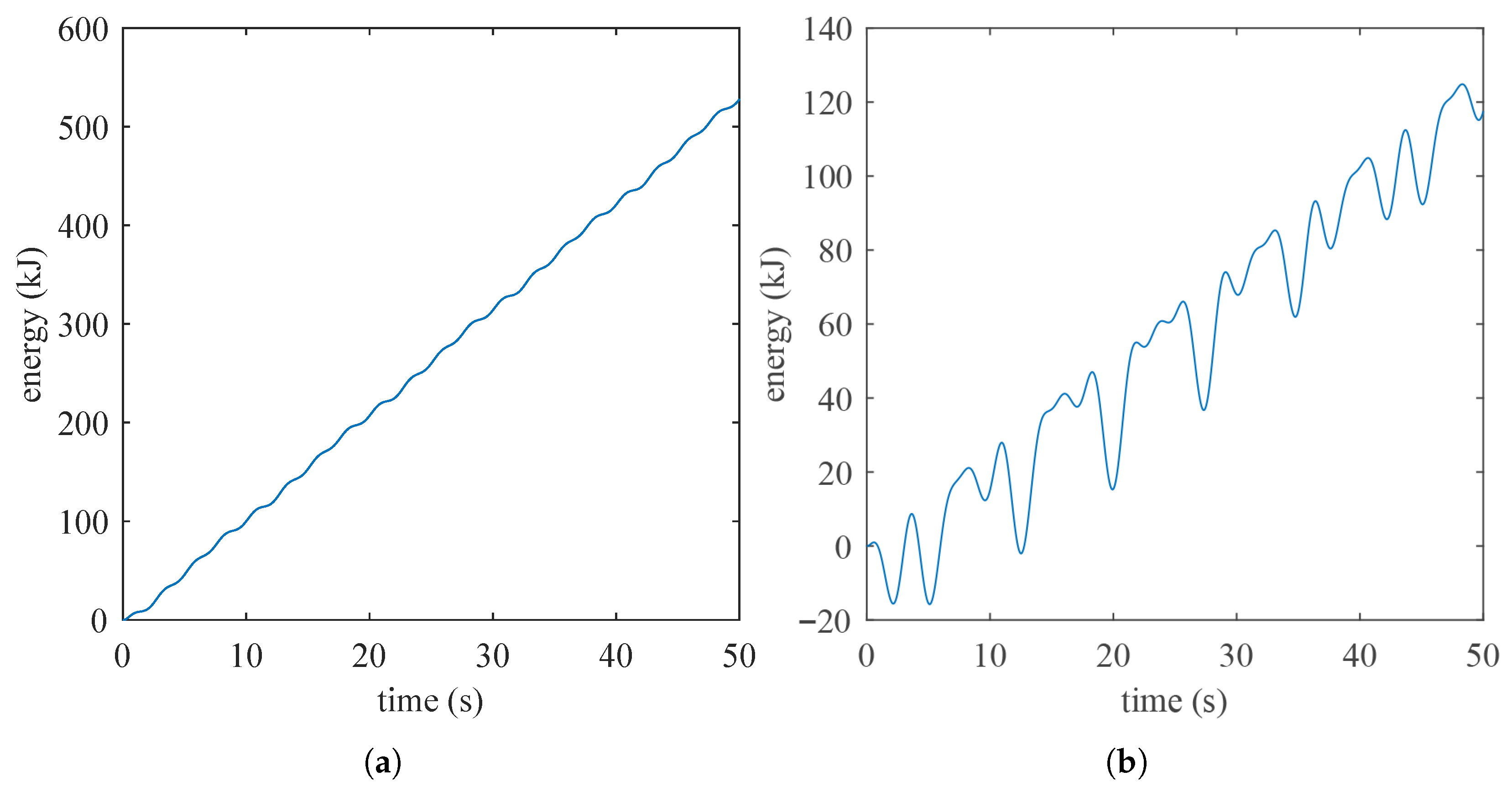
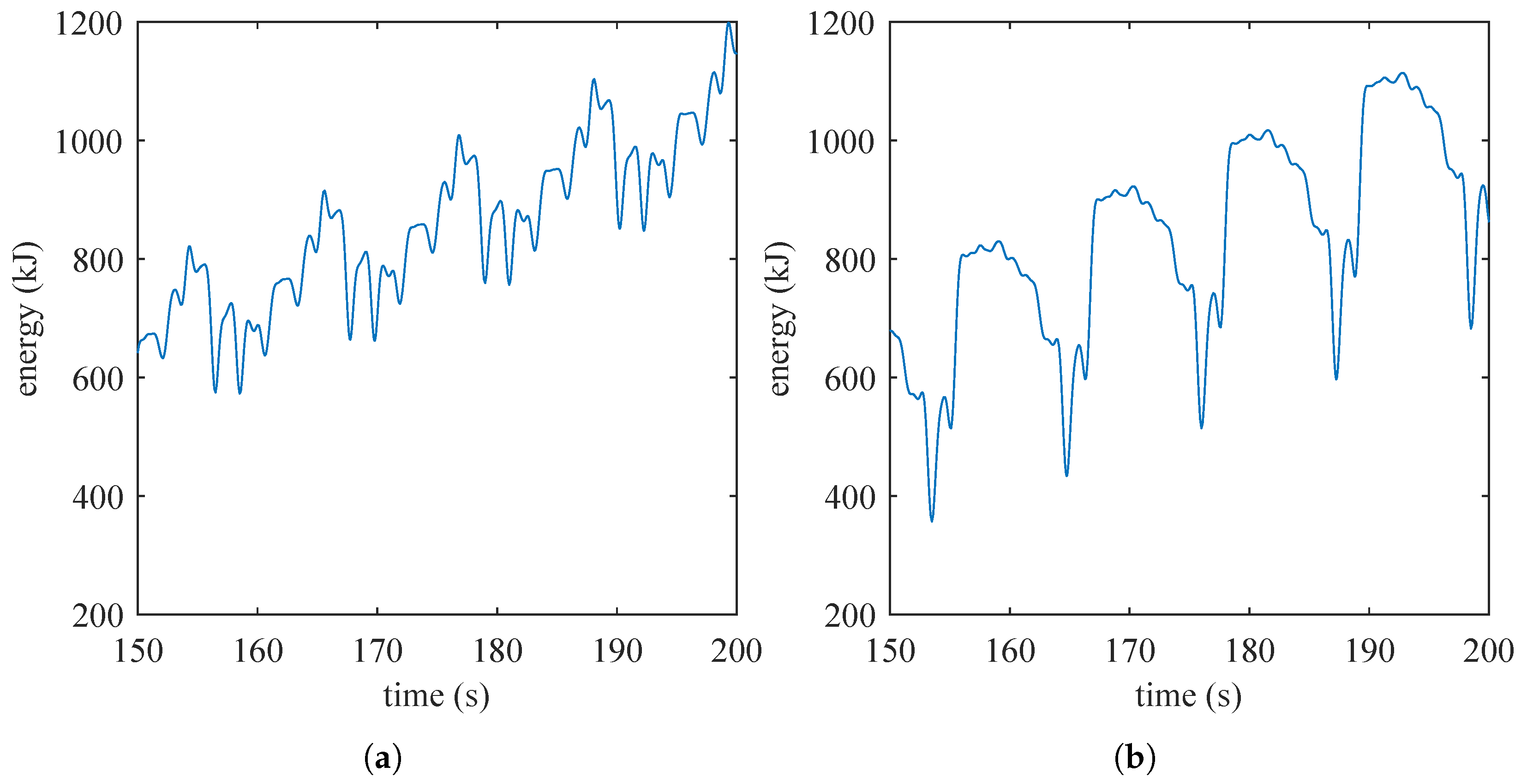
Figure 8a, where the WEC consistently produces positive power. The derivative controllers are responsible for most of the control forces applied to the buoy and are designed to generate power whenever the buoy is in motion.
This is contrasted with
Figure 8b, where a taller, narrower buoy of identical mass and moment of inertia to the optimal buoy has a smaller mooring restoration coefficient. Because this buoy no longer naturally resonates at the driving frequency
, the proportional control coefficients
,
, and
must compensate to make the buoy resonate via a control force. The proportional controller acts as a spring and returns all reactive power under ideal conditions. However, large energy fluctuations will either necessitate on-site energy storage in battery systems or require the electrical grid to handle them. By optimizing a buoy design for the driving frequency rather than using a proportional controller to compensate, these fluctuations can be reduced, as in
Figure 8a.
When an irregular Bretschneider wave is applied to the WEC, fluctuations are guaranteed, as shown in
Figure 9a. This is necessary because proportional control allows the buoy to resonate across the entire wave spectrum; thus, reactive power is essential for the system to function. By focusing on the modal frequency of the Bretschneider spectrum, the proportional controller does not need to provide as much reactive power in reaching the dominant wave frequencies as comparable buoys may.
Of additional interest is the range of frequencies at which the WEC is set to harvest energy using the control force.
Figure 9a depicts the energy generated when the WEC is actively harvesting from those frequencies with wave heights at least half that of the modal frequency.
When the same WEC device is set to harvest over a wider range of driving frequencies, it requires significantly greater energy storage for only limited improvements.
Figure 9b demonstrates this, where the proportional controller makes the buoy resonate with all frequencies that have heights greater than one-tenth that of the modal frequency. Because these smaller waves are farther from the natural frequency, the control force must provide more reactive power and force for very little benefit.
Figure 9a,b show very similar total energy outputs over their periods of operation, though
Figure 9b sees energy fluctuations of twice the magnitude for this comparable total energy output, proving that WEC designers need to carefully consider how much this extra energy will benefit them when compared to the costs associated with a high-fluctuation energy output.
5. Discussion
The techniques outlined for making a right-cylindrical WEC buoy naturally resonate in 3-DOF with minimal proportional control inputs are effective for wave frequencies around 0.2 Hz, though less so at 0.1 Hz. At this frequency, the required buoys are extremely tall and narrow, with moments of inertia that are far too high to be feasible within the external bounds of the cylindrical buoy. At 0.2 Hz these moments of inertia are still very high, but the design changes to make this possible are feasible (
Figure 10).
The WEC buoy is optimized using a penalty-based algorithm. The objective function J is designed to minimize the required reactive power (control force) , subject to the constraints of maintaining positive buoyancy () and adhering to feasible engineering dimensions.
At a wave frequency of 0.1 Hz, the required moments of inertia to achieve natural resonance become impractical for standard cylindrical designs, necessitating extreme buoy dimensions. At 0.2 Hz, the design parameters reach a feasible equilibrium where natural resonance is achieved with realistic mass distributions. Analysis at 0.3 Hz shows that, while the required inertia is lower and the design is highly feasible, the ocean’s energy density at this higher frequency is typically lower than at the modal frequency of 0.2 Hz, resulting in reduced total power capture despite the ease of resonance. Furthermore, the buoy radius R significantly influences performance: as R increases, the capture width increases, but the added mass also rises, shifting the natural frequency downward. By minimizing the required control force through geometric resonance, the design inherently reduces the reactive power flow between the PTO system and the electrical grid. This reduction is critical for decreasing the size and cost of local energy storage components.
The energy outputs detailed in
Figure 8a,b show that a WEC optimized to naturally resonate at the driving frequency of a simple wave requires significantly less energy storage than a WEC that is not. This is due to the proportional control force, which must act to linearly resonate the WEC by providing an additional spring force. This energy fluctuation is only increased as the driving frequency
gets further from the buoy’s natural frequency
, and the proportional control forces must compensate with greater force.
Figure 9a,b demonstrate that harvesting energy from the lower-frequency components of the Bretschneider spectrum yields diminishing returns, as these waves carry inherently less energy. While the Bretschneider spectrum represents a broadband process, the performance degradation observed here is particularly sensitive to the spectral distribution; in narrow-band processes, the mismatch between the excitation frequency
and the buoy’s natural frequency
would be less frequent, potentially mitigating these losses.
The primary “cost” of pursuing these marginal gains is the surge in reactive power demand and the resulting energy fluctuations. These fluctuations place significant stress on the energy storage system—typically a combination of supercapacitors and high-speed flywheels—which must buffer the bidirectional, high-peak-power flows required for proportional control. If the ESS capacity or efficiency is insufficient, the parasitic losses incurred during these cycles may outweigh the mechanical energy captured. Consequently, WEC control strategies must be co-designed with the ESS specifications to ensure net energy positivity across diverse wave states.
Additionally, when accounting for multiple wave frequencies using a Fourier series, the computational cost increases significantly as the number of frequencies grows. This may impose additional hardware requirements on the onboard control system and further increase the cost of accounting for these low-energy wave frequencies.
6. Conclusions
A WEC can be made to linearly resonate in 3-DOF by altering the external buoy dimensions, mass, moment of inertia, and mooring restoration coefficient. For a vertical, right-cylindrical WEC, these dimensions cannot compensate for the coupled surge and pitch modes, but the proportional controllers associated with these effects require very small energy storage systems. This process is effective for regular waves with driving frequencies near 0.2 Hz, but at lower frequencies, the required buoy parameters are not realistic for most cylindrical WEC designs if the buoy is to remain buoyant. If the natural resonance location is attainable through the physical design of a buoy, this design will result in significantly smaller energy fluctuations than a WEC that must reach this resonance location through a proportional controller. This either reduces on-site energy storage requirements or alleviates the fluctuations that the local power grid must accommodate.
For irregular waves, a WEC can mitigate energy fluctuations by leveraging its uncontrolled natural frequency to resonate with the most energy-dense portion of the spectrum. When a buoy is tuned to the peak (modal) frequency of a Bretschneider spectrum, it is optimized to harvest energy from the high-amplitude waves that constitute the bulk of the sea state’s power. While this ’narrow-band’ resonance strategy effectively filters out lower-energy frequencies—thereby reducing the computational complexity of the Fourier series approximation—it is most effective in sea states with highly concentrated energy. In broader spectra, supplemental control strategies or multi-resonant designs may be required to maintain capture efficiency across a wider frequency range.
This study presents a theoretical framework for achieving natural resonance in 3-DOF WECs. However, it is important to note the limitations of the proposed model, which assumes linear wave theory and ignores non-linear viscous effects that may become significant in high-amplitude waves. Furthermore, the current findings are based on numerical simulations and lack direct experimental validation. Future work should involve tank testing of the optimized buoy geometry or comparison with higher-fidelity CFD models to prove the practical accuracy of the resonance results.