Article

Assessment of Heavy Metal Accumulation in Box Elder Acer negundo L. Leaves and Soil in Ecologically Transformed Urban Areas in Southern Poland


1
Institute of Earth Sciences, Faculty of Natural Sciences, University of Silesia, 41-200 Sosnowiec, Poland
2
The Institute of Social and Economic Geography and Spatial Management, Faculty of Natural Sciences, University of Silesia, 41-200 Sosnowiec, Poland
3
Department of Medical Biology and Genetics, Faculty of Medical Prevention, Public Health and Medical Biology, Samarkand State Medical University, 18 Amir Temur Street, Samarkand 140100, Uzbekistan
4
Department of Botany, Institute of Biochemistry, Samarkand State University Named After Sharof Rashidov, Samarkand 140104, Uzbekistan
*
Author to whom correspondence should be addressed.
Appl. Sci. 2026, 16(8), 3823; https://doi.org/10.3390/app16083823
Submission received: 28 January 2026 / Revised: 6 April 2026 / Accepted: 13 April 2026 / Published: 14 April 2026
(This article belongs to the Section Environmental Sciences)

Abstract

Urban soils along transportation routes are subjected to intense anthropogenic pressure, altering their physicochemical properties and promoting the accumulation of potentially toxic metals (PTM). This study aimed to assess soil contamination levels and evaluate the bioindicative potential of Acer negundo L. growing in urban green areas exposed to varying traffic intensities. Topsoil and leaf samples were collected from eight sites representing different levels of anthropogenic disturbance. Soil granulometric composition, pH, organic carbon content, selected nutrients, and concentrations of PTM (Cu, Pb, Zn, Ni, Co, Mn, Cd, Hg, Fe) were determined, and contamination was evaluated using pollution indices (Igeo, EF, CF, Er). The soils ranged from moderately acidic to slightly alkaline (pH_KCl 5.85–7.66). Elevated concentrations of Zn (1078 ± 3.07 mg kg−1), Pb (401.4 ± 2.51 mg kg−1), Mn (1816 ± 3.3 mg kg−1), and Cd (10.8 ± 2.06 mg kg−1) were recorded at most sites, frequently exceeding permissible limits for urban green areas (Zn: 500; Pb: 200; Mn: 240 and Cd: 2 mg kg−1). Correlation analyses revealed that zinc and cadmium are the two predominantly traffic-related origins. Pollution indices indicated moderate to very high enrichment, particularly for Cu and, locally, for Cd and Zn, while cadmium posed the highest potential ecological risk. The differences in the order of element abundance between the soil and plant tissues indicated a selective enrichment in plant leaves, with a preference for Fe, Zn, Mn, Cu and Pb. A strong positive correlation between soil and leaf cadmium concentrations indicates its high bioavailability and efficient transfer to plant tissues. These results demonstrate that Acer negundo is a valuable bioindicator of urban soil contamination, particularly for cadmium and zinc, and highlight the significant impact of road traffic on urban soil quality.

1. Introduction

Acer negundo L. (box elder or ash-leaved maple), a North American native species, has become widely established in urban environments globally. This species exhibits remarkable adaptability to urban conditions while raising concerns about its invasive potential. In Poland, A. negundo is also an invasive character species, introduced at the turn of the 18th and 19th centuries [1,2], while in Europe it was first introduced as a decorative plant at Fulham Palace in England [3]. Urban and suburban areas are among the first habitats colonised by A. negundo because this species is deliberately introduced into city centres [4,5,6], is easier to cultivate, and does not require fertile habitat. Most alien woody plants are planted in parks and for urban greening due to their high phenotypic plasticity, which allows them to maintain productivity and good health in a variety of unfavourable habitat conditions [7,8,9]. Unlike native species, alien plant species are usually more strongly associated with the urban environment [10].
Acer negundo, growing in urban and suburban areas [11] on landfills, and along road and rail routes, demonstrates high resistance to environmental stress, especially those associated with soil contamination by potentially toxic metals [12]. Therefore, it has become an interesting subject of numerous environmental studies. Studies have focused on the heavy metal content in urban soils and also under A. negundo canopies [13,14,15,16,17,18,19] and its leaves [6,20,21,22,23,24,25], as well as on the effect of heavy metals on the physiological parameters of this species [21,26,27,28]. Most of the aforementioned studies were conducted on urban soils within managed green areas. However, the research problem we addressed concerns a narrow strip of land directly along transport routes. Furthermore, previous analyses of heavy metal composition in A. negundo leaves [21,23,26] primarily focused on the deposition of metalliferous dust on leaf surfaces along an urbanization gradient, rather than specifically targeting transport corridors.
In addition to the high concentration of industrial sources of environmental pollution, road and rail transport is a significant factor contributing to elevated levels of heavy metals. Vehicle traffic is widely recognised as a major and growing source of air and soil pollution along roads [29]. Due to increasing traffic congestion in urban areas, environments closer to roads and highways are exposed to pollution from traffic emissions. Public roads significantly impact the natural environment, as cars are linear sources of heavy metal pollution [30]. Environmental pollution from cars has recently received significant attention [31]. The most polluted urban areas include roads from industrialised regions [32,33], which constitute a significant source of heavy metals [34,35,36,37] and affect the ecosystems there. Studies conducted along roads have examined heavy metal concentrations in soil and plants [38,39,40], in road dust [41,42], and the impact of traffic intensity on metal accumulation [43,44], including studies on metal accumulation in A. negundo [45,46]. As argued by some authors, the most determined and examined metals in roadside environments are Cd, Cr, Cu, Pb, Ni, and Zn [47].
The chemical composition of A. negundo leaves was examined in various cities to determine their potential for monitoring the urban environment [48,49,50,51]. A. negundo demonstrates significant capacity for heavy metal accumulation and other pollution [51,52] in urban environments, making it both an effective biomonitor and potential phytoremediation tool for urban air pollution [45,46,53,54,55,56]. It should be stressed that the genus Acer, including A. negundo, is recognised for its potential for phytoremediation of heavy metal-polluted soils [55]. While A. negundo is not a hyperaccumulator, it effectively accumulates heavy metals from polluted soils and via the deposition of metalliferous dust [21,25]. Its rapid growth rate and tolerance to urban conditions make it suitable for phytoremediation in contaminated urban areas [57] as does A. negundo.
It was assumed that Acer negundo, which occurs on anthropogenic soils and along transport routes, may have the ability to accumulate potentially toxic metals originating from traffic-related emissions and other sources. Therefore, this study aims to assess and determine the concentrations of heavy metals in the leaves of A. negundo and in the soil on which it grows, in relation to traffic intensity.

2. Materials and Methods

2.1. Study and Sampling Sites

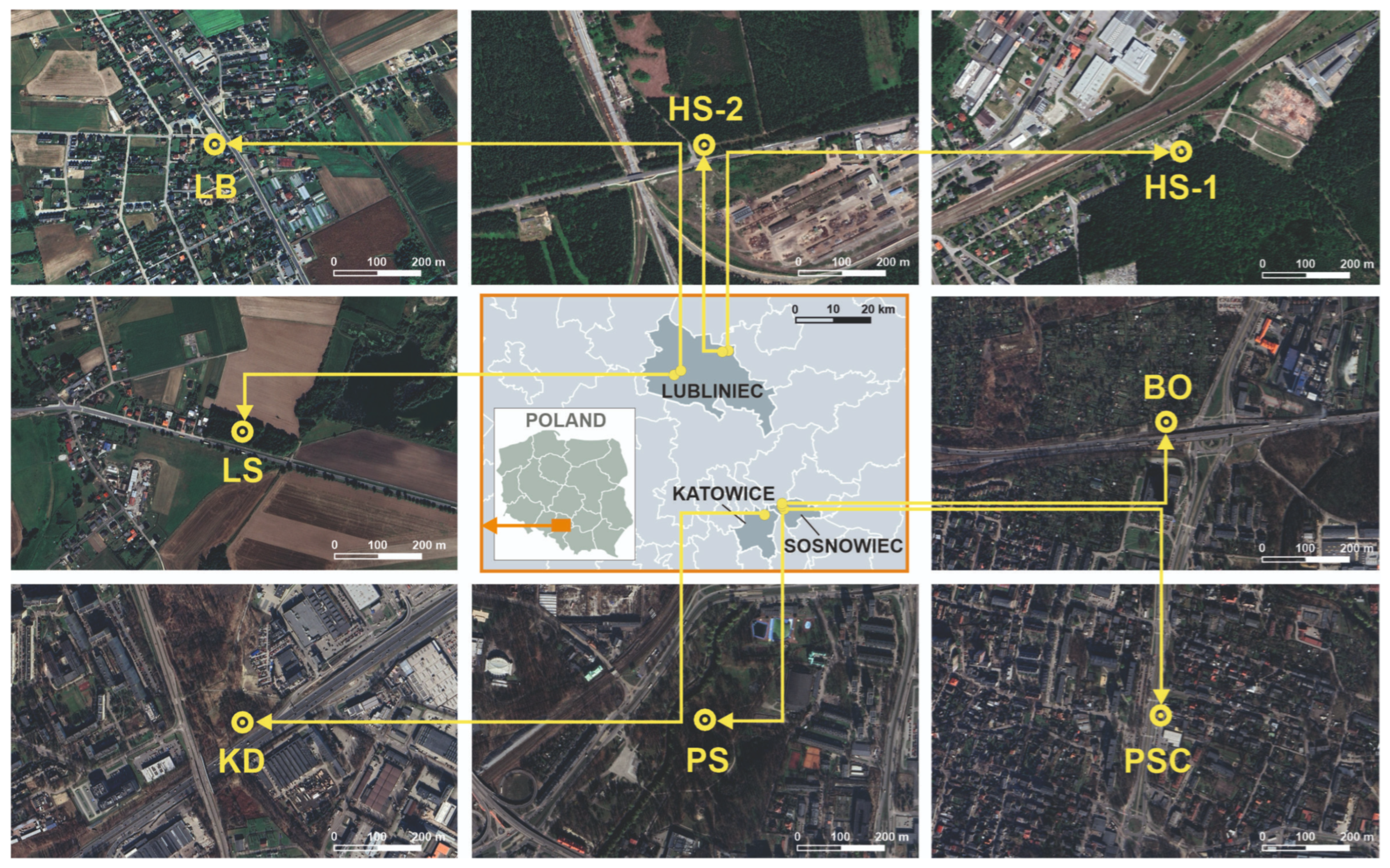
The study was implemented in the counties of Sosnowiec (PS, PSC, BO), Katowice (KD), and Lubliniec (LB, LS, HS-1 and HS-2) (Figure 1), all located in the Silesian Voivodeship. The study areas are located in the Silesian Upland and the Upper Silesian Industrial Region, where the entire region is characterised by diverse terrain that has been significantly altered by anthropogenic activity. Due to high levels of industrialisation, both historical and contemporary, significant transformations of ecosystems have occurred [58]. Plant species with a wide range of ecological requirements and adaptive capabilities colonise these degraded ecosystems. The general characteristics of the geographical environment of sites are presented in Table 1.
The study area, encompassing Katowice, Sosnowiec, and Lubliniec, features a temperate continental climate. The mean annual temperature ranges from 8.5 °C to 11.0 °C, and the annual precipitation totals vary between 650 and 800 mm, with peak rainfall occurring in July. Katowice and Sosnowiec exhibit typical urban heat island effects due to dense industrial and residential development, Lubliniec (located slightly further north, Figure 1) often experiences slightly higher forest cover influence, though temperature and precipitation ranges remain consistent with the regional average. The prevailing winds are from the west and south-west, which are critical factors in the spatial distribution and atmospheric deposition of potentially toxic metals (PTMs) across these urban-industrial landscapes [19,58].
Acer negundo is mainly found in anthropogenically transformed environments, including forest edges, and is also intentionally planted in city parks and along transportation routes. Therefore, eight sites located along national and local roads and railway lines, varying in the degree of anthropogenic transformation and traffic intensity, were selected for the study (Table 1). At all analysed sites, habitat degradation was associated with urban land-use and management activities. The primary criterion for site selection was traffic intensity. At all eight sites (Figure 1), A. negundo occurred mainly as rows of trees or dense thickets. The annual average daily traffic (AADT) for each site was assessed using national road traffic data provided by the General Directorate for National Roads and Motorways [GDDKiA,59] and the acoustic map of the city of Sosnowiec [59,60].
The habitat disturbance level of A. negundo was assessed based on the presence of anthropogenic materials (artefacts) encountered during soil sampling and current land use. Sites exhibiting the highest concentration of anthropogenic artefacts were categorised as extremely disturbed. In such locations, the soils were formed from materials transported from other areas and contained a significant proportion of construction debris. Among all the sites studied, the edge of a pine forest in Herby Stare 2 was characterised by the lowest degree of anthropogenic transformation. Anthropogenic pressure in this location was limited primarily to traffic impact, while the soil retained its natural character.

2.2. Plant and Soil Sampling

Leaf samples were collected in the first half of September 2024 along transportation routes (Table 1). The plant material consisted of leaves collected from eight healthy A. negundo specimens, each exhibiting a low-growing tree or shrub habit. To ensure representative sampling and account for potential spatial variation within the canopy, leaves were collected along the entire canopy circumference at 1.5–2.0 m above ground level. Four subsamples were collected from each individual (one from each compass direction), resulting in a total of 32 primary samples. Each subsample was placed in a plastic bag and transported to the laboratory. In the laboratory, the leaves were thoroughly cleaned of extraneous materials and air-dried at room temperature to constant weight. The samples were then homogenised using a laboratory grinder. For each study site, four processed subsamples from each tree were thoroughly mixed to form a single representative composite sample. This procedure yielded eight final composite samples (n = 8), which were then sent to a certified laboratory in Canada for analysis (see below).
Soil samples were collected directly beneath the canopies of the same eight A. negundo individuals from which leaf material was collected. The samples were taken from the humus horizon, which was of anthropogenic origin and varied in thickness (ranging from 15 to 30 cm) among sites. Under each canopy, four soil samples were collected at a distance of one meter from the trunk (32 samples in total), one from each side of the tree. Soil samples were collected at a depth of 0–25 cm. These samples were then combined into a single composite sample per tree, resulting in eight soil samples for laboratory analyses.

2.3. Laboratory Analyses

Eight soil samples were collected for laboratory analysis. The granulometric composition was determined using standard grain size analysis, in which a set of sieves with different mesh sizes was used. The following granulometric groups were identified: rock fragments (>10.0; 10.0–5.0; and 5.0–2.0 mm), fine soils (2.0–1.0; 1.0–0.5; 0.5–0.25; and 0.25–0.1 mm), silt (0.1–0.05 mm) and clay (<0.05 mm). The mass of the sample remaining on each sieve was expressed as a percentage of grains of a particular size related to the total sample mass [61].
The soil samples were air-dried, sieved (mesh sizes: 1 mm) and analysed as follows: total organic carbon (OC) was determined by Tyurinn method; total nitrogen (Nt) was quantified using the Kjeldahl method; loss on ignition (LOI) was measured at 550 °C, total phosphorus (Pt) was measured by Bleck’s method modified by Gebhardt; available phosphorus (Pav.) was assessed using Egner–Riehm method; and available magnesium (Mgav.) was analysed according to PN-R-04023/23; and pH was measured potentiometrically (soil:water:1/2.5) in both H2O and 1 N KCl using a glass electrode [61].
The total composition of potentially toxic metals (PTM), including Pb, Cd, Zn, Fe, Mn, Co, Ni, Cu, and Hg, in the leaves of A. negundo and in the soil samples, was measured using inductively coupled plasma emission spectrometry ICP-OES, [62]. Leaf analyses were performed using a 5 g split digested in HNO3, then Aqua Regia, and analysed for the ultralow detection limits. In the case of soil samples, they were digested to complete dryness using an acid solution (H2O-HF-HClO4-HNO3). 50% HCl was added to the residue and heated using a mixing hot block. After cooling, the solutions were transferred and brought to volume using dilute HCl. Sample splits of 0.5 g were analysed (www.bureauveritas.com, accessed on 13 September 2025). The analyses were performed at the ACME laboratory (Vancouver, BC, Canada) using the AQ250_EXT procedure for soil and the VG105_EXT procedure for leaves. Leaves and soil samples were analysed three times for the selected elements, and the mean values are reported in the study.

2.4. Environmental Indices

To assess soil contamination by heavy metals, the following environmental indices were applied (Table 2, detail in Table S1): Igeo (Geoaccumulation Index)—evaluating the degree of contamination relative to the natural geochemical background [63,64,65]; EF (Enrichment Factor)—assessing the anthropogenic influence on metal concentrations in the soil [65,66]; CF (Contamination Factor)—evaluating contamination by individual metals [63,65]; and Er (Potential Ecological Risk Factor)—indicating the potential ecological risk of metals [67], considering both their concentration and toxicity.

2.5. Statistical Analyses

The concentrations of potentially toxic metals (PTM: Cu, Pb, Zn, Ni, Co, Mn, Fe, Cd, and Hg) were analysed in soil samples and Acer negundo tissues collected from eight study sites (N = 8, Table 1). For each variable (analysed separately for the soil and plant matrices), the Shapiro–Wilk test (α = 0.05) was conducted to evaluate the normality of the data distribution. Due to the observed deviations from normality for several variables and the small sample size (N = 8), Spearman’s rank correlation (ρ) was employed for further analyses. This non-parametric method was selected for its robustness against non-normal distributions and lower sensitivity to outliers. For each Spearman correlation, a two-tailed significance level (p-value) was calculated. Exact correlation coefficient values were determined for α = 0.001, 0.01, and 0.05. All statistical analyses were performed using SPSS Statistics software (version 14.0).
Additionally, due to the small number of sites (n = 8), a leave-one-out (LOO) sensitivity analysis was performed for the key Spearman correlations. In this procedure, the correlations were recalculated multiple times, each time excluding one site (resulting in eight separate calculations for each pair of variables). The objective was to verify whether the direction of the relationship (the sign of the correlation) and the overall interpretation of the results remained stable following the removal of any single observation.
To summarise the variability of soil physicochemical properties, a separate Principal Component Analysis (PCA) was performed using LOI, OC, Nt, Mgav., Pav., and Pt (n = 8). Data were Z-score standardised and analysed using a correlation matrix. The first principal component (PC1) was interpreted as a soil fertility gradient because it was mainly associated with LOI, OC, and Nt. Site scores were used to separate the sampling sites along this gradient.
To evaluate the combined multivariate response of soil metals, a Principal Component Analysis (PCA) was performed on the soil metal concentrations (n = 8). Data were Z-score standardized, and the analysis was conducted using a correlation matrix. Based on the resulting loadings, component scores (PC1 and PC2) were calculated for each site. Subsequently, Spearman’s correlation (ρ) was used to assess the relationship between traffic intensity (Cars_per_day) and the extracted components.

3. Results

3.1. Soil Physicochemical Features

The analysed samples from the individual research sites showed variation in grain-size distribution. Nevertheless, all samples are dominated by medium sand (0.25 < d ≤ 0.5 mm), fine sand (0.1 < d ≤ 0.25 mm), and very fine sand (0.05 < d ≤ 0.1 mm) fractions. Furthermore, a significant proportion of the silt and clay fraction (d < 0.05 mm) was observed. The highest concentrations of these fractions were recorded at sites KD, BO, and PSC, respectively (Table 3).
The pH of the studied soil samples varied considerably, ranging from moderately acidic (pH in KCl = 5.85; site PS) through slightly acidic (pH in KCl from 6.73 to 6.88) to slightly alkaline, with values between 7.19 and 7.66 (Table 4). This variation in pH was reflected in the concentrations of exchangeable acid cations (H+ and Al3+), with slightly higher levels recorded at site KD (Table 4).
Results for loss on ignition (LOI) indicate a high proportion of organic matter in the upper anthropogenic layers. The highest value (11.14%) was recorded at the highway site (KD), where the topsoil formed from foreign fill material. Similar results were found at PS (7.28%), HS-1 (7.5%), and LS (7.73%) sites. Organic carbon (OC) peaked at KD (6.74%) and PS (5.35%), while other locations ranged between 3.95% and 5.06%. Total nitrogen (Nt) followed a similar distribution pattern (Table 4).
Available magnesium showed significant variability, from 71.5 mg kg−1 (HS-2) to 297.5 mg kg−1 (PS). Pav. values were comparable across the BO, LS, and HS-1 sites (31.21–39.24 mg kg−1). The highest total phosphorus (Pt) content (1120 mg kg−1), reflecting anthropogenic impacts such as fertilization and animal waste, was noted in Sielecki Park (PS). Across all sites, Pt averaged 655 mg kg−1, ranging from 280 to 1120 mg kg−1 (Table 4).
A separate PCA based on LOI, OC, Nt, Mgav., Pav., and Pt explained 74.5% of the total variance in the first two axes (PC1 = 48.7%, PC2 = 25.8%). PC1 was mainly related to LOI, OC, and Nt and was interpreted as a fertility gradient. KD had the highest PC1 score, followed by LS and PS, whereas HS-2, BO, and LB were located at the lower end of the gradient. PC2 mainly reflected variation in Mgav. and Pt. Overall, the more fertile soils were characterised mainly by higher organic matter and nitrogen (Table 5).

3.2. Assessment of Soil Contamination with PTM

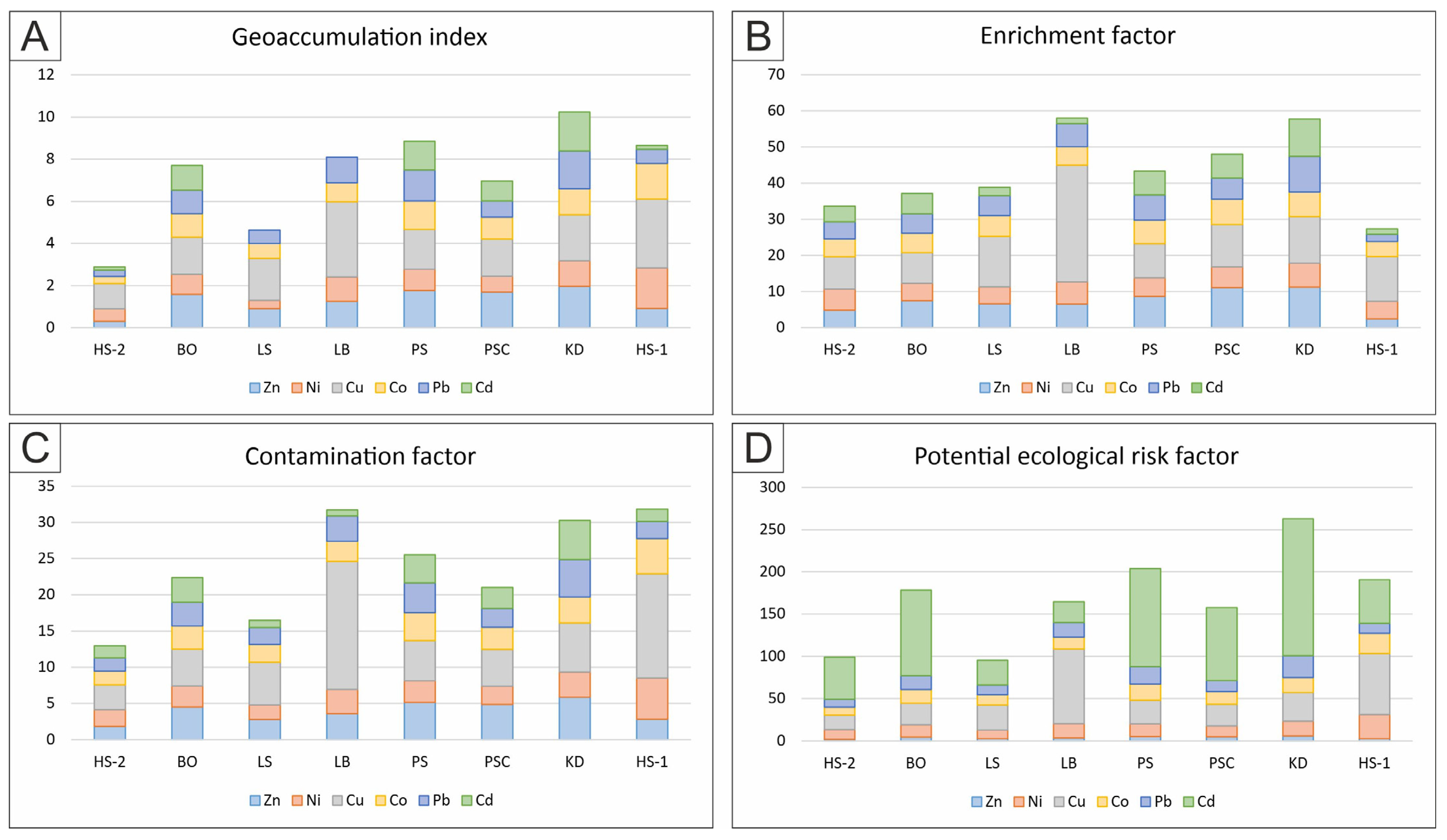
The geoaccumulation index (Igeo) was employed to evaluate soil contamination by toxic metals. Calculated values ranged from −0.88 to 3.55, indicating levels from uncontaminated to strongly contaminated. Cu exhibited the highest enrichment (Igeo: 1.19–3.55), reflecting moderate to strong contamination. Zn and Ni showed predominantly moderate contamination (0.30–1.96 and 0.40–1.92, respectively), with peak levels at sites KD and HS-1. Pb levels were generally moderate (0.29–1.79), while Cd displayed the greatest spatial variability, ranging from uncontaminated (−0.89) to moderately contaminated (1.85, Figure 2, Table S1).
Enrichment factor (EF) values for the analyzed elements indicated moderate to very high soil enrichment, with pronounced spatial variability. Most values fell within the range of significant enrichment (5 ≤ EF < 20), suggesting a substantial anthropogenic contribution. Cu showed the highest levels, reaching “very high enrichment” at the LB site (EF = 32.29), while other sites maintained significant enrichment (8.91–12.9). Zinc, nickel, cobalt, and lead generally exhibited moderate to significant enrichment, with peak values for Zn (11.04) at the PSC site and Pb (9.94) at the KD site. Cd displayed high spatial variability, ranging from minimal enrichment at LS and HS-1 to significant enrichment at the PS, PSC, and KD sites (EF up to 10.2; Figure 2, Table S1).
Contamination factor (CF) values indicate moderate (1 ≤ CF < 3) to very high soil contamination (CF ≥ 6), depending on the element and location. Overall, considerable contamination (3 ≤ CF < 6) was the dominant class across the analyzed soils. The highest CF values were recorded for Cu, which reached very high levels at the LB (17.6) and HS-1 (14.3) sites, while exhibiting considerable contamination elsewhere. Zn and Ni were generally characterized by moderate to considerable contamination, with elevated Zn at the PS, PSC, and KD sites, and increased Ni at HS-1. Cd showed significant variability, ranging from low contamination at LS and LB to considerable contamination, reaching a peak at the KD site (CF = 5.4; Figure 2, Table S1).

3.3. Content of PTM in Soil

The content of PTM across the studied sites was diversified. Among the analysed metals, zinc (Zn) reached the highest concentrations at nearly all locations (Table 6). Its content ranged from 339 ± 3.0 mg kg−1 (HS-2) to 1078 ± 3.07 mg kg−1 (KD), with an overall mean value of 720 mg kg−1 for all analysed soil samples. Except for site HS-2, Zn concentrations exceeded the permissible threshold values. The highest lead (Pb) content was recorded at sites KD (401.4 ± 2.51 mg kg−1) and PS (317 ± 7.00 mg kg−1), respectively, while the lowest concentration was observed at HS-2 (142.1 ± 3.0 mg kg−1).
The cadmium (Cd) content in the studied soils ranged from 1.62 ± 0.40 mg kg−1 at site LB to 10.8 ± 2.06 mg kg−1 at site KD. With the exception of sites LS and HS-2, Cd concentrations exceeded the permissible limits for urban green area soils. The highest manganese (Mn) content was recorded at site HS-1 (1816 ± 3.3 mg kg−1), while the lowest value (396.3 ± 3.68 mg kg−1) was found in the sandy habitat of a pine forest (LS). Apart from this site, Mn concentrations also exceeded the applicable regulatory standards (Table 6).
The lowest contents of copper (Cu) (30.9 ± 4.91 mg kg−1), cobalt (Co) (3.8 ± 0.29 mg kg−1), and mercury (Hg) (58.3 ± 4.5 µg kg−1) were determined at site HS-2, whereas the minimum value for nickel (Ni) (11.9 ± 1.76 mg kg−1) was observed at site LS. Cobalt, copper, and nickel concentrations remained within permissible limits and did not indicate soil contamination. In contrast, Pb, Zn, Mn, and Cd significantly exceeded the threshold limits for urban greenery soils (Table 6). The average iron (Fe) content in the studied epipedons was approximately 1.81% (18,100 mg kg−1). The maximum Fe concentration was observed at HS-1 (3.60 ± 1.20%), while the minimum was recorded at HS-2 (1.19 ± 0.02%). Iron, as a key element in soil-forming processes, significantly influences the chemical and morphological properties of soils. However, in the analysed parks and green areas (particularly along roadsides), its presence is largely anthropogenic, associated with urban infrastructure.

3.4. Correlation Between Metal Content, Soil Features and Car Traffic

Based on the correlation analysis between PTM, OC, Nt, Pt, and traffic intensity, several statistically significant relationships were identified (Table 7 and Table S2). A strong positive correlation was observed between Pb and Zn (ρ = 0.904; p = 0.0020), indicating a shared spatial distribution pattern across the studied sites. Significant correlations were also identified among elements associated with the mineral phase and soil sorption properties. In particular, a pronounced relationship was observed between Co and Fe (ρ = 0.833; p = 0.0102), as well as positive correlations between Ni and Co (ρ = 0.785; p = 0.0208) and between Ni and Fe (ρ = 0.738; p = 0.0366). The Zn–Cd relationship (ρ = 0.8095; p = 0.0149) suggests a common soil geochemical gradient for these two elements. Moderate correlations were also observed for Zn–Co, Pb–Ni, Ni–Mn, Pb–Cd, Cu–Ni, and Mn–Fe (Table 7 and Table S2).
Among soil parameters, the strongest positive correlation was recorded between OC and Nt (ρ = 0.809; p = 0.0149), which can be interpreted as a typical biogeochemical relationship, as total nitrogen content in soil is largely associated with organic matter abundance. Additionally, a significant negative correlation was observed between Mn and Pt (ρ = −0.7381; p = 0.0366), suggesting that sites with higher Mn concentrations simultaneously exhibit lower Pt values, despite the generally high Pt content in the soil.
Statistical analysis revealed moderate positive correlations between Cd content and parameters such as OC (r = 0.452), Nt (r = 0.333), and Pt (r = 0.357). Although organic matter may promote cadmium retention in the soil, the remarkably high correlation coefficient between Cd and traffic intensity (r = 0.929, p < 0.01) clearly indicates an anthropogenic, traffic-related origin of this element in the studied region. The second strongest significant correlation involved Zn and Cars (ρ = 0.810, p = 0.0149), further confirming a robust positive association. Other elements showed weaker and statistically non-significant correlations with traffic intensity (e.g., Co: ρ = 0.55; Pb: ρ = 0.52; OC: ρ = 0.50; see Table 7 and Table S2). In contrast, Cu showed no significant relationship with traffic intensity (ρ = −0.238, p = 0.5702; Table 7 and Table S2), despite high local contamination levels at some sites. This suggests that cadmium was the clearest traffic-related metal in the studied soils, whereas copper enrichment was more likely associated with local, site-specific anthropogenic sources rather than road traffic alone.
The potential ecological risk factor (Er) was calculated to evaluate the hazard posed by metals in the investigated soils (Table 1). Results indicate substantial variability across elements and locations (Figure 2, Table S1). Zn, Ni, Co, and Pb exhibited low ecological risk (Er < 40) at all sites. Cu presented moderate to locally considerable risk (80 ≤ Er < 160), peaking at the LB site (Er = 88.33). Cd emerged as the dominant risk contributor, showing significant spatial variability. The highest ecological risk was recorded at site KD (Er = 162.00), categorized as high risk (160 ≤ Er < 320) identifying it as a potential hotspot for Cd contamination.
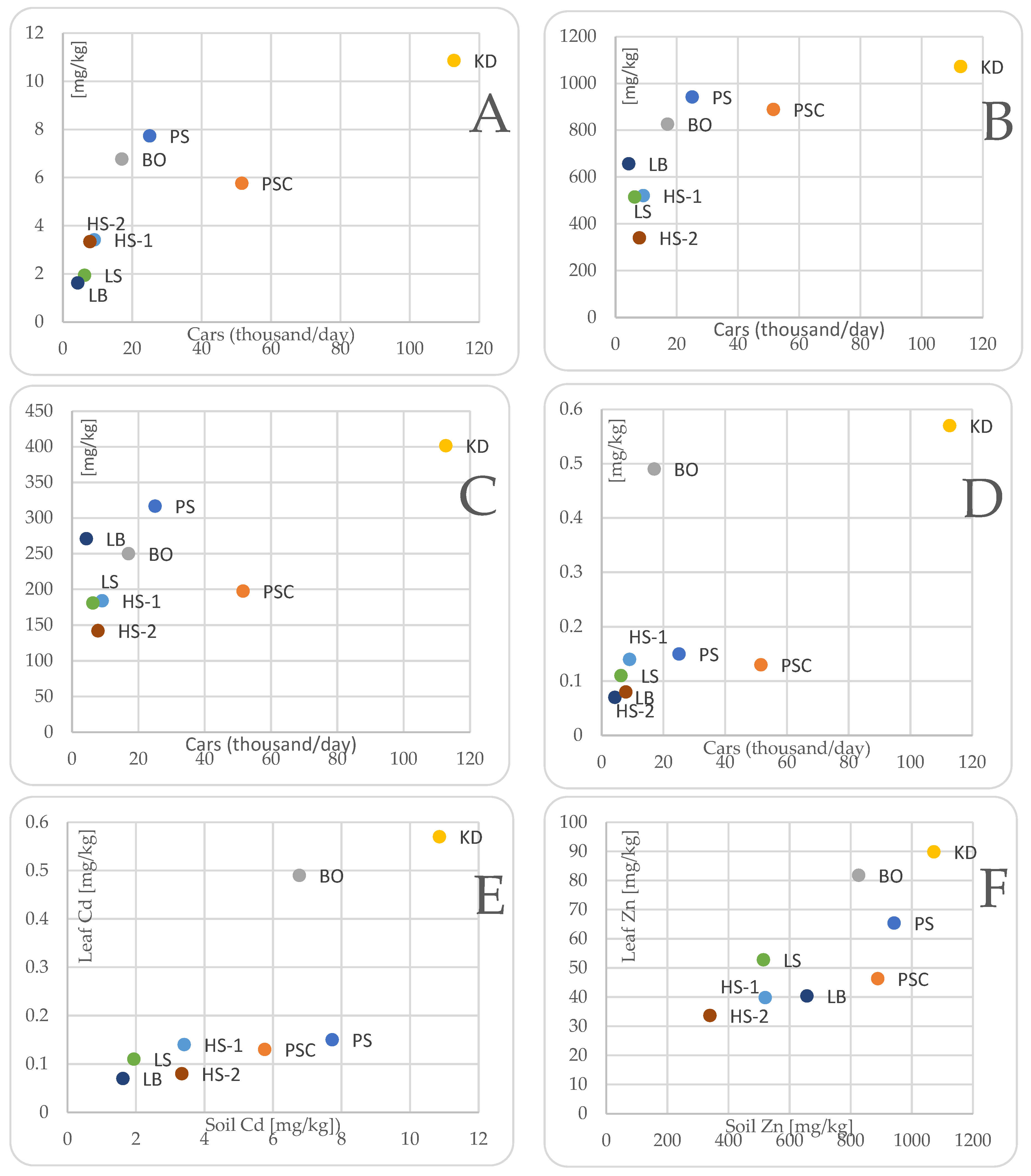
Site-level results (Figure 3) illustrate the relationships between traffic intensity (Cars_per_day) and selected metal concentrations in soil and leaves, as well as soil–leaf relationship. The use of site labels allowed for an assessment of whether the trends were driven by a single location. While site KD exhibits extreme values (high traffic and high metal concentrations), the overall distribution of data points suggests that the observed trends do not rely solely on this outlier. The most distinct trends involve soil Cd and Zn in relation to traffic volume, and the correlation between soil and leaf Cd. For soil Pb and leaf Zn, the relationships are weaker and more dispersed.
To assess whether the observed relationships were driven by any single influential site, a leave-one-out (LOO) sensitivity analysis was conducted. For each key pair of variables, the Spearman’s rank correlation coefficient (ρ) was first calculated for the full dataset (n = 8), followed by iterative recalculations excluding one site at a time. Table 8 presents the ρ values for the complete dataset alongside the minimum and maximum ρ values obtained through the LOO procedure.
The first two principal components accounted for 86.7% of the total variance (PC1: 50.5%; PC2: 36.2%). PC2 was strongly associated with Pb, Zn, and Cd (loadings: 0.905, 0.955, and 0.942, respectively, Table 9), reflecting a shared co-occurrence pattern. Spearman correlation revealed a significant positive relationship between PC2 scores and traffic intensity (ρ = 0.76; p = 0.028), whereas no such correlation was found for PC1 (ρ = 0.02; p = 0.95). These results indicate that traffic intensity is primarily linked to the Pb–Zn–Cd metal pattern represented by PC2, which was positively correlated with traffic intensity (Spearman’s ρ = 0.76; p = 0.028), whereas the primary component (PC1) showed no such relationship (Table 10).
PCA of soil metals revealed two major multivariate patterns. PC1, which explained the largest share of variance, described the general geochemical structure of the soil metal dataset, whereas PC2 represented the shared Pb–Zn–Cd pattern and was positively correlated with traffic intensity (Spearman’s ρ = 0.76; p = 0.028, Table 10). These results indicate that traffic affects only part of the total variability in soil metal composition, while the remaining variation is related to other soil-forming or anthropogenic factors. While these multivariate findings support the observed trend between metal concentrations and traffic, they should be considered exploratory given the small sample size and potential confounding factors (Table 1).

3.5. Content of Heavy Metals of Acer Negundo Leaves

The average content of potentially toxic elements in the analysed A. negundo leaves at individual research sites was as follows (in descending order): Fe (466.25 mg kg−1) > Zn (56.25 mg kg−1) > Mn (55.73 mg kg−1) > Cu (6.74 mg kg−1) > Pb (5.28 mg kg−1) > Ni (0.58 mg kg−1) > Cd (0.23 mg kg−1) > Co (0.12 mg kg−1) > Hg (0.03 mg kg−1). The highest Zn, Pb, and Cu contents were found in specimens growing at the KD site, which was characterised by a high level of disturbance. The lowest contents were recorded at the HS-2 (Zn 33.7 ± 3.30 mg kg−1; Pb 0.94 ± 0.03 mg kg−1) and Cu 4.04 mg kg−1 at the PS site. High Mn and Fe concentrations were recorded at the BO site, which was characterised by a moderate level of disturbance. Considering the limit values for edible plants, Pb, Zn, Mn, Cd, and Fe exceed the permissible threshold (Table 11).

3.6. Correlation Between Metal Contents in the Leaves of A. negundo and Car Traffic

The strongest and only statistically significant relationship between leaf metal content and traffic intensity was found for Cd (ρ = 0.738, p = 0.0366; Table 12). This indicates that cadmium is the clearest traffic-related element in A. negundo leaves. No other leaf metal showed a statistically significant correlation with Cars. Positive trends were also observed for Pb and Zn, but these relationships were not statistically significant and were therefore interpreted cautiously.
Despite the stability of the correlation signs indicated by the LOO procedure (Table 8), the small sample size (n = 8) necessitates an exploratory interpretation of the data. Although a consistent trend between traffic and heavy metal accumulation is evident, broader validation is essential before utilizing these results for definitive pollution mapping or bioindication.

3.7. Correlation Between Metal Content in Leaves and Soil

Correlation analysis revealed an element-specific accumulation pattern in A. negundo leaves (Table 13). The strongest same-metal soil–leaf relationship was found for Cd (S_Cd vs. L_Cd, ρ = 0.881, p = 0.0039), indicating that cadmium was most clearly reflected in leaf tissues. Significant same-metal relationships were also observed for Zn (S_Zn vs. L_Zn, ρ = 0.761, p < 0.05) and Fe (S_Fe vs. L_Fe, ρ = 0.718, p < 0.05). In contrast, same-metal relationships for Cu, Pb, Ni, Mn, and Hg were weak or not statistically significant suggesting that A. negundo does not reflect all metals equally. Some cross-metal correlations were also observed, but these were treated only as co-variation and not as evidence of direct uptake.
Cross-metal correlations were treated with caution, as they may reflect shared site conditions or common pollution sources rather than direct soil-to-leaf transfer.

4. Discussion

The structure and functioning of plant ecosystems and soil cover in industrial regions and cities are significantly determined by anthropogenic activity. Human impact degrades or modifies natural soil properties, including morphological, biological, and physicochemical characteristics shaped by natural pedogenic processes. Long-term anthropogenic pressure in urbanised areas promotes the transformation of soil profiles and changes in plant community structure. In urban and suburban areas, soil cover and its genetic horizons are often deformed, truncated, or destroyed. Consequently, anthropogenic soils with specific properties are formed, with parameters depending on the intensity, direction, and duration of human influence [75,76,77]. Along transport routes, anthropogenic materials often accumulate, and technogenic embankments are formed, serving as artificial parent material for developing soils. It should be noted that unlike persistent organic pollutants (POPs), which can undergo microbial degradation in the rhizosphere, heavy metals are non-degradable elements. Therefore, their elimination by A. negundo is limited to physical sequestration, stabilization, or redistribution within the plant tissues, rather than biological breakdown. This occurs where the spontaneous plant succession takes place, or stress-tolerant species are introduced to shape roadside green belts. In the study area, Acer negundo is one such species, characterised by a wide ecological amplitude and high tolerance to conditions in urbanised and degraded environments [57].

4.1. Variability of Basic Physicochemical and Chemical Properties of Soils

The soils developing along the analysed transportation routes (Table 1), occurring under A. negundo, and in particular their topsoil (humus horizon) from which samples were collected for analysis, were formed with the contribution of allochthonous anthropogenic material transported from external sources, except at site PS. This material was characterised by a high content of OC (Table 4), which significantly influenced the development of other physicochemical properties of the soils. It contained, among others, limestone fragments, concrete and cement pieces, glass, and red brick debris. The presence of these technogenic components had a substantial effect on both soil structure and soil reaction (pH). Based on the morphological characteristics of the humus horizon, the type of parent material, and the physicochemical properties, the studied soils should be classified as anthropogenic soils whose development was closely associated with human activity. According to the WRB classification [78] these soils can be classified as Anthropols and Technosols (Table 1).
The studied soils exhibited considerable variability in physicochemical properties, including soil reaction (pH), loss on ignition, and the content of selected plant-available elements, clearly distinguishing them from natural soils. At most of the investigated sites, soil reaction was neutral to slightly alkaline (Table 4), whereas at site PS, a slightly acidic pH was recorded. Elevated pH values observed at sites PSC and HS-2 can be attributed not only to natural factors, such as the degree of organic matter humification and plant species composition, but also to the presence of limestone fragments, cement particles, and alkaline construction- and road-derived dust in the soil. Soil reaction is a critical factor governing heavy metal mobility; elevated pH levels promote immobilization [61,79], effectively limiting the uptake of these elements by Acer negundo. At most sites, neutral to slightly alkaline pH favoured the sequestration of trace elements; however, one site (PS) showed a moderately acidic reaction (Table 4), indicating local variability in the geochemical conditions controlling metal mobility. This geochemical buffering likely shields A. negundo from acute phytotoxic effects by decoupling high total metal concentrations from biological absorption. Consequently, this mechanism enables the species to thrive in anthropogenic habitats characterized by significant trace-element enrichment. The soil pH patterns observed at most sites are typical of technogenic soils and primarily result from the presence of carbonate components and alkaline construction materials in the soil matrix. Moreover, dust and ash from adjacent areas contribute significantly to the alkalisation of urban soils. Under alkaline conditions, PTM tend to become immobilised, reducing their mobility and bioavailability. This process has important ecological implications, particularly for the functioning of urban green spaces and tree species such as Acer negundo, which exhibit a high tolerance to strongly transformed and contaminated soils. Comparable soil pH characteristics in urban environments have been reported in studies conducted within similar ecological settings [80,81,82,83].
The content of OC in soils at the investigated sites showed relatively low variability, with values ranging from 3.95 to 6.74%. In contrast, total nitrogen (Nt) exhibited greater spatial differentiation. The highest concentrations of both OC and Nt were recorded at site KD, which is located in the area with the most intense vehicular traffic (Table 1). As reported by several authors, elevated organic carbon content in urban soils is associated with the application of organic fertilisers in parks and green spaces, as well as with the accumulation of carbonaceous dust in the form of soot, bituminous substances, lubricants, and products of tyre abrasion [84,85,86,87]. These processes are also relevant to the studied sites. OC carbon content strongly influences Nt levels, which are primarily derived from organic residues and emissions from the combustion of fossil fuels in heavy industry and transportation. Since the investigated sites are located within zones affected by road traffic, transport-related emissions represent a significant factor shaping Nt concentrations in these soils. The obtained results are consistent with findings from previous studies on urban soils [19,83,88,89,90].
The highest Mgav. content was recorded at site PS (297.5 mg kg−1), clearly distinguishing it from the other locations (Table 4). Such elevated levels of this element, beyond natural pedogenic factors, are likely associated with the site’s function as an urban park, where regular fertilisation promotes Mg accumulation in the soil. Pav. contents were relatively low compared to Pt. For example, at site PS, total phosphorus was very high (1120 mg kg−1), while only a small fraction was plant-available (15.78 mg kg−1). The dominance of Pt over Pav. is typical of soils under strong anthropogenic influence and results from phosphorus occurring in forms derived from park fertilisation, agricultural activities, detergents, cleaning agents, and associated waste. In urban parks, the primary sources of total phosphorus include fertilisation and maintenance practices, accumulation of organic matter, inflow of domestic and industrial wastewater, and deposits of waste and domestic animal excreta. Phosphorus concentrations exceeding 300 mg kg−1, as reported by Prusinkiewicz et al. [91], can therefore be considered an indicator of environmental anthropogenization, reflecting the intensity and diversity of human activities in urban areas.
The new PCA showed that the main fertility gradient in these soils was related mainly to organic matter and nitrogen (Table 5). The sites with higher fertility scores, especially KD and PS, also tended to show higher Zn, Pb, and Cd contents. This suggests that anthropogenic enrichment of the upper soil horizon promoted not only nutrient accumulation but also the retention of some metals. However, this pattern was not identical for all elements, and traffic remained the clearest driver of Cd and Zn.

4.2. Factors Causing Variation in PTM in Soil

Road dust is a significant source of air and soil pollution in large cities [92]. It consists of mineral and organic particles deposited and accumulating on road surfaces, originating from industrial emissions, motor vehicle traffic, and natural sources [93]. In Poland, mineral materials and chemical compounds originating from sand used to keep roads clear in winter also constitute a substantial part of street dust [94]. The elemental composition of the soil varied significantly across the study sites, reflecting both natural and anthropogenic influences. Lead (Pb) concentrations in the KD and LB soils exceeded recommended values. In contrast, Zn concentrations were particularly high in the KD, PS, and PSC soils (Table 6), indicating a significant impact of vehicle traffic and urban-industrial activities. Zinc is a well-established indicator of traffic impact, as it has historically and technologically been associated with tyre and rubber abrasion [95,96,97].
The studied sites are located directly along major transportation routes, where emissions from fuel combustion and traffic-related processes contribute to elevated soil concentrations of Pb, Zn, and Cd. These metals originate primarily from tyre wear, abrasion of brake linings and road surfaces, vehicle components and lubricants, as well as from the emission, deposition, and redeposition of road dust and metal-bearing particulates [98]. Additional sources include construction activities, waste disposal, surface runoff from adjacent roads, grease residues, and leaks from batteries and damaged fuel tanks [93,99,100]. Road traffic is a significant source of aerosols, including particulate matter (PM10 and PM2.5), which carry potentially toxic metals and polycyclic aromatic hydrocarbons (PAHs) [101].
The issue of PTM content in urban and suburban areas is a key and frequently investigated aspect of the urban environment in recent times [93,102,103]. The results received in this study are compatible with those reported in the literature and confirm the occurrence of elevated concentrations of PTM, including Zn, Pb, Cd, and Mn, in soils of urban ecosystems [19,75,76,83,93,100,104,105,106,107]. According to the current Polish environmental regulations Journal of Laws [72], the humus horizons of soils at the investigated sites exhibited permissible concentrations of Cu and Ni. In contrast, the contents of Fe, Zn, Mn, Cd, and Pb (Table 6) exceeded the threshold values established for this type of ecosystem.

4.3. PTM in Acer negundo in Urban Area

Acer negundo, as an alien species in Europe, is characterised by a wide ecological tolerance. It occurs on soils with varying degrees of transformation and PTM (potentially toxic metals) contamination. Soil conditions are often reflected in the chemical composition of its leaves and tissues; therefore, this tree is frequently planted in urban areas (as an element of urban greenery) due to its high resistance to environmental stress and good vitality. For this reason, the species is used in biomonitoring regarding PTM accumulation [6,16,20,48]. Analysis of literature data indicated considerable variability in Acer negundo’s ability to accumulate PTM, which is directly attributable to differing levels of anthropogenic pressure at the studied locations. The Pb content in leaves from industrial areas of Orsk reached 1.45 mg kg−1 [49], in urban green areas of Belgorod, 1.03 mg kg−1 [48], whereas in Istanbul, values as high as 12.8 mg kg−1 were reported [20]. Mean concentrations reported by Krupnova ([6]; Pb 4.20 mg kg−1) and Oliva ([25]; Pb 3.44 mg kg−1) indicated moderate contamination associated with traffic exposure. These results were comparable to those obtained in the present study, except for site KD, where a markedly higher concentration (Pb 25.5 mg kg−1) was recorded (Table 11).
For Zn, results reported by other authors also showed substantial variation. The highest concentrations were reported by Larionov (100.8 mg kg−1 [48]) and Belozubova ([16]; Zn 80.6 mg kg−1), suggesting high zinc bioavailability in urban soils. Slightly lower values were reported by Doğanlar et al. ([26]; 30 mg kg−1) and Simon et al. ([21]; 35 mg kg−1). In contrast, data from Turlybekova [49] indicated very low accumulation levels in urbanised areas (9.25 mg kg−1). In the present study, higher Zn concentrations were recorded at sites BO (Zn 81 mg kg−1) and KD (89.8 mg kg−1) (Table 11), whereas the remaining results vary from those reported in the cited studies. Cadmium concentrations in A. negundo leaves reported in the literature [20,26] ranged from 0.02 to 0.35 mg kg−1. These values were relatively low and rarely exceeded 0.41 mg kg−1 [16]. The results obtained in the present study are consistent with the above data, except for sites BO and KD, where higher concentrations were observed (Table 11).
The highest Cu accumulation capacity was reported by Belozubova ([16]; Cu 16.1 mg kg−1), whereas other authors [21,48] reported values ranging from 3.93 to 7.1 mg kg−1. These results do not differ substantially from the levels recorded at the sites analysed in the present study (Table 11).
The results indicate that A. negundo may serve as a useful bioindicator of local metal contamination, although its response was element-specific. Among the analysed elements, cadmium showed the clearest soil–leaf relationship (Table 13), which suggests that its concentration in leaves reflected local substrate contamination more consistently than the other metals. Because leaf samples were cleaned prior to chemical analysis (Section 2.2), the measured concentrations should be interpreted primarily as tissue-associated accumulation rather than direct surface deposition. In this context, A. negundo appears to be particularly useful for screening cadmium contamination in urban roadside environments.
While the invasiveness and adaptability of Acer negundo are well documented, its use as a biomonitoring tool in the Silesian industrial region warrants particular emphasis. In this specific environment, characterised by long-term anthropogenic pressure and complex pollution gradients, there is an urgent need for ubiquitous and resilient screening indicators. The prevalence of box elder in highly transformed urban-industrial areas, combined with its capacity to reflect traffic-related metal patterns, positions this species as a unique and necessary subject for monitoring. Utilising its widespread presence enables a more comprehensive assessment of environmental health in a region where traditional bioindicators may be less viable due to severe habitat degradation.

5. Conclusions

1. A. negundo shows promise as a screening indicator, and the observed patterns suggest associations along the studied gradient; however, given the small sample size, these findings should be considered exploratory, indicating potential links rather than definitive source attribution. The strong correlation identified between soil concentrations and leaf content further confirms the species’ suitability for monitoring urban environmental pollution. Specifically, Cd shows a very strong correlation with the substrate, enabling precise mapping of environmental loads from plant biomass analysis.
2. The analysis demonstrates that A. negundo is a plastic species whose leaf chemical composition closely reflects local environmental contamination. The observed variability in zinc, lead, and manganese concentrations makes this species a suitable potential bioindicator for urbanized areas.
3. The significant accumulation of Pb, Zn, Hg, and Mn confirms the significant impact of human activity on urban soils. These findings emphasise the need for continuous monitoring to mitigate ecological threats in urban environments.
4. The enrichment factor (EF) analysis indicates substantial anthropogenic soil enrichment, especially for copper and, locally, for Zn, Pb, and Cd, with sites LB and KD being the most affected. Furthermore, the contamination factor (CF) indicates that Cu is the primary contaminant in the studied soils, whereas other elements show moderate to significant accumulation levels.
5. The results show that Cd and, to a lesser extent, Cu are the main contributors of potential ecological risk in the studied soils, highlighting the need for targeted management at sites KD and LB. The remaining metals (Zn, Ni, Co, Pb) contribute minimally to the overall ecological risk in the studied areas.
Recommendation: Research indicates that cadmium (Cd) is a good marker of anthropogenic road traffic pressure, while Acer negundo demonstrates high efficacy as a bioindicator of such contamination in roadside soils. Due to the persistence of heavy metals within the ecosystem, it is essential to implement long-term monitoring programs to assess the dynamics of pollutant accumulation and their real impact on public health in urbanized areas.

Supplementary Materials

The following supporting information can be downloaded at: https://www.mdpi.com/article/10.3390/app16083823/s1. Table S1: Selected environmental indices calculated for the studied samples. Table S2: Correlation between metal content, soil features, leaves and car traffic.

Author Contributions

Conceptualization, O.R.; methodology, O.R., S.P. and A.A.; software, S.P. and A.A.; validation, O.R., Z.B.I. and S.P.; formal analysis, O.R.; investigation, O.R.; resources, O.R.; data curation, O.R.; writing—original draft preparation, O.R.; writing—review and editing, O.R.; A.A., S.P., Z.B.I. and B.I.; visualization, A.A.; project administration, O.R. All authors have read and agreed to the published version of the manuscript.

Funding

This research received no external funding.

Institutional Review Board Statement

Not applicable.

Informed Consent Statement

Not applicable.

Data Availability Statement

Upon request from corresponding author.

Conflicts of Interest

The authors declare no conflicts of interest.

References

  1. Tokarska-Guzik, B. The Establishment and Spread of Alien Plant Species (Kenophytes) in the Flora of Poland; Wydawnictwo Uniwersytetu Śląskiego: Katowice, Poland, 2005; pp. 1–192. [Google Scholar]
  2. Tokarska-Guzik, B.; Dajdok, Z.; Zając, M.; Zając, A.; Urbisz, A.; Danielewicz, W.; Hołdyński, C. Rośliny Obcego Pochodzenia w Polsce; Generalna Dyrekcja Ochrony Środowiska: Warszawa, Poland, 2012.
  3. Wein, K. Die erste Einführung nordamerikanischer Gehölze in Europa. Mitteilungen Der Dtsch. Dendrol. Ges. 1930, 42, 137–163. [Google Scholar]
  4. Maeglin, R.R.; Ohmann, L.F. Boxelder (Acer negundo): A review and commentary. Bull. Torrey Bot. Club 1973, 100, 357–363. [Google Scholar] [CrossRef]
  5. Straigytė, L.; Čekstere, G.; Laiviņš, M.; Marozas, V. The spread, intensity and invasiveness of Acer negundo in Riga and Kaunas. Dendrobiology 2015, 74, 157–171. [Google Scholar] [CrossRef]
  6. Krupnova, T.; Rakova, O.; Berentseva, S.; Gavrilkina, S.; Udachin, V. Can trees help reduce lead in urban air? A case study of greening in a Russian industrial city. Geomate J. 2022, 23, 70–77. [Google Scholar]
  7. Davidson, A.M.; Jennions, M.; Nicotra, A.B. Do invasive species show higher phenotypic plasticity than native species and, if so, is it adaptive? A meta-analysis. Ecol. Lett. 2011, 14, 419–431. [Google Scholar] [CrossRef] [PubMed]
  8. Hulme, P.E. Phenotypic plasticity and plant invasions: Is it all Jack? Funct. Ecol. 2008, 22, 3–7. [Google Scholar] [CrossRef]
  9. Richards, C.L.; Bossdorf, O.; Muth, N.Z.; Gurevitch, J.; Pigliucci, M. Jack of all trades, master of some? On the role of phenotypic plasticity in plant invasions. Ecol. Lett. 2006, 9, 981–993. [Google Scholar] [CrossRef]
  10. Williams, N.S.; Hahs, A.K.; Vesk, P.A. Urbanisation, plant traits and the composition of urban floras. Perspect. Plant Ecol. Evol. Syst. 2015, 17, 78–86. [Google Scholar] [CrossRef]
  11. Obidziński, A.; Mędrzycki, P.; Kołaczkowska, E.; Ciurzycki, W.; Marciszewska, K. Do David and Goliath play the same game? Explanation of the abundance of rare and frequent invasive alien plants in urban woodlands in Warsaw, Poland. PLoS ONE 2016, 11, e0168365. [Google Scholar] [CrossRef]
  12. Rahmonov, O.; Środek, D.; Pytel, S.; Kupka, T.; Makieieva, N. Accumulation of heavy metals in soil and Chelidonium majus L. in an urban environment. J. Elem. 2023, 28, 1329–1351. [Google Scholar] [CrossRef]
  13. Pichtel, J.; Sawyerr, H.T.; Czarnowska, K. Spatial and temporal distribution of metals in soils in Warsaw, Poland. Environ. Pollut. 1997, 98, 169–174. [Google Scholar] [CrossRef]
  14. Pan, L.; Wang, Y.; Ma, J.; Hu, Y.; Su, B.; Fang, G.; Xiang, B. A review of heavy metal pollution levels and health risk assessment of urban soils in Chinese cities. Environ. Sci. Pollut. Res. 2018, 25, 1055–1069. [Google Scholar] [CrossRef] [PubMed]
  15. Li, X.; Liu, L.; Wang, Y.; Luo, G.; Chen, X.; Yang, X.; He, X. Heavy metal contamination of urban soil in an old industrial city (Shenyang) in Northeast China. Geoderma 2013, 192, 50–58. [Google Scholar] [CrossRef]
  16. Belozubova, N.; Zubkova, V.; Kirillov, N. Spatial and Specific Variance in Accumulation of Heavy Metals in Tree Vegetation of Moscow City South-Western Administrative District. In Economy and Ecology: Contemporary Trends and Contradictions; Radović-Marković, M., Đukanović, B., Vuković, N., Eds.; Conference 15–17 February 2019; Russian State Social University: Moscow, Russia, 2019; pp. 7–12. Available online: https://world-evolution.ru/pdf/4_2019_107_EconomyandEcologyContemporaryTrendsandContradictions.pdf (accessed on 23 January 2026).
  17. Prokof’eva, T.V.; Umarova, A.B.; Bykova, G.S.; Suslenkova, M.M.; Ezhelev, Z.S.; Kokoreva, A.A.; Gasina, A.I.; Martynenko, I.A. Morphological and physical properties in diagnostics of urban soils: Case study from Moscow, Russia. Soil Sci. Annu. 2020, 71, 309–320. [Google Scholar] [CrossRef]
  18. Didur, O.; Strepetova, K.; Katsevych, V.; Holoborodko, K.; Ivanko, I.; Loza, I.; Lovynska, V.; Sytnyk, S. Environmental quality assessment of soil as a component of green spaces in parks of the megalopolis. Agrology 2023, 6, 92–96. [Google Scholar] [CrossRef]
  19. Rahmonov, O.; Kowal, A.; Rahmonov, M.; Pytel, S. Variability of concentrations of potentially toxic metals in the topsoil of urban forest parks (Southern Poland). Forest 2024, 15, 1020. [Google Scholar] [CrossRef]
  20. Baycu, G.; Tolunay, D.; Özden, H.; Günebakan, S. Ecophysiological and seasonal variations in Cd, Pb, Zn, and Ni concentrations in the leaves of urban deciduous trees in Istanbul. Environ. Pollut. 2006, 143, 545–554. [Google Scholar] [CrossRef]
  21. Simon, E.; Baranyai, E.; Braun, M.; Cserháti, C.; Fábián, I.; Tóthmérész, B. Elemental concentrations in deposited dust on leaves along an urbanization gradient. Sci. Total Environ. 2014, 490, 514–520. [Google Scholar] [CrossRef]
  22. Savinov, A.B.; Nikitin, Y.D.; Erofeeva, E.A. Bioindicative aspect of Acer negundo L. leaf variability under the pollution of urban soils with heavy metals. Probl. Reg. Ecol. 2018, 5, 45–47. [Google Scholar] [CrossRef]
  23. Bielyk, Y.; Heilmeier, H. Macronutrients and heavy metals contents in the leaves of trees from the devastated lands at Kryvyi Rih District (Central Ukraine). E3S Web Conf. 2020, 166, 01011. [Google Scholar] [CrossRef]
  24. Hrotkó, K.; Gyeviki, M.; Sütöriné, D.M.; Magyar, L.; Mészáros, R.; Honfi, P.; Kardos, L. Foliar dust and heavy metal deposit on leaves of urban trees in Budapest (Hungary). Environ. Geochem. Health 2021, 43, 1927–1940. [Google Scholar] [CrossRef] [PubMed]
  25. Oliva, T.V.; Kolesnichenko, E.Y.; Panin, S.I.; Manokhina, L.A. Heavy metals accumulation by wood species and agricultural plant in conditions of roadside ecosystem. Adv. Curr. Nat. Sci. 2021, 12, 184–193. [Google Scholar] [CrossRef]
  26. Doğanlar, Z.B.; Atmaca, M. Influence of airborne pollution on Cd, Zn, Pb, Cu, and Al accumulation and physiological parameters of plant leaves in Antakya (Turkey). Water Air Soil Pollut. 2011, 214, 509–523. [Google Scholar] [CrossRef]
  27. Chernyavskaya, I.; Ednich, E.; Belous, O. Indicators of adaptability of representatives of the genus Acer in an urban environment. In BIO Web of Conferences; EDP Sciences: Les Ulis, France, 2023; Volume 67, p. 01007. [Google Scholar] [CrossRef]
  28. Chudnovskaya, G.V.; Chernakova, O.V. Fluctuating asymmetry of the Acer negundo L. leaf: An indicator of its state and the quality of the urban environment. Arct. Subarct. Nat. Resour. 2023, 28, 293–302. (In Russia) [Google Scholar] [CrossRef]
  29. Abderrahmane, B.; Naima, B.; Tarek, M.; Abdelghani, M. Influence of highway traffic on contamination of roadside soil with heavy metals. Civ. Eng. J. 2021, 7, 1459–1471. [Google Scholar] [CrossRef]
  30. Kuklová, M.; Kukla, J.; Hniličková, H.; Hnilička, F.; Pivková, I. Impact of car traffic on metal accumulation in soils and plants growing close to a motorway (Eastern Slovakia). Toxics 2022, 10, 183. [Google Scholar] [CrossRef]
  31. Kumar, M.S.; Sangwan, P.S.; Karthik, R. Effect of heavy metal concentrations in roadside soils: A review. J. Pharmacogn. Phytochem. 2020, 9, 1812–1816. [Google Scholar]
  32. Monks, P.S.; Granier, C.; Fuzzi, S.; Stohl, A.; Williams, M.L.; Akimoto, H.; Amann, M.; Baklanov, A.; von Glasow, R. Atmospheric composition change: Global and regional air quality. Atmos. Environ. 2009, 43, 5268–5350. [Google Scholar] [CrossRef]
  33. Ghosh, S.P.; Raj, D.; Maiti, S.K. Risk assessment of heavy metal pollution in roadside soil and vegetation of a national highway crossing an industrial area. Environ. Process. 2020, 7, 1197–1220. [Google Scholar] [CrossRef]
  34. Legret, M.; Pagotto, C. Heavy metal deposition and soil pollution along two major rural highways. Environ. Technol. 2006, 27, 247–254. [Google Scholar] [CrossRef]
  35. Lagerwerff, J.V.; Specht, A.W. Contamination of roadside soil and vegetation with cadmium, nickel, lead, and zinc. Environ. Sci. Technol. 1970, 4, 583–586. [Google Scholar] [CrossRef]
  36. Hjortenkrans, D.S.T.; Bergbäck, B.G.; Häggerud, A.V. Metal emissions from brake linings and tires: Case studies of Stockholm, Sweden 1995/1998 and 2005. Environ. Sci. Technol. 2007, 41, 5224–5230. [Google Scholar] [CrossRef] [PubMed]
  37. Atiemo, S.M.; Ofosu, F.G.; Aboh, I.J.K.; Oppon, O.C. Levels and sources of heavy metal contamination in road dust in selected major highways of Accra, Ghana. X-Ray Spectrom. 2012, 41, 105–110. [Google Scholar] [CrossRef]
  38. Othman, I.; Al-Oudat, M.; Al-Masri, M.S. Lead levels in roadside soils and vegetation of Damascus city. Sci. Total Environ. 1997, 207, 43–48. [Google Scholar] [CrossRef] [PubMed]
  39. Werkenthin, M.; Kluge, B.; Wessolek, G. Metals in European roadside soils and soil solution—A review. Environ. Pollut. 2014, 189, 98–110. [Google Scholar] [CrossRef]
  40. Rolli, N.M.; Gadi, S.B.; Giraddi, T.P. Bioindicators: Study on uptake and accumulation of heavy metals in plant leaves of a state highway road, Bagalkot, India. J. Agric. Ecol. Res. Int. 2016, 6, 1–8. [Google Scholar] [CrossRef]
  41. Pagotto, C.; Remy, N.; Legret, M.; Le Cloirec, P. Heavy metal pollution of road dust and roadside soil near a major rural highway. Environ. Technol. 2001, 22, 307–319. [Google Scholar] [CrossRef]
  42. Taşpınar, F.; Bozkurt, Z. Heavy metal pollution and health risk assessment of road dust on selected highways in Düzce, Turkey. Environ. Forensics 2018, 19, 298–314. [Google Scholar] [CrossRef]
  43. Modlingerova, V.; Szakova, J.; Sysalova, J.; Tlustos, P. The effect of intensive traffic on soil and vegetation risk element contents as affected by the distance from a highway. Plant Soil Environ. 2012, 58, 379–384. [Google Scholar] [CrossRef]
  44. Mangani, G.; Berloni, A.; Bellucci, F.; Tatano, F.; Maione, M. Evaluation of the pollutant content in road runoff first flush waters. Water Air Soil Pollut. 2005, 160, 213–228. [Google Scholar] [CrossRef]
  45. Bayraktar, E.P.; Isinkaralar, O.; Isinkaralar, K. Usability of several species for monitoring and reducing the heavy metal pollution threatening public health in the urban environment of Ankara. World J. Adv. Res. Rev. 2022, 14, 276–283. [Google Scholar] [CrossRef]
  46. Ozel, H.B.; Varol, H.N.; Sevik, H. Change of Mg concentration in several plants depending on plant species, washing status, and traffic density. World J. Adv. Res. Rev. 2021, 12, 447–453. [Google Scholar] [CrossRef]
  47. Kayhanian, M.; Fruchtman, B.D.; Gulliver, J.S.; Montanaro, C.; Ranieri, E.; Wuertz, S. Review of highway runoff characteristics: Comparative analysis and universal implications. Water Res. 2012, 46, 6609–6624. [Google Scholar] [CrossRef] [PubMed]
  48. Larionov, M.V. Content of heavy metals in the leaves of urban trees. Ekologiya 2012, 10, 71–75. [Google Scholar]
  49. Turlybekova, D.M. Content of heavy metals in Acer negundo under conditions of industrial pollution in the city of Orsk. Vestn. OGU 2014, 167, 148–150. [Google Scholar]
  50. Voronina, V.P.; Dolmonego, M.A.; Arubina, A.V. Bioecological features of species of the genus Acer on urbanized soils of the Lower Volga region. Lesn. Khozaystvo 2021, 2, 69–76. [Google Scholar] [CrossRef]
  51. Kuzmin, P.A.; Skoblikova, T.V.; Gorovoy, S.A.; Otto, O.V. Research of the state of woody and brushwood plants under anthropogenic stress conditions. Sib. J. Life Sci. Agric. 2023, 15, 141–163. [Google Scholar] [CrossRef]
  52. Ivanko, I.A.; Kulik, A.F. Assessment of adaptive capacity of native and adventive species of trees and shrubs in Dnipro region. Pyt. Stepovoho Lisoznavstva Ta Lisovoi Rekultyvatsii Zemel 2021, 50, 12–21. [Google Scholar] [CrossRef]
  53. Stratu, A.; Costică, N.; Mihai, C. Wooden species in the urban green areas and their role in improving the quality of the environment. Present Environ. Sustain. Dev. 2016, 10, 173–184. [Google Scholar] [CrossRef]
  54. Guney, D.; Koc, I.; Isinkaralar, K.; Erdem, R. Variation in Pb and Zn concentrations in different species of trees and shrubs and their organs depending on traffic density. Balt. For. 2023, 29, id661. [Google Scholar] [CrossRef]
  55. Alsawaf Idrees, M.S.; Younis Al-Obaidi, M.H.; Basheer, S.A.; Khalid Al-Salmany, S.W. Use of forest trees in the treatment of polluted soil by heavy metals: A mini review. Diyala Agric. Sci. J. 2024, 16, 1–7. [Google Scholar] [CrossRef]
  56. Vasilieva, T.N.; Galaktionova, L.V.; Baisheva, E.Z.; Lebedev, S.V. Phytoremediation potential of woody flora in urban areas. IOP Conf. Ser. Earth Environ. Sci. 2020, 579, 012116. [Google Scholar] [CrossRef]
  57. Masarovičová, E.; Kráľová, K. Woody species in phytoremediation applications for contaminated soils. In Phytoremediation: Management of Environmental Contaminants, Volume 6; Springer International Publishing: Cham, Switzerland, 2019; pp. 319–373. [Google Scholar]
  58. Różkowski, J.; Rahmonov, O.; Zarychta, R.; Zarychta, A. Environmental transformation and the current state of hydrogeological condition in the Wojkowice area—Southern Poland. Resources 2021, 10, 54. [Google Scholar] [CrossRef]
  59. GDDKiA Generalny Pomiar Ruchu (GRP) 2020/2021, Średni Dobowy Ruch Roczny (Sdrr) W Punktach Pomiarowych w GRP 2020/21 na Drogach Krajowych. 2020. Available online: https://www.gov.pl/attachment/b8298ec9-69ab-443c-ac59-223464ea4a65 (accessed on 13 January 2026).
  60. Bohatkiewicz, J.; Biernacki, S.; Hałucha, M.; Kosak, A. Mapa Akustyczna Miasta Sosnowca—Część Opisowa. 2017. Available online: https://www.sosnowiec.pl/wp-content/uploads/2022/03/MA-Sosnowiec-czesc-opisowa.pdf (accessed on 13 January 2026).
  61. Bednarek, R.M.; Dziadowiec, H.; Pokojska, U.; Prusinkiewicz, Z. Badania Ekologiczno-Gleboznawcze; Wydawnictwo Naukowe PWN: Warszawa, Poland, 2004. [Google Scholar]
  62. Olesik, J.W. Elemental Analysis Using ICP-OES and ICP/MS. Anal. Chem. 1991, 63, 12A–21A. [Google Scholar] [CrossRef]
  63. Müller, G. Die Schwermetallbelastung der sedimente des Neckars und seiner Nebenflusse: Eine Bestandsaufnahme. Chem. Ztg. 1981, 105, 157164. [Google Scholar]
  64. Förstner, U. Contaminated sediments. In Lectures on Environmental Aspects of Particle-Associated Chemicals in Aquatic Systems; Lecture Notes in Earth Sciences 21; Springer: Berlin/Heidelberg, Germany, 1989; p. 155. [Google Scholar]
  65. Barbieri, M. The Importance of Enrichment Factor (EF) and Geoaccumulation Index (Igeo) to Evaluate the Soil Contamination. J. Geol. Geophys. 2016, 5, 1–4. [Google Scholar] [CrossRef]
  66. Bern, C.R.; Walton-Day, K.; Naftz, D.L. Improved enrichment factor calculations through principal component analysis: Examples from soils near breccia pipe uranium mines, Arizona, USA. Environ. Pollut. 2019, 248, 90–100. [Google Scholar] [CrossRef]
  67. Napoletano, P.; Colombo, C.; Di Iorio, E.; Memoli, V.; Panico, S.C.; Ruggiero, A.G.; Santorufo, L.; Maisto, G.; De Marco, A. Integrated Approach for Quality Assessment of Technosols in Experimental Mesocosms. Sustainability 2021, 13, 9101. [Google Scholar] [CrossRef]
  68. Lis, J.; Pasieczna, A.; Siwek, Z. Geochemical Atlas of Poland: 1: 2.500.000; Polish Geological Institute: Warsaw, Poland, 1995. [Google Scholar]
  69. Wedepohl, K.H. The composition of the continental crust. Geochim. Cosmochim. 1995, 59, 1217–1232. [Google Scholar] [CrossRef]
  70. Hakanson, L. An ecological risk index for aquatic pollution control. A sedimentological approach. Water Res. 1980, 14, 975–1001. [Google Scholar] [CrossRef]
  71. Zhang, H.; Jiang, Y.; Ding, M.; Xie, Z. Level, source identification, and risk analysis of heavy metal in surface sediments from river-lake ecosystems in the Poyang Lake, China. Environ. Sci Pollut. Res. 2017, 24, 21902–21916. [Google Scholar] [CrossRef]
  72. Journal of Laws 2016, item 1395. Regulation of the Minister of the Environment of 1 September 2016 on the Method of Conducting the Assessment of Soil Surface Pollution. Available online: https://isap.sejm.gov.pl/isap.nsf/DocDetails.xsp?id=wdu20160001395 (accessed on 12 April 2026).
  73. Kabata-Pendias, A.; Pendias, H. 1999 Biogeochemistry of Trace Elements; PWN: Warsaw, Poland, 1999. [Google Scholar]
  74. Jabeen, S.; Shah, M.; Khan, S.; Hayat, M. Determination of major and trace elements in ten important folk therapeutic plants of Haripur basin, Pakistan. J. Med. Plants Res. 2010, 4, 559–566. [Google Scholar]
  75. Greinert, A. Studia Nad Glebami Obszaru Zurbanizowanego Zielonej Góry; Oficyna Wydawnicza Uniwersytetu Zielonogórskiego: Zielona Góra, Poland, 2003. [Google Scholar]
  76. Prokof’eva, T.; Poputnikov, V. Anthropogenic transformation of soils in the Pokrovskoe-Streshnevo Park (Moscow) and adjacent residential areas. Eurasian Soil Sci. 2010, 43, 701–711. [Google Scholar] [CrossRef]
  77. Abramowicz, A.K.; Rahmonov, O. Element Cycling at Thermally Active Coal-Waste Dumps: A Case Study of Calamagrostis epigejos and Solidago canadensis. Resources 2024, 13, 73. [Google Scholar] [CrossRef]
  78. IUSSWorking Group, W.R.B. World Reference Base for Soil Resources. In International Soil Classification System for Naming Soils and Creating Legends for Soil Maps, 4th ed.; International Union of Soil Sciences (IUSS): Vienna, Austria, 2022. [Google Scholar]
  79. Dąbkowska-Naskręt, H.; Różański, S.; Bartkowiak, A. Forms and mobility of trace elements in soils of park areas from the city of Bydgoszcz, north Poland. Soil Sci. Annu. 2016, 67, 73–78. [Google Scholar] [CrossRef]
  80. Stroganova, M.N.; Miagkova, A.D.; Prokof’eva, T.V.; Skvortsova, I.N. Soils of Moscow and Urban Environment; PAIMS Press, Lomonosov Moscow State University: Moscow, Russia, 1998; pp. 1–178. [Google Scholar]
  81. Greinert, A.; Fruzińska, R.; Kostecki, J. Urban soils in Zielona Góra. In Technogenic Soils of Poland; Polish Society of Soil Science: Toruń, Poland, 2013; pp. 31–54. [Google Scholar]
  82. Matinyan, N.N.; Bakhmatova, K.A.; Korentsvit, V.A. Soils of the summer garden (Saint Petersburg). Eurasian Soil Sci. 2017, 50, 637–645. [Google Scholar] [CrossRef]
  83. Abramowicz, A.K.; Rahmonov, O.; Ciesielczuk, J. Accumulation of Heavy Metals and PAHs in Algal Crust on Burning Coal-Waste Dumps: A Case Study From an Extreme Environment. Land Degrad. Dev. 2025. [Google Scholar] [CrossRef]
  84. Czarnowska, K. Gleby i rośliny w środowisku miejskim. Zesz. Probl. Postępów Nauk. Rol. 1995, 418, 111–115. [Google Scholar]
  85. Pouyat, R.; Groffman, P.; Yesilonis, I.; Hernandez, L. Soil carbon pools and fluxes in urban ecosystems. Environ. Pollut. 2002, 116, 107–118. [Google Scholar] [CrossRef]
  86. Doichinova, V.; Zhiyanski, M.; Hursthouse, A. Impact of urbanisation on soil characteristics. Environ. Chem. Lett. 2006, 3, 160–163. [Google Scholar] [CrossRef]
  87. Licznar, S.E.; Licznar, M. Oddzialywanie aglomeracji miejskiej Wroclawia na poziomy prochniczne gleb Parku Szczytnickiego. Rocz. Glebozn. 2005, 56, 113–118. [Google Scholar]
  88. Beyer, L.; Cordsen, E.; Blume, H.P.; Schleuss, U.; Vogt, B.; Wu, Q. Soil organic matter composition in urbic anthrosols in the city of Kiel, NW-Germany, as revealed by wet chemistry and CPMAS 13C-NMR spectroscopy of whole soil samples. Soil Technol. 1996, 9, 121–132. [Google Scholar] [CrossRef]
  89. Lorenz, K.; Preston, C.M.; Kandeler, E. Soil organic matter in urban soils: Estimation of elemental carbon by thermal oxidation and characterization of organic matter by solid-state 13C nuclear magnetic resonance (NMR) spectroscopy. Geoderma 2006, 130, 312–323. [Google Scholar] [CrossRef]
  90. Chudecka, J. Charakterystyka Substratu Glebowego w Warstwie Antropogenicznej Najstarszej Części Szczecina; Wydawnictwo Uczelniane Zachodniopomorskiego Uniwersytetu Technologicznego: Szczecin, Poland, 2009; pp. 1–110. [Google Scholar]
  91. Prusinkiewicz, Z.; Bednarek, R.; Kośko, A.; Szmyt, M. Paleopedological studies of the age and properties of illuvial bands at an archaeological site. Quat. Int. 1998, 51, 195–201. [Google Scholar] [CrossRef]
  92. Charlesworth, S.; Everett, M.; McCarthy, R.; Ordonez, A.; de Miguel, E. A comparative study of heavy metal concentration and distribution in deposited street dusts in a large and small urban area: Birmingham and Coventry, West Midlands, UK. Environ. Int. 2003, 29, 563–573. [Google Scholar] [CrossRef]
  93. Li, G.; Sun, G.X.; Ren, Y.; Luo, X.S.; Zhu, Y.G. Urban soil and human health: A review. Eur. J. Soil Sci. 2018, 69, 196–215. [Google Scholar] [CrossRef]
  94. Zgłobicki, W.; Telecka, M.; Skupiński, S.; Pasierbińska, A.; Kozieł, M. Assessment of heavy metal contamination levels of street dust in the city of Lublin, E Poland. Environ. Earth Sci. 2018, 77, 774. [Google Scholar] [CrossRef]
  95. Callender, E.; Rice, K.C. The urban environmental gradient: Anthropogenic influences on the spatial and temporal distributions of lead and zinc in sediments. Environ. Sci. Technol. 2000, 34, 232–238. [Google Scholar] [CrossRef]
  96. Szwalec, A.; Mundała, P.; Kędzior, R.; Pawlik, J. Monitoring and assessment of cadmium, lead, zinc and copper concentrations in arable roadside soils in terms of different traffic conditions. Environ. Monit. Assess. 2020, 192, 155. [Google Scholar] [CrossRef]
  97. Alloway, B.J.; Steinnes, E. Anthropogenic additions of cadmium to soils. In Cadmium in Soils and Plants; McLaughlin, M.J., Singh, B.R., Eds.; Developments in Plant and Soil Sciences; Springer: Dordrecht, The Netherlands, 1999; Volume 85, pp. 97–123. [Google Scholar]
  98. Grigoratos, T.; Martini, G. Brake wear particle emissions: A review. Environ. Sci. Pollut. Res. 2015, 22, 2491–2504. [Google Scholar] [CrossRef]
  99. Komorowski, A.; Szulc, W. Impact of traffic routes on the content of trace elements in soils in Warsaw agglomeration. Soil Sci. Annu. 2017, 68, 87–92. [Google Scholar] [CrossRef]
  100. Oliver, M.A. Soil and human health: A review. Eur. J. Soil Sci. 1997, 48, 573–592. [Google Scholar] [CrossRef]
  101. Burghardt, W.; Morel, J.L.; Zhang, G.L. Development of the soil research about urban, industrial, traffic, mining and military areas (SUITMA). Soil Sci. Plant Nutr. 2015, 61, 3–21. [Google Scholar] [CrossRef]
  102. Adimalla, N. Heavy metals pollution assessment and its associated human health risk evaluation of urban soils from Indian cities: A review. Environ. Geochem. Health 2020, 42, 173–190. [Google Scholar] [CrossRef] [PubMed]
  103. Adewumi, A.J.; Ogundele, O.D. Hidden hazards in urban soils: A meta-analysis review of global heavy metal contamination (2010–2022), sources and its Ecological and health consequences. Sustain. Environ. 2024, 10, 2293239. [Google Scholar] [CrossRef]
  104. Majgier, L.; Rahmonov, O.; Składowska, M. Use of Hippophae rhamnoides L. and Symphoricarpos albus L. in the phytoremediation of soils contaminated with heavy metals. Environ. Prot. Nat. Resour. 2024, 35, 26–35. [Google Scholar] [CrossRef]
  105. Środek, D.; Rahmonov, O. The properties of black locust Robinia pseudoacacia L. to selectively accumulate chemical elements from soils of ecologically transformed areas. Forests 2021, 13, 7. [Google Scholar] [CrossRef]
  106. Bounaas, M.; Haouichi, M.; Gattal, B.; Hamza, W.; Benalia, A.; Derbal, K.; Benzina, M.; Pizzi, A.; Trancone, G.; Panico, A. Optimization of NaOH Chemical Treatment Parameters for Biomass-Based Adsorbents in Cationic Dye Removal. Processes 2025, 13, 3932. [Google Scholar] [CrossRef]
  107. Muscetta, M.; Bianco, F.; Trancone, G.; Race, M.; Siciliano, A.; D’Agostino, F.; Sprovieri, M.; Clarizia, L. Washing Bottom Sediment for The Removal of Arsenic from Contaminated Italian Coast. Processes 2023, 11, 902. [Google Scholar] [CrossRef]
Figure 1. Location of the study area within the Silesian Voivodeship and Poland.
Applsci 16 03823 g001
Figure 2. Selected environmental indicators calculated for the analysed urban soil samples: (A) geoaccumulation index (Igeo), (B) enrichment factor (EF), (C) contamination factor (CF) and (D) potential ecological risk factor (Er).
Applsci 16 03823 g002
Figure 3. Variation in relationships between metal concentrations in soil and leaves relative to traffic intensity across the study sites: (A)—Cars_per_day vs. Cd in soil; (B)—Cars_per_day vs. Zn in soil; (C)—Cars_per_day vs. Pb in soil; (D)—Cars_per_day vs. Cd in leaf; (E)—Soil Cd vs. leaf Cd; (F)—Soil Zn vs. leaf Zn.
Applsci 16 03823 g003
Table 1. Characteristics of the study sites (traffic intensity, habitat disturbance, land use and soil type.
SiteSite NameGeographical CoordinationRoad NumberTraffic Intensity:
Vehicle/Day
HabitatLevel of
Disturbance
Land Use
Classification
Method of RestorationSoil Type
1Herby Stare 2
(HS-2) *
50°44′41.20″ N 18°51′31.92″ E46, Herby7842The edge of the forest along a local roadLowAnthropogenic forestSpontaneous successionArenosole
2Allotment gardens in Sosnowiec (BO)50°18′03.0″ N 19°08′02.9″ E94, Sosnowiec17,024Allotment gardens along the road to Katowice, green avenues lined with treesMediumGreen urban areasPlanting and cultivationUrbic Technosol
3Lipie Śląskie (LS)50°40′35.1″ N 18°38′15.9″ E46, Lisowice6297The edge of a pine forest along the national road, further away from human settlementsMediumAnthropogenic forestPlanting and cultivationArenosole
4Lubliniec (LB)50°41′22″ N 18°40′05″ EDW494 Lubliniec4318Stabilised and tree-lined area, housing estate—urban greeneryLowGreen urban areasPlantingAnthrosol
5Sielecki Park
(PS)
50°17′02.56″ N 19°08′30.71″ E3 maja,
Sosnowiec
25,064Artificial surfaces, urban park with ornamental species, fertilisedHighGreen urban areasPlantingUrbic/mollic technosols
6Pogoń, Sosnowiec
(PSC)
50°17′36.4″ N 19°08′01.4″ EBędzińska,
Sosnowiec
51,589Square, urban greenery, ground covered with transported material.HighGreen urban areasPlantingTechnic Anthrosol
7Katowice-Dąbrówka (KD)50°16′02.47″ N 19°03′12.47″ ES86, Katowice112,736The high-speed road between Katowice and Sosnowiec, an artificial embankment with artefactsVery highGreen urban areasSpontaneous successionTechnic
Anthrosol
8Herby Stare 1
(HS-1)
50°44′54.8″ N 18°53′14.6″ EDW905, Herby9076artificial embankment along the railway track, various fractions of mineral materials together with artefactsExtremeUrban and industrial siteSpontaneous successionTechnic
Anthrosol
* In the remainder of the article, abbreviations of the names of research sites from this table will be used.
Table 2. Selected environmental indices used for the analysis of soil samples.
IndexFormulaClassification of Indices
Geoaccumulation index (Igeo) I g e o = l o g 2 C n 1.5 × B n Igeo ≤ 0—uncontaminated;
0 < Igeo ≤ 1—uncontaminated to moderately contaminated;
1 < Igeo ≤ 2—moderately contaminated;
2 < Igeo ≤ 3—moderately to strongly contaminated;
3 < Igeo ≤ 4—strongly contaminated;
4 < Igeo ≤ 5—strongly to extremely contaminated;
Igeo > 5—extremely contaminated
Enrichment factor (EF) E F = ( C n ÷ C r e f ) s a m p l e ( B n ÷ B r e f ) b a c k g r o u n d EF < 2—deficiency to minimal enrichment;
2 ≤ EF < 5—moderate enrichment;
5 ≤ EF < 20—significant enrichment;
20 ≤ EF < 40—very high enrichment;
EF ≥ 40—extremely high enrichment
Contamination factor (CF) C F = C n B n CF < 1—low contamination;
1 ≤ CF < 3—moderate contamination;
3 ≤ CF < 6—considerable contamination;
CF ≥ 6—very high contamination
Potential ecological risk factor (Er) E r = T r × C F Er < 40—low risk;
40 ≤ Er < 80—moderate risk;
80 ≤ Er < 160—considerable risk;
160 ≤ Er < 320—high risk;
Er ≥ 320—very high risk
C n —measured concentration of element n; B n —background concentration of element n [68]; C r e f —concentration of the reference element (Fe); B r e f —background concentration of the reference element [69]; T r —toxic-response factor [70,71].
Table 3. Granulometric composition in the analysed sites.
Sitemm
>10.010.0–5.05.0–2.02.0–1.01.0–0.50.5–0.250.25–0.10.1–0.05<0.05
[%]
PS1.01.19.30.121.433.122.36.25.5
PSC2.82.72.84.817.230.025.37.47.0
BO3.42.52.95.212.628.726.89.78.2
KD0.61.42.16.416.527.522.712.510.3
HS-11.45.15.34.219.529.323.66.65.0
LS1.62.14.18.419.327.924.57.44.7
LB1.81.62.57.219.030.023.87.66.5
HS-20.34.93.84.917.436.326.63.82.0
Table 4. Selected physicochemical properties of the topsoil under A. negundo.
SitespHLoss on IgnitionOCNtMgav.Pav.PtAl3+H+
H2OKCl
[%][mg kg−1][cmol(+)/kg−1]
PS6.425.857.285.350.160297.515.781120.00.000.20
PSC7.737.336.784.900.175125.55.32880.00.020.04
BO7.627.155.913.950.145162.539.24520.00.000.12
KD7.196.8511.146.740.342115.024.24560.00.040.24
HS-17.587.277.54.580.126106.031.21360.00.020.10
LS7.176.737.735.060.188135.538.45840.00.020.08
LB7.316.886.544.270.154178.512.55280.00.000.08
HS-27.667.284.854.010.09471.55.06680.00.020.06
Table 5. Principal Component Analysis (PCA) for soil physicochemical features.
VariablePC1PC2
LOI1.047−0.149
OC1.0390.161
Nt1.028−0.112
Mgav.0.1010.810
Pav.0.267−0.440
Pt0.1510.928
Table 6. The average value of the content of potentially toxic metals (PTM) in the topsoil.
Elements/
Sites
PSPSC BO KDHS-1LSLBHS-2Limit
Values
for Soil *
[mg kg−1]
Cu50.1 ± 3.1 **46 ± 3.6545.9 ± 2.0761 ± 2.07129.5 ± 3.2953.2 ± 2.75159 ± 2.2830.9 ± 4.91200
Pb317 ± 7.00197.4 ± 4.07250 ± 2.58401.4 ± 2.51184 ± 3.63180.7 ± 3.08271 ± 3.52142.1 ± 3.0200
Zn942.2 ± 7.83888.5 ± 5.34826.2 ± 2.271078 ± 3.07520.5 ± 3.55515 ± 3.14657 ± 3.27339.6 ± 3.0500
Ni18.03 ± 4.0115.2 ± 2.4417.4 ± 1.7120.9 ± 3.2734.1 ± 3.2811.9 ± 1.7620.1 ± 2.4213.6 ± 1.9150
Co7.67 ± 0.956.13 ± 0.866.47 ± 2.027.07 ± 0.959.7 ± 1.914.9 ± 1.135.6 ± 0.973.8 ± 0.2950
Mn447.7 ± 4.92529.7 ± 2.49805 ± 3.48502.7 ± 4.111816 ± 3.3396.3 ± 3.68603.7 ± 3.09479.7 ± 2.05240 **
Cd7.73 ± 1.125.76 ± 0.456.77 ± 1.4410.8 ± 2.063.41 ± 0.881.94 ± 0.481.62 ± 0.403.34 ± 1.282
Hg [μg kg−1]178 ± 2.45544.7 ± 3.68125 ± 2.45125 ± 4.08532 ± 3.27138.3 ± 2.87132.3 ± 2.8758.3 ± 4.55
Fe [%]1.82 ± 0.031.35 ± 0.071.86 ± 0.041.62 ± 0.033.60 ± 1.201.31 ± 0.021.69 ± 0.081.19 ± 0.020.57 **
* Journal of Laws [72]. ** Kabata-Pendias and Pendias [73]. Values are means ± SD of three analytical replicates (technical repeatability) for each composite sample.
Table 7. Spearman correlations between soil metals, selected soil properties (OC, Nt, Pt) and traffic intensity (Cars_per_day).
CuPbZnNiCoMnFeCdHgOCNtPtCars
Cu1.000
Pb0.3811.000
Zn0.1430.904 **1.000
Ni0.6670.5950.4521.000
Co0.3570.5480.5950.785 *1.000
Mn0.2620.0950.0480.6190.4291.000
Fe0.3810.4290.3330.738 *0.833 *0.6901.000
Cd−0.2380.6190.809 *0.3330.6430.0000.3101.000
Hg0.2200.0240.2680.1460.5120.1220.3170.1461.000
OC0.3570.4760.5710.1900.357−0.524−0.1190.4520.3901.000
Nt0.2860.5000.595−0.0480.071−0.452−0.2380.3330.2680.809 *1.000
Pt−0.524−0.0480.238−0.548−0.071−0.738−0.4290.3570.3660.5000.3811.000
Cars−0.2380.5240.810 *0.2620.5480.0240.1430.929 **0.3170.5000.4290.4291.000
* p < 0.05, ** p < 0.01.
Table 8. Leave-one-out (LOO) sensitivity analysis for key Spearman correlation coefficients.
Variable PairFull Dataset ρ (n = 8)MIN ρ (LOO)MAX ρ (LOO)Remark
Soil_Cd vs. Cars0.92860.89291.0000Stability
Soil_Zn vs. Cars0.80950.71430.9286Stability
Leaf_Cd vs. Cars0.73810.60710.8571Stability
Soil_Cd vs. Leaf_Cd0.88100.82140.9286Stability
Table 9. Principal Component Analysis (PCA) loadings for soil metal concentrations (n = 8).
MetalCuPbZnNiCoMnFeCd
PC1 Loadings−0.686−0.019−0.063−0.982−0.861−0.942−0.9830.083
PC2 Loadings−0.2050.9050.9550.1010.431−0.194−0.0260.942
Table 10. Explained variance of the principal components and their correlation with traffic intensity (Spearman’s rank correlation).
ComponentExplained Variance [%]Spearman ρ (PC vs. Cars_Per_Day)p-Value
PC150.50.02380.9554
PC236.20.76190.0280
Table 11. The average value of the content PTM in leaves of A. negundo.
Elements/
Sites
PSPSC BO KDHS-1LSLBHS-2Limit *
Values
for Edible Plants
[mg kg−1]
Cu4.04 ± 0.83 **6.74 ± 1.479.22 ± 1.629.88 ± 1.575.46 ± 1.246.12 ± 1.636.05 ± 0.766.41 ± 1.723
Pb3.90 ± 0.842 ± 0.413.55 ± 1.5525.55 ± 3.062.41 ± 1.232.15 ± 0.471.73 ± 0.280.94 ± 0.030.43
Zn65.4 ± 3.6946.3 ± 2.5381.8 ± 1.8089.8 ± 1.8039.8 ± 3.1452.8 ± 3.6540.3 ± 3.0733.7 ± 3.3027.4
Ni0.27 ± 0.90.27 ± 0.81.47 ± 0.250.87 ± 0.050.54 ± 0.040.41 ± 0.160.53 ± 0.100.27 ± 0.091.63
Co0.08 ± 0.010.05 ± 0.020.38 ± 0.030.15 ± 0.030.07 ± 0.020.07 ± 0.020.08 ± 0.010.05 ± 0.02no data
Mn31.8 ± 3.8872 ± 2.45117 ± 4.0861 ± 3.2749 ± 2.4539 ± 3.2737 ± 3.2739 ± 4.082
Cd0.15 ± 0.020.13 ± 0.020.59 ± 0.040.57 ± 0.030.14 ± 0.030.11 ± 0.020.07 ± 0.020.08 ± 0.020.3
Fe300 ± 8.16230 ± 16.31330 ± 24.4670 ± 16.3400 ± 8.16300 ± 16.3310 ± 16.3190 ± 8.1620
Hg [μg kg−1]29 ± 1.6320.7 ± 2.8744 ± 1.6347 ± 2.4520 ± 3.2725 ± 1.5323 ± 2.4513 ± 2.45no data
* Jabeen et al. [74], ** Values are means ± SD of three analytical replicates (technical repeatability) for each composite sample.
Table 12. Correlations between metal content in leaves and car traffic.
CuPbZnNiCoMnFeCdHgCars
Cu1.000
Pb0.2861.000
Zn0.4520.857 **1.000
Ni0.4150.6340.4641.000
Co0.2300.763 *0.763 *0.757 *1.000
Mn0.778 *0.3710.3110.5150.1461.000
Fe0.2750.766 *0.5870.957 ***0.865 **0.4161.000
Cd0.3810.952 ***0.785 *0.5120.6180.4910.6351.000
Hg0.4050.908 **0.969 ***0.6040.812 *0.3030.7040.797 *1.000
Cars0.4520.6430.5950.0730.2060.4910.1920.738 *0.4911.000
* p < 0.05, ** p < 0.01, *** p < 0.001.
Table 13. Correlations between metal contents in soil and leaves.
Soil (S)/
Leaves (L)
L_CuL_PbL_ZnL_NiL_CoL_MnL_FeL_CdL_Hg
S_Cu−0.3570.1190.0000.3420.242−0.3110.395−0.0950.110
S_Pb0.1190.6430.714 *0.3420.739 *−0.0360.5390.5710.651
S_Zn0.2620.6900.761 *0.1950.5460.2040.3950.7140.651
S_Ni−0.1670.4520.1190.5120.4490.0120.6230.4050.196
S_Co−0.2380.714 *0.3570.3660.4240.1320.5630.7140.405
S_Mn0.0950.119−0.1670.5860.2300.5030.5630.143−0.110
S_Fe−0.3100.5480.2140.5610.5700.1320.718 *0.4760.295
S_Cd0.3570.809 *0.714 *0.2200.4610.3710.3710.881 **0.651
S_Hg−0.3660.1220.000−0.250−0.2980.098−0.1100.146−0.038
S_OC−0.0710.4290.476−0.1710.061−0.240−0.0360.3810.454
S_Nt0.3100.4290.6900.0490.2300.0720.1200.3330.638
S_Pt−0.0710.0240.214−0.707−0.352−0.156−0.5990.1430.074
* p < 0.05, ** p < 0.01.
Disclaimer/Publisher’s Note: The statements, opinions and data contained in all publications are solely those of the individual author(s) and contributor(s) and not of MDPI and/or the editor(s). MDPI and/or the editor(s) disclaim responsibility for any injury to people or property resulting from any ideas, methods, instructions or products referred to in the content.