Article

Species-Specific Particulate Matter Retention by Shade-Tolerant Plants in Modular Living Walls: SEM-Based Quantification and Trait-Guided Selection


by
Caterina Dalsasso
1,†,
Mattia Martin Azzella
1,*,†,
Maria Rosaria Bruno
2,
Antonella Campopiano
3,
Annapaola Cannizzaro
3,
Federica Angelosanto
3 and
Fabrizio Tucci
1
1
Department of Planning, Design, and Technology of Architecture, “Sapienza” University of Rome, Via Flaminia 72, 00196 Rome, Italy
2
Department of Medicine, Epidemiology, Occupational and Environmental Hygiene, National Institute for Insurance Against Accidents at Work (INAIL), 88046 Lamezia Terme, Italy
3
Department of Medicine, Epidemiology, Occupational and Environmental Hygiene, National Institute for Insurance Against Accidents at Work (INAIL), Via Fontana Candida 1, 00078 Monte Porzio Catone, Italy
*
Author to whom correspondence should be addressed.
These authors contributed equally to this work.
Appl. Sci. 2026, 16(8), 3811; https://doi.org/10.3390/app16083811
Submission received: 24 February 2026 / Revised: 30 March 2026 / Accepted: 3 April 2026 / Published: 14 April 2026

Abstract

Airborne particulate matter (PM) poses a major health risk, yet species selection for vertical greening systems (VGS) is poorly quantified. We evaluated PM retention by seven commercially available shade-tolerant species grown in a modular living wall system (LWS) on a north-facing façade at Sapienza University of Rome. After 3 months of in situ exposure, leaves were analyzed via SEM (1000×), collecting 210 images, 30 per species. An automated FIJI/ImageJ pipeline segmented particles, computed equivalent circular diameters, and classified them into (PM < 0.5, PM [0.5, 1), PM [1, 2.5), PM [2.5, 10), and PM ≥ 10 µm). Across species, ultrafine and fine fractions dominated deposits, with the <0.5 µm class typically comprising 60–70% of counts. Vinca minor cv. albomarginata exhibited the highest densities in ultrafine and fine classes, closely followed by Fatsia japonica; Hedera helix captured more coarse particles (2.5–10 µm and >10 µm). Heuchera sanguinea consistently displayed the lowest densities across all size classes. Performance patterns aligned with leaf surface traits: wax-coated, moderately rough or gently structured cuticles favored adhesion, whereas highly irregular microrelief did not consistently enhance retention. Methodological considerations include thresholding sensitivity, use of equivalent circular diameter for irregular particles, and an upper area filter that may undercount large aggregates. The findings identify Vinca minor cv. albomarginata and Fatsia japonica as priority species for PM mitigation in shaded VGS, with Hedera helix complementing coarse PM capture. The results provide trait-based, design-oriented guidance for living wall species selection in Mediterranean urban and indoor contexts.

1. Introduction

Urban environments are complex ecosystems where social, economic, and environmental processes coexist in a delicate balance. Within this framework, airborne particulate matter (PM) remains one of the most critical and persistent threats to urban health. PM is particularly harmful because of its pervasive presence and direct implications for human health. Several epidemiological studies have shown a strong correlation between increased air pollution and adverse health effects [1], mainly due to PM with aerodynamic diameters less than 10 μm [2]. Current evidence indicates that PMs with a diameter less than 2.5 μm are the most dangerous to health [3]. Fine and ultrafine fractions can penetrate deeply into the respiratory system and even enter the bloodstream, potentially triggering cardiovascular, pulmonary, and neurological diseases [4]. Furthermore, the EEA estimated that in 2021, 97% of the urban population was exposed to fine particulate matter concentrations above WHO health-based guidelines [5], both in outdoor and indoor conditions [2,6,7,8].
At the same time, ongoing urbanization has reduced the capacity of remaining natural areas within cities to absorb, filter, and metabolize pollutants. To counter these trends, cities are increasingly adopting nature-based solutions (NBS), including green infrastructures (GIs), to mitigate pollution and improve environmental quality, both outdoors [4,9] and indoors [10,11].

1.1. GI as an Urban Mitigation Strategy

GIs refer to networks of vegetated systems that deliver ecosystem services such as biodiversity enhancement, thermal regulation, stormwater management, and air purification [9,12,13,14,15]. GIs play a key role in reducing the environmental impact of urbanization processes and have important solutions for climate change mitigation and adaptation in urban contexts [16,17]. GIs include a wide range of typologies, from large-scale green corridors and urban parks to micro-scale solutions such as green roofs and vertical greening systems (VGS), which include living wall systems (LWS) and green facade systems (GFS). These systems can be strategically deployed to improve air quality and thermal comfort at multiple spatial scales [9,12]. Although trees are often considered the primary source of urban greenery, they face several limiting factors: soil conditions, space constraints, underground infrastructure, limited sunlight, and the size of trees relative to adjacent buildings [18]. Vegetation can intercept and retain PM on leaf surfaces, acting as a natural biofilter that contributes to reductions in PM concentrations. The effectiveness of these processes depends on environmental conditions (e.g., wind, humidity, rainfall) and plant selections: nonetheless, the cumulative impact of widespread vegetative surfaces can be substantial at the neighborhood scale.
Among NBS and GIs, VGS stand out for their capacity to increase vegetative surfaces in highly urbanized environments, where the horizontal space is often limited. VGS can overcome space limitations by transforming building walls into green surfaces, minimizing land take, while providing multiple benefits [18].

1.2. VGS Typologies and Environmental Potential

VGS are vegetated structures integrated into vertical building surfaces [19]. They can be categorized into two main groups: GFS, where climbing or descending plants, planted on the ground or in pots, grow directly on the building envelope or on support structures (meshes, cables); and LWS, which can employ different construction technologies such as modular, continuous, substrate-based, or mat-based systems.
LWS are technologically advanced VGS that can host a broader range of plant species than GFS, including perennials and shrubs, since they provide plants with everything they need.
VGS can transform inert architectural surfaces into functional ecosystems that improve microclimatic and air quality conditions, reduce surface temperatures through shading and evapotranspiration, decrease building cooling loads, improve urban thermal comfort both indoor and outdoor by buffering thermal fluctuations, attenuate noise, and capture airborne pollutants [20,21,22,23,24,25,26,27,28].
Ecologically, they provide habitats for insects and birds, contributing to biodiversity preservation [29,30]. One of the most valuable but less quantified ecosystem services is air purification, in particular, PM removal.
Plants act as natural filters [31]; through dry deposition and gravitational settling, fine particles adhere to the leaf surfaces. Empirical studies have been undertaken to highlight the capacity of specific plant species to retain airborne particles. Previous studies have shown that plant leaves capture a greater number of small particles (PM < 2.5 µm), but a greater mass of larger particles (PM10 µm) e.g., [27]. Differences in deposited PM among plants, considering trees, green roofs, and VGS, are related to environmental factors [32], leaf surface properties [33,34], and morphological and anatomical traits [18,33,35,36]. Numerous studies have reported that characteristics such as high leaf surface area (measured by leaf area index), surface roughness, trichomes, waxy cuticles, and stomatal density significantly influence PM capture [27,32,33,34,37,38,39,40,41]. When integrated into VGS with high leaf area density, the individual leaf-scale processes aggregate into wall-scale impacts, making VGS efficient passive filters that can reduce local PM concentrations. These promising potentials require in-depth studies on commonly used species to determine which are best suited to meet different needs. Field results vary widely, often due to differences in plant species selection, solar exposure, microclimatic conditions, and methodological differences in particle counting. Many studies select species used in VGSs only for aesthetic reasons, without considering their origin and the microclimatic conditions under which species best express pollutant-removal potential.

1.3. Aim of the Study and Research Questions

The design of Rome Technopole posed challenges in selecting green infrastructure that integrates with grey infrastructure, provides ecosystem services, and protects biodiversity. Since several commercial plants are available, it is important to quantify their PM retention capacities to improve species selection for VGS aimed at air quality improvement. This study focused on species suitable for shade-loving conditions, useful in two contexts: (1) north-facing façades in Mediterranean cities, where the winter climate does not preclude evergreen species, and (2) indoor conditions in a Mediterranean city with controlled temperatures ranging between 17 and 21 °C.
This study aims to produce experimental data on VGS ability to capture airborne PM. The specific objectives are:
  • To quantify the PM retention capacity of seven commercially available shade-tolerant plant species in a modular LWS;
  • To categorize deposited particles into standard size ranges (PM < 0.5 µm, PM [0.5–1) µm, [1–2.5) µm, [2.5–10) µm, and >10 µm) using an automated SEM image analysis protocol;
  • To compare species performance and identify the morphological or structural characteristics that influence PM retention efficiency;
  • To provide design-oriented insights for plant selection in VGS aimed at improving air quality.

2. Materials and Methods

The experiment was performed in the courtyard of the Faculty of Architecture, Sapienza University of Rome, in Via Flaminia. This site offers a controlled yet realistic urban context, characterized by moderate vehicular traffic, ambient pollutants typical of the metropolitan area, and partial shelter from prevailing winds. The chosen wall faces north and, therefore, receives limited direct solar radiation, representing a typical low-light condition for shaded urban façades and courtyards.
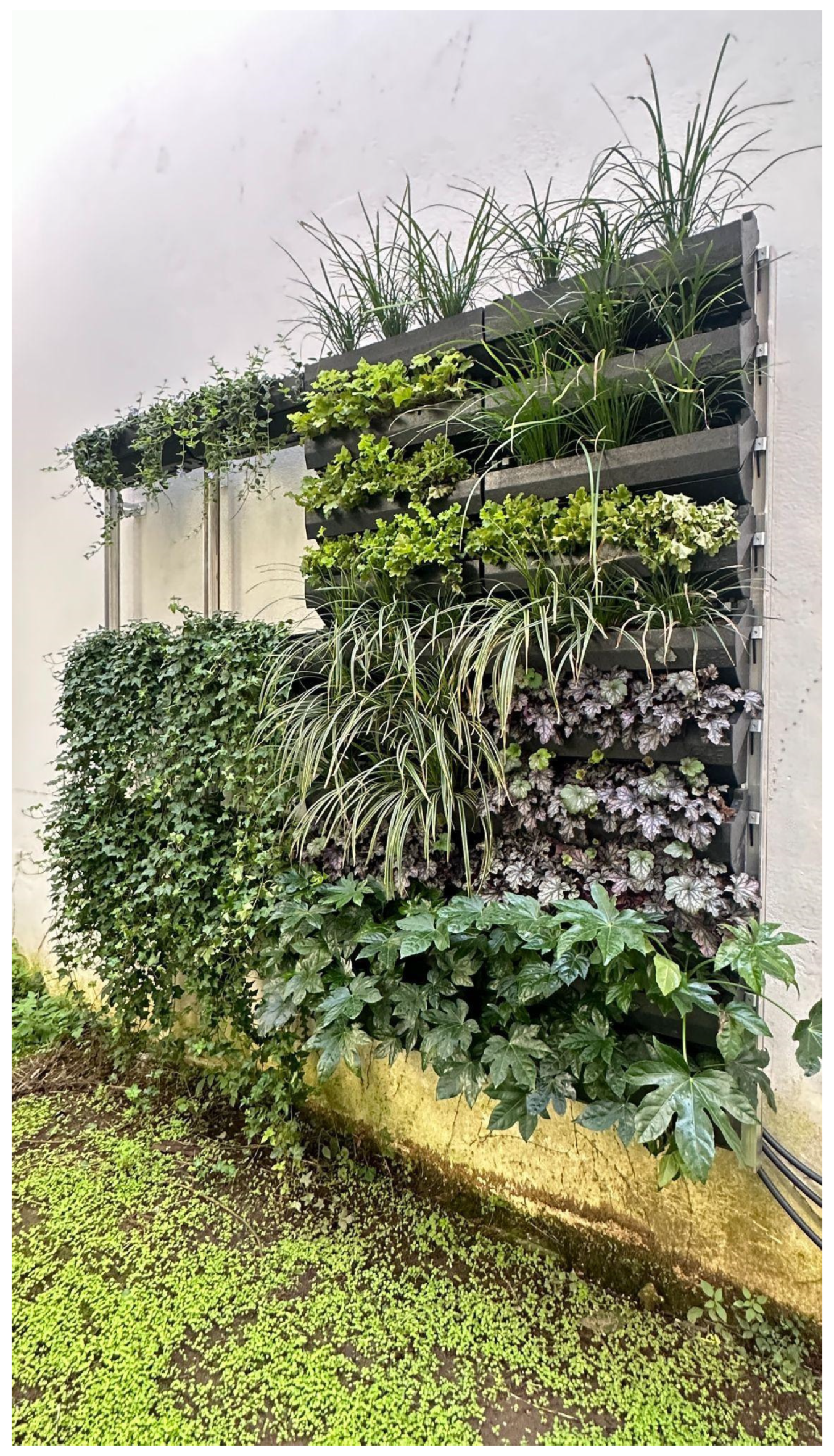
The experimental installation aimed to simulate a full-scale living wall system under real conditions (Figure 1) rather than a laboratory pilot. The intention was to measure the in situ capacity of different ornamental species to retain atmospheric PM when cultivated in a modular commercial system under Rome’s microclimatic and pollution regimes.

2.1. The Experimental Setting Configuration

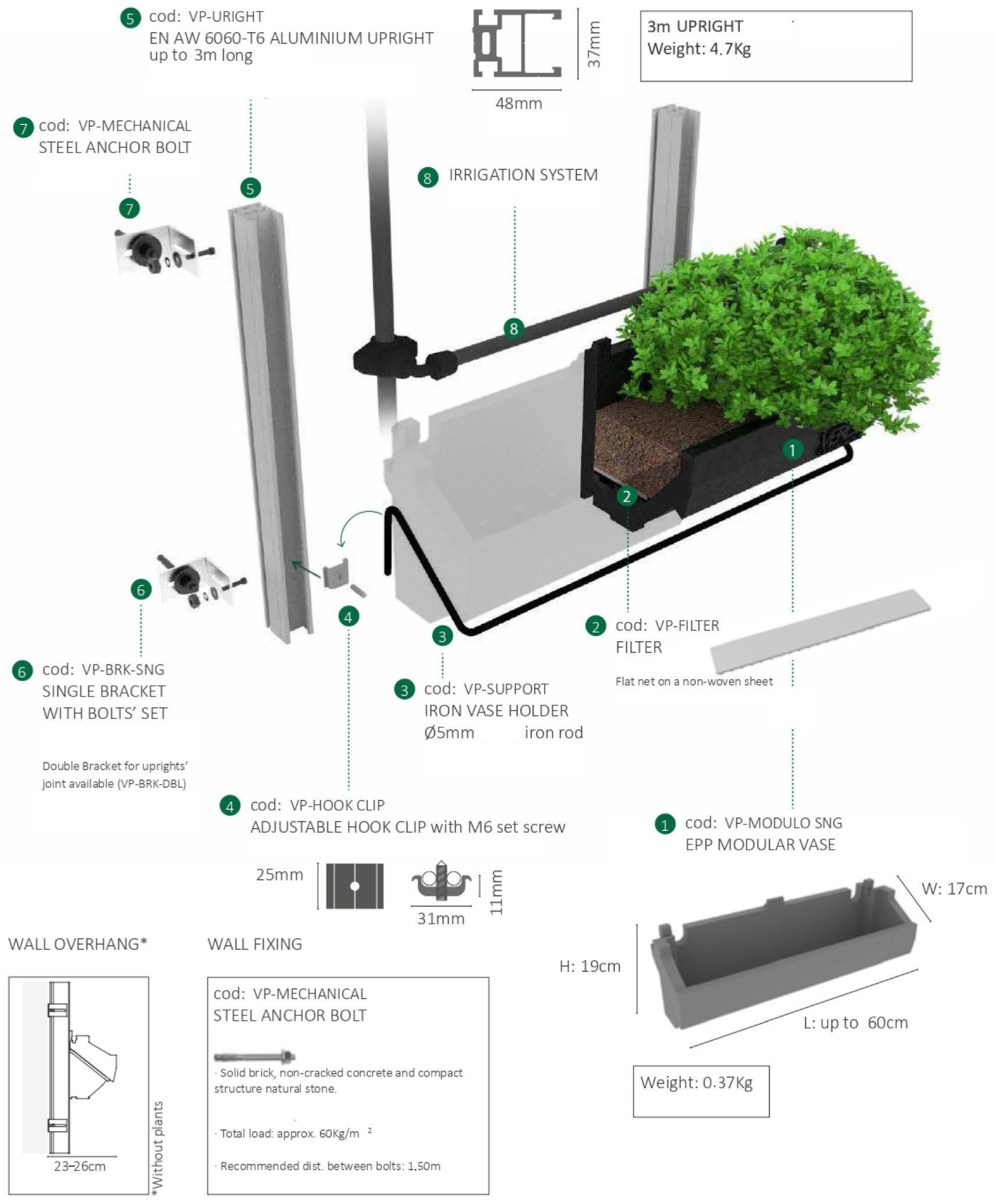
The VP-module vertical garden, developed and provided by the Verde Profilo firm, was installed on the internal, north-facing wall of the Faculty of Architecture courtyard. The VP-Module® is a modular, substrate-based LWS designed for indoor and outdoor applications. Each module consists of an expanded polypropylene (EPP) container measuring 60 × 18 × 21 cm with an integrated water-retention cavity (capacity ≈ 0.6 L). The EPP material provides thermal and acoustic insulation, is lightweight, durable, and 100% recyclable (Figure 2).
Modules were mounted on vertical aluminum uprights mechanically anchored to the concrete wall. The assembled structure covered approximately 5.2 m2 (2.4 m wide × 2.06 m high) and included 26 planters arranged in four vertical columns. A pressure-compensated drip-irrigation system with emitters spaced at 30 cm supplied 2.1 L/h per dripper, ensuring uniform moisture. Irrigation was automatically regulated by a timer and checked weekly.
A key design constraint was the north-facing orientation, which receives minimal direct sunlight. Species selection, therefore, focused on plants that thrive in low-light or shaded conditions, similar to indoor conditions. The success of the experimental setup depended on selecting species combining aesthetic appeal and physiological adaptability to shade.
The following plant species were selected and installed by the Verde Profilo technicians:
  • Liriope graminifolia (L.) Baker, native of China, Taiwan, and the Philippines;
  • Heuchera sanguinea Engelm., native of the southwestern United States;
  • Carex morrowii Boott, native of Japan;
  • Heuchera micrantha Douglas, native to the west coast of North America;
  • Fatsia japonica (Thunb.) Decne. & Planch., Native to the Korean peninsula and Japan;
  • Hedera helix L., native in Europe;
  • Vinca minor L. cv. albomarginata, of which the wild species is native to central Europe.
All specimens were nursery-grown and approximately one year old. Planting took place in October 2024 to allow root establishment before winter exposure. Regular irrigation and minimal maintenance ensured plant health during the experiment.
Liriope graminifolia and Carex morrowii, are evergreen herbaceous species valued for their decorative foliage. Heuchera sanguinea and H. micrantha, have high ornamental value due to colored or variegated foliage and seasonal flowering. Fatsia japonica and Hedera helix, have persistent foliage and are well suited to shade or partial shade conditions. Vinca minor cv. albomarginata combines decorative leaves and discreet flowering, making it very versatile. This combination integrates evergreen, flowering, and structural elements, balancing aesthetic and functional traits related to maintenance requirements, growth performance, and adaptability to building-integrated systems. Commercial VGS providers often prioritize these practical traits over ecological or environmental services considerations. The choice was validated by one of the authors to verify an ecological aspect that could not be ignored. Some species are non-native flora but are not invasive and, therefore, pose no known risk to biodiversity.

2.2. Sampling Method

Sampling was performed on 27 January 2025, after roughly three months of uninterrupted outdoor exposure. The objective was to assess the particulate accumulation on leaf surfaces under realistic ambient conditions and obtain a representative sample of each species for microscopic analysis.
From 3 plants of each species, three mature leaves were collected, yielding nine leaves per species and a total of 63 samples. Immediately after the sampling, leaves were placed in labeled plastic bags to preserve their identity and integrity. Labels included a species code, sampling site, and sample number (e.g., “L-D01”), where:
  • L = species code (e.g., Liriope graminifolia);
  • D = sampling site (Via Flaminia experimental setup);
  • 01 = individual sample number.
Samples were stored at 4 °C overnight to prevent degradation and transferred to the National Institute for Insurance against Accidents at Work (INAIL) Laboratory the next day for preparation and imaging.

2.3. Automated Analysis of SEM Images for PM Counting and Size Classification

Prior to imaging, leaves were dried in a laboratory oven at 60 °C for 24 h to remove residual moisture and stabilize the surface for analysis. More leaves were collected than were strictly necessary, and replacement samples would be available in case the processing procedure described below might have damaged the leaves. Among the nine leaves per species, three leaves were selected for the SEM analysis. The selection was based on quality criteria (specifically, leaves were required to be intact and undamaged). A section of approximately 1 cm × 1 cm of each dried leaf was cut from the center of the adaxial leaf surface. Each leaf section was mounted on an aluminum stub and coated with a thin layer of gold (about 10 nm) using a metallizer (Q150T ES, Quorum Technologies, Laughton, UK) to increase conductivity. The analysis of PM required the use of micrographs obtained by a field-emission scanning electron microscope (FE-SEM, Merlin, Zeiss Microscopy GmbH, Oberkochen, Germany) to visualize leaf morphology and deposited particles. Imaging was performed with an accelerating voltage of 15 kV (EHT), a working distance of 8.5 mm, and using an in-lens detector for secondary electrons (SE). The nominal resolution was 0.8 nm. For each species, 30 SEM images were acquired at 1000× magnification (3 leaves × 10 images per leaf) corresponding to a field of view of approximately 0.05 mm2 per image. Particle density (particles mm−2) was calculated by counting the number of particles within each image and dividing by the corresponding field of view area. No “blank” samples of the studied plants were examined.
Image processing and particle quantification were performed using FIJI (ImageJ 1.54p). To ensure reproducibility, a macro-based automated pipeline was developed and applied uniformly to all images.
The workflow comprised the following steps:
  • Conversion of each image to 8-bit grayscale;
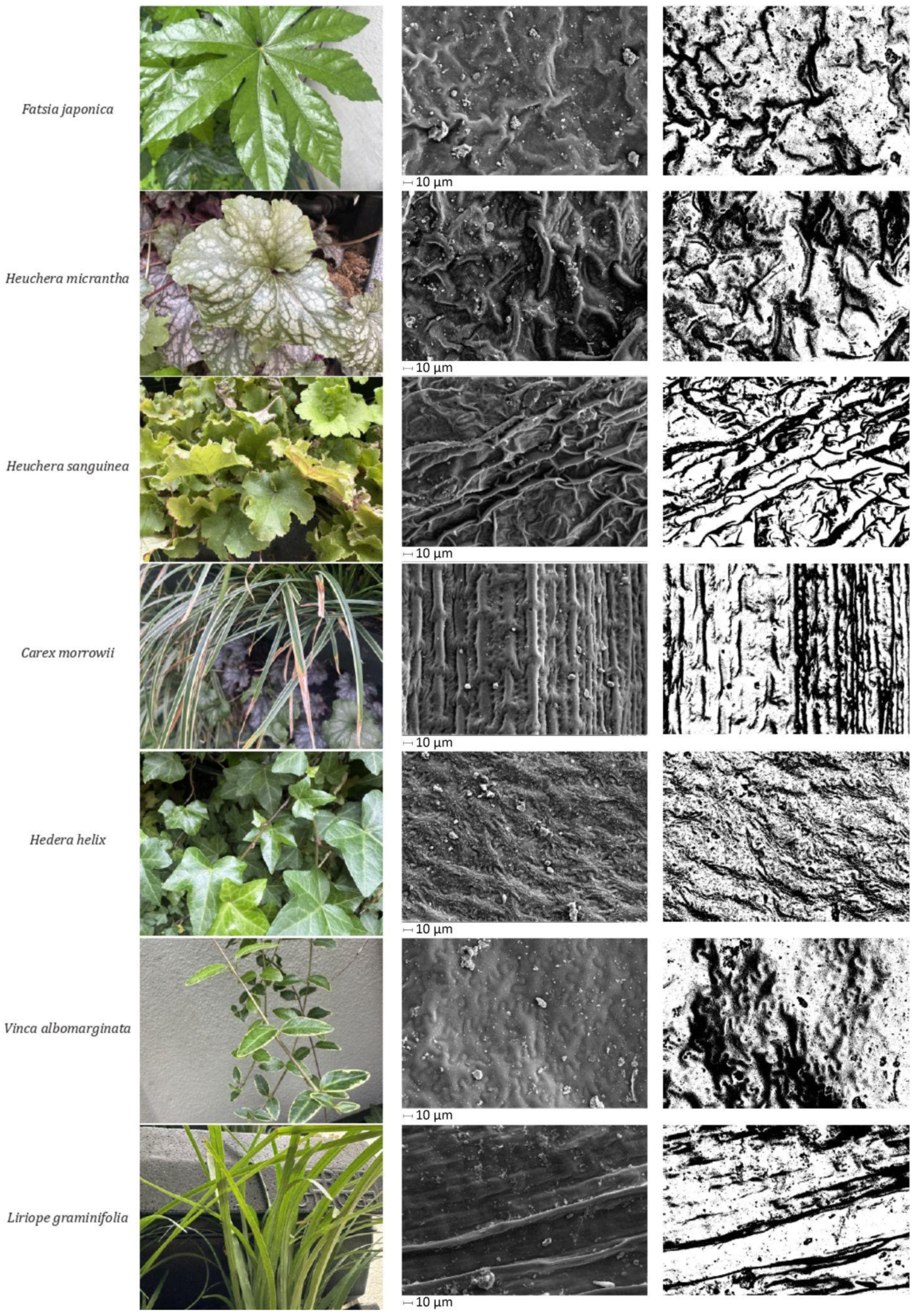
  • Automatic thresholding using the Huang method [42], chosen for its robustness in segmenting particles in noisy or low-contrast conditions (Figure 3);
  • Invert binary mask so particles appear as white objects on a black background, consistent with ImageJ’s “Analyze Particles” function;
  • Particle detection settings: size = 0–100 µm2, circularity unrestricted, all objects with non-zero area were retained. The upper area threshold of 100 µm2 was deliberately chosen to include particles up to and beyond the PM10 range (a circular particle of 10 µm diameter corresponds to an area of approximately 78.5 µm2) while limiting detection errors associated with ImageJ’s thresholding algorithm, which tends to merge adjacent particles or generate artefacts at larger area values. This choice may result in a partial undercount of large aggregated particles, which is acknowledged as a limitation of the current methodology;
  • Compute equivalent circular diameter (d) for each particle using:
    d = √[(4 × A)/π]
    where A is the projected particle area in µm2.
The formula derives from the area equation of a circle (A = πr2), rearranged to calculate the diameter of a circle with the same area as the detected particle. This allows comparison of particles of different shapes using a single, normalized size metric. Regardless of the shape of the particle, it can be assigned an equivalent diameter that reflects the size of a circle with the same area. This standardization simplifies the classification and analysis of particles with diverse geometries;
6.
Classification of particles into five standard size classes: PM < 0.5 µm, PM [0.5–1) µm, PM [1–2.5) µm, PM [2.5–10) µm, and PM > 10 µm;
7.
Output generation: for every image, the macro saved a binary mask (for visual verification) and a results.csv file listing particle ID, area, equivalent diameter, and class.
The macro recursively processed all TIFF files within the directory structure, enabling high-throughput batch analysis with minimal human bias and ensuring reproducibility.

2.4. Statistical Analysis

Statistical analysis was performed using R (version 4.3.1; R Core Team, 2023), to assess whether differences in PM densities among species were statistically significant. The leaf was the statistical unit in this study. For each species, 30 images were acquired (3 leaves × 10 images per leaf); images were treated as independent observations given that they were acquired at randomly selected, spatially distant locations within a 1 cm2 leaf section, minimizing within-leaf spatial autocorrelation. Interspecific differences in PM density were assessed using a separate one-way ANOVA for each PM size class, with species as the sole fixed factor, resulting in five independent analyses. Prior to ANOVA, the normality of the data was assessed using the Shapiro–Wilk test applied separately for each species within each PM size class (35 groups total). Normality was confirmed for 20 out of 35 groups (57%). For the remaining 15 groups, W statistics remained relatively high (W ≥ 0.80 in all cases), indicating only moderate deviations from normality. The full Shapiro–Wilk results are reported in Supplementary Table S1.
Visual inspection of Q-Q plots (Supplementary Figure S1) confirmed that deviations from normality were confined to the tails and involved few outliers, with the central body of the distribution remaining approximately normal in all cases. Given the balanced group sizes (n = 30 per species), the one-way ANOVA is considered robust under these conditions in accordance with the Central Limit Theorem. To verify the robustness of the parametric results in light of the partial violations of normality detected in some groups, a non-parametric Kruskal–Wallis test followed by Dunn’s post hoc test with Bonferroni correction was performed as a sensitivity analysis. The results were fully consistent with the one-way ANOVA findings, confirming significant interspecific differences for all size classes up to 10 µm (p < 0.001) and no significant differences for PM ≥ 10 µm (χ2(6) = 3.74, p = 0.711). The main pairwise comparisons identified by the Tukey HSD test were confirmed by the Dunn test, supporting the validity of the parametric approach.
Tukey HSD test was used for post hoc pairwise comparisons of the one-way ANOVA, with significance shown at three threshold levels (p < 0.05, p < 0.01, and p < 0.001), but the significance level accepted in this study and used to describe the results as statistically significant was set at 0.001. Effect sizes were quantified using eta-squared (η2), calculated as the ratio of the treatment sum of squares to the total sum of squares.

3. Results

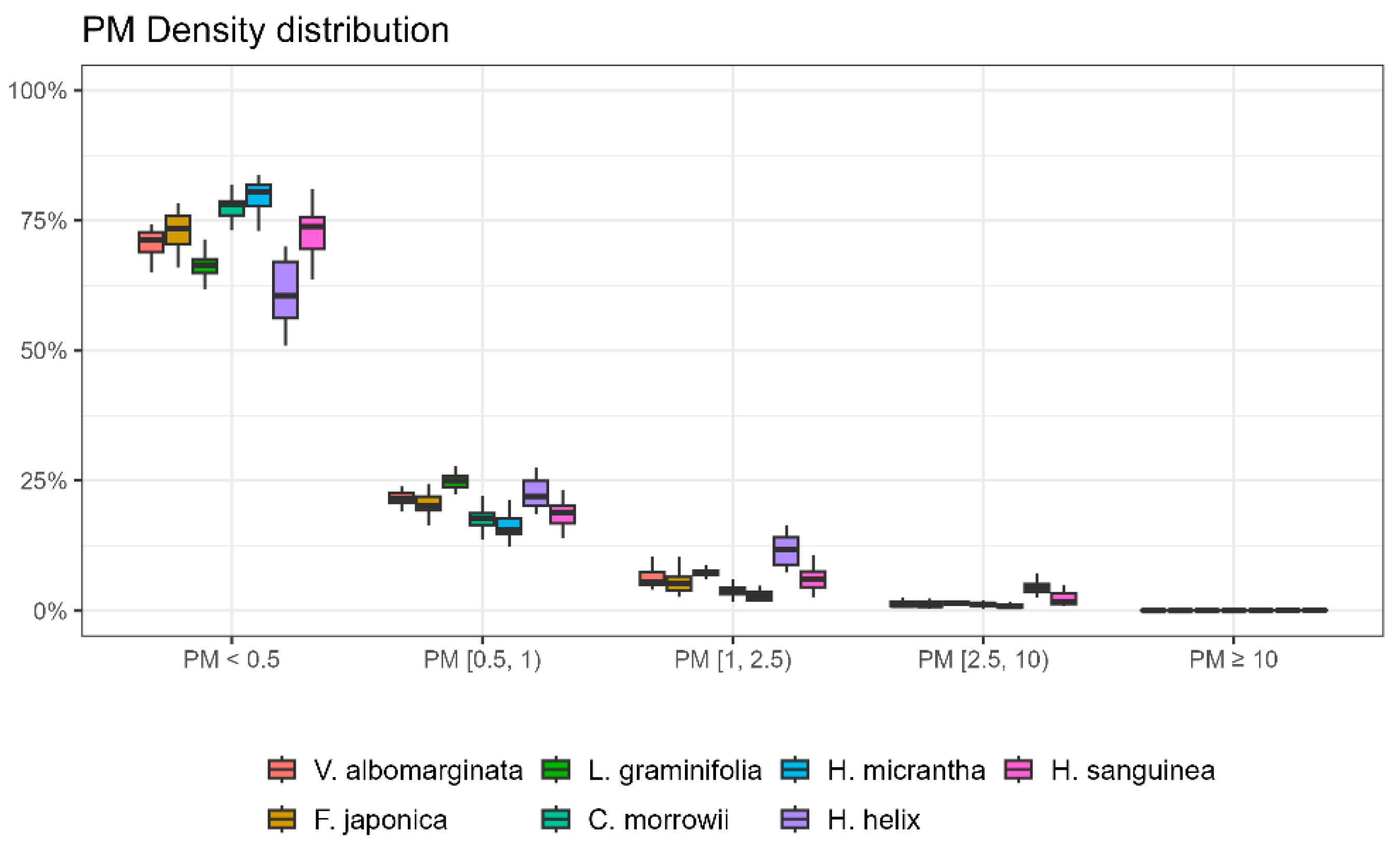
The SEM analysis showed that most PM retained on the leaf surfaces of the analyzed species belonged to the finest size fractions. In all seven examined species, the ultrafine fraction (particles < 0.5 µm) was the predominant portion of retained matter, typically accounting for 60–70% of all particles counted (Figure 4).
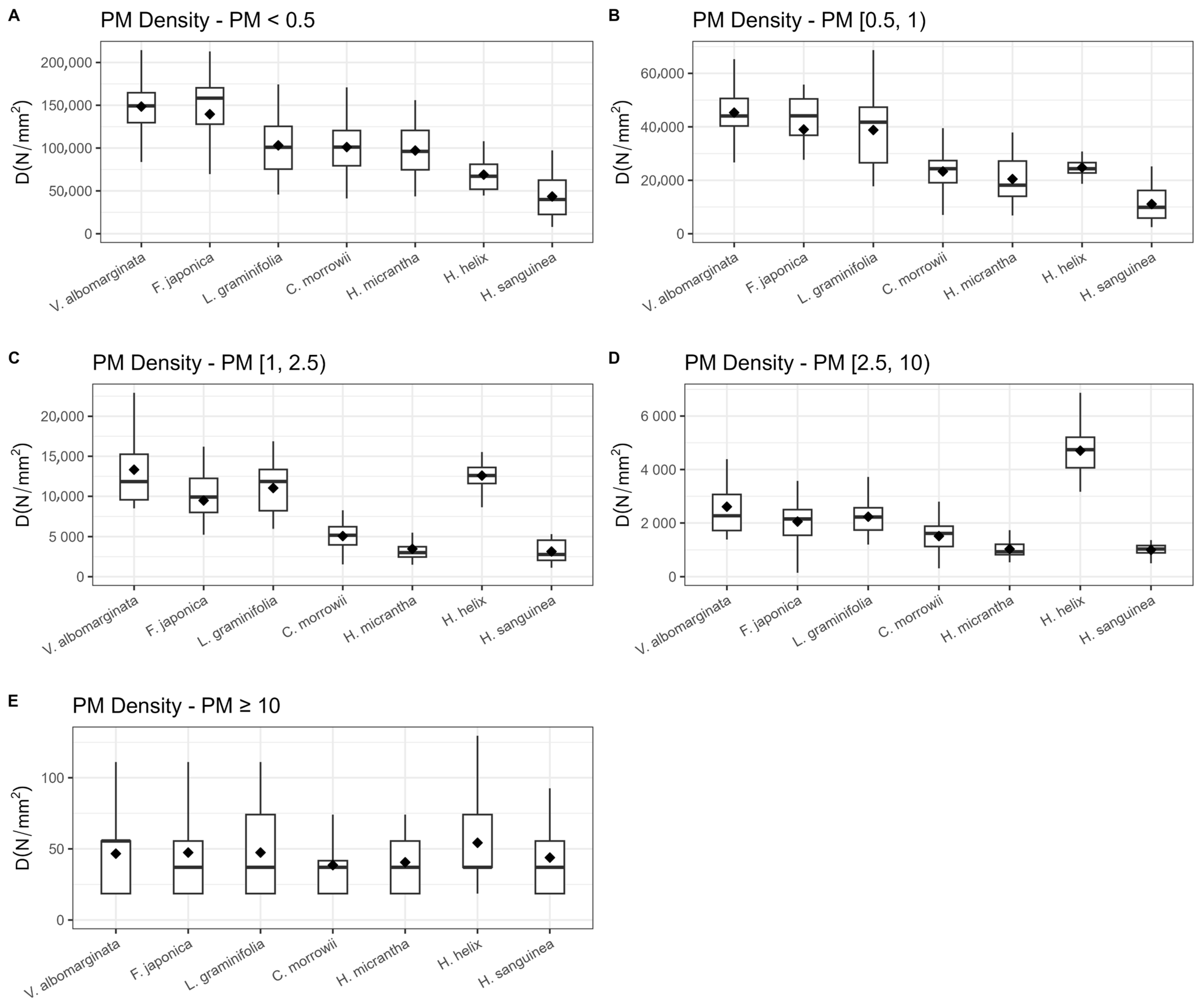
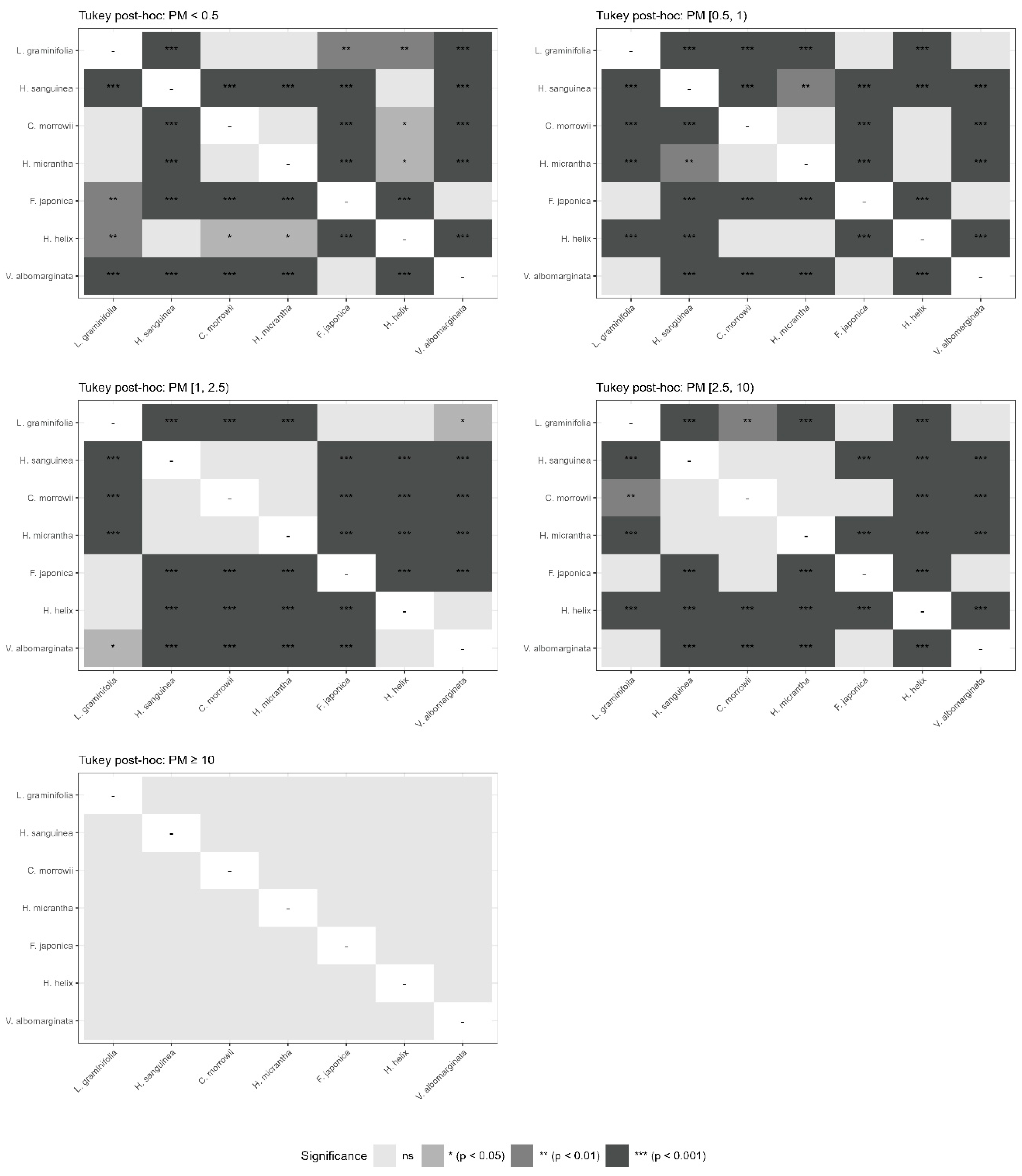
In the PM < 0.5 fraction, mean surface densities ranged from 43,521 particles per square millimeter (N/mm2) in H. sanguinea (lowest) to 148,525 N/mm2 in V. minor cv. albomarginata (highest) (Table 1). Species identity had a significant effect on PM density in this size class (F(6, 203) = 31.43, p < 0.001, η2 = 0.48). V. minor cv. albomarginata exhibited the highest and statistically distinct average density in this smallest size class, closely followed by F. japonica (139,604 N/mm2) (Figure 5). H. sanguinea and H. helix showed statistically significant lower values (43,521 N/mm2 and 69,001 N/mm2, respectively). Figure 6 reports the statistical significance of pairwise differences among mean values.
A similar pattern occurred for the PM [0.5–1) μm fraction: V. minor cv. albomarginata retained about 45,320 N/mm2, followed by F. japonica (39,007 N/mm2) and L. graminifolia (38,802 N/mm2). Species differences were again highly significant (F(6, 203) = 44.59, p < 0.001, η2 = 0.57). These species performed notably well, capturing a significantly higher number of particles than the other species.
In the fine fraction PM [1–2.5) μm, absolute particle counts dropped by roughly an order of magnitude for all species (Table 1). A one-way ANOVA confirmed significant interspecific differences (F(6, 203) = 68.12, p < 0.001, η2 = 0.67). V. minor cv. albomarginata and H. helix captured the most particles in this class, with mean densities of 13,324 N/mm2 and 12,583 N/mm2, respectively, both significantly higher than those of the other species. H. sanguinea, H. micrantha, and Carex morrowii retained significantly fewer particles at these ranges, at approximately 3000, 3500, and 5000 N/mm2, respectively (see Table 1 and Figure 5).
This trend of decreasing PM density with increasing particle sizes continued into the PM [2.5–10) μm fraction. Species identity remained a strong predictor of PM retention in this class (F(6, 203) = 87.34, p < 0.001, η2 = 0.72). For this class, the mean deposition densities fell to the low thousands and hundreds per mm2. H. helix showed the highest retention in this fraction (4706 N/mm2), nearly double that of the second-highest species, V. minor cv. albomarginata (2608 N/mm2), and differed significantly from all other species. F. japonica, L. graminifolia, and C. morrowii clustered around a few thousand particles per mm2, while H. sanguinea and H. micrantha captured only ~1000 N/mm2 each (Table 1). Very few coarse particles (PM > 10 µm) were recorded on any leaves (Figure 5). For this largest fraction, no significant effect of species was detected (F(6, 163) = 0.955, p = 0.458, η2 = 0.034), and the mean densities for all species were on the order of tens per mm2 or less. H. helix shows a slightly higher value, i.e., 54 N/mm2, while others ranged from 39 to 50 N/mm2 (C. morrowi showed the lowest results, 39 N/mm2) (Table 1). Total PM accumulation (summed across sizes classes) was highest in V. minor cv. albomarginata, followed by F. japonica; H. sanguinea consistently had the lowest particulate densities in every size class (see Figure 5). A dedicated summary of total cumulative PM retention per species, including uncertainty estimates, is provided in Supplementary Figure S2. Figure 6 highlights statistically significant differences among the species: for the fine particles, V. minor cv. albomarginata and F. japonica, capture a significantly greater number of particles to most other species, while H. sanguinea consistently showed the lowest values across all fine fractions. H. helix was an exception in the PM [2.5–10) µm class, showing significantly higher retention compared with all other species, indicating relatively better performance with larger particles.

4. Discussion

The results align with previous evidence regarding the influence of leaf traits on PM capture. In the seven analyzed species, as in other previous studies, a greater number of small particles accumulate, along with a small number of particles belonging to the coarse classes, with significant differences in performance between species [e.g., [27,32]. Weerakkody et al. (2018) [12] found that reduced leaf size, complex leaf shapes, and micromorphological features, such as trichomes, epicuticular waxes, and surface roughness, favor PM accumulation, with trichomes identified as especially influential [12]. However, these observations are only partially consistent with the present study. Species that retained higher densities of fine PM, such as V. minor cv. albomarginata and F. japonica, share features like surface roughness (e.g., fine epidermal texture or vein patterns) and cuticular waxes that enhance particle adherence, but trichome presence did not correlate with higher PM retention here. SEM images (Figure 3) and transmission electron microscopy (TEM) images [43] confirmed that V. minor cv. albomarginata exhibits epidermal cells separated by shallow, regular depressions, which act as micro-reservoirs for particles. F. japonica leaves appear glossy due to a wax-coated cuticle. As shown in the boxplots (Figure 5), F. japonica captures substantial quantities of ultrafine particles (PM < 0.5 μm) and maintains relatively high performance across the intermediate classes (pm 0.5–2.5 μm). Although its efficiency declines with increasing particle size, it still ranks among the top performers overall, suggesting that a waxy cuticle may promote adhesion across a range of PM sizes, not just the finest fractions. By contrast, H. sanguinea and H. micrantha underperformed in PM retention. Although these species are valued for ornamental foliage and complex textures, SEM images (Figure 3) show leaf surfaces characterized by dense and irregular micro-ridges, that do not form continuous structure favoring adhesion. This surface complexity may disrupt rather than support particle retention. Controlled experiments will be needed to identify which microscopic characteristics most strongly determine PM-capture efficiency.
H. helix exhibits a distinct pattern: moderate to low capture of ultrafine and fine particles, but the highest capture of larger particles among species. This result can be attributed to ivy’s broad, leathery leaves and prominent surface features, including raised veins and a thick, waxy cuticle. Large particles, which have a greater inertia [44,45], are effectively intercepted by H. helix’s sizable leaf blades and tend to accumulate along veins and grooves, giving ivy an advantage in the coarse fraction. Conversely, a relatively smooth surface may offer fewer anchoring points for ultrafine dust, allowing more of the smallest particles to bounce or be washed off compared to the more textured leaves of V. minor cv. albomarginata or F. japonica. The strong performance of both F. japonica and H. helix, likely linked to their waxy leaf surfaces, supports a pattern previously observed for glossy, wax-rich foliage. Waxiness may be a converging trait among species with high PM-capture capacity.
Chiam et al. (2019) [46] identified high pubescence and low specific leaf area (SLA) as predictors of higher PM retention. In our results, V. minor cv. albomarginata conforms to this model, with thick, low-SLA leaves, whereas F. japonica, despite its relatively high SLA, also performed strongly, likely due to its waxy surface. This divergence highlights that SLA alone may be insufficient to predict PM retention unless combined with additional structural leaf traits. Koch et al. (2023) [47] further investigated these relationships in the living walls and reported a negative correlation between PM retention (measured through saturation isothermal remanent magnetization—SIRM) and SLA [47], proposing SLA as a straightforward indicator of a filtering efficiency [47]. Our observations partially support this thesis: V. minor cv. albomarginata fit the low-SLA/high-retention relationship, whereas F. japonica is an exception, suggesting that traits, such as surface roughness, waxes, or cuticle morphology, may compensate for higher SLA. H. micrantha underperformed despite some hairiness, highlighting the multivariate nature of leaf traits interactions. However, it should be noted that species with low capture efficiency, but extensive leaf area and high leaf biomass may, overall, contribute more effectively to PM reduction. This has not been considered in this study, but it is a variable that must be considered when designing effective VGS for particulate matter reduction.
Finally, Spörl et al. (2024) [48] reaffirm that, despite methodological variations, traits such as small leaves [49], roughness factors [50], trichome presence [46], waxiness [51], and stomatal density are all associated with increased PM accumulation. Additionally, complex leaf structures [52] and various leaf shapes (lanceolate [53], pinnate [54], lobed [12], ovate [51], and obovate [53]) have been linked to higher PM retention.
The results represent an initial contribution to the species analysis. Because sampling was limited to a single collection, seasonal variations in PM retention could not be assessed, and performance may change throughout the year or due to rainfall patterns—even if seasonality has been found negligible for PM deposition in some other studies [27]. This experiment also did not account for wind speed and direction, turbulence, façade height, street-canyon geometry, or VGS technical parameters (substrate, irrigation, maintenance, plant density). Therefore, these findings should be viewed as order-of-magnitude estimates of PM retention by some commercial species. Controlled-environment studies and sampling that includes the above factors are needed for more robust quantitative data.

Considerations and Limitations

While the automated SEM image analysis workflow used here provides a robust, reproducible framework for quantifying PM on leaf surfaces, several methodological considerations and limitations must be acknowledged. First, the Huang automatic thresholding algorithm was effective for most samples, particularly in conditions with clear contrast between leaf tissue and PM deposits. However, under uneven illumination or complex background texture thresholding may segment images inaccurately. Although the macro standardizes the process, visual inspection and occasional manual correction may remain necessary to ensure the validity, partially triggering the reproducibility.
Second, particle size classification by equivalent circular diameter assumes geometric similarity across particles of varying shapes. While this standardization is essential for automated categorization, it introduces a potential approximation—especially for highly elongated, irregular, or clustered particles which may be misassigned to size classes. Using area as a base measure preserves general reliability but cannot fully represent complex particle geometries.
Third, the thresholding process produces binary masks; an explicit inversion step is required so particles become white foreground elements for ImageJ’s particle analyzer. Omission of this inversion (as occurred in early) causes the analysis to target leaf area rather than particulate matter, underscoring the importance of correct macro configuration and validation.
Finally, variations in leaf surface texture, waxiness, and sample preparation (e.g., drying and gold coating) can influence particle adhesion and detectability. Although all samples were processed under a uniform protocol, interspecific differences in surface chemistry microstructure can affect comparability. Additionally, the 100 µm2 upper area threshold applied during ImageJ particle detection, while chosen to minimize thresholding artefacts and particle merging errors, may result in a partial undercount of large aggregated particles in the PM ≥ 10 µm fraction. However, given that this size class represented a negligible proportion of total retained particles across all species and showed no significant interspecific differences (F(6, 163) = 0.955, p = 0.458), this limitation is unlikely to affect the main conclusions of the study.
Therefore, the results should be interpreted within their ecological context, acknowledging that species-specific traits can mediate both deposition and the detectability in SEM imagery.

5. Conclusions

This experimental evaluation of a VGS has shown that all seven plant species can capture airborne particulate matter but differ markedly in retention efficiency. All species followed a common pattern, preferential accumulation of fine and ultrafine PM and relatively few coarse particles, indicating that the LWS primarily functions as a sink for the smaller pollutants. However, species-level differences were substantial.
V. minor cv. albomarginata was the best-performing species overall, exhibiting the highest retained PM densities in most size classes, especially PM < 0.5 and 0.5–1 μm. F. japonica also performed strongly, supporting the importance of leaf-surface traits. H. sanguinea was the least effective, retaining significantly fewer particles across all PM sizes. The remaining species (L. grandifolia, C. morrowi, H. micrantha, and H. helix) showed intermediate retention capabilities; none matched the extremes of V. minor cv. albomarginata or H. sanguinea, but each contributed distinctively. For example, H. helix was relatively more efficient for coarse PM (PM 2.5–10 and PM > 10). These findings highlight that careful species selection is essential to optimize the air-purification benefits of VGS. Selecting species with particulate-capturing traits, such as surface roughness and waxiness can improve the efficacy of VGS as a functional measure for improving air quality. Overall, this study provides valuable insight that V. minor cv. albomarginata, followed by F. japonica, are promising candidates for PM mitigation in VGS applications in Mediterranean urban and indoor settings. Conversely, species such as H. sanguinea, with lower capture potential, may be less suitable for this specific ecosystem service. However, specific studies in controlled indoor settings will be needed to verify whether the performance of these species remains comparable to that observed in outdoor conditions.

Supplementary Materials

The following supporting information can be downloaded at: https://www.mdpi.com/article/10.3390/app16083811/s1, Figure S1: Q-Q plots of observed PM density data for each species within each significant PM size class. (A) PM < 0.5 µm; (B) PM [0.5, 1) µm; (C) PM [1, 2.5) µm; (D) PM [2.5, 10) µm. Each panel shows the Shapiro-Wilk statistic (W) and p value for each species; ✅ indicates normality not violated (p ≥ 0.05), ❌ indicates formal violation (p < 0.05). In all cases where normality was formally violated, deviations are confined to the tails and involve few outliers, with the central body of the distribution remaining approximately normal. The PM ≥ 10 µm size class is not shown as no significant interspecific differences were detected for this fraction (Kruskal-Wallis: χ2(6) = 3.74, p = 0.711).; Figure S2: Total cumulative PM density (N/mm2) retained on leaf surfaces of the seven studied species, summed across all five particle size classes (PM < 0.5, PM [0.5, 1), PM [1, 2.5), PM [2.5, 10), and PM ≥ 10 µm). Bars represent mean values across three analytical leaves per species; error bars indicate the standard error of the mean (SE). Species are ordered from highest to lowest total PM retention. Table S1: Shapiro-Wilk normality test results for each species within each PM size class. W: test statistic; p value: significance level; Normality: whether normality assumption is met (p ≥ 0.05).

Author Contributions

Conceptualization, M.M.A. and C.D.; methodology, C.D., M.M.A., M.R.B., A.C. (Antonella Campopiano), A.C. (Annapaola Cannizzaro), and F.A.; formal analysis, C.D., M.R.B., A.C. (Antonella Campopiano), A.C. (Annapaola Cannizzaro), and F.A.; investigation, M.R.B., A.C. (Antonella Campopiano), A.C. (Annapaola Cannizzaro), and F.A.; resources, F.T.; data curation, C.D. and M.M.A.; writing—original draft preparation, C.D. and M.M.A.; writing—review and editing, all the authors; Figures and tables preparation, C.D.; supervision, M.M.A. and F.T.; funding acquisition, F.T. All authors have read and agreed to the published version of the manuscript.

Funding

The present work has been funded by the National Recovery and Resilience Plan (PNNR), Mission 4 Component 2 Investment 1.5—Call for tender No. 3277 of 30 December 2021 of Italian Ministry of University and Research funded by the European Union—NextGenerationEU.

Data Availability Statement

The raw data supporting the conclusions of this article will be made available by the first author on request.

Conflicts of Interest

The authors declare no conflicts of interest.

Abbreviations

The following abbreviations are used in this manuscript:
PMAirborne particulate matter
VGSVertical greening systems
LWSLiving wall system
GFSGreen facade systems
NBSNature based solution
GIGreen infrastructure
SEMScanning electron microscope
EPPExpanded polypropylene
INAILNational Institute for Insurance against Accidents at Work
ANOVAAnalysis of Variance
SLASpecific leaf area

References

  1. Mannucci, P.M.; Harari, S.; Martinelli, I.; Franchini, M. Effects on Health of Air Pollution: A Narrative Review. Intern. Emerg. Med. 2015, 10, 657–662. [Google Scholar] [CrossRef] [PubMed]
  2. Anderson, J.O.; Thundiyil, J.G.; Stolbach, A. Clearing the Air: A Review of the Effects of Particulate Matter Air Pollution on Human Health. J. Med. Toxicol. 2012, 8, 166–175. [Google Scholar] [CrossRef] [PubMed]
  3. Pryor, J.T.; Cowley, L.O.; Simonds, S.E. The Physiological Effects of Air Pollution: Particulate Matter, Physiology and Disease. Front. Public Health 2022, 10, 882569. [Google Scholar] [CrossRef] [PubMed]
  4. European Commission. Green Infrastructure (GI)—Enhancing Europe’s Natural Capital; European Commission: Brussels, Belgium, 2013. [Google Scholar]
  5. EEA. Air Pollution. Available online: https://www.eea.europa.eu/en/topics/in-depth/air-pollution (accessed on 18 January 2024).
  6. Bo, M.; Salizzoni, P.; Clerico, M.; Buccolieri, R. Assessment of Indoor-Outdoor Particulate Matter Air Pollution: A Review. Atmosphere 2017, 8, 136. [Google Scholar] [CrossRef]
  7. Maung, T.Z.; Bishop, J.E.; Holt, E.; Turner, A.M.; Pfrang, C. Indoor Air Pollution and the Health of Vulnerable Groups: A Systematic Review Focused on Particulate Matter (PM), Volatile Organic Compounds (VOCs) and Their Effects on Children and People with Pre-Existing Lung Disease. Int. J. Environ. Res. Public Health 2022, 19, 8752. [Google Scholar] [CrossRef]
  8. Martins, C.; Teófilo, V.; Clemente, M.; Corda, M.; Fermoso, J.; Aguado, A.; Rodriguez, S.; Moshammer, H.; Kristian, A.; Ferri, M.; et al. Sources, Levels, and Determinants of Indoor Air Pollutants in Europe: A Systematic Review. Sci. Total Environ. 2025, 964, 178574. [Google Scholar] [CrossRef]
  9. Mori, J.; Ferrini, F.; Saebo, A. Air Pollution Mitigation by Urban Greening. Italus Hortus 2018, 13, 13–22. [Google Scholar] [CrossRef]
  10. Kumar, R.; Verma, V.; Thakur, M.; Singh, G.; Bhargava, B. A Systematic Review on Mitigation of Common Indoor Air Pollutants Using Plant-Based Methods: A Phytoremediation Approach. Air Qual. Atmos. Health 2023, 16, 1501–1527. [Google Scholar] [CrossRef]
  11. Vitaliano, S.; Cascone, S.; D’Urso, P.R. Mitigating Built Environment Air Pollution by Green Systems: An In-Depth Review. Appl. Sci. 2024, 14, 6487. [Google Scholar] [CrossRef]
  12. Weerakkody, U.; Dover, J.W.; Mitchell, P.; Reiling, K. Evaluating the Impact of Individual Leaf Traits on Atmospheric Particulate Matter Accumulation Using Natural and Synthetic Leaves. Urban For. Urban Green. 2018, 30, 98–107. [Google Scholar] [CrossRef]
  13. Tucci, F.; Cecafosso, V.; Altamura, P.; Giampaoletti, M. Simulation and modelling for climate adaptation and mitigation. AGATHÓN Int. J. Archit. Art Des. 2022, 12, 106–121. [Google Scholar] [CrossRef]
  14. Evans, D.L.; Falagán, N.; Hardman, C.A.; Kourmpetli, S.; Liu, L.; Mead, B.R.; Davies, J.A.C. Ecosystem Service Delivery by Urban Agriculture and Green Infrastructure–A Systematic Review. Ecosyst. Serv. 2022, 54, 101405. [Google Scholar] [CrossRef]
  15. Tucci, F.; D’Olimpio, D. Designing the biotic environment with a view to restoring the balance of the urban microclimate | La progettazione dell’ambiente biotico per un riequilibrio del microclima urbano. Sustain. Mediterr. Constr. Mag. 2019, 10, 125–130. [Google Scholar]
  16. Farrell, C.; Livesley, S.J.; Arndt, S.K.; Beaumont, L.; Burley, H.; Ellsworth, D.; Esperon-Rodriguez, M.; Fletcher, T.D.; Gallagher, R.; Ossola, A.; et al. Can We Integrate Ecological Approaches to Improve Plant Selection for Green Infrastructure? Urban For. Urban Green. 2022, 76, 127732. [Google Scholar] [CrossRef]
  17. Ramyar, R.; Saeedi, S.; Bryant, M.; Davatgar, A.; Mortaz Hedjri, G. Ecosystem Services Mapping for Green Infrastructure Planning–The Case of Tehran. Sci. Total Environ. 2020, 703, 135466. [Google Scholar] [CrossRef]
  18. Weerakkody, U.; Dover, J.W.; Mitchell, P.; Reiling, K. Particulate Matter Pollution Capture by Leaves of Seventeen Living Wall Species with Special Reference to Rail-Traffic at a Metropolitan Station. Urban For. Urban Green. 2017, 27, 173–186. [Google Scholar] [CrossRef]
  19. Dalsasso, C. Vertical Greening Systems (VGS): Integrated Technologies for Sustainable Urban Climate Mitigation. Ph.D. Thesis, Sapienza University of Rome, Rome, Italy, 2025. [Google Scholar]
  20. Su, M.; Jie, P.; Li, P.; Yang, F.; Huang, Z.; Shi, X. A Review on the Mechanisms behind Thermal Effect of Building Vertical Greenery Systems (VGS): Methodology, Performance and Impact Factors. Energy Build. 2024, 303, 113785. [Google Scholar] [CrossRef]
  21. Oquendo-Di Cosola, V.; Olivieri, F.; Ruiz-García, L. A Systematic Review of the Impact of Green Walls on Urban Comfort: Temperature Reduction and Noise Attenuation. Renew. Sustain. Energy Rev. 2022, 162, 112463. [Google Scholar] [CrossRef]
  22. Manso, M.; Castro-Gomes, J. Green Wall Systems: A Review of Their Characteristics. Renew. Sustain. Energy Rev. 2015, 41, 863–871. [Google Scholar] [CrossRef]
  23. Wood, A. Green Walls in High-Rise Buildings; Everbest Printing Investment Limited: Guangzhou, China, 2014; ISBN 978-1-86470-593-5. [Google Scholar]
  24. Loh, S. Living Walls–A Way to Green the Built Environment. Environ. Des. Guide 2008, TEC 26, 1–7. Available online: https://www.jstor.org/stable/26149051?seq=1 (accessed on 2 April 2026).
  25. Bustami, R.A.; Belusko, M.; Ward, J.; Beecham, S. Vertical Greenery Systems: A Systematic Review of Research Trends. Build. Environ. 2018, 146, 226–237. [Google Scholar] [CrossRef]
  26. Perini, K.; Bazzocchi, F.; Croci, L.; Magliocco, A.; Cattaneo, E. The Use of Vertical Greening Systems to Reduce the Energy Demand for Air Conditioning. Field Monitoring in Mediterranean Climate. Energy Build. 2017, 143, 35–42. [Google Scholar] [CrossRef]
  27. Perini, K.; Ottelé, M.; Giulini, S.; Magliocco, A.; Roccotiello, E. Quantification of Fine Dust Deposition on Different Plant Species in a Vertical Greening System. Ecol. Eng. 2017, 100, 268–276. [Google Scholar] [CrossRef]
  28. Perini, K.; Castellari, P.; Calbi, M.; Prandi, S.; Roccotiello, E. Fine Dust Collection Capacity of a Moss Greening System for the Building Envelope: An Experimental Approach. Build. Environ. 2025, 267, 112203. [Google Scholar] [CrossRef]
  29. Collins, R.; Schaafsma, M.; Hudson, M.D. The Value of Green Walls to Urban Biodiversity. Land Use Policy 2017, 64, 114–123. [Google Scholar] [CrossRef]
  30. Chen, C.; Mao, L.; Qiu, Y.; Cui, J.; Wang, Y. Walls Offer Potential to Improve Urban Biodiversity. Sci. Rep. 2020, 10, 9905. [Google Scholar] [CrossRef]
  31. Timur, Ö.B.; Karaca, E.; Timur, Ö.B.; Karaca, E. Vertical Gardens. In Advances in Landscape Architecture; IntechOpen: London, UK, 2013; ISBN 978-953-51-1167-2. [Google Scholar]
  32. Ottelé, M.; van Bohemen, H.D.; Fraaij, A.L.A. Quantifying the Deposition of Particulate Matter on Climber Vegetation on Living Walls. Ecol. Eng. 2010, 36, 154–162. [Google Scholar] [CrossRef]
  33. Beckett, K.P. Particulate Pollution Capture by Urban Trees: Effect of Species and Windspeed. Available online: https://www.researchgate.net/publication/227823238_Particulate_pollution_capture_by_urban_trees_Effect_of_species_and_windspeed (accessed on 6 November 2024).
  34. Hwang, H.-J.; Yook, S.-J.; Ahn, K.-H. Experimental Investigation of Submicron and Ultrafine Soot Particle Removal by Tree Leaves. Atmos. Environ. 2011, 45, 6987–6994. [Google Scholar] [CrossRef]
  35. Viecco, M.; Vera, S.; Jorquera, H.; Bustamante, W.; Gironás, J.; Dobbs, C.; Leiva, E. Potential of Particle Matter Dry Deposition on Green Roofs and Living Walls Vegetation for Mitigating Urban Atmospheric Pollution in Semiarid Climates. Sustainability 2018, 10, 2431. [Google Scholar] [CrossRef]
  36. Honour, S.L.; Bell, J.N.B.; Ashenden, T.W.; Cape, J.N.; Power, S.A. Responses of Herbaceous Plants to Urban Air Pollution: Effects on Growth, Phenology and Leaf Surface Characteristics. Environ. Pollut. 2009, 157, 1279–1286. [Google Scholar] [CrossRef]
  37. Salonen, T.; Hollands, J.; Sesto, E.; Korjenic, A. Thermal Effects of Vertical Greening in Summer: An Investigation on Evapotranspiration and Shading of Façade Greening in Vienna. Buildings 2022, 12, 1705. [Google Scholar] [CrossRef]
  38. Burkhardt, J. Hygroscopic Particles on Leaves: Nutrients or Desiccants? Ecol. Monogr. 2010, 80, 369–399. [Google Scholar] [CrossRef]
  39. Speak, A.F.; Rothwell, J.J.; Lindley, S.J.; Smith, C.L. Urban Particulate Pollution Reduction by Four Species of Green Roof Vegetation in a UK City. Atmos. Environ. 2012, 61, 283–293. [Google Scholar] [CrossRef]
  40. Janhäll, S. Review on Urban Vegetation and Particle Air Pollution–Deposition and Dispersion. Atmos. Environ. 2015, 105, 130–137. [Google Scholar] [CrossRef]
  41. Sæbø, A.; Popek, R.; Nawrot, B.; Hanslin, H.M.; Gawronska, H.; Gawronski, S.W. Plant Species Differences in Particulate Matter Accumulation on Leaf Surfaces. Sci. Total Environ. 2012, 427–428, 347–354. [Google Scholar] [CrossRef] [PubMed]
  42. Huang, L.-K.; Wang, M.-J.J. Image Thresholding by Minimizing the Measures of Fuzziness. Pattern Recognit. 1995, 28, 41–51. [Google Scholar] [CrossRef]
  43. Ciorîță, A.; Tripon, S.C.; Mircea, I.G.; Podar, D.; Barbu-Tudoran, L.; Mircea, C.; Pârvu, M. The Morphological and Anatomical Traits of the Leaf in Representative Vinca Species Observed on Indoor- and Outdoor-Grown Plants. Plants 2021, 10, 622. [Google Scholar] [CrossRef]
  44. Jacques, F. Air Pollution Particles: What Are They? Encyclopedia of the Environment: Grenoble, France, 2018. [Google Scholar]
  45. Queensland Government. High and Low Volume Air Samplers|Measuring Air Quality. Available online: https://www.qld.gov.au/environment/management/monitoring/air/air-monitoring/measuring/samplers (accessed on 6 June 2025).
  46. Chiam, Z.; Song, X.P.; Lai, H.R.; Tan, H.T.W. Particulate Matter Mitigation via Plants: Understanding Complex Relationships with Leaf Traits. Sci. Total Environ. 2019, 688, 398–408. [Google Scholar] [CrossRef]
  47. Koch, K.; Wuyts, K.; Denys, S.; Samson, R. The influence of plant species, leaf morphology, height and season on PM capture efficiency in living wall systems. Sci. Total Environ. 2023, 905, 167808. [Google Scholar] [CrossRef] [PubMed]
  48. Spörl, P.; Trimmel, S.; Haluza, D.; Sauerbrey, S.; Irrgeher, J.; Prohaska, T.; Pitha, U. Façade Greening for Healthy Urban Air: An Umbrella Review on Particulate Matter Reduction, Challenges, and Future Directions. Sustainability 2024, 16, 446. [Google Scholar] [CrossRef]
  49. He, C.; Qiu, K.; Pott, R. Reduction of Traffic-Related Particulate Matter by Roadside Plants: Effect of Traffic Pressure and Sampling Height. Int. J. Phytoremediation 2020, 22, 184–200. [Google Scholar] [CrossRef] [PubMed]
  50. Baraldi, R.; Chieco, C.; Neri, L.; Facini, O.; Rapparini, F.; Morrone, L.; Rotondi, A.; Carriero, G. An Integrated Study on Air Mitigation Potential of Urban Vegetation: From a Multi-Trait Approach to Modeling. Urban For. Urban Green. 2019, 41, 127–138. [Google Scholar] [CrossRef]
  51. Corada, K.; Woodward, H.; Alaraj, H.; Collins, C.M.; de Nazelle, A. A Systematic Review of the Leaf Traits Considered to Contribute to Removal of Airborne Particulate Matter Pollution in Urban Areas. Environ. Pollut. 2021, 269, 116104. [Google Scholar] [CrossRef] [PubMed]
  52. Mori, J.; Fini, A.; Galimberti, M.; Ginepro, M.; Burchi, G.; Massa, D.; Ferrini, F. Air Pollution Deposition on a Roadside Vegetation Barrier in a Mediterranean Environment: Combined Effect of Evergreen Shrub Species and Planting Density. Sci. Total Environ. 2018, 643, 725–737. [Google Scholar] [CrossRef]
  53. Tomson, M.; Kumar, P.; Barwise, Y.; Perez, P.; Forehead, H.; French, K.; Morawska, L.; Watts, J.F. Green infrastructure for air quality improvement in street canyons. Environ Int. 2021, 146, 106288. [Google Scholar] [CrossRef] [PubMed]
  54. Zhang, X.; Lyu, J.; Zeng, Y.; Sun, N.; Liu, C.; Yin, S. Individual Effects of Trichomes and Leaf Morphology on PM2.5 Dry Deposition Velocity: A Variable-Control Approach Using Species from the Same Family or Genus. Environ. Pollut. 2021, 272, 116385. [Google Scholar] [CrossRef]
Figure 1. Vertical garden experimental setting at Sapienza University of Rome (Via Flaminia 72) on Friday, 25 October. Sampled plant species: Liriope graminifolia (L.) Baker, Heuchera sanguinea Engelm., Carex morrowii Boott, Heuchera micrantha Douglas, Fatsia japonica (Thunb.) Decne. & Planch, Hedera helix L., Vinca minor L. cv. albomarginata.
Applsci 16 03811 g001
Figure 2. VP-Modulo system components. System patented by VerdeProfilo.
Applsci 16 03811 g002
Figure 3. Representative images of the seven plant species utilized in the vertical greening system are displayed: macroscopic photographs of leaves (left), scanning electron microscope (SEM) images at 1000× magnification (center), and the corresponding thresholded binary masks utilized for particle detection (right). The central SEM images are included in the Supplementary Materials in high resolution.
Applsci 16 03811 g003
Figure 4. Distribution of PM deposition densities for the seven plant species.
Applsci 16 03811 g004
Figure 5. Boxplots of PM density (N/mm2) retained on leaf surfaces of the selected seven plant species across five particle size classes: (A) PM < 0.5 μm, (B) 0.5–1 μm, (C) 1–2.5 μm, (D) 2.5–10 μm, and (E) ≥10 μm. Boxes represent interquartile ranges, whiskers indicate the data spread, and diamonds denote median values.
Applsci 16 03811 g005
Figure 6. Results of Tukey’s post hoc test comparing species average particulate matter (PM) density; pairwise significant differences are indicated (ns = no significant differences; * = p < 0.05; ** = p < 0.01; *** = p < 0.001).
Applsci 16 03811 g006
Table 1. Average particulate matter (PM) density (N/mm2) and full range (in parentheses) for the selected plant species across five PM size classes.
SpeciesPM < 0.5PM [0.5, 1)PM [1, 2.5)PM [2.5, 10)PM > 10
V. albomarginata148,525 (84,664–215,718)45,320 (26,003–69,002)13,324 (8648–23,308)2608 (1416–5423)47 (19–87)
F. japonica139,604 (4192–212,223)39,007 (927–54,137)9476 (313–15,224)2051 (133–3747)47 (19–100)
L. graminifolia103,201 (50,950–160,490)38,802 (19,553–57,037)11,039 (6164–15,783)2233 (1217–3507)47 (19–100)
C. morrowi101,201 (33,031–167,268)23,320 (7488–39,111)5069 (1792–7749)1519 (556–2568)39 (19–93)
H. micrantha97,179 (45,709–149,683)20,458 (7625–36,743)3472 (1607–7267)1034 (564–1807)41 (19–74)
H. helix69,001 (46,011–102,977)24,752 (19,190–31,689)12,583 (9288–16,245)4706 (3220–6400)54 (19–146)
H. sanguinea43,521 (11,945–93,294)11,096 (2911–24,541)3144 (1406–5315)1001 (527–1330)44 (19–84)
Disclaimer/Publisher’s Note: The statements, opinions and data contained in all publications are solely those of the individual author(s) and contributor(s) and not of MDPI and/or the editor(s). MDPI and/or the editor(s) disclaim responsibility for any injury to people or property resulting from any ideas, methods, instructions or products referred to in the content.