Article

Soundscape-Informed Urban Planning and Architecture in Historic Centers: A Multi-Layer Method for Soundscape Characterization Applied to Bilbao Old Town


by
Zigor Iturbe-Martin
1,*,
Alexander Martín-Garín
1 and
Amaia Casado-Rezola
2
1
TICBE Research Group, Department of Architecture, Faculty of Engineering of Gipuzkoa, University of the Basque Country (UPV/EHU), Plaza Europa 1, 20018 Donostia-San Sebastián, Spain
2
TICBE Research Group, Department of Architecture, School of Architecture, University of the Basque Country (UPV/EHU), Plaza Oñati 2, 20018 Donostia-San Sebastián, Spain
*
Author to whom correspondence should be addressed.
Appl. Sci. 2026, 16(8), 3630; https://doi.org/10.3390/app16083630
Submission received: 21 February 2026 / Revised: 22 March 2026 / Accepted: 26 March 2026 / Published: 8 April 2026
(This article belongs to the Special Issue Soundscapes in Architecture and Urban Planning)

Featured Application

The proposed procedure and the products obtained offer operational support to incorporate soundscape criteria into the urban planning and architectural design of historic centers characterized by the intense coexistence of commercial, hospitality, pedestrian, logistical and cultural uses in public space. The combination of control points, commented routes, dimensional reading and type–token analysis makes it possible to compare sound scenes between urban areas; identify relationships between diversity, dominance and identity; and prepare audio materials designed for a subsequent phase of participatory contrast through reactivated listening, which is not addressed in this article.

Abstract

Urban soundscape management is a central challenge to the livability and sustainability of cities and requires approaches that complement level indicators with frameworks capable of integrating context, use and experience. In this framework, the present work applies a multilayer methodology to the Old Town of Bilbao, understood as a useful case study to explore the applicability of soundscape reading in historic centers with intense coexistence of commercial, hospitality and catering uses, pedestrian, logistical and cultural uses. The methodology is organized into two phases. The first focuses on the recording and documentation of control points and routes through sound fieldwork, perceptual descriptions and homogeneous systematization of information. From this corpus, a qualified sound map and a first visual characterization of the sound identity are elaborated. The second phase presented in this article, consists of the interpretative synthesis of the corpus through five analytical dimensions and the preparation of fragments and sound sequences conceived for future application through reactivated listening. The results are presented at three levels: (1) a traceable documentary corpus of records, files and synthetic representations; (2) a comparative reading by dimensions that identifies spatial contrasts between interior, exterior and perimeter, as well as relationships between urban form, uses, persistence, masking and salience; and (3) a set of operational audio materials prepared for subsequent comparison with inhabitants and users. In a transversal way, type–token reading distinguishes between the diversity of sounds and dominance by repetition. The article does not yet carry out participatory validation of these materials; its contribution consists of proposing and applying a traceable analytical protocol as a basis for future phases of social contrast and applied discussion.

1. Introduction

The study of soundscapes arises from the need to understand the relationships between sound, environment and culture in modern life. The epistemological starting point can be traced back to R. Murray Schafer, who coined “soundscape” to describe the set of sounds characteristic of an environment as cultural and ecological traces [1]. His idea of “tuning the world” proposes an acoustic balance in the face of noise pollution, not only as a technical issue, but as a metaphor for a society in sensory mismatch: sound progresses from being a “residue” of urban inhabitation to an indicator of dynamics between humans and the environment.
Barry Truax expands on this perspective by placing acoustic communication at the axis of a sound ecology based on perceptual interaction [2]. Listening is understood as a cognitive and social act (rather than a physiological one), and the soundscape as a system of exchange between listener and environment. From here, sound identity is conceived as a product of the dialog between sound source, physical space and listening subject, the foundation of contemporary approaches to the urban soundscape.
The phenomenological shift from sound as an object to sound as experience took place in the 1980s and 1990s, when urban research shifted from physical measurement to sensory experience. In turn, the work of the Centre de Recherche sur l’Espace Sonore et l’Environnement Urbain (CRESSON, Grenoble) marks an epistemological change: Augoyard and Torgue formalize “sound effects” as recurrent modes of relationship between auditory perception and urban space, inaugurating a phenomenology of everyday sound [3].
Along the same lines, Amphoux develops the “sound environment interview” to qualitatively access the sensory experience of a public space, and Thibaud the method of “commented routes”, which combines situated observation and narrative description of the sound environment [4,5]. The key is situational: the researcher does not observe from the outside but participates as an actor immersed in the acoustic experience. Amphoux and Thibaud then extend this tradition to an epistemology of “ambiances” as global perceptual conditions that integrate sound, space, and body [6]. Thus, sound ceases to be an isolated phenomenon and becomes a constitutive variable of the urban environment: it is not only “what it sounds like” that is of interest, but how the urban form, the body and the situation configure modes of attention, thresholds and meanings. This conceptual basis allows us to think of the city as a complex auditory system and, by extension, to study the sound identity and perception of the place with sensitive and comparable criteria.
Sound identity, precisely, emerges from the intersection between acoustic ecology and urban phenomenology. Also, for authors such as Palmese and Carles, the urban soundscape can be understood as sensory heritage, as it configures collective memory and belonging to the inhabited space [7,8,9]. This approach assumes that the acoustic environment not only reflects uses/functions but embodies ways of life and cultural values.
Sound identity is not the same as adding up present sources: it arises from the dialogic relationship between physical space, social practices and listening experiences. In this dialectic, it is simultaneously objective (linked to acoustic characteristics) and subjective (constructed by perception and memory). Voegelin develops this relational dimension by proposing that listening is a generative act that produces meaning and configures the sound world as a field of possibilities [10,11]. From a critical reading, LaBelle analyzes how sound constructs acoustic territories and can activate resistances, situating the soundscape as a space of political and cultural dispute [12,13]. Ochoa Gautier, on the other hand, emphasizes the historical and epistemological dimension: auditory practices are mediated by specific cultural and technological contexts [14].

2. Background

2.1. Urban Soundscape Research Methodologies

Traditionally, the quantitative approach has focused on measuring acoustic parameters (levels, frequencies, and durations) and correlating them with perceptual responses. In the context of public health, international regulations on environmental noise—promoted, among others, by the WHO—set exposure thresholds to protect health [15]. However, physical measurement alone is limited in terms of capturing the complexity of the urban sound experience.
Conventional acoustic indicators are still essential for diagnosing exposure and risk, but they have limitations when the objective is to understand how the everyday sound experience of a place is organized. In complex urban environments, scenes with similar levels can produce very different evaluations and effects depending on their composition, temporality, meaning, legibility or relationship with uses and urban form. Therefore, an approach focused exclusively on levels is not sufficient for interpreting issues such as the sound identity, dominance by repetition, coexistence of activities or the perceptual quality of public space. In this framework, the soundscape approach allows for perception to be incorporated into context and to complement the physical–acoustic reading with a more situated and operational understanding for planning and design.
The development of soundscape mapping integrates acoustic data with spatial and perceptual information. Under this premise, Kang et al. propose urban soundscape design methodologies that combine noise maps, perception surveys and spatial analysis [16,17,18], making it possible to distinguish areas with differentiated acoustic profiles and guide interventions to improve the sound quality of public spaces. In this direction, Rémy and Vogiatzis elaborate design guides through noise mapping applied to medium-sized urban agglomerations [19,20], showing the feasibility of introducing sound design criteria in planning, beyond the mere reduction of noise. In addition, Lavandier et al. emphasize that perceived sound quality depends both on the sound pressure level and on the nature and significance of the sources present [21,22].
Qualitative methodologies are based on the fact that sound experience is not reduced to physical parameters and requires capturing subjective, symbolic and narrative dimensions. CRESSON’s methods—environmental interviews, annotated routes, and sound mapping—have been widely adopted in international research [4,5,6]. Raimbault and Dubois question the dominant use of questionnaires and semantic scales because of their tendency to simplify the auditory experience [23,24]; they propose alternatives based on free verbal descriptions and linguistic analysis, capable of capturing the semantic richness with which listeners describe soundscapes through perceptual and conceptual categories that do not always coincide with measurable acoustic dimensions.
Citizen participation is consolidated here as a key methodological line—it recognizes inhabitants as experts of their sound environment and incorporates knowledge, preferences and values in research and decisions. In this area, Palmese and Carles develop participatory sound mapping projects in Madrid, where citizens identify and characterize significant places [7,8,9]. In addition to producing collective knowledge, these methodologies can reinforce belonging and local identity.
The complexity involved in the study of the soundscape drives mixed approaches that triangulate measurements, surveys and qualitative methods. Aletta and Kang propose methodological integration frameworks for evaluating soundscapes by combining acoustic data, perception, and qualitative techniques [25,26]. Axelsson et al. develop psychoacoustic models that relate physical properties of sound to perceptual dimensions such as “pleasantness” and “eventfulness” [27,28], useful for predicting responses and supporting interventions. However, their applicability is conditioned by contextual, cultural and personal mediations.
In urban planning, Brown et al. show how integrating acoustic and perceptual data can inform public space design and management [29,30]. Raimbault and Dubois underline, from urban practice, the potential of soundscapes as a tool for the conception of urban environments and the limitations of approaches based solely on levels, reinforcing the need for sound quality criteria in planning [24].
Digital technologies expand the methodological scope; mobile apps, distributed sensors and crowdsourcing platforms allow for large-scale data collection with high spatio-temporal resolution. Davies et al. explore crowdsourcing to collect sound perception data in urban environments [31,32]. In parallel, big data analysis and the use of machine learning make it easier to detect spatial/temporal patterns and develop predictive models, automating soundscape evaluation and design processes [33].
In this framework, Gleeson proposes the Sonic Identity Model as an interdisciplinary approach for analysis, management and qualitative design of urban soundscapes [34,35], integrating physical, perceptual, cultural and emotional dimensions, with a projection towards acoustic consulting and decision-making based on qualitative evidence. Atienza et al. investigate the design of contextual sound spaces and strategies to create adaptive acoustic environments adjusted to the needs and preferences of users [36,37].

2.2. Soundscape Regulations, Policy and Planning

The international regulatory framework on urban acoustic environments has evolved in recent decades. The European Directive 2002/49/EC requires the development of noise maps and action plans to manage noise in urban agglomerations, large infrastructures and industrial areas, but focuses on noise reduction and does not explicitly incorporate the concept of the soundscape. The ISO 12913 standard (definition/conceptual framework; data collection; analysis) provides an international framework for researching and managing soundscapes [38,39,40], defining them as the perception of the acoustic environment in context and incorporating personal and contextual factors in addition to physical ones, and also incorporating qualitative aspects.
In this sense, the ISO 12913 series offers a particularly relevant framework because it formulates the soundscape as the perception of the acoustic environment in context, and coherently organizes three complementary levels: conceptual definition, data collection requirements and analysis criteria. This articulation is particularly useful for research such as the present one, which is not limited to mapping levels, but seeks to link recording, analytical listening, spatial interpretation and future participatory contrast.
The WHO guidelines for the European region also establish recommendations for sound exposure to protect health [15], recognizing environmental noise as a public health problem and synthesizing evidence on adverse effects (cardiovascular, sleep, cognitive performance, and well-being).
Thus, the integration of sound quality into urban policies and design/planning processes is receiving increasing attention by promoting the analysis of urban soundscape design policies, which identify principles and strategies to improve the sound quality of the built environment [41]. Schulte-Fortkamp and Kang publish reference works that bring together interdisciplinary contributions and show the need to articulate acoustics, architecture, urbanism, environmental psychology, sociology and cultural studies [42,43].
Botteldooren et al. also explore the application of soundscape design principles in planning, showing that interventions aimed at improving sound quality can contribute to healthier, more inclusive and livable public spaces [44,45]. These interventions include creation of quiet areas, introduction of natural/pleasant sounds, acoustic design of public spaces and management of nuisance sources.
However, challenges to integrating sound quality criteria into urban planning/management remain: lack of standardized tools/methodologies, little professional training, limited public awareness, and difficulties in fitting soundscape criteria into existing regulatory frameworks. Along these lines, Hong and Jeon examine the relationships between soundscape and the built environment, identifying architectural/urban factors that affect perception—design of public space, urban configuration, materials and presence of natural elements [46,47]—while De Coensel et al. complement it by applying simulation models to predict perceptual responses to sound design interventions and evaluate alternative scenarios in early phases, optimizing planning decisions [48,49].

2.3. Applications and Case Studies

The urban soundscapes developed in squares, parks and pedestrian streets offer privileged contexts due to their relevance in the meeting, interaction and cultural expression of their inhabitants; sound quality affects the user experience and urban vitality. Nilsson and Berglund show that in suburban green areas and urban parks the presence of natural sounds (birds, water, and wind) increases the perception of tranquility and restoration [50]. Yang and Kang show that these sound preferences cannot be universal, they reflect cultural diversity in terms of acoustic preferences and discard universal solutions, reinforcing the need for contextualized and participatory approaches [51,52]. On the other hand, Jeon et al. focus on the study of sound preferences in public spaces and identify factors that influence perceived quality—type of sources, sound pressure levels, visual context, and activities carried out [53,54]—confirming the multidimensional nature (physical, psychological, and contextual) of the experience.
Research in specific contexts extends to transportation, health, and education, among others. In transportation, the perception of the soundscapes in stations, airports, and vehicles is studied to improve the experience and reduce the stress of travel [55,56]. In health, the impact of soundscapes on patient recovery, staff well-being and quality of care is analyzed; it is highlighted that acoustic design can reduce stress, improve sleep, and accelerate recovery [57,58]. In education, the effect of the soundscapes on performance, concentration and well-being is investigated; the acoustic quality of classrooms and educational spaces impacts learning and hearing health [59,60].
With regard to the intervention and transformation of the urban soundscape, intervention projects are developed ranging from quiet areas to sound installations and noise management policies, evidencing the potential of sound design to improve quality of life and create inclusive public spaces. “Quiet areas” are implemented in European cities as part of action plans derived from the European Directive: spaces with relatively low levels and the presence of natural/pleasant sounds that offer rest and restoration [61,62]. This designation seeks to preserve acoustic shelters where one can experience calm and connection with natural sounds; in addition to reducing stress and improving well-being, they contribute to urban biodiversity by promoting fauna and ecosystem regeneration.
On the other hand, sound art and installation projects explore the creative potential of sound to transform the experience of public space and generate new forms of interaction and cultural expression. They are usually participatory, involving inhabitants in the creation and management of soundscapes [63,64]. Such installations function as mediation devices between physical space and sensory experience, generating listening situations that challenge perceptual habits. Some incorporate interactive technologies and spatialized sound to create immersive experiences that respond to the presence/actions of users and promote participation and appropriation of public space.

2.4. Objectives and Challenges

In the international context, the quality of the urban sound environment has become a key challenge for the livability and sustainability of cities. Beyond the control of noise in terms of levels, the soundscape approach allows for the integration of acoustic dimension, context and experience, offering an applicable framework for design decisions and management of public space. This guidance connects with the 2030 Agenda, particularly SDG 11 (sustainable cities and communities), by addressing the improvement of urban environmental quality and its impact on everyday well-being.
The general objective of this work is to advance the operational incorporation of soundscapes into architecture and, especially, into urban planning, and to overcoming the limitations of approaches focused only on physical parameters or macro representations. Specifically, a procedure is proposed that connects empirical evidence (recording and documentation), analytical synthesis and applicable products in order to make the sound phenomenon interpretable, comparable and transferable to planning processes: not only how an environment sounds, but how the experience is structured between diversity, dominance, identity and conflict.
The case study is located in the Old Town of Bilbao and its immediate surroundings, a historic fabric of high functional intensity in which pedestrian interior areas, perimeter edges and activity fronts coexist. It is relevant because it concentrates frequent problems in consolidated historic centers of medium-sized European cities, such as the coexistence of mobility and permanence, commercial and tourist pressure, and morphological transitions between urban fabrics. In this sense, the case is presented as a pertinent context to discuss the applicability of the approach in comparable environments, without assuming automatic transferability or statistical representativeness.
To operationalize these objectives, the study combines control points and routes as a recording strategy, a homogeneous documentary systematization and an interpretative synthesis in dimensions that condense spatial patterns and contrasts. Finally, the work culminates with the selection and preparation of fragments and audio sequences as operational materials, conceived for their eventual application in a subsequent phase of social contrast through reactivated listening with inhabitants and users.
With this, the article does not intend to close the validation of the method, but to provide an explicit and usable analytical basis for further research and for the discussion of intervention criteria on public space from the perspective of sound quality.

3. Materials and Methods

From a methodological point of view, two elements are observed in order to approach the study of a sound event: on the one hand, the context that encompasses a sound situation and, on the other, the grouping of repetitive structures that allow for the observed phenomenon to be interpreted and explained in well-defined units of analysis at a reasonable scale (delimited neighborhoods or public spaces). This type of analysis cannot be applied to an entire city or to areas that are too large, due to the excessive amount of information and variability of the material generated, which would make it difficult to structure the analysis (by not being able to determine general lines that articulate it or by facing too many lines of analysis). As also defined in Decree 2014/90 of 3 June on Landscape Planning in the Basque Autonomous Community, each community decides what makes up a specific landscape and, from there, what constitutes that landscape (physical or cultural) and what parameters are likely to be identified and analyzed. For this reason, there is no single methodology of analysis for sound experiences, but rather guidelines for action that are adjusted to each situation observed.
This analysis proposal is based on the intersection of two methodologies: (1) the perception of the sound environment through the analysis of control points and commented routes [5] and (2) a second phase to verify what has been analyzed by involving users and inhabitants through interviews and group conversations through “reactivated listening” [65]. We remind you that this second phase is not the subject of this article; therefore, we will focus on the analysis of the information collected via control points and routes commented on in order to obtain results applicable to this second phase.
During the analysis of the commented listens (fixed points and routes) a basic classification of the sounds is made. We will apply Pierre Schaefer’s concept of sound object, defined as “acoustic object of human perception” [66] (p. 84); and, for Murray Schafer, as “the smallest autonomous particle of a soundscape” [67] (p. 185). Through this classification, the similarities, contrasts and models of each point or route are identified. This interpretation is complemented by the identification of the sound effect that occurred in each event or sound scene, guided by the classification of the 16 main effects analyzed by J. F. Augoyard and H. Torgue in Sonic Experience: A guide to everyday sounds [3], relating urban (and architectural) space, sociology, everyday culture, acoustics and musical aesthetics to obtain a transversal and multidisciplinary vision of the sound event.

3.1. Qualification of the Points and Commented Routes

In this research, a variant of the “Commented Urban Routes” methodology [5] is carried out, whose objective is to approach the sensory experience of the passer-by in the place where they live through an interdisciplinary approach to the urban environment. In its original version, the routes are based on three simultaneous activities: walking, perceiving and describing. However, the perception of public space does not always derive from a dynamic action with displacement: the contemplative state is inherent to architecture and can occur from a static position (for example, when sitting on a terrace or on a park or square bench). For this reason, in addition to commented routes, commented control points are proposed.

3.1.1. Initial Collection Criteria

Jean Paul Thibaud’s method of annotated routes [5] is based on three hypotheses: perception in context, variability of perception, and intertwining between words and the perceived. In the ecological approach to visual perception, James J. Gibson argues that perception cannot be dissociated from the possibilities offered by the perceived environment, due to the duality between methodology and theme that every context entails [68]. The way in which it is perceived cannot be dissociated from the action to which it belongs [69].
For his part, Renaud Barbaras indicates that it is the subject who, by moving towards the world, makes it appear, giving rise to the phenomenon in the world in which the subject is involved through its movements [70]. Merleu-Ponty also pointed to the unity between perception and movement in The Visible and the Invisible [71].

3.1.2. Implementation Criteria: Site Selection, Duration of Searches and Technical Guidelines

Selection of places
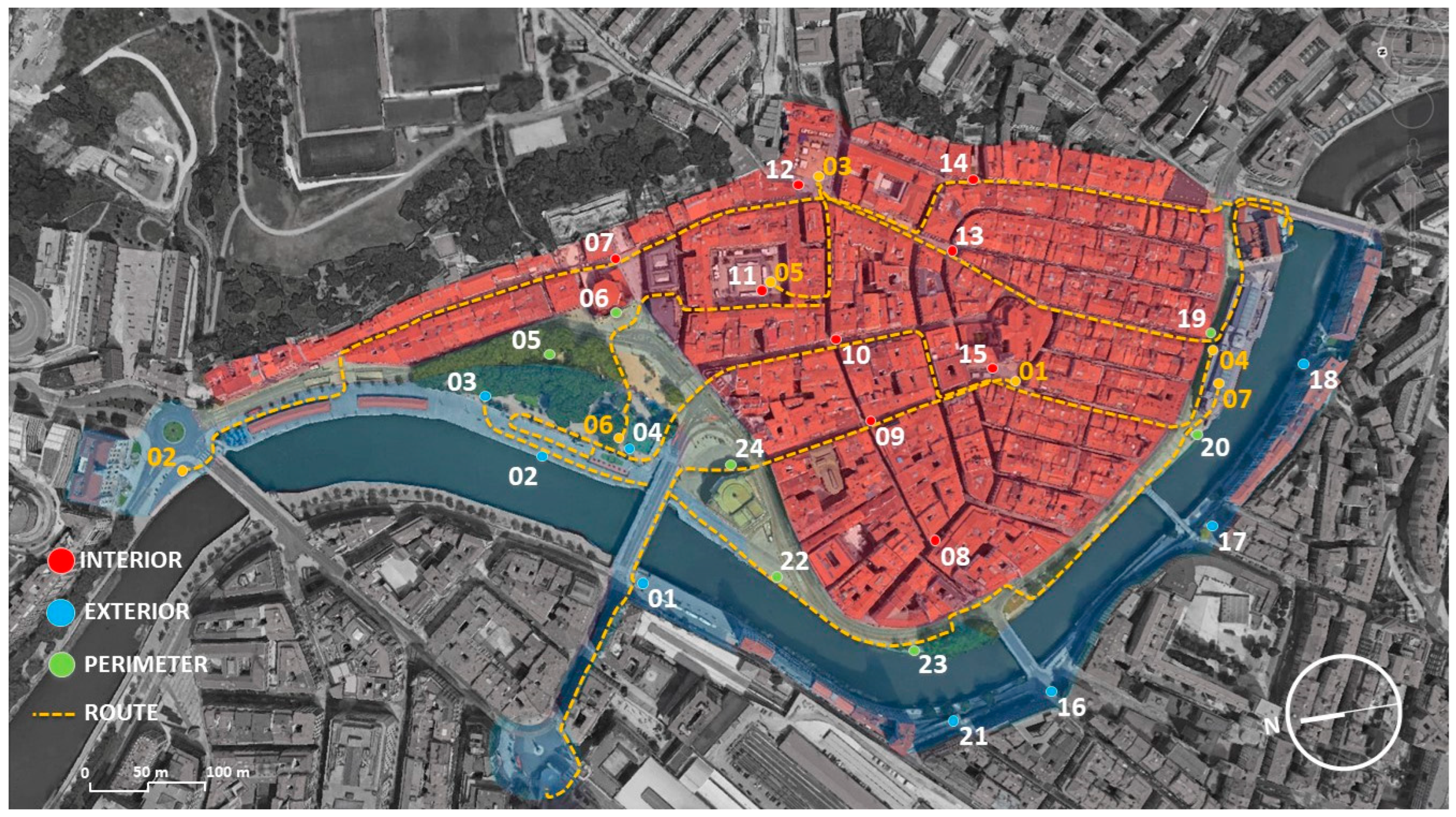
The selected area belongs to the pedestrian area of the Old Town of Bilbao and the road parallel to the estuary that surrounds it. The Plaza del Teatro Arriaga and the Parque del Arenal are included due to their relevance to the urban fabric, as they configure the boulevard that structures the limits of the Old Town in relation to the expansion of the city, as shown in Figure 1. The distribution of points is carried out by configuring a network that covers different situations in the area and guarantees the non-intrusion or contamination of the sound environment from one point to another, avoiding the repetition of situations.
Duration of records
The recording at each point is limited to ~5 min, lengthening or shortening slightly as the situation requires; the duration is determined by the researcher. In any case, it should be enough to collect a sequence that describes the situation without reaching auditory fatigue.
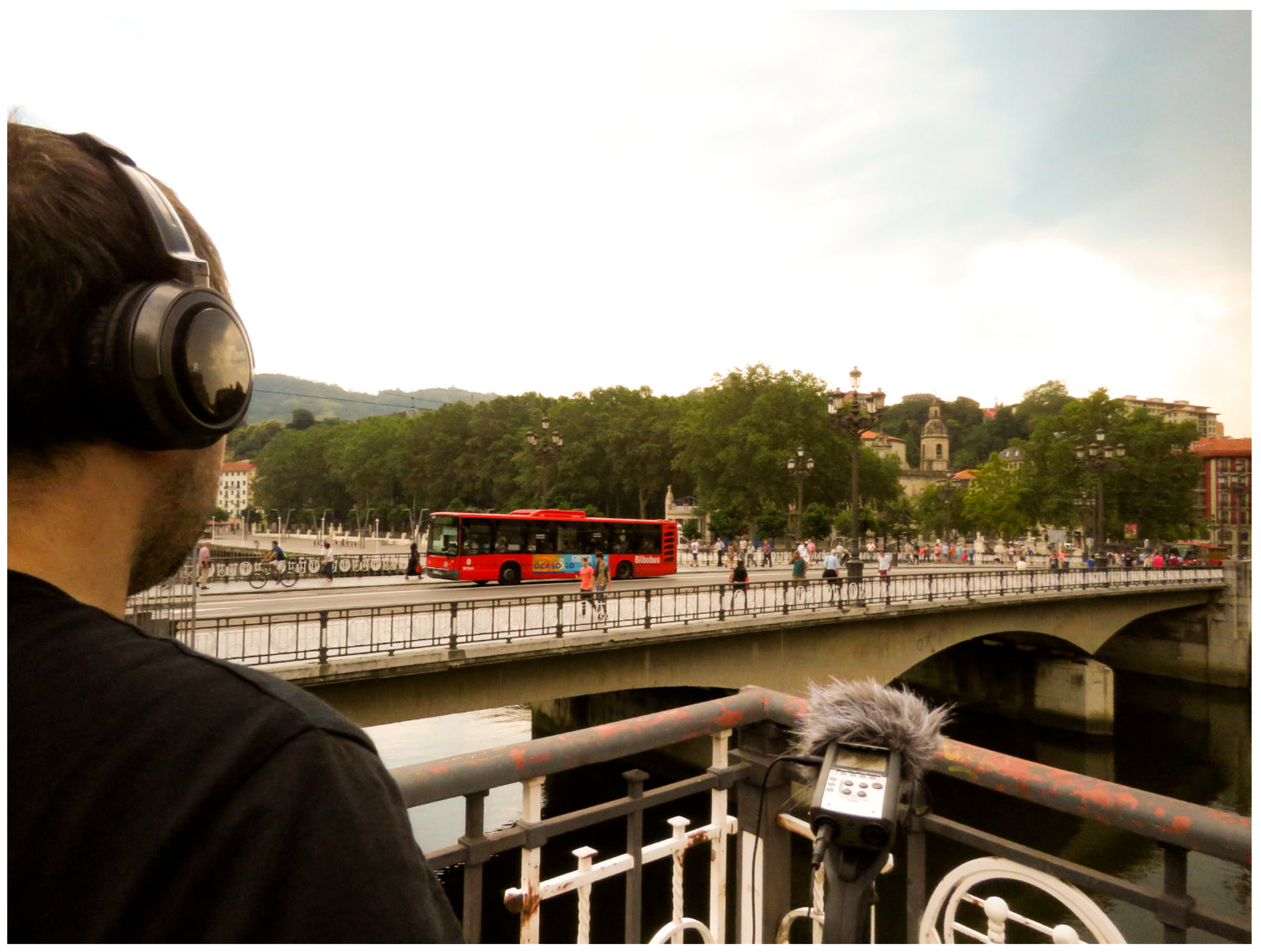
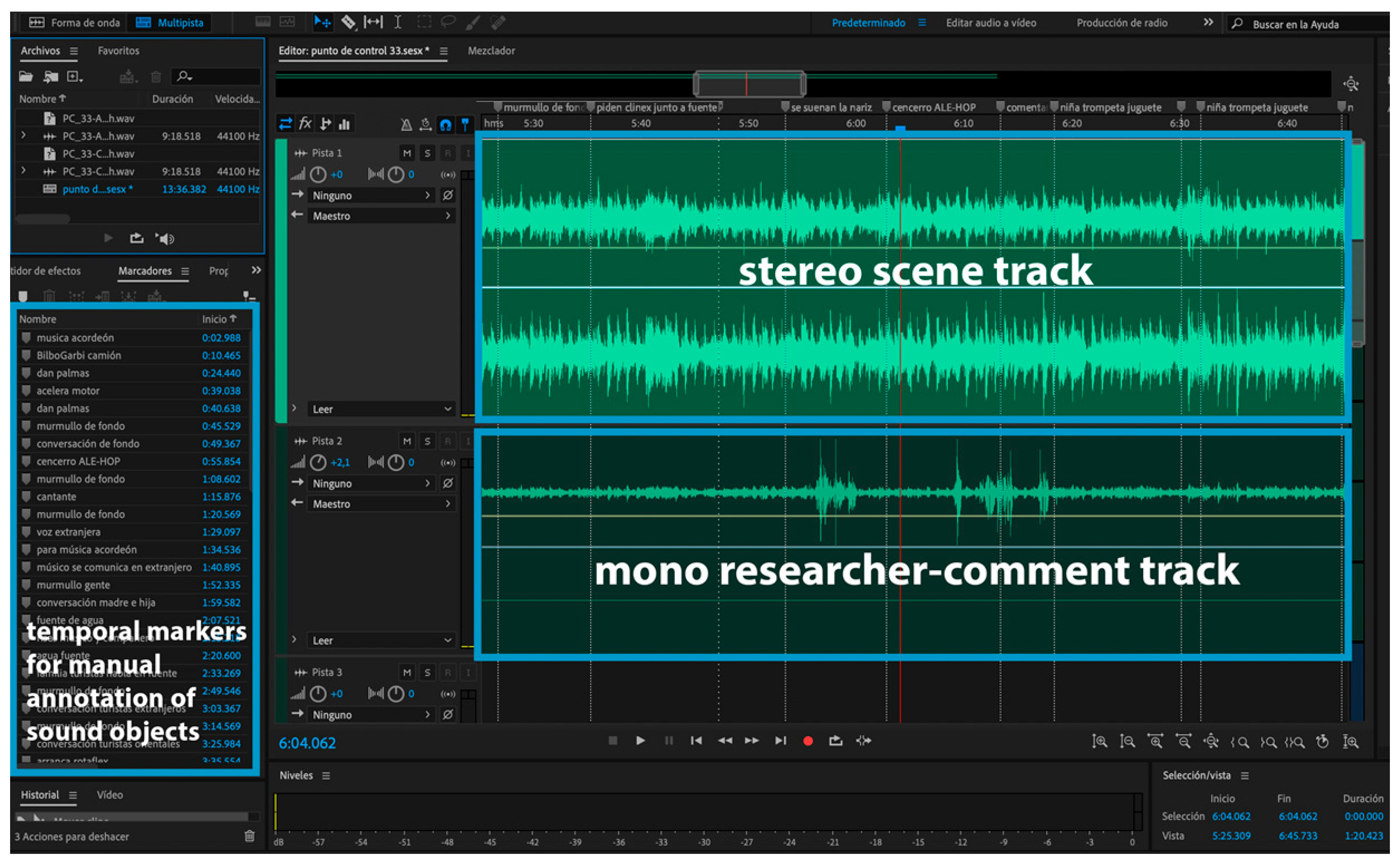
A ZOOM-H4N recorder (Zoom Corporation, Tokyo, Japan) is used, which allows for stereo image recording and multiple simultaneous tracks: one stereo track records the sound event to be analyzed and another track records the descriptive comments of what is perceived. Comments are made with a separate lavalier microphone for later transcription, Figure 2.
The stereo image covers 120° of aperture in the front plane by means of an X/Y arrangement of two unidirectional condenser microphones (sensitivity −45 dB/1 Pa at 1 kHz). This technique allows for a more uniform registration compared to others (such as unidirectional microphones), avoiding sound gaps in the stereo image; in addition, the X/Y arrangement is the most widely used in cinema. Feedback is recorded with an AUDIO-TECHNICA—ATR 3350 lavalier microphone (Audio-Technica Corporation, Machida, Tokyo, Japan), an omnidirectional cardioid polar pattern condenser microphone. It is inserted into INPUT 1 of the ZOOM recorder, adding an independent mono track to the stereo track picked up by the built-in X/Y microphone.
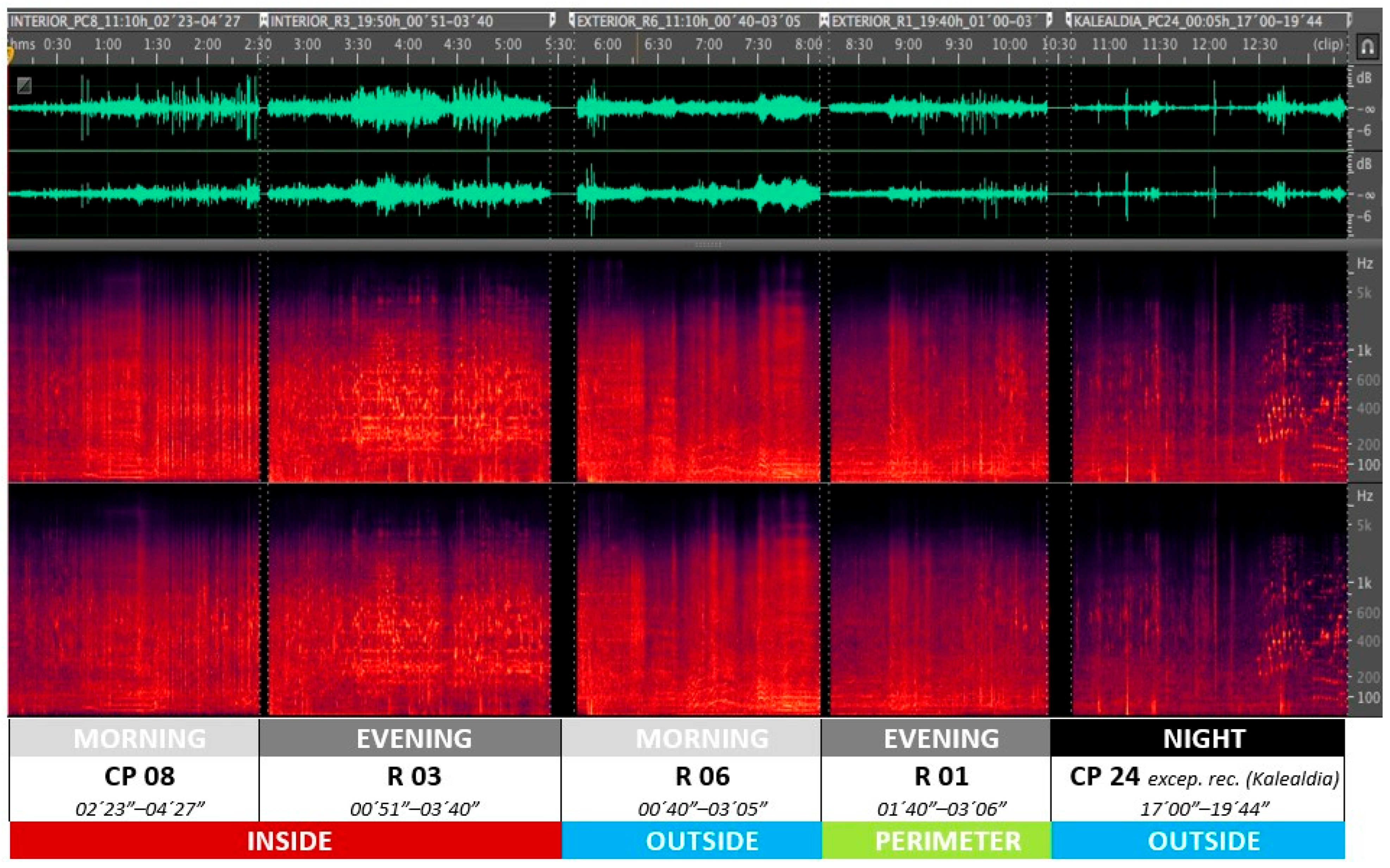
For the subsequent listening session for the classification of the sound objects, the Adobe Audition CC v.9.2 (Adobe Inc., San Jose, CA, USA) DAW was used, where the recording of the scene is heard in the stereo track, and the comments of the researcher in the mono track. By means of this listening session, the sound objects identified using the software markers are noted, as shown in Figure 3.
Sampling table and temporal representativeness
To reinforce the methodological replicability and transparency of the sampling design, Table S1 (Supplementary Material) is incorporated It includes the complete list of 24 control points (CPs) and 7 routes (Rs), together with their basic metadata: code, type of record, location, spatial scope, function in the sampling design, date, time, type of day, season, duration and contextual observations. The extended methodological development and the complete documentary files for Control Points (CPs) and Routes (Rs) are described in the author’s doctoral thesis [72]. Supplementary visual documentation of the sampling locations is provided in Figures S1–S5, which show the localized views and map positions of the Control Points (CPs) and Routes (Rs). The objective of this table and figures is to make explicit the specific conditions of each recording and to limit the temporal scope of the analyzed corpus. Consequently, the study should be understood as a situated characterization of scenes recorded at defined times, useful for identifying comparable patterns, although not intended by itself to exhaust all the daily, weekly or seasonal variability of the soundscape.
Next, four lines are developed that guide the analysis of the area: (1) development of sound objects; (2) definition of sound effects; (3) how in situ descriptions and sound effects are intertwined through commented points and routes to obtain qualified information; and (4) criteria for developing general audio clues that, in the future, could guide group interviews through reactivated listening.

3.1.3. Description and Classification Criteria

Elaboration of the descriptions
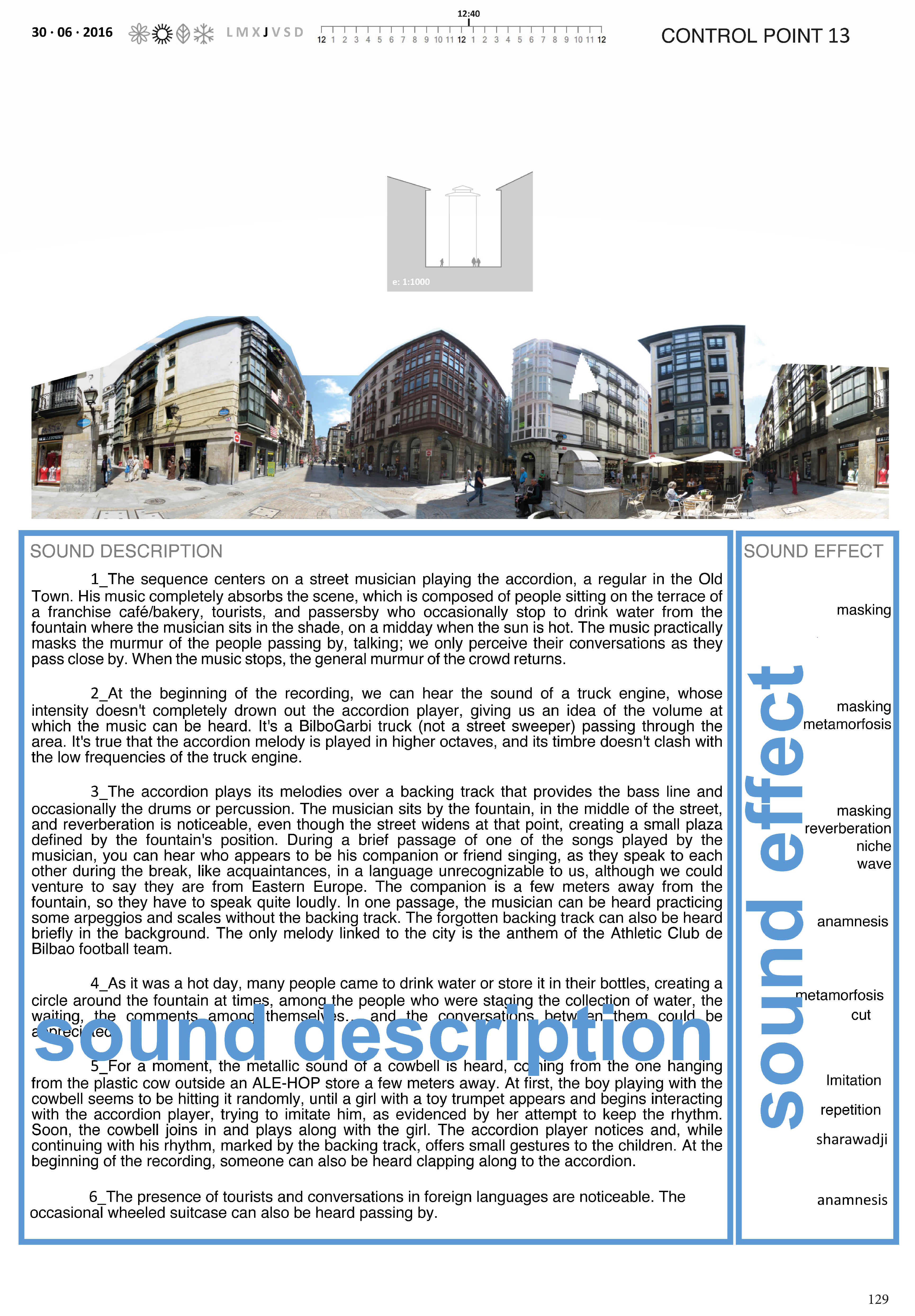
The descriptions of experiences at fixed points and routes make up the basic corpus of the analysis, as shown in Figure 3. The narratives include the location and perceptions complementary to the ear (visual, tactile, olfactory…), as well as subjectivity such as the mood suggested by each moment.
These descriptions make it possible to classify sound objects by enumerating what is heard, but their purpose is more focused on establishing perceptual milestones that articulate how we relate to what is perceived. Depending on whether we are observing, qualifying, detailing, clarifying or enumerating, the discourse takes a concrete form, establishing different attempts at explanation and evaluation; the attitude with which it is described determines the resulting information. In our case, it is mostly based on the identification and explanation of “sound effects” and “sound objects” as central concepts [5].
Sound effect clasification
A concept that deals between cause and event, where it does not always become an object in itself. The catalog of sound effects proposed by the interdisciplinary team of the CRESSON Laboratory (architects, engineers, urban planners, sociologists, philosophers, geographers and musicologists) and condensed in Sonic Experience: A guide to everyday sounds [3], presents a repertoire of effects whose meaning, as in music, is clear when properly represented and interpreted by the actors and listeners involved.
Here we focus on the 16 main effects of the 66 developed classifications: anamnesis, cutting, drone (drone), filtering, imitation, masking, metamorphosis, niche, remanence, repetition, resonance, reverberation, sharawadji, synecdoche, ubiquity, and wave (Figure 4).
Sound object classification
The sound object, defined by Pierre Schaffer in the Treatise on Musical Objects [66], is a temporal object that, although classifiable, cannot be limited to the quantitative, since its existence obeys the laws of the perception of time in consciousness. Here it is understood as the raw sound captured by consciousness that tries to animate itself through a process of formalization, objectified in the consciousness itself through the contrast of different listening intentions of the individual against the sound [73]. It is an element that is presented by choice and selection of the listener, who chooses between sound objects to configure his particular collection along a specific sequence, as shown in Figure 5.
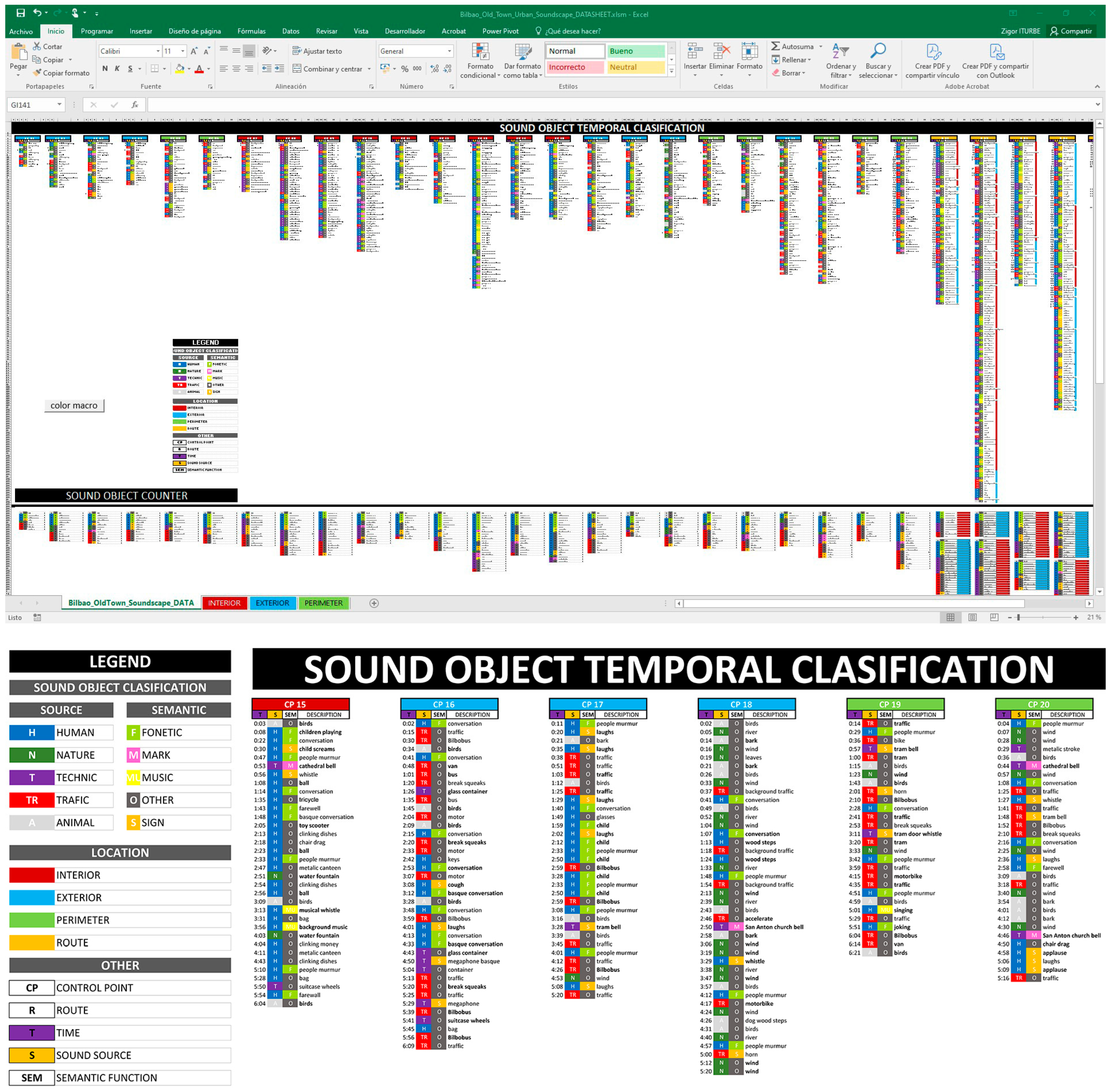
In this study, the classification of the sound source and its semantic function have been color-coded. Thus, sounds are classified by the type of source (five origin criteria):
-
Human: voice, music, physiological sounds such as a cough, etc.;
-
Animal: birds, dogs, mascots…;
-
Natural: wind, rain, thunder, water…;
-
Technique: installations in general, works, alarms…;
-
Traffic wheeled: cars, buses, trams, bicycles…
These sounds perform a semantic function and are classified as follows:
-
Sound Mark: sound representative of a place for a community.
-
Sound Signal: sound carries a specific coded message intended for a receptor.
-
Phonetic Language: solid speech, including attempts at children’s speech when babbling.
-
Musical Language: sound sequence that forms an artistic work for a community.
-
Others: the rest of the sounds are included as “others”, as their classification is undetermined.
This color-coded classification was compiled in a Microsogt 2016 file (.xlsm) (Microsoft Corporation, Redmond, WA, USA), which can be accessed from Zenodo’s open access repository, as shown in Figure 6 [74].
Coding Protocol and Decision Rules
The identification and classification of the sound events was carried out by manual annotation, from repeated listens (no more than 2–3 repetitions per listen, to avoid listening fatigue) of the recordings in Adobe Audition, using the stereo scene track together with the mono track of the researcher’s comments and the time markers of the software. No automatic classification was used. This decision responds to the perceptually situated nature of the study and the need to maintain traceability between recording, commented listening, segmentation and interpretative synthesis.
For operational purposes, a sound object is defined as a perceptually distinguishable temporal unit within the recorded sequence, with a recognizable beginning and end or, failing that, with a clear change in source, function, prominence or perceptual configuration. The delimitation of objects is not established only by the physical discontinuity of the signal, but by its legibility as a relevant unit in analytical listening.
When overlaps occur between simultaneous sounds, a perceptual criterion of stability is applied. Only those events that can be distinguished and followed in a relatively stable way when listening are noted as separate objects. When the overlap prevents this separation or one of the sounds is clearly subordinated to another, a single composite object is registered, assigning the main prominence to the most prominent source in the scene. In this way, an artificial fragmentation of the sound continuum is avoided and an homogeneous coding logic between registers is preserved.
Each object receives a single provenance label and a single semantic function label within the taxonomies used in the study. Multiple tags are not assigned to the same event. In ambiguous cases or cases of insufficiently clear classification, the object is assigned to the category “Other”, leaving a record of the ambiguity in the working datasheet. This restriction is introduced to ensure consistency between records and to facilitate subsequent comparative reading between points and routes.
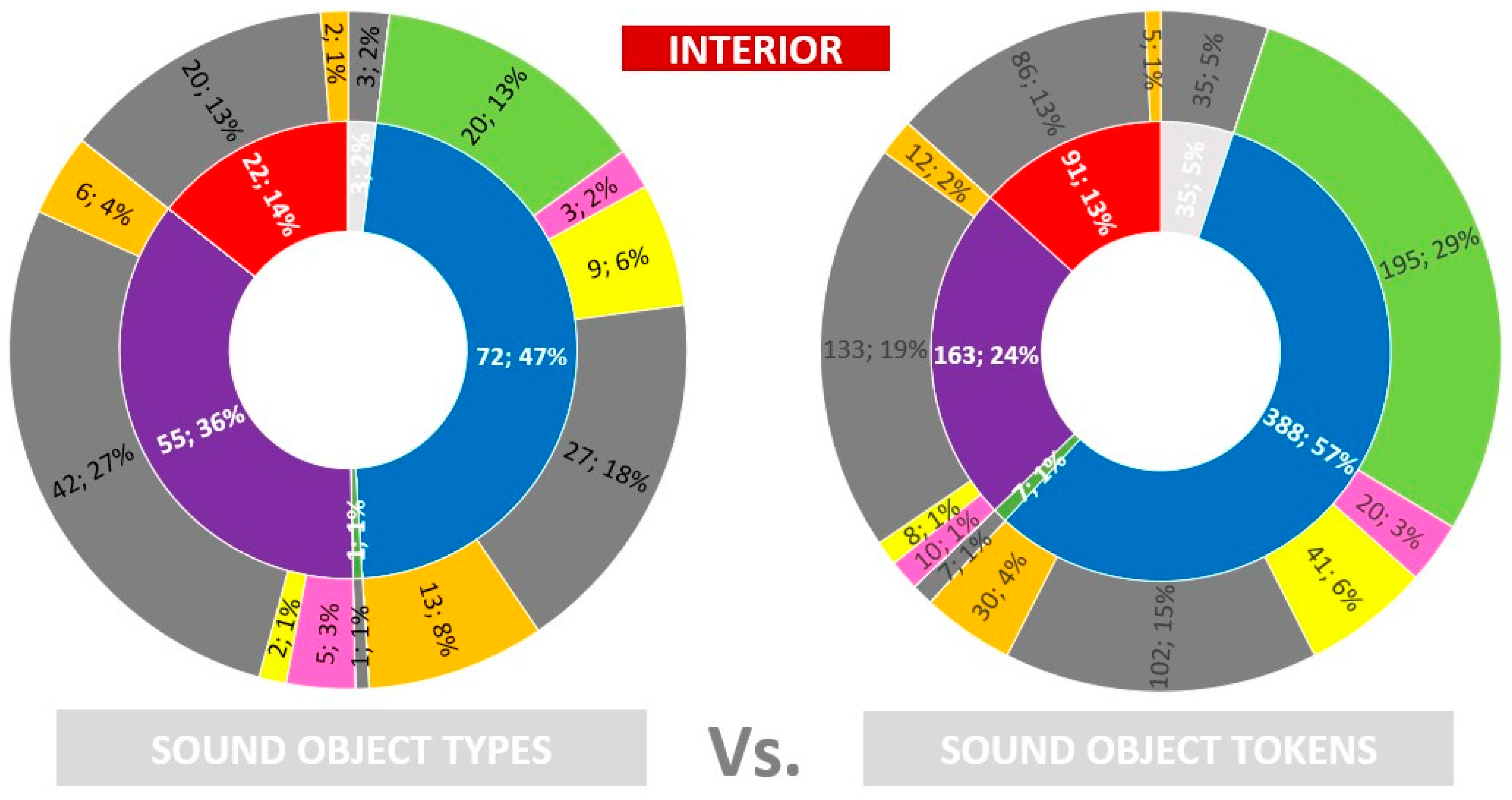
In this work, a token is defined as the total number of sound objects annotated in a recording, i.e., the total number of recorded occurrences, while a type is defined as the number of distinct categories present in that recording, understood as a measure of diversity. This distinction makes it possible to analytically separate the repeated presence of a source or function from the effective variety of sound elements present in the scene. Type–token reading is used here as a cross-sectional criterion to interpret differences between diversity and intensity of dominance by repetition.
Although the initial organization of sound objects by origin distinguishes categories such as human, animal, natural, technical and road traffic, in the synthesis by analytical dimensions two specific decisions are introduced. On the one hand, bells are treated as a dimension of their own due to their capacity for temporal structuring, collective reference and spatial anchoring. On the other hand, animal sounds are integrated into the dimension of natural sounds, given their related analytical behavior in the corpus and in order to avoid a residual subdimension with little autonomous interpretative capacity.
The identification of sound effects is carried out as a complementary analytical layer to the segmentation by objects. The effects do not replace the objects nor do they constitute a second unit of equivalent counting, but function as an interpretive reading of relevant perceptual relationships within the scene, guided by the selected repertoire of Augoyard and Torgue. In this way, objects and effects are understood as complementary layers: the first describes events and sources that are perceptually segmentable; the second helps to interpret how these events are articulated and acquire meaning in the experience of the place.
Consistency of the Analytical Process
Since it is an interpretative protocol guided by the investigator, a complete external validation of the coding system is not presented in this article. However, to reinforce the consistency of the analysis, segmentation and labeling were carried out through repeated listening, contrasting the scene track and the commented track, and iteratively reviewing the temporal markers and assigned categories before the final comparative synthesis. This procedure does not replace participatory or intercoder validation, but it does introduce an internal consistency check between registration, description, classification and results.

3.1.4. Preparation of the General Audio Tracks

The general audio track, to be shown to users in a future phase of reactivated listening, will respond to two groups according to psychological or spatial logic. Although there is no definitive method that defines the exact technical conditions of the recording, the selection of microphones, the listening point and the quality and neutrality of the medium show the relevance of each detail. However, the aim is not to reproduce the experience lived by others with absolute fidelity, but to awaken it; a sound event can enliven reactions as long as it is sufficiently intelligible to the listener.
In this methodological proposal, it is proposed that the users and inhabitants themselves should make the recordings through commented routes in the environment to be studied.
For the method of reactivated listening, J. F. Auogoyard (quote) proposes the organization of two types of tracks: (1) a collection of local recordings that evoke a specific identifiable place, and (2) a track oriented to typologies of objects, spaces or situations, composed of appropriations chosen for their evocative capacity. These groupings can be tested in three situations during group interviews: 1_ To verify the validity of an exploratory approach to the place of study. 2_ To achieve discrimination in a collection of representations of universal tendencies and irrelevancies. 3_ To investigate reactions to the singularity of abstract sounds or typical sound objects (technical or technological sounds, equipment noises, emblematic sounds…). This research focuses on testing the first situation: verifying the validity of the sound fragments proposed in an exploratory approach to the place.
The sound material for group interviews must be subjected to a prior selection that allows for recognition and evocative associations in the minimum listening time; selecting the sounds to be exposed is, therefore, a challenge. In descriptive monographs of a place, the choice of objects and configurations is simpler than in a comparative observation of several places, as in this case. The method proposes five criteria providing reasoning for the composition of sequences, grouped into three general rules based on P. Schaeffer’s postulates of sound objects and M. Schafer’s classifications: the first rule is a taxonomic sieve and includes criteria 1, 2 and 3; the second obeys principles of sound psychology; the third implies intersubjectivity. The criteria are as follows:
1_ TYPES OF SOUND that intervene in everyday life rationally classified based on:
1.1_ TYPE OF SOURCE. Human, animal, natural, technical…
1.2_ SONORA ORGANIZATION. Elementary: intensity, timbre, patterns, duration… Compositional: figure versus background or atmosphere…
1.3_ TYPE OF SPACE AND FUNCTION INVOLVED. Open/closed, neighborhood, city, suburb…
1.4_ SEMANTIC STATUS in the local culture. Signal, phonetic or musical language, background sound…
1.5_ SPECIFIC CHARACTERISTICS proposed by the research.
2_ SOUND OBJECTS to identify a specific situation, used to review the first weighting through agreement/disagreement of the listeners.
3_ SINGULAR AND UNIVERSAL SOUND OBJECTS maintain a balance between unique sounds of the place and universal ones to prevent the listener from creating too much distance such that the interviews become a mechanical game of sound puzzles.
4_ THE TEMPORAL ORGANIZATION OF THE EDITED TRACK should favor sound aesthetics (chronological, spatial, narrative or subjective) and a didactic attitude that provokes interrogative function, since intelligibility is not the only criterion of social interactions. “We can communicate despite the noise.”
5_ INTERNAL TESTS IN THE LAST PHASE OF EDITING to sift recordings through corrected and reasoned listening according to the researcher’s purposes, making the final track possible.
Once the first three criteria have been applied (sound object, sound effect, and descriptions) individual files are obtained for each control point and commented route. From the analysis of these files and the application of the fourth described criterion, the general audio clues will be obtained for a future application in interviews through reactivated listening with local inhabitants, this being the second main result of the analysis, as will be seen in the next section.
Criteria for Preparing Audio Materials for the Subsequent Phase
The audio materials developed for the subsequent phase of reactivated listening do not constitute in themselves a participatory validation, but a set of fragments and operational sequences selected from the recorded corpus to facilitate subsequent contrast with inhabitants and users. Their preparation is guided by three criteria: (i) analytical representativeness, achieved by collecting relevant situations within the identified dimensions; (ii) perceptual clarity, avoiding excessively ambiguous or technically deficient fragments; and (iii) comparative capacity, favoring sequences that allow for scenes to be confrontations between interior, exterior and perimeter areas, as well as tensions between diversity and dominance. In this sense, these materials should be understood as support devices for a future participatory phase, not as results already validated by that phase.
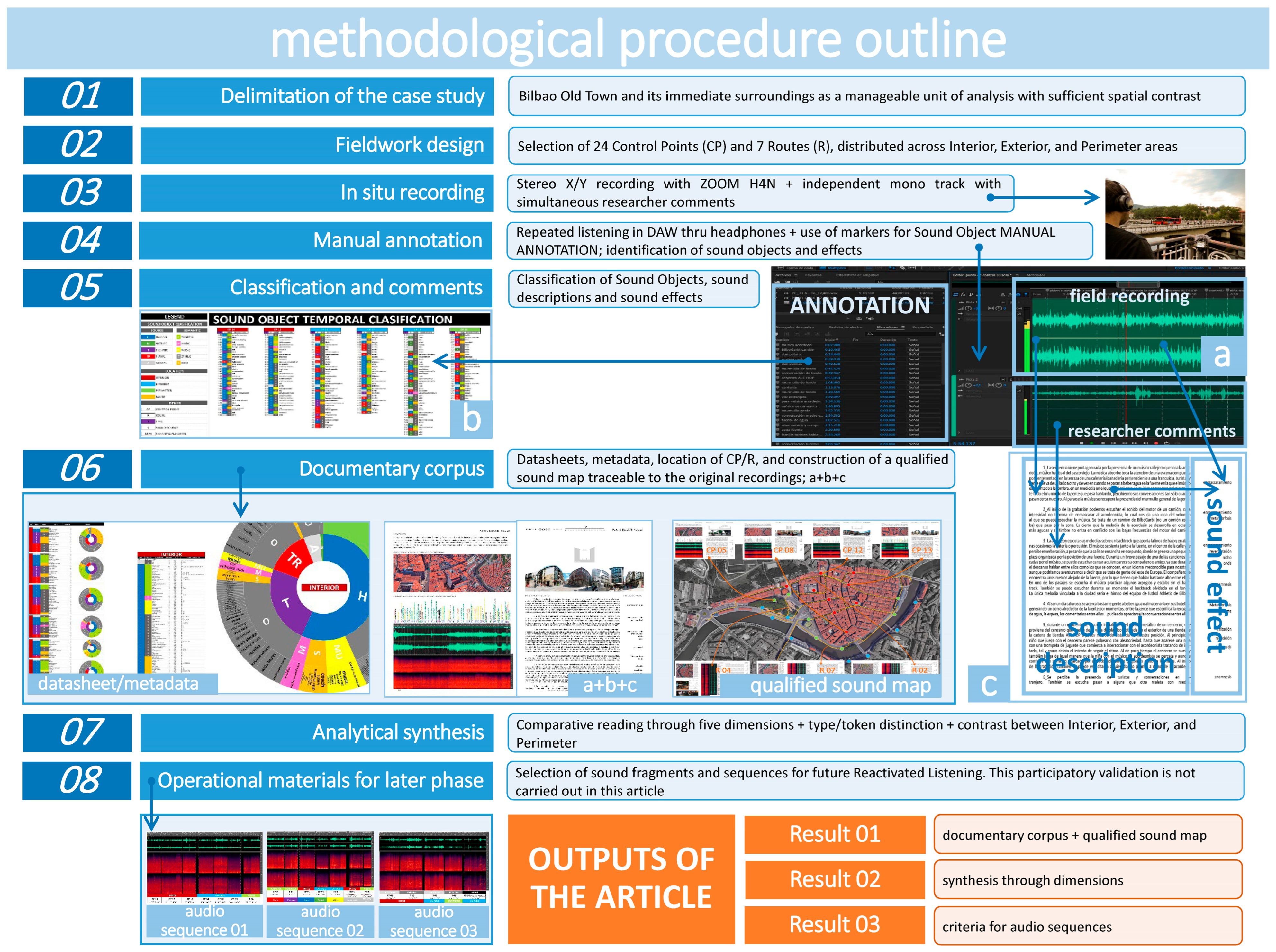
Figure 7 synthesizes the complete methodological flow of the study, from case delimitation and fieldwork design to analytical synthesis and preparation of operational materials for a subsequent phase of reactivated listening.

4. Results

The results are presented in a progressive and hierarchical manner, maintaining traceability between the outputs obtained and the analytical decisions adopted. In this sense, the section is structured into three chained levels: (i) a first level of primary results, directly derived from the application of the first methodological phase; (ii) a second level corresponding to the systematic analysis of these outputs; and (iii) a third level, built from the second methodological phase and fed by the evidence consolidated in the previous levels.
Consequently, RESULT 1 collects the initial empirical corpus (descriptive–documentary) that fixes the evidence of the soundscape at the control points and routes. On this basis, RESULT 2 develops the analytical reading and interpretative synthesis of the material, transforming it into comparable information. Finally, the second methodological phase integrates the information contained in RESULTS 1 and 2 to operationalize criteria and produce RESULT 3, closing the data chain → analysis → applicable synthesis.

4.1. Result 1

In this first level, the direct result of the first phase of the methodology is presented, focused on the study of control points and routes. RESULT 1 is specified in three complementary products that build the empirical corpus and the first layer of synthesis of the soundscape: (i) the individual files; (ii) their integration into a qualified sound map; and (iii) a first sound identity represented by colored disks, obtained from the classification of sound objects according to their origin and semantic function.
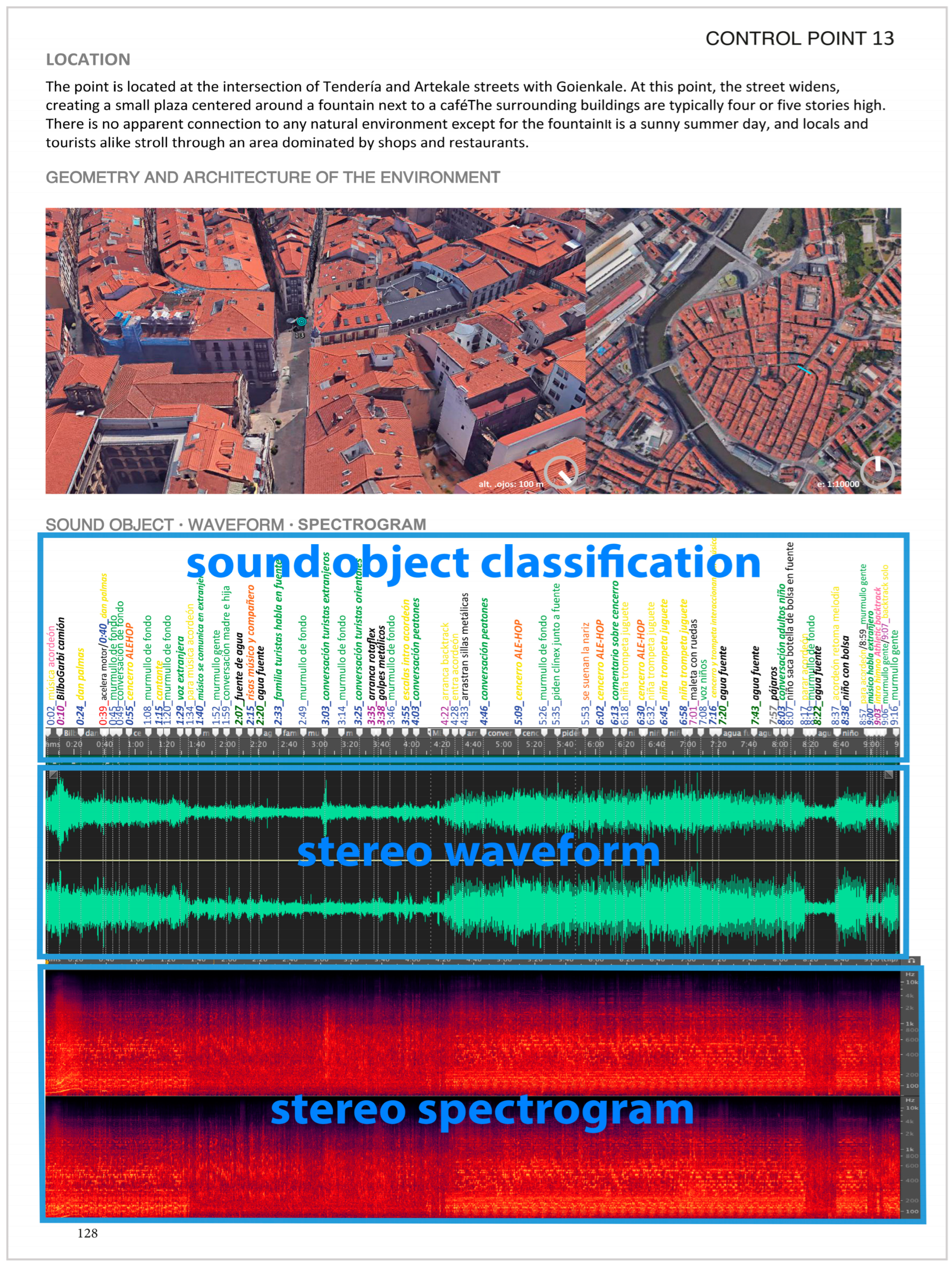
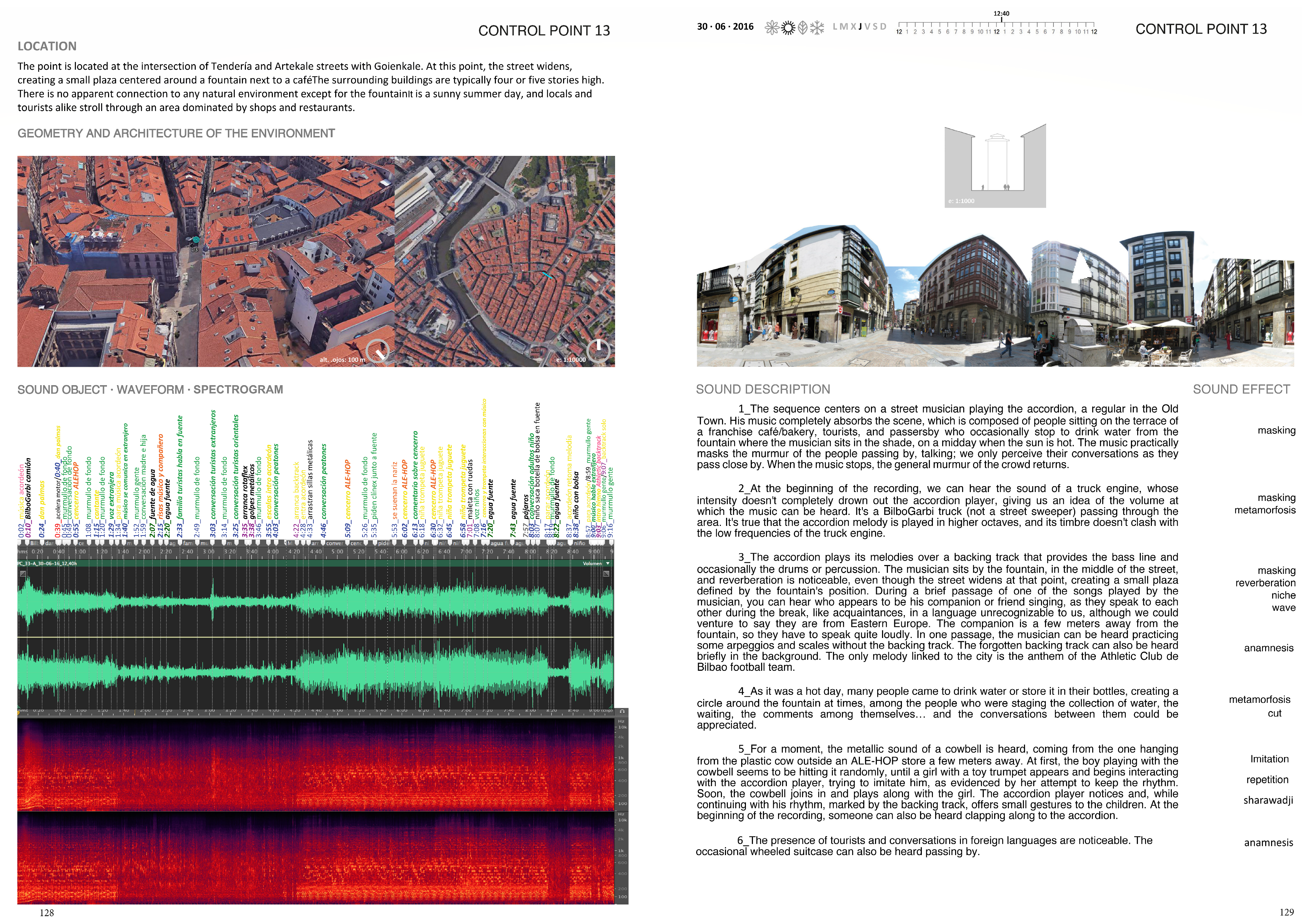
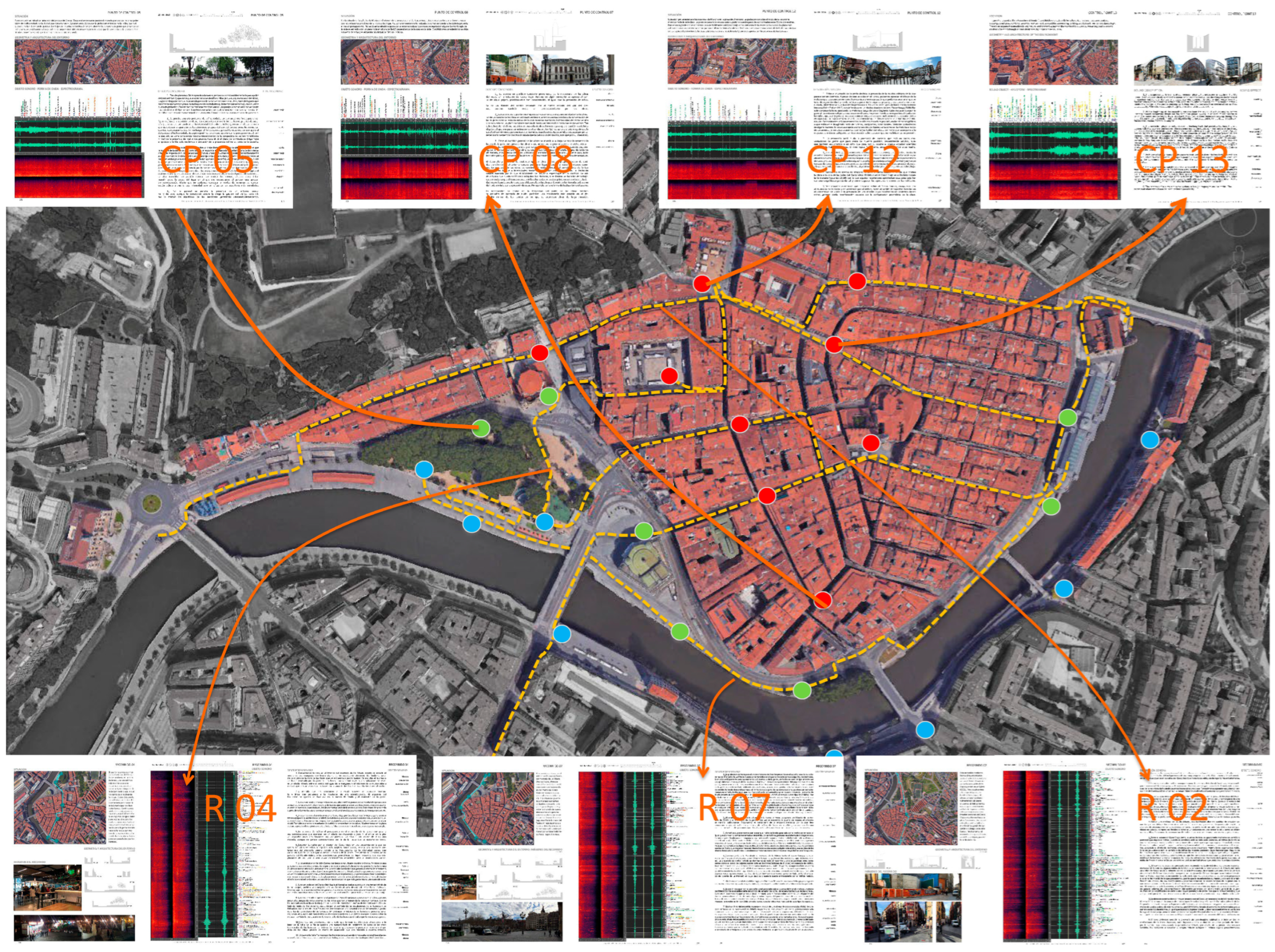
First, individual files were developed, one for each point and route, which systematically collect the evidence necessary to describe the sound scene and its context (Figure 8). These sheets incorporate (i) a sound recording of the environment, with durations of 4–6 min for the control points and 10–15 min for the routes [75]; (ii) a sound description based on the researcher’s comments, describing the scene experienced through perceptual and affective criteria; (iii) graphic information on the architecture and morphology of the place (images, orthophotos and architectural sections); (iv) identification and cataloging of the main sound objects [66] and their classification [67]; (v) a list of the most important sound effects [3] that structure the sound sequence; (vi) the waveform and stereo spectrogram of the sound sequence; and (vii) information on the day, time, and season of the year in which the recording is made.
It should be remembered that the reading framework that guides the elaboration of the files is based on three main axes: (i) the development of sound objects; (ii) the development of sound effects; and (iii) the interweaving of perceptual descriptions in situ with these objects and sound effects, in order to obtain qualified information about the place.
Secondly, from the set of files of the control points and commented on routes, a qualified sound map of the studied environment of the Old Town of Bilbao is elaborated, composed of each of the files together with their audio tracks, which can be synthesized as represented in Figure 8.
Secondly, from the set of files of the control points and commented on routes, a qualified sound map of the studied environment of the Old Town of Bilbao is elaborated, composed of each of the files together with their audio tracks, which can be synthesized as represented in Figure 9.
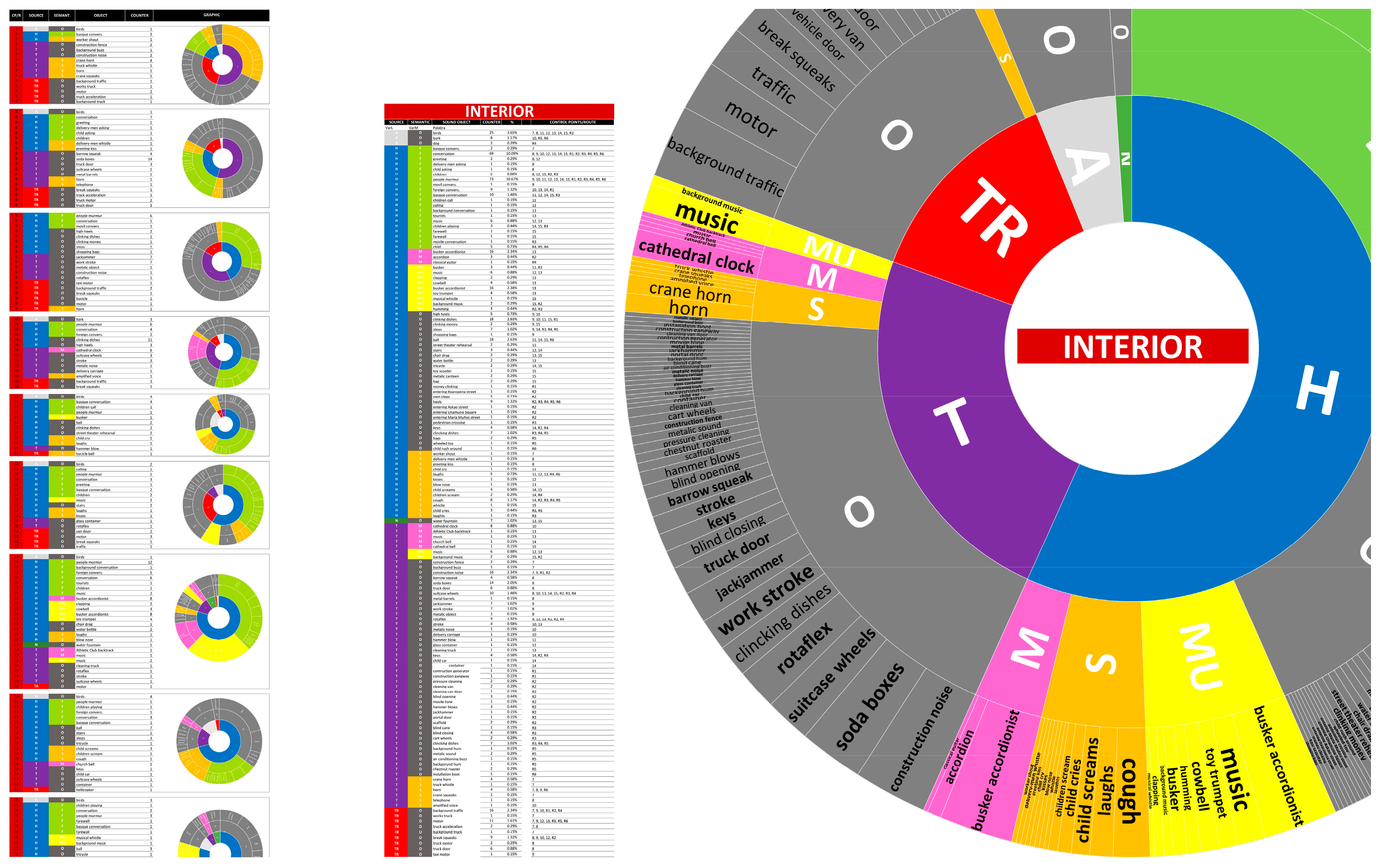
Thirdly, from the previous corpus, a first sound identity is derived and represented by colored disks as a result of the classification of sound objects based on their origin and their semantic function (Figure 10). This representation constitutes a first visual synthesis that makes it possible to characterize and compare, immediately, dominant features between points and routes, maintaining traceability with the documentary evidence contained in the files.
Each card synthesizes the sound identity of the control point or route it represents through a structured set of evidence (audio, perceptual description, objects and sound effects, and morphological–architectural context). This homogeneous organization enables a multidimensional reading (the morphology of sound objects and sound effects, the perceptive–affective dimension in situ and the morphological–architectural context) and constitutes the documentary basis on which a qualified sound map and a first synthetic characterization of sound identity are then built by means of colored disks.
Together, these first results (individual files, qualified sound map and initial sound identity using colored disks) make it possible to condense and structure the evidence recorded at the control points and routes, establishing a solid basis for their comparative reading. From this corpus, RESULT 2 develops the analytical synthesis of the recordings in order to condense ideas and define the main dimensions that guide the subsequent elaboration of audio tracks for their application through reactivated listening with groups of inhabitants of the study area.

4.2. Result 2

Based on the corpus generated in RESULT 1 (individual files, qualified sound map and initial sound identity), this second level synthesizes the comparative analysis of the recordings made at the control points and routes in the Old Town of Bilbao, with the aim of condensing the information obtained to define the main dimensions of the soundscape that make it possible to guide the elaboration of future audio tracks, intended for application through the reactivated listening method with groups of inhabitants of the study area.
In order to guarantee a clear and traceable reading, RESULT 2 is structured into five analytical dimensions (D1–D5), which group the findings by large sound domains: (D1) road traffic and mobility; (D2) technical sounds; (D3) bells; (D4) human sounds; and (D5) natural sounds. Although these five dimensions are largely aligned with the classification of sound objects by provenance, here they are adopted as analytical groupings: bells are treated as a specific dimension for their marking and structuring function, and animal sounds are integrated into D5 (natural sounds) for their related analytical behavior and to avoid a residual sub-dimension. Each dimension is developed through subsections with explicit references to control points and routes, making it possible for the identified patterns to be linked to the recording situations and facilitating the comparison between sound scenes.
Abbreviations: PC = Control Point; R = Route; MER = Strategic Noise Map.
D1. Road traffic and mobility.
D1.1. Structuring nature of traffic and limitation of the SRM.
Traceability: PC 12, 8, 9, 10, 14, 13, 5, 6, 19, 20, 23, 22, 24, 21, 17, 18, 2; A: Internal opposition/perimeter.
Road traffic is configured as a structuring element due to its presence, its capacity to produce interruptions (cutting effect) and its masking potential (masking). The MER operates as a macro reference but does not represent the actual fluctuation of the event.
D1.2. Pedestrian interior: extension of hours and “cut-off effect”.
Traceability: PC 12, 8, 9, 10, 14, 13 (emphasis PC 12, 8, 9, 10).
In the pedestrian interior, a stable background is not consolidated; traffic appears as an intermittent figure due to proximity/maneuver. The municipal regulation for professionals/distributors is set at 11:00 a.m.; the recording documents a general presence until 11:30 a.m. and, sometimes, up to 12:30 p.m. or more (PC 12, 8, 9, 10). The “cut effect” (not “wave”) predominates: starts, accelerations and maneuvers mask conversation and murmuring; the reverberation of narrow streets intensifies the masking (PC 14, 8, 9, 10, 13).
D1.3. Approach to the perimeter: filtering traffic from the inside.
Traceability: PC 8, 9, 10.
Before reaching the perimeter, traffic is perceived as a variable hum with “funnel” filtering (less treble; bass predominance); the perimeter is acoustically “announced” from the inside.
D1.4. Perimeter: traffic light control and “wave effect”.
Traceability: PC 5, 6, 19, 20, 23, 22, 24.
At the perimeter, sidewalk/road segregation and traffic light cycles produce a “ripple effect” (circulation/stopping). Depending on level and proximity, traffic operates as a background or as a masking figure.
D1.5. Intra-perimeter variability: topography, screens, vegetation and leisure.
Traceability: PC 22–23, 24, 20, 21, 17, 18, 2 (with similarities in 5–6–19–20–23–22–24).
Local modulations are observed. PC 22: reinforced tram per stop; passage area such as PC 23; curvature/topography increases reverberation and amplification. PC 24: meeting point; traffic overshadowed by theater, trees and river. PC 20: terrace (jazz bar) with youthful conversation; traffic (especially buses) enters “suddenly” through the screen of the market and the one-way street. PC 21: upper elevation and vegetation attenuate traffic (also linked to the wind in R5). PC 17: leisure partially reduces the background, but accelerations of vehicles/buses on curved slopes stand out. PC 18: lower traffic; lower bridge elevation and market screen produce general hum that is difficult to identify/locate. PC 2: even with low presence, the reference to vehicles as a source of mobility persists.
D1.6. Singular mobility: helicopter and bicycle.
Traceability: PC 14 (helicopter). Bicycle: general presence (without a single PC).
Helicopter: A brief event associated with celebrations, rallies or protests, momentarily located on PC 14. Bicycle: sporadic presence, limited by scarce infrastructure and restricted to banks and pedestrian areas.
Once the structuring role of mobility and road traffic (presence, masking and interior/perimeter dynamics) has been characterized, the non-human sounds associated with infrastructure, devices and technical–logistical activities are then analyzed and grouped into D2 (technical sounds).
D2. Technical sounds.
Sounds from devices, tools, or installations (non-human, non-natural/animal, and non-road traffic). A distinction is made between fixed (stable location; own temporality) and ephemeral (mobile or unpredictable).
D2.1. Installations: example of R1 (filtering, signal and masking background).
Traceability: R7 (Plaza Santiago -> Abando metro entrance).
Examples of fixed technical sounds: humming tram transformers, cancelation beeps, escalators outside the market and metro ventilation (very intense) outside the pedestrian zone; two sounds associated with transport (tram/metro). With long exposure, the masking buzz transitions from being a figure to being in the background and “flattens” the scene. At the end of R1, traffic remains in the background (wave effect) and the traffic light beep acts as a pedestrian signal with rhythmic acceleration prior to closing (anticipation). Upon entering, traffic is filtered as the escalator emerges; the ventilation persists in the descent, increases at the end and changes EQ (less treble) while maintaining a tonal tuning recognizable as the installation itself.
D2.2. Works: figure (metals) vs. background (motors) and associated signs.
Traceability: PC 7; PC 21 y 9; R1; R6.
Works: motors/installations as background noise and metal beats as rhythmic figures (operative tempo); temporal dilation can return the figure to the background. Signals: crane horns (call/anticipation) and barracks horns (R6) as ephemeral marks dependent on use.
D2.3. Cleaning services: cut-off effect, perception/normalization conflict and night event.
Traceability: PC 23 (00:00), R 2.
Sweepers (BilboGarbi): masking cut-off effect, especially near terraces, and conflict between normalization of the service and nuisance (noise emission and CO2) (13). The cleaning services introduce episodes of cutting and masking, especially in the vicinity of terraces and rest areas (PC13). In the analyzed records, the sweepers generate perceptual interruptions and temporarily modify the figure–background hierarchy of the scene, as for example in R 2.
D2.4. Leisure, tourism and commerce: ephemeral technical sounds and social reading.
Traceability: PC 8; R2; A3.
The sound of terraces (human) is postponed and technical–logistical markers are prioritized: suitcases with wheels (temporary displacement, unfinished local/foreign) and delivery carts (goods). These sounds are interpreted for their function on the stage and for their urban timing, without attributing to them a local or visiting origin on their own. In PC 8, a delivery man unloads boxes and barrels: an intense rhythmic sequence that can go from figure to background by repetition/dilation and marks daily temporality conditioned by the period of vehicular access to the pedestrian interior. Commerce: opening/closing of shutters as a sign of temporary work; synchronisms: R2 (Calle Esperanza, 10:30 a.m. Thursday) and R3 (Calle Tendería, 7:55 p.m. Wednesday). Only by ear is it not possible to distinguish opening/closing; the morning/evening context (plus reverb and propagation) could support the inference.
Beyond these technical events—fixed or ephemeral—the corpus includes sound markers with a high capacity for temporal structuring and spatial anchoring, which are specifically addressed in D3 (bells).
D3. Bells.
D3.1. Bells as a temporary signal and “niche effect”.
Traceability: PC 20 (7:00 p.m.) and PC 10 (12:00 p.m.; 02′01′′–03′46′′).
Bells as a temporary signal anchored to space (daily repetition) and synchronizing. Time stamps are found in San Nicolás, San Antón and Santiago Cathedral; La Merced is differentiated by its conversion to a concert/rehearsal hall. Cathedral: greater intensity and “niche effect” (height/location). On PC 20, the Cathedral signals 7:00 p.m. and, ~5 min later, other bells also mark 7:00 p.m.; by stereo San Antón is deduced and the delay is verified with a mobile phone. Before the time, “rooms” (call/anticipation) appear. On PC 10, a sequence of bells is recorded marking 12:00 h (repetition) at 02′01′′–03′46′′.
Together with these temporal markers, the soundscape is defined by a dimension of high situational variability linked to social presence and activity, developed in D4 (human sounds).
D4. Human sounds.
Sounds by direct action (speech, music, leisure). Technical supports (backtracks/PA systems) are attached to technical sounds.
D4.1. The voice: dynamics vs. statics and relationship with urban typologies.
Traceability: PC 20, 17, 16, 21, 18, 1, 24.
Dynamic voice (step) vs. static (terraces/meetings/shows). Murmur as a variable background according to traffic/technical competence, modulated by distance and architecture (filtering/camouflage). Perimeter: few terraces despite cafeterias; PC 20 stands out: youth terrace (tables next to the road and set back towards the estuary), small “square” in front of the market; murmur as a background with engine cutoffs. A periodic variation in step density and conversation coinciding with mobility cycles in the environment is also observed; this reading is interpreted as a contextual hypothesis and not as a main result derived exclusively from the audio. Opposite shore: presence of “radically opposite” terraces: except for PCs 1 and 16, the rest are associated with bars/cafeterias; PC 17 (leisure with adults and children), PC 16 (meeting linked to Bilborock), PC 21 (little voice, intermittent but variable murmur), PC 18 (similar situation), PC 1 and 24 (depend on groups; tourists in “24H” in front of the theater). Pedestrian interior: murmur dominates in squares; in narrow streets with terraces on both sides, traffic is reduced and crowding increases.
D4.2. Language: linguistic distribution and limits of inference.
Traceability: 20 pcs; PC 13.
Predominantly Spanish and with an important presence of Basque. It is not concluded whether Spanish is local or national tourism; some Andalusian dialect is heard. Basque: affinity with Bilbao/surroundings as it is the local official language; the dialect of the Arratia Valley is noted in PC 20. Others: English, French, an undetermined oriental language and one with an unconfirmed provenance in PC 13 (accordionist and partner). A sociodemographic or provenance attribution is not made, without external corroboration, from these voices, nor are conclusions drawn about tourism or the origin or territorial affiliation of the speakers.
D4.3. Phonetics.
Traceability: PC 8; PC 4.
Whistling (call/activation; anticipation) and screaming (childish play or crying/protest/complaint) as signals that generate “induced cuts” (forcing attention). In PC 4 (children’s area of the Parque del Arenal), the shouting creates a micro-climate and, due to its acuity, is not masked by traffic (including frequent bus passages); fragmented conversations according to proximity.
D4.4. Walking.
Traceability: PC 14.
Steps/Running: report direction and speed; more perceptible in pedestrian interiors. Their legibility depends on the pavement, the local resonance and the geometry of the space. From the audio, some timbral and impact variations can be distinguished in elements such as heels, but no inference of gender or other personal attributes is made without external verification; in PC 14 (stairs to Solokoetxe) it is made explicit that gender cannot be determined in multiple situations (e.g., sandals) without visual verification.
D4.5. Gameplay.
Traceability: PC 14, 5, 6, 11, 15.
Recurrent ball play; on the riverbank/perimeter it is not usually observed for safety, with the exception of San Nicolás. PC 14: Basketball dribble. PC 5, 6, 11, 15: football-style kick. PC 6 and 15: façade of a religious building as a “fronton” (bounce), similar to handball but with the foot. PC 15: doorman “next to the Cathedral of Santiago”.
D4.6. Music.
It is integrated by cultural impact. Operational division: instruments (including voice) vs. electronic devices. In the corpus, classical tonal harmony (tonal center); no modal harmonic development or atonality is detected.
D4.7. Instruments.
Traceability: PC 11, 12, 24, 13; R 1, 3; also mention in R2 at the height of PC 12.
Instruments: saxophone, clarinet, dulzaina, accordion, singer–songwriter with guitar, and trumpet. PC 11 (Plaza Nueva): saxophone in the background (reverb; melody not necessarily discernible), visually confirmed. PC 12 (Plaza de Unamuno): clarinet (“La vie en rose”); melody perceptible by high register, difficult to locate without visual confirmation. PC 24: dulzaina heard from interior streets without precise location; effect of anamnesis and reading as a territorial sound mark. R7: trumpet at the height of PC 24 (Puente del Arenal) with backtrack; “niche effect” to maximize audience. PC 13: accordion (foreground in PC 13; background in R2) with cowbell and toy trumpet (function as instruments) and the singing of the accompanist without amplification, below the accordion. R3 (height PC 13): singer–songwriter with amplified guitar; a pedestrian “croons”; cessation of works as a temporary marker (almost 8:00 p.m.). In addition, musical singing/whistling (non-calling) on PC 15, 18 and19.
D4.8. Music played.
Traceability: R6 and R6; in R6, start at PC 4.
R6 (indoor bars Mercado de la Ribera): quiet music (Latin rhythm) that encourages conversation; reverb mitigable with absorbents; frequent practice of lack of optimal acoustic conditioning versus lighting care. R6 (start, PC 4): barracks music barely noticeable due to masking engines; filtered by physical barrier and spatial arrangement, with acute attenuation.
Finally, the natural component is considered, both for its contribution to the characterization of the environment and for its potential to modulate or counterbalance the previously identified dominant backgrounds, synthesized in D5 (natural sounds).
D5. Natural sounds.
Posed as an answer to R6: are there elements that mask traffic?
D5.1. Wind.
Traceability: PC 21.
Associated with the estuary (temperature/pressure changes) and intensified by vegetation (leaf movement). Most noticeable by the shore (emphasis PC 21); in pedestrian interiors only during the days of recording.
D5.2. Water.
Traceability: PC 15 and 18.
Water by fountain (e.g., PC 15) and shore. PC 18: collector that falls into the estuary; it depends on the tide (more audible at low tide due to the higher fall height; it can disappear at high tide). Few points where it is heard; in calm weather it is not heard (visually verified in situ); with rain/winter it would change.
D5.3. Sound masking using water.
Traceability: Zabalburu Square; Plaza General Latorre.
Sound masking: masking traffic with a more pleasant/evocative sound from nature; water is used because it shares spectral traits with traffic (bandwidth); flow may vary with traffic density.
D5.4. Animals.
Traceability: “Separate point” (without single PC).
Limited variety: birds (sometimes surprising) and some accompanied dogs (cuts when barking); potential contribution to the more natural imaginary.

4.3. Outcome 3

From the analysis of the fragments recorded in the Old Town of Bilbao and its immediate surroundings, the necessary variables are identified to construct testing criteria by means of general audio tracks (sequences) composed of fragments from control points (PCs) and routes (Rs). The preparation of these materials was carried out according to the criteria set out in Section 3.1.4 and the Criteria for preparing audio materials for the subsequent phase of the methodological section.

4.3.1. Variables for the Operationalization of Testing

The prominence of road traffic in practically all the PCs and Rs (with specific exceptions) is highlighted, as well as its variability in the pedestrian interior (smaller and associated with the work strip), which is linked to the urban morphology and the divisions between interior, exterior and perimeter. The perimeter is mainly operationalized as a riverside edge (both banks) due to its greater sound contrast, recognizing the slope as an additional morphological limit.

4.3.2. Criteria for the Construction of Sound Sequences

The application of the second methodological phase results in three operational criteria that give rise to three sound sequences (which would serve to test in three interviews by means of reactivated listening, a procedure not addressed in this article). The criteria are understood as interrelated guidelines within a single composition exercise:
Criterion 1 (interior vs. exterior/perimeter): contrast between pedestrian interior and exterior/perimeter, taking into account perceptual differences in the soundscape.
Criterion 2 (background vs. figure): selection of fragments according to the perceptual role of sound (background/figure), taking as reference families the groupings of the analysis (road traffic, technical/mechanical, human, music and natural).
Criterion 3 (temporality and dynamics): incorporation of (i) time slots (day/afternoon/night, in line with MER criteria) and (ii) difference between being still (PC) and moving along a route (R), in order to test whether this affects the reconstruction of the environment from listening.

4.3.3. Composition of the General Tracks (Three Sequences)

In order to ensure traceability between the composite tracks and the original records, each fragment is documented indicating its provenance (PC/R), its spatial scope (indoor/outdoor/perimeter) and the exact time segment within the original recording (mm:ss–mm:ss). The composition and order of the three sequences is summarized in Table 1.
The composition logic for each sequence is detailed below:
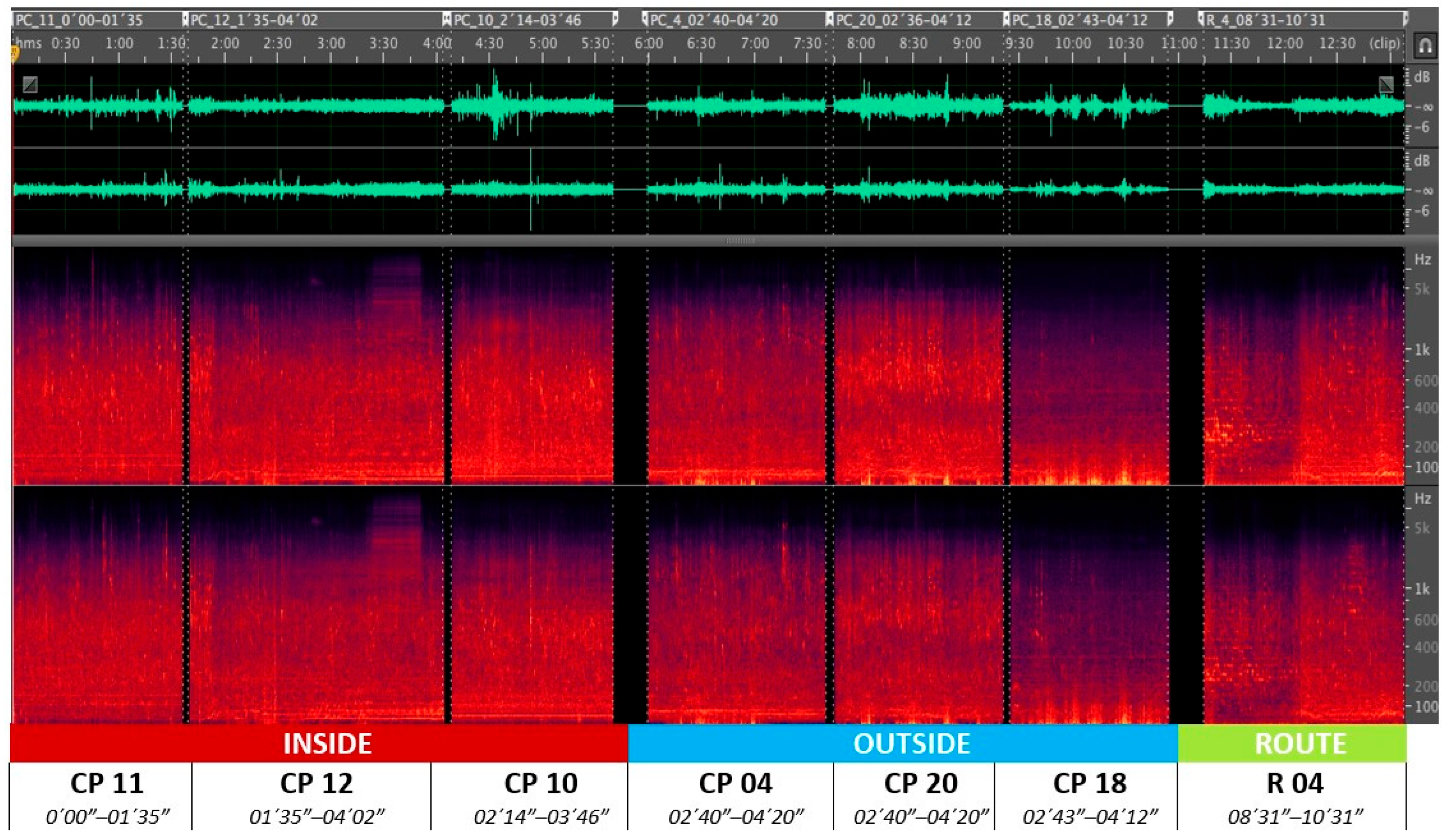
Sequence 1 (indoor/outdoor variety), Figure 11. The first track is designed to offer a variety of scenarios divided between pedestrian and outdoor interiors. The fragments are selected with approximate durations 01:30–02:30, seeking a balance between representativeness (time for habituation and “situation” in the scene) and fatigue/memory limitation at the end of the sequence. Interior: PC 11, PC 12, PC 10 (segments 00:00–01:35; 01:35–04:02; 02:14–03:46). Outdoor: PC 04, PC 20, PC 18 (segments 02:40–04:20; 02:40–04:20; 02:43–04:12). Route: R 04, section 08:31–10:31, as a transition fragment between areas (Table 1). The inclusion of this section of the route allows us to incorporate, within the same sequence, the dynamic condition of displacement and the progressive passage between spatial areas, maintaining coherence with the interior vs. exterior/perimeter criteria, as shown in Figure 10.
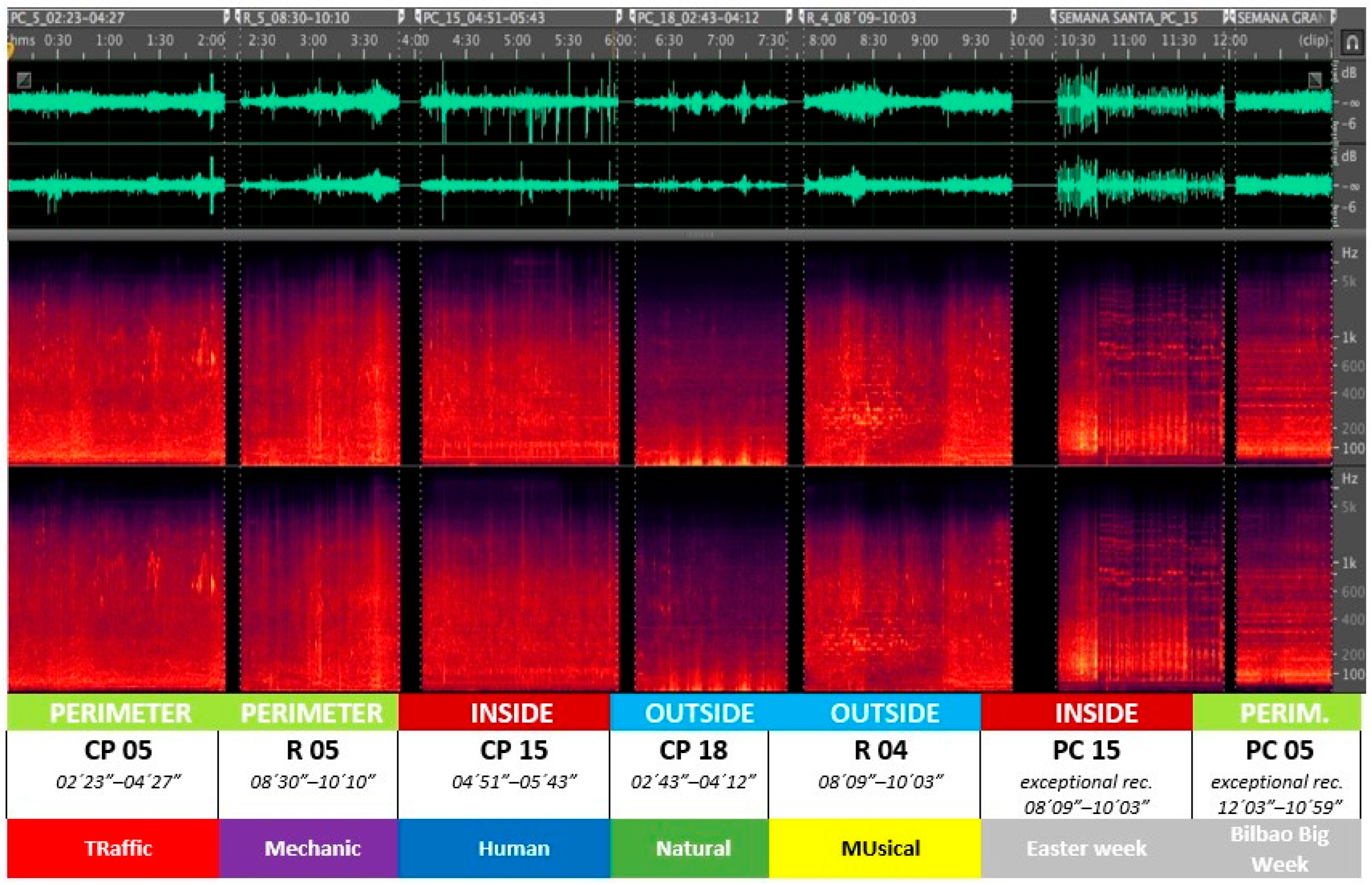
Sequence 2 (selection by sound backgrounds + two exceptional cases), as shown in Figure 12. The second track is built mainly by the type of background (rather than by location), using representative backgrounds from the categories of the analysis and mixing indoor/outdoor/perimeter and PC/R as appropriate to the dominant background. Road traffic background: PC 05 (02:23–04:27). Technical/mechanical background: R 05 (08:30–10:10). Human background: PC 15 (04:51–05:43). Natural background: PC 18 (02:43–04:12). Musical background: R 04 (08:09–10:03). In addition, two “exceptional” fragments are added at the end: Holy Week (PC 15, 08:09–10:03) and Bilbao Big Week (PC 05, 10:59–12:03) (Table 1).
Sequence 3 (temporality + control point vs. route + scope), as shown in Figure 13. The third track is selected by temporal dynamics (morning/afternoon/night) and by the difference between PC (stillness) and R (displacement), while also maintaining the belonging to indoor/outdoor/perimeter. Composition: PC 08 (morning, 02:23–04:27); R 03 (afternoon, 00:51–03:40); R 06 (morning, 00:40–03:05); R 01 (afternoon, 01:40–03:06); and PC 24 (night, Kalealdia, 17:00–19:44) (Table 1).
Overall, RESULTS 1–3 establish a traceable progression from empirical evidence to operationalization: (i) a descriptive–documentary corpus based on cards, a qualified sound map and initial sound identity; (ii) an analytical synthesis organized into five dimensions (D1–D5) that structures the main patterns of the soundscape; and (iii) the translation of these patterns into variables, criteria and audio sequences documented by means of explicit fragments and temporal segments. This chain of results provides the necessary framework to interpret the meaning of the identified dominances, spatial contrasts and situational variations, as well as to discuss their scope and their methodological and urban implications, aspects that are addressed below in Section 4 (Discussion).

5. Discussion

5.1. Contribution of the Multilayer Approach

Contemporary soundscape approaches have shifted attention from reading focused exclusively on acoustic levels to approaches that integrate context, use, and perception. In this framework, the ISO 12913 series situate the soundscape as a construction situated between person, acoustic environment and context, and provide useful criteria for its definition and systematic data collection [38,39]. From this perspective, the layered results logic used in this study—empirical corpus, analytical synthesis and operational materials—is not only an expository resource, but a methodological decision aimed at preserving traceability between records, interpretation and subsequent application.
The main contribution of the approach lies, therefore, in making explicit the chain that connects on-site registration, analytical listening, comparative reading and preparation of materials for subsequent phases. In a complex urban environment such as the Old Town of Bilbao, this traceability makes it possible to relate sound scenes, spatial configuration and urban uses without reducing the analysis to an inventory of sources. At the same time, it is worth specifying the scope of the work: the article does not present a participatory validation that has already been completed, but an explicit and operational analytical basis on which this validation can be developed at a later stage.

5.2. Dimensions 1–5 as a Bridge Between Auditory Experience and Urban Form

The five-dimensional synthesis is not limited to ordering sound sources or categories, but acts as a bridge between the situated auditory experience, the spatial organization of the study area and the urban materiality that modulates propagation, reverberation and masking. In the case analyzed, the interior–exterior–perimeter structure does not operate only as a geometric division, but as an effective criterion for interpreting differentiated sound situations: in the pedestrian interior, scenes more linked to the permanence, conversation and reverberation of streets and squares predominate; on the perimeters and edges, on the other hand, persistent traffic backgrounds, mobility cycles and contrasts between flows and areas of stay acquire more weight.
This reading allows for the analysis to be transferred to the urban and architectural project with greater precision. In the most sensitive interior environments, where permanence, sociability and reverberation reinforce the legibility of the murmur and other nearby figures, management should be aimed at reducing episodic interferences of high salience and at making logistics, terraces and room uses more compatible. In the perimeters, on the other hand, where persistent traffic establishes the sound background more clearly, the main issue is not only the level, but the continuous exposure, the accumulation of dominance, and the relationship between the circulatory edge and the areas of stay. In the transition zones between the two systems, the interest shifts towards the mediation between mobility and permanence, preventing certain points from functioning as conflicting thresholds or as sources of overlap between incompatible uses.
From this perspective, the governance of the soundscape should not be formulated through homogeneous responses for the entire historic center, but through differentiated criteria according to the type of scene: control of occasional interference indoors, modulation of persistent backgrounds on perimeters and specific treatment of transitions. This logic is especially useful when combined with type–token reading, as it makes it possible to distinguish between sound diversity and the intensity of repetition dominance. Thus, the discussion stops focusing only on what a place sounds like and begins to consider how the sources are distributed spatially and temporally, which elements sustain the identity of the environment and which generate conflict by reiteration, offering a more concrete basis for decisions on location, rotation, compatibility of uses and contextual regulation of sound activities in public space.

5.3. Type vs. Token: Diversity, Dominance and Sound Identity

The type–token reading is particularly useful because it allows sound identity to be discussed without reducing it to a single metric (Figure 14). A given scene may sustain its character through the presence of minor yet meaningful elements, while its everyday habitability depends to a large extent on the weight acquired by other sounds through repetition and persistence. This distinction is well established in corpus analysis and lexical diversity studies, where diversity and frequency are understood to capture different dimensions of the same material [76,77]. Likewise, comparative work on noise discourse and soundscape discourse shows that the relationship between diversity and recurrence is useful for interpreting which elements become central through repetition [78].
When transferred to the urban soundscape, this distinction makes it possible to analytically separate diversity from dominance and avoids simplifications based on the opposition between “noise” and “silence”. From an operational perspective, it helps distinguish between scenes rich in nuance, scenes saturated by the reiteration of a small number of elements, and hybrid scenes in which the most appropriate intervention is not to eliminate sounds, but to rebalance the relationship between identity and dominance. In urban terms, this connects directly with soundscape governance: managing sound quality does not simply mean reducing levels, but also acting on repetition, spatial concentration, and exposure times, while preserving culturally significant components that contribute to the character of the place.

5.4. Street Musicians, Sound Coexistence and Regulation: Bilbao in a European Perspective

Street music is a particularly sensitive case for the discussion of soundscape, since it can act both as a cultural marker and an activator of urbanity, but also intensify conflicts when amplification, spatial or temporal repetition and a high density of receptors concur. In this sense, it has already been pointed out that the main trigger of the conflict is not always the acoustic level itself, but the repeated exposure to the same source at recurrent points in the Old Town, where reiteration and continuity can be more decisive than a specific measurement [79]. This observation connects directly with one of the findings of this work: the difference between element diversity (types) and dominance by repetition (tokens).
In Bilbao, the current ordinance incorporates a specific regime for actions on public roads that combines operating conditions—schedules, permanence and rotation—with control criteria when there is amplification, including a limit of 70 dBA at 5 m for cases with loudspeakers, amplifiers or pre-recorded music [80]. More recently, a revision of the regulation on the use of public space, especially in relation to terraces and coexistence, has reactivated the debate regarding which models are reasonable for balancing urban activity, rest and cultural practices [81,82]. In this context, some press reports have reflected the concern of artistic groups about the possibility of more severe restrictions on location and conditions of performance; however, this aspect must be handled with caution and clear attribution to public sources, given the changing nature of the regulatory process [83].
The European comparison (Table 2) shows that many cities avoid “all or nothing” solutions and tend to govern street music through combinations of (i) amplification restrictions, (ii) permanence limits per point, (iii) mandatory spatial rotation, (iv) licenses or designated sites, and (v) sensitive areas [6,11,12,13,14,15]. These measures are relevant because they act precisely on the factor that emerges as critical in the case of Bilbao: dominance by repetition, without the need to indiscriminately eliminate practices that can bring diversity and identity to the soundscape.
In the light of the results of this study, this discussion can be made somewhat more precise. In narrow indoor areas, with high room density, reverberation, and proximity between emitters and receivers, a music source repeated at the same point can acquire a disproportionate weight due to continuity and accumulation. In perimeter areas or edges with persistent traffic, on the other hand, the problem can shift towards competition with already dominant backgrounds or towards saturation due to coincidence of uses. From this perspective, a reading of soundscape governance should not be formulated only in terms of prohibition or permission, but in terms of contextual adjustment: rotation, permanence, zoning, and amplification conditions according to the type of soundscape.

6. Conclusions

This study proposes and applies a multi-layered approach to the characterization of the soundscape of the Old Town of Bilbao, articulating in situ recordings through control points and routes, interpretative synthesis and production of operational materials. The main contribution of the work lies in maintaining traceability between recording, documentation, comparative reading and selection of sound fragments, so that the analysis can be followed and discussed explicitly.
The results obtained show that the spatial organization interior–exterior–perimeter constitutes a useful criterion to interpret how the urban form, the distribution of uses and the conditions of mobility modulate salience, persistence, masking and contrast between sound scenes. On this basis, the synthesis by dimensions allows for the identification of recurrent patterns and spatial differences that are not sufficiently described by a reading focused only on global acoustic levels.
A particularly relevant cross-cutting contribution is type–token reading, which distinguishes between diversity of sounds present and dominance by repetition. This distinction allows us to nuance the interpretation of the sound character of a place, by differentiating between minority elements that are significant for identity and persistent elements that condition daily experience by accumulation or reiteration. In this sense, the study offers useful analytical criterion to discuss conflicts between coexistence, identity and urban sound quality.
Likewise, the work allows for progress in the discussion of implications for the planning and management of public space in historic centers. In particular, the case of street music and other focus of dominance shows the interest of approaches that are not limited to the prohibition/permission binomial, but that consider variables such as location, rotation, temporality, intensity of use and amplification conditions. The combination of dimensional synthesis and type–token reading thus provides a promising interpretative basis for guiding sound governance criteria that are more context-oriented.
However, the results should be read within the effective scope of the article. This work does not yet complete participatory validation with inhabitants and users, nor does it intend to present a method that has already been fully validated in general terms. Their contribution consists of formulating and applying an analytical protocol traceable in a specific case study, as well as preparing audio materials for a subsequent phase of reactivated listening and social contrast. Consequently, the transferability of the approach should be understood as a hypothesis of methodological applicability to comparable contexts, and not as a closed generalization.
In short, the article provides a consistent methodological and analytical basis for studying complex urban soundscapes from a situated, comparative and action-oriented perspective. Its main value does not lie in closing the validation of the method, but in making explicit a chain of work capable of connecting sound documentation, spatial interpretation and preparation of materials for future participatory and decision support phases in planning and design.
Limitations
The study presents limitations derived from the design of the registry, the situated nature of the corpus analyzed and the interpretative nature of the approach. First, the characterization is constructed from a specific set of control points and routes and specific moments of registration; therefore, certain events may be under- or over-represented according to seasonality, time variations, holidays or exceptional episodes. Secondly, although traceability is preserved through files, maps and temporal segmentation, the perceptual–semantic interpretation depends on situational conditions and the reading framework adopted, which advises additional contrasts with participants and temporal extensions. Thirdly, transferability is methodologically robust, but the relative weight of dimensions and scenes is necessarily dependent on the urban fabric, dominant uses and the local regulatory framework.
Future lines of research
As an immediate follow-up, it is proposed that the following be conducted: (i) participatory validation through reactivated listening with inhabitants and users, to contrast the synthesis by dimensions and the type–token reading with perceptions of identity, annoyance and acceptability; (ii) the extension of the register to different stations and event contexts, in order to discriminate more accurately between structural and exceptional components of the soundscape; and (iii) the translation of the interior-–outdoor-–perimeter framework and the diversity/dominance criterion into public space planning and management instruments (e.g., zoning, rotation, and amplification conditions), evaluating their impact on sound quality, coexistence, and urban experience.

Supplementary Materials

The following supporting information can be downloaded at: https://www.mdpi.com/article/10.3390/app16083630/s1, Table S1: Inventory of Control Points (CPs) and Routes (Rs), including sampling metadata, function in the sampling design, and contextual observations; Figure S1: Localized photographic views and map positions of Control Points CP01–CP07 within the study area; Figure S2: Localized photographic views and map positions of Control Points CP08–CP14 within the study area; Figure S3: Localized photographic views and map positions of Control Points CP15–CP21 within the study area; Figure S4: Localized photographic views and map positions of Control Points CP22–CP24 and Routes R01–R04 within the study area; Figure S5: Localized photographic views and map positions of Routes R05–R07 within the study area.

Author Contributions

Conceptualization, Z.I.-M.; methodology, Z.I.-M.; investigation, Z.I.-M.; formal analysis, Z.I.-M.; writing—original draft preparation, Z.I.-M.; writing—review and editing, A.M.-G. and A.C.-R.; supervision, A.M.-G. and A.C.-R. All authors have read and agreed to the published version of the manuscript.

Funding

This research received no external funding.

Data Availability Statement

The data analyzed in this study is publicly accessible. The complete files on control points and routes, as well as the extended documentation of the work, are available through the institutional repository of the UPV/EHU, http://hdl.handle.net/10810/24047 (accessed on 19 February 2026) [72]. The datasheet in Excel format with the temporal classification aligned to the timeline and the derived graphs are deposited in Zenodo in open access (https://doi.org/10.5281/zenodo.18716205) [74]. The full corpus of audio recordings (control points, routes, exceptional recordings, and general tracks) is available from Zenodo (DOI: https://doi.org/10.5281/zenodo.18561165) [75].

Conflicts of Interest

The authors declare no conflict of interest.

References

  1. Schafer, R.M. The Soundscape: Our Sonic Environment and the Tuning of the World; Knopf: New York, NY, USA, 1977. [Google Scholar]
  2. Truax, B. Acoustic Communication; Ablex: Norwood, NJ, USA, 1984. [Google Scholar]
  3. Augoyard, J.-F.; Torgue, H. (Eds.) Sonic Experience: A Guide to Everyday Sounds; McGill-Queen’s University Press: Montreal, QC, Canada, 2005. [Google Scholar]
  4. Amphoux, P. Urban Sound Identity; CRESSON/IREC: Grenoble, France, 1993. [Google Scholar]
  5. Thibaud, J.-P. The method of commented pathways. In Urban Space in Methods; Grosjean, M., Thibaud, J.-P., Eds.; Parenthèses: Paris, France, 2001; pp. 79–99. [Google Scholar]
  6. Amphoux, P.; Thibaud, J.-P. Ambiances in action/Ambiances en acte(s). In Proceedings of the International Congress on Ambiances, Montreal, QC, Canada, 19–22 September 2012. [Google Scholar]
  7. Palmese, C.; Carles, J.L. Madrid Soundscape Map: Listening and identity—MADLIST. J. Urban. Int. Res. Placemak. Urban Sustain. 2024, 17, 337–355. [Google Scholar] [CrossRef]
  8. Palmese, C.; Carles Arribas, J.L.; Rodríguez Antolín, A. The soundscape and listening as an approach to sensuous urbanism: The case of Puerta del Sol (Madrid). Urban Plan. 2023, 8, 234–248. [Google Scholar] [CrossRef]
  9. Palmese, C.; Carles, J.L. Sound and its multiple resonances: Three projects. Arbor 2023, 199, 810. [Google Scholar] [CrossRef]
  10. Voegelin, S. Listening to Noise and Silence: Towards A Philosophy of Sound Art; Bloomsbury Academic: London, UK, 2010. [Google Scholar]
  11. Voegelin, S. Sonic Possible Worlds: Hearing the Continuum of Sound; Bloomsbury Academic: London, UK, 2014. [Google Scholar]
  12. LaBelle, B. Acoustic Territories: Sound Culture and Everyday Life; Bloomsbury Academic: London, UK, 2010. [Google Scholar]
  13. LaBelle, B. Sonic Agency: Sound and Emergent Forms of Resistance; MIT Press: Cambridge, MA, USA, 2018. [Google Scholar]
  14. Ochoa Gautier, A.M. Aurality: Listening and knowledge in Nineteenth-Century Colombia; Duke University Press: Durham, NC, USA, 2019. [Google Scholar]
  15. World Health Organization. Environmental Noise Guidelines for the European Region; WHO Regional Office for Europe: Copenhagen, Denmark, 2018; Available online: https://www.who.int/europe/publications/i/item/9789289053563 (accessed on 19 February 2026).
  16. Kang, J. Urban Sound Environment; CRC Press: Boca Raton, FL, USA, 2006. [Google Scholar]
  17. Kang, J.; Schulte-Fortkamp, B. (Eds.) Soundscape and the Built Environment; CRC Press: Boca Raton, FL, USA, 2016. [Google Scholar] [CrossRef]
  18. Kang, J.; Aletta, F.; Gjestland, T.T.; Brown, L.A.; Botteldooren, D.; Schulte-Fortkamp, B.; Lercher, P.; van Kamp, I.; Genuit, K.; Fiebig, A.; et al. Ten questions on the soundscapes of the built environment. Build. Environ. 2016, 108, 284–294. [Google Scholar] [CrossRef]
  19. Vogiatzis, K.; Rémy, N. Soundscape design guidelines through noise mapping methodologies: An application to medium urban agglomerations. Noise Mapp. 2017, 4, 1–19. [Google Scholar] [CrossRef]
  20. Vogiatzis, K.; Rémy, N. From environmental noise abatement to soundscape creation through strategic noise mapping in medium urban agglomerations in South Europe. Sci. Total Environ. 2014, 482–483, 420–431. [Google Scholar] [CrossRef]
  21. Lavandier, C.; Defréville, B. The contribution of sound source characteristics in the assessment of urban soundscapes. Acta Acust. United Acust. 2006, 92, 912–921. [Google Scholar]
  22. Lavandier, C.; Aumond, P.; Gomez, S.; Dominguès, C. Urban soundscape maps modelled with geo-referenced data. Noise Mapp. 2016, 3, 278–294. [Google Scholar] [CrossRef]
  23. Raimbault, M. Qualitative judgements of urban soundscapes: Questioning questionnaires and semantic scales. Acta Acust. United Acust. 2006, 92, 929–937. [Google Scholar]
  24. Raimbault, M.; Dubois, D. Urban soundscapes: Experiences and knowledge. Cities 2005, 22, 339–350. [Google Scholar] [CrossRef]
  25. Aletta, F.; Kang, J.; Axelsson, Ö. Soundscape descriptors and a conceptual framework for developing predictive soundscape models. Landsc. Urban Plan. 2016, 149, 65–74. [Google Scholar] [CrossRef]
  26. Aletta, F.; Oberman, T.; Mitchell, A.; Tong, H.; Kang, J. Assessing the changing urban sound environment during the COVID-19 lockdown period using short-term acoustic measurements. Noise Mapp. 2020, 9, 123–134. [Google Scholar] [CrossRef]
  27. Axelsson, Ö.; Nilsson, M.E.; Berglund, B. A principal components model of soundscape perception. J. Acoust. Soc. Am. 2010, 128, 2836–2846. [Google Scholar] [CrossRef]
  28. Axelsson, Ö.; Nilsson, M.E.; Hellström, B.; Lundén, P. A field experiment on the impact of sounds from a jet-and-basin fountain on soundscape quality in an urban park. Landsc. Urban Plan. 2014, 123, 49–60. [Google Scholar] [CrossRef]
  29. Brown, A.L.; Kang, J.; Gjestland, T. Towards standardization in soundscape preference assessment. Appl. Acoust. 2011, 72, 387–392. [Google Scholar] [CrossRef]
  30. Brown, A.L. A review of progress in soundscapes and an approach to soundscape planning. Int. J. Acoust. Vib. 2012, 17, 73–81. [Google Scholar] [CrossRef]
  31. Davies, W.J.; Adams, M.D.; Bruce, N.S.; Cain, R.; Carlyle, A.; Cusack, P.; Hall, D.A.; Hume, K.I.; Irwin, A.; Jennings, P.; et al. Perception of soundscapes: An interdisciplinary approach. Appl. Acoust. 2013, 74, 224–231. [Google Scholar] [CrossRef]
  32. Davies, W.J.; Murphy, J.E. Reproducibility of soundscape dimensions. In Proceedings of Acoustics 2012 Nantes Conference; Société Française d’Acoustique: Paris, France, 2012. [Google Scholar]
  33. Gasco, L.; Clavel, C.; Asensio, C.; de Arcas, G. Beyond sound level monitoring: Exploitation of social media to gather citizens’ subjective response to noise. Sci. Total Environ. 2022, 658, 68–79. [Google Scholar] [CrossRef]
  34. Gleeson, S. The Sonic Identity Model: One interdisciplinary approach for qualitative urban soundscape analysis, management and design. In NOISE-CON Proceedings; Institute of Noise Control Engineering: Wakefield, MA, USA, 2023; pp. 1–10. [Google Scholar] [CrossRef]
  35. Gleeson, S.; Allen, M.J. Application of soundscape methodologies in an acoustic consulting context. J. Acoust. Soc. Am. 2023, 154, A229. [Google Scholar] [CrossRef]
  36. Ljungdahl Eriksson, M.; Atienza, R.; Pareto, L. The Sound Bubble: A context-sensitive space in the space. Organ. Sound 2017, 22, 130–139. [Google Scholar] [CrossRef]
  37. Atienza, R.; Lundström, M. My sound space: An attentional shield for immersive redirection. In Proceedings of the 14th International Audio Mostly Conference; ACM: New York, NY, USA, 2018; pp. 171–178. [Google Scholar] [CrossRef]
  38. ISO 12913-1:2014; Acoustics—Soundscape—Part 1: Definition and Conceptual Framework. International Organization for Standardization (ISO): Geneva, Switzerland, 2014.
  39. ISO/TS 12913-2:2018; Acoustics—Soundscape—Part 2: Data Collection and Reporting Requirements. International Organization for Standardization (ISO): Geneva, Switzerland, 2018.
  40. ISO/TS 12913-3:2019; Acoustics—Soundscape—Part 3: Data Analysis. International Organization for Standardization (ISO): Geneva, Switzerland, 2019.
  41. Aletta, F.; Kang, J. Soundscape approach integrating noise mapping techniques: A case study in Brighton, UK. Noise Mapp. 2015, 2, 1–12. [Google Scholar] [CrossRef]
  42. Schulte-Fortkamp, B.; Kang, J. Introduction to the special issue on soundscapes. J. Acoust. Soc. Am. 2013, 134, 765–766. [Google Scholar] [CrossRef] [PubMed]
  43. Schulte-Fortkamp, B.; Fiebig, A.; Genuit, K. Soundscape: An approach to rely on human perception and expertise in the post-modern community noise era. In Proceedings of INTER-NOISE 2018; Institute of Noise Control Engineering: Wakefield, MA, USA, 2018; pp. 1–12. [Google Scholar]
  44. Botteldooren, D.; De Coensel, B.; De Muer, T. The temporal structure of urban soundscapes. J. Sound Vib. 2006, 292, 105–123. [Google Scholar] [CrossRef]
  45. Botteldooren, D.; Lavandier, C.; Preis, A.; Dubois, D.; Aspuru, I.; Guastavino, C.; Brown, L.; Nilsson, M.; Andringa, T.C. Understanding urban and natural soundscapes. In Proceedings of Forum Acusticum 2011; European Acoustics Association: Madrid, Spain, 2011; pp. 2047–2052. [Google Scholar]
  46. Hong, J.Y.; Jeon, J.Y. Designing sound and visual components for enhancement of urban soundscapes. J. Acoust. Soc. Am. 2013, 134, 2026–2036. [Google Scholar] [CrossRef]
  47. Hong, J.Y.; Jeon, J.Y. Influence of urban contexts on soundscape perceptions: A structural equation modeling approach. Landsc. Urban Plan. 2015, 141, 78–87. [Google Scholar] [CrossRef]
  48. De Coensel, B.; Vanwetswinkel, S.; Botteldooren, D. Effects of natural sounds on the perception of road traffic noise. J. Acoust. Soc. Am. 2011, 129, EL148–EL153. [Google Scholar] [CrossRef]
  49. De Coensel, B.; Botteldooren, D. The quiet rural soundscape and how to characterize it. Acta Acust. United Acust. 2006, 92, 887–897. [Google Scholar]
  50. Nilsson, M.E.; Berglund, B. Soundscape quality in suburban green areas and city parks. Acta Acust. United Acust. 2006, 92, 903–911. [Google Scholar]
  51. Yang, W.; Kang, J. Acoustic comfort evaluation in urban open public spaces. Appl. Acoust. 2005, 66, 211–229. [Google Scholar] [CrossRef]
  52. Yang, W.; Kang, J. Soundscape and sound preferences in urban squares: A case study in Sheffield. J. Urban Des. 2007, 10, 61–80. [Google Scholar] [CrossRef]
  53. Jeon, J.Y.; Hong, J.Y.; Lee, P.J. Soundwalk approach to identify urban soundscapes individually. J. Acoust. Soc. Am. 2013, 134, 803–812. [Google Scholar] [CrossRef] [PubMed]
  54. Jeon, J.Y.; Lee, P.J.; You, J.; Kang, J. Perceptual assessment of quality of urban soundscapes with combined noise sources and water sounds. J. Acoust. Soc. Am. 2010, 127, 1357–1366. [Google Scholar] [CrossRef] [PubMed]
  55. Liu, J.; Kang, J.; Behm, H.; Luo, T. Effects of landscape on soundscape perception: Soundwalks in city parks. Landsc. Urban Plan. 2014, 123, 30–40. [Google Scholar] [CrossRef]
  56. Liu, F.; Kang, J. A grounded theory approach to the subjective understanding of urban soundscape in Sheffield. Cities 2016, 50, 28–39. [Google Scholar] [CrossRef]
  57. Mackrill, J.; Cain, R.; Jennings, P. Experiencing the hospital ward soundscape: Towards a model. J. Environ. Psychol. 2013, 36, 1–8. [Google Scholar] [CrossRef]
  58. Mackrill, J.; Jennings, P.; Cain, R. Exploring positive hospital ward sound-scape interventions. Appl. Ergon. 2014, 45, 1454–1460. [Google Scholar] [CrossRef]
  59. Shield, B.M.; Dockrell, J.E. The effects of environmental and classroom noise on the academic attainments of primary school children. J. Acoust. Soc. Am. 2008, 123, 133–144. [Google Scholar] [CrossRef]
  60. Klatte, M.; Bergström, K.; Lachmann, T. Does noise affect learning? A short review on noise effects on cognitive performance in children. Front. Psychol. 2013, 4, 578. [Google Scholar] [CrossRef]
  61. Margaritis, E.; Kang, J. Relationship between green space-related morphology and noise pollution. Ecol. Indic. 2016, 72, 921–933. [Google Scholar] [CrossRef]
  62. Margaritis, E.; Kang, J. Soundscape mapping in environmental noise management and urban planning: Case studies in two UK cities. Noise Mapp. 2017, 4, 87–103. [Google Scholar] [CrossRef]
  63. Cerwén, G.; Pedersen, E.; Pálsdóttir, A.M. The role of soundscape in nature-based rehabilitation: A patient perspective. Int. J. Environ. Res. Public Health 2016, 13, 1229. [Google Scholar] [CrossRef] [PubMed]
  64. Erfanian, M.; Mitchell, A.J.; Kang, J.; Aletta, F. The psychophysiological implications of soundscape: A systematic review of empirical literature and a research agenda. Int. J. Environ. Res. Public Health 2019, 16, 3533. [Google Scholar] [CrossRef]
  65. Augoyard, J.-F. The wiretap interview reactivated. In Urban Space in Methods; Grosjean, M., Thibaud, J.-P., Eds.; Parenthèses Editions: Marseille, France, 2001; pp. 127–153. Available online: https://cressound.grenoble.archi.fr/fichier_pdf/num/2001_JF_A_BS_EcouteReactivee.pdf (accessed on 20 February 2026).
  66. Schaeffer, P. Traité des Objets Musicaux: Essai Interdisciplines; Éditions du Seuil: Paris, France, 1970. [Google Scholar]
  67. Schafer, R.M. The Soundscape and Tuning of the World; Intermedio (Prodimag, S.L.): Barcelona, Spain, 2013. [Google Scholar]
  68. Gibson, J.J. The Ecological Approach to Visual Perception; Reprint/Edition of the Classic Originally Published in 1979; Psychology Press: New York, NY, USA, 1986. [Google Scholar] [CrossRef]
  69. Thibaud, J.-P. Practical visions in an urban environment. In Regards en Action: Vers une Ethnomethodology de L’espace Public; Éditions À la Croisée: Grenoble, France, 2002; pp. 21–54. [Google Scholar]
  70. Barbaras, R. Desire and Distance: Introduction to a Phenomenology of Perception; Vrin: Paris, France, 1999. [Google Scholar]
  71. Merleau-Ponty, M. The Visible and the Invisible: Followed by Working Notes; Lingis, A., Translator; Northwestern University Press: Evanston, IL, USA, 1968. [Google Scholar]
  72. Iturbe Martín, Z. A Perceptual Approach to the Urban Sound Environment: Methodological Variant in the Old Town of Bilbao. Ph.D. Thesis, University of the Basque Country/Euskal Herriko Unibertsitatea (UPV/EHU), Biscay, Spain, 2017. Available online: http://hdl.handle.net/10810/24047 (accessed on 19 February 2026).
  73. Rivas, F. What Is the Sound Object? The Phenomenology of Sound in Pierre Schaeffer; Text Presented During the Tribute for the 100th Anniversary of the Birth of Pierre Schaeffer, Museum of Modern Art, Rijeka, Croatia, October 2010. Available online: https://www.academia.edu/6646633/Qu%C3%A9_es_el_objeto_sonoro_La_fenomenolog%C3%ADa_del_sonido_en_Pierre_Schaeffer (accessed on 20 February 2026).
  74. Iturbe Martin, Z. Bilbao Old Town Urban Soundscape DATASHEET; Zenodo: Geneva, Switzerland, 2026. [Google Scholar] [CrossRef]
  75. Iturbe Martin, Z. Bilbao Old Town Urban Soundscape, Version v1; Zenodo: Geneva, Switzerland, 2026. [CrossRef]
  76. Malvern, D.; Richards, B. Investigating accommodation in language proficiency interviews using a new measure of lexical diversity. Lang. Test. 2002, 19, 85–104. [Google Scholar] [CrossRef]
  77. McCarthy, P.M.; Jarvis, S. MTLD, vocd-D, and HD-D: A validation study of sophisticated approaches to lexical diversity assessment. Behav. Res. Methods 2010, 42, 381–392. [Google Scholar] [CrossRef] [PubMed]
  78. Niessen, M.E.; Van de Cruys, T.; Cance, C.; Dubois, D. Sound and noise in sonic environmental studies: Comparing word meaning in discourses of community noise and soundscape research. Acta Acust. United Acust. 2013, 99, 853–862. [Google Scholar] [CrossRef]
  79. Bilbao City Council. Public Space Ordinance; Definitively Approved by Plenary Agreement on 23 September 2010; Published in Boletín Oficial de Bizkaia No. 186, 27 September 2010; Entered into Force on 16 October 2010. Available online: https://www.euskadi.eus/contenidos/informacion/ordenanzas_adicciones/es_def/adjuntos/ORDENANZA_ESPACIO_PUBLICO_BILBAO.pdf (accessed on 19 February 2026).
  80. Bilbao City Council. Bilbao City Council Advances the Processing of the New Ordinance on Terraces, Which Will Also Regulate Other Activities in Public Space to Improve Coexistence and Citizens’ Rest. 2026. Available online: https://www.bilbao.eus/cs/Satellite?c=BIO_Noticia_FA&cid=1279245885422&language=es&pageid=1279190880027&pagename=Bilbaonet%2FBIO_Noticia_FA%2FBIO_Noticia (accessed on 19 February 2026).
  81. elDiario.es. The Closure of the Terraces of the Hospitality Industry in Bilbao Will Be Brought Forward by Half an Hour During the Week. 2026. Available online: https://www.eldiario.es/euskadi/cierre-terrazas-hosteleria-bilbao-adelantara-media-hora-semana_1_12907813.html (accessed on 19 February 2026).
  82. Radio Popular–Herri Irratia. Bilbao’s Street Artists Warn: “The New Ordinance Can Erase Art from the Streets”. 2026. Available online: https://radiopopular.com/podcast/los-artistas-callejeros-de-bilbao-alertan-la-nueva-ordenanza-puede-borrar-el-arte-de-las-calles (accessed on 19 February 2026).
  83. City of Amsterdam. Street Artist or Street Musician. Available online: https://www.amsterdam.nl/en/business/street-artist-street/ (accessed on 19 February 2026).
  84. City of Vienna. Place Ticket for Street Art Performances (Información Municipal). Available online: https://www.wien.gv.at/amtswege/platzkarte-strassenkunstdarbietungen (accessed on 19 February 2026).
  85. City of Zurich. Street Art (Información Municipal). Available online: https://www.stadt-zuerich.ch/de/stadtleben/veranstaltungen-und-bewilligungen/veranstaltungen/strassenkunst.html (accessed on 19 February 2026).
  86. Dublin City Council. Street Performers Bye-Laws 2016. Available online: https://www.dublincity.ie/sites/default/files/media/file-uploads/2018-08/Street_Performers_Bye-Laws_2016.pdf (accessed on 19 February 2026).
  87. Westminster City Council. Busking and Street Entertainment (Licensing/Guidance). Available online: https://www.westminster.gov.uk/licensing/licensing/apply-busking-and-street-entertainment-licence (accessed on 19 February 2026).
Figure 1. Study area in Bilbao Old Town and spatial distribution of the 24 control points (CPs) and 7 routes (Rs), classified as Interior, Exterior, and Perimeter. Numbers identify the Control Points (CPs) and Routes (Rs), colors distinguish the spatial domains, circles mark the control points, and dotted lines represent the routes.
Applsci 16 03630 g001
Figure 2. The investigator capturing the scene using the ZOOM-H4N recorder, lavalier microphone, and headphones.
Applsci 16 03630 g002
Figure 3. Adobe Audition interface used during the annotation process, showing the stereo scene track, the mono researcher-comment track, and the temporal markers used for manual sound-object annotation. The figure is included as a visual illustration of the workflow rather than as a source of quantitative information.
Applsci 16 03630 g003
Figure 4. Example of the analytical file for Control Point 13 (CP13), showing the written sound description (left blue box) and the corresponding annotation of sound effects. The blue box on the right highlights the section of the file in which the sound effects identified in the scene are annotated.
Applsci 16 03630 g004
Figure 5. Example of the analytical file for Control Point 13 (CP13), showing the annotation and color-coded classification of sound objects alongside the waveform and spectrogram of the recorded scene. The figure is included as a visual illustration of the coding process used in the analytical workflow. Any non-English labels visible in the figure belong to the original analytical file and remain for documentary consistency; they do not affect scientific understanding.
Applsci 16 03630 g005
Figure 6. Example of the Excel-based analytical file used to compile the coded classification of sound objects, including source attribution, semantic function, and comparative analysis fields. The figure is included as a visual illustration of the coding and data organization process, and the corresponding file is available through the Zenodo open-access repository.
Applsci 16 03630 g006
Figure 7. Schematic methodological workflow of the study, from case-study delimitation and fieldwork design to documentary corpus construction, analytical synthesis, and preparation of operational audio materials. The figure summarizes the main stages of the research process and illustrates the links between field recording (a), sound-object classification and annotation (b), and the documentary corpus and qualified sound map (c), leading to the three main outputs of the article. Any non-English labels visible in the figure belong to the original analytical file and remain for documentary consistency; they do not affect scientific understanding.
Applsci 16 03630 g007
Figure 8. Example of the individual analytical file prepared for each Control Point (CP) and Route (R), illustrated here with Control Point 13 (CP13). Each file integrates the audio record, perceptual description, sound objects, sound effects, waveform and spectrogram, together with contextual and morphological information, in order to preserve traceability between the recorded scene and its analytical interpretation.
Applsci 16 03630 g008
Figure 9. Qualified sound map of the study area, based on the individual analytical files prepared for the 24 Control Points (CPs) and 7 Routes (Rs). The figure provides a graphic sample of the documentary corpus, linking each file to its urban location and allowing a comparative reading of the study area. Circle colors identify the main spatial domains and route category: red for Interior, blue for Exterior, green for Perimeter, and yellow for Routes.
Applsci 16 03630 g009
Figure 10. Initial visual synthesis of sound identity across the study area, represented through color-coded discs for each Control Point (CP) and Route (R). Disc colors summarize the classification of sound objects by source origin and semantic function: by source origin, blue = Human, purple = Technical, red = TRaffic, green = Natural, and grey = Other; by semantic function, pink = Sound mark, orange = Signal, yellow = Music, green = Phonetic language, and grey = Other. The image shows the information corresponding to the Interior domain only; the complete dataset, including Interior, Exterior, Perimeter, and Routes, is available in the Excel file deposited in the Zenodo repository.
Applsci 16 03630 g010
Figure 11. Sequence 1, schematic and temporal representation of the waveform and spectrogram of the compiled audio track. The sequence combines fragments selected to contrast Interior and Exterior/Perimeter situations, together with a route segment incorporated as a transition between spatial domains. The figure provides a visual illustration of the compositional logic and temporal structure of the sequence, as arranged in Adobe Audition.
Applsci 16 03630 g011
Figure 12. Sequence 2, schematic and temporal representation of the waveform and spectrogram of the compiled audio track, as arranged in Adobe Audition. Colors identify the selected fragment categories—traffic, technical/mechanical, human, natural, musical, and exceptional cases—and illustrate the compositional logic and temporal structure of the sequence.
Applsci 16 03630 g012
Figure 13. Sequence 3, schematic and temporal representation of the waveform and spectrogram of the compiled audio track, as arranged in Adobe Audition. Colors distinguish the selected fragments according to temporality and recording type within the sequence, combining morning, afternoon, and night situations, as well as Control Points (CPs) and Routes (Rs) across Interior, Exterior, and Perimeter domains. The figure provides a visual illustration of the compositional logic and temporal structure of the sequence.
Applsci 16 03630 g013
Figure 14. Type–token graphical comparison of the proportional representation of sound objects in the Interior of Bilbao Old Town. Colors identify the different sound-object categories and support the visual comparison between diversity (types) and dominance by repetition (tokens). The image shows the information corresponding to the Interior domain only; the complete dataset, including Exterior, Perimeter, and Routes, is available in the datasheet deposited in the Zenodo repository.
Applsci 16 03630 g014
Table 1. Synthesis of composition of the general tracks (sequences) (PC = control point; R = route. The “segment” indicates the stretch extracted within the original recording).
SequenceOrderFragment (PC/R)Scope (Indoor/Outdoor/Perimeter)Segment (mm:ss–mm:ss)DurationObservations
Sequence 1 (Indoor/Outdoor variety)1PC 11Interior00:00–01:3501:35
2PC 12Interior01:35–04:0202:27
3PC 10Interior02:14–03:4601:32
4PC 04Exterior02:40–04:2001:40
5PC 20Exterior02:40–04:2001:40
6PC 18Exterior02:43–04:1201:29
7R 04 (Calle Correo → Parque del Arenal)Indoor → Outdoor (transition section)08:31–10:3102:00Selected Route Section
Sequence 2 (backgrounds + exceptionals)1PC 05 (Traffic Background)Perimeter02:23–04:2702:04Dominant background
2R 05 (technical/mechanical background)Perimeter08:30–10:1001:40Dominant background
315 pcs (human background)Interior04:51–05:4300:52Dominant background
418 pcs (natural background)Exterior02:43–04:1201:29Dominant background
5R 04 (music background)Exterior08:09–10:0301:54Dominant background
6PC 15 (Easter)Interior08:09–10:0301:54Exceptional (at the end)
7PC 05 (Big Week/Txosnas)Perimeter10:59–12:0301:04Exceptional (at the end). In the artwork it appears inverted as 12:03–10:59
Sequence 3 (temporality + PC/R + scope)1PC 08 (Morning)Interior02:23–04:2702:04Morning
2R 03 (afternoon)Interior00:51–03:4002:49Afternoon
3R 06 (morning)Exterior00:40–03:0502:25Morning
4R 01 (afternoon)Perimeter01:40–03:0601:26Afternoon
5PC 24 (Kalealdia, noche)Exterior17:00–19:4402:44Night (special event)
Table 2. Comparative scheme of street music regulation (selection of European cities).
CityInstrumentOperating PrincipleAmplificationUsefulness for a Soundscape Reading
AmsterdamMunicipal rules for street performers/musiciansSorting by conditions (location/time/rotation)Generally restrictedIt reduces local dominances (tokens) and favors rotation [83]
ViennaMunicipal Authorization System/”Platzkarte”Location control and conditions of useRestrictedSpatial assignment (“where/when”) approach rather than generic prohibition [84]
ZurichMunicipal conditions for “Strassenkunst”Rules by schedules/zones and execution conditionsRestrictedFine management by sensitive areas and control of coexistence [85]
DublinMunicipal bye-laws for street performanceRegulatory framework with operating conditionsRegulatedIt combines cultural activity and operational control in public space [86]
Westminster (London)Policy/guide and control regimeConditions by area and conflict managementRegulatedCompliance-oriented model in areas of high urban pressure [87]
Disclaimer/Publisher’s Note: The statements, opinions and data contained in all publications are solely those of the individual author(s) and contributor(s) and not of MDPI and/or the editor(s). MDPI and/or the editor(s) disclaim responsibility for any injury to people or property resulting from any ideas, methods, instructions or products referred to in the content.