Horizon Calibration in Highly Deviated Wells and Implications for Velocity-Model Building


Abstract
1. Introduction
2. Data and Methods
2.1. Dispersion and Frequency-Band Mismatch
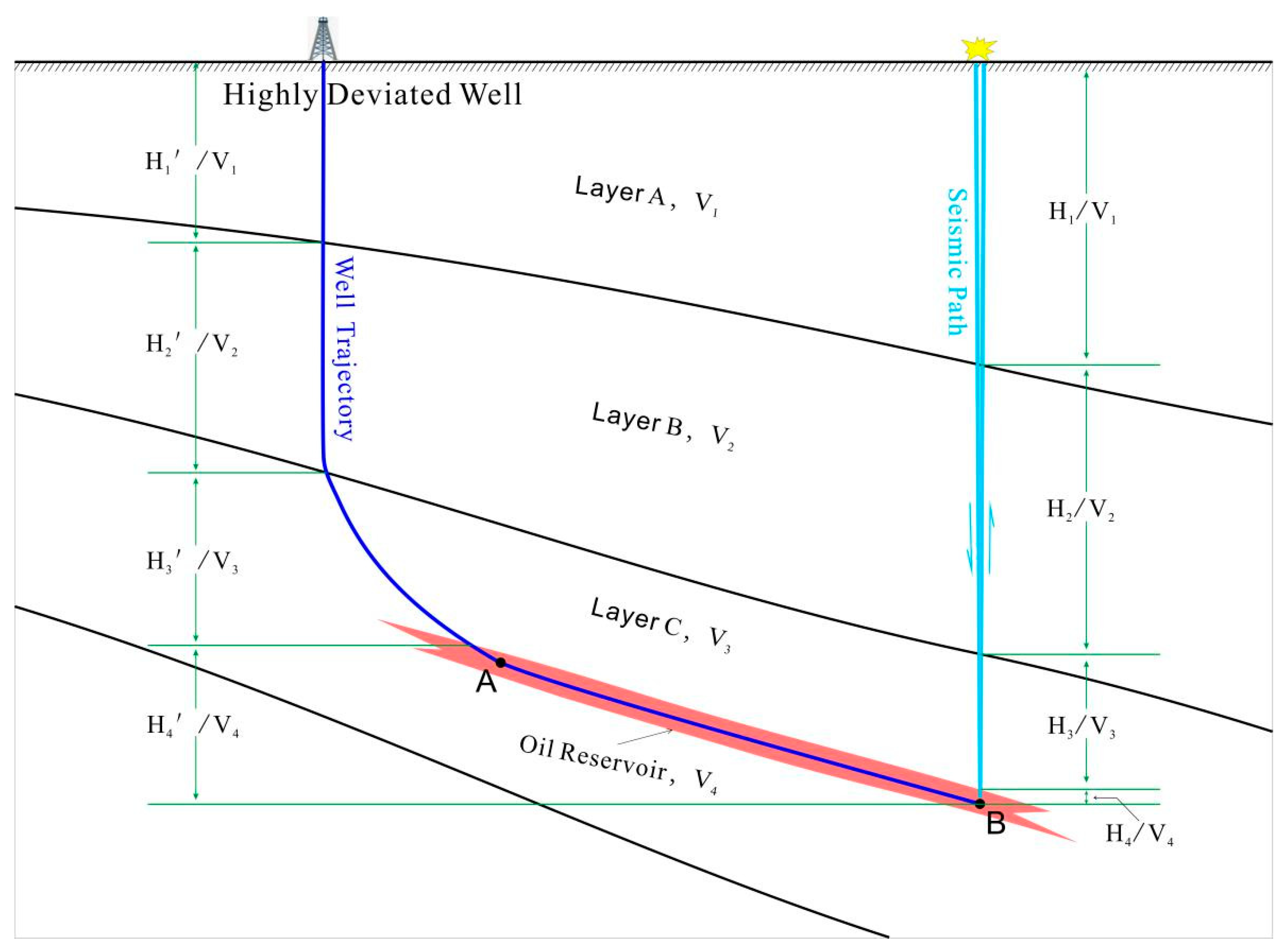
2.2. Trajectory-Driven Error in Deviated Wells
- Dispersion-driven difference between sonic-wave velocity and seismic-wave velocity;
- Path-driven difference because the sonic measurement samples the formation along an inclined trajectory, whereas the seismic time volume implicitly represents vertical propagation.
2.3. Distinctive Features of Horizon Calibration in Highly Deviated Wells and Practical Mitigation
3. Result and Discussion
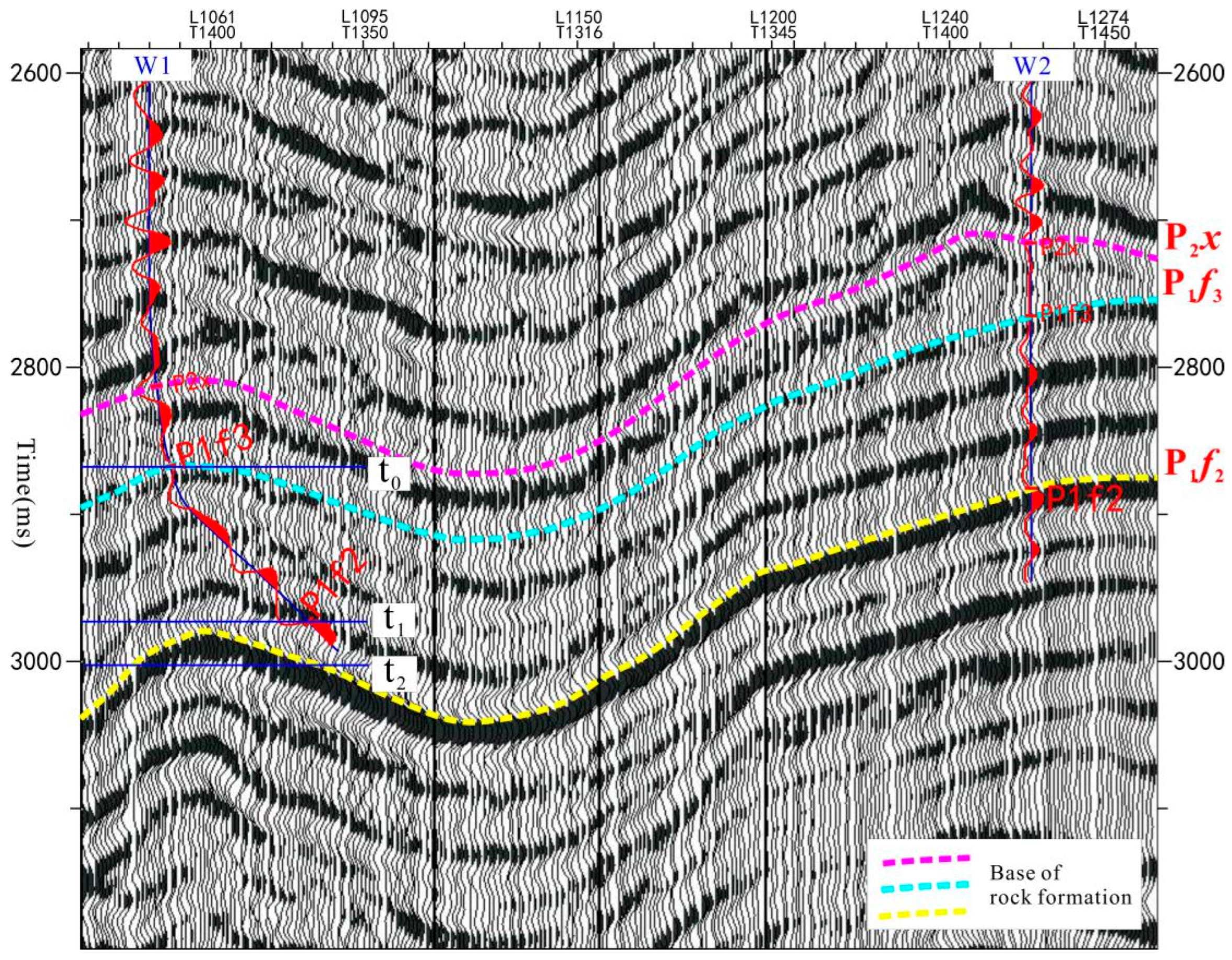
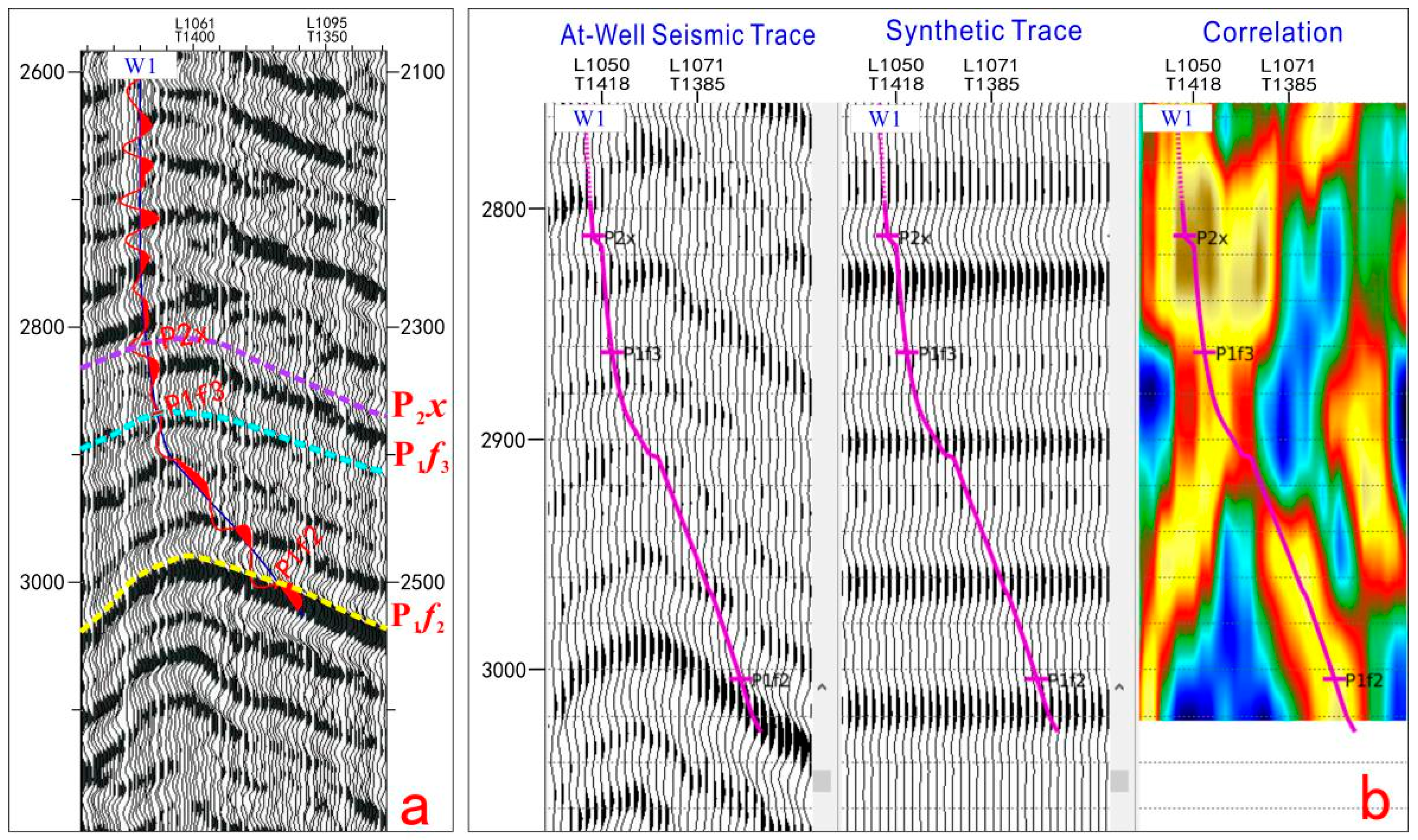
- Horizon picks in highly deviated wells should be guided primarily by regional seismic facies, using waveform coupling between the synthetic and the seismic trace as the quantitative check.
- Large stretch/squeeze can be justified in the deviated interval to correct for trajectory-driven mis-tie, and the conventional “small stretch only” constraint from vertical-well practice may not apply. This provides a more reliable tie and a stronger data foundation for downstream workflows such as velocity modeling.
4. Conclusions
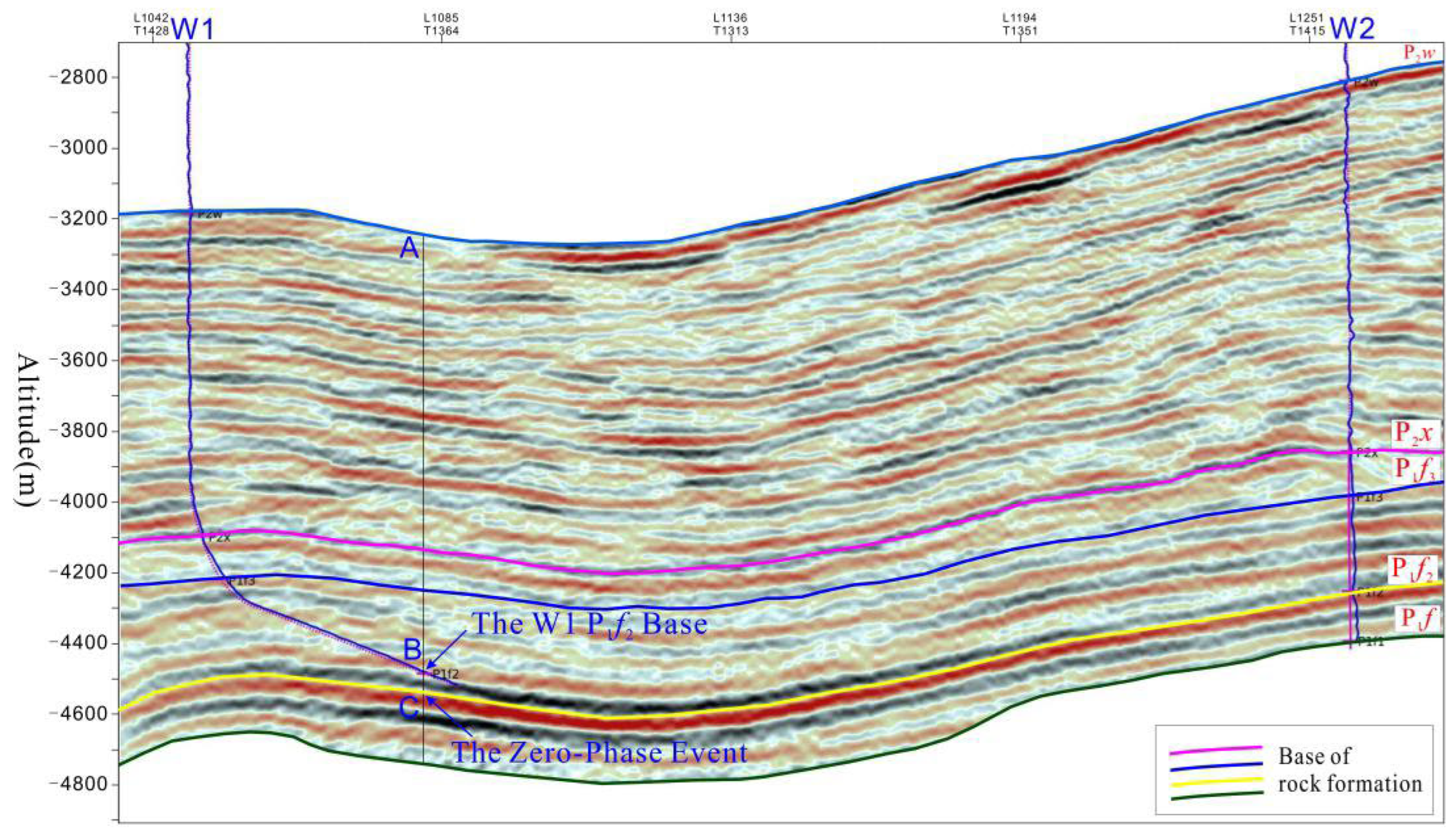
- Post-stack time-domain seismic volumes obtained after processing steps such as NMO correction and migration effectively assume vertical seismic propagation. In highly deviated wells, the logging path is inclined and therefore differs from this assumed propagation direction. As a result, the 1D velocity model derived from a conventional synthetic tie does not represent the effective seismic travel velocity at specific depth points within the deviated interval, which explains the large bias commonly observed in the initial tie.
- Workflows developed for vertical-well synthetics are not directly transferable to the deviated interval of highly deviated wells. For these wells, horizon calibration should be guided primarily by regional seismic facies and validated by waveform coupling between synthetic and seismic traces. Accordingly, large stretching/squeezing of the original logs can be warranted, and the conventional “small stretch only” rule of thumb from vertical-well practice may not apply.
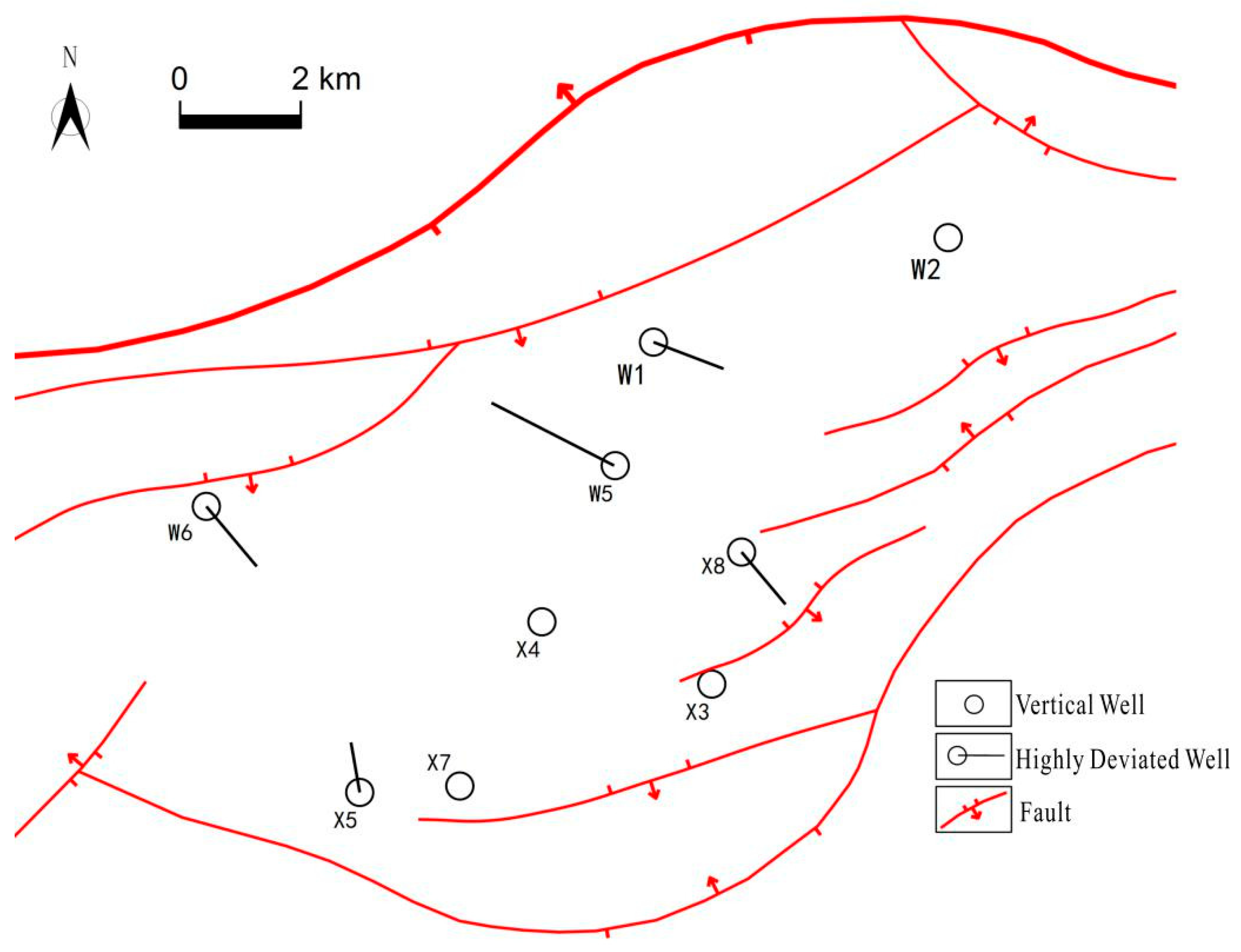
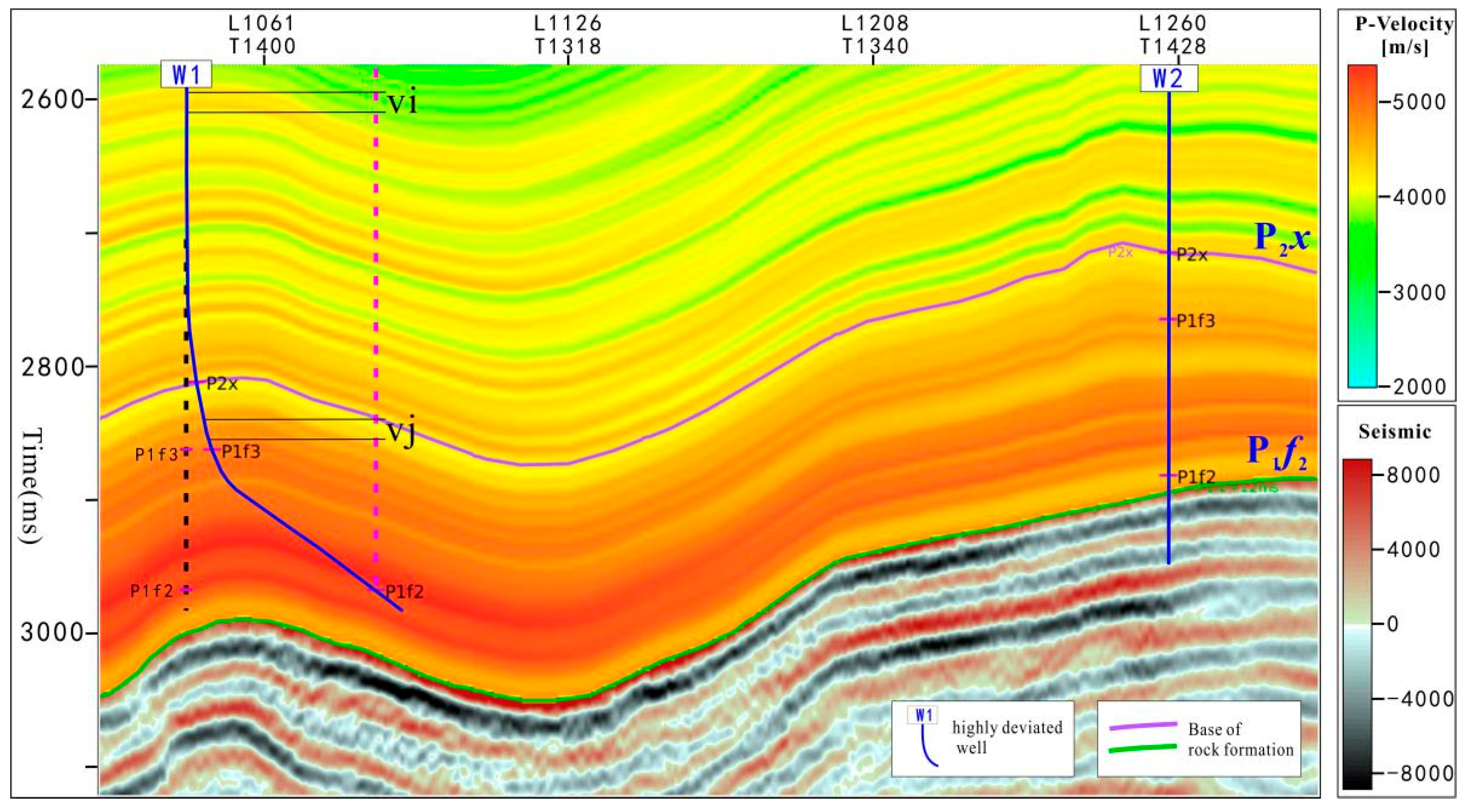
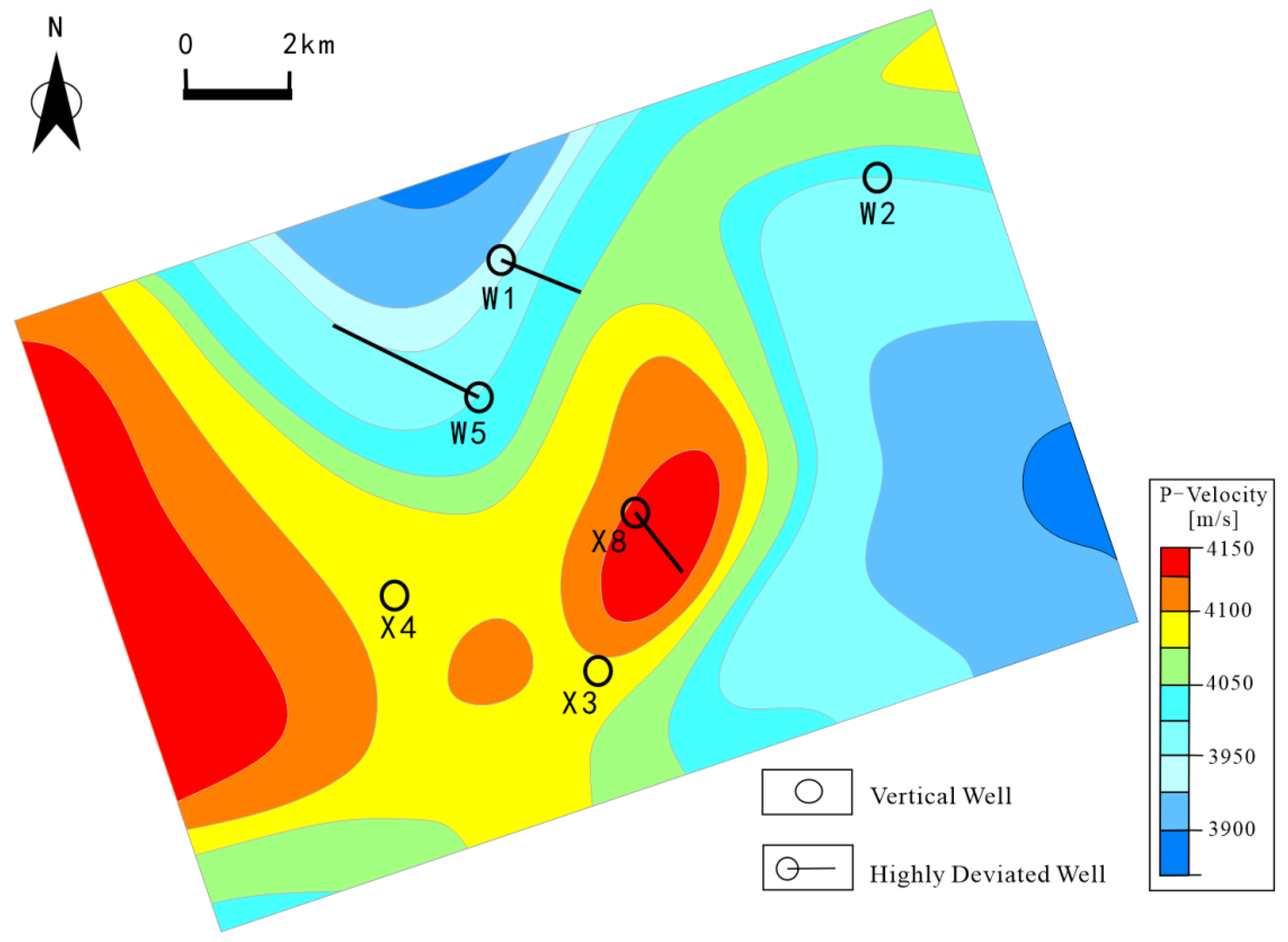
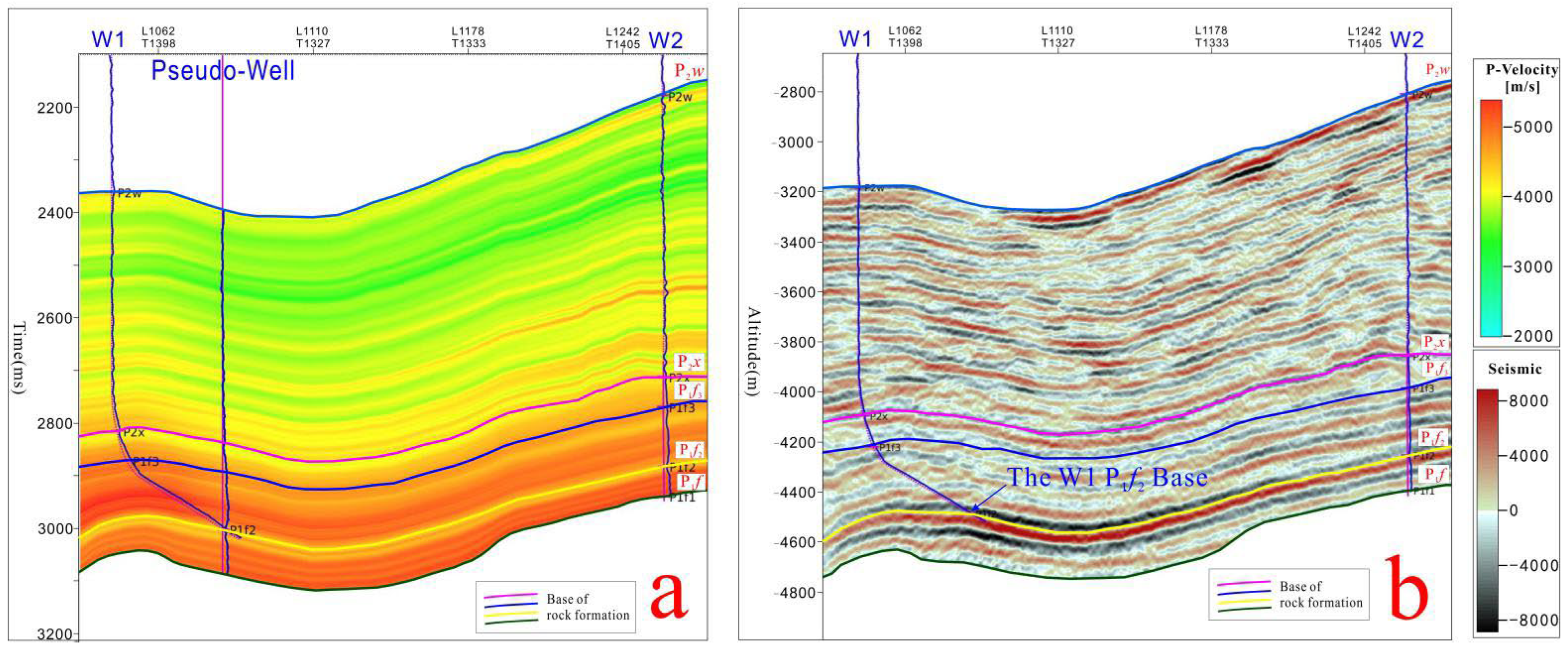
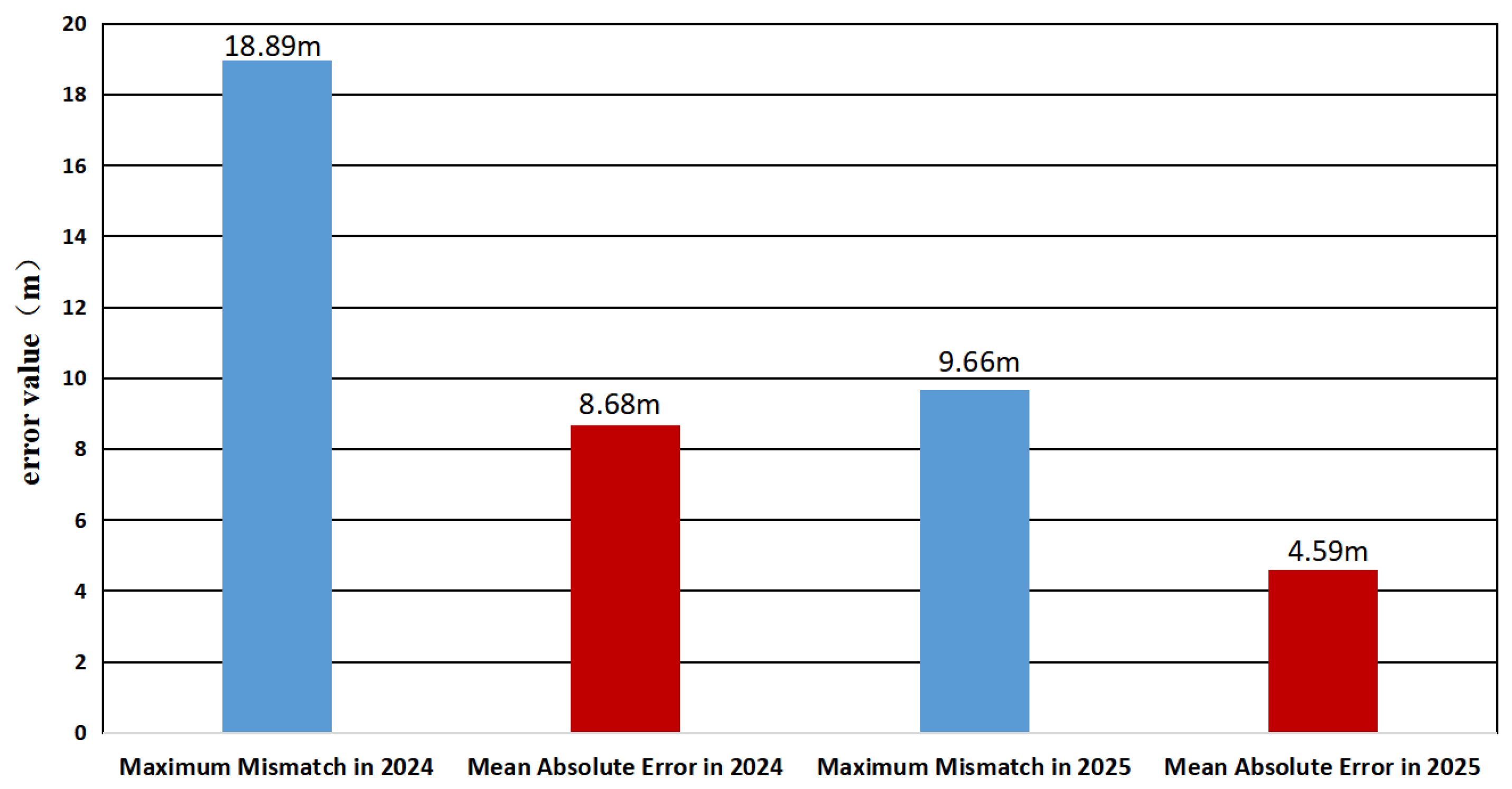
- In velocity-field modeling, vertical wells provide 1D velocity control along depth, whereas highly deviated wells provide a dense set of fixed time-depth points along a near-linear map-view trajectory. With pseudo-well constraints, these data can supply 2D velocity information along the trajectory plane, improve velocity-model accuracy, and produce a more reliable depth-domain model. Drilling results confirmed that the updated depth model provides practical guidance for geological well planning and reduces drilling risk.
Author Contributions
Funding
Institutional Review Board Statement
Informed Consent Statement
Data Availability Statement
Conflicts of Interest
References
- Tomassi, A.; De Franco, R.; Trippetta, F. High-resolution synthetic seismic modelling: Elucidating facies heterogeneity in carbonate ramp systems. Pet. Geosci. 2025, 31, 2024–2047. [Google Scholar] [CrossRef] [Scilit]
- Ling, Y. The Practice and Exploration of Seismic Data Acquisition, Processing and Interpretation Integration; Petroleum Industry Press: Beijing, China, 2007. [Google Scholar]
- Faleide, T.S.; Braathen, A.; Lecomte, I.; Anell, I. Exploring seismic detection and resolution thresholds of fault zones and gas seeps in the shallow subsurface using seismic modelling. Mar. Pet. Geol. 2022, 143, 105776. [Google Scholar] [CrossRef] [Scilit]
- Noureddine, M.A.; De Martin, F.; El Meouche, R.; Sammuneh, M.A.; Ababsa, F.; Beaufils, M. Neural Network-Based Metamodel of synthetic seismograms: Application for uncertainty quantification. Eng. Appl. Artif. Intell. 2025, 151, 110613. [Google Scholar] [CrossRef] [Scilit]
- Eivazi, R. A novel analytical approach to design horizontal well completion using ICDs to eliminate heel-toe effect. Sci. Rep. 2025, 15, 11094. [Google Scholar] [CrossRef] [Scilit]
- Xiao, H.M.; Luo, Y.C.; Zhao, X.L.; Zhang, H.Q.; Liu, X.W. Factors Influencing Productivity of Horizontal Wells with CO2 Inter-Fracture Flooding. Xinjiang Pet. Geol. 2022, 43, 479–483. [Google Scholar]
- Zhang, J.; Hu, D.D.; Qin, J.H.; Wang, Y.W.; Tang, H.Y. Optimization of Key Fracturing Parameters for Profitable Development of Horizontal Wells in Mahu Conglomerate Reservoirs. Xinjiang Pet. Geol. 2023, 44, 184–194. [Google Scholar]
- Yushchenko, T.; Demin, E.V.; Khabibullin, R.A.; Sorokin, K.S.; Khachaturyan, M.V.; Baykov, I.V.; Gatin, R.I. Case Studies and Operation Features of Long Horizontal Wells in Bazhenov Formation. SPE Prod. Oper. 2023, 38, 185–199. [Google Scholar] [CrossRef] [Scilit]
- Al-Rashidi, H.; Hussein, M.R.; Erhamah, A.; Malik, S.; Al-Hajri, A.; Salehi, N.; Rossi, G.O.; Zaitoun, A.; Almeida, D. Mitigating Water Production from High Viscosity Oil Wells in Unconsolidated Sandstone Formations. SPE Prod. Oper. 2022, 37, 762–766. [Google Scholar] [CrossRef] [Scilit]
- Zheng, J.; Fu, Y.Q.; Chen, M.; Jing, C.; Zhang, J.; Zhou, H.; Zhang, J.H. Application of Vertical P-Wave Slownesses in Porosity Evaluation of Shale Gas Reservoirs in Highly Deviated or Horizontal Wells. Xinjiang Pet. Geol. 2021, 42, 598–604. [Google Scholar]
- Ramirez Palacio, G.J.; Almario, F.; Chacon, A.C.; Rojas, E.M.; Hernandez, N.J.; Valencia, M. Production Profiles Recorded Using Fiber-Optic Technology in Wells with Electrical Submersible Pump Lift System. SPE Prod. Oper. 2023, 38, 746–763. [Google Scholar] [CrossRef] [Scilit]
- Singh, U.; Pathan, R.; Joshi, A.D.; Cavé, A.; Fouchard, C.; Baume, A. Accelerated Design of Sidetrack and Deepening Well Trajectories. SPE J. 2023, 29, 1862–1872. [Google Scholar] [CrossRef] [Scilit]
- Fang, X.D. A grouped calibration method of synthetic seismograph with complex geology: A case study of Gunan-209 area, Shengli oilfield. China Offshore Oil Gas 2006, 18, 313–315. [Google Scholar]
- Yuan, L.H.; Liu, H.; Li, J.H. Application of Well Seismic Joint Fine Calibration Technology in Stratigraphic Correlation of Hailar Basin. J. Oil Gas Technol. 2012, 34, 63–67. [Google Scholar]
- Sun, Z.T.; Meng, X.J.; Shen, G.Q.; Niu, X.M.; Ji, Y.X.; Wang, Y.M. The technology of making high-precision synthetic seismogram. Oil Geophys. Prospect. 2002, 37, 640–643. [Google Scholar]
- Zhang, Y.H.; Li, G.L. Deviated Well Horizon Calibration Technology and Its Application. Geophys. Prospect. Pet. 1999, 38, 121–126. [Google Scholar]
- Zhang, X.K.; Zhou, Y.X.; Liu, B. Method for making an inclined well synthetic seismogram. Oil Geophys. Prospect. 2000, 35, 774–778. [Google Scholar]
- AlGharbi, W.M.; Bell, R.E.; John, C.M. SRT-AI: Identifying seismic reflection terminations using deep learning. Appl. Comput. Geosci. 2025, 27, 100271. [Google Scholar] [CrossRef] [Scilit]
- Sun, Z.C.; Gu, Z.G.; Li, J.; Yang, B. Correction of well logs in the case of severe borehole enlargement. Xinjiang Pet. Geol. 2006, 27, 559–561. [Google Scholar]
- Zhang, J.-H.; Zhang, B.-B.; Zhang, Z.-J.; Liang, H.-X.; Ge, D.-M. Low-frequency data analysis and expansion. Appl. Geophys. 2015, 12, 212–220. [Google Scholar] [CrossRef] [Scilit]
- Song, J.G.; Li, H.; Liu, L.; Liu, L.Y. Quality control methods of synthetic seismograms. Prog. Geophys. 2009, 24, 176–182. [Google Scholar]
- Galiana-Merino, J.J.; Rosa-Herranz, J.L.; Rosa-Cintas, S.; Martinez-Espla, J.J. Seismic Wave Tool: Continuous and discrete wavelet analysis and filtering for multichannel seismic data. Comput. Phys. Commun. 2013, 184, 162–171. [Google Scholar] [CrossRef] [Scilit]
- Dahlin, A.; Lecomte, I.; Senger, K.; Smyrak-Sikora, A.; Braathen, A.; Stemmerik, L. Analysing lithological complexity in outcrop-scale seismic models of interbedded siliciclastics and carbonates from Svalbard. Mar. Pet. Geol. 2025, 181, 107494. [Google Scholar] [CrossRef] [Scilit]
- Mu, Q.; Li, G.; Zhang, W.; Chi, R. Effectiveness evaluation of tight sandstone reservoirs based on NMR logging. Xinjiang Pet. Geol. 2025, 46, 121–126. [Google Scholar]
- Tschannen, V.; Ghanim, A.; Ettrich, N. Partial automation of the seismic to well tie with deep learning and Bayesian optimization. Comput. Geosci. 2022, 164, 105120. [Google Scholar] [CrossRef] [Scilit]
- Jin, L.; Su, G.Z.; Liu, G.L.; Zhu, P.Y.; Li, L.; Hu, Y.P. The influencing factors and countermeasures of synthetic seismic record production. Geophys. Prospect. Pet. 2004, 43, 267–271. [Google Scholar]
- Xiao, D.Z.; Luo, Y.H.; Zeng, X.H.; Fang, X.Y.; Chen, K.; Huan, J.L. Inclined Well Logging Curve Correction and True Vertical Thickness Calculation Method Based on 3D Modeling. Chin. J. Eng. Geophys. 2023, 20, 281–289. [Google Scholar]
- Wang, Y.G.; Han, W.G.; Liu, H.J. Analysis and matching of multi-scale geophysical data. Oil Geophys. Prospect. 2008, 43, 333–339. [Google Scholar]
- Zhang, R.; Xu, Q.Z.; Parhat; Wang, H.Y.; Wei, J.L. Discussion on Improving the Precision of Formation Pressure Prediction: The Relationship between Sonic Logging Formation Velocity and Seismic Formation Velocity. J. Oil Gas Technol. 2010, 32, 274–276. [Google Scholar]
- Bi, J.F.; Cai, J.H. A method for making and calibrating synthetic records of horizontal wells: A case study on Well Zhuang 202-Ping 1 in the Zhanhua sag. China Pet. Explor. 2018, 23, 88–93. [Google Scholar]





| Formation TVD (m) | Seismic TVD (m) | Interval Velocity (m/s) |
|---|---|---|
| H1′: 974 | H1: 1633 | V1:3000 |
| H2′: 1240 | H2: 1560 | V2:3500 |
| H3′: 930 | H3: 727 | V3:4000 |
| H4′: 856 | H4: 80 | V4:3800 |
| Well Location | W5 | W6 | X5 | X8 |
|---|---|---|---|---|
| stretch/squeeze (%) | 20 | 24 | 29 | 27 |
| Well Location | W1 | W2 | W5 | X3 | X4 | X8 |
|---|---|---|---|---|---|---|
| Interval velocity (m/s) | 3935.3 | 3965.4 | 3971.8 | 4092.4 | 4068.5 | 4133.6 |
| Interval-velocity deviation from the mean (m/s) | −92.5 | −63.4 | −58.0 | 61.6 | 36.7 | 100.8 |
| Elevation of the Base of P1f2 (m) | Stratigraphic Thickness (m) | Interval Velocity (m/s) | |
|---|---|---|---|
| Initial time-depth conversion model | −4536.0 | 1292.1 | 4252.4 |
| Measured at Well W1 | −4486.2 | 1242.3 | 4088.5 |
| Error | −49.8 | 49.8 | 163.9 |
Disclaimer/Publisher’s Note: The statements, opinions and data contained in all publications are solely those of the individual author(s) and contributor(s) and not of MDPI and/or the editor(s). MDPI and/or the editor(s) disclaim responsibility for any injury to people or property resulting from any ideas, methods, instructions or products referred to in the content. |
© 2026 by the authors. Licensee MDPI, Basel, Switzerland. This article is an open access article distributed under the terms and conditions of the Creative Commons Attribution (CC BY) license.
Share and Cite
Ma, H.; Zhang, L.; Lou, T.; Zhao, Y.; Zhong, L.; Chen, X.; Chen, X. Horizon Calibration in Highly Deviated Wells and Implications for Velocity-Model Building. Appl. Sci. 2026, 16, 3628. https://doi.org/10.3390/app16083628
Ma H, Zhang L, Lou T, Zhao Y, Zhong L, Chen X, Chen X. Horizon Calibration in Highly Deviated Wells and Implications for Velocity-Model Building. Applied Sciences. 2026; 16(8):3628. https://doi.org/10.3390/app16083628
Chicago/Turabian StyleMa, Hailong, Liping Zhang, Ting Lou, Yao Zhao, Lei Zhong, Xiaoxuan Chen, and Xuan Chen. 2026. "Horizon Calibration in Highly Deviated Wells and Implications for Velocity-Model Building" Applied Sciences 16, no. 8: 3628. https://doi.org/10.3390/app16083628
APA StyleMa, H., Zhang, L., Lou, T., Zhao, Y., Zhong, L., Chen, X., & Chen, X. (2026). Horizon Calibration in Highly Deviated Wells and Implications for Velocity-Model Building. Applied Sciences, 16(8), 3628. https://doi.org/10.3390/app16083628