SAS-SemiUNet++: A Stochastic Consistency Regularized Framework with Scale-Aware Semantic Recalibration for Cardiac MRI Segmentation

Featured Application
Abstract
1. Introduction
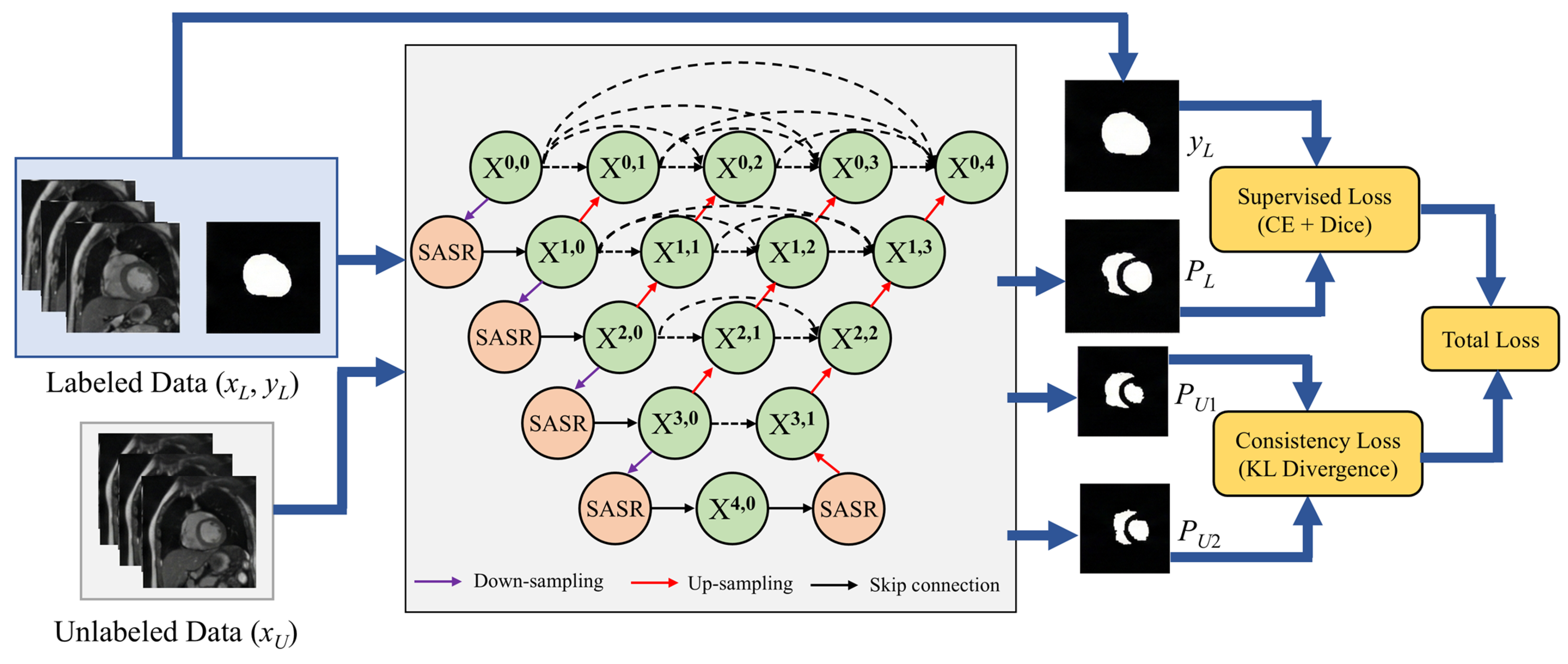
- We present a unified semi-supervised architecture that synergistically integrates anatomical scale awareness with consistency regularization. To the best of our knowledge, this is the first framework to couple dynamic receptive field recalibration with stochastic perturbation constraints within a nested dense-skip architecture for cardiac MRI segmentation.
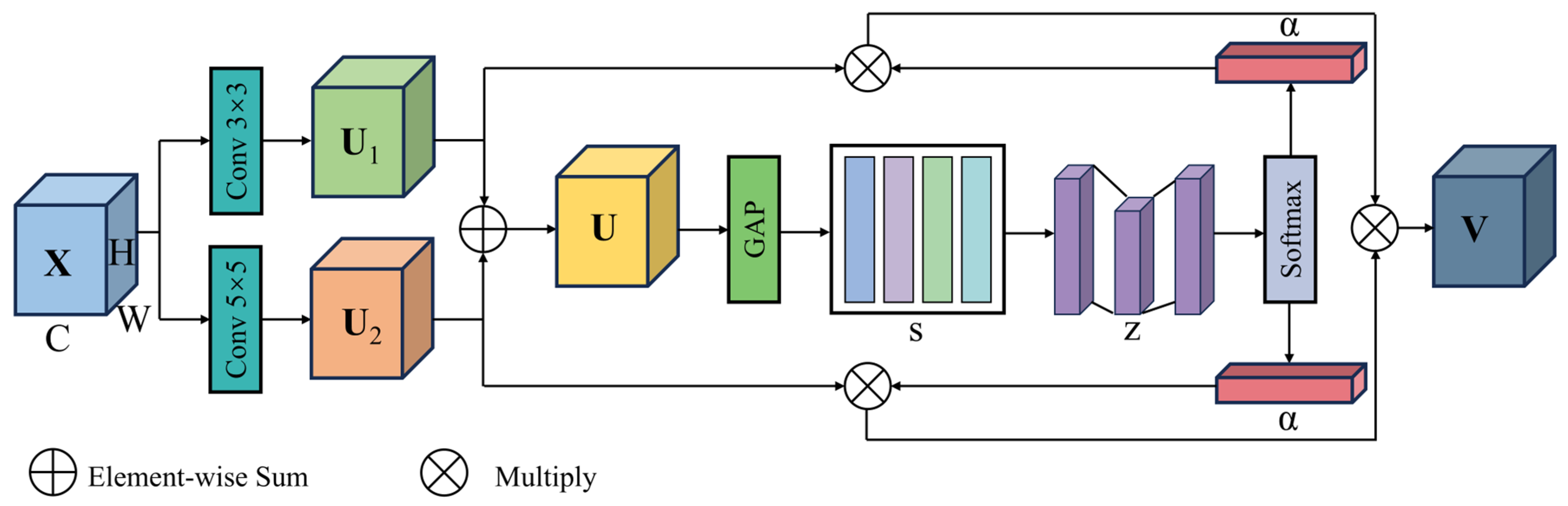
- We propose the SASR unit as a plug-and-play semantic gate. By dynamically reweighting multi-scale features, this module significantly enhances the representation of fine-grained anatomical details that are typically lost in standard encoders.
- We introduce a dual-path consistency paradigm that regularizes the model against decision noise. This strategy effectively leverages unlabeled data to smooth decision boundaries, substantially improving robustness and geometric fidelity in low-data regimes.
- Extensive experiments on the ACDC dataset validate that SAS-SemiUNet++ not only achieves state-of-the-art overlap metrics but also significantly reduces the 95% Hausdorff distance, demonstrating its exceptional capability in preserving precise anatomical boundaries.
2. Materials and Methods
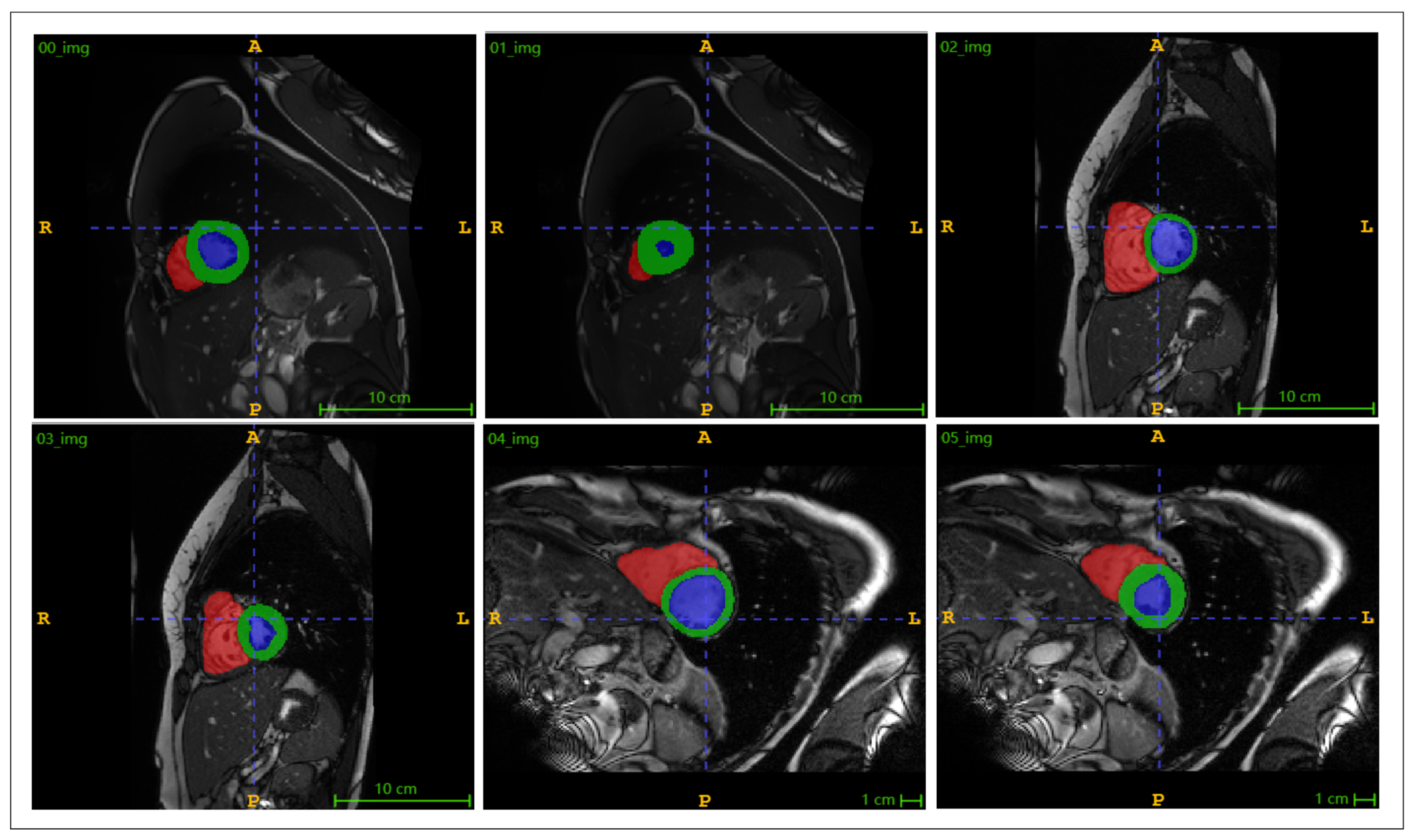
2.1. ACDC Dataset
2.2. Architectural Overview of SAS-SemiUNet++
2.3. Scale-Aware Semantic Recalibration Unit
2.4. Stochastic Consistency Regularization via Dual-Path Perturbation
2.5. Holistic Semi-Supervised Paradigm via Uncertainty-Rectified Consistency
3. Results
3.1. Experiment Condition
3.2. Evaluation Metrics
3.3. Ablation Study on Component Efficacy
3.4. Comparative Performance Analysis
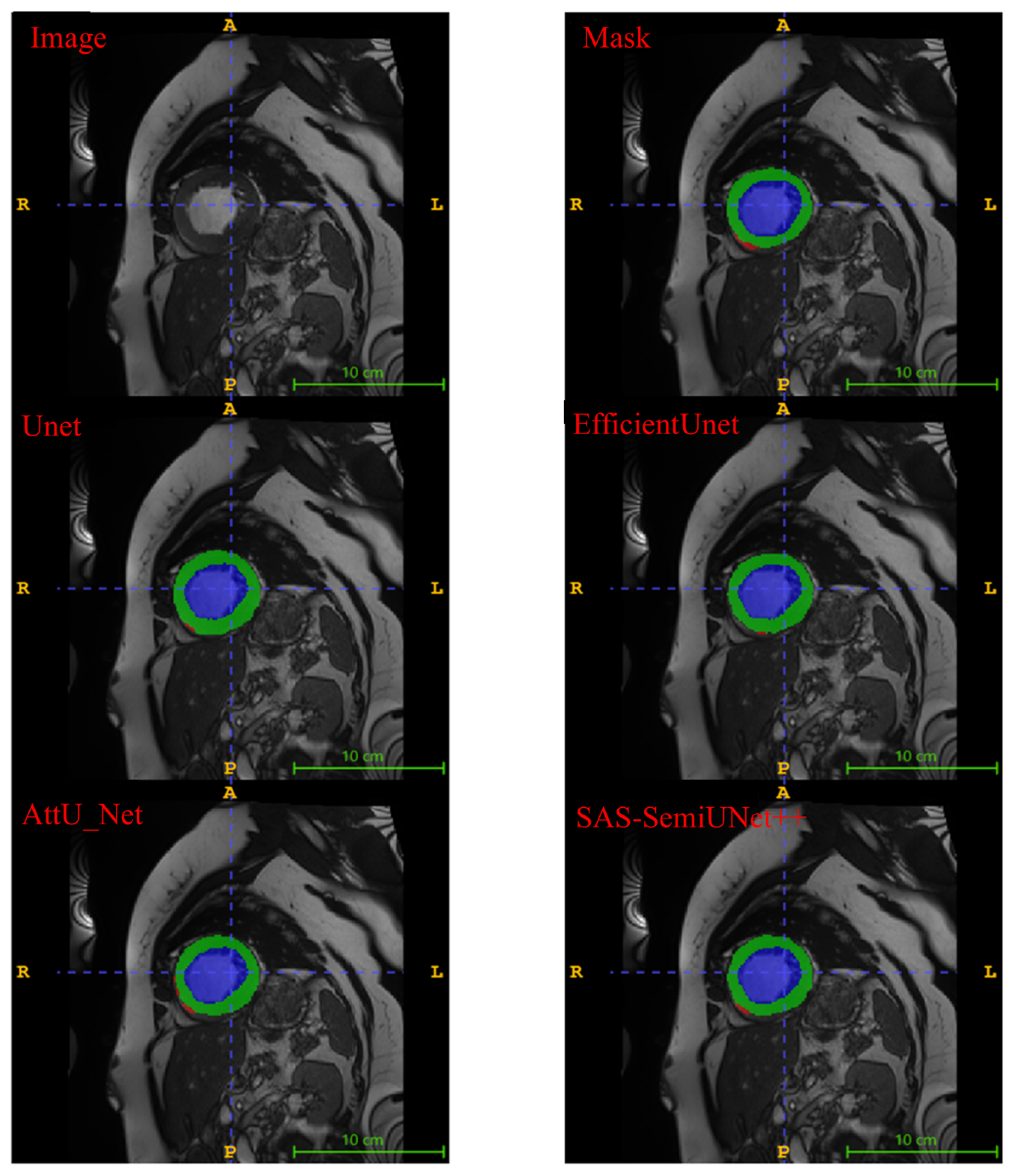
3.5. Qualitative Visualization and Perceptual Analysis
4. Discussion
5. Conclusions
Author Contributions
Funding
Institutional Review Board Statement
Informed Consent Statement
Data Availability Statement
Acknowledgments
Conflicts of Interest
Abbreviations
| ACDC | Automatic Cardiac Diagnosis Challenge |
| fwIoU | frequency-weighted Intersection over Union |
| HD95 | 95% Hausdorff Distance |
| KL | Kullback–Leibler |
| mIoU | mean Intersection over Union |
| MRI | Magnetic Resonance Imaging |
| SCR | Stochastic Consistency Regularization |
| SASR | Scale-Aware Semantic Recalibration |
| U-Net++ | UNet Plus Plus |
| SD | Standard Deviation |
References
- Zhang, Y.C.; Shen, Z.R.; Jiao, R.S. Segment anything model for medical image segmentation: Current applications and future directions. Comput. Biol. Med. 2024, 171, 108238. [Google Scholar] [CrossRef]
- Rayed, M.E.; Islam, S.S.; Niha, S.I.; Jim, J.R.; Kabir, M.M.; Mridha, M.F. Deep learning for medical image segmentation: State-of-the-art advancements and challenges. Inform. Med. Unlocked 2024, 47, 101504. [Google Scholar] [CrossRef]
- Azad, R.; Aghdam, E.K.; Rauland, A.; Jia, Y.; Avval, A.H.; Bozorgpour, A.; Karimijafarbigloo, S.; Cohen, J.P.; Adeli, E.; Merhof, D. Medical image segmentation review: The success of u-net. IEEE Trans. Pattern Anal. Mach. Intell. 2024, 46, 10076–10095. [Google Scholar] [CrossRef] [PubMed]
- Xing, Z.H.; Tian, Y.; Yang, Y.J.; Guang, L.; Zhang, L. Segmamba: Long-range sequential modeling mamba for 3d medical image segmentation. In Proceedings of the International Conference on Medical Image Computing and Computer-Assisted Intervention; Springer: Cham, Switzerland, 2024. [Google Scholar]
- Zhao, L.; Zhou, D.; Jin, X.; Zhu, W. Nn-TransUNet: An automatic deep learning pipeline for heart MRI segmentation. Life 2022, 12, 1570. [Google Scholar] [CrossRef] [PubMed]
- Liu, J.H.; Zhao, D.W.; Shen, J.Y.; Geng, P.T.; Zhang, Y.; Yang, J.F.; Zhang, Z.H. HRD-Net: High resolution segmentation network with adaptive learning ability of retinal vessel features. Comput. Biol. Med. 2024, 173, 108295. [Google Scholar] [CrossRef]
- Jiang, Q.; Jin, X.; Cui, X.; Yao, S.W.; Li, K.; Zhou, W. A lightweight multimode medical image fusion method using similarity measure between intuitionistic fuzzy sets joint laplacian pyramid. IEEE Trans. Emerg. Top. Comput. Intell. 2023, 7, 631–647. [Google Scholar] [CrossRef]
- Hatamizadeh, A.; Tang, Y.; Nath, V.; Yang, D.; Myronenko, A.; Landman, B.; Roth, H.R.; Xu, D. Unetr: Transformers for 3d medical image segmentation. In Proceedings of the IEEE/CVF Winter Conference on Applications of Computer Vision; IEEE: Piscataway, NJ, USA, 2022; pp. 574–584. [Google Scholar]
- Morales, M.A.; Manning, W.J.; Nezafat, R. Present and future innovations in AI and cardiac MRI. Radiology 2024, 310, e231269. [Google Scholar] [CrossRef]
- Zhang, D.; Lu, C.F.; Tan, T.; Dashtbozorg, B.; Long, X.T.; Xu, X.F.; Zhang, J.; Shan, C. BSANet: Boundary-aware and scale-aggregation networks for CMR image segmentation. Neurocomputing 2024, 599, 128125. [Google Scholar] [CrossRef]
- Zhang, H.; Cai, Z.W. ConvNextUNet: A small-region attentioned model for cardiac MRI segmentation. Comput. Biol. Med. 2024, 177, 108592. [Google Scholar] [CrossRef]
- Lyu, J.; Wang, G.; Wang, Z.; Dong, S.Y.; Ding, W.; Wang, C.Y. Diffusion-prior based implicit neural representation for arbitrary-scale cardiac cine MRI super-resolution. Inform. Fusion 2025, 126, 103510. [Google Scholar] [CrossRef]
- Yang, R.; Liu, K.; Liang, Y. A fusion-attention swin transformer for cardiac MRI image segmentation. IET Image Process. 2024, 18, 105–115. [Google Scholar] [CrossRef]
- Mastrodicasa, D.; van Assen, M.; Huisman, M.; Leiner, T.; Williamson, E.E.; Nicol, E.D.; Allen, B.D.; Saba, L.; Vliegenthart, R.; Hanneman, K. Use of AI in cardiac CT and MRI: A scientific statement from the ESCR, EuSoMII, NASCI, SCCT, SCMR, SIIM, and RSNA. Radiology 2025, 314, e240516. [Google Scholar] [CrossRef] [PubMed]
- Wang, Z.; Xiao, M.M.; Zhou, Y.; Wang, C.; Wu, N.; Li, Y.; Gong, Y.Y.; Chang, S.; Chen, Y.; Zhu, L.; et al. Deep separable spatiotemporal learning for fast dynamic cardiac MRI. IEEE Trans. Biomed. Eng. 2025, 72, 3642–3654. [Google Scholar] [CrossRef] [PubMed]
- Lehmann, D.H.; Gomes, B.; Vetter, N.; Braun, O.; Amr, A.; Hilbel, T.; Müller, J.; Köthe, U.; Reich, C.; Kayvanpour, E.; et al. Prediction of diagnosis and diastolic filling pressure by AI-enhanced cardiac MRI: A modelling study of hospital data. Lancet Digit. Health 2024, 6, e407–e417. [Google Scholar] [CrossRef]
- Ye, Y.; Chen, Y.W.; Wang, R.; Zhu, D.H.; Huang, Y.Y.; Huang, Y.; Liu, J.Y.; Chen, Y.X.; Shi, J.; Ding, B.; et al. Image segmentation using improved U-Net model and convolutional block attention module based on cardiac magnetic resonance imaging. J. Radiat. Res. Appl. Sci. 2024, 17, 100816. [Google Scholar] [CrossRef]
- Cui, H.; Li, Y.; Jiang, L.; Wang, Y.; Xia, Y.; Zhang, Y. Improving myocardial pathology segmentation with U-Net++ and EfficientSeg from multi-sequence cardiac magnetic resonance images. Comput. Biol. Med. 2022, 151, 106218. [Google Scholar] [CrossRef]
- Rahman, T. Fast Magnetic Resonance Image Reconstruction with Deep Learning Using an Efficientnet Encoder. Master’s Thesis, The University of Texas at El Paso, El Paso, TX, USA, 2021. [Google Scholar]
- Abdeltawab, H.; Jani, M.R.; Hasan, M.R.; Yasser, I.; Khalifa, F. A hybrid adversarial-TransUnet architecture for improving LV segmentation using cardiac cine images. In Proceedings of the International Conference on Intelligent Systems, Blockchain, and Communication Technologies; Springer: Cham, Switzerland, 2024; pp. 237–247. [Google Scholar]
- Wong, K.K.L.; Zhang, A.; Yang, K.; Wu, S.C.; Ghista, D.N. GCW-UNet segmentation of cardiac magnetic resonance images for evaluation of left atrial enlargement. Comput. Methods Programs Biomed. 2022, 221, 106915. [Google Scholar] [CrossRef]
- Li, W.; Wang, L.; Qin, S. Cms-unet: Cardiac multi-task segmentation in MRI with a u-shaped network. In Myocardial Pathology Segmentation Combining Multi-Sequence CMR Challenge; Springer: Cham, Switzerland, 2020; pp. 92–101. [Google Scholar]
- Kumar, R.; Gupta, M.; Agarwal, A.; Nayyar, A. CBAR-UNet: A novel methodology for segmentation of cardiac magnetic resonance images using block attention-based deep residual neural network. Multimed. Tools Appl. 2024, 83, 85047–85063. [Google Scholar] [CrossRef]
- Gomathi, G.; Subha, V. DPA-UNet: Detail preserving attention UNet for cardiac MRI ventricle region segmentation. Int. J. Health Sci. 2022, 6, 11833–11852. [Google Scholar] [CrossRef]
- Cui, H.; Jiang, L.; Yuwen, C.; Xia, Y.; Zhang, Y. Deep U-Net architecture with curriculum learning for myocardial pathology segmentation in multi-sequence cardiac magnetic resonance images. Knowl.-Based Syst. 2022, 249, 108942. [Google Scholar] [CrossRef]
- Firouznia, M.; Ylipää, E.; Henningsson, M.; Carlhäll, C.J. Poincare guided geometric UNet for left atrial epicardial adipose tissue segmentation in Dixon MRI images. Sci. Rep. 2025, 15, 25549. [Google Scholar] [CrossRef] [PubMed]
- Wang, X.Y.; Yang, S.X.; Fang, Y.; Wei, Y.M.; Wang, M.J.; Zhang, J.; Han, X. SK-UNet: An improved U-Net model with selective kernel for the segmentation of LGE cardiac MR images. IEEE Sens. J. 2021, 21, 11643–11653. [Google Scholar] [CrossRef]
- Islam, M.R.; Qaraqe, M.; Serpedin, E. CoST-UNet: Convolution and swin transformer based deep learning architecture for cardiac segmentation. Biomed. Signal Process. Control 2024, 96, 106633. [Google Scholar] [CrossRef]
- Fayouka, A.; Benameur, N.; Mahmoudi, R.; Masmoudi, I.; Deriche, M. Cardiac segmentation: A comparative study between 3D UNet and 2D UNet performances. In Proceedings of the 2024 IEEE/ACS 21st International Conference on Computer Systems and Applications (AICCSA); IEEE: Piscataway, NJ, USA, 2024; pp. 1–7. [Google Scholar]
- Li, Y.Z.; Wang, Y.; Huang, Y.H.; Xiang, P.; Liu, W.X.; Lai, Q.Q.; Gao, Y.Y.; Xu, M.S.; Guo, Y.F. RSU-Net: U-net based on residual and self-attention mechanism in the segmentation of cardiac magnetic resonance images. Comput. Methods Programs Biomed. 2023, 231, 107437. [Google Scholar] [CrossRef]
- Li, Y.; Chouzenoux, E.; Charmettant, B.; Benatsou, B.; Lamarque, J.P.; Lassau, N. Lightweight U-Net for lesion segmentation in ultrasound images. In Proceedings of the 2021 IEEE 18th International Symposium on Biomedical Imaging (ISBI), Nice, France, 13–16 April 2021; pp. 611–615. [Google Scholar]
- Badrinarayanan, V.; Kendall, A.; Cipolla, R. SegNet: A deep convolutional encoder-decoder architecture for image segmentation. IEEE Trans. Pattern Anal. Mach. Intell. 2017, 39, 2481–2495. [Google Scholar] [CrossRef]
- Chen, J.N.; Lu, Y.; Yu, Q.H.; Luo, X.D.; Adeli, E.; Wang, Y.; Lu, L.; Yuille, A.L.; Zhou, Y. TransUNet: Transformers make strong encoders for medical image segmentation. arXiv 2021, arXiv:2102.04306. [Google Scholar] [CrossRef]
- Oktay, O.; Schlemper, J.; Folgoc, L.L.; Lee, M.; Heinrich, M.; Misawa, K.; Mori, K.; McDonagh, S.; Hammerla, N.Y.; Kainz, B.; et al. Attention U-Net: Learning where to look for the pancreas. Med. Image Anal. 2018, 50, 108–118. [Google Scholar]
- Ronneberger, O.; Fischer, P.; Brox, T. U-Net: Convolutional networks for biomedical image segmentation. In Medical Image Computing and Computer-Assisted Intervention—MICCAI 2015; Navab, N., Hornegger, J., Wells, W.M., Frangi, A.F., Eds.; Springer: Cham, Switzerland, 2015; pp. 234–241. [Google Scholar]
- Heckel, R.; Jacob, M.; Chaudhari, A.; Perlman, O.; Shimron, E. Deep learning for accelerated and robust MRI reconstruction. Magn. Reson. Mater. Phys. Biol. Med. 2024, 37, 335–368. [Google Scholar] [CrossRef]
- Benjamin, M.M.; Rabbat, M.G. Artificial intelligence in transcatheter aortic valve replacement: Its current role and ongoing challenges. Diagnostics 2024, 14, 261. [Google Scholar] [CrossRef]
- Jin, Y.; Pepe, A.; Li, J.; Gsaxner, C.; Chen, Y.X.; Puladi, B.; Zhao, F.H.; Pomykala, K.; Kleesiek, J.; Frangi, A.F.; et al. Aortic vessel tree segmentation for cardiovascular diseases treatment: Status quo. ACM Comput. Surv. 2025, 57, 1–35. [Google Scholar] [CrossRef]
- Priyadarshi, R.; Ranjan, R.; Vishwakarma, A.K.; Yang, T.; Rathore, R.S. Exploring the frontiers of unsupervised learning techniques for diagnosis of cardiovascular disorder: A systematic review. IEEE Access 2024, 12, 139253–139272. [Google Scholar] [CrossRef]
- Meier, C.; Eisenblätter, M.; Gielen, S. Myocardial late gadolinium enhancement (LGE) in cardiac magnetic resonance imaging (CMR)—An important risk marker for cardiac disease. J. Cardiovasc. Dev. Dis. 2024, 11, 40. [Google Scholar] [CrossRef] [PubMed]
- Moradi, A.; Olanisa, O.O.; Nzeako, T.; Shahrokhi, M.; Esfahani, E.; Fakher, N.; Khazeei Tabari, M.A. Revolutionizing cardiac imaging: A scoping review of artificial intelligence in echocardiography, CTA, and cardiac MRI. J. Imaging 2024, 10, 193. [Google Scholar] [CrossRef] [PubMed]
- Cai, Y.Q.; Gong, D.X.; Tang, L.Y.; Cai, Y.; Li, H.J.; Jing, T.C.; Gong, M.; Hu, W.; Zhang, Z.W.; Zhang, X.; et al. Pitfalls in developing machine learning models for predicting cardiovascular diseases: Challenge and solutions. J. Med. Internet Res. 2024, 26, e47645. [Google Scholar] [CrossRef]
- Baeßler, B.; Engelhardt, S.; Hekalo, A.; Hennemuth, A.; Hüllebrand, M.; Laube, A.; Scherer, C.; Tölle, M.; Wech, T. Perfect match: Radiomics and artificial intelligence in cardiac imaging. Circ. Cardiovasc. Imaging 2024, 17, e015490. [Google Scholar] [CrossRef]
- Singh, V.; Sathio, A.A.; Anwar, S.; Vavekanand, R.; Danish, R. A Medical Imaging Approach for Recognising Mitral Regurgi-tation Through Machine Learning Methods in Cardiac Imaging. Cardiol. Vasc. Res. 2024, 2, 1–7. [Google Scholar]
- Liu, Z.L.; Kainth, K.; Zhou, A.; Deyer, T.W.; Fayad, Z.A.; Greenspan, H.; Mei, X. A review of self-supervised, generative, and few-shot deep learning methods for data-limited magnetic resonance imaging segmentation. NMR Biomed. 2024, 37, e5143. [Google Scholar] [CrossRef]
- Carrabba, N.; Amico, M.A.; Guaricci, A.I.; Carella, M.C.; Maestrini, V.; Monosilio, S.; Pedrotti, P.; Ricci, F.; Monti, L.; Figliozzi, S.; et al. CMR mapping: The 4th-era revolution in cardiac imaging. J. Clin. Med. 2024, 13, 337. [Google Scholar] [CrossRef]
- Rashid, I.; Cruz, G.; Seiberlich, N.; Hamilton, J.I. Cardiac MR fingerprinting: Overview, technical developments, and applications. J. Magn. Reson. Imaging 2024, 60, 1753–1773. [Google Scholar] [CrossRef]
- Dishner, K.A.; McRae-Posani, B.; Bhowmik, A.; Jochelson, M.S.; Holodny, A.; Pinker, K.; Eskreis-Winkler, S.; Stember, J.N. A survey of publicly available MRI datasets for potential use in artificial intelligence research. J. Magn. Reson. Imaging 2024, 59, 450–480. [Google Scholar] [CrossRef]
- Tolu-Akinnawo, O.Z.; Ezekwueme, F.; Omolayo, O.; Batheja, S.; Awoyemi, T. Advancements in artificial intelligence in noninvasive cardiac imaging: A comprehensive review. Clin. Cardiol. 2025, 48, e70087. [Google Scholar] [CrossRef]
- Altara, R.; Basson, C.J.; Biondi-Zoccai, G.; Booz, G.W. Exploring the promise and challenges of artificial intelligence in biomedical research and clinical practice. J. Cardiovasc. Pharmacol. 2024, 83, 403–409. [Google Scholar] [CrossRef]
- Pasdeloup, D.; Østvik, A.; Olaisen, S.; Skogvoll, E.; Dalen, H.; Lovstakken, L. Challenges and strategies for deep learning in cardiovascular imaging: Ejection fraction and heart failure management. Cardiovasc. Imaging 2025, 18, 751–764. [Google Scholar]
- Milosevic, M.; Jin, Q.; Singh, A.; Amal, S. Applications of AI in multi-modal imaging for cardiovascular disease. Front. Radiol. 2024, 3, 1294068. [Google Scholar] [CrossRef]
- Bernard, O.; Lalande, A.; Zotti, C.; Cervenansky, F.; Yang, X.; Heng, P.-A.; Cetin, I.; Lekadir, K.; Camara, O.; Ballester, M.A.G.; et al. Deep Learning Techniques for Automatic MRI Cardiac Multi-structures Segmentation and Diagnosis: Is the Problem Solved? IEEE Trans. Med. Imaging 2018, 37, 2514–2525. [Google Scholar] [CrossRef]



| Data Split | Number of Subjects | Number of 2D Slices |
|---|---|---|
| Training | 140 | 1312 |
| Validation | 20 | 196 |
| Testing | 40 | 394 |
| Total | 200 | 1902 |
| Name | Related Configurations |
|---|---|
| CPU | Intel(R) Xeon(R) Gold 5220R CPU × 2 |
| RAM | DDR4 2400 MHz 256 GB |
| Accelerator | CUDA11.1, cudnn8.0.4 |
| GPU | RTX4090 × 4 |
| Operating system | Ubuntu 18.04 |
| Framework | Pytorch 1.9.0 |
| Python version | 3.9 |
| Method | Mean_Dice (↑) | Mean_hd95 (↓) | Acc (↑) | Acc_Class (↑) | mIoU (↑) | fwIoU (↑) |
|---|---|---|---|---|---|---|
| Unet++_supervised (baseline) | 0.9030 ± 0.0003 | 1.2050 ± 0.0314 | 0.9947 ± 0.0001 | 0.9292 ± 0.0003 | 0.8715 ± 0.0003 | 0.9901 ± 0.0001 |
| Unet++ | 0.9043 ± 0.0003 | 1.2381 ± 0.0336 | 0.9947 ± 0.0001 | 0.9352 ± 0.0004 | 0.8727 ± 0.0003 | 0.9902 ± 0.0001 |
| Unet++ w/SASR | 0.9074 ± 0.0004 | 1.4288 ± 0.0427 | 0.9949 ± 0.0002 | 0.9351 ± 0.0004 | 0.8757 ± 0.0004 | 0.9905 ± 0.0002 |
| Unet++ w/SCR | 0.9050 ± 0.0003 | 1.2325 ± 0.0329 | 0.9950 ± 0.0002 | 0.9270 ± 0.0003 | 0.8739 ± 0.0003 | 0.9907 ± 0.0003 |
| SAS-SemiUNet++ (Ours) | 0.9142 ± 0.0004 | 1.1516 ± 0.0215 | 0.9954 ± 0.0002 | 0.9376 ± 0.0003 | 0.8844 ± 0.0003 | 0.9914 ± 0.0002 |
| Method | Mean_Dice (↑) | Mean_hd95 (↓) | Acc (↑) | Acc_Class (↑) | mIoU (↑) | fwIoU (↑) |
|---|---|---|---|---|---|---|
| EfficientUnet [31] | 0.9003 ± 0.0004 | 2.2168 ± 0.0392 | 0.9947 ± 0.0001 | 0.9249 ± 0.0003 | 0.8672 ± 0.0004 | 0.9901 ± 0.0001 |
| Segnet [32] | 0.8823 ± 0.0005 | 1.4197 ± 0.0287 | 0.9938 ± 0.0002 | 0.9108 ± 0.0004 | 0.8460 ± 0.0005 | 0.9885 ± 0.0002 |
| Transunet [33] | 0.8518 ± 0.0004 | 2.2018 ± 0.0415 | 0.9909 ± 0.0002 | 0.8941 ± 0.0003 | 0.8129 ± 0.0004 | 0.9838 ± 0.0001 |
| AttU_Net [34] | 0.9052 ± 0.0003 | 1.1615 ± 0.0218 | 0.9948 ± 0.0001 | 0.9422 ± 0.0003 | 0.8731 ± 0.0002 | 0.9904 ± 0.0001 |
| Unet [35] | 0.9007 ± 0.0002 | 3.1687 ± 0.0486 | 0.9945 ± 0.0001 | 0.9134 ± 0.0004 | 0.8682 ± 0.0003 | 0.9896 ± 0.0001 |
| SAS-SemiUNet++ (Ours) | 0.9142 ± 0.0003 | 1.1516 ± 0.0195 | 0.9954 ± 0.0002 | 0.9376 ± 0.0003 | 0.8844 ± 0.0004 | 0.9914 ± 0.0002 |
| Method | Metric | Mean | Patient-Level SD | Median | IQR (25th–75th) | 95% Bootstrap CI |
|---|---|---|---|---|---|---|
| U-Net++ (Baseline) | Mean Dice | 0.9030 | 0.0352 | 0.9065 | [0.8810, 0.9240] | [0.8320, 0.9480] |
| HD95 | 1.2050 | 0.5840 | 1.1200 | [0.9100, 1.6200] | [0.7600, 2.6800] | |
| SAS-SemiUNet++ (Ours) | Mean Dice | 0.9142 | 0.0281 | 0.9180 | [0.8960, 0.9320] | [0.8540, 0.9580] |
| HD95 | 1.1516 | 0.4120 | 1.0500 | [0.8600, 1.3800] | [0.6800, 2.1500] |
Disclaimer/Publisher’s Note: The statements, opinions and data contained in all publications are solely those of the individual author(s) and contributor(s) and not of MDPI and/or the editor(s). MDPI and/or the editor(s) disclaim responsibility for any injury to people or property resulting from any ideas, methods, instructions or products referred to in the content. |
© 2026 by the authors. Licensee MDPI, Basel, Switzerland. This article is an open access article distributed under the terms and conditions of the Creative Commons Attribution (CC BY) license.
Share and Cite
Rao, J.; Ma, X.; Li, X. SAS-SemiUNet++: A Stochastic Consistency Regularized Framework with Scale-Aware Semantic Recalibration for Cardiac MRI Segmentation. Appl. Sci. 2026, 16, 3507. https://doi.org/10.3390/app16073507
Rao J, Ma X, Li X. SAS-SemiUNet++: A Stochastic Consistency Regularized Framework with Scale-Aware Semantic Recalibration for Cardiac MRI Segmentation. Applied Sciences. 2026; 16(7):3507. https://doi.org/10.3390/app16073507
Chicago/Turabian StyleRao, Jie, Xinhao Ma, and Xiang Li. 2026. "SAS-SemiUNet++: A Stochastic Consistency Regularized Framework with Scale-Aware Semantic Recalibration for Cardiac MRI Segmentation" Applied Sciences 16, no. 7: 3507. https://doi.org/10.3390/app16073507
APA StyleRao, J., Ma, X., & Li, X. (2026). SAS-SemiUNet++: A Stochastic Consistency Regularized Framework with Scale-Aware Semantic Recalibration for Cardiac MRI Segmentation. Applied Sciences, 16(7), 3507. https://doi.org/10.3390/app16073507