Structuring Sustainability-Oriented Reconstruction Decisions After Earthquakes: A MIVES-Based Methodological Framework




Abstract
1. Introduction
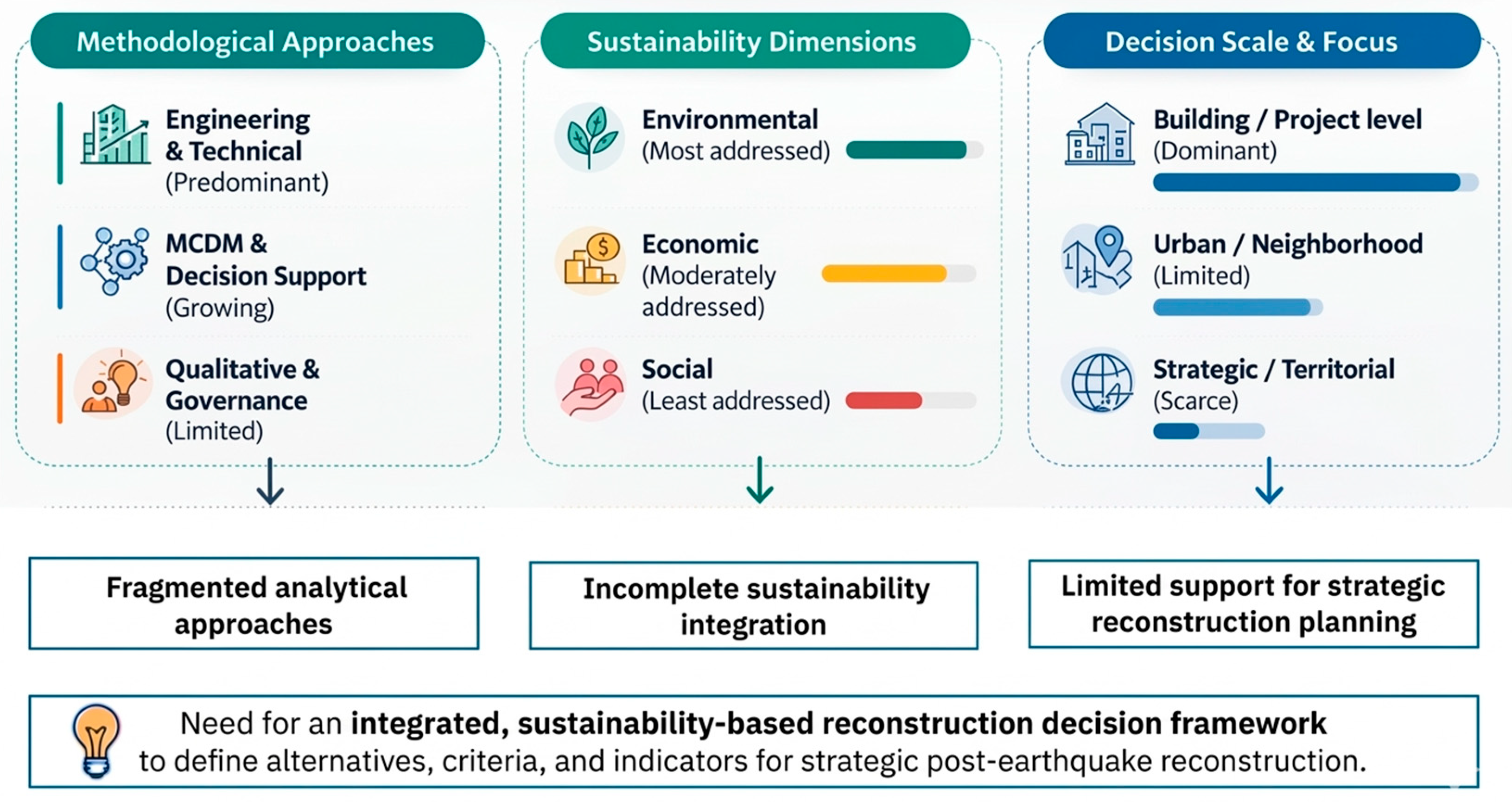
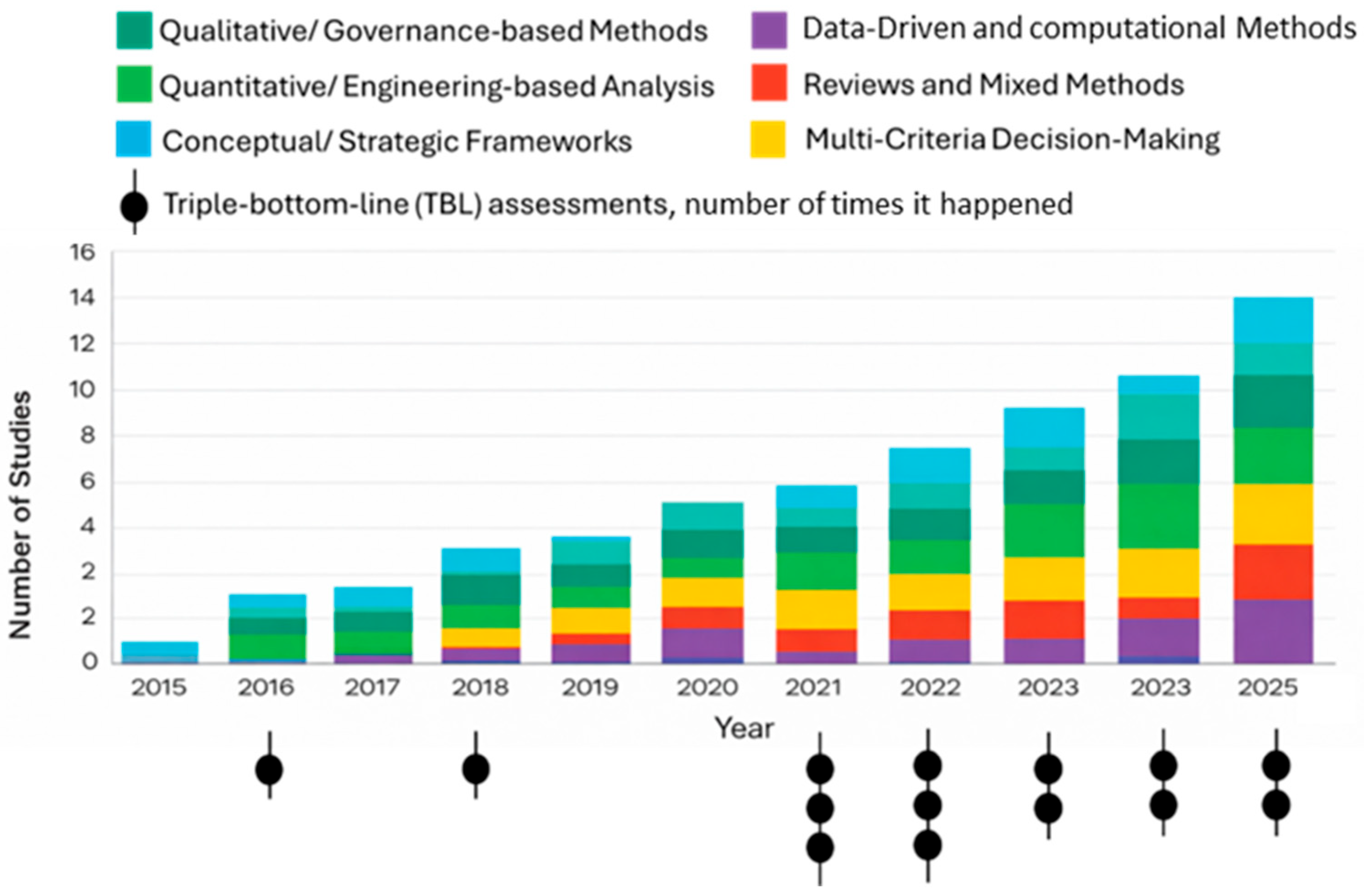
2. State of the Art
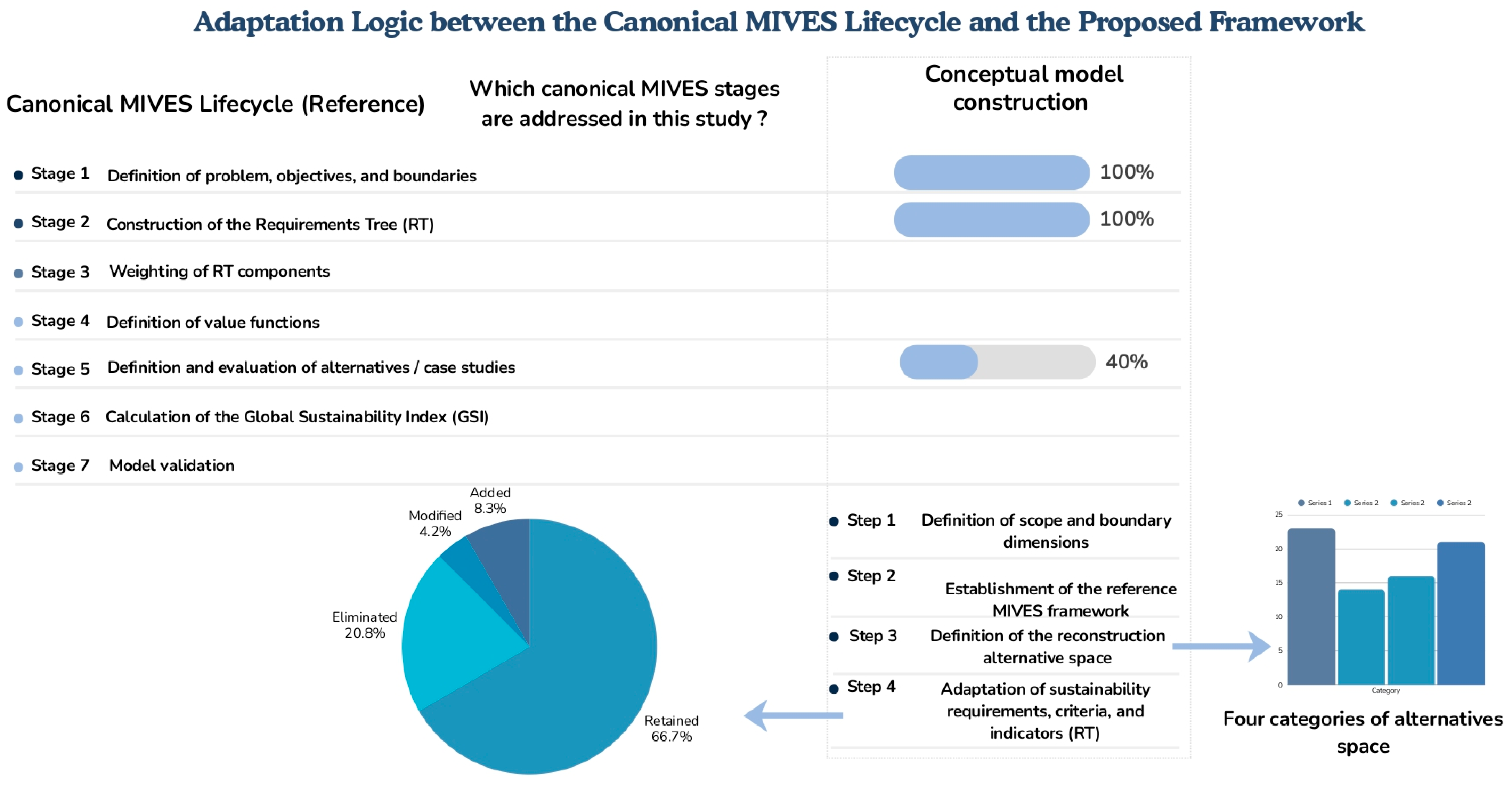
3. Methodology
3.1. Definition of Scope and Boundary Dimensions
3.2. Establishment of the Reference MIVES Framework
3.3. Definition of the Reconstruction Alternative Space
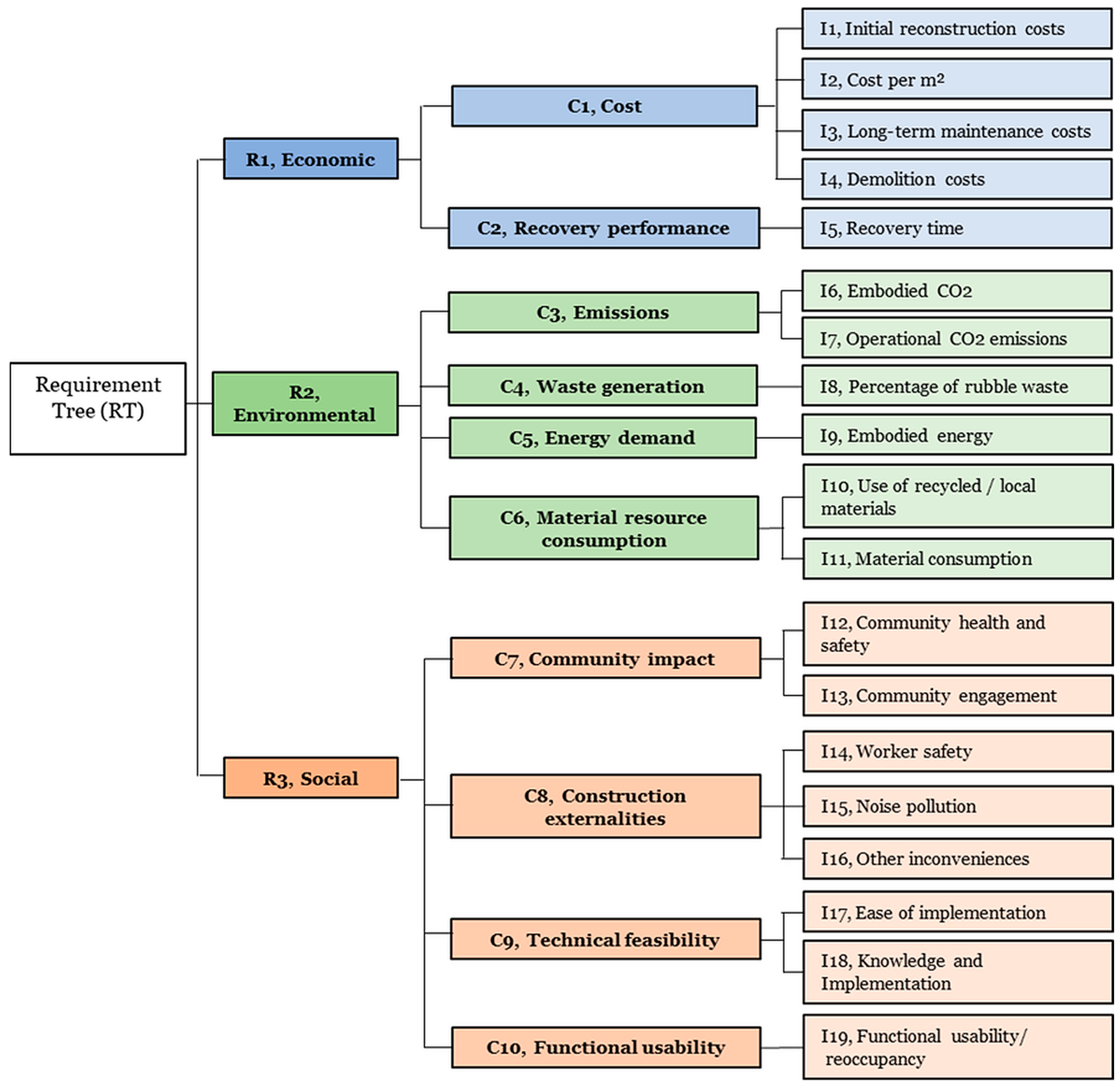
3.4. Adaptation of Sustainability Requirements, Criteria, and Indicators
4. Result
4.1. Definition of Scope and Boundary Dimensions
4.2. Reference MIVES Framework Adopted for Model Adaptation
4.3. Role-Based Classification of Studies Informing the Reconstruction Alternative Space
4.4. Adapted Sustainability Requirements Tree for Post-Earthquake Reconstruction
4.4.1. Scale-Based Classification of Sustainability Indicators
- (a)
- Building-Level Reconstruction Studies
- (b)
- Site-Level Reconstruction Studies
- (c)
- Community/Settlement-Level Studies
- (d)
- Urban/Infrastructure-Level Studies
4.4.2. Indicator Selection and Strategic Adaptation
5. Discussion
6. Conclusions
Author Contributions
Funding
Institutional Review Board Statement
Informed Consent Statement
Data Availability Statement
Conflicts of Interest
Appendix A

| References | Strategic Recovery Framing | Decision Drivers and Constraints | Intervention- or Scheme-Oriented | Out-of-Scope Reconstruction-Related |
|---|---|---|---|---|
| [128] | ✓ | |||
| [109] | ✓ | |||
| [40] | ✓ | |||
| [129] | ✓ | |||
| [64] | ✓ | |||
| [130] | ✓ | |||
| [35] | ✓ | |||
| [34] | ✓ | |||
| [38] | ✓ | |||
| [51] | ✓ | |||
| [85] | ✓ | |||
| [33] | ✓ | |||
| [52] | ✓ | |||
| [37] | ✓ | |||
| [74] | ✓ | |||
| [131] | ✓ | |||
| [99] | ✓ | |||
| [132] | ✓ | |||
| [100] | ✓ | |||
| [96] | ✓ | |||
| [97] | ✓ | |||
| [133] | ✓ | |||
| [36] | ✓ | |||
| [31] | ✓ | |||
| [134] | ✓ | |||
| [73] | ✓ | |||
| [61] | ✓ | |||
| [28] | ✓ | |||
| [64] | ✓ | |||
| [39] | ✓ | |||
| [65] | ✓ | |||
| [135] | ✓ | |||
| [72] | ✓ | |||
| [75] | ✓ | |||
| [114] | ✓ | |||
| [136] | ✓ | |||
| [27] | ✓ | |||
| [68] | ✓ | |||
| [56] | ✓ | |||
| [137] | ✓ | |||
| [76] | ✓ | |||
| [67] | ✓ | |||
| [26] | ✓ | |||
| [30] | ✓ | |||
| [83] | ✓ | |||
| [84] | ✓ | |||
| [138] | ✓ | |||
| [32] | ✓ | |||
| [25] | ✓ | |||
| [25] | ✓ | |||
| [139] | ✓ | |||
| [140] | ✓ | |||
| [141] | ✓ | |||
| [44] | ✓ | |||
| [25] | ✓ | |||
| [66] | ✓ | |||
| [82] | ✓ | |||
| [142] | ✓ | |||
| [59] | ✓ | |||
| [143] | ✓ | |||
| [71] | ✓ | |||
| [70] | ✓ | |||
| [106] | ✓ | |||
| [144] | ✓ | |||
| [81] | ✓ | |||
| [57] | ✓ | |||
| [58] | ✓ | |||
| [53] | ✓ | |||
| [145] | ✓ | |||
| [77] | ✓ | |||
| [48] | ✓ | |||
| [49] | ✓ | |||
| [47] | ✓ |
References
- Aronsson-Storrier, M.; Aronsson-Storrier, M. UN Office for Disaster Risk Reduction (2023). Yearb. Int. Disaster Law Online 2025, 6, 368–373. [Google Scholar] [CrossRef]
- United Nations Office for Disaster Risk Reduction. Global Assessment Report on Disaster Risk Reduction 2023: Mapping Resilience for the Sustainable Development Goals; United Nations Office for Disaster Risk Reduction: Geneva, Switzerland, 2023. [Google Scholar]
- United Nations Office for Disaster Risk Reduction. Global Assessment Report on Disaster Risk Reduction 2025; United Nations Office for Disaster Risk Reduction: Geneva, Switzerland, 2025. [Google Scholar]
- Altunişik, A.C.; Atmaca, B.; Kartal, M.E.; Günaydin, M.; Demir, S.; Uluşan, A. Assessment of Structural Damage Following the October 30, 2020 Aegean Sea Earthquake and Tsunami. J. Earthq. Tsunami 2021, 15, 2640299. [Google Scholar] [CrossRef] [Scilit]
- Jaupart, P.; Kharb, A.; Manigat, A.-K.; Tassot, C.; Tesliuc, C. Social Protection & JOBS. In The Impact of the August 2021 Earthquake in Haiti: Evidence from the Social Registry’s Shock Module; The World Bank: Washington, DC, USA, 2021; Volume 1. [Google Scholar]
- Miyamoto, K.; Gilan, A.; Broughton, M.; Victor, G.; Sechi, G.J.; Chesi, C.; Martinelli, L.; Abdulmawla, L.; Brusa, E. Accelerating Post-Disaster Response: The Haiti (2021) Experience. In Proceedings of the 18th World Conference on Earthquake Engineering, Milan, Italy, 30 June–5 July 2024; pp. 1–12. [Google Scholar]
- Whitworth, M.R.Z.; Giardina, G.; Penney, C.; Di Sarno, L.; Adams, K.; Kijewski-Correa, T.; Black, J.; Foroughnia, F.; Macchiarulo, V.; Milillo, P.; et al. Lessons for Remote Post-earthquake Reconnaissance from the 14 August 2021 Haiti Earthquake. Front. Built Environ. 2022, 8, 873212. [Google Scholar] [CrossRef] [Scilit]
- Cavallo, E.A.; Álvarez, L.G.; Powell, A. Estimating the Potential Economic Impact of Haiti’s 2021 Earthquake 2021; IDB: Managua, Nicaragua, 2021. [Google Scholar] [CrossRef] [Scilit]
- Fisher, J.R.; Bela, M.; Rexhepi, Z.K. International Response to Turkey 2023 Earthquake: A Policy Analysis. Knowl.-Int. J. 2023, 60, 175–180. [Google Scholar] [CrossRef] [Scilit]
- Acharya, P.; Sharma, K.; Liu, F. Türkiye’s Road to Recovery after the 2023 Kahramanmaras Earthquake: Lessons from Chile, Japan, and Nepal. Nat. Hazards Rev. 2024, 25, 04024031. [Google Scholar] [CrossRef] [Scilit]
- Apostolaki, S.; Riga, E.; Pitilakis, D. Rapid damage assessment effectiveness for the 2023 Kahramanmaraş Türkiye earthquake sequence. Int. J. Disaster Risk Reduct. 2024, 111, 104691. [Google Scholar] [CrossRef] [Scilit]
- Danacı, Ö.Ü.; Gökkaya, E.; Yavuz, K.; Demirbilek, Ö. The Macroeconomic Effects of Earthquakes in Turkey and Sustainable Economic Resilience: A Time Series Analysis, 1990–2023. Sustainability 2025, 17, 11268. [Google Scholar] [CrossRef] [Scilit]
- Stojadinović, Z.; Kovačević, M.; Marinković, D.; Stojadinović, B. Rapid earthquake loss assessment based on machine learning and representative sampling. Earthq. Spectra 2022, 38, 152–177. [Google Scholar] [CrossRef] [Scilit]
- Karadeniz, O. Building resilient social protection: Lessons from Türkiye’s earthquake response. Int. Soc. Secur. Rev. 2025, 78, 97–122. [Google Scholar] [CrossRef] [Scilit]
- Bao, M.; Abdelaal, M.I.; Saleh, M.; Chourak, M.; Mohamed, M.; Xing, M. Unlocking the hidden secrets of the 2023 Al Haouz earthquake: Coseismic model reveals intraplate reverse faulting in Morocco derived from SAR and seismic data. Int. J. Appl. Earth Obs. Geoinf. 2025, 137, 104420. [Google Scholar] [CrossRef] [Scilit]
- Yeck, W.L.; Hatem, A.E.; Goldberg, D.E.; Barnhart, W.D.; Jobe, J.A.T.; Shelly, D.R.; Villaseñor, A.; Benz, H.M.; Earle, P.S. Rapid Source Characterization of the 2023 Mw 6.8 Al Haouz, Morocco, Earthquake. Seism. Rec. 2023, 3, 357–366. [Google Scholar] [CrossRef] [Scilit]
- Achbani, A.; Bouchriti, Y.; Sine, H.; Kharbach, A.; Boukrim, M.; Rida, J.; Ougjij, A.A.; Sine, H. Key Takeaways From the Al Haouz Earthquake, Morocco, 2023. Disaster Med. Public Health Prep. 2024, 18, e88. [Google Scholar] [CrossRef] [Scilit]
- Hassan, H.M.; Peresan, A.; ElGabry, M.; Chourak, M.; Panza, G. Ground motion forecasting for the 2023 Al-Haouz and 2004 Al-Hoceima earthquakes in Morocco: The use of Mdesign definition. Eng. Geol. 2026, 364, 108600. [Google Scholar] [CrossRef] [Scilit]
- Nouayti, A.; El Moudnib, L.; Khattach, D.; Zeckra, M.; Nouayti, N.; Saadi, O.; Elhairechi, K.; Oujane, B.; Iken, H. Seismic synthesis of the Al Haouz earthquake of September 8th, 2023 by integrating gravimetric and aeromagnetic data from the western High Atlas in Morocco. Model. Earth Syst. Environ. 2024, 10, 6639–6658. [Google Scholar] [CrossRef] [Scilit]
- Yuhi, M.; Umeda, S.; Arita, M.; Ninomiya, J.; Gokon, H.; Arikawa, T.; Baba, T.; Imamura, F.; Kawai, A.; Kumagai, K.; et al. Post-event survey of the 2024 Noto Peninsula earthquake tsunami in Japan. Coast. Eng. J. 2024, 66, 405–418. [Google Scholar] [CrossRef] [Scilit]
- Masuda, H.; Sugawara, D.; Cheng, A.-C.; Suppasri, A.; Shigihara, Y.; Kure, S.; Imamura, F. Modeling the 2024 Noto Peninsula earthquake tsunami: Implications for tsunami sources in the eastern margin of the Japan Sea. Geosci. Lett. 2024, 11, 29. [Google Scholar] [CrossRef] [Scilit]
- Suppasri, A.; Kitamura, M.; Alexander, D.; Seto, S.; Imamura, F. The 2024 Noto Peninsula earthquake: Preliminary observations and lessons to be learned. Int. J. Disaster Risk Reduct. 2024, 110, 104611. [Google Scholar] [CrossRef] [Scilit]
- Fukushima, Y.; Ishimura, D.; Takahashi, N.; Iwasa, Y.; Malatesta, L.C.; Takahashi, T.; Tang, C.-H.; Yoshida, K.; Toda, S. Landscape changes caused by the 2024 Noto Peninsula earthquake in Japan. Sci. Adv. 2024, 10, 9193. [Google Scholar] [CrossRef] [Scilit] [PubMed]
- Kiratzi, A.; Papazachos, C.; Özacar, A.; Pinar, A.; Kkallas, C.; Sopaci, E. Characteristics of the 2020 Samos earthquake (Aegean Sea) using seismic data. Bull. Earthq. Eng. 2021, 20, 7713–7735. [Google Scholar] [CrossRef] [Scilit]
- Harirchian, E.; Jadhav, K.; Mohammad, K.; Aghakouchaki Hosseini, S.E.; Lahmer, T. A Comparative Study of MCDM Methods Integrated with Rapid Visual Seismic Vulnerability Assessment of Existing RC Structures. Appl. Sci. 2020, 10, 6411. [Google Scholar] [CrossRef] [Scilit]
- Vona, M.; Flora, A.; Carlucci, E.; Foscolo, E. Seismic Retrofitting Resilience-Based for Strategic RC Buildings. Buildings 2021, 11, 111. [Google Scholar] [CrossRef] [Scilit]
- McCaughey, J.W.; Daly, P.; Mundir, I.; Mahdi, S.; Patt, A. Socio-economic consequences of post-disaster reconstruction in hazard-exposed areas. Nat. Sustain. 2018, 1, 38–43. [Google Scholar] [CrossRef] [Scilit]
- Shen, S. Resilience and sustainability: Engineering solutions in disaster-affected real estate markets. Sustain. Dev. 2024, 32, 6748–6762. [Google Scholar] [CrossRef] [Scilit]
- Mebarki, A.; Boukri, M.; Laribi, A.; Farsi, M.; Belazougui, M.; Kharchi, F. Seismic vulnerability: Theory and application to Algerian buildings. J. Seism. 2013, 18, 331–343. [Google Scholar] [CrossRef] [Scilit]
- Zaidir. Repair and retrofitting of buildings post earthquake. E3S Web Conf. 2020, 156, 05023. [Google Scholar] [CrossRef] [Scilit]
- Wang, J.; Ng, Y.Y.E. Post-earthquake housing recovery with traditional construction: A preliminary review. Prog. Disaster Sci. 2023, 18, 100283. [Google Scholar] [CrossRef] [Scilit]
- Bhatt, A.C.; Mevada, S.V.; Patel, S.B. Comparative Study of Response of Structures Subjected to Blast and Earthquake Loading. Int. J. Eng. Res. Appl. 2016, 6, 62–66. [Google Scholar]
- Cerracchio, V.; Di Matteo, M.; Vallati, A.; Pampanin, S. Multi-Criteria Approach for the Evaluation of the Seismic-Energetic Retrofit Solutions for a Public Residential Building. In Proceedings of the 10th International Conference on Computational Methods in Structural Dynamics and Earthquake Engineering Methods in Structural Dynamics and Earthquake Engineering, Rhodes Island, Greece, 15–18 June 2025; pp. 2215–2230. [Google Scholar]
- Hosseini, S.A.; de la Fuente, A.; Pons, O. Multi-criteria decision-making method for assessing the sustainability of post-disaster temporary housing units technologies: A case study in Bam, 2003. Sustain. Cities Soc. 2016, 20, 38–51. [Google Scholar] [CrossRef] [Scilit]
- Hosseini, S.M.A.; Ghalambordezfooly, R.; de la Fuente, A. Sustainability Model to Select Optimal Site Location for Temporary Housing Units: Combining GIS and the MIVES–Knapsack Model. Sustainability 2022, 14, 4453. [Google Scholar] [CrossRef] [Scilit]
- Izadinia, N.; Ramyar, E.; Alzayer, M.; Carr, S.H.; Cusatis, G.; Dwivedi, V.; Garcia, D.J.; Hettiarachchi, M.; Massion, T.; Miller, W.M.; et al. A versatile optimization framework for sustainable post-disaster building reconstruction. Optim. Eng. 2022, 24, 2079–2114. [Google Scholar] [CrossRef] [Scilit]
- Lamboglia, E.; Guerrisi, G.; Bonafoni, S.; Del Frate, F. Long-term temporal analysis of Sentinel-2 spectral reflectance data for post-earthquake monitoring of urban environment dynamics. Eur. J. Remote Sens. 2025, 58, 2445658. [Google Scholar] [CrossRef] [Scilit]
- Cárdenas-Gómez, J.C.; Gonzales, M.B.; Lazo, C.A.D. Evaluation of Reinforced Adobe Techniques for Sustainable Reconstruction in Andean Seismic Zones. Sustainability 2021, 13, 4955. [Google Scholar] [CrossRef] [Scilit]
- Escamilla, E.Z.; Habert, G. Global or local construction materials for post-disaster reconstruction? Sustainability assessment of twenty post-disaster shelter designs. Build. Environ. 2015, 92, 692–702. [Google Scholar] [CrossRef] [Scilit]
- Polese, M.; Di Ludovico, M.; Prota, A. Post-earthquake reconstruction: A study on the factors influencing demolition decisions after 2009 L’Aquila earthquake. Soil Dyn. Earthq. Eng. 2018, 105, 139–149. [Google Scholar] [CrossRef] [Scilit]
- Elsevier. Scopus. 2025. Available online: https://www.scopus.com/ (accessed on 15 January 2026).
- Clarivate. Web of Science. 2025. Available online: https://www.webofscience.com (accessed on 15 January 2026).
- Google. Google Scholar. 2025. Available online: https://scholar.google.com (accessed on 15 January 2026).
- Noura, H.; Mebarki, A.; Abed, M. Post-quake structural damage evaluation by neural networks: Theory and calibration. Eur. J. Environ. Civ. Eng. 2017, 23, 710–727. [Google Scholar] [CrossRef] [Scilit]
- Anagnostopoulos, S.; Moretti, M. Post-earthquake emergency assessment of building damage, safety and usability—Part 2, Organisation. Soil Dyn. Earthq. Eng. 2008, 28, 233–244. [Google Scholar] [CrossRef] [Scilit]
- Anagnostopoulos, S.; Moretti, M. Post-earthquake emergency assessment of building damage, safety and usability—Part 1, Technical issues. Soil Dyn. Earthq. Eng. 2008, 28, 223–232. [Google Scholar] [CrossRef] [Scilit]
- Khaddour, L.A. Life-cycle sustainability risk management a multi-stakeholder approach: The case of Damascus post-war residential projects. Environ. Dev. Sustain. 2021, 24, 12756–12786. [Google Scholar] [CrossRef] [Scilit]
- El Hage, J.; Shahrour, I.; Chehade, F.H.; Farraj, F.A. A Comprehensive Assessment of Buildings for Post-Disaster Sustainable Reconstruction: A Case Study of Beirut Port. Sustainability 2023, 15, 13433. [Google Scholar] [CrossRef] [Scilit]
- Khaddour, L.A.; Deng, W. Multi-criteria sustainability risk management for post-war residential re-construction: The case of Damascus. J. Hous. Built Environ. 2023, 38, 1939–1982. [Google Scholar] [CrossRef] [Scilit]
- Fu, L.; Zhi, H.; Zhang, Q. A risk index for the structural diagnosis of rockeries in Chinese classical gardens based on the MIVES model. npj Heritage Sci. 2025, 13, 37. [Google Scholar] [CrossRef] [Scilit]
- Hosseini, S.A.; Pons, O.; de la Fuente, A. A combination of the Knapsack algorithm and MIVES for choosing optimal temporary housing site locations: A case study in Tehran. Int. J. Disaster Risk Reduct. 2018, 27, 265–277. [Google Scholar] [CrossRef] [Scilit]
- Rezk, J.; Pons-Valladares, O.; Muñoz-Blanc, C. Evaluating Sustainability in Post-Conflict Reconstruction: A Case Study of Blast-Damaged Buildings Without Structural Collapse Risk in Syria. Buildings 2025, 15, 369. [Google Scholar] [CrossRef] [Scilit]
- Khalaf, R.W. Cultural Heritage Reconstruction after Armed Conflict: Continuity, Change, and Sustainability. Hist. Environ. Policy Pract. 2019, 11, 4–20. [Google Scholar] [CrossRef] [Scilit]
- Imperiale, A.J.; Vanclay, F. Top-down reconstruction and the failure to “build back better” resilient communities after disaster: Lessons from the 2009 L’Aquila Italy earthquake. Disaster Prev. Manag. Int. J. 2020, 29, 541–555. [Google Scholar] [CrossRef] [Scilit]
- Imperiale, A.J.; Vanclay, F. Conceptualizing community resilience and the social dimensions of risk to overcome barriers to disaster risk reduction and sustainable development. Sustain. Dev. 2021, 29, 891–905. [Google Scholar] [CrossRef] [Scilit]
- Imperiale, A.J.; Vanclay, F. Experiencing local community resilience in action: Learning from post-disaster communities. J. Rural. Stud. 2016, 47, 204–219. [Google Scholar] [CrossRef] [Scilit]
- Sabri, R.; Altan, H.; AlGhareeb, D.; Alkhaja, N. Heritage Reconstruction Planning, Sustainability Dimensions, and the Case of the Khaz’al Diwan in Kuwait. Sustainability 2020, 12, 8805. [Google Scholar] [CrossRef] [Scilit]
- Fadhil, H.I.; Ashour, A.S. The role of social sustainability in reviving heritage buildings in the city of Baghdad after crises. IOP Conf. Ser. Mater. Sci. Eng. 2020, 881, 012036. [Google Scholar] [CrossRef] [Scilit]
- Salahieh, D.; Asaeed, S.; Zibar, L. (Re)calibrating heritage: Al-Jdeideh (post-)conflict transformations in Aleppo, Syria. J. Soc. Archaeol. 2024, 24, 79–105. [Google Scholar] [CrossRef] [Scilit]
- Ghafory-Ashtiany, M.; Hosseini, M. Post-Bam earthquake: Recovery and reconstruction. Nat. Hazards 2007, 44, 229–241. [Google Scholar] [CrossRef] [Scilit]
- Dastgerdi, A.S.; Stimilli, F.; Pisano, C.; Sargolini, M.; De Luca, G. Heritage waste management: A possible paradigm shift in the post-earthquake reconstruction in central Italy. J. Cult. Herit. Manag. Sustain. Dev. 2019, 10, 76–89. [Google Scholar] [CrossRef] [Scilit]
- Medrán, F.; Enfedaque, A.; Alberti, M.G. A Sustainability Assessment of Industrialised Housing Construction Using the MIVES (Modelo Integrado de Valor para una Evaluación Sostenible)-Based Multicriteria Decision-Making Method. Buildings 2024, 14, 2712. [Google Scholar] [CrossRef] [Scilit]
- Boix-Cots, D.; Pardo-Bosch, F.; Blanco, A.; Aguado, A.; Pujadas, P. A systematic review on MIVES: A sustainability-oriented multi-criteria decision-making method. Build. Environ. 2022, 223, 109515. [Google Scholar] [CrossRef] [Scilit]
- Li, W.; Li, Q.; Shao, Y.; Li, Q.; Jia, L.; Liu, Y. Prioritization of Emergency Strengthening Schemes for Existing Buildings After Floods Based on Prospect Theory. Sustainability 2025, 18, 363. [Google Scholar] [CrossRef] [Scilit]
- Li, Z.; Tan, X. Revitalization of Trust in Local Government after Wenchuan Earthquake: Constraints and Strategies. Sustainability 2018, 10, 4030. [Google Scholar] [CrossRef] [Scilit]
- Radchenko, K. Is Smart City model promising for sustainable post-war recovery of Ukraine? In ACM International Conference Proceeding Series; Association for Computing Machinery: New York, NY, USA, 2024; pp. 130–142. [Google Scholar] [CrossRef] [Scilit]
- Venable, C.; Opdyke, A.; Javernick-Will, A.; Liel, A. Community Participation in Post-Disaster Shelter Programs: Examining the Evolution of Participation in Planning, Design, and Construction. In Construction Research Congress 2018: Infrastructure and Facility Management—Selected Papers from the Construction Research Congress 2018; Association for Computing Machinery: New York, NY, USA, 2018; pp. 222–232. [Google Scholar] [CrossRef] [Scilit]
- Yang, H.; Dietz, T.; Yang, W.; Zhang, J.; Liu, J. Changes in Human Well-being and Rural Livelihoods Under Natural Disasters. Ecol. Econ. 2018, 151, 184–194. [Google Scholar] [CrossRef] [Scilit]
- Wu, H. Advancing resilience post-disaster: Improving designer-user communication in the post-Lushan earthquake reconstruction and recovery. In Risk Communication and Community Resilience; Taylor and Francis: Boca Raton, FL, USA, 2019; pp. 198–210. [Google Scholar] [CrossRef] [Scilit]
- Kousa, C.; Pottgiesser, U.; Lubelli, B. Post-Syrian War Residential Heritage Transformations in the Old City of Aleppo: Socio-Cultural Sustainability Aspects. Sustainability 2021, 13, 12213. [Google Scholar] [CrossRef] [Scilit]
- Altaema, M.; Hatipoglu, H.K. Sustainable Housing Concept for Post-War Syrian Reconstruction. In Contemporary Approaches in Urbanism and Heritage Studies; Cinius Yayınları Publication: İstanbul, Turkey, 2021; pp. 225–234. [Google Scholar] [CrossRef] [Scilit]
- Peng, Y. A comparison of two approaches to develop concentrated rural settlements after the 5.12 Sichuan Earthquake in China. Habitat Int. 2015, 49, 230–242. [Google Scholar] [CrossRef] [Scilit]
- Yang, T.; Wang, L.; Huang, L. Comparing three approaches to developing concentrated rural settlement after the Lushan Earthquake. Saf. Sci. 2020, 125, 104626. [Google Scholar] [CrossRef] [Scilit]
- Xiao, Y.; Olshansky, R.; Zhang, Y.; Johnson, L.A.; Song, Y. Financing rapid community reconstruction after catastrophic disaster: Lessons from the 2008 Wenchuan earthquake in China. Nat. Hazards 2019, 104, 5–30. [Google Scholar] [CrossRef] [Scilit]
- Kondo, T. Planning challenges for housing and built environment recovery after the Great East Japan Earthquake: Collaborative planning and management go beyond government-driven redevelopment projects. In Advances in Natural and Technological Hazards Research; Springer: Amsterdam, The Netherlands, 2018; Volume 47, pp. 155–169. [Google Scholar] [CrossRef] [Scilit]
- Peng, Y.; Zhu, X.; Zhang, F.; Huang, L.; Xue, J.; Xu, Y. Farmers’ risk perception of concentrated rural settlement development after the 5.12 Sichuan Earthquake. Habitat Int. 2018, 71, 169–176. [Google Scholar] [CrossRef] [Scilit]
- Lević, B.; Đukanović, L.; Ignjatović, D. Approaches for Complex and Integrated Refurbishment to Improve Energy Efficiency and Spatial Comfort of the Existing Post-War Mass Housing Stock in Serbia. Sustainability 2023, 15, 13884. [Google Scholar] [CrossRef] [Scilit]
- Mardani, A.; Zavadskas, E.K.; Govindan, K.; Senin, A.A.; Jusoh, A. VIKOR Technique: A Systematic Review of the State of the Art Literature on Methodologies and Applications. Sustainability 2016, 8, 37. [Google Scholar] [CrossRef] [Scilit]
- Casprini, E.; Passoni, C.; Belleri, A.; Marini, A.; Bartoli, G.; Riva, P. Demolition-and-Reconstruction or Renovation? Towards a Protocol for the Assessment of the Residual Life of Existing RC Buildings. IOP Conf. Ser. Earth Environ. Sci. 2019, 290, 012010. [Google Scholar] [CrossRef] [Scilit]
- Casanovas, M.D.M.; Armengou, J.; Ramos, G. Occupational Risk Index for Assessment of Risk in Construction Work by Activity. J. Constr. Eng. Manag. 2014, 140, 04013035. [Google Scholar] [CrossRef] [Scilit]
- Majeed, M.L. “Sustainability” as a Strategy for the Reconstruction of Distressed Cities in Iraq. J. Phys. Conf. Ser. 2020, 1660, 012087. [Google Scholar] [CrossRef] [Scilit]
- Rahmoun, T.; Zhao, W. A New Model of a Spatial Structural Map for Re-Building Urban-Rural Links. Int. Rev. Spat. Plan. Sustain. Dev. 2024, 12, 21–43. [Google Scholar] [CrossRef] [Scilit]
- Allmann, B.P.; Shearer, P.M.; Hauksson, E. Spectral Discrimination between Quarry Blasts and Earthquakes in Southern California. Bull. Seism. Soc. Am. 2008, 98, 2073–2079. [Google Scholar] [CrossRef] [Scilit]
- Badawy, A.; Gamal, M.; Farid, W.; Soliman, M.S. Decontamination of earthquake catalog from quarry blast events in northern Egypt. J. Seism. 2019, 23, 1357–1372. [Google Scholar] [CrossRef] [Scilit]
- Boix-Cots, D.; Pardo-Bosch, F.; Pujadas, P. Introducing the Comprehensive Value Function for Sustainability Full-Spectrum Assessment. Sustainability 2024, 16, 2617. [Google Scholar] [CrossRef] [Scilit]
- de la Fuente, A.; Armengou, J.; Pons, O.; Aguado, A. Multi-criteria decision-making model for assessing the sustainability index of wind-turbine support systems: Application to a new precast concrete alternative. J. Civ. Eng. Manag. 2016, 23, 194–203. [Google Scholar] [CrossRef] [Scilit]
- Pons-Valladares, O.; Nikolic, J. Sustainable Design, Construction, Refurbishment and Restoration of Architecture: A Review. Sustainability 2020, 12, 9741. [Google Scholar] [CrossRef] [Scilit]
- De La Fuente, A.; Casanovas-Rubio, M.D.M.; Pons, O.; Armengou, J. Sustainability of Column-Supported RC Slabs: Fiber Reinforcement as an Alternative. J. Constr. Eng. Manag. 2019, 145, 04019042. [Google Scholar] [CrossRef] [Scilit]
- Leal Filho, W.; Tripathi, S.K.; Andrade Guerra, J.B.S.O.D.; Giné-Garriga, R.; Orlovic Lovren, V.; Willats, J. Using the sustainable development goals towards a better understanding of sustainability challenges. Int. J. Sustain. Dev. World Ecol. 2019, 26, 179–190. [Google Scholar] [CrossRef] [Scilit]
- Holden, E.; Linnerud, K.; Banister, D.; Schwanitz, V.J.; Wierling, A. The Imperatives of Sustainable Development; Taylor & Francis: London, UK, 2017. [Google Scholar] [CrossRef] [Scilit]
- Zaidan, B.B.; Ibrahim, H.A.; Mourad, N.; Zaidan, A.A.; Pilehkouhic, H.; Qahtan, S.; Deveci, M.; Delen, D. An in-depth analysis of ensemble multi-criteria decision making: A comprehensive guide to terminology, design, applications, evaluations, and future prospects. Appl. Soft Comput. 2024, 167, 112267. [Google Scholar] [CrossRef] [Scilit]
- Dehshiri, S.S.H.; Firoozabadi, B. Optimizing building energy solutions: A guideline for choosing proper multi criteria decision making methods in energy problems. Energy 2025, 317, 134598. [Google Scholar] [CrossRef] [Scilit]
- Zhong, Q.; Tang, H.; Zhou, W. Analyzing the influence factors of the post-earthquake reconstruction project using fuzzy DEMATEL. J. Asian Arch. Build. Eng. 2023, 23, 1050–1062. [Google Scholar] [CrossRef] [Scilit]
- Shevchuk, O.; Rochshyna, N.; Lazarenko, I.; Stets, O. Towards a sustainable future: Overcoming the challenges of post-war ecosystem reconstruction in Ukraine. IOP Conf. Ser. Earth Environ. Sci. 2023, 1269, 012018. [Google Scholar] [CrossRef] [Scilit]
- Dev, K.N.; Das, A.K. Design of Bamboo Shelter Kit for Post-disaster Temporary Shelter Response. Smart Innov. Syst. Technol. 2021, 221, 923–934. [Google Scholar] [CrossRef] [Scilit]
- Çetin, S.; Kirchherr, J. The Build Back Circular Framework: Circular Economy Strategies for Post-Disaster Reconstruction and Recovery. Circ. Econ. Sustain. 2025, 5, 1689–1726. [Google Scholar] [CrossRef] [Scilit]
- Adamy, A.; Aini, Q.; Meillyta, M.; Maharani, L. Typology of post-disaster relief houses in Palu and Sigi, Central Sulawesi. E3S Web Conf. 2023, 464, 15004. [Google Scholar] [CrossRef] [Scilit]
- Sadrolodabaee, P.; Hosseini, S.A.; Claramunt, J.; Ardanuy, M.; Haurie, L.; Lacasta, A.M.; de la Fuente, A. Experimental characterization of comfort performance parameters and multi-criteria sustainability assessment of recycled textile-reinforced cement facade cladding. J. Clean. Prod. 2022, 356, 131900. [Google Scholar] [CrossRef] [Scilit]
- Pons, O.; Wadel, G. Environmental impacts of prefabricated school buildings in Catalonia. Habitat Int. 2011, 35, 553–563. [Google Scholar] [CrossRef] [Scilit]
- Tröndle, T.; Melnyk, O.; Tutova, O.; Porieva, V.; Neumann, F.; Staffell, I.; Patt, A. Rebuilding Ukraine’s energy supply in a secure, economic, and decarbonised way. Environ. Res. Infrastruct. Sustain. 2024, 4, 031002. [Google Scholar] [CrossRef] [Scilit]
- Gao, Z.; Li, Y.; Qian, H.; Wei, M. Environmental, Economic, and Social Sustainability Assessment: A Case of Using Contaminated Tailings Stabilized by Waste-Based Geopolymer as Road Base. 2023. Available online: https://ssrn.com/abstract=4410628 (accessed on 27 March 2026).
- Alba-Rodríguez, M.D.; Martínez-Rocamora, A.; González-Vallejo, P.; Ferreira-Sánchez, A.; Marrero, M. Building rehabilitation versus demolition and new construction: Economic and environmental assessment. Environ. Impact Assess. Rev. 2017, 66, 115–126. [Google Scholar] [CrossRef] [Scilit]
- Ferreira, J.; Pinheiro, M.D.; de Brito, J. Economic and environmental savings of structural buildings refurbishment with demolition and reconstruction—A Portuguese benchmarking. J. Build. Eng. 2015, 3, 114–126. [Google Scholar] [CrossRef] [Scilit]
- Rezaei, M. Assessment of Site Location of Post-Disaster Temporary Housing After Kermanshah Earthquake Applying MIVES for Determining Sustainability Index. Master’s Thesis, UPC, Barcelona, Spain, 2019. [Google Scholar]
- Hosseini, S.A.; Farahzadi, L.; Pons, O. Assessing the sustainability index of different post-disaster temporary housing unit configuration types. J. Build. Eng. 2021, 42, 102806. [Google Scholar] [CrossRef] [Scilit]
- Abdulrazaq, H.A.; Guedes, M.C. Post-war sustainable housing design strategies: The case of reconstruction in Iraq. Renew. Energy Environ. Sustain. 2021, 6, 22. [Google Scholar] [CrossRef] [Scilit]
- Sánchez-Garrido, A.J.; Navarro, I.J.; Yepes, V. Multi-criteria decision-making applied to the sustainability of building structures based on Modern Methods of Construction. J. Clean. Prod. 2022, 330, 129724. [Google Scholar] [CrossRef] [Scilit]
- Landaeta, E.; Richman, J. A Model of Build Back Better Utilization: Long-Term Recovery Groups and Post-Disaster Housing Recovery. Sustainability 2023, 15, 16424. [Google Scholar] [CrossRef] [Scilit]
- Fung, J.F.; Zhang, Y.; Johnson, K.J.; Cook, D.T.; Sattar, S. Multidisciplinary research to advance the development of functional recovery for community resilience. Disaster Prev. Resil. 2023, 2, 13. [Google Scholar] [CrossRef] [Scilit]
- Zolfaghari, S.M.; Pons, O.; Nikolic, J. Sustainability assessment model for mass housing’s interior rehabilitation and its validation to Ekbatan, Iran. J. Build. Eng. 2022, 65, 105685. [Google Scholar] [CrossRef] [Scilit]
- Dave, N.; Zhang, X.; Xu, Z.; Gerada, D.; Zhang, H.; Li, J.; Vakil, G.; Gerada, C. Carbon Emission Comparison of Slotted and Slotless Motors for eVTOL Application. In Proceedings of the 2022 IEEE Transportation Electrification Conference and Expo—ITEC 2022, Haining, China, 28–31 October 2022; pp. 1291–1295. [Google Scholar] [CrossRef] [Scilit]
- Bettemir, Ö.H.; Erzurum, T. Comparative life cycle assessment of post-disaster housing according to ground type-outdoor temperature-lifespan relationship: Carbon, energy and cost. J. Build. Eng. 2025, 111, 113388. [Google Scholar] [CrossRef] [Scilit]
- Kobayakawa, T. Estimating the carbon footprint of post-war reconstruction: Toward a ‘greener’ recovery of Ukraine. Environ. Res. Infrastruct. Sustain. 2025, 5, 015015. [Google Scholar] [CrossRef] [Scilit]
- Pradhananga, P.; Kasabdji, G.S.; Elzomor, M. A sustainable opportunity to utilize hazardous waste during post-disaster reconstruction phase: A case study of Nepal Earthquake. In Construction Research Congress 2020: Infrastructure Systems and Sustainability—Selected Papers from the Construction Research Congress; Association for Computing Machinery: New York, NY, USA, 2020; pp. 212–220. [Google Scholar] [CrossRef] [Scilit]
- Martínez-Molina, A.; Tort-Ausina, I.; Cho, S.; Vivancos, J.-L. Energy efficiency and thermal comfort in historic buildings: A review. Renew. Sustain. Energy Rev. 2016, 61, 70–85. [Google Scholar] [CrossRef] [Scilit]
- Song, P.; Wu, L.; Zhao, W.; Ma, W.; Hao, J. Life Cycle Sustainability Assessment: An Index System for Building Energy Retrofit Projects. Buildings 2024, 14, 2817. [Google Scholar] [CrossRef] [Scilit]
- Gbadeyan, O.J.; Muthivhi, J.; Linganiso, L.Z.; Deenadayalu, N. Decoupling Economic Growth from Carbon Emissions: A Transition toward Low-Carbon Energy Systems—A Critical Review. Clean Technol. 2024, 6, 1076–1113. [Google Scholar] [CrossRef] [Scilit]
- Naseer, A.N.; Al-Gahtani, K.S.; Altuwaim, A.A.; Alsanabani, N.M.; Almohsen, A.S. Selecting Building Façade Materials by Integrating Stepwise Weight Assessment Ratio Analysis and Weighted Aggregated Sum Product Assessment into Value Engineering. Sustainability 2024, 16, 4611. [Google Scholar] [CrossRef] [Scilit]
- Lian, J.; Li, D.; Zhao, H. Analysis of damage characteristics of reinforced concrete slabs under explosive impact and research on CFRP reinforcement. Front. Mater. 2024, 11, 1480206. [Google Scholar] [CrossRef] [Scilit]
- Weiler, V.; Harter, H.; Eicker, U. Life cycle assessment of buildings and city quarters comparing demolition and reconstruction with refurbishment. Energy Build. 2017, 134, 319–328. [Google Scholar] [CrossRef] [Scilit]
- Benedetti, A.C.; Costantino, C.; Lobosco, R.; Predari, G.; Gulli, R. Comparative LCA Scenarios for Urban Regeneration of Residential Building Stock. Application to an Existing High-density Urban Block in Bologna. Energy Build. 2025, 329, 115270. [Google Scholar] [CrossRef] [Scilit]
- Kato, K. Debating sustainability in tourism development: Resilience, traditional knowledge and community: A post- disaster perspective. In Tourism Development in Japan: Themes, Issues and Challenges; Taylor and Francis: Boca Raton, FL, USA, 2020; pp. 224–238. [Google Scholar] [CrossRef] [Scilit]
- Matsumoto, A.; Ishiwatari, M. Navigating Sustainability and Inclusivity: Women-Led Community-Based Businesses in Post-Disaster Recovery. Sustainability 2024, 16, 5865. [Google Scholar] [CrossRef] [Scilit]
- De Medici, S.; Marchiano, G.; Pinto, M.R. A participatory project for the Librino Social Housing Community. Vitr. Int. J. Arch. Technol. Sustain. 2023, 8, 100–113. [Google Scholar] [CrossRef] [Scilit]
- Khan, H.Z.A. Investigating the Relationship Between Safety Climate and Safety Performance in the Construction of Multi-Storey Buildings in Pakistan. 2017. Available online: https://theses.lib.polyu.edu.hk/handle/200/8830 (accessed on 27 March 2026).
- Fortunato, B.R.; Hallowell, M.R.; Behm, M.; Dewlaney, K. Identification of Safety Risks for High-Performance Sustainable Construction Projects. J. Constr. Eng. Manag. 2012, 138, 499–508. [Google Scholar] [CrossRef] [Scilit]
- Ning, X.; Qi, J.; Wu, C.; Wang, W. Reducing noise pollution by planning construction site layout via a multi-objective optimization model. J. Clean. Prod. 2019, 222, 218–230. [Google Scholar] [CrossRef] [Scilit]
- Terzic, V.; Villanueva, P.K. Method for probabilistic evaluation of post-earthquake functionality of building systems. Eng. Struct. 2021, 241, 103899. [Google Scholar] [CrossRef] [Scilit]
- Puri, A.; Elkharboutly, M.; Ali, N.A. Identifying major challenges in managing post-disaster reconstruction projects: A critical analysis. Int. J. Disaster Risk Reduct. 2024, 107, 104491. [Google Scholar] [CrossRef] [Scilit]
- Zhao, H.; Takahashi, N. Resilience Evaluation of Post-Earthquake Functional Recovery for Precast Prestressed Concrete Buildings. Appl. Sci. 2025, 15, 6994. [Google Scholar] [CrossRef] [Scilit]
- Rawal, V.; Bothara, J.; Pradhan, P.; Narasimhan, R.; Singh, V. Inclusion of the poor and vulnerable: Learning from post-earthquake housing reconstruction in Nepal. Prog. Disaster Sci. 2021, 10, 100144. [Google Scholar] [CrossRef] [Scilit]
- Mushtaha, A.W.; Alaloul, W.S.; Baarimah, A.O.; Musarat, M.A.; Alzubi, K.M.; Khan, A.M. A decision-making framework for prioritizing reconstruction projects in post-disaster recovery. Results Eng. 2024, 25, 103693. [Google Scholar] [CrossRef] [Scilit]
- Gong, H.; Wang, X.; Wang, Z.; Liu, Z.; Li, Q.; Zhang, Y. How Did the Built Environment Affect Urban Vibrancy? A Big Data Approach to Post-Disaster Revitalization Assessment. Int. J. Environ. Res. Public Health 2022, 19, 1458. [Google Scholar] [CrossRef] [Scilit] [PubMed]
- Moreno-Sierra, A.; Pieschacón, M.; Khan, A. The use of recycled plastics for the design of a thermal resilient emergency shelter prototype. Int. J. Disaster Risk Reduct. 2020, 50, 101885. [Google Scholar] [CrossRef] [Scilit]
- Mohtat, N.; Zargar, A.H.I. Sustainability evaluation of post-disaster housing reconstruction after 55 years: Rudak village, Iran. Int. J. Disaster Resil. Built Environ. 2018, 9, 294–316. [Google Scholar] [CrossRef] [Scilit]
- Kaufman, R.; Avgar, A.; Mirsky, J. Opportunities for Sustainable Community Development in the Wake of Disaster Situations: Lessons from the Field. Int. J. Sustain. Policy Pract. 2015, 11, 1–10. [Google Scholar] [CrossRef] [Scilit]
- Salaheldin Ismail Elsayed, D. Perceiving Urban Resilience Within Post-quake Recovering Processes. An Experimental Approach for Emergency Housing in Emilia Romagna, Italy. In Sustainable Urban Development and Globalization. Research for Development; Springer: Cham, Switzerland, 2018; pp. 333–349. [Google Scholar] [CrossRef] [Scilit]
- Eggertsson, G.; Lund, B.; Roth, M.; Schmidt, P. Earthquake or blast? Classification of local-distance seismic events in Sweden using fully connected neural networks. Geophys. J. Int. 2024, 236, 1728–1742. [Google Scholar] [CrossRef] [Scilit]
- Nourzadeh, D.; Humar, J.; Braimah, A. Comparison of Response of Building Structures to Blast Loading and Seismic Excitations. Procedia Eng. 2017, 210, 320–325. [Google Scholar] [CrossRef] [Scilit]
- Mohammadnazari, Z.; Mamoudan, M.M.; Alipour-Vaezi, M.; Aghsami, A.; Jolai, F.; Yazdani, M. Prioritizing Post-Disaster Reconstruction Projects Using an Integrated Multi-Criteria Decision-Making Approach: A Case Study. Buildings 2022, 12, 136. [Google Scholar] [CrossRef] [Scilit]
- Anbari Moghadam, M.; Bagherpour, M. A framework to assess and report social, environmental, and economic post-disaster damages based on Z-numbers and the Delphi method. Nat. Hazards 2024, 120, 14459–14494. [Google Scholar] [CrossRef] [Scilit]
- Salmo, A.; Shcherbina, E.V. Sustainability assessment of Syrian cities considering historical and cultural heritage. Vestnik MGSU 2024, 19, 169–180. [Google Scholar] [CrossRef] [Scilit]
- Kareem Kawther, K.; Hussein Hassan, R.; Hussien Hassan, R.; Kawther, K.K.; Hassan, R.H. Sustainable urban space strategies in the reconstruction of destroyed cities after the wars. J. Eng. Sci. Technol. 2022, 17, 4145–4186. [Google Scholar]
- Al-Samurai, A.A.R.M.; Al-Qaraghuli, A.S.R. Adopting sustainable development in reconstruction Post War City of Mosul Architecture-Case Study. IOP Conf. Ser. Earth Environ. Sci. 2021, 754, 012001. [Google Scholar] [CrossRef] [Scilit]
- Koval, V.; Mikhno, I.; Zharikova, O.; Tsvirko, O.; Metil, T.; Nitsenko, V. Investment management and financial development in infrastructure renovation of a sustainable-built environment. Sci. Bull. Natl. Min. Univ. 2023, 091–097. [Google Scholar] [CrossRef] [Scilit]


| Event | Location | Year | Estimated Building Damage | References |
|---|---|---|---|---|
| Aegean Sea earthquake | Turkey–Greece | 2020 | >4000 buildings affected | [4] |
| Haiti earthquake | Haiti | 2021 | ~60,000 buildings destroyed or severely damaged | [5,6,7,8] |
| Turkey–Syria earthquakes | Turkey–Syria | 2023 | >230,000 buildings collapsed or severely damaged; ~1.9 million housing units affected | [9,10,11,12,13,14] |
| Al Haouz earthquake | Morocco | 2024 | ~59,000 buildings damaged | [15,16,17,18,19] |
| Peninsula earthquake | Japan | More than 70,000 buildings | [20,21,22,23] |
| Authors | Post-Event Context | Assessment Scale | Decision Problem Addressed | Methodological Role of MIVES |
|---|---|---|---|---|
| Hosseini et al. (2016) [34] | Post-earthquake (Bam, Iran) | Building system | Evaluation of temporary housing technologies | Standalone multi-criteria sustainability assessment framework, where MIVES functions as the primary tool for evaluating alternative solutions |
| Hosseini et al. (2018) [51] | Post-disaster | Site level | Spatial selection of temporary housing locations | Embedded evaluation module within an optimization-based decision system, where MIVES supports the assessment of alternatives generated through algorithmic processes |
| Cárdenas-Gómez et al. (2021) [38] | Post-earthquake | Building technique | Comparison of reinforced reconstruction techniques | Comparative sustainability assessment tool for predefined construction alternatives, applied to evaluate and rank technical solutions |
| Hosseini et al. (2022) [35] | Post-disaster (Tehran, Iran) | Site level | Constrained site selection for temporary housing | Hybrid decision-support framework integrating MIVES with GIS and optimization models, enabling spatially constrained and multi-criteria site selection |
| Cerracchio et al. (2025) [33] | Seismic vulnerability & retrofit | Building level | Evaluation of seismic–energetic retrofit solutions | Integrated sustainability and performance assessment framework, combining MIVES with structural and energy performance evaluation |
| Rezk et al. (2025) [52] | Post-conflict (blast damage) | Building level | Strategic selection among reconstruction alternatives | Strategic decision-support framework combining MIVES with Delphi-based expert weighting, enabling evaluation of reconstruction alternatives under uncertainty |
| Study Category | Definition | Representative Keywords | Number of Studies |
|---|---|---|---|
| Strategic recovery framing studies | Studies that define overarching recovery objectives, performance targets, and normative orientations for post-earthquake reconstruction without formulating explicit reconstruction schemes | Functional recovery, resilience, sustainability goals, build back better, long-term recovery, circular economy | 23 |
| Decision drivers and constraint studies | Studies that analyze institutional, economic, regulatory, and social conditions shaping reconstruction decisions, without framing reconstruction as a choice among alternatives | Governance, regulation, financing, prioritization, social acceptance, participation, feasibility | 19 |
| Intervention- or scheme-oriented studies | Studies that explicitly formulate post-earthquake reconstruction as a choice among distinguishable intervention schemes at building or strategic level | Repair, strengthening, retrofit, demolition and reconstruction, relocation, reconstruction strategy | 10 |
| Out-of-scope reconstruction-related studies | Studies addressing post-disaster contexts that do not contribute directly to permanent building reconstruction decisions | Emergency response, temporary housing, damage assessment, hazard analysis | 21 |
| Study | Hazard Context | Reconstruction Alternatives Compared | Method |
|---|---|---|---|
| [64] | Post-flood | Emergency strengthening schemes (RC jacketing, steel bracing, localized reinforcement, stabilization options) | Prospect Theory prioritization |
| [38] | Post-earthquake | Traditional vs. reinforced adobe reconstruction techniques | MIVES |
| [33] | Seismic | Seismic–energetic retrofit packages combining structural strengthening and energy upgrades | MIVES |
| [52] | Post-war | Refurbishment; Strengthening; Demolition & reconstruction; Preservation | MIVES–Delphi |
| [36] | Post-disaster | Optimization-generated reconstruction design configurations | Multi-objective optimization |
| [73] | Post-earthquake | Three rural settlement reconstruction approaches | Comparative evaluation |
| [72] | Post-earthquake | Two rural settlement reconstruction approaches | Comparative case study |
| [26] | Seismic | Alternative seismic retrofit techniques for strategic RC buildings | Resilience-based evaluation |
| [47,49] | Post-war | Alternative residential reconstruction strategies evaluated under sustainability and risk criteria | Multi-criteria sustainability risk model |
| Indicators | Sustainability Pillar | Decision Horizon Activation | Indicator Role | Core/Context-Specific | References |
|---|---|---|---|---|---|
| Initial reconstruction costs | Economic | All horizons | Strategic | Core | [34,35,85,98,99] |
| Cost per m2 | Economic | All horizons | Operational | Core | [8,47,49,52,100,101,102,103] |
| Long-term maintenance costs | Economic | Long-term | Strategic | Core | [62,102,104] |
| Demolition costs | Economic | All horizons | Strategic | Core | [60,85,105] |
| Reconstruction process duration | Economic | Emergency/Transitional | Operational | Context-activated | [70,102,106] |
| Demolition time | Economic | Emergency | Operational | Context-activated | [81,107] |
| Property-added value | Economic | Long-term | Strategic | Context-activated | [31,60,108,109] |
| Recovery time/downtime (time to functional recovery) | Economic | Emergency/Transitional | Strategic | Core | [52,110] |
| Embodied CO2 | Environmental | Long-term | Strategic | Core | [34,35,51,52,105,111,112,113] |
| Operational CO2 emissions | Environmental | Long-term | Strategic | Core | [34,35,51,52,105,111,112,113] |
| Percentage of rubble waste | Environmental | Long-term | Operational | Core | [61,101,114] |
| Embodied energy | Environmental | Long-term | Strategic | Core | [100,112,115,116,117] |
| Use of recycled/local | Environmental | Long-term | Strategic | Context-activated | [39,40,41,42,43,44,45,46,47,48,49,50,51,52,53,54,55,56,57,58,59,60,61,62,63,64,65,66,67,68,69,70,71,72,73,74,75,76,77,78,79,80,81,82,83,84,85,86,87,88,89,90,91,92,93,94,95,96,97,98,99,100,101,102,103,104,105,106,107,108,109,110,111,112,113,114,115,116,117,118,119] |
| Material consumption | Environmental | Long-term | Strategic | Core | [77,78,79,80,81,82,83,84,85,86,87,88,89,90,91,92,93,94,95,96,97,98,99,100,101,102,103,104,105,106,107,108,109,110,111,112,113,114,115,116,117,118,119,120,121] |
| Building historical significance | Social | Context-dependent | Strategic | Context-activated | [52] |
| Architectural preservation | Social | Context-dependent | Strategic | Context-activated | [70] |
| Building importance | Social | Context-dependent | Strategic | Context-activated | [52] |
| Worker safety | Social | All horizons | Operational | Core | [91,102] |
| Community health and safety | Social | All horizons | Strategic | Core | [56,122,123,124] |
| Community engagement | Social | All horizons | Strategic | Core | [45,125,126] |
| Noise pollution | Social | All horizons | Operational | Context-activated | [127] |
| Other inconveniences (disturbance, access disruption | Social | All horizons | Operational | Context-activated | [52] |
| Ease of implementation | Social | All horizons | Strategic | Core | [38] |
| Knowledge and Implementation | Social | All horizons | Strategic | Core | [38] |
| Indicator | Sustainability Pillar | Decision Horizon Activation | Indicator Role | Core/Context-Specific | References |
|---|---|---|---|---|---|
| Distance from hazard zones | Environmental | Emergency | Strategic | Core | [34,35,51,104] |
| Land suitability/soil stability | Environmental | All horizons | Strategic | Core | [34,51,95,104] |
| Environmental compatibility of site | Environmental | Long-term | Strategic | Context-activated | [34,35,51,95,104] |
| Infrastructure availability | Economic | Emergency | Strategic | Core | [104] |
| Site preparation cost | Economic | All horizons | Operational | Core | [34,35,51,104] |
| Population density compatibility | Social | Transitional | Strategic | Context-activated | [104] |
| Social integration potential | Social | Long-term | Strategic | Context-activated | [34,35,104] |
| Urban–rural connectivity | Economic/Social | Long-term | Strategic | Context-activated | [104] |
| Accessibility to public services | Social | Emergency/transitional | Strategic | Core | [82] |
| Indicator | Sustainability Pillar | Decision Horizon Activation | Indicator Role | Core/Context-Specific | References |
|---|---|---|---|---|---|
| Livelihood restoration | Economic | Transitional | Strategic | Core | [55,67,75] |
| Housing affordability | Economic | Long-term | Strategic | Core | [96] |
| Stakeholder coordination capacity | Governance | All horizons | Strategic | Core | [68,72,73] |
| Governance efficiency | Governance | All horizons | Strategic | Core | [113] |
| Community participation in planning and design | Social | All horizons | Strategic | Core | [64,76] |
| Institutional trust | Social | Transitional/long-term | Strategic | Context-activated | [74] |
| Equity in resource distribution | Social | Transitional | Strategic | Context-activated | [60,96] |
| Social cohesion | Social | Long-term | Strategic | Core | [56,58] |
| Risk perception and acceptance | Social | Emergency/transitional | Strategic | Context-activated | [76,109] |
| Functional continuity of services | Social | Emergency/transitional | Strategic | Context-activated | [109] |
| Indicator | Sustainability Pillar | Decision Horizon Activation | Indicator Role | Core/Context-Specific | References |
|---|---|---|---|---|---|
| Decarbonization trajectory | Environmental | Long-term | Strategic | Core | [100] |
| Renewable energy share | Environmental | Long-term | Strategic | Core | [100] |
| Energy security/supply reliability | Environmental/Governance | Long-term | Strategic | Context-activated | [100] |
| Ecosystem restoration (soil, water, biodiversity) | Environmental | Long-term | Strategic | Context-activated | [97] |
| Circular material flows/reuse rate | Environmental | Long-term | Strategic | Context-activated | [99,101] |
| Waste recovery systems | Environmental | Long-term | Strategic | Context-activated | [61,99] |
| Reconstruction financing mechanisms | Economic | Transitional/long-term | Strategic | Core | [74] |
| Investment allocation efficiency | Economic | Long-term | Strategic | Core | [81] |
| Urban–rural connectivity | Economic/Social | Long-term | Strategic | Context-activated | [82] |
| Strategic governance coordination | Governance | All horizons | Strategic | Core | [81,96] |
| I# | Indicators | Indicator Meaning at Strategic Level | Adaptation Decision | Clarified Rationale |
|---|---|---|---|---|
| I1 | Initial reconstruction costs | Total absolute cost required to implement a reconstruction strategy for a given building | Retained | Represents the aggregate financial requirement of each reconstruction alternative and enables direct comparison at the strategic decision level |
| I2 | Cost per m2 | Normalized reconstruction cost per unit area | Retained | Allows for comparability across buildings of different sizes and damage conditions by standardizing cost intensity |
| I3 | Long-term maintenance costs | Cost associated with maintaining the building after reconstruction | Retained | Captures lifecycle economic implications beyond initial investment, consistent with long-term sustainability assessment |
| I4 | Demolition costs | Cost associated with demolition activities | Retained | Necessary to differentiate reconstruction pathways involving partial or total demolition from rehabilitation-based strategies |
| I5 | Reconstruction process duration | Time required to complete construction activities | Eliminated | Integrated within recovery time to avoid redundancy; not treated as an independent strategic indicator |
| I6 | Demolition time | Time required to complete demolition works | Eliminated | Considered a subprocess of overall recovery performance and not independently discriminative at the strategic level |
| I7 | Recovery time/downtime (time to functional recovery) | Time required to restore functional usability of the building | Retained | Core recovery-oriented indicator reflecting the combined temporal performance of reconstruction strategies |
| I8 | Property-added value | Increase in market or asset value after reconstruction | Eliminated | Classified as context-dependent; activation depends on specific economic or market conditions and therefore not retained as a core indicator for baseline comparison |
| I9 | Embodied CO2 | Carbon emissions associated with reconstruction materials and processes | Retained | Widely recognized lifecycle environmental indicator capturing the environmental impact of reconstruction activities |
| I10 | Operational CO2 emissions | Widely adopted indicator reflecting environmental impact of reconstruction strategies | Retained | Reflects long-term environmental performance and complements embodied impact assessment |
| I11 | Percentage of rubble waste | Quantity of waste generated by demolition and reconstruction | Retained | Critical for distinguishing demolition-intensive strategies and assessing waste-related environmental impacts |
| I12 | Embodied energy | Energy consumed in producing and assembling reconstruction materials | Retained | Retained as complementary to embodied CO2 to capture energy-related environmental impacts without redundancy |
| I13 | Use of recycled/local materials | Degree of use of recycled or locally sourced materials | Retained | Reflects circular economic principles and resource efficiency in reconstruction processes |
| I14 | Material consumption | Quantity of materials required for reconstruction | Retained | Captures resource intensity and supports evaluation of material efficiency across alternatives |
| I15 | Building historical significance | Cultural or historical value of the building | Eliminated | Considered context-activated; primarily relevant in heritage-sensitive reconstruction contexts and not universally applicable to the defined decision boundary |
| I16 | Architectural preservation | Architectural value related to preservation objectives | Eliminated | Overlaps with heritage-specific evaluation domains and therefore excluded from the generalized building-level sustainability framework |
| I17 | Building importance | Strategic or functional importance of the building | Eliminated | Highly dependent on external prioritization frameworks and not directly linked to intrinsic sustainability performance of alternatives |
| I18 | Worker safety | Safety risks to construction workers during reconstruction | Retained | Core social sustainability indicator reflecting occupational risk conditions during reconstruction processes |
| I19 | Community health and safety | Health and safety impacts on surrounding community during works | Modified | Reframed to reflect construction-phase exposure and localized impacts rather than emergency-response conditions |
| I20 | Community engagement | Degree of stakeholder and community participation | Added | Introduced to capture governance-related and participatory dimensions of reconstruction decision-making |
| I21 | Noise pollution | Noise impacts generated during reconstruction activities | Retained | Represents a measurable and recurrent form of social disturbance in urban reconstruction contexts |
| I22 | Other inconveniences (disturbance, access disruption | Disturbance, such as access disruption and daily-life interference | Retained | Captures broader indirect social impacts not represented by single disturbance indicators |
| I23 | Ease of implementation | Practical ease of executing the reconstruction strategy | Retained | Reflects constructability and logistical feasibility under post-earthquake conditions |
| I24 | Knowledge and Implementation | Availability of technical knowledge and expertise | Retained | Influences feasibility, risk, and reliability of strategy execution |
| I25 | Functional usability/reoccupancy | Ability to reoccupy and use the building after reconstruction | Added | Central indicator of functional recovery and alignment with reconstruction objectives |
Disclaimer/Publisher’s Note: The statements, opinions and data contained in all publications are solely those of the individual author(s) and contributor(s) and not of MDPI and/or the editor(s). MDPI and/or the editor(s) disclaim responsibility for any injury to people or property resulting from any ideas, methods, instructions or products referred to in the content. |
© 2026 by the authors. Licensee MDPI, Basel, Switzerland. This article is an open access article distributed under the terms and conditions of the Creative Commons Attribution (CC BY) license.
Share and Cite
Rezk, J.; Muñoz-Blanc, C.; Pons-Valladares, O. Structuring Sustainability-Oriented Reconstruction Decisions After Earthquakes: A MIVES-Based Methodological Framework. Appl. Sci. 2026, 16, 3449. https://doi.org/10.3390/app16073449
Rezk J, Muñoz-Blanc C, Pons-Valladares O. Structuring Sustainability-Oriented Reconstruction Decisions After Earthquakes: A MIVES-Based Methodological Framework. Applied Sciences. 2026; 16(7):3449. https://doi.org/10.3390/app16073449
Chicago/Turabian StyleRezk, Josephin, Carlos Muñoz-Blanc, and Oriol Pons-Valladares. 2026. "Structuring Sustainability-Oriented Reconstruction Decisions After Earthquakes: A MIVES-Based Methodological Framework" Applied Sciences 16, no. 7: 3449. https://doi.org/10.3390/app16073449
APA StyleRezk, J., Muñoz-Blanc, C., & Pons-Valladares, O. (2026). Structuring Sustainability-Oriented Reconstruction Decisions After Earthquakes: A MIVES-Based Methodological Framework. Applied Sciences, 16(7), 3449. https://doi.org/10.3390/app16073449