

Potential Clinical Applicability of Deep Learning in the Diagnosis of Major Depressive Disorder Using rs-fMRI: A Systematic Literature Review



Abstract
1. Introduction
- Small sample sizes may limit the generalisability of the models, leading to overfitting due to a lack of validity on independent datasets.
- The complexity of brain regions and the lack of knowledge to extract the most representative features of both the structure and function of the brain.
- Data heterogeneity resulting from variations in sites, scanners, and acquisition methods.
- The black box nature of AI algorithms and the limited availability of explainable methods.
2. Materials and Methods
- Defining research questions
- Identifying related literature by performing searches on certain databases
- Selecting studies based on inclusion and exclusion criteria
- Extracting key data
- Assessing the results
2.1. Research Questions
2.2. Search Strategy
2.3. Inclusion Criteria
- Publications in English within 2020–2024.
- Studies involving subjects clinically diagnosed with MDD and the presence of a control group.
- The use of resting-state fMRI (rs-fMRI) data.
- A focus on classification problems.
- The application of deep learning methods.
- Papers focusing solely on disorders other than MDD.
- Non-research articles such as reviews, meta-analyses, book chapters, posters, and theses.
- Non-peer-reviewed studies, including preprints and conferences not published by IEEE or ACM.
- Journals that are not indexed in JCR.
- Studies employing only traditional machine learning or statistical methods.
2.4. Study Selection
2.5. Data Extraction
3. Results
3.1. RQ1: How Do Sample Size and the Use of Multi-Site Datasets Promote the Generalisability of Deep Learning Models?
3.2. RQ2: How Can 4D rs-fMR Brain Scans Be Used for Feature Extraction, and What Biomarkers Have Been Identified?
3.2.1. Preprocessing
3.2.2. Feature Extraction
3.2.3. Biomarkers
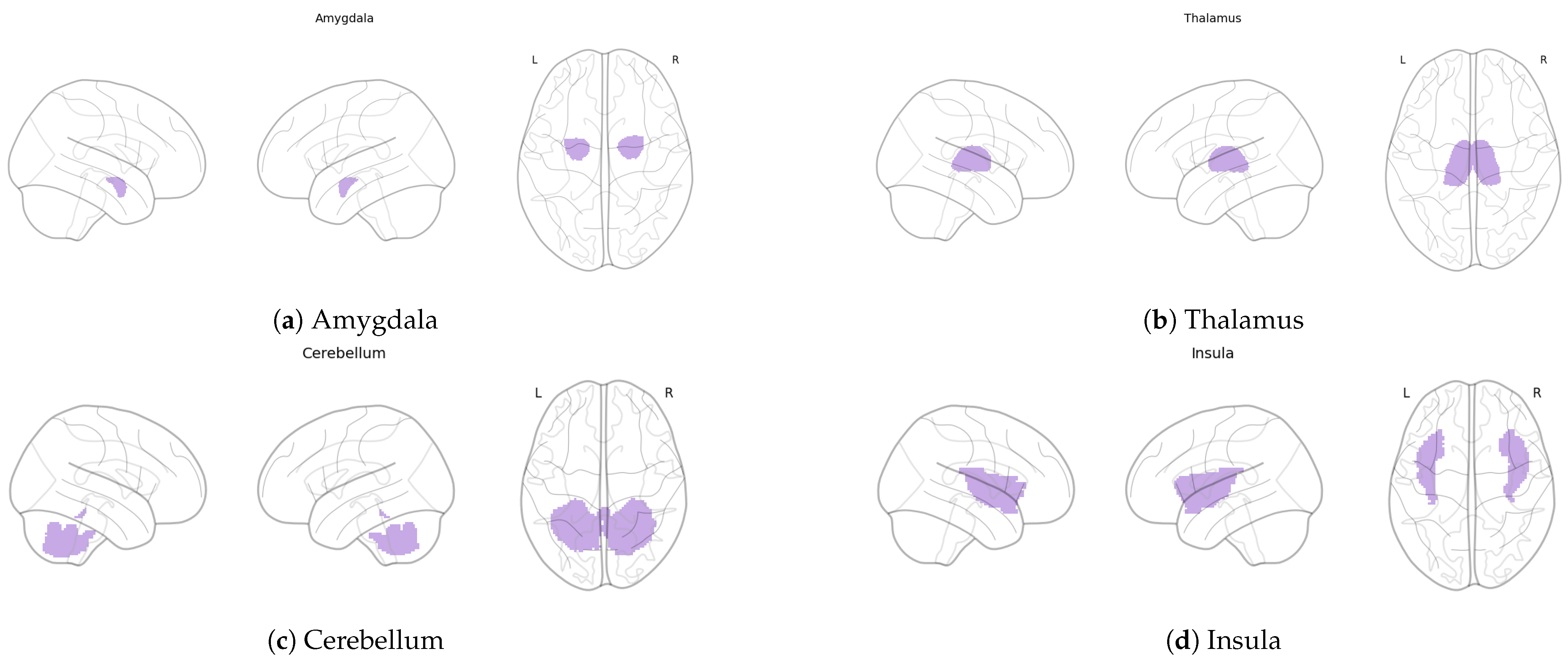
Amygdala
Thalamus
Cerebellum
Insula
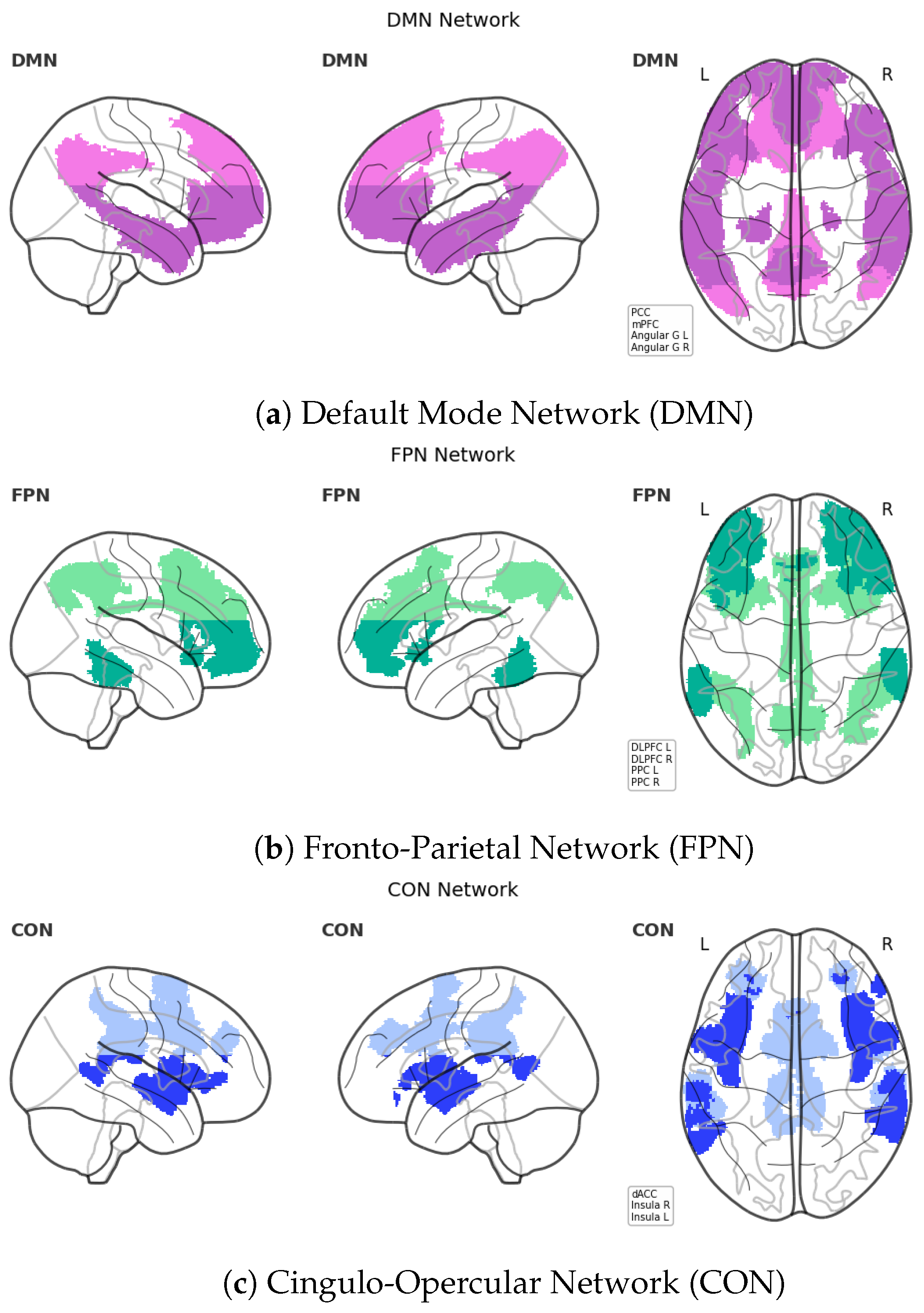
Default Mode Network
Fronto-Parietal Network (FPN) and Cingulo-Opercular Network (CON)
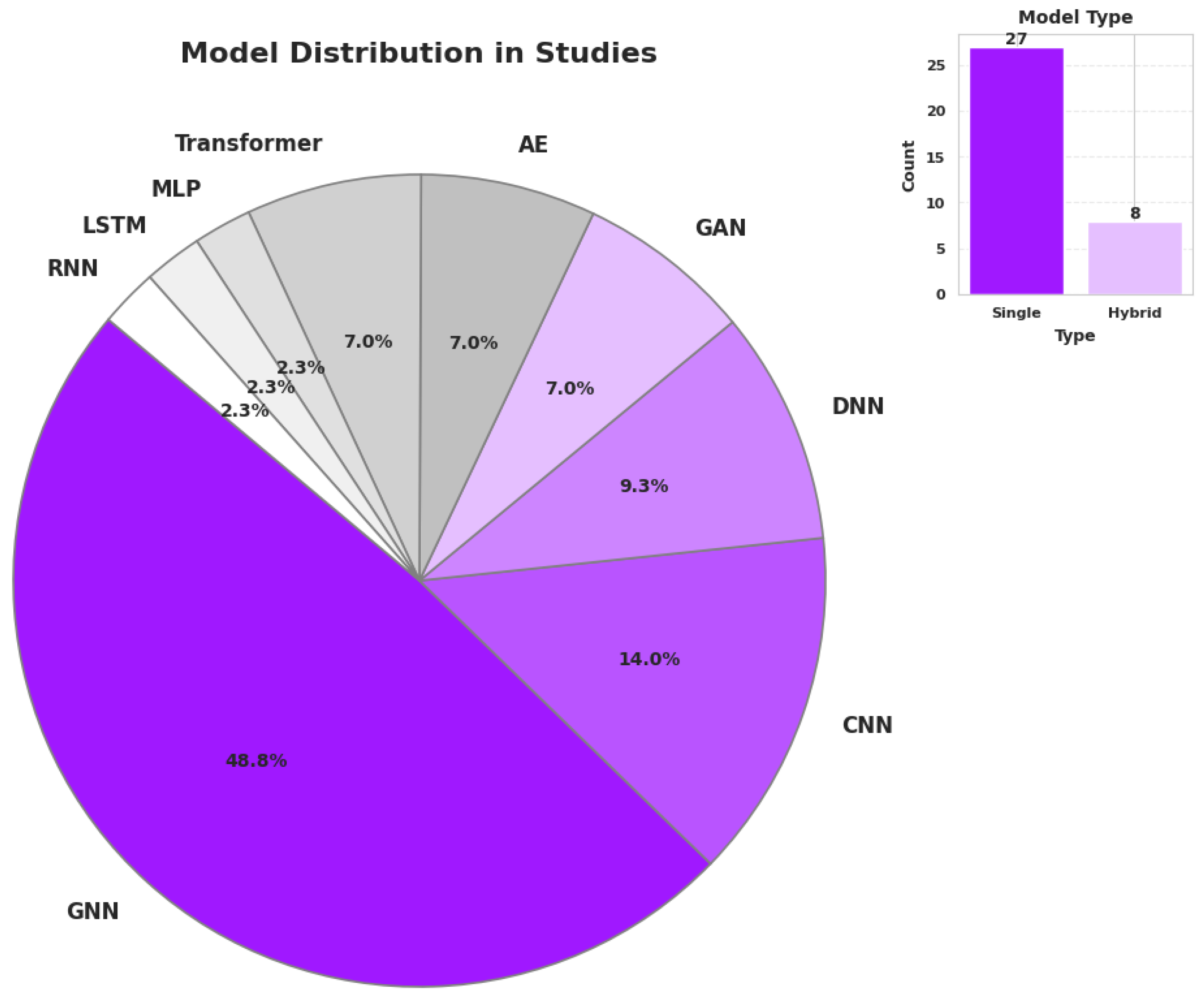
3.3. RQ3: What Are the Most Common Deep Learning Techniques Applied, and to What Extent Do They Accurately Detect MDD?
3.3.1. Supervised Methods
Deep Neural Networks (DNNs)
Graph Neural Networks (GNNs)
Graph Design and Topology Optimisation
Temporal Dynamics Modeling
Multi-Site Generalisation and Harmonisation
Multimodal Fusion
Convolutional Neural Networks (CNNs)
Recurrent Neural Networks (RNNs)/Transformers
3.3.2. Unsupervised Methods
Autoencoders
Generative Adversarial Networks (GANs)
Domain Adaptation Methods
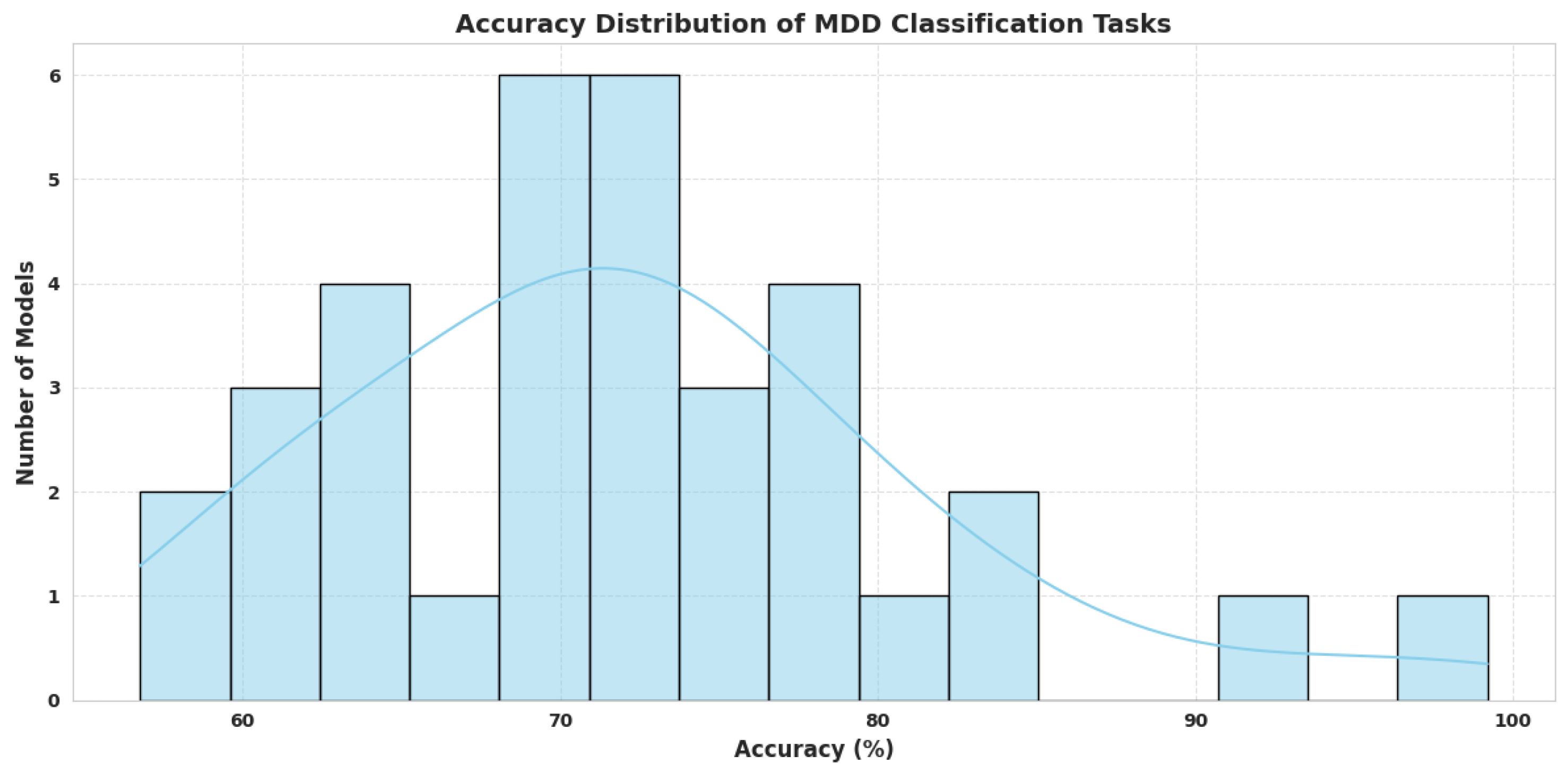
General Comparison of Model Accuracies
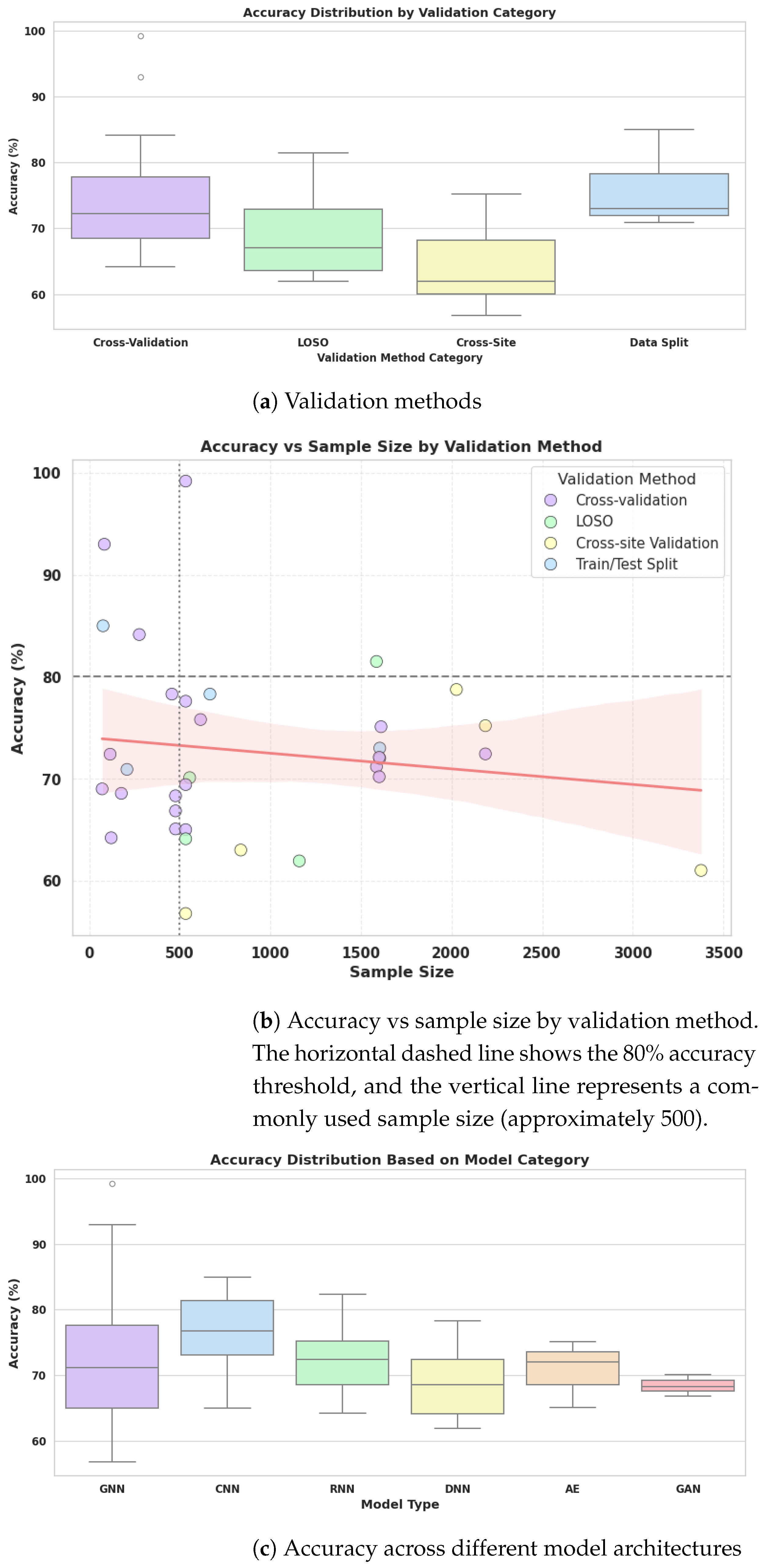
Influence of Architecture on Model Accuracies
Impact of Validation Methods on Model Performance and Generalisability
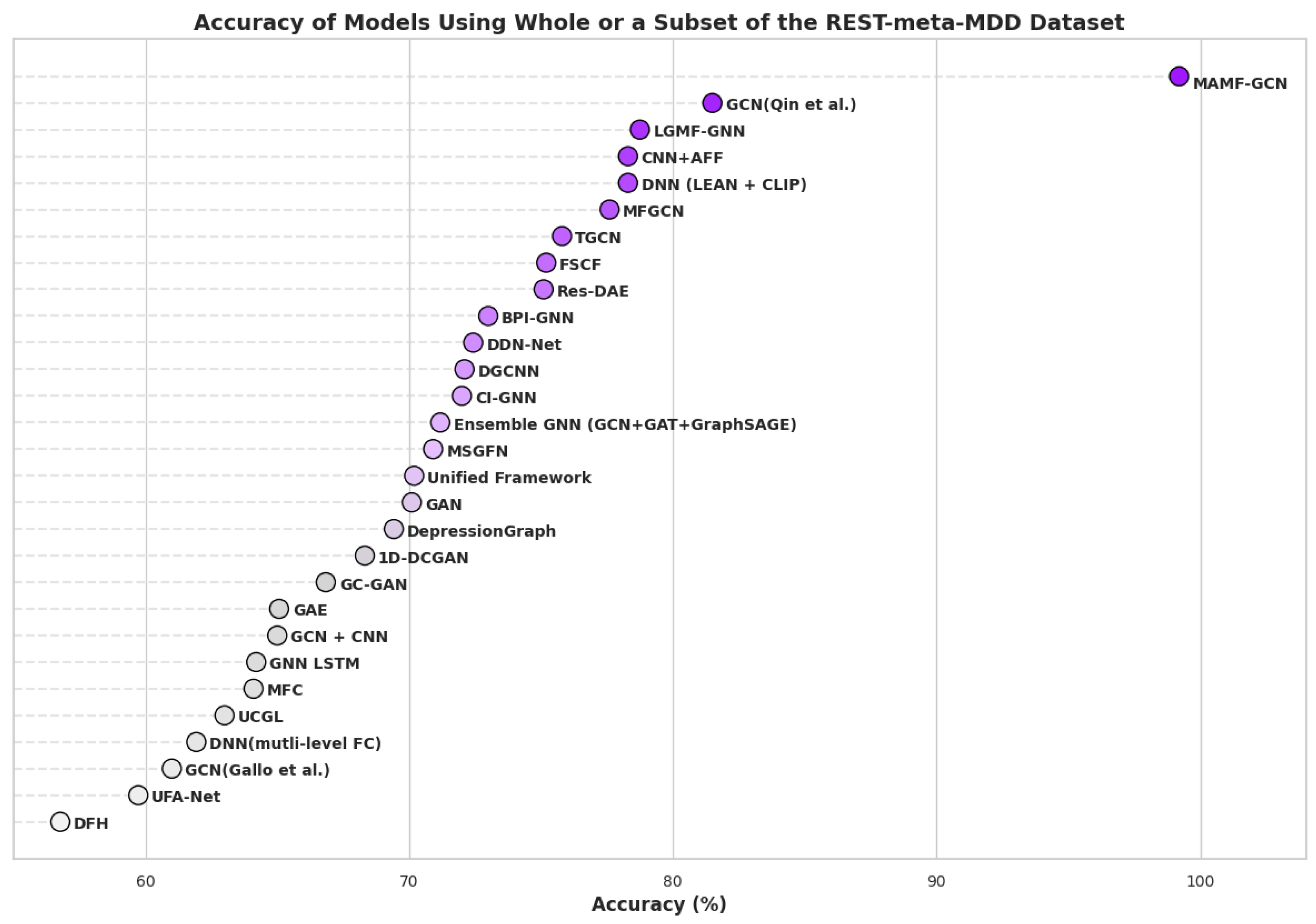
Model Accuracy Comparison on REST-Meta-MDD
3.4. RQ4: What Explainability Methods Have Been Applied for MDD Detection in Deep Models, and How Do They Contribute to the Interpretation of the Model?
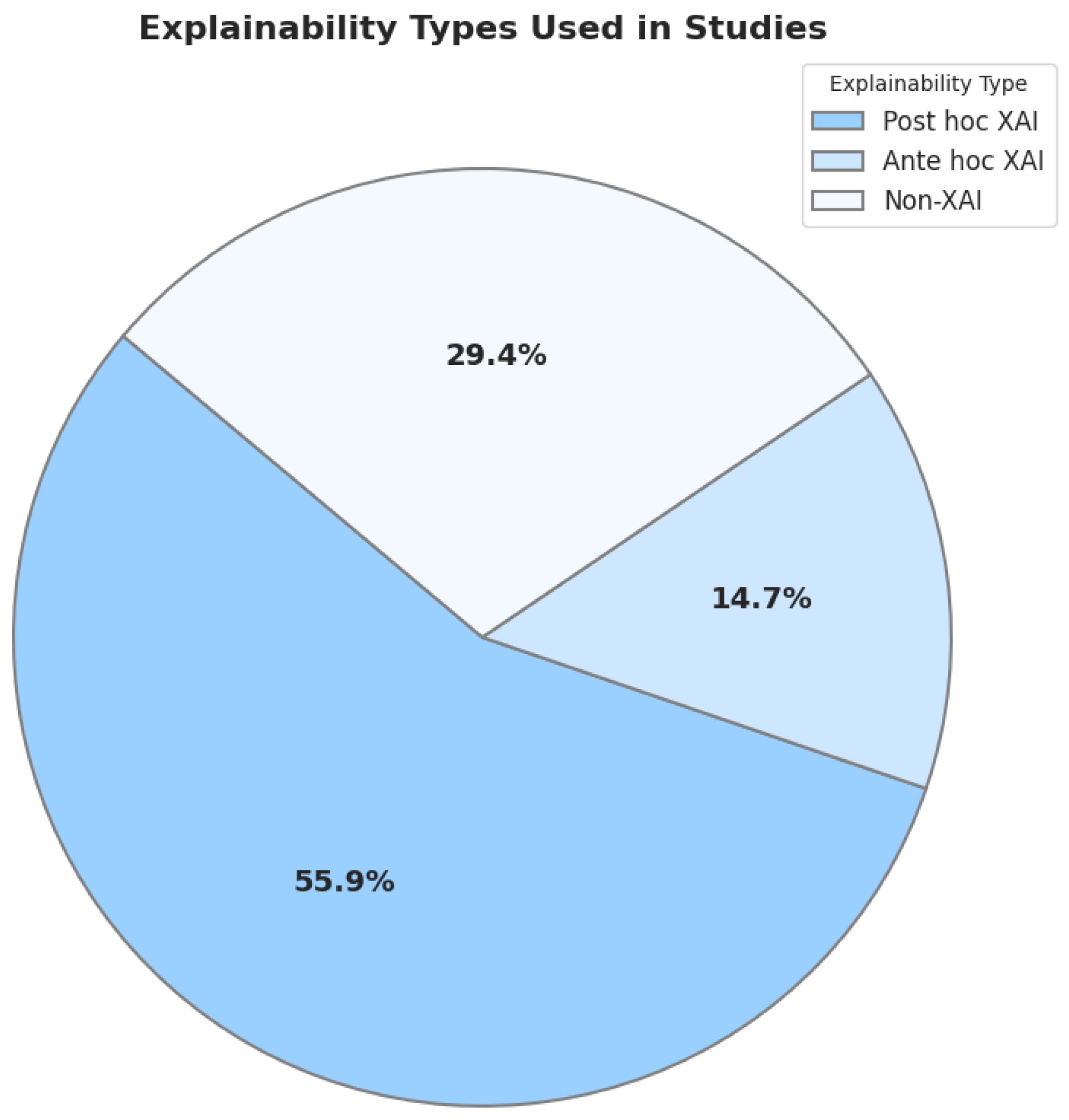
3.4.1. Post Hoc Methods
3.4.2. Ante Hoc Methods
3.4.3. XAI Challenges and Future Directions
4. Discussion
4.1. Generalisation and Data Diversity (RQ1)
4.2. Feature Extraction and Biomarker Discovery (RQ2)
4.3. Deep Learning Techniques and Performance (RQ3)
4.4. Explainability (RQ4)
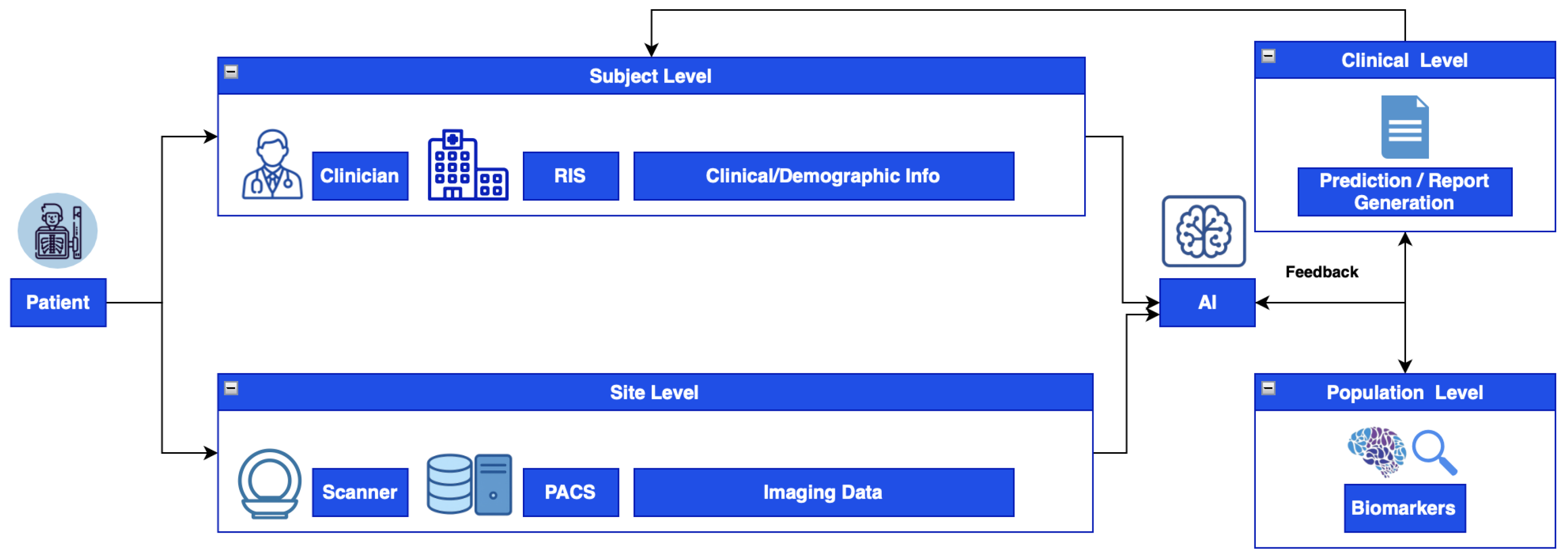
4.5. Clinical Translation and Deployment Challenges
4.5.1. Site-Level Challenges
4.5.2. Population-Level Challenges
4.5.3. Subject-Level Challenges
4.5.4. Clinical-Level Challenges
4.6. Future Research Directions
- Data diversity must be improved.Current datasets lack sufficient geographical and demographic diversity, leading to population bias and limiting the generalisability of models across different cohorts.
- Preprocessing and harmonisation require careful evaluation.Choices such as global signal regression and harmonisation can influence both model performance and reported biomarkers, potentially introducing artificial differences or removing meaningful signals.
- Biomarker reproducibility remains unclear.Reported neuroimaging biomarkers are often inconsistent across sites, datasets, and preprocessing pipelines, raising concerns about their robustness.
- Individual-level variability should be better modelled.Most approaches rely on group-level classification, while clinical heterogeneity in MDD requires models that incorporate subject-specific clinical and demographic information.
- Robust validation strategies are essential.Many studies rely on internal validation, and cross-site evaluation or independent test sets are still limited, restricting conclusions about real-world generalisability.
- Domain adaptation and data-efficient methods are promising.Approaches that reduce sensitivity to site effects and dependence on large labelled datasets offer potential for improving generalisation.
- Clear and clinically meaningful explanations are needed.Current explainability methods often highlight important regions but do not sufficiently explain decisions at the individual level, limiting clinical trust and usability.
- Standardised benchmarking is lacking.Differences in datasets, preprocessing pipelines, and evaluation protocols make comparisons across studies difficult, highlighting the need for unified benchmarks and reporting standards.
- Practical deployment constraints must be addressed.Real-world implementation requires efficient pipelines, manageable computational demands, and integration into existing clinical workflows.
4.7. Limitations and Contributions
5. Conclusions
Supplementary Materials
Author Contributions
Funding
Institutional Review Board Statement
Informed Consent Statement
Data Availability Statement
Acknowledgments
Conflicts of Interest
References
- Najjar, R. Redefining radiology: A review of artificial intelligence integration in medical imaging. Diagnostics 2023, 13, 2760. [Google Scholar] [CrossRef]
- Zafar, F.; Alam, L.F.; Vivas, R.R.; Wang, J.; Whei, S.J.; Mehmood, S.; Nazir, Z. The Role of Artificial Intelligence in Identifying Depression and Anxiety: A Comprehensive Literature Review. Cureus 2024, 16, e56472. [Google Scholar] [CrossRef] [PubMed]
- Klöppel, S.; Stonnington, C.M.; Barnes, J.; Chen, F.; Chu, C.; Good, C.D.; Frackowiak, R.S. Accuracy of dementia diagnosis—A direct comparison between radiologists and a computerized method. Brain 2008, 131, 2969–2974. [Google Scholar] [CrossRef]
- Fava, M.; Kendler, K.S. Major Depressive Disorder. Neuron 2000, 28, 335–341. [Google Scholar] [CrossRef] [PubMed]
- World Health Organization. Depression. 2023. Available online: https://www.who.int/news-room/fact-sheets/detail/depression (accessed on 31 March 2023).
- Zalar, B.; Blatnik, A.; Maver, A.; Klemenc-Ketiš, Z.; Peterlin, B. Family history as an important factor for stratifying participants in genetic studies of major depression. Balk. J. Med. Genet. 2018, 21, 5–12. [Google Scholar] [CrossRef]
- Hasler, G. Pathophysiology of depression: Do we have any solid evidence of interest to clinicians? World Psychiatry 2010, 9, 155. [Google Scholar] [CrossRef]
- Mascayano, F.; Armijo, J.E.; Yang, L.H. Addressing stigma relating to mental illness in low-and middle-income countries. Front. Psychiatry 2015, 6, 38. [Google Scholar] [CrossRef] [PubMed]
- Brasso, C.; Cisotto, M.; Del Favero, E.; Giordano, B.; Villari, V.; Rocca, P. Impact of COVID-19 pandemic on major depressive disorder in acute psychiatric inpatients. Front. Psychol. 2023, 14, 1181832. [Google Scholar] [CrossRef]
- Mao, K.; Wu, Y.; Chen, J. A systematic review on automated clinical depression diagnosis. npj Ment. Health Res. 2023, 2, 20. [Google Scholar] [CrossRef] [PubMed]
- Tolentino, J.C.; Schmidt, S.L. DSM-5 criteria and depression severity: Implications for clinical practice. Front. Psychiatry 2018, 9, 450. [Google Scholar] [CrossRef] [PubMed]
- Renemane, L.; Vrublevska, J. Hamilton depression rating scale: Uses and applications. In The Neuroscience of Depression; Academic Press: Cambridge, MA, USA, 2021; pp. 175–183. [Google Scholar]
- Khalifa, M.; Albadawy, M. Artificial Intelligence for Clinical Prediction: Exploring Key Domains and Essential Functions. Comput. Methods Programs Biomed. Update 2024, 5, 100148. [Google Scholar] [CrossRef]
- Glover, G.H. Overview of functional magnetic resonance imaging. Neurosurg. Clin. 2011, 22, 133–139. [Google Scholar] [CrossRef]
- Pandya, M.; Altinay, M.; Malone, D.A.; Anand, A. Where in the brain is depression? Curr. Psychiatry Rep. 2012, 14, 634–642. [Google Scholar] [CrossRef]
- Buxton, R.B. The physics of functional magnetic resonance imaging (fMRI). Rep. Prog. Phys. 2013, 76, 096601. [Google Scholar] [CrossRef] [PubMed]
- Zhang, X.; Maltbie, E.A.; Keilholz, S.D. Spatiotemporal trajectories in resting-state FMRI revealed by convolutional variational autoencoder. NeuroImage 2021, 244, 118588. [Google Scholar] [CrossRef]
- Lee, M.H.; Smyser, C.D.; Shimony, J.S. Resting-state fMRI: A review of methods and clinical applications. Am. J. Neuroradiol. 2013, 34, 1866–1872. [Google Scholar] [CrossRef] [PubMed]
- Mosch, L.; Fürstenau, D.; Brandt, J.; Wagnitz, J.; Klopfenstein, S.A.; Poncette, A.S.; Balzer, F. The medical profession transformed by artificial intelligence: Qualitative study. Digit. Health 2022, 8, 20552076221143903. [Google Scholar] [CrossRef] [PubMed]
- Chen, Y.; Zhao, W.; Yi, S.; Liu, J. The diagnostic performance of machine learning based on resting-state functional magnetic resonance imaging data for major depressive disorders: A systematic review and meta-analysis. Front. Neurosci. 2023, 17, 1174080. [Google Scholar] [CrossRef] [PubMed]
- Bondi, E.; Maggioni, E.; Brambilla, P.; Delvecchio, G. A systematic review on the potential use of machine learning to classify major depressive disorder from healthy controls using resting state fMRI measures. Neurosci. Biobehav. Rev. 2023, 144, 104972. [Google Scholar] [CrossRef]
- Yeasmin, M.N.; Al Amin, M.; Joti, T.J.; Aung, Z.; Azim, M.A. Advances of AI in image-based computer-aided diagnosis: A review. Array 2024, 23, 100357. [Google Scholar] [CrossRef]
- Chan, H.P.; Samala, R.K.; Hadjiiski, L.M.; Zhou, C. Deep Learning in Medical Image Analysis; Springer: Berlin/Heidelberg, Germany, 2020; pp. 3–21. [Google Scholar]
- Page, M.J.; McKenzie, J.E.; Bossuyt, P.M.; Boutron, I.; Hoffmann, T.C.; Mulrow, C.D.; Shamseer, L.; Tetzlaff, J.M.; Akl, E.A.; Brennan, S.E.; et al. The PRISMA 2020 statement: An updated guideline for reporting systematic reviews. BMJ 2021, 372, n71. [Google Scholar] [CrossRef] [PubMed]
- Venkatapathy, S.; Votinov, M.; Wagels, L.; Kim, S.; Lee, M.; Habel, U.; Ra, I.H.; Jo, H.G. Ensemble graph neural network model for classification of major depressive disorder using whole-brain functional connectivity. Front. Psychiatry 2023, 14, 1125339. [Google Scholar] [CrossRef] [PubMed]
- Qin, K.; Lei, D.; Pinaya, W.H.; Pan, N.; Li, W.; Zhu, Z.; Sweeney, J.A.; Mechelli, A.; Gong, Q. Using graph convolutional network to characterize individuals with major depressive disorder across multiple imaging sites. eBioMedicine 2022, 78, 103977. [Google Scholar] [CrossRef]
- Zhao, J.; Huang, J.; Zhi, D.; Yan, W.; Ma, X.; Yang, X.; Li, X.; Ke, Q.; Jiang, T.; Calhoun, V.D.; et al. Functional network connectivity (FNC)-based generative adversarial network (GAN) and its applications in classification of mental disorders. J. Neurosci. Methods 2020, 341, 108756. [Google Scholar] [CrossRef] [PubMed]
- Tan, Y.F.; Ting, C.M.; Noman, F.; Phan, R.C.W.; Ombao, H. fMRI Functional Connectivity Augmentation Using Convolutional Generative Adversarial Networks for Brain Disord. In Proceedings of the 2024 IEEE International Symposium on Biomedical Imaging (ISBI), Athens, Greece, 27–30 May 2024; IEEE: Piscataway, NJ, USA, 2024. [Google Scholar]
- Noman, F.; Ting, C.M.; Kang, H.; Phan, R.C.; Ombao, H. Graph autoencoders for embedding learning in brain networks and major depressive disorder identification. IEEE J. Biomed. Health Inform. 2024, 28, 1644–1655. [Google Scholar] [CrossRef]
- Zheng, G.; Zheng, W.; Zhang, Y.; Wang, J.; Chen, M.; Wang, Y.; Cai, T.; Yao, Z.; Hu, B. An attention-based multi-modal MRI fusion model for major depressive disorder diagnosis. J. Neural Eng. 2023, 20, 066005. [Google Scholar] [CrossRef]
- Hu, J.; Luo, J.; Xu, Z.; Liao, B.; Dong, S.; Peng, B.; Hou, G. Spatio-temporal learning and explaining for dynamic functional connectivity analysis: Application to depression. J. Affect. Disord. 2024, 364, 266–273. [Google Scholar] [CrossRef]
- Gallo, S.; El-Gazzar, A.; Zhutovsky, P.; Thomas, R.M.; Javaheripour, N.; Li, M.; Bartova, L.; Bathula, D.; Dannlowski, U.; Davey, C.; et al. Functional connectivity signatures of major depressive disorder: Machine learning analysis of two multicenter neuroimaging studies. Mol. Psychiatry 2023, 28, 3013–3022. [Google Scholar] [CrossRef] [PubMed]
- Kong, Y.; Gao, S.; Yue, Y.; Hou, Z.; Shu, H.; Xie, C.; Zhang, Z.; Yuan, Y. Spatio-temporal graph convolutional network for diagnosis and treatment response prediction of major depressive disorder from functional connectivity. Hum. Brain Mapp. 2021, 42, 3922–3933. [Google Scholar] [CrossRef] [PubMed]
- Kang, E.; Heo, D.W.; Lee, J.; Suk, H.I. A Learnable Counter-Condition Analysis Framework for Functional Connectivity-Based Neurological Disorder Diagnosis. IEEE Trans. Med. Imaging 2023, 43, 1377–1387. [Google Scholar] [CrossRef] [PubMed]
- Wang, Q.; Li, L.; Qiao, L.; Liu, M. Adaptive multimodal neuroimage integration for major depression disorder detection. Front. Neuroinform. 2022, 16, 856175. [Google Scholar] [CrossRef] [PubMed]
- Lin, C.; Lee, S.H.; Huang, C.M.; Chen, G.Y.; Chang, W.; Liu, H.L.; Ng, S.H.; Lee, T.M.; Wu, S.C. Automatic diagnosis of late-life depression by 3D convolutional neural networks and cross-sample Entropy analysis from resting-state fMRI. Brain Imaging Behav. 2023, 17, 125–135. [Google Scholar] [CrossRef]
- Wang, J.; Li, T.; Sun, Q.; Guo, Y.; Yu, J.; Yao, Z.; Hou, N.; Hu, B. Automatic diagnosis of major depressive disorder using a high-and low-frequency feature fusion framework. Brain Sci. 2023, 13, 1590. [Google Scholar] [CrossRef] [PubMed]
- Zheng, K.; Yu, S.; Chen, L.; Dang, L.; Chen, B. BPI-GNN: Interpretable brain network-based psychiatric diagnosis and subtyping. NeuroImage 2024, 292, 120594. [Google Scholar] [CrossRef] [PubMed]
- Zheng, K.; Yu, S.; Chen, B. Ci-gnn: A granger causality-inspired graph neural network for interpretable brain network-based psychiatric diagnosis. Neural Netw. 2024, 172, 106147. [Google Scholar] [CrossRef] [PubMed]
- Dai, P.; Lu, D.; Shi, Y.; Zhou, Y.; Xiong, T.; Zhou, X.; Chen, Z.; Zou, B.; Tang, H.; Huang, Z.; et al. Classification of recurrent major depressive disorder using a new time series feature extraction method through multisite rs-fMRI data. J. Affect. Disord. 2023, 339, 511–519. [Google Scholar] [CrossRef] [PubMed]
- Dai, P.; Shi, Y.; Lu, D.; Zhou, Y.; Luo, J.; He, Z.; Chen, Z.; Zou, B.; Tang, H.; Huang, Z.; et al. Classification of recurrent major depressive disorder using a residual denoising autoencoder framework: Insights from large-scale multisite fMRI data. Comput. Methods Programs Biomed. 2024, 247, 108114. [Google Scholar] [CrossRef]
- Zhang, Y.; Liu, X.; Zhang, Z. DDN-Net: Deep Residual Shrinkage Denoising Networks with Channel-Wise Adaptively Soft Thresholds for Automated Major Depressive Disorder Identification. In Proceedings of the ICASSP 2024—2024 IEEE International Conference on Acoustics, Speech and Signal Processing (ICASSP), Seoul, Republic of Korea, 14–19 April 2024; IEEE: Piscataway, NJ, USA, 2024; pp. 1626–1630. [Google Scholar]
- Xia, Z.; Fan, Y.; Li, K.; Wang, Y.; Huang, L.; Zhou, F. DepressionGraph: A Two-Channel Graph Neural Network for the Diagnosis of Major Depressive Disorders Using rs-fMRI. Electronics 2023, 12, 5040. [Google Scholar] [CrossRef]
- Liu, S.; Gui, R. Fusing multi-scale fMRI features using a brain-inspired multi-channel graph neural network for major depressive disorder diagnosis. Biomed. Signal Process. Control 2024, 90, 105837. [Google Scholar] [CrossRef]
- Oh, J.H.; Lee, D.J.; Ji, C.H.; Shin, D.H.; Han, J.W.; Son, Y.H.; Kam, T.E. Graph-based conditional generative adversarial networks for major depressive disorder diagnosis with synthetic functional brain network generation. IEEE J. Biomed. Health Inform. 2023, 28, 1504–1515. [Google Scholar] [CrossRef] [PubMed]
- Liu, M.; Zhang, H.; Liu, M.; Chen, D.; Zhou, R.; Lu, W.; Zhang, L.; Shen, D.; Wang, Q.; Peng, D. Hierarchical Encoding and Fusion of Brain Functions for Depression Subtype Classification. IEEE Trans. Affect. Comput. 2024, 15, 1826–1837. [Google Scholar] [CrossRef]
- Long, D.; Zhang, M.; Yu, J.; Zhu, Q.; Chen, F.; Li, F. Intelligent diagnosis of major depression disease based on multi-layer brain network. Front. Neurosci. 2023, 17, 1126865. [Google Scholar] [CrossRef]
- Pan, J.; Lin, H.; Dong, Y.; Wang, Y.; Ji, Y. MAMF-GCN: Multi-scale adaptive multi-channel fusion deep graph convolutional network for predicting mental disorder. Comput. Biol. Med. 2022, 148, 105823. [Google Scholar] [CrossRef]
- Liang, Y.; Xu, G. Multi-level functional connectivity fusion classification framework for brain disease diagnosis. IEEE J. Biomed. Health Inform. 2022, 26, 2714–2725. [Google Scholar] [CrossRef]
- Kong, Y.; Niu, S.; Gao, H.; Yue, Y.; Shu, H.; Xie, C.; Zhang, Z.; Yuan, Y. Multi-stage graph fusion networks for major depressive disorder diagnosis. IEEE Trans. Affect. Comput. 2022, 13, 1917–1928. [Google Scholar] [CrossRef]
- Gupta, S.; Chan, Y.H.; Rajapakse, J.C.; Initiative, A.D.N. Obtaining leaner deep neural networks for decoding brain functional connectome in a single shot. Neurocomputing 2021, 453, 326–336. [Google Scholar] [CrossRef]
- Zhang, W.; Zeng, W.; Chen, H.; Liu, J.; Yan, H.; Zhang, K.; Wang, N. STANet: A Novel Spatio-Temporal Aggregation Network for Depression Classification with Small and Unbalanced FMRI Data. Tomography 2024, 10, 1895–1914. [Google Scholar] [CrossRef] [PubMed]
- Zhu, M.; Quan, Y.; He, X. The classification of brain network for major depressive disorder patients based on deep graph convolutional neural network. Front. Hum. Neurosci. 2023, 17, 1094592. [Google Scholar] [CrossRef]
- Pitsik, E.N.; Maximenko, V.A.; Kurkin, S.A.; Sergeev, A.P.; Stoyanov, D.; Paunova, R.; Kandilarova, S.; Simeonova, D.; Hramov, A.E. The topology of fMRI-based networks defines the performance of a graph neural network for the classification of patients with major depressive disorder. Chaos Solitons Fractals 2023, 167, 113041. [Google Scholar] [CrossRef]
- Wang, X.; Chu, Y.; Wang, Q.; Cao, L.; Qiao, L.; Zhang, L.; Liu, M. Unsupervised contrastive graph learning for resting-state functional MRI analysis and brain disorder detection. Hum. Brain Mapp. 2023, 44, 5672–5692. [Google Scholar] [CrossRef]
- Fang, Y.; Potter, G.G.; Wu, D.; Zhu, H.; Liu, M. Addressing multi-site functional MRI heterogeneity through dual-expert collaborative learning for brain disease identification. Hum. Brain Mapp. 2023, 44, 4256–4271. [Google Scholar] [CrossRef]
- Fang, Y.; Wang, M.; Potter, G.G.; Liu, M. Unsupervised cross-domain functional MRI adaptation for automated major depressive disorder identification. Med. Image Anal. 2023, 84, 102707. [Google Scholar] [CrossRef] [PubMed]
- Liu, S.; Zhou, J.; Zhu, X.; Zhang, Y.; Zhou, X.; Zhang, S.; Jin, C. An Objective Quantitative Diagnosis of Depression Using a Local-to-Global Multimodal Fusion Graph Neural Network. Patterns 2024, 5, 101081. [Google Scholar] [CrossRef]
- Tian, C.; Lu, M. High-Order Functional Connectivity Based Major Depressive Disorder Classification Using Self-Attention Based CNN. In Proceedings of the 2024 7th International Conference on Data Science and Information Technology (DSIT), Nanjing, China, 13–15 December 2024; IEEE: Piscataway, NJ, USA, 2024; pp. 1–6. [Google Scholar] [CrossRef]
- Yan, C.G.; Chen, X.; Li, L.; Castellanos, F.X.; Bai, T.J.; Bo, Q.J.; Cao, J.; Chen, G.M.; Chen, N.X.; Chen, W.; et al. Reduced default mode network functional connectivity in patients with recurrent major depressive disorder. Proc. Natl. Acad. Sci. USA 2019, 116, 9078–9083. [Google Scholar] [CrossRef]
- Tanaka, S.C.; Yamashita, A.; Yahata, N.; Itahashi, T.; Lisi, G.; Yamada, T.; Ichikawa, N.; Takamura, M.; Yoshihara, Y.; Kunimatsu, A.; et al. A multi-site, multi-disorder resting-state magnetic resonance image database. Sci. Data 2021, 8, 227. [Google Scholar] [CrossRef]
- Qian, J.; Li, H.; Wang, J.; He, L. Recent Advances in Explainable Artificial Intelligence for Magnetic Resonance Imaging. Diagnostics 2023, 13, 1571. [Google Scholar] [CrossRef]
- Zhao, L. Advances in fMRI-Based Brain Function Mapping: A Deep Learning Perspective. Psychoradiology 2025, 5, kkaf007. [Google Scholar] [CrossRef] [PubMed]
- Craddock, C.; Sikka, S.; Cheung, B.; Khanuja, R.; Ghosh, S.S.; Yan, C.G.; Milham, M. Towards automated analysis of connectomes: The configurable pipeline for the analysis of connectomes (C-PAC). Front. Neuroinform. 2013, 7, 42. [Google Scholar] [CrossRef]
- Yan, C.G.; Zang, Y.F. DPARSF: A MATLAB toolbox for “pipeline” data analysis of resting-state fMRI. Front. Syst. Neurosci. 2010, 4, 13. [Google Scholar] [CrossRef] [PubMed]
- Friston, K.J. Statistical Parametric Mapping. In Neuroscience Databases: A Practical Guide; Toga, A.W., Mazziotta, J.C., Eds.; Springer: Boston, MA, USA, 2003; pp. 237–250. [Google Scholar]
- Woolrich, M.W.; Jbabdi, S.; Patenaude, B.; Chappell, M.; Makni, S.; Behrens, T.; Beckmann, C.; Jenkinson, M.; Smith, S.M. Bayesian analysis of neuroimaging data in FSL. NeuroImage 2009, 45, S173–S186. [Google Scholar] [CrossRef] [PubMed]
- Avants, B.B.; Tustison, N.; Song, G. Advanced normalization tools (ANTS). Insight J. 2009, 2, 1–35. [Google Scholar]
- Ashburner, J. A fast diffeomorphic image registration algorithm. NeuroImage 2007, 38, 95–113. [Google Scholar] [CrossRef] [PubMed]
- Liu, T.T.; Nalci, A.; Falahpour, M. The global signal in fMRI: Nuisance or information? NeuroImage 2017, 150, 213–229. [Google Scholar] [CrossRef]
- Bastos, A.M.; Schoffelen, J.M. A tutorial review of functional connectivity analysis methods and their interpretational pitfalls. Front. Syst. Neurosci. 2016, 9, 175. [Google Scholar] [CrossRef]
- Lin, C.; Huang, C.M.; Chang, W.; Chang, Y.X.; Liu, H.L.; Ng, S.H.; Lin, H.L.; Lee, T.M.; Lee, S.H.; Wu, S.C. Predicting suicidality in late-life depression by 3D convolutional neural network and cross-sample entropy analysis of resting-state fMRI. Brain Behav. 2024, 14, e3348. [Google Scholar] [CrossRef] [PubMed]
- Liu, Z.; Wong, N.M.; Shao, R.; Lee, S.H.; Huang, C.M.; Liu, H.L.; Lee, T.M. Classification of Major Depressive Disorder using Machine Learning on brain structure and functional connectivity. J. Affect. Disord. Rep. 2022, 10, 100428. [Google Scholar] [CrossRef]
- Kim, H.; Han, K.M.; Choi, K.W.; Tae, W.S.; Kang, W.; Kang, Y.; Ham, B.J. Volumetric alterations in subregions of the amygdala in adults with major depressive disorder. J. Affect. Disord. 2021, 295, 108–115. [Google Scholar] [CrossRef]
- Duan, J.; Li, Y.; Zhang, X.; Dong, S.; Zhao, P.; Liu, J.; Zheng, J.; Zhu, R.; Kong, Y.; Wang, F. Predicting treatment response in adolescents and young adults with major depressive episodes from fMRI using graph isomorphism network. NeuroImage Clin. 2023, 40, 103534. [Google Scholar] [CrossRef]
- Jones, E.G. The Thalamus; Springer Science & Business Media: Berlin/Heidelberg, Germany, 2012. [Google Scholar]
- Uddin, L.Q.; Nomi, J.S.; Hébert-Seropian, B.; Ghaziri, J.; Boucher, O. Structure and function of the human insula. J. Clin. Neurophysiol. 2017, 34, 300–306. [Google Scholar] [CrossRef]
- Zanto, T.P.; Gazzaley, A. Fronto-parietal network: Flexible hub of cognitive control. Trends Cogn. Sci. 2013, 17, 602–603. [Google Scholar] [CrossRef]
- D’Andrea, C.B.; Laumann, T.O.; Newbold, D.J.; Nelson, S.M.; Nielsen, A.N.; Chauvin, R.; Gordon, E.M. Substructure of the brain’s Cingulo-Opercular network. bioRxiv 2023. [Google Scholar] [CrossRef]
- Avberšek, L.K.; Repovš, G. Deep learning in neuroimaging data analysis: Applications, challenges, and solutions. Front. Neuroimaging 2022, 1, 981642. [Google Scholar] [CrossRef] [PubMed]
- Ono, S.; Goto, T. Introduction to supervised machine learning in clinical epidemiology. Ann. Clin. Epidemiol. 2022, 4, 63–71. [Google Scholar] [CrossRef]
- Hussain, H.; Tamizharasan, P.S.; Rahul, C.S. Design Possibilities and Challenges of DNN Models: A Review on the Perspective of End Devices. Artif. Intell. Rev. 2022, 55, 5109–5167. [Google Scholar] [CrossRef]
- Mohanasundaram, R.; Malhotra, A.S.; Arun, R.; Periasamy, P.S. Chapter 8 - Deep Learning and Semi-Supervised and Transfer Learning Algorithms for Medical Imaging. In Deep Learning and Parallel Computing Environment for Bioengineering Systems; Sangaiah, A.K., Ed.; Academic Press: Cambridge, MA, USA, 2019; pp. 139–151. [Google Scholar] [CrossRef]
- Mohammadi, H.; Karwowski, W. Graph Neural Networks in Brain Connectivity Studies: Methods, Challenges, and Future Directions. Brain Sci. 2024, 15, 17. [Google Scholar] [CrossRef]
- Asif, N.A.; Sarker, Y.; Chakrabortty, R.K.; Ryan, M.J.; Ahamed, M.H.; Saha, D.K.; Tasneem, Z. Graph Neural Network: A Comprehensive Review on Non-Euclidean Space. IEEE Access 2021, 9, 60588–60606. [Google Scholar] [CrossRef]
- Zhou, J.; Cui, G.; Hu, S.; Zhang, Z.; Yang, C.; Liu, Z.; Sun, M. Graph neural networks: A review of methods and applications. AI Open 2020, 1, 57–81. [Google Scholar] [CrossRef]
- Dai, E.; Jin, W.; Liu, H.; Wang, S. Towards robust graph neural networks for noisy graphs with sparse labels. In Proceedings of the Fifteenth ACM International Conference on Web Search and Data Mining, Tempe, AZ, USA, 21–25 February 2022; ACM: New York, NY, USA, 2022; pp. 181–191. [Google Scholar]
- Gevins, A.; Smith, M.E.; McEvoy, L.K.; Leong, H.; Le, J. Electroencephalographic imaging of higher brain function. Philos. Trans. R. Soc. Lond. Ser. B Biol. Sci. 1999, 354, 1125–1134. [Google Scholar] [CrossRef]
- Chaabene, S.; Boudaya, A.; Bouaziz, B.; Chaari, L. An overview of methods and techniques in multimodal data fusion with application to healthcare. Int. J. Data Sci. Anal. 2025, 20, 3093–3117. [Google Scholar] [CrossRef]
- Yamashita, R.; Nishio, M.; Do, R.K.; Togashi, K. Convolutional neural networks: An overview and application in radiology. Insights Into Imaging 2018, 9, 611–629. [Google Scholar] [CrossRef]
- Singh, S.P.; Wang, L.; Gupta, S.; Goli, H.; Padmanabhan, P.; Gulyás, B. 3D deep learning on medical images: A review. Sensors 2020, 20, 5097. [Google Scholar] [CrossRef] [PubMed]
- Güçlü, U.; Van Gerven, M.A. Modeling the dynamics of human brain activity with recurrent neural networks. Front. Comput. Neurosci. 2017, 11, 7. [Google Scholar] [CrossRef] [PubMed]
- Mienye, I.D.; Swart, T.G.; Obaido, G. Recurrent Neural Networks: A Comprehensive Review of Architectures, Variants, and Applications. Information 2024, 15, 517. [Google Scholar] [CrossRef]
- Trezza, A.; Visibelli, A.; Roncaglia, B.; Spiga, O.; Santucci, A. Unsupervised Learning in Precision Medicine: Unlocking Personalized Healthcare through AI. Appl. Sci. 2024, 14, 9305. [Google Scholar] [CrossRef]
- Ehrhardt, J.; Wilms, M. Autoencoders and variational autoencoders in medical image analysis. In Biomedical Image Synthesis and Simulation; Burgos, N., Svoboda, D., Eds.; The MICCAI Society book series; Academic Press: Cambridge, MA, USA, 2022; pp. 129–162. [Google Scholar] [CrossRef]
- Showrov, A.A.; Aziz, M.T.; Nabil, H.R.; Jim, J.R.; Kabir, M.M.; Mridha, M.F.; Shin, J. Generative Adversarial Networks (GANs) in Medical Imaging: Advancements, Applications and Challenges. IEEE Access 2024, 12, 35728–35753. [Google Scholar] [CrossRef]
- Guan, H.; Liu, M. Domain adaptation for medical image analysis: A survey. IEEE Trans. Biomed. Eng. 2021, 69, 1173–1185. [Google Scholar] [CrossRef]
- Sadeghi, Z.; Alizadehsani, R.; Cifci, M.A.; Kausar, S.; Rehman, R.; Mahanta, P.; Pardalos, P.M. A review of Explainable Artificial Intelligence in healthcare. Comput. Electr. Eng. 2024, 118, 109370. [Google Scholar] [CrossRef]
- Alkhanbouli, R.; Matar Abdulla Almadhaani, H.; Alhosani, F.; Simsekler, M.C.E. The role of explainable artificial intelligence in disease prediction: A systematic literature review and future research directions. BMC Med. Inform. Decis. Mak. 2025, 25, 110. [Google Scholar] [CrossRef]
- Retzlaff, C.; Angerschmid, A.; Saranti, A.; Schneeberger, D.; Roettger, R.; Mueller, H.; Holzinger, A. Post-hoc vs ante-hoc explanations: XAI design guidelines for data scientists. Cogn. Syst. Res. 2024, 86, 101243. [Google Scholar] [CrossRef]
- Chen, Z.; Xiao, F.; Guo, F.; Yan, J. Interpretable machine learning for building energy management: A state-of-the-art review. Adv. Appl. Energy 2023, 9, 100123. [Google Scholar] [CrossRef]
- Mohamed, E.; Sirlantzis, K.; Howells, G. A review of visualisation-as-explanation techniques for convolutional neural networks and their evaluation. Displays 2022, 73, 102239. [Google Scholar] [CrossRef]
- Chaddad, A.; Peng, J.; Xu, J.; Bouridane, A. Survey of explainable AI techniques in healthcare. Sensors 2023, 23, 634. [Google Scholar] [CrossRef]
- Salih, A.M.; Raisi-Estabragh, Z.; Galazzo, I.B.; Radeva, P.; Petersen, S.E.; Lekadir, K.; Menegaz, G. A Perspective on Explainable Artificial Intelligence Methods: SHAP and LIME. Adv. Intell. Syst. 2024, 7, 2400304. [Google Scholar] [CrossRef]
- Antoniadi, A.M.; Du, Y.; Guendouz, Y.; Wei, L.; Mazo, C.; Becker, B.A.; Mooney, C. Current challenges and future opportunities for XAI in machine learning-based clinical decision support systems: A systematic review. Appl. Sci. 2021, 11, 5088. [Google Scholar] [CrossRef]
- Arrieta, A.B.; Díaz-Rodríguez, N.; Del Ser, J.; Bennetot, A.; Tabik, S.; Barbado, A.; Garcia, S.; Gil-Lopez, S.; Molina, D.; Benjamins, R.; et al. Explainable artificial intelligence (XAI): Concepts, taxonomies, opportunities and challenges toward responsible AI. Inf. Fusion 2020, 58, 82–115. [Google Scholar] [CrossRef]
- Rudin, C. Stop explaining black box machine learning models for high stakes decisions and use interpretable models instead. Nat. Mach. Intell. 2019, 1, 206–215. [Google Scholar] [CrossRef]
- Longo, L.; Brcic, M.; Cabitza, F.; Choi, J.; Confalonieri, R.; Del Ser, J.; Stumpf, S. Explainable Artificial Intelligence (XAI) 2.0: A manifesto of open challenges and interdisciplinary research directions. Inf. Fusion 2024, 106, 102301. [Google Scholar] [CrossRef]
- Clusmann, J.; Kolbinger, F.R.; Muti, H.S.; Carrero, Z.I.; Eckardt, J.N.; Laleh, N.G.; Kather, J.N. The future landscape of large language models in medicine. Commun. Med. 2023, 3, 141. [Google Scholar] [CrossRef] [PubMed]
- Nazario-Johnson, L.; Zaki, H.A.; Tung, G.A. Use of large language models to predict neuroimaging. J. Am. Coll. Radiol. 2023, 20, 1004–1009. [Google Scholar] [CrossRef] [PubMed]
- Alowais, S.A.; Alghamdi, S.S.; Alsuhebany, N.; Alqahtani, T.; Alshaya, A.I.; Almohareb, S.N.; Aldairem, A.; Alrashed, M.; Bin Saleh, K.; Badreldin, H.A.; et al. Revolutionizing healthcare: The role of artificial intelligence in clinical practice. BMC Med. Educ. 2023, 23, 689. [Google Scholar] [CrossRef]
- Aravazhi, P.S.; Gunasekaran, P.; Benjamin, N.Z.; Thai, A.; Chandrasekar, K.K.; Kolanu, N.D.; Prajjwal, P.; Tekuru, Y.; Brito, L.V.; Inban, P. The integration of artificial intelligence into clinical medicine: Trends, challenges, and future directions. Disease-a-Month 2025, 71, 101882. [Google Scholar] [CrossRef] [PubMed]
- Yang, J.; Soltan, A.A.; Clifton, D.A. Machine learning generalizability across healthcare settings: Insights from multi-site COVID-19 screening. npj Digit. Med. 2022, 5, 69. [Google Scholar] [CrossRef]
- Rosenblatt, M.; Tejavibulya, L.; Jiang, R.; Noble, S.; Scheinost, D. Data leakage inflates prediction performance in connectome-based machine learning models. Nat. Commun. 2024, 15, 1829. [Google Scholar] [CrossRef]
- Jin, C.; Jia, H.; Lanka, P.; Rangaprakash, D.; Li, L.; Liu, T.; Hu, X.; Deshpande, G. Dynamic brain connectivity is a better predictor of PTSD than static connectivity. Hum. Brain Mapp. 2017, 38, 4479–4496. [Google Scholar] [CrossRef]
- Kaufmann, T.; Alnæs, D.; Doan, N.T.; Brandt, C.L.; Andreassen, O.A.; Westlye, L.T.; Duff, E.P. Connectome fingerprinting identifies highly heritable patterns of brain connectivity. Sci. Rep. 2019, 9, 7442. [Google Scholar] [CrossRef]
- Eickhoff, S.B.; Yeo, B.T.T.; Genon, S. The impact of different brain parcellation schemes on connectome-based predictions of behavior and psychiatric traits. Hum. Brain Mapp. 2023, 44, 1590–1608. [Google Scholar] [CrossRef]
- Bzdok, D.; Eickhoff, S.B. Parcellations, parcellation-based connectome, and the challenges of individual variability. Trends Cogn. Sci. 2013, 17, 664–686. [Google Scholar] [CrossRef]
- Pezoulas, V.C.; Zaridis, D.I.; Mylona, E.; Androutsos, C.; Apostolidis, K.; Tachos, N.S.; Fotiadis, D.I. Synthetic data generation methods in healthcare: A review on open-source tools and methods. Comput. Struct. Biotechnol. J. 2024, 23, 2892–2910. [Google Scholar] [CrossRef]
- Yamashita, A.; Yahata, N.; Itahashi, T.; Lisi, G.; Yamada, T.; Ichikawa, N.; Takamura, M.; Yoshihara, Y.; Kunimatsu, A.; Okada, N.; et al. Harmonization of resting-state functional MRI data across multiple imaging sites via the separation of site differences into sampling bias and measurement bias. PLoS Biol. 2019, 17, e3000042. [Google Scholar] [CrossRef] [PubMed]



| Google Scholar |
|---|
| ((“major depressive disorder” OR mdd) AND (fmri OR (functional AND magnetic AND resonance) OR (functional AND mri)) AND ((resting AND state) OR rs-fmri) AND (“deep learning”) AND (control* OR healthy) AND (classif*)) |
| Scopus |
| TITLE-ABS-KEY(((“major depressive disorder” OR mdd) AND (fmri OR (functional AND magnetic AND resonance) OR (functional AND mri)) AND ((resting AND state) OR rs-fmri) AND (“deep learning”) AND (control* OR healthy) AND (classif*))) |
| PubMed |
| (“major depressive disorder”[Text Word] OR mdd[Text Word]) AND (fmri[Text Word] OR (functional[Text Word] AND magnetic[Text Word] AND resonance[Text Word]) OR (functional[Text Word] AND mri[Text Word])) AND ((resting[Text Word] AND state[Text Word]) OR rs-fmri[Text Word]) AND (“deep learning”[Text Word]) AND (control*[Text Word] OR healthy[Text Word]) AND (classif*[Text Word]) |
| Authors | Year | Sample Size | Data Source | Feature Extraction | Method | Metrics |
|---|---|---|---|---|---|---|
| Venkatapathy [25] | 2023 | 821 MDD, 765 HC | REST-meta-MDD | Dosenbach, FC using Pearson | Ensemble GNN (GCN, GAT, GraphSAGE) | ACC: 71.18%, AUC: 76.53%, SEN: 68.23%, SPE: 74.96% |
| Qin [26] | 2022 | 821 MDD, 765 HC | REST-meta-MDD | Dosenbach, FC | GCN | ACC: 81.5%, AUC: 86.5% |
| Zhao [27] | 2020 | 269 MDD, 286 HC from 4 sites | Henan Mental Hospital, West China Hospital, Anding Hospital, First Affiliated Hospital of Zhejiang | FNC using ICA | GAN | ACC: 70.1%, AUC: 70.3%, SEN: 73.5%, SPE: 66.5%, F1: 71.7% |
| Tan [28] | 2024 | 250 MDD, 227 HC | REST-meta-MDD | AAL, FC | 1D-DCGAN | ACC: 68.3%, AUC: 68.0%, F1: 67.9% |
| Noman [29] | 2022 | 250 MDD, 227 HC | REST-meta-MDD | AAL and HO, FC using LDW | GAE, GCN (Supervised & Unsupervised) | Supervised: ACC: 59.47%, SEN: 54.87%, F1: 58.57%; Unsupervised: ACC: 65.07%, SEN: 69.7%, F1: 67.29% |
| Zheng [30] | 2023 | 1179 MDD, 1008 HC (52 MDD 80 HC from Gansu Provincial Hospital, independent test set.) | REST-meta-MDD | AAL, FC | FSCF BFE (rs-fMRI), BSE (sMRI) | ACC: 75.2%, SEN: 69.0%, SPE: 80.5%, AUC: 80.8% |
| Hu [31] | 2024 | 89 MDD, 89 HC | Shenzhen Kangning Hospital | AAL, dFC | MT-STN | ACC: 68.56%, SEN: 67.4%, SPE: 69.7%, AUC: 70.6% |
| Gallo [32] | 2023 | 531 MDD, 508 HC, 1255 MDD, 1083 HC | Psymri, REST-meta-MDD | HO, FC | GCN, SVM | ACC: 61.0% (range: 57%–63%) |
| Kong [33] | 2021 | 82 MDD, 50 HC, 98 MDD, 47 HC | ZhongDa Hospital of Southeast University, Hospital of Xinxiang Medical University | dFC | STGCN | Zhongda: ACC: 84.1%, SEN: 89.4%, SPE: 68.3%; Xinxiang: ACC: 83.9%, SEN: 92.9%, SPE: 67.9% |
| Kang [34] | 2023 | 830 MDD, 771 HC | REST-meta-MDD | CC200, FC | Unified Deep Learning Framework | AUC: 75.6%, ACC: 70.2%, SEN: 69.7%, SPE: 70.7% |
| Wang [35] | 2022 | 282 MDD, 251 HC | REST-meta-MDD | HO, FC, Feature fusion (rs-fMR + sMRI) | GCN + CNN | ACC: 65.0%, SEN: 69.4%, SPE: 60.9%, AUC: 66.5% |
| Lin [36] | 2023 | 49 LLD, 28 HC | Chang Gung Medical Foundation | AAL, 3D CSE volumes | CNN | ACC: 85% for 4 ROIs, 80% for 20 ROIs |
| Wang [37] | 2023 | 54 MDD, 62 HC | Gansu Provincial Hospital | AAL, MLFE, MHFE, FC | Feature Cross-Fusion (CNN Transformer) | ACC: 72.4%, PRE: 75.0%, SEN: 88.2%, F1: 60.0%, AUC: 66.7% |
| Zheng [38] | 2024 | 828 MDD, 776 HC | REST-meta-MDD | AAL, FC | BPI-GNN | ACC: 73%, F1: 72.0% |
| Zheng [39] | 2024 | 828 MDD, 776 HC | REST-meta-MDD | AAL, FC | CI-GNN | ACC: 72.0% %, F1: 70.0% % |
| Dai [40] | 2023 | 189 MDD, 426 HC | REST-meta-MDD | dFC | TGCN | ACC: 75.8%, SPE: 66.0%, SEN: 85.3% |
| Dai [41] | 2024 | rMDD616 Dataset: 189 rMDD, 427 HC, all-MDD1611 Dataset: 832 MDD, 779 HC | REST-meta-MDD | CC200, AAL, FC | Res-DAE | rMDD616: ACC: 75.1%, SEN: 69%, SPE: 77.8%, all-MDD1611: ACC: 70% |
| Zhang [42] | 2024 | 1179 MDD, 1008 HC | Rest-metaMDD dataset | AAL, FC | DDN-Net | ACC: 72.4%, PRE: 71.6%, SEN: 70.1%, F1: 67.8% |
| Xia [43] | 2023 | 282 MDD, 251 HC | REST-meta-MDD consortium | CC200 and AAL, FC | Depression Graph | ACC: 69.4%, F1: 75.1%, PRE: 65.9%, SEN: 87.2%, SPE: 49.4%, AUC: 68.3% |
| Liu [44] | 2024 | 282 MDD, 251 HC | REST-meta-MDD dataset | AAL, LOFC, HOFC, demographic info | MFGCN | ACC: 77.6%, SEN: 81.9%, PRE: 79.7%, F1: 79.3% |
| JH Oh [45] | 2023 | 249 MDD, 228 HC | REST-meta-MDD | HO, FC using Pearson correlation | GC-GAN | ACC: 66.84%, SEN: 70.24%, SPE: 63.14%, F1: 68.72% |
| Liu [46] | 2024 | 46 melancholic, 42 atypical, 34 anxious | Shanghai Mental Health Center | AAL. FC using Pearson/ Spearman/ Partial correlation | LSTM and Graph Fusion | ACC: 64.2% (MDD vs. HC), Multi-class: 65.8% |
| Long [47] | 2023 | 597 MDD 563 HC | REST-meta-MDD project | AAL, tHOFC, aHOFC, LOFC Pearson’s correlation | DNN | tHOFC: 60.12%, aHOFC: 60.53%, LOFC: 62.49%, Combined networks ACC: 61.93% |
| Pan [48] | 2022 | 282 MDD, 251 HC | Southwestern University dataset | AAL and HO, FC Pearson’s correlation | MAMF-GCN | SEN: 99.2%, AUC: 99.2%, ACC: 99.2%, SPE: 99.8%, F1: 99.2% |
| Liang [49] | 2022 | 282 MDD, 251 HC | REST-meta-MDD | DNN, CC200, AAL FC | Multi-Level FC Fusion Classification (MFC) | ACC: 64.1%, SEN: 1.9%, F1: 60.7% |
| Kong [50] | 2022 | 129 MDD, 89 HC | ZhongDa Hospital, Southeast University | FC between GM and WM, Pearson correlation | Multi-Stage Graph Fusion Networks (MSGFN) | ACC: 70.91%, SEN: 73.85%, SPE: 66.60% |
| Gupta [51] | 2021 | 289 MDD, 168 HC | Brain Imaging Center at Southwest University | Power Atlas, FC | DNN (LEAN + CLIP) | ACC: 78.3% |
| Zhang [52] | 2024 | 51 MDD, 21 HC | Open Neuro | AAL, FC | STANet | ACC: 82.38% |
| Zhu [53] | 2023 | 830 MDD, 771 HC | REST-meta-MDD | Dosenbach, FC | DGCNN | ACC: 72.1% |
| Pitsik [54] | 2023 | 35 MDD, 49 HC | Medical University of Plovdiv | AAL3, FC | GNN with GCN blocks | ACC: 93.0%, F1: max under 2.5% graph sparsity |
| Wang [55] | 2023 | Site 20: 282 MDD, 251 HC; Site 21: 86 MDD, 70 HC; Site 1: 74 MDD, 74 HC | REST-MDD | BOLD signal augmentation, AAL, FC | UCGL: Pretext model + Fine-tuning | Site 20 → Site 21: ACC: 63%, AUC: 65%, REC: 63%, PRE: 68%, F1: 65% Site 20 → Site 1: ACC: 62%, AUC: 66%, REC: 60%, PRE: 62%, F1: 61% |
| Fang [56] | 2023 | 282 MDD, 251 HC | REST-meta-MDD | AAL, FC | DFH | Site-21: ACC: 56.77%, AUC: 57.23%, SEN: 66.12%, SPE: 45.43%, Site-1: ACC: 57.16%, AUC: 57.30%, SEN: 64.05%, SPE: 50.27% |
| Fang [57] | 2023 | Site-20: 282 MDD, 251 HC; Site-1: 74 MDD, 74 HC | REST-meta-MDD | Spatio-temporal graph, AST-GCM, MMD alignment | UFA-Net | ACC: 59.73%, AUC: 62.50%, SEN: 69.46%, SPE: 50.00%, PRE: 58.49% |
| Liu [58] | 2024 | REST-meta-MDD: 814 MDD, 756 HC; SRPBS: 229 MDD, 228 HC; Anding: 196 MDD, 177 HC; OpenNeuro: 21 MDD, 21 HC | REST-meta-MDD, SRPBS, Anding, OpenNeuro | ROI + subject-level graphs (rs-fMR, sMRI, demographic) | LGMF-GNN | 10-fold CV: AUC: 80.6%, LOSO: AUC: 73.7%, External: AUC: 72.9% (Anding), 70.3% (OpenNeuro), ACC: 78.75%, Cross-site ACC: 69.97% (Anding), 69.05% (OpenNeuro) |
| Tian [59] | 2024 | 368 MDD, 299 HC | REST-meta-MDD | dtHOFC, daHOFC | CNN + Self-Attention | ACC: 78.3%, F1: 80.4%, SEN: 79.3% |
| Dataset Name | Number of Participants | Description | References |
|---|---|---|---|
| REST-meta-MDD (DIRECT Consortium) | 2428 (1300 MDD, 1128 NC) | Large multi-site dataset from 17 hospitals in China | [25,26,27,28,29,30,32,33,34,35,38,39,40,41,42,43,44,45,46,47,48,49,50,51,53,55,56,57,58,59] |
| PsyMRI Consortium | 1039 (531 patients, 508 controls) | Data from 23 cohorts worldwide | [32] |
| SRPBS Dataset (Japan) | 229 MDD, 228 HC | Multi-site dataset collected across 8 sites in Japan | [58] |
| Anding Hospital Dataset | 196 MDD, 177 HC | Used for external testing | [27,58] |
| OpenNeuro Dataset (Russia) | 51 MDD, 21 HC | Public dataset used for training external testing | [52,58] |
| Affiliated ZhongDa Hospital of Southeast University & Second Affiliated Hospital of Xinxiang Medical University | 218 (129 MDD, 89 HC) | Two-site dataset with matched controls | [33] |
| Southwest University Dataset | 282 MDD, 251 HC | Subset of REST-meta-MDD (Site 20) | [55,57] |
| Shanghai Mental Health Center Dataset | 122 (46 melancholic MDD, 42 atypical MDD, 34 anxious MDD) | Focused on MDD subtypes | [46] |
| Gansu Provincial Hospital Dataset | 52 MDD, 80 HC | Used main dataset and also independent test set for validation | [30,37] |
| Shenzhen Kangning Hospital, China | 178 (89 MDD, 89 HC) | Balanced MDD-HC dataset | [31] |
| Henan Mental Hospital, West China Hospital, Anding Hospital, First Affiliated Hospital of Zhejiang | 555 total subjects (269 MDD patients, 286 HCs from 4 sites) | Multi-site MDD dataset | [27] |
| Medical University of Plovdiv Dataset | 84 (35 MDD, 49 HC) | Study on topological properties of brain networks in MDD | [54] |
| Chang Gung Medical Foundation | 77 older adults (49 LLD patients, 28 HC) | Late-life depression (LLD) study | [36] |
| Atlas Name | Number of Regions (ROIs) | Type (Anatomical/Functional) | References |
|---|---|---|---|
| Automated Anatomical Labeling (AAL) | 116 (AAL-90) (AAL3-166) | Anatomical | [28,29,30,31,36,37,38,39,40,41,42,43,44,46,47,48,49,54,55,56,57,58,59] |
| Harvard–Oxford (HO) Atlas | 112 | Anatomical | [29,32,35,43,45,48] |
| Dosenbach’s Atlas | 160 | Functional | [25,26,40,53,57] |
| Power Atlas | 264 | Functional | [51] |
| Craddock(CC200) Atlas | 200 | Functional | [34,40,41,49,58] |
| Brodmann Atlas | 82 (GM regions) | Anatomical | [50] |
| JHU ICBM-DTI-81 Atlas | 48 (WM bundle regions) | Anatomical | [50] |
| Region | Occurrence | References |
|---|---|---|
| Cerebellum | 7 | [26,27,31,34,42,47,58] |
| Insula | 7 | [26,32,36,40,41,46,57] |
| Thalamus | 6 | [32,41,42,45,51,56] |
| Amygdala | 6 | [29,32,39,40,42,45] |
| Lingual Gyrus | 5 | [32,41,44,56,57] |
| Temporal Gyrus | 5 | [34,41,42,51,56] |
| Precentral Gyrus | 5 | [34,40,41,44,58] |
| Hippocampus | 4 | [40,42,46,58] |
| Caudate | 4 | [33,41,42,56] |
| Fusiform Gyrus | 4 | [26,41,42,44] |
| Superior Frontal Gyrus | 4 | [36,41,42,44] |
| Putamen | 3 | [33,45,56] |
| Calcarine Cortex | 3 | [32,42,57] |
| Precuneus | 3 | [26,42,51] |
| Postcentral Gyrus | 3 | [33,42,45] |
| Supramarginal Gyrus | 3 | [32,41,45] |
| Inferior Frontal Gyrus | 3 | [33,40,42] |
| Inferior Parietal Lobule (IPL) | 2 | [26,42] |
| Temporal Pole | 2 | [41,42] |
| Rolandic Operculum | 2 | [42,58] |
| Calcarine region | 2 | [31,56] |
| Cuneus | 2 | [42,44] |
| Middle Frontal Gyrus | 2 | [34,39] |
| Superior Parietal Gyrus | 2 | [40,42] |
| Network | Occurrence | References |
|---|---|---|
| Default Mode Network (DMN) | 5 | [26,27,29,36,47] |
| Frontoparietal Network (FPN) | 2 | [26,27] |
| Cingulo-Opercular Network (CON) | 2 | [26,72] |
| Sensorimotor Network (SMN) | 1 | [27] |
| Cognitive Control Network (CC) | 1 | [27] |
| Model Type | Strengths | Limitations | References | Accuracy Range |
|---|---|---|---|---|
| DNN | Learns high-dimensional patterns automatically; computationally more efficient than other complex models; | Fails to model spatial/temporal structure of brain; | [42,47,49,51,53] | 61.93–78.3% |
| CNN (2D/3D) | Strong at local feature extraction from rs-fMR slices or volumes; well-suited for spatial patterns | Cannot model temporal dynamics; 3D CNNs are computationally intensive | [30,35,36,52,55,59] | 65.0–85.0% |
| RNN/Transformers | Models sequential and temporal patterns; suitable for dynamic FC | limited performance alone; often used in hybrid models | [30,31,37,46,52] | 65.8–82.38% |
| GNN | Captures topological brain network structure; supports node/edge/graph-level prediction; strong with FC data | Sensitive to graph topology; risk of over-smoothing; high implementation complexity | [25,26,32,33,34,35,37,38,39,40,43,44,45,46,48,50,53,54,56,57,58] | 56.77–99.2% |
| GAN | Generates synthetic functional connectivity; augments small datasets; helps with generalisation | Needs large training data; may produce unrealistic samples; graph structure may be lost | [27,28,45] | 66.84–70.1% |
| Autoencoder | Reduces dimensionality; denoising and connectivity preservation; good for feature learning | Spatial/temporal context loss; limited interpretability in flattened FC maps | [39,41,48] | 65.07–75.1% |
| Domain Adaptation | Enhances generalisation across sites using unlabelled data or transfer learning | Still limited by site heterogeneity; often poor performance | [55,56,57] | 56.77–63.0% |
| Validation Category | Validation Method | References |
|---|---|---|
| Cross-validation | 5-fold cross-validation | [28,29,31,34,41,42,43,45,46,51,53] |
| 10-fold cross-validation | [25,33,35,40,44,48,52,54] | |
| 4-fold cross-validation | [37] | |
| LOSO | Leave-one-site-out | [26,27,47,49] |
| Cross-site | Cross-site/Independent test set | [30,32,55,56,57,58] |
| Data Split | Train/val/test Random partitioning | [36,38,39,50,59] |
| Method | Technique | References |
|---|---|---|
| Post Hoc | Grad-CAM | [26,40] |
| Feature attribution (gradients or weights) | [43,44,50,51] | |
| ROI/FC ranking via accuracy | [33,36,41,45,55] | |
| Region/connection ablation | [27,30,32,42] | |
| Statistical testing | [29,47] | |
| Layer-wise relevance propagation (LRP) | [31] | |
| Ante Hoc | Attention-based ROI/time weighting | [56,57,58] |
| Causal subgraph discovery | [30] | |
| Prototype learning | [38] | |
| Counter-condition analysis | [34] |
Disclaimer/Publisher’s Note: The statements, opinions and data contained in all publications are solely those of the individual author(s) and contributor(s) and not of MDPI and/or the editor(s). MDPI and/or the editor(s) disclaim responsibility for any injury to people or property resulting from any ideas, methods, instructions or products referred to in the content. |
© 2026 by the authors. Licensee MDPI, Basel, Switzerland. This article is an open access article distributed under the terms and conditions of the Creative Commons Attribution (CC BY) license.
Share and Cite
Saeedi, M.; Wei, L.; Edoho, M.; Mooney, C. Potential Clinical Applicability of Deep Learning in the Diagnosis of Major Depressive Disorder Using rs-fMRI: A Systematic Literature Review. Appl. Sci. 2026, 16, 3444. https://doi.org/10.3390/app16073444
Saeedi M, Wei L, Edoho M, Mooney C. Potential Clinical Applicability of Deep Learning in the Diagnosis of Major Depressive Disorder Using rs-fMRI: A Systematic Literature Review. Applied Sciences. 2026; 16(7):3444. https://doi.org/10.3390/app16073444
Chicago/Turabian StyleSaeedi, Maryam, Lan Wei, Mercy Edoho, and Catherine Mooney. 2026. "Potential Clinical Applicability of Deep Learning in the Diagnosis of Major Depressive Disorder Using rs-fMRI: A Systematic Literature Review" Applied Sciences 16, no. 7: 3444. https://doi.org/10.3390/app16073444
APA StyleSaeedi, M., Wei, L., Edoho, M., & Mooney, C. (2026). Potential Clinical Applicability of Deep Learning in the Diagnosis of Major Depressive Disorder Using rs-fMRI: A Systematic Literature Review. Applied Sciences, 16(7), 3444. https://doi.org/10.3390/app16073444