Experimental Study on Pore Structure, Mechanical Behavior and Permeability Characteristics of Weakly Cemented Sandstone

 , and
, and
Abstract
1. Introduction
- (1)
- The pore structure of porous sandstones with different grain sizes and its relationship with high porosity, good connectivity, and high permeability.
- (2)
- The stage-dependent evolution of permeability throughout the complete stress–strain process and its coupling with pore compaction, crack propagation, and the development of secondary structures. The present work is expected to improve the understanding of the hydromechanical coupling behavior of weakly cemented, high-porosity sandstones and to provide an experimental basis for evaluating the mechanical and seepage responses of similar aquifer sandstones.
2. Methodology
2.1. Sample Preparation and Experimental Apparatus
2.2. Test Scheme
3. Results
3.1. Characteristics of Sandstone Aquifers
3.2. The Strength and Deformation Characteristics
- (1)
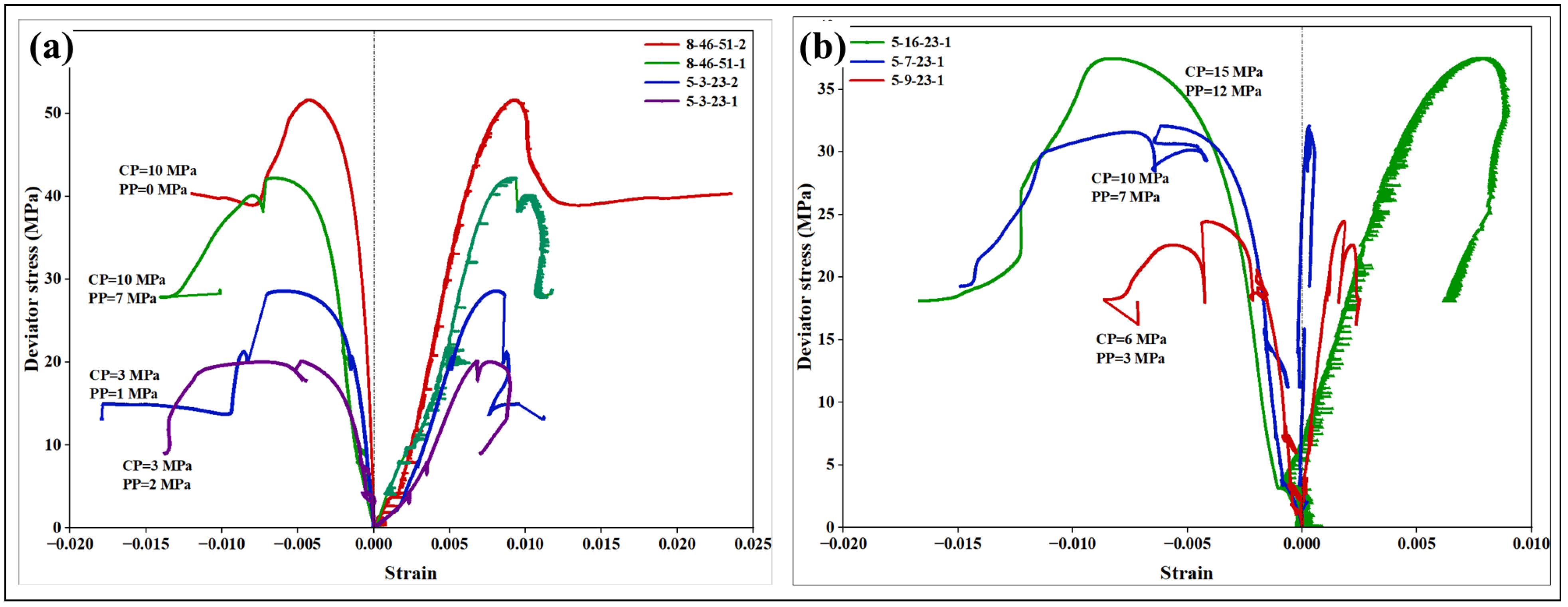
- The peak strength decreases with increasing hydraulic pressure gradient, and this effect becomes more significant at lower confining pressure. As shown in Figure 4a, under a confining pressure of 3 MPa, when the initial hydraulic pressure difference increased from 1.0 to 2.0 MPa, the peak strength decreased from 28.57 to 20.18 MPa, corresponding to a reduction of 8.39 MPa or 29.4%. With increasing confining pressure, however, the rate of strength variation with pore water pressure gradually diminished, indicating that confining pressure weakens the influence of pore water pressure on the peak strength. For example, under a confining pressure of 10 MPa, when the initial hydraulic pressure difference increased from 0 to 7.0 MPa, the peak strength decreased from 51.69 to 42.25 MPa, representing a reduction of 18.3%. This can be attributed to the fact that higher confining pressure promotes the tighter closure of internal fissures, thereby reducing the inflow of pore water into the internal flow channels of the rock. As a result, part of the water pressure acts only as an external load on the specimen ends, increasing the effective stress and thus weakening the effect of hydraulic pressure difference on rock strength.
- (2)
- Poisson’s ratio showed an overall increasing trend with increasing initial hydraulic pressure difference. Under a confining pressure of 3 MPa, when the initial hydraulic pressure difference increased from 1 to 2 MPa, Poisson’s ratio increased from 0.24 to 0.33, representing an increase of 37.5%. Under a confining pressure of 10 MPa, when the initial hydraulic pressure difference increased from 0 to 7.0 MPa, Poisson’s ratio increased from 0.14 to 0.32, representing an increase of 128.6%. This is because, under triaxial compression and constant confining pressure, increasing pore water pressure reduces the compressive stress between particles, thereby enhancing the lateral deformation of the rock.
- (3)
- The elastic modulus generally showed a decreasing trend, with an increasing initial hydraulic pressure difference. For instance, under a confining pressure of 3 MPa, when the initial hydraulic pressure difference increased from 1 to 2 MPa, the elastic modulus decreased from 5.65 to 4.63 GPa, corresponding to a reduction of 1.02 GPa or 18.1%. Under a confining pressure of 10 MPa, when the initial hydraulic pressure difference increased from 0 to 7 MPa, the elastic modulus decreased from 6.96 to 4.60 GPa, corresponding to a reduction of 33.9%.
3.3. Permeability Characteristics Under the Complete Stress–Strain Process
4. Discussion
5. Conclusions
- (1)
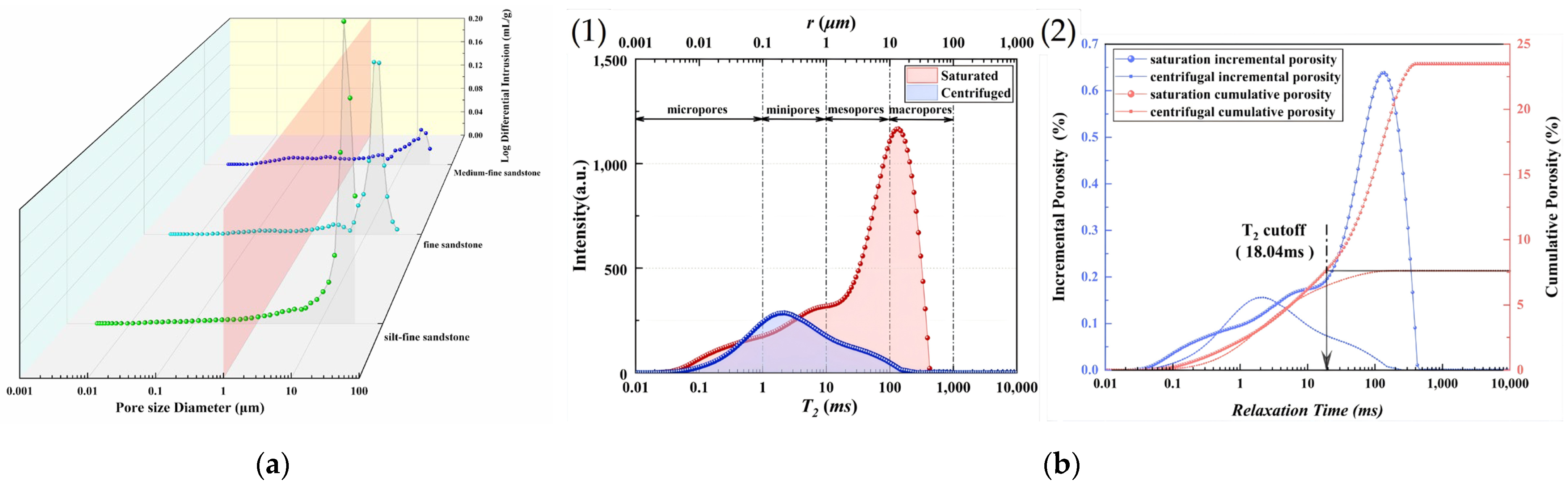
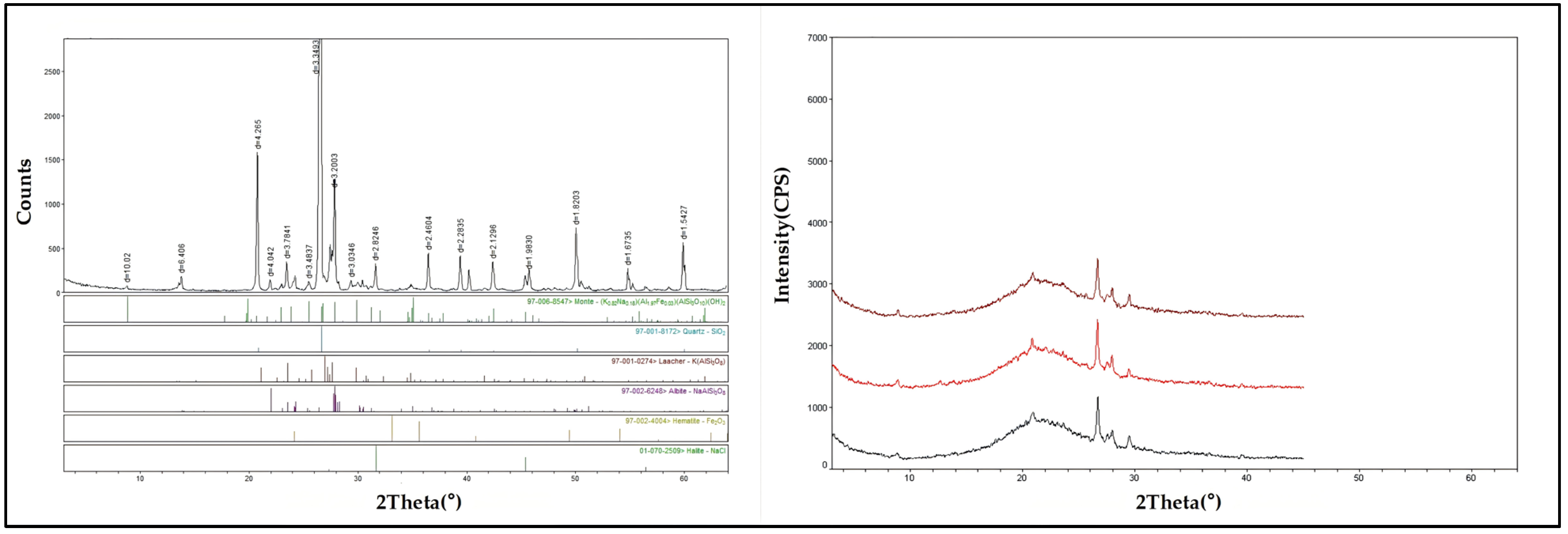
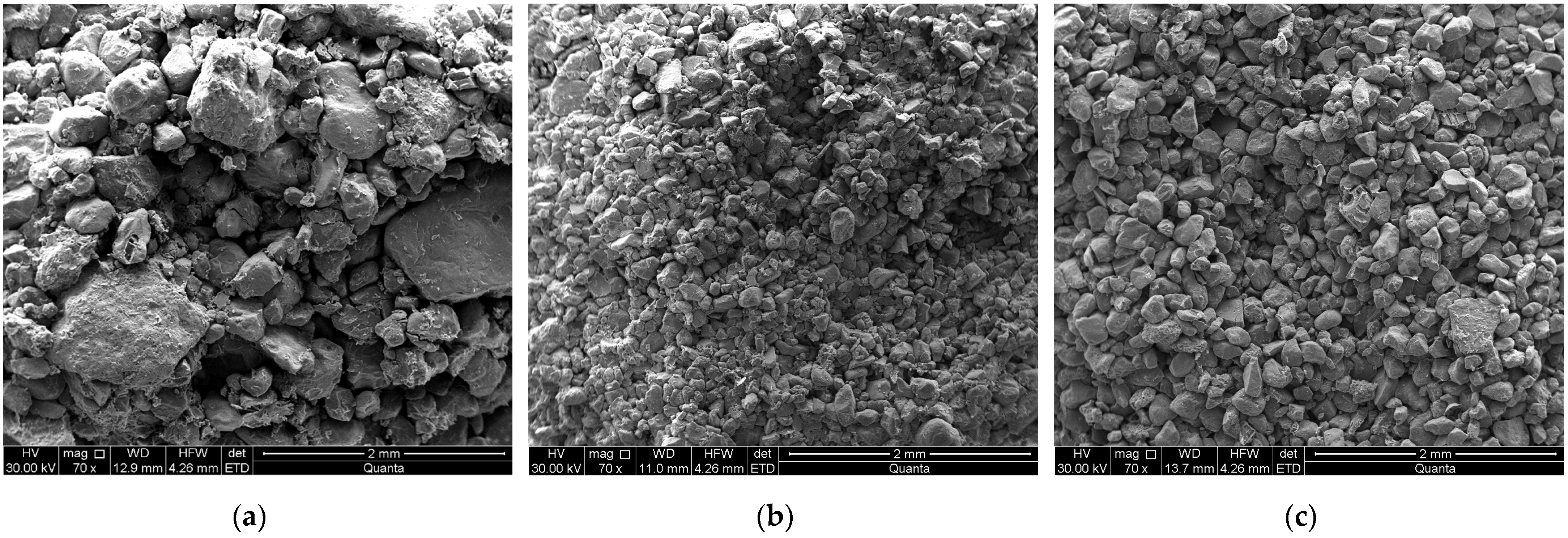
- Integrated SEM-XRD-MIP-NMR characterization demonstrates that the target aquifer consists of weakly cemented sandstone with high porosity and strong hydraulic conductivity, as evidenced by large pore sizes, good pore connectivity, and high permeability.
- (2)
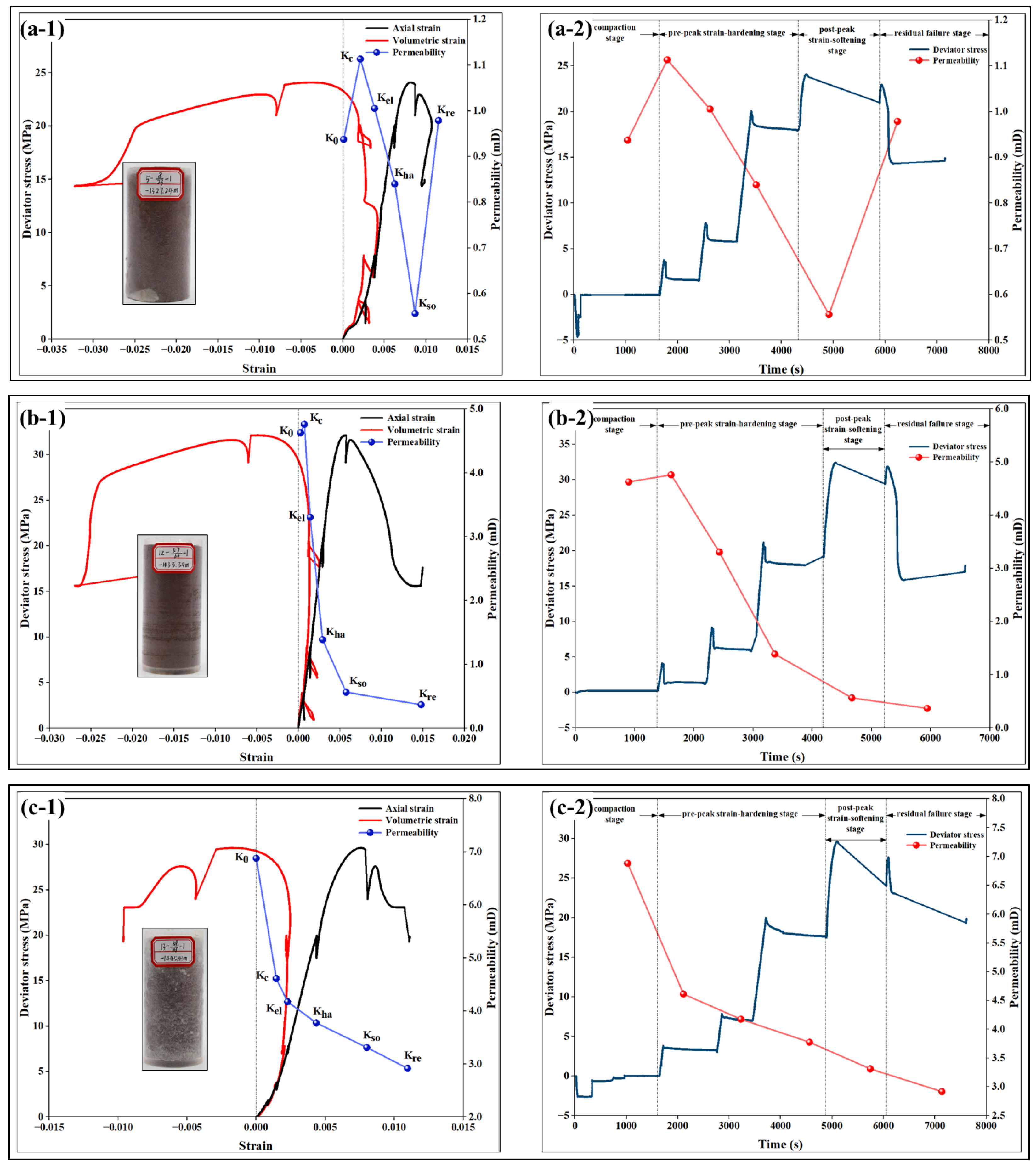
- During the deformation and failure of sandstone with different pore sizes, permeability exhibits a staged variation along the stress–strain curve. Rocks with high porosity and loose structure possess relatively high initial permeability. In the compaction stage, permeability rises briefly compared with the hydrostatic pressure stage, which is attributed to the expansion of the rock skeleton in loose, high-permeability sandstone under downstream seepage pressure. Subsequently, permeability decreases continuously with increasing stress. In the residual failure stage, permeability further declines with increasing strain, as crushed particles block pore channels.
- (3)
- Under the same confining pressure, the peak strength of the rock decreases with increasing pore water pressure, and this pore pressure effect becomes more pronounced at lower confining pressure. With increasing pore water pressure, the elastic modulus shows a decreasing trend, whereas Poisson’s ratio increases.
- (4)
- At relatively high confining pressure, once localized compaction bands develop in highly porous rocks, permeability generally decreases continuously with increasing axial strain. The initiation and propagation of microcracks promote permeability enhancement, whereas the compaction of primary pores and pore–throats, closure of pre-existing fractures, crushing of framework grains, and formation of compaction bands inhibit permeability increase. The overall evolution of permeability is therefore governed by the combined effects of these competing mechanisms.
Author Contributions
Funding
Institutional Review Board Statement
Informed Consent Statement
Data Availability Statement
Conflicts of Interest
References
- Wang, Y.; Kong, D.; Wu, G.; Xiong, Y. Study on failure of roof overburden and high ground pressure control under deep repeated mining. Eng. Fail. Anal. 2026, 183, 110226. [Google Scholar] [CrossRef] [Scilit]
- Li, J.; Li, G.; Zhang, L.; Miao, K.; Wo, X.; Yuan, Y.; Chen, Z. Experimental study on stress-permeability evolution of rocks under complex mining-induced loading: Insights into water inrush risk in floor strata. Int. J. Min. Sci. Technol. 2026, 36, 333–351. [Google Scholar] [CrossRef] [Scilit]
- Zhu, X.; Zhang, Q.; Liang, M.; Zhang, W. Mining-induced damage evolution and infiltration failure in deep mudstone-sandstone interbedded strata. Results Eng. 2025, 28, 107095. [Google Scholar] [CrossRef] [Scilit]
- Zhu, Y.; Wu, Y.; Zhang, L.; Zhang, S. Experimental and Numerical Simulations of Pore Structures and Seepage Characteristics of Deep Sandstones. Processes 2023, 11, 3411. [Google Scholar] [CrossRef] [Scilit]
- Ni, H.; Liu, J.; Huang, B.; Pu, H.; Meng, Q.; Wang, Y.; Sha, Z. Quantitative analysis of pore structure and permeability characteristics of sandstone using SEM and CT images. J. Nat. Gas Sci. Eng. 2021, 88, 103861. [Google Scholar] [CrossRef] [Scilit]
- Ji, Y.; Zhu, K.; Li, K.; Zhao, C.; Liu, K.; Ning, D.; Liu, X.; Yan, P.; Zhao, S. Study on the microscopic pore structure and seepage mechanism of the Luohe Formation sandstone in the roof of coal seams in the Huanglong Coalfield. Sci. Rep. 2025, 15, 33568. [Google Scholar] [CrossRef] [Scilit] [PubMed]
- Wang, Z.; Li, W.; Hu, Y. Experimental study on mechanical behavior, permeability, and damage characteristics of Jurassic sandstone under varying stress paths. Bull. Eng. Geol. Environ. 2021, 80, 4423–4439. [Google Scholar] [CrossRef] [Scilit]
- Zong, Y.; Han, L.; Wei, J.; Wen, S. Mechanical and damage evolution properties of sandstone under triaxial compression. Int. J. Min. Sci. Technol. 2016, 26, 601–607. [Google Scholar] [CrossRef] [Scilit]
- Fu, X.; Su, H.; Xie, Q.; Dong, K.; Mei, H.; Ban, Y. Triaxial loading mechanical properties and differential failure mechanisms of damaged sandstone under pore water pressure changes. Bull. Eng. Geol. Environ. 2025, 84, 352. [Google Scholar] [CrossRef] [Scilit]
- Yang, S.-Q.; Jing, H.-W.; Cheng, L. Influences of pore pressure on short-term and creep mechanical behavior of red sandstone. Eng. Geol. 2014, 179, 10–23. [Google Scholar] [CrossRef] [Scilit]
- Wang, G.; Liu, J.; Hou, M.Z.; Zhang, S. Permeability Evolution of Impure Rock Salt Under Triaxial Stress with Implications for Underground Energy Storage. Appl. Sci. 2026, 16, 2091. [Google Scholar] [CrossRef] [Scilit]
- Liu, Y.; Zhang, T.; Ma, Y.; Song, S.; Tang, M.; Li, Y. Deformation behavior and damage-induced permeability evolution of sandy mudstone under triaxial stress. Nat. Hazards 2022, 113, 1729–1749. [Google Scholar] [CrossRef] [Scilit]
- Zhao, C.; Liu, J.; Lyu, C.; Xu, D.; Liang, C.; Li, Z. Investigation on the mechanical behavior, permeability and failure modes of limestone rock under stress-seepage coupling. Eng. Fail. Anal. 2022, 140, 106544. [Google Scholar] [CrossRef] [Scilit]
- Rong, Y.; Sun, Y.; Chen, X.; Ding, H.; Xu, C. Analysis of Damage and Permeability Evolution of Sandstone under Compression Deformation. Appl. Sci. 2024, 14, 7368. [Google Scholar] [CrossRef] [Scilit]
- Qu, X.; Xu, W.; Ma, H.; Guo, Z. Experimental study on mechanical and permeability properties of subsea granite under cyclic loading with different seepage pressures. Bull. Eng. Geol. Environ. 2025, 84, 70. [Google Scholar] [CrossRef] [Scilit]
- Chen, Y.; Xu, J.; Cao, Q.; Rao, H.; Cui, M.; Zhang, Q.; Peng, S. Experimental Study on Mechanical and Strain Localisation Behaviour of Sandstone Under Seepage–Stress Coupling. Rock Mech. Rock Eng. 2023, 56, 8457–8470. [Google Scholar] [CrossRef] [Scilit]
- Song, Z.; Zhang, J. Progressive failure mechanical behaviour and response characteristics of sandstone under stress-seepage coupling. J. Geophys. Eng. 2021, 18, 200–218. [Google Scholar] [CrossRef] [Scilit]
- Xiao, W.; Zhang, D.; Wang, X. Experimental study on progressive failure process and permeability characteristics of red sandstone under seepage pressure. Eng. Geol. 2020, 265, 105406. [Google Scholar] [CrossRef] [Scilit]
- Yu, B.; Zhang, D.; Xu, B.; Li, M.; Liu, C.; Xiao, W. Experimental study on the effective stress law and permeability of damaged sandstone under true triaxial stress. Int. J. Rock Mech. Min. Sci. 2022, 157, 105169. [Google Scholar] [CrossRef] [Scilit]
- Zhang, G.; Wu, S.; Guo, P.; Zhang, S. Mechanical Deformation, Acoustic Emission Characteristics, and Microcrack Development in Porous Sandstone During the Brittle–Ductile Transition. Rock Mech. Rock Eng. 2023, 56, 9099–9120. [Google Scholar] [CrossRef] [Scilit]
- Lyu, C.; Liu, J.; Wu, Z.; Liu, H.; Xiao, F.; Zeng, Y. Experimental Study on Mechanical Properties, Permeability and Acoustic Emission Characteristics of Gypsum Rock Under THM Coupling. Rock Mech. Rock Eng. 2021, 54, 5761–5779. [Google Scholar] [CrossRef] [Scilit]
- Xue, Y.; Dang, F.; Cao, Z.; Du, F.; Ren, J.; Chang, X.; Gao, F. Deformation, Permeability and Acoustic Emission Characteristics of Coal Masses under Mining-Induced Stress Paths. Energies 2018, 11, 2233. [Google Scholar] [CrossRef] [Scilit]
- Zhang, L.; Jiang, S.; Yu, J. Experimental Research into the Evolution of Permeability of Sandstone under Triaxial Compression. Energies 2020, 13, 5065. [Google Scholar] [CrossRef] [Scilit]
- Zhang, S.; Fan, G.; Zhang, D.; Li, W.; Luo, T.; Liang, S.; Fan, Z. A Model of Stress-Damage-Permeability Relationship of Weakly Cemented Rocks under Triaxial Compressive Conditions. Materials 2023, 16, 210. [Google Scholar] [CrossRef] [Scilit]
- Wang, W.X.; Sui, W.H.; Faybishenko, B.; Stringfellow, W.T. Permeability variations within mining-induced fractured rock mass and its influence on groundwater inrush. Environ. Earth Sci. 2016, 75, 326. [Google Scholar] [CrossRef] [Scilit]
- Wang, W.; Zeng, Q. Evolutionary laws and response mechanisms of stress-fracture-seepage in mining-induced overburden of coal seams: A case study in Dajing mining area, Xinjiang, China. Geomech. Geophys. Geo-Energy Geo-Resour. 2025, 12, 13. [Google Scholar] [CrossRef] [Scilit]
- Zhao, A.; Li, Y.; Shi, X.; Hao, S.; Che, Z.; Yang, K.; Xu, M.; Ma, H. Mechanism of anomalous “internal subsidence and peripheral uplift” in a salt mine goaf: A multi-source validated superposition of poroelastic uplift and mining-induced subsidence. Geomech. Energy Environ. 2025, 44, 100769. [Google Scholar] [CrossRef] [Scilit]
- Chen, X.; Yu, J.; Tang, C.; Li, H.; Wang, S. Experimental and Numerical Investigation of Permeability Evolution with Damage of Sandstone Under Triaxial Compression. Rock Mech. Rock Eng. 2017, 50, 1529–1549. [Google Scholar] [CrossRef] [Scilit]
- Hu, C.; Agostini, F.; Skoczylas, F.; Jeannin, L.; Egermann, P.; Jia, Y. Transport property evolution during hydrostatic and triaxial compression of a high porosity sandstone. Eur. J. Environ. Civ. Eng. 2023, 27, 2552–2565. [Google Scholar] [CrossRef] [Scilit]
- Vajdova, V.; Baud, P.; Wong, T.F. Permeability evolution during localized deformation in Bentheim sandstone. J. Geophys. Res. Solid Earth 2004, 109, B10406. [Google Scholar] [CrossRef] [Scilit]
- Wen, M.; Wang, Q.; Jiang, H.; Busch, A. Experimental Study on the Hydromechanical Behaviours of Porous Sandstone under Cyclic Proportional Triaxial Loading: Implications for Cyclic Underground Hydrogen Storage. Rock Mech. Rock Eng. 2025, 58, 13267–13289. [Google Scholar] [CrossRef] [Scilit]





| Rock Sample Number | Lithology | Diameter (cm) | Length (cm) | Mass (g) |
|---|---|---|---|---|
| 5-3-23-1 | Siltstone | 4.993 | 10.009 | 417.30 g |
| 5-3-23-2 | Siltstone | 4.931 | 10.004 | 408.84 g |
| 5-7-23-1 | Siltstone | 5.005 | 9.9890 | 409.23 g |
| 5-8-23-1 | Siltstone | 5.004 | 9.9990 | 418.84 g |
| 5-9-23-1 | Siltstone | 4.955 | 9.9660 | 385.34 g |
| 8-46-51-1 | Siltstone | 4.996 | 9.999 | 438.49 g |
| 8-46-51-2 | Siltstone | 4.994 | 9.996 | 433.59 g |
| 15-11-73-1 | Fine Sandstone | 4.958 | 9.953 | 383.52 g |
| 15-12-73-1 | Fine Sandstone | 5.005 | 10.025 | 417.28 g |
| 15-12-73-2 | Fine Sandstone | 5.049 | 10.012 | 422.56 g |
| 15-12-73-3 | Fine Sandstone | 5.100 | 10.001 | 445.28 g |
| 7-23-56-1 | Medium-Fine Sandstone | 5.005 | 10.002 | 417.01 g |
| 7-23-56-2 | Medium-Fine Sandstone | 5.007 | 10.008 | 424.21 g |
| 1 | 2 | 3 | |
|---|---|---|---|
| Porosity | 23.7335% | 12.53% | 19.4339% |
| Permeability | 623.87 md | 130.05 md | 181.15 md |
| Fractal dimension | 2.962 | 2.851 | 2.966 |
| Tortuosity | 2.2732 | 2.6022 | 2.4243 |
Disclaimer/Publisher’s Note: The statements, opinions and data contained in all publications are solely those of the individual author(s) and contributor(s) and not of MDPI and/or the editor(s). MDPI and/or the editor(s) disclaim responsibility for any injury to people or property resulting from any ideas, methods, instructions or products referred to in the content. |
© 2026 by the authors. Licensee MDPI, Basel, Switzerland. This article is an open access article distributed under the terms and conditions of the Creative Commons Attribution (CC BY) license.
Share and Cite
Zhao, A.; Li, Y.; Shi, X.; Hao, S.; Che, Z.; Feng, W.; Zhang, H.; Ma, H.; Xu, M. Experimental Study on Pore Structure, Mechanical Behavior and Permeability Characteristics of Weakly Cemented Sandstone. Appl. Sci. 2026, 16, 3432. https://doi.org/10.3390/app16073432
Zhao A, Li Y, Shi X, Hao S, Che Z, Feng W, Zhang H, Ma H, Xu M. Experimental Study on Pore Structure, Mechanical Behavior and Permeability Characteristics of Weakly Cemented Sandstone. Applied Sciences. 2026; 16(7):3432. https://doi.org/10.3390/app16073432
Chicago/Turabian StyleZhao, Ahu, Yinping Li, Xilin Shi, Shefeng Hao, Zengguang Che, Wenrui Feng, Hanzhao Zhang, Hongling Ma, and Mingnan Xu. 2026. "Experimental Study on Pore Structure, Mechanical Behavior and Permeability Characteristics of Weakly Cemented Sandstone" Applied Sciences 16, no. 7: 3432. https://doi.org/10.3390/app16073432
APA StyleZhao, A., Li, Y., Shi, X., Hao, S., Che, Z., Feng, W., Zhang, H., Ma, H., & Xu, M. (2026). Experimental Study on Pore Structure, Mechanical Behavior and Permeability Characteristics of Weakly Cemented Sandstone. Applied Sciences, 16(7), 3432. https://doi.org/10.3390/app16073432