Article

Modeling and Simulation of a PINN-Based Nonlinear Motor Drive System

College of Automotive and Energy Engineering, Tongji University, Shanghai 201804, China
*
Author to whom correspondence should be addressed.
Appl. Sci. 2026, 16(7), 3426; https://doi.org/10.3390/app16073426
Submission received: 10 March 2026 / Revised: 26 March 2026 / Accepted: 26 March 2026 / Published: 1 April 2026
(This article belongs to the Section Electrical, Electronics and Communications Engineering)

Abstract

To address the insufficient accuracy of conventional permanent magnet synchronous motor (PMSM) models caused by neglecting magnetic saturation nonlinearity and periodic parameter disturbances, a nonlinear motor system model integrating a Physics-Informed Neural Network (PINN) is developed. By exploiting the differential relationships among incremental inductance, flux linkage, and magnetic energy, the voltage and torque equations considering rotor position variation are derived, and analytical expressions for the derivatives of incremental inductances are obtained. To reduce the computational burden of PINN in system-level simulations, linear and nonlinear approximation strategies based on incremental inductances and their derivatives are proposed, which significantly reduce the frequency of PINN calls while maintaining model accuracy. CPU/GPU collaborative computation and cross-frequency-domain scheduling are further implemented to improve simulation efficiency. Considering the influence of the test bench mechanical dynamics, an electromechanical–magnetic coupled simulation model is established. The accuracy of the proposed nonlinear motor model is validated through two-phase short-circuit tests as well as simulations and test bench experiments under sinusoidal and non-sinusoidal excitations. The results demonstrate that the proposed model accurately captures the nonlinear electromagnetic characteristics of PMSMs while significantly improving system simulation efficiency.

1. Introduction

Permanent Magnet Synchronous Motors are widely used in high-precision and high-dynamic-performance applications such as electric vehicles, humanoid robots, and industrial automation due to their simple structure, high power density, high efficiency, and low losses. With the continuous advancement of control technologies, PMSMs have been increasingly employed in high-performance drive systems [1]. However, a PMSM is inherently a strongly coupled and multivariable nonlinear electromagnetic system, whose operating characteristics are influenced by non-ideal factors such as magnetic saturation and internal parameter disturbances [2]. These non-ideal effects often lead to torque ripple, degraded dynamic performance, and limited control accuracy during operation, thereby restricting the overall performance of the drive system.
To further understand the relationships among incremental inductance, flux linkage, and magnetic energy within PMSM, and to reveal the intrinsic nonlinear dynamics of the motor, accurate modeling has become a critical issue for improving control performance from a mechanistic perspective. Modeling is not only a prerequisite for control strategy design, but also an important tool for understanding torque generation mechanisms, analyzing nonlinear coupling effects, and optimizing operating trajectories. Therefore, it is necessary to establish a mathematical model that can accurately represent the internal electromagnetic relationships of the motor, thereby providing reliable theoretical support for the design and implementation of high-performance control strategies.
Currently, research on PMSM is mainly based on two types of models: finite element models and analytical parameter models.
The finite element method (FEM) can provide highly accurate motor models and effectively capture the effects of magnetic saturation, spatial harmonics, and material nonlinearities on motor performance [3,4]. Therefore, it has been widely used in the analysis of electromagnetic characteristics and high-fidelity modeling of electrical machines [5,6]. However, the main drawback of FEM lies in its high computational cost. Electromagnetic field solutions are required at each time step, and even slight changes in operating conditions or boundary conditions necessitate recomputation of the magnetic field distribution [7]. As a result, FEM is difficult to apply directly in the analysis of PMSM operating characteristics and control system design.
To reduce computational complexity, a magnetic network-based modeling approach was proposed in [8], where the motor magnetic circuit is equivalently modeled to decrease the computational burden. However, compared with FEM-based accurate calculations, this approach still suffers from limited modeling accuracy and only achieves moderate improvements in computational efficiency.
Traditional analytical parameter models are typically established based on the assumption of a linear magnetic circuit. In these models, constant parameters such as the stator equivalent resistance, dq-axis inductances, and the equivalent permanent-magnet flux linkage are used to construct a fixed-parameter model, enabling decoupled control in the synchronous rotating reference frame. Owing to their simple structure and ease of analysis, such models exhibit good engineering applicability under medium–low load conditions or weak nonlinear operating regions. However, when the motor operates over a wide range of operating conditions or enters strong magnetic saturation regions, the inductance becomes strongly dependent on current, and the relationship between flux linkage and current exhibits complex differential coupling. Under these circumstances, traditional constant-parameter models fail to accurately capture the actual electromagnetic behavior of the motor, resulting in accumulated modeling errors and degraded control performance. This issue becomes particularly prominent under high-speed or heavy-load conditions, where torque ripple and control deviations are significantly intensified.
To improve the accuracy of linear parameter-based analytical models, some studies have proposed combining the FEM with analytical modeling approaches. Specifically, electromagnetic parameters of the motor are obtained from FEM at several representative operating points, and nonlinear models are then constructed using interpolation, fitting, and lookup table techniques [9,10].
Among these approaches, reference [11] directly establishes a three-dimensional mapping of stator flux linkage as a function of dq-axis currents and rotor position, and generates flux linkage maps using radial basis function (RBF) interpolation. In [12], nonlinear electromagnetic characteristics are approximated by combining FEM data at typical operating points with interpolation and lookup table methods. Such methods avoid complex analytical computations through discretization, significantly reducing computational cost. However, since they do not strictly preserve the differential relationships among key parameters such as inductance and flux linkage, the model accuracy tends to degrade when the current excitation deviates from the predefined operating points.
In addition, some studies have developed motor models based on parameter identification techniques. In such approaches, key motor parameters are identified either online or offline and then incorporated into the motor mathematical model for parameter updating [13]. Representative methods include model reference adaptive systems (MRAS) [14], extended Kalman filtering (EKF) [15], and identification approaches based on swarm intelligence optimization algorithms [16]. These methods can compensate for modeling errors caused by parameter variations to a certain extent. However, the resulting models still have limited capability in describing complex nonlinear electromagnetic characteristics from a mechanistic perspective.
Furthermore, most of the aforementioned methods focus primarily on modeling the motor itself and typically assume that the mechanical structure of the drive system is ideally rigid. Consequently, the influence of mechanical dynamics in the test bench and load system on the motor torque output and overall system response is rarely taken into account.
Physics-informed and machine-learning–based approaches, represented by PINN, have recently provided a promising pathway for overcoming the aforementioned limitations [17]. In [18], a PINN-based parametric modeling approach for PMSM was proposed, where a DeepONet framework was employed to represent motor geometric parameters. This method enabled the prediction of magnetic field distribution, average torque, and iron loss under sinusoidal current excitation within a 15-dimensional parameter space, while reducing the training time to approximately 60 h. In [19], a PINN model trained using FEM-generated data was developed, and its torque prediction accuracy was validated through comparisons with FEM and other methods under both sinusoidal and non-sinusoidal excitations. However, the high computational resource requirements of machine learning–based methods still limit their applicability in more complex system-level simulations.
To address the aforementioned issues, this paper conducts research in three main aspects.
  • Considering the combined effects of magnetic saturation and periodic parameter disturbances, the characteristics of the PMSM flux linkage vector field and a PINN-based solution method are first analyzed. Based on this, Section 2 derives the torque equation and voltage equation considering rotor position variation. Furthermore, the expressions of the incremental inductance derivatives are obtained from the differential relationships among inductance, flux linkage, and magnetic energy.
  • To address the high computational burden and low simulation efficiency caused by the machine-learning model in a simulation system that includes the PINN-based motor parameter model, power electronic circuits, and control algorithms, Section 3 proposes linear and nonlinear approximation strategies based on incremental inductance and its derivatives. By reducing the invocation frequency of the PINN module while maintaining model accuracy, the overall simulation efficiency is significantly improved.
  • The validation of the proposed nonlinear motor model is presented in Section 4. First, a two-phase short-circuit test is conducted to verify the accuracy of the nonlinear motor model. Then, using sinusoidal and non-sinusoidal current excitations as control targets, both simulations and experimental tests on a test bench are carried out to further validate the effectiveness of the nonlinear motor system model.

2. Flux Linkage Vector Field and PMSM Model

Based on the nonlinear motor model proposed in [19,20], the PMSM is modeled in the dq0 reference frame. Although the system parameters remain dependent on the currents and rotor position when magnetic saturation and parameter disturbances are considered, the dq0 transformation enables the spatial distribution characteristics of electromagnetic parameters to be represented as periodic functions of the rotor position. This facilitates their reduced-order representation using a Fourier series.
Furthermore, in the dq0 frame, the currents are expressed as DC quantities under steady-state conditions, which simplifies the computation of partial derivatives of electromagnetic parameters. As a result, the computational complexity of the PINN-based modeling is reduced, and the training efficiency is improved. Therefore, the dq0 reference frame is adopted for the nonlinear motor modeling in this work. The voltage equation of the PMSM in the d q 0   reference frame can be expressed as:
u d q 0 = R s i d q 0 + d Ψ d q 0 d t
In (1), i d q 0 denotes the excitation current vector in the dq0 reference frame, Ψ d q 0 represents the flux linkage vector, and d Ψ d q 0 d t corresponds to the induced voltage of the motor.
In the dq0 reference frame, the torque equation of the PMSM can be expressed as:
T e = p i d q 0 T γ d q 0 ρ d q 0 ( Ψ A M _ d q 0 + Ψ P M _ d q 0 ) p d W m _ P M d θ e W ¯ m _ A M θ e + p i d q 0 T ρ d q 0 d Ψ P M _ d q 0 d θ e
In (2), p denotes the number of pole pairs; Ψ P M _ d q 0 represents the permanent magnet flux linkage vector; Ψ A M _ d q 0 denotes the armature reaction flux linkage vector; and W m _ P M is the magnetic co-energy of the permanent magnet. γ d q 0 = C d q 0 1 d C d q 0 d θ e , and the metric matrix introduced by the coordinate transformation is defined as ρ d q 0 = C d q 0 T C d q 0 . W ¯ m _ A M is given by:
W ¯ m _ A M = i d q 0 T ρ d q 0 Ψ A M _ d q 0 W m _ A M
In (3), W m _ A M denotes the magnetic co-energy of the armature field. Define Ψ ˜ A M _ d q 0 = ρ d q 0 Ψ A M _ d q 0 , L ˜ d q 0 = ρ d q 0 L d q 0 .
Where L d q 0 represents the incremental inductance matrix. According to the definition of incremental inductance, the differential relationship between L ˜ d q 0 and Ψ ˜ A M _ d q 0 can be expressed as:
D i d q 0 Ψ ˜ A M _ d q 0 θ e = L ˜ d q 0
Taking the gradient of W ¯ m _ A M , we obtain:
i d q 0 W ¯ m _ A M θ e = Ψ ˜ A M _ d q 0
Differentiating (5), the relationship between L ˜ d q 0 and W ¯ m _ A M can be obtained as:
D i d q 0 i d q 0 W ¯ m _ A M θ e = L ˜ d q 0
Further derivation based on (6) leads to the following Poisson equation:
i d q 0 2 W ¯ m _ A M θ e = tr L ˜ d q 0
From (7), it can be concluded that, in the current vector space i d q 0 , the flux linkage field Ψ ˜ A M _ d q 0 forms a curl-free vector field. The scalar potential of this field is W ¯ m _ A M . This implies that, within the domain defined by the excitation current, the flux linkage field corresponding to different rotor electrical positions θ e is conservative.
In (6), L ˜ d q 0 denotes the Hessian matrix of the scalar potential W ¯ m _ A M . Using the Hessian operator, it can be obtained that:
H i d q 0 i d q 0 = D i d q 0 i d q 0 = 2 i d i d 2 i d i q 2 i d i 0 2 i q i d 2 i q i q 2 i q i 0 2 i 0 i d 2 i 0 i q 2 i 0 i 0 H i d q 0 i d q 0 i d q 0 T Ψ ˜ A M _ d q 0 W m _ AM = L ˜ d q 0
According to the irrotational property of the source-free magnetic field, the Hessian matrix L ˜ d q 0 of the scalar potential is symmetric. This result indicates that the incremental inductance matrix remains symmetric even under nonlinear conditions.
Since the magnetic energy W m _ A M is a scalar quantity, the following relation can be obtained from the curl-free property of the gradient field as follows:
i d q 0 × i d q 0 W m _ A M θ e = 0 i 0 i q i 0 0 i d i q i d 0 θ ^ e 3 2 L d d i d + 3 2 M d q i d + 3 2 M d 0 i 0 3 2 M q d i d + 3 2 L q q i d + 3 2 M q 0 i 0 3 M 0 d i d + 3 M 0 q i d + 3 L 00 i 0 0
Based on the symmetry constraint revealed in (9), the following relationships among the partial derivatives of the inductance parameters can be obtained as follows:
M d 0 i q = M d q i 0 θ ^ e L d d i 0 = M d 0 i d θ ^ e M d q i d = L d d i q θ ^ e M q 0 i q = L q q i 0 θ ^ e M q d i 0 = M q 0 i d θ ^ e L q q i d = M q d i q θ ^ e L 00 i q = M 0 q i 0 θ ^ e M 0 d i 0 = L 00 i d θ ^ e M 0 q i b = M 0 d i q θ ^ e
Substituting (10) into (9) yields:
M ˜ d q i 0 = M ˜ q 0 i d = M ˜ 0 d i q = M ˜ 0 q i d
Equation (11) indicates that the cross partial derivatives of the incremental inductance matrix are interchangeable, which significantly reduces the number of independent parameters in the system. Based on the above relationship, further differentiating L ˜ d q 0 in (8) with respect to the current vector i d q 0 yields the tensor-form derivative expression as follows:
D i d q 0 L ˜ d q 0 θ e = L ˜ d d i d M ˜ d q i d M ˜ d 0 i d M ˜ q d i d L ˜ q a i d M ˜ q 0 i d M ˜ 0 d i d M ˜ 0 q i d L ˜ 00 i d L ˜ d q 0 i d L ˜ d d i d M ˜ d q i q M ˜ d 0 i q M ˜ q d i q L ˜ q q i q M ˜ q 0 i q M ˜ 0 d i q M ˜ 0 q i q L ˜ 00 i q L ˜ d q 0 i q L ˜ d d i 0 M ˜ d q i 0 M ˜ d 0 i 0 M ˜ q d i 0 L ˜ q q i 0 M ˜ q 0 i 0 M ˜ 0 d i 0 M ˜ 0 q i 0 L ˜ 00 i 0 L ˜ d q 0 i 0
where each block matrix in (12) is a third-order tensor. By combining the symmetry-derived identities in (10) and (11), the expression of the incremental inductance derivative D i d q 0 L ˜ d q 0 can be significantly simplified as:
D i d q 0 L ˜ d q 0 θ e = L ˜ d d i d L ˜ d d i q L ˜ d d i 0 L ˜ d d i q L ˜ q q i d M ˜ q 0 i d L ˜ d d i 0 M ˜ 0 q i d L ˜ 00 i d L ˜ d q 0 i d L ˜ d d i q L ˜ q q i d M ˜ d 0 i q L ˜ q q i d L ˜ q q i q L ˜ q q i 0 M ˜ 0 d i q M ˜ q q i 0 L ˜ 00 i q L ˜ d q 0 i q L ˜ d d i 0 M ˜ d q i 0 L ˜ 00 i d M ˜ q d i 0 L ˜ q q i 0 L ˜ 00 i q L ˜ 00 i d L ˜ 00 i q L ˜ 00 i 0 L ˜ d q 0 i 0
According to [19], the flux linkage vector dataset is obtained using the FEM. Machine learning is then employed to construct PINN models for the Fourier coefficients of different orders, thereby establishing a lumped-parameter model of the PMSM. In practical applications, given the current vector i d q 0 , the PINN can be used to obtain the Fourier-series representations of D i d q 0 L ˜ d q 0 , L ˜ d q 0 , Ψ ˜ A M _ d q 0 and W ¯ m _ A M . The motor voltage and electromagnetic torque can then be calculated using (1) and (2). For ease of subsequent analysis and control, the zero-sequence current is set to i0 = 0, and thus the three-dimensional dq0 coordinate system model can be reduced to a two-dimensional dq model. Based on this, a nonlinear motor model considering magnetic saturation nonlinearity and parameter disturbances will be established in the dq coordinate system in the following sections.

3. Nonlinear Motor System Modeling

3.1. Model Structure

In conventional motor system simulations, the ideal PMSM model is typically represented by a constant-parameter vector model, or magnetic saturation nonlinearity is approximated using simple lookup tables. In contrast, the simulation system proposed in this paper considers the combined effects of magnetic saturation nonlinearity and periodic parameter disturbances, which requires the interaction between the PINN and the motor model. Therefore, the simulation system in this study consists of five modules: the PINN computation module, the data interaction module, the parameter prediction module, the motor control module, and the motor system simulation module.
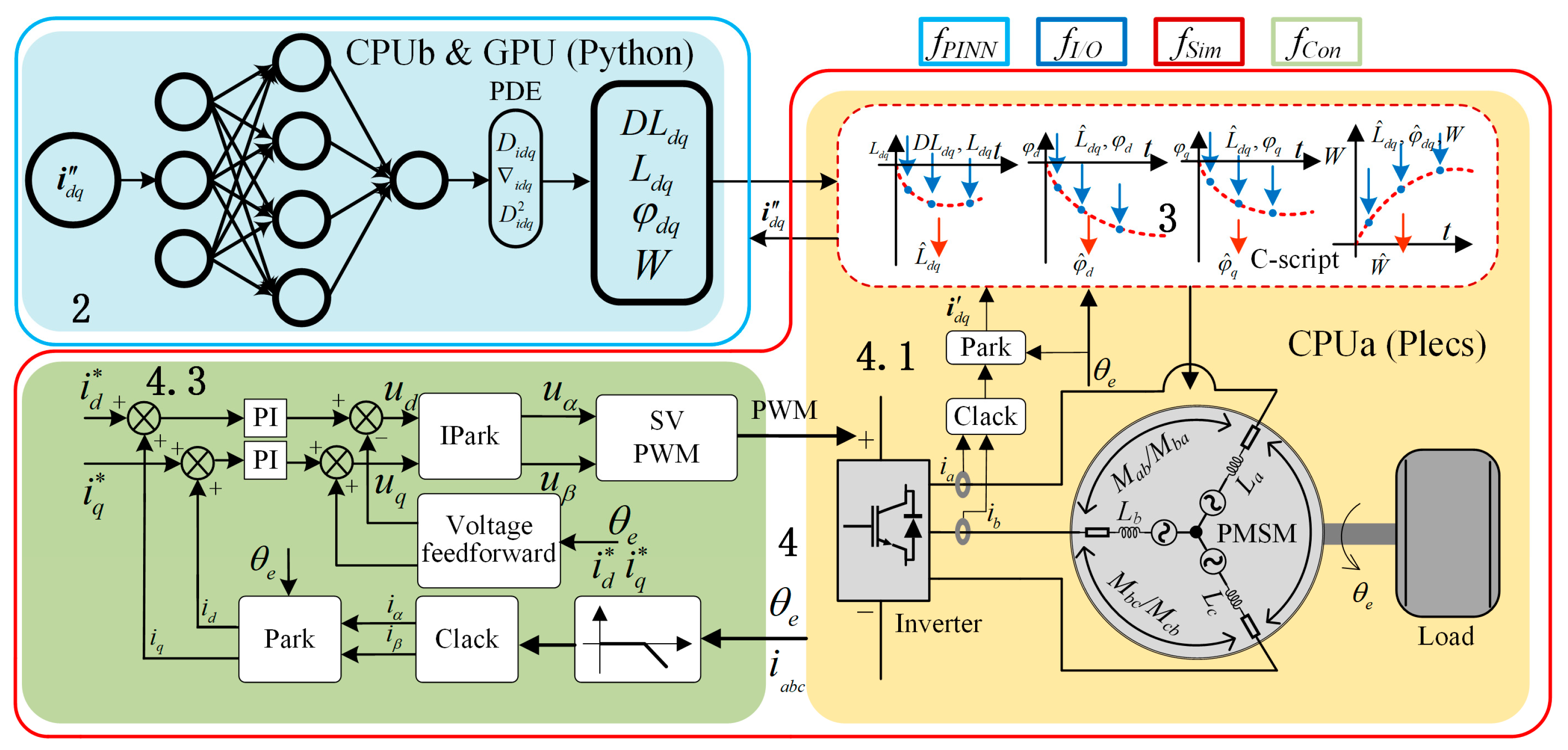
Among them, the construction of the PINN computation module has been described in detail in Section 2 and in [19]. The data interaction module and parameter prediction module will be introduced in Section 3. The motor control module corresponds to the green part labeled 4.3 in Figure 1. Taking field-oriented control as the core framework, the non-sinusoidal excitation contains harmonic current components. To improve current control accuracy, a composite control strategy based on the full compensation principle, combining voltage feedforward and current feedback, is adopted to achieve torque control. The voltage feedforward compensates for motor nonlinearities and parameter disturbances, where the compensation term is obtained from the voltage equation in (1). The current feedback loop compensates for inaccuracies caused by the open-loop voltage estimation. The implementation of the motor system simulation module will be described in Section 4. This section mainly focuses on the cross-frequency-domain data interaction mechanism and the implementation process among different modules.
Since the computational characteristics of PINN evaluation differ significantly from those of circuit simulation, a dual-CPU cross-platform modeling approach is adopted in the proposed simulation system. Except for the PINN computation module, the remaining four modules are implemented on the CPUa platform. Their operating frequencies are distinguished by colors in the system diagram. The dark-blue frequency corresponds to the CPUa interface module, which is responsible for data transfer and interaction within a specified period. The red frequency represents the operating frequency of the motor system simulation module, which is used to simulate the dynamics of the power electronics and the motor. The light-blue frequency corresponds to the PINN computation module, which is deployed on CPUb and GPU to compute the motor parameters using the PINN. In addition, the parameter prediction module converts the data collected by the interface module into red-frequency signals for the motor system simulation, thereby enabling cross-frequency-domain data mapping.
In the CPUa platform, the data interaction module transmits the current data from the motor simulation module to the PINN module at a predefined sampling frequency. Based on the current operating state, the PINN then calculates the corresponding motor parameters, including D i d q L d q , L d q , Ψ A M _ d q and W m _ A M , and feeds the results back to the CPUa interaction module.
Meanwhile, the parameter prediction module combines the current information i d q obtained at the motor system simulation frequency with the parameter values D i d q L d q , L d q , Ψ A M _ d q and W m _ A M updated at the data interaction frequency to estimate the corresponding quantities L d q , Ψ A M _ d q and W m _ A M at the motor simulation frequency. In this way, the transition from the dark-blue data interaction frequency to the red motor simulation frequency is achieved, enabling efficient cross-frequency-domain data mapping. This strategy significantly reduces the number of PINN calls, thereby improving computational efficiency.
The motor control module utilizes the electrical angle and current obtained from the motor system simulation to perform closed-loop control and generate PWM drive signals for the inverter.

3.2. Motor Parameter Prediction

Based on the current i d q and rotor position θ e , the motor parameters, including D i d q L d q , L d q , Ψ A M _ d q and W m _ A M , can be calculated using the PINN model. However, in power electronic circuit simulations, the simulation step size is typically smaller than 10−7 s in order to accurately capture the PWM switching behavior. When a GPU-based nonlinear motor model is used to predict the key motor parameters and co-simulated with a circuit model running on the CPU, the data interaction frequency between the two may exceed 10 MHz, resulting in significant communication overhead and reduced simulation efficiency.
To address this issue, a method based on intermittent sampling and predictive approximation is proposed. The core idea is to decouple the PINN invocation from the system state update. At predefined sampling instants, the PINN is used to obtain the motor state at the current operating point. During subsequent simulation steps, the incremental inductance and its derivatives are employed to perform optimal linear approximation and nonlinear approximation for state prediction [20], thereby reducing the frequency of PINN calls and improving the overall computational efficiency.

3.2.1. Optimal First-Order Linear Approximation Based on Incremental Inductance

In the dq reference frame:
d Ψ A M _ d q = L d q d i d q
To balance numerical simulation accuracy and computational efficiency, a time-scale separation strategy is adopted, and the following definitions are introduced:
Full-model simulation time step Δ t : To ensure numerical stability and simulation accuracy, a fixed time step (typically on the order of 10 7   s ) is employed for updating the state variables.
PINN invocation interval Δ T : A variable but significantly larger interval (typically on the order of 10 4   s ) is adopted for invoking the PINN model to update the motor parameters.
These two time scales satisfy the relationship: Δ T = N Δ t where N is an integer and N ≫ 1. At the m-th PINN invocation time t m , the motor parameters at the current operating point ( i d q 0 m , θ e m ) , including L d q m , Ψ A M _ d q m and W m _ AM m , are obtained. During the subsequent interval t m , t m + Δ T , a first-order Taylor expansion is applied at the operating point i d q m to approximate the variation of Ψ A M _ d q 0 . For the current at the k -th time step within this interval: i d q k = i d q m + Δ i d q k .
According to (14), the flux linkage at time step k can be derived as:
Ψ ^ A M _ d q k θ e Ψ ^ A M _ d q m + L d q m Δ i d q k θ e
In (15), the incremental inductance L d q m serves as the coefficient of the first-order Taylor expansion, providing the local linear slope of flux linkage variation. Similarly, a second-order Taylor expansion can be employed. By further combining with (6), the magnetic energy at the k-th time step can be derived as:
W ^ m _ A M k θ e W ^ m _ A M m + i d q k T ρ d q L d q m Δ i d q k θ e + 1 2 Δ i d q k T ρ d q L d q m Δ i d q k θ e
By utilizing (15) and (16), linear prediction of Ψ ^ A M _ d q and W ^ m _ A M can be performed based on the incremental inductance L d q . This approach effectively reduces the frequency of PINN invocations, thereby improving co-simulation efficiency while maintaining model accuracy.

3.2.2. Nonlinear Approximation Based on Incremental Inductance Derivatives

From (15) and (16), the incremental inductance matrix L d q can be used to perform linear prediction of Ψ A M _ d q and W m _ A M . Furthermore, using the incremental inductance derivative D i d q L d q derived in (13), nonlinear prediction of Ψ A M _ d q and W m _ A M can be achieved. In this way, the influence of current trajectory variation can be further reduced, thereby decreasing the frequency of PINN invocation and improving the overall simulation efficiency.
At the m-th PINN invocation instant t m , the current operating point ( i d q m , θ e m ) is obtained, along with the corresponding parameters L d q m , Ψ A M _ d q m , W m _ AM m . The derivative D i d q L d q is then used to predict the variation of L d q within the time interval t m , t m + Δ t . For the current at time t m , t m + Δ t , it can be expressed as i d q k = i d q m + Δ i d q k .
Using the first-order Taylor expansion, L d q can be expanded at i d q k . For the current i d q k = i d q m + Δ i d q k , the following expression is obtained:
L ^ d q k + 1 θ e = L d q k + D i d q L ^ d q m Δ i d q k θ e
Substituting the predicted incremental inductance L d q , obtained using the incremental inductance derivative D i d q L d q , into (15) and (16), the nonlinear prediction of Ψ A M _ d q and W m _ A M with respect to the incremental inductance derivative can be obtained:
Ψ ^ A M _ d q k + 1 θ e = Ψ ^ A M _ d q m + L ^ d q k + 1 Δ i d q k θ e
Similarly, according to the second-order Taylor expansion, the magnetic energy at time k can be obtained as
W ^ m _ A M k θ e W ^ m _ A M m + i d q k T ρ L ^ d q k + 1 Δ i d q k + 1 2 Δ i d q k T ρ L ^ d q k + 1 Δ i d q k θ e
where L ^ d q k + 1 can be derived from L d q k using (17).

3.3. Comparative Analysis of Invocation Frequency and Approximation Algorithms

3.3.1. Impact Analysis Under Different Frequencies

Taking an eight-pole, 48-slot interior permanent magnet synchronous motor prototype as the research object, its main parameters are listed in Table 1.
In this study, the CPU platform employs an AMD 7945HX processor (Advanced Micro Devices, Santa Clara, CA, USA), and the GPU platform uses an RTX 4060 (NVIDIA Corporation, Santa Clara, CA, USA). Based on the physical characteristics of the PMSM under investigation, a nonlinear mathematical model and a PINN model are established on the PLECS 4.9.4 and PyTorch 2.2.2 platforms, respectively. First, sample data are obtained using the finite element method (FEM), and the PINN model is subsequently trained on the PyTorch 2.2.2 platform [19]. The hidden layer configuration of the PINN model is 3 × 64 × 64 × 64 × 6.
It should be noted that the proposed PINN-based model is mainly constructed for the armature magnetic field (AM). The motor parameters of the armature part (including flux linkage, inductance, and magnetic energy) are learned by the PINN to capture nonlinear effects such as magnetic saturation and parameter disturbances. The permanent magnet (PM) parameters are obtained from FEA under zero-current conditions and represented as periodic functions of rotor position using a Fourier series, which are reconstructed during simulation. This modeling strategy ensures physical consistency while reducing model complexity.
Based on the previously developed linear approximation algorithm derived from L d q and the PMSM system simulation model, this subsection analyzes the simulation accuracy and computational efficiency under different PINN interaction frequencies. The PINN computation result at 1 MHz is used as the reference, and the performance at multiple frequencies ranging from 1 kHz to 1 MHz is compared.
The excitation currents id and iq are sinusoidal with an amplitude of 50 A and a frequency of 200 Hz, where id leads iq by 90°. The magnitude of the current vector idq is approximately 70 A, exceeding the rated current and covering four quadrants. At the zero-crossing point, the current variation rate reaches up to 63 A/ms. In addition, the root mean square error (RMSE) is introduced as the evaluation index for magnetic energy and flux linkage prediction accuracy.
R M S E ( J ) = 1 n i = 1 n ( W i W ^ i ) 2 R M S E ( Wb ) = 1 n i = 1 n ( Ψ i Ψ ^ i ) 2
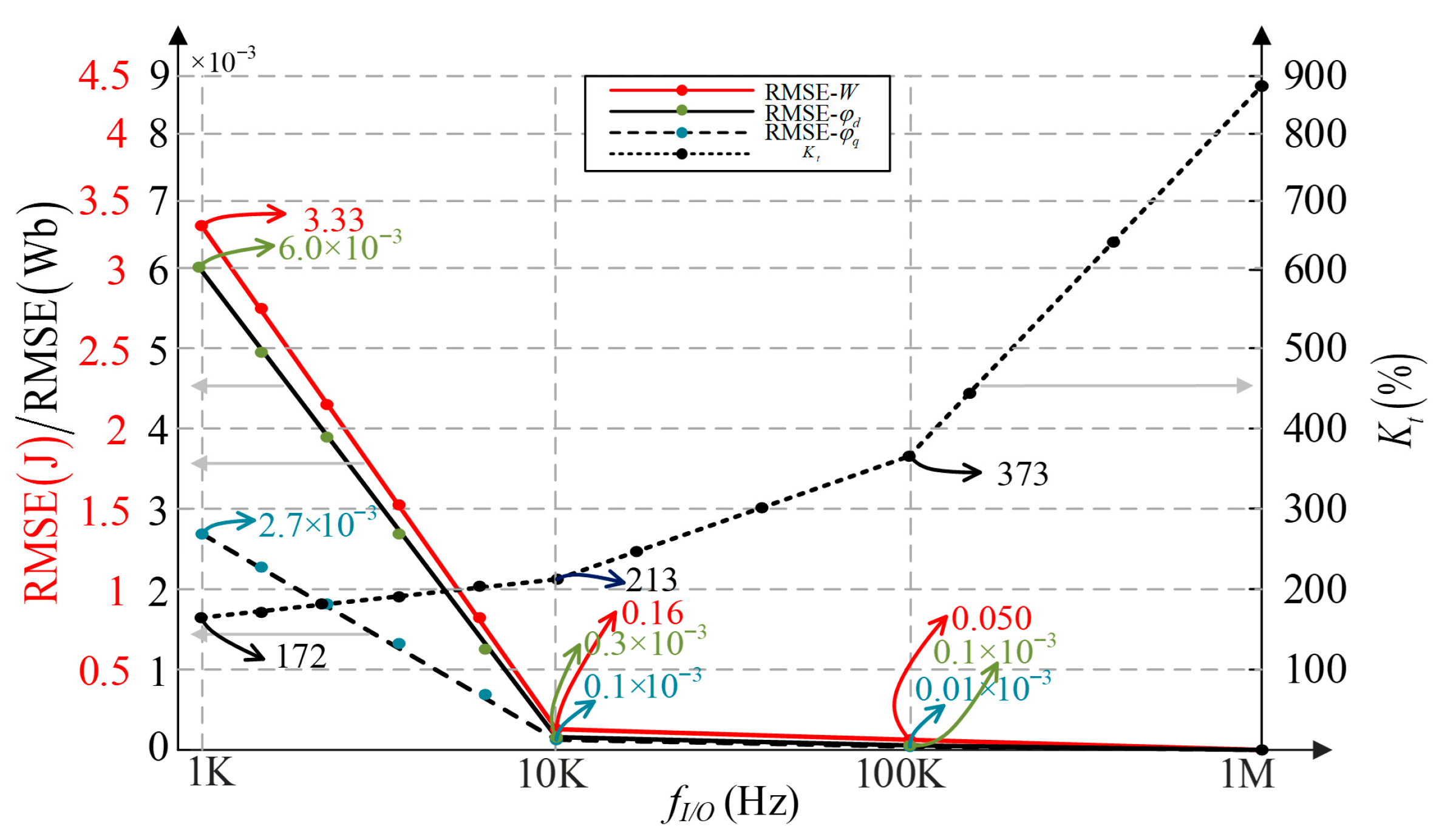
Here, Ψ ^ i and W ^ i denote the reference values obtained at 1 MHz. Meanwhile, Kt is defined as the ratio of the runtime consumed by the nonlinear motor model to that of the linear motor model under the same simulation duration of 1 s. The RMSE and simulation time corresponding to PINN interaction frequencies of 1 kHz, 10 kHz, 100 kHz, and 1 MHz are then evaluated and plotted, as shown in Figure 2.
As shown in Figure 2, when the interaction frequency fio increases from 1 kHz to 10 kHz, all RMSE indicators decrease significantly. However, when fio is further increased to 1 MHz, the RMSE does not show a noticeable reduction. Meanwhile, the computational cost coefficient Kt increases sharply with the increase in fio. Therefore, the interaction frequency of 10 kHz achieves a favorable trade-off between computational accuracy and execution efficiency. It ensures accurate parameter estimation while effectively controlling the overall computational time.

3.3.2. Comparison of Linear and Second-Order Nonlinear Approximations

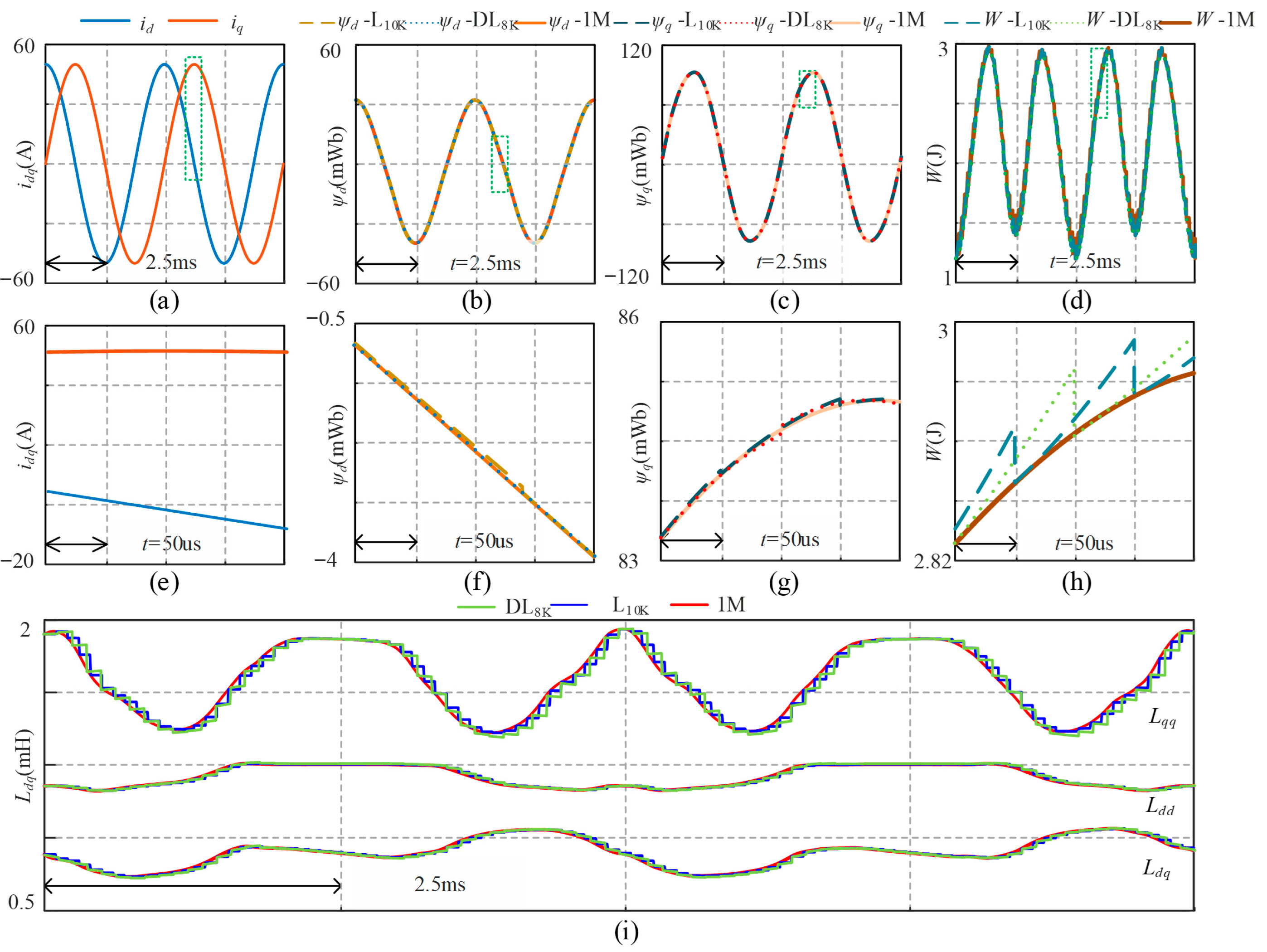
To further analyze the influence of different approximation algorithms on simulation accuracy, the PINN computation result obtained at an invocation frequency of 1 MHz is taken as the reference. On this basis, the linear approximation algorithm proposed in Section 3.2 with a data interaction frequency of fio_L = 10 kHz and the second-order nonlinear approximation algorithm with fio_DL = 8 kHz are selected for comparison.
By comparing the inductance, flux linkage, and magnetic energy characteristics obtained under different approximation strategies, the impact of these methods on computational efficiency is evaluated while maintaining an accurate representation of the nonlinear electromagnetic characteristics of the PMSM. As shown in Figure 3, the variations in the key motor parameters under identical current excitation conditions are illustrated for the two algorithms.
Figure 3e–h show enlarged views of the green regions in Figure 3a–d. Under the current excitation shown in Figure 3a, the variations of L d q , Ψ A M _ d q , W m _ AM calculated at fio_L = 10 kHz and fio_DL = 8 kHz are consistent with the reference results obtained at 1 MHz.
When fio_L = 10 kHz, the maximum error of Ψ d is about 0.085 mWb (3.0%), the maximum error of Ψ q is 0.077 mWb (0.091%), and the maximum error of W is 0.042 J (1.4%). When fio_DL = 8 kHz, the maximum error of Ψ d is 0.062 mWb (2.4%), the maximum error of Ψ q is 0.11 mWb (0.13%), and the maximum error of W is 0.051 J (1.7%). The two methods exhibit nearly identical accuracy, with all errors maintained within 5%.
In terms of computational efficiency, when fio_L = 10 kHz, the runtime ratio of the system is Kt = 273%, whereas when fio_DL = 8 kHz, Kt = 211%. Since the second-order nonlinear approximation allows a lower PINN invocation frequency, the overall computational efficiency is improved by approximately 20% compared with the linear approximation, while also reducing the number of PINN calls and the occupation of computational resources. Considering both simulation accuracy and computational efficiency, the data interaction frequency of the simulation system is finally set to 8 kHz, and the second-order nonlinear approximation strategy is adopted.

3.3.3. Comparative Analysis of PINN-Based Nonlinear, Linear, and FEA Motor Models

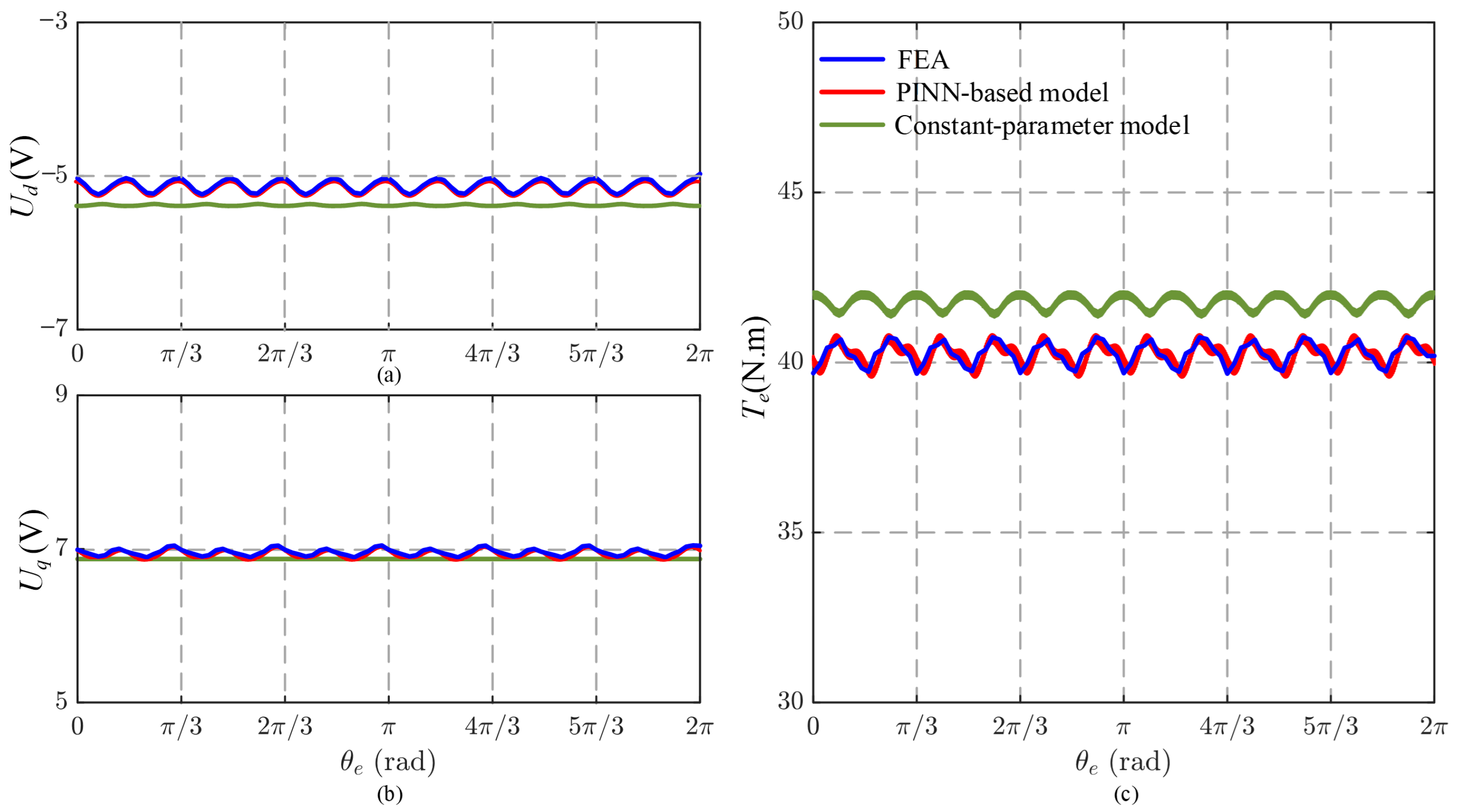
The results are shown in Figure 4. Simulations are carried out at a speed of 50 r/min and the rated torque operating point (id = −40 A, iq = 51.96 A). The constant-parameter linear motor model, the nonlinear motor model based on second-order approximation, and the finite element analysis (FEA) model are compared.
Figure 4a,b present the d q -axis voltage variations in the three models over one electrical period. The results show that both the FEA model and the proposed nonlinear motor model exhibit pronounced periodic fluctuations with rotor position, and they are in good agreement in terms of waveform and amplitude. In contrast, although the constant-parameter linear model considers the position-dependent inductance and thus produces certain periodic variations, its fluctuation amplitude is significantly underestimated, and noticeable deviations exist in the DC component compared with the FEA and nonlinear models. This discrepancy mainly arises because the linear model only captures the dependence of inductance on rotor position, while neglecting its nonlinear dependence on current, making it unable to reflect the effects of magnetic saturation and parameter coupling on the voltage characteristics.
Figure 4c shows the comparison of the electromagnetic torque among the three models. Similarly, both the FEA model and the nonlinear model exhibit clear periodic torque fluctuations and show high consistency, whereas the linear model, although presenting some periodic variation, deviates significantly from the FEA results in both waveform and average value.
Further Fourier decomposition of the voltage and torque signals (see Table 2) indicates that the proposed nonlinear model agrees well with the FEA model in both dominant harmonic components and DC terms, demonstrating its capability to accurately capture nonlinear electromagnetic characteristics. In contrast, the linear model exhibits significant deviation in the DC component, with its voltage harmonic components being nearly zero, and its torque harmonic orders and amplitudes differing substantially from those of the FEA model, indicating its inability to represent the inherent nonlinear behavior of the motor.
In summary, the proposed PINN-based nonlinear motor model effectively captures the effects of magnetic saturation and parameter disturbances. Its results show good agreement with those of the FEA model. While achieving an accuracy comparable to that of the FEA model, the computational time is only about 2.11 times that of the linear motor model, thereby achieving an effective trade-off between modeling accuracy and computational efficiency.

4. Experimental Validation

4.1. Dynamic Characteristics of the Test Bench

The experimental test bench used in this study mainly consists of the tested PMSM, an inverter, a motor controller, a torque sensor, and a load motor.
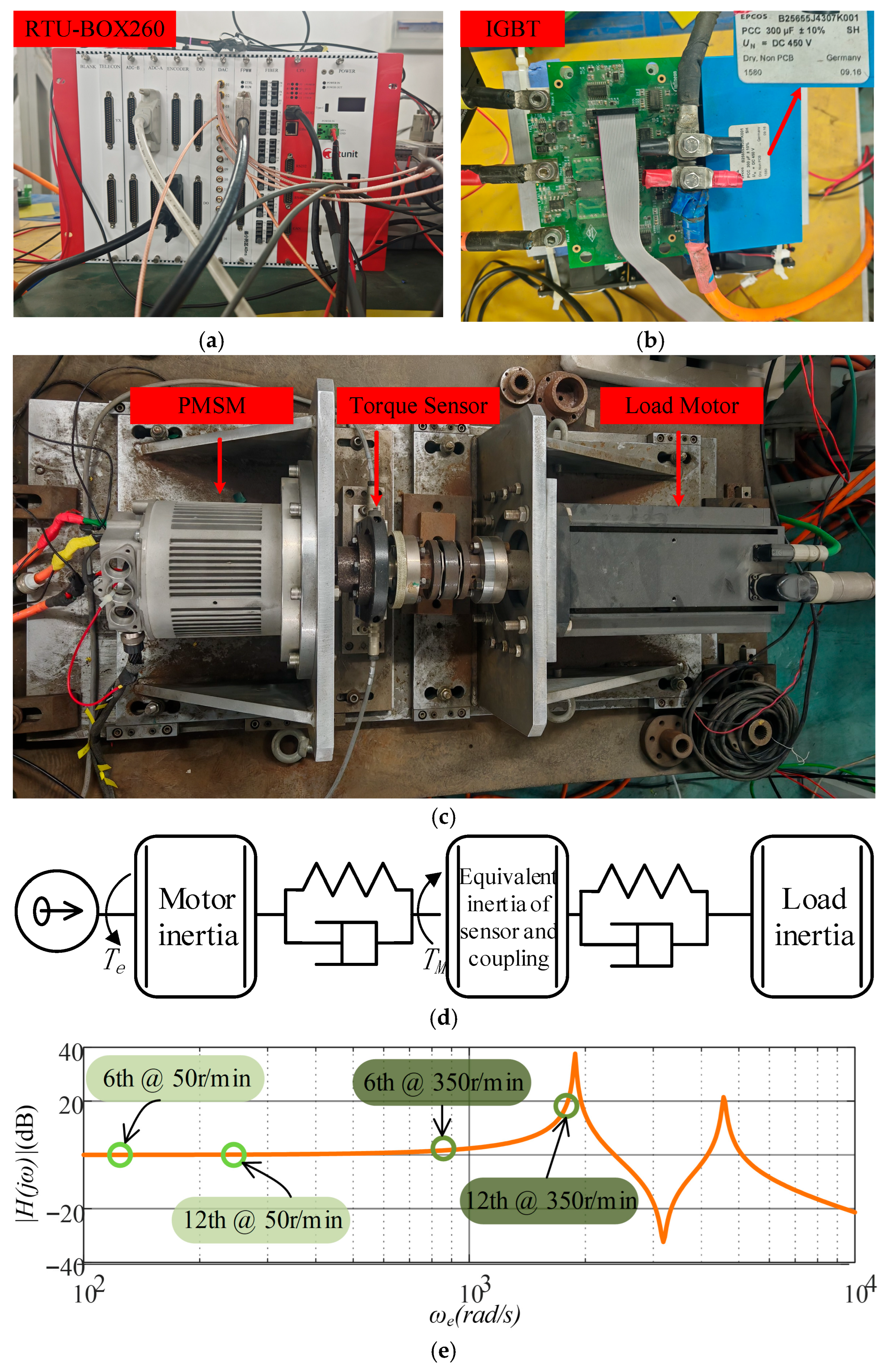
Figure 5a,b show the motor controller and inverter used in the experiments. The controller is an RTU-BOX206 (Tusen Youte Information Technology, Nanjing, China). The inverter adopts the Infineon FS400R07A1E IGBT module (Infineon Technologies AG, Neubiberg, Germany), which is designed for electric vehicles with a power range of 20–30 kW and satisfies the power requirements of the test motor in this study.
Figure 5c shows the photograph of the experimental test bench. The torque sensor used in the system is a high-precision T40B torque transducer manufactured by HBM (HBM GmbH, Darmstadt, Germany). The sensor provides high measurement accuracy with a linearity error of 0.03%, which meets the requirements for measuring torque ripple in the tested motor.
Figure 5d illustrates the mechanical dynamic structure of the experimental test bench, where Te denotes the electromagnetic torque produced by the motor and TM represents the torque measured at the torque sensor location. Since this work mainly investigates torque characteristics considering the combined effects of magnetic saturation nonlinearity and parameter periodic disturbances, the load motor operates in a constant-speed mode. Under this condition, by taking the electromagnetic torque of the motor as the system input and the torque measured by the sensor on the prototype side as the output, the back-to-back test bench can be simplified as a fourth-order underdamped system.
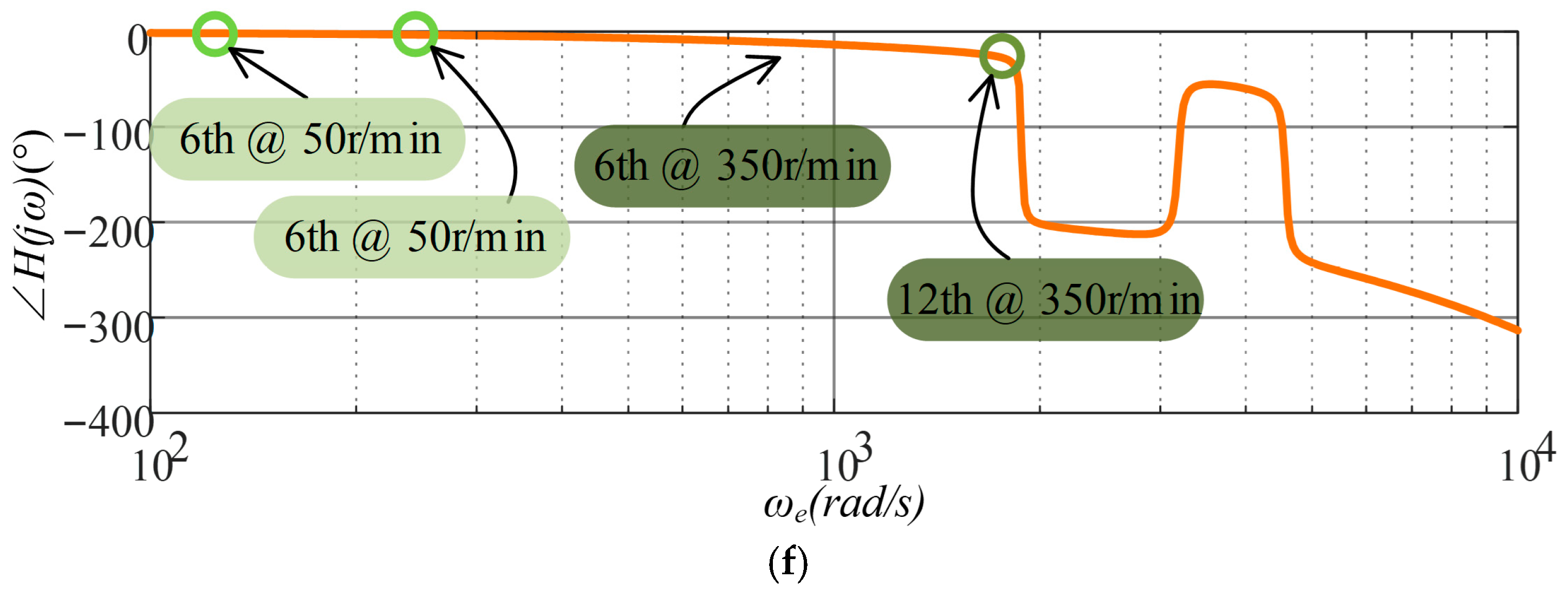
Figure 5e,f show the frequency characteristics of the experimental test bench, where the orange curves represent the fitted frequency responses obtained from the model shown in Figure 5d. The Bode plot of the system exhibits two resonance peaks and one anti-resonance valley. The resonance peaks are located at 1881.7 rad/s (37.7 dB) and 4564.7 rad/s (21.5 dB), respectively, while the anti-resonance valley appears at 3184.2 rad/s (−32.3 dB). In addition, the system includes a pure time-delay component introduced by mechanical elements such as couplings, with a delay time constant of 0.235 ms.

4.2. Two-Phase Short-Circuit Test

It should be noted that the two-phase short-circuit test is primarily used to validate the fundamental accuracy of the electromagnetic model under conditions with minimal external disturbances, rather than to fully excite strong magnetic saturation and nonlinear effects. To verify the accuracy of the proposed PINN-based nonlinear motor model, two-phase short-circuit tests are conducted in both simulations and experiments for comparative analysis.
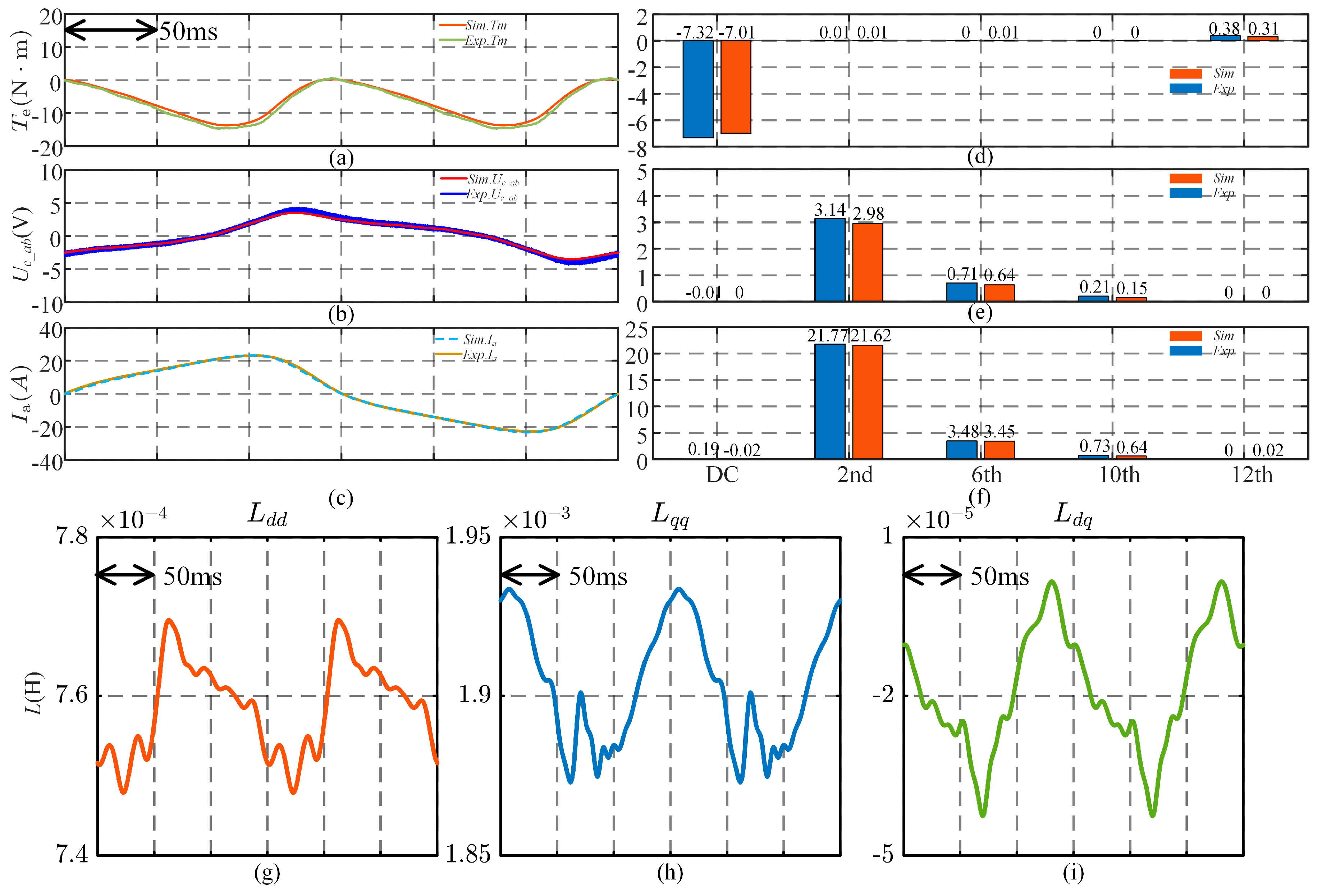
In the two-phase short-circuit test, phases a and b are short-circuited while phase c is left open, and the tested motor is driven by a load machine at a prescribed speed. Under this condition, the terminal voltage is mainly determined by the variation in internal flux linkage, and the system response is dominated by the intrinsic electromagnetic coupling of the motor, with reduced influence from control strategies and inverter non-idealities. Therefore, by measuring the terminal voltage of phase c with respect to the ab short-circuit node (Exp.Uc_ab) and the electromagnetic torque (Exp.Tm), and comparing them with simulation results, the accuracy of the proposed model in describing the relationships among flux linkage, voltage, and electromagnetic energy can be effectively evaluated.
On this basis, to further assess the applicability of the model under practical operating conditions, additional experiments are conducted under rated-torque closed-loop control at different speeds. By comparing the current and torque responses under sinusoidal and non-sinusoidal excitations, the capability of the model to capture electromagnetic characteristics and system dynamics under strongly nonlinear conditions is further validated.
Moreover, under the two-phase short-circuit condition, the symmetry of the three-phase system is broken, leading to pronounced periodic fluctuations in electromagnetic quantities, particularly in the torque. To quantitatively evaluate the consistency between experimental and simulated torque waveforms and to characterize torque ripple, the torque ripple coefficient KTb is adopted as the evaluation metric. According to the Chinese national standard GB/T 30549-2014 [21], KTb is defined as follows:
K T b = T max T min T max + T min × 100 %
Figure 5 shows the results of the two-phase short-circuit test conducted at a speed of 50 r/min. Under the two-phase short-circuit condition, two stator windings are directly short-circuited, which breaks the symmetry of the three-phase system. As a result, the current no longer follows the harmonic characteristics of a balanced three-phase system.
Due to the combined effects of the short-circuit loop configuration and the spatial harmonics of the motor, the phase current ia and the voltage of phase c with respect to the short-circuit node, Uc_ab, mainly exhibit harmonic components of order 4k + 2.
As illustrated in Figure 6a, the electromagnetic torque exhibits a clear periodic ripple within one electrical cycle. The simulation and experimental results are consistent in both magnitude and variation pattern. The torque ripple coefficient KTb is adopted to quantitatively evaluate the torque fluctuation level, yielding values of −108.13% and −106.09% for the experimental and simulation results, respectively. The Fourier decomposition results shown in Figure 6d indicate that the error in the average torque is 0.31 N·m (4.23%).
Figure 6b presents the comparison of the terminal voltage Uc_ab between phase c and the short-circuit node. Under the two-phase short-circuit condition, the motor terminal voltage is mainly determined by the variation in the internal flux linkage. The consistency of the voltage waveform therefore indicates that the proposed motor model can accurately reflect the internal electromagnetic coupling characteristics of the machine. The Fourier decomposition results shown in Figure 6e indicate that the dominant harmonics of Uc_ab are mainly distributed at orders of 4k + 2. Among them, the 2nd harmonic exhibits a maximum error of approximately 0.16 V, corresponding to a relative error of 5.09%.
Figure 6c shows the comparison of the phase current ia. The simulated and measured current waveforms almost coincide over the entire electrical cycle. The Fourier decomposition results in Figure 6f further indicate that the dominant harmonic orders of the current are consistent with the experimental results. The Fourier coefficients of the main harmonic components show good agreement, with the 2nd harmonic exhibiting a maximum error of approximately 0.15 A, corresponding to a relative error of 0.69%.
Figure 6g–i show the variations in Ldd, Lqq and Ldq in the proposed nonlinear motor model under this operating condition. Although the motor has not entered a strongly saturated region, the inductances still exhibit coupled variations with respect to both current and rotor position due to the dynamic evolution of current, revealing inherent nonlinear characteristics. These nonlinearities mainly arise from electromagnetic coupling effects induced by structural asymmetry and parameter disturbances, and are reflected in both the dynamic variation and harmonic components of the inductances. Therefore, although strong saturation is not fully excited, this condition can still capture the nonlinear electromagnetic behavior of the motor to a certain extent, providing a fundamental validation of the electromagnetic parameter relationships in the model.
The proposed nonlinear motor model mainly considers parameter disturbances and magnetic saturation nonlinearities, while the eddy-current effect is not included. Under the low-speed condition of 50 r/min, the simulation results agree well with the experimental results, and the errors between the simulated and measured parameters are within 5.1%. This demonstrates that the proposed model can accurately capture the variation characteristics of the motor electromagnetic properties.

4.3. Torque Response Tests Under Sinusoidal and Non-Sinusoidal Excitations

To validate the accuracy of the established nonlinear motor system model under closed-loop control conditions while considering the mechanical dynamic characteristics of the test bench, experiments are conducted at two operating conditions: 50 r/min, which is far from the mechanical resonance region, and 350 r/min, which is close to the resonance region. As indicated by the frequency characteristics shown in Figure 5e,f at the low speed of 50 r/min, the dominant torque ripple harmonics (6th and 12th) are only slightly affected by the mechanical resonance of the test bench, with amplitude gains of 0.03 dB and 0.13 dB, respectively. Experiments performed at this speed can therefore effectively reflect the intrinsic torque ripple characteristics of the PMSM under different excitation conditions.
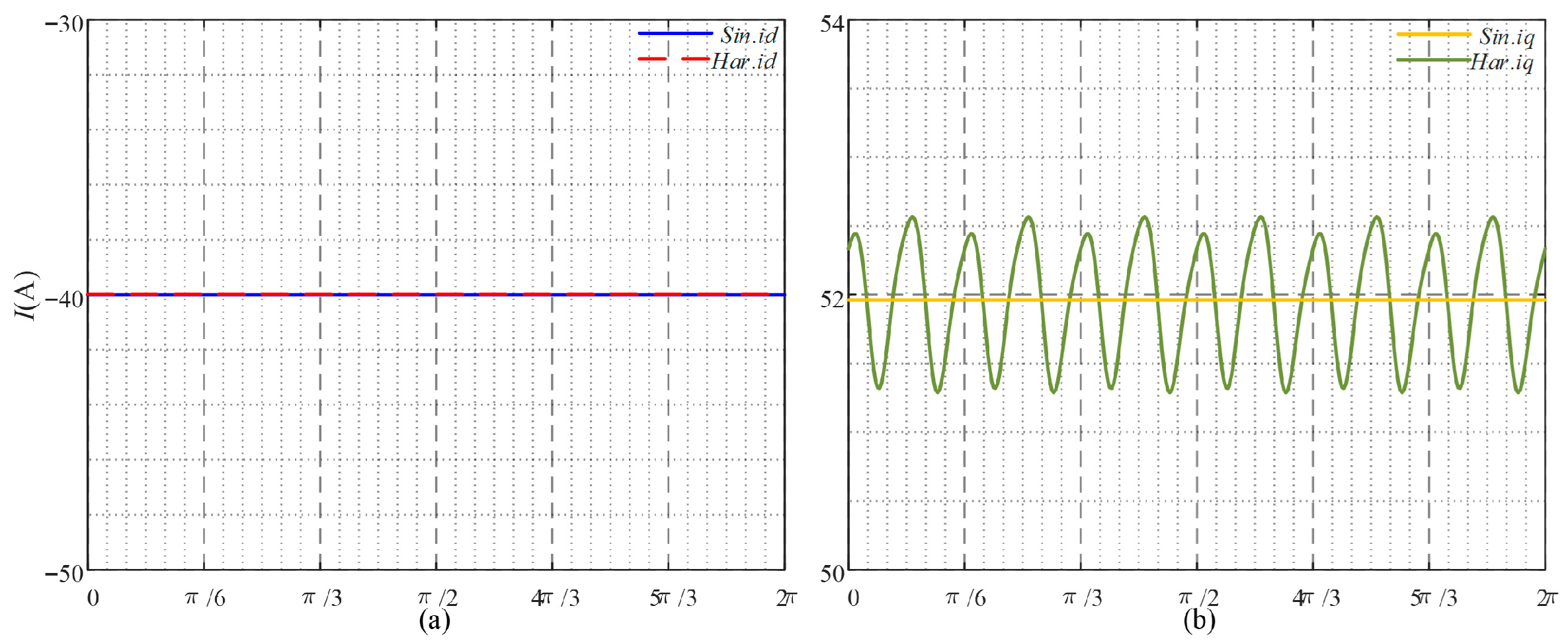
At 350 r/min, the 12th torque harmonic is located near the first resonance peak, where the amplitude gain reaches 15.66 dB. Experiments conducted under this condition further verify the capability of the nonlinear motor system model to capture the torque ripple characteristics when mechanical resonance coupling occurs. In the experiments, the rated torque operating point of 40 N·m (id = −40 A, iq = 51.96 A) is selected as the current reference for the sinusoidal excitation Sin.idq. In addition, the 6th and 12th harmonic current components are superimposed on the iq component of the fundamental current to construct the harmonic current excitation Har.idq, in order to evaluate the simulation tracking capability of the nonlinear motor model for torque response characteristics under non-sinusoidal excitation. The experimental results are shown in Figure 7.
a. 
Simulation and Experiments Under the Non-Resonant Operating Condition
To analyze the torque ripple characteristics under rated torque at low-speed operation and to validate the established nonlinear motor system model, the operating condition of 50 r/min, which is far from the mechanical resonance point, is selected for simulation and experimental comparison.
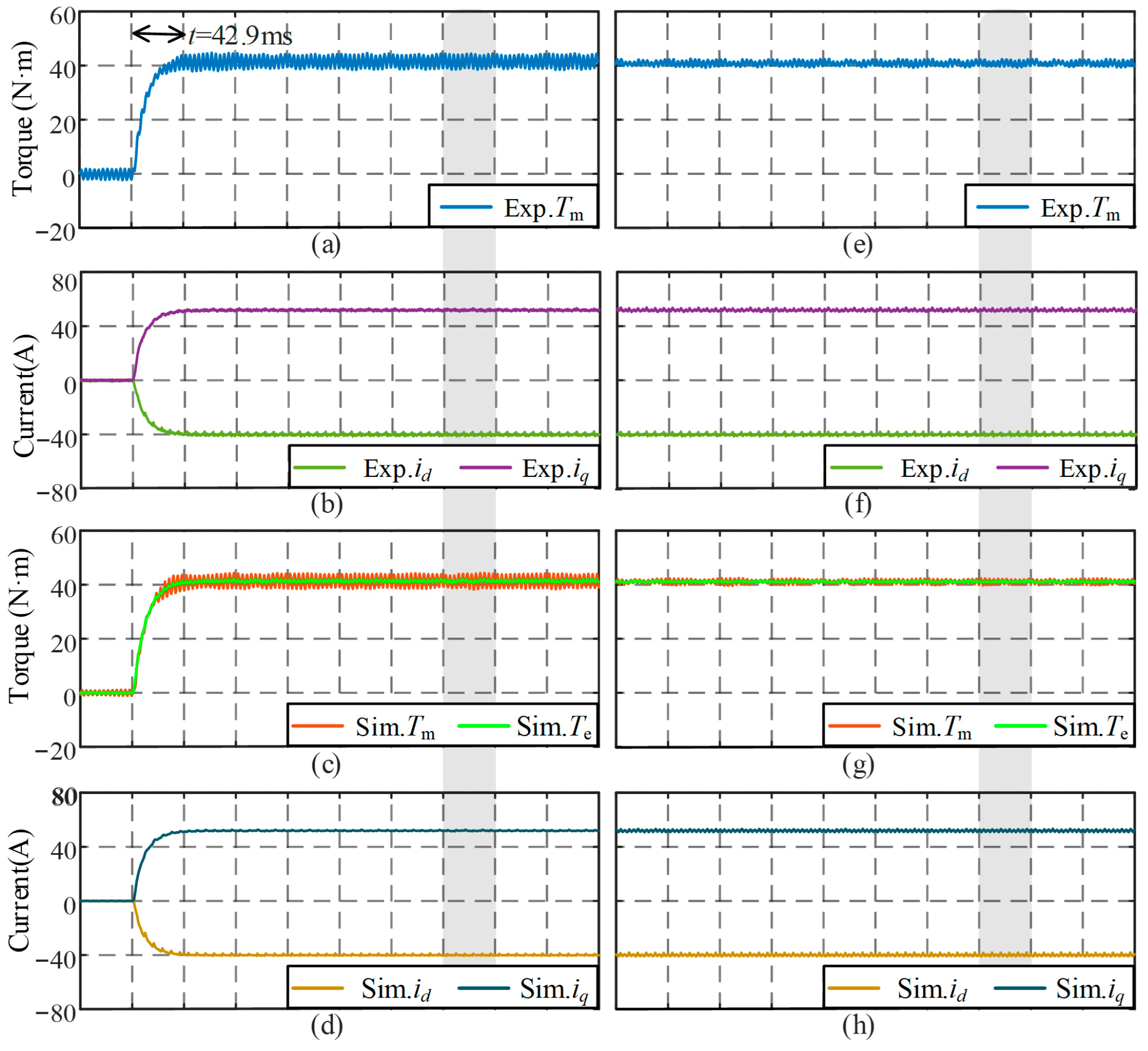
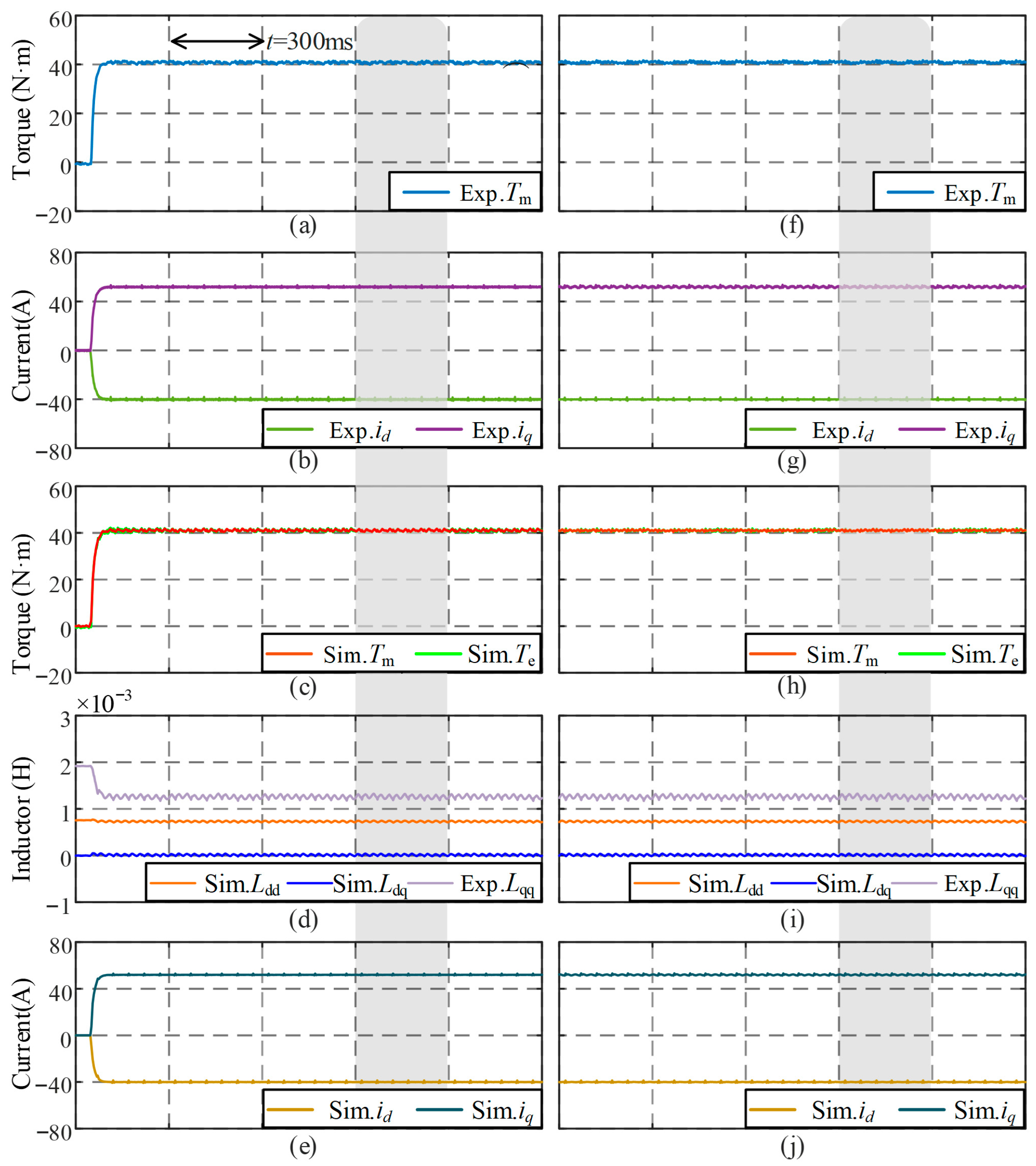
The results are shown in Figure 8, which presents the comparison between experimental and simulation results under the 50 r/min low-speed condition for the two excitation methods. In the figure, Exp.TM denotes the output torque measured by the experimental torque sensor, Sim.TM represents the mechanical torque output from the simulation model at the same position, and Sim.Te denotes the electromagnetic torque of the motor in the simulation. Exp.id and Exp.iq correspond to the experimental id and iq currents, while Sim.id and Sim.iq denote the corresponding currents obtained from the simulation system. Sim.Ldd, Sim.Ldq, and Sim.Lqq represent the direct-axis self-inductance, cross-axis mutual inductance, and quadrature-axis self-inductance in the simulation model, respectively.
Under sinusoidal excitation, the rise time of Exp. TM from 0 N·m to 40 N·m (from 0% to 90%) is 21 ms, while the rise time of Sim. TM is 23 ms, showing close agreement. This indicates that the simulation model can accurately reflect the dynamic response characteristics of the actual system. As shown in Figure 8d,i, the incremental inductances Ldd, Ldq, and Lqq exhibit pronounced magnetic saturation nonlinearities with the variation in excitation current and rotor position.
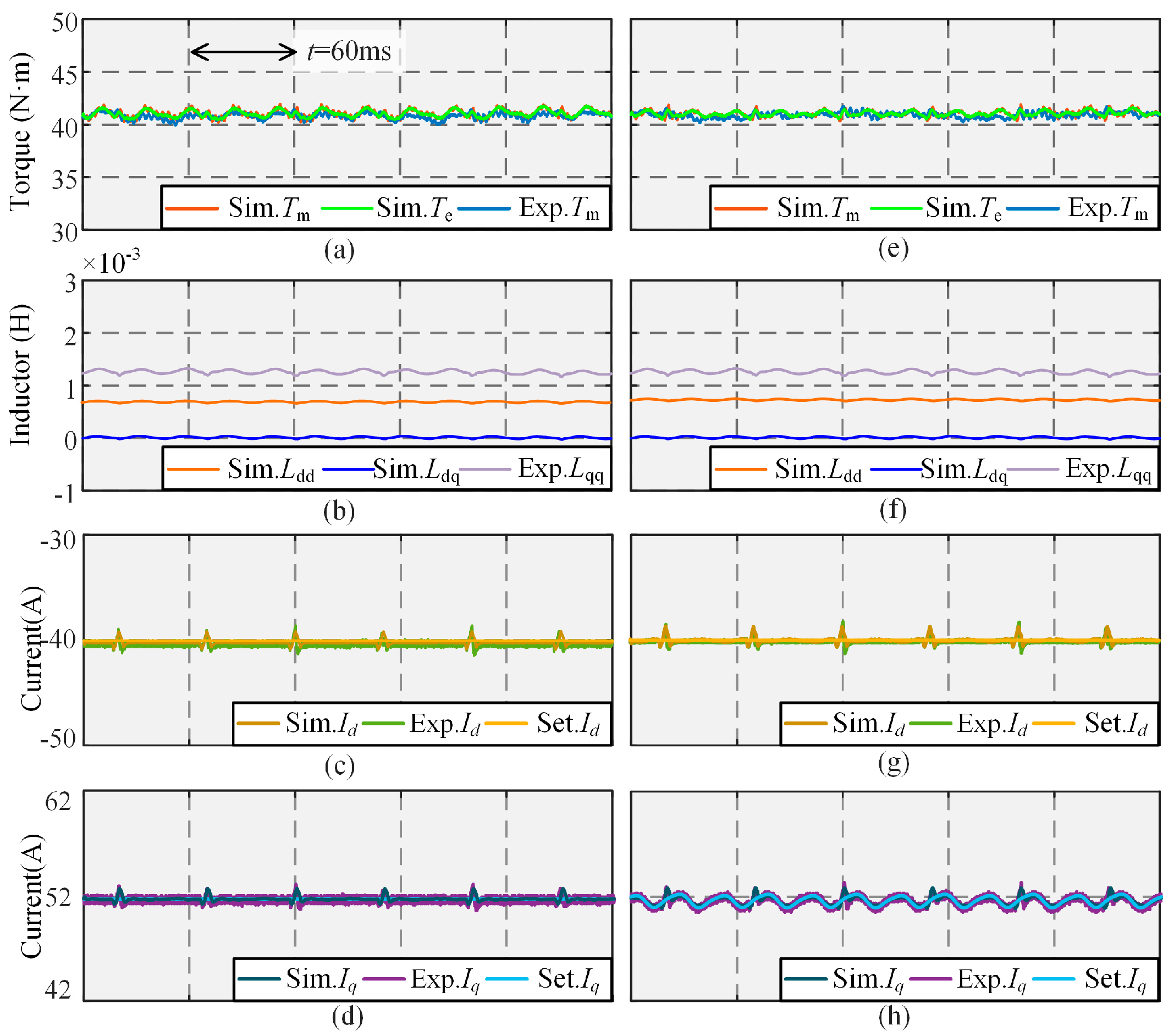
Figure 9 presents the enlarged single-cycle comparison of the gray region highlighted in Figure 8. At 50 r/min, the angular frequency of the 12th harmonic is 252 rad/s, corresponding to an amplitude-frequency characteristic of 0.13 dB and a phase-frequency characteristic of −3.38°. Therefore, the transmission of the torque signal is not significantly affected in terms of amplitude or phase.
As shown in Figure 9a,e the simulated mechanical torque Sim.TM and the measured torque Exp.TM exhibit good agreement under both sinusoidal and non-sinusoidal excitation conditions. The amplitudes and variation trends of the experimental and simulated currents are also consistent in both cases, validating the effectiveness of the proposed model under low-speed operating conditions. Under sinusoidal excitation, the torque ripple coefficients K T b   obtained from the experimental and simulation results are 1.71% and 1.83%, respectively. Under non-sinusoidal excitation, the corresponding values are 1.53% and 1.69%, respectively.
Figure 9b,f illustrate the variation in the incremental inductance parameters in the simulation model over a single electrical cycle under sinusoidal and non-sinusoidal excitation, respectively. It can be observed that L d d , L d q , and L q q     exhibit periodic variations with changes in the excitation current magnitude and rotor electrical angle, indicating that the motor inductance parameters are influenced by both current and rotor position. Under different current vectors, the local saturation level of the magnetic circuit varies, resulting in dynamic changes in the incremental inductances. In addition, the periodic variation of L d q     further reflects the cross-coupling effect between the d - and q -axes.
Figure 9c,d,g,h show the comparison of current trajectories under sinusoidal and non-sinusoidal excitations at 50 r/min. Both simulated and experimental currents accurately track the reference trajectories, indicating good current tracking performance under low-speed non-resonant conditions. Slight periodic distortions remain in the experimental currents due to the inverter IGBT dead-time effect, mainly appearing near the current zero-crossings. However, their magnitudes are small and have little impact on the overall current trajectory and torque control performance.
b. 
Simulation and Experiments Near the Mechanical Resonance Point
To further validate the accuracy of the simulation model in the resonance region, experimental and simulation comparisons are conducted at 350 r/min under the rated torque operating point (id = −40 A, iq = 51.96 A). Figure 9 shows the comparison results under sinusoidal and non-sinusoidal excitations.
As shown in Figure 10, when the speed is 350 r/min, the torque ripple amplitude under sinusoidal excitation increases significantly, exhibiting typical mechanical resonance characteristics. The step response results show that the rise time of the measured torque is approximately 20 ms, while the simulated result is about 21 ms, indicating good agreement between the experiment and the simulation.
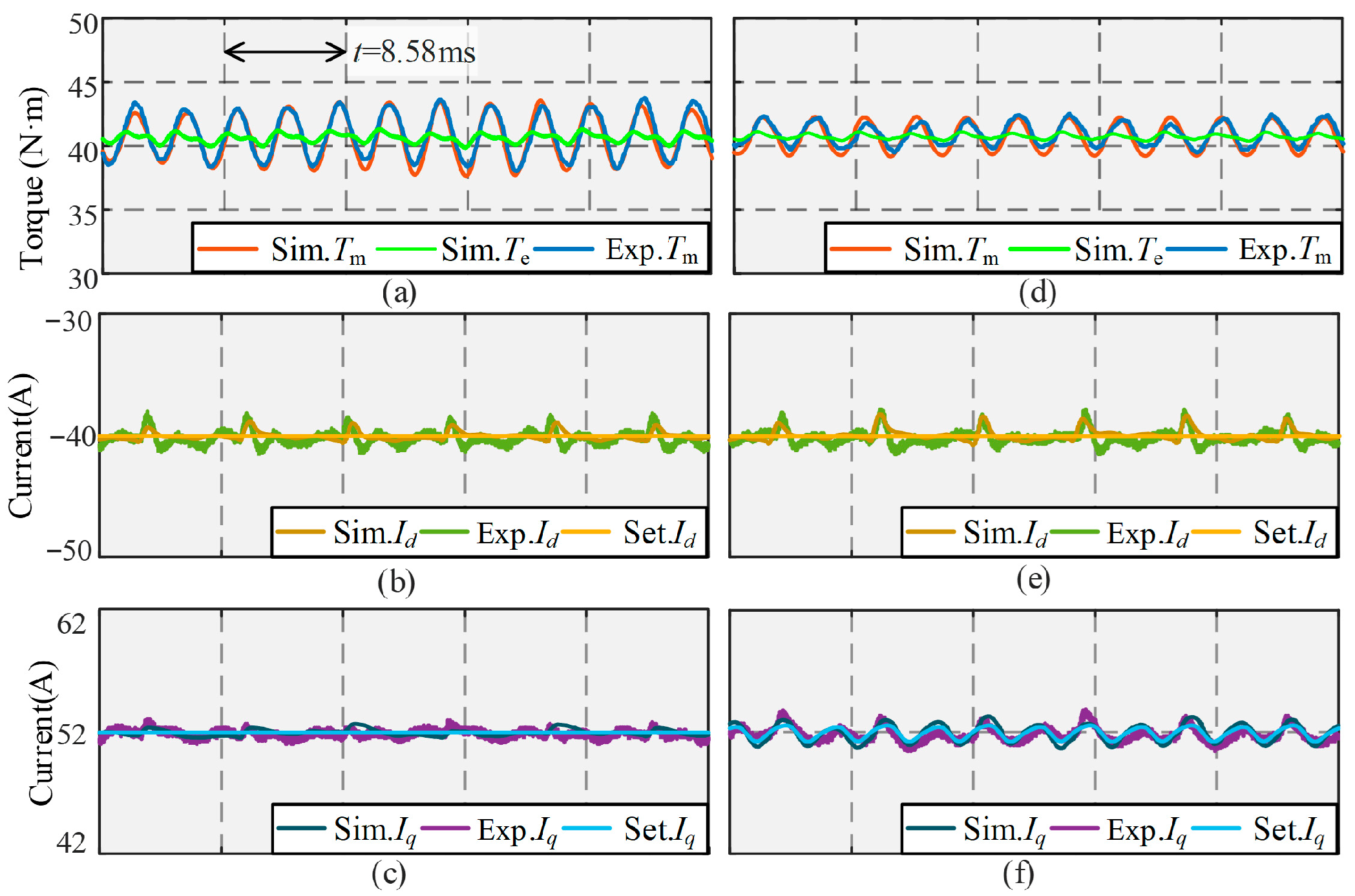
Figure 11 presents the enlarged single-cycle comparison of the gray region in Figure 10. Under the resonance condition at 350 r/min, according to the frequency characteristics of the test bench, the angular frequency of the 6th harmonic is 1764 rad/s, with an amplitude gain of 1.80 dB and a phase shift of −11.94°. The angular frequency of the 12th harmonic is 3528 rad/s, with an amplitude gain of 16.72 dB and a phase shift of −27.38°.
Due to the resonance characteristics of the test bench, the 12th harmonic component of the torque undergoes significant amplitude amplification and phase lag. As a result, the measured torque Exp.TM, the simulated mechanical torque Sim.TM, and the simulated electromagnetic torque Sim.Te exhibit noticeable differences in both amplitude and phase.
As shown in Table 3, under sinusoidal excitation, the measured torque and the simulated mechanical torque are amplified by 2.86 and 2.98 times, respectively, while the 12th harmonic component is amplified by 16.32 dB and 16.68 dB, respectively. Under non-sinusoidal excitation, the measured torque and the simulated mechanical torque are amplified by 3.01 and 3.09 times, respectively, and the 12th harmonic component is amplified by 15.68 dB and 16.12 dB, respectively.
For both sinusoidal and non-sinusoidal excitation control, the constructed motor system simulation model shows good agreement with the experimental results. Under sinusoidal excitation, the torque ripple coefficient KTb obtained from the experiment is 7.34%, while the simulation result is 7.59%, indicating that the proposed model can accurately reproduce the torque ripple characteristics in the resonance region. Under non-sinusoidal excitation, the torque ripple is reduced, with the experimental and simulation KTb decreasing to 4.02% and 4.21%, corresponding to reductions of 45.2% and 44.5%, respectively, showing consistent trends between experiment and simulation.
Figure 11b,c,e,f further present the comparison of current trajectories under the two excitation methods at 350 r/min resonance condition. Under this condition, as the speed increases and approaches the mechanical resonance region, the coupling between electromagnetic and mechanical dynamics becomes more pronounced, leading to certain periodic fluctuations in the feedback current under sinusoidal excitation. For non-sinusoidal excitation, harmonic components are intentionally introduced into the current trajectory and tracked through voltage feedforward compensation. However, in the presence of harmonic currents, the zero-crossing detection required by the dead-time compensation algorithm becomes more complicated, limiting the compensation accuracy. Moreover, as the current frequency increases and the system dynamic coupling becomes stronger, the current tracking error becomes larger compared with the 50 r/min operating condition. Nevertheless, the current can still stably follow the reference trajectory without obvious instability or severe distortion.

5. Conclusions

Based on the nonlinear motor model proposed in [19,20], this paper derives the expression of the incremental inductance derivatives using the differential relationships among incremental inductance, flux linkage, and magnetic energy. By exploiting the advantage of the PINN in maintaining the consistency of the parameter differential structure, the derivatives of the incremental inductances are further obtained. On this basis, linear and nonlinear approximation strategies based on incremental inductances and their derivatives are developed. These strategies effectively reduce the invocation frequency of the PINN module while maintaining model accuracy, thereby improving the overall computational efficiency of simulation and control. As a result, the constructed nonlinear motor model enables cross-frequency-domain system simulation and application.
To verify the accuracy of the established nonlinear motor model considering magnetic saturation nonlinearity and parameter disturbances, two-phase short-circuit tests are first conducted to validate the model while eliminating the influence of the inverter and control system. Furthermore, under closed-loop control conditions, experiments are performed at both a low-speed operating condition far from the mechanical resonance point and a high-speed condition near the resonance region. Comparative experiments under sinusoidal and non-sinusoidal excitations are carried out to evaluate the closed-loop simulation capability of the model and its ability to describe the dynamic characteristics of the actual test bench. It should be noted that, in torque smoothness analysis, the dynamic characteristics of the mechanical system of the test bench must be carefully considered in both experiments and simulations, as they can significantly affect the measured results. The experimental results demonstrate that the proposed nonlinear motor system model exhibits good accuracy and applicability.
In addition, this work mainly focuses on the effects of magnetic saturation and parameter disturbances on electromagnetic characteristics. Eddy current effects, as well as temperature variation and demagnetization of permanent magnets, are not considered. Since these factors typically evolve over much slower time scales, they can be incorporated in future work within the proposed differential modeling framework by introducing slowly time-varying parameter drift under a quasi-steady-state assumption, thereby enabling extended modeling of thermal effects and long-term degradation.

Author Contributions

Methodology, X.W.; modeling, Y.L. All authors have read and agreed to the published version of the manuscript.

Funding

This research received no external funding.

Institutional Review Board Statement

Not applicable.

Informed Consent Statement

Not applicable.

Data Availability Statement

The raw data supporting the conclusions of this article will be made available by the authors on request.

Conflicts of Interest

The authors declare no conflict of interest.

References

  1. Monadi, M.; Nabipour, M.; Akbari-Behbahani, F.; Pouresmaeil, E. Speed Control Techniques for Permanent Magnet Synchronous Motors in Electric Vehicle Applications Toward Sustainable Energy Mobility: A Review. IEEE Access 2024, 12, 119615–119632. [Google Scholar] [CrossRef]
  2. Srinivasan, K.; Delgado, F.A.P.; Hofmann, H.; Sun, J. Nonlinear Magnetics Model for Permanent Magnet Synchronous Machines Capturing Saturation and Temperature Effects. IEEE Trans. Energy Convers. 2026, 41, 311–324. [Google Scholar] [CrossRef]
  3. Parasiliti, F.; Villani, M.; Tassi, A. Dynamic Analysis of Synchronous Reluctance Motor Drives Based on Simulink® and Finite Element Model. In IECON 2006—32nd Annual Conference on IEEE Industrial Electronics, Paris, France, 6–10 November 2006; IEEE: New York, NY, USA, 2006; pp. 1516–1520. [Google Scholar]
  4. Park, S.-C.; Kwon, B.-I.; Yoon, H.-S.; Won, S.-H.; Kang, Y.-G. Analysis of exterior-rotor BLDC motor considering the eddy current effect in the rotor steel shell. IEEE Trans. Magn. 1999, 35, 1302–1305. [Google Scholar] [CrossRef]
  5. Hua, W.; Zhu, X. Overview of Flux-reversal Permanent Magnet Machine and Its Key Technologies. Proc. CSEE 2020, 40, 2657–2669. [Google Scholar]
  6. Ma, W.; Wang, D.; Cheng, S.; Chen, J. Common Basic Scientific Issues and Technology Development Frontiers of High-performance Motor Systems. Proc. CSEE 2016, 36, 2025–2035. [Google Scholar]
  7. Liu, C.; Yao, R.; Liu, T. Study of the research parameters of permanent magnet synchronous motors in variable frequency system. Large Electr. Mach. Hydraul. Turbine 2003, 5, 1–5. (In Chinese) [Google Scholar]
  8. Forstner, G.; Kugi, A.; Kemmetmuller, W. A Magnetic Equivalent Circuit Based Modeling Framework for Electric Motors Applied to a PMSM With Winding Short Circuit. IEEE Trans. Power Electron. 2020, 35, 12285–12295. [Google Scholar] [CrossRef]
  9. Lin, H.; Liao, Y. Gain Scheduling Current Control of Permanent Magnet Synchronous Machine Based on Nonlinear Magnetic Saturation Model. Proc. CSEE 2023, 43, 770–778. [Google Scholar]
  10. Wang, R.; Wang, Q.; Huo, J.; Pan, X.; Wu, H. The Non-Linear Model Research of Two-Phase Switched Reluctance Motor Basic on Interpolation and Fitting Methods. In 2021 7th Annual International Conference on Network and Information Systems for Computers (ICNISC), Guiyang, China, 23–25 July 2021; IEEE: New York, NY, USA, 2021; pp. 346–352. [Google Scholar]
  11. Weidenholzer, G.; Silber, S.; Jungmayr, G.; Bramerdorfer, G.; Grabner, H.; Amrhein, W. A flux-based PMSM motor model using RBF interpolation for time-stepping simulations. In 2013 International Electric Machines & Drives Conference; IEEE: New York, NY, USA, 2013; pp. 1418–1423. [Google Scholar]
  12. Goto, H.; Ichinokura, O. A new analytical model of ipm motor based on magnetic reluctance matrix. In The XIX International Conference on Electrical Machines—ICEM 2010; IEEE: New York, NY, USA, 2010; pp. 1–4. [Google Scholar]
  13. Zhu, Z.Q.; Liang, D.; Liu, K. Online Parameter Estimation for Permanent Magnet Synchronous Machines: An Overview. IEEE Access 2021, 9, 59059–59084. [Google Scholar] [CrossRef]
  14. Qi, X.; Sheng, C.; Guo, Y.; Su, T.; Wang, H. Parameter Identification of a Permanent Magnet Synchronous Motor Based on the Model Reference Adaptive System with Improved Active Disturbance Rejection Control Adaptive Law. Appl. Sci. 2023, 13, 12076. [Google Scholar] [CrossRef]
  15. Li, X.; Wang, W.; Wang, X. Permanent Magnet Synchronous Motor Parameter Identification Based on Improved Adaptive Extended Kalman Filter. In 2022 IEEE 4th International Conference on Power, Intelligent Computing and Systems (ICPICS), Shenyang, China, 29–31 July 2022; IEEE: New York, NY, USA, 2022; pp. 926–931. [Google Scholar]
  16. Zhang, S.; Zhou, Z.; Pu, Y.; Li, Y.; Xu, Y. Parameter Identification of Permanent Magnet Synchronous Motor Based on LSOSMO Algorithm. Sensors 2025, 25, 2648. [Google Scholar] [CrossRef] [PubMed]
  17. Lu, L.; Meng, X.; Mao, Z.; Karniadakis, G.E. DeepXDE: A deep learning library for solving differential equations. SIAM Rev. 2021, 63, 208–228. [Google Scholar] [CrossRef]
  18. Beltrán-Pulido, A.; Aliprantis, D.; Bilionis, I.; Munoz, A.R.; Chase, N. Physics-Informed Neural Networks for Parametric Modeling of Permanent Magnet Synchronous Machines. IEEE Trans. Energy Convers. 2026, 41, 648–661. [Google Scholar] [CrossRef]
  19. Wang, S.; Wang, X. A PINN-Based Nonlinear PMSM Electromagnetic Model Using Differential Inductance Theory. Appl. Sci. 2025, 15, 7162. [Google Scholar] [CrossRef]
  20. Wang, X.; Yi, P.; Zhou, Z.; Sun, Z.; Ruan, W. Improvements in the permanent magnet synchronous motor torque model using incremental inductance. IET Electr. Power Appl. 2020, 14, 109–118. [Google Scholar] [CrossRef]
  21. GB/T 30549-2014; General Specification for Permanent Magnet AC Servo Motors. China Standards Press: Beijing, China, 2014.
Figure 1. Nonlinear motor system modeling and data interaction.
Applsci 16 03426 g001
Figure 2. Relationship between accuracy, simulation time and corresponding call frequencies.
Applsci 16 03426 g002
Figure 3. Relationship between inductance flux linkage and magnetic energy at different interaction frequencies. (a) Reference i d q current trajectory; (b) ψ d   versus time; (c) ψ q   versus time; (d) W   versus time; (e) zoomed view of the green region in (a); (f) zoomed view of the green region in (b); (g) zoomed view of the green region in (c); (h) zoomed view of the green region in (d); (i) variations of L d d , L d q , and L q q with time.
Applsci 16 03426 g003
Figure 4. Comparison of voltage and torque characteristics among three motor models. (a) Ud over one electrical period; (b) Uq over one electrical period; (c) Te over one electrical period.
Applsci 16 03426 g004
Figure 5. Composition, dynamic modeling and frequency response characteristics of the experimental bench system. (a) Experimental motor controller; (b) experimental IGBT inverter; (c) back-to-back test bench; (d) mechanical dynamics schematic of the test bench; (e) mechanical magnitude–frequency response of the test bench; (f) mechanical phase–frequency response of the test bench.
Applsci 16 03426 g005aApplsci 16 03426 g005b
Figure 6. Simulation and experimental comparison of two-phase short-circuit at 50 r/min with Fourier decomposition. (a) Measured torque Exp.Tm and simulated torque Sim.Tm; (b) measured voltage Exp.Uc_ab and simulated voltage Sim.Uc_ab; (c) measured current Exp.Ia and simulated current Sim.Ia; (d) Fourier spectra of Exp.Tm and Sim.Tm; (e) Fourier spectra of Exp.Uc_ab and Sim.Uc_ab; (f) Fourier spectra of Exp.Ia and Sim.Ia; (g) variation in Ldd in the nonlinear motor model; (h) variation in Lqq in the nonlinear motor model; (i) variation in Ldq in the nonlinear motor model.
Applsci 16 03426 g006
Figure 7. One-cycle sinusoidal and non-sinusoidal currents (a) Sinusoidal current Sin.id and non-sinusoidal current Har.id; (b) Sinusoidal current Sin.iq and non-sinusoidal current Har.iq.
Applsci 16 03426 g007
Figure 8. Comparison of sinusoidal and non-sinusoidal excitation (50 r/min). (a) Measured torque under sinusoidal excitation; (b) measured current under sinusoidal excitation; (c) simulated electromagnetic torque Sim.Te and simulated mechanical torque Sim.TM under sinusoidal excitation; (d) simulated incremental inductance variations under sinusoidal excitation; (e) simulated current under sinusoidal excitation; (f) measured torque under non-sinusoidal excitation; (g) measured current under non-sinusoidal excitation; (h) simulated electromagnetic torque Sim.Te and simulated mechanical torque Sim.TM under non-sinusoidal excitation; (i) simulated incremental inductance variations under non-sinusoidal excitation; (j) simulated current under non-sinusoidal excitation.
Applsci 16 03426 g008
Figure 9. Local Zoomed-in View of Single-Cycle Comparison between Sinusoidal and Non-sinusoidal Excitation (50 r/min) (a) Measured torque Exp.TM, simulated electromagnetic torque Sim.Te, and simulated mechanical torque Sim.TM under sinusoidal excitation; (b) simulated variation in incremental inductances under sinusoidal excitation; (c) measured current Exp. id, simulated current Sim. id, and reference current Set.id under sinusoidal excitation; (d) measured current Exp. iq, simulated current Sim. iq, and reference current Set.iq under sinusoidal excitation; (e) measured torque Exp. TM, simulated electromagnetic torque Sim. Te, and simulated mechanical torque Sim. TM under constant-torque excitation; (f) simulated variation in incremental inductances under constant-torque excitation; (g) measured current Exp.id, simulated current Sim. id, and reference current Set.id under constant-torque excitation; (h) measured current Exp.iq, simulated current Sim.iq, and reference current Set.iq under constant-torque excitation.
Applsci 16 03426 g009
Figure 10. Comparison of sinusoidal and non-sinusoidal excitation (350 r/min). (a) Measured torque under sinusoidal excitation; (b) measured current under sinusoidal excitation; (c) simulated electromagnetic torque Sim.Te and simulated mechanical torque Sim.TM under sinusoidal excitation; (d) simulated current under sinusoidal excitation; (e) measured torque under non-sinusoidal excitation; (f) measured current under non-sinusoidal excitation; (g) simulated electromagnetic torque Sim.Te and simulated mechanical torque Sim.TM under non-sinusoidal excitation; (h) simulated current under non-sinusoidal excitation.
Applsci 16 03426 g010
Figure 11. Local zoomed-in view of single-cycle comparison between sinusoidal and non-sinusoidal excitation (350 r/min). (a) Measured torque Exp.TM, simulated electromagnetic torque Sim.Te, and simulated mechanical torque Sim.TM under sinusoidal excitation; (b) measured current Exp. id, simulated current Sim. id, and reference current Set.id under sinusoidal excitation; (c) measured current Exp. iq, simulated current Sim. iq, and reference current Set.iq under sinusoidal excitation; (d) measured torque Exp. TM, simulated electromagnetic torque Sim. Te, and simulated mechanical torque Sim. TM under constant-torque excitation; (e) measured current Exp.id, simulated current Sim. id, and reference current Set.id under constant-torque excitation; (f) measured current Exp.iq, simulated current Sim.iq, and reference current Set.iq under constant-torque excitation.
Applsci 16 03426 g011
Table 1. PMSM parameters.
ParameterValueParameterValue
Pole pairs4Rotor outer diameter/mm98.6
Stator slots48Rotor segments3
Stator outer diameter/mm155Rotor skew angle/deg2.5
Stator inner diameter/mm100Core materialB35APV1900
Air gap/mm0.7Magnet materialN42UH
Peak torque/N.m80Rated torque/N.m40
Peak current/A130 ARated current/A65 A
Table 2. Fourier decomposition results of voltage and torque in Figure 4.
FEAPINN-Based ModelConstant-Parameter Model
UdUqTeUdUqTeUdUqTe
DC−5.136.9640.26−5.176.9340.25−5.406.9241.91
6th0.00250.0220.0750.00210.0220.0680.00060.00010.011
12th0.100.0560.410.0940.0650.350.0120.00030.26
Table 3. Torque data analysis under 350 r/min sinusoidal excitation and non-sinusoidal excitation.
Sinusoidal ExcitationNon-Sinusoidal Excitation
Sim.TeExp.TMSim.TMSim.TeExp.TMSim.TM
Tmax–Tmin1.635.896.010.863.433.62
6th0.030.040.040.040.060.04
12th0.362.522.670.231.611.78
Disclaimer/Publisher’s Note: The statements, opinions and data contained in all publications are solely those of the individual author(s) and contributor(s) and not of MDPI and/or the editor(s). MDPI and/or the editor(s) disclaim responsibility for any injury to people or property resulting from any ideas, methods, instructions or products referred to in the content.