Article

Simple Improvement of In Vitro Shoot Elongation and Rooting of Sida cordifolia L. from Nodal Segments


1
Department of Biotechnology, Faculty of Natural Sciences, University of Ss. Cyril and Methodius in Trnava, Námestie Jozefa Herdu 2, 917 01 Trnava, Slovakia
2
National Agricultural and Food Centre, Research Institute of Plant Production, Bratislavská cesta 122, 921 68 Piešťany, Slovakia
*
Author to whom correspondence should be addressed.
Appl. Sci. 2026, 16(7), 3423; https://doi.org/10.3390/app16073423
Submission received: 5 February 2026 / Revised: 25 March 2026 / Accepted: 30 March 2026 / Published: 1 April 2026
(This article belongs to the Special Issue Plant Biotechnology and Application)

Abstract

Efficient in vitro propagation of Sida cordifolia L. from nodal explants is often limited by poor shoot and root elongation. This study aimed to improve elongation of shoots and roots from two-node explants through simple modifications of the Murashige and Skoog (MS) culture medium. Explants were cultured on full- and half-strength MS media. Half-strength MS (1/2MS) significantly increased shoot (3.9-fold) and root (4.2-fold) elongation compared to full-strength MS. Therefore, subsequent experiments were conducted using 1/2MS. Further modifications included supplementation of 1/2MS medium with KH2PO4, plant growth regulators (TDZ, BAP, 2iP, GA3), and pretreatment of nodal segments with Norit buffer before cultivation. KH2PO4 did not further affect shoot elongation but significantly enhanced root elongation, with the greatest effect at 170 mg L−1. Pretreatment of nodal segments in Norit buffer had almost the same effect as KH2PO4, both on shoots and roots. In contrast, cytokinins and GA3 inhibited both shoot and root elongation compared to hormone-free 1/2MS medium. The results indicate that 1/2MS medium alone is most suitable for improving shoot and root elongation in vitro in S. cordifolia. Supplementation of the 1/2MS medium with 170 mg L−1 KH2PO4 further enhances root elongation. The use of cytokinins and GA3 should be avoided.

1. Introduction

The genus Sida L., belonging to the family Malvaceae, comprises approximately 200 species worldwide. Among them, Sida cordifolia L. (commonly known as country mallow, Ilima, flannel weed, and heart-leaf sida) is one of the most extensively studied species. It is widely distributed in tropical and subtropical regions. Although considered an invasive weed in some areas, S. cordifolia is a perennial herb with a long history of use in traditional medicine systems, particularly in Indian, American, and Chinese folk medicine [1,2]. In Ayurveda, it is known as “Bala” or “Indian ephedra”. Traditionally, S. cordifolia has been used to treat a wide range of conditions, including inflammation, pain, arthritis, nervous disorders, abdominal infections, bronchial asthma, the common cold and influenza, headaches, nasal congestion, joint pain, cough, wheezing, oedema, blood and bile disorders, urinary diseases, and other human ailments [1,2,3,4,5]. Various parts of the plant, including the bark, seeds, and roots, are associated with specific pharmacological properties, such as cooling, aphrodisiac, astringent, stomachic, tonic, aromatic, bitter, and diuretic effects [6].
More than 50 chemical constituents have been identified in S. cordifolia, including quinazoline and phenethylamine alkaloids, flavones, flavonols, phytosterols, fatty acids, and other secondary metabolites [1]. Additional bioactive compounds present in the roots, leaves, and seeds include alkaloids, such as ephedrine, fatty oils, and steroids [2,5]. The presence of alkaloids, flavonoids, and coumarins is closely associated with the pharmacological activities of plants [3]. Specific constituents, including rosmarinic acid and its 4-O-β-D-glucoside derivative, have also been reported [7]. Numerous in vitro and in vivo studies have demonstrated the broad spectrum of pharmacological activities of S. cordifolia extracts. Ethyl acetate extracts of the roots and aerial parts exhibited analgesic activity comparable to that of indomethacin, whereas the aqueous acetone extracts showed dose-dependent analgesic effects [4,8]. Methanolic fractions containing compounds such as rosmarinic acid demonstrated strong activity against Gram-positive antibiotic-resistant bacteria, including multidrug-resistant Staphylococcus aureus [7]. Cryptolepine, an alkaloid isolated from this plant, has been shown to induce p21WAF1/CIP1 protein expression and cause cell-cycle arrest in human osteosarcoma cells, suggesting its potential chemotherapeutic applications [9]. Methanolic root extract also exhibited significant hypoglycemic effects [8]. Polysaccharides present in aqueous extracts have demonstrated immunomodulatory activity and enhanced resistance to bacterial infections [7]. Aqueous extracts of S. cordifolia have been reported to induce hypotension and bradycardia through stimulation of muscarinic receptors [10] and exert cardioprotective effects [1]. In addition, hydroalcoholic leaf extracts showed depressant activity on the central nervous system [5,6,11], significantly reduced blood glucose and glycated hemoglobin (HbA1c) levels, restored renal function indices, and inhibited the formation of advanced glycation end-products in animal models [12]. Preclinical studies have attributed notable antioxidant properties to Sida species [3], and S. cordifolia has demonstrated free-radical scavenging activity without cytotoxic effects in the PC12 cell line [13]. Moreover, S. cordifolia fibers are currently being investigated for the development of eco-friendly composite materials, offering a sustainable alternative to synthetic materials in various industrial applications [14]. Overall, Sida L. represents a promising subject for further advances in phytochemistry and pharmacology; however, sustainable sourcing and additional clinical investigations remain necessary [3].
The efficient propagation of S. cordifolia and the development of new cultivars with desired chemical profiles are constrained by poor seed germination. Even after chemical treatments with agents such as H2SO4, HCl, or gibberellic acid, as well as physical treatments including boiling or freezing, germination rates rarely exceed 50% [15,16]. In addition, pollen grains exhibit low natural viability, even under optimal temperature [17]. Overcoming the limitations associated with the propagation and cultivation of S. cordifolia would enable the consistent production of high-quality plant material and ensure a reliable supply of biologically active secondary metabolites for the pharmaceutical industry, thereby supporting the development of new drugs and nutritional and sports supplements. Furthermore, the medicinal importance of this species highlights the need for effective conservation strategies, as increasing demand may render natural populations vulnerable to overexploitation, endangerment, and extinction [18].
Tissue culture techniques, particularly in vitro micropropagation, represent an effective strategy for the propagation and conservation of this valuable medicinal plant. Micropropagation enables the production of uniform plant material of S. cordifolia and may play a crucial role in meeting the increasing demand for this species in the future. Although direct or indirect somatic embryogenesis represents a highly efficient regeneration system, it has not yet been successfully achieved in S. cordifolia. An alternative approach involves micropropagation through direct organogenesis from primary explants or indirect organogenesis via previously induced callus tissue. In both systems, the initiation, elongation, and development of shoots and roots are essential for obtaining complete regenerants that can subsequently be transferred to in vivo conditions. Shoots can be induced through direct shoot organogenesis from nodal explants [19] or indirectly from callus derived from nodal explants [18]. Root induction in regenerated shoots has been achieved using culture media supplemented with auxins such as NAA, IAA, or IBA [18,20]. Regenerated plants were morphologically similar to the donor plants [18]. However, these findings primarily demonstrate the feasibility of the reported protocols for the mass propagation and germplasm conservation of S. cordifolia. To date, only four studies have addressed the in vitro micropropagation of this species [18,19,20,21], indicating that the methodology remains insufficiently developed for efficient large-scale application. A major limitation is the slow and poor growth and elongation of shoots and roots obtained through direct or indirect organogenesis from nodal segments under in vitro conditions. We hypothesized that shoot and root growth from nodal explants can be enhanced through modifications of the culture medium and the addition of selected compounds, without the use of plant growth regulators. Therefore, the aim of this study was to improve shoot and root elongation in plantlets regenerated from explants, thereby increasing the efficiency of the in vitro micropropagation system for Sida cordifolia L.

2. Materials and Methods

Seeds of Sida cordifolia L. were scarified in concentrated sulfuric acid for 15 min and subsequently surface-sterilized with 70% (v/v) ethanol for 30 s, followed by immersion in a 4.7% (v/v) sodium hypochlorite (NaOCl) solution for 15 min. The seeds were then rinsed repeatedly with sterile distilled water and cultured on solid Murashige and Skoog (MS) medium [22] supplemented with vitamins, 30 g L−1 sucrose, and 0.8% (w/v) agar, adjusted to pH 5.7–5.8 before autoclaving. Young, aseptically grown plants were used as explant sources. Stem segments containing two nodes were excised and placed on either full-strength or half-strength MS medium (1/2 MS, containing half the concentration of all the components). Potassium dihydrogen phosphate (KH2PO4) and the plant growth regulators thidiazuron (TDZ), 6-benzylaminopurine (BAP), 6-(γ,γ-dimethylallylamino)purine (2iP), and gibberellic acid (GA3) were added to the culture medium as specified. Concentrations of plant growth regulators were as follows: TDZ at 0.1, 0.25, 0.5, and 2.0 mg/L, BAP at 0.5 and 2.0 mg/L, 2iP at 2.0 mg/L, and GA3 at 0.2 or 0.6 mg/L. All chemicals were obtained from Duchefa Farma B.V. (Haarlem, The Netherlands). In one experimental variant, nodal explants were pretreated with Norit buffer prior to in vitro cultivation. The Norit buffer consisted of 0.05 M sodium/potassium phosphate buffer (pH 7.0), 1 mM ethylenediaminetetraacetic acid (EDTA), 5 mM sodium diethyldithiocarbamate (DIECA), and 5 mM thioglycolic acid (all from Carl Roth GmbH + Co. KG, Karlsruhe, Germany), and the explants were immersed for 5 min. All cultures were maintained at 22 ± 1 °C under a 16 h light/8 h dark photoperiod. Shoot and root growth were evaluated after eight weeks of cultivation period.
The results are expressed as the mean ± standard deviation (SD). Graphs were prepared using Microsoft® Excel® for Microsoft 365 MSO (v. 2511). Statistical analyses were performed using one-way analysis of variance (ANOVA) followed by Tukey’s honestly significant difference (HSD) post hoc test at a significance level of p < 0.05 using the Statistics Kingdom Calculator [23].

3. Results

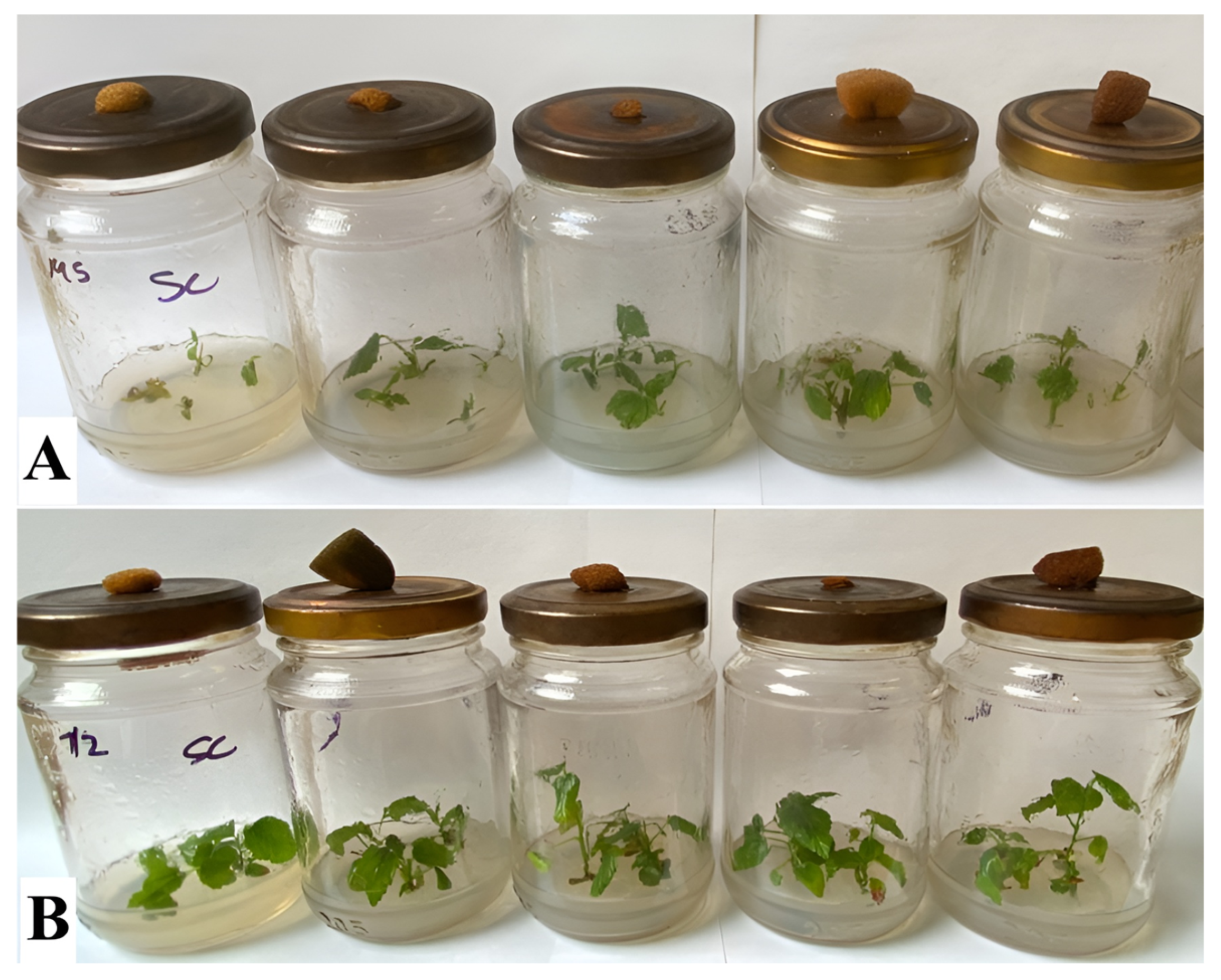
In the first phase of the experiment, the effects of full-strength and half-strength Murashige and Skoog (MS) media on the development of two-node explants and the subsequent growth and elongation of shoots and roots were evaluated. After only four weeks of cultivation, differences in shoot elongation were evident between explants grown on MS and 1/2MS (Figure 1).
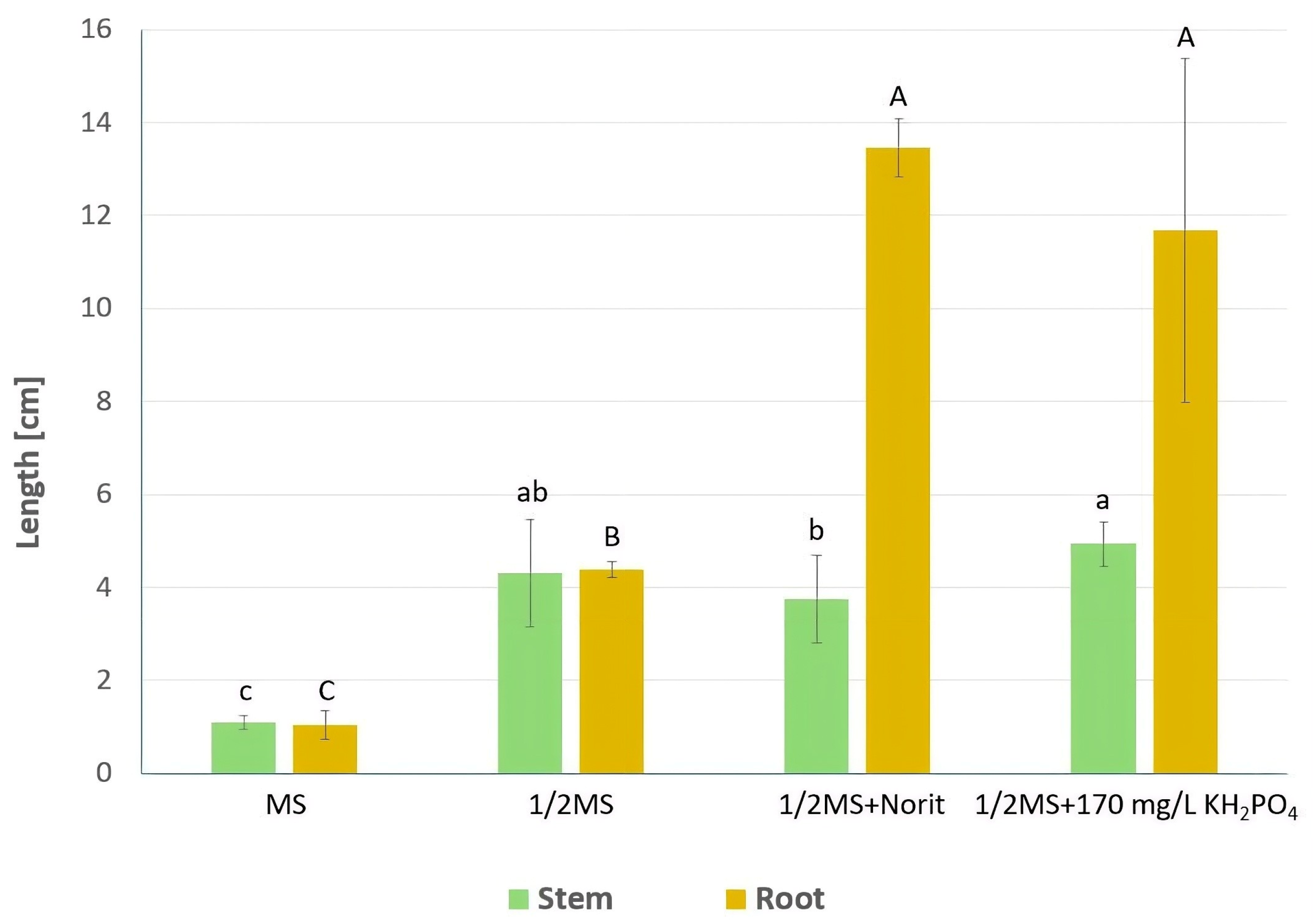
Evaluation after eight weeks of cultivation revealed statistically significant differences (p < 0.05) in the average lengths of both shoots and roots between the MS and 1/2MS media (Figure 2). The mean shoot length on 1/2MS medium was 4.31 ± 1.15 cm, approximately 3.9-fold greater than that observed on full-strength MS medium (1.10 ± 0.14 cm). Similarly, root length was significantly greater on 1/2MS (4.38 ± 0.18 cm), representing a 4.2-fold increase compared with full-strength MS medium (1.04 ± 0.31 cm). These results indicate that half-strength MS (1/2MS) is more suitable for in vitro growth and elongation of shoots and roots from nodal explants than full-strength MS. Therefore, all subsequent experiments were performed using only 1/2MS medium, which was already considered a control medium.
Enhancement of shoot and root elongation was anticipated following the treatment of two-node explants with Norit buffer, which contains components, particularly EDTA and DIECA, that are known to positively influence tissue growth. Treatment of explants with Norit buffer, followed by eight weeks of cultivation on 1/2MS medium, resulted in a statistically significant (p < 0.05) increase in root growth and elongation (Figure 2). The average root length reached 13.46 ± 0.62 cm, which corresponded to a 3.1-fold improvement compared to the control 1/2MS medium. Conversely, the mean shoot length decreased to 3.75 ± 0.94 cm, representing a 13% reduction compared with explants cultured on 1/2MS medium.
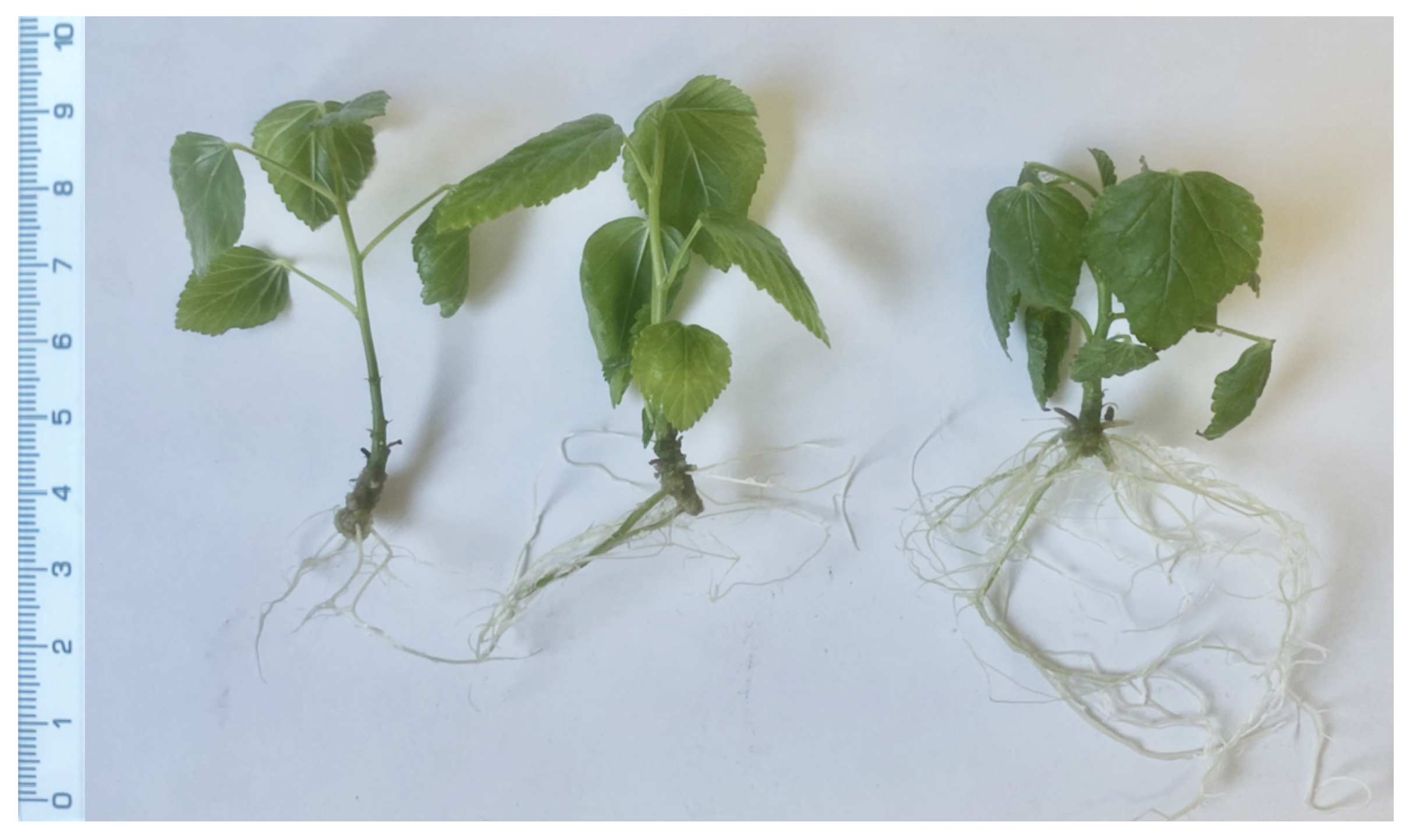
The effect of potassium supplementation, applied as potassium dihydrogen phosphate (KH2PO4), a key macronutrient influencing in vitro plant growth and development, was also evaluated in 1/2MS culture medium. All tested concentrations of KH2PO4 (85, 170, and 255 mg/L) resulted in a statistically significant (p < 0.05) increase in mean shoot length (2.93 ± 0.23 cm, 4.94 ± 0.48 cm, and 3.08 ± 1.67 cm, respectively) compared with the full-strength MS medium (1.10 ± 0.14 cm). However, supplementation of 1/2MS medium with KH2PO4 did not significantly affect shoot elongation compared with the control 1/2MS medium, even at the most favorable concentration of 170 mg/L, where shoot lengths were comparable to those observed on 1/2MS medium (Figure 2). The mean root lengths on 1/2MS media supplemented with 85, 170, or 255 mg/L KH2PO4 were 6.01 ± 2.31 cm, 11.68 ± 3.71 cm, and 5.07 ± 2.22 cm, respectively, whereas roots on the control 1/2MS medium reached only 4.38 ± 0.18 cm. Among the tested treatments, the most effective supplementation was 170 mg/L KH2PO4 (Figure 2), which did not significantly increase shoot length, but enhanced root elongation by 2.7-fold compared to the control 1/2MS medium. A larger standard deviation in root elongation was observed on 1/2MS medium supplemented with 170 mg/L KH2PO4 (Figure 2), likely reflecting the natural genetic and biological variation among nodal segments derived from plantlets originating from different seeds. These plantlets may differ in their physiological state, genetic background, growth rate, and other characteristics. The regenerated plantlets were viable, with well-developed shoots and roots, and were suitable for acclimatization and transfer to in vivo conditions (Figure 3).
Shoot growth promotion in in vitro cultures is typically induced by the use of cytokinins. Accordingly, 1/2MS medium was supplemented individually with the cytokinins TDZ and BAP at concentrations of 1.0, 2.0, and 4.0 mg/L to stimulate shoot elongation from the nodal segments. However, in all treatments, shoot length was significantly reduced, ranging from 0.25 to 0.60 cm compared with 4.31 ± 1.15 cm on 1/2MS medium. As shoot elongation was severely inhibited, root elongation was not assessed in these treatments.
Further experiments were conducted to test shoot elongation with the simultaneous use of cytokinins TDZ (0.1, 0.25, 0.5, and 2.0 mg/L), BAP (0.5 and 2.0 mg/L), and 2-isopentenyladenine (2iP; 2.0 mg/L) in the 1/2MS medium supplemented with 170 mg/L KH2PO4. Supplementation with TDZ and BAP again resulted in reduced mean shoot lengths (0.19–0.67 cm). The addition of 2iP (2 mg/L) increased shoot length to 1.72 ± 0.25 cm; however, this remained substantially lower than that observed on the control 1/2MS medium without growth regulator (4.31 ± 0.15 cm), as well as on 1/2MS medium with 170 mg/L KH2PO4 added (4.94 ± 0.48 cm). Supplementation of 1/2MS medium containing 170 g/L KH2PO4 with GA3 at concentrations of 0.2 or 0.6 mg/L resulted in shoot lengths of 2.00 ± 0.73 cm and 3.78 ± 0.84 cm, and root lengths of 4.89 ± 0.55 cm and 2.61 ± 1.46 cm, respectively. Both shoot and root elongation remained lower in comparison with 1/2MS medium containing 170 mg/L KH2PO4 without growth regulators.

4. Discussion

Murashige and Skoog medium (MS) is one of the most used culture media for in vitro plant propagation. Variations in its concentration can significantly influence shoot and root development in vitro [24,25,26]. Full-strength MS often promotes shoot development, particularly in terms of shoot length and number, whereas reduced concentrations (half or quarter strength) of its components can enhance root number and elongation, depending on the plant species and growth regulators applied. Consequently, the optimal concentration of MS medium components varies with both the plant species and the specific objectives of cultivation [27,28,29,30]. These observations underscore the importance of optimizing the medium strength for each genus and species to achieve the desired outcome of micropropagation, namely, efficient shoot and root proliferation. In our experiments with S. cordifolia, half-strength MS medium was more effective than full-strength MS medium in promoting the development and elongation of both shoots and roots in vitro.
In addition to modifying the overall concentration of MS medium, adjustments to individual inorganic components and supplementation with various non-regulatory (predominantly organic) additives have also been investigated. Nutrients and ions in plant tissue culture media are generally classified into four main groups, with nitrogen, potassium, and phosphorus serving as the principal macronutrients. These macronutrients act as structural components and participate in metabolic reactions, exhibiting complex interactions with micronutrients and other medium constituents. In MS medium, potassium and phosphorus were supplied together as potassium dihydrogen phosphate (KH2PO4). Both elements generally exert positive effects on shoot development, rooting, and the prevention of hyperhydricity in regenerants during in vitro culture [31,32]. The standard concentration of KH2PO4 in MS medium is 170 mM; however, this level can be adjusted, and in interaction with other components, such modifications can influence shoot and root growth [33,34,35]. To date, the effects of KH2PO4 adjustment on micropropagation within the genus Sida L. have not been reported. In our study, nodal segments of S. cordifolia were cultivated on half-strength MS medium supplemented with KH2PO4, increasing the final concentration from 170 mg/L to 225 mg/L. This simple modification further enhanced the positive effect of the half-strength MS medium on both shoot and root elongation.
The Norit buffer used in this study did not contain activated carbon and therefore functioned as a standard buffer solution without adsorption properties. Although it was not added directly to the culture medium, a brief pretreatment of nodal segments was sufficient to elicit a positive response, likely due to the presence of several bioactive compounds. Diethyldithiocarbamic acid (DIECA), a component of the buffer, has been shown to affect plant tissue cultures primarily through its antioxidant activity and influence on the stability of secondary metabolites, including growth regulators [36,37]. Another component, EDTA, particularly in the form of Fe-EDTA, has been demonstrated to significantly enhance shoot regeneration from callus cultured on MS medium [38]. Increased concentrations of Fe-EDTA above standard MS levels promoted shoot regeneration in hormone-free media, whereas its absence inhibited regeneration. Thioglycolic acid, a further component, functions as a chemical antioxidant and may help reduce explant browning, similar to other antioxidants commonly used in plant tissue cultures. Additionally, the sodium/potassium phosphate buffer may exert beneficial effects by stabilizing the medium pH, thereby reducing physiological disorders such as hyperhydricity and tissue necrosis [39]. Pretreatment of nodal segments with Norit buffer produced effects on plantlet regeneration comparable to supplementing the medium with 170 mg/L KH2PO4. However, this approach requires additional handling steps, which can increase the risk of contamination in in vitro culture.
Several factors may explain why cytokinins, whether generally or as used in this study, did not promote shoot elongation. The efficiency of regeneration can be strongly influenced by the intrinsic hormone content of the explant and its original location on the plant. Shoot regeneration results from the interaction between endogenous hormone levels and exogenous plant growth regulators (PGRs) supplied in the culture medium [40,41]. Nodal segments contain axillary meristems with their own hormonal regulation, which often require lower levels of exogenous PGRs to initiate shoot growth compared with other tissues; in some cases, addition of extrinsic hormones may be unnecessary [42]. PGRs, particularly auxins and cytokinins, are the primary drivers of plant morphogenesis. However, the culture medium, in this case MS medium, provides a physiological environment that critically influences plant growth. Variations in MS components, even without altering hormone levels, can significantly affect regeneration because mineral nutrients act as structural building blocks, signaling molecules, and morphogenesis elicitors [32]. For example, nitrogen levels and the nitrate-to-ammonium ratio can modulate shoot induction independently of added growth hormones [43], while calcium concentration affects cellular perception of endogenous hormones [44]. The salt concentration in the medium determines osmotic potential, and dilution of MS media can increase explant survival and promote root development in sensitive species, even in hormone-free media [45]. Full-strength MS can induce vitrification (hyperhydricity), whereas reduction in medium strength alleviates this stress [46]. Mineral composition also influences pH dynamics and nutrient availability, with medium acidification inhibiting uptake of essential elements and high levels of one nutrient potentially suppressing others, thereby affecting regeneration independently of added growth hormones [44]. In line with our hypothesis, the results demonstrate that improved shoot and root growth and elongation during micropropagation can be achieved through simple modifications of the MS medium. Specifically, reducing MS component concentration by half and increasing potassium dihydrogen phosphate levels were sufficient to enhance plantlet development. Exogenous growth regulators have proven unnecessary, simplifying the protocol and reducing the cost of the culture medium by approximately 50%. Future research should focus on increasing the multiplication coefficient, particularly through indirect organogenesis and somatic embryogenesis.

5. Conclusions

Simple modifications of the MS medium significantly enhanced shoot and root elongation from two-nodal explants during in vitro micropropagation. Reducing all MS components to half-strength resulted in an approximately fourfold increase in both shoot and root elongation compared to full-strength MS medium. When additional root elongation is required, either supplementation of the medium with 170 mg/L KH2PO4 or pretreatment of nodal segments with Norit buffer prior to culture on half-strength MS medium is effective. In both cases, the effect was similar, with root length increasing by approximately threefold compared with 1/2MS medium. Application of the cytokinins TDZ, BAP, and 2iP, as well as GA3, adversely affected both shoot and root elongation.

Author Contributions

Conceptualization, J.K. and Š.K.; methodology, J.H., Š.K. and J.K.; software, J.H. and J.K.; validation, J.K.; formal analysis, J.H.; investigation, J.H.; data curation, J.H. and J.K.; writing—original draft preparation, J.K.; writing—review and editing, J.H., Š.K. and J.K.; visualization, J.H. and J.K.; supervision, J.K.; project administration, J.H.; funding acquisition, J.H. All authors have read and agreed to the published version of the manuscript.

Funding

This research was funded by EU NextGenerationEU through the Recovery and Resilience Plan for Slovakia under the project No. 09I03-03-V05-0004 (FPPV 26-2025).

Institutional Review Board Statement

Not applicable.

Informed Consent Statement

Not applicable.

Data Availability Statement

The original contributions presented in this study are included in the article. Further inquiries can be directed to the corresponding author.

Conflicts of Interest

The authors declare no conflicts of interest.

References

  1. Kumar, S.; Kumar, S.; Vishnoi, V.K.; Kumar, P.; Maheshwari, D.K. Sida cordifolia L.: Ethnobotany, phytochemistry, phytonanotechnology, and commercial application. Curr. Pharm. Biotechnol. 2024, 25, 838–859. [Google Scholar] [CrossRef] [PubMed]
  2. Paijwar, P.; Mishra, P.; Awasthi, H.H. Therapeutic significance of Bala (Sida cordifolia Linn.): A systematic review. Afr. J. Biomed. Res. 2025, 28, 885–891. [Google Scholar] [CrossRef]
  3. Jiménez-Ferrer, E.; Herrera-Ruiz, M.; Campos-Vidal, Y.; Flores-Franco, G.; Monterrosas-Brisson, N. Sida L.: Ethnobotany, pharmacology, and phytochemistry: A review. Plants 2025, 14, 3115. [Google Scholar] [CrossRef] [PubMed]
  4. Konaté, K.; Bassolé, I.H.N.; Hilou, A.; Aworet-Samseny, R.; Souza, A.; Barro, N.; Dicko, M.H.; Datté, J.Y.; M’Batchi, B. Toxicity assessment and analgesic activity investigation of aqueous acetone extracts of Sida acuta Burn f. and Sida cordifolia L. (Malvaceae), medicinal plants of Burkina Faso. BMC Complement. Altern. Med. 2012, 12, 120. [Google Scholar] [CrossRef]
  5. Jain, A.; Choubev, S.; Singour, P.K.; Raiak, H.; Pawar, R.S. Sida cordifolia (Linn)—An overview. J. Appl. Pharm. Sci. 2011, 1, 23–31. [Google Scholar]
  6. Singh, A.; Navneet. Ethnobotanical, pharmacological benefits and phytochemistry of Sida cordifolia (Linn.): A Review. Int. J. Pharm. Clin. Res. 2018, 10, 16–21. [Google Scholar]
  7. Iqbal, H.; Wright, C.L.; Jones, S.; Rocas da Silva, G.; McKillen, J.; Gilmore, B.F.; Kavanagh, O.; Green, B.D. Extracts of Sida cordifolia contain polysaccharides possessing immunomodulatory activity and rosmarinic acid compounds with antibacterial activity. BMC Complement. Med. Ther. 2022, 22, 27. [Google Scholar] [CrossRef]
  8. Kanth, V.R.; Diwan, P.V. Analgesic, antiinflammatory and hypoglycaemic activities of Sida cordifolia. Phytother. Res. 1999, 13, 75–77. [Google Scholar] [CrossRef]
  9. Matsui, T.-A.; Sowa, Y.; Murata, H.; Takagi, K.; Nakanishi, R.; Aoki, S.; Yoshikawa, M.; Kobayashi, M.; Sakabe, T.; Kubo, T.; et al. The plant alkaloid cryptolepine induces p21WAF1/CIP1 and cell cycle arrest in a human osteosarcoma cell line. Int. J. Oncol. 2007, 31, 915–922. [Google Scholar] [CrossRef]
  10. Medeiros, I.A.; Santos, M.R.V.; Nascimento, N.M.S.; Duarte, J.C. Cardiovascular effects of Sida cordifolia leaves extract in rats. Fitoterapia 2006, 77, 19–27. [Google Scholar] [CrossRef]
  11. Franco, C.I.F.; Morais, L.C.S.L.; Quaintas-Júnior, L.J.; Almeida, R.N.; Antoniolli, A.R. CNS pharmacological effects of the hydroalcoholic extract of Sida cordifolia L. leaves. J. Ethnopharmacol. 2005, 98, 275–279. [Google Scholar] [CrossRef]
  12. Imran, M.; Jaqiline, R.S.M.; Sharma, M.; Aeri, V. Evaluation of Sida cordifolia and Sida rhombifolia extracts in a rat model of streptozotocin-induced diabetic nephropathy. Polym. Med. 2023, 53, 7–18. [Google Scholar] [CrossRef] [PubMed]
  13. Auddy, B.; Ferreira, M.; Blasina, F.; Lafon, L.; Arredondo, F.; Dajas, F.; Tripathi, P.C.; Seal, T.; Mukherjee, B. Screening of antioxidant activity of three Indian medicinal plants, traditionally used for the management of neurodegenerative diseases. J. Ethnopharmacol. 2003, 84, 131–138. [Google Scholar] [CrossRef] [PubMed]
  14. Sharma, B.P.; Dewangan, R.; Sharma, S.S. Characterizing the mechanical behavior of eco-friendly hybrid polymer composites with jute and Sida cordifolia fibers. Obrab. Met. 2024, 26, 267–285. [Google Scholar] [CrossRef]
  15. Krizevski, R.; Lewinsohn, E. Germination of bala (Sida cordifolia L., Malvaceae), an Ayurvedic plant. Acta Hortic. 2010, 860, 219–222. [Google Scholar] [CrossRef]
  16. Raghav, A.; Kasera, P.K. Seed germination potential of Sida cordifolia Linn.—A medicinal flannel weed from Indian arid zone. J. Med. Aromat. Plant Sci. 2013, 35, 154–158. [Google Scholar] [CrossRef]
  17. Singh, D.K.; Agnihotri, R.K.; Ganie, S.; Singh, G.; Sharma, R.K. Pollen fertility and scanning electron microscopic studies of Sida cordifolia L. Indian Res. J. Genet. Biotechnol. 2013, 5, 98–104. [Google Scholar]
  18. Dahiya, B.; Sethi, N.; Chaudhy, S. In vitro propagation of medicinal plant Sida cordifolia under different growth regulators and salt stress. Ecol. Environ. Conserv. 2002, 28, S357–S360. [Google Scholar] [CrossRef]
  19. Pramod, V.P.; Jayaraj, M. Rapid in vitro multiplication of Sida cordifolia L.—A threatened medicinal plant. J. Hortic. Sci. Biotechnol. 2012, 87, 36–40. [Google Scholar] [CrossRef]
  20. Sivanesan, I.; Jeong, B.R. Direct shoot regeneration from nodal explants of Sida cordifolia Linn. Vitr. Cell. Dev. Biol. Plant 2007, 43, 436–441. [Google Scholar] [CrossRef]
  21. Pramod, V.P.; Jayaraj, M. Rapid callogenesis and plant regeneration from nodal explants of Sida cordifolia L.—An important medicinal plant. J. Phytol. 2012, 4, 40–44. [Google Scholar]
  22. Murashige, T.; Skoog, F. A revised medium for rapid growth and bio assays with tobacco tissue cultures. Physiol. Plant. 1962, 15, 476–497. [Google Scholar] [CrossRef]
  23. Statistics Kingdom. Statistics Kingdom Calculator. 2017. Available online: https://www.statskingdom.com/410multi_linear_regression.html (accessed on 15 January 2026).
  24. Rezali, N.I.; Sidik, N.J.; Saleh, A.; Osman, N.I.; Adam, N.A.M. The effects of different strength of MS media in solid and liquid media on in vitro growth of Typhonium flagelliforme. Asian Pac. J. Trop. Med. 2017, 7, 151–156. [Google Scholar] [CrossRef]
  25. Dogan, M. Influence of different concentrations of Murashige and Skoog medium on multiple shoot regeneration of Staurogyne repens (Nees) Kuntze. J. Eng. Technol. Appl. Sci. 2022, 7, 61–67. [Google Scholar] [CrossRef]
  26. Wijayani, A.; Lestari, R.S.; Pratiwi, N.V. Effect of Murashige and Skoog medium dose and thiamin concentration on in-vitro microchannel growth of chrysanthemum plantlet (Dendranthema grandiflora Tzvelev). In Atlantis Highlights in Sustainable Development 1, Proceedings of the International Conference on Agriculture, Food, and Environment (ICAFE 2024), Yodyakarta, Indonesia, 23 July 2024; Atlantis Press: Dordrecht, The Netherlands, 2025. [Google Scholar] [CrossRef]
  27. Fadel, D.; Kintzios, S.; Economou, A.S.; Moschopoulou, G.; Constantinidou, H.-I.A. Effect of different strength of medium on organogenesis, phenolic accumulation and antioxidant activity of spearmint. Open Hortic. J. 2010, 3, 31–35. [Google Scholar] [CrossRef]
  28. Salam, F.M.N.; Alhadi, F.A.; Al-Thobhani, M.A. Effect of full and half MS-salt strength on some commercial cultivars of carnation (Dianthus caryophyllus L.). PSM Biol. Res. 2021, 6, 5–12. [Google Scholar]
  29. Dönmez, D.; Erol, M.H.; Biçen, B.; Şimşek, Ö.; Aka Kaçar, Y. The effects of different strength of MS media on in vitro propagation and rooting of Spathiphyllum. Anadolu J. Agric. Sci. 2022, 37, 583–592. [Google Scholar] [CrossRef]
  30. Ioannidis, K.; Koropouli, P. Effects of different media and their strengths in in vitro culture of three different Cistus creticus L. populations and their genetic assessment using simple sequence repeat molecular markers. Horticulturae 2024, 10, 104. [Google Scholar] [CrossRef]
  31. Mohamed, M.A.-H. A protocol for the mass-micropropagation of carnation (Dianthus caryophyllus L.). J. Hortic. Sci. Biotechnol. 2011, 86, 135–140. [Google Scholar] [CrossRef]
  32. Pasternak, T.P.; Steinmacher, D. Plant growth regulation in cell and tissue culture in vitro. Plants 2024, 13, 327. [Google Scholar] [CrossRef]
  33. Hunková, J.; Gajdošová, A.; Szabóová, M. Effect of mesos components (MgSO4, CaCl2, KH2PO4) on in vitro shoot growth of blackberry, blueberry, and saskatoon. Plants 2020, 9, 935. [Google Scholar] [CrossRef] [PubMed]
  34. Munthali, C.; Kinoshita, R.; Onishi, K.; Rakotondrafara, A.; Mikami, K.; Koike, M.; Tani, M.; Palta, J.; Aiuchi, D. A model nutrition control system in potato tissue culture and its influence on plant elemental composition. Plants 2022, 11, 2718. [Google Scholar] [CrossRef] [PubMed]
  35. Puri, S.; Heriansyah, P.; Nopsagiarti, T. Potassium dihydrogen phosphate (KH2PO4) and kinetin enhance the growth of Dendrobium Sonia somatic embryos. J. Biol. Indones. 2022, 18, 41–50. [Google Scholar] [CrossRef]
  36. Ernstsen, A.; Sandberg, G.; Crozier, A. Effects of sodium diethyldithiocarbamate, solvent, temperature and plant extracts on the stability of indoles. Physiol. Plant. 1996, 68, 519–522. [Google Scholar] [CrossRef]
  37. Li, Y.; Qiu, L.; Zhang, Q.; Zhuansun, X.; Li, H.; Chen, X.; Krugman, T.; Sun, Q.; Xie, C. Exogenous sodium diethyldithiocarbamate, a Jasmonic acid biosynthesis inhibitor, induced resistance to powdery mildew in wheat. Plant Direct 2020, 4, e00212. [Google Scholar] [CrossRef]
  38. Kothari, S.L.; Agarwal, K.; Kumar, S. Inorganic nutrient manipulation for highly improved in vitro plant regeneration in finger millet—Eleusine coracana (L.) Gaertn. In Vitro Cell. Dev. Biol. Plant 2004, 40, 515–519. [Google Scholar] [CrossRef]
  39. Tóth, S.; Scott, P.; Sorvari, S.; Toldi, O. Effective and reproducible protocols for in vitro culturing and plant regeneration of the physiological model plant Ramonda myconi (L.) Rchb. Plant Sci. 2004, 166, 1027–1034. [Google Scholar] [CrossRef]
  40. Hu, W.; Fagundez, S.; Katin-Grazzini, L.; Li, Y.; Li, W.; Chen, Y.; Wang, X.; Deng, Z.; Xie, S.; McAvoy, R.J.; et al. Endogenous auxin and its manipulation influence in vitro shoot organogenesis of citrus epicotyl explants. Hortic. Res. 2017, 4, 17071. [Google Scholar] [CrossRef]
  41. Zhang, Y.; Zhang, J.; Yin, J.; Liu, Y.; Cai, X. Plant regeneration via organogenesis in Jerusalem artichokes and comparative analysis of endogenous hormones and antioxidant enzymes in typical and atypical shoots. Plants 2023, 12, 3789. [Google Scholar] [CrossRef]
  42. Javed, S.B.; Alatar, A.A.; Anis, M.; El-Sheikh, M. In vitro regeneration of coral tree from three different explants using thidiazuron. HortTechnology 2019, 29, 946–951. [Google Scholar] [CrossRef]
  43. Nunes, C.F.; dos Santos, D.N.; Pasqual, M.; Teixeira Valente, T.C.; de Oliveira, A.C.L.; Alves, E.; Setotaw, T.A. Morphogenesis and regeneration of adventitious shoots in Jatropha curcas L. Aust. J. Crop Sci. 2013, 7, 1511–1519. [Google Scholar]
  44. Urbano-Gálvez, A.; López-Climent, M.F.; Gómez-Cadenas, A.; Mahouachi, J. Phytohormones and mineral nutrient changes in young plants of grapevine genotypes at different growth stages. Horticulturae 2024, 10, 1114. [Google Scholar] [CrossRef]
  45. Ko, X.-Y.; Lin, T.-Y.; Ho, C.-W.; Shaw, J.-F. In vitro regeneration of Cephalotus follicularis. HortScience 2010, 45, 260–264. [Google Scholar] [CrossRef]
  46. Rodboot, N.; Te-chato, S.; Yenchon, S. Influence of MS medium strengths and types on in vitro shoot multiplication and development of Nymphaea colorata Peter. ASEAN J. Sci. Technol. Rep. 2025, 28, e258176. [Google Scholar] [CrossRef]
Figure 1. Differences in shoot elongation from nodal segments cultured on MS medium (A) and 1/2MS medium (B), after the first 4 weeks.
Applsci 16 03423 g001
Figure 2. The most effective modifications of the MS medium influencing shoot and root length of plantlets developed from nodal segments. Lowercase and uppercase letters indicate statistically significant differences among treatments for stem and root length, respectively (p < 0.05; Tukey’s HSD test).
Applsci 16 03423 g002
Figure 3. Eight-week-old S. cordifolia plantlets regenerated from nodal segments on 1/2MS medium supplemented with 170 mg/L KH2PO4.
Applsci 16 03423 g003
Disclaimer/Publisher’s Note: The statements, opinions and data contained in all publications are solely those of the individual author(s) and contributor(s) and not of MDPI and/or the editor(s). MDPI and/or the editor(s) disclaim responsibility for any injury to people or property resulting from any ideas, methods, instructions or products referred to in the content.