Article

Prediction of Shear Strength for Lunar Subsurface Regolith with Varying Particle Size Distributions and Relative Densities


1
Institute of Mine Safety, China Academy of Safety Science and Technology, Beijing 100012, China
2
State Key Laboratory of Intelligent Construction and Healthy Operation and Maintenance of Deep Underground Engineering, China University of Mining and Technology, Xuzhou 221116, China
*
Author to whom correspondence should be addressed.
Appl. Sci. 2026, 16(7), 3327; https://doi.org/10.3390/app16073327
Submission received: 26 February 2026 / Revised: 19 March 2026 / Accepted: 26 March 2026 / Published: 30 March 2026
(This article belongs to the Section Civil Engineering)

Abstract

Future lunar mining missions are expected to involve deeper geological conditions. Understanding the mechanical behaviors of the lunar subsurface regolith is essential to operational safety. Recent findings from the Chang’e-4 and Chang’e-5 missions revealed a marked increase in particle size and relative density of lunar regolith with depth. In addition, the geostatic stress naturally increases with depth. These three variables pose significant challenges for accurately predicting the shear strength. Existing predictive models, such as the Alshibli model, fail to account for the distinct conditions of lunar subsurface regolith. To address this, consolidated drained triaxial tests were conducted on the CUMT-1 lunar regolith simulants. The influences of confining pressure, relative density, and particle size distribution on shear strength were systematically analyzed. A novel indicator, named inter-particle void ratio, was introduced to capture the combined effects of relative density and particle size distribution. Based on this indicator, a new empirical model was proposed for predicting peak shear strength under varying subsurface conditions. The results suggest that deeper lunar regolith may have significantly lower shear strength than previously estimated, primarily due to the combined effect of increased inter-particle void ratio and geostatic stress. This finding has important implications for the assessment of excavation efficiency, underground construction stability, and the overall safety of lunar subsurface infrastructure.

1. Introduction

As the only natural satellite of Earth, the Moon is an ideal space exploration base due to its abundant mineral resources [1,2] and potential water ice in polar regions [3,4]. With the rapid advancements in aerospace technology, several lunar exploration programs focusing on long-term sustainability and resource utilization have been proposed [5,6,7,8], e.g., the Artemis project and Chang’e program. To ensure the safety of the upcoming resource exploration and in situ utilization activities on the Moon, understanding the mechanical properties of lunar regolith has become an urgent task [9,10].
Particle size distribution is a critical factor affecting the shear strength of lunar regolith. In the past, most lunar regolith simulants were designed based on the particle gradations of the samples returned by the Apollo missions. In 1971, Carrier et al. developed the first lunar regolith simulant at a time when reference data on the particle size distribution of real lunar regolith was limited [11]. Subsequently, as the Apollo program progressed, the database of lunar surface samples steadily expanded. Graf [12] collected 143 particle size distributions of lunar regolith, which were later recommended by McKay et al. [13] as the reference for the widely used JSC-1 simulant. Carrier [14] summarized particle size distributions from nearly 350 returned lunar regolith samples and estimated their approximate upper and lower bounds, which have since served as a widely used reference for developing lunar regolith simulants [15,16,17,18,19,20,21,22,23,24,25]. In general, most lunar regolith samples returned by the Apollo missions, as well as their simulants, can generally be classified as well-graded sandy silt with a high content of fines.
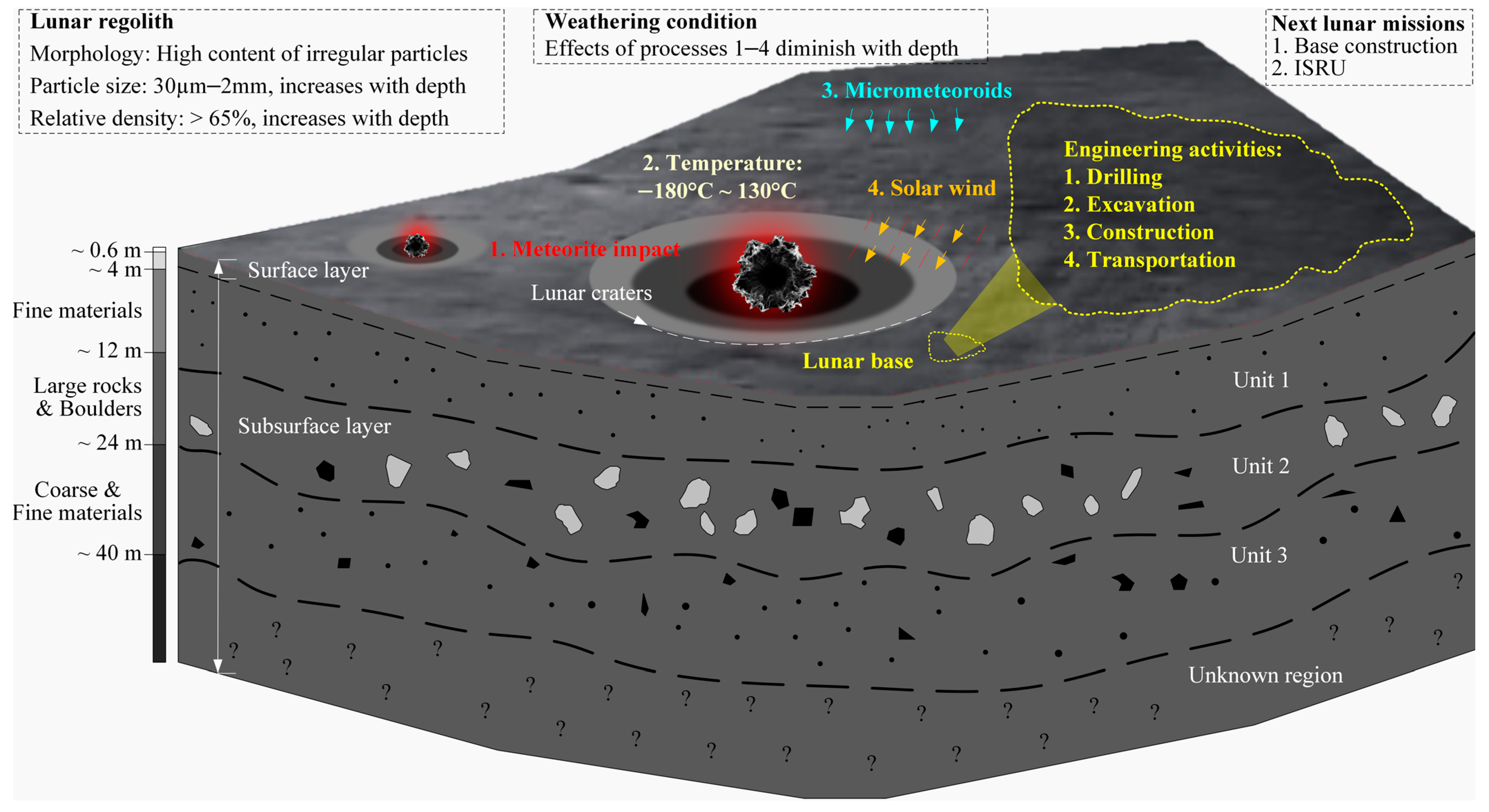
However, recent observations from the Chang’e-4 Lunar Penetrating Radar indicate that the particle size of in situ lunar regolith increases rapidly with depth [26]. Moreover, analysis of drilling samples from the Chang’e-5 lunar mission [27] revealed that fine particles predominantly occupy the 0~28.7 cm depth range, and coarse grains increase progressively from 35 cm to 70 cm. Beyond 73.8 cm, the drill encounters rocky regions. These recent observations and analyses provide clear evidence for the increasing particle size of in situ lunar regolith with depth. One possible formation mechanism for this phenomenon is illustrated in Figure 1. The lunar regolith was primarily reshaped by meteorite impacts. During these events, Moon rocks were shattered into particles of varying sizes, with finer particles lifted higher due to their lower mass. As a result, fine materials ultimately covered the larger particles, constituting the main reason for the increase in particle size with depth. Following meteorite impacts, the lunar surface regolith undergoes continuous space weathering processes, such as extreme diurnal temperature variations, micrometeoroid impacts, and solar wind bombardment. These processes induce further fragmentation of the lunar regolith, resulting in the formation of fine powders and smaller lunar dust particles.
The latest exploration results suggest that accurately predicting the shear strength of deeper lunar regolith necessitates simultaneously considering variations in particle size distribution, vertical stress, and relative density. However, existing strength prediction models, such as the classical Bolton model and the Alshibli model (the latter specifically developed for lunar surface regolith), are limited to fixed particle size distributions and thus do not apply to subsurface lunar regolith, where particle size varies significantly with depth. Therefore, this study systematically analyzed the effects of particle size distribution, relative density, and confining pressure through a series of triaxial compression tests. A novel indicator, termed the inter-particle void ratio, is proposed to jointly quantify the influence of both particle size distribution and relative density. Based on this indicator, a new prediction model for shear strength applicable to lunar subsurface regolith was established, and the peak shear strength of lunar subsurface regolith with depth was predicted.

2. Material

2.1. Overview of CUMT-1 Lunar Regolith Simulant

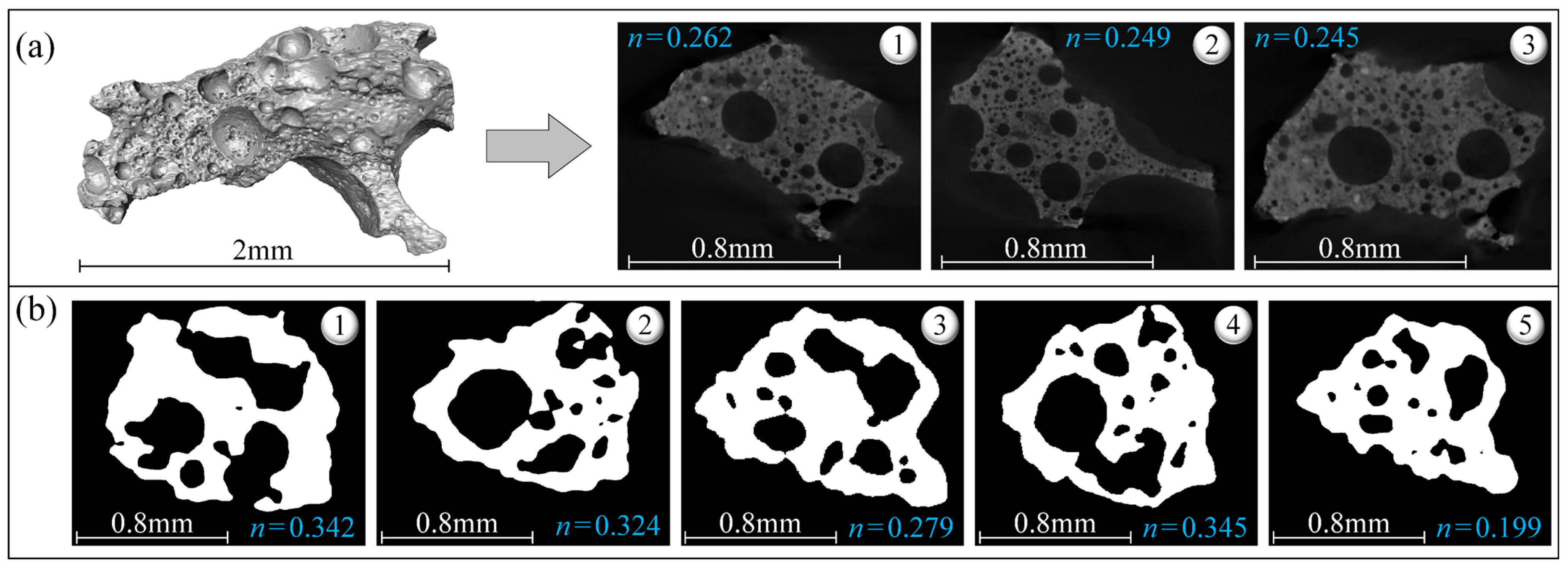
The CUMT-1 lunar regolith simulant was utilized to investigate the mechanical properties of real lunar regolith [28]. This simulant is a sintered material characterized by abundant internal voids and irregular particle morphology [29,30]. It is composed of volcanic ash, ferric oxide powder, and ammonium bicarbonate (NH4HCO3). During the sintering process, NH4HCO3 decomposes at high temperatures, releasing ammonia, water vapor, and carbon dioxide, which generate numerous pores within the material. Figure 2a displays the microscopic pores in a single particle of CUMT-1 lunar regolith simulant with 20 wt% NH4HCO3. It can be observed that this simulant has similar inner pore morphologies to those of real lunar regolith obtained by the Chang’e 5 probe [31], as shown in Figure 2b.

2.2. Particle Morphology of CUMT-1 Lunar Regolith Simulant

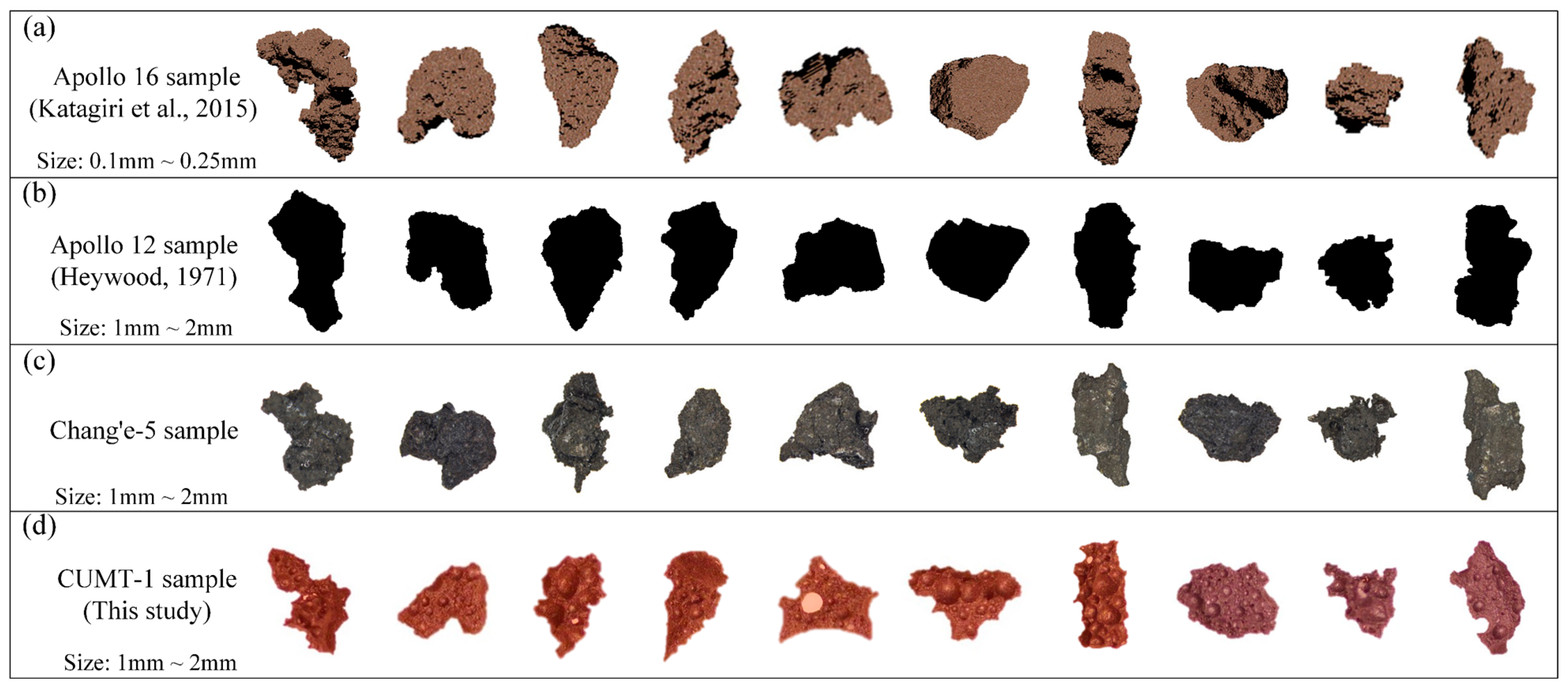
The particle images of the CUMT-1 lunar regolith simulant and three types of real lunar regolith are shown in Figure 3. It can be seen that the simulant exhibits similar irregular morphology to that of real lunar regolith. To quantify these similarities, the individual particle morphology was divided into three observation levels [32,33]. Specifically, three indicators, namely surface texture, angularity, and aspect ratio, were utilized to quantify the detailed, local, and global geometric features, respectively. The specific definitions of these indicators have been presented in the published literature [30].
Table 1 presents the quantification results of particle morphology. The surface textures of regolith particles from various lunar sites are highly consistent, exhibiting a maximum variation of only 9.9%. Such uniformity is likely the result of prolonged, homogeneous micrometeorite erosion on the lunar surface. However, the maximum angularity difference among different real lunar regolith particles is 48.5%. One potential explanation is that these local geometric features are formed over a short timescale under spatially heterogeneous conditions (e.g., the impact force diminishes quickly with the distance of the impact center; the mineral compositions of the lunar regolith vary across different regions). Moreover, the aspect ratio shows a maximum variation rate of 8.3%, and the underlying reasons for this variation remain unexplained.
The CUMT-1 lunar regolith simulant exhibits more irregular particle morphology than real lunar regolith. Specifically, the mean aspect ratio of CUMT-1 lunar regolith simulant is 2.9% smaller than that of real lunar regolith, while its angularity and surface texture are 16.3% and 2.3% larger, respectively. This indicates that the morphological complexity of the CUMT-1 lunar regolith simulant surpasses that of the real lunar regolith across all three observation levels, particularly in angularity. Moreover, it is worth noting that the selected real lunar regolith particles in this study are among the most irregular in their respective sample sets. Given that some rounded particles, such as glassy spherules, have also been found in returned lunar regolith samples [36,37], but are absent in CUMT-1 lunar regolith simulant, it can be concluded that the CUMT-1 lunar regolith simulant represents the upper limit of the morphological complexity of the real lunar regolith.

3. Triaxial Test Schedule

3.1. Test Preparation

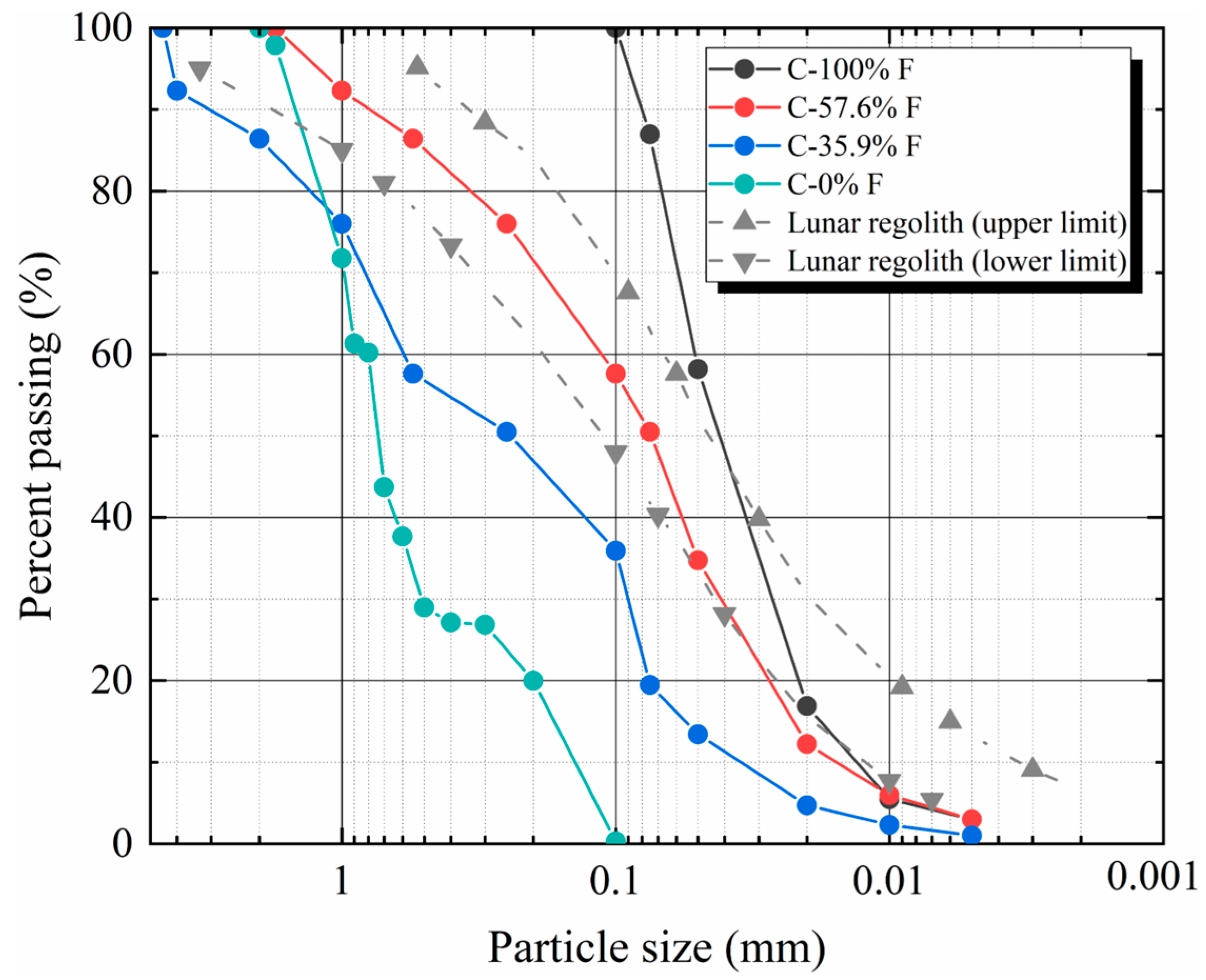
Four particle size distributions were designed to study their influence on shear strength, named according to the initials of the soil name—the mass fraction of soil particles less than 0.1 mm-F, as illustrated in Figure 4. This nomenclature was adopted based on the observed significant role of fine particle content in shear strength, which may facilitate subsequent analysis of the test results. The four gradations were prepared using vibrating-sieve screening followed by recombination of particle-size fractions, resulting in an overall coarsening trend relative to shallow regolith, as shown in Figure 4. This design is intended to capture in situ variation from the surface to the subsurface and its influence on shear strength. Particles smaller than 0.075 mm are measured using a laser particle size analyzer, as the fine powders in this range are challenging to screen. Additionally, irregular CUMT-1 lunar regolith simulant particles with diameters close to sieve sizes are difficult to screen and prone to causing blockages. To enhance measurement precision, the weight of the CUMT-1 lunar regolith simulant was limited to 300 g for each sieving, and the sieve pores were carefully and thoroughly cleaned after each screening. Any adhered particles were categorized into the upper layer. The grading characteristics are summarized in Table 2.
According to the findings from the Apollo lunar missions, the relative density of lunar regolith is estimated to range from approximately 65% to 92% with depth, increasing rapidly with depth [1]. Accordingly, these two critical relative densities were selected in this study to cover the gradation variations. Given the inevitable particle breakage and difficulties in uniform compaction, a higher relative density was not considered. The density-related indicators of the CUMT-1 lunar regolith simulants with different particle size distributions are summarized in Table 3. It should be noted that the relative density (Dr) is defined individually for each particle size distribution based on its corresponding minimum and maximum void ratios. Therefore, identical Dr values correspond to different bulk densities. The particle size distribution analyses before and after triaxial testing indicate that particle breakage is negligible under a confining pressure of 150 kPa.
Given that the Moon’s gravity is only one-sixth of Earth’s, six relatively low confining pressures were selected for investigation: 10 kPa, 20 kPa, 30 kPa, 50 kPa, 100 kPa, and 150 kPa. These pressures are estimated to correspond to vertical stress within a depth of approximately 51.37 m on the Moon, assuming the in situ lunar regolith has a bulk density of 1.8 g/cm3.

3.2. Instruments and Schemes

Consolidated drained (CD) triaxial tests were conducted using the GDS triaxial apparatus, which features a servo control system that applies loading at a constant speed, adjustable within the range of 0.001 to 10 mm/min. The pressure-volume controller has a range of 2 MPa with a resolution of 0.1 Pa. A latex membrane with a thickness of 0.3 mm was utilized. This equipment performance meets the precision requirements for conducting triaxial tests under low confining pressure conditions. Additionally, given the low confining stress level in this study, the water pressure difference between the water outlet on the pressure-volume controller and the sample center (≈0.5 kPa) was also taken into account to improve the accuracy of the confining pressure.
The triaxial specimens were prepared in a split mold measuring 39.1 mm in diameter and 80 mm in height. The specimens were compacted to the specified relative density using the under-compaction method (UCM) [38], which was originally proposed in the context of discrete element modeling, and provides useful guidance for laboratory specimen preparation. After preparation, the specimens were first isotropically consolidated to the target confining pressures (10–150 kPa) and maintained for approximately 2 min until a relatively stable state was achieved. Subsequently, shearing was conducted under strain-controlled conditions at a constant axial strain rate of 1%/min. Loading was terminated when the axial strain reached 15%, at which point the specimens had entered the post-peak state, and the key mechanical responses had been fully captured. Additionally, considering that most in situ lunar regolith is dry, all samples were oven-dried at 105 °C for 8–12 h before testing. The moisture content of the CUMT-1 lunar regolith simulant was less than 0.5 wt% before the triaxial tests. During specimen preparation, some moisture reabsorption from ambient air is unavoidable. Therefore, the specimens are considered to be in a near-dry condition rather than completely dry.

4. Results and Discussion

4.1. Triaxial Test Results

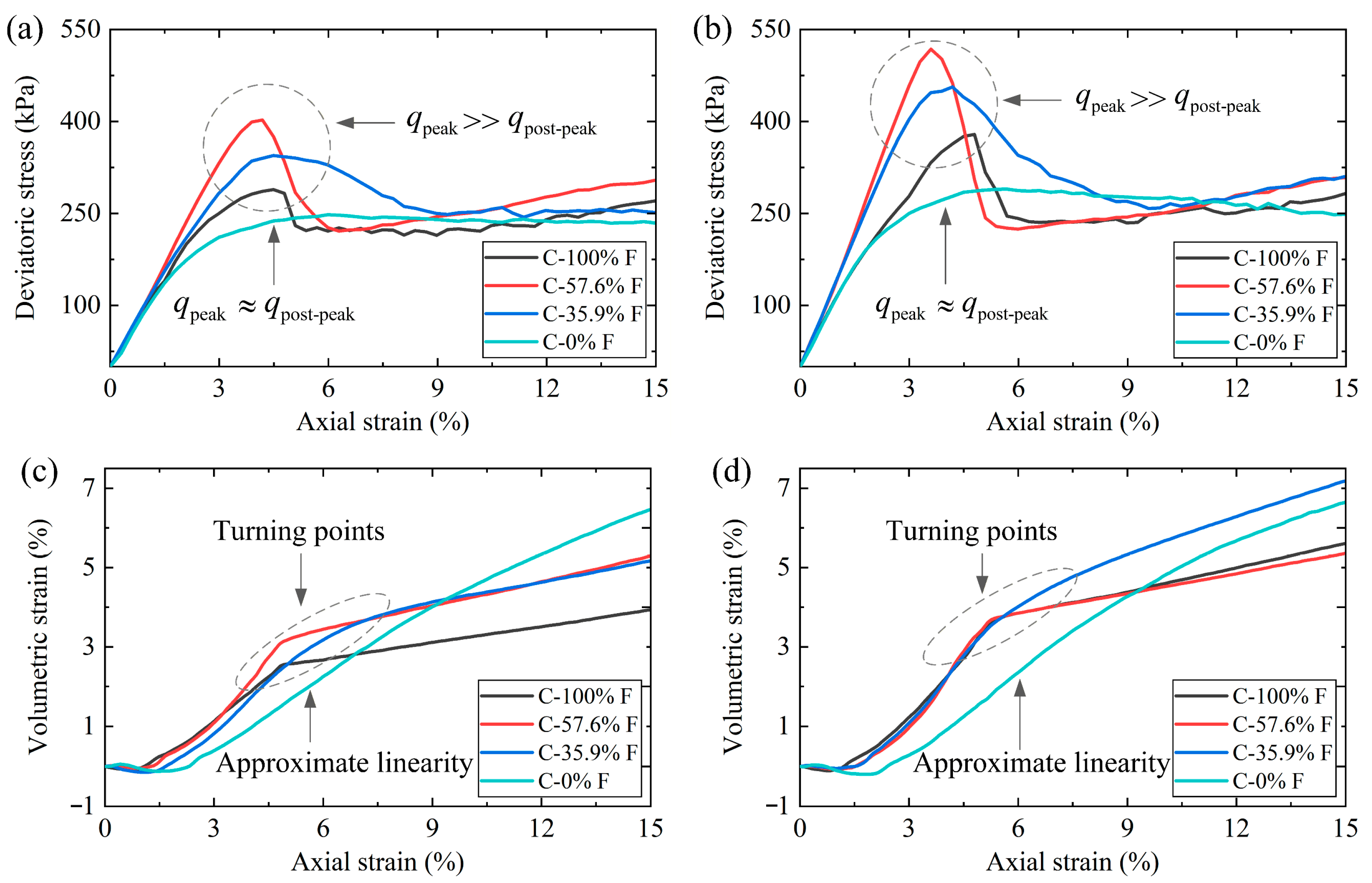
The stress–strain and volume–strain curves were obtained by the GDS equipment, and the results under the 50 kPa confining pressure are shown in Figure 5. It is observed that the CUMT-1 lunar regolith simulants exhibit strain softening and volumetric expansion, with degrees varying with the fine particle content. These phenomena were also observed under five other confining pressures, which can be attributed to the high-density state and low stress levels. It is also observed that the highest rate of volumetric strain always coincides with the peak stress state, which aligns with observations in many other lunar regolith simulants [19,39,40] and terrestrial soils [41,42]. Additionally, specimens with significant strain-softening behavior exhibited clear inflection points in their volumetric dilation curves, while those without did not. These observations imply that a unique relationship between the peak friction angle and the maximum dilation angle might exist.
The shear strength parameters were calculated using the Mohr–Coulomb criterion, which has been widely used for lunar regolith simulants [43,44]. For the triaxial compression tests in this study, the friction angle and cohesion can be calculated by the following equations:
1 2 ( σ 1 σ 3 ) = c cos φ + 1 2 ( σ 1 + σ 3 ) sin φ
where σ1, σ3, c, and φ are the axial stress, confining pressure, cohesion, and friction angle, respectively. Given the non-steady strength behavior during the post-peak stage, the post-peak friction angle was calculated using the average axial stress of the post-peak stage.
The cohesion was assumed to be zero for the following reasons. First, when the axial stress reaches its peak state (with the shear band fully developed), dry lunar regolith simulants cannot bear load without the support of confining pressure, indicating the absence of cohesion under these conditions. The observed apparent cohesion results from applying a linear Mohr–Coulomb fit to a nonlinear peak-strength envelope. As the confining pressure increases, the contribution of dilatancy progressively diminishes, leading to a reduction in the peak stress ratio. Consequently, the nonlinear strength envelope, when approximated by a linear fit, produces an apparent intercept on the y-axis. This phenomenon is inherent to dry granular materials and has been observed in various soils [40,41]. Therefore, the cohesion reported in previous studies is more likely a result of averaging the friction angles under different confining pressures. Secondly, previous triaxial tests on most lunar regolith simulants conducted within narrow confining pressure ranges have shown cohesion close to zero [45]. These results further support the validity of the assumption in this study.
The dilatancy angle was calculated by:
sin θ = δ ε p / δ ε q
where εp represents the volumetric strain increment, and εq represents the shear strain increment. For the triaxial conditions in this study, they can be further expressed as
δ ε p = δ V / V
δ ε q = δ l / l + δ V / 3 V
where V and l are the volume and height of the sample, respectively. Typically, the interval with the maximum slope on the volumetric strain-axial strain curve is selected for calculating the maximum dilation angle. However, this stipulation is subjective and can lead to discrepancies among researchers when analyzing the same curve. To address this issue, this study defines the interval from the endpoint of volumetric contraction to the peak stress point. This definition aims to reduce subjectivity and improve the calculation consistency of the maximum dilation angle.
The peak friction angles, post-peak friction angles, and maximum dilation angles under different test conditions, calculated using the methods described above, are presented in Table 4 and Table 5.

4.2. Effect of Confining Pressure

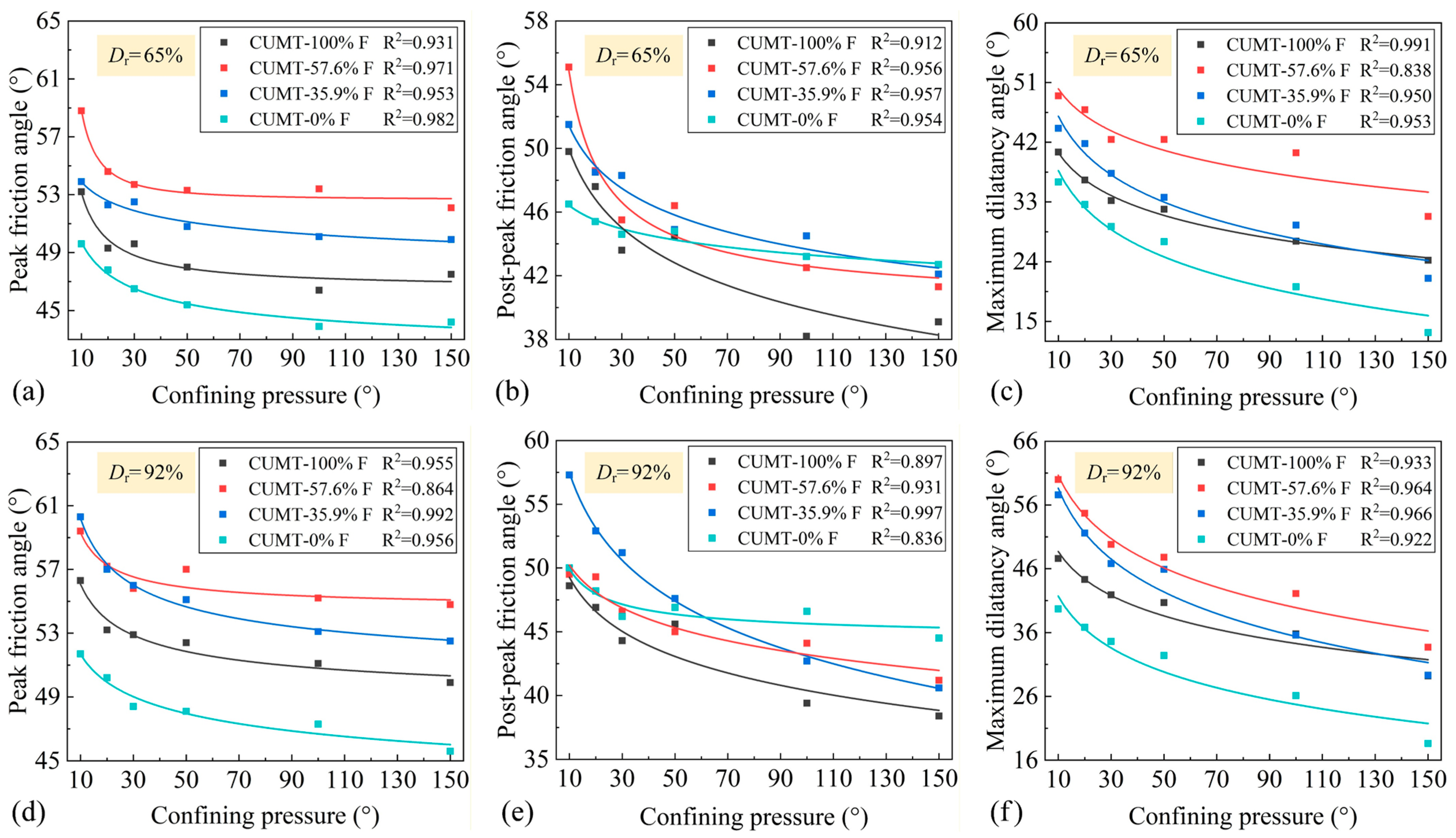
The variation patterns of the peak friction angle, post-peak friction angle, and maximum dilatancy angle with confining pressure are shown in Figure 6. It is observed that all three strength parameters exhibit rapid growth as confining pressure decreases, with a distinct inflection point around 50 kPa. To quantify these nonlinear relationships, the following model is introduced:
ϕ = a + b σ 3 c
where ϕ denotes one of the three strength parameters; a, b, and c are model constants; and σ3 represents the confining pressure. Figure 6 shows that the coefficients of determination for all curves exceed 0.85, with the majority surpassing 0.9, indicating strong predictive performance of the model. In this model, the constant a represents the stabilized value of the internal friction angle as the confining pressure increases, while b and c are adjustment factors that determine the variation in the internal friction angle with confining pressure.
The observed acceleration in strength parameters with decreasing confining pressure has also been documented in other lunar regolith simulants. Zou et al. [40] conducted triaxial tests using QH-E lunar regolith simulant within a confining pressure range of 3.13 to 150 kPa. They observed dilatancy angle trends that are consistent with those shown in Figure 6c,f. Similar reductions in dilation angle with increasing confining pressure were also observed by Suescun-Florez et al. [19] and Alshibli and Hasan [43] using different lunar regolith simulants. Alshibli and Hasan also presented the variation curves of peak and post-peak friction angles with confining pressure, aligning with the trends in Figure 6a and Figure 6b, respectively. Additionally, Alshibli et al. [46] conducted triaxial tests on Ottawa sand under microgravity conditions created by the NASA space shuttle. Their results indicated that the dilatancy angle decreases from 70° to 44.1° as the confining pressure increases from 0.05 kPa to 34.5 kPa, showing a trend similar to that observed in Figure 6c,f. These results suggest that the accelerated increase in shear strength parameters with decreasing confining pressure is a common characteristic of granular materials.
In contrast, previous studies demonstrated that the peak friction angle of saturated sand exhibits minimal variation with changes in confining pressure. Ponce and Bell [47] conducted triaxial tests on saturated quartz sand over a confining pressure range from 1.4 to 240 kPa. Their results showed a slight decrease in peak friction angle with increasing confining pressure, along with a significant increase in apparent cohesion. Additionally, Fukushima and Tatsuoka. Ref. [48] performed similar tests on saturated Toyoura sand and found that the peak friction angle remained nearly constant across different confining pressures, while the apparent cohesion consistently approached zero. These behaviors may be attributed to differences in particle characteristics, water content, and other factors, under which the dilatancy response does not vary significantly within the considered confining pressure range, resulting in only minor changes in the friction angle.
Based on the previous studies and the triaxial test results in this paper, it can be inferred that the dilatancy effect in lunar regolith simulants is a key factor contributing to the high sensitivity of shear strength to confining pressure. Given that in situ lunar regolith is an exceptionally dry granular material situated in a 1/6 g environment, this mechanical property is expected to be particularly pronounced, thus deserving special attention in future lunar exploration missions.

4.3. Effect of Relative Density

In soil mechanics, the relative density is defined as follows:
D r = ( ρ d ρ min ) ρ max ( ρ max ρ min ) ρ d = e max e e max e min
where ρd represents the current dry density of the granular material; ρmin and ρmax represent the minimum and maximum dry density obtained by the standard procedure, respectively; e is the current void ratio of the granular material; and emin and emax are the minimum and maximum void ratios, respectively.
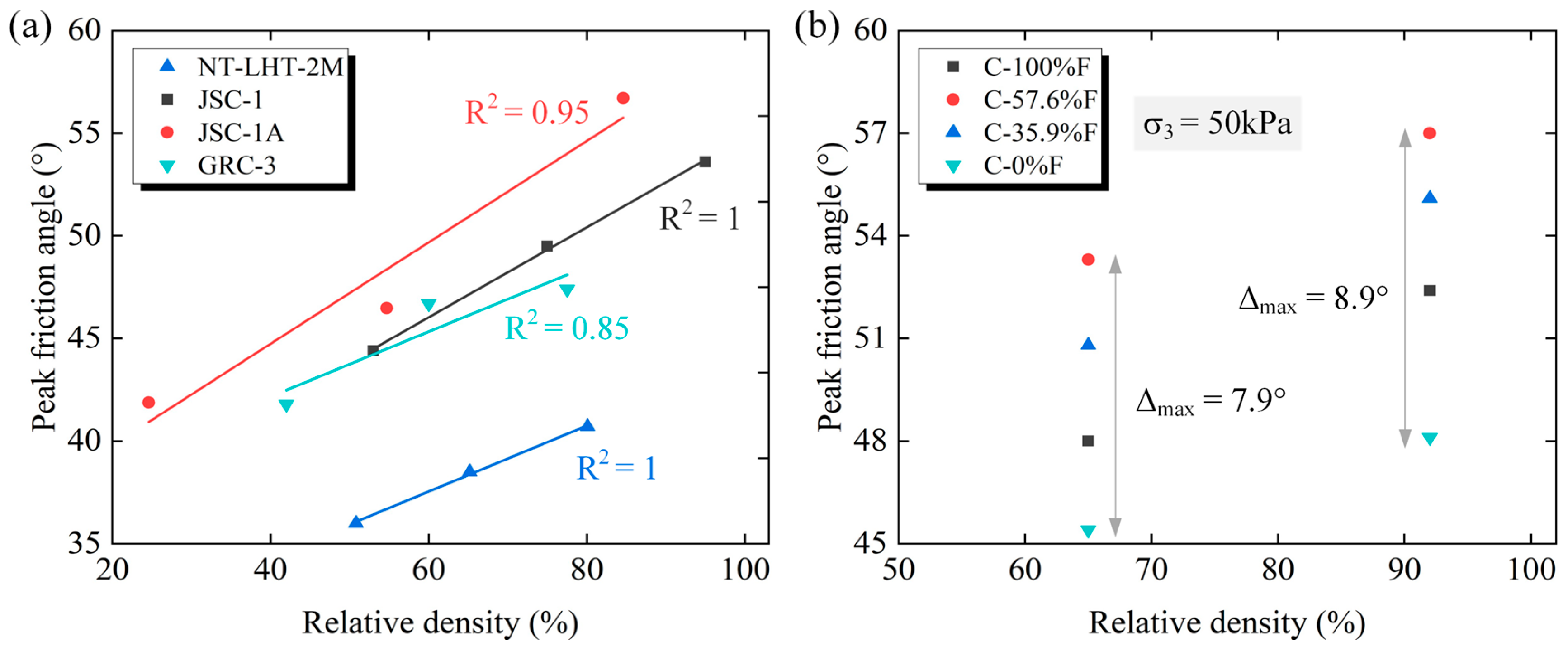
Previous studies demonstrated a linear relationship between the shear strength and relative density for lunar regolith simulants, as summarized in Figure 7a. The fitting formulas for NT-LHT-2M, JSC-1, JSC-1A, and GRC-3 exhibit coefficients of determination exceeding 0.85, suggesting the relative density is a reliable predictor of shear strength. However, it should be noted that all these studies were conducted under constant particle gradation. Given the rapid variation in particle size distribution with depth in lunar regolith, it remains unclear whether relative density continues to be an effective predictor.
To further investigate the prediction effectiveness of relative density under varying particle size distributions, the peak friction angles of CUMT-1 lunar regolith simulant with four particle size distributions and two relative densities are displayed in Figure 7b. It is observed that at a relative density of 65%, the peak friction angle difference caused by particle size distribution is 7.9°, and this difference further increases to 8.9° at the 92% relative density. These results indicated that the predictive effectiveness of relative density for the CUMT-1 lunar regolith simulant has failed under different particle size distributions. Therefore, to develop an effective shear strength prediction model for lunar subsurface regolith, it is necessary to further account for the influence of particle size distribution.

4.4. Effect of Particle Size Distribution

The two assessment indicators for particle size distribution are defined as follows:
C u = d 60 d 10
C c = d 30 2 d 60 × d 10
where d10, d30, and d60 denote the particle diameters corresponding to 10%, 30%, and 60% cumulative passing by mass, respectively; Cu is the uniformity coefficient, with larger values indicating a wider particle size range; and Cc is the coefficient of curvature, which reflects the continuity of the particle size distribution curve.
The grading characteristics of the CUMT-1 lunar regolith simulants are summarized in Table 2. According to conventional evaluation standards, the soil is classified as well-graded if it meets both 1 ≤ Cc ≤ 3 and Cu ≥ 5. Otherwise, the soil is classified as poorly graded. According to this criterion, only C-35.9%F is classified as poorly graded. Nevertheless, its shear strength is significantly higher than that of C-100%F and C-0%F, which are classified as well-graded. Additionally, C-100%F and C-0%F exhibit similar values of Cu and Cc, while their shear strength is significantly different. These comparative results indicate that the traditional classification standards are too broad to accurately assess the effects of particle size distribution, making them unsuitable for predicting the shear strength of the CUMT-1 lunar regolith simulant.

4.5. Effect of Inter-Particle Void Ratio

Both relative density and particle gradation affect shear strength, but each has limitations as a predictive indicator. Thus, a more comprehensive indicator is required to accurately predict the shear strength of lunar subsurface regolith. To ensure the new indicator accounts for both relative density and particle gradation, the influencing mechanisms of the two factors are analyzed first.
Both well-graded and high-density conditions enhance shear strength. Well-graded conditions imply an appropriate proportion of particles with different sizes, where smaller particles densely fill the spaces around larger particles. High relative density status is achieved by compacting the particle assemblies after determining the particle gradation. In the absence of particle breakage, the particle size distribution sets the potential range of compaction, whereas relative density reflects the degree of compaction achieved within these limits. Both factors affect the final packing density of the particle assemblies and consequently influence the shear strength. Considering that the packing density can be quantified by the ratio of the inter-particle voids to the total volume of the particle assembly, an initial attempt was made to quantify the combined impact of relative density and particle size distribution on the compaction state using the void ratio.
The void ratio was determined using a pycnometer method with distilled water and vacuum-assisted deaeration to remove entrapped air from both the water and the particles. A vacuum pressure of approximately −98 kPa was maintained for 10 h to ensure thorough deaeration. However, for coarser particles, the presence of more developed internal pores may limit the effectiveness of air removal, and even boiling may not be sufficient to eliminate the entrapped air. Nevertheless, this limitation is considered to have a negligible influence on the overall trends and interpretations presented in this study.
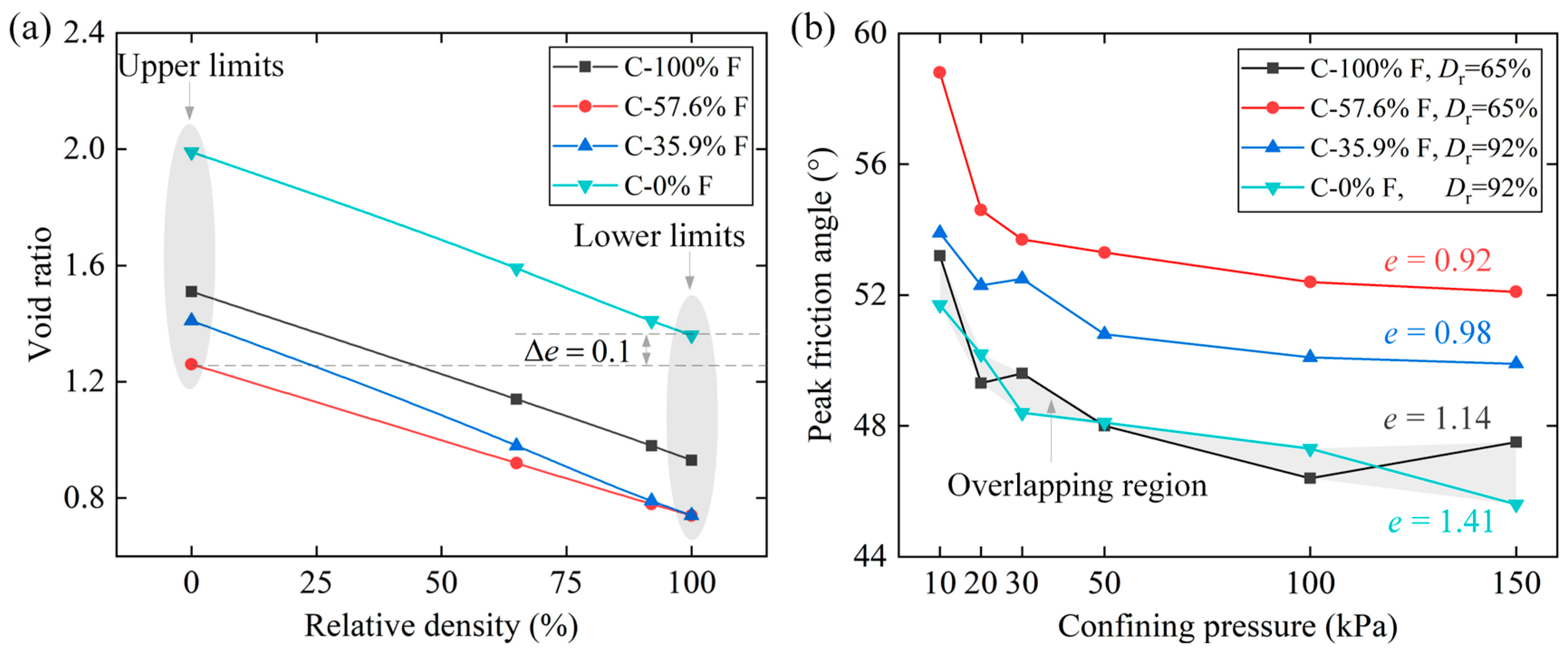
The variation trends of the void ratio with relative density for CUMT-1 lunar regolith simulant under various particle gradations are presented in Figure 8a. It is observed that the CUMT-1 lunar regolith simulant exhibits a significant difference in compaction capacity under different particle gradations. For instance, even at its maximum relative density, the void ratio of C-0%F remains higher than that of C-57.6%F at its minimum relative density. This suggests that C-0%F is inherently incapable of reaching a denser packing state than C-57.6%F, primarily due to the absence of fine particles needed to fill the voids between larger particles. Correspondingly, the peak shear strength of C-57.6%F at 65% relative density is higher than that of C-0%F at 100% relative density under all confining pressure conditions, as shown in Table 4 and Table 5. The void ratio more effectively explains the shear strength differences between C-0%F and C-57.6%F than relative density, highlighting it as a more accurate indicator of the compaction state.
To avoid the potential randomness in the above individual example, further analysis was performed on the relationship between peak shear strength and void ratio for CUMT-1 lunar regolith under four particle gradation conditions, as illustrated in Figure 8b. Most observations show that smaller void ratios correspond to larger peak friction angles. However, there is an exception: C-0% at 92% relative density has a higher void ratio than C-100% at 65% relative density, while both exhibit similar peak shear strength. To explain this phenomenon, it is necessary to analyze the definition of the void ratio. The standard formula for its calculation is given below:
e   = G s ρ d ρ d
where Gs represents the specific gravity, ρd represents the current bulk density.
Typically, the specific gravity is measured using the pycnometer method. When extracting air from inter-particle voids, the gases within the internal voids of the single particle are also removed. Consequently, the void ratio calculated by Equation (9) includes both internal voids and inter-particle voids. However, only the latter affects shear strength. Considering that the internal void content of individual particles may vary with size, and the significant size difference between C-100%F and C-0%F, it can be inferred that larger particles may contain more internal voids. Therefore, although C-0%F has a higher measured void ratio, a substantial portion of these voids is attributed to internal voids within the larger particles. The inter-particle voids of C-0%F, which determine the inter-particle packing density, do not differ significantly from those in C-100%F, resulting in similar peak friction angles for both groups.
To validate the inference, CT scanning was performed on CUMT-1 lunar regolith simulant particles with a precision of 2.83 μm and a scanning range of 2.83 mm3. A total of 10 samples were analyzed to minimize result variability. For each sample, the scanning range was continuously reduced, and the internal void content of the representative elementary volume (REV) was calculated after each reduction. The minimum REV size adopted in this study is 25 μm. Although absolute measurement accuracy for very fine particles may be limited at a scanning resolution of 2.83 μm, the observed trend of rapidly decreasing internal porosity with decreasing particle size remains consistent with physical expectations. A total of eight REVs were determined, with scanning length selected on the particle gradation curve in Figure 4. The computational formula of the internal void content for each REV is as follows:
c t = 1 n i = 1 n s i 1 s i 2 s i 1
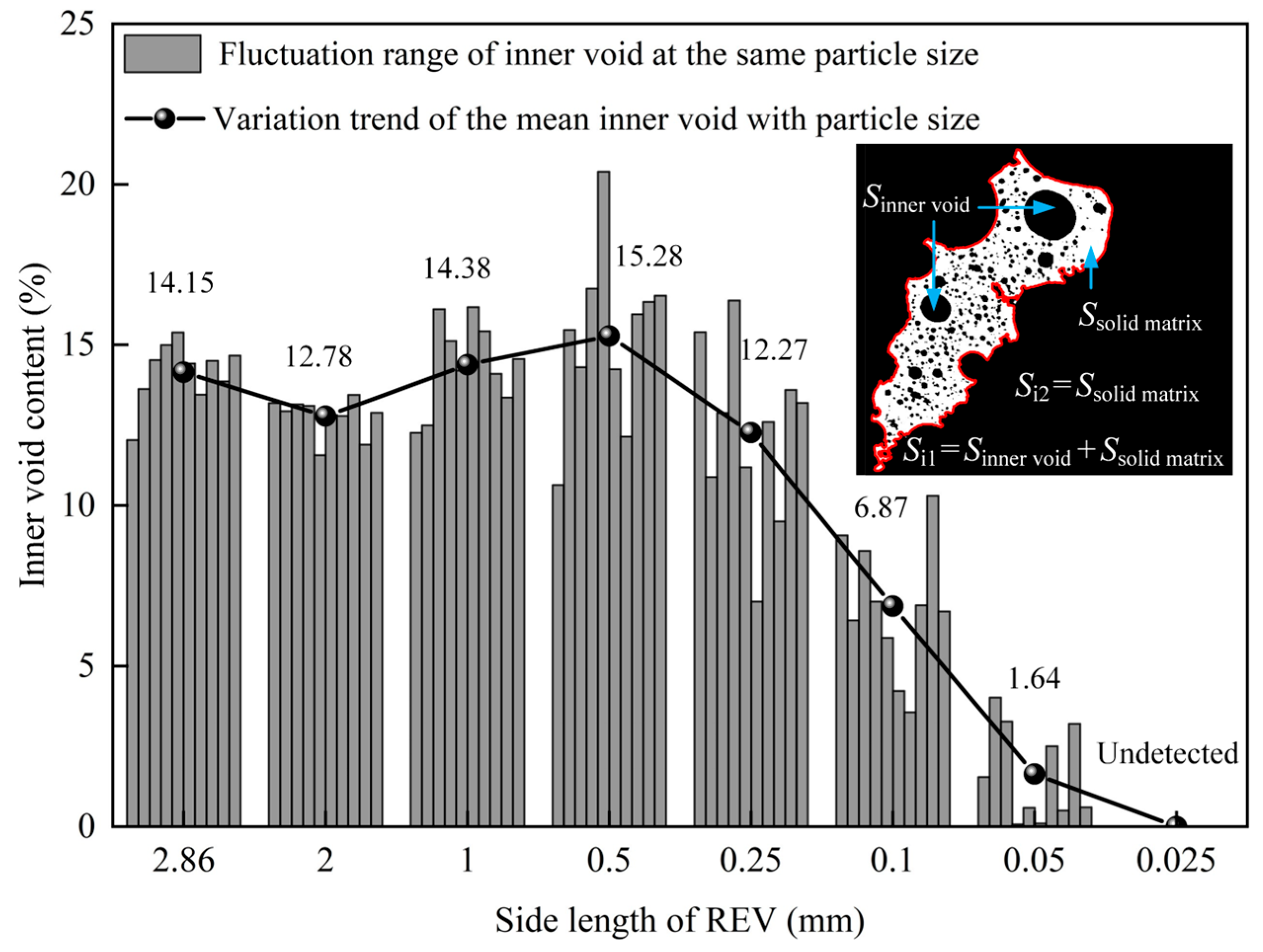
where ct represents the internal void content; n denotes the number of cross-sectional slices of the REV; Si1 and Si2 represent the area of particle contour and solid matrix, respectively, as defined in Figure 9.
Figure 9 shows that the mean content of the internal voids within individual particles remains above 12% when the REV size is larger than 0.25 mm. However, for REV sizes below 0.25 mm, the mean internal void content decreases rapidly with decreasing REV size. Additionally, as the REV size decreases, the discreteness of internal void content in parallel measurements increases, since smaller REVs capture more random voids. When the small REV encompasses a region with larger pores, the measured internal void content tends to be higher; conversely, when it encompasses the domain with smaller pores, the measured content tends to be lower. Overall, the CT scan results indicated that the internal void content of individual particles varies significantly with particle size. Consequently, when predicting the shear strength of CUMT-1 lunar regolith simulants using the void ratio, it is necessary to exclude the influence of internal voids.
Based on the CT scanning results, the inter-particle void ratio can be accurately determined. First, the internal void content of particle assemblies is calculated using:
C t = 1 k j = 1 k c t j m j M
where Ct represents the mean internal void content of particle assemblies under a specific particle gradation; k denotes the number of selected REVs; M represents the total mass of the particle assemblies; ctj represents the mean internal void content of the individual particles belonging to the j th REV scale, as indicated in Figure 9; mj represents the mass of the particles belonging to the j th REV scale. It should be noted that the REV scale in this study does not refer to a specific value but rather to a range. For instance, when the side length of REV is 0.5 mm, the scale corresponds to the range of 0.375 to 0.75 mm, as shown in Figure 4. A total of 8 REVs were selected within the particle size range of 0.025 to 2.86 mm, as shown on the x-axis of Figure 9.
According to Equation (11), the internal void contents for C-100%F, C-57.6%F, C-35.9%F, and C-0%F are 3.74%, 6.80%, 8.23%, and 13.71%, respectively. Assuming the volume of the particle assemblies is 1, the following four equations can be established simultaneously to obtain the inter-particle void volume:
V io = V in + V out V io / V solid = e 0 V io + V solid = 1 V in / ( V solid + V in ) = C t
where Vio, Vin, Vout, and Vsolid represent the total void volume, the internal void volume, the inter-particle void volume, and the solid matrix volume of the particle assemblies, respectively; and e0 is the initial void ratio measured using the pycnometer method.
Then the inter-particle void ratio can be calculated using the following formula:
e out = V io V in V solid + V in
Based on Equation (13), the initial inter-particle void ratios of CUMT-1 lunar regolith simulant under different particle gradations and relative densities are summarized in Table 6. It can be seen that the inter-particle void ratio of C-100%F at 65% relative density is 1.06, while for C-0%F at 92% relative density, it is 1.08. The minor difference in inter-particle void ratios results in the two samples exhibiting similar peak strengths, as observed in Figure 8b.
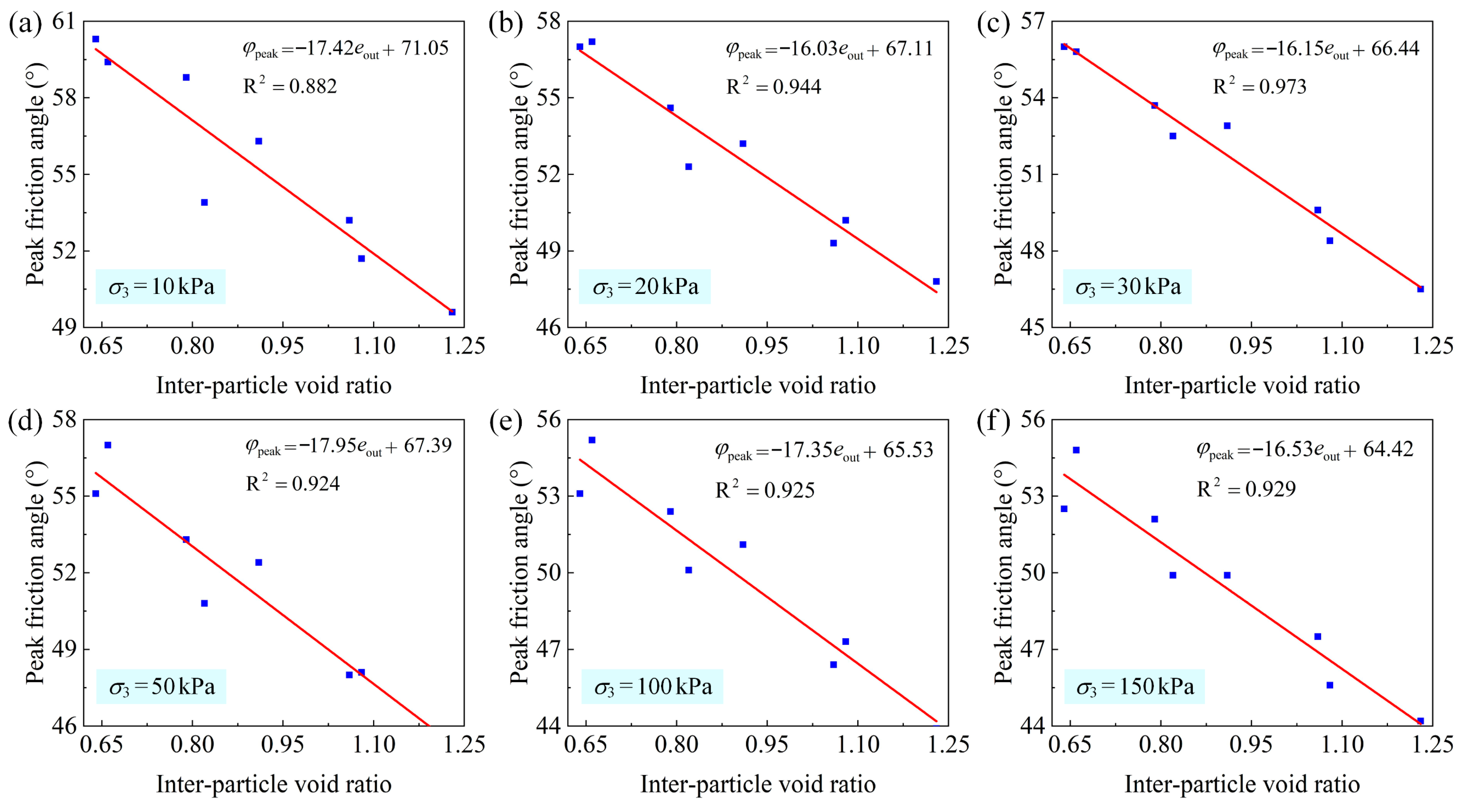
The variations in peak friction angle with the initial inter-particle void ratio under all test conditions are shown in Figure 10. It is observed that the peak friction angle decreases approximately linearly as the inter-particle void ratio increases across all confining pressures, with determination coefficients exceeding 0.88. Additionally, the decline rate in the peak friction angle with increasing inter-particle void ratio is similar across all confining pressures within the range investigated in this study, indicating that the effect of inter-particle void ratio on the peak shear strength is largely unaffected by stress levels. The comparison of Figure 10 with Figure 7b reveals that the inter-particle void ratio is a more reliable predictor of peak shear strength than relative density for the CUMT-1 lunar regolith simulant under varying particle gradations.
It should be noted that the potential filling of internal voids by fine particles may influence the filling effect of fines between large particles. However, in the present study, the internal voids quantified by CT scanning exclude surface concavities, which are more likely to be involved in inter-particle filling. Moreover, under the dry testing conditions and the applied confining pressures (up to 150 kPa), the highly tortuous internal pore channels are unlikely to permit significant intrusion of fine particles. Therefore, the influence of such effects on the overall trends is considered negligible within the investigated conditions.

4.6. Shear Strength Prediction Model

Building on the above discussion, existing empirical prediction models for the shear strength of lunar regolith simulants were reviewed and analyzed. Furthermore, a novel empirical model was proposed to predict the peak internal friction angle of CUMT-1 lunar regolith simulants under varying particle gradations. The specific research approach is as follows.
Bolton [50] proposed an empirical model for terrestrial sands that establishes a relationship between shear strength parameters and triaxial test conditions. The model is expressed as follows:
φ peak φ post - peak =   3 [ D r ( 10 ln p ) 1 ]
p = ( σ 1 + 2 σ 3 ) cs / 3
where φpeak and φpost-peak represent the peak friction angle and post-peak friction angle, respectively; Dr denotes the relative density; p′ is the mean effective stress during the post-peak stage; and σ1 and σ3 represent the axial stress and confining pressure during the post-peak stage, respectively.
Equations (14) and (15) have been widely used for terrestrial soils due to their broad applicability. However, Alshibli and Hasan [43] found these equations yielded a determination coefficient of only 0.34 when applied to the JSC-1A lunar regolith simulant, indicating their limited applicability to lunar regolith simulants. The reasons may be attributed to the highly irregular particle morphology of lunar regolith simulants and the low confining pressures. Consequently, they proposed a new model:
φ peak =   φ post - peak +   A D r d p f
θ max = B D r g p h
where θmax represents the maximum dilation angle; A, B, d, f, g, and h are fitting constants of the model; and other parameters are consistent with those in Equations (14) and (15).
It can be seen that the Alshibli model also relates the internal friction angle with the mean effective stress at the post-peak stage and relative density. However, by modifying the structure of the Bolton model and introducing new coefficients, it has been adapted to account for the unique shear strength characteristics of the JSC-1A lunar regolith simulant. Zou et al. [40] successfully applied this model to the QH-E lunar regolith simulant, demonstrating its effectiveness in predicting the shear strength of irregular particles.
Although the Alshibli model effectively correlates shear strength with triaxial test conditions, it still quantifies packing density using the relative density, which is inadequate for predicting the shear strength of in situ lunar regolith, where fine particle content decreases rapidly with depth. To address this limitation, this study adopts the inter-particle void ratio as a predictive factor instead of relative density. The variation pattern of the peak friction angle with inter-particle void ratio and confining pressure can be expressed in the following normal form:
φ peak =   m e out + f ( σ 3 )
where m is the model coefficient, eout is the inter-particle void ratio, and f(σ3) represents the variations in the peak friction angle with confining pressure.
The rationales for Equation (18) are as follows. First, Figure 10 shows a nearly linear relationship between the peak friction angle and the inter-particle void ratio, with the fitted slopes showing minimal fluctuation with changes in confining pressure. Therefore, the influence of the inter-particle void ratio can be expressed as an independent variable in the predictive formula. Second, the effect of confining pressure on the peak internal friction angle may be influenced by the inter-particle void ratio, which can be temporarily represented in an abstract form. However, once the inter-particle void ratio is determined, f(σ3) can be expressed in a form similar to Equation (5), as shown in Figure 6. Consequently, Equation (18) can be further expressed as:
φ   =   m e out + n ( 1 + σ 3 r )
where m, n, and r are model coefficients.
Although n and r may be related to the inter-particle void ratio, the degree of association and underlying mechanisms of this potential relationship are difficult to quantify. Therefore, it is initially assumed that the relationship is weak, that is, both n and r are treated as constants. Consequently, 48 sets of equations can be established in this study, and the optimal model of the CUMT-1 lunar regolith simulant derived through the least squares method is as follows:
φ peak   =   16.91 e out + 37.78 ( 1 + σ 3 0.07 )
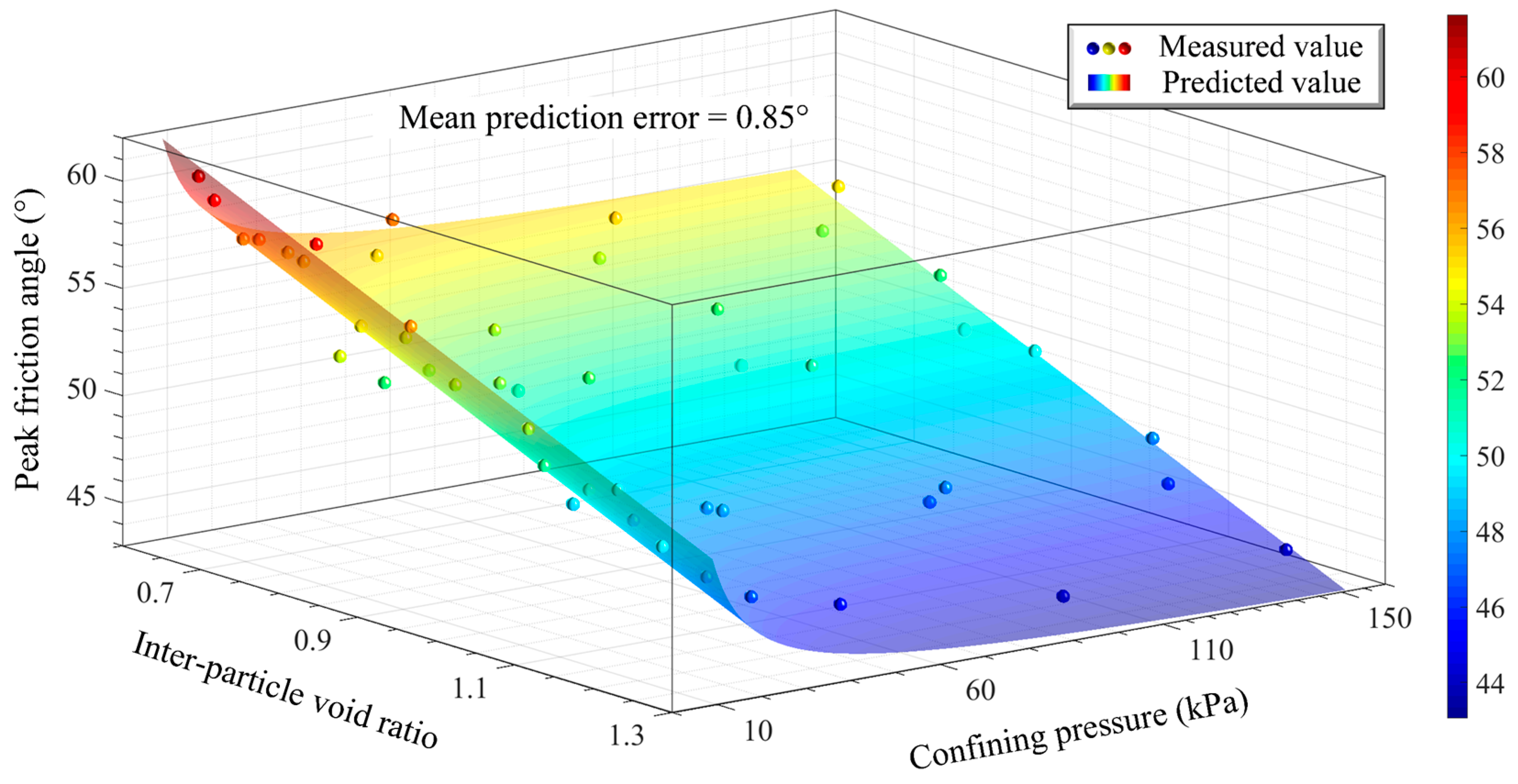
The predictive performance of Equation (20) is shown in Figure 11. The model exhibits a high level of predictive accuracy, with a mean prediction deviation of 0.85°, indicating that the effect of confining pressure on the peak internal friction angle is also largely unaffected by the inter-particle void ratio. That is to say, the inter-particle void ratio and confining pressure independently influence shear strength in this model, which is consistent with the findings of Bolton, as presented in Equation (14).
For the in situ lunar regolith, the inter-particle void ratio is inferred to increase with depth for two main reasons. First, although the relative density increases with depth, it has already exceeded 92% at approximately 60 cm, making further depth increases have a limited effect on reducing the inter-particle void ratio. Second, as the particle size increases with depth, voids among larger particles become increasingly difficult to fill with finer particles, leading to a continuous increase in the inter-particle void ratio. This inference is supported by Table 5, which shows that the inter-particle void ratios of C-35.9%F and C-0%F at 100% relative density are significantly higher than that of C-57.6%F at 92% relative density. Consequently, according to the prediction model in this study, the peak friction angle of the lunar subsurface regolith is expected to decrease rapidly with increasing depth. Moreover, the increase in confining pressure with depth further contributes to this decrease.

5. Conclusions

To investigate the shear strength properties of lunar subsurface regolith with depth, triaxial tests were conducted on the CUMT-1 lunar regolith under varying conditions of confining pressure, relative density, and particle size distribution. The effects of these factors on shear strength were systematically analyzed. The main conclusions are summarized below.
  • The peak friction angle, post-peak friction angle, and maximum dilation angle of the CUMT-1 lunar regolith simulant increase exponentially as confining pressure decreases, which can be described quantitatively by mathematical models. This behavior is consistent with dilatancy-controlled responses commonly observed in granular materials. Given the extremely low confining stress levels relevant to lunar surface conditions, these strength properties deserve special attention.
  • The proposed inter-particle void ratio incorporates the effects of both relative density and particle size distribution, making it an effective indicator for quantifying the inter-particle packing density of CUMT-1 lunar regolith simulants with varying particle size distributions. Triaxial test results reveal a strong linear relationship between this indicator and peak shear strength, and indicate this relationship is largely unaffected by confining pressures within the range of 10–150 kPa.
  • Based on the inter-particle void ratio, a new predictive model has been developed for the peak internal friction angle to overcome the limitations of the Alshibli model, which is not applicable to varying particle size distribution conditions. This model incorporates the inter-particle void ratio and confining pressure as predictor variables and demonstrates high accuracy for CUMT-1 lunar regolith simulants under all conditions in this study.
  • For in situ lunar regolith, the increase in relative density with depth decreases the inter-particle void ratio, whereas the increase in particle size with depth has the opposite effect. The findings of this study indicate that the latter effect is predominant. Consequently, according to the proposed prediction model, the peak friction angle of in situ lunar regolith is expected to decrease significantly with depth.

Author Contributions

Data curation, J.C.; Funding acquisition, J.C. and R.L.; Investigation, J.C.; Visualization, J.C.; Writing—original draft, J.C.; Writing—review & editing, P.-Q.M. and Y.J. All authors have read and agreed to the published version of the manuscript.

Funding

This research was funded by the Beijing Natural Science Foundation (No. 8264047), the Fundamental Research Funds of the China Academy of Safety Science and Technology (2025JBKY03), the China Postdoctoral Science Foundation (No. 2025M773218), the National Natural Science Foundation of China (No. 42372329), and the Basic Research Program of Xuzhou (No. KC23019).

Institutional Review Board Statement

Not applicable.

Informed Consent Statement

Not applicable.

Data Availability Statement

The raw data supporting the conclusions of this article will be made available by the authors on request.

Conflicts of Interest

The authors declare no conflict of interest.

References

  1. Heiken, G.H.; Vaniman, D.T.; French, B.M. Lunar Sourcebook, a User’s Guide to the Moon; Cambridge University Press: Cambridge, UK, 1991. [Google Scholar]
  2. Crawford, I.A.; Anand, M.; Cockell, C.S.; Falcke, H.; Green, D.A.; Jaumann, R.; Wieczorek, M.A. Back to the Moon: The scientific rationale for resuming lunar surface exploration. Planet. Space Sci. 2012, 74, 3–14. [Google Scholar] [CrossRef]
  3. Carpenter, J.; Fisackerly, R.; Houdou, B. Establishing lunar resource viability. Space Policy 2016, 37, 52–57. [Google Scholar] [CrossRef]
  4. Rubanenko, L.; Venkatraman, J.; Paige, D.A. Thick ice deposits in shallow simple craters on the Moon and Mercury. Nat. Geosci. 2019, 12, 597–601. [Google Scholar] [CrossRef]
  5. Smith, M.; Craig, D.; Herrmann, N.; Mahoney, E.; Krezel, J.; McIntyre, N.; Goodliff, K. The Artemis program: An overview of NASA’s activities to return humans to the moon. In Proceedings of the 2020 IEEE Aerospace Conference, Big Sky, MT, USA, 7–14 March 2020; pp. 1–10. [Google Scholar]
  6. Li, C.; Wang, C.; Wei, Y.; Lin, Y. China’s present and future lunar exploration program. Science 2019, 365, 238–239. [Google Scholar] [CrossRef]
  7. Ohtake, M.; Karouji, Y.; Ishihara, Y.; Nomura, R.; Inoue, H.; Shiraishi, H.; Mizuno, H.; Hoshino, T.; Aso, D. Current Status of the Planned Lunar Polar Exploration Mission Jointly Studied by India and Japan. In Proceedings of the 52nd Lunar and Planetary Science Conference, Virtual, 15–19 March 2021; p. 1840. [Google Scholar]
  8. Mitrofanov, I.G.; Zelenyi, L.M.; Tret’yakov, V.I.; Kalashnikov, D.V. Luna-25: The First Polar Mission to the Moon. Sol. Syst. Res. 2021, 55, 485–495. [Google Scholar] [CrossRef]
  9. Wilkinson, A.; DeGennaro, A. Digging and pushing lunar regolith: Classical soil mechanics and the forces needed for excavation and traction. J. Terramech. 2007, 44, 133–152. [Google Scholar] [CrossRef]
  10. Slyuta, E.N. Physical and mechanical properties of the lunar soil (a review). Sol. Syst. Res. 2014, 48, 330–353. [Google Scholar] [CrossRef]
  11. Taylor, L.A.; Pieters, C.M.; Britt, D. Evaluations of lunar regolith simulants. Planet. Space Sci. 2016, 126, 1–7. [Google Scholar] [CrossRef]
  12. Graf, J.C. Lunar Soils Grain Size Catalog (No. NASA-RP-1265); NASA: Washington, DC, USA, 1993. [Google Scholar]
  13. McKay, D.S.; Carter, J.L.; Boles, W.W.; Allen, C.C.; Allton, J.H. JSC-1: A new lunar soil simulant. In Engineering, Construction, and Operations in Space IV; American Society of Civil Engineers: Reston, VA, USA, 1994; Volume 2, pp. 857–866. [Google Scholar]
  14. Carrier, W.D., III. Particle size distribution of lunar soil. J. Geotech. Geoenviron. Eng. 2003, 129, 956–959. [Google Scholar] [CrossRef]
  15. Ray, C.S.; Reis, S.T.; Sen, S.; O’Dell, J.S. JSC-1A lunar soil simulant: Characterization, glass formation, and selected glass properties. J. Non-Cryst. Solids 2010, 356, 2369–2374. [Google Scholar] [CrossRef]
  16. Zeng, X.; He, C.; Wilkinson, A. Geotechnical properties of NT-LHT-2M lunar highland simulant. J. Aerosp. Eng. 2010, 23, 213–218. [Google Scholar] [CrossRef]
  17. Jiang, M.; Li, L.; Sun, Y. Properties of TJ-1 lunar soil simulant. J. Aerosp. Eng. 2012, 25, 463–469. [Google Scholar] [CrossRef]
  18. He, C.; Zeng, X.; Wilkinson, A. Geotechnical properties of GRC-3 lunar simulant. J. Aerosp. Eng. 2013, 26, 528–534. [Google Scholar] [CrossRef]
  19. Suescun-Florez, E.; Roslyakov, S.; Iskander, M.; Baamer, M. Geotechnical properties of BP-1 lunar regolith simulant. J. Aerosp. Eng. 2015, 28, 04014124. [Google Scholar] [CrossRef]
  20. Ryu, B.H.; Wang, C.C.; Chang, I. Development and geotechnical engineering properties of KLS-1 lunar simulant. J. Aerosp. Eng. 2018, 31, 04017083. [Google Scholar] [CrossRef]
  21. Sandeep, C.S.; Marzulli, V.; Cafaro, F.; Senetakis, K.; Pöschel, T. Micromechanical behavior of DNA-1A lunar regolith simulant in comparison to Ottawa sand. J. Geophys. Res. Solid Earth 2019, 124, 8077–8100. [Google Scholar] [CrossRef]
  22. Venugopal, I.; Muthukkumaran, K.; Annadurai, M.; Prabu, T.; Anbazhagan, S. Study on geomechanical properties of lunar soil simulant (LSS-ISAC-1) for chandrayaan mission. Adv. Space Res. 2020, 66, 2711–2721. [Google Scholar] [CrossRef]
  23. Just, G.H.; Joy, K.H.; Roy, M.J.; Smith, K.L. Geotechnical characterisation of two new low-fidelity lunar regolith analogues (UoM-B and UoM-W) for use in large-scale engineering experiments. Acta Astronaut. 2020, 173, 414–424. [Google Scholar] [CrossRef]
  24. Zhou, S.; Yang, Z.; Zhang, R.; Zhu, X.; Li, F. Preparation and evaluation of geopolymer based on BH-2 lunar regolith simulant under lunar surface temperature and vacuum condition. Acta Astronaut. 2021, 189, 90–98. [Google Scholar] [CrossRef]
  25. Sun, X.; Zhang, R.; Li, X.; Zou, M.; Wang, C.; Chen, L. JLU-H: A novel lunar highland regolith simulant for use in large-scale engineering experiments. Planet. Space Sci. 2022, 221, 105562. [Google Scholar] [CrossRef]
  26. Li, C.; Su, Y.; Pettinelli, E.; Xing, S.; Ding, C.; Liu, J.; Ren, X.; Lauro, S.E.; Soldovieri, F.; Zeng, X.; et al. The Moon’s farside shallow subsurface structure unveiled by Chang’E-4 Lunar Penetrating Radar. Sci. Adv. 2020, 6, eaay6898. [Google Scholar] [CrossRef] [PubMed]
  27. Zheng, Y.; Yang, M.; Deng, X.; Jin, S.; Peng, J.; Su, Y.; Gu, Z.; Chen, L.; Pang, Y.; Zhang, N. Analysis of Chang’e-5 lunar core drilling process. Chin. J. Aeronaut. 2022, 36, 292–303. [Google Scholar] [CrossRef]
  28. Li, R.; Zhou, G.; Chen, G.; Hall, M.R.; Zhao, X. Geotechnical magnetic-similitude-gravity model testing method. Int. J. Phys. Model. Geotech. 2019, 19, 181–199. [Google Scholar] [CrossRef]
  29. Li, R.; Zhou, G.; Yan, K.; Chen, J.; Chen, D.; Cai, S.; Mo, P. Preparation and characterization of a specialized lunar regolith simulant for use in lunar low gravity simulation. Int. J. Min. Sci. Technol. 2022, 32, 1–15. [Google Scholar] [CrossRef]
  30. Chen, J.; Li, R.; Mo, P.; Yu, Y.; Ji, Y.; Wang, T.; Vandeginste, V. A unified 2D and 3D morphology quantification and geometric parameters-driven reconstruction method for irregular particles. Granul. Matter 2024, 26, 31. [Google Scholar] [CrossRef]
  31. Zhang, H.; Zhang, X.; Zhang, G.; Dong, K.; Deng, X.; Gao, X.; Yang, Y.; Xiao, Y.; Bai, X.; Liang, K.; et al. Size, morphology, and composition of lunar samples returned by Chang’E-5 mission. Sci. China Phys. Mech. Astron. 2022, 65, 229511. [Google Scholar] [CrossRef]
  32. Barrett, P.J. The shape of rock particles, a critical review. Sedimentology 1980, 27, 291–303. [Google Scholar] [CrossRef]
  33. Zheng, J.; Hryciw, R.D. Traditional soil particle sphericity, roundness and surface roughness by computational geometry. Géotechnique 2015, 65, 494–506. [Google Scholar] [CrossRef]
  34. Katagiri, J.; Matsushima, T.; Yamada, Y.; Tsuchiyama, A.; Nakano, T.; Uesugi, K.; Ohtake, M.; Saiki, K. Investigation of 3D grain shape characteristics of lunar soil retrieved in Apollo 16 using image-based discrete-element modeling. J. Aerosp. Eng. 2015, 28, 04014092. [Google Scholar] [CrossRef]
  35. Heywood, H. Particle size and shape distribution for lunar fines sample 12057, 72. In Proceedings of the Lunar Science Conference, Houston, TX, USA, 11–14 January 1971; Volume 2, p. 1989. [Google Scholar]
  36. Duke, M.B.; Woo, C.C.; Bird, M.L.; Sellers, G.A.; Finkelman, R.B. Lunar soil: Size distribution and mineralogical constituents. Science 1970, 167, 648–650. [Google Scholar] [CrossRef]
  37. Dikov, Y.P.; Ivanov, A.V.; Wlotzka, F.; Galimov, E.M.; Wanke, G. The nature of volatiles in the lunar regolith. Sol. Syst. Res. 2002, 36, 1–11. [Google Scholar] [CrossRef]
  38. Jiang, M.J.; Konrad, J.M.; Leroueil, S. An efficient technique for generating homogeneous specimens for DEM studies. Comput. Geotech. 2003, 30, 579–597. [Google Scholar] [CrossRef]
  39. Klosky, J.L.; Sture, S.; Ko, H.Y.; Barnes, F. Geotechnical behavior of JSC-1 lunar soil simulant. J. Aerosp. Eng. 2000, 13, 133–138. [Google Scholar] [CrossRef]
  40. Zou, W.; Li, Y.; Chen, L.; Zhang, J.; Wang, X. Mechanical properties of QH-E lunar soil simulant at low confining stresses. J. Aerosp. Eng. 2016, 29, 04015036. [Google Scholar] [CrossRef]
  41. Yang, J.; Li, X. State-dependent strength of sands from the perspective of unified modeling. J. Geotech. Geoenviron. Eng. 2004, 130, 186–198. [Google Scholar] [CrossRef]
  42. Yu, F. Influence of particle breakage on behavior of coral sands in triaxial tests. Int. J. Geomech. 2019, 19, 04019131. [Google Scholar] [CrossRef]
  43. Alshibli, K.A.; Hasan, A. Strength properties of JSC-1A lunar regolith simulant. J. Geotech. Geoenviron. Eng. 2009, 135, 673–679. [Google Scholar] [CrossRef]
  44. Dewoolkar, M.M.; Edwards, M.; Walsh, D. Shear strength and stiffness characterization of lunar simulant GRC-3. J. Aerosp. Eng. 2018, 31, 04018024. [Google Scholar] [CrossRef]
  45. Monkul, M.M.; Dacic, A. Effect of grain size distribution on stress-strain behavior of lunar soil simulants. Adv. Space Res. 2017, 60, 636–651. [Google Scholar] [CrossRef]
  46. Alshibli, K.A.; Sture, S.; Costes, N.C.; Frank, M.L.; Lankton, M.R.; Batiste, S.N.; Swanson, R.A. Assessment of locaMozed deformations in sand using X-ray computed tomography. Geotech. Test. J. 2000, 23, 274–299. [Google Scholar] [CrossRef]
  47. Ponce, V.M.; Bell, J.M. Shear strength of sand at extremely low pressures. J. Soil Mech. Found. Div. 1971, 97, 625–638. [Google Scholar] [CrossRef]
  48. Fukushima, S.; Tatsuoka, F. Strength and deformation characteristics of saturated sand at extremely low pressures. Soils Found. 1984, 24, 30–48. [Google Scholar] [CrossRef]
  49. Zeng, X.; He, C.; Oravec, H.; Wilkinson, A.; Agui, J.; Asnani, V. Geotechnical properties of JSC-1A lunar soil simulant. J. Aerosp. Eng. 2010, 23, 111–116. [Google Scholar] [CrossRef]
  50. Bolton, M.D. The strength and dilatancy of sands. Geotechnique 1986, 36, 65–78. [Google Scholar] [CrossRef]
Figure 1. Distribution of lunar regolith with depth based on the latest radar detection results [26], and illustration of its forming processes.
Applsci 16 03327 g001
Figure 2. Comparison of internal voids. (a) CUMT-1 lunar regolith simulant; (b) lunar regolith sample of Chang’e-5 mission [31].
Applsci 16 03327 g002
Figure 3. Comparison of particle morphologies. (a) Apollo 16 sample [34]; (b) Apollo 12 sample [35]; (c) Chang’e-5 sample; (d) CUMT-1 sample.
Applsci 16 03327 g003
Figure 4. Particle size distributions of lunar surface regolith and CUMT-1 lunar regolith simulants [14].
Applsci 16 03327 g004
Figure 5. Results of triaxial compression tests on CUMT-1 lunar regolith simulants at 50 kPa confining pressure: (a) stress–strain curves (Dr = 65%); (b) stress–strain curves (Dr = 92%); (c) volumetric strain-axial strain curves (Dr = 65%); (d) volumetric strain-axial strain curves (Dr = 92%).
Applsci 16 03327 g005
Figure 6. Variation trends of shear strength parameters with confining pressure for CUMT-1 lunar regolith simulant under different relative densities. (a) peak friction angle, Dr = 65%; (b) post-peak friction angle, Dr = 65%; (c) dilatancy angle, Dr = 65%; (d) peak friction angle, Dr = 92%; (e) post-peak friction angle, Dr = 92%; (f) dilatancy angle, Dr = 92%.
Applsci 16 03327 g006
Figure 7. Variation trends of peak friction angle with relative density for lunar regolith simulants: (a) cases with constant particle size distribution [16,39,44,49]; (b) cases with varying particle size distributions.
Applsci 16 03327 g007
Figure 8. (a) relationship between void ratio and relative density of CUMT-1 lunar regolith simulant; (b) effect of void ratio on peak friction angle of CUMT-1 lunar regolith simulant.
Applsci 16 03327 g008
Figure 9. Variation trend of internal void content with REV sizes in CUMT-1 lunar regolith simulant particles.
Applsci 16 03327 g009
Figure 10. Variation trends in peak friction angle with the initial inter-particle void ratio under different confining pressures. (a) σ3 = 10 kPa; (b) σ3 = 20 kPa; (c) σ3 = 30 kPa; (d) σ3 = 50 kPa; (e) σ3 = 100 kPa; (f) σ3 = 150 kPa.
Applsci 16 03327 g010
Figure 11. Measured and predicted peak friction angles of CUMT-1 lunar regolith simulant.
Applsci 16 03327 g011
Table 1. Quantification results of real lunar regolith and CUMT-1 lunar regolith simulant.
SoilsSize (mm)NumberAr RangeMean ArAg RangeMean AgTe RangeMean Te
Apollo120.105–0.25740.49–0.970.720.011–0.1280.0490.0129–0.02670.0177
Apollo161–2370.47–0.980.780.002–0.1230.0330.0082–0.03140.0162
Chang’e-51–2620.48–0.990.780.001–0.2860.0380.0069–0.03510.0178
Mean-1730.47–0.990.760.001–0.2860.0400.0069–0.03510.0172
CUMT-11–25000.36–0.990.740.004–0.2850.0460.0101–0.02640.0176
0.1–0.255000.38–1.000.740.004–0.2940.0470.0110–0.03480.0176
Mean-10000.36–1.000.740.004–0.2940.0470.0101–0.03480.0176
Table 2. Grading characteristics of CUMT-1 lunar regolith simulants.
GroupC-100%FC-57.6%FC-35.9%FC-0%F
d10/mm0.0110.0160.0380.15
d30/mm0.0330.0450.090.52
d60/mm0.0560.120.60.8
Cu5.17.515.85.3
Cc1.81.10.42.3
Table 3. Specific gravity, bulk density, and void ratio of the CUMT-1 lunar regolith simulants.
GroupSpecific GravityBulk Density (g/cm3)Void Ratio
ρmaxρminρ(Dr = 65%)ρ(Dr = 92%)emaxemine(Dr = 65%)e(Dr = 92%)
C-100%F3.441.781.371.611.741.510.931.140.98
C-57.6%F1.981.521.791.931.260.740.920.78
C-35.9%F1.981.431.741.921.410.740.980.79
C-0%F1.461.151.331.431.991.361.591.41
Table 4. Peak friction angles, post-peak friction angles, and maximum dilatancy angles of CUMT-1 lunar regolith simulants at 65% relative density.
GroupConfining Pressure (kPa)Peak Deviatoric Stress (kPa)Post-Peak Deviatoric Stress (kPa)Peak Friction Angle (°)Post-Peak Friction Angle (°)Dilatancy Angle (°)
C-100%F1080.264.853.249.840.5
20125.5112.649.347.636.3
30191.4133.449.643.634.2
50289.6234.14844.531.9
100523.7324.746.438.227.1
150840.9513.447.539.124.2
C-57.6%F10118.291.358.855.149
20176.3120.154.648.646.9
30249.2149.453.745.542.4
50403.5261.953.346.442.4
100813.2416.052.442.540.4
1501125.1583.552.141.330.8
C-35.9%F1084.171.853.951.544.1
20151.511952.348.541.8
30230.2177.352.548.337.3
50343.3239.450.844.933.7
100657.3469.350.144.529.5
150978.2610.949.942.121.5
C-0%F1063.859.549.648.536
20114.599.347.845.432.6
30158.9141.446.544.629.3
50246.7238.545.444.827
100451.2434.243.943.220.2
150689.5631.244.242.713.3
Table 5. Peak friction angles, post-peak friction angles, and maximum dilatancy angles of CUMT-1 lunar regolith simulants at 92% relative density.
GroupConfining Pressure (kPa)Peak Deviatoric Stress (kPa)Post-Peak Deviatoric Stress (kPa)Peak Friction Angle (°)Post-Peak Friction Angle (°)Dilatancy Angle (°)
C-100%F1098.872.456.351.647.6
20160.6108.453.246.944.3
30236.5147.352.945.341.9
50382.0250.852.445.640.7
100703.6346.651.139.435.8
150978.8491.249.938.429.2
C-57.6%F10123.276.859.452.560
20210.4125.357.249.354.7
30286.6159.755.846.649.8
50521.5241.3574547.8
100916.7457.955.244.142.1
1501342.7578.754.841.233.7
C-35.9%F10132.6106.060.357.357.6
20208.4157.15752.951.6
30291.0186.85649.246.8
50457.2281.955.147.645.9
100799.3421.853.142.735.6
1501152.2560.452.540.629.3
C-0%F1072.865.551.75039.7
20132.7117.550.248.236.8
30177.9155.648.446.234.6
50291.4271.348.146.932.4
100554.1532.747.346.626.1
150748.5703.845.644.518.6
Table 6. Inter-particle void ratio of CUMT-1 lunar regolith simulants under different particle gradations and relative densities.
Groupeout (Dr = 0%)eout (Dr = 65%)eout (Dr = 92%)eout (Dr = 100%)
C-100%F1.421.060.910.86
C-57.6%F1.110.790.660.62
C-35.9%F1.210.820.640.60
C-0%F1.581.231.081.04
Disclaimer/Publisher’s Note: The statements, opinions and data contained in all publications are solely those of the individual author(s) and contributor(s) and not of MDPI and/or the editor(s). MDPI and/or the editor(s) disclaim responsibility for any injury to people or property resulting from any ideas, methods, instructions or products referred to in the content.