1. Introduction
Permafrost is a unique and complex multiphase soil containing diverse cemented particles [
1]. Structurally, it exhibits a porous configuration. In China, seasonally frozen ground occupies 53.5% of the national territory. Subjected to repeated freeze–thaw cycles, this soil undergoes continuous pseudo-weathering. In frigid regions, the strength of seasonally frozen ground is severely compromised [
2,
3,
4]. In seasonal frozen regions of northeastern China, winter temperatures regularly drop below −10 °C, with spring thaw periods causing significant subgrade moisture fluctuations. During a cycle of freezing and thawing, ground temperature range from −9.0 to 14.4 °C [
5].
The freeze–thaw cycles in subgrades within the seasonal frost region of northeast China exhibit a fundamental pattern characterized by an annual macrocycle superimposed with depth-dependent microfluctuations in frequency and intensity [
6,
7,
8]. This spatiotemporal heterogeneity arises from the non-uniform propagation of the freezing front and the coupled dynamics of the thermal and moisture fields within the soil matrix.
During freezing, the expansion and migration of pore water within the soil volume causes frost heave [
9,
10]. When temperatures drop below the soil’s freezing point, pore water freezes into ice, increasing in volume and causing relative displacement of soil particles. Conversely, as temperatures rise above the freezing point, the frozen pore water melts, allowing the soil particles to settle again. This freeze–thaw cycle significantly impacts the soil’s mechanical properties [
11,
12]. Studies indicate that in regions with seasonal freeze–thaw cycles, asphalt pavements can develop cracks after a single winter [
13]. In soil layers with high groundwater levels, high silt content, and poor bearing capacity, uneven frost heave forces may cause uplift of the foundation, accelerating the rate of soil strength reduction. Furthermore, after undergoing frost heave and thaw settlement, soil layers become more prone to causing building cracks and foundation subsidence. As freeze–thaw cycles affect both the physical and mechanical properties of soil, scholars have conducted dynamic triaxial and direct shear tests on various seasonal frozen soils and rocks to investigate their mechanical behaviour [
14,
15]. Others have studied improved soils subjected to freeze–thaw cycles through laboratory experiments [
16]. Research indicates that freeze–thaw cycles increase permeability and reduce porosity [
17]. Regarding mechanical properties, freeze–thaw cycles reduce soil strength parameters, including cohesion and internal friction angle [
18,
19]. Furthermore, freeze–thaw cycles affect the elastic modulus and dynamic elastic modulus of the soil, leading to dynamic changes and reduction of stability [
20,
21].
Under the action of freeze–thaw, the degree of compaction of soil can significantly influence its mechanical properties, particularly in soft clay soils. Freeze–thaw cycles induce compressive deformation in soils with a lower compaction coefficient, whereas expansive deformation occurs in soils with a higher compaction coefficient [
22,
23]. Concurrently, to prevent engineering issues arising from soil strength failure, researchers have incorporated curing agents (such as lignin fiber or industrial slag) into soil samples, successfully enhancing soil strength [
24,
25].
Research on the effect of compaction coefficient, freeze–thaw cycles, and curing agents on the dynamic behaviour of soft clay remains limited. However, given its practical engineering value, this study investigates the dynamic behaviour of freeze–thaw-cycled soft clay under specific compaction coefficients and curing agent effects, using seasonal frozen ground as the research subject. Combined with nuclear magnetic resonance (NMR) analysis, the micromechanisms of freeze–thaw cycling are examined, providing theoretical foundations and technical guidance for highway construction in seasonal frozen ground regions.
2. Materials and Methods
2.1. Test Apparatus
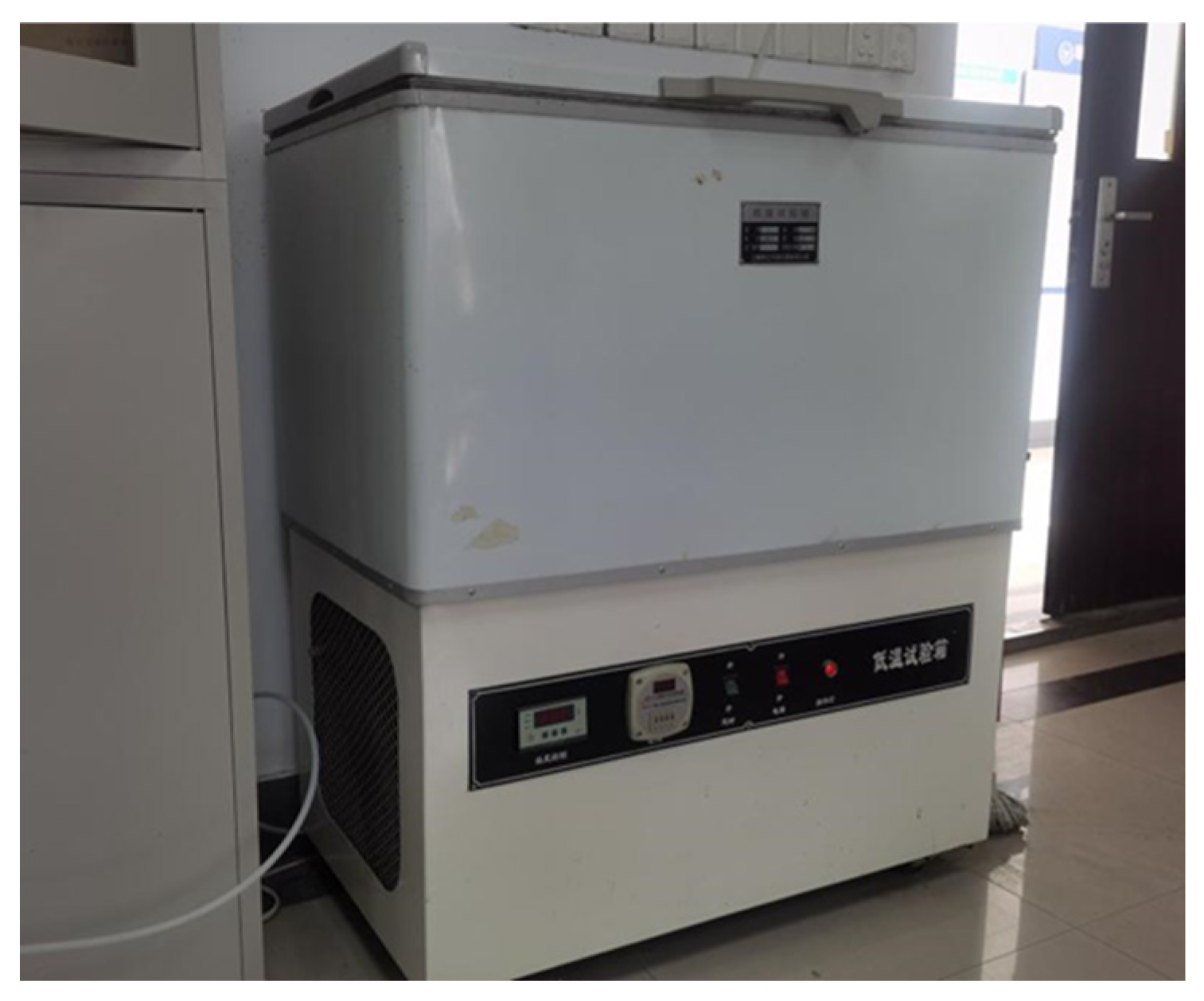
The freeze–thaw testing apparatus employed in this study is DW-23, manufactured by Ludata Testing Instrument Co., Ltd. (Shanghai, China), as illustrated in
Figure 1. This equipment permits real-time configuration and recording of parameters, including freezing temperature, freezing duration, and thawing interval periods, whilst automatically controlling the freezing and thawing processes. Upon test completion, it generates reports to ensure full compliance of the applied freeze–thaw cycle parameters with the established testing protocol.
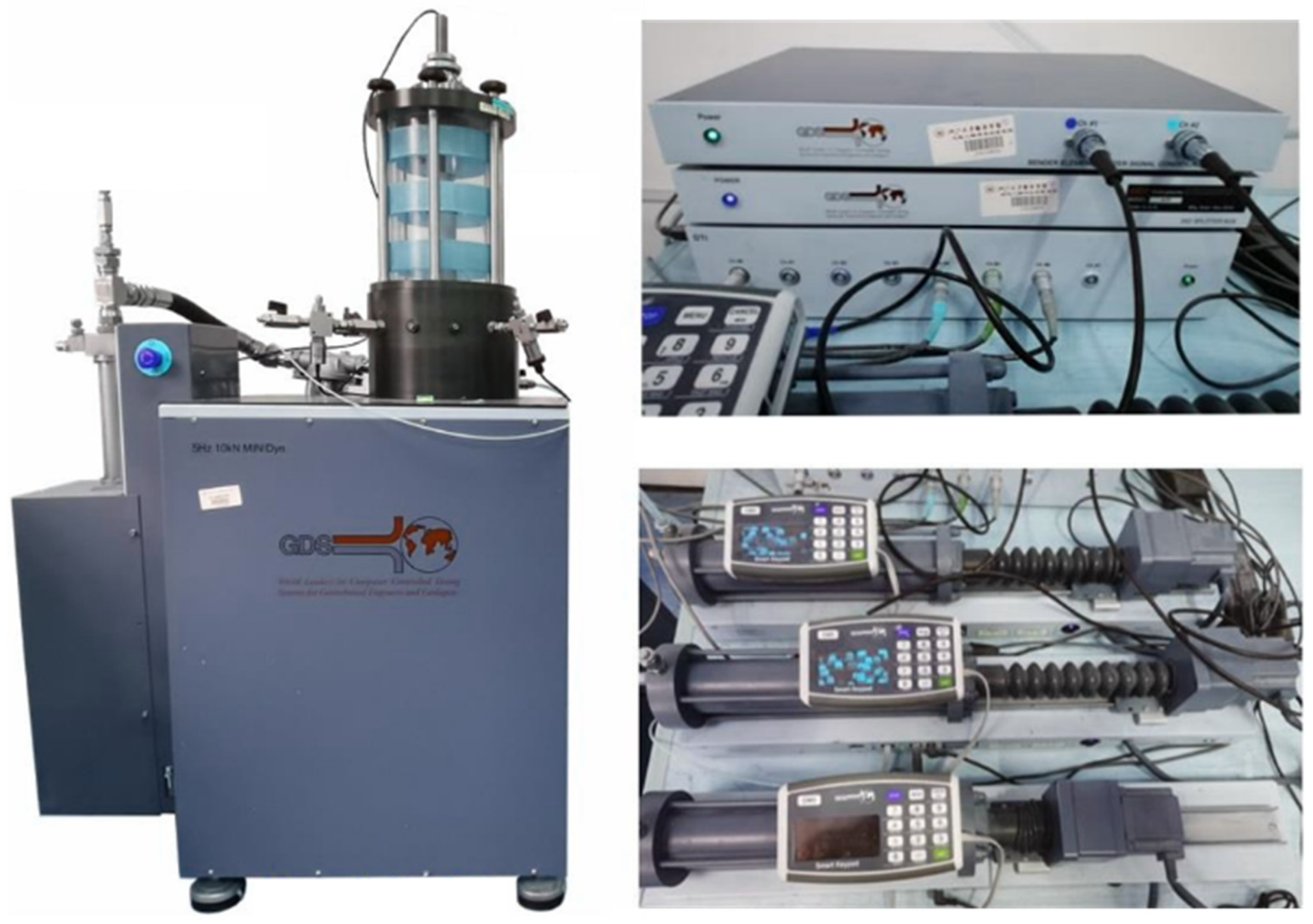
This study employs the British GDS dynamic triaxial testing system (
Figure 2), characterised by high measurement and control precision with digital operation. The system primarily comprises a pressure-volume controller, pressure chamber, 8-channel data acquisition unit, data acquisition software system, and sensors. Its loading frequency ranges from 0.1 to 5 Hz, with a maximum dynamic load capacity of 10 kN and a maximum confining pressure of 2 MPa.
2.2. Test Materials
The use of remoulded soil in this study serves specific methodological purposes. While natural soft clays possess complex structures, fabric, and bonding that cannot be fully replicated in the laboratory, remoulded samples provide essential advantages for controlled experimentation: (1) homogeneity ensures consistent material properties across all test specimens, eliminating the inherent variability of natural soils; (2) repeatability allows for reliable comparison between different test conditions; (3) controlled variable analysis enables isolation of specific factors (compaction, curing agents, freeze–thaw cycles) without the confounding effects of natural heterogeneity. This approach follows established geotechnical research methodology [
3,
26] and provides fundamental insights into soil behavior mechanisms. However, the quantitative results should be applied to field conditions with appropriate safety factors and site-specific validation, as natural clays may exhibit different responses due to pre-existing structure, bonding, and heterogeneity. To ensure test reliability and validity, remoulded soil has become a crucial technical method for guaranteeing uniform soil sample properties. Experimental studies on remoulded soil have improved sample homogeneity, increased test data utilisation, enhanced data repeatability, and facilitated controlled variable analysis. Therefore, in this laboratory dynamic triaxial test, undisturbed silty clay was remoulded to ensure test data reliability and comparability.
The density of the remoulded soil
ρ was 1.79–1.82 g/cm
3, with a specific gravity
Gs = 2.74, water content
ω = 41.8–48.7%, plastic limit
ωP = 32.8%, liquid limit
ωL = 51.8%, and plasticity index
Ip = 18.1. Based on specifications and sample thickness conversion for freeze–thaw cycle duration [
2], the freezing time was set at 48 h. Following reference [
3], freeze–thaw cycles were conducted by subjecting specimens to the freeze–thaw cycle tester (
Figure 1). Each cycle comprised 48 h of freezing followed by 48 h of thawing at specified temperatures. Subsequently, cylindrical specimens with a diameter of 50 mm were prepared from the freeze–thawed soil samples. Vacuum saturation treatment was performed according to the Specification of Soil Test (SL237-1999) [
26]. Specimens were placed in a vacuum saturator, evacuated to saturation at 0.1 MPa for 3 h, and soaked at atmospheric pressure for 12 h. This study investigates the development of cumulative plastic strain under the influence of freezing temperature, freeze–thaw cycle duration, and initial consolidation of thawed soil through laboratory dynamic triaxial tests. The freeze–thaw cycle tester was set to a freezing temperature of −10 °C for 48 h of constant-temperature freezing.
2.3. Curing Agent Characterization
To comprehensively evaluate existing curing agents, this experiment selected agents from both physical and chemical modification methods, whilst also comparing liquid and solid curing agents. The agents employed were lignin fiber and Huaxia No. 1 curing agent. Lignin fiber is a natural solid flocculent curing agent employing physical modification. Its mechanism resembles traditional inorganic solidifiers by enhancing soil structure through altering particle gradation. Its widespread availability, low cost, environmental sustainability, and ease of acquisition make it the physical modification curing agent of choice for this trial. Referring to a previous study [
27], the optimum addition ratio of lignin fiber was 1:100, because the best effect of soil improvement against the deterioration of the elastic modulus caused by freeze–thaw cycles is achieved under this addition ratio. The above ratios are the ratios of the mass of soil stabilizers to the mass of dry soil.
Huaxia No. 1 is a proprietary liquid stabilizer composed of silicate-based compounds, ionic surfactants, and polymeric binders. It is manufactured by Huaxia Xianhe New Material Co., Ltd. (Beijing, China). Its density is 1.15 g/cm
3, pH ≈ 11.5, and it is designed to react with soil minerals to form insoluble cementitious gels. Despite limited open literature, preliminary laboratory studies [
25] have confirmed its efficacy in silt stabilization. According to previous foundation treatment cases, its preferred dosage is 0.01%. Therefore, a ratio of 1:10,000 was selected as the dosage for Huaxia No. 1, with an additional ratio of 1:20,000 included as a control to evaluate the cost-effectiveness for engineering applications.
2.4. Test Protocol
In accordance with Specification of Soil Test [
26], this study aims to investigate three sets of soil samples with varying compaction coefficients and incorporated curing agents through triaxial tests. The test grouping is presented in
Table 1.
The selected freeze–thaw parameters (−10 °C/−5 °C, 48-h freeze/thaw) are representative of conditions in seasonal frozen regions of Northeast China, aligning with specifications for highway subgrade design and established laboratory protocols [
2,
3]. This regime effectively simulates the slow freezing conducive to ice lens growth and water migration, which is critical for inducing structural damage analogous to field frost heave. The results are inherently sensitive to variations in freezing rate and duration; slower freezing typically promotes greater water redistribution and macrostructural damage, while insufficient thawing can lead to residual ice and overestimated stiffness. The fixed parameters in this study provide a controlled baseline for comparative evaluation of compaction and stabilization effects, though future work should explicitly address parameter sensitivity to develop more generalized models [
23,
28].
Based on the geological survey report, the consolidated effective confining pressure was selected as 100 kPa. The selection of a single effective confining pressure (σ′
3) of 100 kPa for all cyclic triaxial tests was based on its representation of a typical stress state in the upper layers of highway subgrades in seasonal frozen regions. This value aligns with the overburden pressure at a depth of approximately 4–5 m (assuming a typical unit weight of 20 kN/m
3), which is a critical zone where freeze–thaw action is most active and traffic-induced stress amplitudes are significant. This choice is supported by common practices in subgrade evaluation and previous studies focusing on the dynamic response of shallow foundation soils [
29].
This study primarily investigates the effects of compaction coefficient and curing agent on soil deformation. The cyclic loading parameters (1 Hz, 20 kPa) were selected based on typical highway subgrade conditions reported in the literature [
30,
31], representing an average traffic-induced stress state. While actual traffic loads exhibit a broader frequency-amplitude spectrum, this simplified approach allows for controlled comparative analysis of freeze–thaw and stabilization effects. Specimen dimensions were 50 mm × 100 mm (diameter × height). Loading was stress-controlled and ceased either upon completion of the predetermined number of load cycles or when the cumulative vertical strain exceeded 30%.
Soil samples undergo saturation treatment in two stages according to specifications, employing isostatic consolidation. Subsequently, cyclic loading is applied using the consolidated undrained (CU) method to obtain curves of soil strain versus vibration frequency. The CU loading condition is selected to simulate the most critical in-situ scenario for saturated thawed subgrade soil under rapid traffic loading. During the spring thaw period, the near-saturated soft clay has limited drainage capacity under short-duration load pulses. The CU condition allows for the accumulation of excess pore water pressure, which is the key mechanism leading to softening and accelerated development of cumulative plastic strain in fine-grained soils. This represents a worst-case, conservative design approach. While partially drained conditions may occur in the field, results from CU tests provide a fundamental and safe assessment of the soil’s susceptibility to deformation under adverse drainage, forming a reliable basis for comparative analysis of stabilization effectiveness [
29,
32]. The test procedure is outlined in
Table 2.
3. Results
3.1. Variation of Dynamic Properties of Frozen Soil with Compaction Coefficients
Soil samples undergo saturation treatment in two stages according to specifications, employing isostatic consolidation. Subsequently, cyclic loading is applied using the consolidated undrained method to obtain curves of soil strain versus vibration frequency. The test procedure is outlined in
Table 2.
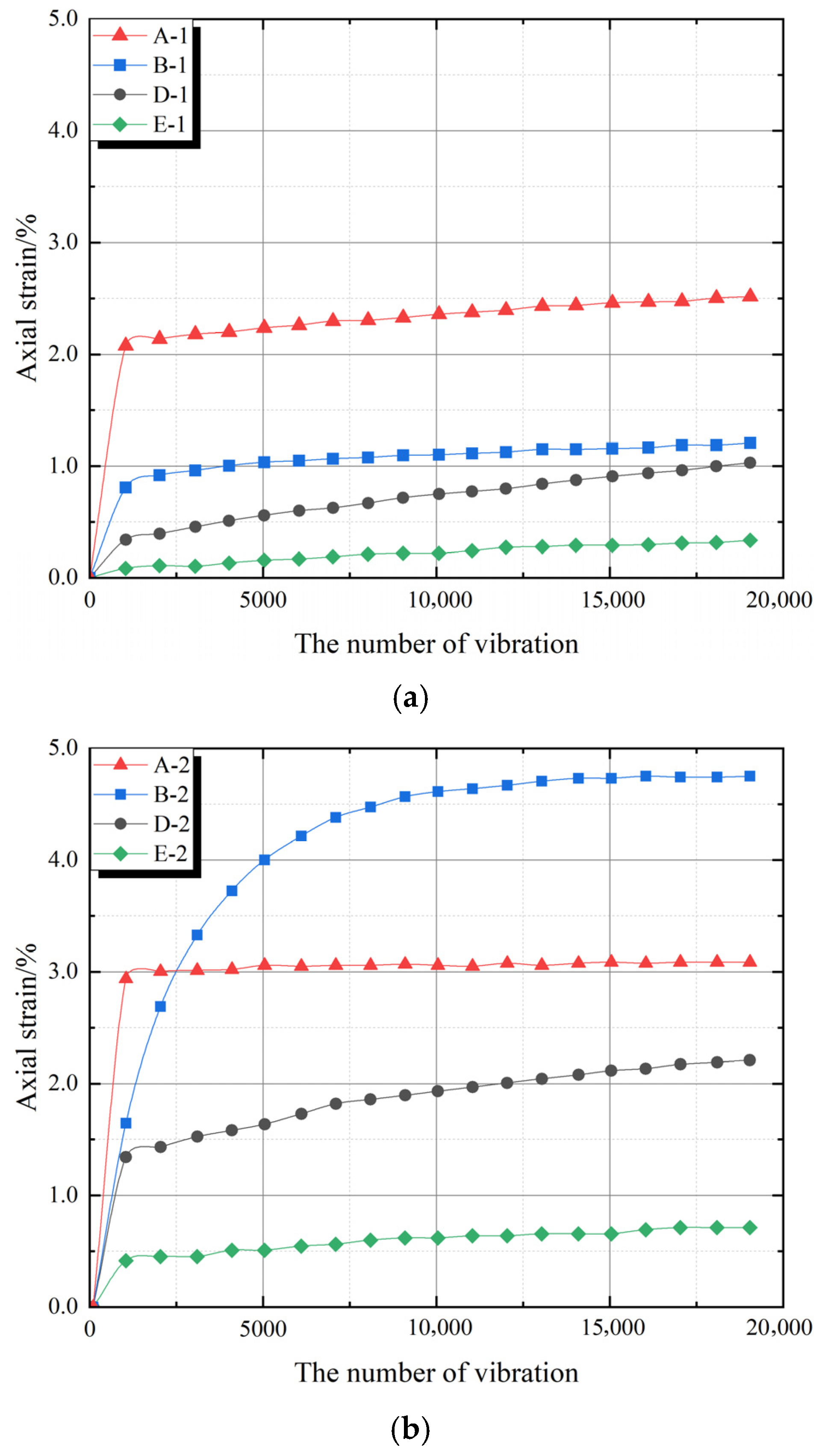
Groups A, B, D, and E indicate soil strain development under cyclic dynamic loading across different compaction coefficients with identical freeze–thaw temperatures of −10 °C.
Figure 3 presents the relationship curves between vibration cycles and axial strain for Groups A (compaction coefficient 0.80), B (0.85), D (0.87), and E (0.90) without curing agent addition.
Following freeze–thaw cycles, soil samples with identical compaction coefficients exhibited increased axial strain under identical cyclic loading. These results clearly demonstrate that freeze–thaw cycles amplify soil deformation and settlement.
Without the addition of curing agents, the soil’s compaction coefficient significantly influences the strain of both unfrozen and freeze–thawed soils. Increasing the soil’s compaction coefficient effectively reduces strain development in both unfrozen and freeze–thawed soils under cyclic loading. When pore water within the soil freezes, its volume expansion enlarges pores, causing particle displacement and resulting in frost heave. As compaction increases, the inter-particle gaps diminish, reducing the expansion volume of pore water and consequently weakening frost heave. Furthermore, the figure indicates that the ultimate deformation of the soil gradually decreases with increasing compaction coefficient.
3.2. Variation of Dynamic Properties of Frozen Soil with Freeze–Thaw Cycle Period
As depicted in
Figure 4, without the addition of curing agents, the freezing temperature is −5 °C. The axial strain after two freeze–thaw cycles increases by approximately 50% compared to that after a single cycle. The freeze–thaw cycles influence the interactions between soil particles, causing larger particles to fracture into smaller ones. Under self-weight, the smaller particles rearrange, converting large voids within the soil into smaller ones, thereby increasing the void ratio. Consequently, the cumulative strain developed in the soil sample subjected to two freeze–thaw cycles under long-term cyclic traffic loading is significantly greater than that in the sample subjected to only one freeze–thaw cycle.
3.3. Variation of Dynamic Properties of Frozen Soil with Freezing Temperatures
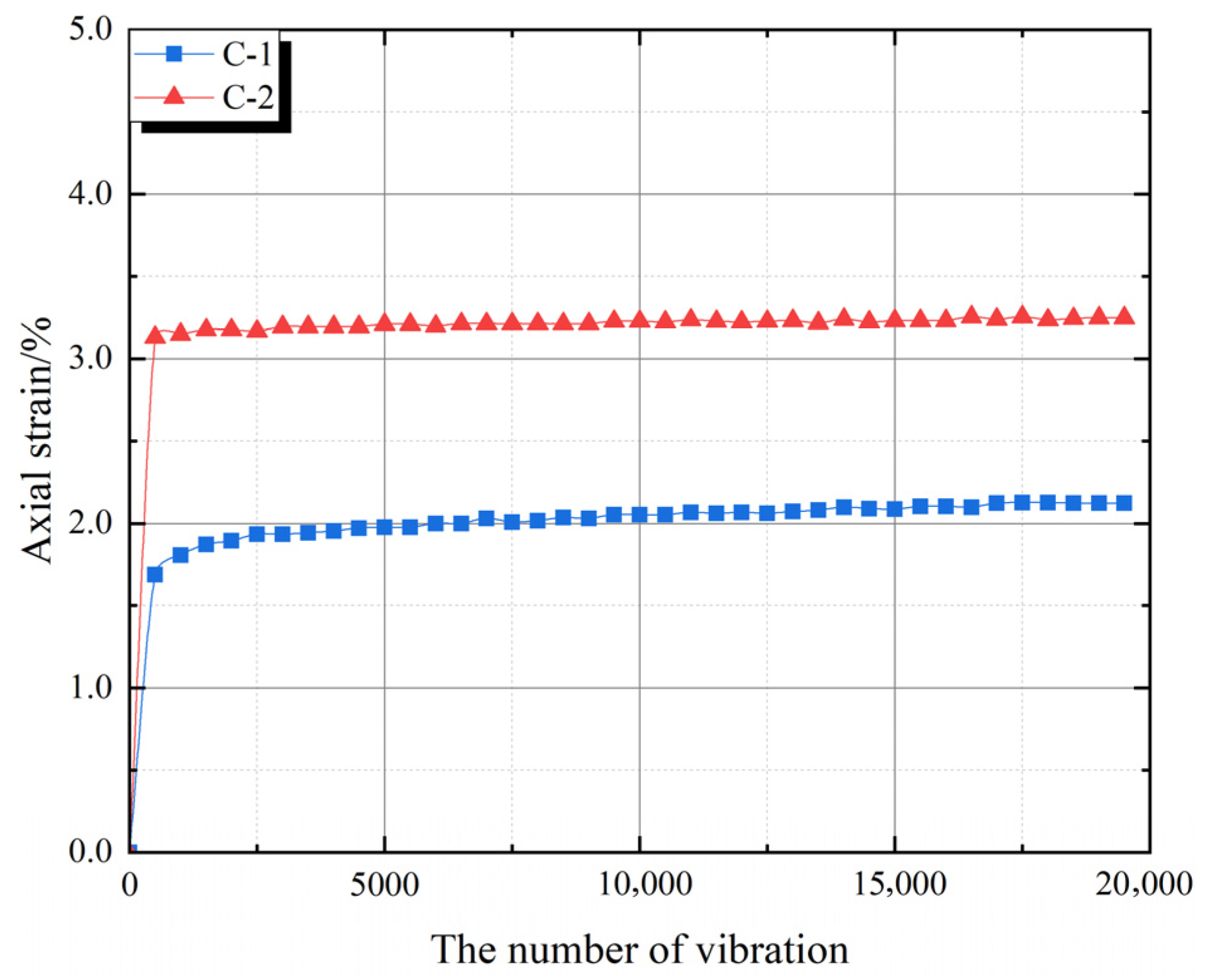
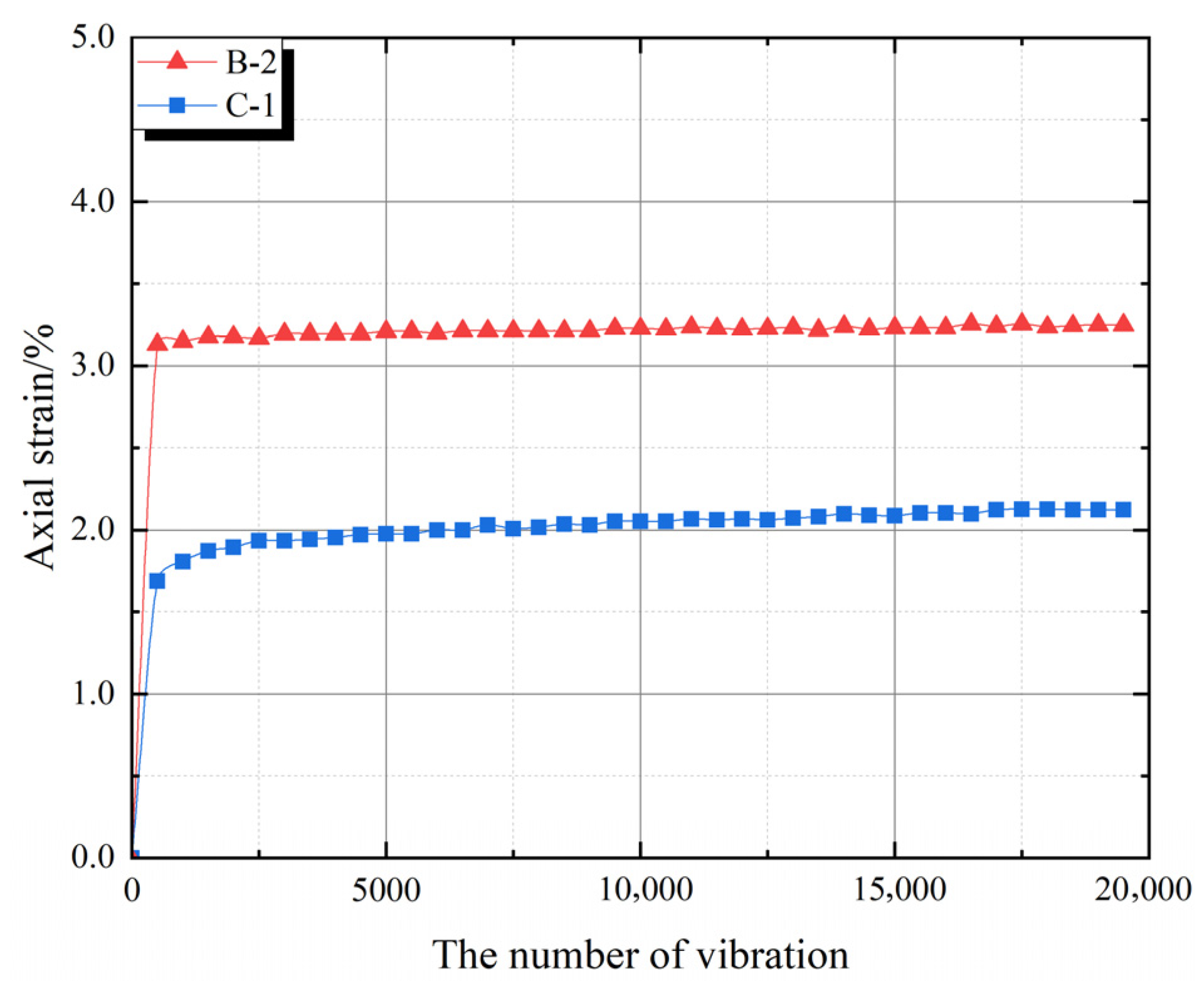
Groups B and C share identical compaction coefficients of 0.85, with Group B undergoing freeze–thaw cycles at −10 °C and Group C at −5 °C.
Figure 5 illustrates the relationship curves between the number of vibrations and vertical strain in soil with different freezing temperatures.
It is demonstrated that the cumulative axial strain increases with the decrease of freezing temperature. The axial strain of sample B-2 was approximately 60% greater than that of sample C-1, despite a temperature difference of only 5 °C. This phenomenon arises because lower temperatures enhance the migration capacity of pore water, thereby intensifying soil frost heave and ultimately inducing greater deformation.
3.4. Variation of Dynamic Properties of Frozen Soil with Curing Agents
Without any curing agents, this test selected a compaction coefficient of 0.9 as the minimum settlement scheme. However, in engineering practice, each 0.01 increase in compaction coefficient substantially elevates construction costs and duration. Therefore, relying solely on increasing the compaction coefficient to reduce post-construction settlement is impractical.
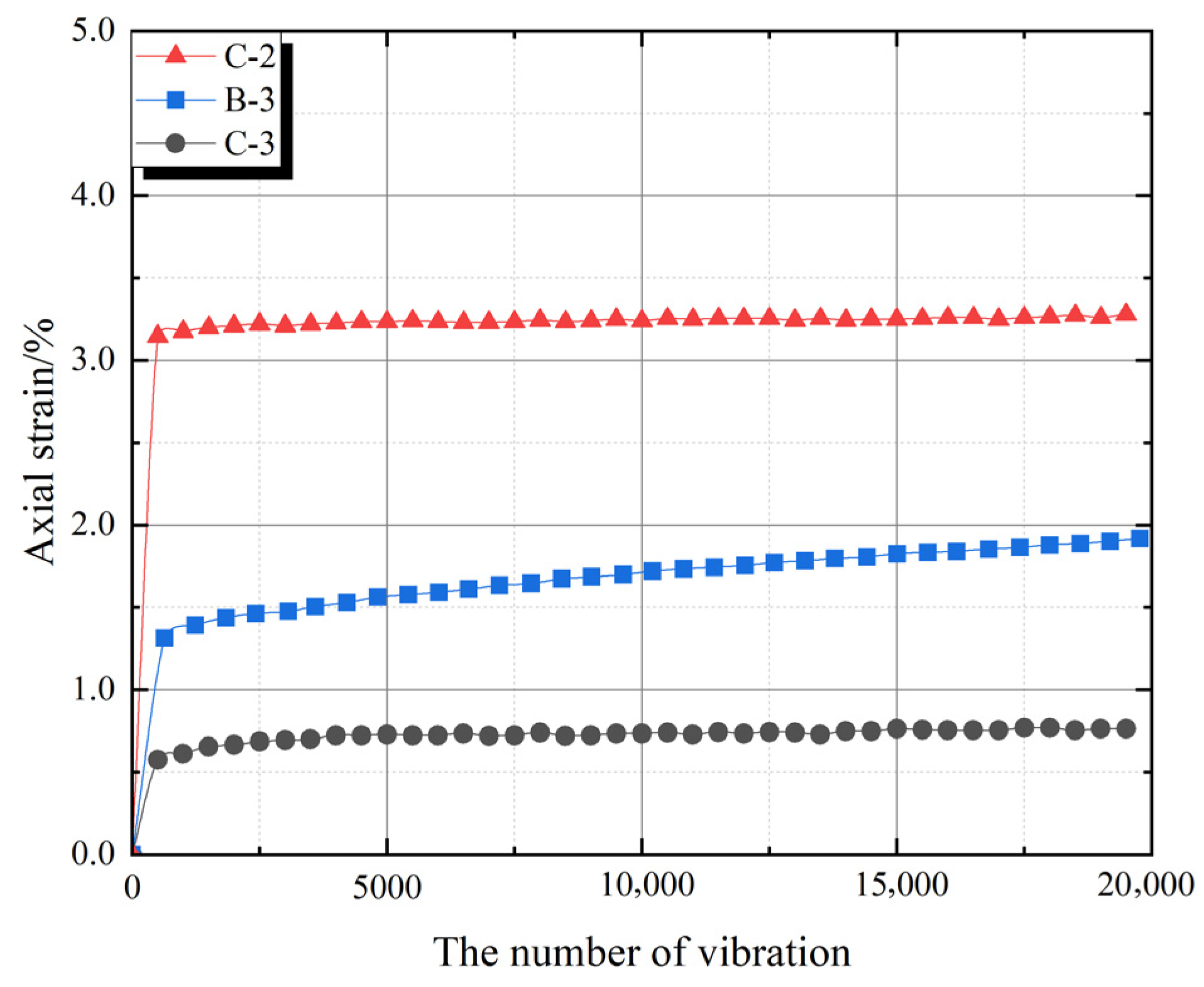
Figure 6 presents the relationship curves between axial strain and number of freeze–thaw cycles for specimens with a compaction coefficient of 0.85 at different freezing temperatures: B-3 treated with Huaxia No. 1 curing agent (1:20,000) after one freeze–thaw cycle; C-2 without curing agents; and C-3 treated with Huaxia No. 1 curing agent (1:10,000) after two freeze–thaw cycles.
As shown in
Figure 6, at a freezing temperature of −5 °C, a sample of group C-2 without curing agent exhibited significant strain under dynamic loading. Previous test results indicate that at a freezing temperature of −10 °C, the strain of freeze–thawed soil under dynamic loading increases by approximately 50% compared to −5 °C, with a further 50% increase after secondary freeze–thaw cycles. Consequently, the cumulative strain after secondary freeze–thaw cycles in the C-3 group samples, treated with Huaxia No. 1 curing agent at a ratio of 1:10,000, was significantly controlled. In contrast, the strain control effect was relatively weaker for the B-3 group specimens, which incorporated Huaxia No. 1 curing agent at a ratio of 1:20,000. This indicates that the solidifier dosage significantly influences its strain control capability; a higher dosage more effectively reduces cumulative strain after multiple freeze–thaw cycles.
The freeze–thaw temperature and number of cycles solely affect the final deformation outcome of the freeze–thaw process, without influencing the process by which the curing agent strengthens the soil. Consequently, the degrees of improvement provided by the curing agent can be determined separately for comparative analysis. Group B-3, incorporating Huaxia No. 1 curing agent at a ratio of 1:20,000, exhibited a 50% reduction in cumulative strain. Conversely, Group C-3, using Huaxia No. 1 curing agent at the dosage of 1:10,000, demonstrated over 80% reduction in cumulative strain. Based on cumulative strain reduction efficacy, the group with the dosage of 1:10,000 demonstrated superior performance to the group with the dosage of 1:20,000. Consequently, the ratio of 1:10,000 is recommended as the preferred curing agent dosage.
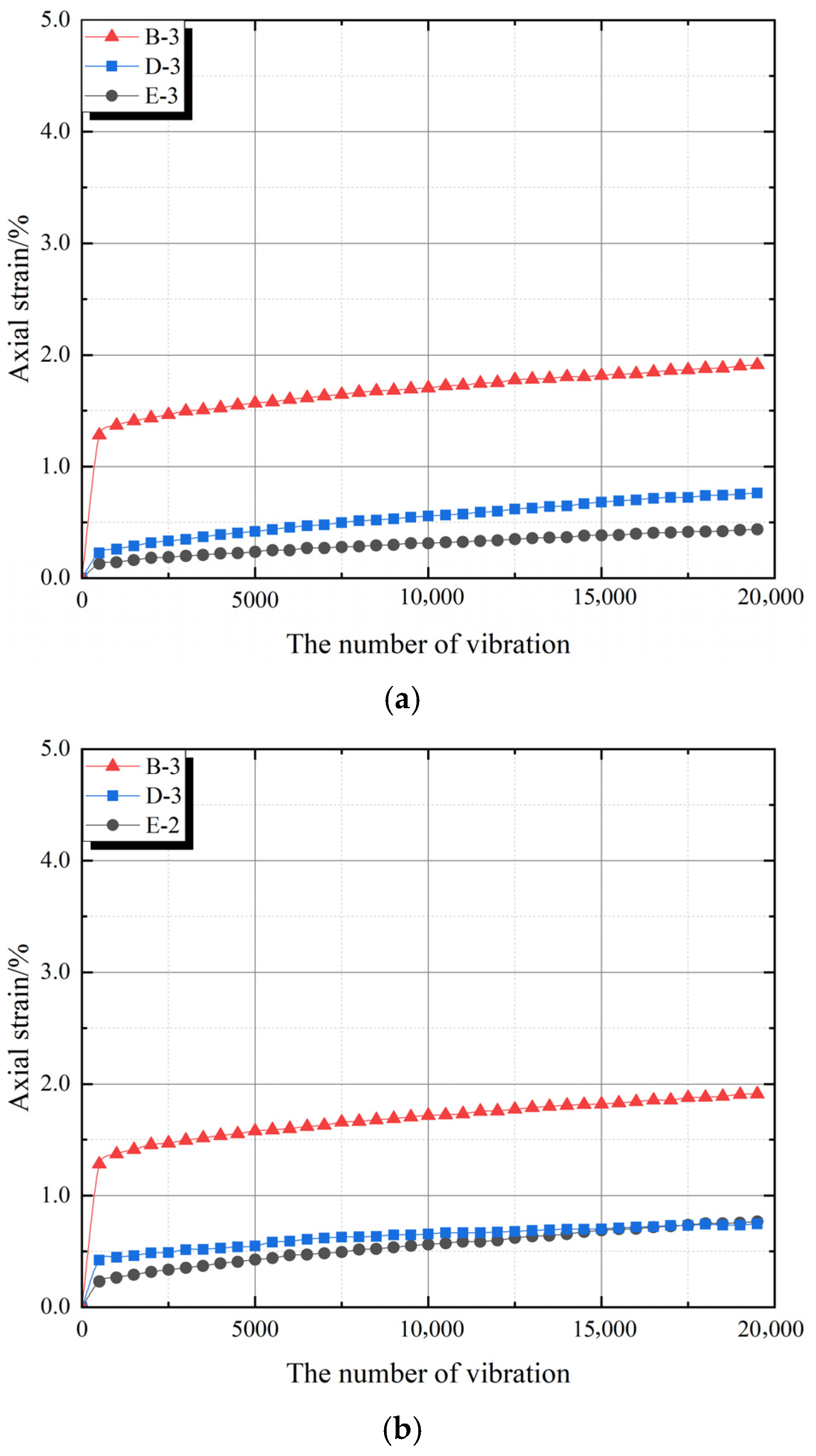
Figure 7 presents the relationship curves between vibration cycles and axial strain after freeze–thaw cycles for Groups B-3, D-3, and E-3 when Huaxia No. 1 curing agent at a ratio of 1:20,000 was added.
As evident from
Figure 7a, at identical freeze–thaw temperatures, the effect of the compaction coefficient on the strain of freeze–thawed soil is obvious, with the addition of curing agents. Increased compaction reduces interparticle voids, diminishing pore water migration and accumulation capacity, thereby mitigating frost heave. Lignin fiber aids in filling interparticle voids, impeding water migration. Huaxia No. 1 curing agent, through chemical reactions, enhances interparticle bonding, reducing pore space and thereby mitigating frost heave.
As shown in
Figure 7b, for the group with a compaction coefficient of 0.87, the final deformation after adding a certain proportion of curing agent is consistent with that of the 0.9 compaction coefficient group without any curing agent. This indicates that incorporating Huaxia No. 1 curing agent permits a reduction in soil compaction requirements. Consequently, when adding this curing agent, a compaction coefficient of 0.87 may be selected. This achieves the objective of minimising cumulative settlement induced by loading while simultaneously reducing construction costs and duration.
3.5. Microstructural Mechanism Analysis
To investigate the micromechanism of freeze–thawed soil, nuclear magnetic resonance (NMR) scanning was performed on all test samples. NMR measurements were conducted using a MesoMR23-060H-I NMR analyzer (Niumag Analytical Instrument Corporation, Suzhou, China) operating at a magnetic field strength of 0.5 ± 0.08 T with a resonance frequency of 23 MHz. The transverse relaxation time (T
2) distribution was obtained using the Carr–Purcell–Meiboom–Gill (CPMG) pulse sequence with the following parameters: echo time (TE) = 0.2 ms, waiting time (TW) = 3000 ms, number of echoes = 5000, and number of scans = 64. Pore size distribution was derived from T
2 distributions using the Schmidt–Raleigh conversion model with an assumed surface relaxivity (ρ
2) of 10 μm/s, following the established methodology [
33,
34]. The measurement assumes cylindrical pores and homogeneous magnetic susceptibility, with limitations including uncertainty in surface relaxivity and simplified pore geometry assumptions.
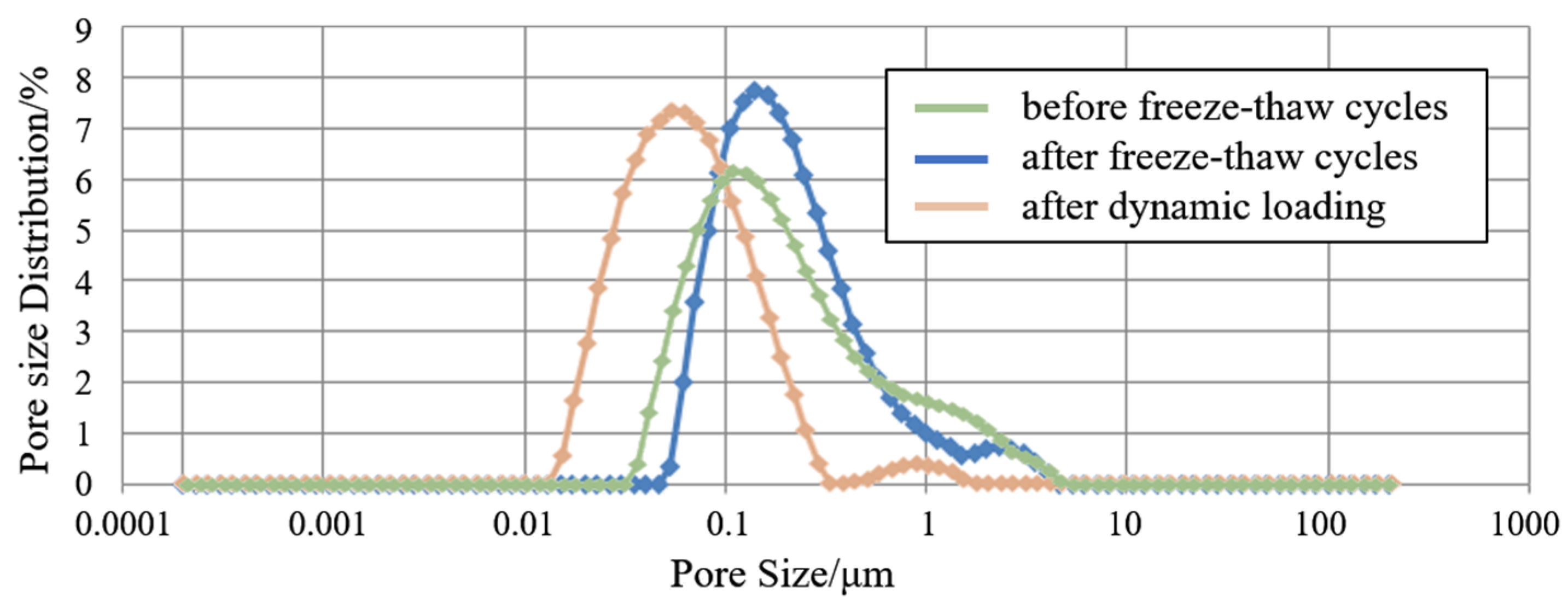
NMR results indicate that freeze–thaw cycles induce an irreversible expansion of the pore size distribution, shifting the dominant pore diameter range upward by approximately 10% in volumetric proportion, primarily due to the growth of macropores (>1 µm). The use of the curing agent effectively mitigated this pore enlargement effect, though it could not restore the soil to its initial state. The resulting pore size distribution differed by about 4% from the original distribution, broadly consistent with the patterns observed in dynamic triaxial tests. Scanning specimens before and after dynamic loading using NMR revealed changes in pore size attributable to both freeze–thaw action and solidification.
As shown in
Figure 8, freeze–thaw action alters the internal structure and pore size distribution of the soil sample, shifting the peak to a later position. This occurs because ice crystal formation during freezing disrupts the interparticle bonding, subjecting the soil to compression that forms a new skeletal structure. Simultaneously, existing micro-pores interconnect under compression, creating larger voids. Upon ice crystal melting, the expanded pores cannot revert, preventing complete restoration of the skeletal structure.
Secondly, following cyclic dynamic loading, the peak of the pore size distribution shifts markedly forward. Under cyclic loading, significant compression occurs between soil particles. The original interparticle bonding is disrupted, causing particle slippage and fragmentation. Concurrently, larger voids diminish under compression, while surrounding smaller particles aggregate and consolidate. Through slippage, fragmentation, aggregation, and consolidation, soil particles redistribute into a new state.
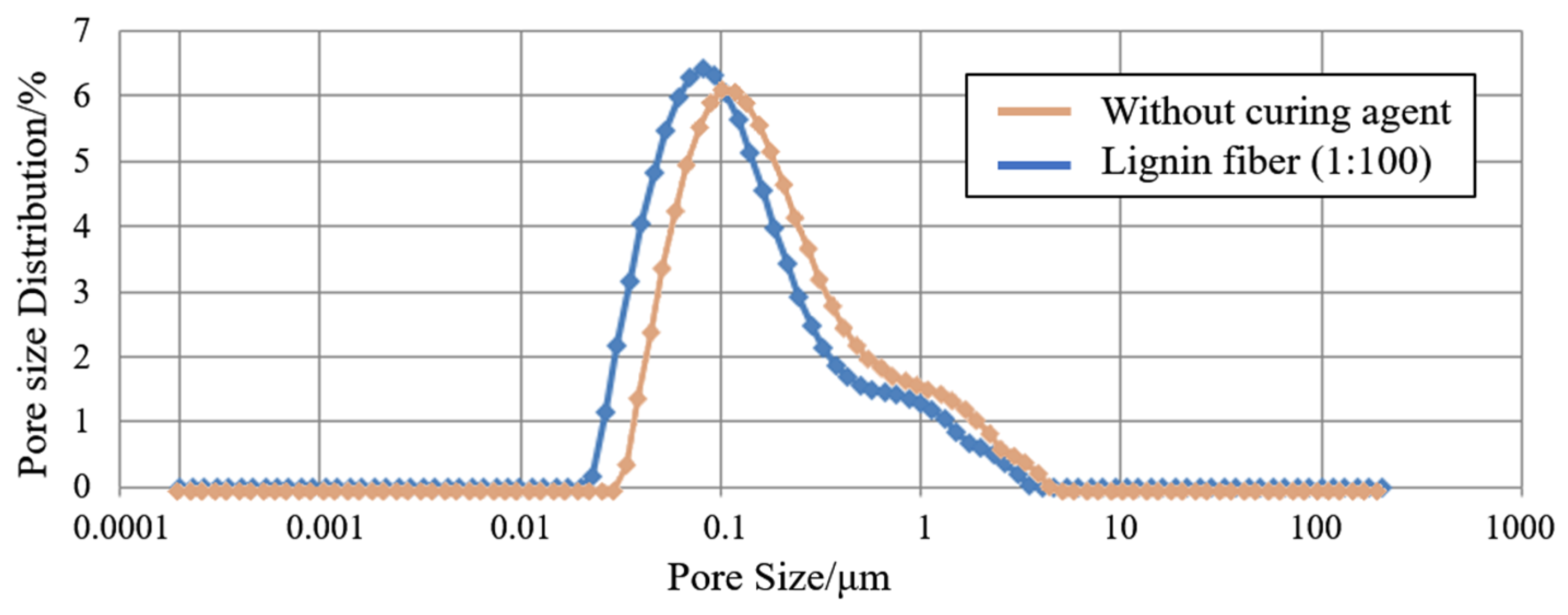
Following the incorporation of lignin fiber and subsequent freeze–thaw cycles, the peak of the pore size distribution shifted markedly to lower values compared to unfixed freeze–thawed soil samples, as illustrated in
Figure 9. This occurs because lignin is highly oxidizable and possesses exceptional water absorption; upon entering the soil matrix, it not only coats soil particles but also forms interlocking structures. Due to its high viscosity, these units aggregate progressively, thereby strengthening soil cohesion. The surface-bound water films of adjacent aggregates overlap, progressively reducing pore space.
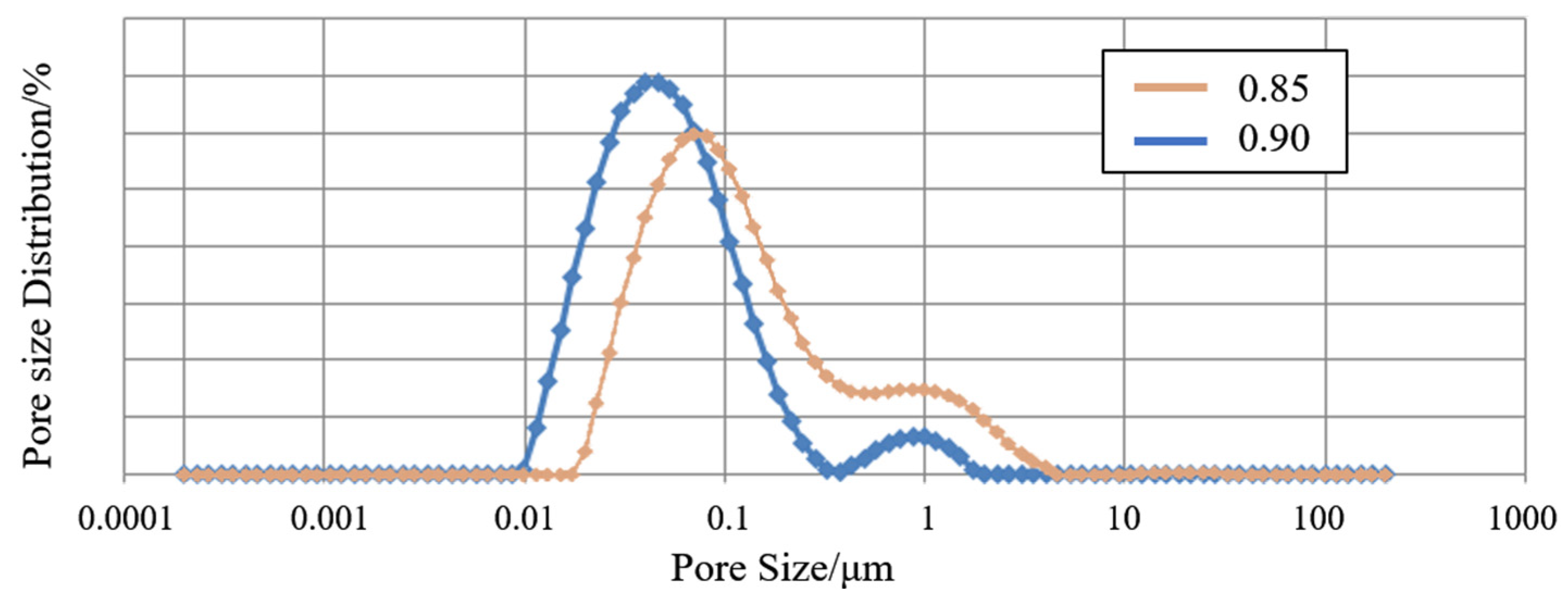
Figure 10 demonstrate that as the compaction coefficient increases, the peak of the pore size distribution shifts significantly forward. This occurs because a higher compaction coefficient implies greater soil mass per layer, indicating a higher concentration of soil particles within each layer. During compaction, specimens with lower compaction coefficients achieve the required density once their original voids are compacted. Conversely, specimens with higher compaction coefficients require additional compaction cycles after void compaction. This intensifies interparticle friction, gradually wearing down larger particles. The resulting smaller particles then fill voids and channels, increasing overall density and reducing the average pore size.
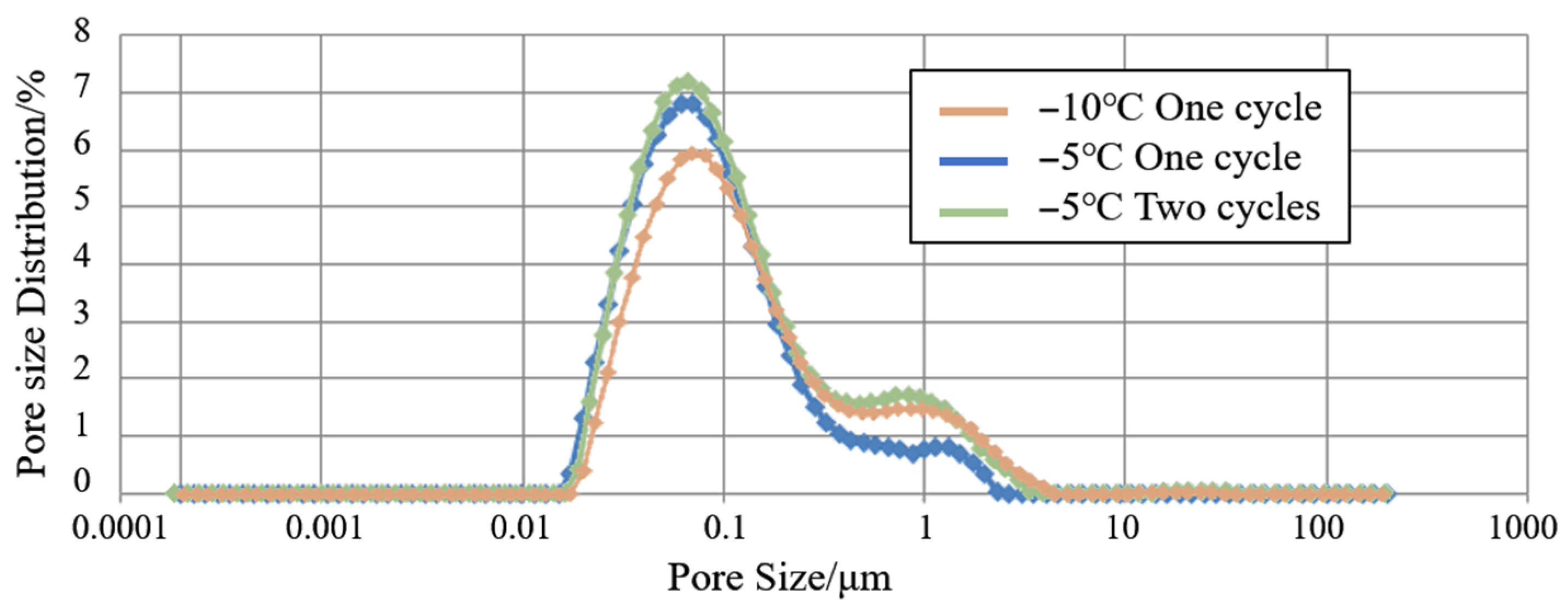
Figure 11 demonstrate that as the number of freeze–thaw cycles increases and the freeze–thaw temperature decreases, the distribution of pores within the soil remains broadly similar, yet the number of large-channel pores markedly increases. This occurs because during the freezing process of soft soil, lower freezing temperatures result in a greater volume of pore water freezing into ice, consequently leading to a higher frost heave rate. Furthermore, as the number of freeze–thaw cycles increases, the total pore volume also rises, indicating more severe damage to the internal structure. This manifests as disruption to the cementation between particles, with minute pores becoming interconnected, leading to an expansion in pore volume. During thawing, the microstructure cannot revert to its original state. Consequently, after multiple freeze–thaw cycles, the structural properties of the soil undergo a degree of weakening. This results in accelerated cumulative development rates of pore pressure and axial strain during macroscopic dynamic loading, consistent with the conclusions drawn from the preceding dynamic triaxial tests.
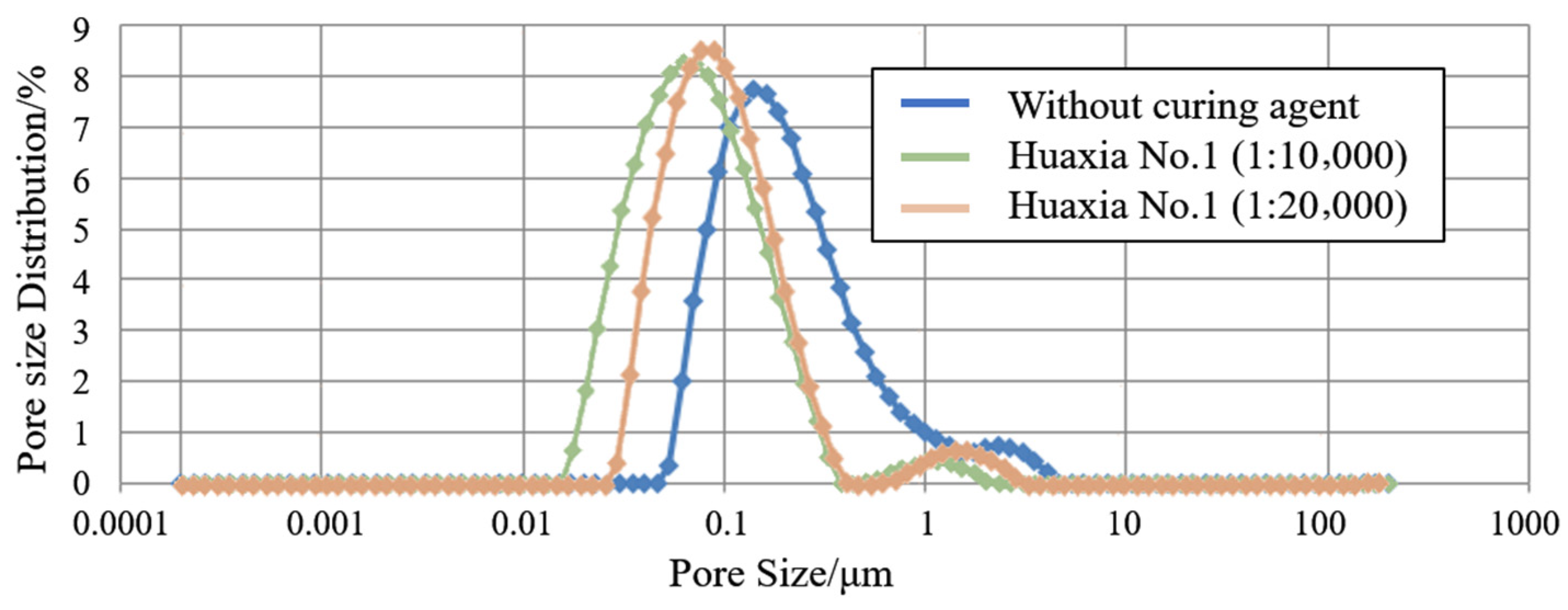
Figure 12 demonstrate that Huaxia No. 1 curing agent effectively reduces the original pore network in the soil. The peak of the pore size distribution shifts significantly forward, with a corresponding decrease in the number of large-diameter pores. Comparative analysis of the two dosage groups (1:10,000 and 1:20,000) reveals that the modified pore size distribution structures are broadly similar. However, the dosage of 1:10,000 exhibits a more pronounced shift in the pore size distribution, indicating a greater overall reduction in pore channels. Furthermore, the peak pore size decreases more rapidly after solidification, suggesting compression across all pore size segments, resulting in a more uniform internal pore distribution. Consequently, the dosage of 1:10,000 proves superior to the dosage of 1:20,000.
4. Discussion
The experimental results presented herein elucidate the complex interplay between freeze–thaw cycles, soil compaction, and curing agents in governing the cumulative plastic strain behavior of soft clay under cyclic traffic loading. Our findings demonstrate that the degradation of soil mechanical properties induced by freeze–thaw action is not merely a macroscopic phenomenon but is intrinsically linked to irreversible alterations in the soil’s micro-fabric. The integration of dynamic triaxial testing with NMR analysis provides a robust, multi-scale validation of these effects, offering significant insights for engineering practice in seasonal frozen regions.
A primary finding of this study is the profound impact of freeze–thaw cycles on the soil’s internal architecture. The NMR results (
Figure 8,
Figure 9,
Figure 10,
Figure 11 and
Figure 12) provide direct microstructural evidence that freeze–thaw cycles cause an irreversible fracturing of the soil skeleton, leading to a coarser pore structure with an approximate 10% expansion in pore size distribution. This microstructural damage directly explains the macroscopic mechanical behavior: the 50% increase in cumulative axial strain observed in freeze–thaw cycled samples compared to their unfrozen counterparts (
Figure 3). This aligns with established theories that ice lens formation during freezing displaces soil particles, and upon thawing, the loss of cohesive bonds and the collapse of the expanded structure prevent full recovery, resulting in a more compressible and less stable fabric [
15,
19]. The further 50% strain increase after a second freeze–thaw cycle (
Figure 4) underscores the cumulative and progressive nature of this damage, as repeated cycles continue to break down soil aggregates and facilitate particle rearrangement into a looser state.
The efficacy of the curing agents, particularly Huaxia No. 1, in mitigating this freeze–thaw damage represents a key novelty of this research. The mechanism is twofold, as revealed by our micro–macro correlation. Firstly, from a microperspective, the curing agent effectively counters the pore enlargement effect, with the final pore size distribution of treated soil deviating by only about 4% from the original state, compared to 10% for untreated freeze–thaw soil (
Figure 12). This suggests that the agent promotes the formation of insoluble, cementitious compounds that fill pores and strengthen interparticle bonds, thereby resisting the disruptive forces of ice formation. Macroscopically, this translates to a dramatic reduction in cumulative plastic strain—up to 80% with the 1:10,000 dosage (
Figure 6). This improvement is so substantial that the deformation of a stabilized soil with a compaction coefficient of 0.87 can match that of an untreated soil compacted to 0.90 (
Figure 7b). While both curing agents reduced cumulative strain compared to untreated soil, Huaxia No. 1 demonstrated superior performance, particularly at the 1:10,000 dosage. Lignin fiber, functioning primarily through physical reinforcement and pore filling, reduced strain by 30–40% but showed limited effectiveness against pore water migration during freezing. In contrast, Huaxia No. 1’s chemical modification mechanism created more durable cementitious bonds that resisted freeze–thaw degradation more effectively. The detailed focus on Huaxia No. 1 stems from its markedly better performance in these tests, suggesting greater potential for practical application. However, lignin fiber remains a viable, environmentally-friendly option for less severe frost conditions or where chemical stabilization is undesirable.
The role of the compaction coefficient itself is critical. Our results consistently show that higher compaction leads to lower cumulative strain, both in unfrozen and freeze–thaw conditions (
Figure 3). This is mechanistically explained by the reduced initial void ratio, which limits the space available for water migration and ice lens growth, thereby attenuating the frost heave process. The NMR data further corroborate this, showing a clear forward shift in the pore size distribution peak with increasing compaction (
Figure 10), indicating a finer and more uniform pore network. However, a purely compaction-based approach to control settlement has diminishing returns and significant practical constraints, as each incremental increase in compaction coefficient substantially elevates cost and effort. Our study therefore provides a scientifically-grounded alternative: the synergistic combination of a moderate compaction level (e.g., 0.87) with an optimal dosage of chemical stabilizer (Huaxia No. 1 at 1:10,000) can achieve superior performance to high compaction alone.
The recommended scheme—a compaction coefficient of 0.87 combined with Huaxia No. 1 curing agent at a 1:10,000 dosage—provides a quantifiable alternative to traditional compaction-based design. In practice, achieving a compaction coefficient of 0.90 or higher in soft clay is often challenging and costly.
Instead of mandating a universally high compaction degree, design codes could permit a lower compaction target (e.g., 0.87) if coupled with verification of stabilization effectiveness (e.g., via unconfined compressive strength or resilient modulus tests meeting a threshold after simulated freeze–thaw cycles).
The idealized laboratory conditions employed in this study serve to establish fundamental relationships and mechanisms under controlled settings. For practical application, these findings provide: (1) material selection guidelines for frost-susceptible subgrades; (2) design parameters for preliminary stabilization approaches; and (3) quality control benchmarks for stabilized soil performance.
5. Limitation and Future
It is crucial to address potential limitations of this study. The tests were conducted on remoulded soil, which, while essential for controlling variability, may not fully capture the in-situ structure and fabric of natural soft clays. All tests were conducted under a single effective confining pressure (100 kPa). The influence of varying in-situ stress states on the reported interactions between freeze–thaw cycles, compaction, and stabilization remains unquantified. Furthermore, the cyclic loading was applied at a single frequency (1 Hz) and stress amplitude (20 kPa) to simulate traffic loads. While these parameters are representative, real-world traffic involves a spectrum of frequencies and stress levels.
An important limitation of this study is the absence of long-term durability assessment under extended freeze–thaw cycling (>10 cycles) and varied loading conditions. While the stabilization effects are promising for one–two freeze–thaw cycles, the permanence of improvement over multiple seasonal cycles remains unverified. A substantial body of literature on soil stabilization establishes that the long-term durability and permanence of improvement are fundamentally governed by the initial development of cementitious and pozzolanic reaction products, which are strongly correlated with short-term strength gains. For instance, studies on lime- and cement-treated soils have demonstrated that achieving a minimum threshold unconfined compressive strength (UCS) shortly after treatment is a reliable predictor of satisfactory performance in prolonged freeze–thaw and wet-dry cycles [
35,
36]. The immediate improvements in strength and stiffness measured in this study for ‘Huaxia-1’ stabilized soil are indicative of the formation of such a stable matrix. Therefore, while long-term cyclic testing remains essential for definitive field-life prediction, the initial mechanical properties provide a valid and scientifically supported basis for comparing the efficacy and potential durability of different stabilizer dosages, as undertaken in this initial evaluation.
Future research should focus on: (1) extended freeze–thaw cycling (10+ cycles) to assess cumulative degradation; (2) variable loading spectra representing different vehicle types and speeds; and (3) field validation under actual environmental conditions. Without such testing, the long-term performance and maintenance requirements of stabilized subgrades cannot be fully assessed.
6. Conclusions
This study conducted laboratory cyclic triaxial tests on remoulded soft clay subjected to freeze–thaw cycles, primarily analysing the effects of compaction coefficient, curing agent type, and dosage on the axial cumulative strain of soft clay. The following conclusions were drawn:
(1) For unfrozen soil, freeze–thawed soil, and freeze–thawed soil with curing agents, the axial strain increased at a relatively rapid rate during the initial phase of cyclic loading, exhibiting a nearly linear progression. However, as the number of vibrations increased, reaching approximately 10,000 cycles, the soil structure gradually attained compaction. Although axial strain continued to increase to some extent, it had essentially stabilised.
(2) Regardless of compaction degree, unfrozen soil subjected to freeze–thaw cycles exhibited substantially increased strain and approximately 50% reduced strength. Conversely, the addition of curing agent (including Huaxia No. 1 curing agent and lignin fiber) markedly reduces strain in freeze–thawed soil compared to untreated samples. The strength degradation, compared to unfrozen soil, was limited to approximately 10%. This demonstrates that curing agents effectively mitigate cumulative strain in freeze–thawed soil while enhancing its strength.
(3) At identical freezing temperatures, both the absence of curing agents and the soil’s compaction coefficient significantly influence strain in both unfrozen and freeze–thawed soils. This experiment employed four progressive compaction coefficient groups. Strain decreased progressively within each group. Increasing the soil’s compaction coefficient effectively reduces cumulative strain in both unfrozen and freeze–thawed soils. Consequently, a higher compaction coefficient results in lower cumulative settlement. However, considering multiple factors such as construction duration, difficulty, and economic efficiency, incorporating a curing agent can effectively lower the required compaction standard. Therefore, the recommended scheme—incorporating Huaxia No. 1 curing agent at a ratio of 1:10,000 with a compaction coefficient of 0.87—can save construction cost under the tested conditions (remoulded soft clay, 1 Hz loading frequency, 20 kPa stress amplitude). Field application should consider site-specific conditions including natural soil variability, actual traffic spectra, and local climatic factors.
(4) To investigate the microstructural mechanisms within freeze–thawed soils, nuclear magnetic resonance (NMR) scanning was conducted on all test specimens. Findings revealed that freeze–thaw cycles induce irreversible skeletal fragmentation within the soil matrix, expanding the pore size distribution by approximately 10%. The use of curing agents effectively mitigates this pore enlargement effect, though it cannot restore the soil to its initial state. The resulting pore size distribution deviates by approximately 4% from the original distribution, aligning with the patterns observed in dynamic triaxial tests.
Author Contributions
Conceptualization, M.Z. and Z.W.; methodology, T.X.; software, H.L.; validation, L.Y.; formal analysis, K.C.; investigation, K.C.; resources, K.C. and M.Z.; data curation, Z.W.; writing—original draft preparation, Z.W.; writing—review and editing, T.X.; visualization, Z.W.; supervision, T.X.; project administration, M.Z.; funding acquisition, M.Z. All authors have read and agreed to the published version of the manuscript.
Funding
This research received no external funding.
Institutional Review Board Statement
Not applicable.
Informed Consent Statement
Not applicable.
Data Availability Statement
The original contributions presented in the study are included in the article, further inquiries can be directed to the corresponding author.
Conflicts of Interest
Authors Mengya Zhang, Hongyi Liu, Lidong Yang, Kena Cheng was employed by the company Northeast Electric Power Design Institute Co., Ltd. The remaining authors declare that the research was conducted in the absence of any commercial or financial relationships that could be construed as a potential conflict of interest.
Abbreviations
The following abbreviations are used in this manuscript:
| CU | Consolidated Undrained |
| NMR | Nuclear Magnetic Resonance |
References
- Yang, C.; He, P.; Cheng, G.; Shi, Y. Current State and Progress of the Study on Thawing Settlement of Frozen Ground. J. Eng. Geol. 2004, 12, 147–150. [Google Scholar]
- JTG/T D31-06; 2017 Technical Specifications for Design and Construction of Highway in Seasonal Frozen Soil Region. China Communications Press: Beijing, China, 2017.
- Zhang, M. Experimental Study on Dynamic Characteristics and Microstructure of Frozen-thawed Soil under Subway Loading. Master’s Thesis, Zhejiang University, Hangzhou, China, 2017. [Google Scholar]
- Liu, F.R.; Ma, W.; Zhou, Z.W.; Wen, Z.; Zhang, S.; Shen, M.; Mu, Y. The Effects of the Principal Stress Direction on the Deformation Behaviour of Frozen Silt Clay under Cyclic Loading. Transp. Geotech. 2022, 37, 100870. [Google Scholar] [CrossRef] [Scilit]
- Meng, S.; Li, X.; Sun, Y.; Cheng, Y. Field Monitoring and Analysis of Permanent Deformation in Seasonal Frozen Soil Roadbeds. Rock Soil Mech. 2018, 39, 1377–1385. [Google Scholar] [CrossRef]
- Liu, H.; Zhang, H.; Wang, J. Influence of Freeze-Thaw Cycles and Water Content on the Mechanical Properties of Compacted Clayey Soil. Rock Soil Mech. 2018, 39, 158–164. [Google Scholar] [CrossRef]
- Zheng, X.; Li, M.; Yan, M.; Yu, S. Study on the Laws of Frost Heave and Thaw Settlement in Highway Subgrades in Seasonal Frozen Regions. Sci. Technol. Eng. 2016, 16, 239–244. [Google Scholar]
- Li, J. Study on the Settlement Characteristics of Roadbed Under Freeze-Thaw Cycles. Master’s Thesis, Northeast Forestry University, Harbin, China, 2018. [Google Scholar]
- Qi, J.; Ma, W. State-of-the-Art Research on the Mechanical Properties of Frozen Soils. Rock Soil Mech. 2010, 31, 133–143. [Google Scholar]
- Wang, Y.; Wang, Z.; Liu, Q.; Xiao, M. Experimental Investigations on Frost Damage of Canals Caused by Interaction between Frozen Soils and Linings in Cold Regions. Chin. J. Geotech. Eng. 2018, 40, 1799–1808. [Google Scholar]
- He, S. Study on Freezing Project Affected by Frost-Heaving and Thawing-Settlement Applied in Construction of Subway Tunnel in the Coastal Regions. Master’s Thesis, Lanzhou University, Lanzhou, China, 2011. [Google Scholar]
- Wang, X. Study on Thaw Settling Characteristics of Artificial Frozen Soil and Its Prediction Model. Master’s Thesis, Nanjing Agricultural University, Nanjing, China, 2006. [Google Scholar]
- Hao, H. Study on Field Test and Construction Technology of Roadbed in Seasonal Frozen Soil Area. Highw. Traffic Technol. (Appl. Technol. Ed.) 2019, 15, 43–45. [Google Scholar]
- Yang, Y.; Lin, Q.; Feng, H.; Zhao, Y.; Ma, Y. Study on Damage Characteristics of Rock in Helan Mountain Site under Freeze-Thaw Cycle Treatment. J. Ground Improv. 2022, 4, 372–379+399. [Google Scholar]
- Song, D.; Zhao, W.; Wen, H.; Gao, X. Geological Formation and Thaw-Settlement Characteristics of Frozen Soil in Sulian Gully, Southern Tianshan Mountains. J. Eng. Geol. 2023, 31, 1225–1234. [Google Scholar]
- Yang, S. Experimental Study on Effect of Freeze-Thaw Cycle on Mechanical Properties of Modified Powder Soil. J. China Foreign Highw. 2018, 38, 270–274. [Google Scholar]
- Yang, P.; Zhang, T. The Physical and Mechanical Properties of Original and Frozen-Thawed Soil. J. Glaciol. Geocryol. 2002, 24, 665–667. [Google Scholar]
- Wang, C. Experimental Study and Analysis on the Influencing Factors of Mechanical Properties of Freeze-thaw Silty Clay in Canal System Engineering. Master’s Thesis, Shandong Agricultural University, Tai’an, China, 2020. [Google Scholar]
- Xie, B. Study on Mechanical Properties of Sandy Loess and Slope Stability under the Action of Freeze-Thaw Cycles. Master’s Thesis, Changan University, Xi’an, China, 2023. [Google Scholar]
- Lee, W.; Bohra, N.C.; Altschaeffl, A.G.; Tae, D.N. Resilient Modulus of Cohesive Soils and the Effect of Freeze-Thaw. Can. Geotech. J. 1995, 32, 559–568. [Google Scholar] [CrossRef] [Scilit]
- Simonsen, E.; Janoo, V.C.; Isacsson, U. Resilient Properties of Unbound Road Materials during Seasonal Frost Conditions. J. Cold Reg. Eng. 2002, 16, 28–50. [Google Scholar] [CrossRef] [Scilit]
- Liang, B.; Zhang, G.S.; Liu, D.R. Experimental Study on Thawing Subsidence Characteristics of Permafrost under Frost Heaving and Thawing Cycles. Chin. J. Geotech. Eng. 2006, 28, 1213–1217. [Google Scholar]
- Wang, T.L.; Liu, Y.J.; Yan, H.; Xu, L. An Experimental Study on the Mechanical Properties of Silty Soils under Repeated Freeze-Thaw Cycles. Cold Reg. Sci. Technol. 2015, 112, 51–65. [Google Scholar] [CrossRef] [Scilit]
- Zhang, M.; Sun, J.; Zhang, X.; Li, Z.; Xu, F.; Ding, L. Applying Calcium Lignosulfonate-Fly Ash to Improve Mechanical Properties of Carbonate Stained Soil in Cold Areas. J. Northeast. For. Univ. 2022, 50, 96–100+107. [Google Scholar]
- Zhang, Z.; Li, G.; Ye, G.; Shan, W.; Shu, H. Mechanical Characteristics and Microscopic Mechanism of Submarine Silt Stabilised by GS Agent. J. Ground Improv. 2022, 4, 1–5. [Google Scholar]
- SL237-1999; Specification of Soil Test. China Water & Power Press: Beijing, China, 1999.
- Chen, C.; Guo, W.; Ren, Y.X. Properties and Microscopic Analysis of Lignin Fiber-Reinforced Soils under Freeze-Thaw Cycles. Chin. J. Geotech. Eng. 2020, 42, 135–140. [Google Scholar]
- Konrad, J.-M. Physical Processes during Freeze-Thaw Cycles in Clayey Silts. Cold Reg. Sci. Technol. 1989, 16, 291–303. [Google Scholar] [CrossRef] [Scilit]
- Liu, J.; Fu, H.; Guo, T. Comparative Experimental Study on Dynamic Characteristics of Soft Clay under Different Cyclic Loads. China Earthq. Eng. J. 2020, 42, 973–981. [Google Scholar]
- Lekarp, F.; Isacsson, U.; Dawson, A. State of the Art. I: Resilient Response of Unbound Aggregates. J. Transp. Eng. 2000, 126, 66–75. [Google Scholar] [CrossRef] [Scilit]
- Huang, B.; Ding, H.; Chen, Y. Simulation of High-Speed Train Load by Dynamic Triaxial Tests. Chin. J. Geotech. Eng. 2011, 33, 195–202. [Google Scholar]
- Mitchell, J.K.; Kenichi, S. Fundamentals of Soil Behavior, 3rd ed.; John Wiley & Sons: Hoboken, NJ, USA, 2005. [Google Scholar]
- Coates, G.R.; Xiao, L.; Prammer, M.G. NMR Logging: Principles and Applications; Halliburton Energy Services: Houston, TX, USA, 1999. [Google Scholar]
- Jaeger, F.; Bowe, S.; Van As, H.; Schaumann, G.E. Evaluation of 1H NMR relaxometry for the assessment of pore size distribution in soil samples. Eur. J. Soil Sci. 2009, 60, 1052–1064. [Google Scholar] [CrossRef] [Scilit]
- Consoli, N.C.; Festugato, L.; Reddy, K.R. Durability and Strength of Fiber-Reinforced Compacted Gold Tailings-Cement Blends. Geotext. Geomembr. 2017, 45, 98–102. [Google Scholar] [CrossRef] [Scilit]
- Al-Mukhtar, M.; Tabti, A.; Coeur, J.-F. Lime Stabilisation of a French Plastic Clay. Geotechnique 2010, 60, 197–206. [Google Scholar] [CrossRef] [Scilit]
| Disclaimer/Publisher’s Note: The statements, opinions and data contained in all publications are solely those of the individual author(s) and contributor(s) and not of MDPI and/or the editor(s). MDPI and/or the editor(s) disclaim responsibility for any injury to people or property resulting from any ideas, methods, instructions or products referred to in the content. |