Next Article in Journal
Integrating Visual Perception with Conservative Enhanced Bio-Inspired Optimization for Safe UAV Trajectory Planning
Previous Article in Journal
Machine Learning in Surface Mining—A Systematic Review
 
 
Due to scheduled maintenance work on our servers, there may be short service disruptions on this website between 11:00 and 12:00 CEST on March 28th.
Article

A Decision-Making Model for Green and Sustainable Remediation of Contaminated Sites Based on CRITIC–Entropy–TOPSIS

School of Energy and Environment, Southeast University, Nanjing 211189, China
*
Author to whom correspondence should be addressed.
Appl. Sci. 2026, 16(7), 3247; https://doi.org/10.3390/app16073247
Submission received: 28 February 2026 / Revised: 22 March 2026 / Accepted: 25 March 2026 / Published: 27 March 2026

Abstract

Green and Sustainable Remediation (GSR) has become a guiding framework for selecting remediation solutions for contaminated sites. However, in practice, there is a lack of quantitative decision support tools that can reflect the multi-dimensional environmental, social, and economic objectives of GSR. To address this, a GSR alternative decision-making model was developed, integrating the Criteria Importance Through Intercriteria Correlation (CRITIC) method and the Entropy Weight method for weighting, combined with the Technique for Order Preference by Similarity to an Ideal Solution (TOPSIS) for ranking. A preference coefficient was introduced to simulate four typical decision-making scenarios: balanced-preference, health-sensitive, economy-priority, and low-carbon constraint scenarios. Empirical analysis was conducted using three remediation alternatives for a complex contaminated site in Jiangsu Province, China. The results indicate that the optimal alternative selection is highly dependent on decision preferences: under the balanced scenario and low-carbon constraint scenario, Alternative 1 (Cement Kiln Co-processing, CKC) is optimal; under the health-sensitive scenario and economy-priority scenario, Alternative 3 (Ex situ Solidification/Stabilization + Ex situ Thermal Desorption, ESS + ESTD) is optimal. Furthermore, uncertainty analysis demonstrates the robustness of the proposed model.

1. Introduction

The global number of potentially contaminated sites is estimated to exceed five million [1], making their remediation a critical activity for ensuring the safe reuse of land and the health of human habitats [2,3]. Traditional remediation decisions often focus on technical feasibility, cost, and pollutant removal efficiency, frequently overlooking the significant resource consumption, environmental disturbance, and carbon emissions inherent in remediation activities themselves, which may trigger secondary environmental impacts [4,5]. Against this backdrop, the concept of Green and Sustainable Remediation (GSR) has gained prominence within the international contaminated land management field since the early 21st century. GSR advocates for a comprehensive consideration of social, economic, and environmental impacts throughout the entire life cycle of a remediation project [6]. It aims to minimize secondary environmental pollution and reduce the consumption of energy and materials associated with cleanup activities [7]. This philosophy aligns closely with China’s strategic goals of “Carbon Peak and Carbon Neutrality,” charting a new course for the remediation industry toward energy conservation, emissions reduction, and a green economy [8].
To advance GSR from a conceptual framework to practical implementation, extensive research has been conducted in recent years to quantify the environmental impacts of remediation alternatives [9,10], achieving significant progress particularly in the fields of Life Cycle Assessment (LCA) and carbon footprint accounting [11,12]. For instance, Meng Xiao et al. [7] utilized the SiteWise™ tool to quantitatively simulate and compare the full life cycle environmental footprints of two candidate remediation alternatives for a mega-site and evaluated the emission reduction effects of Best Management Practices (BMPs). Marco Vocciante et al. [13] conducted an LCA-based comparison of the carbon footprints of four technologies: phytoremediation, electrokinetic remediation, soil washing, and excavation-landfilling. However, existing research frequently concentrates on a single environmental dimension, lacking systematic integration of social and economic objectives, which limits its capacity to fully support the multi-criteria decision-making inherent in GSR [14].
Multi-Criteria Decision Analysis (MCDA) methods have been widely applied in comparative studies of remediation alternatives due to their ability to coordinate multiple, even conflicting objectives [15,16]. For instance, Xin LIU et al. [17] proposed a two-level MCDA framework incorporating “remediation duration” as an independent screening criterion for redevelopment needs in developing countries, employing a linear weighting method to evaluate five remediation options for a contaminated steel mill site; Da An et al. [18] developed a model integrating AHP and ELECTRE II to screen sustainable groundwater remediation technologies; Lakshmi Priya et al. [19] further proposed the Remediability Score (RS) framework to quantify the difficulty of contaminant remediation in specific environmental media, aiding technology selection. Nevertheless, existing multi-criteria decision analysis methods exhibit significant limitations: On one hand, most approaches rely on subjective weighting methods like the Analytic Hierarchy Process (AHP) [20], where weight determination depends on expert judgment, lacking objectivity and robustness. Additionally, indicator scoring often employs qualitative or semi-quantitative grading [21], resulting in low result differentiation and hindering precise ranking. On the other hand, most existing models employ fixed weights [22], failing to account for shifts in decision preferences arising from site-specific sensitivities, policy orientations, or stakeholder demands in real-world scenarios. This results in limited flexibility and adaptability during practical implementation.
To address these challenges, this study develops a quantitative and scenario-adaptive decision-making model for selecting GSR alternatives for contaminated sites in China. The proposed framework integrates CRITIC–Entropy combined weighting, the TOPSIS ranking method, and scenario analysis to support multi-dimensional sustainability evaluation. The methodological contribution of this study lies primarily in two aspects.
First, in terms of indicator weighting, a combined objective weighting approach based on CRITIC and entropy methods is proposed. Existing MCDA studies in contaminated site remediation commonly adopt single-objective weighting methods, among which the Entropy Weighting method is most widely used [22,23]. The entropy method evaluates the dispersion of indicator values based on information entropy, thereby reflecting the variability of data; however, it does not account for the relationships among indicators. In contrast, the CRITIC method measures the contrast intensity and conflict among indicators using standard deviation and correlation coefficients, effectively capturing inter-criteria relationships, but it does not fully reflect the information content associated with data variability. By integrating these two methods, the proposed approach simultaneously considers indicator dispersion, inter-criteria conflict, and information entropy, allowing for a more comprehensive extraction of data characteristics. This combined weighting strategy improves the objectivity and accuracy of weight determination and overcomes the limitations of single-objective weighting methods commonly used in environmental decision-making.
Second, at the decision-making level, this study moves beyond the conventional fixed-weight MCDA framework by incorporating a scenario analysis mechanism. This mechanism allows decision-makers to dynamically modify the relative importance of evaluation criteria according to specific project contexts, policy objectives, and stakeholder priorities. As a result, the model can simulate optimal remediation strategies under different value orientations (e.g., health-sensitive, economy-priority, and low-carbon constraint scenarios), enhancing its flexibility and practical applicability and making it more adaptable to decision-making contexts of contaminated sites in China.
To validate the model’s efficacy and practicality, it is applied to a case study of a typical multi-pollutant site in Jiangsu Province, China. The framework provides a systematic and operable quantitative toolkit to support green, low-carbon, and sustainable remediation decisions for complex contaminated sites.

2. Materials and Methods

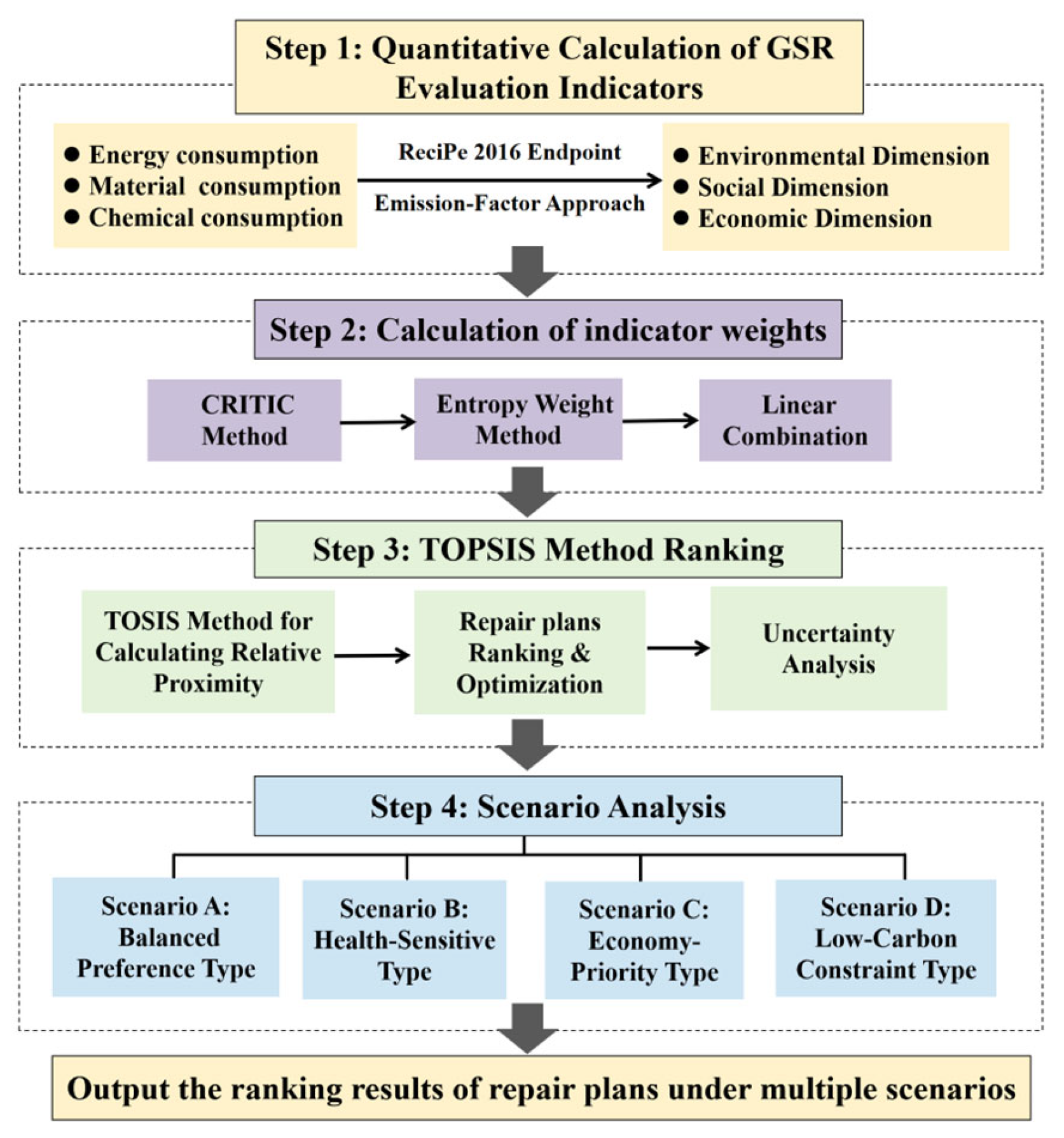
The technical framework of the developed GSR alternative decision-making model is illustrated in Figure 1, encompassing four main steps: (1) quantitative calculation of evaluation indicators; (2) combined weighting using the CRITIC-Entropy method; (3) alternative ranking via the TOPSIS method; and (4) scenario analysis based on decision preferences.

2.1. Development of the Evaluation Indicator System and Quantification Methods

Establishing a scientifically sound evaluation indicator system is the cornerstone of the GSR alternative decision-making model. The selection of indicators in this study adheres to the following principles: (1) Representativeness: Indicators should comprehensively cover the three core dimensions advocated by GSR—environmental, social, and economic. (2) Comparability: Indicators should demonstrate sufficient discriminatory power among different remediation alternatives, avoiding the introduction of redundant indicators that do not substantially contribute to the decision ranking. (3) Quantifiability: Indicators should possess clear quantification methods and be calculable based on actual engineering data or reliable literature data.
Based on these principles and fully considering the characteristics of engineering practice and data availability for contaminated site remediation in China, the evaluation indicators proposed in the International Standard “Soil quality—Sustainable remediation (ISO 18504:2017)” [24] and the Chinese industry standard “Principles for Green and Sustainable Remediation (T/CAEPI 26-2020)” [25] were appropriately simplified. Ultimately, an evaluation system comprising 3 dimensions and 8 indicators was constructed, as shown in Table 1.
The environmental dimension includes three indicators: carbon footprint, ecosystem quality, and resource scarcity. The carbon footprint quantifies the greenhouse gas emissions equivalent generated per unit volume of remediated soil, directly responding to China’s “Carbon Peak and Carbon Neutrality” strategic goals. It is quantified using an emission factor method based on localized Chinese parameters [26]. The ecosystem quality and resource scarcity indicators evaluate the potential impact of remediation activities on terrestrial, freshwater, and marine ecosystems, and the extent of occupation of natural resources such as fossil fuels, minerals, and freshwater during the remediation process, respectively. Both are quantified using the internationally recognized ReCiPe 2016 endpoint method. This method converts life cycle inventory data into unified endpoint damage values, outputting normalized, dimensionless results. Their numerical values represent the relative magnitude of environmental impact compared to a baseline scenario (global average levels in the year 2000) [27].
The social dimension assesses the potential impacts of contaminated site remediation on the social system. Two indicators were considered in this study: human health and employment. Human health was quantified using the ReCiPe 2016 endpoint method, which is based on the Disability-Adjusted Life Years (DALY) metric and integrates various health risks associated with pollutant emissions, including carcinogenic, non-carcinogenic, and respiratory impacts. The employment indicator reflects the job creation effect induced by remediation activities. The employment effect was estimated using the input–output Life Cycle Assessment (IO-LCA) method. By linking remediation investment to sectoral outputs within the input–output framework and applying sector-specific employment coefficients, the indirect employment generated along the industrial supply chain can be quantified. The detailed calculation procedure can be found in Chen et al. [28].
The economic dimension selects three indicators: economic output, remediation cost and remediation duration. Economic output reflects the capacity of soil remediation activities to stimulate economic growth across the entire supply chain. It was estimated using the IO-LCA method based on the Chinese 2023 non-competitive input–output table [28], in which the Leontief inverse matrix is used to estimate the total sectoral output induced by remediation investment. Remediation cost represents the engineering cost required to remediate one cubic meter of contaminated soil (CNY/m3) and serves as a direct indicator of economic feasibility. Remediation duration refers to the time required to complete the remediation process (days), and shorter remediation periods allow earlier site redevelopment and improved land-use efficiency [17].

2.2. Combined Weighting Using the CRITIC-Entropy Method

The CRITIC method is an objective indicator weighting method that comprehensively considers the variability and conflict of indicators, taking into account both the comparative intensity and the conflict between indicators [29]. However, the single CRITIC method cannot measure the degree of dispersion among indicators. The Entropy Weight method is a weighting method based on information theory, which determines the randomness and disorder by calculating the entropy value, thereby reflecting the amount of information an indicator carries and its degree of dispersion [30,31]. Therefore, this study employs a combined CRITIC–Entropy Weighting approach to overcome the limitations of a single method and improve the objectivity and accuracy of the weights. The main calculation steps are as follows:
  • Data Preprocessing
Assume there are m candidate remediation alternatives and n evaluation indicators, constructing the original decision matrix X = ( x i j ) m × n , where x i j represents the original value of the i alternative under the j indicator. To eliminate deviations caused by differences in dimensions and types (cost-type/benefit-type) among indicators, the range standardization method is used to normalize the original data:
For cost-type indicators:
Z i j = x m a x x i j x m a x x m i n
For benefit-type indicators:
Z i j = x i j x m i n x m a x x m i n
where x m a x and x m i n are the maximum and minimum values of the j indicator, respectively.
2.
Calculating Objective Weights A j  Using the CRITIC Method
S j = i = 1 m ( Z i j Z j ¯ ) 2 m 1
r j k = i = 1 m ( Z i j Z j ¯ ) ( Z i k Z k ¯ ) i = 1 m ( Z i j Z j ¯ ) 2 i = 1 m ( Z i k Z k ¯ ) 2
R j = k = 1 n ( 1 | r j k | )
A j = S j R j j = 1 n S j R j
where S j is the variability of indicator j ; R j is the conflict of indicator j ; and r j k is the correlation coefficient between indicators j and k .
3.
Calculating Weights B j  Using the Entropy Method
p i j = Z i j i = 1 m Z i j
e j = 1 ln m i = 1 m p i j ln p i j
B j = 1 e i j = 1 n 1 e i
where p i j is the characteristic proportion of the i alternative under the j indicator; e j is the entropy value of the j indicator.
4.
Calculating Combined Weights C j
C j = α A j + ( 1 α ) B j
Given that data dispersion, variability, and correlation are equally important, the linear weighted combination method is used to calculate the combined weights (α = 0.5) [32].

2.3. Alternative Ranking Using the TOPSIS Method

In MCDA, commonly used ranking methods include the AHP, ELECTRE, and TOPSIS [33]. The AHP determines indicator weights by constructing a judgment matrix and conducting pairwise comparisons. However, this approach relies heavily on expert judgment and may suffer from consistency issues when the number of evaluation indicators increases [34]. The ELECTRE method belongs to the family of outranking-based approaches, in which alternatives are compared pairwise through concordance and discordance relations. However, due to its non-compensatory structure, ELECTRE may result in partial rankings or incomparability among alternatives, and its computational procedure is relatively complex [35]. Compared with these approaches, TOPSIS ranks alternatives according to their distances from the ideal and negative ideal solutions, producing a clear and continuous ranking [36,37]. The specific steps are as follows:
  • Construct the weighted normalized decision matrix: Multiply the standardized data Z i j by the weight W j (which will be C j for the baseline scenario or the scenario-adjusted coefficient W j k for specific scenarios, see Section 2.2) to obtain
    V i j = Z i j × W j
  • Determine the Ideal Solution A j + and the Negative-Ideal Solution A j for each indicator:
    A j + = { A 1 + , A 2 + , , A n + }
    A j = { A 1 , A 2 , , A n }
  • Calculate the weighted Euclidean distances D i + and D i of each alternative from the ideal and negative-ideal solutions:
    D i + = j = 1 n [ W j ( A i j A j + ) ] 2
    D i = j = 1 n [ W j ( A i j A j ) ] 2
  • Calculate the relative closeness C i for each alternative:
    C i = D i D i + D i +
    A larger C i value indicates a better alternative.

2.4. Scenario Analysis Based on Decision Preferences

To account for variations in value preferences arising from differences in policy orientation, management objectives, and stakeholder demands in actual contaminated site remediation decision-making, and to enhance the model’s applicability across diverse scenarios, this study introduces a scenario analysis module. This module dynamically adjusts the importance of specific indicators based on the baseline objective weights, thereby simulating optimal solution selection under different value orientations.
Reflecting common policy goals and management needs in remediation practice, this study constructs four typical decision scenarios as foundational templates for model application. In practice, decision-makers can adjust or expand these scenarios based on site contamination characteristics, land use types, local policy requirements, and owner demands.
Scenario A (Balanced-Preference Type) represents a baseline situation with no specific policy constraints or stakeholder preferences. The decision objective is to seek a comprehensive balance among the environmental, social, and economic dimensions, using the baseline objective weights C j calculated by the CRITIC–Entropy method.
Scenario B (Health-Sensitive Type) simulates situations where sensitive targets such as schools, hospitals, or residential areas are located near the site. Decision-makers place greater emphasis on the potential health impacts of remediation activities. In this scenario, a higher weight is assigned to the “Human Health” indicator.
Scenario C (Economy-Priority Type) simulates contexts with strong budgetary constraints or high demands for timely site redevelopment, such as urban renewal and industrial redevelopment projects. In this scenario, higher weights are assigned to the “Remediation Cost” and “Remedial Duration” indicators.
Scenario D (Low-Carbon Constraint Type) emphasizes carbon reduction goals. In this scenario, the weight of the “Carbon Footprint” indicator is increased.
To quantify the intensity of preference under different scenarios, a preference coefficient vector P k = ( p 1 k , p 2 k , , p n k )   is introduced based on the baseline objective weights C j . Here, p j k represents the degree of importance adjustment for the indicator j under scenario k . with its value range set as { 0 ,   0.1 ,   0.2 , ,   1.0 } . A value of  p j k = 0 indicates that the indicator is not additionally emphasized in the corresponding scenario; values of p j k = 0.1 , 0.2 , ,   1.0 respectively represent increasing the indicator’s importance by 10% to 100% relative to its baseline weight. This setting ensures fine-grained expression of preferences while maintaining operational feasibility in parameter selection, allowing decision-makers to flexibly choose an appropriate preference level based on actual conditions such as policy stringency, public concern, or economic pressure. For clarity of comparison, the maximum value of 1.0 was applied to the emphasized indicators in Scenarios B, C, and D in this case study.
Under a specific scenario k , the scenario-adjusted coefficient W j k for each indicator is obtained by adjusting the baseline objective weights C j with the preference coefficient p j k and then normalizing:
W j k = C j ( p j k + 1 ) j = 1 n [ C j ( p j k + 1 ) ]
Substituting this scenario-adjusted coefficient W j k into the TOPSIS model in Section 2.3 yields the alternative ranking for that scenario.

3. Case Study and Results

3.1. Site Description and Remediation Alternatives

3.1.1. Site Description

The study site is located in Jiangsu Province, China, on a former chemical pharmaceutical factory site that has been relocated. Historically, the facility produced chemical synthetic drugs, tablets, and capsules. The future land use is planned for residential purposes. According to the site investigation and risk assessment report, the soil exhibits both single and co-contamination. The primary contaminants include two heavy metals (arsenic and nickel), three semi-volatile organic compounds (benzo[a]pyrene, dibenzo[a,h]anthracene, and aniline), as well as total petroleum hydrocarbons (TPH, C10–C40). The maximum remediation depth of the contaminated soil is approximately 9.0 m, and the total volume of contaminated soil requiring remediation is about 6.7 × 10⁴ m3. Among this, heavy metal-contaminated soil accounts for approximately 3.33 × 10⁴ m3, organically contaminated soil accounts for 2.73 × 10⁴ m3, and soil with combined heavy metal and organic contamination accounts for 0.64 × 10⁴ m3. Different remediation technologies are required to effectively address these different types of contamination. According to local land-use planning, the site is proposed for residential use.

3.1.2. Remediation Alternatives

The feasibility study report for this site proposed three alternative remediations. The estimated engineering quantities, remediation costs, and project durations for these alternatives are summarized in Table 2.
Alternative 1 (Alt. 1, Cement Kiln Co-processing, CKC): This alternative employs cement kiln co-processing technology to treat all types of contaminated soils, including heavy metal-contaminated soil, organic-contaminated soil, and mixed contaminated soil. The technology utilizes the high-temperature conditions in cement kilns to stabilize and safely dispose of contaminants while allowing resource recovery. The nearest cement kiln co-processing facility is located approximately 42 km from the site.
Alternative 2 (Alt. 2, Ex situ Soil Washing + Ex situ Thermal Desorption, ESSW + ESTD): This alternative adopts a combined treatment approach depending on the contamination type. Heavy metal-contaminated soils are treated using ex situ soil washing technology, while organically contaminated soils are treated using ex situ thermal desorption. For soils with combined contamination, thermal desorption is first applied to remove organic pollutants, followed by chemical soil washing to remove heavy metals.
Alternative 3 (Alt. 3, Ex situ Solidification/Stabilization + Ex situ Thermal Desorption, ESS + ESTD): In this alternative, heavy metal-contaminated soils are treated using ex situ stabilization/solidification technology, whereas organically contaminated soils are treated using ex situ thermal desorption. For mixed contaminated soils, thermal desorption is first used to remove organic pollutants, after which stabilization/solidification is applied to immobilize heavy metals.
To ensure comparability among different alternative remediations, the functional unit in this study was defined as the remediation of 1 m3 of contaminated soil to meet the remediation target values. The system boundary encompasses the entire life cycle of the remediation project from on-site construction to final disposal. Specific stages include: excavation of contaminated soil, pre-treatment, primary treatment, transport, wastewater and exhaust gas treatment, and final disposal of treated soil or residues. The boundary excludes preliminary phases such as site investigation, feasibility studies, and engineering design, as well as post-remediation long-term monitoring and site redevelopment.

3.2. Data Inventory and Calculation Methods

The life cycle inventory data for the three remediation alternatives are summarized in Table 3. The data are derived from engineering quantity estimates based on the site’s design and reference values from the published literature on similar remediation projects [38,39,40,41,42,43,44], serving as foundational input for the subsequent quantitative assessment model. For Alt. 1 (CKC), the baseline energy consumption of the cement kiln was allocated according to the mass ratio between the treated contaminated soil and the clinker production capacity, following the approach proposed by Tian et al. [44], to avoid the potential underestimation of environmental burdens associated with the incremental-energy-only assumption.
The quantification tools and methods employed are as follows:
Life Cycle Impact Assessment (LCIA): The SimaPro 9.6.0.1 (with the Ecoinvent 3 database) was used to assess the ecosystem damage, resource consumption, and human health damage for the three alternatives. The ReCiPe 2016 methodology was selected for impact assessment.
Input–Output Life Cycle Assessment (IO-LCA): Employment and economic output indicators were calculated based on an input–output analysis approach. The non-competitive input–output table and sectoral employment data were obtained from the China Statistical Yearbook (2025) [45].
Carbon Footprint Accounting: A carbon emission factor method based on localized Chinese parameters was applied. Emission factors were sourced from the China Products Carbon Footprint Factors Database [46] and relevant studies on China’s regional grid emission factors [47].
Uncertainty Analysis: Monte Carlo simulation (with 10,000 iterations) was performed on the ranking results using Oracle Crystal Ball software 11.1.3.0.0.
Data Processing and Visualization: SPSS 31.0 was used for data processing, and Origin 2026 was employed for chart creation.

3.3. Results and Analysis

3.3.1. GSR Alternative Decision-Making Model Comparison Results

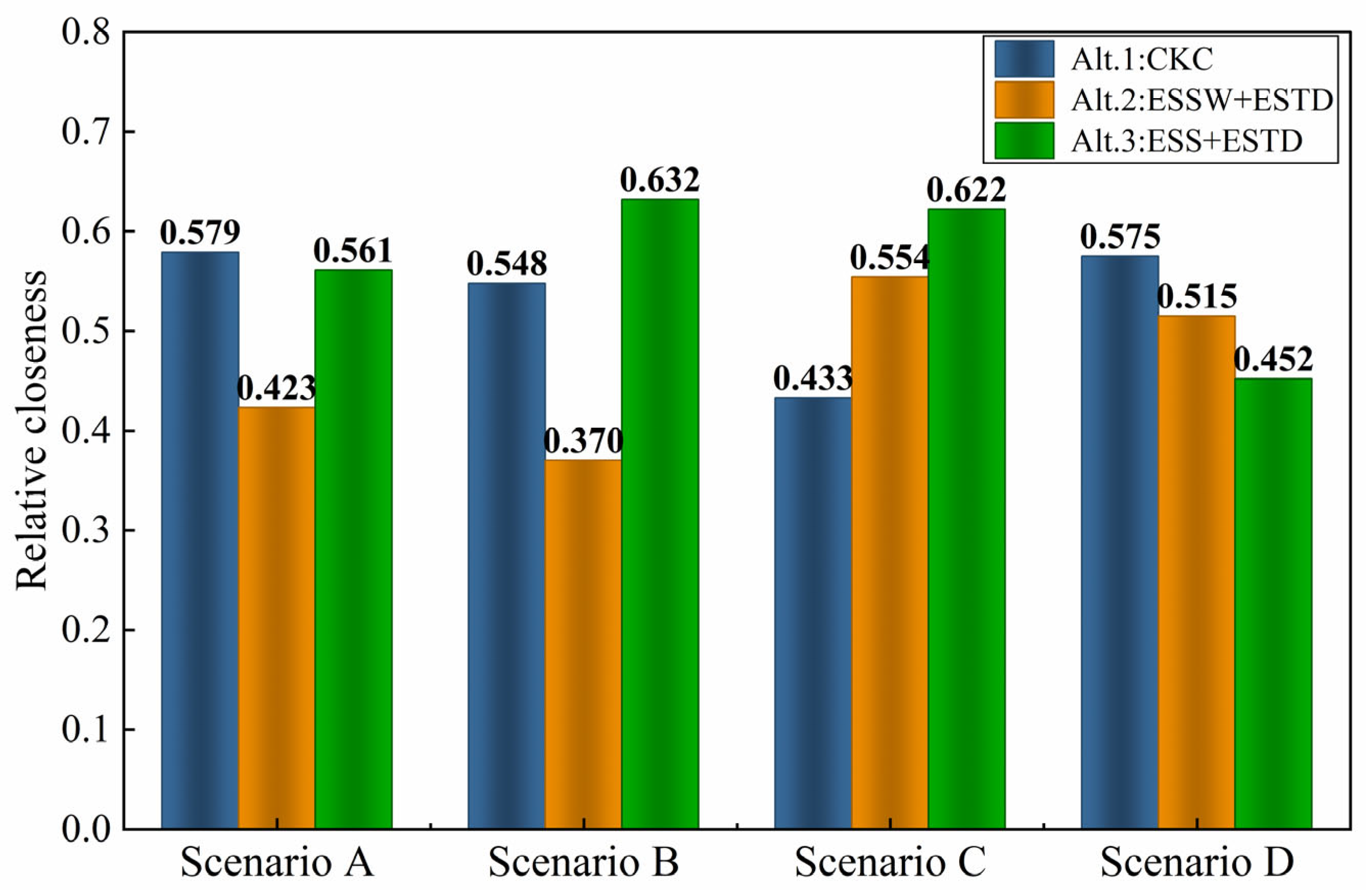
The quantified results of the evaluation indicators for each alternative are presented in Table 4. These values were input into the GSR decision model to calculate the scenario-adjusted weights (Table 5) and the ranking based on relative closeness coefficient (Figure 2). The relative closeness C i ranges from 0 to 1, with a higher value indicating that the alternative’s overall performance is closer to the positive ideal solution, i.e., the better the alternative.
As shown in Figure 2, the optimal remediation alternative is strongly influenced by decision-making preferences, demonstrating that the proposed model can effectively adapt to different policy priorities and management objectives:
Under Scenario A (balanced-preference), no additional preference was imposed, and the objective weights derived from the CRITIC–Entropy method were directly adopted. The results show that Alt. 1 (CKC) achieved the highest relative closeness coefficient (0.579), followed by Alt. 3 (ESS + ESTD) with a value of 0.561 and Alt. 2 (ESSW + ESTD) with 0.423. This indicates that Alt. 1 performs relatively well in balancing environmental, social, and economic objectives simultaneously. Specifically, Alt. 1 exhibits moderate levels of ecosystem quality (0.000330) and resource scarcity (0.000391) while also providing the highest economic output (8.72 × 10³ CNY/m3) and stronger employment benefits. Consequently, when no preference adjustment is applied and all indicators are considered comprehensively, Alt. 1 is the optimal choice.
Under Scenario B (health-sensitive), when the weight of the “Human Health” indicator is increased, the optimal alternative shifts from Alt. 1 to Alt. 3, with Alt. 1 ranking second and Alt. 2 remaining in third place. This shift is primarily attributed to the fact that Alt. 3 has the lowest human health damage value, while Alt. 2 exhibits the highest due to its extensive use of chemical reagents, and Alt. 1 falls in the middle due to emissions from substantial coal combustion. Therefore, when sensitive areas such as schools or residential zones are located near the remediation site, Alt. 3, should be prioritized as the preferred option.
Under Scenario C (economy-priority), Alt. 3 emerges as the optimal option, followed by Alt. 2, while Alt. 1 ranks the lowest. Although Alt. 2 has the lowest cost (1105 CNY/m3) and the shortest remediation duration (180 days), the advantages of Alt. 3 in key indicators such as human health damage and ecological impacts remain significant after weight adjustment, resulting in a higher overall relative closeness than Alt. 2. This indicates that, under decision contexts characterized by budget constraints or tight redevelopment schedules, economic indicators alone are insufficient to determine the optimal alternative, and social and environmental factors must also be taken into account.
Under Scenario D (low-carbon constraint), when the weight of carbon footprint is significantly increased, Alt. 1 becomes the optimal option again, followed by Alt. 2, while Alt. 3 ranks the lowest. Although Alt. 2 performs best in terms of carbon footprint (123.31 kg CO2-eq/m3), it exhibits the highest values in human health damage, resource consumption, and ecosystem damage. In contrast, Alt. 1 performs better across multiple indicators, including economic output, employment, and several environmental metrics. Therefore, Alt. 1 still achieves superior overall performance after multi-criteria weighting.

3.3.2. Life Cycle Assessment Results

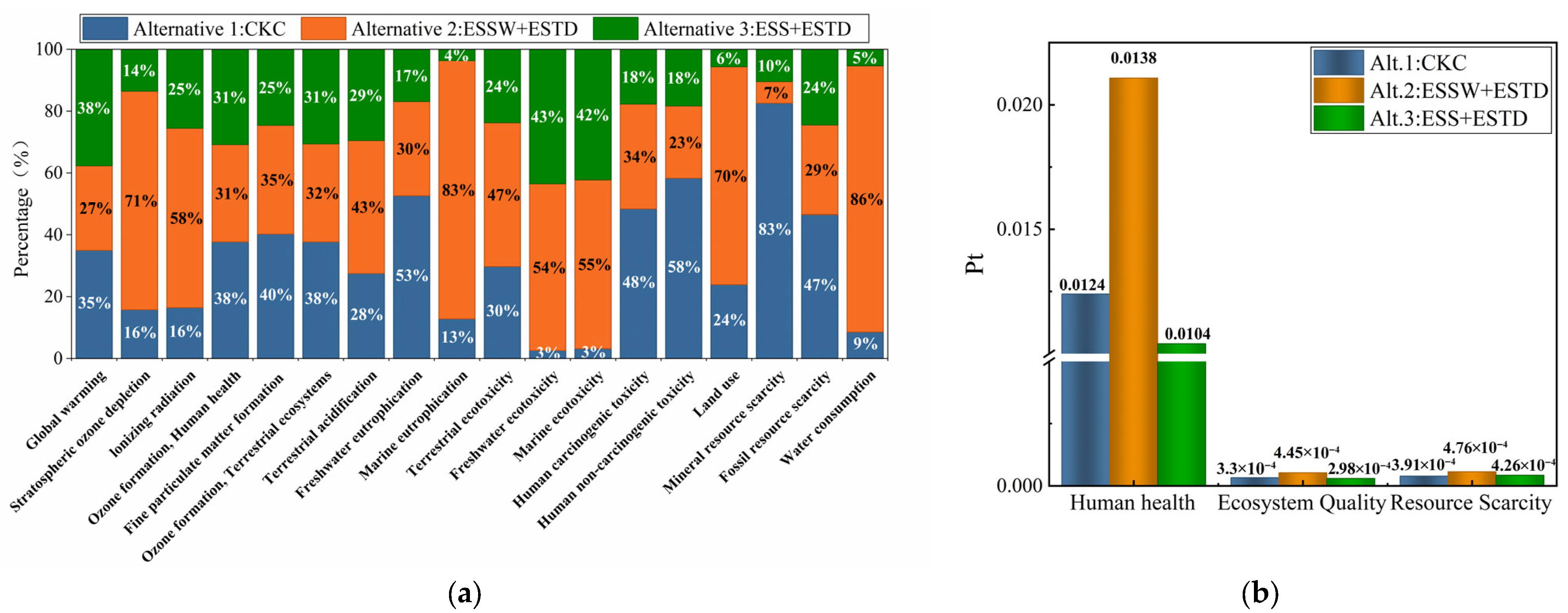
To identify the environmental impact differences among the alternatives in detail, a life cycle impact assessment was conducted using the ReCiPe 2016 midpoint method (Figure 3a). The results show the following:
Alt. 1 (CKC) shows the highest contributions in several midpoint categories, including ozone formation (human health and terrestrial ecosystems), fine particulate matter formation, freshwater eutrophication, human carcinogenic and non-carcinogenic toxicity, as well as mineral and fossil resource scarcity. These impacts are mainly associated with the process characteristics of CKC. Specifically, the extensive combustion of coal releases nitrogen oxides, sulfur oxides, and particulate matter precursors, thereby contributing to photochemical pollution and respiratory health effects. In addition, the calcination of limestone and the substantial consumption of mineral raw materials (e.g., clay and iron slag) further increase resource depletion indicators.
Alt. 2 (ESSW + ESTD) exhibits the highest contributions in terrestrial acidification, marine eutrophication, terrestrial ecotoxicity, freshwater ecotoxicity, and water consumption. These impacts primarily arise from the extensive use of chemical reagents such as EDTA and citric acid in the soil washing process. The production and application of these reagents introduce potential ecological toxicity, while the washing process itself involves substantial water consumption.
Alt. 3 (ESS + ESTD) shows the largest relative contribution to global warming potential. This is mainly attributed to two key processes. First, the continuous combustion of natural gas in the thermal desorption unit generates considerable direct carbon dioxide emissions. Second, the large quantities of cementitious materials required for stabilization/solidification, such as cement and lime, are associated with significant carbon emissions during their production.
Figure 3b presents the endpoint damage results for the different remediation alternatives. It can be observed that Alt. 2 (ESSW + ESTD) exhibits the highest impacts on human health, ecosystem quality, and resource scarcity. In contrast, Alt. 3 (ESS + ESTD) shows the lowest impacts on human health and ecosystem quality, while Alt. 1 (CKC) demonstrates relatively lower impact in terms of resource scarcity.
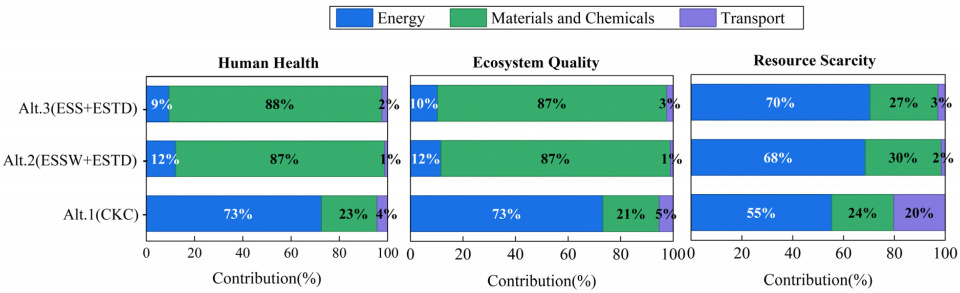
To further trace the sources of environmental impact, Figure 4 presents the contribution of major input categories to the endpoint damages. The results indicate that energy consumption is the dominant driver of resource scarcity impacts across all three alternatives. For Alt. 2 and Alt. 3, material and chemical reagent inputs are the primary contributors to human health and ecosystem damages. In contrast, for Alt. 1, energy consumption not only dominates resource-related impacts but also significantly contributes to damages to human health and ecosystem quality.
These findings suggest that green optimization strategies should be technology-specific. For CKC, priority should be given to fuel substitution, energy efficiency improvements, and emission control during combustion processes. For ESSW and ESS, efforts should focus on reducing chemical reagent consumption, developing environmentally friendly alternative materials, and optimizing process integration.

3.3.3. Carbon Footprint Analysis and Carbon Emission Reduction Pathways

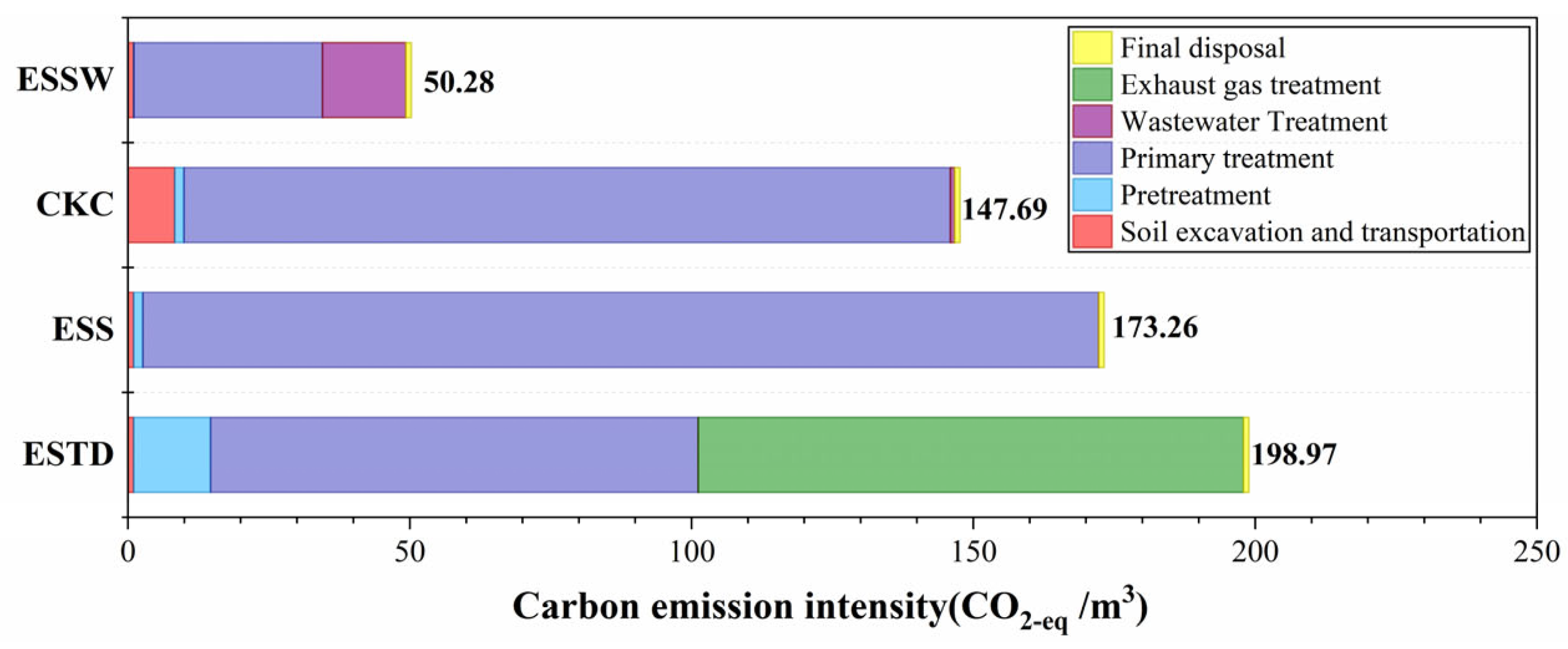
Carbon footprint accounting for the entire remediation process was conducted using the IPCC emission factor method. The results indicate that the carbon emission intensities per unit volume of treated soil are as follows: Alt. 1 (CKC): 147.69 kg CO2-eq/m3; Alt. 2 (ESSW + ESTD): 123.31 kg CO2-eq/m3; and Alt. 3 (ESS + ESTD): 178.41 kg CO2-eq/m3. A comparison of the carbon emission intensity of individual remediation technologies (Figure 5) shows the following descending order: ESTD > ESS > CKC > ESSW. For all technologies except ESTD, the primary treatment process contributed the highest share of carbon footprint, while soil excavation, transportation, and pretreatment stages had relatively low contributions. This ranking indicates that high-temperature thermal treatment and material-intensive processes are the key contributors to carbon emissions in contaminated site remediation. Except for thermal desorption, the largest share of carbon emissions in the other three technologies is associated with the main treatment stage, while soil excavation, transportation, pre-treatment, and final disposal contribute relatively less.
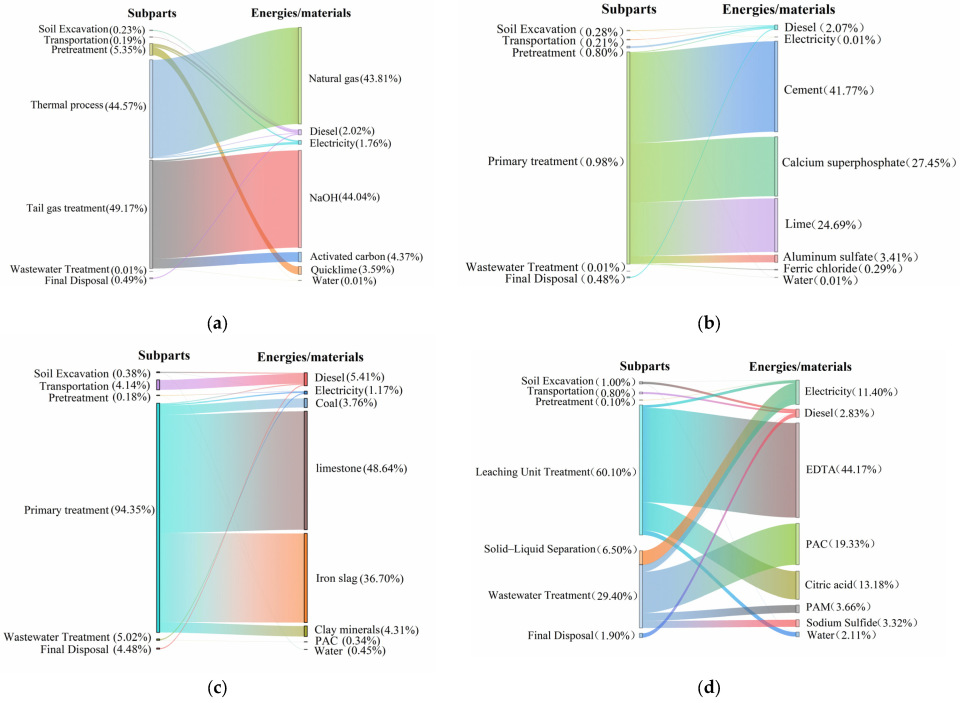
To explore carbon emission reduction pathways, Figure 6 further analyzes the contributions of major process stages and energy/material inputs to the carbon footprint. For ESTD (Figure 6a), the dominant emission sources are sodium hydroxide used in off-gas treatment (49.17%) and natural gas consumption for soil heating (43.81%). This suggests that carbon mitigation for thermal desorption should not be limited to energy substitution alone but should also include optimization of the off-gas treatment system. Potential low-carbon pathways include improving thermal efficiency, enhancing waste heat recovery, reducing reagent consumption in flue gas treatment, and adopting electrification or low-carbon heat sources.
For ESS (Figure 6b), the primary contributors to carbon emissions are cement, lime, and phosphate materials, which together account for 93.91% of the total carbon emissions. This indicates that emissions are predominantly driven by the production of cementitious materials. Therefore, carbon mitigation strategies should focus on developing low-carbon binders, increasing the substitution rate of industrial by-products, and optimizing formulations to reduce material consumption per unit of treated soil.
For CKC (Figure 6c), the main treatment stage and transportation stage are the primary sources of carbon emissions. Due to the relatively long transport distance of contaminated soil (42 km to the nearest cement kiln facility in this case), transport-related emissions cannot be neglected. Therefore, carbon mitigation strategies should prioritize improving kiln energy efficiency and optimizing transportation logistics, such as increasing the use of alternative fuels, reducing transport distances, and optimizing vehicle types. Previous studies have shown that, during soil transportation, medium-duty trucks can significantly reduce carbon emissions compared to both heavy-duty and light-duty trucks [48].
For ESSW (Figure 6d), the major carbon sources are washing reagents (e.g., EDTA and citric acid) and wastewater treatment chemicals (e.g., PAC). Similarly, Espada et al. [49] reported that hydrochloric acid used as a washing agent is the dominant contributor to environmental impacts in soil washing processes. This indicates that although soil washing has relatively low direct energy consumption, its reagent-dependent nature shifts a significant portion of emissions upstream to chemical production processes. Therefore, the key mitigation strategy for this technology lies in developing or selecting low-carbon and environmentally friendly alternative reagents.

3.4. Uncertainty and Sensitivity Analysis

3.4.1. Uncertainty Analysis

Due to the fact that key parameters in remediation projects, such as energy consumption, material usage, and transportation distances, are primarily derived from engineering design documents and literature data, deviations from actual construction conditions are inevitable [50]. To evaluate the impact of input data uncertainty on the decision-making results, Monte Carlo simulation was performed using Oracle Crystal Ball software.
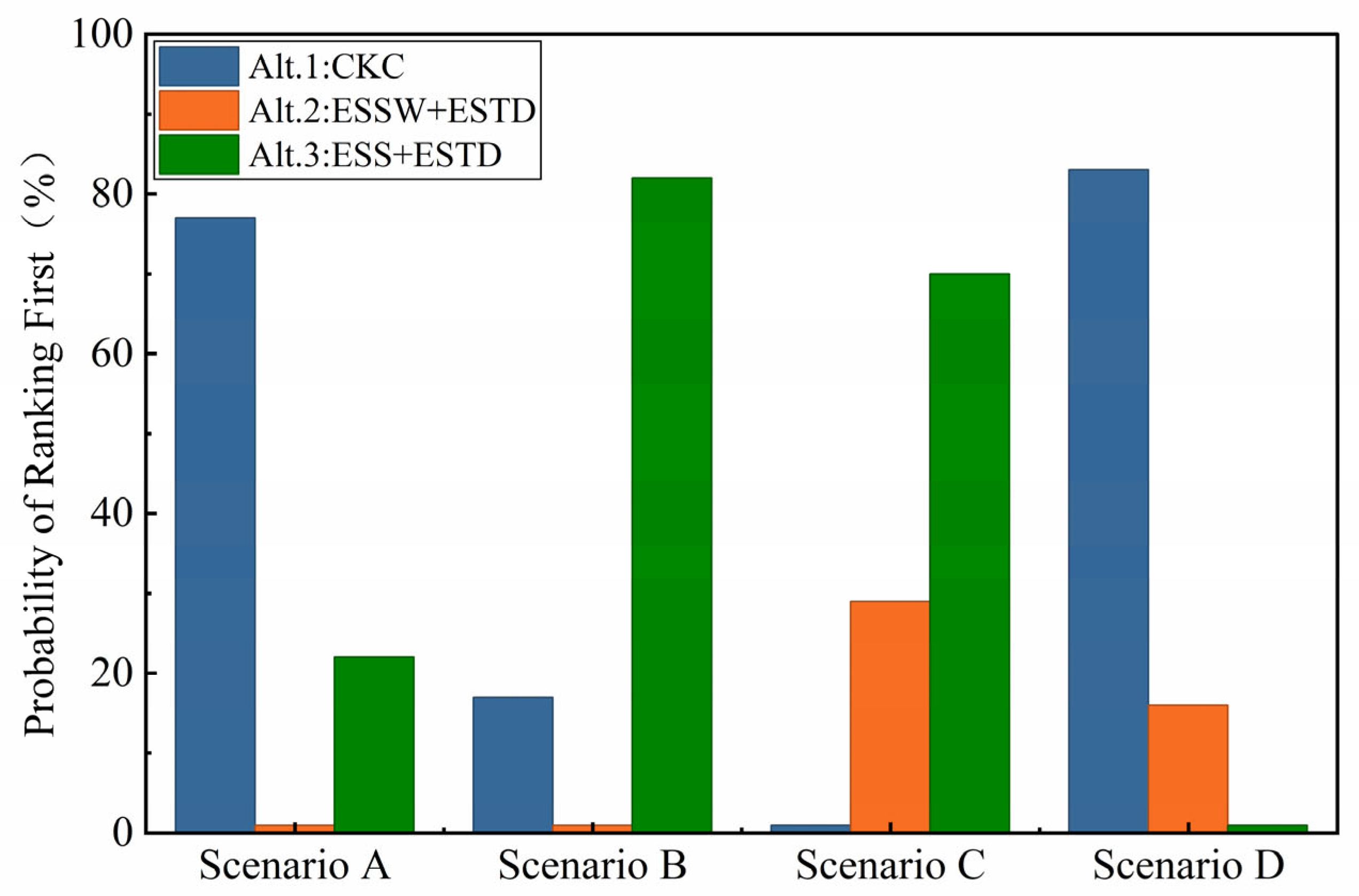
In the simulation, 10,000 random iterations were conducted, and a ±10% variation range was applied to the input values of all evaluation indicators in Table 4. In each iteration, TOPSIS relative closeness was recalculated, thereby obtaining the probability distribution of ranking positions for each alternative under different decision scenarios (Table 6), as well as the probability of each alternative being ranked as the optimal option (Figure 7).
As shown in Figure 7, under input data uncertainty, the alternatives ranked first in each decision scenario exhibit a relatively high level of stability. Specifically, under Scenario A (balanced-preference), Alt. 1 (CKC) ranks first with a probability of 77%. Under Scenario B (health-sensitive), Alt. 3 (ESS + ESTD) shows the highest probability of being optimal (82%). Under Scenario C (economy-priority), Alt. 3 (ESS + ESTD) ranks first with probabilities of 70%. Under Scenario D (low-carbon constraint), Alt. 1 (CKC) ranks first with a probability of 83%.
However, the analysis also reveals a certain degree of overlap in ranking probabilities among alternatives. For instance, under the baseline Scenario C, Alt. 2 (ESSW + ESTD) still has a 29% probability of being ranked as the optimal option (Table 6). This phenomenon can be attributed to the relatively small differences in some evaluation indicators (e.g., certain environmental impact indicators) among the alternatives. Within the ±10% perturbation range, small variations in input data may be sufficient to alter the relative advantage of specific indicators, leading to probabilistic rank reversals.
Therefore, the model output should be interpreted as a probabilistic decision outcome rather than a strictly deterministic ranking. For decision-makers, when a particular alternative achieves a significantly higher probability (e.g., >60%) of being optimal under a given scenario, it can be considered to have high decision reliability. Meanwhile, overlapping probability regions indicate that when the advantage of the leading alternative is not overwhelmingly dominant, additional factors (such as technological maturity and site-specific implementation conditions) should be taken into account.

3.4.2. Sensitivity Analysis of Preference Coefficients

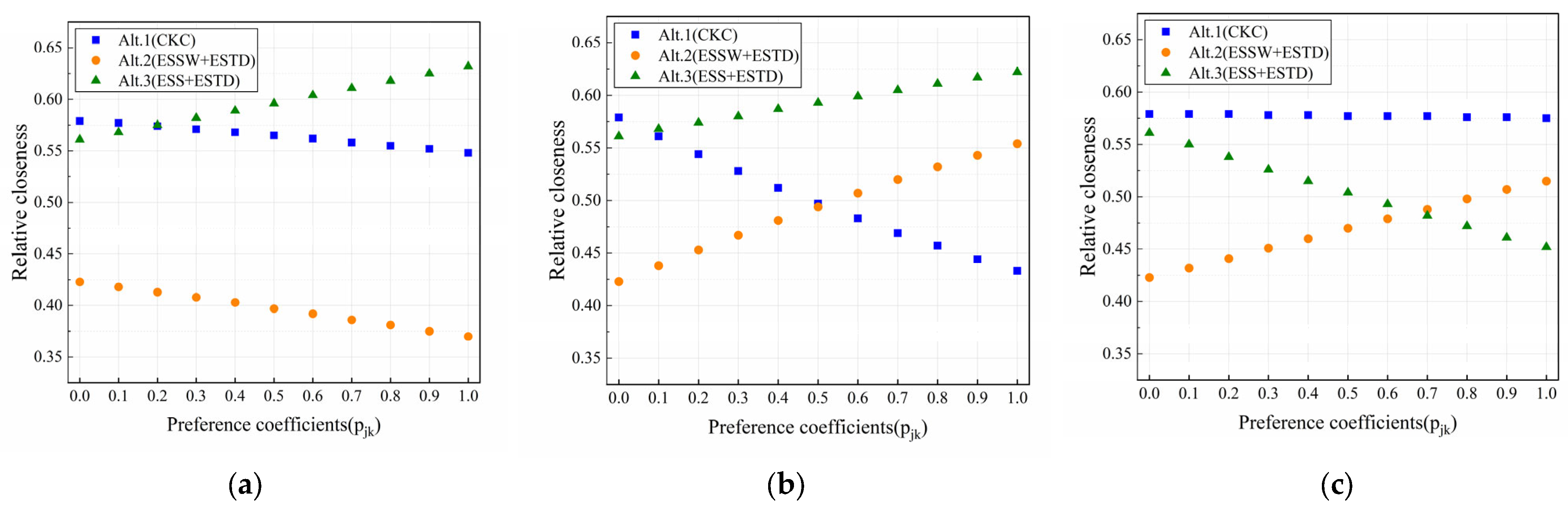
To further investigate the influence of the preference coefficient values on the model results, sensitivity analysis was conducted under three decision scenarios: Scenario B (health-sensitive), Scenario C (economy-priority), Scenario D (low-carbon constraint). The preference coefficients p j k   of the core indicators were increased from 0.1 to 1.0 (with a step size of 0.1), corresponding to a 10–100% increase in their importance relative to the baseline objective weights. The scenario-adjusted weights were recalculated and incorporated into the TOPSIS model to obtain the relative closeness  C i of each alternative under different preference intensities (Figure 8).
As shown in Figure 8a, under the Scenario B (health-sensitive), as the weight of the human health damage indicator increases, the relative closeness of Alt. 3 (ESS + ESTD) rises continuously and surpasses that of Alt. 1 (CKC) at p j k = 0.2, becoming the optimal alternative and maintaining its advantage thereafter. This indicates the existence of a clear threshold effect for health preference in this case, where the optimal solution shifts once the emphasis on health impact exceeds approximately 20% of the baseline weight.
As shown in Figure 8b,c, under the Scenario C (economy-priority) and Scenario D (low-carbon constraint), despite increasing the weights of remediation cost and duration, as well as carbon footprint, respectively, the optimal alternative does not correspond to the one that performs best in the emphasized criterion. Specifically, under Scenario C (economy-priority), although Alt. 2 (ESSW + ESTD) has the lowest cost and shortest duration, Alt. 3 (ESS + ESTD) remains optimal; under Scenario D (low-carbon constraint), although Alt. 2 (ESSW + ESTD) achieves the lowest carbon footprint, Alt. 1 (CKC) consistently ranks first. Only when the preference intensity is further increased (e.g., approximately 60% for Scenario C and 70% for Scenario D) do changes occur in the ranking of sub-optimal alternatives. These results indicate that GSR decision-making is inherently a multi-dimensional trade-off among environmental, social, and economic criteria. Even when the weight of a specific core indicator is significantly increased, superiority in a single criterion may not translate into overall optimality, as disadvantages in other dimensions can offset its benefits. Changes in preference intensity modify the weight structure and, consequently, the relative contributions of different criteria, leading to shifts in ranking outcomes and exhibiting distinct threshold effects.
Overall, when preference intensity exceeds certain critical levels (approximately 20% for Scenario B, 10% for Scenario C, and 70% for Scenario D), the ranking of alternatives may change. This not only demonstrates the model’s responsiveness to variations in the preference coefficients p j k  but also provides a reference for the selection of preference coefficients in decision-making for contaminated sites with similar pollution characteristics.

4. Discussion and Conclusions

This study constructed a multi-dimensional quantitative decision-making model that integrates CRITIC–Entropy Weighting, TOPSIS ranking, and scenario analysis to support the selection of Green and Sustainable Remediation (GSR) alternatives for contaminated sites. The model was applied to a typical co-contaminated site in Jiangsu Province, China, to demonstrate its effectiveness and practical applicability.
The research findings indicate that the identification of the optimal remediation alternative is heavily contingent upon decision contexts and stakeholder priorities. Under the balanced scenario and low-carbon constraint scenario, Alt. 1 (CKC) is optimal; under the health-sensitive scenario and economy-priority scenario, Alt. 3 (ESS + ESTD) is optimal. This indicates that there is no universally optimal remediation solution independent of context; rather, the best choice is jointly determined by site-specific contamination characteristics, land-use objectives, and policy constraints.
Through Life Cycle Assessment and carbon footprint tracing, this study further identified the key environmental impact stages and major carbon emission sources of each remediation technology. The results indicate that green optimization strategies should be technology-specific: for CKC and ESTD, priority should be given to clean energy substitution, energy efficiency improvement, and emission control during combustion processes; for ESSW and ESS, efforts should focus on reducing reagent consumption, developing environmentally friendly alternative materials, and increasing the utilization of industrial by-products.
The uncertainty analysis based on Monte Carlo simulation demonstrates that, despite inherent variability in input data and model parameters, the ranking results remain stable across scenarios. Notably, the probability of the optimal alternative being ranked first is ≥70% in all scenarios, indicating a relatively high level of robustness. Therefore, the model output should be interpreted as a probabilistic decision result rather than a deterministic ranking. For decision-makers, when a specific alternative shows a high probability (e.g., >60%) of being optimal under a given scenario, it can be regarded as a reliable choice. Meanwhile, overlapping probability distributions among alternatives suggest that, when the advantage is not overwhelmingly dominant, additional factors—such as technological maturity, site-specific implementation conditions, and regulatory acceptance—should be considered.
Additionally, the proposed model is applicable to Green and Sustainable Remediation decision-making across different types of contaminated sites. By updating life cycle inventory data and remediation technology parameters, the model can be readily extended to sites with varying contamination characteristics, land-use objectives, and regional policy contexts. Furthermore, in practical applications, additional decision scenarios can be incorporated as needed, allowing the framework to be effectively aligned with diverse policy objectives.

Author Contributions

Conceptualization, Z.W. and L.W.; methodology, Z.W.; software, L.W.; validation, Z.W., Y.S. and L.W.; formal analysis, Z.W.; investigation, Z.W.; resources, L.W.; data curation, Z.W.; writing—original draft preparation, Z.W.; writing—review and editing, L.W. and Z.W.; visualization, Z.W.; supervision, L.W.; project administration, L.W.; funding acquisition, L.W. All authors have read and agreed to the published version of the manuscript.

Funding

This research was funded by the National Key Research and Development Program of China (No. 2023YFC3709600).

Institutional Review Board Statement

Not applicable.

Informed Consent Statement

Not applicable.

Data Availability Statement

The original contributions presented in this study are included in the article. Further inquiries can be directed to the corresponding author.

Conflicts of Interest

The authors declare no conflicts of interest.

References

  1. Hou, D.; Al-Tabbaa, A.; O’Connor, D.; Hu, Q.; Zhu, Y.; Wang, L.; Kirkwood, N.; Ok, Y.; Tsang, D.; Bolan, N.; et al. Sustainable remediation and redevelopment of brownfield sites. Nat. Rev. Earth Environ. 2023, 4, 271–286. [Google Scholar] [CrossRef]
  2. Li, Y.; Jia, S.; Liu, J. Solidification, remediation and long-term stability of heavy metal contaminated soil under the background of sustainable development. Sci. Rep. 2022, 12, 16. [Google Scholar] [CrossRef]
  3. Yang, Z.; Wang, Q.; Wei, C.; Zhang, Z.; Tang, Z.; Li, Y.; Luo, G.; Coulon, F.; Fan, L.; Song, X. Quantitative sustainability assessment of in situ thermally enhanced bioremediation for carbon efficient groundwater remediation. Sustain. Prod. Consump. 2026, 63, 19–33. [Google Scholar] [CrossRef]
  4. Hou, D.; O’Connor, D. Green and sustainable remediation: Concepts, principles, and pertaining research. In Sustainable Remediation of Contaminated Soil and Groundwater; Elsevier: Amsterdam, The Netherlands, 2020; pp. 1–17. [Google Scholar]
  5. Lee, H.; Sam, K.; Coulon, F.; De Gisi, S.; Notarnicola, M.; Labianca, C. Recent developments and prospects of sustainable remediation treatments for major contaminants in soil: A review. Sci. Total Environ. 2024, 912, 16. [Google Scholar] [CrossRef]
  6. Xiao, M.; Zhang, H.; Li, X.; Zhang, C.; Zhu, M.; Dong, J.; Meng, H.; Liu, P.; Deng, J.; Shi, H.; et al. Coupling life cycle assessment with social media-based matrices for multidimensional sustainability assessment of site remediation. Resour. Conserv. Recycl. 2026, 228, 14. [Google Scholar] [CrossRef]
  7. Xiao, M.; Li, X.; Seuntjens, P.; Sharifi, M.; Mao, D.; Dong, J.; Yang, X.; Zhang, H. Qualitative and quantitative simulation of best management practices (BMPs) for contaminated megasite remediation using the SiteWise™ tool. J. Environ. Manag. 2024, 360, 121098. [Google Scholar] [CrossRef]
  8. Sun, X.; Huang, H.; Wang, H.; Zhang, J.; Yang, Y. Discussion of problems in the process of large-scale contaminate sites remediation and project practice. J. Environ. Eng. Technol. 2020, 10, 883–890. [Google Scholar]
  9. Jin, Y.; Wang, L.; Song, Y.; Zhu, J.; Qin, M.; Wu, L.; Hu, P.; Li, F.; Fang, L.; Chen, C.; et al. Integrated Life Cycle Assessment for Sustainable Remediation of Contaminated Agricultural Soil in China. Environ. Sci. Technol. 2021, 55, 12032–12042. [Google Scholar] [CrossRef]
  10. Xiao, M.; Li, X.; Zhang, H.; Meng, H.; Dong, J. Environmental impact assessment and remediation decision-making of a contaminated megasite: Combining LCA and IO-LCA. J. Clean. Prod. 2024, 462, 12. [Google Scholar] [CrossRef]
  11. Li, F.; Fang, L.; Wu, F. A Roadmap for Sustainable Agricultural Soil Remediation Under China’s Carbon Neutrality Vision. Engineering 2023, 25, 28–31. [Google Scholar] [CrossRef]
  12. Xu, Y.; Wang, L.; Li, K.; Wei, L.; Chen, C.; Xiang, L.; Cai, J.; Wang, Z. Multi-tier life cycle assessment for evaluating low carbon strategies in soil remediation. Environ. Impact Assess. Rev. 2024, 106, 9. [Google Scholar] [CrossRef]
  13. Vocciante, M.; de Folly D’Auris, A.; Franchi, E.; Petruzzelli, G.; Ferro, S. CO2 footprint analysis of consolidated and innovative technologies in remediation activities. J. Clean. Prod. 2021, 297, 126723. [Google Scholar] [CrossRef]
  14. Huysegoms, L.; Cappuyns, V. Critical review of decision support tools for sustainability assessment of site remediation options. J. Environ. Manag. 2017, 196, 278–296. [Google Scholar] [CrossRef]
  15. Colapinto, C.; Jayaraman, R.; Ben Abdelaziz, F.; La Torre, D. Environmental sustainability and multifaceted development: Multi-criteria decision models with applications. Ann. Oper. Res. 2020, 293, 405–432. [Google Scholar] [CrossRef]
  16. Labianca, C.; De Gisi, S.; Todaro, F.; Wang, L.; Tsang, D.; Notarnicola, M. A holistic DPSIR-based approach to the remediation of heavily contaminated coastal areas*. Environ. Pollut. 2021, 284, 13. [Google Scholar] [CrossRef]
  17. Liu, X.; Jin, P.; Yang, Z.; Wei, C.; Bardos, P.; Ding, D.; Zhang, Z.; Song, X. An evaluation approach integrating remedial duration for sustainable mega-site remediation in China. Pedosphere 2025, 35, 1026–1038. [Google Scholar] [CrossRef]
  18. An, D.; Xi, B.; Ren, J.; Wang, Y.; Jia, X.; He, C.; Li, Z. Sustainability assessment of groundwater remediation technologies based on multi-criteria decision making method. Resour. Conserv. Recycl. 2017, 119, 36–46. [Google Scholar] [CrossRef]
  19. Priya, L.; Varghese, G.K. ‘Remediability Score’ as a tool for selecting the most suitable remediation technology for contaminated sites. Environ. Sci. Pollut. Res. 2024, 31, 8666–8676. [Google Scholar] [CrossRef]
  20. Li, Y.; Chen, R.; Yang, X.; Liu, X.; Zhu, G.; Hu, Q. A Quantitative Sustainability Assessment Framework for Contaminated Site Remediation: Integrating LCA, Economic Analysis, and Social Big Data. Water 2025, 17, 3416. [Google Scholar] [CrossRef]
  21. Liu, K.; Fang, L.; Li, F.; Hou, D.; Liu, C.; Song, Y.; Ran, Q.; Pang, Y.; Du, Y.; Yuan, Y.; et al. Sustainability assessment and carbon budget of chemical stabilization based multi-objective remediation of Cd contaminated paddy field. Sci. Total Environ. 2022, 819, 12. [Google Scholar] [CrossRef]
  22. Yang, Z.; Wei, C.; Song, X.; Liu, X.; Tang, Z.; Liu, P.; Wei, Y. Thermal conductive heating coupled with in situ chemical oxidation for soil and groundwater remediation: A quantitative assessment for sustainability. J. Clean. Prod. 2023, 423, 10. [Google Scholar] [CrossRef]
  23. Hu, G.; Liu, H.; Chen, C.; He, P.; Li, J.; Hou, H. Selection of green remediation alternatives for chemical industrial sites: An integrated life cycle assessment and fuzzy synthetic evaluation approach. Sci. Total Environ. 2022, 845, 12. [Google Scholar] [CrossRef]
  24. ISO 18504:2017(E); Soil Quality—Sustainable Remediation. International Organization for Standardization (ISO): Geneva, Switzerland, 2017.
  25. T/CAEPI 26-2020; Principles for Green and Sustainable Remediation. China Association of Environmental Protection Industry: Beijing, China, 2020.
  26. Liu, Z.; Li, X.; Yu, J.; Shi, H.; Wang, J.; Ma, F.; Gu, Q. Carbon emissions and reduction potential of ex-situ thermal desorption (ESTD) for contaminated sites based on actual projects in China. J. Clean. Prod. 2025, 507, 9. [Google Scholar] [CrossRef]
  27. Huijbregts, M.A.J.; Steinmann, Z.J.N.; Elshout, P.M.F.; Stam, G.; Verones, F.; Vieira, M.; Zijp, M.; Hollander, A.; van Zelm, R. ReCiPe2016: A harmonised life cycle impact assessment method at midpoint and endpoint level. Int. J. Life Cycle Assess. 2016, 22, 138–147. [Google Scholar] [CrossRef]
  28. Chen, C.; Zhang, X.; Chen, J.; Chen, F.; Li, J.; Chen, Y.; Hou, H.; Shi, F. Assessment of site contaminated soil remediation based on an input output life cycle assessment. J. Clean. Prod. 2020, 263, 10. [Google Scholar] [CrossRef]
  29. Krishnan, A.; Kasim, M.; Hamid, R.; Ghazali, M. A Modified CRITIC Method to Estimate the Objective Weights of Decision Criteria. Symmetry 2021, 13, 20. [Google Scholar] [CrossRef]
  30. Zhang, Z.; Li, J.; Bi, S.; Xu, X.; Lin, R. A comprehensive evaluation method for offshore wind system planning based on improved CRITIC entropy weight combination weighting method. Adv. Technol. Electr. Eng. Energy 2024, 43, 1–10. [Google Scholar]
  31. Chang, B.; Chen, L. Land Economic Efficiency and Improvement of Environmental Pollution in the Process of Sustainable Urbanization: Case of Eastern China. Land 2021, 10, 23. [Google Scholar] [CrossRef]
  32. Fu, W.; Chu, L. Research on the Evaluation of High Quality Development of Manufacturing Industry from the Perspective of Integration of the Yangtze River Delta—TOPSIS Evaluation Model Based on Improved CRITICAL-Entropy Weight Method. J. Ind. Technol. Econ. 2020, 39, 145–152. [Google Scholar]
  33. Malefaki, S.; Markatos, D.; Filippatos, A.; Pantelakis, S. A Comparative Analysis of Multi-Criteria Decision-Making Methods and Normalization Techniques in Holistic Sustainability Assessment for Engineering Applications. Aerospace 2025, 12, 24. [Google Scholar] [CrossRef]
  34. Pascoe, S. A Simplified Algorithm for Dealing with Inconsistencies Using the Analytic Hierarchy Process. Algorithms 2022, 15, 12. [Google Scholar] [CrossRef]
  35. Greco, S.; Slowinski, R.; Wallenius, J. Fifty years of multiple criteria decision analysis: From classical methods to robust ordinal regression. Eur. J. Oper. Res. 2025, 323, 351–377. [Google Scholar] [CrossRef]
  36. Wang, Y.; Liu, P.; Yao, Y. BMW-TOPSIS: A generalized TOPSIS model based on three-way decision. Inf. Sci. 2022, 607, 799–818. [Google Scholar] [CrossRef]
  37. Jeremi, L.; Mohammed, B.; Al-Yacouby, A.; Abbas, F. Optimizing sustainability in cement production: A combined LCA and TOPSIS approach for evaluating GGBS substitution and alternative energy strategies. Carbon Manag. 2026, 17, 22. [Google Scholar] [CrossRef]
  38. Xue, C.; Fang, Z. Path of carbon emission peaking and carbon neutrality in soil remediation industry. Environ. Eng. 2022, 40, 231–238. [Google Scholar]
  39. Xu, P.; Zhou, J.; Han, J.; Tian, Q.; Qu, C. Study on the Collaborative Disposal and Application of Organic and Heavy Metal Polluted Soil in Cement Kilns. J. Green Sci. Technol. 2023, 25, 188–193. [Google Scholar]
  40. Lai, X.; Tang, B.; Liu, Z.; Zhang, Y.; Cai, C. A case study on carbon emission characteristics of soil remediation using ex-situ soil washing technology in lead contaminated site. J. Environ. Eng. Technol. 2025, 15, 1522–1531. [Google Scholar]
  41. Liu, S.; Chen, P.; Song, H.; Chen, K.; Li, H. Carbon emissions and emission reduction strategy for remediation of contaminated soil by ex-situ thermal desorption in East China. Chin. J. Environ. Eng. 2022, 16, 2663–2671. [Google Scholar]
  42. Wang, G.; Li, Y.; Yang, S.; Sun, Z.; Liu, Y. Experimental Study on Washing of Arsenic-contaminated Soil with Different Washing Agents. Saf. Environ. Eng. 2021, 28, 182–187. [Google Scholar]
  43. Zhang, J.; Zhou, L.; Zhou, J.; Wu, W. Life cycle carbon footprint accounting and assessment of risk management and control technologies of typical contaminated sites. China Environ. Sci. 2025, 45, 2932–2940. [Google Scholar]
  44. Liang, T.; Huo, M.; Yu, L.; Wang, P.; Zheng, J.; Zhang, C.; Wang, D.; Ding, A.; Li, F. Life cycle assessment-based decision-making for thermal remediation of contaminated soil in a regional perspective. J. Clean. Prod. 2023, 392, 8. [Google Scholar] [CrossRef]
  45. NBS. China Statistical Yearbook; China Statistics Press: Beijing, China, 2025. [Google Scholar]
  46. Chinese Academy of Environmental Planning; Beijing Normal University; Sun Yat-sen University; China City Greenhouse Gas Working Group. China Products Carbon Footprint Factors Database (2022); Chinese Academy of Environmental Planning: Beijing, China, 2022. [Google Scholar]
  47. Zhang, X.; Xu, K. Statistical data-based prediction of carbon dioxide emission factors of China’s power generation at carbon peak in 2030. Case Stud. Therm. Eng. 2023, 51, 13. [Google Scholar] [CrossRef]
  48. Gao, M.; Tang, H.; Ma, Z.; Li, L.; Yu, S. Data-driven study on key factors for carbon reduction from contaminated soils at regional level—An example of cement kiln co-processing technology. J. Southeast Univ. (Nat. Sci. Ed.) 2025, 55, 903–911. [Google Scholar]
  49. Espada, J.; Rodriguez, R.; Gari, V.; Salcedo-Abraira, P.; Bautista, L. Coupling phytoremediation of Pb-contaminated soil and biomass energy production: A comparative Life Cycle Assessment. Sci. Total Environ. 2022, 840, 10. [Google Scholar] [CrossRef]
  50. Meng, H.; Dong, J.; Zhang, H.; Xiao, M.; Li, L. Calculation method and case analysis of carbon emissions for risk control and management of contaminated sites. China Environ. Sci. 2023, 43, 368–375. [Google Scholar]
Figure 1. Technical roadmap of the GSR alternative decision-making model.
Applsci 16 03247 g001
Figure 2. Relative closeness results of alternatives under different scenarios.
Applsci 16 03247 g002
Figure 3. (a) Life cycle environmental impacts of different remediation alternatives; (b) endpoint environmental impacts of the different remediation scenarios.
Applsci 16 03247 g003
Figure 4. Contributions of major input categories (energy, materials and chemicals, and transport) to the endpoint impact categories for the three remediation alternatives.
Applsci 16 03247 g004
Figure 5. Comparison of carbon emission intensities for different remediation technologies.
Applsci 16 03247 g005
Figure 6. Contribution of process stages and energy/material inputs to the carbon footprint for four remediation technologies, (a) ESTD; (b) ESS; (c) CKC; (d) ESSW.
Applsci 16 03247 g006
Figure 7. Probability of alternatives being ranked first under four decision scenarios.
Applsci 16 03247 g007
Figure 8. Sensitivity of relative closeness to preference coefficient under different decision scenarios: (a) Scenario B (health-sensitive); (b) Scenario C (economy-priority); (c) Scenario D (low-carbon constraint).
Applsci 16 03247 g008
Table 1. GSR evaluation indicator system.
DimensionIndicatorIndicator TypeUnitQuantification Method/Data Source
EnvironmentCarbon FootprintCostkg CO2-eq/m3Emission Factor Method
Ecosystem QualityCostDM 1LCA (ReCiPe 2016 endpoint)
Resource ScarcityCostDM 1LCA (ReCiPe 2016 endpoint)
SocialHuman HealthCostDM 1LCA (ReCiPe 2016 endpoint)
EmploymentBenefitPerson/m3IO-LCA
EconomicEconomic OutputBenefit104 CNY/m3IO-LCA
Remediation CostCostCNY/m3Engineering Budget
Remediation DurationCostdayConstruction Organization Design
1 DM: Dimensionless score from the ReCiPe 2016 endpoint method.
Table 2. Remediation soil volumes for alternative schemes.
Remediation AlternativeRemediation
Technology
Contaminant TypeTreatment Volume (104 m3)Unit Cost (CNY/m3)Total Cost (104 CNY)Remediation Duration (Days)
Alt. 1CKCHeavy metal contamination3.331150383290
CKCOrganic contamination2.731150313880
CKCCo-contamination0.64115073925
Subtotal for Alt. 16.70 7709195
Alt. 2ESSWHeavy metal contamination3.331000333060
ESTDOrganic contamination2.731200327690
ESSW + ESTDCo-contamination0.64125080030
Subtotal for Alt. 26.70 7406180
Alt. 3ESSHeavy metal contamination3.339803263.460
ESTDOrganic contamination2.731200327690
ESS + ESTDCo-contamination0.64140089635
Subtotal for Alt. 36.70 7435.4185
Table 3. Life cycle inventory data for the remediation alternatives.
SubpartsNameUnitAlt. 1 [38,39,44]Alt. 2 [40,41,42]Alt. 3 [41,43]
Soil ExcavationDieselt9.859.859.85
ElectricityKwh1213.201213.201213.20
Watert3970.473970.473970.47
TransportationSoil Transporttkm4.79 × 1065.70 × 1055.70 × 105
Material and chemicals Transporttkm5.93 × 1055.15 × 1043.55 × 105
PretreatmentDieselt29.0721.3138.54
ElectricityKWh-3990.76-
Quicklimet-20.2220.22
Primary treatmentDieselt11.295.6812.52
Natural Gasm3-1.18 × 1061.18 × 106
ElectricityKWh4229.813.10 × 1055.06 × 104
Coalt7501.35--
limestonet9.70 × 104--
Clay mineralst1.08 × 104--
Iron slagt3327.70--
EDTAt-198.96-
Citric Acidt-389.44-
Ferric Chloridet--131.69
Aluminum Sulfatet--553.02
Calcium Superphosphatet--823.56
Cementt--3603.60
Quicklimet--1801.80
Watert-3.00 × 1051997.23
Exhaust Gas TreatmentElectricitykWh-8.43 × 1048.43 × 104
Activated Carbont-3.303.30
Sodium Hydroxidet-168.54168.54
Watert-6741.636741.63
Wastewater TreatmentElectricityt7.77 × 1041.12 × 105352.20
PACt2.01226.34-
PAMt-22.25-
Sodium Sulfidet-22.25-
Final DisposalDieselt11.8711.8712.59
Table 4. Calculated results of evaluation indicators.
Evaluation IndicatorsUnitAlt. 1: CKCAlt. 2: ESSW + ESTDAlt. 3: ESS + ESTD
Carbon Footprintkg CO2-eq/m3147.69123.31178.41
Ecosystem QualityDM0.0003300.0004450.000298
Resource ScarcityDM0.0003910.0004760.000426
Human HealthDM0.01240.01380.0104
EmploymentPerson/m30.0007350.0003700.000534
Economic Output104 CNY/m30.8720.5320.651
Remediation Cost 1CNY/m3115011051110
Remediation Durationday195180185
1 The remediation cost equals the total engineering cost of the remediation alternative, as shown in Table 2, divided by the total soil volume it treats (CNY/m3).
Table 5. Calculated results of the scenario-adjusted coefficient W j k . (Note: preference coefficient: Scenario A: all = 0; Scenario B: Human Health = 1, others = 0; Scenario C: Remediation Cost and Remediation Duration = 1, others = 0; Scenario D: Carbon Footprint = 1, others = 0).
Evaluation IndicatorsScenario AScenario BScenario CScenario D
Carbon Footprint0.12750.11350.10330.2262
Ecosystem Quality0.11180.09950.09050.0991
Resource Scarcity0.12970.11550.10500.1150
Human Health0.12310.21920.09970.1092
Employment0.13170.11730.10670.1168
Economic Output0.14140.12590.11450.1254
Remediation Cost0.11790.10500.19090.1045
Remediation Duration0.11690.10410.18930.1037
Table 6. Ranking probabilities (%) of remediation alternatives obtained from 10,000 Monte Carlo simulations under different decision scenarios.
Decision ScenarioRankAlt. 1: CKCAlt. 2: ESSW + ESTDAlt. 3: ESS + ESTD
Scenario ARank 177122
Rank 222969
Rank 31909
Scenario BRank 117182
Rank 2661717
Rank 317821
Scenario CRank 112970
Rank 2175825
Rank 382135
Scenario DRank 183161
Rank 2156619
Rank 321880
Disclaimer/Publisher’s Note: The statements, opinions and data contained in all publications are solely those of the individual author(s) and contributor(s) and not of MDPI and/or the editor(s). MDPI and/or the editor(s) disclaim responsibility for any injury to people or property resulting from any ideas, methods, instructions or products referred to in the content.