Article

Longitudinal Selected Predictors Influencing 50-Metre Breaststroke Performance in Pre-Adolescent Non-Elite Female Swimmers

1
Institute of Physical Culture Sciences, Jan Dlugosz University in Czestochowa, 42-200 Częstochowa, Poland
2
School of Biological and Behavioural Sciences, Queen Mary University of London, London E1 4NS, UK
*
Author to whom correspondence should be addressed.
Appl. Sci. 2026, 16(7), 3241; https://doi.org/10.3390/app16073241
Submission received: 29 January 2026 / Revised: 25 March 2026 / Accepted: 25 March 2026 / Published: 27 March 2026

Abstract

Background: Breaststroke performance in young swimmers is influenced by a complex interaction of anthropometric, physiological, and technical factors. However, existing studies predominantly focus on pre-selected or elite youth swimmers, limiting insight into performance development in non-elite populations without early selection bias. Purpose: This study aimed to identify key predictors of 50-m breaststroke performance and to examine longitudinal changes in selected characteristics in pre-adolescent, non-elite female swimmers. Methods: Fourteen female swimmers (baseline biological age: 10.52 ± 0.37 years) who entered swimming training without prior anthropometric or physiological selection were followed over three consecutive years. Measurements were collected at six time points and included anthropometric dimensions, body composition, aerobic and anaerobic capacity, respiratory volumes, and 50-m breaststroke performance. This investigation was a prospective longitudinal cohort study. Data were analysed using generalised estimating equations. Results: The correlation-filtered model explained 76% of the variance in 50-m breaststroke time. Chest depth (B = −0.16, p = 0.03), foot length (B = −0.17, p = 0.04), foot width (B = 0.30, p < 0.001), and shoulder width (B = −0.07, p = 0.04) emerged as significant anthropometric predictors. Maximal oxygen uptake also showed a significant association with performance (B = −0.33, p = 0.02). Conclusions: In pre-adolescent, non-elite female swimmers, selected anthropometric characteristics—particularly trunk dimensions and foot morphology—are associated with short-distance breaststroke performance. Aerobic capacity appears to play an indirect, supportive role. These findings highlight the importance of longitudinal monitoring without early selection and support a development-oriented approach to youth swimming training.

1. Introduction

Contemporary sports training is increasingly informed by applied research that integrates methodological practice with evidence derived from biomechanics, physiology, and motor control sciences [1,2]. In this context, swimming represents a valuable model for analysing performance development, as effective swimming requires the coordinated interaction of multiple functional systems under strictly defined technical constraints [3,4]. Performance outcomes are therefore not determined by a single factor, but rather by the combined influence of anthropometric characteristics, physical capacities, and movement coordination.
Among the competitive swimming techniques, breaststroke is regarded as particularly demanding due to its complex motor structure and strict temporal coordination requirements [5]. The technique is characterised by asymmetric limb actions and the precise synchronisation of arm movements, leg propulsion, and breathing, which together place high demands on neuromuscular control and inter-limb coordination [6]. In sprint events such as the 50-m breaststroke, performance is further influenced by start-related variables, underwater efficiency, stroke mechanics, and the swimmer’s ability to generate force rapidly [7]. These performance components are strongly associated with anaerobic power and the capacity to produce high force within a short time window [3].
In youth swimmers, technical efficiency is additionally influenced by rhythm stability and the minimisation of frontal resistance, both of which directly affect movement economy and energy expenditure [8]. The developmental period encompassing late childhood and early adolescence is therefore of particular importance for swimming training [9]. During this phase, characterised by high adaptive potential, coordination, balance, rhythmic control, and spatial orientation can be developed effectively without the need for excessive physiological loading. Previous studies indicate that systematic swimming training between the ages of 9 and 12 leads to marked improvements in technical performance, even in the absence of intensified physical demands [10]. At the same time, technical deficiencies acquired at this stage may persist over time if not identified and corrected early, underscoring the importance of continuous monitoring of technical and biomechanical variables [11].
This developmental stage, typically including girls aged 9–12 years, is characterised by high motor plasticity, during which movement patterns and water-specific skills are established [12]. Due to the relatively limited influence of sex hormones during this period, training interventions can focus primarily on technical refinement and coordination rather than on high-intensity physical loading [13,14].
However, a major limitation of existing research on youth swimming performance is that most studies are conducted in groups that have already undergone early selection for competitive training. Such selection procedures systematically favour children with advantageous anthropometric and physiological profiles, including greater body height, longer limb segments, larger feet, and higher aerobic capacity. While these traits are known to support swimming performance, their early overrepresentation complicates the interpretation of results by conflating training effects with biological maturation. Consequently, current evidence provides limited insight into performance development in children who enter structured swimming training without prior selection.
This limitation is particularly evident in longitudinal research involving non-elite female swimmers. There remains a lack of applied, longitudinal studies that examine how anthropometric growth, functional capacity, and sprint swimming performance evolve in pre-adolescent girls independently of selection bias. As a result, it is still unclear whether early selection based on somatic or physiological criteria is justified at this stage of development, or whether comparable performance improvements can be achieved through training combined with natural biological growth. According to the latest scientific reports, the most important determinants influencing the sports result in the 50 m breaststroke are motor coordination combined with the explosive power of the lower limbs
Accordingly, the aim of this study was to identify which selected anthropometric and physiological variables exert the strongest influence on 50-m breaststroke performance in pre-adolescent, non-elite female swimmers who commenced training without prior selection. Additionally, the study sought to examine longitudinal changes in these variables over a three-year training period. The following research question were formulated: Which variables are the most relevant predictors of 50-m breaststroke performance in girls aged 10–12 years? Addressing these questions may contribute to a more evidence-based approach to youth swimming training and inform applied decisions regarding early selection and long-term athlete development.

2. Materials and Methods

2.1. Participants

The study sample consisted of 14 female swimmers who were in the pre-adolescent stage throughout the entire study period. At baseline, mean biological age was 10.52 ± 0.37 years, mean body mass was 34.99 ± 2.77 kg, and mean body height was 146.00 ± 3.05 cm. All participants were members of school-based swimming clubs operating in the city of Czestochowa, Poland.
Eligibility criteria included: (i) chronological age of 10 years at study onset; (ii) initiation of organised swimming training within the same calendar year; (iii) medical clearance confirming no contraindications to swimming participation; and (iv) written informed consent provided by a legal guardian. Importantly, enrolment into the swimming clubs was conducted without any anthropometric or physiological selection criteria. Prior to the start of the study, all participants had acquired basic swimming skills and subsequently began a structured training programme.
According to information obtained from legal guardians, the swimmers did not participate in additional organised sports outside of compulsory physical education classes at school. All participants remained in the pre-adolescent phase for the full duration of the three-year observation period (information from legal guardians indicating the absence of menarche in all examined participants). Based on the athlete development classification proposed by McKay et al. [15], the swimmers were categorised as Level 2 athletes.

2.2. Ethical Considerations

The study was conducted in accordance with the principles of the Declaration of Helsinki. Participants and their legal guardians were informed in detail about the study objectives, procedures, and potential risks. Written informed consent was obtained from both the participants and their guardians prior to participation. Ethical approval was granted by the Bioethics Committee for Scientific Research of Jan Długosz University in Czestochowa (approval number: KB-2/2012).

2.3. Study Design and Training Protocol

The investigation was a prospective longitudinal cohort study spanning three consecutive years, from autumn 2011 to spring 2014. Assessments were conducted every six months, resulting in six measurement sessions in total. All measurements were performed between 08:00 and 12:00 h to minimise the influence of diurnal variation (Figure 1).
The annual training macrocycle was structured according to the guidelines of the British Swimming Federation for girls aged 9–12 years [16]. Training sessions were held four times per week in the morning (06:30–07:40) and lasted 70 min each. Training volume increased progressively across the study period, averaging approximately 1500 m per session in the first year, 2000 m in the second year, and 2500 m in the third year.
Each session began with a 10-min dry-land warm-up, followed by an in-water warm-up consisting of 200–400 m of front crawl or backstroke swimming. The main training sets focused on technical drills targeting arm movements, leg actions, and coordination, followed by full-stroke swimming. Coaches emphasised body alignment, stroke efficiency, and technical precision, with particular attention given to turns and underwater phases. Aerobic capacity was developed primarily through front crawl swimming. Sessions concluded with approximately seven minutes of dry-land stretching aimed at improving shoulder girdle mobility and ankle joint flexibility. A detailed overview of the training structure is provided in Table 1.
Figure 1. Study design diagram [17].
Applsci 16 03241 g001

2.4. Protocol for Performing the 50 m Breaststroke Swimming Test

The swimming test took place every 6 months in an indoor 25-m swimming pool, the same one where training took place. The pool consisted of five lanes, each 2.5 m wide. The water temperature was constant at 28.5 °C. Each participant completed three attempts to swim 50 m breaststroke against time, in accordance with applicable FINA regulations. The intervals between attempts were 20 min, devoted to stretching exercises on land. The test was performed. The best result was used for analysis. The time was measured manually, always by the same person, using a STOPER FINISH 3 × 300 M Stopwatch (FINIS, Inc., Model 130040, Livermore, CA, USA). The test was performed on a single day in the morning after a warm-up: 10 min of exercises on land and a 200-m breaststroke swim.

2.5. Anthropometric Measurements

Body mass and body height were measured using a calibrated electronic scale with an integrated stadiometer (WPT 150.0; RadWag, Radom, Poland), with measurement accuracy of 0.1 kg and 0.5 cm, respectively. Biological age was estimated using the method described by Przewęda [18], based on body mass age and height age derived from Pirquet growth tables for girls from the Lubusz region [19]. Chronological age was calculated following the procedure outlined by Jopkiewicz [20].
Anthropometric measurements included body height (B–v), chest depth (xi–ths), chest width (thl–thl), shoulder width (a–a), hip width (ic–ic), upper limb length (a–da), hand width (mu–mr), lower limb length (B–sy), foot width (mtt–mtf), and foot length (pte–ap) [21]. All measurements were taken on the right side of the body with participants standing in the Frankfurt plane, using a spreading calliper with 1 mm precision. Body mass index (BMI) was calculated as body mass divided by height squared (kg·m−2).

2.6. Body Composition

Subcutaneous fat thickness was assessed at four anatomical sites: biceps, triceps, subscapular, and suprailiac regions. Measurements were performed on the right side of the body using a Harpenden skinfold calliper (M2 TOP, Käfer, Munich, Germany) with an accuracy of 0.1 mm. Percentage body fat was calculated according to the equations proposed by Slaughter et al. [22], based on the sum of triceps and subscapular skinfolds.

2.7. Aerobic Capacity

Aerobic fitness was evaluated using the Maximal Multistage 20-m Shuttle Run Test [23]. Participants ran repeatedly over a 20 m distance in time with auditory signals of progressively increasing frequency. The test commenced at a speed of 8.5 km·h−1, with increments of 0.5 km·h−1 at each stage. The test was terminated when the participant failed to reach the end line in time with the signal. The total number of completed shuttles was recorded.
Maximal oxygen uptake (VO2max) was estimated using the equation developed by Léger et al. [21], incorporating maximal running speed achieved and chronological age.

2.8. Anaerobic Capacity

Anaerobic performance was assessed via a vertical jump test. Participants performed maximal vertical jumps from a semi-squat position (knee flexion ~90°) using an arm swing. Three trials were completed barefoot, and the highest jump was retained for analysis. Mechanical work was calculated as the product of body mass, gravitational acceleration, and jump height [22]. Given the short duration of the movement, the test was considered indicative of maximal anaerobic work capacity [23].

2.9. Respiratory Function

Pulmonary function was assessed using a VF-S spirometer (PELAB, Kraków, Poland). Measurements included vital capacity (VC), forced vital capacity (FVC), and forced expiratory volume in one second (FEV1). Tests were performed in a standing position with a nose clip applied. Each measurement was repeated three times with five-minute rest intervals, and the highest value was retained for further analysis.

2.10. Statistical Analysis

The analytical sample consisted of 14 swimmers. A post hoc power analysis was performed using G*Power software (version 3.1.9.2; University of Cologne, Köln, Germany), indicating that a minimum of 12 observations was required to detect a statistically significant effect assuming an alpha level of 0.05, an effect size of f = 0.6, and statistical power of 0.95. Participants’ dietary intake was neither monitored nor controlled. Aerobic fitness was assessed indirectly using a field-based running test, as direct measurement was not feasible due to the absence of consent from legal guardians. Information on menstrual status was obtained from legal guardians.
All statistical analyses were conducted using R software (version 4.0.4; R Core Team, 2021). Descriptive statistics, including means and standard deviations, were calculated for all anthropometric, physiological, and respiratory variables across the six measurement occasions. Changes over time were evaluated using repeated-measures analysis of variance (ANOVA), with comparisons focused on baseline and final assessments. Distribution normality was assessed using skewness, with values between −1 and +1 considered acceptable.
To quantify the magnitude of observed changes, effect sizes were calculated. Eta-squared (η2) values derived from the ANOVA were used to estimate explained variance, while Cohen’s d was calculated to assess standardised differences between baseline and final measurements. Associations between 50-m breaststroke performance and selected predictors were examined using Pearson correlation coefficients, calculated from mean values averaged across all six measurement points.
While repeated-measures ANOVA comparing baseline and final assessments was used to provide a summary of overall changes, it does not fully exploit the longitudinal structure of the data. Therefore, the primary inferential analyses were conducted using generalised estimating equations (GEE), which incorporate all repeated observations and account for within-subject correlation. The GEE models constitute the main analytical framework for longitudinal inference in this study.

2.11. Multivariable Prediction of 50-m Breaststroke Performance

To examine factors associated with 50-m breaststroke performance, generalised estimating equations (GEE) were employed. This approach is well suited to longitudinal designs in which repeated observations within individuals are correlated. In the present study, each of the 14 swimmers was assessed at six measurement occasions, resulting in clustered observations at the individual level. GEE enables estimation of population-level effects while accounting for within-subject dependence in repeated measurements [24].
Predictor variables were decomposed into two components: (i) within-swimmer deviations, representing session-specific departures from an individual’s mean value, and (ii) between-swimmer components, reflecting average differences across individuals. This decomposition allowed separation of intra-individual variability from inter-individual differences in performance-related characteristics. The model was specified as:
B r e a s t s t r o k e S c o r e i t = β 0 + β w i t h i n ( X itj X ¯ itj ) + β b e t w e e n X ¯ itj + ε i t j
where i denotes the swimmer, t the measurement occasion, and j the predictor variable (e.g., body height, body mass, VO2max). BreaststrokeScoreit represents the 50-m breaststroke time for swimmer i at time t, β0 is the intercept, βwithin captures within-swimmer effects, βbetween represents between-swimmer effects, X ¯ itj X(itj) is the observed value of predictor j at time t, X ¯ itj is the swimmer-specific mean across all sessions, and εᵢₜ is the residual error term.
Breaststroke times were treated as continuous outcomes with approximately normal distributions. An identity link function was applied to allow direct interpretation of regression coefficients in seconds. To model within-subject correlation, a first-order autoregressive [AR(1)] working correlation structure was specified, assuming that observations closer in time were more strongly correlated than those further apart. Model selection was guided by the quasi-likelihood under the independence model criterion (QIC), with the AR(1) structure consistently yielding the lowest QIC values and therefore selected as the most appropriate [25,26,27].
Potential multicollinearity among predictors was evaluated using variance inflation factors (VIF) and pairwise correlation coefficients. Three model variants were examined: (i) a full model including all candidate predictors; (ii) a VIF-reduced model excluding variables with VIF ≥ 5; and (iii) a correlation-filtered model in which one variable from each highly correlated pair (|r| ≥ 0.80) was removed. Model diagnostics included inspection of residuals and assessment of influential observations. Robustness of parameter estimates was further evaluated using a leave-one-cluster-out (LOCO) procedure, in which the GEE was refitted sequentially after excluding each swimmer, and the maximum change in regression coefficients was recorded.
To control for multiple testing across predictors, p-values were adjusted using the False Discovery Rate (FDR) procedure [28]. FDR adjustment limits the expected proportion of false-positive findings among statistically significant results. Predictors were considered statistically significant if the FDR-adjusted p-value was below 0.05.

3. Results

3.1. Descriptive Statistics

Descriptive and inferential statistics for anthropometric, physiological, and performance variables across the six measurement occasions are presented in Table 2. Assessment of skewness and kurtosis indicated that variable distributions were approximately normal, with no evidence of pronounced asymmetry.
GEE regression coefficients, precision estimates, and multicollinearity diagnostics across model variants are presented in Table 3.
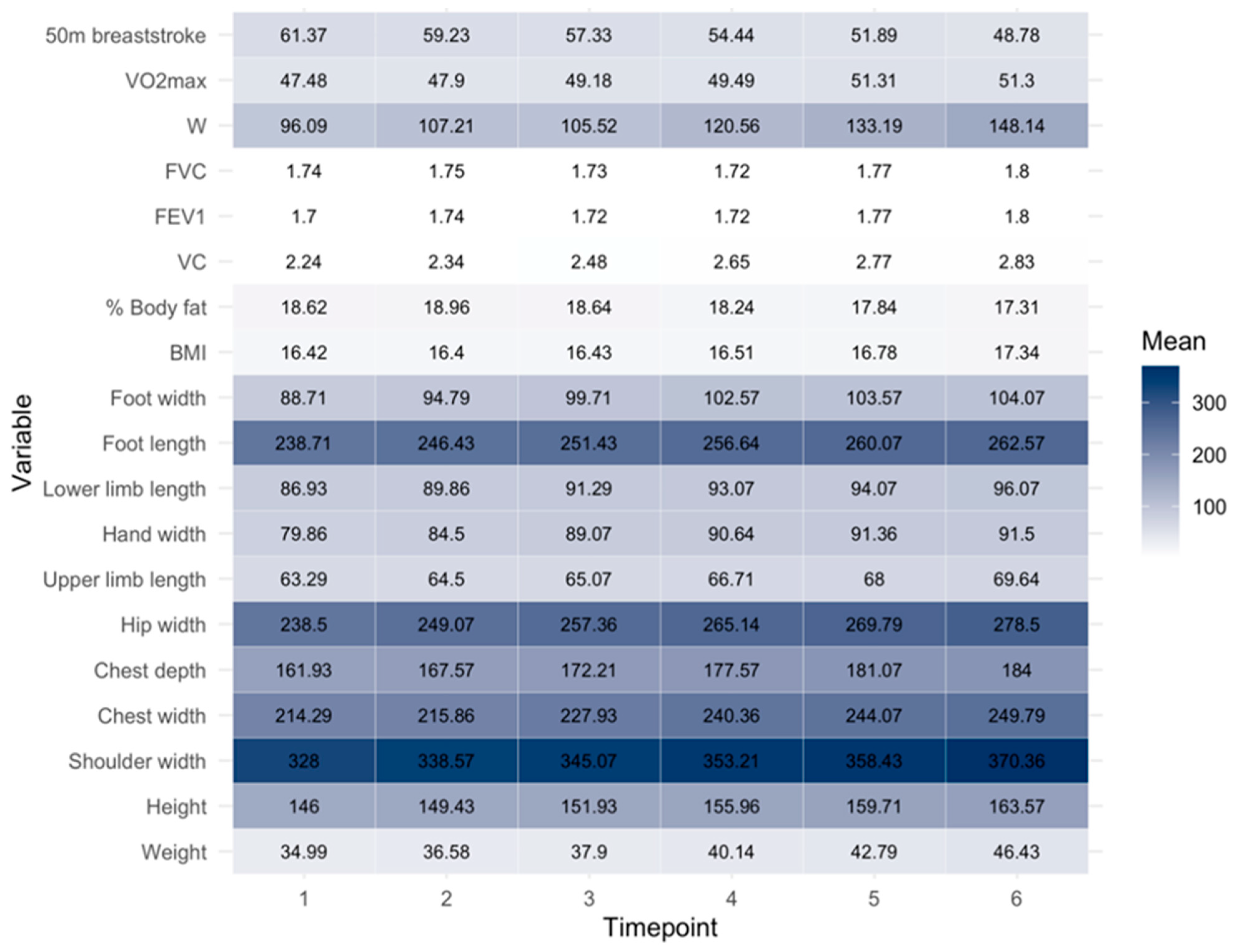
Repeated-measures ANOVA comparing baseline and final assessments demonstrated statistically significant improvements in most anthropometric and performance-related variables relevant to 50-m breaststroke performance. No significant changes were observed for body mass index, percentage body fat, forced expiratory volume in one second (FEV1), or forced vital capacity (FVC). The largest anthropometric changes were observed for body height (d = 4.06), body mass (d = 3.28), hip width (d = 3.33), and lower-limb length (d = 3.28), all of which exhibited very large effect sizes. Moderate-to-large effects were also evident for chest width (d = 1.45), chest depth (d = 1.52), and foot dimensions (d = 1.56–2.01).
Physiological variables likewise showed meaningful longitudinal improvements, with large effect sizes observed for vital capacity (VC, d = 2.03), lower-limb mechanical work (W, d = 2.48), and maximal oxygen uptake (VO2max, d = 1.11). The longitudinal changes in anthropometric, physiological, and respiratory variables across all six measurement occasions are illustrated in Figure 2.

3.2. Correlations Between Study Variables

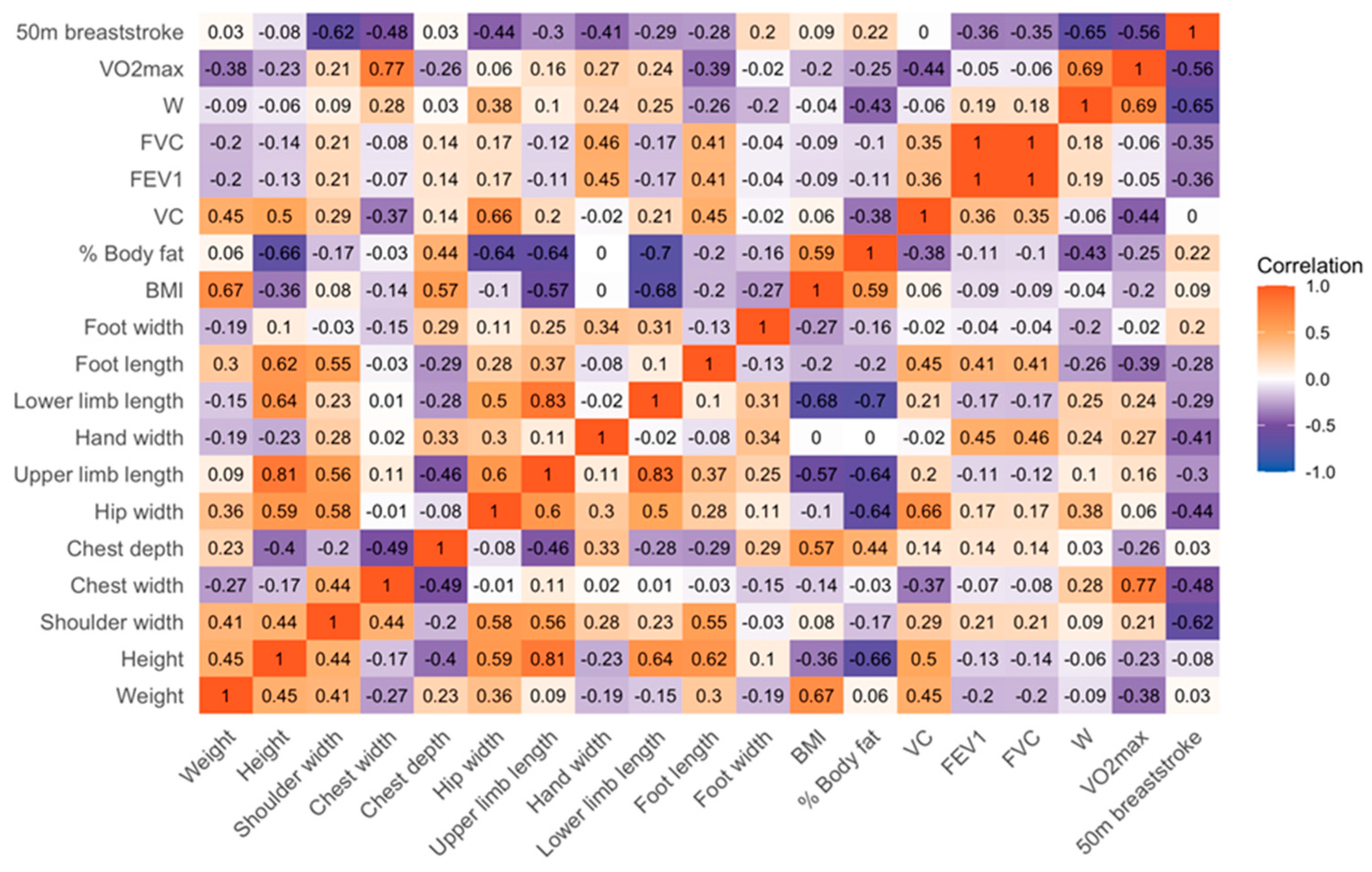
Correlation analyses revealed relationships between 50-m breaststroke times (lower times= better performance) and anthropometric, physiological, and respiratory variables (Figure 3). Among anthropometric measures, shoulder width exhibited the strongest negative association with 50-m breaststroke performance (r = −0.62), indicating that swimmers with broader shoulders tended to achieve faster times. Chest width (r = −0.48), hip width (r = −0.44), hand width (r = −0.41), upper limb length (r = −0.30), and lower limb length (r = −0.29) also demonstrated moderate negative correlations, suggesting that larger or longer limbs and a wider torso are generally advantageous for sprint breaststroke performance. Conversely, some variables showed weak positive relationships with 50-m breaststroke time, indicating slower performance, including foot width (r = 0.20) and, to a lesser extent, BMI (r = 0.09) and body fat percentage (r = 0.22). Height (r = −0.08), weight (r = 0.03), and chest depth (r = 0.03) were largely unrelated to performance. Physiological and respiratory variables exhibited generally weak associations with sprint breaststroke outcomes. VO2max (r = −0.56) and work of lower limbs (r = −0.65) showed moderate negative correlations, indicating higher aerobic capacity and external mechanical power were linked to faster times. Vital capacity (VC, r = −0.005) and FEV1/FVC (r = −0.35 to −0.35) displayed weak or negligible associations.

3.3. Prediction Model Results for 50-m Breaststroke Performance

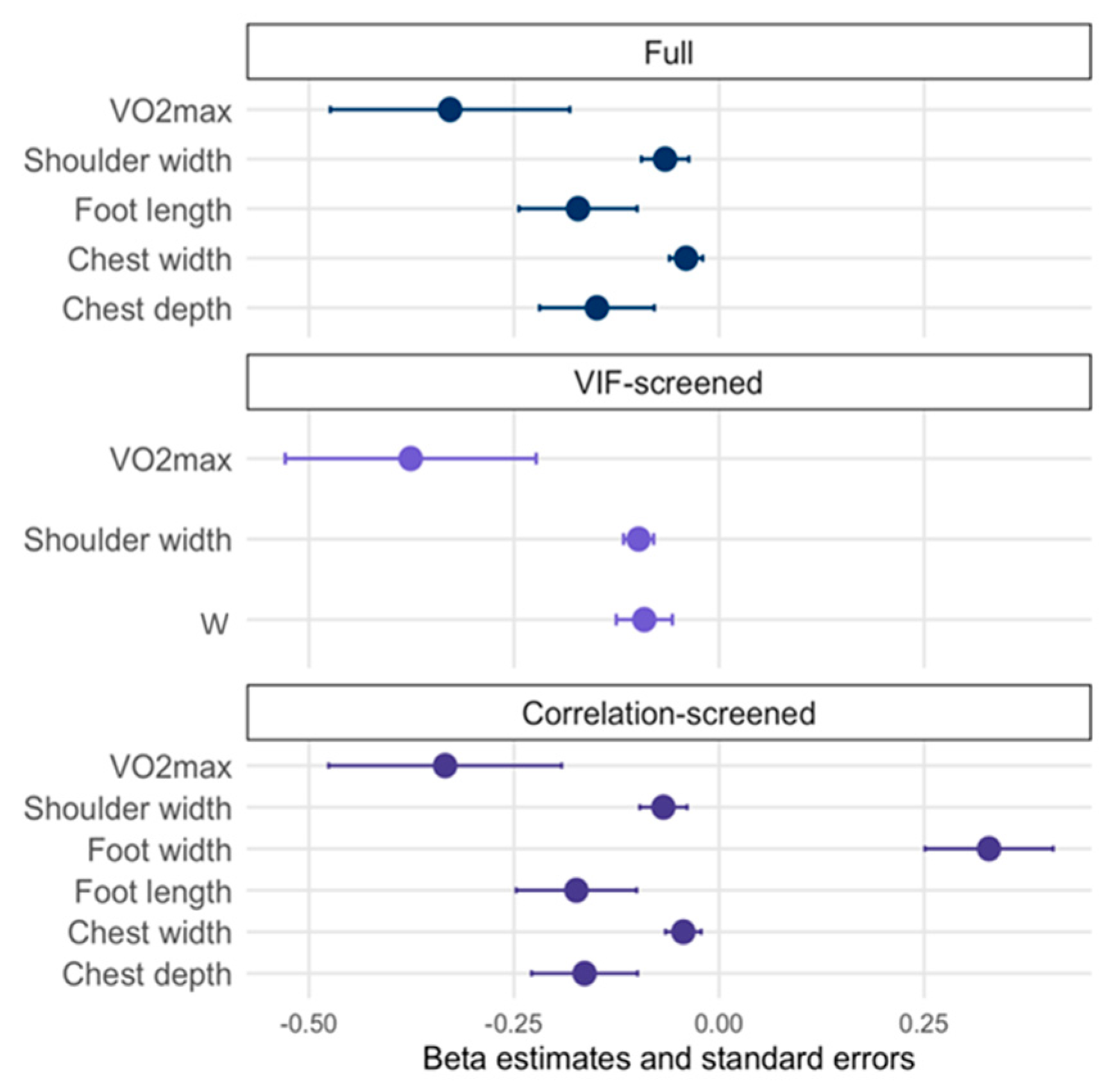
GEE models were fitted to assess associations between anthropometric and physiological variables and 50-m breaststroke time. Residual diagnostics indicated acceptable normality and variance patterns, and no major violations of model assumptions. A small number of observations influenced coefficient magnitudes, but overall model behaviour remained stable. Beta coefficients and standard errors are presented in Figure 4.

3.4. Full Model

The full model (18 predictors) explained 77% of the variance in 50-m breaststroke scores. Several upper-body breadth measures were significantly associated with faster breaststroke times. Shoulder width (B = −0.07, SE = 0.03, p = 0.04), chest width (B = −0.04, SE = 0.02, p = 0.05), and chest depth (B = −0.15, SE = 0.07, p = 0.04) showed consistent negative coefficients. Foot length was also significant (B = −0.17, SE = 0.07, p = 0.045). VO2max demonstrated a negative association with performance (B = −0.33, SE = 0.15, p = 0.04). Other variables, including BMI, limb lengths, and pulmonary measures, were not statistically significant. After FDR correction, no predictors remained statistically significant, indicating that the nominal associations observed in the unadjusted model were not robust to multiple-testing correction (Table 3).

3.5. VIF-Screened Model

Following multicollinearity screening, the reduced model (7 predictors) explained 67% of the variance in 50-m breaststroke performance. Three predictors remained significant: shoulder width (B = −0.10, SE = 0.02, p < 0.001), VO2max (B = −0.38, SE = 0.15, p = 0.02), and work of lower limbs (B = −0.09, SE = 0.03, p = 0.02). After FDR correction, shoulder width, work of lower limbs, and VO2max remained significant predictors of 50-m breaststroke performance (Table 3).

3.6. Correlation-Screened Model

The correlation-filtered model (14 predictors) explained 76% of the variance in 50-m breaststroke scores. Significant predictors included shoulder width (B = −0.07, SE = 0.03, p = 0.04), chest depth (B = −0.16, SE = 0.07, p = 0.03), foot length (B = −0.17, SE = 0.07, p = 0.04), and foot width (B = 0.3, SE = 0.08, p < 0.001). VO2max remained significant (B = −0.334, SE = 0.14, p = 0.02). After FDR correction, foot width remained the only statistically significant predictor, while other nominal predictors did not survive multiple-testing adjustment (Table 3).
The full model (18 predictors) demonstrated the highest marginal pseudo-R2 (0.77), with RMSE = 3.44 and MAE = 2.50. The correlation-screened model (14 predictors) showed comparable explanatory performance (pseudo-R2 = 0.76) with slightly higher RMSE (3.50) and the lowest MAE (2.48), indicating similar predictive accuracy despite reduced dimensionality. In contrast, the VIF-screened model (7 predictors) demonstrated a reduction in explanatory power (pseudo-R2 = 0.67) and increased prediction error (RMSE = 4.10; MAE = 3.01). These findings suggest that model reduction improved parsimony but was associated with some loss of explanatory performance, particularly in the VIF-screened specification.

4. Discussion

This longitudinal study focused on variables from five categories: anthropometry, body composition, aerobic capacity, anaerobic capacity, and respiratory function. According to the presented results, in pre-pubertal girls, body dimensions proved to be crucial for achieving sports results in swimming.
The results of this study indicate that one of the main factors related to the results achieved in 50 m breaststroke swimming in children in the studied age group was the width and depth of the chest. Chest width is considered an indirect indicator of respiratory system development and is typically associated with greater lung volumes (VC, FVC) [29]. In addition, an increased chest surface area facilitates more effective ventilation and promotes improved muscle oxygenation during exercise. Although breathing during a 50-m event is temporally limited, greater respiratory capacity supports better control of breathing rhythm and delays the onset of oxygen deficit, particularly in young swimmers [30]. As reported in the literature, breaststroke is the most technically complex of all swimming styles. From the perspective of economical swimming, streamlining and trunk stability are of crucial importance. Increased chest dimensions enhance the buoyancy of the anterior part of the body, facilitate the maintenance of a horizontal body position in the water, and reduce the unfavourable sinking of the hips and lower limbs [31]. From a biomechanical standpoint, greater chest dimensions contribute to reduced frontal drag, more effective utilisation of force generated by the lower limbs, and a more efficient glide phase, which constitutes one of the key elements of breaststroke swimming [32]. In swimmers, greater chest width often correlates with increased shoulder girdle width and better development of the pectoral, intercostal, and scapular stabilising muscles. In short-distance breaststroke events, this is of particular importance due to stronger and more effective arm movements, improved coordination between arm actions and the breathing phase, and a greater contribution of the upper body to propulsion [33]. Nevertheless, the influence of chest width on breaststroke performance—especially over sprint distances—should be interpreted with caution. In children, variability in somatic build is substantial [34]. A wider chest is often observed in biologically more advanced children and may confer a performance advantage independent of sports training [35]. The effect of chest width is also closely associated with chest depth, which likewise emerged as a determinant of 50-m breaststroke performance in the present study. Scientific evidence suggests that greater chest depth is associated with increased lung volume, improved trunk buoyancy, and a higher body position in the water, which is particularly important for optimal body alignment during swimming [36]. A deeper chest is often linked to greater trunk muscle cross-sectional area and enhanced core stability, which contribute to stronger and more economical arm movements [37]. The above assumptions should be approached with great caution because no biomechanical measurements were performed in the present work.
In children, chest depth is considered one of the indicators of biological maturity, and more developmentally advanced individuals often achieve better sports performance, sometimes irrespective of swimming technique [37]. In the studied group, greater chest depth was associated with improved 50-m breaststroke performance; however, it should be emphasised that this influence is supportive rather than decisive and should be analysed within the broader context of the child’s overall biological and motor development.
Another important predictor of performance in the 50-m breaststroke was foot length and width. In breaststroke swimming, lower-limb propulsion accounts for approximately 60–70% of the total propulsive force, which is considerably higher than in other swimming styles. Evidence from previous studies indicates that foot length affects the effective surface area interacting with the water. A longer foot facilitates the generation of greater propulsive force at the same energetic cost [33].
Moreover, a longer foot increases the surface area exerting pressure on the water, improves the effectiveness of displacing water backwards and laterally, and enables the generation of a greater force impulse within a shorter time frame, which is of critical importance in sprint events [31]. In children, foot length may therefore be an important factor in swimming performance over sprint distances (50 m), where the ability to generate fast and efficient propulsion is crucial. Previous research has also demonstrated that a longer foot contributes to greater force production at the knee and hip joints, promotes more effective use of the available range of motion, and improves the synchronisation of lower-limb movements with the glide phase [38]. Nevertheless, it should be emphasised that foot length does not independently determine 50-m breaststroke performance. Its contribution depends on technical proficiency, muscle strength, flexibility, and overall motor coordination.
Shoulder width has been shown to be a significant factor influencing athletic performance over the 50-m distance. In scientific studies, shoulder width is noticeable but not a decisive factor [39]. Due to the age of the participants, these results should be treated with caution, as body proportions change rapidly between the ages of 8 and 13, and this structure becomes more balanced after puberty. In senior competitive swimmers, wider shoulders in the breaststroke allow for better grip and push-off phases and promote better trunk stabilisation, which contributes to maintaining proper body position, especially during the head-lift phase [40]. In children, shoulder structure plays a less important role, for example, in terms of technique and motor coordination.
An interesting finding of this study was the relationship between maximum oxygen uptake and performance in the 50 m breaststroke race. The authors demonstrated that although the majority of energy expended during a 50-m breaststroke race is derived from anaerobic sources, approximately 22% of the energy contribution originates from aerobic processes. Consequently, it may be assumed that maximal oxygen uptake plays a meaningful role in 50-m breaststroke performance, particularly given that breaststroke technique at this age continues to undergo refinement [41]. During short-duration efforts, energy production from anaerobic processes is several times greater than that from aerobic metabolism [8]. However, we must note that in our study, both aerobic and anaerobic capacity were measured indirectly, so the results may be subject to a certain margin of error. It should be emphasised that in children aged 10–12 years, anaerobic energy systems are not yet fully developed, which may increase the relative contribution of aerobic capacity to performance outcomes [42]. In children, higher VO2max may therefore indirectly influence sprint performance by improving tolerance to high-intensity exercise, accelerating phosphocreatine resynthesis, and enhancing the ability to maintain proper technique during the final phase of the race. It should be noted, however, that much of the available evidence supporting these mechanisms is based primarily on studies involving young competitive swimmers, rather than non-elite populations [43].
In summary, when grouped by domain, significant predictors included anthropometric variables (shoulder width, chest depth, foot length, foot width) and one physiological variable (VO2max). Among these, shoulder width and VO2max demonstrated the most consistent associations across model variants, suggesting relatively robust relationships with 50-m breaststroke performance. In contrast, associations for chest dimensions and foot morphology were more model-dependent and should therefore be interpreted cautiously. Overall, these findings indicate that while selected morphological characteristics may support performance, their influence appears complementary rather than determinative in this developmental stage.

Practical Implications

The findings of this study have important practical implications for the training process of pre-adolescent female swimmers, particularly with regard to breaststroke events. First and foremost, the results indicate that selected physical characteristics, such as chest width, chest depth, and foot length, may serve as useful supportive indicators in the assessment of swimming potential; however, they should not be treated as decisive selection criteria. In coaching practice, this necessitates a cautious interpretation of morphological advantages in children, which often result from accelerated biological maturation rather than solely from training effects. Therefore, it is recommended that the evaluation of sporting progress in young female swimmers should always be conducted in relation to their individual rate of biological development, rather than being based exclusively on current performance outcomes. The research findings suggest that swimming instructors and coaches should prioritise breaststroke specialisation in athletes with favourable proportions (larger chests, longer feet). In girls with less favourable builds, the focus should be on improving technique and coordination, rather than premature negative selection. An additional applied conclusion concerns the importance of foot length in the generation of lower-limb propulsion. From a practical training perspective, this highlights the need to focus technical exercises on the optimal use of the foot’s effective surface area, improvement of the range of motion at the ankle, knee, and hip joints, and precise synchronisation of leg movements with the glide phase. Such interventions may partially compensate for less favourable morphological conditions. The observed relationship between maximal oxygen uptake and results in the 50-m breaststroke race further emphasises that, even in sprint races with children, the development of basic aerobic capacity should not be neglected. During the pre-adolescent period, the enhancement of aerobic fitness may support tolerance to high-intensity exercise, improve technical execution in the final phase of the race, and facilitate more efficient recovery between repeated efforts. Therefore, training for girls aged 10–13 should maintain a solid aerobic base, even for future sprinters. Giving up aerobic work in favour of early sprint specialisation may limit long-term development. From a practical standpoint, the study’s findings highlight the need for a holistic approach to the training of young female swimmers, in which anthropometric characteristics are regarded as supportive elements, while long-term development of technique, motor coordination, and functional capacities plays a central role. The study confirms that valuable information is obtained by monitoring changes over time, rather than by performing a one-time assessment of predispositions. The recommendation for coaches is to conduct periodic somatic measurements, observe the pace of change during the growth period, and avoid excluding children based on a single measurement. Such an approach may reduce the risk of premature sports selection and promote more balanced and effective athletic development in children.

5. Conclusions

Based on this research, it can be concluded that body composition has functional significance even in pre-puberty, even in a group without pre-selection. In particular, greater chest depth and shoulder width promote better performance in the 50 m breaststroke, a longer foot length has a beneficial effect on performance (larger propulsive surface), while excessive foot width can impair the effectiveness of the kicking technique. Aerobic capacity plays a supporting role even in the 50 m sprint competition. The study confirms that valuable information is obtained by monitoring changes over time, rather than by a one-time assessment of predispositions. Therefore, it is more effective to monitor a child’s development rather than to practice premature selection. The results suggest that a developmental approach combining systematic monitoring of somatic characteristics with comprehensive performance training should be used in the training of pre-pubertal girls, rather than early selection based solely on current sporting level.

6. Limitations

Several limitations of this study should be acknowledged. The sample size was relatively small (N = 14). Although a post hoc power analysis conducted using G*Power software (version 3.1.9.2; University of Cologne, Germany) indicated that a minimum of 12 observations would be sufficient for an alpha level of 0.05, an effect size of f = 0.6, and statistical power (1 − β) of 0.95, the limited number of participants may restrict the generalisability of the findings. Participants’ dietary habits were neither monitored nor controlled, which may have influenced body composition and selected physiological outcomes. Aerobic and anaerobic capacity was assessed using indirect tests. Items related to swimming technique were not considered. A comparison with a control group would certainly have facilitated the assessment of the impact of training and natural biological changes. ICC verification was not performed. Due to the lack of consent to use the Tanner scale, biological maturity was assessed using a different method during each examination—an interview regarding the occurrence of menarche during each examination.

Author Contributions

Conceptualization, M.K. and J.W.; methodology, M.K.; software, A.M. and M.C.; validation, M.K. and A.M.; formal analysis A.M.; investigation, M.K. and J.W.; resources, M.K. and A.M.; data curation, M.K.; writing—original draft preparation, J.W. and M.K.; writing—review and editing J.W.; visualisation, A.M. and M.C.; supervision, M.K.; project administration, M.K. and J.W. All authors have read and agreed to the published version of the manuscript.

Funding

This research received no external funding.

Institutional Review Board Statement

In accordance with the Declaration of Helsinki, all participants and their parents were informed about the purpose and methodology of the study. Written informed consent for participation was obtained from both the participants and their legal guardians. The study protocol was approved by the Bioethics Committee for Scientific Research of Jan Długosz University in Czestochowa (approval number: KB-2/2012).

Informed Consent Statement

Informed consent was obtained from all subjects involved in the study.

Data Availability Statement

The datasets generated and analysed during the current study are not publicly available due to patient confidentiality but are available from the corresponding author on reasonable request.

Conflicts of Interest

The authors declare no conflicts of interest.

References

  1. Kuberski, M.; Musial, A.; Choroszucho, M. Longitudinal Effects of Swimming Training on Anthropometric Characteristics in Pre-Adolescent Girls. Phys. Act. Rev. 2025, 13, 116–130. [Google Scholar] [CrossRef]
  2. Mekkaoui, L.; Potdevin, F.; Derigny, T.; Gandrieau, J.; Staub, I.; DeMartelaer, K.; Kovács, Z.; Olstad, B.H.; Rejman, M.; Soares, S.; et al. Towards a Consensus on the Development of the Aquatic Curricula Analysis Tool Using an Ecosystem Approach: A Delphi Method. Phys. Act. Rev. 2025, 13, 141–155. [Google Scholar] [CrossRef]
  3. Toussaint, H.; Truijens, M. Biomechanical Aspects of Peak Performance in Human Swimming. Anim. Biol. 2005, 55, 17–40. [Google Scholar] [CrossRef]
  4. Kuberski, M.; Musial, A.; Choroszucho, M.; Konarski, J.M.; Wąsik, J. Longitudinal Effects of Aerobic Training Programme on Body Composition in Non-Elite Adolescent Female Swimmers. PeerJ 2025, 13, e19456. [Google Scholar] [CrossRef]
  5. Tzelepis, G.E.; Vega, D.L.; Cohen, M.E.; McCool, F.D. Lung Volume Specificity of Inspiratory Muscle Training. J. Appl. Physiol. 1994, 77, 789–794. [Google Scholar] [CrossRef]
  6. Barbosa, T.M.; Costa, M.; Marinho, D.A.; Coelho, J.; Moreira, M.; Silva, A.J. Modeling the Links Between Young Swimmers’ Performance: Energetic and Biomechanic Profiles. Pediatr. Exerc. Sci. 2010, 22, 379–391. [Google Scholar] [CrossRef] [PubMed]
  7. Ruiz-Navarro, J.J.; Cuenca-Fernández, F.; Sanders, R.; Arellano, R. The Determinant Factors of Undulatory Underwater Swimming Performance: A Systematic Review. J. Sports Sci. 2022, 40, 1243–1254. [Google Scholar] [CrossRef]
  8. Vaz, J.R.; Olstad, B.H.; Cabri, J.; Kjendlie, P.-L.; Pezarat-Correia, P.; Hug, F. Muscle Coordination during Breaststroke Swimming: Comparison between Elite Swimmers and Beginners. J. Sports Sci. 2016, 34, 1941–1948. [Google Scholar] [CrossRef] [PubMed]
  9. Deliceoğlu, G.; Suveren, C.; Önmen, H.; Kara, S. The Impact of Basic Movement Skills on Early Childhood Development with a Focus on Gender Differences. Phys. Act. Rev. 2025, 13, 1–11. [Google Scholar] [CrossRef]
  10. Robertson, E.Y.; Pyne, D.B.; Hopkins, W.G.; Anson, J.M. Analysis of Lap Times in International Swimming Competitions. J. Sports Sci. 2009, 27, 387–395. [Google Scholar] [CrossRef]
  11. Brown, G.A.; Shaw, B.S.; Shaw, I. Sex-based Differences in Swimming Performance in 10-years-old-and-under Athletes in Short Course National Competition. Eur. J. Sport Sci. 2025, 25, e12237. [Google Scholar] [CrossRef]
  12. Beunen, G.; Malina, R.M. Growth and Biologic Maturation: Relevance to Athletic Performance. In The Young Athlete; Wiley: Hoboken, NJ, USA, 2007; pp. 3–17. [Google Scholar]
  13. Benardot, D. Nutritional Concerns for the Artistic Athlete. Phys. Med. Rehabil. Clin. N. Am. 2021, 32, 51–64. [Google Scholar] [CrossRef]
  14. Tortu, E.; Deliceoglu, G. Comparison of Energy System Contributions in Lower Body Wingate Tests between Sexes. Phys. Act. Rev. 2024, 12, 13–21. [Google Scholar] [CrossRef]
  15. McKay, A.K.A.; Stellingwerff, T.; Smith, E.S.; Martin, D.T.; Mujika, I.; Goosey-Tolfrey, V.L.; Sheppard, J.; Burke, L.M. Defining Training and Performance Caliber: A Participant Classification Framework. Int. J. Sports Physiol. Perform. 2022, 17, 317–331. [Google Scholar] [CrossRef]
  16. Lang, M.; Light, R. Interpreting and Implementing the Long Term Athlete Development Model: English Swimming Coaches’ Views on the (Swimming) LTAD in Practice. Int. J. Sports Sci. Coach. 2010, 5, 389–402. [Google Scholar] [CrossRef]
  17. Kuberski, M.; Musial, A.; Błażkiewicz, M.; Wąsik, J. Determinants of 50 m Front Crawl Performance in Adolescent Non-Elite Female Swimmers: A Longitudinal Study. J. Funct. Morphol. Kinesiol. 2025, 10, 274. [Google Scholar] [CrossRef] [PubMed]
  18. Przewęda, R. Ocena Wieku Rozwojowego. In Teoria i Metodyka Sportu; Ulatowski, T., Ed.; Sport i Turystyka: Warsaw, Poland, 1971. [Google Scholar]
  19. Malinowski, A.; Asienkiewicz, R.; Tatarczuk, J.; Stuła, A.; Wandycz, A. Dziecko Lubuskie; Oficyna Wydawnicza UZ: Zielona Góra, Poland, 2005; ISBN 83-89712-87-3. [Google Scholar]
  20. Jopkiewicz, A.; Suliga, E. Biologiczne Podstawy Rozwoju Człowieka; WSP: Kielce, Poland, 1998; ISBN 83-87039-99-3. [Google Scholar]
  21. Léger, L.A.; Mercier, D.; Gadoury, C.; Lambert, J. The Multistage 20 Metre Shuttle Run Test for Aerobic Fitness. J. Sports Sci. 1988, 6, 93–101. [Google Scholar] [CrossRef] [PubMed]
  22. Praagh, E. Van Anaerobic Fitness Tests: What Are We Measuring? Karger Publishers: Basel, Switzerland, 2007; pp. 26–45. [Google Scholar]
  23. Bosco, C.; Luhtanen, P.; Komi, P.V. A Simple Method for Measurement of Mechanical Power in Jumping. Eur. J. Appl. Physiol. Occup. Physiol. 1983, 50, 273–282. [Google Scholar] [CrossRef] [PubMed]
  24. Liang, K.Y.; Zeger, S.L. Longitudinal Data Analysis Using Generalized Linear Models. Biometrika 1986, 73, 13–22. [Google Scholar] [CrossRef]
  25. Pan, W. Akaike’s Information Criterion in Generalized Estimating Equations. Biometrics 2001, 57, 120–125. [Google Scholar] [CrossRef]
  26. Cui, J. QIC Program and Model Selection in GEE Analyses. Stata J. 2007, 7, 209–220. [Google Scholar] [CrossRef]
  27. Gosho, M.; Hamada, C.; Yoshimura, I. Modifications of QIC and CIC for Selecting a Working Correlation Structure in the Generalized Estimating Equation Method. Jpn. J. Biom. 2011, 32, 1–12. [Google Scholar] [CrossRef]
  28. Benjamini, Y.; Hochberg, Y. Controlling the False Discovery Rate: A Practical and Powerful Approach to Multiple Testing. J. R. Stat. Soc. Ser. B 1995, 57, 289–300. [Google Scholar] [CrossRef]
  29. Ackland, T.R.; Ong, K.B.; Kerr, D.A.; Ridge, B. Morphological Characteristics of Olympic Sprint Canoe and Kayak Paddlers. J. Sci. Med. Sport 2003, 6, 285–294. [Google Scholar] [CrossRef]
  30. Barbosa, T.M.; Bragada, J.A.; Reis, V.M.; Marinho, D.A.; Carvalho, C.; Silva, A.J. Energetics and Biomechanics as Determining Factors of Swimming Performance: Updating the State of the Art. J. Sci. Med. Sport 2010, 13, 262–269. [Google Scholar] [CrossRef]
  31. Geladas, N.D.; Nassis, G.P.; Pavlicevic, S. Somatic and Physical Traits Affecting Sprint Swimming Performance in Young Swimmers. Int. J. Sports Med. 2005, 26, 139–144. [Google Scholar] [CrossRef]
  32. Conceição, A.; Silva, A.J.; Boaventura, J.; Marinho, D.A.; Louro, H. Wave Characteristics in Breaststroke Technique with and Without Snorkel Use. J. Hum. Kinet. 2013, 39, 185–194. [Google Scholar] [CrossRef][Green Version]
  33. Lätt, E.; Jürimäe, J.; Mäestu, J.; Purge, P.; Rämson, R.; Haljaste, K.; Keskinen, K.L.; Rodriguez, F.A.; Jürimäe, T. Physiological, Biomechanical and Anthropometrical Predictors of Sprint Swimming Performance in Adolescent Swimmers. J. Sports Sci. Med. 2010, 9, 398–404. [Google Scholar] [PubMed]
  34. Malina, R.M.; Bouchard, C.; Bar-Or, O. Growth, Maturation, and Physical Activity; Human Kinetics: Champaign, IL, USA, 2004; ISBN 9781492596837. [Google Scholar]
  35. Lätt, E.; Jürimäe, J.; Haljaste, K.; Cicchella, A.; Purge, P.; Jürimäe, T. Physical Development and Swimming Performance during Biological Maturation in Young Female Swimmers. Coll. Antropol. 2009, 33, 117–122. [Google Scholar]
  36. Thorland, W.G.; Johnson, G.O.; Housh, T.J.; Refsell, M.J. Anthropometric Characteristics of Elite Adolescent Competitive Swimmers. Hum. Biol. 1983, 55, 735–748. [Google Scholar]
  37. Seifert, L.; Carmigniani, R. Coordination and Stroking Parameters in the Four Swimming Techniques: A Narrative Review. Sports Biomech. 2023, 22, 1617–1633. [Google Scholar] [CrossRef]
  38. Shahidi, S.H.; Al-Gburı, A.H.; Karakas, S.; Taşkıran, M.Y. Anthropometric and Physical Performance Characteristics of Swimmers. Int. J. Kinanthropometry 2023, 3, 1–9. [Google Scholar] [CrossRef]
  39. Karadenizli, Z.İ.; İlbak, İ.; Jorgić, B.M.; Bartik, P.; Sagat, P. Physical Performance Predictors in Youth Breaststroke Swimming: Motor and Biomotor Diagnostic Differences. BMC Sports Sci. Med. Rehabil. 2025, 18, 4. [Google Scholar] [CrossRef] [PubMed]
  40. Morais, J.E.; Barbosa, T.M.; Forte, P.; Silva, A.J.; Marinho, D.A. Young Swimmers’ Anthropometrics, Biomechanics, Energetics, and Efficiency as Underlying Performance Factors: A Systematic Narrative Review. Front. Physiol. 2021, 12, 691919. [Google Scholar] [CrossRef] [PubMed]
  41. Gomez-Bruton, A.; Matute-Llorente, A.; Pardos-Mainer, E.; Gonzalez-Aguero, A.; Gomez-Cabello, A.; Casajus, J.A.; Vicente-Rodriguez, G. Factors Affecting Children and Adolescents 50 Meter Performance in Freestyle Swimming. J. Sports Med. Phys. Fitness 2016, 56, 1439–1447. [Google Scholar] [PubMed]
  42. Balducci, L.; Hardy, C.; Dreiling, B. Neoplastic Meningitis in Hodgkin’s Disease: CSF Eosinophilia Following Myelography. J. Miss. State Med. Assoc. 1985, 26, 343–346. [Google Scholar]
  43. Price, T.; Cimadoro, G.; Legg, S.H. Physical Performance Determinants in Competitive Youth Swimmers: A Systematic Review. BMC Sports Sci. Med. Rehabil. 2024, 16, 20. [Google Scholar] [CrossRef]
Figure 2. Trends in anthropometric, physiological, and respiratory variables across six follow-up assessments. Note: BMI = body mass index; VC = vital capacity; FEV1 = forced expiratory volume in one second; FVC = forced vital capacity; W = lower-limb mechanical work; VO2max = maximal oxygen uptake. Anthropometric measurements are expressed in millimetres, except for upper- and lower-limb lengths, which are reported in centimetres.
Applsci 16 03241 g002
Figure 3. Heatmap of correlation coefficients between anthropometric, physiological, and respiratory variables and 50-m breaststroke performance. Note: BMI = body mass index; VC = vital capacity; FEV1 = forced expiratory volume in one second; FVC = forced vital capacity; W = lower-limb mechanical work; VO2max = maximal oxygen uptake.
Applsci 16 03241 g003
Figure 4. Beta estimates and standard errors of the association between significant predictors and 50-m breaststroke scores for different regression models.
Applsci 16 03241 g004
Table 1. Training macrocycle of female swimmers (aged 9–12), according to British Swimming Federation Guidelines [16].
Research TimeTraining FrequencyTraining Unit DiagramTotal Metres Covered
Year 1
35 weeks’
swimming training
4 training
sessions
per week
Warm up: 200–300 m
Main part: 5 × 50 m only arms
5 × 50 m only legs
5 × 50 m coordination arms/legs
2 × 100 m full style
Cool down: 200–300 m
1500 m
in one training session
Year 2
35 weeks’
swimming training
4 training sessions
per week
Warm up: 300–400 m
Main part: 6 × 50 m only arms
6 × 50 m only legs
6 × 50 m coordination arms/legs
5 × 100 m full style
Cool down: 200–300 m
2000 m
in one training session
Year 3
35 weeks’
swimming training
4 training sessions
per week
Warm up: 300–400 m
Main part: 5 × 100 m only arms
5 × 100 m only legs
5 × 100 m coordination arms/legs
4 × 100 m full style
Cool down: 200–300 m
2500 m
in one training session
Table 2. Descriptive statistics and ANOVA results comparing the initial and final measurements.
VariableMeanSDMinMaxRangeSkewKurtosisF-Valuep-ValueEta2Cohen’s d
Weight (kg)39.802.7335.8044.238.430.34−1.2875.18<0.0010.743.28
Height (cm)154.434.17149.25164.8315.580.830.30115.52<0.0010.824.06
Shoulder width (mm)348.9425.30276.67373.5096.83−1.571.9823.53<0.0010.481.83
Chest width (mm)232.0519.84208.33279.8371.500.96−0.1214.72<0.0010.361.45
Chest depth (mm)174.0611.85149.83195.6745.83−0.31−0.3116.12<0.0010.381.52
Hip width (mm)259.739.20240.17274.1734.00−0.28−0.6677.47<0.0010.753.33
Upper limb length (cm)66.202.7261.6771.179.50−0.01−1.0628.72<0.0010.522.03
Hand width (mm)87.823.1881.8392.5010.67−0.03−1.1412.62<0.0010.331.34
Lower limb length (cm)91.882.2688.6796.678.000.31−0.7375.37<0.0010.743.28
Foot length (mm)252.648.50241.50265.6724.170.24−1.7328.32<0.0010.522.01
Foot width (mm)98.903.2094.33104.8310.500.43−1.1917.06<0.0010.401.56
BMI (kg/m2)16.651.1014.8218.653.830.18−1.013.750.060.130.73
Body fat (%)18.272.8913.4724.1710.700.16−0.690.740.400.03−0.33
VC (L)2.550.312.073.121.040.14−1.1828.81<0.0010.532.03
FEV1 (L)1.740.460.992.501.510.19−1.250.340.570.010.22
FVC (L)1.750.461.002.511.500.17−1.250.150.700.010.15
W (J)118.4517.7490.25150.6460.39−0.03−1.1543.16<0.0010.622.48
VO2max (mL × min−1 × kg−1)49.443.2042.1354.4712.35−0.69−0.078.690.010.251.11
50 m breaststroke (s)55.505.2747.6365.0017.360.23−1.2228.63<0.0010.52−2.02
Note. SD = standard deviation; BMI = body mass index; VC = vital capacity; FEV1 = forced expiratory volume in one second; FVC = forced vital capacity; W = work of lower limbs; VO2max = maximal oxygen.
Table 3. GEE regression coefficients, precision estimates, and multicollinearity diagnostics across model variants.
ModelPredictorBetaSELower 95% CIUpper
95% CI
Raw pFDR pVIF
Full modelWeight1.3562.177−2.9115.6240.53340.8728375.30
Full modelHeight−0.3851.071−2.4841.7150.71960.9251241.21
Full modelShoulder width−0.0660.029−0.123−0.0090.02310.14514.05
Full modelChest width−0.0400.020−0.080−0.0010.04670.16802.54
Full modelChest depth−0.1490.070−0.287−0.0120.03270.14723.61
Full modelHip width0.0140.083−0.1480.1770.86410.93269.56
Full modelUpper limb length−0.6700.452−1.5560.2160.13850.311611.00
Full modelHand width0.0590.137−0.2100.3280.66690.92345.54
Full modelLower limb length−0.0190.221−0.4520.4150.93260.93269.75
Full modelFoot length−0.1720.072−0.313−0.0300.01730.14515.58
Full modelFoot width0.2570.137−0.0120.5260.06070.18216.68
Full modelBMI−2.7845.869−14.2878.7190.63530.9234143.59
Full model% Body fat0.0130.097−0.1770.2030.89620.93262.15
Full modelVC−0.3732.039−4.3703.6240.85500.93264.19
Full modelFEV1−27.74926.718−80.11724.6180.29900.5696742.35
Full modelFVC26.54626.499−25.39278.4840.31650.5696736.38
Full modelW−0.0890.050−0.1860.0080.07200.18513.85
Full modelVO2max−0.3280.146−0.614−0.0430.02420.14512.57
VIF-screened modelShoulder width−0.0980.018−0.134−0.0620.00000.00001.80
VIF-screened modelChest width−0.0160.024−0.0640.0310.49660.75111.94
VIF-screened modelChest depth−0.0230.049−0.1180.0730.64380.75111.72
VIF-screened model% Body fat0.0020.143−0.2770.2810.98860.98861.48
VIF-screened modelVC−0.8651.753−4.3002.5710.62180.75111.94
VIF-screened modelW−0.0910.034−0.158−0.0240.00770.02682.12
VIF-screened modelVO2max−0.3760.153−0.676−0.0760.01390.03252.05
Correlation-screened modelWeight0.5520.391−0.2151.3200.15810.246018.73
Correlation-screened modelShoulder width−0.0680.029−0.124−0.0110.01870.05243.89
Correlation-screened modelChest width−0.0440.022−0.086−0.0010.04610.10752.46
Correlation-screened modelChest depth−0.1640.065−0.291−0.0380.01090.05243.09
Correlation-screened modelHip width−0.0030.084−0.1670.1610.97260.99398.20
Correlation-screened modelUpper limb length−0.5880.405−1.3810.2060.14680.24608.60
Correlation-screened modelFoot length−0.1740.073−0.318−0.0300.01790.05245.49
Correlation-screened modelFoot width0.3290.0780.1760.4820.00000.00043.70
Correlation-screened modelBMI−0.5241.369−3.2072.1590.70200.893412.13
Correlation-screened model% Body fat0.0010.117−0.2280.2300.99390.99392.03
Correlation-screened modelVC−0.5782.061−4.6173.4610.77910.90894.14
Correlation-screened modelFEV1−0.7711.110−2.9471.4040.48710.68202.11
Correlation-screened modelW−0.0860.049−0.1810.0090.07710.15433.64
Correlation-screened modelVO2max−0.3340.142−0.613−0.0560.01870.05242.38
Note. SE = standard error; CI = confidence interval.
Disclaimer/Publisher’s Note: The statements, opinions and data contained in all publications are solely those of the individual author(s) and contributor(s) and not of MDPI and/or the editor(s). MDPI and/or the editor(s) disclaim responsibility for any injury to people or property resulting from any ideas, methods, instructions or products referred to in the content.