Data-Driven Yield Estimation and Maximization Using Bayesian Optimization Under Uncertainty


Featured Application
Abstract
1. Introduction
- The introduction of a yield estimator based on the estimates of the mean and variance parameters of the distribution characterizing the outgoing product quality which are then used to estimate the probability that the outgoing quality falls within a desired specification interval.
- A mathematical proof of asymptotic superiority in terms of MSE of the aforementioned yield estimator compared to the traditionally utilized yield estimator based on estimating the Bernoulli distribution parameter under the assumption that the outgoing product quality variables follow an uncorrelated Gaussian distribution.
- The introduction of a BO algorithm which uses the aforementioned mean and variance parameter-based estimator of yield to tune controllable process parameters in a way that maximizes the probability that the random variable characterizing the outgoing product quality falls within the desired specifications.
2. Materials and Methods
2.1. Estimation of Yields
- A. Problem formulation
- B. Yield estimator based on estimating Bernoulli distribution parameter
- C. Yield estimator based on estimates of mean and variance parameters
- D. Comparison of MSEs of two estimators
- E. Yield estimator based on parameters of uncorrelated multivariate Gaussian distribution
- F. Discussion
2.2. Bayesian Optimization for Maximizing Yields
- A. Problem formulation
| Algorithm 1 Bayesian procedure for solving optimization problem |
| Input: An algorithm initial observations , the number of observations per iteration , and maximum iteration . Output: Estimated best control parameters for each iteration 1: 2: for to do 3: Algorithm suggests the next control parameter . 4: Observe the outputs for , . 5: Update the history of observations 6: Algorithm suggests the best control parameter, . 7: . 8: end for |
- B. Bayesian Optimization using GPR modeling empirical yields
- C. Bayesian Optimization using GPR modeling parameters of the distribution of quality characteristics
- D. Discussion
3. Results
3.1. Experiments with Various Methods for Estimating Yields
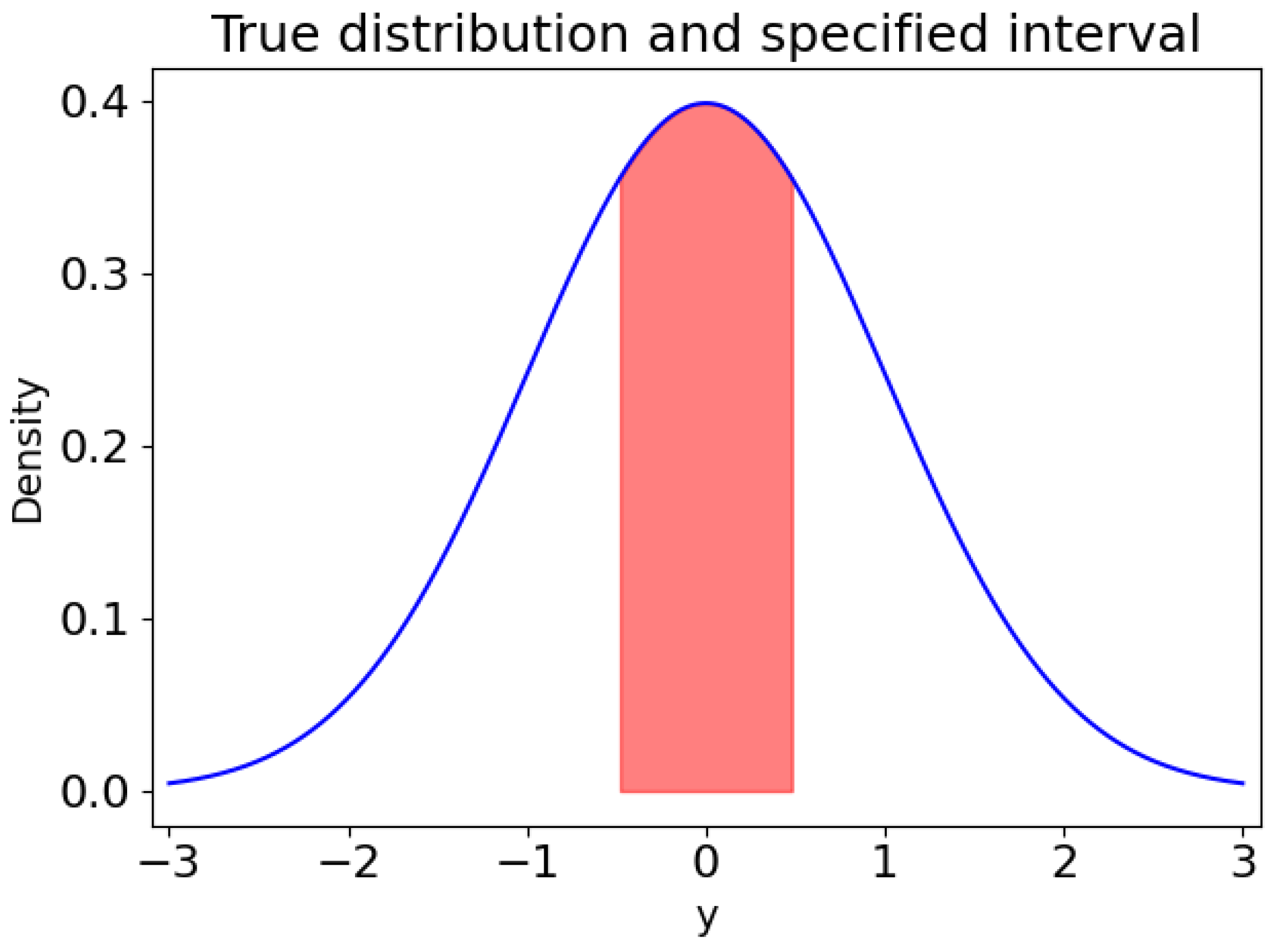
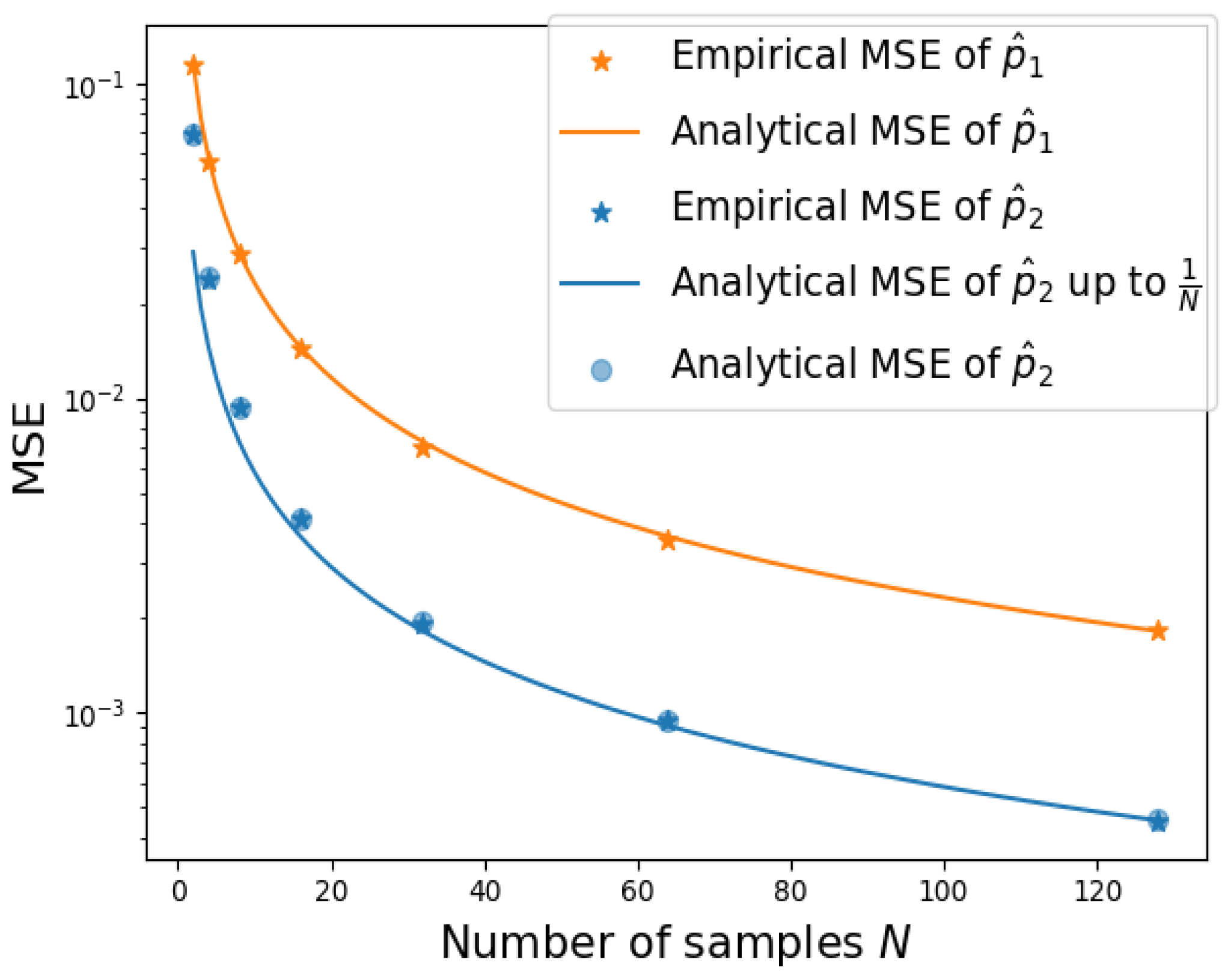
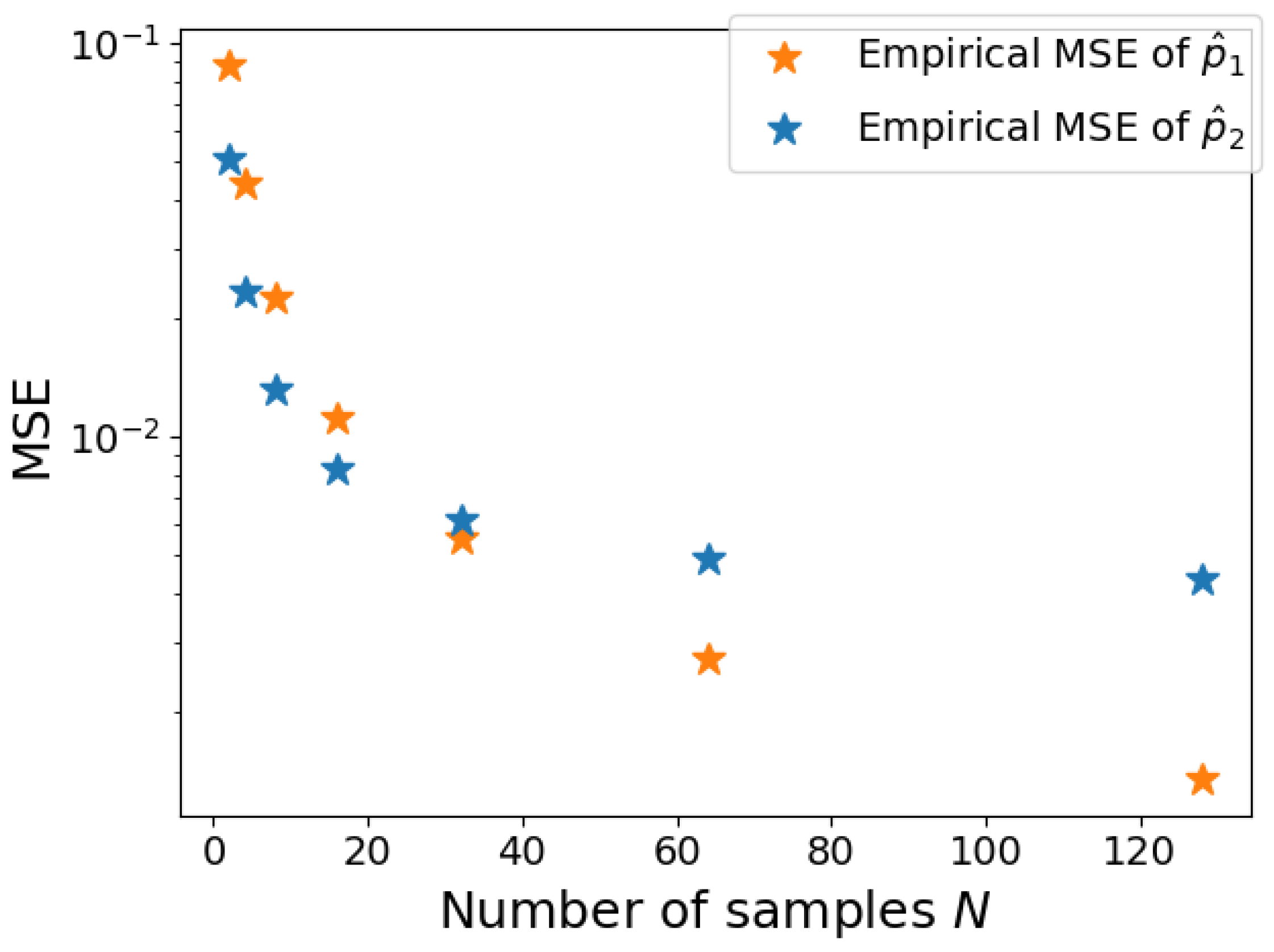
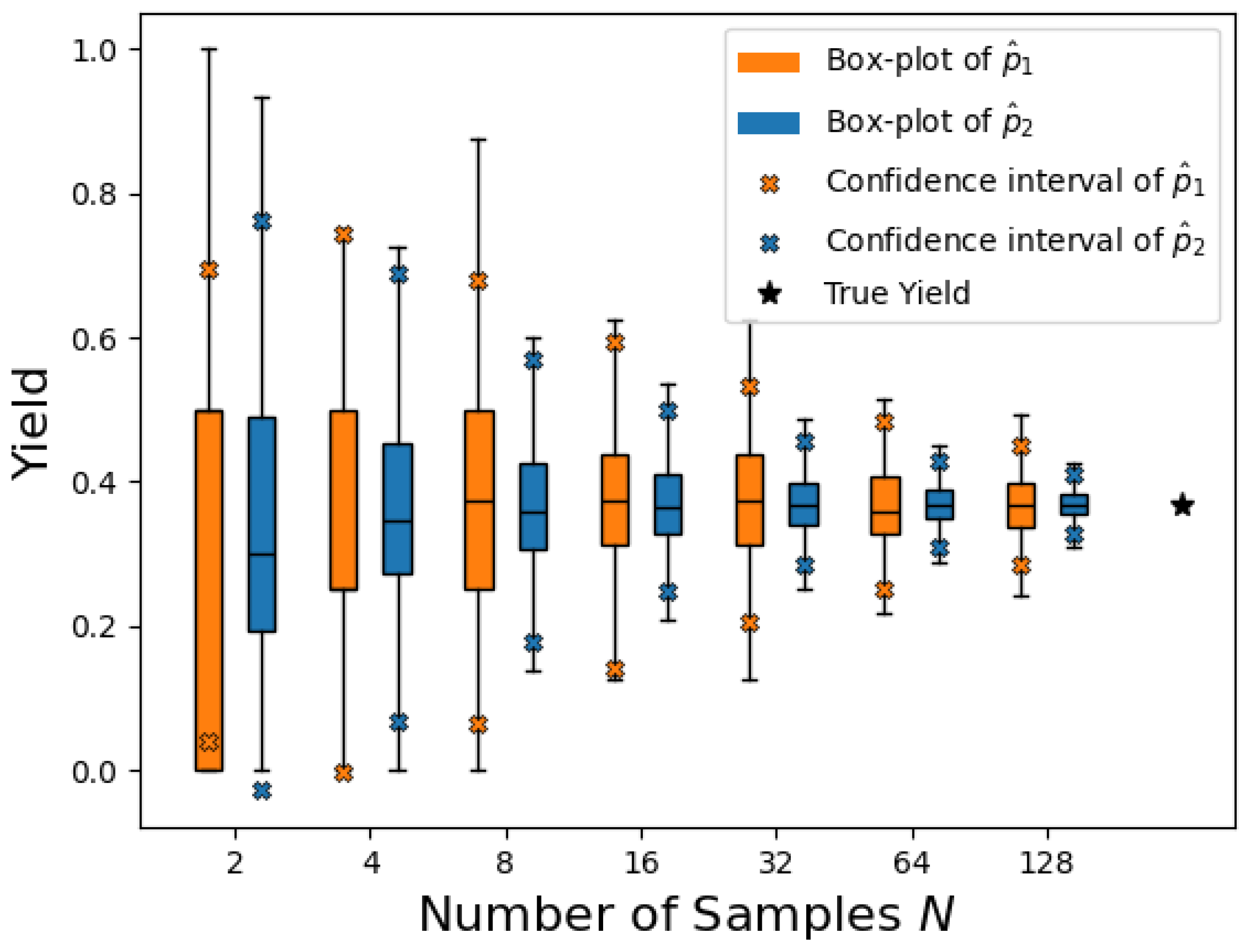
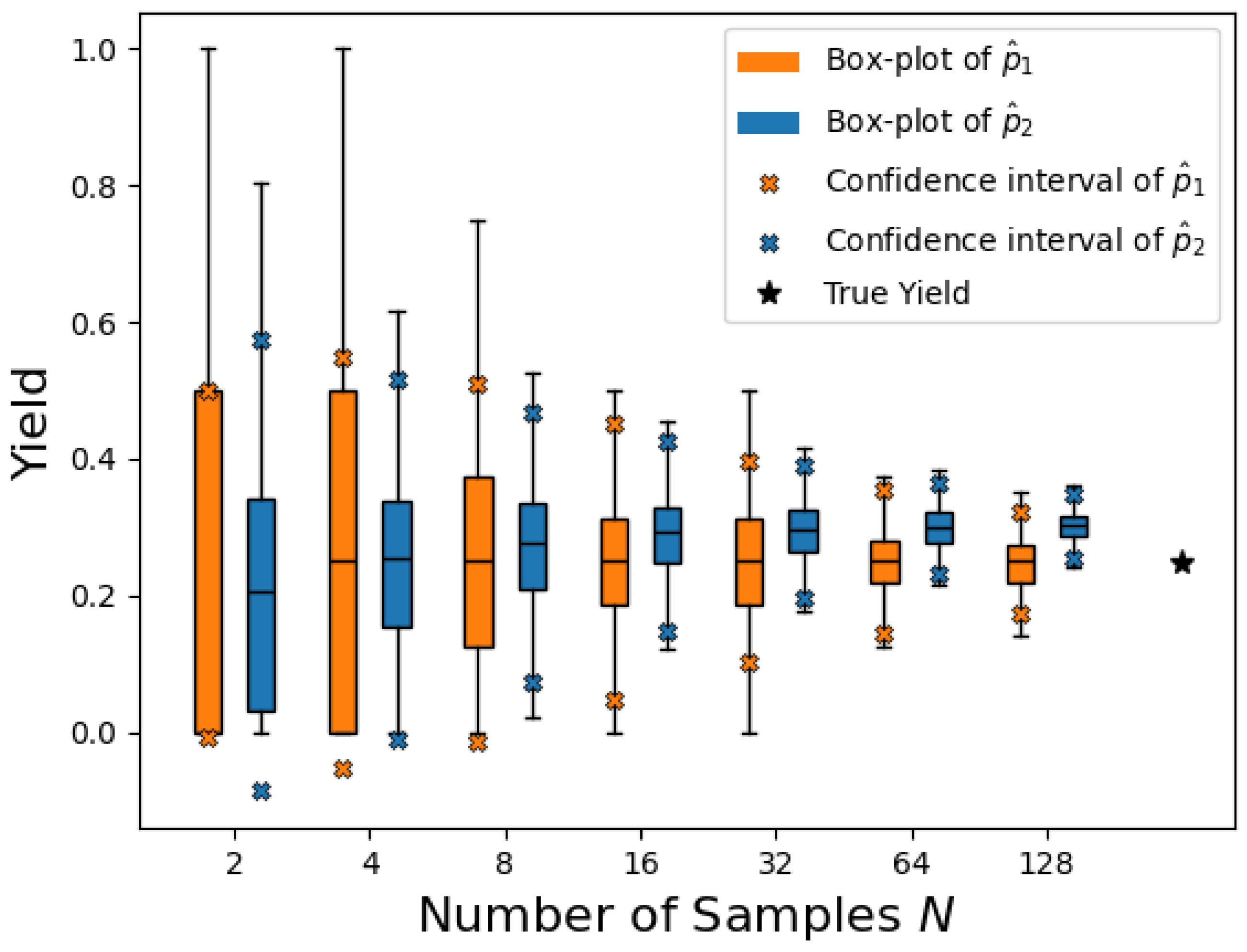
- A. Estimation of yield when quality characteristic follows Gaussian distribution
- B. Estimation of Yield Expressed as Probabilities of Electron Densities and Temperatures Falling Within Specifications
- (1) Configuration of simulations:
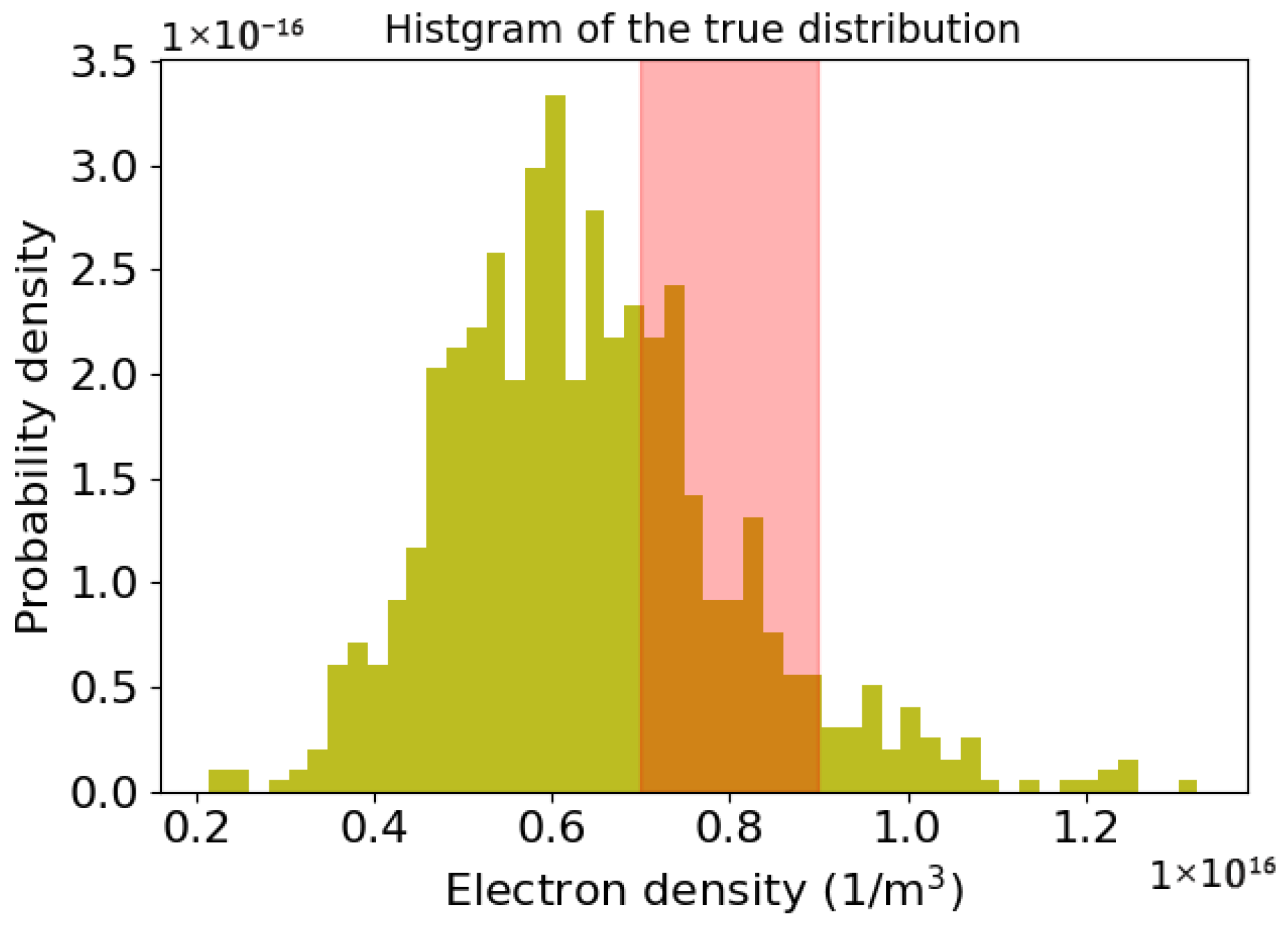
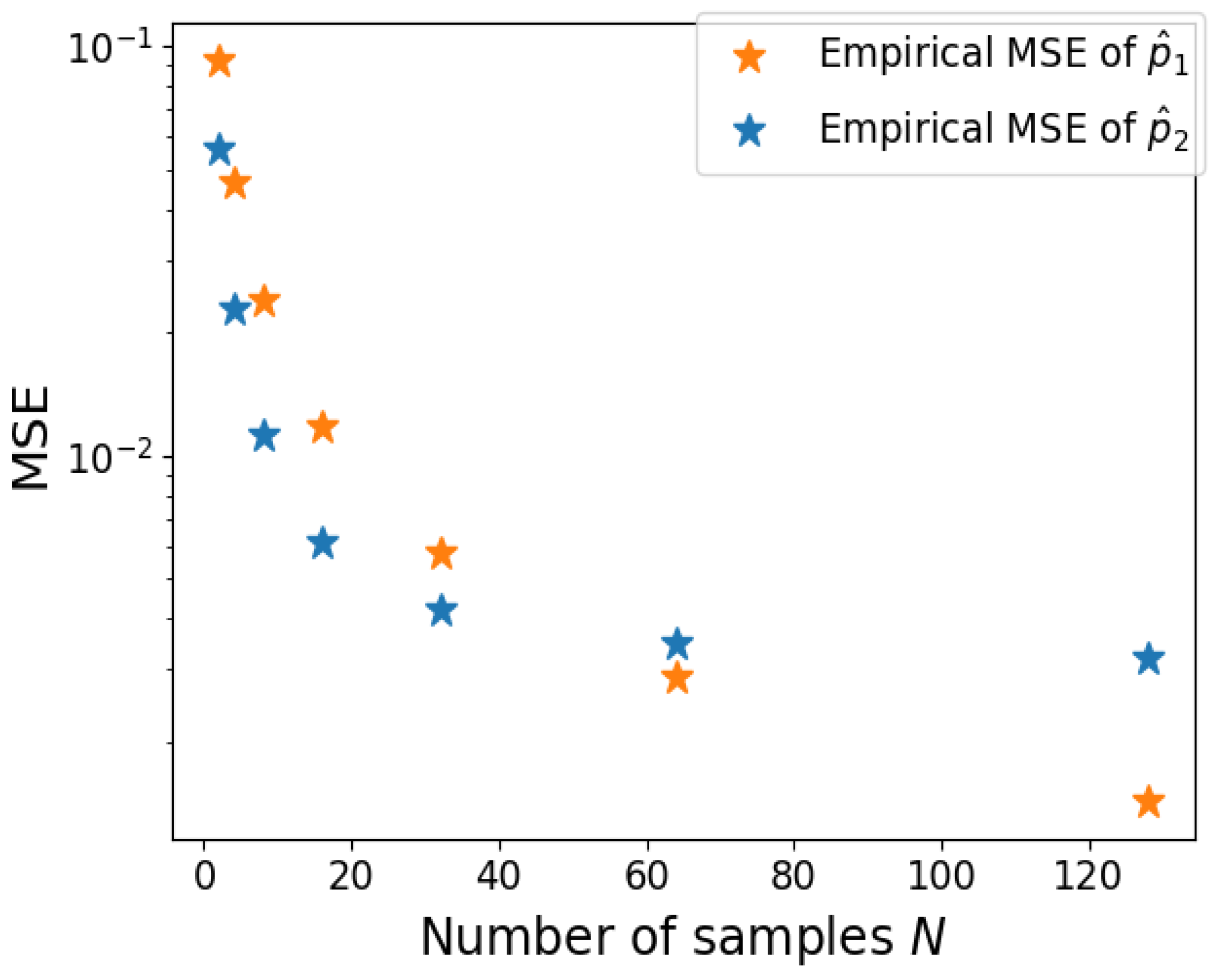
- (2) Probability of electron density falling within specification limits:
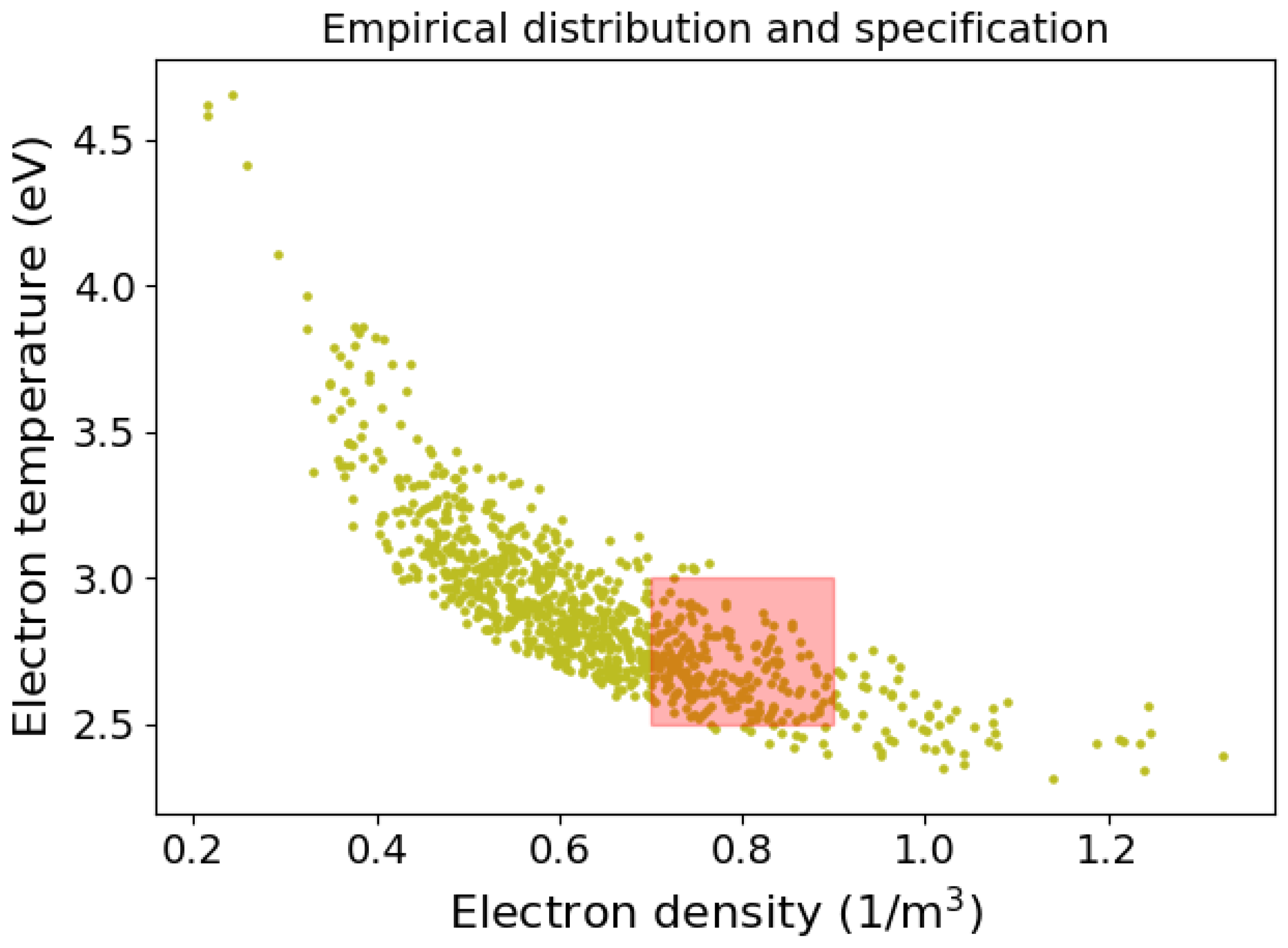
- (3) Probability of electron densities and temperatures falling within specifications:
3.2. Numerical Experiments for Maximizing Yield
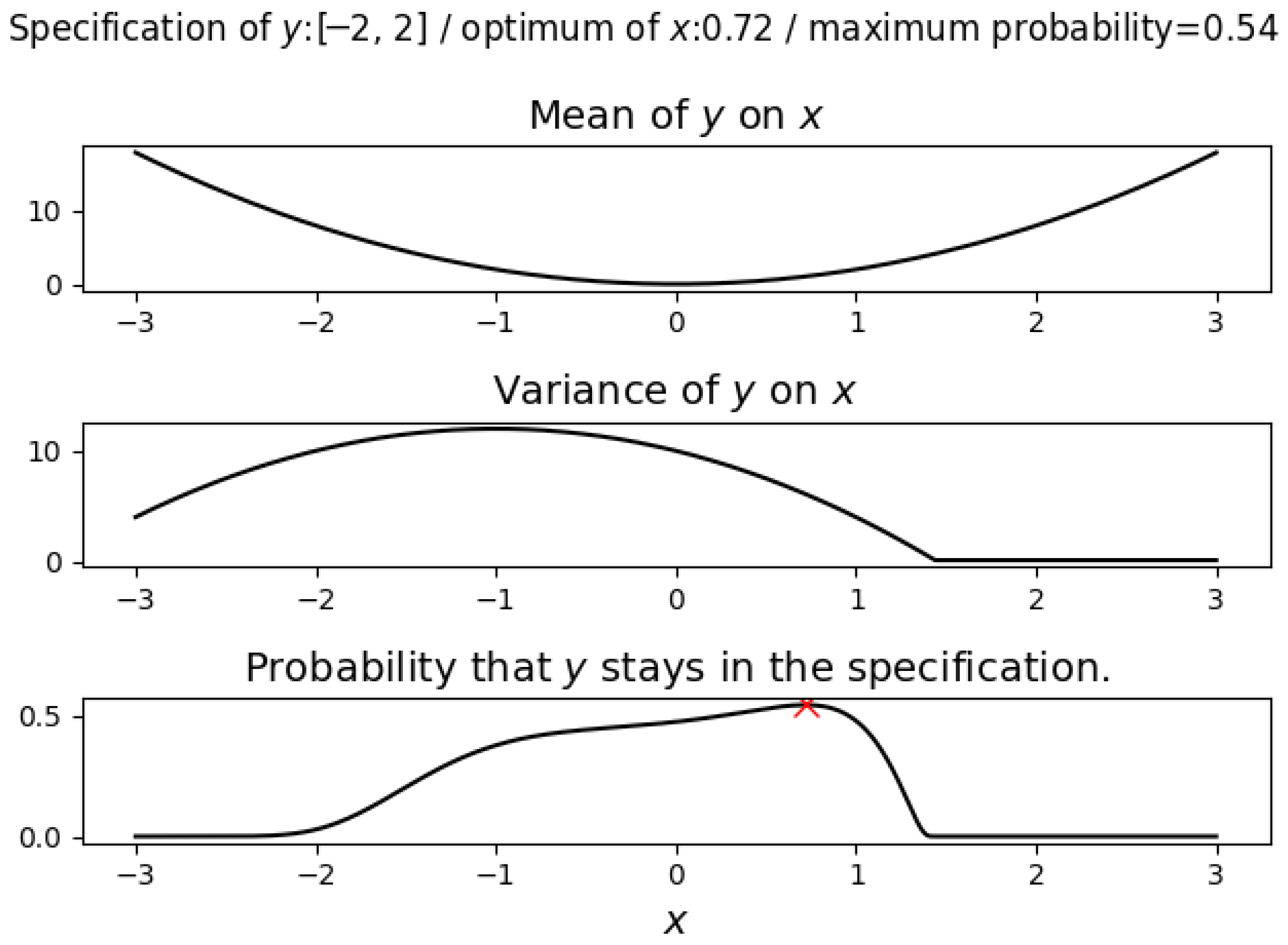
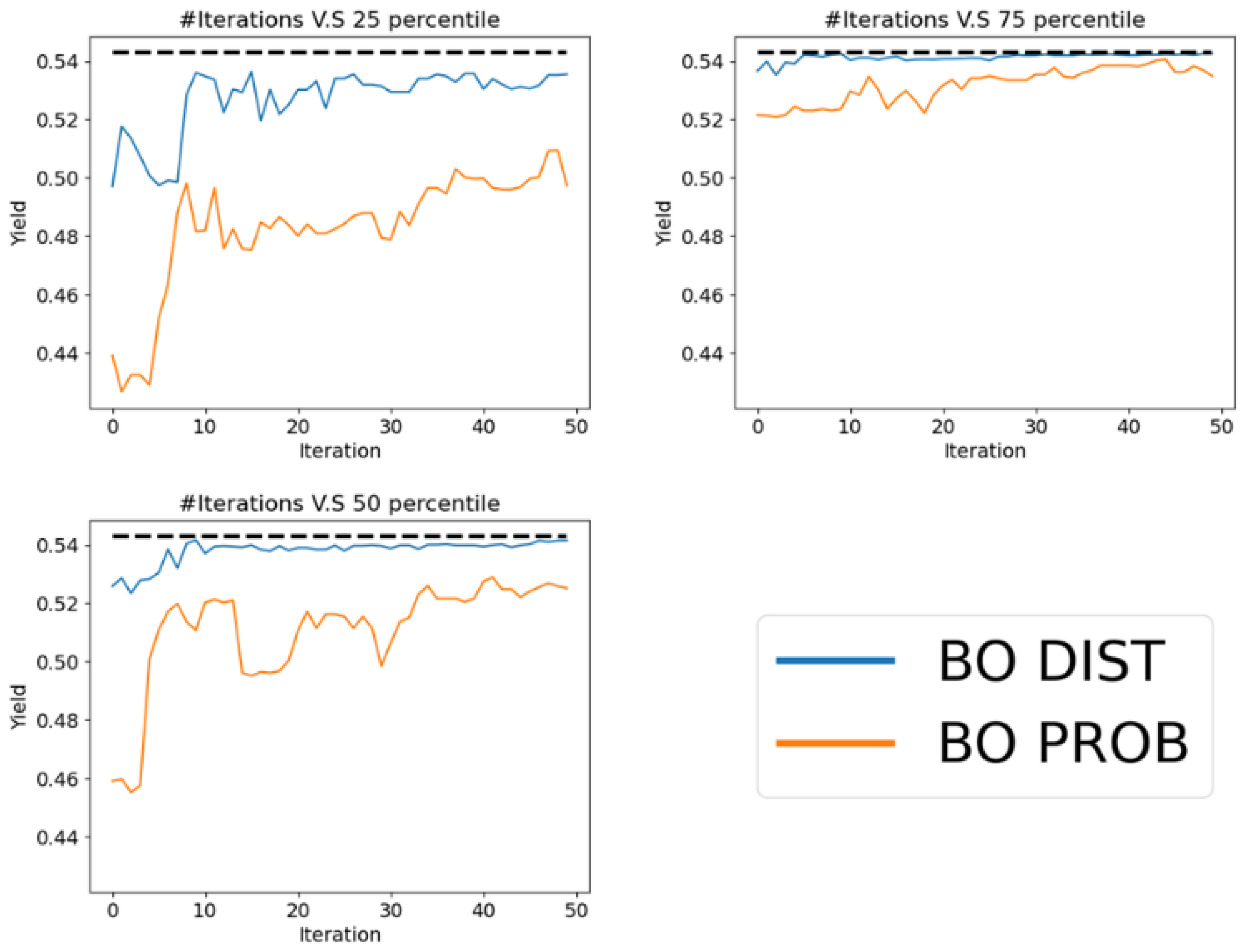
- A. Optimization of control parameters which determine parameters of Gaussian distribution
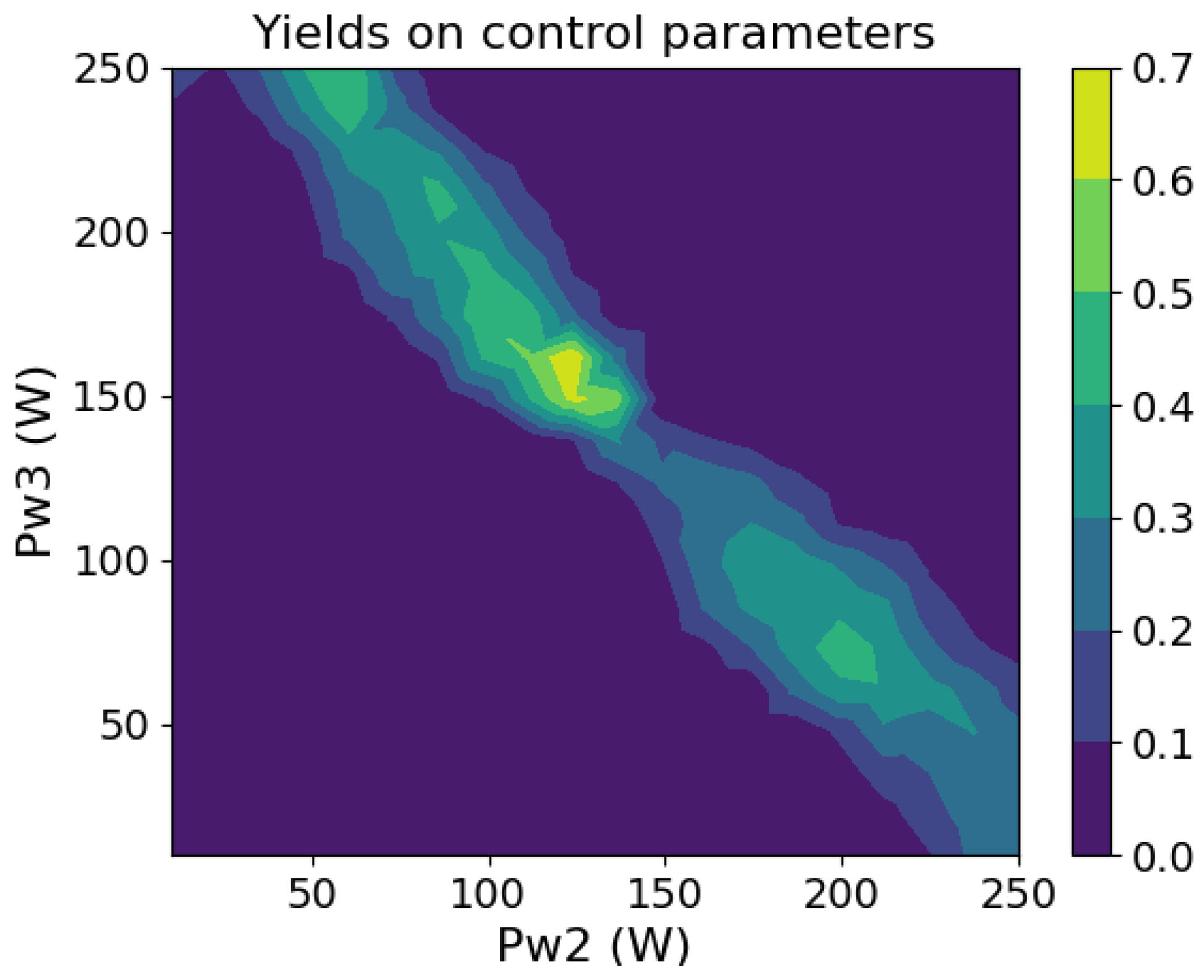
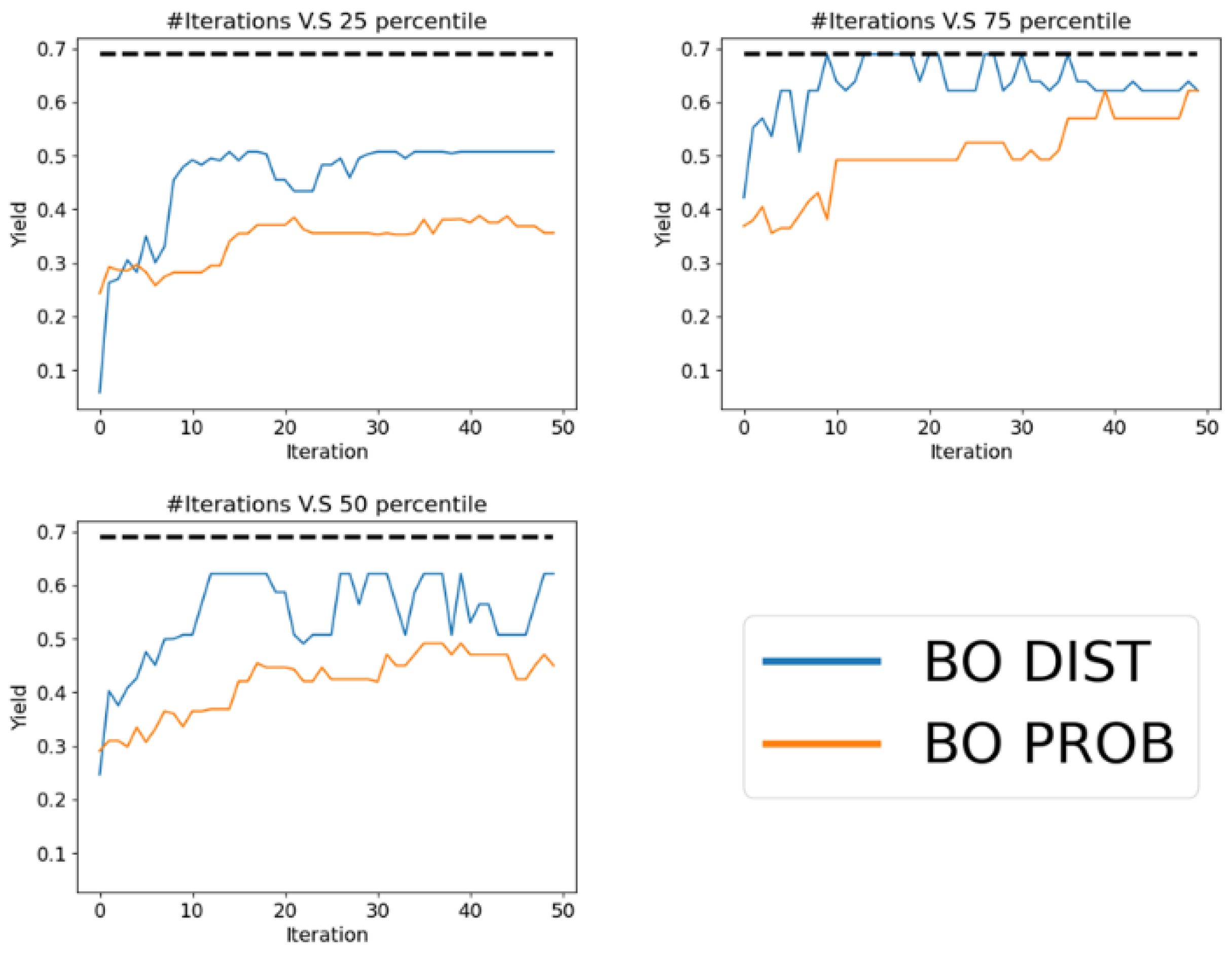
- B. Optimization of control parameters to maximize probability that electron densities and temperatures are within specifications
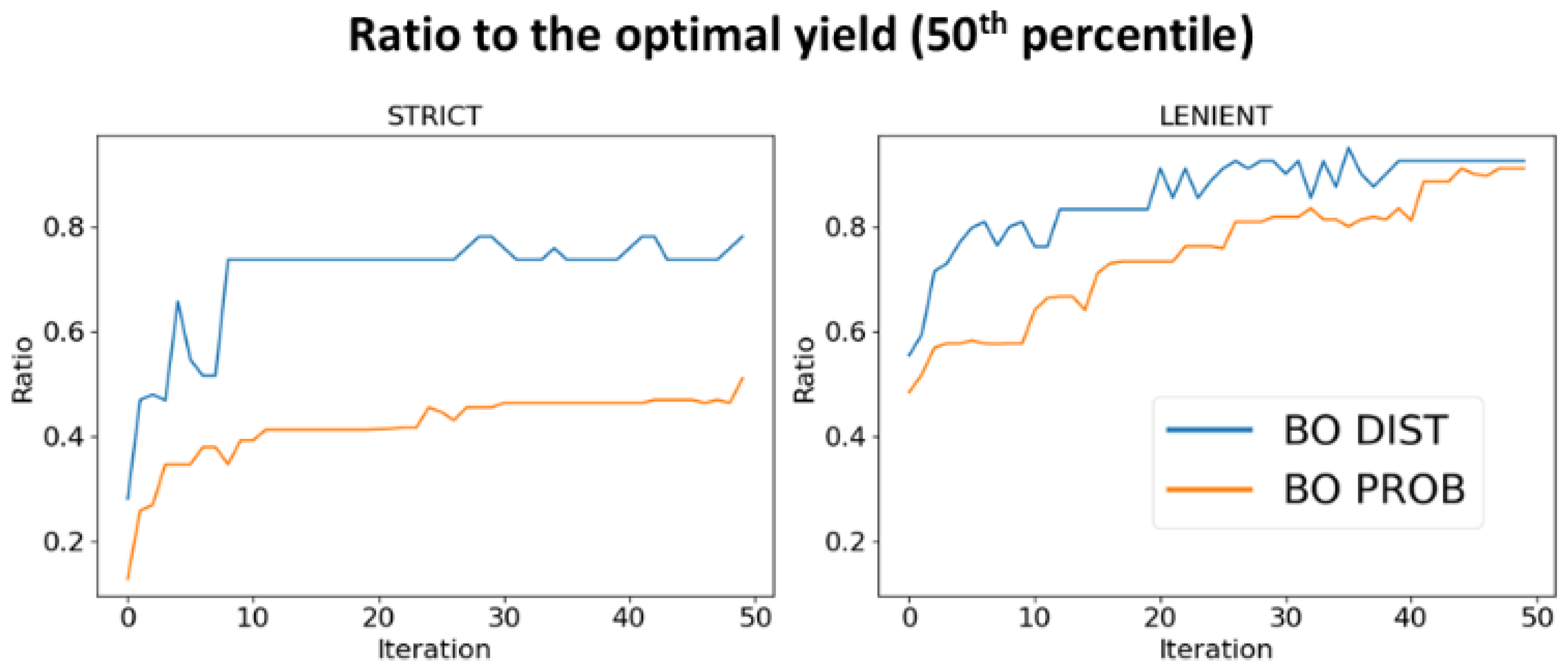
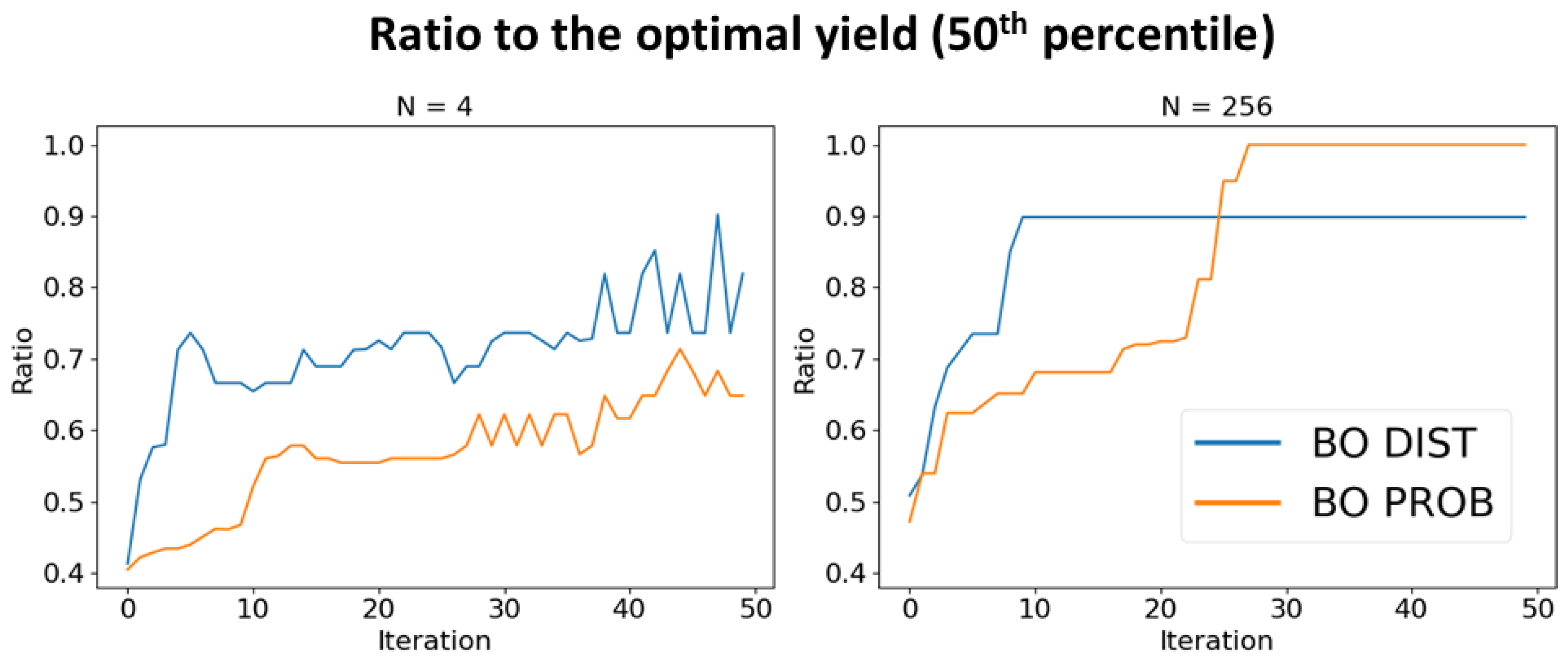
- C. Sensitivity studies for BO performance in ICP chamber simulations
- When the desired specification area is narrower, the newly proposed algorithm works more favorably.
- When the number of experiments is smaller, the newly proposed algorithm works more favorably.
4. Conclusions
Supplementary Materials
Author Contributions
Funding
Data Availability Statement
Acknowledgments
Conflicts of Interest
Notations and Abbreviations
| Symbol | Description |
| Scalar value | |
| Vector (column vector) | |
| Matrix | |
| -th element of vector | |
| -th element of matrix | |
| Abbreviation/Symbol | Full Term/Meaning |
| BO | Bayesian Optimization |
| MSE | Mean Squared Error |
| GPR | Gaussian Process Regression |
| EI | Expected Improvement (an acquisition function) |
| NEI | Noisy Expected Improvement (an acquisition function) |
| ICP | Inductively Coupled Plasma |
| ML | Machine learning |
| Quality characteristics | |
| Specification interval | |
| True yield | |
| True mean | |
| True variance | |
| Number of samples | |
| Estimator based on Bernoulli distribution | |
| Proposed estimator | |
| Unbiased estimator of mean | |
| Unbiased estimator of variance | |
| Error function | |
| Gaussian distribution | |
| Chi-square distribution with degrees of freedom | |
| () | Probability Operator |
| Expectation Operator | |
| Variance Operator | |
| Control parameter vector | |
| Empirical estimate of yield at | |
| Acquisition function based on EI given observations | |
| Distribution of modeled by Gaussian Process Regression given observations |
Appendix A. Derivation of the Confidence Interval for the Newly Proposed Yield Estimator
Appendix A.1. Confidence Interval for Newly Proposed Yield Estimator
Appendix A.2. Numerical Evaluation of the Confidence Interval


Appendix B. Proof of Lemma 1
Appendix C. Proof of Theorem 1 and Proposition 1
- The function is not negative over the boundary of .
- .
- There exist no local minima of over the interior of .
- Hence,
Appendix D. Ablation Study of BO Configurations with Yield Estimators
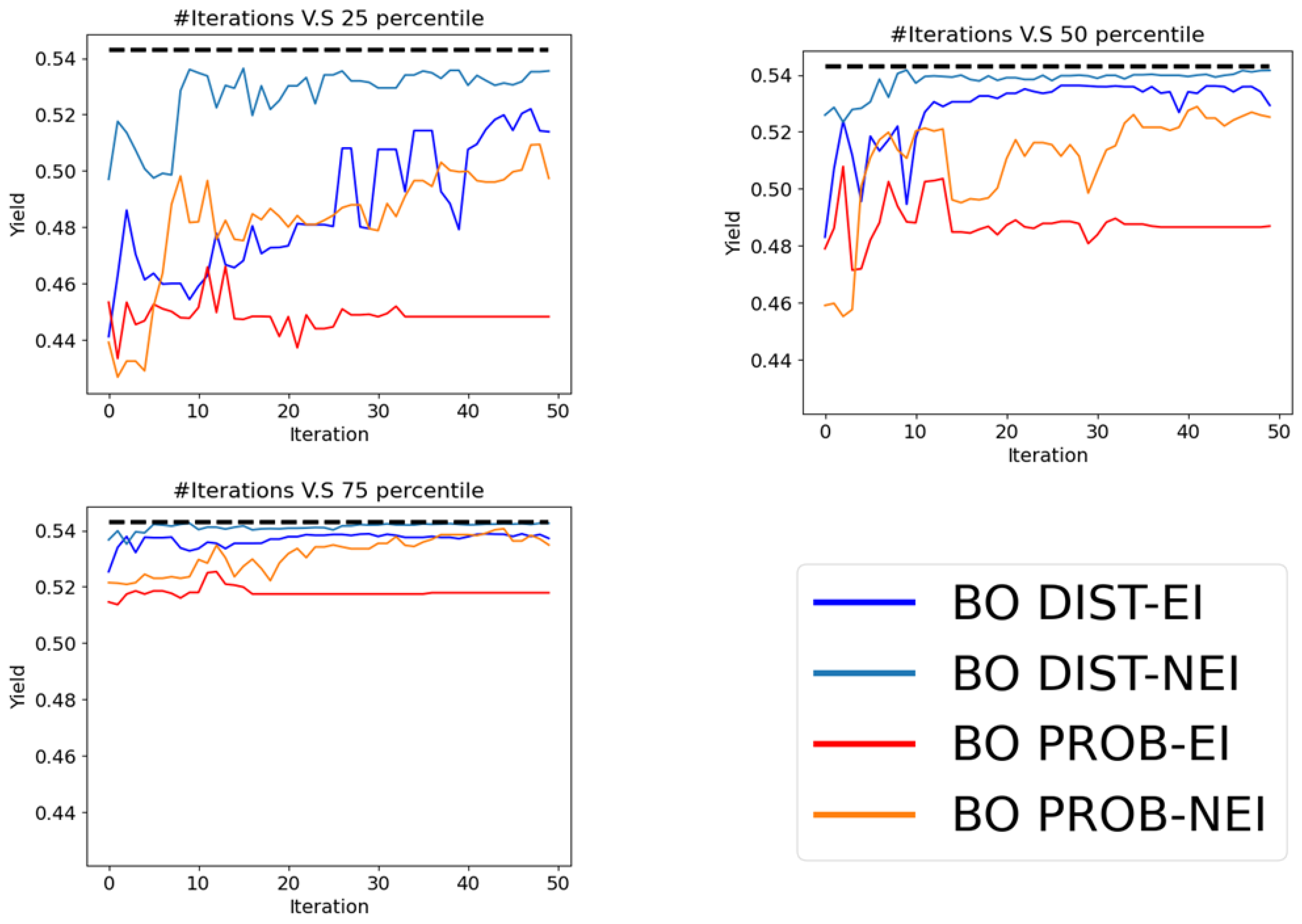
Appendix D.1. Difference in Acquisition Functions


| Percentile | 25 | 50 | ||||||
|---|---|---|---|---|---|---|---|---|
| Method | BO DIST-EI | BO DIST-NEI | BO PROB-EI | BO PROB-NEI | BO DIST-EI | BO DIST-NEI | BO PROB-EI | BO PROB-NEI |
| Iteration | ||||||||
| 4 | 0.461 | 0.501 | 0.447 | 0.429 | 0.496 | 0.528 | 0.472 | 0.501 |
| 9 | 0.454 | 0.536 | 0.448 | 0.482 | 0.495 | 0.542 | 0.488 | 0.511 |
| 14 | 0.466 | 0.529 | 0.447 | 0.476 | 0.531 | 0.539 | 0.485 | 0.496 |
| 19 | 0.473 | 0.525 | 0.441 | 0.484 | 0.532 | 0.538 | 0.484 | 0.5 |
| 24 | 0.481 | 0.534 | 0.444 | 0.482 | 0.534 | 0.54 | 0.488 | 0.516 |
| 29 | 0.479 | 0.531 | 0.449 | 0.479 | 0.536 | 0.54 | 0.481 | 0.498 |
| 34 | 0.514 | 0.534 | 0.448 | 0.497 | 0.536 | 0.54 | 0.488 | 0.526 |
| 39 | 0.479 | 0.536 | 0.448 | 0.5 | 0.527 | 0.54 | 0.487 | 0.522 |
| 44 | 0.52 | 0.531 | 0.448 | 0.497 | 0.536 | 0.54 | 0.487 | 0.522 |
| 49 | 0.514 | 0.535 | 0.448 | 0.497 | 0.529 | 0.542 | 0.487 | 0.525 |
| Percentile | 75 | |||||||
| Method | BO DIST-EI | BO DIST-NEI | BO PROB-EI | BO PROB-NEI | ||||
| 4 | 0.538 | 0.539 | 0.517 | 0.524 | ||||
| 9 | 0.533 | 0.543 | 0.518 | 0.524 | ||||
| 14 | 0.535 | 0.541 | 0.521 | 0.524 | ||||
| 19 | 0.537 | 0.541 | 0.517 | 0.528 | ||||
| 24 | 0.538 | 0.541 | 0.517 | 0.534 | ||||
| 29 | 0.539 | 0.542 | 0.517 | 0.534 | ||||
| 34 | 0.538 | 0.542 | 0.517 | 0.534 | ||||
| 39 | 0.537 | 0.542 | 0.518 | 0.539 | ||||
| 44 | 0.539 | 0.542 | 0.518 | 0.541 | ||||
| 49 | 0.537 | 0.543 | 0.518 | 0.535 | ||||
| BO DIST-EI | BO DIST-NEI | BO PROB-EI | BO PROB-NEI |
|---|---|---|---|
| 23.447 ± 3.705 | 31.102 ± 3.105 | 4.670 ± 0.638 | 6.148 ± 0.609 |
Appendix D.2. Difference in Kernel Functions
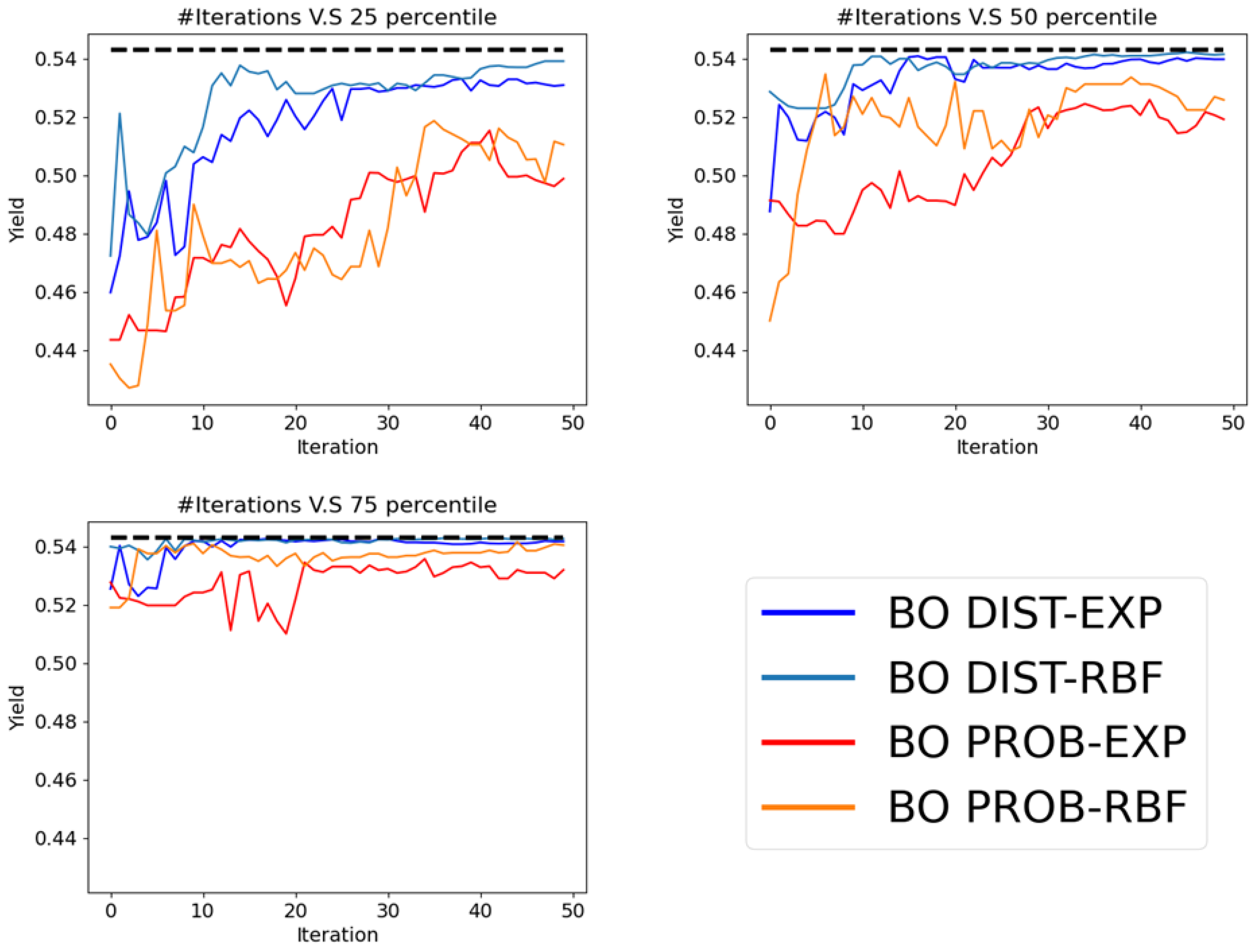
| Percentile | 25 | 50 | ||||||
|---|---|---|---|---|---|---|---|---|
| Method | BO DIST- EXP | BO DIST-RBF | BO PROB-EXP | BO PROB- RBF | BO DIST-EXP | BO DIST-RBF | BO PROB-EXP | BO PROB- RBF |
| Iteration | ||||||||
| 4 | 0.479 | 0.479 | 0.447 | 0.449 | 0.512 | 0.523 | 0.483 | 0.509 |
| 9 | 0.504 | 0.508 | 0.472 | 0.490 | 0.531 | 0.538 | 0.487 | 0.527 |
| 14 | 0.520 | 0.538 | 0.482 | 0.468 | 0.536 | 0.540 | 0.501 | 0.517 |
| 19 | 0.526 | 0.532 | 0.455 | 0.467 | 0.540 | 0.537 | 0.491 | 0.517 |
| 24 | 0.530 | 0.531 | 0.482 | 0.466 | 0.537 | 0.537 | 0.506 | 0.509 |
| 29 | 0.529 | 0.532 | 0.501 | 0.469 | 0.538 | 0.538 | 0.523 | 0.513 |
| 34 | 0.531 | 0.532 | 0.487 | 0.517 | 0.537 | 0.541 | 0.524 | 0.531 |
| 39 | 0.529 | 0.533 | 0.511 | 0.510 | 0.540 | 0.541 | 0.524 | 0.534 |
| 44 | 0.533 | 0.537 | 0.499 | 0.511 | 0.540 | 0.542 | 0.514 | 0.527 |
| 49 | 0.531 | 0.539 | 0.499 | 0.510 | 0.540 | 0.541 | 0.519 | 0.526 |
| Percentile | 75 | |||||||
| Method | BO DIST- EXP | BO DIST-RBF | BO PROB-EXP | BO PROB- RBF | ||||
| 4 | 0.526 | 0.535 | 0.520 | 0.538 | ||||
| 9 | 0.542 | 0.542 | 0.524 | 0.541 | ||||
| 14 | 0.542 | 0.542 | 0.530 | 0.536 | ||||
| 19 | 0.542 | 0.541 | 0.510 | 0.536 | ||||
| 24 | 0.542 | 0.542 | 0.533 | 0.535 | ||||
| 29 | 0.542 | 0.542 | 0.532 | 0.537 | ||||
| 34 | 0.541 | 0.542 | 0.536 | 0.538 | ||||
| 39 | 0.541 | 0.542 | 0.534 | 0.538 | ||||
| 44 | 0.541 | 0.543 | 0.532 | 0.541 | ||||
| 49 | 0.542 | 0.543 | 0.532 | 0.540 | ||||
References
- Brajlih, T.; Valentan, B.; Balic, J.; Drstvensek, I. Speed and accuracy evaluation of additive manufacturing machines. Rapid Prototyp. J. 2011, 17, 64–75. [Google Scholar] [CrossRef]
- Kumar, N.; Kennedy, K.; Gildersleeve, K.; Abelson, R.; Mastrangelo, C.M.; Montgomery, D.C. A review of yield modelling techniques for semiconductor manufacturing. Int. J. Prod. Res. 2006, 44, 5019–5036. [Google Scholar] [CrossRef]
- Katari, M.; Shanmugam, L.; Malaiyappan, J.N.A. Integration of AI and machine learning in semiconductor manufacturing for defect detection and yield improvement. J. Artif. Intell. Gen. Sci. 2024, 3, 418–431. [Google Scholar] [CrossRef]
- Liang, Y.-Z.; Xie, P.; Chan, K. Quality control of herbal medicines. J. Chromatogr. B 2004, 812, 53–70. [Google Scholar] [CrossRef]
- Appleton, T.; Bryan, P.; Contos, D.; Henry, T.R.; Lehmann, P.; Ohorodnik, S.; Reed, D.; Robichaud, C.; Schetter, J.; South, N.; et al. Nonclinical dose formulation: Out of specification investigations. AAPS J. 2012, 14, 523–529. [Google Scholar] [CrossRef]
- Chen, W.; Wiecek, M.M.; Zhang, J. Quality utility—A compromise programming approach to robust design. J. Mech. Des. 1999, 121, 179–187. [Google Scholar] [CrossRef]
- Zang, C.; Friswell, M.; Mottershead, J. A review of robust optimal design and its application in dynamics. Comput. Struct. 2005, 83, 315–326. [Google Scholar] [CrossRef]
- Du, X.; Chen, W. Towards a better understanding of modeling feasibility robustness in engineering design. J. Mech. Des. 1999, 122, 385–394. [Google Scholar] [CrossRef]
- Ochoa, J.S.; Cangellaris, A.C. Random-space dimensionality reduction for expedient yield estimation of passive microwave structures. IEEE Trans. Microw. Theory Tech. 2013, 61, 4313–4321. [Google Scholar] [CrossRef]
- Styblinski, M.A.; Opalski, L.J. Algorithms and software tools for IC yield optimization based on fundamental fabrication parameters. IEEE Trans. Comput.-Aided Des. Integr. Circuits Syst. 1986, 5, 79–89. [Google Scholar] [CrossRef]
- Dolecek, L.; Qazi, M.; Shah, D.; Chandrakasan, A. Breaking the simulation barrier: SRAM evaluation through norm minimization. In Proceedings of the 2008 IEEE/ACM International Conference on Computer-Aided Design, San Jose, CA, USA, 10–13 November 2008; pp. 322–329. [Google Scholar]
- Fang, C.; Yang, F.; Zeng, X.; Li, X. BMF-BD: Bayesian model fusion on bernoulli distribution for efficient yield estimation of integrated circuits. In Proceedings of the 2014 51st ACM/EDAC/IEEE Design Automation Conference (DAC), San Francisco, CA, USA, 1–5 June 2014; pp. 1–6. [Google Scholar]
- Ashby, M.F. Multi-objective optimization in material design and selection. Acta Mater. 2000, 48, 359–369. [Google Scholar] [CrossRef]
- Sarkar, D.; Rohani, S.; Jutan, A. Multi-objective optimization of seeded batch crystallization processes. Chem. Eng. Sci. 2006, 61, 5282–5295. [Google Scholar] [CrossRef]
- Shao, J. Mathematical Statistics; Springer: New York, NY, USA, 2003. [Google Scholar]
- Sano, S.; Kadowaki, T.; Tsuda, K.; Kimura, S. Application of bayesian optimization for pharmaceutical product development. J. Pharm. Innov. 2020, 15, 333–343. [Google Scholar] [CrossRef]
- Cho, S.; Kim, M.; Lee, J.; Han, A.; Na, J.; Moon, I. Multi-objective optimization of explosive waste treatment process considering environment via bayesian active learning. Eng. Appl. Artif. Intell. 2023, 117, 105463. [Google Scholar] [CrossRef]
- Iwama, R.; Kaneko, H. Design of ethylene oxide production process based on adaptive design of experiments and bayesian optimization. J. Adv. Manuf. Process. 2021, 3, e10085. [Google Scholar] [CrossRef]
- Al-Qahtani, K.; Elkamel, A.; Ponnambalam, K. Robust optimization for petrochemical network design under uncertainty. Ind. Eng. Chem. Res. 2008, 47, 3912–3919. [Google Scholar] [CrossRef]
- Rashidi, N.; Wang, Q.; Burgos, R.; Roy, C.; Boroyevich, D. Multi-objective design and optimization of power electronics converters with uncertainty quantification—Part I: Parametric uncertainty. IEEE Trans. Power Electron. 2020, 36, 1463–1474. [Google Scholar] [CrossRef]
- Zhang, Y.; Apley, D.W.; Chen, W. Bayesian optimization for materials design with mixed quantitative and qualitative variables. Sci. Rep. 2020, 10, 4924. [Google Scholar] [CrossRef]
- Chen, Y.; Hassani, H.; Krause, A. Near-optimal bayesian active learning with correlated and noisy tests. In Proceedings of the Artificial Intelligence and Statistics, Fort Lauderdale, FL, USA, 20–22 April 2017; pp. 223–231. [Google Scholar]
- Cakmak, S.; Astudillo Marban, R.; Frazier, P.; Zhou, E. Bayesian optimization of risk measures. Adv. Neural Inf. Process. Syst. 2020, 33, 20130–20141. [Google Scholar]
- Picheny, V.; Moss, H.; Torossian, L.; Durrande, N. Bayesian quantile and expectile optimisation. In Proceedings of the Uncertainty in Artificial Intelligence, Eindhoven, The Netherlands, 1–5 August 2022; pp. 1623–1633. [Google Scholar]
- Makarova, A.; Usmanova, I.; Bogunovic, I.; Krause, A. Risk-averse heteroscedastic bayesian optimization. Adv. Neural Inf. Process. Syst. 2021, 34, 17235–17245. [Google Scholar]
- Daulton, S.; Cakmak, S.; Balandat, M.; Osborne, M.A.; Zhou, E.; Bakshy, E. Robust multi-objective bayesian optimization under input noise. In Proceedings of the International Conference on Machine Learning, Baltimore, MD, USA, 17–23 July 2022; pp. 4831–4866. [Google Scholar]
- Wang, X.; Yan, C.; Ma, Y.; Yu, B.; Yang, F.; Zhou, D.; Zeng, X. Analog circuit yield optimization via freeze–thaw bayesian optimization technique. IEEE Trans. Comput.-Aided Des. Integr. Circuits Syst. 2022, 41, 4887–4900. [Google Scholar] [CrossRef]
- Iwazaki, S.; Inatsu, Y.; Takeuchi, I. Bayesian quadrature optimization for probability threshold robustness measure. Neural Comput. 2021, 33, 3413–3466. [Google Scholar] [CrossRef] [PubMed]
- Inatsu, Y.; Iwazaki, S.; Takeuchi, I. Active learning for distributionally robust level-set estimation. In Proceedings of the International Conference on Machine Learning, Virtual, 18–24 July 2021; pp. 4574–4584. [Google Scholar]
- Routtenberg, T.; Tabrikian, J. General classes of bayesian lower bounds for outage error probability and MSE. In Proceedings of the 2009 15th IEEE/SP Workshop on Statistical Signal Processing, Cardiff, UK, 31 August–3 September 2009; pp. 69–72. [Google Scholar]
- Cabilio, P. Sequential estimation in bernoulli trials. Ann. Stat. 1977, 5, 342–356. [Google Scholar] [CrossRef]
- Rice, J.A. Mathematical Statistics and Data Analysis; Thomson/Brooks/Cole: Belmont, CA, USA, 2007; Volume 371. [Google Scholar]
- Oehlert, G.W. A note on the delta method. Am. Stat. 1992, 46, 27–29. [Google Scholar] [CrossRef]
- Casella, G.; Berger, R. Statistical Inference; CRC Press: Boca Raton, FL, USA, 2024. [Google Scholar]
- Zhao, P.; Wu, J.; Liu, Z.; Wang, C.; Fan, R.; Li, Q. Differential private stochastic optimization with heavy-tailed data: Towards optimal rates. In Proceedings of the AAAI Conference on Artificial Intelligence; Philadelphia, PA, USA, 25 February–4 March 2025, AAAI: Washington, DC, USA, 2025; Volume 39, pp. 22795–22803. [Google Scholar]
- Lehmann, E.L.; Casella, G. Theory of Point Estimation; Springer Science & Business Media: New York, NY, USA, 2006. [Google Scholar]
- Zhang, Q.; Huang, W.; Jin, C.; Zhao, P.; Shu, Y.; Shen, L.; Tao, D. Multinoulli extension: A lossless yet effective probabilistic framework for subset selection over partition constraints. In Proceedings of the Forty-Second International Conference on Machine Learning, Vancouver, BC, Canada, 13–19 July 2025. [Google Scholar]
- Frazier, P.I. A tutorial on bayesian optimization. arXiv 2018, arXiv:1807.02811. [Google Scholar] [CrossRef]
- Letham, B.; Karrer, B.; Ottoni, G.; Bakshy, E. Constrained bayesian optimization with noisy experiments. Bayesian Anal. 2019, 14, 495–519. [Google Scholar] [CrossRef]
- Balandat, M.; Karrer, B.; Jiang, D.R.; Daulton, S.; Letham, B.; Wilson, A.G.; Bakshy, E. BoTorch: A Framework for Efficient Monte-Carlo Bayesian Optimization. In Proceedings of the 34th Conference on Neural Information Processing Systems (NeurIPS 2020), Vancouver, BC, Canada, 6–12 December 2020; NeurIPS: San Diego, CA, USA, 2020; Volume 33. [Google Scholar]
- Lee, C.; Graves, D.B.; Lieberman, M.A.; Hess, D.W. Global model of plasma chemistry in a high density oxygen discharge. J. Electrochem. Soc. 1994, 141, 1546. [Google Scholar] [CrossRef]
- COMSOL. Coil Optimization of an ICP Reactor. Available online: https://www.comsol.jp/model/coil-optimization-of-an-icp-reactor-96771 (accessed on 10 March 2026).
- Kokura, H.; Nakamura, K.; Ghanashev, I.P.; Sugai, H. Plasma absorption probe for measuring electron density in an environment soiled with processing plasmas. Jpn. J. Appl. Phys. 1999, 38, 5262. [Google Scholar] [CrossRef]
- Nakamura, K.; Ohata, M.; Sugai, H. Highly sensitive plasma absorption probe for measuring low-density high-pressure plasmas. J. Vac. Sci. Technol. A 2003, 21, 325–331. [Google Scholar] [CrossRef]
- Scharwitz, C.; Böke, M.; Hong, S.-H.; Winter, J. Experimental characterisation of the plasma absorption probe. Plasma Process. Polym. 2007, 4, 605–611. [Google Scholar] [CrossRef]
- Shapiro, S.S.; Wilk, M.B. An analysis of variance test for normality (complete samples). Biometrika 1965, 52, 591–611. [Google Scholar] [CrossRef]
- Sobol, I.M. On the distribution of points in a cube and the approximate evaluation of integrals. USSR Comput. Math. Math. Phys. 1967, 7, 86–112. [Google Scholar] [CrossRef]
- Pedregosa, F.; Varoquaux, G.; Gramfort, A.; Michel, V.; Thirion, B.; Grisel, O.; Blondel, M.; Prettenhofer, P.; Weiss, R.; Dubourg, V.; et al. Scikit-learn: Machine learning in Python. J. Mach. Learn. Res. 2011, 12, 2825–2830. [Google Scholar]
- Rodriguez-Galiano, V.; Sanchez-Castillo, M.; Chica-Olmo, M.; Chica-Rivas, M. Machine learning predictive models for mineral prospectivity: An evaluation of neural networks, random forest, regression trees and support vector machines. Ore Geol. Rev. 2015, 71, 804–818. [Google Scholar] [CrossRef]
- Wald, A. Tests of statistical hypotheses concerning several parameters when the number of observations is large. Trans. Am. Math. Soc. 1943, 54, 426–482. [Google Scholar] [CrossRef]
- Willink, R. Relationships between central moments and cumulants, with formulae for the central moments of gamma distributions. Commun. Stat.-Theory Methods 2003, 32, 701–704. [Google Scholar] [CrossRef]




| N | ||
|---|---|---|
| 2 | 1.15 × ± 1.25 × | 6.93 × ± 1.01 × |
| 4 | 5.68 × ± 7.27 × | 2.39 × ± 4.87 × |
| 8 | 2.89 × ± 3.90 × | 9.30 × ± 1.90 × |
| 16 | 1.43 × ± 1.99 × | 4.16 × ± 7.91 × |
| 32 | 7.01 × ± 9.86 × | 1.92 × ± 3.23 × |
| 64 | 3.57 × ± 5.05 × | 9.44 × ± 1.48 × |
| 128 | 1.83 × ± 2.57 × | 4.54 × ± 6.64 × |
| N | One-Sided Alternative Hypothesis | p-Value | Effect Size (Difference in Average) | 95% CI of Difference in Squared Error (Percentiles from 2.5 to 97.5) |
|---|---|---|---|---|
| 2 | Squared error of is less than that of . | < | −0.0460 | [−0.04912, −0.04284] |
| 128 | Squared error of is less than that of . | < | −0.00138 | [−0.00143, −0.001327] |
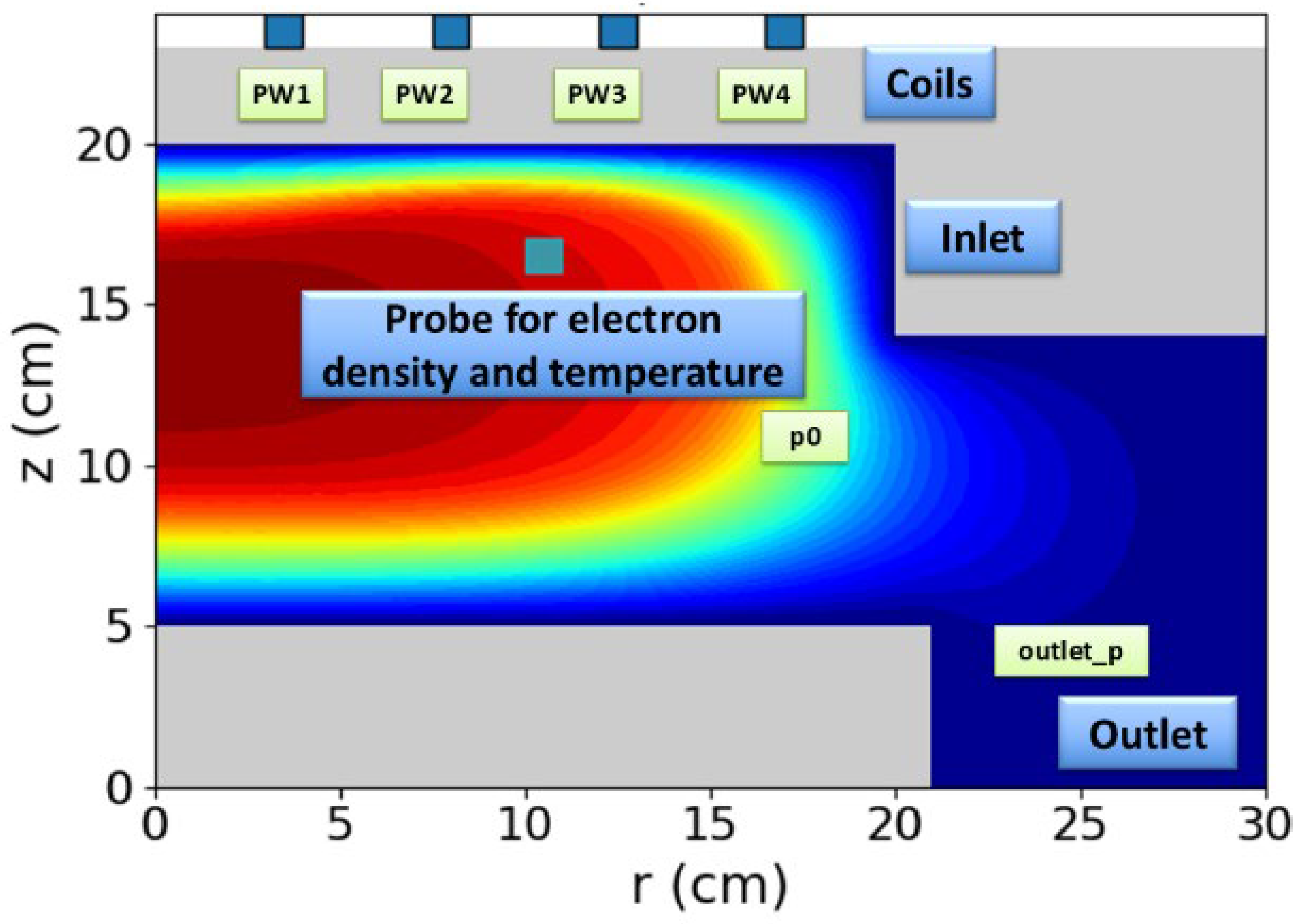
| Item | Type | Value/Distribution |
|---|---|---|
| Power (Pw1-4) | Fixed | 100 [W] |
| Ratio of O2 at inlet (xO2) | Varied | |
| Pressure (p0) | Varied | [torr] |
| Pressure at outlet (outlet_p) | Fixed | 0 [torr] |
| N | ||
|---|---|---|
| 2 | 9.26 × ± 1.20 × | 5.58 × ± 1.06 × |
| 4 | 4.66 × ± 6.21 × | 2.27 × ± 4.19 × |
| 8 | 2.40 × ± 3.34 × | 1.12 × ± 1.72 × |
| 16 | 1.18 × ± 1.67 × | 6.16 × ± 8.32 × |
| 32 | 5.81 × ± 8.36 × | 4.18 × ± 4.73 × |
| 64 | 2.86 × ± 3.99 × | 3.48 × ± 3.24 × |
| 128 | 1.43 × ± 2.00 × | 3.19 × ± 2.32 × |
| N | One-Sided Alternative Hypothesis | p-Value | Effect Size (Difference in Average) | 95% CI of Difference in Squared Error (Percentiles from 2.5 to 97.5) |
|---|---|---|---|---|
| 2 | Squared error of is less than that of . | < | −0.0369 | [−0.0400, −0.0337] |
| 128 | Squared error of is less than that of . | < | −0.00176 | [−0.00183, −0.00170] |
| N | ||
|---|---|---|
| 2 | 8.81 × ± 1.19 × | 5.07 × ± 8.96 × |
| 4 | 4.41 × ± 6.06 × | 2.34 × ± 3.53 × |
| 8 | 2.26 × ± 3.14 × | 1.31 × ± 1.50 × |
| 16 | 1.12 × ± 1.57 × | 8.29 × ± 8.82 × |
| 32 | 5.53 × ± 8.01 × | 6.10 × ± 5.97 × |
| 64 | 2.71 × ± 3.81 × | 4.90 × ± 4.20 × |
| 128 | 1.34 × ± 1.86 × | 4.35 × ± 3.05 × |
| N | One-Sided Alternative Hypothesis | p-Value | Effect Size (Difference in Average) | 95% CI of Difference in Squared Error (Percentiles from 2.5 to 97.5) |
|---|---|---|---|---|
| 2 | Squared error of is less than that of . | < | −0.0373 | [−0.0402, −0.0344] |
| 128 | Squared error of is less than that of . | < | −0.00301 | [−0.00309, −0.00294] |
| Percentile | 25 | 50 | 75 | |||
|---|---|---|---|---|---|---|
| Method | BO DIST | BO PROB | BO DIST | BO PROB | BO DIST | BO PROB |
| Iteration | ||||||
| 4 | 0.501 | 0.429 | 0.528 | 0.501 | 0.539 | 0.524 |
| 9 | 0.536 | 0.482 | 0.542 | 0.511 | 0.543 | 0.524 |
| 14 | 0.529 | 0.476 | 0.539 | 0.496 | 0.541 | 0.524 |
| 19 | 0.525 | 0.484 | 0.538 | 0.500 | 0.541 | 0.528 |
| 24 | 0.534 | 0.482 | 0.540 | 0.516 | 0.541 | 0.534 |
| 29 | 0.531 | 0.479 | 0.540 | 0.498 | 0.542 | 0.534 |
| 34 | 0.534 | 0.497 | 0.540 | 0.526 | 0.542 | 0.534 |
| 39 | 0.536 | 0.500 | 0.540 | 0.522 | 0.542 | 0.539 |
| 44 | 0.531 | 0.497 | 0.540 | 0.522 | 0.542 | 0.541 |
| 49 | 0.535 | 0.497 | 0.542 | 0.525 | 0.543 | 0.535 |
| Item | Range |
|---|---|
| Coil Power (PW1) | 10 [W] |
| Coil Powers (PW2, PW3) | (0, 300) [W] |
| Coil Powers (PW4) | 250 [W] |
| Ratio of O2 at inlet (xO2) | (0.7, 0.9) |
| Pressure (p0) | (0.01, 0.02) [torr] |
| Pressure at outlet (outlet_p) | (0, 0.02) [torr] |
| Item | Type | Domain/Value/Distribution |
|---|---|---|
| Power1 (Pw1) | Fixed | 10 [W] |
| Power2 (Pw2) | Control | 10–250 [W] |
| Power3 (Pw3) | Control | 10–250 [W] |
| Power4 (Pw4) | Fixed | 250 [W] |
| Ratio of O2 at inlet (xO2) | Randomly Varied | |
| Pressure (p0) | Randomly Varied | [torr] |
| Pressure at the outlet (outlet_p) | Randomly Varied | [torr] |
| Item | Range |
|---|---|
| Electron density | |
| Electron temperature (eV) |
| Aspect | Surrogate Model | Real Experiments |
|---|---|---|
| Control variables/operating windows | Coils (see Table 3 for details) | Same conditions |
| Measurement cost /response lag | Negligible per eval/fast surrogate; (0.1~1 [s] per evaluation on workstation) | Measurement of sensors for processing wafers /repetition of wafer processing (tens of minutes ~ hours) |
| Yield metrics | Probability both density/temp within specification limits | Same metrics |
| Percentile | 25 | 50 | 75 | |||
|---|---|---|---|---|---|---|
| Method | BO DIST | BO PROB | BO DIST | BO PROB | BO DIST | BO PROB |
| Iteration | ||||||
| 4 | 0.283 | 0.297 | 0.426 | 0.335 | 0.621 | 0.365 |
| 9 | 0.479 | 0.282 | 0.507 | 0.336 | 0.689 | 0.381 |
| 14 | 0.507 | 0.340 | 0.621 | 0.369 | 0.689 | 0.492 |
| 19 | 0.455 | 0.371 | 0.587 | 0.447 | 0.638 | 0.492 |
| 24 | 0.483 | 0.356 | 0.507 | 0.447 | 0.621 | 0.524 |
| 29 | 0.503 | 0.356 | 0.621 | 0.424 | 0.638 | 0.493 |
| 34 | 0.507 | 0.356 | 0.587 | 0.471 | 0.638 | 0.510 |
| 39 | 0.507 | 0.382 | 0.621 | 0.492 | 0.621 | 0.621 |
| 44 | 0.507 | 0.387 | 0.507 | 0.471 | 0.621 | 0.570 |
| 49 | 0.507 | 0.356 | 0.621 | 0.450 | 0.621 | 0.621 |
| Item | STRICT | LENIENT |
|---|---|---|
| Electron density | ||
| Electron temperature (eV) |
Disclaimer/Publisher’s Note: The statements, opinions and data contained in all publications are solely those of the individual author(s) and contributor(s) and not of MDPI and/or the editor(s). MDPI and/or the editor(s) disclaim responsibility for any injury to people or property resulting from any ideas, methods, instructions or products referred to in the content. |
© 2026 by the authors. Licensee MDPI, Basel, Switzerland. This article is an open access article distributed under the terms and conditions of the Creative Commons Attribution (CC BY) license.
Share and Cite
Sano, K.; Kawahito, D.; Saito, Y.; Moki, H.; Djurdjanovic, D. Data-Driven Yield Estimation and Maximization Using Bayesian Optimization Under Uncertainty. Appl. Sci. 2026, 16, 3213. https://doi.org/10.3390/app16073213
Sano K, Kawahito D, Saito Y, Moki H, Djurdjanovic D. Data-Driven Yield Estimation and Maximization Using Bayesian Optimization Under Uncertainty. Applied Sciences. 2026; 16(7):3213. https://doi.org/10.3390/app16073213
Chicago/Turabian StyleSano, Kei, Daiki Kawahito, Yukiya Saito, Hironori Moki, and Dragan Djurdjanovic. 2026. "Data-Driven Yield Estimation and Maximization Using Bayesian Optimization Under Uncertainty" Applied Sciences 16, no. 7: 3213. https://doi.org/10.3390/app16073213
APA StyleSano, K., Kawahito, D., Saito, Y., Moki, H., & Djurdjanovic, D. (2026). Data-Driven Yield Estimation and Maximization Using Bayesian Optimization Under Uncertainty. Applied Sciences, 16(7), 3213. https://doi.org/10.3390/app16073213