Article

Accuracy, Repeatability, and Test–Retest Reliability of a Pressure Algometer for Pain Threshold and Tolerance in Sports, Exercise, and Rehabilitation Settings

by
Verena Calmon Almeida
1,2,
Leonardo Yung dos Santos Maciel
2,3,4,5,
Jader Pereira de Farias Neto
6,
Rodrigo Zacca
2,4,7,8,* and
Valter Joviniano de Santana Filho
1
1
Post Graduate Program of Health Science, Federal University of Sergipe, Aracaju 49100-000, Brazil
2
Research Center in Physical Activity, Health, and Leisure (CIAFEL), Faculty of Sports, University of Porto (FADEUP), 4200-450 Porto, Portugal
3
Physiotherapy Department, Federal University of Sergipe, Lagarto 49400-000, Brazil
4
Laboratory for Integrative and Translational Research in Population Health (ITR), 4050-600 Porto, Portugal
5
Post Graduate Program in Nursing, Federal University of Sergipe, São Cristóvão 49100-000, Brazil
6
Physiotherapy Department, Federal University of Sergipe, São Cristóvão 49107-230, Brazil
7
Nucleus of Research in Human Motricity Sciences, Universidad Adventista de Chile, Chillán 3780000, Chile
8
Laboratory of Sport Physiology, Faculty of Sports, University of Porto, 4200-450 Porto, Portugal
*
Author to whom correspondence should be addressed.
Appl. Sci. 2026, 16(7), 3210; https://doi.org/10.3390/app16073210
Submission received: 21 February 2026 / Revised: 14 March 2026 / Accepted: 23 March 2026 / Published: 26 March 2026
(This article belongs to the Special Issue Innovation in Sports and Exercise Performance)

Featured Application

The present work supports the practical implementation of the AMF-500 digital push–pull force gauge as a low-cost, valid, and reliable pressure algometer for assessing pressure pain threshold and pressure pain tolerance in sports, exercise, and rehabilitation settings. Specifically, this device can be applied to: (i) Athlete monitoring programs, enabling regular assessment of neuromuscular sensitivity and early detection of maladaptive responses to training load, fatigue accumulation, or overuse; (ii) Rehabilitation follow-up, allowing clinicians to objectively track recovery progression and treatment effectiveness in musculoskeletal conditions; (iii) Return-to-play decision-making, providing quantitative support to complement functional and performance-based criteria; (iv) Research in sports science and exercise physiology, particularly in middle- and low-income contexts where access to high-cost validated algometers is limited. Given its demonstrated accuracy, precision, repeatability, and test–retest reliability, the AMF-500 offers an accessible and standardized tool for objectively quantifying pain sensitivity. Its affordability expands the feasibility of implementing evidence-based pain monitoring protocols in field-based sports environments, university laboratories, and clinical rehabilitation practice.

Abstract

Background: Pressure algometry is commonly used in sports, exercise, and rehabilitation settings to assess pain sensitivity and monitor neuromuscular status. Reliable and accessible devices are required for consistent assessment. This study evaluated the accuracy, agreement, repeatability, and test–retest reliability of the AMF-500 digital pressure algometer. Methods: Three independent studies were conducted. Study A assessed the agreement between the AMF-500 and a three-axis AMTI force plate during 30 controlled pressure trials. Study B compared pressure pain thresholds (lumbar paravertebral muscles, tibialis anterior, and thenar eminence) and lumbar pressure pain tolerance between the AMF-500 and the MED.DOR algometer in 27 healthy adults. Study C (n = 27 healthy adults) evaluated test–retest reliability across two sessions separated by 48 h. Agreement was assessed using Bland–Altman analyses, and intraclass correlation coefficients (ICC) was also applied. Standard error of measurement (SEM) and minimal detectable change (MDC) were also calculated. All pressure values were expressed in N/cm2. Results: In Study A, the AMF-500 slightly overestimated pressure compared with the force plate (19.34 ± 2.44 vs. 18.71 ± 2.49 N/cm2), with a mean bias of 0.63 N/cm2 and limits of agreement from 0.21 to 1.05 N/cm2, corresponding to a mean difference of approximately 3.4%. Despite this small systematic bias, agreement between devices was excellent (ICC = 0.99; 95% CI: 0.96–0.99), and no proportional bias was detected, indicating a small and consistent overestimation of pressure by the AMF-500. In Study B, no significant differences were observed between AMF-500 and MED.DOR for lumbar threshold, lumbar tolerance, tibialis anterior threshold, or thenar eminence threshold (all p > 0.05). Agreement between devices was good to excellent (ICC = 0.82–0.91). Bland–Altman analyses showed small mean biases (1.05–7.51 N/cm2), with proportional bias detected only for lumbar tolerance. In Study C, test–retest reliability for the AMF-500 ranged from moderate to good across sites (ICC = 0.69–0.88), comparable to MED.DOR (ICC = 0.63–0.88). SEM values for the AMF-500 ranged from 9.31 to 25.15 N/cm2, with higher variability observed for lumbar tolerance. Conclusions: The AMF-500 demonstrated acceptable accuracy, agreement, and reliability when compared with a laboratory force plate and an established clinical algometer. These findings can support its use as a low-cost tool for pressure pain assessment in sports, exercise, and rehabilitation contexts.

1. Introduction

Self-reported visual analog scale (VAS) and pressure algometry are the most used methods [1] to assess an individual’s pain perception in clinical, sports, and exercise contexts. These methods, especially the assessment of pain threshold, provide a starting point to track and monitor the pain responses and recovery processes during training, competition, and rehabilitation interventions [2]. Pressure algometry has showed its reliability to allow the “tenderness” of force to be quantified [3], which is particularly relevant in musculoskeletal assessment within sports and rehabilitation practice.
The terms “pressure algometer”, “algometer”, or “dolorimeter” are used to describe instruments that measure pain sensitivity [3]. Pressure pain threshold refers to the minimum pressure (force per unit area) that induces pain perception, whereas pressure pain tolerance is the maximum pressure that a participant can tolerate before requesting cessation. These values are typically expressed in units of pressure (e.g., N/cm2 or kg/cm2) [4]. During testing, the examiner gradually applies increasing force until the participant reports pain [5,6]. Thus, although the pressure pain threshold algometry is still based on pain perception, it can be objectively quantified [2], making it useful for monitoring neuromuscular adaptations, injury risk, and rehabilitation progress in physically active populations.
Typically, algometer devices have a force transducer and flat applicator tip which allow quantitative force assessment [7]. The most common devices have 1 cm2 pressure application surface area and display force readings in newtons (N) or kilograms of force (kgf). The AMF-500 (Push Pull Force Dynamometer, Wenzhou, China) is a digital push–pull force gauge with a 1 cm2 round rubber application tip, in line with standard pressure algometry protocols. The device measures force directly in newtons (N), with a maximum load of 50 kgf (~490 N) and a display precision of 0.01 kgf (~0.1 N). This standardized tip area allows the conversion of force into pressure using the relation “pressure = force/area”, resulting in pressure values expressed in N/cm2 or kPa. All reported pressures in this study are expressed in N/cm2 (equivalent to kPa), and rounding is performed according to the device’s display precision after conversion, ensuring scientific consistency and comparability across studies.
Currently, there are some already validated models on the market. The Somedic (Somedic Algometer Type II, Somedic, Solna, Sweden) [8] and the Wagner (FDIX50, Wagner force One, Wagner Instruments, Greenwich, CT, USA) [3] are available algometers, but these are expensive and sometimes inaccessible for some physical therapists and sports and exercise professionals [8]. Another possibility is the “MED.DOR” (MED.DOR Ltda., Governador Valadares, Brazil) [9], a valid low-cost option, but some features (e.g., maximum pressure) are not automatic in this model, which may limit its applicability in some related settings.
Considering that middle- and low-income countries have financial stress (money shortage) as one of the most important barriers to research development [10,11], the validation of new low-cost devices gives extra confidence and motivation to professionals and researchers working in sports science, exercise physiology, and rehabilitation contexts. In this context, the AMF-500 algometer is a low-cost device which displays the main functions of the already validated algometers. Despite that, tests against reference values, as well as their reproducibility, has not yet been performed in laboratory and applied sports settings. Criterion validity typically is assessed by comparing results from biological tests during simultaneous or consecutive (accuracy and precision) and repeated (repeatability) measurements, i.e., evaluating how a device measures an outcome that it is designed to measure. However, considering the subjective characteristics of pain [12], we cannot exclude the individual variability. Thus, through three independent studies, we aim: (i) to assess the accuracy, precision, and repeatability of a commercially available algometer, the AMF-500 digital push–pull force gauge 500 N dynamometer (Push Pull Force Dynamometer, AMF-500, Wenzhou, China), against a three-axis AMTI (Advanced Mechanical Technology, Inc., Watertown, MA, USA) force plate; (ii) the accuracy, precision, and repeatability against the MED.DOR; and (iii) the test–retest reliability of AMF-500 and MED.DOR, specifically within contexts relevant to sports, exercise testing, and rehabilitation practice. Our hypothesis is that this commercially available algometer can be used to assess the pressure pain threshold and tolerance with adequate accuracy, repeatability, and test–retest reliability in sports, exercise, and rehabilitation settings.

2. Materials and Methods

The STROBE checklist [13] was used. Firstly (Study A), we assessed the accuracy, precision, and repeatability among AMF-500 and a three-axis force plate. Secondly (Study B), we verified the accuracy, precision, and repeatability between AMF-500 and MED.DOR for the pressure pain threshold and tolerance. Finally (Study C), the test–retest reliability of both the AMF-500 and MED.DOR algometers was evaluated using the intraclass correlation coefficient model ICC(3,1) (two-way mixed-effects model, absolute agreement). Additionally, the standard error of measurement (SEM) and minimal detectable change (MDC) were calculated. The data were collected at the same shift, in a temperature-controlled environment. The Faculty of Sport of the University of Porto ethics committee for human investigation approved the procedures employed in the study (CEFADE 40-2022). All procedures were performed by an independent investigator with at least 3 years of experience, who underwent standardized training sessions to ensure consistent device handling and application rate (~1 kg/s). The algometer was aligned perpendicular to the force plate using visual guides and confirmed by the investigator before each trial.

2.1. Study A (Accuracy, Precision, and Repeatability Between AMF-500 and Force Plate)

2.1.1. Equipment

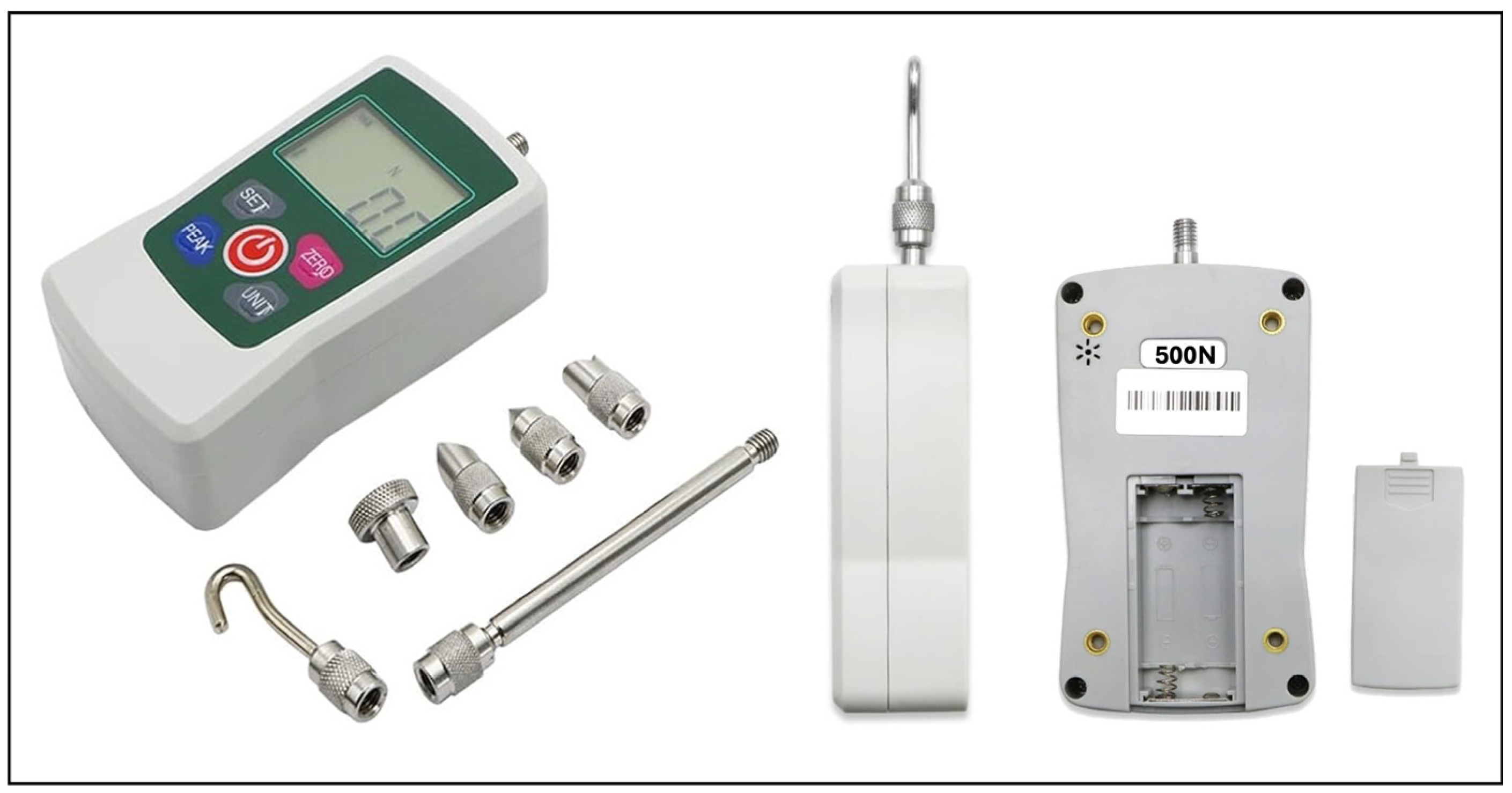
The AMF-500 algometer (Figure 1) used in the present study was brand new and calibrated twice before any measurement. A three-axis AMTI force plate (40 × 60 × 8.2 cm, AMTI BP-400600-WP-1k, Advanced Mechanical Technology, Inc., Watertown, MA, USA) was used as a gold standard to collect data using a sample rate of 1000 Hz.

2.1.2. Procedures

A total of 30 independent 3 s pressure trials were performed with the AMF-500 on the force plate, with the order of trials randomized to reduce order bias. Data were collected simultaneously. The AMF-500 algometer used a peak hold function over the 3 s application. To ensure comparability, the force plate signal was processed to extract the peak force over the same 3 s window, using identical definitions for peak force. AMTI’s NetForce v 1.0 software and Gen5 amplifier (Advanced Mechanical Technology, Inc., Watertown, MA, USA) were used for data acquisition, signal amplification, and processing according to the manufacturer instructions. The channels were connected to AMTI’s Gen5 amplifier and NetForce software to assess the peak force values applied in the Z axis. The force plate was calibrated after every round of 5 measurements according to the manufacturer instructions. The AMF-500 was re-zeroed immediately before each trial to ensure a baseline force of 0 N, independent of the force plate calibration, which was performed every five trials according to the manufacturer’s recommendation. Both devices used newton (N) as a unit of measurement. For consistency in reporting, all pressure values were converted to N/cm2 considering the 1 cm2 tip area.

2.2. Study B (Accuracy, Precision, and Repeatability Between AMF-500 and MED.DOR)

2.2.1. Participants

The sample was non-probabilistic, inviting participants by flyers in university or through the media and using snowball sampling. The volunteers (see Table 1) were healthy individuals that participated within the university community and had no pain in the selected areas. The exclusion criteria for participants were: (1) pregnancy; (2) cutaneous lesion in the selected anatomical region; (3) active infectious processes; (4) nerve damage or disease affecting the skin in selected anatomical region; (5) inability to understand the instructions or consent to the study; (6) psychiatric disorders; (7) presence of auditory, visual, or communication disturbance; (8) body mass index > 30 kg·m−2; and (9) use of pain medication within 24 h prior to assessment. Participants were recreationally active, reporting at least 150 min of moderate physical activity per week. No participants performed vigorous exercise within 24 h prior to testing, and all were instructed to avoid caffeine for at least 12 h before assessment
All measurements were conducted by a trained investigator (≥3 years of experience), blinded to the readings of the devices until after data was recorded.

2.2.2. Equipment

The MED.DOR algometer (MED.DOR Ltd., São Paulo, Brazil), which was used as the reference algometer, has a maximum compression of 50 kgf, a precision of 0.1 kgf, a three-digit display, and 1 cm2 round rubber application surface attached to follow the standardization for pressure algometry protocols. For consistent reporting, all pressure values were converted to N/cm2 (equivalent to kPa) in consideration of the 1 cm2 tip area. The values originally measured in kilograms of force (kgf) were converted using the relation 1 kgf = 9.80665 N.

2.2.3. Procedures

Subjects who met the inclusion criteria were evaluated individually. The protocol for positioning the patient to assess pressure pain threshold for the selected anatomical regions was as follows: the participant lying in a prone position was marked and assessed bilaterally where (1) the midpoint of paravertebral muscle belly was located at 5 cm lateral to the L3 process [14,15,16] for pressure pain threshold and pressure pain tolerance; and (2) the thenar eminence [5,6] for pressure pain threshold. After the assessment, the patient was asked to lie in the supine position, then marked and assessed bilaterally for the pressure pain threshold in the tibialis anterior muscle, located 5 cm from the tibial tuberosity [14,15]. The algometer was positioned perpendicular to the selected anatomical regions. Pressure was applied at a controlled rate (~1 kg/s) for both devices. Because the investigator was blinded to the display during the trials to prevent bias, this rate was ensured through specific prior training sessions and the investigator’s extensive experience (≥3 years), relying on consistent motor execution rather than concurrent visual or auditory feedback. Participants were instructed to indicate when the pressure became painful (pressure pain threshold or tolerance). Three measurements were taken per site at 30 s intervals, and a fourth measurement was performed only if the variation exceeded 20%. In such cases, the fourth measurement replaced the most distant value (outlier), and the average of the three closest trials was calculated for analysis. The order of devices (AMF-500 vs. MED.DOR) was counterbalanced across participants.

2.3. Study C (Test–Retest Reliability of AMF-500 and MED.DOR)

2.3.1. Participants and Equipment

The participants and the equipment used were the same from Study B.

2.3.2. Procedures

Participants underwent a two-moment assessment respecting the same selected anatomical region and positioning as in Study B. The assessments were repeated after 48 h using the same procedures. The order of devices was counterbalanced, and participants were blinded to the devices’ readings.

2.3.3. Statistical Analysis and Sample Size

The sample size for each study was determined based on previous reliability studies and the number of measurements needed to estimate the ICC and Bland–Altman limits of agreement with acceptable confidence. All statistical calculations were undertaken using R (“Cherry Blossom” 2023.03.0 release for Windows). Significance was set at p < 0.05. The normality of the data was tested using Shapiro–Wilk test, and the data considered according to each part of the study.

2.3.4. Study A

A total of 30 independent 3 s pressure trials were performed, which was considered sufficient to estimate the accuracy, precision, and repeatability of the AMF-500 measurements against the force plate. The maximum vertical force values recorded by the force plate and the corresponding values from the algometer were used for data analysis. Since the algometer tip area was 1 cm2, all force values were expressed as pressure (N/cm2). A paired t-test was used to compare the differences between the two instruments. The effect sizes (Cohen’s dz) were interpreted with the following criteria: 0–0.19 trivial; 0.2–0.59 small; 0.6–1.19 moderate; 1.2–1.99 large; 2.0–3.99 very large; and >4.0 nearly perfect [17].
The Bland–Altman plot [18] was applied using jamovi (version 2.6), an open-source statistical software (the jamovi project, 2025, https://www.jamovi.org) (accessed on 20 February 2026) [19], according to the guidelines [20] to quantify the agreement between two quantitative measurements by determining the bias (or mean of difference for normally distributed and median of the differences if non-normally distributed data) as a measure of accuracy, and the limits of agreement as a measure of precision. The mean of the two measurements was plotted against the difference between them with 95% of the differences expected to lie within the limits of agreement (±1.96 standard deviations from the mean for normally distributed, or median 2.5th and 97.5th percentiles if non-normally distributed data) and the respective 95% confidence interval. The confidence interval of the bias illustrated the magnitude of the systematic error, while the confidence intervals of the limits of agreements provided an estimation of the extent of the possible sampling error [18,20]. An inspection of the slope of the linear regression (Bland–Altman plot) between both protocols (to check for proportional error) was performed. The intraclass correlation coefficients (ICC) were calculated (model: two-way mixed; type: absolute agreement) to quantify the consistency (repeatability) of each variable. Values less than 0.5, between 0.5 and 0.75, between 0.75 and 0.9, and greater than 0.90 were deemed indicative of poor, moderate, good, and excellent repeatability, respectively [21].

2.3.5. Study B

A total of 27 healthy participants were included, which was considered sufficient to estimate the accuracy, precision, and repeatability of the AMF-500 in comparison with the MED.DOR algometer [16]. To compare the differences between the two devices (AMF-500 vs. MED.DOR) measured on the same participants, paired statistical tests were employed. The Wilcoxon signed-rank test was used for non-parametric data, and the paired samples t-test was used for parametric data. The effect sizes were calculated accordingly: Cohen’s dz was used for parametric comparisons and the matched-pairs rank-biserial correlation (r) was used for non-parametric data. The effect sizes were interpreted with the following criteria: 0–0.19 trivial; 0.2–0.59 small; 0.6–1.19 moderate; 1.2–1.99 large; 2.0–3.99 very large; and >4.0 nearly perfect [17]. The Bland–Altman plot was applied, and intraclass correlation coefficients (ICC) were calculated to assess repeatability and agreement [18,19,20,21].

2.3.6. Study C

Study C included the same 27 participants from Study B, which was considered sufficient to estimate the test–retest reliability of AMF-500 and MED.DOR algometers using intraclass correlation coefficients (ICC) [21]. For the statistical analysis, a comparison between the moments for each algometer was made by a t-test for repeated measures in case of parametric data (Cohen’s dz was calculated as effect size). For the non-parametric data, the Wilcoxon test (matched-pairs rank-biserial correlation r) was used to calculate the effect size. ICC values were calculated and interpreted like Study B to quantify the consistency between evaluators.

3. Results

3.1. Study A

A total of 30 paired pressure measurements were analyzed to compare the AMF-500 algometer with the three-axis AMTI force plate. The mean pressure recorded by the AMF-500 (19.34 ± 2.44 N/cm2) was slightly higher than that measured by the force plate (18.71 ± 2.49 N/cm2).
A paired t-test revealed a statistically significant difference between instruments (mean difference: 0.63 N/cm2; 95% CI: 0.55 to 0.71 N/cm2; p < 0.001), corresponding to a 3.4% higher value for the algometer. This difference was associated with a very large effect size (Cohen’s dz = 2.97); however, this large effect size reflected the high consistency (low standard deviation) of differences rather than a lack of practical agreement. From a clinical perspective, the systematic bias was only 0.63 N/cm2 (3.4%), which fell well within acceptable tolerance bands for pressure pain threshold measurements, where typical inter-trial variability often exceeded this margin. Despite this systematic difference, excellent repeatability between devices was observed, with an intraclass correlation coefficient of ICC = 0.99 (95% CI: 0.96 to 0.99; p < 0.001).
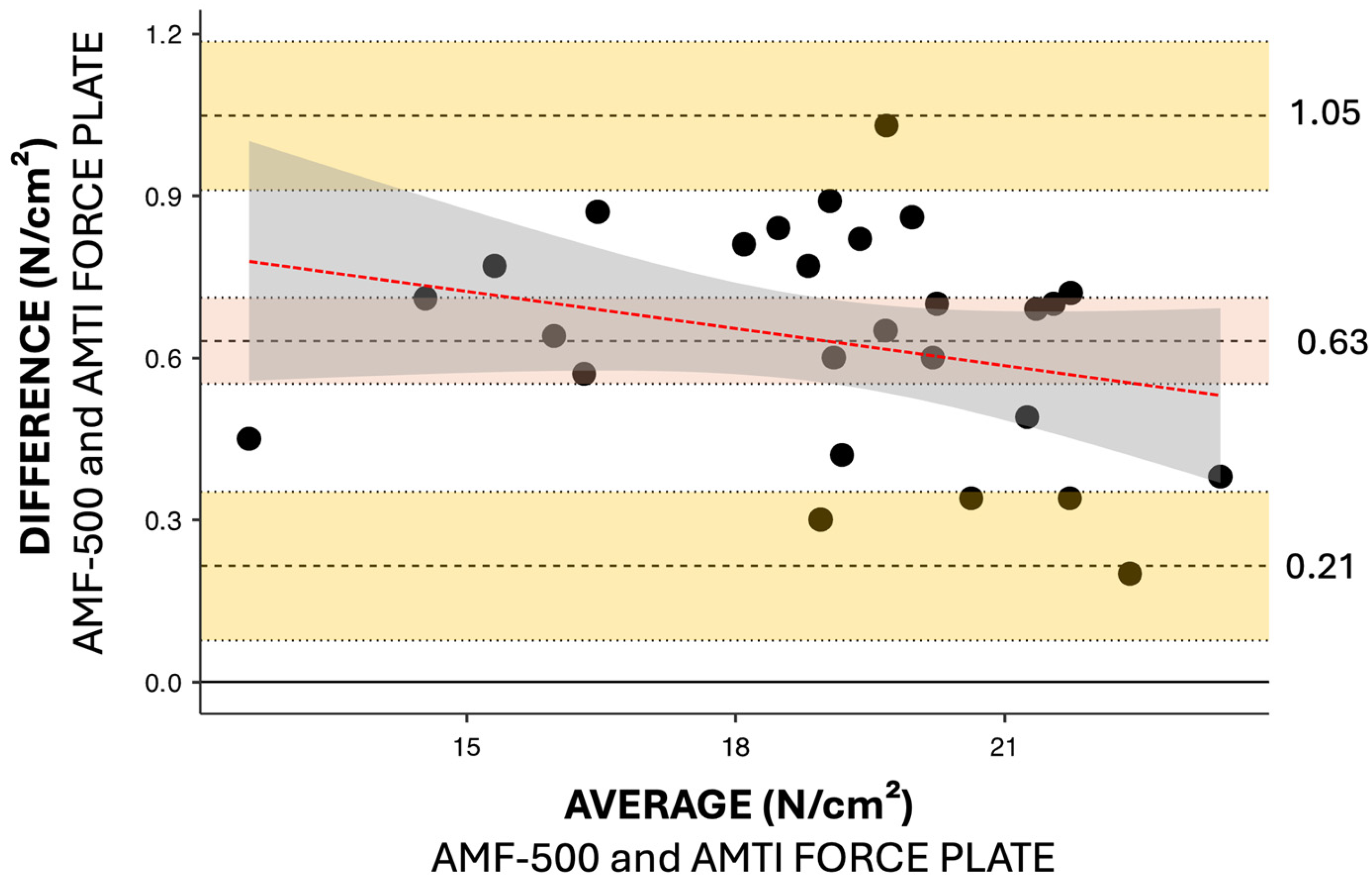
Bland–Altman analysis showed a small systematic bias of 0.63 N/cm2 (3.4%) (95% CI: 0.55 to 0.71 N/cm2; 3.0% to 3.8%), indicating that the AMF-500 slightly overestimated pressure compared to the force plate. The limits of agreement ranged from 0.21 to 1.05 N/cm2 (1.1% to 5.6%), with 95% confidence intervals of 0.07 to 0.35 N/cm2 (0.4% to 1.9%) and 0.91 to 1.19 N/cm2 (4.9% to 6.4%) for the lower and upper limits, respectively. Visual inspection of the Bland–Altman plot indicated a consistent distribution of the differences within these limits (Figure 2), and linear regression analysis showed no evidence of proportional bias between the measurements (slope = 0.007, p = 0.72).

3.2. Study B

A trivial to small effect size was observed for the lumbar threshold and tolerance, as well as the tibialis anterior and thenar eminence thresholds (Table 2). Following the averaging of the three consecutive trials for each anatomical point, pairwise comparisons revealed that the AMF-500 and MED.DOR devices performed similarly across all measurements. Specifically, no significant differences were found for the lumbar threshold (Z = 154.00; p = 0.41; r = 0.19), lumbar tolerance (t(25) = 0.96; p = 0.35; dz = 0.19), tibialis anterior threshold (Z = 138.00; p = 0.23; r = 0.27), and thenar eminence threshold (Z = 151.00; p = 0.37; r = 0.20).
The repeatability and agreement between the two algometers were good to excellent across all assessed moments (lumbar threshold: ICC (3,1) = 0.88, p < 0.001; lumbar tolerance: ICC (3,1) = 0.85, p < 0.001; tibialis anterior threshold: ICC (3,1) = 0.91, p < 0.001; thenar eminence threshold: ICC (3,1) = 0.82, p < 0.001).
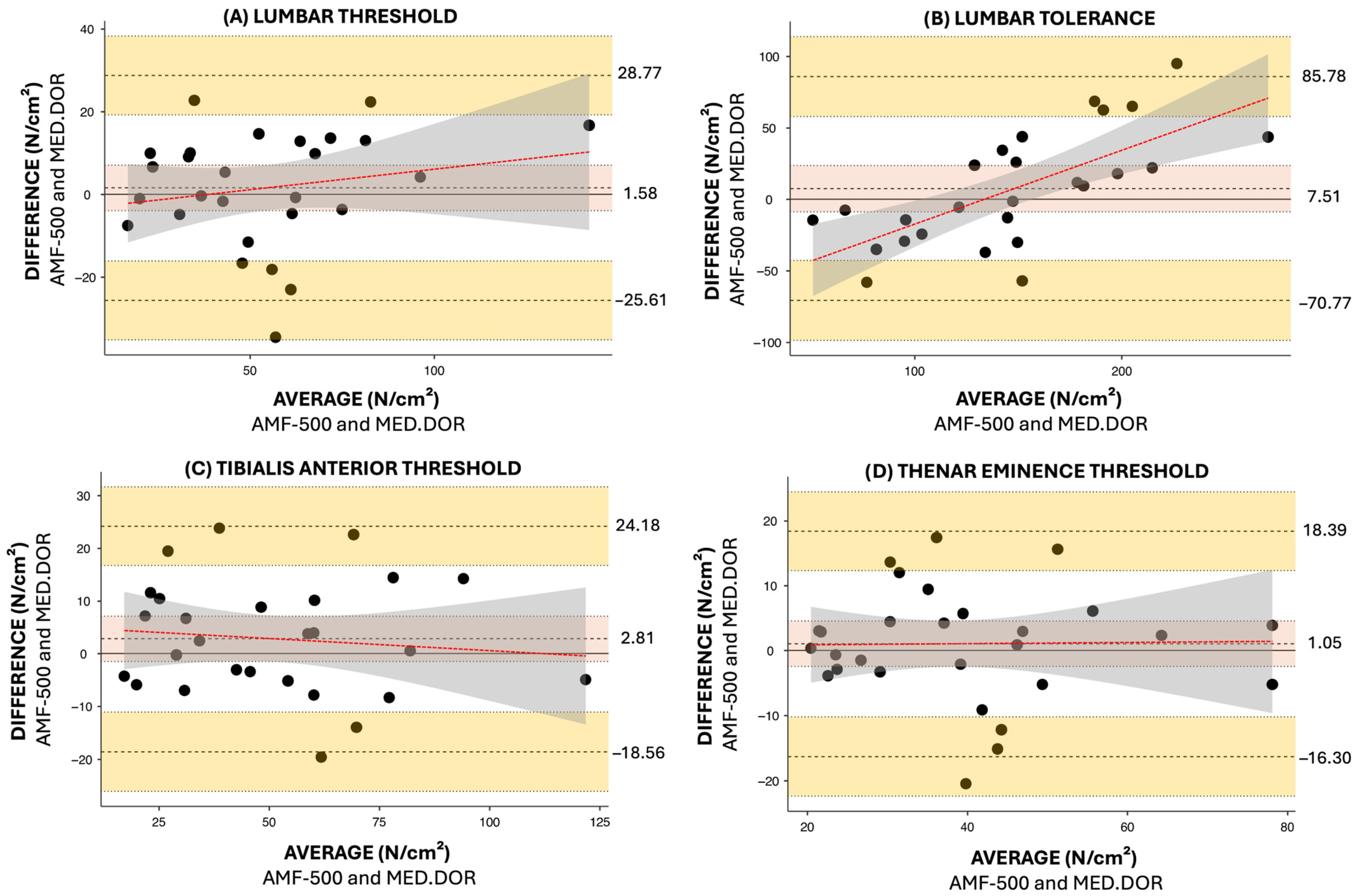
The calculated bias and 95% limits of agreement (LoA) were as follows (see Figure 3:
  • Lumbar threshold: bias of 1.58 N/cm2 (LoA: −25.61 to 28.77 N/cm2);
  • Lumbar tolerance: bias of 7.51 N/cm2 (LoA: −70.77 to 85.78 N/cm2);
  • Tibialis anterior threshold: bias of 2.81 N/cm2 (LoA: −18.56 to 24.18 N/cm2);
  • Thenar eminence threshold: bias of 1.05 N/cm2 (LoA: −16.30 to 18.39 N/cm2).
An inspection of the slope of the linear regression between the mean and the difference in the two devices was performed to check for proportional error. No significant proportional error was found for the lumbar threshold (p = 0.33), tibialis anterior threshold (p = 0.59), or thenar eminence threshold (p = 0.94). For the lumbar tolerance, a significant proportional error was detected (p < 0.001), suggesting that the difference between devices may vary at higher pressure levels.
Figure 3. Bland–Altman plot showing bias (dashed line), limits of agreement (dashed lines), and their 95% confidence intervals (colored bars between dotted lines) for pressure (N/cm2) between the AMF-500 and MED.DOR for each body location.
Applsci 16 03210 g003

3.3. Study C

The data related to Study C are presented in Table 3. Both algometers demonstrated moderate to excellent test–retest reliability across sessions, depending on the measurement site. For the AMF-500, the ICC (3,1) values ranged from 0.686 to 0.880, with the SEM ranging from 9.31 to 25.15 N/cm2. For the MED.DOR, the ICC (3,1) values ranged from 0.632 to 0.879, with the SEM ranging from 8.12 to 43.10 N/cm2. The minimal detectable change (MDC) for all sites and devices is detailed in Table 3. Overall, the SEM and MDC values indicated an acceptable level of absolute reliability for both devices. The measurement error was lowest at the tibialis anterior and thenar eminence thresholds, suggesting a high precision, whereas the lumbar tolerance exhibited greater variability, which was common in pressure pain threshold assessments of larger muscle groups.

4. Discussion

The main aim of this study was to assess the accuracy, precision, repeatability, and test–retest reliability of the AMF-500 algometer. To the best of our knowledge, this was the first study to use different body sites for accuracy, precision, repeatability, and test–retest reliability assessments within a framework applicable to physically active populations. Our results suggested that the AMF-500 was highly accurate and precise, repeatable, and demonstrated strong test–retest reliability. Sports scientists, exercise professionals, and rehabilitation clinicians could safely use the AMF-500 algometer to quantify pain threshold and tolerance.
For Study A, the excellent repeatability against the force plate was consistent with already validated algometers [3,8,9,22]. Generally, these validation studies have compared data against a force plate, although with small variations between protocols. Vaughan et al. [8] applied progressive pressure against the force plate and observed a positive correlation between the devices. Kinser et al. [3] and Jerez-Mayorga et al. [9] applied the same protocol and a similar one to that used in our study. Sets of 3 s pressure trials with 3 s intervals were applied in both studies, in which positive correlations between the algometer and the force plate were observed. A possible limitation of the current study is that the AMF-500 was not tested against the force plate across different pressure ranges. However, a very large effect size and high accuracy and precision were observed, suggesting that the device was reliable for measuring pressure pain threshold in laboratory- or field-based assessments commonly used in sports science and rehabilitation research.
Study B considered that the comparison between validated equipment was important to understand potential differences between devices. In addition, pressure pain threshold assessments were typically repetitive in nature [23], and thus the reliability of the measurements was an important step toward guaranteeing measurement quality. From sports performance, exercise monitoring, rehabilitation, and research perspectives, reliability is required to trust algometry in the assessment of pressure pain threshold [24]. In this regard, the results showed no differences between the AMF-500 and an already validated algometer. Other studies [7,25] also compared a new device with a gold-standard device to test validity and reliability. In this context, the protocol used by Jayaseelan et al. [7] was like the one used in this study.
Although not part of the main objectives, it is important to consider equipment construction. The AMF-500 algometer was structurally similar to the SOMEDIC and the Wagner Force One regarding the flat tip, whereas the MED.DOR has a rounded tip. Since the pressure pain threshold relied on the subjective perception of pain, the format and material of the tip should be considered when applying the stimulus to athletes, physically active individuals, or patients undergoing rehabilitation. Additionally, equipment ergonomics are important to ensure that the evaluator did not inadvertently touch the participant and activate parallel sensory inputs [26]. No studies were found relating equipment ergonomics to measurement values; however, it seems important to consider the more comfortable construction of the AMF-500 compared to the MED.DOR, particularly during repeated assessments in training or rehabilitation sessions.
Despite this, our study suggested that the AMF-500 and MED.DOR presented similar results for the lumbar threshold, lumbar tolerance, tibialis anterior threshold, and thenar eminence threshold assessments. The comparison between the two algometers showed high accuracy and precision, supporting their applicability in musculoskeletal evaluation across sports and rehabilitation scenarios.
Regarding Study C, the AMF-500 demonstrated moderate to excellent test–retest reliability. However, significant differences between moment 1 and moment 2 were observed for the thenar threshold (AMF-500) and lumbar threshold (MED.DOR). The increase in the pressure pain threshold observed at the thenar eminence during the second session suggested some adaptation effect or a reduction in participant fear after the initial familiarization with the device and procedure. Conversely, the significant variation in the lumbar threshold for the MED.DOR device may be attributed to the anatomical characteristics of the site. The lumbar region presented a larger surface area and thicker, soft tissue, which could lead to higher measurement variability if there were even millimetric inconsistencies in site marking or probe placement between sessions. Furthermore, although the rater followed a standardized protocol, subtle fluctuations in the manual loading rate (pressure application speed) might have influenced the mechanical response of the tissues and the subjects’ reaction time. It is important to clarify that Study C evaluated test–retest reliability (intra-rater), as the same investigator performed all measurements across sessions. The SEM and MDC values reported in Table 3 provide clinical benchmarks for interpreting changes in the pressure pain threshold in this sample, suggesting that any clinical improvement must exceed these thresholds to be considered a true change beyond measurement error. A recent systematic review [27] summarized the measurement properties of the pressure pain threshold in patients with low back pain, suggesting that methods and evaluation sites are not fully standardized. The authors considered that the standardization of assessment procedures remains challenging [27], which reinforces the importance of establishing reliable protocols for sports and exercise applications.
Considering this, it is important to acknowledge some shortcomings and potential limitations of our study. Firstly, the protocols used during participant assessment assumed that pressure would be applied in a gradual and constant manner. Although the investigators were experienced in handling the algometer and trained extensively to standardize the protocol, there was no guarantee of a perfectly consistent loading rate when using a manual algometer. This limitation should be considered when implementing the device in field-based environments. Secondly, the lack of performance data across a broader spectrum of pressure levels (e.g., low, medium, and high) may limit, at least in part, the generalization of our findings. Future studies should evaluate the device’s linearity and accuracy across a broader spectrum of pressure levels to ensure measurement stability in populations with exceptionally high pain tolerance. Nonetheless, the current data has provided a robust baseline for the most common pressure pain threshold and tolerance applications. Finally, a potential source of systematic bias observed between devices may relate to the differences in tip geometry. While both algometers were compared using standardized units (N/cm2), variations in the tip shape (e.g., flat vs. rounded) significantly influenced the contact mechanics and subsequent distribution of mechanical stress across the underlying tissues. Such differences in the pressure profile could alter the nociceptive response and perceived pain intensity. Therefore, while the AMF-500 showed strong agreement with the MED.DOR, future comparisons should ideally standardize the tip geometry or explicitly account for these morphological differences to minimize systematic measurement error.
Jerez-Mayorga et al. [9] were among the few to propose a low-cost digital algometer, while other authors [25,28] proposed alternative valid approaches that did not involve a single commercial device. The validation of a commercially available algometer should consider the ease of access and practical implementation. Thus, the availability of a low-cost device that is accurate, precise, repeatable, and test–retest reliable has represented a step forward for sports science, exercise physiology, and rehabilitation practice—particularly in middle- and low-income countries—due to strain gauge-based systems that can allow signal acquisition with quality and effectiveness in an affordable system [3].

5. Conclusions

The AMF-500 is a highly accurate and precise, repeatable, and test–retest reliable algometer. It can be confidently used in sports, exercise, and rehabilitation settings to quantify pressure pain threshold and tolerance. Its affordability and measurement properties make it a practical tool for monitoring pain sensitivity in athletes, physically active individuals, and patients undergoing rehabilitation programs.

Author Contributions

Conceptualization, V.C.A., L.Y.d.S.M., J.P.d.F.N., R.Z. and V.J.d.S.F.; methodology, V.C.A., L.Y.d.S.M., J.P.d.F.N., R.Z. and V.J.d.S.F.; validation, V.C.A., L.Y.d.S.M., J.P.d.F.N., R.Z. and V.J.d.S.F.; formal analysis, V.C.A., L.Y.d.S.M., J.P.d.F.N., R.Z. and V.J.d.S.F.; investigation, V.C.A., L.Y.d.S.M., J.P.d.F.N., R.Z. and V.J.d.S.F.; resources, V.C.A., L.Y.d.S.M., J.P.d.F.N., R.Z. and V.J.d.S.F.; data curation, V.C.A., L.Y.d.S.M., J.P.d.F.N., R.Z. and V.J.d.S.F.; writing—original draft preparation, V.C.A., L.Y.d.S.M., J.P.d.F.N., R.Z. and V.J.d.S.F.; writing—review and editing, V.C.A., L.Y.d.S.M., J.P.d.F.N., R.Z. and V.J.d.S.F.; visualization, V.C.A., L.Y.d.S.M., J.P.d.F.N., R.Z. and V.J.d.S.F.; supervision, R.Z. and V.J.d.S.F.; project administration, V.C.A., L.Y.d.S.M., J.P.d.F.N., R.Z. and V.J.d.S.F.; funding acquisition, V.C.A., L.Y.d.S.M., J.P.d.F.N., R.Z. and V.J.d.S.F. All authors have read and agreed to the published version of the manuscript.

Funding

V.C.A. was financed in part by the Coordenação de Aperfeiçoamento de Pessoal de Nível Superior (CAPES), Brazil. R.Z. was supported by the Research Center in Physical Activity, Health and Leisure (CIAFEL), Faculty of Sport, University of Porto (FADEUP), which is part of the Laboratory for Integrative and Translational Research in Population Health (ITR); both are funded by the Fundação Para a Ciência e Tecnologia (FCT; grants Reference: UID/00617/2025 with DOI: https://doi.org/10.54499/UID/00617/2025; and Reference: LA/P/0064/2020 with DOI: https://doi.org/10.54499/LA/P/0064/2020).

Institutional Review Board Statement

The study was conducted in accordance with the Declaration of Helsinki and approved by the Ethics Committee of the Faculty of Sport of the University of Porto (CEFADE 40-2022; date of approval: 7 March 2023).

Informed Consent Statement

Informed consent was obtained from all subjects involved in the study.

Data Availability Statement

The data presented in this study are only available upon request from the corresponding author. The data are not publicly available as they contain information that could compromise the privacy of study’s participant.

Conflicts of Interest

The authors declare no conflicts of interest.

References

  1. Costa, L.O.P.; Maher, C.G.; Latimer, J.; Ferreira, P.H.; Ferreira, M.L.; Pozzi, G.C.; Freitas, L.M.A. Clinimetric Testing of Three Self-report Outcome Measures for Low Back Pain Patients in Brazil. Spine 2008, 33, 2459–2463. [Google Scholar] [CrossRef]
  2. Fenton, B.W.; Palmieri, P.A.; Durner, C.; Fanning, J. Quantification of abdominal wall pain using pain pressure threshold algometry in patients with chronic pelvic Pain. Clin. J. Pain 2009, 25, 500–505. [Google Scholar] [CrossRef]
  3. Kinser, A.M.; Sands, W.A.; Stone, M.H. Reliability and validity of a pressure algometer. J. Strength Cond. Res. 2009, 23, 312–314. [Google Scholar] [CrossRef] [PubMed]
  4. Kamińska, A.; Dalewski, B.; Sobolewska, E. The Usefulness of the Pressure Algometer in the Diagnosis and Treatment of Orofacial Pain Patients: A Systematic Review. Occup. Ther. Int. 2020, 2020, 5168457. [Google Scholar] [CrossRef]
  5. Rolke, R.; Baron, R.; Maier, C.; Tölle, T.R.; Treede, R.D.; Beyer, A.; Binder, A.; Birbaumer, N.; Birklein, F.; Bötefür, I.C.; et al. Quantitative sensory testing in the German Research Network on Neuropathic Pain (DFNS): Standardized protocol and reference values. Pain 2006, 123, 231–243. [Google Scholar] [CrossRef]
  6. Rolke, R.; Magerl, W.; Campbell, K.A.; Schalber, C.; Caspari, S.; Birklein, F.; Treede, R.D. Quantitative sensory testing: A comprehensive protocol for clinical trials. Eur. J. Pain 2006, 10, 77–88. [Google Scholar] [CrossRef]
  7. Jayaseelan, D.J.; Cole, K.R.; Courtney, C.A. Hand-held dynamometer to measure pressure pain thresholds: A double-blinded reliability and validity study. Musculoskelet. Sci. Pract. 2021, 51, 102268. [Google Scholar] [CrossRef] [PubMed]
  8. Vaughan, B.; McLaughlin, P.; Gosling, C. Validity of an electronic pressure algometer. Int. J. Osteopath. Med. 2007, 10, 24–28. [Google Scholar] [CrossRef]
  9. Jerez-Mayorga, D.; dos Anjos, C.F.; de Cássia Macedo, M.; Fernandes, I.G.; Aedo-Muñoz, E.; Intelangelo, L.; Barbosa, A.C. Instrumental validity and intra/inter-rater reliability of a novel low-cost digital pressure algometer. PeerJ 2020, 8, e10162. [Google Scholar] [CrossRef]
  10. Graham, S.M.; Brennan, C.; Laubscher, M.; Maqungo, S.; Lalloo, D.G.; Perry, D.C.; Mkandawire, N.; Harrison, W.J. Orthopaedic research in low-income countries: A bibliometric analysis of the current literature. SICOT-J. 2019, 5, 41. [Google Scholar] [CrossRef]
  11. Steinert, J.I.; Atika Nyarige, D.; Jacobi, M.; Kuhnt, J.; Kaplan, L. A systematic review on ethical challenges of a € field’ research in low-income and middle-income countries: Respect, justice and beneficence for research staff? BMJ Glob. Health 2021, 6, e005380. [Google Scholar] [CrossRef]
  12. Cohen, S.P.; Vase, L.; Hooten, W.M. Chronic pain: An update on burden, best practices, and new advances. Lancet 2021, 397, 2082–2097. Available online: https://www.thelancet.com/ (accessed on 20 February 2026). [CrossRef]
  13. von Elm, E.; Altman, D.G.; Egger, M.; Pocock, S.J.; Gøtzsche, P.C.; Vandenbroucke, J.P. The Strengthening the Reporting of Observational Studies in Epidemiology (STROBE) statement: Guidelines for reporting observational studies. J. Clin. Epidemiol. 2008, 61, 344–349. [Google Scholar] [CrossRef]
  14. Corrêa, J.B.; Costa, L.O.P.; de Oliveira, N.T.B.; Sluka, K.A.; Liebano, R.E. Central sensitization and changes in conditioned pain modulation in people with chronic nonspecific low back pain: A case–control study. Exp. Brain Res. 2015, 233, 2391–2399. [Google Scholar] [CrossRef] [PubMed]
  15. Leite, P.M.S.; Mendonça, A.R.C.; Maciel, L.Y.S.; Poderoso-Neto, M.L.; Araujo, C.C.A.; Góis, H.C.J.; Souza, J.H.S.; Desantana, J.M. Does Electroacupuncture Treatment Reduce Pain and Change Quantitative Sensory Testing Responses in Patients with Chronic Nonspecific Low Back Pain? A Randomized Controlled Clinical Trial. Evid.-Based Complement. Altern. Med. 2018, 2018, 8586746. [Google Scholar] [CrossRef] [PubMed]
  16. Faul, F.; Erdfelder, E.; Lang, A.-G.; Buchner, A. G*Power 3: A flexible statistical power analysis program for the social, behavioral and biomedical sciences. Behav. Res. Methods 2007, 39, 175–191. [Google Scholar] [CrossRef] [PubMed]
  17. Hopkins, W.G.; Marshall, S.W.; Batterham, A.M.; Hanin, J. Progressive statistics for studies in sports medicine and exercise science. Med. Sci. Sports Exerc. 2009, 41, 3–12. [Google Scholar] [CrossRef] [PubMed]
  18. Bland, J.M.; Altman, D.G. Statistical Methods for Assessing Agreement Between Two Methods of Clinical Measurement. Lancet 1986, 327, 307–310. [Google Scholar] [CrossRef]
  19. The Jamovi Project. Jamovi (Version 2.6) [Computer Software]. 2025. Available online: https://www.jamovi.org (accessed on 20 February 2026).
  20. Giavarina, D. Understanding Bland Altman analysis. Biochem. Medica 2015, 25, 141–151. [Google Scholar] [CrossRef]
  21. Koo, T.K.; Li, M.Y. A Guideline of Selecting and Reporting Intraclass Correlation Coefficients for Reliability Research. J. Chiropr. Med. 2016, 15, 155–163. [Google Scholar] [CrossRef] [PubMed]
  22. Fischer, A.A. Pressure algometry over normal muscles. Standard values, validity and reproducibility of pressure threshold. Pain 1987, 30, 115–126. [Google Scholar] [CrossRef]
  23. Tabatabaiee, A.; Takamjani, I.E.; Sarrafzadeh, J.; Salehi, R.; Ahmadi, M. Pressure Pain Threshold in Subjects With Piriformis Syndrome: Test-Retest, Intrarater, and Interrater Reliability, and Minimal Detectible Changes. Arch. Phys. Med. Rehabil. 2020, 101, 781–788. [Google Scholar] [CrossRef] [PubMed]
  24. Suzuki, H.; Tahara, S.; Mitsuda, M.; Izumi, H.; Ikeda, S.; Seki, K.; Nishida, N.; Funaba, M.; Imajo, Y.; Yukata, K.; et al. Current Concept of Quantitative Sensory Testing and Pressure Pain Threshold in Neck/Shoulder and Low Back Pain. Healthcare 2022, 10, 1485. [Google Scholar] [CrossRef]
  25. Farasyn, A.D.; Meeusen, R.; Nijs, J. Validity of Cross-friction Algometry Procedure in Referred Muscle Pain Syndromes Preliminary Results of a New Referred Pain Provocation Technique With the Aid of a Fischer Pressure Algometer in Patients With Nonspecific Low Back Pain. Clin. J. Pain 2008, 24, 456–462. [Google Scholar] [CrossRef]
  26. Siao, P.; Cros, D.P. Quantitative sensory testing. Phys. Med. Rehabil. Clin. N. Am. 2003, 14, 261–286. [Google Scholar] [CrossRef] [PubMed]
  27. Melia, M.; Schmidt, M.; Geissler, B.; König, J.; Krahn, U.; Ottersbach, H.J.; Letzel, S.; Muttray, A. Measuring mechanical pain: The refinement and standardization of pressure pain threshold measurements. Behav. Res. Methods 2015, 47, 216–227. [Google Scholar] [CrossRef]
  28. Durga, P.; Wudaru, S.R.; Khambam, S.K.R.; Chandra, S.J.; Ramachandran, G. Validation of simple and inexpensive algometry using sphygmomanometer cuff and neuromuscular junction monitor with standardized laboratory algometer. J. Anaesthesiol. Clin. Pharmacol. 2016, 32, 74–79. [Google Scholar] [CrossRef] [PubMed]
Figure 1. AMF-500 pressure algometer.
Applsci 16 03210 g001
Figure 2. Bland–Altman plot showing bias (dashed line), limits of agreement (dashed lines), and their 95% confidence intervals (colored bars between dotted lines) for pressure (N/cm2) measured with the AMF-500 algometer and the AMTI force plate.
Applsci 16 03210 g002
Table 1. Characteristics of the participants in Studies B and C (n = 27).
CharacteristicsMean (SD)
Sex (male)16–59.25%
Age (y)27.46 (7.39)
BMI (kg·m−2)25.32 (3.53)
ScholarshipHigh School6–22.2%
College7–25.9%
Master10–37.0%
Ph.D.4–14.8%
Legend: BMI = body mass index; categorical variables presented in absolute (n) and relative values.
Table 2. Comparison between AMF-500 vs. MED.DOR pressure algometers.
Pressure Algometer
AMF-500MED.DOREffect Sizep
Median
(Mean)
IQR
25–75
(SD)
Median
(Mean)
IQR
25–75
(SD)
Lumbar Threshold46.2738.33–71.3456.2431.06–68.34r = 0.190.41
Lumbar Tolerance (151.66)(68.69)(144.16)(42.15)dz = 0.190.35
Tibialis Anterior Threshold52.7032.43–64.1147.4227.31–67.53r = 0.270.23
Thenar Eminence Threshold37.5126.72–45.7634.9925.35–48.23r = 0.200.37
Table 3. Comparison between moment 1 and moment 2 for AMF-500 and MED.DOR pressure algometers.
Pressure
Algometer
Body SiteMoment 1Moment 2ICC (3,1)Effect SizepSEM (N/cm2)MDC (N/cm2)
Median (mean)IQR
25–75
(SD)
Median
(mean)
IQR
25–75
(SD)
AMF-500Lumbar Threshold46.2738.32–71.3447.4140.22–63.600.726r = −0.070.71413.9538.67
Lumbar Tolerance(151.66)(68.69)(158.55)(67.32)0.880dz = −0.190.34725.1569.71
Tibialis Anterior Threshold(52.61)(25.70)(57.15)(25.03)0.859dz = −0.350.0819.4726.25
Thenar Eminence Threshold37.5126.72–45.7643.4931.23–55.920.686r = −0.460.017 *9.3125.80
MED.DORLumbar Threshold56.2431.06–68.3436.9526.81–53.140.733r = −0.64<0.001 *13.6537.83
Lumbar Tolerance149.77116.08 –172.66121.6494.50–194.810.632r = −0.100.61743.10119.47
Tibialis Anterior Threshold47.4127.30–67.5343.1628.61–57.060.879r = −0.130.5019.5826.55
Thenar Eminence Threshold34.9925.34–48.2338.5924.69–46.270.71r = −0.020.8968.1222.51
Legend: SD = standard deviation; IQR = interquartile range; ICC = intraclass correlation coefficient; SEM = standard error of measurement; MDC = minimal detectable change; * difference between Moment 1 and 2.
Disclaimer/Publisher’s Note: The statements, opinions and data contained in all publications are solely those of the individual author(s) and contributor(s) and not of MDPI and/or the editor(s). MDPI and/or the editor(s) disclaim responsibility for any injury to people or property resulting from any ideas, methods, instructions or products referred to in the content.