Accuracy, Repeatability, and Test–Retest Reliability of a Pressure Algometer for Pain Threshold and Tolerance in Sports, Exercise, and Rehabilitation Settings
 , , ,
, , ,  and
and
Featured Application
Abstract
1. Introduction
2. Materials and Methods
2.1. Study A (Accuracy, Precision, and Repeatability Between AMF-500 and Force Plate)
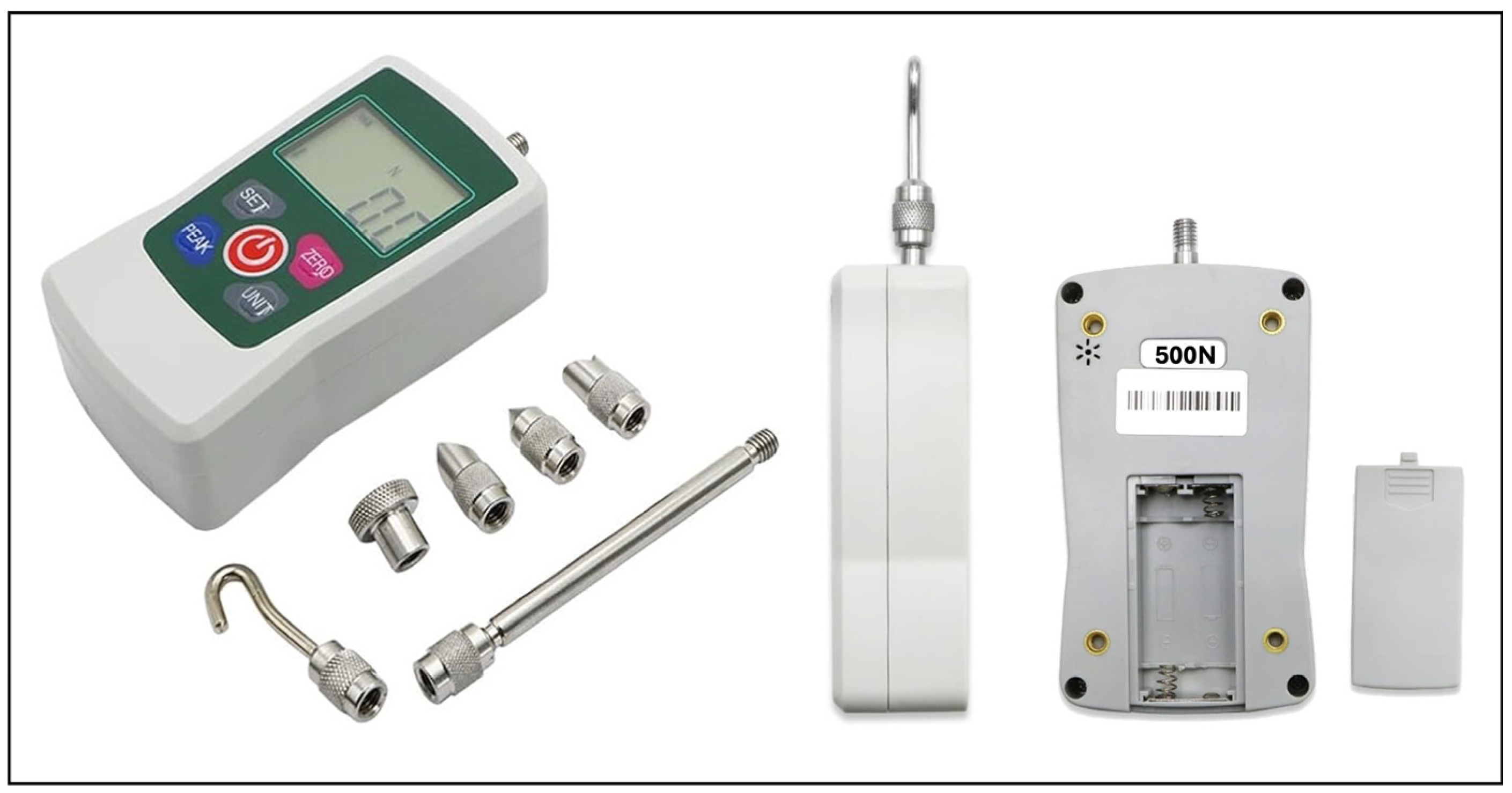
2.1.1. Equipment
2.1.2. Procedures
2.2. Study B (Accuracy, Precision, and Repeatability Between AMF-500 and MED.DOR)
2.2.1. Participants
2.2.2. Equipment
2.2.3. Procedures
2.3. Study C (Test–Retest Reliability of AMF-500 and MED.DOR)
2.3.1. Participants and Equipment
2.3.2. Procedures
2.3.3. Statistical Analysis and Sample Size
2.3.4. Study A
2.3.5. Study B
2.3.6. Study C
3. Results
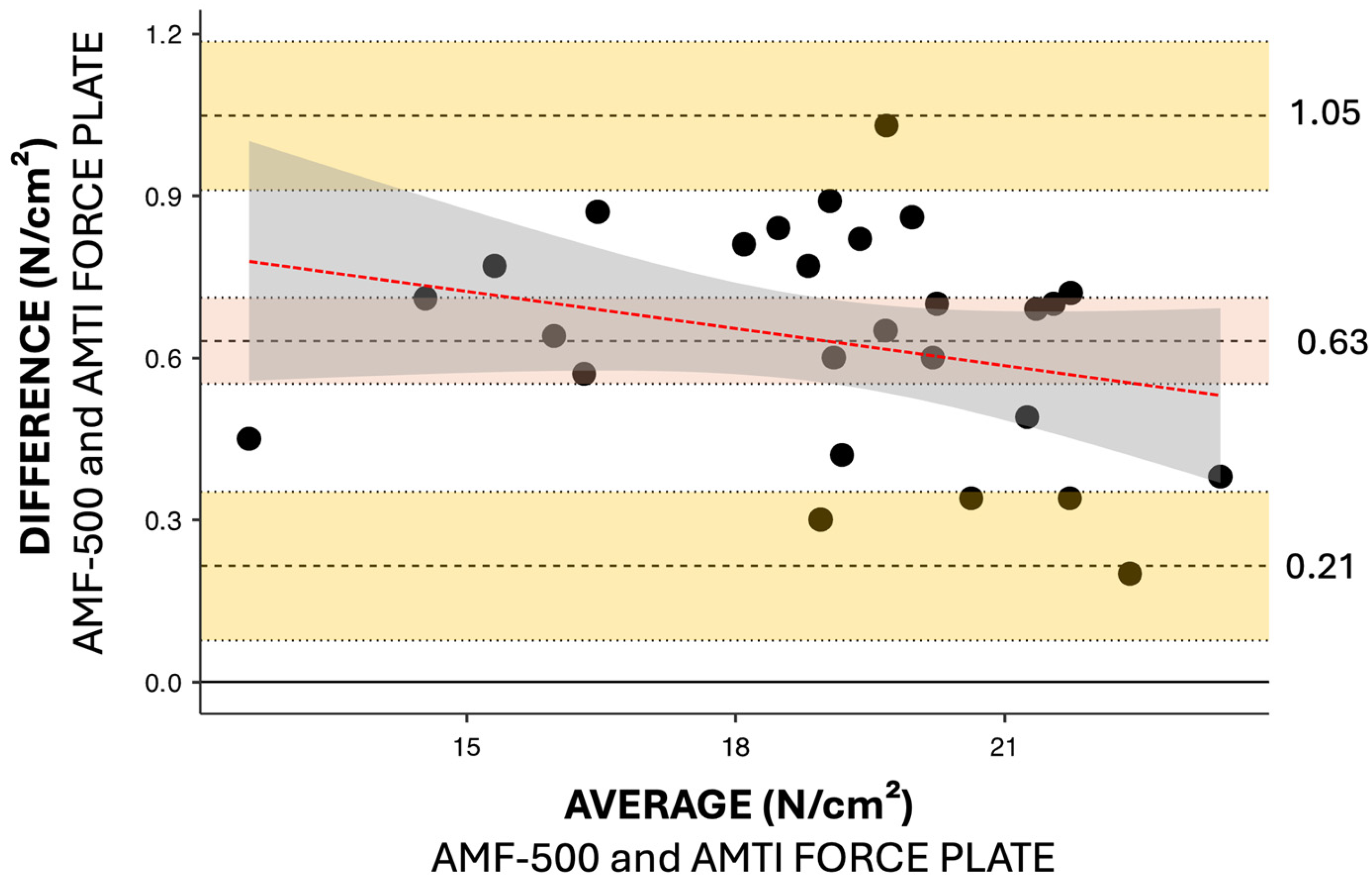
3.1. Study A
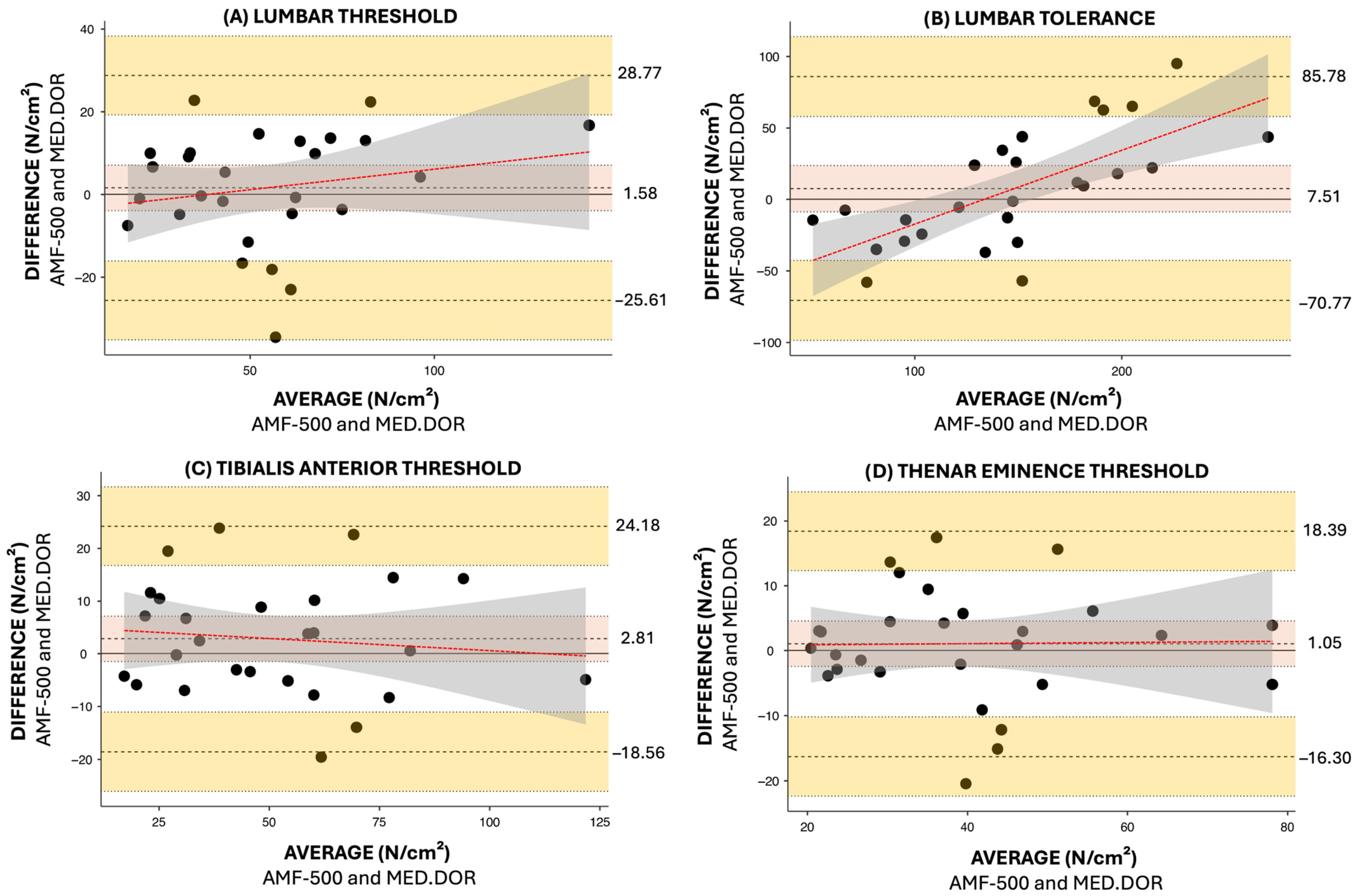
3.2. Study B
- Lumbar threshold: bias of 1.58 N/cm2 (LoA: −25.61 to 28.77 N/cm2);
- Lumbar tolerance: bias of 7.51 N/cm2 (LoA: −70.77 to 85.78 N/cm2);
- Tibialis anterior threshold: bias of 2.81 N/cm2 (LoA: −18.56 to 24.18 N/cm2);
- Thenar eminence threshold: bias of 1.05 N/cm2 (LoA: −16.30 to 18.39 N/cm2).

3.3. Study C
4. Discussion
5. Conclusions
Author Contributions
Funding
Institutional Review Board Statement
Informed Consent Statement
Data Availability Statement
Conflicts of Interest
References
- Costa, L.O.P.; Maher, C.G.; Latimer, J.; Ferreira, P.H.; Ferreira, M.L.; Pozzi, G.C.; Freitas, L.M.A. Clinimetric Testing of Three Self-report Outcome Measures for Low Back Pain Patients in Brazil. Spine 2008, 33, 2459–2463. [Google Scholar] [CrossRef]
- Fenton, B.W.; Palmieri, P.A.; Durner, C.; Fanning, J. Quantification of abdominal wall pain using pain pressure threshold algometry in patients with chronic pelvic Pain. Clin. J. Pain 2009, 25, 500–505. [Google Scholar] [CrossRef]
- Kinser, A.M.; Sands, W.A.; Stone, M.H. Reliability and validity of a pressure algometer. J. Strength Cond. Res. 2009, 23, 312–314. [Google Scholar] [CrossRef] [PubMed]
- Kamińska, A.; Dalewski, B.; Sobolewska, E. The Usefulness of the Pressure Algometer in the Diagnosis and Treatment of Orofacial Pain Patients: A Systematic Review. Occup. Ther. Int. 2020, 2020, 5168457. [Google Scholar] [CrossRef]
- Rolke, R.; Baron, R.; Maier, C.; Tölle, T.R.; Treede, R.D.; Beyer, A.; Binder, A.; Birbaumer, N.; Birklein, F.; Bötefür, I.C.; et al. Quantitative sensory testing in the German Research Network on Neuropathic Pain (DFNS): Standardized protocol and reference values. Pain 2006, 123, 231–243. [Google Scholar] [CrossRef]
- Rolke, R.; Magerl, W.; Campbell, K.A.; Schalber, C.; Caspari, S.; Birklein, F.; Treede, R.D. Quantitative sensory testing: A comprehensive protocol for clinical trials. Eur. J. Pain 2006, 10, 77–88. [Google Scholar] [CrossRef]
- Jayaseelan, D.J.; Cole, K.R.; Courtney, C.A. Hand-held dynamometer to measure pressure pain thresholds: A double-blinded reliability and validity study. Musculoskelet. Sci. Pract. 2021, 51, 102268. [Google Scholar] [CrossRef] [PubMed]
- Vaughan, B.; McLaughlin, P.; Gosling, C. Validity of an electronic pressure algometer. Int. J. Osteopath. Med. 2007, 10, 24–28. [Google Scholar] [CrossRef]
- Jerez-Mayorga, D.; dos Anjos, C.F.; de Cássia Macedo, M.; Fernandes, I.G.; Aedo-Muñoz, E.; Intelangelo, L.; Barbosa, A.C. Instrumental validity and intra/inter-rater reliability of a novel low-cost digital pressure algometer. PeerJ 2020, 8, e10162. [Google Scholar] [CrossRef]
- Graham, S.M.; Brennan, C.; Laubscher, M.; Maqungo, S.; Lalloo, D.G.; Perry, D.C.; Mkandawire, N.; Harrison, W.J. Orthopaedic research in low-income countries: A bibliometric analysis of the current literature. SICOT-J. 2019, 5, 41. [Google Scholar] [CrossRef]
- Steinert, J.I.; Atika Nyarige, D.; Jacobi, M.; Kuhnt, J.; Kaplan, L. A systematic review on ethical challenges of a € field’ research in low-income and middle-income countries: Respect, justice and beneficence for research staff? BMJ Glob. Health 2021, 6, e005380. [Google Scholar] [CrossRef]
- Cohen, S.P.; Vase, L.; Hooten, W.M. Chronic pain: An update on burden, best practices, and new advances. Lancet 2021, 397, 2082–2097. Available online: https://www.thelancet.com/ (accessed on 20 February 2026). [CrossRef]
- von Elm, E.; Altman, D.G.; Egger, M.; Pocock, S.J.; Gøtzsche, P.C.; Vandenbroucke, J.P. The Strengthening the Reporting of Observational Studies in Epidemiology (STROBE) statement: Guidelines for reporting observational studies. J. Clin. Epidemiol. 2008, 61, 344–349. [Google Scholar] [CrossRef]
- Corrêa, J.B.; Costa, L.O.P.; de Oliveira, N.T.B.; Sluka, K.A.; Liebano, R.E. Central sensitization and changes in conditioned pain modulation in people with chronic nonspecific low back pain: A case–control study. Exp. Brain Res. 2015, 233, 2391–2399. [Google Scholar] [CrossRef] [PubMed]
- Leite, P.M.S.; Mendonça, A.R.C.; Maciel, L.Y.S.; Poderoso-Neto, M.L.; Araujo, C.C.A.; Góis, H.C.J.; Souza, J.H.S.; Desantana, J.M. Does Electroacupuncture Treatment Reduce Pain and Change Quantitative Sensory Testing Responses in Patients with Chronic Nonspecific Low Back Pain? A Randomized Controlled Clinical Trial. Evid.-Based Complement. Altern. Med. 2018, 2018, 8586746. [Google Scholar] [CrossRef] [PubMed]
- Faul, F.; Erdfelder, E.; Lang, A.-G.; Buchner, A. G*Power 3: A flexible statistical power analysis program for the social, behavioral and biomedical sciences. Behav. Res. Methods 2007, 39, 175–191. [Google Scholar] [CrossRef] [PubMed]
- Hopkins, W.G.; Marshall, S.W.; Batterham, A.M.; Hanin, J. Progressive statistics for studies in sports medicine and exercise science. Med. Sci. Sports Exerc. 2009, 41, 3–12. [Google Scholar] [CrossRef] [PubMed]
- Bland, J.M.; Altman, D.G. Statistical Methods for Assessing Agreement Between Two Methods of Clinical Measurement. Lancet 1986, 327, 307–310. [Google Scholar] [CrossRef]
- The Jamovi Project. Jamovi (Version 2.6) [Computer Software]. 2025. Available online: https://www.jamovi.org (accessed on 20 February 2026).
- Giavarina, D. Understanding Bland Altman analysis. Biochem. Medica 2015, 25, 141–151. [Google Scholar] [CrossRef]
- Koo, T.K.; Li, M.Y. A Guideline of Selecting and Reporting Intraclass Correlation Coefficients for Reliability Research. J. Chiropr. Med. 2016, 15, 155–163. [Google Scholar] [CrossRef] [PubMed]
- Fischer, A.A. Pressure algometry over normal muscles. Standard values, validity and reproducibility of pressure threshold. Pain 1987, 30, 115–126. [Google Scholar] [CrossRef]
- Tabatabaiee, A.; Takamjani, I.E.; Sarrafzadeh, J.; Salehi, R.; Ahmadi, M. Pressure Pain Threshold in Subjects With Piriformis Syndrome: Test-Retest, Intrarater, and Interrater Reliability, and Minimal Detectible Changes. Arch. Phys. Med. Rehabil. 2020, 101, 781–788. [Google Scholar] [CrossRef] [PubMed]
- Suzuki, H.; Tahara, S.; Mitsuda, M.; Izumi, H.; Ikeda, S.; Seki, K.; Nishida, N.; Funaba, M.; Imajo, Y.; Yukata, K.; et al. Current Concept of Quantitative Sensory Testing and Pressure Pain Threshold in Neck/Shoulder and Low Back Pain. Healthcare 2022, 10, 1485. [Google Scholar] [CrossRef]
- Farasyn, A.D.; Meeusen, R.; Nijs, J. Validity of Cross-friction Algometry Procedure in Referred Muscle Pain Syndromes Preliminary Results of a New Referred Pain Provocation Technique With the Aid of a Fischer Pressure Algometer in Patients With Nonspecific Low Back Pain. Clin. J. Pain 2008, 24, 456–462. [Google Scholar] [CrossRef]
- Siao, P.; Cros, D.P. Quantitative sensory testing. Phys. Med. Rehabil. Clin. N. Am. 2003, 14, 261–286. [Google Scholar] [CrossRef] [PubMed]
- Melia, M.; Schmidt, M.; Geissler, B.; König, J.; Krahn, U.; Ottersbach, H.J.; Letzel, S.; Muttray, A. Measuring mechanical pain: The refinement and standardization of pressure pain threshold measurements. Behav. Res. Methods 2015, 47, 216–227. [Google Scholar] [CrossRef]
- Durga, P.; Wudaru, S.R.; Khambam, S.K.R.; Chandra, S.J.; Ramachandran, G. Validation of simple and inexpensive algometry using sphygmomanometer cuff and neuromuscular junction monitor with standardized laboratory algometer. J. Anaesthesiol. Clin. Pharmacol. 2016, 32, 74–79. [Google Scholar] [CrossRef] [PubMed]



| Characteristics | Mean (SD) | |
|---|---|---|
| Sex (male) | 16–59.25% | |
| Age (y) | 27.46 (7.39) | |
| BMI (kg·m−2) | 25.32 (3.53) | |
| Scholarship | High School | 6–22.2% |
| College | 7–25.9% | |
| Master | 10–37.0% | |
| Ph.D. | 4–14.8% | |
| Pressure Algometer | ||||||
|---|---|---|---|---|---|---|
| AMF-500 | MED.DOR | Effect Size | p | |||
| Median (Mean) | IQR 25–75 (SD) | Median (Mean) | IQR 25–75 (SD) | |||
| Lumbar Threshold | 46.27 | 38.33–71.34 | 56.24 | 31.06–68.34 | r = 0.19 | 0.41 |
| Lumbar Tolerance | (151.66) | (68.69) | (144.16) | (42.15) | dz = 0.19 | 0.35 |
| Tibialis Anterior Threshold | 52.70 | 32.43–64.11 | 47.42 | 27.31–67.53 | r = 0.27 | 0.23 |
| Thenar Eminence Threshold | 37.51 | 26.72–45.76 | 34.99 | 25.35–48.23 | r = 0.20 | 0.37 |
| Pressure Algometer | Body Site | Moment 1 | Moment 2 | ICC (3,1) | Effect Size | p | SEM (N/cm2) | MDC (N/cm2) | ||
|---|---|---|---|---|---|---|---|---|---|---|
| Median (mean) | IQR 25–75 (SD) | Median (mean) | IQR 25–75 (SD) | |||||||
| AMF-500 | Lumbar Threshold | 46.27 | 38.32–71.34 | 47.41 | 40.22–63.60 | 0.726 | r = −0.07 | 0.714 | 13.95 | 38.67 |
| Lumbar Tolerance | (151.66) | (68.69) | (158.55) | (67.32) | 0.880 | dz = −0.19 | 0.347 | 25.15 | 69.71 | |
| Tibialis Anterior Threshold | (52.61) | (25.70) | (57.15) | (25.03) | 0.859 | dz = −0.35 | 0.081 | 9.47 | 26.25 | |
| Thenar Eminence Threshold | 37.51 | 26.72–45.76 | 43.49 | 31.23–55.92 | 0.686 | r = −0.46 | 0.017 * | 9.31 | 25.80 | |
| MED.DOR | Lumbar Threshold | 56.24 | 31.06–68.34 | 36.95 | 26.81–53.14 | 0.733 | r = −0.64 | <0.001 * | 13.65 | 37.83 |
| Lumbar Tolerance | 149.77 | 116.08 –172.66 | 121.64 | 94.50–194.81 | 0.632 | r = −0.10 | 0.617 | 43.10 | 119.47 | |
| Tibialis Anterior Threshold | 47.41 | 27.30–67.53 | 43.16 | 28.61–57.06 | 0.879 | r = −0.13 | 0.501 | 9.58 | 26.55 | |
| Thenar Eminence Threshold | 34.99 | 25.34–48.23 | 38.59 | 24.69–46.27 | 0.71 | r = −0.02 | 0.896 | 8.12 | 22.51 | |
Disclaimer/Publisher’s Note: The statements, opinions and data contained in all publications are solely those of the individual author(s) and contributor(s) and not of MDPI and/or the editor(s). MDPI and/or the editor(s) disclaim responsibility for any injury to people or property resulting from any ideas, methods, instructions or products referred to in the content. |
© 2026 by the authors. Licensee MDPI, Basel, Switzerland. This article is an open access article distributed under the terms and conditions of the Creative Commons Attribution (CC BY) license.
Share and Cite
Almeida, V.C.; Maciel, L.Y.d.S.; Neto, J.P.d.F.; Zacca, R.; Santana Filho, V.J.d. Accuracy, Repeatability, and Test–Retest Reliability of a Pressure Algometer for Pain Threshold and Tolerance in Sports, Exercise, and Rehabilitation Settings. Appl. Sci. 2026, 16, 3210. https://doi.org/10.3390/app16073210
Almeida VC, Maciel LYdS, Neto JPdF, Zacca R, Santana Filho VJd. Accuracy, Repeatability, and Test–Retest Reliability of a Pressure Algometer for Pain Threshold and Tolerance in Sports, Exercise, and Rehabilitation Settings. Applied Sciences. 2026; 16(7):3210. https://doi.org/10.3390/app16073210
Chicago/Turabian StyleAlmeida, Verena Calmon, Leonardo Yung dos Santos Maciel, Jader Pereira de Farias Neto, Rodrigo Zacca, and Valter Joviniano de Santana Filho. 2026. "Accuracy, Repeatability, and Test–Retest Reliability of a Pressure Algometer for Pain Threshold and Tolerance in Sports, Exercise, and Rehabilitation Settings" Applied Sciences 16, no. 7: 3210. https://doi.org/10.3390/app16073210
APA StyleAlmeida, V. C., Maciel, L. Y. d. S., Neto, J. P. d. F., Zacca, R., & Santana Filho, V. J. d. (2026). Accuracy, Repeatability, and Test–Retest Reliability of a Pressure Algometer for Pain Threshold and Tolerance in Sports, Exercise, and Rehabilitation Settings. Applied Sciences, 16(7), 3210. https://doi.org/10.3390/app16073210