Article

The Deep Structure of the Western Slope of the Songliao Basin and Its Implications for the Evolution of the Paleo-Asian Ocean (Eastern Segment)


1
College of Earth Sciences, Chengdu University of Technology, Chengdu 610059, China
2
Institute of Geophysical and Geochemical Exploration, Chinese Academy of Geological Sciences, Tianjin 300309, China
*
Authors to whom correspondence should be addressed.
Appl. Sci. 2026, 16(7), 3202; https://doi.org/10.3390/app16073202
Submission received: 14 February 2026 / Revised: 12 March 2026 / Accepted: 18 March 2026 / Published: 26 March 2026

Abstract

Northeast China, situated in the eastern Central Asian Orogenic Belt (CAOB), marks the terminal closure zone of the Paleo-Asian Ocean (PAO) (eastern segment). At present, due to extensive Quaternary cover, the structural deformation characteristics and deep structure of the Solonker Suture Zone in the east of the Nenjiang–Balihan fault remain poorly constrained, which limits our understanding of the tectonic evolution of the PAO. This study integrates deep seismic reflection (DSR) and magnetotelluric (MT) sounding profiles to investigate the crustal structural, sedimentary framework, and tectonic evolution of the oceanic and continental crusts along the western slope of the Songliao Basin. Two regional detachment surfaces (D1 and D2) were identified. The D2 interface demarcates the upper crust’s basal boundary, overlain by multiple high-amplitude monoclinic reflections. The area below the D2 interface exhibits a network structure of arcuate and variably oriented reflections, indicating a dual-layered orogenic structure. The upper crust exhibits distinct structural domains defined by strongly contrasting monoclinal reflections: north-dipping, low-resistivity zones in the southern sector and south-dipping, high-resistivity zones in the northern sector. These oppositely oriented reflections have been interpreted as marking an Early Paleozoic accretionary wedge and oceanic island arc, respectively. Interposed between these opposing structural domains, the Paleozoic to Early Mesozoic forearc basin sequences are preserved, with a pre-Middle Permian oceanic basin identified north of the study area. By integrating characteristics of seismic reflection sequences with regional geological data, this paper clarifies the processes of closure and collision at the northern margin of the PAO (Eastern Segment).

1. Introduction

The Central Asian Orogenic Belt (CAOB), situated between the Siberian Plate and the North China Craton (Figure 1a), comprises various tectonic units, including island arcs, microcontinents, and accretionary complexes, and is widely regarded as the largest Phanerozoic accretionary orogenic belt on earth [1,2,3,4]. Due to the complex tectonic evolution of the Paleo-Asian Ocean (PAO) and the subsequent superposition of multiple tectonic domains, the CAOB has long been the focus of international geological studies [5,6,7,8]. The eastern section of the CAOB, located in Northeast China (NE China), records the final closure of the PAO. A series of studies have demonstrated that the PAO closed along the Solonker Suture Zone during the Late Paleozoic, accompanied by widespread development of ophiolites, tectonic mélanges, magmatic rocks, and other geological records [5,6,7,8,9,10].
Through systematic investigations of tectonic mélanges and magmatic rock assemblages, researchers have identified a complete set of genetically associated arc-basin systems, foreland basins, and magmatic arcs within the Solonker Suture Zone and its adjacent regions, which significantly advances the understanding of both the structural architecture of accretionary orogenic belts and the regional tectonic evolution history of the PAO [7,8,9,10]. However, the subduction polarity of the PAO remains highly debated, with existing controversies centering on three competing evolutionary models: (1) southward subduction [15], (2) northward subduction [7], and (3) bidirectional subduction [3,9]. As a key tectonic unit genetically linked to the PAO closure and subsequent continental margin subduction–collision processes, the Solonker Suture Zone inevitably preserves crustal-scale records of complex tectonic deformation and geophysical property variations. These geological archives can be effectively constrained by deep geophysical exploration techniques, most notably deep seismic reflection (DSR) profiling and magnetotelluric (MT) sounding.
DSR and MT work deployed across the eastern segment of the CAOB have successfully imaged geophysical signatures associated with oceanic crust subduction and collisional orogenic processes (Figure 1b). These geophysical constraints provide a critical empirical basis for deciphering the subduction polarity of the Solonker Subduction Zone and reconstructing the PAO tectonic evolution [11,12,16,17]. Most existing geophysical transects targeting the Solonker Suture Zone are concentrated west of the Nenjiang–Balihan fault, where Paleozoic strata are well exposed. In contrast, only a very limited number of geophysical profiles have been acquired across the area to the east of the fault.
The Songliao Basin, situated to the east of the Nenjiang–Balihan fault, is the most significant Mesozoic petroliferous basin in Eastern China [16,17]. The basin is extensively blanketed by thick Quaternary sediments, with almost no exposed geological records linked to oceanic crust subduction and collisional processes [9]. As such, investigations into the PAO tectonic evolution beneath the basin have to rely heavily on deep geophysical methods, particularly DSR surveys. However, the scarcity of targeted geophysical data designed to resolve PAO-related tectonic evolution has significantly hindered research on the structural deformation and deep architecture of the Solonker Suture Zone in the region east of the Nenjiang–Balihan fault. Furthermore, recent geological investigations have constrained the northern boundary of the Solonker Suture Zone beneath the western slope of the Songliao Basin to approximately the southern sector of the Tuquan–Baicheng area [12].
In this study, two new DSR profiles were deployed across the western slope of the Songliao Basin. Integrated with previously published MT surveys, these datasets allow us to systematically characterize the deep crustal structure and tectonic deformation pattern of the study region. The precise northern boundary and internal structural framework of the Solonker Suture Zone were further delineated. Synthesizing these new geophysical constraints with the latest regional geological survey data and recent research advances, we reconstruct the closure and collisional orogenic processes of the northern PAO, providing critical deep geophysical constraints for refining the tectonic evolutionary model of the eastern CAOB.

2. Geological Setting

The CAOB is the largest proliferative orogenic belt in the world. As a key component of this collisional system, NE China preserves a complex history of multi-terrane convergence, prolonged subduction–accretion processes, and polyphase orogenesis spanning from the Paleozoic to the Mesozoic [3,18,19]. The western slope of the Songliao Basin is situated in the south of NE China, structurally north of the Solonker Suture Zone, with the NE-trending Nenjiang–Balihan fault developing to the west. The EW-trending Xar Moron–Changchun–Yanji fault defines the southern boundary between the study area and the North China Plate [6,18,19]. During the Paleozoic to Early Mesozoic, the study area occupied a dynamic tectonic setting within the PAO, characterized by a multi-arc ocean that underwent successive phases of oceanic crust subduction, arc-continent collision, and crustal accretion. This protracted tectonic evolution produced a series of NE-trending subduction–accretion complexes and magmatic belts, including the Bainaimiao Arc Magmatic Belt, Wenduermiao Subduction–Accretion Complex, Erdaojing Accretion Complex, Baiyinbaolidao Arc-Accretion Complex, and the Hegenshan Ophiolite Accretion [3,5].
The Solonker Suture Zone, situated in the southern Great Xing’an Range, marks the terminal closure position of the PAO [1,15]. The Linxi fault to the south separates the suture from the Wenduermiao Subduction–Accretion Complex, and the Xilinhot fault to the north demarcates its transition to the Baiyinbaolidao Arc-Accretion Complex [20]. Within the Solonker Suture Zone, discontinuous ophiolitic assemblages are exposed along the Solonker Mountains, Xar Moron River, and Linxi regions [21,22]. Since the Mesozoic, the region has experienced superimposed deformation from both the Mongolian–Okhotsk collisional system and the circum-Pacific tectonic regime. The latter exerted dominant control over the structural reorganization, generating widespread NNE-trending tectonic features, complex deformation patterns, and extensive Mesozoic magmatic rocks.
The study area exhibits a well-preserved post-Late Carboniferous stratigraphic succession. The Carboniferous to Permian sequence is predominantly composed of marine to transitional marine-continental facies, including the following units in ascending order (Figure 2): Seribayanaobao Formation (D3–C1s), Benbatu Formation (C2bb), Amushan Formation (C2–P1a), Shoushangou Formation (P1ss), Dashizhai Formation (P1–2ds), Zhesi Formation (P2z), and Linxi Formation (P3l) from bottom to top. The Triassic succession comprises continental clastic deposits, with the Xingfuzhilu Formation in the Bahrain Right Banner displaying typical red-bed sedimentation [23]. Notably, the well SK-2 in the northern Songliao Basin penetrated a ~1000 m-thick Lower Triassic continental volcaniclastic sequence [24]. The Late Jurassic–Early Cretaceous strata are dominated by volcaniclastic deposits, while the Late Cretaceous sedimentation has shifted to lacustrine-fluvial environments primarily confined to the Songliao Basin. Stratigraphic data from the GD1 well (total depth: 2911 m) reveal the following drilled succession (top to bottom): Quaternary, Early Cretaceous Manitu Formation, Late Jurassic Mankotouebo Formation, Middle Jurassic Wanbao Formation, Lower Triassic Laolongtou Formation, and Permian Linxi Formation [21].
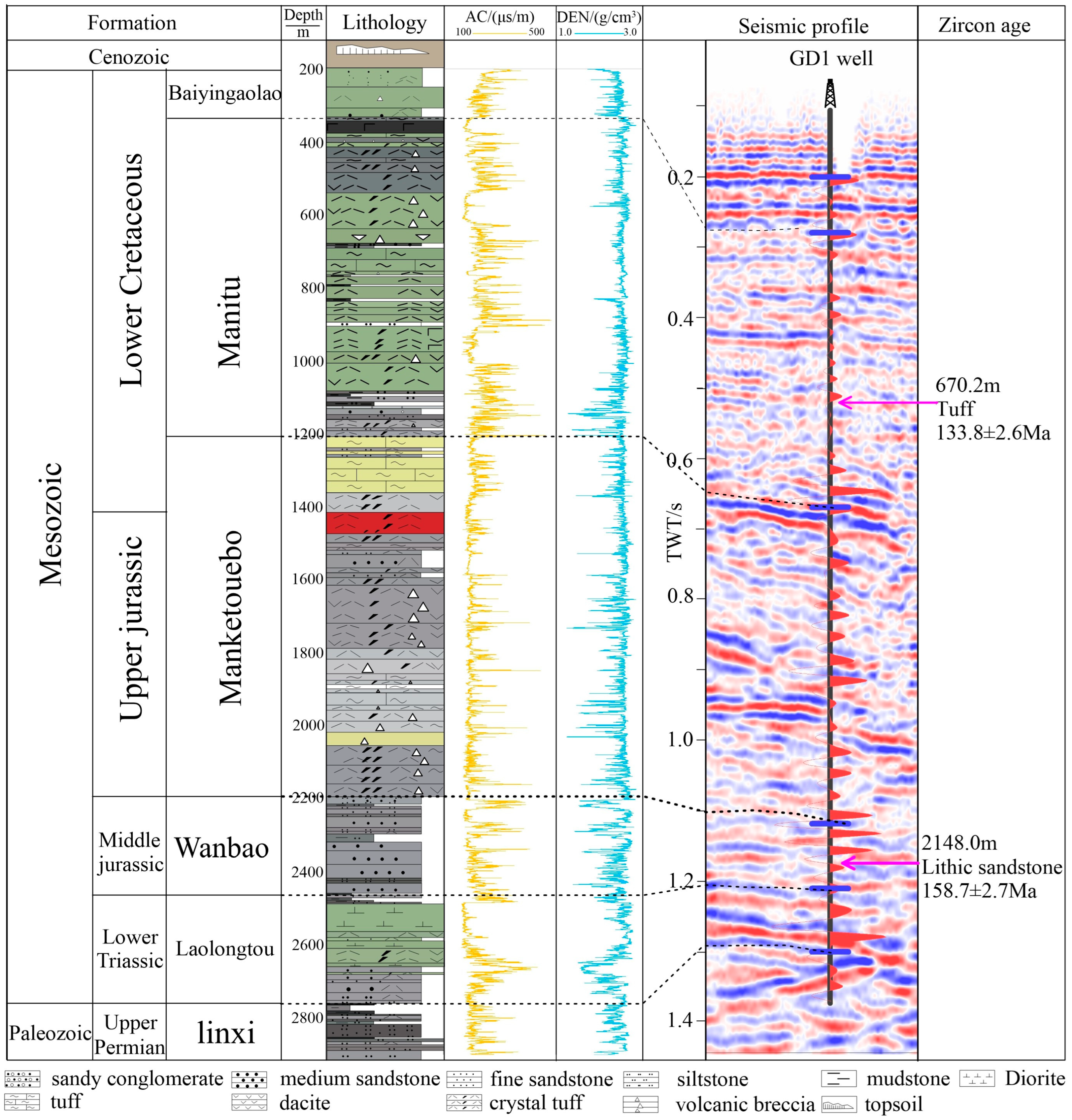
By integrating sonic and density logs from well GD1, well-seismic calibration was conducted to accurately clarify the position of each formation interface in the DSR profile. The lithology of the Baiyingaole Formation, predominantly crystal tuff and sandy conglomerate, is expressed as continuous, high-amplitude reflections in the DSR profile. The upper section of the Manitu Formation consists of thick tuff, whereas its lower section comprises thick mudstone and sandstone. These units exhibit contrasting seismic responses: the upper is characterized by weak, discontinuous reflections, while the lower displays strong, continuous reflections. The Manketouebo Formation consists of tuff interbedded with sandstone, exhibiting strong-amplitude reflections only in localized areas in the DSR profile. The Wanbao Formation, composed predominantly of thick sandstone and mudstone, is lithologically distinct from the surrounding tuff- and basalt-dominated rocks. Its top and base are marked by strong-amplitude reflections on seismic profiles. The Laolongtou Formation features layered basalt in the upper section and mudstone in the lower, displaying high-amplitude, low-frequency reflections. In contrast, the Linxi Formation, only partially penetrated by Well GD1 and consisting mainly of mudstone and sandstone, is characterized by strong but discontinuous reflections.

3. DSR Data Acquisition Processing

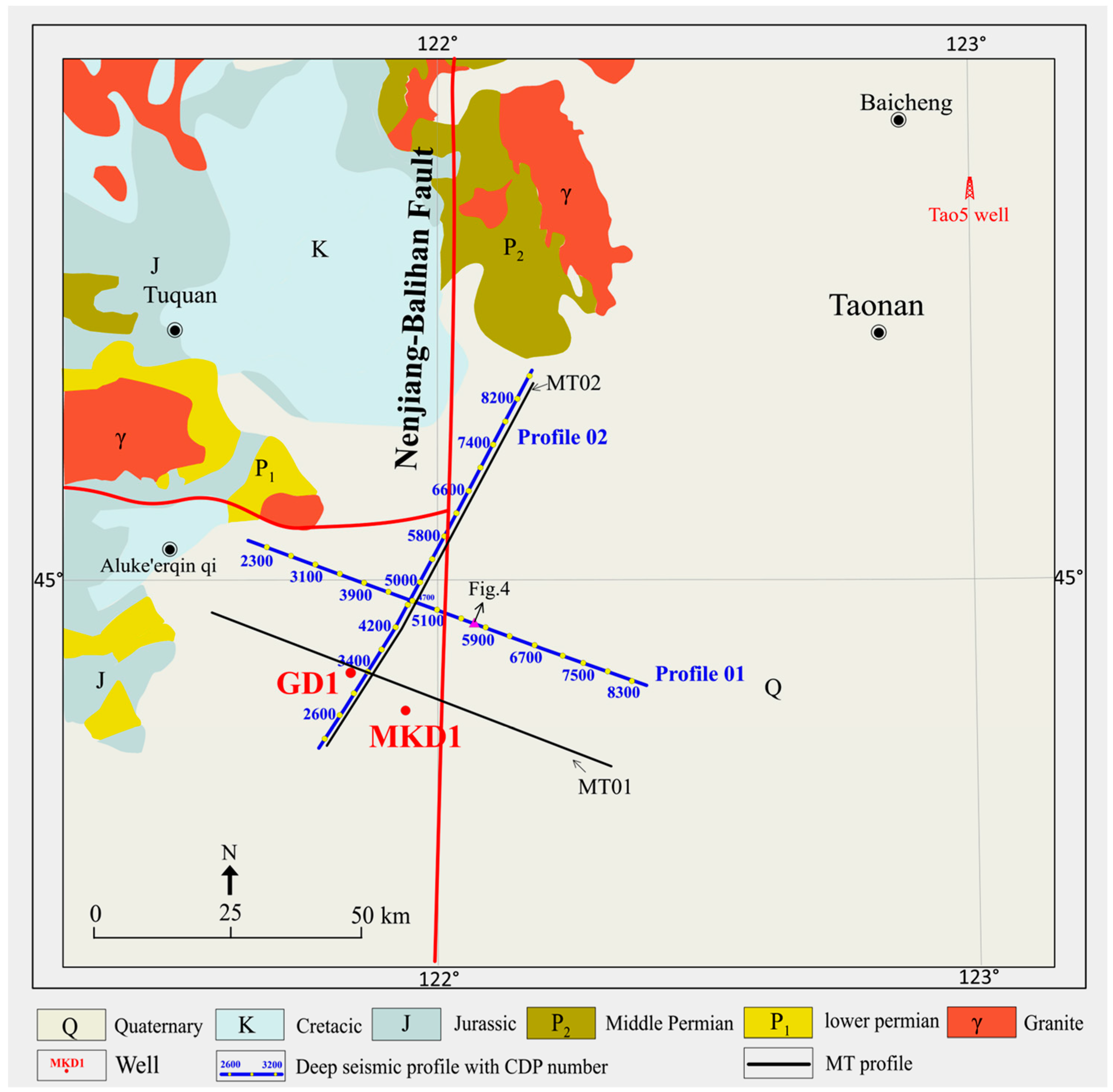
Two DSR profiles (Profile 01 and 02) were deployed across the slope of the Songliao Basin, collectively spanning ~60 km of continuous coverage. Profile 01 adopts a near EW orientation, transecting the Nenjiang–Balihan fault system, while Profile 02 follows a NNE-trending trajectory with its western segment approaching the northern margin of the Solonker Suture Zone (Figure 3). Field acquisition parameters were optimized through experimental testing, with a 15 m shot depth and 12 kg charge size selected to enhance energy penetration into deep-seated, steeply dipping formations. To improve the signal-to-noise ratio, a high-density, high-coverage time, and long-arrangement observation system was implemented, with a 60 m shot spacing and a 20 m trace interval, as well as having 720 receiving traces and a 120-fold coverage. Variable recording lengths were employed across profiles; that is, 6 s for Profile 01’s northern segment and 12 s for the remaining sections (see Table 1 for full parameter specifications). Complementing these seismic surveys, two pre-existing MT profiles in the region include a nearly EW-oriented transect parallel to seismic Profile 01 across the Nenjiang–Balihan fault zone. Another MT profile basically overlaps with the seismic Profile 02. The processing workflows for MT data acquisition, inversion, and joint interpretation were rigorously documented in [13].
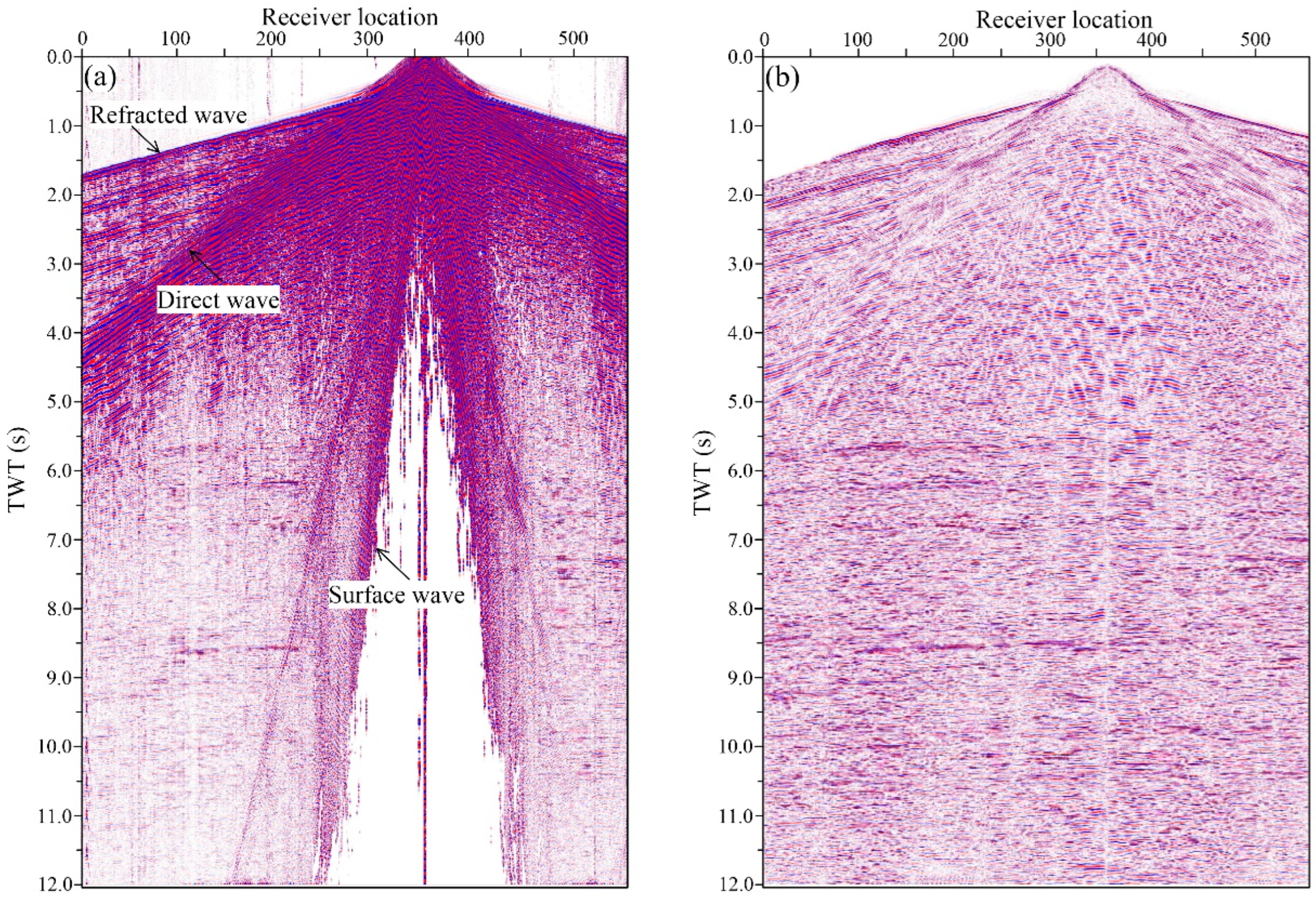
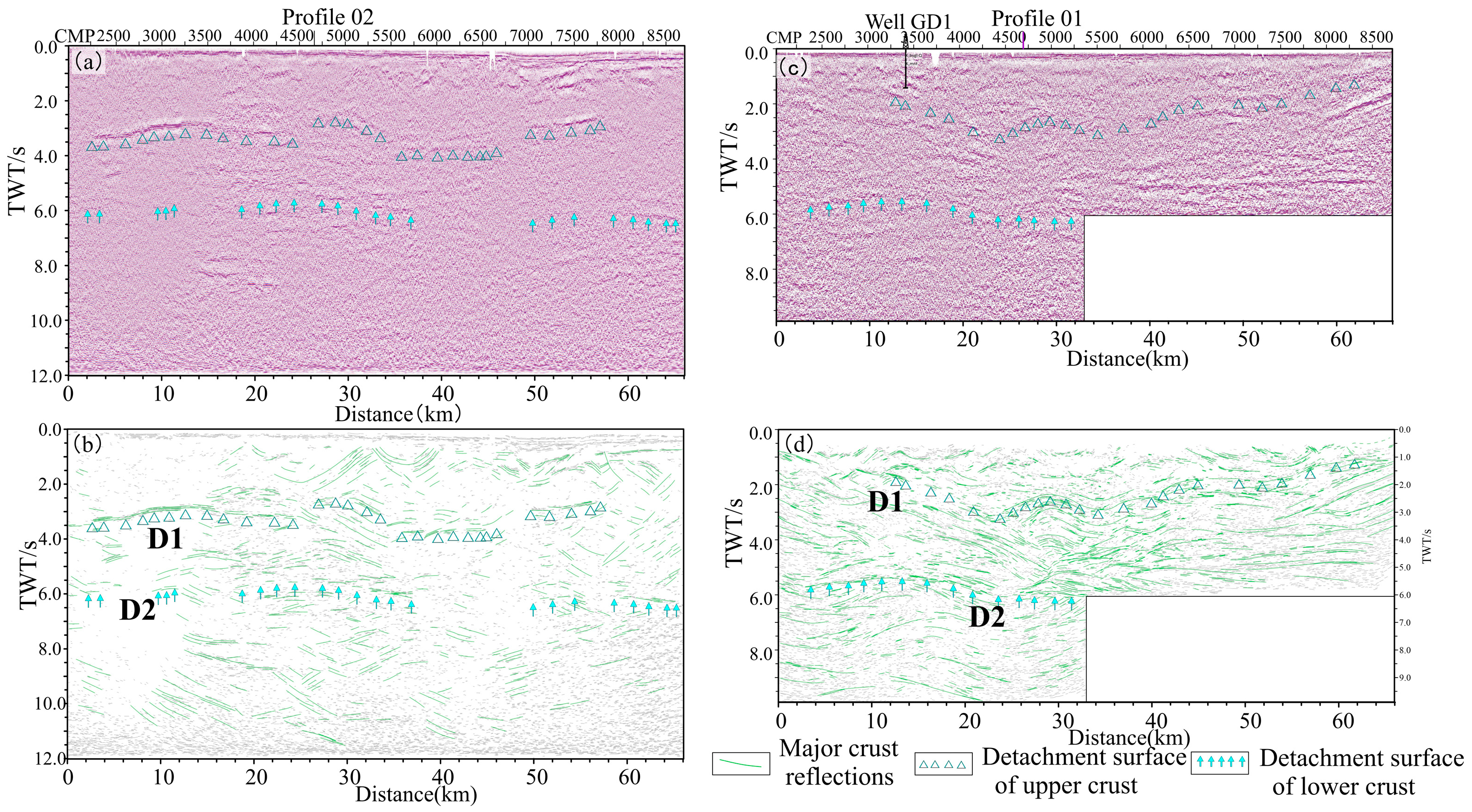
The acquired single-shot raw seismic records exhibited significant surface wave interference and high-amplitude refraction with a wide range, which obscured shallow-layer effective reflections. On the other hand, the deep crustal signals demonstrated relatively high signal-to-noise ratios with identifiable coherent reflections (Figure 4a). Due to the shielding effects of thick volcanic sequences, the internal phase axis exhibits poor continuity. To optimize deep crustal imaging, data processing prioritized enhancing the signal-to-noise ratio beneath volcanic strata through a systematic workflow. Velocity modeling combined interactive velocity analysis with constant velocity scanning, iteratively refined with residual static corrections to stacked imaging and improved velocity field accuracy [25,26]. After detailed parameter testing, a processing workflow was designed to address the specific geological characteristics of the study area. Key steps included static correction, pre-stack comprehensive denoising, surface-consistent processing, deconvolution, velocity analysis with dynamic correction removal, residual static correction, and migration. The processing ultimately yielded high-resolution unmigrated and migrated sections (Figure 5a,c). Additionally, to improve the rationality of DSR interpretation, the MT-sounding method was used as an auxiliary tool for integrated geophysical interpretation. The project team was responsible for MT data acquisition and processing. Results from the MT01 profile have been published; in contrast, the MT02 results are unpublished but were processed following the methodology outlined in reference [13].

4. Results of DSR Profiling

4.1. DSR Characteristics

The Moho discontinuity beneath the Songliao Basin is estimated at depths of 33–36 km [27], with the two-way travel times (TWT) of 11–12 s in the DSR profile based on an average crustal velocity of 6000 m/s. Despite the fact that the acquisition time reached 12 s, Moho reflections were not interpretable, and the focus was on analyzing crustal reflections. Distinct high-amplitude reflections were extracted from the DSR profiles, and a line diagram was drawn to illustrate the spatial variations in the seismic facies (Figure 5b,d).
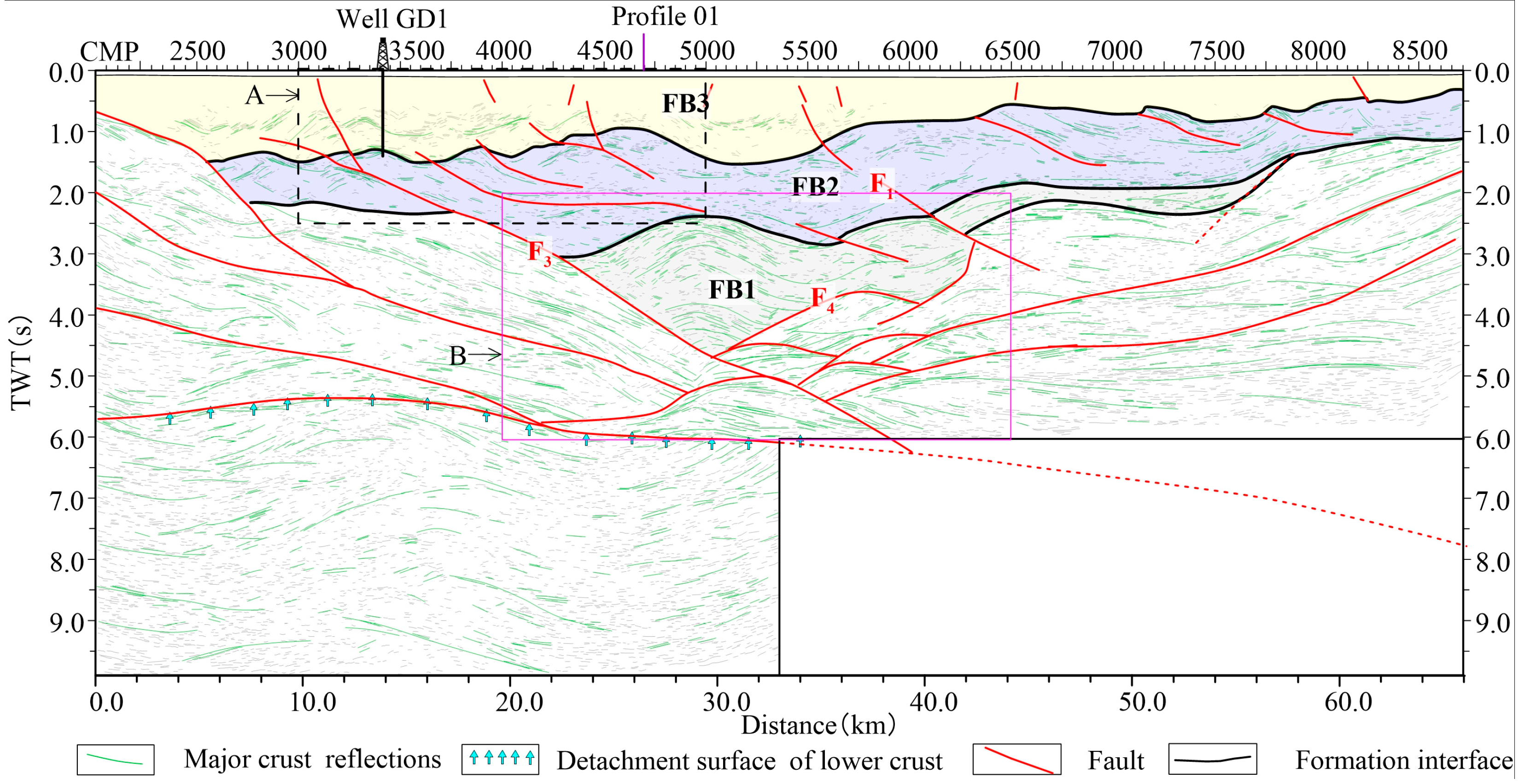
In DSR Profile 01, two sets of seismic reflections with good continuity and strong amplitude are observed at TWT intervals of 3.0–3.5 s and 5.5–6 s, designated as the D1 and D2 interfaces, respectively. The D1 reflection zone exhibits an upward-convex arched geometry and consists of three continuous reflection sets in the western part of the profile (CDP 2300–4300), while only two continuous sets are present in the eastern segment (CDP 7000–7700). The D2 reflection zone displays a nearly horizontal attitude, particularly within the CDP ranges of 4000–5500 and 8000 onward. The seismic reflections above and below the D1 and D2 interfaces show distinctly different characteristics: for instance, the shallow strata overlying D1 are dominated by fold deformation, whereas the interval between D1 and D2 is characterized by nearly horizontal, diffusely distributed reflections. These features suggest that the D1 and D2 interfaces are likely to be structurally related. A comparison with the deep seismic facies from the Songke-2 Well reveals that the seismic characteristics of D1 and D2 closely resemble those of the ductile shear zone encountered at a depth of 7000 m in the same well [28]. Furthermore, the detachment structural system in the Songliao Basin comprises upper high-angle thrust faults and lower imbricate thrust nappes at depths of 10–20 km, with structural deformation deepening from west to east [20]. Therefore, the D1 and D2 interfaces are interpreted as regional detachment surfaces.
Based on the crustal velocity structure of the study area and adjacent regions [29], the D1 and D2 interfaces are located at depths of approximately 8–10 km and 15–18 km, respectively. The D1 interface coincides with the base of a laterally extensive high-conductivity layer imaged by MT profiles [13], with folds and stacked thrust faults developed above it, indicating intense upper-crustal deformation along this detachment. The D2 interface marks the lower boundary of the upper crust [30] and corresponds to a distinct seismic velocity discontinuity characterized by a transition from lower to higher shear-wave velocities [31]. These geophysical signatures suggest significant differences in material composition, physical state, and structural style across the D2 interface.
Recent studies of major Chinese orogenic systems, such as the Qiangtang [32], the Yarlung Zangbo River [33], and the Taiwan Orogenic Belts [34], have revealed a widespread two-layer crustal structure, characterized by an upper imbricate thrust fan system and a lower metamorphic subduction complex. The D2 interface identified in our seismic profile exhibits similar characteristics: the overlying section is dominated by broad folds and monoclinal reflections, whereas the underlying portion displays a reticulated or chaotic seismic fabric. This suggests that the D2 interface may represent the structural boundary of such an example of a two-layer piece of orogenic architecture. The distinct seismic signature across this interface confirms its role as a major decollement horizon separating contrasting deformation regimes within the orogenic crust.
(1)
DSR Profile 01
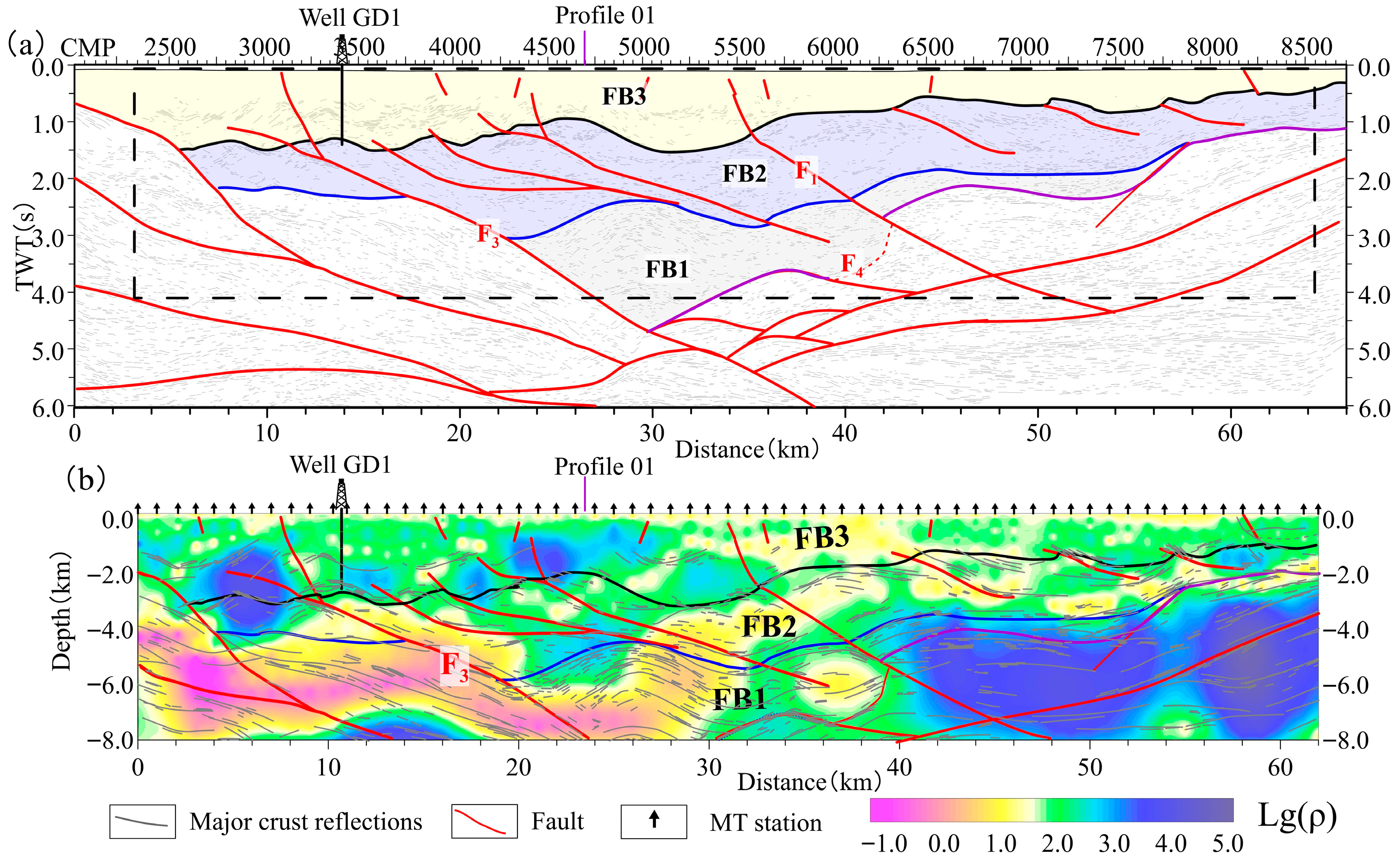
Using the D1 and D2 interfaces as structural markers, Profile 01 reveals a significant crustal structure of horizontal blocking and vertical stratification. As illustrated in Figure 6a, profile 01 is divisible into three crustal units bounded by D1 and D2 interfaces. The supra-D1 domain exhibits blank reflections associated with fold-related deformation and magmatic intrusions. Structural mapping identifies a series of normal faults, including a small-scale half-graben depression between CDP 6800 and 7600, characterized by a depth in the west and a shallowness in the east. The reflections in the shallow part (TWT 0–0.5 s) display high lateral continuity, featuring a two-layered seismic facies. The upper high-amplitude reflections correspond to the Quaternary alluvial deposits, underlain by the lower-amplitude reflections attributed to the Early Cretaceous continental volcaniclasticsm, with dissection by intra-basin normal faults. In the interval between 0.5 s TWT and the D1 interface, the east and west sides mainly feature blank reflections and high resistivity layers [13]. Combined with surface exposures of Permian granodiorites west of the profile, the blank reflection area with high resistivity is interpreted as an intrusive complex (Figure 6).
The D1, D2 interface interval exhibits laterally continuous subhorizontal reflections with high-amplitude characteristics, showing substantial changes in their occurrence concentrated near the fault. Below the D2 interface toward the Moho discontinuity (TWT 11–12 s), distinct dipping reflections are observed, east-dipping reflections in the western section (CDP 3600) and west-dipping reflections in the eastern section (CDP 6500). Between CDP 3600 and 6500 at TWT 7–9 s, two sets of reflections with opposing dip directions create a grid-like structure, a feature widely documented in other DSR profiles in the Songliao Basin [12]. In the CDP 4000–7500 segment, a tri-anticlinal fold structure displays reflections discordant with the overlying shallow reflections. The reflections along the anticlinal axis exhibit significant variations, displaying discordance with the continuous bending of stratigraphic units. This structural discontinuity suggests probable fault development, particularly in the CDP 4000–5250 segment. At CDP 4500 (TWT 2.5 s), reflections transit sharply from subhorizontal to east-dipping configurations, with this discordance propagating eastward at depth. Integration with MT data reveals that this discontinuity corresponds to the western branch of the Nenjiang–Balihan strike-slip fault. Similarly, at CDP 5800 (TWT 3.5 s), reflections shift from near-horizontal to west-dipping orientations, extending downward to TWT 5.5 s at CDP 5700, suggesting it may be the eastern branch of the Nenjiang–Balihan strike-slip fault. A near-vertical fault between the two branch faults disrupts seismic reflection continuity, exhibiting characteristics distinct from overlying deformed reflections (TWT 0.5–2.5 s), interpreted as a recoil fault. MT data reveal the F2 strike-slip fault (CDP 7000–8500) as a low-resistivity zone dipping eastward and extending to 12 km in depth. To the west of the F2 fault, reflections dip eastward, while eastern reflections dip westward, with the deep part of the fault extending to the D2 interface.
(2)
DSR Profile 02
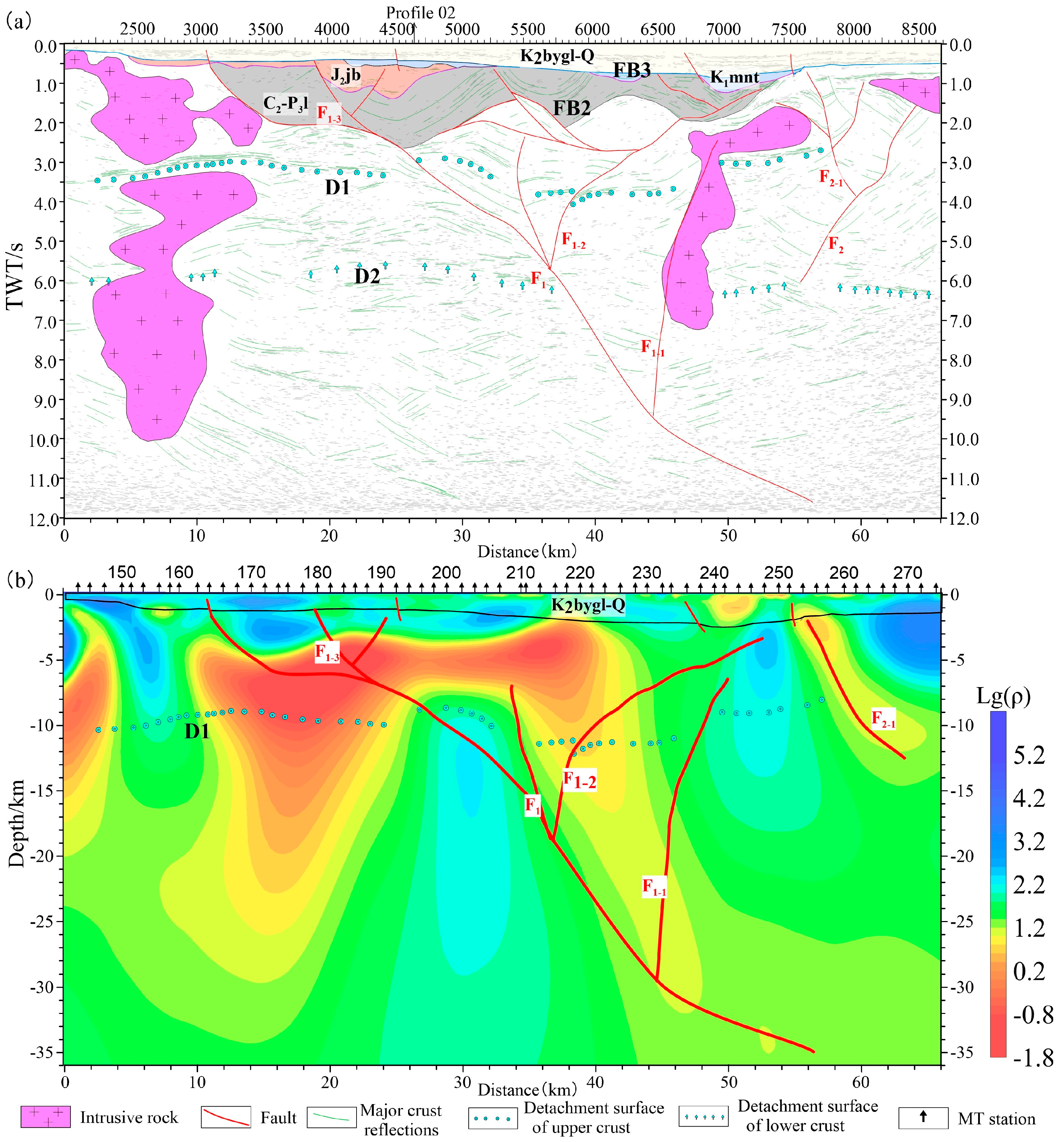
DSR Profile 02, oriented subperpendicular to regional structural trends, exhibits greater reflection complexity compared to Profile 01. Crossing the Nenjiang–Balihan fault at CDP 5500 [13], the profile displays north-dipping reflections in the south and south-dipping reflections in the north relative to the D2 interface (Figure 7), and arcuate high-amplitude reflections develop between the former north-dipping domain. The southern section likely contains a reverse thrust fault merging with the D2 interface at depth. The south-dipping reflections in the north (CDP 8000–8700) transit from steep south-dipping patterns to subhorizontal patterns with increasing depth. Below the D2 interface, a central domal reflection pattern contrasts with the grid-like features observed in Profile 01, characterized by arc-shaped uplift structures obliquely truncating the D2 interface.
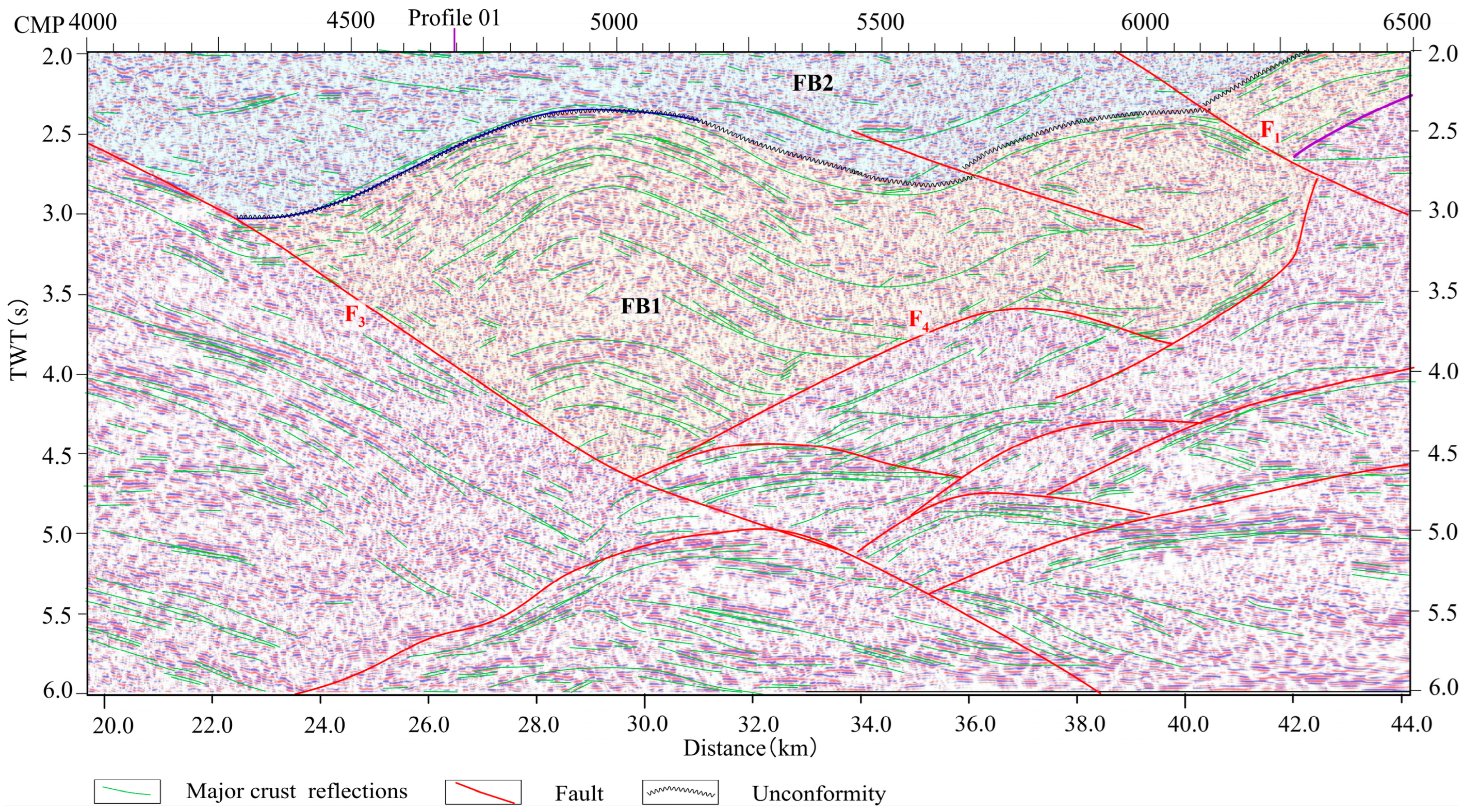
Between the two sets of reflections with different orientations above the D2 interface (within the F3 and F4 faults), a series of well-continuous, vertically stacked reflections has developed, inferred to represent the Late Paleozoic sedimentary sequences. The deeper portion between TWT 2.5–4.0 s exhibits an arcuate pattern, overlapping westward onto north-dipping monoclinal reflections, and displays a distinct angular unconformity with the overlying strata. Liu et al. (2011) revealed significant differences in structural deformation between D-C1 and the overlying Upper Carboniferous strata in the region, generally exhibiting NEE-trending broad, gentle folds [35]. These observations support the interpretation that the lower strata belong to the Devonian–Lower Carboniferous strata. The upper C2-P2l succession comprises multiple structural blocks characterized by monoclinal reflections transitioning upward into arcuate patterns. Thrust faults between these blocks collectively form an imbricate structural style. The shallow section reveals alternating high-amplitude and blank reflections correlating with Late Jurassic–Early Cretaceous volcaniclastic sequences. These volcanic-sedimentary units comprise Jurassic terrestrial clastics (sandstone–mudstone assemblages) overlain by Cretaceous volcaniclastics.

4.2. Interpretation of Stratigraphic Sequences

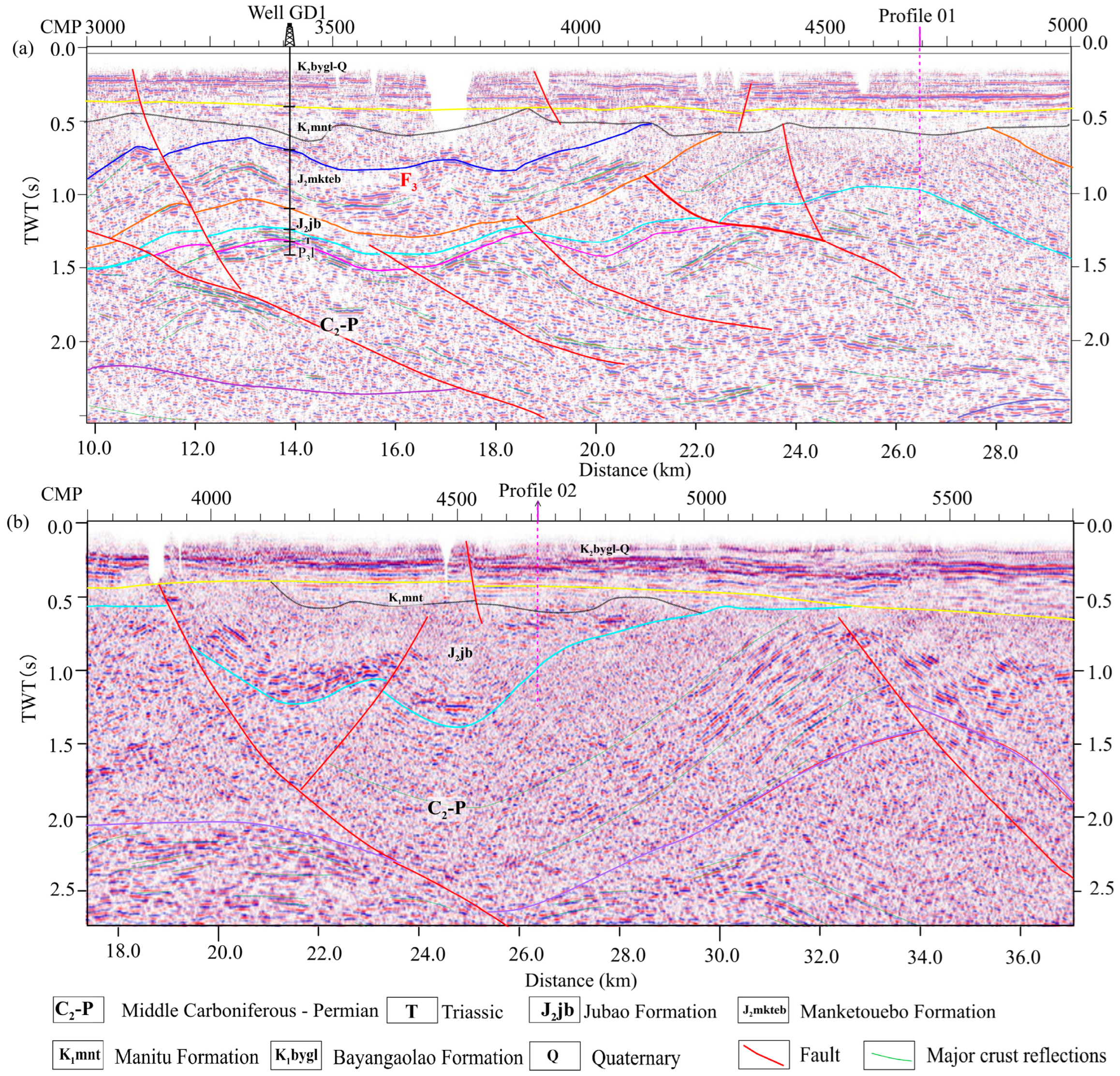
DSR Profile 02 reveals vertically stacked, horizontally continuous high-amplitude reflections within the faults F3, F4 bounded depression, interpreted as sedimentary sequences (Figure 8). Three distinct seismic-stratigraphic zones (FB1, FB2, FB3) were delineated based on vertical reflection characteristics. Borehole GD1, located at CDP 3410 on Profile 02 with a total depth of 2911 m, penetrated, from top to bottom, the Lower Cretaceous Baiyingaolao Formation, the Manitu Formation, the Middle Jurassic Manketou’ebo Formation, the Wanbao Formation, and the Early Triassic Laolongtou and Permian Linxi formations [21]. The Upper Jurassic to Lower Cretaceous succession comprises a set of continental volcanic clastic sedimentary rocks. Well-seismic calibration demonstrates that well GD1 drilled through the entire FB3 section and reached the top of FB2.
Using Borehole GD1 as a constraint, the lateral continuity of stratigraphic units was interpreted from seismic reflection characteristics (Figure 8). This calibration confirms that the top of the Permian Linxi Formation coincides with the base of FB3, where a distinct angular unconformity separates underlying monoclinal reflections from overlying sub-horizontal ones. The lenticular shape of FB2—thick in the center and thinner laterally—is likely attributable to compressional uplift and subsequent differential erosion. In contrast, FB3 displays high-amplitude, continuous seismic facies, while the lower part of FB2 is characterized by discontinuous, low-amplitude reflections. This sharp contrast in seismic signature implies substantial differences in the depositional and tectonic environments of the two units.
In the shallow section of FB3 of Profile 02, integrated well-seismic calibration and lateral tracing of the well GD1 reveal the shallow section comprising the Middle Jurassic Wanbao Formation, Manketou Ebo Formation, and Lower Cretaceous Manitu Formation, comprising a continental volcanic-sedimentary succession. The Middle Jurassic strata exhibit a dual uplift–depression structure with central thickening and rapid westward thinning within the synclinal axis. The eastern sector displays erosional truncation, forming an angular unconformity with overlying Manitu Formation units. DSR analysis divides the Manitu Formation into two subunits: a lower interval with continuous broad folds and an upper interval featuring subhorizontal reflections separated by intraformational unconformities.
Profile 01 traverses the central uplift zone of the study area; the deep stratigraphic identification markers are obscured by later strike-slip modification along the Nenjiang–Balihan fault zone, while the upper FB2 and FB3 zones exhibit distinct seismic reflection characteristics. The FB2 is dominated by continuous curved high-amplitude reflections, indicating progressive fold deformation during the Late Carboniferous to Permian. The FB3 primarily comprises the Jurassic Jubao Formation, Early Cretaceous Manitu Formation, and Baiyin Gaolao Formation. The Early Jurassic Jubao Formation deposits are concentrated in the western profile segment (CDP 2500–5000), reaching maximum thickness between CDP 3900 and 5000. The Manitu Formation occupies localized depressions or fault basins in the central Profile 01, particularly within CDP 6600–7600. The Baiyin Gaolao Formation demonstrates eastward-thickening trends with significant influence from normal faults (e.g., CDP 6800, Profile 01). These depressions or fault basins, which have been made since the Early Jurassic, are predominantly distributed within the Nenjiang–Balihan strike-slip fault zone, with sedimentary filling likely linked to its tectonic evolution since the Mesozoic era [13].

5. Discussion

5.1. Tectonic Attributes of the Study Area

The presence and distribution of ophiolites and magmatic rocks west of the Nenjiang–Balihan fault have enabled the identification of multiple tectonic units, such as the Solonker Suture Zone and the Baolidao island arc [5,7]. However, how these tectonic belts—particularly the Solonker Suture Zone—extend beneath the Quaternary-covered western slope of the Songliao Basin, and what their internal fine-scale structures are, remain critical questions for an understanding of the accretionary orogenic processes in the eastern Central Asian Orogenic Belt. Accordingly, we compare seismic reflection patterns and electrical resistivity structures across the suture zone west of the Songliao Basin with those observed within the study area, aiming to discuss the regional tectonic affinity of the study area. The seismic profiles involved in this study are distributed in and around the Solonker Suture Zone, and their locations are of crucial significance for the structural interpretation of the profiles and for research on the accretionary orogenic processes.
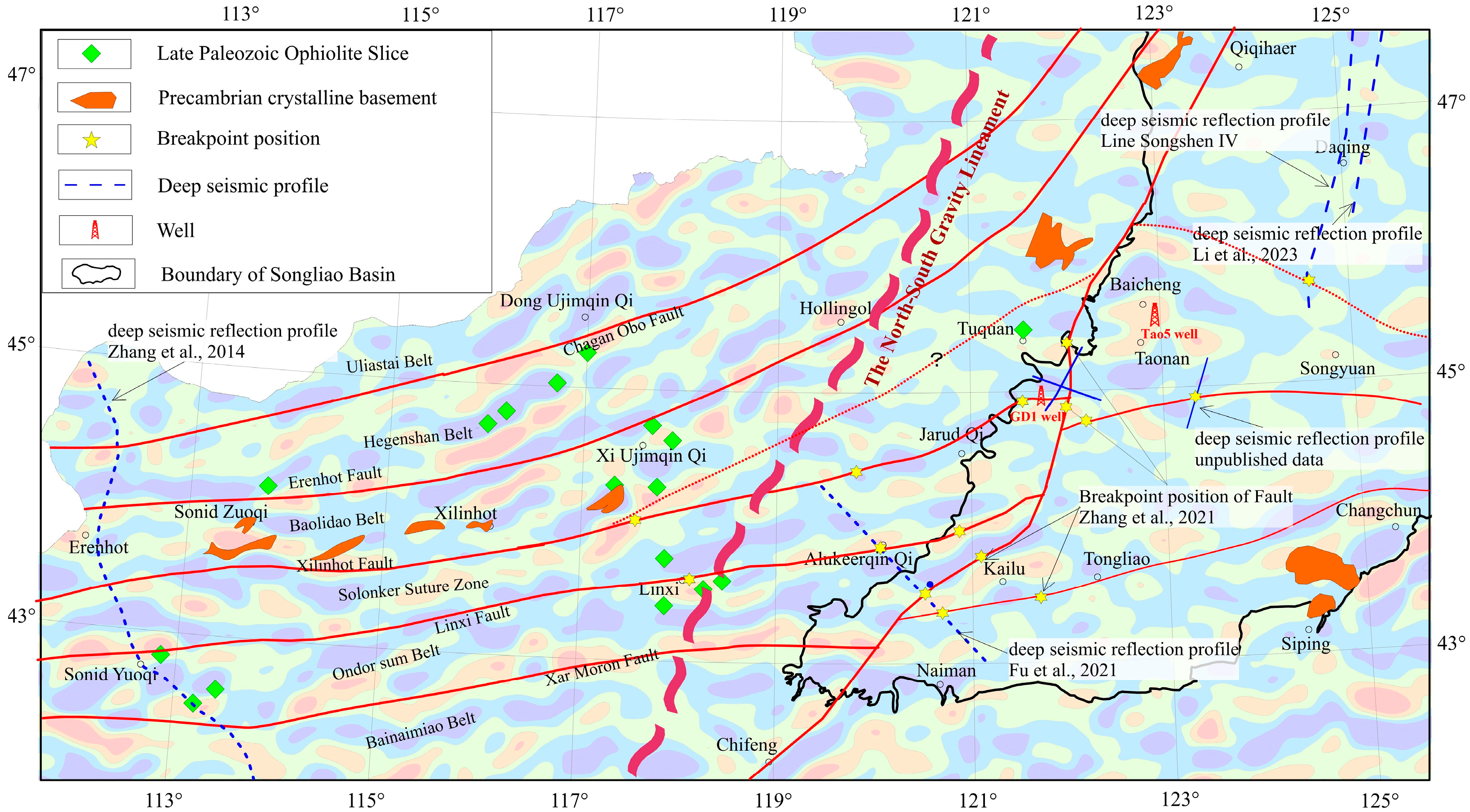
The SinoProb DSR profiles spanning the Solonker Suture Zone and adjacent tectonic units revealed distinct crustal structures [14]. Specifically, north-dipping upper crustal reflections in the south of the Linxi fault (the southern boundary of the Solonker Suture Zone) merge with south-dipping lower crustal reflections, forming a characteristic crocodile-mouth structure. In contrast, the Baolidao island arc exhibits south-dipping upper crustal reflections that gradually converge with arcuate mid-lower crustal reflections at depth [14]. According to the structural features from the central Linxi–Xiwuqi SinoProbe DSR profile [7], the contact zone between lower crustal arcuate reflections and upper crustal south-dipping reflections at CDP 18,800 corresponds to the Xilinhot fault zone. In Profile 02, north-dipping upper crustal reflections south of the F3 fault converge toward the apex of arcuate reflections near TWT 5–6 s, while reflections north of the F4 fault display opposing south-dipping patterns. These seismic characteristics align with those observed between the Xilinhot and Erenhot faults in the western SinoProbe DSR profile [14]. Consequently, the F3 fault is inferred as being the Xilinhot fault. The Xilinhot fault typically manifests as a north-dipping low-resistivity strip in the MT profile exhibiting a subvertical pattern at shallow depths and gradually shallower dips at greater depths. This characteristic electrical signature is observed in four MT profiles deployed across the Sunite Right Banner, Xilinhot, and Zhalute Banner [36,37,38]. Projecting the fault trace identified through integrated DSR and MT profiles onto the regional fourth-order gravity anomaly map reveals its preferential localization along transitional zones of bead-shaped gravity anomaly belts (Figure 9).
The Xar Moron River fault, Linxi fault, and Erenhot fault serve as boundary structures demarcating the Late Paleozoic tectonic units [5,7]. The Xar Moron River fault, separating the Bainaimiao island arc belt from the Wenduermiao accretionary complex belt, is well-imaged in both DSR and MT profiles as being a north-dipping lithospheric-scale feature [11,14]. The footwall of the Linxi fault exhibits a crocodile-mouth structure, characterized by north-dipping upper crustal reflections merging with south-dipping mid-lower crustal reflections. This signature has been documented in eastern DSR profiles [11] and unpublished seismic data from the Tongyu region. Similar to the Xilinhot fault, gravity anomaly projections reveal strike-slip displacements of ~20 km for the Xar Moron fault and ~50 km for the Linxi fault, with the latter matching previous estimates [39]. Consequently, the study area south of the Xilinhot fault and east of the Nenjiang–Balihan fault resides within the Solonker Suture Zone, while its western sector belongs to the Baolidao island arc belt.

5.2. Deep Stratigraphic Sequence Characteristics

The well GD1 has a total drilling depth of 2911.5 m, enabling the calibration of the upper intervals of the FB2 and entire FB3 zones on seismic profiles. However, as the delineation of the stratigraphic sequence features in the deep part of FB2 and the portions of FB3 lacks direct evidence, it is therefore necessary to discuss the deep sequence characteristics in combination with regional geological attributes.
In the upper part of FB2, well GD1 penetrated a 162.5 m-thick interval of the Linxi Formation encountered at 2749.0~2911.5 m. However, the Linxi Formation attains a maximum thickness of 3000~4000 m within the study area, and a 650 m-thick interval of the formation has also been encountered in Well MKD1 in the southern part of the study area [40]. This indicates that thick Linxi Formation strata are still developed in the deep part of the study area. Research findings on the regional stratigraphic sequences indicate that continuous sedimentation occurred in the study area from the Late Carboniferous to the Permian, with no significant sedimentary hiatus or unconformity surfaces [18]. This sedimentary characteristic has also been confirmed by drilling data [40]. Numerous studies have revealed that during the late Early Carboniferous, Northeast China experienced a major paleogeographic reorganization along the Heihe–Hegenshan fault zone [18,19], which led to an unconformable contact between the Upper and Lower Carboniferous successions. In the seismic profile 01, the base of FB2 exhibits either blank or weak monoclinal reflections, showing a distinct contrast to the high-amplitude, high-continuity arcuate reflections at the top of FB1 (Figure 10). Additionally, these two reflection types intersect at a high angle in local areas, leading to the inference that the base of FB2 corresponds to the basal boundary of the Upper Carboniferous. The FB2 sequence exhibits an overall lateral distribution characteristic of being thicker in the central and western sectors and thinner in the northern, southern, and eastern sectors. The attitudes of the internal seismic reflections within the FB2 sequence transition from nearly horizontal in the upper part to monoclinal in the lower part, a feature that may indicate the extensive development of a thrust-nappe tectonic system during the late-stage compressive deformation event. Furthermore, the lateral variations in its stratigraphic thickness are associated with differential denudation subsequent to compressive uplift.
The FB3 interval between TWT 2.5–4.5 s is distinguished by continuous arcuate reflections overlying monocline reflections on both sides (Figure 10), indicating a typical angular unconformity. Internally, FB3 is characterized by seismic reflections with high amplitude, good lateral continuity, substantial thickness, and uniform deformation. This set of features aligns with the seismic expression of sedimentary strata, leading to the interpretation that the continuous reflections within FB3 correspond to Early Carboniferous and older units. Previous studies have indicated that the Devonian and Lower Carboniferous strata in northeastern China were deposited continuously [41]. The D-C1 unit is widely distributed across the study area and exhibits relatively weak tectonic deformation, dominated by NE-trending broad and gentle folds [19]. This characteristic is consistent with the gentle arcuate seismic reflections observed in FB3. Moreover, the internal arcuate reflections of FB3 overlie the monoclinal reflection packages on both flanks. This configuration resembles the D-C1 outcrop profile in Sonid Left Banner, Inner Mongolia, in which the Late Devonian–Early Carboniferous Seribayanaobao Formation (a molasse assemblage) unconformably overlies the Early Paleozoic mélange. Therefore, based on regional geological clues, the reflections in the FB1 are interpreted to represent strata of the Late Devonian–Early Carboniferous age.
As the Late Devonian–Early Carboniferous deposit, FB1 exhibits an overall westward-thickening half-graben structure, with a distinct normal fault developed along its eastern margin, indicating a sedimentary environment under an extensional tectonic regime. The arcuate reflections in the FB1 represent the folding deformation of the strata, associated with the closure of the PAO and subsequent collisional orogenesis. Furthermore, seismic profiles reveal a southward migration of the depositional center from the Early Devonian to the Early Cretaceous, suggesting an NNW–SSE oriented compressional stress during late-stage tectonic activity [21,42,43].

5.3. Identification of the Paleozoic Buried Basins

The strata within the depression bounded by F3 and F4 faults in Profile 02 overlie the monoclinic high-amplitude reflections on both sides, indicating the early structural development that governed the basin’s sedimentary structure. Resolving the genesis of reflections on both sides is critical to examine the regional tectonic evolution and structural properties of this depression. Crustal high-amplitude reflections are related to partially melted magma, fluids, ductile high-strain zones, and mafic batholiths (basalt or gabbro) [44]. Owing to the low geothermal flow value (about 70 mW/m2) [45] and low porosity of the Paleozoic strata (the porosity of the Linxi formation is 0.56–5.41%, with an average of 2.7%) [46] in the study area, local molten magma and abundant fluids do not fully explain the strong monoclinic reflections in the footwalls of the F3 and F4 faults. Analogous reflections documented near the East China Sea continental scientific drilling site [47] confirm that ductile shear zones and magmatic intrusions can generate such crustal signatures. The investigated area occurs within an accretionary orogenic belt exhibiting the widespread development of ductile shear fabrics and magmatic rocks. This may be the principal reason for the prominent crustal reflection patterns observed in Profile 02.
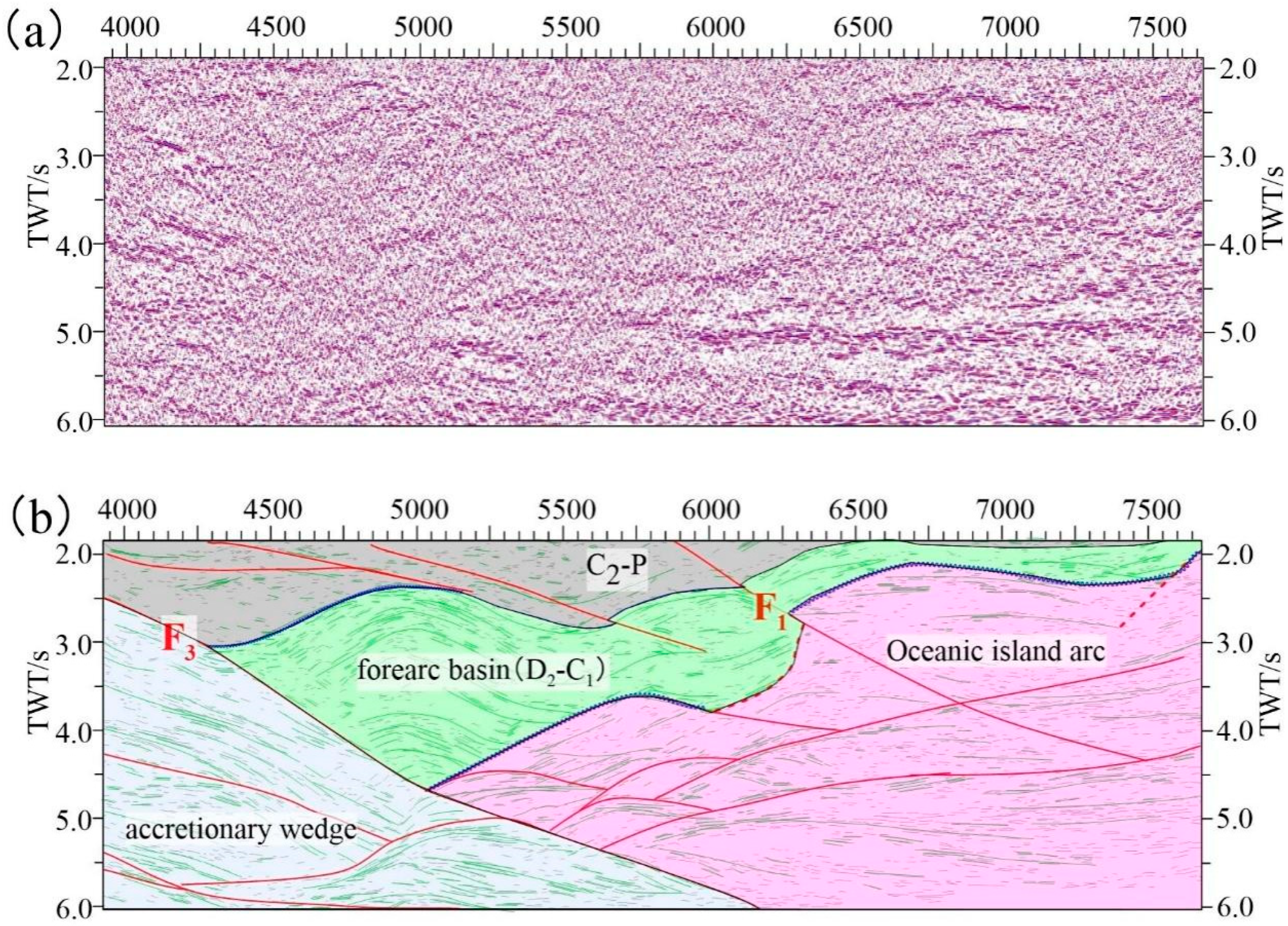
Integrated DSR Profile 02 and the corresponding MT profile (Figure 11) reveal contrasting resistivity domains: the footwall of the F3 fault (CDP 2200 to 4700) exhibits low resistivity, while the footwall of the F4 fault (CDP 6000 to 8500) displays high resistivity, implying distinct genetic mechanisms for the monoclinic reflections on both sides. Between CDP 2000 and CDP 5000 (TWT 2–4 s), reverse faults and imbricated arcuate reflections suggest tectonic uplift superimposed along the reverse faults within the accretionary belt. Therefore, the low resistivity reflections in the footwall of the F3 fault may originate from fault-induced fracturing or carbonaceous fault gouge [48]. After all, we have seen that regional Duerji tectonic mélanges developed southwest of Profile 02 (Figure 9), with a matrix of strongly deformed marine clastic sequences formed in an active continental margin [49]. This supports an interpretation that the genesis of the south-dipping, low-resistivity monoclinic reflections in the footwall of the F3 fault could represent a subduction-related mélange belt (Figure 10). In contrast, the south-dipping footwall of the F4 fault exhibits a distinct layered pattern of high-resistivity reflections and displays a near-horizontal occurrence at the upper crust’s base (Figure 11), showing remarkable parallels to the seismic reflections identified beneath Wollaston Lake in Canada [44]. Such large-scale crustal seismic reflections are interpreted as representing either a mafic batholith or a stratified gabbro body. Based on the documented occurrence of Early Carboniferous basalt and diabase northwest of the study area, the south-dipping reflections observed north of Profile 02 are interpreted as subsurface expressions of partial melts derived from mafic-ultramafic intrusive sources (Figure 12).
The shallow reflections characterized by gradual and abrupt variations in Profile 02 closely resemble seismic reflections documented from the Gangdise magmatic belt in Tibet [50] and the Luzon Island arc in the Taiwan Orogen [23]. These observations support the interpretation that the south-dipping reflections north of Profile 02 represent the Early Paleozoic island arc (Figure 12). Basalts and diabases from the Keyouzhong Banner exhibit trace element signatures consistent with oceanic arc magmatism [51]. The subduction–accretion complex north of Profile 02 contains matrix materials yielding Early Permian (298–275 Ma) metamorphic ages [17], indicating persistent oceanic crust north of the study area through the Early Permian. The monoclinal reflections observed in the footwall of the F4 fault are interpreted as being structural expressions of an oceanic island arc.
Seismic interpretation reveals distinct tectonic domains within Profile 02. The reflections in the footwall of the F3 fault suggest a Late Devonian to Early Carboniferous tectonic mélange containing intensely deformed forearc tholeiitic basalt with pillow lava structures [49]. The reflections in the footwall of the F4 fault suggest a pre-Early Carboniferous remnant oceanic island arc, likely representing a paleo-intraoceanic arc system. The intervening depression is interpreted as a pre-Early Carboniferous forearc basin, consistent with mid-Late Carboniferous forearc sequences documented in the adjacent Baolidao arc system to the west [22,41]. Early Permian metasedimentary zircon aging from the Shoushangou Formation southwest of Profile 02 indicates the presence of a trench or forearc basin during the period of active plate convergence [20], further confirming the development of forearc basins related to the oceanic island arcs in the study area. There are signs of a regional correlation showing widespread Early Carboniferous forearc basin development during the PAO subduction. Although Profile 01 intersects the interpreted forearc basin domain, its structural reflections remain unconstrained in this study due to a tectonic superposition carried out by the Nenjiang–Balihan fault’s sinistral strike-slip movement and the post-Paleozoic magmatic intrusions disrupting the lateral continuity of the primary stratigraphic reflectors. These superimposed deformational features mask the Paleozoic basin morphology, precluding any reliable seismic facies analysis of the forearc succession.

5.4. Tectonic Implications for the PAO (Eastern Segment) Evolution

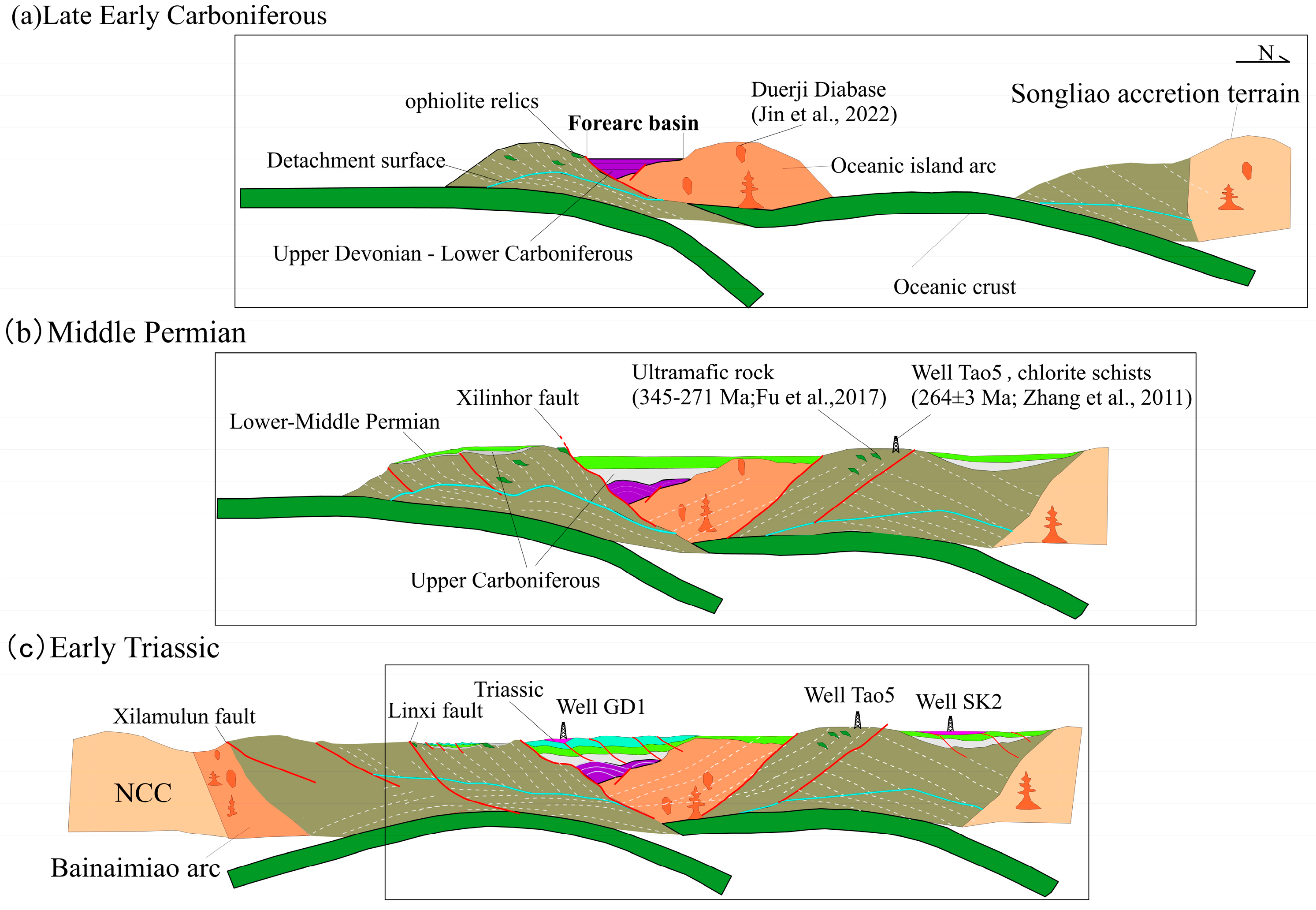
The south-dipping seismic reflections in Profile 02’s northern sector are interpreted as representing an Early Paleozoic oceanic island arc. This arc exhibits tectonic continuity with the Baolidao island arc to the west [5] and a temporal overlap with the Late Devonian to Early Carboniferous Solonker Suture Zone-type ophiolitic complexes [52]. These relationships suggest the existence of a branching oceanic basin, separating the Songliao accretionary terrain from the evolving arc system throughout Paleozoic subduction episodes. Supporting evidence comes from a series of serpentinized ultramafic suites (345–271 Ma) that were observed in the Tuquan area north of the study region [53], further suggesting the existence of a branching ocean basin. Therefore, an arc-continent collision must have happened during the final closure of the PAO (eastern segment). Elucidating this collisional process is essential for constraining PAO plate reconstruction models and for understanding the accretionary orogen mechanisms in NE China.
The CAOB, a typical proliferative orogenic belt, exhibits diagnostic compressional structures including thrust-imbricate fans and fold-thrust belts—features typically resolvable in seismic imaging. In Profile 02, the oppositely vergent crustal reflections with high continuity are interpreted as being thrust fault systems formed during the PAO subduction and terminal closure. South-dipping reflections (CDP 5000 to 8500) extend northward beneath the Daqing southern margin and structurally override north-dipping crustal reflections [12]. It is very likely that this reflection architecture records progressive stacking of subduction–accretion complexes within the orogenic wedge [3,7]. Integrating these seismic constraints with Late Paleozoic forearc basin architecture and stratigraphic sequence distribution patterns enables reconstruction of the evolution of PAO (eastern segment).
Previous DSR profile profiling north of Profile 02 in the Songliao Basin has identified north-dipping crustal and upper-mantle reflections beneath the Daqing region [12]. These deep structural features are interpreted as being preserved signatures of paleo-subduction processes [54,55]. Documentation of 348.3 ± 2.6 Ma basic rocks in the southern Songliao accretionary terrane showing Izu–Bonin–Mariana (IBM)-type forearc basalt geochemical signatures [51] indicates northward subduction of the PAO crust beneath a developing intra-oceanic arc system in the early Late Paleozoic. During the Late Devonian to Early Carboniferous, the forearc basin developed under the instance of the extensional tectonics, which is evidenced by the presence of normal fault-controlled sedimentation with southward-thickening Upper Devonian–Lower Carboniferous sequences. This implies a steep-angle (>45°) subduction of the oceanic crust. The forearc basin’s basement architecture comprises Early Paleozoic accretionary complexes (southern domain) and arc remnants (northern domain), overlain unconformably by the Upper Devonian to Lower Carboniferous sedimentary successions (Figure 13). This stratigraphic configuration finds direct analogs in the western study area, where Late Devonian–Early Carboniferous strata of the Seribayan Aobao Formation disconformably overlie the Ondor Sum Group in the Sunite Left Banner. Detrital zircon provenance signatures and depositional architectures within the Seribayan Aobao Formation [41] demonstrate forearc basin characteristics, confirming the coeval development of an oceanic arc system and its associated forearc basin along the northern PAO margin during the early Late Paleozoic.
The tectonic evolution of the northern oceanic island arc was fundamentally controlled by the subduction and closure of the Hegenshan Ocean during the Late Carboniferous to Early Permian, according to a series of 345–271 Ma ultramafic rocks discovered near the Tuquan region [53] north of Profile 02. The north-dipping upper-mantle reflections, indicating the remnants of subducted crust, can be seen beneath the Daqing region [12]. Compressional tectonics during ocean closure induced a northward thrusting of oceanic arc and ophiolitic fragments along an internal weak structural plane, causing the development of south-vergent thrust systems extending to the vicinity of the Da’an region, where they structurally override north-dipping lower crustal and upper-mantle reflections in Profile 02. The 264 ± 3 Ma deformed chlorite schists [56] in the Baicheng region record the stacking of accretionary wedges. By the Late Permian, intense compressional and thrusting tectonics had driven significant crustal uplift in the Baicheng–Zhalute region. The ocean in the southern forearc domain of the intra-oceanic arc was still unclosed, resulting in the restricted deposition of the Upper Permian Linxi Formation to regions south of the oceanic island arc and also to the stratigraphic hiatus of the Linxi Formation near Baicheng and the SK II well in the Songliao Basin [24].
The PAO is likely to have closed completely during the Late Permian to Early Triassic, with seawater subsequently retreating from the region [57]. The transition to continental sedimentation is evidenced by Early Triassic non-marine deposits in the Songliao Basin and adjacent areas [40,58], with the relatively thin Laolongtou Formation preferentially preserved in the depression at the front edge of the thrust fault in Profile 02. Under the influence of strong NWW–SEE compressional stresses, this collisional regime produced north-vergent thrust faults and associated fault-propagation folds developed within the Upper Carboniferous-Permian sequence. The tectonic model in Figure 11 effectively elaborates the spatial variations in crust–upper-mantle reflection patterns across the study area and apparent discrepancies in the collisional metamorphic records. Large progressive deformation within the stacking accretionary wedge likely attenuated these collisional stresses, as is evidenced by the absence of high-pressure metamorphic assemblages such as blueschist rocks [59]. This provides critical constraints for modeling orogenic systems, offering novel perspectives on the mechanics of “soft-collision” orogenic processes.

6. Conclusions

(1)
Two major detachment interfaces (D1 and D2) were identified from DSR profiles along the western slope of the Songliao Basin. The D1 interface corresponds to the Upper Paleozoic basal unconformity, while the D2 interface marks the bottom boundary of the upper crust. The upper crust above D2 exhibits pronounced monoclinic reflections, contrasting with the area below D2, which shows a network structure of arcuate and variably oriented reflections, indicating a dual-layered orogenic structure.
(2)
The upper crust exhibits distinct structural domains defined by strongly contrasting monoclinal reflections: north-dipping low-resistivity zones in the southern sector and south-dipping high-resistivity zones in the northern sector. These oppositely oriented reflections were interpreted as marking the tectonic origin as an Early Paleozoic accretionary wedge and an oceanic island arc, respectively. The forearc basin interposed between these opposing structural domains preserves Paleozoic-Early Mesozoic strata, with a pre-Middle Permian oceanic basin identified in the north of the study area.
(3)
Seismic reflection patterns across the crust–upper mantle were systematically analyzed. Based on the conceptual framework of orogenic accretionary wedge superposition, we propose an evolutionary model for the northern PAO (eastern segment) during the Late Paleozoic. This model posits that the closure of an ocean basin north of the oceanic arc during the Middle Permian initiated a northward thrust propagation on the accretionary wedge along the crustal weak structural planes, resulting in the stratigraphic absence of the Upper Permian Linxi Formation in the north of the oceanic island arc. This study highlights the value of integrated geophysical investigations in covered areas, which provide essential insights into the deep structure and tectonic evolution of accretionary orogenic belts.

Author Contributions

Conceptualization, P.Z. and Z.L.; methodology, P.Z. and X.Z.; validation, D.H. and P.Z.; formal analysis, D.H. and J.L.; investigation, P.Z., D.H., X.Z.; resources, Z.L., H.F. and J.L.; data curation, P.Z. and X.Z.; writing—original draft preparation, P.Z. and D.H.; writing—review and editing, P.Z., Z.L., D.H., X.Z., H.F. and J.L.; visualization, D.H. and X.Z.; supervision, J.L. and H.F.; project administration, H.F. and J.L.; funding acquisition, H.F. and J.L. All authors have read and agreed to the published version of the manuscript.

Funding

This research was funded by the China Geological Survey (No. DD20240200706), National Nonprofit Institute Research Grant of IGGE (No. AS2024J06) and Deep Earth Probe and Mineral Resources Exploration-National Science and Technology Major Project (No. 2024ZD1000200).

Institutional Review Board Statement

Not applicable.

Informed Consent Statement

Not applicable.

Data Availability Statement

The data presented in this study are available on request from the corresponding authors.

Conflicts of Interest

The authors declare no conflicts of interest.

Abbreviations

The following abbreviations are used in this manuscript:
CAOBCentral Asian Orogenic Belt
DSRDeep seismic reflection
MTMagnetotelluric
NENortheast
PAOPaleo-Asian Ocean

References

  1. Eizenhöfer, P.R.; Zhao, G.; Zhang, J.; Sun, M. Final Closure of the Paleo-Asian Ocean along the Solonker Suture Zone: Constraints from Geochronological and Geochemical Data of Permian Volcanic and Sedimentary Rocks. Tectonics 2014, 33, 441–463. [Google Scholar] [CrossRef]
  2. Wilde, S.A.; Zhou, J.B. The late Paleozoic to Mesozoic evolution of the eastern margin of the Central Asian Orogenic Belt in China. J. Asian Earth Sci. 2015, 113, 909–921. [Google Scholar] [CrossRef]
  3. Xiao, W.J.; Song, D.F.; Windley, B.F.; Li, J.; Han, C.; Wan, B.; Zhang, J.; Ao, S.; Zhang, Z. Research progresses of the accretionary processes and metallogenesis of the Central Asian Orogenic Belt. Sci. China Earth Sci. 2019, 49, 1512–1545, (In Chinese with English abstract). [Google Scholar]
  4. Zhou, J.B.; Wilde, S.A.; Zhao, G.C.; Han, J. Nature and assembly of microcontinental blocks within the Paleo-Asian Ocean. Earth-Sci. Rev. 2018, 186, 76–93. [Google Scholar] [CrossRef]
  5. Jian, P.; Liu, D.Y.; Kröner, A.; Windley, B.F.; Shi, Y.R.; Zhang, F.Q.; Shi, G.H.; Miao, L.C.; Zhang, W.; Zhang, Q.; et al. Time scale of an early to mid-Paleozoic orogenic cycle of the long-lived Central Asian Orogenic Belt, Inner Mongolia of China: Implications for continental growth. Lithos 2008, 101, 233–259. [Google Scholar] [CrossRef]
  6. Li, J.Y. Permian geodynamic setting of Northeast China and adjacent regions: Closure of the Paleo-Asian Ocean and subduction of the Paleo-Pacific Plate. J. Asian Earth Sci. 2006, 26, 207–224. [Google Scholar] [CrossRef]
  7. Xiao, W.J.; Windley, B.F.; Hao, J.; Zhai, M.G. Accretion leading to collision and the Permian Solonker Suture, Inner Mongolia, China; termination of the Central Asian orogenic belt. Tectonics 2003, 22, 1069. [Google Scholar] [CrossRef]
  8. Xu, B.; Charvet, J.; Chen, Y.; Zhao, P.; Shi, G.Z. Middle Paleozoic Convergent Orogenic Belts in Western Inner Mongolia (China): Framework, Kinematics, Geochronology and Implications for Tectonic Evolution of the Central Asian Orogenic Belt. Gondwana Res. 2013, 23, 1342–1364. [Google Scholar] [CrossRef]
  9. Eizenhöfer, P.R.; Zhao, G.C. Solonker Suture in East Asia and its bearing on the final closure of the eastern segment of the Palaeo Asian Ocean. Earth-Sci. Rev. 2018, 186, 153–172. [Google Scholar] [CrossRef]
  10. Zhao, P.; Xu, B.; Zhang, C. A rift system in southeastern Central Asian Orogenic Belt: Constraint from sedimentological, geochronological and geochemical investigations of the Late Carboniferous-Early Permian strata in northern Inner Mongolia (China). Gondwana Res. 2017, 47, 342–357. [Google Scholar] [CrossRef]
  11. Fu, W.; Hou, H.S.; Gao, R.; Zhou, J.B.; Zhang, X.Z.; Guo, L.; Guo, R.; Pan, Z.D. Lithospheric structures of the central Solonker-Xar Moron-Changchun-Yanji Suture (Inner Mongolia) revealed by a deep seismic reflection profile. Tectonophysics 2021, 817, 229043. [Google Scholar] [CrossRef]
  12. Li, M.R.; Gao, R.; Zhou, J.B.; Wilde, S.A.; Hou, H.S.; Deng, X.F. Eastward extension of the Solonker Suture beneath the central Songliao Basin, NE China: Evidence from a deep seismic reflection profile. Gondwana Res. 2023, 119, 164–171. [Google Scholar] [CrossRef]
  13. Zhang, P.H.; Fang, H.; Zhong, Q.; Zhang, X.B.; Yuan, Y.Z.; Liu, J.X. Structural features and tectonic evolution of the Nenjiang–Balihan fault in the western margin of the Songliao Basin, NE China, inferred from 2D inversion of magnetotelluric data. J. Asian Earth Sci. 2021, 206, 104628. [Google Scholar] [CrossRef]
  14. Zhang, S.H.; Gao, R.; Li, H.Q.; Hou, H.S.; Wu, H.C.; Li, Q.; Yang, K.; Li, C.; Li, W.H.; Zhang, J.S.; et al. Crustal structures revealed from a deep seismic reflection profile across the Solonker suture zone of the Central Asian Orogenic Belt, northern China: An integrated interpretation. Tectonophysics 2014, 612, 26–39. [Google Scholar] [CrossRef]
  15. Jian, P.; Liu, D.Y.; Kröner, A.; Windley, B.F.; Shi, Y.R.; Zhang, W.; Zhang, F.Q.; Miao, L.C.; Zhang, L.Q.; Tomurhuu, D. Evolution of a Permian intra oceanic arc-trench system in the Solonker suture zone, Central Asian Orogenic Belt, China and Mongolia. Lithos 2010, 118, 169–190. [Google Scholar] [CrossRef]
  16. Hou, H.S.; Wang, H.Y.; Gao, R.; Li, Q.S.; Li, H.Q.; Xiong, X.S.; Li, W.H.; Tong, Y. Fine crustal structure and deformation beneath the Great Xing’an Ranges, CAOB: Revealed by deep seismic reflection profile. J. Asian Earth Sci. 2015, 113, 491–500. [Google Scholar] [CrossRef]
  17. Yang, X.P.; Zhong, H.; Yang, Y.J.; Jiang, B.; Qiang, C.; Ma, Y.F.; Zhang, C. Research progress on the subduction-accretion complex: Reconstruction of the tectonic framework of the Great Xing’ an Range. Earth Sci. Front. 2022, 29, 94–114, (In Chinese with English abstract). [Google Scholar]
  18. Liu, Y.J.; Li, W.M.; Feng, Z.Q.; Wen, Q.B.; Neubauer, F.; Liang, C.Y. A review of the Paleozoic tectonics in the eastern part of Central Asian Orogenic Belt. Gondwana Res. 2017, 43, 123–148. [Google Scholar] [CrossRef]
  19. Liu, Y.J.; Li, W.M.; Ma, Y.F.; Feng, Z.Q.; Guan, Q.B.; Li, S.Z.; Chen, Z.X.; Liang, C.Y.; Wen, Q.B. An orocline in the eastern Central Asian Orogenic Belt. Earth-Sci. Rev. 2021, 221, 103808. [Google Scholar] [CrossRef]
  20. Shi, L.; Tang, Z.; Qian, C.; Zhang, Y.J.; Du, J.Y. Tectonic attributes of the northern Solonker-Linxi suture zone: Constraints from the Shoushangou Formation metamorphosed sedimentary rocks and its andesite lenticle in northern Jarud Banner, Inner Mongolia. Acta Petrol. Sin. 2022, 38, 2829–2847, (In Chinese with English abstract). [Google Scholar]
  21. Zhang, J.; Zheng, Y.J.; Zhang, D.J.; Chen, S.W.; Sun, L.; Zhang, H.H.; Su, F.; Huang, X. Stratigraphic division and correlation of the borehole GD1 in the Gaoliban Fault Depression, western margin of Songliao Basin. J. Northeast Pet. Univ. 2019, 43, 22–29, (In Chinese with English abstract). [Google Scholar]
  22. Chen, B.; Jahn, B.M.; Tian, W. Evolution of the Solonker suture zone: Constraints from zircon U-Pb ages, Hf isotopic ratios and whole-rock Nd-Sr isotope compositions of subduction- and collision-related magmas and forearc sediments. J. Asian Earth Sci. 2009, 34, 245–257. [Google Scholar] [CrossRef]
  23. Zhang, R.X.; Li, S.Z.; Suo, Y.H.; Liu, J.P.; Cao, X.Z.; Zhou, J.; Jiang, Z.X.; Li, X.Y. A forearc pull-apart basin under oblique arc-continent collision: Insights from the North Luzon Trough. Tectonophysics 2022, 837, 229461. [Google Scholar] [CrossRef]
  24. Yin, Y.K.; Gao, Y.F.; Wang, P.J.; Qu, X.J.; Liu, H.B. Discovery of Triassic volcanic-sedimentary strata in the basement of Songliao Basin. Sci. Bull. 2019, 64, 644–646. [Google Scholar] [CrossRef]
  25. Zhang, P.H.; Wang, T.; Li, G.C.; Liu, J.X.; Fang, H.; Li, P.; Li, H.K. Crustal structure of the southern Lower Yangtze region and its geological implications: A deep reflection seismic profile. J. Geophys. Eng. 2024, 21, 359–371. [Google Scholar] [CrossRef]
  26. Zhang, X.B.; Zhang, P.H.; He, M.X.; He, D.S.; Pei, F.G.; Zhang, Y.Y.; Peng, Y. Crustal Electrical Structure of the Wuwei Basin, Lower Yangtze Region of China, and Its Geological Implications. J. Earth Sci. 2023, 34, 1744–1757. [Google Scholar] [CrossRef]
  27. Tao, K.; Niu, F.; Ning, J.; Chen, Y.J.; Grand, S.P.; Kawakatsu, H.; Tanaka, S.; Obayashi, M.; Ni, J. Crustal structure beneath NE China imaged by NECESS Array receiver function data. Earth Planet. Sci. Lett. 2014, 398, 48–57. [Google Scholar] [CrossRef]
  28. Wang, P.J.; Gao, C.C.; Gao, Y.F.; Yang, Z.L.; Tang, X.; Zheng, C.Q.; Liu, S.; Liu, H.B.; Li, H.H.; Gao, X.; et al. Study on basement metamorphic rocks of the ICDP borehole SK2 in the Songliao Basin. Earth Sci. Front. 2025, 32, 038–051. [Google Scholar]
  29. Xiong, X.S.; Gao, R.; Li, Y.; Hou, H.S.; Liang, H.D.; Li, W.H.; Guo, L.H.; Lu, Z.W. The lithosphere structure of the Great Xing’an Range in the eastern Central Asian Orogenic Belt: Constrains from the joint geophysical profiling. J. Asian Earth Sci. 2015, 113, 481–490. [Google Scholar] [CrossRef]
  30. Fu, W.; Hou, H.S.; Gao, R.; Liu, C.; Yang, J.; Guo, R. Fine structure of the lithosphere beneath the Well SK-2 and its adjacent: Revealed by deep seismic reflection profile. Chin. J. Geophys. 2019, 62, 1349–1361, (In Chinese with English abstract). [Google Scholar]
  31. Guo, Z.; Chen, Y.J.; Ning, J.; Feng, Y.; Grand, S.P.; Niu, F.; Kawakatsu, H.; Tanaka, S.; Obayashi, M.; Ni, J. High resolution 3-D crustal structure beneath NE China from joint inversion of ambient noise and receiver functions using NECESS Array data. Earth Planet. Sci. Lett. 2015, 416, 1–11. [Google Scholar] [CrossRef]
  32. Wang, G.H.; Li, D.; Liang, X.; Tang, Y. Determination of the double-layer structure in orogenic belts and its geological significance. J. Geomech. 2022, 28, 705–727, (In Chinese with English abstract). [Google Scholar]
  33. Guo, X.Y.; Gao, R.; Zhao, J.M.; Xu, X.; Lu, Z.W.; Klemperer, S.L.; Liu, H.B. Deep-seated lithospheric geometry in revealing collapse of the Tibetan Plateau. Earth-Sci. Rev. 2018, 185, 751–762. [Google Scholar] [CrossRef]
  34. Huang, T.Y.; Guang, Y.; Kuo, B.Y.; Chiao, L.Y.; Chen, Y.N. Layered deformation in the Taiwan orogen. Science 2015, 349, 720–723. [Google Scholar] [CrossRef]
  35. Liu, Y.J.; Zhang, X.Z.; Chi, X.G.; Wen, Q.B.; Liang, C.Y.; Han, G.Q.; Zhao, L.M.; Zhao, Y.L. Deformation and tectonic layer division of the Upper Paleozoic in Daxing’anling Area. J. Jilin Univ. (Earth Sci. Ed.) 2011, 41, 1304–1313, (In Chinese with English abstract). [Google Scholar]
  36. Han, J.T.; Yuan, T.M.; Liu, W.Y.; Liu, L.J.; Liu, G.X.; Hou, H.S.; Wang, T.Q.; Guo, Z.Y.; Kang, J.Q.; Zhang, J.H. Geoelectric structure of the collision zone between the Siberia plate and the North China Craton and discussion on the deep suture boundary. Chin. J. Geophys. 2019, 62, 1159–1171, (In Chinese with English abstract). [Google Scholar]
  37. Tian, J.F.; Ye, G.F.; Xie, C.L.; Li, L.; Wei, W.B.; Jin, S.; Liu, Z. Two-dimensional electrical resistivity structure of the crust and upper mantle across the North-South Gravity Lineament in NE China. Tectonophysics 2022, 837, 229459. [Google Scholar] [CrossRef]
  38. Zhang, H.H.; Qiu, L.; Yan, D.P.; Zhao, Z.F.; Cai, K.D.; Zhang, J.; Chen, S.W.; Li, Y.F.; Song, Y.; Zheng, Y.J.; et al. Late-Permian subduction-to-collision transition and closure of Paleo-Asian Ocean in eastern Central Asian Orogenic Belt: Evidence from borehole cores in the Songliao Basin, Northeast China. Gondwana Res. 2023, 122, 74–92. [Google Scholar] [CrossRef]
  39. Han, G.Q.; Liu, Y.J.; Neubauer, F. Characteristics, timing, and offsets of the middle-southern segment of the western boundary strike-slip fault of the Songliao Basin in Northeast China. Sci. China Earth Sci. 2012, 55, 464–475. [Google Scholar] [CrossRef]
  40. He, D.S.; Fang, H.; Zhang, P.H.; Pei, F.G.; Ming, C.D.; He, M.X.; Zhang, X.B. Geochemical characteristics of the Middle–Late Permian sedimentary rocks in the southern Great Xing’an Range, NE China, and their constraints on the closure time of the Paleo Asian Ocean (Eastern Segment). Sediment. Geol. 2023, 450, 106375. [Google Scholar] [CrossRef]
  41. Wang, S.Q.; Hu, X.J.; Yang, Z.L. Late Paleozoic tectonic framework of the central Xing-Meng Orogenic Belt: Constrains from detrital and igneous zircon U-Pb geochronology of late Devonian-Early Carboniferous Seribayanaobao Formation in southern Sunid Zuoqi. Acta Petrol. Sin. 2021, 37, 2086–2102, (In Chinese with English abstract). [Google Scholar]
  42. Zhao, P.; Faure, M.; Chen, Y.; Shi, G.Z.; Xu, B. A new Triassic shortening-extrusion tectonic model for Central-Eastern Asia: Structural, geochronological and paleomagnetic investigations in the Xilamulun Fault (North China). Earth Planet. Sci. Lett. 2015, 426, 46–57. [Google Scholar] [CrossRef]
  43. Zhao, P.; Xu, B.; Tong, Q.L.; Chen, Y.; Faure, M. Sedimentological and geochronological constraints on the Carboniferous evolution of central Inner Mongolia, southeastern Central Asian Orogenic Belt: Inland-sea deposition in a post-orogenic setting. Gondwana Res. 2016, 31, 253–270. [Google Scholar] [CrossRef]
  44. Mandler, H.A.F.; Clowes, R.M. Evidence for extensive tabular intrusions in the Precambrian shield of western Canada: A 160 km-long sequence of bright reflections. Geology 1997, 25, 271–274. [Google Scholar] [CrossRef]
  45. Wang, J.; Li, C.F. Curie point depths in Northeast China and their geothermal implications for the Songliao Basin. J. Asian Earth Sci. 2018, 163, 177–193. [Google Scholar] [CrossRef]
  46. Xu, H.; Xie, Q.L.; Wang, S.M.; Yu, S. Organic geochemical characteristics and gas prospectivity of Permian source rocks in western margin of Songliao Basin, northeastern China. J. Pet. Sci. Eng. 2021, 205, 108863. [Google Scholar] [CrossRef]
  47. Yang, W.C.; Yang, W.Y.; Cheng, Z.Y. Calibration of seismic reflectors at the Chinese Continental Scientific Drilling site. Chin. J. Geophys. 2006, 9, 1682–1692, (In Chinese with English abstract). [Google Scholar]
  48. Mathez, E.A.; Roberts, J.J.; Duba, A.G.; Kronenberg, A.K.; Karner, S.L. Carbon deposition during brittle rock deformation: Changes in electrical properties of fault zones and potential geoelectric phenomena during earthquakes. J. Geophys. Res. Solid Earth 2008, 113, B12201. [Google Scholar] [CrossRef]
  49. Jin, S. Study of material composition and tectonic properties of the Duerji tectonic malange, Inner Mongolia. Acta Geol. Sin. 2020, 94, 2227–2242, (In Chinese with English abstract). [Google Scholar]
  50. Dong, X.Y.; Li, W.H.; Lu, Z.W.; Huang, X.F.; Gao, R. Seismic reflection imaging of crustal deformation within the eastern Yarlung-Zangbo suture zone. Tectonophysics 2020, 780, 228395. [Google Scholar] [CrossRef]
  51. Jin, S.; Li, Y.J.; Qian, C.; Zhang, Y.; Meng, D.; Yang, H.B.; Wang, B.; Wu, G.F. Geochronology and Geochemistry of Two Types of Basic Rocks in Horqin Right Middle Banner, Inner Mongolia and Their Tectonic Significances. Earth Sci. 2022, 47, 342–356, (In Chinese with English abstract). [Google Scholar]
  52. Li, Y.J.; Wang, G.H.; Santosh, M.; Wang, J.F.; Dong, P.P.; Li, H.Y. Subduction initiation of the SE Paleo-Asian Ocean: Evidence from a well preserved intra-oceanic forearc ophiolite fragment in central Inner Mongolia, North China. Earth Planet. Sci. Lett. 2020, 535, 116087. [Google Scholar] [CrossRef]
  53. Fu, J.Y.; Wang, Y.; Zhong, H.; Song, W.M.; Sun, W.; Na, F.C.; Qian, C.; Yang, Y.J.; Pang, X.J.; Jiang, S. Geochemistry and Source Characteristics of Ultramafic Rocks in Tuquan Mangniuhai, Inner Mongolia. J. Jilin Univ. (Earth Sci. Ed.) 2017, 47, 1172–1186, (In Chinese with English abstract). [Google Scholar]
  54. Spence, G.; Cook, F.A.; White, D.J.; Jones, A.G.; Eaton, D.W.S.; Hall, J.; Clowes, R.M. How the crust meets the mantle: Lithoprobe perspectives on the mohorovii discontinuity and crust–mantle transition. Can. J. Earth Sci. 2010, 47, 315–351. [Google Scholar]
  55. Cook, F.A.; Velden, A.J.V.D. Crustal seismic reflection profiles of collisional orogens. In Regional Geology and Tectonics: Principles of Geologic Analysis; Elsevier: Amsterdam, The Netherlands, 2012; pp. 178–213. [Google Scholar]
  56. Zhang, X.Z.; Qiao, D.W.; Chi, X.G.; Zhou, J.B.; Sun, Y.W.; Zhang, F.X.; Zhang, S.Q.; Zhao, Q.Y. Late-Paleozoic tectonic evolution and oil-gas potentiality in northeastern China. Geol. Bull. China 2011, 30, 205–213. [Google Scholar]
  57. Zhang, D.H.; Huang, B.C.; Zhao, J.; Joseph, G.M.; Zhang, Y.; Liang, Y.L.; Bai, Q.H.; Zhou, T.H. Permian paleogeography of the Eastern CAOB: Paleomagnetic constraints from volcanic rocks in Central Eastern Inner Mongolia, NE China. J. Geophys. Res. Solid Earth 2018, 123, 2559–2582. [Google Scholar] [CrossRef]
  58. Zheng, Y.J.; Zhang, D.J.; Su, F.; Zhang, H.H.; Zhang, J.; Chen, S.W. New understanding of the Xingfuzhilu Formation in thesouthern part of the Greater Khingan Mountains and a correlation with the neighboring areas. Geol. Bull. China 2023, 42, 201–214. [Google Scholar]
  59. Song, S.G.; Wang, M.M.; Xu, X.; Wang, C.; Niu, Y.L.; Allen, M.B.; Su, L. Ophiolites in the Xing’an-Inner Mongolia accretionary belt of the CAOB: Implications for two cycles of seafloor spreading and accretionary orogenic events. Tectonics 2015, 34, 2221–2248. [Google Scholar] [CrossRef]
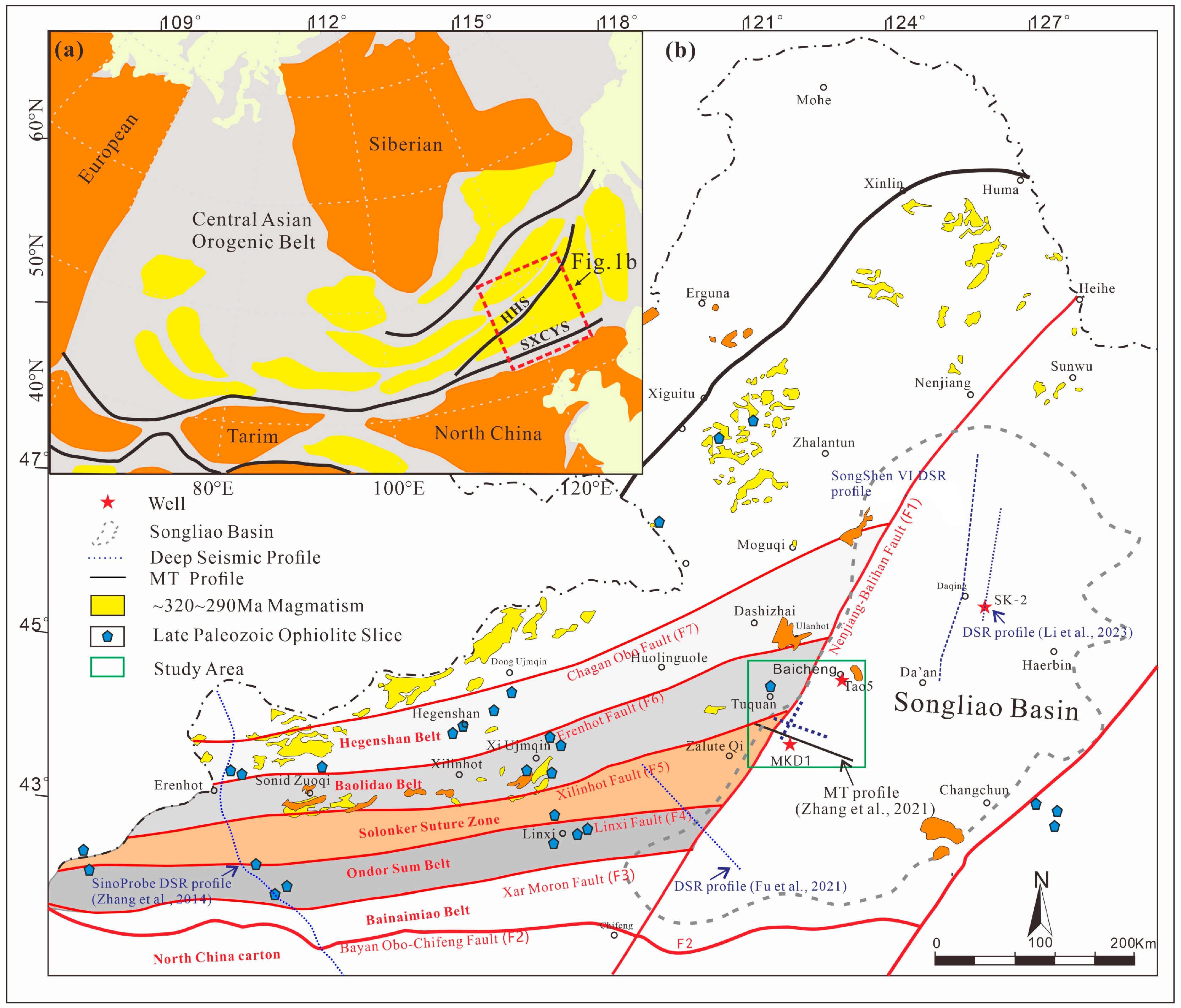
Figure 1. (a) A simplified tectonic framework of the Central Asian Orogenic Belt. (b) A tectonic subdivision of NE China and location of the study area (modified from [7,11,12,13,14]).
Applsci 16 03202 g001
Figure 2. Lithological column and seismic-well calibration for well GD1 (logging curve; AC: acoustic; DEN: density; the pink arrow marks to the location of the zircon dating sample on the seismic profile; stratigraphic stratification and zircon age after [21]).
Applsci 16 03202 g002
Figure 3. Regional geological map and location of seismic and pre-existing MT profiles on the western slope of the Songliao Basin (The vertical red line indicates the Nenjiang-Balihan fault [13]).
Applsci 16 03202 g003
Figure 4. A representative seismic shot of beneath the western slope of the Songliao Basin ((a). Raw shot; (b). Processed shot).
Applsci 16 03202 g004
Figure 5. Time-migrated seismic sections from (a) Profile 01 and (c) Profile 02, with corresponding (b,d) interpreted line drawings of key reflections.
Applsci 16 03202 g005
Figure 6. A seismic line diagram (a) and integrated seismic-electrical interpretation (b) of the DSR Profile 01.
Applsci 16 03202 g006
Figure 7. Seismic line diagram and geological interpretation of DSR Profile 02.
Applsci 16 03202 g007
Figure 8. Stratigraphic sequence characteristics of DSR Profile 02 (a) and Profile 01 (b). (The scope of (a) corresponds to box A in Figure 7).
Applsci 16 03202 g008
Figure 9. Distribution of fault points in NE China, inferred from MT and seismic constraints superimposed on fourth-order residual Bouguer gravity [12,14,28,35].
Applsci 16 03202 g009
Figure 10. Deep stratigraphic sequence characteristics of DSR Profile 02 (The scope of the figure cprresponds to box B in Figure 7).
Applsci 16 03202 g010
Figure 11. Seismic reflection structures (a) and corresponding electrical resistivity structures (b) across the forearc basin basement in the study area.
Applsci 16 03202 g011
Figure 12. (a) A time-migrated seismic image and (b) interpretation of the sedimentary basement of the Paleozoic forearc basin in the study area.
Applsci 16 03202 g012
Figure 13. A tectonic evolution model for the PAO (eastern segment) during the Late Paleozoic in the study area [49,53,56].
Applsci 16 03202 g013
Table 1. Acquisition parameters of seismic reflection data.
ParameterValue
Recording systemSercel 428XL
Gain12 dB
Low CutOUT
Recording formatSEG-D
Sample rate1 ms
Recording length6 s/12 s
Geophone type30DX-10
Geophones/groupArea combination of a string of 12 geophones
Arrangement7190-10-20-10-7190
Maximum offset7190 m
Trace interval20 m
Source typeExplosives
Charge size12 kg
Shot point interval60 m
Shot depth15 m
Coverage120 folds
Disclaimer/Publisher’s Note: The statements, opinions and data contained in all publications are solely those of the individual author(s) and contributor(s) and not of MDPI and/or the editor(s). MDPI and/or the editor(s) disclaim responsibility for any injury to people or property resulting from any ideas, methods, instructions or products referred to in the content.