Article

Numerical Study of the Regulatory Effects of Laser Heating on Thermocapillary-Buoyancy Convection in Two-Layer Fluid System

1
College of Mechanical and Electrical Engineering, Hohai University, Changzhou 213200, China
2
School of Electrical and Power Engineering, Hohai University, Nanjing 211100, China
*
Author to whom correspondence should be addressed.
Appl. Sci. 2026, 16(7), 3186; https://doi.org/10.3390/app16073186
Submission received: 12 January 2026 / Revised: 16 March 2026 / Accepted: 23 March 2026 / Published: 26 March 2026
(This article belongs to the Special Issue Computational Fluid Dynamics in Mechanical Engineering)

Abstract

The present study examines the regulatory effects of laser heating parameters (power, position, and spot radius) on hydrothermal wave instability, heat and mass transfer, and interfacial deformation in bilayer thermocapillary systems under normal gravity. It provides theoretical support for the efficient utilization of energy and the optimization of industrial thermal systems, meeting the demands of sustainable development. The results show that increasing laser power induces asymmetric flow bifurcation nears the laser heating point, enhancing hydrothermal waves in the left region while suppressing them in the right region, with oscillation periods decreasing monotonically and amplitudes showing non-monotonic variation. Laser heating position alters convection intensity distribution, in which the convection in the hot zone is weakened as the laser point nears the cold end, while the convection in the cold zone is strengthened as the laser point nears the hot end. Reducing spot radius significantly decreases temperature gradients near the interfacial heat source, while attenuating horizontal velocity amplitude and increasing oscillation period, effectively suppressing oscillatory thermocapillary convection. This study demonstrates that precise control of laser heating parameters can effectively suppress thermocapillary instability and optimize heat transfer without introducing additional mechanical disturbances. It provides a theoretical basis for efficient, low-energy, non-contact thermal flow control technologies.

1. Introduction

Against the backdrop of the global carbon neutrality goal and energy transition, optimizing the efficiency of thermal systems and reducing energy waste have become the core pillars of sustainable development strategies [1,2]. In precision thermally driven systems and multiphysics optimization design, parameter optimization and stability control of complex systems have become major research focuses [3,4]. The noninvasive sensing technique developed by Zhang et al. [5], the multifactor coupling analysis method proposed by Liu et al. [6], and the multimodal feature fusion modeling strategy introduced by Shen and Zhang [7] provide valuable methodological references for microscale interfacial observation and multiphysics coupling analysis. In addition, the concepts of improving macroscopic performance through microstructural regulation [8] and enhancing core properties via interface engineering [9] offer theoretical support for understanding and actively controlling thermocapillary convection systems.
Fluid flow driven by surface tension gradients induced by temperature gradients at the fluid free surface (liquid–liquid interface) is known as thermal capillary convection. Its heat and mass transfer characteristics, along with flow instability, are critical topics in heat transfer and microgravity fluid mechanics. Double-layer fluid thermal capillary convection is prevalent in daily life and industrial processes, such as multilayer casting, crystal growth, and coating [10]. In industrial processes such as crystal material growth [11,12], molten crystal flow primarily involves thermal capillary convection and buoyancy-driven convection. When the temperature gradient in the molten crystal fluid becomes uneven or exceeds a specific threshold, it can induce internal flow oscillations. The instability of thermal capillary convection significantly affects the quality of the produced crystals, leading to issues like the formation of microscopic striations during crystal growth.
In past decades, research on double-layer fluid thermal capillary convection has increased significantly both domestically and internationally. The upper and lower fluids in a double-layer fluid system exhibit complex thermal coupling and fluid dynamic coupling interactions, making their flow characteristics and instability mechanisms more intricate than those of single-layer fluid thermal capillary convection. Qiusheng Liu [13] conducted early simulation studies on double-layer fluid systems domestically, obtaining the velocity and temperature fields of these systems. In 2010, Ueno et al. [14] studied rectangular double-layer fluid systems using both experiments and simulations. The results showed that as the thermal capillary effect increased (with a rising Marangoni number), the system transitioned from stable flow to unstable flow of thermal fluid waves. Yourong Li et al. [15] and Wanyuan Shi et al. [16] revealed the instability mechanisms of thermal capillary convection in double-layer systems within annular liquid pools. The former used the finite volume method, showing that the enclosed liquid effectively suppresses thermal capillary convection in the melt. Additionally, when buoyancy is introduced, internal convection in the melt intensifies while convection within the enclosed liquid is weakened. Xiaoming Zhou et al. [17,18,19] studied the dual-fluid thermocapillary convection in rectangular and annular liquid pools, revealing the development process of the convection and the oscillation characteristics of the thermal fluid waves. When the horizontal temperature difference exceeds the critical value of the fluid system, thermocapillary convection becomes unstable. From a mathematical perspective, when the parameters that determine the flow state of the fluid system are small, the system of equations has a unique solution, indicating stable flow. As the input parameters increase, the system may have multiple solutions, leading to flow instability, a phenomenon known as bifurcation [20]. In 1983, Smith and Davis [21] analyzed the stability characteristics of two ground-state flows under the action of a horizontal temperature gradient and established two physical models: an infinite horizontal fluid layer and a rectangular liquid pool with return flow and a very small aspect ratio. Under microgravity and non-deforming interfaces, they identified a new instability in the return-flow state, known as thermal fluid waves. Based on these flow characteristics, further studies on controlling instability in double-layer thermocapillary convection have attracted increasing attention.
Based on an understanding of thermocapillary convection, further studies on controlling instability in double-layer thermocapillary systems are necessary. How to suppress thermocapillary flow instability has drawn increasing attention. Among existing approaches, external heat sources show greater potential in the regulation of thermocapillary convection. Advanced thermal management technologies, such as localized heating, microscale thermal control, and non-contact energy input, offer significant advantages in improving energy efficiency and system stability, providing new solutions for sustainable energy systems and advanced manufacturing processes. Among them, laser heating is considered a sustainable thermal control approach due to its precise energy input, fast response, and non-contact operation, making it particularly suitable for fine control of microscale and localized thermal processes. O. Politano et al. [22] used molecular dynamics to study nanoscale thermocapillary convection in a pure nickel system. The focused laser source was simulated at the free interface, and two counter-rotating convection units were formed in the molten pool, increasing laser power induced unstable flow in the melt pool. Gupta, N. R. et al. [23] investigated the influence of surface heat transfer of a rectangular melt encapsulation agent double-layer fluid on thermocapillary flow. The results showed that continuously adding heat from the surface into the fluid domain weakened thermocapillary convection in the encapsulated phase, while strengthening thermocapillary convection in the melt phase. Shiomi et al. [24,25] introduced one or more point heat sources on the free surface of a liquid bridge and effectively suppressed thermal fluid wave instability. Muldoon et al. [26] also achieved effective suppression of thermal fluid wave instability by applying a spatiotemporally varying heat flux density on the free surface of a single-layer fluid. Alexander Gelfgat [27] used numerical analysis to study the effect of interfacial disturbances on buoyancy–thermocapillary convection instability in a rectangular cavity. He showed that the influence of interfacial disturbances on fluid flow is significant. In some systems, interfacial disturbances can change the critical temperature difference by about 10%, leading to either destabilizing or stabilizing effects. V. B. Bekezhanova et al. [28,29,30] studied mass and heat transfer in a double-layer incompressible fluid system through theory and experiments, laser heating induced thermal accumulation at the free interface, which triggered thermocapillary convection and interfacial deformation. They proposed a numerical method that describes flow characteristics and predicts interface shapes.
Although previous studies have addressed the instability of bilayer systems, local heating control, and interface deformation effects, significant knowledge gaps remain. There is still a lack of systematic numerical analysis and physical explanations regarding how laser parameters (power, position, spot radius) influence the redistribution of the temperature gradient, modulating thermal capillary forces and vortex structures to alter the stability and propagation characteristics of thermal fluid waves. Thus, this study aims to investigate the control mechanism of local laser heating on thermal capillary–buoyancy coupled convection instability using a bilayer fluid numerical model with deformable interfaces under normal gravity. The specific objectives include developing a laser heating numerical model for bilayer fluids considering interface deformation and gravity effects; revealing the influence of laser parameters on thermal fluid wave propagation, oscillation characteristics, and bifurcation behavior; exploring the intrinsic relationship between temperature gradients, thermal capillary forces, and vortex structure evolution; and examining the physical mechanism and control conditions for the transition from oscillatory to steady state via laser active control. This research will enhance the understanding of local optothermal control in bilayer thermal capillary convection instability and provide a theoretical foundation for active thermal control of interface flow in related engineering applications.

2. Physical and Mathematical Model

2.1. Physical Model

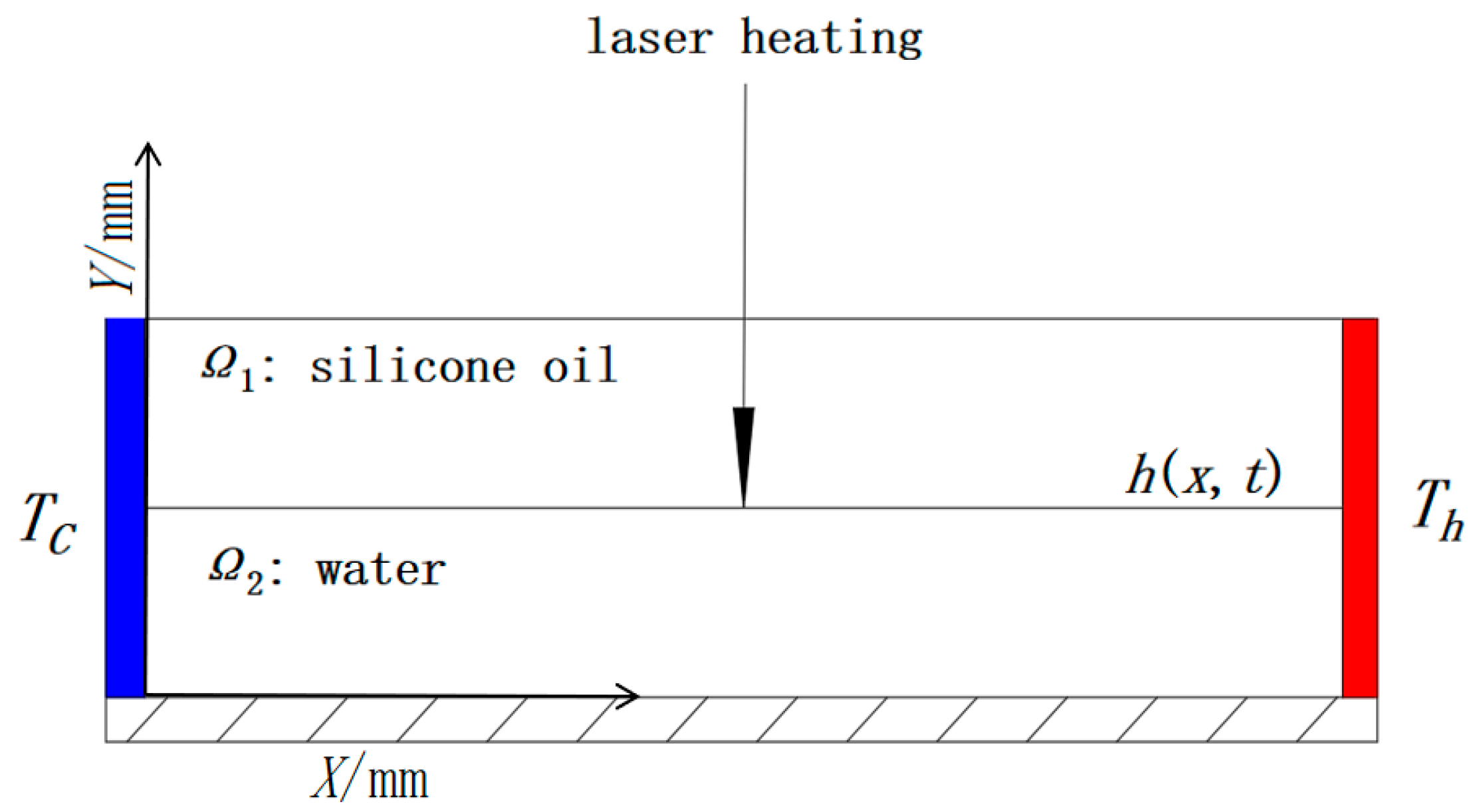
The physical model of double-layer fluid thermocapillary convection under laser irradiation is shown in Figure 1. The length L of the fluid domain is 20 mm, and the height H is 3 mm. The thickness of the fluid in Ω1 and Ω2 is both 1.5 mm. At the initial stage, both fluids are in a stationary state. The right wall is maintained at a constant high temperature Th, and the left wall is maintained at a constant low temperature T c . The cold-end temperature is fixed at T c = 298.15 K , and the hot-end temperature is T h = T c + Δ T . The ambient temperature is constant and equal to T c . The upper and lower layers are immiscible fluids with equal heights. The upper fluid domain Ω1 is 0.65 cSt silicone oil, and the lower fluid domain Ω2 is water. The laser beam irradiates vertically and penetrates the liquid layers into the fluid domain. For simplicity, the laser is modeled as an equivalent heat source.
The following assumptions are made in the physical model.
(1)
The flows in both the upper and lower fluid layers are laminar.
(2)
The left and right walls are maintained at constant temperatures, while the other walls are adiabatic.
(3)
The fluids are incompressible, and all properties except surface tension are independent of temperature.
(4)
Thermocapillary effects are considered at the free surface of the silicone oil layer and at the liquid–liquid interface, hereafter referred to as the fluid interface.
(5)
Deformation of the fluid interface is considered, while the free surface remains flat and undeformed.
(6)
Surface tension is a linear function of temperature, and the linear relationship is:
σ = σ 0 γ T T 0
Here, γ represents the temperature coefficient γ = σ T of the fluid’s surface tension, and σ 0 is the surface tension when the temperature is T 0 .
To define the surface tension σ ˜ T at the liquid–liquid interface, we assume that the liquids in the system are in a mutually saturated state. Calculate the surface tension at the fluid interface using Antonoff’s rule [31]:
σ ˜ T = σ 1 T σ 2 T

2.2. Governing Equations and Boundary Conditions

2.2.1. Governing Equations

Based on the relevant assumptions in Section 2.1, the governing equations and boundary conditions of the double-layer fluid system are obtained as follows:
Continuity equation:
υ i = 0
Momentum equation:
ρ i υ i t + ρ i υ i υ i = p i + μ i 2 υ i + ρ g
Energy equation:
T i t + v i T i = k i 2 T i
Among them, the value of i is 1 or 2; 1 represents the silicone oil on the upper layer, and 2 represents the water on the lower layer. ρ i represents the density of the fluid; μ i represents hydrodynamic viscosity; p i represents fluid pressure; k i is the thermal conductivity of the fluid; υ i represents the velocity of the fluid.
In this study, it is assumed that the energy density of the laser follows a Gaussian distribution and can be expressed as:
q v = 0 r > w z P π w z 2 h exp r 2 w z 2 r w z
Here, P represents the laser power and h represents the absorption height. r is the horizontal distance from point ( x , y ) to the centerline of the laser beam located in the vertical plane. The radius w z of the laser can be given by the formula.
w z = w 0 1 + z H / 2 z R 2
In the formula, z R represents the Rayleigh length of the laser and w 0 is the waist radius of the laser beam. The conversion of light energy absorbed by a liquid into heat energy q v , l is given by the following formula:
q v , l = η q v
The heat absorption rate of a liquid:
η = 1 e α h

2.2.2. Boundary Conditions

Except for the upper wall surface which is a free surface, the other wall surfaces all meet the no-slip condition, and the left and right wall surfaces:
x = 0 ,   u = v = 0 ,   T = T c
x = L ,   u = v = 0 ,   T = T h
y = 0 ,   u = v = 0 ,   T y = 0
y = H ,   v = 0 ,   T y = 0 ,   μ 1 u 1 y = γ 1 T x
y = h x , t ,   T 1 = T 2 ,   k 1 n 1 T 1 = k 2 n 1 T 2 ,   q v , l i q u i d = η i f O , e
In the formula, h x , t represents the interface position. k i is the thermal conductivity of the fluid. q v , l i q u i d is the light energy absorbed by the liquid and converted into heat energy. η i represents the heat absorption rate of the liquid.
Considering the deformation of the interface, h x , t solves the interface position. The silicone oil-water interface F = y h x , t = 0 should satisfy the dynamic and kinematic conditions:
n 1 Π 1 Π 2 = σ ˜ t n 1 n 1 t σ ˜
Π i = p i I + μ i υ i
υ 1 = υ 2
1 F F t = υ 1 n 1
n 1 represents the unit normal vector pointing to the silicone oil, and Π i represents the dimensionless stress tensor in the two phases.

2.3. Material Parameters

In experimental studies of thermocapillary effects, silicone oils with different viscosities are commonly used as working fluids. This choice is due to their wide range of Prandtl numbers and their colorless, non-toxic, transparent, and low-contamination properties. These features make silicone oil an ideal experimental medium. In this study, a double-layer fluid system composed of 0.65 cSt silicone oil and water is adopted. The physical properties of silicone oil and water are listed in Table 1.

2.4. Verification of Grid Independence

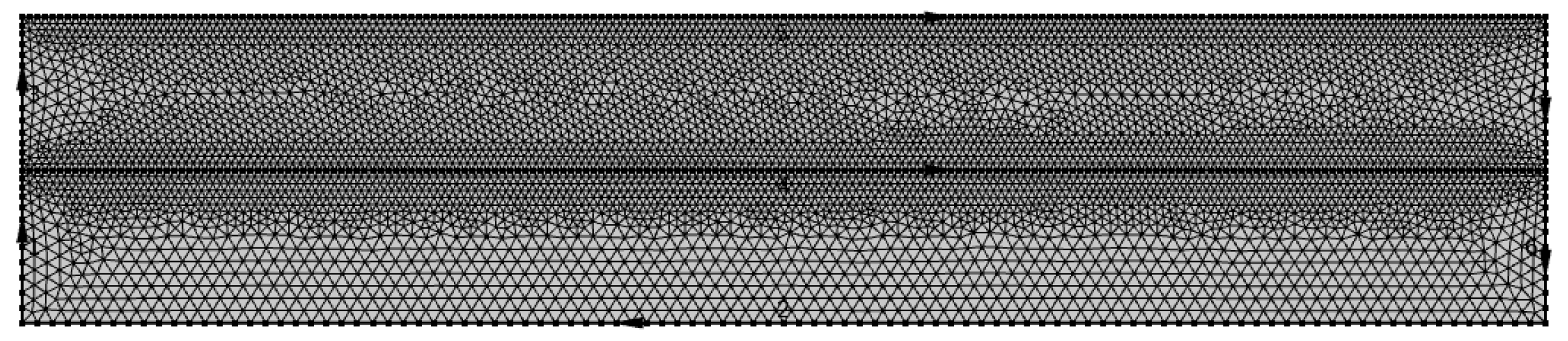
This study uses the finite element method to solve the energy, momentum, and continuity equations. The backward Euler method is applied at the initial stage to reconcile inconsistent initial conditions. The subsequent flow oscillations are computed using the backward differentiation formula (BDF). A moving mesh is used to capture interface deformation. Mesh refinement focuses on the free surface and the fluid interface due to nonuniform surface tension and localized heat accumulation. Sufficient mesh refinement at these interfaces is required to improve accuracy. Accurate tracking of interface deformation requires a dense mesh near the interface to ensure precise calculation of the laser heat source. The flow characteristics of thermocapillary convection are evaluated using fluid velocity as the convergence criterion. As shown in Table 2, the stable velocity of the fluid was obtained under different grid resolutions. The calculation time of grid E was shorter than that of grid G, and the minimum relative error was achieved in all grids. Considering both calculation accuracy and efficiency, grid E was determined to be the most suitable choice (The division of grid E is shown in Figure 2).

2.5. Computational Model Verification

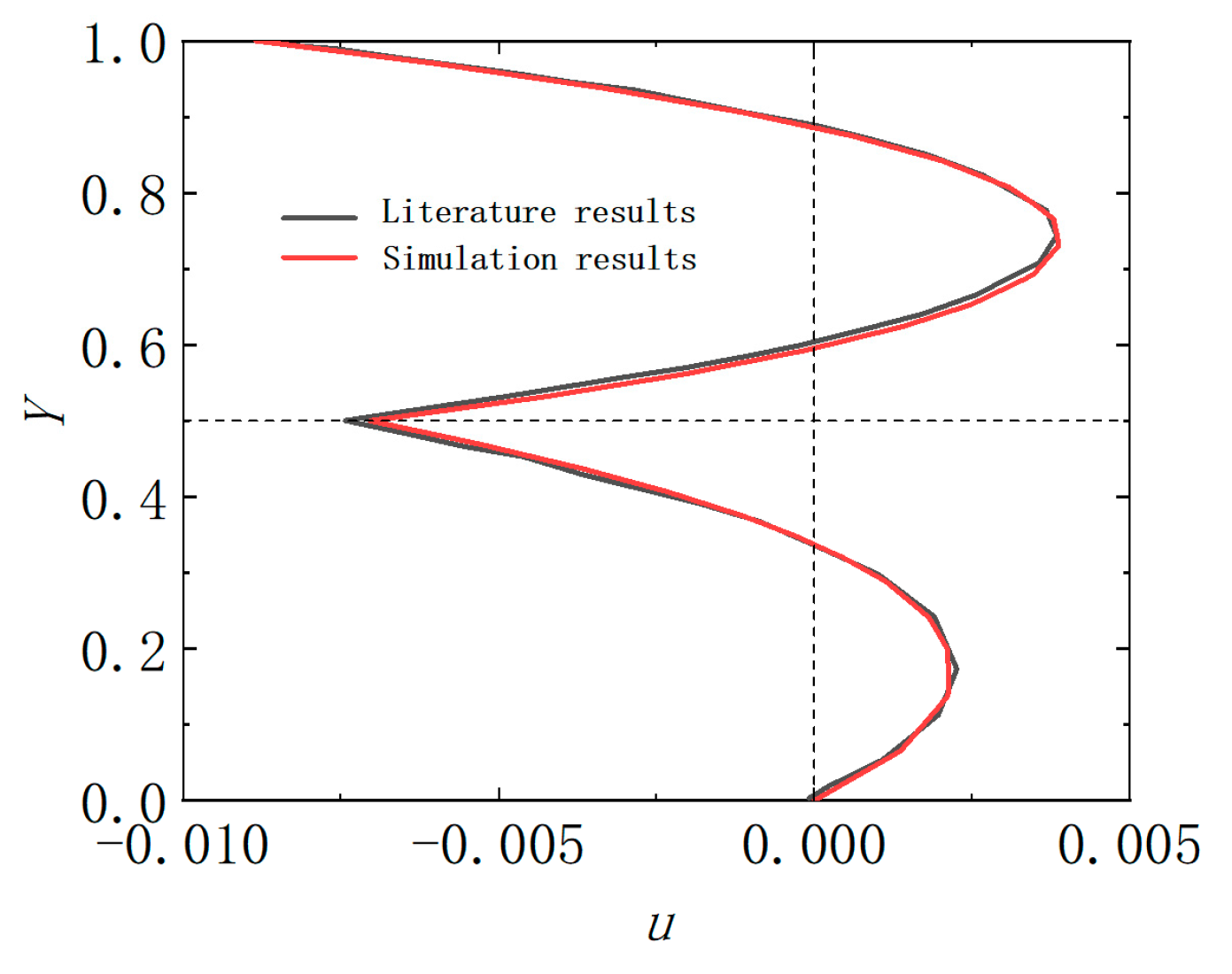
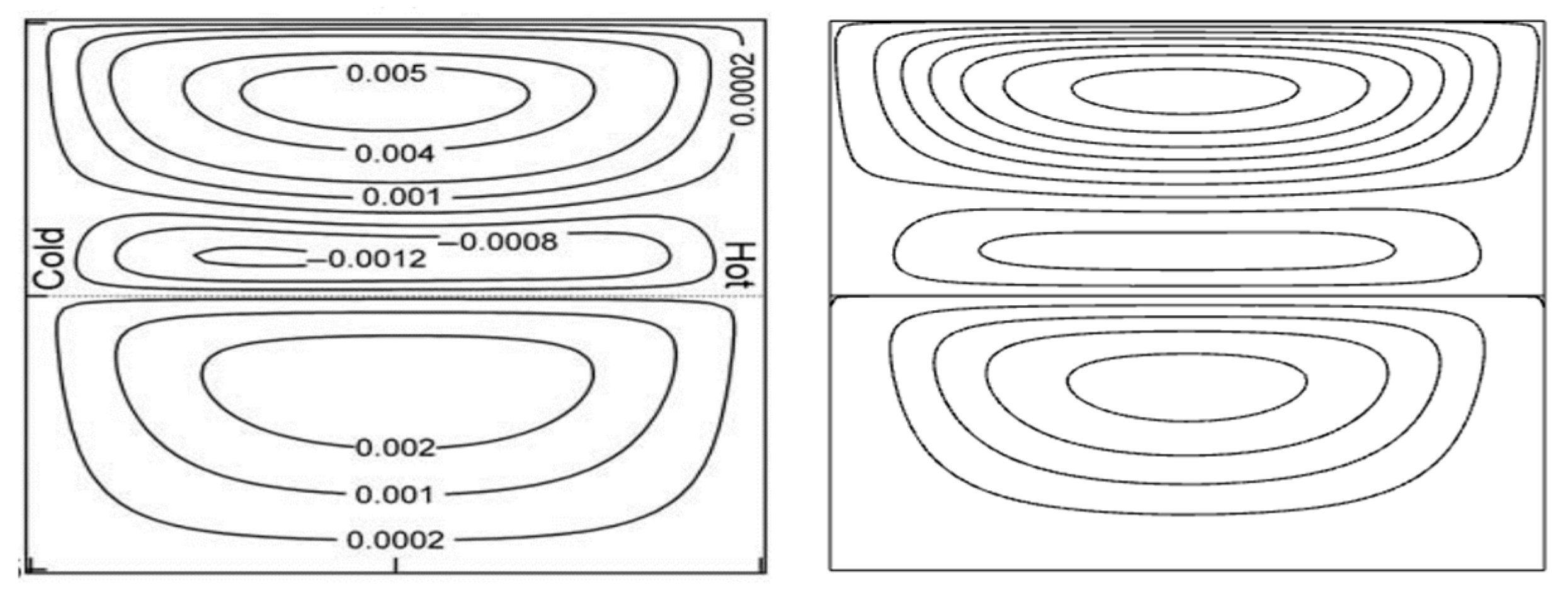
This study establishes a two-dimensional double-layer fluid thermocapillary convection model with a deformable interface and validates the model. The reference simulation uses a square cavity with a side length of 1 mm. The fluids are immiscible and incompressible, and the upper and lower layers have equal thickness. The surface tension ratio between the free surface and the fluid interface is σ 1 / σ 2 = 5 . A horizontal temperature difference of 1 K is applied. The results are compared with those of Gupta [32]. Figure 3 shows streamlines when thermocapillary effects are present at both the free surface and the fluid interface. The left panel shows the reference results, and the right panel shows the present results. The streamline patterns are highly similar. As shown in Figure 4, the maximum error of the numerical results of this study at the vertical midline of the reference literature is less than 3% in terms of the horizontal velocity. This error range is within a reasonable and acceptable range, fully demonstrating the correctness and reliability of this numerical model.

3. Calculation Results and Analysis

3.1. The Influence of Laser on Multi-Vortex Cell Flow Patterns

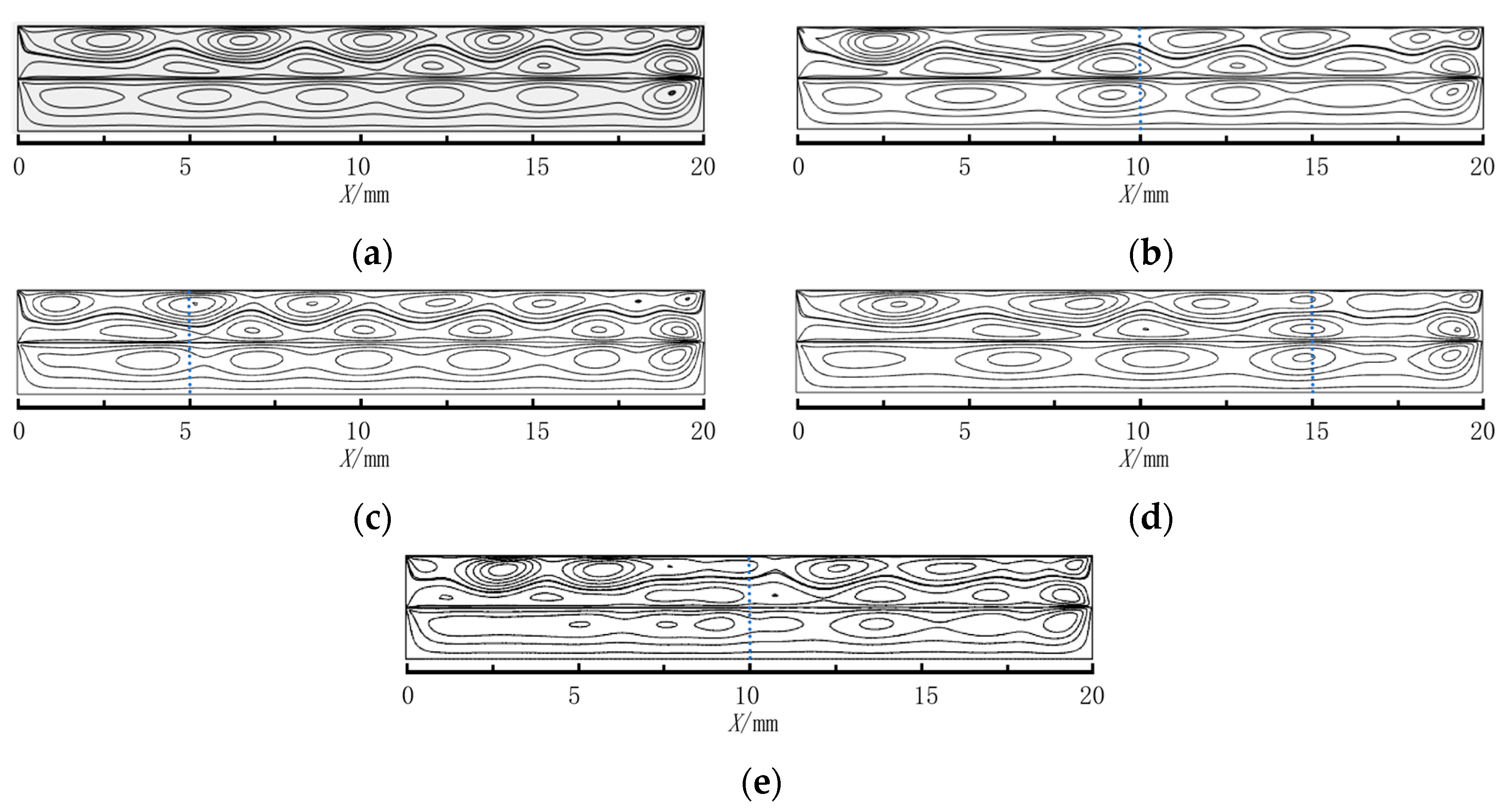
Figure 5 shows the streamline evolution of the double-layer fluid system under different heat source conditions at Δ T = 8 K . When the power P = 8 W, the maximum flow intensity appears near the cold end in the silicone oil layer. Below the silicone oil layer and within the water layer, the flow field shows a distinct asymmetric division with the laser center as the boundary. Vortices on the left side of the laser begin to merge, while the flow intensity on the right side decreases, vortices above the silicone oil layer grow rapidly and compress the vortices below. When the laser is applied near the cold end, the first vortices near the cold end in both layers move away from the cold end. At the hot end, except for a persistent isolated vortex, the remaining vortices move toward the hot end. This indicates that the laser alters the distribution and peak position of the axial temperature gradient, thereby causing the vortex core position of the main cycle to adjust towards the new driving strong zone. When the laser is applied near the hot end, the number of vortices in each layer decreases from six to five, and the vortices elongate along the X direction. Local heating rearranges the shear layer and changes how neighboring vortices interact. Under the strengthened primary circulation, adjacent vortices merge, producing larger vortices with stronger axial elongation. When w0 = 0.5 mm, a clear boundary appears. Different areas are formed on both sides of the laser, below the silicone oil layer and in the water layer basin, the vortex cell on the left side of the laser stretches left and right. The smaller beam waist concentrates the thermocapillary driving force into a more localized zone. This intensifies the reorganization of local shear and recirculation, making vortex patterns more sensitive to the heat-source position and the temperature-gradient peak.
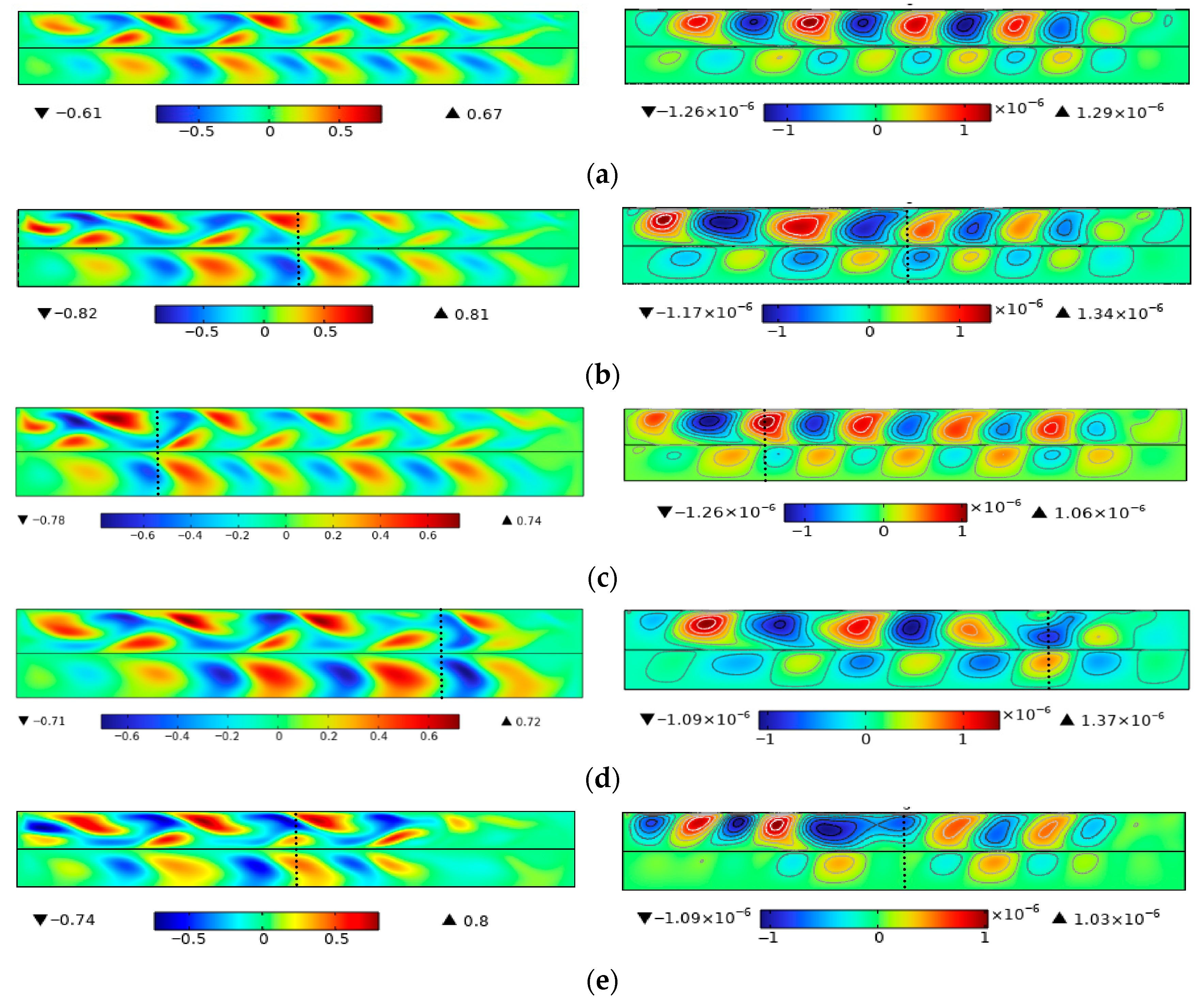
Figure 6 shows the fluctuation distribution of the stream function in the double-layer fluid system under different laser parameters. When P ≥ 8 W, the maximum temperature fluctuation appears near the laser. This indicates that local laser heating significantly restructures the wave field. Strong heat input near the laser enhances the interfacial temperature gradient. This intensifies thermocapillary driving and interlayer shear coupling. As a result, temperature fluctuations on the left side of the laser become disordered, especially in the upper silicone oil layer, and lose regular propagation. In contrast, fluctuations on the right side are weakened but still propagate rightward with alternating positive and negative patterns, indicating that the propagation mechanism is reduced but not completely suppressed. Meanwhile, During propagation toward the hot end, laser heating significantly increases the free-surface propagation speed. When the heat source is applied near the cold end, temperature fluctuations in the water layer increase on the left side of the heat source, while they first weaken and then strengthen on the right side of the laser. The number of alternating positive and negative stream-function fluctuation groups increases, and propagation on the right side of the laser continuously weakens. When the laser is applied near the hot end, temperature fluctuations in the water layer continuously increase on the left side of the laser up to the heating region, while they weaken on the right side. The number of alternating stream-function fluctuation groups decreases, and clear differences appear on both sides of the laser above the silicone oil layer. Local thermocapillary shear rearrangement alters the wave-train scale and spatial organization. For a smaller beam radius (w0 = 0.5 mm), the heat flux is more concentrated. Local heating more strongly modulates the evolution of temperature waves. The waves vanish earlier as they propagate toward the hot end. Distinct generation, growth, and decay stages appear between the cold end and the laser region. Negative waves near the heating zone are stretched. This indicates pronounced nonuniform phase stretching and enhanced spatial asymmetry. These results show that the laser reconstructs the propagation paths of temperature and stream function waves by modulating the temperature gradient field within the domain and the interfacial thermocapillary shear intensity.

3.2. The Influence of Laser on Thermal Fluid Waves

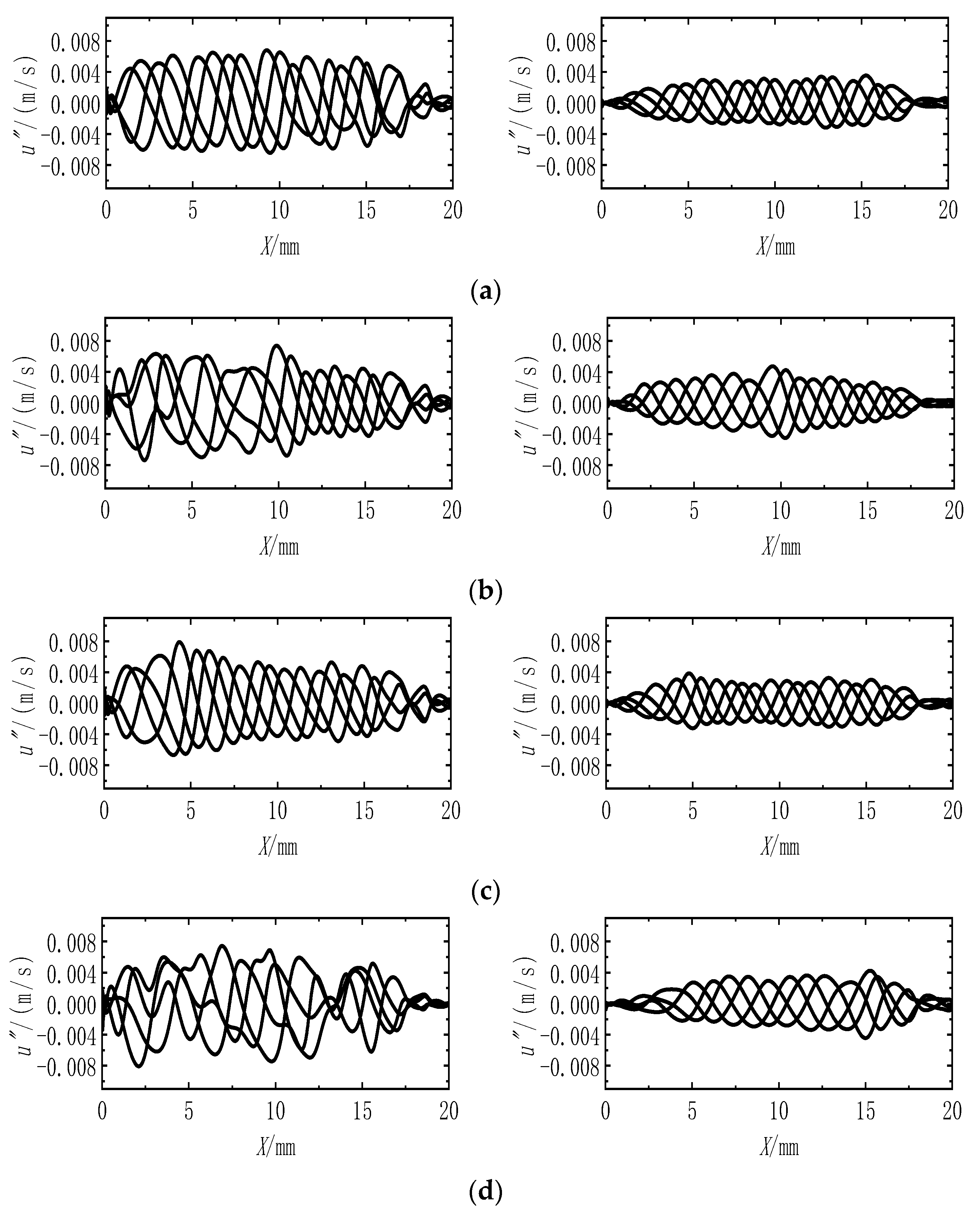
To illustrate the propagation direction and evolution of thermal fluid waves, Figure 7 shows the propagation of horizontal velocity fluctuations along the free surface and the fluid interface under different laser conditions. The waves originate at the cold end, propagate toward the hot end, and vanish before reaching the standing wave at the hot end. When P = 8 W (Figure 7b), horizontal velocity fluctuations on the free surface to the left of the heat source become disordered and evolve toward a chaotic state, while fluctuations on the right side weaken and become more ordered. The peak temperature gradient near the laser enhances local thermocapillary driving. As a result, the horizontal velocity fluctuation reaches its maximum at the heat source (X = 10 mm). while they are continuously attenuated in the region 14 mm ≤ X ≤ 18 mm on the right side. Changing the position of the laser will further alter the relative distribution of the amplification zone and the attenuation zone, when the laser is applied near the cold end (Figure 7c), horizontal velocity fluctuations on the left side of the laser increase significantly. On the right side, temperature fluctuations first weaken, then strengthen along the positive X direction, and finally disappear before reaching the hot end. When the laser is applied near the hot end (Figure 7d) and P = 8 W, free-surface velocity fluctuations vanish after reaching the left side of the laser and propagate in a disordered manner. In contrast, velocity fluctuations at the fluid interface increase markedly near the heat source, the growth range of the cold end has significantly increased, and the velocity waves are strongly weakened when propagating to the left side of the laser. When the laser is close to the hot end, the perturbation energy is more likely to be trapped at the fluid interface, inhibiting its orderly transfer to the free surface, resulting in a significant differentiation between the two propagation channels of the free surface and the fluid interface.
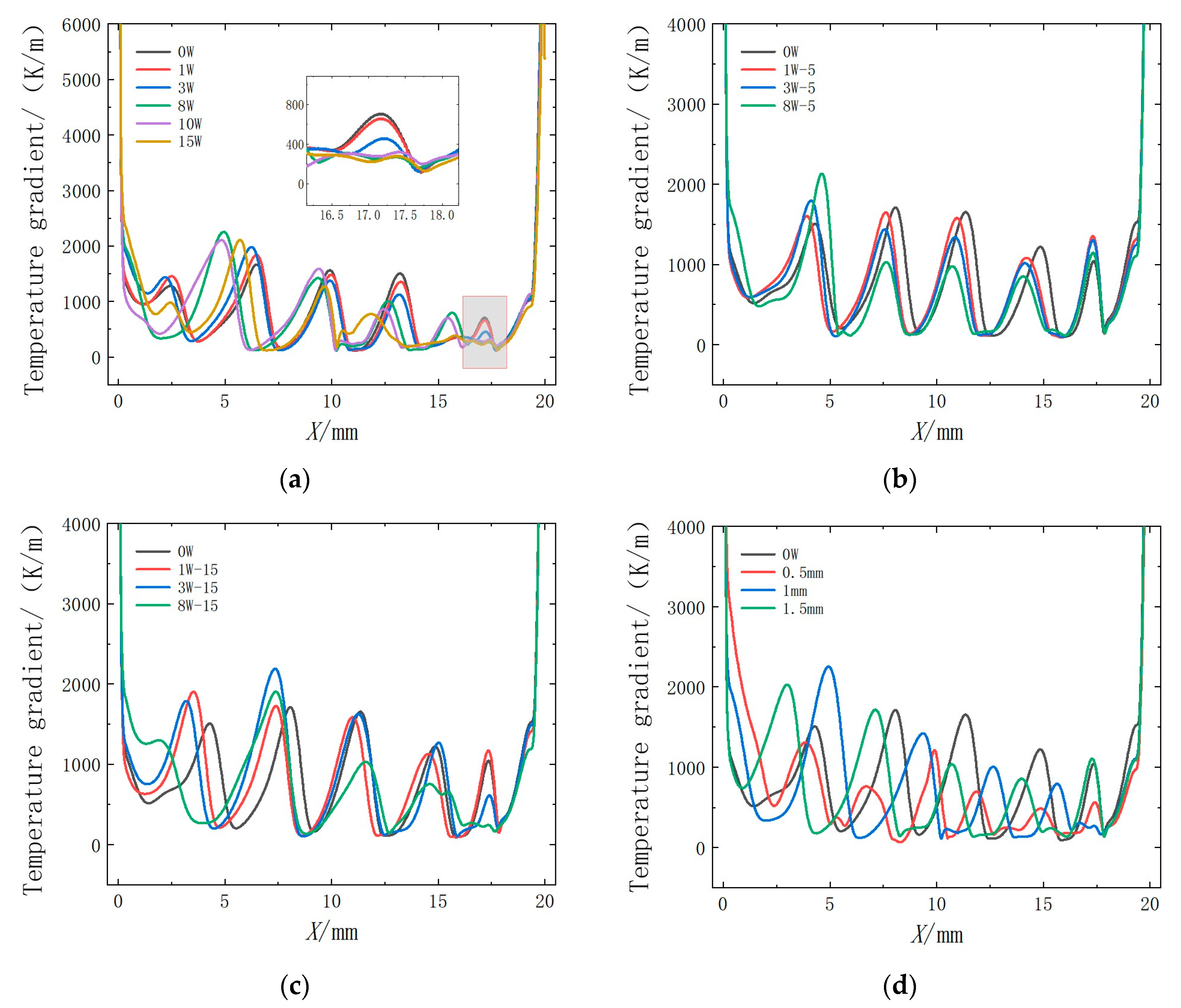
Figure 8 shows the distribution of temperature gradients along the fluid interface under different laser conditions. On the right side of the laser, the temperature gradient decreases as the laser power increases, and for P ≥ 8 W the peak shifts toward the laser position (X = 10 mm). On the left side of the laser, the temperature gradient increases with increasing power, and the corresponding peak moves toward the cold end. When P ≥ 8 W, the peak near the cold end disappears and reappears at P = 15 W. Notably, for P ≥ 8 W, a clear boundary forms at X = 10 mm, separating the temperature gradient into two distinct patterns on either side. The variation in temperature-gradient peaks corresponds directly to changes in vortex structures, indicating that the laser modifies the overall flow by altering the temperature-gradient and thermocapillary-force distributions. When the laser is near the cold end (X = 5 mm), the temperature gradient on the right side decreases with increasing power and the peak shifts toward the laser, while the gradient on the left side increases. Near the hot end, the temperature gradient decreases and forms a valley at the laser position, except at P = 8 W where the left-side gradient increases. When the laser is near the hot end (X = 15 mm), for P ≤ 3 W the temperature gradient on the left side increases with power and the peak moves toward the cold end, while the right side shows no regular trend. At P = 8 W, the temperature gradient near the laser decreases markedly and tends to form two peaks on both sides, with larger gradients closer to the cold end. In this case, no peak appears on the right side and only three peaks appear on the left side. Figure 8d shows the distribution of temperature gradients along the fluid interface for different laser spot radii. On the right side of the laser, the temperature gradient decreases as the spot radius decreases. On the left side of the laser, the temperature gradient increases as the spot radius decreases. When w0 = 0.5 mm, the temperature gradient on the left side of the laser decreases markedly, while the gradient near the cold end increases. Overall, laser power and beam radius jointly modify the spatial distribution of the interfacial temperature gradient. This modification regulates thermocapillary driving and the evolution of flow patterns.

3.3. Steady-State Flow of Double-Layer Fluid System Under Laser Influence

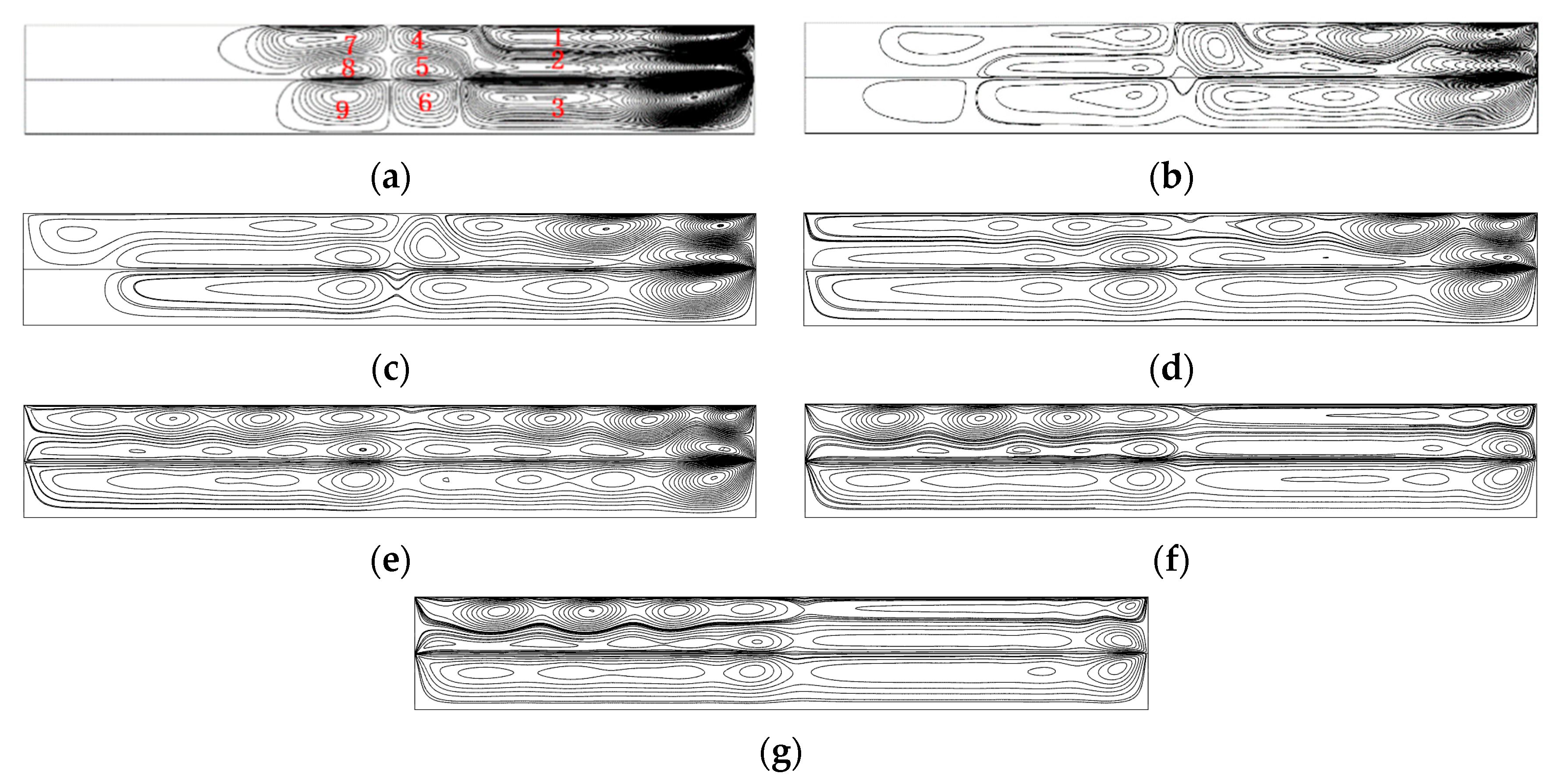
Simulation results show that appropriate laser parameters can transform double-layer thermocapillary–buoyancy convection from an oscillatory state to a stable state. The following presents stable thermocapillary convection under coupled laser heating and horizontal temperature difference. A laser is applied at the system center (X = 10 mm) with a power of 15 W and a spot radius of 0.5 mm. The horizontal temperature difference is maintained at 8 K. Figure 9 shows the temporal evolution of the double-layer thermocapillary convection flow field. Under these conditions, laser-induced local thermocapillary convection couples with thermocapillary convection driven by the horizontal temperature difference, stabilizing the system. At t = 0.5 s, three vortices (1–3) develop near the laser due to the horizontal temperature difference. Meanwhile, laser-induced thermocapillary effects generate six vortices (4–9) at the fluid interface and the free surface around the laser. As time progresses, vortices with the same rotation direction begin to merge. At t = 10 s, multi-vortex flow exists on both sides of the laser. With further evolution, vortices on the right side begin to disappear at t = 62 s. At t = 116 s, the system reaches a stable state, with a single vortex on the right side of the laser and multiple vortices on the left side. The stabilization is not a simple superposition of laser heating and the horizontal temperature gradient. Instead, the laser redistributes the temperature gradient in the fluid domain and modifies the interfacial shear coupling. This process reshapes the spatial action zone of thermocapillary stress. Vortical structures in some regions are continuously drained of energy and decay. Multivortex structures on the opposite side are maintained. The periodic exchange of wave energy in the original oscillatory state is thus suppressed. As a result, the system transitions from oscillatory convection to steady convection.
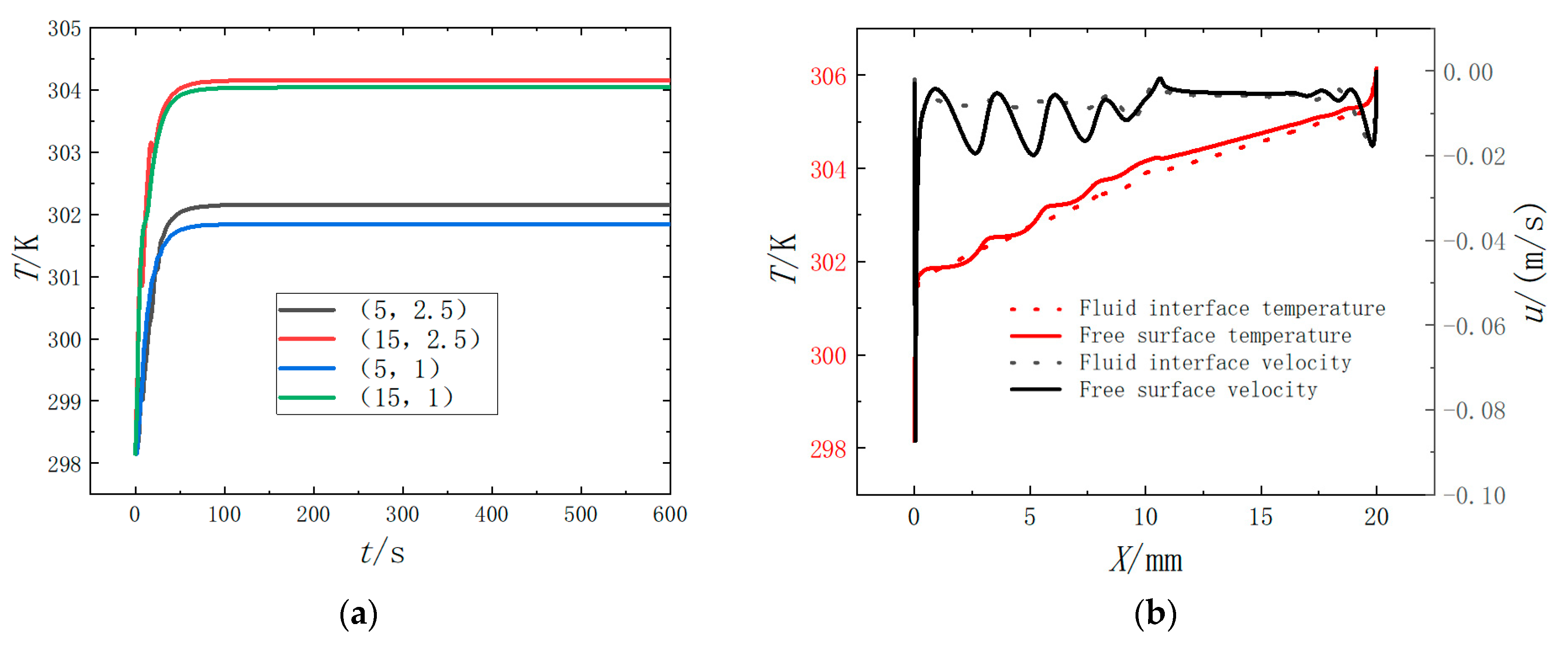
Figure 10a shows the time evolution of temperature at monitoring points in the silicone oil layer and the water layer. The temperature on the right side of the laser is always higher than that on the left side, and the temperature in the silicone oil layer is higher than that in the water layer. The system temperature becomes steady at approximately t = 120 s. Figure 10b shows the temperature and horizontal velocity distributions along the free surface and the fluid interface. Both temperature and horizontal velocity exhibit inflection points near the heat source, which distinguish them from the steady flow without a heat source. On the free surface, temperature and horizontal velocity show strong fluctuations on the left side of the laser and linear distributions on the right side. Fluctuations at the fluid interface are relatively weak. On the right side, the temperature profile becomes nearly linear and the velocity field becomes smoother. In contrast, the interfacial wave amplitude remains small. This indicates that the interlayer fluid buffers disturbances. Its temperature and velocity fields approach a controlled equilibrium state. Overall, Figure 10 confirms that appropriate laser parameters induce the transition of thermocapillary convection in a two-layer system from an oscillatory state to steady convection. The resulting flow pattern shows pronounced spatial asymmetry. These results agree with Shiomi and Amberg [24]. They suppressed oscillations by localized heating in an open cylindrical container filled with silicone oil. This agreement further supports the reliability of the present study.
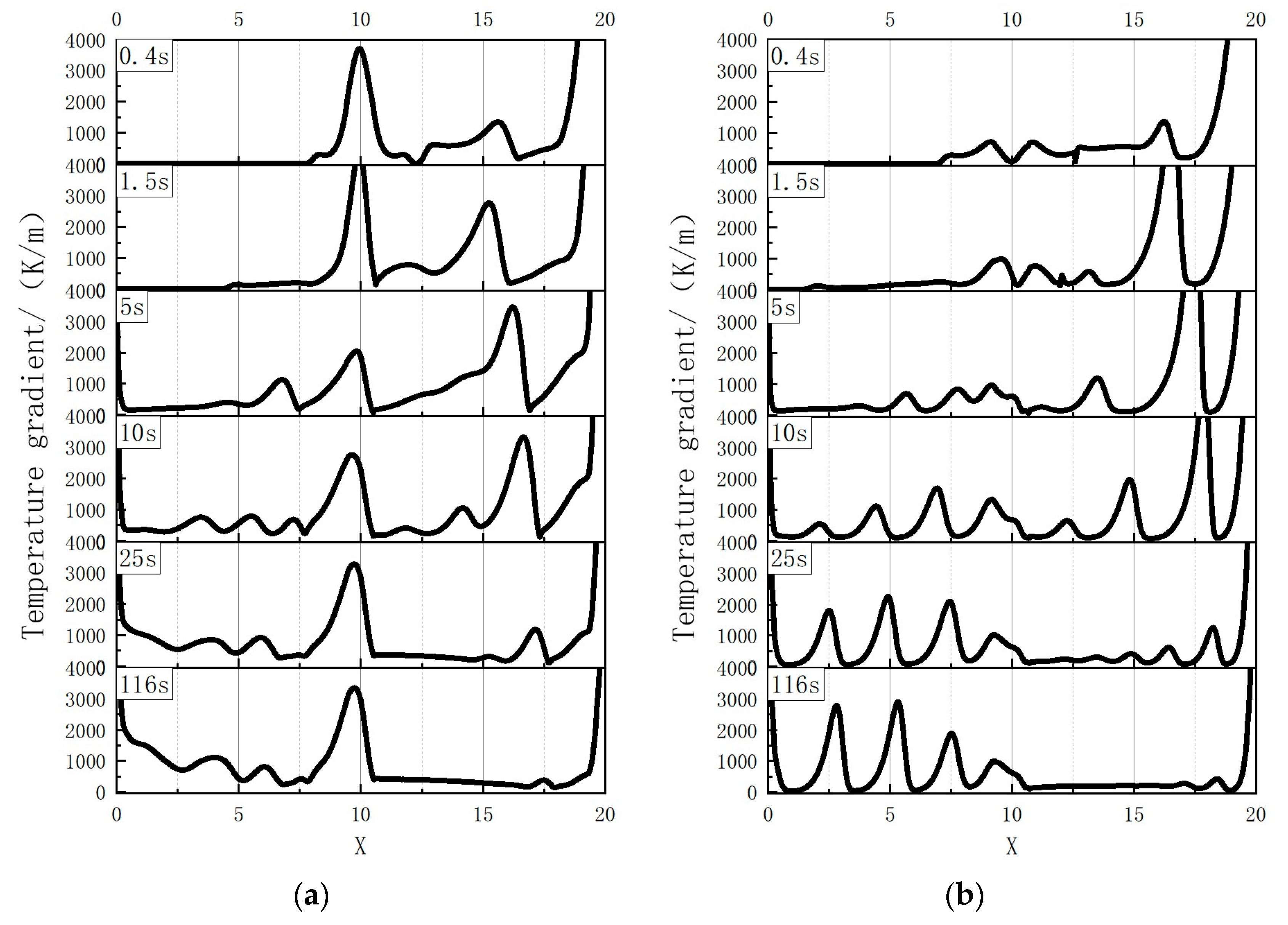
The introduction of the laser heat source leads to significant non-uniformity in the temperature field within the fluid domain, and this effect directly drives the spatial rearrangement of the temperature gradient. Figure 11 shows the temporal evolution of temperature gradients along the fluid interface and the free surface. At t = 0.4 s, a large temperature gradient exists in the heating region, and the gradient induced by the hot end begins to propagate toward the cold end. At t ≈ 1.5 s, the laser-induced temperature gradient increases rapidly, while the hot-end-induced gradient reaches the right side of the laser and its propagation toward the cold end is hindered, it exhibits a clear asymmetry. At t = 5 s, the laser-induced gradient decreases and develops one peak toward the cold end, while the gradient on the left side of the laser weakens and moves toward the hot end. At t = 10 s, the laser-induced temperature gradient increases with time and continues to propagate toward the cold end, whereas on the right side of the laser the hot-end-induced gradient is suppressed and decreases during propagation toward the hot end. At t = 116 s, the system reaches a steady state, where the temperature gradient on the left side of the laser shows a wavelike pattern and that on the right side exhibits a linear distribution. The evolution of the temperature gradient on the free surface is similar to that on the fluid interface. However, the laser-induced temperature gradient forms two peaks on both sides of the laser, with a valley at X = 10 mm. These features indicate that the laser establishes a local high temperature gradient zone and redistributes the axial heat flux. This process disrupts the continuous gradient transfer dominated by the horizontal temperature difference. It spatially blocks and restructures the propagation of hot-end disturbances toward the cold end. Meanwhile, the thermocapillary driving force is re-concentrated in specific regions. On the left side, a fluctuating temperature gradient is maintained under multivortex structures. On the right side, the system shifts toward quasi-one-dimensional conduction and smooth shear output. As a result, the two-layer convection structure and its stability are actively regulated.

4. Conclusions

This study uses numerical simulations to investigate the instability of thermal fluid waves and interface deformation in double-layer thermocapillary convection under laser heating. It focuses on the effects of laser parameters, including power, position, and spot radius, on temperature fluctuations, convection intensity distribution, and temperature-wave propagation at the interface under normal gravity. The regulatory role of laser heating on thermocapillary convection instability is examined. The main contribution of this study is the proposal and validation of a controllable mechanism for laser-based active thermal regulation of instability in two-layer thermocapillary convection. The laser redistributes the temperature gradient within the bilayer domain and shifts the spatial focus of the thermocapillary driving force. Under normal gravity, the laser weakens local convective vortices in the flow field. With appropriate laser parameters, oscillatory thermocapillary convection transitions to a steady state. This transition effectively suppresses thermocapillary–buoyancy instability in the two-layer fluid system. It reveals that under normal gravity, laser heating weakens local convective vortices in the flow field. For specific laser parameters, oscillatory double-layer thermocapillary convection transitions to a steady state, effectively suppressing thermocapillary–buoyancy instability. The results show that:
(1)
As the laser power increases, the flow field exhibits an asymmetric response characteristic with the heating center as the dividing line. Convection intensity is significantly enhanced from the cold end to the laser region (left domain), while it is markedly reduced from the laser to the hot end (right domain).
(2)
Shifting the laser position significantly alters the temperature gradient distribution. When the laser moves toward the cold end, the temperature gradient in the right region decreases and weakens convection, while local convection near the laser is enhanced. When the laser moves toward the hot end, the temperature gradient in the left region increases and strengthens convection, and the weak-fluctuation region near the cold end of the fluid interface expands.
(3)
When the spot radius is w0 = 1 mm, temperatures at the heating regions of the free surface and the fluid interface increase markedly. At the fluid interface, temperature gradients decrease on both sides of the laser and increase in the heating region. At the free surface, an asymmetric pattern appears, with increased gradients on the left side of the laser and reduced gradients on the right side.
(4)
The laser builds a local high–temperature-gradient “barrier” and redistributes the axial heat flux. This barrier blocks and reshapes the propagation of hot-end disturbances toward the cold end. As a result, it enables active control of bilayer convection, driving a transition from oscillatory to steady flow.
Laser heating affects double-layer thermocapillary instability mainly by modifying the temperature gradient distributions at the free surface and the fluid interface in the heating region and by inducing self-oscillations that generate standing waves. By precisely tuning laser heating parameters, this study effectively controls thermocapillary instability without introducing mechanical disturbance. It optimizes heat transfer and provides a theoretical basis for efficient, low-energy, non-contact heat-flow control. However, the present work uses a two-dimensional model to study laser-induced thermocapillary flow in a two-layer fluid system. The model neglects out-of-plane temperature and velocity components, so it cannot fully capture three-dimensional laser energy deposition or interfacial 3D flow structures. Future work will perform three-dimensional simulations to validate the generality of these conclusions and to quantify the impact of 3D effects on thermocapillary convection control.

Author Contributions

X.Z. (Corresponding Author): Data Curation, Investigation, Conceptualization, Supervision. S.Y.: Data Curation, Resources, Validation, Writing—Original Draft. Y.Z.: Methodology, Investigation. W.D.: Writing—Original Draft. All authors have read and agreed to the published version of the manuscript.

Funding

This research received no external funding.

Institutional Review Board Statement

Not applicable.

Informed Consent Statement

Not applicable.

Data Availability Statement

All data included in this study are available upon request by contact with the corresponding author.

Conflicts of Interest

The authors declare that there are no conflicts of interest.

References

  1. Sui, Y.R.; Sui, Z.G.; Liang, G.D.; Wu, W. Superhydrophobic Microchannel Heat Exchanger for Electric Vehicle Heat Pump Performance Enhancement. Sustainability 2023, 15, 13998. [Google Scholar] [CrossRef] [Scilit]
  2. Zhao, Y.Z.; Qin, X.X.; Shi, X.Y. Heat Transfer Modeling on High-Temperature Charging and Discharging of Deep Borehole Heat Exchanger with Transient Strong Heat Flux. Sustainability 2022, 14, 9702. [Google Scholar] [CrossRef] [Scilit]
  3. Fan, D.; Zhu, X.; Xiang, Z.; Lu, Y.; Quan, L. Dimension-Reduction Many-Objective Optimization Design of Multimode Double-Stator Permanent Magnet Motor. IEEE Trans. Transp. Electrif. 2025, 11, 1984–1994. [Google Scholar] [CrossRef] [Scilit]
  4. Fan, D.; Miao, D.; Shan, W.; Xiang, Z.; Zhu, X. Short-Circuit Fault Demagnetization Assessment and Optimization of Double-Electrical-Port Vernier Permanent Magnet Motor. IEEE Trans. Ind. Appl. 2025, 1–10. [Google Scholar] [CrossRef] [Scilit]
  5. Zhang, J.; Qi, H.; Wu, J.J.; Mao, X.; Zhang, H.; Amin, N.; Xu, F.; Dong, C.; Wang, C.; Wang, P.; et al. Disposable Peptidoglycan-Specific Biosensor for Noninvasive Real-Time Detection of Broad-Spectrum Gram-Positive Bacteria in Exhaled Breath Condensates. Anal. Chem. 2024, 96, 9817–9825. [Google Scholar] [CrossRef] [Scilit]
  6. Liu, D.; Shen, Q.; Liu, J. The Health-Wealth Gradient in Labor Markets: Integrating Health, Insurance, and Social Metrics to Predict Employment Density. Computation 2026, 14, 22. [Google Scholar] [CrossRef] [Scilit]
  7. Shen, Q.; Zhang, J. MFTFormer: Meteorological-Frequency-Temporal Transformer with Block-Aligned Fusion for Traffic Flow Prediction. Res. Sq. 2026. [Google Scholar] [CrossRef] [Scilit]
  8. Guo, S.; Song, Y.; Wu, Y.; Hu, J.; Lu, J.; Wang, C.; Jia, Z.; Hua, L. Microscopic mechanism of enhanced strength-plasticity synergy in pre-damaged TC11 titanium alloys via novel electroshock treatment. J. Alloys Compd. 2026, 1052, 186139. [Google Scholar] [CrossRef] [Scilit]
  9. Liu, J.; Du, S.; Huang, Z.; Liu, N.; Shao, Z.; Qin, N.; Wang, Y.; Wang, H.; Ni, Z.; Yang, L. Enhanced Reduction of Nitrate to Ammonia at the Co-N Heteroatomic Interface in MOF-Derived Porous Carbon. Materials 2025, 18, 2976. [Google Scholar] [CrossRef] [Scilit]
  10. Zhang, H.R. Effect of Vertical Heat Transfer on Thermocapillary Convection in a Rectangular Liquid Pool. Ph.D. Thesis, Chongqing University, Chongqing, China, 2010. (In Chinese) [Google Scholar]
  11. Langlois, W.E. Buoyancy-driven flows in crystal-growth melts. Annu. Rev. Fluid Mech. 1985, 17, 191–215. [Google Scholar] [CrossRef]
  12. Kuhlmann, H.C. Thermocapillary Convection in Models of Crystal Growth; Springer: Berlin, Germany, 1999. [Google Scholar]
  13. Lu, Q.S.; Roux, B. Instability of Thermocapillary Convection in Multiple Superimposed Immiscible Liquid Layers. In Proceedings of the VIII European Symposium on Materials and Fluid Sciences in Microgravity, Paris, France, 12–16 April 1992; Volume 2, pp. 735–740. [Google Scholar]
  14. Ueno, I.; Tori, T. Thermocapillary-driven flow in a thin liquid film sustained in a rectangular hole with temperature gradient. Acta Astronaut. 2010, 66, 1017–1021. [Google Scholar] [CrossRef] [Scilit]
  15. Li, Y.R.; Zhang, W.J.; Wang, S.C. Numerical simulation of thermocapillary convection in an annular double-layer liquid system. J. Eng. Thermophys. 2008, 29, 1759–1761. (In Chinese) [Google Scholar]
  16. Li, H.M.; Shi, W.Y. Thermocapillary convection in a differentially heated two-layer annular system with and without rotation. Int. J. Heat Mass Transf. 2017, 105, 684–689. [Google Scholar] [CrossRef] [Scilit]
  17. Huang, H.L.; Zhou, X.M. The impact of normal magnetic fields on instability of thermocapillary convection in a two-layer fluid system. ASME J. Heat Transf. 2009, 131, 062502. [Google Scholar] [CrossRef] [Scilit]
  18. Zhou, X.M.; Huai, X.L.; Huang, H.L. MHD effects on thermocapillary-buoyant convection in an annular two-layer system. Heat Transf. Res. 2017, 48, 35–47. [Google Scholar] [CrossRef] [Scilit]
  19. Zhou, X.M.; Huang, H.L. MHD effects on the instability of thermocapillary convection in two-layer fluid system. Int. J. Heat Mass Transf. 2010, 53, 5827–5834. [Google Scholar] [CrossRef] [Scilit]
  20. Chen, G.; Lizee, A.; Roux, B. Bifurcation analysis of the thermocapillary convection in cylindrical liquid bridges. J. Cryst. Growth 1997, 180, 638–647. [Google Scholar] [CrossRef] [Scilit]
  21. Smith, M.K.; Davis, S.H. Instabilities of dynamic thermocapillary liquid layers. Part 1. convective instabilities. J. Fluid Mech. 1983, 132, 119–144. [Google Scholar] [CrossRef] [Scilit]
  22. Politano, O.; Baras, F. Thermocapillary convection in a laser-heated Ni melt pool: A molecular dynamics study. Appl. Phys. Lett. 2023, 134, 095301. [Google Scholar] [CrossRef] [Scilit]
  23. Gupta, N.R.; Haj-Hariri, H.; Borhan, A. Effect of free surface heat transfer on thermocapillary flow in double-layer fluid structures. Heat Mass Transf. 2014, 50, 333–339. [Google Scholar] [CrossRef] [Scilit]
  24. Shiomi, J.; Amberg, G. Active control of a global thermocapillary instability. Phys. Fluids 2002, 14, 1063–1073. [Google Scholar] [CrossRef] [Scilit]
  25. Shiomi, J.; Kudo, M.; Ueno, I.; Kawamura, H.; Amberg, G. Feedback control of oscillatory thermocapillary convection in a half-zone liquid bridge. J. Fluid Mech. 2003, 496, 193–211. [Google Scholar] [CrossRef] [Scilit]
  26. Muldoon, F.H. Numerical Study of Hydrothermal Wave Suppression in Thermocapillary Flow Using a Predictive Control Method. Comput. Math. Math. Phys. 2018, 58, 493–507. [Google Scholar] [CrossRef] [Scilit]
  27. Gelfgat, A. Effect of interface dynamic deformations on instabilities of buoyancy-thermocapillary convection in a two-fluid two-layer system. Phys. Rev. Fluids 2022, 7, 053503. [Google Scholar] [CrossRef] [Scilit]
  28. Bekezhanova, V.B.; Goncharova, O.N.; Ivanova, N.A.; Klyuev, D.S. Instability of a Two-layer System with Deformable Interfaces under Laser Beam Heating. J. Sib. Fed. Univ. Math. Phys. 2019, 12, 543–550. [Google Scholar] [CrossRef] [Scilit]
  29. Bekezhanova, V.; Fliagin, V.; Goncharova, O.; Ivanova, N.; Klyuev, D. Thermocapillary deformations of a two-layer system of liquids under laser beam heating. Int. J. Multiph. Flow 2020, 132, 103429. [Google Scholar] [CrossRef] [Scilit]
  30. Bekezhanova, V.; Goncharova, O.; Ovcharova, A. Numerical simulation of the dynamics of a locally heated bilayer system under weak evaporation. Int. J. Heat Mass Transf. 2022, 185, 122329. [Google Scholar] [CrossRef] [Scilit]
  31. Antonow, G.N. Sur la tension superficielle à la limite de deux couches. Chim. Phys. 1907, 5, 372–385. [Google Scholar] [CrossRef] [Scilit]
  32. Gupta, N.R. Double-Layer Thermocapillary Convection in a Differentially Heated Cavity. Ann. N. Y. Acad. Sci. 2006, 1077, 395–414. [Google Scholar]
Figure 1. Research model.
Applsci 16 03186 g001
Figure 2. Grid division.
Applsci 16 03186 g002
Figure 3. Flow diagram (calculation results on the right and literature results on the left).
Applsci 16 03186 g003
Figure 4. Comparison of horizontal velocities in the vertical midline.
Applsci 16 03186 g004
Figure 5. Laser-modulated streamline patterns in two-layer thermocapillary convection system (The blue dashed lines indicate the position of the laser.): (a) P = 0 W; (b) P = 8 W, X = 10 mm, w0 = 1 mm; (c) P = 8 W, X = 5 mm, w0 = 1 mm; (d) P = 8 W, X = 15 mm, w0 = 1 mm; (e) P = 8 W, X = 10 mm, w0 = 0.5 mm.
Applsci 16 03186 g005
Figure 6. Spatial distributions of temperature and stream function fluctuations in two-layer fluid system with varying operating conditions (The black dashed lines represent the position of the laser): (a) P = 0 W; (b) P = 8 W, X = 10 mm, w0 = 1 mm; (c) P = 8 W, X = 5 mm, w0 = 1 mm; (d) P = 8 W, X = 15 mm, w0 = 1 mm; (e) P = 8 W, X = 10 mm, w0 = 0.5 mm.
Applsci 16 03186 g006
Figure 7. Propagation dynamics of thermocapillary hydrothermal waves with varying operating conditions (left: free surface; right: fluid interface): (a) P = 0 W; (b) P = 8 W, X = 10 mm, w0 = 1 mm; (c) P = 8 W, X = 5 mm, w0 = 1 mm; (d) P = 8 W, X = 15 mm, w0 = 1 mm.
Applsci 16 03186 g007
Figure 8. Interfacial temperature gradient profiles with varying working conditions: (a) X = 10 mm, w0 = 1 mm; (b) X = 5 mm, w0 = 1 mm; (c) X = 15 mm, w0 = 1 mm; (d) P = 8 W, X = 15 mm.
Applsci 16 03186 g008
Figure 9. Changes in flow field over time: (a) t = 0.5 s; (b) t = 1.4 s; (c) t = 2.5 s; (d) t = 5 s; (e) t = 10 s; (f) t = 62 s; (g) t = 116 s.
Applsci 16 03186 g009
Figure 10. Changes in physical quantities at observation points and lines over time: (a) The variation in temperature at the observation point over time; (b) The distribution of temperature and horizontal velocity at the interface.
Applsci 16 03186 g010
Figure 11. Changes in interface temperature gradient with time: (a) Temperature gradient of the fluid interface; (b) The temperature gradient on the free surface.
Applsci 16 03186 g011
Table 1. Physical property parameters of working medium at normal temperature and pressure.
Physical Property Parameters0.65 cSt Silicone OilWater
Density ρ  kg / m 3 760998
Surface tension σ  mN / m 0.01590.719
Surface tension temperature coefficient σ T   N / ( m · K ) 8 × 10⁻⁵
Dynamic viscosity μ Kg/(m·s)4.95 × 10−49.21 × 10−5
Coefficient of thermal expansion β K−10.001340.000207
Thermal conductivity λ W/(m·K)0.10.6083
Specific heat capacity Cp J/(Kg·K)20004179
Pr10.36.215
Table 2. Grid independence test.
GridNumber of GridsFlow Velocity × 10−3 (m/s)Relative Error
A37,2578.2615.4%
B52,6958.0512.4%
C74,9857.484.47%
D104,3977.291.81%
E136,9587.160
F154,4097.170.14%
G189,9637.16/
Disclaimer/Publisher’s Note: The statements, opinions and data contained in all publications are solely those of the individual author(s) and contributor(s) and not of MDPI and/or the editor(s). MDPI and/or the editor(s) disclaim responsibility for any injury to people or property resulting from any ideas, methods, instructions or products referred to in the content.