Article

Experimental Study on the Dynamic Response and Energy Absorption Mechanism of Honeycomb Structures in Water Environments


1
Frontiers Science Center for Extreme Flows and Energies, Central South University, Changsha 410075, China
2
School of Traffic & Transportation Engineering, Central South University, Changsha 410017, China
3
Key Laboratory of Traffic Safety on Track, Ministry of Education, Changsha 410075, China
*
Author to whom correspondence should be addressed.
Appl. Sci. 2026, 16(7), 3180; https://doi.org/10.3390/app16073180
Submission received: 10 February 2026 / Revised: 18 March 2026 / Accepted: 24 March 2026 / Published: 26 March 2026
(This article belongs to the Special Issue Blasting Analysis and Impact Engineering on Materials and Structures)

Abstract

Driven by the requirements of lightweight design and efficient impact protection, biomimetic hexagonal honeycomb structures have been widely used for energy absorption. However, their dynamic response and energy absorption behavior in underwater environments remain insufficiently understood. To address this gap, this study investigates the impact response and deformation mechanisms of aluminum honeycomb structures under fully submerged conditions relevant to marine engineering. We fabricated honeycomb cores from 5052-H18 aluminum alloy and developed a custom fixture for fluid–structure interaction tests under underwater drop hammer impact conditions. Using force sensors and high-speed photography, we characterized the dynamic impact behavior through load–time and velocity–time responses. Results demonstrate that drainage holes in the support plate serve a dual function: they enable the structure to maintain stable deformation and absorb energy underwater while also significantly enhancing energy absorption capacity. Specifically, the mean crushing force increases by 156.5%, and the energy absorption capacity increases by 333% compared to performance in air. This enhancement arises from the plastic deformation of cell walls and the additional energy dissipation induced by fluid–structure interaction. Overall, this study clarifies the dynamic compression behavior of aluminum honeycombs in underwater environments and demonstrates their potential for marine energy-absorption applications.

1. Introduction

Honeycomb structures are widely used in various engineering fields, including aerospace, automotive manufacturing, civil engineering, packaging, transportation, and marine engineering, due to their high strength-to-weight and stiffness-to-weight ratios, as well as excellent thermal insulation and energy absorption capabilities [1,2,3,4]. These structures consist of an array of regularly arranged hexagonal or other geometrically shaped units, enabling effective load distribution and resistance while maintaining a lightweight form. In aerospace, honeycomb structures are widely used in aircraft wings and fuselage panels, contributing to weight reduction, improved fuel efficiency, and reliable structural performance under extreme conditions [5,6,7]. In the automotive sector, they are applied in bumpers, seats, and other components to improve crashworthiness and support lightweight design, thereby reducing energy consumption and emissions [8,9,10]. In civil engineering, honeycomb-based materials such as lightweight walls and insulation panels enhance building energy efficiency and comfort [11,12]. The packaging industry benefits from their cushioning performance and environmental friendliness, particularly for protecting fragile goods during transport [2,13,14]. In marine engineering, honeycomb structures are used in deck beams and hull walls, offering impact resistance, vibration damping, and noise reduction [15,16]. For example, Wang et al. [17] reported that multilayer double-corrugated sandwich structures exhibit excellent energy absorption and plastic deformation, significantly improving the blast resistance of hulls. Zhang et al. [18] demonstrated that aluminum alloy octet-truss lattice sandwich structures reduce back-face displacement through quadrilateral inward deformation, thereby enhancing energy absorption under underwater explosion. Despite these advances, most honeycomb applications are confined to single environments, and research on their performance in underwater settings remains limited. While the studies above demonstrate the potential of cellular structures under specific loading conditions, they predominantly focus on structural response in air. The coupled dynamic problem, where inertial, viscous, and pressure effects interact simultaneously during high-rate crushing, remains largely unexplored. This gap constrains the broader use of honeycomb structures in marine engineering.
Currently, honeycomb structures are predominantly applied in environments that prevent water ingress, such as aerospace, automotive, and civil engineering. Even in underwater applications, the honeycomb core is typically sealed to prevent fluid penetration [19,20]. Their underwater application is hindered by the inherent conflict between low-cost honeycomb designs and the stringent demands of marine environments. Low-cost honeycombs often adopt a double-wall thickness configuration, fabricated by bonding layers of aluminum foil, paper, or other materials at intervals and then expanding the stack [21]. However, prolonged exposure to salt spray, humidity variations, and water pressure can induce delamination between the bonded layers. Once delamination occurs, critical properties such as strength, stiffness, and energy absorption degrade significantly, compromising structural reliability and limiting underwater use [22,23,24]. Moreover, Javier et al. [25] noted that pressure differentials between air-filled structures and surrounding water can lead to instability or collapse. Such collapse events release large pressure pulses into the water, potentially harming nearby organisms and structures. These factors underscore the need for specialized design considerations when deploying honeycomb structures underwater.
The energy absorption mechanism of low-cost honeycomb structures relies on their geometric configuration and material properties, dissipating energy through cell deformation and folding under load [26]. When the cells are filled with liquid, their buckling behavior and energy dissipation pathways may change. Studies on shear thickening fluid (STF)-filled honeycombs reveal that the presence of STF alters the stress wave propagation path, delays the buckling of honeycomb walls, and suppresses local damage. Due to the fluid inertia effect and additional viscous energy dissipation, the load-bearing capacity and energy absorption of the honeycomb are enhanced [27,28]. However, these studies address high-viscosity non-Newtonian fluids confined within closed cells, leaving fluid–structure interaction in low-viscosity fluids (such as water) and open immersion environments unexplored. Lu et al. [29] provided the first combined experimental and numerical investigation of fluid–structure interaction in water-filled sealed cylindrical shells, demonstrating that water’s inertial effect enhances load-bearing capacity and that fluid confinement modifies buckling modes and delays failure. However, their simplification of water as inviscid neglects viscous dissipation, and the focus on fully sealed systems excludes open, immersed conditions with free flow and drainage. Sun et al. [30] used refined numerical simulations to elucidate how trapped gas influences the dynamic compression of cellular structures, showing that gas pressure primarily enhances response during densification and indirectly affects global behavior through cell deformation and interaction. Nonetheless, their work is limited to gaseous media and assumes complete gas entrapment, ignoring leakage in practical scenarios. However, these studies predominantly address either STF-filled systems or sealed fluid confinement, where fluid remains either within or outside the structure throughout deformation [17,18,19,20,27,28]. In contrast, the behavior of fully submerged, open-cell honeycombs—where water flows freely, and rapid drainage is essential—remains largely unexplored. The near-incompressibility of water may constrain cell deformation, altering failure modes and reducing energy absorption. Moreover, lateral expansion during crushing can further degrade performance. The underwater dynamic response is governed by coupled physical mechanisms distinct from in-air behavior: water inertia (accelerating the surrounding fluid, increasing apparent mass), viscous effects (flow-induced velocity gradients and shear layers dissipating energy), and fluid confinement (hydrodynamic pressure interacting with deforming walls). To address these challenges and preserve performance, specialized designs are necessary. For example, creating an open-loop flow field can facilitate fluid movement under load, minimizing resistance to cell crushing. Alternatively, filling cells with foam or using higher-viscosity fluids can increase fluid resistance and improve energy absorption [31,32,33]. Such approaches offer promising pathways for enhancing the performance of honeycomb structures in marine applications.
Underwater impact protection in marine engineering represents a key application scenario for honeycomb energy absorbers. In service, these structures are often isolated from seawater to prevent corrosion. However, during accidental impacts or installation operations, they may become fully submerged and subjected to dynamic loading. In such cases, honeycomb structures act as energy absorbers to provide cushioning and mitigate impact effects. To address this practical demand and to move beyond the existing literature’s focus on sealed or fluid-retaining systems, this study investigates the dynamic response of vented aluminum honeycomb specimens under fully submerged conditions. A custom fluid–structure interaction fixture was developed for drop-weight impact testing, enabling simultaneous measurement of force histories and high-speed visualization of deformation. By systematically comparing in-air and underwater behavior, this work aims not only to quantify performance enhancement but also to provide a physically grounded interpretation of the underlying fluid–structure interaction mechanisms, thereby contributing to both the fundamental understanding and practical design of underwater energy-absorbing structures.

2. Experimental Setup

2.1. The Test Honeycomb

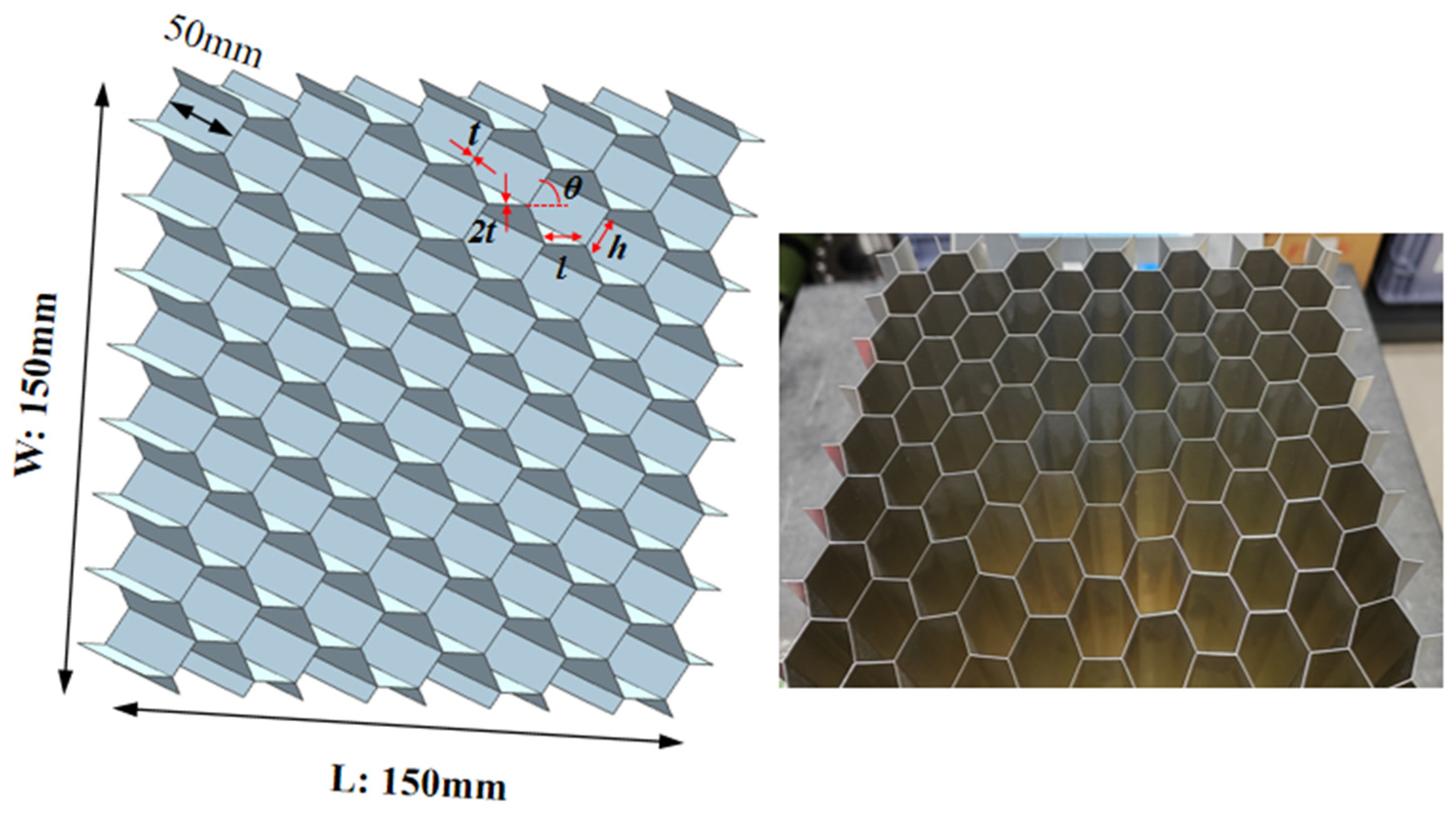
The test specimens consisted of typical regular commercial aluminum honeycombs, as illustrated in Figure 1. Each honeycomb cell has a side length of 10.9 mm and a foil thickness of 0.075 mm. The overall specimen dimensions are width (W) × length (L) × thickness (T) = 150 mm × 50 mm × 50 mm. The parameters t, l, h, and θ represent the aluminum foil thickness, side length, side height, and internal inclination angle, respectively. For a regular hexagonal configuration, θ = 30° and h = l. Due to the bonding and forming process employed in commercial honeycomb manufacturing, two of the six cell walls have a double-wall thickness.
The foil material of the honeycomb specimen is Al-5052-H18, fabricated by Qianxingda in Harbin, China. The material has an elastic modulus of E = 69 GPa and a Poisson’s ratio of ν = 0.33. Table 1 and Table 2 [34] summarize its chemical composition (based on the manufacturer’s technical specifications) and mechanical properties, respectively.

2.2. Experimental Design and Cases

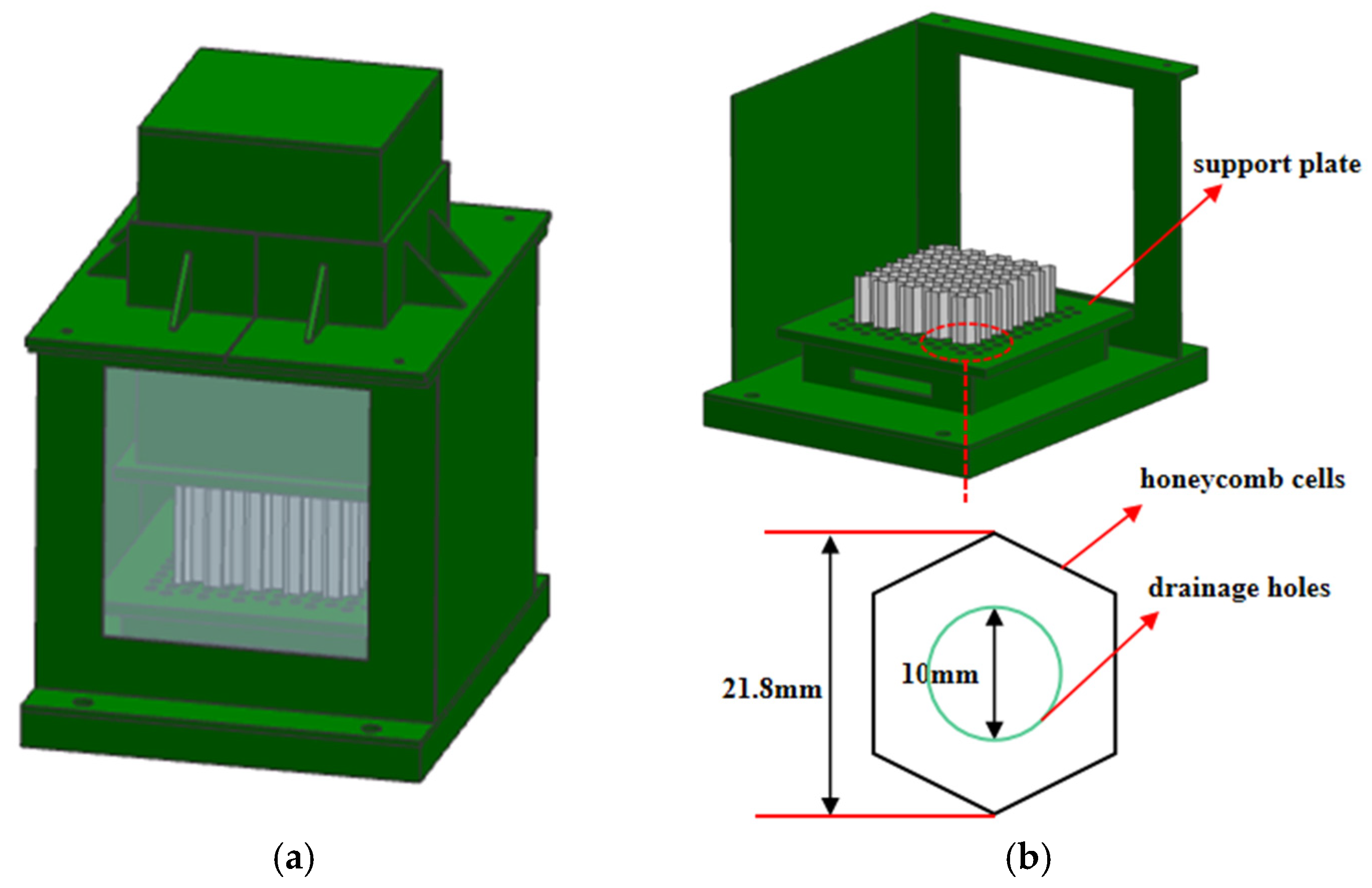
Although cellular structures are widely used in terrestrial applications, their deployment in underwater environments remains limited, partly due to the effects of water filling the cell cavities. To evaluate the impact resistance of honeycomb structures underwater, we designed a fluid–structure interaction (FSI) experimental fixture, shown in Figure 2a. The fixture has an internal cross-section of 350 mm × 350 mm and a height of 400 mm. This custom-built apparatus serves as an intermediate load-transfer component, effectively transmitting the impact force from the drop hammer to the aluminum honeycomb while ensuring controlled and repeatable impact conditions underwater. Since water is nearly incompressible, any fluid trapped within the cells without a means of escape causes internal pressure to rise rapidly during buckling and compression. Consequently, the honeycomb may fracture before orderly progressive folding can occur, leading to premature failure.
To address this problem, we incorporated multiple drainage holes into the honeycomb support plate. These holes align with the honeycomb cells so that the bottom of each cell corresponds to a drainage opening. During the experiment, these openings facilitate the rapid release of high-pressure water, thereby preserving the energy-absorbing performance of the underwater honeycomb. Figure 2b shows an internal view of the FSI experimental fixture. The drainage holes have a diameter of 10 mm, while the honeycomb cells have a circumcircle diameter of 21.8 mm, yielding an opening ratio of approximately 0.45.
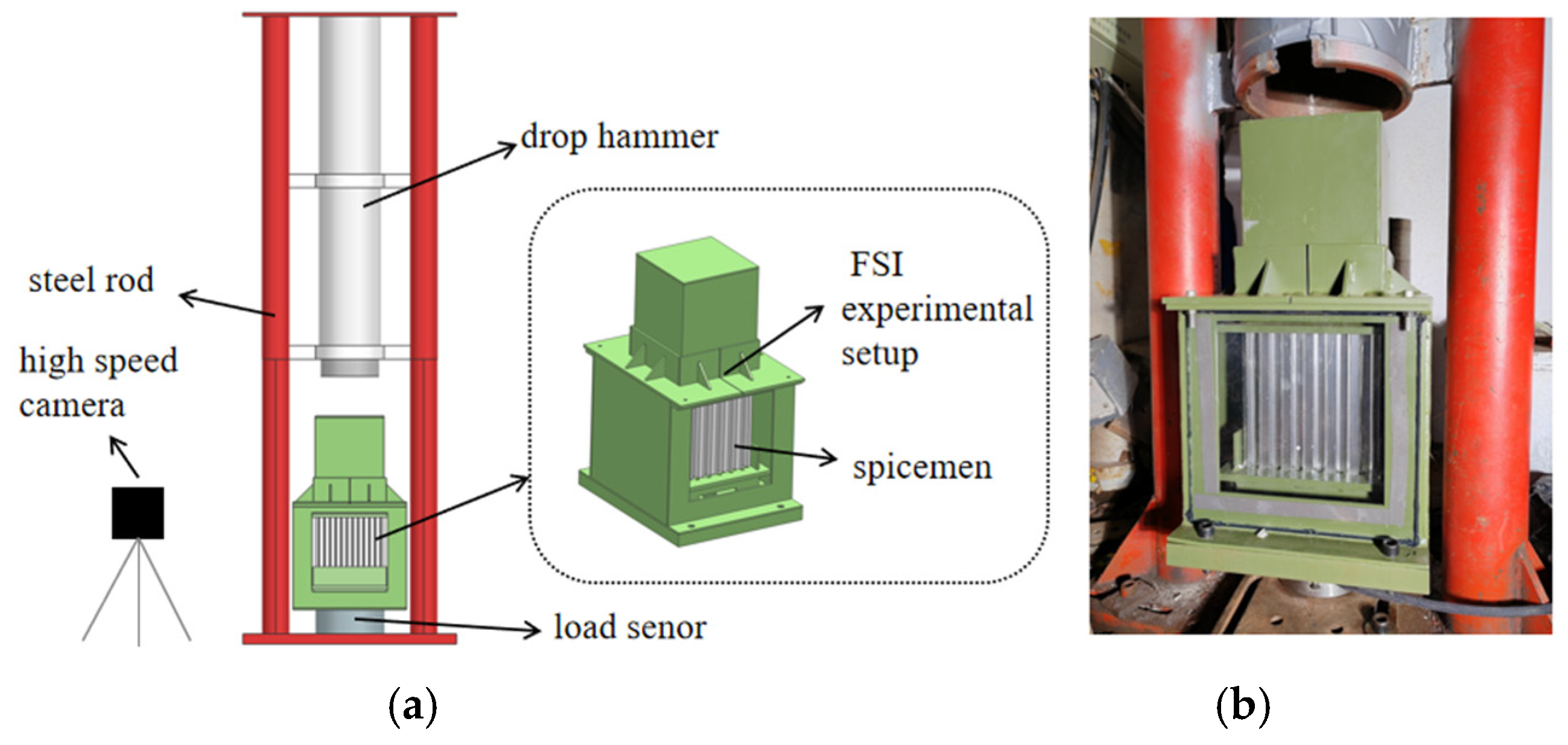
We conducted experiments using a 200 kg drop hammer test platform at the College of Transportation and Engineering, Central South University, as depicted in Figure 3b. Figure 3a illustrates the drop hammer test setup, where a force sensor is mounted beneath the platform and guided by four sliding rails. The force sensor used in this research is a three-component load cell (Model SFC3) manufactured by Changcheng Metrology & Test Technology Institute, Beijing, China. It operates as a resistance strain gauge-type force sensor. To obtain accurate dynamic response data, we employed an FD-3000 dynamic load tester, produced by the same manufacture. This instrument offers versatile dynamic force measurement capabilities and features a high-frequency response of 1000 kHz, approximately one thousand times that of ordinary high-speed instruments. We set the sampling frequency to 500 kHz during testing. The FSI experimental fixture was bolted to the force sensor, and the honeycomb specimens were placed inside the fixture. In addition, we used a high-speed camera (provided by NAC Image Technology Inc., Tokyo, Japan) to capture the entire impact process at a frame rate of 3000 fps and a resolution of 1920 × 768.
We examined two experimental conditions. In the first condition, we tested specimens in air using an empty FSI fixture. In the second condition, we filled the fixture with water to a level 100 mm above the top surface of the honeycomb. When we poured water into the FSI device, no gas remained inside either the device or the honeycomb core.
For all tests, the drop hammer had a mass of 200 kg and was released from a constant height of 1.5 m, producing an impact velocity of approximately 5.4 m/s. The corresponding impact energy was sufficient to fully crush the honeycomb specimens. Table 3 summarizes the detailed test conditions.

3. Test Results

In this section, we present the results of drop hammer impact tests conducted to investigate the low-velocity impact responses of empty honeycombs (HE) and water-filled honeycombs (HW). To assess the reliability of the experimental results, we repeated each test condition three times. We selected the adjacent averaging method to filter the force–time curves, and the number of window points was set to 100.
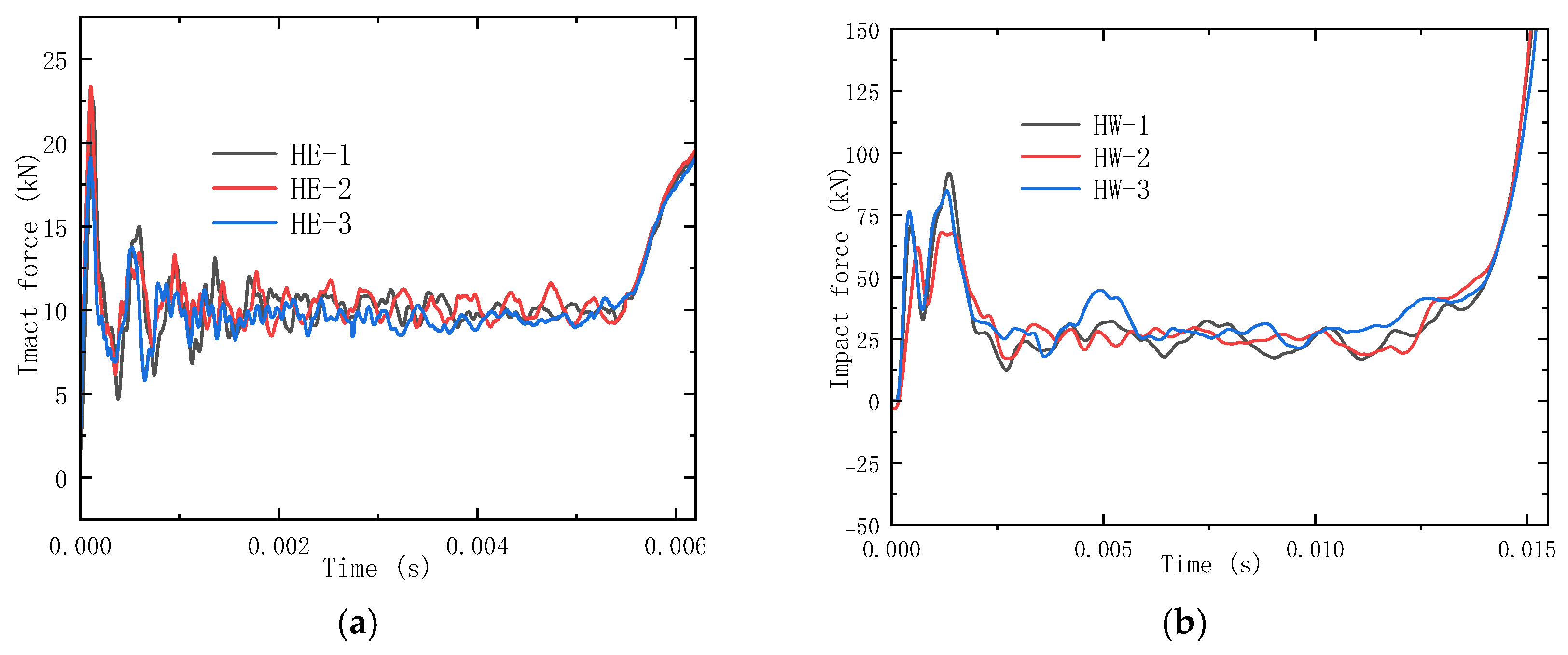
Figure 4a,b illustrate the repeatability of the drop hammer test results for the honeycomb specimens tested in air and in water, respectively. We defined the average force over the interval from 20% to 60% of the total crushing time as the mean crushing force. For the HE specimens, the mean crushing forces were 10.21, 10.18, and 9.56 kN, corresponding to a maximum variation of 6.7%. For the HW specimens, the mean crushing forces were 24.6, 25.3, and 27.1 kN, with a maximum variation of 10.2%. Overall, the repeated tests show good agreement with minimal variability, indicating that both HE and HW exhibit excellent repeatability under dynamic impact loading. Notably, under identical test conditions, the HW specimens display a longer crushing duration and a significantly higher mean crushing force.
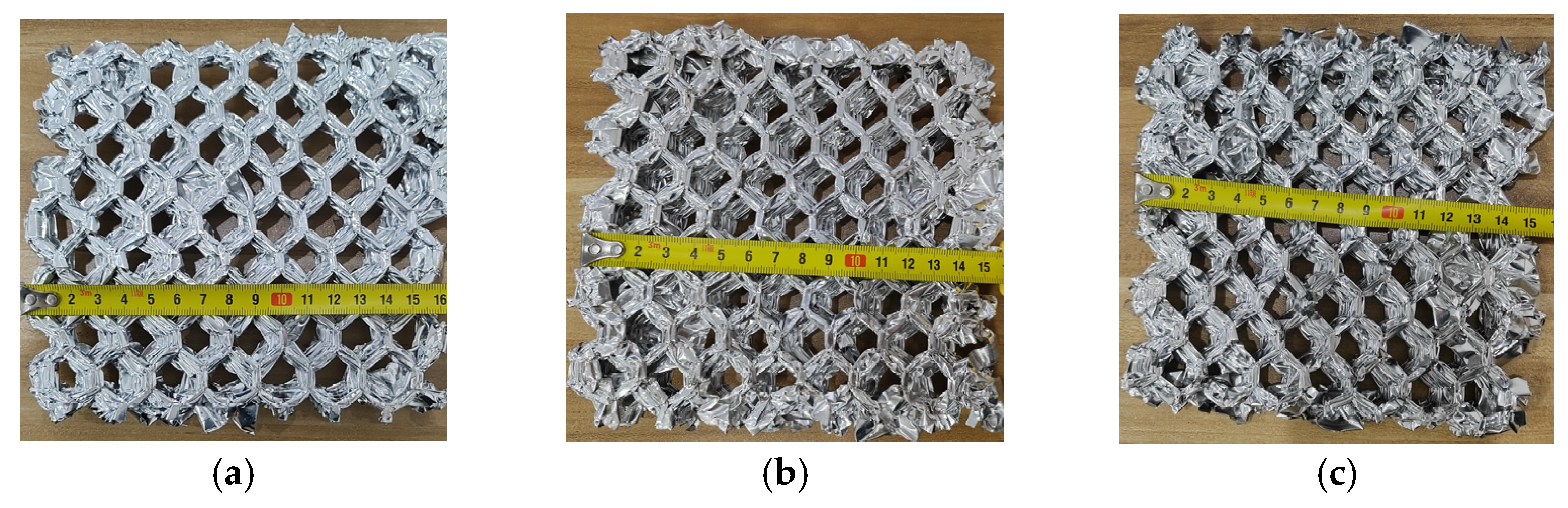
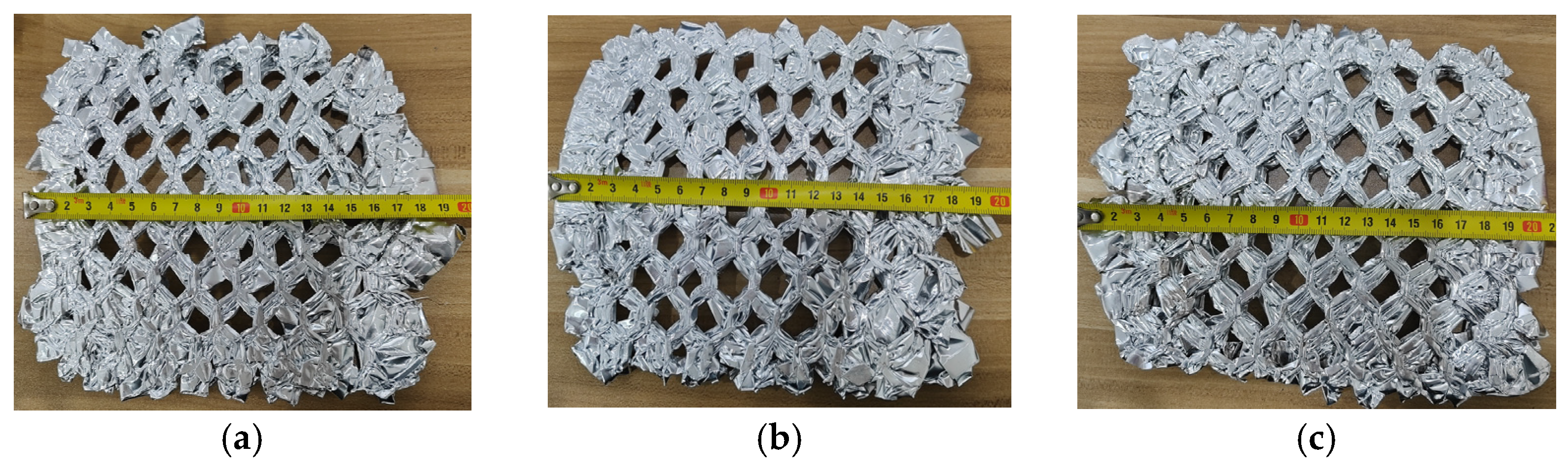
Figure 5 and Figure 6 show the honeycomb structures after all six drop hammer impact tests, revealing clear differences in the final morphologies between the two conditions. Figure 5a–c show that the post-impact cross-sectional area of the HE specimens remains nearly unchanged, with deformation confined within the original cross-section. In contrast, the cross-sectional area of the honeycomb increases after compression in water. As Figure 6a–c illustrate, the HW structure expanded by approximately one-third in the w-direction (perpendicular to the sheet direction) after impact, whereas expansion in the L-direction (parallel to the bonding direction of the honeycomb core walls) remained relatively limited. This behavior arises because commercial aluminum honeycombs have the lowest compressive strength in the w-direction.

4. Discussion

4.1. Analysis of the Dynamic Impact Response of Honeycomb Structures in Water

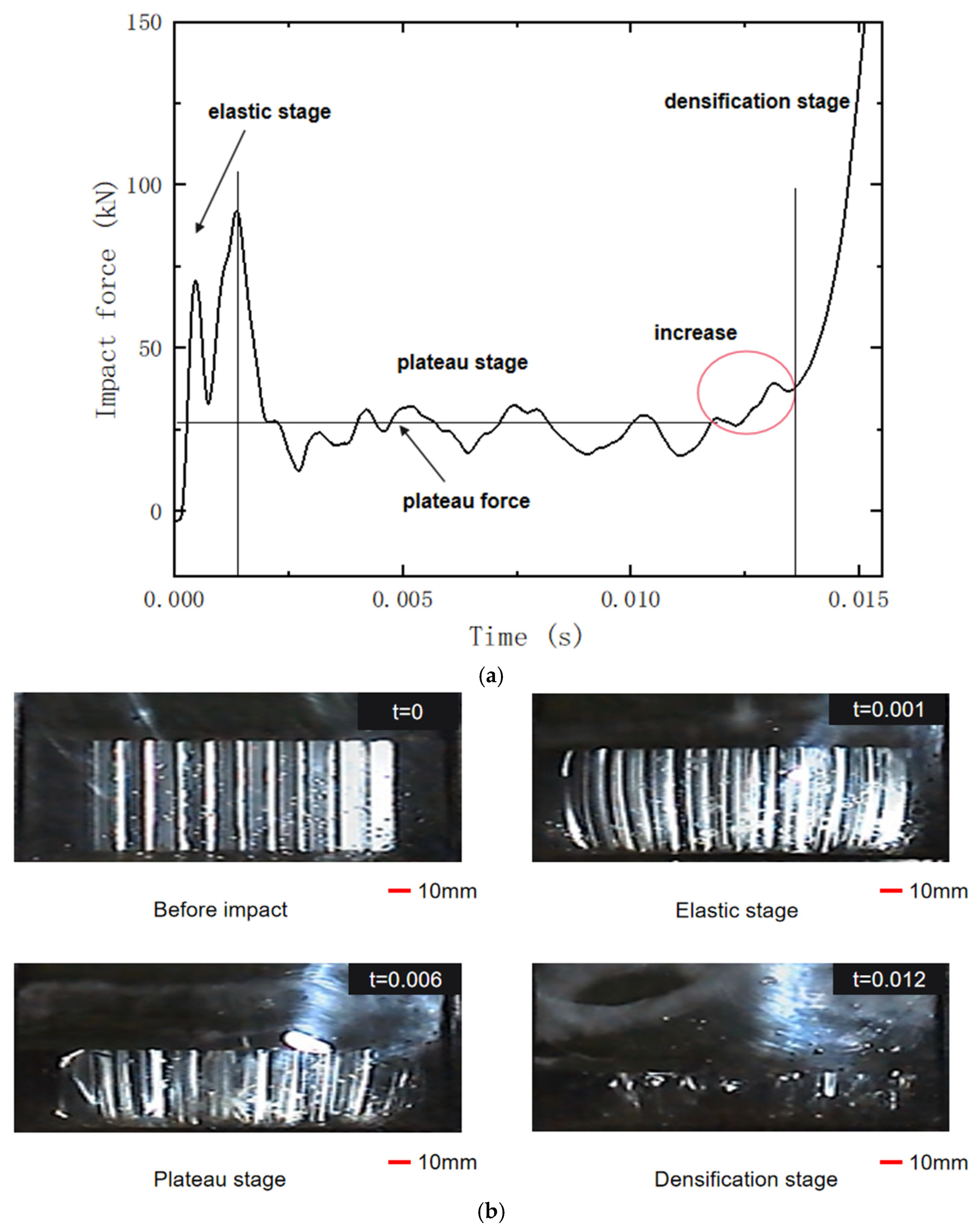
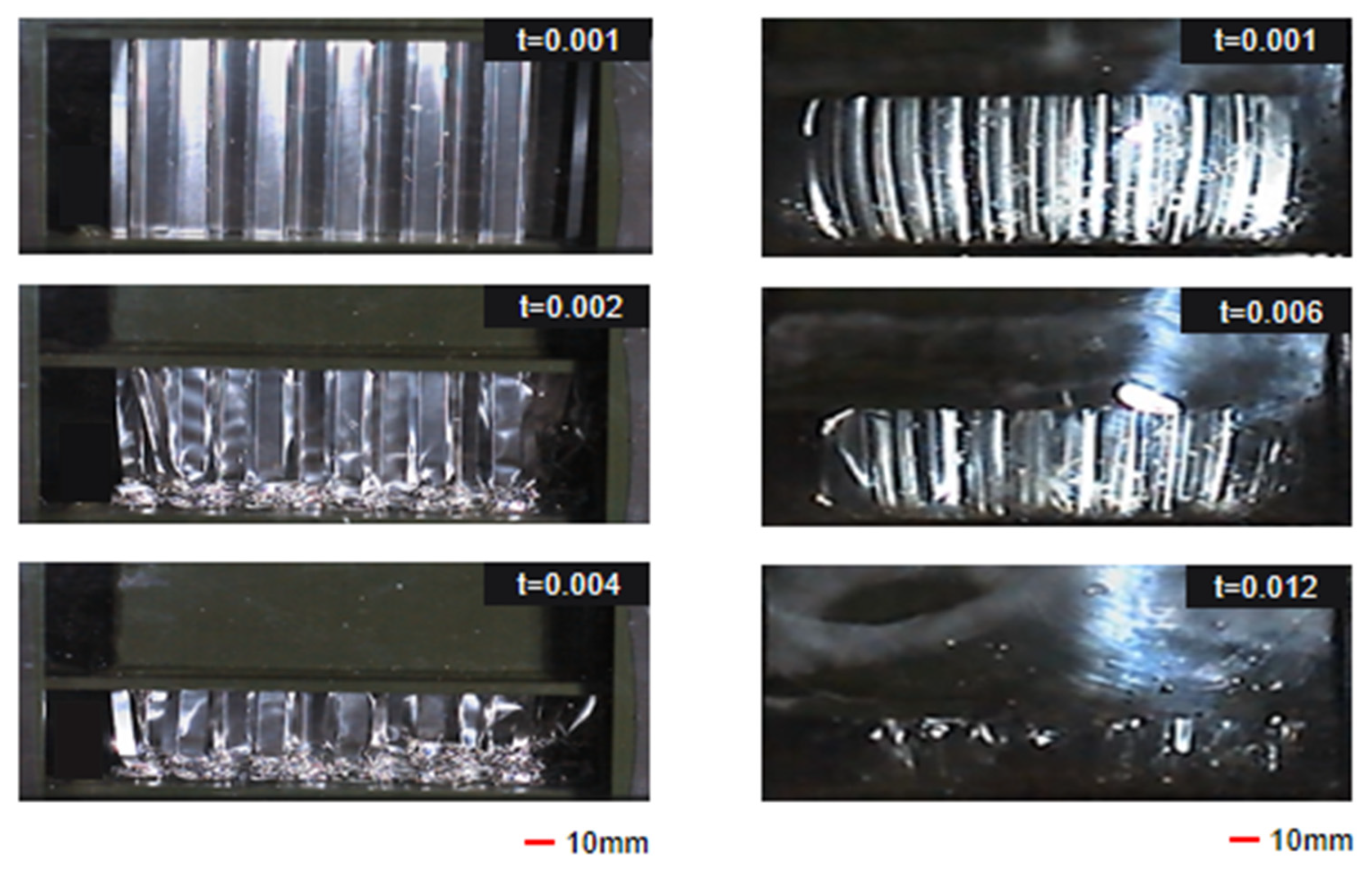
Figure 7a presents the time history of the load response for the HW under drop hammer impact. As shown, the force–time curve exhibits characteristics similar to those observed in air (HE), featuring the three classical stages of honeycomb crushing deformation: the linear elastic stage, the plateau stage, and the densification stage. During the linear elastic stage, we observe a secondary force peak, which likely results from the combined effects of hydrodynamic resistance and surface tension during compression, transiently increasing the impact force. Pronounced fluctuations occur during the plateau stage. Due to limitations in the experimental setup, the FSI device was not large enough; these oscillations likely arise from stress wave propagation and high-frequency noise generated by the impact event. As the response transitions from the plateau stage to the densification stage, the impact force increases slightly, which we attribute to the rise in water pressure. Previous drop hammer studies of honeycomb structures that consider the influence of surrounding air have reported similar trends [30,35]. Figure 7b shows the impact response of the HW at different stages, captured by high-speed photography and corresponding to the stages marked in Figure 7a. Notably, significant lateral expansion occurs during the collapse of the HW, which explains the cross-sectional expansion discussed in Section 3.

4.2. Comparison Between the Energy Absorption of Empty Honeycomb and Honeycomb Structures in Water

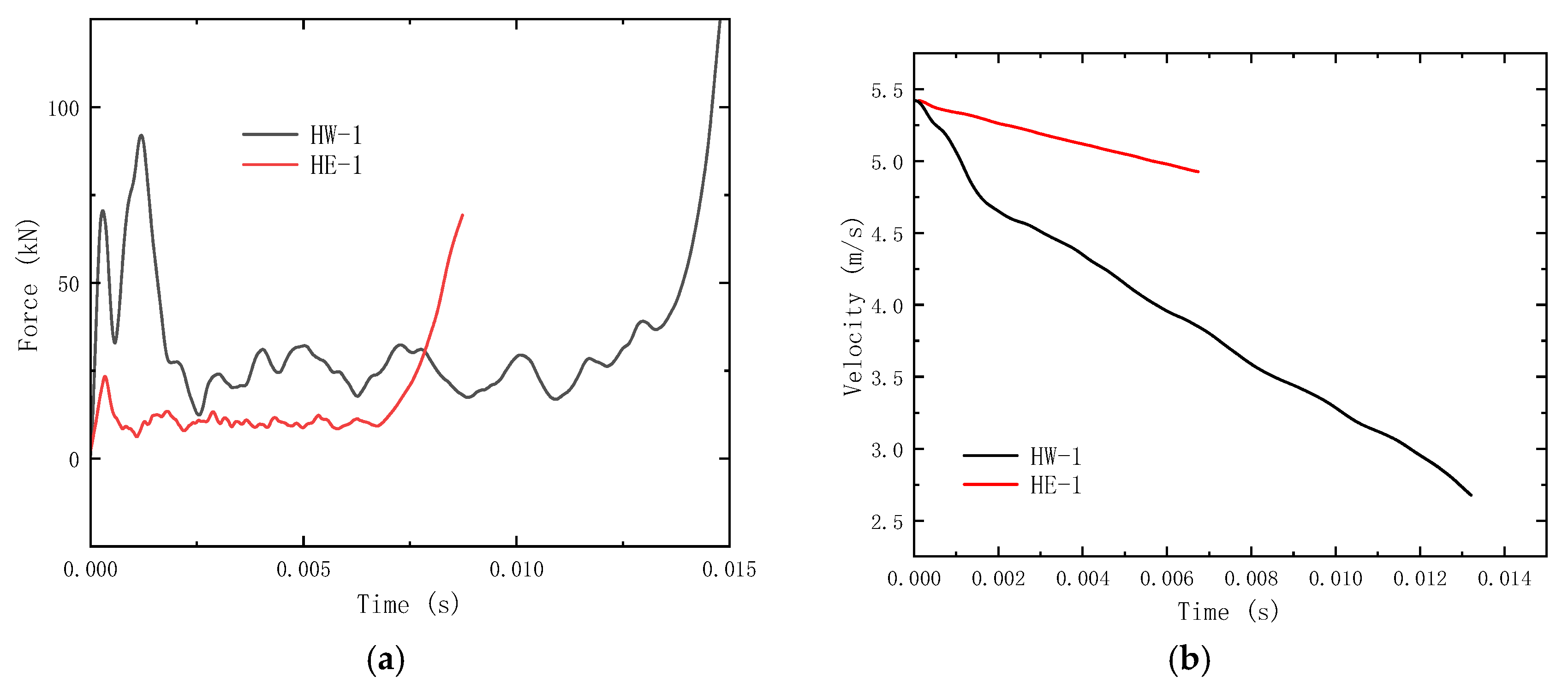
Figure 8a depicts the impact force curves for HE and HW. The impact force–time curve of the HE aligns well with expected results. In contrast, the mean crushing force of the HW reaches approximately 2.5 times that of the HE, and the crushing duration is also longer. This behavior is consistent with the generation of internal water pressure against the cell walls, which induces an expansion effect and appears to increase the resistance to deformation.
Furthermore, the impact force sustained by the HW remains relatively stable during the plateau stage and increases slightly prior to densification. This behavior likely results from incomplete drainage of water during the later stages of compression, suggesting a progressive rise in internal water pressure that could enhance the mechanical resistance.
To quantify energy absorption, we integrated the force–time curve up to densification to determine the impulse and subsequent momentum change of the hammer. Based on this result, we calculated the time history of the hammer’s velocity. Figure 8b presents the corresponding velocity–time curves. The results indicate that the HW exhibits a higher load-bearing capacity, which corresponds to a more rapid reduction in hammer velocity. In contrast, the honeycomb tested in air shows a lower peak force and shorter impact duration; the nearly constant slope of the velocity–time curve suggests a relatively stable energy absorption process. For the HW, the significantly higher peak force and longer impact duration produce a sharp initial decrease in hammer velocity followed by a more gradual reduction, indicating a nonuniform energy absorption process.
Energy absorption (EA), mean crushing force ( F m ), peak force, crushing force efficiency (CFE), and fluctuation degree ( w ) are commonly used to evaluate the mechanical performance of a crushable structure.
It should be noted that the energy absorption (EA) defined here represents the total energy dissipated by the coupled fluid–structure system during the impact event, including the plastic deformation of honeycomb, the kinetic energy imparted to the water, and viscous dissipation.
In this study, these indicators are collectively employed to assess and compare the dynamic responses of honeycombs subjected to impact loading in both air and water environments.
The energy absorption is calculated from the change in kinetic energy of the falling hammer, as expressed by the following equation:
E A = 1 2 m v 1 2 1 2 m v 2 2
The mean crushing force ( F m ) represents the average force during the plateau stage, and the crushing force efficiency (CFE) is defined as the ratio of the F m to the peak force.
C F E = F m F m a x
The fluctuation degree is used to evaluate the stability of the energy absorption process of the honeycomb structure, and its calculation is given by the following expression:
w = F 1 F 2 F m
Here, F 1 denotes the peak force during the plateau stage, and F 2 denotes the minimum (valley) force during the same stage.
Table 4 summarizes the mean values, standard deviations, and coefficients of variation for crushing performance evaluation indices. The relatively low coefficients of variation indicate good repeatability of the experiments.
The results indicate that under identical geometric specifications, the honeycomb structure in water exhibits a 333% increase in energy absorption compared to that in air. This enhancement primarily arises from its higher mean crushing force and prolonged crushing duration. However, the peak force in water is approximately 3.8 times that in air, while the crushing force efficiency decreases to 61% of the air value, and the fluctuation degree increases by 50%. These findings indicate that despite its superior energy absorption capacity, the energy absorption process of the honeycomb structure in water is less stable than that in air.
The pronounced initial peak observed in HW specimens (nearly four times that of HE) warrants discussion from a crashworthiness perspective. In protective applications, high initial peaks are generally undesirable because they transmit large decelerations to the protected object, potentially damaging sensitive components. Conversely, for one-time impact barriers where maximum energy dissipation is the sole objective, the higher initial force may be acceptable. This highlights the importance of application-specific design optimization.

4.3. Analysis of the Impact Energy Absorption Mechanism of Honeycomb Structures in Water

The deformation mechanism of the honeycomb in water also differs markedly from that in air. Figure 9 compares the honeycomb deformation sequence in air versus water. The HE specimen undergoes primarily axial compression, and its failure mode is characterized by progressive folding. In contrast, under the combined action of internal fluid pressure and axial force, the internal cells of the HW specimen undergo axial folding, while the external cells expand and deform, forming a coupled failure mode that combines axial folding with circumferential stretching. Zhao et al. [36] also demonstrated this phenomenon in their research.
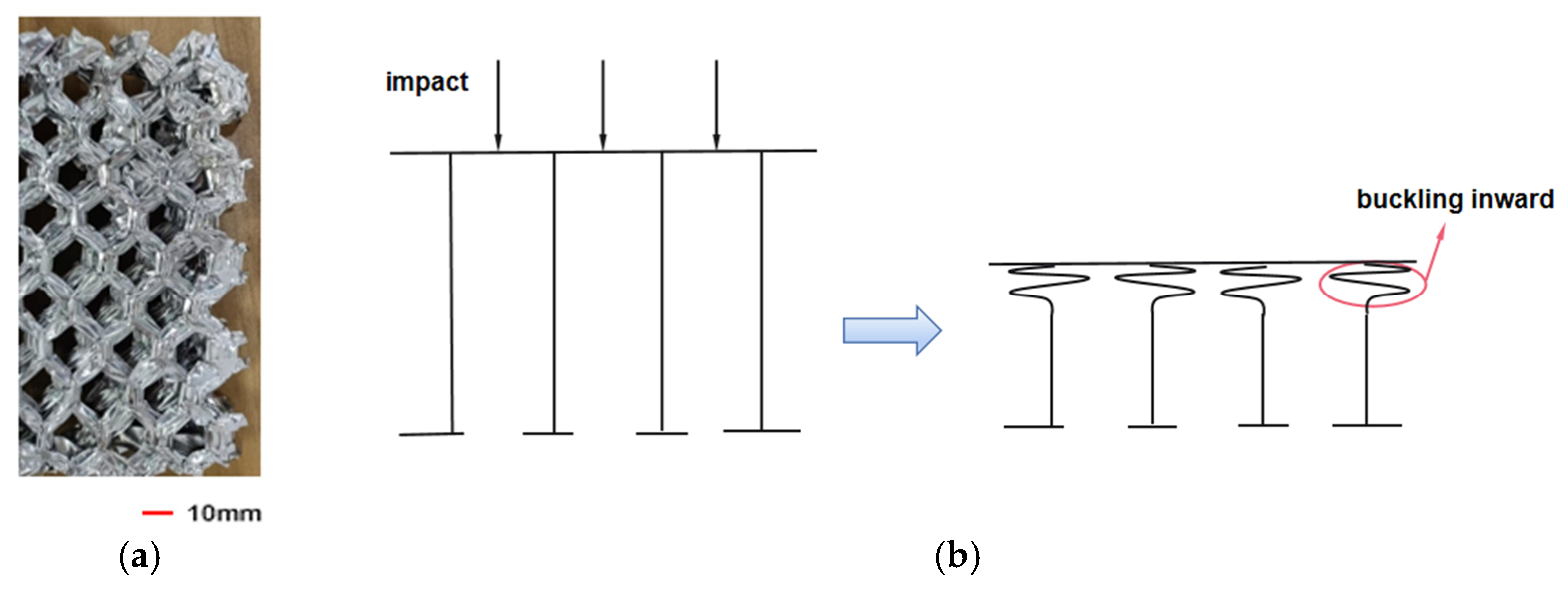
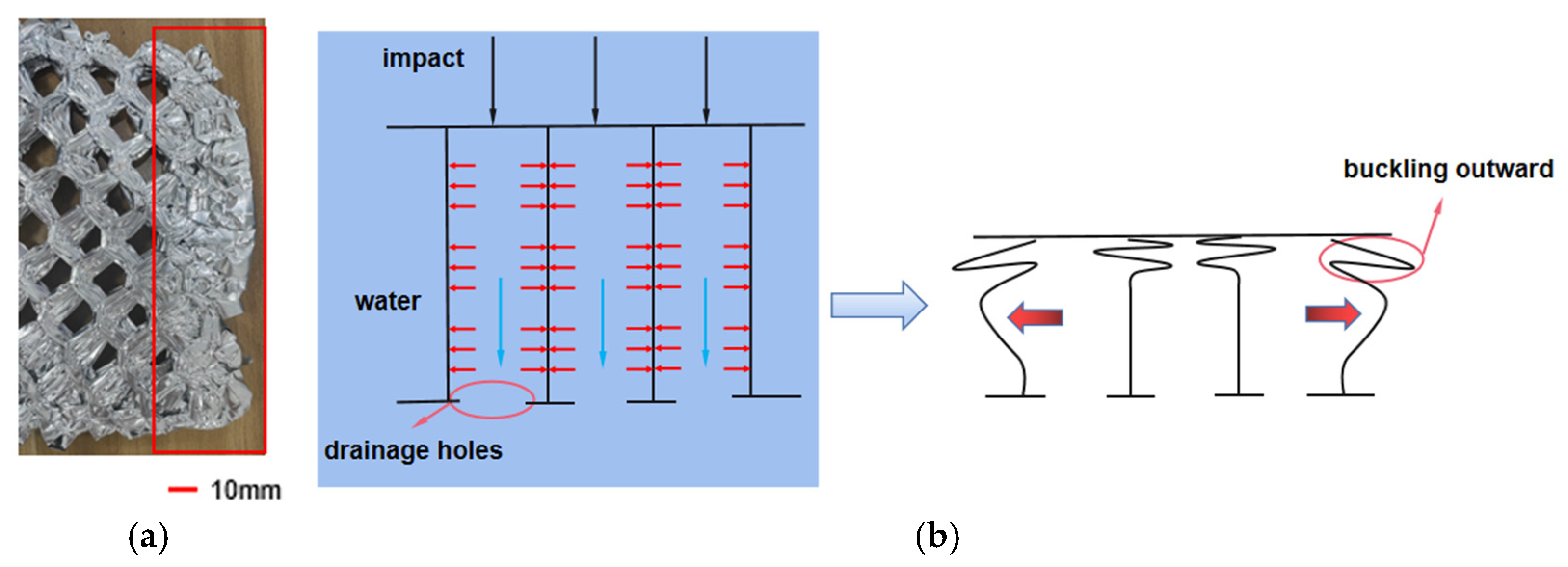
Figure 10 and Figure 11 show, respectively, the deformation diagrams of the HE and HW specimens. Vertical downward black arrows indicate the direction of out-of-plane impact load. Red circles specifically indicate the buckling mode observed in the honeycomb wall.
The red rectangular area in Figure 11a represents the outward expansion section of HW (scale bar: 10 mm). Figure 11b illustrates the progressive buckling process of HW under impact loading and the associated fluid-structure interaction effects. During impact, the contained water is expelled downward and outward through drainage holes at the bottom of the cell walls (highlighted by the red ellipse), with the flow direction indicated by the vertical blue arrows. Simultaneously, the water generates significant lateral pressure, a phenomenon represented by the horizontal bidirectional red arrows, which causes the cell walls to bulge outward. This internal hydraulic support leads to a distinct outward protrusion buckling mode, specifically circled in red on the rightmost wall. This convex plastic deformation is a key characteristic of HW, contrasting sharply with the inward buckling typically observed in HE.
For HE specimens, the folding wavelength is relatively uniform and consistent with classical progressive buckling. For HW specimens, the folding pattern is less regular, with a tendency toward longer wavelengths. This suggests that the internal water pressure may partially stabilize the cell walls against buckling, potentially promoting a more global deformation mode. The water appears to have a dual effect: It may stabilize the collapse by providing lateral support through hydrostatic pressure, preventing premature Euler buckling of individual cell walls. It may also introduce destabilizing fluctuations due to the unsteady nature of water ejection, causing the force oscillations observed in Figure 4b. Overall, the deformation remains progressive rather than total collapse, indicating a net stabilizing influence.
While a rigorous quantitative decomposition of the fluid-related forces is beyond the scope of the present experimental setup, the following discussion offers a qualitative interpretation of the observed phenomena based on the deformation characteristics and force histories. This interpretation is intended to guide future, more targeted investigations rather than to assert definitive mechanistic conclusions.
Under impact in the air, the load is borne entirely by the honeycomb cell walls. In contrast, in water, the measured impact force is interpreted as the combined effect of the structural crushing resistance and hydrodynamic pressure. In this case, the fluid pressure generated during cell wall bending is likely to contribute a substantial portion of the total impact force.
To better understand the origin of force enhancement in water, we consider a simplified decomposition of the total resistance:
F t o t a l = F s t r u c t u r e +   F f l u i d
Here, F s t r u c t u r e represents the intrinsic crushing force of the honeycomb. The fluid contribution may comprise three components: inertial resistance due to added mass, viscous drag from water flow through drainage holes, and hydrostatic pressure buildup within confined cells.
The energy absorption of a honeycomb structure during compression in water may be influenced by several coupled mechanisms. First, the water confined within the honeycomb is believed to exert outward pressure on the cell walls, potentially generating circumferential tensile stresses. This effect may cause the outer cells to bulge outward during collapse, while the resulting circumferential membrane forces restrain the enclosed water and allow it to sustain high pressure. Consequently, a greater amount of energy is required for collapse compared with deformation in air. Second, during the crushing process, the surrounding water is forced to move with the deforming structure. The internal water is expelled through the drainage holes, which may convert a portion of the impact energy into kinetic energy of the fluid. In addition, as the water flows along the honeycomb surfaces, viscous shear layers are likely generated, potentially contributing to further dissipation of fluid kinetic energy as heat.

5. Conclusions

This experimental study investigated the dynamic impact response and energy absorption mechanisms of aluminum honeycomb structures in both air and fully submerged water environments.
The following conclusions can be drawn:
  • The presence of water fundamentally alters the crushing behavior of honeycomb structures. Compared to in-air performance, the mean crushing force increases by 156.5%, and the total energy absorption increases by 333% under identical impact conditions. This enhancement is consistent with coupled fluid–structure interaction mechanisms, such as added mass effects, viscous dissipation during water ejection through drainage holes, and hydrostatic pressure buildup within confined cells. The relative contributions of these mechanisms, however, remain to be quantified in future work.
  • The deformation mode shifts from pure progressive folding in air to a coupled mode combining axial folding with circumferential expansion in water. High-speed photography reveals that water-filled cells exhibit significant lateral expansion (approximately 30% in the w-direction) and longer effective buckling wavelengths, suggesting that internal fluid pressure may partially stabilize cell walls against short-wavelength buckling.
  • While underwater conditions dramatically enhance energy absorption, they also introduce trade-offs. The peak force increases by approximately 280%, reducing the crushing force efficiency from 0.436 (HE) to 0.268 (HW). The pronounced initial peak, which is plausibly associated with fluid inertia, may be detrimental in applications requiring low deceleration but acceptable for sacrificial energy absorbers.
  • The strategically placed drainage holes proved essential for maintaining progressive deformation by preventing hydraulic locking. Without adequate drainage, the near-incompressibility of water would cause premature cell wall fracture and catastrophic failure.
These findings demonstrate the potential of perforated honeycomb structures for underwater impact protection applications in marine engineering while highlighting the need for application-specific optimization to balance energy absorption against peak force transmission.
This study has several limitations. Tests employed a single impact velocity (5.4 m/s), water depth (100 mm), and honeycomb configuration. Internal cell pressures were not measured, preventing the quantification of individual fluid interaction mechanisms. To address these points, future work should develop coupled Eulerian–Lagrangian (CEL) models to capture fluid–structure interaction and drainage effects; conduct systematic parametric studies on impact velocity, water depth, opening ratio, and cell size; integrate dynamic pressure sensors into experimental setups for model validation; and establish multi-objective optimization frameworks for marine engineering applications.

Author Contributions

Conceptualization, S.Y. and J.W.; methodology, K.L. and J.W.; software, J.W. and Y.W.; validation, J.W., and S.Y.; formal analysis, J.W.; investigation, K.L. and F.C.; resources, S.Y.; data curation, J.W. and H.Z.; writing—original draft preparation, J.W.; writing—review and editing, S.Y., J.W. and E.H.; visualization, J.W.; supervision, S.Y. and E.H.; project administration, J.W.; funding acquisition, S.Y. and K.L. All authors have read and agreed to the published version of the manuscript.

Funding

This research was funded by the Science and Technology Innovation Plan of Hunan Province (No. 2023RC3045) and the Hunan Provincial Natural Science Foundation of China (2023JJ40734).

Institutional Review Board Statement

Not applicable.

Informed Consent Statement

Not applicable.

Data Availability Statement

The raw data supporting the conclusions of this article will be made available by the authors upon request.

Conflicts of Interest

The authors declare no conflict of interest.

References

  1. Mohammadi, H.; Ahmad, Z.; Petrů, M.; Mazlan, S.A.; Faizal Johari, M.A.; Hatami, H.; Koloor, S.S.R. An insight from nature: Honeycomb pattern in advanced structural design for impact energy absorption. J. Mater. Res. Technol. 2023, 22, 2862–2887. [Google Scholar] [CrossRef]
  2. Li, R.; Zhao, Z.; Bao, H.; Pan, Y.; Wang, G.; Liu, B.; Liao, T.; Li, J. Bio-inspired honeycomb structures to improve the crashworthiness of a battery-pack system. Eng. Fail. Anal. 2024, 158, 108041. [Google Scholar] [CrossRef]
  3. Zhang, Q.; Yang, X.; Li, P.; Huang, G.; Feng, S.; Shen, C.; Han, B.; Zhang, X.; Jin, F.; Xu, F.; et al. Bioinspired engineering of honeycomb structure—Using nature to inspire human innovation. Prog. Mater. Sci. 2015, 74, 332–400. [Google Scholar] [CrossRef]
  4. Hameed, H.M.; Hasan, H.M. Exploring honeycomb structures: A review of their types, general applications, and role in vibration damping and structural stability. Structures 2025, 76, 108837. [Google Scholar] [CrossRef]
  5. Xing, Y.; Yang, X.; Yang, J.; Sun, Y. A theoretical model of honeycomb material arresting system for aircrafts. Appl. Math. Model. 2017, 48, 316–337. [Google Scholar] [CrossRef]
  6. Tan, Y.; Zhou, Y. Improved crashworthiness of sandwich wing structures by using negative Poisson’s ratio honeycomb cores. Thin-Walled Struct. 2025, 213, 113223. [Google Scholar] [CrossRef]
  7. Paz, J. Size and shape optimization of aluminum tubes with GFRP honeycomb reinforcements for crashworthy aircraft structures. Compos. Struct. 2015, 133, 499–507. [Google Scholar] [CrossRef]
  8. Jia, B.; Liang, Z.; Yu, X.; Zhang, S. Crash performance study of a novel re-entrant hexagonal honeycomb composite guardrail on highways using numerical simulation. Compos. Struct. 2025, 374, 119717. [Google Scholar] [CrossRef]
  9. Mueller, B.C.; Arbelaez, R.A. Developing an aluminum honeycomb barrier to represent a striking SUV in a side impact crash test. Traffic Inj. Prev. 2021, 22, 582–587. [Google Scholar] [CrossRef]
  10. Vu, V.T.; Tran, T.T. Dynamic response of honeycomb core sandwich plates assuming sinusoidal top face sheet subjected to half-car moving load resting on elastic foundation. Thin-Walled Struct. 2026, 221, 114486. [Google Scholar] [CrossRef]
  11. Mackin, A.; Hanoun, Z.; Migliorino, J.; Ahmed, A.M.A.; Mantawy, I.M. Multi-functional additively constructed honeycomb walls for housing and sheltering. Constr. Build. Mater. 2024, 452, 138941. [Google Scholar] [CrossRef]
  12. Xiang, L.; He, C.; Pei, Z.; Chen, T.; Jiang, J.; Chen, Z.; Yu, Y. Multi-scale synergistic flame-retardant composite aerogel with low thermal conductivity and mechanical robustness for passive fire protection in high-rise buildings. Constr. Build. Mater. 2025, 494, 143345. [Google Scholar] [CrossRef]
  13. Türkcan İmrağ, B.; Taşdemirci, A.; Gürler, Y. On the quasi-static and dynamic compressive behavior of paper honeycomb: Experimental and numerical study. Int. J. Impact Eng. 2025, 206, 105469. [Google Scholar] [CrossRef]
  14. Li, Z.; Zhu, Y.; Yang, K. Modular metamaterials with strong auxeticity, tunability and crashworthiness. Int. J. Solids Struct. 2025, 321, 113577. [Google Scholar] [CrossRef]
  15. Qu, Y.; Chen, J.; Jiao, L.; Ye, T.; Hu, X. Experiment and finite element analysis of protective honeycombs based on equivalent method for ocean engineering under impact loading. Compos. Struct. 2024, 331, 117858. [Google Scholar] [CrossRef]
  16. Chen, J.; Qu, Y.; Poh, L.H.; Hu, P.; Sun, Z. Mechanical properties of cylindrical honeycomb buffers in the scour protection for sea-spanning bridges under impact loading. Ocean. Eng. 2026, 345, 123795. [Google Scholar] [CrossRef]
  17. Wang, Z.; Yang, S.; Yang, L.; Xu, W.; Dong, Y.; Li, D.; Qu, J.; Wu, L. Experimental and numerical studies on the effect of sandwich structures on the dynamic response of ship sections subjected to underwater explosions. Thin-Walled Struct. 2026, 218, 113969. [Google Scholar] [CrossRef]
  18. Zhang, X.; Sun, S.; Kang, X.; Huang, Z.; Li, Y. Dynamic Response and Energy Absorption of Lattice Sandwich Composite Structures Under Underwater Explosive Load. Materials 2025, 18, 1317. [Google Scholar] [CrossRef] [PubMed]
  19. Huang, W.; Zhang, W.; Li, D.; Ye, N.; Xie, W.; Ren, P. Dynamic failure of honeycomb-core sandwich structures subjected to underwater impulsive loads. Eur. J. Mech.-A/Solids 2016, 60, 39–51. [Google Scholar] [CrossRef]
  20. Xiang, D.-L.; Rong, J.-L.; He, X. Experimental Investigation of Dynamic Response and Deformation of Aluminium Honeycomb Sandwich Panels Subjected to Underwater Impulsive Loads. Shock Vib. 2015, 2015, 650167. [Google Scholar] [CrossRef]
  21. Dutta, A.; Das, A.; Pal, S.K.; Panda, S.K. Evaluation of structural defects on crushing performance of adhesive-bonded aluminium honeycombs: Alternative fabrication strategy and real-time defect monitoring. Compos. Struct. 2026, 379, 119940. [Google Scholar] [CrossRef]
  22. Ardebili, A.; Kaveh, A.; Alaei, M.H.; Eskandari Jam, J.; Jafari, M. Health monitoring of the composite honeycomb insulation panels using thermographic image processing. Nondestruct. Test. Eval. 2025, 40, 4619–4637. [Google Scholar] [CrossRef]
  23. Campbell, F.C. Honeycomb Core Can Be Dangerous to Your Program’s Health. Corros. Rev. 2007, 25, 13–25. [Google Scholar] [CrossRef]
  24. Hungler, P.C.; Bennett, L.G.I.; Lewis, W.J.; Schulz, M.; Schillinger, B. Neutron imaging inspections of composite honeycomb adhesive bonds. Nucl. Instrum. Methods Phys. Res. Sect. A Accel. Spectrometers Detect. Assoc. Equip. 2011, 651, 250–252. [Google Scholar] [CrossRef]
  25. Javier, C.; Kishore, S.; Senol, K.; Shukla, A. Energy balance of rapidly deforming foam filled cylindrical shells in a high pressure fluid environment. Phys. Fluids 2021, 33, 097107. [Google Scholar] [CrossRef]
  26. Wierzbicki, T. Crushing analysis of metal honeycombs. Int. J. Impact Eng. 1983, 1, 157–174. [Google Scholar] [CrossRef]
  27. Hu, Q.; Lu, G.; Hameed, N.; Tse, K.M. Dynamic compressive behaviour of shear thickening fluid-filled honeycomb. Int. J. Mech. Sci. 2022, 229, 107493. [Google Scholar] [CrossRef]
  28. Yi, C.; Shi, D.; Li, S.; Liu, Z.; Lei, J. Low-velocity impact response of shear thickening fluid-filled honeycomb sandwich panel with thin face sheets. Thin-Walled Struct. 2026, 219, 114162. [Google Scholar] [CrossRef]
  29. Lu, G.Y.; Han, Z.J.; Lei, J.P.; Zhang, S.Y. A study on the impact response of liquid-filled cylindrical shells. Thin-Walled Struct. 2009, 47, 1557–1566. [Google Scholar] [CrossRef]
  30. Sun, Y.; Li, Q.M. Effect of entrapped gas on the dynamic compressive behaviour of cellular solids. Int. J. Solids Struct. 2015, 63, 50–67. [Google Scholar] [CrossRef]
  31. Yan, L.; Zhu, K.; Zhang, Y.; Zhang, C.; Zheng, X. Effect of Absorbent Foam Filling on Mechanical Behaviors of 3D-Printed Honeycombs. Polymers 2020, 12, 2059. [Google Scholar] [CrossRef] [PubMed]
  32. Mozafari, H.; Molatefi, H.; Crupi, V.; Epasto, G.; Guglielmino, E. In plane compressive response and crushing of foam filled aluminum honeycombs. J. Compos. Mater. 2015, 49, 3215–3228. [Google Scholar] [CrossRef]
  33. Zarei Mahmoudabadi, M.; Sadighi, M. A study on the static and dynamic loading of the foam filled metal hexagonal honeycomb—Theoretical and experimental. Mater. Sci. Eng. A 2011, 530, 333–343. [Google Scholar] [CrossRef]
  34. Wang, Z.; Li, Z.; Zhou, W.; Hui, D. On the influence of structural defects for honeycomb structure. Compos. Part B Eng. 2018, 142, 183–192. [Google Scholar] [CrossRef]
  35. Yamashita, M.; Gotoh, M. Impact behavior of honeycomb structures with various cell specifications—Numerical simulation and experiment. Int. J. Impact Eng. 2005, 32, 618–630. [Google Scholar] [CrossRef]
  36. Zhao, Z.; Hou, H.; Li, D.; Wang, K.; Yao, M. In-plane dynamic mechanical properties of partially liquid filled multicell structure. Explos. Shock Waves 2022, 42, 033103. [Google Scholar]
Figure 1. An example of a regular hexagonal bare honeycomb core structure: edge length: 10.9 mm; foil thickness: 0.075 mm.
Applsci 16 03180 g001
Figure 2. Schematic diagram of the fluid–structure interaction (FSI) experimental fixture: (a) geometric model; (b) internal schematic diagram.
Applsci 16 03180 g002
Figure 3. Drop hammer test setup: (a) schematic diagram of the drop hammer test; (b) drop hammer test platform.
Applsci 16 03180 g003
Figure 4. Drop hammer impact test results at a velocity of 5.4 m/s: (a) force–time curves for HE; (b) load–time curves for HW.
Applsci 16 03180 g004
Figure 5. Post-impact of empty honeycomb. (a) HE-1; (b) HE-2; (c) HE-3.
Applsci 16 03180 g005
Figure 6. Post-impact of underwater honeycomb: (a) HW-1; (b) HW-2; (c) HW-3.
Applsci 16 03180 g006
Figure 7. Impact force–time curves and dynamic impact response of HW-1: (a) impact force–time curves; (b) dynamic impact response diagram.
Applsci 16 03180 g007
Figure 8. Impact process drop hammer speed and crushing force curve: (a) force–time curves; (b) drop hammer velocity.
Applsci 16 03180 g008
Figure 9. Comparison of the deformation sequence in air vs. water.
Applsci 16 03180 g009
Figure 10. The buckling pattern of HE: (a) post-buckling of HE; (b) deformation diagrams of HE.
Applsci 16 03180 g010
Figure 11. The buckling pattern of HW: (a) post-buckling of HW; (b) deformation diagrams of HW.
Applsci 16 03180 g011
Table 1. Chemical composition of 5052 aluminum alloy.
AlSiFeCuMnMgCrZnNaTi
Bar.0.1190.2420.0150.0462.4410.1760.0210.00010.018
Table 2. Material properties of AL-5052-H18.
Young’s Module (GPa)Density (kg/m3)Poisson’s RatioYield Stress (MPa)
69.326800.33215
Table 3. Test conditions.
CaseMass
(kg)
Height
(m)
Honeycomb Wall Thickness (mm)Honeycomb
Thickness (mm)
Filled-Water
HE2001.50.07550
HW2001.50.07550
Table 4. The results of HE and HW analysis with statistical scattering (mean ± SD (CV%).
Case E A (J)Peak Force
(kN)
Mean Crushing Force (kN)CFE w SEA (J/g)
HE513.3 ± 10.34
(2.1%)
21.6 ± 2.17
(10.1%)
9.98 ± 0.367
(3.7%)
0.436 ± 0.0087
(1.9%)
0.71 ± 0.0227
(3.2%)
7.89 ± 0.205
(2.6%)
HW2224.1 ± 133.46
(6.2%)
81.5 ± 12.26
(15%)
25.6 ± 1.289
(5.1%)
0.268 ± 0.014
(4.6%)
1.07 + 0.057
(5.3%)
0.96 + 0.042
(4.4%)
Disclaimer/Publisher’s Note: The statements, opinions and data contained in all publications are solely those of the individual author(s) and contributor(s) and not of MDPI and/or the editor(s). MDPI and/or the editor(s) disclaim responsibility for any injury to people or property resulting from any ideas, methods, instructions or products referred to in the content.